| AFS LETTERS |
XXXX |
Edited and published at AFS Headquarters, 60 Beaver Street, New York 4, N.Y. under the sponsorship of the ambulanciers' relatives and friends, who contribute the excerpts from the letters.
(Editor's note)., Frederick W. Hoeing, Lt. Col. AFS, was C.O. of the ambulance units in Italy and Germany. On his return we asked him to tell you something of what his AFS service has meant. His story follows:
"Here's a few facts on the subject concerned. The name is Frederick Walbridge Hoeing. I was born in Rochester, New York on November 7, 1907. I graduated from Amherst in 1929 and then did graduate work in European history at Harvard, receiving my M.A. in 1930. I taught Freshman history at Harvard living- in the yard and acting also as freshman proctor and adviser from 1931 to 1937 (with the exception of the academic year 1935-6 when I had a travelling fellowship in Europe). Then I was instructor in European history at the College of William and Mary from 1937-40.
"My last year there was the first year of this war. I felt rather strongly on the subject, and wanted to get involved in it as soon as possible. On top of that. I had probably made something of an ass out of myself by repeating from the lecture platform the best dope and the best prognostications I could get by carefully studying the reports of the military experts etc. You may remember that they were completely wrong with an astounding consistency nearly all of that time. So it seemed better to try to do something rather than to continue to give out rather dubious information. At the end of the college year in June of 1940 I dashed to New York rather immaturely determined to give my all. The first place I went was to the office of the AFS which I had heard about from friends and had recently read about in the NEW YORKER, etc. I didn't get to first base, in fact I didn't get beyond the door of the office as France was just finishing collapsing, the scene was somewhat hectic with parents and friends of those who had already gone over and whose fate was, uncertain at that time, and the AFS was not even thinking of accepting any more applications just then.
"However, about a year later I was accepted and sailed in Unit I to the British in Syria. I've been thru the desert, across to Italy and finally into Germany with the B.L.A. The chronological story of this time in the 'ambulance business', is too long for this space.
"The AFS is an anachronism. That is perfectly obvious to anyone who has had any experience in this total war. It represents a volunteer spirit, an individual desire for action and accomplishment that seems to have largely, and probably necessarily, disappeared elsewhere. Disappeared is not the right word, but this personal enthusiasm has had to be cancelled in different directions and has had to be rigidly controlled, in the fighting of this total war. I think it is tragic that there has been this change, but of course the same type of change has taken place in other sides of our civilization. When I say the AFS is an anachronism I don't mean that it has not been worthwhile. I think it has been tremendously worthwhile, not to mention successful. In short it is a successful and worthwhile anachronism. Adequate development of that theme would take the next six hours; I spare you.
"The AFS is an amateur organization. It is amateur in that it is not really paid, and it is amateur in that it does not have the long training, and the careful orientation and regimentation that the professionals have. The fact that we are amateurs has colored the whole life and work of the organization. We are primarily a group of friends cooperating for a common. aim. The whole problem of officers has been made a fascinating one. You must have people to give organization and leaderships and to take responsibility particularly in times of crisis but in the AFS they have considerable domestic responsibilities superimposed on the ordinary problems of running a military unit. People who might be very successful as regular army officers might be complete failures in the same position in the AFS and possibly vice versa. Our whole amateur organization and approach to problems made one thing all along vitally important, and that is that we do at least as good a job as the professional units alongside of which we were serving. And I think in that we were generally successful. I do not know of a single time when the AFS with the British failed in any of its duties of service. It was tremendously interesting to see regular British officers who first greeted us with very polite skepticism come to respect the work of our lads, and finally look forward with enthusiasm to having us work with them. In short we remained an amateur organization, but I think we did manage consistently to do a professional job of work.
"The whole problem of authority and discipline was another fascinating one, and one which added a lot of grey hairs to many of us who had positions of responsibility overseas. We didn't have either of the normal checks. In civilian life, and in most civilian organizations overseas, there is an economic incentive to good work, and economic punishment for failure or misbehavior. You can give the deserving a raise, you can fine or fire the undeserving. This power we really did not have. Fines were most unfair and unsatisfactory, sending men home was a most dubious punishment, particularly as many good men were often anxious to go home. In the army they have regular military discipline with savage punishments, and that is that. But we didn't have the ordinary military discipline, and we were for obvious reasons most reluctant to use the clumsy court-martial power that we did have. This lack of normal disciplinary policy led to constant problems, and to much criticism of the running of the AFS. But the thing that interests me is that the situation never got out of control, and we never had a complete shambles on our hands. That I think, speaks well both for those of the AFS who were responsible for the keeping of order and for running an efficient organization, and to the others, who were faced with great temptations, and who yet in general behaved themselves admirably.
"Extremely trite, but extremely important, was the invaluable work of the AFS in cementing Anglo-American relations. The way we fitted in as units in the regular British Army was really remarkable, And the way Americans and British within our companies got along was ditto. Of course this can be overstated, there was friction at times, but in general I think the results were most hopeful. And they were really outstanding when compared with some of the friction which developed elsewhere. The AFS also did a lot of good, I think, in representing America to other people with whom we came in contact, particularly in Syria, Italy, Belgium, and Holland.
"The main aim in warfare is to kill the enemy. But I think a good deal can be said for a unit whose main aim is the saving of life. Personally I am glad to have served in that way, and I think this, too, had its effect on many of our men, and that they will be much more useful people in the future because of what they have seen, and the humanitarian work they have done."
|
We should like to request of all AFS veterans that they send information about themselves and their postwar plans and jobs to FS LETTERS. We have been told that the readers want this news of each other, We would also greatly appreciate receiving the CORRECT PERMANENT ADDRESSES of all AFS men and other readers, The Editor. |
*
| Thomas Stretton Esten | Stoughton, | Mass. |
| George Oscar Tichenor | Maplewood, | N.J. |
| Stanley Balzei Kulak | Salem | Mass. |
| William Keith McLarty | Berkeley | Calif. |
| John Fletcher Watson | Larchmont | N.Y. |
| Randolph Clay Eaton | Ft. Lauderdale | Fla, |
| John Hopkins Denison, Jr. | Big Horn | Wy. |
| August Alexander Rubel | Piru | Calif. |
| Richard Sterling Stockton, Jr. | Bryn Mawr | Penn. |
| Curtis Charles Rodgers | Highland Park | Ill. |
| Caleb Jones Milne IV | Woodstock | N.Y. |
| Vernon William Preble | Lowell | Mass. |
| Charles James Andrews, Jr. | Norfolk. | Va. |
| Arthur Paisley Foster | Warroad | Miss. |
| Charles Kendrick Adams, Jr | Huntington | W. Va, |
| Henry Larner | Albany | N.Y. |
| Alexander Randall, Jr, | Baltimore | Md. |
| George Edward Brannan | Chicago, | Ill. |
| Robert Carter Bryan | Richmond | Va. |
| Dawson Ellsworth | Milwaukee | Wis. |
| John Dale Cuningham | Brooklyn | N.Y. |
| Donald Joseph Harty | Buffalo | N.Y. |
| Thomas Lees Marshall | Winnetka | Ill. |
| George Alden Ladd | Burlington | Vt. |
| Paul Haynes Cagle | Owensboro | Ky. |
| James Bennett Wilton, Jr. | Peoria | Ill. |
| Ralph Evans Boaz | Omaha | Neb. |
| William Tuttle Orth | New York | N.Y. |
| Bruce Gilette Henderson | Kenmore | N.Y. |
| Albert Studley Miller | Cambridge | Mass. |
| Hilding Swensson | Manasquan, | N.J. |
| Charles Butler Alexander, Jr. | Eccleston | Md. |
| Jack Wells Douthitt | Florence | Ala. |
| Gerald Riley Murphy | Chicago | Ill. |
| John Wilder Parkhurst | Winchester | Mass. |
It has always been those little things, that we did because we wanted to, over and above Ambulance driving, that has made the A.F.S. the only group in forward areas with a "reconstructing" spirit, and more than an Ambulance Service attached to the military. It was the odd assignment, too, that always seemed to be our "lot". with the Poles, the Italians, negroes from Lake Tchad, and occasional individual jobs with military snow schools at Italian skiing resorts. Only the Field Service would have stopped Prince Peter of Greece on the Bengazi Road and suggest that he accept three ambulances for his Long Range Desert Patrol with which he, but not our H.Q. readily agreed. We would have worked with the German Army, if not in theory, actually with equal enthusiasm, and, in fact finally did at Belsen Concentration Camp Over the years the Field Service developed the most personal, international and least understandable of dialects, often heard to combine Arabic, Polish, and New Zealand slang in one sentence. Founded on a gesture of good will it was no coincidence that the AFS received so many Croix-de-Guerres from the French, or that the Poles offered one of our Platoons the Cassino ribbon (later refused us by the British).
But it was in Italy that we came into our own, and while Fred Hoeing always said the "C" was his most humanitarian platoon, and while living with civilian families and courting Italian girls might not be called strictly humanitarian "D" Platoon created more good will for America, in Campobaso than did her illustrious native son, Fiorello LaGuardia. And while it was popular with the military to despise the "Ities", there were always enough of us to keep open Isernia's "milk run" with rations to the Civilian Hospital in the hills to keep patience with a temperamental Mother Superior, --- if only for the rare old wines that the Sisters had hidden from the Germans and never drank.
In Forli, last winter a string quartette was hired and played weekly in a private house to Italians and Field Service. One AFS man conducted the weekly Symphony Concerts at Ravenna. And while the A.M.G. job in Faenza meant a luxurious palazzo beautiful secretaries and dances, it also meant being in charge of Civilian War Relief, resurrecting the destroyed pottery industry, and combating typhoid epidemic. "C" Platoon's Civilian Relief in Lanciano and Pollutri was one of the most far-reaching and generous volunteer projects in Italy, for which George Collins was offered the position of podesta, or local mayor. Our half dozen marriages were considerable for our numbers. Certainly more have been born and died in our Ambulances than any others. I have cited only a few incidents at random as they came to me; there are hundreds more, pet stories of each platoon that must be similar and probably more important.
Finally our assignment at Belsen Concentration Camp came as no surprise.
And we wanted to do these things because the spirit of choice was inherent in our membership. We try and do get away with a lot, but we are also on the job with more resourcefulness and ingenuity than the Army.---with not quite enough variety to confuse. We have been an accent, a flavor, both bewildering and stimulating to the atrophied "Tommy". We do not know the sterile patterns the Army imposes and any attempts at standardization in the AFS have failed miserably. No two ambulances look alike, in fact often don't look like ambulances at all. We wear any and every uniform in the most varied in the world 8th Army. There is a rather silly rivalry between AFSers amounting almost to hostility, but perhaps that is part of individuality too. And to be called "irresponsible prima donnas" and to receive little pay or none are small prices for the privilege of exploring a world at war such as the AFS has offered.
We have come because we wanted to, did what we wanted to, and likewise came home. We have done as much and as little as we wanted to do and we have gotten out of it what was in us to get; certainly the organization did not interfere. There have been many abilities in the AFS and inner directions have been stimulated by mere exposure; others without direction or curiosity have wasted their time, looking for direction from without, or not at all. It is the simple proof of and best guarantee of individual development.
|
Soldiers at heart are these though not in very name, The blast of bursting bomb and devastating shell, Alike for wounded friend and foe they carry on, L.L. Biddle |
June 15, 1945
"I think I mentioned in my last letter that I had just been attached to a Gurkha battalion. This mopping-up operation was short and sweet. The actual time to clear up this pocket of resistance was a little over two weeks. The terrain was hilly and plastered with small dry nullaks which were transformed into roaring streams after a few minutes of torrential downpours. This region was definitely the thickest jungle I've seen so far in Burma. So you can get a vague picture of the part of the country out of which we had to shift the Japs. I wasn't kept too busy, just a steady stream, which meant one or two runs a day back to the ADS on a lonely but very lovely jeep track. In order to be shot, one has to be in sight, and 'in sight' in this country is not more than thirty yards, so you can readily see how all my patients have been extremely serious cases, all in the chest and abdomen areas. What wonderful patients the Gurkhas are! You can't beat them. The only way you can tell how fast or slow to go is by a minute inspection of their faces, for they wouldn't cry out if their lives depended on it.
"One Gurkha I took in had been shot in the foot while out on patrol, and when another patrol finally found him four days later he was in a sorry state. Gangrene had set in on his wound in the foots which was swarming with white maggots. Besides this, a Jap patrol had found him a day after he was wounded, inflicted four bayonet wounds in the chest and neck, one of which pierced the lung (just missing his heart), and left him for dead. Despite all this, he was quite cheerful on reaching the RAP and although he would have to have his leg amputated (which is the same as death to a Gurkha) the doc had high hopes for his life. I learned later that he had died in the A.D.S. just before he was to have been evacuated to the M.D.S. Tough luck to have gone through so much and then not quite make it. An extraordinary number of prisoners were taken ---ten in all. It is odd, but most battalions consider it a poor show to take prisoners .... The Gurkhas are a lovable race. You couldn't meet a fiercer fighter, they rarely take prisoners even when the odd Jap throws up his hands, but once they're captured and brought into the RAP the Gurkhas pamper them like babies, giving them cigarettes, tea, smiles, etc.
"After this operation, we moved down still further and took over a job as defense troops for some town until other troops arrived.... I had hardly any work to do, and as the doc treated most of his patients, malaria and dysentery, right at his RAP, I had few runs to make while I was down there. I spent the time fooling around the town collecting old coins. Obtained several quite old ones--- East India Co., dated around 1840, and a couple of coins issued during the time of the Burmese kings; according to one English-speaking Burmese, they are 96 years old. The fad now, while in Burma, is to buy stones. So I had to have a try, Bought a couple, probably both worthless as I don't know the first thing about jewelry, but what the heck! I couldn't return without some stones."
May 9, 1945.
"My stock of souvenirs is coming along. I found a beautiful pair of pukka Jap boots along the wayside. They are evidently brand new and will be perfect for use after the war. I am hoping to pick up a couple more pairs of the same article. I also found the head and a hand of a Burmese statue which I have. To put your mind at ease I didn't rip it off a shrine. It was lying in pieces in a bloody great clump of weeds. Also, yesterday I traded a few packages of cigarettes for a Jap rifle in excellent condition.
"The driving I am picking up rapidly. It is not half as hard as I imagined it to be. Of courses I still come within inches of hitting trees and going over banks, and yesterday I clipped a cow off the side of the head. This bothered me somewhat, but I later learned that the cow was still in one piece. Now I am doing better."
May 17, 1945.
"Life is on the whole very interesting and extremely comfortable. I am living with T. and the Doc in the upstairs of a house, the downstairs of which is filled with Burmese whom the Doc knows. One or, two of them are girls and not bad looking either. Bullets have made a mess of the roof with the result that it now leaks like a sieve, but not badly enough to drown us. I have an occasional patient to attend to and the rest of the time is spent readings, writing, talking, making friends,, and worrying about my ambulance which is definitely not in the best of condition. I have no complaint in the worlds and as I say am enjoying the whole business heartily."
June 13 1945.
"The big business of the day and every day until the nineteenth is the preparation for the big boy of Kashmir. The Maharajah is one of the big men in India and is a friend of the Colonel. The Colonel himself is a minor prince, brother to the present ruler of Pitandi. A little while ago the Maharajah of Kushbihar came to visit us. He was a very nice chap, nice enough to be one of the boys. I expect that his Highness of Kashmir will be somewhat different. They are using our present quarters for the banquet to be given in his honor. Doc, D., and I are rooming in a bloody great bungalow which used to be the monks' quarters. It is next to a very large pagoda which must have been a fairly important shrine before the war. The Colonel is of course very worried about this banquet. Everything must be right. He has delegated Doc to see to the food and when Doc suggested fifteen chickens and a goat, the Colonel nearly blew up. "You will get 50 chickens and 10 goats, I am planning on roasting two goats whole with rice in their bellies." It should be quite a show."
June 7, 1945.
"In the last week I've travelled over 800 miles. We went up to the dry belt which was very dusty and had a swim in a lake, a really welcome feeling. From there we went into the mountains. Near the base of them was a very thick jungly area and as we went higher, we came into a more forest like area with large teak trees. The road was a winding ribbon up the sides of the mountain which vaguely followed a river. All along the road up the mountains at every turn are Japanese gun positions They left a lot of ammunition when they got out and I have a 75 mm shell case which I intend to make into a beer stein. If the Japs had really wanted to hold that road they could have held it against an army, but they didn't seem set on doing that.
"About five in the morning the tanks started forward, and I decided to go forward to see what the story was. I went up in one of the jeeps. We were a bit behind when I heard a few mortars. As we turned the corner we saw that some men had been hit and it turned out to be the stretcher carriers. I ,really didn't belong there but I volunteered to be a stretcher bearer until they got replacements. We stayed next to the tanks and then they moved ahead about fifty feet and then they stopped and it sounded as if all hell had broken loose. Eight or ten Jap medium and light machine guns opened up on the infantry beside the tanks. They'd been standing there for about fifteen minutes smoking and relaxing and then the Jap opened up; I ducked into a sort of hole in the bank of the hill and when we got reorganized we went back around the corner. The O.C. decided that we should not use the road, but climb the mountain beside the road and bypass their machine guns, so up we went The Japs seemed to have anticipated the move, for as we reached the top they were there again on a ridge which ran along the top of the hill. Some of the troops went around behind them and others attacked along the top of the ridge on one end of which we were situated.
"The tanks went back and what did the Japs do but cut the road behind us, so here we were on top of a hill with two companies and no food or bedding. We dug in and the Japs sent a few shells over most of them landing off in the jungle and more of them hitting our company. It was cold up there at night with nothing but wet leaves to sleep on and a very heavy dew to cope with, but a corporal and I made a roof of leaves over our hole and it was fairly dry. We had no further excitement until morning when as we awoke there were a lot of snipers around and the corporal and I sat up together and there was a crack and a phing of a bullet whizzing by and you can imagine that we lay down again. About 5:30 the road block came off the road and ran into us. It made a lot of noise but that's all. I went back that morning after the stretcher bearers came in and the next day of all things we had to come back again---what a long, bumpy, dusty, tiresome ride!"
May 27, 1945.
"Since last I wrote I have gone into Burma. Part of the trip, I flew in a few short hours over country that by road and trail takes many days to cross. From 11,000 feet, the entire countryside was mapped out, and the great rivers of Burma seemed mere ribbons far below. Compared to the barren and dusty part of India that we saw, the fields, hills and mountains here looked rugged, green and untouched. From the air, the only signs of civilization were the occasional rice paddies, turning, bright green with the early monsoon rains, a few thatch-roofed houses and villages, and little cone-shaped Burmese pagodas sitting atop many of the hillsides. I arrived at headquarters as they were preparing to move on and spent the next three days in a truck driving in convoy over incredibly rough and pitted roads through fertile and beautiful valleys occasionally passing through primitive villages that by contrast were burned and filthy after the war had gone through. In the distance on both sides of the valley, mountain ranges rose.
"Now we are on the outskirts of this once fine city, located in what once was the Japanese command's quarters. In Italy, I saw small villages far more completely devastated but except near the railway and dock areas the large cities in Italy were mostly saved. This city is largely an area of rubble and filth and its suburbs contain empty or burned-out houses. The primitive Burmese, Indian and Chinese populations are homeless and camping next to the broad streets and avenues, and beside the pagodas, amid the dust and odor that ruin creates.
"Today, a unique event occurred a water buffalo and a cow who were fighting in the neighboring field fell down a forty-foot well. It was both an amazing and a pitiful sight to look down the shaft and see these great animals deep at its bottom. An Indian went down by rope to try and put ropes about the beasts, but even with winches it became impossible to pull them out, and they couldn't be saved."
April 2 1945.
"At last I've been assigned to a Battalion. I'm as happy as can be now, not just because I've been assigned but also because of the particular Battalion I'm with. I would have gladly waited four more months if I knew after waiting I would be with this outfit. The Battalion I'm with is a new one on this front. It has been in battle before but up on the N.W. frontier of India. If you've never done anything before you had bettor read up on the Gurkha for that is all you are going to hear about from now on, They are the swellest bunch of fighting men I've ever seen. They’re born fighters and have a heck of a reputation over here as such. All the officers of the Batt. are English and the swellest bunch of men. The officers are about my age, except for the first and second Commander. They call us by our first names and vice versa. We are the only AFS men with this Batt. and are rather proud and glad to be chosen for a new Batt. just going into action.
"I've had many talks with the officers,, We trade mutual agreements as to the war in general. We explain how different an Englishman is as compared to our point of view. He is no fat monocle-bespeckled pompous sort of man we imagine him at home. He is just a regular guy. We have changed their viewpoint of Americans. In England they think we are a bunch of gangsters running around with Tommy guns and such with more money than is good for us.
"Three days ago I was assigned and joined the Batt. that night. What a night that was! I slept next to a Battery of five-inchers. As is general practice in camp, when it gets dark (around 7 p.m ) everyone stops walking and talking, no cigarettes lighted and such. About nine this certain night the guns sent out a barrage of about 30 rounds. The nearest gun to me was about 75 yards away and when that went off ---WOW--- I, stretcher and all leaped about five inches oft the ground."
June 2, 1945.
"This new section that I am with is 'super!' We call ourselves Marsh's Marauders in honor of our 'Supreme Commander, ' Lt. Col, Larry Marsh. We hail from many states: Ohio, Mass., Vt., New York, California and Michigan.
"The day before yesterday C. and I completed signs painted in bright yellow paint declaring Marsh's Marauders. We have placed the signs on the front stretcher rack of our jeep ambulance. Yes, now, I think I can tell you without fear of blue pencil that I have a jeep; the venerable, mighty jeep transformed into a 'two stretcher' (2 laying patients) or about 'four sitters' (4 sitting patients) ambulance. It is mighty in power and strength to take great guff.,Man! those babies can certainly take wash-board roads in their stride. I could have washed the city of Boston's laundry on some of the washboard we went over! The first night out after we left base H.Q. I think the oceans of the world were gathered up and concentrated on our struggling convoy of jeep ambulances'. Papa Rain must have had a grudge against us, But it was fun---it's fun to smile --- we laughed at the rain and I sang all sorts of songs; everything from a Magnificat and Nunc Dimilitis to Blue Skies!!
"The rest of the days during convoy were bright with sun, and as we went North through Burma we sped by great stretchers of open land---practically like desert in New Mexico or Arizona. I love the long, long stretches of dry earth and struggling green things. It's country of bare essentials; country that blazes with the heat of a demanding sun. And your arms get red with burn and your face smarts with the combination of hot sun and sand or dirt sprayed about.
"The little jeep plays with the bumps like a kid and chucks them gently aside. You get a sweet ride but the chassis takes it on the chin; I know--- I finished tightening all the loosened bolts!
"We 'gassed up at a good-sized town and were told to move on by the Colonel into the hills which were towards the East. A rush call had been made for jeep ambulances to support evacuation of patients on mountainous roads. So we all darted into the hills and the approach to the higher ground was tremendously exhilarating. I didn't realize ï had missed hills so much. I had to wait at a workshop while the others went on ahead on the last lap of our journey. One of my shock-absorber support plates on the front axle was broken.
"The drive into the hills themselves was terrific because it was a reminder of 'home country'.
"All the rush of home thoughts came again touched off by a natural reminder so far away from homeland.
"We are in the hills now, surrounded by great beauty but men are still at work on war; bridges are repaired in half a day, roads are rid of aerial bombs used as land mines by the retreating Japanese, tents are thrown up quickly, and life goes on and we like to keep it going with a smile and cheerful voice and prayer."
June 12, 1945. [pencilled addendum: "Written by Bill"]
"We are going back to for special training, so the way it stands now I'll be saying goodbye to Burma in a short time. It is really not a bad place. Kipling caught the spirit of it or maybe gave it to in his many poems on India and Burma, and it will be a long time before I forget the pagoda bells tinkling and the dawn. that comes out of China Bay.
"The town we are in now has a certain charm with its cleanliness, easy going life, lack of modern disturbances, and beauty. There are many beautiful sights in Burma. There are lots of flowers growing out here, among them orchids. There are some pretty red bushes that look like poinsettias that are quite common. The prettiest sight out here is the big ponds of lillies that thrive on the Burma climate. Once, we had an officers' mess made out of mortar boxes for chairs and tables; the position was only a few thousand yards from the Japs but the Indian orderly had picked three huge clusters of gardenias and placed them in bottles on the tables. The trees here in the towns are pretty and everything seems to have natural beauty as it the buildings and roads just grow up instead of being man built. This sounds like a travel bureau advertisement, but it is true. The poor infantry seldom gets a chance to see this as they are stuck out some place where the Japs chose to fight and live in bunkers mud, and slit trenches. If I were head of the Army I'd give them twice the pay any other branch got and extra privileges."
Germany, May, 1945.
"The horror at Belsen cannot be exaggerated; it was numbing. And yet, the average German honestly seems to have been unaware of such things and to be genuinely shocked by them. The significant thing, as most of us who were there agree, is that there are some people in every country who can be brutalized to do such things, as lynchings, etc. at home demonstrate, and that under the right or wrong kind of government similar things could quite conceivably be carried on in America. The immediate thing, of course, is that while it is both stupid and unwise to inflict mass retaliation on the German people, yet they do have a desire for domination and aggression, even the best of them, and so careful measures must be taken to prevent them ever again indulging their favorite weakness. Oh yes, I can foresee many heated discussions between us when I return!
"This short but seemingly long period since we first entered Germany has been disturbing and thought-provoking, without conclusion. The frightfully blitzed cities like Hamburg, Munster, etc. the thousands of homeless refugees, both foreign and German, streaming along the roads, the horror at Belsen, combine to make a picture of our civilization unbearably upsetting and depressing. One's personal, feelings and emotions become startlingly withdrawn or numbed and suspended, as in battle, although civilians' suffering and disaster are always more poignant than that of the battlefield where excitement and violence and danger blot out the more sensitive feelings. I think that there is a numbness and a distaste for itself throughout all Europe that affects everyone in some degree and leaves only the hardened and the cynical able to drive ahead with energy. There has been no Wilson in the war to inspire the discouraged and the weak with a new vision and a new hope. The Germans are dazed, France is self-centered, Central and Eastern Europe are disorganized and helpless and only the Russians seem to have vitality and a conception of the world they intend to make.
"I will try to tell you another time of some of the incongruous episodes at Belsen. A chapter in itself should be written about the fantastic 'Watch Factory', a room where the valuables of all the thousands of dead had been stored and to which access could be had in the usual Army fashion, and where we all filled our pockets ghoulishly, with watches probably stripped from some of the corpses we saw. This is too bizarre a story to compress but you can discern its outlines by the fact that I have given away at least ten thousand dollars worth of watches and rings. Others with stronger stomachs did very nicely themselves."
Netherlands, June 12, 1945.
"In a few days we move back to some place in Belgium where the breakup of the present company will take place. You can probably conceive the mixed feelings that such a break-up inspires, relief and anticipation at the thought of going home and yet a certain regret at saying goodbye to old friends and acquaintances and to a way of life that created such a long series of memorable experiences, with even the bad ones gilded by the passage of time."
THE GUY WHO COMES BACK
The most important thing that happens to the man, or the woman, who has served overseas is that he, or she, in the majority of cases, returns to America with a broader understanding of his country than before departure.
This is not surprising.
Texas has lain in a fox-hole with North Dakota. Oregon has given the anaesthetic while New York performed the operation. Kansas has sat side by side with Maine on the drivers seat of an ambulance. And they all have found they're pretty much the same sort of people with the same sort of American ideals.
And that is good--- for the U.S.A.
It is also good ---for the world--- that the Yank, has been in a lot of tough spots with the British Tommy, and found out he is not only a staunch fighter but a staunch friend a well. He has also discovered that the New Zealander and the Aussie look at things just about as he does---that the "frogs", as he used to call them, of the Fighting French and the Maquis are real guys that the Russians, Indians Burmese, and Chinese are fighting for exactly what we are fighting for.
The returning GI nurse, or ambulance driver has acquired an international outlook, an international purpose.
And on his return he is going to find that the greater part of America, which has been carrying on its share of the war work over here, agrees with that point of view. But he is also going to run up against a few snags. He is going to be astonished at the number of people, a minority to be sure but a menace nevertheless, who will talk against Russia and France and even England. He is going to encounter more race prejudice than existed when he went away. He'll hear that kind of talk at dinners, from taxi drivers on the subways, on the sidewalks. A lot of people will tell him that Germany is no longer a potential menace and that we should not be vindictive... let's give her a soft peace, etc. And most of those people actually believe it, some from selfish motives others as victims of propaganda, still others out of pure muddle-headedness.
So he, the guy from overseas, who has seen and known the horrors and atrocities of conflict and being therefore the one person best equipped to refute these dangerous ideas, has got another war to fight in his home towns, perhaps even, on his own door-step.
Two AFS men have been honored by the 20th Battalion or the famous French Chasseurs Alpine regiment. They are the second and third Americans to be made honorary members of this unit, the first having been General of the Army, Douglas MacArthur who was similarly honored during World War I. The AFS men, Walter Moore and Peter Warren, were made members of the 20th Battalion at a ceremony at Buhi on the Austrian border attended by all the Headquarters officers. The ambulance drivers were attached to' the Chasseurs during the French spearhead which crossed the Rhine after a bitter six week battle.
The newly organized American Veterans Committee Inc. has invited veterans of AFS overseas ambulance service to membership., In a letter to Mr. Galatti the executive secretary states that "the National Planning Board has instituted a regulation making provision for the American Field Service in our membership because the Board feels that service in the AFS is on a par with service in any of the Armed Forces." The Committee is an outcome of the present war and is headed by Charles Botle, himself a veteran of the North African campaign, who lost a leg at El .Alamein. This is the first veterans organization whose membership has been open fully to AFS veterans. The American Legion has never been able to include personnel, as its charter set down by Congress specifically states "Members of the Armed Forces of the United States."
Charlie Shonneman, AFS desert veteran, has recently been honorably discharged from the Army (he was with General Patton). This is the first case we know of an ex-AFS Army man being released on points accumulated in the ambulance service before he entered the Army.
Ed Jones, AFS desert veteran, is back in New York after several months in the Pacific as a foreign correspondent for the Atlantic Monthly. He and Mrs. Jones are celebrating the birth of a son, Dana, born July 25th. Congratulations, Joneses!
Marriage must be here to stay... Don Fruchey, Unit I of India, tied up with Ruth Carol Heymann on July 22nd out in Napolean, Ohio, Ruth's hometown would appeal to any ambulance driver it is Convoy, Ohio. Don and his wife will live in Cleveland, where he is to attend the Cleveland School of Art. Bill Browning, AFS, who. served in North Africa and Italy, was married on August 18th, in Rome to Miss Jordice Gigstad, with the American Red Cross in Italy.
The British Consul General in Boston was host at an afternoon reception on August 29th for AFS men of the New England area, at the British Officer's Club,
On a very wet Monday evening in New York, a large crowd of parents and friends of the ambulance drivers attended the preview of the new movie, THE BURMA CHAPTER. This 16 mm sound film in color was made of the ambulance units in Burma last year by Burgess Whiteside. The documentary was enthusiastically received at its premiere and will be shown throughout the U.S. in coming months under the auspices or the Nation War Fund, Inc. If your local War or Community Chest committee have not scheduled a showing they may obtain a copy of the film from the Speakers Bureau of the National War Fund, 46 Cedar Street, New York.
Two AFSers recently returned from overseas have taken up military careers: Burgess Whiteside currently a Private in the Army of the United States and John Harmon who was also a Private in the Army--- for ONE week, after which he was discharged on his AFS gained points
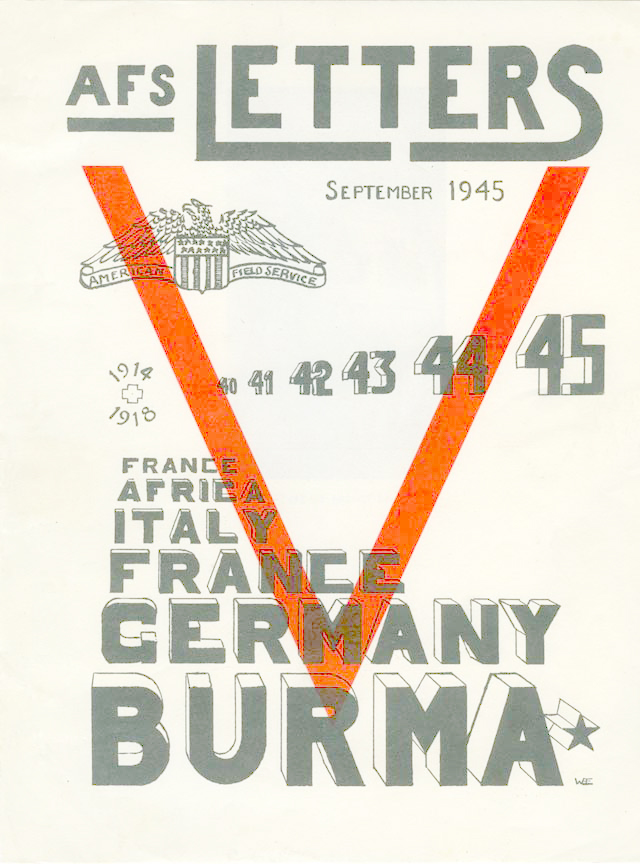
We are very much indebted to William Burke Eberhard who designed and executed the cover of this issue of AFS LETTERS, The artist has recently returned from serving with the First French Army, he is also an AFS Middle East veteran.
A directive has just been issued by Selective Service headquarters in Washington, stating that: AFS men who have had enough overseas duty to have accumulated points equivalent to any military requirements for discharge, may be classified I G by local boards,
We regret very much having to announce the recent death in Boston of Harry Laiser who served as an AFS volunteer for 18 months in North Africa. He leaves a widow and a stepson William Randall of the Navy, also a former AFSer. We would like to express deep sympathy to Mrs. Laiser from Harry's many friends in the AFS.
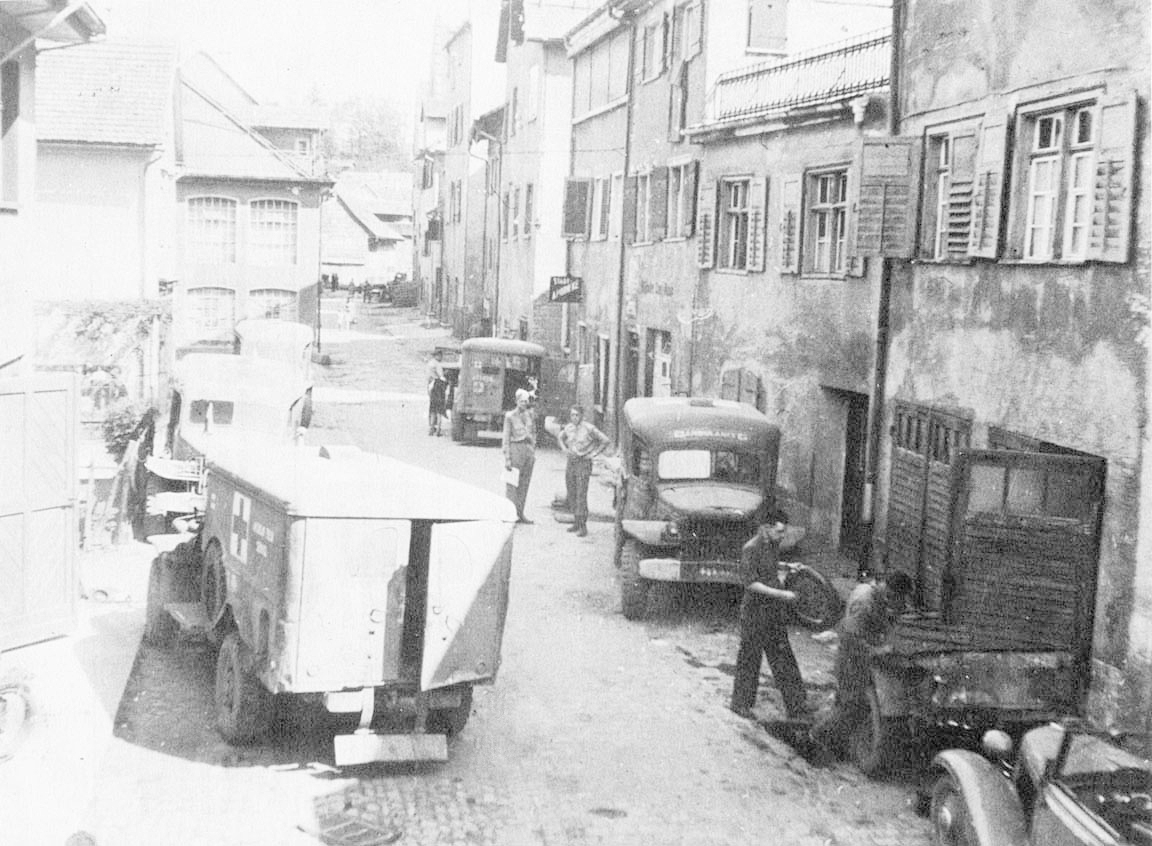
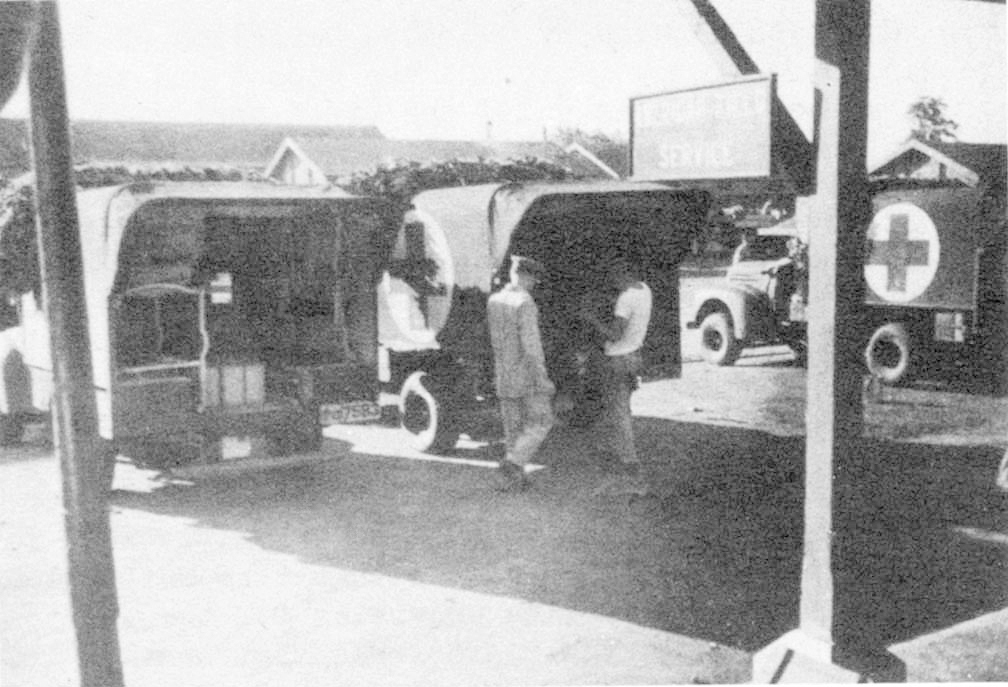
| Some of the ambulances of French Section II parked along the street in Wangen, Germany, where the volunteers lived while stationed there. |
Looking back at the time spent in the Field Service one is undecided as to the value of one's individual contribution. Does a drop of water make the ocean just because without drops of water there would be no ocean?
The fact that one man drove an ambulance around a battlefield affects the total picture of war very little. Ambulances, however, carry many patients. Out of a thousand "cases" one human life might not have been spared if an ambulance had not happened to be around. This single opportunity justifies the attempt.
The bloody "casualty" on a stretcher is not anyone we know, yet it is the most precious thing in the world: it is Humanity!
By virtue of forces beyond the control of the individual, everyone is one side or on the other, whether one chooses to participate in war or not. The only choice left to a man is whether he will be a burden to his nation, thereby giving help to the enemy, or prove his own manhood to himself. Neutrality is not possible. For the man who is refused a weapon, ambulance work is a stirring job.
Somewhere, deep in the human conscience, is the knowledge that war is avoidable, precedents to the contrary. After all, man means intelligence. War is the failure of intelligence to solve a problem of human relations.
Coming home, the first thing that strikes one is that America is blessedly unaware of the horrors of war. It is not selfishness. It is just human nature. One feels a prick more than a mutilation. Imagination alone cannot conceive the amplitude of human suffering. A lot of American boys died to make sure that American homes should never know.
The second shock comes with the realization of the affluence of the American nation. The terrifying want of the other side is not easily forgotten.
The third realization is frightening: America does not appear to have a concrete world policy. A lot of internal problems remain just as unsolved as ever: prejudices, social reforms, isolationism, tariff protection, monopolies.... The problem of race prejudice, widely discussed in the press had nothing to do with the war. It remains a mere domestic problem that could be solved better in the mind than by being dragged in the mud of foreign battlefields.
Isolationism is threatening to become the major issue. It is a tradition in America, justified in the past, hardly acceptable today, deadly tomorrow. America cannot avoid being mixed up in the quarrels of other nations. It is time for the public to realize that a twig of tea growing on the banks of the Yan-Tse river can affect the fat on a Long Island duckling’s breast.
AS long as a New Guinea native gets a dollar a year to extract gold from a mine or a fellah 20 cents a day to tow a ship (with which generous stipend these human beings are supposed to raise a family and to sing the chorus of Progress) we cannot call our social structure anything but a fortress. We are free, yes, only inside of the enclosure.
Freedom belongs to all men, in every country. He does not progress, really, who progresses alone. There is solidarity of the whole humanity.
We have not defeated the Germans to destroy a potential competitor. If this was the reason for all wars we would have fought our allies as well. We are not fighting the Japanese to eradicate a cut-rate dealer. We fight imperialism. We fight the sword with a sword to break all the swords!
It is a common mistake to refer to America as a "young country". American is the oldest "free" country in the world. We have experience in freedom and we have tested its mettle. We can show its magnificent benefits and we can show how it should be used.
Others are looking upon us for help and we must give this help without hope of return. If we fail in our mission as "the best people on earth" the world will look down on us and feel that we only wanted to be safe.
Humanity can be compared to a body. On the spine of China there is a burden. Some interesting thoughts are in the head of France. The grasp of England holds a delicate mechanism. Russia's legs tramp stolidly on. For some reason, America seems to be the world's conscience.
Surplus food, clothing machinery, capital are only temporary relief and there never is enough to go around. I remember the discomfiture of a native to whom I once gave a precious can of food; he would still be starving if I had not brought a can-opener.
The can-opener is education. So far, education is not all it should be. In the civilized countries education is more or less a compound of yesterday's knowledge applied toward filling tomorrow's job. Culture, the appreciation of beauty and the wisdom in life, should be more important, Everybody knows the historical exploits of Tamerlane, Napoleon, and Hitler, while only a few people can identity Erathostenes, Lister and Sir Alexander Fleming with far more worthwhile achievements. The saga of brutality is respectfully taught in preference to the majesty of intelligence. It is about time that Alexander's shadow got out of the sun's way.
Fortunately we have something better to offer than the text books and propaganda. We have the American man. His example. I don't know how much the evangelist or the politician achieved "in parbibus infidelium" but I know what an enterprising American boy does he organizes without paying attention to customs. He gets results without ramming them down the onlooker's throat. He gets labor without oppressing. He likes people and they like his sunny disposition, his drive his fearlessness. Other people call him "crazy" with wistfulness. Soon they ape him. The miracle of America is not the achievement of machines or gadgets, it is the sheer quality of being human, friendly, unprejudiced, of making himself loved. It is an attribute of character.
Can we rid the world of hate? Can we give it that love of which we have so much? To achieve ultimate peace is not beyond the scope of imagination. International competition must be curbed. There never will be any hope of stability as long as nations are allowed to become or remain entirely self-sufficient. Natural deficiencies should be supplemented from outside.
Nations are respectable as sentimental , as competitive bodies. They make war inevitable. If war essentials were divided among all nations, each nation to one essential only, war would become a problem of getting together instead of splitting away. No world alliance will ever last outside of this simple expedient.
It is common belief, and a nefarious one, that war makes Progress. The only Progress achieved through war us to ignore our self-made restrictions. Monopolies and patents for the common good. Outside of that the advances in bomber planes do not benefit peacetime aviation beyond what seven years of normal endeavor will have achieved.
Progress is only as good as the human beings that use it. The measure of Progress is in the heart. The spirit of Progress has its own beauty but this beauty is that of man's soul. Progress is not the privilege of one single nation. It is the rightful inheritance of humanity as a whole.
We Americans shall sing the proud song of the broad axe to others, but we shall accept that they might prefer contemplation to enterprise, meditation to the restlessness of science. Their truth is as much a part of the whole truth as our part is.
Let's offer what we have, Let's not tolerate any barrier against our influence. Let's not erect any fence around any other influence. We know what we have to offer. We don't know what others have to give us. Some of it is certain to be good. Let's trade thoughts, methods and people.
The challenge is worthy of American energy. We might even succeed a little sooner, a little betters, than we should expect. We might suffer set-backs, but we should never give up trying. Thus, and thus only, we shall win the last war, on the last battle ground, for the brotherhood of man.
May 7, 1945. Italy.
"Several nights after my last letter of April 25, our cook stole two chickens and a duck which we had that night. It was very good as our cook knows what he is doing. His name is Jomet and he is an Indian. He speaks a little English and Italian, and is quite clever. He was a Class A (1) cook, but was downgraded to a Class 3 cook for selling rations sometime before I arrived at the unit.
"While in convoy, I saw a G.I. walking along the road with an Italian girl, and at the next convoy stop she barrowed a horse from a Kiwi, which must have been left by the Jerries, and rode around a bit. Also one of the AFS men rode the horse a bit. The G.I., I, and several soldiers were standing around watching the girl ride the horse, when I asked the G.I. the same question I usually asked most soldiers; namely, if he had a Colt 45 that he would trade for a bottle of whiskey. He wanted the whiskey very badly and told me that any G.I. who had one would trade but that he hadn't any. He wanted to trade me a Czechoslovak 9 mm automatic pistol for the whiskey, but I told him I didn't want it as it was too small and it was virtually impossible to get ammo for it as it wouldn't shoot 9 mm Luger ammo. He then offered to trade a 15 jewel Swiss wrist watch and a 7 jewel Itie pocket watch which was the type made twenty or thirty years ago. As I had three bottles of whiskeys, I decided to take a chance on the watches and trade. The wrist watch goes much too slow, but the pocket watch keeps pretty good time, He said that he was away from his unit on a three-day pass and that he got the watches from Jerries. He also said that the reason he was walking was because the German car he had was stolen.
"One night we made a quick advance and when we stopped the Ities were all along the road welcoming us, and mooching cigarettes from us. I was about to go to bed when a little Scotch medical orderly came up to me and said that the Ities claimed there were ten Jerries in a farmhouse a mile down the road and asked me if I had any arms to take them prisoner. All I had was the old Mauser that the medical orderly at my last post had taken off the man with his brains blown out, and an Itie kitchen knife that I had found outside a farmhouse and ground down to a dagger and sharpened with the stone you sent me. Jock, the medical orderly, told an officer, but he didn't seem interested and after several other attempts to get assistance we failed so I finally persuaded him that we ought to get the Jerries anyway. The fact that the Ities began whispering that we were scared was probably the deciding factor. I took the Mauser, and Rave look the knife. When we got to the house Jock stood outside to get the prisoners as they came out and I went inside. The two guards who were near the door came out with their hands up and I came to a room with a stairway, on which the Jerries were sleeping. It was about 3 A.M., and I yelled at them to come out. A Lieutenant got up and started shining a light around and as I must have sounded a little afraid when I told them to come out they didn't move fast so I fired a shot into the roof and said 'Io parlare presto.' They thought I had shot at them and they gave me the most reproachful look I have ever had in my life. It got them to move a bit faster. Jock and I were rather nervous as instead of ten Jerries there were sixteen and they were armed to the teeth with submachine gun rifles, grenades, pistols,, and a Spandeau. They seemed to have all the fight taken out of them, however, and didn't try to use them. Jock took a gun off the first Jerry that came out but he didn't know how to work it. All the Jerries were now lined up and Jock had searched a few but they then started coming out too fast so he didn't search the rest. When some of them showed signs of slowing downs I said, 'Una encora morto Tedesco niente differente.' It wasn't very grammatical but it kept them moving pretty well.
"We started marching them down the road toward our convoy with Jock in the lead and me in the rear. When we were within a few hundred yards of our convoy the regular soldiers took over with sub-machine guns and the like. The Jerry officer told the English officer that I had tried to shoot him which was a bit of an insult to assume that I couldn't hit a person standing 15 ft. away. The Lieutenant was the only Jerry who spoke English.
"The Ities had followed the Jerries up the road carrying all the weapons and I relieved one of them of a Bareta submachine gun, I took the binoculars off the officer and a watch off another Jerry. The English officer had them searched and got a couple of pistols off them but I didn't get them as I wasn’t around.
"I think the Jerries were rather embarrassed when they saw that a couple of ambulance men had taken them. They looked like they were whipped, and were just waiting for someone to surrender to. It was a very foolish thing for Jock and I to get the Jerries for they could have gotten us if they wanted to, especially as we were insufficient in number, weren't properly armed and were such amateurs. The reason I got them was because I felt almost certain they wouldn't fight.
"It was now daylight, and Jerries were now surrendering right and left. The Ities were gathering in ever increasing numbers and when they saw that the Jerries weren't resisting they suddenly turned partisan and started bringing in the Jerries themselves. One Itie asked me for a gun so he could become a partisan and I gave him my Mauser as I now had the Bareta sub-machine gun.
"I was transferred to an ADS for a couple of days, where Jerries were streaming in by the thousands, either being brought in by partisans or giving themselves up. There were some who were sick and I was called on to drive them to a German hospital which was captured intact and was still being manned and operated by the German staff. The Jerries were crowded into my car and as two of them spoke English I was able to satisfy a craving I have had for a long time---that is to have a long man-to-man talk with a couple of Jerries and try to learn what makes them tick.
"The two Jerries who spoke English couldn't have been more opposite. One was an Austrian and was opposed to the Nazi party. He was scared to admit it in front of the other English speaking officer who was a Nazi, but told me later. They were both officers end the Nazi was a Captain, with a panzer division and proudly told me that he as captured and didn't surrender. The other officer was an interpreter in some large city. He could speak English and Itie very well, and a number of other languages. The Nazi also could speak Norwegian, French, and a number of other languages which he claimed to have learned in those countries. I asked the Jerries why they were so cruel and they asked me what I meant. I told them I was thinking of concentration camps and the atrocities committed against various conquered countries and the Jews. They said that it was the SS troops mostly, and I am inclined to believe them.
"The Major finally came around and we got under way after putting up a red cross flag. I was glad I had the flag up for partisans armed to the teethe were always stopping the car and looking in.
"During that long conversation I was rapidly becoming a long lost friend of the Jerry prisoners and after getting lost and going over a blown-up bridge that had been very poorly repaired by the partisans and would barely support my car, we finally arrived at the hospital where I got another big surprise. Jerries were wandering about everywhere and one Jerry came up to me and shook my hand and said he was glad to see me. He said he had been in Chicago from 1929 to 1939, and he spoke perfect English. He told me that he had gone to Germany in 1939 to see his parents against the advice of his friends and when war broke out couldn't come home. He said he had been a factory worker, but had been in the army the last two years. He was an ambulance driver as he had told them that he wouldn't fight the Americans. He had two sons in the American army and when America entered the war he knew then that Germany wouldn't win, although his parents or no one would believe him.
"A Kiwi was guarding the Jerries who were wandering about at will. He was half drunk had a two-day stubble of beard, and a machine gun that he didn't know how to work. He said the Jerries had been treating him to drinks, and that the German, who was an American citizen was his buddy. There was a fellow who was dressed in civilian clothes with a group of civilian friends who said he was a South African who had been attached to a Scotch regiment and was captured at Tobruk in 1942, and had escaped from a prison camp and been posing as an Italian while the Germans were in control. I could tell he was a South African by his accent, and he had a paybook to prove be had been in the army.
"The German Major at the hospital didn't want to take the patients as he had too many, but we left all there except the anti-Nazi German officer and his friend. Before going I gave the German-American and the South African some cigarettes as they said they didn't have any. They seemed very appreciative as they hadn't had good cigarettes for a long time. The Jerry told me that he had no complaint about the German food, but recently it had gotten worse. He had his ambulance painted all white with big red crosses, and he said our planes left him pretty well alone.
"On the way back the Jerry told me that he was anti-Nazi, but didn't want to say it in front of the other off officer. He said he was an Austrian and that the Prussians were the real fanatical Germans. He talked the Major into keeping him a an interpreters, as someone who speaks German and Italian and English well comes in mighty handy at times these days. He is helping the Major around HQ, and seems quite contented. He wears his uniform and has the run of the placed and likes our soldiers very much he said. The capturing of the sixteen Jerries and everything that happened up to this time, occurred on the same day, and I believe it was the most eventful day of my life.
"The reason I was a bit harsh to the Jerries I captured, was because I was scared, but I really meant what I said.
"We were than stationed in a nice Italian town where we were welcomed as long lost friends. The Jerries told the Ities that we would keep bombing them when they left and would starve them among other things. They were very surprised that I wasn't a 'beast' as they put it and didn't carry a pistol when I visited them as the Jerries did. I made a big hit with my guitar, especially with the girls. Several of them were good singers and one played the piano and sang, while her brother played the fiddle. They were a high-class family and played operas. I tried to explain my music by saying that it was old-style American music, but I don't think they understood. It wasn't like the music they heard in our movies, but they kept saying, ‘Cantore Americano, Cantore Americano.'
"The partisans were about the only persons who carried guns, and they were usually armed with a "potatomasher" and several smaller grenades, besides red scarves and long belts of ammo draped over, their neck. I think it was all for show as they didn't know how to use their arms,
"One time I was being entertained by some Itie girls in their house with their family, when three partisan friends burst in ready to rescue them. I think they were rather embarrassed when they found me sitting in the corner playing the Itie's mandolin. They later invited me to a meal at their house, where I had a meal which consisted chiefly of macaroni. It was such a big meal I could hardly eat it and the girls ate more than I, but I don't see how they did it.
"Some partisans friends of this family invited me to go on an anti- fascist demonstration with them which I did. It was rather comical. About half the crowd along-the sidewalk gave the communist salute and I piled into one of the big Itie Diesel trucks. There were about three or four trucks with a priest in the front one and a lot of people walking in front and behind the convoy of trucks. There were a good number of partisans armed to the gills as usual and we drove by some large Fascist buildings where there had been some fights between partisan and fascists a day or so before, The people in the trucks were afraid of snipers and were glancing nervously upward. They seemed rather disappointed when they weren't fired upon so the partisans fired their guns Into the air from the truck I was on. That was the only time during the parade I was scared, for the Partisans didn't know how to handle guns. When they were operating the mechanisms or safety catches their guru were pointing at everyone in the truck and I was afraid I would be accidentally shot. Several women fainted at this point, overcome by emotion or something I guess. The British let the Partisans have their fun, but sent a plane over to show the civilians who really was boss.
"E. and Kiwi were listening to the radio announce dramatically that all fighting in Italy had ceased when 'Zing' a sniper's bullet knocked some leaves out of a tree overhead. He said the war may have ceased but some people sure didn't know it.
"Two Naval Lieutenants went into a town that the Jerries hadn't quite evacuated against the soldier's advice to check up on the harbor installations, and were shot by the Germans who stopped their car. The Jerries then bandaged them up and surrendered to them."
May 15, 1945.
"As soldiers can't get food in town I took a couple of chocolate bars completely melted in my pockets as it was quite warm. I had a job washing my pocket out then I got back to camp. This incident isn't as bad as what happened a few days before when I spilled acid on the same pants. While waiting for a haircut I found a small Jerry sight under the table which, I was told was meant for the front sight of a machine gun so you could line up the sights on a silhouette at night. I turned it upside down thinking it was a dry-cell battery, and it turned out to be a wet-cell. I put a generous supply of health salts on my pants because it was an alkalizer and I couldn't get any baking soda. I believe it worked as I haven't noticed any ill effects as yet.
"I now am about twenty miles from Venice near a little village called Preganzio, which is between the towns of Treviso and Mestre. We are on the estate of a very rich Countess who was Fascist first, but later helped the partisans (hiding partisans, concealed radio station). Her husband took all of value from the estate and moved to Venice. The Countess and her good looking niece, daughter, and a governess who spent fourteen years in New York share the villa with us. One of my friends has befriended the girls and gets invited by them to dinner. There also are numerous servants of the Countess, and she gave us two girls who wait on our table. The whole platoon of about thirty-five cars and forty men are here.
"When I got here I heard that American troops were in Treviso six miles away, and our Sergeant gave me permission to go up there. I asked every GI I met if he would trade a Colt 45 for a bottle of whiskey, but they all said they couldn't as they were charged to them. I finally asked a drunk G.I. who hopped on my running board, and after taking him all over the place in search, of vino he went into a building and emerged with a 45 stuffed in his shirt. He said he would only trade if I would never come back, and acted very mysterious, so your guess as to how he got it is as good as mine. I then drove off quickly and parked along the main road to examine the pistol. It was a last war model and I was rather disappointed, but was glad to get it. As I was examining it another GI who was slightly inebriated staggered up. saying that he was trying to get a horse and wanted me to drive him a couple of miles down the road where he thought he could get one. I explained that I was trying to trade a pistol which I had in my hand for a new model, and he said his buddy who was an ambulance driver had one. I persuaded him to come with me and find him by promising to take him where he wanted to go afterward When I saw the pistol he had I knew I wanted it more than anything else. It practically was brand new and had an easier trigger pull than my Colt that was stolen. It was exactly like a Colt, but was made by Remington. The only thing wrong was that the barrel was a little pitted, but I didn't mind that. I gave him the other pistol and the Itie Bareta sub-machine gun, with three clips of ammo that I took off the Jerries and told you about in my last letter.
"I then had another hard hunt for the holster I wanted, but I finally managed to get it and a grease cap for another bottle of whiskey. It was a very dear price to pay, but I got what I wanted and am very satisfied as I didn't want the stuff I traded. I got another scare when I found a small red German box at workshops and pulled it open. There was a string attached to the lid and as the string snapped taut I had visions of having my hands and stomach blown apart on the first day of peace It turned out to be an anti-gas ointment container and I now keep cigarettes and matches in it which I offer the Ities and patients. There was a live rifle grenade in the flower bed, and the other day I helped get a kid who had picked up something once too often. We took him to an Itie hospital and he should live.
"The other night I had a run to a Jerry hospital and carried three stretcher patients and one sitting. They offered me a Jerry cigarette which I took so as not to be rude. It was stronger than ours and had hardly any tobacco in it. I then offered them some and we became quite chummy. Every time we passed a bombed-out town, they said 'Americans did that,' and one of them told me how American bombers had killed his two sisters. I offered them more cigarettes and started singing and finally asked them to sing, and they were pretty goods They were reluctant to sing, 'Deutchland, Deutchland, Uber Alles', explaining that Deutchland was 'kaput', so, therefore, the song was 'nienta bona', but they did it when I said, please. It became practically inaudible when I slowed down as they didn't want anyone to hear them. I thought it was a very stirring song, and that if you heard it often enough you would begin to believe it.
"When I got to the hospital, which was Jerry-run, I asked for some food, as I wanted to eat Jerry food, and not everyone can say that he was the guest of Jerry soldiers. We had a midnight snack of sausage with brown bread and margerine, made into sandwiches and some red vino.
"The Countess on whose estate we are, seems to like us She was very sorry when she caught her nephew, who was a sort of bellhop of about ten years complete in uniform, stealing cigarettes. She told us about it, and he was sent home on probation. Jo the cur bitch, had 4 puppies a couple of days ago. They are brown and black, and about the size of rats."
May 20, 1945, Italy.
"On the fifteenth, eight of us in two ambulances set off for the Brenner Pass to have our pictures taken while shaking hands with some fellows from the French Unit. After a somewhat shaky start in which we went miles up a road only to find it blown out alongside of a cliff, we finally got straightened out and reached the Brenner without incident. There was a good deal of traffic on the road, almost all of it German! It was so strange to see Jerries wandering around in the town, completely on their own. We even saw M.P.s. Of course actually there were plenty of Americans in the area, but they were not conspicuous at all,. The approach to the Brenner Pass is through a long valley enclosed on either side by tremendous mountains of rock... As we got closer to the Austrian border, the road started to climb somewhat, but we never reached any great altitude. There was still snow on the higher peaks, and as we got into the mountains the scenery became more impressive,
"Before leaving we had been told that we were to meet the boys from the French Unit up in the Brenner Pass, and that was all 'Oh! there'll be a town up there somewhere.' Slightly vague, to say the least. Actually the town of Brenner is on the border. Brenner on the Austrian side and Brenner on the Italian. As we came to the first houses, we were stopped by some G.I.s at a road block. They told us it was absolutely impossible to get across the border without a special pass from the Fifth Army, but they had a note for us from the guys who had come from the French Unit. The notes said for us to go back to the next town where some Engineer outfit would put us up for the night, and they were going back to spend the night at Innesbruck and would meet us at the border between ten and twelve the next morning.
"We were naturally anxious to get over into Austria, and tried to talk our way through , but only generals were allowed through without a pass. Finally the G.I.s let us talk to the Provost Marshall over the telephones The P.M. was pretty good guy, and said he couldn't let us through, but that he would find some billets for us to spend the night right in town. And so we got through the Fifth Army barrier but unfortunately the Seventh army had a road block at the other end of town, so the situation did not look too promising. Just as we pulled up to the Provost Marshall's office, a guy came out and told us that he had heard just a minute ago that our friends were waiting for us on the other side of the Seventh's block at A Co. HQ. and that he would call up to have us let through.
"We started up again in sort of a daze, approaching the road block cautiously, and waved to the guards as they raised it up. We missed A Co,, and saw no sign of any AFS men, and asking no questions, on we went, Unfortunately by the time we reached Innesbruck it was a little too dark to see very much of anything, but it seemed to be a good sized city and extremely clean. As we came to the outskirts, an M.P. stopped us and asked for our trip ticket. 'Trip Ticket? We don't use Trip Tickets in the American Field Service. We're from Italy, 8th Army,' That was a knockout blow, and he just stood gaping at our innocent expressions, shook his heads and waved us on. We decided that probably the fellows from the French Unit were somewhere in town, and that we had gotten through the Brenner on a fluke. We asked everybody if they had seen any AFS men or ambulances in towns but it was like looking for a needle in a haystack. After looking around a bit we pulled into the main square and brought out some C Rations. Everybody was famished, and we stood around in a circle eating out of the can, while a little pup one of the boys had brought along stuck up his nose at the beans we put on a place and sat in the middle of the circle.
"Numerous M.P.s came along curious to know what we were doing, but we just told them we were looking for our pals. They couldn't help us any, but it wasn't for lack of trying. We had just about the whole city looking for our friends, but all to no avail. Finally, we decided to go back to the Brener, spend the night there and hope the French Unit would show up in the morning. On the way out we were stopped three times by guards asking for the pass-word. This whole area is heavily guarded to prevent Germans from slipping over the border. Of course the first time we did not have the foggiest idea what the password could be. We explained to the guard who we were, and he told us that all we had to know was 'jazz', he didn't know the other half, though. The next guard stopped us and hardly before we came to a standstill one of us yelled out 'jazz’ just to make darn sure he didn't beat us to the draw leaving us to cope with the other half. We asked this guy what the counter-sign was and after scratching his head for a couple of minutes, he said he thought it was 'jive.' Thanking him we drove on all set for the next stop. A guard waved us down, and came up to us asking in a sort of pathetic voice, ‘Gee do you fellows know the pass-word?' We told him, he thanked us, and we were off till we reached the Brenner. Someone found an officer, and explained the situation. We were fixed up with a couple of rooms for the night and then turned in. The next morning we cooked ourselves a darn good breakfast consisting of fruit juice toast Vienna sausage, scrambled eggs and the inevitable beans. Just as we finished four fellows from the French Unit drove up, and later they had something to eat, we got out by the stone marking the border, and the pictures were taken! Our official business ended two of the fellows took one of the cars and went back to Innesbruck while the rest of us headed for the town of Riva on Lake Garda.
"We arrived there about supper time, and finally found an Inn which was closed., but we persuaded them to cook our ration for us. After dinner it looked very much like rain, and we finally persuaded the Eyeties to put us up for the night, two in a rooms with good beds and clean sheets. About noon the next day we started back for Platoon. We took the road running along the western side of the lake which is an amazing feat of engineering. There are about seventy tunnels cut through the sheer cliffs that drop down into the water. The Italians or Germans had put an entire aeroplane factory in these tunnels. We drove for miles and miles with one side of the road filled with lathes and drill presses. We stopped for two marvelous swims on the way and at one place we rented a row boat for a while and had a good deal of fun fooling around with that."
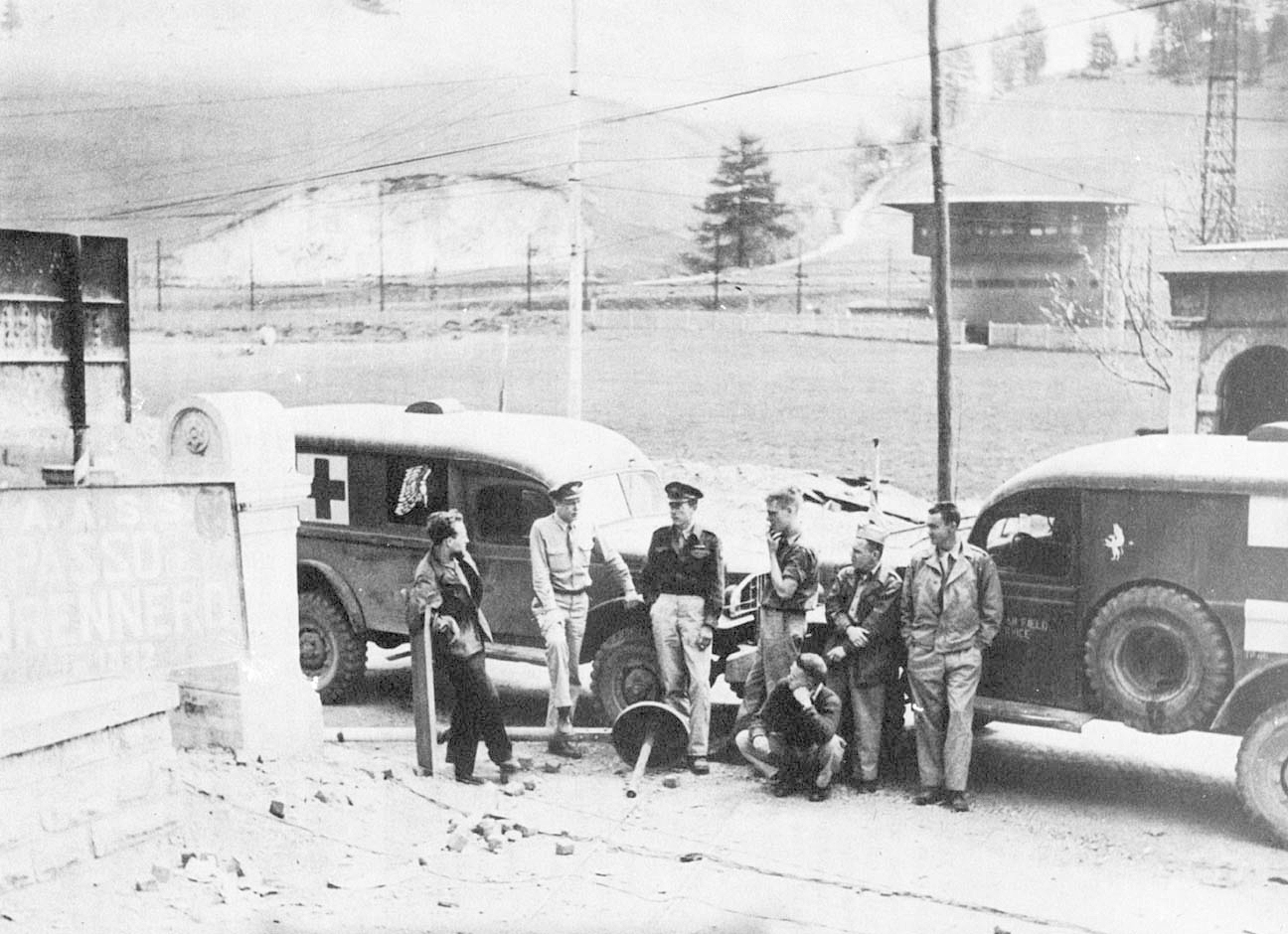
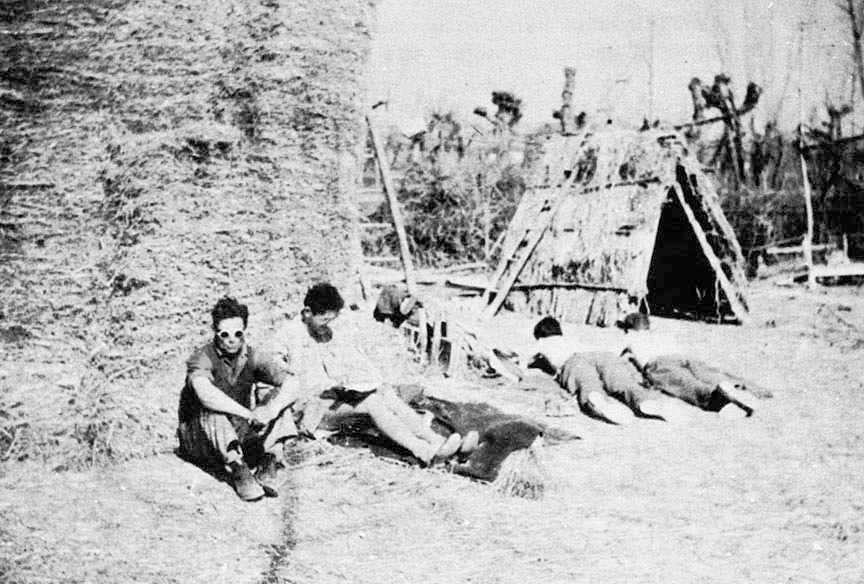
| Some members of 485 Co. from Italy (right) and some from the French section (left) met in May at the Brenner Pass at the Austria-Italian border. The AFSera are: left to right, Quentin Hope, Mason Bowen, Drayton Smith, Joe Desloges, Dick Altamang (kneeling) Bill Washburn and Paul Clark. |
The United States Navy Department has just issued a directive stating that, Navy men formerly in AFS can count points earned during ambulance service toward demobilization.
AFS LETTERS will continue to be issued for the next several months We would appreciate it if the readers would continue to furnish us with interesting letters from ANY theatre, even though some may have been written some time ago.
The Editor.
|
60 BEAVER STREET NEW YORK 4, N. Y. There is a profit for AFS on all copies bought through our headquarters. Cost #3.00. |
Please send. . . . . . . . copies of Ullman's "THE WHITE TOWER".
$
NAME. . . . . . . . . . . . . . . . . . . . . . . . . . . . . . . . . . . . . . . .
ADDRESS. . . . . . . . . . . . . . . . . . . . . . . . . . . . . . . . . . . . .
Check enclosed [ ] Money Order [ ]