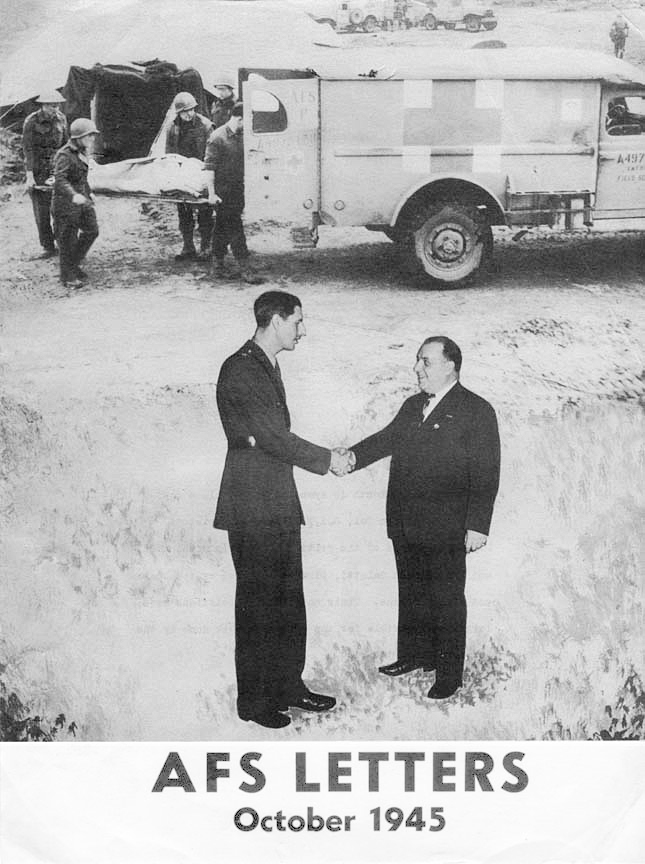
| Our cover this month is symbolic of the close cooperation between Col. R.A.F.. "Williams, Assistant Military Attache of the British Embassy in Washington, and Mr. Stephen Galatti, Director General of the American Field Service. Their most cordial relations were largely responsible for the effective work done by the AFS throughout the war. |
| AFS LETTERS |
XXXXI |
Edited and published at AFS Headquarters, 60 Beaver Street, New York 4, N.Y. under the sponsorship of the ambulanciers' relatives and friends who contribute the excerpts from the letters.
Nobody can succeed alone. AFS owes thanks to many for its successful accomplishment of the job undertaken. To no single person does the ambulance corps owe more than to Lt. Co1 R.A.F. Williams..... not only for his invaluable official aid in all military details, but far more for his ever-present, friendship and encouragement throughout the years that the volunteers have served with British and other Empire forces.
For all his very British name of Reginald "Reggie" to his friends, the Colonel is a very American person. Or rather he is that rare human being, a genuine Anglo-American, both by circumstance and by personal choice. If the American Field Service had sought the world over for a sympathetic, able adviser, it would have been looking for "Reggie" Williams ---fate or perhaps the Field Service angel (of World War I fame) sent him.
He became known to AFS in his capacity of assistant Military Attache of the British Embassy in Washington at the time of the initial negotiations in 1940 between the ambulance service and General Wavell, the forerunner to the Western Desert and subsequent work. Since then he has become known, respected and loved by hundreds of volunteers and friends of AFS. No problem however small, has occurred that it did not receive his immediate attention, no function, however impromptu, took place but that "Reggie" was there if he could spare the time from his embassy duties.
He has taken an intense personal interest in AFS always. His main interest is the ultimate result of the close association of the men of many nations; although, the son of an eminent nerve specialist, he has an appreciation and knowledge of the worth of rapid ambulance aid to the battlefield casualty that is close to professional.
Colonel Williams is a realists too wise to prophesy or extravagantly praise --- he has real hope for the outcome of the war work done by the AFS volunteer ambulance drivers. In his opinion there CAN be great value in the understanding and working together that Tommies, Kiwis etc. and AFSers have begun. He has faith that the AFS veterans will have a constructive part in establishing and maintaining the peace. In his opinion there is no other group of men better qualified to promote the international understanding so necessary for world order. Although thousands of American soldiers have served in foreign countries and lived among the peoples of many lands, the Colonel does not believe that soldiers can have the same understanding of these people as do the AFSers. In explanation of this he refers to the G.I.s and officers stationed in England whose relationship with English people has been more like that of a tourist, whereas the AFS men serving with British and other troops were virtually a part of these forces, living with the men of Allied Armies at all times. He also believes that the very fact of the ambulance drivers having served as volunteers created an interest in Americans among Allied soldiers that reached far beyond the comparatively small number of men involved.
Lt. Col. R.A.F Williams is not a career soldier, in fact his career, which he voluntarily interrupted to enlist in the British Army as a private is right in New York with Conde Nast Publications. After seven years of military service both in England and in Washington, and speckled with missions to many war fronts, "Reggie" is returning to civilian life and the publishing business January 1, 1946. His present plans include a nice long holiday in the Bahamas with his lovely wife whom he married in Washington in 1942. Then comes the civilian problem of finding an apartment and getting back to work.
It seems only right that "Reggie" Williams' army career, like the rest of his life, should have started in England and wound up in the United States. When he joined up he was assigned to an antiaircraft regiment in which he served for three years participating in the defense of London and winding up in command of a battery, having been commissioned 2nd Lieutenant in February, 1939. In August, 1941, he was appointed to the job of assistant military attaché in Washington, the post that he had held until his demobilization.
His private life has not been so geographically cut and, dried. Born in Parls, he was brought to the United States when he was a disinterested spectator one year old, His father, a nerve specialist, practiced in Washington D. C. where the family lived until 1917 when they all returned to France. Dr. Williams and his wife worked through 2 years of World War I at the American hospital in Neuilly. "Reggie" spent the two latter years of that other war commuting between France where his parents worked and England where he was at school. He attended the traditional British public school of Harrow. Later he went to Cambridge University and spent his holidays (or maybe they had better be called vacations) in the United States where his parents returned at the end of the war.
After graduation from Cambridge, "Reggie" went to work on the Daily Mail in London. This brief association with the U.S. was terminated when in a few years the Daily Mail sent him to New York as business manager. He returned to England in 1932 when the Daily Mail closed their NY. office as a result of the depression. "Reggie" subsequently quit the Mail and beat it back to N.Y. in 1934 as assistant advertising manager of the British, edition of Vogue and thus began his career with Conde Nast Inc. which lasted until he looked up, saw the shape of things a lot more quickly than a lot of other people, and enlisted In His Majesty's Army.
Lt. Col. RA.F. Williams, practically Mister Williams, leaves military service almost simultaneously with the American Field Service. He has done a tremendous job for the ambulance corps. Â job it is hoped that will be repaid to him and the rest of the world by the fundamental understanding set up by the ambulance men's volunteer work with men of Allied nations As he himself says, it has been a vital job, "because our whole future depends on a common understanding between the two peoples."
As he leaves one job to take up another we want to wish him the very best of luck and say once more, "thanks."
J.B.
| Thomas Stretton Esten | Stoughton, | Mass. |
| George Oscar Tichenor | Maplewood, | N.J. |
| Stanley Balzei Kulak | Salem | Mass. |
| William Keith McLarty | Berkeley | Calif. |
| John Fletcher Watson | Larchmont | N.Y. |
| Randolph Clay Eaton | Ft. Lauderdale | Fla, |
| John Hopkins Denison, Jr. | Big Horn | Wy. |
| August Alexander Rubel | Piru | Calif. |
| Richard Sterling Stockton, Jr. | Bryn Mawr | Penn. |
| Curtis Charles Rodgers | Highland Park | Ill. |
| Caleb Jones Milne IV | Woodstock | N.Y. |
| Vernon William Preble | Lowell | Mass. |
| Charles James Andrews, Jr. | Norfolk. | Va. |
| Arthur Paisley Foster | Warroad | Miss. |
| Charles Kendrick Adams, Jr | Huntington | W. Va, |
| Henry Larner | Albany | N.Y. |
| Alexander Randall, Jr, | Baltimore | Md. |
| George Edward Brannan | Chicago, | Ill. |
| Robert Carter Bryan | Richmond | Va. |
| Dawson Ellsworth | Milwaukee | Wis. |
| John Dale Cuningham | Brooklyn | N.Y. |
| Donald Joseph Harty | Buffalo | N.Y. |
| Thomas Lees Marshall | Winnetka | Ill. |
| George Alden Ladd | Burlington | Vt. |
| Paul Haynes Cagle | Owensboro | Ky. |
| James Bennett Wilton, Jr. | Peoria | Ill. |
| Ralph Evans Boaz | Omaha | Neb. |
| William Tuttle Orth | New York | N.Y. |
| Bruce Gilette Henderson | Kenmore | N.Y. |
| Albert Studley Miller | Cambridge | Mass. |
| Hilding Swensson | Manasquan, | N.J. |
| Charles Butler Alexander, Jr. | Eccleston | Md. |
| Jack Wells Douthitt | Florence | Ala. |
| Gerald Riley Murphy | Chicago | Ill. |
| John Wilder Parkhurst | Winchester | Mass. |
| Walter Bradley William Hull Browning II Calvin Dunwoody Richard Field Benjamin P. Ford Gibson D. Hazard Morton B Strauss S. Joseph Tankoos, Jr. John Garrett Wilson Charles McQ. Wright |
The U.S. Forces Headquarters European Theatre have authorized 86 members of the American Field Service, who were attached to the 1st French Army 6th U.S..Group, to wear the European-African-Middle Eastern Campaign ribbon. "for outstanding and conspicuous service with the Armed Forces under difficult and hazardous combat."
August 22. 1945
"As soon as peace was declared the war started for us. We sat around except for a few patrols until the war was over, now we're on the move. We dropped a few thousand leaflets in this area in English telling the Japs the situation and the next day I walked 15 miles south into previously Tap held territory to see if they had had any effect. We asked the villagers in the afternoon but they said that the Japs had left in the morning, leaving a trail of looting, rape and other atrocities .One patrol carne across a dead man who was a village head man. Beside him was his two-year-old son cut in half. You often wonder if these Japs are human. They have no respect for nice things. In the commissioner's house in Tavnggyi they fettered the mules and it's a beautiful house. They tore our teak panelling to build their fires in the middle of a nice hardwood floor, and they chopped up furniture to make firewood. The officers are as bad as the men.
"When we (the Brigade) saw how the civilians were being treated they ordered us to occupy the territory for the protection of civilians. The Japs must have been scared for we haven't been able to catch up with them on their west flank, while the Gurkhas are pushing into their front. Some say that they are Siamese troops under Jap officers and that's why they're ruuning. We haven't had a chance to take any prisoners so we can't tell.
'This road south is just a bullock-cart track with ruts some times four feet deep that we must straddle. When it's rainy we occasionally fell in and then it's practically impossible to get out. I was towing rations in a trailer yesterday when the trailer fell in and it turned right upside down and everything was strewed out into the muddy road. We have a bulldozer going down the road now so it's much better, but I broke the trail with my jeep and it was some ride. At some places where mud was three feet deep we had to make diversions into the fields which meant tearing down fences and digging out banks It took all afternoon to go four miles, but now we can go the whole twelve miles in an hour and a hair and the road isn't half bad when it's been leveled.
"This is beautiful hiking country with rolling open hills. From here we can see for miles and miles and when I took that hike the other day we walked through corn fields, cucumber gardens, rice paddies and through bamboo groves and thick jungley trails. In this short distance there's so much variety of scenery that it's always interesting. We had to hurry to get back before dark and we covered the first three miles uphill and down in 35 minutes. We were practically running and since I haven't done much walking I was really bushed at the end. We tried to find a short cut on the way back to avoid hills but we took the wrong trail and walked about two or three miles extra in coming back. It was terrific and I had blisters on the bottoms of both heels, but after a day's rest I felt better than I have in some time."
August 26, 1945
"The other day the pilot of one of the small L-5 Stinsons let me go up with him. We flew all over these mountains and over the lake where there are dugout boats some thirty feet long and over four feet wide, all dug out of one piece of wood. We flew low over the villages on the lake, and they're all on stilts in the water and most interesting. When we gained a little altitude he let me take the stick and I flew the plane from the back seat for a while and it was fun until he all of a sudden turned the rudder with his feet. We banked way around almost making the wings vertical and I thought I was doing something wrong. I was trying to keep level but it naturally banks when it turns without the use of the stick. When I realized what was happening it was O. K. but it did frighten me at first. He just laughed and when we landed I felt that I'd had a wonderful time. It was the first time I've ever flown in a small plane."
August 3 1945,
"I'm fine, never felt better. Weighed myself yesterday and have gained six pounds (183) and find India absolutely fascinating. Yes, we arrived safe and sound with all the extravaganza and life of the AFS.
"Had leave in Bombay, in fact we're presently living in Bombay area and wow! I wish I could describe the first day our unit invaded the weary trodden city. Oh, it was terrific! Everybody donned new outfits, campaign ribbons, bush hats (similar to 10 gallon jobs) pith helmets, loaded and unloaded leather swagger sticks, and oriental fragrance de lux. Something (?) happened to the city of Bombay once before, so they say, that being when the first C.B.I. unit came a couple of years ago. All the first class cabs, restaurants, shows, promenades, merchants, and beggars were swamped with business. Snake charmers and similar grizzly characters made fortunes and we all loved it Also most of us who appreciate the 'strange wonders" rode thru the streets where girls are kept in cages, Gosh, the money I could make in Times Sq. with a dancing cobra and the talent to play one of their "charming" horns. So indescribably different from dirty Italy!
"Outside of the mangey natives' contributions to the city's atmosphere there really isn't anything exceptionally different from any western city ----prices, transportation, hotels, restaurants, theatres and shows all run the same. Every little sidewalk shop sells Pond's face cream, Lux soap, hairpins, combs, cigarettes, ‘Kellog's Corn Flakes,' 'Campbells' Tomato soup, catsup by Heinz and so forth. Nothing strange about it but it certainly astounded each of us, The soap is amazing."
August 13, 1945.
"Yesterday morning at breakfast I had a strange experience, one which has made me something of a notorious personage around here. I had just taken my plate of bacon and eggs and was walking with it from the cook house toward the mess tent (still in something of a daze, I'll admit, having got out of bed only a few minutes before) when there was a loud thump, a bang and clatter as my plate hit the ground, and a flutter of wings as one of the huge hawks or crows we have around here flew away with my bacon. I was so surprised I didn't realize what had happened for a few seconds; thought at first I had run into someone. Then when I saw a bird had hit the plate with force enough to knock it out of my hand I realized what a good joke it was. X-----, who was standing the closest of anyone to me said he saw the bird hover about twenty five feet above my head, waiting for me to get in a good clear open space then dive with all possible speed for the plate. I understand the British soldiers were warned against this; but I wasn't and therefore had the singular experience of being robbed by a bird. X---wondered if, as in the case of Sinbad and the roc, I had held on to the bacon, I would have been carried off too.
August 25, 1945.
"I do think most of the horrors of this land have come to us through British eyes. Of course it does seem hot to those cold-damp-fog-dwellers. They don't know what summer in America is like. Of course there are beggars, but there are wonderful, intelligent Indians a most hospitable family of whom I have become acquainted with here. Of course you get cheated if you don't know how or where to buy; but don't you deserve it? No, India is just another country full of human beings with a different philosophy and religion, with different (although similar in so many ways) art and music, with singular spots of scenic grandeur and greatly varying climate; but with nothing at all beyond the understanding of the western mind. I don't say you can understand India in even a year or two, but I say that I think there is more potential greatness and power here (and not on an oriental but a world scale) than I have seen in any other country."
July 2, 1945.
"This country is very exciting and every day you notice something new and interesting. At first it is all too amazing for comprehension. Everything is so new and different; the houses, trees, customs, and people. There is quite a bit of vegetation everywhere and it grows very quickly. I think the most beautiful tree of all is the Flamboyant, which is very abundant. It is a very green tree with large red flowers and is very beautiful. There are numerous pineapples and cocoanut trees which provide delicious meals. The rule is to eat nothing except the fruits which have a protective shell or covering which must not be broken. Bananas are also prevalent. We have also noted nut trees, banyans, and other vegetation distinctive to this area. Out near our camp there are vast tea plantations, which is a most important product of this land. It is the second largest tea producing land in the world. There are also rice fields and even tobacco patches. The natives here are very dark and have a peculiar smell about them. They talk a completely queer language which is very difficult to learn. It is nothing like the language which we learned on the boat in preparation for dealing with the natives. As we progress to our destination I guess they will speak the language we learned on the boat. I hope so. Every day we come in to the Red Cross and eat meals and go on their tours of the surrounding country. We went around the city yesterday and saw all the sights including the Governor's palace, a zoo, where we saw all sorts or queer animals, reptiles, birds and other creatures distinctive to this areas, and also a Buddhist temple. The last is a strange, grotesque and gaudy place where they make you remove your shoes before entering, The High Priest briefly described the philosophy and history of Buddhism. Before I forget it at the zoo the four of us rode an elephant. Future tours include more temples and. a gem mine. I am looking around for a cheap ruby and sapphire which are abundant here. They charge only about $10.00 for a large guaranteed stone which is mined right around this territory. Every day we also go out to a most beautiful beach where the swimming is perfect. The waves are pretty high and the water is very, very warm. It is almost like taking a warm bath. There are quite a few very pleasant English girls here, and they stroll freely around the beach.
"We watch some of the natives training and drilling and it is very interesting to watch the policy out here of the officers. They treat the natives like mud. Somebody is going to have quite a job on their hands after this war is over."
July 3, 1945
"Today I bought a couple of precious stones from the natives of this place., I couldn't have been gypped too much, seeing I didn't pay very much. The accepted practice is to offer the merchant 1/3 the price he asks and finally settle for one half. There is always something new and interesting to see here. Yesterday I saw another strange funeral procession. The priests wear yellow robes and it is very colorful.
July 4, 1945
Today I took a rick-shaw ride all over town It was really very interesting. I stopped in at a lot of shops which had very curious items for sale. Actually they were worth nothing, but the natives take great delight in simple jewelry, cloths, etc. The poverty is very great here. If you are interested there is an interesting, and in my opinions, a very correct article in the June 1945 Readers Digest about the whole situation. Can you imagine a cow strolling down a main street crowded with traffic, or grazing peacefully, unattended, on a swimming beach? It is a common occurrence here for the natives to permit their holy cows to roam anywhere. I believe it is a penal offense to molest them. Out in the country it is very pleasant The grass, trees and vegetation are a bright green, probably due to the rain. There are quite a few swamp areas where rice is grown.
July 19, 1945.
"We are now on leave in Calcutta. The other day vie received our first mail. It was all waiting for us in Calcutta and I got letters from you dated May 27th through July 2nd The mail service is very good. Because it goes through an American Overseas Post Office it shouldn't take more than twelve days by air mail.
"We have a pretty nice set-up here. We can go anywhere. British Officers Clubs, Sgts, Clubs, American Officers Clubs, Enlisted American Clubs, Civilian Clubs, etc.; also some often go down in "out-of-bounds" areas just to see what it is like. No place is forbidden,
July 22, 1945
"This is certainly a very strange city. At first it seems just a dirty, smelly hole, but you soon realize that there is more to it than meets the eye. There is one main street, Chowingee, around which are all the small shops. It is possible to buy almost anything under the sun. There is a great commercial trade here. Much of the stuff for sale is rather cheap and flimsy. Most of the better stores are air-conditioned."
May 3, 1945.
This will be my last chance to write for many a day so I will rush this off. Three days ago the British Medical Colonel in charge of the advance dressing station unexpectedly had a spare jeep ambulance and thru great luck I got an assignment. I wish you could see it, a regular jeep but all covered over with an awning and Red Cross in red and white painted in front and both sides. Inside, two stretchers and one extra seat behind me facing stretcher for sitting up case. So I carry three patients from the front (Advance Dressing Station) to the back line dressing station, called the M. D. S. sometimes 10 miles back---sometimes 40. We live in our ambulance at the A.D.S. to pick up wounded as they come in,
May 9, 1945.
"All going well and as I write our own shells are firing overhead aiming at over 2000 Japs not far off---so the Burma campaign is not over yet in spite of certain towns we are clearing up between, but it should be complete with all the enemy out of this pitiful little country. Every town we move into has been completely shelled and nothing is left---sometimes within a few hours after they have been there.
"It seems strange to be back again in the outskirts of a formerly large and civilized city. Now, the remains with bombed buildings and all the aftermath; first the invasion by the enemy and then almost two years later more bombing and destruction by us in order to take it back However the paved roads still remain and all the evidences of a beautiful city; also really fine homes on the outskirts; and in one locality is a large lake surrounded by wealthy estates and shattered mansions. We ourselves are billeted just outside the city, eating in the remains of a large attractive house and sleeping in our ambulances. If my time was up tomorrow I would feel that it had been worthwhile for I was indeed fortunate to have gotten over in time to take an active part in the Burma campaign. We were very fortunate to reach our objective---and victory---just ahead of the monsoon. We in the A. F. S. got here in time for the Victory Parade, but alas! it poured in the middle of it ---something which happens daily and nightly now--- with perhaps an hour's lapse between times."
July 10, 1945.
"Well, after Mandalay had fallen, I was lucky enough to be attached to an armored car outfit. It was Indian cavalry--- the old XX's. Since armored cars can't go cross country as much as tanks we were to lead the main column down the road to Rangoon---it was a good job. They had swell officers and I was hob-nobbing with the pukka officers of the "old regiment." Had a good time with "Diggers" real name (get this) Prince of Cooch Behar, Major Maharaj Kumar Interject Nuraian. His older brother is the Maharajah or Cooch Behar. There's another swell guy called "A.J."" who's the Prince of Afghanistan. His grandfather was the King. He was quite the fierce-looking frontier fighter--- flashing dark eyes, broken nose, and mustache. Almost all of them were educated in England---either at Oxford or Cambridge. Well, anyway we started off from Meiktila We had a pretty rough trip all the way down . A lot happened but I’ll have to tell you all that when I get home. Just before Allanmyo, a small village on the bank of the Irrawaddy about 220 miles from Rangoon, we had a hell of a battle. The Japs were trying to hold a rear guard action so that the Japs trapped on the other side of the river could get across and down to Rangoon. On the second day our squadron was moving up the road with the Xxs, a mortar regiment following close behind in the trucks. The Japs on the ridge next to the road ambushed them letting the armored cars go through and then opening up on the trucks with LMG's. It wasn't too much of a success but they knocked out a couple of trucks and killed a few. The leading car wired back through the radio set to send me up and get them out---the wounded. Well it didn't sound too gay but I went. It was only about 1/2 mile and I didn't lag along. I got there all right and helped dress the guys and put 'em in my jeep. I got them out all right and went back again and got some more. It was slow getting back because one of them had a stomach wound. As I was going over a little wooden bridge I noticed there was a dry creek bed running along with thick bushes along the sides. I didn't like the looks of it in the first place. I was about a hundred yards past it when he hit me. I didn't feel much and didn't realize I was hit until I felt the blood run down my face. I naturally didn't retaliate, but put her in high and got back. The doc bound me up and asked me if I wanted to go back to the Advanced Dressing Station. I said no and so he says: "Well, get back there---they need you..,," so off I went That's all there was to it. Later on in the afternoon after they were mopping up they found the joker still hiding under that damn bridge. They blew him up with a grenade. I wish I could have done it.
"After we got to Prome, there wasn't much doing. They made an invasion landing on Rangoon and we just had to clear the way down there. When we got to Rangoon I had to leave the regiment since they were going back to India to get tanks. Before I left Digger gave me a sword captured from a Jap captain. We had a squadron of light tanks with us from the 7th Cavalry and the squadron commander (pro tem) gave me a Jap flag captured at .Allanmyo. I really had a swell time with all of them and was sorry to leave. I was pretty worn out after the long journey all the way from Meiktila to Rangoon and so I decided to go on leave. and X---- and myself went up to Kashmir near the frontier of Tibet. It was wonderful up there. You stepped right out of India. when you got up there. It was more like Switzerland. Beautiful snow-capped mountains surrounding you and in the middle was the capital Sringa. It was spread all the way around a big lake. There were houseboats in all the waterways which made up the lake and we stayed on one of these. You have a living room-dining room and three bedrooms, nicely furnished and comfortable. The cooking boat was tied on behind. You had a bearer, a mess waiter and a general liaison man who helped you out with everything. We stayed up there for two weeks. You had to reach land by shikara--- a boat like a gondola with a canopy over you and cushions and wonderfully soft spring seats like a mattress. You could lie there and drift along all day. It was a paradise. We hardly ever stirred from our comfortably furnished houseboat---just relaxed completely. The Indians or rather Kashmiris couldn’t understand why we didn't go around like the rest of the tourists, but we were too comfortable and too broke. X---- played his guitar in the evenings and it was heaven. Wonderful food--- fresh strawberries, all kinds of fresh fruit. I wish I had had enough money to buy some of the Kashmir shawls and cloth they had up there. Also beautiful papier mache, hand-painted amazingly small, and fine work. But expensive---if you could buy it and take it home it would be worth a lot more I imagine. Â three and one-half yard square Kashmir shawl with exquisite hand embroidered border on both sides cost $25. You can see how expensive they are."
June 26, 1945.
"I seem to keep so very busy with my job of running the mess that there doesn't seem to be much time for leisurely letter writing. It includes so many odd things and is really a full time job, Planning meals has become a very simple affair as Huzumia, our cook, or "Cookie" as we usually call him, really is a wonder and tries his best to please. The other night we had fresh meat (one doesn't inquire too carefully into what kind of meat) first boiled then fried with tinned pineapples This was hailed as a great luxury. Our Captain made an oven out of bricks arid mud and an empty fifty-gallon petrol tin; so now we have cakes and other baked dishes. Then there is the matter of getting wood, I take my jeep and A---- and X---- and drive out to a deserted house and rip up the floor boards. One day we found ourselves near a deserted pagoda and I climbed up it and plucked off some of the temple bells They have tin leaf-shaped flags attached to their clappers to catch the wind and make them ring. I hope to put them on a tree in our garden and you will hear, whenever a breeze blows the most familiar sound of Burma. Then there are the visits I have to make to the homes of the civilian boys who work for us (I don't believe censorship would permit what occasioned them). The simple welcome of these people has a quality I'll never forget. I care what will happen to each of these boys, each one in his own way so full of capacity for all that is best in life, yet with so small a chance of ever fulfilling it. They are so decent fun-loving, beauty-appreciating, eager to learn anxious to work, to do their jobs well. But I fear that when we move on they will fall back into the hand-to-mouth existence we found them in. In any country of opportunity they'd be fine, useful citizens. As it is the odds are against them. When they came to us they were scared little wretches. In a few weeks, their personalities have developed and asserted themselves. Each takes pride in his works in his particular job. They sing at their work and tell me stories of what they remember of their childhoods in India. They all like me and try to outdo each other in pleasing me. When I return from an overnight trip they have great fights over who is to carry my bedding roll inside. I wonder if when we move on, they will be begging for garbage like their parents? X---- was born in Africa (his ancestry undoubtedly has a good strain of Negro), moved here when he was three. He speaks Urdu Malayan Madrasi, Chinese, Japanese, Siamese and he studies the English alphabet with me Through his own powers of investigation and inquiring he knows as much about why a motor vehicle works as I do. He is fifteen. He sings Chinese songs and Urdu songs and arranges flowers like an artist. He is clean and honest and has the most infectious smile I've ever seen. Will he, when we are gone, be begging garbage for a living?
July 7, 1945
"It's amazing what you can do when you have to. Today I reconstructed a small bridge so that water could flow under it and we could still drive over it. We had prisoners of war to help us.
July 16, 1945.
"Today we had an army medical officer in to give us our quarter annual cholera inoculations. He is an Indian and lots of fun so we asked him to stay for lunch. He had met very few Americans before and was delighted with us. Typical of his Bengali nature was his enthusiasm for every conceivable topic of conversation, especially of course, for the subject of the book you carry in the snapshots. He said he knew of America only through books and wanted us to tell him whether his impressions of Times Square and 42nd Street were correct. Whereupon he painted a word picture of that busy corner so vivid and real and rich in detail it took our breath away and we couldn't believe he hadn't been there. "Is it really like that?" he asked. ""Gosh, Doc, you're making us homesick," we all replied. During the conversation, he had occasion to address one of our Indian servants. Since his native language is Bengali and Urdu (Hindustani ) is for him an acquired language, he failed to convey to the servant what he meant. I took over and explained to the boy what Lieut. X---- wanted. You should have seen the Lieut's face. He said, This is, as I believe you say in America, the pay-off. When a white man corrects an Indian on his native language, the millenium has come. Never have I known a European to take enough interest in an Indian language to be able to speak it better than an Indian. Americans are indeed a strange and wonderful and unpredictable race.
"I had a most interesting time recently when I had a chance to visit Rangoon. The University library was in ruins and anyone who wanted to could wander through the ruins looking for books that might still be in readable condition. It was frightful to see so many irreplaceable books in ashes. We were able, however, to come away with some very fine treasure. I found a complete set (very damaged of course) of "The Cultural Heritage of India." I wonder if you have dipped into it. It has wonderful illustrations and I think you'd find in it many articles of interest. I also found other fascinating books, some of which I hope I’ll be able to keep in my already over-stuffed kit bag and bring home with me.
August 12, 1945.
"The excitement over the present peace negotiations is almost unbearable. We've just heard via San Francisco radio Truman’s reply to the Japanese government on behalf of the Allied powers stating that the Emperor must be subject to our control and stating the full terms of surrender... The atom bomb is, of course, what has brought about these wonderful events, It will mean either the end of future wars or the imminent destruction of the world. I wonder if mankind is really civilized enough to control this monster or whether the lust for power will make us the slaves of this bomb. Now it becomes evident that India, so long considered "backward" by the western worlds, may yet be the arsenal or spiritual strength to which a weary world may turn. But I doubt it. We have worshipped material power so long; Christianity, as represented by the majority o1 Christian sects and church organizations have become so immersed in the affairs of the world and so sure and self-righteous that I don't believe they will have sufficient humility to look outside their own backyards. However, there' s just a chance. The greater awareness due to this war of what's going on in the rest of the world may just possibly make us have more respect for and curiosity about our other brothers.
August 24, 1945.
"We fully expected see Singapore or Sumatra or Java or Bangkok. We were all. set to be in combined operations somewhere, although w didn't know just where. But thank God these operations were never necessary. Its wonderful to think of the thousands of lives that have been spared by the invention of the atom bomb. I only hope we can control it instead of becoming its slaves. We are on the brink of marvelous advances for mankind or complete destruction of civilization... Do we really believe in the sermon on the mount and the other great human doctrines? Or is Wall Street our God and we the slaves of "man's inhumanity to man"? Perhaps in five or ten years the human. race will be destroyed and most of the animals and insects, and the world will begin all over again with sea-monsters.
No date.
"Two nights before I had spent nine of the twelve blackout hours in a slit trench while everything the Japs had came over. That night a fragment took the top off a petrol tin on the back of my car twenty feet away. As soon as the road was cleared I started taking casualties to the rear. The day after I was awakened just after dawn to collect a single casualty and I got back as the sun was coming up. In the afternoon I spent several hours on the crest of ridges, waiting until tanks moved out and we got the green light to pick up what was left. Actually the tanks brought casualties back to the R.A.P.and we took them in from there.
"Thus it goes, sitting on blazing plain and waiting, then lying is some fly-ridden ditch and waiting. Finally creeping at a snail's pace over a moonlit road, with the fruits of war reaped and piled around you."
July 7, 1945.
"I have been back in active duty for some days, but the going is slow, the terrain wretched. It is of course a 'minor show,' the Battle for Burma as you know, ended. Yet even such a show has all the horrors of wars, men are still being killed crippled ad wounded. At present I am sitting in an (A.D.S.) Advanced Dressing Station, combined with an (R.A.P.) Regimental Aid Post, first step to a hospital. The place is full of men, wet clothes and muddy boots. The conversation, orders, instructions and arguments in three languages drown the noise of the rain. Combined with the stamp or hobnailed boots it creates a atmosphere typically 'army.'"
|
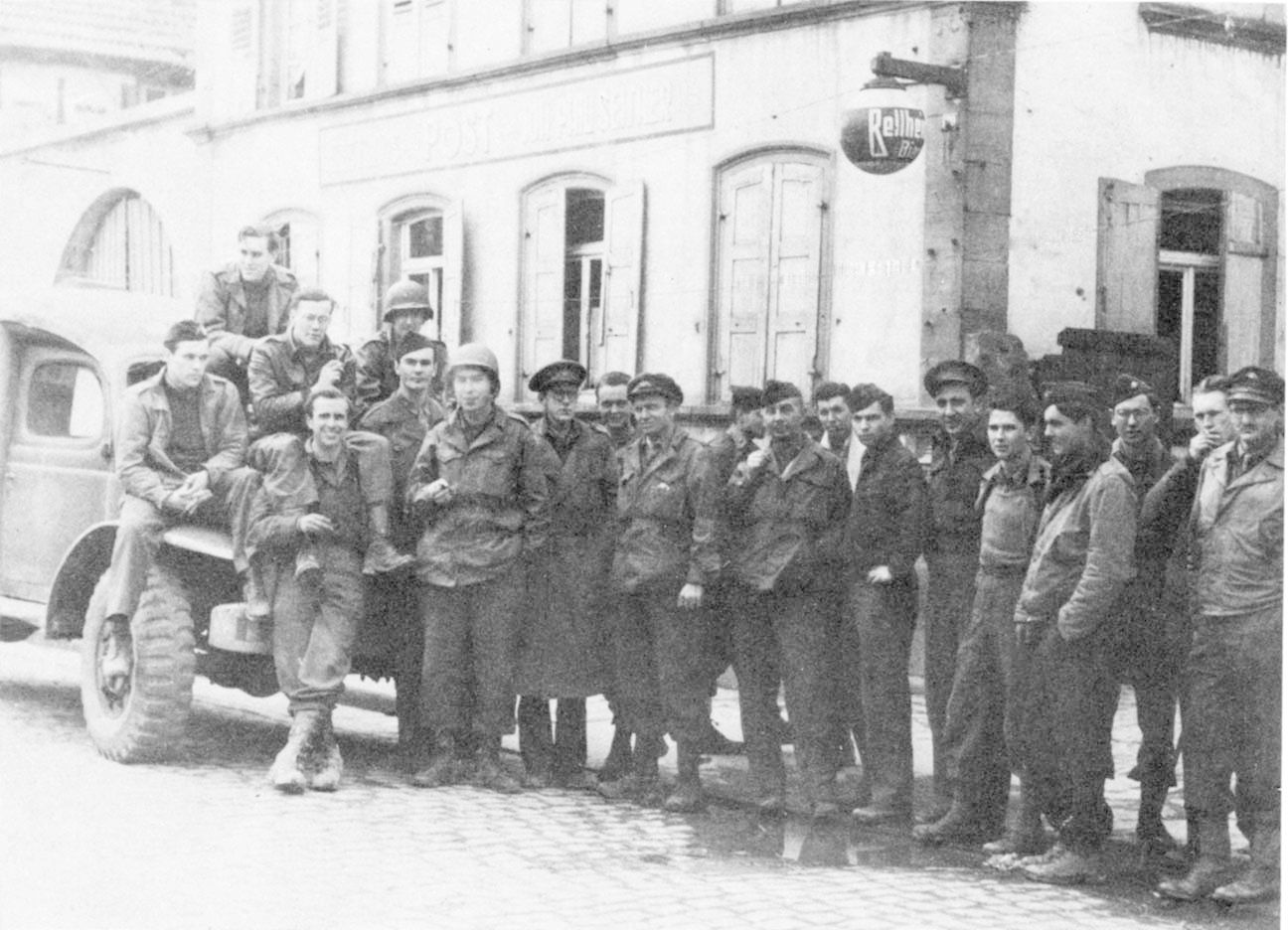
AFS ambulanciers of the 2nd Section, with the French 1st Army were the first volunteers to enter Germany, March 24, 1945. Gathered outside the town restaurant which they used as a mess in Herxheim, Germany, they are: left to right (seated) Brinton Young, William Wallace, Richard Norton, Donald Gulls. (standing) James Salinas, Robert Moore, Carl Harris, Joseph Lippincott, Robert Fenwick, CHARLES ALEXANDER (later killed) Gayle Smith, Frederick Blow, Wright Nodine, Melvin Braunstein, Eli Rock, Mark Ethridge, Donald Elberfeld, JACK DOUIHITT (later killed), Peter Warren and Edwin Davis. Photo by Cuddy |
Another AFS 'veteran' ambulance will soon be in the. Field Marshall Alexander has given one of the vehicles which served under his command, back to AFS at home. This sister of 'Bambolina's' is due to arrive any day under the personal guidance of John Nettleton. When they arrive, the veteran (ambulance, not John) will be presented to the War Museum of the Commonwealth of Virginia. Bambolina, who is still working hard roaming the streets in behalf of the National War Fund, has turned an ugly and unbecoming shade of billious green on hearing the news.
September 29th.... is a red letter day in AFS annals: this year on that date, AFS N.Y. Headquarters gave a party to celebrate the end of six years of active service. Because of the vagaries of transportation, holding up the return of several hundred men from Burma we couldn't have a total-welcome party. However, the veterans who were in the New York area came to the Club and we all had an open-house. reunion, which was FUN (if we do say so ourselves), and was attended by so many old AFSers that it is impossible to name them all... Among the recently freed ones were: 'Brook' Davis, who, after AFS desert services joined the Navy and was one of the heroes of the Franklin; Ed Zittell, a civilian once more after serving in the U.S. Medical Corps in Europe for many months. MR 'Bill' Thayer of the general committee recently Cmdr. Thayer U.S.N.R. of the Aleutians....It was a good party and it was wonderful to see so many familiar faces and catch up on what people were doing.... We hope it will only be outdone by the total VICTORY party that we are planning when ALL the ÂFSers get home.
News comes from the India-Burma theater that 16 AFS volunteers are more than 'sweating out' their repatriation. They are working at the ex-Prisoner of War Information Bureau at Belvedere, India. Their work consists of checking the records of all information on returning P.O.W.s and aiding in the relocation of them, The O.C. of the camp writes that the work of these AFS men is invaluable.
Dave Briggs, AFS desert and France 1945 vet, is about to leave the States once more to go to work on the staff of the New York Post, Paris edition. Congratulations Dave, good luck and may the other members of AFS fare as well.
ROMANCE DEPT: Charlie Miller ex-AFS currently a private in the A.U.S. was recently married to Simon Hildebrand, a Parisian, while he was on leave in Rheims and she was on duty there with a hospital unit. Phillip Sheridan was married to the former Miss Vivian Peavey in Columbus on September 21. Jay Guenther, AFS Middle East vet, and May Ferfy, a veteran of more than two years on the N.Y. Headquarters staff, have announced their engagement........... Best of luck to you all.
Another AFSer to join General of the Army Douglas McArthur in honorary membership to the famous Chasseurs Alpin is Alvin Braunstein. Alvin was honored for his service with the 1st French Army. Congratulations!
SMALL WORLD DEPT: Two American civilians met recently and after a few words realized that they had met before. It developed that their last meeting had been at El Alamein when 'Bernie' Curley, AFS, had carried a wounded Kings Royal Rifleman in his ambulance. The KRR casualty, Charles 'Chuck' Bolte, is the head man and organizer of the new American Veteran's Committee, the very up and coming veterans' group which has offered membership to all ex-AFS men.
THINGS AS THEY MIGHT HAVE BEEN: Maj. Dick Paulson writes from the Burma theatre: "We had put a lot of work into the Malaya campaign when the war ended, and it had been arranged that one section of the Company would have left for Malaya on September 5th and the other Section would have left for Sumatra on September 12th. 1 can see the death gasps beginning to come up as far as the AFS is concerned" for this is surely something of-that-were-to-have-been-in-the-future but expressed now in the past-future plu-perfect-tense.--- To which we can only add, 'Dick thank God for the end of it all!... and we do understand just what you mean.... come home soon and see.....
THE BEGINNING OF THE END..... or perhaps the beginning: In the last two or three months AFS HQ staff has lost several of its gal faithfuls. Louise (Weasie) Devine, Mrs. C.R.D., left because her Major returned from the E.T.O. and has since received his discharge .... Lucille (Mrs. Charles) Sagona merely took a vacation when her Navy husband returned from many months in the Pacific, but it won't be long now, the fleet is ashore to stay. Anne Thomas, her husband Evan is an AFS desert veteran and his LST got in and Evan subsequently got demobilized, has resigned .... and yours truly is writing finis to this chronicle because the U.S.N.R. very kindly released my husband from active duty; thanks for your patience, readers, and the best to all of you.
J.B.
June 18, 1945. (Udine, Italy)
"...We flew in C-47's. I don't remember whether or not I told you that during the war these were the planes that were flown low behind the enemy lines and dropped food, clothing, weapons and medical supplies to the Italian Partisans, who made good use of them when the final push came. One G. I. in my plane described the whole business to me as we droned along over the mountains. They would go out at night, loaded as heavily a possible, and fly over into enemy territory, often through quite a bit or ack-ack. Partisan hideouts were necessarily isolated and hidden in the hills. When they reached the appointed rendezvous, perhaps a little valley in the mountains, the pilot would put the plane into a dive, go down as low as he could, and give the signal. The G. I. would be waiting with the side door open and holding to the safety line with his hands, would kick the first big bundle out the door. Then the plane would rise, circle and come in again, Another signal---.another bundle from the Allies to our co-belligerents fighting behind the enemy lines. And so on, with the G. I. scurrying madly to manoeuver the heavy bundles into place in time---for the whole operation had to be performed quickly, before Jerry planes could intercept the unarmed cargo ship---until the last bundle had been kicked, the G L was covered with sweat and about pooped out, and the plane made its way through the flak and back to its base.
June 23, 1945.
"My second trip into Austria was interesting. We decided to tour around a bit, not following the regular route; so instead of going to Velden we turned off and went to Spittal. On the way we picked up a British Tommy. Nearly all the troops like Austria---the mountains are grand when you don't have to fight in them. The contrast to noisy, dirty Italy is very noticeable, but they all have one common complaint; they don't like the non-fraternization order. When they see some kids, or a pretty girl, they want to stop and talk without running the risk of a fine of $60 and a couple of weeks or so in the guard house. They say that Austria would be "just the job" if it weren't for that. They want to talk to someone besides other soldiers.
"The main reason for the non-fraternization order is that there are many die-hard Nazis around still doing what they can to hinder the Allies. They are guerillas, hiding in the mountains, killing, looting, and raiding British troops stationed in the vicinity. Our Tommy passenger told us that 10 men in his unit have already been killed by these murderers. M. P.'s are cautioning every traveler to be careful. An M. P. said: 'They are vicious, We're out trying to round them up now. The charge is murder.'
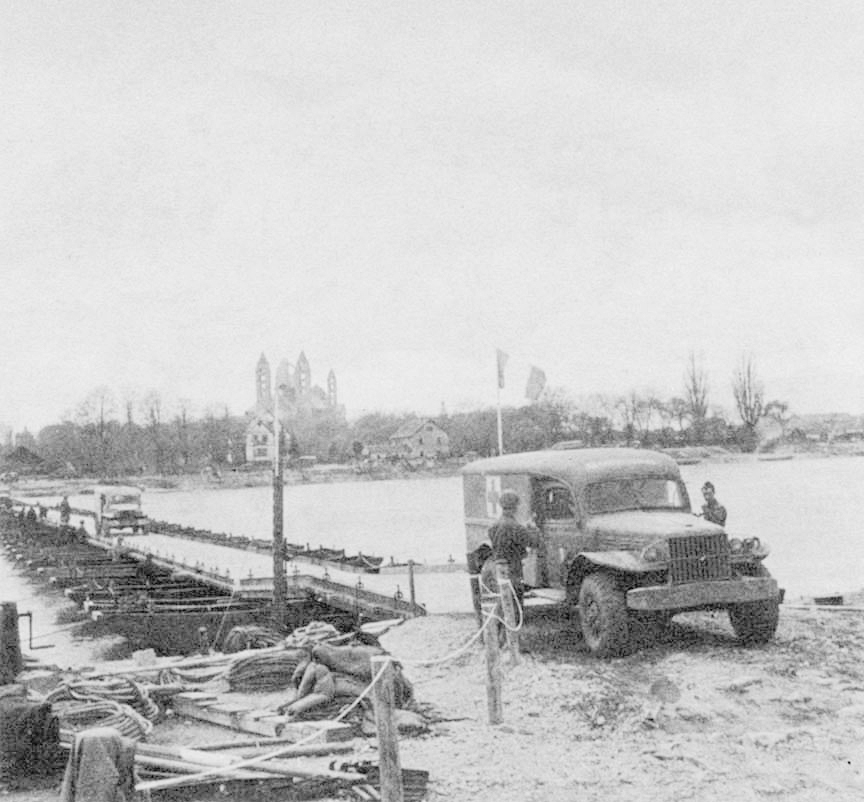
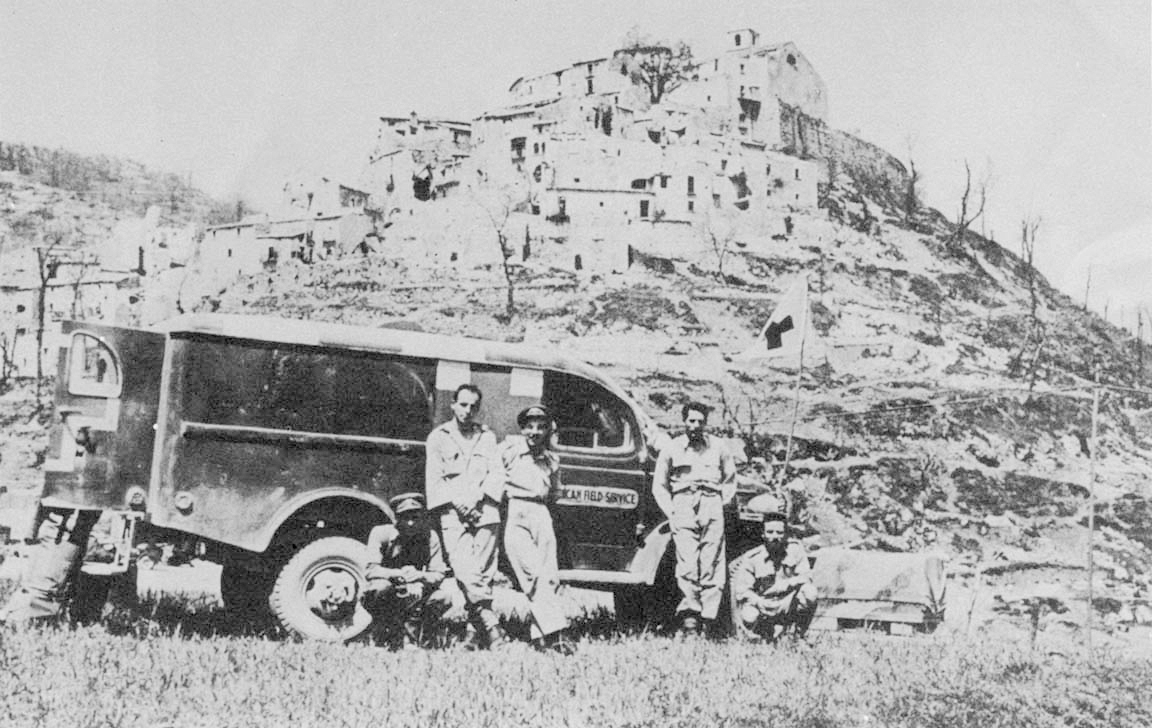
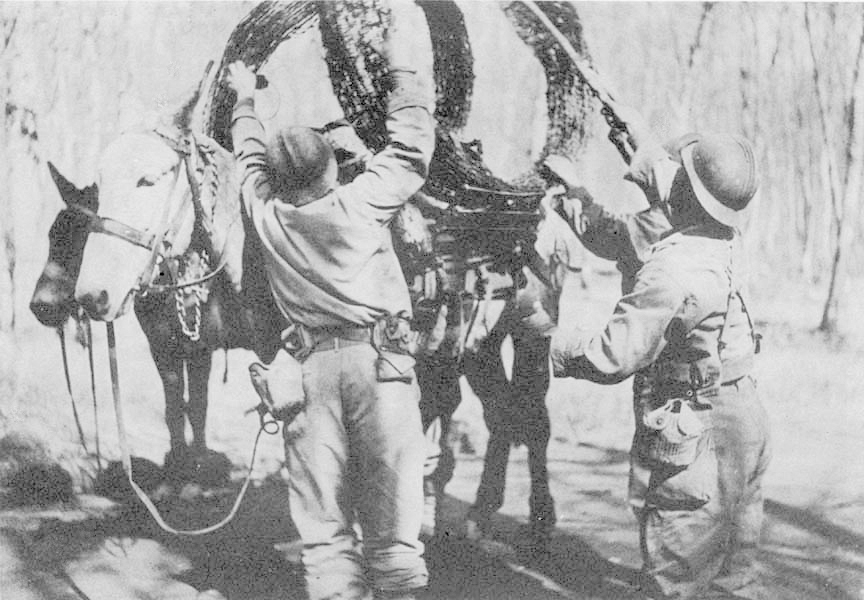
"From SpittaI we took a little side road along the Millstatter See where we stopped and cooked our lunch. A thunderstorm came up and the rain poured down but we had the car for protection. Driving along slowly we came upon a girl seeking shelter under trees along the road so we picked her up and took her to her home in a little town 5 or 6 miles on the road, This was my first 'fraternization.' She was very attractive, a little blonde 22 years old, with 2 children. Her husband was killed on the Russian front. We learned all this in a mixture of German, English and Italian.
"More side roads, many neat little farms, more pretty lakes, and finally back to Velden, the Worther See and the Viking Arms for dinner, then back to Udine after dark. It had been a very interesting trip and day.
June 29, 1945.
"Three of us decided to make another trip to Austria on June 27. We went north to Klagenfurt and a little east to Strassburg to a tiny Austrian town, called Wieting, to visit some officers of an artillery outfit of the English 46th Div. whom we had met at the Viking Arms and who had invited us up. They had a lot of German guns that we were interested in. We cut up through the mountains this time instead of following the valley route, and it was a marvelous trip. Half the time we were in or above the clouds. We saw the most picturesque, fairy-tale-like castle any of us ever saw. It was like something out of Grimm’s Fairy Tales. Its name: Hoch Osterwitz---located a few miles east of S. Veit. We had no time to explore but after the war I hope to revisit Austria and will surely go back there. We found our friends in Wieting and stayed with them for several hours, examining, purchasing and being presented with guns. I paid $10 for a Luger and a Major gave me a Colt 45--- all taken from Germans.
"Another trip through the mountains on the Italian side of the border we turned off to the west through Tolmezzo. This, too, was quite interesting. Here we found another style of architecture---houses 3 and 4 stories high, with narrow little porch-like ledges all around the top floor. The houses had two entrances---a doorway on the ground floor, and another just above it on the second floor. This is a region of very heavy snowfall, and our guess was that in winter they have to use the 2nd floor entrance. We went through a long, twisting, narrow tunnel cut out between very high rock on either side This mountain pass bears the graphic and suggestive name of "Passo della Morte'---Death Pass!
"In some of the little towns every house had been burned out---no evidence of bombing or shelling. Roofs were gone but plaster and walls stood---insides completely gutted. We stopped and inquired. After passing cigarettes we were told that a group of Partisans used to hang out in the mountains nearby and would prey upon the German troops and transport. One night there was quite a battle –--guerilIa warfare type C---and the Germans came back in force next day. In reprisal and by way of example, they went through the town throwing phosphorus bombs into every house..
As we drove along we noticed the charred remains of many small buildings---too small to be residences. We finally stopped and inquired of an old man who was engaged in rebuilding one. It seems they had been grain and produce storage houses. The Partisans used them to conceal weapons and ammunition and the Germans had fired all they could find. We found charred pieces of guns and ammo clips in one. We drove along the Piave River, past more pretty like lakes, and past numerous entrenchments and defense positions the Germans had prepared and never had a chance to use.
"Before I finish with Northern Italy I have big news for you---thrill, thrill, thrill!---"The Voice"--- Sinatra himself! The other night I saw him in person. It so happens that H.Q. of the American Corps is only a few miles from Udine and we go there often to movies and shows. Sinatra is at present making a tour of this section and we all went over to see Frankie strut his stuff, ably assisted by comedian Phil Silvers and 2 gorgeous gals. Truckload after truckload of G. I's were there--- fellows from the 10th Mountain Div., the Powder River (91st Div. ) and officers from lieutenants right on up to a 3-star generals. Probably close to 10,000 men crowded onto that hillsides, with a stage set up at the foot, and a G.I. orchestra, and a very good loudspeaker system. The show was interesting. We knew the reputation Frankie has. The G I.'s all around were talking about swooning, screaming, and all that---and they said he'd better make it good---one false step would be the end of Mr Frankie Sinatra Well, Sinatra did make good, and he made no false steps. Phil Silvers, a good comedian and even better master of stage presence, was equal to any situation---even when some generals arid colonels arrived late, interrupting the show while they took places down front. Silvers ad libbed a few cracks at them and the G.I.s loved it---'because he could get away with it---they couldn't. Sinatra himself went over quite well and the show was a success. I got the impression that despite all the big talk, most of the Ge I.'s weren't really antagonistic to Frankie---they were just curious and a little puzzled. Just what in hell was there about this little squirt that had been driving the kids crazy back home. Was he a real "Joe"? Opinion seemed to be that he was an o.k. "Joe" and that he had a pretty good voice. Sinatra made a smart business move in coming over here!
July 7, 1945.
"The road to Trieste from Udine winds through the low hills and plains of northeastern Italy and then suddenly emerges upon the sea, at the very top of the Adriatic, and for several miles follows along the top of a high cliff overlooking the sea. The Adriatic is beautiful---the deepest blue I have ever seen in water. Eventually the road descends to sea level and then you drive along the shore Approaching Trieste is narrow, very long beach. We saw many swimmers and sun bathers (and some of the Trieste girls looked pretty nice in their abbreviated suits).
"At this time there was considerable tension in Trieste and British and Americans were jockeying with Tito's Partisans for occupation of the port. The city had been placed 'out of bounds' to all Allied troops M P.'s guarded the entrances and allowed no unauthorized persons to enter. That is---except us. There are some places n ambulance can go that other vehicles can't get into. We drove up to the road block, with an M. P waving us down, and the 'out of bounds' sign staring us in the face. We kept on moving, nodding at the M.P. who looked at the red cross on the car. He stood back, uncertain as to whet he should do, but by then we had already passed through,,
"Trieste is large city and fairly modern looking. Many buildings carried Jugoslav slogans: 'Zivel Tito!' (Long Live Tito!), etc. And everywhere were Partisans in their varied and nondescript uniforms. The only 'uniform' thing about them was that they were all heavily armed and they all wore gray overseas caps with a red star on the front. The British were there, too, an armed guard on duty at all British or Allied buildings, and several tanks were strategically parked in the heart of the city. It all had an ominous look---at the same time a ludicrous look---to see the Jugoslavs stalking the streets, so overarmed it seemed silly---especially the youngsters of 14 or 15 lugging heavy submachine guns around with them---and women a fighting counterpart of our WAC, all carrying weapons. What kind of a crazy war, or threat of war, was this? We drove all over town and everywhere it was the same---joint occupation by Allies and Partisans, neither being quite certain they trusted the other, and around them moved civilians bent on their own affairs with little concern for the warlike display.
"My second Jugoslav experience occurred a few days later when I had a day off and a desire to see more of the country. Four of us decided we'd try to drive into Jugoslavia to Lubiana then over the Loibl Pass up to Klagenfurt in Austria, and we started out after I had drawn a rough map of the region from a big wall map at Platoon. What we didn't take into consideration was one of the most obvious things in Europe today---namely, what and where are the boundaries between countries to-day, and what do they mean.
"We had forgotten or perhaps never knew, that the Jugoslavs had entered eastern Italy and helped drive the Germans out and were still occupying part of Italy up to a line a few miles east of Govizia. This, like everything else in this crazy situations was very uncertain and tentative as to the futures but its present was very certain for we ran smack into that border-line---and it stopped us.
"From Govizia on we noticed increased activity among the Partisans--little bands of them marching---wagon loads of girls, singing and shouting. We even passed several detachments of American soldiers. We felt that they all looked at us peculiarly as we passed, as tho wondering where we thought we were going. And well they might, for we soon came to a businesslike road-block---a big bar right across the road, and behind it soldiers carrying rifles, pistols and grenades. We stopped, I got out, walked to the barrier and made motions that we wanted to go through. They made motions that we couldn't go through. Some sort of officer came forward----in a complete uniform,, a couple of rows of ribbons on his breast, a gun at his hip, and the inevitable red star, with Communist hammer and sickle superimposed, on his cap. We conversed in Italian--the gist of the conversation being that we wanted to go into Jugoslavia, while he fired back "niente possible." We used all the persuasive powers we could command in a situation so conversationally limited. We showed our Geneva cards, our Red Cross arm bands, my pencil drawn map---all to no avail. Our persistence finally caused him to go to a phone and contact the brigade commander. For 15 minutes we stood under the suspicious eyes of the heavily armed guards, and covered by a machine gun set up at the side of the road. Then the officer carne back. "No good," he said "Why not?" we demanded. Finally, exasperated he said sharply in Italian: "Because Marshall Tito says NO!" He suggested we try some other road---but we definitely could not continue on this road---if we did we wouldn't be able to come back. By this time we had begun to think that perhaps they did not want to let us through. So we turned around and cut off into Austria thru the mountains.
"The atrocity pictures I sent are the type of propaganda employed by the Germans, an obvious example of the favorite German strategy of attempting to divide the Allies--create friction between the English and Americans on one side, and the Russians on the others , Written in English these were intended for us. I have no doubt but that similar methods were used on the Russian front, with us as the 'horrible fiends,' These leaflets were packed in shells and showered down on enemy positions, I picked these up during the Bologna push."
June 8, 1945.
"Yesterday had another of those prisoner runs. You probably got tired of hearing about them, but as they are our only activity I will tell you about it. To begin with we are about ten miles from the Klagenfurt, and the big lake is Worth See, and all our trips are around this neighborhood. Yesterday we were told to have enough petrol to make a two hundred fifty mile run into Russian occupied Austria (that is, a round trip). It is seventy-five miles to the border and we went about thirty-five miles in on the other side, leaving about sixty miles to Vienna, but we weren't allowed to go on; in fact we had to come back across the border before stopping for the night.
"We left here at about 9:30 A.M. going to a large German hospital where there were enough vehicles to pick up two thousand patients. That makes quite a convoy when it's stretched out on the road. We left at 1:30 P.M. carrying six slitters or six ‘Surg" as it was marked on the ambulance. They were all Cossack traitors in not too bad condition, but terribly smelly, as I found out while we waited in the hot sun. There were some terrible sights amongst the other patients, with arms and legs missing. We stopped for tea at 4:30 P.M. and reached the border at 6 P.M. Our load, which had been fairly talkative and cheerful amongst themselves became deadly silent when they saw the Russian officers and soldiers at the barracks. In the ambulance in front of me was a boy in his teens with his face to the window weeping all afternoon.
"It would be impossible for me to toil you the mental process that goes on inside me when I am driving thru this most beautiful countryside, with its castles, wheat fields, peasant life, pine forests creeping up to snow capped mountains, that I would give anything for you all to see and enjoy with me, and then suddenly realize I am driving a 'Tumbrel Cart' to the guillotine. The minute we crossed the border it was quite different. The Russians use horse drawn transportation mostly and the roads were covered with manure. It looked like pictures of the Civil War in the States with soldiers struggling along the roads and wagons with four or five horses tied to each one, as well as the pair pulling them. Sometimes there were two or three wagons tied together. It was the first time I had seen masses of Russians together, many women soldiers also. They are less handsome race than the people of these parts and with a rather low I.Q. look. When were waiting outside our final destination (Bruk) a military band came along. It was good music and the first I had heard in this war. We also saw choirs singing along the way. The Austrians were all out on the street waving as we were some of the first Anglo-Saxons they had seen. I couldn't tell whether the Russians liked this or not as their faces are not very expressive.
"When we were parked for traffic the Russians would come out, stick their heads in the windows and talk to the patients, then look at us and make a sign that they were to have their heads cut off. Cheerful for the patients that were sick anyway, and slightly sadistic it seemed to me, to put it lightly. What really happens is that they are judged according to their crimes and put to work in the salt mines of Siberia or executed. We unloaded at 10:30 P.M. and started back for the border. It was 5 A. M., with birds singing in the apple orchard and broad daylight when I went to bed this morning.
"When the patients saw what was going to happen they gave X---- and me all their reich marks. If we can change them into Allied currency we will have a hundred dollars each. We gave them cigarettes and food as being the only things, they could use, for anything with any value or identity to it was useless and meant trouble. You will think this an odd procedure no doubt, and the fact that we carried the luggage of traitors into the hospital queer. But I tell you these things so you will see why home will be such a relief after all these rather emotional experiences. Who am I, who have never suffered directly from the war to judge what la proper treatment of a man about to be put to death, no matter what past sins have been committed by these people?"
June 20, 1945.
"When we cleaned out the ambulance thoroughly you would be surprised at the stuff we found hidden by the Cossack prisoners I wrote you of in the last letter. Their pay books, letters and any mark of identification they had on them were stuck in the tool boxes, in a painting X---- had fastened to the roof, wrapped in blankets, in fact everywhere and yet so well hidden that when I washed the ambulance after them they had not shown up.
"Up at 3:30 A.M. Saturday and in a three-ton truck we passed thru Venice about 9 A.M., Bologna at noon and were in Florence at 5:30 P.M. X---- and I spent the evening at Umberto Giansi's house, which has been in the family for four hundred years. They have a lovely terrace on the roof, with gardenias, oleanders and hydrangeas in bloom. His son took us sightseeing from 9:30 A.M. to 1 P.M., doing five main churches, Palazzo Vecchia, Medici palaces, etc. It was pretty intensive sightseeing, but this is X---- 's first trip and the Lord only knows if he will get another so we crammed it all in. Lunch at the Excelsior Hotel, concert for five of us only at Santa Croce on the tremendous organ at 3 P.M. by a monk who is a famous organist. Back to Umberto's for dinner at 8 o'clock. We were dead tired when we got back to the A.F.S. villa at 10:30 P.M. as we had to walk everywhere and go by street car to the country, standing both ways as there is no transport. Umberto's son followed us back to the villa with his bicycle and I took my shoes off and gave them to him so that I arrived here in sneakers. They have to pay eighty dollars for a pair of shoes---just imagine! We gave them some candy, and I dumped the sugar bowl into my napkin at the Hotel when no one was looking and they took that as they can't buy any ---this for people who had a chauffeur, cars villas, .etc. before the war. They don't complain and I have lots more to tell you when I can just chat."
Many inquiries have come in about the AFS Roster, This is being prepared now, and will probably be mailed by the end of November.
THE WHITE HOUSE
WASHINGTONSeptember 10, 1945
Dear Mr. Galatti:
The impressive record of the American Field Service in the saving of thousands of lives both in this war and in World War I has won the admiration of everyone who has seen this organization in action.
From 1914 until the end of the first World War the members of the American Field Service, serving voluntarily and largely at their own expense, made an enviable name for themselves because of their loyal devotion to duty and their valorous conduct under fire.
Reorganized September 29, 1939, the American Field Service again resumed its task of rescuing the wounded on the battlefields of Africa, Italy and France. The many decorations awarded its members and the high casualty rate incurred are eloquent evidence that the organization has lived up to the high traditions it established in the last war.
On the occasion of your sixth anniversary in this war I voice the gratitude of the nation for the outstanding contribution the American Field Service has made in aiding the wounded soldiers who fought for our Allied victory.
Very sincerely yours,

Mr. Stephen Galatti
Director General
American Field Service
60 Beaver Street
New York, New York
From: General Sir William SLIM, KCB, CBE, DSO MC.
No. 10093 MS,
HQ, Allied Land Forces,
South East Asia.
4th October, 1945,

Now that the war has ended with the conclusion of operations in this Theatre I would like to take the opportunity to place on record my most sincere an grateful appreciation of the outstanding work done by the American Field Service.
Wherever they have been employed, and at their own wish this has always been in the forefront of the battle, they have distinguished themselves by their endurance of hardship and their unselfish and undaunted courage to an extent that has filled their British Indian and Gurkha comrades with admiration and affection.
Many hundreds of soldiers owe their lives to the devotion of the American Field Service and when the Service leaves this Theatre its members will take with them the remembrance and gratitude of all British Empire troops who have served with them.
Stephen Galatti Esq.
Director General , American Field Service,
60, Beaver Street,
NEW YORK.- - - - - - - - - - - - - -- - - - - - -- - - - - - -- - -