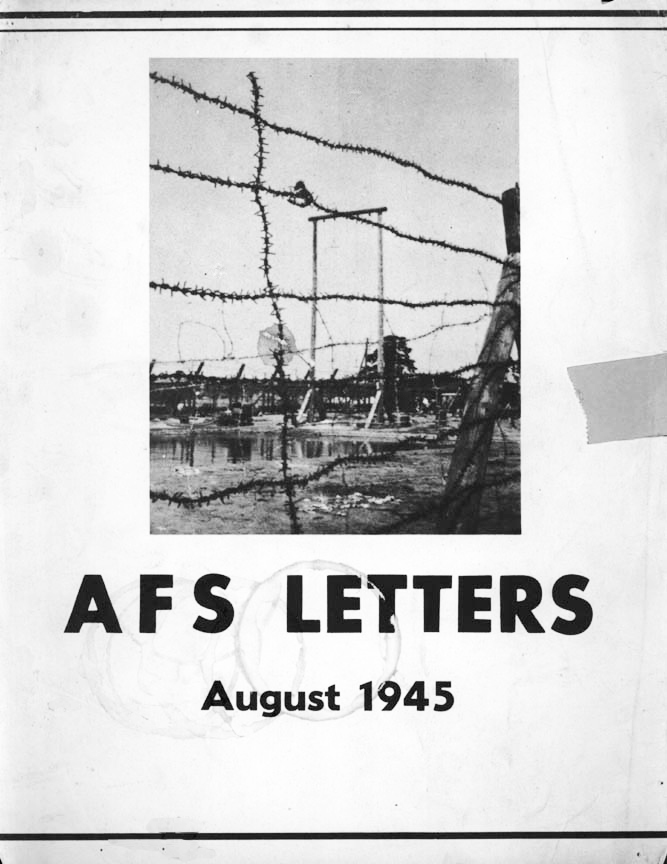
Edited and published at AFS Headquarters, 60 Beaver Street, New York 4, N.Y. under the sponsorship of the ambulanciers' relatives and friends, who contribute the excerpts from the letters.
In recent weeks 330 AFS men have returned home from the European theatre. For the majority of these men it is the termination of service, some plan to re-enlist for more ambulance work in the SEAC (South East Asia Command) theatre. Writing on the work of these volunteers with his outfit, a Medical Captain of the famed Coldstream Guards says: "I should like to write one or two words for myself and the Battalion on the work of the AFS...it seems a fitting moment to express the deep-felt gratitude that we have for them. Not only in the last phase, but all through the fierce battles, the work of the AFS has been beyond all praise. Overcoming the slight handicap of being thrust into British Army ways, they have settled down to the most arduous and dangerous duties, performing them with a skill and gentleness which could not have been bettered. The individual volunteers have become known to us each personally, not as merely men who are there to do a job, but as friends. And this comradeship has, I know, greatly added to the common understanding between British and American troops. May I end by saying that we wish to express to them before they leave us our deep gratitude for their efforts in this war, and our great hopes that the energy we have all expended over such a long period of strife may be rewarded by that true and lasting peace which all so much desire."
There is perhaps no group of men, among those who have had part in the active hostilities of war, who feel more keenly the depth of the Captain's words, than the AFS ambulance drivers. They have expended energy when, for the most part, they needn't have gone to war. The long period of strife must have seemed doubly so at times, to these uniformed civilians, who were driving the sad remains of this strife...the wounded. They have served in humanitarian work, where they have been in close contact, not only with men of Allied Nations, but with many enemy men...wounded prisoners. The American Field Service men, as much as any fighting man in the war, have seen the hopeless futility of war, and thus wish fervently for that 'true and lasting peace'.
Those of the AFS men who worked in Germany, particularly at Belsen, have seen enough of the Nazi operations to make them perpetually remember; and give them a deep desire to help avoid any repetition. The comradeship and a common understanding which they have acquired in close association with the British and British Empire men, has made the world seem a smaller, friendlier place.
Several of the ambulance men have remained in Europe in reconstruction work, not wanting to wait until the total end of the war before starting to work for peace. Many of those who have returned home after many months and even years of front line service, are back completing their formal educational, before embarking on peace-keeping careers.
The plans and decisions that these volunteers have made and are making show once again that there is something to be gained in everything, however bad. They have not served in vain.
J.B.
| Thomas Stratton Esten | Stoughton | Mass. |
| George Oscar Tichenor | Maplewood | N..J. |
| Stanley Blazei Kulak | Salem | Mass. |
| William Keith McLarty | Berkeley | Calif. |
| John Fletcher Watson | Larchmont | N.Y. |
| Randolph Clay Eaton | Ft. Lauderdale | Fla. |
| John Hopkins Denison, Jr. | Big Horn | Wy. |
| August Alexander Rubel | Piru | Calif. |
| Richard Sterling Stockton, Jr. | Bryn Mawr | Penn. |
| Curtis Charles Rodgers | Highland Park | Ill. |
| Caleb Jones Milne IV | Woodstock | N.Y. |
| Vernon William Preble | Lowell | Mass. |
| Charles James Andrews, Jr. | Norfolk | Va. |
| Arthur Paisley Foster | Warroad | Miss. |
| Charles Kendrick Adams, Jr. | Huntington | W. Va. |
| Henry Larner | Albany | N.Y. |
| Alexander Randall, Jr. | Baltimore | Md. |
| George Edward Brannan | Chicago | Ill. |
| Robert Carter Bryan | Richmond | Va. |
| Dawson Ellsworth | Milwaukee | Wis. |
| John Dale Cuningham | Brooklyn | N.Y. |
| Donald Joseph Harty | Buffalo | N.Y. |
| Thomas Lees Marshall | Winnetka | Ill. |
| George Alden Ladd | Burlington | Vt. |
| Paul Haynes Cagle | Owensboro | Ky. |
| James Bennett Wilton, Jr. | Peoria | Ill. |
| Ralph Evans Boaz | Omaha | Neb. |
| William Tuttle Orth | New York | N.Y. |
| Bruce Gilette Henderson | Kenmore | N.Y. |
| Albert Studley Miller | Cambridge | Mass. |
| Hilding Swensson | Manasquan | N.J. |
| Charles Butler Alexander, Jr. | Eccleston | Md. |
| Jack Wells Douthitt | Florence | Ala. |
| Gerald Riley Murphy | Chicago | Ill. |
| John Wilder Parkhurst | Winchester | Mass, |
GERALD R. MURPHY, of Chicago, Illinois, on June 20th, was killed in India. Gerald, in company with Gilbert Collyer, was riding in a jeep driven by a British Officer, who swerved suddenly to avoid hitting a parked truck, lost control of the car and hit a tree. Gerald was thrown from the jeep and struck his head killing him instantly. During the Burma Campaign, Gerald had risked his life many times transporting wounded in forward areas, and his death came as a great shock to all those who worked with him.
JOHN W. PARKHURST, of Winchester, Massachusetts, on July 3rd, died in India. John entered the hospital on June 20th, suffering from malaria, and later developed enteric fever. He was making satisfactory progress when pneumonia set in, and although every care and attention was given him, he could not pull through. John had served during the Burma Campaign and his courage and fine spirit were an inspiration to the men with whom he worked.
GILBERT L. COLLYER, of Akron, Ohio, on June 20th, was wounded while riding in the jeep with Gerald Murphy. He suffered a broken arm and his cheekbone was fractured. He was removed to a base hospital, where he is making satisfactory progress. He hopes to be able to rejoin his section after convalescent leave.
RICHARD A. VON GLATS, of Shawnee-en-Delaware, Pennsylvania, on July 8th, was wounded in the foot during the Burma Campaign. No report, other than the cabled message, has been received regarding his injury.
JOHN BROCK, of Edgemont, Pennsylvania, was wounded in Austria on May 21st. John and an English soldier, attached to an RAP of the Lincoln Battalion of the 46th Division, were searching through an enemy ammunition dump when. one of them tripped on a hand grenade, which exploded. Brock was peppered with shrapnel in both legs, but suffered no serious injuries. He was evacuated to the hospital and expects to rejoin his Unit in a short time.
| to those men of the American Field Service who are qualified under the stipulations of the directive. |
A dramatic close to the long and faithful career of the American Field Service in the Mediterranean Theater occurred on July 13th, when Field Marshal Sir Harold Alexander presented the organization with a British Union Jack. This tribute was paid at a colorful ceremony in the Field Marshal's office in Italy. He said:
"It is particularly pleasing to me to have this opportunity of saying a few words of thanks and appreciation to you for the splendid and gallant work you have performed in this war with the British Army. And I feel it a special privilege that I should have this chance to thank you, since you and I have served together right through the whole of the Mediterranean Campaigns which have brought us a long way together from Alamein to Austria.
"You may well look back with pride on the distinguished part you have played in this war, and, as a small token of our regard for you and as a memento of our friendship which has been forged on the battlefield, I hope that you will accept this Union Jack."
13 July 45
(sgd) H. C. A.
In this issue we are printing still more stories of the Belsen horror camp, for, though partly repetitious, each one adds some new detail to complete the whole terrible picture. The shocking and tragic extent of this Nazi deviltry should be known to every American.
May 7, 1945.
"Everybody keeps saying that everyone at home must, or at least should know what's going on over here, I used to think (and so did our late, great president) that the Germans are not innately inhuman but only sort of temporarily so. But we, the living here, have begun to wonder. Most of the fictional and non-fictional accounts of what concentration camps are like are fairly accurate except they give no idea of the vastness of the horror. When you hear that thousands of people have died in such a place you don't really know they have died unless you have seen them dying, or at least seen the mass graves. To be sure this is one of the worst, and the worst part of the worst camp is apt to stick in your mind. But I'll try to be as truthful and objective as possible.
"Disease is the most widespread horror now, but before the Allies arrived it was disease and slaughter. I have seen a lot of people die of typhus (all women incidentally, because we worked only in the women's section) but I've seen only the tiniest fraction of the thousands that have died of it here. Starvation is next and almost impossible to describe; the most of those I carried on stretchers seemed to weigh less than the stretcher. You have seen pictures of people bloated by starvation but most here are beyond that stage; they are skeletons with a bit of skin on them. But the typhus and starvation are only a segment of the horror, although the most immediate segment just now. Nobody thinks much about the high (probably 90%) T.B. rate because that is a slow disease on the whole. Nobody worries about the deranged minds, that these women will never have children, because these things can wait to be worried about. The only thing we can possibly have the time or energy to worry about now are (1) stop the typhus, and (2) feed these people.
"Fighting typhus means washing, scrubbing, disinfecting, spraying, and burning. That sounds simple until you realize the extent of this mess. When the British arrived they found acres of the dead and near-dead, lying outside and inside the huts, in the streets, everywhere. Someone told me today that 14,000 people have died here since we arrived (not long ago), but I don't know. I also don't know; but imagine, that the number of people who should be in beds would fill every hospital in New York, and perhaps twice over for all I know. At first everything seemed terribly inefficient and confused here. It still seems confused. But when I at last realized what a huge place this is, the terrific supply troubles, and the filth, and everything else I decided that the British have done a remarkable job.
"Cases of people too weak to push the dead out of their beds or off of them were frequent. So was cannibalism, if you can believe the testimonies of plenty of people. Horror is apt to be exaggerated, but we have seen the place and we know that, in your wildest imagination, you can't exaggerate it. You might think that at least the Nazis wouldn't have put the children in such a place a place but they did; I think I've handled more 15-16-17 year old girls than anything else though you can't very well tell the age of the skeleton. Might think they would have had some doctors trying to trop the typhus but the only one you hear of is a lovely lad who used to inject petrol into people's veins to see if they'd burn better. (Actually, near the end, the furnaces couldn't take care of the dead and les Bosches resorted to the mass to we graves. ) You might think they'd have been decent about a lot of things, but they weren't, not about anything.
"There are some things that puzzle me. As I've picked up these girls, I've wondered what crime they had committed in Nazi eyes. The obvious answer in that they .were Jewish... about the only thing you can imagine. So then, they were members of the underground. But that doesn't explain the children or a lot of other things. The Nazis seem not only fantastically brutal but also strange and erratic in their ways. Another puzzle, to me at least, is the fact that the Germans didn't use these people, unlike the slave labor that they worked to death. One answer is that this war the most efficient way to kill them, but that doesn't sound like the famed Nazi efficiency. We don't understand a lot of things here.
"The mixture of nationalities is a note of interest. Poles, Russians, Hungarians, and Germans predominate but it's hard to know for certain. Almost, and perhaps every country in Europe is represented and the language difficulties are unending though German is a reliable standard. Yesterday I gave a pack of cigarettes to a man from Salikona (or however the hell you spell it), some candy to a girl from Nice, and had an incoherent chat with a girl from Ruthenia, just to give you a few examples."
May 1, 1945.
"Germany is a lovely country, there's no getting around it. There are woods galore and beautifully cultivated fields. The small villages are awfully pretty too. Towns and cities, though I've seen very few, are absolutely gutted. Unfortunately there are miles and miles of country that show no signs of the war. You can drive a hundred miles without seeing a house destroyed or even a shell hole. The people are prosperous and seem perfectly happy about everything. Some even wave and give us the V sign! And the German children are just beautiful --- the cutest little tow-heads you ever saw. In fact you would almost think that the Germans were human to see them in their farms and villages! BUT they AREN'T! I found out today and nothing will ever make me have the slightest thought of pity or mercy for them.
"We are working with a hospital which is working on a concentration camp. Because the camp is so disease ridden it's hard to get in. However, just being outside is bad enough. We have to get powdered with D.D.T. all the time. Typhus is everywhere. Today we were taken to the camp by a padre. I'll try to describe it but nothing can make you realize what it was like, not even the movies, because you can't get the smell. It was just nauseating and that's putting it mildly.
"The prisoners live in shacks about 150 feet by 75 feet. Some of them have double-tiered bunks and some have none at all, Six to eight hundred people live in each hut. One hut had 1250 living in it.
"There are no toilet facilities of any kind. I don't know what the inmates were fed but it must have been next to nothing. You wouldn't believe that the human body could get so emaciated and still live. From enteritis, a terrible diarrhea brought on by undernourishment, they have to 'go' all the time and they just haven't the strength to get up, and of course there's no one to do anything for them. Now latrines are being set up but the people don't have enough of their minds left to use them. The men are mostly just dumb. They just lie and stare up at you; don't ask you for anything; and hardly moan. The woken, though, screamed and pleaded to be taken out. Just about all that is possible is being done for them now but it takes time because there are about 45,000 people still in the camp. No individual cases are being considered but block by block they're being cleaned up and gotten out. But, goodness, they aren't half way through.
"Plenty of food was given at first but hundreds killed themselves eating so the food has been cut down and will be increased only gradually. It seems to take about two months in one of these camps to completely debilitate a person. Any who were in only a short time have been organized and put to work. It seems like a completely hopeless task but apparently things are a lot better than they were, already.
"SS troops guarded this place before we took it and did all the outrages (and there were plenty although this wasn't one of the so-called torture camps). Somehow or other, no one seems to know quite how, the guard troops were captured intact, and they were not considered prisoners of war. Instead they were put to work getting rid of the pile of dead. They were fed a half a liter of turnip a day, and had to do everything on the double all day long! If we (I use it figuratively) weren't satisfied with their speed we kicked them around and beat them with rifle butts. They died off like flies and after eight or ten days only, 15 out of about 300 were able to walk. At that time General Dempsey declared that they should be treated as prisoners of war. Thank goodness we got in our licks on them first! Any time that one or two of them were in a lonely spot they were killed by razors, stones or whatever was at hand, by the people in the camp. I guess our guards didn't try very hard to protect them.
"It's just inconceivable, the whole thing, and even if you believe everything I've told you, and I know it's hard, you won't be able to understand or grasp it. I can't even after seeing it. But this I do know, that no one will ever be able to tell me an atrocity story I won't believe and perhaps have a little clearer picture of than I could have had before.
"There is just a complete breakdown of civilization. All the veneer is off and you see man as a beast. The SS obviously were beasts and the inmates get that way. They just wait impatiently for a person to die so that they can grab his clothes and get whatever tiny bit of extra space they can from all the other grabbers. There's almost no helping of one another. They are far beyond that stage and are out only for themselves. Another person's life, of course, means nothing.
"As a contrast there are the SS officers' quarters. The most fabulous place I have ever seen! It's enormous and done in really very good taste. It has an enormous ballroom about as big as the whole floor area of the barn at home. There are a half a dozen dining rooms and a dozen sumptuous sitting rooms. The kitchen has a layout that puts Princeton's to shame. And as for the china ware, glass ware, silverware and equipment of all kinds, it's unbelievable. Several hundred of everything, with wine, cocktail, and highball glasses of every shape and size. The basement is just a string of wine cellars one after another. Unfortunately we arrived a bit late and found only about a dozen full bottles in those ten or twelve cellars. All good French and Rhine wine, You get an idea of the kind of life the pigs led when you hear that the bathrooms had vomitoriums in them. They are basins about four feet from the floor or a little less, with large drains, no strainer, and with a handle on each side about shoulder high. The drunken Huns just grabbed the handles, leaned over, and puked, so that they could start all over again while a mile away three hundred people a day were dying of starvation! I don't think I'll ever bother to learn to speak German. Who wants to talk with such people?
"The loot that's been taken out of that place is unbelievable, too. There were innumerable cases of wine, and several cases or crates of fifteen jewel gold watches, and diamond rings galore! Imagine it. Then the tables, chairs, mirrors, carpets, pictures and such like were enough to equip the Providence Biltmore. The grounds about it are like a park, with goldfish ponds and a swimming pool.
"The camp commandant was captured there and the only place they could find to put him was in one of about eight big refrigerator rooms. They chained his legs together and tossed him in there; locked the huge iron door and put two guards on it. During the night signals got to work and set the electricity going and when the found the guy in the morning he was nearly frozen to death. He was taken away then and stories differ as to what has been done with him. The most generally accepted one is that the Russians, who have lots of old scores to settle with him, have been given full rein. They'll do a good job on him, I think.
"This camp is something that everyone should have to see so that the country will know what we're fighting against, but I thank God that they don't have to see it.
"I may be more cheerful next time but these memories will last..."
April 26, 1945.
"We are, at present, pleasantly unoccupied in still another dusty little German town. I'm still with the same little outfit which has some marvelous characters in it including an Arab named 'Vingt-neuf' (just about all of them are named 'Mohammed', so the French just shrug their shoulders and give them a number) who is the image of Steppin' Fetchit, and utterly useless for anything in the way of work but who has an engaging and ready laugh, usually so violent that his helmet falls to the ground ten or more feet distant. We're very congenial since we all dislike the same people ---the Captain, who is quite mad, and the cook who has produced nothing for the gustatory delight of his peers except bully beef and potatoes for the past two months. The Captain, when complained to about this regrettable state of affairs, apparently said, 'Let 'em eat 'K' and promptly a 'K' ration appeared as a side dish for each repast. In fact, if it weren't for the inexhaustible supply of Teuton poultry we would be quite upset, digestively and spiritually.
"This old war is about done, I think. We can't find the front anywhere. We just keep moving without resistance. Every now and then we go up in the hills on a manhunt and bring back a handful of bedraggled Supermen tired of sniping and eager for a square meal. Right now the division to which we're attached is resting (too much effort to keep up with the Jerries) and we are too.
"We're all a little disappointed at the civilians. No spirit to them. To hear them talk each one was the leader of his own little anti-Nazi movement. The three of us here are the guests of the local pastor who is a cordial gentleman with a brother in St. Louis. I haven't yet met a German who didn't have a brother in St. Louis."
May 15, 1945.
"This time I write to you with good tidings of great joy. La guerre est finie, grâce à Dieu, and I haven't a care in the world. Happily, I was in France when the news finally came through having driven to an American hospital in Nancy for a few days to get rid of an annoying skin rash called scabies, and the people went wild with joy. They threw more ack-ack up in the air in celebration than I've ever seen against enemy aircraft, they rang all the church bells and there was dancing in the streets.
"A day or so later I drove back to the section, sitting on the border near Austria. Everybody has been relieved of active duty, and in a few days we'll leave the French. I'm in a very famous watering place in the most beautiful part of the -----. We're almost the sole occupants of a posh transit officers' hotel and have nothing to do but enjoy a life of quiet and healthy elegance. I have a bedroom, bath and dressing room all to myself ---I even have a white telephone. There's swimming, walking, sun, tennis, motoring, mountain air ---it's really smashing.
"From Bishwiller, about 15 miles east of Haguenau and the jumping off point of the French drive north into Germany west of the Rhine, we worked just about steadily until a few weeks ago. After a string of towns in the Palatinate, we crossed with the French in their bridgehead at Speyer. It was quite thrill, because it wasn't until then that we really considered ourselves in Germany. We evacuated back across the Rhine for a while at a place where there wasn't a bridge. They tied a couple of pontoons together and put some planking across it and you had a sort of ferry, which you drove onto over two wooden timbers---not without uneasiness, I can tell you. We headed toward Stuttgart for a while, then changed our direction and headed due south as far south as Freudenstadt. Then we headed southeast until we got almost to Austria and there wasn't much point in moving farther. Until very near the end most of the night work had to be in absolute blackout because there still were a few stray Jerries in the air who would shoot up the roads if they could. The main problem of a rapid advance like that was the pockets of Germans behind the non- existent front. It's now pretty safe to drive through the forests at night, but it wasn't until fairly recently. So far there's been little or no trouble from the 'Werewolves, as the Germans wistfully call their mythical resistance movement."
May 28, 1945.
"Our job's over now and we're just waiting for the next development........ homeward bound, of course.
"Censorship details have naturally relaxed a great deal and I'm able for the first time to spread a little bit of military information which you can pass along to the Japanese if you think it will help them any.
"Our section was attached to the Fourth Moroccan Division, which I had known from the Italian campaign. (They were the heroes of last spring's offensive which resulted in the fall of Rome.)
"On the whole it's my opinion that the Italian show was a far tougher one, that is, as far as the AFS is concerned. Foot by foot it was easily bloodier, and the home comforts on this end certainly are far above those we experienced while connected with the Fifth and Eighth Armies. On the latter count, however, I wouldn't like to get into any argument with the Burma-India boys.
"It was very pleasant being attached to the Moroccans. They seem to have a general liking for Americans (all of whom are 'Joe' or 'Johnny') and as far as their native honesty is concerned I would trust them with the U.S. mint, which is more than I can say for the British Indian troops.
"Armistice Day for us simply was a maze of rumors Finally there were so many rumors saying roughly the same thing that all we could do was string along. We were in the town of Feldkirk, Austria, which for some time had been the Headquarters of the exiled Vichy regime. This first night of Peace was noisier than almost any night of war I had been through. Two division worth of jubilant French troops proceeded to celebrate by shooting off all their old ammunition. Many of the civilians took to the cellars and I must confess that I was tempted to do the same thing (on the sly) myself. As far as I know only one man was killed. That, I might add, is considered an excellent record. The AFS was quite sober about the whole thing, one reason being that the only things we had to blow up were our ambulances, and secondly that we found ourselves unprepared in alcoholic ways. At any rate there was the thought that U.S. still had a job to do in other parts of the world.
"Right now we are in an excellent hotel which once handled the winter skiing trade. It is really a magnificent life.
"While we were still with our Battalion we threw a few gay parties, recruiting women from French woman ambulance sections and nurses from a nearby medical unit. There were also Austrian civilian girls, who may I say, far surpass their German cousins in physical comeliness.
"A number of us now have our personal automobiles, having surrendered our ambulances back to the Army. Sometimes it is a problem getting gas, but I still don't suppose that it's as difficult as it is in the States.
"Roosevelt's death naturally came as a great shock. It seemed incredible that he should die before the end. We were still in Alsace when it happened, and it is a fact that the first words of every man after he heard the news amounted to, 'O God, Truman! ' However, the new president seems to have inspired a new sort of confidence over here as he has at home. But we still wonder how much we have been set back in this first round of the Battle for Peace. It seems to me that this is far more critical for the moment than any domestic policy or issue.
"Most of my news on what's going on in. the world still comes from back copies of TIME magazine. The stories that come from German concentration camps seem to make a great case against Germany, and I personally hope that America remembers them along with the world for a long time to come. A couple of our fellows ran across the bodies of several hundred Russians who had been slaughtered by the SS just before liberation. I have seen none of this but the huge, camouflaged barracks which once harbored thousands of slave laborers, which one sees everywhere, are amply incriminating There were, of course, millions of deportees............ men, women, and children alike. Now they are all trying to go home, and how they are going to eat en route is beyond met.
"While we were in Feldkirk we were besieged by hungry people. It is hard to refuse, but it's either that or be swamped. One day I relented and fed a fine breakfast to a tall, sallow, bespectacled Frenchman. The next day I saw him being escorted up the street by two French soldiers. He turned out to be a volunteer member of the SS. It's good proof that there's no such thing as justice these days.
"We also ran across an American couple. At least the woman was an American (in accent) as hot dogs. Their story was that they had been living in Jugoslavia for most of the war, and had been free to travel around Europe as they pleased. They were obviously well off, but from what I could fathom about their life in the States they had lived there in fairly modest means. Why were they in Europe? How could they make a living here without at least faking Nazi loyalty? Why were they not interned? I don't know. But we must have had a lot of dead wood in Europe during the salad days of Germany and my personal wish is that we leave it there.
"The people here show a great and natural fear of Russia. It is evident that as far as the German regime is concerned the Allied democracies were only secondary enemies. It is hard to conceive, but the fact is that most Germans are confident that the United States and Britain are more allied to Germany than they are to the Soviet Union. They expect us to go to war against Russia at any moment; and they expect our victory to be Germany's as well. I was actually asked once by an Austrian if I would go home to America before going off to fight the Russians! As the years wear on this is going to prove for them a deep disappointment. It is the one last, bitter false hope that the crumbling National Socialist regime left them. It is the last lie.
"My hunch on Germany's future is that if plans for the postwar occupation are carried out as they have been blue-printed, the German nation is going to have some job uniting itself again at its conclusion. You can't expect the three powers to treat their respective zones identically, and for this reason the whole moral and political outlook of the three zones are going to be radically different. It may or may not be a good thing.
"I have yet to run across any specific sign of a German underground. There is supposed to be at least one now, as you know, called the 'Werewolves'. It is inevitable, and there are probably enough fanatics left to make it a sizable problem once it becomes organized.
"The woods around this are filled with a rather elaborate defensive system. There is one pillbox, if you can call it that, which has tiled shower baths in it. I wonder if every Jerry was issued with a bottle of Pond's facial cream."
April 30, 1945.
"Last night we were shown some German news reels which were extremely interesting, though the commentary was in German. They showed both movies of the western and eastern fronts and also pictures of a U-boat sinking a ship taken thru the periscope. The pictures were excellent complete with Russian atrocity pictures and the defense of Berlin with the civilians preparing the bulwarks alongside the soldiers. The latter was, I suppose, meant to illustrate the unity of the people of Germany.
"Germany is a pleasant country. The majority of the important cities that we have seen have been almost completely obliterated, but there is negligible destruction in most of the villages. The countryside is covered with gun-emplacements, wrecked vehicles, slit-trenches and small fortresses and pill-boxes, and almost all the main roads have evidences of having been strafed frequently by planes.
"The people look well-fed and appear to have all the necessities of life. The luxuries have probably been hidden as some that we do see have obvious signs of having been stolen from nations occupied by Germany previously. The people are not exactly over-friendly but most are not openly hostile and some are really quite willing to be friendly. As you know, the non-fraternization policy prevents the possibility of any more than token friendship. This policy may or may not be the right one. I suppose that it is. It is sometimes quite difficult to follow with little children inclined to be friendly or with someone who goes out of their way to do you a favor. But on the whole, the Germans appear to have adopted a sort of passive resistance policy which is only natural, I guess. There are a few signs of active resistance (sniping, poisoning water, wires across the road to behead motorcyclists, etc.) but these are quite rare at least in this area. These are probably the work of fanatical boys about 16 or 17 and I don't think they can be blamed. I hope we would do the same thing in their position.
"We have seen thousands of German prisoners and thousands of Russians, Frenchmen, Belgians, Dutch, Americans, Englishmen and even Italians that have been liberated. The former German-held prisoners and slave laborers that we have seen are almost all in terrible condition. We have talked to many of them and the countless atrocities committed by their German guards are hard to believe. You have undoubtedly read enough about these so that I need not give examples. Suffice it to say, they come out of the P.W. and concentration camps with blood in their eyes and woe-betide any unprotected German prisoner they meet. Even passing German prisoners in trucks on the road, they will throw anything at them that they can get their hands on, such as gasoline tins, the seats in their trucks, anything at all. These freed men loot the houses of civilians unscrupulously and it is amazing what some have found in the way of hoarded and hidden food, radios, even autos, etc. I think you will agree that they have good reason for these actions. At least you would if you could see some of them.
"In fact the Allies' whole policy in general towards the Germans seems to be 'To the victor belong the spoils'. If one of us sees something we want we just take it or else get a permit to take it 'legally'. Sometimes, as in the case of Germans driving cars or motorcycles without permits, it really is permissible to confiscate the car, but usually it is just plain looting. Looting is actually forbidden, and sometimes the article is given back to the German, but usually you keep it. I really don't approve of this and haven't as yet taken anything, but perhaps it is the best policy anyway, it is certain that they deserve such treatment, and the only objection is a matter of moral principle and whether it is more liable to incur such hatred that another war is more likely. On the other hand, maybe it is better to show them that we are capable of such action and that we can be as tough as they are. Again I don't know which is right. It is really up to the individual soldier to decide, as not everyone can have an M.P. following him around. Most M.P.s don't care what you take anyway.
"Well yesterday Germany gave us its first offer of unconditional surrender. It is hard to believe that they could hold out much longer anyway. [Next 4 lines illegible due to water damage].
May 13, 1945.
"We are pleased to note that the home country is not making fun of [next 3 lines illegible due to water damage] ...President Truman save what I receive from you in clippings. So please, if your want me to know what gives in the world, keep them up. Incidentally, did you notice that on the back of one of the 'Sad Sack' cartoons there was a full column article on the 'AFS to Mark an Anniversary',,. anniversary of five full years of service to the Allied Armies. I'll bet you didn't see it because, in your anxiety over the exhuming of Sad Sack, you scissored right through the middle of the Field Service. Never mind, I can hear about the AFS every day.
"We are now very comfortably billeted in a small German town getting a breather after the Stuttgart show, and after the excitement of VE Day. It is certainly hard to believe that, in a month and a half or two months at the most, I will be home with all this behind me. This life of cold, hot, wet, dry, hard and soft...all the opposites you can think of.....do in the future. If I must go to the Far East, that will be another world; one I will not worry about now. In war one can't help but live for the moment. Hmmmmm, sounds like something somebody wrote when he had nothing better to do.....and to think he probably got paid for it.
"Anyway, life has suddenly become very pleasant. We eat, we swim, we play touch football and we romp. Every two days we have to get up at four a.m. to carry a load of patients to the local airport. From there they are flown back to France. One of those days we will go back to France and from France .....Scarsdale, New York City, Boston and a hundred other towns... towns that suit the plans of the members of this section, some of whom haven't been home in almost three years!"
April 13, 1945.
"Although it is some time since my leave in Paris It is still fresh in my mind, and with the slightest concentration it becomes a flood of thoughts and physical sensations. I remember how warm it was at night and how the lights from the left bank were reflected in the river. I can see the trees just budding and smell their new life. Then I can look down the river and see one of the arched bridges beneath a full moon which was always successfully appearing through the sky mist moving in the wind. The cobblestones by the water, the splash of a fisherman's little boat, the oars breaking the quiet surface of the flowing current, [next 8 lines illegible due to water damage] Paris is all around you, whenever you want it, but is so unintruding. It is charming. I left wishing I could stay. I hope now that I may return."
April 18, 1945.
"Since I wrote you last a whole lot has happened. A convoy formed and stopped near a small Gasthaus, and four of us went inside and drank beer and sang the Whiffinpoof song and Lilli Marlene song and then left and drove some more through this beautiful country. The fruit trees line the roads like a boulevard or like the entrance to some huge estate. Sometimes the blossoms are white, some times they are pink. Always there are blossoms, and beyond across the cultivated plains are the mountains, cool and blue.
"I check my own vehicle and swing it into its position in the middle of the convoy. We drive, and I dream while the car drives itself. We stop in a tiny village, but there is a Gasthaus. I sit in the Gasthaus out of the sun and away from the buzz of dirty insects and eat my cheese ration with beer which I purchase. Afterwards I read Plato's Republic until the convoy starts again.,.... The roads are dusty now, and I am caked with dirt. The people wave and cheer while we drive through the towns. We pass into Germany, and the people stop cheering and waving --- except two very little children, a little boy and a little girl, holding each other's hands and looking at us wonderingly, they wave with the hand which is free.
"The towns are practically deserted. The destruction is immense, and the French patrols marching on foot look alone and lost amid the debris of ghost towns.
"It is night. We have camped in a cool grove of trees near a deserted city. I relax and close my eyes. I open them as soon as I hear the familiar drone of a German fighter plane. Already the sky is filled with a beautiful display of tracer bullets and heavy anti-aircraft shells. Shades of Anzio, I watch it with fascination (it is the best word for the sensation). Some of the old thrill returns when the plane sweeps low and roars past directly over our heads with the streams of tracer bullets chasing madly after it. The noise is familiar and exciting. This happens several times during the night in lesser or greater degrees of intensity, but it finally ceases and we go to sleep.....I slept solidly until morning when we cook breakfast and boil eggs. Then, feeling too full of energy and good health to contain myself in the fresh morning coolness of the grove, I go off to investigate the factory.
It is being looted (naturally). Hitler's picture has been smashed legitimately. Other things were smashed which I will not pass upon since I haven't the bursting seeds of French revenge inside of me. I found a medicine ball and a skipping rope which I confiscated. Nearly everyone was on hand when the safe was sprung, and everybody came away with an envelope containing great quantities of German marks. My envelope contained approximately 500 marks. This may be worth one hundred dollars, and it may be worthless. I don't know yet.
"It is afternoon, and we have moved through miles of dust to a tiny village. The money is good I learn, but there is no need for it. Everything imaginable is lying about deserted. We just took about fifty gallons of wine for the company from a brewery. Life seems wild and utterly fantastic. Nothing is beyond belief. Any hunger or adventure inside of me is being fed richly in this fast moving existence.
"During a delay in the convoy the sound of a piano drew me to the second floor of a house in the village. A French soldier who was a concert pianist before the war was playing Ravel quite unconcerned with the smashing of mirrors, and the other loud sounds of insanity all about him. He created a scene of dramatic contrast, and I, for one, felt it deeply. I must say that I lack hate in sufficient quantity and all of this is very tragic to me. It is probably better for the future of the kind that the majority of people around me are proving themselves not wanting in bitterness. But, God! I can't help feeling sad! It is hard to know where justice ends and madness begins. I shall not try to interfere even in wanton destruction until I am firmly convinced that madness has taken over, for my mind tells me there is a need for hard justice of this kind even though some injustice may inevitably occur. Are our ideals right or wrong when we must compromise them so? And I have compromised certain ideals actively this morning and passively this afternoon, I stood by the piano and listened to the music until the other noises ceased.
"We were billeted in a house next to our medical aid station, and I found a pump and washed myself clean. What a good feeling it is to be clean again! Amid the ruins of a town and among the weary faces of the German old people and the expectant unknowing faces of the little children (everyone else has left, or, perhaps, they are all dead). I hear again the weird music of Ravel, a pianist with the technique of a virtuoso. It is a powerful and tragic drama, and no one with eyes to see and life to feel can miss all of it. It isn't just the Germans, it is the French, the English, the Italians, and even ourselves.
"We passed columns of decrepit men on the road today. They were French, Poles, Russians leaving German concentration camps where some of them had been prisoners for as long as five years. They are walking the many miles homeward, hopefully, but I could tell many of the French that they need not hope to find the homes which they left or (but I will let them hope) the family. Perhaps some of them will find the remains of a shattered wall, others a chimney.
"You tell me what is just. I am acting sometimes so, sometimes so, always doubting what I do, only knowing what I feel. I am not one to deal with this situation. I am sorry for everyone in the whole world; myself, of course, I count. To act, a man must feel more than sorrow. You have probably felt most pained when you were firmly convinced that you were right and had to deal sternly with someone.
"Then, perhaps, it is the answer. Deal sternly, whatever the sorrow, when it is just, but beware of madness. And in dealing sternly still feel sympathy and sorrow. Never take joy in the tragic ---especially this enormous tragedy --- it is too solemn. We would corrupt the race and debase ourselves.
"We have been listening to an original composition by our French pianist. Though my knowledge of higher music is chiefly intuitive, I think he is a genius. In the midst of explosions, what a miracle!
"I have to make an emergency run. I am carrying one German and one Frenchman. Both of them are badly wounded. A piano, an ambulance --- both are in a way sacred. We deny neither to those who need them. It makes no difference what crimes a man comes from or what wretched ideas he carries still within his mind, these things are never deliberately denied him while we remain human.
"What a hectic night! One run after the other through miles of blackout. Unfortunate houses blazing with bright fire illuminate the way sometimes. Bridges are blown, and the routes vary. Trying to understand directions in French, German, and Arabic is profoundly confusing."
No date.
"After seeing Belsen, I can believe anything. Talk about man's inhumanity to man. Men and women are kept in separate huts. They are too weak to keep clean; and no sanitary facilities were provided until the British of a Scottish division captured the place. So the people simply shuffled over to the window.
"W. and some of our men are working carrying men and women from these filthy huts to a sort of assembly line laundry, where German nurses wash them and wrap them in clean blankets. They are then taken to clean quarters. The women are so anxious to get out into cleaner quarters that as soon as our cars draw up and the stretchers are ready, naked women fight with each other weakly to get places on the stretchers; they have to leave all their contaminated clothing and possessions behind.. Every once in a while one of these people just gives out in the excitement and dies. Or else they die in their sleep and the bodies are placed outside the huts. Each day the bodies are collected around the camp by a big trailer truck. Individual graves can't be dug, of courses so bull-dozers here dug out big pits. One recently covered over had a simple sign 'Grave, 1000 persons, April, 1945'. The pit now in use has about 500 bodies thrown in it. They are all dumped in, in all manner or grotesque positions; when the pile is big enough the bull-dozer will level some dirt over it. All these sprawling half-naked bodies are bad enough but they did not make half the impression on me that the living survivors did. The inmates are clothed in horrible striped pants and odd shoes and coats. Their features are all horribly gaunt and drawn, and they have the unhealthy pallor of starved people.
"The German nurses who are working in the place seem very amazed. I dare say a majority of the German people had no idea that their government was treating human beings in such a despicable manner. The SS guards who garrisoned the place were apparently criminals and other dregs of German society who competed with one another in their inhuman treatment of the prisoners. As I said before after having seen Belsen I can believe anything
"Our present HQ, is in an old 9th century church and convent. There are many pastors here who are refugees. They have been bombed out of their homes in some cases. One 'Free Church' minister here has a very musical family and he entertained us one afternoon un the cello while his daughters played the violin and flute and his wife the piano. At the end of a lovely afternoon he said to us rather apologetically, 'I'm afraid our music is better than our politics.' If there are enough of this sort of people left in Germany the future is not a hopeless one. This man spent over a year in jail, just because his religious views did not please the Gestapo and Hitler.
"This has not been a very tasteful letter, but I thought you would like to know about some of this stuff I have recently seen. It is not pretty stuff but it is true. I haven't adequately described Belsen. No one can do that. One must see it to understand and comprehend it in all its monstrosity."
May 3, 1945.
"The camp is set off in the middle of some woods, miles from any towns or cities, and is completely cut off from the outside world. It is surrounded by barbed wire, set out a mile or two from the actual borders of the camp, with signs warning that any trespassers would be shot without hesitation. No care whatsoever was taken of the inmates ---as people died, they were merely shoved out of the windows by the others, if they were strong enough. In many of the buildings, however, the people were too weak to even do that, and the bodies remained in the crowded rooms to rot. These rooms were in many cases so crowded that there was not even room for them to lie down without lying on top of one another. In these rooms many of the dead were stuck to, or had grown to, the bodies of those still alive, and they had to be pulled apart. Now I know this sounds absolutely incredible --- I am not trying to impress you by all these things. I am certainly not exaggerating --- they couldn't be exaggerated, as they couldn't possibly be made any more horrible. I am merely giving a factual account because I think everybody ought to know about this. Previous to this, I had always taken accounts of German atrocities with somewhat of a grain of salt, but now I see they have always been underestimated.
"Of the ones I saw, I would say that only about 20% of them had much chance of living. They look and act like animals --nothing more. Most have lost their minds completely or have sunk to animal level. Most of them just lie and stare, and it is difficult to tell when they are alive and dead. No latrines existed in the entire camp, and although many have been built now by the British, most of the inmates are much too weak to move and consequently just evacuate in their beds where they are lying. The Germans never cleaned up. Although we had been cleaning for almost two weeks when I saw the camp, the barracks were still being shoveled out ( by Germans) and the trash and rubbish pushed in to piles by snow plows and burnt. You can't imagine the horrible sight and smell of a pile of this rubbish coming out of a building, with several dead bodies mixed up in it. It is really impossible to believe all this ---even for me. It all seems like a nightmare.
"And in the center of the camp was the gas chamber. Hundreds of people at a time could be, and were, herded into here and gassed. There was also a crematorium, where bodies were burned, in some cases I understand before they had even died. I talked to one Pole, almost dead from starvation, who had seen both his mother and sister tossed into this while they were still living! The stench of dead bodies around the gas chamber was impossible to stand, although a certain amount of it, of course, covered the entire camp, and clung to our clothes and nostrils after we left the camp. This smell of rotten dead bodies is without doubt the most sickening smell there is.
"We were in one ward full of women, one of whom was trying to tell the Doctor something in German, which he couldn't understand. Someone pointed to me and said I could speak German, and I was immediately pounced upon by this woman while all the others who could talk wailed at me and cried. This one woman kept asking why they didn't take them to hospitals, why they didn't get them out of the camp, why they didn't give them some food, etc. I told her that there were very few of us here yet, and that we had very few supplies and food, and that we had not beds enough or hospitals enough in which to put them that it would take time to handle so many people. But she grabbed me and took me around to various girls pointing them out, this one only fifteen years old, with a face of seventy and a body of five, and so on, asking me why they didn't at least take out the young ones who had lives ahead to live. I could do nothing but repeat over and over that we were doing all we could, but still they couldn't understand. It was really pretty horrible. One of our fellows took a visiting English priest down to the camp the other day, and when they got in the camp, the priest just from the little he could see from the car, became so frightened that he simply would not get out of the car--- he refused to look at the horrors because his mind could not conceive of all these things.
"Of course the first thing that came to my mind was what kind of men could perpetrate such tortures. This entire camp, as I believe I mentioned above, was run by SS troops, some of whom were still here when we captured the place. Those that were left were put to work burying dead bodies left lying around. The British Tommies made them work on the double all day, with the only rest they got on top of the bodies they were burying. There were also a couple of SS women here, too, who were supposed to be even more sadistic than the men. I saw the five main SS men here--- all were ill in the hospital after their work in the camp, and I believe all of them caught typhus. They were certainly shown little consideration by us, and as far as I'm concerned they deserved none at all. I also saw the two women, and although one looked pretty frightened, the other looked just as tough and defiant as many of the army prisoners look. One thing I have been trying to decide is how much the general population of Germany is to blame for these things. Of course, they all claim that they knew nothing, but after seeing lots of things, and talking to lots of the inmates themselves, I have come to the general conclusion that the general run of German people undoubtedly knew that concentration camps of some sort existed in Germany, but did not know how bad they were; but if they suspected the worst, they were certainly not encouraged to look into the matter. They were shot for even walking near the camps. In most of the large cities we have put up large photographs of the horrors of these camps, and I have watched the people looking at them. They do not just glance at them and pass on, but they stand and stare and stare and stare for a long, long time with white faces full of horror and fear. Most of them are horrified, but even more are afraid. I asked one old lady what she thought of all these things, and she asked me if they were true. I told her I had seen them myself, and she started raving about how horrible it was, then blaming it on the SS men, the Wehrmacht, the Nazis---everybody but the ordinary German people. But still no matter how you look at it, the people must be responsible for the way their country is run; if they claimed that they could do nothing, even if true, they can be blamed for ever letting a government like that get control.
"There is a terrific contrast here between all those horrors, and the other end of the camp where the SS troops were billeted. They lived in clean and modern buildings, while the SS officers club is one of the most luxurious and completely equipped places I have ever seen. The entire place is nothing short of fantastic, These SS men could hardly have been human beings. As a matter of fact we evacuated a hospital of wounded SS men from here, and over a bumpy road, I don't believe any of the cars went under fifty miles an hour the whole way. It is impossible to have any sympathy for these men after seeing the things they have done. I have seen plenty of men who have always theoretically advocated an easy peace for the Germans, completely change after seeing this camp. It is just too much to take in, and I'm sure you cannot even conceive of this place from my description, because I, even after seeing this camp, cannot believe it myself. Every person here has lost most of their families --- many have seen their own children picked up by SS men and beaten up against a wall till they died. Many have seen their own families gassed or cremated while still alive. Every person in this camp can tell stories like the, until it almost gets monotonous. I won't go on telling stories like this, however; as I've written enough now, and more won't make any more impression. But every one of us who has seen this camp and worked here, has been terribly impressed. Everybody, whether he can write or not, has certainly been inspired to try, just to get across to the people at home a faint idea of what this is like. You probably read the account of this camp in Time Magazine, under Belsen Camp. I believe there were three pictures of this place in. the issue with Vandenburg on the front. That account will undoubtedly give you a better idea of the place than mine. But, if you see any person at home poo poo these stories in the papers about these camps, tell them about this, because I've seen all this myself and know it's true."
No date.
"You cannot possibly imagine how terrible this place is. It is, reportedly, one of the better concentration camps; sans torture chambers, etc. All they did here was to let the people starve, beat them and burn the bodies! No torture!
"As we drove into a block our first day, we had to drive carefully to avoid running over bodies of persons who had died as they ran out to beg for help, or where they were thrown by their cellmates. In the blockhouses some of the women actually used dead bedmates as pillows ---the only pillow they had had in years.
"It's soul stirring to see how these. people fight, even on hands and knees, to get onto the stretchers. The Tommies must watch carefully or they will run outside, naked, and jump onto a pile of stretchers, or in the case of many weaker people, try to crawl out the door.
"These British men deserve great commendation for the kindly, gentle manner in which they continue day after day, to clean out block after block. -------------I never thought real, nasty, vicious thoughts before, but I think I could cheerfully stand by while someone cut SS men apart, inch by inch."
May 23, 1945.
"This is the first time in a year I am able to seal my own letter, and hope it is not censored on the way.
"On March 20th we left the front near Forli and started on our long journey. We went to Leghorn, where we drove aboard L.S.T.s and had a two-day sea trip on top deck, arriving at Marseille, France. We started north and saw such cities as Orgon, Valence, St. Robert, Lyon, Macon, Chagny, Dijon, Tonnerre, Sens, Meaux, Compiègne (where the 1st War Peace was signed) Ham and Cambrai. The trip across France was made in a long AFS convoy. What a sight! The people of France waved, threw kisses, flowers, etc. all the way. Then we went on into Belgium to a fine town named Waerehem. Flanders Field was near by, so B and I went to see it, and saw some names from N.Y. and L. I, families very familiar. Then on we went through Brussels to Eindhoven, Holland, where we joined Monty's 2nd Army, and crossed the Rhine into Germany, the country we had been heading for so long. Our orders were to go to a Concentration Camp that had been captured, and was in bad shape. Off we went, and after passing through some ruined cities, we arrived in Belsen, North Germany. We saw Wesel, Munster, Hanover, Hamburg, plus many other towns.
"When we arrived here at Belsen it was like coming into another world. It was a world of horror. It would take me a year and more paper and ink than I possess to describe the place when we arrived. Human bodies, just skin and bone were lying all over. The stench was terrible! Many of these living were like animals, they had been reduced to that state! Disease was rampant. Typhus, T.B. and many others. It was a nightmare, that after seeing it with my own eyes, I can't believe it; yet there it was!
"In the end we burned the place to the ground, after saving as many as God would let us. When we arrived there, there were 60,000 people. We buried in mass graves 24,000 bodies, 1000 in a grave. At one time over 1000 died in one day; and I cannot find words to describe how it feels to stand on the edge of one of these mass graves, and look down on those hundreds of bodies who were once like us. The starved people dropped like flies, and the British Red Cross, British Sisters (nurses) Medical officers and the AFS did a big job and improved the place greatly.
"All the terrible things I have seen at the front can't compare with the horrors we found here. I don't think any horror, as long as I may live, will affect me. Well, Belsen is gone --just a pile of coals remains!
"War came to its end while we were hard at work here at Belsen so it made little no difference to us. We had a party of our own with the British nurses (such grand and brave women) but with all the horror about, it was hard to be gay. I suppose the cheering will be over when we return. I must say a word here about the British sisters (nurses). I don't know what we would have done without these great women! I may imagine it, but I think they have aged since we brought them here. They cannot be praised enough."
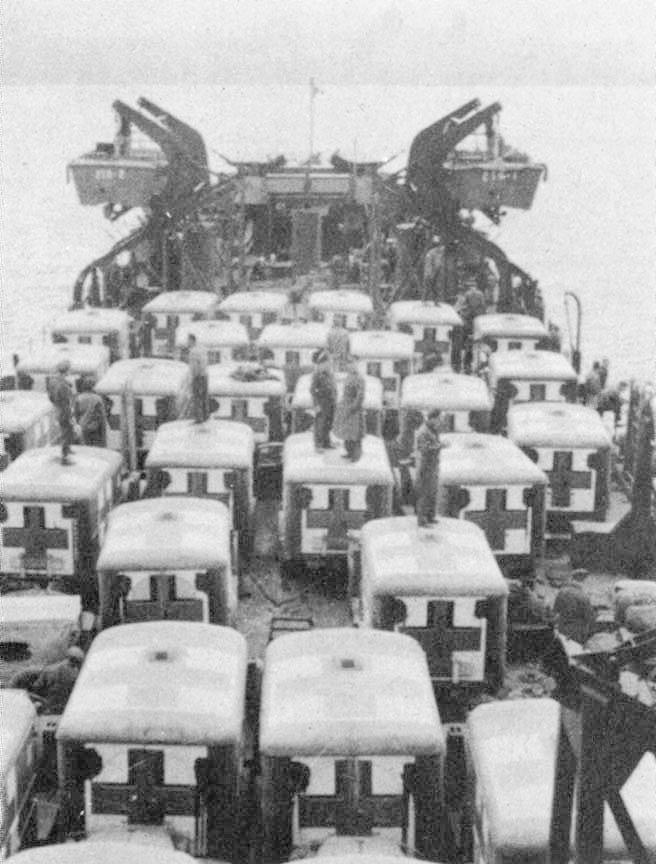
| THIS IS AN ABBREVIATED VERSION OF THE PICTURE STORY SENT IN BY CARL ZEIGLER. IT FOLLOWS THE MOVEMENT OF 567 COMPANY FROM ITALY TO HOLLAND, IN APRIL, 1945. |
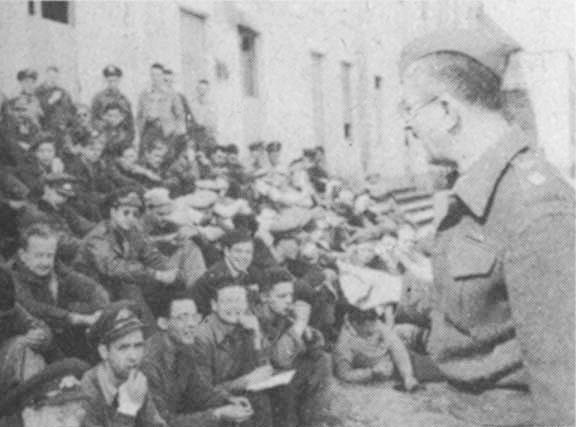 1. Col. Hoeing urged strictest security for the forthcoming movement out of Italy. |
 2. The 1st day a 6 mile convoy climbed the Appenines. |
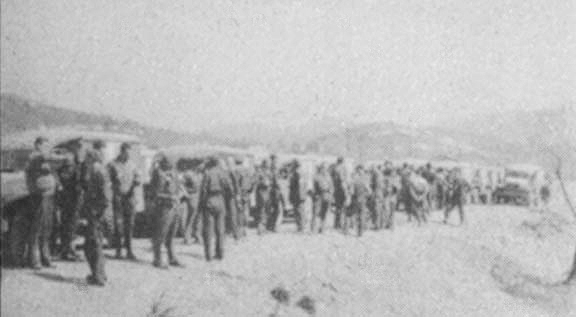 3. At the end of the 1st day the convoy leagured alongside the railway siding. |
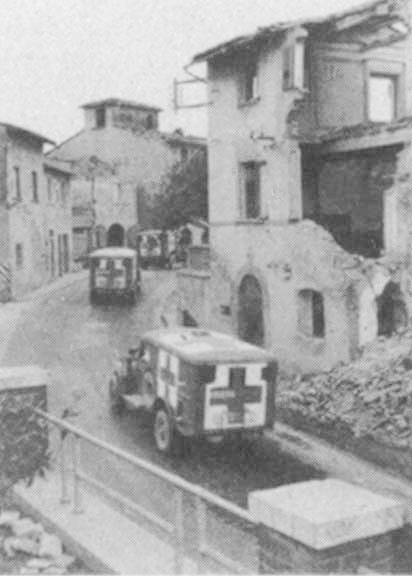 4. 2nd day passed thru Pontadura. |
 5. Encamped for 2 weeks at a port of embarkation staging area between Leghorn and Pisa. |
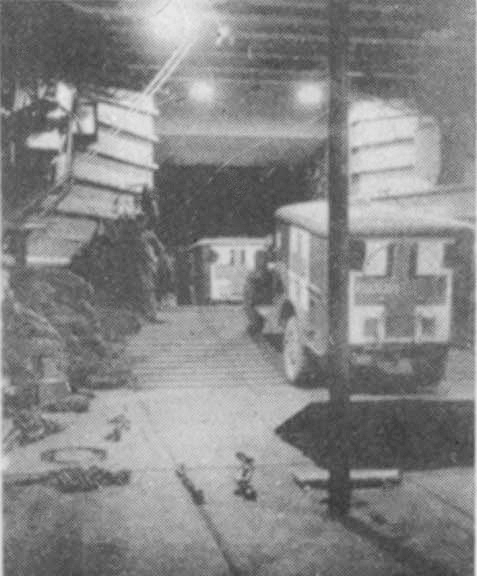 6. The ambulances backed into the tank deck and waited for the elevator to lift them to the top deck. |
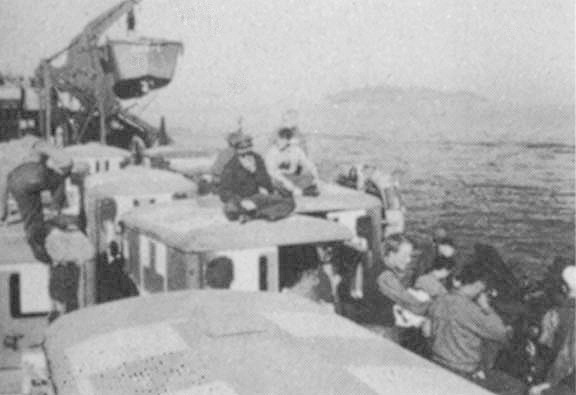 7. Most comfortable place was the ambulance roofs where the men slept on stretchers slung from vehicle to vehicle, |
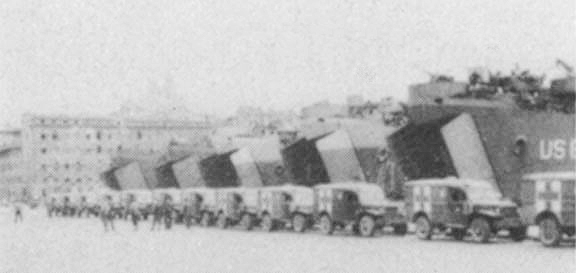 8. Fifteen ambulances queue up ready for short convoys to the nearby staging area. |
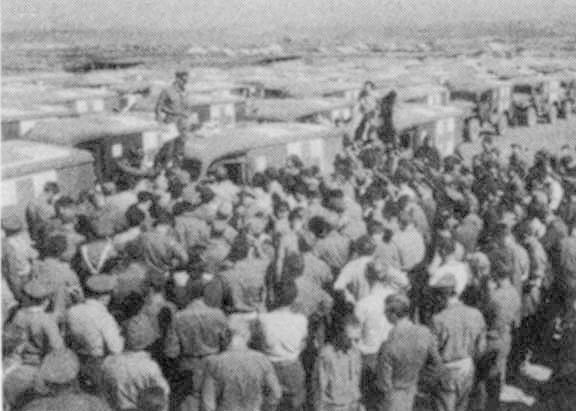 9. Major Payne told the Coy to be ready to leave on convoy through Prance early the next morning, April 14. |
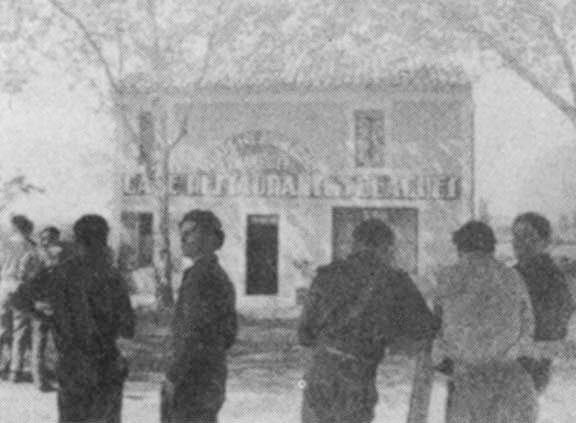 10. At noon the convoy stopped for lunch opposite a typical French roadside cafe. |
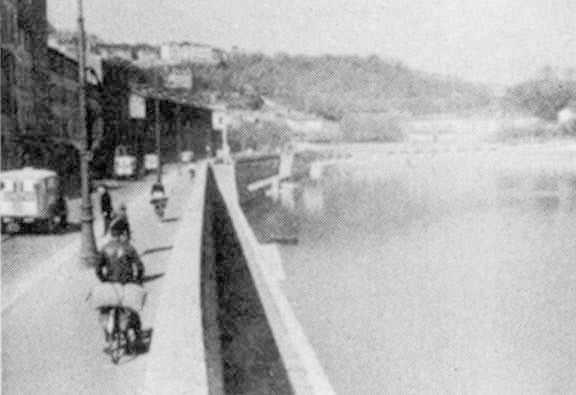 11. Passing along the Rhone thru the beautiful area of Lyons which is untouched by bombs and shells. |
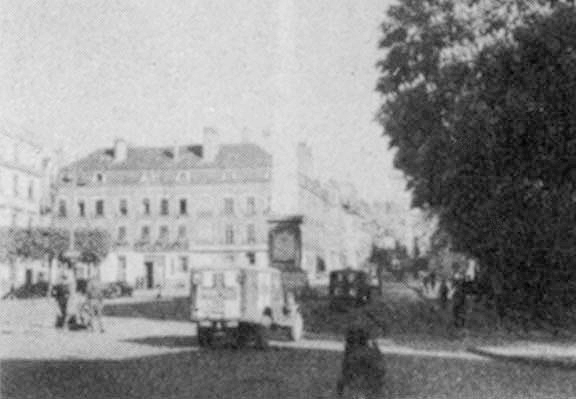 12. Through Chalon. |
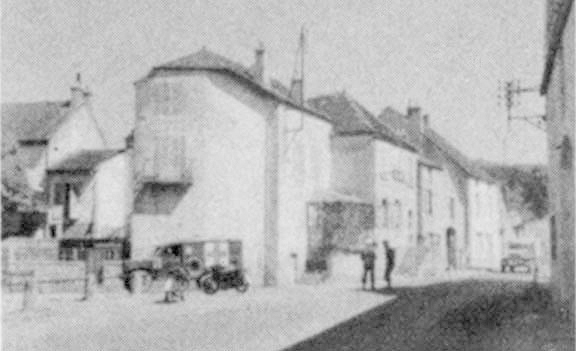 13. The 3rd night further north near the quaint village of Chalon. |
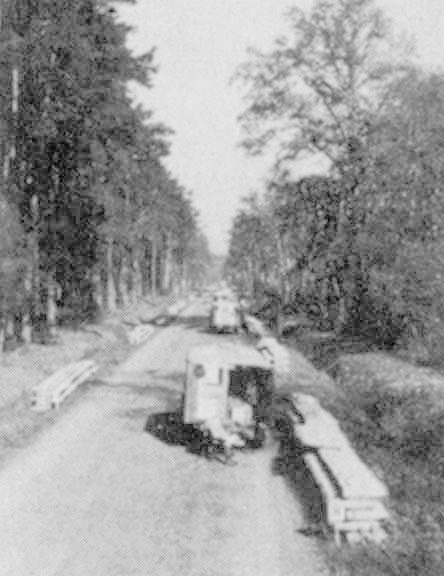 14. North of Paris passed long line of ammunition left far behind by the spring rush into Germany. |
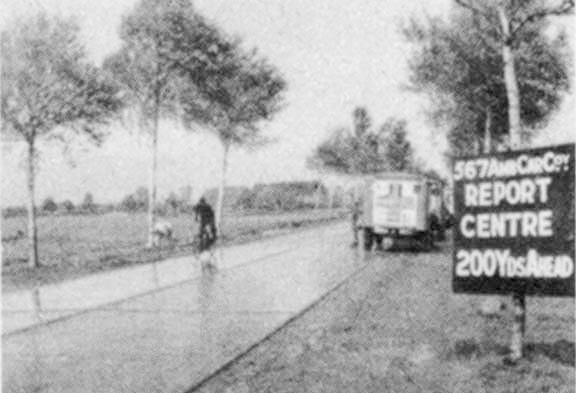 15. Arriving at headquarters area near Eindhoven, Holland. |
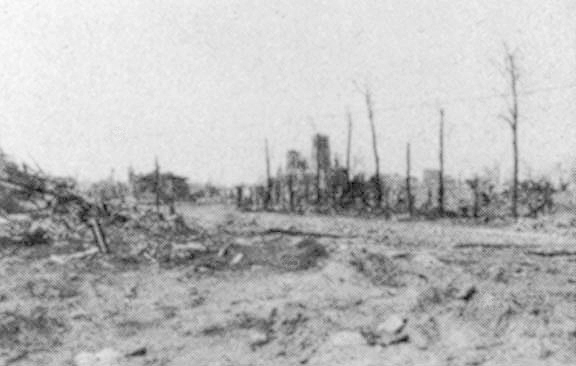 16. First 567 Coy ambulances into Germany were from C Platoon. They passed through Wesel then .... |
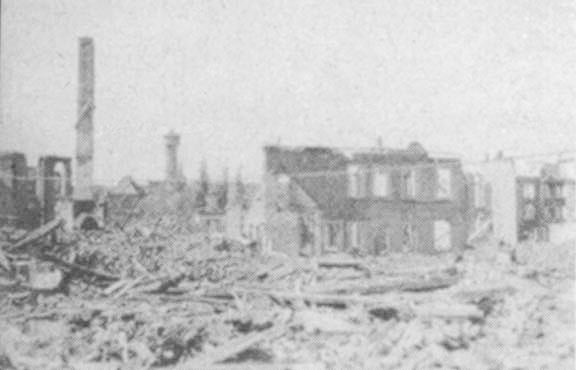 17. Munster ----and |
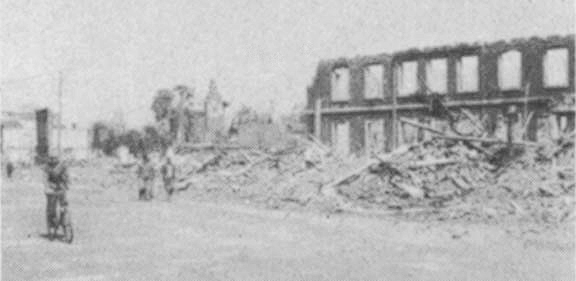 18. Osnabrucke. All 3 of them populous cities a few years ago. |
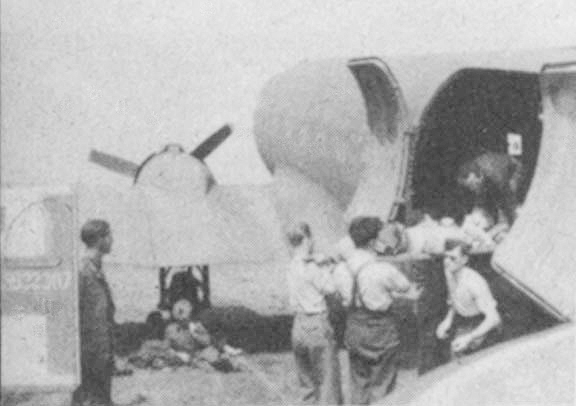 19. April 26 C Platoon ambulances evacuated to the planes wounded from the battle of Bremen as well as British ex-prisoners of war. |
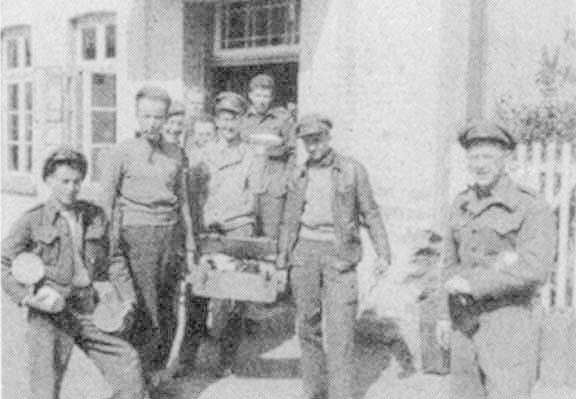 20. AFS men making the first visit to the Yank ex-POWs at a CCS to bring them food and cigarettes. |
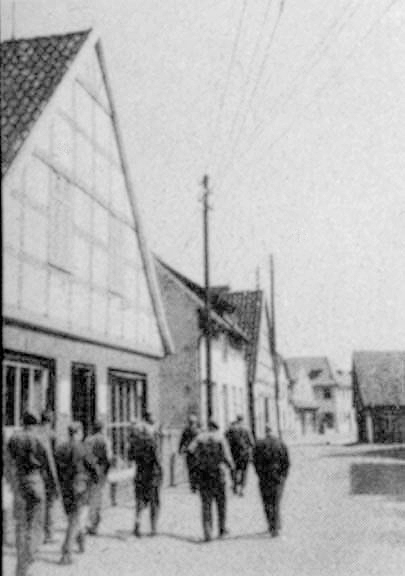 21. They carried their precious gifts received from home to the CCS which lies at the end of this picturesque German street. |
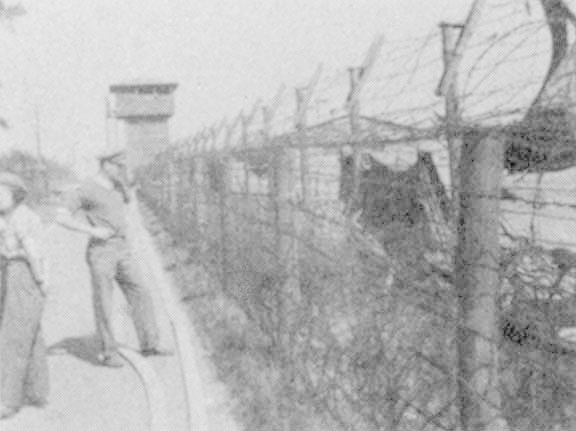 22. AFS man looking thru the barbed wire fence which surrounded the 6 sq. miles of Belsen concentration camp. |
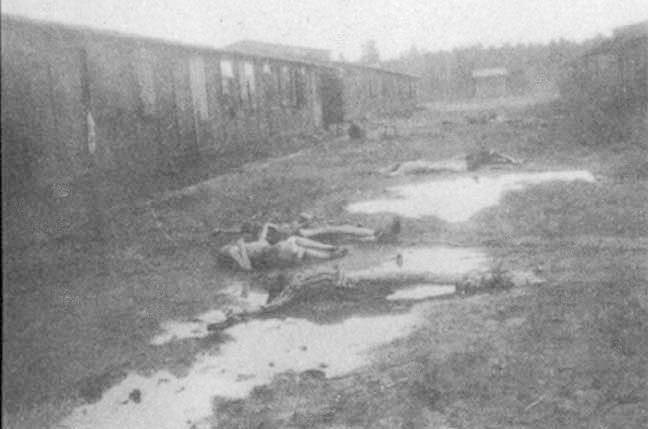 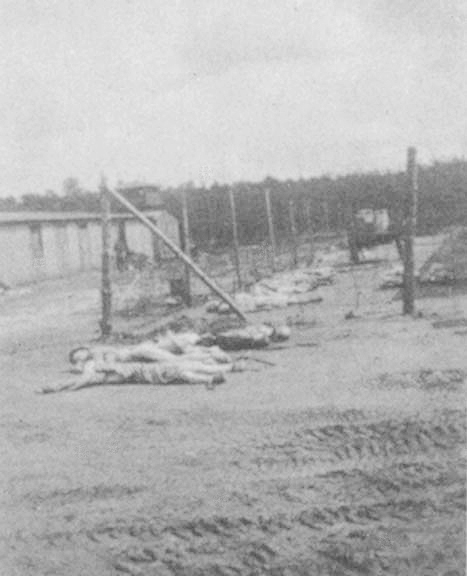 23. Left and right. Bodies piled everywhere because the people had died too fast for the SS troops and slaves caring for the camp to bury them.
|
|
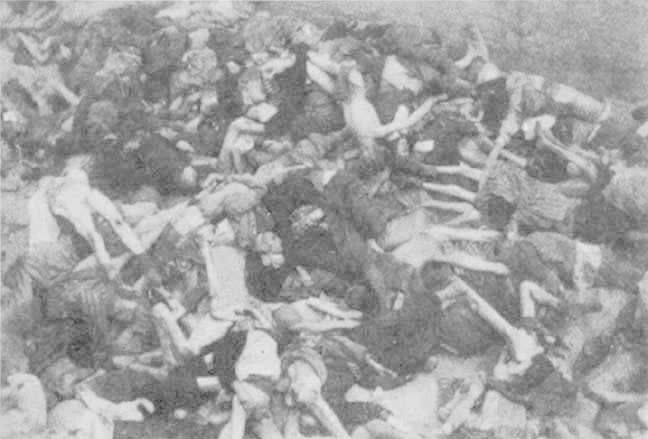  24. Left and Right. Huge open burial pits in which 1000 people from Camp No 1 who were dying each day from starvation, typhus, tuberculosis, and dysentery were thrown in helterskelter piles.
|
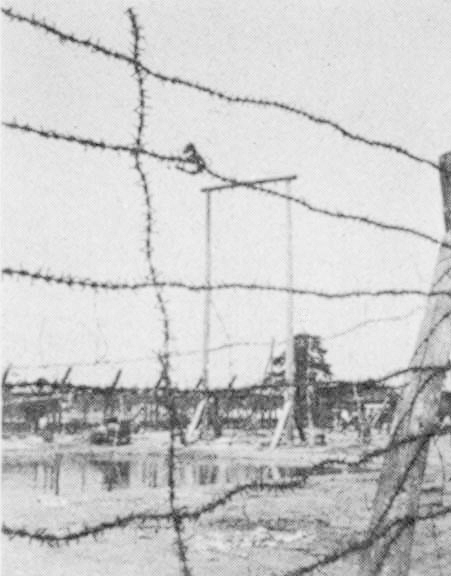 25. The camp gallows built high so that victims could be seen all over the camp as they hung from the five wire garroting devices. |
|
 26. They also found scores of huts like this in which as many as 200 people had been crowded and starved all winter ....... |
 27. People huddled like animals to keep warm ..... |
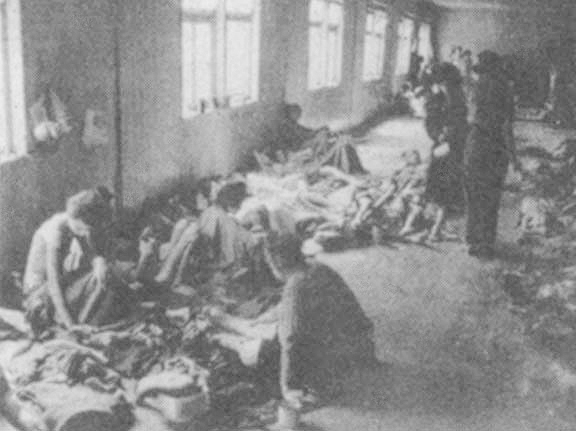 28. ....lying in many months' accumulation of filth and defecation. These are the living. They look very little different from the ....... |
 |
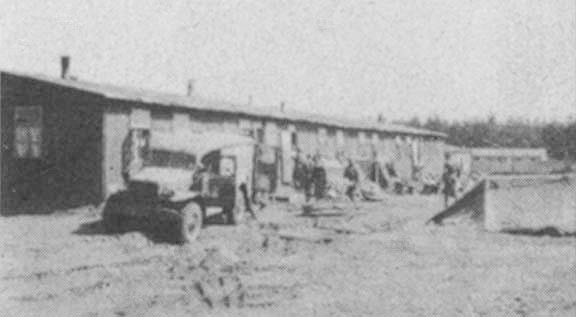 30. D & C platoon ambulances evacuated these huts, carrying the living who still had a chance to recover out of the loathsome pest houses. Starting at 7:30, AFS men and British ambulances worked side by side all day evacuating them to......... |
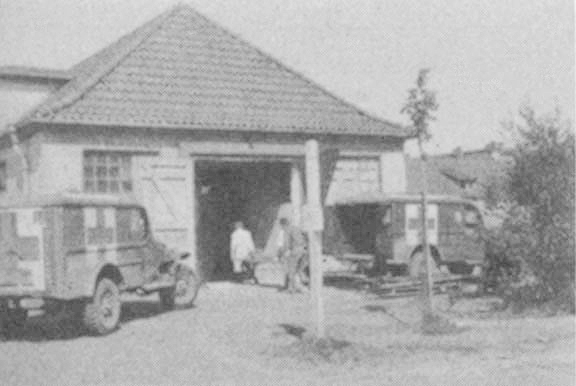 31. ....then to a human laundry where drafted German nurses washed their befouled and louse-ridden bodies 24 at a time. |
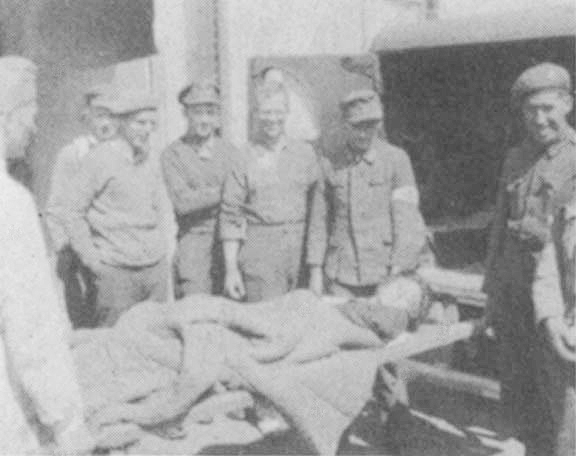 32. Polish girl asked that her picture be taken with the young men who liberated her. |
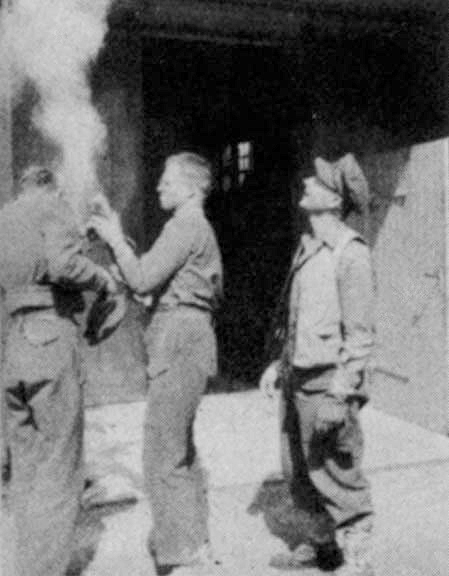 33. Drivers daily dusted themselves and their ambulances with AL63 to keep off typhus-bearing lice. Smells in the camp were terrible. At first our men had to cut the filthy clothing from the people who were unable to move or help themselves in any way. |
 34. Foul clothing hurled into the yards outside the huts was often picked up by walking inmates who searched out better clothing regardless of their filth. |
 35. Patients were removed to the formerly luxurious barracks of the SS guards who patrolled the camp and indulged in the sadistic tortures that made it notorious. |
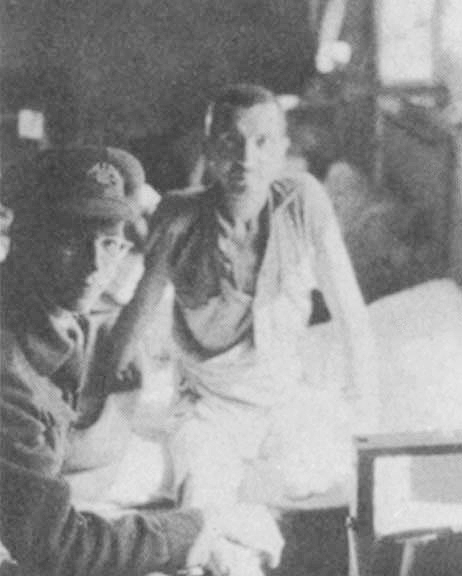 36.AFS man talks with a French internee whom he evacuated from Camp No. 1. |
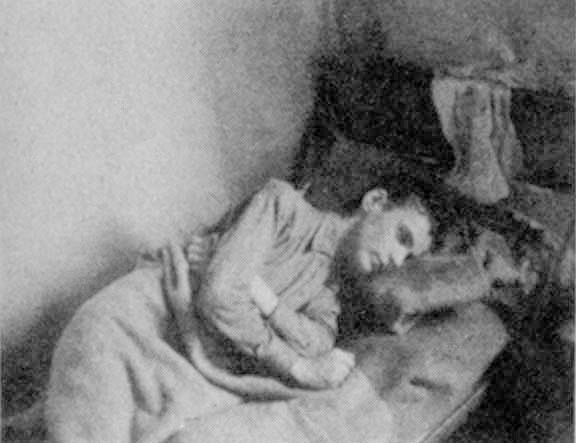 37. Czechoslovakian lad, too weak to talk and too starved to accept even soft and liquid foods, was badly in need of intravenous feeding, which was given him later. |
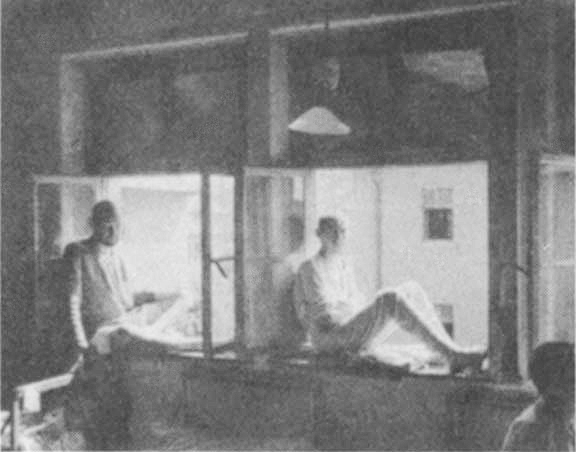 38. Two Polish internees, evacuated to the hospital, felt enough better to sun themselves. |
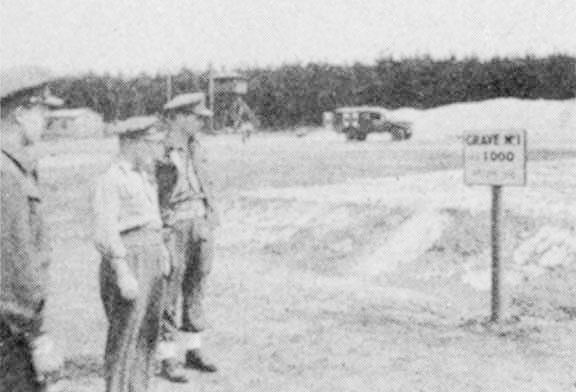 39. A week later the piled up dead had been buried in huge common graves like this. |
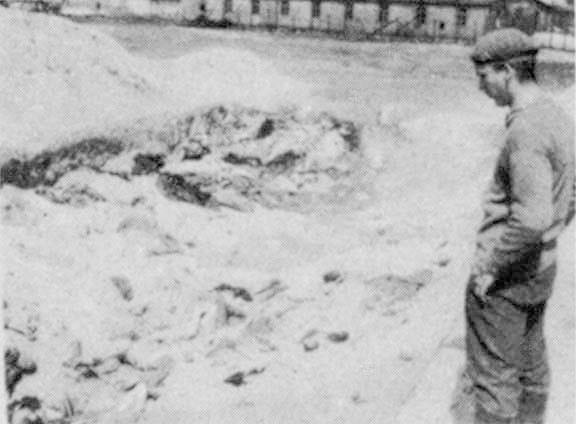 40. In this half-filled grave an AFS man looks with horror and disgust at the indignities heaped upon these thousands of human beings. When this pit was closed it contained approximately 2000, all dead in a single week. |
 41. D Platoon lived in a section of the pine forest completely surrounding Belsen Camp. At night the men returned to the pure, clean, free air of the woods after the day's work in Camp No. 1. |
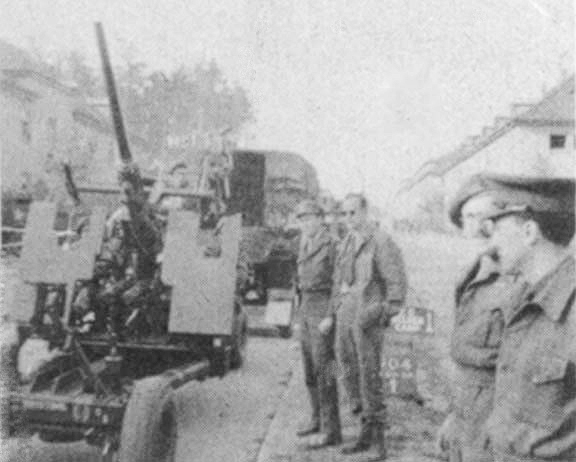 42. On VE Day two AFS men watch the Victory parade through the Belsen camp. |
|
Quoted from a letter on Page 17:
"If you see any people at home who poo-poo the stories in the papers about these camps, tell them about this, because I've seen all this myself and know it's true."
COPY
CR/14/5 Officer Commanding
American Field Service
Coy 567, Platoon C------------------------
I should like to express my appreciation of the most excellent work done by your personnel at this camp. This has been no easy task and one that has had to be done against time, and against the risk of infection with typhus. I cannot speak too highly of your men for whom no job was too difficult or too risky.
(J.A.D. Johnston, Lt. Col. RAMC
OC 32 Brit CCS Gp)
SMO Belsen Concentration CampBLA
20May45
May 8, 1945.
"We are busy carrying a couple of wounded men from the farm yard a while afterwards and all in all it was quite a show, with screaming Mimies, mortar shells, rockets and 88's going off all around us. They seemed to be concentrating on the road and the farm yard where we were as our clouds of dust had made him extremely anxious as to what was coming off. The other incident was nothing, only a couple of stray shells going overhead and really can't be counted.
As we went from river to river we saw all the brutal signs of the violence of the action of their crossing. Dead Jerrys and Tommies lying at the side of the road, burning trucks and tanks, dead horses and all the other wastes and signs of battle. The smell was terrific when we passed men who had lain where they were killed for a couple of days and the sight of their bloated faces was terrific."
May 16, 1945.
"As you see by the heading I'm now situated in Austria where we are doing occupational work. Where we are staying is on an Alpine lake surrounded by hills and snow-peaked Alps. It's the most beautiful spot I've ever had the luck to stay at and enjoy. We have swell quarters in a former guest house with beds, sheets, and everything which one can demand. I bought some fishing tackle while in Udine (Italy) and we have been having the time of our lives catching speckled trout.
"Besides our fishing we have been climbing the Alps and I took a series of pictures the other day. We wear shorts and moccasins around here and we all have a swell tan. I sure hope I'll be able to return here some day."
May 10, 1945.
"Again we have moved twice --- farther into Austria. It is the most beautiful countryside and makes me feel as if I were in Islesboro, for the woods are exactly the same --- with all the same kinds of pine and beeches, and same smell --- except for the snow covered mountains.
"We came on here about twenty-five miles yesterday afternoon and are stationed in a big country place. I hated to leave the Lake, but there are still mountains everywhere. There are also several hundred Germans camped here with us, including the women that travel with them, which makes it slightly confusing. One of the soldiers came up to me last night and said that when he left he couldn't take his dog with him, so he gave me a female dachsund. She is quite nice looking and has a sweet disposition. It remains to be seen how well I can arrange traveling with her. Last night she slept beside me in the ambulance, and is eating well today now that she is used to the change --- she also seems well house-broken, I might add."
June 1, 1945.
"For the last two days, we got up at 5 a.m. which always throws one slightly off, to say the least, and on the first day we went to two prison camps. The first one was like coming into the farm at Islesboro and looking down on the hollow between the house and the water and suddenly seeing three thousand six hundred Russian Cossacks who had deserted the Russian Army for the Germans. The place didn't show from the road and gave one quite a start. There was barbed wire all around them with Bren gun carriers, machine guns, four enormous search lights, flame throwers and the Welsh guards. It's a sight one will never forget, to see so many human beings behind barbed wire and one realizes how much worse it must have been for our own people, who were not being treated anywhere near as well as these Cossacks. There were about ten women with them who claimed to be wives or daughters of the Regiment. The job of the Medical Unit we brought in was to examine them for lice and venereal sicknesses. As a German doctor said to me, they think they are healthier with the 'lices' (as he called them) than not, as lice are not supposed to like a sick body. Anyway they had everything unattractive the matter with them and were a pretty 'scruffy' looking lot as our 'chums' say. Those are the men the Germans let loose to do the plundering in places like Odessa. When the officers were ordered out of the cages they refused to come until the flame throwers were put into action, then they came quickly enough but begged for pistols to commit suicide for they know what their end will be in Russia. The rest will be put to work in the Salt mines in Siberia, probably due to labor shortage. Many were Mongolians and lots had those tea cozy hats with fur and a red crown. There were men of all ages from 15 to 60 and they were either of the most ignorant peasant types or the dregs of the city criminal types. Thousands of horses were everywhere, with good saddles, and they are handsome animals. The English are having themselves a time as anyone can take a horse who will look after it and keep it. We were all on horseback most of the day when we weren't working. The second camp had 1600 in it.
"The next day we went to the railroad station and stood by all day while the same people were entrained for Russia. There were three long trains of freight cars, leaving at about two hour intervals. As the guards' orders were to shoot to kill if there was any trouble we were there for business, but nothing went wrong, The freight cars were from every country you can think of. The French ones were marked 'Quarante Hommes et Huit Cheveaux' and forty men were put in and the doors locked. All the same armament lined the tracks and again it was an impressive picture --- the handsome Welsh guards six feet or more tall, with their blanco whitened belts and gaiters, looking so smart and the locked freight cars with their loads of human freight.
"The thing that is so confusing to someone like myself who arrived too late to see any action is that these people don't seem a bit conscious of having brought tragedy on the world and themselves, the poor Englishman who is the conqueror stands around forbidden to fraternize and dying to go home, while the Germans, Austrians and people from all the neighboring countries play Viennese waltzes on the accordion and dance and sing every night as if nothing was the matter; and they eat better as it is farm land, while we eat canned rations that are kept in storage. It will be a great relief to get home where one's emotions aren't continually being torn this way and that and no one knows the proper way to meet situations as they come up.
"This place, for example is a chateau high on a mountain with the family and ourselves living in it. They are descended from the Hapsburgs and consist of a Count and Countess and eight children of varying ages, from eight to twenty I would say. They all speak English and today are out under a colored awning celebrating a silver wedding anniversary. The house has priceless furniture and a collection of pictures, like Uncle Arthur's, going up the stairs. We have the third floor and our meals are served in the summer house, with white tablecloths and by Austrian peasant waitresses. The summer house looks out over the tennis courts across the valley to snow-peaked mountains. It would be impossible not to fraternize with them or like them as they are just the kind of charming family Americans visit here in peace time. Then you climb up to a sweet church yard on a neighboring mountain and there is a memorial, with a swastika on it, to a man who died for Hitler and you realize that way off in the peaceful looking countryside was that damn Nazism."
May 10, 1945.
"Since my last letter we have made another series of moves which has left Italy far behind, instead of looking North for snow capped mountains, we now look South. The minute we crossed the border there was a marked difference in the countryside, in both people and houses in comparison to Italy, houses are of stone with upper part of wood and usually a little balcony, the yards have grass and flower beds and are neatly kept. Here and there you see a pretty peasant costume, the people are of a light complexion, quite a contrast to the people we just left, their attitude in general is one of merely accepting our presence here. At present our R.A.P. has a perfect set up, for the first two days we were in the town, today we moved to a beautiful lake about a mile outside and have a modern cottage built on piles above the edge of the water, there are electric lights, running, hot and cold water, an electric stove even and is completely furnished. There is also a row boat in good condition. The lake itself is about ten to twelve miles long and varies in width of a mile or so, hills rise all around and in the background to the south the snow-capped peaks of the larger ones. Water is still a little cold though we go in for short dips, and can make a shallow dive off the sun porch though it isn't deep until we get out about 50 feet. Our R.A.P. now has a motor-cycle with a side car, when we first came into town there were Jerry cars, trucks, motorcycles and other stuff lying around. It seems every one has some kind of vehicle to ride around in including the prisoners of war. S. and I came upon a crowd of civilians raiding a warehouse full of Jerry supplies, there were boxes upon boxes ripped open and lying on the ground, with a lot more still in the warehouse. We got ourselves a few necessary articles and a harmonica each."
No date.
"A girl I spoke to last evening said G.B. and U.S.A. were too soft to treat Jerry the way he should be treated and I hope she is wrong. I think we are inclined to pass ugly things off as propaganda. Believe me anything you see or hear is true, and it's not just a few Jerrys, it's all of them. I carried two Dutchmen this morning who were just released from a prison camp after 5 years. For 4 months straight they ate nothing but potato peelings. They walked 20 miles to work from 6 in the morning till 6 at night and 20 miles back. It's not a special German that does that, it's all of them."
No date.
"We had two V days here; V-H Day for Holland and V-E Day for all. On the first one I was at an RAP. The news came at sometime in the afternoon and at once there was a Dutch flag flying from every house--- all sizes, big, little, and in between. From the end of every staff hung a long orange streamer which I believe is the Queen's color. Every Dutch man, woman and child had a piece of orange cloth on them somewhere. Almost at once we were invited into houses and given cognac the people had saved 6 years for this day. That night the Dutch soldiers shot tracers, flares, and anything that made light was sent into the air. A week of festivities was declared and there were dances in the streets every night. In the middle of the week came V-E Day and real bedlam broke loose. The people went even crazier. All thru this, the average British soldier went on as usual and in spite of all it seemed like another day.
"All in all it was quite a week. I saw dozens of big planes that were dropping food to the people in north Holland. It was really a sight. They flew at rooftop height and were really pretty. It must have given Jerry a shaking to see we could spare so many big planes for such a cause."
No date.
"Get out your maps! When in Italy I spent most of my time between Rimini and Faenza on the Adriatic coast. One day we packed up and drove across Italy to leave the country. We drove right thru France, due north, past Paris, right thru Belgium and stayed 3 days in a town called Waeregem. Then thru Belgium and Holland where we stopped and established HQ. in Breda. I went out the following morning to an RAP in Uligkmen, a few miles west of Hertogenbosh which is just south of the Maas river on the other side of which Jerry was situated. Things were very quiet and I only heard one shell land. A sergeant showed me where the men were in case there was trouble and someone needed an ambulance. We crossed a 400 yard stretch of road with a bridge in the middle which was all under observation. We went all right one way but returning we were just on the bridge when he landed one under it. As I said it was the only shell I heard land in Holland, and the fewer I hear the happier I am. We were in Ulijmen for several weeks and then came here to Made which is about 6 miles north of Breda almost the river Maas. I went to the river yesterday and went fishing there with hand grenades. Great sport.
"The Europeans have all suffered but the worst I have seen are the Ities. Italy is almost flat from one end to the other. There can not be seen a house for miles around Cassino. Their money is worth little. In 1927 the lire was worth $6.00, is now worth 1¢. They have little food and no clothes. Above Bologna may be better, I don't know.
"North Holland is terrible. A few cigarettes will get you a watch or almost anything. A pack on the black market is worth 100 guldens. A gulden is worth 38¢ of our money."
We regret to report the death of Col. Francis S. Robbins, a member of the General Committee of the American Field Service.
When Col. Robbins offered to serve on the Board he did so with the understanding that he was on call for any assistance he might give. During these past five years he proved to be a wise councilor and a devoted friend of the AFS. Mr. Galatti went directly to him on all questions of policy affecting the service and on all matters which required a broad and comprehensive outlook on the problems involved. The AFS owes much to Col. Robbins for his profound judgment and generous interest.
Life had its brighter moments for AFS drivers serving in Italy, such as the time an attractive, trim looking American woman. inspected AFS platoons working at the front. Arriving home in Washington, D.C., she wrote as follows to Major Bert Payne, C.O. of 567 Company serving in Italy:
"It was certainly a pleasure to be able to visit you in the field so that I might see for myself the great contribution which the American Field Service has made toward Anglo-American understanding and co-operation. I know that I cannot express to you the gratitude of the American people for the services you have rendered internationally, because AFS men have undertaken this mission voluntarily. Your work will bear fruit for a long time to come in the growth of friendship between all English speaking people and their allies. I shall be most happy in telling people over here of your good work over there for the United States.
Sincerely"
CLARE BOOTH LUCE
An AFS driver, home after two years service in Italy and France, tells us how to get in the Army after once being rejected ----join the American Field Service! Two years ago, this same volunteer was turned down by his draft board --- the reason, spots on his lung. Now, after 24 months of driving an ambulance at the front; this AFS man finds his lung recovered. How come? The volunteer offers the answer: "Must have been that Italian winter weather, or maybe it was the British food."
VITAL STATISTICS DEP'T .... Not content to sit back and read about the rest of this war, 246 AFS men have transferred from Europe to the South East Asia Command. 485 Company reports that from 1943 to May 5, 1945, during the Italian Campaign a total of 168,028 casualties were evacuated with the ambulance mileage of 2,205,945 ... .,..this record being achieved by the 225 men and 332 ambulances comprising 485 Company.
AFS took great pride in recently announcing that volunteer Neil McDowell Gilliam had been awarded the George Medal for his work in the Burma theater. The George Medal in the highest award for bravery for which a non-British civilian is eligible. We have now learned that General Mountbatten, while making the award, informed Neil he would have received the Victoria Cross had he been a British citizen.
ROMANCE DEPARTMENT: Dick Hamilton, home after serving in Burma and Italy, where he had been wounded, is to be congratulated on his engagement to Kathie Pancoast of Philadelphia. Dick Norton, taking the bull by the horns, married Miss Ann Sprague within a few days of arriving home from France. Bill Schorger, now an ensign in the Merchant Marine, married Priscilla Howland on June 19th, at Genesee Depot, Wisconsin, Bob Riotte married Francena Carpenter Walwyn on July 5th in East Orange, N.J. (Bless us, but there's more to come!) Charles Edwards married Beatrice Ruth Pyle on June 30th at Santa Barbara, Calif. Bill Stump, just back from France, tells us he will be married to Joyce Morrill in Baltimore, Maryland, in the very near future.
Dory Wood recounts a harrowing, if not particularly unusual experience of evacuating a pregnant woman in southern Austria. With the patient seemingly in her last spasms, the ambulance was turned away from hospital after hospital. Finally, Dory found one with room for the woman. His sigh of relief proved premature, however, when an attendant produced dozens of forms that had to be filled out before the patient was admitted. By the time the woman was installed inside, the Stork was already circling above the hospital. Mused ex-rancher Wood: "I was almost ready to jump in there with the forceps myself. I've delivered plenty of horses before, but a baby would be something new. Steve Galatti never told me there'd be days like this when I signed on for AFS!"
There is now available a special de luxe edition, limited to 250 copies, of a Portfolio of 53 original lithographs (many in color) by Pierre Bourdelle who served with the AFS on the Western Front. Advanced subscriptions are being accepted by Pierre Bourdelle Studio, 139 West 54 St., New York 19, N.Y. Pierre is the artist who drew the cover for the June-July issue of AFS LETTERS.
May 25, 1945.
"Impressions at random on Burma --- miles of rice paddies, now caked solid and dry; terrific wind and rain storms with damning regularity nothing compared to the monsoons ahead; cities and towns just rubble and ashes and broken pottery; a dozen dead Jap bodies on the road unmoved for over a month; flies by day, mosquitoes in the dark, and swarms of bugs around any light; diseased eyes or scabies frequent among the natives; every tiny skin break gets infected; big emerald green lizards with spiny backs; magnificent huge white birds at the water's edge; really cheesy shows put on by ENSA, English entertaining outfit; amazing mixture of native troops, black Africans with punched ear lobes or slitted faces, Sikhs with never-cut hair and beards, always wearing magnificent turbans, little Mongolian Gurkhas with their long, famous knives and the respect of every fighting man; occasional Yanks, strong-legged, well-fed, confident, independent, feeling quite superior; stubby, infrequent trees; their branches regularly stripped for firewood; and occasional magnificent stretch of road, with high, green trees forming a cool arch; millions of temples of all varieties, many of them delicately carved, some with tremendous figures of beasts. Also one spluttering radio and half rations for meals.
"One thing impressive is the continuous sense of humor of the average Tommy. I have never before met guys who could go through so much hell, for so long a time, with no visits home and still laugh and make a joke of almost everything. Unfortunately there is still a lot of bad feeling between our fellows and them; but if our guys could get to know the Tommy well, as few of them do they would admit that they are excellent fighters, underpaid, underfed, and in many cases, lacking equipment, and swell fellows."
No date.
"Yesterday we began an attack on a village by a savage barrage and bombing and straffing. All around the village in the paddies came a swarm of dogs running with their tails between their legs going in all directions out of the village. It certainly scared them.
"There are two Gurkhas sitting beside my ambulance in the shade reading a book written in Hindustani. when they read, they sing. None of them ever reads to himself, they always sing it in a sliding, slurring way. No note is separated from another; they are all run together as are the words.
"Another fella is sitting beside them beating on a drum with his hands. Often they sit for hours just beating on the drum. It must have some musical tone to them, but my ear isn't developed to the point so that I can recognize it....The only work I do all day long is to help dig a slit trench late in the afternoon and so I'm afraid as a man in condition I'll be a failure.
"I swapped a Jap flag for a carton of cigarettes yesterday and thereby enriched my supply to carry me thru the month."
No date.
"I understand I am able to tell you more now that censorship has been relaxed. You must have been wondering whore I have been and what I have been doing.
"From Calcutta we took train, boat and feet to get to Komilla where we waited a few days to get a plane to fly to Mytche. At Mytche we met the 4th Corps H.Q. boys with whom we were to be stationed. We were destined to go to Myktilla(?), but the Japs held the road as well as the airfield. As soon as the road was 'cleared' we headed for Myktilla and it was on this road that we were sidetracked because someone had turned over an arrow point the wrong way. I told you about running into the ambush. We arrived at Myktilla about the first of April or later. We were stationed in front of one of the gun boxes there and I was then given my ambulance and farmed out to 23rd Field Ambulance with 63 Brigade of 17th Div. There is a tar road from Myktilla to Rangoon, but we went off to the west of the tar road to come into Puabwe from the west. We killed 1900 Japs there, and it was on this excursion that we were jittered each night by jitter parties. The whole brigade moved together in close formation and the Japs were all around. With the dust we raised, we made an easy target for shelling and ambushes, but we were only ambushed once. The Japs let the armored column through and then struck at the front of our medical unit. We stopped and patrols wont out clearing the way for us to move. We spent five days in a little village about 4 miles west of Puabwe, and built a small airfield on the Oyabwe side to evacuate casualties. It seems that that was the wrong side of the village as we were machine gunned one day just after I left the field and while I was there they tried to shell and mortar the field but couldn't get our range so we sat and watched the battle for Pyabwe and lots of fires on all sides caused our shelling and air strikes on nearby villages. The next day we moved into Pyabwe and that was the end of action for 17th Div. for a while, as 5th Div. came through us to move south.
"Orders came through for me to transfer to 5th Div. but since I was out at the front with the engineers and sappers (just a little excursion on my own) I never got the order and someone else moved in my place. From Pyabwe after waiting quite a while we moved south along the Rangoon road to Yamethin and after a day or so on to Pyinmana. The ride from Yamathin to Pyinmana was the night ride I described. We by-passed Pyinmana, but while waiting north of Pyinmana one night after a terrific rain we heard a bomber going into a dive. All of us sat on the edges of our slit trenches not wishing to be soaked by jumping in. Suddenly there was a loud whoompf! followed by another and the bombs hit the 82nd anti-tank group up the road. We went up to take casualties. There were quite a few as many didn't hear the plane and also because an ammunition truck was hit. From here we raced south to catch up and pass 5th Div. for we were the division destined to take Rangoon we were told, since 17th Div. was chased out in 1942. We passed through Tovngoo and at a village, just north of Pegu we met our first real opposition since Pyabwe. I watched the battle there, but didn't carry many patients for the Japs had run during the night to stand in Pegu. This village was the head of the only good road east and the Japs wanted to keep this open to let their troops in the West through to the East. We tried to take Pegu with the bridge intact, but one span was blown and the rest was washed out. Before it rained, however, 48 Brigade got across because the river rose 16 ft. but at this point we got the disappointing news that Rangoon had been taken by air and sea-borne troops. Everyone's morale went down, as we wanted and expected to be the first in."
March 29, 1945.
"They use a tremendous quantity of penicillin here. In the tent wards and orange ribbon tied to the mosquito bar over a man's bed indicates he is getting it, just as white ribbon indicates he is in shape to be evacuated by plane back to a base hospital.
"Outside of all the pain and suffering around, there is much that is comic. In the next bed, at the moment, is a merry major from Yorkshire who stopped a sniper bullet in a certain mix-up up the road some distance, and now takes his penicillin every four hours day and night, what a treat the man is! Still very young, he has been wounded twice before and engaged in scuffling in the middle east and here. Extremely amusing are his conversations with the ward boys. After converse with one he emerged laughing, the boy had stated candidly that he didn't like the infantry for they were getting too far forward.
"Now we can no longer hear the big guns grumbling up and down the river as they were some time ago.
"A brigadier general, badly mauled up, was sent in one day to our little ward, as a consequence the General of the Corps in which I happen to be, dropped in to see him. Exuding personality he stopped at our three 'Officers' beds and asked what we were. When told I was an A.F.S. man, he said, 'Oh, very good. Your group is doing splendid work.' Gives you quite a boost, especially since this particular general is well known to be strong for the A.F.S. and his words sincere."
April 23, 1945.
"The unit I'm with at the moment and I've been with so many these past couple of weeks I'm dizzy, --- is very, very good. It seems to consist of a major, best officer I've ever seen, a corporal and two other BOR's and the usual lot of Indians.
"I find that being an A.F.S. man is a fine life. So far, everywhere I've been everyone is swell --- the British troops and Indians like Americans in general --- and up front, anyhow, like AFS men because they are AFS."
May 9, 1945.
"The group I'm with was all set to go to Rangoon, but I guess it not to be. So close, too -- on the dash down we passed each milestone the Rangoon road with ever mounting interest, and then some scrubby airborne mob takes the place --- never even saw a Jap.
"Finally I managed to get a Jap flag --- a very nice platoon flag ---I think. It has only two small holes in it and no stains. If I can, I'll send it along."
No date.
"I understand you were to be notified by N.Y. Hq of our safe arrival at a port of call. I cannot tell you where, but I can tell you that what happened this day is entirely unbelievable. We were given a leave and another chap and I fell into some information about a hotel in the country, given us by a Red Cross woman who started talking to us because she heard me talking about Skeneatales (The Krebs restaurant) which is near her home in the U.S.
"We are at the hotel now, and it's incredible. The scenery, the rustic luxury, the gardens (I'll enclose some flowers I picked) the hospitality, the fine rooms, fishing and the cordial and informal atmosphere total to a breath-taking experience. My head is whirling anyway, as I never expected to have a chance to see this country at all, and while we're getting only a fleeting glimpse, it is so beautiful I keep hoping I won't wake up; I just can't believe I'm here. It's the kind of spot that makes you wish everyone you loved didn't have to miss it and could be with you to share it.
"This is my second night at the Hotel. The bed was softer than my own by far, really luxury plus. We went around all over the countryside today and found it beautiful. We get our meals and lodging at the hotel for $1.15 per day. That's our American Red Cross! We telephoned back to our Unit and told them about the place, so others came out today and all are in love with it and they all say they are going to spend their honeymoon here if they possibly can.
"The next event proves that all good things do not come to an end. We are now embarked again and. our latest accommodations are fabulous, even to air-conditioning. I'll be so healthy at the end of this leg, I won't know me!"
April 30, 1945.
"The Gurkhas are really some soldiers. They are such likable little fellows that you just look at a Gurkha and his grin and grin and grin back. I have to laugh at some of the things they do. The Gurkhas had been fighting all night in this village and the next day it was clean as a whistle of Japs. I was talking to a little Gurkha or rather we were doing the best we could when he spied the detonator to a Jap bomb on the ground. What did he do but pick the darned thing up, motion another fellow away and throw it against a tree to see if it would go off. It didn't and wouldn't have hurt anything if it had, but, as for myself I was sick of hearing bangs. Not the little Gurk though. He had been sitting in the town all night while I had been about a mile away, but he still wanted to see if it would go off.
"Something else I just discovered for myself is that these Sikhs are also great fellows. When I first came out I didn't see many, but we have been with some lately, and they are good guys. The Sikh is supposed to have 5 k's (in Urdu) which consists of uncut hair, a beard, a knife, woolen underwear, and a wooden comb. They have been a nation of warriors in the past, but of late they have been taking up other lines. They are very smart and are called the 'aristocrats of the Indians'. Physically they are tall, well-built chaps and keep immaculately clean, according to the standards out here. We take a bath when we can get the water and the times which is usually about once every three days or so. The Sikh seems to be able to do it oftener; maybe he has a faculty of not picking up dirt which I always seem to do. They take a lot of kidding about their long hair, and have a good laugh themselves. No Sikh smokes, but sometimes you will find a few that like their booze, which is also forbidden. They are all Hindus, but not the strict kind; that is best, as strict Hinduism is a pain in the neck. The Gurkhas wear their hair or what there is of it in the form of a tiny pigtail and shave the rest of their hair off."
May 1, 1945.
"The AFS does a good job out here. They actually do save quite a few lives. There is one quality Americans seem to have more than other peoples, and it is a good one ---that is, seeing that a job is done on time, and is well done, and is not delayed by red tape and little difficulties. A Yank usually says, 'To hell with it, we can do it', and it is done. It is probably our inheritance from our forefathers and shaped by our environment; whatever it is, I am glad it is there. There was a Yank war correspondent out here whom I met some while ago. He was helping with the wounded that day, as there were a lot of them and he was doing a good job. It was really a darned decent thing for him to do. He wasn't just getting a story, he was helping make one."
NOTICE DAVID BRIGGS' BOOK "ACTION AMID RUINS" IS EXPECTED FROM THE PUBLISHERS SHORTLY. ANY ORDERS SENT IN TO:
AMERICAN FIELD SERVICE
60 Beaver Street
New York 4, N.Y.WILL BE FILLED. THE BOOK COSTS $1.50
|
Please send ........................Copies of Briggs, "ACTION AMID RUINS". NAME..................................................................................... ADDRESS............................................................................. .............................................................................. |
| CHECK ENCLOSED [ ] | MONEY ORDER [ ] |
The end of Belsen. The infamous Nazi camp set afire by the British
after removal of internees. An AFS volunteer salvages a volkswaggen.