Edited and published at AFS Headquarters, 60 Beaver Street, New York 4, N.Y. under the sponsorship of the ambulanciers' relatives and friends, who contribute the excerpts from the letters.
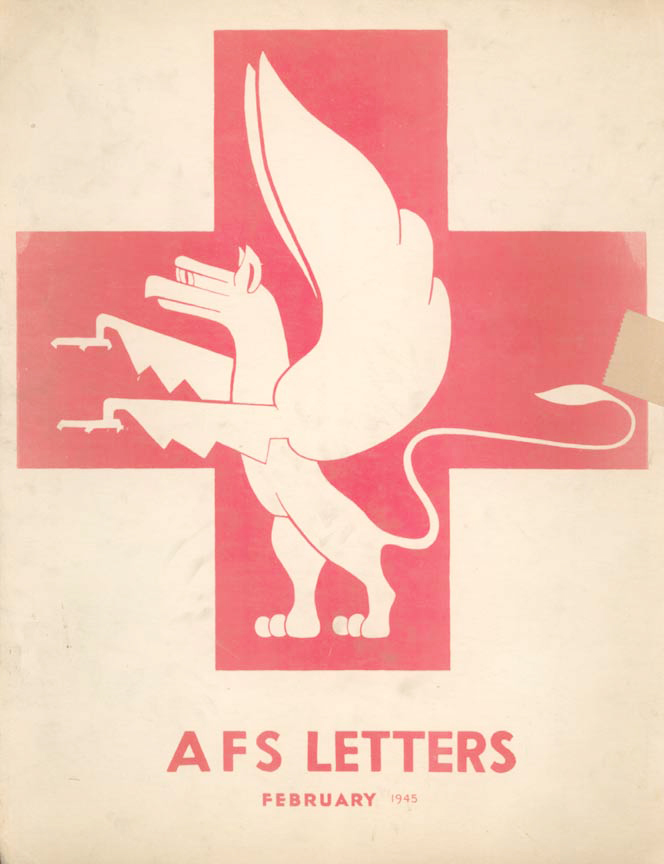
"Griff" is the Tommy's word for talk, the kind of semi-news, semi-gossip talk that military men indulge in during their idle moments. As this month's cover is a reproduction of the Griffin emblem of AFS 485 Company, some assorted 'Griff' on that unit appears below.
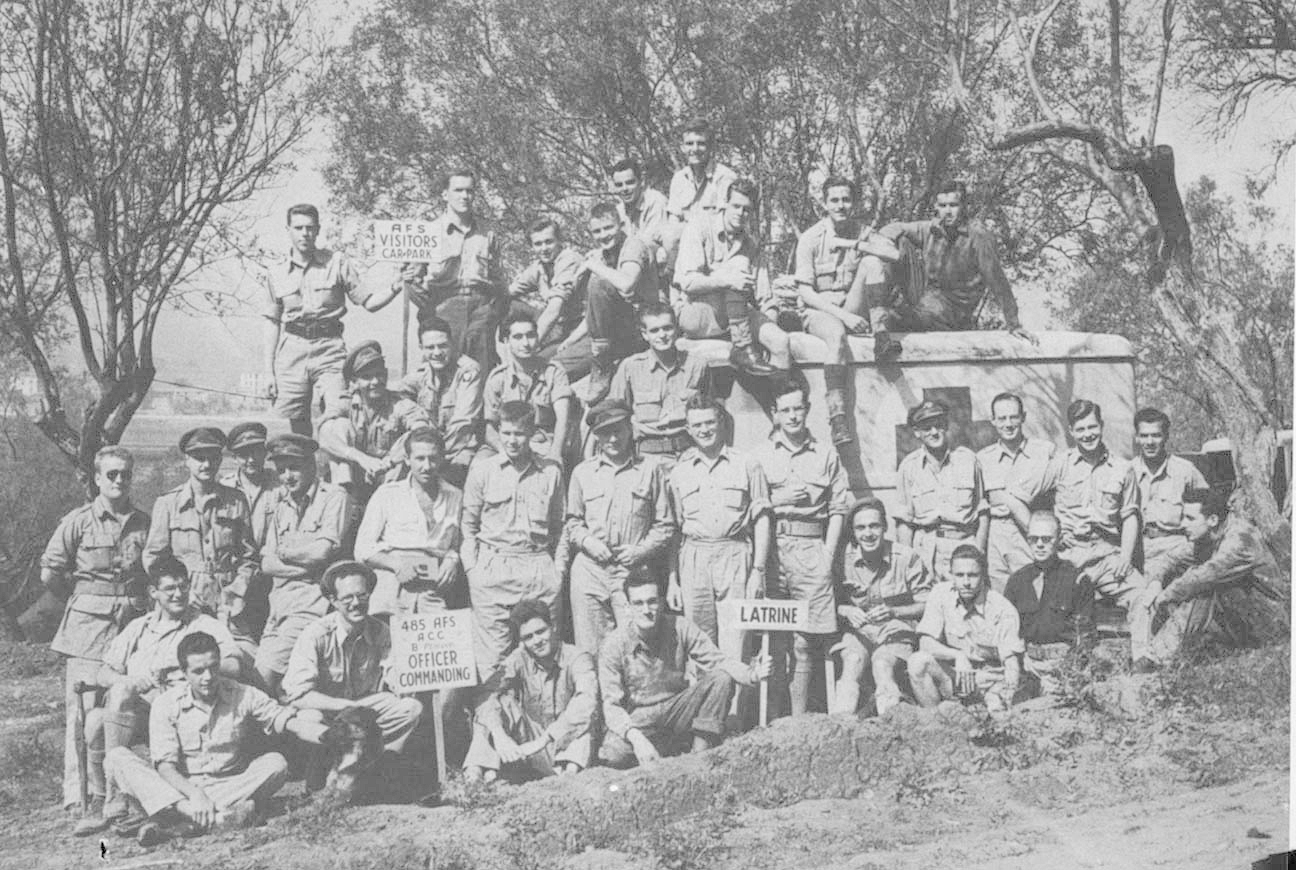
485 Company, or Coy, as it is designated in British abbreviated form, was born in Syria in the spring of 1943. AFS in the Middle East was divided into two Ambulance Car Companies which were given (apparently at random) the numbers 11 and 15. Then, for reasons of their own, the British commanders decided to re-arrange the AFS numbers in North Africa. AFS drew the numbers 567 (the Chicken Brigade) and 485. Men and cars from both 12. and 15 went into 485 in its babyhood. The first thing the new company did as a unit was to trek across the top of the African continent, on what was then the longest convoy trip to be undertaken by any part of the British Middle East Forces, driving from Baalbek, Syria, to Tripoli. In all there were 98 vehicles and they made the trip without a single mishap or road accident.
It was not until after the advance guard of 485, A and B platoons, had reached Italy however, that the men started talking of an identifying insignia of their own. Everyone wanted an emblem, but no agreement could seem to be reached on what device or design should be used. Finally it was decided to have a contest, the winner to get a $25.00 prize to make the Coy a distinguishing mark of its own. The griffin was chosen because this mythical creature with its half eagle, half lion body, seemed best able to represent the fraternity and cooperation between the AFS men and the British troops they serve. Shortly afterwards, the ambulances and other sundry 485 vehicles had brightly painted griffins on their front doors.
It was at Casserta Italy, the first station that 485 had in Europe, that the design was originated, executed and where the majority of the cars were actually painted. While 485 was at Casserta the ambulance men were quartered in the town abatoir and they set up a bar in the house that had been previously used exclusively to house Casserta's mad dogs; thus it got its name of 'The Mad Dog Bar'.
A and B platoons went to Italy from Tripoli and arrived at Salerno less than a week after the Allied landings, C and D platoons followed from Alexandria in December 1943. Members of D Platoon, 485 Coy, were the men who took part in the amphibious operations on the Anzio Beachhead and the ones who in rotation served there during the four months that the Nazis fought to push the invaders back into the sea. 485 has been the AFS outfit that has moved and shifted the most throughout its service in Italy, having at first had three platoons with the Fifth Army, then one platoon with the Fifth and three with the Eighth. Now the Coy has returned to its original status with the majority of the men attached to the Fifth.
From Casserta 485 Coy has moved northward along the Italian boot until it is now in Northern Tuscany. There is much griff as to how long the Coy will be staying in Italy, how much farther it will advance, and what sort of fighting it will be involved in. Naturally no one knows the answer to any of this, but, the ambulances with their Anglo-American griffins are and will be there as long as they are needed to see the 'show' to its conclusion.
J.B.
| THOMAS S. ESTEN | GEORGE O. TICHENOR |
| STANLEY B. KULAK | WILLIAM K. MCLARTY |
| JOHN F. WATSON | RANDOLPH C. EATON |
| JOHN H. DENISON, JR. | AUGUST A. RUBEL |
| RICHARD S. STOCKTON, JR. | CURTIS C. RODGERS |
| CALEB MILNE, IV | VERNON W. PREBLE |
| CHARLES JAMES ANDREWS, JR. | ARTHUR P. FOSTER |
| CHARLES K. ADAMS, JR. | HENRY LARNER |
| ALEXANDER RANDALL, JR. | GEORGE BRANNAN |
| ROBERT C. BRYAN | DAWSON ELLSWORTH |
| JOHN DALE CUNINGHAM | DONALD HARTY |
| THOMAS L. MARSHALL | GEORGE A. LADD |
| PAUL H. CAGLE | JAMES B. WILTON, JR. |
| RALPH E. BOAZ | WILLIAM T. ORTH |
|
A sign |
The bare flank of "hangman's hill" |
|
3 Cassino was thrust |
|
|
Cassino C.P.E. |
|

No date.
"One day, we got a call for two cars to be attached to a post a few miles away --- a complete German hospital with all the Jerry staff, equipment, and 600 patients; G. and I took it at once!
"That post was really swell. Excluding the guards, there were only ten Englishmen there --- an advanced party of a general hospital who. were there to supervise the evacuation of the Jerries, and to handle the sick of the immediate vicinity. The setup was really remarkable. The building was a large one of some three stories, built about a huge court. Beside the Jerries, one wing was used as an Italian civil hospital, and another for our own use; G. and I had a private room to ourselves. The kitchen was one large room with a tremendous range on which all three of us prepared meals at the same time in perfect harmony!
"The hospital was being completely staffed by the Jerry staff, and operating full blast. Our only concern was to arrange facilities for their evacuation, and see to our own sick. I must say that I've never met a nicer group of Englishmen than these ten, and we felt that it was a big house party. The guards are entirely distinct from us. We found that we had just the right amount of work, and spent the rest of the time taking advantage of our unusual situation.
"I've seen, talked to, and dressed the wounds of dozens of Germans, but only at a forward position where they've just been brought in and are suffering from shock and scared to death. On the other hand, these men at the hospital had recovered or nearly so in many cases, and had discovered that they had no reason to fear us as long as they caused no trouble, and they wanted to talk. So we spent hours talking in Italian, French, or English, and covered a lot of ground.
"All that I talked to realized the game was nearly up, but many talked of it as a football game lost thru an error in strategy. The most interesting spoke fluent Italian and said that as he looked back on it, he finds it increasingly hard to believe that so many had been so thoroughly and completely bluffed by Hitler and his satellites. He had decided that something was wrong about a year ago, but felt that it was his duty to stand by his country when it (the war) was beginning to go the other way. I believe him. He was at Cassino, and said that our artillery was so terrific that they couldn't move; and I felt a little silly to think that I found their's (dropping nothing compared to ours) most disconcerting, indeed. Altogether, they were a frank, honest, fun-loving, intelligent group of men --- and I was really sorry to see them go. In the evenings, they sang to an accordion, real German music --- it was really terrific.
"To stick scrupulously to the truth, I must confess that there was another element which enhanced the stay there --- a girl. She came in one day to our private room, and thenceforward spent much of the time there. She's dam' cute, quick as a whip, 'allegro' and very sweet. She's been wounded three times by our bombings, and knows what war costs --- a mother and brother. All in all she brightened our stay no end, and we left with real affection for her.
"And then we were recalled. Back to the field we went, laden with Jerry equipment and supplies which our new friends had given us, and armed with a new outlook toward the men whom we are fighting. I had begun to realize, and now I know! If they will only give up this complex of militarism, the German people will be among the most useful and constructively creative in the world.
"Evening of next day! We -------an atrocity story which we found in Time Magazine of June under heading of Italian Lidice. According to this story, the Germans entered the little town of ---------one morning at 7:00 with a tank and turned a flame thrower into all the houses, burning women and children to death in their beds, and then shot all of the male populus. This sounded fishy, and so we hauled off and went to the town to check on it.
"The road was narrow and winding. Soon we could see the town, perched high up atop a peak of about 1,500 ft. As we entered the road became so narrow we had to maneuvre to gain the center of the 'paese', for the houses lining the road were lying in the road, masses of rubble. We left the car and approached an Italian Red Cross Nurse who was walking thru the rubble toward us. From her, and others of the tiny group of civilians who sat or stood dazedly about the charred doorways of the almost deserted town we learned the real story:
"A small party of three Jerries was in one of the houses of Civitella eating and drinking wine on the evening of June 18th when the door opened and two Italian partisans (a guerrilla group who are doing fine work here) entered quickly. Shots rang out and the two fled, leaving two Jerries dead and, the other dying. ( I saw the room and the action was reconstructed for me by a woman who had heard the shots and run to the scene as the partisans fled.)
"The German commanding officer arrived on the following day, and when his demands of the name of the men who did the killing were answered by 'Non so', 'Crano I partisani', ordered the bodies buried and declared that 'the incident was closed, since, obviously, if they were partisans the town could not justly be punished. So, the populace who had fled the town if they were in the majority ---felt that it was safe to return, and the whole thing was forgotten.
"June 29th is 'festa' in --------the 'festade S. Paulo'. The populace, combed and brushed and dressed in its very best, turned out at 7:00 in the morning for the early mass. I can easily picture that morning. The great, golden sun a few inches from the horizon giving promise of blazing heat later, but now simply gilding the cool dampness of the morning air; the shouts of the kids as they greet their friends, and the reciprocal 'buon giornos', of their parents; the stream of people walking across the piazza to the little church bordering its northern side, with its two bells ringing evenly (those bells are lying in the square, tonight.)
"The mass had begun when the fact the town was 'pieno di tedeschi' became common knowledge. The priest hesitated, and then announced that all should remain in the church ---they were safe there --- and then continued with the mass. Suddenly (this happened) the doors of the church opened and several soldiers of Germany's elite 'S.S. division entered, sporting their 'testa-di-morte' (death's head) insignia. 'Women and children will leave. At once!' In the confusion five shots were heard and three men and wife and child who ran to their doomed 'man' fell. The woman ran screaming, the kids ran terrified, and the machine-gun's rattle covered them all.
"About 150 men were killed in the square that morning. (I saw the stains --- large circular ones, and long streaks where the blood had run across the square.) Sixty were of the town, some ninety were there to observe the 'festa'; one woman killed, and one child. The magnificent 'S.S.' dumped the warm bodies into near-by houses, and several in the church (I saw the bones!) and most of the houses, blew them to bits; and walked through the streets greeting each open doorway with a burst of the flame-thrower. For them the festa was over.
"At night-fall the women returned and dug the graves of their men, and families came from neighboring farms to claim their own. Finally, they were all laid to rest, including the priest. For them the festa was over.
"The strain was unbearable, the grief unspeakable; and twenty of the women cracked, and went mad. For them the festa was over.
"In all, nine or ten of the male populace succeeded in making their escape. However they were seen by the Jerries, taken, and made to do work behind the German lines. Then, on the third day (this story has been reported by a man who was there and is now in a hospital in another village --- I didn't talk to him) they were forced to dig a great hole their own common grave. For these, too, the festa had ended.
"There is another survivor. One man fled to his casa, and came out when summoned with his hands in the air. He was shot thru both palms and in the chest. He lives today.
"The festa was over, and was indeed an occasion which will be remembered for generations by the people of ------ and by four Americans who saw it on the 'morning after'.
"I don't know why I wrote that story, except that it is interesting --- and the truth. But, it is not enough to say that because this instance of Nazi brutality really occurred, it may or should be made common knowledge. There are several aspects that are not apparent at first: that the Jerry commander may have been quite sincere when he called the incident closed, and action was taken by the higher-ups when his report came in; also the work was done by the 'S.S.' men specially trained and selected for this type of work, and in my personal opinion not representative of the German people as a group, or the army itself as a whole.
"The most striking angle of the thing seems to me to be the fact that it was not an action done in hot blood --- a deed to be regretted afterwards, but rather a carefully, even fiendishly planned reprisal, executed coldly and systematically. The 'S.S.' were the murderers, to be sure, but still I cannot forgive the Jerries as a group some of the responsibility for the affair, since apparently this is simply another weapon of the Nazis whom the majority of the Germans have supported with everything they had. However, I do not mean to excuse, but still I cannot see that the hate sure to be inspired against the race as a whole by this thing can do any good now or make more possible a lasting peace. For surely Hate cannot be destroyed as soon as hostilities cease, when it has been kindled and fanned by warped impressions and stories presenting only part of the whole story. My own feeling was of acute disappointment, and then a sort of sickening feeling. Human nature is a strange thing! and war seems to bring out the best and worst in all of us.
"Well, after we were recalled from the Jerry Hospital, the field welcomed us with a blaze of hot air and dust. The work was dull and tiring to some extent, for the route was long and the roads bad. So we established a Platoon 'Rest Camp' on the banks of a beautiful lake whose crystal waters dashed thru a channel skirted by green banks of cool, shady groves, and then thundered over a cliff of some 400 feet, creating a first-class waterfall. The lake nestles in a high valley surrounded by mountains, and a little town makes a pin-point on the map on its north shore. Each section spent a night and day there, swimming, sailing and eating marvelous Italian food. It was almost up to Westport!
"But always onward! Our next move was to a town which sported a cathedral and a fascist girls' school. We were billeted on the grounds of the latter and altho the young ladies were not there, we enjoyed the use of the gym and pool daily. Also the wine was really delicious and it was possible to get ice.
"However, the work was as dull as ever, and it was not too upsetting to move on again. Now we are in another field, working every other day ---and are beginning to get that 'Tripoli feeling'. If we don't get up into more exciting circumstances soon --- or if the war does not end quickly --I don't know what I'll be doing to keep interest in life from leaving me completely!"
December 7, 1944.
"That Sorrento leave certainly was grand. We left here Sunday and I got back Wednesday night, which is not very long, but long enough to go to Capri, attend a nice dance and see the town of Sorrento itself, which used to be a much visited tourist spot, as you probably know. Our hotel, once the playground of the King of Sweden and other bigwigs, was the Grand Albergo Vitorio, and is certainly worth describing. Though level with the town's main street, reached by a flower-girt drive from the rear of the building, the hotel is set right into the cliff where it drops off to the sea on the northern side of the peninsula. A many-windowed sitting and writing room gives a perfect view of the clear blue water (on fine days), Vesuvius and the land to the north through several trees which artistically grace an immense terrace built right out over the sea. Chairs and tables for aperitifs and coffee furnish this expanse, from which a mausoleum-housed elevator takes guests to the seaside boating and bathing below.
"Like the sitting rooms, the large, cigar-shaped dining 'salon' is window-walled on two sides We sat at tables covered with white clothes and strewn with hotel cutlery, while efficient waiters of the original. staff hurried to and fro, and an eight-man orchestra, led by a funny, gray-thatched maestro with black pince-nez, played soft and schmaltzy waltzes and other light classical fare. There was even a floor show. Two costumed kids, the boy in red pants and stocking cap quite obviously bored with the whole thing, did a table-to-table promenade while rendering 'Lilly Marlene'. The usual throaty soprano come on painted and full of artificial gestures, but she was just right for her song 'Santa Lucia', which we got many times before we left along with 'Back to Sorrento', another old favorite.
"We had a movie the first night, and I met two Red Cross girls, one of whom was from Cleveland and knew the C. tribe --- but not very well. The other hailed from Vermont and knew several AFS characters; so we had a merry time."
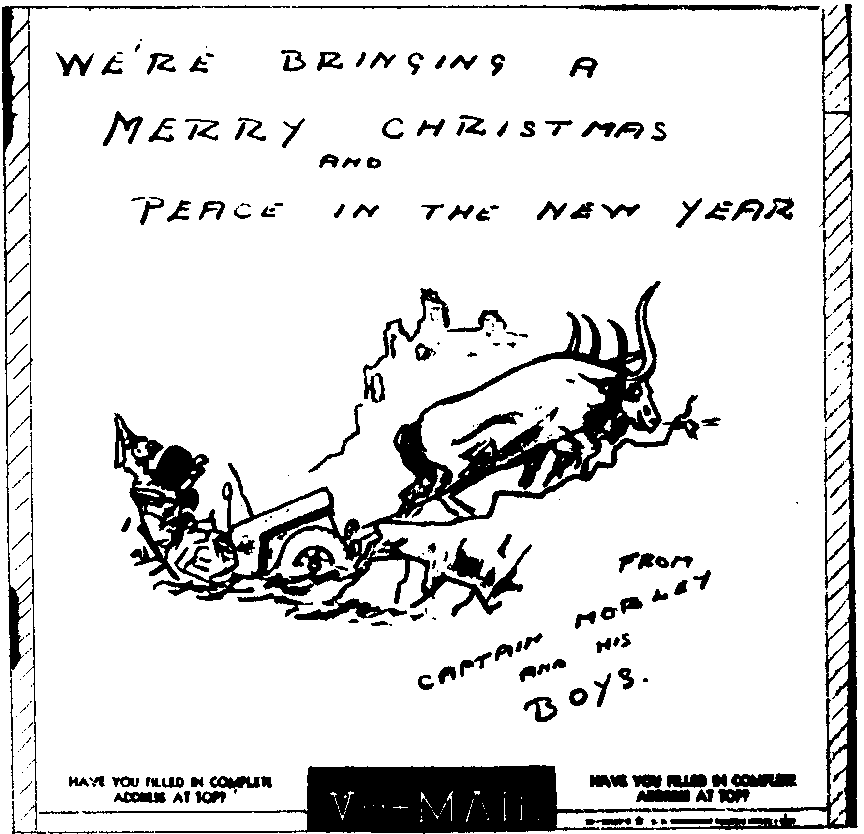 |
Capt. Morley heads the British workshops which service AFS vehicles in Italy. He personally drew this V-Mail Christmas card and sent it to one o the AFSers home on leave who kindly lent it for reproduction here. |
December 13, 1944.
"The other evening I went to a hymn-sing in our Protestant Chapel. We murdered some Lutheran numbers I had never heard before, after which the chaplain requested some carols. As the beautiful, familiar strains of 'Oh, Little Town of Bethlehem' and 'Silent Night' swelled and filled the hall. I looked around me at the cement pillars and straight-backed chairs, the plain windows, the chaplain's desk and paraphernalia, the two white candles twinkling on the make-shift altar at the other end of the room, I sang the carols from memory, but looked at the room, for it was different.
"Here the chapel had no pine, there was no candle-lit, hush before we sang, and there were only two carols. Yet, because I'll be leaving here soon, it will probably pass for my Christmas service. It may as well. This is no year to gather quietly and give thanks for the blessings of peace. Christmas here will be different, as I know you will find it at home, yet I am not despondent, and you certainly should not be.
"For given the current situation in the world today, I think we ---as a family ---have much to be thankful for. This is the year to rejoice that we are allowed to play some part in righting the world's affairs. It is hard to say, but until there be freedom for all to rejoice at this time of year, it is only right that the rest of us mark the day by doing what we can to bring nearer the final day of great rejoicing for all peoples. Therefore I want you all to have a fine Christmas. This year it should be improved, not spoiled, by our necessary absence.
"Here already the long, cot-lined wards have been decked with bunting by ambulatory patients. Colored paper chains make canopies above the beds, while the walls are covered with sheets. One room here was finished early and up went the haughty proclamation:
"All the rooms whose display is similar show a lack of initiative, of spirit, and originality on the part of the personnel of that room."
December 22, 1944.
"When I come home, I'll have to take a blanket, roll it in the mud and sleep on the floor to be comfortable. I'll sure be glad when summer comes and this mud is gone.
"I'll tell you about what happened to my friend 'A'. the other day. He was parked on the side of the road and a little way down the hill was some ammo stacked up with a little Englishman counting it. About that time everyone heard a whistling sound and the Englishman hit the dirt and about thirty feet from him a shell hit. 'A'. said. he saw something flying through the air and his wog and he hit the bottom of the car with his face up. He saw big black specks coming toward the window, since he was face up, and couldn't do a thing. Then he said they finally hit the windshield and windows after what seemed like ages. And to his surprise it just ran all over the windshield when it hit ---it was mud. When 'A'. finally stopped shaking and got his heart out of his mouth, he looked out the window and swears that the little Englishman was down behind on of the ammo boxes on hands and knees digging for everything he was worth. The shell must have been a small one and buried up in the mud and when it exploded, threw more mud than steel. 'A' swears he was never more scared in his life."
November 17, 1944.
"The doc is really a swell guy and very funny. A couple of days ago doc's batman and the orderly went on leave, and as we have been cooking on our own it left the doe and me to shift for ourselves. Our supper that first night was terrific, if terrific is the right word. First of all we couldn't get the stove going. I was doing something in the next room and could hear the doc muttering to himself in the kitchen. I looked around and saw the doc standing in pools of kerosene throwing matches at the stove. Suddenly there was a terrific 'woof' and flames shot into the room I expected to see the kitchen vanish in the explosion but the only noticeable change was that the oven door fell open. The doc got a great kick out of it exclaiming, 'By Jove! That's the way to start the fire! In spite of repeated doses of kerosene the fire refused to burn and we were finally reduced to cooking on the burners normally used for heating the doc's sterilizers.
November 22, 1944.
"I have another post now and it is really a pip. I am stationed with an Italian Infantry Brigade. It isn't actually a Brigade but that is what they call themselves. The whole thing is a riot from beginning to end. The officers are always shouting at the men, and the men shouting at the officers. The most exceptional, thing about the post is that they have an Italian Red Cross girl attached to the unit. As far as I can see the girl does most of the work when the bad cases come in."
No date.
"I am waiting here in a very small village on top of a mountain waiting to run casualties back to the ADS. W. is out on a stretcher-bearing jeep because he won the coin toss. An Italian Partisan was just brought in and I had to get ready to take him back. Unfortunately, he was a job for the Priest instead of an ambulance. The Partisans have an unenviable position in this war. The Germans don't consider them combatants and therefore shoot them if captured. Of course, things being as they are, the Partisans treat the Germans in kind.
"As you probably know, the 8th Army is composed of a hodge-podge of soldiers. (The 5th, contrary to opinion, is only about 50% American.) There are Canadians, Tommies from Scotland, Wales, Ireland, England, etc. Aussies, South Africans, various sects of Indians, Palestinians, French, Kiwis, Greeks, Poles, etc. We, of course, are sent to whomsoever needs us at the time and our ambulance happens to be, at the moment, with the Poles.
"It's really quite quaint sitting here hearing the big guns firing and hearing the shells pass over, surrounded by hay stacks, jeeps, little outbuildings, made of sticks and thatch, ducks, turkeys, chickens, rabbits, sheep etc., which we don't get to eat, Polish soldiers and doctors, trucks and other ambulances, Eytie farmers and some Partisans, a small church and a few stone houses partly battered, Tommies of various service corps, gasoline cans, mud, tents, rolling cultivated hills, mountains, oxen pulling primitive basket contraptions without wheels, etc., etc. It's a strange mixture. If you wonder why we didn't sleep in one of the houses last night I'll put you at ease. All the construction I've seen in Italy is stone, and there is no central heating. You can imagine the cold dampness!
"I'll try to give you a brief getup of what we are doing. AFS is composed of general headquarters, various liaison headquarters, two car companies each having four platoons. Each company has a headquarters as does each platoon, so you can see why it might take quite a while to get mail, rations and things. On the whole, however, things are handled much more efficiently than the Army. (I had to say that as this will be censored by headquarters!!) Each platoon is composed of a number of ambulances, (I think it's okay to say 33) which either go hither and thither in groups or singly as directed by platoon headquarters. (By the way, the lodgings and food headquarters are quite different than in the field). Our ambulance work consists of taking casualties from RAPs (Regimental Aid Posts) which are up front to other stations farther back, or from those farther back still farther back. We also carry sick patients, and when things are very quiet do a bit of messenger work between posts. Unfortunately, there is more back work than forward, but we get some of each.
"Strangely enough, the shell fire doesn't bother us at all, though we have plenty of it going out and a bit coming back. None of the coming has landed very near. Also, we haven't been close to any machine gun or mortar fire. I did feel sorry the other day for my patients when a whole battery of big babies went off just as we were passing under their muzzles. The concussion and the noise nearly caved in the roof. The thing that does bother us at times, however, are the mountain roads. To give you an idea, there is a sign saying '4,000 ft.' Some view, but some drop! The mountain roads are full of more than hairpin turns, narrow, slippery, and in most places no fence to hold one from going over the side. There are spots where the road has been blown away and repaired where mud is so bad it's a hell of a job getting through. The road we came to this place on, is only a jeep road, and has so far only been used by mules, jeeps and Dodge-ambulances which, because of four wheel drive, can go almost anywhere a jeep can. Of course, we had to have chains on all four wheels and even then we had a few tense moments. We are looking forward to driving back tonight without lights. E. just returned, after having seen to it that the Germans retreated some more, and he said that twice the jeep he was in went up hills that were convex. Lovely terrain! I sure feel sorry for the casualties on some of the rides.
"Two days ago I was made O.C. Vanda, which means I am in charge of Vanda, our new cook. They're ten of us at this post an most of us have no desire to cook or clean up, so I arranged to hire Vanda, and because of this she has become my responsibility. A very pleasant responsibility! Yesterday, she and I went scouting around and got a turkey and four pigeons for supper tonight. Everyone is looking forward to it, and we hope to get vegetables, also.
"Yesterday received a batch of letters, all most pleasant to get. Over here we look forward to the mail just as much as you've always heard.
"I'm still having uneventful days. Our chief difficulties are bad weather, mud, washing mess tins, and toilet facilities which usually there ain't some of. Did you ever try to wash a greasy mess tin in exceedingly cold water? Did you ever try to wash in exceedingly cold water? I don't got me or my mess tins very clean that way. We do get back to portable showers now and then. As I mentioned once before, the Poles do not have one, two or three holers. They only have no holers, so I bought a toilet seat and had our workshop carpenter put 4 sturdy legs on it. It's a bit cumbersome to carry about! Hope that I'll get a more interesting post in the near future. (Some Poles are having a fine time chasing a chicken.) When I was in Florence the food was much too good, and I'm fat as a dinosaur, and now with all the delicious Xmas stuff, I'll need a new uniform. Yours, with fatty degeneration!"
December 4, 1944.
"I had my worst patient yesterday, an experience which I hope never to go through again. She was a pregnant woman who came into the A.D.S. and wanted to be taken to the hospital very quick! She came with the usual pack of relatives, a couple of whom had thought up some ailments for themselves since they were coming along anyhow. All seemed to be going fine for a while until the medic looked the gal over and realized that she was practically a mother already, and it was my turn for a run So they loaded her on a stretcher and the stretcher into my ambulance, piled the relatives in and slammed the doors with great haste but still very gently. Then the corporal turned to me, standing shaking by the ambulance, 'Drive like Hell', he said, 'and mind the bumps'. So I left, very unhappy about the whole thing. It was a good road so I was able to drive as he said and still not bump. All went fine, however, until I got pretty near my destination and the traffic began to thicken, at which point the young lady started to moan, the relatives began to moan in sympathy and I began to perspire very freely although the weather was quite cold. I got free of the traffic, permanently alienating the affections of a number of truck drivers, etc., and began to breathe freely again; then, as I turned down the street to the hospital, I saw that there was a large truck parked so as to block it completely, I stopped hard, the gal, relatives, and I groaned loudly, and I rushed over to see what could be done about it. It is amazing how cooperative people are in situations like that. The truck driver grasped the situation immediately, put the machine in gear and the truck leaped backwards like a startled elephant, to the no small terror of a small armored car which was coming innocently up behind it I finally got to the hospital, found a stretcher bearers opened the doors hauled out the relatives (and masses of the family possessions) and finally got the lady inside the hospitals leaving me, winner of the race, but a complete wreck. It is funny to look on, but, dammit, it certainly wasn't while it was happening!"
December 11, 1944.
"As you know from the news, we have not come far since I last wrote to you. Mud, rivers, and Jerries have kept us from making any real progress. To be trite, someone forgot to tell the Germans that the war is over. They have a great deal of artillery which they use much more unsparingly than ever before. It is probably true that if the Jerries had been as strong in the desert as they were here the war would have been a very different story at this point. Of course we are relatively stronger; too. And in my mind it is right that it is this way, because the harder it is fought the more likely we are to be shut of the problem for a while to come. While I would never go so far as to say that a permanent peace is either a good or desirable state, certainly we are earning the right to have peace in the next few decades."
November 8, 1944.
"We have at last been put to work. It sure is a relief after six weeks of sitting with practically nothing to do. I am at an MDS with about nine other fellows. We have pretty good billets, and best of all a kerosene stove and a tilly lamp, also plenty of 'buckshee' food, coffee, etc. This makes for pretty good living, but that's about as far as it goes. The food we get here has got me buffaloed--- the noon meal is usually fairly good, but breakfast consists of coffee, bread and cheese; and supper is I don't know what --- half cooked dough and a little bacon is all I can make of it --- I imagine it must be some sort of peasant dish. Luckily, since we are able to get some food from platoon Headquarters, we don't get hungry. As a matter of fact, we make out pretty well. In a way I'm glad we had such a long period of inactivity, because otherwise I'm sure the evacuation would be enough to floor me --- they range from thirty to seventy-five miles one way --- always over a hellish mountain pass, which is usually enveloped in the clouds. Somebody has to do the work, though, and we happen to be 'it'."
November 11, 1944.
"This is ever so much better than war plants! To top it off, this is a much better deal than I would have had in the army. We get just about every privilege that one could want. We go to officers' clubs, warrant officers' and enlisted men's clubs. MPs usually cower when we flash our Geneva cards (part of our passports) and we have rather a good deal of freedom of movement. It's swell. Of course our duty is rather messy (I hope the censors are open minded) but an infantry has no vehicles to carry itself about. All in all it's not bad. Of course, I don't hop from place to place as you do by plane, but then, in the last war you had no ambulance. That's all for now..."
 Some of 485 Coy's ambulances parked in camp near Monte Cassino. |
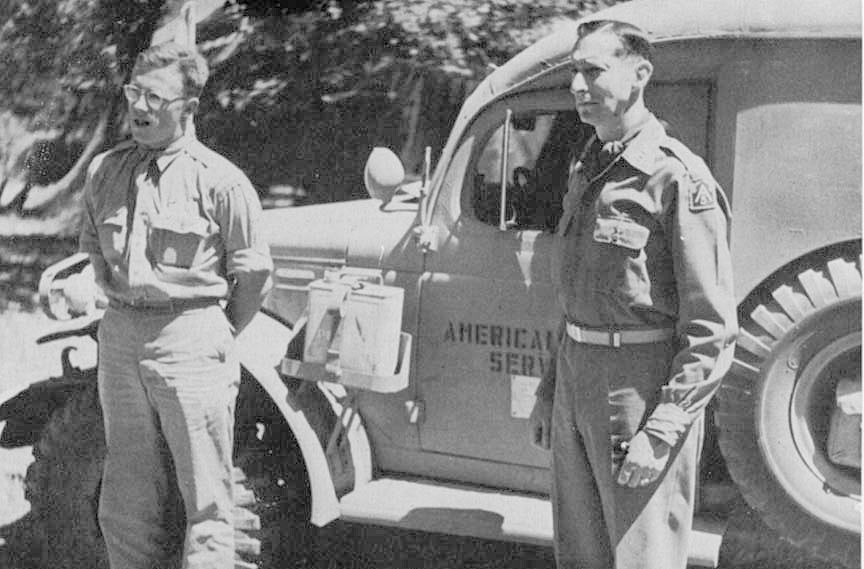 Jim Brindley and General Mark Clark, commander of the Fifth Army, pictured when the general inspected the AFS in Italy last summer. |
December 1, 1944.
"We left convoy about 6:30 M --- and when AFS ambulances travel in convoy they really travel --- bumping, bounding, rattling, and twisting. Finally we reached the turn-oft spot and we stopped. There were just 2 or 3 of us left then ---the others had branched off to other posts. I started first, turned off the main road, crossed a Bailey bridge under the remains of an extremely well bombed-out RR bridge, and up the side of a mountain. My guide, an AFS officer, had told the second car to wait 5 to 10 minutes before following us up. I asked him why. He said: 'Well, you see, this road is almost entirely under complete observation of the Germans. They won't fire, usually, on an ambulance but it's best not to tempt him with a whole convoy'. I gulped a bit, and the front wheels seemed to shimmy ---must have been the road! Then he pointed out to me the next ridge a mile or so away. Jerry held that, he said, and from that ridge he could watch all movements on this road. And this is the road we use to evacuate patients!
"It isn't a long run at all---about 4 miles one way up to the little town where we are stationed. The ambulances can't get up to the RAPs in these muddy mountains, so they use jeeps and stretcher bearers beyond us and bring the wounded in to us to take down to the ADS. So you can see that we are pretty close to the business here. There are guns all around us, some so close that I still jump out of my shoes when they crash out, some maintaining a steady roll of thunder off in the distance.
"We carried our gear into the house where we are quartered, when they took a notion to lob a few shells our way. We have the basement of the house and I had just climbed thru a window into a little yard to show one of the fellows some rifle grenades that Jerry had left behind in his haste to get out of this tiny mountain town. At that very moment there was whoosh! and a blast that shook the air and I dove back into that window with haste. The bloody shell, a small one, had landed at the other end of the garden. After that we sat around in our little room protected by sand-bags and heard some more come over. One landed very close by, but it was a dud. We heard the shoosh, then a thump as it struck the ground, and a sizzling S-S-S-S! as cold mud and water came in contact with the hot steel. One of the British medics said there were quite a few duds, that probably the shells were made in Czechoslovakia and had been sabotaged by the Czech workers.
"A little later we discovered that one shell had landed a few feet in front of two ambulances, one of ours and one British. R. found 2 shrapnel holes in the right door of his cab but neither went all the way thru. The blast lifted a 15 lb. rock and set it down neatly right on his radiator cap! Shrapnel went thru the radiator of the British ambulance. During the night about 20 more shells (I am told) dropped in the town, but did very little damage except to already bombed-out houses. I wouldn't know I was asleep and slept right thru it.
"However, this is a very nice post and our quarters are very comfortable. The bunch we work with now happen to be very grand guys and we get along swell with them. The M.O. (Medical Officer---a Captain is also very nice. Our first night here he invited us all up to his quarters, gave us cigarettes, and we all sat around his fireplace for an hour or so getting acquainted and talking. We learned more about what was going on in that one evening than we had learned in nearly 2 weeks at our previous post.
"A Sergeant-Major (top non-com rank in the British Army, and a very respected one) dropped in from the front and told us about some of the recent patrol activities---mostly at night, and it is casualties resulting from these marauding patrols that furnish us with most of our work at the moment. We won't move ahead on a large scale until other troops have moved up on our flanks, which are exposed now. In other words, we are in a little spear-head into the German lines at present. So we don't anticipate being too busy until the rest of the front pulls up parallel to us---and then only if the weather favors an advance.
"The Sergeant-Major told us about one unit of men just a few hundred yards ahead of us who are dug in a cemetery. They are sleeping in the vaults, which the S-M considers not exactly pleasant. He quoted one of the men as saying that it was bad enough to have to sleep in the cold, damp vault without having Jerry drop mortar shells in and throw all the old bones all over him.
"There are a few other little items of local color that might interest you---things I learned from British drivers who have been here since the town fell. The road thru town has been given the name 'Panic Drive'. The reason is that when the Jeeps hit the edge of town they put her into low gear and 4-wheel drive and open the throttle wide, roaring thru town at about 50 to get up momentum to carry them in a hurry up the road out of town, which is under complete and direct observation. This is the road that only Jeeps and mules can travel on. It is pitted with bomb craters and mud holes, is narrow and steep and winding, and has been given a name-'The Mad Mile'. I walked a little distance up the Mad Mile until discretion got the better of foolishness, and it was quite a road. I can well imagine a tiny jeep zooming along like a bat out of Hell, hitting only the tops of the ruts. In fact they have a sign up along the road reading: 'Beware of Low Flying Jeeps!'"
December 3, 1944.
"My location is now 'Somewhere Else in Italy', since I have been moved again. We are just a few miles back at an ADS. We were pulled out of our Mad Mile post because there was not very much doing and the M.O. decided he didn't need so many ambulances. He thought it better to move a few back from the front where there was less danger of a stray shell hitting them while they were sitting there doing nothing. Don't get me wrong, we were doing work at the CCP but there were just too many ambulances for the amount of work. Here, however, we haven't a thing to do but the M.O. here promised us it would only be a couple of days. Then he wants to send us to another post where they need a small, powerful machine with 4-wheel drive, where they can't use the British ambulances very successfully. That just hits us right, so in another day or so I may be into something quite interesting. I hope so.
"There is nothing just like the A.F.S. set-up anywhere else in the war, I believe. There is an almost complete absence of discipline, especially as understood in the military sense. It is enough to drive hard-bitten old military men berserk, and yet they are usually the first to admit that the A.F.S. is doing very well --- 'Bloody Good Show'. We have talked about this and have decided that the main reason for the lack of discipline is the lack of need of discipline, and this results from the peculiar organization of the A.F.S. itself. You see, as all A.F.S. men are volunteers they came over because they really wanted to come, and wanted to do the job that is theirs. Where a regular soldier might gripe because he had to make 2 bad runs in one day, most A.F.S. men actually jump at the chance to do it. We are a select group in the sense that we are self-selected. The stock retort to anyone who gripes too much (a certain amount of griping is healthy and to be expected) is simply: 'Okay yoker, you didn't have to come!' It is this kind of set-up which makes it possible for the A.F.S. to function efficiently with so little discipline. Each man on the whole welcomes this assumption of individual responsibility. It is very good for an ego perhaps badly battered back in the States by the feeling of inferiority that accompanies the 4-F classification. We're better off than the average Tommy and G.I., and we know it, are proud of it, and mean to keep it that way. You see, we are in the thick of the war doing a very necessary job and right in the midst of military anonymity ---and yet we are able to keep alive a complete sense of individuality. We are not numbers, or pawns we are persons to each other and to our leaders --- and let no one forget it!"
December 6, 1944.
"Every now and then we come across something that is so utterly incongruous as to be pathetic. This morning such an incident occurred. This town where we are now given every appearance of being completely dominated by the military. Trucks, tanks, jeeps roar back and forth --- red capped British M.P.'s direct all traffic --- troops abound in the town. It really isn't a town, it's simply a military camp. And yet this one little incident took place that was so completely, so tragically civilian, that it made me feel funny.
"I was sitting in the front seat of my ambulance, reading. By now I had become so accustomed to convoys of troops, huge speedy heavily armed tanks, etc. ---that I hardly bothered to look out of the window at them. But then, up ahead appeared a procession that I did sit up and watch. It was a funeral, a civilian funeral. First came 4 or 5 little boys dressed in the white vestment common to the Catholics (I don't remember what it is called). Following them was the priest in shabby black vestment and white surplice, inevitably muddy, carrying a large cross at the top of a pole about 10 ft. long. Behind him were 7 or 8 men and women carrying the coffin. It was very small and could not have been heavy --- undoubtedly a child. Behind this came about 10 other persons, men, all bareheaded. There was no mourning and I could detect no weeping but perhaps that is not to be wondered at, since almost all their attention was required to thread their way down the hill amidst the rumble and roar of modern war weapons moving to and from their destructive tasks. A squad of British soldiers was marching up the opposite side of the street. They like me, were interested in this strange cavalcade out of another world, another life. As the passed the Sergeant snapped out: 'Eyes left' and every man turned his head, not pausing in his stride, to look. Then a sharp; 'Eyes front!' and the squad moved away smoothly and smartly towards the Church just around the bend.
"There are many ways in which the Italian people have met this crisis. Some have turned it to their own advantage and traded upon it at the expense of their own countrymen. Some have been reduced to the status of beggars. Many girls and young women have taken advantage of the age-old fact that armies are made up of men without women and have met the crisis by selling their bodies---not always for money, very often for rations, 2 or 3 tins of bully beef, a blanket, a can of gasolene, or cigarettes. You see many of these, and similar things, cannot be gotten in Italy by civilians for money---but quite often they can be gotten for 'love'."
December 22, 1944.
"One evening the two of us were standing just outside our cars. Suddenly, out of the darkness a cheerful voice accosted us, saying he had noticed us parked there for some time, and had intended stopping in on us sooner. He had known and worked with some of our (A.F.S.) fellows near Rome---he was attached to an English ambulance H.Q. up the road about 1/4 mile. Would we like to come up and have a cup of hot tea, sit around the fire and talk for a while? We would, and did. The fellow, Joh, and his buddies managed to scrounge some sandwiches and raisin biscuits from their cook---so we had a very pleasant evening.
"These were all English chaps---just about the first members of the British Army that I have met so far that have actually come from England. John is a young fellow, very pleasant and friendly. His home is London where he lived with his mother until they were blitzed out. Then they moved to a little cottage in the country which he seems to have enjoyed very much before he went into the army. He has been in a little less than 3 years. He laughed a little as he said this and remarked: 'compared to these other fellows I'm still just a recruit.' He is obviously, very, fond of England and wanted me to be sure and visit it--- 'but not now, not until after the War. This is no time to visit England. We've been hit hard, you know, and what with rationing and all it's best to wait until we get straightened around again.' We had a very pleasant evening, talking about England and America, swapping English and American cigarettes, and talking about the war, and about ambulances, close calls, etc. They told us about evacuating wounded in Sicily when the southern invasion first started, how one of their runs was 160 miles long and they used to go 4 or 5 days with practically no sleep. They compared German patients with Italian patients---to the detriment of the Italian. These men have a high respect for the German soldier as a fighting man---but they have very little respect for the Italians."
December 26, 1944.
"The fellows had gone to a lot of trouble to fix the place up as Christmasy as possible. There were little Christmas trees scattered about the house with home-made decorations: colored paper, streamers, designs cut from tin cans, etc. (Another interruption---afternoon tea.) A great long table had been set in a narrow hallway. On the table were oranges, nuts candy, and a bottle of beer at every place, also cans of cigarettes. We first went into the office and sat around a fire where we gradually met the various fellows attached to the MAC---all English. The Lieutenant in command wandered in to meet us---and here I discovered another tradition in the British Army. The Lt., a slim, pleasant young chap, had on over his uniform an apron. It was explained to us ignorant Yanks that on Christmas day the officers wait on the men. John told me that in the morning the officers had come around to the billets with steaming pots of tea and had served them their breakfast in bed! For those that wanted it they had bottles of whisky and poured a lot in the morning tea---a pick-me-up! The Lt. couldn't stay long because he had his work to do and with a mock courtesy in his bedraggled apron he swallowed a bit of cognac and was off."
December 27, 1944.
"We sat around the rest of the evening singing and even dancing a little at the MAC party. The warmest place was in the room occupied by the Italian family, a young couple with their 16 months old baby---as cute, chubby and cheerful a little fellow as you could hope to see. Capt. Van, of the A.D.S., was there and he simply couldn't leave that baby alone. He held it on his lap, played with it, and talked to me about his own baby---2 years old---back in South Africa---the baby he has not seen yet. Another soldier---a Corporal---stood looking at the baby for long minutes. Then he reached in his wallet and showed me pictures of his baby. He looked at the Italian baby, then at his pictures, and said: 'It just touches my heart to see this little baby here today and to know I've got a baby just like that back home. It's little things like that that choke you up a bit---as a matter of fact the corporal's baby is now nearly 5 years old but he remembers it as he last saw it---just about the size of this Italian baby."
One day late in January 1945 a man was given his acceptance papers for AFS. He was the 2000th volunteer to give his time and services to the ambulance corps since the start of active service in World War II, in 1940.
One of the ambulance drivers home from India left his car parked too long and the alert New York City police took a dim view of this action and gave the AFS man a ticket. The intrepid volunteer went to court to answer the summons without the necessary five dollars to pay the fine, determined to argue (and try to win) his own case. As he stepped up to the judge's desk, immediately after his honor had taken $25.00 from a Marine, the judge looked down from his bench, saw the volunteer standing there in uniform and said: "American Field Service, eh? Sentence suspended."
A hitherto unheard of Ally is now being served by AFS men and ambulances, Warren Fugitt's section in France is attached to the 4th. Division of Moroccan Mountaineers.
AFS will be represented by a guest speaker who will appear on the Mutual Radio network on the program THIS IS OUR CAUSE on Saturday afternoon, March 3rd. This show is on from 4:30 to 5:00 P.M. Eastern War Time and should make interesting listening. We cannot tell at the date of writing who the guest will be who will tell of the AFS over this nationwide hook-up.
Bill Hanna was driving his ambulance along a road in France recently when a column of American tanks passed him going in the opposite direction. One of the tanks stopped a short distance in front of him and the driver got out, seeing an American he spoke to Bill and to their mutual surprise discovered that they were old friends from New Canaan.
John Cobb, William Manning and Leslie Scott, former AFS drivers who served together in Italy are now together again. All three U.S. Navy sailors in training at the Hospital Corps School in San Diego.
AFS has recently accepted a few men who did not know how to drive a car. This amazing fact is a little known outcome of four years of war. So many people who had cars either sold them or put them up for the duration that the opportunity for learning to drive which usually enters a boy's life when he is 15 or 16, has passed many of them by. The result: 18 year old AFS applicants who do not know how to drive. They have been accepted, however, and will be taught this necessary trade on arrival overseas.
We are very pleased to announce that Mrs. Wells Farnham whose stepson is driving an ambulance in Burma, has taken over at the Chicago AFS office. This is very good news as the office at 30 North Michigan Avenue has been of invaluable help to the Chicago representatives and had to be temporarily closed.
Major 'Chan' Ives who has been OC in India-Burma since the start of AFS service there, and has been overseas for more than three years, is home on leave. It was a disappointment that after briefly visiting N.Y., HQ he went home and shaved off the famous flowing Ives moustache.
The only Romance we have to report this month is the whirlwind courtship, engagement and marriage of Capt. Jack Pemberton, home from Burma, and the former Miss Lorraine Pruett. They were married in Rochester, Minnesota, on January 27th. Congratulations and the best of luck to them.

December 22, 1944.
"This is going to be another one of those letters that I will mail later. I left our field headquarters in India on Sunday to make the rounds, and thought I would surely be back by Christmas but there's not a chance. One of the new men came along for the ride and is getting more of one than he bargained for. Before we left I had a list of where all our jeep ambulances were supposed to be and we expected to get to the first pair Sunday night. We got to the appointed place on schedule and were told that the MDS had moved on---miles so we kept going and got there about 7:00 o'clock. The O.C. there, an Indian Lt. Col. said he had sent them on ahead to his ADS. He was very cordial, gave us a good dinner and a tent with stretchers to sleep on. We had to wait until noon the next day to get ferried across a large river (much in the news) but reached where he said they would be about 5:00 o'clock.. Then we found another MDS with a Canadian O.C. He said our men had been there and had moved on. He also gave us a good dinner and a tent, but no stretchers, so we slept on the ground which proved to be quite comfortable. The next day we started out at 9:00 o'clock and by 10:30 that night hadn't found the ADS we were looking for, so we flopped down in the patient's tent of another ADS with no dinner except cocoa and toast which some M.P.s gave us along the way. The next morning we found our men in half an hour and went on to the next pair who were with the advanced brigade on this track. This ADS was camped on the edge of a field, where the brigade's advanced platoon had run into an ambush the day before with heavy losses in killed and wounded. Being that close to the Jap we could have no lights or noise, of course. For our evening meal we had chicken by the dim light of a new moon and slept on the ground under my ground sheet stretched between two jeeps. Although it hasn't rained for months the dew is very heavy. You can actually hear it drip from the trees on a tent. I discovered the next morning that the men wounded the day before had slept (?) with no cover. One had a broken back and a bullet went into his buttocks and came out his stomach. Another, with only minor wounds, had a bullet hit a grenade he was carrying, without exploding it, but which ruined a can of bully beef much to his disgust. The next day, yesterday, we started back to make a wide circle to our next unit which will take two days under the best conditions, even if they were where they are supposed to be. Last night we slept on the ground again, and extraordinarily hard ground this time.
"The newness and strangeness of India was beginning to wear off, but in this part of Burma it is starting all over again. On our second and third day this week we went through the most dense jungle yet and up and down the steepest mountain grades. Then we came into a valley which is comparatively open with many villages, most of them deserted. The huts are all raised or 6 feet off the ground and some of them have plank walls, practically unheard of in India. Wherever there is a native hut there is sure to be a Buddhist shrine, and even the small villages have elaborate temples. All but one we have seen, look as if they have been deserted for years with Buddhas of various sizes stacked up in a storeroom. I got one which I think is small enough to mail home from one of the shrines in the clearing where I am now."
Christmas Day.
"A year ago on Christmas I imagined a lot of things that I might be doing today but not what I actually am doing, namely, sitting in a broken-down jeep on a jungle mountainside. H. and I stayed where the first part of this letter was written for two days, during which time said jeep was in the shop. We had our Christmas celebration last night minus my presents which are back at the field headquarters unopened. All the patients were evacuated yesterday afternoon, so there were only two drivers H. and me, the Sikh Captain, a British Captain, and a B.O.R. medical orderly to have our Christmas dinner together. The meals have been lousy there, all supplies flown in and the only difference in our Christmas ration was four ounces of canned chicken per man and a bottle of rum for the group. Luckily, the mail I brought up for our drivers included several boxes of food from which we made a good meal by recent standards. One of the fellows had some gin and beer and I had a third of a bottle of Scotch plus that can of turkey-a-la-king which you sent some time ago; so by pooling our resources we had the following dinner in the M.I. Tent temporarily converted into a mess tent:
P.S. About the time we were ready for dinner a new B.O.R. malaria patient was brought in and lay in the ward tent all by himself while the festivities were going on, too sick to join us. He hadn't had anything to eat for five days. Are people at home still complaining about rationing? One of the H.O.R. malaria patients died the day before (they didn't have enough quinine), and they buried him on the hillside with a small stone pillar from the Buddhist temple as a gravestone. Lucky me!--- I have nothing but motor trouble.
January 4 1945.
"Our breakdown was caused by blowing out the gasket in the cylinder head and was repaired in a couple of hours the next morning so we continued on. The next day part of the road reminded me of the farmer seeing an elephant for the first time. 'There ain't no such animal'. It was a new track, in fact they were still building it and using elephants for the job. We didn't see any, but we saw what they left behind. It was just wide enough for a jeep and the grades, curves, density of the jungle topped anything I had seen before, also many more birds and monkeys. We almost ran down one family of the latter, which crossed the track and scrambled up a bank which was too much for the youngest member to negotiate. Such a chattering and scolding as the others left him behind. Late that afternoon we crossed the same river at another point. They were using captured Jap barges and were too busy to take our jeep so we borrowed one on the other side and continued for an hour by the eerie light of a full moon over a track that would be wonderful to scare little children. It was Saturday night when I got back to headquarters and on Sunday night we had a New Year's Eve party.
"On New Year's Day I drove the ambulance of a man in the hospital to where I am now, two days of it through heat and dust over a road which would be good training to go through the Niagara Rapids in a barrel. Sport rode up front with me and, having no steering wheel to hang onto, he bounced around like a cherry in a cocktail shaker, and wasn't at all happy about it. I told him that if he was going to be an Army dog he must expect some discomforts but he took a dim view of the whole situation. I'll probably have this ambulance until its driver gets well or a replacement arrives, but of course I'm still doing finance business anywhere at anytime."
November 29, 1944.
"Talking of animals, this still is the most colorful service to be in with the craziest people in it. Yesterday two young boys came in to draw their money to go on leave and informed me they were taking their snakes with them. They had special bags made, in which each has a snake about six feet long. They sit around here with them wound around their necks and crawling up and down their arms. If I got into a compartment on a train and found two people with snakes I should probably have hysterics, and I certainly wouldn't sleep all night. There are also three monkeys and a parrot at the Club in town.
"We were just talking about the water buffaloes (which, by the way, we are eating for supper) that teem the streets like Tremont and Washington at home. I remarked that I thought they had a certain placid dignity. The answer was they must have, or they would not have survived as the most common animal, that their intellect and the natives' bore a striking resemblance. I so often think of Father and his 'It isn't good for the Christian's health to hustle the Aryan brown'. I mean what you do in a country when, if you want a short leave pass for our next village, you have to ask for a 'chot choota chittie for Buge Buge'.
"Well, with this bit of nonsense I will bid you good night."
December 26, 1944.
"I bought a new hat the other day at great expense, only to wake up one morning and find the rats had eaten it. I put it back in the cupboard tonight with rat poisoning as a trimming and only hope they come again."
November 20, 1944.
"Where I'm stationed now it's hot and dry and reminds me of the week I spent in Aden where it hadn't rained for almost two years. Of course, it has rained here quite recently but there is no evidence of it left. The landscape itself is similar to Gibraltar. In other words; it is rugged, rocky terrain.
"Next week, or rather this week, I think, is Thanksgiving and we're having a big party at our HQ. Hope I can get back for that night to enjoy it. It isn't often that we have mass brawls but when we do they are a lot of fun. Everybody comes, from the lowest B.O.R. to full Generals and consequently it's necessary to serve the drinks early and strong so everybody will be right at home. Frequently I've seen B.O.R.'s and generals throwing each other in the lake while inebriated and not caring a damn for rank. It's the AFS way of doing things, no class distinction, and it results in a lot more fun. Also we're going to have pukka dinner with canned turkey and all the trimmings.
"Next Saturday I'm supposed to have a date with a W.A.S.(B). It'll be my first encounter with a white girl since leaving home. I just hope I'm not too bashful to talk, like I used to be. I guess I've gotten over that by now!"
November 23, 1944.
"As you know I've been sent out to do a job and I couldn't have asked for anything better. Everyone is swell and I'm being treated like a long lost brother. A sergeant from the signal corps came over to my ambulance to fix up my radio. Now instead of taking my battery from the engine to work the radio, I just turn the switch. The whole thing is wired together on a central lead.
"The real work hasn't started yet although I'm not idle now. In my spare time I work on my ambulance so's to be sure it'll keep going when things get hot around here. My work consists of passing off the sick parade in the morning and later carrying the same people I ordered to the hospital. Other than that I only work when an emergency arises, which has been frequent.
December 5, 1944.
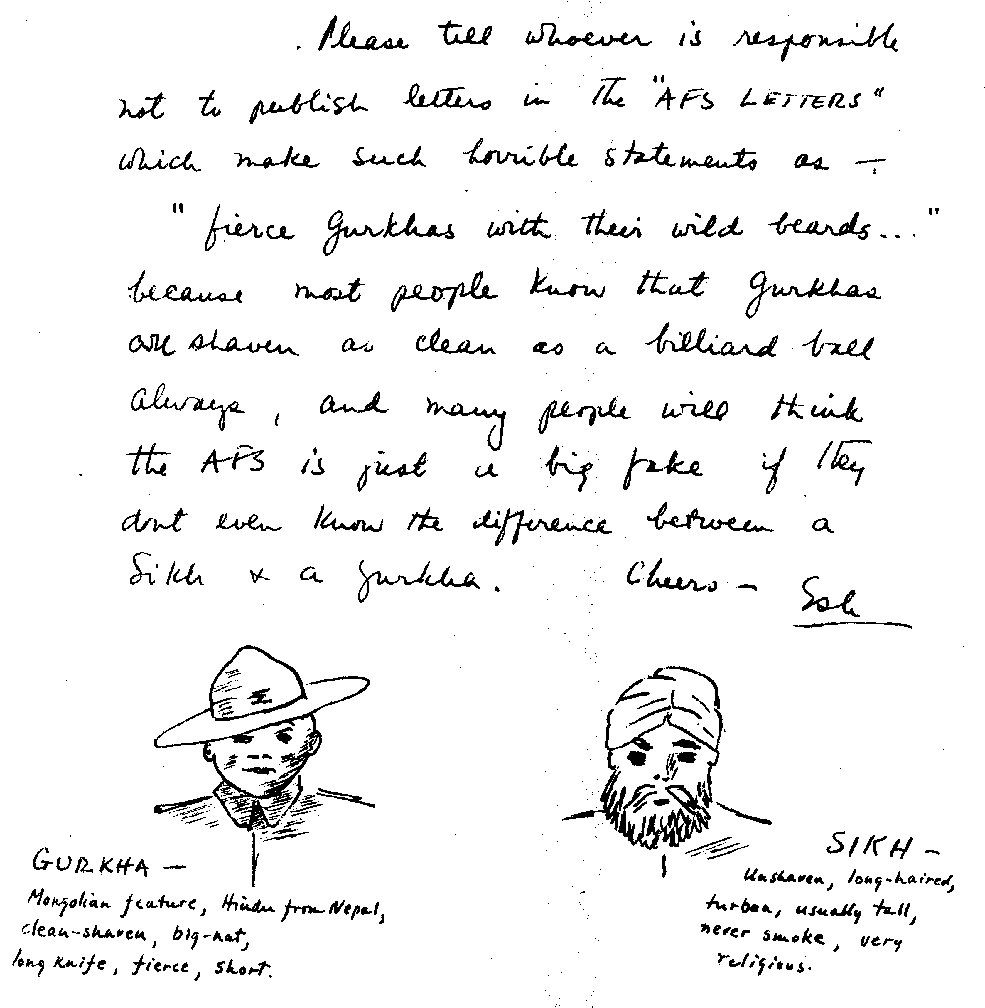
"All during the day the Gurkha troops stop in to see me. They are wonderful little follows, always smiling and never forgetting their place. Being mercenary troops and coming from the free state of Nepal, they are the best jungle fighters in the world. These mongolian featured boys are short, stocky and strong as an ox and nothing is too much for them. I saw one of them get seriously wounded by a hand grenade in combat and all the others who were around stopped what they were doing, ran over to where the fella was hurt and then literally rolled over laughing. They are always that way --- getting a big kick out of it when one of their lot is wounded. They laugh and carry on in such cases as much as to say 'Why, the damn fool got in the way, Ha, Ha! ' Eventually they noticed me and said 'Thik Hai, Sahib'. Then some more ha-has. But regardless of their sense of humor they would never let the bara white sahib down, and there isn't a man in the British army who'll not give them the highest praise.
"Last night I heard the Army-Navy game on the radio. Wasn't too hot, was it? I guess the army outclassed the navy in every department cause it seemed like an awfully lopsided game."
December 17, 1944.
"Yes, I've seen the Taj Mahal and was not particularly impressed by it. All it is, is a glorified bathtub. Once inside the main building all you do is give money for the unfortunate of India and unless you re a complete miser, you've parted with 15 rupees before leaving. There are many more beautiful spots in India and also more interesting. For instance, we visited the Maha Raja of Indore and met his American wife. We made a hunting trip in a Ford station wagon instead of the usual elephants and brought back jackals instead of the expected tigers, but nevertheless it was fun and very interesting and a little more enjoyable all around than a visit to a commercialized temple."
December 18, 1944.
"Headline for today --- 'Tragedy Strikes AFS'. 'Mysterious Blaze Sweeps Through Volunteer Ambulance Drivers' Headquarters'. Yes, that is right. Our HQ burned down two days ago. The cause of the blaze is still a mystery but I'm sure ------has a mighty guilty conscience. In the end only two bashas were destroyed, the mess hail and the one in which I was slumbering in sweet repose. At about five in the morning one of the fellas started yelling 'fire' , but we all told him to go back to sleep as he was merely having a nightmare, but then we smelled it. Sure enough, it wasn't a nightmare. As fate would have it, the first bucket of water to be thrown on the fire was the one in which I had left all the pictures I'd printed the night before. All the pictures were destroyed. As a matter of fact that was the only loss of personal property. We tried our hardest to limit the fire to one basha, but our efforts were futile, so we quickly retreated and set up new and stronger defences on the third. Bashas being made of straw burn like celluloid and what's more, the roofs are only a foot apart. Well, our third line of defense was strong and consisted of a bucket brigade to the roof on which I perched as a wet blanket beater, a wall pusher-in group whose job it was to see that all falling timbers fell in the opposite direction from still whole bashas and a water supply-in-hand group who put out what timbers the pusher-in group failed to push. After about three hours the fire was checked and for all weary firemen, breakfast was served on the terrace (the mess hall was no longer). The party broke up at 10:00 a.m. and a good time was had by all."
December 20, 1944.
"The Japs are retreating fast and there is a hell of a lot of work for us to do. I can't tell you any facts but I fully believe that we are making history now; ---like the Eight Army with the retreat of Rommel.
"Life here in the jeep section is quite different than in the other bigger ambulances. We have a rack fixed on the jeep over the right-hand side, over the passenger's seat. The canvas roof and the windshield have been removed and stretchers are placed in these racks. At night we sleep on the stretcher and it's not too bad as the monsoons are over and the mosquitoes have sought a more balmy clime. Our runs are varied---we never know from one day to the next what the work will be like on the tomorrow.
"The Japs are retreating fast, so fast, in fact, that it is possible they may even abandon Burma completely. You should see the piles of papers, records, books, rifles, clothes and personal stuff that they hurriedly abandoned as they fled. If I keep collecting I'll look like an old curiosity shop before long.
"We hear no more shelling now as it's moved on up again. That's the way it always is. We move up, hear all the noise, then it moves on; people move in where we are, creating a boom-town-like hustle and things are civilized. Then up we go again to the noise.
"There are bananas here which will be ripe by January 1, and grass 20 feet tail --elephant grass. In the daytime the temperature reaches 60-90 degrees while at night we suffer at 30 degrees. There is snow at times on the mountain peaks.
"Our field cashier finally caught up with us. I had given up hope of ever seeing anyone else in the AFS except the three others who are on this assignment with me. Besides my $20 pay and letters, he brought me two Christmas packages. These I'll keep for the Christmas party."
No date.
"The monsoon is over now. No longer are the roads slimy and boggy, they are dry and dusty. I don't know which is worse. In places here the dust is a foot thick and you have to shift down to get through. It hovers in the air for hours after a car passes and if there is any traffic at all on the road it is so thick you can't see an inch in front. And there usually is a lot of traffic. The rocks are rutted, corrugated, and lumpy, jumpy, numpy, runty. But the AFS always gets through. Sometimes an ambulance goes over a cud, sometimes one gets stuck in the mud, crashes into a tree, burns, breaks down, turns over, but on the whole a good show. It is a gloriously satisfying work. Ha Ha!"
No date.
"We had rather a hectic trip over, but a fast one. Aside from sleeping in the most awfully crowded hold I have ever imagined, suffering the terrific heat therein, eating two meals a day standing up, lining up for everything, we eventually arrived and I was most thankful. However, the worst part of the trip was to follow. Have you ever pictured or read of Indian trains? If not, you would have difficulty in appreciating what we experienced. Four long wooden benches running lengthwise down the car, one lone solitary light bulb, and no blankets or sleeping bags to cover us or lie on (and the nights were really cold). I had difficulty fitting my big frame on the bench so chose the floor to sleep on!
"The trip from point of debarkation to this point was most interesting, and something I shall never forget. The train made stops at every hick village and town and we had an opportunity to observe the native and his living conditions. I have never seen such living conditions! The dirt and filth of both the native quarters and the natives themselves are beyond description; yet the whole picture to me was of great interest since I have studied and read much of India, and for that reason always wanted to visit here.... Beneath all her poverty and squalor, she has so much to offer to him who really knows where to look. For example when I arrived in Calcutta I nearly went insane when I visited several bookstores and observed the wealth of material on philosophical and Veda literature, and the most awful dearth of such literature back home.
"Those of the AFS I have met here are a grand bunch to a man, and it is such a relief to find things that way for all of us. The fellows were remarkable on the way over, so cooperative and helpful. We will be here for about 2 or 3 days and then are going up. I understand we will all be sticking together for a while and will be attached to Section 4 Some of us have hopes of getting into the Jap section, which is an ambition of mine, eventually.
"Today several of us spent several hours walking thru the bazaars and native quarters of the town. Honest-to-God I have never seen anything like it ---with their eternal 'backsheesh, Sahib' --- and if you so much as give them a glance they will follow you for a mile! I am learning slowly. I have had several rides in Sharries (rickshaws), a most reasonable way of travel; I think New York would profit by such a method! I had bid goodbye to such luxuries as hamburgers, ice cream, milk-shakes, etc. but had all of them on my first day, which amazed me considerably."
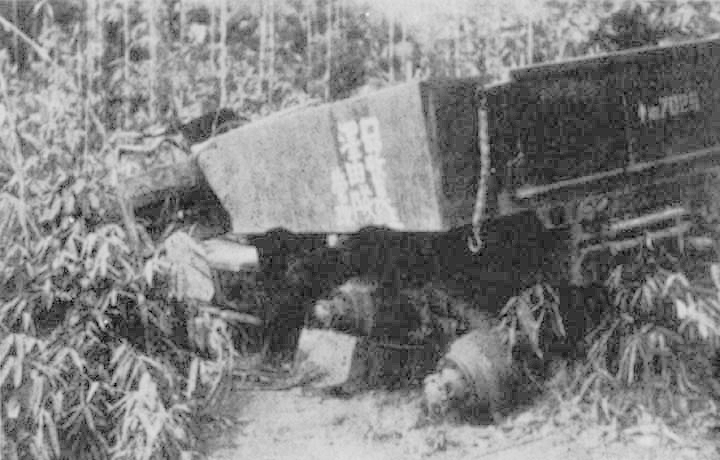 A British half-track, captured by the Japs and wrecked by Allied gunfire, lies beside the Tiddim road. |
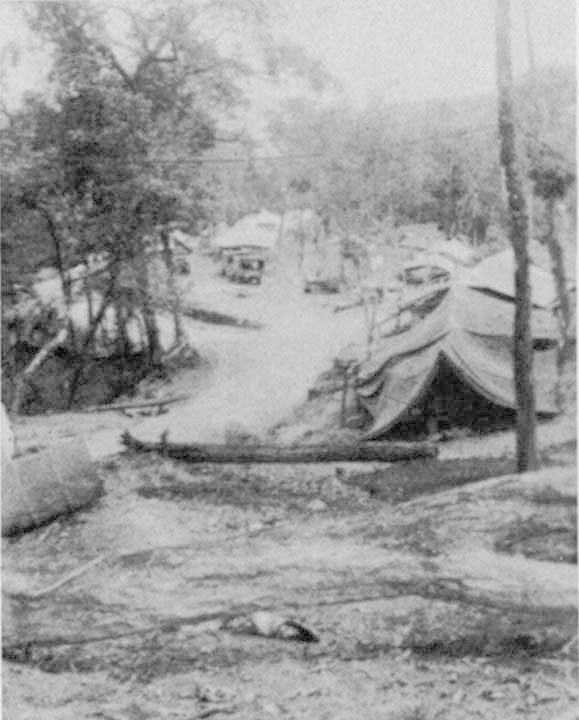 An AFS camp in Assam. |
 Screened by a Burmese bamboo thicket, an AFS ambulance makes its way along the track. |
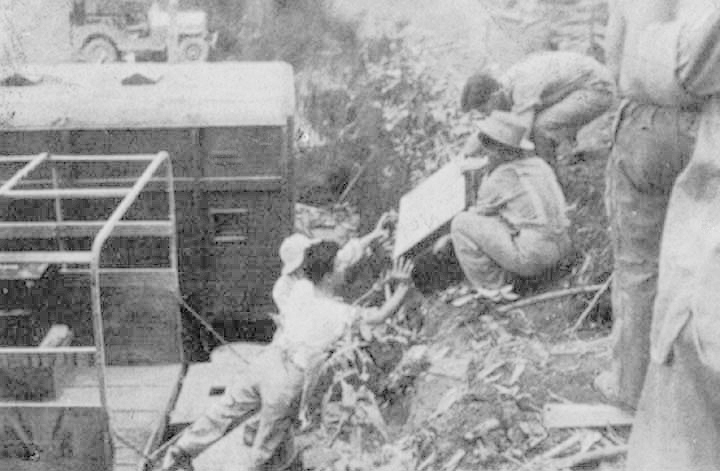 AFS men loading supplies into a truck from a hillside in Assam. |

December 17, 1944.
"Yesterday afternoon two American officers on duty here took me with them to the Swiss border. We had a big time talking with the Swiss army officers on duty at the customs station there, we just couldn't talk them into letting us go in for a few hours but they were very cordial and told us all about conditions there and in the meantime went out and bought a whole raft of Swiss pastry for us to eat. We swapped souvenirs with them. American, for Swiss, American cigarettes for Swiss, packets of paper matches and everything we had on us. We really have quite a party. One of the officers told me that if I could wangle some kind of a visa for my passport to get in for Xmas, his house would be open to me. We had cameras with us but we forgot all about taking some pictures of the whole business. One of the Swiss officers was a famous watchmaker as well as being an army officer. He showed me a watch he had made himself. It was really some watch. It showed the day, month and year as well as the second minute and hour and, in addition, was a stop watch. It was a wrist watch too."
December 25, 1944.
"At least the weather here was not too bad for Xmas. No snow to amount to anything, but the rains stopped about a week ago and it was a beautiful, bright, clear day here. We had a very fine Xmas dinner this evening with most of the Field Service on hand, turkey and everything. Among my other duties I'm also official AFS Quartermaster here. I had to go out and round up the turkey and fixings several days ago. I really had to talk turkey to a couple of these U.S. Army quartermasters because they had never heard of the Field Service and thought I was trying to pull a fast one. However, I finally got the turkey and the fixings and felt like Santa Claus when I got home. The French donated quite a bit of wine and good champagne and we had a very nice party.
"We certainly enjoy your clippings of cartoons and also jokes. I usually pass them around and the boys get a big laugh out of them."
 THE HASTY HEART. |
 |