
Edited and published at AFS Headquarters, 60 Beaver Street, New York 4, N.Y, under the sponsorship of the ambulanciers' relatives and friends, who contribute the excerpts from the letters.
Cooperation is one vital fact, that, will not only win the war, but will be essential in building and holding the peace. It cannot afford to exist only in a broad sense between nations, but must reach each individual person. One of the very few good things to grow out of the war is an increasing awareness and practice of this, charity, helping those less fortunate than ourselves, is an American custom. As is often the case, good intentions in this direction can overstep themselves and result in some confusions and waste, if real cooperation is not present.
The National War Fund Inc. is an organization set up under the sponsorship of the Federal Government to be a guide to, and central collecting bureau for, relief organizations, both home-front and war. From community chests in the smallest towns to the largest war relief organizations in the biggest cities, all are merged in their fund raising as member agencies of the National War Fund, or its affiliates.
The purpose of the War Fund is to get the maximum aid from each contributed dollar, while involving a minimum amount of expense for collection, to each member. It is also a tremendous time-saver. With war-time hours crowded to capacity for most people, the War Fund drives in the separate communities, take care of the fund raising for twenty-two member war organizations, and numerous home-front ones at once. In addition, by combining the efforts of all the participating agencies and their staffs into one drive, the drive can be a much larger and more effective one.
The American Field Service, while it was officially taken in as a participating member agency last year and has been receiving its funds this way since April, 1945, was a little late to reap the extra benefits that it is now getting. In addition to soliciting and turning over to AFS its lifeblood dollars, the War Fund, with offices in every corner of the U.S., spreads word of the ambulance service and the job that the men overseas are doing, bringing far wider recognition than a lone organization could obtain for itself.
Cooperation is the seed from which the War Fund has grown and is growing. The 1945 campaign drives will start soon in some communities, in others it will be months yet before they are under way. The success of these drives depends, not only on the efficiency of the National War Fund's staffs nor on the generosity of the contributors, but also on the cooperation of all interested people. The American Field service can get a greater share of recognition through the cooperation of its friends. Your War Fund Drive wants stories of your AFS man, your interest and suggestions to help 'put over' its campaign.
J. B.
| Thomas Stratton Esten | Stoughton | Mass. |
| George Oscar Tichenor | Maplewood | N.J. |
| Stanley Blazei Kulak | Salem | Mass |
| William Keith McLarty | Berkeley | Calif. |
| John Fletcher Watson | Larchmont | N.Y. |
| Randolph Clay Eaton | Ft. Lauderdale | Fla. |
| John Hopkins Denison, Jr. | Big Horn | Wy. |
| August Alexander Rubel | Piru | Calif. |
| Richard Sterling Stockton, Jr. | Bryn Mawr | Penn |
| Curtis Charles Rodgers | Highland Park | Ill. |
| Caleb Jones Milne, IV | Woodstock | N.Y. |
| Vernon William Preble | Lowell | Mass |
| Charles James Andrews, Jr. | Norfolk | Va. |
| Arthur Paisley Foster | Warroad | Min |
| Charles Kendrick Adams, Jr. | Huntington | W. Va. |
| Henry Larner | Albany | N.Y. |
| Alexander Randall, Jr. | Baltimore | Md. |
| George Edward Brennan | Chicago | Ill. |
| Robert Carter Bryan | Richmond | Va. |
| Dawson Ellsworth | Milwaukee | Wis. |
| John Dale Cuningham | Brooklyn | N.Y. |
| Donald Joseph Harty | Buffalo | N.Y. |
| Thomas Lees Marshall | Winnetka | Ill. |
| George Alden Ladd | Burlington | Vt. |
| Paul Haynes Cagle | Owensboro | Ky. |
| James Bennett Wilton, Jr. | Peoria | Ill. |
| Ralph Evans Boaz | Omaha | Neb: |
| William Tuttle Orth | New York | N.Y. |
| Bruce Gilette Henderson | Kenmore | N.Y. |
| Albert Studley Miller | Cambridge | Mass. |
| Hilding Swensson | Manasquan | N.J. |
ALBERT STUDLEY MILLER of Cambridge, Massachusetts, on February 7th, 1945, was killed in France. Albert's ambulance and a French truck collided, instantly killing Miller and seriously injuring a French officer and a stretcher bearer, who were riding with him. Upon learning of Albert Miller's death, the Chief of the French Military Mission in the United States wrote, "I am sure I need not tell you that France is gratefully aware of the great assistance given the war effort by the splendid work of the volunteers of the American Field Service, and feels a personal loss in the passing of one of its members."
BRUCE GILETTE HENDERSON of Kenmore, New York, on February 15th, was killed by enemy action while serving on the India-Burma Front. Bruce was in charge of a jeep ambulance and was working at a forward post near the banks of the Irrawaddy. Just before dawn, on the morning of the 15th, the Japanese attacked the position in superior force, inflicting many casualties and forcing the remnants of the company to withdraw. During the operations, Bruce was shot through the chest. He was loved and admired by everyone in his section, as he was always cheerful and helpful to those he worked with and those he worked for. His Commanding Officer said, " ...one feels that, having known such a man, one can never lose heart."
HILDING SWENSSON of Manasquan, New Jersey, on February 28th, was killed while serving on the India-Burma Front. The news of his death was received by cable and, as yet, the details have not reached us. The only information is that he was killed by a land mine. Hilding originally went overseas with the British Ninth Army during the Middle East Campaign. He returned to this country and in 1943, reembarked for the India theatre, where he served until his death.
John Stanley Wires of Wellesley Hills, Massachusetts, was wounded while serving with the Seventh American Army, France. John was a member of the Thirty-second AFS Unit and was attached to the British Ninth Army and the Fighting French Forces during the Middle East Campaign. He returned to this country and entered the Armed Forces. He was endeavoring to help a wounded man when a piece of shrapnel struck him. He is now recuperating in a hospital in England.
|
Your smile is good for quiet joys, B.M.J. |
January 4, 1945.
"The nicest thing that has happened to me in a long time was a telephone call from B. Sunday night. He was in the Field Service originally with me and left about the time I went home in 1943 to join the British Navy. He's a sub-Lieutenant with his own ship at his command, doing a special kind of work and we had two very interesting evenings together. So many boys when we join the Field Service have romantic ideas about what they are going to do in the future out here, but most of them want to go home when the time comes --- not so B., he has really put his hopes and ideas into effect and I am afraid post-war will be an anti-climax to him.
"Before I met him he had just been on the Fahenstock expedition, studying music and native dances in the Pacific Islands and, after being shipwrecked off Australia, had worked on a sheep ranch there finally sailing home before the mast on one of the grain schooners, to Canada.
"On arriving at his first port of call in the Mediterranean after I last saw him he reported to the Navy Base concerning his ship. The man in charge asked him why he was in civilian clothes and on being told that B. had no others having come from the American Field Service the man sent a wire to Admiral Cunningham saying, 'I am giving this man a commission for his own safety' and to B. 'For God's sake go and buy yourself a uniform,'
"At some point a year or so ago they sailed into a small harbor of an Aegean island at night and opened up on the Jerrys but the German ship turned out to be a large one and promptly sank them, taking the crew prisoners on shore. As far as I can make out B. thoroughly enjoyed his six weeks as a German prisoner, although they threatened to line them up against the wall and shoot them at first, feeling that they were spies. The British recaptured the island before the Germans could ship them to Germany, and it all seems a big adventure when re-told. Some day we will get all of the details in front of the fire at home."
October 29, 1944.
"Just after I had written you last, I joined a British RAP and went up to the front with them. There at the RAP I could watch our shells land on lorry positions, see fighters strafe him and bombers lay the eggs. The air was continually filled with the ripple and screech of the shells landing to the rear of us. Before the division I was attached to went in the line, I was pulled out and transferred to an Indian division where I am now. At first I thought I had seen all the action I was going to see and that this would be dull behind the lines driving. In fact I was completely mad over the set up, but in a couple of days things started happening.
"One night we moved up to an A.D.S. in. the mountains in the pouring rain. The attack was to go in that night. That's one of the three or four nights I'll especially remember. I was pulled out of the mud only once but I'll bet I helped push or pull at least 5000 jeeps out ---it seemed that many at the time. Well the next day it finally dawned clear as crystal and about 11:00 a Capt. (the M.O. of the A.D.S.) came up to me where I was reading an antique and muddy tattered copy of Fortune magazine and said he wanted a volunteer to go with the Colonel on a reconnaissance mission. I said 'o.k.' jumped into my Jeep with the Col. and his driver and rode off. As we started up this Mountain road the Col, asked me if I had my identification bracelet. I thought he said identity card, so I replied 'Yes, I have my Geneva card'. He laughed and said 'No, your bracelet. Shells don't pay much attention to Geneva cards'. I too laughed (a bit hollowly I think) and said that I had heard some place that they didn't care about identity bracelets either. This seemed to break the ice a bit and he came out of his stony silence to explain that we were going to look for 10 or 20 wounded Indians reported back in. the hills and that the route was under enemy observation the whole way thus the huge white flag with a brilliant red cross on it that flew from the pole on our Jeep. We proceeded down to a meandering river very wide but mostly dry and started across. As we did, a shell tore up the gravel about a hundred yards ahead of us. I remember now that I've never felt so scared in my life. When we reached the opposite bank, another fell behind us and a couple in the town. The driver put his foot down and sped through that little village hell bent for election. After more driving over an impossible trail along, in and across the river, we eventually reached a road going up another hill and soon we came upon 3 or 4 walking Indians and one stretcher case. The latter was seriously wounded so the Colonel stayed with the others and sent me back with the casualty to bring up 2 more Jeeps, 2 of our Dodges and a squad of stretcher bearers. On the way back shells landed in the town before and after I went through, so if Jerry did see me he respected the red cross. The poor Indian died about half way back. I put a mirror to his mouth to further test for a sign of life and got none. Reporting the whole set up to the M.O. at the A.D.S. I returned to the Col. with two Jeeps and 2 Dodges as well as the bearers. Here I'll skip a lot of detail and say that we finally got an evacuation system set up and worked at it until midnight that night. In those two days I had two meals in 42 hours but I was much sleepier than hungry. Finally during a lull I pulled over to the side of the road and fell asleep. That night driving with no lights is the most strenuous work I've ever done. I'll never forget that. In fact the other night I had a nightmare that I was driving at night and that suddenly a huge truck loomed up before me. It was so vivid that I woke up with a terrific jerk. Now this little town I mentioned is a beehive of military activity and our A.D.S. is there.
"In spite of what you may think, I'm in good health and have caught up on my food and sleep. Still haven't had a bath or change of clothes though ---3 weeks since I did."
(Ed's note: This is an exact copy of a letter written to Mr. Galatti, who considers it one of the finest tributes ever received.)
19th Feb. 1945
191404 Pte. R.C. Cleghorn
1st. Bn London Scottish
CMFDear Sir:
On behalf of my friends and myself I would like to express the sincere admiration which we have for the members of the American Field Service, whilst serving in our unit, to write all their gallant exploits would take to long, so we hope by this short letter the people of America will appreciate the good work that these volunteers are doing.
We ourselves belong to a Infantry Unit and we have had the good fortune of having one or two of your drivers attached to us, during that time not one has ever failed in carrying out his duty, even under the most trying circumstances, --- I myself, have seen them carrying on for days without sleep, evacuating wounded, their cheerfulness during these operations was an inspiration to many a wounded soldier. I also think that during that time they did a great deal to bring about a closer Anglo-American relationship, even now I think we are much more closer then ever before.
Infantry men are supposed to be hard-boiled, but we still take our hats off to the men of the AFS each time we talk of them it is with a feeling of pride and admiration.
Many of our American friends have since gone home, namely Steve Mclnnis, Frank Emmett, Mort Wright, Ken Brennan and a good few others, on behalf of my friends and I we would like to extend our best wishes and thanks for the good work they have done for us during their period with the Eighth Army.
We are at the moment privileged with having one of your oldest AFS members with us, John Meeker, he is a very loyal member and I should imagine he is the high light of many a British Division.
Before I close Sir, we would like to wish you and the AFS the very best of luck for the future and 1 hope that in the days to come you will carry on the good work, of which I am sure you will.
On Behalf of the London Scottish Medical Section we extend our best wishes.
I am Sir
Yours sincerely,
R.C. Cleghorn
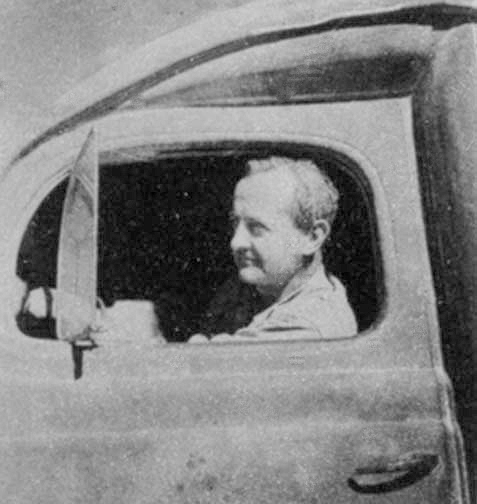 |
At left: John Meeker "...the high light of many a British Division." |
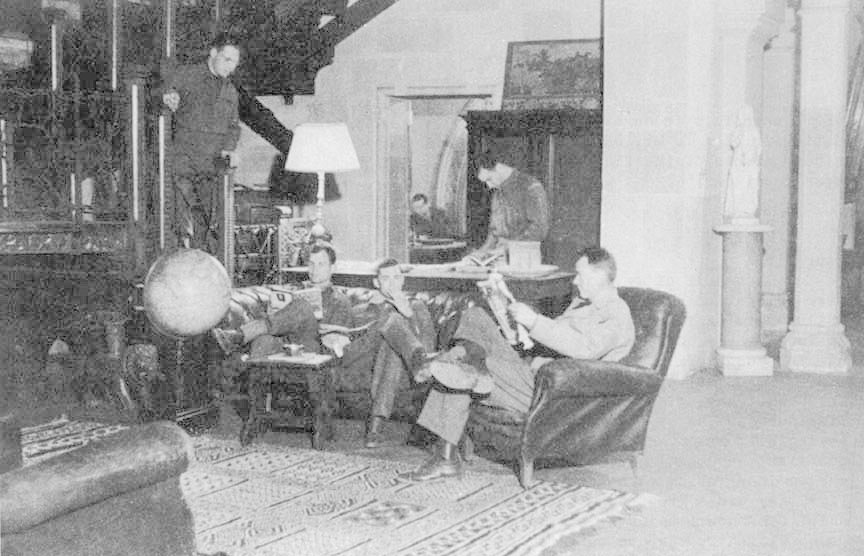 A group of the ambulance drivers relax in the living room of the Naples AFS Club which is housed in an old Italian villa. |
 |
January 17, 1945.
"I've been out on 'loan' to the Red cross officer here in this place for several days. The work is very interesting. I'm carrying Italian civilians to the hospital. Really seeing the country. The Red Cross officer here is an American and very nice. He is in charge of Red Cross Welfare and works in conjunction with the AMG. It's a riot the way the 'Eyties' kow-tow to him. 'Ah, Americano, Cruce rossa officiale; si, si Signor', ad infinitum. Nothing is too good for the Red Cross 'officiale'. When I go to the various houses to pick up my cases they all rush out and stare at the ambulance (and me) as Americans are still quite a novelty in this section and are things to be looked at with awe and treated with respect. The people nearly always (after I give them a cigarette or two) ask me to sit and have a glass of wine, then the Pappa sits down and immediately comments, in a voice melancholy with a sort of inquiring lift at the finish, 'Multi mangare en America?' (Lots to eat?) You can take that statement either as a statement or a question. Anyway, as soon as they receive the affirmative answer they all nod and say, 'A-h-h-h', sort of wistfully. Gad, these people are strange.
"I get awfully outdone with them sometimes. When I arrive at the various places they can't do a thing until you tell them what's to be done. Very sheeplike. In spite of their simplicity and ignorance they are pitiful and some are extremely kind. It takes all kinds of people to make a world. The other day I had an opportunity to see a particular portion of the old Gothic line. The fortifications were quite extensive and, even to my unpracticed eye, they seemed very easy to defend with a minimum amount of men.
"We are very comfortably settled in good billets, it's easy to see why this campaign is the most foul of all the fronts. I've talked to several fellows who have been on the French front and they're all miserable on this front. Although there is a greater amount of combat on the other front the whole picture is different. On that front lies the whole expectation of victory. In spite of Clare Luce's sensational appeals to 'remember our troops in Italy', it does nothing to alleviate the dreary monotony of the soldiers' existence here. It's very difficult to explain what is expected of people. Perhaps a bit more publicity would inflate their ego some. Nothing material in that!
"I suppose you have read the comments of all our worthy statesmen who visited Italy in December. Some of their utterances were quite ridiculous, I thought. Clare Luce went to sleep for a 'good long time'. The air trip kept her awake quite a bit and she was extremely fatigued. Hah, poor lady. Never heard her talk that way on the extensive slur-tours she made in October.
"We heard on the radio tonight that Warsaw had fallen and possibly Cracow. I hope they keep it up. As far as I can learn the Ardennes salient still bulges but is considerably blunted."
December 28, 1944.
"The Major came by this morning to chuck me under the chin and ask if I were comfortable, bored, etc. and I took one run (very undramatic) with a tonsilitis case and a cordite burn. Then I took the M.O. down to Regimental HQ in the afternoon, and that, together with talking to the Tommies on the Gun Crew is 'My Day'---oh, one more thing, I took a bath. Very Important landmark, date-line, or whatever is appropriate for something unusual. There are a few bath units around, but I took this one in the back of the ambulance, with unaccustomed modesty. Most interesting experience!
"By the way, I'll enclose a clipping from 'Stars and Stripes' about the Field Service. It is perhaps rather theatrical and dramatic, and doesn't take into account all the endless sitting and waiting; changing tires putting on chains, greasing, etc. but still it's a pretty good article; and certainly complimentary enough.
"As far as commodities are concerned I think I'm faring better than you are. I have an unopened carton of Chesterfields in the ammunition box I use for luggage; candy, and a quart of Scotch Whiskey (for only $1.70). My canteen was just emptied of cognac for the benefit of some appreciative Tommies. So if you want anything, just write to me! I wish I could send cigarettes, because I only use about half of my fortnightly ration of 15 packs."
January 15, 1945.
"We are quite far up as Jerry is only about 1000 yards away, but it is really quite a safe post because we are at the foot of a very steep hill. It is thus very hard for him to drop shells on us and about the only things that come close are mortars which are pretty inaccurate as he can't see what he is shooting at. Some rocket bombs came in quite close last night and shook the building a lot, but there is very little danger if you stay inside as everybody does when he is shelling. I am the only American in miles and have the only ambulance here. But the fellows here are very nice and easy to get along with. I park my car in a tunnel about two hundred yards away and evacuate along a railroad track for about five miles. It is a very rough ride as you can imagine and the car gets shaken up a good deal. There is a lot of patrol activity on both sides up here and thus quite a bit of fighting, although you probably don't read about it in the papers, as the real lines remain static. We have had a goodly number of casualties and quite a few dead. Some follows come in horribly wounded and die here or on the way to the next post in the medical set-up, but it doesn't bother you too much usually, as you sort of expect it here. I usually get called about 2 A.M. as that is when most of the casualties come in, and thus don't get too much sleep. Last night was the first one I was able to sleep thru, as a matter of fact. The casualties have to walk in unless it's absolutely impossible, as the trail down is so steep. They get their wounds dressed here and then get carried up in stretcher jeeps to where I meet them in my ambulance a few hundred yards away. I can't go on that trail as it is too narrow. The walk up to my car includes the steepest trail (and the slipperiest) I have ever seen. It is very frightening if you think about it (at least for me) walking up alone about 2 or 3 A.M. for, as I said, the Jerry patrols are very active. Every little sound and I walk a little faster. The other night ---2 nights ago--- there was a big patrol skirmish and I was sent out after Eytie stretcher-bearers. On the second trip while I was turning around on the railroad track I went into a ditch and couldn't get the car out in time to take the casualties. It was of course pitch dark and snowing very hard so that the new snow covered the tracks, but just the same I didn't feel too well about it as two of the patients died in the stretcher jeeps which had to take them all the way. They would probably have died anyway (both --- one lorry and one ours --- with very bad head wounds) but still....
"The casualties with bullet or machine gun or even shrapnel wounds aren't so bad, but the thing that disturbs you is those that come in more or less dismembered by shell or mortar bomb blasts. A mortar bomb fell near here the other day and killed two Eyties and wounded eight. One came in screaming with his hand blown off and holding the stump. One of the dead had no stomach so they put him on my stretcher, We had to carry him up to another room and got blood all over us. I have to lug them around (the stiffs) but I refuse to wrap them up although I've been asked several times. Actually I don' t have to do either.
"The longer I stay over here the sorrier I feel for the infantry. They are the only ones who see (and feel) the worst of war steadily. They sleep in the snow (one fellow was dug out last night still sleeping under a foot of snow) in little slit trenches, can't move or talk or smoke and have to keep wide awake all the time. Of course this is only in the most forward positions at night, but it's an awful strain. Especially on the veterans who can't trust the young replacements, only just arrived, as sentries with all this patrol activity. Of course both sides have mined everything around here, but Jerry often misses them and sneaks up on posts, both the extreme forward ones and otherwise. It is so cold that the oil on our men's weapons freeze and the guns jam. One fellow that was brought in here the other night was one of six at a forward post. They were attacked and he rushed the enemy patrol of about 30 or 40 men with a Bren gun, but it jammed and he was just sprayed with bullets. But you hear of so many miraculous escapes from the men --- verified too --- that it more than counteracts such disasters. It sounds funny but you laugh about such escapes of our men and how Jerries have been killed with the same men who went thru the experiences an hour previously. Even with those wounded during the episodes. As Mr. K. writes, 'everything is relative'. A year ago, I took it very seriously when somebody in my house disobeyed some trivial rule and now we laugh and talk in the same room with the wounded groaning and dying and others dead in the corner while machine guns are firing outside and mortar shells landing outside with a terrific crash and shaking the house. I never even thought about how strange it all is until Mr. K. mentioned it in his letter. A few trinkets like a ring or a letter ---even a hand grenade taken from the pockets of dead men seem grimmer than seeing the actual man covered with a blanket.
"It is very cold here now and there is almost three feet of snow on the ground. This building is like an ice box. The fire is sort of pathetic, as wood is very hard to get. We have burned all but the absolutely necessary furniture already as well as several German rifles and in fact anything but grenades and bullets. There is a beautiful woodside only a short distance away but it is sort of like a water mirage in the desert. It is loaded with booby traps, has mines all around it and besides that is under Jerry's observation and in his machine gun and rifle range. So our main source of wood is railroad ties. But they are such a job to lug down and cut up that we burn anything else first. Somebody found a lovely door this morning and I am enjoying that now. Then too; our single fire is usually surrounded by trench foot patients trying to warm up after a night in the snow. So, of course, they get A-1 priorities, and we get left in the cold. They constitute the majority of my patients. Trench foot takes a big toll of the men and is very painful. They consider it so important that two specialists ( a Colonel and Brigadier, no less) were up here working on it. But I haven't had a run yet today (or last night) so I am curious to know what has happened especially since I have a front row seat by the fire.
"I don't know when I'll be able to mail this as the mail isn't very regular these days especially since nobody likes to come up the railroad track unless necessary."
October 22, 1944.
"To look at me now, you'd wonder where my clothes came from: a Canadian uniform, New Zealand hat, South African shoes, Indian shirt, British socks. You see, no one ever really is dressed like any one else in this outfit. We're a queer assortment of uniforms, with only the shoulder emblem to identify us."
December 14, 1944.
"This New Zealand padre I've been talking about smokes a lot of my cigars, for which I know you are thankful. Each time I give him one he says, 'The Lord will keep you for doing this,' and I say; 'Is that a guarantee? These cigars are pretty expensive and hard to get.' And he replies, 'Keep me in cigars and you will have nothing to worry about. You will even get extra desserts for dinner.' He admits it's bribery, but he points to Heaven and says it's bribery of the Highest Order. Amen.
"I have never told you about the strange races in the Eighth Army. These are, as you know, Sikhs, Gurkhas, Indians and Maoris (from New Zealand). I've met all of them, and there are really weird tales to tell. Meanwhile, I can say that the finest sort of persons, in every sense; that I've met are the Maoris. These Maoris are the natives of New Zealand, and although they're fully civilized and belong to the Church of England; lots of tribal traits and taboos persist. They're warriors by profession and preference. They will have only their chiefs as officers; won't follow lesser men.
"A Maori is rarely bothered by the sight of his own wounds --- loss of an arm or eye means little to him, even if he's dying, for it's been lost in battle, honorably. But minor stomach ache or head cold puts the fear of his gods in him and he shakes like jello. They're tall, handsome and terribly courteous."
December 17, 1944.
"I was talking to two prisoner-woundeds the other day. One was 17 years old, and he had been in nine months. He was one of the handsomest boys I've ever seen, with light blonde hair, light blue eyes, and a big generous mouth. But a complete idiot. He said Germany will win the war in six months.
"The other prisoner was about fifty, conscripted for police duty about two months ago, but sent in the line about three weeks ago with an old carbine and no ammunition. He had about eight hours' training before going into the line. He couldn't see how the Germans could last more than a few months."
No date.
"This RAP that I am now stationed at, is without a doubt the nicest place I have worked at since leaving the States. I get along very well with the regulars here.
"Jerry just threw about ten shells in our direction and made the old house just jump. The door banged to and fro and everything danced. They were at least 100 yards from us but as they were mostly those dreaded 'Screaming Mimies', they sounded a lot closer. This type of shell really makes a terrible bang and they land in a circle, caused by their being fired from a gun with six barrels in it, and with a diameter of about 50 yards. The shell throws fragments about 150 yards, so it is always very dangerous.
"We had some patients last night and believe it or not, one of them had the mumps. I was awfully glad I'd already had them. The trip down was pretty bad, especially getting out to the main road. Two cows got in my way and I had to just about hit them before they'd move on. The shell holes were all filled with snow so I had to take it extra slow. I slid off the road once but it was only into a small ditch. The hill to the ADS was my main worry and especially the turn into the ADS track. We have to swing three or four times before we can make it.
"Walking over to lunch this noon both the Doctor and I went flat on our faces, not once, but three times. 1t was the first time I've taken a dive in the snow but I guess it won't be my last. The shells weren't too close, about 150 yards away, but neither one of us felt like taking any chances. Coming back, it was very quiet and you wouldn't have had the slightest idea that Jerry was only about 1,000 yards away.
"The Doctor needed some cotton for use on splints so I drove over to get it at the ADS while he took a much needed nap. He was about half of last night dressing wounded and I don't know how he keeps going. As I drove along the road I could see plainly where the latest shells had landed and some were mighty close to the road. They were just like burnt holes in a brand new white blanket.
"I was just about to turn in at the ADS when I was clipped by a Bren Gun Carrier. He was coming out of a side road and although I pulled over to let him pass, he hit my front right wheel and side. He hit the wheel so hard that it spun right out of my hands and gave me a sprained right thumb. Nothing happened to the car and I kept on going until a Jerry shell dropped about 50 yards behind me. My motor was making so much noise that I wasn't aware of the shell and just kept right on going.
"We had a great influx of patients last night so I was busy most of the evening. On one trip, I hadn't gone very far when an officer stopped me and said that Jerry had knocked out a jeep at one of the most dangerous corners around here. I was just approaching the jeep when I saw another man behind it, and he was examining the men in it. It didn't take either of us long to see that they were all dead. As we were standing there, we heard the whistle of a shell and both of us hit the drainage ditch on the side road. It wasn't the first time that we've had to dive for cover.
"Because we had so many casualties last night, I served as sort of an orderly, helping to remove and apply bandages and splints, dressing wounds or doing anything I could to be of help. I've never seen a man work so quickly or with such assurance, as the Doctor. He's as cool as a cucumber and when a shell lands near here, he doesn't appear to notice it at all.
"Yesterday I helped to evacuate the Italian family living in this house. They had been here all along and had a dreadful fear of the shelling. In order to get them out we got two jeeps, and my ambulance carried most of their personal belongings. To show their appreciation, they presented me with a chicken and it's now hanging for a few days before it will be ready to eat. The old man who rode in front with me was laughing and joking about how most of the houses along the road had been blown to bits. His neighbors troubles didn't seem to worry him in the least, but when he saw his friends, he burst into tears.
"A few nights ago our evening started out quietly enough but as it drew toward morning, things started to happen. I was making a run at dawn and had just passed the crossroad when Jerry landed a couple behind me. As I was coming back I met one of the boys and we stopped and talked a few minutes. In the meantime Jerry had hit both crossroads with direct hits. It's a good thing we did stop and talk I guess! Just as I started up the hill near our pet corner, I heard a couple of shells land about 50 yards ahead and to my left. I slowed down to listen and debated whether I should jump for the ditch or continue. I decided to keep going and then saw two M.P.'s in front, running like mad down the road. Just as I passed them, a shell landed on the other side of the ambulance about 20 yards away. I tore around the
the corner like mad and shifted into second gear. I had just done this when a shell landed 10 feet in front of my car. I didn't hear it coming and the first thing I knew there was a loud bang and snow and mud went flying into the air. I yelled to the two orderlies who were riding in the back, to see it they were okay, and then I just tore down the road. As I came into, the shelter of the RAP I collected my wits end only then began to realize how close a call it was. I still don't see how the shrapnel missed my car, let alone going through the front windshield. The Doctor came running out with a cup of tea to calm my nerves and it was mighty welcome. That certainly was some experience and one that I hope won't be repeated soon.
"The other afternoon as we were loading the Italian family to evacuate them, we watched some of our Spitfires dive bomb, and fight the German positions just over the river. They really looked nice as they came diving down and we could hear very plainly the sound of their machine guns and bombs. There were also some bombers returning from a mission, flying very high, and the sky was just filled with little puffs of anti-aircraft fire. It was quite a sight to see them coming back and we stood and watched them for quite some time.
No date.
"The last twelve hours have been without a doubt the most exciting and nerve trying that I've had since joining this outfit. That night about 10:30 Jerry laid down one of the heaviest barrages I've ever been near. I was not only near this one, but the RAP was in the direct line of fire. He threw shell after shell in this area and it's a wonder that there is anything at all left of our pet little corner. The only thing we could figure out was that Jerry was counter-attacking and the supporting fire landing on the roads was to prevent supplies and reinforcements from reaching the forward platoons and companies. Right in the middle of it all we received some casualties and one of them was a priority-one head wound. Every time the shelling would die down we'd load up the ambulance and then it would start again with what seemed renewed vitality. This would make it necessary to unload as quickly as possible and we did this two times before we were able to get away.
"Just before I reached the post I saw a jeep stuck half on and half off the road. I tried to go around it and in doing so, I got stuck myself. I tried every trick I knew to get my car out of difficulty and finally we were on the go again. It was about 2:00 before I crawled into bed and Jerry's constant shelling didn't make for good sleeping either. I'd just gotten to sleep when one of the regulars woke me up in order to borrow a tow as one of the jeeps was stuck.
"A messenger came and said there were a great many wounded at one of our forward companies. W. tried to dispatch a jeep but they were all ditched along the roadsides. The Doctor and I took our ambulance forward then, over the worst stretch of road I have ever ridden on. It was only a jeep track---the tires wouldn't fit in the ruts. We could look at the houses that Jerry was occupying and if he had decided to walk around, we could have seen him very plainly. For the first time in a long while I wore a steel Stetson and was mighty glad to have it although it gave me a headache. We went up there hoping only one thing, and that was that Jerry would respect the Red Cross. He did, for which I'm mighty thankful, and we were a little surprised too, for we half expected that he wouldn't. The building that we went to had been hit four times last night so we were kept quite busy. In about 20 minutes there were four jeeps to help us out.
"I just found out that all the noise yesterday was due to the fact that Jerry made three attacks last night. They came at twelve, two and five. It seems that they were trying to erect a bridge over the river so that they could move some guns and tanks across. Luckily the group on our right spotted the bridge. Most of the wounded that the doctor had to treat were caught in a mine field. It seems that earlier last night a German patrol crossed the river and laid new mine fields.
"At present, neither the doctor nor I have eaten anything all day long. Neither one of us feels like it after last night and this morning. I tried to sleep this afternoon but found that I was too keyed up at present, so gave up trying. I've lived practically a complete lifetime in the last 36 hours, and it hasn't been fun.... Doc and I just finished eating our first and only meal of the day. It was some bouillon soup, a cold bully-beet sandwich and a cup of tea. Neither of us was hungry and this small amount filled us to the brim.
"Last night was very quiet except for a few stray shells. We all got some much needed sleep and feel much better this morning. There was one casualty last night and he was wounded by a machine gun shell at just about the same spot we were at yesterday morning."
No date.
"Last night Jerry sent a company to occupy a house on our side of the river. They were there working on the defenses when a patrol from one of our battalions spotted them. As they were outnumbered, they got some more men and tried to drive Jerry out at daybreak. This failed, so they called for more reserves and a few tanks. The tanks blasted the house, as did our mortars and artillery. We laid down some smoke shells so that our casualties could be removed; this obscured the building and the tanks had a little difficulty seeing their target. After all was over, there were 25 German dead and 12 prisoners taken. A few escaped and two of the prisoners caused trouble. The Indians who had captured them, cut off their heads and brought them back to the commanding officer. It's heard that our casualties were light, but there was plenty to do just the same.
"We walked over to mess as usual (all done up in our white sheets so that the Germans couldn't see us in the snow) and just then Jerry threw about ten shells into the place. I moved over to the other side of the room. There were no direct hits made but the sentry was hurt out front. They used self propelled gun shells and these are exceptionally fast. You no sooner hear the whistle than they explode.
"Believe it or not I had dinner this noon with Royalty! This fellow was the Maharajah of the Indian state of Nabah and he was over visiting the Italian battlefronts. He had a turban which was an olive drab color with a yellow band, just covering his forehead. His beard and mustache was huge and when he drank his beer, the foam stuck to them and gave him the appearance foaming at the mouth. He was a big man in all ways, --- power, height and girth. He must have weighed close to two hundred and fifty pounds, but he didn't look like a prince, although you could see that he was used to being treated as such. He only stayed for dinner and then left, and everyone seemed a great deal happier then, and more at ease.
"Last night I was out and heard something slap through the bushes, about ten feet away and land in the snow with a plunk. It made me jump and I thought it might be a German patrol. Later I learned that it was probably a spent German machine gun bullet that hadn't hit what it was aimed at.
"Shells are going over our heads into Jerry's lines every few seconds now and its far from peaceful. The trouble in the other sector hasn't let up either, so it's going to be a matter of counting shells instead of sheep when I go to sleep tonight.
"I had to sew an AFS patch on my left shoulder and also a few button holes. The button holes were a real problem and I hadn't the slightest idea how to go about them. Somebody would make a lot of money by selling an already threaded needle to the Armed Forces. It must have taken me at least 15 minutes to thread the needle and it took me a good three quarters of an hour to do all my sewing. My fingers look as if somebody had been taking a blood test all day long and I think I have at least 50 punctures.
"We've had about five minutes of complete silence and it really is a strange feeling, but a welcome one. Of course, there is always something in the distance, but I'm referring to our guns nearby, that are very seldom silent.
"Yesterday we learned how the German Army keeps its soldiers from deserting. For example, two German soldiers deserted this sector and became prisoners of war of their own accord. The German Army then took 5 men from the Division these men were in and sent them back to Germany to the families of these men. They were made to watch the families being shot by a firing squad. Then they were sent back to their Division and told to inform the other men about the procedure which follows a man's deserting. To call it cruel and inhuman would be putting it mildly. Human life holds no value for them and I hate to think what the results would have been had Germany been victorious in her attempt to conquer Europe. It isn't possible to even conceive of the conditions that would exist under her rule."
From the French front comes this tale of mistaken identity. A small group of AFS men were enroute from one sector to another when they were stopped by the MPs, who took them into custody for questioning. The Frenchmen were baffled, these men were obviously foreigners, yet they were wearing French uniforms. The Frenchmen took them into a house and started asking preliminary questions while awaiting the arrival of the Colonel. The fewer questions the AFS answered the more convinced the French became that they must be German parachutists. The questioning took place, however, in a comfortable house and the AFS men were entertained with brandy and cigarettes until the Colonel arrived and the matter was cleared up, and they proceeded on their way.
Bill. Key joined AFS because two attempts at entering the Army were futile as he was way overweight. After driving an AFS ambulance in Italy for 18 months, Bill lost 55 pounds, and was sworn into the U.S. Army in February by his father, Maj. General William S. Key.
AFS ambulances like many other war vehicles often have names. One volunteer writes that after waiting some time for a suitable name to occur to him for his vehicle, he has named it THE STORK. He explains the moniker this way: "An Italian woman gave birth to a baby girl in my ambulance. It was night and I was taking her and the midwife to the hospital. We were within a mile when the midwife yelled 'Halt! Halt: Halt! ' I pulled off the road and stopped. My inside lights didn't work so I held my flashlight while she delivered the child."
ROMANCE DEP'T. Just before leaving for his second term of enlistment, this time to serve in France, Jim Gerhardt married the former Miss May Ackerman. They are both from Bethlehem, Pa...... On February 10th, George McKay, who served with the First Unit in Burma-India theatre, was married to Miss Marybeth O'Reilly of St. Louis, Mo.
Mr. and Mrs. Duncan Row had a son and heir born in Italy on December the twenty-first, 1944, Ronald Mario. His father is on active service with the Eighth Army.
New York HQ, is very sorry to be losing this month Miss Ada Brentano of the enlistment department and Miss May Ferry of the finance department.
The movie rights to John Patrick's play THE HASTY HEART have been purchased by Warner Brothers, so AFS may have a minor part in the movies one of these months.
Gilbert Collyer nearly attained hero status out in Burma recently. He walked into a small native village whose inhabitants swarmed around him excitedly shouting "Bomb! Sahib, Bomb! Bomb!" Beckoning to him and conversing in sign language they led him to the edge of the river and pointed to a bomb half buried in the mud. Clearly Gilbert was expected to remove this menace to their community. Trying valiantly to divert their attention elsewhere, he was handed a short stick by one of the young native girls. With rubbery knees and a damp brow, he held the stick at arms length, and with a shakey motion gingerly pried the deadly missile loose. The bomb came out of its grave in the mud and rolled end over end down the stony bank, hitting the water with a loud splash. The entire native population stood back at a good safe distance and cheered. Our hero straightened up with relief, looked into the water, and stood in awe as the "bomb" FLOATED peacefully down the stream.
An ambulance belonging to Coy 567, which weathered the African campaign and then took on Italy, has just arrived from overseas. Permanently retired from active service, it is to be preserved for the sake of historical interest.
This is a letter to Mr. Galatti. from Lt. General Sir Alexander Hood, KCB, CBE, Director General of the British Army Medical Services
39, Hyde Park Gate,
London, S.W.7.14th February, 1945,
My dear Director General:
I am writing to tell you that I have just returned from a visit to India and Burma and while in Burma I saw one of the American Field Service units at work, and I would like you to know how very much the work they have done for us in that theatre of war is appreciated by the Commanders of the Forces there. I saw what a fine company of men you had collected and I was not at all surprised to hear the accounts of the gallantry and devotion with which they had carried out their arduous jobs It was a great pleasure to meet them and I am sure you yourself must be very proud of the work they have done.
With kindest regards,
Yours sincerely,
ALEX. HOOD
Stephen Galatti Esq.,
Director-General,
American Field Service,
New York Cotton Exchange Building,
60, Beaver Street,
New York 4, New York.

November 3, 1944.
"We arrived late in the afternoon, and found we were needed quite badly at an ADS. It was about a five mile drive through the jungle, just wide enough for a jeep, and at that we were brushed by overhanging limbs. The casualties were brought in by stretcher bearers, and we loaded up. We were just about ready to start off, when we wore told that in the past few days, the Japs had been cutting the road, and setting up small road blocks (light machine guns, mortars, and riflemen) and that we should wait for an escort. So with an armed guard in front, and one behind us, we set off, and, in spite of the fact that we visualized Japs lurking behind every tree and bush, the trip was uneventful.
"The RAP was set up shortly after the troops went forward, and right after lunch was moved up again. All this time we were within earshot of all the noise, which was directly forward. Suddenly, late in the afternoon, we heard shots coming from our left and too close for comfort, machine guns, rifles and grenades (what a racket!) then for a climax, one of our artillery shells fell short. We were pretty jumpy at the time and it seemed to be about ten feet away, actually it was good many yards. We dove for the nearest trench, built to accommodate one person, and we suddenly found four in it, a fifth trying to get in, and the poor owner of the hole, left out in the cold, and taking a very dim view of the whole proceedings. The noise to our left kept getting louder and closer. After a bit it grew dark and the wounded came in; fortunately I only had to take them a short distance, but driving through woods at night, is not my idea of the way to spend an evening. Everything turned out OK; all the noise was part of the little yellow fellows trying to convince us that they were a much larger group than they really were, and as soon as our people showed up, they hit up for the tall timber."
November 9, 1944.
"I've had a taste of just about all there is to be had, we've been sniped at, shelled, machine gunned, bombed, grenaded and damned good and scared. We were waiting for business one afternoon, and finally got a call for a jeep to pick up a wounded man who was being brought back by stretcher bearer. So off I buzz, the road is barely wide enough for a jeep, the elephant grass almost meets over the top of the road. I was driving a short time when I heard machine guns chattering away. I finally caught up with the troops and was told the wounded were out another half mile ahead. As I drove along, I noticed that everyone was crouching by the side of the road, with the business end of their rifles pointing towards the trees. There I was buzzing along just as if I were on one of the highways back home. Finally an officer stopped me and told me to wait there. I wasn't sorry, I pulled off to the side and got out a book I was reading. About 5 minutes later I heard a very nasty 'zing!' In less time than it takes to tell, I was in the ditch. I asked the officer just where the Japs were, he took me over to the jeep and pointed to a hill, about four hundred yards down the road. Needless to say I moved the jeep, but quick.
"The next afternoon, the troops ran into a bit of trouble, just as I went up to rejoin them and our artillery, to prevent the Japs from crossing the road, put down what they called 'covering fire', that is, they shelled one side of the road so our troops could take care of the other side, and not worry too much about their flank. How was I to know what was going on. I would have sworn they were after me. It wasn't too bad at first, but when one landed a few yards to my right and I felt the blast of the explosion, it didn't take me long to get out of there.
"The little yellow fellows have a cute little trick of sending out small parties of men at night, to keep us awake and annoyed, these are called 'jitter parties'. One paid us a visit. One of their tricks is to throw rocks around and give the impression that they are grenades. Some one started shooting and I dove for the ditch, it sure sounded like a battle royal, what with bullets whistling thru the trees and grenades going off, and the air filled with buzzing splinters. There I was, way down at the bottom of the trench, thoroughly convinced that all the Japs in Burma were but a few yards away. They (the Japs) were out to make a night of it, and went around for the remainder of the night, banging two pieces of wood together, or just opening and closing the bolts on their rifles. Most annoying.
"Two days later, I saw my first Jap plane, it sounds much different than ours. I don't know just how many there were. They spotted us and decided to drop in. Once again I dove for a ditch and made myself as small as possible. I could hear the roar of the motor, then they opened fire. As they dove for the second time, something hit me in the back of the neck with a terrific thud. I thought I was hit, but it was only some fool who dove into the trench on top of me.
"They hit a truck in the left gas tank, which promptly started burning, we all grabbed extinguishers and pumped away, keeping one eye open for the next strafing plane. When it showed up we scrambled back into the trench. Needless to say I was rather jumpy for several days, but I wouldn't have missed it for the world."
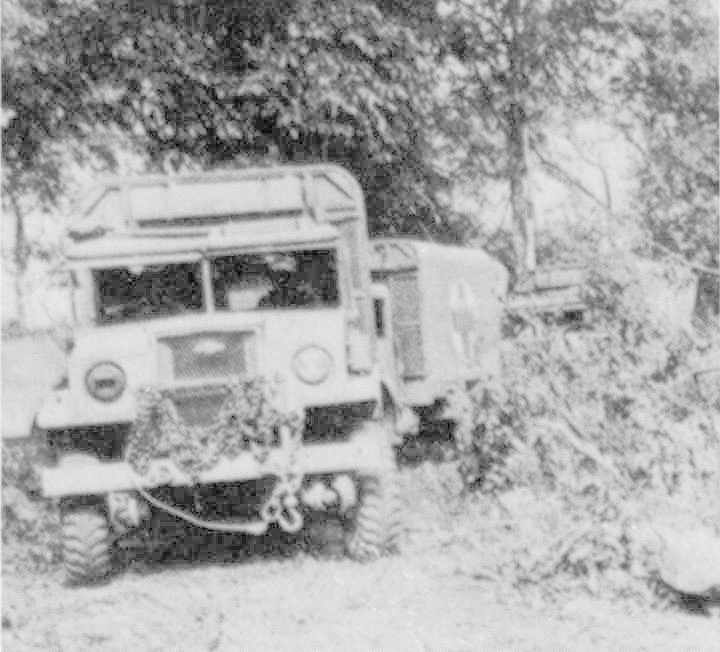 Two of the AFS 30cwt. (hundredweight) ambulances emerge from their jungle car park, somewhere in Burma. |
 |
January 1, 1945.
"We moved forward the other day. Were on the road most of two days, and didn't travel very far either. And what a trip! We went over mountain roads that can't compare with those at home, worse than our poorest mountain roads. One-way most of the way, and dusty and rough. But at the end we had a hot shower at a hospital. The first hot shower I have had since I arrived here. No bridges, we just drive thru the rivers. One ambulance tipped over, but no one was hurt. We are still a long way from the Japs, so no action for a while."
January 23, 1945.
"I am enjoying Burma immensely. We have a swell place to camp now. This part of the country is beautiful, with palm trees and open paddy fields. There are many temples and pagodas around here, which are very interesting to look at, but are supposedly taboo to us. There aren't many people in this part. The Japs chased them back into the hills and they are still too bewildered to return. Those who have come back are quite friendly and think Americans are okay. Some speak a little English and they want to trade bully beef and biscuits for eggs and chickens. But they trade by quantity, not quality, ---one for one, etc..... The Japs aren't far away, and last night we could hear their rifle fire, and always the mortars. I saw some who had tried to take a position, and didn't. They were certainly decapitated, etc. The vultures were in the trees, just waiting...We are quite safe and well protected. Our planes are always overhead....Some new fellows arrived the other day, so right now we have plenty of drivers, and extras, too."
January 22, 1945.
"I went out to lunch with F., who has joined the ATC, and thoroughly enjoyed seeing an American Airport at work over here. The amount of service (three bearers to a table), foodstuffs, like peanut butter, apple butter, fine sugar, and the chance to buy cigarettes impressed me no end. There was a free movie show after dinner with all kinds of interesting 'shorts' that are only released at military bases, showing the taking of all kinds of vital places on the continent and islands in the Pacific. Breakfast is served from 10:30 p.m. on for night-flying personnel, so we went and had fruit juice, pancakes and coffee, the like of which I had not had since I left an American ship.
"This is New Year's for the Mohammedans and there has been great celebrating in the neighborhood this week. We walked over the other night to a garden they had built nearby and they insisted we come in. There was a large pond in the center with the Goddess of Learning on a dais in the center and beautiful artificial lotus blossoms made of shells floating around her. The Indians are great on making artificial things with papier mache. Nothing would do but we sit down and try some of their sweetmeats. I was terrified of picking up some loathsome disease, they are such unsanitary people, but of, course one couldn't offend them when they were so hospitable so I ate away and no ill effects as yet, so all is well.
"We have gone in for pets rather heavily lately, with a puppy and doves living in our Basha. The puppy is really very cute, especially when she has a bath, like yesterday, but I despair of her ever being house broken and everything we own is chewed to pieces. Dear little thing I will probably kill her one or these days I get so mad."
January 4, 1945.
"We are the first AFS unit to my knowledge that has come this way as troop class passengers. The others have all gone officer class in Liberty ships, etc. The troop transport is about the bare necessity and nothing more, but you have the advantage of speed.
"The crossing the equator proved to be quite an affair. In our Navy there is an unbelievable spirit aroused on this occasion. Two days before the crossing the 'shell-backs' (old timers) began scrounging around for the 'polly-wogs' (new hands). The shell-backs had organized and were ready to give the 'polly-wogs' 'the works'. At the starboard and port watches, bow and stern mastheads, were stationed polly-wogs in their under pants. They blew New Year's Eve horns and at intervals shouted, 'Davey Jones, Davey Jones, where are you?' After several rounds of this they would report to the bridge 'Davey Jones has not been sighted, Sir'. The shell-backs led the wogs around on leashes, begging for alms, while others ran around in gas masks and hockey gloves, holding a pail and ball-hammer, looking for gremlins under the davits (one was found in the Captain's ear). Other wogs promenaded the deck with rolls of toilet paper calling, 'Get your morning paper here!'
"The next morning the shell-backs were putting the finishing touches on a large canvas and wood tank in which they were to 'purify' the pollywogs in preparation for their reception at the court of His Majesty, Neptune Rex. As they were in their final stages, a mob of sabotaging 'wogs' completely ruined the tank. Then the Devil broke loose. A group of shellbacks, armed with fire hose, deluged the 'wogs' back to the poop deck, and in fifteen minutes the shell-backs dominated the whole ship. It was tough luck when a lone 'wog' was caught by the shell-backs, or vice versa. I shall never forget a big, red-headed ensign who took a really bad paddling and laughed all the time. My most vivid memory was a soaking I got on the Captain's 'verandah' from two big marines with a fire hose. A violent swat on the seat of my pants and then I lit on my head ten feet away.
"The next day, Davey Jones, the King's scribe, was sighted and shortly before noon the royal party came aboard. The Captain turned over the command of the ship and the skull and cross-bones went up. Each wog was sentenced by the Court, in session, and was then gone over by the royal 'barber', 'tailor', 'masseur, and the entire, blood-thirsty court of shell-backs. It was fun but hard at the same time."
No date.
"Our ambulances are just like house trailers. They have lockers where one can keep all sorts of things and once you get used to sleeping on a stretcher, it makes a swell house, nice and dry, with electric light and all other conveniences such as running water (when it is raining) air conditioning (when the wind is blowing) and all sorts of bugs you can study (if you like studying bugs) ....well, enough of that! The sun just came out but that is just an invitation to wander out without hat and raincoat and just when. you get far away from cover, somebody turns on the shower again. Gremlins, maybe?
"We are now enjoying a month's rest in the mountains. It gets cold up here and we sleep over three blankets, under four and cover our heads with our greatcoats! This is a very beautiful country....but not to fight a war in. The sunsets are beautiful every nite. We have been eating very well, lately.
"We have our home set up now and it is cozy and warm...we put up a tent and built a fireplace in it. It is now the attraction of the camp. In the evenings when it is cold and damp many of the other men come in for a chat and to be warm. You really should see it! We rigged up an electric light, took the seats out of our trucks and we built a writing table. The floor is of sawdust from empty beer cases and our beds are stretchers set up on two-gallon gas cans. We heated up some water for shaving and I never knew that hot water could feel so good.. I would like a hot bath but that is out of the question for a while.
"We tried sawing some teakwood for our fireplace, but it is practically valueless so far as we are concerned. It is as hard as a rock to cut and it won't burn, so it is no good for our fireplace. You hack through a log 6" across and your 'panga' won't cut butter. A 'panga' is an African machete.
"We have been quite busy this week and will be moving forward again soon. We are attached to the 2nd Zanzibar Field Ambulances. They are a swell crowd. The Zanzibars are from East Africa and speak Swahili, which I am learning bit by bit. They are fine soldiers and will do anything for you. They are quite talented too, as my watch gave out and one of the East Africans fixed it for me....some speak no English at all, so it is important for one to know their lingo. I can make myself understood in the more simple matters and am picking new words every day. I am driving the CHEV and I like it all right, but altho it is a good truck and quite roomy and comfortable to live in, not my idea of an ambulance. It drives like a 1920 Mack truck! The only truck out here that is worse than the CHEV is a Ford of the same type which is called 'The Yellow Peril' because it is usually painted a bright yellow. There are not many of these left as the Chevs are disappearing and most of the stuff up here now is late model U.S. stuff which is coming in good qualities.
"I have sort of adopted one of these African boys and he does most of my work for me. He does my washing so I always have clean clothes to wear.
"I get a kick out of some of the Tommies when you offer them a beer. Some haven't seen any in years, so as well as being ambulance drivers, we are also diplomats of good will, up here."
October 21, 1944.
"As you have probably seen in the papers, we are daily moving farther ahead and pushing the Japs back at a good pace. It is very good considering the terrain. We got the news yesterday that the Philippines had been invaded and that is sure welcome news. I am sure it will shorten the Pacific war by a lot.
"My boy has gone sick so I am doing my own washing until he gets better. I saw a pretty snake this morning. He was all different colors and beautifully designed. It is the first one I have seen out here. This place is like a fisherman's paradise. The angle worms are all over a foot long. The fish are plentiful, but, having no fishing pole, we use hand grenades and catch the stunned fish as they come to the top. It is a sure way of getting the fish as they come to the top. It is a sure way of getting the fish, but not too sporting. The Zanzibars moved out this A.M. and we are temporarily attached to some Indian Unit. The quicker we get out the better, as I don't get along with Indians very well and don't like their food either. There are just two of us here now and it is pretty dull. Well, my wish is granted. I move again today about ten miles from these Indians."
December 27, 1944.
"We had a minor catastrophe last nite. Then we got back from the movies and were about to go to bed, I saw a bird come down the chimney of our fireplace. It was B's parrot 'Sam' and before I could get him out he was so badly burned that we had to shoot him to put him out of his misery. He now lies in a small grave by our tent with a small cross above him with his name on it."
December 25, 1944.
"It is a damp Christmas morning here with the dew draining from the trees and I'm uncomfortable, sitting on the edge of a stretcher and shivering with the wetness. In three hours the sun will burn through the mist, which makes the morning existence seem like sleep-walking, and bring life and dryness to all us creatures down here. Then the birds sleepily stretch their wings and ride forth on the breeze. The heather in the meadow by the river starts its day with a bejeweled lustre, changing slowly to the golden amber, which is so loved by Englishmen, at sunset. And our day begins."
January 14, 1945.
"I wonder if what is going on here is making the news back home. It's amazing. I'm busy now with interesting, ever changing, exciting, at times slightly dangerous activities. I don't know when I'll be able to mail this as we are rather isolated. Things are moving so fast. What mail we do get comes in bunches every month or so. I'm working by myself with a British infantry regiment away from my Field Service contacts, the P.X., mail and other civilized things of interest. As to my morale, I have found that when I become 'browned off' it usually is because my work is either repetitious or arduous. By reducing my mind to a state of nothingness or, better, to an acuteness for picking the good from the bad and magically converting the residue into a thirst for better things, by doing one or the other of these two things, I can make myself do anything and get enjoyment from the doing of it, too. Then the time passes quickly and the worst is soon over. At present I'm very kooshee. I have my own jeep, a camp cot, five blankets, a huge tent, (it's a discarded parachute) which folds up into a five pound bundle no larger than a small sofa pillow, with a floor area 10 X 10 and 12 ft. height, a rifle, a Buddhist idol, a Burmese bushman's crossbow that looks like those used by the yeomen of Merrie England hundreds of years ago, a lot of candy, beer and cigarettes, and a lantern. All this moves ahead with me in my jeep every time we move on and that is plenty frequent."
January 14, 1945.
"Our incoming mail is very poor. From now on we'll be lucky 1f we receive mail once every two weeks. Out-going mail shouldn't be quite so slow as this.
"Since I last wrote we have moved some 200 miles farther southeast. We are now in flat country and in a much warmer climate than we have been up to now. The nights, however, are still pleasantly cool. I have been seeing quite a bit of Burma this past week. Some of the towns we have passed thru were at one time beautiful places. Now, however, they are a deserted mass of ruins. About the only thing remaining standing in them are the Burmese Temples of which I have taken some pictures. The Burmese are very religious from all appearances. At least a person would get that idea from the number of temples they have built. Everybody has their own, and the richer they are the bigger the temple. Some of the larger ones are extremely beautiful. The largest I've seen so far was about 150 feet tall and about 205 feet square at the base. They all have marble statues of Buddha in them plus many small ornamental stone carvings. These statues are all inlayed with colored glass and stones which are quite decorative. The windows are all of beautiful colored glass. All of the temples are shining with trimmed goldleaf. The largest statue of Buddha I've seen was about 50 feet tall and 15 wide. The only trouble with these statues is that there are so many of them and they so closely resemble one another that after seeing the first fifty the novelty of them more or less wears off.
"We are on the ---------now and have run into some beautiful roads, comparatively speaking. If they aren't Tarmac they are gravelled, all of them very smooth with very few bumps. It's a wonderful feeling to be able to travel 25 M.P.H. again on good roads.
"The Burmese seem to be quite friendly, only not overly so. I myself don't trust them very far as they look too much like Japanese and you never know whether or not they might be. Since the British have occupied this part of Burma they have found lots of Japs who had deserted from the Jap army living with the Burmese and there are probably a lot more of them who still are. It's almost impossible to tell them apart from the Burmese when they are dressed the same. The Burmese have brought quite a few of them in as prisoners to the British. In return the British give them medical treatment and all the food they can spare. I have so far noticed one important difference between the Indians and the Burmese besides their looks. The Burmese do not want anything for nothing, they trade you something of theirs for whatever they want of yours, and they are honest in their dealings. Whereas the Indian will cheat you blind and they are always whining around for 'Baksheesh, Sahib' which means something for nothing. The Burmese do not have this trait of character and therefore are liked much better by everyone.
"The other day they flew a Jap prisoner in from the front lines and I was at the field when he landed. He went straight to the commanding officer at the field and asked in perfect English if he could have a knife to commit hara-kiri with. Of course they didn't give it to him as war prisoners are valuable for information, but I certainly would have liked to see him kill himself. The Japs are really on the run around here. The British have been trying for weeks but still haven't been able to catch up to them. Since that landing by MacArthur on Luzon I think that the Japs will withdraw from all of Burma into China, Indo-China, and Siam. So I may be in one of those countries before long.
"I'm not doing much work, only a run or so every other day, of about three miles. They haven't been able to engage the Japs in any kind of battle and so there have been practically no battle casualties. The other day I was with -------------which has set up camp right in the middle of a Burma cemetery. Quite a gloomy place for a hospital. All night long wild and half starved Burmese dogs used to howl and walk around our ambulances. They scared the dickens out of me. Since then I've moved over to another Field ambulance which is located next door to a fighter strip. All day long from 6 a.m. to 6 p.m. you can hardly hear yourself think over the noise of the planes taking off, landing, and flying overhead. It more or less gives you a feeling of security, though, which is very nice. There is also a small L 5 strip close at hand. We evacuate from the hospital to this strip when Yank pilots evacuate all casualties back to Base Hospital."
| GOUVERNEMENT MILITAIRE DE PARIS ----------------- Etat-Major Particulier No. 381 GMP/CAP |
Paris, le 31 Janvier 1945 |
Monsieur.
Je viens d'apprendre, avec une très vive satisfaction, que trois sections de l' "American Field Service" se trouvaient de nouveau à la disposition: des armes françaises.
La première section, attachée au 433e Bataillon Médical, est en action dans les Vosges depuis octobre 1944. Deux de ses volontaires ont été blessés au feu, et trois des ses voitures-ambulances détruites par le tir d'artillerie ennemi.
La deuxième section est rattachée au 431e Bataillon Médical.
La troisième section fait partie du 8e Bataillon Médical, Comme leur aïnée, ces deux sections sont rattachées à des divisions françaises qui se battent dans l'Est.
A ma connaissance, sept citations, avec Croix de Guerre, ont été décernées pour faits de bravoure au feu à des volontaires de la première section, entre autres à l'officier commandant 1' "American Field Service" en France, le Major C.H. Coster.
L' "American Field Service" a; dans l'armée française, des titres de noblesse qui remontent à la Grande Guerre 1914-1918. Il était a nos côtes en 1939 à Beauvais, Mais je ne puis oublier, et les soldats de la France libre avec moi, que l'"American Field Service", maintenant de retour dans une France libérée, a voulu servir à nos côtés pendant les années sombres,
Au Levant en 1941, en Libye, en Cyrénaïque et en Tripolitaine en 1942 et 1943, il nous a fourni une aide très appréciée: les volontaires des Vosges et d'Alsace sont les dignes successeurs des volontaires héroïques qui, à Bir Hacheim et à El-Alamein, ramassèrent sous les balles et les bombardements leurs camarades français, et méritèrent les plus hautes distinctions pour leur bravoure.
Je tenais à vous dire cela comme on acquitte une dette de gratitude.

January 19, 1945.
"Now let me tell you about the Chateau Froid. It's the coldest hotel any of us ever expect to enter again, mainly on account 'a it ain't got very many windows. The temperature was well below freezing in this little village high in the mountains. Snow was on the ground and we rolled into town late in the afternoon when even the sun had given up the ghost to Jack Frost. For three days we froze and if it wasn't for a group of FFI men (now in the French Army) I wouldn't be writing this. Then we got a stove, then we got a radio, then lights came on, then the windows (broken) were boarded over, then we left the bloody joint. Before leaving we switched from a steady diet of cabbage-soup and potatoes to a wonderful meal with scrounged American rations. We even had place cards and a menu in the dingy damp of a room that we had. The menu said 'Chateau Froid, Menu, Dinner' and French for cold salmon, rarebit (seasoned with half bottle of good champagne) Calcutta Special (bully beef beautifully prepared) string beans and lima beans for vegetables, and canned peaches for desert. Also nine bottles of champagne and cointreau after dinner liqueur. There were two bottles of cognac also and we had better leave the party there because its character rapidly changed. It definitely changed after some of the FFI boys came in and brought some homemade schnapps with them that smelled and tasted like anti-freeze and burned with a bluer and more zealous flame than any of the other schnapps we had ever seen."
January 9, 1945.
"My French started and ended at 'C'est froid'. The missing exclamation points are all in the intonation of this phrase. We are all fast becoming reasonable facsimiles of Birdseye products. When 60 Beaver suggests that volunteers bring a warmer for their trench coats I give with a laugh. Trench coat indeed. But for their lack of maribou they make the nicest little bed jackets you've ever seen. To give you a rough idea of how cold it is here, have just had runners attached to 'me' bedroom slippers. I might add that these are the cold facts of life. No wonder that in spring a young man's fancy turns to love. It's so cold that even a Cassanova doesn't show his head until Groundhog Day.
"It's a great shock returning to France. A France that most of us only knew in peacetime, and gay times. The French are now too busy with rehabilitation of their lives, what lives the Germans have left them, to entertain this new type of khaki clad American tourists. Brandies, champagnes and all wines, it seems, have gone to the heads of the Germans, and I hope they suffer the worst kinds of hangovers. Even the French are now left with that unimaginative liquid we Americans consume so religiously with meals.. Soon they'll be as waterlogged as we are. A horrible, horrible fate.
"First time in this war that I've had to send mad requests home for food. Not to mention those necessary tonics to quell the revolutions and uprisings of my stomach. To say the least, our diet is most static. Even though the French so delightfully call it 'Cornered Biff' it still comes out Corned Beef to this hungry Yank. Not that Corned Beef isn't good, mind you, but isn't there some old bromide about making too much of a good thing? Exactly. Unfortunately there are no restaurants where one can supplement this sterile diet. Those that are to be found reek of black market. Also when the bill comes around one feels as if they were trapped in Henry Morgenthau's War Bond drives. It's the same as paying ten dollars for one of Schrafft's dull little fifty cent business man's luncheons.
"This about ends my 'War is Hell Dept'. Any further complaints about life in general are bound to emanate from this department. In short, our policy is that if you can say a kind word about anything... ...don't say it."
February 1, 1945.
"The oil stove in the corner, or rather charcoal stove, has gone out, but the room is more than warm enough even though there are two shell holes near the window which we have blacked out with blankets. Our building, or rather medical post, sits on a small hill over-looking a town which in turn is surrounded by high mountains, funny how every little sound echoes, especially on a still night like tonight. I can very plainly hear enemy machine gun fire and snipers on the ridges. The whole valley is lighted up by artillery fire, most of it ours going out. Also the mortar fire is continuous since it is a very effective weapon in Mountain Warfare.
"Very astounding how mild the climate is here now. Not a problem keeping warm anymore, more or less like Washington weather, rainy and damp. We have been doing all our own cooking now for nearly a month, drawing our rations from the French Army, instead of the old G-L 10's not half as good, but eatable. None of us can cook worth a damn so we have French fried potatoes for breakfast and dinner. I have more grease inside of me than a jar of vaseline. We also get Cognac rations every day; damn stuff burns my throat out."
January 17, 1945.
"My post for the present is high up on a snow-bound mountain peak at a fortified shack which had been taken so by surprise that the Jerries had dashed, leaving potatoes on the fire which hadn't yet started to burn by the time our men took to eating them. That is what may be called a coup. But at the moment thereto nothing but local skirmishes and such, a definite change over from the past month. We all expect to be put 'en repos' soon, which means rest in a rear area and a long leave or two. "This may be rather a horrible letter, but really, to be forced to stare out upon banks of snow, and a lead-grey sky and a forest of dirty old evergreens, well, one can't be expected to derive much inspiration from such, can one?"
February 8, 1945.
"Only a few drivers at a time work forward. These all volunteer for forward work. I much prefer working forward than at a base hospital so will continue to ask for front-line posts. Right now things are rather quiet, a few big guns going off, some mortar fire and sporadic rifle fire. The other night a German patrol went right by where we are. I am enjoying the AFS, and the work very much. We have a fine group of fellows in our Section, most of them veterans of Italy and the Desert. 'I carried a sick baby with two wounded yesterday, but the baby died."
February 14, 1945.
"I am on repose, 'rest period', at the moment as the whole French Army is regrouping after the last push. I am sleeping in a real bed for the first time in a long time and it is wonderful. W. and I got ourselves billets in the village where we went, by walking from house to house, asking for a room. It is quite easy to get a room like that, because the French think we are officers. My French is coming along slowly, I have had several young French girls teaching me at various times."
January 1, 1945.
"As you remember, De Gaulle issued an edict last October asking all members of the FF1 to join the Regular Army. In my halting French I had quite a conversation one afternoon with one of the fellows. They lived an amazingly dangerous, hard life during the German occupation and deserve a great deal of respect.
"The first day we were here I was strolling up a hill south of the city when 3 French soldiers accosted me and quite politely but firmly, escorted me to the local military government office in the town hail to explain myself. It seems that four days before, eight German parachutists disguised in American and British uniforms, had been apprehended near the village and shot. In my case, the commandant to whom I was taken had heard that were in town and so I was spared the firing line."
|
|
Don Harty was killed on July 5, 1944, about six miles north of Monte San Savino when the ambulance which he was driving hit a super-charged teller mine set by the Hun. He was one of my best friends, and his death brought me nearer to, and made me think more deeply on the subject of death than any other event in my life. Hence, this phantasy. This is the way I like to think it is; and if God is just, this is the way it is. |
"Damn those tanks! I wish we were ahead of them instead of riding on their tail," I shouted at Bill, my British orderly, who was not three feet away riding in the seat next to me.
"Aye", he shouted back, "They don't 'aaf threw oop a bloody cloud of doost; the noisy blighters."
The road was very narrow and the rich Italian dust was inches thick. To the left was a wooded bank covered with scrub growth, grotesque and ugly, limbs broken and twisted by the passage of men and machines, and by the sudden expansion of explosives in their midst. The whole covered with a red film of dust which bowed the weaker members to the ground. To the right, down a bank, cultivated fields of wheat interspersed with orchards and vineyards stretched to a small stream which threaded its way at the foot of a rock strewn hill.
I had allowed the Shermans to draw away from us in order to avoid as much of their dust as possible. Bill and I could now talk in more natural tones so I said.
"We had quite a few casualties last night, Bill. There must have been a pretty heavy action."
"Aye, Moosh," he replied using the familiar British expression, "it were a bit of a do."
We were going ahead of our RAP to pick up casualties which had been reported to our Medical Officer by wireless from one of the forward companies. One of the Regimental stretcher-bearers was going to meet us on the road and direct us to the spot where the boys were.
I noticed that the tanks which were still in sight had just crossed a newly filled in demolition. It was in spots like this that Jerry liked to plant anti-.tank mines, but sub-consciously I discharged the thought from my mind and marked the spot as safe. My front wheels had just gone down the slight dip of the fill-in when suddenly, but with such ease and deliberateness that the start of the motion was hardly perceptible, the whole car began to rise in the air.
I remember saying to Bill, "We've hit a mine." Just as casually as, "have a cup of tea," Bill didn't say anything.
The upward motion was accompanied by a roaring rumble which seemed to be miles away and at the same time so close that it was inside my head. Every sensation that a human being can possibly imagine was forced upon me, and all the while the car kept rising in its tortuously slow ascent, and the noise rose in intensity, slowly taking on an animal quality until it was almost a scream. The car was pitching badly like a small ship on a high sea, and finally Bill suggested, "Why don't ye pull oop on the wheel, and see if ye can't straighten 'er out?"
I did, and was absolutely amazed to feel the steering wheel give under the pressure. Instantly the car ceased its crazy rocking, and although it continued to rise the ride was smooth and strangely soothing. The air began to get thin and I felt a terrible contraction in my chest as though some great weight were being pressed against it.
All at once we were on the road again although I'm sure we didn't go down to get there. I found that if I wanted to avoid a bump all I had to do was to pull up on the wheel and the car would rise off the road without the slightest difficulty. At this time the phenomenon seemed absolutely natural and neither Bill nor I made any comment on it.
The road was still dusty, but the dust had taken on certain godly qualities, and lost some of its grimy filth. It floated rather than hung in the air. The sky was blue as of sapphires, and although it was day the stars were shining with their old familiar friendly light. We were traveling at a terrific speed as indicated by the speedometer, but yet we were crawling the way a ship crawls when viewed through a gull's eye.
"We must have gone too far, Bill", I said after a few minutes of driving without seeing anything associated with war or human life. "Maybe we ought to go back and see if we can find those casualties."
"Damn the ruddy casualties. Let's keep on. I'm enjoying this ruddy ride."
"But we've got to find the boys."
Bill didn't say anything, and we kept on driving, absolutely relaxed and at peace with the world and nature.
As we rounded a gentle bend in the blissful road with the sun and stars shining thru the fairy dust, I saw an old peasant standing on the right side of the road who obviously wanted a lift. As a rule I never picked up Italians. I turned my head so as not to catch his eye, and he too calloused about refusing to give him a lift ....How strange, that horrible car! Why did it stop? Bill opened his door and got out ankle deep in the pink dust, tipped his seat forward and allowed the Italian to crawl into the back of the ambulance. Bill got back in and closed the door which made a lovely, soft "putt" sound.
I turned half around in my seat to speak to the Eyetie.
"Quanta kilimetre voy andare? I asked in broken Italian.
He smiled and said in perfect English, "I'm going all the way, son, to the end of the line."
"Where do you get that stuff?" I snarled.
"To the end of the line, son, you'll see."
Such finality could not be answered, so I turned around and started the car up again, Bill didn't say anything.
"You speak English," I stated the fact with as little interest in my voice as I could manage.
"Are you surprised?"
"Well, not very many hobos like you have such a good command of the language," I replied.
"I speak every language, one as well as another. Italian, English, German, Russian, Greek. But you get the idea."
"You must get around quite a bit."
"Yes, these past five years have been pretty hectic for me. I hate my job. It's too bad you picked me up."
"I couldn't help it, the G-----damned car stalled."
"I know, I arranged that."
So matter of fact, so calm, so assured, so oddly gentle. I couldn't say a thing, though I wanted very badly to curse and kick the old goat out.
The purple dust seemed to be getting lighter all the time. Where five minutes before it had been floating just a few inches, maybe a foot, off the ground, it was now level with the hood of the car. We were approaching a pair of stone gate-posts (I don't know, maybe they weren't stone) built in the usual Italian style on which were hung two beautiful gates. They were attractive, not only because of their unusual and artistic design, but also because they were made of some metal which glittered in the sun. They couldn't possibly be gold; nobody had that much money.
There was no turn-off, so I slowed down, but as we drew near, the gates swung slowly and majestically open and we drove in.
The old Padroni straightened up out of the slumped position he had assumed and said "Alright son, this is it."
"This is what, Jack?"
"This is it!!. Come on, put the car over in the vehicle park, the Boss wants to see you."
"The Boss? ---Hey, Bill, maybe this is the joker we've been looking for. Come on, let's go see him." Bill didn't say anything.
The Smiths or Smyths still have it. There are or have been 24 of this name in the AFS. The Wilsons or Willsons tie with the Browns for second place --- 11 each --- and the Jones family runs a poor third with 6.
What combat outfit has a better record in proportion to its size than the Field Service, whose men have been awarded the following decorations:
| French Croix de Guerre |
|
British Order of Empire in various classes |
|
| Purple Heart (American) |
|
George Medal (British) |
|
| Bronze Star (American) |
|
Mentioned in dispatches (All Armies) |
|
214 men who have returned home have gone overseas again with the American Field Service. This does not include those men who have reenlisted abroad, a number of whom have seen three or more years of continuous service overseas. This high proportion might show either that they like the Field Service, or find it the best way to serve their country, or even that they just like war. It's anybody's guess.
Gentlemen used to prefer Blondes, but a recent poll of 50 average Field Service men show that they prefer Brunettes in the proportion of 3 to 1. Can it be that our AFS boys are not -----------------'. But enough of this.