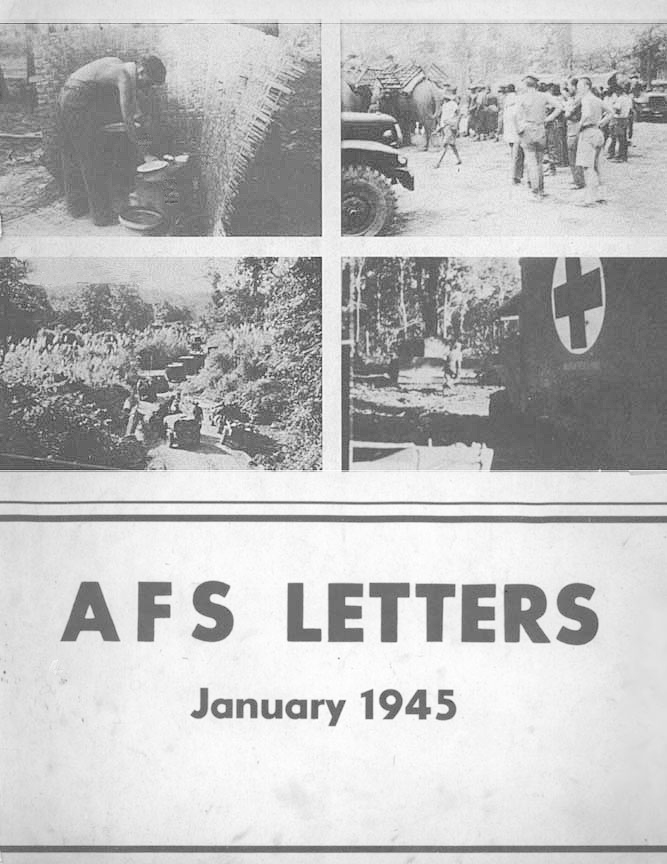
Edited and published at AFS Headquarters, 60 Beaver Street, New York 4, N.Y. under the sponsorship of the ambulanciers' relatives and friends, who contribute the excerpts from the letters.
From February 1944, when the Japs first attacked the Allied positions in Assam along the Tiddim road, until the present time when the British have taken Swebo in Burma, there have been AFS men attached to fighting units in that theatre. A short while ago a group of volunteers returned from the India-Burma "show" and in talking with them we gleaned several odds and ends and bits of information covering most of the year and a half of AFS service there, which, being new and interesting to us, we thought might be equally so to many of the readers. Following are same of the "fragments" disclosed in these interviews.
Between May 5th and November 10th, 1944, the 3rd. MAS (Motor Ambulance Section) of AFS carried 11,322 casualties and drove over 260,000 road miles without accident....Up to 35 men have been successfully carried in 3-tonners during July when the extra casualties in an area prompted the use of something roomier than the ambulances..... The cookhouse burnt down, cause unknown!....Lying in the intense quiet of the jungle night bamboo can be heard growing, the rustling sound made by this horticultural wonder resembles that of Japs moving stealthily..... AFS took over entire evacuation from Kohima back to MS 18, let's face it bravely, the place is a shambles.....The Burma campaign of 1944 handed the Japs the worst defeat that they have suffered in land fighting....Some feel it would be desirable to have AFS personnel enlisted in the British Army.... Indian duck for Thanksgiving dinner, lending dignity to the occasion by using sheets for table cloths..... A new illness has been caught by several AFSers in the India theatres; this ailment, N.Y.D.F. (Not Yet Diagnosed Fever) has rarely proved serious.......At the base camp in India the men have a whole list of initial jobs having little to do with ambulance driving, such as: N.G., night guard --- B.G., barrack guard --- V.G., vehicle guard --- R.D., ration detail --- O.N.C.O., orderly non commissioned officer .......
This is as much of a cross section of facts and opinions as could be gleaned As the trip home from India is a lengthy affair, the military action is stale news, therefore it has not been included here. The AFS units in Burma are in the advanced sectors near Swebo, and will keep going forward with the British as long as they are needed, on the back road to Tokyo.
| THOMAS S. ESTEN | GEORGE O. TICHENOR |
| STANLEY B. KULAK | WILLIAM K. MCLARTY |
| JOHN F. WATSON | RANDOLPH C. EATON |
| JOHN H. DENISON, JR. | AUGUST A. RUBEL |
| RICHARD S. STOCKTON, JR. | CURTIS C. RODGERS |
| CALEB MILNE, IV | VERNON W. PREBLE |
| CHARLES JAMES ANDREWS, JR. | ARTHUR P. FOSTER |
| CHARLES K. ADAMS, JR. | HENRY LARNER |
| ALEXANDER RANDALL, JR. | GEORGE BRANNAN |
| ROBERT C. BRYAN | DAWSON ELLSWORTH |
| JOHN DALE CUNNINGHAM | DONALD HARTY |
| THOMAS L. MARSHALL | GEORGE A. LADD |
| PAUL H. CAGLE | JAMES B. WILTON, JR. |
| RALPH E. BOAZ | WILLIAM T. ORTH |
JOHN GARRET WILSON, on December 14th, was seriously wounded in Italy. He was returning to the ADS to which he was posted, and was passing a minefield which a group of New Zealanders were sweeping. Two of them had been blown up across a ditch from the road, John stopped, and started on foot across the ditch to help the two wounded men. In crossing the road, he stepped on a mine and suffered the loss of his left foot and his right eye. He was immediately evacuated back to the ADS and was later transferred to the hospital. He has now been repatriated to this country and desires to rejoin his Unit after a convalescent leave.
JOSEPH NICHOLAS SCHICKER was slightly wounded during the Italian Campaign. The town in which he was posted was heavily shelled. Shrapnel from a shell which hit the house across the street from where Shicker was billeted came through the window of his room, wounding him in the left arm and chest. After a short period of convalescence he will return to active duty.
ALLEN Y. DAVIS, in January 1944, was hospitalized as a result of a shell blast. In a recent reclassification, it has been definitely defined that Allen was wounded.
HILGARD PARNES, on December 7th, was wounded in Germany. Hilgard first left for overseas service with the 16th American Field Service Unit. He served during the desert campaign and returned to the States at the termination of his enlistment. He then entered the Armed Forces and was with the Rangers when he was wounded.

October 15, 1944.
"We picked up two loud speakers in a town we just captured, set them up inside the ambulance and now have music and news all day ---what a life. This morning I woke up to hear a thick German voice warning us that if Germany fell there would be no one to keep off the Bolsheviks and the world would soon be teeming with communists and Roosevelt controlled Jews.
"As a matter of fact the best jazz programs are usually Jerry ones. Between 7-8 P.M. we always tune in to 'Axis Sally' who has been broadcasting to G.I.'s for 2 years now Although she is known as 'Midge' now she's the same silky babe the boys used to pick up at Anzio. First comes a German news report remarkably true, although their defeats are minimized and the number of allied losses stressed. Then follows the usual divide and conquer psychological attack. Last night the commentator explained how DeGaulle had taken over the most expensive hotel in Paris for his friends who were dining off the fat of the land letting the French starve. American officers as well as British are having the time of their lives in Paris, carelessly scribbling out orders for the rain-soaked boy in the trenches to attack superior German positions etc. Roosevelt is playing up to Stalin to get the huge communist vote in America, but when elections are over he will drop Stalin, who will then commence to over-run the world with Bolshevism unless Germany is spared to stave off this scourge. Their propaganda is pitifully weak now and the cornered-rat whine is all that is left.
"This is followed by a sexy voice which goes something like this: 'Hello, all you G.I.'s sitting in your wet foxholes. Are you feeling blue? Do you wish you were back in the arms of your wife and girl? Well, Midge is here to cheer you up again, calling from Berlin every night to all you brave boys crouching out there in your muddy fox-holes. Come on Joe, how about a little tune like you used to dance to back in the good ol' States? Let's listen to Fats Waller playing Bye-Bye Blues'. Then follows about a half hour of good jazz, mostly blues, each recording followed by comments such as 'That last piece was 'I've Got the Blues' and I bet you do have them, you pooooor deaeaears'. It's really a riot and a lot of fun to listen to!
"At present we are meeting unexpected resistance. We are about 3/4 of the way thru the Gothic Line, but Jerry has thrown in some new divs and is fighting stubbornly....I've carried Panzer Grenadiers, Shock Troops, Paratroops, troops from the Hitler Regiments, in short the supermen of the German armies. True, they are brave, arrogant, and good fighters, but this fact is interesting: Our wounded seldom make a noise, save those that are dying and no longer care. A Tommy would sooner bite his lip to shreds than let the driver or the others in the ambulance know that he's in pain. They swallow their blood rather than vomit it on the floor. The Jerries are just the opposite. They shriek and groan at the least bump in the road and make it so unbearable for the Tommies in the ambulance that my orderly often has to cuff them to make them shut up. This may sound brutal, but when you see a Jerry with only a bullet wound in the hand kicking up a row while seriously wounded Tommies lie about him in silence, it is the only thing to do. A slap is usually sufficient. This is just to point out that German morale must be very near the breaking point. Jerry used to be almost as quiet as the Tommies.
"It's nice to know, however, that the Germans are given the best treatment possible. A badly wounded German will naturally be evacuated before one of our own troops who is not in a dangerous condition."
October 8, 1944.
"This summer villa in a resort town, altho comfortable, is phoney from the ground up like all Italian houses. In front there is what appears to be an iron picket fence on first sight. On closer inspection it turns out to-be black painted cement; but when you lean on it you find it is not cement but wood coated with cement. Wide, the baseboards all turn out to be painted on plaster walls. A few Italian houses have walls lined with real red satin which is ghastly enough; but most Italian houses have walls with red satin painted on them with a deceptively realistic artistry complete with phoney sheen. Marble paneling is always painted on some place. The famous convalescent villa in Naples is the worst I've seen any place. Everything in it from cellar to attic is pretend something else including the furniture,. Another annoying house building trick the Italians have is making doors flush to the wall an papering them over with the room wall paper, which is supposed to conceal them (God knows why). They are a cheap, fake people themselves."
November 26, 1944.
"To give you an example of how the Polish Army operates I will cite a description of this scene which we watched from one of the ambulances parked near by. A visiting Captain and 1st Lieuy were inspecting the quarters (just a dirty barn) of some men. The Capt. said something to the first Lieutenant in a very serious tone. The 1st Lieuy said something to our own 2nd Lieutenant who then barked put an order to the master sergeant. The master sergeant then to the sergeant and right on dawn the line until the whole thing finally boiled down to a buck private or yard bird in our Army, ordering a little Italian boy to sweep the dirt off the door step. We expected the Italian boy to come over and hand us the broom any second, but he swallowed his pride and did the job himself. And this is no exaggeration either.
No date.
"It's interesting to note the changed tone of American newspapers in regard to the war lasting through the winter. As far as we're concerned there's no doubt about it, and I think most people are more or less philosophically resigned to the fact. Also, whether the war ends or not, the Germans are putting up a show of resistance which has rarely been equalled. Last winters at Ortona and Cassino the battles were grim; but now the resistance is greater and over the entire front. The enemy has more and heavier guns than before; and though I believe we still have superiority (as always) in artillery, I don't think we have as many as we did some months ago. Also, though we have complete air-superiority, we never see any four-engined bombers nowadays.
"Obviously this front is not considered particularly important except by the Germans. I'm not enough of a strategist to see more than a few reasons for the tremendous resistance, the number of guns and men the Germans are putting into the battle of Italy. That bombing of Germany would be considerably intensified by Allied possession of the Po Valley is the main excuse for this struggle. But they maintain longer lines of communications, a vital need for continued war in the Balkans and above all the absence of vitally needed troops on the other two fronts. The fact that these points can be so openly ignored by the German High Command is evidence of their complete confidence in being able to adhere to their present lines throughout this winter. There is no evidence of panic in this scheme --- as there would be were we suddenly to advance to the Alps.
"As a friend remarked the other day: 'Germany is going through the greatest phase of her history'. Probably he would agree with the modifications I would like to add. For example: he should have said ...... 'the greatest phase of her military history'. It's greater than Britain's stand after Dunkirk because Germany's failure then, was due, more to her own mistake than Britain's tenacity. It's greater than any phase in the great Desert battles, because at that time no nation stood with 'its back to the wall'. It's greater than Germany's inglorious end in the First World War because mutiny has arisen and been quelled.
"But politically Germany is making a mistake which becomes more irreparable as each day of this winter approaches. Her great hope is to weaken the Allies sufficiently to guarantee two or three decades of impotence, during which time there will be a new Reich built up to 'conquer the world'. But, as is beginning to dawn on Americans, and as is only too well known in England, Russia, and occupied countries, the immeasurable hatred will leave a whole nation permanently crippled.
"...................it is ignorance to think that power is the answer to difficulties; is it ever so, whether in personal, community, or national dealings? Germany is the ideal example. Power solved some personal difficulties --- at the expense of others; some community difficulties at the expense of others, and attempted to solve national difficulties. Power boomeranged, and to the expense of nation, community, and individual. Yet we, England and Russia intend to use power. Finally it is blindness to ignore the achievements of power in former wars. Egypt, Greece, Rome, Spain the Netherlands, and even England are not the great powers they were at one time. With the exception of England these are all minor names now, distorted in value due to the war. Before this war France, Italy and Spain were always in a political mess, thanks in part to he much-harried memory of their respective histories. Now it's Germany's turn for suppression and possible centuries of 'memory' politics.
"Give them living conditions and a political democracy that is strong but just, and the need for 'memory politics' will be forgotten."
November 27, 1944.
'The little city where we walked the moon-lit streets last spring, is making a most interesting progress now towards 'picking up its boot straps'. Hard hit by the war, there is now a bus service to the surrounding communes, a local committee to assist the needy, three up and coming political parties (Liberal, Socialist-Communist, Christian-Democratic), a cooperative store. Allied Commission has chosen the town as the center for distribution of new clothing and medical supplies arriving from the States. This month a music festival to be given by the San Carlo Company will raise funds to re-build the hospital...even the jail has been rebuilt! You can well imagine, the biggest problem Italians are facing in trying to rebuild their country: these are communications, finance, and of course the need to learn democratic methods from the ground up. Roads, rail-roads, transport and telegraph lines (power) have been badly hit, especially in central and northern regions and near large cities. An extensive black-market and inflation has merited a special Allied commission sub-commission to combat it; extreme groups may turn the country either communist or back to the old monarchy. However Commander Stone, Chief of Allied Commission in Italy, is encouraged by the strides Italy has made in the past year towards recovery. A recent article of his in the Stars and Stripes quoted the amounts of material aid already sent by the States and to what use it had been put, and went on to praise the democratic and cooperative spirit in which the new political parties have been created. Commander Stone added words of praise to the present Italian war-effort, which, for reasons of security, can not be outlined.. These facts, and the come-back of France as well, remind us that perhaps the 'brave new world' of which some have spoken may be in the making in spite of cynicism and material destruction. We may at least hope for the best, especially at Christmas time.
"I think I may be justly proud of 'my' city; the city where I was attached to AMG last spring. Here the first armed rebellion against German troops took place by Italian Patriots, October 3, 1943. I was on hand this October 3 to witness the first anniversary of the event a day of speech-making, of brave words, and of dedication of a square to the patriots who had been killed in the fighting."
November 7, 1944.
"We are still with the Poles, but have now moved up a little from where I last wrote you. We have been hero about 5 days now and expect to move up again tomorrow or soon after. It is awful here --- much worse than the last place whore we had a room and hired an Italian woman to do our cooking. Here the mud is even worse than the last place. I've gotten stuck twice while looking for a place to park. We have had no room until yesterday but now we have a tiny two by four place where you can barely stand up. I am parked smack in the middle of an artillery battery with the nearest gun so close that I form part of the recoil. The barrages (which are quite frequent) make a terrific racket as they go on all night it is not too easy to sleep. In fact it's entirely impossible because they blast you right out of your stretcher and almost break your eardrums.
"We have been pretty busy lately. We only have about one run a day, but it is about 25 miles and takes about 5 hours there and back and the roads are so bad and the traffic heavy. I got back about 8 last night and got woken up at 2 in the morning. The Poles come out in the middle of the, night and pound on the side of your ambulance. Instead of waking one guy they wake everybody by their pounding and shouting 'Am boo lance.' I didn't have another run until about 7 this morning (now at 2, they just woke me up so I could get ready) when we have to go and look for a Jerry plane that got shot down. Before we found it, we learned that the guy before me had picked the German pilot up on the road. He said he was dying and was, so I turned around and came back.
"This morning I went thru an Italian or German underground aircraft factory. There wasn't much to see as they are using it as a civilian air raid shelter now. It was filled with Wops to the roof, the town where it is located was bombed yesterday. It is much better in the town where we expect to move, so I hope we pull out soon. The Poles only eat one meal a day and we find that rather tough going especially as that one isn't worth looking at, but we managed to accumulate a little extra food so it isn't too bad."
November 22, 1944.
"Well this is Thanksgiving night and the 'festa' is all over. Tonight and last night I have had the best time since I've been in it. Both nights some follows who have been hanging around HQ, for a while, introduced me to some Italian girls and we had a swell time dancing and singing. I know little or no Italian but it's amazing how you can make yourself understood and visa versa. They had a dance at HQ tonight too, but it was very crowded and had a poor crowd of signorinas, so we (an English fellow who I am taking back to my post with me and myself) went to this other house where there is an extremely nice family. The dinner at noon was also superb and a great treat after our Polish food."
December 6, 1944.
"Late yesterday afternoon, we had a little excitement. The Tedeschi (as the Poles and Eyeties call the Germans) dropped a couple of mortar shells into the town and raised hell. We heard the first one come in just as we were getting into a blacked out ambulance before dinner for a bull session (4 of us) but didn't pay much attention as it landed in a field outside of the town. Shortly afterwards, we heard a big 'wham' and a lot of stuff fell on the roof of our car. Somebody said 'What the hell was that?' but that was all for the moment, and we resumed our talk. Then there were some more explosions and a lot of people running around. We went out and the whole town was lit up as the Jerries had hit a couple of trucks loaded with petrol and ammunition about 50 yards away. Fortunately, there was a row of houses between us and the fire, so we only got the stuff that came over the buildings and down when the gas and 'shells exploded. Everybody including howling Eyeties who were supposed to be inside because of the curfew was running around and peeking out of doorways warily. The Poles were very excited and all wore helmets. We walked over to see the fire and see if there was anything we could do to help but several more explosions and a lot of fragments showering around us decided us that we should go back behind the buildings where our ambulances were parked.
"Then after much scurrying and jabbering the Poles finally appeared with the wounded and as I was next up I left soon after with a load of patients. The explosions were still going on periodically when I left, but had stopped by the time I had returned although the fire was still blazing away.
"We didn't know what it was at first because the mortar shell didn't make much of a whistle and as per usual we were parked in the midst of a lot of artillery we thought it was probably just an extra loud 'bang' of one of our own guns.
"One British artillery man that I had as a patient was taking a bath in a building right next to where the shell landed and got a bad gash in his head. He said he was most embarrassed when he went tearing out of the house half naked, as by that time all the civilians were running around outside. They were all so frightened, however, that I don't imagine they even took any notice of him.
"By the time I got backs everything was quiet again and we settled down to our rabbit dinner with wine. It was surprisingly good. I had never eaten rabbit before.
"This morning our own artillery gave the Germans a terrific pounding in payment for last night. What a racket!"
September 27, 1944.
"It was a pretty nasty time while it lasted. Briefly, we moved up into a church in full view of Jerry, hung out Red Cross flags, and set up. The whole situation was a bit shaky, and the RP was forced to evacuate its forward position and draw back to our ADS in the church. Three hours after we moved in, they shelled us heavily, landing several shells within 25-50 feet of the building, and scoring two direct hits. No casualties, but one AFS man would have been instantly killed if the shell had been two feet more to the left. We assumed that Jerry was shelling the road --- as it happened the church was on a crossroads --- and that we were just in the way.
"That night we had 'stand-to' orders to evacuate at a moment's notice, and then we got word that a heavy Jerry patrol had fought its way down toward us. The lieutenant in charge told us all to put on our Red Cross armbands and not to be surprised it anything unusual happened. I went to bed, and, strangely enough, to sleep --- and in the morning was told that this patrol had set up shop on a hill 1/4 mile away with 4 spandau machine guns and 6 mortars, and that I'd slept through a furious bit of fighting while our men mopped them up. That day was quiet except for heavy mortaring some distance ahead-of us.
"I went to bed and got a good sleep, and woke up about 5:30 in the morning with shells hitting around the house again. They stopped finally and I lay in bed reading and smoking. About 8:30 or 9 the shelling started again, even more accurate than before. Several landed in the adjoining lawns, and I got up put on my helmet and walked into the room we all agreed was nearly shellproof. A number of closies hit the lawn and then a couple hit, but no bells rang, so I figured it was either the root or the wall. When the shelling stopped I walked into my room, which led into the main hell of this church. Across my stretcher was a piece of 6 X 6 rafter blown right into my room----dust was everywhere, still settling down. A great gaping hole in the roof showed that it was either a 105 or 190 mm. shell---pretty rough stuff.
"Our lieutenant went back in his jeep to the main ADS to get permission to evacuate the church, and we all started packing. Through all this shooting, the ambulances came through without a scratch,---how, God only knows. Presently a dispatch rider on a motorcycle came up with the O.K. to leave, and with orders to send out the vehicles at l/2 hour intervals. We moved out to another house a couple of miles down the road and set up. Three hours after we moved in, we were shelled there too, but we had to stick there. That's the story."
October 7, 1944.
"The war is slow now ---the incredible mountains aren't much to look at, but fighting up one side and down the other is as heartbreaking this year, as it was last. Everyone has the faint hope that the Battle of Germany will save them from a whole winter of this stuff; and everyday queries about the news are just variations of 'How're they doing in Germany?' The poor news from China, which was downright bad in its own right, was only a minor item compared to the way we treated the news that the Siegfried Line was still holding. Talk about slugging your way to the goal-line in the last quarter!
"The platoon is split into fairly new men and the old ones, who are due leave in a month or so. The new men haven't seen enough action to be wary of what they volunteer for; and RAP is still pretty glamorous to them and they fight to get with certain posts. For the old men it's like a pilot's last mission: they hope it won't be bad, and only a couple have volunteered for really forward work. It's not a protective impulse, but it's a knowledge that RAPs are a misery of greasy mess tins, poor food, mud, dark night evacs, and the whole feeling that they are tired of war and blood and pain. It's the same feeling that turns the returning veteran so intensely anti-civilian. It's the going back in, seeing the same pale faces and the same dirty bandages, that not only negates civilization, but forcibly combats it. I'm not surprised at myself. for writing this. It looks depressed and morbid. Actually, it's only the feeling that the whole business has turned the circle and we're back to the muddy hill-fighting of last winter --- and having turned the circle, it all looks pretty futile. Your friends go down in the din and shooting, and your regret is dry-eyed and hard, and you only hope you can point to some event and say 'He helped make that attack a success.' You look at a little hill, or a brook, or a piece of road and wonder if there was any success to be had there in the first place. In the grand collected analysis it all adds up and it was worth something, and the equation balances. I suppose that in adding the little bit, you lose sight of the value of your results Someone else will have to do the computing and adding--- and we'll give him the material. I guess we're tired and hoping the bell will save us, but we know the fight has to stay in our hands till then.
"Meanwhile, for all these thoughts, I remain pretty well off. I was ready for the mud this year with the rubber boots I saved from last winter. I'm still warm and eating vaguely satisfying meals. The cigarette supply is short, but I've managed to collect a comfortable backlog and am well fixed there.
"Been having many good bull-sessions these days. I'm surprised at the change in some of them. There is still Food and Love and Sex, but more and more we keep asking ourselves 'What am I going to do?' 'What is Life for?' and such. The stature of these bull-sessions is astounding. In one session you can see why the AFS is different from the Army. The questions aren't dumb and the answers given are not glib or flip. I'm sure that I would have gone crazy in the Army, having seen some of the men I would have been with. Here, the common thing is the man searching for his answers, and in searching together over here, we've all done each other great good. You can read a book over here and get some decent discussion on its. Nothing formal, of course, but the atmosphere is one of real thought. Nearly everyone is glad in some way that he could take this time (which he's spent at war) to catch up and really decide what he wants to do. Philosophies are made and broken regularly here, but everyone seems to have a better idea of his own philosophy for that. Everyone also seems to regret not having Widener Library in his back pocket. A new book here is quite a sensation. I hadn't gone 3 pages in 'Man's Fate' when the line started 'to read it after you'."
October 25, 1944.
"Had a long talk with a wounded Jerry Lt., 24 years old. He was a real Nazi from way back and if anyone thinks they can change those bastards by kindness and nice treatment they're nuts. This guy admitted that if we hadn't taken his revolver away, he would have shot us all. Lovely fellow. We asked him what he expected and his answer was he expected to be shot. His view on the war was that they couldn't possibly win but they're going to kill as many Americans and British as possible to make it easier for their children in World War #3. Slightly discouraging."
October 13, 1944.
"I wish you could see the conditions under which I am writing this letter! It would really give you a thrill, as it did me at first. It's a Hell of a noisy place, and at night, especially, we have learned to pick out the unfriendly sounds from the friendly. The shelling is enough to drive you nuts! It catches you with your mouth open at times for it is a terrific sight. When you come into the range of the guns, all Hell is on a 24 hr. a day job. At first you jump all over the place, but you do get used to it after a while. When you see the people coming along the roads from the front, old, young, some with bandages on, and most with no shoes, but all with that terrified look on their faces, you realize that there must not be another war.
"When a big shell comes over, you feel as tho your eardrums are meeting the middle of your head, and your chest seems to cave in at the same time. At night it's worse, for we use no lights at all and the roads are in a terrible condition. The explosions blind you, so that you have to stop the ambulance and get used to the dark again. We sleep wherever we can and eat enough in one day to make a pretty small sized single meal, but we are usually too busy to care about hunger anyway. I have no complaints after seeing the Tommies without shelter, except a mud-tilled foxhole! With all the mess around here, I don't want to be anywhere else. I can't say I am exactly enjoying it, but I would not miss it for a million dollars. We have mud to our knees, and now snow. I have gone for days with my feet wet, and have still the same clothes on for the past two weeks; but the odd thing is, I have no sign of a cold!!
"I have had a front line assignment for some time. Have experienced a bombing, plenty of shelling, and the famous 'Screaming Mimi', which is the odd looking mortar gun, which fires six at a time. When you hear them, you just become part of good old Mother Earth, and it is surprising how close you come to it! Many of our casualties are from mines; principally the 'boot mine', which is an old one, but oh so cruel. It blows off a foot or a leg, and leaves you there to be picked up. The Jerries also have a sub-machine gun, which tires five-hundred rounds a minute. Again I say, do not worry, because I have no fear that I will not be as lucky as have always been!
"It was grand to get those article from the Herald Tribune of July 9th (this week) ---and to read about our work here. I passed them around to the fellows, and you should have seen their faces. We all have the feeling that few at home know what we are doing here, and to get an article like that shows us that someone is working for us, and also waking up to recognize the work we are doing."
September 4, 1944.
"I have been very busy lately working for the most part until late at night or until early in the morning. Have lost plenty of sleep but I am happy in the thought that I can be of some help to someone. Don't know when I have enjoyed work so much, not only because it has to be done but because it is such satisfaction to be helping people who need help so badly
September 11, 1944.
"At present we are living in an abandoned hotel, rather large, affording each a room to himself. Strictly-stag hotel. I have a small room with a wash basin and running water (if I carry in my own) and I managed to bring up a table and a mirror from the basement so have made things fairly livable. My bed, of course, is a stretcher. So with a box for a chair and a table for a desk, I am at present 'at home' writing this. Usually I have written in the back end of my ambulance.
October 18, 1944.
"The events of the past few days have been rather hectic as I have been on the go constantly and am rather tired. We are at the moment billeted at the rear of a farmhouse. Though still occupied by the owner, we have taken it over and are using it as a Medical Post. Any sleep we get must be had in our cars so we can be on hand when duty calls, at which time we carry casualties who have been brought in farther down the line.
"Am surrounded at the moment by numerous chicks and chickens and only a few feet away is a pig sty. The pigs have just been fed --- no need to say more about that.
October 20, 1944.
"Last night had the opportunity to sit in on some surgical operations. Stayed from eleven to two--- saw some of them from beginning to end and found them quite interesting. Wonder now why I didn't study surgery.
October 27, 1944.
"Life is slogging along, and we are about as comfortable as it is possible to be in 'sunny' Italy. There are six or seven of us posted in this little town, up in the mountains. We have been lucky enough to get and keep a nice little billet which consists of two small rooms in what used to be the bank. Fortunately we found a small wood stove, and are keeping fairly warm --- (we have burned most of the furniture left in town).
"The roads are getting worse and worse, and small bridges and detours are continually washing out. Therefore we frequently get calls to go forward end help ferry casualties across a swollen stream or some such unpleasant job. R. and three others were cut off yesterday when a bridge washed out, but I think that a new one is almost finished.
"The view from the door of our little house looks just like a scene from Journey's End or All Quiet on the Western Front. Most of the buildings have had the their roofs blown in, an occasional vehicle or a column of infantry splashes by, and tired-looking Tommies slog around in ankle-deep mud, tin hats pushed to the back of heads. Against a shell-torn hill for a background this all makes quite a picture.
"If there la one thing that makes us mad over here, it's to read in the papers or hear on the radio that 'rapid advances' are being made and that the Germans are in 'chaos', 'frantic retreat', etc., on the Italian front. True --- we are pushing ahead, but it is a matter of yards, not miles, and Jerry is fighting as well and hard as ever. I wish some of those writers and commentators would come up here and watch the wounded coming through here. I think they would sing their song in a different key!"
November 15, 1944.
"The battalion I was with for such a long time finally went to a place where it could rest and train reinforcements. The billets were on a pleasant estate of some Italian 'padrone'. Since there were hard driveways and tarred roads, one could wear comfortable leather boots instead of having to wade through mud in tiresome wellingtons, which become very hot and sweat-filled. The formalities of the army, relaxed in the line, were enforced again. Boots shone, salutes were snappy, everyone wore the same clothes and personnel were supposed to 'walk in soldier-like manner'. Of course my ambulance was not doing much there and so I was withdrawn. I asked for an assignment with -------------troops with whom we have a few ambulances. I was sent out to relieve other drivers so that they could go in for their workshops inspection.
"The ride from our H0 Q to the new post was a long one. A fellow called ..... who acts as a kind of liaison officer between H.Q. and the drivers with the ------ troops, came to show me the way. He actually had just been appointed to the task and I, as many others will, kidded him as our new 'Fuhrer', N.C.O., and Commander-in-Chief, and asked him what strings he had pulled to get this 'base wall'er (wallower) job. Actually his is not a pleasant task, for it means always being on the move, missing meals, and making long journeys (perhaps on a motor cycle or in a drafty jeep over muddy and slippery, roads) to bring mail up forward.
"The day we travelled was one of those uncheerful and drizzly periods when cars in front throw up a fine spray of mud on one's windshield, and the wiper effectively blocks one's view by smearing it over the pane. We rolled over roads good and bad, over autostradas reminiscent of Mussolini's few constructive contributions to the Italian nation, past a row of green (U.S.) army tents pitched in a wet field, their chimneys emitting a few wisps of smoke. Halfway we halted at the Officers' Red Cross Club (we are not allowed in the enlisted men's!) for a lira snack (cup of coffee and three delicious cakes). Then on over flats, hills and bridges until we reached the crest of a range on the other side of which the roads were smooth and dry, a warmless sun shone on the countryside, and the air was cold but crisp. We drove along the winding highway, to each side of which vehicles were parked. But what we missed was the real autumn colors. In Italy no massive oaks and, maples cover the hillsides or line the roads, and no cold and sudden frosts arrive to change the colors of the scenery overnight. And yet there are many beauties. Sometimes it is the whole panorama; the mountains, their sides cut by erosion into downward ridges, the small trees and bushes slowly yellowing, reddening, giving the hill slopes a richer hue, and skies greying, stormy or blue, lending the landscape a shade of their mood, altogether filling tiny man with awe and wonder at the almost indescribable spectacle of this amazing creation."
November 8, 1944.
"Our work isn't so dangerous and we've found that Jerry respects us very much. In fact, the British think more of Jerry than the Italians. I'll always, except for the mud, be better off than you will think I am."
November 15, 1944.
"From what I've seen in Italy I'm glad to be an American and I can appreciate the United States. This country reminds me of Mexico. I recently saw where all the heavy fighting on. the Anzio Beachhead took place."
No date.
"Briefly, this is what happened. I was driving back from seeing one of our boys, when Jerry started to shell the roads I had left where our boy was as they were being heavily shelled and I wanted to get away from the cellar during a lull and before losing my jeep. I had gone about half a mile when a shell landed too close to an Italian and his wife who were running --- a two year old child in her arms. I stopped to pick them up and got them out faster. About 50 feet further on we were trapped --- the car in front of us being knocked out. Jumping out I grabbed the baby in my arms and the woman by the wrist. We had gotten three paces, when my jeep caught one but luckily we weren't hurt. We dove for the only shelter we could see, a shallow ditch behind a house. I, all over the Italians. A shell struck within ten feet and all but the baby got hit --- she, in the hand, he and I in the leg. The house then got a bad pounding but we were fairly safe. It stopped then and there was groaning and commotion. I got out on the road and called for ambulances. Four cars had been knocked out and a good many badly hurt and killed. Then I came back to my trio and poured cognac down their throats --- and bandaged them as well as I could. Stretchers came and loaded the hurt. Then one of our ambulances arrived just as shelling was resumed. We hit the dirt again as the house---got another pounding --- no casualties. Then we safely got away to medical attention. While I hobbled around being busy, I thought I had only been bruised from the spray of rock and mud. It wasn't until my leg gave way carrying a stretcher that I knew I had been hit."
November 18, 1944.
"Feel well this morning and go down about 11 to have my leg done again. With me here are two boys that crashed in a bomber and floated around in ice water they are OK. Also, there is a man of some 50 odd years with Infantile Paralysis --- can't move his legs, poor fellow. There has been quite a bit of it among the troops and the symptoms sounded very much like those that had been bothering me. I am the only battle casualty in the ward, so get very special respect and attention. All know of the Field Service and admire our work. How I wish we could get that across at home."
November 19, 1944.
"We had an excitement today. General Alexander, the most popular General over here it seems, came through the ward. Hours of preparation faded into nothingness as he and his entourage entered the door. His strong face, quick eye, and intelligent forehead gave his carriage an almost royal dignity. Every man from Col, to Lieut. froze in a stiff position, their lunches getting cold on their laps. This threw my poise a bit as I wanted to put in plug for the A.F.S.; but when he got to me, I felt like the rest before his superiority and, though able to hold his eye without flinching, found myself answering his inquiries and ending up by praising the entire hospital. This did not interest him, only those directly concerned seemed pleased. He thus moved from man to man impressing us with his magnetism."
The American Field Service has hit Broadway! January 3rd saw the opening in New York of THE HASTY HEART by John Patrick, who wrote it on the transport on his way home from a year and a half in Assam-Burma with AFS. Not only is the author and AFS man, but the second male lead in the play is an AFS man. We cannot presume to be theatrical critics; worthy ladies and gentlemen have already praised the play for numerous dramatic reasons --- and it looks like a hit. However, to anyone interested in AFS, The Hasty Heart is a 'must' in entertainment for its sincere and simple message of friendship among peoples, its spirit of cooperation that is so much the essence of AFS. In addition to this, the set which represents a Hospital Basha in Burma is accurate in every detail according to those volunteers who have seen the show.
Edward R. Murrow, the noted news analyst and foreign correspondent, received a check of $100.00 from a listener to be spent for some good cause for servicemen. Mr. Murrow, an admirer of the work of AFS, sent the money on to Mr. Galatti who put it into the purchase of Christmas books for the ambulance drivers overseas. As the readers know, books headed the priority list of desires from AFSers. Many thanks to Mr. Murrow for the many pleasant hours he has donated.
Romance Dept. The good news feature is almost 100% AFS this month. Janet MacDougall, who is the daughter of a World War I AFSer and has been working at N.Y. headquarters for the past 15 months, is engaged to Fred Rogers who served in Africa and Italy. Shirley Fennebresque, who has also been at HQ for over a year, is engaged to Tom Burton who served in India.....Gordon Ingraham was married while home on leave to the former Elisabeth Lloyd Wright, and has left for another term of service overseas. Bucknor Clay, Jr. was married in December to Miss Hamilton Hansford Grigg.
From Maj. General W.C. Hargill, surgeon general of the Central Mediterranean Forces, Mr. Galatti received the following letter: "1 would like to assure you of our unfailing gratitude for the splendid service your drivers are giving us. The conditions in the forward areas are vile in the extreme --- what with disrupted roads, foul weather, and a vicious enemy; but nothing daunts these drivers in their determination to get the casualties back --- whatever the difficulties. We are indeed proud of their record of devotion to the cause of the sick and wounded," This is certainly a grand tribute and the readers can be justly proud of their sons, husbands and brothers who inspired it
Mrs. Caleb Milne, whose son Caleb Milne IV was killed in action at Enfidaville in 1943, has just published a collection of his letters under the title I DREAM OF THE DAY. These letters were written to his mother while Caleb served as an AFS ambulance driver in the Alamein-to-Tunis desert battles. The beauty of these letters lies not so much in the narrative as in the feeling and form of expression imparted by the author. The letters are lovely and make the book a memorable one.
From a recent Princeton University bulletin we learned that there are more members of the class of '39 presently serving in AES than in the Marine Corps.
The movie footage that Burgess Whiteside took of the ambulance work in India-Burma has been taken by the U.S. Army. It has been adapted to black and white and is being distributed as a short feature throughout Army and Navy bases.
Buzz Shaw, recently returned from ambulance driving in Italy is now at Navy Pre-Flight School in Athens Georgia. He writes: "These people are determined either to kill me or make a man of me. I don't really care which it is if they would only hurry up about it. I fell twenty feet off a rope yesterday and it sort of hurt my morale, but otherwise I'm beginning to like this military life."
While Bill Whitehead was home on leave he learned that an AAF airport in Wilmington, Delaware --- the Blumenthal Airport --- was so named in honor of a flier of the 1st World War, Arthur Blumenthal, who started his career as an AFS ambulance driver, before the U.S. entered the war.
The main bulk of AFS LETTERS is, as the readers know, made up of excerpts of letters that you receive from the ambulance men overseas. The interest and variety of the bulletin is therefore dependent on its readers for their contributions. Please do keep on sending in quotes, for we need them. Any criticism or suggestions are always welcomed for any part of the publication.
Gerry Paine who came back from Italy a short time ago where he ran the Naples AFS club, and very successfully, has a collection of his water colors on exhibition. These are the Doll & Richards Gallery in Boston, Mass., January 15-February 3. This show is made up of work Gerry did overseas.

October 7, 1944.
"I now live in a little one-man tent that I crawl into on my hands and knees every nite and hope like hell it doesn't rain 'cuz it leaks. Really quite cozy if I don't move around too much.
"Read articles on how disappointed returning American soldiers are becuz the American people are having a good time and aren't walking the streets with long faces. So much rot! The movies and other entertainment and food the American Army gets once they get established anywhere is fantastic compared to what other armies get. I've never heard anyone begrudge them it, either, However, I think this attitude is confined to a very few and it certainly gives the American G.I. a black eye to print it. (So ends today's sermon).
"Forgot to tell you another treatment I used for my cold was a half-hour siesta under an ice cold mountain waterfall,. Nothing like it."
October 24, 1944.
"I was assigned to go out on a mule track (in my car, of course) and pick up some crashed fliers, I was to drive as far as possible and wait. Well, it turned out to be an all day and into the night affair, and damned interesting. I started out at 9:30 with my non-English speaking guide and an army photographer who was to take pictures of the event for the newsreels. The 'road' turned out to be nothing more than a mule path ---room for my car and nothing else. At one sharp turn A. (the camera man) and I had to build up the road to get on our way. We arrived at a little village at 11:30 and that was as far as we could go by car. My orders were to wait there for the patrol to bring in the fliers who had to make a crash landing in the jungle when their motor went bad. As there would be considerable delay, I decided to do a bit of exploring so I wandered into the town. The entrance by the way, could pass for the movie setup of the entrance to Shangra La. The comparison ends there. I found some women tying bits of thin string together for darning and sewing, others were working on corn---they take it off the ears and put it in large flat baskets out in the sun. Stopped in at the Chief's house and had a cup of tea. Not much conversing They know very little Hindustani and I can only do a rough job with it. Certainly did strike me how cut off from everything those people are. Most of 'em live and die and never get out except for tramping around in the adjacent hills. Then there are so many villages just like that one. When you come right down to it, they really aren't missing anything because they don't know, but it certainly strikes you that they are, and seems as if they get exactly nothing out of life.
"After returning from the village I went to my vehicle. A., thinking that the fliers would not be brought in, went back. The patrol finally came at. 4:00 o'clock. The fliers turned out to be American! And were they surprised to see another American waiting for them. They had, however, heard of the A.F.S --- which makes them unusual. Here were four cases --- only one serious (he was burned pretty badly) I put him on a stretcher and two others sat in back of me (almost sitting on me 'cuz there isn't much room). The fourth continued on a mule We got down the track about mile and there was A. working on his car which had stalled. We finally got it running --- there was a petrol stoppage in the carburetor. Pictures at this point were out of the question 'cuz it would have delayed getting the fliers into the A.D.S. Alec took the fellow on the mule and we proceeded onward. He drove over the bad turn first, slipped and left one wheel dangling over the cliff. We waited 'till the patrol caught up and five of us lifted the car bodily onto the track again. I got over okay and that was the last really bad spot on the road. Got 'em in about 6:00 and after the Doc gave some treatment and food, I took them on down to the M.D.S. where they'll stay 'till they're all rite. The fellow who was burned was from Grand Rapids. The rest were from Minn, Md., and Ky. They started the day after the crash and it was a 10 hour trek to the village although only a few miles.
"The farther we go, the colder it gets. Marvelous for sleeping.!"
October 22, 1944.
"The last few days we have been going to see the natives from a village just across the valley from us. We walked each day four miles over and four miles back through rice paddies and mud. On Sunday we called on Mr. Siama, a Christian. He took us to their church and we joined them in a service. The whole village of 300 people are Baptists and extremely religious.
"The service began with a hymn and instead of an organ, a huge drum was beat to keep the tempo. The singing had an oriental tinge to the original Scottish tune. Hymn books were given us out of courtesy but we could not read either the words (which were like the Hopi alphabet) or the music (whose scale was invented by some missionary). We sang, anyway, making up our own words. Incidentally, the whole service was in Lushai, so we couldn't understand anything.... only three people in all could speak and write English and these acted as our interpreters."
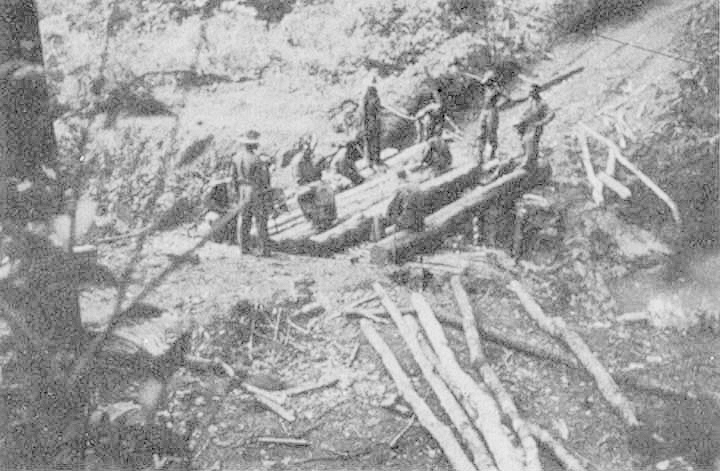 Engineers of an Indian regiment building a bridge across a stream along the Tiddim Road. |
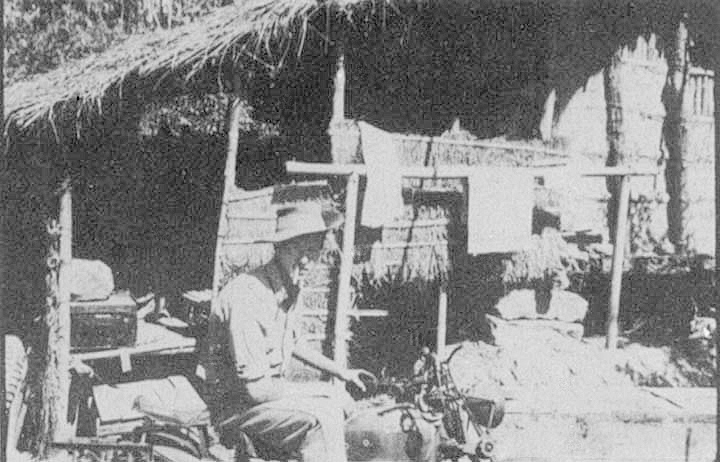 Tom Newberry stops his motorcycle in front of a typical Burmese 'Basha'. |
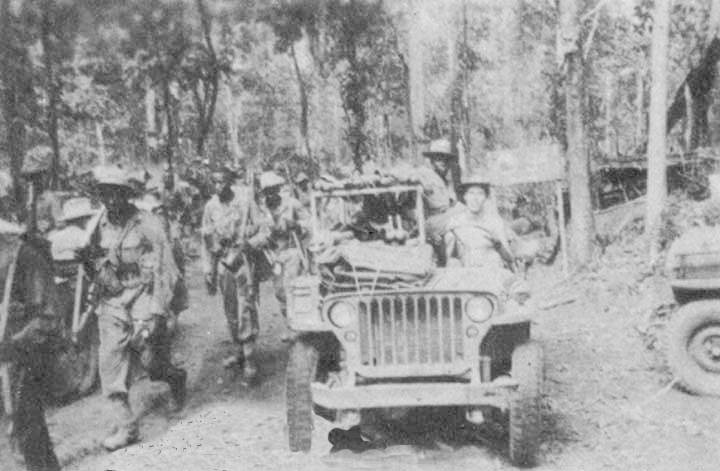 An AFS Jeep ambulance showing the two stretchers beside the driver. Two or three sitting cases can be carried behind the driver. |
September 29, 1944.
"I've just returned from the front, so to speak. I went up there for a change (ha ha) and tried the life of a foot soldier---it's not so hot. All day there is nothing but walking and walking while you're continually being harassed by snipers. Occasionally a barrage of artillery is laid down but that is so inaccurate, it hardly ever bothers anyone. All food is carried by mule and consists of nothing but bully, biscuits and tea. It is possible to walk for days without seeing a Jap although you know you're within their lines. It's very interesting seeing how it all works, although a little risky"
October 6, 1944.
"We're going deep into Burma. There is nothing spectacular about Burma--- in fact, the only difference I have noticed is in the way people smoke. Here in Burma they smoke foot long cheroots, while in Assam it's the old bubble pipe. The flora is the same and so is the animal life.
"We have a lot of fun and take all the inconveniences in our stride. Just the other day we were talking about it and had a good laugh. Anyone at home would have a fit if they saw the way we live but hen you're here it seems quite natural.
October 14, 1944.
"I'm enclosing a complete set of Jap invasion money . It's a rather interesting souvenir. Note the cheap paper and the lack of watermark. The cent pieces are for some other invasion this army has been in ---probably designed for Ceylon or maybe Hong Kong.
"We heard the world series complete on station A.A.F, your armed forces radio station, Calcutta. Never enjoyed anything as much before. We also get Hope, Benny, Duffy's Tavern and a lot of others."
October 21, 1944.
"We are set to move ---still backward. But we are going back only to get fixed up for a big move forward. The section should start again within two weeks ( I hope so) and will undoubtedly, continue for duration of my enlistment. I consider it a pretty good show and the sign of a good outfit to stand up under eight months of action a year. Of course my unit actually saw quite a bit before we got here, but that was just a warmer-upper.
"At the moment we are playing the victrola and gathered around the tent are about 20 hill folk who are amazed at the wonderful talking machine. They are squatting, staring wide-eyed and open-mouthed. Quite a sight! It reminds me that the other day I walked up to one of their villages and strolled about. I was amazed at the cleanliness. The leader of the village is a Christian and learned English from a Missionary out here, so Ï talked with him. He took me to their schoolhouse where approximately 20 children ranging from 5 to 10 sat around learning the history of their people, English and, believe it or not, Geometry. There were only a few girls but each one had a little brother or sister strapped to her back and occasionally would get up, jog around pat the baby's head and then sit down again. The boy's only peculiar habit was to smoke in class. Mind you, they are very young and to see them smoke at all, much less in school is odd. I think it was one of the most interesting trips I've made. By the way, one of our fellows was a Franciscan monk and every Saturday he goes to the village to preach while the leader translates. The old boy wanted us to give a speech on the Western civilization, but we didn't know what to say, so we came back and to-day one of the boys went back to give the talk. It is the same villagers who are sitting around the tent now. They came down to bring us bananas and chicken eggs and chickens. Their language is very odd and just to illustrate, I'll use their word 'NO' ---'NILO' The 'nil' comes from Latin and means 'nothing' and 'O' is their own word for 'yes'---in other words to say 'no', they say 'nothing yes', literally translated."
October 26, 1944.
"We are all the way back getting our ambulances ready for something big. Any day now we will start out for the jungle again and be ready to work.
"As the set-up is now, I have a bed, bearer and all the other comforts of civilization. Can't say I like being idle, even though it does have its advantages. Give me some work to do and I'll be happy. We are eating very well now and there is always a bunch of Yank pilots around."
October 30, 1944.
"Recently I've been palling around with a bunch of Yank pilots who are in the neighborhood. Swell fellows, all of them, and it's been just since I met them that I realize how different we are from the British. I like the British a lot but I doubt if you can ever beat the good old Yank. One day they'll eat with us and the next we with them. It's a good change for both of us that way. Our fellas have been loading the Yanks up with Jap souvenirs and in turn they give us candy and other PX stuff we run short of.
"Last night we had a party and entertained some WAS(B)s (Women's Aux. Service, Burma.) at cocktails and dinner. It would have been a great success if we hadn't out-numbered them 10 to 1. Never-the-less it was a lot of fun talking to white women and seeing a bit of femininity again. One of the girls was a cute little redhead from Melbourne, Australia and one was a Scottish girl.
"I understand from a fairly reliable source that we are to move up again as soon as the main force of Japs is removed from the town we are to occupy. That means more excitement. Certainly looks as though my time out here will end up with a bang.
"I see by Time magazine that they expect the war to go on in Europe until spring of next year. That's longer than anyone had anticipated from what I have read before, but then the Americans are always overestimating the weakness of the enemy.
"Outside the ack ack is pounding away but I'll be darned if I can see what they're shooting at. Maybe a Jap bomb will come pounding down any minutes I don't know we haven't been put on alert. Oh well, that's war, always disturbing sounds going on
November 4, 1944.
"Still no news of our going in again but I always hope it will be the next day. Recently I've had plenty to keep me occupied ---Yanks, you'll remember. I spent two days at one of their air bases where they apologized because 'things aren't set up yet' --- you know the old line, but they were serious: gee whiz, they didn't have much, just movies every night, running water, electric lights, a bar (with coke) all set up and you could never satisfy a Yank in a million years. Every one of them thinks the world of us for coming out here like we did and they think it is pretty stupid of the government for turning us down. They say 'you 4Fs see more action in a month than any old G.I. Joe sees in a year.' They think we have guts. You can't imagine what it does to you to hear fellows ---American fellows our own age say that; it makes you feel so proud of the outfit. Do you think those flyers would let us do anything? Never. We had all the service in the world: officers' mess, Officers' barracks with air mattresses and all the things we've dreamed of. It was wonderful and it is one of the things Ill never forget. We've made some lifetime friends.
"After all the good times I've had recently, I'm going to find it hard to go back to the filth and discomfort of the front. It's going to seem odd to hear the shells whistling over again and having to dive for cover all the time, but I'm ready and even anxious"
October 20, 1944.
"I really find the Indian and India far below the Middle East. The dirt seems dirtier, the unhappiness greater, the picturesque overtired, if one might so describe it. Am, however, becoming very intrigued by Indian music. It is incredibly hard to adjust the ear to half tones, for a European, and the Indians even use half tones and quarter tones, often in direct scale sequence. The Chinese only go to half tones. Imagine between C and C# four more notes. Our Cape Cod piano which was, would have seemed a noble instrument. The Arabians stick to half, I have met a learned little Indian here who is very charming."
October 22, 1944.
"Was much amused by my dubious nationality today. I was first introduced by friend of mine to a mixed crowd of Americans and British as 'This is Mr. J., you know he's in the British Army, an American ---with us, what! --- Good show --- what!' A little later my British friend left and I was introduced by the Americans, all from Texas, to a friend of theirs as, 'This is Mr. J., an Englishman, in this here American Army---sure it's fine this get-together, isn't it?' At that point I mumbled something noncommital, sang two snatches of the Marseillaise ending in 'hein!' and left resignedly ---a man without a country."
September 19, 1944.
"Yesterday six of the boys and myself went to church first time in months. The chapel was in a small room used for sleeping quarters for the Belgian Padre from the Belgian Congo. It is quite a novelty to attend church these days because we are so far away from base hospital. Kneeling on a hard mud-packed floor, shell holes in the roof, Jap ammo boxes for altar props, top of a Jap food crate for the altar proper, water-stained vestments, rifles in the corner near the door, pistols hung on the wall, mosquito screened windows with patched bullet holes, two sputtering candles casting weird shadows across the room. This is our church, and we travelled fifty miles over impossible roads, and we loved it.
'We visited a tourist spot one day over here They have a railway that climbs up through typical Indian scrub to enter the State through red wooden doors built into battlements, stretching across a valley. At the first station-stop the monkeys take possession of your coach, but are taught to leave immediately the guard's whistle blows. Quite a remarkable self-denial for the monkeys. This is only one of many things. At six o'clock, for instance, a parade of 300 wild boars which come in daily from the hills all around and assemble among some Gadarene rocks on the far side of the lake. Some of the timelessness of the place is shown by the fact that every evening without a break for the past eighty years, boat loads of royal corn have been rowed across the lake for this ceremony. I was able to view this scene from the roof of a gaily painted little shooting box and happy to be well above the pigs on the rocks below, scuffling furiously for the grain as it is scattered to them, and soon it is lost in great clouds of dust; and the sound of their hooves on the rocks is that of waves ebbing from a shingle beach. If ever you were caught on the rocks with these boars, you'd be torn to pieces. Leopard and pig fights are staged here in a sunken arena."
The following letter was written by an AFS man who flew into China recently. This is an account of that trip.
November 19, 1944.
"The trip was extremely interesting. I was particularly glad to have been able to go there at this time, because of the large amount of controversial sentiment that is being expressed in print on the subject of China. I think a very unfortunate thing has resulted from the change that has taken place in China's propaganda policy at this time, in that the contrast between the sort of nonsense you read now and the sort of nonsense you used to read, produces a disproportionate disillusionment about China in western minds and a reaction towards viewpoints of the opposite extreme. We used to think of the Chinese as a small, united nation gallantly fighting the vicious Jap. Now we have a picture of disorganized banditry and corruption, internally weakened against the stronger neighbor. Neither picture is accurate, and the latter is particularly unfortunate at this time when it seems so essential for the western powers to get to China every possible bit of support in order to avoid a sequence of events which would prolong the war in Asia many months, perhaps years.
"What I think the present trend of discussion and thinking on China ignores is the fact that, in spite of certain superficial appearances of a trend towards westernization, China is, essentially, still a very oriental nation. The future may hold for her a certain amount of westernization. I hope a successful amalgamation of what a nation must necessarily adopt of western civilization in order to survive with such orientalism as the peoples of the East may never want to abandon. At any rate, China, judged solely by western standards, is impossible to understand. The attempt so to judge her had brought disillusionment and bitterness to a very large number of westerners who've been there. But there are large numbers of American, British, French and other people who've been there for years, who find they can deal with the Chinese without having to impose upon them their own standards and thus can operate in China without becoming disillusioned and embittered. These people, in spite of the disheartening experiences of the past seven years, still believe that China is worthy of our help and still go on helping her themselves.
"However, I'm already starting out to make the same error I criticize the journalist bookwriters for, viz., attempting to speak authoritatively about a country which they've visited for only a month or so. I shall confess, as they would do, that most of the opinions which I've so far formed have been based upon what I've learned from speaking to people who have lived in China for some time, not upon my own experiences there. I think I've gone to a wide source of opinion for I've spoken to people with pink-cheeked enthusiasm, people who are bitter, and a great many people in between. But I've still got to have my own experience.
"I was guest of Gen. Lim and his boss, Gen. Hsü, one evening at a party which I shall never forget. (Parts of it I'll never remember, either. Chinese wine is stronger that it seems at first taste.) After an afternoon of discussing our business, we moved into a room in the center of which was a round table of moderate size, set to about ten places. Eight stools were put opposite these places, and two chairs, standing opposite each other, made up the seating compliment. The host, Gen. Hsü took one chair and I was directed to the other. Several of his generals, aide-de-camps, two doctors, and the wife of one of the doctors who herself, a bacteriologist, filled the other seats. In front of each of us was a wineglass (full), a pair of chopsticks, a spoon made of chinaware, and a saucer (for the spoon, not the glass). First of all, the General toasted his guest (this being translated to me by his a.d.c., who acts as interpreter), and after I'd said 'thank you', the General says 'Gombay!' (spelling supplied by me), to which the .D.C. adds, 'That means you empty your glass.,' We emptied our glasses, demonstratively exhibiting the insides for all to see that we hadn't cheated. That one time, everyone drank to the toast. However, as each course was taken off, there were more toasts and these were all private affairs between two people. Most of the time, I was one of the two people. That I walked away from the table, after the feast, was, I'm told, the source of considerable loss of face on the part of my host. However, I did sneak around a corner and deposit that portion of my meal, which my stomach didn't seem to consider necessary, on a plot of grass, and I did manage to retire pretty soon, thereafter.
"The normal Chinese meal consists of a bowl of rice, or two, or three, plus a few dainties (hors d'oeuvres, or what-have-you) placed in the center of the table for everyone to pick from. At a feast, the emphasis is reversed. The hors d'oeuvres are placed, one after another, in the center of the table, and you all go picking at them until, when the host thinks you've had enough, rice bowls are served and then a token effort is made to eat the rice and then you give up. Hundreds of these hors d'oeuvres were served up at Gen. Hsü's feast and each one was regarded as a course, with much toast-drinking in between. (Most of the toasts, by the way, were of the gombay variety, although once or twice, when the proposer wished to express lack of enthusiasm over the subject of his toast he would say 'Schwey bien' which means 'as you like' or something). The dish I remember most vividly was a fair sized steamed fish, brought in whole head, fins, tail and all. The steaming is done so thoroughly that you just poke the fish a bit with your chopsticks and the meat falls away from the bones. Inside of two and one-half minutes there were nothing but bones left, and those Chinese boys, with their chopsticks could really pick those bones clean. Other courses included various bits of meat and local, vegetables prepared together, bamboo shoots, pigeon eggs soft boiled, soy bean curd, etc. The soy bean curd came in a soup, along about the middle of the meal, about which they said that, had it been peace time, with no shortages, they would have served birds' nest soup, but they were sorry, they had no birds' nest soup now on account of the war. I passed it off, nonchalantly remarked, 'Oh, that's all right, I like soy bean soup!.........."
The A.F.S. in the field has its mascots. I had the pleasure of meeting two, Alice the goat, and Jo Kuchh. Of Alice little need be said except that she is mostly white and knows no fear. When the section travels Alice travels with it in the back of the kitchen truck her mild eyes looking out at passing scenes. Alice is quite safe and she knows it. The section would rather starve to the last man than carve her up into goat steaks
Jo Kuchh is another matter. Joe is a little Gurkha boy whose age is about seven, although no one, least of all Jo, knows. His last name Kuchh, was given to him by the Field Service and in Hindu means "anything". Jo's past history is a little confused. We know that he lived in Kohima when it was under Jap attack. We think he placed himself under the protection of harassed M.P. who could not direct traffic and care for little boys at the same time. We know that Jo was given to an Indian family who apparently accepted him with resignation as an act of God.
Thereafter lots history becomes clear. He played with a discarded phosphorous bomb and burned his hand rather badly. An A.F.S. man treated it and when further treatment was indicated brought him to the camp. Apparently military hospitals had no place for little boys who played with fire in the midst of a great attack. The hand healed, Joe was returned to his foster parents, but he refused to stay. Presently he showed up at the section again, and there he has remained. His foster parents accepted this, too as an act of God, or perhaps they saw in it a way out. Anyway, the Field Service has Jo Kuchh.
Now he wears a little Field Service uniform complete even to the "flash" on his left shoulder. He bathes with the men in the rivers and takes it for granted that he should use soap and towels even as they do. He eats their mess, although God knows how many Indian taboos this violates, he sleeps in his own tent.
Because Jo is a very bright child he is learning English rapidly, and he rarely has occasion to use his own tongue. The men have taught him the Manual of Arms which he delights to perform. But life is not all play for Jo. A former school-teacher, who refuses to let his name be used because he joined the A.F.S. "to get away from all that", gives him daily lessons and Jo can spell cat, rats, dog like any little boy at home. A Franciscan lay brother who surprisingly is driving an ambulance for the Field Service will presently instruct him in the rudiments of Christianity. Each day he accompanies the food truck on its forty mile trip for supplies crouching on the running-board and warning of traffic jams ahead. He is never allowed to go to the front. All in all Jo is a very happy little boy.
Some Field Service men say that after the war Jo will return to America with them, but others are doubtful, believing that because of his dark skin he would be discriminated against, or that he would be an alien always in a strange land. On the other hand can he remain in India? He has lost caste; he has no background in a country where background is a part of life; his education will be completely American, and already he is becoming intolerant of his own kind. That is the problem of Jo Kuchh.
Many readers have asked for a glossary of the abbreviations which they find in the letters. Some we print below, If there are more that are perplexing, kindly write us about them and we will be glad to print an explanation in subsequent issues,
| ADS | Advanced Dressing Station |
| CCS | Casualty Clearing Station |
| MDS | Main Dressing Station |
| RAP | Regimental Aid Post |
| DMS . | Director Medical Section |
| DDMS | Deputy Director Medical Section |
| DST | Director Supply & Transport |
| DDST | Deputy Director Supply & Transport |
| MO | Medical Officer |
| CO | Commanding Officer |
| KIWI | New Zealander |
| AUSSIE, DIGGER | Australian |
| SCROUNGE | Harmless looting, a right in the desert |
| "BLUE" | Desert |
| EYETEY, ITIE | Italian |
| JERRY | German |
| WADI | Dried water-beds; gullies washed out in the sudden, severe desert rains. |
| BAKSHEESH | Arabic term for alms (also used for anything gratis) |
| MALISH | Arabic for "oh, what's the difference, n'importe", etc. |
| NAAFI | Navy-Army-Air-Forces-Institute....the organization which supplies all the mobile canteens with their goods. |
| BASHA | Thatched-roof house, with walls of woven cane and a mud mixture, Permanent bashas have beams, temporary only bamboo, |
| GURKHA | Native of Nepal |
| KUKRI | Gurkha's battle weapon, a large knife. |
| MAS | Motor Ambulance Section |

November 24, 1944.
"I'm sitting in my ambulance on top of a mountain, waiting for the stretcher-bearers to bring down the wounded from the hills. I'm in a little clearing at the end of a great track. The tall spruces sigh gravely in the light afternoon breezes. A mountain stream rushes angrily by on my left. Today is the second of two (only two) beautiful days, cold, but clear and the setting sun is shining on the water as it cascades down to the valley. Far down the valley towards the rear our heavy guns boom lazily, but here it is as quiet and peaceful as a clearing on the way to Nigger Lake, although the Jerry is less than a mile away. We've been advancing rapidly lately, pushing on five and ten miles a day, the ambulances right behind the infantry. It's been thrilling being the first Americans into town after town. At first the mine fields gave us an additional thrill, but since we've passed Jerry's prepared defenses they've been no problem. In this sector Jerry has very little artillery left so that our heroic advance amid the cheers, tears and flowers of a liberated populace hasn't been too dangerous as yet, although the vague concept of where we are going, and under what conditions, which filters thru the language barrier to my confused and apprehensive mind, has often made it seem so.
"You can't imagine what a thrill it is to be advancing rapidly into new territory after having squatted in the mud for months dodging the desultory shell fire of an immovable Jerry. I do hope you won't worry. This sort of thing is no more dangerous than your hurricane, Mom's description of which chilled my blood. I prefer shrapnel to flying trees any day.
"Shortly after my last letter we went to Paris on a five day leave. In spite of being prepared for disillusion, I found it the most beautiful city I've ever seen. It was a return of reality in every way. Two huge double beds, hot baths, regular and delicious meals, coffee, doughnuts and nightclubs. In a deeper sense, it was also a return to the feeling of being at the hub of things, where the war was a clear cut problem with a limited number of specific solutions, where it was planned and understood, instead of being an angry turmoil in mud, as formless as the original Chaos. We rubbed shoulders with major generals in bars, sat at the table next to Hemmingway at the Press Club, saw Churchill and Eden in the lobby of our hotel.
"In this atmosphere one's failing sense of individuality and personal responsibility revived, along with one's spirit of adventure. Every little café held the promise of new and exotic experiences. One even began to make tentative plans for the future"
"I want to tell you how much we have enjoyed the AFS LETTERS and are sending a small check to help out in the publication of same. When one of them arrives I am not good for anything else until I have read every word. I hope you will keep sending them after my son gets home"
The LETTERS continues to go to the men after their return. In the case of those who do not remain in the states we use the home address.
"We have not received our November issue of "AFS LETTERS". We would rather miss every other magazine that comes to us than this one. It is so filled with human interest, I wish I could send it to every corner of this country."
The LETTERS seldom get out before the 20th of the month and often paper, mechanical and labor difficulties have delayed us later than that. We hope you will bear with our delays, for come rain, or shine, we WILL get it out at long last.
"Wouldn't it be nice it you could state the name of the city from where the boys come on the Honor Roll? This is only a suggestion."
We would like to hear from more of our readers on this before making any change, especially from the wives and parents of the men whose names are on the Honor Roll.
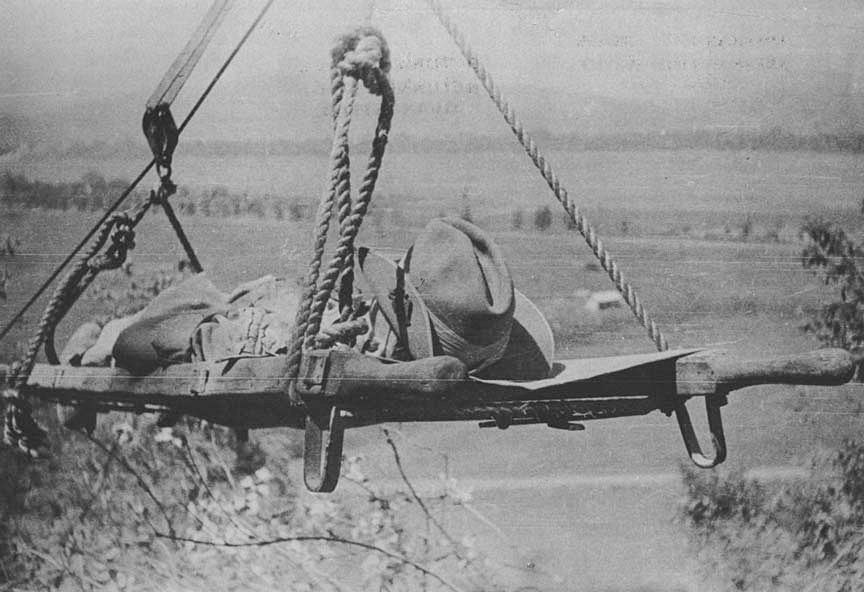
An unidentified AFSer wearing his Gurkha hat demonstrates one of the methods of evacuating the wounded in the Burma hills. In places where there are no roads a pulley system is used to get the wounded down from the hill to the waiting ambulances on the plain below.