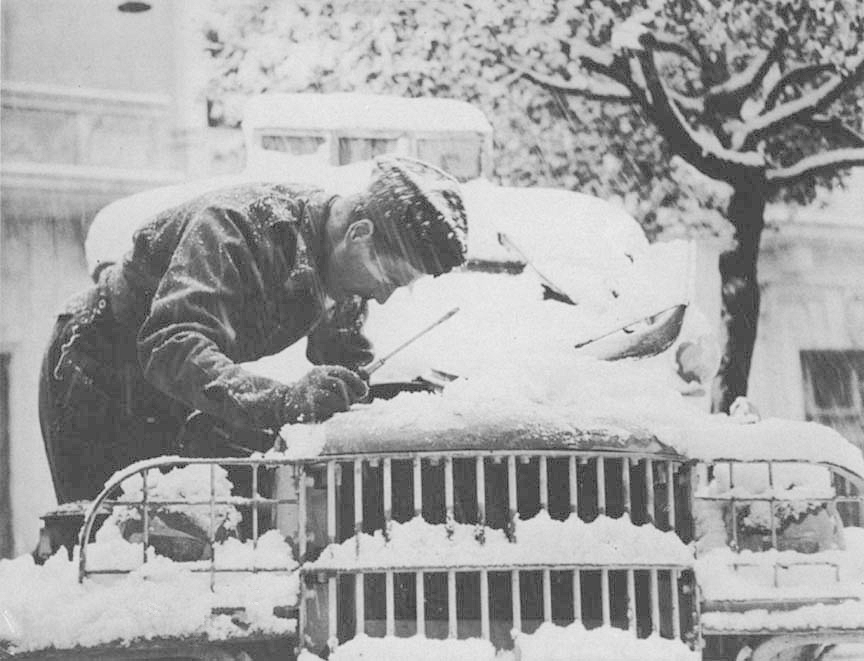
Edited and published at AFS Headquarters, 60 Beaver Street, New York 4, N.Y. under the sponsorship of the ambulanciers' relatives and friends, who contribute the excerpts from the letters.
Again this Christmas the loved and familiar words "merry", "joyous", "hearty" are overshadowed by such as "blasted", "shattered", "bombed-out", and "wounded". Words which are now so commonplace they have become everyday, Sunday, and holiday fare to everybody in the world. There is no real festive season, no really festive spirit. It is rather the indomitable, forward-looking spirit that, refusing to be downed, pretends gaiety, plays at festivity and gladness. How courageous is the mother's hand that whips the Christmas cake that he will never eat, how brave the hearts of those who trim the Christmas tree that will not glow for him.
Undismayed, they keep alive the symbols of peaceful times, the beloved traditions, the bright trappings, which are the outward manifestations of that everlasting hope of mankind --- Christmas. These people throughout the torture of uncertainty, the suffering of loss, and the pain of separation, walk with their heads high and their eyes looking forward. They have the same spirit, the same inspiration that refuses to be dismayed, as their loved ones who are making sacrifices far from home and comfort. It is a fitting tribute to those who have given their lives for their ideals, that those they leave behind keep bright the fires of peace on earth.
"God rest ye, merry Gentlemen." J.B.
| THOMAS S. ESTEN | GEORGE O. TICHENOR |
| STANLEY B. KULAK | WILLIAM K. MCLARTY |
| JOHN F. WATSON | RANDOLPH C. EATON |
| JOHN H. DENISON, JR. | AUGUST A. RUBEL |
| RICHARD S. STOCKTON, JR. | CURTIS C. RODGERS |
| CALEB MILNE, IV | VERNON W. PREBLE |
| CHARLES J. ANDREWS, JR. | ARTHUR P. FOSTER |
| CHARLES K. ADAMS, JR. | HENRY LARNER |
| ALEXANDER RANDALL, JR. | GEORGE BRANNAN |
| ROBERT C. BRYAN | DAWSON ELLSWORTH |
| JOHN DALE CUNNINGHAM | DONALD HARTY |
| THOMAS L. MARSHALL | GEORGE A. LADD |
| PAUL H. CAGLE | JAMES B. WILTON, JR. |
| RALPH L. BOAZ | WILLIAM T. ORTH |
RICHARD TRUITT HAMILTON, on November 12th, was seriously wounded while serving in the Italian Campaign. Dick was returning from an RAP to the ADS to which he was posted when a shell landed near his ambulance. He was knocked unconscious by the blast and was evacuated back to the MDS. He suffered from a fracture of the base of the skull and his left eye was seriously injured. Dick originally was attached to the Indian Command and only recently transferred to the Central Mediterranean theatre. He has now been released from the hospital and is on a convalescent leave in Italy.
RUTHERFORD STUYVESANT PIERREPONT, Jr., on November 12th, sustained slight wounds during the Italian Campaign. Stuyve was returning from one of the forward posts in his jeep when the road was heavily shelled. He saw an Italian, his wife and small daughter running down the road and stopped to pick them up to carry them to safety. The shelling became more violent and they decided to take refuge in a nearby farmhouse. As they approached the building, a shell landed a few feet away. All four flattened themselves on the ground, Pierrepont shielding the woman and child with his body. second shell struck, wounding both the Italian and Stuyve in the legs. After a short period of hospitalization, he will rejoin his Unit.
NEWELL OWEN JENKINS, on November 21st, was slightly wounded in the ankle by a mortar fragment. He has since rejoined his Unit. Newell is a veteran of the AFS. He was a member of the 16th Unit which left the States in June, 1942. Last summer, he returned to this country for a short home leave, after which he reembarked for Italy.
DAYTON THOMAS MITCHELL, II,
REGINALD BISHOP TAYLOR were both wounded on November 29th
in Italy. They were in the same ambulance when it struck a mine
while driving towards a car post of an Indian division at night;
the explosion blew the car off the road and on its side. Both
men were taken immediately to an RAP and evacuated the following
day to hospitals. Reg Taylor had a bad cut in the back of his
head, but no concussion or fracture and was expected to be all
right within a couple of weeks. Dayton Mitchell suffered blast
injuries to his right eye, but it is not expected that he will
lose sight in it.
| RICHARD C. ANDERSON | HOUGHTON P. METCALF |
News has come from the French Headquarters that the following men have been awarded the Croix de Guerre:
Jeremy Addoms
Charles Henry Coster
W. Dean Fuller
Thomas O. Greenough (second citation)
John C. Hodel
William G. Shearman
The U.S. War Department has awarded the Purple Heart to
Norman Laden
The Italian Government has awarded the Il Cuore di Rincalzo to
Howard A. Brooke.
S. Joseph Tankoos, Jr.
AFS Volunteers now in the U.S. Forces
Herbert C. Reinhardsen, (AFS 1942-43) now a pharmacist mate, 3/c USNR, has received the Navy & Marine Corps Medal
The U.S. War Department has awarded the Bronze Star Medal to
Lt. Commander Robert Montgomery, USNR (AFS 1940)
Pfc. Charles Shoneman, AUS (AFS 1941-42)
The U.S. War Department has awarded the Bronze Star Medal to
Lt. Colonel Leslie Buswell, AUS (AFS 1915)
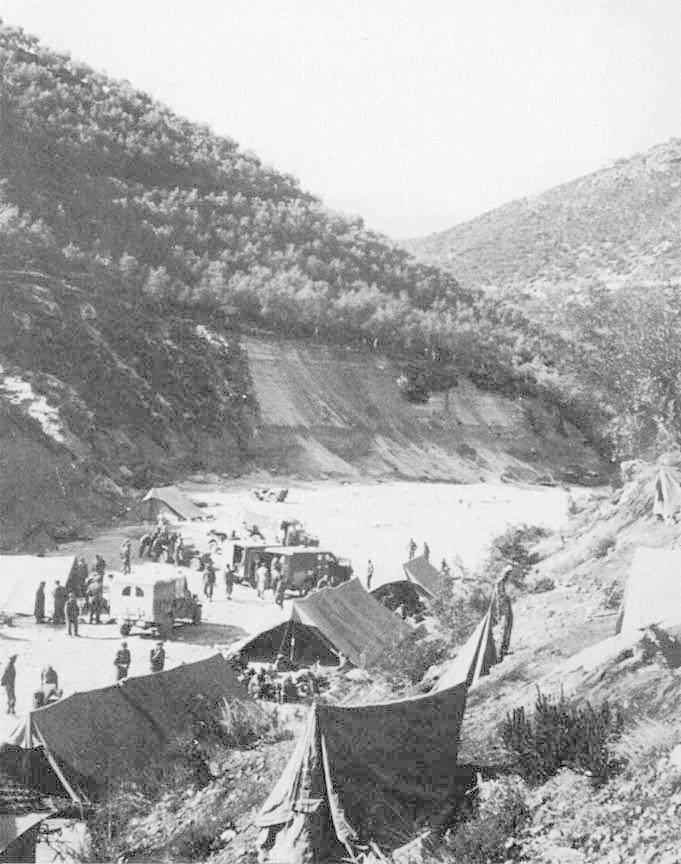
| Behind the Fifth Army front in Italy AFS ambulances bring the wounded to this peaceful valley for treatment before they are evacuated to a base hospital. |
On Christmas Eve American Field Service ambulances will be driving up and down the steep slopes of Italian mountains, others will be slopping through the mud and mist on French roads and others yet will be carefully winding over the steep Burma trails, bringing their load of sick and wounded back to safety.
On Christmas morning A.F.S. Volunteers from every corner of the U.S. will raise their glasses in friendship with Tommies, with Kiwis, with Poles, and with Canadians, or a glass of wine with a Frenchman, and Algerian, or a toast with Sikh, Gurkha, and East African.
You, who have bid them God-speed, will perhaps also light another candle for those lasting friendships which your sons have made among men of all nations and creeds.

September 3, 1944.
"E. and I came down to the car post, parked and waited for casuals. I found a chair and sat down to write some letters. Jerry mortars were dropping across the canyon and in the valley before the next town. Our guns replied and then Jerry 88's started to land closer. We moved into the house after a few close ones and I tried to keep on writing, though it was plenty noisy and shrapnel was whistling outside. Then it quieted down a little when two tanks, one a reccy, showed up with 3 casuals, one bad. We worked fast, shoved them into the car and took off up the hill. 88's were still coming down in the area. We got back on the main road and were held up by close to 50 tanks and other vehicles that were jammed up, making clouds of dust, and under observation. Jerry put his 88's a bit closer before we got through ---then we were held up again; there was a column of flame and smoke around the bend and we heard popping and occasionally a whine. The ambulance in front stopped and the guy said, 'Ammo' (ammunition dump). He thought it over a bit, then scrammed through it. I got on the running board and then changed my mind, nearly falling oft meanwhile. We came to the corner and slid it, going like hell. I thought we were through when 'Whammo' --a huge cloud of dust flew up right beside me and my ears rang, the car jumped and my head and eyes jarred. Finally the dust cleared so I could see and I looked at E. He said; 'My ears are ringing so hard I can't hear a damn thing!' We just looked at each other sort of dazed.
"The entrance to the ADS was just 150 yards down from the burning Ammo and it was jammed by the ambulance that went through before us and a bren carrier. I got out and swore at the man to get out of the way, looked at the ambulance --on my side there were 4 holes big enough to put your fist through and later I found another hole in the fire extinguisher just over my head. E. came around and looked, turned green and held out his hand. We shook on it. Then a guy on the floor inside said, 'Johnny caught a packet as we went through.' Then we had to hurry. 'Get the hell out of the way.' We scrammed past them up to the reception tent. I had the door open before we stopped rolling and helped one guy out who was just nicked. He had been lying on the floor underneath the guy who had caught the stuff, and was scared as hell. The guy who got it was in bad pain and we got him out fast. The third patient had had a leg wound before, and was slightly scratched on face and arms by flying glass and dirt from a piece that had gone through the back door an inch above his head.
"Later that day T. and I were sitting on the farmhouse steps when a cycle rider came into the yard and said one of his buddies had got hit. We asked him where it was, but he was in a flap and rather vague, 'Just down the road ---plenty of room to turn around.' The farmhouse was on a promontory and we had to go down the ridge on the Jerry side of the hill. The cyclist leading us turned off the road on the lee side of the ridge. We were coming down fast and went past the turn-off. T. stopped and started to back up when 'WHUMP' 20 yards on Jerry's side of the road and right beside us, an 88 hits. I made an arc out of the car into the ditch beside the road. T. screamed the car down the turn-off and I got on the running board. 'WHUMP, WHUMP' . ---2 more hit straddling the car 30 yards on each side. T. kept the car rolling down the field, which had no road and was a mass of bumps, until Jerry couldn't see him anymore; parked in a gully and got out. I came up panting, a shell dressing in each hand, and looking very pale and foolish, I'm sure. We got out a stretcher and carried it down to the ravine where the casual was. Jerry put a few more 88's down near us for good measure and I ducked so fast my helmet almost cooled me when it caught up with my head. The guy wasn't in bad shape, though he was in pain. We had to take him out up that hill under observation and perhaps fire. It wasn't a pleasant prospect and we waited for 2 more shells to come in before we loaded him.
"It's hard not to drop that stretcher when you hear a shell coming your way. We could get up almost to the road before Jerry knew we were coming out. We'd have to do it fast and it was bumpy so I got in the back to hold the guy on the stretcher. We went up on the road and gunned it. Then on the steepest part; where there were three fresh shell holes in the road, the car stalled. For an agonizing 45 seconds it hung on that hill before it went on. We got the rest of the way without mishap and I sat down to give my nerves a rest.
"So much for the fire and glory stories ---the situation in general is good. I like the outfit; like the job and think I can do it ---the fellows are swell and have what it takes. So I have no complaints to make at all."
August 27, 1944.
"This front is the most unusual one we have yet seen because most of the fighting takes place in the country and it is impossible to tell where our lines end and Jerry's begin. One can drive up the road for miles and see no installations of any kind until the realization suddenly hits you that maybe you are driving through territory supposedly in enemy hands. No one wears a helmet and there is no attempt to dig slit trenches ---everything seems to be spread out all over the place in most haphazard fashion. The actual positions are very informal so as to enable the men to strike camp at the shortest notice, when the order comes in, to move on, should contact with Jerry be lost.
"This hand to mouth existence thus precludes almost complete isolation from the A.F.C. and men are 'lost' for weeks at a time simply because the units to which they are attached have pulled up stakes and moved elsewhere
"Recently I had the good fortune to spend a couple of days of my convalescent leave in the ancient town of -------- famous for its narrow, devious and winding streets and its old cathedral. This latter was built in the 13th century and although the architecture and friezes viewed from the outside are overly ornate, the interior is beautiful. The pulpit which for obvious reasons had been enclosed in sand bags must be a masterpiece if one can judge by the pictures available. The altar is magnificent, containing many ancient candelabras and ornamented at the front in base reliefs and paintings. But the most impressive sight of all, is located in the cathedral library. Here are a series of huge painted frescos which completely encircle the walls and done in beautiful coloring and perspective. They were painted in the 14th century by Pinturecchio and are so well preserved that it would seems as if they could easily have been done last year. I spent almost all day studying and admiring each one and would have liked to spend several more but a re-assignment cropped up and I was off again.
"The progress of the war is indeed first-rate and it may well be that Jerry will be defeated before the end of my contract as I sincerely hope to be the case since it would make my homecoming considerably easier. However, if the fighting in France were still continuing and there was a possibility of my getting there I might reconsider. But as I said before that appears very remote."
October 17, 1944.
"You ought to see these Poles; they are really funny. They are just about the most fastidiously dressed troops I have ever seen. They most always have a crease in their pants and always have their boots shined. You see a lot of them with cigarette holders and rings. They certainly are a queer bunch.
"I was up all night the other night bringing down casualties. The run wasn't long but the road was pretty bad and what with the blackout at night we ---my orderly and myself--- were pretty tired by morning. That afternoon about five shells came over from Jerry. One fell about 50 yards away, but don't worry, I was well flat in a ditch before it hit. After that we all wore tin hats ---just in case. But there weren't any more shells, so my tin hat took its original place as part of my equipment (that being a washbowl). That was the closest I've been to a Jerry shell and that was close enough for me."
No date.
"Earlier that day and the night before they had caught shell fire from the German artillery and had carried many eases of wounded in that area. One of the cars had been hit by shrapnel which had rewounded one of the patients in the back part of the ambulance. By the time I arrived at the RAF after dark that evening things had quieted down considerably tho' I did have the dubious privilege of having a couple of shells land pretty nearby later on when I made a run down to the RAP. I made two trips there that night and they were about the weirdest that I ever hope to have. It was only a short distance but on a very poor dirt track to the RAP which was in a farmhouse that was situated on top of a small hill practically in the middle of no-man's land. The route was very well illuminated thanks to some tanks and a house that were burning merrily from hits that had been made that afternoon. A very lurid sight.
"The next day, as I remember it was quiet; but on the following day we were moved up to another ADS. Towards dusk two of us in one ambulance (we're only using the old Dodges for that work incidentally) were sent by the Major in charge to a car post that was supposed to be a mile up the road. We got a short way up the road to find a jeep full of officers and a motor cycle stopped on the road. They told us that the road was being pretty badly shelled up ahead and the officers decided to go to the next safe corner by crossing the field on foot while leaving the poor driver to drive the jeep around and meet them there. That puckered us more than somewhat, so we roared off and made the stretch with no trouble at all. We had been told to wait at a church on the road, but we were surprised to find nobody there and more surprised to see a bunch of Germans come around the turn in the road. It was a relief, as you can imagine, finally to see that they were POWs and were being followed by a couple of Tommies. Soon we found out where the car post was and off we went down the hill on the worst track that you can imagine. It was a little better than a trail.
"It was dark by the time that we had arrived and we had to bring a bunch of wounded in that had been brought that far by stretcher-bearing jeeps. It was a terrible trip back trying to keep on the road with no lights, of course, and to make it really bad a vehicle had turned over on a very steep part of the road which meant that we had to unload all the patients; carry them past the bad part, skid and push the car around the other vehicle, and reload-all the patients again. So we were pretty tired upon arrival, only to find out that we were to be part of a great mechanized column that was to advance about 6 miles and more or less take another town from which, it was thought, the enemy would retreat. The trip took most of the rest of the night and except for several vehicles turning over etc. was successful. The Germans didn't quite act according to plan, but at least the village was entered with no trouble and the ADS was set up there instead of further on as originally planned. It was very interesting to be about the first to enter a liberated town and the people were rushing out practically kissing us, the usual procedure. The town on the top of the next ridge was German held and it was taken and retaken several times before several days later we managed to keep it. Our job was to evacuate from the bottom of the valley between the two hills up to the first village. The fighting for the other village was furious and we kept more than busy day and night for several days.
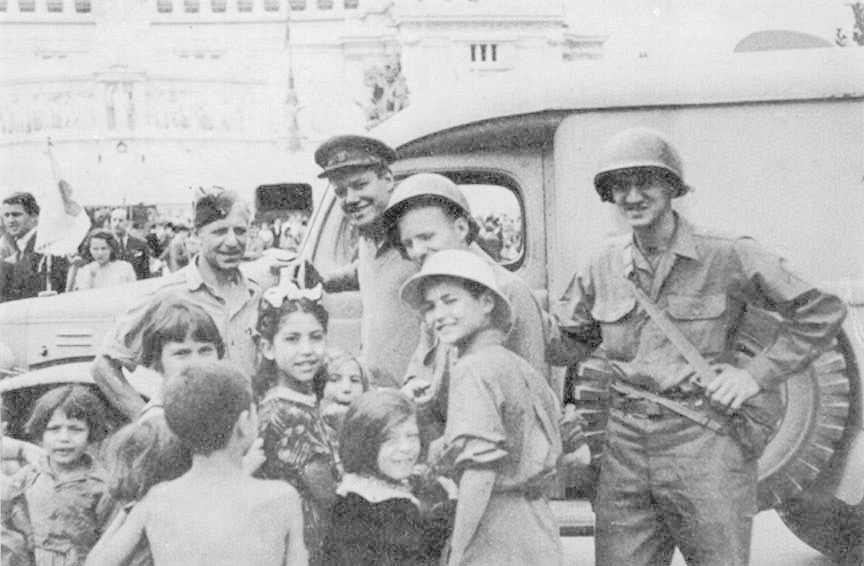
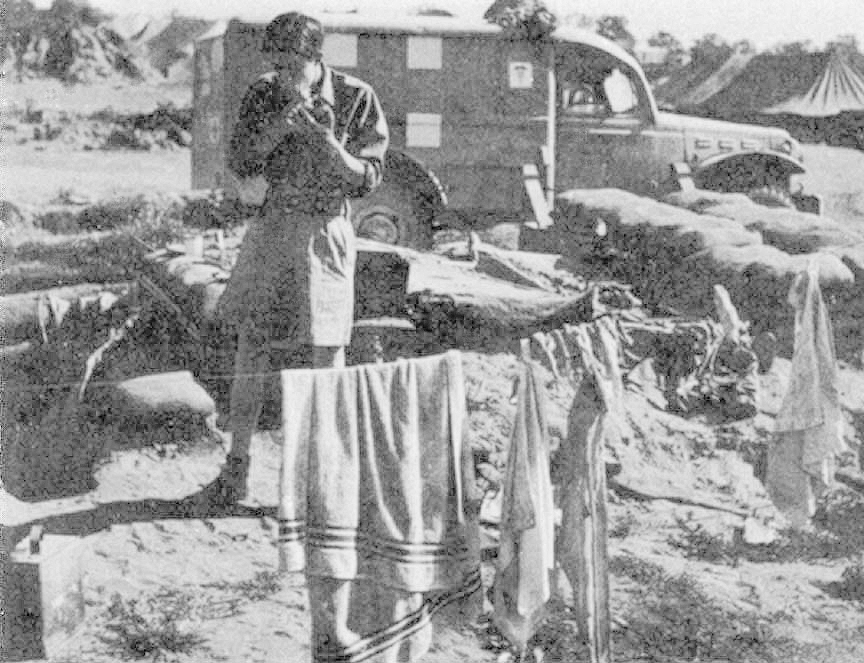 At Home abroad .... Fred Finkenstaedt shaves beside his slit trench in Italy. |
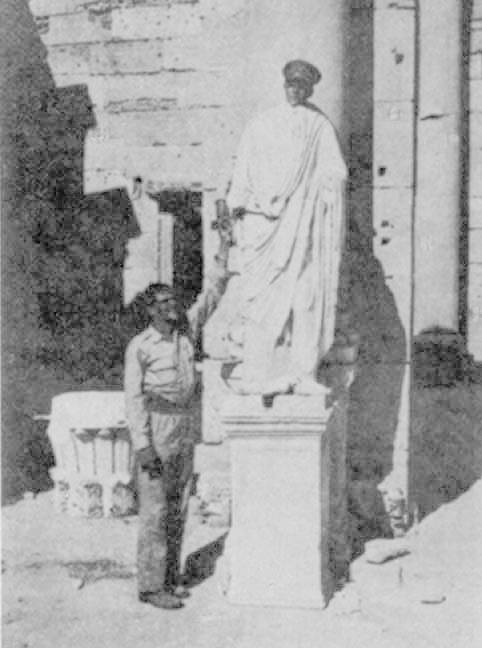 Jay Guenther supplies the missing part to an old Roman statue. |
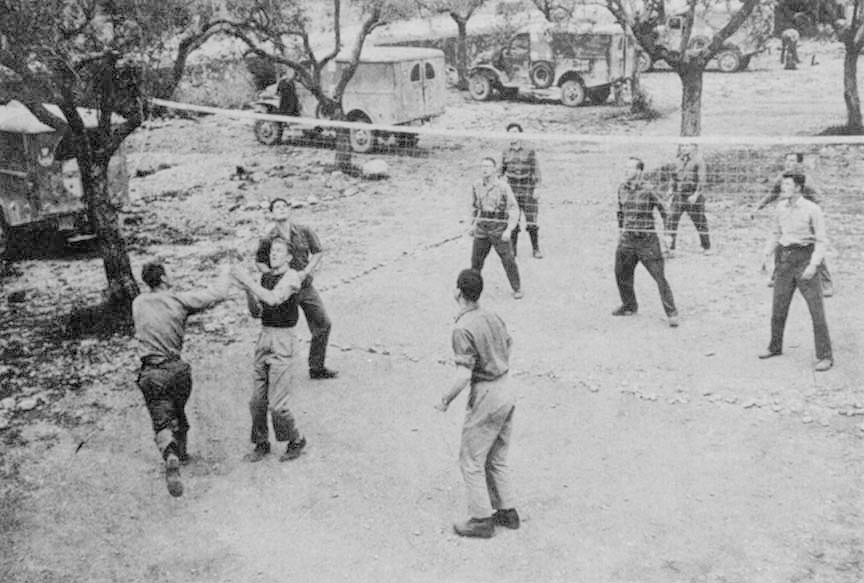 All is not work overseas. A group of ambulance drivers with the Eighth Army relax in a volley ball game during a lull. |
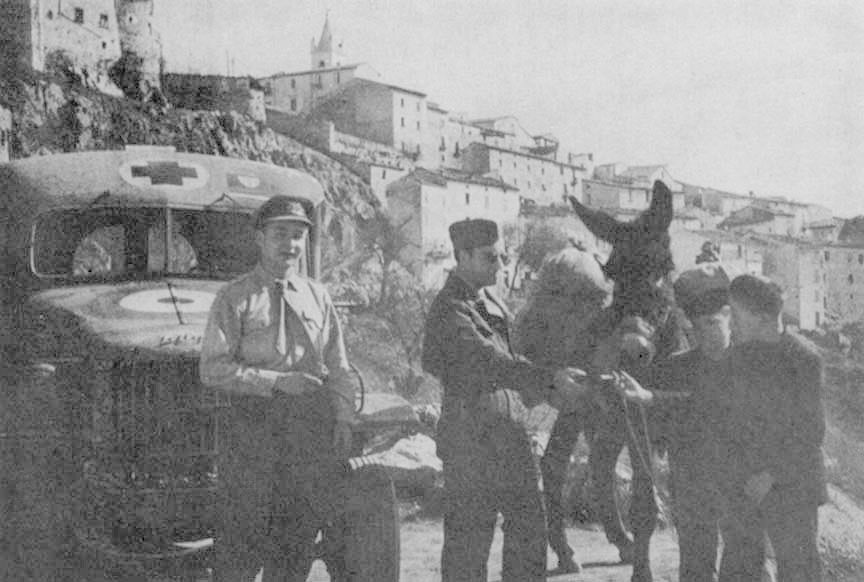 A youthful smoker 'bums one' from C.V. Stewart, while his burro looks on disapprovingly. |
"The road was under observation most of the way and so pretty hot, although they appeared to respect the red cross. At night, however, that didn't do any good and we all had pretty close calls. All the five cars that we had there most of the time were pierced by shrapnel, but only one of the drivers was wounded. We were all miraculously lucky (and I don't particularly want to try mine any further), in that place, but not so lucky at another post near ours where two of the drivers were killed and another reported missing and is presumably a POW. All three were in the platoon that I used to be in and I knew them all well, so it was a shock to hear about it. The town would be shelled from time to time but not very much until the next to the last day of my stay there when they really let us have it. Our house was unfortunately situated between the two places where the Germans could be sure that there would be a lot of vehicles parked and so in quite a hot spot, as their artillery aim is short of uncanny. One fell not 6 feet from two of our cars and one of the drivers, and another went through the roof of the house we were in but was a dud; I think that we would have been alright in any case it the latter one had exploded as we were in the cellar at the time. One exploded through the roof of the house across the street and another in the house to one side of us, so it was a bit noisy. They were not particularly big shells but there were some killed and there were plenty of wounded which we helped to take to the ADS. And leaving that cellar to do so was not an easy thing to do. After about two hours it was all over and that same night the German positions that were shelling us were taken, and all was peaceful from then on. The following night word came that I was to return to my own section, and I was very happy to leave. I was the only one of us still left in that village of the original 5 that had gone in there.
"There's probably been some of the fiercest fighting on this front in the last 3 weeks of the entire war. I've talked with a lot of English soldiers who had been in on the Salerno and Anzio campaigns and they claimed this was tougher than the others. I can well believe it."
August 6, 1944.
"Our two cars and an English Austin are the only ambulances serving this post, and, as usual, the Tommies are wonderful to us. We're rather a novelty, since our entire sector is composed of British and Colonial troops which are pushing over the steep ridges to a city. In fact one may drive a hundred miles and the only Yanks he'll see will be one of our AFS boys.
"And while I'm speaking of Tommy, let me tell you of their attitude toward the war while either under or out of fire. Tommy appear to the newcomer as being so indifferent to it all that he seems to be somewhat blasé about it, whereas the Yank is definitely quite melodramatic.
"Coming back from a run with several litter cases to a Main Dressing Station ten miles back, I gave a lift to an intelligence Sgt. of the ------, one of Britain's most famous Brigades. He had been back at a hospital for a spell and was now rejoining his unit. Upon arriving at his HQ at a hidden farmhouse, I stopped in to look over some maps, since I wasn't sure of my position and Jerry was along the road several miles ahead occasionally lobbing shells our way to annoy us. The Sgt. greeted his old friends and asked how the rest were. One of them said their Captain had been killed by shell fire the other day, and told of several others being injured by mines. To which the Sgt. commented, 'Rather bit of bad luck', and then led me off to see the maps.
"The quiet way the Tommy accepts the war and its horrors is most impressive. To him it's a job to be accomplished quickly so that he may go home, and forget about it. He doesn't think about it as an exciting adventure which may lead toward movie contracts and purple hearts. He goes along his way observing the 'good shows' and forgetting the poor ones. There's no ceremony when the Sgt. Major gets it and there is no blare of trumpets when a lance Corporal brings in ten prisoners. No, Tommy carries on as always, doing his duty as in the tradition of the British Army, of which he's proud.
"And so Tommy's easy, seemingly indifferent way of accepting the clash of artillery and spat of machine guns enables one to become quite fearless instead of becoming too scared. I'm sure that if it wasn't for his calm attitude, I would never have been able to adjust myself to war so quickly.
"As I've been writing there has been constant shelling on both sides--- our batteries exploding behind us, swishing their shells overhead and Jerry whistling his shells towards us, which end in a sharp clatter. Earlier while I was heating some water over a primus a Tommy gave me last week, in which to shave, Jerry dropped some anti-personnel shells about 2--- yards away. They are the ones which burst in the air throwing shrapnel around from about 100 feet above the ground. However, since they were a good 200 yards out of the danger zone, I went on about my shaving, as Tommy has taught me to do. Jerry sends over ten at the villa on the hill above us; our observation plane, hovering above, reports his position and we send thirty back at him.
"Had a twenty-five mile run at midnight last night with one litter case. The road was deserted, my only companion being the belching 25-pounders in the fields beside me. The moon was full and the rolling countryside shimmered with silver olive groves, and the cool night-was most refreshing as I wound my way up over the hills and then slipped down into the valley, misty with smoke and smelling with cordite. But even with my patient groaning, the roar of guns and the crash of nearby Jerry shells, it seemed to be a beautiful peaceful night, made more for love than for war.
"One often sees the sign 'Verges not cleared' which means that the sappers didn't have time to clear the road shoulders of mines. In such cases, on narrow roads, it becomes a test of who can stall the longest when two vehicles meet, to make the other fellow pull over on the shoulder to get past.
"It is really a great experience and I shall never regret my coming despite the outcome. So far I haven't been scared yet, probably because I'm too ignorant of the immediate dangers. However, I've been nervous enough to start smoking again!
"The one thing which has shaken me most occurred the other day while I was at an M.D.S. My car was parked beside the villa, near a window of one of the wards where men await evacuation further back. Presently I heard a wounded Tommy calling , 'Mama, Mama, Mama'. He called continuously with such pleading that it was hard to stay and listen, which I had to do since I was posted on call. I couldn't help him, naturally, but can only help the boys I carry, which I do with all my heart."
August 18, 1944.
"With us we have a very brilliant Italian boy who was driven from his home by Jerry at Milan. He comes from a wealthy family. He's also picked up our language very well, having been with us since Salerno. We also have a wonderful dog, which we acquired at Cassino, by the name of 'Lonie', more commonly known as 'Lon' . He's part police, part wolf, and for the most part mongrel! He quickly learns each new fellow and stays always with us. His intense dislike for Italians makes him a good watch dog. When you drive into HQ from a post for mail, etc., Lon is the first to meet you, making a big fuss over it. Three British cooks are assigned to us and a unit of five always comes with us as our workshop for our cars. At each new place we acquire temporary servants for house-cleaning, table waiting, laundry, shoes shined every night etc., and for a small weekly mess fee we buy china, etc. and food other than British rations. Twice a month a Paymaster comes around for drawing money, etc. Also the canteen truck, driven by one of our boys, as well as the monthly ration of whiskey and one quart of gin per man --the very best brands from England!
"Before I close, I'll tell you a little story of a quick adventure I had just before we came out of the line. Coming back on a 3:00 AM run one rainy night, T. and I missed a turn in the road, going off to our right. Since the supply line runs along the Northern side of the river parallel to Jerry's lines at the foot of the mountains, while going west any right turn leads to his lines, which are very flexible due to the terrain. We drove along, noticing a lack of markers, signs, etc. as well as white tapes for mines along the road. We crossed an original bridge into a dead town, showing no signs of shelling or any such signs as 'Town Major For Billets', etc. continuing on what we thought was the right direction, though in a strange country. We eventually saw a marker pointing to a bivouac. Leaving the car, with naturally no lights on in any way (terrible driving on rainy night !), we ventured into camp to awake someone to show us the way around. However, upon seeing a concentration of good Jerry vehicles, our hearts stopped, and we left in a hurry. As we started off a sentinel dog started barking and I thought we'd had it. Retracing our path for half an hour we found the right track and returned to our post. God knows how many British and Jerry patrols were watching us, and how many Teller mines we drove over. Well, it's one for my children!"
August 21, 1944.
"On one of my recent runs of --- miles round trip, I stopped to look over several Jerry Mark IV Tiger tanks and a misty ancient ruin of a castle which in times of old was the stopping-off point half way between Rome and Florence. "The Jerry tanks are massive, and once one has studied their construction one can appreciate how the Germans have been able to hold out so long. Their idea of war is purely mechanical --- for them there is no human element present. This naturally tends to make us very pessimistic in our outlook upon the duration of the war.
"The castle, which I explored with H., left nothing to the imagination. Since it was situated upon a peak from which one had a clear view of unwooded hills for at least a 25 mile radius, it was a stronghold in this war as in the Fourth Century, which is supposed to be the approximate date of its prime. It'll go down in present history as a Jerry stronghold which the French had such a hard time taking. The walls of stone are 12 feet thick. The old metal sheathed wooden draw-bridge over a massive moat is still there, ---underground rooms and rooms in the towers have mosaic floors, ornate ceilings and painted and scriptured walls."
September 1, 1944.
"In recent weeks I've lived in the weirdest billets imaginable, such as farm houses, villas, railroad stations, and at present in a T.B, institute for children! We always have an excellent mess, eating off china and white table cloths and having three or four table waiters. As soon as we receive a movement order, a recon. party in a jeep goes ahead and 'acquires' a building, since we prefer our way of living to the tented mess tents and tins of the other platoon.
"Several weeks ago, we lived in real style in an immense villa owned by an American woman. There we had four table waiters, kitchen boys, a boot-black, a laundress, and a chambermaid to clean the rooms, and also our assorted beds!
"As we move from place to place we collect more servants, chinaware, tables, sofas (3!) etc. If they ever loaded our cars on a L.C.V. I'm afraid it would submerge the pier!"
September 8, 1944.
"We're in the big push, and there's lots of work to be done. I remember I mentioned how much it seemed to me the fellows drank and messed around when there wasn't much to do ---but now every last one is chipping in willingly and driving themselves groggy. I guess the AFS is like that --fooling around until the chips are down and then they're there.
"One day I carried four stretcher cases for air evacuation, forty miles round trip after breakfast --- made lunch there --- left on a 120 mile round trip with 9 sitters to a general hospital --- got back for a bite around 8 --- and left again for the same place at 9 with 4 stretcher and 1 sitting patient --- got back at 4 in the morning and left again at 8:30 after breakfast.
"Some of the cases are dreadfully serious --- loss of limbs from shell fire and mines, terrible burns, and loss of eyesight from rockets. One has to drive 5 m.p.h. over rough diversions and at night, driving along runs with blacked-out lights in the rain against 60 Sherman tanks coming up is no fun.
"Been carrying a lot of Indians lately. I can see why Jerry is afraid of some of them, such as the fierce Gurkhas, with their full beards and their hair knotted up on their heads with three or four combs. Am also carrying Jerrys. Had one boy about 14 years old who rode in front with me. He spoke broken English learned at school. He wanted to know why we were taking him so far to shoot him in front of everybody, and he said Germany would win the war in two months!
"When I hear Jerry talking like that, and see the hundreds and hundreds of Allied casualties, I can't help thinking the war will last until next spring. I don't think they'll collapse, but we'll have to take, them all, and surely we can't cover all that ground before winter comes and slows things up.
"While coming back from an empty run, I came across two 'Eyties' who'd stepped off the main road and were blown up by mines. I got help and loaded them into my car on stretchers and a British Major, who stopped by, sent a motor bike for morphine. After it arrived, and the Major administered it, I drove to the nearest medical post which happened to be a Polish C.C.S. There, after unloading the patients, a very pleasant Polish nurse made me some cocoa in her tent. One sees quite a few Polish girls driving trucks and jeeps everywhere."
September 17, 1944.
"Spent a couple of days in a mountain town recently where we lived in the rooms of a former Fascist Club of a University there. We were attached to an Indian CCS where the guards walked past at night with their long curved knives unsheathed in place of rifles. It was great being up there where the air is clearer and cooler and everything seems so much cleaner. Saw several mule pack trains of the Italian Alpine troops under the supervision of British Cavalry Officers.
"At present we're with the Canadian CCS by the sea; in fact, our cars are parked on the beach. The Brigadier must have been after a VC when he set up the CCS practically on the front line. When we arrived the morning after the CCS was opened up, the road barrier was a mile and a half down the road, and the lines about several miles further. The CCS is really functioning as a MDS. Anyway, the set-up is far enough forward to be in front of our artillery and subjected to Jerry's return fire. The other evening I watched an Infantry patrol pass by on foot on their way into the line and later that night when I made a run I saw a whole brigade walking quietly through the night as they moved up into the line with loaded rifles.
"In fact, we're in position to see the whole show as the 8th cracks the Gothic Line. We can sit on our cars and see our guns shell the ridges, or see our planes bomb a town up the coast (saw one get shot down into the sea), or watch a smoke screen being laid down only four or five miles up the beach, or watch our ships out at sea shelling Jerries further up the coast. It's interesting to watch the ships maneuvering as they fire, and then Jerry sends up a geyser of water from a close one, they lay a smoke screen and circle off. The first night here, while waiting for a run around 2 in the morning, I saw on the steps of the CCS, once a most modernistic institute of some sort for children. From where I sat I would get quite a view of the lighting effects of war ---just in front of me the fields glared from the white flashes of our guns, inland flares drifted lazily over the ridges, to my right the sky burned with the ---- gun barrage laid down nightly, while up the coast Jerry ack-ack and tracers laced the sky, searching out our planes.
"Lads coming back from the front say this is worse than any of them, worse than Africa or any place in Italy. Jerry has easily as much artillery as we have and he's deadly with it from his high points on the steep rocky ridges. I know that everyone at home has their attention focused upon the invasion, and that little thought is given to Italy. Although the resistance may be fierce at times in France, it has been deadly here. Apparently, except for a short time around Rome, Jerry has been retreating North much as he pleases. In the invasion, and on the Russian front, we had the great advantage of air and armor superiority where here in the mountains this is of too little advantage. Jerry just sits up high and digs in with much ingenuity. The other night we sent over ---- bombers and ---the next day, but it made little difference to his well-dug-in guns. With a few men at the guns commanding the heights, he can keep many divisions against us on the coast. The casualties are appalling and the wounds the men suffer are unbelievable. Thank the lord this campaign is not typical of the others, or the war would last many years more.
"Jerry is very adept in fortifications. Here on the coast where he expected amphibious landings to flank the Gothic Line, he erected many small steel pill boxes, such as are pictured of the Japs. In the side of hills he has carved elaborate rooms. I went into one dug out, composed of a large room made of six inch thick timber, covered with 15 feet of dirt and rock under felled trees, and at ground level, four machine gun mounts commanded the field it was in in all directions."
September 26, 1944.
"Went up to the city after it had fallen. The fighting troops had moved to the other side and the city was supposedly closed to troops. It was weird walking through the deathly still streets, climbing over unbelievable heaps of rubble. Other than the occasional roar of guns shelling Jerry over my head, and the quiet crackle of flames slowly eating up the interior of wrecked buildings, it was so damn quiet that when a window pane broke from the heat, or a fire-eaten wall collapsed, your heart stood still. I was in the city for several hours and saw only three civilians --- there were no welcoming citizens strewing flowers---they'd all taken to the hills during the heavy bombing, continuous shelling, and destructive Naval shelling. Sometimes one would be up even with second or third story windows while climbing over the great piles of bricks, stones and timber. Destruction was terrific, every other house had been hit severely. The stench of buried bodies lay low in the hot, dusty alleyways. But it was the death-like stillness which was most impressive!
"Another day T. and I drove to a nearby Republic State, dating back to 300 A.D. It was neutral, but Jerry used its area for supplies and gun positions so we shelled and bombed it. However, its capital, high on a rocky cliff of a plateau, was virtually untouched. There we bought souvenirs and traded for some of their stamps. We also found a little bar behind closed doors where we drank some of the best Vermouth I've ever tasted. From its high walls, with a pair of Field glasses borrowed from a Canadian Lt., we watched the battle going on below on a dry river bed. Saw one of our tanks receive a direct hit and go up in flames."
August 25, 1944.
"I think I know why Italy is not a great country. It is all mountains and it takes plains to make a great nation. Most towns, dating from the ancient days, are built on the tops of hills...hives of masonry walled in on precipitous cliffs. You simply can't do business from so high, and so far away. All that has touched these fantastically-perched towns has been war, and war has done some of them very badly. We are accustomed to towns in the valley, where the water and water power are...here towns are on peaks, and water is brought up by donkeys unmercifully beaten by their Eyetie masters. It goes back, of course, to ancient days, when a city had to be built as a fortress ...but it simply will never work...the very poor and the very rich perched on the mountains, while farmers try to achieve a whole economy by farming the lowlands! ....."
August 29, 1944.
"In every town, partially obliterated by the Eyetie republicans, are the signs Mussolini had painted on practically every blank wall: 'A strong Italy is a fecund Italy'...'Conquer or Die' ... and many others. It was a very tin-pan bravado...going to fight this war with grapes, grain and poor people. Everywhere you still see the buildings occupied by the various Fascisti corporations --- the Tabacchi Opera Nazionale (tobacco) which made rotten cigarettes and sold them at prodigious prices; the electrical monopoly which sold electricity to so very few. It was a hell of a racket from start to finish. They never had a nation here and how much less they have today.'
September 3, 1944.
"In the morning we took tour stretcher cases to an airport to be sent back for operations. Two were German prisoners to whom I offered cigarettes. One said: 'Danke schon, you Amerikanischer?" The other pointed to his left lung and said: 'Allus caput', meaning that that lung would not permit smoking. In the bottom of the stretcher rack were two Tommies, one severely burned from head to knees, so much so you could hardly see him. He was practically covered with plaster of paris, under which there was a sheath of penicillin. Over his face there was a black crust of sulpha grease, and a mosquito netting which did a poor job keeping away the flies which swarmed all over him. He didn't whimper a word --- said 'thanks, Yank' and asked for a couple of drags on a cigarette. W. gave that to him, as well as a drink of water. That fellow is out of the war. ...Our other Tommy was a Welshman and he was in fine spirits despite the fact that he had compound fractures of the left arm, a left leg shot off and other injuries. I told him I was part Welsh but could not pronounce the town my grandfather came from. He said no one could, I didn't know his leg was gone until I leaned over him to get to the burned fellows I said, 'Am I hurting your leg?' and he said, 'You can't hurt what ain't there, Yank'. But despite his troubles, he was whistling and smoking and had a fine, crinkling smile around his eyes and was sure, now, that he was going home .... Another of our ambulance loads were all badly wounded.....we had to go very slowly over bumpy, rutted, shelled roads. We asked if a little more speed would hurt them any more and they all said, practically in a chorus, '---all the hurt, Yanks, the faster the better out of this--------- Eyetally!.....
"Another of our trips involved a trip from CCS with a Sikh ... very young, but like all Indians, or Sikhs at least he had never cut his hair or whiskers. 'He was in great pain with broken arms and legs and we were to hurry him to where they could arrest the incipient gangrene. He was thirsty and in agony and the frames holding his broken parts were coming undone and slipping, so I sat with him in the ambulance and tried to hold him together. He could talk no English except to say No or Okay, and I don't talk Hindustanee, so we communicated with each other in very poor Eye-talian, the universal language in this army which, as you know, contains Poles, every type of empire and colonial Englishman, and Tommy. If the Sikh kid, who stunk to heavens hadn't been obviously in great pain, it would have been amusing: a Hindoo and an American talking bad Italian while bounding along in a British ambulance. The trip was slow, messed up with such military traffic. But we finally got him into an Indian ward, where he got some Indian food and someone who could talk his language."
September 5, 1944.
"We carried 11 passengers: two of them Nazi prisoners. One of them was a meek, mild little fellow who showed me pictures of himself before he went to war, and he was a fine looking youngster. He was a paratrooper, captured and wounded a few days ago. Now he is apparently quite happy to be out of it. talked in Eye-tie, which the Germans know better than English, and which we know better than German. He said: American? Bono! The other kid, same age, was completely Nazified. He smirked and joked and very arrogantly said that the Germans would be in America in three years. He said the war would never be over for Germany, that the Germans love and follow Hitler. So the other fellow shut up, saying little in front of him. It was a poignant example of the habits of a nation where only one side can talk out loud ... Two Nazis, wounded and helpless, couldn't even argue with each other."
September 6, 1944.
"Of all the Jerry prisoner casualties I have seen, there is only one for whom I had real pity. He was a young, rather pleasant and American-looking lad with a smattering of English. He had shrapnel bitten into about every inch of him. He was thoroughly whipped out. But there was something about his eyes and his manner that made me feel sorry for him as well as many of the German people. He was grouped with a lot of sitting wounded, most of them Tommies, but quite a number of colonials too, and he was trying so hard to cooperate and be pleasant and not out of place among all those miserable people that it made your heart bust out of your shirt. I think I shall remember how he looked when I have forgotten many other things....."
September 9, 1944.
"Some of our casualties have told of Jerry's nasty tricks placing personnel mines in ditches, and then shelling the roads, so that when drivers and occupants of vehicles jump into the ditches to avoid shelling, they leap into mine fields and are never seen again except for very small pieces. Jerry is very clever with mines. I have seen some of his mine fields, which have not been sapped out because of our rapid advance this past summer. You pass them very fast and right where the signs say 'If you want to help finish this war, keep out of here'---which is a. typical British way of saying it is 'unhealthy'."
September 11, 1944.
"On the way home I drove a jeep through countless towns and villages most of which had been thoroughly demolished and the roads were lined with Italian families coming back from hill and mountain hide-outs carrying their odd assortments of chair and always mattresses on horse-carts and smaller carts drawn by donkeys the size of dogs followed by perambulators loaded with bambinos, and the household effects on the backs of children and old men and women. I saw dumbfounded old women in black, wrinkled probably not so much from ago as work in this Italy, standing in the archways of what were once their homes, but are now very ancient looking rubble heaps. I can never quite get accustomed to the fact that a new rubble heap a few days old looks exactly like rubble of 6 months' standing, or like 2000-year old ruins of Pompeii. The other constantly amazing thing is the salvage work which starts immediately. Old men pick through the rubble, removing whole bricks and roof tiles and piling them neatly against the day when they build again. And all Italy, being built of soft stone and chips of slate and marble and materials we would certainly call rubble can be built again very much as it was."
September 12, 1944.
"But I imagine these Fords would not be too impossible, were it not for military traffic and Italian roads. Military Traffic, as they say it, includes everything from jeeps and ducks to 24-wheeled prime-movers which carry Sherman or Churchill tanks on their backs like piggy-back ---their eight-in-a-row rear wheels spread out like a stenographer's butt and kicking up more dust than a three-day rodeo. They occupy almost all of any roads and about twice the width of a track. In British military parlance a road is a fairly smooth(??) stretch of highway with some past history or importance. Italy has very few 'roads', with the exception of Via Appia Via Flavvia, the Naples to Pompeii Autostrada and other such through-traffic arteries. Everything else over which military traffic moves is called a track, and the term is completely descriptive. Certain types of traffic is confined exclusively to tracks --- as for instance tanks when they move on move on their own power .....
"We ambulanciers do most of our driving on tracks, competing with mighty military machines driven by Indians, Poles, Basudos, Greeks and Canadians who never read traffic signs. Military traffic is directed chiefly by signs ....a large movement over a great distance is noted by a code word and you will get where you are going if you know the word and can find it in the maze of signs at every crossroad. Every intersection is plastered with the signs of armies, corps, divisions, regiments and all of their services, including the medical groups, transport, ammunition, engineering, petrol and lubrication outfits, and the rest. Since we are a polyglot army of many races, colors and tongues, there is considerable duplication of many of the signs...for instance, a tank track in Polish needs a special sign 'tankow drodznie' ....every bridge is labeled 'most'....and so on for all the languages, including Indian, which is completely inscrutable. One could even get used to the signs and get along with them, if it were not for the Poles. They make their own signs and make them big and place them where they damn please. I have seen a truck-load of Polish traffic and transport men jump out of a truck, unload a cord of signs and hammer them into the ground at an intersection, completely covering up all the signs that were there before. 'If that is a "dobra" (good) place for signs', the Poles seem to figure, 'let's put our signs there.!
"The Poles are a wonderful people. They are all sizes and shapes and mostly very tough. They speak a language which puts every movable part of the head in action, and they seem to live without eating. Our boys who have been assigned to Polish divisions and have had to eat their rations, crawl back slim shadows of their former selves. Breakfast is a cup of tea if there is enough to go around. The big meal is at noon, but it is soup and potatoes with meat thinly disguised. The evening meal is at the complete whimsy of the cook, consisting of tea and hard bread, and is served any time from 5 to 8 p.m., and if you are not present when it is served (and there is no warning) you've had it. The Polish counterpart of WACs are not typewriter-beaters, but may be seen --- short and big-busted or lean and tallish --- directing traffic, or wheeling big multi-ton vehicles, double clutching to beat hell and bearing down upon our little Dodges like a Yellowstone bear after peanuts.
"The Polish male drivers go like hell and weave in and out like a pickaninny's braids and they stop on a dime if they are in front of you, or in 500 feet, if they are behind you. But the Poles are not the worst drivers. The Indians drive fast and recklessly, but manage to keep on the road, and far too much of it, most of the time. The French, whenever you see them, seem to feel the power of their vehicles under them and have full confidence that they are only three feet wide and can pass between anything. But the worst drivers are the Mauritius from the little island of Mauritius off Madagascar. The British call them 'the most deadly drivers'. They shift from low-low in a four-speed wagon to high. They start backing up before they stop going forward. They stall on a steep hill and roll backwards until someone stops them by sheer weight of machinery or masonry wall, and if you ever pull them to get their engines started, drop your two chains and roar away fast because once they get started, they go ahead no matter who or what is ahead or what they are tied to. I saw one Mauritius being towed then try to pass the towing vehicle while the tow-cable was still attached . ...So you can see that an ambulancier, accustomed to a half-ton truck and suddenly put in the saddle of a 3-ton top-heavy gymnasium, against the traffic I have described, has something to worry about, and cannot be blamed for hugging the ditches and landing in them."
September 20, 1944.
"At 7:30 our bike courier comes back from the CCS to report how many vehicles are needed for early morning air evacuations, usually 10 or 15 ambulances. We move up to the marquees of hospital tents where Indian, Mauritian or Italian stretcher bearers load us up. Sometimes we have priority loads: head, chest or spinal fracture cases needing special driving care, ether loads include fractures and amputations; painful, but not serious, still difficult to handle on account of the splints. Other types of cases include shrapnel and bullet-wounded, often in great pain, but usually unworried and more or less cheerful. The last type of patient is the sick, from jaundice which is now in season (and we have some high chrome yellow fellows), from malaria which will carry on here till the end of November at least, or ischio-rectal abscesses, boils, infections and other diseases, that make soldiering difficult.
"When loaded we check out of the CCS, pick up kit and pack at the pack store, get a check on the number of stretchers, blankets, splints and pajamas on the load and then take off for the airport.
"The port we are now using is just 6 1/2 miles away. The fastest time I have made it in is 45 minutes; the slowest 1 1/2 hours. The speed depends upon. the condition of the road, traffic and (chiefly) on the condition of the patients. Since the roads are lousy with chuck-holes, fast driving is impossible with not-sea-sick patients, you can go as fast as it is safe to take the car over bumps. With painfully or dangerously wounded we go as slowly as the car will take it, and often stop to check their condition enroute. At the airport we check in with medical cards, find out the destination of our patients, and wait until a plane arrives that can handle our men. This takes from 10 minutes to 1 1/2 hours. If there is a wait of more than 15 minutes, we drivers go to a Red Cross canteen and pick up tea or lemonade, biscuits and cigarettes for our patients, and sometimes copies of the Eighth Army News, Stars and Stripes, Union Jack or other current papers, for the boys to read. I keep all the magazines you send me in my car as a sort of travelling library. If the lads are not too bad, they like to read and drink tea. If they are in pain, I talk to them, get them to tell me about what happened to them and where, how the fighting is going, where they came from...and jokes and stories..... After we unload our men onto planes, up to which we back our hulking vehicles, we load up on empty stretchers and blankets and bugger off smartly for home. Occasionally there is a second morning run for some, but usually one takes the whole morning.
"In the afternoon we very possibly make an air evac run similar to that of the morning. It differs, however, in that the patients, worn from the day, are more pained and difficult to handle. Waiting drives them mad and they become irritable and bitch a great deal. One Tommy told me 'The British Army is the greatest group of confused people in the world. The only success it ever had is when it's so bollixed up no one knows what he is doing, including the enemy, who hopelessly gives up. When the British Army ever gets organized, you can look for a general---retreat'. So the Tommies bitch like GIs around the world, and for probably as good reasons, and probably it is no reflection on the British Army, for which I have immense respect, particularly the Eighth which has a five year record that can't be beaten, as armies go. One thing pleases us very much: The Tommies invariably say that the Yanks give them the smoothest rides of all the ambulances they ride in. A smooth ride --- or as smooth as humanly possible --- is one of the first notions you get in the AFS and it haunts you all the time. You go slower over a road the longer you use it. You study the ruts, you know them all, you are afraid you are going to jolt the hell out of the lads. It helps to have a change of scenery; a new road or track over which you have not become fanatically self-conscious. If you used the same track for more than a month, you would probably be afraid to use it.
"I don't know anything that has ever happened to me that has been as interesting as this experience. When I think how close I came to missing this, I am glad I finally caught on to the AFS connection; in many respects the Field Service is one of the best ways of seeing the war. We see more of it in scope and hear more about it than any soldiers in the line. And, strangely, it is lovely here now, blue skies, white clouds, colorful peasants and, for fall, a blaze of a sun, that shows me many things I have never seen before."
September 26, 1944.
"You can tell any doubters that Field Service men really do get to the front these days well within a month of leaving home. We are about the only military units (and we are that, being a company in an army organization with the same job as soldiers who are in regular ambulance companies) to get into action in such rapid time. It is certainly one of the advantages of this service, getting to war without going through a lot of training. And we do the same job that soldier ambulanciers do, drive where they do, and often where they do not, because we are volunteers and can take jobs that regular soldiers cannot be ordered to do. The Field Service has been commended in recent issues of the EIGHT ARMY MNEWS for 'going down the road', and that means to places which can be reached only without regard for personal safety. A number of boys have medals for such deeds, one of them is a Member of the British Empire, because he evacuated 28 men over a mined road, four at a time. He volunteered to do it."
'Hodie' Metcalf who has been missing in action since September 19th has been officially reported prisoner of war. Before receiving the official news his family had had word through two other AFS men in Italy that he had been taken by the Germans. Royal Knight moved up to a town in Italy that had recently been evacuated by the Nazis and found 'Hodie's' name, platoon number, a drawing of the platoon insignia, and the words 'Prisoner of War' written on the wall of a schoolhouse which had been used to house prisoners. Charlie Perkins entered the town a little later and identified the handwriting on the wall as 'Hodie's'. The two ambulance drivers wrote of their discovery some weeks before word came from the Adjutant General of 'Hodie's being well and safe as POW.'
The following tale comes over from .AFS Burma. One of the volunteers at Bishenpur had somehow not taken his hearing aid, without which he is very hard of hearing. The only way in which he could safely navigate in the area, which was more or less under fire at the time, was by following someone else. This turned out unfortunately for the ambulance driver, because he was with a Field Ambulance officer who was a practical joker. The officer was walking in front and when they had passed a particularly muddy spot with the AFS man directly in it, he ducked, so did his follower. The officer has been 'knocking himself out laughing ever since.'
Mr. Galatti received one of the first civilian post cards to be allowed mailed from liberated France. It was from M. Girodie curator of the Blérancourt Museum in which there is an AFS wing housing mementos of the last war. He wrote to say that the wing is still intact with nothing in it damaged or stolen.
The American Red Cross Club in Calcutta asked one night for five AFS men to take part in a quiz program they were conducting. Five particularly brave AFSers responded and their team, AFS WIZZ KIDS, won. They each received five rupees and report that all in all 'It was rather an amusing evening.'
Bill Brown, a Staff Sergeant with Patton's 3rd Army in France, has been reported as missing in action Bill was in AFS for 15 months in Syria and the Battle of Alamein before coming home and enlisting in the Army. We sincerely hope that since we received this distressing news, his family has heard of his being safe and well.
Dave Briggs has written a book about his experiences in AFS up to the time that he returned on a leave last summer. The book follows him from the time of his departure for the Middle East and goes through his service in Italy up until the spring of this year. It is largely Dave's own impression of war in convoy, on the desert and in Italy, based of course on his experiences as an ambulance driver. The publishers who are interested in it feel that such a volume would not have wide enough public appeal to warrant its being printed because a great deal of the material is dated. A private printing is considered a good risk, however, if proof that at least 500 buyers would want it, can be furnished. We therefore take this opportunity to tell our readers about it, in the belief that many people vitally interested in AFS might also be interested in this book; it is called WALLOW AND WAGE WAR.
Several of the ambulance drivers spending their two year leaves in and around New York were guest speakers at War Bond rallies during the Sixth War Loan Drive. They were very persuasive talkers and managed to boost the bond sales whenever they appeared and told of their ambulance driving experiences with the Allied Soldiers.
Two more former AFSers have joined the Army. David Spencer is in the Infantry at Camp Wheeler, Georgia and Barnie Lefferts is a new Private of Uncle Sam's, whereabouts unknown. Peter Glenn Smith is in the Indian Army and with the 125th Frontier Force Regiment.
The widely used name 'Joe Blow!, applied to any and everyone whose right name is unknown, is frequently heard around AFS N.Y Headquarters. One day recently, according to the usual custom, one of the girls shouted across to another, "have you got any dope on Joe Blow?" A volunteer in uniform, preparing to sail, walked up to her desk and asked politely, "Did someone call me?" "Why, no," said the girl surprised, "I don't believe so, what's your name?" "My name's 'Blow' ", replied the boy.

October 8, 1944.
"I've just returned from detached duty where it was impossible to send any letters back for we were fairly far away from anyone and most of our communication was by radio and rations were dropped to us from the air. D. and I were the only AFS men out there and. we saw none of the other fellows till we finally got back. I had to walk part way to this location so I had to keep my kit very light, only a change of clothing, bedding roll, and cigarettes. It was a great deal of fun, rather like a camping trip except we didn't have to do the cooking, and all our clothes and bedding got wet and we never really got dry till we came back in. After a couple of days squishing around in wet socks your feet look crinkly and dead looking. We were the closest ambulance to the front lines, but I saw no shooting at all. D. was out there sometime before me and had some hair raising tales to tell. By the time I got there it was very quiet. I finally got the souvenirs I wanted and have a fairly nice Jap flag which is a story I'd like to tell but can't, and a bolt of a Thousand Stitches which is a Jap good luck charm, but it didn't work in this guy's case.
"The country was pretty but wild and unsettled, at least I saw no natives of these hills and it wasn't till we got down on a plain that we saw some Burmese villages. The Burmese men are nothing to look at. They usually have black teeth, scrawny physiques, dirty turbans, and smoke 'whacking cheroots' white and about twice as big around as a cigar. But the girls ---oh, my! Some of them are lovely and for a lump of rock salt 'Daddy' will practically give you his favorite daughter. We were fascinated by the way the natives handle some of the huge elephants we saw. They simply stand off to one side and tell the big animal what to do. Its like a circus act.
"U.S. War Correspondent Larry Barretto who was doing some articles for Liberty and who had driven with the AFS in the last war was much impressed by the scenery, but even more so by the roads. Driving in France was nothing like this he said. The roads were highways compared to what we drove over and there was practically no danger of being cut off, for the front was a stabile line and there was no danger of patrols of the enemy cutting your roads behind you, as there sometimes is out here. We were amused by his amazement at the number of Jap skeletons along the way. We are used to it by now and there is not much time or use in burying them, the rain would wash them right out again and the ants and flies make a nice clean job of it anyway."
No date.
"You must remember that I am in a war that is being fought under the most difficult conditions known to man. The enemy is an unknown quantity and worse yet, ubiquitous. Food is scarce and there is little variety; a sleep is more precious yet, and real rest is impossible at any time. I manage to read about two books a week which fills in the spare time along with letter writing, but it isn't relaxation in any sense of the word. With it all, we enjoy ourselves and take pride in the job we do."
September 13, 1944.
"Our new spot is 5000 feet up and the nights are actually cold. By December I'll need my red flannels. Our work for the moment is night work and that leaves us free all day. Yesterday in the theatre we had seven operations, five abdominal and two amputations. Three of the abdominal cases died, one on the table, two last night. Any doctor is doing well to save two out of five in that kind of operation.
"We're perched right on a hill-top that commands a view for miles. Each day the fighter planes rip through the valley and we have to look down on them. Because of the exposed position we're almost free of flies and mosquitoes. The flowers on the hillside are beautiful. Orchids, gardenias, some big, yellow flowers about a foot in diameter and another kind that looks like lilacs only much sweeter smelling. At the bottom of the hill and all through the valleys grows elephant grass that stands anywhere from eight to twelve feet high. This is where the tigers, leopards and wild boar live. Higher up where there are trees you see monkeys jumping around and jackals sitting down idly.
September 1, 1944.
"That evening we started to work. Up rolled a jeep with a wounded Japanese soldier. God, what a state he was in. He was half starved, suffering from dysentery, and his left arm had a huge shrapnel wound, in which the maggots crawled about like moving rice. And stink! whew, what a smell. The dysentery, rotten flesh, and unwashed clothes gave up a most nauseating odor. I soon got him on a stretcher and cut all his clothes off (which we promptly burned) and got him rolled up in some blankets. Then I did up his arm with some bandages I had in the ambulance, gave him some warm tea, and made him comfortable....All this while the sergeant had been looking on and kept mumbling, 'Christ, I wouldn't have your job for anything.' I'll admit it was pretty rough. Not long ago after this some sick Africans were brought in so I put them with the Jap into the ambulance and took them to the FDS.
"I decided to take a look at the ruined town of Tamu, as there probably would be little work at the car post until the afternoon. When our troops had entered the town of Tamu a week earlier, they found such a number of dead Japs, mules, and other animals, so much disease, and such unbearable stench that they were withdrawn and the place burned. The only thing left standing were the temples in which the sick Japs had taken refuge as they were the coolest places in the area and then. when the Japs had left, these men were killed and left there. The Jap prisoners we took were assigned to clean out these bodies. They piled them up outside and burned them.
"The temples were pretty well ruined and most of the statues were mutilated. The marble and platter Buddhas all had their heads knocked off; the metal ones were full of bullet holes, and other decorations had been wrecked....One of the temples had its floor raised about seven feet above the ground; under this floor were still left some Japanese dead. They were completely gone and nothing was left but the clothes and bones. The skulls with the grinning teeth and staring eye sockets sticking up out of the coats on a string of vertebra...At first, the sight of a dead body is somewhat of a shock, but soon we got used to them and think no more of them than we do of the wrecked trucks and guns we see along the road. The dead have no meaning, only the living do we worry about."
October 4, 1944.
The boys have been living here for six months with just chairs and tables, books, bottles and ashtrays, which was too much for me, especially when I saw hooks in the walls that used to hold curtain rods. So with T. (who is an architect and has the good taste of Charlottesville, Va.) I want on a shopping bee. I found a nice, what is really dress material in the market, white background, all-over flower print that had a yellow of the walls and the blues and greens of our furniture in it, and was gay enough to put all the bright flowers of these parts up against. Twenty yards of this, five foot wooden poles, that won't rust, a pair of earthen, native jars and one small jar filled with flowers for the coffee table have turned a barn of a place into a living room where we all meet for drinks before dinner and enjoy sitting around afterwards. There was a high wooden cabinet stained brown, we painted its side and the trim dark green and one of the boys is decorating the panels with flower designs so that it has become a handsome piece with a rather Bavarian look."
August 21, 1944.
"I have just discovered that I can tell you where I have been on leave, but I am sure that you must have already guessed that it was Calcutta---a fearful and wonderful city, mostly fearful. I stayed at the Grand Hotel on Chowringhee. The rates are rupees 10/8 per day, but British officers under the rank of Major who are there on leave may stay for rupees 7 per day, which is extremely cheap as it includes all meals and afternoon tea. Chowringhee is the Fifth Ave. of Calcutta. On the next block from the Grand is Firpo's, the best restaurant in the city, and clustered around the area are the cinema houses and many, many ice-cream parlors.
"There are no visible signs of the famine in Calcutta. I guess it is pretty well over, It was terribly hot there, but there are always fans inside every place.
August 28, 1944.
"I am now back at HQ working in the Personnel dept. again. The day before yesterday I was at the CCS when I received word that I was wanted at HQ, so I drove my ambulance back to my section's new camp site --- miles and miles over the most incredible road. It is mostly made of mud, with ruts and holes so deep that there is no point in holding onto the steering wheel, and scarcely wider than one vehicle. On one side the land goes straight up and there are almost continuous landslides. On the other side it goes straight down, and the road keeps giving way. Going up it isn't possible to go more then five miles an hour, and going down it isn't safe to go faster."
September 3, 1944.
"It being late afternoon, it is pouring again, and the pond will soon overflow. The cow, which belongs to God, I guess, is standing under the arbor and looking miserable. The jackals, which visit us nightly and make incredible howling noises, killed all the ducks but two last night. I think we should eat the other two before they are killed. We were talking about training them to stay in the pond where they are safe but decided we had other things to do.
"The other night I went to see 'Four Jills in a Jeep'. It was rather dull, except for Martha Raye. She couldn't be more vulgar or more amusing. The movie houses here always show two or three new reels and a comic and an Information Film of India, and then have an intermission before the main feature....The Info films of India are sometimes interesting. They are meant to correct things which need correcting. The last one I saw illustrated the custom of Indians converting all their money into jewelry, and, of course, the value of gold drops and there you are."
September 5, 1944.
"I think it will be a long time before Japan is defeated. From what little I have seen of the war on this front, it looks as if the only way to defeat Japan is by attacking Japan itself. I often wonder just how much people at home know about this obscure theater of war. The short clippings you send are often inaccurate ...I never see anything about the 'battle of Burma' in TIME. But this part of the war is overshadowed by the other fronts. In some ways I am rather sorry to have left the front. I think from now on things will be more interesting up there. I was there from May till September, but really saw very little. In this kind of warfare, five miles behind the lines there is little danger and excitement. In one of our camp sites we could hear the guns at night, we never saw any Jap planes ......
"Everyone here seems to think that the Nazis can't last much longer and that when they are out it won't take much longer to finish off the Japs. I wish I could feel that way, too, but I am willing to bet that two years from now we are still fighting Japs. Certainly nothing of much importance can be accomplished on this front."
September 21, 1944.
"The Moslems are having a great festival period just now. Many shops are closed, and yesterday it was difficult to get about in a car because of the processions --- gaudily dressed people dragging huge floats which carry monstrous displays of gold hideousness. Next week the Hindus have their turn. All the servants ask for backsheesh and then dash off to the bazaars."
October 13, 1944.
"They had a big robbery out here the other night, and since then all sorts of police officials have been around questioning the servants and. putting them thru the third degree and searching everywhere. Quite a bit of money was stolen from the house and one of the two bamboo houses. Two American army people happened to be staying here for the night and they lost heavily. Watches and other valuables were taken. The three of us who inhabit the second bamboo house were the only ones who lost nothing.
"There are only eight of us here now and it is delightful. The offices have been moved downstairs and the large upstairs room has been made into a very attractive sitting room, with curtains made from some very gay materiel bought in the bazaar, and a large cabinet painted in a very rococco style, lots of comfortable chairs and divans. That room opens on the terrace where it is comfortable to sit in the evening."
June 1, 1944.
"We are busy here and there is much to see. I am thankful, when I am feeling lonely, that God has made so many beautiful things in nature. There is a good side to everything if you just look for it, I have discovered. Even the pesky insects can be interesting and often humorous.
"I find much I cannot comprehend, and more that I cannot put into word ---such as, my high admiration for the supreme consistent courage of the British Tommy; 'magnificent' is an all-inclusive adjective but even it cannot describe them.
"There is so much to think about and wonder at when the days are slow; the beauty of sunlight and breeze in leafy trees; the structure of flowers and even common objects like a potato or an onion; the musical notes of different scale in splashing, rock-covering, swift water; the sound of waves on a brown and sandy beach, the drip of water into a puddle or a glass; the quietude and utter tranquility of a cool church and contact with and faith in God."
August 8, 1944.
"At present we have a swell set-up in several roofed huts and stalls. They formerly composed a dairy but after cleaning up, turned out OK, except there are still a couple of goats and cows who seem anxious to let us know they're still around.
"I hated to leave the place from which I wrote last; I could not get my fill of its unbelievable beauty. One night the full moon appeared from behind long, purple clouds, and reflected itself in the rice-paddies and snake-like river in the deep valley directly below us. The night was crisp and cool and we sat around listening to the radio. When I crawled underneath my mosquito net for the night, I thought of home and all the good things to look forward to. From the night came the trill of a strange jungle bird...I believe I have ever felt more content or more at peace.
September 3, 1944.
"I wish you could be seeing this very beautiful part of the world with me, for I cannot bring it to you vividly enough. The slowness of time, and even the war itself, despite its closeness, pass away before it.
"There are flowers everywhere, red ones as big as my head and white buds no bigger than my fingernail. Lilac-hued blossoms quiver along the roadsides, and in marshland on the plains waterlilies crowd the tall elephant grass. This morning I picked twelve orchids from one bush. At night the mists cover the valleys and surrounding hills, and look like snow piles, and there is no world but here,
"There is a rigid blackout and no radio so we go to bed early. The dried grass on which I sleep is pungent and sweet, I lie and-listen to the screams of the jungle bird and bark of the swamp wolf and rumble of the spasmodic guns.
"I am with a pukka Indian regiment, the only white man besides one half of the officers. I eat officers' rations which are pretty good. As long as the food is O.K. I can stay happy, I've found. Mealtimes are pleasant, but I don't think I'll ever be excited over picnics again.
September 7, 1944.
"This country is full of similes and symbols. There is the power and beauty of God, the plague of the devil, and all the pain and weariness and the love and warmth of man. There are the staunch, solid hills, with their tall, green forests, their beaten and rocky sides still defying the elements. There are the rivers which pour through valleys as they please, and cut the earth to suit their course. There are the thick jungles which bar all passage; there is grass so strong that it bends not even to rain. And there are landslides, thunderous and quick, flinging tons of earth and hundreds of boulders far down into the valleys. Amid the strength is finality; multi-hued wild flowers away in the breeze and bathe in the rain. Strange birds call their mates with mellow whistles; streams ripple down over rocks, forming shining white waterfalls.
"If there is power and delicacy, there is also treachery. Dysentery starts where the blue and green gold. flies find it. Tiny body lice spread typhus, and rat fleas carry plague. In the sparkling, clear streams lurk cholera, and in the murky swamps malaria mosquitoes breed. It is simultaneously a friend and enemy. It offers foliage for protection in day and mists at night; and mountains discourage bombing and make strafing difficult, it is a country of many moods. For days the leaden skies stand open and pour rain. Man are never dry or warm and hold cigarettes inside of dripping coats. Clothes spattered with mud, they slog through the jungles and over the roads. To their knees sometimes, to their ankles at others; the water-soaked earth squashes beneath them. From the mire jump tiny leeches which cling until they have sucked so much blood they burst. Up 60 degree slopes, the men slide, slip, and crawl, while the enemy tries to do the same thing more quickly.
"At night the muffled thud, thud of our guns drowns out the rain, but you know it's there because your blankets are damp and the insects are striving to find dryness on your body, or close to it. Everywhere is destruction, the remnants of a fleeing army, his cap, his ammunition, his uniforms; and the little objects which make him personal ---pictures of his family, an old letter, shaving equipment and stationary. Trees, once graceful and splendid, are scrawny, naked. Guns rest in the slit trenches, ants make their nests in helmets. Most pitiful of all are the shiny skeletons of mules, picked clean by vultures and black butterflies. Only their worn saddles remain. Some, not yet dead, are too weak to move, and stand patiently in the rain, their pathetic eyes seeming to await death.
"The sun dries the roads and they are less dangerous, but now instead of thick, slippery mud there is dust, like flour, which coats the face and cuts the eyes.
"And still the soldiers go ahead, tired, wary, tough....
"There is the mortar and shell-fire, too, of course. When you're so afraid that you are sick to your stomach; when you're sure that the next one is for you; when you suddenly realize how sweet life has been; with home and good food, lovely music and spring nights, girls and perfumes, Christmas.....
"But mostly there is mud and discomfort and monotony..... I will be happy to get home, but will never be sorry for the experiences I have had.
October 15, 1944.
"Three of us hiked about four miles to a native village (about 300 people). We reached it just in time to join in their morning Sunday worship. After service we were introduced to the 'head-man', a fine looking elderly man, somewhat retiring but with natural dignity. Only two men in the village spoke enough English for conversational purposes (these people do not understand Urdu). One of those men invited us to his house for lunch, which consisted of curried rice and cucumbers, plus tea. We stayed with his family for an hour and a half, learning about their customs. All the time the many children ogled at us with mixed curiosity and amusement. These little tykes are all as cute as bugs' ears --- even cuter. They are healthy and fat and all have big wondering eyes.
"The women stayed reticently in the background, now and then snickering when we looked in their direction, or giggling at our bizarre actions and appearance. Among them are many really splendid looking individuals with good teeth, beautiful long straight hair, fine features and good figures. Their clothes are striking --- skirt and blouse, the latter very often colored, then a loose cloth is thrown over their shoulders or wrapped about the torso. This cloth is usually a work of art, colored white, black and orange, or red usually with embroidered designs. They are continually adjusting it --- essentially a show piece.
"Next we went over to the 'head-man's house. Here was the family. His cousin, who speaks English quite well, was also here. We continued on in much the same way. We learned about the missionary, his school for the natives, saw a photograph of him and his wife. All seemed to regard our visit as a treat and outdid themselves in courtesy and smiles.
"This little community impressed us all as prosperous and happy. Of course the war caused them some direct hardship recently. The teeth were invariably prominently displayed. All seemed to go smoothly and quietly. The community as a whole seemed to possess a calm wisdom which impressed us all.
"Those folk are hill people, although this particular village is on the plain against the hills. They are Mongoloid in type and origin, as one told us himself and as all are, that I have seen. They all remind me strongly of American Indians.
"I failed to mention the apparent cleanliness of their homes and persons. Their clothes are fresh and clean and the interiors of their homes are surprisingly free of dirt. I saw none except smudge from the fire-place. All buildings are raised about three feet off the ground, bamboo being the basic framework. The floors are bamboo, flattened out; around the wails of the one room runs a seat or platform, or what-have-you.
"I might add that, in normal times, these people get along very well by raising nice yams, fruit, papaya, bananas, pineapple, vegetables, chickens, cows, pigs, tobacco. They raise surplus rice, trading it for salt sugar, shoes, thread, pens, clothes, and many other things. The women weave cloth with purchased thread. They are expert...Wild deer, pig, bears, fowl of various type are caught from time to time to add meat to their diet."
August 10, 1944.
"I'm terribly interested in what Ghandi is doing over here. It is raining very hard today and the little rickshaw boys are clanking about dripping. Everything appears saturated for years back. The most disturbing thing about all this to me is the abject poverty and sordidness of it. You want to do something and what to do. This war hasn't helped any. As I have told you the gaudiest blue birds and parakeets, chattering monkeys, even in the rafters of the railway stations, and on the train trip, rice paddy after rice paddy being plowed, picked, planted, and the myriad vast, black, hairless, water-buffalo, elephants, ivory, camels --perhaps it all sounds like a land of enchantment to you, but it isn't as much so as you think."
August 25, 1944.
"Very colorful people here, almost Thibetan in appearance and very friendly. Practically no roads and right now most things are rather bogged down. The mountains all about are rich, green and luxuriant unfortunately the rain has so far blotted out what I hear are beautiful sunsets. Coming through the mountains on a tortuous road was lovely with its serpentine curves and extraordinary precipices...Colorful troops of all descriptions; only la guerre as you read it as of the 14th. Am invited to a Regimental dinner with a British Captain, a friend of mine, if as and when it is held in an available spot. It should be colorful The Tommy out here is just the same, he takes it and has more spirit and sheer grit and good cheer regardless of mucking around, than anyone I've ever known --- Great!"
August 29, 1944.
"The mountain types here are happier. It is in the cities, not the rice fields, that there is such filth and dire poverty. Although the former live in rude, grass huts, or only under a roof, it is more of a real life. It all looked the same from the air when I had occasion to fly for some five hours. The mountains are lovely but it was a damp, cloudy, rainy day and 'bucket seats' are not exactly arm-chairs for a stiff old man such as I am. At one point in a drenching rain, had to change planes due to motor trouble and at the destination it was a sea of mud.
"The jungle was lovely but as the Bemelmans put it, after the first 'oh's and ah's it is as though you were regarding a particularly lush stage setting and after a wait, still the characters fail to appear. As for the natives, they frankly drive you nuts. There is a true sentence in regard to questions in a 'A Soldier's Guide to India', i.e. never phrase a question so that it can be answered by yes or no. For it is only considered polite to say yes in reply to all questions, and once again I find limited exhilaration in sweating, screaming, walking away, coming back, and finally giving up over the purchase of the smallest gew-gaw. Maybe they love it --- I don't. They certainly are all out to get you. In a city I get dubious pleasure from, in one block, stepping over ten beggars, being followed by six more, saying,, 'No poppa, no momma, no brother, no sister.' This is a queer line supposed to invoke instant dismay at such a lot, but hardly conducive to pity?! Or am I wrong? Then comes a snake charmer whom you don't care to entwine with, ten shoeshine boys, mostly forming a daisy chain between your legs, a wooden flute seller shrilling 'Deep in the Heart of Texas' in your ear, cigarette vendors, hopeful rickshaw runners and so it goes. If you stop, look to right or left or change your gate, you are immersed and done for. If you go window shopping it's the same. All due to the war, but you would take a dim view of pausing slightly to look into Tiffany's window as the whole store's rostrum of employees came running out, grabbed and clutched your sleeve or collar and queried 'Yes, Sahib?' I'm terribly excited about this Gandhi and Jinah meeting."
September 26, 1944.
"Am certainly slept out. The day begins at 5:30 because of the subtle regime here. It really is rather funny in the morning I find, for I awaken then perforce. Although 7:30 is the rising and shaving hour, at 5:30 the orderly, a stalwart product of the Empire, brings tea, and then proceeds to take the necessary temperatures of those pottering around between life and death. He walks on tiptoe into all the beds and chairs. The old Major in the bed next to mine, (who has been reading for six days a thin little volume entitled 'Murder in the Library' with lingering and evident satisfaction) has his taken. In a low guttural voice the orderly roars with sibilant tones '100-102, Sir' as is his habit with each patient. (He thinks he's talking to himself). This morning he bellowed 'It's bloody well normal,' in such exuberant tones that the Major started and his temperature shot up again like a rocket, and he has had a bad day. At six a bird of a dirty brown color clings to the screen, with claws and screeches 'Yah, Yah! Ssss!' He has blood-shot eyes and seems to be anti-British. You can tell time by his appearance. And so the days begin ---heralded finally by a sister who says, 'What, awake so early,' to every one whether he has dozed off into a moment's further haunted slumber, or no. An Indian orderly follows her giving quinine to all the patients who don't have malaria, with typical oriental efficiency. And so it goes."
"In honor of the peasant, the staunch soul of France unvanquished ---in memory of those volunteers of the American Field Service who carried wounded along this road in May and June, 1940--- presented by American friends of France."
The statue (photograph above) is a proposed war memorial by Stuart Benson. It was inspired by what he saw when driving an ambulance in France immediately before the German occupation in 1940. The sculptor --- who has always abhorred war ---has long nursed an antipathy to war memorial statues glorifying war and depicting various means of killing.
In Beauvais, 1940, he portrays what he calls the real hero of this, and for that matter, of any war: the innocent civilian who is unprepared for war, who has no means with which to conduct it, not any means with which to avoid it, when war comes into her home from the sky; the courage and indomitable spirit shown by the French peasants who were obliged to stand helplessly by, while the German hordes entered their villages, their farms and their humble homes ---to destroy. He says of these brave people: "We saw fear, though seldom panic, in the eyes of those wives, husbands and children who were shot down beside them. But behind that fear, and stronger than the fear, shone an unyielding defiance...the peasant....the staunch soul of France, unvanquished."
The present statue, about seven feet in height, is on view at American Relief for France at 457 Madison Avenue, N.Y. It is proposed to set up the finished monument just north of Beauvais on the road leading to Amiens. It was along this road that the AFS section did most of the driving of wounded and of feeling refugees in those sad days of May, 1940. The statue, which when finished will be seventeen feet high, will be made of native French granite. The enlarging and rough stone cutting is to be done on the spot by French artisans. The proposal is that the monument be presented to the people of France as a memorial to their gallant stand by their American friends. Work on this project can, of course, not be started until after the war has been ended, oven then it will be some time until the food and clothing needs of the people have been taken care of.
General LeClerc, in command of the Fighting French Troops to which AFS was attached during the North African campaign, was an ardent tennis enthusiast. Every time that his command was transferred to a new location he had a court built immediately. Below is Bill Hanna's impression of one of these numerous desert tennis courts which were such an integral part of AFS service with the French in Africa.
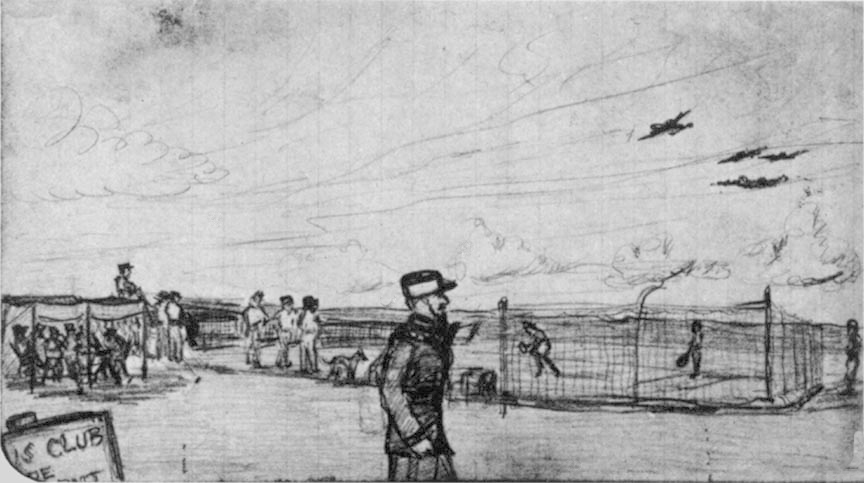

October 1, 1944.
"Since I wrote last, we have moved quite a way North. At present we are in a rather pleasant small town, about fifty or sixty miles from the front, waiting to be sent up into action. This part of the country is a great farming and wine district, so food and wine are two things the people are not short of. Wool clothing and good shoes are scarce, in fact it is about the same set-up as in Italy, many luxuries and very few necessities. Last night we had steak, pate du fois gras, and excellent red wine. North of here, however, the food situation is said to be very bad.
"I saw a collaborationist, yesterday, being paraded through the town by the F.F.I. before being taken out and shot. He was Garrison Commander of the Vichy Militia. He had been beaten so badly that he could hardly walk, but he was being helped along by the kicks and blows of his guards. The people were throwing mud, stones, horse dung, or anything they could fire at him. It was brutal. But he was directly responsible for the torturing and death of many townspeople, and according to the French I talked to, was far worse than 'the Hun'. How these people hate 'the Huns' and the Vichy traitors. Their hate for Jerry seems to be inherited. One can't blame them though, when told about the things the Germans did. If we left the peace up to the Russians, Poles, French and a few other nations that have been kicked around by the Germans, we would not have to worry about another war, at least with Germany."
September 23, 1944.
"We have been here several days and will be pushing North tomorrow for front line work, according to the grapevine. Monte Carlo is untouched by the war, the Casino going but only civilians allowed to play. It is out of bounds to all except the French Army, but since we are attached, we have had no trouble. The French girls in each town are beautiful, friendly, and lots of fun on a date. I went to a dance with one girl I met in Cannes, and she was shocked to find out I didn't know how to jitterbug, so she taught me.
'The more I see of French people and soldiers, the greater my respect and liking for them grows. They are a great people and deserve a better deal than we have been giving them. The country, at least what I have heard and seen of it, is in better shape for food than Italy. The people are too proud to beg and are not whiners and complainers. Shades of World War I.... Bull. Durham has made its appearance. Seeing our ration is limited to ten fags a day, I have made up for the lack of 'tailor mades' by rolling my own. The first one I made took fifteen minutes to roll, and as many seconds to smoke."
No date.
"From what 'Time' and 'Life' say these days, everyone at home figures it is all over but the shouting. Maybe some day people will find out what it is all about, just how fiercely and fanatically Jerry is fighting, and how some of these guys have to pay in blood for every foot they get. I think when they do realize this, the war will be over much sooner. The German soldier still thinks he is going to win, at least the ones I have talked to in the last month. He certainly isn't demoralized by a long shot. An enemy like that is not to be reckoned with by a shrug of the shoulders."
August 30, 1944.
"Things have been shaping up as to what kind of work we will, do when we get to an active theatre of war. The battalion is med. up of litter bearers, medical officers, and three sections of ambulances, each section numbering about twelve ambulances, commanded by a lieutenant. One section of ambulances will be driven by Moroccans, another by French Wacs, and the third by us. The Moroccans and the women will be doing all the evacuations from the main dressing stations back, and we will be driving from the front. We have also had some training for litter bearer work.
"Most of the European officers and N.C.O.s of the battalion escaped to North Africa via the Underground. One sergeant in particular, who went to school in London, and speaks both French and English with a cockney accent, had some rather hair-raising adventures. The commandant of the battalion is an ex-Foreign Legion man, who came up from the ranks, and he is just as hard as nails."
September 23, 1944.
"The French girls in each town are beautiful, friendly, and lots of fun on a date. I went to a dance with one girl, I met in Cannes, and she was shocked to find out I didn't know how to jitterbug, so she taught me.
"The more I see of the French people and soldiers, the greater my respect and liking for them grows. They are a great people and deserve a better deal than we have been giving them. The country, at least what I have heard and seen of it, is in better shape for food than Italy. The people are too proud to beg and are not whiners and complainers. Shades of World. War I.....Bull Durham has made its appearance. Seeing our ration is limited to ten tags a day, I have made up for the lack of 'tailor mades' by rolling my own. The first one I made took fifteen minutes to roll and as many seconds to smoke."
October 7, 1944.
"The other day my co-driver and I stopped in at a restaurant for lunch and happened to get talking with a huge French farmer who was in town with his family for the day. When we started to leave, he made us a present of a package of pork and a pound of butter. A French woman near us saw him do it and immediately started a great fuss. 'Why should he be giving meat and butter away to the Americans, when she had none, etc.' The farmer stood up and told her it was none of her business, it was his butter and he would darn well do with it what he wanted. There was a big argument over this, with everyone taking sides. After it quieted down, the farmer invited us to his farm for lunch next day, so we drove out there in the ambulance. After a huge lunch, we were shown around the farm, which was a good sized one, with several fields under cultivation, and lots of stock he had been able to hide in the woods when the Jerries were looting.
During our conversations, he said he had been with the Thirty-Second light horse artillery regiment which was attached to U.S. troops at Château-Thierry, so that called for a lot of talk and a drink to the Thirty Second and Dad. He also sends his regards to you, as one old soldier to another, as he put it. While we were saying our good-byes, one of his daughters came running out to us with another pound of butter."
October 9, 1944.
"According to the orders, we are going to a town about ten or fifteen miles from the front, and then on up, a day or so after that. After so long away from the active part of war, the close shaves and other nasty part of this work had had time to sink in, but I would rather be working forward than back. Whether we will work as a unit, or be posted out to combat regiments, as we were with the British, I don't know, but I hope we get some good work out of this.
"We will be working with an infantry outfit that is fighting up in the hills. The run back is going to be tough --- over a rough mule track that is muddy as Hell. At night, one of us will have to walk in front of the ambulance to look out for holes and washouts. It has been raining rather heavily for the past few days, and there is quite a bit of mud. I would like very much to 'fight a dry war' just once, to see what it is like..... "The Jerries have got a great railway gun up in this sector, that keeps landing shells over in the valley in back of us. First you hear the whistle, then the 'crump' of the shell landing, and then after that the explosion of the gun going off. It must be a good sized one, because we are quite a way from the front still."
No date.
"Have made friends with an extremely charming man in Cannes, Paul deRemosat, Marquis deVeou, governor of Syria, ex-diplomatist, friend of many of the men in high places before the fall of France, ex-Chief of underground in Cannes area, for which he was twice imprisoned and tortured, discharged for want of evidence, he is now, and has been living for some time as a bookseller. After the Fall he had to leave the army, of course, and his property was all confiscated, except part of his library with which he started his present trade. I got to know him by buying some books at the store, noticing the great quantity of first editions and really good stuff and asking why. Later we came to talk on various things. Next time in Cannes I had occasion to got hold of some food for him, which is scarce still, and ended up at his apartment drinking excellent brandy out of glasses which had belonged to Napoleon's brother, the King of Rome.
"The man is truly of the Ancient Regime, a staunch Royalist, he quit the diplomatic service in the early 1920's when the republic became too rough for him. Though he wants desperately to get to Paris and straighten out his affairs; regain his commission in the army, he waits till the railroad is put through for 'Personne ne verra le Marquis DuVeou en faisant l'autostop' ---though everyone else in France hitch bikes shamelessly.
"The outstanding part of the man is that a great many of his achievements I have been able to verify. I also forgot to mention that he has also written on historical subjects, and organized a rubber company in Indo-China.
A man of his experience is bound to be an interesting one and I had several enjoyable afternoons with him and his equally charming wife in the shop and that one evening at his apartment, which was a melange of pictures, beautiful old furniture and orange crates in the hall. If I ever get to Paris I'm supposed to look him up which I certainly shall do if possible.
"Ran into a British Captain (intelligence) who can now divulge that he spent two (last two) years in the South of France as a collaborationist Frenchman with a beard a foot long and a beautiful Marseillais accent. The Germans had all had great confidence in him as a petty tool, while at the same time he was bossing a chain of 30 operatives and getting his information to an Allied HQ regularly. Is now with F.F.I. as Intelligence and liaison.
"The F.F.I. is quite a crowd. Men with civie clothes, tri-color armbands, old Belgian machine guns and various types of rifles and pistols. They go up into the lines, fight until they run cut of bullets, or food or till their positions become untenable. Whereupon they come back with their prisoners, park them or shoot them depending on what type of work they were do before being captured, and drop into the nearest bar for an aperitive, home to bed. Back to the line the next day for sore more. The American soldier doesn't think much of the F.F.I., but they do their job well these little, poorly armed men..."
| Everywhere, everywhere, Christmas tonight! Christmas in lands of the fir-tree and pine Christmas in lands of the palm-tree and vine, Christmas where snow peaks stand solemn and white, Christmas where cornfields stand sunny and bright, Christmas where children are hopeful and gay, Christmas where old men are patient and gray, Christmas where peace, like a dove in his flight; Broods o'er pr brave men in the thick of the fight; Everywhere everywhere, Christmas tonight! For the Christ-child who comes is the Master of all; No palace too great, no cottage too small. |