Edited and published at AFS Headquarters, 60 Beaver Street, New York 4, N.Y. under the sponsorship of the ambulanciers' relatives and friends, who contribute the excerpts from the letters.
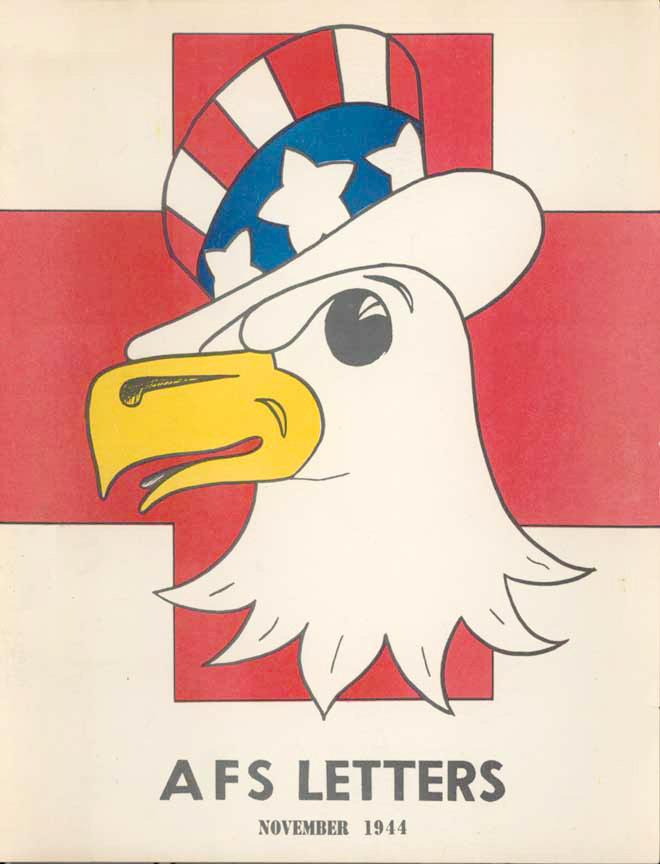
You will find 567 Ambulance Car Company listed at British and AFS HQ as one of the ACCs serving in the field under the AFS. To the men of this company, and those with whom they work, it is known simply as the "Chicken Brigade". This month's cover well illustrates the reason for this title. The October issue of the LETTERS showed a few of the many flashes worn by British Divs and Corps with which AFS serves. These emblems have for sometime been part of the British and American Armies. Thus, it was a foregone conclusion that AFS would not be long in creating their own individual signs.
In August, 1942, 567 ACC was first formed at Tahag in Egypt. Theirs was a hard task, for the unit was made up largely of new volunteers. An ACC to be set up must follow customary Army procedure in regard to strength of personnel, vehicles, maintenance of these vehicles establishment of mobile workshops, HQ staff, etc. The British War Establishment lays down the following make-up.--- an ACC comprises approximately 132 ambulances, twelve of these to be held as spares. With the addition of mobile workshops, stores, vehicles, personnel carriers, water carriers, staff cars and motorcycles the total, strength is brought up to about 190 vehicles of all types. The administration of such a project is comparable to a large trucking concern, with the added problem of the HQ staff, down to the cook truck, having to be so mobile as to be ready to move separately, or en masse, at a moment's notice. This, under conditions of war, is indeed a trying and hard task. That was the job these new volunteers faced.
Being a new unit they were, of course, subjected to the usual "heckling"' from the desert veterans. It was this heckling that decided them to be really "new". With free paint, and freer imagination, their Disney-like eaglet was soon perched upon a red cross. On seeing it the hecklers immediately misconstrued it as a rather scruffy chicken, and thus dubbed them "Chicken Brigade". Theirs was the first unit to originate an AFS flash.
Now the "Chickens" are veterans. From El Alamein to Tunis....from Tunis to Italy, where they are still adding to that record. In one month alone 567 ACC carried over ten thousand casualties. In that month they drove close to 106,000 miles...and they are still driving....still carrying more casualties. Upon their record the Chickens can well afford to strut....they never yet laid an egg.
Other AFS companies have now adopted this and created their own "signs". 485 ACC is now known by its emblem of a Griffin. The units in Burma have become familiar to all troops by an American Indian flash. AFS LETTERS hopes to show these also, and tell the story of their birth, and work in future issues.
J.B.
| THOMAS S. ESTEN | GEORGE O. TICHENOR |
| STANLEY B. KULAK | WILLIAM K. MCLARTY |
| JOHN F. WATSON | RANDOLPH C. EATON |
| JOHN H. DENISON, JR. | AUGUST A. RUBEL |
| RICHARD S. STOCKTON, JR. | CURTIS C. RODGERS |
| CALEB MILNE, IV | VERNON W. PREBLE |
| CHARLES J. ANDREWS, JR. | ARTHUR P. FOSTER |
| CHARLES K. ADAMS, JR. | HENRY LARNER |
| ALEXANDER RANDALL, JR. | GEORGE BRANNAN |
| ROBERT C. BRYAN | DAWSON ELLSWORTH |
| JOHN DALE CUNNINGHAM | DONALD HARTY |
| THOMAS L. MARSHALL | GEORGE A. LADD |
| PAUL H. CAGLE | JAMES B. WILTON, JR. |
| RALPH E. BOAZ | WILLIAM T. ORTH |
WILLIAM TUTTLE ORTH and RALPH EVANS BOAZ, on October 23, 1944, while serving in the India theatre. Both of these men had volunteered to help shorthanded aircraft crews parachute medical supplies from their planes to troops in the Burma Front area. While the plane was flying over mountainous regions dropping its load one bundle failed to clear the plane and caught underneath When it finally fell free, the pilot was unable to gain altitude and his ship disappeared from view behind a hill. A battalion located on higher terrain saw the crash and immediately British and Indian personnel set out to rescue the men. They were guided by runners from one of the native villages, but on reaching the scene of the crash, it was found that all aboard had been instantly killed. A memorial service was held for both of the men on November 4th. The Chaplain who conducted the ceremony uttered these appropriate words, "Let us remember before Almighty God, two who have given their lives--- Ralph Boaz and William Orth."
DAVID VIALL, on October 24, 1944, was wounded during the Italian campaign. Dave was attached to a regiment which was operating on mountainous terrains and was sent to an RAP. Unable to reach his destination by car, he left his ambulance at an MDS and hitch-hiked up the road in an endeavor to locate the RAP. He stopped in the doorway of an Italian farmhouse to get directions when an enemy shell hit close by, wounding him in the stomach. He was rushed back to the MDS and immediately operated on. Although his wound was serious, he is now on the way to recovery and from the latest reports, should be out of the hospital in the near future.
| HOUGHTON P. METCALF | Missing in Action |
| RICHARD ANDERSON | Prisoner of War |
PAUL ULLMAN was killed on August 5, 1944, while fighting with the French resistance group he had organized and trained. Paul was one of the small group of men who were the pioneers of the AFS in this war. He was a member of the first American Field Service Group in France in 1940 and helped to carry the wounded in the Amiens and Beauvais sector during the terrible months of May and June.
JONATHAN HYDE HATELY, on August 6, 1944, was killed in France. He was a member of the Fourth American Field Service Unit and served during the desert campaign. At the termination of his enlistment, he joined the U.S. Forces overseas, and was attached to an armoured division at the time of his death.
News has come from the Central Mediterranean Headquarters saying that H.M. the King has approved the awards of. the British Empire Medal to
Lawrence Bigelow
Walter James Brethauer
The French government has awarded the Croix de Guerre with the following citation: .:
Ière Division Blindée
Direction du Service de SantéL'Ambulancier William Burke Eberhard de l'American Field Service, détaché a la Ière Compagnie du 15th Bataillon Médical.
"Ambulancier toujours volontaire pour les évacuations dangereuses, a toujours fait preuve du plus grand calme et du plus grand sang froid lors de nombreux bombardements de l'artillerie ennemie. A été grièvement blessé à son poste dans la nuit du 17 au 18 Octobre 1944 à Saulxures."
P.C. le 18 October 1944
le Médecin Lt. Colonel Stibio
Directeur du Service de Santé
de la Ière DB
P.O. Le Médecin Commandant Coutie
Commandant le 15 Bataillon Médical

October 1, 1944.
"We all often wonder how things really are back home, I don't mean personal home, but the one that's represented by ye old public opinion, etc. Being over here gives you what might be termed a superior attitude in realization of what the war is really like. That was something very faintly understood on the home front that I remember.
"I imagines though, that with the start of new offensives, a greater understanding is developing, one that goes deeper than the headlines and the radio commentaries. That should be important, I guess. Somehow, it seems rather necessary that everyone truly understand what it is like, in order to arouse determination for a strong peace.
"The fellows coming back are probably going to make first-rate bores out of themselves on this subject. Maybe the new principles will be proved cockeyed, but there's one that seems clear, and that is to squash aggression before it runs wild. That's an old League-of-Nations ideal never put into practice, but perhaps it's value has been made certain at last by the brutal, unidealistic disaster of world war. It seems like a simple plan might work; a plan that will appeal to the simple desire for happiness. If that doesn't, we might as well go back to living in caves."
"Time after time I marvel at the bravery and endurance of the front line soldier. To me, the infantry man is the real hero of this war. When you see such suffering and sorrow it makes you wonder why God allows such things. Perhaps I may as well tell you, I have been seeing some rather exciting things. I have been frightened and shaken several times. One of my friends who was caught with me in a murderous shell fire directed at the infantry group suffered a slight attack of nerves---you would call it shell-shock and exhaustion. I pulled through O.K., but I certainly thought that I was going to die for a while and was scared to death even while we were doing some good work. It's over now, but for a short time I witnessed swift death.
"We take great pride in getting a wounded man to the field hospitals. Meek as I am, I became very aggressive when hauling patients and have been known to tell M.P.'s to damn well clear that traffic so I can get rough; have told colonels to get out of the way,, etc. An ambulance with patients has high road priority. To help the wounded, to ease their pain, always gives me a glow of satisfaction."
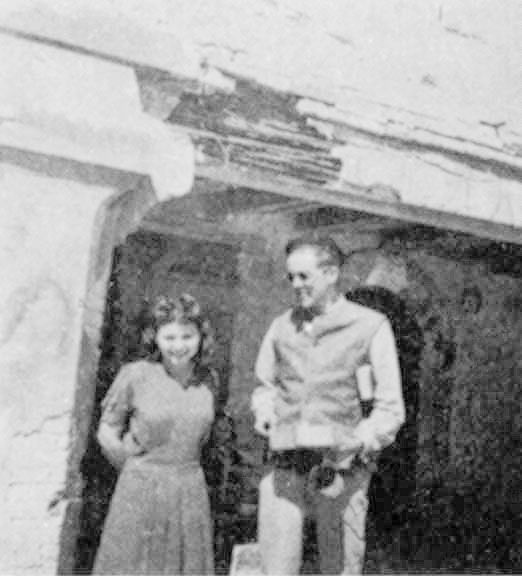 Vol. Sterling Grumman with dinner and dinner date. |
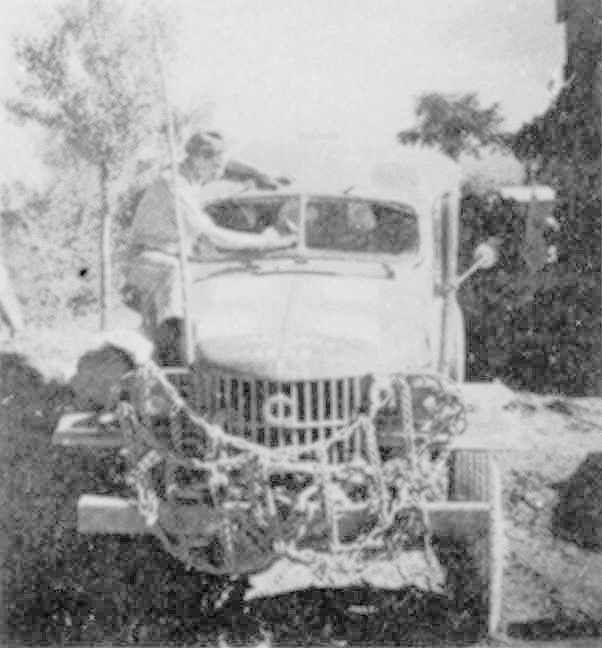 Pre-inspection shine-up. George Collins rates an "A" for effort. |
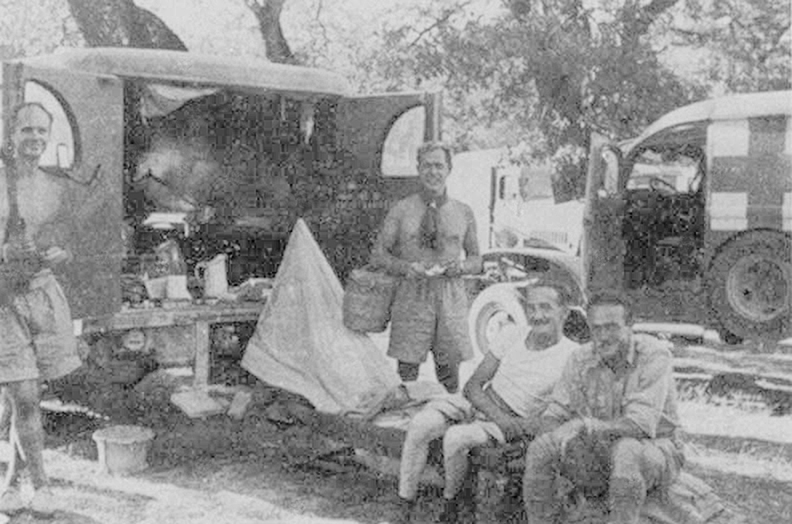
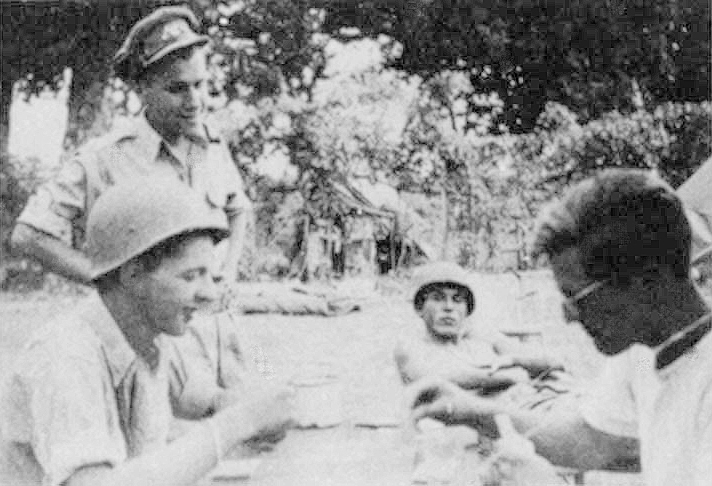 Bob McCulloch, Allan Prince, David Viall, and Jim Helfrich play casino between runs on a 160-mile evacuation route. |
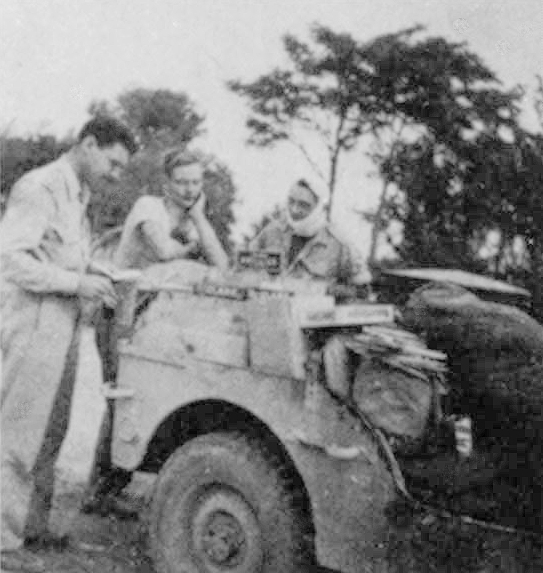 Big business ...PX sales are transacted by Ham Goff (left) and Charles Edwards (far right) while an envious Britisher looks on. |
August 12, 1944.
"We have been pretty steady in our work. I have carried up to 129 wounded; some have been in a terrible condition, which shakes you up in the beginning, but you get used to it as time goes on. It gives you the feeling you are really doing a job when you see the gratitude on their faces when you leave them. I'm very glad I took up this work, for I'm sure I am doing the right thing for a change. It's not a job of glory, but it makes a fellow want to fight against the possibility of ever having another war.
"Jerry comes over and drops a few, but on the ground he's plenty strong. His large guns are as accurate as any could be but I'd hate to be in his boots when the British send in the Indian Gurkhas. They are the little fellows with the curved knives, fast on their feet and silent as a cat. They cut off heads and collect ears to keep account of their dirty work. When they are wounded they are just like children, and would give you their shirt in gratitude.
July 6, 1944.
"The enclosed Nazi blouse insignia, which may or may not interest you, we given me by a Jerry, believe it or not. I happened to evacuate him and got into conversation with him in the few words of Italian we knew. He wasn't sorry to get out of the war, although he came from one of the crack regiments. I've carried lots of Jerrys but he was the closest to the German superman I've ever seen. Blond, tall and husky, he was quite a capable looking customer. He never whimpered although he was shot in the stomach.
"Censorship regulations have finally been relaxed enough so that I can tell you that I did go thru the Cassino offensive. I was attached personally to the Indians with whom I crossed the Rapido River. That was the period when none of us got much sleep and had to work night and day. I believe that I was the first Field Service man across the Rapido. I went across with a stretcher-bearing party before vehicles like ambulances were allowed across. The parties would assemble at a point where they kept the reserve tanks. Then we would go out to pick up the casualties. While we were near the tanks we could hear the radio conversations between different tanks. It was really interesting. The tank commanders would talk to each other about what moves to make and give out orders to get a certain anti-tank gun, etc. Once they sighted a Mark V, and then it was thrilling to hear the progress they made with it. While all this was happening we could hear the tanks and the battle going on but couldn't see because of the smoke. It was just like standing under the goal posts at a football game in a blizzard and listening to the radio account.
"I saw lot of cases of shell shock, but the worst was one guy we got who was the only man to get out of a tank alive. He was in quite a horrible state. I've been quite close to the lines with my ambulance, but that day was the first and only time I was really as far forward as one can get.
"Cassino itself is really one badly wrecked town. It is really leveled. I don't doubt but that the 'Cassino do' will go down in history as one of the great battles of all time. The Germans are certainly wonderful soldiers.
July 8, 1944.
"The work is very interesting, as we evacuate to an 'Air evacuation center' where big planes whisk every casualty from this area far from the fighting front in about three hours. So wonderful are the arrangements that a man wounded at the front may be operated on, evacuated and sent to recuperation centers in two or three days. The planes are manned by American crews and nurses, and there are British Red Cross girls in evidence, but, as you can well imagine, our big interest is in watching the activity at the field. As there is usually a line of cars waiting to unload, we sometimes wait two or three hours, but this is not yet boring. However, it soon will get so, I imagine, as we long to get back to the war and a real rest."
No date.
"Ischia is the perfect place to rest. We stayed at a little Swiss hotel right at the water. It was sunny and warm all the time we were there and the water was cool enough to feel good but warm enough to stay in all day. No one wore rank insignia which was rather nice for a couple of volunteers. The other guests were two Brigadiers a full and Leftenant Colonel and an assortment of Majors and Captains. There was an ARC gal who was sick of men and several French women from I don't know where. One of the colonels was a wonderful Colonel Blimp. He made the RC girl's life miserable so she told us but I doubt. He was a master at British understatement. When talking about the evacuation of Dunkirk he told about a ship that was sunk and the sea was topped with burning oil. 'Of course the oil made it a bit difficult for the chaps.' He must have weighed two-fifty if he weighed an ounce. He floated in the water like a sponge ball. The evenings weren't all peaceful but the days went along like silk.
"Got to know some interesting people. Two moguls in S & T Base area were there. Found out a lot of things from them. There was also a pair of newlyweds. Both of them were in the RAF. No one spoke to them once in the usual-polite way of the British. Every one seemed to think they would be intruding even at high noon in the garden. D. and myself broke the ice like good Yanks and they turned out to be very charming. We aroused the bride's anger by keeping the groom out until two one morning on a small sailing party.
"And so we left Ischia with a song in our hearts and also very worried about dough and a half a pack of cigarettes between us."
No date.
"Am attached to a civilian first aid station in a recently occupied city. We are in the center of it and whenever civilians are hurt the message comes to us and off we go with some 'Itie'' showing us the way. At the beginning it was very often some 'Partisan' or Fascist that had been shot in street fighting, and now it is mostly mines and booby traps or shells. The work is really very interesting and the Italians appreciate it.
"There are numerous hospitals, all with little food, supplies, etc. and all crowded......Yesterday afternoon at 8 o'clock I went about 30 miles into the country to get a girl of 17 who had lost her eye-sight. I had to cross fields, olive orchards, etc. (mines all over). It took me four hours to get her---missed both meals as well, but it was fascinating work. An elderly woman has just come up, and is very nice. Her villa has been mined and she had no place to go. There is a little boy near here that has his left arm shot off, has lost his family ---killed by Germans. He takes a fancy to me and I give him whatever I have. These and similar incidents go on all day. We do what we can, but it is not much. The war is still much too close; now the little boy sits by me and puts his only arm around my waist. It makes you sad. This war has been tough on the civilians. I wish the people in America could see this. Thank God they don't have to go through it.
"There was a rumor that Germany had thrown in the towel, but we soon found out nothing had happened and. the guns were still pounding away. We are getting all set for the end and I have a bottle of gin, several bottles of cognac, vermouth, champagne, etc. I'm just afraid that the end will come and we won't hear about it until later.
"Yesterday afternoon we evacuated 40 people who had been in a cave because their hospital had been shelled and mined by the Germans. A Russian woman who spoke English, who had been in prison for 4 years, was helping out. She was really a character, thin to needle size, with her eyes outlined with charcoal, carrying a huge white cat. The conditions of these hospitals are deplorable. This whole country is poor, and they have been living by any means possible and now that they have a chance to live like human beings, they cannot get out of the old habit of stealing, cheating, etc.
"I have made three attempts in the last four days to got two women who are out in the country about 30 miles away. They have been wounded by a shell. The first time the roads were mined, the second the bridges were all mined, the third was after a heavy rain and the bridges were again washed out; also this time a bridge behind me washed out and I very nearly had to spend two days out there, but by detouring 30 miles I was able to get to a main road and eventually back to the city."
August 6, 1944.
"We're just back from the wedding of C. and the Signorina Licia Sargiacemo of the town of our winter. It has been quite a party! One of the best.
"Perhaps I first ought to refresh your memories with some history: C. worked for AMG during most of our stay in said town --- a part of his job apparently was to keep a watchful eye on the local Refugee Center, where Licia, Vera, Maria and others arranged menus, beds and papers and what-not for migrants on their way thru town. We were want to spend our free hours now and then at the Centro soaking up the language. Thus, by and by, we all became one, happy family and came to use the house of Sargiacamo as a second home. It made for pleasant evenings.
"Nine of us wangled a few days off and treked over for the celebration. A. and I arrived a bare 8 hours after the groom. There being no means of communication the family had had no advance warning, so the scene we burst in on was a confused one of hectic preparation...the ceremony was only 48 hours away... had to be, as C. had only two weeks leave.
"We did what jobs we could, helped mostly by staying well away from the furniture-polishing, curtain-hanging, cake-baking, dress-making dervish and out of the path of calling congratulators. A. and I stayed at Vera's, ate supper there that night, visited with other friends and went swimming the next day with a sort of bachelor gathering on the beach... back to Licia's for a big dinner of just close friends.
"The wedding happened about 10:00 the next morning in the house of Licia. The strange thing was that it did just happen.... I was supposed to be a witness (one of four---two for the bride, two for the groom) the nearest thing to best man. So it was lucky that I was in the room near the kneeling business when of a sudden Licia appeared looking very pretty; then C. was at the altar kneeling and before I realized what was up the old, almost blind Monsignor was rattling off in Italian and Latin the meaningful words ---it was a double-ring ceremony... simple, rather nice certainly full of color and over as suddenly as it had begun. Then much. kissing on both cheeks, while I signed some papers I couldn't read, then food and drink and picture-taking for several hours, then another big dinner for the same select group, eight or ten of the family and eight of us, Maria, Vera, another Maria, etc.
"Later I drove the happy couple to their seaside villa ---two small rooms and a large vine-shaded veranda with a magnificent view, small and on a high hill. They were very happy and it was infectious. We had a 'super' time."
September 3, 1944.
"'About half the wounded we have carried have been German POW's and it's been interesting talking with them what little we could. I showed one my kodachromes I took in California and he abruptly said that Germans would be in America in two years. Day before yesterday while at the hospital ship waiting my turn to unload I heard another say the dame thing. Apparently all of them are completely deceived as to the course of the war. Many of the British wounded were recently fighting the Jerry at the Gothic line ----While waiting to put our cases on a plane, we get them tea, cookies and cigarettes from a British Red Cross canteen and that cheers them up considerably.--- Last night the Northern sky was lit up by an almost constant orange glare---must have been a naval bombardment. One day while coming back from a G.H. run and waiting for a convoy to move on, a demolition squad exploded a mine about 100' to the aide of the ambulance. ------ I guess they are still digging up mines and bombs in the ruined towns; and they are ruined, absolutely plastered. ---The Bailey Bridge is a god-send here where every bridge has been demolished; I don't see how they could fight a war without it.-----"
August 30, 1944.
"I have seen Cassino and the pictures do not do it justice. You'd have to see it to believe it. It's just that X marks the spot. When you see it you feel as though you were on sacred ground and should not talk or make a sound; that the dead should sleep in peace. At least that's the way I felt. For, as you know by now, three different nations, not to mention Germany, suffered plenty there. There is not a wall or building standing more than five feet high, and the monastery was leveled. But war IS hell.
"How glad I am that American does not know the horrors of war and the women and children know suffering as they do over here. What is to become of the little children is really a problem for the Allies."
September 13, 1944.
"A Jerry named Josef Strack who was damn glad to get out of the war said it would go on for a year, and that America and Russia would rule the world. He thought I was an Englishman ..... when one of our other boys, talking to him, said he was American, the Jerry announced to him that after the war England and Russia would rule the world. So, as pleasant as this fellow seemed, he was a propaganda-mongering bastard, carrying on the old Nazi divide-and-conquer line while drinking a cup of British tea served by Americans. A big Lancashireman just below him said: 'It's a good thing for that Jerry us blokes is hors de combat or he would get a knife through him when we get on the plane."
No date.
"Across a snow-covered field: long---stretching to the horizon there are footsteps; man has dared cross perfection and leaves his mark. With an earnest and consecrated step he has walked on. That march is for him life---the meaning of beauty depends on his movement. With him are his hopes and desires and ideals bent and stacked on his one claim of discovery. On his is the weight of a thousand impressions; he is sought eternally by demanding thoughts and desires; he has no quiet, he can give little time to organized reflection; his soul is his own, his hand is upon it, he defies the universe to scratch its finger on it; this is his time, his joy, his search and torture, his scrap of tarnished flesh bleeding on the floor, from his soul he cries for escape and hears in reply the hammer call of millions; the dregs chained in slow rhythm march by him and the cant festers his soul; only with bold emphasis and shattering defiance can he carol freedom. This life, yes, its filth, its vermin its song, its rhythm, its shriek, its discovery yes, but the Man is the center, he stands at the vertex; his is life, defiance, and scorn for conformity. From the cauldron of liquid, seething, anxious in its heat, he draws metal and throws it on his anvil. The beating of his soul and spirit conquer shapelessness."
No date.
"At last I have seen the center of Christianity. A you probably know, Rome is an open City, and is the most logical place to spend a leave.
"The Catacombs are definitely worth a visit. They are situated on the outskirts of Rome, on the Appian way. At the entrance we lit our candles and proceeded down the stairs. Our guide spoke perfect English and explained the history and meaning of the chapels and paintings. Set into walls on either side of the passages are the tombs of the Christians: They reach clear to the ceiling, so you can imagine the number buried there. Because of the lack of air and sunlight much of the painting on the walls has been preserved. Most of them represent scenes in the Bible. The thing that impressed me the most was how easily one could get lost. The accessible part consists at present of several thousand miles of galleries.
"Our rooms where we stayed were part of an apartment run by a little old Swiss lady. She speaks six or seven languages including English. We ate at the New Zealand Club which is as good a place as any. They had dinner music and a very comfortable lounge. We also had access to the American Officers Red Cross where we could get ice-cream and coffee equal to any in U.S. Prices on gifts are terrifically high."
No date.
"Since this was started a lot has happened and I'm right in the thick of it. I've been a week in action with a famous Scottish Regiment and the days have been very full and hot. Now that I look back, it has been well over a week.
"For the first three days after I joined the Regiment, we moved in hot pursuit of Jerry. Often we were no more than a half a mile behind. He would blow out bridges, mine the roads and try all type of demolitions, but we still pressed him hard. Every farm we passed, the people would be standing by the road handing out bouquets, wine, bread and water. The heat was unbearable and must have been hell on the marching men. The cold water, the people cheering and the knowledge of our being a few jumps from Jerry kept us dashing on. Our marching orders each day are: 'Go as far as you can. Go until you meet him!' For the first three days we met his fire about 3 P.M. With his heavy shelling and mortaring he would be able to hold us up and, make us dig in. As darkness came, we would receive a goodbye barrage and he would be off. All night long the dull boom of demolition told of his retreat.
"My big thrill was on the second day's march. We were on. two ridges about 1/2 mile apart. We set up RAP to handle those people who were caught in the first mortar fire. We wanted to get our RAP a little closer if we could, so while they were busy I went to investigate. I had just rounded the house when I hear a spandaw (not sure of that spelling) open up. I hit the dirt and crawled back to the corner of the house while the small doses of lead poisoning whizzed over my head. It shook me. Needless to say, I was very careful where I stuck my head thereafter. The next march was a long one and everything was going fine ---we were entering the last rim of hills before the plains. We were moving along a main road between two demolitions when we really caught it. Shells burst everywhere. We found cover on a hillside and started taking care of patients. We have been in the valley four days now. Jerry decided to make his stand. The place is a little Cassino."
September 12, 1944.
"From yesterday morning to this morning I have been ducking Jerries' shells. I asked for this, and I'll stick it out until I fall from exhaustion or get hit. It isn't too bad getting shelled in daytime because you can see them land, but at night, especially last night, I thought my number was up. At night shells fly every which way and you can't see them land; so when you hear a screaming noise coming at you, you duck (hit the ground or dive into a slit trench or a ditch) and by that time it is a matter of seconds before it lands. Well, I ducked over 30 last night and one landed very close and sent a piece of shrapnel off my helmet. I have never been so scared in my life and I hope I don't go through that for the rest of my life. I am out for a rest and will go back in. tonight or tomorrow morning. If I hear any of you complain about a thing it will be murder, because you haven't really missed or had anything taken away that you couldn't have had in peace time. I have had hardly any sleep in the last 12 days, one meal in the last 3 days, very little food, that's if you can get it, and constant shelling going on which drives you bats."
No date.
"I've had opportunity recently to do some nurse's aiding myself in a very crude way. Making our patients comfortable in our ambulances has always been part of our job. But until recently we hadn't been needed to help out in the wards, which in this case were tents. There weren't enough orderlies to take care of more than the most immediate needs. It was amazing and heartbreaking to learn how very much the smallest things we could do for the poor chaps meant to them. I'll never forget the look on one fellow's face when I adjusted the blanket (there weren't any pillows) under his head. His head seemed to me to be too low, so I refolded the blanket to make it a little higher. The pain left his face as he relaxed more comfortably and tears came into his eyes as he said 'Oh, Yank, that's wonderful'. From then on I was kept busy every morning doing it for all of them. I would also bring along my shaving things and help them shave. I also went through all our cars, scrounging old magazines for them. Such little things one was able to do to help. Some of them rallied wonderfully from seemingly hopeless cases to being 'sitting' patients. Others didn't recover. I was shocked each time. It was different when we just drove short trips, leaving the patients at their ADS or CCS and not seeing them again. But we were with these same fellows a long time and got to know individual cases and watch their varying individual progress. They would show me pictures of their wives and babies and you couldn't help caring each time one of them failed to make the grade. If people at home could see half of what I have it they could have a look for half an hour at what we see every day, the sale of war bonds would double and triple by the minute."
July 20, 1944.
"Since we have been in reserve, a sergeant's mess has been established. I have been given full privileges of this mess. The position of the sergeant in the British Army carries far more prestige than in the American forces. These particular sergeants look after my welfare as if I were a baby. They are a swell group of guys. A rather nifty job of drinking goes on every night in the mess.
"The news of revolution in Germany certainly sounds good. In fact all the news of late sounds as though things are kicking along in grand shape; but I for one am not too optimistic as the Germans still contain an awful wallop. 'Time' says the wave of optimism in the U.S. is so great as to make the sale of bonds a tough problem. Sitting on this side of the fence, you wonder just what the hell is wrong with the American people. Our sacrifices at home aren't one quarter of those sacrifices made by the people in Britain, yet the soldiers say the only thing that really disturbs them is to stand in queues all day. They consider their sacrifice normal. Even the Americans in the Army that you run across crab more than the Tommy. I think serving in this particular spot has taught me lot. I don't mean that I'm not itchy to get this job done and away, 'cause I sure am; but to get this mess straightened out right is worth a lot of sacrifice. So much for moralizing."
No date.
"A short time ago I read the following words in an introduction to Marcel Proust's 'Remembrance of Things Past'. Proust's theory was 'that quality of a direct experience always eluded one and that only in recollection could we grasp its real flavor.' Since I have been here in India I have looked back on the past and have seen many things that I have never seen before. The past has taken on meaning. I see myself as a result of it; the partial imprint of circumstance. I also see the future and what those years in service will mean to the future. I have made decisions; I expect to carry them out. I think I will remain over here another year. The Field Service is a superb organization and we are doing a necessary job. The evacuation of patients is steady. I am learning much about the mechanics of a car. I enjoy working on my vehicle ---it reminds me of my tinkering at my bench at home. I live a beautiful and full life. Music and my pen give the days meaning ---it is enough--- I do not ask for more."
No date.
"I can't begin to tell you how glad I am that I joined the Field Service instead of remaining at college. I'm getting so much more knowledge that is practical knowledge, than I could. possibly ever have acquired in college.
"There are two things you must have to get along well over here. The first is the patience to be a good listener, the second is diplomacy. When I work with the Indians I eat in the kitchen with the Indians ---results: I get more food, real Indian food, instead of the food that they fix for the British."
September 4, 1944.
"I had quite time the night we moved up to this post. We got a rush call, while we were greasing the car, to move up to this post and to relieve two other men. As we got nearer the front, I became more and more disappointed. Like every other new man before me, I expected shelling every second and something dramatic every five minutes. We arrived without having heard a great deal of activity, reported, and went to bed with the prospect of having a run later that night. Just as we'd gotten into bed, Jerry started shelling something or other in the nearby vicinity. Needless to say I was scared as hell and immediately decided that this post was active enough for me. . . .
"After a few days you got to know, shelling and know when to duck. A shell coming over sounds, strangely enough, like a flight of Mallards coming in low over a blind. It's the same low, fluttering whistle that a duck makes. As a result, there's a certain amount of familiarity even in a place like this.
"The contrasts still persist even up here. If you could see this view before me you'd see how hard it is to think of a war going on. We're billeted in a lovely villa, belonging to, I would imagine, an upper middle class Eyetie, sleeping on mattresses and eating extremely well. About ten yards away from me a group of children are playing, as if the war was as far away as Wyoming. The only sign of war is the gunfire and the occasional shellbursts Jerry sends over. However when night comes, this valley turns into a battlefield. It isn't so much that there is more shelling; the very fact of semi-darkness seems to accentuate every shellburst. The house has very thick walls, but if you have to go out for a run, you feel a bit uncomfortable. Nevertheless, Jerry is damned good about respecting the Red Cross, although wish he didn't have the nasty habit of sending over a couple of salvos nearby when we're having dinner. I guess he must have different mealtimes."
September 19, 1944.
"I now find myself at a restful interlude, looking back in a sort of dream-like reminiscence to a period when I was literally in the 'teeth of war'. Now, it is quiet and peaceful, but then ---was it real? I almost wonder. This I do know. War, as we fight it today, is brutal, unheroic, unchivalrous, and terribly impersonal. The net effect of thrusts and counter-thrusts is largely this: a bomb of steel flies from an unknown and unobserved position and bursts into a thousand jagged bits, serving to kill, maim, or terrify every living thing in its effective area. Can there be heroes or crusaders against such deviltry as this? or, are we not more like frightened and maddened animals hunting or hunted in the night? The sight of mutilated, dead men rotting by the road-side is terrible; but the fear-driven expressions on some of the 'Bomb-happies' is worse.
"Strangely enough, I feel a gathering strength and power which pulls me together and drives me on through these experiences, a feeling that 'God moves in a mysterious way, his wonders to perform'; that, even in this hell, there is kindness, comfort, understanding, and good work, all to be gained and given. I believe every soldier feels this, but we are like little lost children with no true directive force.
"But enough of trying to tell what can't really be put into words."
September 13, 1944.
"A fellow, who had been bitten by a dog while out on patrol, was taking a horrible ribbing from the battle casualties, who said that if he died he would probably get the Victoria Cross for 'placing himself in danger unrequired of his Majesty's troops'. He defended himself quite well, however, saying 'the dog should bloody well be decorated as the only Eyetie who ever took on an Englishman single-handed and brought him to terms."
September 26, 1944.
"About three days ago I was changed from one ambulance to another, and as the second didn't arrive on time, I spent almost two days assisting our Medical Officer. An attack was going on during the night of the first day, so we were at the front that morning. This was the first RAP I had seen. It was a small dirty stone house on top of a hill. By the narrow front door was a corpse on a stretcher and inside were men pretty badly wounded. After staying here a few minutes, the Captain, another doctor and myself, walked across to another hill. Between the ---RAP were two tanks. About ten minutes after we passed them 'Jerry' began shelling them. The three of us moved down to the bottom of the hill, and tried to make our way back to the RAP and hence to a more rear position. The German shells were landing all of 300 yards away, but because they were from large guns and were higher than we, the shrapnel fell down on us. I was frightened hearing the shrapnel tearing through tree leaves; even though most were 20 feet from us. We finally got back all right. Later that day 'Jerry' realized the position of --------------------(where we were) and shelled it for 15 minutes, killing---and wounding ----------(We were up there later and it was a very bloody place."
August 27, 1944.
"I saw Colonel Kenshole on the road the other day and it reminded me again of my first day in action. We were attached to the Grenadier Guards for the initial attack on the beachhead, and during the first morning we moved the RAP forward to a cross-road where there was a slight protection of about a four-foot road cut. The medical post was just set up in the ditch without any cover, and there was just room to get the ambulance turned around and pointed out, but it had to be left standing in the road in full sight of the enemy who were a matter of about 250 yards away. There was a line of our tanks on either side of the little space left for the medical post, and their guns were firing steadily over the low embankment. We got the ambulance in and turned around just as the stretcher-bearers brought in two badly wounded guardsmen.
"About that time Jerry began to get the range of the tanks, and mortar bombs began dropping closer and closer. We all sought the shelter of the ditch, and got the two stretchers well down in the bottom. The shrapnel was singing over our heads and imbedding itself in the embankment. I was thoroughly scared. I had never been under fire before, and the mortar is the worst weapon I've ever faced. The shells drop almost straight down and make a hideous noise en route. We were all as low down as we could get including the medical officer, expecting every minute the next one would land right on us. Just at that minute a jeep drove up and Colonel Kenshole stepped out as unconcerned as if he were strolling down Piccadilly --- soft cap on his head, swagger stick in hand. He looked down in the ditch at us and said, 'Do you have anything to eat? I'm starved'. Someone handed him up some crackers and cheese; and he stood up there in the road head and shoulders above the embankment, munching away. About then six mortar shells in rapid succession landed within fifty yards. We got even flatter in the ditch. Colonel Kenshole looked over his shoulder toward where the mortars had landed, shook his head a bit and said; 'Beastly noisy, isn't it?' and then calmly straightened his cap, got in the jeep and drove away. L. looked at me and said 'if the old man can stand up there and eat a bloody sandwich we can load these boys into the ambulance.' And so we climbed out of the ditch ignored the landing shells as much as we could, put the two stretcher cases on board and carried them safely back to the main dressing station. It was a classic example of the way an officer, if he is a good one, can bolster morale in the field. It looks so foolhardy but it certainly works. I never appreciated anything in my life as I did the Colonel's presence that morning, and I never looked at him afterward without remembering it. He was wonderful."
September 15, 1944.
"At 8 o'clock in the morning I set out with one priority, one patient (very bad) and a medical orderly to go to a field dressing station, a distance about seven miles. The road passes through a small city and on to a larger one where the FDS is located. The trip going was uneventful and all went well. However, on the way back when I reached the smaller city, it was taking a terrible beating from very accurate enemy shell fire. I parked about four hundred yards from its limits and waited until I saw a lull and started through. Just as I got into the middle of the village some men waved frantically from a bombed building, so I stopped and backed the ambulance up to the door and got out. A few minutes before two men had been hit by shrapnel, and the group was trying to fix them up in this building. We offered to take them to a medical dressing station. I went to the ambulance and opened the back door to get stretchers and blankets. Just at that moment there was a terrific explosion as a shell landed right in the town. I dropped to the floor and then as I raised up another one landed. After that I was able to take the equipment out and into the building, and then help to load the patients. As I left the town another shell landed just to the left of the road and I 'stepped on it'. I got them to the MDS all right and then arrived back at my own advanced dressing station at 12:30. Frankly, after having the shells burst so close, and seeing the two men writhing, not having had any morphine, I was rather unnerved......I saw the body of a young fellow who had been hit in a jeep, a few moments before our jeep went over the road, and I don't think I'll ever forget him. You see, it's the aftermath of danger, the fear of being under shell-fire, that makes up the real frightfulness of this business. But yesterday was just a bad day for me. Actually we have a wonderful lot of men here and life isn't bad at all ---it's just a slow, normal flow of men, hurt very badly. So today I'm very happy and I do think it will be over soon. I am with one of the most famous divisions of the British 8th Army, and will tell you all about it when I get home. You can't imagine how proud I am to be with them. The AFS is doing a good job and is known all along this front, so I'm proud to be in the war."
No date.
"Besides being shot at, mortared, shelled, as we all have been, and so close that they have hit the house we have occupied, I myself have been fortunate in having got all my patients thru without ever having a mishap. Although I nearly finished myself off in missing the approach of a bridge and finally stopping with two wheels of the car draping over a fifty foot precipice. They saved the ambulance as the other two wheels stubbornly held on to the bridge. My two very unusual experiences were these. I was sleeping on the ground, our battalion was waiting orders to move up. As I lay there on the ground a fifteen hundred weight truck wheel backed directly over my head. And believe it or not I was merely in the hospital tour days with a cauliflower ear. That was the time my mates around here thought I had 'Had It'. The other incident was when a British sergeant and I were on a reccy in no-man's land for two wounded British soldiers. As a result we ran directly into the German lines, their forward infantry companies. We were held for a short while to wait for their under officer. As the rest of them were as confused over such an incident that they were hardly able to do more than stand there undecided and somewhat bewildered. Neither the sergeant nor I wanted to see the under-officer as the circumstances gave us considerable knowledge of their location, troop displacements and strength of position. I made a try to make a mad run for it, but the Jerrys said 'Nein'. The British sergeant was a damn good man in that situation and convinced the Jerrys standing around that all we wanted to do was to turn the car around. Why, I don't know, but they allowed us this. That was all I wanted. I backed her up about fifteen feet to a turn in the road enabling n to hear her back down the hill again. Instead of stopping there I shoved her in gear and made a helluva run out down the hill at top speed right in front of them. They could have easily riddled the ambulance with bullets. But they let us go once we got under way.
WE WANT BOOKS; -This is the cry from overseas where our men so greatly appreciate all those sent heretofore. But we need more and more books, so scan your supply and send us current novels and non-fiction which you have read and then next time you are in a book store buy a couple more and send to:
American Field Service
60 Beaver Street
New York 4, N.Y.
We will get them over to the men.
American Field Service Day was observed on Sunday, November 5th at the New York War Fund exhibition, "31 on Parade" at 'Rockefeller Center. The ceremony featured speeches by Mr. Galatti, Major R.A.F. Williams, Assistant Military Attaché at the British Embassy, and Captain A. de Manziarly of the French Military Mission. Mr. Richard Lawrence of the N.Y. War Fund was master of ceremonies, Miss Margaret Downs, radio star, led the singing, and Jim King and Stu Benson of AFS spoke briefly. AFS, French and British guards of honor added another impressive note to the program.
John Stamm and Bob Marshall, AFS India, were ordered at dusk one evening to deliver a stretcher-load of medical supplies at an ADS "come hell or high water." It turned out to be high water. Crossing a creek, Bob fell into a hole so deep that the water came over his head, but by holding up the stretcher he managed to swim while submerged and they reached the opposite bank with the much-needed supplies intact. The colonel who had given the order was good enough to compliment them when he saw their bedraggled appearance.
Of interest to AFS men who hope to study at French universities is the announcement that plans are being made to resume American Field Service exchange scholarships. Qualified applicants who have served overseas with the AFS in this war will be given preferred consideration.
A newly-arrived AFS volunteer in Italy was instructed in military protocol soon after being assigned his post. M.P.s, he was told wear red Insignia on. their hats. Full of his newly acquired knowledge, he dashed off on a run with a carload of casualties. A red-capped official soon waved him to the side of the road. The driver was determined to deliver his patients post-haste and leaned from the window with "Hey, bub ---you take care of the traffic and I'll manage the patients." It was later, much later, that a sheepish AFS volunteer dared repeat the story of his first encounter with an "M.P." ---Major General Freyberg, V.C., K.C.B., K.B.E., C.M.G., D.S.O.
Volunteer Cliff Bissler is the owner of a green parrot named Jane who resides in a cage in the back of his ambulance. Jane eats anything, as well, she must to survive at the Burma front. When Cliff has a call to go up to the lines he carefully transfers Jane to another ambulance, but sometimes this ambulance too goes up to the fighting area, with the bird's presence unknown to the driver. When this happens Jane's language is frightful, but no AFS man will admit to teaching her the words she uses.
An AFS man doesn't take long to make his mark once he and an ambulance get together. Reggie Taylor, who left this country for Italy a scant ten weeks ago, is the subject of one of the most complimentary letters it's ever been our privilege to read. Signed by an R.A.M.C. Lieutenant, it reads in part: "Pvt. Taylor willingly went everywhere I wanted him to take me, and, in fact, I had to restrain him on one occasion from going on a "recce" himself. He kept going with complete disregard for his personal safety, and was a God-send in evacuating casualties....I can never hope to have a more brave and helpful comrade." In passing we note that Reggie's contributions to the war effort are not confined to his personal deeds at the front....he has a son on active duty with the U.S. Army Air Corps.
Two AFS representatives, both Field Service veterans of World War I, are the authors of recently published books. Samuel Rogers, Professor of French at the University of Wisconsin, has turned his talents to a mystery novel "DON'T LOOK BEHIND YOU!" and John Whitton, Professor of economics at Princeton, has set forth his peace plan in "THE SECOND CHANCE."
Fred Kern of the India Unit hit the newspapers lately under the headline of "Spittin' Image of Hirohito Spits on Fred Kern's Face." Intrigued by this bit of expectoration, we pass on the story. Seems Fred had U.P. correspondent John J. Andrew as a fever patient in his ambulance. Andrew, with a 104-degree fever, didn't quite trust his eyes when he spotted a toothy Jap jabbering at him from the opposite stretcher. Giving a shout he soon got Fred to come around to quiet the Jap. Fred finally figured out that he wanted water, so went for his water bottle. Meanwhile Andrew lit a cigarette and placed it between the Jap's lips. With one spat it was thrown right back in Andrew's face. What happened after Fred gave the Jap three swigs of water you must have guessed by now. That's right!..... our volunteer was completely soaked. Our angel of mercy again tried giving the difficult patient some water and again the good samaritan got it right in the face. Well, the rains had come just once too often for John Andrew, so with ''Sorry but I gotta see a man about a story" he departed. Last seen, Andrew was slowly marching back with a fever and typewriter as his only companions.
As recently announced on this page, the British War Office has authorized service chevrons and wound stripes for AFS volunteers. Since this order has been effective, chevrons have blossomed forth on the sleeves of AFS battle dress and bush jackets alike. According to rapid calculations, a very select group of 14 vets is entitled to wear three chevrons, a sort of AFS "Pre-Pearl Harbor" designation.
Freddy Child is a private in the U.S. Army, stationed in England. Arthur Stratton and Bayard King now in the army in France; Lindley Baldwin, a candidate in training at the Provost Marshall school at Fort Custer --he's the guy you don't like to meet if you are GI Joe; Kenneth Ungerman a Captain in the Army, recently returned to this country, and was married while on furlough; Howard Weisberg, an aerial instructor in the U.S. Army, stationed at Springfield, Mass.; Andy Geer, Captain in the Marine Corps, just back after eight months service in the Pacific; Walter J. (Dick) Dixon, commissioned second Lieutenant, now at Camp Lee; Carleton Keysor in France with U.S. Infantry; Folam Kreis, Captain, U.S. Army, leaving Indianapolis shortly for God knows where; Hod Gilmore, in an Engineering brigade somewhere in the Netherlands Eat Indies. Hod says he is a member of the Brigade band and those of you who remember his violin playing on the desert, will know that the men around him are glad that he is there.
Harcourt (Bill) Awry is in OSS. He's stationed in Washington and hopes to go overseas soon in same direction as the AFS; Fred Rath and Bill Callahan still together at Camp Ritchie ---they're getting to be like the Sawdust Twins; Ray Schroth a second Lieutenant assigned to a Medical Training Battalion at Camp Barkeley; Albert Lovejoy, in United Seaman's service, stationed in Egypt. He saw Bill Merrill and some of the Indianites on their way to CM; Ralph Woodworth in Armed Forces commuting between Ireland and England; Fred Wackernagel in OWI now at Algiers; Robert Curry in Military Intelligence in France; Bud Banks, an Ensign in the Navy, now out on the Pacific; Dave Spencer, private in U.S. Army, stationed at Camp Wheeler; Barnie Lefferts, also a private in the Army ---at this time whereabouts unknown; once again, we say this does not mean he is missing --he is just missing to the AFS, which is serious, but not fatal to Barney.
Kenneth Proctor recently a bridegroom, is working for FEA in Washington; Jim Newton, at M.I.T. in a radiation laboratory. Gene Hammond, who recently returned from overseas with Johnny Harmon, left the new Mrs. Hammond, formerly Doris M. Martin, when he sailed. Gene sure is a tight-lipped guy, as he said not a word about his marriage during the days he was around GHQNY before his departure. Gale Smith, who will return overseas with the French Unit, married Roberta Hein, while George McCay assumed the role of best man; Charlie Bachman middle-aisled it with Margaret Truesdell; Patricia Van Patton became Mrs. John Wilson in Lincoln, Nebraska on October 14th; Charlie Wood, now a Lieutenant in the Navy married Betty Ann Venter, and George Marsh, also of the Navy, and an Ensign, wed Miss Elizabeth Jeffries in Coronado, California.
Bob Thompson and John Patrick are both deep in the hearts of their respective shows. Bob's play "The Perfect Marriage" opened in New York and got off to a rather slow start, but Miriam Hopkins and Victor Jory do a superb job, so it looks as though the play will be a success after all. Patrick's show goes into rehearsal shortly and from all indications will be a hit.

August 9, 1944.
"One day our group leader requested me to pick six men for an urgent mission of mercy. It seemed that a native woman, a Naga, had been hurt by a thunder bird that lays loud-noise egg, and was lying in agony seven miles away in the hills. At 10:00 the next morning, armed with a stretcher, a first-aid kit, our rations, we started climbing the steepest cliffs I've ever seen before.
"Turns were taken carrying the stretcher up the narrow trail. Five minute intervals was all anyone could manage without collapsing. Two miles in we came across the remains of a Jap camp with a sweetish, gluelike smell pervading. Two Jap remains and a pile of mule bones were the cause. Numerous items of equipment lay here and there: the Japanese .27 rifle, packs, harness, knives, etc.
"We passed several such camps and finally got about 5,000 feet up above the starting point where we found a Naga village deserted. We all dropped on to the ground exhausted. An old horse covered with flies and with the wisdom of old age in its eyes grazed not twenty yards away. It was too old and thin to have been eaten by the Japs, was the only living thing left behind in their retreat. It was quiet and hot. Only the buzzing hum of flies and crunch, crunch of the nibbling horse. The object of our mission presumably had died. Soon the Nagas will be back, though, and return to their normal way of living as though nothing had ever been out of the regular routine."
August 17, 1944.
"The other day, B., a rolly-polly English fellow, S. and I went into the bush to a village where we hoped to barter for eggs. We had salt (nimak) soap (charpole) also some baksheesh (gift) cigarettes for good will.
"B. led the way as he had been there before and S. and I came along to hoist him over logs, walls, and bumps. When we came in sight of the particular house we were in search of, B. gave a shout and the father came smiling out to greet us. The little girls who had been playing in the yard ran inside and, while we three exchanged salaams, were to be seen peering from the doorway. Those people live in homes made from bamboo, mud and tree trunks.
"We were ushered up to the porch where we were bid to sit on straw mats. Cigarettes being passed out all around from Poppa even to the smallest child, one year (who commenced to gorge himself on it), we sat in a circle and the dark faces beamed while we tried the dialect. Native food tid-bits were offered. I gave the eldest daughter, who was a tall, light, tan-colored beauty with pure white teeth, a cake of Lifebuoy if she would do a dance for us. With much hand-waving and hip-wiggling she responded. It was most interesting to watch. Everyone clapped to keep the rhythm and she accompanied herself by singing.
"The father, mother, three elder daughters aged 20, 18, 16 and four smaller kids (sex unknown). All of them smoke these tasteless, weak Indian-made British cigarettes with relish. Even children of 2 and 3 are to be seen walking down the dusty road smoking great gusts of fumes. It's very usual.
"I admired a brass necklace that one of his daughters wore and he said he would bring me one soon. I hope I get it. It is a 'smasher'.
"These Mohammedans are clean people, their religion is based on sanitation, their hair is shaved from under their arms and private parts I understand. The Manipuri Mohammedans are not as strict as those of the North West, Karachi, namely. The women will readily speak to a white man and never cover their faces completely as do those of Karachi. But once married they obey their husbands strictly, never sleeping with one's neighbor as white men sometimes do. If a Hindu, Mohammedan or Jinnah woman is unsuccessful in gaining the love, and consequently becoming married to; her first boy friend she has to accept all men as her husbands. In other words she becomes prostituted, either being sent to a wealthy man's harem or brothel operating under the auspices of a pimp or joining several women, and plying their trade together."
September 8, 1944.
"A ghurka boy, aged 10, has adopted himself to our section. He speaks 50 words of English, which we taught him, and I speak about 100 of his language Urdu. Through this I learned a lot about the Japs who killed his ma and pa at Kohima. He showed me how they salute and their drilling methods. He hates them ---they were so cruel to his people; taking all their rice. This is the same little boy who, in fun, and not knowing, pulled the fuse on a phosphorous bomb and threw it between two Naga men. They died as a result of the severe burns."
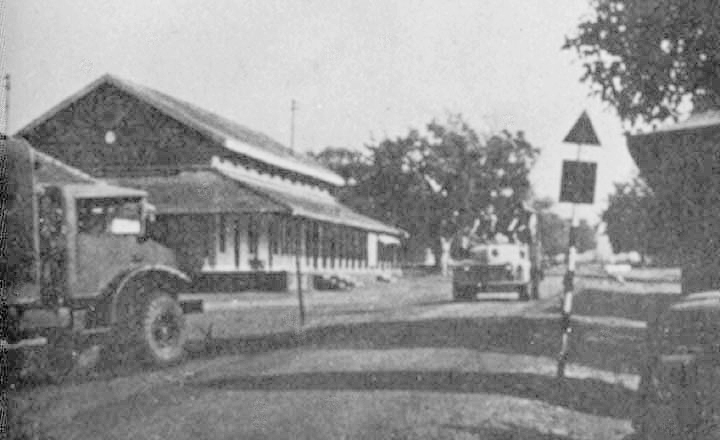 AFS volunteers from the States arrive at their training center in India. |
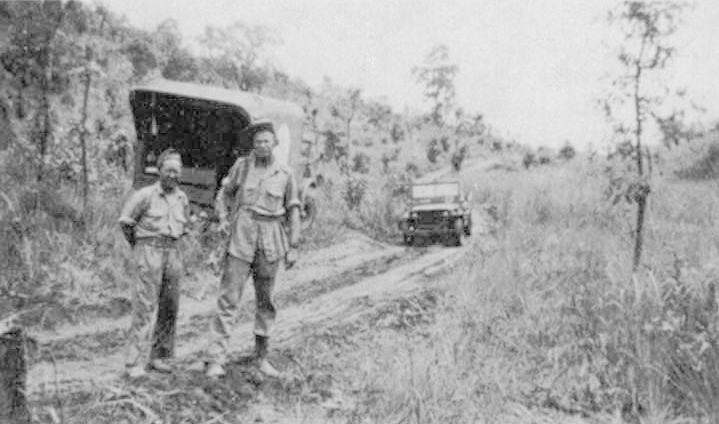 Rob Robinson and Alex Roach wait for the passage of a staff jeep on the Tamu road. |
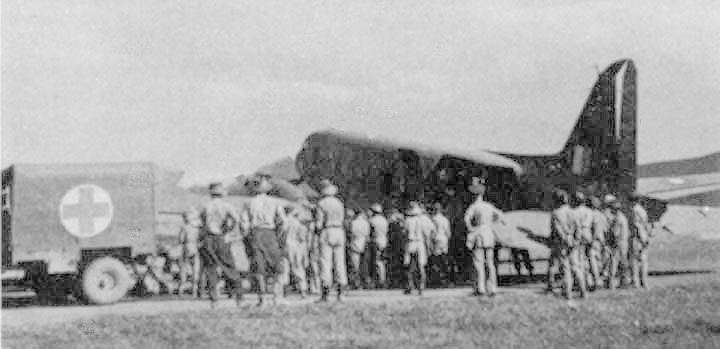 Air evacuation .... AFS drivers at the Assam-Burma front see their charges off on the next lap of the road to recovery |
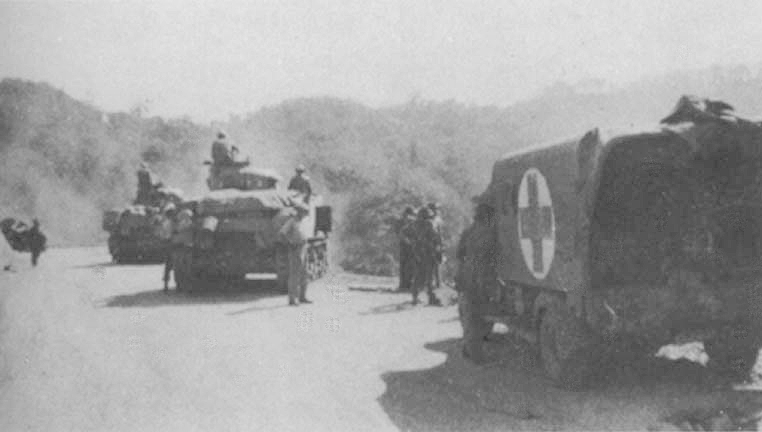 AFS ambulance stands by for the "go ahead" on the Tiddim road. |
September 11, 1944.
"Yesterday I drove my water cart, a Ford, seven miles to the place whore water is pumped by gas pump into the tank. I was all set for a quick get-away......No one was there. All pumping equipment had vanished. Around I turned the heavy thing and back over the bumpiest, dustiest and muddiest road I've ever been on. When one mile from camp my engine stalled as I was driving through a knee deep mudhole. It refused to start; obviously flooded; then rain came. I hoofed the remaining mile and back again with two wogs (natives). I got the thing started and off we went to the stream. After backing as close to the muddy deep slopes as I dared I unleashed the two wogs equipped with hand pumps and twenty feet of hose. All three of us pumped, sawed, heaved and screwed until we were the typical result of the old Army fatigue party. It took an hour and a half to pump the tank full compared with 4 3/4-minutes with the gas pump. Such is the spice of life...After I add chlorine, alum, etc. to the water the result in one half hour is a slightly clouded liquid which tastes and is O.K."
September 19, 1944.
"I expect to get a jeep ambulance within two weeks and go up to the line where it may be hot for a while. I've got a swell little Jap entrenching shovel which is light and with which I expect to do some rapid digging at times.
"Incidentally, there was a war correspondent here the other night who knows L. I gave him a little story of an encounter with a wild pit ---so don't be surprised if you read it in the Herald soon."
September 23, 1944.
"Last night we managed to get some damn good programs from the States via Delhi. There was some jazz, Jack Benny, Fibber McGee and an especially good one of sound effects that the soldiers requested---Times Square on New Year's Eve, Lana Turner, a baby crying etc. The static is so bad, though, due to the rain, that reception is very limited and garbled.
"Yesterday we hiked four miles into the hills to the ex-Jap headquarters for this area. It used to be a Baptist missionary village --twenty well-built houses, gardens, stone walls and bath tubs. There were no souvenirs whatsoever. However, we did take some good pictures of bomb craters and bombed out buildings. Do you want a Jap skull? Now that I'm better acquainted with mailing ways I'll try to ship home something better than I have already. A Jap canteen, insignia, flag, sword, medals, etc. Enclosed are some Jap invasion notes, a sleeve division insignia, a sketch and an Irish money order. Also a Jap instruction sheet for mosquito preventive."
September 30, 1944.
"At any time now the mail both ways may be irregular and unreliable as we expect a rush in work to come. So don't worry, although I know you will. Everyone is bored now with the dull, scarce work, but it will pass soon and we'll be happy again."
I was going as fast as possible, as we had a 70 mile rough road to travel with the jeeps. When we arrived at HQ, we were told the orders had been changed, and we were to leave the following afternoon. I spent the next half hour combing the bugs out of my hair and moustache.
"I signed for my jeep the next morning and was as happy as a kid with the first pair of long pants. After we drew our tools and skid chains and condensed our luggage to a pack and an ammunition box it was time for lunch. Right after lunch we left, four of us, and what a ride that was. We had sixty-eight miles to go and the further we went the worse the road became. We ate in the Officers' mess that night; and went right to bed. About five in the morning, the rain started and except for one afternoon, it's been raining ever since. I put on the same wet clothes in the morning that X took off the night before. I have dry, or fairly dry ones; but it's useless putting then on when they, too will be soaked in fifteen minutes.
"The roads are so bad, it took us three days to travel sixteen miles. The mud is beyond description; I've never in all my life seen so much of it, I'm covered with it from head to foot, due to me trying to help push a jeep out of a hole and not having the brains to stay from behind the rear wheel, which had chains on. When the jeep went forward it sent up a shower of mud, most of which went on me."
September 6, 1944.
"I'm almost willing to sign a sworn statement that there hasn't been so much rain since Noah, and if it keeps up for a few more days I'm going to inspect my hands and feet carefully each day, to see if they are becoming webbed, as only an amphibious animal can live under these conditions and survive.
"We are camped on the side of a hill at an FDS and a few hundred yards from our guns. We are at the Officers' mess, and what a crazy crowd they are. A Major is in charge of the show and there are five Captains who have various duties around camp. The Major is Irish and three of the Captains are Scotch; what a riot at meal times! They are continually ragging us and we them. We have tea for breakfast; at 10 A.M., at lunch, and at 4 P. M., then, thank God, coffee for supper.
"My mustache is two months old today and a prettier thing you've never seen. It's just about 5 inches from end to end and still growing strong. Figuring that the longest hairs are one and a half inches long now, and the space across my upper lip is roughly 3 inches, that means the hair is growing at the rate of 3/4 of an inch per month. By the time my year is up, that would be 4 1/2 inches more; added to the inch and a half, making a grand total of 6 inches, 2 X 6. is 12, and the 3 inches across my lip makes a grand, grand total of 15 inches from end to end. I've gotten out of the 'Colona' class and now it resembles 'Kaiser Wilhelm'.
No date.
"I was able to follow this particular RAP and ADS with interest. Comes morning at about 4:00, the camp slowly begins to melt away leaving a bare skeleton to handle anything that might come in by mistake while the other parts of the unit move forward. During this time, casualties are being loaded but the M.O. and the camp moves in with clockwork precision, setting up and displaying quarters as though they had been there for a week.
"This particular M.O. had a lot to say about a mule company that was always using his sites for a road to go into forage and night quarters. Some of his baleful. comments would have given the best G. I. muleskinner a sharp advance in talent! Briefly, they follow so fast behind the troops that it is often necessary for them to take up the brakes and slow down. In one instance the M.O. had left our reccy and found a lovely site; as; he was preparing to move in, however, a snappy looking I.O. informed him that the Japs had not quite evacuated the area yet and he would have to wait another hour or two. Taking the Intelligence Officer at his word, he proceeded to move in about two hours later to find himself in the middle of a free-for-all evacuation and tenency --- result, he was in the fight alone. With these units the AFS follows closely and often works in advance of the stretcher teams to ease the burden of work that falls to them. It is not unusual to find a jeep loaded over the capacity merely because the AFS volunteer wanted to get them all back at the same time and not by sections."
August 27, 1944.
"I've just spent the busiest two weeks I've had since I arrived out here, lots of what you might call big doings for me. The Lt. in charge of our section was chosen to form a new section of jeeps. The way our work was being handled, there really was no need of an N.C.O. and I was getting tired of inactivity. So as soon as I got wind of the jeep ambulances, I asked for a transfer, and it was granted. One evening during supper, word came to us to report that evening to the AFS Field HQ. Our jeeps were there, and we were to out that night. What a scramble, packing and collecting my ton and half of junk but in a short time the three of us were ready. We threw our stuff in the back of our trucks, put the roof back and the windshield down and I got behind the wheel. It was about dusk, and we drove a few miles before I had to put the lights on. We had been aware of some objects hitting us in the face, when I put the lights on we could see that it was swarms of insects we were driving through. It was awful, they were getting into our eyes, nose, ears and mouth. I solved the problem very neatly indeed. I found that if I tucked my lower lip up under my moustache, it very effectively filtered the air I was breathing. So you see, the moustache really came in handy; I was quite comfortable while the other fellows were holding on with one hand and holding a handkerchief over their noses and mouth, suffering the torments of the damned.
American Field Service Headquarters near the front is a collection of bashas.. That word, once forbidden by the odd rules of censorship, because it was descriptive of dwellings in a certain part of India, can now be used. Presumably the Japs have learned what part of India the War is being fought in. A basha is a building made of bamboo and thatch with a sharply peaked root to shed the heavy rains. Its walls inside are plastered and white-washed to where the roof begins every house is a basha and they are used for a variety of purposes.
Field Service Headquarters is an oblong compound, flanked by buildings. On one side are the men's sleeping quarters, containing beds with the usual mosquito bars, duffel bags, and all the odds and ends which men in the field accumulate ---tin helmets, native knives, iron rations against an emergency trip. From the wall of one basha a Jap flag hung limp.
Across the compound are the mess-hail, PX stores and an office. The mess-hall is long and narrow and holds three tables where one sits at whatever place takes his fancy. There is no formality and no precedence. The bell rings---it is a beautiful bronze temple bell, loot from some ruin --- and everybody makes a rush. It is first come, first served. The men say that eventually they will return the bell to its new home. "A Bell for Adano" caught their fancy, and they want to be the sponsors of its Indian counterpart.
The food, supplemented by a mess fund, is very good indeed and there are usually "seconds" unless a hungry group descends on Headquarters from the outposts. A punka, that is a contrivance made by stretching pieces of cloth on wooden frames hung from the ceiling, keeps the mess-hall cool. A servant sitting outside pulls the cord which sets the punka in motion, thereby creating a breeze. At least that is how it works in theory. Actually on hot days the punka-wallah goes to sleep. When a fresh mountain wind is blowing he wakes up and animates his fan violently. Nobody seems to mind.
At one end of the compound is the Field Service club room which is decorated with murals painted by one of the men and very well painted, too. They illustrate the names of such famous night clubs as El Morocco, The Stork, the Black Cat, etc., and are nostalgic of other days and other places. This place has a name too. A sign over the door proclaims it as Cafe El Malaria.
The room always has some occupants during the day, reading or writing letters, but at night it comes into its own. A radio, and a phonograph with well-worn records play simultaneously. The bar at the far end of the room is always crowded with feet on the bamboo rail when there is anything to drink. A sign sternly announces, "A.FS. Men Only," but it doesn't mean a thing. The British, eager for a little gaiety and the companionship of the men they work with are constantly poking their heads in the door and asking mildly, "Is Tom (or Dick of Harry) here?"
Inevitably they are invited in by Tom, Dick or Harry, and the room is often crowded with British officers and men of all ranks. Warm friendships have been formed between our men and the British ---friendships born of genuine liking and shared work. On my job as a war correspondent I have talked with everybody from Brigadiers to privates, and I have never heard anything but the most enthusiastic praise of A.F.S. men and their work. Usually, by eleven, the Cafe El Malaria is dark, its customers in bed, which is not quite like its counterparts at home.
Finally there is in this compound, the room of the C.O., and the office. In the office a young man sits all day by the tinkling field telephones "American Field Service. Yes, sir, we dispatched reliefs for the jeep show this morning." "American field Service. You say the water-truck has broken down? Well, tell that bird to fit it up and get right back I want a bath." So it goes.
About fifteen Indian laborers are always policing up. That is, they are when they are watched by their overseer, an A.F.S. man who wears high boots and tries to cultivate a voice like Simon Legree's. When he shouts at them they take up their shovels languidly; when he turns his back they squat on their heels and contemplate the unfinished work. But somehow they get things done. Each basha is surrounded by a deep ditch to drain off the rain so that the place is comparatively, dry. The "slave-driver" is always thinking up improvements, and A.F.S. Headquarters in the field promises to become a model camp. When that happens I suppose they will move on. It is a way armies have.
There is a coming and going of ambulance drivers all day and all night long, but they say little about their work. "No, it's dull up there, or "For a while it was pretty hot," "Stick to the road at such and such a milestone. I know it's bad, but they've discovered a mine-field to the right." That is all. For them it has become just part of the grim routine of war. Overhead airplanes pass constantly on their deadly missions, but the men at Headquarters never look up. They have their own work to do.
If you wish to send money or messages to members of the AFS overseas for Christmas, your checks should reach these Headquarters prior to December 15th. The Christmas cables will started going over on November 15th, and are being sent three or four times a week up to and including December 15th.

The twenty-nine men listed below make up the French Section in France, where AFS tradition is once more maintained.
| Addoms, J. | Fugitt, W.G. | Molly, H.T. |
| Alexander, C.B., Jr, | Fuller, W.D., Jr. | Moore, P.V.C. |
| Bowen, B.M. | Greenough, T.O. | Selz, H.C. |
| Britton, A.B. | Hannah, W.T.C. | Shearman, W.G. |
| Chaney, B.D. | Hodel, J.C, | Shepard, R.C. |
| Cook, W.C. | Hope, Q.M. | Sherman, H.J. |
| Cooke, W.H. | Johnson, P.A. | Smith, B., Jr. |
| Coster, C.H, | Martin, C.P. | Tanner, E.E. 3rd. |
| Eberhard, W.B. | MacArthur, J.R. | Williams, F.W. |
| France, H.B. | Mayer, P.E.M. |
September 25, 1944.
"Food is a current great problem in southern France. During the occupation, the people, not lacking in the least in folding money, banked on. the black market and the flow of food supplies from the rich north. Now those routes were cut, ever since the great Prussian retreat, and although the country has an abundance of fruit and such, the people of the Cote have to stand in. a daily 'soupe populaire' line, thereby partaking of a daily ration of an extremely thin broth. Bread is non-existent although the U.S. Army is making a magnificent effort to meet all vital short-comings. The situation is improving daily, but for a period there things were at low ebb. Needless to say, meat is priceless.
"The meadow we were parked on bordered a huge corn-field. Hopefully we plunged into it.....The hospital, run by Americans, employed Russian prisoners to do the menial work. They were the first I'd ever seen, and I must say I was impressed. Their carriage, manner, speech, and looks reminded me of nothing other than an ogre.
"Cannes' most lovely gala gathered at the U.S. Air Force rest house every afternoon for cocktails, and before I go further ---they were indeed beautiful, and dressed to match, altogether producing a rather startling effect. But their whole aim of the evening was to eat. They'd attach themselves to all-aspiring officers, get themselves invited to dinner, haul in mamma, sister, and Aunt Latta, ----and feast. Then, after dancing they go home. But the very-patient G.I. doesn't mind, for he'll see her tomorrow and he knows the French are too polite to try that a second time.
"The feeling the French bear the German ranges from intense dislike to cold-blooded hatred. And what is most encouraging is that these feelings are due merely to the presence of the Hun, and not necessarily to any particular mistreatment or misfortune because of him. Those who at any time carried on with the Germans have either been killed, or are now in captivity. Those who have collaborated of their own free will were made a mental note of by their neighbors. Thus every ill-doer has come to reckon with the people of France. There is no escape, and certainly no pardon. The FFI represent the people as a huge mass of armed civilians; armed with their own or stolen weapons. And what is most remarkable is that the organization of it is superb. The famed Maquis, on the other hand, is a full-fledged military outfit consisting of soldiers in uniform, trained in commando-tactics and armed as well as the British could supply them.
"The fighting spirit of the French, women, children, Maquis, FFI is matchless, and national morale is high. It is enough to say that the spirit of the population is identical to that I observed while serving with the Fighting French on Lybian sands. We may thank God for two things: namely, the German occupation, and General De Gaulle. For, through her suffering France attained indominatable strength; and through the Cross of Lorraine and that gallant voice from across the seas, France found her symbol, her strength personified, her raison d'être. France is completely reborn, she is cleansed, chastened to the core, and it is my personal conviction that through her magnificent action France will be considered once again a first-rate power and will occupy a front-row seat at the peace conference.
"I expected to find flagrant signs of communism throughout the land. There may be Red elements in the industrial north, but from what I've seen France seems void if any radical political tendency. I believe communism has lost out badly since its rather shameful exhibition during 1939 and 1940; rather, the values of private enterprise and individual freedom have sprung to the fore. The people of France know what they want and I shouldn't be surprised if France becomes a model republic, ---one that even we Americans may cast our eyes on. And you may rest assured that the populace henceforth will take an avid interest in what goes on in government circles, and any slips will not pass unnoticed.
"We haven't run into any Maquis yet, but what I've seen of the FFI is enough. Is fact, the day the unit landed the FFI was in evidence, racing around in Citroens and Renaults, straggling through the streets in little bands, a jaunty beret on top, ammo-belts and side-arms criss-crossing weather-beaten leather jerkins, riding breeches or shorts, captured Jerry boots, a bottle in one hand, a tommy-gun in the other, and a song in their throats. A pause here and there, handshakes, greetings, "what's new?", a coup de vin, and off they'd go, singing to beat the world. They had just come down from the front where they'd been working with their American comrades, and now that their job as civilians was over, they were about to join the French Army.
"These husky lads came back; they hadn't seen their families for months. But many husky lads did not come back; their families will probably never even see their graves. If captured, they are shot on sight.
"Just a few days ago I was lounging in the ambulance musing over what hardships the war could bring at home and abroad, such as rationing and mud, when my eye fell on a little .2 X 4 column on the third page of a local French newspaper. It represented a small town on the coast. In a one-sentence. paragraph it read: 'Will all those Citizens wishing to locate relatives and friends missing since July 15 please call at the morgue Rue-----, on Thursday afternoon between 2 and 5 o'clock.' Just like that.
"Every village seems to have its shaving episode. The girls lose all their hair, ---usually show up the next day with a turban on, and smile and carry on as if nothing at all had happened. They realized they had it coming to them, and took it gracefully in their stride.
"Even now that the fighting in this sector is over, the FFI is continuing cooperation with the armed forces. On my travels along the coast, the FFI with their rifles and Tricolor and Cross of Lorraine sleeve-bands were posted at cross-roads, detours, isolated houses, bridges, occupying all strategic points in cities and towns. At night they often flash you to a stop. There's constant watch for Jerries in mufti who have escaped or deserted their own lines; a dozen or so are rounded up each day. Of course, the FFI is only too anxious to shoot on sight, so it is wise to follow the rules.
"Besides these scattered duties, American-trained and equipped FFI are tackling the stupendous task of clearing the unbelievable number of mines planted along the southern coast. Swimming at Cannes, Nice and Menton is out. So is a casual stroll along the famous boulevards confronting the hotels. Beaches and sidewalks are further marred by grotesque walls and pillars of concrete. Due to these obstructions one cannot even see the ocean from the breakfast terrace of the Negresco. And of course there's no lack of barbed wire.
"Actually, though, that is how deep the German defenses extends---just the beaches. A magnificent front; 20 feet inland, and you wouldn't know a war exists. And lots of dummy gun-emplacements. Apart, then, from the immediate vicinity of the shore-line, 'R.A.F. and U.S. bombers left the Cote practically untouched*
"We drove through the black-out up past the state aquarium. And in doing so we stumbled on nothing less than a mass FFI street dance. When we saw the huge crowd in our headlights we stopped to inquire what it was all about. 'Oh stay, shine your headlights and join us.' Somewhere in the gloom behind the crowds an accordion was playing. Bright Tricolors flashed on arm-bands, girls in white dresses laughed. Needless to say, we consented, and from the mass in front of us stepped a gendarme who automatically took his post in front of the car. As if it were necessary.
"We had brought light to the party, and were enthusiastically greeted. A broad woman, who seemed to be one of the hostesses, formally received us, and immediately started talking in English about America, Paris, us, the war, ---and she was crying. She was terribly happy. Then she urged us to go out and dance, but to keep away from the Italian girls. Mussolini forced, it seems, many Italians on the Monégasques, hoping to break Monaco's political leaning toward the French. They're about to be kicked back to Italy, and preferring Monaco to Italy, are trying to got into the good graces of the people.
"Madame was about to push us into the party when I stopped her for I felt that she wanted to talk, talk her heart out. So after introducing us to her son, a young, strapping FFI lad of seventeen, we strolled up to her house in the old city. She brought out some beer, apologizing that it was all she had to offer. She told us of the food situation past and present, and showed us the bread-bin with its two scraps of rock-hard bread. 'We put it into our soupe-populaire' She showed me the soupe-populaire they are supposed to have for dinner. It was so thin that I tried to mix it with some left-over ingredients. But that turned the soup completely. During the occupation she had been driven frantic by the meager ration of meat for her four growing boys. Milk had been totally absent. I looked at her son again and reassured her that he had survived it all right.
"Then she spoke of the long waiting, waiting the seemingly endless hoping for deliverance. And when finally the great day came, how she ran up the stony slopes of the mountain bearing a huge French and a huge American flag. How, on top, she flung herself at two American paratroopers, and covered them with the brilliant furls of silk. How she had hugged them, desperately.
"She showed me the flag, the American one, which she had made at night, which she had hidden at day. It was indeed large, and of very fine silk. 'The stars were very difficult to make,' she said shaking her head. She showed me copy for copy, the stack of American sheet-music dating back to World War I. 'The family sang softly', she said, 'and at night.'
"Soon thereafter we left for Cannes, but not till after the stalwart son had grasped our hands, pulled us aside, and murmured in his limited English. 'Thanks, thanks for being here'.
"Suddenly news came that the last command had landed (.........)