Edited and published at AFS Headquarters, 60 Beaver Street, New York 4, N.Y. under the sponsorship of the ambulancier's relatives and friends, who contribute the excerpts from the letters.
Overseas millions of men are fighting and many, too many, are dying to preserve an ideal. This ideal has been phrased by experts and though its form of expression may vary, the belief behind it does not. Every man and woman of the United Nations knows in his or her heart just what that ideals that way of life is. All are struggling to get it back ---to keep it in a lasting unity.
We all know what we personally are fighting for, working for, and waiting for. The knowledge of how best to bring about the materialization of these hopes and desires is not so clear. These things we must all, each in his own way, strive to make clear, and then, only then will our fight be won.
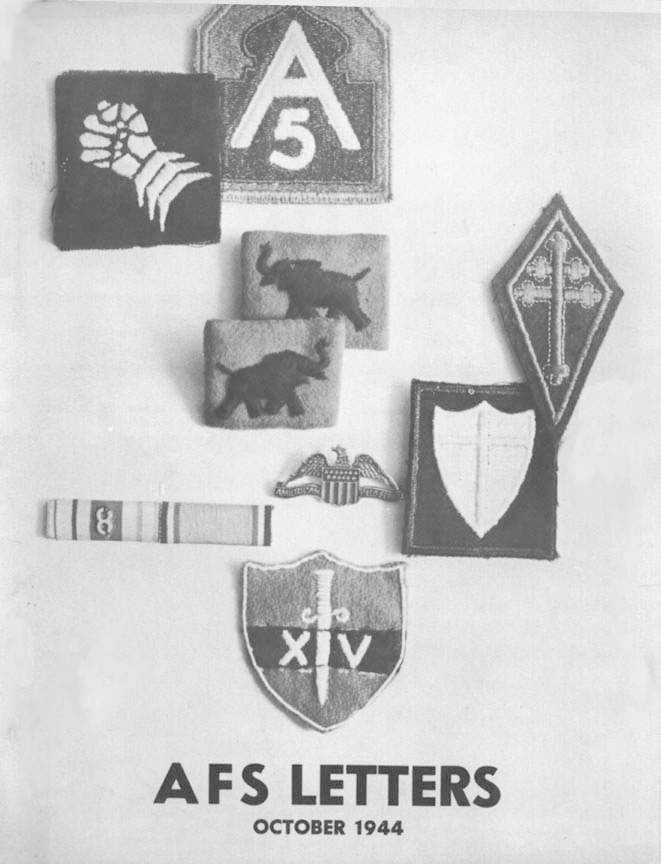
AFS volunteers have that clarity of purpose and are, today, following their set course. They are serving with the men of the United Nations... mingling with them, whatever their race, creed, or homeland, so that they may help those in need...and help us all towards our set course ---VICTORY. These men. have been such immeasurable help to the troops of our Allied Nations that they have been honored with the privilege of wearing the special insignia of those units with whom they served. The flashes which have been photographed for this months cover, by Volunteer Irving Penn, are: the British Eighth Army, the American Fifth Army, Fighting French forces, the British Sixth Armored Division, the Fourth Corps of the British 14th Army in the India-Burma theatre. These represent only a few of those the AFS is entitled to wear. Volunteers who served during any part of the Desert battles of North Africa are entitled to wear the Africa Star, which is not a flash, but a British campaign Medal.
Working with an army which has need of ambulance aid --- because thus they have a hand in the world wide fight against tyranny and oppression ---AFS men are setting a high standard. To back them to the utmost is the least we at home can do. Sincere and sober reflection and presence at the polls on November 7th is vital to our common purpose. VOTE so that the seed of successful peace may be sown. It is part of our share in the struggle and we must do something about it.
J. B.
| THOMAS S. ESTEN | GEORGE O. TICHENOR |
| STANLEY B. KULAK | WILLIAM K. MCLARTY |
| JOHN F. WATSON | RANDOLPH C. EATON |
| JOHN H. DENISON, JR. | AUGUST A. RUBEL |
| RICHARD S. STOCKTON, JR. | CURTIS C. RODGERS |
| CALEB MILNE, IV | VERNON W. PREBLE |
| CHARLES J. ANDREWS, JR. | ARTHUR P. FOSTER |
| CHARLES K. ADAMS JR. | HENRY LARNER |
| ALEXANDER RANDALL, JR. | GEORGE BRANNAN |
| ROBERT C. BRYAN | DAWSON ELLSWORTH |
| JOHN DALE CUNNINGHAM | DONALD HARTY |
| THOMAS L. MARSHALL | GEORGE A. LADD |
| PAUL H. CAGLE | JAMES B. WILTON, JR. |
Since the last issue appeared, Headquarters has received official notification of the posthumous award of the Croix de Guerre (Army Citation) to George O. Tichenor.
"Au cours de la sortie de vive force de Bir Hacheim (Lybie) dans la nuit du 10 au 11 Juin 1942, son ambulance ayant été immobilisée, a réussi à transporter les blessés dont il avait la charge sur un autre véhicule, faisant preuve de hautes qualités de sang froid et de courage.----
MORT POUR LA FRANCE LE 11 JUIN 1942."
ROBERT KENNEDY, on September 10th, 1944, in Italy while standing on the steps of an ADS, was slightly wounded in the hand and shoulder when a shell landed near him. He was given immediate treatment and returned to duty shortly after the accident.
GEORGE SEARS, on September 15th, 1944, was badly wounded by enemy action on the Italian front. George left his ambulance to take cover in a ditch when the area around him was subjected to severe fire. He failed to get completely under cover and was struck by a shell in the left leg, receiving a compound fracture. He was evacuated to a hospital for treatment and due to the nature of his injury was flown back to the States. He is now in an American Army Hospital at Coral Gables, Florida.
WILLIAM EBERHARD....Cabled advice has just been received that Bill was slightly wounded while serving in France with the recently formed French Unit of the AFS. The cable also stated that he had been awarded the Croix de Guerre by the French Government, which makes him the first AFS volunteer in the new French Unit to receive this decoration. Bill went overseas as a member of the Eighth Unit, which was torpedoed, but set out again with a later Unit, this time successfully landing at his destination. He returned to the States for a short leave at the end of which he sailed to rejoin his unit in Italy. Recently he transferred from there to the newly formed French Unit, to which he will return after a short period of hospitalization.
| HOUGHTON P. METCALF | Missing in Action |
| RICHARD ANDERS0N | Prisoner of War |
JOHN S. R. JAMES, on July 18th, 1944, was seriously wounded while serving with the Canadian Forces at Caen. Jack served with the AFS in France in 1940, and was awarded the Croix de Guerre for distinguished service. After his return to this country, he joined the Canadian Army and was commissioned before returning overseas. He is now in a hospital in England where his progress is slow but satisfactory.

No date.
"....the Liberty ship plows through the surf, at a miserable speed, and men are hungry. A Frenchman stops by the ambulance and asks the time. He, like all his comrades, is dressed in American O.D. uniform, carries complete U.S. equipment. The marks that distinguish him from U.S. troops are his rank insignia and the lettering FRANCE mounted on a French flag sown on the left sleeve. All of us have been issued French flag arm-bands."
September 25, 1944.
"Loading operations of AFS personnel and material were something worth witnessing. It was early in the morning of the second day in the harbor that an LCI tied itself to the side of our Liberty ship, and how we AFS were hoping it was for us --- because, what with the numerous vehicles, supplies, and crates of ammo below deck, we figured it would be days before this ship would be completely unloaded. But we were the first to get off, and while we were having a lusty breakfast of cream-of-wheat and pancakes; the first ambulances were swinging over the side.
"It became apparent to us soon, however, that as the LCI was gradually being filled by the first batch of our vehicles, the drivers were being left high and dry on the Liberty, as there wasn't so much as a rope-ladder leading down to the LCI. My car was already down there, and M's was next on the list, we looked at each other, thought it over for a while, then climbed into his car, feeling more than a mite uneasy, for the stevedores had advised us against it. And the more they knocked blocks from under the wheels and attached cables to odd corners of the car, the more uneasy we felt, especially since by now several of the AFS were jeering at us, forecasting our doom. As loading progressed a better scheme was devised to transfer personnel --- by. making extra trips with the crane and having our follows hang on to the cross-wires and hooks that availed themselves. Only three could go with safety at a time.
"After a long wait caused by Franco-American inefficiency, we finally chugalugged toward the beach, leaving twelve drivers on the Liberty. They were to drive the women's ambulances ashore, when and if these ever emerged from the hold. (The women were on another ship).
"First AFS ambulance to hit French soil was our most luxurious one with the installed radio. Right onto the beaches we went in low-low gear, winding our way through the debris that marked the outer wall of Fortress Europe. We mounted a road headed inland, passed through the mine-fields; reached some partly demolished villas, and upon a signal from the leading car, pulled up to let stragglers catch up.
"First impressions usually don't amount to a damn, for they are so spontaneous that they ring superficially. But in front of the houses stood some Jerry prisoners, loafing as usual, also giving us the old despicable poker-face, while out on the road were some smiling old farmers in shirtsleeves, vest and yards of watch-chain, a couple of sturdy laborers in their typical get-up of blue working clothes, tin lunch-box and flat cap; but above all, there was the refreshing sight of a Frenchwoman, a girl in her late teens sitting on a bicycle --- just sitting there with her hand on a tree and her feet twirling the pedals. She was only a paysanne, but her long, ever so well-kept brown hair above the well-formed suntanned face, the pleated skirt and soft blue trunks, the white teeth, and the sparkling eyes as alive as the oblong, dangling pieces of crazy jewelry attached to her ear-lobes, --- all made me realize that this wasn't just another wasted stretch of Rogland, or another slovenly Naples, ---that this was France, home of culture, country of stubborn individuality, color, natural gaiety and charm.
"In these faces I found dignity born of pride, not personal, but an inborn pride of great thing on high planes.
"The convoy started, and I looked forward more than ever to the days ahead.
"About noon-time we pulled into what had been Jerry barracks --- row upon row of comparatively small one-storied houses made of yellowish limestone with excellent toilet, washing and cooking facilities. It was a small camp built with German care and thoroughness, set neatly on a tree-covered glade. But there were two things wrong with it. The whole place still bore the odor of Germans, --- Jerry cooking or something like that, not at all unpleasant, but unmistakably there. I believe it bewitched me a bit for I found myself fervently singing 'Lippe-Detmold' all evening. Secondly, every building was booby-trapped, or so we were warned, and none of our fire-eaters volunteered to do anything about it. Towards the end of the afternoon, I was just warming up some C-ration on the engine, and wondering where the next meal would come from, when in drive P. & E. with a car-load of peanut-butter, mild dried eggs, Vienna sausage, chili cancarni, butter, graham crackers etc. etc.
"There's piles of it where we came from. And 'it's for the asking.'
"It's a U.S. salvage dump where general surplus as well as cans with dents in them or perhaps a bit muddy, are dumped. You actually climb up mountains of them, although you need some sort of official chit to get in, of course. It probably is to be doled out to the public eventually, where, incidentally it is most desperately needed.
"We didn't get off till two o'clock the next afternoon, thanks to usual French bunglery, and headed in close convoy West along the coast, then, after a while, turned inland, and after a little over three quarters of an hour, found ourselves on a lush grassy field in a pleasant green valley --- our temporary camp."
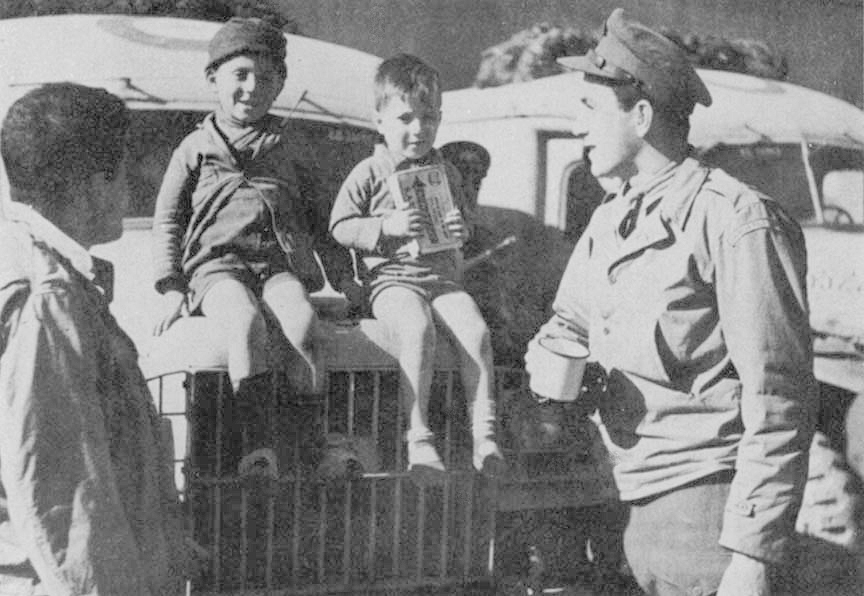 Bernie Curley (left) and Dick Decatur share real American "gum" with small natives of Anzio. Shortly after this photo was taken, Dick was wounded, awarded the Purple Heart, and subsequently repatriated. |
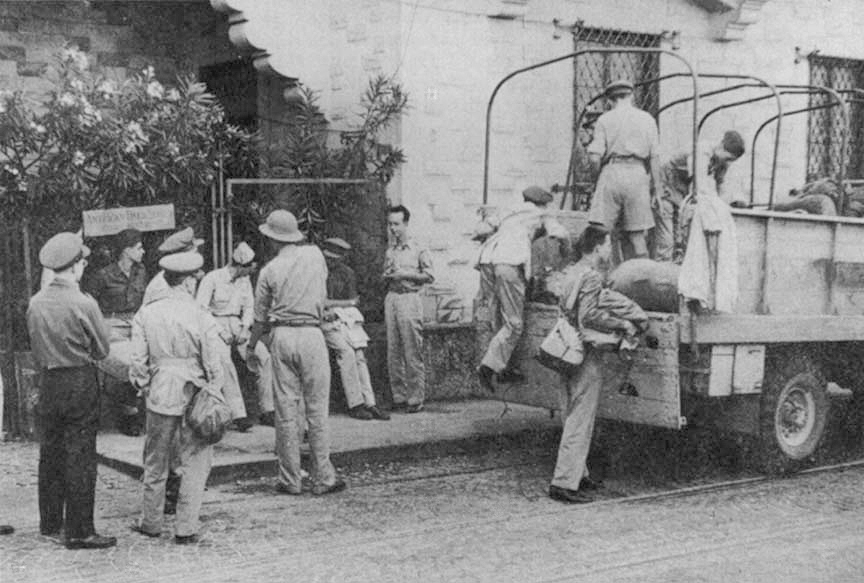 Homeward bound, Veterans of two years overseas service leave the AFS convalescent depot in Naples for a well-deserved leave in the States. |
This is the story of "B" Platoon, proud wearers of the Sixth Armored Div's 'mailed-fist' insignia, as told by its commanding officer, Livingston L. Biddle, Jr. Since it gives so vivid a picture of an AFS unit in the battle for Cassino, we feel it is of sufficient importance and interest to justify omitting the "Letters from Italy". Some of these may find their way into a later issue.
YOU ARE NOW UNDER ENEMY OBSERVATION! GO SLOW OR ELSE!
DUST IS DEATH!
These are the road signs through the heat of this Italian summer.
The dust lies fog-thick in the low-lands and on tracks that wind and twist through high mountains. The dust cakes on your skin like flour and the faces of the men along the road have a weird bleached appearance ---like moving skeletons. The Germans watch for the dust with their artillery. They are always above us on higher ground; but the dust-coated columns advance across the parched marsh-ground of the Rapido, over the plains of Rome and into the hills again; relentless pursuit against a wearying foe.
Dust is death! And below the sign a painted skull and cross-bones for emphasis...
Away from the roads, however, the scene is different. The grass, the leaves of the trees, are no longer caked and dead-looking from the fine, white powder sprung from the spring's mud-drifts, dried and disintegrated by the sun. Away from the roads the land is fertile in the valleys; the rivers run clear through deep mountain gorges --- and there are villas with lofty ceilings, cool even in the noon-day heat: chandeliers; vintage cognac and cellars with good wine. A strange combination; this, of the worst parts of war and the luxuries of peace-time.
These are the extremes of the Italian campaign. And for nearly four months we experienced the extremes perhaps more uniquely than any other organization of the push from Cassino to Florence.
We were attached --- our platoon of 30 American Field Service Dodge ambulances --- to the Sixth British Armored Division, a division steeped in tradition, boasting one of England's oldest and most distinguished regiments.
To say that this was the best assignment the AFS ever had would be perhaps an overstatement, but certainly it was the best job ever given to our platoon; not only because of the opportunities the work afforded, but also because of the close association we gradually gained with men of all ranks and the lasting friendships involved. As one of the boys put it: "We were not just attached to the Div. We are very attached to it --- in both meanings of the word."
Ours were the only four-stretcher, four-wheel drive ambulances in the division. Rain was our greatest selling point, for even half a day's rain, or a heavy thunder storm can turn Italy's summer dust into thick mud. The ground simply does not absorb water. Many times --- with the countless, gullied diversions past where the retreating Germans had systematically blown all bridges and with the make-shift tracks of the advance --- ours were the only ambulances which could get through to the casualties. Little by little we were entrusted with all the division's most forward work.
From then on it was up to us. And the fellows who drove these 30 cars did wonderful job. They won us honorary membership in the division and the right to wear the famous divisional insignia on our shoulders and on our ambulances. This singular distinction for the AFS was presented to me, as OC of the platoon, at a victory party celebrating the fall of Perugia. The rooms of Perugia's best hotel were crowded with the men who had led the battle thus far. Champagne flowed. Suddenly I became aware of high officialdom looming above me, chiefly by the way the conversation I was having came to a dead stop. I was wearing the div flash at the time---not without some misgivings---and here was the general himself, a huge man decorated with the ribbons of many campaigns and highest gallantry in action. But before I could find my voice, which had mysteriously disappeared the general smiled down at the flash and said: "Bloody fine show! Tell all your lads to put it up. They deserve it." Then as he turned, he added: "oh, yes if you ever have any trouble staying with the div," (and in the AFS you are always moving from one unit to the other) "just come to me, and I'll arrange it. We'd like to have you all with us as long as possible."
A little later our relations with the div were cemented in a different manner in a small farm-house where we had set up temporary headquarters. We had just finished the evening meal when the door banged open and appeared the ADMS (Assistant Director Medical Services) Col. James Barneston, in charge of all things medical in the Division. He was covered with dust. A pair of field glasses hung from his shoulders.. His face was taut after a long day's work. We all stood up awaiting momentous news. The ADMS spoke in my direction, "Liv," he said solemnly, "I've just seen 'Tug' Barton". He paused, a twinkle in his eyes. "Tug wants his laundry ---and two bottles of gin."
Well, he couldn't have spoken more momentously, for when a full colonel in the British Army goes out of his way to get laundry for an American ambulance driver, that--- as the poet says--- is news. Regarding the latter part of the ADMS' request. I might add parenthetically that we had discovered the factory where the Italians concoct the priceless ingredient. And while our supply lines became more and more extended as the advance continued, we always managed to keep them open in one way or another.
On the eleventh of May at 11 P.M., the barrage began for the final battle for Cassino. We were stationed a few miles below the city. Some of the platoon were already serving with the Div's leading tank elements. The rest of us climbed a rocky hill, held our watches and waited, for we had been 'briefed' that afternoon and we knew. The night was dark and still. You had an overwhelming feeling of expectancy.
Then the hour struck and the night became aflame, and alive with one continuous roar. In the hectic flashes of the big guns we could see the silhouettes of Trochio and Prochia, the mountains just south of Cassino, the mountains of previous battles won.
We watched for perhaps an hour. There was no let-up and in the early dawn of the twelfth, the guns were still booming. I shall never forget the scene on the roads that morning. I used a motorcycle --- the only way you could get anywhere among the traffic packed for miles, barely inching forward. From gullies where they had lain hidden, the tanks rumbled out to specially constructed tank tracks paralleling the road. The dust swirled and billowed and hung over the moving columns. The sun was a pale copper disc through the dust-pall.
Everything was on the move. From the turrets of their armor the commanders --- grim, goggled, helmeted figures --- talked ceaselessly into wireless microphones. Up the road it gave you a peculiar feeling to drive past the danger zones of but yesterday and see so much traffic. These were the areas where before you could only move at night --- without lights. Now it was broad daylight and we were moving forward, bunched and confident. Near Cassino I met Lt. Col. Sangster, OC of a Field Ambulance serving a Brigade Div. "It's going all right," he shouted over the din of a battery firing just behind us, "We're across the Rapido in several places but Jerry's putting up fierce resistance." I found four cars of the platoon moving up with the tanks, delivered some mail which had come into HQ the previous evening. The boys in the cars grinned and moved off amidst the grind of armored treads against the earth.
Shortly thereafter the platoon had its casualty --- the first of seven we sustained while our group which varied between 35 and 40 AFS men was with the Div. Across the Rapido, the Lancers were being heavily shelled and mortared. Warner Love and Norm Laden were in their slit-trenches when the call came for stretcher-bearers. Without waiting longer they grabbed a litter and started for the victim about 200 yards away in the same field. Norm was wounded through the groin by a mortar in this mission through the concentrated enemy fire, and had to be evacuated along with the man he had rushed to save. A few minutes later the Germans hit one of our own mortar dumps near Love's ambulance. Though the Jerry fire had not slackened and with the dump exploding in all directions, Warner crawled through a ditch to his car, leaped inside and drove it to safety.
The next afternoon the lieutenant of another AFS platoon --- Bob Bryan---was killed by shell-fire near the river. It came as an awful shock. He was a good friend and as genuinely well-liked as anyone I ever knew. His men were devoted to him. That evening I went up with his second in command to help break the news to his platoon and visit some of my own men who had crossed the Rapido with the Lancer and Yeomanry tanks. It was not a pleasant job.
You approached the Rapido over open marsh-land dry and dust-caked in the hot late-spring sun. There was the odor of the newly dead in the marshes. A few burned out vehicles lay by the roadside: distorted heaps of twisted metal. The bridges were variously code-named: Amazon, Cardiff, Oxford, Plymouth. They were hidden by smoke pots, and the thick, acrid vapor drifted downstream and hung over the clusters of marsh grass.
The Germans were mortaring positions about a mile beyond. We passed where Bryan had been killed a few hours before. You knew you were well within shell range, that the Germans could see you from the hills opposite. Neither of us spoke --- just drove ahead into the smoke, so thick as to make any speed impossible. We made the rounds of the posts across the river and delivered our news. The fellows took it silently. There wasn't much you could say.
Coming back we passed through San Angelo. It was almost dark and the destruction of the little village above the river was almost beyond description. Nothing but rubble and smoke and again the smell of death. I think San Angelo was oven worse than Cassino itself, of which one of the boys said: "There's nothing left of Cassino except a couple of bricks piled on top of each other --- and both of those are broken."
The mortars were closer now and as we crossed the river, the darkness became alight suddenly. Looking back you could see the Jerry flares falling and hear the drone of the dive bombers in their last concentrated assault of the Rapido crossing.
Then came the order we had all been hoping for; the whole platoon was to be assigned to the Div. (Some of us had been with them since they first landed in Italy. They were in the line below Cassino and I can vividly remember visiting at night a Regimental Aid Post (the RAPs being the most forward medical units) in the shadow of Monastery Hill. From the RAP you could hear the swift, staccato bursts of the Gentian spandaus, hear the whine of the shells passing overhead, in both directions, and see our rifle grenades falling and flickering like fire-flies against the black of the Hill. And yet there was always a kind of eerie, unearthly quiet to that scene around Cassino in the darkness.)
The order came at dusk. It had been raining since mid-afternoon and in one of those amazing Italian terrain metamorphoses, the dust on the roads had turned to a gluey slime. I had ten ambulances in convoy and with our four-wheel drives and large 'snow-tread' tires, if anything could get through, we could. But across the river traffic was bogged down for miles. Far ahead heavy three-ton trucks were stuck on a steep grade. They were winching them up one by one with a Scammel, but it would be hours before the road was clear. So we backed the convoy for maybe a mile and tried another, less travelled track.
Again we ran into mired traffic and eventually reached a spot where not even a jeep could get through. We decided to wait there for the night in the rain and the pitch dark. By some trick of fate our parking ground was in the middle of several batteries of Long Toms which pounded at the enemy until dawn. The cars literally shook with the blast every time a battery cut loose. We were dive-bombed by a lone plane about 3 A.M., but half the fellows never heard the bombs drop, such was the noise of our own artillery. The rain abated before dawn. At sunrise we set out on the rapidly drying tracks and reached our destination with a Field Ambulance before they moved forward. Col. "Sandy" Sangster gave us a royal welcome. We ate a breakfast of sausages and tea and turned in for a few hours.
No one knew much about the battle --- except that we weren't losing. The Germans, however, had deployed their defenses with the cleverness born of desperation. At one spot they had dug in a Panther tank so that only its heavy reinforced steel turret and long, high velocity gun protruded from the earth. There was a little wooded knoll through which the Canadian-manned Shermans had approached the near-buried monster in ambush. Not many got over the knoll. One after one the Germans had made masses of twisted, burned armor of the Shermans. But one tank had penetrated. It stood facing the German not more than 30 yards away. There was a gaping round hole through the turret, but there was another similar hole through the turret of the enemy. You could reconstruct the whole scene: you knew how it must have been.
There were rumors and counter rumors. One of the more picturesque concerned the Goums --- those swarthy, wild, native French Moroccan troops fighting to our left in the hills. The British never spoke of "sending in" the Goums. Rather they were "turned loose." Rumor had it that the Goums were turned loose against a German mountain strong-point "and the bloody Goums, with their night-shirts flapping and their long knives flashing went up the mountain --- yelling like mad --- went over the top, chased the Boche down the other side, and nobody's seen them since." That was for the hyperbole department but the infantry was pressing forward. Cassino was being outflanked and on the 16th it fell. The Div's forward elements pressed north toward the River Melfa to spear-head the drive up the Liri Valley.
Col. Barnetson always insisted on having his medical units as far forward as possible, and he stretched that possibility to its utmost. He was indefatigable. And he had as his right-hand man in those days, and throughout the campaign, colonels of two field ambulances who never needed any urging when it came to getting their units in the vanguard of the attack: Lt. Col. Sangster, who spent all one night of the river-crossing waist deep in water and under continuous German Spandau fire helping bring back the wounded from the other side and Lt. Col. Phillipson, blond and Irish, who gained a lasting nick-name among the AFS as "Follow Me" Phillipson. Those three men deserve the highest praise. They had the admiration of us all and we grew to know them closely.
I think they were commandos at heart. Many times they went out on reconnaissance ahead of the forward infantry to find suitable locations for their various medical establishments; and in the fluid advance this was all-important. It meant the saving of many lives.
Col. Phillipson outdid himself on one occasion some 60 miles north of Rome. He 'reckied' a railroad station in mid-afternoon for an ADS (Advanced Dressing Station). It looked fine and he brought some of our platoon forward that evening to set up shop. At dusk the boys were more than somewhat surprised to see a contingent of Troops creep out of the gloom and begin to surround the place. The Troops, however, were "not" 'arf shaken" in British idiom, to find that an ADS had captured their first objective of the night's battle. The "Follow Me" was classically illustrated below Arezzo. Col. Phillipson was heading a group of our cars into the city when an MP stopped him, "Sorry, sir," said the arm of the Army law, "you can't go any further. The road's under heavy shell-fire and so is the town." "These ambulances have to get through," countered the colonel and from his jeep he shouted back to the AFS: "FOLLOW ME!" They got through.
Incidentally Col. Barnetson, in his jeep, was the first car into Arezzo. He went ahead of the leading tanks to requisition a hospital. When. the tanks behind him drew enemy shelling; the Col. whipped up a rubble-strewn alley and over a Telar mine without setting it off calmly removed the fuse and then found the hospital --- had it ready before the first casualties arrived. Yes, they were great men. There was never; as they say, a dull moment with them.
Just south of the Melfa we had our worst dive-bombing, the last of the Germans' really heavy aerial bows during the campaign. All afternoon and into the night we had crawled in convoy along the Div's axis north from Rapido. It was a bull-dozed track through flat wilderness. The track wound through innumerable turnings. If you've never driven without lights try it sometime on a night without a moon. The barely perceived shadows take on fantastic shapes. The road was lit intermittently by gun flashes, but in the intervals the black was more intense, as when you turn from a bright light into darkness.
At last, around midnight, we reached our destination. There was a field and a farm-house and we were scarcely inside the gates when the first string of flares dropped about a mile away.
We watched this slow-falling chandelier more in surprise than fear, but there wasn't much time for either emotion. A second plane droned over and this time the flares were right above our farm-house. None of the vehicles had had a chance to deploy. Our Red Cross flag was not spread. And we realized sickeningly that in all probability the ambulances would look like any concentration of vehicles --- a perfect target. Then the first bomber came in with that unmistakable high-pitched, grinding whine, rising in a crescendo, of a diving plane.
I ran for the farm-house and as I reached the door, a bomb hit about twenty feet behind me in the roadway. The blast, plus my own momentum hurtled me inside and astride a figure on the floor. "Sorry, old man," I managed to blurt. But apologies were unnecessary. The next bomb lit up the face of my companion--- a very dead German. He leered back at me in the sudden light. I crawled under a stone arch-way between two rooms and waited.
The planes were diving in one after the other. You'd hear the first of the stick of six bombs drop and automatically, without thinking, you'd figure your chances. If it was on the far side of the building, you were all right, if not --- if the first bomb hit near the road, the second would be closer...then the third...the fourth...the fifth ....The building was hit several times. The ceiling came down in the next room with a crash of dust and rubble on the dead German. Again the drone of the dive, the roar of the plane just above you. Then the ever louder whistle of the bombs. The split seconds of waiting. And the fear.
After half an hour --- the longest I ever hope to spend as a target; it was over. Miraculously none of the fellows had been hurt. The cars were intact. And always after the near misses comes a strange feeling of exhilaration. You find men talking together, avidly, eagerly, and really laughing --- not hysterically, but with keen amusement about the whole thing. One fellow had leaped for a hole in the ground and his expected slit-trench turned out to be a twenty-foot well. He emerged by rope wet and spluttering, but none the worse for wear. This was a huge joke to us all, something to relieve the tension.
Others had not been so lucky, however. The Germans wreaked some damage that night and within an hour we were enroute with casualties. Back tracking on one of the darkest nights I can remember was no easy job. I mounted a look-out on the fender of the lead car, as from the driver's seat you absolutely could not see the track. I'd shout back instructions through the open windshield, and similarly manned, the other ambulances followed and we journeyed to the rear with the wounded.
That is the worst part of being an ambulance driver --- knowing your responsibility --- being unable to go faster and realizing that every bump and every extra minute on the road is agony to those you carry.
Across the Melfa River the following evening two of the platoon, Dawson Ellsworth and Frank Billings, were blown up in a mine going after an Italian civilian reported badly wounded near their RAP. Dawson had his right arm nearly severed by the blast; Frank was badly burned. Their Italian guide was burned to death in the back of the car. The British Medical Officer with them escaped without injury. Ellsworth died as a result of his wound --- and this was one of our worst tragedies. He had just joined the platoon. It was his first front-line assignment. And so it goes for the veterans and the new....
The Melfa River was crossed with much more ease than the Rapido and Col. Sangster's Field ambulance set up its MDS (Main Dressing Station) two miles north of the river. That afternoon we shifted our platoon HQ to the MDS and from then on we moved our headquarters with them or with Col. Phillipson's Field Ambulance---whichever was open at the time. The two Field Ambulances, plus a third which from time to time was attached to the Div., leapfrogged each other during the advances. One would open ahead, the other close, and as the advance proceeded, the one not working would reccy a new spot forward and receive casualties there in due course. And so we alternated some ten of the cars always to the MDS in operations. The rest of the cars were permanently attached to the infantry and artillery regimental aid posts. Two or three AFS cars from the MDS allotment would go forward to the Field Ambulance Advanced Dressing Station just behind the RAPs. Platoon HQ, which we kept with the greatest concentration of our cars, consisted of three-ton truck which carried our cook stoves, and tentage. A Dodge pickup truck for baggage and kit, a water truck, the jeep, and a semi-nebulous relief section of three ambulances which was semi-nebulous because casualties to ambulances and road breakdowns kept our number of cars on the road to the 30 required -- and on the unlucky days we sometimes dropped below 30. But always we managed to muddle through, and never were the deficiencies critical.
As we pulled into the MDS across the Melfa to set up HQ in a nearby farmhouse, I noticed certain ominous characters with field glasses surveying even more ominous puffs of smoke rising from a hill scarcely a mile distant. It appeared that Jerry had filtered down through the hills and the front line was in a state of what was called flux.
"This," I mentioned to the Field Ambulance's sergeant-major, "is a hell of a spot for an MDS." "This," he countered with great pride; "I have on best authority, is the most forward MDS ever established in the entire British Army." A delightful record to get mixed up in, I thought, and the Germans substantiated by lobbing about a dozen shells far to the rear. You could hear them whistle over high above.
In front of the MDS were two steep hills, and on the slopes of these hills took place one of the bloodiest engagements in the advance.
Early in the evening one of our drivers came down from the combined RAP with a load of casualties. His tin hat was askew; his face covered with sweat and grime. "We need more ambulances," he shouted to me. "Things are really rough up there." Now I knew that this fellow was one of our bravest under fire, not given to asking for help, so I boarded the next vehicle and journeyed up the road. In a few minutes we were on the track headed for the RAP, and everything was going off. Our own machine guns were on the bank above the road, firing red tracers into the hill-side across from us. Mortars and shells were dropping, German Spandaus and small arms fire were cutting the air. The RAP was in a farm house, twice directly hit by shells. Just across the intervening gully were the Germans. You caught an occasional glimpse of their blue-grey uniforms among the trees. They were counter-attacking; but, just as it looked as if they would over-run the position and after the medical officer in charge had given the boys full instruction how they should act when captured, the last reserves of the Brigade halted the enemy. Their lines wavered, then withdrew. The battle was won.
The four drivers we had there were amazingly cool through it all. They drove the route from the RAP to the MDS innumerable times in light and darkness, feeling out the pattern of the German fire, ducking their cars behind buildings along the road to escape the really close ones. Always they got through, and it was great to see the way they would drive late into the MDS, swiftly unload the casualties, hop back into the cab of their cars and speed away again with a wave. They knew the chances and that sometimes-disconcerting-factor called the law of averages; but there was never any question of waiting at the MDS for a brief respite. They kept their engine running and they were off without a pause.
After that the battle broke wide open. We were on the move constantly in darkness, at first light, sometimes all day on the road with our tanks up ahead and our infantry on the flanks. A few times below Rome isolated pockets of Germans came down from the hills and cut out the divisional convoy.
They would shoot up all their ammunition, then surrender.
At Fiuggi, south of the Roman plain, another of the platoon, Dale Cunningham, from Brooklyn, was killed. He was attached to the forward battalion of a Brigade, and his ambulance was directly hit by a shell during a concentrated enemy barrage. He was one of my best friends. We had left home together in November, '42.
From Fiuggi we proceeded to Acuto, stopped there over night, high above the plain where our tanks were in action. We left Acuto in the semi- darkness before sunrise and that morning as we moved through wooded areas came the news. It was June 6th. A motorcyclist sped down the column shouting the tidings of the invasion of France. The convoy stopped. Men jumped from their vehicles, cheering, rallying around the sergeant on the motorcycle in spontaneous joy.
The division by-passed Rome the day of our greatest advance. All morning and afternoon we drove over the old Roman roads to the south and east of the city, and I may say that these roads might have been fine in Caesar's day, but that was some time ago. Now they are just an endless series of rutted cobblestones. We bumped along slowly with the dome of St. Peter's barely visible in the distant horizon haze.
We set up our next Main Dressing Station some 25 miles north of Rome, in one of Italy's sprawling communal farms and for the first time in many days we were stationary a short while. There were good rooms in the farm buildings. We cleaned them out and set up platoon HQ in royal style.
There were tables and chairs once used by the Germans. Just after the hill battle one of the boys discovered what he called Kesselring's headquarters --- a series of spacious rooms dug into the hillside. From this came lacey tablecloths and silverware, plates and pitchers and glass goblets. We now had two Italian servants. From the friendly farmers we bought geese, rabbits, corn on the cob, lettuce, and tomatoes.
With a Mauser we shot a supply of rump steaks, butchered by our irascible but tireless cook, inevitably named Jock. The Italians had pointed out a herd of German cattle with much gesticulation and the target practice was accompanied with their sanctioning cheers from the sidelines. As I mentioned before, we were well-stocked in the libation department --- for cocktails, for wines with dinner, and for vintage brandy afterward. We had cigars from our American PX supplies and we even had tinned lobster from home for hors d'oeuvres.
So a banquet was 'laid on' in candle-light, and a lot of the divisional dignitaries were present. This was one of many similar occasions. The AFS man has a strangely ubiquitous status: he gets the pay of a British private (20 dollars a month): for administrative purposes he ranks as a Warrant Officer, first class, and he has officers' privileges. In our time with the Div we got to know regimental and tactical commanders, everyone in the Field Ambulance and the medical headquarters --- from the privates on up the line. More important we won their friendship.
It was rumored that night that we were leaving the Div. In a change in the military set-up, our platoon was to be allocated elsewhere. At the height of festivities the ADMS volunteered to stencil the Divisional Flash personally on each vehicle. The next morning he dispatched a special messenger to the high command. We stayed with the Div.
The following night I was sitting in the farm talking with the ADM and Maj. "Toffee" Field --- an Irishman with keen blue eyes and a yen for poker, and action as OC of Col. Sangster's ADS section ---when the door opened and Ben Ford, a New Jerseyite, appeared. "Liv", he said with a wry smile, "you'd better get a spare driver for my ambulance." He sat down and rested a bandaged arm on the table. Ben had been some 20 miles north with a. RAP. At a road junction a scout car had hit a mine. Ben was sent forward to pick up the casualties. Arriving he found the occupant already dead and he was returning to his ambulance parked nearby when an armored vehicle exploded another mine almost at Ben's feet. He was knocked down by the blast --- his shoulder badly bruised, his hand cut by pieces of flying metal. But Ben managed to get the more severely wounded armored car driver into his ambulance and back through the pitch black night to the MDS. Such actions as this won Ben the right to honorary membership in one of England's oldest and proudest Regiments.
This episode was the prelude to perhaps the worst day of the campaign ---"Stonk Saturday". The British refer to heavy German shelling as a stonk and this was the heaviest of them all. It lasted without intermission most of the day. Near the intersection of the mine explosions was the forward ADS. A mile or so distant was an RAP. The boys at those posts had a hectic time. Gene Vasilew had his car riddled with shrapnel holes and the radiator punctured as he left the ADS with a load of patients, but Gene kept the wreck going till he reached the next medical station. Later Gene was towed into HQ with his tin-hatted face grinning through a smashed windshield and pointing to the hole, barely an inch above his head where a shell fragment had gone out through the roof. Warner Love, with the Regiment, had an even worse time.
At one point a shell dropped directly behind his ambulance, wounding an orderly and bracketing Love with the hot whizzing fragments. He made five trips to the DS under shellfire, until all four tires were punctured by shrapnel, the gas tank holed and the body sieved. Unable to drive further, he spent the rest of the day intermittently in a slit trench and wrestling with the tires, which he mended one by one. Of the rest of the cars up there, none returned without some scar of Stonk Saturday.
The next stand the enemy made was at Perugia. We drove in convoy to our intended location, a hospital in the city. But somehow the road didn't look right. After a while you get so you can sense when you're in the danger zone. There is no traffic, no sign of movement. The farms are deserted and you know you have passed that mythical demarkation known as the front line. That's the way it was now. The road was empty ---then suddenly far to the right we spied a group of our infantry deploying through a field. If you think it takes time to turn a convoy in reverse under these circumstances you're wrong. The city had not yet fallen.
When it did, it was a fabulous mixture of war and peace. Perugia was wide open. There were restaurants with sleek black and white uniformed waitresses, bars and villas and gardens; a theater and two movie houses going. But almost every hour for a week German shells were falling in the city. I'll never forget seeing a queue of British soldiers under shellfire on the main street. In the British Army a queue is an integral part of daily life. They "queue up" for meals, for innumerable cups of tea, and your place in line is not to be lost easily. This queue was waiting for the movie house to open. It stretched single file for two blocks and when the shells landed in the adjoining square the men just ducked down a little. No one gave an inch; and strangely enough no one was even touched.
We had our best farmhouse below Perugia. It belonged to a wealthy middle class family, who were a bit reluctant at first when their uninvited guests arrived, but who, little by little, gave us the run of the place; a tremendous oak-beamed dining room and several bedrooms replete with that almost unheard of luxury known as a bed with a spring mattress. There were gardens of roses, lofty shade trees, a well with ice-cold fresh water; all the live stock we could desire for the cuisine and best of all a magnificent chandelier which actually worked on acetylene gas, (and which had a tensile strength of two men.) The Germans destroyed every power house in Italy in their retreat; illumination was an oddity par excellence.
Most of the posts were close to HQ by then, and as was often the case, the fellows at the RAPs could drop in for a sumptuous meal supplied by our mess president, Dave Burke, whose liaison work with the Eytie farmers was nothing short of miraculous. And so the rafters of the Perugia manor rang into the small hours, and the flowing bowl kept flowing for the platoon and their growing number of friends. There were poker games with all stops out, and British officialdom got its initiation to the American indoor sport played with two dice. Someone produced a roulette wheel: and one night we got the brilliant idea of making money for the mess with the red and the black. The mess lost 70 bucks. The roulette wheel was conveniently lost in our next move.
West of Perugia "Pop" Watson of Philadelphia had his closest call. Pop is a veteran of some 40 years, and late one afternoon he was sent forward to pick up casualties from a tank battle still raging on the plains below the city. Warned on the way up that the road was being shelled and mortared, Pop said "Maleesh the shells," which, roughly translated from the Arabic, might read "Damn the torpedoes." And Pop proceeded at full speed. His car was twice hit by mortars before he reached the wounded; and on the return route a German 88 mm shell landed, to hear Pop tell it "Practically in my nostrils." The radiator was smashed, there were fist-sized holes through the front of the car, but the engine was still running and the wounded were brought safely to medical care at the ADS.
These are adventures you laugh about later; spin yarns about, and remember with pleasure. But at the time there is no amusement--- no pleasure. The whole is disproportioned by its nearness. Your feelings at the time are never fully recaptured in memory. To have the impression of something infinitely big and fast and, deadly coming in, and the seconds after the explosion are disjointed, vivid things, without relation to actuality.
From Perugia we pushed north toward Arezzo past Italy's famed Trasemane Lake, blue like the Mediterranean in sunshine. There was good swimming in the lake and a sandy beach, and many of us thought of summers at home. But the illusion is nostalgic, short-lived, and we left Trasemane behind. Near Cortona, 20 miles south of Arezzo, Bob Glasser of Chicago drove over a double Teller mine. His car hurtled 20 yards through the air (I paced them). Bob was blown clear, and though bruised from head to foot, his back wrenched and muscles torn, he brought aid to his two seriously injured patients and another vehicle for their evacuation. There was nothing left of the car except one good tire which we salvaged driving to the scene of the explosion in the jeep as if we were traveling on eggs ---and an Italian egg is a valuable thing.
The fight for Arezzo was hard won. The Germans put up determined resistance. We had our third death in the platoon below Arezzo. Tom Marshall was killed by mortar fire while on duty with the forward infantry. We had a service for Tom the morning after his death. In a small, close-knit organization of friends, tried and true over the months together, a death---sudden, unexpected--- comes with deep impact. There is no need for words spoken one to the other. We carried Tom's body to its resting place on a stretcher, lowered it into the grave and the padre spoke the words, with the hills rising blue in the distance across the valleys "I am the resurrection and the light..." Those seemed good words and I felt somewhat as I did a few days before, when I stood inside the crypt of St. Francis' tomb at Assisi --- the crypt with its lofty dimlit arches, and its unalterable silence, the silence of a deep-felt religion, the silence of a hallowed memory, the silence in veneration of the gentle peace apostle of a bygone age, a silence far removed from the intimacy of war and one akin to a true perspective of values.
To take Arezzo a heavy concentration of artillery of the entire Italian campaign was mustered. I spent the night of the barrage at "Toffee" Field's ADS, some five miles below the town. German mortars were dropping from the enemy-held hills just above us, but we knew we did not have long to wait for their silence.
Then, in one vast semi-circular ring behind us, our guns opened fire. It gave you a feeling of tremendous, crushing power. The sky was alive overhead with singing steel beneath the stars, the horizon was as if a blaze with wave after wave of heat lightening; only the flashes were more savage, sharper, less sustained in themselves. For hours it lasted, ceaseless, relentless, and Arezzo fell.
Our road to Florence led down the valley of the Arno. The Germans still held the high ground overlooking the road, and there was that unforgettable afternoon when the MDS itself was shelled. Howie Brod, our platoon sergeant, and I had just returned from a visit to the RAPs with the all-important mail from home. All was relatively quiet up there, the advance going well. And if two people were ever unprepared for the first shell which landed just off the rear of the jeep, we were that two. The next one dropped to the left and the MDS cook tent went up in a cloud of dust. The speed that jeep developed for our half mile distant platoon farmhouse would have made its makers proud. The shells were still falling behind us, but always disconcertingly just behind. At a small bend in the track some 30 yards ahead, we waited for the next group of four and by this time we could hear the muffled pop of the German self-propelled guns in the nearby mountain range. We could count to about 10 between the pop and the scream of the shells coming in. The next four were over to the left, and a little further. So we again made a jeep dash and reached the stone-walled farmhouse just as another enemy effort landed in the barnyard.
Ten minutes after the shelling had stopped, the MDS produced more Red Cross flags than I thought the whole British Army possessed --- to supplement the giant one they already had spread. We hung them from haystacks, from poles, draped them on tents. We weren't bothered again.
At Montevarchi, about 30 miles below Florence, was requisitioned a veritable villa for the platoon --- and we tried something new in the field of entertainment: a thé-dansant. We invited 20 of Montevarchi's comeliest. They came all right, at the appointed hour --- but so did their entire families, down to the half-cousins once removed. The band we hired knew about three tunes which were tops in your Italian hit parade in the late '90s. We tried to stem the invading hoards, but the ultimatum, "if we go so do the signorini," had us defeated. The young ladies' terpsichorean abilities were limited to a step such as I imagine a dance marathoner would attempt on the 40th day of the contest, and one young beauty kept skulking about, picking up cigarette butts which she carefully dropped in a can ---"for papa." The energies of the demoiselles were reserved for the food department, and when the doors were opened on the buffet spread, aforementioned doors resembled nothing so much as a late subway rush for the last car. The groaning board was "crumbed" in about two minutes flat and with many "grazias" the guests departed at once, while we settled down to the elaborate punch we prepared and with which the young things to a girl refused to be plied. A nice turbulent cyclone would have been less spectacular.
We crossed the Arno a few miles above Montevarchi and there we spent our last days with the division. Complete reorganizations of the forces to be used against the Gothic line necessitated at last our being sent to another sector. This was sad new to us all. It meant leaving one of the finest groups anyone could hope to fight a war with. The night before our departure we took over a hillside mansion and gave a party for all those we had come to know. Over 100 officers and men were present. We ransacked the countryside for Italy's best food and drink. We found a piano and two British ex-pros on the accordion and clarinet. With one of our own number, a disciple of a hot trumpet, this was the band and they made plenty of noise. There were speeches and cheers back and forth and the AUKS surprised us by producing for each beautifully embroidered shoulder insignia and giant oak shield on which was emblazoned "To B Platoon. With All Our Thanks" above the engraved divisional flash. The last of the guests departed at that hour known to military strategists as 0400 hours. And so it ended. We will never have an assignment quite like it. Call it, if you will, a battle of lights and shadows and darkness --the light of warm sunshine on verdant, sloping hillsides, the light of a full moon on an ancient, walled city, the sudden lightning-savage flash of the big guns, the ominous suspended glow of enemy flares, the subdued illumination of candlelight on the timbered ceiling of an old farmhouse --the shadows of shade trees on well-kept lawns, the shadows in the dust of wrecked German tanks, the shadows of little crosses beside the road --and the darkness. There had been time of real tragedy, times of great gayety. Our cars had traveled a total of over 75,000 miles, our casualties had been 20 per cent. We had carried a great percentage of the division's wounded. But outside of figures and percentages is the honor of the long association and the friendships which spring up suddenly in war time and are lasting.. Our days with the Div are unforgettable. We will all remember them closely all our lives.
A new decoration, "Il Cuore de Rincalzo", has been awarded AFS men for outstanding service. With past citations from France, Great Britain, and the United States, Italy becomes the fourth country to show its appreciation by presenting her own national awards to members of the AFS. Those to be first honored with the "Il Cuore" are:
| Edwin Cady | Walter Moore, Jr. |
| Mortimer Wright | John Riege |
"31 on Parade," a colorful display of New York War Fund dollars at work, will be exhibited from October 15th through November 10th in the Mezzanine of the International Building, Rockefeller Center. The booth allotted AFS, as one of the 31 member agencies, will welcome any and all visitors from 11 a.m. to 6 p.m. on week days and between 1 and 6 p.m. on Sundays.
Bill Orth of AFS India has evolved a new method of therapy for the wounded patients he carries in his ambulance. Because of the terrible condition of the Burma roads, his patients are often in considerable pain and call out asking how much farther the hospital is. Now, instead of telling the actual mileage, which is long enough to sicken a well man Bill tells them there are 45 bridges to cross between the first aid station and the base. He can hear them counting bridges in the back of his car and it seems to quiet them.
Tom Durrance, for of AFS Italy, is now covering the Fifth Army as a correspondent for TIME magazine. He recently set out for the front in a jeep with an older correspondent whom he had never met. After driving for two hours through a blinding rainstorm, they finally reached a divisional command post from which they planned to continue to an observation post above Firenzuala. While stamping about trying to get some warmth back into their numb legs, the talk turned to overseas service. The older correspondent was surprised t learn that only three of Tom's 17 months abroad has been spent in his present capacity and inquired about his previous work. Tom writes "I'd no sooner got the words 'American Field Service' out of my mouth when he burst into a good hearty laugh and said, 'Well, that's my old outfit'." The ambulance driver of World War I vintage was Gill Robb Wilson, N.Y. HERALD TRIBUNE correspondent, still a staunch supporter of the AFS. The remainder of their, frontline hike around mud-clogged mountains was brightened considerably by comparing notes and reminiscing.
This month's cover, showing insignia worn by the AFS at three war fronts, was done for us by Irving Penn, whose work is often seen in both VOGUE and HOUSE & GARDEN, Mr. Penn will soon drive an AFS ambulance overseas.
Sidelights on Lord Wavell's visit to the AFS at the Burma front, have drifted in since last mouth's report. The Viceroy spoke informally with each volunteer and in the course of these conversations, asked Alfred Ogle where he was from. Al replied quite correctly, "Indiana, sir." Lord Wavell exclaimed, "Oh, yes, that's where they grow wheat, isn't it?" Alfred drew himself up to his full height in defense of his home state and retorted "No, sir; corn and pigs."
Little is heard of the unsung work of the British Workshop personnel, 60 strong, attached to each AFS ambulance car company in Italy. Captain W.C. Webb, commander of these tireless Tommies who maintain and repair the cars of Bert Payne's company, has received well-deserved and gratifying recognition, "Webby", beloved by AFS men from Alamein to Ortona, has been appointed a "Member of the British Empire" by order of H.M. George VI --- with whole-hearted approval of the AFS.
An interesting excerpt from "SEAC" the Service newspaper of the South East Asia Command, reached AFS headquarters recently. Titled "GENERAL BAGGED 2 JAPS" it reads: "Two unwounded Japs were captured recently on the Tamu sector by a party consisting of Major-General O. Roberts, two Brigadiers, a Brigade Major, a General Staff Officer, a Liaison Officer and an American Field Service ambulance driver. Out on reconnaissance the General and party spotted the two Taps, armed with rifles and grenades; hiding in a culvert. They dragged one out, protesting loudly, by his feet. The second Jap had to be smoked out with a grenade!" The AFS ambulance driver who was travelling in the select company which accomplished this feat was Frank Mayfield --"Jap-stalker Mayfield" perhaps.
Two articles of interest to AFS friends and relatives appear in current magazines. "Diary of a U.S. Ambulance Driver" by Hugh Chisholm of AFS Italy, is in the October TOWN & COUNTRY...Another story from Ed Fenton's productive pen, "Burial in the Desert", appears in HARPERS BAZAAR for October....A later article to appear will be in LIBERTY magazine in December: "They Have to be Good,' Laurence B. Barretto's graphic story of AFS work at the Burma front.
Lieutenant, wounded while serving with his crack British regiment at Anzio writes of the AFS, "...they are a first-class crowd. We had an ambulance attached to us all the time at Anzio and they did some magnificent work evacuating casualties. I am afraid we kept them very busy."
John Patrick, recently returned from AFS duties at the Burma front; was halted by a traffic light on Park Avenue. A lady standing next to him studied his uniform with great interest and said: "Oh, those elephants on your sleeves! I love elephants." "That's the insignia of a Corps of the British Army in Assam," (see cover) Patrick explained. "Oh, I love Assam," the lady continued. "How're things in Assam?" The amazed "Pat" was sure he detected an abnormal gleam in the lady's eyes. "Yes, I love Assam and Imphal", she declared, "Perhaps I should introduce myself; I'm Osa Johnson."
This is where some of the AFSers are and what they are now doing: Warren Grinde is a Corporal at Camp Croft, South Carolina; Bob Draper is in aerial gunnery school at Virginia Beach; Bill Nichols is with the 18 Garhwal Rifles; Bob Murphy is in the Navy, studying at Stanford University Medical School,. Bob recently got himself married and his wife is at the West Coast with him; Tim Watson is a corporal in the Marines attending radio school; Vance Bourjaily is in the infantry at Ft. McClellan; Buz Shaw is in the Navy at Murray, Kansas; Freer Wilson is a 2nd. Lieutenant in the Air Force at Geneva, Nebraska, In writing, Freer says, "few of us at the time realized what a magnificent organization the AFS is, but now I am in the Army and look back on the work the Field Service was doing in Africa and is now doing in the other theatres, I am impressed, not only by the spirit of the idea itself, but by the cheerfulness and generosity of the men,!' Charlie Murray at Atlanta, Georgia in the Navy; Alexis Nason in the Army at Melville( branch unknown --- security, probably); Norm Barrett, a private in. the Army (security again --- it is not known where); Dick Tevis a Lieutenant in the Navy; Douglas Woolf in Air Force at San Antonio; Wickliffe Johnston, 2nd. Lieutenant in the 4th Infantry (whereabouts unknown at this time, just lost to the AFS at present
Carl Curtis is at U.S. Embassy in. London; hopes to get to France, but at the moment, it's just a hope; J.C. Wyllie, a Master Sergeant in the 1st Tactical Air Communications somewhere overseas; Edgar Jones correspondent in the Navy. Other doings of AFSers: Sivcho is working in an airplane plant in Allentown, Pa.; Peter Chew is working on a newspaper in Lynchburg Va.; Charlie Craig has left these Headquarters and has affiliated himself with the Daily News. He is a sort of traveling representative and, at the moment, is touring Upper N.Y. State to ascertain how the coming election is coming. Julian O'Leary is working in a Textile Plant in Greenville, South Carolina. He recently married, as did Dave Emery, who is still at Haverford College. Another AFS middle-aisler is Charlie Collins. Justin Pearson also joined the ranks of the married men, Eleanor Hershey became Mrs. Pearson and they are living in Pennsylvania where Justin is working in a war plant. George Munger is at Theological School in Rochester, as is Hugh White. Hugh is taking his training at a school down south. We hear Charlie Edwards got himself a bride overseas.
Waring Hopkins was recently married to Suzanna Durgin. They are living at Duke University and Waring completes his studies in February, Anne Cleveland became Mrs. Franklin Coleman on September 30th, while Herman Tausig, now a pilot of a Flying Fortress, became engaged to Dorothy Porter, Ralph Foulds, who expects to return overseas with the next French Unit, has asked Jane Sorber to wait and become Mrs. Foulds when he finishes his enlistment with the AFS, Edgar Jones middle-aisled it with Gertrude Studley of Seattle, Washington and Laverne Williams announced her engagement to Jim Fair. Word has just been received that Felix Jenkins is in the Army and is now stationed in Australia. Maybe he will eventually get around Chan's way.
John Dunn, who is the proud possessor of the Croix de Guerre and the Médaille Militaire, both of which were bestowed on him during his service with AFS, is now in France with the U.S. Army. Vincent Bowditch is at Billings General Hospital, not as a patient, but assigned to the Army Medical Department's enlisted technicians School; David Hume, a Captain in the U.S. Army, has recently changed his APO address; Newbold Noyes covered the invasion of southern France with British Paratroops in his new role as war correspondent; Bill Thorn is in the infantry at Camp Croft, South Carolina; Lester Harding, a versatile young man, having served with the AFS in the Middle East and India, is now in the paratroops of the U.S. Army, while Louis Brandt is attached to an antiaircraft battery at Fort Leonard, Missouri.
|
There is constant noise and mad persistency,
|
 Inspection of vehicles just before an AFS convoy begins its 2200-mile trip across India to the Burma front. |
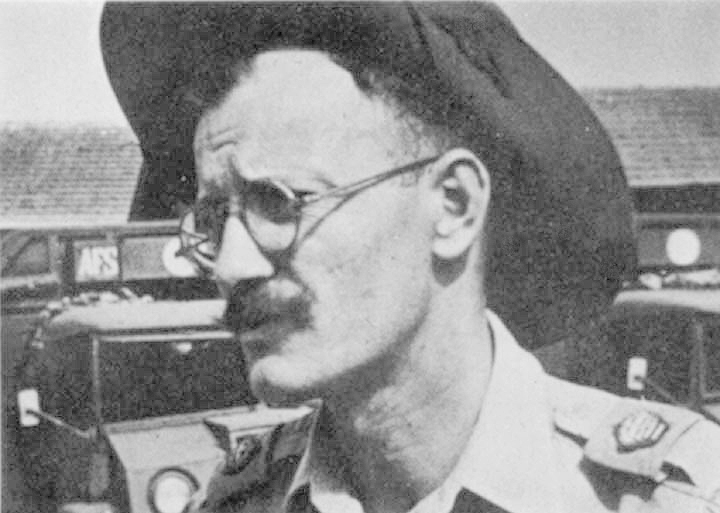 Maj. Chauncy B. Ives, OC AFS India-Burma |

 AFS volunteers arriving from the states unload at camp to begin their training. |
 AFS ambulances clear the road for elephant-borne supplies. |

August 27, 1944.
"Added notes in the past week; one drip case, one compound fracture and fractured femurs, one Ghurka with his guts all but torn out, were brought from forward station by AFS men. These are but a few of those that were evacuated but they were outstanding for the fact that the M.O.'s without exception were voluble in amazement and praise of the condition and lack of effects upon the patients. To better understand the situation, one must survey the road used. First it was torn up by our planes during dive bombing attacks, then it was shelled to splinters and dust by our artillery, finally it was blown to kingdom come by the retreating Jap. Every inch of it in the forward area bears the marks of one or more of these efforts and it is impossible to describe the mess it becomes after an hour or so or monsoon rain---which usually comes every day. Ambulances slide from one end of the hills to the other. At times, with motors racing full speed and wheels spinning like propellers, they barely creep to the top of the grades In other places they cover the road from one side to the other with thousands of feet straight down on one side, a mountain wall on the other rising about the same distance, and a glassy film of mud underneath in other places the road goes into deep morasses and over narrow bridges hardly designed for any joy ride; yet over these roads serious injuries have been. brought by AFS men with comparatively light effects upon the patients carried. A miracle, I calls it!
"Added to this the men who are driving these cars are not experienced with the right hand drive, most of them have never driven a truck, much less an ambulances under even the most favorable conditions, and many of them had to be taught the fundamentals of driving these large vehicles one day, while being pressed into service the next. Send us more recruits of this type and the AFS will have to get a place in the Hall of Fame, perhaps a bust of the American Indian would be suitable."
July 23, 1944.
"Unit I, India Command, has done a magnificent job bringing the Field Service and all it stands for to India. I was never more proud of anything than the work my Unit did, the way they did it, and the fact that I was able to be associated with them.....When you're in a 'front-line' area, and especially when you're under enemy fire, those around you become a most integral part of your life, and friendship means more than anything. Every minute you spend with them becomes another wonderful experience to add on to what is to me the finest thing in life --- an honest-to-God friendship,"
No date.
"The Nagas tribesmen, even now in all this rain, are passing by the front of my tent, some very stern, others smiling and gay. You may have hoard of these Nagas mentioned in the papers in the Kohima battles; they are among the few remaining 'savages' of our times, living in one of the least accessible parts of British India. Most of these ridges, in which they have most of their homes, lie under 6000 ft. high mountains, with one main ridge 1200 ft. high. When the fighting was in and around Kohima and beyond, you can imagine the heights and jungle tracts we all had to cover with our ambulances; at times, or rather almost all the time, it was straight up and down, twisting jungle tracks, bringing in wounded or ill boys Englishmen, natives, Japs; sometimes taking four hours often longer, to bring in our patients. The boys deserve all the praise possible for their efforts, with the strain and dangerous driving conditions and came thru it surprisingly well with no real casualties. From the beauty of the hills' and valleys' picturesque fastnesses, come the Nagas, many of whom are fighting with us now....A few of us were surrounded by Japs unexpectedly one day when the fog was almighty thick and the rain very heavy. It took six of us three days to get out of that mess; all we had was one day's ration plus a can of U.S. 'C' ration and can of M & V that I always carried with me. In arms all we had were three rifles, one Bren gun, four pistols; well, we got four Japs, wounded two, and not one of us was touched. You see we were going to pick up four wounded men in a Naga village; but halfway between our ambulance and the village we were fired upon by a patrol of Japs, who thought we were cold meat. No matter how cold and wet we were no blasted Japs are going to shoot down any of us without a battle on his dirty hands. The Nagas guided us out of there, with our four patients, plus some Japs. But we are much more careful these days, you may be certain. The Nagas include many and various tribes and castes of Angam, Ros, Shotas, Semas, Kachas and others and are frequently at war with each other. Right now they are peaceful and friendly, except to a Jap. Just as we avoid dangers on the highways, so does the native in his jungle, avoid dangers in his section."
No date.
"Some of us have moved up again and the country here is even more rugged and the scenes more beautiful than before, if that is possible. I passed through a level valley the other day at sunset where a great deal of fighting took place at one time. The Indians have moved back, rebuilt their homes and their lives are going on as if nothing had happened.
"The entire valley is covered with rice paddles (that's not something to eat) and they are all flooded at this time of year. Hundreds of the inhabitants were fishing for the tiny fish that abound in the paddies. Imagine the air dark, but the western sky a golden yellow reflecting on the water. A maize of narrow walkways form a dark pattern in the water and the fishermen standing on them with their costumes of startling white complete the picture of contrasts. It's too bad a war has to be fought with such a beautiful background.
"There are dozens of little things that are real luxuries out here. Coffee, the Nestles chocolate drink that you add water to, candy cigars, chewing gum, records, pipes, etc. are a few. Some of these things are now almost priceless in this area."
July 27, 1944.
"Right now my sub-section is in by far the nicest location. We are in an old bungalow that was at one time a Government House. It had been in the hands of the Japs until quite recently but they did it no harm. 1t is located on a bluff overlooking a river and when the weather is clear the view reminds me of that part of Pennsylvania over near Bedford. My room is about as large as my bathroom at home and I have to sleep with my feet out the door. But it is nice and dry and I like it. Most of the time here the mud is ankle deep, and the flies are legion. But, I still like my work.
"The unit own six ducks which I guess will be our Thanksgiving dinner. I'm fond of the damned things --- it makes it more homey to have them quacking around all over the place. The --------have given us a couple of goats which also add to the down-on-the-farm impression, but they will be eaten ere long."
August 11, 1944.
"Most of the fighting out here is patrol work up in the hills with an occasional flap of some proportion. These patrol soldiers are the toughest bunch of guys I have ever seen and have about the toughest life a white man could have. They climb these damned hills with full pack and armament, sleep in the rain and mud, exist on the scantiest rations, and have practically impossible conditions in case of casualty. And, fittingly enough, seem to do the least griping of anyone out here. 1t seems to be those of us doing the routine non-fighting jobs who gripe the most.
"We have a few prisoners come through but they have been so strafed, sick and generally miserable that they weren't even interesting. There are two Japanese-Americans here who, apparently, are doing a swell job. a interpreters. I wish some of the arm-chair Gods who write to 'Time' saying they should be done away with could be out here. These men are Americans who are serving their country and deserve a hell of a lot of credit or at least decent treatment from other Americans ---those who sit at cocktail bars and claim that the only good Jap is a dead one."
August 8, 1944.
"I don't know even how to begin to describe India. You can't get a true picture from all the books and movies in the world. You have to see it for yourself and smell it and hear it. I knew what it was going to be like before I got here, but still when we first came into the Hindu section after getting off the boat, I sat in the little gari (horse carriages) with my mouth wide open and my eyes popping out. Camels, cows, beggars, veiled women, naked kids, goats, dogs, shop keepers, people sleeping in the street and on the sidewalk (the people use their houses for the sacred cows to wander thru and use the sidewalks for homes and they walk in the street). Can you imagine this all crowded in a street the width of an automobile? plus the smell of queer foods and incense and dirty people and dirtier camels, cows, goats, dogs ---with a background of steady, queer, high, screeching music, not to mention the colors and the architecture. The costumes of these people are amazing. Dirty white; full, baggy pantaloons or whatever you want to call them, a long nightshirt affair over them and then a bright blue pinstripe suit coat over it, with a red fez on top. The nightshirt is usually pink, lavender, green or chartreuse.. They go barefooted --- even the Sikh policemen. You see all sorts of fancy turbans. They are all filthy dirty --- I haven't seen a clean Indian yet. Also the Indians can't talk without shouting no matter how close together they are; you just can't describe it all.
"When we got off the boat, they sent us to a transit camp (British) to wait until they could get the train reservations. We met three other Field Service guys who had arrived about three days before us. The camp is good and clean --- whitewashed stone with tiled roofs. You see fancy turbaned Sikhs riding dappled grey horses all over. It reminds me of 'Lives of a Bengal Lancer'.
"There's a wonderful American Red Cross recreation center here (I'm there now). Beautiful library and sitting room, bar, restaurant, etc. It must have been a mansion once."
September 5, 1944.
"I've done nothing but travel ever since my last letter. It took us about five days to get where we are now and it wasn't easy traveling; about two days by train and the rest of the way by truck. We went first to base headquarters, which is about 70 miles back from where our section headquarters is. I'm now detailed to a CCP (Casualty Clearing Post) about 12 miles forward from our section HQ. Here we're only about 10 or 15 miles from the enemy.
"I've been up here for about a week and I got to section HQ, about 3 days before I came up here, so you can see how fast they put you to work. I really got a shock when we first came up to HQ, after a grueling journey in a truck for four hours; we got out, were pounced upon and shown which ambulance was ours, told that it should be greased once a week and that was our month's training. Slightly bewildered, I staggered over and looked my angry, huge three-ton adversary square in the headlights. God, it looked big! And inside on the left-hand side of the steering wheel were three levers where there should have been one; one was the gear shift, one was the four-wheel drive, and the other was the starter. We, or rather I, sat around two days rather bewildered until our C.O. came up and told me they needed a third man up here ---that was all. Scared half to death, I got in and B. & P. led the way. The first thing out of camp is a steep hill --- a 200 ft. drop on one side and a cliff on the other. There's mud knee deep all the way down. You can imagine me skidding all the way down sideways in a three-ton truck! After about a half hour's driving, I got on to the hang of it, though, and now I can handle it pretty well, as well as a lot of them. In fact it comes quite easily now. We make a run from here back to the MDS, which takes about 2 hours, just about every day, so you get practice enough. The road's pretty tough, some places you can't even call it a road; crossing pontoon bridges and pontoon ferries; two hours of that and back again is pretty tiring.. Sometimes when we're very busy we have to make two trips and over that road it's no joke.
"It's quite nice here actually. There's just a captain (doctor) and a staff sergeant and their staff. You should see us at night under a, ----well, almost a tent --- drinking rum and eating hors d'oeuvre. They call them 'toasties' (thank God! it's much easier to spell) and then they bring on the dinner; it's amazing what they can do with their rations and they've got a wonderful cook. It certainly isn't as 'rough' as I expected it to be. I imagined myself eating out of a tin can in a foxhole. We're sort of up in the mountains and the climate's pretty nice except for the monsoon. That's tapering oft now, tho'.
"We sleep in our ambulances and they really make pretty nice rooms; lights in the back and a stretcher to sleep on; it's pretty comfortable.
"There isn't much action going on. We hear an occasional booming of artillery and sometimes scattered rifle fire where they are cleaning up the bush, but outside of that there isn't much doing. The first night we got to camp they shot a couple of Jap stragglers about 1000 ft. from us down in the valley. There are lots of skeletons up here and equipment left by the Japs. You have to just about kick your way thru Jap skulls to walk around. I've got a Jap rifle in pretty good condition, which someone gave me and also a Sten gun which was in the ambulance when I got it. I'd like to get hold of a revolver somewhere. You can always scrounge around and pick one up. As yet I haven't been fortunate enough to come across one."
No date.
"Now I'll explain why you didn't hear from me for so long; all the mail was held up by the government for a month because of security reasons. This was the month around D-day. I can't see the point but they did and I guess they know best.
"I wish you could just take a look at the scenery here; it would take your breath away. We are situated on a hill which overlooks a long valley. The valley broadens out into a plain high in the mountains. Down the length of it flows a meandering stream and you can see every bend and twist for miles both ways. Bordering this valley on both sides are ridges of mountains, beautiful and green, so green, in fact, that it doesn't look real. The rugged peaks of the mountains stand out against a deep blue sky, except for a few with clouds resting on them. The sun shining on the far side of the valley makes each little ridge and gully stand out with perfect shadowing. In contrast the other side is pouring rain and down the middle a beautiful double rainbow reaches from one end and seems to disappear at my feet. It's such a wonderful sight it has to be seen to be appreciated.
"Our work is almost nil due to the fact that the enemy can't be caught up with. Well, we need a rest anyway....We're all broken up now and in different sectors of the front. We're on the move forward continually. As the Tommies say out here 'the Japs 'ad it'."
No date.
"This letter comes to you from 'Yankee Town' as our hut was so dubbed by the M.P.'s. Four of us are huddled together in this none too secure straw hut and we have the time of our lives. What a variety! Our ages range from 19 to 47, but to see and hear us you'd think we were all about 10. The hut itself is a native made affair that leaks like a sieve, although it does afford damp protection from the monsoon rains.
"At the moment the four of us are stationed at an ADS which is at the bottom of a mountain on a dirt path called a road. When the rains come and this so-called road gets muddy there is hell to pay because our ambulances just won't respond to the wheel. Actually it seems like a game of follow-the-leader with the rear of the car being a poor sport and not wanting to follow. Sometimes the rear section gets so browned off that it decides it wants to lead---that's when there is hell to pay, because you have to go back up the hill to where you started from in order to turn around. Rather amusing but annoying at the same time.
"Last week the boys of the R.A.M.C. stationed here gave us (us four) a party. It was a wonderful affair with all kinds of drinks and pastries, which were made in an improvised oven; the results were wonderful. There was fruit cocktail, pie, cup cakes and pear turnovers. They may sound like odd combinations but you must remember we're starved for things like that. Not to be outdone by the R.A.M.C., the M.P.'s gave us a party, too, with an equal amount of success. This time we had rum punch, made of the rum we get issued each nite; lemon squash, fruit cocktail, ham sandwiches, which were delicious, and plum pudding. You'd get a kick out of these boys; the way they talk is really odd. For instance, instead of saying 'we're throwing a party for you tonight', the say, 'tonight we're having a bit of a do for you'. Anyway, they've been wonderful to us and we like them a lot."
No date.
"I do plenty of driving but I am also assisting in the operating theatres here. Besides that I give shots (hypodermics) occasionally. To date I have carried over 250 patients, not to mention a good number of prisoners.
"Things are really looking up for us here. Each day we see more action and it's just what we want. It probably sounds gruesome picking souvenirs off of dead bodies, but really you get used to it. On several occasions I've come across dead bodies that have lain there for three weeks or more (much disintegrated because of the climate) and in such cases I usually bury them. I find war is like any other job, you get used to it. The worst thing is to see a wounded soldier lying there without a chance in the world of living and have him look at you and smile as though nothing were the matter. I guess that is what makes men men ---guts. Often I've wondered if I could do it."
No date.
"Today I can write in comfort sitting at a table in the Officers' mess. This is the first time I've had the pleasure of such luxury because there have been no other officers around where I've been. In the morning hot water is brought to wash and shave with and all meals are served. We have china plates and plenty of silver and best of all is the demi-tasse after dinner. In the evening the radio blares the latest news and then the good old jazz holds sway. The drinks go round and a good time is had by all. This is an MDS which is, in brief, the surgical station in the field. The surgeon, a Kahor in the British army is a yank from Buffalo, N.Y. He joined the army in '41 before we entered the war and didn't change over because he wanted to leave the service the day the war is over, an opportunity the British give American volunteers.
"When you see me I'll have that atabrine yellowish tinge that comes to all men in the tropics from the suppressive pills they take. Once we start on these pills there is no stopping because 99 out of 100 cases will go in dock with malaria. I'll keep mine up until I get home and then hope for the best.
"The rains are just about completely finished. In the night the stars are shining in true tropical fashion and the moon fairly glistens with romance. So life should be getting easier in the future."
July 11, 1944.
"The Americans couldn't have been nicer or more helpful about the trip down. At last people know what the AFS is, and what our relationship is to the English and Americans. They gave me a private room (blankets and mosquito net provided) and meals in the Officers' mess. They have wonderful cement floor Bashas with burlap lined walls and screens in the windows and showers, way out in the jungle. This forms such a strong contrast to the casual way in which the people we are attached to live and they suffer so much less from malaria that it proves its worth.
"The AFS has a small villa about two miles out of the city; set in an acre of garden with a large pool in front. Like all houses in warm climates it opens up very well with verandas and. terraces everywhere and is nice and cool so that one is not tempted to go to the city any more than is absolutely necessary, even for ice cream. I couldn't help thinking of the contrast in your view last night of the Penobscot ---and mine of royal palms and tropical plants, including gardenia trees and heavy scented night blooms."
August 5, 1944.
"My four units were about eighty-six miles apart up to this week and sometimes I would cover the whole distance in an afternoon paying out as I went along; even stopping ambulances by the side of the road, musingly enough I have been in much more active areas armed with my attaché case than I had seen with my ambulance, as it is necessary I reach the foremost jeep ambulance driver, no matter where he is. This makes the work exciting and allows me to see everywhere the AFS has been, and to get to know everyone in India, which is fun.
"Am having a few days at the Field Headquarters which is excellently fitted up and this afternoon am going horseback riding with four of the boys thanks to some English officers who want their horses exercised. Our relations with the English are most pleasant here, I don't think I could have been in a more beautiful district to motor continually through. The brilliant green of the rice paddies with bamboo trees scattered through them and tropical flowering plants and high mountains in the background in every direction covered with cloud and wonderful shadows make all my trips a feast for the eye. The native women with their children tied to their back working in the rice paddies or walking along the side of the road with the wonderful carriage they have from carrying everything balanced on the top of their heads are most picturesque. The men wear practically no clothes and the women bright colored clothes wound around them so that their arms and shoulders are bare. Their hair is drawn back straight and wound in a band at the nape of the neck and they have gold earrings as a rule."
If you wish to send money or messages to members of the AFS overseas for Christmas, your checks should reach these Headquarters prior to December 15th. The Christmas cables will start going over on November 15th and will be sent three or four times a week up to and including December 15th.
When the plane landed on my first Indian airfield I was met by an American Field Service man, and he directed me to the Calcutta headquarters. When I reached the place it was like coming home.
The building is what is known in this part of the world as a Picnic Cottage, and is owned by a wealthy Parsee who, perhaps, has given up picnics for the duration. It is a stucco house facing a square lily pond in which languid fish occasionally rise to the surface of its tepid waters. The house is white, its walls faintly discolored by green from the continuous moisture, and about fourteen men can live there comfortably. At a pinch twenty can be accommodated. Meals are served in a loggia where any cooling breeze may wander in. There aren't any.
There is an office upstairs where some of the staff were clicking typewriters, making out the innumerable reports that are the necessary adjuncts of any military organization. In a corner a paymaster with a furrowed brow was checking against his figures before setting out for the front, I saw where the men slept and noticed that each bed was screened with a mosquito bar, not only sensible but essential in this country of the Anopheles pest. Indian servants padded back and forth on their duties and a disconsolate sweeper swept steps that were already clean. War seemed very far away, but I realized that wars can not be run without headquarters.
Tiffin was served and all the men broke off work. As a bearer brought in the tea-tray there was a frightful crash as the whole bottom of it fell out. Having forgotten the war, I rose at least a foot in my chair. A quiet voice beside me said, "Think nothing of it. This is India."
Headquarters, being on the outskirts of the town, was somewhat inconvenient for the men on leave and there was a tendency to move into the already overcrowded and uncomfortable hotels. Now the Field Service men have a club of their own in the heart of the city.
This club is a tribute to the ingenuity of the American Field Service in a city which, swollen to capacity by the war, makes Washington look like a piker. There being no other place available, the salesroom of a motor company with no cars to sell was rented and the necessary alterations were made. The display room was divided by a partition and half is used as a dormitory, the rest for lounge. Comfortable chairs were bought and the place was filled with books, magazines and ash-trays, the latter a genuine novelty in India where of necessity you park your butts on the floor.
The walls are tinted a cool cream and the prevailing color note both inside and out is an Indian red, very soft in tone. The club had decided advantages. It gives footsore men a pleasant place to rest, and one gets tired of wandering all day even when on leave. 1t is on Chowringhee Road, the focal point for all the soldiers in Calcutta; it is cool, due to perhaps the many whirring electric fans, and it is conveniently close to cinemas and restaurants -- if you can get in them .... Such is the life of a base-wallah in India.
"The finest and best picture of the war has been given me by the Bulletin. I love the different points of view one gets from these letters---and the fascinating and often poetic descriptions of the places where AFS men are situated. It makes it all so real, and the boys? heroism shines through unconsciously. I look forward to getting it and put aside everything else until I have read every word."
"These letters published in this monthly bulletin are to me the most interesting reading on the conditions at the front of anything which comes into my hands. As soon as it arrives everything else is put aside and I read it 'from cover to cover'. I cannot suggest any improvements unless it might be group pictures of the various units if it were possible to get them all together at one time and place. I wish that I were as gifted in expression as many of these boys and men who write the letters. They would make interesting reading in any publication and are so much more personal than those published in magazines and newspapers. I wish this publication could have wider circulation, not only for the sake of stimulating interest in, and support for, your organization, but because of the human interest it holds for those of us at home with boys at the front."
Group pictures of men as units, if possible to get the men together, is a good suggestion. We cannot promise anything, but will most certainly bear this in mind and are glad you wrote us about it. We are most anxious to have a wider circulation. Anyone who cares to send in a donation of $3.00 can have his name put on the mailing list for the period of one year.
"We received our copy of AFS LETTERS and found it very good reading; in fact we liked it as well as any war novel I have come across."
"There isn't any magazine or other reading material that comes into our home that is a much appreciated or as much enjoyed. No matter how far the Field Service lads are scattered, it seems to bring them all closer when you read their letters. The going seems to be rather tough for some of them at times, but they all seem to carry on their splendid work with but a minimum of 'griping'.....Don't let me miss any copies of the letters."
We take this opportunity to remind our readers to send in changes of address; also, that we are dependent upon excerpts sent in to make the LETTERS! We especially need more material from the Indian theater of war.
"Immediately on the arrival of the LETTERS I read them from cover to cover, and am not only thrilled by the accounts of the active work of the men but am equally interested in the descriptions of the country and people during the quieter moments."
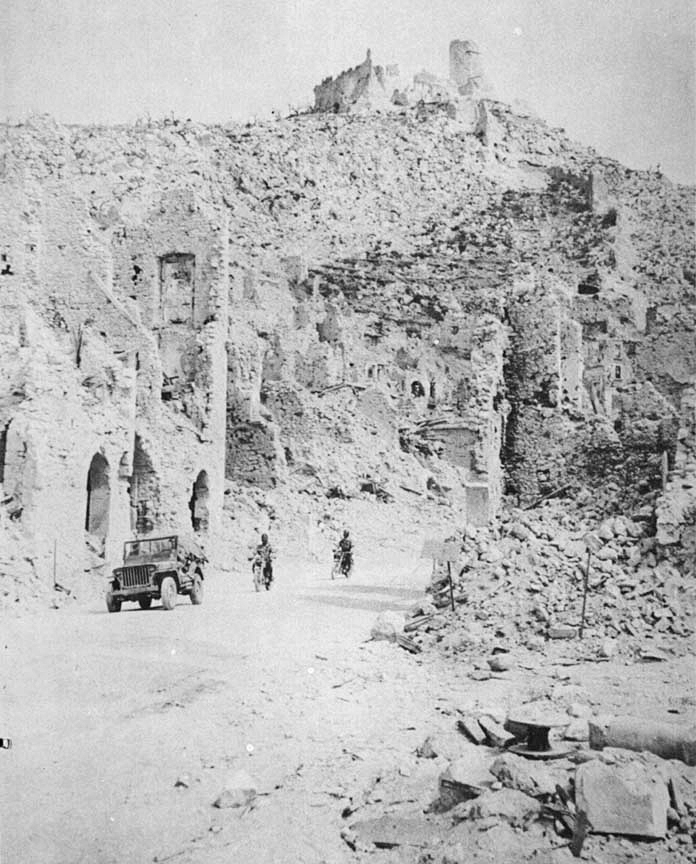
Allies again travel the road to Rome. During the battle for Cassino, AFS operated at an RAP just below Castle Hill (background) throughout some of the bitterest fighting of the Italian campaign.