Edited and published at AFS Headquarters; 60 Beaver Street, New York 4, N.Y. under the sponsorship of the ambulanciers' relatives and friends, who contribute the excerpts from the letters.
Thirty years ago an idea conceived and nurtured by A. Piatt Andrew was born as the AMERICAN FIELD SERVICE. This idea being that Americans, as neutrals, could serve in the front lines, help save lives and thus, while sharing the hardships of war with their French friends, cement a closer bond between men, who although of different nationalities were of the same beliefs. On the First birthday AFS was a tiny but sturdy baby --- a few men in a few cars at the front carrying French wounded to safety, away from German aggressor bullets.
Throughout the next two years of its life, AFS expanded until it served almost all fronts in France and was represented in the Balkans. On its Fourth birthday it was to lose its individuality yet gain immeasurably in face and characters for the American Field Ambulance Service, as it was then called, was absorbed by the American Expeditionary Force. Its members went to all branches of the Army and into the Navy, many of them as commissioned officers. The ambulances and other vehicles went as a complete efficient working unit to the U.S. Army in France to participate in the 1918 victory.
When the time of the Seventh birthday came, the erstwhile ambulance service had undergone a complete change in actual operation, yet it was serving. Perhaps more quietly than in its boisterous war-baby days, the ideal of good fellowship among men made a strong spine that wouldn't break and a well-formed head that kept developing. For the next 18 years American Field Service money, collected and administered by former ambulance drivers in France, supplied exchange scholarships to American and French students under the name of "American Field Service Fellowships in French Universities".
On the Twenty-fifth birthday, 1939 September, AFS men, seeing the need once more for the battle ambulance service, sprang into action and again American vehicles were rolling along French roads, helping hands and strong shoulders by the side of French comrades, against the enemy of free people.
Five more birthdays have passed. AFS had now grown to man's estate. No longer does it serve with one nation, but with many. Wherever there has been a call, a need for aid to the wounded, a place on the battlefields, AFS responded. A long hard journey: retreat in France, retreat at Bir Hacheim, Tobruk, retreat from Imphal, advance from El Alamein up through the desert to Tunis, advance in Italy, advance in Burma and now in France. These last five birthdays have been marked, not in celebration,..... but, in all-absorbing, hard work. The wounded have been carried over every kind of ground, in all weather by ever increasing numbers of Americans who sought to do their parts, no matter how tough or unsung. AFS men have shared the risks; the dangers, the hardships, on three continents with men of many nations: Britons, New Zealanders, Australians, South Africans, Indians, Canadians, Fighting French, Poles, Greeks, Italians, and French again. These unarmed Americans have shared it all with these soldiers......AFS men lie with the honored dead of these nations.
Whether or not it is destined that more battles be added to the flag, AFS will have birthdays to come. Such a force of men as have lived with these ideals, will make a future for keeping close the ties that have knit them with the men of many nations.
| Kirk Browning | Thomas R. Byrd |
| Thomas Hale | Leo E. Hillery |
| Chandler Keller | Jay L. Nierenberg |
| Julian R. Orton Jr. | Richard Bayley Winder, IV |
| Vernon W. Preble (posthumously) | Bernard H. Wood, III |
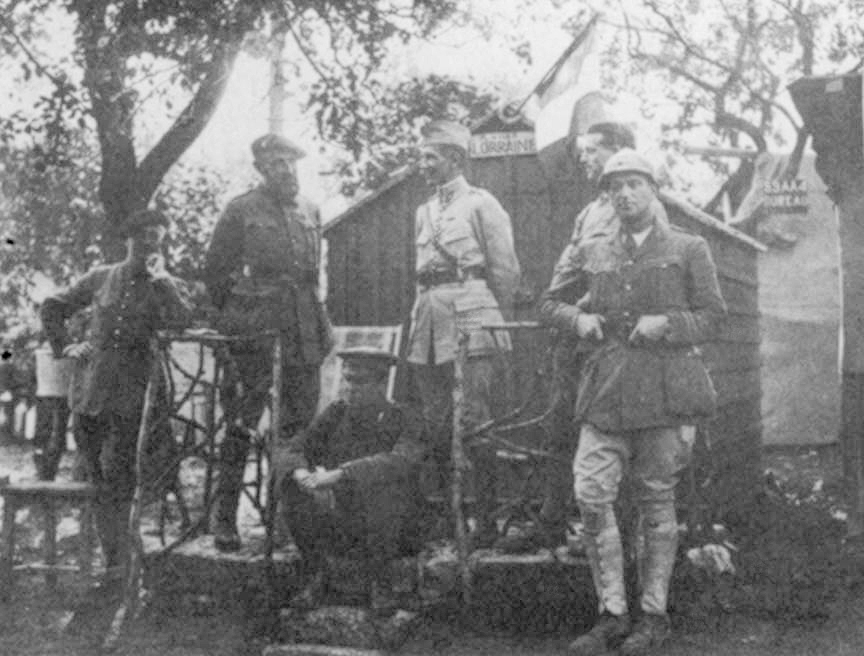 A. P. Andrew (extreme right), founder of American Field Service, is pictured at a field HQ in France, 1916, with a group of French officers and volunteer ambulance drivers. |
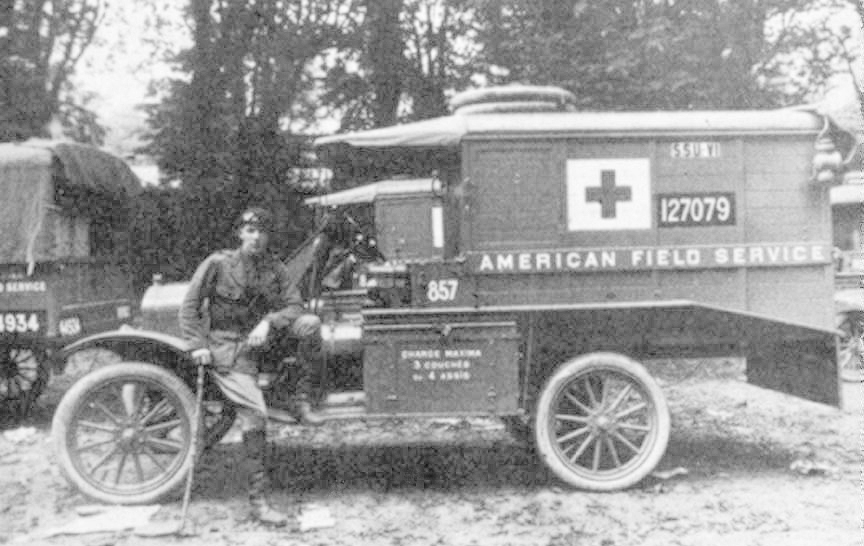 When we were very young ....An AFS Ford ambulance of 1914-18 |
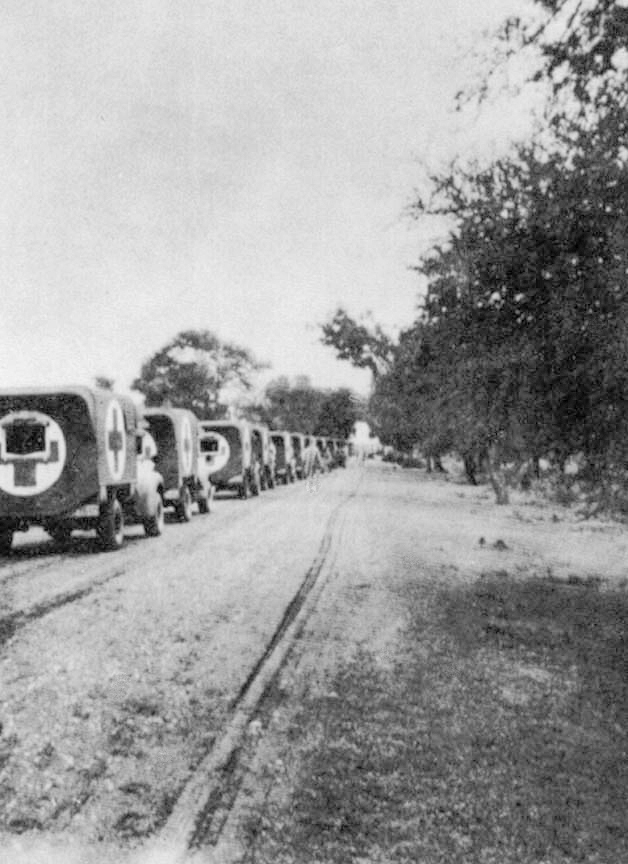
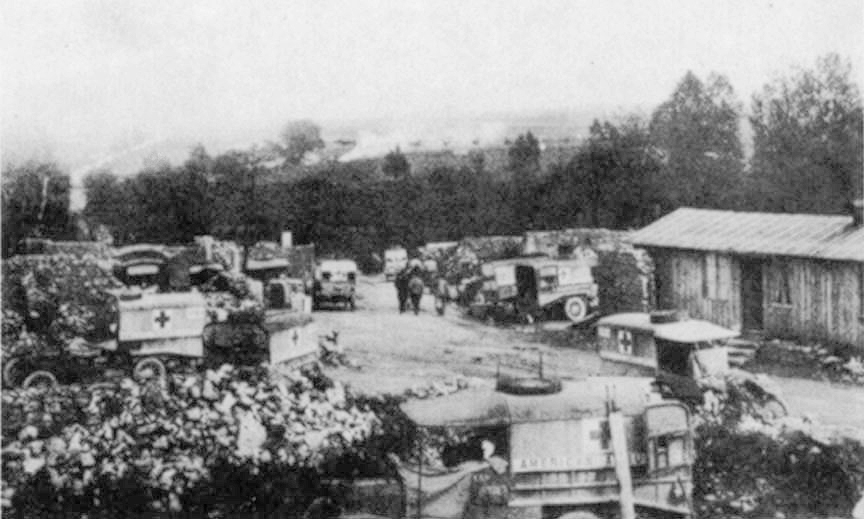 Ambulances of World War I await the call to move in the Verdun area, while enemy shells kick up dust in the background. |
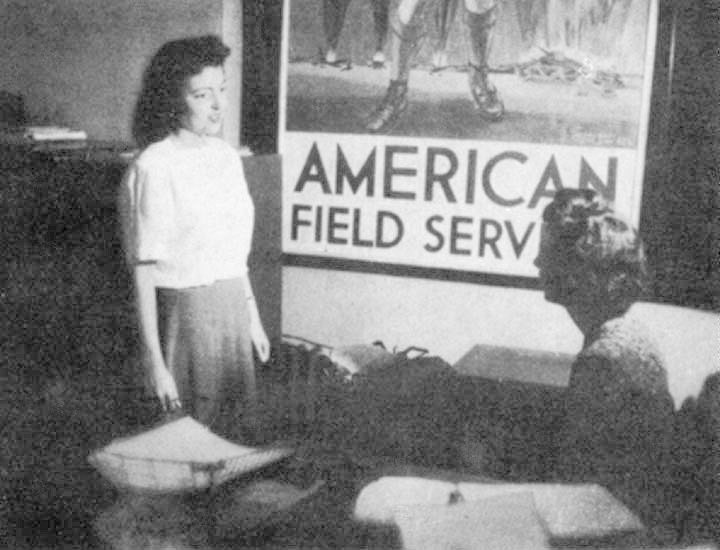 During the peace years, AFS functioned as an association working with the American Field Service Fellowships for French Universities, Inc., whose purpose was to provide an enduring memorial for AFS men who died in World War I. |
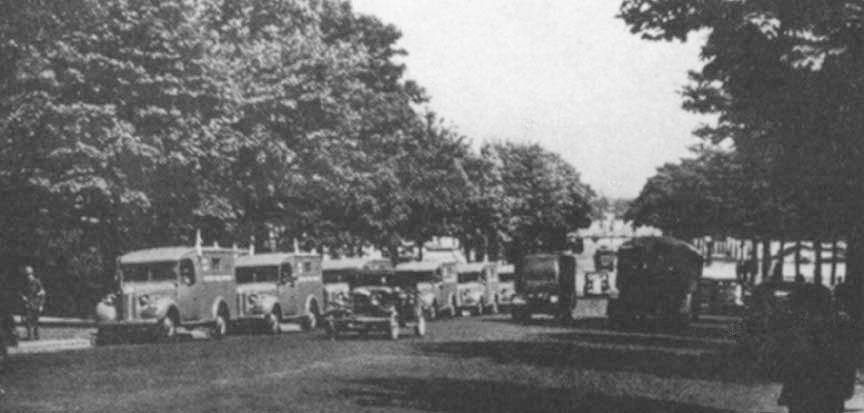 Ambulances line up in front of the Cité Universitaire before leaving for the Amiens-Beauvais front, 1940. |
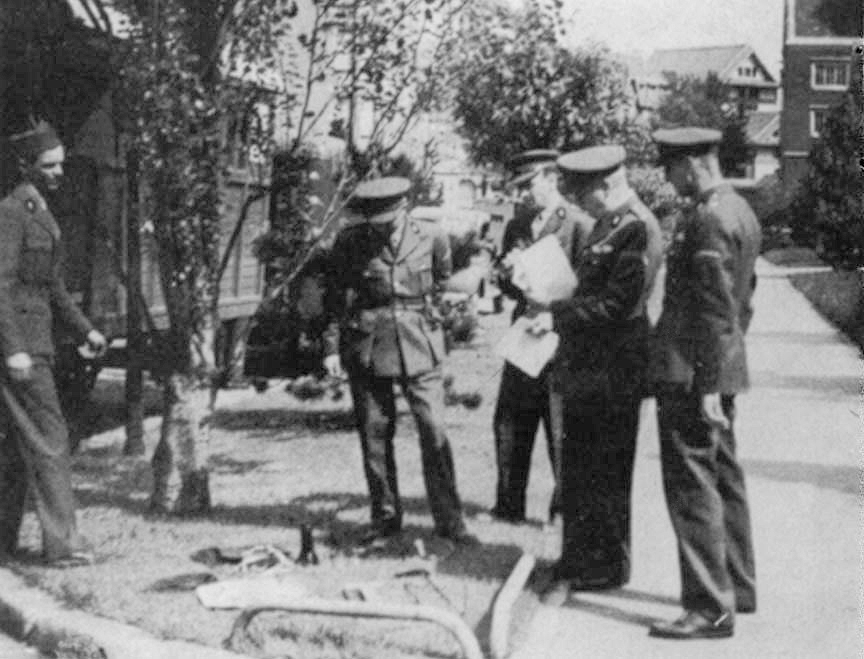 Final check-up. William H. (Bill) Wallace, Jr. AFS' assistant Director General, with papers in hand, sees that everything is ready before the ambulance sections leave Paris for the front, 1940. |
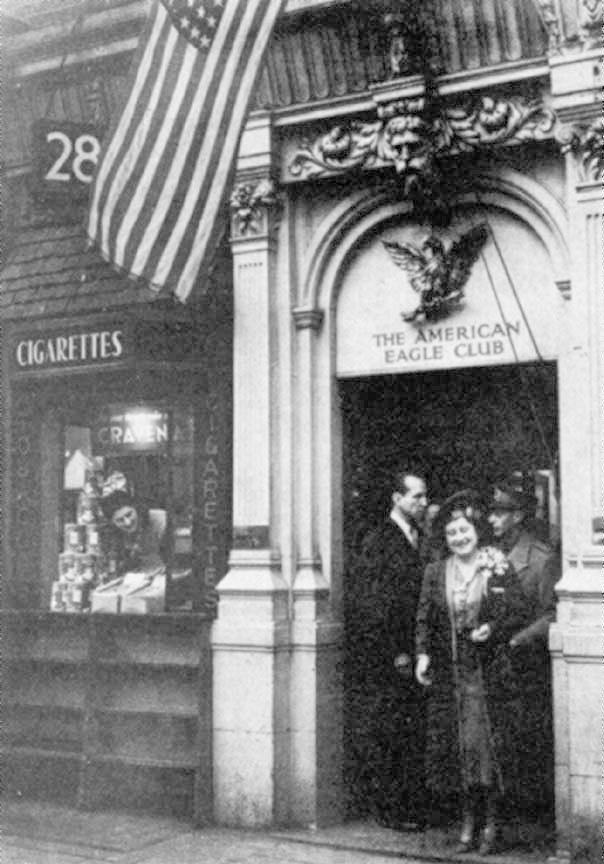 England's King and Queen are snapped leaving the Eagle Club of London. AFS raised funds in America for this club. |
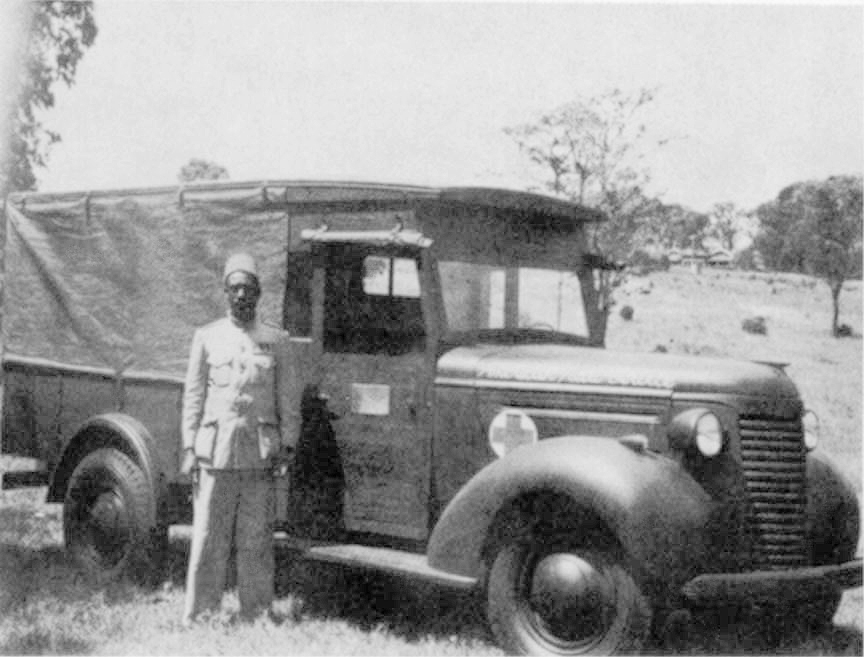 One of the 14 ambulances sent to Kenya Colony in 1940. These have continued in service with British troops and are driven by African natives. |
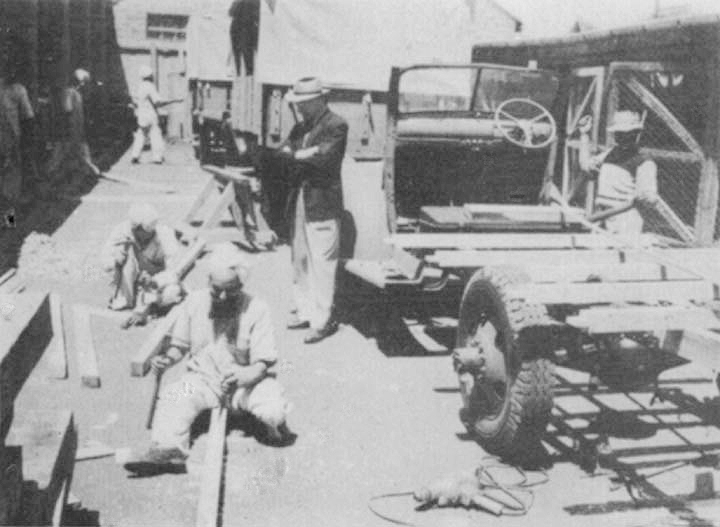 The ambulances sent to Kenya Colony were assembled on the spot by natives. |
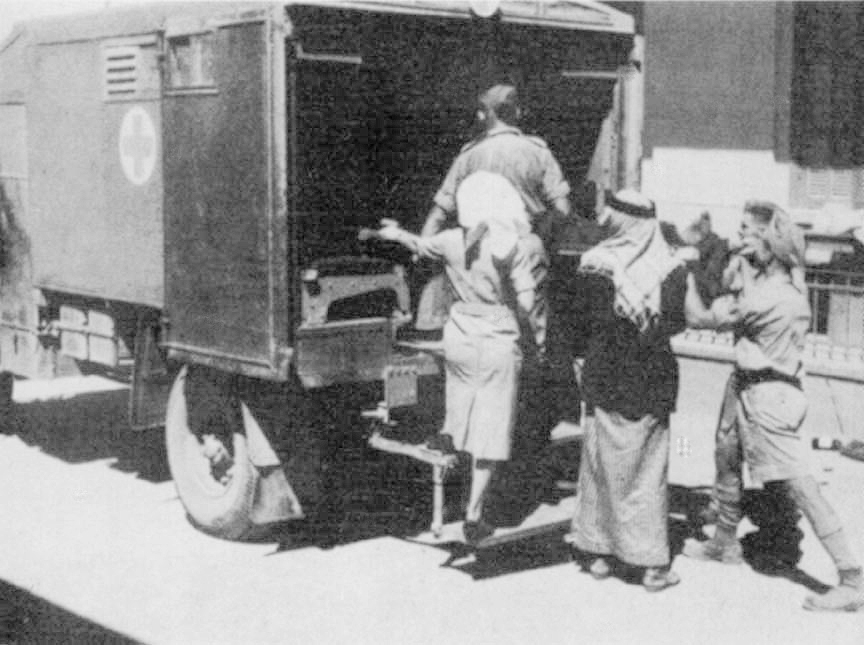 Syria 1941. One of the vehicles operated by AFS men with the Hadfield-Spears mobile hospital unit for the Free French. |
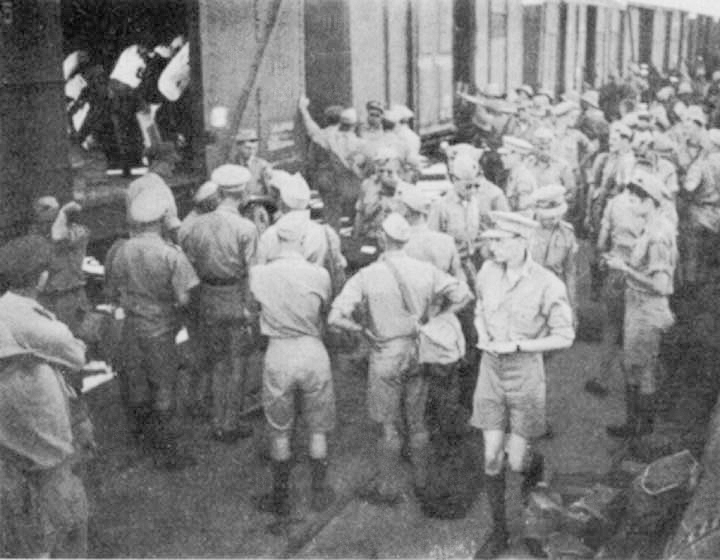 One of the first AFS contingents to serve the celebrated 8th Army in the Western Desert arrives in the Middle East. |
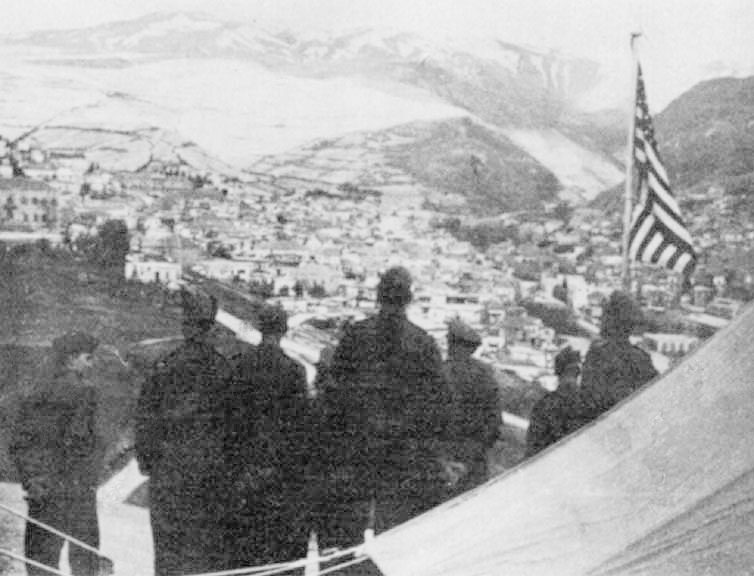 The first AFS unit to serve with New Zealanders stand under the first American flag to be raised over General Freyburg's HQ at Zahle, Syria in June 1942. |
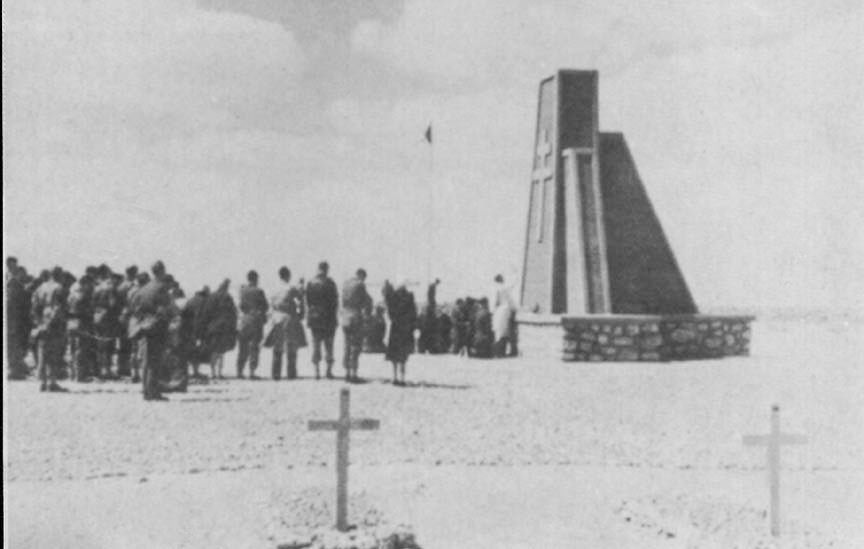 AFS men join their Fighting French comrades in paying tribute to those who fell at Bir Hacheim. The memorial, which is on the desert at the site of their gallant stand, honors George Tichenor and Stanley Kulak, American "ambulanciers volontaires" among its heroes. |
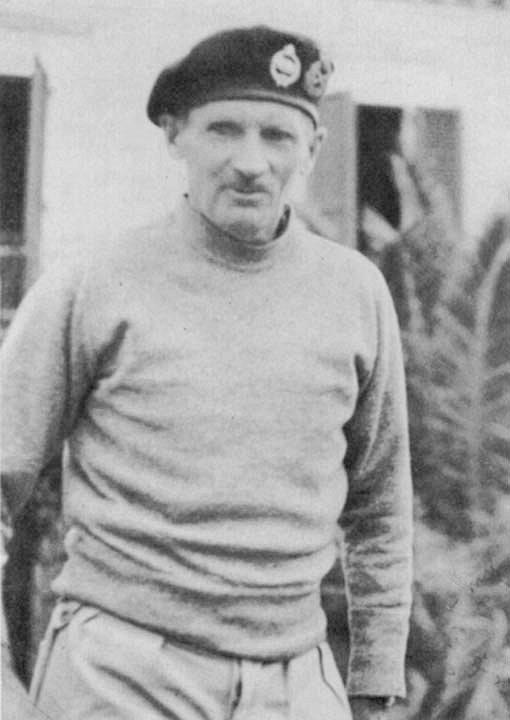 "Monty" of the Desert Eighth Army. |
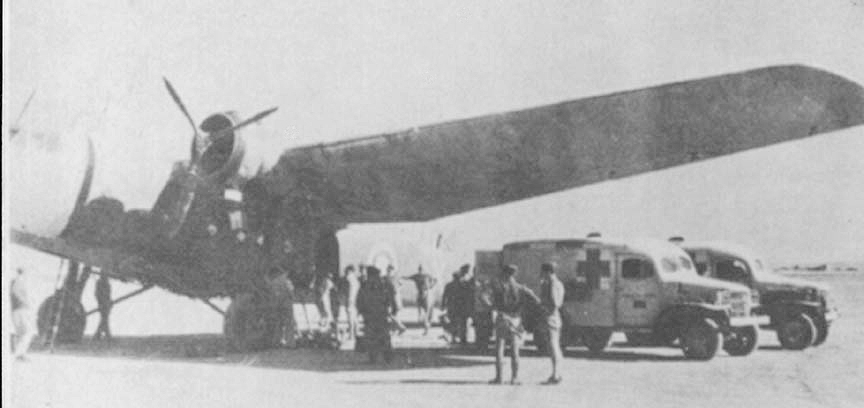 AFS ambulances evacuate the desert wounded to RAF bombers, pinch-hitting as ambulance planes. |
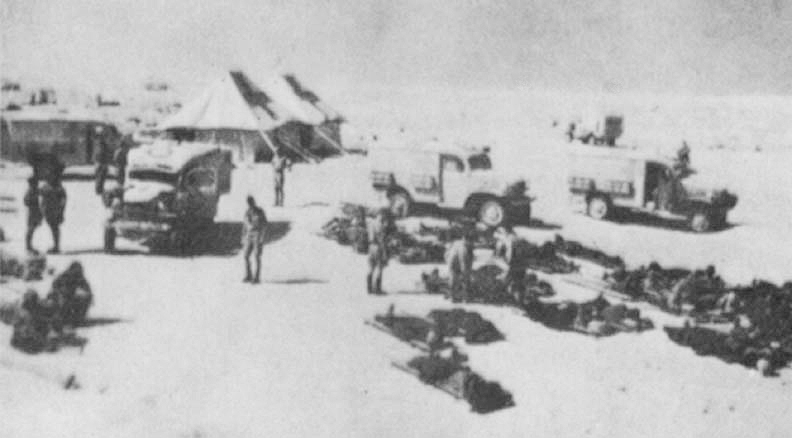 AFS ambulances stand by to evacuate wounded from an over-crowded dressing station during the battle of Alamein. |
 Ambulance drivers at an Advanced Dressing Station watch Nazi shells explode, somewhere in the Western Desert. |
 "The end of a perfect day" ......Twilight on the road to Tunis finds a group of ambulance drivers sharing talk and rations. |
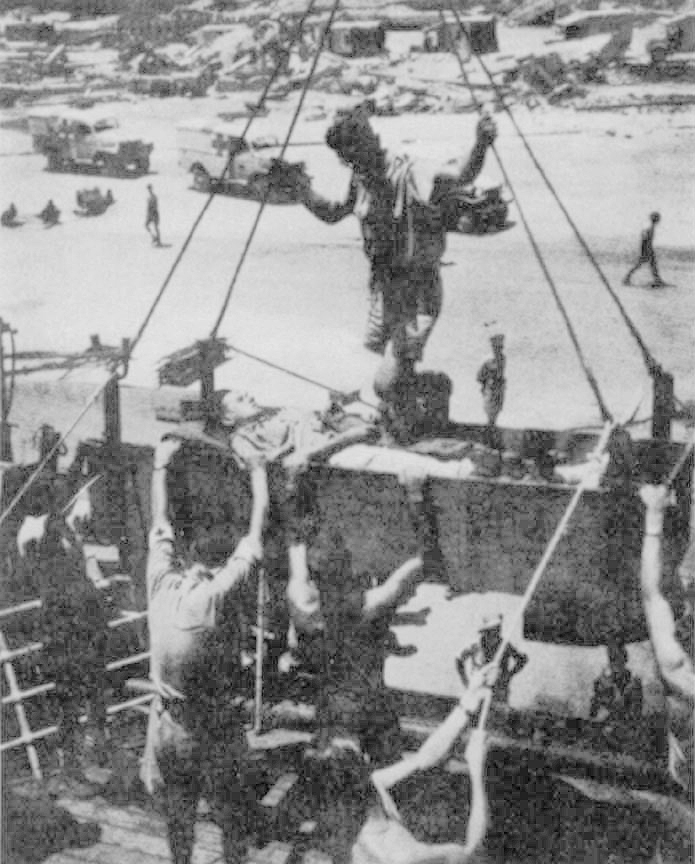 Wounded from Sicily are lowered from a hospital ship at Tripoli. AFS ambulances in the background will take them on to base hospitals. |
 Going Across .... A group of ambulances cross the Mediterranean aboard an L.S.T. (Landing Ship Tank). |
 On to Europe. The first AFS ambulance goes ashore at Salerno. |
 AFS evacuates Polish wounded from Monastery Hill during the final battle for Cassino. |
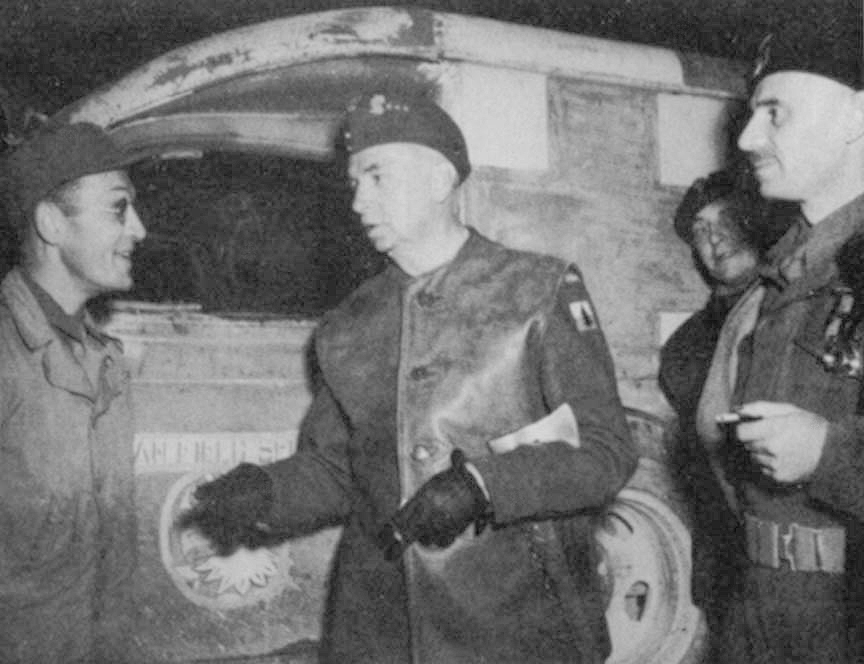 Another Ally---another friend .... an AFS driver stops to talk with Lt.-General Sosnkowski (center), Commander in chief of Polish Army, and Maj.-General Anders. AFS units have served with the Poles since Cassino. U.S. Army Signal Corps. |
 AFS volunteers join Italians who are fighting with the British 8th Army for the liberation of Northern Italy. Tents in the background are an Italian Dressing Station. |
 Mr. Galatti goes to war .... AFS's director general confers with Colonel Ralph Richmond and a British Officer, while on his inspection tour overseas last spring of the ambulance bases in Italy. |
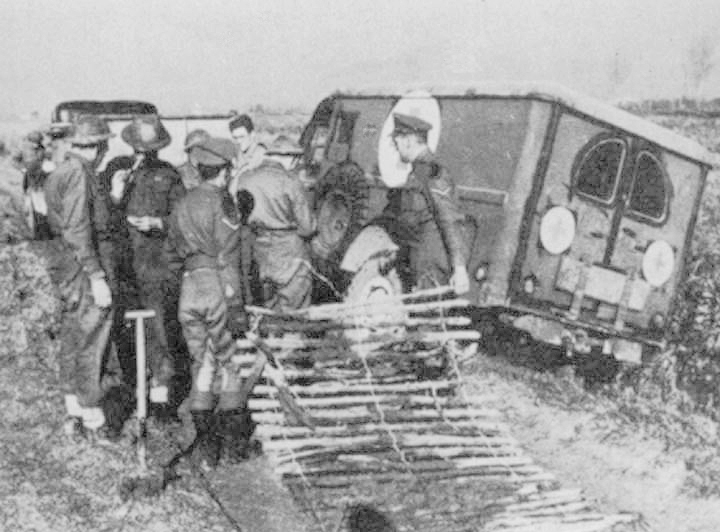 An AFS ambulance bogged down in mud at the Garigliano River front, is rescued by means of an improvised wooden track. |
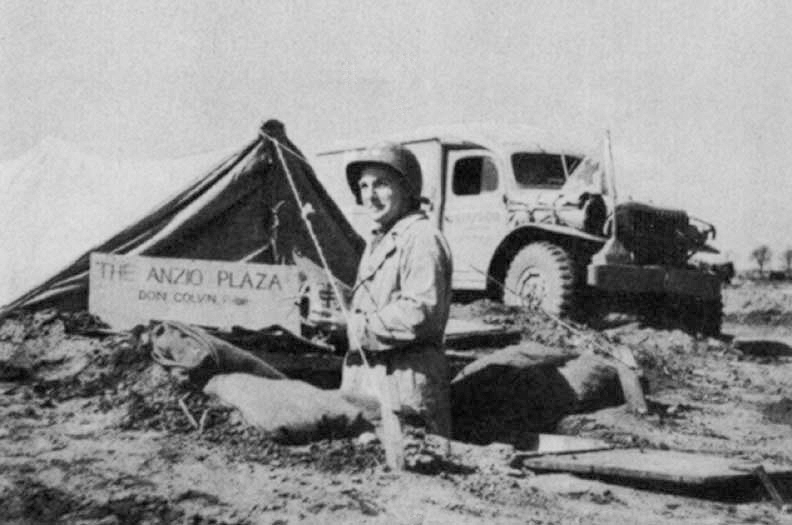 At home abroad. An AFS man christens his foxhole. |
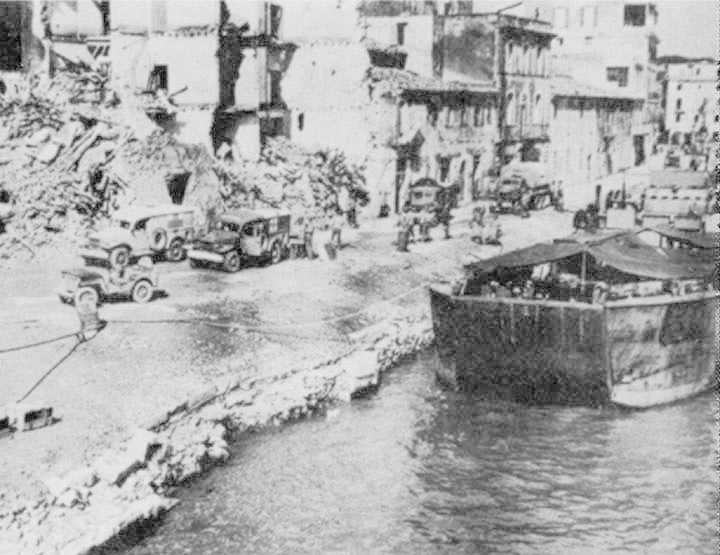 AFS ambulances on the Anzio beachhead evacuate the wounded to waiting barges. |
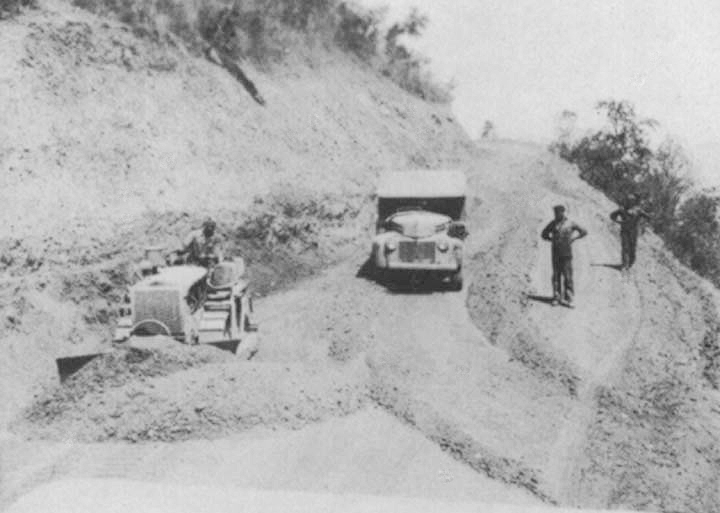 Along the newly widened Tiddim Road an ambulance goes up forward --- in Burma. |
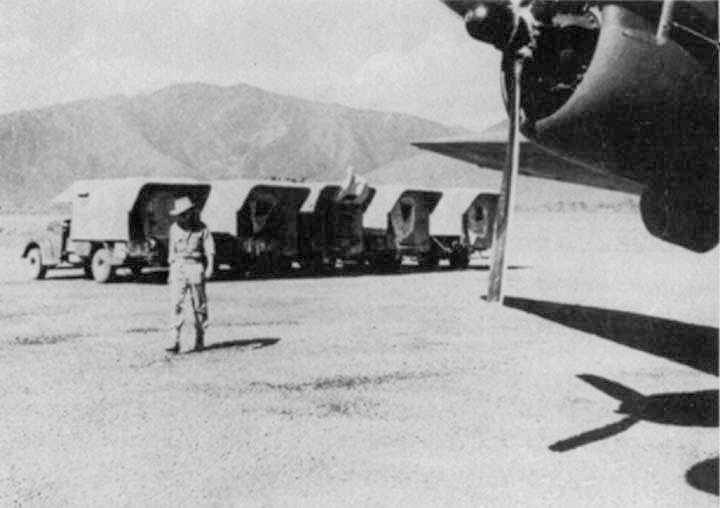 On the Imphal airstrip. AFS ambulances have brought the wounded out for evacuation. |
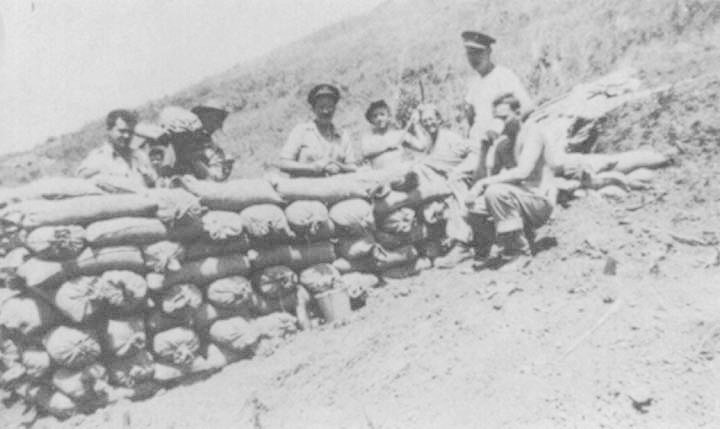 AFS men fortify their bunker at the Assam-Burma front |
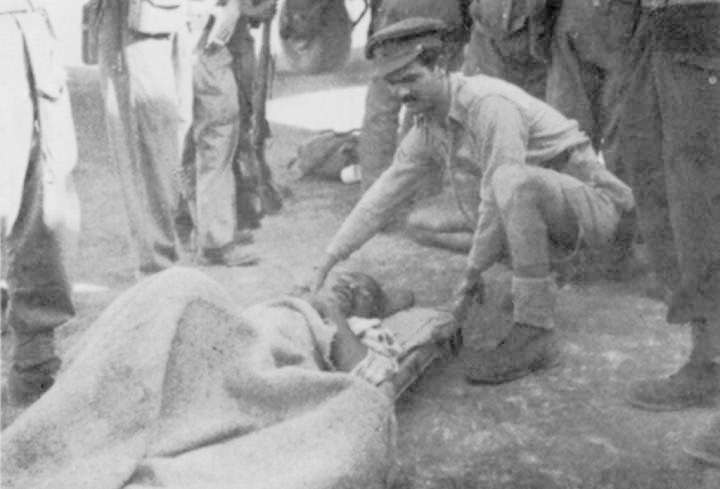 Mercy to an enemy. A Japanese prisoner wounded in Burma is loaded onto an AFS ambulance. |

|
IN FRANCE 1940 A. C. Barrage |
WESTERN DESERT 1942-3 J. D. Dun |
MEDAILLE MILITAIRE J. D. Dunn |
|||
 |
ORDER OF THE BRITISH EMPIRE D. G. Atwood |
BRITISH EMPIRE MEDAL R. W. Beck |
 |
||
|
MENTIONED IN DISPATCHES T. N. DePew |
PURPLE HEART F. S. Billings |
||||

| T. Barbour | J. B. Helfrich, Jr. |
| R. W. Beck | J. N. Hobbs |
| D. Beatty | D. D. Hunt |
| F. S. Billings, Jr. | G. B. King |
| W. Bradley | LeR. H. Krusi |
| H. Bonner | N. Laden |
| T. Bullock | A. McElwain |
| G. R. Bunker | R. McK. Mitchell |
| R. C. Coffey | S. I. Munger, IV |
| R. G. Decatur | C. Saber |
| S. M. Donaldson | L. Semple, III |
| E. S. Driver | N. Shethar |
| D. A. Emery | G. E. M. Stumpp, III |
| C. M. Field | A. M. P. Stratton |
| B. P. Ford | G. F. Stutz |
| R. G. Frazer | E. E. Tanner, III (twice) |
| W. G. Fugitt | H. W. Taylor, Jr. |
| W. D. Fuller, Jr. | L. Toms |
| W. G. Fuller | R. C. Waller |
| R. E. Glasser | W. B. Warden |
| B. E, Grove | R. B. Winder, IV |
| J. C. Harkness | J. B. Wilton, Jr. |
| F. A. Dignam | J. E, Reppert |
| D. DeV. Heath | F. M. Smith |
| D. James |
| FRANCE 1940 | WESTERN DESERT 1942 |
| J. Clement | M. W. Belshaw |
| D. Q. Coster | P. C. T. Glenn |
| G. F. J. King | A. McElwain |
| H. G. Wait | W. W. Mitchell |
| C. L Perkins, Jr. | |
| L. C. Sanders | |
| A. R. Stuyvesant | |
| ITALY 1944 | |
| R. C. Anderson |
| RICHARD N. HALL | PAUL G. BENTLEY |
| EDWARD C. SORTWELL | PERCY R. HAMILTON |
| EDWARD J. KELLEY | JAMES W. GAlLEY |
| HOWARD E. LINES | JOHN V. NEWLIN |
| HENRY M. SUCKLEY | PAUL G. OSBORN |
| HARM0N B. CRAIG | GEORGE P. NORTON |
| BENJAMIN R. WOODWORTH |
| THOMAS S. ESTEN | GEORGE O. TICHENOR |
| STANLEY B. KULAK | WILLIAM K. MCLARTY |
| JOHN F. WATSON | RANDOLPH C. EATON |
| JOHN H. DENISON, JR. | AUGUST A. RUBEL |
| RICHARD S. STOCKTON, JR. | CURTIS O. RODGERS |
| CALEB MILNE, IV | VERNON W. PREBLE |
| CHARLES J. ANDREWS, JR, | ARTHUR P. FOSTER |
| CHARLES K. ADAMS, JR. | HENRY LARNER |
| ALEXANDER RANDALL, JR. | GEORGE BRANNAN |
| ROBERT C. BRYAN | DAWSON ELLSWORTH |
| JOHN DALE CUNNINGHAM | DONALD HARTY |
| THOMAS L. MARSHALL | GEORGE A. LADD |
| PAUL H. CAGLE | JAMES B. WILTON, JR. |
PAUL CAGLE AND JAMES WILTON on August 4th, while posted to an RAP on the Italian Front, were in an area which was under heavy shell fire. Wilton, who took shelter under his ambulance, was struck by an enemy shell. Cagle who had taken refuge with some British personnel, left his shelter to go to Jim's aid. As he was bending over him to ascertain the extent of his injuries, Paul was severely wounded. Both boys were given immediate surgical attention, but despite the quick action of the Medical Officers, they died as a result of their wounds. The service rendered by both of these boys will always remain an inspiration to those who carry on in their stead. Many AFS men have given their lives that others may live. This is the first time that one member of the Service has died in an attempt to save his friend --- "Greater love hath no man" may well be applied to Paul Cagle.
WARREN G FULLER, on August 6th, was very slightly wounded during the Italian Campaign. He was attached to the First Field Ambulance ADS. The building was hit by a shell, scratching Warren's leg in several places. Warren has served overseas with the AFS since September 1942, and is now enroute to the States for a thirty day leave after two years of service.
Cabled advice received at New York Headquarters reports that the following three men have been wounded, during the Italian Campaign, but the details of these injuries have not, as yet come through.
WALLACE CHAPIN, slight burns on hands and face.
ROBERT KENNEDY, slight wounds right hand and shoulder. Both Chapin and Kennedy have reported back on duty.
GEORGE SEARS, leg wound and fracture.
DANIEL JAMES on August 5th, while posted to an RAP of the forward battalion on the Tiddim Road south of Imphal, was slightly wounded in the head by a fragment from a Jap 105, This gun was endeavoring to knock out some tanks when a shell hit the ambulance which Danny was driving. After a week's hospitalization, he has returned to duty.
HOUGHTON P. METCALF, on September 19th, was reported missing in the Italian Campaign, Hodie is a veteran AFSer. He left for overseas duty with the first section and served throughout the desert campaign. He moved to Italy with his Platoon, and then returned to the States for a short home leave. He rejoined his Unit and soon thereafter was reported missing.
RICHARD ANDERSON, who, several weeks ago, was listed as missing in action during the Italian Campaign, has now been reported a prisoner of war in Germany.
ALBERT CAMERON BURRAGE, on August 9th, was killed while serving with the Sixth Armoured Division in Brittany. Cam served with the AFS In France 1940, and was awarded the Croix de Guerre for distinguished service. After his return to this country, he joined the Armed Forces and was commissioned as a Captain before returning overseas. He was killed very near the same road in France up which he drove his ambulance during the time he served with the AFS.
CHARLES A DOWNS on August 7th, was killed in France. He was attached to a reconnaissance unit of an army tank group and was assigned to advance observation of German strong points. Charles first went overseas as a member of the Fourth Unit of the American Field Service and served with the British Eighth Army all during the desert campaign. He returned to this country and joined the Armed Forces, returning overseas several months before the invasion.
ALBERT CLARK RUSSELL, on August 12th, was killed in France. Albert was a member of the Sixteenth American Field Service Unit, and like Charles Downs, served with the British Eighth during the desert campaigns. He was one of twelve AFS volunteers who faced heavy mortar fire while rescuing wounded men in the battle of Tunisia. He returned to this country at the end of his enlistment and joined the Army, with which he served until his death.
LEWIS RUTHERFORD STUYVESANT died suddenly on September 7th. "Stuyve" as he was affectionately called by his friends, together with his brother Alan, went overseas with the AFS in 1940. After the collapse of France, both brothers returned to the States and in 1941 rejoined the AFS and left for service with the French in the Middle East. Stuyve was awarded the Croix de Guerre for meritorious service and came home because of an injured arm. He later was commissioned a Lieutenant in the Marine Corps, from which he was honorably discharged because of ill health. His greatest desire was to return overseas with the French Section of the American Field Service, but this dream was never realized.
JOHN WILSON CUTLER, word has recently been received that John is a prisoner of war in Germany. He, like Cameron Burrage, was a member of the American Field Service and first served in France in 1940. After a short time at home, Jack returned overseas and has served with both the British and American Forces.
In retrospect, one realizes that the French resistance at Bir Hacheim perhaps made the difference, gave the British time to retreat and reform at Alamein. At the time, that was not apparent. The new armour that had, so slowly been brought from America around the Cape; had been destroyed at Knightsbridge; Bir Hacheim for all the heroism of its defenders had fallen; Tobruk with the bulk of its large garrison, with all its supplies, had been lost almost at once; Matruh had gone; the armies were streaming back in a seething mass towards the Delta; G.G.Q. at Cairo was burning its papers in preparation for evacuation. The British if they should be lucky, might retreat to Palestine, and hold out there for a time on supplies brought across the Syrian desert from the Persian Gulf. But it looked like a losing game.
Such was the situation when I first met Colonel X of the Free French Forces. He was camped with his men on a desolate slope somewhere near Fuka. Not a propitious spot. Northaly the sea. To the east; just below him; the coast road crossed the railway--- an ideal target. Inland was an airfield. West of him were tanks. In consequence, he had been heavily bombed and straffed the night before, and he expected a repetition that evening. For all that, he looked neat, alert and cheerful; he gave us what was a very good supper under the circumstances, though he apologized for it; he spoke enthusiastically of the excellent work done by our American Field Service ambulance drivers attached to his command. But he warned Colonel Richmond, my chief; to sleep well away from his vehicle. His tone was pleasant and half jocular, but he meant his warning; there would be a moon, and the vehicles would be targets for straffing. Colonel Richmond answered that his presence was a guarantee of a quiet night; he always arrived the day after a show or left the day before it; he was never at it. In fact, he did sleep in his ambulance and there was no raid.
Raid or no raid, I remember admiring the composure of Colonel X. His country fallen, he had made his way to Egypt and joined General de Gaulle. And now, his cause seemed hopeless. De Gaulle had made a fine gesture, but nothing would come of it. Colonel X must have been feeling this and struggling against it; he showed nothing of it.
We met several times later. Colonel X was always particularly pleasant to me. Probably, just because he was a pleasant man, but I suspected that it was a little because I had by chance been with him at the moment of his greatest discouragement; and he had felt my sympathy and admiration. But perhaps this is imagining too much.
Last night; we met again, for the first time in nearly a year. It was at the French Officers' mess in------------. This time there was no disguising Colonel X's feelings. How was I? He was glad to see me. There was an excellent dinner tonight. Wouldn't I dine with him? Pure elation, and with reason! He had heard that very morning of the liberation of Paris. That afternoon, word had come that the town in which his family lived had been freed. And, just an hour or so before dinner, he had been told that he was to sail for France in the morning.
C. H. C.
July 11, 1944.
"So far nothing unusual has happened to us, everything is quite normal, except that we believe that the U.S. Army has put us on the wrong ship. We have reason to believe that we're headed for the wrong port on the wrong continent. It won't be too bad should this happen, perhaps a delay of a week or so before we end up where we are expected. But the Army fouled this one up, so they'll just have to straighten it out for us, too.
"The French Unit is really an outfit made to order. Wonders are going to be done with it; it is capable of anything. The esprit de corps is there, and I have observed the fellows and am most confident. of our potentialities. We now have a unit of 14 men; we hope to get 6 more men from Italy (British) to make up a section of 20 men before we go into battle."
July, 1944.
"France has been at war a long time, hasn't she? Her countless campaigns at home and in her colonies" have taught her I think how to treat her soldier so that he in turn can most fully appreciate her. He lives in stables and straw; he drinks and perhaps washes at the same pump that serves the horses and mules. He cleans his gun by candle-light or perhaps one of those dangling light bulbs that you can easily stare at and look through.
"His camp lacks every modern convenience; but is kept clean, even though there are moss covered cracks in the barracks walls, and rats waddle almost lazily across the palm-fringed square as the sun sets, and someone plays a ragtime on an old defunct victrola. This is an army. the army you read about in books, ---the one you imagine when you read of Napoleon, the Riffs Foch and perhaps Gamelin, an army of discipline reaching cruelty; of two sous a day, of pure simplicity, and golden rules of tradition, and of honor. And to the French soldier the last two mean everything. He will never say so, or show it in any obvious way, but it is in his eyes. All he asks for is his wine and his gun. It is therefore also an army of good food, unmatched fighting; and grand camaraderie.
"And right now; -----France is on the lips of every man. They are casually fatalistic about it, but demand one thing ---that they die on French soil. And when the time comes that these fellows invade their homeland, I would be very happy if I know that you were drinking a silent toast to them. And drink a short one to me, too; for I shall be with them."
August 30, 1944.
"The French Unit officially commenced operations on the morning of August 2nd. We were based at a large French hospital in the very center of town. This hospital used to be a high school with one room for sleeping quarters and another for poker tables; phonographs, baggage etc. Large rooms, (former classroom, with much window space and tiled floors). The center of our establishment was a tree-filled courtyard where we usually ate our meals. Just outside the patio, and directly in front of the hospital, our ambulances were parked.---brand new Dodge 3/4 tonners. Working with us on a temporary basis were some Spaniards and Arabs, although of course, they lived in other quarters. The work consisted of morning runs evacuating patients to hospital-trains, and usually we had the rest of the day off in town where we had access to the ABC Officers' club, also there were five movie houses with the latest films, bars; cafes, etc. We made use of fair beaches not ten miles distant, and altogether our stay was very satisfying.
"It was all an a temporary basis, however, for during this time preparations had been under way for our permanent attachment to a medical battalion in the field; not far from the city, and after having drawn complete U.S. Army (lend-lease) issue, (which includes everything the U.S. Army ambulance driver gets), we set forth for camp, and became Company 1 of the battalion. There is another company of Corsican women drivers and the Spaniards and Arabs make up the third company.
"So here we are, fully equipped and perfectly satisfied. Of course, it does irk us that we missed out on the invasion and especially since women drivers had been used in it; but it couldn't be helped. In fact we missed being selected as part of the invading forces by a few hours. This was no one's personal fault ---merely an unfortunate turn of events which caused the miss-out. And besides; the prospects of our seeing action soon are bright now.
"While we were working back at the hospital our ranks swelled to 24---10 men from Italy. There are two men to an ambulance, and we are taking a daily course in 1st. Aid. The battalion is fully equipped with shiny new American material, ready for embarkation.
"After leaving us well-established with the French, the Major took off for British AFS HQ, and more recruits ..... The health of the unit is good and the food is improving.
"As for the French Unit in general, the old French spirit is not lacking. I'm sure that it will increase to great proportions as we get started with the work we came over here for. The French seem more than glad to have us, and Captain Lemonnet, our French C.O, has chosen our company as top-ranking, meaning the choicest bit of work at the front."
July 27, 1944.
"I have got more insight into the problems of Italy in the last three weeks than in all the other months. The problems are important not only in themselves, but also because they are going to be the problems of every country in Europe after the war. You can only see Italy in terms of the class struggle. That, of course, is why the Communists are so strong here. It is rich against poor. I don't say it has to be that way, but that is the way the people say it is, which is important. The English and Americans, thru AMG, adopt a middle-of-the-road policy. I believe they should either treat it like a conquered country and run the whole show thoroughly or leave the internal affairs as much as possible to the Italians. What happens now is this: AMG comes along after a place is taken and kicks out certain prominent Fascisti (most of whom have retreated with Jerry any way). They set up a new Sundico (Town Council) and talk to certain people and appoint a mayor. All very well, but in the other government positions they leave in the same men who have held the job for years. These men who have no title (i.e. Mayor) do the real work and although they are not 100% fascisti, they have played along with the fascisti for years to hold their jobs.
"It gets down to this question ---who are you going to call Fascists (and then kick out) and who aren't you? It's a hard line to draw. To get any kind of work in Italy, you had to sign up as a Fascist, so that is no criterion. If a man had to decide between having his family starve and signing up in the party, you can hardly blame him. Of course, now in Italy everyone calls everyone else a Fascist. You see how difficult it is. I believe that as soon as possible we must take our hands off Italy and let them work it out. There will be bloodshed, revolution, etc., but in the end they will get off to a clean start and I think the Italian people have learned this lesson about Fascism.
"Obviously in any broad sense these wars are a struggle to find a new way of life--- I don't mean a brave, new world ---I mean they are struggles to find out how the peoples of the world can live in the midst of these technological advances which have come upon us so suddenly in the last 80 years. That is what people mean when they say we are in the midst of a world revolution. To ignore it, to pretend it isn't happening is only a sure way to make oneself miserable in the future.
"That is what I mean when I say this is a struggle for a better world. If we cannot create a world after this war in which people can live together and, what is more important, a world in which people can derive some satisfaction spiritual satisfaction from their lives, then we will plunge into another abyss. That is why there is no turning back. The Church is finito --- it can no longer supply the need. Very little of what has formed the material basis of people's lives for the last couple of centuries will help. So it is, I believe, to the future, not to the past, that we must look. I see ahead a time when I personally may have to make certain sacrifices in the common good. I hope (and that's all one can do) that I shall be willing to make them."
May 17, 1944.
"The other night some of us had a sudden unexpected call to go to the front. I shall never forget that night. It was the darkest, noisiest, most confused and downright frightening night of my life. The narrow, treacherous track, the explosions all around, and the vicious chatter of the machine guns were disconcerting to say the least. The darkness seemed to drag on forever. Dawn slowly crept up. A heavy mist hung low. Scattered about were piles of rubble or shattered walls that told us a house had once been there. I know it was real for I was there and saw it. Men were killed, for I saw them dead ---and, yet, that misty weird dawn will always seem to be only a dream. It was too strange to have truly existed."
June 20, 1944.
"One of the men, while strolling through the streets of this village (after our occupation), was stopped by a ragged Italian who was almost overcome with joy. He was not an. Italian at all but one of five British soldiers who had been captured nine months ago. They had escaped soon after capture and had been living in the hills ever since. He had sneaked into town for a look around and was overjoyed to see British troops on the streets. He went for the others. That night we listened to their interesting story while they drank gallons of tea and ate a huge dinner the cook prepared for them. They were eager for news. They cheered when we told them of the second front, of the capture of Rome and of the great air raids on Germany."
No date.
"One of the men here is Scottish and would steal K's heart away. He recites, etc. in the Highland dialect which I can barely understand. He plays 'Jock' marches and Highland flings that would turn K. inside out. I guess the biggest disappointment in his life was that he could not be serving in some Highland Infantry Regiment where he could march to their 'pipes' to his heart's content. So he consoles himself by playing all their stirring marches on the accordeon.
"Several of the tommies went on a trip yesterday in a jeep. They came to a washed out bridge. Six big blacks from South Africa picked up the jeep and carried it across the river with the tommies in it!
"Several Italians have just come into the post for treatment of wounds. Some of them are quite pitiful, especially the very young children; who, by the way, while pitiful, are not usually the whiners and babies that their parents are. Sometimes children whose parents have been killed or taken away to hospitals are rather disturbing, but they usually bear up quite well. We sometimes feed them, etc., and they eventually find relatives or friends, to care for them.
"Funny thing. Three dogs are trotting single file along a path across a field. Almost seems as it they know that the path has been swept clear of mines and is safe and that the rest of the field is not."
May 18, 1944.
"I have taken some lovely walks around the mountain patches which remind me a lot of North Carolina except here you constantly run into a chapel or the remains of an old villa. There are whole fields about of red poppies which are really beautiful..... thought you might like to know there is still a little more in parts besides death, destruction, starvation and all the other miserable aspects of this war. I must say however the way the people live is dreadful and their ambition goes little further than profiteering off the armed forces. The black market is outrageous and they seem to be proud of it. Stealing is rampant and we dare not let anything we value out of our sight."
"I went to an audience which the Pope grants to Allied troops ever so often. I was only a few feet away from him. He was very gracious and pleasant but his English is terrible. We were instructed to cheer when he entered which seemed to me a bit odd in a Vatican reception room reeking with religious symbols, paintings and persons. Next to seeing the Pope I got the biggest kick out of seeing the Swiss Guard arrayed in all their splendor."
July 16, 1944.
"We are now doing the hardest job we have ever done as far as tedious and exhausting work is concerned. We are evacuating wounded from a C.C.S. to another C.C.S. further back over forty miles of the worst road imaginable We work day and night, because as you have undoubtedly read; about the time I write this and for the past two weeks the Germans have been putting up fierce resistance which always means a lot of work for us. The cases have been very bad and we have to drive at a torturous rate most of the time. Our run, which we do twice daily, takes from four to six hours. The dust is absolutely killing and the traffic is comparable to circus day. Last night I set out at midnight and got back to camp at five-thirty this A.M. after a horrible trip."
June 3, 1944.
"I don't know whether I told you or not but there were some prisoners brought in to an R.A.P. where I was a few days ago and one of them was fourteen years old. They have been told that the British operate on them without anesthetic and are amazed when they are given morphia and treated like human beings,"
July 19, 1944.
"Had one of those things happen night before last which really makes you feel badly. Two Italian children were brought into the ADS and I had to take them back. They had come back to their houses after Jerry cleared out of town and he had left a mine in the fireplace. The minute they touched the grate the damn thing went off and blew the two kids to hell and gone. One of them died in the ambulance on the way down and the other died about ten minutes after I got them there. Probably it was just as well, because there wasn't much left of them; but it doesn't seem right that innocent kids should have to suffer like that.
"Since I've been here I've met a great number of British Officers, and they are an amazing group of people. Some of them are stuffy beyond words, but most of them are damn nice. But the thing that amazes me is how indifferent they are to danger. They go into battle sort of wearing the old school tie and carrying on for old so-and-so just as if they are going to a cricket match. It's particularly true of the Guards regiments such as the Coldstream and Grenadiers. And we've seen a--------. After seeing the so-called upper class Englishman in action you can realize that 'there will always be an England'."
July 22, 1944.
Incidentally the night we drove up to this place was the worst drive I've had since I've been over. It was an absolutely black night without even a star showing, and the convoy went for about twelve miles over back country roads. We couldn't use the main road because it was being shelled. Well; I couldn't see the radiator cap on the car even with the windshield open. At one point I lost the convoy entirely and stopped the car and stepped out to have a look and stepped right into an eight foot ditch and damn near drowned. When I finally dug myself out of that I thought I heard the other cars in the distance so I started after them ---I caught up with them alright, by running into the back of F's ambulance and damn near knocking him loose from his teeth. When we finally got where we were going we were shelled by our own guns as the barrage was falling a bit short. All in all it was a lovely night. The next morning Jerry had pulled out and we had four days of doing nothing. I'm now convinced that one of the reasons Jerry is retreating is because he couldn't stand the flies any longer. They are beyond description.
"The driving around here is something out of this world---some of these Eyeties can take a 3 ton truck through an alley at 35 miles that I'd hesitate to take a bicycle through. it seems as though these Italian streets are alleys not more than 8 ft. wide --- and plenty, bumpy. The country around here is very beautiful and much cleaner than where we were before, although one doesn't go hiking around much to look at it since Jerry left a mess of mines and booby traps around. Our immediate camp area has been cleared, and also the main roads but there is a booby trap under a tree in one corner of camp which no one bothers. Yesterday 2 Italians were killed and a few hurt down the road by one of Jerry's going away presents. You can hear the explosions ever so often but everyone takes a very blase attitude with it all ---mines, booby traps etc. It's not really blasé, they just get tired of worrying about it, and take what comes. As soon as you get used to seeing piles of mines besides signs saying, 'Shoulders cleared 4 feet', and other markers, there's nothing to it. I've gotten used to seeing blown up and burned up cars at the side of the road, and towns with sometimes whole sections levelled. In some towns there isn't a single building that hasn't been hit."
May 14, 1944.
"Take a rough, country road put a few hundred military vehicles driven by Poles, Indians, New Zealanders; etc. ---who have no conception of proper driving--- set it at a 45 degree angle or higher; consider the fact that bombing and demolition have made it necessary for the countless bridges to be repaired generally for one lane of traffic; throw in the natives with sheep, donkeys, dogs etc., wrap it all up in a haze of dust and you have a remote idea of what driving in Italy is like. We didn't even see mud, which is added to all this in the winter. This entire country is one hill after another and the roads never run for over fourteen feet in any one direction."
May 23, 1944.
"We all trooped over and sat for an hour through folk dances songs and skits all in their native tongue. We didn't understand a word of it, we laughed tho just to see these jokers having a good time. Up to now they have been to hell and back again. When somebody with no home, family, or even country to go to, and just back from fighting on alien soil with alien allies, can laugh, then I guess I can bear up under it. There was one skit, though that even we understood and could laugh at louder than the rest. In a recent issue of the TIMES, April sometime I think, there was an article about the mistake the American Air Force made in bombing a town already in Allied hands. Well, of course that made the American Air Force the butt of a lot of jokes aid cracks. In this scene the characters were supposed to be reminiscing about the war. Suddenly a drone of airplanes was heard. They all look up in a fright and one of them says, 'Americanos!' With that they all run like the dickens for shelter and did that bring the house down! We could gather the drift of that with no trouble at all, and they were really funny."
June 8, 1944.
" 'Tedeschi' as the Italians call the Germans, had just vacated the spot and on a nearby farm building were crude pictures, sayings like 'Rozevelt Du Massen Morder'---oh well! 'Chortzchill' had some equally complimentary remark added to his name."
June 15, 1944.
"I carried two Jerry P.O.W. (prisoners of war) patients a few days ago and very nice patients they were. I've seen one of their captured ambulances and what a nice job that was. Better than ours I think, with sliding racks for stretchers. We lug ours in and out like a sack of flour."
June 27, 1944.
"When I pulled in here last time I thought I heard a piano playing. Maybe I should explain we are now in an even bigger villa than the last one, but with a smaller garden. There are five or six buildings on each side of the road and whether they all go together or no I don't know. The Germans had of course pretty well stripped it, but upstairs there was a game room with a pool table about six feet longer than any I've ever seen and a piano. There was a Tommy up there, dirty, unshaven, and pretty much of a mess. The kind of a guy you sort of step around when you meet him on the street if you're home, but he was playing that piano as beautifully as Iturbi in my estimation. Everything under the sun came from the keyboard from 'Stardust' and 'Deep Purple' to the William Tell Overture. Operatic selections, classical music of all kinds--- Siguund Romberg's songs, marches, and some Hungarian folk dances, Gilbert & Sullivan and on into the night. There didn't seem to be anything he couldn't play to perfection. With a shave, a bath, and formal evening dress he could have appeared in Carnegie Hall. You sort of realize how much talent and genius this war is removing forever from the world.
"Down in. the basement of the villa are huge presses and machinery for making vino. Huge casks and kegs were lined up against the wall in one room and the C.O. had to put it under lock and key because even the Germans couldn't drink it all. There were hundreds of gallons of vino there. As it was, the men got enough for some of them to get beautifully plastered on.
"A Tommy came up and asked me if I wanted some olive oil to put on my hair. I did, so I went down. the cellar again to another room and got two bottles filled with oil out of a stone crock which holds about one hundred gallons. There was a funny odor in the room and when I turned around I could see blanket-wrapped forms in the far corner. I was in the mortuary. I got out of there in a hurry."
July 3, 1944.
"The only thing interesting in the past few days was our last latrine. Now latrines may not be a polite topic of conversation, but this one was a latrine to end all latrines. I don't know how clear the description is but in our last site we were in a park at the edge of a good sized city which is located on a table-like plateau. The road, like all Italian roads, winds its way up to the side of the plateau and just before it enters the town, passes beneath the park about sixty or seventy feet straight down and under an arch, the top of which is level with the park, and extends over the road and right off sharp for about five hundred feet. May I explain it was not the main road into town, but a small subsidiary one. The top of the arch was dirt, so some brain child walks through the hole in the wall that leads to the arch and digs the latrine on the top of the arch and there we could sit in all our glory with no protection of any kind; five feet on either side of us was a fifty foot drop to the road, and ten feet ahead of us a five hundred foot drop to the valley, while underneath us passed the village traffic and spread all around us was a view of Italy for thirty miles or more! What more could be asked than a scenic latrine like that? But one thing worries me, did the hole go all the way through the arch? I'll never know I'm sure, but one thing is certain --- never again will I see a latrine with a personality all its own like that one."
July 6, 1944.
"Rome is one of the loveliest cities I've over seen. The stores are modern to the extreme, and there is absolutely nothing you cannot buy in any line: jewelry, cosmetics'. clothing in the newest styles and designs, hardware, kitchen utensils; and all sorts of electric appliances, irons, waffle irons, stoves, heaters, coffee pots and even your office equipment which is on priority in the States. It is only too obvious that Italy has never been all out on war production or any where near, especially when you see streamlined baby carriages with rubber tires and everyone in the city owns a bicycle!"
June 22, 1944.
"We see enough of the evil wrought by the fascists; hear enough about the groups even in Italy that are fighting them, to tell that this is not just an 'economic' war. Seeing and talking with the Italians greatly strengthens my faith in what we are fighting for---increases my hate of Fascism. The Italian people are friendly, gregarious, a naturally cheerful people" but ---they are very generally dishonest to an appalling degree, have no faith in each other, their church or their leaders, or their future. They have no moral fibre, spirit, or soul, call it what you will. They will all tell you how dishonest every other Italian is, and it's not hard to prove them right. They say Musso did many good things but that the Fascism government generally speaking, far from being public conscienced was riddled with graft and rotten politics. They are all extremely cynical---even the liberal minded people one meets. The Catholic church seems to be complete in its power over them even tho they agree it is too wealthy, indolent and lacking in anything that might be called religion. Perhaps Italy was in a bad way before Fascism unified the country, but twenty-two years have served only to further intrench the church, the small privileged classes of officials and parasitic wealthy, non-resident land owners, etc.
"I think the Catholic Church in Italy is a positive force of evil---certainly, it is not a force for good. On the other hand, I would be the first to defend the Catholics, either here or in the U.S.A. against any sort of persecution, as well as the Jews or Negroes. Nothing the most idiotic New Dealer can think up worries me as much as even the suggestion of race or religious persecution. That to my mind is terribly dangerous both in its immediate consequences and as an indication of a trend, --- a deterioration in thinking, in values, in morals. It's possibilities lead to the family and the schools, ultimately to the people themselves. If intelligent, tolerant, educated people don't take a positive interest in this trend, we will lose what we're fighting for. We have in the past dealt economically with countries having different economic systems than ourselves. There may be other wars, but we can win the peace even if there are other wars, but we will have lost the peace in and right out of our own communities. We are all worrying about the conduct of the war the necessity for a strong foreign policy and post-war planning. We can individually have very little effect on these matters, or even acting in local groups, but we can do what is actually more important. That is, we can see that our local communities are well and honestly run; that slum conditions do not exist; that the public school has good teachers, that our local office holders are high-caliber men. They are men who eventually are nominated for Mayor, Governor, Senator, and finally President,"
July 19, 1944.
"On May 11th 1 was stationed at an ADS carpost serving two ADS's. Directions straight, I started out. I went along about a hundred yards to where the wall, which protected the road from the river, ended and turned left down a track laid out with white mine tapes which led to the river about 400 yards ahead. The track was strewn with discarded equipment, broken stretchers, torn and bloody blankets, and a couple of burned out bridging trucks were turned over out of the way. There were still signs of the Americans' vain attempt to cross the river several months before. The track led downhill across a field which was creased with four or five drainage ditches. Just after I turned off the road I met a jeep coming up with 2 stretcher cases, I started to pull over the tapes to let him pass, but the driver shouted 'For God's sake; don't leave the track there are mines around here.' He was just able to squeeze by me. About 20 yards from the river there was a huge bomb crater which forbade further progress so I tried to turn my car around. The track was not wide enough for the maneuver so I had to cross the tapes and take my chances. I backed over them, so if there were any mines the back wheels would get it and not the front ones. The casualties were being carried across the river on Assault boats and then carried to me by Jerry prisoners.
"The first casualty to be put in the car had a very bad head wound and was unconscious. The second was a Major who was so covered with dirt and blood that it was impossible to tell where his wound was. The third and fourth came in quick succession so I didn't have a look at them. I closed the back doors and started back on the way up I put a shock case in the front seat and a boy with trench foot on the fender on my side. We proceeded to the ADS without incident.
"To cut a long story short, the second time I went down the casualties were quite slow in coming across so I had the Jerries lay the stretchers in one of the ditches until I had enough to fill the car. Mortar bombs were coming over with their unique howling noise which has won them the name of 'Sobbing Sisters'. There was also a sniper across the river who made movement uncomfortable. Many of the casualties had not been dressed so I found my hands quite full. Finally when the fourth stretcher case came across I found I had seven walking wounded to take back as well. I put the four stretchers in and one of the walkers behind them by the back door and closed up. I was trying to figure what I'd do with the rest when we heard a plane overhead. We looked up and saw (I was told later) a F.W. 190. One ack-ack shell burst behind him and he went into his dive. We all hit the ground and tried to get as flat as possible. The scream of his bombs (he dropped 5 small air bombs) was clearly audible above and apart from the shriek of his air screw. As I lay there and the bombs ended their tortured trip with the culminating crashes I could see a man's legs flailing the underbrush nearer the river. When the plane had gone on his way I found that no one was hurt altho one bomb had landed in the ditch 5 yds. from the car, and shrapnel had punctured the side of the car just below the top stretcher. There also was a dent in the left hand front door just below the window. I put a walker in front, one on each fender, one on each running board, and one on the back step. As I was driving up to the road I noticed in my rear view mirror a hole in the back window. I still don't know where the bullet went after it went or whether it was from the plane or a sniper. I heard machine gun fire while the plane was diving but it might have been ack-ack fire. When I got back to the C.O. he asked if I were all right and I told him yes. He said; 'You've done a good job today'. At ADS 'B' again I was forbidden to go out again, and sat down and for the first time in my life smoked two cigarettes in a row.----"
July 26, 1944.
"This morning we got up at about six o'clock had breakfast and left here at seven to see the King. We gathered with the Div. Medical units and after about an hour we fell in and marched about a quarter of a mile and stood on either side of the road in single ranks. There were about nine of us. We were dressed as nearly alike as Field Service men could ever be. We wore slacks, shirts (with sleeves rolled up) ties, white web belts, berets, and brown boots (polished). We had to wait about an hour on the road before George came by, but most of the time we were at ease and were allowed to sit and smoke. An M.P. jeep came by with a loud speaker on it telling everyone to be ready, but that we still had half an hour to wait. We fell in again and stood 'easy'. Pretty soon we heard the group ahead of us give three cheers; then Col. Valentine said; '---th Div. Medical 'ten-shun'. And we acted accordingly. We could hear the cavalcade of cars coming, but we couldn't look around. Then Col. V. said; '--th Div. Medical, 'remove head gear'. A pause, then; 'Three cheers for His Majesty the King, ---Hip, Hip, Hoo-ray!' etc. etc. Then George Rex rolled sedately by in a yellow and green Humber 'Snipe'. He was wearing a Field Marshal's uniform with red band on cap and red tabs on lapels. The top of the car was down and he was sitting on the back the way people like 'Lindy' and ' Wrong-Way Corrigan' do when riding down Fifth Avenue. General Alexander and General Leese were sitting on the back seat. One of our cooks, Kelly from Edinburgh, was sitting on the bank of the opposite side of the road from us and took a picture with my camera just at the right moment. I hope it turns out okay."
July 24, 1944.
In the afternoon we will move the mess to a better house. That brings up the problem of transporting livestock. In whose ambulance will one sheep, three rabbits, eight chickens, a guinea pig ride? We had a dog, a duck, and three geese, but they've gone, one way or another. One of the rabbits, a white one, is likely to be kept as part of the mess, for he has an unexpectedly ferocious side where mice are concerned and does a cat's job admirably."
July 4, 1944.
"I went down one day to visit Vesuvius ---before it really let go. The lava had started to flow down the sides, and there were smoking little forests and clouds of steam and dust rising from the front edge of the lava. The lava followed the lines of little valleys down the side, moving several feet an hour with a front edge of anywhere from 50 to 300 feet long. In the places where it had to flow between two ridges that were close together, it went quite fast. It was appreciably hot when you got anywhere near. As the front edge cooled down and hardened a bit, the whole thing would stay still a moment; then the pressure from behind would pop a hole in the front and red-hot, molten lava would flow out the hole with a cracking, ripping sound. Once I saw the lava cover a well, and about 1/2 hour later when the main mass of lava had passed beyond the well, a geyser of steam and loose lava shot into the air. It was just the heat of the lave turning the well into a steam-box that exploded when the pressure got high enough.
"The next day, Vesuvius pumped out a lot of small clinker and ash; which covered the countryside to a depth of 12 to 24 inches. When I saw it late at night, it looked like another world. The headlights made it look even queerer, and the stuff was still falling with a soft hissing, swishing noise. Two-wheel drive cars were stuck along the road, and Italian farmers stumbled slowly along in the drifts of ash with tin pans on their heads to keep ash out of their hair. I saw two or three houses whose roofs had collapsed under the weight of cinders.
"As we passed down the main road to check on how the volcano looked from another angle, we saw the lava fields glowing red on the sides, and sometimes white-hot where some inner lava under the crust broke through. The lava was spilling out over the top pretty gently, pulsing a little, like a coffee pot. It looked fairly safe, so we decided to drive up as far as we could.
"We managed to get within 4 miles, or maybe 6 miles, of the crater. Although it looks like a fairly small mountain, it has a very wide base and you have quite a way to go after you pass the last town. We went through as far as we could, then parked the car and wangled a ride on an Army Pictorial Service jeep. It went up a couple more miles to where the track was blocked by an old flow of lava. We left the jeep there and went up on foot from there. Finally we got up to a ridge; on each side of which was the glowing lava. Up this close it sounded like a roaring splitting cracking noise--- quite loud. Up at the crater a mile or two miles away and above us, the pulsing of the lava was easy to see. It would be quiet for a minute, then it would come spilling out with a sighing roar and a washing sound like splashing water as it rushed down from the mouth onto the cooler lava fields.
"Above the mouth of the volcano hung a ball-like cloud of ash and smoke, which was so hot that the cool night air charged it with electricity; and cracking bolts of lightening shot through it every which way. While we were up there, we could see an air-raid going on over Naples, with a heavy ack-ack barrage going up. It was quite a sight: tracer and exploding antiaircraft shells, lightning, and an erupting volcano all at the same time.
"We watched the lava shooting up into the air for a few more minutes and then wound on down to the main highway. We had been going along the road for a couple of miles when suddenly the thing really blew off. A great column of lava went 1/2 or 3/4 of a mile into the air, and slopped down with a great splash and spray onto the sides, and the white hot lava boiled down the mountain, slowing up finally as it spread out and cooled off a bit. A great long streamer of smoke and ash trailed away high overhead as the wind blew it out towards the Amalfi peninsula and the sea. We saw great chunks of lava fall away from the main body of the column and slowly arch down like a comet and splash with a burst of light on the red lava below. Some of the pieces we judged to be the size of trucks and one that we saw was easily the size of a small house. But even the biggest, most awe-inspiring sights get boring after a while, and we finally drove home."
June 5, 1944.
"As you know, I was in the same place for about two months (our cars and the dressing station the only inhabitants), but this was replaced soon after we started moving ahead. It had been a very hot post with a good deal of shelling, and they decided they had to give some others a chance at what turned out to be about the best post the C.M. had. However I'm not kicking as I was lucky to have had it that long, and was getting pretty tired. You've probably heard by now that my car was destroyed by a shell. I wasn't touched, however, and an none the worse for wear. The town was under enemy observation all the time, which made things 'un peu difficile' and I must confess it gave me a queer feeling to know that the Germans were watching my every move."
July 3, 1944.
"Nothing especially interesting happened on the trip except that I had all my hair clipped off again at the Red Cross Club in -------and saw Rome. I saw the Colosseum and Vatican City. I saw St. Peters Cathedral and went to confession there and climbed to the very top of the dome which really tired me out, since I've gotten so soft from just sitting around. I also saw the Sistine Chapel and the Pope. I heard that we could see the Pope at 11:30 so I went to the place at 11:40, some guards opened the door and gave everyone a picture of the Pope and a medal. I got fairly near a platform elevated about 4 feet from the floor with a heavy gold painted, red plush, antique chair. All the French were ushered into an adjoining room, the door was then closed and the Pope talked to them first. Meanwhile everyone was crowding into the room in which I was waiting till it could hold no more. Every one was standing and it became terribly hot and stuffy. I was getting bored, browned off, and sleepy and was looking at various uninteresting paintings on the wall. After about an hour's wait, the door opened and some guards dressed in medieval: costumes and armed with axes came in followed by the Pope. The Pope then gave a short talk in broken English which none understood. All that I gathered was that you should get nearer to God and everything would be O.K. He then said that he would bless any holy pictures or objects that we had with us and gave the blessing in two seconds while I was trying to get my beads, the medal and the picture of the Pope out of my pocket without taking out my jack knife. Everyone then crowded around to kiss his hand, but he left before I got there. We went to the most interesting place, which was a G.I. run restaurant near the railway station and had steak and real butter among other things for 10 lira (10¢) I had seconds on bread, and butter; for I hadn't any butter for over half a year. That night we saw a movie and a drunk Kiwi started praising the A.F.S. Next morning we went back to our unit."
| Q. | "A.F.S. LETTERS is our favorite publication impatiently watched for, greedily read (aloud) from cover to cover, widely travelled among our friends. Our only comment is to wish that when the boys are decorated the citations might be given. Perhaps that is not always possible or desirable. Thank you for the 'LETTERS' and good luck to them". |
| A. | We publish cable reports of the awards; citations usually follow a long time afterwards. |
| Q. | "I have often wondered if it would be possible to print a list of the boys that have just gone overseas, and another of the boys that have just returned. Possibly there is a very good reason why this cannot be done but I do believe it would be very interesting to the boys' families." |
| A. | The best of reasons, SECURITY, which does not permit names of those leaving for overseas to be published. We thank you for the suggestion in regard to those men returning and would like to have other opinions on this. |
"Your monthly bulletin of A.F.S. LETTERS is very much enjoyed by the members of my family. We all read it from cover to cover and thereby get a much clearer picture of the activities in which our son is engaged."
"Your magazine, A.F.S. LETTERS, has long been a source of satisfaction and enjoyment to me. I am grateful to the friends and relatives of our Ambulanciers who have made these contributions that are of such interest and importance to all of us, and to you, for making them available."
Keep the excerpts pouring in
"I read the AFS magazine from start to finish every month. Although my son is in India, I enjoy the letters from Italy. There are a few letters that make your hair stand on edge, but all in all, it is very interesting and I think the AFS is doing a grand work and am proud to have a boy doing his part in the service. I look forward each month to getting your magazine and am keeping them for him."
This is all very gratifying but we would like more CRITICISM and further suggestions.
An unprecedented honor has been accorded the members of "B" platoon, CMF, commanded by Liv Biddle. They may now be identified by a shoulder patch showing the mailed fist; historic badge of the Sixth Armoured Division to which they have been attached. When these drivers return home, they'll cause even more comment and questioning than was occasioned when the Eighth Army shield first appeared on their uniforms.
News travels fast around Milwaukee as Bradley Van Brunt, AFS representative in that city learned recently. Mr. Van Brunt, his mind no doubt occupied with thoughts of the Field Service, was walking down one of Milwaukee's streets when he was accosted by a man---a gentleman, in fact. This generous individual had spotted an. announcement to the effect that the American Field Service, represented locally by Mr. Van Brunt, had just been made a member of the National War Fund, and showed his approval forthwith by presenting the AFS with $20 through the willing hands of Mr. Van Brunt.
The fifth anniversary of the AFS in the World War II finds its veterans scattered to the proverbial four corners, engaged in every type of work and service.... Lee Edwards, Fred Rath, Bill Callahan, and Lt. Tor Torland who served in the desert find themselves all at the same camp, Ritchie, Md.... Peter Brooks holds forth at the Military Desk of the OWI in New York City. .... Alex McElwain, after making speeches on behalf of the AFS in. Boston during the last winters, is now lending his hand to the Greater Boston Prisoners of War Relatives Association, the Boston Metropolitan Chapter of the Red Cross, and the U.S.O. Servicemen's Club.... Grafton Fay who watched Montgomery's tanks speed across the desert is now in the Army tank corps himself and was recently promoted to the rank of sergeant.....Philip Dakin, we hear, is in the Army Signal Corps, and Jack Carter is with the Leathernecks in. the Motor Transport.
AFS volunteers have been authorized by the British War Office in London to wear service chevrons and wound stripes. The list of AFS wounded to date, appearing in this issue, indicates the number of men eligible for the well deserved stripes.
Prospective AFS volunteers are requested to designate their choice of war theatres---Italian, Indian or French. The application division at AFS headquarters recently had occasion to wonder where the war is really being fought. A telegram from one applicant arrived with the bald statement: "My preference--- the Indiana theatres."
The cover of this issue of the LETTERS, commemorating the return of the AFS to France, was done for us by the well known commercial artist, Frederick Chapman who is now driving an ambulance in Italy, drew this effective design at headquarters, just before leaving for overseas. The original pen and ink sketch hangs in the Field Service house in New York.
Homer Ferrante, AFS Italy volunteer, has sharp eyes and a lucky hunch to thank for his unorthodox role of Nazi captor. Returning to his MDS through the newly captured town of Perugia, he drove by two Italians who unlike the usual foot-sore peasants, at first refused his offer of a ride. Only one of the civilians made any response to Homer's questions, even though he speaks fluent Italian. Having concluded that the "native" was a hoax, he gambled on the chance that his suspect didn't know his way around and sped towards a detachment of M.P.s. Here he learned that his prisoner was an ex-member of Kesselring's battered army. After delivering his prize to the intelligence headquarters under motorcycle escort, Homer returned to the comparative calm of his post at the dressing station.
Romance Department: This department again comes into its own with four recent AFS weddings to report: Bob Wood, home from Italy, and Miss Betty McGee of Dayton, Washington were married on August 6.....Denes Balo, a veteran of the same campaign, was married on August 3 to Miss Barbara Geach of Gratiot, Wisconsin......September 2 marked the wedding date of Ken Proctor, formerly AFS Middle East and Miss Jacqueline L. Niedt in New York....Norman Pierce, on leave after two years overseas, married Miss Adele C. Eels of Cleveland, Ohio on September 11.
Bouquets from the British
India:
A real and gratifying tribute to the AFS was received in a letter to the leader of Section 2 India-'Burma from Colonel Franklin, ADMS of the 20th Indian Division: "Please express to No. 2 Section American Field Service drivers the thanks of the Divisional Commander and of all ranks 20th Division for the magnificent way they managed the evacuation of sick and wounded on the Ukhrul Road. Their hard work is known and much appreciated".
Italy:
An AFS platoon leader convalescing in a hospital recently pricked up his ears when he heard the AFS being lauded by the 4th Division officer and a South African division chaplain. Among the treasured bits was the chaplain's remark, "Thank God for the American Field Service" and his friend's answer, "Yes, we reckon they've saved a great many lives for our division. We put our battalions up where we think not even a jeep can get to them, and the next morning there's an AFS ambulance with us".
The India-Burma contingent of the AFS has been host to numerous "great" and "near greats" in the past year. On August 9, however, 23 volunteers had the good fortune to receive a call and talk from Lord Wavell, Viceroy of India. Those familiar with its history will remember that it was Lord Wavell who requested the services of the AFS for both the Middle East and Indian commands. His recent visit is still another token of the high regard for their services rendered.
No date.
"There is comparatively little doing here now as most of the Japs have been cleared out. There are just enough in this vicinity to be nasty and it look like their small outfits always turn out to be bigger than we thought. The work for us has been not too hard, not too dangerous, and plenty interesting. We, of course, are working with the British front line troops. Every day or so the Japs got on to the road (the only one) between us and headquarters and we were cut off. They would place light and heavy machine guns on hills directly overlooking the road and just sit there and snipe out any and everything that went by. The only difference the Red Cross meant was that it offered an excellent target.
"Several of the boys were gunned as they passed and mortars were always bursting on or near the road. We, of course, would be held back until the tanks and carriers went in and cleaned out the nest. I personally never got any shells in my car except a piece of shrapnel through the front canopy. This was at night and I was in the bunker where I spent most of my time. A couple of times they could not open the road blocks in several days and there were patients who had to be gotten back to the hospital. Then our guns laid down a smoke barrage over the road and we came through that. This was safe enough but it was rather eerie to be driving through the thickest mist you ever saw and hear the mortars falling. Thank God the Japs are very poor shots.
"I think our most exciting experience was the air raids. One day about forty of their fighters came over with four bombers. They seemed to come from nowhere and in no formation but were all over the place. They were very low and straffing the gunners' positions (right next to us) while the bombers were dropping their loads. We all dived into bunkers immediately but could not stay there. There was too much to see. Our ack-ack opened up and literally tore them from the skies. There were about twenty of us out in our car park. Three burning zeros whizzed over our heads losing altitude and crashing into the paddy fields. The noise was terrible and all of us were shouting and cheering and giving directions to our gunners like you do at a football game. In the middle of this the R.A.F. arrived and the Spitfires took on the Zeros. The score was high and when the Zeros turned tail and ran for home they were ambushed by a bunch of American fighters and the whole force was wiped out. 'Twas a grand sight. They had dropped their bombs at random and did no damage."
July 20, 1944.
"An evening away from the A.F.S., with no discussion of its personnel and problems, was a great relaxation. Also, hearing post-war problems from an American civilian point of view --- in business here and in China for the last ten years--- gave one a lot to think about.
"It is still an endless surprise to me how beautiful this country is. I had imagined all creepers; swamps, snakes and humid weather; instead of White Mountain atmosphere I am living in. We bathe in nice mountain streams and often sleep under blankets. The monsoon is much lighter than I expected, although I guess this is a drought like you had earlier in the year and will be serious for these peoples' crops, but the AFS is shedding no tears."
No date.
"Yesterday we took a hike up the hills to some Jap positions and managed to pick up a few good souvenirs from amongst the many skeletons. The whole hillside just stunk of death halt rotten corpses not very pleasant; but we didn't mind too much. We're crazy that way.
"I'm enclosing a Jap postcard which I picked up on one of my excursions They use them to write home on it is the Jap equivalent of our V-mail. Vera Lynn's signature is on it. She is a famous English entertainer who has been out here pepping up the Tommies for the past few weeks.
"One of the boys round some Gardenias growing wild recently. The smell took me back to the days of the high school dances. Although the flower wasn't as large as those you buy in a florist shop, the odor was just the same. This must be the tropics. Next we'll probably find orchids."
July 4, 1944.
"Today is the 4th of July, so we have been celebrating. It was quite a problem trying to figure a way, but it wasn't long before we had a rocket improvised--- and what a thing! We took bamboo and sliced it in half, halt way up, then pointed one end and put a tail on the other end. After stuffing the remaining half with cordite we lighted it what a show!"
July 24, 1944.
"I've been on the run all the while and have only just gotten back to my ducks, chickens and goats. Home for me these days is where my goats are. Have two of them now pretty scraggly and wild but with a bit of forced feeding they ought to make a tasty meal for us one of these days. We have been in a lull for a bit so have taken on the job of doctoring a couple of remote native villages. There is no civilian doctor in this advanced area to watch out for the various tribes back in the hills, so we have sort of taken it on ourselves to do what we can for them. The natives seem to be very glad to have us and watch over us like hawks. It's pretty rugged work, in a way. They seem to delight in putting their villages on the top of the highest and furthest hills around, and what with mud and rain, it's rather a struggle to get to our patients. One is met about a mile or so from the village by all the stray dogs and children belonging to the tribe and escorted up the remaining slope in a most terrific din. At the village you are taken to the largest building available and everyone crowds around and the patients are brought to you. It is usually so dark, however, that you have to take them outside again in order to see them clearly. Every. one is most interested and impressed. After that's over you go around to the patients who can't be moved and everyone goes with you. Then back to the first building again for a pow-wow. All the conversation is carried on by voice (unintelligible) and hands. The next step is the entry of the zoo bowl and everyone has a drink of some home brew of such high alcoholic content that the army doctors say it is perfectly safe to drink. After that an exchange of presents and we are off home again with a couple of chickens under our arms which complicates the trip no end. And so it goes. It is good fun and they like us."
June 15, 1944.
"Our headquarters at present is located on the side of a 45 degree slope, there being no better place for us to camp. We have cut into the bank and made enough level ground to pitch the cook tent. All who can live in their ambulances are doing so, as they are dry and comparatively free from mud* We have set up a canteen in the back of one of our trucks. We have a phonograph which fascinates the natives who sit by the hour listening to it. These natives are not at all like the natives we have seen in other parts of India. They have great pride, won't beg (this in India is something!) are very independent, and have been of great service to the English in this part of the country. It is quite a sight to see some native chief walking along the side of the road a big black umbrella over one shoulder; a spear over the other and a bright green blanket wrapped around him. Most of the natives have umbrellas which are full of holes and very large size. Sometimes when a shower comes up they will open their umbrellasª hold them with one hand and continue their work with the other. I've seen this happen with repair crews working on the roads.
"We are in a spot where we can. listen to the radio and have been able to keep up with world news. We learned of the invasion of France a few hours after it happened. One of our most powerful stations is a Jap one which puts out frequent news broadcasts in English, also very good U.S. jazz and other music. We are thinking about buying a radio of our own but the cost of à $35.00 American radio is roughly 600 rupees ($200.00) so we may never get it."
June 27, 1944.
"A few days ago I carried my first Jap wounded. They were four stretcher cases who had been found in a dug-out when the enemy retreated. Their wounds originally were not serious but they must have been in the dugout for days before they were found, for the wounds were badly infected. As with all patients, we offered them tea, bread, and cigarettes. They were only too glad to get these, and one went so far as to thank us in Japanese, or at least I think that was what he was talking about. For the most part, however, they were silent and seemed to ignore us entirely. Two M.P.'s, one with a revolver and the other with a Tommy gun, rode to the hospital with the Japs and me just to see that no harm came to them on the way. We stopped a few times and each time a small crowd would gather and peer in the back of the ambulance. Only a few who saw the Japs wished them any harm, but the few who did, mostly British soldiers who had been fighting them for some time, wanted to kill them on the spot."
July 8, 1944.
"We have moved again, but not far. We're still near the front, which doesn't mean much because there really isn't any 'front' as most people think of it. If the Japs wanted to they could probably surround us and we'd never know about it. All I can say about this place we are now in, is that if it were not for the malaria it would be just about a perfect vacation spot. The climate is cool, never gets much above 90 F. and at night I sleep under a blanket. There's a small river near by where we wash ourselves and our clothes, a great luxury. Strange to say, the monsoon hasn't hit us yet. Perhaps it never will. True, it rains a little each day and some at night, but we have not yet had those three and four days' rains we were led to expect.
"I celebrated July 4th by working from 8:30 A.M. to 5:30 A.M. the next day. It would not have been an exceptionally long day if it had not been for an accident which I had to rush to the hospital at 11:30 P.M. He had only a broken leg; got off quite easily considering that his companion got his neck broken and died instantly when their truck went over a cliff. Both were Indians who are notoriously poor drivers."
July 20, 1944.
"The spot we're in now is the best place we've camped in for some time. It has a substantial stone house, which in peace time must have been in very good condition, but now its roof leaks a bit so a canvas has been draped over one half of it. The place was occupied by the Japs before the British chased them out. They tell us that the Japs were in such a hurry to leave that they left their rice boiling on the fire. Much Jap equipment was left behind, I think the place was used as a first aid post. Now the MO, an Indian, has his office here. He and his staff of which we are part, consist of Indian stretcher bearers, orderlies, cooks, etc. plus two British orderlies who look after the medical stores, drugs etc. There are also a few Anglo-Indians, besides our section of ambulances. We have a room in the house to use as a recreation-room. and store-room. All our cooking is done in one of the two brick and stone sheds on the place. We have two Indian cooks who do all their work over an open fire. We've no oven, so pastry is not on the menu. The cooks speak little or no English, so we do our best with Urdu, and at times the result is something we never tasted before, but as most of our food comes out of cans the cooks can't go far wrong.
"The grounds around the house were once very beautiful; flower garden, neatly clipped hedges, etc. Now we park our ambulance on the front lawn, and have churned it into a sea of mud. The hedges have barbed wire concealed in them and slit trenches are dug in the flower gardens. There are a number of fresh British and Jap graves scattered around the place."
July 30, 1944.
"I've just returned from spending a few days with six other fellows at a spot off the main road over which we usually carry patients. This place was as far as ambulances could go on the road, and the patients had to be brought to us on stretchers, We'd take them on to the M.D.S. where they'd be transferred to another ambulance and taken to a base hospital. We had a very easy time of it, not one battle casualty was brought in, and only about one or two ambulance loads of malaria cases went out daily. The road we had to cover was terrible, however. In places the ruts were two feet deep, and one of the two plank bridges over brooks was almost washed away by the heavy, rains. Late in the afternoon of the first day, a Colonel rushed up in a jeep with two stretcher loads of medical supplies he wanted delivered to an A.D.S. two and a half miles off, across a marsh and into the jungle. Five of us started with the two stretchers. The mud and water was up to our waists and one of the follows fell off a swinging bamboo bridge into the brook below. The water came up to his neck. It was just dusk when. we reached the native village where the A.D.S. was, and we returned to camp with the aid of flashlights. Not a very tiring trip as the distance was short but a wet one.
"After this expedition, we lived in luxury for a few days as we had only a few patients daily. We had plenty of food with lots of canned vegetables, fruit, and milk. We made a bamboo dining-table, covered it with a blanket and on top of this put a sheet. Wild flowers were plentiful, so we had these on the table stuck in tin cans! We even had Vitamin pills!"
June 17, 1944.
"The other night I was lying on my stretcher reading when I heard a scratching sound and noticed a bulge in the top of my mosquito net. I investigated and found a little monkey comfortably installed in the net. I hated to disturb him but felt that his presence wasn't really necessary."
June 22, 1944.
"The dhobi is rushing out to get the clothes off the line. They have been on and off the line for days now but there is never a long enough sunny spell to dry them. It rains every day, but not a great deal. Everything is a sea of mud and many ambulances got stuck every day. We are very busy now and I am occasionally called upon to do the work I enlisted to do and that gives me a feeling of satisfaction greater than that derived from licking stamps and posting notices.
"Things are going excellently on this front, as you probably have heard on the radio and in the papers. I often wonder just how much they tell about this part of the war now that the invasion is on; not much, I imagine."
July 6, 1944.
"Living in one of our ambulances is extremely comfortable. The cab is separate from the other part and the living part is like a little room with large cupboards at the front end and white leather seats along each sides, which when turned over, become racks for stretchers. There are two other racks folded above the seats for two more stretchers. I sleep on one of these. It makes an excellent bed at night and a good table in the day. It is all very domestic. The walls and ceiling are a soft green. The back end is open with a canvas flap which can be rolled down. It has a little window in it which can be rolled up. The patients do not disturb things much as almost all my possessions are looked in the cupboard and my bedding roll and duffle bag are kept in racks beside the cupboards. After carrying patients, I always stop by the side of the road at one of the many little waterfalls, and wash out the ambulance. Of course there is maintenance work to be done too, supposedly once a week, but it is better to do it whenever possible.
"It won't do you much good to try and figure out where we are as we keep moving so much, though we stay in the same general area.
"I have turned the ambulance around now so the rear faces the valley rather than the road. It was most disturbing having great trucks roaring by not two feet from the back stoop. We are parked on a steep curve Just where all trucks find it necessary to shift from second to first. Also many natives walk by and stare, and there was little privacy. One native gave me a Jap 1/4 rupee invasion note for some cigarettes. The Japs have printed paper, ten cent notes also, and other American moneys."
August 7, 1944.
"Most of the Japs are lousy with dysentery, malaria and V.D. And most of them appear to be at the point of starvation from lack of supplies that the lines they held made acute........They have been using antiquated guns from the Russo-Japanese era on the grounds that they would lose them in the retreat anyway. Some of them were so old that even the captured ordinance men could not place them, not having seen them because of modern equipment they had been using. Another item of interest is that the Japanese Light Machine Gun seems to be regarded as the best in use in this war which makes for a contradiction of the copy-cat school. Another item is the Jap infantry rifle which also concluded to be a major factor in their successful jungle fighting. The rifle has a cover over the bolt that prevents water and mud from clogging the mechanism. The powder charge on their 25 cal. bullet is the same as on our 30-30 or 03 which makes for a terrific penetration power and a clean piercing wound.
"I cannot give the names of the divs. that we annihilated in this area but we did account for three divs. and eighteen of the twenty-four tanks they were known to have here. Most of their tanks were light tanks quite suitable for maneuvering in the semi swamps and some of the valleys hereabouts. We have not as yet finished the Jap here but from all looks of the situation he is well on his way into the jungle from whence he came and I think evolved.
"We should have some interesting times here in the future. These men (censor struck out what men) are about six feet tall and we hear that they were the most feared of all troops on combat duty in China. The majority of troops up here were all conscripts and from the rate of surrender and morale, were not exactly enthusiastic about the situation they were placed in. One interesting note is that a Japanese Intelligence officer, after considering his position and ours, surrendered on the assumption, now proven correct, that his positions were untenable in view of the terrific supply problems and the lack of morale in his forces as well as our enormous advantage in supplies and equipment.
"Some captured Jap paybooks point out that a good many of the troops in this area were on their first real combat experience and that most of them were recruits of from one to five years only. This would seem to point to the fact that the Japs have not felt that we were in any position to resist them here and have been sorely disappointed. Also the fact that no aerial cover was supplied would seem to show their ideas on the front as a pushover.
"Jap dead have been buried by a bulldozer in this area due to the large amounts killed. The individual Jap seemed to have little initiative and was quite willing to sit down and wait to be killed, possibly a lack of morale but it seemed to bear out the opinion that these men were conscripts with no real initiative and little feeling for the hardships under which they were required to fight.
"Another side of the picture, however, was the fact that the Jap was resourceful in the placing of his heavy guns and battalion guns (nicknamed the 'whiz-bang' from its high muzzle velocity) and also extremely accurate in his firing of same. Some guns have been taken in positions that were only accessible to manpower, which would mean that guns of eight tons and more were taken to those positions by manpower alone.
"The main fault of the Jap in this area was his underestimation of the forces that could be thrown against him and the fact that his positions of supply were hampered by his dependence upon the land to feed him and the cooperation of the majority of the natives with the British, in preventing him from obtaining food. Another factor was the lack of maneuverability that the jungle made acute. Many times he might have concluded this front successfully but for the fact that transport difficulty made it impossible to follow up his successes.
"Individual examples of atrocity and bravery on the part of the Jap are few, but group actions of atrocity and bravery are sprinkled occasionally throughout his campaign in this area. It is unique to note that the Japs are using a good deal of material and equipment in this area that was taken at Singapore. Some of the Japanese Indian Forces were men who had been captured in Singapore and given the choice of death or Japanese service.
"The Japanese do not wear Red Cross arm bands, have never signed the Geneva Conference on Rules of Warfare and are unreliable in the treatment they show enemy Red Cross. Some will respect it, others won't.
"This is a hot climate; but the country affords those who are interested a real view of the east, primitive and semi-primitive. There are head hunters, nomads, farmers, plain hunters, wild tribes, queer music and custom, fierce fighters who have parts of India with all religions and customs. There is such a diversified wealth of things present for the interested that it is highly probable that the men who would want to come here would find in it an unforgettable experience from the standpoint of sightseeing alone.
"Japanese souvenirs are of infinite value and often bring $500 to $600 for Samurai swords and military equipment.
"From the experience and information I have so far gained about the Jap, I would say that we have an extremely difficult and arduous task ahead of us before we can say that this part of the world is safe or even partially safe from a future Japanese aggression and, indeed, the present one."
April 14, 1944.
"So far I've seen all types of country: flat farm land that reminded me of Western Ohio, mountainous country that reminded me of the Allegheny Plateau, and desert that looked like the Mojave. But the other day we got into some wild brush country unlike anything I had seen in the State.
"This country was largely a flat plateau cut with low rolling hills and covered with a sparse growth of brush and small scrawny looking trees. It truly was a dismal and depressing sight. There were very few towns in this areas and we saw few people. Well, smack-dab in the center of this waste we came upon a large town, and on a hill a huge building that looked like an apartment house --- It must have had at least a hundred rooms. This, we were told, was the Maharaja's hunting palace, and the area abounded with panthers, tigers, etc. The week before, the rumor said, some American soldiers had shot a sixteen foot tiger and had to pay to the Maharaja a huge fine; as this was his private hunting grounds.
"Wonders never cease. Nearby we came to a lake which was formed by a dam across the valley. This dam was one of the largest I have ever seen being some 3 to 4 thousand feet long and about 40 feet high. It was entirely of stone masonry, and as far as I could see had no other purpose than for the Maharaja's boating.
"Lower down was a smaller lake and dam, so we decided to go there for a swim. On the way there we got lost on the many roads about the place and at one point were stopped by the Maharaja's guards. These boys wore red turbans and a red sash with blue shirts and pantaloons. They carried long spears made of a five-foot piece of bamboo tipped with a 6-inch steel point, flat, shaped like a long leaf, and sharp as a razor. They stopped us, and after a long hullabaloo we made them understand that we were going swimming. Finally we found the lake and had a wonderful swim."
May 24, 1944.
"It is interesting to see the spirit of the British, ---no complaining, and so glad for the little we do for them. It anyone in the ambulance is worse off than they, they do all they can to help him. It is a wonderful spirit, and is winning the war for them."
June 9, 1944.
"Our camp is situated on a hilltop in the center of what was, a few weeks ago a battlefield. To the right and left of us are hills in which the Japs had dug in. The tops of these hills are brown from the blasting, and the trees stick up leafless and black in silhouette
"Our H.Q. is an old residence in the center of an old gun battery emplacement. The house was not badly damaged except for broken windows, plaster, and holes in the roof We soon knocked down the remaining plaster and cleaned up the places, which is now quite a palace. There are three fireplaces (which work); two in smaller rooms which are the library and lounge, the other in a larger room which is our dining hall. It isn't just like home, but it not too unpleasant.
"From our position on the hill we have a beautiful view down, far down, the narrow valley to the higher mountains in the distance. In. one direction we can see the mountain where the Japs are still holding out. At times, when the wind is right, we can hear the big guns firing and the shell explosions.
"All in all we have a nice location. There are gardenias; bougainvilla and roses in bloom; everything is nice and green; and very beautiful. Because of the rain there is quite a lot of mud. It in about ankle deep now; I'm more than glad that I brought along the good raincoat and got the rubber boots on board the boat. At least I'm keeping dry.
"Today, while waiting for a load of patients; I went into the operating room and watched the surgeon operate on an Indian who had three machine gun bullet wounds in his hand. It was a small operation, but I found it quite interesting. I must say the surgeon was good. He cleaned the wounds and opened up one that had fractured a bone in the palm of his hand. He cleaned up the tendon which had some frayed segments" and cleaned the bone. He then dusted the wounds with sulpha powder, bandaged them and put the arm in a cast. The Indian will be sent to the hospital where the fracture will be set and the wound closed.. This in an MDS where they only do emergency surgery and clean wounds.
"We are now working between an ADS, this MDS and another MDS. We pick up our patients from forward ambulances and give them to other ambulances. It is a good road although somewhat mountainous, rough and windy. It is a shorter run than our other one but more interesting."
June 18, 1944.
"The other day we walked over part of the battlefield. The sappers had cleaned it out, but the sickening smell of the dead remained It took me a day to get it out of my nose. You could tell by the crosses where the men had fallen, some of them marked simply 'an unknown soldier' The most amazing thing was the Japanese system of bunkers. The hill was covered with them, so set up that when one was taken two more fired on it. The whole place was ringed with barbed wire. It must have been a terrific job to take these positions, for the attacking troops had to advance up the steep hillside through the barbed wire against an enemy that was dug in and hidden. It shows what kind of men we have on our side to say that they took the hills."
June 22, 1944.
"We had some excitement the other day when two of us went out with the stretcher party to bring in three wounded Japs. We went up the road in our ambulances, then on foot up quite a hill to where they were. We got some natives to help us, brought them down the hill and got them into the ambulance. Then back to the ADS. They were looked after, then put into my ambulance together with another that had come in; and off I went. f course they were under armed guard.
"I was proud of the British Medical services who treated these prisoners with as much kindness as if they had been Tommies. It was a good show.
"We are now working from a transfer point to a CCS. So fast are we now advancing that when we were sent up here this was an ADS; the next morning they moved out and it became an MDS; that night the MDS moved out and now it is just a transfer point.
"The location is quite high (close to 7000 feet) and the clean, cool air had an invigorating quality. It rains off and on, and many times we are in the clouds.
"The area is dotted with small villages, and the-steep hillsides have been terraced to grow rice and tea. The land with its terraces looks like a topographical map come to life. The native themselves are very colorful. Due to their hardy existence in the hills they are good physical specimens. Their skin is a copper bronze color rather than the dark brown of the real Indians. They are of Mongol origin, yet do not have the slant eyes of the oriental.
"The people wear highly colored beads and other ornaments, all have a blanket of some sort wrapped around them. These are usually black with orange border; white with black border, or red.
"These natives work for us as guides, stretcher-bearers and road workers. They use primitive methods and it is a strange sight to see them digging away a landslide with hoes and carrying the dirt in little baskets on their heads. It seems so slow in this fast-moving day, yet no landslide has held us up for more than a couple of hours."
June 25, 1944.
"The last few days have been busy ones for us. One day about noon the car post we were working from folded up, and we were sent back to an MDS. I no sooner got there than I picked up a load of patients to go to a CCS about 10 miles away. Upon delivering the patients I was loaded up with surgical supplies and sent back to the MDS. There I took on some more patients and started out for a MDS farther down the line. I arrived there about 1:00 A.M., then back to our camp. I crawled in the sack about 3:30. Most of the time, we make one run a day, but once in a while things get a but rushed."
No requests from the addressees are required for Christmas parcels mailed during this period.
Christmas greeting cards must be sent in sealed enveloped and prepaid at the 1st class rate --- same as a letter.
LIMITS: Parcels shall not exceed the present limits of 5 pounds weight or 15 inches in length or 38 inches in length and girth combined. Not more than one Christmas package shall be accepted for mailing in any one week when sent by or in behalf of the same person or concern to or for the same addressee.
OUTSIDE PACKAGING: All packages must be packed in boxes of metal, wood, solid fiber-board, or strong double-faced corrugated fiber-board reinforced with strong gummed-paper tape, or tied with strong twine or both. Fiber-board boxes should be securely wrapped in heavy paper. Secure covering of the parcel so as to permit ready inspection of the contents.
INSIDE PACKAGING: When combination packages are made up, including miscellaneous toilet articles, hard candies soaps, etc., the contents should be tightly packed in order that the several articles may not be loosened in transit, damaging the contents or the covering of the parcels. Hard candies, nuts, caramels (including those covered with chocolate) cookies, fruit cake, and chocolate bars individually wrapped in waxed paper, should be enclosed in inner boxes of wood; metal, or cardboard. Soft candies, whether homemade or commercial, do not carry well. Sealed packages of candy, cigars, tobacco; and toilet articles in simplest mercantile form may be placed in parcels without affecting the parcel post classification of such packages. Sharp-pointed or sharp-edged instruments, such as razors, knives; etc., must have their points or edges protected so they cannot cut through their coverings and damage other mail or injure postal employees.
Perishable matter will not be accepted. Do not send fragile articles.
PROHIBITED: Intoxicants, inflammable materials (including matches of all kinds and lighter fluid) poisons, or compositions which may kill or injure another or damage mails,
Address plainly
From: To: Name
American Field Service
A.P.O.
c/o Postmaster, New York N.Y.
The complete address should also be shown on a sheet of paper inside the parcel in order to permit Identification of the addressee in the event the outer wrapper becomes torn or destroyed in transit.
RATES: 4th class (parcels exceeding 8 oz.) zone rate applicable from the post office where mailed to the post office in care of which the parcels are addressed.
3rd class: 1 1/2 cents for each 2 oz. applies to packages not exceeding 8 oz., except in case of books, on which rate is 1 cent for each 2 ozs.
Special rate of 3¢ per pound for books only; plus 1 cent added for each parcel, limit of weight being 5 pounds.
PERMISSABLE ADDITIONS: In addition to the name and address of the senders which is required, inscriptions such as "Merry Christmas", Please do not open until Christmas", "Happy New Year", "With best wishes", and the like may be placed on the covering of the parcel in such manner as not to interfere with the address, or on a card inclosed therewith. Books may bear simple dedicatory inscriptions not of a nature of personal correspondence. Stickers or labels resembling postage stamps are not permissible on the outside of parcels.
SUGGESTIONS: for Christmas packages; but only suggestions. Each reader knows what best to send a friend or relative. These gifts will be acceptable to A.F.S. men in all theatres of operation.
Chewing gum
Candy
Razor blades
Peanut butter
Jam (no marmalade)
Small cans of fruit and vegetable juice
Small cans of fruit, meats, fish and soups.
Playing cards
Pocket size games
Pocket editions of booksWriting paper
Envelopes
Fountain pens
Automatic pencils
vitamin pills
Calcium tablets.
Tobacco
Pipes
Pipe cleaners
Cigarettes