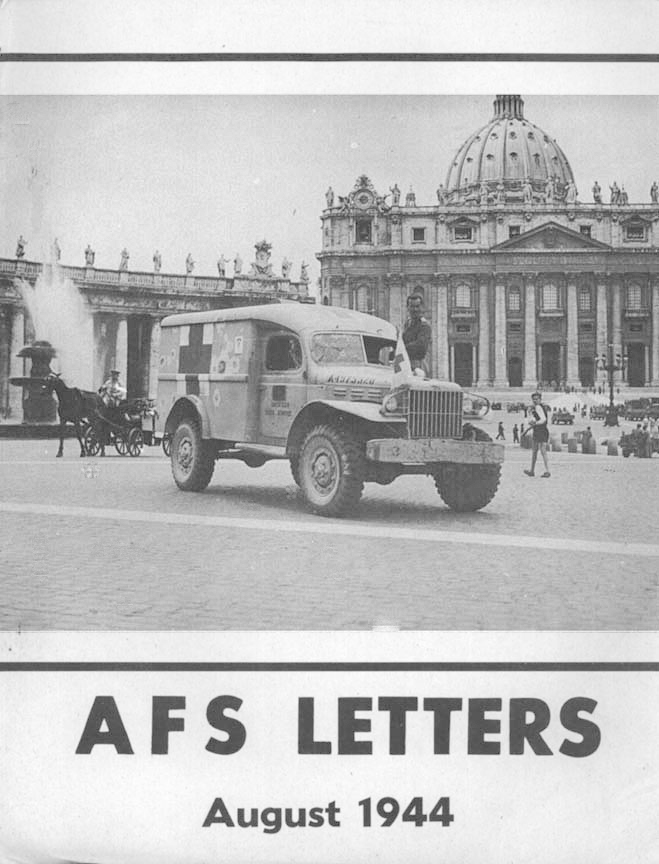
Edited and published at AFS Headquarters 60 Beaver Street, New York 4, N.Y. under the sponsorship of the ambulanciers' relatives and friends; who contribute the excerpts from the letters.
Lately, with the Nazis being pushed and punched toward the Inner walls of their Festung Europa, we have thought and written almost entirely of AFS in Italy and with the French. Some 200 ambulance drivers meanwhile have been carrying the wounded from the grim and intense battles against the Japanese in Burma. This small nut in the wheel of the war's progress is a tough one. The British ground troops to which AFS men are attached are serving in the hills far from their sources of supply. These forces are largely made up of Gurkhas, the tough little north of India men who fight so fiercely as shock troops.
From a report recently received from AFS HQ India the American volunteers and their ambulances are desperately needed and work is hard on this Assam-Burma front as in any other sector where they have served since the early days of fighting in the Middle East when the Free French had almost no material with which to combat the Germans. This report written on the AFS work at Shenam says: "There are a few companies of infantry located on the foremost series of hills we hold. . . . The road as well as the hills ---Malta The Pimple; and Gibraltar--- are usually under shell fire from the enemy who have also made repeated attacks on our positions; especially at night. The ambulances are not permitted to go forward further or oftener than necessary because of their conspicuousness and awkwardness." The Field Service men have gotten hold of six jeeps and the volunteers are using these to evacuate from the most forward areas. In order to effectively carry out these evacuations, the AFS men who need not even bear stretchers except voluntarily (their contracts call for ambulance driving an maintenance) go into the hills; help locate the casualties. Then they remove them to the jeeps or ambulances which carry them either to ambulances further behind or to the ADS. The men with the jeeps have remained for long hours by day or night ahead of the ADS picking up what wounded they could and notifying the ambulances at the ADS when they are needed to come up.
One of the AFS volunteers carried many wounded off the Allied hill known as 'The Pimple', on his back; as well as on stretchers with a comrade's assistance. He has carried over 250 patients by these methods and undoubtedly saved many lives. A.F.S.' service to these Gurkhas who otherwise have practically no facilities for caring for their wounded; who are fighting the Japanese with very few stretcher bearers, corpsmen, one or two Medical Officers and limited medical supplies, has been more than appreciated by the fierce little men from the hills. One Gurkha MO told the AFS men that in that fighting a man who still lived a half an hour after being hit, and who could be operated on within two hours, was almost sure to survive, in other words a large percentage of lives may be saved if the wounded can be evacuated during the engagement or immediately following it, and treated very soon after they fall. Thanks to AFS volunteers, their vehicles and ingenuity this is being done for the Allied soldiers fighting the Japs in that small, segregated and vital part of Burma.
| Thomas S. Esten | George O. Tichenor |
| Stanley B. Kulak | William K. McLarty |
| John F. Watson | Randolph C. Eaton |
| John H. Denison, Jr. | August A. Rubel |
| Richard S, Stockton, Jr. | Curtis C. Rodgers |
| Caleb Milne, IV | Vernon W. Preble |
| Charles James Andrews, Jr. | Arthur P. Foster |
| Charles K. Adams, Jr. | Henry Larner |
| Alexander Randall Jr. | George Brennan |
| Robert C. Bryan | Dawson Ellsworth |
| John Dale Cunningham | Donald Harty |
| Thomas L. Marshall | George A. Ladd |
THOMAS L. MARSHALL on July 9th, while serving in the Italian Campaign was killed instantly by a mortar bomb which exploded directly over the small shelter in which he and some British personnel were gathered. Tom had served with the AFS since November 1942, was a veteran of the desert campaign and moved to Italy with his unit. His record of courage, faithfulness, loyalty and unselfishness will long be remembered by all who had the privilege of knowing him and serving with him.
GEORGE A. LADD on July 2nd, while proceeding with members of his unit to a port of embarkation for the United States, suffered a heart attack and died instantly. George went overseas with the first AFS Unit destined for the Indian Command and served in that theatre until the termination of his enlistment. Few men were more universally liked, and he did much to keep morale high among the men because of his keen sense of humor. His conscientious devotion to the AFS will long be remembered.
ROBERT B. SULLIVAN. On August 14th, word was received at Headquarters announcing the death of Bob Sullivan on Saipan. Bob went overseas in November, 1939, in the first AFS Unit. He was awarded the British Empire Medal for courageous conduct during operations in, the Middle East, and returned to the States at the termination of his enlistment with the AFS, to join the Marine Corps. Bob is the first AFS member in this war to be killed while in the U.S. Armed Forces. His courage and devotion to duty will always be an inspiration to those who carry on in his stead.
WALTER BRADLEY on July 19th, sustained a very slight wound from shrapnel during the Italian Campaign. He was returning to his post when a Bren gun carrier was hit by an enemy shell, and set afire, Walter stopped to lend aid and was hit in the arm. After his wound was dressed he proceeded to his post.
June 16, 1944.
"I have the doubtful honor of being personally attached to the Colonel of the Medical Unit we're with. He is a complete and total mad man. Wherever he goes in his jeep, I follow in my wagon at a mean rate of speed. He daily goes on a reccy to find site for tomorrow's stand which involves going up to and including enemy territory. This procedure is nerve-wracking to say the least. We invariably have to withdraw due to 'enemy action'. He usually has me sleep at the Tactical H.Q. which is where the boys operating the tactics hide under a few bushes. Then if anything startling happens I go back and wake him from his soft bed and silk pajamas. Last night we went up and got shelled back to TAC and parked in the middle of a tank battle. Soon the Newton theory with regard to mortars put us in a ditch for two hours while tanks growled around. During a short lull, got back to the place where the boys were laying plans. They were planning a night sortie by the Guards and it was alarming to find their first objective was where we had just been before.
"It is exciting to be the first to hit a recently evacuated area. Finding a table set with wine still in glasses, candles in old bottles and ziggaretten butts about. He leaves damn little stuff and loots hell out of what he finds.
"I will write longer later but am on the jump here and now and my 'old man' will be yelling 'Follow me' soon. He wants a V.C. I think."
May 16, 1944.
"Have spent quite some time at the front and take a very dim view of the whole thing. Have had a number of 'front-line experiences' which in retrospect are, I suppose quite thrilling. Most of it just plain scares the liver out of you.
"Have learned a lot about war, including particular dislikes of certain of tedeschi's weapons. The worst part of it is not the actual damage Jerry can do to you but the fear a stenk (air bursts); a mortar or a shell can put into you. That is probably the chief advantage of his nebelwerfer (screaming Weenies). Though he can't hit the broadside of a barn door with the darn things, the moaning will scare the liver out of anyone.
"Let me set your mind at ease about Jerry and the Red Cross, if by any chance he hits a Dressing Station, it is only because an ammo. dump is right next to it, or his shells have fallen short. Ambulances have been stopped by his patrols and then allowed to go on. I, myself, have driven through one of his patrols without being stopped or even realizing who it was until I passed. The Germans may be fighting for everything that we know is wrong and inhuman, but you will find that the closer you get to the Front Lines, the more he is respected as a fighter. He is a fine soldier and a clever fighter and should never be underestimated. We may have him on the run but he will fight like the devil before he gives up. These people who believe he will crack at any moment, just don't know the nature of the man. Have seen and talked with many P.O.W.'s and their morale is far from low. They are licked right now; but won't admit it.
"Have been reading about the growing cry for Prohibition at home. That is the last thing the American overseas wants. When he gets home he wants to go on a terrific bender and the lord knows he certainly deserves it.
"The difference between the American and the British outlook about home is this: the English want many reforms when they get home; but the Americans want home just the way they left it. The G. I. is proud of his country just as it is and doesn't want anything changed. Let's hope the folks at home keep it that way until he comes home and then let him change it if the soldiers and civies want it.
"Some of the things we see over here you wouldn't believe if I told you. Besides many of the things are better forgotten. The ideal soldier should have absolutely no imagination or memory. People at home can have no conception of war you must actually experience it to know what it's like.
'Working with combat troops is one of the greatest pleasures of my life. Nowhere will you find a finer bunch of men. They are considerate, understanding; friendly and cheerful. Even when wounded, their first thought is for the other fellow not for themselves. It doesn't matter whether they are American, British, Canadian or Kiwi. Birth, race, or creed ---it makes no difference to them---- everyone is in the same boat.
"The British are extremely nice to us and now that the Americans have learned what the Field Service is; they are just as nice. As for the Kiwis, (New Zealanders) any Field Service man now is constantly in danger of being captured by them and 'wined and dined until exhausted. This all goes back to a sticky affair in the desert where the A.F.S. stuck with them when all other medical units had left them to surrender.
"If you want a good example of a combat G. I. read Sgt. Bill Mauldin's cartoons. I believe they ran some of them in Life around Christmas time."
June 21, 1944.
"It was very interesting to read in your letter the reaction to the so-long-awaited second front. You can well imagine, I'm sure, the reactions over here. We are particularly conscious here on the former beachhead of just what a colossal job a beach landing can be, what a costly, heart-breaking, pitiful thing, too. I'm glad I'm not on it! I've seen the only beach landing I want to see and the details of that one are graven on my mind so they will never come off. There is no feeling of bitterness in the memories, just a feeling of frustration and an awareness of the futility of the whole thing. The many men who died on this beachhead died for a good cause ---and knew that when they died. They may grouse like hell when they are back at their base camps; but when the chips are down they make the final sacrifice gallantly, proudly, and confidently--- confident that what they did was right and the price they paid was just. The little cemeteries with their row-on-row of white crosses are not a very imposing sight, hardly an adequate monument because within them lie some of the finest specimens of British and American courage. It takes courage to face death so far from home when you're fighting loneliness as hard as you are the Germans. But they don't flinch and I will never forget my service with those boys, particularly the Guards Brigade, to which, I am proud to say, I was attached during the whole of the initial push. All British soldiers are wonderful soldiers in battle but the Guards are something apart; the boys in the army will be the first to tell you that. They have a slogan describing themselves: 'They died with their boots clean', and it is literally true in many cases.
"I shall never forget as long as I live my only real view of the Grenadier Guards in action. There was a German machine gun nest in an entrenched position on a slight hill about 150 yards in front of the R.A.P. We were standing where we could watch it from a doorway; it sprayed the building every now and then. A platoon of Guards was ordered to attack the Jerries and take the position. They formed up behind the R.A.P. gave their boots a final cleaning, polished their brasses, straightened up their battle dress and then the major quietly said, 'Extended order, march!' and with his soft hat on and revolver drawn the major sauntered forward. The men followed with fixed bayonets, and their bayonets are silly little things about four inches long, not charging and diving for cover like ordinary soldiers, but in extended order marching up that hill into the face of the machine gun. When a man fell the man behind quick-stepped up into his place; no one looked right or left; no one missed a step, no one hurried. Well they hadn't much more than started up the hill when the Jerries ran out with their hands in the air. Psychologically; the Germans can't stand up to such calm determination.
"It was a sight I'll always remember of courage and confidence and foolishness that was heroic in itself. That month I was with the guards gave me an insight into the nobility of the human soul that nothing also in the world could ever give me. One of the Grenadier Guards majors won the Victoria Cross at the beachhead which is a pretty good indication of the plane on which they fought.
"It's interesting here; especially the people passing by. The town of course is swelled with refugees from both north and south and feeding them is a serious problem. I don't envy the work that the A.M.G. has to do. It must be a heartbreaking job trying to take care of these people who have so little idea of how to take care of themselves. If you leave one of these Italian peasants on his own farm he can struggle along successfully forever, but most of them have never been off their own home places (except perhaps for short visits) so when their lives are turned upside down by war, they are simply lost. If no one took care of them they would just sit down and starve.
"Since Rome fell and the Germans were cleared well out of this country the civilians who had been driven from their homes on the beachhead are still returning; coming back to absolutely nothing. You can imagine what the houses in the battle area are like, pounded by both sides for five solid months. They are all just heaps of rubble, most of them literally without one stone on another. As I was driving back to the C.C.S. the other day I stopped by the side of the famous 'factory' that must have been written up in all the news stories of the beachhead in the States. It was the scene of the bitterest fighting through the whole campaign, changing hands at least a dozen times. It was on the site of the 'factory' that that charge of the Grenadier Guards took place. This 'factory' wasn't really a factory at all, but a group of buildings, a fascist communal project consisting of a cinema, church, school, post office, and living quarters with the farm land in the area surrounding. A most modern layout, but of pretty cheap construction. You can guess what the whole thing looks like now after the guns had played with it for five months. When I stopped there the people had returned to their former homes. One old man sat by a wheelbarrow with his pitifully meager possessions heaped beside him at the side of a pile of broken stone and brick that had once been a home. I sat down beside him, gave him a cigarette and asked him what he was going to do. He just shrugged his shoulders and looked sad. It was his land and his home and I imagine he's still sitting by that wheelbarrow waiting for someone to do something about it. And, of course if he waits long enough, someone will, because those farms will have to be rebuilt and the people taken care of somehow. When you see those people trudging down the roads with great packs on their backs and their wagons piled with household goods going back to a complete destruction you are very forcibly reminded of our own economic refugees, the Okies that I used to see passing through Blythe, California with their loaded-down model T's heading for the promised land of Southern California. There is a great difference, however, and that is the same difference of adjustment you see everywhere over here. The farmers in the States who were driven off their lands by drought; were descendants of pioneer groups with the tradition of wanderlust firmly in their veins. They had been but little time in any one place and their roots were not deep. The tragedy of their moves was an economic tragedy, but hardly a very deeply sentimental one. Over here you have the same family owning the same land for centuries. There is no tradition of change, only a deep-seated permanence. The people know only one home; the one their fathers and their grandfathers knew before them. So when they move away it is just until the war has passed over and then they are back, back to nothing but the land, but it's the land in which their family roots are deeply buried. It's sad in a way, but it is one of the few strengths of this weakened country. Their people are faithful to their homes if to nothing else."
June 23, 1944.
"The set-up at Headquarters is this: ( I assume you know the location) We have three villas. One is the Headquarters office villa of which we occupy two thirds. The other is a marvel of fake, cheap, grandiose Italian architecture that once belonged to a Fascist chief. That is what we call our Convalescent Villa. It is the place to which all the men in the field come on leave, and where the sick and wounded come for convalescence. Some day I shall go into details about it, for it rates a full letter. The third villa is our Headquarters Mess. It is a light, airy place that is just grand now; but it is hellishly cold in winter.
"I have taken what I fondly call an apartment very near the headquarters. It is really two rooms sublet to me by an ancient Italian couple in their apartment. I wanted a chance to more or less recover from my experiences at Cassino. The couple that let the apartment are a lovable old, pair of gentle folk. I took the rooms, brought all my stuff over during lunch-hour and went off to work. When I got back that evening everything had been neatly put away, water was there for me to drink, flowers were in the room, and my dirty clothes had been whisked away to be washed. What luxury! Actually the rooms are the most atrocious cubicle! Both are nine by fourteen. The bedroom is done in the heaviest phoney hand-carving you've ever seen. The whole room is deep brown and dull maroon. It contains a huge double bed; a tremendous wardrobe with two full-length mirrors, two oversize chiffoniers, a dressing table; a night-table, (complete with pot de chambre) a plaster statue of the Virgin Mary with a constantly burning light in front of its glass case and a big chandelier with an inverted Japanese lantern affair. The other room, which was obviously the 'parlour', is a travesty of baroque Italian furnishing. All predominate colors are gold and gilt. In a room 9 x 14 there can be crammed 17 pieces of furniture. I counted them. They include a piano which is in such a state of disrepair that each note sounds like a chime, a flimsy fake Louis Quinze gilt table, and numerous little golden upholstered chairs, couches, and settees. The really lush feature of this room is a stuffed heron under glass. In spite of its hideousness, I love it. The old couple are swell to me. I have coffee brought to me at 7:30 in the morning and they spend all of this time when I'm in the apartment trying to think up things to do for me. Such luxury is worth the tremendous rent of $10 per month including laundry."
May 30, 1944.
"I'm happy! Tonight when I took the shovel for a walk I could hear, coming over the field from the next hill, the familiar sound of soldiers singing. 'Oh, Lord', I thought, 'they've been on the vino'. You. know they were singing the usual 'You Are My Sunshine' (the British love it), 'The Smoke Goes Up the Chimney' and others. Soldiers always sing when they get drunk and I thought that this was the usual thing --a very bad show, since Jerry moved out of here only three days ago and there they were misbehaving for the civilians already. Then ---I wish you could have heard it --- they started singing another song. But something was wrong because little voices were thrown in Willy-Nilly, voices that were either girls' or children's. Anyway, they sang; the soldiers in English, in forced bassos, and the others, in piping Italian voices. They sang 'La Campagnola Bella' (Woodpecker's song) 'Lili Marlene', 'Gor Bella Castellera' (Ferryboat serenade) and so on. Finally a mandolin joined in and in ten minutes they were going strong; singing first to each other, then with one another --- all from this hill, about half a mile from where I was standing. An Italian told me that it was the most wonderful thing he'd heard in eight months.
"In the last months we've seen endless trails of mules, carts; women carrying sacks of flour and grain on their backs, and children trailing anything they can manage; all pouring along the roads on the way back to their homes. Some move towards the front villages that have been occupied for a few hours; but most seem to be wandering down from the hills and on to the main road in various stages of bewilderment, joy and sometimes the most heartbreaking grief. There's been no rain in over a week now so the countryside is chock full of dust; churned up by the never ending line of trucks, tanks guns and munitions moving forward towards the front. everything is covered with dust---drivers, vehicles, animals women nursing babies as they walk along the road, carrying perhaps huge baskets on their heads ---all jaundiced by the dust! It's fantastic!
"Happily enough most of our patients lately have been prisoners, and very few Germans. Almost all are Austrians, Poles, Russians, and Alsatians, who speak better French than they do German! You can see what Hitler must think of Italy --- and you can see what he's getting.
"Last night I had a long talk with one prisoner who was positively gleeful to be out of the war. He was a nineteen year old Alsatian ---two years in the French Army, six months in a Jerry prison, and only a few months in the Wehrmacht. This had been his first experience on any front except in France where he was captured by the Germans. He said the Germans do not know that Germany is being bombed day and night; that the Army is living on something resembling dehydrated carrots, rice, and black tea; they haven't got any artillery left on this front to speak of; that for every four kilometers of front line in his area, there was one company of soldiers (60 men); that when he was captured he and six other with one Spandau machine gun (requiring two men to operate) was ordered to counterattack by an officer who fled as soon as he had given the order; that, save for regular officers in his division, the men have had enough and some have been shot for whimpering. When we gave him a hot cup of chocolate and a cigarette upon receiving him here (the same given to our own men) he practically wept. So there you are! and I'm a pessimist!
"The people are still singing and it's 11:40 p.m. They haven't been so happy in years . You can see it in their faces, even when there's an eighth of an inch of dust covering them. Tomorrow, the padroni of this house goes to work in his field with the family, for the first time in two months. He has absolutely nothing except a hell of a lot of courage."
June 4, 1944.
"Apparently we are not allowed to say that we were in the Battle of Cassino before May 18th. Before May 18th is a laugh! We were in the Cassino area as far back as February and from the middle of March we were within shouting distance of the Mont.
"The flowers here this spring have been enough to take your breath away. In all the small towns, the Italians have planted Iris by the thousands....bordering the fountains, the walks, and especially the churches. They're different than ours in that they are about twice as large and have the most terrific odor in the world. They smell like lilies. Besides the countless fields of poppies, blue and red, roses grow in about the same abundance as dandelions do at home. It's almost as bad as California.....everything is too big."
May 21, 1944.
"It's funny but when you are all the way up front the way we are, you seem to know less of what is going on than anyone else. All we can see is the small sector we are on and get no picture of the whole thing, until we read about it in the Eighth Army News. These tank troops are a great crowd and it is fun being with them. It's a funny position we're in. Jerry is on a hill (as usual) about two miles away; we are on the flat ground and our guns are about 1000 yards in back of us and the field next to us is loaded with tanks. We are the meat in the sandwich; which is not so hot.
"I said earlier in this letter how hard it was to know what was going on in the war. Well, this morning the Colonel of the Division gave a talk giving us all the dope on the situation. So now I've got an idea of what's happening."
June 7, 1944.
"This is another letter written on a hit or miss basis. We are chasing Jerry like a pack of hounds and, figuring it out, we have had eight hours sleep in the last seventy-two. It's most exciting. Mark down June 5th as my lucky day. An 88 mm shell landed just 15 feet from my ambulance; it threw about a ton of mud all over the car, but not one single piece of shrapnel touched it. It hardly seems possible. I damn near fainted.
"The way we are operating now we follow the tanks to within about a mile and a half of the front line and set up an R.A.P. The tanks go in and as they advances say five miles, we pack up and set up in business five miles further up. We may be in one location for fifteen minutes or fifteen hours; you never know. Also Jerry has left snipers all over the place.
"The news about the second front is wonderful. Everybody went wild when he heard about it,.
"To show you how far German propaganda is believed by their troops, here's an example. Three Jerry prisoners were brought in to the R.A.P. yesterday and one Capt. who speaks German was questioning them, and one of them said, 'I guess you are proud of yourselves!' The Capt. asked why, and the Jerry said, 'Well, we are the first prisoners that you have taken in the Italian campaign.' Can you imagine that? He told them about the second front and they thought it was the funniest thing they ever heard, as a landing in France was an absolute impossibility. They firmly believed that it was just a question of time until Germany wiped out Russia. What do you do with Dopes like that? Also yesterday, three British boys turned up at the R.A.P. who had just escaped from a Jerry prison camp, having been in since July 1942. Didn't get a chance to talk with them as they were taken direct to Intelligence, but were they happy!"
June 11, 1944.
"You should see me now, I am a beaut. We have a Colonel who feels that ambulance oars should operate about three miles inside the enemy lines, So the other night be called for F. and myself and said to follow him. Well, I thought we were right at the front as it was, but we went about four miles up the road and into a field. The Col. then went somewhere in his jeep and where do you think he left us, right in the middle of a tank battle. I thought I had been scared up until then, but I realize now that those other things were nice quiet tea parties by comparison. We finally decided we wanted to get out, so during a slight lull in the shelling we started down the road. We had gone about 30 yards when he started again; we both left our teat and dove into a ditch and landed on my nose. It is now one complete scab and why I didn't break it I'll never know. You can Imagine how scared I was when I didn't oven feel it when it happened; but; oh boy, about an hour afterward!
"W & I had a day in Rome, and it was marvellous. St. Peters was far beyond anything I expected, and all the other places such as the Colosseum were certainly impressive. The city is untouched, and you can't Imagine how it felt to see a place with all buildings intact, the streets clean and the people looking normal. It is a beautiful city, and it would have been a super crime it Jerry had destroyed it.
"This is good news. The various divisions in the British Army have certain insignia which they wear on their sleeve to identify them. These flashes, as they are called, can be worn only by invitation when you are attached to the division, so we just found out that this division we have been with is putting on a ceremony and awarding B. platoon the division flash. This is the second time it has happened in the history of the Field Service, so you can imagine how everybody feels. These regiments and divisions are most particular about handing the flashes out, so without bragging too much we can feel that we did an outstanding job for them.
"During his retreat Jerry has managed to mine the place pretty thoroughly so you have to be pretty careful. We came into a town a few days ago and took over a building for the A.D.S. Jerry had been there a couple of hours before and had left quite a few Medical supplies. Among them were about a dozen thermometers, which later turned out to be booby traps; unscrew the top and it blows your face off. Nice guy what! Corning into an Italian town is really an experience. The people are lined up along the road cheering and throwing flowers in the car, and they will give you anything they have which isn't much. Jerry has taken all their cattle, food, furniture and anything he couldn't carry away with him he has destroyed."
May 19, 1944.
"The A.D.S. was to move up that night. We were called together and the Major in charge of the A.D.S. gave us the 'griff'. Just about the biggest barrage in history was to start at 11:00 in the evening and last till 11:45. At 11:59 the infantry was to cross the river, put up bridges and work around in back of Cassino. At 36 hour 'creeping barrage' was to be sent into Jerry lines until the Infantry moved up. Then he read a letter from General Alexander and from another Brigadier telling everyone to 'go forth with the light of battle in your eyed' and bring the world the news it is waiting for.' We knew there would be no sleep that night.
"The barrage was the most tremendous and sudden thing I have ever seen. 1500 big guns on a 1500 yard front, someone said. It was easy to drive because of the light from the flashes of the guns. The noise was terrific. Most of us kept cotton in our ears because we were so close to some of the big guns. I could just picture the poor German soldiers cowering under the fire.
"At about 6:00 in the morning I was called to go to A.D.S. through one of the thickest fogs I have ever seen. It was composed mostly of powder smoke, smoke screen and morning fog. I took one run back to the M.D.S. and returned immediately. Casualties were beginning to pour in. The Major in charge of A.D.S. said; 'Oh, we need you forward now, follow that jeep.' So we went up route 6 to about a mile from Cassino and turned left. We followed the bed of a stream mostly, until we came to the edge of the river. They had failed to erect the bridge on the first night, so the river was 'No man's land'. We travelled along till we came to the forward A.D.S. (a forward A.D.S. was used in place of an R.A.P. because it was serving more than one regiment). All around the infantry men were crawling through bushes poking their guns out and shooting. Mortar shells were landing all over and from across the river you could hear the lurrrp of machine guns and the lurrrp of one of our guns answering from the ditch in the road. The shells as they land closely sound just as if someone had just dropped a pile of wooden slats on a cement floor. Then you wait for a piece of shrapnel to hit you. But none did. At last we reached the A.D.S. All available cars and ambulances and jeeps were loaded with wounded and then we started along the tracks and torn up R.R. tracks on our way back. It was a rough road and the patients groaned every time the car hit a bump, but I couldn't go any slower or stop. Several times the road was blocked by vehicles stopping and men jumping into the ditch when a shell landed nearby. An ambulance driver; of course, can never leave his patients. It was nerve wracking; but a thrill. All day 2 British Humbers, one other AFS driver and myself went from the river to the A.D.S. I lost track of the number of patients I carried. One time traffic was stopped for about an hour because a truck ahead was stuck in a newly made shell hole. All the time Jerry was shelling the area. Three times that truck got stuck and always we were under shelling and machine gun fire. About evening the casualties slacked off and I stopped going forward and waited for a run to the M.D.S. Then I realized I hadn't had any sleep for two nights and three days and was quite jumpy from my first experiences forward. So when I stopped by Platoon HQ for my first meal in two days (excepting tea and biscuits) I was told to sleep for the night there. Believe me, I didn't have to be rocked to sleep.
"In the evening I was sent back again to the place I had just left, at the river's edge. The bridges had been erected during the night so most of the fighting was on the other side of the river, but still, for some reason, there was quite a bit of firing. There were no dead men around the fields next to the river this time and not so many destroyed vehicles. At the A.D.S. I loaded up and started back. By now it was pitch black. The sky was cloudy, the atmosphere was smoky and the road was barely discernable. I was first in a line of ambulances going along the road. At one point in it the track cuts down from the bank of a stream into the stream bed itself. This spot was not taped and impossible to see so it was here that my ambulance tipped over on its side. Another driver and myself helped get the patients out and put their stretchers in a ditch. I was carrying 2 German stretcher patients, 2 British stretcher patients, and 1 British sitting patient. All the tommies came out mostly under their own power and said they were O.K. but the Germans were more difficult. When we got the patients out we rolled the car over by manpower into the ditch and traffic moved on taking my patients with it. I sat in a slit trench near my ambulance and waited for someone to pull me out. Several times shells landed nearby and fighting seemed to be near. In the morning I saw why. Monastery Hill loomed up about a mile away and when the breeze blew the smoke away I could see the Monastery and the town plainly.
"From the morning of the attack on, the front roads were filled with German prisoners walking back. Sometime they were not even guarded but usually there was a guard marching them. Most of them looked very dishevelled and forlorn, and many looked very sad, but some looked like hardened fighters. Thousands or prisoners have been taken and always are taken down the main roads to the P.W. camps.
"Strangely enough, through all this heavy fighting; the civilians have remained in their homes. In Cassino itself there were civilians and often we get calls to go pick up an Eyetie who stopped a piece of shrapnel. It is beyond me why they will stay in such areas."
July 1, 1944.
"I was 'browned off' with the state of our sector of the front in the first part of June. Shortly afterwards I had less reason to be 'browned off' and plenty of reason to be amused, amazed, and at times, exasperated with what I saw.
"At the time I was attached to a unit of what is the nearest approach to a comic-opera army I have ever encountered. It was fantastic. Elaborate uniforms on the officers; discipline like you might find in a poorly organized boy scout troop. When saluting was done which was only rarely, it was haphazard and highly colored by the individual's own personality. In the evenings bunches of soldiers would hang out of billet windows or stand in knots serenading the peasant girls as they passed, sounding for all the world like professional choruses.
"All of the men are full of flashy Latin courage; which is mostly vanity and ignorance of simple rules of warfare. I was told in all seriousness by the doctor that mines were no danger if you were only brave enough. When, therefore, we moved into one of the most heavily mined areas of the front I had a large number of patients, and would have had no spare time for sleeping and eating had I had to carry the dead as well as the wounded. It was a great relief to me when we moved still further north.
"It was interesting to be in on such an advance; the only thing that could be more confused would be a flap, or retreat. Nobody knew where anything was; hospitals would be missing for days, supply depots were well hidden from Jerry and our own troops. The roads were in a sad state due to a number of causes, not the least of which were the oxcarts of the farmers, who have not the slightest idea of traffic or the simplest rules of safety.
"We were given some time to see Rome, which we reconnoitered in a hasty fashion taking a quick shufti at the most important spots: several forums, the Colosseum, the modern districts, a number of churches and St. Peter's in the Vatican City. In order to be properly impressed with most of these things you have to see them from the angle at which the best known photographs of them are made. From other viewpoints most of these sights are a little disappointing.
"St. Peter's was not up to my idea of what it should have been. It was big, but it was barbaric and in bad taste for the most part. Every thing was greatly over-done, though some parts of it the side chapels especially, were breath-taking in their cultured barbarity. I missed the Sistine Chapel which is open only briefly every day when the pope gives audiences, and for a time before and after. Some of our people saw it, and said it was everything it was cracked up to be.
"When you do work like this you get an idea of how it must be with men who must spend all their time in base areas. To a front-line soldier the comfort and safety of the 'base wallahs' look pretty attractive, and on the whole they lead a soft life. But the men at base know they are held in contempt, know they can't do much about it, feel as though their work, though important is not so closely related to the actual business of war as frontline work, and are saddled with tiresome routine jobs that offer little change or excitement. For these reasons many of them get surly and short-tempered and are thus unpleasant to meet up with. M. P.'s for example, who have always been in the rear, are especially obnoxious, for their repressed fighting spirit can find an outlet only upon soldiers who have committed breaches of etiquette, or who are so stupid as not to know their way around a strange city. Frontline M.P.'s, however, are swell men."
June 14, 1944.
"We heard about the attack back here and I decided to go forward. I saw the Colonel of the unit to which I was attached, and he said it was O.K., so I went to the A.D.S. The Major let me go on to the R.A.P., and I was set. We were about 600 yards from the lines and now and then were mortared. There was a Medical Officer there the first two days, and then that unit moved out and another infantry outfit moved in. Their M.O. was bomb-happy and wouldn't stay that close, so my orderly and I were all alone in the farmhouse. We made a good fly-proof latrine, beds, fly-swatters and other conveniences on the first day and waited for patients. The first we got were two guys who wanted cascara tablets and aspirin; but the next was the worst I ever hope to handle.
"He had just stepped on a mine and his leg was shattered just above the ankle. I gave him morphine and then tried to dress the wound. No one had touched it and it was bleeding badly. Using a tourniquet; I stopped the bleeding but when it came to the dressing it became tough. The foot was hanging by a thick strip of skin and we couldn't get the shell- dressing to stay on. I had to fix it somehow, so I amputated with my pocket-knife. The orderly buried the foot. The dressing on, we took him back to the M.O. who told me that I had done the right thing. We went back only to discover that the stretcher-bearing jeep, which ran back to my ambulance-ahead had hit a mine. I had to go forward from my post; along a lateral road in sight of the enemy to a track at which the stretcher-bearers were posted. Five minutes before, they had shelled the road, and it was under constant machine gun fire. I had a big Red Cross flag on the front of the ambulance, and, as I went along I expected it any moment. I must hand it to them, for they never fired a shot.
"We worked hard all day and most of the night; and were consequently glad to have a rest the next day. All was quiet at the farmhouse until one of our own shells landed short and scared the hell out of us. Another unit took over and we got all set to move. After all night of work we pushed off behind the infantry in the morning.
"There were dead Jerries everywhere, and the amounts of equipment destroyed on the road was fantastic. Jerry is very neat apparently until he knows he's leaving, and then he goes all out to make the place tough and disgusting as possible. We couldn't find much loot, as the Tommies were loot-happy after months on the beachhead.
"Three miles up we passed reconnaissance, and from then on were on our own. We discovered a model Fascisti village--- modern et al --- and went hunting. With typical German thoroughness they had cleaned everything out, even down to the lens from the projector in the local movie. Everything of value was removed except a gold-looking plate: set in above the altar in the church. It must have been brass or it would have gone the way of all good things.
"We had gone about poking doors open with a long pole, jabbing at small objects from behind suitable cover just in case. Then we found a lovely bathtub and we abandoned all caution in order to turn on the water. Of course they had blasted the pumps, but we hadn't thought about that. The next thing we knew somebody was shouting for us to come out of the building with our hands up or else he'd blow us sky-high. We came out to discover the most chagrined British officer I've ever seen. He was sure he'd made his first capture. He couldn't have been much older than I, and for a moments, I wished for his sake, we could have been Germans.
"We decided to return to the R.A.P. and on the way passed reconnaissance, mine sweeping engineers; infantry, and advanced artillery units, all of whom looked at us in the queerest way. Later we discovered from the Div. Commander himself that we had been at least two miles ahead of the advances
"In the yard outside the R.A.P. was a well, complete with pump and two enormous casks. The water was O.K. for washing, so I filled a cask, stripped and went in for a bath. The casks were low and broad, and I stretched out and loved life. After a good soaking, I put on a pair of underpants and went hunting for a wash-board. I finally compromised and used the fender of the ambulance to scrub a shirt and a pair of pants. I polished my shoes, scrubbed my gaiters white, cleaned my American Officer's overseas cap with pyrene from my fire-extinguisher, sewed on two buttons, polished off a can of prunes, and killed a bottle of beer; all before we ate dinner. Then I had a cigar while listening to the radio and went to bed ----,in my ambulance.
"It's hard to write about such times without making everything sound grim, but honestly, it's more damn fun. Everyone says we're crazy even to be over here, but it's worth it. I wouldn't trade it in for anything. Since I've come over I've learned so much and done so much that it's all justified.
"Since all this I've rested in a hospital, had a couple of days leave (first in three or four months) and generally enjoyed life; but still I won't be completely happy again until the Platoon goes up again, and we're in it once more. Don't worry!"
June 2, 1944.
"About two weeks ago, I moved up with an HQ echelon of an armoured group. Jerry was being pushed back to his next position, but I was surprised at how far up they took the HQ., a mere two miles from the lines. Coming across the river we saw a perfectly shocking sight. It compared with every movie scene of France in the last war, and it Cecil B. DeMille could have filmed it for a picture he would have a perfect battle scene.
"German dug-outs were strongly reinforced caves or holes; white tapes marked the safe passage land through minefields, and here and there burned out trucks and tanks bore stark witness to the fighting that had gone before. Everywhere there were shellholes bomb-craters, and vehicle tracks. Trees were naked, blasted stumps shorn of leaves and branches. The dark made it look even more like the graveyard it was. There was a slight ground-haze through which long creaking clanging lines of trucks and guns snaked up the banks and into the wilderness of destruction beyond. We moved up a track pocked with shell-holes and deeply rutted on either side, with the smell of the unburied dead all around.
"The tracks went everywhere. MP's and signs kept a good bit of the traffic moving along on the right tracks, but there were uncounted hundreds of by-pass tracks, cross tracks, unmarked ruts that passed for tracks. We slithered along a hill in convoy where the road was simply the side of a hill, greasy with a recent sprinkle of rain, then wound through a blown up ammo dump and on through the smashed trees.
"We made our positions a half an hour after dark, and dispersed in a field cut with ditches, brush, and shell holes. There was no business for us, so we looked around for a suitable ditch or hole and started to bed down. It started to rain a bit making the night even blacker.
"I was all wrapped up in a couple of blankets when someone came around saying a fellow had been brought in and would I look at him. I found he was only bomb-happy. His tank had been hit by a phosphorous shell and set on fire; he was the only one to get out alive. While I was trying to get a jeep to take him away, (the ambulance is pretty big on crowded roads) another bomb-happy came in, and I figured I might as well use the ambulance. There was no M.O. there and I was head-man, getting 'sirred' and saluted all over the place. I grabbed a sergeant, and piled out onto the track. I reached a Divisional Dressing Station after a 4 hour 6 miles drive; and by mid-afternoon were bumping along to a Main Dressing Station to wait a few days for our units to go into action.
"We sat around for two or three days just eating and sleeping. The first night I and another fellow dug a double slit-trench to get a little below the level of the ground. We slept well, except for a little air raid a bit in front of us. The next night a different fellow moved in and we spent a good part of the afternoon digging the hole down a couple of feet. Right in the middle of our work, Jerry lofted a half-hour shelling over our heads and to each side, making us keep our heads down. It was the first shelling anywhere near me for quite a time, and it gave us the energy to dig down another foot. We filled two upside-down stretchers with dirt and put them over the hole as protection against ack-ack shrapnel; rain, and spent shell-splinters, for we had one drop in on us during that shelling. We had one stinker of an air-raid one night complete with flares and all the sound-effects.
"We moved out finally and went forward through some more minefields. There had evidently been a nasty tank-battle at one point, because I could count a pack of burned-out, shot-up tanks of Jerry's and our armoured outfits. We halted for a few hours and dug in, just on general principle. We moved up later in the afternoon, and we dug in again. Just as I finished most of my trench, I was detailed to go up to the tanks' RAP. We forded another river and bumped around a bit to where the tanks were parked. I dug in again, as Jerry was laying mortar-fire onto a hill just above and to one side. I got this trench well dug; it was a beauty. I was actually scraping out the last loose dirt when my M.O. came up and took me back to the ADS which had moved again.
"After you dig-in three times in one day, you start to get a bit 'alakeefik' and don't care what lands near you; you don't dig-in much the fourth time. But I found a house and a Jerry dugout to use, and I slept behind a wall outside.
"And here is today's gory bit: My first run was a fellow with one hell of a head wound. I mean a real one. He was quite far gone and didn't have a chance; but be was still alive when they put him aboard. He was bleeding so much that I called the major and asked him it he knew it was that bad. He looked in at the head, at the pool of blood all over the floor, and said that he'd probably die in the ambulance but to take him on the off-chance that he'd live to the next MDS. All the blood was running up to the front of the car, where it soaked into the sandbags under the seats. From there it ran out the front floor until the running board was a deep crimson and black. He died before I got a mile down the road.
"I delivered all the patients and went back to the river where the ford was. I washed out the car and had a nifty swim, and then went back for another load. The other Tommies swimming didn't much like my washing my bloody car and stretchers there but it couldn't be helped."
July 13, 1944.
"It was in action at Cassino that I was first under fire, and I can say truthfully that at that stage of the game, I almost enjoyed the whistle and then, the 'carumph' of shells landing; since then, I have changed my tune, however! We were in a small building right under the monastery, and since we were under observation, could only move at night. One of the unpleasant features of this job is the large amount of driving at night (with no lights) over bad roads with an occasional column of Sherman tanks or something coming the other way. You get used to it, and it isn't bad except on the very dark nights.
"After the push started and Cassino fell we were on the move practically all the time until recently when 'Jerry' decided he didn't want to be chased any more. Things have been pretty grim of late and, don't get the idea this war is over, because it isn't by a long shot.
"I was lucky enough to get to Rome to spend an afternoon some time ago. I drove around for about four hours" impressing the medical orderly I had with me, with what little I remembered about Roman architecture. It seemed queer to be part of a stream of traffic around the Colosseum, Trajan's Column, or St. Peters, which in those halcyon days of 7th and 8th grade had seemed nothing more than pictures in a book. The city is remarkably untouched by war, and the people are clean, well dressed and respectable looking; very, very different from Naples. We have passed through much beautiful country and many picturesque towns, for the most part unharmed."
No date.
" I can tell you now that I have been to Orvieto near the Tuscany border. In this quaint old town is a most beautiful cathedral, a most famous and striking example of Italian art. It is said that Michael Angelo borrowed his plans for St. Peter's in Rome from this edifice. The outside of it is a literal blaze of colored mosaic fringed high in the front with chiseled, friezes. The eyes fairly lose themselves at the points of the several spires. The interior is high, spacious, and soft tones with white and blue marble. Two parallel rows of arches form aisles on either side.
"An interesting aspect of A.F.S. is the wide variety of peoples and nations with whom they work. At one time or another we have worked with British (Scotch, English, Irish, Welch), Australians, New Zealanders, South Africans, Canadians, Indians, Italians, as well as our fellow Americans. We can learn to appreciate and to compare the peoples of the various countries."
June 13, 1944.
"I must say that I'm falling in love with Italy a bit. We've been driving through some perfectly beautiful country recently, the war has moved fairly fast, and consequently much less damage has been done to the countryside as a whole; than was the case this past winter. There are the inevitable mines and bomb-craters, but for the most part you could say that this area was untouched. Some of the rail-junctions and marshaling yard are a perfect chaos of bomb-craters, through which roads must be made by bull-dozers. The railways have been bombed at frequent intervals, chopping them up pretty effectively. What trains and cars remain between blocks and gaps in the roadbed are strafed and set afire. Much of the rolling stock is marked 'Deutsches Reichsbahn' and carry home-town name like Munchen and Kassel. Thus Jerry must be losing more than just captured equipment. But in spite of such sights, which are pleasing in their own way, Italy is making up for its bad winter.
"June 4th we drove and drove until about 8:30 or 9 then pulled over to the side of the road for two hours to let a mass of tanks go through. Six Jerry soldiers up the hill from us who had missed the last bus back to their unit saw the Red Cross and came down and surrendered themselves, imagining, rightly, that we wouldn't pull out their toenails or give them the usual fiendish barbarianisms they hear about. Another bunch of about fifty Jerries were walking down the highway under guard, and our six tacked on with the big bunch. They were all good-looking lot of soldiers, not the scraggy type you hope the Vaterland is turning out. In fact, I'd say they were an darn healthy and pretty capable of a lot of hard fighting. We just cut them off fairly fast and they figured they might as well come on in.
"B. took a run up to a town on a call from an armored car to get a wounded Jerry. He asked the major if there were any Jerries still there, since the town was in no-man's land. The major said 'No', and they went up, the armored car covering B's car. He put this stretcher case in the car, but with some speed, as a sniper had put a bullet through the back door. The major came walking down the street yelling; 'You dirty b------! and his armored car came down after him pumping machine gun bullets all over the place while B. got away. He whipped the Jerry 's belt off as souvenir of that show. He asked the major later 'I thought you said there weren't any Jerries in that town,' and the major said in a very British accent, 'Oh none to speak of'..............
"On my way back I picked up an electric iron out of the road, all chrome-plated and everything. So now I can really do all my own wash!
'We moved out at 4:30 in the morning only to sit on the road again from 6:30 to 7:45. I shaved, made a cup of coffee and marvelled again at the havoc that our Air Force played with the roads and German transport. We counted 103 burned-out, shot-up vehicles, 103 of them German. We halted again; then a dispatch-rider on a motor bike came roaring down the convoy with a signal-form in his hand which gave the news that the Invasion had started. Great cheers were loosed off: and a passing Eyetie, who heard the news immediately donated a two litre bottle of vino to the cause.
"At 10:45 we moved into a field and had lunch, got Invasion news on the radio, and didn't move an inch until the next morning.......
"The ADS had just moved into an Eyetie house when we arrived; and everyone was scrounging around and cleaning the place up. The Jerries had left in a fair hurry, or at least hadn't bothered to wash the dishes. All the Eyeties' belonging had been rifled, and anything of value was taken. The owners themselves didn't put in their appearance until the next day. We got casualties just before dusk and I was given an A-1 priority case to go way back to the town we'd left that afternoon. He had a bad abdominal wound and kept groaning and asking for water all the way down. I couldn't give him water; so by the time he arrived at the CCS he must have been pretty thirsty. I had to pick up one other stretcher case from an AFS guy who wanted me to take it in as he was moving up with a unit. I loaded the case on, and groped through the rain and mud through the ford, and then on to a reasonably smooth road. A jeep passed me with full headlights on, so I said I guess I've got a right to do it too. I switched on and cut dirt all the way to the CCS. Just before I got there, my lights fell on a soldier lying in the road. He had been drunk, was walking down the road and had been hit a glancing blow by a passing truck or something. I checked him over loaded him in and dumped everyone at Reception with a great sigh.
"The Eyeties here are lucky. The war has been moving through them so fast that the land, crops and houses stay almost unmolested. The Germans have taken a fair amount of livestock; but the fight has cost him too much transport, and he is forced to leave behind animals and other things he desperately would like to cart away.
"Funny thing happened one night. H. is a German-speaker, and one night we interrogated a Jerry wounded who was brought in to us. It was after the Invasion had started; and he knew about it. He was either very confident that the beachhead would be wiped out; or was just acting his part as his orders may have instructed, but we could get few things out of him. When we asked him if he thought our invasion would get places, he laughed and said, 'You'll see. Just wait and see!' The war in Russia was 'going all right' What did officers tell the men to expect when they were captured? No particular answer, except 'to be taken prisoner is nicht schoen, (which I gather means 'not pretty') but if we must be taken, we must be taken.' How did be explain the rapid German withdrawal in Italy? It was according to plan, he said.
"The startling answer was one he gave when we asked him if he thought Germany would win the war. He gave a definite 'Yes'. We asked him when Germany would win. He smiled and said 'When do you think you will win the war?' That's all he'd say.
"My guess is that this 21 year old had learned his lessons pretty well and was reciting admirably. Actually I think he was using arrogance to cover up his nervousness and we assured him he'd be well taken care of. He agreed and wished us good luck.
"I'll be glad when things quiet down a bit because we all feel the strain of pushing, pushing, and trying to keep the cars mobile. I see that I've driven 1200 miles already in June, and that's no joy-ride."
June 10, 1944.
"Here in Italy at one time and another, I have been attached to the Canadians, English; and the Poles. I was with the Canadians for quite a while, and enjoyed it quite a bit, as they are of course exactly the same as the Americans. I was out with one Canadian artillery regiment for a month and a half, the only ambulance attached to them, and almost became a part of the outfit. I would almost have preferred staying on with them for the duration. The Poles, of course; were very interesting to be with for a while; but it was very difficult to communicate with them, as few spoke much English....They had the real continental manners, bowing, clicking their heels, and saluting... ...They certainly had a tough time; most of then have been in both German and Russian concentration camps.
"As I believe I mentioned we were in the battle of Cassino, and it was quite tough. The Germans, as you probably know from their positions on Monte Cassino and Mount Cairo, commanded a view of the entire valley and surrounding country which we held. Consequently it was almost impossible for traffic to move around the town during daylight. As a matter of fact, during the early stages of the battle, our ambulances were about the only vehicles using our particular road. It was certainly a weird drive as our hospital was actually north of the town, and we had to drive right past Cassino and the Monastery, while they were still held by the Germans. So-called smoke pots; artificial smoke screens were set at various points along the road to cover it from view of the Germans, and generally there was a heavy mist covering the valley, giving me the impression that I was driving through a real inferno, particularly so because of the feeling of death all around. A terrific stench came from the dead mules along the road; and perhaps dead human bodies, too; there were knocked out tanks and other vehicles; and the sound of whistling shells overhead at the same time, a great feeling of loneliness as I never saw another living person along that road. Then at times the mist would rise and the monastery would emerge clearly and it looked so close you could almost imagine seeing the Germans in it. At those times for some strange psychological reason, I as well as many others, had a very difficult time forcing myself to look up directly at the town and hill; but wanted to look only at the road. Now that it is all over here that feeling of strangeness has gone; the town is no longer a town but a mass tomb covered by rubble. Every inch of ground is torn up and it is almost impossible to conceive of what a mess the place is."
June 11, 1944.
"The past few days have been among the most interesting of the war for me. After all the long months of waiting and attrition this front has finally broken loose. The Germans have pulled out with a despatch and speed which have enabled then to run free to whatever unknown line they choose. Strangely, five days ago, the front went still. Our own guns fired away in diminishing volume as no return at all was heard. After a day of that, news came to us at 1:30 A.M. that we were to be ready to move at 4:30. And we were on the road in time to see the sun drive its first wedge of light across the Adriatic and into the mountains.
"The morning was all musical comedy war. Moving into a village which stood for six months as a salient into the German line, a place of great danger, we parked in the piazza amid the rubble of the smashed church and watched the troops come down the road in the fresh sunlight. This was much like the scenes we used to see in the movies of the last war. Now-a-days most troop movement is motorized and a great advance resembles nothing so much as a traffic jam of dinosaurs. But here were surging columns of walking men streaming down the road, the column having a particular and peculiar pulsating movement of its corporate mass.
"Being Italians, they added the final touch to the musical comedy effect by posing themselves picturesquely against the shattered buildings and singing their hearts and throats out for an hour or more until the sun got too hot. And they sang beautifully too, with good operatic effects here and there.
"The village, bombed and shelled continuously by us first and then by the Germans for a six-month period and further damaged by the raid and foray of Patrol warfare, was the worst place far and away that I have seen. Not only were houses scarred and holed and smashed some of them had been penetrated by projectiles which had gone off inside at just the right spots. Houses here are still brick and stone, and some of these had been laid in almost symmetrical heaps of absolutely individual bricks
"The people coming back after so long a time were piteous. The walls and roofs and firesides to which they were attached were wrecked as not two hundred years of neglect would have wrecked them. Knowing in advance as they did what things would be like still some of them broke down and wept at the sight. And just as pathetic were those who went quietly about to salvage what little they could. Nothing anyone could say could keep some of then out of the houses. And in some the mines and booby-traps. put there by both sides, did their work.
"That afternoon we went lurching on through a no-man's land where there is hardly a square yard of unscarred earth and the skeletons of tanks lie in and around the roads and jammed into the broken farmhouses. We wormed and fought along the cratered streets of an outpost town. And then suddenly came out again on good, smooth road and went flying down through country never fought over before comparatively untouched except where towns have been shelled at long range. The winter was not a picnic on our side of the line but it was a cruel time for the German.
"There was one very nice little town which the Germans had declared 'open' and which was as a result quite untouched. Marching into town with the Italian columns was a real experience. The place was plastered with the brilliant colored Italian flags some of the true garish type, others off-color and obviously improvised out of cloth and even paper. And the whole population of the town was lined up to clap and cheer and toss flowers. Every soldier had a bouquet somewhere, growing out of the barrel of his gun or in his hat. Even your humble AFSer had his spray of pink roses neatly presented by a little girl, and lots of 'vivas for America!' This is a new side to the war and a lot of fun especially compared with the other side.
"I hope this will all break up before too long. The civilians claim the Germans are weary to death. I only wish they'd quit so we can take up life again."
The American Field Service has become a member agency of the National War Fund, whose drive for funds will start shortly. We know that all friends of the A.F. S. will help in their communities to make this drive a success. It is of vital interest to us.
BITTER PILL DEP'T: Winslow Sears, AFS volunteer in Italy, is all in favor of boosting the war effort, but his hope for soft music over the air waves had to be sacrificed in the bargain. It all came about when Win ran across a strange looking piece of enemy equipment abandoned in a mine field north of Rome. Gleefully noting the dials and tube-slots, he conjured up a mental picture of nocturnal radio serenades. After outfitting the "radio" with tubes; only a shrill modulating whine issued forth. Royal Engineers at a nearby camp broke the news to Win that his new acquisition would never produce music or news; it was an hitherto undiscovered German mine-detector which intelligence officers welcomed with open arms.
The American Field Service has found competition for the famous initials, AFS ----the AMERICAN FELINE SOCIETY. The organization whose motto is to "Help Save American Cats" recently issued a pamphlet which is a source of considerable interest. Mention is made of their quarterly publication, "THE AFS NEWS" ---in no way to be confused with "AFS LETTERS" --and similar "cat stories....for and about AFS members." We are now considering the urgent plea which winds up this literary gem: "Couldn't you do just a little more for the AFS?
Next stop-Berlin! As we go to press, reports reaching AFS Headquarters indicate that Volunteers George Stacy and Walter Cope, attached to an Eighth Army South African unit were the first Americans to enter the city of Florence. This adds another red-letter name to the growing list of important places where AFS men have been the first Yanks in former enemy territory ---Tobruk, Bengasi, Tripoli, Sfax, Sousse, Tunis, Ortona....
A Jap officer's sword. with three-foot blade bronze hilt encrusted with seed pearls, and gold tassel, has been presented to Neil Gilliam by the Gurkha troop. with whom be is serving at the Burma front. Neil, whose bullet-riddled jeep-ambulance bears testimony to many narrow escapes has been an AFS volunteer for two and a half years, first in the Middle East with the British and Fighting French. The presentation was made by the battalion commander in a brief but impressive ceremony at the front.
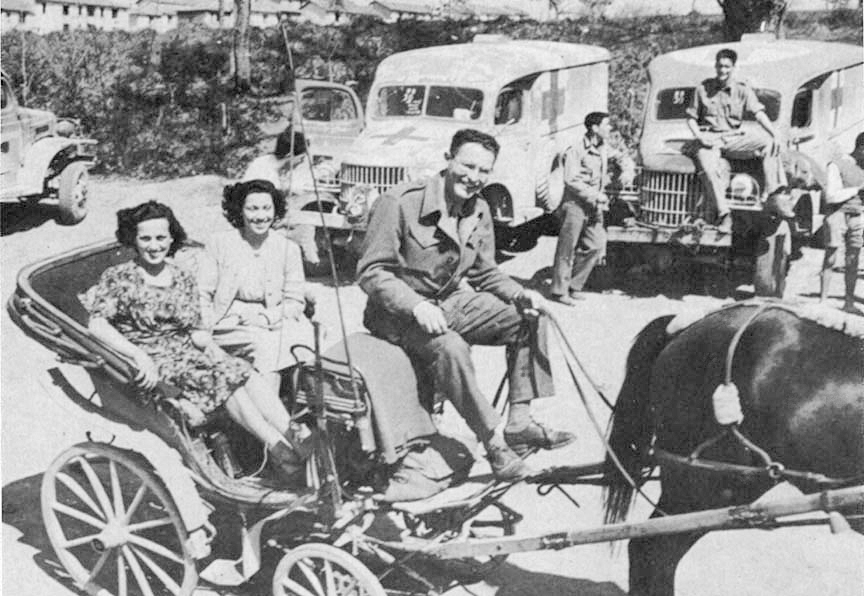 Busman's holiday. An ambulance driver by profession, Bill Powning seems to enjoy this extra-curricular job of chauffering le belle donne. Photo by George Holton |
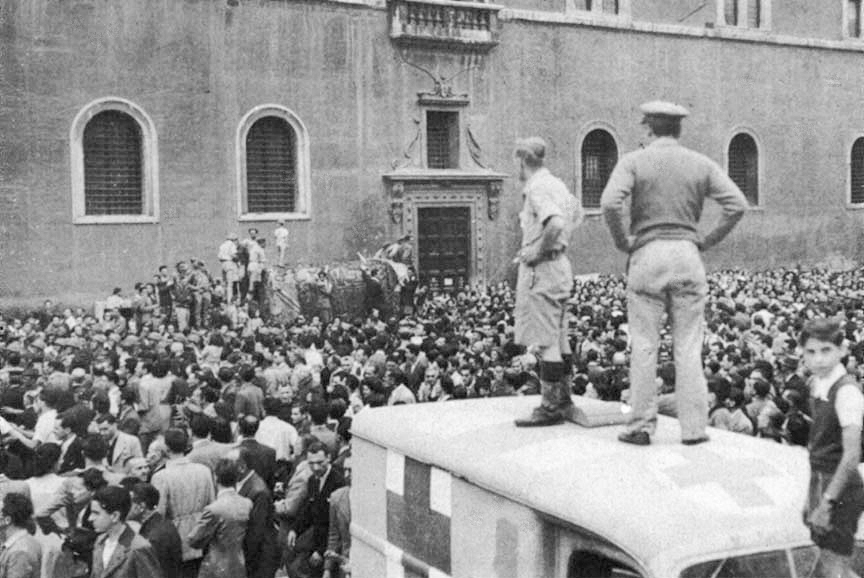 Louis Heschke and Charles Johnson, AFS, get a bird's-eye view of the Piazza de Venezia after fall of Rome. Balcony in background is scene of Mussolini's speeches. Photo by George Holton |
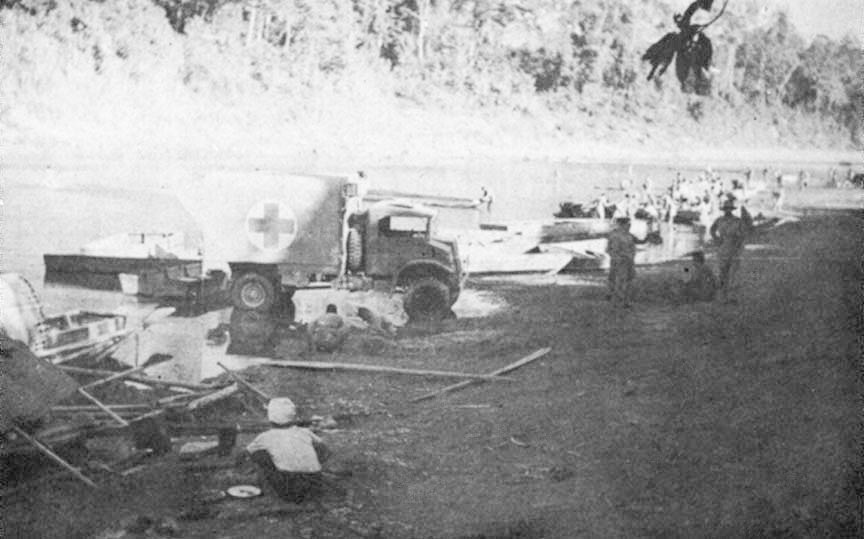
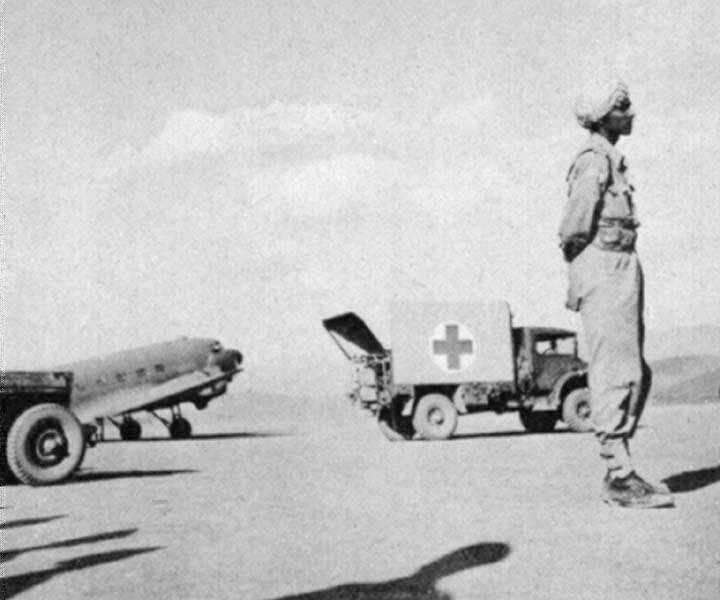 Casualties transported by the AFS from the Burma front await evacuation by hospital plane. Indian corporal in foreground wears a camouflaged turban instead of a helmet. |
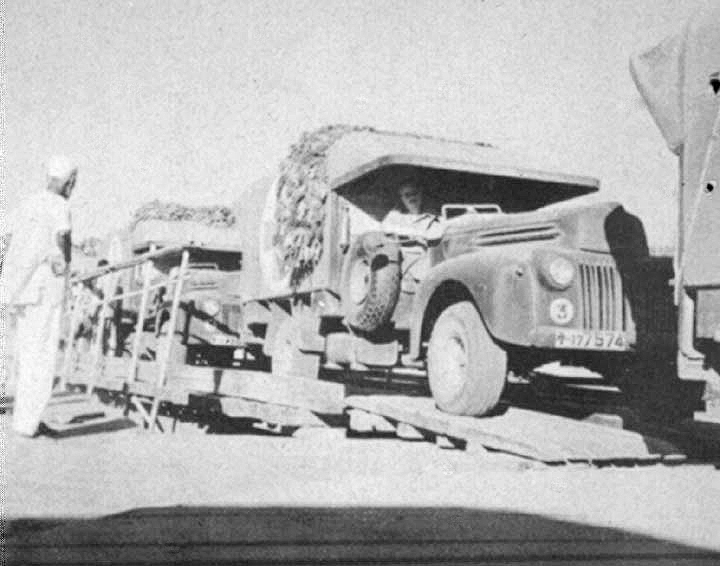 AFS ambulances in convoy cross a pontoon bridge en route to the Burma front. |
The Allens of Winchester, Virginia hold the unique distinction of being the only set of three brothers in the AFS, but they are also gaining individual fame. Their father received a call recently from Sgt. Charles A. Phillips of Niles, Ohio, on leave from the famous First Ranger Battalion, who stopped in for a pro-marital check-up. Dr. Allen immediately noticed his Purple Heart and asked where it had been awarded. Sgt. Phillips replied that he had been wounded at the Anzio Beachhead. "Why, my three sons are over in Italy now in the American Field Service," exclaimed Dr. Allen, indicating their pictures on his desk. "I should say I know this one" remarked the Ranger as he picked up the photo of 20-year old Douglas. "He carried me out from under!"
ROMANCE DEP'T:: After last month's barrage of AFS engagements and wedding announcements, news along this line is comparatively scarce......... Waring Hopkins, who returned from the Middle East last summer, is engaged to Miss Susanna S. Durgin of Haddam, Conn. Waring is studying at Duke University now.......Dave Conant, now an Apprentice Seaman in the Navel Reserve, was married to Miss Jean Kirk of Passaic, N.J. on July 19...... John Harmon, home on leave after two years in the Middle East and Italy, was married to Miss Jane Tattle of Larchmont, N.Y. on July 25th. "Chip" Harkness, AFS was the best man.
One of the most absorbing stories yet printed about the AFS in the Desert is "Still I Leave My Joy Behind" which appears in the August issue of HARPER'S. Our felicitations to Ed Fenton, ex-AFS Middle East, for this outstanding job.
SMALL WORLD DEPT: AFS volunteer Fisk Dellinger was attached to an ADS when the British fought their way into Civita Castellana, 32 miles above Rome. A complete hospital, with staff and supplies, and filled with 600 German wounded fell into their hands and Fisk was called forward to help evacuate the Germans. While the first patients were being loaded a German officer standing nearby had noticed the AFS insignia on the ambulance door. "You are the Americans who drive ambulances for the British; aren't you?" the Jerry asked in flawless English. "In addition, you are volunteers and receive no pay. I know in the desert at Alamein I had one of your boys with me for a week." When Fisk returned to company headquarters he learned that in June 1942, AFS volunteer Bill Mitchell had been captured and made to evacuate casualties for a German medical unit on the Alamein front.
June 16, 1944.
"We are with Gurkha troops and in case you are vague about Gurkhas, I'll tell you something of them. 'Johnnie' Gurkha is a little man, tall at five feet, with a mongoloid head, round and shaved; smiling always, and has stubby legs. He is the color, I suppose; of a Chinese with a tan. He comes from the small, independent state of Nepal in the Himalayas, between northeastern India and Tibet; and is one of the best fighters in the world. Against the Jap he has no equal; he's the best of them all.
"The Gurkhas are funny little fellows. Their voices childlike and they talk with childish glee in a droll and ironic way. They grin like children; they are usually quiet and unobtrusive. Their idea of a big joke is to see someone also in a predicament that would be personally most unpleasant, perhaps fatal. But to see another person in dire straits is the funniest thing in the world to them. The other day, for instance, N. slipped on an escarpment and slid almost straight downward into mud for twenty feet. If he had not been stopped by some barbed wire he would have slid another couple of hundred feet. The wire, it so happened was full of booby traps. Oh, how the Gurkhas loved that. They jumped up and down and laughed and laughed and finally threw N. a rope and pulled him up. Had he landed on a booby trap they would have laughed twice as soon and twice as long.
"They are fine troops and grand fighters. They do much of their fighting in these parts with eighteen-inch knives, called Kukris.
"A Gurkha Havaldar, with whom I an friendly, is going to give me one of these knives, I think. He is an awfully nice chap, extremely intelligent and charming. He was educated at the University of Darjeeling and speaks excellent English.
"This is our own little corner of the War here, and it's fascinating. I have become acquainted with most of the Gurkha Officers (Englishmen) in this area. They are all excellent men. The bravest, most intelligent: capable, and charming men I have ever met. They fight under the most uncomfortable conditions imaginable against the most savage and devilish enemy; and they are under the most perpetual, nervous strain, day and night, fighting and waiting. We see them every day in their front line positions, and talk with them for a few minutes if there are no casualties for us to pick up. They tell us whether the night has been quiet or noisy, how many Japs they have killed, if any, the disposition of the Japs (who are often not more than forty or fifty yards from our forward trenches) and what improvements we have made in defenses; and so forth. You can see how interesting and personal this war is to us.
"We are eating in the Officers' Mess here. The Officers are all fine chaps. There is none better than our Colonel who is a fat and funny fellow. He has been awfully nice to all of us and done us all sorts of favors and has given us encouragement and recommendations when we needed them most.
May 25, 1944.
"......I stop about four times in a run to see how the patients are taking the bumps, give them a cigarette, bedpan, drink of water, or sometimes just a rest. I always dread to go back there for they invariably ask you 'How much farther, chum' I'm telling you, it breaks your heart. You don't feel like telling them the truth ---four hours or twenty miles more, I never know what to say. The driving isn't too bad; especially when you have sitting patients and can breeze down about 15 miles per hour. But with stretcher cases it's a little tiring. I tell myself to relax a hundred times on a run, but the next minute I always find myself tensed up my back away from the seat, my hands grasped tightly around the wheel, easing over each bump with the patients in the back. These Tommies are wonderful. Look the world over and you'll never find as much pluck and spirit as you do in the back of any ambulance."
June 1, 1944.
"These Indians have an effective but 'wear and tear' method of doing their clothes which we soon adopted after spending long, laborious hours in our way, rubbing the clothes together with our hands. The dhobi wallahs plant themselves in the river beside a nice flat rock; soap the clothes up and then beat them on the rock, grunting (a standard guttural noise used all over India) with each downward swing. A few more dips in the water a few more beats and grunts, and 'bas' (finished). There I stand knee-deep in water, beating my clothes while F. and G. help me out with the 'native' grunts, and the modest Indians stand around in disgust."
June 7, 1944.
"These men are short; but very husky and well-built individuals quite in contrast to some of the emaciated Indians I saw coming across the continent. Broad, thick shoulders and huge calves; developed, I suppose from climbing the perpendicular mountain slopes. Let me give you a couple of examples of their health, stamina and endurance. A couple of our fellows went out on a patrol (just for the fun of it on their maintenance day) with the tribesmen. Neither or them could maintain the speed and both passed out cold from heat and exhaustion. These rugged natives built a couple of bamboo stretchers, with even a roof; in about five minutes, and carried them all the way back. On one of my runs I carried one of those tribesmen who had been shot clean through the chest while out on a patrol; and had wandered about his village for three days before reporting to the ADS. Not a word of complaint from this fellow the whole way down, although he was in pain on every bump and spitting up quite a bit of blood.......The surrounding country is really beautiful. These high, usually fog-covered mountains all around us rise straight out of the valley. The air is crisp and cool, especially at night when at least two blankets are necessary to keep warm. Most of the ridges are green with foliage, but four or five are laid bare, except for a few grotesque, charred tree trunks. From our camp site we are able to see the old Jap bunkers,"
May 6, 1944.
"As far as India goes, this place could be worse. We live in ------ which are also inhabited by gobs of rain water every night, rats, mice, lizards and other fauna. There is one particularly amusing beast which utters all night long an expression much used in the Field Service but which I won't repeat here. In the distance great beasts which sound like laughing hyenas cry out reassuringly as one goes to sleep. If we wish to leave the place we must know the password to get in again. Last night, as I was walking calmly along the dark road, having stood at the gate to direct an ambulance late in arriving someone screamed 'Halt' at me out of the shadows and then jabbered at me in an unknown language. In desperation I showed him my Geneva card. He didn't seem to believe it was mine when he saw the picture but finally he let me through and it will be a long time before I venture out again.
"I have been to what looks like Switzerland! It was beautiful. And cool! I slept under two blankets in a wool sweater. What heaven that was. It hasn't been very hot here, tho. It looks as if it is going to rain again in a few minutes. I'd better bustle around and find a damp (as opposed to wet) place to stay for a while."
May 15, 1944.
"The roads are seldom paved and sometimes so rough that it is necessary to go in second gear all the time. The mountain roads are incredible. They must have 50 hairpin turns per mile. One day we came over a magnificent range. We started up in a tremendous downpour. Luckily it was paved road but too narrow for two cars. They have gates at the top and bottom and regulate the traffic so that you never meet anything going the other way. The mountain was covered with dense tropical growth and every once in a while great waterfalls came smashing straight down. We went over a narrow suspension bridge and I thought of Thornton Wilder and held my breath,. There was nothing below us but mist and cloud and the tog was thick. On the other side it was clear and we could look straight down thousands of feet. The views were magnificent. That was a day I will not soon forget.
"I have a little tent all to myself and it is very snug and dry. I sleep on a stretcher and have all my worldly belongings piled on one side and have about 2 square feet of room beside. When I get home, any food will be delicious and any place comfortable and I'm going to be easy to please."
May 28, 1944.
"Though the AFS more or less runs itself, we come into daily contact with the British. In fact, there are no Americans except us. I have great respect for the British 'Tommy'. Theirs is a tough life. They are very friendly. Some of the officers are stuffy snobs who treat their subordinates like dogs, but most of them are really fine. They all seem to have respect and appreciation for the AFS."
June 12, 1944.
"We are at last established in à semi-permanent headquarters and it is quite nice. We have two little villas, pretty much in ruins; but we are quickly fixing them up. One we use for a dining room, lounge, library and office. The other will be for storage and living quarters. At present I am living in a large tent with our OC and three others.
"One of our cottages is on the top of a hill and the view is magnificent. We have a gardenia bush and several beautiful trees with purple flowers. Our animals are Eleanor, a hen, who apparently lived here before us and pays no attention to our doings; (she occasionally lays an egg on the mantlepiece in the library) and a monkey whom we discovered in our tent."
No date.
"Everyone out here keeps up interest and morale by trying to cultivate a moustache. We are not allowed to have a beard, but it's a free-for-all, ---no holds, except when it comes to the upper lip. Nine percent of the people in my group, have, or have tried to have, a moustache. I have not a pretty good one myself. Many are the varieties that cane be seen in a day's observation: waxed spikes sticking a jaunty three inches into the air on each side of the nose; bushy 1890 affairs carefully curled to turn up at the ends; thin, sickly black ones which droop like a dead fish; the palest yellow fuzz and the wirey wild soup-strainer; the debonair trimmed card-sharp style and the narrow patch of the humorist---everything may be found here. Whether they are an adornment or not, is another question. I wonder how many will be carried back for an appearance however brief; in civilian life,"
June 15, 1944.
"You should see my little office here. We've been given a very nice site for our new section H.Q. It was nothing but a mass of rubble when we got it but we've all been pitching in and cleaning the place up. We have two fairly decent houses, and though the roofs are full of holes we throw tarpaulin over them and keep out the rain. The place abounds with flowers and you can easily see what a heavenly place it must have been and will be again. I hope that we are here long enough to make it nice.
"Picking about in the rubble when we arrived here was a white hen who had survived the Jap occupation. On the first morning we were here she laid an egg on the mantlepiece over the fireplace in one of the rooms. She has repeated this process every morning. I think it is a good sign that she feels convinced that the war even though she can still hear it in the distance, has passed her by for keeps now. The boys have named her Eleanor Roosevelt Galatti. There are two gardenia bushes in full bloom in the garden and their fragrance is wonderful. On this little hilltops, where I am now sitting, sometimes we are above the clouds; and sometimes they break and rise and disappear and give us the most staggering view. How you would love it. In the evenings we are getting again those spectacular monsoon sunsets that are so unreal looking. The growth of the jungle all lush and green very lovely. You should see the view from the office window. I can just see the tops of the trees as the hill descends out of sight and then across the way the mountains rise again, green and beautiful. Right now I on see nothing because the clouds have dropped around us, but they can rise again like a curtain in a very short time. Now the clouds are rising; in fact, and I can see the green carpet of trees rolling upwards towards a top where the trees are mere skeletons where there was a battle. The new. censorship rules say, that one may tell of individual instances of bravery. They are too many to relate. The quiet fortitude of all the soldiers here is most moving."
May 4, 1944.
"That night we went to an officers' dance. Met some delightful people including Air Vice-Marshal Williams, one of the top flying blokes in the RAF. Took the train next morning, ended up in a 2nd class compartment supposed to sleep 4--- there were twelve of us---British, Americans, and Indians. One of the Indians brought along his wife and mother-in-law. Changed trains at 10 AM and rode for six hours on a narrow gauge up to an altitude of 6800 feet. When the grade got too steep they'd switch back and continue. After much running around explaining what manner of beast the A.F.S. was, without much success, an American billeting officer took pity on me and put me up in the best hotel --- where I wanted to go all the time--- with a U.S. Major and Lieutenant, both flyers. The Major wangled me a membership in the club so I'm all set.
"Walked around the town this morning (Thursday) looking things over. A perfectly fascinating town built all over the sides of several hills. We've had clouds and mist so far and though the sun breaks thru all the time we haven't seen much of the most magnificent views in the world. I hope it breaks just for one day. Went to the races Saturday, the smallest and highest track in the world. They aren't horses but little mountain ponies ---lots of fun. Tonight there is a dance at the club which should be fun....The dance was good; they have a Paul Jones about three time during the evening because there are so many coming and going all the time, and nobody knows very many. The gals (?) run to all types but on the whole very typical English wives, with and without husbands. The competition is terrific and I enjoy watching the intrigue---every imaginable nationality ---and the effect of the different uniforms is kaleidoscopic.
"This morning the bearer brought in early tea and looking out the window there was that magnificent peak ---third highest in the world standing out just as clear as though in your back yard. The glaciers and contours of the whole ridge were very sharply outlined in the sunlight even tho it was raining on and off where we were. It's breath-taking sight and the first view of it we've had since I came up. Of course the white peak area is covered with snow but there are numerous black ridges showing thru ---over 28,000 feet high. Went up to a hill about 8 miles away and got a glimpse of the highest of them all. You can't get a good look at it unless you take about a two weeks trip. From here it looks like a little bump among a lot of the others. And that's a couple of sights that I never thought I'd see."
May 30, 1944.
"Came down yesterday with a load of patients after waiting four days to get them out. That's the way this war goes. The roads are open one day and closed the next. It was very amusing the other day; they mined the road I was working on and blew a big hole in it; that closed it for the day. Next day we sent out a party to fill in the hole and a big piece of apparatus tell into the hole, so we closed ourselves in that day. But we always break the blocks and things stay open until they move in some place else."
June 6, 1944.
"Things have been very quiet the last few days around here. Mopping up continues and I wonder if it will ever end? Now that Rome has fallen and there seem to be persistent reports that the invasion of France has started we must be going into the semi-finals of this tournament. The finals will be in this district.
"I've been posted to an MI Room et Headquarters the past week and the work is very easy. I'm living with the orderlies in a thatched hut and it's quite comfortable and waterproof. Eating at officers' mess which means that the food is a little better. See Jap prisoners most every day coming in for treatment and a sorry looking bunch they are; they don't seen to understand that they're going to get decent treatment and such bowing and salaaming to every white man in sight!"
June 13, 1944.
"Still posted to H.Q. medical room. There's a lot of work; but not glamorous. And what is glamor after all? the sun rising over the hills as you look up and down from 500 feet to 6000 feet and back again? Watching a bunch of Gurkhas storm a strong bunker and take it regardless? But when you take back the casualties the next day perhaps you find it in the ready smile that Johnny Gurkha gives you when you really hurt him on a bad patch of road; but that's guts, not glamor. War can only be glamorous from a distance; when you're sitting in the middle of it, it's flies, mosquitoes, 1/2 rations for six days which must last for seven, bully-beef and soya links, dehydrated fruits, potatoes and weak sugarless tea, screams from those that are terribly hurt, the stench of the dead, sloshing thru the mud to a telephone when your car breaks down. Oh, it's great fun; month after month without seeing a white woman's face or hearing her voice. True, there are moments charging bunkers regardless of safety that others may live; an occasional bust with congenial friends, a letter from home, a beer and cigarette ration; but we've gotten a long way from glamour; the scales don't balance; the fighting troops know it; they do a magnificent job but they don't pretend to like it.
"My stint is almost over. I wouldn't have missed the chance to do a little bit for anything. I've seen things; done things, been strange places, lived out of my world but very close inside another one, made some fine friends of every rank and color. It's been an interesting interlude, plenty tough, but luxury compared with the lot of most. I'm glad it's almost over."
May 23, 1944.
We have much more maintenance to do out here then we had in the Middle East, but there is more incentive as we got the vehicles new and at present the roads are good with a hard surface.
"I preferred the first year of work because it was more dramatic, both in actual relationship to the war and the continual view we had of it. This is more scenic in a 'Mother Nature' way. My present run is like going up Lookout Mountain on my trip out West. The twists and turns are something for the poor patients but as usual they don't complain. I made one trip after dark in the rain and I couldn't get out of first gear, the man was in such pain --- his leg had been amputated --- and I don't know which of us was more of a nervous wreck at the end of the journey.
"We have a nice campsite on a mountain stream, which is a new experience to me as we can bathe ourselves as often as we like, and also drive the vehicles in and keep them clean, which is a delight to me as you can well imagine. I have taken to doing my own washing to a great extent as the natives wear clothes out so quickly, beating them on the rocks.
"The trip from our base depot to here was intensely interesting. We went through all kinds of countrysides and every day the terrain changed completely. We stopped at one or two places of world fame that will have to remain secret till I get home. The architecture out here I find disappointing as in most cases it looks as if it would crumble tomorrow, which of course is silly as it has stood for centuries, still there is something cheap and stagey about it.
"We met everything on the road from water buffalo to people riding elephants. I wore a lovely spray of orchids one day that R. picked off a tree in a swamp and we had them stuck in the windshield, etc. At times it looked very 'National Geographic-y' with natives paddling around in their rice paddles, practically no clothes on but a gee string and umbrella straw hats. Bamboo grows all over the place; and is a lovely green in the woods. The tea plantations also intrigue me.
"There is one thing certain about the American Field Service: one covers so much territory and knows it so well at the finish that it would never be necessary to come back and go over the ground again; nor could one ever live again with the feel of the country as you get it camping and motoring thru it."
June 8, 1944.
"I see maps of our location in your local papers, which amuses me when I can't say anything about it, but at least it's in the news. We now have a radio and it arrived just in time to get the second front news, which interests us a lot. Also the musical programs do a lot to raise our morale, though it seems almost impossible to think of them coming from a home-setting such as we remember before the war."
June 29, 1944.
"There is one thing about this experience out here and that is one always feels the other person's hardships and losses are so much greater than his own that he doesn't dwell on personal matters long.
"How silly aggravations seem when my patients have slept all night in the pouring rain or lain out in foxholes being shelled with no chance to bathe for week. Even that seems better to me than the story in Life of the escaped American prisoners that the Japs tortured so. That was the worst story I have read or heard of so far.
"We had several days' rest and you certainly would have called it rest it you could have seen me lying in a mountain stream up to neck with cigarettes on a rock, a large hat and colored glasses on, reading the Literary Digest to keep cool. We must have looked funny sitting around in groups. The temperature would go up to well over 120 degrees; but there was always the lovely stream and one wore under-shorts all day so that the part of keeping the ambulance and one's personal things clean made up for everything.
"Our new location is higher and cool with wonderful scenery when the clouds lift, for we are in them most of the time and often above them. The country out here is not at all as I imagined it and resembles the Smoky Mts. I think more than anything. Although it is high there are gardenias growing in our ruined garden; bougainvillia, roses and lilies. There are two houses for our use, and we had a busy day on arrival cleaning up one to use for a mess.
"The Indians cook for us on the porch of one and we have five long tables, benches, a radio, and three open fireplaces, so eventually when all the rubble is cleared away we should make quite a nice home for ourselves. All the plaster had to be torn off the walls and ceiling as it had been so badly bombed we were afraid of its falling on us and hurting someone. Both sides have occupied this territory and between the two it is pretty well destroyed. It is my first experience living under conditions such as our friends in Italy are so used to. Also I am glad at last to be where all the noise at night is not thunder as this work always seems more worthwhile the nearer one gets to what is going on actively. The thing that seems so ludicrous to me is that one would pay a fortune and feel oneself the luckiest person in the world to live in scenery like this in peace times, and it makes one's daily life so difficult now under present circumstances. My poor patients get a regular corkscrew treatment, up and down over a bumpy road when the poor things are in such pain anyway, but they never complain."
June 27, 1944.
"The work here has become quite heavy lately and very interesting. If you could see us starting out in the dark with patients (some of whom have been on the opposite side of the right and require an armed guard standing in the back with a Tommy gun) and driving along twisting mountain roads through clouds and torrential rains with the ever-present opportunity of a landslide on one side or a several thousand foot drop on the other side you would know what I mean. On one of these trips the other night my lights went out and we ended up with a wooden peg stuck on the connection to keep them going, and to cap the whole experience there was a tree across the road still with its roots attached to the landslide. We had no axe but four of us were able to lift the top of the tree high enough for a jeep to get under it then the jeep backed away and swung the tree around like a gate for us to got by. We thought for a moment the tree might have the upper hand and swing the jeep out over the cliff, but some of the roots snapped. The Japs are quite a sight when the native hillmen bring them in, for they have been living in the woods wounded for quite a while without shelter, food, etc. and are covered with maggots and smell of gangrene plus filth, so that if we don't get a chance to wash out the ambulance in a mountain stream at the end of the run, our home for the night is something. I am resigned to the rain, and fortunately it is cool ---with open fires at night like Maine; in fact, the clouds that we are in so much of the time seem just like a Maine fog... The endless trying to keep dry, and changing of shoes so as not to bring mud into the ambulance, is a nuisance; but we try to have the vehicle clean when the patients get in, though they certainly make a terrible mess as soon as they are in ---poor things."
May 24, 1944.
"It is a lovely day today ---overcast but very peaceful and calm. The greenness, flowers and all are very lovely. These last few weeks I've been able to swim daily in a rocky stream. There are rapids at one point and you can prop your feet against the rocks on the bottom and let the fresh cool water cascade past you. The force of it is quite wonderful and when you let go you go bumping down and get caught up in small whirlpools and given quite a ride. Lots of men do their own laundry on the rocks at the water's edge rubbing it with soap and pounding and slapping the dirt out of it. Much of our life is really like looking at copies of the National Geographic at the dentist's. Much that is second note has to be rationalized into first rate merely by the token that you've come so far to see it. I have some quite good Indian friends. All the grandeur of Indian scenery can be found scattered about in other places. Arizona, New Mexico, Colorado, Honolulu, Norway...Of course I haven't been in the Himalayas yet, but they can't be so very different from Yotenheimer, and the food is less strange in Yotentheimer. Well, again I'm grateful for the disciplining that my palate has had through the years. Children, if possible, should be sent out away from home and that careful individual eating to taste at an. early age. You can't make a man out of a child of 20 but you can make a man out of a child of 10. Even it the parent can't afford to send the child away surely they can, with some effort teach some sort of discipline at home; but do they? I'd be ashamed to complain about food here when I think it is miraculous that we get anything at all. The job of supplies is amazing."
A.F.S. driver Cady accompanied the army's advance party in the capture of Teramo, a town near the Adriatic, and his story may now be told. In the hotel there, awaiting the army, sat a group of Allied soldiers, including escaped prisoners of war. They told Cady; who gave them the first American cigarettes they had had in two years, of their lives since September 3, when Italy quit Germany's side. The soldiers came from around the world. There was an American pilot who had been forced down behind enemy lines in Italy; a South African tankman taken two years ago in the desert; a British officer; an Australian captured at Sollum; an American Infantrymen captured at El Guettar.
Most of them were sitting out the war in Italian prison camps until the day Italy surrendered. An American explained what happened at his camps.
"The guard came by and told us about the surrender, and then he said, 'Well boys, reckon as how we'll mosey on home and get a bite to eat.' And then they sort of added, 'By the way; tomorrow the Germans will take over the camp.' And they went off and left the gates free. Man, you should have seen us light out for the hills!"
The hills are actually impressive mountains. Gren Sasso; where the men held forth during the subsequent months, is 8,000 feet high, the highest mountain in the Appennine chain. It is located between Pescara and Teramo, and west of them. The Italians say it is so wild and unconquered that a man can wander two days on it without seeing a house.
Not all the men had escaped prison camps. The pilot; for instance had fallen in with the guerillas and had avoided capture. Some joined the guerillas after escaping from the prison camps, others hid or became farm hands to avoid detection.
The small guerilla group lived intimately with danger ---outlaws who harried and fought the Germane wherever and whenever the odds seemed worth the gamble. If caught; they were shot on sight. Food, shelter, and sleep: these were everyday problems, never permanently solved. A reasonable knowledge of the Italian language was necessary; a misunderstanding could mean death.
The men had arms. Outwardly they looked like natives, but under their clothes they carried Baretta pistols, knives and Italian hand grenades. On the mountain they had machine guns and even mortars.
Their last undertaking was the project of the bridge at Teremo. Four German soldiers had been assigned to blow up the bridge behind their retreating forces. The guerillas observed this and then went to work. They waited until the Germane were alone; then assaulted them. Two Germans were shot and the other two captured. The bridge was safe, and expedited the advance of the Allies.
The men learned to use the mountain to advantage. From it they sallied forth to blow up railroad lines or bridges and section of highways. They even engaged small, isolated German garrisons. When the Germans sent out punitive expeditions, then the mountain furnished innumerable hiding places.
As the Germans retreated into the mountains, warfare was on more even terms. The local Italians were afraid to act as guides for the Germans. But the guerillas, posing as natives, guided them, freely. They would lead the Germans into ambush, machine gunning the advance columns. Then they would retreat again possibly to another ambush. Several times, though, the band had to split and go into hiding for weeks.
These fighters behind the lines had many stories of their bouts with Germans. Once they lay waiting for a German truck convoy. As it started past them. Spitfires unexpectedly plunged out of the sky and began strafing the trucks. The guerillas, adding to the confusion, threw mortar bombs among the panic-stricken Germans. Gleefully they told how the baffled Germans thought the Spitfires were dropping small bombs; a new secret weapon.
Naturally, the attitude of the Italians was important and vital in guerilla war. The soldiers estimated that 80 per cent of the natives were friendly. Another ten percent were afraid to help; and the remainder were good Fascist party members. These were the most dangerous for they were far more clever at finding the guerillas than were the Germans.
Cady asked the soldiers about the German soldier; how was he standing up to constant defeat. The South African replied:
"When I was captured, I was standing beside my burning tank; with several Jerries covering me. I got out my cigarettes and offered them around. One Jerry took one. His officer shouted and bawled him out for that; taking anything from a prisoner was against army regulations." Now that German soldier had no cigarettes. He was hungry; supplies are not getting through, and living off the country often means slim pickings. He is tired and nervous from unceasing Allied pressure. Things are not going right. There are incidents were German soldiers are stopping women on the streets and taking their earrings or finger rings. Lately there have: been cases of rape.
But these freed Americans had some questions of their own. Who had won the last world series? What college had the best football team last fall?
On the mountain a heated controversy had arisen over Joe Louis. A rumor had spread that, in a return fight, Billy Conn won the title.
Cady settled that. Joe Louis was still world champion.
On the following pages are printed lists of the men and their platoons. There are two companies in the Central Mediterranean of 4 platoons each. In India there are 4 Sections. Those rosters were made at designated dates; if a name is absent, it is because the man is either in transit or is on detached service.
|
"A" Platoon |
"B" Platoon |
"C" Platoon |
"D" Platoon |
| Atwood: D., Lt. | Hobbs, J., Lt. | Blair, R., Lt. | Dickson R. Lt. |
| Avery, F. | Barres, O. | Barbour, T. | Allen, L. |
| Bacon H. | Browning, K. | Barrel, R. | Applewhite, R. |
| Bennett, W. | Bullock, T. | Bell, W. | Bayer, F. |
| Brown W. P. | Chisolm, H. | Brennan, K. | Baylor, J. |
| Burton, R, | Cook, T. | Brewster, J. | Beach, F. |
| Cagle P. | Doyle, W. | Brooks, H. | Bigelow, L. |
| Campbell, R. | Earle, J. | Byrd, T. | Bolte, A. |
| Demarest, D. | Ford, D. | Cady, E. | Brooks, J. |
| Emmert, F. | Hess, F. | Chapin, W. | Campagnoli, J. |
| Erhart, C. | Kelly, L. | Chaplin, M, | Curtis, W. |
| Fenhagen, F. W. | Lippincott, H. | Collins, G. | DeMone, R. |
| Fisher, P. | McCord, J. | Combs, C, | Fogg, J. |
| Griffin, G. | McGuire, C. | Corse, J. | Gadarian, H. |
| Hause, B. | McLouth, C. | Crothers, A. | Gerhardt, J. |
| Hendrickson; J. | Morris, H. | Ecclestone, A. | Grant, L. |
| Hunter, G. | Moore, J. | Edwards, C. | Harward, R. |
| Hursey, G. | Myers, F. | Everett, F. | Hazard, G. |
| Janswick, W. | Noble, D. | Grumman, S. | Henry, C. |
| Jones B. | Parker, E. | Hale, T. | Hill, D. |
| Kennedy, R. | Parker, H. | Hillery, L. | Hughes, J. |
| Kyle, K. | Perkins, C. | Hilton, E. | Kaufman, J. |
| Little, A. | Potter, A. | Jones, H. | Keen, I. |
| MacLeod, S. | Raphael; B. | Keller; C. | Keenan, J. |
| Messinger, C. | Rodd, W. | Kent, G. | Massey, G. E. |
| O'Rourke, R. | Rorison, H. | Kinsolving, L. | Mitchell, D. |
| O'Sullivan, J. | Rowan, S. | Kirkaldy, .J. | Moore, W. |
| Rector, C. | Schley, G. B. | Knight, R. | Payne, T. |
| Reeve, C. | Sleeth, B. | McKinley, R. | Pierrepont, R. S. |
| Reis, J. | Stewart, A. | Meeker; J. | Powing, W. |
| Richmond, D. | Townsend, R. | Metcalf, H. | Rich, W. |
| Riker, R. | Waller, R. | Morris; J. P. | Scott, J.F. |
| Rodgers, P. | Watson, A. | Murphy, D. | Scott, R. |
| Sears, G, | White, L. | Orton, J. R. | Tankoos, J. |
| Turner, K. | Whiting, F. B. | Reige, J. | Tilton, S. |
| Vaughan, C. | Wilson, R. | Reynolds, C. | Toms, L. |
| Warren, P. | Woods, W. | Schick, T. | Wakefield, W. |
| Wilton; J. | Wright, J. | Uhl, U. | Waterman, S. |
| Woodward, W. | Van Bomel, R. | Whitehead, W. | |
| Wackernagel, F. | Willets, C. | ||
| Wright M, | Woods, B. |
| Company HQ | Reserve Group | ||
| Driver, E. | Payne, B. | Brawley, A. | MacNeill, R. |
| Field, M. | Pearmain, R. | Conlon, E. | McKinnon, R. |
| Halle, R, | Pierce, C. | Fitter, E. | O'Connell, J. |
| Leinbach, J. | Scott, J.H. | Lee, J.T. | Plass, V. |
| Light, E. | Stoddard, J, | ||
| L. A. D, | Lindsay, J. | Wilson, J.G. | |
| Ingraham, L.G. | Lippincott, J. | Wisotzkey, J. |
|
"A" Platoon |
"B" Platoon |
C" Platoon |
"D" Platoon |
| Moran, M., Lt. | Biddle, L., Lt. | Chamberlin, W. Lt. | Lester, L., Lt, |
| Allemang, R. | Allen, H. | Adam, C. | Allen D. O. |
| Bartlett, F. | Allis, R. | Adams, D. | Ashmun, B. |
| Bradley, W. | Barton, T. | Balderston, F. | Baer, W. |
| Brinton, J. | Brixey, A. | Bernardi, W. | Becker, D. |
| Brooks, R. | Brod, H. | Bottomley, T, | Bohning, F. |
| Browning, W. | Burke, F. | Brewer, W. | Bowles, E. |
| Burkhard, F. | Cole, T. | Butman, E. | Brindley, J. |
| Cliffe, F. | Cowles, D. | Cole, C. | Burwell, R. |
| Conrow, R. | Davis, A. | Cooper; B. | Carranza, D. |
| Cope, W. | Dickey, B. | Dennis, M. | Crawford, R. H. |
| Dellinger F. | Emmert, A. | Farnham, C. | Colvin, D. |
| Desloge, B. | Eshleman, B. | Farrelly, W. | Davis, R. |
| Gordon, C. | Ferrante, H. | Foote, F. | de Rimsingeur, C. |
| Heuss, L. | Ford, B. | Forte, J. | Douthitt, J. |
| Hoffmann, R. | Fuller, W. | Garland, L. | Ferguson, L. |
| Jacobsen, E. | Higby, R. | Gotshall, R. | Finkenstaedt, F. |
| Jones, D. | Ives, C. | Green, J. | Frazer, R. |
| Kohnstamm, R. | Key, W. | Hackett, W. | Fuller, M. |
| Long, M. | Laden, H. | Harrington, P. | Hall, M. |
| Mann, R. | Lamberton, H. | Helfrich J, | Hamilton, D. L. |
| Meleney, W. | Lewis, D. | Howard, A. | Heschke, C. |
| Middleton, W. | Love, W. | King, B, | Johnson, C. |
| Moeller, H. | Martin, W. | Lefferts, C. . | Litchfield, P. |
| Mount, T. | McNabb, S. | Lichensteiger, F. | Nodine W. |
| Nelson, R. | Miller; J. | Lloyd, W. | Olesen, O. |
| Posselius, F. | Rellinger, C. | Manley, J. | O'Meara H. |
| Sanderson, F. | Sears, W. | McCulloch, R. | Rea; H. |
| Seward, S. | Strauss, M. | Messerschmidt, L. | Russell, F. M. |
| Sloane, P. | Stump; W. | Munger, S. | Russell, H. |
| Smith, A. | Truitt S. | Peck, L. | Satter, R. |
| Smith, D. | Vasilew, E. | Prince, A. | Shearman, W. |
| Stacy, G. | Watson, W. | Scott, G. | Spencer, E.J. |
| Thorp, R, | Wells, H. | Shethar, N. | Tilgham, W. |
| Townsend, W. | Wilson, C. | Skillings, R. | Titus, C. |
| Walker, G. | Yarnall. R. | Snyder, T. | Tome, C. |
| Whipple, J, | Yarnall, Robt. | Stumpf, A. | Tompkins, W. |
| Stutz, G. | Whitehead, R. | ||
| Trowbridge, G. | Wickes, W. | ||
| Upson, J. | |||
| Viall, D. | |||
| Wagner, H. |
| Company HQ | Reserve Group |
| Balderston, F. | Bowen, J. |
| Biddle, L. | Brannan, P. |
| Brod, P. | Hallowell, F. |
| Burke, P. | Harrington, R. |
| Chamberlin, W. | Mackey, J. |
| de Rimsingeur, C. | Moore R.J. |
| Dickey, B. | Ross, H. |
| Farrelly, W. | Washburn, W. |
| Lester, J. | Zimmer, A. |
| Moran, M. | |
| Wagner, H. |
|
Section 1 |
Section 2 |
Section 3 |
Section 4 |
| Fenn, N., Lt. | Macgill, J., Lt. | Paulson, R., Lt. | Birkett, J. Lt. |
| Bailey, R. | Ainsworth, J. | Alexander, H. | Ball, C. |
| Basking N. | Beeber, N. | Angevin, J. | Bealor, M. |
| Becker, M. | Bragg, D. | Boulet, J. | Boyd, A. |
| Bennett, R. | Brown, W. | Burns, R. | Bramkamp, L. |
| Boaz, R. | Clark, P. | Coleman, G. | Brown, R. |
| Burton, T. | Cosgrove, W. | Custer, E. | Carr, L. |
| Cary, M. | Devine, T. | Downing, E. | Carron, J. |
| Dolan, T. | Elberfeld, R. | Drabeck, C. | Chandler, H. |
| Dodds, R. | Feddeman, F. | Ferguson, J. | Chase, T. |
| Drew, W. | Gilliam, N. | Ferguson, R. | Cloud, E. |
| Eggleton, L | Grey, R, | Frost, F. | Cutaiar, G. |
| Field, R. | Hill, A. | Garvey, D. | Dempsey, J. |
| Hauserman, R. | Kunkel, N. | Gilbert, P. | Fisher, R. |
| Heath, D. | Mayfield, F. | Kellog, W. | Habein, R. |
| Kelly, B. | Moor, D. | Kern, F, | Hamilton, R. |
| Krusi, L. | Morrill, D. | Mackay, A. | Heisler, B, |
| Lutman, D. | Nash, R, | Madsen, K. | Hoffman, J. |
| Michaels, J. | Roach, A. | Moore, W. T. | Holmes, D, |
| Newbery, T. | Robinson, R. | Newton, K. | Humphreys, H. |
| Ogle, A. | Ruppert, K. | Ostenso, R. | James, D. |
| Olmstead, A. | Searles, H. | Parkhurst, J. | Janeway, T. |
| Orth, W, | Smith, F. | Quandt, R. | Kurtz, A. |
| Riel, G. | Smith, W. | Richley, R. | Lilly, V. |
| Ronberger, H, | Spallone, D. | Sample, P. | Long, C. |
| Swensson, H. | Sawyer, T. | McCormack, F. | |
| Waterbury, R. | Schneider, B. | McPheeters, T. | |
| White, S. | Schubert, K. | Marshall, R. | |
| Whiteside, J. | Schwab, W. | Martin, R. | |
| Wilhelm, J. | Simonds, H, | Matthew, R. | |
| Headquarters | Wright, C. | Smith, D. | Merriam, J. |
| Ives, C.B., Maj. | Spavin, E. | Myron, M. | |
| Craven, T., Capt., OC Personnel | Staples, F. | O'Donnell, J. | |
| Van der Vliet, P., Capt., OC Finance | Stott, P. | Parson, A. | |
| Marsh, W.L., Capt., 2 i/c | Sweetman, W. | Scott, F. | |
| Wiley, P., 2/Lt., 2 i/c Personnel | Turner, E. | Shands, C. | |
| Pemberton, J., Capt. | Turney, E. | Shepard, T. | |
| Kersting, T. | Whyte, D. | Sinclair, J. | |
| Kneupfer, R | Williams, R. | Stamm, J. | |
| Yankey, R, | Taber, W, | ||
| Cheney, M. ) | Wonson, T, | ||
| Simpson, R.) Field Cashiers | Young, T. | ||
| Pierce, H, ) | |||
We wish to thank our readers for their response to the request in the last issue for opinions and criticism; We would like to hear from many more of you. Pro and Con----send it in
| Q. | "My only comment is that the stories are sometimes disconnected and places and names would help a lot if permitted." |
| A. | Our policy from the outset has been to omit the men's names. Both the recipients of the ambulance drivers' letters and the AFS men themselves have stated that they were not written for publication but that there was no objection to the opinions being printed unsigned. Where men's names are mentioned they are omitted to avoid identification. Place names are never omitted by us; when missing, they have been struck out by the censor, |
| Q. | "I think it proper and fitting that one page be set aside for the AFS men who have been killed. You could give the name, home town, place and date killed. Unless I am in error I believe the present listing is a bit jumbled. Outside of that the LETTERS are very well arranged and interesting." |
| A. | The Honor Roll reads from left to right in order of men lost. It is printed as a memorial to their sacrifice and courage, not as informative material. When a casualty is reported we give a notice to the man in the individual paragraph devoted to him on the Casualty Page. |
"Everything is forgotten when the AFS LETTERS arrive; it's like reading a story. I feel I know the boys and when friends mention they know someone in service, several times I've been able to show them pictures and their names in print! I keep the copies in one place and lend them to interested people."
"We have read the July issue from cover to cover forewords, news items, pictures, and letters, and enjoyed every page...The cover design is beautiful and the make-up on the whole magazine attractive."
| Q. | "I would suggest that in future you put on the cover the pictures of all you nice women working in the AFS. I am sure that will bring more visitors to 60 Beaver Street and broaden the interest in the AFS." |
| A. | Who will draw us a "Vargas" gal? |
| SECTION ONE, AFS, WITH THE FRENCH, WITH HEADQUARTERS UNDER HENRY COSTER, HAVE ARRIVED OVERSEAS AND ARE ATTACHED TO A FRENCH BRIGADE. |
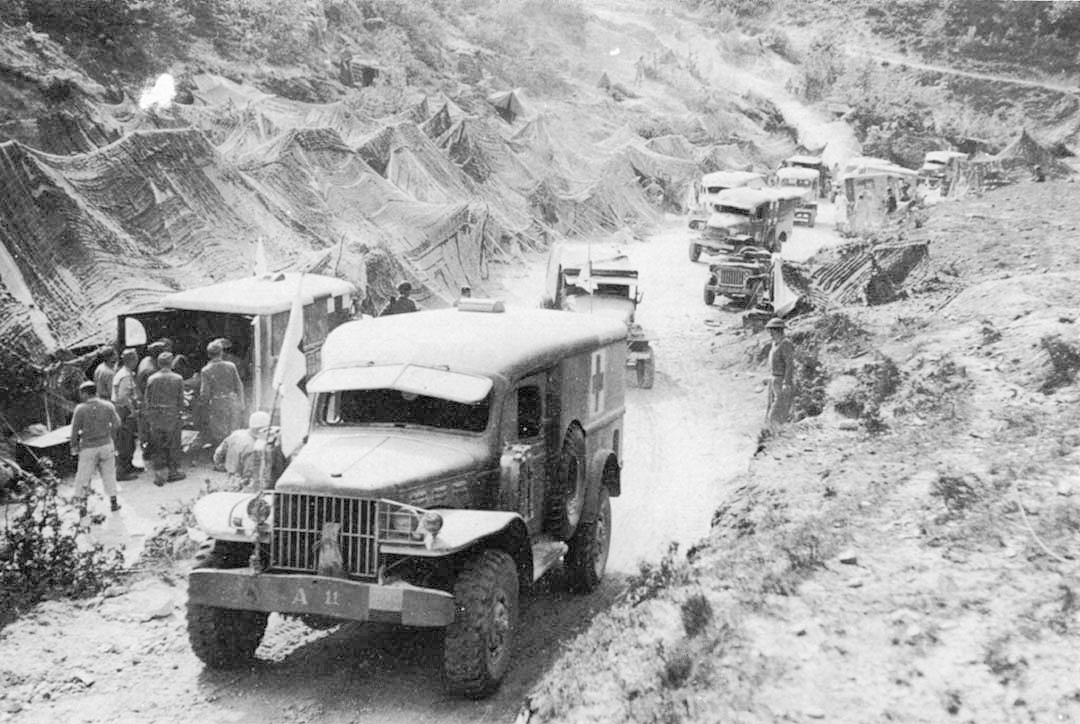
AFS ambulances deliver patients from the front to a Polish dressing station behind Eighth Army lines. Camouflage nets protect the dressing station tents during enemy plane attack.
Photo by George Holton