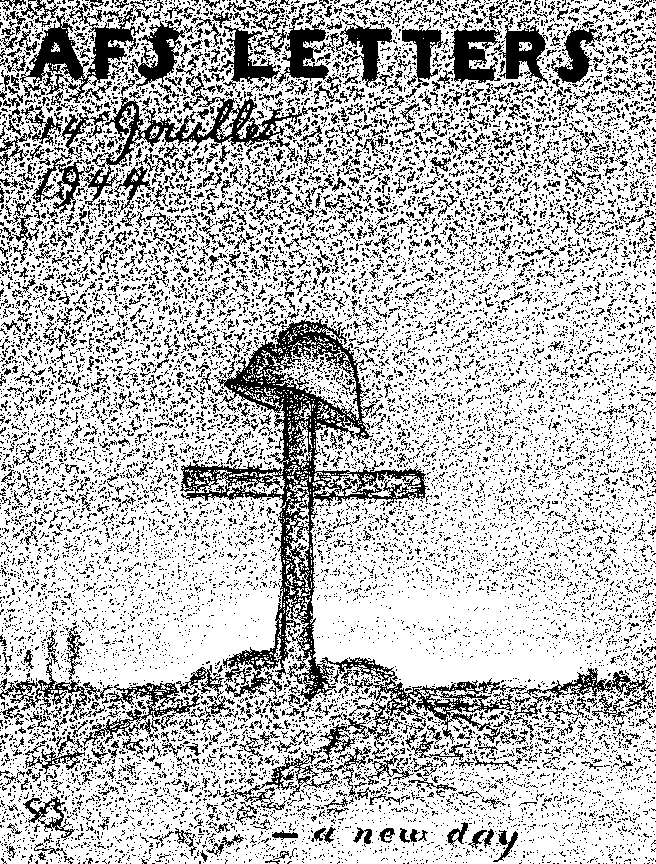
Edited and published at AFS Headquarters, 60 Beaver Street, New York 4, N.Y. under the sponsorship of the ambulanciers' relatives and friends, who contribute the excerpts from the letters.
|
"Les Etats Unis d'Amérique n'ont pas oublié que la première page de l'histoire de leur indépendence a été écrite avec un peu de sang français." Maréchal Joffre, 1916. |
The words of Maréchal Joffre uttered in 1916 in appreciation of the aid given by American Armies might well have been inspired by that handful of Americans who rushed to the front at the first battle of the Marne, to help carry back the wounded in their own automobiles. They did not forget the bond between Americans and Frenchmen. The other Americans organized by these few into the American Field Service felt the bond. Throughout the years of peace AFS money provided exchange scholarships between Americans and French students. The re-vitalized AFS ambulance service has served French soldiers wherever it has been able in the second world war.
The American Field Service is a hybrid organization. Its members are Americans, but they have worked with the French, the British, the New Zealanders, Indians, South Africans, Aussies, Canadians, and more recently with the revived Polish forces. They have never been attached to the American Army in this war (though we have constantly received every assistance from the Army), but they have carried our American wounded at Anzio and some of our drivers, wounded themselves while carrying wounded American soldiers have received the Purple Heart.
The Field Service in short, is a hopeless and shameless polygamist, capable of many contemporaneous loves. But its first love was the French, and they first knew of it in 1914, and subsequently at Bois-le-Prêtre, Hartmannsweilerkopf, Champagne --- these are not names one forgets. And in the ill-fated campaign of 1940, Amiens, Beauvais, and the Loire. To these more recently have been added service with the Free French in Syria, the Fighting French at Bir Hacheim, Himeimat, Enfidaville, and Cape Bon.
After the fall of North Africa, the French unit of the AFS, owing to difficulties of documentation and to the prospect of a long period of inactivity, had to be disbanded. Some of its members cane home (many of them in order to work for the revival of the unit); others have been serving with distinction with the AFS in Italy. But the lack of a unit with the French left a gap which was sorely felt, fine as has been, and is, the work of the Field Service in Italy and Burma.
Now, that gap is tilled once again. The first section of American Field Service men, thirty strong, has sailed to serve the French Army in Europe. France is being avenged. The Frenchmen who gave their blood to help secure American independence look down this July with thankful smiles to see Americans teamed once more with Frenchmen in the name of Liberty.
| Thomas S. Esten | George O. Tichenor |
| Stanley B. Kulak | William K. McLarty |
| John F. Watson | Randolph C. Eaton |
| John H. Denison, Jr. | August A. Rubel |
| Richard S. Stockton, Jr. | Curtis C. Rodgers |
| Caleb Milne, IV | Vernon W. Preble |
| Charles James Andrews, Jr. | Arthur P. Foster |
| Charles K. Adams, Jr. | Henry Larner |
| Alexander Randall, Jr. | George Brannen |
| Robert C. Bryan | Dawson Ellsworth |
| John Dale Cunningham | Donald Harty |
DONALD HARTY on July 5th, was instantly killed by a mine. This the only information received to date was reported by cable to the AFS. The message, brief as it was, spoke volumes for the courage and devotion of this ambulance driver. During his seventeen months of service overseas, Donald held an outstanding record on the desert and his ambulance was one of the first to make the hazardous crossing of the Gargliano River with the Fifth Army in Italy. He was admired and respected by all who knew him and he was always where the need was greatest. His death is a greet loss but his memory will always be cherished by those who had the privilege of knowing him and working with him.
RICHARD C ANDERSON was last seen on the morning of June 21st, leaving the workshops to return to his post. The regiment to which he was attached had moved while he was away and he did not show up at their new location. Manor Edwards, his Commanding Officer, together with several of Dick's comrades, have searched the area, but as yet have found no clue to his whereabouts. It is quite possible that in searching for his regiment, he drove too far forward and has been captured by the enemy.
BENJAMIN FORD on June 9th, was slightly wounded by a Teller mine splinter, which gouged one finger. He was posted at an RAP and was standing outside his car when a passing vehicle set off a mine. He completed his run and after his finger was dressed reported back for duty.
"And now for the story of the week. It all goes back to the battle of and for Cassino. Our section was about 11 miles from the town the night of the barrage. It really was the most stupendous thing I have ever seen; three times as big as the one at Alamein and five hours long. The country looked as if it had been sprinkled with diamonds or like the crest of a phosphorescent wave. You can imagine the sleep we got. The next day we all worked continuously bringing the wounded back from the Mt. Cassino sector. We got a little sleep about dusk but I was called again at midnight to go back up. The road was terrific. It took about an hour and a half to do the 14 miles when I got to a place there I knew there was a bend; I had to get out and look for the road because it was too dark to see, I knew I was fairly near the right place because I could smell the two dead mules which were right at the bend. Just as I got out Jerry sent some mortars over and they were landing so close I jumped down into a convenient dug-out with two Poles and a dog. In about twenty minutes I thought it safe to go on so I got back in the car and whoommff! I jumped back in the dug-out in one leap. As soon as the noise died down a bit I could hear the dreadful pisst of a punctured tire. It took me an hour and a half to change it because Jerry would start shelling just as I started to work. It was very unpleasant. (I had three flats caused by shrapnel in 10 days.) Anyway I finally got it fixed and pushed on up to the post just as it was getting light. The post was very near the front. The machine guns sounded as if they were in the next yard. Practically all the road was under observation and only red cross vehicles could go up during the day. In some places the road was only several hundred yards from Jerry. At night we could hear the motors going along the road and shell it. I arrived up at the post to find T---waiting just ahead of me. I told him about the trouble I'd had and we found a piece of shrapnel which had gone through the back window, pierced my helmet and finally ended up in the fire extinguisher. T. loaded two patients in his car and was sitting in them --- I was about twelve feet behind the car --- when there was a terrific concussion. I was aware of no explosion or sound of any sort. I immediately jumped behind a wall but came out again in a few seconds. L.'s car was all hidden by smoke. In a few seconds he appeared at the door yelling for help but I could not hear him because the noise had deafened me. Poor T. was hit in several places and was pretty scared --- not to mention myself. This work kept up for several days then we were withdrawn for several days rest. When we went beyond Cassino with an armored unit. We leagured on the side of a mountain in full view of Jerry, but he only shelled the main road as every time he would fire we would answer back at the gun position which he had thus given away. It was very quiet all the afternoon, evening and night. We could see the Infantry going in with grim faces and bayonets fixed. The trees looked dead because practically all the branches were torn off by shells. We all dug slit trenches and went to sleep very early. I awoke early and went to B.'s car with a can of bacon to add to the breakfast brew up. Just as I got there the shells started coming thick and fast. Three of us jumped into the same slit trench and tried to act as small as possible. After the first salvo we heard cries for help and looked up to see two S.B.'s running over to help. I thought this a good time to get back to my own hole so I started to run back. When I was almost there they started coming again and I dropped down in a newly made pot hole for protection and then one landed close and when I looked up I could not see anything but smoke. For another 15 minutes they came thick and fast. It was by far the worst thing I have ever been through. When I got up I found that a mortar had landed about ten feet away from me. My car was in shambles. The radiator, gas tank, tires were all punctured, the car had more than two hundred and fifty holes in it! I did not look long because they started coming over again. One landed about 50 feet away and I heard many groans and shrieks. I ran over and found a horrible mess. A shell had landed in the middle of a group of seven people who had been huddled together in the same hole. Why they were not all killed I didn't know. The MO arrived about the same time I did. Several of us went to work trying to make the wounded comfortable. We picked up one guy and his feet fell off. About a half hour later ---the shelling was practically continuous --- I rode back with one of the ambulances. What a relief to get out of that hell hole. I came back to Plt. HQ and got some help. We went back up and towed the car out and down to the workshop. I now have a new car because the old one was beyond repair.
May 22, 1944.
"Our R.A.P. moved up some days ago to within 2000 yards of the lines, nearly within range of the deadly mortar which does not know we are here. It was a night move, along roads under enemy observation. Except the few moments that shells are actually bursting within a hundred yards of you, you are in relative safety. The only danger is the first shell for it comes with too little warning to duck unless you are under cover and you can't and don't say that you stay under cover until the shelling starts. You run for your hole and if it is not too far away you get there before the second shell hits. (Under cover you are safe except for the shell that gets by the 50-l chance of hitting within three feet of you). Night driving is nerve-racking. In following another car with lights you have only a pin-point of red ahead. You glue your eye to it and follow as best you can. Your lights are no help. They are to warn vehicles coming toward you. Without lights, which is how you drive when Jerry can see the road you are on (and will shell it if he sees dark objects moving), the problem is greatly magnified, especially as that night there was no moon behind the heavily clouded sky. Your windshield is up because even clean glass cuts down visibility. And so we drive for 3 1/2 miles at about 5 miles per hour, the driver straining to follow the dark object ahead, his alternate driver on the right front fender calling instruction, 'Right, left turn, stop, going ahead, etc.' At last the medical truck leading the way came to a halt. The MO (Medical Officer) led the first car to a pre-dug shelter. Then it was my turn. At lowest possible speed, in 'low-low' gear (1st of 4) I crept after a flashlight covered with a hand for 250 yards ---'Left hand down, full right, stop, hole here, go easy, right hand down'---and nervous Jerry sending up flares to locate the sound of my engine which sounded like a banshee wailing to us all. It was pouring rain to make matters easier. But I got bedded down in a grove of trees out of direct enemy sight. It was four a.m. We dozed till first light (3 a.m.) and hastily erected our camouflage nets and dug our vehicle pits deeper. Mine now has the engine 2/3 covered, which is excellent cover in this concrete-like earth. Wet clay is hell! There our bivy for the wounded had to be strengthened with sand-bags (clay-bags). Our clump of trees offers the only real cover for thousands of yards ---trees five to fifteen feet high. No moving out of the trees in daytime or Jerry will come down on us with mortar fire which is hellish in its accuracy. But Jerry does not seem to know we are here. We have had only four shells come near us, three today -the first gave us a half-second scream before landing ---time enough to realize it was coming. Mess-kits flew, cups went over, I lit on my belly in a rut in the road eight inches deep in the edges and four in the center. Normally I would have shuddered at the thought of hitting that ground but I took it as fast as I could and did not feel the skin come off. There was silence for a moment so I ran to my dugout picking up my mess-kit on the way. It had a piece of steak (1" x 1 1/2") the first since I left N.Y. While the other shells came over I gulped down my steak ---our dugout for two had four of us in it, two of us eating our lunch. If we had had wounded to move they would have had to lie still till dark in our slit-trench; then we were supposed to evacuate them about four miles to the rear. But we have had none to evacuate. There was no firing done, it was just sitting tight and staying under cover till the big doings started. So we sat and smoked and ate and slept and waited. Each morning there was a short but terrific barrage about six o'clock, then intermittent fighting between the guns behind us and Jerry's guns. All day long the steady roar of heavy guns. At night it lessened and you could sleep."
May 23, 1944.
"The battle is on. It had been on for an hour and a half --- at 0545 the usual morning barrage let go ---or so Jerry was led to believe as he took cover. On the road we came up a few nights ago there was the rumbling of tanks going up to aid the infantry attack. It was cold and rainy. At 0600 there was a slight lull and then the guns concentrated for a while on the left flank where the feint was, to go in strongly. Then suddenly the barrage shifted and dive-bombers streamed overhead, neatly formed, then suddenly peeling off and going soundlessly down into the holocaust to lay their bombs, rising swiftly in arching flight to reassemble and wing back. The enemy fire observed so far has been a very week anti-a fire. No response to our guns. The barrage must be terrific there. Enough to make the bravest stay under cover and surrender to advancing infantry. I can hear the sporadic machine-gun fire, whether ours or theirs I cannot say. We are behind a slight rise in the terrain and cannot see our shells landing. We, the R.A.P., are waiting for casualties to appear but so far Jerry has not replied. We hope his guns have been knocked out. It'll mean no work for us if that is true. They say this barrage was to have been greater than at Alamein. I have stuffed my ears with cotton but still it is terrific and my ambulance shakes and quivers with the gun blasts. The firing has died considerably now. Evidently they have done their work more quickly than anticipated or else the infantry had advanced too quickly, and they are waiting for new targets to be reported. Machine-gun fire seems more distant. There has been no firing near me for almost a minute and I could hear suddenly the shells bursting on Jerry, a steady roaring. God, what a hell he must be suffering --- 10:40 hours: have just returned from carrying three American infantrymen to the rear. They straggled in, lost. None badly hurt, none of our unit have had a chance to be hurt, for no shells have come over yet. These Yankees came in, one bleeding profusely from a shrapneled shoulder, dazed but o.k. otherwise. Our MO dressed them, gave them tea and bundled them into our ambulance. The rain was still pouring down, earth had turned to a slippery clay which necessitated low-low gear and four-wheel drive in getting out of our position. We ran the few miles to the hospital slowly and raced back in case any casualties were waiting, but there were none. The drizzle of rain continues, leaves us feeling morose. Steady stream of bombers, fighters and dive-bombers running a 'milk-run' up forward. The day is almost never empty of their motors. And the guns pound on, suddenly, endlessly, deafeningly. My ambulance is caked with mud in the back, one of my stretchers soaked with blood from one of the wounded Yanks. It will go on like this all day. Rain, shells, bombs, planes, rain, rain, rain, a deafening holocaust that will go on till the guns move forward and start again. And if the job la not finished today it will go on tomorrow for this is the real effort to crush forever the German war machine in Italy, force a big retreat. This is not a small battle. This is probably a bigger battle than any so far, part of the break-through at Cassino and the subsequent rupture of the Adolph Hitler Line. You'll know by the time you read these words how successful we are."
May 24, 1944.
"There was no anti-a fire from Jerry and only once did his planes appear---three fighters dropped some bombs, and fled not to be seen again. Overhead the little observation planes flew in circles unmolested, fighters droned and bombers roared. Towards early afternoon the noise of battle lessened, the guns around us belching spasmodically. The work of the bombers seemed done and only fighters patrolled overhead. News trickled in slowly: L unit has taken its objective, B unit has almost got his; C is held up, while D has made little progress. At first the news was not good, then suddenly our weight was felt and the news became good, excellent. You were afraid of over optimism and would believe only the word from HQ.
"In the afternoon Jerry guns began to be heard, only a few. Now and then a stray shell would buzz into our area. We spent an hour in our dug- out, then after a long silence I went out to turn my sleeping bag over so the sun would dry the bottom. I inspected it for fleas and suddenly I heard a shell coming in. Naked to the waist I flung myself into the grass, really scared, for the whistle told me the shell would be a close one. Hugging the ground, face hidden under helmet I prayed it would be a dud. The shell sounded as if it were going to hit me square in the middle of the back and I trembled like a leaf. This was to be luck or bad luck. And it was a dud!! If it had been good I think I'd have 'had it' ---but my good luck held, I dove into the dugout next to R., cowering against the further wall. I was unable to speak for a second and R. gave me a sick grin and said; 'God, you were lucky'. We later heard it was a ricochet and that was the reason we could hear it so plainly. It hit about thirty yards from where I had stood. A few more came in later but he was shooting AP (Armor Piercing) which do not explode unless they hit something solid; my dud had been AP. But Jerry soon became quiet. We cooked dinner in peace and finally got a full report of the day's activity plus a detailed account from one of the artillery HQ officers of objective taken and to be taken and were shown the map with the new line. Some of the best news was that some of the American units had done remarkably well, vindicating their previous blunders. All are very pleased and Jerry appears to be hard pressed now.
'"The news this morning is even better. The guns roared all night and about 0400 hours another barrage went over until about 0720--- nearly double yesterday's barrage in intensity. We have been told that being in the middle we cannot appreciate the tremendous extent of the barrage. But to me it is the most awful din I hope to hear, an endless blast that tears at your clothing and shakes your head and bellows snappishly in your ears. The roads are not too full; tanks going up, trucks, jeeps ambulances, and prisoners going to the rear, young, clean, strong but very happy to be out of it. Big smiles, only a few glowering (this is a report ---I've not seen them).
"1100 hours. The barrage is over and the guns are firing irregularly now. R. is standing naked in the sun washing himself in his helmet. I squeezed my bath in yesterday ---my first in 21 days. It is only a sop to convention, as you can only wash off part of the sweat ---none of the filth. R. is betting that as soon as he gets 'clean' and before be gets his clothes on Jerry will toss over a few shells and he'll hit the ground as I did yesterday, without hesitation. Incidentally, I found later that my arms and face were full of thorns; I had landed in a clump of brambles! never even felt them as I tried to get closer to Mother Nature. If we can hold our present position, or improve it as we hope to do and are doing; Jerry will be in a very bad spot. But I must not be too optimistic for he has not yet counter-attacked strongly. That is the test to come, the second act of the battle. The first act is definitely all ours.
"Everything has been very quiet. R. and I turned in at 2030 hours after spending most of the afternoon packing ambulances. Expect to move at 0330 to new position. At 2230 we were awoken to learn a man had fainted. Went over with the MO --- malaria, bad. While tending him three shells dropped near by making us all nervous. Found the ambulance; picked up the patient and started off; black as ink; could see nothing except the merest outline of the road a few feet ahead. Luckily, after driving three miles, we found an ambulance and followed it to the hospital. Back at area at 0100. Jerry just forced out of area into which we are moving at 0200. News very good, unbelievably so."
May 25, 1944.
"Driving not too bad. Sky cleared up and we were able t follow the MO in his 'Scout Car' medical truck. Unfortunately we got lost going through a mine-field and the four cars ahead of us followed a truck into No Man's Land. Roads mined on side, so we dared not turn around. So we sat for an hour while a motorcycle went back to find the right road. We watched Jerry shoot up flares, and prayed he wouldn't find us. Mortar shells were bursting a few hundred yards away and it felt like touch and go for a while. Finally we backed up half a mile and found a diversion (British for 'detour') round, actually through, a mine-field. On the way we passed huge craters in the road and much material the Germans left behind: guns, helmets, etc. Just after first light (after about a half-hour of nervous waiting on the open road in daylight). We camouflaged our positions first, then started looking for 'holes'. I was amazed to find that six-foot deep trenches formed a huge line of defense along the hill overlooking the road, with inter-com wires strung along in niches dug in the walls. There were mortar pits with ammo still scattered around, picks, shovels, powder for the mortars in little special cases, etc. In dugouts just off the main channels were rifles, grenades, clips, books, photographs, mess equipment, spare m.g. barrels in wonderful cases. (I got one for a map case) ---there were no booby traps. Jerry had had to evacuate too quickly. His defenses were really beautiful; it would have been hard to rout him out, but he had to fall back when weaker sections of his front broke. We were just getting breakfast when a sniper opened up on us --- Boy! How we hit the trenches! Finally we got him partly spotted and kept cover between him and us while eating. In the middle of breakfast some planes appeared and when the fire opened up we again flattened ourselves in the trenches, But they were our own Spitfires so we came out and finished the meal. I bedded down at 10 and slept till about 2. Very tired, very hungry, too ---breakfast was meager.
"We moved that night again; our new position was about four miles forward but we went fifteen getting there, back and around. Passed a few burning vehicles, over a bridge with a shell-hole dead center(!) and bedded down in our open wadi (African for valley). We were to move immediately, but we managed to get two hours sleep in. There was a Jerry Mark IV Special tank knocked out by our position. We moved again about noon over some hills in plain view of Jerry fire. Some of our O.P. spotting planes loafing around received a bit of attention from Jerry. Then some Yank planes appeared --- I could see it perfectly from where we were ---the planes nosed over, peeling down, the bombs dropped away and suddenly on the road clogged with men and vehicles appeared a huge blossom of orange and yellow flame, black dirt towering into the air. Square on target: and the planes lifted into the sky. Further down the road we began to see wrecked and burned vehicles - lots of them! A few German dead (Jerry does not leave dead behind except when very hard pressed ---as it gives information as to his losses). At a cross-road our tank leader passed a monster tank, the Jerry Tiger tank. We found our new position at the edge of what had been a town. We camouflaged our vehicles. Just after dark three Jerry shells came over --- I was scared stiff --- they screamed like banshees, a hateful, fearsome sound."
May 26, 1944.
"We pulled into our position, found we were right under Jerry's eye, so backed a hundred yards and dug in. Shells are bursting on the hill behind us. On the road we came up, there are endless quantities of burned vehicles, some in (air) bomb craters twenty feet across, some shapeless masses of burned jumbled steel, no bodies but endless clothing;' etc... Our Spits must have caught an enemy convoy because the road is littered for miles. Everywhere you see Allied troops running around in 'Volks-wagon' (little personnel camion); ferry motorcycles, trucks and staff cars. In one place saw captured American vehicles with Jerry military markings. A bull-dozer has dug a hole for my car. I've dug a shell-hole a foot or two deeper as a temporary shelter from splinters. Our unit is digging in as Jerry is about a mile up the road just over the hill. I can hear m.g. fire and our shells landing on Jerry with their nasty 'cr-r-u-ump'. There is a battery just over our heads and the whistle of the shells seems only a foot or so above the car. Our guns; those of my unit are just ahead ...the most forward of all except the infantry who are pushing Jerry back.
"1900 hours: Have dug a shelter under my car. Have managed to wash enough to get some of the dirt off my face and arms to the elbows. Shaved and feel clean! The rest of me is intolerably dirty---my clothes a sight. 2130: Jerry was registering air bursts over us a while ago. After using air-bursts to get the range he then proceeded to forget all about us. Have found out we are facing the best German division in Italy --- one of his elite divisions."
May 28, 1944.
"R. and I made one trip. Too busy to be scared; --- and too ignorant. On the way back on the second trip we went cross-country to avoid the shells. Our last trip a shell knocked the boys out of the truck ahead of us and into a ditch and another blew them out of the ditch into the road. They scrambled, unhurt but scared stiff, into the ambulance and roared 'get going, he's shelling the road!' -as though we didn't know! After running the last load (up to get the casualties, bring them to the MO then take 'em to the rear) I got out of the car to find myself dead on my feet. Completely exhausted. Simply reaction to the nervous strain of being shelled. All this sounds wonderfully heroic, actually it is far more than commonplace. Jerry had comparatively little artillery --- shells burst maybe two or three for a minute --- then he reloads and there's a minute or half-minute interval of safety before the next lands. So you tear like hell out of the area, or if you fail to get out of the area you halt in a protected spot.
"Reaction to shell-fire? You're scared silly if it's closer than a hundred yards and you generally sink into the earth as much as possible. And the old saying 'there are no atheists in fox-holes' is true. You come out shaky, but it wears off quickly. If you're working and are out in the open you don't feel fear much --too busy-- but the reaction is worse. It's as bad as 'they say'. And not nearly so bad, actual danger exists momentarily and rarely. Bombing is worse because you hear the bomb all the way down and see it if you are looking up,"
May 29, 1944.
"Two trips today. One dysentery, and one jeep accident. Watched Jerry shell the road about 3/4 of a mile from us on the side of a low crest of the hill. You'd see a shell burst, then a car would race down one road before the next one (shell) came over. About 1900 hours I went to the hill-top in front of us with a pair of field glasses and watched our shells landing on Jerry in the next valley. Lay in a huge bomb crater some 40 feet across to do my observing. Shell landed some 30-40 yards away from our truck ---was too busy crawling under my car to be certain of the distance. Very quiet today for a change."
June 7, 1944.
"I spent two days this week with Italian troops. Since they are willing to do most anything to make you feel at home I really enjoyed it a great deal.....The town in which I was stationed is separated from Jerry by a steep, rocky mountain, which makes it impossible for him to shell it. Including myself, there were scarcely more than a dozen civilians in town. Nobody spoke English, but I managed to get along with the use of my French and a few words of Italian. I found it a bit difficult to get used to Italian Army mess routine. The only breakfast was a cup of coffee. Italian coffee is good, and was a welcome change from British tea. Lunch; served at about 10:30 on my first day, consisted of a small loaf of bread, cauliflower, a can of 'bully' (corned beef) and a pint of wine. For dinner, at about 4:30, there was a sort of spaghetti soup, and orange, and another pint of wine .... A piece of candy and a cake of soap were responsible for the beginning of my friendship with Fortunato, an 11-year-old Yugoslav lad who has been adopted as a mascot by the Italians. I might say that Fortunato kind of 'adopted' me, as he took it upon himself to see that I had water to wash with, extra food, and that my bedding roll was laid out at night....Fortunato, though his name may imply good luck, had lost both his parents in the war. Dressed in a dilapidated miniature Italian uniform (with corporal stripes), he goes through a routine of clicking his heels and saluting passing officers.
"My first afternoon a truck-load of infantry-man arrived in town for a few hours' rest. One of them, a chap in his early twenties, rushed over to me and seemed very anxious and happy to tell me in very sketchy English that he was an American, having spent twenty odd months in the States. He was proud to boast that he spoke 'poco American'."
April 6, 1944.
"I've had opportunity recently to do some nurse's aiding myself in a very crude way. Making patients comfortable in our ambulances has always been part of our job. But until recently we hadn't been needed to help out in the wards, which in this case were tents. There weren't enough orderlies to take care of more than the most immediate needs. It was amazing and heartbreaking to learn how very much the smallest things we could do for the poor chaps meant to them. I'll never forgot the look on one fellow's face when I adjusted the blanket (there weren't any pillows) under his head. His head seemed to me to be a little low, so I refolded the blanket to make it a little higher. The pain left his face as he relaxed more comfortably and tears came into his eyes as he said, 'Oh Yank, that's wonderful!' From then on I was kept busy every morning doing it for all of them. I would also bring along my shaving things and help them shave. They felt like kings using my fine-smelling Marlin shaving cream. It made their morale soar also their belief in their recovery. I also went through all our cars, scrounging old magazines for them. Such little things one was able to do to help. Some of them rallied wonderfully from seemingly hopeless cases to being 'sitting patients'. Others didn't recover. I was shocked each time. It was different when we just drove short trips, leaving the patients at their A.D.S. or C.C.S. and not seeing them again. But we were with these same fellows a long time and got to know individual cases and watch their varying individual progress. They would show me pictures of their wives and babies, and you couldn't help caring each time one of them failed to make the grade. It people at home could see half of what I have, if they could have a look for half an hour at what we see every day, the sale of war bonds would double and triple by the minute."
May 15, 1944.
"Surely you know that war is again raging in Italy, and I am in the midst of it. There is nothing so terrible as seeing wounded men. I really hate war because it is so gruesome and cruel. The day it ends can not come soon enough for me.
"A little more misfortune came my way yesterday when a lot of my equipment went up in flames, which was stored in a tent that somehow caught fire. I lost my bedding roll, your two nice blankets and my battle dress uniform, camera, fully packed musette bag that contained many other things, all my summer pants, handkerchiefs, too. Luckily my sleeping bag escaped damage and my most valuable personal articles are all intact. Everything seems to happen to us, doesn't it."
May 15, 1944.
"This is the first breather I've had in days. There for a few days I felt something like a mechanical shuttle. For two days I got two and a half hours sleep. What I ate I don't know. The night evacuations were the worse naturally. Took 4 1/2 hours for a 16 mile road. The traffic was terrific as all the heavy work had to be done under the cover of darkness. In one day my section 5 cars evacuated 130 wounded four lying to every sitter. The day work was hot and dusty and recalled some of the times we had in the desert. The whole evacuation i.e. when possible to distinguish it. During the day we passed flocks of men lying about any which way looking like balloons with all the air let out of them. There were burials too. It is amazing how well things carry on what with all the obstacles.
"One day I was traveling along a road on which it was forbidden to stop for any reason at all (or else you would draw fire). Well, two line men saw me coming along way off I was going slowly because I had a load one of them crept along the ditch till he was about 100 yards from his mate. When I passed he spoke up 'Ay cock, throw us some smokes to me chum'. I managed to get several packets from the 'rats seat' (glove dept) by the time I reached the other fellow 'Ire y-e go Cock' I said as I flung the cigarettes out. 'Right o, Yank, bags of thanks!.
"T. was wounded a couple of days ago. Not seriously but none the less painful. I was a few yards from him at the time and was deafened for several hours. I helped him to a stretcher and took him down to the MO. Later I evacuated him and by the time we got back here the shock had worn off a bit. Anyway he was talking and joking a bit. Definitely an unpleasant experience. Life moves so rapidly that you hardly have time to catch up with yourself.
"Yesterday a plane crashed just up the mountain. We saw the pilot coming down by parachute. We took bets as to who he was as we had not seen the plane before it exploded. We all hoped it would be a Jerry just like children in the 6th form. Anyway it turned out to be a Yank who had run into a Focke-Wolfe.
"Everything that happens around here is strictly story book stuff."
May 14, 1944.
"Boy! did I have an unlucky day recently. Everything seemed to go wrong that day. To start off with, we were working in a forward area, and I had 1eft the car pool and went to a forward ADS and picked up my patients. I had to drive a long distance on a long; winding road that must have been an Indian trail, it was so single and narrow, before I got to the more or less mud road. I was driving in both low-low and forward drive, the road was so bad and I don't think the speedometer needle left the zero mark all the way down.
"One of the patients was carrying on pretty much all the way down and just before I got to the car pool which was also a rear ADS, the patient passed out, so I stopped and had a Medical Officer look at him. The MO said that he had passed out and that it would be better as he would not feel the bumps the rest of the way to the MDS. He was right; the poor patient was quite dead when I arrived at the MDS. This was the first one to ever die in my ambulance and I guess that is why I took it rather hard at the time but naturally I had to get over that in a hurry.
"The next minor incident was a minor one to the war, but an important one to me and that was I broke a large piece of tooth away from the filling; I am rather fussy who takes care of them over here but I hope to see a dentist that took care of them last fall in the near future and will wait for him unless they start bothering me. The next incident was the worst of all. I left the car pool about 10:00 o'clock at night for one of the forward ADS, not the one I had been to in the morning, though. It was black as pitch and I couldn't even see my hand before my face, it was so dark. I had my windshield open and driving very slowly; I was about 500 ft. from the ADS when one of our ambulances came along fully loaded; the road being narrow I got over on the shoulder as far as I could. Unfortunately the ground gave way and my right wheel fell into a cement square about 2 ft deep, used for the water coming off the mountains. I had no sooner gotten out of the car to look the situation over when Jerry began throwing some shells and mortars over. For the next two hours I alternated between lying in the ditch by the side of the road and directing traffic around my ambulance, mostly in the ditch. Finally a tank came along and he couldn't get by so he had to pull me out. The ADS was located about 50 ft off the road; and on a curve of the road and the driveway was at an angle so that you were parallel to it for a few feet before you got to the entrance; and since it ran down a slight embankment of about 1 ft., coming to this a few seconds later after the tank had pulled me out I thought I was at the entrance but I was a few feet from it, so when I turned in I went over the embankment and the ambulance instead of going head on as it should, it slowly but surely started tipping to one side and within a few seconds it lay flat on its side; it went over so easily I had plenty of time to reach over and switch off the ignition. The ambulance didn't even bounce although I faintly remember my head bouncing once or twice; but I had on my tin helmet so I didn't even get a bump on the head out of it. After it happened I just laid where I was, as I was more or less dazed. I hadn't had any sleep the previous 30 hours and had been driving most of the time so I was pretty tired and then laying in the ditch the previous two hours, I was almost dazed. One of my friends (another ambulance driver) in an ambulance who had been held up by the tank when it was pulling me out, pulled up a few seconds later and came running over to see it I was all right I told him I was but I didn't care whether I aver got out. He said I had better and he got up on the side of the car and opened the door and helped me out. We talked for a few seconds and then he went and got his ambulance and took it to the entrance of the ADS to get his patients, while I tried to get my kit from the back of my ambulance, in the dark. I finally succeeded and loaded it in his ambulance and I went back to Platoon Headquarters and slept the rest of the night and most of the morning.
"The only damage done to the ambulance was that the gas, oil and water from the battery drained out while it was on its side. My bedding roll was tied on the fender and it was soaked with oil, but I washed it all in gas and then aired it well and it is all right now. Well, that was my unlucky day and I certainly hope I don't have another very soon, anyway.
"This will be all for this time."
April 27, 1944.
"One night I had the chance of working at a car post which is usually in the lines. From here you evacuate wounded back to the A.D.S. and from there they are taken to a M.D.S. (Main Dressing Station). Usually in advanced posts you can only go in and do your evacuating at night. It's pretty tricky driving without lights and staying out of ditches; shellholes, or minefields, but I sure would a hell-of-a-lot rather be up there doing and seeing things than sitting. It's really wonderful. About 3 days ago we were having lunch at the A.D.S. when the M.O. ran out and said that a Spitfire had crashed. It was my turn so I hopped in Box (the ambulance) and started following a jeep, strictly cross-country, thru streams, orchards, etc. The 'Spitz ' had burned completely and pilot had to ride it in. 'Jerry' ack-ack had shot it up so that he couldn't flip over and bail out. I had a few words with him while taking him out. He only had a cut on the forehead. He was really a lucky guy.
"Couple of weeks ago met a British Clarinetist and we got together on a couple of pieces --- lots of fun.
"Well; keep slugging you guys, and don't worry about me. We eat and sleep now and then, and I don't need a thing. I'm sure glad and thankful to be over here and helping a little bit now and then, 'cause when this is over I'll be able to say, 'Sure I was there', and then inside I'll feel good as hell."
March 7, 1944.
"Well, they brought us back for a rest and I must admit that I was ready for it. We had had practically six weeks straight in the front line, and I was getting a bit tired of mortar shells and shrapnel dropping all around. It's hard to say how long we'll be here but we should have at least two weeks. We are stationed at combined British and Indian base hospital with practically nothing to do and it's wonderful. We each have a batman who brings us a cup of tea when he wakes us about 7:30. We lie in bed and drink the tea while he fetches hot water for shaving and cleans our boots etc. We eat all our meals in the Officers' Mess; breakfast from 8 to 9; lunch from 1 to 2; tea from 4 to 5 and dinner 7.30 to 8.30. There is all the Gordon in and Johnny Walker you want at 12¢ per double drink. The Indian officers are all Sikhs, which is the highest caste in India and they are the finest people I ever met. They love to play bridge so we have been having a field day."
April 17, 1944.
"We really got a break last night, not a single casualty came in. There was plenty of stuff dropping all around, and the house we're in did plenty of swinging and swaying but other than that nothing happened. Here's a funny one. I was standing outside the building a little while ago and three American soldiers came strolling along the road. I called to them and asked them where they were going. They said they had a one-day pass and thought they would take a look at the front. They asked how far it was and I said '-----yards' and just as I said it a mortar shell burst across the road and threw mud over everybody. Believe me, they took off. Of course they would have been picked off long ago except it is a bit foggy today. I don't know what they think is going on up here, maybe a circus or something like that because this is not the first time we've had to stop sightseeing parties."
May 2, 1944.
"Well we had a three day honest-to-God leave and it was really the nuts. We went to the island of Ischia which is about an hour and half boat ride from Naples, and stayed in the village of Lacco Ameno. There was small hotel there run by Swiss; accommodating about 18 people. It was the cleanest place I've been in since leaving home. The rooms were absolutely spotless, and the food was served the way it should be. The beds were something I had forgotten about, being the first real bed I've slept in since last September 5th. All the hotels operate the same way as far as food goes: we draw our rations for as many days as we are going be there, and then turn them in to the hotel when we arrive; then they supplement them with whatever they can get. They must have had an unusually good chef, because he made even British rations taste good. We paid $2.50 per day including meals, and the only extras were drinks, and, if you wanted, eggs for breakfast which cost 50¢ per egg. We drank mostly a white wine which was really delicious and gave you a perfect glow without getting plastered. One of the things you must do is have a mud bath, so we all went for one, and they certainly give you the full treatment. First they pack you from your chin down in hot mud and wrap you up in sheets and let you sweat for about half an hour. Then the guy comes back and starts taking the mud off and gives you a massage at the same time; then you go under a hot mineral water shower and then soak in a tub of hot water for about 15 minutes. He then drags you out, gives you a good rub-down, wraps you up in a turkish towel robe, sits you in a steamer chair and brings you a large drink of excellent Vermouth and a cigarette. I've never been so relaxed in my life. All of which costs one dollar. The baths where you get all this are built like the old Roman ones and are quite similar to the real ancient ones at Pompeii. It sounds as if I've raved a lot about the whole thing, but I haven't been so clean in at least six months, and never realized what wonderful items are things like clean sheets and good beds and room service etc."
May 6, 1944.
"There are new censorship regulations which allow us to say which action we have been in prior to March 15. F. and I were at the crossing of the Garigliano and Cassino, but did not get to the Beachhead at Anzio. It is hard to decide which was tougher but the work we did at the Garigliano was more interesting, at least I thought so.
"By a great piece of luck I had a day and a night in Naples at the time, of Vesuvius' eruption, and it was a sight to remember. Some of the fellows went up near the crater and shortly after they got there old Vesuvius really blew its top. They came down a damn sight faster than they went up, when the rocks and everything else started to fly. Incidentally just to complete the picture we had an air raid along with everything else. Never a dull moment!"
"For about two months now I've been free lancing the photography for the AFS. Earlier in the winter I crossed the Sangro and went up along the Adriatic with our company. I had to hitch hike and bum rides from place to place to take the pictures of our doings. Later I came over with a convoy of our cars across the snowy Appenines when. they were assigned to work around the Cassino area. Cassino has probably become about the world's most fought over place; fortunately I was able to got a good sideline seat at the big 'show' on several occasions. Near the outskirts of Cassino there is a hill overlooking the town; the ambulance evacuation route was on the slope of this hill and from here we could get an excellent view over the battle area. I watched the famous Benedictine Monastery being destroyed on the day the Allies decided it couldn't be spared any longer. Each day the shelling of the Monastery would reduce its height until now just about all that is left are the thick walls. The houses and buildings of Cassino were being bashed about daily. I haven't gone into the town yet but one of our drivers breezed in by mistake. One soldier yelled out to him from behind the rubbles of a wrecked building, 'Hey Buddy, if you go a block further you'll be working for Jerry!! Some of the artillery barrages were pretty terrific. One night several of us were in the dugout aid post forward of our artillery; all was quiet until all of a sudden one of the barrages opened up. The racket, vibrations and flashing of the firing was quite a hellish sensation, the constant whistling of our own shells over our heads added to the weird effect. We just sat safely in the aid post dug-out drinking local 'vino'. It was presumed that all the noise and vibrations, we could probably have a hundred shells drop around us and not even know the difference! Much of the evacuation of patients by our cars had to be made at night because most of the fighting would go on then; observation during the day from German. posts on the surrounding mountains. It was tough going on these night evacuations as the roads were so narrow and bumpy; not being able to use lights doesn't help too much either in such a case!
"Last winter I went up to the Anzio beachhead. Everyone there lives in a dug-out except a few that were lucky enough to accommodated in a cave or wine cellar. Most dug-outs are made just big enough for one person to stretch out in as the smaller they are the more protection there is against shelling and bombing; shutters off the wrecked house of Anzio made excellent roofs and would hold up a good layer of dirt on top. One is quite safe in a dugout unless a bomb or shell makes about a direct hit. Near misses sometimes cause them to cave in; a few shells landed in the area around my dug-out and at times the dirt on the roof would spray down on me and my bed. Several times it rained and made our lives in these holes in the ground quite miserable; I spent hours catching the water dripping through the roof in my helmet and mess tins in order to try to keep my bed and kit as dry as possible. Not only the dampness but the almost constant racket of guns, made a good night's sleep impossible.
"During the days I went around photographing the life and work of the A.F.S. I would also take anything of interest as O.W.I. or the photo pool might want to use the shots. About halt our cars were at various forward posts; those would bring the casualties back to the medical area where the patients would be treated and held for evacuation by sea. Each morning the rest of our cars would evacuate down to the battered harbor all the patients fit to make the boat trip back to base hospitals. Everybody working around the post had the jitters and no one would hang around any longer than necessary. The Germans occasionally would shell the place with a special long range gun; troops affectionately called this gun 'Anzio Archie'. Never have I seen stretcher bearers hop to unloading an ambulance of its patients so quickly. Usually a driver has an annoying wait till the patients are unloaded, but here the cars would be emptied and off in 'nothing flat'! The patients would be taken out on a barge to the hospital ship waiting well off shore.
"Yes, the A.F.S. was doing a fine job and the beachhead work is probably about the toughest work and life that any of us have ever had over a long and continuous period of time. Every car except one I saw there had a good spraying of holes from bomb and shell fragments; concussion of explosions knocked out the windows and wind shields of several of the cars and four cars had been wrecked completely. A few drivers were wounded and others had to be sent back from a mild form of the incorrect term of 'shell shocked' (slightly bomb happy). We went up in an ambulance with M0 and the driver to a forward aid post; the driver was replacing another who had enough close shaves to need a rest. B.., who was being replaced, had been captured by a German patrol, and after taking a load of German wounded back to their lines, was released. The next day he had his ambulance wrecked and orderly wounded, B. was given another ambulance which was hit twice in the following few days but still in good running condition. A few minutes after we arrived at the post, things seemed too quiet and peaceful for only a distance of a couple of thousand yards from Jerry. We had just finished watching a plane come crashing to the ground when a shell landed about 25 yards away and covered us all with a thin layer of dirt. Then the six of us made a quick dash for underneath the nearest ambulance as there were no dug-outs close enough at hand and the ambulance would give some protection from flying bits of shrapnel. A few seconds later shells started landing here and there on every side of the ambulance; we all were a most scared bunch and I will never forget the frightened look of our faces as we huddled together and thought that with each shrieking shell it would soon be the end. After a dozen shells there was a sudden stop; we waited a minute and then made a quick dash for the dugouts. The pause continued so we came out for air and breathed a sigh of relief. I got B. over for a quick picture by his ambulance; we found that his car had just had a few more holes added to the collection! Those of us that were leaving quickly got in a few last words and drove off as fast as the rough road through the swamp and woods would take us. As we left the new driver, his first chance at front line work, cried 'Hey, how long does one usually stay posted around these sort of places?' The other veterans calmly went back to their poker game; as most of their work came at night. I later heard that the new driver had a shell land right next to his dugout that night and cause all the dirt to cave in on him, all quite an initiation to the 'horrors of war'.
"The beachhead always looks like a real war; everyone is either down in their dugouts or rushing around at their job. There is an almost constant smoke screen put up over the place; and that adds to the effect. It s not a pleasant feeling being confined to such a small area, all of which can be covered by enemy shell-fire. Jerry is on one aide and your back is to the sea; there's no way of getting 'away from it all'. After I thought I had a good set of pictures and there wasn't any point in hanging around any longer, I left via the hospital ship. The trip back from the beachhead was a much more enjoyable one than the trip up; the sight of the hundreds of casualties wasn't too pleasant, nor was the smell, I slept in one of the wards but most of the time I strolled the decks in the fresh air; glad to be leaving. Outwardly the ship looked just about the same as it was as a pre-war cruise ship; the lights were on at night and the ship had no dull grey paint job. Yes, it was just like a peace-time Mediterranean cruise --- only below decks there were not a gay bunch of tourists, but a sad sight of weary and bandaged soldiers!
"Last month I had a few days 'leave' in Naples and was fortunate to be there when Vesuvius had the biggest eruption in over 70 years. I got a few pictures of the weird slow moving lava streams end of the lava shooting up into the air. In fact several large hunks of red hot lava just missed a bunch of us by a few yards. We made good use of our helmets again; one thing good about lava coming at you and not shrapnel is that you are able to see lava coming and quickly jump out of the way, (that is, if you're quick). We wouldn't have had this lava come so close to us through if we hadn't gone right up to the edge of the crater. A couple of days later Vesuvius really blew its 'lid' and sprinkled the surrounding farms and villages with 3 or 4 ft. of ashes. If it doesn't take a war to make poor people miserable and homeless, it's got to be a damn volcano! I imagine that these same folks are expecting next a terrific earthquake or even the men from Mars to tear up anything they might have left!!"
April 16 ,1944.
"I am on the Allied beachhead and perhaps you can imagine to some extent what our activities are. To describe the life here is somewhat difficult as it is totally different from your so-called 'eye-witness' war correspondents.. The actual area is so small and there is so much jammed into it that it is virtually impossible for Jerry not to hit any thing when he lets go an artillery barrage. There to no bit of ground which has not been utilized for some unit or for various supplies with the result that it is often very hard to find the place to which you may be sent. Dirt roads run every which way, across fields, into woods, along the sea and after a while they all begin to look alike, and if some unit is hidden deep in a wood, your problem of locating it is correspondingly increased. The terrain varies as to contour so that one moment you think you are in the midst of beautiful rural surroundings and the next in the desert. The ground everywhere is quite sandy and now that the weather has improved becomes very dusty at times. The foxholes are, for the most part very elaborate, especially around the hospital area where everything is dug in. My bivvy is lined with stripped logs and weather-proofing and is well fortified with sand bags and thick boards overhead. It sleeps two and has all the comforts of home including two box-tables, two lamps, and a stove. The only thing that bothers me is the sound of the wood-borers in the logs which sometimes contrive to keep one awake for several hours.
"Everything is informal--- old clothes, unkept hair and a generally stumble bum look are the rule, since it is almost impossible to keep clean, although there are hot showers operating not too far away. I do not eat from mess tins but actually at a table with all the utensils, located in a very large ground shelter. Because of the presence of American troops we are able to supplement our somewhat meager British rations with all kinds of elaborate canned goods from home, usually procured thru devious means of barter. You see, the British keep their forces here well supplied with beer and whiskey, while Americans have none. As a result we are frequently offered as high as $25 for one bottle of Scotch.
"The most difficult thing to become accustomed to is the noises. One eventually can tell the difference between our guns and the enemy, although I still jump when the Howitzer battery located near us sounds off. Also, one gets used to the whistle of the shells overhead. At first you fall on your face at the sound, quite certain that they will land about 10 feet away, but when nothing happens you pick yourself up rather sheepishly; realizing that they have, in reality, hit about a mile away. Then, of course, there are the air raids, invariably at night when they are the most terrifying. One hears the whistle of the bombs and then a dull concussion as they hit, all the while the ack-ack batteries putting up such a terrific barrage that you can't hear yourself think. The tracers are really beautiful to watch --- like skyrockets at the fourth of July celebration--- all multicolored in a steady pattern across the sky. Then flares or incendiaries are dropped, the night is turned to day, and everything is vividly outlined. The raid we had at dusk the other day was one of the greatest shows I have seen anywhere. About 50 planes came over and all at once the ack-ack opened up. I saw five planes shot down, three exploding in mid-air and one crashing into the woods about 300 yards away. The barrage was so heavy that it seemed impossible for anything to penetrate it but an ammunition dump was hit and then the fireworks started. The sky was lighted up for miles by two huge fires, and every so often on explosion would occur, hurling bullets and hot metal in all directions. One stick of bombs landed across the road from us and started small blazes but did no damage. Then, suddenly, it was all over and we came back face to face with reality, and the casualties began to come in --- surprisingly few, considering the proportions of the raid and the shelling which was taking place simultaneously. One source of danger from a raid is the falling flak which, on that night; was like rain around our cantonment, and when you consider such a piece falling from a height of 8 or 10 thousand feet, you do not particularly want to be beneath it. I picked up a wicked looking piece which thudded into the ground in front of me as I was crossing to my car to go on a run --- it was not pretty.
"In a few days I will be going up to an artillery R.A.P. for a week then back to the C.C.S. for a tour of duty, and then back to a more quiet area for a while. All the cars here have battle scars and some have been completely destroyed, but they are still more practical than the British Austins."
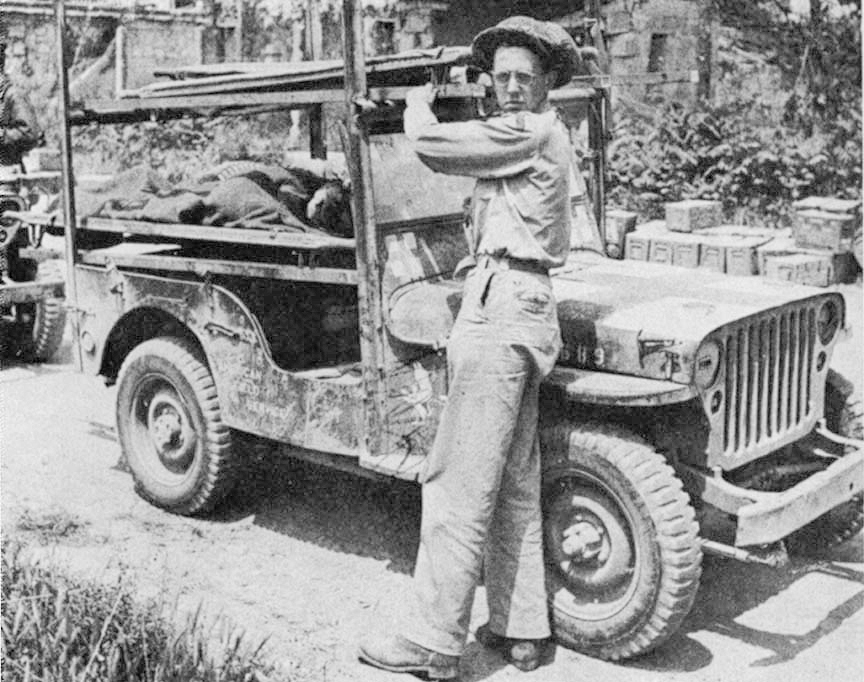 Emergency ambulance operated at the Gustav line by AFS driver Charles Satterthwait. The Rapido River sector in which half this action took place consists of such rough ground and the roads are so bad and narrow that the use of Dodge ambulances was impractical, so as to be nearly impossible. The Jeep shown was found abandoned in a field by Charles Satterthwait just prior to the action at the Gustav Line. He salvaged it, and converted it into this makeshift ambulance. He made many successful evacuations of wounded infantrymen from no-man's land during the Allied advance against the Nazi Line. |
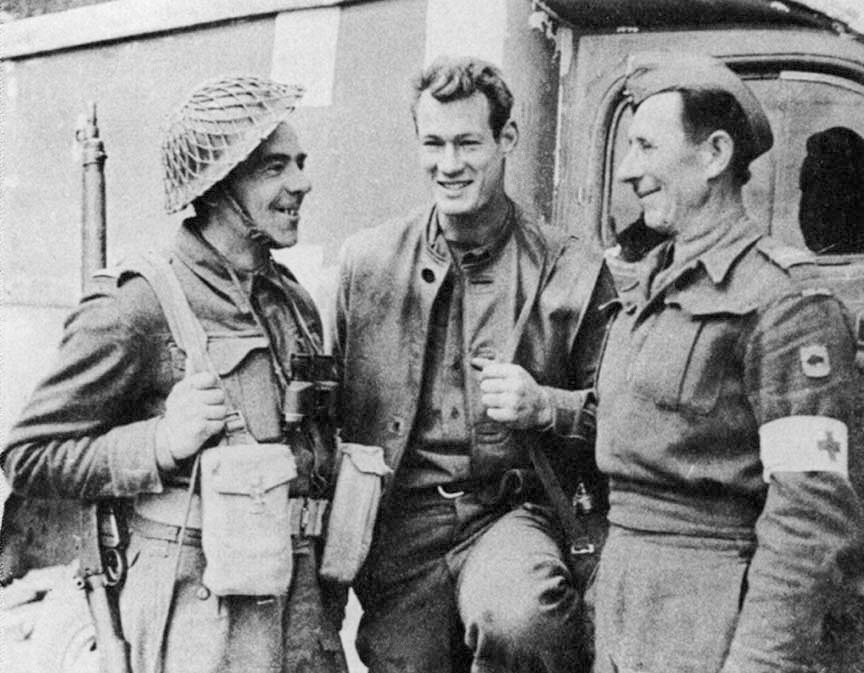 John Harkness (center) poses with two Polish soldiers of the Free Polish Unit of the Eighth Army with which he served at Cassino. The names of the Polish gentlemen were unfortunately not included. However, they are very likely unpronounceable so it is perhaps just as well. |
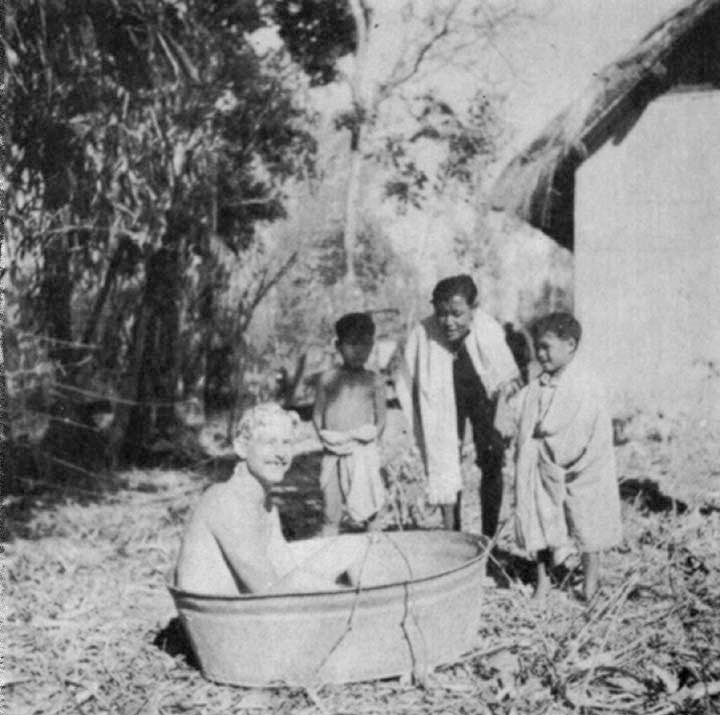 Saturday bath ...AFS Burma style. James Robinson takes a tub to the intense interest of a group of Indian children. |
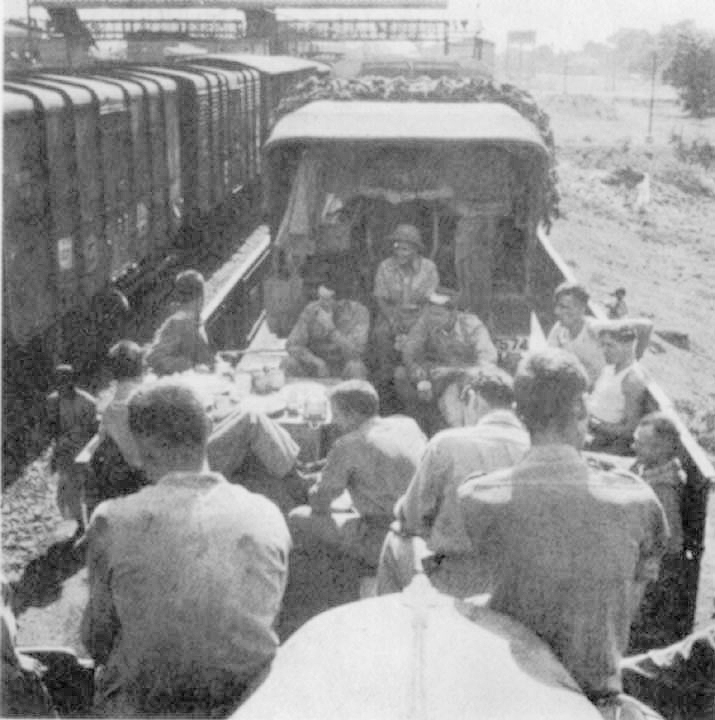 A contingent of AFS men complete with ambulance and lunch, move up to the Burma front by railroad. |
May 9, 1944.
"Our leave was very successful. We went as a section and tried to get a popular resort, but couldn't because the AFS quota was already in residence. We stayed in Naples; S's apartment. I had a delightfully soft bed.
"At tea time we adjourned to the Red Cross Club for enlisted men and had coffee and cakes. That is a wonderful place with everything down to lessons in Italian and showers while your clothes are being pressed free. We spent evenings in the flat ...."
May 10, 1944.
"Looking at the latest censorship rules, I find I may say that I was at the Garigliano crossing; though you know that already. I never got actually inside of Minturno, but I was at another little town north and west of it for, a few days. I'm glad I was in that battle. H. and B. were two of the first across; had their ambulances well peppered with mortar shrapnel and were cited by the AFS for their work. Many ambulances had holes in them. When mine got it in the generator and elsewhere, I was inside a stone building under a great pile of M.O.s and orderlies who had leaped for cover."
June 4, 1944.
"I have a nit of time off this morning and so I am writing what might be called a med-campaign letter ....
"It was a bit of a blood bath, but the R.A.P. was back a bit and we were in no particular danger although very busy and very tired. After one of the Kraut's counterattacks it looked as if we would be captured. We blocked the windows with timbers and carried on .... In a few hours the danger was over. The next evening we buried our dead. The various padres held joint funeral services and afterwards some of the men put poppies on the graves of their friends. At sunset we had a C of E. service.
"You said you wanted the news and would not worry, so there it is. Last week we were dive bombed. No one in this unit was hit; nor were any of the Field Service men stationed in the area; but with the dark and the flares, and being able to hear but not see the planes, it was quite terrifying. It makes shelling seem a picnic.'
We have for some time felt the need of a Page devoted to the opinions of the readers. We want very much to know how you like AFS LETTERS, which parts of it you do not read and your ideas for additional features that we might include. In short: anything you have to say in the way of suggestions or complaints will be welcomed. We hope to be able to start running this letter page in the next issue. Please write in.
The Editor.
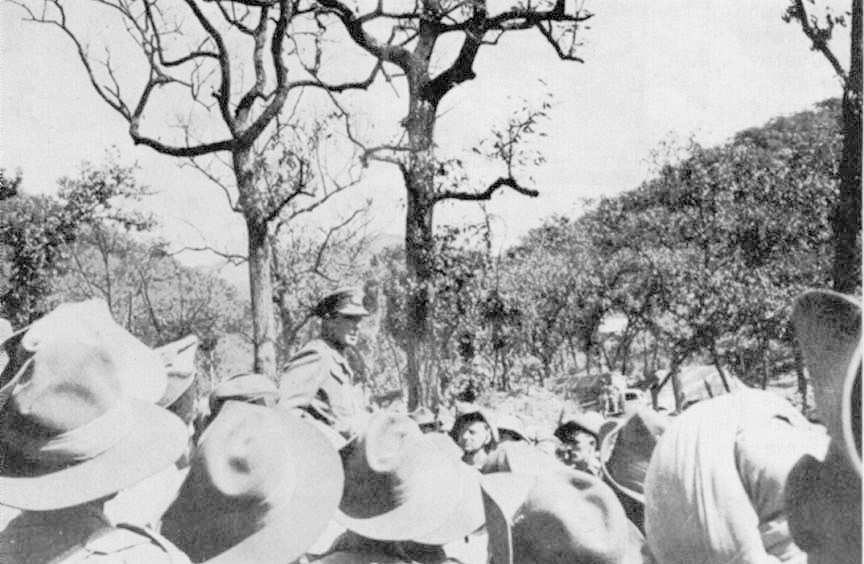
AFS units its in India were visited by the Supreme Commander Lord Louis Mountbatten early in March. He made a speech to them in which he expressed his appreciation of their presence, commended them on their patience and told them to keep it up as it would be quite some time before there was activity. He was wrong. In a matter of days a number of AFS men were involved in the Imphal cut-off.
The American Field Service has been asked by the President's War Relief Control Board to become an associate member of the American Council of Voluntary Agencies. This agency is being formed for the purpose of simplifying and delegating foreign post-war relief work. It is to be an adjunct to UNRRA to supply information and personnel. The major foreign war relief agencies are being asked to participate as members of this new council because of their valuable experience in foreign countries now.
Of the First Section of AFS drivers to go overseas to serve the French Army, six were veterans of AFS service with the Fighting French Forces in the Western Desert. One of the members who has not served with the French previously is Boyd France which conjures up mental pictures for a new Hollywood opus; "Mr. France Goes to France", or something Maybe he had similar thoughts in joining the new section.
During the fight for Cassino five AFS men and their cars served attached to a Free Polish Division. That their work was valuable is evidenced in the following excerpt from a letter written by the commanding officer, Dr. Kaszubski, to the AFS CO. He writes "I wish to express my gratitude and thankfulness for the help of your unit in our recent operations. I have the pleasure to appreciate the gallantry of your ambulance drivers, who despite heavy shelling, evacuated many of our wounded, thus saving their lives with highest bravery."...That, from a man. who braved God-knows-what to get out of his own country in order to fight for it.
Ed Masback, just back from service in Italy, was a guest on the radio program CORRECTION PLEASE recently. This is the program in. which the contestants bid for the questions, the money being returned to the person answering correctly. Ed held his gambling instincts in check, because he felt that his fellow-contestants (G.I,'s) might not want to go up so far. He triumphed for AFS correctly by answering the question, winning $40.00....AND donating his winnings to AFS.
Stranger than fiction: Walter Hackett, one of the first AFS men to get into Rome stopped his ambulance near Vatican City to wipe mud off his windshield: when an American lady appeared and started talking to him. She told him that her son was an American ambulance driver and that she could not help asking every American she saw if her son was known to him. When she said that her son's name was George Bunker, Walter's roommate all through the Italian campaign, they were both flabbergasted. Walter knew that George was in Naples ready to sail for home: immediately told Mrs. Rosso (George's mother) that he would drive back and yank her son off the boat which he literally did.
The AFS dormitory at 30 East 51st Street N.Y. was officially opened on the afternoon of June 22nd. Although far from fully furnished, it will now sleep twenty-five men. Downstairs it boasts a piano, a ping-pong table, a couch and & few odd chairs. The opening was attended by more than 150 people and the ladies of the Navy League's Canteen Service served punch and sandwiches. The AFS House is a large four-story private house a few doors east of Madison Avenue. It was donated to house the volunteer ambulance drivers in transit by Mrs. John Hubbard. The upper rooms have been turned into dormitories, furnished only with Army cots, the volunteers use their own duffles as bureaus. The living rooms on the street floor contain the piano, couch and ping-pong table. Though some additional furnishings were promised for these at the opening, there is still need of more. 30 East 51st Street is now open permanently and all the readers will be welcome who are interested in visiting it.
The ambulance drivers in Italy have been given EIGHT subscriptions to the Book of the Month Club by Mr. William B. Bennett. As Mr. Galatti found on his trip overseas that books had top priority on the list of things desired by the AFS men this generous gift will be delightedly received. It anyone wishes to subscribe we can obtain the subscription for $25.
ROMANCE DEP'T: The month of June lived up to its romantic reputation for AFS this year. Jim Wilton back from Italy is engaged to Miss Betty Vance Weinberger of Peoria, Ill., C. Beach Powell, back from the Middle East and Italy, is engaged to Miss Sarah Ann Mallory of Manchester, Conn. John Wilson back from Italy is engaged to Miss Patricia Ann Van Patton of Evanston, Ill. Sykes Scherman of the Army, ex-AFS Western Desert, is engaged to Miss Gertrude Achelis of Greenwich. On June 9th in Buffalo Stephen Carveth, also home from Italy, and the former Miss Ann Furbush were married. June 24th Leo 'Harpo' Marx a Western AFS veteran, and the erstwhile Miss Ann Cox were married in Providence R. I.
May 12, 1944.
"I shan't explain why yesterday was such an extraordinary day only that I was never so unquestionably 'scared' in my life. From 3:30 a.m. till noontime we were under fire the greater part of the time.
"Until daylight we were about 50 yards from a bloody battle too close for comfort. We both took a very dim view of the situation, what with mortar bombs dropping all around us and on the road. However, we got our casualties out without any trouble, by noontime.
"I'll tell you all about it sometime. Although it was frightening as hell, it was thrilling and now that it's over with, I think that I rather enjoyed the continual suspense and danger. Once is quite enough, thought I hope that the situation won't be repeated.
"My Urdu (a Hindustani dialect; I guess you might call it) has long been fairly proficient. I can usually make myself understood (hands help considerable) to these comically exasperating Indians in the Army. The Indian officers, of course, speak excellent English, and some of them are quite charming. ---others are not.
"At any rate I am now speaking Urdu in sentences; no longer words and grunts, signs and shrugs. I suppose, though, that fully a third of my words to the Indians are old and abrupt English reliables, and Christian religious terms."
May 28, 1944.
"I wish I could tell you more of what I have been doing. Lately I've been able to get extremely far forward --- at one time (from 3:30 a.m. till dawn) I was not more than thirty yards from a battle and scared as hell. It has all been very interesting, though, and I have learned a great deal about anatomy, as you can imagine and about our clever little adversary the Jap, who smells like third-grade sardines.
"The other day I had an upsetting, but amusing experience. I was carrying a corpse back in a jeep fitted with stretcher racks. The corpse was on my right on the top rack. I had no sooner started off when its arm swung down and slapped me on the head. Just grazing my ear. I tucked the arm up again but soon it whacked me once more. This was too much! I stopped and tied its hands together and from then on we had a very pleasant ant ride together!
"On another occasion: after we had put in a successful bayonet charge I went up on the hill to help collect the wounded. We went off toward one chap but found that he was dead. Beside him though flat on his belly his knees drawn up, was a dead Jap. They had probably killed each other. That was the first dead Jap I had seen.
"This will give you some idea of how bloody the war is in this theatre. Operations are for the most part on a small scale, owing to the extraordinary topography but the fighting is very close, hand-to-hand stuff, bayonet charges, sniping, etc. The Gurkha troops (charming little fellows and excellent fighters) carry curved knives, kukris, deadly things, and they delight in lopping off enemy limbs and what not."
April 19, 1944.
"The AFS sent out information that we had been cut off and had to walk out, losing everything in the process. This is a alight exaggeration. Actually, only a few of the fellows had to walk out and they did lose most of their personal kit, however, the rest of us who were up in that territory were with different groups that were able to last it out until more troops came and then fighting our way back along the only road, we saved not only all our kit but also saved the ambulances which had been abandoned by these fellows I spoke of earlier, to say nothing of the kit and souvenirs which we picked up. I guess this is the inevitable result of any retreat or offensive and if one measures the waste in food, clothes; vehicles, etc. by civilian standards, it is incredible. And just from a relatively small retreat, too! However, once back out of Burma and relatively safe, as I look back on the experience, I find that it is impossible to judge the reaction which one will take to any extreme danger. I know I became much more interested and excited in each battle and all the incidents related to it, forgetting completely the cool, unprejudiced judgement which I thought I would have. It's too much like a game in which you are on one side attempting to beat the other and my competitive spirit gets the better of me.
"I did forget to mention one of the exciting and at times dangerous actions, rather strangely afforded by our own U.S. Air Force and RAF. During practically the entire withdrawal we were cut off from our source of supplies overland as the Japanese had the road cut in several places. This necessitated the Air Forces supplying food and ammunition by air. There was never a clearly defined area in which to drop the things and so these 125-25-lb. cases would come all around us. They had parachutes attached and when they opened the multi-colored chutes swinging and floating to earth made a pretty sight and were quite harmless. However, when the chutes failed to open these packages whistling down from several thousand feet were very dangerous and very difficult to judge. Though none of our group were hurt; one crate of 25 pounder shells whistled through the front end of one of our ambulances and scared all of us standing nearby more than all the Japanese mortar and shells we had seen. Despite this daily bombardment by our own people the supplies were wonderful to get and made our position much less severe. I hate to think of what the next war will bring but it seems that however horrible the weapon is there is always one to counteract it and there is always some good that it can do. It was rather ironical at times that some of those supplies would be carried by the wind over to Japanese-held hills and thus were supplying them with much needed supplies.
"A rather horrible and yet impressive sight was to see a company of Ghurkas led by their British officer whom they will follow through thick and thin; as long as he is leading them, march out to fight a rear guard with orders to fight to 'the last man and last round'. They marched out as though to some practice. The Ghurkas with their perpetual infectious grin, stocky, with loads up to 200 lbs. and the British officer---probably the only one of the group to whom life as we know it is just about gone ---jauntily leading them down a path. That was the last we saw of them and undoubtedly they are all dead as the Japanese in the position in which they were could not take prisoners. How cheap life is at those times. And yet no effort was spared on the part of the surgeon who later became attached to our group to save the life of one Ghurka who had been bayonetted in battle. His life was saved and he will go back to a farm in Nepal to spend the rest of his days never quite healthy again. Gee, the grim paradox of the relation of the medical to the infantry stood out in all its stark reality. I have a suspicion that unless a soldier suspends his human and rational processes while in a great deal of activity; he can't remain sane very long.
"As to our present activity, you know that we are back at our HQ in Assam and at present four of us are working on and living in an RAP which might have to be used if the worst should happen. However, at the present time the likelihood of our being Red Cross orderlies rather than ambulance drivers seems far away and not terribly necessary. But I am gradually becoming accustomed to the necessity of war in always preparing for the worst --- 'just in case.' Perhaps I learned my lesson in the retreat, but now it doesn't take much persuading for me 'to dig in' (as the process of digging slit trenches and bunkers for protection against mortars, artillery and bombs is called), and I am beginning to find it much more conducive to sound sleeping to know that you are fairly safe from all shrapnel but a direct hit. Speaking of sleeping, I'm afraid I am going to find it difficult to adjust myself to sleeping without a mosquito net and out in the open above ground. When I think about the prospect now it makes me feel naked. I guess it goes to show how accustomed one becomes to anything. Few have gotten malaria as yet and I think that by taking all the precautions and the suppressive treatment, I have a good chance of avoiding it completely. (I knocked on wood!)
"The work isn't too exciting, but it is restful up on the top of a 1000 ft. hill away from all the noise and turmoil of our HQ and from our camp we can look for miles in all directions and the rice paddies and natives really make a wonderful picture to say nothing of the sunsets and sunrises. We get our supplies and water by mule and do our own cooking and find it very wonderful to eat when we want to ,sleep when we want to, and read and write and play cards. The responsibility is at a minimum at present and unless the Japanese became much more efficient and are in much larger numbers than are apparent at present, there is every likelihood of this being in the nature of a nice restful vacation which is not unwelcome to any of us."
No date.
"There were variety of stories describing the fighting of the Japanese and when the sum total were in, I began to realize again how impossible it is to generalize. Some told of absolutely sadistic treatment of prisoners while others told how Japanese officers apologized for the food which they gave to the British prisoners, but that they had to eat the same thing. Well, all the stories ranged between these two extremes. One of the Japanese prisoners reacted very kindly to the medical attention and good food which he received and as his condition improved expressed a desire to be trained as an orderly and work in British hospitals for the duration. What a little kindness and understanding won't do! Even through the treatment was mainly to glean information for our Intelligence officers, I believe it served a much larger purpose with this one Japanese soldier.
"Well as things settle back to normal my respect and admiration for the British Tommies, the British officers seem to go higher and higher. I was absolutely amazed at the calm courage, the thoughtfulness even under rather trying conditions which these fellows showed. One particular Capt. in the RAMC is really tops. In fact the calmness and efficiency with which he went about his job seemed to spread to others and regardless of how tight a spot one was in I am sure all that would be working with him would turn out heroes---through no fault of his own.
"The situation had its funny side as well, and for the first time (and I hope the last) I had an old time army man ---a brigadier--- stand outside my ambulance and scream at me to get out of the way immediately and that was an order. Of course being stuck on a jeep, from which I had been attempting for fifteen minutes to get unstuck, this seemed rather unnecessary as I was doing my darndest to get out of the way and so I said as nicely as possible. He didn't appreciate this at all and my attempted explanation only seemed to infuriate him the more, and just as I was picturing an AFS ambulance driver in Field Punishment for several years and a Brigadier dead from apoplexy, lo and behold the ambulance moved away leaving the Brigadier with a clear road. Something must have come to my aid for which I will be eternally grateful. Incidentally, this Brigadier after all, had returned to normal had nothing but praise for the Field Service, so I guess this little incident never made much of an impression ---thank the Lord!"
May 3, 1944.
"There are wild orchids and gardenias growing around and great quantities of some little purple bush flowers that sometimes cover a whole tree. Banana trees and bamboo clumps have a line appeal that one would never see in America except perhaps in poplars. The most interesting are these huge banyan trees on symmetrical little hills out in the green and grey rice paddies. They look, except close to, like huge elm trees but their branches have trick of coiling back to the ground and taking root. Thus the area that one of these old trees can encompass is practically endless; some look like small forests, and there is little way of telling which is the main trunk. Some trees have little cairns and written on cloth before them where road is placed for the Nat who is some sort of spirit that is in residence within.
"This place is far too nice to picture as a war zone. It seems it should consist of colorfully bedecked and mailed Arabian Nights, characters running about with spears and whatnot, instead of the more modern variety. There isn't much danger, however, if you keep your eyes open as the war is not very concentrated and consists just now of small groups fighting in large areas, and the guerilla-like nature of it is far less sordid and much more interesting then the more mechanized type elsewhere. But I am pretty sick of blood and pain and the smell of it all. I have tooled about a very little with plasma and morphia and dressings, but usually the meet one can do is haul the sick and wounded over jaw-breaking roads to dressing stations, clearing stations and hospitals as well as possible and try not to hear someone who is screaming, for whom there is nothing more to do then to watch for the bumps.
"The Jap radio, I hear, claims their squeeze is so effective that we live on rats. Not true unless they are ground up in the Argentine bully beef.
"In traveling around these outlying villages, still completely unspoiled, I am still peering around like a tourist fresh off a boat, not acting at all like the jaded old jungle-wallah that I should be now. The people are not to be confused with the weird little primates not yet above a bit of head hunting, that run about in beads and loin cloths with spears. In the clay compounds, between the huts, are looms and wool spinners and grain mashers and people always working on them. The children are beautiful tho often pot-gutted. Usually naked, and the girls, much too old for that sort of thing, sport a shirt and headcloth. One taking a bath (in a great brass pot) will cover her face, if you look her way, ostrichwise.
"The cattle are small, mostly bullocks, but well tended by the children. All is neat and clean. Lots of fowl and dogs around and graceful white cranes. Religion is a refreshingly decadent form of Buddhism or Hindu consisting mainly of seeing that the right spirits take good care at the crops and that the bad ones keep away. Folk on the road at night voice special chants to achieve this effect. They are all between the devil and the deep blue sea as far as the war is concerned. Any action they take, such as spying etc., makes them either traitors to the Crown or to 'co-prosperity sphere', with the result that they'd sell you to the Jap or vice-versa, quite impartially.
"The first action we saw didn't give us much chance for looking except subjectively, but lately I have been able to watch artillery work and things from safe vantages, as a technically interested spectator instead of seeing what I could from between the edge of my helmet and that of a slit trench. The other day we had a good view of our people disembowelling the Jap, all nice and impersonal from a long range view. But I certainly have stopped looking on this war affair as a sort of glorified camping trip. I guess, no matter how much you hear or read, it's quite a surprise when you find out for yourself that a shell or bomb isn't just a big bang, but something that can kill people and not very prettily either. Then it dawns on you (at least on me) what an awful thing it is to do someone in and for a while you do not want even to slap the mosquito that's sitting on your arm with a menacing look on his face.
"We are currently living on a dug-up hillside without enough grass and things to keep it from washing out during the monsoons. Hope we move. Even now there is little shade and that makes for headaches in this weather. But we still get a cool enough breeze for one blanket late at night.
"The best thing is one's justifiable pride in the reputation that we drivers have established for ourselves among combat units and this had to start from scratch. We were unknown in the beginning and of course had to lean on reputations of Middle East units. To have admiration and appreciation expressed by units that are just about the cream of all the world's soldiery is worth a dozen bottles of American beer and packs of cigarettes.
"Speaking of super-regiments, I was attached to one for a long assignment last week but was soon called off as my wagon was declared unsuitable for the terrain (too big and obvious). These people had racked up in amazingly short order, some such score as 1000 Japs dead to their own 8. I think I could sit thru the Battle of Berlin reading a novel if those boys were around."
March 13, 1944.
"Have just returned from a week's, well, not quite that long trip led a British Colonel--- enjoyed myself to the nth degree. Left one night, drove until about 3 in the morning and stopped for a 40 wink nap --- then up and away at 5:30. Finally made camp --- and what a spot --- in a coconut grove within sound of the surf---delightful, and such luxuries; even johns and city tap water! Set up our stretchers, unrolled our bedding and put up our mosquito nets. D. and I pooled our rations and cooked together (which was the purpose of the trip to see how we could cook etc. in a regular ration by ourselves.) Algonquin Park stood me in good stead and I must say considering what we had to work with we made out quite well.
"After our first meals we cleaned up and tore for the water. Had heard no end about riding the surf in and so I tried it. After no end of unsuccessful attempts; I finally caught on and had more fun! Then back to camp for our evening meal for which we tossed together an excellent stew with curry sauce. And then to bed.
"The next day we practised driving in the sand and launching and beaching canoes thru the surf. Then a trip into what the Colonel called 'a bit of Virgin Indian forest' ---expected it to be crawling with animals of all descriptions and filled with tremendous trees. However, I was quite disappointed in that the only wild life I saw was a few birds and red ants. As for the trees, it was scrubby to say the least. Little clumps of bamboo trees here and there and a tangle of undergrowth all over. But the roads --how the vehicles ever got thru is absolutely beyond me --- almost broke my neck on a few bumps. We cooked lunch and then cut some bamboos for a future raft. And there hangs a tale. I don't know what your opinion of the toughness of bamboo is, but I have always figured it to be one of those trees that one could fell with a few well placed hatchet chops. How quickly I learned! After chopping madly for fifteen minutes at the base, one finally cute thru a four inch growth. Then you sit back and congratulate yourself, but why doesn't it fall? A good question! You tilt your head and horrors what a mess at the top! ---all interwoven branches vines, etc. like a tropical rat's nest, although I've never seen one. So you start to chopping away the majority of it, getting pricked at every turn. You didn't know they had prickers? Well, I didn't either; but I do now. Then you give a long whistle, assuming you have wind enough by then. Finally by brute force and the effect of much swearing; it comes clear. And there you are with a bamboo pole. ---All I can say is --- so what?
"Then back to our camp with our trophies of six bamboo poles--- put the stew on and tore for the beach while it cooked. The following morning we rigged up a very crude outrigger canoe effect --- put on stretchers and attempted to launch it thru the surf. If patients had been on board, some poor parents would have received word that their son had died at sea. But as I said before, it's good practise.
"Following the meal we all scrubbed up and put on our carefully preserved clean clothes: jumped on a truck and tore for the railroad. Where to now? --- By the way while we were in the 'primeval, forest' we had a chance to visit some caves (after chopping our bamboo). We could see them 3/4 the way up a cliff ---quite a number of them. The Colonel told us about them, some prehistoric caves, the more elaborate ones and finally, some that went way back a quarter of a mile with piped water and everything. B. and I went off first and foolishly went cross country not realizing there was a path. Finally we made it and saw three of them which weren't very elaborate. One of them, however, is worth mentioning. The entry way was about a 20 by 30 opening in the cliff. Up a flight of stairs and at both sides stood huge statues of Buddha (must have easily been 30' high) very good carving. Then up another flight of stairs into the main chamber about the size of our living room. On both aides were fancy pillars with elaborate carvings at the top --- telling some sort of a tale. At the end of the chamber was a dome-shaped structure, some sort of altar I guess ---but that was all there was to it.
"To get back to my story where were we going on the train? --why; the big, big city. After our arrival we got a lorry and tore for the-------- knew there was ice-cream there --- unheard of elsewhere--- and so to gorged ourselves on it. I consumed most rapidly four banana splits. Then we went shopping. Saw a lot et junk that wasn't worth buying ---exception one beautiful star sapphire for 500 rupees. Then a few drinks at the main hotel and as I was getting hungry --- we went over to a grill had a filet mignon, tomato juice cocktail and coffee ---really delicious--- rivals even Bookbinder's in Philly. Then back to camp got up very early the next morning and came back here--- So you see, I really enjoyed myself no end."
"You make a long walk, yes?"
"I make a long walk, no. I come jeep!"
Doctor Pruczinski and I met at the monastery atop Monte Cassino. We were old friends dating back to February when the American Field Service first started doing business with the Poles. A lot of water has passed over the Rapido since those inactive snowbound days in the middle of Italy. The Polish Corps had just completed one of the most outstanding feats in military history capturing Monastery Hill and Mount Cairo. The red and white flag of Poland fluttered proudly atop the old abbey.
The doc had lugged kit 200 pounds and 45 years up the face of the Benedictine precipice from the town of Cassino. I had come up the crazily winding track around behind the hill; the same track that American New Zealand, French and British troops had fought and died on.
It was a great victory for the Poles and a great privilege for the AFS to have done some of the frontline ambulance work during the siege; a fitting climax to four months et routine evacuations. The Corps is resting now. Their casualties were over 50 percent. We have a new assignment, but none of us will ever forget the fascinating work with the Poles.
"They have been away from home for over five years. Most or them have spent long months in German and Russian prison camps. They trained in the cruel hot sands of Iraq and some fought at Tobruk. All this makes a year of volunteer ambulance driving seem inconsequential.
"There is no more good natured, big-hearted, almost happy bunch of soldiers in Italy --- perhaps in the world.
"The Poles are good linguists. A great many of them speak German and most of them know a smattering or English; medical officers I worked with usually spoke the language fluently and almost all of them knew French as well. The Poles pick up Italian much better than any other troops here. They work at it. They write down words; they spend hours talking to civilians.
"It is sometimes trying to get along with people from a different country even if there is a common language. Yet none of us had any trouble with the Poles, they are just too pleasant a people. One driver got caught in a blizzard and plowed into a snowdrift. The Poles he was carrying, two of them ill, got out and pushed. The driver left his glasses on the seat so that when one of the Poles got back into the car he sat on them, breaking off the side pieces. Instead of a small row; everyone laughed, had a drink of wine and finally dug the car out. The driver held his glasses a la pince-nez for the remaining 8 kilometers through the snow. That night they all sat round the fire, finished off the wine and sang. The Poles know three 'American' songs: 'Auld Lang Syne', 'Happy Birthday to You', and 'My Bonnie Lies Over the Ocean'. They all use cigarette holders, from private to general. And they heat wine and add sugar to it, a trick which does wonders for new wine.
"One night I played poker with an-MO and his orderlies. Others stood around and watched. It's hard to play bridge in a foreign tongue but in poker the actions speak for themselves. It was a small game and I pulled some enormous bluffs, catching the officer twice. There was always a 2-minute intermission for laughs. Dr. Pruczinski was the victim. He brought the incident up while we were looking at the remains of the abbey library.
"There are several hundred Polish Wacs and nurses in Italy. Some of them are very attractive. They are treated with considerable respect by the men and there are always deep bows and kissing of hands in the gallant fashion of the continent. The Polish snack bars which are excellent are run by women. In one unit near the front a countess was serving cocoa and sandwiches.
"There is a touring entertainment group with several real beauties dancing, singing and joking. The tenor sings some Polish folk songs and comes out with 'Down upon the Swanee River', complete with Negro accent, when any Americans are present. A travelling Polish orchestra out here plays swing better than any band I've heard in two years overseas.
"Polish cuisine tends to be a little gamey, but the cooks went out of their way to please us. Sometimes we ate in officers' messes and heard some of the adventures that almost every Pole had in getting out of Europe. One captain had impersonated a Jerry officer and after three months was tracked down in Budapest by the Gestapo. He escaped from the concentration camp into Russia where he was promptly sent to a labor camp in Siberia. When he finally reached Syria the British interned him for two months as an enemy agent. Another officer had escaped the Germans by swimming a river in Yugoslavia. He was hit three times by machine gun bullets but got away to join the army in Egypt. Practically every Pole has a similar tale of suffering and risk.
The Poles here won the privilege to fight at Cassino one of the bloodiest battlegrounds in the world. They are proud to have taken the fortress. Yet they have nothing but praise for other Allied troops. They have put the union Jack alongside the Polish flag on the monastery.
The Poles have a debt to pay the Germans. They have not paid it in full by any means. That, of course, would be impossible. I can remember how they talked in the winter months when they had the job of holding a portion of the static central sector. They wanted to attack; they wanted revenge. When they got the chance they did a grand job, one of the most important of any one in the Italian campaign. When they moved up to attack Cassino the Poles were an unknown quantity. They had the misfortune of launching an attack when a German division was being replaced, so that they met nine battalions instead of the expected five. For several days the going was nip and tuck. The casualties were appalling. It was to handle these that thirty cars of the American Field Service were attached to the corps. We worked day and night for a way to save some fine men. The advanced dressing station to which we drove to pick them up was in clear observation of Jerry, whose patrols could reach it at night. We drove through the outskirts of Cassino, not fully taken at the time; to reach the mule track used for a road leading to the ADS. Ambulances were the only cars used in daylight and we were seldom shelled or mortared --- and then probably by mistake. One day an orderly told me that several hours before one of his mates had gone out to a German pillbox and dressed the wounds of a German captain. The captain offered him a cigarette and when the orderly reached for it the Jerry pulled out his pistol and killed the Pole. Two infantrymen saw the thing happen. They liquidated the offender and Polish officers don't hesitate to allow that no shots were fired.
We had a long herd evacuation route back to the MDS, part of it. going along the famed Inferno Pass. We went through all our own light and heavy positions. During the day the trip took two hours; at night four. Some times we made 4 evacuations in 24 hours. Although German planes frequently dropped flares, and followed them up with bombs; during this whole attack we had only 4 ambulances hit and only two drivers wounded. We were exceedingly lucky. The wounded don't cry, especially the Polish. In fact they are sometimes almost unbelievably high in spirit. And when they see our cars they say: "Goot, goot. Amerikanski cheeris." One day a whopping 6 1/2 foot German parachutist was brought in slightly wounded. One Pole in a fit of rage struggled from his stretcher and made for the Jerry. He would have tried to kill him if not restrained. One of the orderlies was Jewish. He dressed a German's leg and asked him how he felt being helped by a Jew. The young Nazi stiffened and said that he did not need the help of a Jew. Another Jerry had the brass to announce that he had won his iron cross in Poland.
There was no moon for about a week and a nocturnal run was a real nightmare. We kept our windshields up to see better but the dust coming in bothered our eyes. The casualties when heavy however had to be cleaned immediately. Driving an ambulance a few extra hours is little enough to do when whole companies are being wiped out 3 kilos away.
We kept 10 cars at one MDS and they were sent out by a jolly fat sergeant whom we called Santa Claus. He would come bouncing down the hill all smiles and announce '"two ambulanty ADS" just as if it were right around the corner. I don't think Santa Claus slept more than 2 hours a day but he was always in the best of spirits. One day we all got a rum ration and toasted the old times. I've never seen a man more genuinely pleased.
All of us are glad to have been in on the last Cassino battle. We all have a few pet stories, close calls, and happy memories of a time that was tough. We would feel at ease in Poland as in few other places on earth.
As we go to press, word has just been received that the following awards to American Field Service volunteers have been made by the British Government.
Honorary Order of the British Empire --- Major Charles Snead
Honorary Member of the British Empire --- Lt. Douglas Atwood
British Empire Medal:
Ralph Beck Charles Perkins Robert Campbell Charles Stewart George Holton Howard Terrell
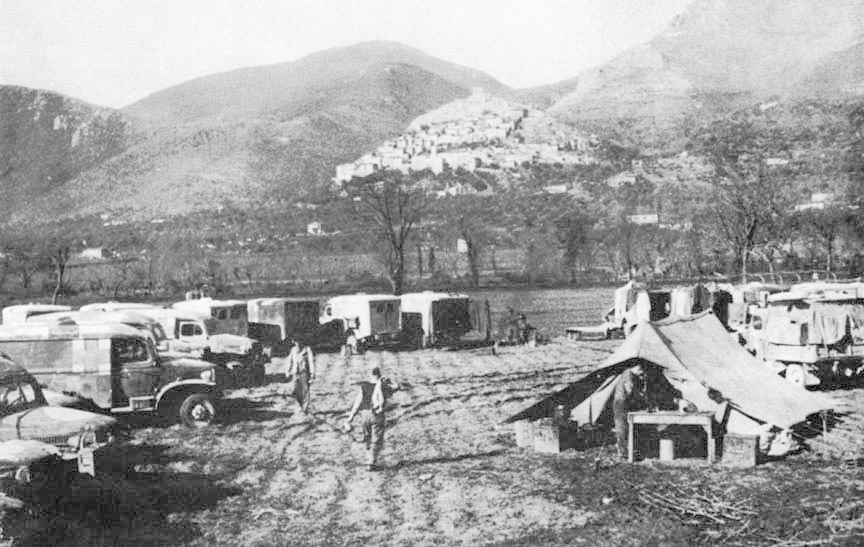
An AFS ambulance car pool behind the Fifth Army front. The GHQ of the Army was located at the left of the town of Presenzano (center of photo). These are the AFS vehicles which participated in the Cassino battle. They are shown above, waiting assignment at the AFS headquarters about 15 miles behind the town of Cassino.