Edited and published at AFS Headquarters, 60 Beaver Street, New York 4, N.Y. under the sponsorship of the ambulanciers' relatives and friends, who contribute the excerpts from the letters.
The AFS, working side by side with the men of the British Eighth Army, played a major role in the evacuation of the wounded during the successful drive against the Nazi Gustav Line in Italy. The AFS men in this action were gratefully praised by the commanding British Brigadier for their part in this fight. A detailed account of this AFS action has just been received in New York. It is reprinted below.
Almost the entire forward evacuation work at regimental aid posts and advanced dressing stations was done by American Field Service ambulances.
One company worked along the Liri valley sector and another was posted to the northeast in the hills above Cassino. Long before the day of attack each platoon was earmarked for service as an integral part of a division. Under cover of darkness on the night of May 10th ambulances moved forward with their designated units.
The terrific barrage that preceded the crossing of the Rapido on May 11th found them in position and already at work evacuating casualties. At the height of the attack, while our shells and those of the counterbarrage fell around them, volunteers Walter Cope and George Walker scoured the northern bank of the river for wounded and did a magnificent job of clearing infantrymen who had been hit as they advanced into the plain.
Forty AFS ambulances were divided among the divisional advanced dressing stations evacuating both Indian and British infantry casualties back to rear medical echelons. Fifteen more cars in one of the companies were posted at artillery aid posts. In a single forty-eight hours these vehicles evacuated many casualties, with one man, Robert Kohnstamm, accounting for almost 100 of these alone.
Ambulances were scattered at isolated and widespread posts along the length of the Rapido. In order to make this mass movement of casualties possible, a complex system of car pools was used. Most evacuation routes were rude, one-way tracks, but through this arrangement cars at forward posts were replaced within a few moments after they had started on a run to the main dressing station.
During the first day of the battle, Charles Satterthwait used a stretcher-bearing jeep to make several trips down to the river in search of wounded. With complete disregard of the heavy shelling and mortar fire, Satterthwait evacuated over a dozen wounded.
When the bridgehead across the river was but a scant two thousand yards in depth, fifteen ambulances accompanied the first medical units which moved to the other side. One of these advanced posts was forced to return, due to heavy shellfire in the area, but all of the cars remained at work across the river. There cars were always on hand to pick up casualties whenever enemy bombers attempted to destroy the vital bridges. On one occasion William Meleney was on the scene too quickly and was soundly strafed for his efforts. He took shelter beneath his car and escaped injury, though machine gun bullets ripped through his vehicle and splattered the road beside him.
During one of the critical stages of the battle, a medical Colonel asked for volunteers to accompany him into the German lines to assist an infantry regiment that had been cut off. Donald Harty and Drayton Smith offered to go. Flying Red Cross flags on their ambulances, they set off across the open fields into no-man's land. A sentry refused to let them go past the German outposts because of an impending British attack. Soon afterwards the infantry assault forced the enemy to withdraw and contact was reestablished with the isolated unit. During the night Harty and Smith evacuated casualties over tortuous, shell-holed tracks.
As the battle progressed, fifteen additional. American Field Service cars joined armoured columns that moved up to force the final wedge into the already strained Gustav Line. While fierce tank battles took place, W. R. Love and Norman Laden aided wounded men only moments after the tanks had been knocked out of action.
A few hours after the final fall of Cassino, South African engineers moved in to bulldoze a road through the rubble. To evacuate mine and booby trap casualties that were sure to occur, two ambulances driven by J. Picklesimer and J. Brinton were also among the first to enter the captured town.
To the north of the town ninety other AFS men attached to another company were working steadily in the flank drive which partially encircled the city. One platoon of thirty cars was assigned to handle the most forward evacuations for the Poles, while another was attached to a casualty clearing station farther behind the lines. Another platoon worked with the New Zealanders and mountain troops of the Italian units which did not take an especially active part in the offensive, but engaged in holding actions and minor diversionary attacks.
Several hours before the barrage went in on May 11th, these men were briefed on the projected push. They were given complete details of the objectives and strategy and when the attack was ordered, they were put on the alert. The attack followed a forty minute barrage and volunteers who witnessed the push said it looked as though the entire valley was ablaze.
At 4 a.m. on the 12th the first AFS ambulance was summoned to carry the initial casualties in the Polish sector. The ambulance, driven by Lawrence Bigelow, was called up from an MDS at Cervaro to the most advanced Polish medical post, and ADS at Cairo. He made most of the trip up and back, with his ambulance full of wounded, under intense shell fire. Bigelow was soon followed to the forward ADS by ambulances driven by William Congdon, Lawrence Toms, John Harkness, John Horton and Robert Applewhite.
This group of volunteers continued without let-up to evacuate casualties from the Cairo ADS for more than 24 hours. At 7:30 a.m. on the second morning of the offensive after 26 hours of almost constant driving under fire, Toms was wounded while loading patients at the ADS when the Germans were shelling. Instead of diving into a slit trench, Toms remained in the ambulance with two patients whom he had just helped load. A shell landed at the side wall. Toms was struck in the arm, thigh and chest but none of the wounds were serious.
A relief section was sent forward to take over this post which was under the leadership of John Horton. After a brief lull this group began continuous evacuations from Cairo during the attack which led to the capture of the abbey and Cassino.
Another group of drivers were attached to an MDS in Inferno Pass and were under frequent shellfire during their evacuations. Meanwhile thirty other cars were working round-the-clock keeping the CCS cleared for the latest casualties. This group set a record for evacuating an unprecedented number of casualties in such a short time.
* * *
| Thomas S. Esten | George O. Tichenor |
| Stanley B. Kulak | William K. McLarty |
| John F. Watson | Randolph C. Eaton |
| John H. Denison, Jr. | August A. Rubel |
| Richard S. Stockton, Jr. | Curtis C. Rodgers |
| Caleb Milne, IV | Vernon W. Preble |
| Charles James Andrews, Jr. | Arthur P. Foster |
| Charles K. Adams, Jr. | Henry Larner |
| Alexander Randall, Jr. | George Brannan |
| Robert C. Bryan | Dawson Ellsworth |
| John Dale Cunningham |
ROBERT C. BRYAN on May 17th, while looking after the assignments of the forward posts of his platoon in the Rapido Sector, was wounded by shrapnel when a shell landed close to his car. He was immediately taken to an Advanced Dressing Station, but died in the ambulance which was transferring him for further attention to the Medical Dressing Station. His courage, devotion and leadership will always remain an inspiration and treasured memory to his comrades in the AFS.
DAWSON ELLSWORTH on May 27th, while acting as spare driver with Franklin Billings, was seriously wounded in the arm as a result of a mine explosion. Although his condition was serious, it was hoped that he would recover. However, he died as a result of his wounds on June 2nd. During the brief period in which Dawson served with the AFS, he did the jobs assigned to him and in giving his life; he gave well above and beyond the call of duty.
JOHN DALE CUNINGHAM on June 4th while working on the Italian Front; was instantly killed by shell fire. Time after time during the year and a half he served he had gone out courageously to advanced posts without thought of himself. His loss will be keenly felt by all those who knew him and served with him.
Edward Tanner, on April 22nd, while driving from an MDS to his post at the ADS, was slightly wounded when a piece of shrapnel cane through the open window and lodged itself in his cheek. He continued to his post for treatment and was then evacuated to the CCS for further attention. This is the second time Tanner has been wounded while serving with the AFS.
Norman Laden, on May 16th, while serving the British in the Liri sector attached to a tank unit of an Armored Division was near a car post beyond an ADS on the west aide of the Rapido when a mortar barrage began. Norman and Warner Love; working together, were in a slit trench when a shell landed nearby wounding a soldier. Both AFS drivers Jumped from their trench to pick up the casualty. As they were carrying the man back another bomb landed near them, wounding Laden in the thigh. He was carried to a Casualty Clearing Station but is now on the way to recovery.
George Barr King and Stephen Munger, while evacuating casualties from a Main Dressing Station across the Rapido River on May 21st, sustained slight shrapnel wounds. King was evacuated to a Casualty Clearing Station where he was treated for a minor arm wound. Munger was struck in the leg but returned to duty after treatment.
Raymond Mitchell and George Stutz both received minor wounds on May 24th and 25th. Neither required medical attention. Mitchell's forehead was cut and Stutz sustained a slight arm wound.
Franklin Billings was injured on May 30th as a result of a mine explosion. He suffered burns on his arms and back; but is progressing satisfactorily.
John C. Harkness received a slight scratch on his left arm. No hospitalization was necessary.
David D Heath, who is on the India-Burma front was wounded by shrapnel, but not seriously.
March 21, 1944.
"Last night, for instance, I stood waiting in a field beside an ambulance full of wounded patients listening to a 5.5. I mean wincing, as the shots went over. We were delayed because tanks were coming up the ambulance route and there wasn't room for us to pass. Meanwhile the artillery kept up a harassing fire designed to bother the enemy, but instead harassing me and my patients. It was the blackest of all nights. A tank would come clanking and squeaking up to the crossroad, emitting enough smoke to blot out the stars, then stop. 'Did you see a tank go by?' a voice would shout. 'Yes, go left', I'd shout back and it would go left with more clanking and squeaking.
"After a while I stood in the road and played M.P. for the tanks since they had provided none themselves. The poor patients were waiting in the blackness and the noise and the flash all the time, nothing was landing near them but it must have been a worrisome thing to lie there more or less helpless and in pain from wounds received a few hours before.
"The tanks took an hour or so and then we ventured down the black road they had come up, going in low gear with no lights of course, lunging into the bank on each side and driving by feel as much as by sight. You couldn't look at the road but instead a little above it, the way you do when it's too dark to see by staring straight at an object. Soon there was more rattling and bumping ahead and I pulled aside to let by another tank and went over a four-foot bank almost The ambulance canted over 30 degrees and then miraculously hung there. Everyone groaned and a wounded major began to cry. The front differential had caught at the last second and saved us from tipping over but the tank was good enough to pull us back on to the road again. We continued on in the black with the help of gun flashes to light the road and eventually reached the main road and crawled rearwards. More transports were coming up and there were columns of marching men---who they were, I couldn't see.
"But the rest was easy, if slow. A Bren gun carrier, a small armored open vehicle with tractor treads and a V-8 Ford motor, bashed us from behind, bending in the steps, and a truck side-swiped us later knocking off the petrol cap and bending the tube that comes from the tank. But otherwise we plodded on and 4 hours after starting, finished the 24 mile journey.
"Back at the hospital --- in tents you can drive with light and having gone so far in darkness, I slid into about 3 feet of soft mud as I was stopping to spend the night which I did. I was pulled out in the morning by a wrecker. Most rides aren't like this--- a few worse, the majority quite uneventful...
March 5, 1944.
"For the last few days we have been visiting the town where we had our rest camp. Three fellows went day before yesterday and six went over yesterday. each time the whole town came out to greet us. When we got to the beginning of the town we were met by scores of children who jumped upon and into the ambulance until it looked like a moving mass of humanity. Every square inch, on the roof mudguard, and radiator hood, appeared to be occupied by a child. Scores more who could not find a place on the car ran cheering along the side. The hubbub was so terrific that you couldn't hear yourself think. The older people stood by the wayside or hung out of windows or balconies all the way up the street. There seemed to be no vacant windows or balconies. everyone was filled by cheerful faces and waving hands. When we got out of the car the kids jumped upon us and hung all over us. It was an experience that none of us shall ever forget. I believe that if two or three A.F.S. ambulances were to go through -----all would follow, adults as well as children, and there would be a ghost town left behind. The pied-piper had nothing on us. Most of the people even called us by name, and most amazing of all was the interest of the children in the other members of the platoon who had not come along. They asked about almost everyone and named each specifically.
"This is the reception we got both days. I didn't go on the first day, but these fantastic tales were corroborated by our own experience on the following day. On the first day the Vecia sent me a delicious pie and the enclosures. Those pictures of religious scenes are as greatly prized by Italian children as dolls and toys are by American children. On the second day we went first to the Vicio's (a 75 year old couple) where they prepared and fed us spaghetti at 2:30 in the afternoon. Then we went to several other houses including Fransia's, the fellow who went skiing with us and who studied medicine in Rome, and the Marchesa's, but unfortunately the daughters were not at home. We visited and talked with many others, but unfortunately we didn't have time to get around to everyone. Our reception was everywhere joyous, and everywhere we were forced to eat something and to drink wine, and every time we went into the streets we met the same ovation. The troops billeted in the town were completely dumfounded by the proceedings; they appeared to be open-mouthed fixtures.
"When it came time to leave 'Mama', the Vecia, presented me on the sly with a very small violet handkerchief edged with green lace."
March 13, 1944.
"Music is the thing I miss most. What little I do hear, which is little indeed, is of Italian origin. The other evening while I was reading in my ambulance I heard part of Carmen; so I got out and stood in the pitch black street opposite the house which the music was coming from. For an hour and a half or two hours I stood so, listening to excerpts from opera and to Italian waltzes played on a victrola. One of the Brahma Liebeslieder Waltzes was played. The Italian children are continually singing excerpts from operas or Italian folk melodies.
"Yesterday morning as I was washing out the inside of car a little smiling dark-eyed Italian girl came out of a neighboring house and started to talk with me. When I mentioned that I did not have enough 'aqua' she ran and fetched some from her house. I gave her a candy, and she was delighted. She turned and ran squealing into her house to tell her mother all about it. A few minutes later she appeared at the doorway and beckoned me to her. Her mother with a glass of wine for me stood just inside the door, and her father gave me a whole plate full of apples. You should have seen the commotion later on in the morning when I gave her a package of cigarettes to give to her father."
April 30, 1944.
"I've seen a good cross section of the country and in nearly every area the poverty is incredible, yet the people seem quite used to it and, strange as this may seem, appear to be less war conscious than the Americans. For every Italian wearing something that years ago used to be shoes, there are a dozen without them. All restaurants over here are closed and there is no night life except a movie or travelling show now and then.
"All Allied armies are here in great numbers and a civilian car is a rarity. Thank heaven, traffic still goes on the right hand side of the road. Traffic regulations evidently don't exist and you never saw such a gang of wild drivers in your life, particularly the Americans, but I guess that's typical of them."
April 25, 1944.
"At present we're in a wonderful place. There are 6 of us (A.F.S.) living in a cellar of a two story house in a well riddled town. On top of the house is a tower; in which there is an artillery O.P. The Boche shell the town (very small, I might add) every night and sometimes in the day time. One car has been destroyed sufficiently to be used for salvage; most of the others have holes in them. However we just sit in our cellar and laugh, for it is pretty safe being below ground. We have a dog, a piano (which is furiously played during shelling), two radios, liquor, and quite a lot of American food.
"On the second story is a terrace where we take a radio and sunbathe. It's amazing to be lying in the sun, listening to jazz, with only a towel over you, and at the same time able to hear their shells go over. We jump though, when any drop in the vicinity. We are working with the friendliest medical outfit in Italy, or in the desert.
"The town is located at the foot of a long range of mountains owned by the Boche. There is a run for each person about every 24 hours night or day. The first part of the run is pretty rugged and open to shelling.
"The route is about 16 miles long, one way. The weather has been beautiful. The food is rather meager, and we're lucky to have some yank food with us. We usually cook up a late breakfast, as lunch is the lightest meal."
April 8, 1944.
"We six castaways are still at the sane posts. We have now, however, been assigned one to each of six hospitals --- only two of which are together. I and another chap, therefore, have ourselves to converse with whereas the others are thrown upon the mercy of our 'native' hosts. Three of the fellows are at quite picturesque spots and seem to be enjoying themselves quite well.
"A second member of our group gets along in French, while the third gets along somehow, but well. After a little difficulty concerning the first evacuation, we are well entrenched; plenty of bully beef, bread, biscuits, and wine. Soup is another standby. But I shall tell you of our first evacuation.
"In the morning we were told that it would take place to a hospital about 50 miles distant. Directly after lunch we pulled around and assumed the ready position. The time was about 12:45 . We figured the trip would take us about six hours and were therefore anxious to get started. At the end of an hour we grew restless but waited patiently, watching the officers prancing back and forth doing their various tasks. At the end of two hours one of our number, there were three men, gave up and went back to our parking place. At 3:15 impatience came to the fore and I accosted the chaplain in my best French. 'We are waiting now three hours. The trip takes six hours. Next time it is necessary to have the evacuations in the morning'. 'I shall tell the directeur and we'll get things mobile!, said the chaplain. 'If you please,' said I. About ten minutes later all hell broke loose. Mobs surrounded the cars; stretchers were demanded and were seen to disappear in every direction; two captains stood uselessly by; a sergeant wandered about with myriads of official documents; and we attempted to find out what in hell they were going to do. Finally we got two lying patients in my car and four sitting. There was an officer in front with a broken arm and two guys not too badly off and a last man with what seemed to be a broken leg resting gingerly upon the empty part of the seat. And so it began. Next, the other car was to be loaded. They claimed that it would hold the same complement as the first, but we soon learned that they were sadly mistaken. A man was brought up with two broken legs and slung on a stretcher. They then brought up a man with no apparent physical detriments, routed the mutilated one off the stretcher, and placed our man Friday thereon. The broken legs were propped up on a kit bag and preparations were made to embark more victims. We tried to tell them that they couldn't put another stretcher in with Pasquale's feet in the way. Well, they weren't going to. Why not put the poor guy on a stretcher himself; then? No, no, no---jabber, jabber, jabber. About five more patients were then added--- one in front, another with a broken leg stretched along the seat; another sitting on the floor at the end of the stretcher; and the rest fitted in as well as they could. A woman appeared with a bad eye and husband in tow and asked for transport down the road. Sure, and the doors of my ambulance were whipped open and the little lady sans husband shoved in. Now we were almost ready, having given up all attempts to persuade these lovely people that they were sadists and after one more body had crowded into my car --- to stand up until this lady got off we left. About seven miles down the road it was found that the fractured one had given up the ghost and was lying on the floor. So we put him on a stretcher as should have been done in the first place. We left at 4 and got there at 8. We then raced back up the road, stopped in front of J's billet, and alighted. We demanded food whereupon we were whisked down to his warehouse where steak, peas and apricots were consumed with glee. Our return was then negotiated, laden down with reading matter, especially LIFES, for the hospital. At eleven we were back after another example of native sadism.
"Everything now is serene. When I made a mistake in thinking the Padres said he wanted to go out (in French), he apologized profusely; said that he had told of yesterday's trip, asked me it I was annoyed; and all was well. He then came over bringing oranges and talked for half an hour in recompense. The next evacuation they had was at 7 A.M. and started right on the nose."
No date.
"The A.F.S. I believe is doing a great job in Italy. The work is not heroic unless endurance is heroism, but it is very rewarding and all that I have hoped for. I work every day all day over difficult roads averaging perhaps 3 to 40 patients each week (98% just sickness). I have dealt with very few battle casualties; despite the tact that I've been assigned to units working directly behind, less than a mile sometimes." the 'fighting'. The Germans where I am are not resisting much in persona you see. Our artillery and engineers do our big job. Jerry demolitions have been thorough but our rate of progress has been surprisingly good. This show however, will not be concluded by action in this sector so far as I can see."
March 23, 1944.
"I wrote you about forgetting to drain my ambulance and the consequent punishment is really funny that while I was actually confined to the billet except when at work, our N.C.O. had to go away for a few days, and I was appointed to take his place till he got in. We are all going to take turns being the non-commissioned officer whenever chances come, because you learn so much. All sorts of conditions arise and you are responsible for finding out what should be done, and doing it.
"This will remind you about that argument on 'discipline' last summer; I am the only AFS man here who regularly salutes all. British officers. I didn't until I got 'called' by a brigadier whom I let pass unsaluted on the other side of the street. It isn't really discipline. You salute to avoid unpleasantness. That particular brigadier when he was where I was, said, 'Oh! You're an American', and walked on. So I have another reason for saluting. No Englishman will ever excuse me again for having failed in any way 'because I am an American'. You see, here it is not an ironclad rule that we salute British officers as the British ranks do."
April 6, 1944.
"It is warm here now; the smell of Spring...the most glorious smell on earth....is here. And it's stronger, more prevalent, certainly more welcome than ever before. 1944 smells green and earthy already, pregnant with clean, beautiful, new things. The gray smell of rotten snow, rust and oily, is gone. Surely each one of us must know this from one end of Tripoli to the other. Surely those magnificent Russians mucking in the outskirts of Smolensk, forging a chain of new steel across the Donets Basin, must know it. Surely, too, the starving populace of Greece and all occupied countries. Even if you're under the rear differential, flat on your back, swathed in filthy overalls with a black smear of hypoid oil across your cheek you can smell it, snuff it up, breathe it until it enters the blood stream. The air seems charged with new hopes. and, surely, every essential thing to be hoped for can soon be reached from the cab of a Dodge ambulance.
"I have never known such happiness as this I experience daily. Never happiness over such extended period, never so hardy a happiness. It simply defies the self-conscious analysis which normally dissipates any brand of 'happy' feeling.
"Events here have produced a singular condition; somehow you eat your cake, want more, and eat that too. I sleep now on the floor of my ambulance, out of preference. It is hard and smells of petrol or parrafin that I've washed it with, but I always rest well. My jacket hangs over one seat-back, shirt over the other. Shoes fit just beside the water can and socks go into the oil funnel with glasses on top. My musette bag with its contents of towel and toilet articles hangs from the handle of the fire-extinguisher and the gas-mask makes a fine, high pillow for late reading and smoking. I make my bed according to personal formula, a blanket envelope. There, with my trousers (properly damped with shaving brush and carefully folded) for a pillow, I lie each night and watch the phantom smoke from the last pipe float upward, against the grey glass of the rear windows. One of the windows is cracked and partially boarded up. By morning my hip always aches just a little bit; the blankets are strangling me just a little bit; and I have to get up. Sleep each night is so sweet, but rising is sweeter. I fold my blankets each morning neatly the way the Tommies do, four in a pile, with the fifth belting them, thinking always the wonderful thought, 'Who knows where I'll sleep tonight'."
No date.
"My health is incredibly good; I thrive on tobacco and dry 'biscuits' (hard crackers) in a cool climate. For the last week before 'coming out' I was in a town where the latrines had been dug on the side of the hill facing Jerry. There was an artillery officer, more obnoxious and overbearing than the usual run of 'em, who would stand at a high window, sweeping the valley with field glasses all day. His second function seemed to be to yells, just as you set hand to belt-buckle; 'Hey you! GET the bloody hell back; do you want to draw shell fire?' So we had to wait, not only for the rain to stop but for darkness also. (There was small danger, actually, the Germans were 5 to 8 miles across the valley, and never fired a shot while I was there). The point is: my stomach is in excellent shape now, despite all irregularities and cookhouse insults. I've also caught the knack of wearing wet shoes and socks in cold weather without even getting a running nose. Whenever I feel sorry for myself I just look out on the hills where our infantry is dug in, and must stand and stamp its feet until dawn comes dripping over the Eastern ridges
.
"One night last. month I got caught behind an armored car while going over a 'diversion' (:a complete blackout). After it went on ahead I had missed my turn left and found myself on a completely strange, dead, moon-shadowy road. It was like the Princeton turnpike at 2:00 a m. Then I passed a single column of foot soldiers, marching silently along with full equipment for assault. I stopped to ask directions for I was sure they were heading for a hostile area, and I shall never forget the quiet taut English voice that answered: 'Really, I don't know and passed on. Then I realized in an instant that I was on a road that probably been swept of mines only casually, and that these men were 'going in'. Believe me I got out. My orderly, who had been all through the mortaring on Catania Plain, was quite upset. I inevitably am unable to believe until they actually blow up. Somehow though, I can drive along a road lighted with the flashes of shells and feel only gratefulness for light to drive by.
"The next night, or perhaps two nights later, I had to proceed on into this town and wait there from 9 to 4:30 a.m., completely alone save for Toy, the orderly (Yorkshire lad). It was completely deserted. I wanted to 'loot' the shells of the remaining houses but was warned by a passing soldier who reminded me they hadn't yet checked for booby traps. So we went to sleep. Later a charming young officer in charge of some engineers knocked and came in to ask if the Germans were far enough away so that the noise of the picks and shovels wouldn't be heard. He had to build a bridge before dawn. I couldn't tell him, being newly arrived myself, so we discussed the future of the English language and the origin of the word 'bloody' (which derives from 'by our lady').
"I overslept and didn't get off until 4:40 a.m. We had been warned to get back over a certain two bridges before daylight because Jerry shelled them regularly. For four nights we made runs over strange roads, over these bridges, dodging daily new shell-craters, to bring in the few wounded. It was good experience. I'm getting to be a good ambulance driver. I was gratified to learn from my orderly that a fellow with a shrapnel fragment in his left kidney remarked yesterday: 'That fellow really knows how to shift his gears.'"
No date.
"The week also included the high point of 'the year'. Here's the background: I was called at 4:20 p.m. to carry a civilian (age 12) through a pea-soup fog over this same mountain road; 20 miles that took 2 1/2 hours. He had stepped on one of those terrible 'S' mines at 11:00 a.m., lung punctured, apparently; head injuries, air passing through the 'sucking' wound in his chest. The family, in typical Italian fashions had sat around wringing its hands until 1:00 before calling at the local R.A.P. They brought him to the A.D.S., whence I took him to an M.O.S. which has a mobile 'operating team' attached. On the way, going over a terrific diversion, I bumped him badly once and he began to bleed. T.L. who, with the M.O.'s who had seen him so far, considered the case lost, began to fight the bleeding in back with cotton batting, the only thing he could do. He just soaked it up and threw the cotton out the back door. When we arrived (6:15 or so), the MO called up the operating team but questioned whether they'd even take the trouble to operate. The little fellow was that hellish 'dead' color, one clear bright blue eye travelling about the room. I asked the M.O. whether he thought the bump had been what finished him, and the M.O. refused me consolation, saying, 'Forget it; just think that whatever you did was better than leaving him there'. So I came away thinking pretty hard. (As ambulance drivers, we are all doomed to thoughts like this) You can imagine my delight, therefore, when I discovered this little piece of country bred hardtack sitting up in bed eating an apple half as big as his own head, two days later!
"I seem to average a new girl a month, now that girls are around, which at least helps my Italian. I have a prejudice against improving the time of married women who have husbands in the (Bodoglio, of course) army, or whose parents think enough of 'em to chaperone them, so I remain inactive, but enjoy myself immensely. The Southern Italian, though, is poor stuff. It will take more than education to make men of these men. They lack imagination, drive, and belief in themselves which first generation Italians absorb in America. The 'road back' will be long but at least there will be a road; there will be no road for Germany. The farmers roundabout are about as effective as the American Indian, but of course the fact that the Germans have raped, razed, and systematically stripped the country of everything even furniture, doesn't help. The masculine spirit in Southern, rural Italy is badly broken; but, by George, the women will carry on. They have immense staying power. They launder sew and cook, build fires, bathe children, and (obviously) continue to supplement the birth rate as usual. The men have lost everything and sit by the fire trying to figure out what to do with the 22 cows they have hidden over the hill, while the women tie up their legs and feet with rags, hoist their beautiful copper kettles (which all have saved somehow) on to their heads, and go to the public fountain for water. After they have the water, they'll get something to boil in it, something edible while the men continue to sit."
No date.
"The Italian peasantry is vivid. The women are like oak trees, brown and hard and round and rough on the outside. They have beautiful teeth and they seem to smile most of the time when standing up. A lot of the time they are scrubbing out khaki shirts and W.D, woolen underwear, feet planted solidly, knees straight, bending direct from the hips, scrubbing away in icy water with their heads almost upside down. Believe it or not, old G.J. will toll you that supporting heavy weights (water jugs) on your head, and inverting your head, are excellent exercises, and conducive to good muscular-neural health and a clear mind. These women wear bright broom-stick skirts, (or black smocks) and inevitably have their heads tied up in large solid color handkerchiefs. On Sundays, etc. kerchiefs are snowy white, and there is nothing more beautiful to see; than these women moving along the road with flocks of children, and lambs, and a goat or two in fronts with papa bringing up the rear. The greens of this country are very yellow, ---all the hillsides are either cultivated steps or sheep-bitten lawn. The roads are impossible, but then who's in a hurry?
"We are currently involved with our Polish allies. And when I say 'involved' I mean just that. All attempts at coordination with their medical corps seem doomed to abort, thanks to the facts mainly, that only one in a hundred can make himself at all understood and the remainder can't even think in 'Polish'.
"Most of the time our relations with the Poles, if trying have at least their redemption in humor. The Poles to me are great people. They are simple and husky and healthy and good Catholics. They are not drunk on the streets. They do not smoke. If they are bewildered by mechanized war you can hardly blame them on masse, they who come from a country which is 65% agricultural and where, if one wishes to pursue higher educational interests, one muet (I was told by a Polish officer) learn to read German text books. They simply are not of a conscientious turn of mind, or perhaps it's just that they find it difficult to acquire the system which is so necessary to the evacuation routes.
"Their women are here in strength also and I like them a great deal.
January 30, 1944.
"I now find myself sitting in the ambulance somewhere along the road to Rome, stationed with some of the troops who invaded this part of the Italian coast a few days ago* There is a considerable amount of noise going on, as we are in front of our forward gun line and the boys are really whooping it up. Some of the explosions seem to be occurring in the general vicinity of the back of this driver's seat. There is the constant, high-pitched sudden sing of shells overhead. Jerry is throwing 'quite a bit of stuff' in return, as the saying goes, and you can hear his 88 projectiles whistling ---at this juncture this epistle was interrupted by a large cloud of black dirt being hurtled approximately 75 yards from the vehicle. H. reports from another vantage point the immediate need for the ambulance!-- An observation post, or so it was then reported, has been hit further up. 'Further up' wasn't exactly my idea of 'le spot juste' at that moment; but we whipped the camouflage net off our bus and sallied forth as Jerry seemed to be trying to prevent aforementioned maneuver. In four-wheel drive we climbed the rutted dirt road from our small gully, and on the summit of the crest hit the track for the main axis, a macadam bit with fine surface. No this track, however, was under direct enemy observation, and we didn't waste much time traversing it, as Jerry had been planting considerable shell-fire along that hill-crest all morning.
"On the main axis we headed left and were at the observation post in jig time. However, a motorcyclist met us there and shouted that our casualty was further on, so we sped across level land, no-man's territory with German tank-fire smashing at the road from 600 yards, we were later informed. About four miles from where we had started along the main roadway we saw a group huddled nearby in a field and seeing the Red Cross, they signaled our halt.
"There was one poor fellow pretty badly wounded. He was on a stretcher and they had a shell dressing over the hole in his back, Another man beside him had part of his foot shot away with a piece of shrapnel. There were two others not hit --- beside the stretcher and lying flat. One was pretty shaken, moaning softly, and his veteran mate was patting him on the back and repeating quietly, 'Easy, chum, it's all right'. We slipped a morphine tablet, quarter-grain variety, under the tongue of the man on the stretcher, ---and then it happened, There was that sudden awful sound of the air being torn apart, as something big and very fast and screaming went just overhead. We had just about a split second to flatten ourselves when the tank shell hit about twenty yards away with a ground-shaking ear-splitting concussion. We were all tense lying there in the dirt when the second shell came in, closer, less time between the screech and the explosion. That one covered us with dirt and I raised my head to see us all still there; seemingly O.K., when the third and fourth hit, still closer; mud and gobs of earth were flying high over us and all around. Miraculously, no one was hit. The man on the stretcher was yelling, 'Get me out of here. Get me out of here!' and I may say at that point he reechoed my sentiments perxactly'. I said to H. 'Let's try to make it.' and H. nodded, smiling grimly. He was damn cool, cooler than I was. We loaded the stretcher in record time, with the shells still falling, crunching in, only a little further away, and the fellow with the bad foot got in side unaided. As we reversed and turned I saw the two other men, their heads low, running back to the shelter of a small farmhouse.
"Then, with accelerator floored, we sped down the road. Shells were bursting, on both sides of the macadam surface, in evil-looking swirls of black smoke and dirt. But they were either just short or just over, none directly on the main axis itself. It they had ever hit the road there would have been plenty of shrapnel, but as it was, with the shells pounding into the soft earth, there was mostly mud, and somehow we got through. Those six miles out of the shelling area were plenty hot, and if I hadn't been so intent on the road and its potholes and avoiding them at 55 m.p.h. I'd probably have been a lot more scared. We deposited our patients at a Main Dressing Station, then we each lit cigarettes, did a bit of morale belt-tightening and sped back. It was just as bad along the road, after we reached the shelling area. At one time, about five landed so close that we debated whether to stop and shelter in a deep ditch and wait for a lull or just keep the throttle open and trust to luck. We took the latter course and made it again, our little gully looked mighty good as we shifted into low-low gear and crawled down the dirt pathway. And a good meal was awaiting us, meat and vegetable stew and a tin of steaming tea. H. and I had a bit of a contest, holding out our hands fingers extended, for steady nerves. Fortunately, my hand was steady, only my knees were doing considerable mutual back slapping maneuvers, and that didn't show.
"Lunch was just over, and I was returning to this letter, when came that sound again, and a big baby hit the sloping aide of the gully within mashie-niblick range. I made for a nice burst which spattered shrapnel all over the place including four jagged foot-size chunks among our plates and eating implements, where we had just been dining. We had another trip to the MDS shortly after, but things had quieted down temporarily, and Jerry would have had quite a fast-moving target, if he had been minded to throw over anything to that road. This was yesterday afternoon, and lost night H. and I spent the hours of darkness in our blankets and sleeping bags at the bottom of two respective slit trenches, dug about six feet deep. And, as the saying goes we felt 'as safe as houses' and really slept, although the night was being rent asunder by gun flashes, shells and the drone of many planes. This morning the Germans keep shelling the ridge just behind us, and you can hear his heavy shells, nearly spent; singing overhead in the low-lying overcast. By now I can tell by the pitch of that singing when and when not to duck. The 'when nots' have had the majority so far today. And they're really giving him hell from behind that ridge. At least 30 of our shells going over us for every German reply.
"We left for this invasion five days after it started, as they would only take armored stuff with the assault party. We managed to wangle in with the first sail thereafter, going on board our LST, Kaiser-built ship with some of the regiment's ammo and petrol lorries. Nice company. It was a beautiful evening as we left port. The sun setting golden and. crimson behind feathery clouds on the sea-horizon; with one brilliant orange cloud hanging disembodied from the rest over the still waters and changing to black, like a giant gun puff, when the sun disappeared. The MO has just appeared with the news that over 1,000 German prisoners were taken in yesterday's battle. Many, some 400, gave themselves up gratis, one group being marched to voluntary surrender by their officer: 'That', commented the MO, 'hasn't happened since Tunisia!' It means that Nazi morale is cracking on this sector. And the battle goes well. We saw some German wounded yesterday at the MDS. They weren't much of a crew in looks. Unshaven, scruffy men, pale and haggard, not like the strapping, over-confident goose-steppers of times past.
"But back to the narrative: the high Italian headlands were wonderfully varied in the sunset glow; dark purple precipice drops nearby and graded lighter shades of silhouettes, clear out to the sun-haze, down the extended coast-line. And set against the hills in front of us the buildings of the town, cream-colored and clean looking, terraced and turning to grey in the twilight.
"We spent a night in the harbor and were en route the next day: bright sunshine, a white-capped sea, and the mountains of Italy on the right, steep-rising above the Mediterranean. We dropped anchor after dark and were up at dawn in the harbor where we landed. We had disengaged the chains which hold your vehicle securely in place on the top deck, when a very calm, matter-of-fact voice announced over the loud-speaker system, 'Enemy planes 15 miles distant. They are headed this way. Red raid warning. That is all'. I told H. We were just figuring out how long it takes an enemy plane to cover 15 miles, when the first ack-ack opened up, red tracers streaking up on all sides. Our eyes were squinting toward the sun when the black dots of the Messerschmitts appeared, circling for their dive. But that dive didn't come off according to Luftwaffe plans. There were about fifteen Mustangs suddenly --- from almost nowhere --on the tails of those MEs, and the latter jettisoned their packs in white bomb-sprays far out in the harbor and banked sharply for home with the Mustangs following them out of sight. We were on shore and de-waterproofing within the hour; dry landing and a fine road.
"We soon had our information as to our regiment's location and headed thither along the road --- the same main axis I mentioned before. H said jokingly as we drove along. 'We'll just continue 'till we see no more white American stars and red, white and blue British bulls-eyes (the respective vehicle insignias) and start runnin' into those black crosses, then we'll know we've gone far enough'. Suddenly we saw the code sign we were searching for and wound into the gully. -Friendly shouts to the MO and party, the exchange of experiences, the tales of their times in a few minutes. In the course of this repartee I asked C., the orderly, 'Where is the front line from here?' C. laughed and pointed to the top of the gully. 'See that house and those trees, about 100 yards up there?' he queried. 'That, my boy, is the front line!' So H's joke hadn't been so funny. It we'd missed that code sign, the black crosses weren't so far away.
"But it certainly didn't look much as if we were sitting on the front lines It was a marvelous sunny morning. We stretched out in the scrub grass on the side of the gully and you could feel the warmth of the sun heating into you. A herd of sheep were feeding in a little patch of cleared ground across from us, and an Ity farmer was casually going about his business. It felt like a warm fall day at homes Driving up through the wooded, slightly rolling country, with the leaves brown on the trees, the whole surrounding atmosphere suggested suddenly to me, and poignantly, the 'back road' to Princeton on a Saturday before the game.
"There were a few planes wheeling almost out of sight, high up there in the sky, cloudless and clear blue. An occasional gun shot and that was all. A very peaceful interlude in the midst of war and an interlude short-lived.
"Inside of an hour we were on the job. Further down the gully where the sides grew steeper and more thickly wooded, but where there was a rift open toward the enemy positions, one of our batteries was dug in, firing out through the rift. It was a grim sight down there when we maneuvered the ambulance, summoned by signals message into that pocket. Four men had been wounded, one killed. They were stretched out near the guns. There was the heavy acrid smell of powder over all, and an unbelievable din. Those guns certainly make a noise, when you're right beside the barrel, in a partially enclosed space, as they fire. We loaded the casualties in two on stretchers, and set off on our first trip to the MDS. Returning, we found the battery had got it again; 'a hundred to one shot', an Officer put it to his sergeant-major who lay stretched out on the ground, his back mauled by shrapnel. The wounded man just said; 'Pretty tough day, sir,' and the officer replied 'Yes sergeant-major, it certainly is'. The MO applied the shell dressings and the merciful morphine hypodermic, and we were on our way, while the battery's guns kept doggedly on, pumping shell after shell back towards the Germans. It was dark on the road, and there was lots of traffic. About a mile from our turn, the ack-ack opened up on all aides, shooting straight up as we moved in and out of the moving vehicles. The bombers must have been right overhead, judging from the trajectory of the tracers, and the bombs were crunching down uncomfortably close. 'They're really throwing the book at us,' I mentioned to H. and he agreed without much argument. Before we turned into the MDS there was a sudden, red glow at the apex of a cone of tracers and a flaming Nazi bomber fell off at a crazy angle, levelled for a second and then plummeted straight down. There was a flash and then a death-throe orange burst of fire as the bomb load exploded. Driving back, the traffic was still heavier, as a night attack moved its weapons and transport forward. 'Just like along the Pulaski skyway on a Fourth of July week-end, with no lights', H. aptly coined a smile. Only the Pulaski's width was lacking.
"It's now near the end of another day. We had a really close shave at lunch again. Three shells within thirty yards, the first going over like a giant hissing rocket so close that if I'd reached up I could have almost touched it. Not that that particular idea entered my head at the time. The bottom of a slit trench is the nicest place I know to be in when that type of paraphernalia is flying around. Incidentally, the ones we sleep in were deeded to us by a group of infantry who moved out of the gully the night before last. They had regular trenching implements and they made a really first class job. One of these boys, with whom we were chatting as their zero hour of departure approached, said when the order to move came through, 'Well, lads, nearer Rome, nearer 'ome!' Another smiled back, 'It's a nice rhyme anyways'. And they swung off into the darkness.
"Is I write on this, our fourth day ashore, the Allied advance has slowed. It's now 3:30 and there has been and still is, I might add incessant firing across the gully. There's a lot more German stuff coming back today, twenty or so rounds at a time, and this whole area is getting a stiff peppering. Still the advance goes forward doggedly and the front-line is no longer anywhere in the vicinity of our ambulance bumper. There is practically no sign of Luftwaffe, and when there is the Allied fighters are on the job at once. A little while ago we watched six Spit-fires chasing two MEs. Four Spits streaked toward their prey, while the two others veered steeply away, banking high in the sunlight, to cut off the Germans' route back to base. It was like a gigantic chess move in the sky --- and the Messerschmitts had to turn out to sea with the Spitfires joining à formation a little above an to the right of their victims. That was the way it was when the planes vanished from sight in the distance. And I think the MEs got a pretty good look at the blue Mediterranean before it was over, sort of a U-boat's eye view, as it were. "We had no sooner seated ourselves comfortably about the tins of edibles, when there was a terrific explosion, a great, grey cloud of smoke, and three Focke-Wolfs, flying at 'zero feet' came over the hind ridge of our gully; machine-guns blazing as they ground-strafed. We were all behind that half-track's armor in 'zero seconds,' to borrow the aerialist lingo and I had a momentary view of the three grey planes, their black crosses very clear in the sunset light. That's the way, it happens around here --- so quickly that you hardly have time to think. And when the planes were gone I was surprised to find my cup of tea still full and ready to drink. Three other F-Ws anti-personnel-bombed that ill-fated battery, but no casualties resulted. The first explosion, I guess, was a bomb going off behind the ridge.
"The later afternoon was further enlivened by the sudden appearance of the nazi blue uniform by the house where C. had designated the frontline upon our arrival. The German was apparently giving himself up, a straggler no doubt from the earlier battle and he was whisked off in a jeep for questioning, before we could get a better, look at him.
".....There has been quite a gap since I wrote those last words above, and things have been pretty grim with the beach-head, as I guess you know we had a day's lull with just one sick evacuation to make to the MDS --- and then the Germans launched their big counter-attack series, which I may say is definitely in the 'hard ball' league!
"We got a hurry call in the late morning after the lull. They were shelling the battery down the gully and we were needed. Whether the Germans saw the ambulance streaking along the ridge-top, as we had to do every time we went to that battery, and knew they had registered or whether they were still laying down their concentration is a moot point. But it was certainly hell getting into the pocket. The Nazis heavily shelled the ridge-top; black explosives going off all around us, and when we maneuvered into the battery's position the shells were failing awfully close. H. was putting a tourniquet around one follow' s arm back against the wall of the gully and I was lifting the second casualty into the bus on a stretcher when a shell hit in the earth about twenty feet to my left. I couldn't duck as I had the stretcher and, anyway, there wasn't any time. By some freak of good luck that shell was a dud! and another which followed it didn't explode either! We had just unloaded those casualties, as a lieutenant ran into our RAP, which the MO had set up in a kind of cave tunnelled in the bank of the gully, and announced that another battery had been hit.
"They were in an even worse place from the point of view of getting the ambulance to them, across the top of our gully, through an open field and down in another ravine. We whipped chains on the ambulance and set off 'cross country' as it were. It was soggy going and we were thankful for the chains. On the brink of the ravine, we stopped, deciding we couldn't risk the descent, and that we'd stretcher-bear the rest of the way. It was a terribly exposed spot and right where the Germans had been shelling that morning, but it was the best we could do, and we didn't have far to go. Below us, halfway up the ravine slope was a 'Priest' (155 mm. gun on Sherman tank chassis) with a wounded men inside. Getting him down carefully was a job. I climbed up the Priest's side and surveyed the situation. One wounded man was propped against the side of the little driver's compartment. He had been hit there a shrapnel piece passing clean through the front of his head. I got two men, standing nearby to hold the stretcher on their shoulders beneath us and H. and I stood on the huge tank tracks and lowered the man to the upraised platform. His face was ash gray, his eyes staring, unconscious, and he was bleeding still. But he was breathing, and going back to the RAP I lay beside him in the ambulance, supporting his head and H. made it safely. Then, with the three casualties treated by the MO, we again wound out of the gully to the shelled road and sped for the MDS, with me still trying my best to ease the head wound with a blanketed pillow, which I held under the wound as we drove. We got through and back safely.
"The afternoon passed slowly there in the gully and the news of attack was not heartening. Toward nightfall, there was a lull in the shelling; then, suddenly, an eerie whining noise, low at first, but rising all the time like the sing of many shells, only pitched somehow differently; the Nazis multi-barrelled mortar, a sort of weird banshee wail. There was a terrific explosion down the gully when it hit, and I could hear our signals officer calling the battery: 'You all right down there? Good: What? Yes, very pretty'. That's the way the battery officer diagnosed the sound. Those boys can certainly take it. Almost immediately we got a call, though, past the battery to another group further along where the mortar shells had struck. They hadn't an ambulance and we were nearest, so we hit the track again. It was pitch dark and of course we couldn't use lights, so I stood on the fender part of the way and shouted back directions to H. We got about opposite the battery's place when a group of stretcher bearers looked out of the night. The lad they carried had both his ear drums burst and a mortar splinter had hit the back of his head, not seriously, though.. Back again to the RAP, where we got the fellow fixed up by the MO.
"Then came news that we were moving back, but would have to wait till the batteries cleared. The ambulance would go last in case anything went wrong.
"Time dragged as we waited. One of our Majors came in near exhaustion after spending two days with the forward infantry on observation duties.. He had had no sleep, had been wounded slightly on the way back when his observation post was surrounded and he had to shoot his way out. A great strapping man, well over six feet. We made him a bed in the ambulance over the other casualty, who was now sleeping peacefully, and the doc gave him morphine, but the major couldn't really sleep, didn't want to, I guess. His mind was too full of the things he'd been doing, so we sat in the front seat and smoked and talked quietly to the Major and he relaxed little by little, but I kept thinking I wish we'd get going. The German shelling was increasing and down the gully you could hear machine-gun fire. Jerry was too close for comfort. It was raining hard. About 2 A.M. we started. We nearly got stuck getting out of the gully.. The rains and the preceding vehicles had made a mess of the track. But gradually we backed and filled cautiously, not losing too much headway, and with me outside giving H. directions as best I could and he doing a great job at the wheel. We got up to the top of the gully and onto the dirt track where the going was O.K. As we maneuvered up to the summit, however, I could hear the shells beginning to land where we had to go: two or three, then quiet, then two or three more. Up on the hill-crest, however our line of vehicles were moving like slow shadows, and Jerry hadn't spotted us yet.
"We joined in behind the line and held our breath, as it were, as one by one the trucks ahead reached the main road and headed back. We couldn't have made that turn by more than fifteen seconds when the Germans dropped a flare directly over that track. It fell slowly, illuminating the hillcrest from end to end. Minute later and we'd have been like ducks on a pond or fish in a barrel or some other equally unmissable target, but now we were gone and the flare lit only the empty track and died out.
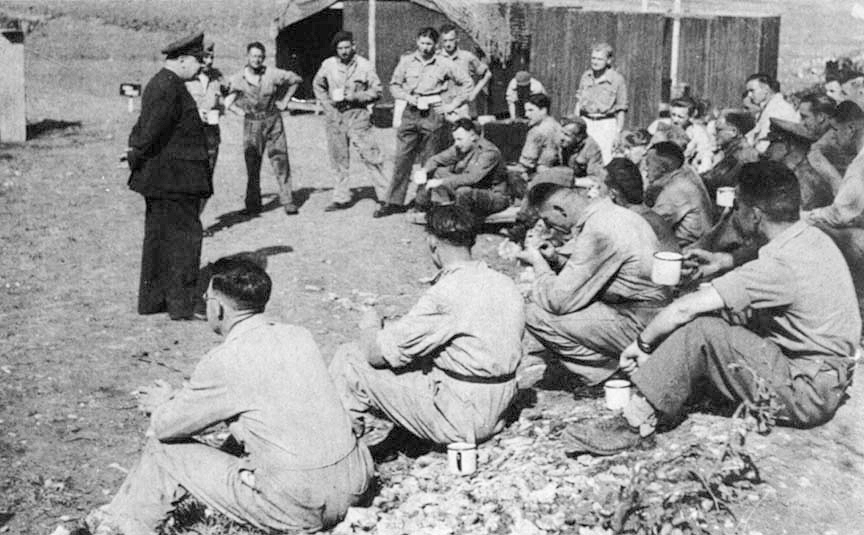 Mr. Galatti expresses his appreciation to British workshop personnel for their excellent maintenance and repair work on AFS ambulances. Photo by Brook Cuddy |
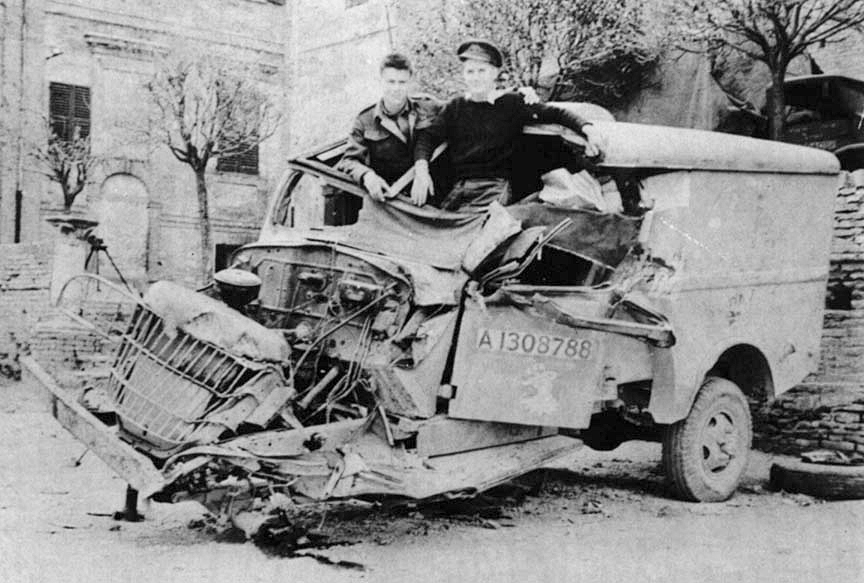 Kenny Brennan (left) and Howard Brooke perch on the remains of their ambulance. The unfortunate vehicle was reamed by a tank along a narrow frontline track during a night run. Photo by George Holton |
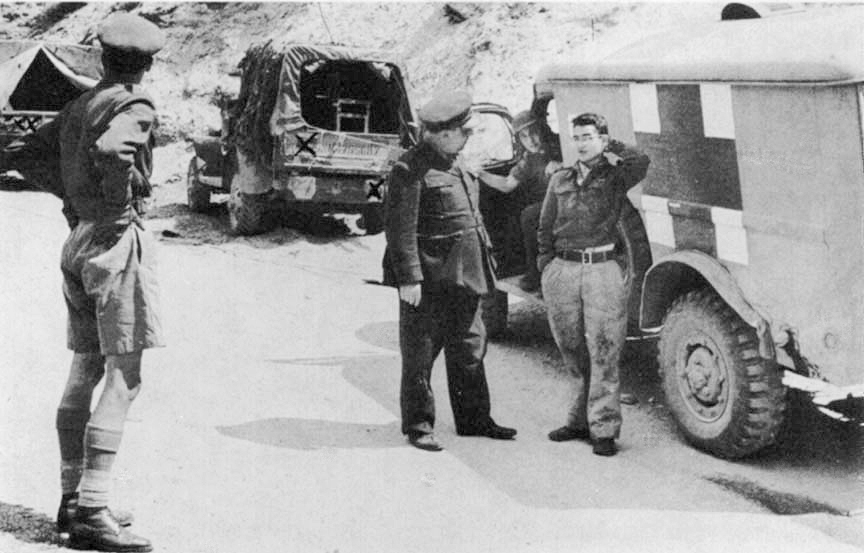 Mr. Galatti interrupts his frontline tour to get a report of Forrest Williams' evacuation run to an MM opposite Mt. Cairo, at that time still in enemy hands. Photo by Brook Cuddy |
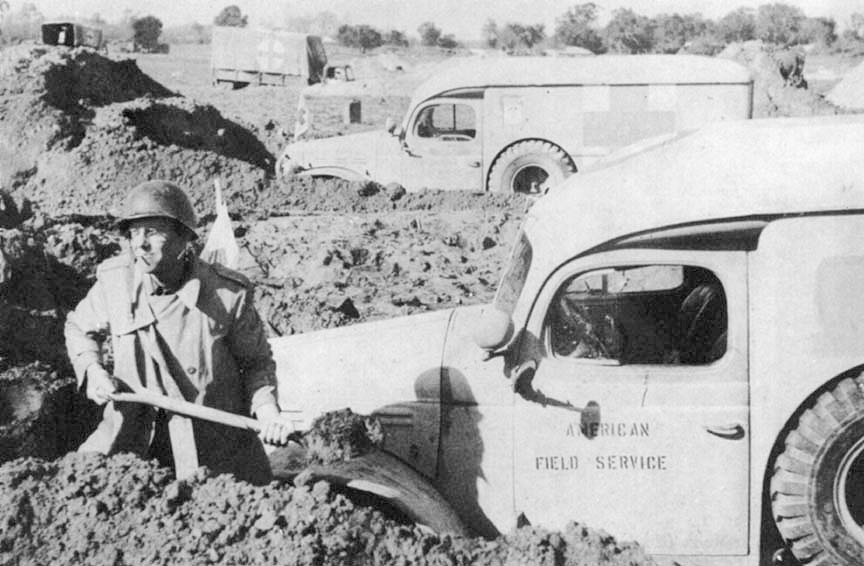 Frank Hallowell "digs in" on the former Anzio beachhead. A high dirt wall of this type protects ambulances and other stationary vehicles from flying shrapnel. Photo by George Holton |
"We picked up another man on the road-side, a walking, with a shrapnel wound in his back, and journeyed down to a CCS, missing the MDS because their signal light had gone out in the wind and rain. At the CCS we unloaded our casualties, except for the Major, who was to spend the night with us and rejoin his post in the late morning. At the CCS, of all things, we found an 'Ambulance Driver's Snack Bar' open all nite --- and the three of us were treated to brimful mugs of steaming coffee, really delicious. Then at about 3 we found the unit again in their new spot and turned in.
"The new location has been quieter than the former, but yesterday morning was a catastrophe. Six Focke-Wolfs slipped in and did awful damage. We have been strafed here several times but these dropped anti-personnel bombs which scatter grenades like missiles over a 50-yard area. They hit some ammo, too, and it was exploding intermittently as we arrived among the dead and the wounded.
"A day has past. This is a bleak afternoon. The Nazis have been sending over occasional night fighter-bombers. You can hear them coming in low overhead, then the machine-gun bullets burst, and those anti-personnel missiles exploding. So I've bedded down in a slit-trench.
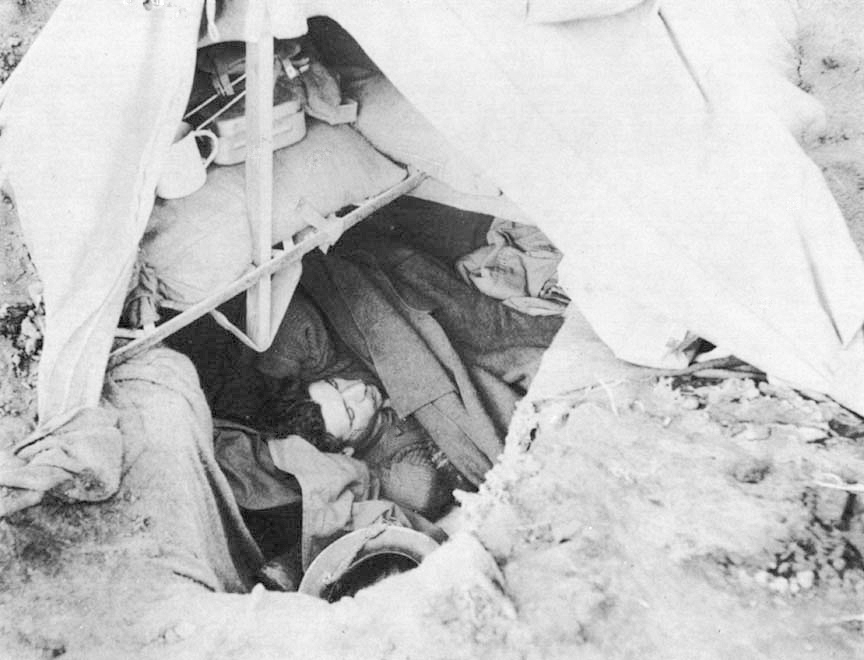
"I cut down some springy saplings, pointed the ends, and thrust them into the earth on both sides of the trench. This made an arched latticework effect. Over the branches I then spread my canvas bed-roll and thus made a pretty fair tent; but it only extended over two-thirds of the slit-trench. Next on the program was a water-proof gas-cape hanging down from the end of my tent which served as both wind and rain-break; finally a ground sheet over the bedding itself and a system of irrigation channels in the bottom of the five-foot trench. I procured a small tin can for a boiler, and, as the ground sheet filled up gradually, I'd just raise my knees a trifle and listen with delight to the aqua running off into the drainage hole at the end of the trench. I have a piece of old German beaver-board for a floor.
"This may sound like a Rube Goldberg invention of how to keep dry in a slit-trench, and this morning the MO surveyed same and immediately got me a regulation Army tent. So I've now taken down my paraphernalia with mingled feelings and set up the tent replete with a new external system of irrigation.
"The heavy rain put a momentary lull to the cannonading but I can hear now, with great dissatisfaction, the Germans beginning to shell again, not so very far away. A most annoying noise, and were there any oysters around, it is my considered belief that they would be plenty peeved. Yesterday morning before the storm, and the evening before, we were treated to a wonderful sight. A total of nearly a hundred of our big bombers flew over us --- in magnificent array --- while fighters swarmed protection around them. They flew in formation through the German ack-ack. There was a relentlessness in that formation, heavy droning right through the black anew bursts. Then you could see the bomb-bays open and feel the ground shake as the terrific load exploded and watch the columns of smoke rising. What a wallop they packed! It made you want to get up and cheer. A great spectacle and I could hear some Yank troops just down from us giving vent to the old touchdown yell.
"Two days later. There isn't a cloud in the sky and hence German air activity has been slight overhead, and ours has been a heart-warming sight; patrols fighters and the big bombers! A couple of F-Ws strafed our area after breakfast, but didn't do any harm. The Nazis come in at tree-top height and then whip back into the clouds; no clouds, no Nazis.
"Last night, in contrast, was the most hectic of all from Jerry attack standards. There was a low, soupy overcast, and just after I'd retired, it began. You heard the planes coming, and somehow you knew they weren't ours; a different, throbbing roar to the engines. They dropped flares all around us and then they started bombing. Our ack-ack put up a terrific barrage, but they didn't stand much of a chance with visibility so poor. The Germans had it their own way for about an hour, one of the most unpleasant interims I want to spend. The trouble was there wasn't anything you could do. You just had to lie there in the darkness and take it. No sooner would you think "That's the last of them' and then the ack-ack would open up again, you'd hear the plane, faint but growing louder, then the roar of it almost overhead, then the screech of the bombs and the rumbling, ground-shaking explosion.
"The nearest bombs were about 100 yards from my slit-trench, and the air was filled with jagged pieces of shrapnel, a big piece sounds almost like a bomb coming down. However, that morning I had perfected perhaps my greatest invention: a shrapnel-proof roof.
"It's now Tuesday morning, bright and clear after a relatively a quiet night. There were some heavy enemy shells failing at one time, but no bombers. Sunday night, however, was a different story. Darkness had just arrived, when there was a strange glow over the front lines a little north of our position, Nazi flares of the parachute type, settling very slowly. There must have been at least 30 of them in a few minutes, an eerie sight in the moonless, still night, for our guns were quiet now, waiting for the inevitable German bombers, not wanting to give away their exact location with the gun flashes. I watched the flares fall, making the night alight. And then suddenly, coming diagonally toward us was something red, glowing, moving above the trees in the darkness. It came silently over us almost like a disembodied falling star, and you had the impression of something big and heavy up there. Yet it didn't seem to lose altitude. There was a little group of us watching the thing and we assumed it must be one of the Germans' new wireless rocket bombs. Listening, we could hear the faint drone of the guiding plane way up above. Then the ack-ack began firing their red tracers as the bombers came in over the flares. I stood at the entrance of my slit trench for a minute or two watching the tracers, keeping a wary eye on the rocket contraption which moved steadily southward and hearing a grinding whine in the distance as if the Germans were working up their up long-range, multi-barrel mortars. But in the trench despite its roofing invention I didn't feel very much at ease. I found myself popping up, looking and listening to the night sounds. I had a feeling of something awful impending. A little while later the Germans came over, one bomb falling closer than any of the others had. But my roof withstood the sudden ground tremor. No one was hurt and I went to sleep, not thinking of the bombs and planes at all.
"This morning we had our usual slit-trench diving maneuvers. The raiders invariably come in out of the morning sunrise, when there are few clouds. There's a high-pitched droning as they dive a noise peculiar to itself among the other battle sounds and almost simultaneously the anti-aircraft and machine-gun. fire begins. In a matter of seconds our complement is out of sight. This time we had just hoisted ourselves from the earth cavities, and were brushing off the mud particles and dirt, when came the droning dive again. One officer, who had completed the 'brush-off' with extra care, glowered in the direction of the approaching enemy and vociferated with extreme annoyance 'Oh, I say, Jerry, this is a bit thick!'
"I had no sooner retired than the Germans began dropping their heavy stuff just outside our area. I lay in my bivouac and as each shell pounded into the earth I could see the 'timbered ceiling' doing a sort of backwoods conga, but it held firm. Then came the enemy planes droning in on top of the shelling. They came pretty close, those boys, but as the old saying goes, 'It was only beginning'. I slept for a while, awakened at various intervals by the sound of our ack-ack and the drone of more planes coming in on their bomb runs some little distance away. Before dawn they switched over to us with a vengeance. The first few dropped those antipersonnel 'fire-crackers' as they are called about a hundred yards away. But they kept diving in closer and closer, until there was a terrific burst of machine-gun fire, and anti-aircraft and one Nazi roared directly overhead. You could feel how close he was by that high-pitched grinding, tearing-of-the-air commotion; a split-second lull and 'all hell broke loose'. There were explosions, rapid fire, quicker than counting --- my ear drums ached with their nearness --- and the 'bivvie' shuddered, lightening flashes of bombs and ack-ack flickered through the darkness, where I had loosened my ground-sheet blackout curtain for ventilation. More planes were attacking, diving in with that deadly close engine roar. And our ground defenses were turning everything loose, smoke and the smell of burning powder swirled outside and gusted into the trench in the terrific din. And then it gradually subsided, but not before I distinguished one splintering crash of metal above the other sounds. That was when the 5 ft. all-metal bomb canister went through the roof of the ambulance. I got outside in the smoke and confusion and there was the wretched vehicle, the roof smashed in and the right front tire resting on the earth. I looked at the tent which covers my timbered roof and it was riddled with about three dozen shrapnel holes. I could see angry swirls still in the leaves and forest floor where three of the grenades had exploded about 5 ft. from the tent. But by a great stroke of luck, no one had been touched in the raid. One grenade exploded in a slit-trench we use only in. day-time, dropping right through the narrow aperture. Another went off among our eating utensils smashing holes in water tins, petrol and paraffin cans. There was a pile of ammunition--- heavy caliber 20ft. from my underground den, but it hadn't caught fire, though there were shrapnel holes through some of the tin casing boxes. I hammered out the hole in the roof as best I could and got my tires mended, the spare having a piece of shrapnel in it as well. The car still ran, and I was soon on the road with it, the front door on the left flapping like a broken wing. Since then I've had the roof patched and the engine given a once-over and if I can get some paint I think I'll dab a wound stripe on the veteran. One of the American troops who appeared when the smoke was clearing suggested I apply for a Purple Heart for the vehicle.
"I had two runs later in the morning, and towards evening one of the batteries had a shell burst among a little group sitting down to their evening meal. I drove thither along a dirt track, thick with mud using chains and 4-wheel drive, as part of the track led through marsh, Even with the help of the added traction I almost didn't get through, but eventually climbed a rutted hill and found the casualties. One lay on an improvised stretcher. His face was already gray, he had no pulse, but with the Germans pumping shells around I put the man I thought was dead on the top bracket first, so that the wounded man wouldn't see him, as they were close friends. Then the other stretcher underneath and I was off, through the marsh and back to the RAP. There was still enough light to see well and I remember thinking how thankful I was not to have to make that run at night! The MO confirmed the second fellow's death, splinted up the leg fracture and I set out with the latter for the MDS. It was now pitch black on the road, but I knew the way well and returned to the post just as the ack-ack opened up on the first night raiders. I was glad, indeed, to get into my bivouac, as these nights Nazis often go for the roads and while it's a small target, it's not a particularly good spot to be when those babies are about.
"What I had been dreading happened the night before last --- a night call to that battery across the marsh. About 4:30 I was dozing when the CO called down my semi-tunnel staircase: 'You're needed at once'--- ' I lit a match, poked it in the earth wall of the dug-out and got my shoes on, grabbed my heavy glasses and my tin hat, emerged mole-like from the recesses and started removing the tree camouflage from the old bus while the MO gave me instructions. He said they would post a guide where I would turn off the main road and hit the mud track through the marsh. There was a half-moon, partially obscured by low clouds and the road was far from a 'ribbon of moonlight'. I could barely see where I was going and how I'd find the guide was another problem. He hadn't arrived at the turn as I passed. I edged along in the pitch-black, knowing that Jerry was counter-attacking in force further along this main road and warily watching for shell flashes, listening for any 'hello' from the guide. I thought sort of desperately 'I passed the turn for sure' when suddenly out of the night came the big shell. It hit about 10 ft., not more, to the left of the bumper and just in front in the soft earth. I never heard it coming. There was just a sudden rending explosion, a red flash; red and black, that seemed to leap across the wind-shield and over the roof, and mud and dirt and debris covered, the car. I sat there at the wheel, stunned for a second, and then you should have seen that ambulance go into reverse gear! As I went backward two more shells straddled the road where the first had hit. The car still functioned O.K. and most of the steel in that blast must have gone just over the roof. They tell me when they hit that close, you can sometimes get beneath the cone of the explosion and by luck I had done so.
"I reversed for about a third of a mile, got my bearings and started forwards again, when suddenly to the right a shadow looked up. I stopped and a wonderful welcome voice said, 'This way with the ambulance'. I followed the guide along the winding track, crawling in low-gear as he walked ahead. I don't think I'd ever have made it without him. He was great and kept doggedly on despite the occasional shells that were coming over. At the marsh I got out and took a good look at the way the road ran through it and somehow kept on the beam and got through. Abreast the hill I pulled up, partially sheltering the ambulance under a friendly bank, then whipped out a stretcher and a blanket or two and followed my guide down an open slope to a fox-hole where the wounded man lay. We dropped low in the trench for a second as a heavy shell whined just over us and hit the slope, then got the casualty into the car, turned and retraced the trail. I was guided again through the marsh and the guide gave me a 'Cheerio, Yank', and I wound slowly through the woods to the main road again. You could smell the powder hanging over the road where the German shells had hit in my absence, and I sure didn't waste time getting to the RAP. The MO greeted me and we unloaded the wounded man, hit through the elbow pretty badly but not seriously, and I helped the Doc put on the necessary dressings and splints. Dawn was breaking when I took the fellow to the MDS. But it wasn't a very comfortable morning. The Germans had advanced too close for comfort and just after breakfast they put over a barrage of some fifteen shells which wounded one of our men a little ways from the ambulance. It was quicker to stretcher-bear, so with some stalwart support I helped carry him in, for the medical aid.
"The rest of yesterday I spent reinforcing my roof and felt more comfortable last night when the German bombers came over about 1 am. They dropped their fire-crackers behind us and to the right and left and then came a very fine sound; machine-gun bullets being fired overhead in the sky --- British Beaufighters on the job and that was the last the Nazis bothered and yesterday evening you could see squads of German prisoners being marched back. American armor had smashed hard and with good effect against the salient the Nazis had driven down the road the night before. The prisoners were not an impressive looking lot, pasty-faced and shaken. Some Spitfires flew over one group and one of the Nazis, evidently bomb-happy, made a break from his escort. But a fixed-bayonet and a rifle at cock brought him back in line pretty quickly. Nevertheless these Germans facing us are a tough foe --- no mistake about it; and the fact that they've outnumbered our forces since the earlier days of the beach-head's establishment hasn't helped,"
Orchid Department: Further praise for AFS sections attached to the former Anzio-Nettuno beachhead forces was received in the form of a letter from the British ADMS to AFS headquarters in Italy. He says in part that the "devotion to duty shown by AFS drivers attached to --------during the last three months has been of the highest standard."....A British Captain in a letter to Charles Pierce sends additional laurels: "Your drivers have been doing a most excellent job under the most wretched conditions..... Good luck to the AFS. We appreciate your fine work and spirit far more than we can ever hope to express on paper."
News of scattered AFS veterans drifts in by letter and word of mouth. Bayard Tuckerman is serving servicemen at Boston's Stage Door Canteen... John Peabody, mentioned in British dispatches in the Middle East, is boosting the war effort as a welder in a defense plant....Jack James, who joined the Canadian Army on his return from AFS duty in France in 1940, has been in England for most of that time. He rose from the ranks and was commissioned a Lieutenant more than a year ago. At one time he was the only man in the Canadian armed forces to wear the Croix de Guerre, won with the AFS. In March his regiment was reviewed by General Montgomery and after the address Monty singled out two officers for personal chats---the Colonel and Jack
While AFS drivers were isolated by the Japs during the British withdrawal in Burma their rations were supplied by air. According to one report from that theatre, the RAF pilots did not pick their food targets with care and consequently considerable time was spent dodging these parcels from heaven. Dave Sanders was enjoying a peaceful moment in his ambulance when a package fell on top of it, scaring him more than a bombardment. He now scurries for cover whenever he hears a plane.
Romance Department: After a brief absence this department
again justifies its existence with reports of two AFS weddings
and one engagement. "Jeff" Jefferys of the India-Burma
contingent was married to Miss Patricia Barry-Cornwell on June
1 ...Art Howe and Miss Margaret Burke were married on June 17
in Washington, D.C.....Private Glenn Lee Smith, now of the U.S.
Marine Corps, is engaged to Miss Gloria D. Lehan, also of the
Marines. Both are stationed at San Diego....Our congratulations
and best wishes to all three couples.
Word of two more AFS awards arrived recently: Denny Hunt, wounded
on the Eighth Army front, and Warren Fugitt, wounded on the Anzio
beachhead, have both been given the Purple Heart.
This month's cover is a reproduction of the insignia-mascot
of the AFS Anzio Beachhead sections. Shortly after the AFS men
first arrived on the beachhead they felt the need for a distinguishing
mark. The original sketch was done by 'Doug' Moore. When he first
put the design on the ambulances, the white triangle in the background
was prohibited as that is the insignia of the First British Division.
Then when the ambulance sections actually made the first landing
on the beachhead all insignia of any type were ordered painted
out. After the first couple of weeks, however, permission was
granted to restore the various group insignias, and Doug's design
as it appears on our cover was painted on the ambulances.
The books so generously donated by friends and relatives of
AFS men are filling a long-felt need on the Italian front. Arthur
Howard has taken over the extra-curricular job of operating a
mobile bookstand composed of 200 of these volumes, all of which
are available to AFS volunteers on duty.
Readers who followed AFS service in the North African campaign
will remember that the first ambulance men to enter Tripoli were
attached to the famous 11th Hussars. In the June issue of Cosmopolitan
magazine Tim Ullman, AFS Middle East veteran tells the story of
the renowned regiment in his story THE CHERRY PICKERS.
Recent visitors to 60 Beaver Street include several ex-AFS
men: Ens. George Marsh of the Navy, Frank Wood, who had just completed
a Merchant Marine run as purser on a liberty ship, and Lewis Stuyvesant....Bill
Brown, soon to be stationed at Fort Meade, stopped in during his
New York furlough... A distinguished AFS father also took a few
moments to pay his respects, Major-General William S. Key, Iceland
Base Commander. Bill, Jr. recently joined the Italian units.
It is with regret that we learned of the death of General Arlett,
former DMS of the New Zealand Division, on April 14th in London.
His association with the AFS was close and of long standing; he
showed his regard for their work by insisting that the AFS should
always be attached to his Division during the desert campaign.
No date.
"Last night I started back to the Post after dark. You
could not see your hand before your face, due to a lot of black
clouds. Just before I got there I got a bit off the road and got
stuck. It was so dark we couldn't see what we were up against,
so we decided to bring up one of the ambulances from the Post
to which I evacuate. That ambulance started up, and about halfway
we went into a three-foot ditch and was finished for the night.
We all went on to the Post to decide what to do next. In came
a casualty. As a jeep was parked near by, we got the driver up,
and the casualty in it, and started to lead the jeep down the
road by holding cigarettes cupped in our hands. First, one of
our men nearly fell down a well, we all banged into various trees,
then, the road suddenly turned and I walked over a four-foot bank
and landed flat on my face in a large mud hole. After I crawled
out of that, and walked back to the Post through a small blizzard,
I called it a night. All the ambulances are now out of their respective
ditches.
"At present I am with the Indian troops. The only person
who can speak English is the M.O. but the boys and I hold wonderful
conversations by drawing pictures. The only difficulty is that
they so insistently offer me the British cigarettes which I have
described to you, that I have to accept occasionally. Three more
days and I will have no throat left. If you ran into the Indians
in the last war, I'll bet you remember their tea. They really
turn it out just like 'mother used to make', and if I so much
as look thirsty, there is a cup in my hand.
"It is a good thing we don't live in Italy. It would be
very difficult to balance the budget. Right now, we pay twelve
cents an egg, four dollars a chicken and eight of us in these
billets eat thirty eggs a day."
April 20, 1944.
"I was working at a hospital, carrying patients back to
a bigger and better hospital, moving to a new location, lugging
medical stores and in general fiddling around, waiting for something
to happen. Then I saw H. and some others, much the worse for wear
---tired, I mean. Boy! was I glad to see them. On the strength
of H's report, I went ahead with my Dodge and a number of my ambulances
to pick up casualties. I had more or less assumed command of about
20 ambulances and 60 Sikh drivers. We brought the casualties back
and I worked all that night, save three hour's sleep, in the post-operative
wards. Next morning early, as soon as I could got through, I took
a fractured skull further down the line, I was on the road for
nine hours straight, dropped the patient, and went lickety-split
for home (if you could call this place home.) I got supper and
a very welcome drink, turned around and came back. I drove all
night, and the next morning, when my ailing ambulance (not the
Dodge) finally pooped out about 9 a.m., abandoned it, threw my
medical supplies in the back of a passing truck, and caught an
hour's sleep before arriving at the first-mentioned hospital.
Got there about 16:30, making exactly 36 hours on the road.
"After about a week of rest, which I appreciated, more
work came along. I'll quote my diary:
"'Actually, I did not 'see action'. Things were more
or less touch and go for awhile, but nothing untoward happened.
My hardest and most interesting work came when I was forced to
give up ambulance driving, and attempt to do a doctor's job.
I was stationed in a smallish hospital, and there was more work
to do than doctors to do it. So I pitched in, dressing wounds,
working in the post-operative ward, making diagnosis, taking
blood slides; following the real doctor on his rounds and taking
down his prescriptions running the evacuation of casualties by
air, and tending to the administration and discipline of 60 Sikh
ambulance drivers. Despite this; there were many days when we
had nothing to do. We just sat around, waiting for something
to happen. And that was, of courses the worst part of all. When
the casualties came, we had too much to do.
" 'One of the proudest moments in my life came when I
was examining a wounded Gurkha. He had only a superficial wound
in his back, but was in great pain, and said so, which is very
uncommon in a Gurkha. They're the toughest little guys I've ever
seen. There was no corresponding wound in front, so I assumed
that his lung wasn't big enough to let any air in, and so partially
deflate the lung. The air, in a pneumo-thorax case, gets in between
the lung and the chest wall, and forms little bubbles which feel
like a bit of mercury skidding around under a piece of leather.
And his chest sounded OK when I thumped it as Dr. Gage would
do. Then I discovered that "Pisnab nahin Jane sakta, sahib"
---he couldn't pee. In fact, his belly was stiffer and more distended
than a starving child's. I figured that he has lost control of
the involuntary muscles in his bladder, and so couldn't empty
it. I said, "Hmm--hmm?" like an honest-to-God doctor,
and scratched his feet and tested his reflexes. He had no feeling
at all in the left leg, and only faint reaction in the right,
which was the opposite side from the wound, so I diagnosed, and
the surgeon corroborated it as a nicked spinal cord. Simple,
perhaps, but I'm still proud that I had the presence of mind
to figure it out slowly and accurately. I shot him off to the
operating tent where they inserted a tube into the bladder and
drained it. That was what was causing the Gurkha so much pain.
I later saw him evacuated by air to a place where they could
repair the damage. He got well, I hear, and I like to think I
was instrumental in saving his life.
"'That's about all. I can't say any more about the general
trend of affairs, so you will have to be content with my personal
experiences. After this incident, I kept on with the dressings.
We were busy with this for about 15 hours, when we finally got
everything cleared up. Then the rest of our AFS guys in that
area finally showed up, to everybody's intense relief and we
all went back together.
" 'The only thing I did see was to make an infinitesimal
effort to help things out a bit. I accomplished that, to a certain
extent. But my greatest satisfaction came when I realized that
I had the opportunity to 'aid the sick and succor the wounded',
that at last I had it within my power to do a little positive
good in this war and in my own life. Perhaps this incident was
a turning point, where I started to become an asset rather than
a liability in the world.' "Anyhow, it's midnight and I am tired. Maybe you'd better
get Dr. G. to interpret my medical terminology and case records;
they're obviously too complicated for the layman. We doctors,
you know! If I know anything at all about medicine, I'll eat my
hat."
May 9, 1944.
"Some of the scenery here is truly wonderful and reminds
one of what I have always imagined parts of the southwestern United
States to be like. It is entirely different from anything I have
ever experienced before. A week or two ago, I camped out in the
country entirely by myself. I cooked a rather mediocre dinner,
smoked a huge cigar, and went to sleep under the stars with only
my mosquito netting for protection from the elements. I was tired
from the day's hike and dropped off to sleep immediately. I awoke
at just that hour before sunrise when the Indian peasant world
is beginning to cast off its blankets and begin the day's toil.
Off in the hills one could hear the creaking of the bullock carts
as they wound their way to the fields. The drivers sang to their
oxen in voices which were wonderful, irritating, and strangely
oriental. Off in the distance I could see the smoke from a native
village, a dog barked; it was magnificent because it proved that
part of the world is at peace."
February 12, 1944.
"When I think of this whole situation and the reality
of my being here, it just doesn't seem possible and I have to
pinch myself to believe it. It's all so amazing and vast ---the
world, I mean--- that even with an endless amount of studying,
one couldn't possibly picture it as it actually is. Millions of
different people with hundreds of languages that all seem so commonplace
when seen through some one else's eyes, suddenly take on a new
light and interest to me. I am no doubt headed for one of the
most remote places in the world which should only prove to make
it more interesting, as there is far less written about it than
the resort places."
"Now that I have seen a part of the world I'll never be
content until I see the rest, I know. And now I surely can recommend
a round-the-world cruise for wonderful relaxation."
No date.
"For five rupees a week ($1.50), I have my man 'Sammy'
who makes my bed; polishes my shoes, wakes me in the morning with
tea, does all my shopping or some of it anyway and does any odd
job I want done. Very reasonable and I don't have to feed him.
Oh well, it may be like that there some day, who can tell. We
eat three meals a day and to my surprise the food is quite good.
It's all pure and wholesome. We can buy milk for a small sum....For
fruit there is most everything; oranges and bananas being the
safest to eat. Diseases are picked up from the skins of fruit
etc., so you should eat the ones that have to be peeled.
"I can't say anything about our training but we are being
trained. We live in nice barracks, plenty of room and not uncomfortable
beds. The place is very airy so it is not too warm to sleep. Of
course there are plenty of fans and windows."
March 19, 1944.
"Driving here is nothing like it is at home. You drive
on the left hand side of the street, and it isn't just a matter
of cruising down the street, you have to watch for pedestrians,
of which there are a great number, bicycles, oxcarts, gharries
and other motor vehicles. For no reason at all a man will decide
to cross the road when he knows full well that you are coming
and haven't a chance in the world of missing him. Bikes are just
about the same or maybe even worse. After driving through this
kind of traffic for an hour or so, you feel as if it would be
a pleasure to fall asleep at the wheel, but you suddenly find
yourself winding up the side of a mountain where the road is hardly
wide enough for two trucks to pass. As many as fifty blind curves
have been counted along some of these mountain roads. On one side
of the road there is a vertical cliff of rock going up while on
the other side all you have to do is step an inch too far and
you won't touch ground again for 1500 feet. It is pretty obvious
that your first mistake will be your last. You can't afford to
fall asleep here but when night comes around, the bed sure feels
wonderful.
January 26, 1944.
"I've recently seen some of the most awesome country I've
ever seen. Mountains several thousand feet high with green, fertile
valleys far below, and native hut villages practically camouflaged.
It reminded me of the time we went to the Grand Canyon.
"After driving backwoods dirt roads for the whole day,
we stopped to encamp next to a mountain stream, sparkling and
minnowed. And was it good to strip, and bathe the inches
of dust off ourselves. The water from the sun was warm as a bath.
We had bully beef stew, and even that tasted good, which must
mean that we were hungry. Later we built a fire, and in the stillness
of the stars sang softly and talked and then slept. We were tired
and another day was ahead..... Some of the guys climbed one mountain
and entertained us by rolling boulders off the edge. We rose with
the sun, dipped again, and were off while the sky was still pink.
That day we went up again, and up. Mountain air is really fragrant
after hours of dusty ceiling zero. We ate in a place in the woods
overlooking miles and miles of hills and valleys; it was like
being in an airplane; the trees on the plateaus and the villages
looked like toys..."
January 9, 1944.
"The Mohammedans here (who, in their shops, have signs
that never mention CHRlSTmas --- always Xmas) are welcoming the
new year with fervor this week. The crowds are like Times Square
on a Saturday night; it's hard to move. You would enjoy --- or
be scared to death of --- the costumes. They are huge and hideous
monstrosities of strange beasts and stranger men, painted in clashing
and multiple colors. Dancing through the dingy, crooked streets
they beat on toms toms or wave sticks at onlookers. Dancing girls,
heavily clothed, sway and symbolize with their hands....Native
bands, more drums, and hordes of spectators, like our Halloween,
add to the din. Fakirs, the men who have through mystic religious
power hardened themselves to all kinds of physical torture, display
their fervor by stabbing themselves with long swords and daggers.
Some drive spikes through their cheeks; others walk on the famous
beds of red hot coals and nails.
"In the crowd is every type of Indian: the Hindu beggar,
the orthodox Moslem women with their bhurkas and flowing gowns;
the cast-marked Hindu women with rings in their noses or red dots
on their foreheads; Ghurka soldiers about four feet eight, looking
like little boys; Sikh soldiers in dress uniforms, with their
three foot scabbards, and black beards tucked under their chins;
Anglo Indian Christian women; bright faced little Indian boys
with excitement in their brown eyes and grins on their smallpox
scarred faces. . . All-in-all, I was pleased as well as surprised
to know that out of the dirt and squalor of those open air little
shops and bumpy streets dotted with beggars, there could come
any festival so crowded with monotony-killing feats and happy
throngs. Sometimes I have wondered at these people; they are very
poor and seen to live a monotonous, unchanging, day-to-day existence,
and yet they are happy, and always ready to help out the shopkeeper
or neighbor next door. I find myself asking, 'Is it you that should
pity them, or they who should pity the great luxury-enjoying,
mercenary western world?'
". . . And the bullock carts continue to jostle by, past
the modern buildings; the tonga wallas continue to whip their
bell-donned horses past the brick schoolhouses and churches; the
ancient beggars continue to beg as the western world walks by.
"Host of the fellows have bearers here and I find them
interesting. My favorite is Sammie, who is an 'RC' as they call
the Roman Catholics here. He constantly reminds me of Gunga Din;
he is not brilliant but is very faithful and dependable doing
things like shining shoes, not because he has been told to do
so but because he sees that they are dirty. . . He greets me in
the morning when he sees me with a big smile because he knows
what is coming. I always say, as if we'd just met after we'd been
apart for a long while 'Hiya Sammie! How's the boy?' He gets a
bang out of it partly I suppose, because me calling him a boy
is a joke: he has six children --- four baddies and two chicos
--- of whom he is very proud 'My children go to school; Sahib
. . . ' Sammie does not know how old he is; his oldest brother
is 53, so I imagine that he is about 48 or so. He wore a green
shirt the other day and we kidded him about going to a party,
and he responded that he had all different colored shirts, just
for work. He is a slight man, and always wears a fez over his
shiny brown face. I would be proud to have him at my table at
home at any time."
February 11, 1944.
"Coyotes and field mice come scratching around our mosquito
nets. Before the moon sets, the birds start to awaken and it is
actually difficult to count the number of different cries. As
far as I can see from the hillside there is no house or human
being --- not even a Coco-Cola stand. . Streams sparkle in the
distance, but are murky and full of frogs, minnows and other fish;
up close. We went in swimming in one and the native women in bathing
scurried for cover; the Hindus are very modest due to their religions.
It continues to amaze me, this religious fervor of people who
have so very little, according to our standards at least. . .
There was one white shrine in the wilderness, to Murka (?), the
god of gods, and when the natives passed it, they took oft their
shoes in reverence; as we tip our hats --- only all of
them do it."
February 6, 1944.
"With the clippings and predictions you send; I am kept
pretty well posted. Judging from reading, I think people are much,
much, too optimistic; at least two years of war lie ahead
and probably three. They don't realize (and neither do I) the
tremendous task of supply and things like that. . . .
"I had an interesting afternoon the other day; rented
a bicycle (2 annas --- 4¢ an hour, and had as my companion
a Nigerian (W. African) soldier. He reminded me of our Milwaukee
darkies. I can't tell you all he said, but one thing will stick
with me for a long, long time....'You have truth In America; you
are the one country we can believe. Americans give us our only
light....' He was 10 years old, educated, and I learned much.
"You sure would have liked the horse I rode one day on
leave; he was really wild! While riding I saw many interesting
things --- Huge elephants pulling lumber, camels hauling straw,
and hundreds and hundreds of monkeys, big and little; brown and
black, noisy and quiet, all alongside the road. I rode a camel;
and it sure is a funny feeling! He sat down and I got on. Up,
up, he went! I thought he'd never finish unbending.
"We have a parrot for a pet now. During the monsoon (rainy)
season there will be hundreds of them in the trees around here.
"While in a wild part recently, we slept on a lonely hillside,
and three different times during the night had to chase a coyote
away. He probably wanted some of the food we had cooked, though
I don't know why!"
December 31, 1943.
"On my way back on the train, I met an American educated
Indian engineer who graduated cum laude from Carnegie Tech. He
turned out to be a real man; he has worked for his government
in France, England, and Germany, and worked as an American specialist
in Russia during the second five year plan. His experiences there
were enlightening. He knows his politics and his ideas on the
post-war world and on India in the post-war world seamed pretty
solid. He thinks, I believe sincerely, that America is by far
the best country in the world. I hear that time after time and
I also hear of the tremendous faith these people have in American
ideals influencing all people after the war. They look to America.
I hope we don't t let then down again…. I learned from him
much about Indian politics."
February 27, 1944.
"The Taj Mahal is an amazing place. I rented a horse for
the afternoon and rode through the spacious parks around it. Tied
my horse and walked through an arch that looked like the Victory
Arch in Paris and there before me was one of the world's seven
wonders. Although I was in the open; under the empty blue sky
I felt as though I should tiptoe. The magnificence is indescribable.
In front of the Taj itself, stretch two narrow, fountain-fed ponds.
On each aide were walks and on the outside rose-trimmed trees
and gardens. At each corner a miniature temple guarded the tomb.
I walked slowly; and closer and closer the intricate patterns
came; the roundness and grace of the dome; the thin beauty of
the surrounding minarets ... I climbed the marble steps (everything
is made of marble); took off my shoes, and entered the main chamber;
in which an echo resounds several hundred times, so perfect is
the structure. . . I was led by the bearded Brahman, who carried
a candle, to the real tombs (of the maharaja and his favorite
wife) below, on which I put flowers. He called upon the god or
(someone!) and put his hands on my head, invoking their blessings.
The immense value of the whole setup can't be realized, but all
around the whole building is a three-foot deep border of
flowers, which are made (not painted) of hundreds of different
valuable stones --rubies; emeralds; etc. The entire floor is the
same. Each flower is perhaps a fourth as high as this page. A
gold screen shields the tombs, and the doors are also gold.
. . The thing that impressed me was that he had this built for
his wife --- out of love and appreciation . . . It quite awed
me. . .
"After many, many more hours, I arrived at the mountain
town; there I took the bus for a-------climb.
"It became more and more chilly, but I didn't notice it;
the view as I looked down into the valleys took my breath away;
I don't think I've ever been so struck by God's power. The tiny
homes dotted the fertile land. The color of putting greens, or
the trees in spring, the rice paddys were 'stepped', separated
by long mounds of pregnant brown earth....Close by were rocky,
quick moving streams.
"Up, up, up we climbed, until we were passing (honest!)
through the clouds. It was like riding into heaven itself!
And then, suddenly, around a turn, and it was heaven! There was
a vast opening, surrounded by a wall of snow-capped and speckled
mountains, heavy with timber. On each mountain were many cottages,
red-roofed and towered, as you'd imagine a Swiss village to be.
In the middle of all was a deep blue lake, and on it sailboats
were gliding. The only mar to all this pine-mountained splendor
was the slush; it had hailed the day before. It was something
to see those hill people; huddled about their kindled fires, and
working in their bare feet.
"In a portable 'hammock' (hills too steep for horses)
I was carried to the inn by four men.... For a distance of about
two and a half miles they got eight cents each.
"Believe me! Did the hot tea and the small blazing hearth
in my room feel good!!
"There was no Catholic church so I went to a Church of
England the next morning, which was sunny and invigorating. The
church chimes reminded me of Wautoina, with the smell of the air
and the drowsy silence of it all. A choir of refugees from --------and
other places (there is a fine British home for them there) sang
the service. Afterwards they turned out to be not so holy, engaging
the Yank-kee! in a snowball fight! While there, I had apple pie,
apples, fresh peaches. I did some rowing and quite a bit of riding
because horses were only 24¢ an hour. They were wild, and
it was really a task to stop them, They love to run, and
do they! I felt like the pony express.
"I left there and stayed with Americans in a city of which
any nation could be proud --- huge fountains, expansive parks,
and wide roads --- modern buildings, a mix between West and East,
were very pleasing to the eye. I had about 400 cokes while there
and at least 100 quarts of good ice cream! The Yanks sure have
it nice. One sergeant asked me to fly several hundred miles to
a desert city, which I did. We returned the same night...It was
all exciting and I'm pleased to say I didn't get air sick.
"Well, that is my leave, or the highlights at least. I
met some very interesting people, among whom were a Burmese mayor
(post war), a Russian girl, and two newspaper men (mechanical).
The latter two have invited me to their monthly press association
meeting to be --------night. I'll let you know how I like it.
They are both Indians, and have quite a bit to say about politics.
"As you can guess, I am well and happy. The scrimmage
is almost over and the game is about to begin."
No date.
"This is a weird and fascinating country and everything
so far has been interesting and a great deal of fun. The other
night for instance I came across a group of people sitting in
a ring on the bare ground beneath some trees. In the center was
a drummer and a woman who played a kind of primitive organ with
a keyboard and hand-bellows. She sang in a hard, clear voice strange
monotonous music, probably hundreds of years old, accompanied
by her organ; playing merely chords of fourths or fifths, and
by exciting drumming from the two drums. All very weird.
"And then to wander down the streets with shops on either
side, shops which have no doors or windows but which are completely
open on the street side, and to hear the babble, and see the costumes
of the people and the curious things for sale---it's like a travelogue.
Of course, we have our work; too but I can't tell you many details
about that, except that as I said, it's enjoyable."
April 20, 1944.
"The morale is excellent. There never was a happier bunch
of guys assembled and living together---myself included. We live
like kings, eat like kings; and sleep like kings. We can have
a servant. too, if we wish; $15 a month. I don't see the need
of one for myself so I don't have one. Being in a good outfit
makes all the difference in the world. I can't get homesick in
this outfit; everything is too good, too good to be true ---good
mates, good officers who treat us like human beings and like fellow
compatriots. Step too much out of line; though, and you get night
guard duty.
"There's no famine here that I can see. The natives are
very robust people and extremely handsome. They resemble Nordics
in profile but not in color. The countryside here is so much like
the wild woolly west that I feel as though I were back there again.
"I have my own ambulance and it's a honey, I have my own
collection of tools issued with it for keeping it in perfect running
condition---my responsibility, I get a great kick out of it and
take great pride in keeping my own vehicle on the road.
"We've made several runs of a hundred miles or so for
practice sake and got ourselves and our ambulances all dusted
to beat the devil. All the time we have to keep at them, it seems,
getting dust out and putting grease, oil, gas and water back.
"Today I had the chance to buy several books on. painting
and sketching, from which I shall be able to instruct myself more
finely. Paper is exorbitant ---$1.20 for a sketching pad, cheaply
made 12" X 9". Imagine it!
"In our driving we get a swell chance to see all the country
side. The buildings are either mud or stone (in the country).
In the city, mostly wood. There are old castles which look older
than Christ. These are damned interesting and filled with snakes,
I hear, but l sketch them as I can and shall send the best on
to you.
"It is such an interesting country and I am only just
getting acquainted. I know a little of the language and the religions.
Phonetically they speak like Mexicans, to my ear. The words, naturally,
are different although some do bear resemblance: dona - give (Spanish
---dar, Latin ...do, dare, dedi, datus)."
No date. Burma front.
"We were cut off up the road for three weeks. Road block
after roadblock was thrown at us but we finally arrived safely
at our base. We were shelled whenever we showed our noses on the
road and at one point they shelled the devil out of our camp.
A piece of spent shrapnel slapped me lightly on my rear end. It
gave me quite a scare but that's about all. Only one trouble ---it
was very hot. I'm glad to say we hauled all our casualties out
safely. That was our main worry. Getting the wounded to
a place where they could get properly treated and have a little
peace of mind.
"The first time we were cut off we had very little food
and practically no water. Of course we couldn't shave or wash
and that really makes you feel lousy.
"The 'Tommies' and 'Gurkhas' broke 14 blocks getting back
to base. We've had several air raids on our base, but none of
them were effective.
"I helped dress my first Jap in. the M.I. room. He had
been crawling in the jungle for four days without food. or water
and was wounded in the back and had most of his one knee blown
away. They use opium tablets instead of morphia to kill pain.
We dubbed this particular Jap 'Togo'. The interpreter told us
he was just a simple peasant who didn't really know what he was
fighting for or why. He loved catsup and could drink a bottle
of it down straight. He also ate salt as we eat peanuts. He was
a typical Jap, fairly short and well built, broad face, slanty
eyes, buck teeth, the usual droopy mustache and a shaved head.
He was just as I would imagine one. The comic strips really have
the Jap typed.
"I'm sorry to say I lost most of my collection of knives
up the road. Tell him I'm bringing him one of the Ghurka's kukris.
Its a knife like a small sword. And do they discourage the Japs
with it!!"
March 28, 1944.
"India is certainly full of oddities. One of their main
occupations is collecting manure off the streets and fields for
use as fuel. Wood and coal are very scarce so I guess the next
best thing is manure. The women walk down the streets balancing
it on their heads and it makes quite a show. Another thing is
in the cultivated spots where oxen walk up and down a slope hauling
water out for irrigation while in the middle of the grove of fruit
trees there is a man sitting on top of a stand doing nothing but
chasing birds away. A human scarecrow. India is full of things
like this which only help to make it more interesting.
"The other day I visited a Hindu temple; one of the most
unique things I've ever seen. It was made of many different colored
stones and was about the size of RHS. A wall surrounded the whole
structure and inside this wall; actually in the vestibule of the
shrine, was a boy who rang a bell whenever anyone entered. The
purpose of this is to wake lip the Gods and Spirits. Along the
back end of the main room are a number of statues of animals and
I imagine these are what they worship. The statues are enough
to scare you they are so odd looking. The eyes look almost alive.
Off of the main chamber are a number of anterooms, but I really
don't know what they are for. The whole business is set up on
top of a hill with more steps leading to it than are at RPI.
"P.S. I wish it were cold enough here to do a little shivering."
No date.
"I recall from school days how odd it was to read of cows
and other animals walking through the streets of the towns, but
when I first saw it it seemed quite natural. For some reason they
go with the surroundings. Frequently they get in your way but
a gentle pat on the rump moves them. Water buffalo are also a
familiar sight. Although they spend a lot of time sitting in rivers
with nothing but their noses sticking out they are still seen
in town window shopping. All the 'beef' we get is from the buffalo.
As you know cows are sacred and cannot be killed. Actually killing
a cow is a worse offense than killing a man.
"Yesterday while traveling around the countryside we stopped
in a small town and witnessed a very good fight between King Cobra
and a mongoose. It was paid for by us; but was certainly worth
the money. It amazing, the speed with which the mongoose moves;
I've never seen anything like it. And when he kills the snake
the whole head is in his mouth with his --- the mongoose's----
teeth around the snake's neck. A mongoose is about the size of
a squirrel with a more pointed nose and very small sharp teeth.
It looks as though he eats betel nut; his mouth is so red but
I imagine it is characteristic."
Below we print an article from the April 8th issue of "VICTORY"
which is the weekly for the Indian Command and published in Calcutta.
A small cloud of dust swept down the winding dusty road which
clung precariously to the mountainside. Outside a collection of
tents, above which floated the Red Cross flag, it lurched to a
standstill. As the dust settled, the outline of a black-bodied
ambulance took shape. On the framework of the hood a few sprawling
letters showed, "Rick's Rambling 'Reck".
A long, lanky figure, evidently Rick, climbed out, "Say,
guy, this sure is a hell of a road." A dusty hand tried to
wipe clean an even dustier face. "Say, can a guy get a can
of tea here?"
That is how I first met the chaps of the American Field Service
Unit who drive ambulances on the Burma-Indian frontier.
The A.F.S. was a volunteer unit formed during the last war
to provide urgently needed ambulances and drivers for Allied troops,
and is still doing the same great-hearted work during this war.
The headquarters of the unit is in New York, from where the director
controls A.F.S. units in various parts of the world. All personnel
are volunteers, mainly chaps who cannot get into the war by any
other means. Some one-eyed, some one-legged, some army rejects,
over-age bankers and under-age college boys from Texas and the
Middle West. Men of varying accents, creeds and strata of American
life, but alike in one desire, to be where the fire is hottest,
the work the hardest, and the going the toughest. No fabulous
sums are paid these fellows. The first year they get $20 a month,
and the second year $50. Out of that they provide their own equipment.
You will find them wearing anything from the uniform of a naval
officer to that of a Ghurka. Some of the chaps driving around
the Burma front have served under Wavell in the Middle East.
And if anyone thinks that it is the job for a softy, let him
try driving an ambulance full of wounded men along a road that
is merely a succession of holes and rocks, where the surface varies
inches of dust to inches of mud, where food and drink is where
you can find it, and where you are glad of a cup of tea and a
place to sleep in any camp. One grizzled old-timer can boast of
being captured by the Germans at Tobruk and held as prisoner of
war by the Italians for nearly twelve months. After which he was
repatriated and came out to the Burma front.
Meet them in their mess, throwing dice, playing cards, or maybe
studying for their post-war jobs. Typical full-of-beans Americans
shocking staid British officers by slapping them on their backs
and calling them "Cappy". Amusing the I.O.R.s by learning
Hindustani and bucking at the word "buksheesh"; arguing
with , playing with, swearing with and eating bully beef with
the B.O.R.s. Making and welding friendships that will last long
after the war. Doing more for post-war Anglo-American cooperation
than scores of visits by "Brass-Hats"; far better than
pages of facts and figures about Lease-Lend. A living, material
proof of faith in a common cause. We take off our battle-bowlers
to the boys of the A.F.S."
During Mr. Galatti's trip abroad, the men told him of various
things they needed. Among these items was the need for books.
They want the latest novels and also the latest non-fiction books.
It does not matter how many copies of any one book is sent over,
as they get passed around and distributed. Anyone wishing to
send books, may send them to the American Field Service, 60 Beaver
Street; and we will see that they are sent overseas.
The men would also like automobile radios. A great many of
them are at outlying posts and a radio would be invaluable to
them. The AFS can secure these radios; they range in price from
$35.00 to $65.00 and anyone wishing to send one of these radios,
may communicate with New York Headquarters, and we will place
the order and see that it gets overseas. Even bright sunlight doesn't keep Joe
From awake, exhausted after a full night's work on the beachhead.
His bed beneath the ground is protected from falling shrapnel
and anti-personnel bombs by a superstructure supporting a roof
of sand bags.
Photo by George Holton
______________________________
______________________________