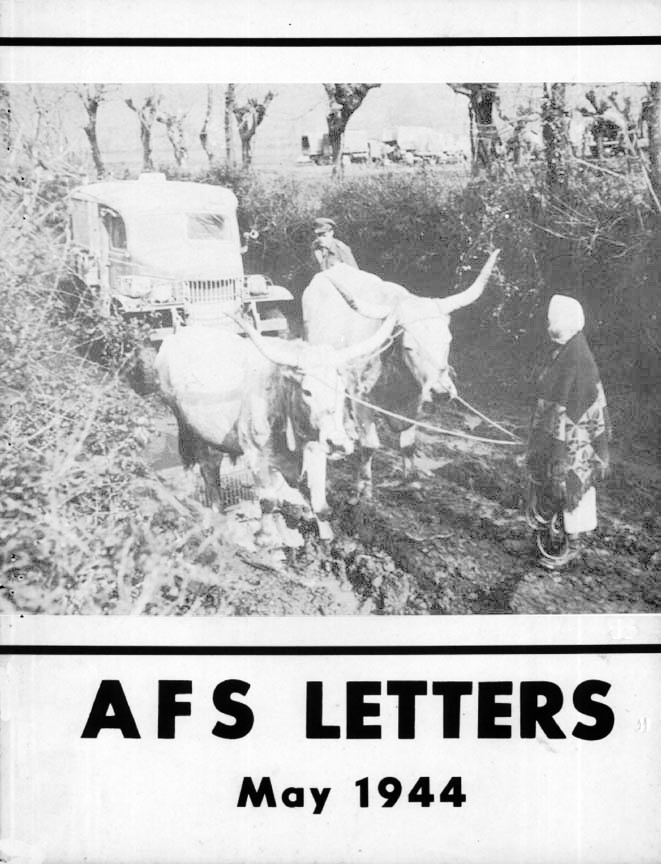
Edited and published at AFS Headquarters 60 Beaver Street, New York 4, N.Y. under the sponsorship of the ambulanciers' relatives and friends who contribute the excerpts from the letters.
* * *
AFS fronts in Italy and North Africa were covered by the Director General Stephen Galatti during the month of April when he made an extensive tour of inspection. After spending Easter in London; he went to Naples where AFS HQ is stationed. From there he visited all the posts where volunteers were serving with their ambulances. He reports that trip below.
"The AFS Editor has asked me to report on my visit to the Italian front. I am happy to do so because, everywhere I went I heard praise of the American Field Service men.
"In London when I saw General Sir Archibald Hood, Surgeon General of the British Armies, he greeted me with this: 'Your chaps are the ones who always want to be where things are hottest.' When at Mediterranean Headquarters I met General Hartgill, British Surgeon General in that area, who told me 'We can use just as many of your volunteers as you can possibly send.' In Italy the Medical Officers at the posts all along the line told me that they wanted AFS serving with them.
"It is difficult to crowd into this space all the impressions I got of our work, scattered as it is over the whole Italian front. What really stands out clearly is that AFS, men and ambulances, is everywhere. The work is pretty much the same in all sectors; variations are mainly in the territory. In the mountains around Cassino many of the runs from the advanced posts to the hospitals are long and tortuous. Runs from the valley posts are shorter and easier . When I was there action was slower than it had been and many of our men were resting, getting their cars overhauled and getting impatient for more action.
"The worst feature of the war in Italy compared to that in the desert is impossibility of escaping the military. AFS men are well taken care of, American as well as British commissaries are open to them. They get the best possible care in the hospitals where they are known to the doctors; and they are often housed in abandoned civilian dwellings where they have heat and water (scarce commodities in the desert); but there is no civilian or homelike place in which they can relax or escape the war in any way, whereas in the Middle East; short leaves were possible in Cairo, Damascus, etc.
"I saw practically every one of the AFS men in the field. They are well, they are happy, they are appreciated and well taken care of. There is little they need that they cannot obtain. The one thing all the men ask for and want badly is books, good books and in almost any quantity, they are very scarce over there. (Books sent to the N.Y. AFS office will be taken overseas by future contingents). AFS men would also like portable radios as there are plenty of available programs on the air, but no means of hearing then while out at the dressing posts.
"It was grand to see the AFS men at work, successfully carrying on their chosen jobs and to have proven to me their really great worth to the Allied Armies. I want to assure the readers that the job is being done, a tough, hard one --- and that the AFS has the respect of all."
| Thomas S. Esten | George O. Tichenor |
| Stanley B. Kulak | William K. McLarty |
| John F. Watson | Randolph C. Eaton |
| John N. Denison; Jr. | August A. Rubel |
| Richard S. Stockton Jr. | Curtis C. Rodgers |
| Caleb Milne, IV | Vernon W. Preble |
| Charles T. Andrews, Jr. | Arthur P. Foster |
| Charles K. Adams; Jr, | Henry Lerner |
| Alexander Randall, Jr. | George Brannan |
GEORGE BRANNAN was killed on the Assam-Burma Front during the latter part of April. With two companions, Frank Dignam and Mitchell Smith, he was flying in an unarmed and unescorted plane which was attacked by Jap Zeros whose fire seriously wounded Brennan in the throat. The men were being ferried to their destination by plane, which is the only means of, transportation between the rear and isolated forward positions where the AFS is at work. Brannen was landed at the nearest British Hospital where a delicate throat operation was performed. For a while he gained ground and it was hoped he would recover, but a fortnight later, he died of a cerebral embolism. His memory and devotion to duty will always be honored by those who knew him as an example of what la finest in courage and self-sacrifice.
Frank A. Dignes suffered slight leg wounds during the same action. He has since recovered.
Lawrence Toms was slightly wounded by shrapnel in the left leg and left arm. Toms is serving on the Italian Front.
February 5, 1944.
"I have had enough experience to till a dozen letters, most of it unfortunately censorable.
"A few others and myself were in the first group of ambulances to make an assault landing in the history of the Field Service. We've been quite busy ever since,) been working at an R.A.P. which is the farthest for- ward of the British Army medical units. The casualties are carried to us by hand or by jeep and we relay them to the Main or Advanced Dressing stations.
"This in itself would be quite simple, but for the past several days I haven't made a single trip without stopping several times along the road to pick up more wounded. It's astonishing how many you can pack into a car when you really have to. "This morning I was carrying three shock cases back from the front; when we'd gone a couple of miles, they started to calm down a bit. Just as I was telling them in my cheeriest voice that we were out of danger and everything was O.K., a shell landed right in the middle of the road about fifty yards in front of the car, in the midst of a bunch of Tommies and Yanks who were coming up the other way. By the time we'd sorted out the ones who were still living and loaded them in the car it was a bit hard to know what to say to the three shell-shocked boys whose confidence in the validity of my last statement was a bit shaken. Not bad travelling in daylight, when you can see where you're going, but at night you're on edge all the time for fear of running into one of the numerous holes left by the German 'eighty-eights'. They don't do the car any particular harm, but the slightest rut or bump is agony for a badly wounded man. Every morning when we go out we have to make an accurate mental picture of the position of the new holes so that we'll know how to navigate, at night.
"The British ambulance orderly who is riding with me currently is really a gem. He's six feet tall and weighs 93 pounds and is as rural as a Sears-Roebuck catalogue. For some very complicated reason, which he explains to me in dialect about seven times a day, he's a vegetarian and thus is completely forlorn in this army where 'bully-beef' reigns supreme. In the waiting room of the A.M. station he picked up a tattered old Italian seed catalogue; and now he just site all day thumbing through the catalogue, gazing in rapt admiration at the colored illustrations of huge green cabbages and incredibly leafy Brussel sprouts muttering moodily to himself about Army rations. Says after the war he's going to settle down in somebody's back yard with a rake, a hoe, and a packet of seeds.
"For the past couple of weeks we've had the unexpected good fortune of receiving American army field rations which are remarkably good."
February 6, 1944.
"Things were a bit thick last night. The shelling started just before dark and continued throughout the night; what with our own guns and the rather noisy German barrage. I don't think there are five consecutive seconds of complete quiet.
"We're in a comparatively safe position here, to the security of which I have added by digging a very deep and very cozy slit trench, within jumping distance of the car door. Speaking of precautionary measures, I've picked up an American helmet, which feels positively huge after the British tin-hat I've been wearing.
"I had a number of runs to the MDS during the night. Ironically enough the only casualty who survived the ride was a German who was carried to the car by four of his comrades. One of them, a short, very young fellow with huge, horn-rimmed glasses spoke very good English. For some reason he was vastly delighted to discover that I was American. He gave me his field cap and cap badge and thanked me profusely when I gave him some cigarettes in return.
"The civilians hereabout are really in a sad state. Although there is no place for them to go, you see them tramping along the roads with all their belongings day after day. Most of their homes have been destroyed; and of course many of them have been injured. I carry some of them to the dressing station from time to time.
"I'll drop you a line from the Vatican soon."
February, 1944.
"Exhausted! But must get off just a line. Perhaps it would be easiest to simply copy off notations made on my reference pad ,..many omissions obviously necessary.
"1st. day....moved to-------ADS forward near-------. Roads under shell fire, and through most devastated area so far. May be exciting. M.O. seems fine chap.
"2nd. day....Evacuated all day, learning to time shells on this stretch. Surprising regularity. One run tonight with serious cases. It was hell (needless to remark). Mad assignment (which I can't explain to you now).
"3rd. day. ...Battle for ------- Objective not taken. Great number of casualties. Constant duty since 3 AM and runs tonight if shelling lets up. Roads a bit perilous today but ambulance not bothered if unaccompanied by other vehicles (which is too much to ask). Fascinating work! Ah! War!!
P.S. That sounds melodramatic. It is quite routine and nothing we haven't done often in the past. It isn't fun, but there is much that is worse.... canned beef, for instance."
January, 1944.
"Have moved again for the remainder of our rest period to a small village which has miraculously been spared any damage whatsoever. There is running water; electricity and window panes galore ---things which we have seldom encountered in all the months we have been here in Italy.
"I was fortunate in striking a bargain with a middle class Italian family wherein I got their dining room in exchange for occasional gifts of food and the like. So here I am sitting in their dining room painted in baby blue with a large Italian Victorian era chandelier in the center and gold framed pictures of stern and very Italian looking relatives staring down at me from the four walls. There is a large dining room table, and iron bed with spring mattress and scenes of half-nude ladies being pursued by centaurs through the woods on the head and foot pieces of the bed. Also a rather dilapidated but comfortable easy chair with knotted fringes hanging from the arm rests, legs and around the bottom. The signor and signora are both crazy about Americans having innumerable relatives in Brooklyn, Rochester, the Bronx and elsewhere in the States. They wait on me hand and foot bringing hot water in the morning, coal for the brazier, and dashing around getting me wine cheese; chickens, eggs and of course macaroni for the dinner parties I give almost every night.
"My setup is all very nice but one AFS man is living at the Marquesa de Something's plush Victorian mansion. You should see his room. The walls lined with red and gold velvety the ceiling is covered with angels cupids, and other exotic and ethereal creatures. The furniture suits this splendid decor. With the Marquesa, who is centuries old and looks twice her ago there are a whole host of barons, baronesses; counts, countesses, etc. who form the nucleus of her family, First thing impressed upon you when you meet this bewildering host of nobility is that they are not used to living in such squalor and can't wait to return to their Naples palacio. They are the sorriest bunch of people I've ever seen You can't tell them apart from their servants in mode of dress, manners, or otherwise,"
No date.
"Here's the low down on a 250 mile trip in an AFS convoy in Italy. Four days before we left we had a grand meeting of the platoon. Big-wigs from HQ were on the spot to break the news: we had a long trip ahead of us. It was secretive beyond measure. Cars had to be spruced up as never before to lend prestige to the triumphant march of the AFS ---at least some seventy odd cars. What awaited us at the end only the generals as yet knew... Macaroni dinners and 'vino' debauches redoubled in intensity before the obvious 'horrors' of three days in convoy.
"A couple of days after the eventful news, another meeting; departure at 6.30 the next morning. A farewell macaroni dinner and wine splurge and then to bed at a none too early hour. The ghastly preparations the next morning in pitch darkness and drizzling rain after a breakfast of tea, uneatable porridge and cold soy link sausages.
"Ten miles to be covered in every hour; each car fifty feet apart. A few miles down the road we picked up an accompanying section of workshops and still another platoon.
"On and on we crawled through the rain while the platoon sergeant and another man patrolled the convoy to see that everything was O.K. We stopped fifteen minutes for a lunch of bully and a slice of cheese.
"We kept going all the afternoon, stopping every hour and a half for a few minutes breathing spell, till finally at 4:30 we filed into a field by the side of the road and leagured for the night.
"Next morning someone opened the door at five and shook me awake and we pushed off at 5:30. Two men who are in the same car hit upon the scheme of staying in bed while one of then drove and then changing over the next day. One stayed in bed that morning till 12 and trotted out all smiles at one of the stops. I could have killed him on the spot.
"We took the wrong road and wandered all over the place in a driving snow storm over tortuous mountain roads where everybody slipped and got stuck. The poor fellows on the motor-bicycles almost froze to death and finally loaded their machines into an ambulance and sought haven from the cold in the heated car. We then proceeded to get stuck in the most awful traffic jam where everybody lost the car ahead of him and God knows why we didn't get completely lost. We finally parked by the roadside at 8:30.
"Someone dragged out a half a bottle of rum with which we made daiquiris by adding lemon powder and water.
"At four some hardy soul woke me up and I crawled out of bed. The car wouldn't go so I had to throw my trench coat on, put on my shoes and try to. fix it. Didn't have a flashlight and no match would brave the glacial wind. It was pitch dark and as I couldn't see a damn thing inside the motor. I gave it up as a bad job. At last when everybody else had gone; work shops came along and only after a good hour got the car going. Then I tore madly after the convoy. I followed directions implicitly as to how to get to our final resting place but took the wrong road and ended up God knows where. I finally arrived at 1:30 absolutely starved and furious at everything and everybody."
February 15, 1944.
"One place we work forward to, is about the nicest spot I've seen in Italy. I guess it appeals to me because I found a box-wood hedge and a nice old garden pretty well intact. There weren't any flowers but the grass and hedge were green. It is a nice change from rubble; ruins and smelly barnyards. In many ways it seemed like home. I'd almost forgotten that such places existed. The whole front tends to be a little depressing at times.
"I'm continuing in good health but getting a little tired of eating duff, meat duff, and fruit duff, and just plain duff. At times I'd welcome plaster of Paris. Anyway, it's an improvement over bully, and biscuits. We get quite a bit of chocolate issued to us now which is a nice change.
"I've accumulated quite a lot of junk lately, one of the most interesting being a German bayonet with a plastic handle. They seem to use quite a lot of it in telephones, pistol grips, etc. The British have a plastic hand grenade.
"Yesterday the great news of the landing south of Rome came through. That should certainly speed up the tempo of the war in this theatre. No one can be blamed for the slowness of the pace here for it is truly a war of ' the poor, bloody infantry'. It seems logical that everything should go faster when they get out into open country."
January 14, 1944.
"Today I got a brand new 1943 model Dodge ambulance. The comparison between the old one and this is beyond belief. The heater in this works like a blast furnace, which is going to be a great luxury, for tomorrow I'm going back into the hills and it is really cold....Our whiskey ration is now about 1/3 bottle a month, but troops at the front sometimes get a rum ration when the weather is really bad. On the night of Jan. 1 after a terrible storm I drove the rum ration around and got slightly better than a double ration as a reward. That I believe: is the best job I've done yet and I've done quite a few, from burying to pouring tea on hospital trains."
February 1, 1944.
"This war like all others has its fancy names for nondescript places and on our front we have our share. Not far from here; for instance is a crossroads called 'Hellsfire Corner' which used to live up to its name; but on occasional lambasting is deemed necessary by the Jerries now. Another quaint name is 'Mad Mile'; it is about a mile of road on a ridge pretty constantly under enemy fire and has some nasty curves. It behooves the cars passing over it to step on the gas and good; some joker has placed some signs like 'No Loitering' and 'Don't Park'.
"You swear that you won't worry about the boys of your section and then you find yourself sitting up half the night waiting for one of them to show up from a run then you get mad as hell when some brat walks and blithely explains that he just stopped off for a snort or two of 'vino' on the way. Then you say to yourself, 'Never Again' but it happens again and there you are waiting, waiting! Most of the lads in my section were about 19 to 21 years old and that only made it worse; they are fire-eaters, at least until a shell lands near enough to calm them down a bit. I've had plenty of action since my transfer to this front and a couple of close ones and I am happy that I just have little me to look out for.
"Although the campaign in Africa was more spectacular, this Italian job is going down as one of the toughest in history. The Germans are tough and clever and still think they can win this war. However, I don't see how they can last out this summer. These British lads are tough and good fighters and they're damn sick of war after four years so give them a little dry weather and rolling start and watch the sparks fly."
December 28, 1943.
"It is not difficult here to keep a sense of perspective regarding Jerry. I wish I could get across to you how little embittered hatred there is. Sometimes a soldier speaks of this how much we are all levelled by battling the elements, and that feeling Marquand expressed by the phrase 'So Little Time'. The unknown time element produces a sobriety; a seeming desire to be at peace internally with oneself. You see, I know about it; and at home, from what I can make out patriotism and helping the 'war effort' are confusingly made similar with a state of 'sober yet frantic frenzy'. Not only is it confusing, but tragic."
January 17, 1944.
"Heard an amusing story yesterday: a tired looking lad in civilian dress, was accosted in a stuffy way by a very dignified matron. Once more he was asked: 'Young man, why aren't you in the armed forces?' reply this time was, 'Madam, for the same reason you are not in the Follies, physically unfit." The orderlies over here act off and on in the war's most gruelling jobs; front line stretcher-bearing, and they lose more than the infantry. It is hard and tough. I had to do it once and it is not fun.
"Walking around any of these towns on side streets is very arduous; dubious matter is flung from unseen people out of the windows at frequent interval. It shakes you somewhat to hear a great splash just behind you. As with most things I've been unusually lucky but have my fingers crossed.
"No change at the moment. Am more or less dazed at the monumental victories in Russia at such a ghastly cost to humanity. Ernie Pyle certainly has a following here. Sometimes his column even appears in the Eighth Army News. Had an egg yesterday and ate it raw before there was any danger of dropping it!"
February 5, 1944.
"If only the Germans knew all the news the war might soon end. Prisoners in all seriousness think that New York is bombed constantly and that Great Britain is starving. You could go on sighting instances from the prisoners and our own escaped prisoners loosed by the Italians who have escaped through Jerry's lines at the time of the armistice.
"Yesterday I spent with a Mauri, an Italian, a Ghurka, a Hindu, the ever present British and an American Air Force youth from the Bronx. A broad life isn't lived objectively, but you slip into it. I mean broad in the sense of knowing many people and places.
"This Morning I had a bath at 7 A.M. in a small wine vat of hot water. It doesn't sound so but it was very clean and the landlord of an old damaged inn where we were quartered was so glad to see his first Americano. He said I was the first to ever enter the place and on the strength of that his wife gave me a fine, large, clean towel and that relieved me of the problem of my wet one."
February 21, 1944.
"We do seen to be appreciated these days. Yesterday a full Lt. General, British, clapped me smartly on the shoulder blades and said to his guest, an American Colonel, 'This is one of the Aumerricaans (pronounced so) we know and work with and who seen to talk our language' and then waxed off on an embarrassing song and dance, while I tried to look modest and paid for a round of vermouth at 6¢ per glass. It appears he'd been with us for two days 'up there'."
March 3, 1944.
"No ---certainly not lice!-- Mon Dieu! As a matter of fact very few soldiers get them. This is such a mobile; mechanical war, and there are few chances taken among troops or whole units re that. It was worse I'm sure in the last war but the mud was probably just about comparable!"
March 6, 1944.
"Met a wonderful self-sufficient Italian today who was lucky enough to have preserved his house and goods. He makes and supplies all his own food, wine, soap and tobacco. With his horse and few fields, cultivated to every available inch, he is a little unit in himself. I have never seen people such as in Italian country, folks who can produce so much from so little and economically. Nothing is wasted and the food is always delicious. Every coal, every twig, is burnt to produce the most heat.
"It is no cause for cheer these days to see for the first time what Fascism has done to youth. It may well be a minor edition of what will have to be faced in Germany after it's over. Thousands of boys aged 14 to 20 with no trade, no sensitive feelings, no self-control for they no longer wear a uniform and obey, no interests other than bellowing about the streets--- lost --- utterly lost. But they must be found and helped. It is most difficult to avoid a hard exterior, to swallow an unconstructive complete dislike, for we must not permit it in ourselves. I've seen it in the quieter, more fanatic way in young Germans, and the reverse in older ones who say, in effect, 'What's the use'."
December 18, 1943.
"I've been doing something lately which will probably interest you. I've watched, and even helped a little with some operations here. A friend of mine asked the chief surgeon if we could watch some and he said, 'Yes, if you help'! Our 'help' consisted mostly in getting under foot but it was very interesting and instructive. Of course it was a little gory at first but I got used to it and quite surprised myself by not going weak in the knees or anything foolish like that. We watched him remove pieces of shrapnel from backs and shoulders, set an arm which had been shattered by a bullet, cut open a stomach and sew up boles which a bullet had made, and amputate a foot. In the last I was the star performer --- he made me hold the foot during the process! I came thru the operation in excellent condition and made a quick recovery."
December 5, 1943.
"Another fellow and I took quite a long walk yesterday through the surrounding hills to look in some German dugouts which were recently evacuated. We stopped in a house and talked to some Italians there for quite a while, with our few Italian words plus a little sign language. They had had some Germans staying there, and when we broke through the line, they (the Germans) had to run out without their shirts or pants on. The war has left some horrible sights. too. One house we saw had about eight dead Italians in it some with heads and arms off, all still lying around the house. Also; there were two old ladies still alive and unhurt living in the house. As you can imagine they were almost completely out of their minds. Almost every Italian family has one or two dead as well as most of their possessions stolen or their homes blown up.
"Yesterday I saw twenty-four of our bombers coming back from a raid; and we were close enough to the German lines to see their ack-ack shooting at our planes. Hundreds of puffs of smoke hit in and around the formation, but not a plane was hit. Some of the shells looked like they almost went through the planes. It was really pretty."
December 22, 1943.
"I am at one of the strangest posts I've been all year; although surprisingly safe. I am in a town occupied by our infantry, while the Germans are on a mountain which rises straight up above the town. They can just look down on top of the town, consequently we cannot move out of our rooms during daylight --- only after dark. Any evacuations of sick or wounded have to be done at night without lights of any sort. Usually there is a heavy mist too, so I have to drive in low gear. We are so close to the Germans that we aren't even supposed to make any loud noises at night. All this makes for suspense; but actually not a shot has been fired since I've been here; except for two or three shells and you would think you were miles away from the lines."
December 4, 1943.
"A while back, I was stationed in a small, Italian mountain village. I was placed there to help in evacuating the wounded civilians who were fleeing from the Germans. Fortunately, I wasn't too busy. I did have one job, the Captain there in the town asked me to bring a woman who was the wife of the Carbemarie (I think that is how you spell it) to à civil hospital. I said I would. It seems the woman gave birth to a child who died. She was in a serious condition. I went into the house with the idea of carrying her out on a stretcher. She wanted to walk to the ambulance and mind you this was one day after she gave birth to the baby. Well, walk she did. I brought her to the hospital and there she is, though I think in a bad way. Her husband was so grateful; he invited me in to stay in the house with him. Well, of course, I couldn't quite refuse. It is not every day you get a chance to sleep in a bed with clean sheets and a soft feather mattress. The last time I did was sometime in June. He also brought me over to his relatives. They also gave me a warm welcome."
January 8, 1944.
"Being able to laugh is a great thing. It would be a tough war if we couldn't. I think it was your father who said that war is pretty funny except when you're awfully scared and you're not awfully scared very often. Well 1 find that the more you laugh the less you get scared."
December 3, 1943.
"It is at times like this that you begin to appreciate what an ideal spot Africa was for a fight--- clear, never any rain, always hot in the middle of the day --- out here the poor guys in the infantry have to stick it out in the dirtiest weather with only their one blanket --- and that ain't no picnic, for besides being wet most of the time, it gets plenty cold at night.
"I have been exceedingly lucky in having had a chance to serve with both the 5th and 8th Armies. Old 'Monty' is a pretty colorful character and one day while driving by in his open car he stopped and spoke to us and dished out some cigarettes. Have also seen General Clark---very tall, looks quite young. He drives around in his 'jeep' and also often stops to chat with 'the guys'. The King himself (Emmanuel) sports around occasionally; he's a funny-looking little old geezer, but apparently still fairly popular with the people.
"A good deal of this country- looks like parts of Lancaster County (northern and southern ends) and there should be game about. However, haven't seen any yet. There's a lot of shootin', but it's another kind of shooting: the wrong kind. War is a perfectly ridiculous business and don't let any-one tell you differently. Its an indication of our own weaknesses and I hope will be outlawed completely some day. But I'm a bit pessimistic as to how soon this will be."
January 15, 1944.
"One evening I had a quick supper at a priests house in one of the most backward of mediaeval Italian villages. His house and life were exactly as I imagine they would have been if this were the 10th century. His servants even wore mediaeval costumes, and, when I left, one of them preceded me through the winding streets, bearing a Middle Age lantern. It was a fascinating experience. A town near this one still has an old castle complete with a drawbridge that works. The remarkable thing is that this castle is still used by heirs of its builder, with practically no modern improvements except window panes and no maintenance of the crumbling walls.
"Since the time I mentioned in my last letter, I have been well away from the actual combat and I think I shall continue back here. I sure hope so, for that week with attacking infantry will haunt me for a lifetime. It was supposed that Jerry was fighting only rear guard action when they sent the infantry regiment I was with 'into the line'. Hence we were by no means prepared for the terrific resistance that we met. We of course had several casualties, and these we had to evacuate along a road which Jerry could see perfectly; and was continually shelling. Believe me, it was rather disconcerting. o make things worse in the confusion of battle, we were not certain where the enemy was; and once I found myself, in daylight on an open road heading right for Jerry lines; being shot at point blank. Thank goodness they must have seen the Red Cross, for I was able to turn around with no further trouble. Later, the same day, too far from Jerry for them to easily see the Red Cross, they tried to hit the car just after I had stopped to leave some stretchers and blankets with some stretcher-bearers. Although this shell landed only twenty yards away a bank kept the shell fragments from coming our way. All we got was dirt and a good puff of wind. We spent a rather nervous fifteen minutes expecting another shell, but none came, perhaps again they saw the red cross. Other rather exciting moments were those when I was marching forward with the infantry to see where they would be when they made contact with the enemy. It was my job to select a spot as close to the regiment as possible for our 'car post'. Lots of shells were whistling over our heads, but we could neither hear them land, nor hear the guns. Other than the whistling shells, everything was deathly still, as we worked our way toward the enemy. It was truly spooky --- the proverbial calm before the storm. The storm finally came with its resulting runs over the shell strewn road. I would have given a thousand dollars to be in Pelham that night. A chance to sit in a nice safe slit trench would have been worth five hundred dollars, even though slit trenches never feel safe when shells are dropping near by. As a matter of fact; one of the main causes of casualties seems to be that men always think the slit trench twenty yards away is deeper and they get hit as they are changing cover. The poor old 'Medics' never seen to have a chance to take cover so this seldom happens to them.
"During these days of the battle; we of course handled quite a few Jerry wounded and we were helped n this by a German medical man. He was extremely capable and co-operative ---- so much so in tact that the whole staff regretted seeing him leave for the Prisoner of War Cage. The feeling of mutual respect so evident between the two medical sections seemed to run even through our soldiers and the regular prisoners in a slightly less degree. It's too bad that people who do not hate each other go around killing each other."
January 6, 1944.
"R. is posted with me. We were sent out Tuesday P.M. and we should have reported before mid-night. But as luck would have it we got started up the wrong mountain. We were completely lost. We drove and drove and drove --- up hill and down. Gosh; for all we knew we could have been behind enemy lines. Anyway we were neither straffed or shot at. Our gas finally gave out. And we found out to our surprise we were about 100 miles off the beam. That night we worried ourselves to sleep. The next day R, using our spare tins of petrol --- went in search of gas. I stayed behind. An old Italian invited me into his house for dinner. He must have seen how hungry I looked. What a time we had! They could not understand me or I them. But I've been overseas too long not to be able to make anybody understand I want food. The house was stone --- all the heat came from the kitchen. Bread, cheese, wine and sausage was served to me. My Yank candy, gum, and cigarettes made a tremendous hit. Even though we couldn't carry on a conversation, I did catch quite a few words that came from Latin. I often wondered what good Latin would ever do me. Now at last; I've found a use. R. came back about 3:00 that afternoon with gas. So off we drove, up the right mountain this time.
"The Italian girls are darling. Such good lookers too and very friendly. I have a hard time remembering the 'girl' I left behind."
December 19, 1943.
"We went for a long walk this afternoon, three of us winding along roads then cutting off into mule tracks and finally just clumping through the fields with tons of mud clinging to our boots. Finally we sighted the village we were walking toward. In that particular village there is a broad flat square in front of the church, up one side of the square a ramp leads to the foot of the church which is fairly high above, -- two rows of carefully trimmed trees bordered this ramp... it was a wonderful afternoon, clear and marvelous for color... the sun played on the yellow front of the church, spilling into the square where literally hundreds of children shouted for joy. We could hear them from way across the valley as we wound down through the fields',' crossing through a small wood, copper leaves glinting in the sun, everything individual and detached and bright in the sunlight. We crossed down through the woods again past a peasant cutting wood: then suddenly there was that small of freshly split green hickory...funny how smells carry almost more memories in their wake than any other sense, then, beyond, the green plain and the gray-stone, mossy farmhouse with its tile roof; infinitely colored beyond that the deeper green of the field below, rocks and the stream, and finally, the village high on the opposite slope with the sun shining in its streets, the people no longer frightened now but acting as though there still could be joy around and bright Sunday afternoons. Then beyond that the half-green hills, half blue, beyond them the purple far hills and in the far distance a tawny snow-covered mountain...We crossed the stream-bed toward the town... our arrival was the occasion for the gathering of all the town's children, who knew us from our stay there some time ago, and who had all apparently at one time or another begged chocolate or gum from us....We must have looked for all the world like the pied-piper of Hamlin's show... then breaking through the children, I found here and there other friends in the village and proceeded to knock myself out in my usual miserable Italian. After talking for a while and visiting this one's house and that one's house we finally tore ourselves away....and strolled back along the road.
"All in all it was a wonderful afternoon's hike. Happy? we owned the world...there are I must admit very few days when I don't own at least one small little plot...but it's wonderful just poking around through the air for an afternoon."
January 23, 1944.
"The people here are more like the northern Italians, quite a few blonds and less 'woggy' than the cities and villages I've seen in the South. Sanitation is pretty generally terrible. Life in the AFS is going on as usual. We are all. getting a little fed up. While we were in the Desert there was always the element of novelty. But now the slow; stupid business of killing and being killed is beginning to pall. A lot of the troops now here were not with the old 8th. There's a decided increase in red-tape and formality. For example, the officers have taken over one of the Hotels --- meals are good and there is an orchestra and a couple of the local 'Belles' sing."
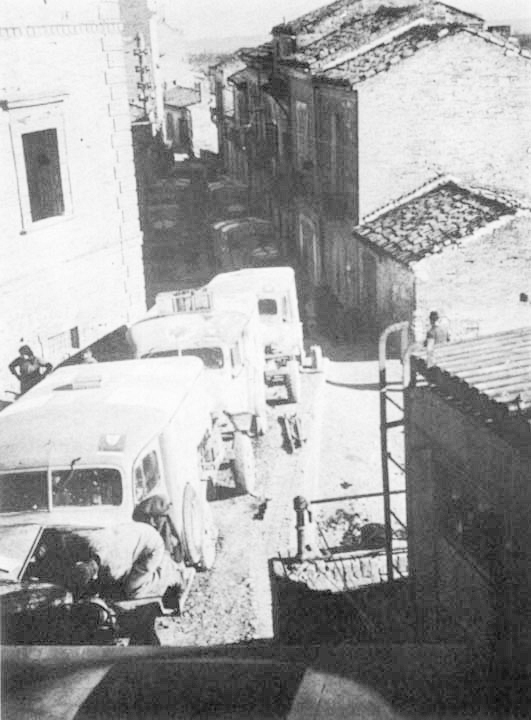
|
An AFS ambulance car pool in an Italian town behind the Eighth Army lines. Eighth Army crosses on the cars are replicas of these worn by AFS volunteers who have served with this Army. Photo by A.T. Brown |
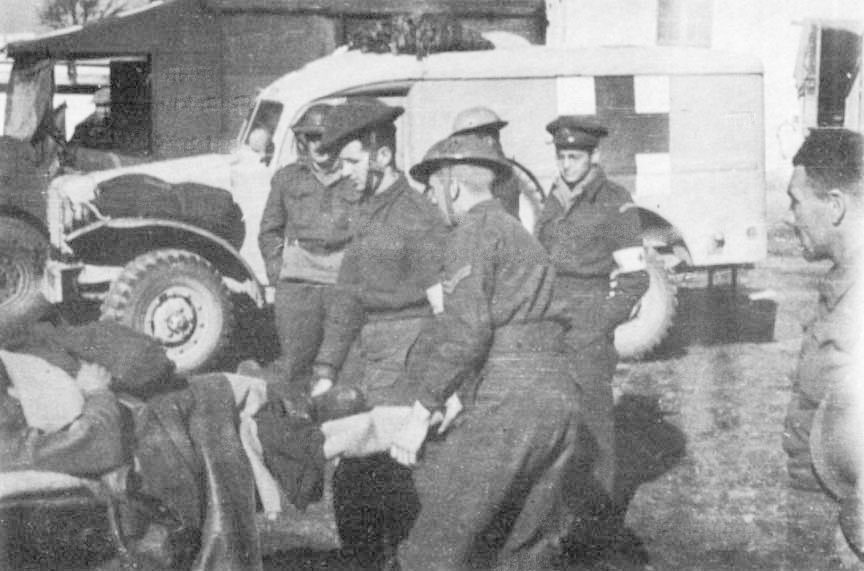 Donald Titus (with Red Cross brassard and AFS cap) watches the unloading of a Fifth Army casualty which he has driven safely from infantry lines through intense artillery fire near Anzio. The AFS volunteer was a member of the original beachhead landing group. Photo by Douglas Moore |
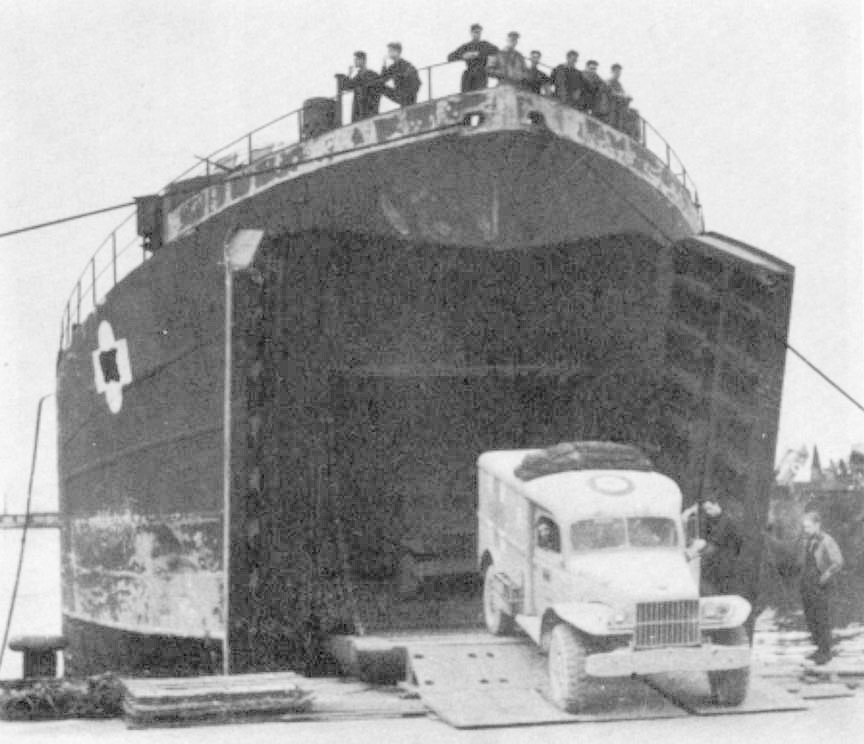 An AFS ambulance rolls past the huge steel doors of an LST to begin active duty on the Anzio-Nettuno beachhead. Photo by L.B. Cuddy, Jr. |
December 25, 1943.
"There is hardly a ten second interval in any part of the day that we cannot hear see, and feel the sending and receiving of shells. Two or three nights ago, for example, a hundred and eighty pound 'Christmas Package' landed exactly ten yards (measured by yours truly) from where I was sleeping. Had it been in an open field, I might have had some shrapnel land near me, but nothing exciting happened."
January 4, 1944.
"We were just about to get on the main road when ---wham!--- quite a noise exploded right near us. Taken completely by surprise, we didn't know whether we heard our guns going off or the shells of the enemy landing. By the time the second shell landed, we had evacuated the ambulance and had taken shelter along side of a stone wall. It all happened like a flash of lightning. The darn shells were literally landing all around us with the air full of flying shrapnel. This was one time in my life when I didn't know whether my heart was in my head, feet, or ten miles away. Well, it was close to getting dark, and we wanted to be back before the sunset, so we thought we would take a chance and risk it. We had no sooner climbed back into the ambulance when a soldier came running up to us, and said that just around the corner a dozen or more men were lying in the road and 'for God's sake do something'. We had no blankets or stretchers, and the inside of the ambulance was still wet with fumigation, but there was nothing left to do but take a look. It was obvious that the men needed immediate assistance (two had died already), so I ran up to a house near by, and practically grabbed a stretcher from under someone who was resting, while my orderly attended to some bandaging. To make a long story short, we crowded in as many as we could and raced back to the MDS like nobody's business. It was really a terrible sight. Two more of the men died that night; another with his left hand blown away, his head practically severed from his neck, died almost immediately. Blood was all over the place. It took us all of the following morning to clean out the back of the ambulance. It was one of those experiences you would like to forget, but can't. There is a lot more to tell but no time."
November 13, 1943.
"Much as I'd like to go my score at these Eyties, I can't help liking some, and it helps even the score I have with others, when such as our hosts are so good to us --- fair tinkum. My Eyetie isn't so hot, but with a mixture of French and Eyetie I get on O.K.
"All this sitting around is damned dull, and all the jokers in the platoon, (ours hasn't done anything yet) are browned off, but there's a rumor we're going to relieve another mob soon and may see some iggery.
"When you read that rain and mud is slowing us down it means rain and mud. There is more gumbo in this country than anywhere I have seen yet. I was riding a motor-cycle in it for awhile, and some job it was. Jerry is damned good at busting up bridges etc., and thank God our R.E.s are just as good at putting them up under fire!
"Don't pay any attention to what others write home and ask for or say they like, everyone wants something different. Since I am section Sgt. and have no wagon I can carry less, and anything I need, I can get; and much that I want. I have got a good Army (British) stomach now, and a biscuit, some bully and a cup of tea is a ten course dinner, and I reckon most jokers are the same. The war's O.K. and the army gives us enough to get along on plus the backshee we can scrounge or get in the canteen. Of course I am not saying I couldn't use a carton of Camels, a bottle of Rye, and a steak dinner, but it will keep. One has to be R. Catholic to do any good with the Sheilers in this country, that is with the ones that count. There are not many of them either as Jerry takes horses, mules, livestock, wagons, food, wine, furniture, clothes, money, men and girls with him as he goes. He is a pretty smart doer is old Jerry. 'Time' is coming over, thanks loads. There's none knows less about the war than the jokers in it and it is swell-to have some news."
December 26, 1943.
"When you read in the papers that some front is a sea of mud, it means just that. Miles and miles of trucks stuck off the road etc. The poor infantry live in, eat, and sleep in it. When they take to a hay stack, straw pile, etc. they get fleas and lice which get infected in this dirt. They can't even light a fire at the front day or night, and sometime go for two days on a chocolate (concentrated) bar, because of supplies being unable to move up. Every hill (and this country is all hills) is fought bitterly for, every bridge and every road mined. The tanks can't operate except as support for Infantry, and it is a yard by yard war. My new job enlarges y scope of operations and should be damned interesting."
February 19, 1944.
"After three :strenuous nights finally got to bed about four A.M. and slept most of the morning, so I'm caught up again. Last night was most interesting. We were with a Commando regiment, and the officer in charge, just about dusk, took me in his jeep all the way up to show me where the advanced first aid posts were in case our ambulance had to work that far forward. Then we hiked about 200 yards up a hill and he pointed out all the German positions. Through the glasses they looked about one city block, but actually it was much further. Then he explained exactly the action that was to take place, the timing of it and so forth. He told me that after the men went in if they needed more artillery support and could not get through to the guns on the portable wireless they were to fire a green Veri light as a signal for the guns to get going. Well, it so happened in the course of the action that our troops wanted more artillery and couldn't get through on the wireless; so up went the Veri light. By one of those 'believe it or not' jobs the Germans were also out and had the same arrangement with their own artillery. Well, when the green light went up our guns started, the German guns started and you never heard such a hell of a racket in your life. All in all it was a real exciting evening.
"The roads we are using now are under direct observation and we only use them in the daytime in cases of emergency. It has been proved that a lone ambulance going along the road is reasonably safe, but you may get caught up in a convoy of jeeps or ammunition trucks which are legitimate targets. In that case the ambulance has to take it along with the rest.
"Just found out from one of the Commando officers that there were German patrols all around our place last night. Whoops --- what you don't know won't hurt you!"
February 22, 1944.
"Here's the way our system is supposed to work at present. There are seven cars assigned to a particular regiment or division. Two of these are posted at the forward ADS (Advanced Dressing Station) three at the rear ADS, about three miles back, and two at platoon headquarters which is right near the Main Dressing Station about seven miles back. The two forward cars are supposed to do forty-eight hours, carrying wounded from the forward ADS. The other cars work from the ADS to the MDS and two are back at H.Q. resting. This is supposed to rotate every 48 hours but it is almost impossible to stick to the schedule, because casualties have a habit of coming in in bunches so for a few days all the cars may be on the road and then there will be nothing for maybe 24 hours."
February 11, 1944.
"This action will be history long before this reaches you, and you can know that I was in the thick of it from the very beginning; and I really feel it is a job well done. We have had extravagant compliments from the commanding general both as to our courage under fire and our willingness to go anywhere at any time we're needed. I don't believe the American Field Service traditions have suffered at all by our activities here."
February 19, 1944.
"Usually it is hard to realize there is a war going on when the sun is blazing down and the cold dark night is forgotten, but just as you relax a couple of German planes will swoop down from-the sky, bombing and strafing or a salvo of 88 mm. shells will fly past or land all around you, and you awake to reality with quite a start. Most of it bothers me very little ---as a matter of fact there are German bombers overhead right this minute and the ack-ack fire from the area is deafening. Our own artillery are laying down a heavy barrage, and the guns are all around us. The noise of our own firing is really more disconcerting than the explosions of Jerry's return blast. I have had 4 weeks of constant front line work now and have been under fire every moment of the time. War is just as horrible as I imagined it would be, but even in my moments of greatest strain I have never regretted my taking the step and coming over here. We are definitely doing some useful work and I can justly say that there are many boys going home to their families who would not have gone home had it not been for the American Field Service. We have our very definite place in this particular 'do', and I think we are acquitting ourselves well enough to merit more praise than censure. We have seen more front line work than any other ambulances in the area and have had only two very minor casualties (both now working again) out of our 15 drivers.
"It has been a rough month but it la a month I wouldn't have missed for anything in the world. I never before knew what fear meant --- I mean really being physically afraid. It is quite an experience, and it makes most of the prewar worries and anxieties look pretty unimportant. It isn't the fear of death or of anything tangible --- it is just fear. Almost everyone here is afraid and it is no emotion to be ashamed of. Bravery, after all, doesn't consist of a lack of fear; but of an ability to carry on and do your job even when you're so afraid you can hardly hold the wheel of an ambulance. I've conquered it completely so far and I see no reason for my not completely conquering it in the future. There have been times when planes were dive-bombing the road I was travelling, or exploding shells were kicking the dirt and shrapnel all around me, that I have thought about a weak heart the Army rejected me for, and rather smiled about it. Things have worked out well, and I'm doing a job that gives me more real satisfaction than anything I have ever done before. I really feel I can help the boys who are hurt because I am sincerely interested in them and their troubles. The horror of the whole thing --- the blood and pain and terrible wounds --- don't affect me at all; that is, I have no feeling of repugnance just an interest in doing what I can to ease the burden. That rather surprised me because I thought I'd be squeamish at the sight of the blood and all.
"I just quit and retired to a shelter to watch some planes fighting above; and two Jerries were shot down in the set-to. They have already brought in one pilot with scratches from his landing and I imagine the other will be brought in soon, as I saw his parachute come down not more than a mile away. I've seen dozens of captured Germans, and some of them are appallingly young they don't look a day over 16. None of them seems particularly sorry to be captured except perhaps the officers who have lost face by becoming prisoners,"
March 29, 1944.
"I'm back in the relatively quiet part of Italy having a rest after seeing action on the beachhead. Thereto not much I can tell you about it except that it's all pretty grim business. Due to the limited area of the beachhead there is no place that is not within range of the enemy guns and first aid posts and hospitals simply have to take their chances and hope for the best. Everybody sleeps in underground dugouts and after a few weeks or it you begin to wonder it you are man or mole.
"The flashlight you sent me proved to be more useful on one occasion than I'd ever expected. One pitch black night I had four stretcher patients in my ambulance, one of whom was getting blood plasma continuously. I was taking them from an Advanced Dressing Station back to a Casualty Clearing Station, a drive of only about eight miles but since the road is pitted with bomb craters and all traffic is blacked out the trip takes nearly two hours. The bottle of blood plasma was suspended from the ceiling of the ambulance and my orderly was crouched beside the patient with his fingers on his pulse. After about forty-five minutes the orderly said, 'I think something's wrong; he isn't getting blood'. He fumbled around in the dark for another five minutes when I suddenly remembered my flashlight. Shielding the light with a coat we had a good look and discovered that the blood bottle was empty. Luckily we were near another Advanced Dressing Station that is off the main road in some woods. We found a sign pointing to it (again with the flashlight) and got some more blood plasma, then continued on to our destination.... ..Maybe it was some of the blood you have donated to the Red Cross...
"Our American Field Service ambulances are identical with those used by the U.S. Army, pictures of which you've probably seen. They are intended to carry either four stretcher cases or seven sitting wounded. On one memorable occasion I was evacuating wounded from a Regimental Aid Post (the most forward first aid post where there were four stretcher cases and five sitting cases all of whom had to be gotten out immediately. We were able to squeeze them all in, plus my orderly, including their kits and the ambulance pulled us all through the muddy roads safely back. The boys of Hackley can be justly proud of sponsoring such equipment by buying bonds.
"When I first arrived at the beachhead the Allied position wasn't over-strong, but now everybody there feels confident they can hurl back anything that the Jerries can throw at us. The key to the whole situation is Casino and I hope for the time we'll be in possession of that town and well on the way to Rome.
"I'm feeling fine and enjoying metropolitan life. I have been to the opera twice: -- 'Traviata' and 'Boheme'. I hope all goes well with you. The censor is in good humor today and says I can tell you about a little excursion that I had recently. Vesuvius is having the worst eruption in seventy-five years and I took the opportunity to climb the mountain and have a close look. We approached to within 25 feet of one stream of molten lava flowing down the mountainside. The lava stream was about 15 feet deep and 200 yards wide and moved 10 feet per minute, pushing down trees, walls, houses and everything in its path. The heat was so intense we couldn't stay long, so we went around to the other side of the mountain and climbed all the way to the top ---that is, to within 100 yards of the crater. On that side there was no lava but frequent explosions inside the volcano sent showers of hot rocks flying down, all sizes from pebbles to huge boulders. The sky was red from the reflection of the volcano and clouds of smoke and volcanic ash rose into the sky to a height estimated at 20,000 feet. The volcanic ash is so thick and heavy that when three or four feet of it pile up on a house, the house collapses and for this reason several villages in the vicinity of Vesuvius have had to be evacuated. It is the same thing on a smaller scale that happened to Pompeii 2000 years ago....Wish you could see it."
March 8, 1944.
"I've changed posts. Changed considerably as a matter of fact, I'm now on the Anzio beachhead, I left my former post quite suddenly and came up here on an L.S.T. I'm beginning now to get the kind of work I really wanted.
"As for danger, don't worry about that. There is shelling but it all goes over our heads and is aimed for the docks and shipping. And we have almost complete air supremacy here so that Jerry only manages to get a single bomber or two out on overcast nights. The only trouble this causes is that our own ack-ack will keep us awake half the night. No, there is no danger. It's just near enough to make life a little more exciting; that's all.
"We live in dugouts. First you dig a slit trench, cover that with planking, cover that with blankets," cover that with a foot of earth, then try to find something waterproof to put over the whole thing. Inside the wall is lined with blankets, the bedding-roll laid out on a stretcher. It makes a warm, cozy home even though it's something like an upper Pullman berth.
"At this moment the weather is fine true spring. When the sun is out and warm, the beachhead is a fine place. But for the last week it has rained every day. Then the ground turns into a sea of mud, the wind grows cold and whips thru your clothes, your dugout leaks and you are very liable to got browned off with the whole business. But right now I'm sitting outside my hole, in the sun, on an empty box of U.S. Army C. Ration, writing on à table scrounged from a shelled out building in Anzio, with a bottle of vino beside me and life seems very nice.
"This business of air supremacy is very good to have. When our bombers aren't overhead there are Spitfires darting back and forth over the enemy lines flying sorties; five or six days ago hundreds of our bombers went over (I suppose you heard about it almost while we were seeing it). After that raid Jerry had to bury his dead with bull-dozers.
"Right now everything is very quiet. Probably the lull before the storm. Things should crack open before very long.
"What has interested me most is the medical angle of the war. I'm in a very good position to see it. The surgeon is truly the unsung hero of this war. The things they can do to human bodies that have been torn and ripped by shrapnel is really amazing. I've watched them working at night in the operating theatre. They go on hour after hour, all night long, imperturbably restoring life, whether it is an amputation or the removal of a crescent shaped, razor-sharp piece of shrapnel from a man's chest or stomach Some of the patients die, but many live. We take them away from the table sucking air painfully thru a. tube or moaning softly thru their anaesthesia and layers of bandages. But many live and I'll take my hat off to the MO who makes it possible."
March 19, 1944.
"Yesterday when I was making a round of the post an A.F.S. photographer came up to me and snapped my picture with an ambulance, the number of which was A4975515. It was the ambulance which your class (1903 of Princeton University) gave to the A.FS. What a coincidence! Who but the American Field Service would be out there in the middle of it all taking a picture, presumably for the benefit of the donor of the ambulance.
"Another amusing incident happened yesterday. The ambulance was blocking the road when a jeep pulled up beside the ambulance. and a tall man, got out and asked me if he could get by. I said 'sure', and we stood there chatting while the ambulance was moved. He asked me how I liked the place; and I told him I liked it fine in the morning, but not so fine in the afternoon when Jerry puts on his matinee show. I glanced at his shoulder then and saw crossed swords and a crown --- a major-general. The other general in the jeep waved at us as he went by; thought for a moment the one I talked to was Alexander, but it could not have been. At first thought he was an infantry major; mistaking the crossed swords for crossed rifles. Anyway, there I was bare-headed and could not even salute. Generals always get a big kick out of A.F.S. men because we are so oddly dressed in. a combination of British and American and miscellaneous outfits, and we treat them like everyone else. They certainly like it, and if they see our cars anywhere, they often make a point of finding out the driver, and talking with him.
"I am glad to say the platoon is doing splendidly. As you can imagine, we have been busy lately and are in the midst of the big doings here. At present our assignment is, I believe, by far the best and most interesting of any platoon in either A.F.S. Company. The fighting is indescribably fierce and hard. The Germans have had so long to dig in, even direct bits by the artillery and by bombs do not dislodge them. In many places they are from 15 to 20 ft. under the ground, and the infantry just has to go in and get them out. This is a big show --- some of the best divisions that the British Empire has to offer are in action, and there is splendid air support. It should work out well."
March 18, 1944.
"Of course, every time I set foot into a forward area, I get the pants scared oft of me. As a welcome, when I was arriving at this lovely spot; Jerry took it into his head to let fly at the road I was driving along. They dropped (literally) all around me. One plumped down into the road fifty feet in front of me and as I was casually driving through the smoke, wondering where the shell hole was; another one whacked into the track fifty feet behind me. I call that perfect timing---the experts call it perfect timing.
"Most of the casualties which pass through here are 'mine' casualties. I'm beginning to agree that those things are the worst terrors that the war has produced. Mines are all over this area (and booby traps), and every day brings in some fellow who's wandered over the white tapes (which mark the borders of the cleared areas) and lost his foot, at least, as the consequence. Then Jerry has ways of placing mines so that they can't be detected. There was one spot on the other side of a taped area where cars and jeeps had been going for ages. This morning there was a terrific explosion. Dirt flew all over the place. Everyone was diving into slit trenches. A car had backed onto a 'teller' mine. It went right up in the air, turned around, and crashed over on its side. We were busy with the casualties all morning. It wasn't one of our ambulances, thank the Lord, but it certainly had us wondering how many more were in our car park. It's pretty safe, though, if you stay on the roads that have been repaired by the engineers; the built up roads and the hard surfaced ones.
"There's an orange orchard next to the ADS. Now you can imagine the temptation offered by a beautiful orange tree laden with juicy oranges, but we all know that the orange orchards are Jerry's favorite booby-trap sites. The other day a mule got loose from its owner and waltzed off into the grove. I guess he didn't realize the price he could very easily pay for going after the greener grass in that forbidden garden. We all stood around the tapes watching this mule wander around through the trees, and jokingly many were visualizing mule steaks for supper. Well you might have known it. He didn't blow up. He finally just walked out of there. Weeks before, a man was killed picking oranges. There was that mule, after stepping all over the place, in one whole piece. There must be some geometric progression or arithmetical reasoning behind it, but we're not going to try to find out how he ever escaped a mine, or at least a booby trap."
No date.
"There are about three ambulances assigned to each post. We have to have our ambulance checked every month and we also have to do small repairs ourselves. We can drive into any petrol or gas area and fill up our tanks as often and as much as we want. We put the petrol in and drive away without saying anything to anybody, which makes me laugh, when I think of the trouble one goes through at home. But if you were over here you could see why there is gas rationing at home. It takes the wind out of anybody's sails to see the towns and people in Italy, and I have seen a lot of them, I have driven over spots where thousands of lives were sacrificed and it strikes one that this whole affair is senseless. I know I have never realized it before.
"The other day I drove an Italian to a hospital. He was all full of shrapnel and part of his hand was gone. His whole family came along, in the back of the ambulance. His mother who was seventy was crying, saying prayers in Italian. I dropped them off at a bombed hospital and had orders not to take the family back. So I had to leave them about fifteen miles from home. By that time it was raining and had gotten dark. The kids are really taking a beating also. Most of them have no shoes at all. Their fathers' battle uniforms are their clothes. They get their daily meal by waiting for us at the garbage can and put the pieces of food we don't eat in little tin cans and take it home. The fellow I am with now knows a little Italian and we talked last night to a farmer who really went through something and what a story he had to tell. I am rapidly learning the drift of the language and get along pretty well. Most of the sergeants we are with have been in the African campaign and certainly know the effects of war. They have gotten so that nothing bothers them any more."
No date.
"I'm stopped on the road awhile until the road workers get the road opened. Just had a lot of excitement --- a jeep full of military police drove up alongside of me and demanded the papers of my patients. It turned out that one of my stretcher cases is wanted for murder. I've carried almost every kind of a case lately, but this is my first murderer! They got another ambulance and transferred him into that and placed him under four guards. The poor guy was so badly wounded he couldn't have possibly moved anyway, but that's the army for you."
December, 1943.
"Italy as I have seen it so far is a distressing place. When you walk the streets of the town you can sense a sort of dank miasma of defeatism, a complete indifference to the future. The poverty is abject and money does not mean much as there is nothing to buy. The stores just contain two or three things and the merchants are completely apathetic about whether they sell then or not. The kids stand all around the edges of the camp selling their wares and looking hungry. At mess time it really hurts you to see them standing around with their dirty rags and bare feet; looking wistful and abject. At breakfast this morning I had a slice of good white bread with margarine that I couldn't eat so I spread the bread and handed it through the wire to a little girl who just stood staring at it with tears running down her cheeks. It made me want to cry or shout or do something, because it just seams so ridiculously unnecessary. I guess the innocent bystanders are always the ones who suffer most."
January 23, 1944.
"The opera was the most fun as far as I am concerned. It was corny but the orchestra was excellent as well as some of the singers. 'Lucia' was a riot. The Tenor and the Mezzo were evidently furious with each other --- it was one mad up-stage after the other. Lucy had a large hanky and used it like train signalmen. The guy--- I forget his name ---had a sword and a hat with which he worked. He completely gave up though when 250 lbs. of Lucy appeared with hanky in one hand and ostrich fan in the other. Neither of them could sing and this made things all the worse. The sextet was a quintet--- Mama Lucia being absent (her whole part was out); nevertheless at the curtain call for appearances sake, they stuck in some little gal from the chorus who could spread a skirt with the best of them. The peanut gallery was sardined with Itys. After an aria one of them would always utter a loud 'Nyah'.
"The Italians continue to amaze me. They can't ride in a car without being ill and they never hit the gut-bucket. One of them showed some ingenuity when he found a workable system involving a urinal."
February 2, 1944.
"A great deal of the work has been on the civilians who have to be evacuated because of a fever they have. At first it was amusing getting from bed to ambulance, but now my patience is almost at end. Of all the crying, yelling, shrieking, fainting in the world, nothing can compare with the sound effects put up by an Italian family when they pull all the stops out. In the first place they are sure that papa, mama, or whoever is being evacuated will die a horrible death and suffer the tortures of the damned. To them there is little difference between the hospital and the morgue. A stretcher might as well be a marble slab, the ambulance a hearse. The doomed one is always arrayed in his Sunday-go-to-meeting best; this, however, is for the journey from the sick room to the ambulance.
Then his body is stripped of such things as shoes, hat, scarf, belt. After all, if we've got to lose papa, that doesn't mean that we got to lose everything. And then, of course, everybody has to get in the ambulance to view the body and shed a last tear. Any attempt at consolation is as fruitless as a dead peach tree. But after all it was a happy life and tomorrow there will be chicken for dinner."
No date.
"What do you think of all the schemes for Germany after the war? Have you read any of the recent articles pointing out the long range plan of the Junkers --- the army general staff as well for eventual German military supremacy? As often as possible here, I sound out the Italians on their political ideas for the future. Frankly, they say, they are tired of politics; perhaps it's more war-weariness. It is immediately evident among American and British soldiers that what they look forward to after the war is home, and comfort. There is next to no interest in politics of any sort. It seems to me that this indifference is extremely unfortunate especially if it carries off after the war when there is naturally a reaction from concerted effort to individual self-seeking. No one except rank, theorising new-dealers has any definite plans for postwar foreign or domestic policy. Americans are so young at imperialism, that they are hopeless at these colossal civil-aid schemes, etc. They patronize, overpay, insult blissfully. On the other hand I do believe that mass education and democracy are the only hope for world peace, and that America should do everything within its power to teach democracy in other countries.
"I suppose everyone is so busy at home with war jobs, or special war work' --- overtime etc. --- that they haven't time or energy to discuss politics. I feel very strongly that if the country is to be saved from a complete change --- over to perpetual new-deal bureaucracy --- permanent dole, WPA, mass subsidies, and consequent general decay of initiative and industriousness, overwhelming taxes, the republican party must develop a positive program with the active participation of leading business men --- men like Eric Johnston who not only believe in free private enterprise, but who know why it is desirable, why it works and what are its limitations. There is an over abundance of propaganda theory, and common knowledge of the principles of socialism, and almost none of the basis of capitalism, even among business men. Business men have always lauded private enterprise without knowing just why it is so practical and desirable. They are not organized in thought or deed in countering the apparently perfect theories of socialism and communism. I also feel that unless Americans --- especially the educated and well-to-do, take more interest in both local and national politics, our beloved democracy will die and I shudder to think of what might follow. Why can't the church take more of the part in urging the people into at least a small degree of feeling of civic responsibility? Americans, the greatest salesmen and advertisers the world has ever seen, can't even sell democracy to themselves. I advocate an entirely new approach. Instead of studying how to improve individual systems and forms of city and state and federal institutions, agencies ate. we should study how to make people, all types and classes, take an interest in their own type of government."
No date.
"Of course you have read of the Vesuvius eruption; but I have seen it, for several days and several nights. If the war was not on, it would be the biggest story in the world. By day an enormous billowing dark brown cloud of smoke rises to at least 20,000 feet and lightning flashes almost constantly in the middle of it. The best description of this enormous cloud is to say that it looks like and exploding cauliflower of colossal proportions. Areas south of the mountain are coated with as much as two feet of dust. By night it is equally spectacular, for the clouds are tinged with pink and one can easily see molten lava belching forth in great explosions. And streams of molten lava running down the side. Yesterday we drove to the mountain. I could only get so far, for the M.P.s blocked the roads. But we parked and walked about two miles to a little town. The lava had already enveloped most of the town but at the end of the street was a mountain of rubble at least thirty feet high! It had cooled sufficiently to walk on it, and at that point at least the lava had stopped. It had stopped just exactly two feet short of someone's house.
"Everywhere you go here the most expensive buildings are churches. A town can rot in poverty and squalor, but its churches will be absolutely covered with expensive ornamentation.... Why should a peasant buy silver candelabra for the church when his bambino needs shoes, food, medicine, and everything else?
"Here I have seen little donkeys, smaller than police dogs, pulling enormous loads up steep hills, slipping on the pavement, and pulling with all the power in their tiny bodies, and being beaten unmercifully....If any man in American would beat an animal one tenth as much as I have seen poor beasts. beaten here, that man would surely be lynched. "This Is Italy in her darkest hours where virtually every woman is ready to sell herself to put a few lira in her pockets. Where every bambino is a thief and will take everything you may be witless enough to leave for a moment unattended. A good proportion of the people are dressed in rags, their shoes literally falling apart. "In the shops junk of all descriptions is for sale at completely fantastic prices. Light wool yardage costs $27.00 per metre; and cheap ersatz cotton prints cost $6.75 per metre. Conversely, a haircut costs 6¢ and a shave 4¢.
"This is Italy in war-time. It is not the sun-filled, laughing, carefree Italy one has heard about,.. When every single Italian you talk to would give anything and everything to become an American citizen, you realize that Italy is but typical of an entire continent that has gone to Hell. No longer will the light of civilization be borne in western Europe: it has moved farther west,"
March 17, 1944.
"Life at the moment is not too strenuous. I've been pulled out of action with most of the other fellows and we're letting some of the newer arrivals have their go at the fun. The boys at ----- having quite a time. They watched the bombing and said ---- town was an undescribable heap of rubble afterwards. The ----- are replying well to the treatment we gave them, and the artillery tire is vicious. All the cars up there have been hit to some extent and two of the boys were wounded. The number of close shaves we've had up there is enough to fill a book.
"I'm assigned now to a General Hospital from which we make long evacuations to convalescent Depots. We have our own tent with lights, and my radio is now working again. It was an old FFC-unit radio, brought from Africa to Italy and we now hear C. McCarthy, swing, news, and green corn from the American radio here.
"Beyond all that the mess is good, the sergeants and warrant officers a friendly crew, and the bar well-stocked. It's the first time in four months that I could order almost what I wanted, when I wanted it. The convivial spirit reigns so thoroughly in the mess that every night; or every other night we hang a mild party on, complete with all the well-known close-harmony bawditties.
"The Americans have a Coca-Cola Bottling Plant in Italy now and after 16 months it really tasted grand. Unfortunately the last air-raid on ---- cost us our liquor-ration, as a bomb landed on a sacrosanct warehouse."
February 22, 1944.
"As far as the war goes; I would like to impress on you all what only a few people at home are saying. The war is not over and it is not just talk that it is going to be long and hard. It really is. I have carried German wounded and been nightly close to their equipment. They fight very well and are well led. Their weapons all seem to be first class. They have butter (we found and ate some from an abandoned dugout) issued regularly. We don't. They don't live by ersatz alone. Not by any means. I suspect that my experience of the past four weeks will stick with me. It was so bad at times that when a car would go by at night, we would read into that everyday sound either the drone of a plane (not ours) or the whine of a shell. That is a good indication of how tough it was. Much of the time I was far enough forward so that one could not be seen unless there were patients to carry. Frequently one had to relieve one's self and yet was afraid to move far away to do so. I am not just trying to make melodrama, but I do think most people at home have no idea what it 's really like. And I might add that at no time was I as badly off as the infantry man in the line. For him it is really tough."
December 27, 1944.
"There are many classes of people in Italy, some are very poor, dirty, unintelligent and have very little to say about anything. They are just one step ahead of the desert Arab. Others are more or less like ordinary people, they dress well, go to school and very interesting because so many of them are fascist but claim that it was the only way to hold a job, which was probably true but they didn't have to be such good fascists. As a whole, the women are interesting, they do all the work in the fields and in the home; I admire them. Many are so very good looking and I admire them even more. The men I despise, they are weak, poor, beggars; only the old farmers are any good at all."
No date.
"The A.F.S. is endearing, if only through its uniqueness. Our highest officers, who wear their crowns and pips mainly to facilitate transactions with the British are our equals in every respect and are called by their first names. The average I.Q. of the group is very high, the result being a weird intellectual mixture of correspondents, artists, architects, sculptors, writers, etc., and students of every class description. It is interesting to note that X and Y were with the A.F.S. in the last war. A good number of the group are C.O.'s and in many cases their convictions were formed or intrenched while in the service over here. A good many are going home now at the close of their year's service."
March 21, 1944.
"It is very bad here on the beachhead with the Germans able to shell almost everywhere --- we never feel completely safe, so we just have to take our chances. I had a lucky break the other day--- I was standing in the open when a shell landed about 15 feet away, which blew me completely oft my feet and gave me a good scare generally; in fact I might say it scared hell out of me, but otherwise I was alright. The Germans may be weak in a lot of ways but they are very definitely not beaten. With the constant artillery fire, Jerry certainly makes things very tough for us. The countryside here reminds me of Ohio; it is rolling pastures and woodlands, and there are some days that it is really beautiful. The other night we drove ten miles with patients thru a driving rain storm and no lights. It took us two hours of valuable time to get to our station. I walked about half way in front of the ambulance directing the driver. The ambulance I am now driving was one of the first to come ashore here and is loaded with holes and scars of battle. There is one beauty that went right thru the driver's seat. I wasn't in it, thank God. I wouldn't wish this one anybody. We are bombed and shelled regularly and I think my post is about the only place on the beach-head where you can get a good night's sleep. Then we have to sleep about 5 feet under. Our hole is super-de-luxe with an electric light and they all have running water. Things here could be worse but not much. I am still not sorry I came, up here---it's great to know that you are doing a job in a place where you are really needed. The Field Service has done itself proud up here and makes you feel good to be a part of them. Everywhere I go I'm called Junior for I'm still the youngest driver of the A.F.S. on the beach-head. It is certainly interesting but not what you might call fun."
The A.F.S. has long felt the need for a house to accommodate incoming and outgoing units while in transit. Through the great kindness of Mrs. John Hubbard we have acquired the use of the residence at 30 East 51st Street. Minor repairs have been completed and the house is now ready for occupancy. Cots are being furnished. A library is being installed A piano and radio have also been donated. However, we are in great need of other furniture, especially comfortable chairs, sofas and rugs. Thus, we are appealing to all of our friends to let us have anything which they can spare.
Please let us know if you can help.
AMERICAN FIELD SERVICE
At the very moment we were reading news of Mr. Galatti's dash around the Cassino front to see the AFS in action in Italy, the Director General himself walked in the front door of New York HQ, making the final lap of his whirlwind journey. The official report of his trip which appears in this issue speaks for itself.
Hidden Talent Department: AFS men on the Assam-Burma front are learning the ways of war quickly. In that theatre everything is camouflaged and some AFS volunteers are learning the art of protective coloring. It seems that Ashley Olmsted lost his hat while speeding along a frontier road. He immediately applied for a replacement, stating in his requisition, that when he went back to search for the missing headgear he was unable to distinguish it from the jungle grass because of the superior job he himself had done in camouflaging it. He was issued a new hat..
AFS in the Armed Forces: News of ex-AFS men now shouldering guns for Uncle Sam shows them scattered in all four directions... In the Army are Roland Allen, ordnance, "somewhere in Africa".... Jonathan Hately, in an armored regiment, is in England.... Bob Adamson is taking special training in the Medical Corps at Camp Ellis, Illinois....Lt. Charles Warren is at Camp Pinedale, California....John Wires, in the infantry at Ft. Bragg, is alternate heavyweight on the camp boxing team.... Fred Childs is in the engineers at Ft. Belvoir....Capt. John Dun of the AMG is in England**** Charles Shoneman Is in the Army, location unknown..
Among our Navy representatives are Ens. Kirk Billings who is taking a course at Babson Institute, Ens. Dick Daugherty, training at Ft. Schuyler, and Alexis Nason, stationed at Newport....Sea.2/c Dick Momsen, serving on a corvette in the Mediterranean, was a member of the amphibious forces in the landing at Sicily and came through with a shrapnel nick on his shoulder....Ens. Dave Hyatt of the Navy Air Corps has his wings at a field medical school at Camp Pendleton California.... Jim Fair has started training in the Merchant Marine.
Serving the war effort in a civilian capacity is Dave Briggs who is in the Psychological Warfare Branch....Sam Jacobs of the UNRRA is a field examiner and inspector....Bill Chadbourne is working for Pan American Airways at La Guardia Field.
Bob Arnett, who has completed his year's service in the AFS has been accepted for training in the British Army Medical Corps. His appointment to a British OCS unit was made on the basis of his work in the Western Desert and Italy, while with the AFS.
Recognition of the outstanding action by AFS volunteers is always gratifying and the last few weeks have been productive of several awards. Col. Ralph Richmond, Commanding Officer of the AFS over-seas, has been appointed an Honorary .Officer of the Order of the British Empire (Civil Division). "for distinguished service in Tripolitania, Tunisia, and Italy" ......Dick Decatur and "Rippy" Frazer who were both wounded on the Anzio-Nettuno beachhead have been awarded the Purple Heart by the U.S. Army, marking the first time an American decoration has been conferred on AFS volunteers in World War II....Word has been received that Porter Jarrell and Edward Welles, both formerly of the AFS and now with the British Army, have been decorated. Pvt. Jarrell received the George Medal and, Cpl. Welles the Military Medal "for outstanding bravery in recent operations in the Aegean."
Over the Air Waves: Tom Greenough, formerly of the AFS Fighting French unit in the Middle East, was interviewed on FRANCE FOREVER over Station WINS on April 24th; Bill Hannah, also of the AFS FFC, was heard on a 15-minute broadcast for the same program on May 8th .....An AFS skit on the CDVO program over WNYC was presented on May 3rd with Bulkely Smith doing the honors for the AFS..... Conrad Brown, just home from Italy, was a "Blind Date" on the program of that name over WJZ on May 8th ... Frequent mention of the AFS has also been heard on news broadcasts and spot announcements.
Recent visitors at 60 Beaver Street Include Bob Headly who is stationed at Camp Hale, Colorado with the ski troops, and Dick Christian of the Infantry, temporarily posted at Ft. Meade, Maryland...Orville Davies, who is working at General Motors, also stopped in, as did Buck Kahlo of the Navy. Bunk has been seeing active duty on a sub-chaser.
Out-of-Breath Department: Proving that the AFS is equal to any emergency, comes this report from Italy. An S.O.S. for an iron lung to save a soldier's life was issued from a British field hospital. A quick response came from members of 485 Ambulance Car Company and their British workshop personnel; together these men planned and built an artificial lung out of wood. The bellows which stimulate breathing were made from odd bits of ring-steel, wood and canvas. the lung is completely fashioned from scraps and spare parts and is pumped by hand...This would seem to set a new high in efficiency and good old Yankee ingenuity.
An eye-witness account of boat-evacuation of casualties in Burma giving a unique picture of the AFS work in that area, appeared recently in the Sunday N.Y. Herald Tribune... story by Hugh Crumpler, photographs by Charles Horton, both of the AFS.
January 28, 1944.
"I've been just as busy as I could possibly be lately. One of most interesting recent tasks was the preparing and delivering of a little lecture to our Indian men in Urdu! The occasion was the arrival of a handful of new ones and I decided it was necessary to explain our set-up here to them in order to get their acceptance of proper authority. My Urdu is still very nebulous so I dared not rely on extemporaneous speaking. I had to write it out beforehand, memorize it and then deliver it. The words still seem very strange to me and it was terrifically funny to note the men's positive reaction, occasionally expressed orally, to those queer sounds I was uttering. Fortunately all of the reactions were ones of agreement and approval, and led to no complications. It has made studying Urdu completely worth while just to have obtained the better cooperation and greater respect which these Indian men are willing to give to one who can speak to them in their own language."
December 23, 1943.
"I have talked to so many interesting people: a tonga driver with four brothers in China; the Hindu bearer who is a Christian; a Moslem instructor just married to a girl he'd never seen, and couldn't understand, because 'she is shy, you know'.... . . A Panamanian shopkeeper who says he can buy genuine star sapphires for 5 rupees and sell them for 300. ---A Welsh soldier who was at Dunkirk --- Another who was evacuated from Crete . . . On and on . . . The world is big and full of life --- exciting and adventurous, pitiful and unbelievable.
February, 1944.
"The most interesting thing I have to report right now is that I have seen lord Louis Montbatten, though only briefly as he drove past in his jeep on a very narrow stretch of road. I saluted smartly, he returned the salute, looked at me and smiled, but did not go off the road as I'm sure I would have done had I returned a salute while driving that fast on such a narrow road. I was certainly impressed with the strong and warm personality expressed in that smile and that salute, and after what one of our fellows who had met him and talked briefly with him said, I'm sure any one would follow S.E.A.C.'s commander-in-chief anywhere he led. One of the impressive things about the report of my friend on his visit with Lord Louis was that, unlike the Americans, he wasn't out just to build morale that is, to say just what his audience wanted him to say. The picture he painted was realistic, and contained both black and white, with perhaps just a bit of emphasis on the black in the manner of Churchill's 'blood, sweat, and tears'. And these people will give their blood, sweat, and tears for Lord Louis."
March, 1944.
"I hope you will bear with me in a few impressions of this fantastic and wonderful land, realizing that I have seen but one tiny part of it.
"The hottest season is now approaching with the rains due the latter part of May or early in June. The countryside is an eternal parched and barren brown with isolated spots of green where some hardy tree or plant breaks the monotony. There is no grass to hold the earth so that there is a constant swirling of dust; the hills and plains are littered with black boulders. The holy cattle of India are everywhere, not only pulling the native two-wheeled carts, but wandering through the streets of town and through the hills, accompanied by myriads of goats and an occasional starved-looking dog. Men and animals alike are thin and hard; a result of the sun and climate. The dress which struck me as strange at first, is sensible; the women in woven tops, not much more than bras covered or wound in loose folds of light cotton cloth, the men in trousers which are of the same cloth, fitted loosely or wound, and loose light shirts. This is the normal, but dress varies so that one might expect anything from a loincloth to a tail coat on the street at full noon. The animals refuse to think that barracks or homes are not part of the country-side, so there is an erratic procession of goats, birds, lizards, chickens, and ootys through here, much to my amusement and the nurse's distress. Incidentally, an ooty is a long, furry, weasel-like animal as large as the average house-cat and with a tail again as large. A bit terrifying at first sight; especially when this happens to be in the middle of the night and the damned thing is intent on sharing the warmth of one's bed. The fruit wallah is around all day and all I have to do is walk to the door to get delicious bananas, tangerines, tomatoes, onions, or oranges at one anna (2¢) each."
February 28, 1944.
"Back again feeling like Cinderella after the ball. Road horseback each morning, including the day we left, saw one movie, and had a nice farewell party given the last night by the Officers in the convalescent home. Our reservations were held all right for us on the Wednesday night train and we arrived the next A.M. at ---- o' clock for our next sightseeing spree. We had difficulty in finding a hotel and ended up in a native one. Two of us slept in a tent, which was Very elaborate with bricks covered with carpet, and bathroom, plus electric lights. After a drive around the streets in the morning and arranging for reservations home we spent the afternoon seeing the one thing one would hate to leave this country without seeing. (Note: photograph of the Taj Mahal was enclosed). It is all it is supposed to be. As there was no moon I was thankful to rest in the evening and not have to return to it as I had the usual fatigue of so much sightseeing. The china in the hotel was so dirty I hated to eat off it. The next day we lunched at a beautiful hotel as our train was three hours late and we had to go back and eat somewhere. The latter hotel had a swimming pool, different flowers on every table from the garden (sweet peas in February) and more high ranking officers than you could shake a stick at."
February 24, 1944.
"I haven't been 'home' for five days. Took a native girl to the civil hospital the other day. Of course all her family wanted to go along but I settled for two of them ---probably mother and sister. She had broken a thigh bone and if the call of nature should come on the trip I wasn't going to solve that problem. So help me; two relatives got in and three got out when I arrived and I haven't the faintest idea when the other one joined the party, so we arrived four strong---the hospital is probably used to that by now.
"Had a day waiting for return patients so I hitched a ride up to ----. Amazing to sit and watch the war going on, literally, and yet to be perfectly safe. I'll tell you all about that when I get back. But I got a very clear picture of the doings and was sorry when I had to get back. Of course you rarely hear about our show but it's a hell of a tough job for the troops in this sector, even tho not on a large scale compared with Russia or Italy. And you'd never convince one of the badly wounded that the action where he got it wasn't important. Pain is the same the world over."
March 21, 1944.
"You know my previous medical knowledge, which consisted of knowing how to make a hospital corner when making a bed. The Sister in charge is a very efficient teacher (not too fond of Americans, but she and the Doctor paid me the usual doubtful back-handed compliment of saying I didn't seem like an American and they would never have known it from my speech, or unless it was written on my arm. I sometimes wonder how the same remarks would go over with then in reverse ---their ideas on the subject being taken from the cinema, mostly).
"My ward is mostly malaria, gastritis or rheumatism. The first time I gave out the medicines, Sister asked me what I would give for different complaints as I stood in front of numerous bottles, all of which seemed to me to be marked 'poison'. Then came temperatures. If I could see the silver I couldn't read the figures, or vice versa --- and if successful there I couldn't find the pulse. A new American thermometer and practice has helped a lot.
"I now do all sorts of things, from washing floors and bedside tables, bathing bed-patients, making beds giving medicines, going the rounds with the Medical Officer, to taking complete charge of the ward for the afternoon at times. There is so much etiquette to learn, for everything has to be done a certain way, whether we can see the sense in it or not. The English. language as spoken by some of the patients, and different terms, is one of my greatest difficulties. For example, yesterday sister asked me for a mackintosh, to put under a patient's arm when we were making a blood injection --- she meant a rubber sheet not a short winter overcoat. There is a man from Glascow I like but I can't understand one-tenth of what he says and find myself saying, 'Yes of course' till all of a sudden he looks startled and I realize the answer should have been 'no' probably.
"There are certain unpleasant jobs the natives are supposed to do, but when they are off duty it's up to me as I see it, so when one of my patients vomited all over the floor I went to work and wiped it up. The Patients laughed and said I had been promoted. I told them 'You have heard of American democracy--- this is it.' "
March 13, 1944.
"We now have American Post Exchange privileges every so often, which Means we get American cigarettes, beef, canned fruit juice --- and luxuries for even you, like cleaning fluid and lighter fluid. I use the beef to barter for cigarettes or pay back debts of kindness.
April 26, 1944.
"Things are still active around here with gunfire from several directions. Everything seems under control and the Eagle is here. I hope he stays. We're still doing air evacuations from the hospital to the air strip. Yesterday we took the patients out but no planes came in so we took them back again.
"It's a lovely day after some days of rain. Rain certainly makes the roads slicker than ice and it is a problem just staying on."
March 23, 1944.
"Been posted to a headquarters medical post for a couple of days---we-eat at a thoroughly delightful officers' mess which makes a pleasant change. Of course things are still tense and the question of whether there is an enemy force of 20 or 500 either 5 or 20 miles away or whether there is any such patrol at all keeps us all one our toes --- or in a slit trench. A group of fellows came in the other night --- they had crashed about a hundred miles inside enemy territory and it took them three weeks to work their way out unarmed and mostly with some injuries. The enemy were all around them and frequently sniped at them. They got so hungry once that they stole a bag of rice lying alongside a sleeping Jap ---another time they went into a village not knowing whether it was friendly or hostile and were lucky--- the natives fed them and even gave some of the boys shoes who had been reduced to bare feet. The stories they had to tell were amazing and yet they were in wonderful spirits.
"Still no word from the boys cut off but we expect to clean that up any day and get to them. Last night an ammunition truck caught fire and the resulting explosion sent us all to bed with our clothes on---how should we know!"
March 25, 1944.
"Since my arrival here at base we've been extremely busy spending our time constructing an F.A.P. (First Aid Post). This consists of a hole in the ground 15' X 12' X 4' deep; thoroughly sand bagged and covered with heavy timbers and a tarpaulin. The first day we made very little progress in the digging as our hands had gone soft and were highly subject to blisters. However, with constant work morning and night a few of us hardened up in short order. While not busy on this I was out in the truck hauling rations: mostly consisting of 'ghi' (cooking fat) and firewood. The ghi-hauling is 'bhote crab' (very bad) as the ghi is packed in boxes and when it is in a melted condition it drools all over the truck and smells like the very devil. I found it extremely difficult to clean out the sticky conglomeration in the back of the truck when I was working on it today.
"We really put in a day now as we get up at 5:30 a.m. for 'STAND TO'. At first we went to the slit trenches, but now we merely dress and remain on our beds with such equipment as gas masks, helmet and emergency rations at our side. From after dinner to 10 p.m. is the only time available for such necessary jobs as writing letters for which we have excellent facilities in the 'Cafe El Malaria', now opened up. The Cafe has turned out to be an excellent job. Without doubt it is the only bar within several hundred miles. It caters chiefly to the A.F.S, but outsiders are allowed to come in.
"I often wonder why I manage to sleep at all, at night, because my bed consists of two six-foot benches at unequal height. There is also a gap about six inches wide along the whole length, as the benches are made with sloping-in legs. I had a stretcher originally, but all stretchers were called in as there was a shortage. 'Charpoys' ---4 legged bed frames with cord stretched across --- are available, but they have such a tendency to sag in the middle and require so much tightening that I've given up the idea of using them. There is one volunteer who has never tightened his. Now he reclines with head and feet on the same level and posterior on the floor."
April 14, 1944.
"For some time now, I have become very friendly with the soil in certain sections of this theater, I have learned to hit the ground in one hell of a hurry, and, during spare moments, to dig like hell. I have found digging no longer a job to be shunned, but one to be done fast and well. I have been scared, and plenty! It is impossible to describe the feeling that conies into your stomach when you hear that whine and whistle of the wobbling of the trench mortars. The darned Jap bullets make a hell of a noise. After a while you seem to get on better and ignore the stuff until you hear just the right tone and then down you go, but fast.
"I am changing many of my opinions held at one time. The air corps, they have no idea what war is. They live well and die well; but the infantry live in the mud and filth, and die that way too. I have watched men go in who knew damned well they would not come out, yet they went on in. It really is something!
"I may be wrong but I think I have seen troops operating who have been through as much as any went through at Guadalcanal, and by and large a hell of a lot more.
"By the way, I am just about broke now, for the Japs have everything I owned including my clothes, excepting those I had on."
|
I
saw him go---this son of mine; I
let him go--- I knew it had to be, Again
I saw him go---this son of mine; So again, I let him go---There was naught else that
I could do--- Yesterday, once more I saw him go---this son of mine; Once more, I let him go--- I felt it had to be--- |
Bill (I know him now) is a man who leaves an impression on every AFS volunteer. Sure, call him an old hen if you want to for he certainly mothers each new batch of us volunteers, looking after us when we're just taking our first steps and sending us off with his not-to-be-forgotten words of wisdom still ringing in our ears as we take our 'big step'.
He' s an old timer from the last war and yet he's been over there in France again this time. He knows whereof he speaks. An Assistant Director General, he is a capable right-hand man to Mr. Galatti. Bill makes it his job to know about us all the time and to answer the multitude of queries from our anxious relatives. Always seen with a large silk handkerchief dangling way out of his coat pocket and with his shirt cuffs rolled back, he might be termed eccentric--- at any rate, he's picturesque. I remember when I left the Desert to come home after the North African Campaign. Five or six of the fellows were standing around bidding me bon voyage and one said: 'When you get back, don't forget to, pull out Bill Wallace's handkerchief and say hello to him for me.' The others laughed heartily and had good wishes for him too.
And when I was leaving "Beaver Street" for home, it was good old Bill who walked with me to the door telling me (in all seriousness, mind you) what a swell job I'd done and how terribly the boys over there missed me. And so to each of us. Nevertheless, I tell you "Mister" Wallace impresses us.
Signed,
One of Many
From "Somewhere in England" Capt. Lawrence A. Higgins, USAAC, writes as follows to Steve Galatti:
"Here are live of the 'old retreads' or 'old sweats' (as the English say) together at this School Center.
"Spent this evening together talking over old times and running over the names of the boys back in the service. Howard Wheeler in the South Pacific with the Navy, Perry Patton, Capt. in the Air Corps in Italy, both of old TMU 133.
"Thought this might be of interest to the old group and maybe an inspiration to some of the present generation AFS boys. Best of luck:
from:
Philip C. Lewis SSU #1
1916 Ellion W. Smith SSU #14
E. Donald Foster TMU #133
Richard D. Sias TMU #133
Lawrence A. Higgins TMU #133
Although this is a young men's war, in Steve Galatti's short trip to one area he ran across the following Vieux Oiseaux serving in important war jobs: Major John Ames, Lovering Hill, Lt. Col. John Huffer, Stuart Kaiser, Col. Perrin Long, Capt. Clarence Mitchell, Capt. Douglas Smith FFA, Arthur Watson.
C. Porter Kuykendall has written in to say that he has been assigned as American, Consul at Liverpool, England, and on confirmation by the Senate, will be appointed Consul General.
Laurence Morris SSU #4 is an officer of the "OWI in Washington.
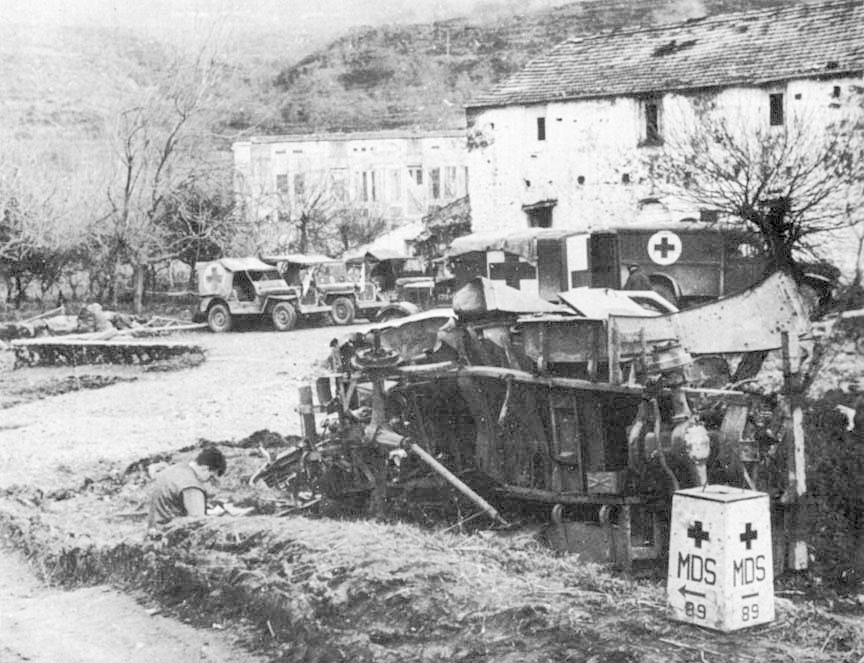
|
Remains of an AFS ambulance which was blown up by a land mine at the entrance of a Fifth Army ADS. The driver was unhurt. Photo by Lewis M. Purnell |