Edited and published at AFS Headquarters, 60 Beaver Street New York 4, N.Y. under the sponsorship of the ambulanciers' relatives and friends, who contribute the excerpts from the letters.
Unit I A.F.S., India, left the United States in April, 1943, arriving in Bombay the following July. They had a long wait, utilized in training courses and maneuvres to fit them for operating in the special conditions of the front on which they were to work. They lived often in some luxury, in comfortable barracks, with the use of tennis courts, officers' clubs, etc. They dined with native friends, tried boar hunting, bathed in the rivers, saw temples; towns, and villages, burning ghats and towers of silence, Indian dancing, and fakirs with their weird tricks. All interesting, all things that would have been fascinating to do in peace time; but training, however much spiced with sight-seeing, is difficult for impatient boys to endure when they have brothers and friends in Italy and the Pacific islands. They thought themselves the "The Forgotten Unit". But in fact their training has stood them in good stead.
In December, they were moved up to the Burma front. As one boy wrote: "We've started work now; carried our first patients awhile ago, so at least we can feel that we have a little share in helping this war..." They were working under most difficult conditions mountainous country, winding "roads", sometimes thick in dust, sometimes deep in mud. The first M. A. S. (Motor Ambulance Section) evacuated more than a third of the casualties in the first big battle on this front after the arrival of the A. F. S. last December. Their amusements were no longer looking at temples and fakirs: "Our lads at ..... occasionally amuse themselves by walking four miles through the bamboo thickets to the river to watch the Jap officers in swimming."
At that time we, in the United States, heard little from this area. Then we began to read in the papers reports of action along the Burma frontier, and, more lately, of the exploits of American and Chinese troops and of British air-borne forces in the interior. On April 3 almost the anniversary of the departure of the First Indian Unit we had definite assurance, for the first time since the Japanese advance into Indian territory, that all twenty-seven of our drivers who had been cut off were safe. Twenty of them were isolated in an outlying position, presumably still working for the troops to whom they were attached. The remaining seven men had made their way to headquarters, where they found the staff officers driving ambulances to help in the emergency. Almost immediately afterwards, headquarters itself was cut off, and at the date of writing, it has not been relieved. By the time this is published, the Battle of Imphal (or whatever it may come to be called will be old news, but in Field Service annals, it will take its place beside Bir Hacheim and Tobruk, Termoli and Anzio. The India Unit, just one year old, has earned its place as a full-fledged member of the A.F.S.; no one can call it "The Forgotten Unit" now.
| Thomas S. Esten | George O. Tichenor |
| Stanley B. Kulak | William K. McLarty |
| John F. Watson | Randolph C. Eaton |
| John H Denison, Jr. | August A. Rubel |
| Richard S. Stockton, Jr. | Curtis C. Rodgers |
| Caleb Milne, IV | Vernon W. Preble |
| Charles J. Andrews, Jr. | Arthur P. Foster |
| Charles K. Adams, Jr. | Henry Larner |
| Alexander Randall, Jr. |
We are glad to report only one battle casualty this month and especially glad because it is a very slight one. It is the first to be reported from the India theatre of war&
JAMES E. REPPERT was one of the five men who escaped on foot from the Jap encirclement. He sustained very slight mortar shell wounds at that time. Another AFS man dressed them, thus enabling him to continue on foot. He was fully recovered by the end of the following day.
In the not too distant future, much will be written about the Burma Campaign and the part the AFS has played in this action. However, at the moment --- for security reasons --- little can be said. Some of the boys have written of their experiences and we present them for your information.
"..... The Japs are now shelling the road above and below. They return by night and there is firing in the hills. We were up at 3:30 and called for instructions. Were told to sit tight, so we dug slit trenches and watched our mortars shelling Japs opposite all day. At dusk a tremendous volume of small arms above us, around us, and even from within the camp. We were ordered to retreat to a bridge. Following orders; we made for the road and while crossing a knoll, encountered crossfire. We found inadequate cover in a Bren gun emplacement and the next half hour was very bad. Finally during a lull we reached the road and went back to camp where we should have stayed in the first place. There was intermittent fire for the rest of the night. We have completed our slit trenches and will stay in them unless called out by the Casualty Clearing Station..... Last night was quiet. We now occupy three two-man log and earth dugouts. After breakfast a Jap mountain gun opened up again and shells came much too close. We cleared three casualties out of a nearby dugout --- two wounded and one dead Sikh. Pioneers are now digging deeper, stronger dugouts for us. Several planes are overhead dropping us supplies. The Japs who are holding the ridge commanding our site seem to have us trapped, although our guns are giving them all we've got. We may yet have to get out of here on foot.
"..... The last two days have been rather strenuous. We were shelled constantly by the Japs who were apparently located on an opposite ridge. We were well entrenched fortunately as several shells landed uncomfortably close. We were told the Japs were coming down in our valley and we'd better get out over the mountain ridge behind us, which we did forthwith. When we reached the top, I judged things looked pretty good down in the valley so we went down again to see about getting the vehicles out. Halfway down, we were told the Japs were already on the road and we'd better let our vehicles (one ambulance, one jeep, one water carrier and one 15cwt) go and escape on foot.
"..... Two other AFS drivers and myself started off. Two others were below with the CCS. The rest of the day we continued north, and were ankle-sore from walking on an angle through unbroken scrub and woods. Finally we reached a valley and on the way up the next slope heard that another party had been seen in the distance. They turned out to be friendly Indians, but were too wary to join us. We crawled up a ravine hidden in trees, then edged up a hillside under cover of tall grass, reaching the top by nightfall and bivouacked at a safe distance from the path. We were almost out of food and water and the prospect of a week's march through uncut brush and forest to get to our nearest safety stop was not pleasant. The wind was icy on the hilltop, but we were up early the next morning and started off again. We overtook a party of Tommies, who were equipped with telephone, compass and binoculars, and they guided us and cheered us with the news that safety is not as far off as we thought --- one day's walk and we will be there. We cut through woods to avoid ambush on the path, but the Tommies preferred easier walking, so we let them lead the way down the mule path. Soon we were joined by a contingent from the CCS including two of our AFS drivers, who had covered their withdrawal from the valley along the river, thereby making better time. Our large party continued down the trail across the river and up the steep slope of the valley, emerging on the road in late afternoon completely exhausted. We stayed with the CCS evacuees, including 23 stretcher cases which had been brought out by hand. They had traveled night and day, carried by their Indian bearers, who were completely out when they finally reached the final hill. We helped them up the road and found transportation which would take us back to HQ. We supervised the loading of the stretcher cases and we all rode to a place where we were given food and a night's rest. Early the next morning, all evacuees, including ourselves, were sent by truck to HQ, where we arrived at nightfall......
"..... One driver was working as a room assistant in a CCS. The station was ordered to move because of anticipated enemy action. He asked permission to move with it and assist in the operating room. He did whatever was asked of him and assisted at an emergency operation on a bayonet wound. When the hospital was again ordered to move to a safer perimeter, he collected his few belongings, drank a cup of tea and started down the valley with a few hundred Indian workers toward the new hospital location. They joined a party of Sikhs, proceeded a few miles under heavy enemy fire and cautiously crossed and recrossed a rocky river a hundred times. They emerged on a wider path and joined a larger party marching till nightfall when they sleep huddled together under Sikh guard. The Sikhs had a few biscuits and one of them who spoke English gave the AFS driver a shot of rum before bedtime. Early the next day, he left the Sikhs and rode to the AFS HQ, with no more than the clothes on his back.
"The action began by Jap troops cutting through the jungle, using elephant-borne supplies. One Section of the AFS was cut off, but several members of it made their way on foot back to Advanced Headquarters, torn, unshaven, hungry and with all kit lost. The other members of the Section managed to drive their vehicles out and all reported back to Advanced Headquarters.
"Another Section of the AFS was threatened, but the road behind them remained open. They established a First Aid Post and dug slit trenches large enough to accommodate stretchers. The Japs were shelling both sides of the road, and one AFS driver volunteered to drive an empty ambulance through the Jap controlled road to see if they would withhold fire to allow for the clearance of casualties. This permission was denied because of much undirected fire from both sides of the road."
February, 1944.
"One day I was on my runs, and G. happened to be with me. We had a while before we had to return back to the hospital with patients, so we decided to go on up 'farther' and visit a few of our boys 'up the line'. On the way, we were kidding each other about the Jap patrol that was supposed to have gotten thru our lines the day before. All of a sudden, about six men that looked like Burmese, (actually the Burmese, Chinese, and Japanese all look alike) came charging up over the side of the road all dressed in full battle uniform with tin hats, etc. and, with their rifles held out with bayonets on them! They came charging up about twenty feet in front of my car and headed right for us, I looked over at G. and he looked at me at the same time, at the same time I jammed my foot on the accelerator and I noticed G. reaching for his Geneva card in his breast pocket. We tore past them and kept riding like bloody hell. About a mile beyond we slowed up and spoke to each other for the first time since our meeting the party. We didn't quite know what to male of it but since they (the 'party') didn't do any shooting or stop us, we thought they were friendly. We visited our friends, then drove the twelve miles back to where we had to pick up our patients. In the evening, that night, we casually and really very innocently, brought up the situation out of sheer amusement. Well, the Captain there, nearly went crazy. He asked us all the particulars and rushed to the phone and called up the O.C. of the area. A bit later we were informed that it was a patrol of Japs!!!!
"At the time we were getting a lot of laughs out of it, but it didn't seem quite so funny when we found out they were really enemy men. We still don't know if it was the Red Cross on the ambulance, or the fact that we surprised them as much as they did us, that saved us.
"Incidentally, don't get worried. Anything like this is as rare as ice cream out here, and just happened, that's all. I do hope this won't upset you as I wouldn't have written about it otherwise. I just think it's very funny. As you can imagine, of course, George and I now have the story up to a 2,000,000 Japs and how he and I surrounded them!"
No date.
"This is my first experience in hunting. The major and his wife have been most wonderful to me. On my last two week-ends I had, they have taken me hunting and fishing with them in the wilds of India. This country is really beautiful; huge trees, dense jungles, all kinds of animal life and many ferocious animals, too. In one huge river, I shot and killed two crocodiles; one I shot just under its right front leg, when it rolled partly over on its side to avoid an alligator which came at us while we were crossing the river on rafts which we built. The second one I killed from the river bank of the same stream, lying flat on the ground, rifle propped on my musette bag, I watched as the last raft containing our bedrolls and cooking utensils plus two natives began to get under way. As we reached about a hundred yards from shore, two crocs broke surface close behind the raft, scaring the natives badly; for, instead of poling or paddling faster, they froze stiff, refused to move a muscle. I adapted the sights of my telescopic gun for two hundred yards and drew a bead on the position of croc's eye. My first two went over his head, making him turn half left with the wallop of the bullets. My eye-shot rolled him over on his back when I made sure of him by placing a fourth in his heart. I told the natives I wanted the hide for making it into a bag for you, and they could not do enough for us. They are simple people and would have come back as my servants because I saved their lives by my lucky shot. As we left the village next morning I promised them we would return on our next hunting trip. The village was very small. My bag for the trip: 2 crocodiles, 6 wild pheasants, 1 water snake (as big as my arm, truly). The Major shot a panther, 5 pheasant, 1 crocodile, 2 wild pigs, 1 chute, and 3 wild ducks. The Major's wife bagged a panther at 250 yards using English measure. She was the best in the party, 3 wild ducks and a nasty pig. We all had a wonderful time; my first hunting and I liked it. I slept under a mosquito net attached to my bedding roll right under the stars and loved it."
February 12, 1944.
"First of all I forgot to mention that we were extremely honored and thrilled to have a visit by Lord Louis Mountbatten. It was terrifically impressive. As you know, he is in charge of the whole South East Asia Command. It really gave us an awful lot of confidence to hear what he had to say and to realize what a wonderful and amazing man he is."
February 2, 1944.
"I believe I told you we were planning to move to another hospital, but it was decided to stay at the site of the 'old' one. Last week, we found another dandy place on the little river that runs through the area, and we were told that no one had it so we could use it. To-day we got up bright and early and started ripping down tents, etc., and carted them over. When we got there, what do we see --- you guessed it, a bunch of Indians setting up their tents! After a few inquiries etc., we found out that these blokes were going to do some special work around the river, and that site was just right for them. So, --- back we go, and here, I trust we will stay for awhile."
February 13, 1944.
"We have had a little military training on the parade ground, more classes in vehicle maintenance, also 3-hours guard duty at night, but I am excused from that from now on because of my early morning trip for rations. Most of these tasks are a matter of keeping us busy so we won't be impatient at the necessary delay and sitting here without actual field duty. Having been before, I am perfectly grateful for any time spent near civilization and hot water, knowing there is plenty of time that isn't, but to the new it's always hard to take, as they think it's not what they came for, but they will look back on it with longing later on."
February 20, 1944.
"A week ago today the AFS said they would not need the boys with previous training for two weeks and we might go on leave, so though I had only been here for two weeks I started off again.
"Four men who had been looking forward to this chance for some time and had planned a trip asked me to join them. I thought they knew exactly what they were doing, but have found myself official guide and spokesman of the trip. We are allowed one free pass on the railroad for two week's leave during the year and took it now, not knowing when we would get another chance. It is all very well to have a sudden chance to travel given you but out here from three to five days in advance should be given to bookings and railroad accommodations, but off we went 'where angels fear to tread'.
"We left our Camp at 7 a.m. Wednesday and took one of the best trains in the country to the nearest large city, having breakfast in the diner and playing bridge in the first-class compartment of a friend for three hours to our destination. I then went Hotel hunting and got a room for five at the seventh one I tried. We lunched at a world famous Hotel and I was taken afterwards by one of our officers staying there to see an old AFS friend who has transferred to the English Army. After dinner and cocktails at the same Hotel we hired a carriage and went on a two hour slumming drive. It certainly was an education, with people sleeping in the streets and whores --- on the sidewalks calling to their would-be customers. It was so 'out of this world' that it was simply picturesque rather than sordid as it sounds, and the native color and smells added to something one will never forget. The following AM I went to the station to check up on the reservations and had one of those delightful experiences that restores one's faith in human nature. The RAF man in charge of transportation took a really personal interest in our problem of traveling so far in so short a time on such short notice and he spent an hour working out train changes, pulling wires, writing a schedule for me right back to our base. In fact in the evening when we left he stood at the door of the compartment and wouldn't let anyone else in, some of whom had more right there than we I am afraid. I spent the day shopping, lunching with friends; the Museum, and tea at a nice place run by society ladies for charity.
'We didn't get off until ----P.M. the next afternoon. At that place we hired carriages and drove thru a native town and its bazaars, visiting a Mosque. Dinner at the station amidst a tremendous thunder storm, which soaked us when we went out to catch our ---- o'clock train. When I had got out of the train at noon to walk up to the diner as there are no corridors and one remains in the car between stations, the train was covered with monkeys crawling all over it and the station. Some of the monkeys were very large and they are so amusing to watch.
"The second train, that brought us to the foot of the Mountains, was a madhouse; eight people sleeping in a four berth compartment, four on the floor. The boys were very nice and insisted I have a berth as I had done the work for them --- and old age counting for something, I guess. Anyway, in my damp clothes, wrapped in a blanket, I slept on the upper shelf as it were. Every station we stopped at all night long the natives would pound on the doors and windows to get in. They travelled hanging on to the railings and door handles on the outside all night, believe it or not, in the pouring rain.
"Saturday A.M. we got into a bus and at the end of an hour and a half were 6,000 feet above sea level on a lake at our destination. If you have been figuring this out as you read along you realize that what we have done is to go on a leave as far as from Boston to Colorado Springs for a three day stay. Imagine anything so crazy, but I never thought anything about it until I was well on the way. The country has been very similar to making that trip at home.
"We arrived at the Hotel recommended, in a blinding snow storm dressed in our khaki shorts. It was a freezing cold, dismal place so after lunch I was up to my old tricks. I left the boys and climbed up to a beautiful villa that had been pointed out to me as an English officers' convalescent home. I explained to the lady in charge that we were no officers and about the AFS, and asked if she could take us for three days. Here we are! Double bedrooms, open fireplaces, delicious food, bearers to look after us and bring our morning tea, clean the rooms, shine our shoes and valet use The bathrooms! I wish you could see them --- cement floors, tin tubs that you can carry around, toilets that are chairs with buckets attached. By the way, a different caste has to keep these clean from the bearer and he is different again from the house servants. We get double Scotch drinks from 7 P.M. on and life is wonderful.
"I am getting stiffer by the minute, for yesterday without any previous exercise for months, I climbed up to 8,000 feet thru the snow to look off at the highest mountains in the world. God what a sight! Only sixty miles away and I shall never forget it as long as I live. I certainly am lucky to have these opportunities while I am still young enough to do the work."
  |
|
 |
 |
 |
 |
No date.
"Lord Louis Mountbatten came through the other day and stopped to address the troops at different spots. He shook hands with the officers commanding units including that sergeant in charge at the moment. He spoke very informally for about twenty minutes, very frankly and with what appeared to be a great deal of sincerity. He is a fine looking man with a commanding personality --- reminds you of an eagle. Definitely the type of man whom people would follow through Hell if he asked it.
"Yesterday three of us took a walk along the ridge to look in at a native village. We poked our heads in the chief's compound and after a few minutes he waved us over, pulled up three chairs and we had quite a talk thru his son who spoke good English. He rules some 30,000 people (probably exaggerated) and a section about 80 square miles. One part of his house has hundreds of skulls hung on the roof and walls --- elephant, tiger, panther, leopard, rhinoceros, crocodile, deer, bison, and many others. As he explained --- they hang up horns for decoration --- the number determines the prestige of the tribe. Those that we saw were an accumulation since 1889 when his tribe had been burned out of their old location. He showed us some beads that his daughter was wearing --- amber and beautifully carved. He explained that they were like our money; she certainly had plenty --- at least 30 strings. They definitely were not for sale. In fact, we could not discover any particular craft peculiar to them; they hunt and cultivate their rice paddies, banana trees and mostly want to be left alone.
"He is an amazing character, quite fat but with a great deal of innate dignity --- and I think he understands more English than he admits. On the way back we passed some slate tombstones with very good carving of animals on them. I believe they are supposed to depict the deceased's possessions. They were fairly recent jobs and not the least bit primitive."
March 1, 1944.
"Curiously enough, the box-seat to the war wasn't so safe a few days after I was there. The enemy shelled it for the first time in months.
"Do we get immune to the suffering of the patients? Certainly I shall never get calloused to a man suffering in the back of the ambulance. I know a bump might hurt them so if I hit one inadvertently, it grates me plenty. So they get the slowest, smoothest ride I can possibly give them. One guy was in a hurry and as he was alone we made it plenty fast but that's exceptional. One of the hardest things to do after a long slow ride is to keep the pace down during the last mile or two, so from a certain point on the road I make it a point to see how slowly I can go. One plays little games like that when driving alone, but there's no danger of falling asleep."
February 11, 1944.
"The Captain full of the Christmas spirit, had put a 1/18 rupee pieces in the pudding and it was, to use the vernacular, a smashing good show. This Captain I have been talking about has been wonderful to us. He delighted in imitating our American accent whenever he talked to us. When he learned that the Field Service was unable to do much for us over Christmas he took the matter into his own hands and arranged everything for us. He used to let us watch the work around the M.I. room and he even allowed us to give inoculations. I haven't seen him in several weeks now as I have been moved to a different Medical Station.
"There is a Colonel near where I am now stationed who says when addressing a friend, 'How things are, old boy? Is it?' Meaning, I guess, 'How are things'.
"A very amusing incident occurred near our present camp site. It seems that the sweepers have been accustomed to cleaning the latrines by pouring petrol down them, lighting it, and then closing the seats, which slowly but surely puts the fire out. They had just finished doing this when a Madrasi found it necessary to use the latrines. After he had finished, he threw a lighted cigarette in and closed the seat. Unknown to a bearded Sikh who came in next, a fire had started so that when the Sikh lifted the seat and sat down, the fresh supply of oxygen refurbished the fire and as Tommy would say, "It didn't 'alf 'elp him up'.
"This country is an artist's paradise. Never in my life have I seen such beautiful colors. The people have been masters of dyeing for centuries. They acquire such subtle shades of bright colors that your eyes fairly pop out, which is again a very used phrase.
"I am hoping that the rain will act as a sedative on the rats for their nocturnal activities keep us awake. One of the main routes that the rodents take happens to be above my stretcher. We have recently graduated from mud huts to tents and consequently the pitter-patter of the galloping rats as they play about on top of the tent is clearly audible."
"Here's one bowl game you didn't hear about --- played in the Mud Bowl deep in the heart of beautiful ---. The 'Chota monsoons' (little rains) prepared the fields, or shall I say, mire? But it wasn't raining at game time so a small crowd of natives, clad in native togas, were on hand at the kick-off. Twelve valiant men, myself included, splashed on to the field, dressed in everything from Jock-strap and sneakers to dungarees and sneakers. The sneakers served their purpose well and I fell on my face twice trying to get up to the ball to kick off. The rules were 'anything goes'---except throwing mud in the eyes and holding anyone's head under. Well, we slopped and splashed and plowed mud with our noses and looked like nothing human for 4 twenty-minute quarters, and every time one of the fellows on the other team, an ex-Columbia guard, hit me, I thanked God for the soft mud. The natives just laughed loud and long at the crazy and incredible spectacle, and we laughed at their laughing."
January 23, 1944.
"We had a magnificent train ride to this place --- the scenery was breathtaking. We are just outside a town, which is interesting. There is a canteen here and a library. The barracks are stone, very cool and not crowded. There seems to be no bed-time and we are free to go to town any time. There is no special uniform required. It isn't too terribly hot here, and is cool at night."
January 27, 1944.
"The barracks are fairly comfortable. They are stone, with very high ceilings and fans. The doors are always open and strange animals wander nonchalantly in occasionally. The other night I woke up and found a goat peering through the mosquito netting. They say that once a water buffalo invited himself in.
"I went for a long bicycle ride the other day along a very beautiful road. The roads are full of pedestrians and bicyclers and water buffalo driven carts. When a car comes along, it just blows the horn and charges ahead.
"We have just been issued clothes and supplies. We were given a duffle bag and so much stuff it won't possibly fit in. Slacks, shorts, shirts, shoes, coveralls, sox, mess kits, etc. and two hats. One of them is similar to the one I had and the other a sort of Australian cowboy hat with a broad brim, one side of which turns up and the other down, very sporty. If you know of anyone joining up, tell him we don't need half of that list of things to bring.
"I have acquired a 'bearer'-named 'Das' --- complete valet service for three rupees a week, including tea in bed every morning!
"I am not trying to make every-thing sound pleasant for your sake. Things are really almost too good to be true. I can't get over how congenial everyone is. It may be different later on, but now we certainly are not suffering any of the privations of war. I have never been with a more congenial bunch of fellows."
February 11, 1944.
"We dine in town frequently at various Chinese restaurants --excellent food --- very cheap. We get a tonga, jounce into town, look around the shops, eat dinner and jounce back again. There are many book shops, some of them quite good, and a superb record shop. I now have a military motor vehicles driver's license. The other day several of us went for a long ride, taking turns driving. The view from the rough road was superlatively magnificent marvelous!"
February 21, 1944.
"We had a lecture on security the other day and were told to write only personal things in letters and to tell absolutely nothing of what we are doing or why.
"The birds here are numerous and fearless and tremendous --great vultures and eagles and gigantic crows are everywhere, and nothing can scare them away. If you happen to have any food in your hand they will swoop down and practically grab it away from you. There are many gigantic trees, beautiful ones, with great hanging vines and strange fruits. I haven't seen any that I could recognize."
February 25, 1944.
"It doesn't seem possible that I have been in India a little over a month. Winter seems to be over and summer fast coming. The only difference between winter and summer is that the nights are no longer cool and the days are even hotter; if possible. When the rains come, they never stop till it's time for the dry season again. Just now it is so completely dry. I wonder why there are not more fires. I guess there isn't enough to burn. What trees there are, are oddly shaped and have a very subdued greenish color. Everything is covered-with dust."
March 4, 1944.
"The biggest news here is that the AFS has acquired American PX privileges. An ambulance went off the other day and came back full of provisions, cigarettes, (best), shoe polish, tooth paste, etc. It's good to smoke American cigarettes again.
"Das, my bearer, has left me. He has gone over to a new barracks where he can get one rupee more per week. But he left me his understudy, Baboo, who is much better. I am living in the lap of luxury and am completely spoiled.
"If you read things like the National Geographic and see movies of India, it all seems very wonderful --- the lure of the Orient and all that. But; unfortunately, or rather fortunately, you can't smell pictures; India has an odor which is far from attractive. You have probably seen pictures of gay processions of brightly dressed natives playing upon weird instruments, and all sorts of fetes with snake charmers and rope artists. I have seen quite a bit of that sort of thing now.
"We are continually told not to try to get anything by the censors. I don't know why our location should be kept such a deep dark secret."
March 7, 1944.
"The climate is slowly changing. Every day it gets slightly hotter and just a little bit hotter, until now the temperature is scarcely ever below 90 degrees during the day and not much cooler at night. In the last few days, clouds have begun to appear in the sky and now they are never absent, and are growing larger and blacker until today they completely cover the sky. Everything suggests rain, but rain doesn't come. Every few minutes a wind springs up and makes a whirlwind of dust and then subsides and it is hotter than ever. I haven't minded the heat much except when I have had to be in the sun for a long time.
"Life here with its courses in various things is not unlike that of school except that it is much freer. I have become thoroughly used to its odder side, such as trying to explain things to natives who don't understand a word of English, and waking up in the middle of the night to find an oom chewing my shoes.
"The dangers of a submarine-filled ocean voyage are nothing compared to the dangers of riding a bicycle in this most fascinating of all countries. I had another accident the other day as I was attempting to turn around in the middle of the road --- something which I will never risk doing again. The roads are completely cluttered up with tongas and bullock carts and natives---walking or cycling,"
March 12, 1944.
"As far as I can see, I will never have to wash any clothes, which is a joy! Our laundry is done free by an army dhobi (baksheesh!)
"Today S. and I cycled out into the country and visited an old temple, perched atop a very historic hill. It seemed to be deserted, but when we started to go in a little chapel, a native popped out of the shadows and jabbered something in Hindustani and waved his arms. We took this to mean that we shouldn't go in there, or perhaps we should have had our shoes off. We climbed on top of old crumbling walls which must have been built centuries ago. The view was magnificent. There was also an old weedy garden with a sacred cow in it. On the way back, we stopped at a restaurant where all the British officers go, and had delicious iced coffee and ice-cream. We have the advantage of being able to go to places for officers only and also to places for enlisted men only. Tonight we are going to the club I told you about for another record concert."
HQ New York is at the moment deprived of the guiding hand of its Director General, However, the temporary loss of Mr. Galatti's presence, while on a brief inspection tour overseas, will be the gain of the AFS as a whole. We gladly loan him, but he is very much missed and a warm welcome awaits his return.
Orchid Department: Col. Ralph Richmond, AFS, reports that General Cowel, head of the Allied Medical Services at Allied Headquarters, requested to see him and tell him personally of the excellence of the work done by volunteer drivers of the AFS serving with British forces in Italy, especially their recent work on the Anzio beachhead. The General said he toured the beachhead and saw AFS ambulances everywhere he went. "I personally got out and shook hands with every driver that I had a chance to, thanking him for the fine work he and the other Field Service men were doing."
The unrelated Wright "brothers" have crossed paths again in Italy. Mort Wright, who is driving the same ambulance he drove in the Middle East recently arrived in this theatre of operations after a leave in the States. Alvin Wright, now in the Indian Army writes: "Have just recently run into Mort again, which, as you can imagine, was the cause of considerable rejoicing and general festivity. As a matter of fact he is with us now, attached, and is dodging shells as calmly and matter-of-factly as any Gurkha. .....The AFS has been doing a magnificent job here. The description of their work is laudatory in the extreme."
Over the Air Waves: Radio fans have probably caught the name "American Field Service" frequently in the past few weeks. Toby Britton, on leave after serving at the Anzio beachhead, was featured on WE THE PEOPLE, March 26th. ...CALVACADE OF AMERICA presented "Ambulance Driver, Middle East" on April 13th, a dramatic incident on a story by John Patrick, now AFS India.... Bernie Wood was heard on REPORT TO THE NATION, April 18th...Early morning risers may be awakened by "Reveille Beverley's" comments on the AFS.
Recent visitors to 60 Beaver Street include Pat Fiero, AFS Middle East veteran...Beach Powell, soon of the U.S. Merchant Marine, stopped in; as did also Jack Lund, in the same service. Jack reports that he had a reunion with some of his old AFS Middle East friends on one of his trips. ....Francis Hamlin, who drove the first AFS ambulance in the first section in France in 1940, took a moment from his duties with the British Ministry of War Transport to say hello.
Current events of AFS interest are an exhibition of modern French and American paintings at the Valentine Gallery in New York, a "Mornings of Diversion Benefit" featuring a talk by Mrs. Mark W. Clark in Boston; and the May 1st presentation of George Abbott's "A Highland Fling" at the Plymouth Theatre in New York, which will turn over their proceeds to the AFS.
Romance Department: "In the spring a young man's fancy!" According to tradition, news of engagements and weddings has been pouring in this month... Ralph Beck, home from Italy, was married to Wave Yeoman Natalie Fiske of New York, on April 15th, in Washington, D. C.... David Conant, who returned in March, is engaged to Miss Jean Kirk of Passaic, New Jersey ... Two new volunteers, Tim Munroe and Bob Kennedy, who recently went overseas, are also engaged...Jim to Miss Katheryn "Walker of Waban, Massachusetts and Bob to Miss Patricia Bancroft of Bridgeport, Connecticut ... Cpl. W. J. (Dick) Dixon, ex-AFS Middle East, who is now stationed at Camp Lee, Virginia, reports that he was married early this month.
An AFS ambulance "In Memory of William DeFord Bigelow" has been presented. It is a fitting tribute to Mr. Bigelow's twenty-five years of unselfish devotion to the Service.
AFS in the Armed Forces: Bill McGuire, stationed at Fort Robinson, Nebraska, after service in the Middle-East writes. "I'm training war dogs now in the K-9 branch of the Quartermaster Corps. The work is intensely interesting and I get quite a kick out of it. I'm working with casualty dogs, which may be of interest to you. Working on the theory that wounded men often make their way into almost inaccessible places to gain cover and concealment from further injury, the army has developed dogs that will search by scent off leash until they locate a casualty, whereupon the dog returns and leads his master (accompanied by a team of stretcher-bearers) straight to the wounded man. 13 weeks are required to train a dog in this work .. Sooner or later, we'll be taking our dogs overseas...."
It is with deep regret that we learned of the death of Thomas J. O'Brien, AFS representative in Salt lake City, Utah. Mr. O'Brien, a member of AFS Section 15 in World War I, is among the many to contribute of his time and efforts again in this war.
March 6, 1944.
"I have now been on the Anzio beachhead since my last letter was written and believe me, this is the real thing. The trip was uneventful and when I arrived here, I thought it wasn't going to be bad but soon changed my mind. One of the first things to be done is to take a shovel and dig a large hole; then beg, borrow, or steal boards to line the hole and make a roof as well, for this is your bed and temporary home; all this being done in the pouring rain and ankle-deep mud. At night the fun begins, artillery fire, which has been going on all day, intensifies. The Germans bring large guns on rail from Rome to shell our positions and the docks and shipping in the harbour. Then around 2:30 A.M., when it is blackest, over come his planes hunting for any target, usually ammunition dumps which are placed not far from us. Our ack-ack guns start, and this is the time to run for cover for the air is filled with shrapnel and you're deafened by noise.
"The first night one of his bombs did hit a dump and I thought the end had come. The concussion lifts you off the ground and the earth trembles and why your sleeping hole doesn't fall in, is an act of God. One lies face down and tries to dig into the earth with fingernails. To say you're not scared to death isn't true. It's terrifying while it lasts and what is the worst to take is to hear a plane overhead suddenly swoop down. It makes a whining noise and then you can hear the bomb coming; this making a whizzing noise and another kind of whine and the time it takes for that bomb to land is interminable. Then the noise and confusion. What a party! Wherever you are on this beachhead you're in danger because it's only four or five miles long and very narrow, so you can see how crowded it is and how concentrated the whole thing is.
"Now I'll try to describe the work. There are six of us and we work in shifts, 2 at a time. The day shift goes on for active duty at 7 A.M. to 7 P.M. The night shift from 7 PM to 7 A.M., the latter assignment being the tough one as one has to drive without a light showing. To be sure you have an orderly at this time, who has to walk on the road with a white cloth in his hand to direct you. Your car must make as little noise as possible as the Germans can hear and will open fire --- I almost got stuck in the mud one night. Hank Rose did and had to abandon his car which was picked up the next morning, no patients at the time luckily. Some of us drive right up to the lines, pick up patients at field dressing stations and carry the hastily bandaged wounded back to the field hospital. This is the hardest because you are machine-gunned, shelled, and on occasion, dive-bombed. If you could see my ambulance now, riddled with bullet holes in the back and part of the driving window ripped away. I tell you I've a charmed life; one patient only was hit and he not fatally. Many times when German guns are trained on roads and they open fire, you have to make a quick leap from the car into the nearest ditch. I always manage to pick ones filled with the most mud. There you lie until you think it is over, make a quick dash again for the car and off you go, sometimes with two or three flat tires due to shrapnel. Somehow, shells don't get me at all, it's the damned planes which you can't hear and the only way you can tell if one's coming, is if there's a truck in front of you and you see the occupants diving for cover. It has happened to me only once and luckily the damned German was a poor marksman as he only got the right hand side of the car. It all happens so quickly you don't have a chance to think and your one hope is that the plane won't come back.
"The casualties, as you can imagine, are high and the one thing that does almost break my heart in two is to hear the screams of the mortally wounded and know there isn't one damned thing you can do. They beg you to put them out of their suffering and your only hope is to get them back to the operating table as fast and as best you can. I hope you never see it; and how humans can do the things to each other they do is beyond understanding. But you do see a face twisted in agony and suddenly a peaceful look comes into his face and you know that God has taken him and he is out of this awful mess and has gone to a better place. If you didn't believe this, you couldn't go on. You don't have a feeling of sorrow for the victim but only those at home whom he has left behind. Death isn't so hard to face I'm sure.
"The people who are the real heroes of this war are the surgeons who work night and day with never a complaint. I wish I could begin to describe an operating theatre tent at night. A strong light in a pit at one end where white-frocked man with gauze over their faces are working; the muffled sound of a typewriter as an orderly tells of each operation; at the far end of the other side of the tent, stretchers lined up in rows of men whose turn is shortly coming and stretcher bearers like shadows in the gloom going and coming with new cases. The doctor calling 'next' while the patient is being wrapped in blankets ready to be taken away and another brought down onto the table. The surgeon, so kind, always talking to the new patient while changing his gloves, telling him that all will be o.k. Then he stands over the patient, telling him to count while another doctor injects him in the arm with a new kind of drug which puts him to sleep before the patient has reached 15. And so it goes, one case after another, with the surgeon using all the skill at his command, with bombs crashing down intermittently which rocks the whole tent and sets instruments on trays rattling around like crazy things.
"One night the operating tent caught on fire badly and I stood and watched the surgeon who never once looked up to see what was going on and was removing a large piece of shrapnel lodged near the wall of the patient's lung. These are the unsung heroes of war, facing all kinds of dangers with never a thought of themselves but trying to save others' lives. All you have to do is to look in their faces and talk to them to know that they are men of extraordinary character. As one particular friend who has taken a fancy to me (we sometimes manage to squeeze in time for a quick smoke) said: 'I feel that all these boys are mine, and if I can't save one, it is as if my own son had gone.' And he operates sometimes on 28 cases a night!
"One of our lads had quite an experience. He was told to proceed with an orderly to a front line station at night. When he got there, he walked into the tent to be greeted with pointed tommy guns at the other end of which there were Germans. One Britisher who was there with hands above his head said, "You've had it, chum". The A.F.S. man showed the Germans his Geneva Red Cross card and was told he could go free if he would drive German wounded back to the German lines. This he agreed to do and had to go thru a mine field with a German orderly who didn't speak English. When they got there, the orderly disappeared and he had to drive back thru the mine field alone and nothing happened. Just another case of a charmed life. The Germans immediately released him and he got back safely.
"I could tell you many stories but let me tell you the boys who are younger of our group, I take my hat off to; there isn't an assignment that is too tough for them to handle and altho they know there's danger on every side of them, they're all keen and eager to do their best. I doubt if I could have done it at the age of 20 or 21."
December 13, 1943.
"We spent the first day of our leave climbing Mr. Vesuvius, a job that required three and a half hours of stiff climbing. About three quarters of the way up, we went into the clouds. It was damp and cold, with a terribly strong wind that drove right through your clothes. Struggling over the great masses of hardened lava that poured forth in the 1906 eruption, we arrived on the rim of the big crater. Descending the sharp outer ridge we started off across the cap of hardened lava that was once a boiling lake. Steam and vapors issued from the many cracks giving me the sensation of being on another planet. The rock was hot to the touch. In the center of the crater stands an ash-cone that is continuously being built up by the eruptions that occur every thirty seconds or so. Up the ash-cone we scrawled on all fours. It took fifteen minutes to go up seventy feet to the top. The wind was blowing at a terrific rate so that it was next to impossible to stand erect. With our hands two feet from the top we gazed into the inferno; that, what was visible of it through the thick sulphur smoke and steam. Just at that moment, the wind took my new hat off my head and we watched it disappear into a stream of smoke. A few seconds later a great tongue of flame flew out into the sky and a shower of red-hot cinders and rock went sailing off in the opposite direction, thanks to the strong wind. After two such blows we decided to withdraw to safer ground. Down we went to the bottom of the mountain just in time to get caught in a rain storm. Two hours of walking brought us to the outskirts of Naples where we hitched a ride back to the villa!"
January 12, 1944.
"Fortunately, our Platoon is large enough to give each section a break in the really tough assignments, that is, one section will work the front line evacuations for perhaps a week and then a relief section replaces. Our meals suffer the most, you may be sure there is plenty of tea around, but the three squares a day come when and where we find them. Baths are no little problem but fortunately our kit is always carried in the ambulance with us, and by frequent changes of clothing, we manage to keep this side of respectable. Of course, when the B.O. gets so offensive that even our best patients complain, we usually scrounge some warm water from a cook house and I'm getting no less than an expert in the line of sponge bathing. Sleep is ideal, plenty of stretchers, bedding roll is always with us and the cars are equipped with inside lights, the only difficulty arising is an effective blackout.
"You mentioned hearing news broadcasts or, some of the action for the control of the Sangro River. Doubt if these reports could carry too much exaggeration and an proud to say that the American Field Service ambulances played, from a medical point of view, quite a major part."
February 20, 1944.
"Have met a number of guys who are "bomb happy". That is, all categories of nervous cases coming back from the front. The term, 'shell shock' is no longer used, but various names are given to different types, exhaustion, hysteria, psychoneurosis, etc. Have, met two particularly interesting guys who are recovering from that. One, a little Welshman, so completely lost himself that he was hiding under blankets from mortar bombs and running around without regard for bullets, shells, etc. They brought him back, put him under a drug, which made him sleep for three days (they give this drug to all these cases) and when he woke up, he had developed a terrific stutter in his speech. It was interesting to see this fellow get better, until when he left yesterday, the stutter was almost gone. He is still a nervous wreck and will never be fit for frontline work again. I was 'in' on a reunion between him and his brother after three years, which was another interesting experience. We had a party, in which, I'm afraid, Italian champagne played a rather large part, but it was fun. The other guy, a young Londoner, in the ..., one of the really crack regiments, only 20, but with a wife and daughter, had the terrible experience of carrying his best friend back wounded from the lines and watching him die. He broke down completely, is still under observation because he can't keep his head from twitching sidewise every few minutes. The life of an infantry man in the war is indescribably horrible --- beats any other branch of the service. People sing too many praises to airmen, tank, men, etc. None have anywhere near as tough a time as the infantry men, and all in the last analysis depend on him. War in all its phases is completely wrong, I am convinced, but I feel I must be a pragmatist. It is unfortunately necessary to do wrong for wrong, in order that the right may have a chance to prevail. I know what D. will say: the ends are determined by the means. I cannot apply that to the practical problems which in these days face us. But I am more convinced that after the war, we've got to keep an altruistic tone in our international dealings. And that is, of course, exactly what we won't do.
"Have had a great time talking in German to some wounded prisoners of war. All, especially a Luxembourger I talked with yesterday, have an extremely lukewarm attitude toward the Nazis. They seem to feel definitely that Germany is finished, say that morale, especially in the bombed areas --- Berlin, Hamburg; Cologne --- is very low. They may or they may not have been talking solely for my benefit."
February 26, 1944.
"The furthest forward work and therefore the most exciting, was evacuating from an aid post along a road that could be used only at night because it was in full view of 'Jerry'. At this point I've carried Americans, Germans, Italians, and British in my ambulance. The Italians are the noisiest and most trouble. I was surprised to find the Germans don't have horns and long fingernails and even look like human beings."
December 14, 1943.
"Everyone is practically a brother to you in this outfit and simply cannot do enough for you. I guess I told you that at least once before, but we men in the Field Service are practically idolized by this army and; of course, not one of us would ever think of letting them down. Everyone risks his life with the rest and as a result the feeling of comradeship is of the most intense sort. I had an experience not so long ago which gave me a thrill (and that is a cheap way to describe it) and which most poignantly bears this out. The battalion, to which I was attached, was going into attack with their objective a town some few miles up a road. It was at night and very dark. It was a long column making up the force and it was preceded by a few armoured cars containing the officers. Immediately, behind them and in front of the tanks, I came in the ambulance with the doctor in order to be right on the spot if casualties came in. It was quite a wonderful experience to have the shells flying around and being in the center of things. But more wonderful still was something else---the infantry marched up the road in two single columns on either side quietly, but in a determined fashion. As I passed these lines the men would say in a quiet whisper 'Hiya Yank'. They knew that the Field Service would not let them down; wherever the going is tough that is where we will be. I shall never forget that night. That experience of being a part of one great whole --- a group of men facing possible destruction is bound to affect one. It did me. And all the men of the American Field Service are doing such wonderful work! They deserve so much credit for, like myself, most of them are apt to be of high-strung, nervous, and artistic natures and yet they have courage in limitless quantities. They will go where few 'more normal' people will go and never have I heard of one backing down. I am afraid the American doctors are all wet when they say this type will not make good soldiers. They make the best as far as my experience sees it. And to give you some idea of the size of the job we do, I can quote my experience of a few days back when I carried eighty-one patients in eight days --most all of them on stretchers and most all seriously wounded. And I am only one of many. The AFS certainly does a magnificent job in the field and I am proud to belong to it at such times. One can't help but feel that one is accomplishing a great deal. I hate to see fellows being shot up but I do love such stretches of intense activity. War, though, has many dull periods."
February 12, 1944.
"At present am doing the kind of work I came over for --- it's a tough life, busy all day and about three nights a week all night. I sleep whenever there is time and eat whenever I am free from duty at mealtimes --- everything is irregular but our life here seems so easy in comparison to the wounded who have just come off the battlefield---and the ones who are still fighting. We carry mostly British, some Americans, and also Jerries. All are the same when wounded --- just a patient no matter what his nationality. I guess it's sort of hard on the British we carry when a Jerry is in the same car, but you can well understand their hatred.
"Last night I was off duty so went into the operating theater to watch. They have two surgical teams here so operations go on all day and night. I watched from 8:30 til about 9 --- and after that I started doing odd jobs, holding a light or a bandage, then bandaging and preparing for the surgeon --- just the sort of work I used to do back at the University of Maryland Hospital. Worked up until 1:30 A.M. and then hit the hay when they weren't quite so busy.
"It was really wonderful to watch the surgeons. All sorts of operations --- removing shrapnel, amputations of all kinds; the doctors would explain everything as they went along, so I learned quite a lot, and really had a ringside seat for all the operations. The surgeon thanked me profusely and said I ought to be an orderly there instead of an ambulance driver --- said I could come around to watch and help out at the same time,--- I was more than welcome. So it looks like I'll spend most of my spare tine in the operating tent."
February 9, 1944.
"We are sitting in a farm house in Italy playing gin rummy by the light of olive oil lamps with wicks of bandage. Half a dozen of our British cousins are sitting around watching the game.
"There is a cat here, an excellent mouser that has just caught two mice. H. woke up last night to find him/her gnawing a mouse on his pillow, claiming that it's female and enceinte, he has bargained with the Ities for a share in the litter. I hope they're all still-born.
"I had a very interesting patient today, an old woman of ninety and so infirm she had to be half lifted about. I put her in the front beside me, and she got her legs well wrapped around the gear shift and I kept reaching for four-wheel drive and could only got her ankle. Greatgrandmother was terrified anyway, but when we went into a ditch, as we did twice in two miles, she threw a blanket over her head and moaned all the way out.
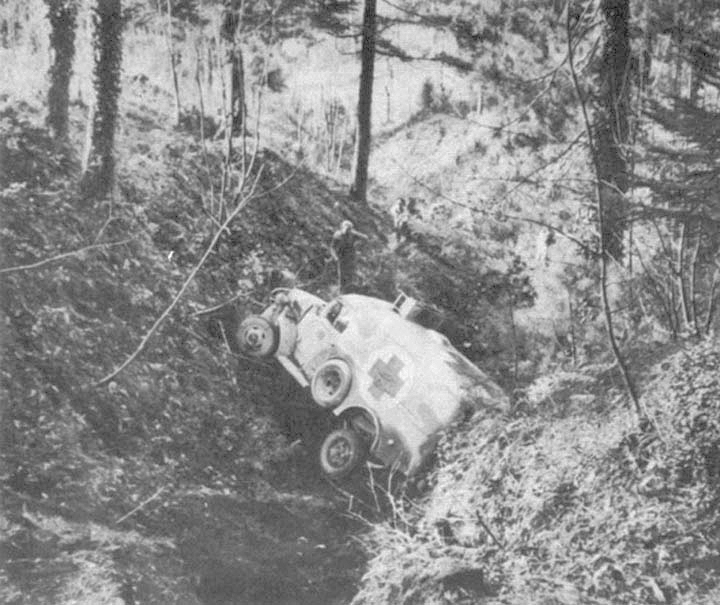
"P.T.A. turned over several weeks ago. I was driving in a convoy over very sketchy roads in the pitch black. After driving in the dark for a little while, I find that shadows become malevolently active, and on this occasion a slight miscalculation brought me up at a precarious angle. After several hours of freezing and trying to find someone to pull me out backwards, I went to bed in the remnants of a house, and shortly a big recovery vehicle, an S Camel, came along and helpfully pulled the car forward and all the way over.
"I became the guest of a regiment and had a highly enjoyable time with the major. We did cross word puzzles and translated a bit of the Princeton Alumni Weekly into Basic English. Everyone, of course, was convinced I was an officer, no matter what I said. I practically had a batman.
"I had a difficult time being recovered, for the road was under direct observation and nothing could move on it during the day. At night the road had to be kept absolutely cleared for vital traffic, so finally a compromise was reached, and I was recovered at dusk. At workshops I got a new engine, and the car is a pleasure to drive. Not long afterwards, after several days of shelling, a piece of shrapnel ruined my generator and I had to return to W/S. I'm back with the boys now."
February 12, 1944.
"I learned later that the house where I stayed was shelled heavily just after I left. Probably the flattening was complete. I don't know what happened to my hosts."
January 22, 1944.
"Life these days is not quite up to home standards but it's the kind of work I've been asking for and the kind I want and I'm quite happy and satisfied. We have a base car pool about six miles back of the A.D.S. and use a shuttle system of evacuation keeping only three cars at a time actually at the A.D.S. When one comes back another goes up, etc....) Most of the evacuations are made at night so sleep is irregular to put it mildly. One night I had to get out of bed three times to make runs. But we manage o.k. You get so you can sleep anytime, anywhere. At least when you finally do get to bed you're not troubled with insomnia.
"A good bit of interest goes on all around these days; especially in the air. We see our bombers and fighters going over nearly every day and can sometimes see them dive-bombing the enemy lines. Just this morning one of our P-38's was shot down by enemy ack-ack and crashed not far from here. The pilot escaped safely in his parachute, though."
February 8, 1944.
"Things have now quieted down for a while anyway. The past two weeks have been the worst two weeks of my life. I have witnessed war at its worst. I will honestly tell you I have never been so scared in my life. I have never been so disgusted with the horrible futility of war, and have never been so proud of every single British and American soldier fighting. All I can say is, if you hear a soldier say, 'All I want to do when I get home is sit in my living room and smoke my pipe', don't blame him. An infantry man over here has gone through the worst experience a human can go through, and it is happening to millions all over the world."
January, 1944.
"Yesterday afternoon I went to the opera 'La Traviata'; the Opera House a perfect gem of baroque style all in red and gold, freezing cold and you could see the singers' breathe. It started off badly, but Violetta in the last two acts really sang beautifully. Poor thing, she was shivering' especially in the last act where she dies in a silk nightie; I hope she had warm step-ins underneath. We are starting off with a bang and I shall be on call from now on, night and day, in between times keeping my ambulance clean and the maintenance in A-1 condition to be ready for all emergencies and catching up on sleep. Such is life and trying to keep clean is more of a major problem than ever with the rain and mud. I'm ashamed to say I haven't had a real bath in two months. Unfortunately now the censorship rules are much more strict and I can tell you practically nothing. At the hospital that I spoke of where I am now it is a help as we have been given the privilege of English Sergeants. This means we have our meals with them and for the first time in months, sit down at table and get served instead of standing in line out in the open and having it thrown in your containers. I went today across a field to look at a little village church and was fascinated by it; bad, but very bad religious paintings on the walls, a very baroque heavily gilded altar and a niche in the wall at the rear depicting the Nativity with figures dressed in the most gaudy bizarre costumes. An old Italian peasant woman and myself were the only two there, she with no stockings and a pair of wooden sandals and an old black much worn shawl over her head. Her face was so sad and yet quite beautiful, I felt so sorry for her."
December 24, 1943.
"These New Zealanders are really swell and as you may know the AFS has quite a wonderful reputation with them. American soldiers regard the British or Dominion troops (except Canadians) all as damned limies but there isn't the slightest resemblance in any respect between a tommy and a kiwi (N.Z.). --- the Kiwis have a language of their own, eat twice as well, dress better (and warmer), there is a much closer feeling between the officers and men, and they'll do anything for you. Above all, they are completely natural, particularly the Maoris (N.Z. Natives) who are what the female sex would call 'perfect darlings'. There is no difference between a Maori (Pronounced Mowri, not may-ori) and a N.Z. white except for slightly darker skin and they all speak excellent English and are well educated and have very strong feelings. They are not only equal with the white in theory but in actual practise. Some of the Maoris got up a little show for the patients a few nights ago and the last line of one of their songs was 'We love our Maoriland' which was quite touching the way it was sung."
January 9, 1944.
"There is no particular drama in our work. You hit a mine or you don't; a shell hits you or it doesn't. That others are hit around you is cause for no surprise or drama, for it's to be expected. Right now I'm back in a rest area after better than two months in forward areas, for the first time in two months out of sound and reach of the guns.
"I was once sent about three miles beyond a town to establish an ambulance car post for a group of engineers who were building a bridge across a river. It was rainy and misty so since Jerry could not see; the shelling hadn't begun yet. The M.O. (Medical Officer) and I drove through the pouring rain over a road hastily cleared of mines; until a suitable spot could be found. When the mist cleared Jerry opened up. British guns, three miles to our rear replied. So Jerry shells started to search out their positions. The first shell landed 150 yards from us and showered us, with mud. For the next six or seven shells until Jerry had corrected his range, we did a few flops into the mud. After that we had only to listen to the shells of both sides going over and take our casualties back to the R.A.P. as they came in. That night a truck blew up on a mine a hundred yards from where I was parked.
"This road went toward the front, crossed the river, then branched into three forks. One of these forks looped back away from the front to the left, to a little village that the British took at this time by fighting through the mountains to our left. The road was under observation so a night convoy was ordered to proceed up this road, cross the newly-built bridge and clear the wounded. I was busy on another job and hence started out alone about an hour after the convoy had left. The guns lighted up the road in the conventional movie fashion though nothing landed near. The road was absolutely deserted and the whole thing had an eerie feeling of being a complete mistake. Tim, my orderly, and I drove along rapidly in the bright moonlight hoping our directions were correct and that we wouldn't take a wrong turn in the dark. It was lovely country for patrols and we kept a wary eye out for unusual activity. We finally crossed the bridge and took the road we hoped was the right one.
"This is going to be a funny story so don't got excited. Suddenly rounding a corner four figures appeared and promptly dashed off the road and hid behind a bush. Obviously we didn't stop to investigate, but both of us were sure they were infantry men. The feeling of uncertainty, as we felt our way along this strange, deserted, moonlit road was terrific.
"About a mile further on we met an English patrol, checked our position and whereabouts of our destination, and thought it best to warn them about the figures in the road. Driving on, not 200 yards past the patrol, we came to a group of about 15 of the figures. All but three promptly disappeared off the road. Three raced ahead of us on the road. T. and I were mystified and I warily started gaining on the racing men. We were sure they were men, though we granted that moonlight and, eye-strain cause strange phantoms. Suddenly I was only 15 yards behind the figures and traveling 20 miles an hour. Men just couldn't run that fast. We immediately agreed that it was three men on bicycles pedaling to beat the band. While trying to figure out why three men on bicycles would be racing -up that road at that time of night, the figures dashed off the road in a most un-bicycle-like fashion. Simultaneously, I almost took the fender off one of our cars returning from the other direction. The oncoming car, of course, explained the sudden change of direction of the figures. Goats, cows, or donkeys, we'll never know.
"Later I was sent to the R.A.P. of a regiment that held a mountain top village over-looking Jerry's position in the valley. We could see English shells landing though not clearly enough to observe damage. We had a few casualties and I had mostly sick parade work. Here I once timed the echo of a gun report. The sound rolled around in the mountain valleys for 14 seconds before dying off. So when a few of the guns have a shoot, you can imagine the noise, not so much loud, as continuous and rolling.
"One day I was called to a vehicle that had been hit just 100 yards from our lane. I drove up and started to turn around when a chorus of 'keep to the verges' (verges of the road) went up, I thought it was silly for we had been using the road for a week and there could be no mines on it. Nonetheless, I turned around and kept off the verges. Walking back, I found that the vehicle had indeed gone up on a mine. The casualty was from our own medical unit. He had just been walking by when the vehicle hit the mine, all 19 TNT POUNDS OF IT. He was miraculously lucky for he had only superficial wounds. While we were tending to him, a soldier said, 'Look at this!' and uncovered a mine on the side of the road just opposite the cracked up vehicle. Another standing ten feet in front of the vehicle said, 'What is this?' and pointed to a mound of mud. It was still a third Teller mine.
"These mines had been hastily planted, not dug in, but merely covered with mud. They just were not there the day before. Ergo, they were planted by a Jerry patrol the night before M. and I had walked along that road the first day we arrived. There were more cracked up Jerry tanks, guns, and transports than I've seen anywhere since El Alamein. I asked an infantry officer how far Jerry was from there. He said none knew but they had had patrols out a thousands yards beyond the road. So it's easy to see how a patrol could sneak through and plant a few mines. I'm sure glad we had no night runs that night.
"Xmas day was especially marked as the first time I've heard the 'Sobbing Sisters', Jerry's multiple rocket mortar. Also by the fact that I had a night evacuation, just as last Xmas."
March 6, 1944.
"I have been working for five long gruelling weeks. My luck here was amazingly good and it held to the end, close call after close call. But I came out without a scratch, never felt better, and believe me it's really wonderful to have this time free from that continual tension.
"I hadn't had a real bath for well over a month--- nor a moment. And my first afternoon was devoted exclusively to these luxuries and donning a complete change. These experiences I have undergone I wouldn't have missed for the world. I did all the things which to me are the best part of the Field Service. But five weeks under fire, often 24 hour duty is a long time and when my relief finally arrived with my movement order back to base, that little slip of paper was just about the greatest looking document I've ever seen. The journey was not without incident. We were shelled until we got out of range. The near misses did no damage, however, and we were in the safe zone at last. I was sorry in one way to say good-bye to the regiment as I made some really fine friends. They gave me a wonderful send-off and the Colonel himself gave me something I shall always prize a letter to our platoon officer who gave it back to me later to keep."
February 15, 1944.
"I don't think I told you that I spent New Year snowed in, in a blizzard.-- the worst in twenty years in Italy, I was driving between two towns, got mixed up in a convoy, snow began falling, and eventually I'm still a couple of miles short of my destination. The orderly aid I then unrolled our blankets and went to sleep on stretchers. Joke up on New Year's morning with blankets piled over my head, pushed them off, and found I had a small drift pile on top of me. The front seat was piled all the way up to the ceiling with snow, in spite of the fact that the windows were closed. Also three soldiers were sitting in front of the ambulance, about three quarters frozen, having gotten lost during the night, while a terrific blizzard was blowing outside. I opened the door, was nearly, blown over a cliff; and found snow drifts piled higher than the ambulance all around. The guys that had been sitting up refused to try to walk up to the town; so eventually I had to go alone. I finally made it; half frozen and numb. After drying off, I got one fellow --- the only one who would go --- to come back with me to get the others. We almost had to carry one of them back. Then we were snowed in here at the first aid station for a couple more days... we couldn't even get to the mess which was just a block away, but luckily I had had some food in my ambulance, which I had brought up. Quite a few guys froze to death in the blizzard. We had no wood either so we burnt gasoline until that was used up, then all the furniture in the house. Eventually a bulldozer cleared the way, much to our relief."
No date.
"This is more or less the story of my travels in this 'poor deluded' country. The first sight of it was all I expected --- a harbour lined with tall, colored buildings --- with some grandiose public buildings adding a superfluous new-age look to the waterline avenue. Once in the town the stones and dirt and decay were evident, and the jovial quality of the people. Camped for the night, then moved on, moved out past a ruined aqueduct not quite in the noble tradition; but satisfying enough. After driving all day seeing vineyards, channels, comic opera villas, gem-like towns sitting on the top of a hill with church steeples (or rather towers gleaming In the sun); we came to the whitewashed town. Its one glory is its name --- Canosa.
"The next day we join the carpost and spend many interesting hours just talking with many inevitable explanations of just what we are and do. Suddenly one day; I while we were preparing to move, a Colonel came up to us and then and there detached us from our section and sent us up to a place with a name like an Opera, where we did evacuations lasting six to eight hours one way. Coming back from one of these I slipped off the road down a bank turning over as nicely as anything, no damage to person or ambulance. We had four eggs beside us which were unharmed.
"Then our big. day came along and we innocents believed it was a routine job. Anyway we both felt that we could wear our spurs after that for in the morning though that night was rather frightening in retrospect, we were told a fact which they had overlooked the night before. But this story will have to be told later.
"We move on. That seems to be the one thing we did all the time --- move on and on. This time into a provincial town of some importance and our car post requisitioned the local manor house."
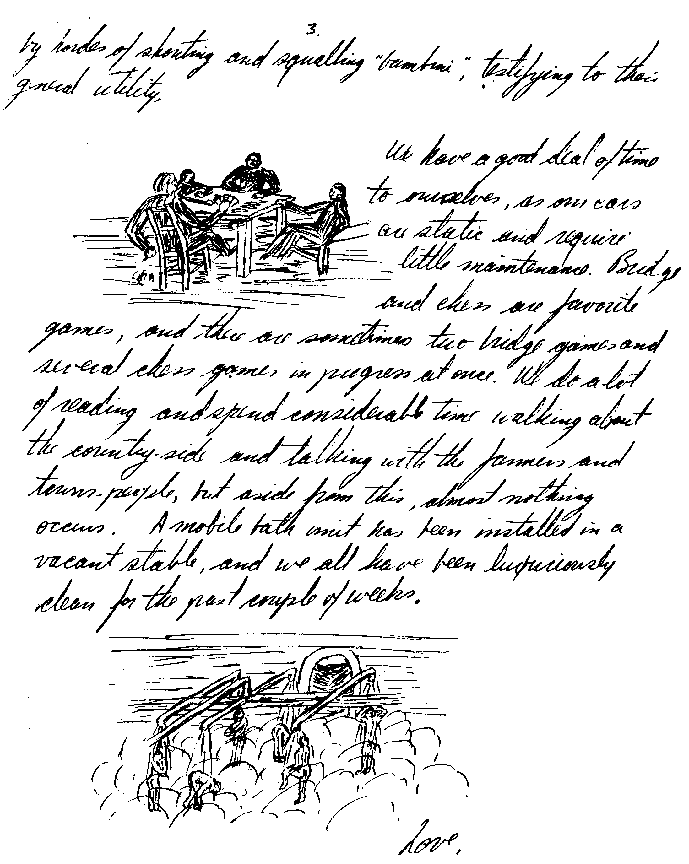
 |
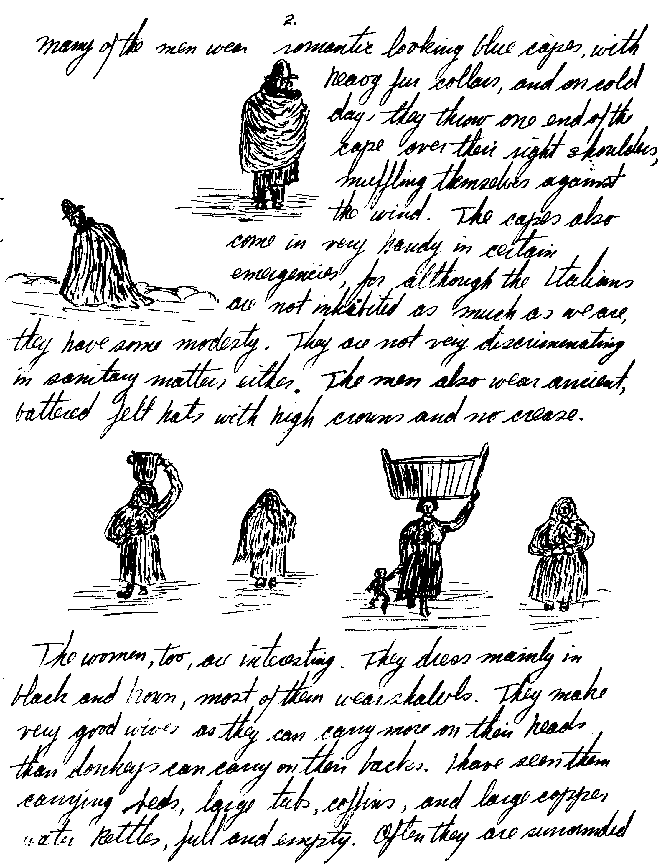 |
 |
January 12, 1944.
"The attack was to be supported by a barrage, which opened up all right, but petered out due to the Commander's getting a direct shell-hit on his observation post --- and incidentally, himself. So there we were, up there, more or less alone, still on The Highway, and getting shelled intermittently till about midnight. We were in a steeply banked cut where The Highway passed through a small hill.
"Jeeps brought men in to us, usually nothing had been done to them, and the MO would look them over and patch them up, then we'd get them out of shell-range where they could be operated on. During one violent counterattack, the noise was indescribable. Artillery behind us flashing and crashing, whistles mortars slamming, shells cracking and smashing as they went off, and through it all went the punctuation of rifles, Tommy guns, pistols, and light and heavy machine guns. Tommy guns at the time sounded like a wood ruler hitting a wood desk very hard, and as they went off, you knew someone had a good bead on a Jerry.
"Well, the shelling came down the hill nearer the Highway and as it was getting vaguely warm around there, we beat it on up to the RAP. As we went up, we could see infantry walking up single-file beside us, and we turned around up at the RAP and watched them file past, and then the worst happened. They shelled the road right in this cut, as though they had it exactly cased. We were in that cut, and we took a dive.
"We hit the road just as the first shell exploded at the end of the cut. It was a smoke shell, but as we flopped we could see that there were lots of guys who couldn't get down or who couldn't get any good cover.
"From there on, everything seems still pretty unreal, frenzied, and I've reconstructed it from the pieces I remember. D. waited till the shell went off and the shrapnel went over our heads, then tore down to see if anyone was hit. The smoke spread out up the cut and everything was clouded by it. We suddenly remembered that smoke shells were ranging shots, and got ready for some more. Everything was quiet except for the yelling where the, shell landed. D.'s co-driver was up by us, but D. hadn't reappeared yet, so we crawled into the slight cover offered by a little gulley, and then the shells came down in earnest. They went from the smoke shell spot right up the road, but as soon as the next shell went off, there were many things to be done.
"About the third or fourth shell hit the road about 10 feet from W. and me --- right perpendicular to me. The blast was terrific, and we just lay low, and let about a million tons of rocks, sand, gravel, and stuff bang down on our tin hats and backs and legs. After that, they went further up the road, about 300-500 yards away, and we were free to try to get our ambulances down to the wounded guys. D. reappeared and gesticulated for us. His co-driver made it to their ambulance without getting hit, and got the car to the guys all right. Both W. and I were deaf from the shell-blast, and couldn't hear anything, and D. kept waving, so W. having more bravery than I could find at the moment, got our car out and zipped past. There were three shrapnel holes in the windshield.
"I finally summoned courage and sprinted down to where they were working on the guys --- but I was still deaf and couldn't hear what W. was saying. I yelled at him to get the MO from our RAP, until W. finally got it across that the MO had been the 1st casualty --the smoke shell almost blew his legs off --- and that there was no doctor anywhere. Therefore, it was up to us. The MO was still alive, so we put him on a stretcher and got him in the ambulance. The shelling then came back up the road, and I saw everyone diving for cover and I went flat on my face and crawled on my stomach to a barricaded dug-out. It was filled with oats or something; the sandbags were oats, and one had been ripped open by a piece of shrapnel.
"An American private hurled himself in just as the shell went off, and then I looked out and saw an American armored ambulance --- a half-track---start off, and the worst was over.
"And I was some shaken. My right ear got some hearing back, but I just had to forget my left one, still deaf. There was lots to do. D. and his driver were doing some loading and W. was helping a guy into ours. We were all so keyed up we didn't put a guy on a stretcher unless he was so bad that he was almost dead. I guess you could say we'd lost our heads, but there were so many.
"Someone dragged me over to the other side of the road. A guy was half-propped-up, half-lying in the gutter, and I asked him how he was. The end two joints of three fingers were gone, and he had two large blood-stains on his trouser-leg. 'O.K.', he said, 'help me to the ambulance and I'll be O.K.!' He'd stopped most of the bleeding from his fingers. I carried him and dragged him to our ambulance and set him on the floor, and he dragged himself to the seat. His fingers started bleeding again, and he grabbed his wrist.
"Everything was a madhouse. We ran around aimlessly and before I know it we had five sitters in our car. Their kit and rifles, Tommy-guns, etc. choked the floor, and we couldn't get any more in because they were all too bad to sit up straight. W. and I slammed up the back step, I wiped the blood off the back of my hand where a flying rock or something had cut it, and we made time for fear they'd start shelling again.
"All our cases should have been on stretchers. They were good about it, and I tried to do some first aid as W. drove. We tore into the Dressing Station, which by then was a mass of guys walking, stumbling, being carried, falling --- all over the place. We got our men in OK, laid them on stretchers, and came out to the place where the ambulances were. D.'s car had shrapnel holes in it, as did almost everyone's. There was blood and regurgitated meals all over, and much equipment they'd left behind. We piled helmets, rifles, kit, etc., and then shifted two corpses off the track, and took our ambulance out.
"Altogether, we took nine ambulance loads out; not W. and I, but all the ambulances available. The dressing station was only ready to handle 12 surgical cases, but rose to the occasion and did 1st aid, surgery, and bandaging.
"Well, that was noon of E day, I guess I was in not such terrific shape, and we slowly drove to X----, to our pool. D. and W. wanted something to eat, but I didn't want anything. They got me to eat a 1/2 can of steak and kidney pudding. Just as we came out of the cookhouse, a bunch of dive-bombers came over, radiating hate and fury, and slammed that gun to glory.
"I was tired, and J. said to stay at the Dressing Station and get a night's sleep. I agreed, as I was pretty jittery, still deaf, and wanted to get out. I'll admit that anytime --- I wanted out, and I wanted out fast. We took a load of less serious walking wounded over to an MDS at Y-- where AFS guys had billets and a good mess, but when I got over there the conflict was too much and I told W. I was going back with him.
"They decided that the pool in X-- was too hot, even though it hadn't actually been hit, so they withdrew it about a mile. We pulled in after dark and immediately wrapped up in blankets and flopped on stretchers without undressing. We were there about 15 minutes when they shelled us there, all around us, I took a dive out the front door, W. out the back. Between shells I leaned in the door and tried to find my helmet, and W. got it, threw it to me. I clapped it on after I'd taken the dive again, only to find it was his hat. After the shelling let up, we traded helmets, and waited. All was quiet outside, but so damn cold we almost fell apart shaking. We crawled into the ambulance, sat on the floor wrapped in blankets.
"We almost went to bed, but got another call for the RAP and went up. Well, they had no load tho, so W. went to sleep on the backseat. I was so jittery in that location that I sat huddled in the front seat in a mound of blankets. Didn't get a wink of sleep, dammit.
"Dawn, or 7:30, of F day, 48 hours on duty without sleep. Nervous tension was adding up, and I wanted to get out pretty badly. Ear still deaf. Left one, by the way.
"About 10 A.M. we got a load, and at about 11, an MO said for me to get back somewhere and get some sleep. I was tired, but I knew damn well I was getting more and more nervous, and that my dislike of shells had gone far beyond any normal limits.
"I was evacuated to Y--, to the billets there. I should have gone right to bed tho, but I couldn't sleep.
"Altogether, I was up 64 hours --- I totaled it up and it doesn't look so big, but I guess the strain was what did the dirty work. I got a sleep that night, except for a half-hour shelling, I decided to move back to Z---, where AFS had a small HQ and car pool. I slept that night---slept like a log. I woke up in the morning and was shown shrapnel holes through the mess tent 30 yards away. There had been a rotten shelling and I'd slept through it. For some reason, I got the jitters again and it took three quarters of an hour to stop.
"The next day, I got all the way back to our company HQ, near a General Hospital. My left ear was still out, and I was vaguely tired, but that was normal, I went over to their first-aid dispensary (M.I. Room) and asked to have someone look at my ear.
"(Oh --- at Y --, where I spent my first night, the MO there was amazed at my ears. He dug out quite a bit of sand and small pieces of rock --- a slightly painful business, at the. least ---, from both ears, mostly from the left, the one nearest the shell blast. He stuck a few drops of goo in them, and some cotton.) (The MO also said that neither eardrum was punctured, and that hearing should return soon). I had to wait for the doc, and I sat down, I must have collapsed or something, because the next I knew was someone pouring tea into my mouth and trying to wake me up.
"From there it was only a short while before they'd made out papers on me and put me to bed in a ward.
"I'm trying to argue it out with myself whether I'm badly scared by action at the front, or not. Sometimes I say that I want to get out and get back on the job --- and other times I break out in a sweat and start shaking when I even think of it. And I have no idea whether the third time going into action is harder than the second; I do know that the second was considerably harder than the first.
"They say that hearing should come back pretty soon, probably when I get more rested up. But I'm not worried about it. My morale keeps coming up every day, and except for some rather scruffy food here, all is well. Please don't go into a sweat about the ear. If I've lost it, to hell with it. If not, I'm even luckier than I thought."
January 15, 1944.
"It might interest you to know that the post where I got all this shooting was the furthest advanced of all AFS posts in Italy --- a minor record. And I'll go back, probably, as soon as I can. Or am I nuts?
"One of the funniest things around here is to see the British officers trying to talk with the Eyties. It was the same in Algiers, and most of them knew at least some French. They'd be asking a Frenchman something, and the conversation almost invariably went like this: 'M'sewer --- je daysire oon port-money' for 'I want a pocketbook" or something. The Frog wouldn't understand, and the officer would repeat it, mangling pronunciation frightfully. The Frog would still shake his head and shrug his shoulders. The officer then gets a little peeved. He says the same thing again, and, 'Oh, come now. You understand this all right. Now listen:' and then repeat it all again. It's just paralytically funny to see them as though they were talking to children. Usually the Frog says 'Ah-h un porte-monnaie!!!!' and shows them a billfold. International understanding takes another step forward.
January 18, 1944.
"The ENT specialist here rammed a catheter up my nose and found the Eustacian tube OK, tested with tuning forks, etc, and found no response. Final diagnosis: outer and middle ear OK definitely. There is no perception of sound. I could feel vibration when he held the tuning fork against the mastoid bone behind my ear, but got no sound. He still has every reason to suppose it will eventually start working again --though he said it might be some time. Meanwhile, the regular doc says I'm being recommended for a 2- 3 weeks convalescent leave."
January 21, 1944.
"'Going on convalescent leave for two weeks. I just got eye-witness account of how I looked when I arrived in our HQ just before going into hospital. Apparently I was quite a sight; and was in a much worse condition than I remembered. I was described as being in a terrific daze, foggy, didn't know what I was doing," etc. Amazing, wot?"
February 9, 1944.
"AFS maintains a villa for that purpose --for fellows who are sick and going home, and for the occasional one that's wounded -- and I found it very comfortable. It's mostly sleeping space in a rather nouveau riche, ornate villa, with a dining room, living room, and odd lounging rooms. After the execrable food in the hospital, eating good food was a treat, made even more pleasant by eating it off china --- the first real plate I'd used for over nine months. They managed to serve pretty good wine, and the furnishings included a good radio and a piano. The guys were from both companies, and we had regular card games every evening. During the day there wasn't much to do, but a nearby town had movies and concerts.
"Just a few days ago we drew lots for an RAP of an artillery regiment, and W. and I won. An RAP is just a one-doctor, satchel and pack sort of poste-de-secours, usually in a cave or slit-trench, which feeds as badly as any outfit going. So you can imagine my joy and pleasure at finding that this one was on bulk rations --- as opposed to bully and biscuits --- and was in a little house. The whole setup is very friendly, and very little work.
"The main hitch with the place--- and not a very big hitch, really ---is that it's sort of advanced, and was under observation from 2 sides. At the moment one side is being taken, so it's not so bad. We can't drive the ambulance up to it except at night, so we leave it under cover about 1/2 mile away. The little house is very exposed, so we don't do our maypole dances for fear of calling down a shelling on the house. The house is dry and warm, and as far as we can see, clean. And it's made of heavy stone that will withstand direct shell-hits.
"The other company is having a bit of a rough time with casualties. So far they've had all the casualties in Italy, except perhaps one or two. But it seems to me that the company I'm in has been extraordinarily lucky. We've had two or three ambulances destroyed, and most of the ones in forward areas -- and some of the men have managed to get stretcher jeeps and do some evacuating over a T-junction in the road that they call 'Amen Corner'. It's shelled, or was shelled, almost every five minutes, and all three approaches to the road were clearly visible. Why no one got hit there we don't know. Two of our ambulances got peppered some more yesterday in a shelling, but the guys were sitting in a house at the time and were OK."
February 10, 1944.
"In 1942, AFS had sold itself to the British as a competent, though unorthodox ambulance unit, and the emphasis began to shift from base work in Syria to more front-line work in the desert. It was under orders from British Amy Medical officers, though immediate orders were delivered through AFS officers. The only things American about the AFS were the men, who were still civilian volunteers, and the cars, which were early U.S. Army pattern, 4-wheel-drive Dodges.
"Many of the man over here in the AFS are 4-F; some of the men have wooden legs, some are blind in one eye, or have poor vision in both. Other men just wanted to go overseas in a hurry, without Army training -- as was my case. Pay to us was not too important; indeed, until just a short while before I arrived, there was no pay. The first year's pay --- or allowance, as we call it --- is $20.00 a month. If you re-enlist, as I did just a couple of weeks ago, you now get $50,00 a month. We eat British rations --- or French rations when we're on loan to the French --- and wear British uniforms with the red embroidered AFS armband, and the dark bronze cap insignia. Our officers wear rank-markings, ('pips') that follow the British, rather than the American, system.
"Our work is as varied as that of all the medical units over here. We're sometimes stationed in base areas, where we take sick men to hospitals, answer road-accident calls, and act as a means of locomotion for medical officers and supplies. In forward areas we may be attached to a C.C.S. (Casualty Clearing Station --- a major field hospital which has surgeons, X-Ray, dental sections, and medical sections), or further forward, to an M.D.S, (Main Dressing Station --- smaller edition of the C.C.S., has surgeons and usually X-Ray). Still further forward, there may be the A.D.S. (Advanced Dressing Station) or an F.D.S. (Field Dressing Station), both of which are usually the primary surgical units a wounded man encounters on his way back from the front. The most forward medical unit that is stationary is the R.A.P. (Regimental Aid Post --- one doctor, an orderly, and first aid equipment.) Beyond that are the stretcher bearers, jeep-ambulances, and once in a while, a roving medical officer. From the M.D.S. forward, our work consists almost entirely of battle casualties.
"At an A.D.S. or an M.D.S., and almost at an R.A.P., you may be under fire. If the medical unit itself doesn't get hit, the roads near it usually do, and evacuation over those roads at times becomes vaguely exciting. When the heat is really on, and there are many trips to make, the ambulance sometimes gets hit by shrapnel or, once in a while, by a shell. In Tunisia with the French I drove out of one place (R.A.P.) under machine gun fire, which means that it was sort of advanced. At the R.A.P. I 'm at now, we can't drive out except under cover of night, and at times it gets a bit noisy around here.
"Now --- don't think that all AFS men are at R.A.P.'s. That's the post that the man want, because it's really 'in action' usually, and it can be pretty exciting. Since it's a one-car post, everyone can't be at R.A.P.'s. But an A.D.S. may have five or six cars, and an A.D.S. sometimes leapfrogs an R.A.P. and becomes pretty hot. This was the case of one A.D.S. near what we've named 'Amen Corner'. It was a hot spot, and everyone realized it. But a great percentage of our work is merely the routine evacuation of wounded after they are operated on, at a C.C.S. or M.D.S., back to General Hospitals. That is safe, but very boring work.
"Once in a while, our forward medical posts get American wounded. In that case, we usually take them back to a bigger British place, but once in a while to an American unit. That's the only connection we have with the U.S. Medical Corps. It's only the rarest case when we ever have an AFS ambulance attached to an American hospital. The Yanks seem to have enough ambulances to handle their own work.
"The A.F.S. is entirely male, except for a few secretaries and office-helpers in N.Y.C. We have no nurses. Most of us know elementary first-aid by theory, some of us know advanced first-aid by practice --- my Tunisian experience was the latter.
"An infantry man is wounded, say, at midnight. He reaches the R.A.P. via stretcher or walking by about 1 A.M. --- but maybe not till 3 or 4 A.M. At an R.A.P. he leaves after about hour, or sooner, and gets to an M.D.S. or A.D.S. about 6 or 7 A.M. There he's operated on, if necessary. In about 12 to 24 hours he moves back to C.C.S. Again operated on, if necessary, or checked over. He may stay at C.C.S. for 2 days to 1 1/2 weeks. Then to General Hospital where he stays till well enough for convalescent camp.
"An R.A.P. may be 30 yards to 5 miles behind the place where a man gets wounded. An A.D.S. or M.D.S. may be 5 to 10 miles from the R.A.P. A C.C.S. may be 10-25 miles from the M.D.S. From the R.A.P. to the M.D.S., the road may be, and, usually is, bad, and you can't go more than 2 to 5 miles per hour. One 19-mile trip used to take me two to three hours with a serious case, just one way. Stretcher-rides are laboriously slow --- so anyone who gets hit may have up to 6 to 48 hours before being operated on.
"We did hang up one record in a major battle a while ago, when a man was wounded up on a hell of a mountain, but was back in a C.C.S. in 8 1/2 hours. That's really travelling. One place, though, it took from 24 to 48 hours to get a man over two mountains by stretcher before he even go to an ambulance.
"The main feature of AFS is that it is the main ambulance unit with the British Forces using 4-wheel-drive cars. That means that we can get through heavy sand, mud, snow, rough trails, etc, and get further forward than other cars. The British have jeeps with stretcher racks for 2 stretchers, and a 4-wheel-drive ambulance for 2 stretchers and 4 sitters, but we get 4 stretchers or up to 8 sitting cases at once."
February 18, 1944.
"The Company is astoundingly lucky --- I can hardly believe it. On one sector, 4 ambulances have been demolished, and the drivers are all right. One man ran into a Jerry patrol, but the patrol paid scant attention --- even when he ran into a shell hole while trying to escape and got stuck. This guy later had his scalp creased by a bullet, but took care of his patients before he said anything. Another ran into a Jerry tank, but turned around and got away before the startled crew could fire more than three shells. On my part of the front, a fellow backed over a mine. It blew off the front doors and the guy's pants --- and incidentally blew him right out of the car. He got up with a small scratch on his head and is back on duty. How long our collective luck will hold is a 'knock-on-wood' proposition --- we just don't talk much about it.
"The January Coronet article gave us all a big kick. Stories like that are pretty funny to us because they say so much and yet so little and always give the impression of a wild death-and-glory outfit, like a ground Flying Tigers. I doubt that any good book about the AFS can be written; you really have to read a series of letters and diaries to get the feel of it!"
February 20, 1944.
"I retract my statement that the Italian front is safer than the Tunisian --- this is 'hard-ball', I'm OK, as usual, but we all do have a hell of a mortgage on our luck!
"One of our guys yesterday was having supper when his dugout got a direct shell-hit. It blew in the door and wounded 3 guys, including the Captain next to him. How's that for luck? I was up there and took the load from the relay-post down to the hospital. At my place, they fired over 3 air-bursts, and later 20-30 shells, and you could hear the shrapnel clanking against the walls of our house."
An AFS ambulance hangs precariously in a ravine after skidding off a rain-weakened road behind the 5th Army lines. The driver was unscratched; the vehicle salvaged and returned to duty.
Bill Farrelly and Bernie Curley, with 5th Army Tommies, seek air-raid protection in a shell hole on the Anzio-Nettuno beachhead. American humor enlivens the group while ack-ack bursts overhead.
Beginning May 1st, 1944, the privilege of using EFM (Expeditionary Force Message) has been extended to members of the American Field Service.
Many of you; who have people in the Armed Forces, are familiar with these messages, but to those of you who have never used them, the accompanying RCA blank is self-explanatory. However, the word "AMFIELD" must follow the A.P.O. number.
The sample we are submitting here is from the RCA Company, but all other cable companies have similar blanks which can be used.
This procedure applies only to the sending of EFM messages. As the messages permitted through EFM may not express what you wish to convey, you may, if you so desire, still continue to send messages to our men overseas through us. EFM messages are to be sent only through your local office, not through the AFS. All money for members of the AFS must still continue to be sent to these Headquarters for transmission overseas.
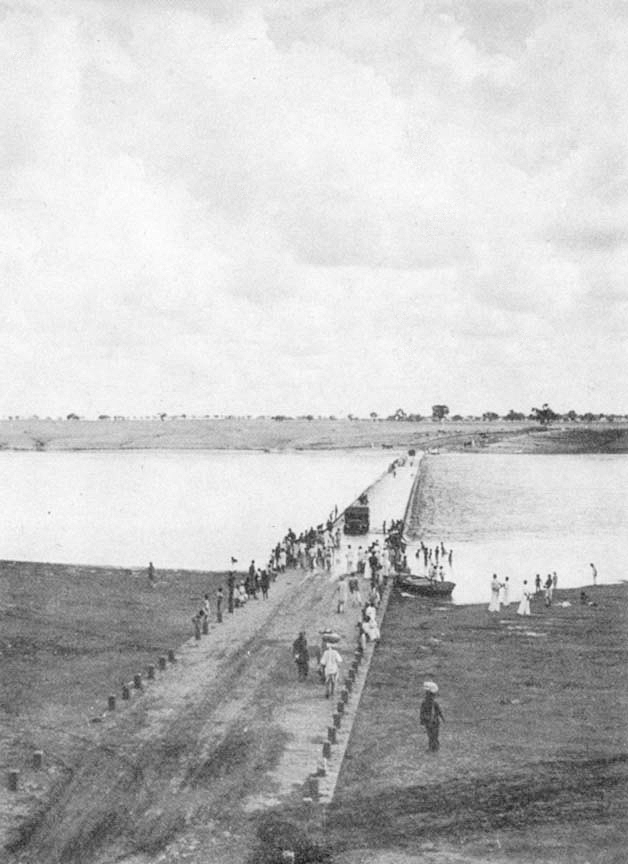
Receding water allows an American Field Service ambulance convoy
to cross a flooded bridge in India.