Edited and published at AFS Headquarters 60 Beaver Street New York 4 N.Y., under the sponsorship of the ambulanciers' relatives and friends, who contribute the excerpts from the letters.
*_*_*_*_*
AFS lives and has its being on the battle front. Its primary purpose is to evacuate sick and wounded from the forward post to the Hospital in order that the soldier may be given a chance for life and further service.
Hundreds of Volunteers and hundreds of vehicles operating amid the complexities of a vast military establishment, call for competent direction to assure order and dispatch. Being autonomous, AFS must therefore draft officers from its own personnel; and men who enlisted as drivers are called upon to wear pips and assume an executive roll "For the good of the Service".
The majority, however; are permitted to carry on in the ranks doing the job of their chosen profession, with small thought of personal aggrandizement, finding therein the happiness satisfaction and self-respect that accrues to one who gives himself to a great Cause.
AFS boasts many in this category but there are three who by reason of greater age seniority in service and continuity of effort; might be considered outstanding. They are John R. Meeker; Laurence C. Sanders; and Alfred S. Terrell. It would be nice to thumbnail them individually for their stories are interesting but space does not permit. As with Rudyard Kipling's "Soldiers Three"
| "For the more you see of the others The. less you can settle with one". |
These three embody a singleness of purpose; a devotion to duty and a complete abnegation of self that is characteristic of the ideals of their service.
| Thomas S. Esten | George O. Tichenor |
| Stanley B. Kulak | William K. McLarty |
| John F. Watson | Randolph C. Eaton |
| John Denison, Jr. | August A. Rubel |
| Richard S Stockton, Jr. | Curtis C. Rodgers |
| Caleb Milne, IV | Vernon W. Preble |
| Charles J Andrews, Jr. | Arthur P. Foster |
| Charles K. Adams | Henry Larner |
| Alexander Randall, Jr. |
Joseph B. Helfrich, Jr. was evacuating a patient when an 88 mm. shell landed near his ambulance, badly puncturing the vehicle and instantly killing the patient. One piece of shrapnel penetrated Helfrich's overseas cap, but despite his injury Helfrich drove his ambulance to its destination. He was then evacuated to a hospital and is expected to be discharged after a short period of recuperation.
Robert Glendinning Frazer was seriously wounded in the leg by a machine gun. No further report has come in yet.
Norman Shethar was wounded in his left leg by a bomb fragment. He is expected to be hospitalized for four months with a compound fracture of the tibia.
________________________ Laurence Sanders, affectionately known as "Sandy", has been followed by ill fortune. While serving in Africa he was taken prisoner by the Germans and served six months in a chain of prison camps. When released he transferred from the Middle East where he was recently the victim of an automobile accident. While his section was moving up, the convoy stopped by the road and Sandy, who was standing behind his ambulance, was struck when a truck ran into the ambulance behind him. All three vehicles bunched up, with Sandy caught between the two ambulances. He suffered several fractures, three ribs, two in one leg and one in the others, so that he will be in casts for at least three months. He is being repatriated to the Mayo Clinic where we hope he will find his former strength and agility.
February 11, 1944.
"Life in the great outdoors isn't what it's cracked up to be, especially when such things as kicking the rats out of your bedding roll each morning gets to be part of the daily routine. A an Anglo-Indian would say; 'That's a damn fact' and unfortunately it is. These capricious rodents are comparable to small elephants, except that they make more noise. The unfortunate thing about getting a rat in your bed is that the mosquito net prevents him from making a hasty exit and it is often a matter of minutes before you can untangle him.
"The closest thing there is to a bath here is a swim in an ice cold river; it's invigorating but could hardly be described as habit forming. I now wash my own clothes; sew buttons on and all in all am becoming fairly independent person. The habit of making tea five or six times a day is firmly entrenched in my being. My knowledge of Urdu is based on British Tommie pronunciation and this often results in some unusual word combinations. Unfortunately because of the high percentage of invectives in the resulting vocabulary I feel it would be a bit improper for me to put any of it down on paper.
"The Britisher, in particular the officers, are a continual source of interest and admiration. I have met some officers who could wallow in a coal bin all day and come out looking immaculate. I haven't the slightest idea how they do it. I heard a new expression this morning. The Irish captain here said, 'I think it's about twelvish', in reference to the time.
"B., who was my spare driver for about a week and incidentally carried the first official patient in my ambulance, says that when he gets back he is going to live in the bathroom for about a week. At this point I am ready to agree with him and adopt a similar attitude when I get back. I would like to walk up to a bathtub turn on the water feel it turn it off and then sit down. and contemplate taking a bath for five or six hours.
"The wonder of being able to turn on the phonograph and listen to any of my records is beyond the wildest flights of my imagination. That is one thing I have noticed about the British I find them extremely unmusical. There are exceptions but they seem very far and few between.
"The diet here is growing fairly monotonous. However we really have nothing to kick about. We never go hungry and I imagine that we fare much better than the Russians or Chinese, although the British Army is not as well fed as the Americans. I thought that when I got into India I would be able to eat lots or curry and rice, but such is not the case, the theory being that when in India do as you would do in England.
"Ever since I left America I have realized that the home front is the toughest part of this war. It involves all of the work and none of the satisfaction of seeing some of the results. American equipment is a vital factor in this theatre of war and the success of the British will certainly be measured by the amount of first class equipment they can get from the U.S.A. Things are looking up out here and the soldiers now call themselves the almost forgotten army. Rangabasha, our Indian cook, is bringing dinner in, so I must stop."
No date.
"Meter much haggling and bitter bargaining, we finally managed to get a smallish pig for the utterly fantastic price of forty-five Rupees, i.e., about fifteen dollars; however I did get a fair reduction on the asking price of sixty "chips". Anyway our new member was a problem from the start and succeeded in making a mess in the truck before we were fairly started for home; arriving in camp, Arnold (the pig's name) was entrusted to the Indian cooks and tied up near the kitchen but made a neat getaway that night into the neighboring jungle. The next day a determined search was made for him, but to no avail and it looked as if Christmas dinner would be pigless; however the fugitive made a mistake ---his last in this world --- of returning for breakfast and was promptly secured. That evening a hurried consultation was held to decide on the best method of slaughtering him and as a result he was shot and the cook slit his throat which was very quick and humane. Last night Arnold made his last appearance, roasted, and was delicious; and a fine time was had by all. The whole affair was a masterpiece of improvisation by our "QMS" (quarter-master sergeant), a young Princeton chap who has done a fine job in feeding the unit, and served to show how much can be done with comparatively little to work with.
"I have made the acquaintance recently of a young native chap who professes to be the Secretary of the local King of Maharaja or whatever he is; this is entirely within the bounds of possibility as the Raj is not particularly important and this 'Secretary' speaks as much English as any native I have yet encountered, which is precious little all the same. I approached him on the possibility of going hunting some day and he expressed his willingness to act as guide at any time; he then launched into a somewhat confusing description in broken English of an animal which, I gathered, 'runs at you in a straight line and will not turn to either side; if you put a dagger or a sword in the ground in front of him' (the obvious thing for any sensible man to do) 'he will run at it and one half of him will fall to the right and one half to the left.' After this rather intriguing description I asked him how big this animal was, to which he answered, 'too big'. Since that interview he has come up with the English name for this creature which turns out to be wild boar. If a few of us get a day to spare we shall go in search of this quarry which would provide us with extra excitement and extra food at one and the same time."
January 9, 1944.
"We went boar hunting again the other day and again drew a blank although we came a good deal closer to our intended quarry than we did on our previous expedition. This time we went out in the evening and waited by the water holes for about an hour and a half there was a full moon, but no pigs showed up. We then turned in, got up at 4 A.M. and went out into the tall grass at dawn. Our guide was a diminutive native about four feet tall who presented a---to me---rather comical sight as he slipped along the trail with his hands behind his back and puffing furiously on a cigarette clenched in his teeth. Since the grass was about six feet high he obviously couldn't see a thing, but suddenly he stopped and pointed to a spot right ahead of us; I looked hard but couldn't see any sign of movement in the grass, nor could I hear anything but there was suddenly a great crashing noise and with a loud beating of hoofs the pigs---which we couldn't see---stamped off and were gone; they were only about fifty feet away. By this time we were well out in the middle of this vast lake bed, surrounded by tell grass and the whole thing enveloped in heavy fog. We continued to thrash around in the grass for a while although I admit that I did so with some trepidation---I was armed with a pistol, my companion with a rifle, but the prospect of stepping on a 300 lb. wild boar without even seeing it was not too reassuring and on the whole the sensation was not unlike that of swimming in shark-infested waters. However, we did go through with it to save our faces, which is a very real consideration around here. Our two other companions, who were off in another direction with another native guide, declined to go into the grass when they returned to camp, their guide asked ours (who spoke some English) 'what kind of men are these?' which called forth considerable derisive laughter from the inevitable audience of villagers who had assembled to see how we made out."
January 3, 1944.
"My bed is in a tent propped on two boxes and made up inside the bedding roll so I can roll it up and move at a notice--- when, the call comes to go out in the late afternoon we spend the night at destination, pack the patients in the cars before we go to bed and start out very early the next morning---about three-to five. The rats are running around busily but I hope I'm high enough off the ground so they keep off the bed. The chocolate bar and candy in the Christmas package had them frantic last night but I wrapped then up where they couldn't get at them."
January 9, 1944.
"The instructor at the mechanical school has been foreman or chief mechanic of a Chevrolet assembly plant out here and was very good. The classes consisted of lectures in which it was finally drummed into us that the car we had driven all these years had some complicated parts. We became at home amid gudgeon pins and idling jets. By the end of the course we had stripped innumerable motors to their bare skeletons and put them back together without any parts missing. Then came the fearful day of the final exam. Part of it was written --- how could you repair a leak in the gas line long enough to get to a repair station? (answer soap) We always carry a nice piece of soap with us now. The second part you could not bluff your way through with clever writing. A motor was conked out deliberately by the instructor. Now make it start. At last we know all there is to know about motors, think we.
"We have met a good many English officers and found them very interesting but pretty peculiar if you judge them by American standards. A Canadian WAC I met later, who was rather in the middle on this 'hands across the sea' business said that the whole trouble was that we spoke the same language. Actually, she explained, we are foreigners to each other but fail to allow for this difference because we talk the same, or nearly the same. To us they appeared stuffy at first; but this I think is largely due to shyness. At a party at one of the enlisted men's clubs an English lady sighed that she wished she could say, 'I sure am glad to meet you' with the ease that we did it, but that the traditional British shyness turned any greeting of that sort into a mumble.
"We bicycled around the countryside looking at temples to strange gods which looked as if they were made out of colored sugar candy. The Nevada-like country had strange Parsee burial grounds set on the tops of small hills and called the Temples of Silence. Women in purple or yellow or green saris washing clothes on the rocks by a stream and then laying them out on the dirty ground to dry, processions of bullock carts winding down the dusty roads, herds of water buffalo grazing on the cricket ground of the club. Sikh soldiers practicing bayonet drill and looking very fierce with their heavy black beards and white turbans, the winding narrow streets of a town with small open shops selling everything and anything, where you stop over and around people asleep on the sidewalk; jammed movie houses with pictures we saw in the States, beggars moaning for 'Baksheesh' along the side of the road."
No date.
"The trip was an ideal experience in every way wonderful accommodations, swell food and perfect weather.....We had one swell break on the way over. We took along a large box of books for the fellows over here. There must have been about 75 titles which were more or less hand picked. This was a godsend on the way, of course. However, we did have to carry them about by train which made them a curse
"It especially interesting working around here because it is so different from anything I have been doing. Right now we are taking courses in Motorcycle driving, truck driving and lessons in Hindustani. We've also had a couple of soft-ball games with some air-force neighbors. We have been getting beaten but today we eked out a 17-17 tie which sounds like basket-ball score."
No date.
'Three or four of us, including myself, went to a Hindu dance recital last night dawn in the city. It was all pretty exciting since it was our first excursion in the city, and the first time I felt as if we were away from white people completely. Actually a couple of British. officers were in the audience, but everything also was completely Indian so that didn't make any difference. Local society was very colorful with lovely women in even more lovely sarees and a mild furor was created'' when the Maharani of ----- arrived with royal guests in her lavender Packard. The recital itself was considered quite amateurish by critics of Hindu dancing but it was an interesting experience for us. The dancers kept throwing flowers at the Maharani who sat in a large plush chair in the front row and in return she donated a few lakhs of rupees to the school. The little man in the orchestra who played the drums with a high degree of bodily-flexibility and the brilliant sarees which the dancers wore were the best features of the show.
"Afterwards we bicycled back to the cantonment to indulge in a ten-rupee-dinner which had already been ordered for the occasion. The restaurant was Chinese and so was the food--- shark's fin soup, roasted pigeons, some crispy delicacies called egg rolls, all kinds of chow chows and foo chows and what not. Then there was ice cream for dessert. That finished us off, so I went home and slept it off.
"One of the fellows met a young Indian couple at an evening church service the other night They invited him to bring a couple of friends to dinner with them Monday night. So three of us went down to the city to their apartment and had a Punjabi dinner. He came from Punjab and went to college in Lahore. After dinner we talked until quite late before leaving. She wrote poetry and had studied under Tagore. She let us read a couple of letters she had received from him."
August 28, 1943.
"We had breakfast late and then got a taxi to see some of the city. We went to the burning ghats first but they weren't near any water. I suppose you've seen a great number of them but it certainly was an experience to watch the sights of oxcarts bringing up wood to the entrance, bodies being carried out by friends and relatives, the little rituals before the burning, and the breaking of the skull. Mud, crows and strange music added a weird touch to that phase. As we were standing there, several men walked by us, one carrying the body of a small child, and shortly after an extended foot burned free and fell from one of the ghats. It was all so stark in a way.
"We didn't spend much time at the dhobi ghats, but they were interesting too. Some of the most awful sights we saw were during our drive through some of the worst parts of the city. There were blocks and streets of degeneracy, where the lowest of prostitutes and men lived lower than animals. It was beyond any Westerner's comprehension, except those that had sunk into it themselves.
"Our stay here has been quite interesting for some of us who have become acquainted with some of the students of the different colleges near by. I spent many very enjoyable evenings over at one of the colleges talking with the boys --- that was before my new job kept me so busy. Usually two or three of us went over at a time and once they put on quite an entertainment for us with their instruments and singing. Two Sundays we fixed up picnic lunches and spent the day out at some of the gardens hereabout."
December 10, 1943.
"I've just finished making a valiant attempt at camouflaging my lorry. I say attempt because I'm not sure that it isn't just all going to cave in like a house of cards. The problem I was confronted with was: I had one three-ton petrol lorry standing in an open space, on top of which was one 24' by 24' camouflage net nearby is a sort of wood and underbrush bordering the open space. The problem was to hide one three-ton. petrol lorry so that no prying little slant eyes which might be passing overhead could see it. Well, anyway, I got out my trusty Ghurka knife and carved a large niche in the jungle, into which I drove the old lady; and then by means of bamboo poles and the net I covered up what was left. So here we sit, the old lady and I, looking like any other self-respecting thicket."
December 28, 1943.
"I remember on driving into the outskirts of the city seeing, for the first time since I've been in India, jalebies, and I recognized them. That was the first of quite a few thrills I had in recognizing objects and impressions. It was twilight when I walked down through the cantonment, the prettiest I've seen in India, into the city to the bridge. At the bridge, again I felt as if I were seeing something I had seen before, but as I walked across the impressions became very strong, the wide river into the fading red sunset, the darkened shores, and the lights beginning to twinkle from the city side. The bridge was very long and its greatness must have forced itself in exaggerated proportions on my mind at four years of age. I seem to recall seeing an elephant coming across, because I have the elephant and the bridge in the some picture. But I don't suppose that is possible. On reaching the other side, everything was coming back as a complete picture, the chowkey and the two roads leading down on each side---I had had a dream several weeks ago and remembered seeing the same scene --- when suddenly a sentry leaped out probably startled himself, he nearly scared me to death ---and pointed a bayonet into my stomach. After the few minutes it took for us both to become reassured, I instinctively started down the road to the right.
"There was only a glimmer of light left, but the fresh, plowed fields seed to stretch right down to the river. A strong smell of the farm was in the air. I knew I must be near to the school. Shortly on the left I saw bright lights coming from the creamery, behind which were one, or two dimly lighted cow barns, low and concrete. Just past the creamery was another seemingly large building but I recognized none of it. Dr. H. was quite surprised to see me, rather when I told them who I was, and we talked for a while, I said I would like to go and see the home where we lived. Mrs. H. and I, the old man leading with the light, cut over thru the back way. A bright noon was up so that I could see things as impressions and thus recognize, rather than be confused by a flood of details. When we first saw the house, the porch with its wide supports and potted plants came back to me. Mrs. H. pointed to the little boy who was living there, eating in the dining room, which as you know opens into the living romp and said that was just the way I looked fifteen years ago. Nothing was familiar until we went into the kitchen. The kitchen stirred something in my memory, especially the sort of sideboard, where I think I remember the cook when he made chapatis for us.
"Out in the front were the poinsettias, and the driveway which led out to the road, both were familiar but so much smaller than I had recalled. It was my clearest remembrance, along with the lights across the river. It was all very lovely in the moonlight and there was the smell of gardenias in the air. Everything was grown up, especially the grass, since the rainy season was not long over. There was a breeze in the air, and in the moonlight, the trees around in front of H.'s bungalow brought back a vague but very definite impression on my mind. During the meal their cook sent Hindustani. word into Mrs. H. by one of the servants that he would like to come in. Mrs. H. sent for him to come and after exchanging a few words with him she said that he had remembered me when I was small and had watched me playing, down by the river. He had a great white smile on his face and seemed very pleased. It was the best evening I have spent since I've been out here, and I'm really locking forward to the chance to get back there."
February 8, 1944.
"It appears that most Indians have a great admiration and regard for America and probably look to her for much. I wonder if they can hope for much other than an example. I have no great faith that America in going to set about being the Great Liberator. I can quite understand why they are somewhat leery of the scheme of Commonwealth. This is such a complicated country, and though it is large it is really more unknown than the little countries of Europe and treated in much the same way. 'How tiresome of them to think about themselves:' You know the attitude 'How tiresome of Norway to think about her Merchant Fleet.' Still they will think of themselves and many of them have a deep pride and love of this place. I talked to a Captain when I was off on that course. I asked him if he had ever been out of India and he replied that he had not but that he considered India a life work in itself and that it was too big for a lifetime. Well I am often very impatient with Indians, but I realize that I am in a foreign land and that it is wrong to be impatient and shows a lack of understanding.
"In this talk the other day we covered many facets including the color bar. Finally I did mention that, no matter what America did or said, at her foundations were wonderful ideas and dreams that belonged to everyone and I read to him the first part of the Declaration of Independence ---'When in the course of human events --- We hold these truths to be self-evident that all men are created equal, that they are endowed with certain inalienable Rights, that among these are Life, Liberty, and the Pursuit of Happiness --- all Experience has shown, that mankind are more disposed to suffer while Evils are sufferable, than to right themselves by abolishing the forms to which they are accustomed.' That is as far as I read, It is a very civilized document and part of the heritage not only of Americans but of all men, because it does not so much advocate revolution as evolution and urges men to reason all ways first. I wonder how often we lose sight of the principles of those early Americans. I think from time to time when things are too good for us we do lose sight of them. One thing all this has done for me is to again make me aware of people. I hope that I don't lose sight of them again. I wish and do honestly feel that even in the theatre one really serves people in a way. I should like to be able to do as much as I can to make things a little better for people by my work. In our present work we do help individuals --- many of them, but when it is all over I should like to feel that I was able to make life a little pleasanter for people by and large."
No date.
'I think that newspaper article was terrible. Several of the other boys also received clippings from other papers so apparently it was a nationwide article. We are far from being the physical wrecks that they portrayed us and that in particular made me mad. We have some very excellent athletes in our unit and while that article may be good advertising for the Field Service, it makes us look as though we were on our last legs, and that is far from being true. Our unit is made up mostly of very swell guys and I have made very good friends with a lot of them, particularly the ones in my section. That article certainly did not paint a true picture."
December 28, 1943.
"Carried patients Christmas eve and went to sleep in my blanket roll under the stars, not expecting to see any signs of Christmas until I got back to HQ. in a day or two. But when I was awakened at 4 AM to get on the road again, I reached out for my shoes and there beside them was your Christmas package, looking as if it had travelled around the block from Highland Street in your car instead of half way around the world. Also on top of the parcel was a little packet of mail. A chap from HQ. had driven up during the night and distributed them to those of us who were on the roads.
"One of the more religiously minded boys offered to hold a short church service. I joined the handful of men and. we stood in an open field under the moon, while he read several psalms and other things from a High Episcopal Prayer Book. We seemed a lonely little band indeed under that enormous sky singing Christian hymns, while from half a mile away came the high wailing singing and the little bell and flute music of some wandering natives."
December 30, 1943.
"I am on the late night guard shift (3-7). I am out in my ambulance where I've just boiled some water and made myself the most delicious cup of nescafe. It is now after six and I must wake the Indian cook who thinks "Kishmush" is a splendid institution, as he gets a cigarette or a candy every time one of us opens a package ....The Indian cook has just come by my car on his way to the cookhouse, saying, 'Gude Mohrning, Bulbul Sahib'. All the Indians attached to us call me that, expressing their delight at my having given my car an Indian name."
January 17, 1944.
"It certainly is good to be doing at last the work I came out here to do. Censorship prevents my going into much detail, but I can say that I'm kept very busy carrying patients and keeping my car in good condition to do it efficiently and well. We keep our kit packed and our car ready to roll at a moment's notice rather like firemen, ready to slide down their poles at a given signal in the middle of the night.
"Most Indian women are very beautiful, being as you must have read, the original Aryans. Even the lower, 'Sweeper' classes have a Grecian delicacy of feature --- there is nothing coarse or heavy about them. It was always surprising to see women, as we drove through villages, with such graceful bodies, clothed in their modest saris, with faces as delicate and refined in feature as Florentine madonnas, their lovely hands expertly busy making little pancakes of cow-dung for fuel for their hearths. From their faces, if you didn't see their hands, you would imagine they were perhaps busy with some fine needle work. The European women seemed like clumsy Amazons in comparison. Through centuries of living in the most peasant-like manner imaginable, they have retained a somehow touching delicacy and fragility and gentleness. The colour of their skins :ranges from a shade much darker than the average American negro, up through varying shades of copper to that of a very pale skinned Chinese.
"The other day we attended a dinner party at which some Indian girls danced and sang. We sat on the floor around the four sides of the room. Great banana leaves were placed in front of each of us as our individual sort of doilies. Our hostesses would come around in their lovely saris and bare feet, some with jeweled toe-rings and tinkling anklets, and put their piles of rice and balls of paste that tasted like peanut butter on our banana leaves. After dinner the younger girls of the family danced for us --- graceful Hindu dancing of the kind I had seen Uday Shankar do many times in the States. It is the custom for young girls (they were about sixteen years old) of good family to dance for their parents' guests --- much like the lady-like accomplishments of piano playing etc. of our Victorian days. It was beautiful. Our Western Russian Ballet seems crude and athletic and like a girl's basket-ball game compared to the subtle grace of those lovely girls in the infinitely graceful and delicate patterns of these ancient dances. Then one of them sang --- sitting on the floor, her sari like a gold cobweb falling all around her, her head slightly bowed under the weight of her soft dark hair caught in a huge loose chignon at the back of her delicate neck--- a sad, wistful little song, beautifully suited to her thin, high reed-like voice, sounding like a pipe or flute heard on a distant hill at night --- a poem of the great poet Tagore set to music. My friend and I went back to our billets that night feeling that we had indeed been for a few moments in another world."
No date.
"As you may gather from the lack of letters I have been rather busy. Until I arrived out here I thought I was a reasonably good driver, but this part of the world teaches you a great deal about what you do not know in a very short time. If you don't learn---well, we carry three days rations so that we do not need to die of starvation before we hit bottom.
"Considering the fact that all of us are half way around the world from home, Christmas was quite a day after all. There wasn't any tree and only a few packages had reached us but we did have a Christmas dinner which was complete from hors d'oeuvres to mince pie and plum pudding. In addition, a lot of mall arrived on the 24th and on Christmas night. Most of us ate dinner with one hand and opened letters with the other."
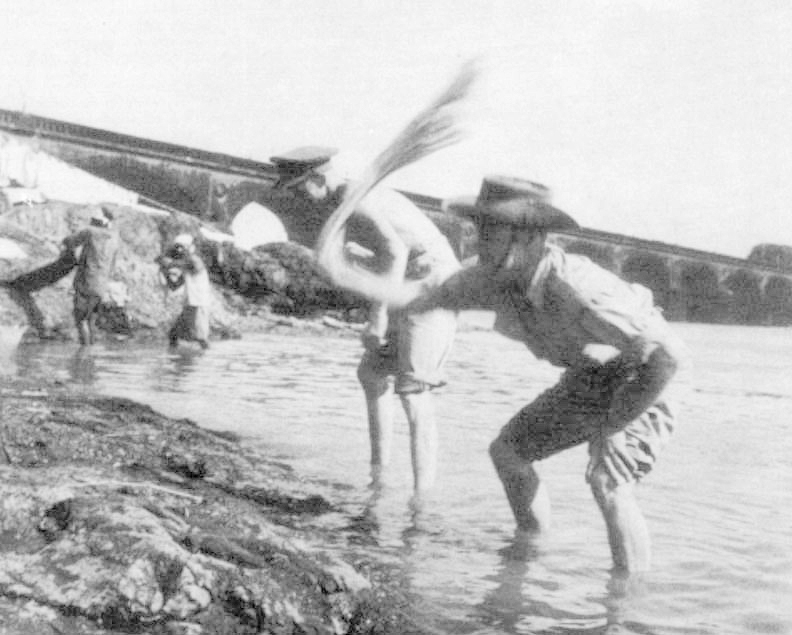
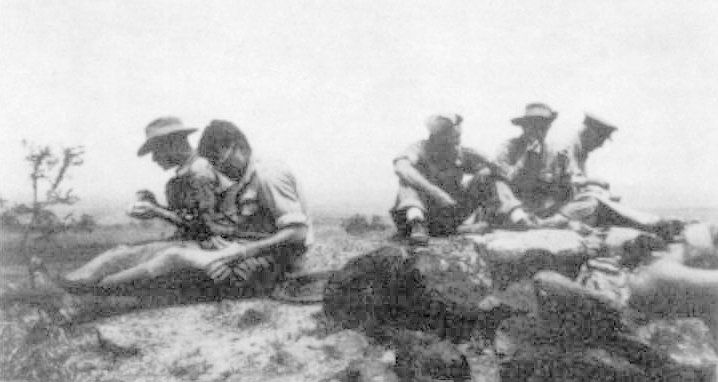 "American Indians" take time out from their training to enjoy a picnic lunch American style. Left to right: Hugh Parker, Morris Hallowell, Robert Dodds, David Mayhall, Lawrence Sanders. |
 |
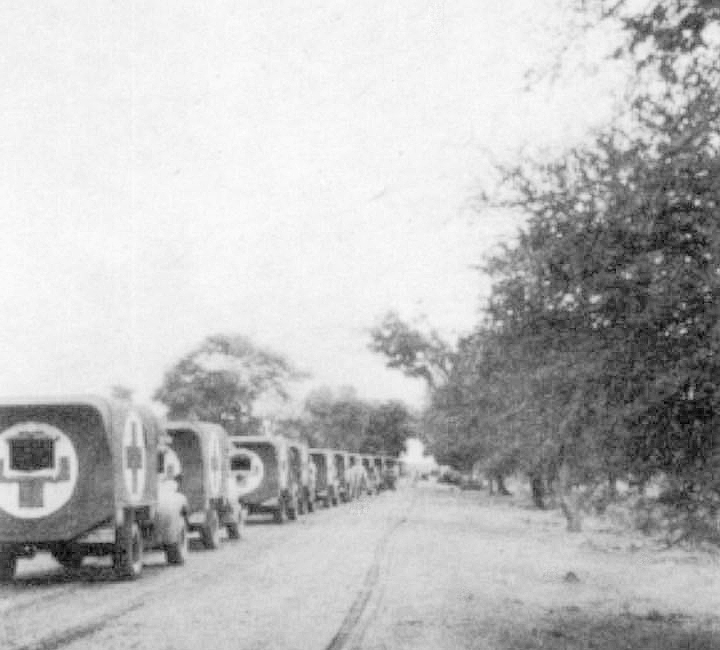 AFS drivers practice convoy driving along a quiet road in India |
 Floods make these American Field Service drivers in India appear to take the evacuation of even this sizeable casualty in their stride. |
No date
"God bless the little British Tommy who believes that his right to a little piece of England and his right to be free on it is worth dying for ...
"Well, with my commission has come added responsibilities one of which is Unit Security Officer. Security is something which so often seems to be overdone and yet the past has proved that we all of us have treated it too lightly. Surely some of the early success of the Germans can be traced to the fact that they considered no information, however remote, regarding us worthless. Well, now I am getting conscious of it, and it is part of my job to inject a consciousness of it into our men. This is not easy, but it is coming along. Life is very pleasant. I have a new room that seems quite large to me. It has a bureau in it which is a real luxury, a table, a bedtable, two comfortable canvas chairs and a straight chair. That coupled with the fact that G. has decided to fatten me up and keeps bringing tea and things to eat to the office all day long robs me of any chance to feel that I am making a noble sacrifice.
"This morning at six o' clock one of the night guards woke me up. I had told him that I would like to see the sky at dawn. The morning star here at this time of year is the biggest star I have over seen. It is hard to believe. The beauty of it is quite indescribable. One of the men told me that it is called the Star of Bethlehem because it appears only at this time of year and disappears shortly after Christmas. I don't know whether this is so, but it certainly looks the way one would imagine the Star of Bethlehem to have looked and it's right in the East. The sky at night does not look like the sky at home. I can't find the old familiar constellations at all. Sunsets and sunrises are quite fantastically beautiful, without doubt the most beautiful I have ever seen. So you see, one place to look is upwards, here as everywhere.
"Now that I am an officer I have more to do than before. They've shown so much confidence in me that I mustn't let them down. I don't know quite what I'm being groomed for, but I'm going away to school to take a course. I told R. that I was somewhat worried as to what sort of a student I'd be after all this time away from books but I shall be very anxious and conscientious,
"I'm glad they made me an officer. It's harder but it gives more of a chance to serve. I'm eager and excited about the future. This has been a most fortunate experience. I'm so glad I came to India rather than the M.E. But the men there have done a good job and ours lies always ahead. The benefits we derive here from the British whom we serve are largely given us on the merit of the boys in the M.E. It's hard to say a great deal in letters. I want you to know how happy I am with these opportunities.
"What a lot we shall have to talk of when I see you again. Only believe me when I say I'm trying in a fast moving world to do my best and serve. Try to keep my feet on the ground. I read Job 'But where is wisdom to be found and where is the place of understanding.' I read 'The greatest of these is charity.' I read 'I will lift up mine eyes unto the hills.' Well; know that I am trying to keep my sense of proportion and a sense of values.
"I can't complain about the mail. I think it is miraculous and quite wonderful. I wish you could see the bathing facilities where I am right now. To begin with, it is quite cold in the mornings and I never did like to get up before dawn, but I do, However, I am shaving in bed these days. I have a mug of hot water on a bedside table and holding my steel mirror shave and brush my teeth before getting out of bed. At about 5 in the afternoon I go down to the wash house for a bath. This is taken in a galvanized wash tub ----2 'babistes' bring in each bucket of hot water and throw it into the bath--- presto, Sahib's bath is ready. No matter how much you shout for 'els am bucked garm pani' you don't usually get any more and get in, hoping that some law of physics will raise that water level up to your naval. It's fine and all experience. Today I was lecturing on battery ignition. Surprised? So am I. As a matter of fact at this moment I could lecture on quite a number of things in the infernal combustion engine from valve timing; ignition timing, fuel systems, lubrication systems; oh well, many things I never knew before. And as I used to find back at Hill with mathematics, these principles come quite naturally and easily when well taught as they have been. What is the enormous morning star we have here in the East? I've never seen anything like it, surely it 's too big for Venus and it's the wrong time of year for Venus, isn't it? I have no way of looking it up and have heard so many various tales about it, ranging from Star of Bethlehem through a 'Cluster' to Venus, I should like to know.
"Another Saturday afternoon and my two English tent mates and I are spending our one lazy afternoon per week. A couple of wandering shoemakers have just been in our tent and laid their wares out all over the floor. And after considerable bartering they have left without making a sale. The shoes out here look quite nice; but don't last. They wear out while you look at them. I think we are all hoping that some Kashmir merchant will come along. Not that we'll buy anything but they put on a good show. That frantic look of disgust when you offer them 6 rupees for something they have asked 30 for. It's pretty good fun.
"I've had two real Indian meals since I've been here. The Major and I went to our Munchi's house for dinner twice. The first time was on a Hindu festival day called 'Djevoli' ---it's their New Year. They light all windows with myriad candles so that the goddess of wealth won't overlook their house. So you see even here where they claim such a belief in poverty and self-abnegation they think about money, too; and are in a state of inflation far worse than ours. The food was very hot and very good. I can't begin to describe it. Little meat balls eaten with the fingers --all of it eaten with the fingers---a rather delicious doughy thing that you dipped in sour cream.
"Monday I'm giving a lecture on the brake system of the Ford. I gave one last Tuesday on battery coil ignition.
"There are certainly lots of men who are making more money in the army than they ever made before. Of course I feel that that is a mistake, but perhaps it is all right. That whole question of pay in the U.S. Army has been handled rather badly from the point of view of Inter-Allied relations. There are far-reaching effects from bad and senseless spending abroad. It is a pity that if they want to pay the soldier so much that they don't put the money aside for them at home and have some sort of equality between the forces side by side abroad. Still I suppose the main thing is how people feel about each other at home and not how they feel about one another out here."
November 21, 1943.
"A wayside photographer took the picture. Across the road two men and a boy performing tricks. Boy placed in a basket, basket covered with a blanket and boy disappears. When he finally reappears he has a bloody dagger in his throat. A wooden bird dancing around in a bowl of water. A crowd stands around until the men pass a hat, then the people leave in a hurry."
November 29, 1943.
"Today I have been duty cook. Some of the boys are going on an early trip so I was up at 5:30 and did not get off duty until 6:30 tonight. Not a hard job, only a long one. Tomorrow I want to work on my car. Have learned a lot about motors and their care and will know a great deal more before the war is over,"
December 12, 1943.
"The countryside is dotted with interesting places. One day we went through a village which is visited by pilgrims in November and December. Here a saint buried himself alive. He dug his own grave and then sat in it in meditation until suffocated by smoke of wood fire. Legend has it that this saint once strode to the town hall, jumped across it and, giving the word, part of the wall shot forward into the air. People point out the part of the wall that is missing to this day. Here in this same village a buffalo once recited four Vedas without a mistake, and the saint was once seen riding through the air on a tiger with a serpent for a whip."
December 14, 1943.
"Today's trip was up into the mountains through a tunnel and into a green valley --- or perhaps mesa top. At one point we crossed a high stone bridge from which we saw an elaborate temple with three towers and two lantern pillars flanking the entrance. The temple is at a bend in the river so that from three sides great stone steps lead down to the water, a colorful picture with women washing their saris, and with buffaloes and children. Crossing the bridge, we drove through the little town over a narrow winding street."
No date.
"It was anything but a white Christmas. Tho fairly cool there is no ice-skating or sleighing. My day was occupied in driving 100 miles over a very dusty road with several patients. Our average driving rate was about 8 M.P.H. So you can see how long that day was. I drove back alone in the evening in time to see a beautiful sunset over the hills. As I drove along in the gathering darkness I could see large Christmas fires all the units were enjoying, seeing the men around the fire busy fixing Christmas dinner. I also passed several very unfortunate chaps who had broken down and were forced to spend Christmas night out on some lonely cold road. As I drove back I sang carols the only ones I heard all last week, as where we are now there is no chaplain. I reached camp pretty tired but climbed up to the mess and was pleasantly surprised by a nicely laid table and a real party going on. About 18 of us crowded in the tent including an Indian medical officer and the local M.V. It was an enjoyable occasion. What made it most so for me was that it was the first time since I'd been in India that I had really worked driving patients all day. It was a very satisfying feeling."
December 29, 1943.
"We've started work now; carried our first patients a while ago so at least we can feel that we have a little share in helping in this war, though in a different way than most men. These Ghurkas, the chaps from the mountains (Himalayas) in the state of Nepal are certainly staunch fellows and are most highly regarded in these parts. Perhaps they're most famous for their kukris, a long curved knife which they use in preference to guns when fighting the Jap. I've carried quite a few in my ambulance and they are a sturdy and uncomplaining patient to carry."
February 3, 1944.
"The English put us up at a very nice private Tennis Club; where we could have drinks and dinner. The next day we were taken to a transient camp at noon. It was dark until around --- which makes one's day a little off kilter. I am not allowed to say too much about my impressions of this country, but it is something similar to my other ports with everything exaggerated and by that I mean --- comforts, scenery, living conditions of both natives and ourselves, etc.
"We were told we would be awakened the next AM at 5:15 and a cart drawn by a camel would be ready to take our luggage to the station, while we followed on foot as it wasn't far. I was lucky in securing first class on the trains all the way through and we traveled for -------.
"It was an experience, believe me. Each compartment is separate, with no corridor running down the train. Your name is put in a slit by the side of the door to reserve the compartment and they wire ahead every time you change trains which in our case was three times, with 28 pieces of luggage and four boys out of the six had never traveled before, so you can imagine what that meant amongst strange sights and languages. However, as there are bearers wherever you look it was simplified a lot. There are four people to a compartment, with its own bathroom, and one must always leave someone to watch the luggage when you leave it. The servants bring you tea in bed in the morning and afternoon, and one gets out at specified stations and eats there or goes along to the diner and is locked in it till the next station or two, if it takes that long to eat the meal. There are first and second sittings, in the diner, and that saves confusion. There was a very nice British officer who gave me lots of tips about how to proceed before different emergencies arose and one of our civilian ship companions had his own bearer for the trip so that helped as he could act as interpreter and guard.
"Now for the AFS. There is an organization here, which will shock my old friends that read this and oh what a joy that is! Definite clothes to be worn at certain times, definite courses to be taken in regard to our future work. Wonderful quarters at this reception base, with bearers that one shares with a number of others according to how much one wants to pay as his share and how much individual service is required
"The bearer brings tea and hot shaving water at 7 AM, makes my bed, folds mosquito netting and makes everything ready for inspection as I am not there for it, being at the ration depot. He lays out my clothes to put on socks and folded in a certain ways hands them to me to dress and takes away anything soiled for the laundry, which comes back the next day (buttons a little the worse for wear, having been pounded on rocks); This all goes on again at 4 PM, when he appears with tea, draws hot bath and does any errands I need. I let him make certain purchases for me as he does better on prices. Bed is turned down for the night and mosquito netting hung before dinner. Knowing me don't think I don't eat it up. My most amusing new issue is a hat like Teddy Roosevelt wore in Cuba, up on one side, with a snap and chin strap. I haven't decided that it does much for me but it is required."
ORCHID DEPARTMENT: Col. G. Anderson of the British ADMS on the Anzio Beachhead writes to Capt. Carleton Richmond of the AFS: "It would be invidious to single out any one of them for individual praise---all have been magnificent. Always a smile---no matter how hard worked --- always ready to go up to 'sticky' places in fact at times almost begging to go there. Words are not enough to express what they have done. All my Field Ambulance Commanders and RMOs are equally loud in their praises. I would be glad if you would convey to them the sentiments contained in this letter --- and accept from me in the name of all members of the medical services in the Division our most grateful thanks for all these chaps have done and are doing for us. Good luck be with them." .......Peter Glenn officer candidate in the Indian Army reports: "One of my closest friends is a Yank in the -------with a Battalion in Italy and writes me that 'The AFS is with us well liked and useful and terrific for morale ---damned nice guys'."
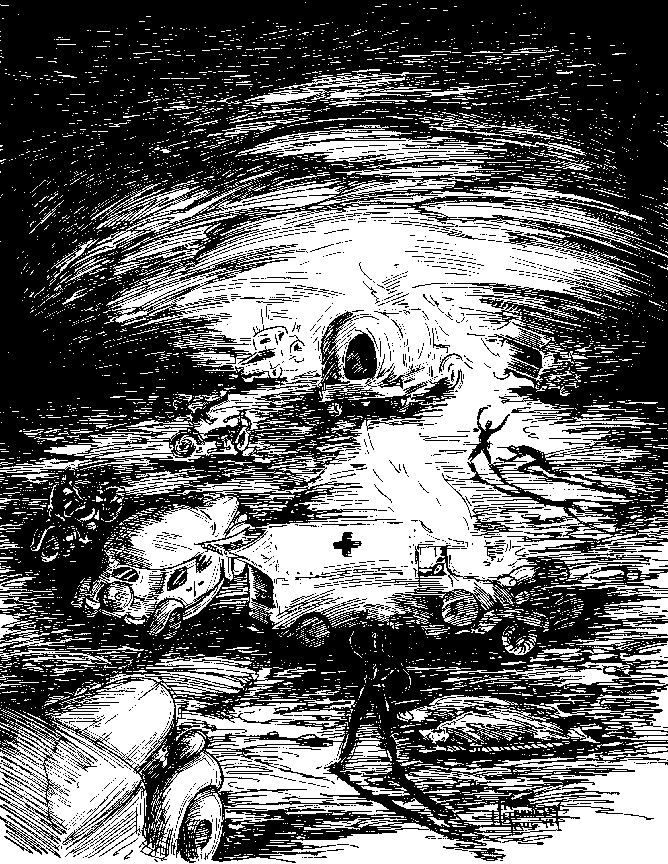
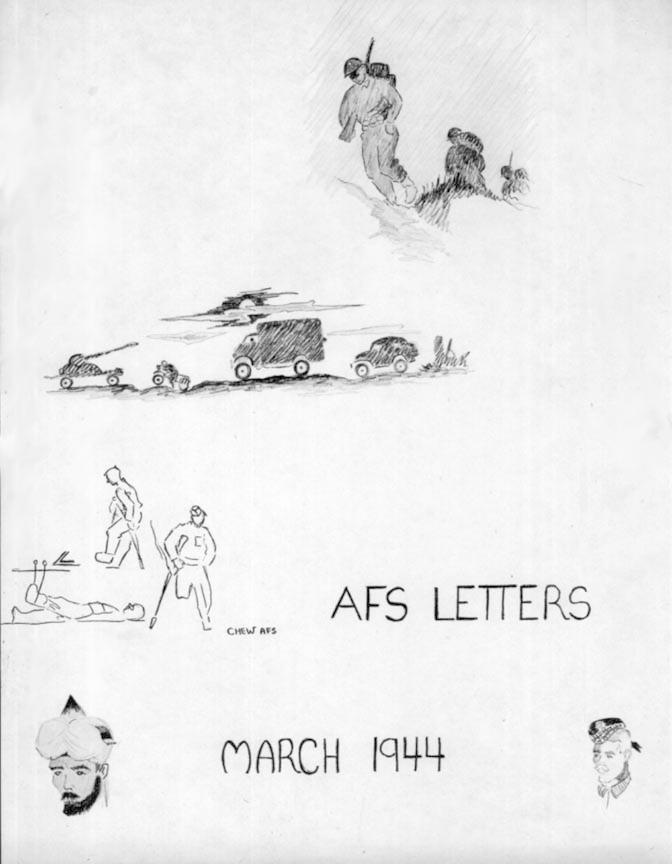
ART FOR OUR SAKE: The eye-catching sketches which appear on the cover of this issue are the product of Peter Chew's clever pen. Peter, who is convalescing in this country, gathered a wealth of material during his travels with the AFS in Africa and Italy..........The drawings on the inside back covers of both last month's and this month's LETTERS were done by Hal Hennesey while in the Middle East. Now an aviation cadet at San Antonio, Hal is art editor of the "Tailspinner", an Army newspaper.
Among the many AFS veterans of the Italian campaign who have recently returned to this country is Fred Hoeing, commanding officer of the AFS in. Italy, now home on leave. Fred who has been appointed to the Most Excellent Order of the British Empire, went overseas with Unit 1 and was one of our pioneers in the Middle East.
An exhibition of paintings by Clifford Saber, our desert artist who originated the famous "Chicken" insignia; will be held from March 18th to April 2nd at the Cochran Gallery. Those who have not seen Cliff's portrayal of the AFS in action in North Africa will want to put this exhibit on their "must" list.
Jackie Hunter Snyder, former AFS switchboard operator and receptionist, and. her Coast Guard husband, are the proud parents of a seven-pound son born February 18th.
AFS IN THE ARMED FORCES: Wayne McMeekin, AFS Middle East veteran known to theatre-goers as David Wayne, is scheduled for a new part--- that of one of Uncle Sam's fighting soldiers. He was recently featured in "The Merry Widow" and had just been assigned a atelier role in "Peepshow".....Dick Tevis is reported attending O.C.S., location unknown..... Recent visitors at 60 Beaver Street include Harold Curtiss of the Navy and Herb Reinhardsen, soon to. join the same branch of service.....Pvt. Vincent Bowditch of the Army writes of the orientation and morale work he is doing: "...I deliver as many as 12 lectures a week to the officers and permanently stationed personnel here at Devens....I have found my experience in Africa with the AFS a great help and it has given me a great background to fall back on...."
ROMANCE DEPARTMENT: March's blizzards and bluster have blown news of only one wedding our way ---Jerry Addoms, recently arrived on furlough from Italy and Miss Eugenia Coleman of Philadelphia were married on March 26th.
Mid-town New Yorkers have no doubt spotted a group of AFS photos in a store window at 43 East 47th Street. Supplementary exhibits will appear in Cleveland during the latter part of March and in Cincinnati early in April.
"GOOD NEIGHBOR" DEPARTMENT: From Italy come two reports of AFS men who are lending a helping hand in extra-curricular activities. Bill Jarvis, a former lawyer, has been trying cases for the AMG. (P.S. He won them all!)....George Collins did such a good job of repairing the torn-up roads and faulty sewage system of an Italian town that its citizens requested him to extend leave indefinitely and remain as mayor.
Special thanks go to the many AFS relatives and friends too numerous to mention; who have generously contributed books to be sent to the men overseas. The need for reading matter is great and the response is most gratifying.
January 21, 1944.
"This is written at the front line and have I had a warm reception. I was told at noon today to report to an Advanced Dressing Station; at that point I was about 14 miles behind the lines. I no sooner arrived and parked my car than things opened up. I am dug into a slit trench with Jerry throwing them one way and our fellows throwing them back. The noise is terrific and the shells are whistling like nobody's business. I had just stepped out of my ambulance when wham things started to come our way. I made a beautiful three point landing in a slit trench beside a Tommy who was lying there reading the Readers Digest; some fun. The fighting is terrific and it looks like we would really be busy."
January 22, 1944.
"Yesterday and last night is a stretch I'll remember for a long time. We had been shelled most of the afternoon and just as I was finishing supper about 4:00 two wounded Germans and two British lads were brought in. After emergency treatment I was to take them to a hospital about 14 miles behind the lines. Well, the barrage was still going on so that the ground was shaking like an earthquake. It was dark and you have to drive without lights and, as you can imagine, the roads are not so hot. I finally made the 14 miles in three hours. One of the Germans died on the way. We then returned to what is called the car pool about 6 miles behind the lines and waited until they needed replacements up front. As it turned out I spent the night there and came back up at 7 that morning. But Jerry shelled the car pool about ten last night and he was really pouring it on. When the first one hit about thirty yards away I made a perfect swan dive into a slit trench. It was a swell trench except it had about a foot and a half of mud and water in it. Was I a mess when I came out about 40 minutes later. For some strange reason I found it very difficult to sleep soundly the rest of the night. They certainly gave me the full treatment for my first day in real action. The stuff is still flying today."
January 24, 1944.
"I was relieved at noon today and am now back about 14 miles behind the lines. They try not to keep the boys too long under fire at any one time, which is a good idea, so I probably won't go up again for another four or five days unless they need replacements badly. The one bridge across which we had to evacuate our patients was under fire all day yesterday and this morning so there was never a dull moment. One of the greatest sources of satisfaction has been this: I have yet to carry a load of wounded that there hasn't been at least one who has said what a swell job the Field Service is doing. This comes from fellows who have just come out of the mess and are in no mood to be tossing idle compliments around. It helps."
February 1, 1944.
"We are still in a lull, and while we are well within. sound of the guns we are not at the front.
"Here is something you can quote me on it you think it will help. Nobody, until they have been up to the front, can realize how much good this blood plasma does. Anyone who gives a pint of blood is almost sure to save a life. It's almost the first thing the Medical Officers call for at the advanced dressing station. If the chap is badly hit it will give him enough resistance to stand the trip back to the main dressing station. And without it he would more than likely die on the way. The second night I was up there I was sent down to get some more plasma and I was told to bring it back if I had to walk."
No date.
"Usually when a rather terrifying experience is all over you find plenty to laugh at but such is not the case with the past two days. Now that it is all over I am glad I had a chance to see and feel what it was like. The story starts three days ago when the major in charge of the A.D.S. to which we were attached came up to me and said that he had received orders to move up the next day to a small town which had been taken the night before. The next day at two we started out in convoy at 100 yards interval. The town was only about six miles from where we had previously been attached. Twice on the way up the ack-ack started up all around us, the cars ahead jerked to a stop and everybody dove for ditches and gullies. The Jerry planes came over but only the first time did they drop anything and machine gun the road. As far as I know they didn't hit anyone or damage much. When we got to ------------ we were told that Jerry had counter-attacked the night before and only been pushed out at eight that morning. The house the A.D.S. took over was a two-story four room house. The first floor was turned over into a ward and dressing station while the top floor was to be used as sleeping quarters for the officers and ourselves. We were given the choice of either sleeping there or in slit trenches outside. There was some shelling and a few planes over during the rest of the afternoon but it really seamed pretty safe up there. The walls were thick and the roof seemed quite solid. No patients came in so we had supper and sat around drinking wine till nine. Then we turned in. I was wakened up at ten-thirty by terrific explosions. The walls shook and shrapnel and stones hammered at the walls and shutters. In a minute we were dressed and down stairs in the dubious shelter of the ward room--- the former kitchen. It was a biggish room with white-washed walls, a till stove, and dried tomatoes hanging from bamboo poles from the ceiling. From then on at twenty minute intervals in batches of six Jerry sent over six pound mortar shells --- a deadly contrivance which explodes into a million pieces peppering everything for a hundred yards or so. At first things weren't so bad, as Jerry was sending them over some way down. the street but after a while the mortars started moving closer. Here we were seven men--- an Indian captain, an army priest, a British captain, two A.F.S. men, and two British orderlies, sitting on the floor waiting for the next batch to come over. We talked of this and that but with always one ear cocked for the warning whine of the mortars. Then when it came and the doors, windows and wails shook and bits of plaster came down we all crouched in utter silence --- our tin helmets on our heads bent for better protection. Soon his range reached us and a mortar hit the house next door killing one and badly wounding another. When that shell hit, the outer door and the one window were blown open and the room filled with the smell of cordite and dust. When it was over and the doors and window shuts, a British lieutenant came in with two men carrying a stretcher. While an ambulance one of the British ones was gotten ready the patient was dressed by the light of two shielded kerosene lamps. He had a gaping wound some four inches long in his am; one piece of shrapnel in his leg, and still another in his back. When he was patched up the stretcher bearers came in to take him out to the car. Just then a shell landed on the roof. Everything came so fast that I don't recall much about it. The door and window were blasted open, people dove on top of each other for cover in corners, plaster and bricks came down, bottles of medicine crashed and broke on the floor, another and still another shell crashed outside, shrapnel came crunching into the walls above us through the open door and window. The deathly silence and then a shaky voice, 'Is everyone O.K.?' A few voices answered in the affirmative. I looked up from the corner by the fireplace and through the smoke. I could see people getting up slowly, someone closed the door and window; the patient was still on his stretcher in the middle of the room. I got up and sat down on a crate. My knees were shaking and I had a bit of trouble lighting a cigarette. The stretcher-bearers picked up the man and took him out. The British lieutenant rummaged around for his hat which he had lost when he dove for the floor, and then went out with his two men. The remainder of the night was relatively quiet so we finally dozed off until morning. With the coming of daylight we all felt better for some reason and after a cup of tea and some food I ventured up to the second floor. In the roof there was a. gaping hole three or four feet in diameter. The floor and all our stuff was covered with bricks; plaster, tiles from the roof, and inches of dust. Somehow my pride and joy, my air-mattress was spared. The M.O. called up HQ and told them that we couldn't spend another night in that house so were assigned to another place the other side of the village.
"These new quarters turned out to be equally bad if not worse than the first. The house faced the main square of the town from which two roads branched out. An obvious target for an army. The first thing that happened the morning we moved in was that mortar landed square in the middle of the square smashing one side of my windshield and one of the side windows. At the time I was luckily in the building but had to run out into the square and drag two soldiers who had been pretty badly hit. From then on for the next two days it was hell every single minute. If you wanted to step outside you made a B-line for wherever you were going and hoped for the best. It was the most nerve-wracking experience I've ever had as you couldn't relax for one single minute. When the shells weren't falling you sat there tense and expectant, ready in a split second to throw yourself on the ground.
When the shells came whistling over you sat cowering in a corner---helpless. Loading the cars for a run was sheer agony. It seemed to take hours to get those patients in and away knowing that any second a shell might land and blow you to bits. I still shudder when I think of it. Driving wasn't so bad as you had your mind occupied and somehow felt safer when the wheels were rolling. Of course, it was all psychological as you were no safer on. the road than anywhere else."
November 5, 1944.
"The big towns have suffered the most, Foggia was in absolute ruins after American and Jerry bombing --- there is not a street left intact. I might even say not a house loft untouched. It is rather pitiful to see several stories up a picture on the wall with its glass unbroken, a mirror unscarred, or a shelf with its bibelots still neatly arranged while the other three walls are nothing but twisted steel, mortar; and stones.
"Jerry is really going to town on boobie traps. He's put them in medical supplies left behind; in such things as guitars, cameras, empty shell casings, and a million other things, he even put a boobie trap on the door leading from the sacristy to the altar in a church of a small village. The old desert days of picking up Leicas and such as you went along are gone forever. You don't dare touch a thing.
"I forgot to say that on our way up here General Montgomery passed us on the road in a very snappy staff car with a motorcycle escort to clear the way for him. I'd seen him before in Tripoli when we were reviewed by the King so I recognized him at once. He doesn't look like any more than a lieutenant as he never wears the red hat of a general ---always the beret for which be is famous. Also, while I was in Taranto, I saw the Prince of Piedmont whisk by in. a two block long car looking more like a conqueror than one conquered. Anyway, such was my impression as I was nearly forced into a ditch to make room for him."
December 12, 1943.
"The old artillery is good, they say, and I can corroborate that if you can gauge by noise. I've seldom heard such whacking great crashings and bangings in my life. Also I saw some of our bombers doing their stuff, and they made good noises, too.. I'll never forget one night we had to go up to the post for a load and met an oncoming bunch of trucks on a bridge. The bridge was a quicki-fill-in, and had no railing. B., who was driving, pulled over to let them pass. The trucks kept cutting it so close that he asked me to look out and see if he could pull over any further. I opened the door and looked straight down. for 150 feet; there was inch to go on the rear wheel before we went over. You can imagine how we felt when one of the trucks sideswiped us.
"We see the Americans around Italy once in a while and they all look grand They keep very American and hold their individuality better than any other troops I've seen They always invite us in to eat with them whenever possible, and as the Americans eat better than anyone else, we almost kill ourselves in the rush to their chow lines.
November 2, 1943.
"Clouds hung heavily in the sky and the light evening somehow brought another hunt for burning leaves and the stir of winter in the home-air. There were more people, of course. Miserable ones near us at camp who had been conscripted to widen the road passing by. The cap, the tattered felt hat, blue shirt, scarfs of rags, and patched pants shoes, whole or otherwise, ---on some there were none. All there we had known before at home. Their mannerisms were but the same but for the most part shabby and drawn out into a bewildered and dazed response. Encountering resistance to their aimless walking through camp brought either a shrug of the shoulders, a faint attempt to explain that perhaps for some reason they either had a right to walk upon the land or would move off, disconcertedly toward the outskirts of the camp. Among themselves, their constant arguments (so they seemed to us a foreign tongue) rose and swelled, to die to mutters and then restless shufflings. Regardless of experiences with Arabs, whom you soon regard as having no kin feelings as yourself and who live by their own codes of the 'scrounging' order and which experience brought on a degree of hardness and insensibility of feelings; I could not help but feel sorry for these people, for they, if any, in all this have been 'sold down the river' regardless of their supposedly individual voice in matters.
"In the town as usual, the women hold the color and attraction. I think unless the very bottom should drop from under her, woman will face the issue with a dab of color and a spangle. And the trolleys ran, chasing one another in single file. Shops were opened and one or two restaurants served a vegetable soup, a veal cutlet, peppers and brown bread --army style. The flavor of well-being existed only in the inherent manner of the waiters whose personality leaped notches with a towel across one arm and a tray in the other. Likewise a haircut became a natural instinct in these people. Though many shops were closed, just as many plied the art as dexterously and flamboyantly as if nothing has been laid low. In truth, only a small portion had become shredded from overhead missiles. Greatest catastrophe lay in the empty and scattered water mains and the reservoirs. Laundries suffered but scrounged enough to produce a bundle within eight to ten days Order was maintained in the wonderful ease of English administration, which, upon assimilation of local government, flows into all channels with the apparent ease of mercury upon sponge rubber. Strangely enough, the town functioned for the armies as if those had always been its customers which is probably not unlikely.
"The uniform in all its various insignia and support --- moral, spiritual and physical, does not suit these people. Naturally a warm people filled with unestablished channels of behavior, whose emotions fill their bodies to the fingertips they are impossible uniformed. As fighters in a war of superb coordination and super-precision, they are as unfitted as a worm is to fly. Individually, if inflamed with hate, jealousy, all frustration, their anger would resolve itself into a vicious knife thrust, a quick short or tricky, and sly scheming blow, spirited and powered by a mind capable of highly imaginative and brilliant fantasy. These are still people of visions of art and creative instincts for beautiful color in music and paint. These two things remain with them but I am not so sure of their building ability. How will they fare in a mechanized and highly specialized world without succumbing to the bursting animosity they, as a people possess; it is hard to say."
January, 1944.
"A chance came to go to a post as interpreter, stretcher-bearer and orderly and general nuisance. Naturally I jumped at it, and although our post is fairly free of casualties (Thank God and knock on wood) I love it. Thereto just the M.O., the Padre; and orderly, batman and myself. I do all sorts of odd jobs from carting water and helping chop wood and laying tires to helping dress wounds, interpret from three languages into English, help translate German Diaries and letters which fall into our hands; and do occasional stretcher-bearing, though frankly my strength isn't up to long treks through the mud, slush and snow. The patients come to us by hand or toboggan and after being looked at and dressed; they are put on wonderful stretcher-bearing jeeps which cart them over most tortuous tracks and paths to the nearest carpost where they are again looked at; transferred to our ambulances and thence taken to a big dressing station. Unfortunately ambulances can't get up this far for various reasons, one of the main ones being the condition of the tracks. At night I go up with the Padre occasionally on his rounds and it is eery, fascinating and not a little terrifying. One speaks in hushed tones and there is an austerity more dramatic than anything I've experienced heretofore. We take up so-called 'medical comforts' such as cakes, coffee, cigarettes, writing paper, ink, playing cards, magazines, and cough medicine. Our food reaches us by mule team, but unfortunately by the time the food gets here it is only tepid as it is cooked quite some distance away. We get some of these 'hot meals' a day, or rather at night. The rest of the day we brew up ourselves out of tine over a big open fire in the almost Norman fireplace of a romantic semi-intact farmhouse. Really we live like kings and as I've said before, I revel in it. The least attractive job is that of grave digger and it isn't at all pleasant in this gooey slime. The countryside is beyond description beautiful. I shall be happy when it is once again silent and free for people to wander through without fear. I shall tell you about this some day. It has been for me the most interesting period of my service yet. The only drawback to it might be the noise. Thank God, stuff doesn't land right around us too often, but my heart does bleed and I get a lump in my throat when I see those whom we visit sometimes at night. They are the ones who deserve all credits and compliments; flowers and fuss. We are mere pikers compared to them.
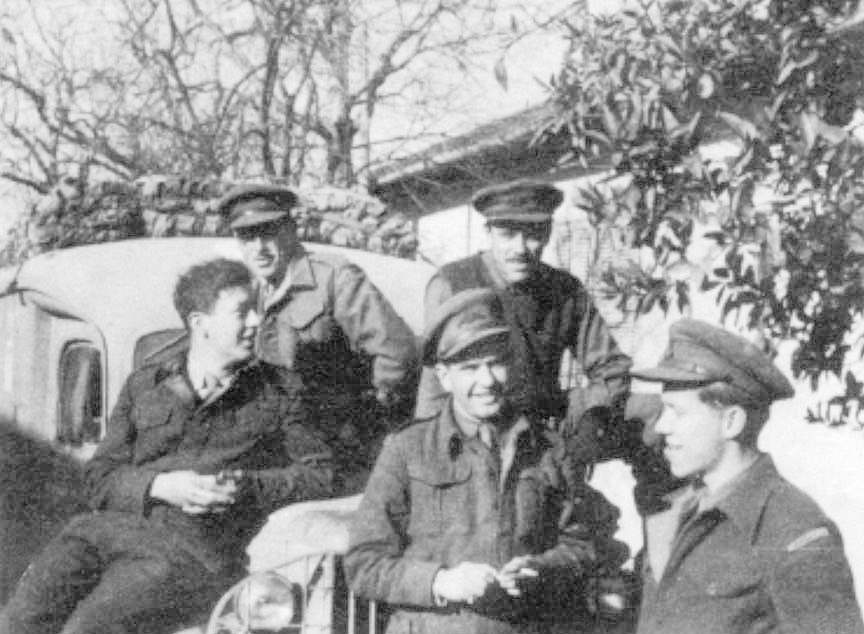 AFS drivers just before they boarded the landing craft which took them on the Allied invasion south of Rome. Left to right: Bayly Winder, Robert Winn, Edmund Baylies, NCO, Oliver Rea, Albert Britton. |
 Looking almost like a "Hooverville", an AFS Coy with the 5th Army is the scene for reorganizing two platoons ready to go into action. Ambulances are parked haphazardly as their American volunteer drivers, fresh from training, repack their kit and have a final wash day. |
October 28, 1943.
"I really think one sees much more, of an army 50-100 miles behind the lines than one does at the front. Behind the lines there is much bustle and activity all day long, but at night the roads are clear or reasonably so. As one nears the front the picture seems to change gradually, while in the forward areas the reverse is true, the roads being almost empty during the days but clogged at night when everyone and his brother moves singly or in convoys to new positions. In the day time at the front, the guns crash away all around you but of the huge numbers of men, munitions and machines there is no sign. If anyone moves by daylight up there it is the tanks as they scuttle from one cover to the next. The major fighting seems to take place at night when a barrage is laid down, usually. what is called a 'creeping barrage' while the tanks and the infantry, the indispensible, expendable, but all-important infantry follow it up. Then the barrage ceases except for occasional and desultory firing while both sides adjust themselves to their own and the enemy's new positions."
December 21, 1943.
"Everyone in C. Platoon, has been working extremely hard for the last several months but particularly in the last six weeks. In November, C. Platoon set an all-time war-time record for carrying more patients, in fewer cars with fewer drivers in less time, over greater distances than any other British or American Field Service ambulance unit, and in the first two week a in December, when we all worked much harder and suffered several casualties in men, and more in machines, as a result of working very near the fronts we must have eclipsed our previous record for any two weeks. From December 1 to about the 12th we had a pretty 'hot' time as, the saying goes and there is hardly a car that has not been marked by shrapnel. One car has over thirty holes in it. (The driver was not in it at the time but nevertheless was wounded.) Another car received a direct hit with a mortar shell in the very center of the Red Cross on the roof! This cannot be blamed on Jerry, however, as mortar fire is very inaccurate and is usually aimed at a general area rather than at a specific objective. The German Mortar which fires six shells simultaneously, and is meant exclusively for anti-personnel works, is probably the most feared of all German weapons and is fearfully deadly for the unprotected infantry. The shells have a most peculiar whine and everyone of them seems to be coming right at you.
"Even a slit trench does not seem safe as you try to pull yourself right down into the earth at the bottom of the trench. I know how it feels. I've been in a slit trench under such conditions --- only once but once is plenty.
"The driver of that second car was not in it at the time. He had just pulled up and leaped to the safety of a slit trench so was not as much as scratched! The mortar made a three foot hole in the roof, exploded inside the ambulance and blew it full of hundreds of shrapnel holes from the inside out.
"Amazingly enough the motor, wheels and driving gear were not damaged and he drove it in the next day under its own power. You can imagine the stir it created along the road and at HQ. Believe it or not it has been fitted with a wooden and canvas roof and patched in innumerable places and is ready to do another several thousand miles it needed. But it is quite a sight.
"During this particular period I was working in a little town right up at the front. When 1 first went in it had only been captured about sixteen hours and so the Germans were not very far off, about two miles away, on the next ridge and kept the town and the mile or so of approaching road under close observation. We moved in at night silently, without lights and found our billets okay. Next day I had to make a run early but was told to wait until it was light enough for Jerry to see my red crosses Then telling my patients that it was for our mutual benefit to cover the 'observed' mile as rapidly as possible, I fairly tore down the road with a terribly conspicuous feeling and then felt just a little foolish when not a shot was fired. Coming back they had signs up reading: 'road under enemy observation, drive accordingly', and 'road subject to shell-fire --Caution.' My caution consisted of tramping on the throttle and trying to imitate a P-47 as closely as a 1/2 ton Dodge ambulance is capable of doing. Fortunately by the time my turn came up again Jerry had been cleared off that particular ridge and therefore it was no longer under observation. From then on although the road was shelled often enough we were able to drive along without that terrible naked feeling. The town sitting on a hilltop was still a target and was shelled quite often but we were in a large building and were safe enough.
"One time about midnight as I was evacuating a load of stretchers out of town, a stray and rather unexpected shell landed near my car, blew a load of shrapnel all around me, but only one piece hit the car. This one, however, went through the window on my left through my left sleeve, taking along a chunk of cloth and shattered the speedometer in front of me, throwing glass all around. Fortunately none of the patients knew we had been hit due to the fact that our own guns were going off all around us and more or less concealed the sound of the explosions of the enemy shells. Two of the patients were shell-shock cases and were having a bad enough time with all the noise so I just drove on without mentioning that a shell had landed near us. In fact it was not until fifteen minutes later as I came around a curve and the moon shone into the car that I saw the torn sleeve and the smashed speedometer and noticed the broken glass lying all around! I can tell you that is the closest I ever want to come to being hit. Half an inch more and it would have nicked my wrist. I still have a window with a neat little hole in it; a broken speedometer, a patched battle dress and a mighty good story... But this is just typical of some of the lucky escapes we have had in C4 Platoon and all in all I am glad enough to be out of where I was. But it is all part of the day's work and is what I signed up for."
January 20, 1944
"The frigid wind and rain make one ever mindful of the terrible fate of the wonderful infantry which crawls through the mire on its belly at two in the morning soaking wet with the wind and rain blowing over then and Jerry machine guns chattering a thousand feet away. For hours they creep and crawl with their teeth chattering and the guns flashing around them. Their discomfort is the greatest; their accomplishments the least spectacular, but in the long run the most important of any group in the army. Hard on their heels are the magnificent engineers whose work of road building and bridge construction more closely affect us than any other branch of the army, save the Medical Corps. These guys advance with or immediately behind the infantry and, up to their necks in near freezing water, erect at night, without lights and under fire, the temporary bridges and detours which we ambulance drivers will roll across a few hours later. But don't forget the Sappers, the glorious Sappers who have saved more lives (including mine, many times) than any other combatants in the army. They advance ahead of the infantry with their feet in the mud and their bayonets probing the goo in front of them looking for mines. When they find one (which is often) they must with benumbed fingers bring it to the surface and search for the delicate wires which may lead to other mines below, and then render the watchlike mechanism safe to handle. Then they inch forward looking for more! All this accomplished in utter blackness with the rain beating down on them and with Jerry gunners alert not nine hundred feet away.
"In one of your recent letters you ask if we do stretcher bearing as well as driving. The answer is emphatically no. The AFS does no stretcher bearing work other than helping get the men into the ambulance and out at the other end. There are special stretcher bearers to do the carrying. Of course if a R.A.P. (Regimental Aid Post), and A.D.S. (Advance Dressing Station), a M.D.S. (Main Dressing Station) or C.C.S. (Casualty Clearing Station) is short of manpower we naturally help carry the fifty feet or so from and to the Reception Room. Our job is No. 1 --- to drive our cars and get the patients through; No. 2 --- to maintain our own cars so that they will continue to run smoothly and that the chance of letting us down will be as small as possible. Beyond these two points our responsibility ceases.
"You ask: is the work terribly exhausting? It is hard to give a definite answer. The work or perhaps the pressure of the work is always so irregular. . .When we sit idle for six weeks as we have been doing now, the answer is emphatically no; but when we work as hard as we worked a month or so ago, the answer is emphatically yes. For about three weeks there we worked under considerable pressure, with long runs, bad roads, and much night driving. Also there was no opportunity to rest-up. We would complete a six or eight hour run, grab maybe an hour or two of sleep and then be off again. The strain is not so much physical, as mental especially with patients and at night, when the road stretched out ahead for mile after winding mile and yet is barely discernible over the hood. The other cars looming up on these narrow, twisting, unguarded roads is enough to blanch the steadiest driver and an occasional groan three feet behind your head makes every bump and jar hurt the driver, almost as much. After four hours of this you feel like a limp and soaking dishrag. But the drive back empty --- even at night sometimes is exhilarating except for occasional loneliness on the open road with only stars to talk to and only your motor to listen to and agree with. This constant strain over a period of three weeks with sometimes no sleep in twenty to twenty-four hours is exhausting to the hardiest drivers, but it is rare indeed that the work piles up like that and as it was we were pulled out before anyone snapped. Indeed many of the old desert veterans could not remember many, if any, such periods in Africa, so you see it was the uncommon rather than the common. Usually the work is hard satisfying and with enough sleep definitely not exhausting. Right now I have never felt better.
"You ask: where do we sleep and how do we keep warm and dry? The answer is simple. First let me say that as for sleeping and living accommodations, we, the A.F.S., as a whole, are better off than any other military unit anywhere in the world. The answer is; --- we live in our ambulances. In them we are snug with constant electric light and heat available in ten minutes on a cold engine; immediately on a warm one. We keep our personal possessions in ammo (ammunition) boxes behind the seats and on the fenders. We can carry any amount of personal kit we wish as long as we can squeeze in four stretchers on a moment's notice and it is amazing how much we can carry. I have long ago given up the clumsy impossible duffle bag in favor of the strong steel boxes which once held three inch shells. I have two of these, each one about 1' x 10" x 20" behind each seat in front and two wooden boxes made by a local carpenter to fit in the other odd shaped corners in the car. The blankets and bed roll ( I have seven blankets which is four more than a British soldier gets even out of doors in bitter weather) are rolled up and tied on the right front fender when not in use. The bed roll is remarkably, waterproof and is very snug indeed when rolled on a stretcher slung knee height off the floor and three feet from the roof of the car. When my blackout curtains which I have rigged in front and back are down, I have about as snug and private a place as could be found anywhere with the advantage of having my personal possessions within easy reach at all times. If you are worried about heat let me tell you that I am warmer in my home than you are in yours for I have a wonderful hot-water, hot-air heating system. In fact the heaters in. these cars are one of the best points about them and are the most efficient I have ever seen. Hot air is blown onto the feet of the driver and the two people sitting in front and out into the car itself. The walls and roof of the ambulance are 3" thick and insulated with cardboard. There is a fan and ventilator in the roof to remove foul air. With one ammo box filled with your Christmas food; with a small kerosene stove available under the front seat, a four-gallon can of drinking water stowed in back, extra gas and oil cans in racks on the outside and a fairly complete set of tools including tire pump. I am a pretty comfortable and self-contained unit, considering everything. Handy hanging on the fire extinguisher, is my tin hat and under a seat my gas mask. Also miscellaneous pieces of junk such as coffee pots; frying pan and flyswatter and mess kits go to make up my home on wheels and by now you must have a pretty good idea how we live. All the boys have much the same arrangements and, we are all so well satisfied that even when we are offered the change of sleeping indoors in billets we prefer to live in our cars. Many a British soldier has remarked: Great heavens---is this a home or an ambulance! and we reply with perfect truthfulness" 'It is both.' Of course, there is company HQ ten to twenty miles behind the front and then Plat. HQ five to ten miles back. Here in ----- where C. Platoon is resting we have four large rooms, kitchen and bathroom with running water The house has electricity and it makes a very luxurious HQ. The house is owned by a local Fascist who does not like the Americans living in her home, much less our taking over her best rooms and tracking in mud. She does not like us nor we her, nor do the people in the town trust her, so we are all happy and whenever she complains we just tell her this is war and would she rather have us or the Tedesche (Jerry)? I guess the Germans were pretty heartless on the Iyties when Badoglio surrendered..."
January 3, 1944.
"Opera's one thing that's still going here in Italy in all its glory. The civilians seem to be carrying on business as usual, though most commodities are very scarce. We are getting better rations than ever, with loads of fresh oranges--- wonderful Italian navels. Also have enjoyed the magnificent Italian mountain scenery. People here are of course loudly anti-fascist, but there are lots of monuments of the Mussolini regime around; incongruous modern hulks of architecture, schools, sport places and government buildings, very gauche next to the soft Renaissance churches and houses. All is very clean, a contrast to the Middle East, and in villages everything is painted in attractive colors.
"The people are much more attractive to look at than in the Middle East, beautiful women nicely dressed, some with fur coats and smartly tailored men in contrast to the dirty Arab with fez, veil and long dirty white 'night-gown'. Here the people dress smartly to the point of being foppish, which may contribute to their military ineptness. Italian officers, for example have uniforms worthy of Louis XV and his court. I'm learning Italian little by little; only a little as yet."
December 18, 1943.
"Our responsibility is to be ready to carry patients and wounded whenever they must be moved from our post and to evacuate them in the best manner possible with regard to the patient's the safety and comfort. Actually it is not a great responsibility, but most of us are really eager to do a good job. We do have a very good reputation among the troops of the Eighth. The New Zealand Division particularly likes our work. Though I often think it would be good to be with our own American Army, I am glad of the contact with these men, for some of them are very fine. On the whole the British don't care much for the American soldier and I think most of the difficulty lies in the fact that the English and American soldier do not know each other and understand one another. Of course this is the universal trouble and explains so much of our present day feelings of hatred for other peoples. Another good feature of the AFS that I have mentioned before is that we have our own cars in which we live privately and comfortably.
"Here is an interesting note on Jerry propaganda. A Jerry plane pilot whose plane was shot down parachuted to safety behind our lines. First thing he told us was that Chicago and Pittsburgh had been leveled. I wonder who has been answering my letters.
"It is believed by nearly everyone here that Jerry does respect the Red Cross whenever he can do so. I am inclined to believe that this is so. One morning I was evacuating patients over the usual route which takes me over a 'Bailey Bridge' (a bridge constructed by the engineers over a place where Jerry had demolished the original one). Just as I was crossing the bridge I saw Jerry planes coming down to strafe and bomb. The bridge seemed to be their only target and it would have paid them to blow it up, but it appeared to me that they diverted their planes and bombs so as to miss me for the Red Cross was easily visible to them."
December 22, 1943.
"The terrain in this locality is very hilly and there are mountains nearby. The Germans here have excellent gun positions and observation posts and they are continually harassing the troops and all movements. Also in the infantry fighting they are putting up a bitter fight. The war is far from being over. The latest news, however, has been that the Russians have made new advances. Also we hear of heavy raids by planes over Germany. The American Fifth Army has been making satisfactory progress on our Western Front. Some Italian troops have been used by the Allies in this region as muleteers. Mules are being used quite extensively and with good effect."
January 7, 1944.
We have had our baptism of fire and it's no fun. You are absolutely sure that each particular bomb is aimed directly at you. They whistle when they come down and if you're not scared then there's something wrong with you.
"Our responsibility is to be ready to carry patients and wounded whenever they must be moved from our post and to evacuate them in the best manner possible with regard to the patients' safety and comfort. Actually it is not a great responsibility, but most of us are really eager to do a good job. We do have a very good reputation among the troops of the Eighth Army. The New Zealand Division particularly likes our work. Though I often think it would be good to be with our own American Army, I am glad of the contact with these men, for some of them are very fine. On the whole the British doesn't care much for the American soldier and I think most of the difficulty lies in the fact that the English and American soldier do not know each other and understand one another. Of course the destruction in Italy is terrific. Not only what the Germans have destroyed in their retreat but the American Air Force has raised hell with the cities. It looks as it if would take forever to rebuild them. Very little effort has been made to clean up so everything is all over the place."
January 10, 1944.
"We are beginning to see the dirty side of war now and it's no fun. It would make you sick to see what happens to these kids blown all to pieces.
"Just been over to the American Hospital. They certainly treat you wonderfully. I got one of those so called desert sores on my hand. It's a running sore about the size of a quarter and it's hard as hell to dry up. The best thing for it is sulfa salve and the British don't seen to use it. However the Captain fixed me up and dressed it for me so it would be OK in a few days."
January 16, 1944.
"You know I no longer wonder that there are shortages of things at home. After seeing an army on the move I wonder that there is anything left for civilian use. It is simply unbelievable and something you have to see to appreciate. The equipment they have is colossal."
January 3, 1944.
"I wish I could give you all the details of our trip over from Egypt as we had a few pretty hot moments, but nothing very disastrous occurred. I must say the trip was anything but pleasant. I was on a cargo ship along with my vehicle and our living conditions were very grim. We slept on the deck with a canvas tent effect over us which afforded very little protection from the weather. Most of the voyage was during a terribly heavy sea and icy cold. There was rain and everything else to add to our discomfort. In addition the trip took much longer than we expected and our rations were quite insufficient, so that I know very well what it is to be hungry. In spite of all this, however, we came through quite O.K. and that is past history and marked up to experience. We spent Christmas at sea and had tinned bully beet for Christmas dinner. It was not a very cheery Christmas but over here we find one day is like any other anyway so it didn't make much difference.
"The most southern pert of the country shows very little sign of war but further up the towns and villages are demolished, almost. I have seen Salerno and the towns around there which are flat. Naples is badly hit but not so noticeably as the smaller places. The people as far as I can see are fairly destitute. They all seem to be hungry and generally poverty stricken."
January 19, 1944.
"I saw the King of Egypt the other day. Before he came along people covered the street with dirt to make his coach go smoothly. His royal guard was escorting him, their uniforms are guaranteed to blind at ten feet. He had two men dressed in white robes on either side of his carriage running along barefoot; this in winter. I suppose it's the outgrowth of the boys who cleared the way for the ancient kings."
December 28, 1943.
"I'd sure like to see snow again. I could see it now and then last summer on far distant mountains, but never close at hand. There was a legend that when the snow on the mountains melted it would mean that whatever war was on had ended. If I believed that, I'd go up with a shovel and a blowtorch."
No date.
"I'm driving for a Regimental Aid Post. We're well billeted ---open fire, electricity, running water in a beautiful, picturesque Italian hill-town complete with a hundred or so church bells and a 15th Century castelo on the highest point of ground. The castle is a civilian hospital run by nuns now, and yesterday when. I walked up there to admire the view, the Mother Superior invited me into the kitchen to sit by the fire and enjoy a glass of Marsala vino. She introduced me to a husky, happy looking little boy whose mother and father and two brothers and three sisters had all been killed by the same bomb. I can go like anything in Italian now. We had a grand chat together, The Protestant padre with this unit is a great guy. He's a Jock, and he prefers to associate with the men, spends most of his time by the fire with us at the R.A. P. Just after Christmas I was very busy in another area helping at a dreadful disaster which I don't think you will hear about until I get home. I was on duty 48 hours without sleep and immediately afterward I had to go into workshops for repairs on my car and the following day make a journey over here to my new post with the Eighth Army. From where I am sitting in my ambulance in the village square I can see the life of the town going on around me, the civilian life distinctly separated and aloof from the military life. These paysanos look much happier and the children are far better fed than the children we saw in Naples.
"There is a new popular song in Italy which you hear as frequently as soldiers in the last war heard 'Mademoiselle from Armentières'. called 'Lili Marlene', but strangely enough it's been banned on the radio so you probably won't hear it until I get home---not because the words aren't nice, but because the Germans marched through Italian towns singing it, looting as they went.
"During the storm we stopped at a little town, three of us in an ambulance, and had a meal off an Italian family, an unheard of thing on the other side. A whole pig hung from the rafters in the kitchen and we just pointed out the parts we wanted to eat and the fat Italian mama and her pretty daughter cut them down and cooked them for us over the fire; along with six eggs apiece The place was spotless too."
November 4, 1943.
"I have just succeeded in having a bit of a wash in ice water; needless to say, and my clothes I'd had on for ten days are being washed by an aged female in a nearby doorway. They do a fine job. Many refugees came back here this morning and in the town beyond where I spent the night in a stone courtyard Jerry stopped shelling and withdrew ---or rather was driven North in the afternoon. It makes life very lulling and peaceful by comparison and the dirt roads are cleared. It was an exciting few days and the A.F.S. did a good job I think. There were six of us attached hero to this A.D.S. and R.A.P. beyond. Mortars are the worst but I've never come in close contact with them --- some hundreds of yards away, they were. He has no airplanes he dares use at all. He can fight.
"These mountain towns are magnificent in a peasant; old-world; medieval, stone-cobbled fashion.
"Jerry has pretty well taken everything. He commits no atrocities but takes anything and everything from pigs to watches. The British buy, trade and bargain even in hostile countries. The Canadians, many of whom I've seen about, do both; alas --- and certainly heckle the women.
"There was a pleasant interlude last night when. I passed an hour in a secret bombproof shelter the Germans never saw; with some Napoli refugees who were quite wealthy ---.and it was a stroke of luck. To celebrate they opened their last bottle of French cognac and the six of us Mr. & Mrs. Caroli, the sister, brother: and niece and I had a bit. There is nothing here of course not even vino.
"It is all pretty grim and warlike everywhere. Arriving just after Jerry leaves; as I did once an hour later; in a car with the A.D.S. sergeant in the dead of night there is no life; cold, dark wind and battered houses and the sky filled with whistling and flashes from the guns. I've had everything; even wounded Arab volunteers in the car some o.k., some unlikely to live. The worst was an Italian civilian who had had his leg broken by shrapnel, then the Germans had put it up in a splint and had to run for it. When found; he'd stopped another shell of ours, in the stomach. The Germans do things well, often. There are surprising light and bright incidents where he's cared for even the Italians, but only in a medical way."
December 6, 1943.
"Our area of operations is quiet for the moment. Many of us are stationed here expecting a. few days of semi-activity. It is not a cheerful spot --- flat rubble and people still pathetically digging for others, even though hell passed over some time ago. The changing of the guard here is something! 'The British Empiah' at its well, at its something or other! Much strutting and many bag-pipes. Bag-pipes always sound so weird, wild --- so magnificently so sinister and formidable, though squawky!"
December 21, 1943.
"There is a bell in this town which is more nerve-wracking than any shells or whatnot. If only it had 'had it' as we say; rather than other objects and buildings. There is still hope. It sounds like an. old rusty ashcan being struck by a broken andiron, and I'm under it. Chief objection is that it scrapes away 10 times every fifteen minutes and then goes once more at quarter past etc. to the hour progressively..... Other than that, this is a typical town --- battered and unhappy. It is certainly warmer."
January 11, 1944.
"I have just descended from a. snow-bound sector where food arrived by parachute and beauty abounded. Life has been busy constantly and at times no fun, but am very well and seeing enough of the new and foreign to keep the mind from working overtime."
November 21, 1943.
'I don't see why everyone is getting worked up about the drafting of fathers, after all, the poor Tommies --- I'd say about half of them--- are married and half of those have kids. They seem to win all right. I honestly don't think it's as bad as everyone makes out. Sure it's tough but so is the whole thing."
|
Special Exhibition of WATER COLORS and MOBILE PAINTINGS by CLIFFORD SABER THE CORCORAN GALLLERY OF ART, Washington, D.C.
|