Edited and published at AFS Headquarters, 60 Beaver Street, New York, N.Y., under the sponsorship of the ambulanciers' relatives and friends, who contribute the excerpts from the letters.
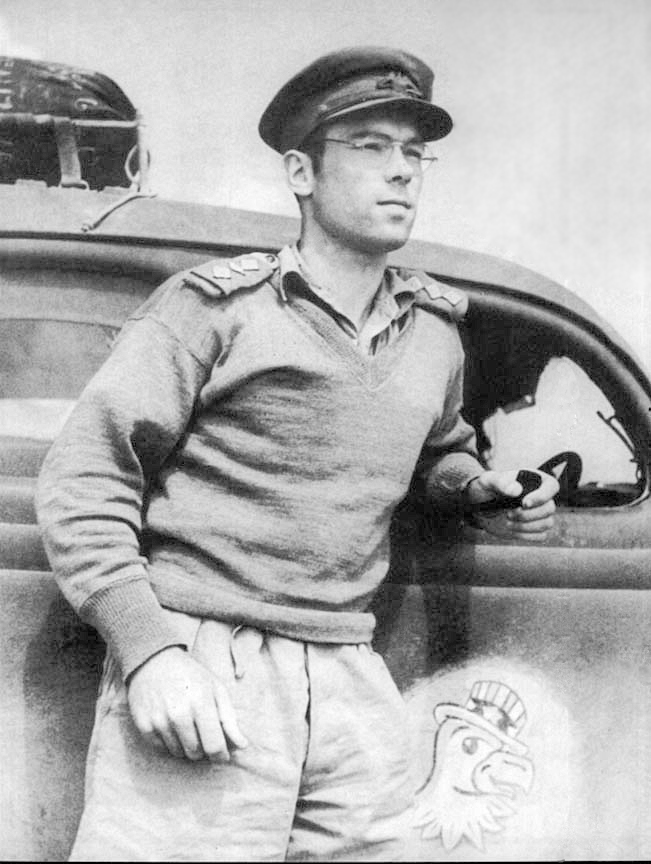
After two years in the field as an ambulance driver and field officer, Arthur Howe, Jr. is home on a convalescent leave. His is an outstanding service rendered. One of the first volunteers to sign up for ambulance work with the British Armies in the Middle East, Art enlisted to do what he could to help before the United States went to war. A few weeks after the attack on Pearl Harbor, he was on his way without waiting to finish his year at Yale and graduate.
A year as an exchange scholar at Rugby had given Art a strong feeling for English people and left with him a desire to see English and Americans more closely united. After two years on the battle field with British soldiers, he is more than convinced that good Anglo-American relations are a most important part of our post-war life.
Art Howe has been in the field all the time that he was overseas. He drove an ambulance in Syria and in the Western Desert. He was made first a section leader, then a lieutenant and a short time after the Battle of El Alamein he took charge of the 11 AFS Ambulance Car Co., at that time rechristened AFS 567 ACC, and replaced Andy Geer who was returning home. Throughout the many months in the desert battles, in the pursuit, in the hot dusty days, in the night sleeping in ambulances, with no change from desert routine, Art and his Company made the AFS respected and loved by Empire troops. And they kept moving up; finally into Italy, After the Sangro River fighting on the Italian east coasts, Art was obliged to come home, but 567 Company ---his own--- is advancing with the troops of the famous Eighth.
It is the caliber of the men in the Field Service who make it what it is. Men like Art Howe who go out simply and sincerely to do what they can to help, are responsible in a very large measure for the reputation AFS enjoys among Empire troops. Art Howe has a deep understanding of the value of human relationships. He is a good leader; men under him believe in and trust his calm, intelligent judgment. After Tunis when the African campaign was over and the men of 567 Company had nothing to do but wait for their next job, a four month wait, Art encouraged the Americans to visit as many different English camps as they could. In this way they met more of their Allies, they gave talks and lectures about America. and any subjects that interested them. This friendly visiting and close sharing of monotonous times together, brought the AFS men and the British soldiers closer than they ever could have come knowing each other only on the battle field.
Art Howe for all his quiet easy-going manner and the modesty and simplicity which make him beloved and respected by AFS men and Britishers, is very determined. He is extremely hard-working and will not abandon an idea he thinks good until all its possibilities have been exhausted. In the two and a halt years that he has been in AFS the ambulance corps has grown from a couple of hundred volunteers trying to orient themselves in a strange job among strangers, until it is now an integral part of the Allied fighting machine which is pushing the Nazis back to where they belong.
AFS is very fortunate in having had Art Howe, Jr., and men like him to guide it and nurse its growth and lead it ahead to the successful performance of its chosen work. He will say that anyone in the field could have done his job, but he did it so well that nobody else would have wanted to replace him. In him are the qualities that have made the A.F.S. possible. We hope his convalescence will be short and that he will be with his men, as they go further along the road, heading AFS 567 ACC at the finish.
| Thomas S. Esten | George C. Tichenor |
| Stanley B. Kulak | William K. McLarty |
| John F. Watson | Randolph C. Eaton |
| John H. Denison, Jr. | August A. Rubel |
| Richard S. Stockton | Curtis C. Rodgers |
| Caleb Milne, IV | Vernon W. Preble |
| Charles J. Andrews, Jr. | Henry Larner |
| Charles K. Adams | Alexander Randall, Jr. |
HENRY LARNER, on December 8th, 1943 was wounded by an enemy shell which struck him as he was entering the Medical Inspection room of an Advanced Dressing Station, to which he was attached. He put up a gallant fight for life and for a while it looked as though he would win through. However, on January 27th, 1944, he died in a hospital in Italy as a result of the wounds received. In giving his life, he gives still greater significance to the great effort now being made by humanity the effort toward decent living toward justice and the high purposeful meaning of all human life. His death is a great loss to his family and to all of us who had the privilege of knowing him and serving with him.
CHARLES K. ADAMS died on January 20th 1944 somewhere in the European Area. He was being repatriated to this country on a hospital ship after a period of illness in the Middle East. He was keen and eager to go overseas and be of service. He fulfilled this desire until his health broke down when it was necessary for him to come back, but, before reaching the home port, he succumbed to the illness with which he was afflicted shortly after his arrival overseas.
ALEXANDER RANDALL, Jr. was killed instantly by shell fire on February 8th, 1944. No other report than this has come through as yet: but the loss of this volunteer, one of the youngest, seems especially full of meaning. It is our youth, the fire of whose spirit we so profoundly honor, who are winning this war. Though they die on the ground, in the sea, or in the air; still this dedication of their lives is not death, really, but life that flames eternal. We will carry on for them, full of humility. and gratitude.
Harry W. Taylor was seriously wounded by shrapnel from a mine which caused a compound fracture of one leg and slight, wounds in the other. The most recent report tells of some improvement.
Dennis D. Hunt, who was seriously wounded at the same time as Taylor had his left leg amputated above the knee. He is progressing but is still in a serious condition.
John N. Hobbs was wounded by shrapnel at the same time as Warden. His condition is reported as not serious.
Turner Bullock and Edward L Tanner 3rd were both wounded while preparing to evacuate casualties when a shell landed near their ambulance. Tanner received a minor flesh wound in the shoulder and Bullock had his lip cut. Both wounds were slight and after receiving First Aid the two men continued evacuating their wounded.
Robert C. Coffey was wounded in the head by a flying brick during a mortar barrage. His injury proved not to be serious and he returned to the job not long after.
Stephen W. Plimpton suffered minor lacerations to his leg and face when his ambulance hurtled off the road during a night evacuation.
Richard B. Winder and Warren G. Fuggitt were both slightly wounded while serving on the Beachhead at Anzio. Winder's hand was slightly injured and is now fully recovered. Fuggitt sustained a slight scalp wound from a machine gun bullet
George R. Bunker incurred a slight wound in the leg and has also returned to duty.
Richard G. Decatur was seriously wounded in the leg by shrapnel.
These volunteers wounded in the performance of their duty, carried out their tasks without any thought of their own safety and well-being. It is hoped they will all soon be fully recovered, and it is consoling to know that they receive the quickest and best possible care from their friends in the British Medical Corps,
No date.
"For the last two weeks we have been working more or less constantly--- irrespective of night, rain and the generally hellish conditions which prevail here now.
"For instance, last night it rained. While it was still dark two emergency cases arrived for evacuation over a river. The bridge had washed away and there seemed no way to get them back. I started out with patients and an orderly and was followed by a second car with eight assistants---assistants for anything that might turn up. Got to the river and, sure enough, the road became first a pond and later rather a torrent. We abandoned the cars, leaving the patients and the orderly, ,and started out to discover exactly what lay ahead. Like a fool I had unshod myself and was soon forced to return for shoes.
"The water became violent and waist-deep and it became evident that no car could get through.
"We passed an abandoned jeep entirely submerged and when jeeps are forced to halt there isn't much use considering these cars--- good as they are.
"Eventually we reached the opposite bank and cars were there, lined up to cross when the river would permit. I requisitioned a jeep---(those wonderful jeeps!!) and sped off to find an ambulance on this other side ----which I did.
"Then came the harrowing task of carrying these two poor guys 200 yards across from one ambulance to the next. Somehow we did it, got the ambulance off to base and turned back. Of course I neglected to mention that in my haste, at one point I stepped off into a deeper area and disappeared my God that water was cold!
"And then when I had just relaxed; I remembered I had forgotten the damned medical cards (which were in these cases extremely important) which were supposed to be attached to the patients--- so had to run back through the damned stream, and requisition another car and pursue the ambulance which was soon approached.
"Back here now, but will make the trip again a bit later----so you see I am not given much to writing these days----but God! what gloriously satisfying work!"
January 11, 1944.
"Wish I could tell you something about this place or where we have been, where we are going. I can say that the poor people are desperately in need of food and clothes and the property destruction has been devastating. I never really believed the pictures of London and other cities after an air raid but now I have seen it a hundred times over. Buildings as skeletons, half standing in crumbled heaps, iron and steel twisted and torn. All horrible and black. Its like looking into the eyes of a lunatic and being able to see into his brain. It is an awe-inspiring sight at first but in reality horrifying. God knows how many lives have been and will be lost in this great tragedy but may it be a lesson for a thousand centuries to come."
No date.
"I am stationed at the brigade ADS --- Advanced Dressing Station. Casualties are brought in here by ambulance from the three battalions of the brigade and neighboring units, and we take them back to the brigade MDS --- Main Dressing Station. Back there I would sleep in the ambulance but here I sleep in a cellar. A little after midnight a hand shakes my shoulder and a voice says 'Your turn Yank; three stretcher cases and a sitter'. I sleep dressed, so I just go out and start the car as stretcher-bearers load me up. The three lying cases are a Tommy engineer with a broken bone in his back, a burned German tank man, and a badly 'shell-shocked' young Canadian. He screams that his buddies were killed right beside him and he wants to go back to Mamma. The German lies silently with an expressionless face, as they all do. I come over here and stick my neck out to cart around any damn heinies, but what the hell, if we don't, they won't take care of our captured wounded. The fourth customer; a cheery Canadian sergeant with shrapnel in his leg, climbs beside me in front and we start off. The road is like glass because of the mud and we have to crawl. Fortunately the moon is full and we can see easily. I ask the sergeant what outfit he comes from, which starts him off on the inevitable talk about why his battalion is the best damn outfit in the division and why the division is the best division, etc. I have heard this a hundred times before; with just the names and numbers different. Their pride of unit is extraordinary. I have yet to hear anything more impressive than a deep-chested Scot saying he is in the Argyll & Sutherland Highlanders. They are the junior Highlanders regiment, only a few hundred years old and so have a chip on their shoulders.
"Suddenly a battery of mediums beside the road opens up in our faces. Of course the Canadian youth screams like a fiend in hell, and the sergeant obligingly twists around and pushes his face down into the blankets. Further on I hit a dip in the road and the Englishman groans. I apologize, and he is furious with himself. 'Caddy on; caddy on,' he says.
"Finally we rattle across the improved bridge and go up into the dead town, in the square of which is the MDS, set up in the town hall, I go in and rouse the stretcher-bearers to life, and help them unload the cases. The 'shell-shocked' ( a misnomer --- this is seldom caused by concussion) has now gotten control of himself and says he wants to go back to the fellas; but he is in a bad way. The front has now woken up a bit and the Jerries are shelling near the ADS. I would chuckle at their discomfiture if I didn't have to go back there myself.
"It is cold, but fortunately my heater works. It's amazing to think that only a few months ago I was driving around Tripoli with the windshield up, clad in nothing but a pair of shorts, and sweating.
"On the way up I pass the other ADS car on the way down, so I know I will be the next out again. There is only sporadic shelling now, and I am given a load almost right away --- an artillery gun crew has been hit. Everything happens at night. By the time I get to the MDS again the moon is down and it is black as hell. However, the road engineers have laid white ribbons along the dangerous verges, and MP's guide us through the foggy river bed with lanterns.
"I get back in time for breakfast. We eat customarily in the sergeants' mess. This idea doesn't thrill me, not so much because of my democratic spirit, but because the sergeant-of mess is exposed and the Jerries have already blown the windows in once, whereas the men eat on the rear side of the street.
"I doze in the morning, until before noon when all the sick-call cases come in. I get a load of assorted maladies and cart them off to the MDS in time for lunch there. One of our guys gives me a letter from you, passed up the line, which recalls the existence of some security waiting for me, without which all this would seem to be leading nowhere. I digest the latest rumors (the most amazing things) and make my way leisurely back. The mud is churned up worse, but if it doesn't rain now, it will get better.
"In the afternoon I argue with an Irishman about which outfit has the best record in the British Army (I know more about it then he does) and then before supper get a load of civilians who stepped on a mine. On the way back I run into a terrific snarl. There is an artillery train all over the place. Two officers are fuming at the crossroads 'Where are the guides?' 'They've skipped off' 'Put them on charge' 'Yes, put them all on charge'. They repeat this a couple of times with relish and it soothes them. Eventually I push past them using my ambulance priority which is second only to bringing material priority. Next I am stopped by a truck dead in the road. The driver is an Indian. He has stopped because he has gotten lost or is thinking what to do. next. I suggest he get off the road. He says blandly 'Yes, Johnnie!' the only English he knows, and does nothing. Then a burly British tankman drives it off the road himself.
"I have missed supper but there is still some cheese left. I go to bed wondering how long it will be. Then our barrage opens up in our backyard. Hell's bells.
"Well, that ought to give you a picture of what we've been doing till day before yesterday. Then our platoon, which had made quite a reputation for itself, came out for a real rest. The reaction from tenseness, lack of sleeps and irregular food hit me like a ton of bricks yesterday, but I think I'm over it now."
November 22, 1943.
"On the road again, I was walking along, (in a sort of dignified canter) when my progress was suddenly impeded by the barrel of a Tommy gun about a yard from my chest. A guy in a steel bat was saying some words I had never heard before, and I was answering 'You don't say so!' when it dawned on me that this must be the right pass-words which I had neglected to ascertain before starting for the bandages. This I hastened to explain' with I might add unheard of rapidity. And the sentry after looking around carefully whispered the right answer and I went on to the next Tommy gun barrel. This time I snapped to attention and gave the proper answer and so on up the street.
"Recently our regiment was called up again and we spent a week in another valley listening to the hills reverberate with the sound of big guns, mostly ours. A few Jerry shells passed overhead as well, but we were plenty safe in the valley. It would have taken a combination shell-dive-bomber to reach us. One day when we had the afternoon off, we climbed a mountain to our north. It was a long pull but the view on top was worth the effort. We had a panorama of the entire front in our sector. Could see the German lines below us, hear the screen of shells passing now close overhead; and see them land on the Nazi positions. It was a beautiful; clear autumn day. You could actually see for miles and miles, a sight long to remember. Then came the rains, day and night, until the roads became a quagmire, and the fields nothing but mud and water."
No date.
"From Cairo we went to Tripoli by motor convoy, with some of the men who did the hardest fighting of the desert campaign. They were the first Tommies most of us had met up with and we were very favorably impressed. They are quieter and more easy going than most Americans and we heard little shouting and saw little horseplay. Many of then had not had the equivalent or a high school education, but they were intelligent and quick-witted and eager to learn --- most of them had been studying on their own. Single men seem to be rarer in the British army than married men in the American army and large numbers of the Tommies carry pictures of their 'nippies' with them. The British soldiers are quite reserved at first, but speak to them in a friendly manner, exchange cigarettes with them and they are almost embarrassing in their friendliness. The average Tommy would be considered a socialist in America, and some of the more forthright Republicans in our unit got themselves into rather embarrassing positions when political questions came up.
"Parts of Cyrenaica, too, were beautiful; and greatly resembled the western foothills. The Senoussii of this region are the finest type of Arab we saw they are a credit to the race, and fortunately friendly to the Allies and hostile to the Axis. They are completely unspoiled by the whites, and were only slightly influenced by the Turks and are proud and erect, and wear the colorful costumes you hear travellers talking about. Personally it irritated me to hear these people also classed as 'wogs', for they do not merit the scorn implied in that term.
"Drivers are expected to grease the ambulance, springs, 'splines.' universals, check on the oil in the crankcases, differentials and transfer case and replenish when necessary, and perform a number of other maintenance tasks, by which means I am coming to learn something about automobile mechanics --- and about time, I say.
"What I have seen so far of the AFS agrees with me very well. There are all types of persons here, from out-and-out adventurers to grim people to whom duty alone is their excuse for being here; with, of course, all sorts of gradations between.
"I have seen a good deal of the Mediterranean area, by sea and by land, I have talked whole evenings with British soldiers and other AFS men, breaking my views of the world. I have made a sort of conversation with natives of various areas, a surprising number of whom have been to America and returned. I have seen modern warfare from several angles. I have eaten British army food, and been exposed with British troops and AFS men, to sand fly fever, malaria dysentery and jaundice not to mention indigestion; none of which; except the latter; has in any way bothered me, and that only slightly. On the whole, I feel in better health than in Phila.
"Most important of all I feel as though I were doing something worthwhile. I have seen the crying need for ambulance drivers at first hand and I have seen that the AFS is doing a needed job, and doing it well."
December 7, 1943.
"Italy is a very, very, very mountainous country. More so than any of the eastern ranges of the U.S. And the mountains are steep, and sharp and rugged. The Germans are retreating from ridge to ridge. They command the roads with their artillery fire, and so the M.T. or Motor Transport have to wait until darkness to get up to the forward battalions of the infantry. The AFS ambulances have to do this too, and so you can see the reason for our abbreviated nights. It is exciting work for the imagination, but colorful only in the contact with the soldiers at the front who unload upon us information as to where Jerry is, what he is doing and what he can be expected to do. Two nights ago, it was my turn to do the evacuation from a certain place. We were in a convoy with an armed jeep full of infantry as an escort to protect us against patrols. When we arrived I got talking to an officer who told me that there would be a barrage in a quarter of an hour, and sure enough there came the booms of the firing and then the whistle of the shells over our heads, and then the sounds of the bursts as they landed a few hundred yards ahead. Apparently they had discovered the time and place that the German supplies were distributed just as our convoy was doing, so they were giving them the works.
"When there isn't an active offensive in progress, the activity is generally limited to patrols and artillery duels. When I was at the front one night, I left my car and walked into this village, the approaches of which had been demolished. I was with a party of stretcher-bearers, and it was an icy moonlit night with a moaning wind. Just as we entered this deserted town, we saw a flash and heard the crack of an explosion, not far away. Proceeded further to the RAP, the furthest medical post, and sat down before a warm fire with the medical officer and his assistants. Were not there long before three casualties came in. They had been hurt in the explosion of a mine of which we had seen and heard the flash. One of them got it in the back, and another's brains were spattered over his forehead; both of these men died as I was watching and I brought the other back to the ADS.
"These disagreeable incidents come rarely in our experiences, but come much too often for me. I know you would prefer to hear the pleasant things. Most of these are so commonplace and closely connected with the sort of life we lead that they might bore you. For instance one of our number bought a smoked ham from a farmer and so, whenever we get an unusually scrubby meal we start a primus stove and fry some ham. The stove was recently doled out to our platoon officer by the Americans in Foggia. Saw a film: 'You Are Always in My Heart' shown by an army film unit in the open air in the town square of the village where we were billeted. Only inconvenience was the two hours of standing. Took a shower recently at the mobile baths and changed my underwear for the first time in three weeks. I have learned a lot about the comparative healthiness of being washed and unwashed and think that the great advantage in the cleanliness of my previous pro-war life was mental. I've found that you can get quite used to being dirty when you can't get clean!"
December 15, 1943.
"All the fellows in our outfit are having plenty to do because of the terrible conditions of the roads. Our Dodges are just about the only ambulances that are ideally fitted for rough going and quick evacuations --- by speed I mean the fact that we can carry four stretcher patients to the English 4-wheel drive car which carries two. I've been out on a post with one English ambulance. I have an orderly with me all the time. Have done my own cooking for nearly a month --- some experience!! I can make flapjacks, cut and cook a sheep, etc."
August 10, 1943.
"I'll take over a new ambulance, or rather, an overhauled ambulance --- my fifth. The others, one in Baalbeck, Syria, one in Gambut, near Tobruk, I had for only a short time. I had another an old Chevrolet, at Gambut, which carried me quite a way, but my last one, which I got 8 hours before I left Gambut, went up to Tunisia, and through the campaign and those months after it.
"Losing an ambulance, as you know, is a hard process. After the first two or three thousand miles, you know your car very well. The process of taking over a new car is, I suppose, much like re-marrying quickly after a divorce. Whatever may have been her faults --- 'her' because we think of our cars as having a distinct feminine cast --- you are pierced with a longing to get her back as you see her blowsily fuss off to get her face lifted a bit. The bright young thing you find yourself wedded to insistently claims your attention, and your natural reaction is to give her a good checking over --- find out when she ate last, when she last took a bath, and in general start out on rather thin, slippery ice your new relationship.
"Nothing quite fits right. There's not quite enough room for your personal impediments for the first few days. In fact, you don't really know your car until you've pushed it around had a few fights and shaken it down.
"By way of further comparison, shot-gun marriages of expediency rarely turn out satisfactorily, whereas a bit of picking and choosing among the local belles seems to be best. If you pick up an out-of-town girl quickly, as some of the boys did when a bevy arrived from the other unit (the English) --- you may get stung."
August 27, 1943.
"Life is more or less normal or normally abnormal out here, We've had no more parachutists since a month or two ago, when someone tried to drop a few, but the flies continue to be perfectly monstrous A new generation turns up every 4th or 5th day, and what with one thing and another, they seem to keep the diarrhea rate uncomfortably high. The only treatment seems to be to drink nothing but tea or coffee and eat bread and jam or some other diet like that. I'm on somewhat of a diet now, principally because the mess has had a streak of bad meals that aren't much worth eating."
September 8, 1943.
"A while ago I had an interesting call--- a murder. Seems as how a negro saw an Arab trying to steal stuff out of the camp early one morning. The nig. without putting on shoes or grabbing a weapon, gave chase across the fields. He got about 1/4 or a mile away and caught up with the Arab, and I conjecture that they tangled.. All this is surmise, because no one saw the show, but the Arab finally got sort of desperate and pulled a knife. When we arrived --- the nig. was dead from loss of blood. Severed femoral arteries (this one was cut just above and inside the right knee) let out a lot of blood, and this was no exception. It was a nasty slash, or a stab, rather, from the looks of the wound. The setting was just pure Steinbeck --- dead negro lying by the side of a tilled field --- sloping down to a little brook. Anyway, we fixed that all up easily --- simply gave all the dope to the local cops and buzzed off.
"I've lately discovered a new remedy for this thing called dysentery, and other related maladies. Consists of charcoal, bismuth carbonate, and urotropine, a drug which goes under as many names as the various sulpha combinations. It worked a minor miracle on me.
"Oh yes --- before I forget. The French are starting to get back in their own groove with their own rations ... i.e., lousy sardines and inedible French singe. Haven't tasted the latter, but they say it's something incredible. All the Froggies themselves went crazy saying, 'Ah, at last...how merveilleux.. ...and such chortling. I thought it sounded like a rather developed masochism, like 'Gee, these caterpillars are wonderful!'
"It's a terrific change to see American camps here in comparison with French ones. Whatever you can say for the French, they don't have an inborn sense of sanitation. Their camps are poorly placed (ex. putting the convoy right next to a nice peaceful little brook just after passing a sign on the road saying 'Highly Malarial Area, No Staging for 5 miles') and invariably poorly laid out ---(ex. the latrines at our last long stop --- more than 1 month were 100 yards from the kitchen and mess hall: none of the three had any fly prevention at all.) Their water supply, I'm afraid, was what kept me in such rotten health all the past weeks; as long as it tasted all right, they don't bother to analyse or purity it. They put into their drinks ice that was army issue, but issued likewise was the strict order not to put the ice into direct contact with food or drinks. The French just didn't pay any attention. The mess table was always unwashed, and flies used it for outings every afternoon. The dishes and mess tins were washed with cold water just to get the main food deposits out, but there was a thin layer of dusty grease by the next meal.
"I was somewhat disgusted, but even the officers paid so little attention that there was nothing you could do. The American camps seem to be twenty times better; their cook-houses are indoors, and mess tins are washed (a) in soapy water, (b) rinse, (c) chemical, (d) rinse, (e) rinse again --- all in big metal drums kept at boiling point until all mess gear is washed. That's enough of a difference to make the dysentery rate almost nil in U.S. camps instead of 40 per cent to 85 per cent in French camps,"
November 9, 1943.
"When I left Algiers, by boat, I thought we were due for a speedy trip to Italy, but no. We sat on this miserable British coal-burner for a few days in the harbor, and began to wonder if they would ever go. We had rather sketchy meals, and when supper moved from 6 o'clock back to 5, we groaned; when the time went back to 4:30, we just made up our minds to go to bed early and try not to be hungry until breakfast at 7:30.
"We pulled out, finally, more or less with a German benediction --- an air-raid alarm the night before. Nothing happened, so we pulled out and puttered up the coast at about -----------------. There were no sub attacks and no air attacks, and we had nothing more exciting to do than play blackjack, poker, and fan-tan.
"We landed in Italy at a port in Southern Italy, and found it was not the one we wanted to go to. Some one had changed the plans, and we had to fool around this place a day before we could get transportation. Movement control gave us a Class 3 priority --- not good and not bad ---but we found that it entitled us to only one box-car on the train. There were nine of us, and God knows how many Eytie civilians going the same place we were. So we threw our baggage in, cornered a corner of the car, and pulled out at about quarter of three one afternoon.
"Well, we've all heard that one of the big boasts of Mussolini's Fascist regime was that Musso made the trains run on time, and we all said that in America ours ran on time without Fascism. And we all smiled smugly. But over here, that's really something to these people, and we found out why. We pulled out of the station exactly on time. Three miles down the track we stopped, and didn't start up again for an hour. Meanwhile we sat dumbly in the box-car amidst 30 or 40 Eyties. Then we putted along for a few miles, stopped again.
"It got dark, and we were a little hungry, but forgot all about it because there wasn't much we could do about it. We started singing, and sang everything from 'Pilgrim's Chorus' and 'Stand Up, Stand Up, for Jesus' to 'Chattanooga Choo-Choo' and 'Tailor Sam'. Then the Eyties started singing --- and it was pretty good. Then we all started singing different songs at the same time, and it was an Italo-American madhouse. Everyone shut up after a while, and someone started playing a harmonica. No matter whether the songs were good or bad, the guy actually played them through 8 to 23 times.
"Well and all---! Musso did do something for the people with the trains, but that trip --- less than ------ H0URS! Towards the end it was a nightmare. We were uncomfortable --- sitting on the edge of tin hats and things like that; it was cold, dark, and raining, and the engineer tried to redeem his poor efforts by an incredible blast of speed. The train rocked and crashed along the track as though everything would fly apart at once, and while we sat there petrified, the Eyties leaned out the door and watched the landscape hustle by, or gurgled appreciatively to one another.
"We unloaded in the rain in another seaport where we had an AFS Office. After coming off the train, we were some surprised to find that movement control knew what the AFS was, and ordered two small trucks to take us to the officers' Transit Hotel. We bedded down --granted it was in our bedding-rolls on the floor or straw mattresses, it was still damn good --- opened a can of biscuits and had biscuits and butter. By that time our spirits had risen from the abysmal to the highest, and we went to bed almost in hysterics at the flow of wit that seemed to exude from everyone.
"Came morning, and we washed up and had breakfast at the officers' Transit mess, and then wandered around town. There was nothing to do but get a haircut, and then we had lunch after wasting the morning.
"It was strictly high-class, and untouched by bombs or demolitions. They had nice comfortable chairs, a small orchestra, good drinks, and waiters in tails and gold braid. I've never seen anything like it in the Middle East or North Africa, or for that matter, it was better than many New York night clubs. We had a few drinks, and supper, and retired for the night.
"After that came the business of going north to the Company and we got an airplane to a resort city some ----------. There we had to wait over a day, so we got a hotel room and a few darn good drinks, and a superb meal. There was a dish of the most excellent fish I've tasted for years, and a sort of super-chicken that I'd swear was crossed with an elephant. It was a monster, and expertly cooked. There wasn't much to do in town except eat some so-so ice-cream, and the next day we were out on the airport waiting for a plane. Three of the five of us --- four had split off for the other company --- got out on one plane, and I stayed behind to get another. We watched plane after plane come in and go out, but they were all full, or someone had a higher priority, and we finally wound up at the head of the list, but there was only one more plane that day to where we wanted to go.
"We had to sleep at the-airport that night, because we couldn't make contact with the HQ, and managed to get a dinner of C ration which was O.K. We did get a ride the next morning and arrived at the hospital whore HQ was. We had to wait around before we moved into the lot where the ambulances were, but we found that they have apples here and we almost went out of our heads when we had one. These Eyties came up and in reasonable English said, 'Hey!! Wanna byanapple?' with such gusto that you just bought and ate till you went over on your face.
"Around here, someone engineered the smoothest deal of all --- drawing both American and British rations, of which we take the pick and the kitchen crew cooked up whopping, socking great meals. I'll spare you the details, but suffice it to say that I have had some of that roast beef that you haven't been having.
"I did get a real goodie a couple of days ago. A friend of mine gave me a big Nazi flag red field, plus white circle, with a black swastika in the middle. He had a bunch of them he'd found, and he tore out the white circle with the swastika on it and uses them as handkerchiefs. I have one flag already --- a French flag with a Croix de Lorraine on it, and a shrapnel hole through it. I'm now after an Eytie flag.
"The Eyties are funny people. They are normal enough --- European, reasonably dressed, and nice enough, but there are no worse jaywalkers in the world. I thought the Arabs were bad, but these people never use a sidewalk unless they absolutely have to. There is the usual complement of horse-drawn vehicles, which makes city driving a little tiring at times. Plenty of Eytie soldiers and officers running around, but they aren't a very inspiring lot.
"Few of the people seem bomb-happy, but there are an awful lot of houses blown down, and outside of casualties. I suppose there must, be quite a number without homes or particular supplies of food. One really bomb-happy old woman who couldn't even talk straight tried to bum food from me, but she was so crazy that it wouldn't do any good. Also my Eytie friend, who I was talking with at the moment in French, said she always was crazy, and shooed her away.
"Food is not particularly scarce, though fruit makes up most of the available food anyone can buy on the streets. You can also buy peanuts and home-made candy-bars, which aren't too good.
"Like Cairo, everyone has something to sell, more or less. I was sitting in a truck on the main street, and people stopped trying to sell me fountain pens, crucifixes, rosary beads; a violin, wine, cognac, and apples. I noticed one shop doing a reasonably humming business selling cheap, unfinished, slapped-together furniture to bombed-out civilians and to army people who needed chairs, tables, and such for messes.
"The children are interesting because they seem so little affected by the war. They are much cleaner and much better dressed than I would have thought, and a surprising number of little boys have parts in their hair which would disappear overnight if their mothers didn't keep after them. Air-raids don't bother the kids too much, but they all know what a bomb can do. One sober urchin of six years gravely explained the whole process to me, with graphic gestures as to what a house does when it gets a direct hit.
"In one city I noticed some obviously German billboard posters plastered on the wall of buildings. They were anti-Russian propaganda bits, and showed a monstrous, ugly, ogre-like Bolshevist in woolly coat and astrakhan hat snatching a baby from a Madonna-like mother, while a bombed town burned in the background and the placard read 'Bolshevism against the family', or something like that.
"On the whole, I'd say the Eyties are glad to have us here, the Americans especially, because the Americans throw so much money and food around almost for nothing. They give kids cans of C ration while some Tommy quietly wonders where it all comes from. The poor Tommies go nuts over the food that U.S. soldiers give away, and they always are glad to get a couple of cans. Also the Americans have so much more money than the Tommies that prices soar whenever Americans are near a city. Result is that the U.S. soldier pays more, and the Tommies don't have the money to buy much,"
December 20, 1943.
"I'm convalescing now, but it's unnecessary, because I'm really absolutely chipper. This 'con-depot' is grand. The colonel in charge once had several of our cars attached to his hospital (field) in the desert. He thinks enough of us to extend full officers' privileges here in Italy. We eat, room and have wonderful time with the British Officers.
"The hotel in which we are billeted is separated from the edge of a beautiful garden that has several orange trees in it. At each meal we have all the fruit and nuts we care for. The town itself is quite beautiful --- by far the prettiest I've seen,"
November 30, 1943.
"Around the first of November we met the hospital surgeons and got them to let us into the theatre. The surgeons are two: Capt. Nicholls is a very young man, quite reserved but a lot of fun. He wears the Military Cross. Major Watts is one of the nicest officers I've met. His repertory of jokes (plus and minus) and. light verse is simply astounding. He is reputed never to have repeated himself in an evening and I never heard him. He is extremely likeable and apparently liked us. Saturday the two surgeons came for dinner.
"Watching operations was extremely interesting and we learned a good deal of anatomy and occasionally were able to help, doing things like supporting a leg while a cast was being put on it. A new (to me) general anaesthetic amazed and delighted me. It's called pentathol and is injected intravenously; or light surgical work. The chap on the table counts out loud and usually pops off before reaching twenty. He comes around in an hour or two, unless he goes off into a natural sleep, and with no unpleasant after effects. Frequently spinals were used, but these are ineffective above a certain point in the tummy.
"We became very interested in one patient. Wounded in the buttocks on October third, it was just a month later before they could get the shrapnel out; he was pretty low and by that time quite an infection had set in. Immediately after the operation I gave him a pint of my A-II, along with an up-patient, it was much more satisfactory than going to Franklin and giving a pint to be made into plasma for an unknown at some future date, for between us we kept the fellow alive. Alive, that is, for another three weeks, for the infection was finally too much. I guess it's better not to become too interested in one's patients.
"The night we were bombed, our first time (and I almost forgot to say we are in Italy) we were all having a big brewup. When the blessés came in we adjourned to the theatre. Work went on until five in the morning. Other ambulances usually brought in casualties, for they were nearer. Sometimes we were called out at night, however, I made an epochal trip way into the hinterland, over bad roads, to pick up several Tommies who had been injured in an accident in a certain town. They were being cared for by an Italian doctor, and that was all I was told. After squeezing old P.T.A. through streets meant for horses, I finally arrived at a little office, all half asleep but extremely hospitable. We chatted in French, the Mother Superior and I, while small Italian orphans were sent as couriers all about the town in an effort to find out something about my patients. I got a guide of one civilian doctor who knew French and we called on the other doctor in town, a bearded old man, delightful in his gestures, who lived in a great, gloomy old stone house, with his wife and innumerable other females daughters, I hope. No one had even heard of the accident, and there were no American or British troops for miles. Just as we left towns having given up, a jeep came along, full of American M.Ps. They took us to the accident. A British 15cwt, had swerved to avoid a woman and some children (Italians have absolutely no road sense and with their carts and all, driving is hazardous) and had rolled down into a tremendous gulley. The driver had stayed with his vehicles for 14 hours. He had a bruised knuckle.
"After much rain, and leakage we finally wangled a larger tent. We had had the A.D.M.S. and our hospital colonel in for dinner, hoping they would get a large stream down the neck and fix us up. Eventually Col. Fava did. The tent was so large that we had three beds!, a radio, stacks of food, a dining table, and sundry benches and forms all arranged with plenty of room to move about. That third bed was occupied (most of the time) by D. of my unit, who had joined us as spare driver after the AFS left the French. We had a few smashing dinners there and were on top of the world until all of a sudden we were recalled and sent to this post."
December 2, 1943.
"The camp itself is just a levelish field on a hillside, with close- cropped turf and quite a few large chestnut trees. Old women are around frequently with baskets, gathering the nuts. They remind me of 'The Gleaners'.. There are few leaves now and we can see the neighboring hillsides, dull green and terraced disappearing step by step into the forests. It's much like a tapestry hunting landscape,"
No date.
"We are in a hospital run by people who don't know much about Thanksgiving Day, In fact, they asked us all about what it was and meant. Then they gave us a party which we will remember for many years to come. We thank them so much. It does show I think, that they really appreciate the work we do, and it makes us want to work harder than before to prove our worth to them even more.
"A lot of things are happening up forward which I am missing, which is too bad. But I have already soon a lot of action and seen a lot of things which I will tell you about when I get home. 'War is hell' is certainly very, very true."
November 28, 1943.
"Fortunately we have been given two rooms in the A.D.S.. a former elementary school --- one of which has a fireplace which we keep going pretty near the whole time. In the room with the fireplace there is amazingly enough, one half of a window whose glass panes have not been smashed. The other room is of little use except for sleeping in, as the shutters have to be kept closed most of the day to keep these late Nov. blasts out. Thanks to these two rooms we don't have to live in the cars which are parked right in the street. For two days before we got these rooms we lived in the cars and in the morning washed and shaved on the sidewalk, with the populace of this little town going by quite indifferent. Thanks to our store of food it doesn't really matter whether we miss a couple of meals or not as we can always heat something up on our primus when we get back.
"Of course here we get a good many wounded but we deal mostly with the 'bomb happy'. When the latter aren't asleep they come out with the damndest statements, I had one the other day who thought that the 'sea was rough' and wanted to know if there was any chance of sinking.
"Coming home the other night around 12:30 after a late run my car suddenly gave out on me completely. Even six months in this outfit hasn't taught me an awful lot about why cars suddenly go dead on you, so I was really in a jam, especially as I didn't have a flashlight and the wind kept blowing the matches out when I tried to fumble around inside the hood. Of their own accord a Kiwi truck stopped and the two guys said, 'Oh, one of them Yank ambulance fellows. Got to give him a hand'. Well, they dragged out a lamp and got to work. Pretty soon another and then two more Kiwi trucks stopped and they all piled out and lent a hand. I thought that I ought to repay them some way so I dragged out a precious bottle of gin which I was saving for Christmas and passed it around. At first they wouldn't think of taking any but finally I persuaded them to at least have a small sip apiece. The Kiwis are really wonderful people. They are always ready to give you a hand and help you out in any way they can. The one ambition of a Field Service man is to be able to work with them as they are such a great bunch of fellas."
November 30, 1943.
"We proceeded to within five miles of the A.D.S. where we had to spend the night because the road had been heavily shelled and not yet patched up. This morning at nine we drove up to this town. The road is just strewn with knocked-out tanks, cars of every sort burnt or blown up, dead mules by the score, fresh graves, and any amount of equipment. The road is muddy and narrow and its sides are apparently thick with mines so that you don't dare go even a foot or so off it. The town was taken four days ago, retaken by Jerry, and only reoccupied by us the night before last. At this point the enemy is but four miles away and the ground shakes continually with the shell fire and bomb bursts of both sides. The A.D.S. has taken. over what was once a very stately villa with marble staircase, terraces, huge lions at the front door---a really beautiful mansion. Now the lions are peppered with shrapnel, the stone balconies of the terraces shot to bits, the marble columns covered with debris of all sorts from helmets and rifles to gloves scissors and clothing. The amusing part of it all is that the owners were doing a complete redecorating job. The walls are freshly white washed and everything else looks as if it had been freshly painted. Of course there isn't a stitch of furniture left and not a window or even a door left intact.
"Had to interrupt this letter because I was called away on a run. One of my patients was a woman shot through the abdomen. The bridge I should have gone over had been hit by shell fire sometime earlier today so I had to wait quite a time before a pontoon bridge had been thrown over.
"I don't mind, stating that at the moment I am slightly on edge as since I got here we have--- that is the general vicinity--- been dive bombed twice and four shells have landed not more than a hundred yards away. It sounds like a long way off but when it comes it sounds mighty close especially when pieces of this and that start falling all over the top of the car. When we were dive bombed I looked up from the slit trench for which I had made a B-line and, could see the tracer bullets leave a thin line of smoke behind them. The bombs were easy to see as they were released and then came the roar of the explosion and the great puff of black smoke. The whine of the Stukas as they came down and the rat-tat-tat of the machine guns absolutely give you the creeps. I really was scared to death. You crouch there and listen to the sound not knowing whether you'll get it or not. You feel completely helpless because there is absolutely nothing you can do but just sit there and wait till it is all over. You can't help be unconsciously tense and expectant. Every time a plane comes into sight you automatically pause, look up and wait to hear whether the ack-ack starts popping."
"Again I had to interrupt this letter to go on a run, a rather unpleasant one over rough narrow roads in the dark. Fortunately the moon was out so that you could see the white road and the black out lines of cars coming the other way. As it was past eleven when I got to the M.D.S., I spent the night there and started out at six-thirty only to be stopped at the river for two hours, the bridge having again been damaged. Up here I found there were two more cars so that we are now four. Jerry had been pushed back a good way during the night so that we are now out of range of his artillery. Our planes have really given him the works today coming in waves of four to twelve planes every few minutes. Outside of two of his planes I haven't seen much today."
October 26, 1943.
"Southern Italy, so far, isn't much to see. Four years, of warfare and the German occupation have left practically nothing. Stores have nothing to sell, and most of them have been consequently closed for quite a while. The only things open are barber shops and you can always find plenty of them in every town: I've seen quite a bit of this section so far, as our job, of course, necessitates lots of driving, but so far I haven't gotten into Naples, I hope to see it soon, however, as I understand it is not nearly so damaged as the news led us to believe. The people are almost all very, very poor but are not starving by any means, although many of them live almost entirely off of spaghetti."
November 3, 1943.
"Some of these Italian towns are opening up pretty fast after our occupation. In-----for instance, there are three theatres running, showing American movies. I saw an Italian vaudeville show in one of the theatres. It was mostly tight rope walkers, contortionists, flying trapeze, etc., more circus stuff than like our vaudeville. It went off very well except one of the strings of the solo violinist's violin broke in the middle of a song, and once there was a crash and the base fiddler, fiddle and all, disappeared. The rear platform he was standing on had collapsed, He reappeared over the top about five minutes later."
December 2, 1943.
"This front here in Italy is almost obscured by the bigger news of the Russian victories, the Moscow conference, and the tremendous air raids, I really believe the end is finally in sight. I have talked with many British and Canadians who were in London during the big raids, and according to them, the effect of heavy raids is tremendous. The Berlin raids certainly must be effecting tremendous losses and damage to Germany. Only very, very seldom do we hear the radio news, and as a result, outlandish rumors are circulated all the time.
"As you know, the fighting on this front is proceeding very slowly, but if you could see the terrain you would know why. Mountains everywhere almost forbid the use of tanks entirely and fighting has to be hand to hand. Also the Germans blow up every bridge behind them; blow out mountain roads, and leave mine fields and booby traps behind. All this takes time and tremendous work to clean out and build up. The engineers do really wonderful work in building new bridges and rebuilding roads."
December 10, 1943.
"I am enclosing a clipping from 'Time' about the battle of Termoli. As you see, it says the Germans came within 200 yards of a field hospital. Well, I was there. Our ambulances were evacuating patients from there back down the road, I spent the day in the town, however, as I had to evacuate a hospital which was actually ahead of our lines and in plain sight of the Germans. Luckily they respected the Red Cross, or perhaps they just ignored it as our tanks were coming at them in the field just beside me. Anyway I made five trips to that hospital, and it wasn't much fun."
December 3, 1943.
"We have four-buildings all requisitioned, so rent free. One for HQ staff to live and eat in. One a mile away which is the Club for convalescents and men on leave; and then a small villa studio, where we live; no servant yet, so far just sleeping and we eat at the Club. But we hope to keep house. Food is a problem: vegetables, apples and oranges can be bought; the rest, which is principally bullybeef is rationed to us by the British. City water is not 'potable' but we get a fair white wine at 22¢ per litre, and that with tea and coffee seems sufficient. But the weather is absolutely vile: rain half the time, and the other half if you are out of the sun the cold bites you to the bone. Of course there is no heat of any sort in the buildings and the only warm hours are those spent under about four army blankets."
December 5, 1943.
"Our camp is one of the muddiest spots in all of Italy and it has been raining now for three weeks and we just spend our time while in camp wading around up to our ankles in mud. I have hardly seen my shoes thru the cake of mud for weeks. It's out of the question to even try to shine them until the situation changes a little. We have had a couple of nice days, though, (in fact today was quite bright and sunny) and if we have a few more I'm going to get out that saddle soap on them and fix them up. Boy, they'll need it!
"Being now with the company I haven't been able to get a forward post yet, although I may soon. I am stationed at a C.C.S. (Casualty Clearing Station) which is situated about one third or one half the distance from the front to the base hospital so you see we aren't exactly up in it now. We evacuate from the C.C.S. to the base hospital and we've been kept pretty busy too but it's not what you would exactly call exciting work. It has had its moments though --enough to keep life interesting, I have been out twice when German planes strafed the road at or near where I was. Luckily, though, I had already dumped my patients both times and it didn't take me long to get under cover. There was one other interesting event --- a Spitfire shot down a German bomber in flames right above camp and it crashed about a mile away. We could see all the crew coming down in parachutes".
November 10, 1943.
"I am now stationed at an R.A.P., a first aid station up with the artillery. There are only the doctor, his orderly, his batman and myself ---- a jeep, a truck and my ambulance. We have a tent which we live in, and a small homemade stove made of oil and gas cans, which keeps us pretty warm. Also luckily our ambulances have excellent heaters which makes our driving comfortable. The doctor here studied at Fordham and has a younger brother who studied medicine at Johns Hopkins. He is a wonderful fellow and so are the other two guys. We lead a pretty good life. When I'm not evacuating patients we brew up tea or coffee and make toast which takes up time. In the evenings we have an electric light in the tent and we can read or write,"
December 2, 1943.
"I have now been out at an R.A.P., a one man assignment, for over a month. It has its advantages and disadvantages. Chief disadvantage is that we are in the field all the time, living in a tent, usually parked in a cold and muddy field,"
September 29, 1943.
"Somehow, out here, time slips by so rapidly that it seems impossible that this time last year I was also on the African continent! Lord, how time flies! It was 15 months ago today that we boarded the old ------ and sailed out from New York. Let's see if I can recall offhand just where I was each succeeding month, since my diary and notes are put away in the bank back in Cairo, it'll be from memory, but I should be able to hit it fairly well ---
14 months ago was somewhere in mid-Atlantic beyond Trinidad and heading for our first African port, Capetown;
13 months ago was somewhere south of the Red Sea swiftly speeding along on the -------------, with the coast of West Africa just out of sight to the port side (left to you);
12 months ago was making routine sick evacuations from kilo 121 (halfway approximately between Cairo and Alex) back to the New Zealand hospital in Helwan, a suburb of Cairo;
11 months ago, was working with the South African Casualty Clearing station at Shamman Halt (see Andy's book for location);
10 months ago, was at Berce where F. made history with his superlative cooking in our little house near the CCS;
9 months ago was having a swell Christmas and New Years week with the New Zealand Advanced Dressing Station near Nofilia:
8 months ago was camped out at Giordani, a suburb of Tripoli, and had had my first look at the city:
7 months ago was in the area of Medinine attached to a Highland Div. Medical Dressing Station;
6 months ago was somewhere in the area of Sfax if I'm not mistaken, (this period is a bit vague in my mind right now);
5 months ago was at Sibeitla with a mixed field ambulance located there as check post for Indian Div. casualties, and had been to Tebessa for my first glimpse of Algeria;
4 months ago the battle was finished and we had come back to the Tripoli area. I was looking forward to leaving in a day or so for my period of leave back in Alexandria,
That brings us up to date as close as I can do without making a possible infringement of the old censorship rules so will stop there for the time being,"
October 14, 1943.
"By the time we pulled into Tripoli on the return from Tunis the city had been in Allied hands long enough that it was back to normal with 'business as usual'. The bombing damage, of which there had been comparatively little, had been cleared up, and all the shops, etc. were again opened. The American Air Force opened a coffee shop in the heart of the downtown area, which was the delight of all Americans in the area The AFS went for it in such a big way that it was necessary for them to limit our attendance to 5 men per day or they would run out of food. if you weren't at the HQ truck before ten in the morning, it was seldom that you could get a ticket! Here they served wonderful peanut butter and jelly sandwiches, spam and cheese sandwiches and iced tea or iced chocolate. Once in a while, tho I never happened to hit the right day, they had ice cream. All in all, it was the nicest place in town. It was fortunate that, due to short rations, they had to limit it to American personnel. The British had their usual NAAFI tea rooms and restaurants, one in the Union Club, another out beyond the American place at Jan Smuts Gate where the South Africans' recreation area was located. There were several movies in town for the troops --- all free, of course. These were terribly crowded during the day, and very warm. Generally, instead, we went out in the evening to either the Field Bakery Unit, the American Hospital, or the Airdrome, where a mobile cinema unit showed outdoor movies in the early evening. These were new releases from home, and much better all around than the downtown ones. The eating places in town, at first closed to any but local civilians, were later open to us, and about once a week, we'd get a bunch together and go in for dinner. In the entire time we were in Tripoli there was not a single enemy plane over to do any damage, and only once or twice did high flying reci-planes speed past. All in all, as I said it was a most pleasant and lazy period."
October 29, 1943.
"Am quite able to follow a conversation between two other people ---not word for word, but enough to get the drift of what they are talking about, and how they feel about it. The people here are very bitter against the Germans, who evidently took all the food supplies, clothing, and especially shoes with them when they left. Even the tiny children's shoes were taken, tho what possible use these could be to the Jerries, I can't see. It is hard to believe that these people were ever allies of the 'tedesco', as they call them. It certainly was against everything they believed in, and was, from the beginning, only a matter of time until they would stand it no longer. I am surprised that even Mussolini didn't have the sense, or understanding of the people's minds, to realize this in the beginning. The civilians may vary in their feelings about Fascism, America, England, France etc. but I have yet to find anyone, old or young, who has anything but harsh words to say for the 'tedesco'."
December 15, 1943.
"I'm back in the Field Service now staying at the moment in their new HQ, clubhouse, which is without doubt the most incredible building I have ever been in; and lately I've been in some pretty incredible buildings. It is a very luxurious castle fully staffed by Italians, with one of the best chefs in Italy as major-domo. The building is in the most appalling taste, built by an Englishman who obviously had been on the Grand Tour and wanted everything he saw represented in the furnishings and architecture. Baroque, roccoco, and Victorian, with floodlights to pick out the high points! The main hail is four stories high with a gigantic fire-place reaching to the top, and an electric heater at the base. Press a button and floodlights light this dim vastness, and concealed spotlights light up the stained glass windows like Christmas trees . . ."
No date.
"I wish I could explain to you what a fraud all this talk about 'the front' is. It is nothing like the last war where people just sat and shot at each other 24 hours a day. Here except for the noise and very, very occasional scares it is a very peaceful and pastoral existence, rather like a Abmok canoe trip only less work. Only twice did we have to go out under any fire at all. The best thing about it all is the feeling of contentment it brings. I never felt happier or more care-free in my life. . . I hope you will believe me when I say that it is as safe as living at home. I really mean it. Also it is a hell of a lot of fun."
November 27, 1943.
"Please don't get the idea that this country is down-at-the-heels as far as their food supply is concerned. Not at all, in fact they have plenty: apples, oranges, bread, wine, and many other things are in abundance.
"All the schools are closed here now. There are two reasons for this; (1) The Allies don't think that the kids ought to go and learn anymore of Musso' s tripe, and until new books are printed, they have no textbooks. (2) The schools make the best places for us to set up the hospitals that are so necessary."
December 28, 1943.
"On Christmas eve we packed off to an AFS party in a small village and had a fine Italian spaghetti dinner, complete with garlic. As the night wore on it got farther from a Christmas party and began to take on the aspects of an international madhouse, with Italians, Americans, British enlisted men representing several regiments, a collection of Sgts. of the R.A.M.C. and a British Captain who was really feeling his oats. We eventually got to bed.
"The next day being Sunday, we took things rather easy. Spent the afternoon working on a milk punch out of Scotch whiskey and condensed milk. There was plenty of both as we got an extra Christmas bonus or one half bottle of Scotch and one third bottle of Sherry and some beer.
"Monday morning, yesterday to be correct, was boxing day, a bank holiday in England. and more important, the day the Sgts. in the Army have their party, for on Christmas Day they wait on the men. About 8:30 A.M. we were told to rejoin our own unit, or to be more specific, the one I'd spent most of my time with in Italy. It was a fine time to rejoin them too, just in time to take one of the Sgts. on a wine hunt. We've done it before and have gotten to know the wine factories pretty well by now. We got back just as dinner was beginning at 4:30, with some Vermouth and quite a bit of white wine. The mess was all decorated two kerosene stoves, if they can be called a decoration, greens, table cloths, and an imposing array of bottles. This mess possesses one of one-in-a-million men, one George Holland, the Sgt. cook peace time chef in a London hotel and once private chef for an American who speculated in London real estate. He produced a dinner, the like of which I've never seen since home. I wouldn't have thought it possible to even approach such heights under field conditions of stove pipes falling tent blowing down, all of which happened during the preparation.
"To start off we had Sherry followed by creamed tomato soup. Next came the main course of Roast Turkey, pork, apple, cauliflower, roast potatoes, stuffing; gravy, etc. I was speechless with amazement. Most of the Christmas rum ration went into the sauce for the Christmas pudding; practically curled my hair. This was followed by a savoury made of issue bacon, doctored up with native spices, and was in turn followed by two kinds of jello and peaches and cream, coffee and nuts and fruits.
"When all but: the fruit and nuts had been cleared away the serious business began. We had had beer during dinner, but by now more was produced, plus Scotch and Canadian Club, Vermouth and white wines. Everyone had been waiting a year for this, and to the last man, everyone 'did themselves proud'. There was music on the piano, along with 'ten minute intervals of serious drinking'. I haven't as yet figured out why they bothered with those at all. There are many things better left unsaid about the night, such as the Sgt. Major losing his false teeth, etc. As a matter of fact, he didn't show up until dinner tonight.
"What a Christmas. Couldn't ask for anything more considering the circumstances. I've enough. anti-freeze in my system to last me through this cold spell, and it is really getting cold now. Clear and dry like winter at home,"
December 26, 1943.
"This year's Xmas story is novel if it isn't anything else. We are to have New Year's back at HQ town with all the fixings, but our section drew forward work for Xmas. One of us had to be in a town that can only be reached or left by night as the road is under enemy observation. I figured inasmuch as there wasn't much in the offing back at the ADS it would be quite an experience to spend Xmas eve and day up the line. It isn't a matter of sticking the neck out as we all get these posts sooner or later. At any rate on the 24th I headed up to the car post ---sort of jumping off place, that afternoon. O. brought up my Xmas bottle of Scotch and soon after dark the ambulance I was to replace rolled in filled with mine casualties. I had an orderly and. we headed off in the pitch dark foggy rain with no lights whatever; the 5 miles takes almost an hour and is a real nightmare ---windshield up doesn't help much as the rain gets on my glasses.
"I started out whistling Xmas carols and ended up singing them for moral support. We had forgotten to find out the password. But when the first sentry challenged with 'Russian' I answered 'bear' because I knew that was it the day before. He said there'd be another one in town and said there was no Jerry patrol out near here last night but that if anyone tried to stop the car to step on it as our own patrols had headed for the hills, and several cars had been hijacked a few nights ago. Well, after a mile or so a typical looming-up-mass turned out to he a group of soldiers. I gunned it with a wild melody of 'Hark, the Herald Angels Sing', but it turned out to be a big British patrol getting last minute instructions from an officer. I swallowed my heart and continued as the first artillery barrage went over, being fired a couple of miles behind us. On nights like this a jeep looks like a Mack truck and the only one we had to pass came by right where the road on the right drops off a few thousand feet. Times like that I think all anybody can do is hope! After losing the way only once, we arrived at the RAP in the town. But having missed the road almost made us miss Xmas. It's possible to distinguish the road for a few feet as a rule, if it stays the same color, but when it has been repaired the color is different; thus a dark patch on a light road looks like a canyon in the road at nite. At any rate one of these appeared on the wrong road and just by luck I decided to get out and look and of course it turned out to be a blown out bridge that I all but walked over. Then followed the turning around process with the shoulders possibly mined. So to put it mildly it was a relief to reach the RAP which was in a nice little building in town --- one of the few whole buildings because this town was really scorch-earthed.
"There was a lively fire going 5 or 6 guys sitting around and one with an accordion. It looked like a sort of ideal Xmas Eve. But the gang of Tommies was of the most undesirable type and just played silly Hollywood sheet music and brewed up tea 3 times, I sort of like Xmas Eve with carols, Xmas spirit etc..; but this missed by a mile. At one point I went out to contemplate the heavens --- it had stopped raining and a sentry challenged me a few houses away with a loud 'Hello' to which I replied 'hello' and kept on walking. His rifle clicked sign of business --- with safety catch open had he barked 'halt'. It turned out that the password in town was 'hello happiness'. I was happy to return to the fireside. Around 10 we put over a big barrage and as predicted the 88's answered back. These guys who are up in this stuff constantly, began to put on tin hats and act nervously as I'd ever seen anybody. I'm bad enough anyway but this scene really put me on edge and a couple of air bursts splattered the building with singing little pieces of shrapnel. It only lasted 5 minutes but this completely obliterated any idea of Xmas Eve and we all sat huddled around while a couple of real bomb happy guys cursed our own artillery for starting Jerry up.
"I left the building for the car some 300 yards down the hill and scooted right along in case another package arrived. Novel Xmas Eve had turned out sort of a fizzle. Orders were for every man without exception to sleep in clothes with shoes on and general alarm was the church bell. The armed troops sleep with string tied to each other so that one may wake the next without changing position. But all this is just precaution and nothing happened altho in the last week 7 men disappeared probably being taken in by patrols which this very Xmas Eve were known to have circled the town and stopped at the local water point. No end of stories was in the air about the forward troops dug in over the next hill. One medical orderly who came in said they could hear the Germans singing Christmas carols. But there was none of this World War I cigarette trading etc. and no let-up at all in the fighting;
"I was awakened at dawn by some Algerians who run the mules that supply the troops. I'd parked in front of the stable. So Xmas day started off nicely. I crawled into the front seat to find my battery completely run down. The boys pushed the car but the door was open, caught on the cement building being used as a stable, and was bent nicely. At this point the church bell started clanging and I tore up to the RAP for instructions --- false alarm, it was just Xmas ringing, as order had been withdrawn about general alarm.
"I killed the morning by climbing up to the top of the town to a church where chanting service was going on; but I couldn't stand it, so ended up in the steeple with a guy who had good binoculars. We could see one place where the Jerries had been seen the day before moving around but nothing else as the hill was in the way. Nobody who had arms --- i.e. all but medical personnel --- could be on the street unarmed and Xmas dinner saw everyone lined up with mess tins and rifle. I got at the end of the 50 yard line to wait for Xmas dinner but couldn't take it standing there with tin pans with a bunch of limies I didn't even know, So I went back to the car, opened a beer and went out to a deserted doorstep and drank the damn thing almost crying in it.
"The afternoon went somehow or other partly in fixing the car and at dusk I was off with a car full of sick. The meter conked out and had me really sweating, in the dark of but after a few minutes tinkering, sputtered along so that I could go in low, back to the ADS. But before arriving my brakes gave out so I had to keep pulling on the emergency on these hilly, winding roads. I arrived at long last steaming from a brown Xmas and heard what a fine meal the gang had had here, etc. etc. As a matter of fact the cook fixed me up with pork and turkey and I stayed here, somebody else having to go back as my car was so indisposed. The final straw came when I went out to have a drink of the Xmas cheer I'd so carefully saved --- somebody had stolen my Scotch! So all in all this Xmas wasn't the most pleasant but it will be, as I planned, one to be remembered."
AFS parents and friends in the Westport-Norwalk-Fairfield area of Connecticut rallied to make a great success of the recent AFS drive. Our thanks go to Mr. Emerson Parker, his energetic committee, and all those who contributed of their time and interest.
AFS in the Armed Forces: Felix Jenkins and Johnny Hammond who were with the Fighting French in North Africa are reported to be stationed at Army camps in Illinois an Louisiana respectively.... Bobby Brewer is at Camp Devon.....Master Sergeant Jack Elwell is on the West Coast and Master Sergeant John Wyllie's current quarters are at Morris Field North Carolina..... Dick Momsen on his return to Rio de Janeiro did sound work for radio programs connected with Brazil's war activities while waiting to be called by the U.S. Navy. He is now Seaman 2d Class on active duty .... Glenn Lee Smith was sworn into the Marines last month and reports at San Diego for training.
A Major in the Indian Army writing to the editor of the "American Indian", the AFS publication in that theatre said: "I should like to thank you very much for sending me copies of the 'American Indian' ---a paper which I always read from cover to cover with much interest, profit and amusement. I should like to congratulate you especially on the latest number just received which is a production of which any might well be proud .... May I take this opportunity of expressing to you all how much we value sand appreciate the work of the American Field Service and to send you my best wishes for the New Year," Such glowing praise is sufficient unto itself; but we heartily second the Major's. sentiments.
Jim Ullman, former AFS Lieutenant is the author of a colorful story about the AFS appearing in the March issue of Cosmopolitan. Those who, have enjoyed Jim's previous articles and stories need no further urging to read it.
ROMANCE DEPARTMENT: There are only two AFS marriages to report this month: that of John Sweetser home from India, and Wave Seaman 2d Class Fanny Curtis; and Bill Van Cleef and Mrs. Mary Green of New York…..
Formal announcements are two: Joe Peabody, now a Private in the Marines and Miss Cordelia Clark of Southport, Connecticut, are officially engaged, as are Tom Huber and Miss Doreen Drexel of Philadelphia.
A recent visitor at 60 Beaver Street was Corporal Tor Torland of the U.S. Army Intelligence Corps en route to C.C.S. at Fort Benning... Lieut. Bill Taussig of the Army Air Forces breezed in, resplendent with newly acquired gold bars and navigator's wings. ... George Marsh now stationed at the Naval Training Station in Samson, N.Y. also paid a visit to headquarters.
A most gratifying tribute to the AFS has been received in the form of two unusual donations. Both were from boys who had set their hearts on going overseas with the AFS. One, whose draft board spirited him away a year and a half ago, wrote recently of his high regard for the Service and enclosed a check for $100. The second, who was unable to go because of severe asthma, sent $25 as his contribution to the work overseas.
A group of recently arrived AFS veterans from Italy includes Peter Chew, Bill Lyle, Pitt Willand, Doug Atwood, and "Tug" Barton. The latter two sailed for the Middle East with Units I and II and are home for well earned leaves. "Tug", incidentally, has discarded a battle-weary uniform for the new one he found awaiting him at 60 Beaver Street, and now rates a second glance as the personification of What the Well-Dressed AFS Volunteer is Wearing This Season.
India HQ is reported to be ready and waiting for the shipment of books en route to them through the good graces of friends of the Service. A room at their headquarters has been completely furnished as a library, its only lack being reading matter. Roving libraries for detached units will also be inaugurated once the supply is adequate.
Glen Russ, an AFS pioneer to the Middle East is back in his old stamping ground, Cairo, with the Bureau of Economic Warfare.
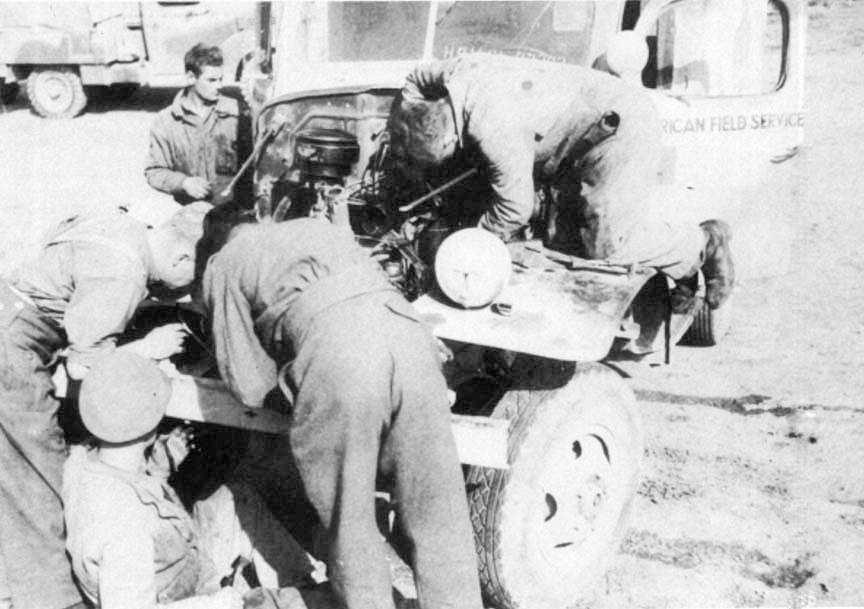 Five heads are better than one...fellow drivers turn out en masse to get this ambulance back into shape. Photo by Brook Cuddy |
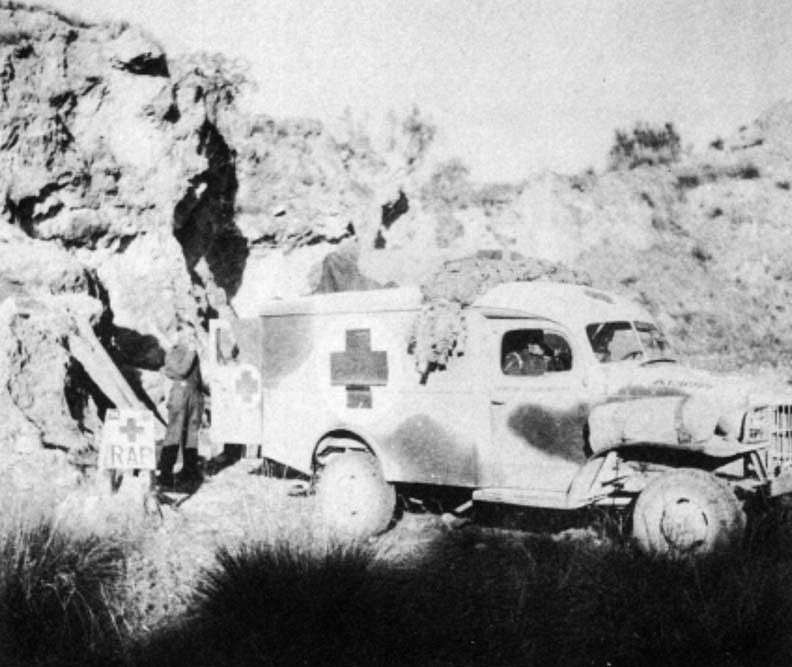 An ambulance, a sign and, hidden from view, the RAP truck on the Fifth army front. |
Christmas night.
"Last night we camped near a small town where we were allowed to go into dinner and the movies. The dinner wasn't much of a success; but the movie was good. After the movies some of us went to the midnight services at the Catholic Church. It was so crowded we couldn't get in, but stayed at the open windows. We had gone hoping to hear Christmas carols, but no luck! We were up early this morning as we had a long day ahead of us. After breakfast a bunch of the boys came around to watch me open your Christmas box --- the only one in camp as the other two had opened theirs on arrival, so with a great deal of ceremony I untied it while the boys stood with their mouths watering, reached in and pulled out the AFS coveralls!!! It was the bright spot of the whole day as it gave every one a real laugh which was just what we needed. The Camels were the only Christmas treat as we were on our own rations all day --- bully beef for lunch and beans for supper." (Editor's note: The coveralls were not a present! they were forgotten when the writer left the States.)
December 4, 1943.
"Sitting in a crowded Y.M.C.A. drinking tea and watching a big crowd sitting around chewing the fat ....At least there is no black-out in the Y.M.C.A. Remember LaGuayra to Caracas,? You ain' t seen nothing. Have really seen some magnificent scenery and some amazing roads. Of course at one time or another we've done a lot of camping out, eating meals wherever we happened to be and sleeping where darkness overtook us. But the top berth of an ambulance is very comfortable.....No more liquor available but we don't care."
December 13, 1943.
"The days here are lovely but it's a bitter, penetrating cold at night. We go down to the Y.M. C.A. most every night and drink tea while playing bridge. We are living in mud houses with thatched roofs and quite comfortable if only a little warmer."
December 16, 1943.
"A little excitement tonight when the thatching on one of the mess halls caught fire and it was all consumed in about twenty minutes. Naturally, there are no hydrants handy. Much wetting down of the roof of an adjoining ward --- typical that the natives drenched a canvas tarpaulin and paid little attention to the places where the thatching was exposed. Everybody enjoyed the blaze and not much harm done."
December 19, 1943.
"We hadn't gotten more than two miles on our 'Special run' when we had the sort of breakdown which can't be fixed by the driver so we are now sitting in a workshop miles from the original camp with no hopes of getting back for a few days. We are waiting to get a lift to a hospital where we'll leave our stuff and spend the night and nights till the job is done on the dear old ambulance. The flies for some strange reason are terrible. I haven't had any form of bath from the neck down for over a week, and all we've had to eat all day is a plate of sausage which we brewed up around eleven while waiting for the salvage truck to come tow us away after having one hell of a time getting a fire going, It is now four. We have spotted a river which we definitely plan to visit tomorrow. We also have something like eight cigarettes to last us until we can get back to camp --- which doesn't sound like much joy. It really is one hell of lot of fun and I think we're all having a great time of it."
December 20, 1943.
"Well, I guess we'll be here for a few more days now, as they weren't able to get the part for my vehicle until this afternoon. Actually it is pretty nice here, especially being completely off on our own. We're off in our own little tent two steps from the mess and we average about eleven hours sleep a night, it being too cold to do anything else once the sun is down and supper is over. The tent has one of the most ideal of situations, being well up on the mountain and has a great view. We have a large table and managed to get a kerosene lamp which improves matters no end. The food has been pretty poor, and to make matters worse the sergeants' food is cooked at the same place as ours and infinitely better than ours. Consequently we always see it going out and just stand there drooling. Finally we managed to get in a bath this morning which was a tedious process of the usual bucket. The unfortunate part about the bath was that I had no clean clothes to put on afterwards. I swear I never believed I could possibly live such a filthy life."
December 25, 1943.
"I spent the morning scouting the mountains with my buggy and another fellow for a Christmas tree. They were all too big so we had to settle for boughs to decorate the mess.
"Last night we had a great party though quite drastic for numerous participants. I ended up quite well really due to the fact that it was too hot for my gullet to gulp down so fast. After an elaborate tea this afternoon, we have cocktails at six, a terrific feast at seven; and God knows what all to drink. Besides rum we get a three-bottle-per-man beer issue.
"Christmas has been sort of fun in a very definite way of its own."
December 17 1943.
"I am afraid that none of our Christmas packages arrived in time in fact we are wondering whether it is next Christmas we are to promise to wait before we can open them."
December 25, 1943.
"Upon awakening this morning I was presented with a garland of flowers from my bearer for which I found out that I had to present him with one ruppee...First thing I knew was that all the bearers, which included the bearers in the mess, the Canteen and bearers of the men next to you plus the sweepers, were coming in with strings upon strings of flowers to hang about your neck. The upshot was that every time you saw a native approaching with a garland you made tracks for other parts lest it cost you another ruppee, of which by this time you had none.
"One is supposed to wear the flowers all day. If you take them off you offend your bearer and that would never do. They feel that without their help Sahib would never be able to go about his work and they could make it possible for Sahib not to do his work! It's a great war, isn't it?"
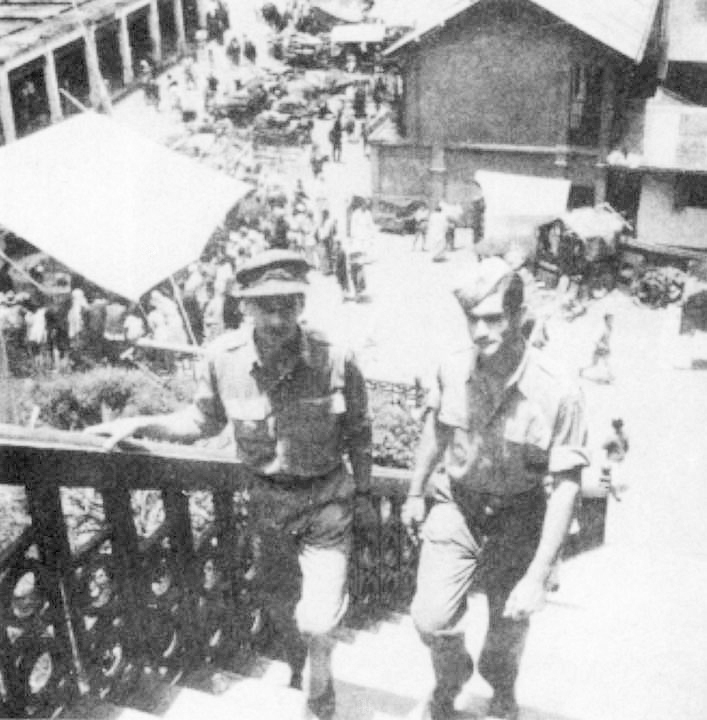 |
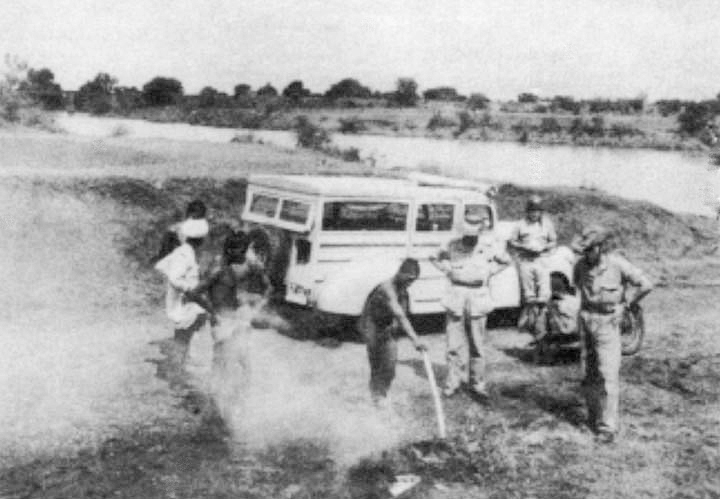 AFS staff members, halted by a swollen river, anticipate a meal of sweet corn roasted by friendly natives who swam the river to get it. |
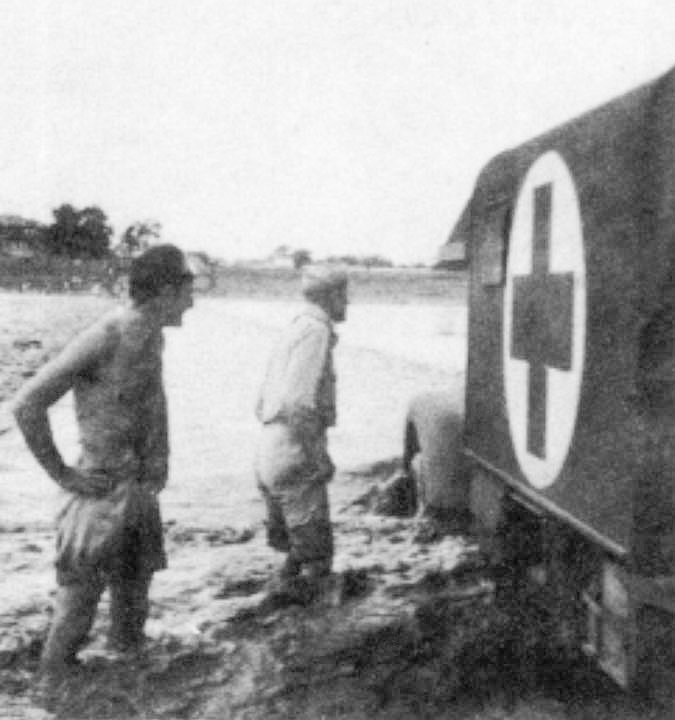 Going up! A rising river holds no worries for these amphibious "American Indians". |
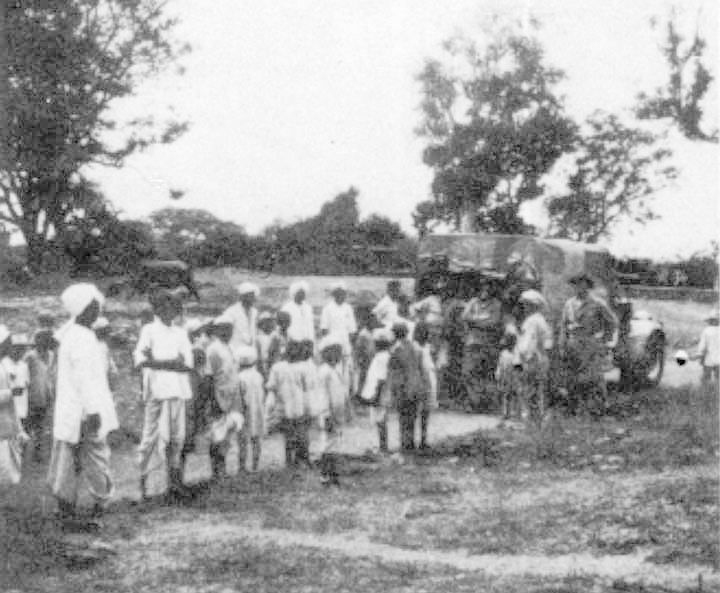 AFS drivers stop by the wayside --- to the delight of curious natives. |
Major Johnny Ames, HQ 12th, Fighter Command, APO 525, c/o Postmaster, N.Y. French Liaison assignment.
Johnny Boit, Volunteer AFS, has been moved over to Italy.
Captain Sam Chamberlin, African Reconnaissance Wing. Probably gathers material for new etchings.
Major Roger Griswold paid a fleeting visit to North Africa and returned to Washington.
Colonel Harold Willis, HQ 12th, AF, APO 650, c/o Postmaster, N.Y. AFS and Lafayette Escadrille in World War I, AFS France '40, now in US Air Corps, has again rendered distinguished service. Harold's decorations and service ribbons cover his tunic from lapel to pocket flap.
Captain Durant Rice, EQ 12th. Fighter Command, APO 525, c/o Postmaster, N.Y, French Liaison assignment.
Major Don Stewart, HQ 12th. Fighter Command, APO 525, c/o Postmaster N.Y. More French Liaison and AFS Special Correspondent... by appointment.
"Sedition in the SOLID SOUTH ". Unmindful of ancient tradition, Doug Boiling serves in the Kentucky Legislature under a Republican Governor who is the son of a Union soldier. Bob Gooch threatens to SECEDE.
Major Paul Rockwell, AUS, brother of Kiffin, first to be killed in the Lafayette Escadrille, Legionnaire under the Tricolore in three Wars soldier and author, writes of his pleasure in again seeing the AFS insignia and men in the War zone.
Twenty-one Veterans of 1914-17, have sent twenty-three sons to AFS 1939-43. The "Old School tie" idea carries on.
Mrs. Elizabeth D. Hall has given an ambulance in memory of her son,, Richard Neville Hall, whose name appears FIRST on the AFS Roll of Honor. Dick was killed Christmas Eve, 1915, in the snows of the Vosges.
Arthur Paisley Foster, SSU 17 and Middle East, was posted as "Missing" in the Western Desert, May 1942. No further word has been received.
AFS HQ is on the ground floor of the New York Cotton Exchange Building, 60 Beaver St., New York City. It is open to the Vieux Oiseaux from 9 to 7 PM ....at other hours by appointment.