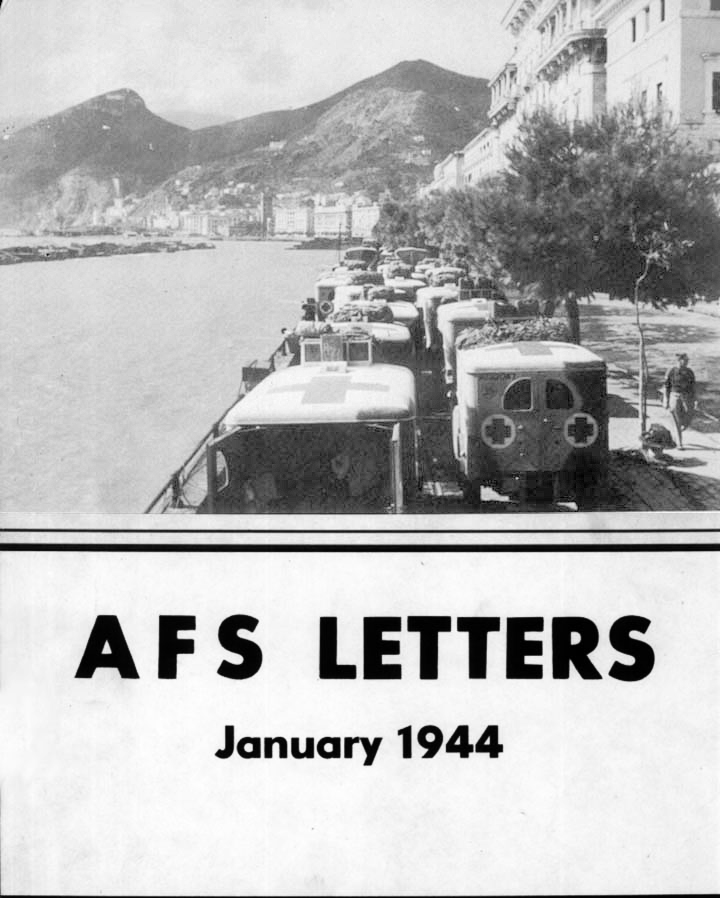
Edited and published at AFS Headquarters, 60 Beaver Street, New York 4, N.Y. under the sponsorship of the ambulanciers' relatives and friends, who contribute the excerpts from the letters.
The first definition of the word 'liaison' given in the dictionary is a "bond of union". The American Field Service has enjoyed such a bond with official Britishdom for the past two years. The path of the ambulance service has been cleared of many obstacles, red tape, delay and difficulty again and again by the understanding and assistance of the British Embassy. The chief figure and number one big brother to AFS during this period has been Rex Benson and it is largely through his liaison work that we have been able to surmount numerous problems that arose in the operation of the service. His belief in the work being done overseas and his untiring efforts to aid and abet its smooth performance, have pulled AFS through many a tight place. Colonel Benson has left Washington; his government has called him to other duties. Of the many friends he has left In the United States, none will more sincerely miss him than Mr. Galatti and the American Field Service.
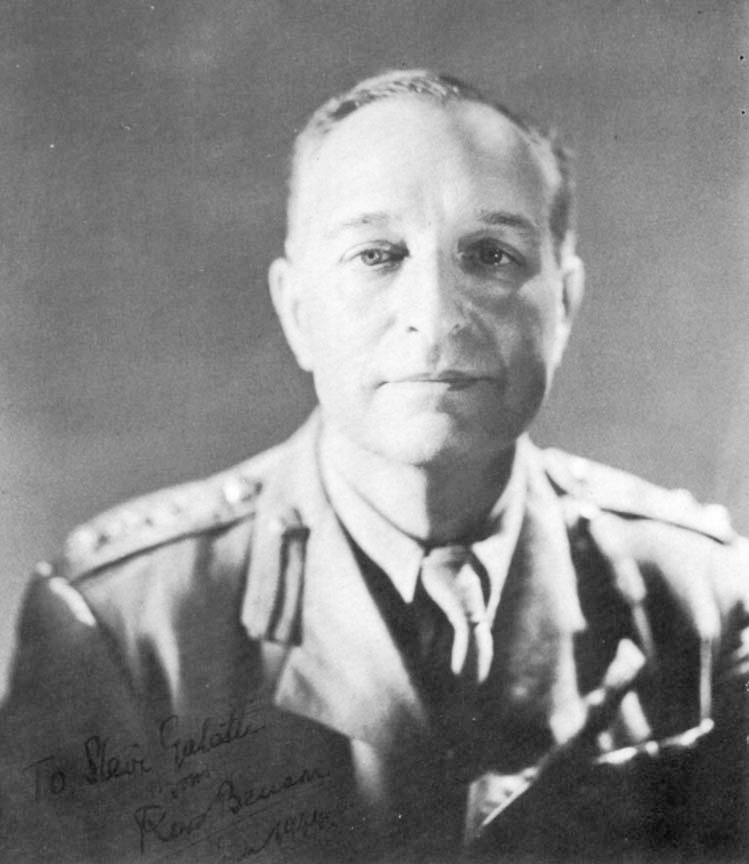
Colonel Benson's is an Army career, the main part of which has been spent in liaison work. He joined the Ninth Queen's Royal Lancers after his graduation from Oxford, In 1910 he was detached and served as a member of the Indian Army's section of the Viceroy Staff. When the first world war broke out Colonel Benson rejoined his old regiment and went to France where he was wounded at Ypres in 1915. Soon after his recovery he went back to active service acting as liaison officer between Marshal Pétain and; General Haig. At the close of hostilities he was at the Versailles Conference as one of Britain's delegates. The 1914-1918 war over, Colonel Benson transferred back to his old regiment the Ninth Queen's Royal Lancers and went with them to Ireland to take part in the Black and Tan Revolution. At the close of this uprising he was assigned as Military Secretary to General Lloyd, the Governor of Bombay.
This period of service completed, Colonel Benson became Mr. Rex Benson. In civilian life he scored another success; this time as head of the board of Robert Benson Company, his father's bank. It was during this period; that he had his first introduction to the United States, when he came here as an official attached to the British International Polo teams both in 1930 and 1936.
With the outbreak of the present war, however came the termination of Rex Benson's civilian status. He returned to the Army and was assigned as liaison officer with the first British expeditionary force to go to France, his specific duties taking in the liaison between the 1st French Army and General Gault's British Army. After Dunkirk he fortunately was evacuated to England in a bomber. He survived the 'blitz' winter of 1940 at the War Office in London where once again he was liaison officer this time serving foreign troops training in England against the day when they might return to their homelands to defeat the Nazi hordes.
Early in 1941 Colonel Rex Benson was transferred to Washington, D.C. and the British Embassy, then under the leadership of General Beaumont-Nesbit. In June, 1941, Major-General Beaumont-Nesbit left the embassy and Colonel Benson took over the strenuous duties of Military Attaché, a post which he has more than ably held until his transfer December, 1943.
Colonel Benson says in a recent letter to Mr. Galatti, "...the AFS, apart from the value of their work in the battles to the VIII'th Army and other British and American fighting units is doing more than any other body of Men in this war to further post war Anglo-American relations." That AFS has been able to successfully constitute this body of men is, in a way, due to Colonel Benson himself. He will be much missed in Washington, and will be very particularly so by AFS to whom he has been a shoulder on which to lean, a guiding hand and an ever present friend. As he leaves America for his new assignment and to form new "bonds of union" we wish him the very best of luck and God speed.
| We are glad to report only minor casualties sustained this month in Italy. |
W. DEAN FULLER was slightly wounded in the left arm by a shell fragment in an artillery barrage while digging a slit trench. He was working in a forward area at the time, but, with his arm in a sling, continued to help carry others more seriously wounded and to work as a spare driver till he could be relieved.
EDGAR STEWART DRIVER sustained very alight wounds in the legs by small fragments of a shell. Volunteer Driver was also working in an advanced area and able to continue on the job.
October 24, 1943. (Canadian Army Active)
"I have had more excitement since I have been over here than I ever dreamed of. The first time I went under fire, I was shaking like a leaf but instead of going back, I went forward; now I like it. The first time I was strafed, I had a load of stretcher cases so I couldn't run, I just stopped the car, and I could see the dust kick up along the road next to me. I went to give my patients a smoke, and I spilled the box of smokes as I was shaking so hard. I get along O.K. now, I was with the English 78 Div., a damn good outfit.
"I was at Termoli with the Commandos when they took the town; and we moved in that evening before the infantry moved in. Then the next morning Jerry counter attacked; then there was 'Hell' to pay. Five of our ambulances worked for two days and nights without sleep. I didn't think I could do it, but I did.
"We eat when and wherever we can, I have been eating enough lately, but for a while it was bloody awful. Since I have been over here I have driven 2,000 miles since October 1st.
"I am with a different outfit; you can see by the letterhead who it is. Well, I must get some sleep so I will sign off. Cheerio, and lots of luck."
November 6, 1943.
"We were holed-up in this town with 'Jerry' just up above, every time he would see anyone moving about the town; he would open up with 88 mm. Boy! it was really 'hot' in this town for about a week. The first day they had the cook's set-up in the square. Well, was it funny! The follows would run by the cook with a mess-tin in each hand, and the cook would throw the food in as you went by. If you dropped anything or if the cook missed, you didn't make a second run. It wasn't funny at the time but it seems funny now. That was one time you didn't yell about how much the cook gave you. It must have looked very funny.
"We are staying in an old house but the windows are blown out. The other day, we were huddled in the basement when a shell passed through the house and then two air-bursts landed right in the street in front of the house. Boys I thought the world had come to an end. But it is all over or now, and I am feeling swell. The food isn't too bad, but we manage to get some extra rations for a brew up at night* Up to today, I took all wounded back at night. So that gives you some idea of what we are doing.
"I will have some great stories to tell you when I get home."
October 16, 1943.
"Since I wrote you last week I have been posted with a very congenial unit, and we have been working hard. It is very gratifying to feel that one is really being needed, and for almost the first time since I have been out here this is truly the case.' Until a short time ago there was, I believe, a distinct scarcity of ambulances in this area and the Field Service has relieved the situation no end. Added to this there has been some heavy rain, and in the mud our cars are able to got through where the large army ambulances have considerable difficulty. Already I have carried about three times the number of patients than I did in the same length of time in Tunisia; as a rule 'good' work for us generally indicates bad news at the front, but that isn't particularly true here, for we are not so heavily over-staffed as we were in the past. The result of all this is that I have been turning in rather early off-nights (darkness comes much sooner now, anyway) pleasantly tired.
"We are stationed at the moment in a small town. Some of the boys are living in an apartment; after sweeping out one room (the place was a mess from looters, etc.) I decided it wasn't really worth lugging my kit back and forth from the car --- and also, having spent nine months in an ambulance, I could stand it a little longer. And so I am living in the ambulance down a side street. I shave off the window sill of a neighboring house and perform my daily duties on a very fine three-holer situated in the station square, quite publicly, with only a fragment of burlap propped up as a gesture to modesty! Our eating facilities are, however, quite swank; we have taken over a little restaurant nearby. Instead of eating with the medical unit, we have our own (British attached Field Service) cooks, and they are having a high old time playing restaurateurs. We have accumulated some china and some makeshift tablecloths, and the cooks insist we stay seated and be served (which; if you knew the English messes, would be something you wouldn't ordinarily expect, even in an age of miracles). Besides we have stored up extra rations during the long summer's wait and are really eating in very grand style indeed. The family that own the restaurant live nearby (I imagine shortage of supplies, etc. forced them out of business) and the children help clean the dishes and so forth; in return we give them food and in comparison to their neighbors one family is eating like kings. (I gave a small boy a slice of bread left from breakfast the other day, and you would have thought I had handed him the crown jewels). I haven't noticed peddlars here that I mentioned before, undoubtedly because there is nothing to peddle. Civilian-Army relations seem very much better. For one thing, the people are, I think, rather harder hit here, and one can be more compassionate. Also we have done a little work carrying civilians in our ambulances and my guess is there will be a great deal more of that further on. If our governments want to cement friendly relations here, they should send over a fleet-load of cigarettes! Flick a butt into the gutter, and nine times out of ten someone will come along and pick it up.
"The day we arrived, I went over into the old part of town. It is guarded by an old castle keep and is a maze of little cobble-stone alleys and. stairways leading every-which way. Chickens and swarms of children underfoot the production of the latter seems to be the national industry! The poorer inhabitants (the majority) appear to live in but one room opening on the street a stove a chair, a chest of drawers, and elaborately colored religious calendar and a tremendous bed make a complete setup for what seems a family of no less than a hundred. In the center of the old town, which is if a shade dirty, very charming, there is a quiet little square, save when a herd of tag-playing urchins stampede through. Here is a simple, austere, and very old church; the foundation is sixth century with a few pigeons perched among the gargoyles or cooing on the steps. There is a little nick off the tower which went not long ago, but, by and large, it looks the same and performs the same old services as it did a thousand years ago. I am thinking now of a certain field in Tunisia full of flowers on the first day of spring and am rather sentimentally reminded that even in the midst of misery and destruction there are hopeless little monuments of peace and security and contentment - did I say 'hopeless'? I hope not so."
October 21, 1943.
"Where we are posted the road looks like some of the pictures you see on the Russian Front.....A small scale 'Town Meeting' started when someone mentioned the fact that the Saturday Evening Post was printing articles written by service men on such topics as 'What are we fighting for?' This immediately brought up a great question in our minds. We know that we are fighting to rid the world of something which is bad but what are we fighting for that is better?
"Thus far we have heard of great plans by our statesmen for a post war peace, which will insure all nations against people like Hitler. However, these plans are full of idealistic statements which have no practical value unless backed up by something more definite. What about the economic setup after this war? To be sure then will be a big demand for food and materials for reconstruction, but what then? Are we to fall into the greatest depression the world has ever seen, just as our children come along?
"Year after year the United States has become more self-sufficient. Now, she has comparatively large imports and imported more rubber than any other country in the world. Now; because of war we have found a way to make synthetic rubber. What will happen to the rubber interests in the Far East? The same is true of nitrates from Chile, optical instruments and chemicals from Germany, and silk from Japan. Russia is likewise independent. Both these countries (the U.S. in particular) will be able to pour goods into the less independent countries who will have nothing which we need in return. Greece is a good example. For years she has been a poverty-stricken nation because her imports have been tremendous and her exports very slight. The difference had to be made up with money. Let us look at the situation from another angle. After the war, our greatly expanded industries will continue to operate, shipping materials for the reconstruction of France and of others. But when France is again on her feet producing her own food and manufacturing her own products, it will be the logical thing for her to put up a tariff wall which cut off our goods. Production in the United States will immediately be backed up and thousands of men put out of work.
"A third point! Who will supply the money for the reconstruction of industry etc. in Europe? American capitalists, of course. Are they going to be willing to give up their interests when Europe is again on her feet? It is not very likely. Already there is an example of the results which are sure to come. North Africa flies the French flag but is controlled by American capitalism.
"So far we have heard no answer to these big questions. Perhaps only a few of us have time to think of such things but I am sure that a much larger group is already beginning to wonder whether peace is yet very near."
October 24, 1943.
"I have got a new American ambulance which I think is wonderful, and pamper like a child. I am also learning quite a bit about elementary mechanics from a very complete manual. I'm very much afraid that business would drop in American garages if people had a fair knowledge of the workings of their car. Many of the illnesses are really very simple. As far as training is concerned we pick that up as we go along. In this kind of work what one needs is experience, and there is only one way to get that."
November 5, 1943.
"Fate is playing tricks again. I got hit with some falling plaster from a ledge. I was knocked out, they tell me, and received a nasty gash under the eye. Luckily I didn't have my glasses on. It seems rather funny to me, for of all the things that could happen to one; I had to get hit with plaster."
October 22, 1943.
"This is the way the British Army evacuates casualties and sick. Each regiment has its R.A.P. or Regimental Aid Post, consisting of a small group of stretcher-bearers and orderlies and one officer. When a regiment is in action its R.A.P. remains with it, within a mile or less of the front lines. Casualties are brought in to the R.A.P. by tanks, trucks, or any sort of vehicle, or carried in by stretcher-bearers. From here, after a very cursory treatment, they are transported back to the A.D.S. in the R.A.P. ambulance. The A.D.S., Advance Dressing Station, has a larger staff and can do the sort of job requiring local anaesthetics. It is usually six or seven miles behind the front and has about six ambulances to the Main Dressing Station about twelve miles further back. R.A.Ps, and M.D.Ss are all very mobile and are often under canvas, moving every few days. The ambulances serving them belong to an L.F.A, Light Field Ambulance. In the patient's journey the stage after the M.D.S. is the C.C.S., Casualty Clearing Station. This is a near hospital, capable of treating the most severe cases. It is usually situated in a fairly large town, a seaport or a railroad center, forty or fifty miles from the front or more, C.C.Ss are also mobile and can often move their staff and equipment within forty-eight hours. From here a man may be put on a hospital ship or train or sent by M.A.C., Motor Ambulance Convoy, to a General Hospital. M.A.Cs also operate between M.D.Ss and C.C.Ss. On paper the whole system looks like a triangle upside down!

Several R.A.Ps evacuate to one A.D.S., several A.D.Ss to one M.D.S. and so on. In actuality the operation of this whole set-up is determined by the particular difficulties of the terrain, the various types of fighting going on and so forth. From what I have seen and heard the system is loose and pliable, subject to constant change. Ambulances are sometimes in front of stretcher-bearers. A M.D.S. may be temporarily fifty miles distant from the A.D.S. and right around the corner from a C.C.S. I started this letter at an A.D.S. and am now writing from an R.A.P. which is supposed to be pretty close to the front, but I can't hear any gunfire. There are no casualties coming in. I suppose this is because Jerry is running.
"Once a patient becomes involved in what they call the 'regular medical channels' he may lose contact with the outside world for several months. The Field Service has at this moment sick men in Base or General Hospitals in Sicily, Malta, Tripoli, Algiers and the Delta. You never know where you will be sent. The guiding principle is to send you as far back as possible and to keep the advance stations clear.
"Driving along the roads here is something like coming through a maze. One has the impression that the Army has been spending all of its time putting up signs. There are an inconceivable number of units each with its own number, special identification and elusive location. Yesterday on an evacuation I got lost in one town three times; blinded by the tremendous arrivals at the crossroads and the red caps of the M.Ps. There are trunk routes identified by colors, divisional routes, diversions, billboards indicating the direction of the Combined South African and R A P Public Relations, the Such and Such Field Bakery and even the HQ, AFS, ACC 567 which, by the way, has found itself a nice billet.
"But I like the one that we had better. Our Section and one other ambulance making six are attached to an ADS in a small village on the top of a hill. We are parked on a little terrace with a beautiful view of the hills and valleys. Directly below us re very steep cobbled streets that descend in steps. Before every doorstep there is a large hog attached to a chain and a half dozen children playing and shouting. Our billet used to be a schoolroom. The walls are all white-washed and there is a crucifix in every room. At the wine shop across the street they sell wine that tastes very good for sixpence a liter. The first night I was there I gave one of the peasants a box of matches. He took me into his house and had his wife bring out a tremendous round loaf of brown bread. He gave me half of it and a goodly portion of cheese. There was a double row of pots and pans around the room, a cupboard, a small high bed with a red coverlet such as you might see in a Carpaccio; otherwise the room was bare like our schoolhouse. The church is up the hill from us on a miniscule square, so steep you can hardly stand straight on it. There are two trees on either side of the door. There is another church on the way out here, a pink one. Donkeys go through the street with barrels full of grapes balanced on either side. There is a host of noisy healthy-looking dogs.
"At this moment, I am waiting for a run from the RAP parked in front of the town fountain. I am constantly distracted by a variety of sights; a man walking by with a pig on a leash trotting beside him, a little girl walking by with a plate of something that is probably very good, covered with a red and white checkered cloth, four children in calico smocks carrying three brass jugs of water between them giggling and spilling, tempestuous fishwives' arguments around the fountain. Almost everything I see has a certain fond familiarity about it, but it is something you remember rather than something you knew all along
"Landing here after dark in a strange town seemed pretty unreal. So did the next morning in the muddy field outside of town. What impressed us most was how different everything was from Tripoli. But, it wasn't until we went through the first village on the way up that I was entirely convinced or rather remembered that we were in Italy. I was impressed by the cobblestones, the color of the stone, the smallness and irregularity of the streets, the uniforms, the faces and noise. but the clincher was the smell which I think is a combination of fresh bread, clean laundry, sour wine and the musty smell from inside the shops that drifts into the street..... In sum; everything's jake. We have a swell Post, we seem to be winning the war and I will try to write once a week on Sundays."
October 31, 1943.
"I was evacuated back first to one and then to another hospital. The last was the most pleasant formerly it was an insane asylum, and we slept in cells ---I in one with the middle-weight boxing champion of Europe! While there, I chatted with Italian prisoners of war serving as orderlies, and with soldiers from various parts of the globe, including several handsome, intelligent, French-speaking soldiers of Indian descent from Mauritius, a tiny island East of Madagascar.
"When I felt better, I wandered about, and visited the ancient ruins of Syracuse---the Greek theater the Roman amphitheater and an amazing cathedral. Originally it was an early Greek Doric temple, with unrefined columns, during the Norman occupation.
"After ten days more, I was discharged from the hospital to be sent to a rest camp for two weeks. However, the admitting officer at the camp, which incidentally was in an old monastery, instead allowed me to catch a plane ride forward to where I could get in touch with the Field Service, and then take my prescribed rest at the very beautiful; song-inspiring isle where I have been this wonderful week.
"I have been resting in the contrast of resort luxury ---so near and yet so isolated from the war, sleeping in a wonderful bed in a room with a balcony looking out over this mountainous little isle with blue sea beyond, and eating better food than I have tasted in a long time. During the days, I have walked over almost every steep path, catching the views of the sea and distant land, looking at clusters of bougainvilla, at gardens and villas, swimming in a blue grotto hollowed deep into the cliffs by the washing of the seas, and delving into the ruined castles of Tiberius and of Augustus. It is the most beautiful island I've ever seen, now left almost for my sole pleasure by the lack of peacetime travellers."
No date.
"My burns are coming along nicely. I have been on a regular tour of the different medical stations. The idea Is to keep everyone moving away from the hospitals near the front, back out of the way, and I am no exception. I had an interesting experience the other day. I went by air from the hospital where I was to this present one. The trip took about an hour and a half and I spent most of it with my head glued to the window. I am in an officer's ward (special privilege granted us) which is pleasant and I have a bed with sheets, a great luxury after a stretcher and blankets in the back of my ambulance. I had a visit from the Red Cross girl today --- British Red Cross, result: five packs of Old Golds and a bar of chocolate which I have just finished. Delicious! We get all our canteen supplies now from England instead of from Egypt and Syria and they are much better.
"The English nurses are very pleasant and capable. I have a nice view from the window by my bed. Mt. Etna with green Sicilian hills as a backdrop. It is most imposing even though quite a distance away. My foot is healing nicely and the doctor thinks I should be back with my unit in a few days. It is some consolation to think that if I hadn't burned my foot I would never have seen Sicily.
"While I have been sitting here idly in bed; I have been trying to sum up in my mind just what I have seen and done in the past six months. I have travelled 16,000 miles, 14,000 miles of this was by boat --- two different ones on the way over and two shorter boat trips since then; 1500 miles by auto, mostly in Italy, and about 500 miles by air. I have been in, or at least touched at, or seen 7 countries and 12 large cities: Capetown, Durban, Cairo, Alexandria, Tripoli, Taranto, and Catania are a few. I have seen every type of soldier, except a Jap. The Indians and the New Zealanders are the most interesting to me. The Indians because they are so small and gentle looking and are such good fighters and the New Zealanders are so much like the Yanks that it is amazing."
November 26, 1943.
"Did I write you about the concert I went to a few days ago? It was really rather sad being all Verdi, Puccini, Rossini, etc. The opera house in which it was given was worth it, however. It was Roccoco at its worst. The orchestra was rather feeble in brass from which fact we gathered they were needed for bands. Of course there were a soprano and tenor to round the program off. The tenor looked like an undernourished waiter, while the soprano resembled a Hermann Goering. It was rather ridiculous when they sang the final duet from 'La Boheme'. They seemed to have that ' I-can-hold-a-note-longer-than-you-can' attitude towards each other. It was great fun, though."
October 22, 1943.
"I am having the time of my life. I am with a small unit, on the move, though still of course as remote as ever from the war. There are only a few whites in the outfit, and being the only American, I sit in the officers' mess --- very delightful! The commanding officer of this company is a delightful Oxford man--- a Captain, though only twenty-four. The second in command, over twenty-two, is also very nice and we get along finely. There is also a medical officer, a Czech, who is fascinating though a trifle boring with his precise continental manners and pedantic method of conversation.
"We travel only about fifteen miles a day, and I will be with them only until they reach a railroad station --- about 300 miles away, It is possible though that I won't even be with them that long as the whole Field Service in this area is more or less expecting a big move.
"We've been entertained here by a number of the resident officers of towns through which we go. Two nights ago a British Major---tonight by the French. Have, by the way, been using my French a lot; also German a little, as the Czech doctor does not speak very good English.
"Have also kept busy running an extra-curricular canteen for the whites here --- beer, cigarettes, soap, chocolates, etc. Actually; I'm having as fascinating a time as I've had yet and seeing new country too. I've been in every part of this particular country except the capitol city! Another interesting bit on this trip is the colonial troops with which we work. Am even learning a few words of their language called Urdu. Their more educated, non-commissioned officers have told me a lot about the situation with Gandhi, the Moslems, etc. This particular group is entirely Moslem."
October 20, 1943.
"I've had the best time of the war so far here. We hadn't been around for more than a couple of hours before we found all the stinking red wine anyone could want. I've had enough to last a lifetime. It tastes like old socks. I'm still on the trail of some good chianti. There is marvelous candy here and fine apples. Out in the country there seems to be plenty of food such as tomatoes, lemons, and peas, etc. The civilians do not have cigarettes and are starved for meat, even bully beef, and would much rather trade than take money. The people are very friendly, almost painfully so in many cases, except that they drive me mad with their little carts which slow down everything. Everyone driving over here goes hell bent for election. I already think I could hold my own with any cab driver in Times Square on a Saturday night. The language seems much simpler and I'm more interested in picking it up than I've been in other places."
October 25, 1943.
"I'm now allowed to say I am in Italy, but you've probably guessed as much from my last letter. You needn't worry as I am having a fine time and only wish that I could have been here earlier. At last I feel we're doing something worth while.
"Our work isn't as interesting as it might be, but it carries us all over the country and we come in contact with all ranks and civilians. Although so far I've only carried three civilians.
"I had a much needed and greatly appreciated bath today at the future H.Q. of the Field Service. Life is much easier! Here at the post there is a canteen where we can write and not far away there are some nuns who have gone into the laundry business. Now If I could only get my hands on an Italian grammar life would be complete. In the course of my travels I've accumulated a sizeable library which makes the periods of inactivity so prevalent with us much more bearable."
November 4, 1943.
"Italy isn't in very good shape. Every day there are refugees trudging somewhere. Sometimes they've come through the lines to take their chances behind the Allied lines. The weather is lovely. Here and there the leaves are turning and the nights are cold enough to do away with the dampness, and for the past three nights I haven't seen a mosquito.
"Here we have our own mess, with both American and British rations which the Field Service drew, plus an abundance of fresh foods including chicken. It is really unbelievable. There are very good red and white wines here, but there is no chianti for love nor money. Two Italians are working for us for only their meals and cigarettes, which are now American. One of them is quite an. interesting fellow. Fought in the International Brigade with the Spanish Loyalists, and also in Ethiopia. For the rest of the civilians, well, they're just one more factor in the war. Italy is unbelievably poor and backward in many ways. I doubt if most of the permanent Fascist 'improvements' were meant to last even this long."
December 4, 1943.
"I've spent practically nothing over here with prices controlled as they are; a shave and haircut being 7¢, and a shave 2¢. This must sound incredible. I was amazed at first until I found out that Italian soldiers were paid 5¢ a day and a family of four could eat on about 18¢ a month during Fascist times. Their prices are based on the lire being worth about 1¢, as for some time before the invasion it was worth about that, formerly being worth about a nickel, and in the late twenties and early thirties, about 20¢. The majority of the population are small farmers, peasants really, now on a diet of apples, walnuts, potatoes and foul, sour wine. The Germans take and kill all livestock suitable for eating. In the towns or cities conditions are better, and of course practically anything can be bought for what is an unheard of price to the Italians, but cheaper than in. the States. The majority of the population in the cities seldom rise up to even American tenement standards."
October 25, 1943.
"Am now with an antitank regiment and we have certainly been busy during these past few days --- exciting and interesting work and the real thing at last. We are now in a small village in mountainous terrain, really beautiful country, heavily wooded, and dappled with shadow and sunshine; for the weather has been fine, the air cool and fresh and invigorating; a long cry indeed from desert wastes and sand swirling in the hot wind.
"But this little village has been razed by the retreating Nazis. There is scarcely a house which has escaped meaningless ravage by dynamite and fire. The narrow, winding cobblestone streets are filled with rubble; the inhabitants still dazed and fearful; they look to the hills, almost whispering their dread word 'Tudesch' --- German; but we reassure them, 'Englese --- Americano, finito Tudesch', which may not be very hot Italian, but they understand and smile broadly, and little by little they are realizing their liberation is assured.
"When D. and I arrived here; we were the only medics on hand; rather a big order for only first-aiders, we thought; but we managed to acquire a pretty adequate supply of stores en route: bandages, field dressings and sulfanilamide powder and ointment, even some morphia. Those sulfa derivatives are certainly worth their weight in gold! We set up a sort of medical room in the village schoolhouse. In the mornings we attend to the troops of our assignment, in the afternoon to the civilians. Running sores and a few shrapnel wounds are now healing well; doctors B. and C. doing minor operations with a pair of sterile scissors to cut away decaying skin and make the sores clean. It's a great satisfaction to feel you are doing some good and the people are immensely grateful, often bringing us apples or perhaps some vino in appreciation.
"The night we arrived we left our ambulance across a ravine and after dark I started back to it for more dressings and equipment. The ravine was a great black hole --- no moon and a somewhat tricky path leading down the perpendicular side and up the other. Of course no light could be used, but after several attempts and failures, I found a path with its wooden ladders over some of the steeper descents. I would cling to a tree or root and carefully stretch a probing foot downwards. When the foot hit nothing I knew I was off the beam, as it were. Just as I got to the top of the gorge 'Jerry', as he is affectionately called, decided to pay a visit with a few bombers and quite a skirmish was on, with the planes droning down and the ack-ack and tracers countering. Great snakes! Out in my first raid; I thought. However, the bomb thuds and whistles were not too close and I didn't hear any ack-ack falling about. So as time was awasting I proceeded to an ambulance parked by a farm down the road and secured the medical stores. A few of our lads were standing nearby with bren guns and together we watched the tracers going up red against the black sky and the anti-aircraft bursting in white flashes. You couldn't see the enemy planes' only hear them diving and circling and the bombs hitting with a kind of muffled roar. Then, in a brief lull. I regained the ravine, stayed there during another attack and got back to HQ O.K., except for a slight charley-horse which did not impede my progress at the time.
"The next day they brought down a badly wounded German from the hills, his left leg broken by a bullet and another through his arm. We patched him up and gave him some hot tea to counteract shock and he stopped trembling and the vacant stare left his eyes. 'Then I evacuated him in ambulance to the rear. Subsequently an ADS arrived and for a while helped them with evacuations from beyond our village where the casualties were being brought down -----------------plus a few Nazi wounded and prisoners. One of the latter told us how he had hidden away in a farmhouse as the rest withdrew. 'I was bred a Nazi', he said, 'but no more'---or words to that effect. The ---------------boys are given the toughest assignment. They are immensely proud of their title and immensely brave. Not a word of complaint even when they are about all in. They certainly are a wonderful example of how to take it. And how they can dish it out! The ------------------------------during a ------ - - - - - were plainly audible in the village just beyond us. 'But that's just the trouble with the Nazis', one of the guards told me in a broad Scottish brogue. 'Ye vera seldom get near enough to Jerry for a real guid han' to han' fight!'
"Down from the hills, too, are coming Italy's war refugees: bewildered, hungry people, women and little children. I had some canned milk in the ambulance larder and with a British leftenant mixed up some food for one family who were just about starved. 'I can stand seeing men suffer', said the leftenant, 'but not mothers and babies!! Then as a kind of after thought he added: 'You see at one time this might have happened in England.'
''We had several bombings since the first night. Last night no hostile aircraft appeared, and today has been relatively quiet. I expect in a few days we shall be on the move again.
"The roads in our particular sector are muddy, narrow and tortuous. And one gets a good idea of what a communiqué means when it states, 'Our progress has been slowed up by enemy demolition! Through craters and blown bridges you are certainly thankful for four-wheel drive, but it is hell for the wounded! Mais c'est la guerre, and you just do the best you can and drive as slowly and carefully as possible. We are operating what is called an RAP. That is the goal position in the AFS............ you get to know the men and officers, and you feel more permanently assigned. We are a fine group of men, have a good mess and have made some lasting friends.
"I'm writing in the schoolhouse as the shadows of evening descend from the mountains. We've had a busy afternoon with our Italian citizens; bevies of squalling infants, many of them with scabies, a skin disease we're already proficient in diagnosing. There is little we can do for these, except keep the sores clean and dressed. But there are others, from cross-eyed old codgers of about 80 odd years, to the smiling little girls and boys whose infections are healing in fine style. I'll practically be ready to hang out a shingle by the gates of 'Westview'. It's surprising how much you can pick up as you go along. Luckily; this village does have a mid-wife!"
November 20, 1943.
"Across the street in a broken down staging-post a weird piano is playing 'When Day is Done'. Most of the standing buildings, and they are few, are occupied by troops. There are a few civilians here --- many, some 3000, were killed by the air-raid vs. Jerry. Have you ever seen a town flattened? I have before, but here the dead are still there, and at noon it isn't pleasant even if it is war. It is criminal, heartrending, incredible. A home, as I may have written, is only a pile of mortar and stones --- with bent metal, bits of cloth, picture postcards, and so forth part of a sodden pile. Italy here I understand, has been much easier than Sicily, where you know I never was. And all this goes on below these mountains, below these clear, cold, red, gold and green, blue, clouded skies.
"The Italians are good sports. They go to work, but what to do? If your home were as above described --- what to do? You see here a man with a possibly fine three-story house carrying out bricks, rubbish and rubble from his basement where he lives. Why? The top three stories aren't there any more and he needs a room. You see clean-cut women and children obviously well off, in fur coats and wooden shoes, carrying bags and chickens along the muddy roads. No one seems downed! It's too big for that. Mankind shrugs and that helps to keep out complete recognition of the disaster and yet to deplore it.
"This morning I found a mobile bath, where one Tommy pumps and another blows a fire and water trickles out of a gas pipe over one's foul frame! But you get cleaned a bit and it was fine."
October 26, 1943.
"Things are going fairly well here, except for the natives one of whom stole all my spare clothing and cigarette supply. I'd left it in a rucksack beside the car and though they left the rucksack, everything else was gone. However, now they're our noble allies we must speak well of them --- oh yeah. They also have the nice custom of driving their market cars at night without lights and I expect every day to end up on top of a load of grapes or something. If I were driving a tank I'd know what to do, but I'm afraid my ambulance would come out the worst in any encounter.
"I've had a little more active work in the past week, but nothing very exciting. All the fighting in our sector is up in the mountains where the ambulances can't go so the stretcher bearers do all the work. The biggest thrill I've had so far is looking out of the window of our billets this morning and seeing snow on top of the mountains, the first in a year and a half. It was with mixed feelings I saw it, for it will mean tough driving conditions when it gets farther down. The mud is bad enough, but, all in all, even on the mountain roads the driving is easier than in the desert."
November 15, 1943.
'The day we were to leave Taranto, we went down to get our laundry. Left it on Sunday; supposed to be ready Thursday, not ready Fridays. If it weren't that the laundress spoke French (lived in Marseilles five years) we'd be there still, or sans clothes. First, the 'Padrone' was not there. Then, when he came, his first action was to spank his smallest child, a small urchin of six who wasn't doing her share about the establishment. Though this action was entirely unjustified, I'm sure the little girl raised such a howl that a group of one hundred pedestrians, local policeman, carbinieri, stopped to disapprove, with shouts and heavings of arms. Mama came out and joined the fray, and it was a small public disturbance at least, before it quieted down about twenty minutes later. The next oldest daughter, about fifteen, was all the while standing in the doorway watching, doing nothing at all to one of my socks she was meant to be darning. This young lady ironed and darned, and took a very poor view of our standing around cluttering up the none too spacious shop. Anyone trying to get by her to the stacks of finished clothes was elbowed and reprimanded in no uncertain terms. And anyone attempting to flirt with her (she was very pretty and chic) was rewarded with all sorts of scowls and grimaces. She spoke and understood nothing but Italian, and seemed to assume that everyone was making either uncomplimentary or indecent remarks about her. We were trying to get five people's laundry, and they couldn't find all the lists--- didn't know whether all the clothes were ironed or even washed. The fellow ahead of us got some laundry, but only some of it was his. The laundress disappeared for a while so I went out in search of a fountain pen. While searching in vain, I passed a florist shop and stopped to get a couple of flowers by the way of speeding the machinery at the 'Lavanderia'. The florist clipped me a few roses, but he had to wind the stems, wrap them individually in cellophane which was buried way back in the shop. So, about thirty minutes later I was back at the laundry, somewhat embarrassed by the presence of three or four soldiers. However, I didn't have to worry how to present the roses as the oldest girl said, 'Pour moi?' at the same time making a dive for one, but she only beat the 15 year old by half a second. Then began such an explosion of appreciatory display that I almost considered retreating to the sidewalk. After which everyone speeded up the ironing and searching --- for a minute or so. However, little Miss Temper was all smiles and favoured me by sprinkling me instead of the pants she was ironing. The Sergeant with me claimed that a pack of cigarettes would have the same effect, but I know it would not. The number of interruptions seemed likely to continue, so we helped one of them carry about fifty gallons of water across to the greenhouse where the actual washing was done. The old law of natural selection was in full swing in this organization; the girls in the back room were pitifully unattractive and undoubtedly excellent scrub girls. The two pretty girls were in the front store, attracting soiled laundry most successfully. Yes, some washed, and some not even washed. They asked us not to forget them as we left."
|
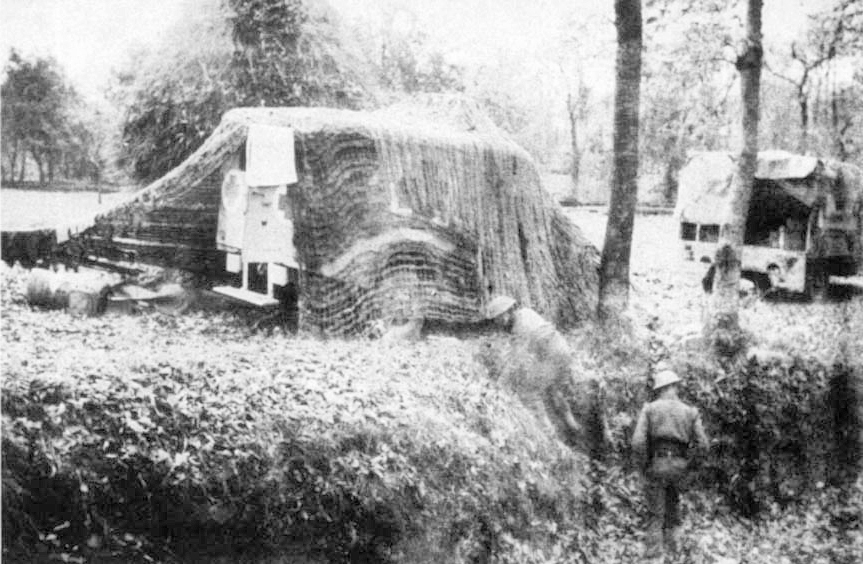
Action successfully eluded. After a German air attack, Fred Balderston and Wilkie Collins climb out of a gulley to their camouflaged ambulance. Apparently in their haste to seek cover the tell-tale white bath towel was left banging on the car in violent contrast to the carefully spread net. photo by Brook Cuddy |
|
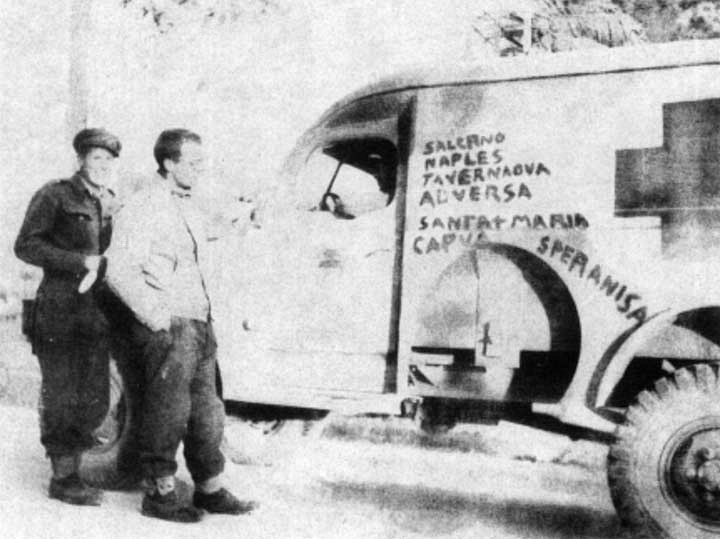
Notches on his guns used by the early western heroes have nothing on Walter Moore and his 128 ambulance. Moore (driving the car) shows his service record with the Fifth Army to two comrades. photo by Brook Cuddy |
|
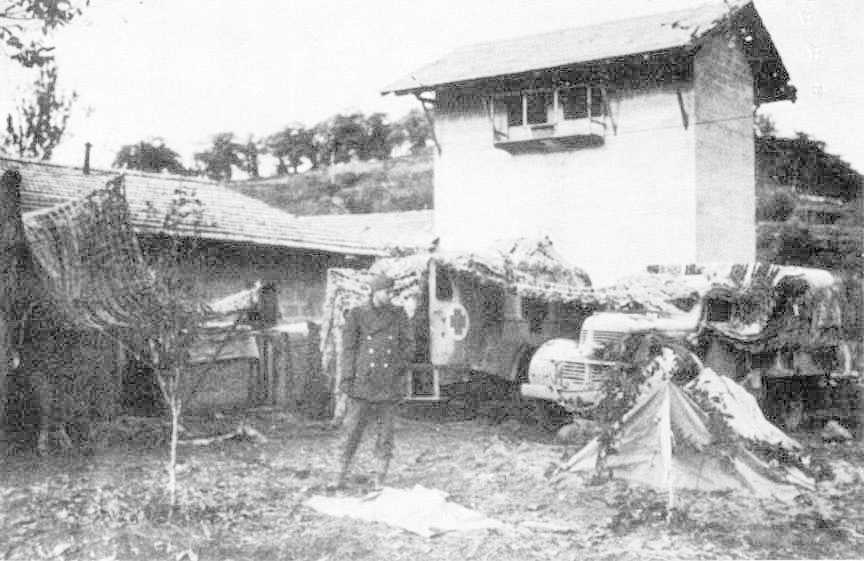
RAP Italian style. AFS driver Charles Colline poses near his ambulance and an RAP truck on the Fifth Army front 'somewhere in Italy'. He is serving with a field artillery regiment. photo by Brook Cuddy |
|
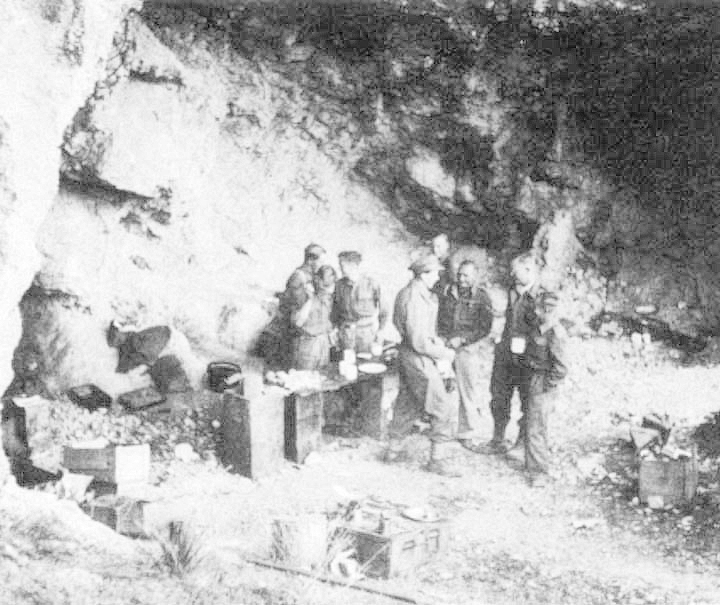
At one of the forward RAP' s with the Fifth Army British forces in Italy. AFS men get breakfast with men of an anti aircraft regiment. The 'kitchen' is a hollowed out hillside. The lines are just beyond and over the hill. photo by Brook Cuddy |
November 12, 1943.
"I had a short period of interesting work at an ADS last week, It was during a local push and I had several runs over the lousiest roads possible. No lights at all, narrow roads and a steady line of trucks and guns going up to the front. At one place a bridge had been blown which meant pulling down through a sea of black sticky mud fording the river, and climbing a very steep bank on the other side. In daylight it's tough enough but at night with patients with the car rocking and twisting when every bump meant agony for them it really takes it out of you. On one of the runs, after leaving patients, I was held up for an hour by a road block traffic stuck for miles. The guns were putting up a terrific barrage and right in the middle of it I crawled in back and fell asleep. Not blasé, just tired. Most of the time, ambulances have the right of way and if one hits a road block or traffic jam, he dashes up to the Control Officer and asks if he can get an ambulance through. Usually they'll try to work it. They usually add, 'But it's your own risk!' You see when there is a 'diversion' where a bridge has been blown, they only let traffic through one way at a time. They let us take the chance of working our way through against traffic. On a fair road it would be nothing, but hub-deep in the mud on a track just wide enough for one car you really have to work. I guess you know what country roads look like in the spring. Well, you can imagine what they would be like if thousands of trucks and guns went over them within a few days! However, it's all part of the job. To date, the only shells I have heard whizzing overhead have been our own, altho I was close enough one night to hear machine-gun fire and see the tracers. It will be all right with me if I stay that far away. I'm no fire eater. Several times my orderly seemed rather perturbed, thinking that Jerry was going to open up on the road along which we were driving, but I wasn't worried. Ignorance is bliss. "I see that parcels have arrived here which were mailed Sept. 2nd, which is wonderful time."
No date.
"Some life! Can't ask for anything more. Tell------to stop bragging about his trailer, for I have an--------- car. A four cylinder job, and it goes swell. Oh! guess what else I got the other day. Four chickens. Boy, did they taste good. Sounds like an easy life; doesn't it? It is! I'm feeling fit as a fiddle and ready to go. Oh! you remember all that food I had, that I got from America? Well, it's all gone now some other bird is eating it. I know what nationality, but not his name!"
No date.
"You should see how nice I look in my uniform with mud . . . all over it and you can't see that I have shoes on for the mud... This country is surely a Hell Hole and you roll in filth . . . The cold season is coming on now and in the hills, it really is cold. We have heaters in our ambulances and they have good insulation so that helps . . . This country sure is hilly and it's hard for the patients as well as being hard for us . . . I have never believed so much in the Red Cross before; but I certainly do now."
October 30, 1943.
"A few days ago I took a stroll after lunch to examine an ancient treadmill irrigation well near our farm house post. It was situated in a beautiful orange grove and of good design altho unused for quite a time. There were two concentric circular walls; one around the well and an outer one to keep the laboring beast within bounds. I had climbed over the outer wall, which was about three feet high and was peering into the murky depths of the well when I heard a flight of planes overhead. I looked up and saw them coming from the northeast. There were sixteen of them flying in three lines abreast and a small 'V' behind. They looked to be American Mustangs. After they had passed over they turned slightly south. All of a sudden our ack-ack opened up and gave them everything they had. The lead planes 'peeled off' and came in at our farm house in a slow dive. When they were about 300 feet from the ground they pulled up and let loose one medium sized bomb apiece. When the first bomb hit, a piece of shrapnel hit the top of a tree not fifteen feet from where I stood; open-mouthed, and jarred me to my senses. I hit the ground and got as close to the well as I could. As the planes roared over my head on their homeward way, still followed by the white ack-ack and red tracer bullets; I could clearly see the black crosses outline in white on their wings. Six bombs were dropped and no planes were shot down. They didn't hit our farm but one a few hundred yards west of us suffered somewhat and shrapnel spattered against an ADS nearby. They did not return. I learned later that they were Messerschmidts 109's. They look very much like our P 43's, and even the gunners hesitated with their ack- ack, uncertain until the planes made their first hostile move."
November 16, 1943.
"Yesterday we drove some patients to a convalescent camp about thirty-five miles south of here. On our return trip we lost the road in the dark and didn't get in until 1:30 a.m. Luckily I had some U. S. Army Field Ration 'C' with me, so we climbed into my ambulance and -cooked it over a primus stove and washed it down with a bottle of vino."
November 17, 1943.
"We were in a field which after two days of rain became absolutely impossible to get out of as the one and only cow path out to the main road had become a death trap to all cars, so deep was the mud. Today the weather let up and the sun came out so this afternoon we got hold of a huge wrecker truck and got to work hauling one car after another over the bad spots with two chains and just simple human pushing. To get seventeen cars out it took us from right after lunch at 12:30 to nearly five o' clock this evening. Every driver had to make a dash for the main road and get his car as fast as he could. When it was bogged down, the rest of us wallowed in the mud pushing and pulling until the tow chain could be hooked on and the wrecker do its job. All the cars finally made it although we practically gave up on the three-ton water truck which despite all our pushing etc. kept getting in deeper and deeper. We are now camped a few thousand yards further up the road in another open field but thank goodness it's flat and we can all hug the roadside so that this time we are in no danger of getting stuck again. However, it is just like living in a glass house as the road with all its traffic is but a few feet away from the car."
No date.
"The other day we had a real chicken dinner. We got two chickens from a local Italian and paid him for them in cigarettes. When we stopped for lunch on the road, there was a potato field near by where we dug up some potatoes for ourselves. We got a hold of a can of peas and some bread from the cookhouse.
"After I had cleaned the chickens a local Italian woman offered to cook them for us, and they turned out very well. She put some sauce on them that really seasoned them. We cooked the potatoes on a small burner in the back of one of our cars and mashed them as well. After heating the peas, six of us sat down to a very good chicken dinner. We all had a grand time and the food was very tasty. We really have a lot of fun together and all of the fellows are wonderful to have as friends. This is a great organization and I'm very glad to be in it.
"I wonder if the censor will let me say that I have seen General Montgomery. I was very close to him and could see him very well. I was standing alone, as he went by. I saluted him and he returned the salute. He is a fine looking gentleman and has a very red, healthy face. He is very small and has a slight build. All of the troops think the world of him, and are glad to do anything he orders.
"The English Army is a great one. The Tommies are fine fellows and I am enjoying my stay with them. They all want to hear about America from a Yank, and are always asking questions about it. They also want to come to America after the war.
"I have talked to some escaped English prisoners of war and they told me that the Germans are having a hard time feeding their army and are taking all the food from the local Italian people before retreating. The group I talked with worked for about three weeks helping the people hide their food from the 'Jerry'. In return for their work they received clothes and when they reached our lines; they really looked like any local man. I talked with them the day after they slipped through the 'Jerry' lines, and their experiences will be wonderful to relate. They walked for days without shoes, and over mud. They lived mostly on grapes, since they could not get other food without giving themselves away."
October 23, 1943.
"This morning we took some sugar and went to a bakery near here. After a bit of trouble explaining what we wanted, they agreed to bake us an apple pie. It should be quite good, as some of the others have had other bakeries do it for them. We will pay for it in cigarettes as they are more valuable than money. It will only cost us one package. In this country you get almost anything for a few cigarettes. I have gotten post cards, shoe-shines, laundry done, and even purchased eggs for a few cigarettes!
"The strangest thing I have eaten since coming here is octopus. It may sound terrible to you, but it is really a fine dish. It was served cold, and I ate two plates of it. Another fellow, finding out what it was, could not eat it, so I, as usual, finished it for him."
October 15, 1943.
"Bali hasn't got anything on this place. You should see the way the women carry water jugs on their heads from the fountain in the square here. Of course, the climate necessitates their wearing a few more clothes."
October 16, 1943.
"One day last week when we were standing by our ambulances after having unloaded some patients at the MDS, an American correspondent (A.P.) came up to us and inquired about what we'd been doing, how long we'd been out here, etc. He also took our home addresses. Don't believe all that he quotes us as saying, though. Our three sections were mentioned in official army dispatches regarding the great work our ambulances did on the 'I' front last week. I don't know whether this will ever make the papers back home."
October 28, 1943.
"I am eating better than I did since I was in the G.I. Field Hospital last summer. Lt. Brown of the London Scottish, a rangy Rugby player, whom I was with through most of the hospitals and evacuations, mistook the American Hospital plane nurse, dressed in natty blue battle blouse and long trousers, for a mechanic. It was his first flight, also with us was a G.I. B-25 pilot, the first time he'd flown as a passenger.
"There are 15 beds in this G. I. tent, one of the jaundice wards. Sandy, the ward boy, keeps an eye on us. Oh, a nurse does come in once in a while and the doc visits us once or twice a day. There is an assistant ward boy, Geno, who dresses in fatigues and KP cap, looks more G.I. than most Yanks. He is a good-looking Italian P.O.W. who speaks very little English but is a hard worker."
November 6, 1943.
"Through most of the journey here I was a walking patient. At one stage I was a stretcher case very much against my will. I was all dressed and started to walk out of the officers' ward when the Sister in charge insisted that I get on a stretcher. In the end I didn't regret it though as it was a long trip. When the British Colonel of the Hospital we were evacuated to, heard I had jaundice he had me on my feet in a hurry. On this leg of my gyrations I was with a young Canadian from the Royal Canadian Navy. He had his appendix out in --------and was evacuated by our AFS. It was for this front that we were mentioned in dispatches."
November 24, 1943.
"I forgot to mention in my last letter that we had a very exciting trip by plane from the base hospital. Nothing really happened but half way up we were told to put on the 'Mae Wests' and it looked for a few minutes as if we might have to use them.
"Since arriving here at H.Q. we have been sight seeing in the old French quarter and eating in the French cafés as well as the G.I. places where the food is swell. Also have gone to all the movies."
November 28, 1943.
"Of course it is one of the oddest Christmas's I have ever spent. Try and picture a small tent with five bedding rolls spread out on the sand and five eager fellows in their shirt sleeves surrounded with Christmas paper, exchanging cookies, candy, and other articles for sampling and examination. All this just two days after Thanksgiving."
A friend of the Field Service brought in a letter written by Major Harley Crawford Roberts of the ------------------, who was wounded in Italy in October. He reports his Colonel as "badly damaged" also, and says: "We were picked up and brought into a dressing station by an AFS ambulance. I don't know who the crew were but they were splendid and did everything they should have done."
Alvin Wright who served his year with the AFS in the Middle East, received his commission as 2nd Lieutenant in the Indian Army early last fall. He is now serving with the Fifth Royal Gurkha Rifles and is expected to take part in the coming Burma campaign. Although having arrived three weeks late at Officers' Training School, he was graduated first in a class of 200 and took a 200-rupee prize in the Urdu language.
Christmas brought another wave of Middle East and Italy veterans back from overseas. Art Howe beat the holiday by a scant 36 hours; Henry Breul was steaming up the East River at 9 o'clock Christmas morning. After helping launch an AFS drive in Westport, Connecticut, Henry will be returning to Harvard to pick up his studies which were interrupted when he enlisted....Bill Browning is home on leave . . . Herb Reinhardson is another of the returned natives.
Edgar Jones has done it again ...this time with an article, "The Soldier Returns" in the January issue of ATLANTIC MONTHLY. Highly recommended reading not only for friends of AFS but for anyone who appreciates a clear understanding of present and future problems in the Middle East.
From India comes a sad story about Lieutenant Norman Jefferys. It seams that a trainer at the Bombay race track gave Jeff a "hot tip" on a certain horse --- in fact the favored nag couldn't lose unless it dropped dead. The tip was followed, the horse dropped dead, and Jeff was confined to a sick-bed for two days.
Philology Department: Mortimer Wright, recently returned from the Middle East, reports the finding of a Hittite heiroglyphic inscription dating about 1200 B. C. He came across it in Syria in January, 1943 and sent photographs of it to Professor Gibb of Chicago University; one of four outstanding Hittite scholars in the world. Professor Gibb reported that the inscription contains "several new and interesting points of grammar". ---Time Marches On!!
A letter from John Dunn reports that he may be meeting some of his old Field Service friends again overseas as he la now a Captain in the AMG. John, you will remember, was awarded the Croix de Guerre with Palm and the Médaille Militaire for his action with the French in October, 1942.
Romance Department: Ham Douglas, ex-AFS and now of the U.S. Army, was married on December 31, 1943 to Miss Elizabeth Read of Worcester, Mass. The engagement of Miss Margaret Burke of Washington, D.C. was announced early this month to Art Howe ....Also joining the ranks of the engaged are John Willson and Miss Fanny Garrison of Rockport, New York.
John Huntington another Middle Bast veteran, is now a war correspondent and historian with the Chemical Warfare Division of the Army. AFS men stationed at Timimi during the winter of '42-'43 who suffered from the active insect life in this area will be interested to know that John's collection of snails and shells made there has been found to be of scientific interest, and a monograph is being prepared on the subject at Harvard.
HQ New York: Chet Willets of AFS and more recently attached to Publicity at 60 Beaver Street is leaving to join the Foreign Sales department of Union Carbide and Carbon company here in town.. . Newest addition to our valiant group of volunteer aides is Mrs. Mortimer Wright, whose marriage was reported recently on this page.
At Home Abroad: Bill Du Val and Ian Forman on leave in India visited a mission to follow up a "friend-of-a-friend' contact of Bill's. To make a long story less involved, Ian had inadvertently returned to the scene of his birth. At the mission he was shown the room where he was born and also renewed acquaintance with Bill's "friend-of-a-friend" who had known Ian's family when they had been missionaries at the same spot fifteen years previously.
October 21, 1943.
"Some parts of the scenery of this country that we see at odd times gives a curious sensation of the primitive and seems almost primeval. A jagged mountain sticking up all by itself in the middle of a huge plain --- the peak itself some fantastic, angry shape but stark in its outline and looking as if picked clean by some gigantic buzzard or kite of which there are plenty flying around. The other night one stole most of one fellow's dinner right out of his mess tin when he was looking the other way. Then another time we passed a magnificent pair of waterfalls that seemed to come out of the side of cliffs and drop into the tops of trees. Of course, farm lands, pastures and herds, from two to a hundred of mixed goats sheep, bullocks and water buffalo with an occasional burro."
November 4, 1943.
"Random glimpses of India caught here and there over a long period of observation --- big fat Indians riding down the road under a big umbrella, on a small burrow, and followed by their wives and children on foot carrying all the household effects. Waiting for trains to cross bridges and then crossing the rivers on the railroad bridges. One huge elephant plodding along a road with a couple of natives on top, looking very snooty as they look down on the world passing by. The expression on the camel's face --- they say that Mohammed has 1000 names --- 999 are known to man, the camel knows the thousandth! A water buffalo and sacred bull in double yoke pulling a cart. Natives ploughing their minute rice paddies with most primitive type of home-made plough. Washing in a long trough fed by a well and pushing the cattle aside when they come too close to drink. Taking a bath at a water faucet in the open. Going to the latrine --- a trench in the ground --- natives passing to and fro, and stopping to watch. Bartering one-half bottle of gin for six lamb chops. Driving through dust so thick that one wears a mask over his nose. Trying to keep clean when out for a couple of days' drive and eventually giving the whole thing up. Running into an occasional American soldier and being given a pack of Chesterfields --- better than a dozen drinks of gin."
November 14, 1943.
"A slight lull so we took a few days' leave and went to a nearby town and stayed at a hotel. It is definitely down at the heel but the meals are good and in vast quantity. Early tea comes in at 6 then we yell for the room bearer and he brings in a pail of hot water for shaving or a bath. Breakfast at about 9:30 --- porridge, fish, eggs, potatoes, bacon, bread, marmalade and tea. Later on a trip to the Botanical gardens to see an amazing banyan tree that must have covered an acre of ground and has over three hundred trunks."
November 19, 1943.
"The Red Cross canteen is where we spend most of our time now, getting at least one good meal a day. They have a lot of magazines and comfortable chairs. Curiously enough it's damned hard to find a comfortable place to sit, no matter where we are! ....Played a little bridge in the afternoon sitting on petrol tins."
November 11, 1943.
"For the past week I have been pinch-hitting as bartender. The bar is run in the canteen which, by the way, is now a very elaborate affair. It used to be a plain, ordinary barren room with concrete floors, horrible wooden tables and benches and a radio. It has had an interior decorating job done and will give competition to any New York City night club. There is a fancy hanging sign over the entrance, 'Cafe La Trine'. The floors are all covered with heavy rope rugs. The benches replaced by barrel-back chairs, woven type, card tables have taken place of the old ones. A new radio was purchased, also a gramophone, which is connected to the radio. The walls, especially over doors and windows, have been decorated with modern designs being used,"
November 2, 1943.
"I was beginning to look like one of the 'Fakirs' my hair was that long. All I needed to complete the masquerade was a pair of sandals, a cobra, and the cry, 'Backsheesh'! Anyhow, I was so ashamed of my long hair that I wended my way to the Elite Hair Dressing Saloon, (Spelled just that 'way, too.)
"I romped gaily into the Saloon and before I could say 'It's a gay nanna ga dum-dum', a native bearer had deprived me of my wallet, wits, and hat --- and pushed me into a chair.
"I glanced into the mirror to see a huge gargoyle much in need of a hair cut (not me) standing over me running through my curly locks with a piece of broken glass. He was quite adept in the use of this weapon and only took oft a few pieces of skin with the hair. At long last he was finished; my hair was finished too; and I started to rise from the chair. I was roughly shoved back and some foul smelling cream was rubbed briskly into my pores (into my blood vessels to be more precise). This practice in America is called a 'massage'. These lads do it up brown tho and one can safely call it a good simonizing job.
"Next, a hot towel was applied and what little skin I had left was quickly wiped away. The. steam from the towel caused a dense fog in the shop and by mistake I was given a shave, I'm sure he used an old linoleum knife. Life in the raw is seldom mild.
"Again I tried getting up but the same strong arms pushed me back into the none too comfortable chair and I was once more --- 'gone over lightly'.... This time I was doused with a liberal amount of fluid-jokingly called oil---which was briskly rubbed into my cranium.
"As you might well Imagine, I was on the verge of wishing myself dead. Old dame nature deemed otherwise and I was spared for further torture. Just as I was losing consciousness a foul-smelling odor penetrated my nostrils and I was quickly brought around.
"The odor ---on label identification--- proved to be 'Rose Water'. This was applied with a garden hose which in turn was worked with a pump run by five or six coolies in the basement.
"At last I was helped from the chair propped against the wall, and my hat, which had been lined with paper, was put on my 'bloody head.' My wallet, minus twelve annas (24¢), was put back in my pocket and I was ceremoniously helped to the door. My last impression as I fell the few remaining steps to the street was of the native voices cheering and the one in particular which said, 'Boy, oh boy, these Americanos sure could took eet!"
On Ship board November 9, 1943.
"The boy scout element (of our group) pulled a fast gag on us the other morning. We had had a late evening and were really sawing wood at about 11 A.M. when there was a terrific explosion followed by much frantic running down the companionway outside. This added to an alarm whistle brought us out of bed with a bounce. In fifteen seconds we were all on deck in various states of undress but with life belts securely fastened, ready to abandon ship. We were greeted by a grinning crew and the laughing boy scouts who had decided to create this illusion of a torpedo to coincide with ship's gunnery practice. I suppose we had it coming to us after keeping them up so late with our raucous gaiety."
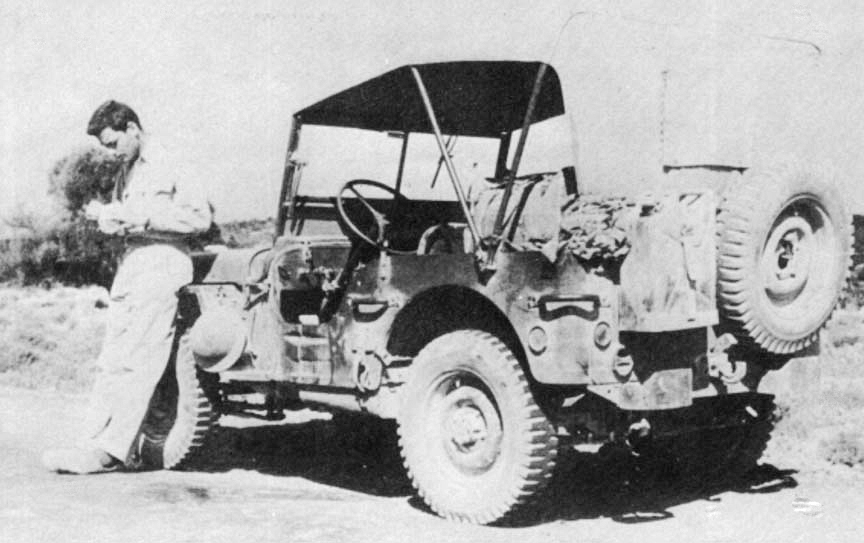
Lt. Hamilton Goff, an AFS field Cashier, checks over his books while on his rounds to the various AFS units. Note that Ham's vital work is carried on from his special 'pay-waggon' jeep.
We must ask the parents, relatives and friends of the men in the AFS to send all money through these Headquarters. Please do not send checks or money orders directly to the men overseas, as these cannot be cashed and must be sent back to us for payment. This delays considerably the receipt of the funds for the men.
Make your check or money order payable to the American Field Service for the account of the volunteer to whom you wish the money sent. Please give us your full name and address, so that proper receipt may be sent to you. Your cooperation in this matter will save a great deal of time.
Many inquiries come in to us regarding cable transfer of funds to our volunteers. We must call to your attention that there will often be unavoidable delays in money reaching our men,, owing to changed conditions from those existing previously. We know you will realize that this is beyond our control and that the money you cable reaches there as soon as possible.
We have received a request from overseas for books of all kinds. We will be glad to receive them at these Headquarters and send them on by units going over.