Edited and published at AFS Headquarters, 60 Beaver Street, New York 4, NY, under the sponsorship of the ambulanciers' relatives and friends, who contribute the excerpts from the letters.
* * * * * * *
TO-NIGHT AND TO-MORROW YOUR SONS AND HUSBANDS WILL BE DRIVING UP AND DOWN MOUNTAIN ROADS IN ITALY OR IN BURMA BRINGING BACK MEN WHO BECAUSE OF THEM WILL LIVE AND RETURN TO HOMES JUST LIKE YOURS. YOU WILL ALL, WE HOPE, SEE GAYER, HAPPIER HOLIDAYS WITH YOUR BOYS IN YEARS TO COME. BUT THERE WILL NEVER BE A FINER CHRISTMAS, EITHER FOR YOU OR FOR THEM.
December 24, 1943.
America is the pioneer of the world. She is young, proud and sure. Her sons, particularly those of AFS who volunteer for an unusual, important work in the global conflict, are also pioneers. These young Americans who go to war of their own will to assist those who must face enemy fire, do so because of their convictions and the courage of these convictions. In November 1943, on invaded enemy soil, two of these Americans risked their lives, and lost them, upholding these convictions. Their gallantry and unselfishness is unsurpassed, their loss is a great one, not only to their parents, friends and AFS comrades, but to America and the world.
VERNON W. PREBLE, the first American Field Service man to cross the Sangro River in Italy. He lost his life attempting to save the lives of others while under heavy enemy gunfire. He was serving attached to an R.A.P., the forwardmost medical station on the Eighth Army front.
CHARLES JAMES ANDREWS, Jr., who was killed while on duty at a New Zealand Medical Station on the 8th Army front in Italy. An NCO he was leading his section in the thick of the front line fighting when he was struck by fragments of a mortar shell.
Manning Field Lt. AFS who received slight leg wounds from shrapnel fragments shortly after landing in Italy. He led the first platoon to see service in Europe. Fortunately his wounds were not serious and he has returned to active duty.
Ralph Beck was wounded in the leg by a piece of shrapnel while on duty at an R.A.P. near the Sangro River on November 28th. From the latest reports he is recovering nicely.
Thomas Barbour who was wounded in the leg during an air raid on the Sangro River front. His wound is reported as not too serious and it is hoped he, too, will soon be fully recovered.
Henry Larner who received serious wounds on the Eighth Amy front on December 8. His wounds were inflicted by mortar shell fragments and the last report from AFS overseas states that his condition is serious but not critical.
It is always dreadful to receive news of anyone's being wounded and somehow it seems particularly ironic in relation to members of the American Field Service whose entire work consists of doing their utmost to aid the wounded. There is great comfort in knowing, however, that wounded AFS men get the quickest and best possible care from their admiring friends of the British Army Medical Corps.
No date.
"It was certainly impressive some time ago, the night Italy surrendered, to see all the searchlights turned on to form a gigantic V. It was a fantastic sky spectacle.
"Managed to get off the barge on that boat trip from X to Y with only a slightly dented fender, when a particularly heavy roll loosened a chain. I still think about the most undignified and ridiculous spectacle is a man trying to look as though he were sure footed and doing balancing acts all over a boat in rough weather and all the Tommies shouting 'Hold it, mate, hold it" with tea sloshing about.
"Although I've been some distance further before on the Med, it seems startling to realize I've sailed on the Pacific, the Atlantic, the edge of the Antarctic, the Indian, the Red seas and oceans; been through the Panama Canal --- up and down and over the Suez, and of course--- Adriatic. But it all gets semi-matter of fact after a while and meeting a man who has done it, etc. isn't smacking of the glamor it had before. New York --- Boston --- The Cape ---Claremont --- Pittsburgh. As far as I'm concerned they are unrivalled and all my latent New England reactions have been brought to the fore. At the moment, I've travelled enough for the present, more or less shot my bolt!"
No date.
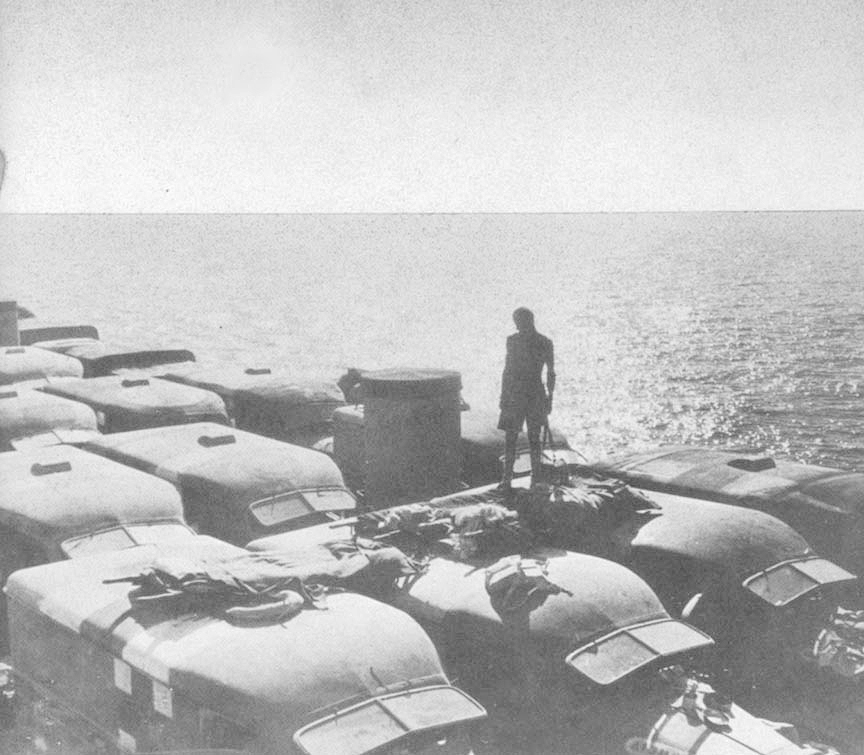
"The description of departing that day from West Africa in a silent evening convoy toward the docks, was one I wish I could do justice to. The first rain in months made it all the more unreal. On a long bomb-battered mole many ambulances, tank-transports, and vehicles of all descriptions were gathered under flickering damp lights. The harbour stretched out in a semi-circle behind us. It wasn't particularly depressing to be leaving Africa, for it was certainly high time.
"The harbour was filled with shipping of all sorts, many invasion barges and light troop transports. The fronts of these invasion barges, one of which some of us boarded, are lowered and doors open sideways in an amazing fashion. All the vehicles back on and the lighters are raised by an elevator to the upper top deck. All in all it was a portable cabin in which one lives, on top of a not-too-luxury-liner boat....troops, tin-helmeted, all their kit strapped on their backs....British officers, well-moustached, who always precede the men, not only lead them....and among whom there is an incredibly higher incident of fatality.
"It was a treat that the boat was American for they were nice enough to feed their rations both to us and to the British.
"In fact some of the time the food seemed too rich and plentiful. Once a system becomes adjusted and the transition is better made slowly or it disagrees. So we've all found.
"It was fine to be on the march again. It is a grand vacation from the usual. All the vehicles were chained to the deck and well that they were, for they tipped and teetered and the Med. was very rough. These small flat-bottomed boats wallow and toss and pitch at no provocation, so use your imagination since there was a great deal of provocation. In fact it was stormy on the Med.; there were not the usual incredible colors on it or on the Adriatic.
"One must realize that in wartime there is much to absorb and enjoy, as would be possible during peace. The entire aura and grimness, not to mention the destruction and suffering, make it a queer thing at times; however. It is also hard to understand that events uninteresting in themselves acquire a profound importance because they occur far from familiar waters and continents."
October 17, 1943.
"A run may pop at any time. If anyone has one 'back' or I do ---then this letter will be mailed, 'Back' is a long and tiresome run --and we don't like them very much. All is fine and this spot medieval. Am sleeping in a clean old building. Jerry moves faster than we do. The Tommies are too friendly and 'matey' and we lack nothing. Am sleeping with the sergeants in a good billet. All goes well. No complaints, as the saying goes.
"A little human interest? A German Sergeant-Major (a Sergeant-Major is an 'old Army man') died the other night while being taken care of as best we could here. Any man gets the best and same treatment, of course. He had been shot apart completely in the middle. A good soldier he was. In a friendly but grim table atmosphere, (operating table) a fellow said, 'Why are you fighting, and for what, old man?' In blunt English the reply was this: 'Hitler says fight, and I fight. Churchill says fight, you fight. War is war! --- You treat me well, better than I was told I'd be.' When told he'd die, he said 'Thanks anyway --- I know --- but ---.'
"Another Jerry on a stretcher seeing Italians, called out, after spitting, 'Your friends, my friends, everybody's friends ---'. They are friendly all right, and naive, really, and very childlike in most ways---alas, --- at times vicious."
October 23, 1943.
"The car is in process of repairs. We are moving about quite a bit and this little town is magnificent. I am sure no tourist would ever come here and it is unsullied and would never have been touched were it not for the war, by even a stray visitor.
"Clear, cold air, good sparkling white wine at 5¢ a pint and not even a gun in the distance, this is a fine 48 hours, or bids fair to be."
October 19, 1943.
"There are many difficulties in getting mail to us and much seems to be lost and we receive letters not as they are dated in sequence but often one letter follows another dated a month earlier.
"My last letter to you was written and sent in a land far removed from my present location. We had a fine trip accompanying our ambulances over part of the journey and driving them to our present leaguer. This move has made me very glad and I am much more satisfied now. For two weeks immediately after arrival I was exceedingly busy. I had many evacuations to drive and some were over 100 miles long. Roads are very good; some are mountainous and hence winding; others are straight and level. The main difficulties are bomb craters, blown-out bridges and heavy traffic. Jerry did a good job of destroying the bridges as he retreated here. Have gone over many roads whose foundations were probably built during the reign of the Roman Emperors. Also probably built over the centuries, I have walked over some Roman (early) roads which are still in excellent shape with the original stones worn by carts and beaten by the elements for many centuries, yet still serving the passing generations.
"Long runs, often at high speeds over bombed roads and often cross country, are naturally hard on our cars, hence, we must lubricate our springs daily and make sure every mechanical part is in perfect order. In addition to our own work on the cars they must be inspected monthly by the workshops attached to our company. Our cars have gone from Alamein to Enfidaville and though they are standing up very well it is important to take good care of them. You want to know that you can depend on your own car under any conditions. In it I have carried Scotch, English and Canadian men. We often talk to them and they tell us about the fighting in their respective sector. I once ran across a Canadian who, having been at one Dartmouth Winter Carnival, recognized me. It is indeed unusual that he would remember my face having only seen it at that one time and then only casually, and stranger still that we should meet over here.
"About a week ago we were removed from the L.F.A. to which we were attached and we returned to A.F.S. headquarters for workshop inspection and new assignments. We are now camped near headquarters and have passed a few days without work. Our camp is in a large (campo) field surrounded by mountains. As the sun was setting one day it shone upon a village at the top of a range of high hills overlooking the plain. The picture caught my fancy; the next day a number of us got some rations for a noon meal and driving all morning arrived at the town and had a fine meal at a grand place. The view from the mountain took in thousands of acres of rich fertile land cut up into irregularly shaped fields. To our right were more mountains and to the left were mountains of the same range falling off into the sea. The sun as it shone thru the clouds and the mist rising from the moist field made patches of light and darkness all over the plain. A little town would be lit up and then the sun would favor another spot and leave the village in shadow as the clouds moved by. Across this vast plain, which lay a couple of thousand feet below, another range of mountains rose out of the land covered with a purple haze. It was a beautiful vista and, a fine experience. The mountains were all limestone rock, which had been deposited in strata, and was not pitched up at an angle. Very interesting geology in this country. Our road to the above mentioned spot took us thru a little village. There we got some wine and traded cigarettes and biscuits for some eggs. These we scrambled and had for lunch. Every little valley or gorge in these rocky barren mountains was terraced in such a ways as to catch the soil as it decayed from the rock and was washed down. As you know limestone when it is decomposed forms a fine red soil. Every bit of this precious soil is caught and cultivated with great care and economy. In one valley in these mountains, larger than the others, was a monastery. The monastery was at the head of the valley sheltered by a mountain top and overlooked the valley, where there was a lot of soil, well tilled, and many farm houses. Far down this valley was the village where we got the eggs. All this is high up in the mountains and not a part of the great plains described earlier.
"I was singularly impressed by the tranquility and peace of this little world up in the hills, self sufficient, and removed from the rest of the world. It seems a simple, natural. man with normal desires and no great ambition could be very happy here. As we stood watching the scene, the monks from the monastery a few hundred yards away walked over and invited us to come to their place. Like many of the churches around here the present chapel had been built on top of one centuries old. Very interesting architecture in the old church, though the later one was extremely gaudy and in the poor taste of the modern Roman church. The monks gave us some excellent wine and entertained us very well. One of our company spoke the language quite well and so made our visit more enjoyable. By contact with the farmers where we stop (we often visit them in a free evening) and such contacts as those with the monks, I am learning a little of the native language. Also I have a book which I plan to study in an attempt to learn to speak as well as understand it.
"L.A. stands for Light Field Ambulance. There are 3 of these units in a division. It is a medical unit in which there is a M.D.S. (Main Dressing Station) and 2 A.D.S.'s (advanced D.S.). For a while we worked with the M.D.S. then with the A.D.S. and then we helped to move the A.D.S. forward.
"Since my arrival here I have been in an ambulance by myself. This arrangement is much better for the car is my own personal responsibility. It is my house and I have it fixed up just as I want it and in such a way that I can live quite comfortably. It has all the requisites of a living place as well as a highly mobile ambulance, and all so compactly arranged that there is always room for 4 lying stretcher cases or 8 sitting wounded as well as the kits of the men. I have a little corner which serves as a library. I have 10 or 12 books, best I could pick up out here; though it is not an excellent collection, it is invaluable. My toilet and eating articles fold upward and go under a seat. In an ammunition box I have my primus stove, sugar, tea, coffee, and cocoa and similar staples. In another place I have quite a large store of canned fruits, meats, milk; etc. Also I have an ammo box and musette bag for my clothing which I have reduced to the minimum for a cold winters.
"So you see I am quite well off. I have a good job even though it is all work and no pay. The future of the work looks even better for tomorrow morning we move forward again; I surely like to keep moving. I have all the food and shelter I want and to boot I am in a splendid land where the turn of every new corner brings a new and beautiful sight to be enjoyed. There are many unpleasant things but I have no right or desire to complain. Also I have met some fine fellows out here and companionship with them is a pleasure."
No date.
"I am once more back at work and more than happy. After a short trip via one of Uncle T's vehicles built for the purpose, we arrived here in the country of the shoemaker and have been moving up through some very interesting country. My, what a pleasant change from the dry, hot, sandy desert ----trees, good roads, rolling, for the most part, hills, fields, houses and towns which look civilized. We have seen some very nice villages with queer winding streets, definitely not built for modern traffic and much less for modern warfare. It gives one a strange feeling to drive in convoy thru these towns and have the children yell and shout. The men are sullen; some of the women look sad; some smile and some hold up their babies and cry 'Biscute', or however it is spelled, 'Biscuit' in English. It all seems so strange and is a very different war from that of the desert. Here towns, homes, churches and civilians are destroyed, while on the desert there was very little of that. It really was an ideal place for a war and it seems a shame that the whole thing could not be fought there.
"I went for a walk today ---that is this afternoon-- and looked over the town. Some messed up, but the oldest part seems to be intact and there I found an old church, originally 6th Century, then rebuilt as a Romanesque one in the 12th, and it is very nice. It has been reconstructed and they ran out of money, so part is unfinished.
"The medical unit we are attached to is in a school and our cars are parked all around it --- down side streets, up alleys, etc. It all must be rather like the last war, being in towns etc. and the mud. It gives one a queer sense to be at war in a civilized country and to see the towns all messed up. Everyone at home --- till they have seen it --- will never know how fortunate they are that all the death and destruction which the whole of Europe knows, will never come across the ocean to them. It will take so very, very long to get the homeless back into homes, to repair and get the parts for water supplies, to see that everyone is getting the proper amount of food. The actual political problems plus the domestic problems seem to present an almost insurmountable barrier to those who will have their fingers in the postwar pie. Let's hope they do more than merely stick them in and pull out the plums."
No date.
"I can defend my slump in letter writing with an abundance of reasons. My brains were completely scrambled by the Tripolitanian heat, up to 120 and 130 degrees during the summer. My recollection is of sitting in a mental stupor behind the windshield of my car all summer, awaiting our turn and embarkation. There were, of course, many little incidents, to do with lizards and scorpions, Roman ruins, and swimming, and our night club bar in the depth of an Italian air raid shelter, etc.; none of them disturbed my torpor for long. It wasn't too bad, but it was very, very dull, and I kept kicking myself for not having gone home after Tunis. Even the night club hamburgers --- hamburgers made from camel meat --- didn't compensate.
"Since then we have had quite a lively time, compressed into a short period. As soon as I know the censor will pass it, I'll write all about it, replete with lurid adjectives, and omitting not a single bullet or bomb. For the present, I'll tell you instead about my own private battle with the Army Medical system, and at the same time give you a rough sketch of the medical process of handling patients. About the time we embarked, I came down with infective hepatitis, or yellow jaundice to you. This is a very common disease out here, particularly at this time of year. Its cause is debatable, but probably an unidentified virus, although all American laymen, of course, darkly attribute it to the British Army diet. It's the first serious illness I've had out here. We were traveling on a large tank landing craft, when a minor epidemic of it seemed to break out among us. One of the first phases is violent nausea, etc., particularly caused by the sight of most Army food, great weakness, and the mental outlook of a seasick victim, and eventually the sufferer may turn a vivid canary yellow. I escaped the worst of these symptoms for the reason, I think, that I immediately stopped eating, except for dry bread, and jam, occasionally, and began drinking quantities of canned grapefruit juice and tomato juice, which by a providential miracle some of our boys had obtained from an American outfit. Oranges seemed to be a cure for the nausea, but there were only one or two on board. Not eating was a tremendous sacrifice, because the draft was American manned, and the food provided by them was such as we had long only dreamed about. The other jaundice victims forced themselves to eat, feeling that it would be a sin to forego such food, whether they enjoyed it or not. Most of them had to give up after the first attempt, no matter how fierce their resolution.
"Immediately upon landing, we received orders to proceed to join various British units, as usual. Three out of six men in my section had reported sick. I wasn't feeling badly, and decided to stick it out for at least a few days, as we were desperately short-handed, and agreed to act as temporary section leader, since that would allow me to sit and direct; instead of driving constantly, although I still retained all my violent objections against being any kind of nabob. It all turned out very well. We made a fast trip straight to the front and my disorganized and re-formed little section by luck drew the assignment of evacuating patients from the most forward A.D.S. (Advanced Dressing Station) that I have ever seen. Normally an A.D.S. is about five miles behind the forward line--- but in this case, after violent counter-attacking, Jerry was at one time, just before we arrived, only 200 yards away. In some ways it was the liveliest assignment of evacuating I have yet had. Amazingly enough, my jaundice condition was ideal for the situation. It was such a wicked spot at times that anyone who did not feel keyed-up and jittery would hardly have been normal. In my condition, however, the excitement round about acted somewhat as a needed tonic, giving me the delusion of being about well at times. I remember going about with a bland equanimity that would have been admirable had it been less stupid and unnatural. One thing did bother me a little, causing a little mental wince of irritation, and that was the painful noisiness and jar of heavy shells crashing into the buildings around the A.D.S. The noise was literally painful. As I say, I felt not too badly all this time, but I was told that I looked like an old parchment lamp shade, and my eyes, bloodshot from sleeplessness reminded one poetical lad of Arizona sunsets, yellow, red and blue. It takes a strong man to look at a well developed jaundice face without shudders and fascinated horror.
"After several days of continuous activity and interrupted alarums and excursions, 'the situation was restored to normal!' Meanwhile another of my drivers had gone sick and been sent back, and the only remaining one of the original section had got himself trapped in a mortar barrage, and his car shot full of holes. He himself was undamaged, and had no bad reactions, except for a doctor's attempt to make him drunk and send him back --- he popped up again on the next returning ambulance.
"I sent him back again, and again he returned, so I put him to bed in the A.D.S. and let him sleep it off. We now had only three drivers at that point reeling with sleeplessness, besides myself, and I was only good for short local trips. In response to my pleas for drivers, a lad with a wooden leg arrived, and after making one round trip be broke his leg, and he went back. Eventually two other sections arrived, the fighting moved off, all the patients were evacuated, and everything quieted down except for the usual air raids and occasional lonely shell.
"We all rested up for several days and then I allowed myself to be persuaded by the doctors to be evacuated myself. They insisted that complete rest is imperative in jaundice treatment, in fact it is the only treatment, aside from a fat-free diet. I was resting very well there, on a mattress in the apartment of the town's former leading Fascist, doing nothing else as a matter of fact, since we had been relieved, but that wasn't orthodox enough, so in a moment of boredom, back I went one night beside the driver in one of our own ambulances.
"The medical sequence is usually the RAP (Regimental Aid Post, at or just behind the front line), then the ADS and the MDS (Main Dressing Station, usually 10-15 miles behind the ADS, although in the above episode the ADS was up in front, almost cut off, and the RAP's were mostly strung along the road between the ADS and MDS). Behind the MDS is the CCS (Casualty Clearing Station) and behind that the hospitals and hospital ships. Each place is larger and better equipped than the preceding ones.
"In this case I and the other patients, severe lying cases, and one still under ether, were ferried all the way back to the CCS after a long moonlight trip and an hour's delay when the driver thought he had arrived and after searching and searching discovered that he still had another town to go to. This CCS was in an enormous rambling high-ceilinged building, like a palace of the Medici, and I seemed to be led miles through dark corridors by a cockney orderly with a lantern. I was given blankets, and plopped myself down on the bare springs of a cot in a roomful of sleeping men. During the night others were brought in on stretchers until the place could hold no more. The orderly, 'the Angel in Battledress', as a Yorkshireman described him, next morning moved around with the light touch of a hobnailed Churchill tank. Soon after it was light, those of us who could walk wandered around until we found a corridor where breakfast was being served to long lines of dirty, haggard men encrusted with mud and blood. They ran short before our turn came, and began opening cans of salmon, so I had to retire morosely with a piece of dry bread and a bowl of tea, although I was ravenous. Sitting glumly on the floor, munching bread, I began to brood darkly about medical Singapores, etc. Shortly before noon, after the doctor had peered at us, some twenty walking cases were loaded into a lorry, and after a long wait started off for a town 30 miles away. By 2 o'clock we were famished; and then a miracle happened. A cheery soldier leaned out of the back of a passing truck, and for no reason (unless previous personal experience on his part) tossed a loaf of bread into our lorry! It was hastily sliced up, and by some loaves-and-fishes legerdemain, every man got one slice. After another hour, we were even more famished, and forced the driver to stop beside a vineyard, where every man plucked several bunches of grapes.
"Eventually we arrived at our destination; a hospital just opened that day. After the rather free and easy day we had had, it was as good as arriving in heaven. Clean sheets and pajamas, a cup of tea, bread and jam, and kindly nurses who hurried to bring us something hot to eat and to clean us up. There were twelve of us in the ward five on each side, with a Moroccan Moor at one end and a black Basuto at the other for centerpieces. After a bowl of hot soup, I dropped off contentedly to sleep in the candlelit shadowy room.
"But it was too good to last. After a day there; most of us were loaded on stretchers and taken back to the next town in Austin ambulances. I was still incoherently content, and the Austin seemed as luxurious as a Pullman car compared to our small Dodge ambulances. At the hospital we were leaving the food had been plain but adapted to each patient's condition, and I had had the first adequate and satisfying meals in two weeks. We were given a light tea just before we left and luckily, too because we were unloaded at the next place too late for supper. This was just a transfer point and although I was put in the officer's ward; it was a sad contrast to the hospital. After the clean luxury of the hospital, I was spoiled, and the dirty blankets and bare springs (although even a bare spring would normally be a great luxury to us) and hunger-fatigue gave me something to be literally jaundiced about. An hour after I had querulously insisted upon getting something, I was given a cup of tea. To top off my happiness, I then discovered my blankets crawling with bedbugs. After a futile struggle, I went to sleep in my greatcoat, as disgruntled as ever a man can be. In the morning I learned that I was to be immediately evacuated on a hospital ship. This was contrary to all my original expectations, as I didn't want to be away for long, but now I gratefully accepted it, ---anything to get away from their bedbugs (every Italian military building in my experience has had either fleas or bedbugs). We were taken out on stretchers and laid in rows on a lighter like dried herrings, and of course it rained while we were exposed. Upon reaching the clean white hospital ship, we were hauled up on rope slings and carried down to the wards; very immaculate and neat. A pleasant, twinkling, middle-aged nurse kept an eye on us. The food was excellent, but in our ward it consisted of a gastric diet and a full diet, and we jaundice patients were mostly put on the full diet, full of woe and heartburn. I finally got up and assisted the other up-patients in serving the bed patients, in the frustrated hope of able to embezzle a bit of junket or a scrap of steamed fish instead of the infernal meat pies and fried meat balls, etc. After several days we finally learned our fate, --- not Alex or Algiers, but of all double-dashed desolated spots, --- Tripoli.
"So here I sit, a bedpatient again, ---the ups and the downs are baffling--- scheming to get back to my stolen mattress and my tomato juice diet somewhere in the mountains of Italy. There is a glint in my eye that bodes an uncomfortable ten minutes for the self-assured young medico who sent me down, with his 'complete rest and proper food are imperative'.
"Some of the practices here are typical of most hospitals. The uppatients feed the bed-patients, at least in these non-surgical wards, for such relatively light ailments as jaundice, malaria, etc. It is a case of the halt leading the blind. It's bad both ways. It's fatiguing work, as I know from my brief essay on the ship, and in this ward at least it's not brilliantly satisfactory for the bed-patient. At meal time an up-patient rushes in and leaves a bowl of tea. Half an hour later (I've been timing it) another head appears, surveys the scene (four of us are in a little room off the enormous main ward) and ejaculates, 'Blimey, ain't you folks been fed yet?' and disappears. Another head appears to confirm the state of affairs, and repeats the same hurt query. Tea minutes later someone rushes in with a plate on which repose crust ends of bread and margarine, or meat and vegetables, whatever the meal happens to be. Later the same actors appear, spray Flit on us, flourish a broom, and cheerily depart.
"Another curious folk-custom is the universal hospital garb for all up-patients. This consists of a pair of brilliantly blue trousers a white shirt, and a scarlet necktie. Once he has survived the humiliation of being seen in public in this costume, the average man would be indifferent being caught naked in Piccadilly Circus. I imagine this, too, is a traditional survival from the Crimean War, although I fancy a faint Tudor accent.
"There you have an admittedly jaundiced view of one man's experience in the hospital conveyor belt. I venture to say that no one has ever died of neglect in these Army hospitals. The British are an incredibly doughty race. My admiration, except for occasional spasms of irritation like the present, is even stronger now than when I came out two years ago, although the emphasis has shifted from top to bottom. As you can see, there is not an overdose of coddling, but everyone gets bedded, fed and tended to somehow, some time. Considering these war conditions, it is a tremendous job of organization, and a few minor rough patches can only be expected. My own discomfort has been relatively trivial, --- most of this Jeremiah stems from a swollen liver. Some time I'll tell you the more characteristic story of front line battle casualties, --- the surgical miracles, the awful but unavoidable roughness, and the sheer grit of both the medical personnel and the wounded."
October 24, 1943.
"We are parked now in a lovely olive grove tight up against an old village on a hill. There has been no rain for the past few days so that the ground is not unduly muddy. It is plowed and I shudder to think what it will be like when it rains. My truck is about to go into workshops for a big overhauling including new bearings. Meanwhile I live and have set up an office in a big scrounged tent. The office part of the deal is more front and effect than anything else; for I really have no need of one. The town that we are next to is a very small, very dull, very dirty village. Its biggest attraction is a duchess who lives in the scruffy old familial seat, a rundown castle, in the middle of town. She was reputed to own a Goya which J. our ever-willing interpreter (French, German, English, Italian) went up to see. He was well received by the duchess although the rumor of her Goya proved false. The only other feature of the town is a saint buried in its church. As a matter of fact we were originally assigned to a small and dirty cobble-paved square in the town as our campsite. It was dirty, and public, and would have been intolerable so I argued my way out of that one. 'But man, what will you do when it rains? The mud in the field will immobilize you!' I maintained confidently that it couldn't possibly stick four-wheeled Dodges; so they gave in. I'd damn well better be right, tho I must say I am far from over-confident."
October 28, 1943.
"It started to rain yesterday and has been going more or less steadily ever since. And already we are pretty badly bogged down. With a little careful maneuvering we can still slither our way in and out of the leaguer; but if it keeps up like this for another 36 hours, we really will be stuck. No car, I'm sure, will be able to move with less than 10 helping it along. To make matters worse our olive grove is on a hillside, and the only entrance to the leaguer is at the top of the hill. This means that in order to get out any car, it must first climb the hill. The operation is something like that of the knights charging the glass hill to get the princess on top.
"We've been having lots of fun lately with our mess. We bought ourselves a pig not too long ago that we tied to a stake next our swill pit. I'd never had a good look at a pig grubbing in garbage before and I really got a bang out of it. 10 chickens that we bought finally slaughtered yesterday after a wild and frantic chase in the mud. I never realized how difficult it is to corner a chicken, I might add that both pig and chickens were well worth the trouble and that we now plan to branch out into turkeys.
"The other day I played hookey with S. and went with him on a long trip in his jeep while he visited some of the other platoons. He and I were very nearly the first to travel the length of a lateral road that had just been taken from the Jerries. We got to the town we were heading for all right and after S. attended to his business we started back on a different more direct road. We'd left HQ in the morning in such a hurry that we'd forgotten to bring maps. S. had been over part of the road before and we followed the signs to town that he seemed to remember passing thru. We got to the town which was absolutely empty and as we drove thru it a soldier, very excited, ran out and asked us what to do with a box of detonators he'd found. We told him to give them to his officer; and then we asked him if we were on the right road to ---- where we wanted to go. He said that Jerry was less than a mile down the road we were on. That is how an excited soldier kept your eldest and S. from becoming P.O.W.'s. Moral of the story is not to travel without maps."
October 9, 1943.
"We left HQ, a week ago for a place some 130 miles away where we branched out, having been assigned to various M.D.S. (Medical Dressing Stations) and L.F.A. (Light Field Ambulance units). We were 18 ambulances, plus a cook-house truck and a workshop truck containing spare springs and other odds and ends of a sort. We went up there in convoy which is a rather tedious drive --- between 20 and 30 M.P.H. However, the trip was well worth while as the country is really beautiful. All day we wound up and down mountainous roads through villages perched precariously on mountain summits. The towns and villages reminded me a good deal of the ones I had seen in France with their old bastion-like churches, cobbled streets, community fountains around which the old cronies of the village gather and sit in wicker chairs sewing or weaving. The churches are really beautiful on the outside but inside local taste has seen fit to plaster the walls with gold leaf, there are trappings with gold fringes and statues of painted plaster. They are all pretty ghastly. About three we ran into our first rain in months and ever since it has been coming down in buckets spasmodically night and day. The winding mountain roads are slippery as ice and when you have to pass a large convoy of 3-ton trucks it's quite an ordeal. In fact it's just nip and tuck whether you make it or not. Anyway that night, as it was raining cats and dogs and getting dark, we stopped in a field for the night some 25 miles from our destination and proceeded on the next morning. We were quartered in some abandoned barracks those roof did not leak which was a definite blessing. The next morning four out of the five cars in my section were assigned to an L.F.A. which we got to at around 8:30. The lack of transportation of all sorts, especially ambulances, is acute so we were immediately pounced upon, loaded with patients (4 stretchers and one sitting) and told to go down to a General Hospital in the town we had left the day before. So off we drove in the inevitable rain on our 130 mile hike. We stopped for lunch at a checking post where the patients were given a once-over by a medical officer, and a cup of tea and crackers. Our lunch was hardly more substantial. In the afternoon, thank goodness, it cleared up and I was able to enjoy, between dodging trucks and Z bends in the road, the magnificent scenery which continually spread out before me --- miles and miles of green cultivated fields nestled in among the high mountains, trickling brooks which had by now turned into torrents rushing by hundreds of feet below in deep ravines or meadowy valleys. It is really quite a sight. We arrived at around 4:30 and found the hospital crowded to overflowing. After waiting for over three quarters of an hour we finally got the patients admitted and beat it for HQ for supper, pretty disgusted with the set-up.
"The next day we drove all the way back to our post after having done a hurried maintenance job before leaving, --- the next day we loaded up again and came all the way down again and back the next day. This time a patient was sick all over the car and I thought that at that point I was about through. Back to our post the next day and then back down again with another load the following day. During all this period I had been feeling worse and worse, not being able to eat much and to my horror noticing that my eyes were turning a distinct yellow. Well, that, last run did it. I went to the Major in charge of our A.F.S. company and told him that I refused to be evacuated with jaundice like the other 10 men who had it, and with the prospect of being away from work for about two months.
"With personnel dwindling fast due to the epidemic the poor man was ready to agree to anything, so here I am comfortably set up in a tent at HQ drinking lemonade all day and asking the cooks whether this or that for lunch or supper contains grease or not. I feel fairly well---if I sleep half the day and take things easy in general --- I hope that I may be able to pull through within 10 days or so if I am lucky. Meanwhile I have turned over my car to somebody else until I can take it over again."
October 14, 1943.
"The weather is absolutely freezing and the rain never seem to stop. --- Just once in a while a faint suspicion of sun peeps out and then tears back in again. We have moved up to another town and HQ has gotten hold of a three-story house that used to be small apartments. On the second floor one of these apartments has been turned into a jaundice ward into which six of us have moved. Don't visualize a palatial residence. It isn't. In the first place there is not a window pane left in the place and if you shut the shutters the place is pitch dark. Furthermore, more than half the roof has been blown off which sort of excludes the third floor from habitation except as a sun parlor which in this weather is somewhat out of the question. The town's water and light supply has been cut off and the pillaging which went an in the house and elsewhere in town has left but scarce furniture. However, we eat off teal china plates and have long stemmed glasses to drink out of although we still sleep four to a room on stretchers as before. I am now well on the road to recovery and feel perfect but for safety's sake I am not going to move out for at least a few more days. Feel perfectly disgusting as I haven't changed clothes for almost a week. Can't wash anything as it won't dry in this damp weather and anyway water is so scarce it has to be brought here in trucks. Forgot to say that now I am well again I have turned into a veritable Florence Nightingale. At meal times I trot down to collect the special greaseless food prepared for us which turns out to be the same old junk minus grease, for better or for worse, and lug it up to the bedridden. I also make coffee and scrambled eggs (egg powder mixed with water and canned milk) as well as toast. Really being terribly efficient. The sanitary conditions are poor, to say the least, due to the water failure. The 'bathroom' is across the street in an empty lot just a big hole in the ground on which a crudely built chaise percée has been installed. For modesty's sake a canvas wall has been erected on the street side but c'est tout. On the whole it is pleasant to be able to climb a flight of stairs again and feel tiles underfoot. I haven't slept in a house since June so it's quite a novelty. You will be pleased to hear that the house is saturated with crosses, holy pictures--- full length and otherwise, and any number of holy this and holy that."
October 24, 1943.
"Yesterday afternoon H. and I, having had our last eggs for breakfast that morning and having nothing else to do, decided to go on an egg hunt --- We are the first Americans to be stationed here so we caused no end of excitement. We were constantly apprehended by old men and women who, with broken down English, wanted to know how Brooklyn, Flatbush, etc. were getting on as they had lived there ten, fourteen, etc. years and still had a brother, cousin, uncle, daughter, son, etc. over there. On top of that the children, gathered about the-boys-from-where-the-streets-are-paved-with-gold, wanted cigarettes, matches, shoes, chocolate, and everything else we possessed or didn't. Eggs in this town are rather scarce since the Germans in evacuating not only cut off the electric light system, blew up the sewers but carted away all the hens, chickens, turkeys, etc. they could lay their hands on. Furthermore those who have a few eggs don't like to part with them. We had to go down each torturous street asking every old crony for 'wova' and we'd usually get a wild gesticulating of the arms and the same old battle cry, 'Niente,' toute morte'. However by producing packs of V's we were able to get a few to part with their damn 'wova', and came back with eight of them --- price: either five lire --- an egg or one pack of V's for four eggs. Tomorrow I am going back into town with an old pair of desert boots which ought to fetch their price in gold. All the shoes that you see are made of cloth with cork heels --- They are exactly like those beach shoes that women went crazy about a few years back.
"I don't think I have ever seen such dirty, smelly streets and houses in my life --- Usually the set up is as follows: four or five people live in one medium sized room. Half the space is taken up by either one or two huge, old fashioned feather beds which look wonderfully comfortable. Amazingly enough the blankets and sheets are always spotless. The walls are covered with cheap framed religious pictures and on the bureau there is the cherished possession of the family, a statue of a saint of some kind surrounded with silver and gold tinsel flowers all encased in glass. Naturally the pigs and chickens, if they possess any, run wild in this compact bedroom, bathroom, barn, kitchen, living room one-room apartment. I went into one of these residences which smelt like a chicken coop, pigsty, and cow shed rolled into one and found, not to my amazement, that not only chickens and pigs were loitering around but also in a corner stood a cow placidly eating while mama was busy at the stove and papa was busy as usual sitting in his favorite chair by the door watching the world go by. We won't go into the street situation. From what I've told you about the houses you can guess what the streets look like and smell like, with the sewers only half fixed.
"The people on the whole are extremely friendly and willing to give you any help they can, but they still can't get the idea out of their heads that we don't intend to act just as the Germans did. If you get mad at them they cringe and await the blow. When you come down the street or stop to inquire for 'wova' you sense that there is a certain feeling of apprehension and the more timid kids run inside the houses. However, on the whole everyone seems genuinely pleased that the Allies have come, and many is the time that I have been dragged into a house to drink a glass of wine and eat nuts and apples.
"Today being Sunday I went to church for the first time on Italian soil. I had been busy on the other Sundays working. Several non-Catholic boys came along and boy! non-church going as I am, I was embarrassed. The whitewashed, electric filled church was crowded but that is all that can be said for it. Only a handful of women wore hats. The rest had on agedly colored muslin bandanas which constantly needed rearranging. The men sat in groups and talked, smiled and scraped their feet throughout the service. People wandered in and wandered out banging doors, crossing themselves madly, genuflexing noisily, and conversing the whole time. The epistle and gospel seemed to be the general signal for conversation as if there had not been enough jabbering in the previous part of the service. The children sat in two rows of benches apart from their parents with no one to watch over them and you can just imagine the laughter, yells, and general carrying on of the 4 to 8 group. I was revolted. It was just such a farce. The church decrees that Sunday mass is compulsory so no one would dream of missing it and going through all the motions; but as long as the powers that be have noticed you in church crossing yourself fervently, kneeling, sitting, standing, and genuflexing at the right time that is all that matters. I am not going to one more Italian mass until I get to Rome and then I'll give St. Peter's a try but until then I refuse."
October 9, 1943.
"We had an uneventful voyage, I am happy to say, although we had one or two submarine alarms.
"We have been travelling in a motor convoy across the desert with a division of a very famous British Army. The cities we have visited thus far have been pretty much the same. Dazzling white buildings and inviting out-lines as you approach them from the desert, but a hollow, battered shell when you get inside, save for Egyptian natives or 'Wogs', as they are called (who will sell their souls for a piastre).
"The tommies we have found to be a wonderful lot of men. They are fatalistic but always cheerful. They make fun of our customs and ideas and expressions and we make fun of theirs. They call us Yanks and 'pommie bawstards' among other things and we, of course, reciprocate with something appropriate. Their morale is excellent. My driver was a swell guy and always looked out for my benefit.
"'The officers are very friendly when you understand them and their customary 'British Reserve' seems something almost done away with out here. They are quite as human as we are.
"Travelling along the roads we passed numerous Italian prisoners at work. The term 'prisoner' is misused for they are quite happy with their lot and always gave us broad smiles as we passed them and gave us the 'V' sign. 'We tossed cigarettes to them of which they never seem to have enough. The Ities, in fact seldom require guards and are practically free to do as they please. A large diamond patch on the back of their shirts designates their status as prisoners.
"The flag of Egypt consists of three stars and a crescent, Britishers say the three stars stand for 'Maleesh' (Gyppo for it doesn't matter'), 'Hashish' (a drug), and 'Baksheesh' (the beggars' cry). Probably the first word a wog learns is the last and he uses it most often. Everywhere you go wogs hold out their hands and shout it at you. They say the pride of the whole Middle East is buried under a thousand 'Baksheeshes'. Wogs are taught trade tricks from infancy and are almost without exception dishonest. So much for that".
October 30, 1943.
"For a few days I have been back at the job of driving an ambulance again. Came up to a unit operating from an advanced Dressing station to discover they were short of drivers, so I took a turn at it again for two nights and a day. I was rather glad to do it. The run was to a car post situated behind a ridge where a first aid dressing station was put up in a small farm house alongside the road. Wood being a scarcity, as you probably remember, nearly all building materials are stone, plaster, and concrete --oh yes, red brick, the farmhouse had a shed made of stones running lengthwise and heavy beams supporting the tiled roof. In here was the dressing room. I made one trip the first night, two the following day, and two more the next night. Three stretcher patients is the usual capacity load -- -- four, the maximum. Carried 16 walking patients and four stretcher patients. We were busy those three days and nights. Roads are evidently stone base and covered with dirt, which easily becomes pasty and running. Last night though it rained hard, I was dry in my truck; this morning stuck in the mud. Behind our backs are a couple of batteries of heavy guns that seem to throw box cars into the air every now and then. The ocean from where I sit has no movement and looks solid in a great plain of lead. It's morning but I am not convinced of its goodness."
October 25, 1943.
"We've been doing some good work and have really been needed. Our section was highly commended for 72 hours of pretty constant work and one car was pretty pilfered. Of late we've been with the division from our northern neighbors in the western hemisphere. Food is much better and canteen supplies excellent --- beer, chocolate --- 5 miles from the fighting, and two movies in one town, and two hospitals, though its still in range of big Jerry artillery. One night a while ago, we had a big turkey dinner with fresh potatoes and real honey. Eggs are plentiful and everything is cheap or easily traded for bully beef etc. The country is full of various wines and we get around so much that we'll all be connoisseurs before long. They even kept some champagne from the Germans.
"The towns are really picturesque and built at a 60 degree angle on the mountain side. Driving is tough on very winding dusty roads with divisions where bridges have been blown out and often choked with traffic. It's quite tricky edging past a tank convoy and night driving without lights is no cinch, though not as bad as in Tunisia.
"My Italian, little as it is, has proved absolutely invaluable. One night we had a bunch of civilian kids who had shrapnel from German mortar fire in them. They had been 3 days before our infantry took the town. It's a great pity to see these little girls with their families begging to be taken along to the hospital with them.
"Another night we had some very seriously wounded Germans, one of whom had been stripped naked by the Eyeties and left to die. One had 22 Tommy gun bullets in him, a full magazine, he not only was alive, he was talking. Another with most of his back missing smiled when I mentioned the Italians as allies, and yelled out 'Schweinhund' when an Italian family came into the 'operating room' to see their child. All this is on top of the regular gang of Canadian casualties ---------What I started to say was that I was up all night interpreting German for the MO who had to know when they were wounded, how, what loss of blood, pain etc. These Germans are real men --- not a whimper and very seldom a grimace. One kid was 19 and had been in Russia. They think they are probably beaten on account of tremendous allied numerical superiority --- man and material. But they still have plenty of fight and are proud of it.
"The problem to me is this. These people after 10 years of Nazi indoctrination are naturally Nazi in thinking --- and even more basically just plain nationalistic. They were told by Junkers etc, that they lost the last war only by blunders and were never really defeated. Aren't they going to think the same thing after this war? They certainly did come close to winning etc., etc. This is the type of thing we studied at school and I'm still interested in the peace etc. and have read a couple of good books of late.
"The AFS now is pretty ideal for me --- as I love to travel about. We have a good section --- the best out of thirty --- with 7 guys and we're usually posted out alone. We work hard now and then --- have days off quite often. We have very little, if any discipline, and every possible privilege. We get along well with anybody and no other outfit does --- i.e. Canadians find fault with Limies etc.
"The former were three years in England and love the place. Actually a majority of them have lived for days and weeks in English houses with English girls, married and unmarried. Some of them have English wives and children. The Americans have the same stories --- they sound informal and unlikely but are absolutely true --- it's just the way things are. They all write to several English girls and the Canadians would rather be in Blighty for Xmas than in Canada.
"Things are shared pretty much in the section and it is almost hard to be too generous --- a wonderful spirit and one that I've entered into pretty well for a change.
"Am one of the few guys who has not been sick at one time or another, have a cold and stomach trouble now and then --- but everyone, almost without exception, does.
"Had one of the most interesting nights of my life a while ago. We were in a little town 5 miles from the fighting at an advanced dressing station car post --- the only troops in the little mountainside town. A village 15 miles away was recently liberated, and damned if 7 Russian girls didn't show up at our HQ. They had been interned in the liberated town for 6 months by the Italians for anti-Fascist propaganda in occupied Russia --- Voroshilovgrad. The MO decided to put them up for the night and we gave them a room with stretchers and blankets in this old fascist HQ a typical village building of rough, grey stone walls, ceiling, stairs all of same material.
"After dinner we sat around a long table ---about 4 AFS, 8 Canadians and the girls. There was candle light and about 8 gallons of wine were put away though no one had too much. It was just a mellow, completely Platonic evening and they turned in about 2:10, hours after my usual bed times They were educated pretty well, all spoke pretty good Italian, a couple of them German and one English, and one French, The languages being tossed around were absolutely amazing, Russian, English German, Italian, and French-- some French Canadians don't speak English. We even had a Russian Canadian who was kept pretty busy translating. I had a great time, as I can get over a little Italian and understand a lot and this, supplemented with German and an occasional look into my little dictionary, kept me pretty occupied hearing the stories of these communistic internees. They were ages 19 - 25 and four of them were quite attractive; with a glass of chianti the others were plenty all right.
"It was quite a scene there with the talking, but singing was more impressive. They sang us a bunch of beautiful Russian songs and were delighted with some of ours which they insisted on learning --- South of the Border, Beer Barrel Polka; Sweet Adeline etc. etc. I brought forth Boola Boola and Bulldog Bulldog Bow Wow Wow which the Canadians liked too.
"We had to keep plenty quiet as there were patients downstairs and the MD had work to do off and on. The whole international incident is just the type of thing that fascinates me; though to the other guys it is just another day, another dollar.
"There is a lot more to this story, a long sequel, not over yet but not for publication. We run into a lot of interesting things --- bunches of Italians who have been to America, other refugees --- anti fascist Yugoslavs etc. Yesterday I had an 80 mile drive with a bunch of internees. One was an old anti-nazi German from Munich --- and his wife. He was a perfect, gentle, loving sort of guy, not Jewish --- a sort of whom there must have been lots in Germany, but very, very few now. All these people have pictures of better happier days."
October 12, 1943.
"I am writing this lying in my car in the middle of the blue desert. When I last wrote we were about to leave 'last spot' on two hours notice. We left in a small convoy and headed into a strange new land. I had the job of leading and it was good fun, particularly after there were no more roads. It was a two days' trip to the first destination, a town built for some remote reason in the middle of nothing beside a river not named the Tigris. Here we waited two days. B., of whom I have written before, and I set off for the 'town' which consists mostly of flies and stinks. There were a lot of F.F. soldiers about and we found what we thought was the Officers' Club and entered. We were greeted by a gentleman and in my best French I demanded the bar and perhaps the dining room while we rested in town. He said no bar, but clapped his hands and many Arab servants brought drinks. We finished and inquired the hour of dinner and said we would return after bathing. As we left he said wouldn't we like a card to the French Officers' Club? 'No!' It turned out that we were in the house of the French delegate and later we found out he was the hardest man in the locality to see and the king-pin; and here we were, demanding his booze and crashing his gate! After due explanations which he thought quite funny, we did dine at the F.O.C. The best meal since the last time I saw Paris and as cheap as a drugstore lunch.
"After two days here orders came for one ambulance to report way the hell out nowhere. I requested and got the job and set off all alone into the blue with nothing in sight but an occasional herd of gazelles. Found them and reported. Two British captains in charge and it is most interesting. I eat with the officers and if you ever didn't believe the always-dress-for-dinner legend, take it from me, it's true. Nothing for miles but sand and we sit at table with cloth, napkins, four Indian servants and eat roast duck, gazelle and Indian delicacies under a nearly full desert moon. It is a good shoo for the Empire system out here. These two men are god and law to a company of black men and as many mules. They salute me all over the place and I'm quite used to it--- but I have not yet taken to toting a swagger stick. I don't think it probable, but I wish I could stick with them to their destination which is one of the hottest parts of Europe. These two officers are princely guys. I never knew such guys as British officers in general are. We start marching every morning by five and cover eighteen to twenty-five miles by noon; have breakfast, lunch about four, dinner at nine. Of course in the car I can do the day's march in no time so they gave me a driver so I could go on horseback.
"In the last little town we were near we heard considerable music and fire-crackers at one house. We stopped and paid respects to a groom and his family who were in the middle of a seven day celebration prior to his wedding.
"We sat in a big room with chairs around the edge and were duly presented to the groom's fifteen brothers and sisters and given coffee. One little girl aged about six came and sat on my lap and we talked some French and she had a tattoo on her chin. The bride to be is fourteen and the groom seventeen.
"So far I have had no business here but it is the worst mosquito country in the world so things should pick up. The Indian soldiers are a perfectly wonderful lot --- big and handsome, many with bushy black beards. Terribly smart uniforms --- topees and brightly coloured decorations. They cut a fine figure on prancing Arabian horses. As for living in the car --I miss you terribly, for there is room for two very comfortably, and possibly three. Running water and a little stove to make tea or Oxo soup whenever I feel like it, good reading light. I wish I could take it home for future trips. I wish you could come and be under this desert moon with me and hear the Indian troops give their war cry at about four-thirty --enough to wake the dead! I wish I could bring you a saluki ---they are very nice animals."
October 27, 1943.
"We have moved far since last I wrote --are expecting to go still further!
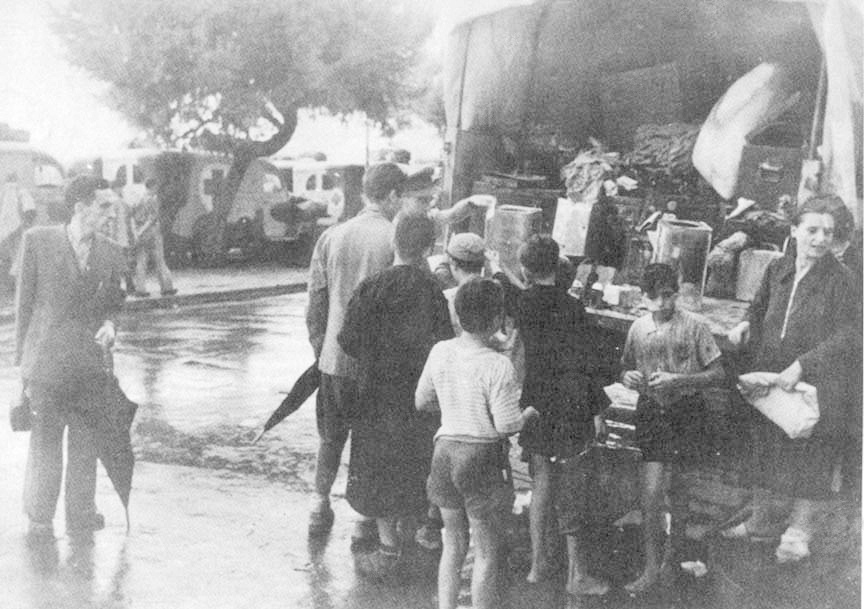 An Army cook provides food for hungry civilians who were left destitute by retreating Germans. Photo by Brook Cuddy | 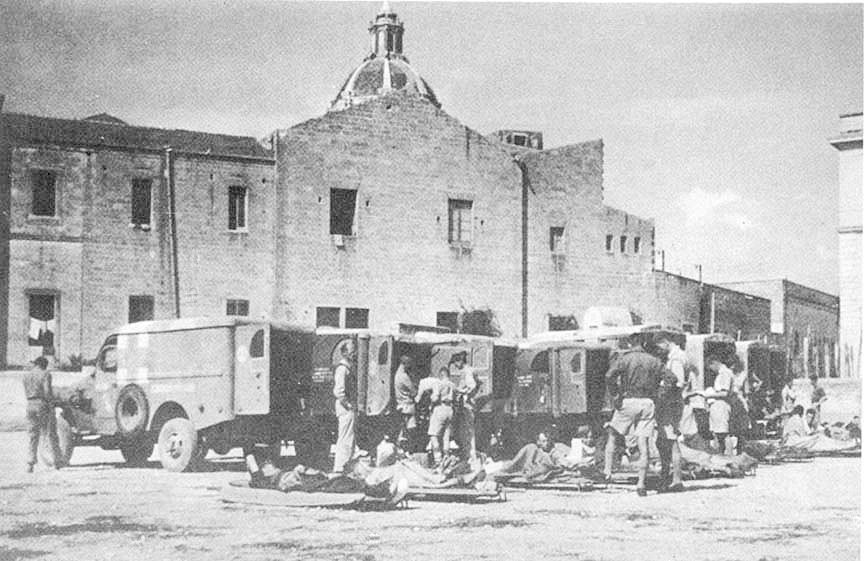 Front line casualties in Italy await evacuation by AFS ambulances to base hospitals. Photo by Henry Larner |
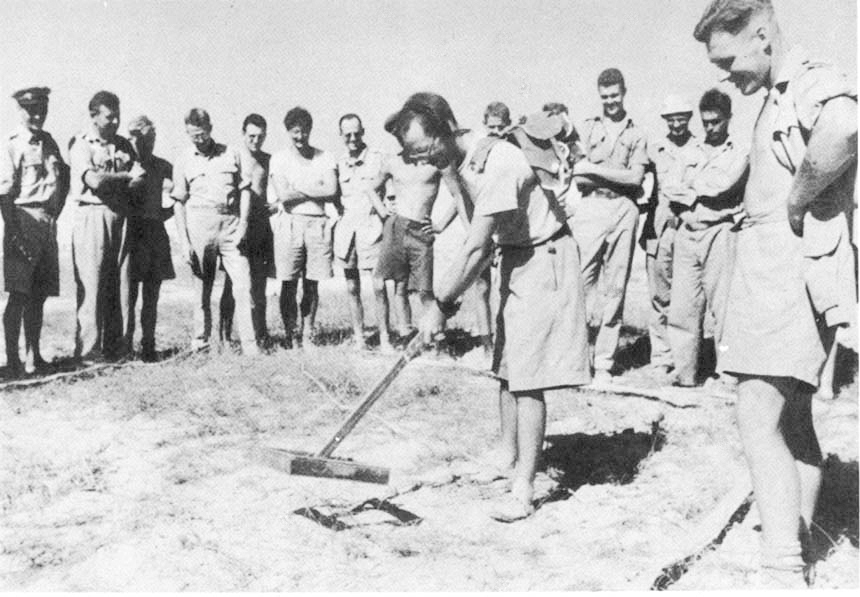 An AFS driver demonstrates to an interested group how to operate a mine-detector. This knowledge is an essential factor in keeping the ambulances safe. Photo by Brook Cuddy |
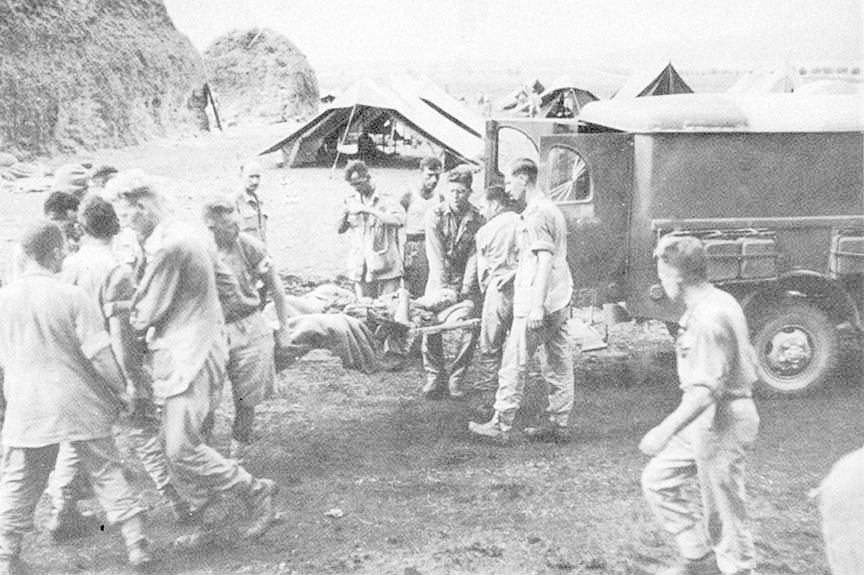 This patient has been brought from the front lines to a MDS, which has been set up in an Italian farm yard. Photo by George Holton |
September 26, 1943.
"We are very lucky for we not only get British canteen supplies, but, starting this month, we have gotten Army PX supplies also. These are much more popular because they are American goods. You can get vanilla wafers, cheese tidbits, tootsie rolls, razor blades, toothpaste, etc. They are all rationed but considering the size of our bunch and that we are not in the U.S. Army we are lucky to get anything.
"Yesterday was a big day for me for I made my first run with a patient. The Field Service has a speed limit of 35 m.p.h. on all its ambulances. They paint a big 35 on the back of your car and on the windshield so the M.P. can spot it a mile away. It is just like back home with M.P.'s roaming up and down the roads looking for speeders."
| I travel where the littered sage begins I lived and fought with them, those lads who bed My heart is where that desert rock is red; Oliver Morgan Barres |
A friend of AFS recently received a letter from Brigadier Edward Phillips of the Eighth Army which was sent on to us. The only thing pleasanter than hearing nice things said about oneself, is to hear them about loved ones; so we pass on to our readers an excerpt from this letter written in Italy..."The men (of AFS) are wonderful and many a Britisher owes his life to the magnificent way in which, often under enemy fire, the AFS has brought them back to safety. They always seem to be just where they are wanted and at the right time. If you know any of the relatives of the drivers please let them know how highly the 8th Army esteems the unit. We are always frightened lest the U.S.A. Army will claim it and take it away from us....."
Fund raising methods are many and varied....AFS is thankful to the Loomis school for their generous donation of $100.00. This money was obtained by the boys at the school by a most unusual means. A letter from the headmaster explains that the money "came from proceeds of a potato picking project". Every class in the school in rotation was taken out for a full month and the boys salvaged some 60,000 bushels of potatoes that might otherwise have spoiled. The Loomis boys were paid for this work and, after deducting the overhead expenses, they allotted $1,500.00 to charitable causes of which AFS received $100.00. We are most grateful for the boys' contribution and offer them sincere congratulations in doing such a fine patriotic job.
About the-finest piece written on the Field Service that we have yet seen, is KNIGHTS-ERRANT OF MERCY. This article, written by Joe From appears in the January issue of Coronet magazine. We heartily recommend it; not only to you readers who thoroughly know AFS, but as an excellent article on the Service for those of your friends who know but little of the ambulance work. The magazine should be on the newsstands by the time you read this.
Two more AFS drivers have been honored by the Fighting French Forces for their services during the desert fighting. They are Hilgard Pannes and Dean Graves both of whom have been given the Croix de Guerre, order of the Division, by General Leclerc. Congratulations, and to both, who have returned home and left the AFS, we wish the best of luck.
AFS Mideast veterans Bill Van Cleef and Lee Ault, who served in the same ambulance section from Alamein to Tunis last year and returned home together at the end of their year's service, are still together. Both have jobs (the nature of which is secret) with the OSS, Office of Strategic Services, in Washington, They enjoy working for Uncle Sam and spend much of their spare time re-fighting their desert experiences with the 8th.
We wish to apologize for a mistake that appeared in this department in the October issue. It was Hugh Parker and not his brother Alexander who successfully completed the Indian Army's Mechanics School course. Alexander is with the AFS units attached to the C.M.F. (Central Mediterranean Forces) and probably in Italy.
Special Bulletin to our readers in Pittsburgh and vicinity. Brook Cuddy's excellent photographs of the North African campaign will be on display in the window of the Farmers Deposit National Bank from December 17th to 23rd. These pictures have been shown at two exhibits in N.Y. with great success and we are very glad they will have a chance to be seen in the photographer's home town.
From a prison camp in Italy last April; is back in N. Y. after a visit to his home in California. Mort has gotten a job as staff photographer with AP. Congratulations to him and good luck.
George Marsh, a Mideast AFS veteran who recently returned home, has just been inducted into the U.S. Navy...Best of luck, George...
ROMANCE DEPT: Christmas, the war or something seems to have slowed down this AFS department. The only lucky candidates this month are Bill Schorger who is engaged to Miss Priscilla Howland Green and this reporter Joan Belmont, who is the very happy wife of Lieutenant (j.g.) Gordon Franklin, USNR, Congratulations, Bill; we can't wish you anything better than that you join the matrimonial ranks soon.
October 14, 1943.
"I wish I could tell you about all the sights we saw while we were on maneuvers. At times we went through lovely rolling country, interspersed with ancient villages. Some of these villages had tremendous walls surrounding them, probably centuries old. The top of each rise held new surprises for us. Dark, weather-beaten towers would loom up out of the distance looking like lonely giants from some other age. By the side of a small stream, surrounded by scrubby palm trees, stood two camels, silent, motionless creatures of the past. A small herd of gazelle shot across the road in front of us and then disappeared as suddenly as they had appeared.
"In one small village, while waiting for petrol, I started blowing bubbles. I was instantly surrounded by about sixty curious youngsters, all of them looking at my mouth. Needless to say, I felt quite foolish.
"One night we camped in sight of three small villages. As it grew dark the sound of drums came rolling across the plain, first from one village, and then from another. Soon the flute joined the drums. From time to time a group of singers would burst forth with their high nasal song, jubilant and emotional. It was thrilling to listen to the music as it grew alternately loud and soft with the shifting of the wind. Flashes of lightning made a Surrealistic pattern in the sky and thunder rumbled softly in the distance. It was hard to believe that those same simple country people I had seen during the day were responsible for this wonderfully emotional music.
"I must tell you about the sky in India. It is the most beautiful that I have ever seen. On bright days, and we now have many of them, the sky and the clouds have a sharp, clear, in-focus quality that I have never seen before. In the last month I have seen at least a dozen rainbows. Some days I have seen two rainbows and I have seen double rainbows. We are now enjoying the post monsoon rains which cool us off every evening. The sunsets and sunrises are the most beautiful I have ever seen.
"Are you interested in papier mâché boxes, necklaces, etc.? Ask Mrs. T. if she knows about Bidar wear. Supposedly there are only fourteen craftsmen in all of India who can make it. They make boxes, cigarette cases, buckles, pins, etc. The simpler designs are rather attractive. It is silver stamped into gunmetal. Are you interested in Kashmir wool shawls or in Kashmir tweeds at 12 rupees per yard, double width?
"I am rather amused at this attempt of yours and Mrs. F. to tell me about Cleveland people in India. India is a country of 400,000,000 people, so you see the likelihood of my running into these people is slight, especially since I so seldom see any Americans other than A.F.S."
October 10, 1943.
"It is quite amazing how different it is touring in India. Your route must be planned according to the weather. We went 250 miles to get to a town 150 miles away because one river was too high to be forded. At that we must have forded about 10 streams that were 2 1/2 feet at the deepest. One's technique varies --- with a soft bottom, give her the gun and go through fast and hope your distributor keeps dry. With a hard bottom it's slow and steady so as not to splash. We camped beside one river two nights waiting for it to go down, then after crossing it we got stuck between two others that rose during the night. It's very peaceful when we stop for lunch at the side of the road, sitting under a tree with flocks of goats, sheep, water buffalo and sacred cows grazing around you. It can get pretty hot in the middle of the day but always seems to cool off at night. Of course when you are away from headquarters the food runs to bully beef and more bully but we manage to get along all right.
"When you're as far apart as we are everything that means anything to me seems very unreal --- almost as though we were on separate planets. Still there are plenty of others going through the same thing so I guess we can take it for a little while --either take it, or run the risk of losing it forever unless we're successful.
"It's a big job and those of us out here know it only too well. Things are in a better perspective when you're out from under your usual protective covering of U.S. civilization, I hope the rest of the world realizes it."

Five o'clock the afternoon after sailing, everyone was gathered in the main lounge waiting for the Old Timer to give his talk. He had been an ambulance driver in the first World War and at the threat of having a stake driven through his heart, had consented to give us a lecture.
A red-faced boy stumbled into the room carrying a large glass of spirits and singing in a big bass voice.
"I would rather be an A-rab than a Wog,
I would rather be an A-rab than a Wog.
I would rather be a Vaunted equestrian
Than an ambulance haunted pedestrian...."
He plopped into an easy chair..."This is the life'. eh fellas?" The boy beside him turned his ale bottoms-up.
Over in a corner some jokers were kidding a seasick, homesick youngster about submarines...
The Bostonians at the poker table were arguing over a bet. Another group was considering the merits of the opposite sex.
The Old Timer made his entrance. Pinned to his olive drab tunic were several ribbons from the last war. He leaned against a desk and coughed rather loudly before the noisy room came to a hush.
"Gentlemen," he began, eyes twinkling;' "I am not going to tell you the stories you have expected. I have decided instead to say something to you of a more serious vein. Let me start by saying you are a motley, undisciplined crew, as, I suppose, all our Units have been in the beginning. You are a group of individualists, averse to regimentation and the loss of personal liberty. But you must realize that the idea of freedom implies self-discipline. The American Field Service will give you orders. They will expect you to stand on your own two feet. When you are sent out on a solitary mission to pick up the wounded and rush them back to a dressing station, you'll have no Top Sergeant telling you what to do. You yourself will need to be self-reliant, decisive, efficient, cool....in a word, self-disciplined. You might begin now by being a little less boisterous and callow."
The boy drinking gin and lime looked a bit embarrassed. Another hid his hands in his pocket.
"'Gentlemen," the Old Timer continued, "we are men of Mercy and Goodwill and we are expected to behave as such. If you think of yourself before your wounded, if you do not act toward your British and French comrades with the decorum expected of you upon certain occasions, you will be putting our collective reputation in jeopardy. The American Field Service is small, perhaps some fifteen hundred men in all, but for its size it is doing a mammoth job of spreading international understanding. The British and French are proud to have our aid. We shall make many lifelong friends among them and foster much goodwill for America in official circles, if we behave toward our Allies in a pleasant, thoughtful manner,"
The Old Timer looked about him significantly, with a raise of the eye-brows...."Think it over, my lads."
Just then the dinner bell rang and the lounge was emptied in nothing flat.
(The above story was written by one of the volunteers.)
Another "Lost sheep" has turned up. Vivian C. Neville-Thompson, TMU 133, back in uniform, writes us for an AFS ribbon. For years we have had no mailing address for him. We lack addresses for many others.
Hilton Welborn Long, SSU 18 is a Captain in the Air Corps and stationed at Presque Isle as HQ Adjutant.
With deep regret we record the death of WILLARD HENRY TIFFANY SSU 65-622.
A copy of a suggested open letter to "Bureau Heads and Compiler of Rules and Regulations in Washington":
"Gentlemen:
After endeavoring to interpret, absorb, and dig out the meaning of some of the obscure; verbose and lengthy directives --- implicated and complicated --- I find great relief in re-reading the Emperor of Abyssinia, Haile Salassie's simple DRAFT ACT which follows:
"Every man able to carry a spear will come to Addis Ababa to fight.
The blind, the lame, and those too young to carry a spear will not come.
Married men will bring their wives to cook for them.
Men without wives will bring any available woman.
Anyone found at home will be hung."
The Vieux Oiseaux page extends seasonal greetings to AFS families --- old and new. To thirteen saddened fire-sides go its respects and the hope that 1944 will bring some comfort in the realization that their sacrifices were not in vain.
"They shall not grow old as we that are left grow old,
Age
shall not weary them, nor the years condemn."
To all a cheery Christmas... ..God bless you all.

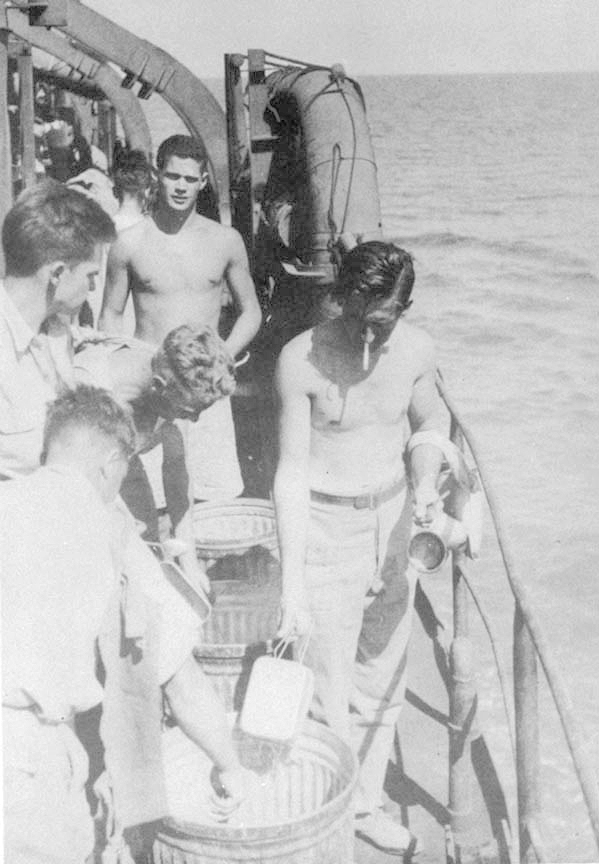
| "Mess" clean-up after chow on board L.S.T. (Landing Ship Tanks) on AFS's way to Italy. Photo by George Holton |
