Edited and published at AFS Headquarters, 60 Beaver Street, New York 4, N.Y. under the sponsorship of the ambulanciers' relatives and friends, who contribute the excerpts from the letters.
* * * * * * * *
"The best things in life are free". This ancient adage must have many loyal supporters to have lived such a long and vigorous life. In the realistic days of war, however, it vanishes to dwell in the shadowy land of wishful thoughts and we are forced to realize that we all have to pay, and often dearly, for the worthwhile things we get.
Although we would hardly go so far as to class AFS and its job as 'best', we certainly put it high on the priority list of 'worthwhiles'. This by no means implies that the ambulance service is free. It is not free to the British Forces who are responsible for the transportation of the volunteers and ambulances and who must supply the food the Americans live on throughout the year. It is not free to the volunteers who must pay for their uniforms, equipment, and inoculations before they can embark for active service. It is not free to AFS which must obtain money from the public in order to pay the men overseas their $20.00 a month allotment, as well as all recruiting expenses and the expenses incurred in running 3 overseas headquarters offices.
The National War Fund Inc. covers many charitable organizations, collecting funds and disbursing them to the organizations for various war reliefs. Large as this undertaking is, it cannot handle everybody. AFS is NOT one of the recipients of this huge collection of money and must therefore solicit its own livelihood.
The War Fund smiles on the American Field Service to the extent of approving it as an agency having a right to operate for the purpose of foreign war relief. While morally very gratifying this does not put fuel into the feed line in the form of money in the treasury. The only restriction put on AFS by the National War Fund is that the solicitation for funds must not take place until the completion of the National War Fund Drive on December 7, 1943. The American Field Service needs funds to the amount of $400,000.00 to meet its expected expenses for the coming year. This sum is very small, not only compared to the cost of other war materials and the amounts asked by other relief agencies, but particularly so as it is the entire amount asked to keep approximately a thousand men actively engaged in saving lives of the wounded for a whole year.
Not free but best to AFS men, is the support to keep them at the front performing their chosen duties. Money to finance the ambulance service is easily obtainable. The primary job is to acquaint the public with AFS' needs for funds. The Service is not well enough known to attract contributions from philanthropic sources without personal attention. The personal touch is of course most ably presented by people close to AFS volunteers. If all readers would undertake to solicit ONE contribution each, the American Field Service fund would be tremendously swelled and at each, to the same time would acquire numerous friends. No amount can be too small to help.
Though the African campaign is past news, we feel that the first two letters following will be of much interest because they were written under more relaxed censorship, and so give a more detailed picture.
No date.
"Several of us were sitting in my ambulance which was our only shelter from the face-cutting sandstorm outside. It was about five o'clock in the afternoon when our lieutenant came to the ambulance and said to me, 'T. wants to see you immediately'.
"I went over to his tent to find T. and the twelve other fellows huddled around him. Then he read us a letter sent by signal from the front. The writer wanted six ambulances as soon as possible, and the letter was signed by General Le Clerc. T. was a man of action --- the fourteen of us would leave at four-thirty the next morning. After hustling to make ready for our departure we caught a little sleep and at four A.M. our six ambulances, led by T. in the staff car, rolled out of camp in the pitch blackness of night. We made the 1500 miles to the front in four days. There were two of us in each ambulance and we took turns driving. I say we reached the front --- and how! We were on the coast road headed north. We passed through Tousse and went ten or fifteen miles further north when we ran up against a burning truck which was directly across the road. We dispersed our ambulances and investigated --- and then a few shells landed pretty near to us. As we found out later we had gone right past our own camouflaged lines and were on the edge of no-man's land. I hate to think where we'd be now if that burning truck hadn't been in our path.
"By the next day we were all stationed with different units of General Le Clerc's division, and believe me we dug slit trenches for ourselves mighty quickly. We were all under plenty of enemy fire --- some only from fire from Germans' 88 mm guns, and others of us were well within machine gun range. The French field hospital was about three miles further back at a little place called Aidi d'Amour, which was only a crossroads with two white arabic mosques nearby. We travelled back and forth with our wounded at all hours of the day and night, and we saw some sights that none of us will ever want to mention again. We grew older very fast; I think. That road was not a very good road to carry casualties over because it was under observation from 'Jerry's' higher positions in the mountains and he kept shelling it constantly. We had no rest --- we were in the foremost lines for five weeks, constantly under fire, and I think it began to show on us after a while. I cannot tell you everything that happened in those five weeks, because that would take too much space.
"There was one place that we called the 'hotbox'; it was a medical unit that we were stationed with and it was attached to the forward infantry. The place was a hot-box all right. I remember sticking my head out of my slit trench to have a good look around one time and a machine gun bullet whistled through the hairs on the back of my head just below my helmet. I didn't stick my head out again until we had to go out to take care of a casualty.
"Another time I'll never forget was on Easter Sunday afternoon. We were not under machine gun fire at the time, but shells were landing near us thick and fast. Someone yelled 'ambulance' and B. (driver with me) and I rushed over to the spot to find a badly wounded Frenchman. While we were carrying him to the ambulance on the stretcher, a German 88 mm shell landed about forty feet from us --- with our artillery roaring we hadn't heard it coming. It knocked us both down. We scurried to our feet to continue with our precious cargo, who had been badly hurt but was very much alive before --- he was dead now. A piece of that same shell that knocked us down had killed him while we were carrying him --- and our ambulance, not far away, was sprayed with small bits of shrapnel.
"We all had many close calls such as that --- some of us weren't as lucky. Out of about 20 of those that went into that campaign with the French, three were killed and one was seriously injured. It is just fate --- if a shell has your name on it there is nothing that you can do about it. All of our ambulances came out of the campaign with various types of shrapnel holes in them. One ambulance was blown up by a land mine. It was lost --- and the two drivers were both killed.
"We were never scared when we were actually being shelled or bombed or machine-gunned --- we were too busy then. It was during the little lull in the battle that we were scared --- and then I think we were all scared --- I know I was. It was then one realized what might have happened to him or what might yet happen to him as soon as the guns started up again.
"I cannot express how we felt when peace came to Tunisia. We were very tired, we were very dirty, we were exhausted --- not only physically but mentally. We had had little food or sleep for five weeks but more than that, the constant thought of danger, the constant roar of guns, and the general melee had just about 'shot' our nerves. We had seen some terrible sights of dying and dead soldiers --- and we carried many brave ones for whom we knew there was no hope and who, we knew, were on their last journey. Those were the saddest cases --- and thoughts of things like that preyed heavily on our minds and our nerves. When peace finally came, it was like heaven; the green grass was beautiful, trees waved in the breeze, and birds sang merrily. 'Mountains, from which death had reigned, were now majestic. All these things were there before the peace --- but we didn't know how beautiful they really were then. There are other fields of death and hell now --- but soon they will become beautiful just as those in Tunisia became beautiful to us when peace finally came there."
June 24, 1943.
"Before every attack the men of all units are of course told fully what they are expected to do. And in addition one always receives a 'griff' talk in which the general plan of battle if outlined and we were told what each division is going to do. This is illustrated by maps. Thus before each battle you always know the general plan of attack and know where everyone is supposed to go. Since we often had to roam about quite a bit on our own, at times when everything was in a state of flux, all our cars were always provided with large scale maps of the areas in which we operated.
"Our plan of attack called for a Ghurka battalion to make the opening phase of the attack at about three in the morning. When they had taken the position assigned to them, our unit was to pass on thru them and capture a hill on ahead.
"Once it became dark we got in our car and started to move forward to the area where our attack and break-through was to be made. It took us hours to drive ahead the eight miles or so, once we had to cross a small river via a pontoon bridge, and the truck load of Indian infantrymen just ahead of us all received a thorough ducking and shaking up when their driver missed the narrow treads and overturned his vehicle into the soup.
"The Ghurkas made their attack as scheduled about three in the morning. Just as daylight was breaking we saw their colored rockets up ahead, their signal that their objective had been reached and occupied...As it became daylight the intensity of the Jerry artillery fire picked up considerably. Several times when we paused for five or ten minutes we thought it best to fall flat if we heard any 88mm shells whistling about in our vicinity.
"The rolling country east of Medjez thru which we were advancing is gentle rolling hills with very little trees or foliage for cover. Just as we had halted briefly on the brow of a small hill, we all piled out of the car. Half a minute later, we heard the familiar whistle of shells nearby and I saw a spurt of dust just by the rear left tire, I glanced at the car and found that an armour piercing shell had pierced the front of the truck just below the windshield, torn thru half the instrument panel and gone out the back of the car. The shell went between the left side of the car and driver's seat, sliced thru the rim of the spare tire, which we carry on the left side of the car, and gone out the rear right corner. The spurt of dust I saw was the shell entering the ground; had it been a high explosive shrapnel shell I probably wouldn't be writing this today. Luckily, it was a solid shell fired to hit one of the tanks around us, and it simply tore a clean hole thru the length of the car. Our instrument panel was shattered and the spare tire gone, but the shell had missed our gas tank, rear spring, and wheel. So all I did was to get a broom, brush out the pieces of broken glass and instruments, and a few minutes later we were able to drive on as if nothing had happened. Half an hour later we passed the gun that had probably fired the shell at very high speed. The shell made no noise when it went thru our car, and the first notice of it was when I had seen the dust fly, as it entered the ground. Around the gun lay the bodies of two of the crew killed by our advancing infantrymen. The rest of the gun crew had been taken prisoners. We estimated that the gun was about half a mile from the spot where our ambulance was hit.
"American-made bombers, especially Bostons, kept flying overhead in groups of eighteen on a regular shuttle service. Mighty comforting sight too. I sure didn't envy the Jerries who were on the receiving end in this modern Boston tea party. You could see the German ack-ack firing at these planes, but the planes kept a sufficient altitude so that the fire was not very effective. I never saw any shot down or even hit.
"Our battalion secured its objective with a minimum of casualties, and I captured some prisoners and six German minnenwerfers, a stove pipe looking mortar arrangement. These mortars are made in groups of six. One of them has six barrels and can fire six mortar shells about half a second apart. They have a long range and are deadly instruments because of their accuracy and because of the fact that they can efficiently blanket an area.
"A prisoner gave us an amusing moment. When a small group of about twenty prisoners came in, the intelligence officer of the battalion came to us and asked us if we spoke any German, he wanted to question the prisoners. We speak German a bit and volunteered to help out. When we went over to the group one of the Jerries spoke out suddenly and said, 'What do you want, bud? I'm from Chicago'. After we had stopped laughing the fellow explained that he was an American. He had a wife and child in Chicago but had gone back to Germany to visit his German parents. When the war began, the German authorities clapped him into the army much to his disgust. He was very glad to see us and complained, 'Gosh; I've waited six months for you guys to came and got me here'. He was not too popular with his fellow prisoners when he had told us all this.
"About noon, six Fock Wolfes zoomed over our lines and dropped a few light bombs before starting to run, but a flight of Spitfires caught up with them and at least one of them was shot down, before going out of sight.
"The morning was a busy one for us, with several runs back thru the rough fields with some badly wounded men. We would pick them up near where they had been hit and rush them back to an ADS. As the advance continued according to plan this method worked quite well. We were able to follow the infantry up quite closely and remove the wounded shortly after they had been hit. We got most of the men back in time and they were able to get blood transfusions and necessary treatment. But unfortunately several died in the car en route back.
"Once we had cleared back all the wounded things quieted down considerably. Our unit just sat down by the side of the road and watched the rest of the world go by. Other units of the army went past us thru the hole the Indian Division had made. This hole was widened and the enemy pushed back towards Tunis. But we didn't move a bit and for two days there we sat about fifteen miles from Tunis.
"The city fell the next day and we all had hopes of getting to see it, but, though it had been our ultimate goal for so long, we were sent next into the Zagouan area to mop up scattered remnants of the enemy hiding out in the hills. It was down there that a unit of our division captured General Arnim and his staff.
"After Cape Bon had fallen and all the fighting in Tunisia was over we were detached from the Indian Division and reported back at our AFS headquarters then near Sousse.
"Things are fine now and I had a dish of strawberry ice cream yesterday along with some fresh tuna fish. Life isn't so bad in this parts."
September 19, 1943.
"I have been busier than a one armed paper hanger. My ambulance came up for semi-monthly inspection and the lad who had it before apparently hadn't touched it for a month. (He had been sick). But anyhow, I did have to spend many hours flat on my back with rags, grease gun and cans of petrol trying to get the thing clean. I have an Austin which carries four lying patients or eight sitting, and when you start to clean it, it really seems larger than any moving van you ever saw. When they say clean, that's what they mean. Can you imagine working on the engine of a car with a toothbrush? That's what we have to do to get every speak of dust out of corners etc.
"The other day we went thru some ruins in one of the oldest cities in the world, dating back many thousand years to the time of Tyre and Sidon. The chief attraction is the Temple of Jupiter built by one of the early Roman Emperors. Its size and architecture are something you have to see to appreciate. (Sounds like Burton Holmes).
"Things are really something here. American cigarettes bring between five and ten dollars per carton and I had an offer of five hundred pounds for the quinine I brought with me. (No sale, I might need it). There is one thing I would give my right eye for and that is a coca cola, It is not allowed to be sold in this part of the world so it looks as if I'll have a long wait."
September 19, 1943.
"Sunday and as usual quiet. Our leaguer which is the local name for parking space shows most of the chaps sleeping, and one violent contract game in progress. Speaking of names, our cars are called waggons, and they have bonnets instead of hoods, and they roll on tyres instead of tires, There are no detours but we deviate when we leave the road. In the desert there are no roads but tracks"
No date.
"Here I am in the middle of nowhere and find an American Red Cross Club. I have been travelling for six days without a hot meal or dry bed and then to find this oasis in the desert! On top of this the place is run by an ex A.F.S, man who is especially nice to us. We have beds plus three lovely girls to talk to. Dinner served was better than any had in a long time."
August 26, 1943.
"I saw and talked to some German wounded several weeks ago which was the first such experience I've had. I didn't get too far in the conversation but it was quite fascinating to watch their motions and actions. Practically all the ones I saw were about 18, 20 years old --- quite interesting (and consistent with) all I've heard said about the Sicilian Campaign. Apparently the veterans are being saved for the big push. The ones I saw were extremely surly and very set in their conviction of an axis victory, apparently just an idea pounded deep in their heads.
"It gave me a funny feeling at the movies the other evening to see some ancient newsreels of the Tunisian war and to be sitting next to the troops who had themselves fought in the same campaign. There were also many photos of and praise of guys like Eisenhower, Patton, etc. with no pictures or comment of Alexander, Montgomery etc., who everybody over here knows were responsible for the entire victory practically. It sort of gripes the tommies and I don't blame them a bit. If you could realize the existence of a tommy out here compared to an American buck private in every phase of living, you'd really be amazed. I suppose the same thing is true in the last war,"
"I have mice in my car at the moment and they are rapidly eating me out of house and home. They chew into anything left lying around such as books, cigarettes, chewing gum, crackers, etc., and apparently live on anything. I have set numerous snares for them but have been outsmarted everytime. A vet informs me that you can't get rid of them until you've driven your car for some time so if you ever hear from me that the rats have left, you'll understand."
October 2, 1943.
"In this part of the world bazaars are known generally as 'souks'. Literally 'souk' is an arabic word for 'city' which, in modern times when Europeans have built up modern European structures about the native city, has come to denote 'old city' or 'ancient city' ---what we would call the native quarters. It is in these native cities, which generally are not encroached on by modern buildings, that the native market stalls are to be found. Colloquially careless foreigners have changed the connotation of the word 'souk' to include only the market or shop districts of the native quarters. The 'alert merchants' consider everyone in uniform to be fair game in open season; whether the prey is of the Caucasian race or not. Strangely, however, no matter how sharply they bargain, nor how ridiculously high the price they ask for some worthless geegaw, they are scrupulously (more than) honest at the time when money is changing hands.
July 4. 1943.
"Today, Independence Day at home, we took quite a ribbing from the Englishmen here. These fellows, whose yoke we decided to throw off 167 years ago, have earned our admiration and respect many times over. However, tho we had no fireworks, no 'tea party', we took time out to remember the importance of the day. Maybe some day soon we can put aside a day to celebrate an Independence Day of United Nations.
"We AFS volunteers have American PX privileges. We can get cigarettes, gum, razor blades, etc. at a very low price."
September 28, 1943.
"We are still waiting in our camp here on the Med. Swimming is what we occupy ourselves with most of the time. The R.E,'s in the camp next to ours take some T.N.T., fuse it, and give it a heave into the water. The blast stuns the fish in a small area if there are any about. You swim in and get them while they are still flopping on the surface, which is usually only for a few seconds. Three days ago, shortly after a blast had been set off, two men pulled in a sea bass which weighed between twenty and thirty pounds... We got S. to cook it and fifteen of us had a fish fry. With contributions of coffee, potatoes, and carrots, we had a wonderful feed."
No date.
"Things are very high in price. A pair of shoes and poor ones at that costs about $20.00. A suit of clothes around $100.00. Of course we don't have to worry about these things, we are issued cigarettes ---50 a week --- so my $20.00 a month takes care of me quite well. Most of it goes for laundry, extra cigarettes and a movie once in a while."
October 14, 1943.
"The war here is so unlike the desert that I am at a complete loss as to what's going on. We are stationed in a lovely old town on top of a hill (just like every other Italian town) with hills all around. The weather is like real fall weather at home, cold at night and fairly warm in the day, so it's quite a change from Tripoli, and a change of which I for one am very glad.
"We had a nice trip over, rather rough at times but nothing serious. Our platoon was sent off the very day after we landed. The only interesting thing that's happened so far, aside from the interest of being on the continent, is meeting four escaped English prisoners --- one of whom had gone to Italy on the same submarine with C.P. They all looked very fit and said they'd been living fairly well off the farmers who treated them well.
"My cars are spread over 150 miles which makes keeping track of them almost impossible. In the past 5 days I've done over 600 miles in a truck that won't go over 30 miles an hour. I suppose the country we are in is not scenically exceptional but to our desert warped standards it is a fairyland. Much of it is hilly ---up to 3000 ft. in height ---,and the towns built in feudal times with an eye to security are all on the tops of the steepest, most jagged hills to be found in the region; and evidently the builder of the roads was determined that the tourist miss none of the sights for they wind their way up every hill and thru every town. As you leave one town you can see across a valley another town on a neighboring hill perhaps three miles away; after 6 miles and half an hour of serpentining you find yourself there. Each town perched on top of its peak is white and gleaming and looks like an illustration in East of the Moon.
"The wine making season is on at the moment. The streets of each village reek with a heavy odor of fermentation. High, two-wheeled carts, each with a barrel of grapes on board, snarl military traffic for miles on the roads. Every roadside vineyard has in its center a little stone house for the purpose of wine making. You can stop at any one of these and get from a grape stained proprietor --- who usually spent a long period of his life in Chicago --- a quart or two of hardening, still sweet grape juice for a couple of cigarettes. Remember the 'edes must' in Hungary? In this country of wine there is of course endless succession of wines of every quality and there's no doubt of it they do make life a deal pleasanter. And I am able to indulge my passion for vermouth---good vermouth.
"Operating in country such as this is very different from the desert where there was unlimited space and hardly a corner that you could not drive over. Here everything must be done on roads and sometimes we are even hard put to it to find a leaguering space that our vehicles can get into, especially if we try, as we mostly do, to stay off cultivated land, for every square foot is used in this over-crowded land. For almost the first time we have to deal with mud as a regular thing. It rains nearly every day. As yet the novelty of it has kept us from fully realizing its inconvenience tho I dare say, before the winter is out we shall be sick of it. Altho rations are poorer we are living better than ever before, for without much trouble we are able to add to our mess from the country things like broccoli, cauliflower, tomatoes, chicken, and pork. You cannot conceive of the delight we take in this green and civilized land; we all of us feel and act like children at Coney Island.
"As I said my platoon is split up in two entirely different parts of the world; unfortunately my truck is in that part which I am not; so that I am riding with an AFS mechanic in an L.A.D. which stands for Light Aid Detachment: a small mobile garage and auto repair shop is what it amounts to. It is an inconvenient situation, for we both need to be free agents, he to go wherever there is trouble and I to poop around the countryside to look after the needs of my people at their (at the moment) five different stations in five different towns fifty- to one-hundred miles apart from each other. We are therefore each a millstone around the other's neck. Fortunately he is an exceptionally nice and easygoing guy and despite the situation we get along well together. My own truck should catch up with us in the near future."
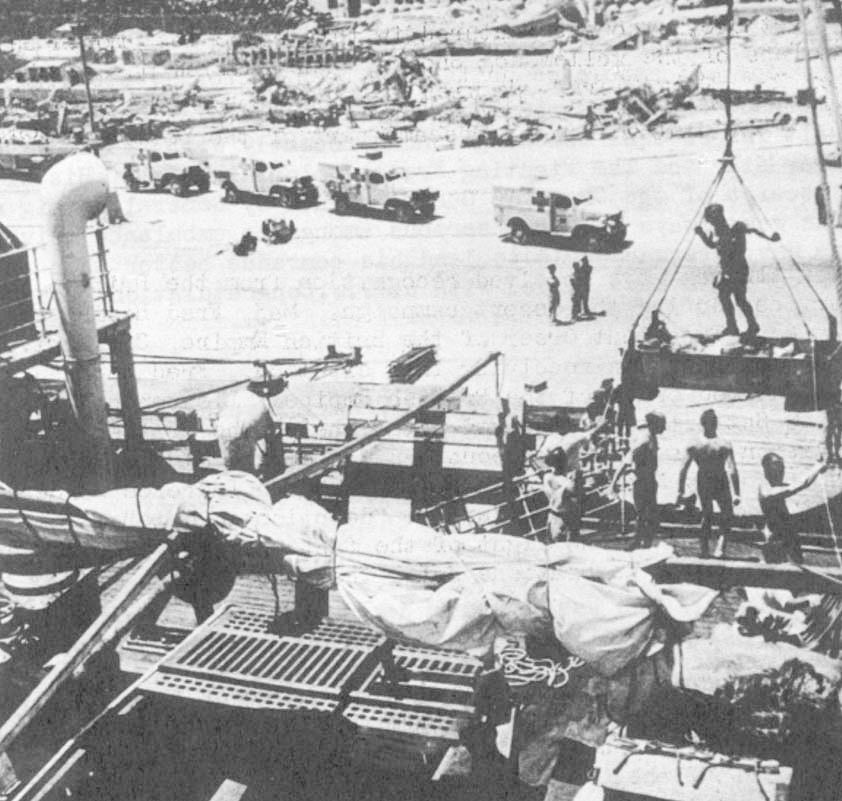
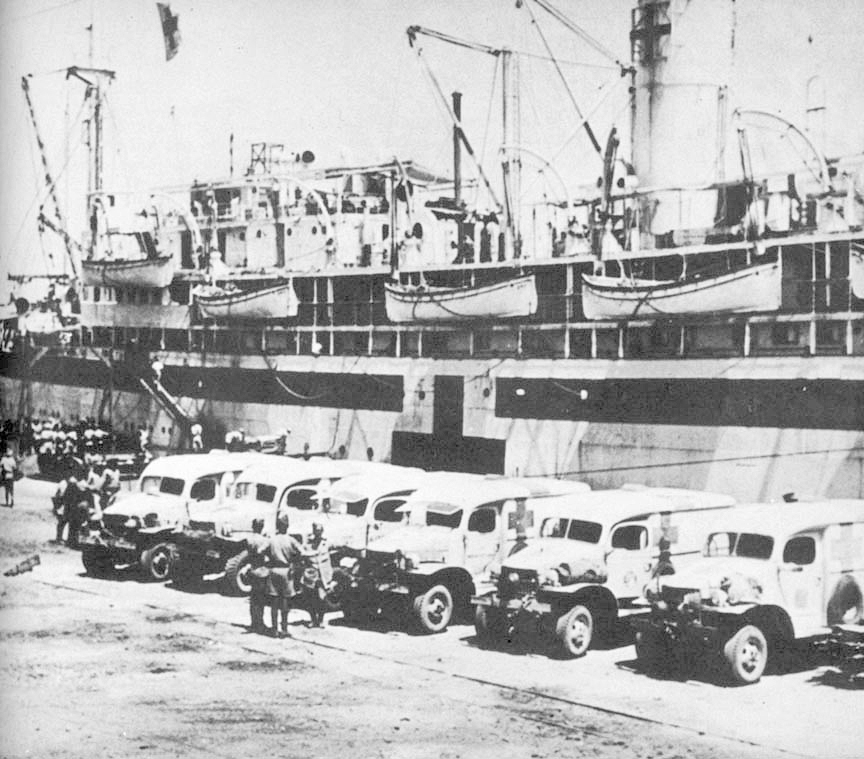
A wounded soldier evacuated from Italy by hospital ship is unloaded at a North African port where he will be taken to a base hospital in an AFS ambulance. Note the line of ambulances waiting to load up in the background. Photo by George Holton
PROGRESS DEPT:....Since the beginning of their service with British troops AFS ambulance units have been, broadly speaking, part of the Middle East Forces. With their crossing of the Mediterranean and their entry into Italy they became part of the Central Mediterranean Forces.
Seven AFS men have received recognition from the British for their services during the desert campaign. Maj. Fred Hoeing was appointed to the Most Excellent Order of the British Empire Civil Division for courageous conduct. In receiving this citation, Fred becomes a member of the Knighthood Order of the British Empire. Lieutenant Manning Field and Charles Satterthwait received citations of the British Empire Medal, Civil Division also for courageous conduct during Middle East operations. Tom DePew, Johnny Meeker, John R. Peabody and Laurence Sanders were given citations of the same order for "devotion to duty". This is great news, particularly in the light of the fact that the British Forces rarely give citations or decorations until the war is over.
Lieutenant Johnny Hammond, who was in charge of the AFS Fighting French unit for several months got home recently with the Croix de Guerre with silver star and the Fighting French Colonial medal. His citation for the receipt of the Croix de Guerre signed by General Koenig states that: "he was always the most serious among the ambulance drivers and therefore was afterward able to lead his comrades better than any of the other officers who have served with us"....Congratulations Johnny!
In a recent letter to Mr. Galatti, Art Lavenhar says that he has been commissioned in the Merchant Marine and that he heartily recommends that branch of the service for anyone who "feels for some reason he must leave AFS" at the end of his year's enlistment.
Bill Wetmore, who was featured in this space last month as being the proud Papa of the yellow doe, Snooks, was married on November 10th to the former Mrs. Mary Clark. We wish them happiness, and from our slight acquaintance with Snooks, are sure there will be few dull moments.
Jim Ullman, an AFS Middle East veteran, has written a very amusing article on Wartime Cairo which is to be found in the November Town and Country. All of the readers with an AFSer in the Middle East should enjoy it. Jim also has a story coming out in the Christmas issue of Cosmopolitan.
Harry Pierce, another Middle East veteran, has reenlisted for another hitch and sailed for the second time. He writes that while on leave he visited some friends in California who are in the movies. He says he had a fine time, started off with a bang by a "kiss from Talullah Bankhead for my brave deeds in AFS" .... We think this probably marks an all time high in glamour for AFS.
FURTHER ADVENTURES IN THE DOG DEPT:.....Bill Hannah who returned from North Africa very recently brought his dog Florenzo with him, Florenzo, had been with the AFS Fighting French unit quite a while, Bill having inherited her from Tom Greenough when Tom came home in July. When she landed in the U.S. with Bill she was proudly wearing evidence of her war career on her collar, Florenzo sports the Fighting French wound (blessé) ribbon earned when a bit of shrapnel struck her leg, the Libyan campaign ribbon, the Tunisian campaign ribbon, and the French (volontaire) ribbon. This collection probably establishes some sort of a record for ribbons won by Franco-American girl dogs in North Africa.....but we can't quite figure out what.
WAR IS HELL DEPT:..... A late dispatch just received from Italy tells of a REALLY novel experience. Maj. Art Howe and his tommie driver went to Naples arriving there late at night, after a fourteen hour drive. It being too late to find a proper place to sleep they parked in the city square, set up their camp beds beside a building, pulled their mosquito nets over them, and went to sleep. The next morning they woke to find themselves the center of interest surrounded by a crowd of natives. Windows of the nearby buildings were thrown open and Italians leaned out staring at the American ambulance drivers. Soon a basket tied to the end of a rope was lowered beside them and in it they found hot coffee which a thoughtful housewife had donated for their breakfast. After a while the basket was raised and again lowered...this time it contained hot water for shaving. Art Howe was heard to exclaim: "This is the first time since I have gotten into this war that I have been served breakfast in bed."
September 8, 1943.
"About a week ago I went on manoeuvers. We went out in a motor convoy to a mountain situated near here. We camped on one of its uppermost slopes and for the next three days went out to the neighboring towns where we would pick up imaginary stretcher cases. The native villages were by far the most interesting feature of the trip. Some times we would be the only white people for miles. Most of the routes we took would take us right through the main streets of these villages. Sometimes the road would be so narrow that the vehicles would almost scrape the walls of the buildings. We would usually create quite a sensation with our cars and the natives would gather around and try to talk to us. We bargained with them for fruit and eggs using the sign language and a little elementary Urdu.
"Some of these villages were quite old and it wasn't an uncommon sight to see goats scrambling over the ruins of old temples. The women ran and hid when they saw us, then later we would see them peeking at us from some dark corner. Little children, some of them in their birthday suits, would come running after us as we went by and a few of the older ones would sometimes try to climb in the back of the car."
September 12, 1943.
"It's funny how my conversational English has changed thru British and Indian influence. Instead of saying OK we say 'tik hai' (pr. Teek hy). The British and conditions of the war, have produced new and more colorful methods of swearing. There are expressions like being 'browned off' which describe a condition of complete disgust. The sidewalks of India are covered with blood red splotches caused by the expectoration of betel nut juice. Betel nut chewing out here is on a similar proportion to cigarette smoking at home. Cigarette smoking isn't a very common practice out here because so many of the Indian religions frown upon it. Occasionally the devout smoke but in order to do so they place the end of the cigarette between their first and second fingers, Then they make a fist with their hand and suck the smoke thru the fist. This gets around the religious taboo by not allowing the tobacco to touch their lips.
"It's funny but the things I miss now are relatively unimportant things like being able to turn a tap and have hot water come out of it, or being able to get out of bed in the middle of the night and raid the ice box, or having an occasional peanut butter sandwich or drinking a bottle of beer.
"The weather out here is wonderful, I couldn't ask for anything better. Now that the monsoons are almost over we begin to see big hunks with warm clear colors of deep blue sky, and the sunsets are filled with warm clear colors.
"I want to tell you about a bath I had the other night. At the end of our barracks we have a bathtub with a very queer sort of charcoal wood heater attached. Up to this time no one had ever troubled to use it but the other night I got a hankering for a hot bath. I summoned a bearer that was hanging around and, since I didn't have any change, I gave him five rupees and told him to run down to the charcoal walla's store in the bazaar and get me some charcoal and wood. Thirty minutes later he hadn't returned and I began to have some misgivings at having trusted him with so much money, I was pacing up and down on the porch with my raincoat on and a towel over my shoulder and the hot bath seemed more and more remote. Finally I got the idea of talking things over with the canteen cook as he understands English quite well. After I told him my story he hurried off to jabber away with some of the other bearers. He came back in a couple of minutes and assured me that the boy was honest and that he would return shortly. Sure enough, at the precise moment, I saw the boy coming down the road followed by an Indian coolie woman with a large basket on her head. The bearer, after giving me a long tale about the hardships he had had to undergo in order to procure the fuel, informed me that it would cost me the sum of three rupees (an exorbitant price) but by that time I was too tired to argue and so took my chance and told him to start the fire going. Unfortunately the wood was wet, and the boy was clumsy. It took a half hour plus a pint of kerosene to get the blooming thing started. There was only one hitch. If I wanted to turn off the hot water running into the tub I had to put out the fire as there was the danger of ruining the stove. The fire represented quite an investment and as I wanted to get my money out of it I had to leave the hot and cold water taps open during my bath. The only way I could hope to get money out of the venture was to sell hot baths to some of the other boys. I did got my hot bath --- that is, one end of the tub was scalding and the other end was icy cold, as the taps are at opposite ends of the tub. However, six other boys got hot baths that night and all in all, the venture paid for itself."
September 13, 1943.
"At present I have my heart set on going to Kashmir. They say that it is the loveliest part of India. Broad fertile valleys interlaced with canals and surrounded by snow capped mountains."
September 19, 1943.
"The more I see of India, the more I realize that I don't know anything about it. Speaking of Sikh's, in the last couple of days I have become good friends with a Sikh from Nairobi. He is a college student here and if the war ends soon enough he plans to study medicine. He is a BMOC at his college. I explained the meaning of the term BMOC to him and he seemed quite flattered. He of course never cuts his hair and he wears a beautiful blue turban. He has a coal black beard and a neat little moustache, both of which contrast very nicely with his even white teeth. Except for his turban, his dress is completely Western, and, I might add, in very good taste. I told him that my mother wanted me to buy her some jewelry and he immediately offered me some that he had bought. It is bad manners not to accept a gift out here so I told him I would be pleased to accept his gift and thanked him for his generosity. As yet he hasn't given the jewelry to me but I understand that it consists mainly of bangles and rings.
'When I first came out here I was appalled by the idea of such things as the caste system, lack of sanitation, adherence to old methods, etc. But I find that as I investigate their religion, my outlook is forced to change. Their religions compensate so beautifully for the natural inconveniences of their way of life that you cease to judge them by Western standards, which is the mistake I made in the first place.
"The other day we were out marching and we stopped for a rest in the back of a typical British officer's home. It was a small, cool looking house of a very vague sort of architecture. It had a I- don't-give-a-damn-how-I-look-from-the-outside air about it, and I imagine that inside it was very comfortable. The back yard had a careless, neglected look. On one side there was a little stable and on the other side a small white building which I imagine was the kitchen. Three or four men and women servants were aimlessly going about their daily tasks with their eastern attitude of nonchalance. As I watched, a tall pale, white woman came out the back-door followed by a chubby little girl. The English woman was still quite young but she looked as though she grew tired easily. She bent over a chicken wire coop where some white rabbits were quietly nibbling grass and picked one of them up for the little girl to hold. There was a Siamese cat on top of the cage who watched the whole scene with interest. At that moment the woman was joined by her husband and they stood there together watching the little girl play with the rabbit. I watched them a while longer and then we marched off down the road. The English seem to let geography and foreign civilizations have as little effect as possible on their personal lives. One of the strange, unnatural sights I see our here are the little English children, almost submerged under their Indian nurses.
"I'm studying Hindustani. Several of us have formed classes under a Mushi (teacher). It's very interesting and already I can begin to understand the dialogue in the Indian movies. Almost all the educated Indians speak English, but I want to know their language anyway.
"Some of us have made friends with some Indian college students. We have grand long talks along the lines of Nehru's 'Glimpses of World History'. Through them we learn much of the real India and are beginning to appreciate the differences and also the unity of Hindus, Moslems, Sikhs --- all of which you can find in the book. The other Sunday we went on a picnic with them in a beautiful botanical garden and besides their all-consuming subject, we spent hours discussing the differences between East and West. The Sikh showed us how to make a Sikh turban. A Sikh never cuts his hair from babyhood and he has long, silky hair down to his knees which he rolls up into a small top-knot under his turban. These college students are my discovery. I met them by riding over to the campus on my bicycle (not motor bike) and stopping a group of them and mentioning the magic name of Shan-Kahr. Every Indian knows and reveres him. All I have to do to open a cordial conversation is to mention the fact that I have seen Iday Shan-Kahr dance in the States."
September 16, 1943.
"Driving routes took us through remote Indian villages that we wouldn't have reached otherwise. The people live mostly in the remains of ancient temples, the lost grandeur of which they probably have no idea. Instead of worshipping at what was once obviously the main altar, they build crude little piles of stones to worship at, and the original inner sanctum is now inhabited by animals. Goats love to climb on the ruins and it is the strangest thing to see a goat, instead of a human being, with its front legs nonchalantly crossed looking at you from the remains of an upper story window and blinking at you. As we drove through these streets and lanes, the villagers and children, very friendly, would swarm around our trucks making the V for Victory sign with their fingers and crying 'Salaam, Sahib'. My Hindustani come in very handy in enquiring the way to the next village on the route."
September 4, 1943.
"Since transportation is so slow and difficult, being mostly by ox-cart, twenty or thirty miles from the fairly large city where we are, a white man is rarely seen and you feel as though you are going through a new unexplored land. One old town we went through had a beautiful old Hindu temple built where two rivers flow together. Hindu's regard such a place as holy, because, I believe, they think of rivers almost as persons, having a personality, and perhaps a river god, and when two of them come together and mix to form a new one, it is a sort of marriage to them. This temple had steps going right into the water and here were wash-women beating the clothes. All around the steps in the river were water-buffalo swimming. Although these people think a temple is holy, they see nothing wrong with washing on its steps or letting animals wander freely around it. Outside the temple you always see a statue of a Brahmini bull which the god Krishna rode and it always seems so effective to me, as though the god has left his bull to go into the temple and there the animal waits --- waits for centuries perhaps, looking toward the temple. As long as the bull is there, the people know their god is within.
"As 'soldiers' we are supposed not to think about politics so I'm afraid I can't tell you much about all the interesting things I've learned and some of the things that are happening now. I can say though that I think India is a lot more important than Americans think and that after the war you can expect much to happen here.
"One thing that impresses you here is how nothing is wasted. Food that we don't eat goes to our sweepers. Every bit of cow dung is picked up from the streets to be used as fuel. Every inch of land is cultivated. On the mountain sides where very little grows sheep and goats graze. I've been climbing hills some weekends lately and we've gone into places where you wouldn't think anyone else would be. But last week after spending an hour going up a very tough hill we sat down, thinking we were alone when a young, shy, shepherd appeared from behind a bush and asked us for a cigarette. Another time we had gone to the top of a terribly rocky and bleak mountain --- it had taken most of the afternoon --- and who should we find at the top but an old woman, who you would think couldn't climb a flight of stairs, chopping down little trees and bushes about three feet tall for firewood. Every scrap of wood is saved. There are always poor outcasts wandering around picking up twigs which have fallen off trees. Never in India have I seen any woods such as along the Merritt Parkway. In India that land would either be cultivated or planted with fruit trees. But the Indians do have a very nice custom of planting shade trees along all the roads so that they are really much prettier, than many treeless American country roads. Another nice custom they have is planting thorn bushes or cactus plants to serve as fences. Often, for this reason, roadsides look as though they'd been landscaped by Lewis and Valentine.
"I mentioned climbing some hills these last two weekends. Both times I'd been out on a picnic with a British lieutenant who like most Englishmen likes to walk, cycle and climb. We've had a lot of fun and a lot of good exercise.
"Two weeks ago I went to the races which are the big social event of this fashionable place. The most interesting part of it is not the horses but the audience which is of every nationality in India, Americans and British. The women are beautifully dressed in saris which cost 1,500 and 2000 rupees--- a lot of money for an afternoon dress in any country. My squad leader ---who is an old race-track fan in America --- says that this is the most beautiful track he's ever seen as far as landscaping and layout goes. Everything is so colorful with the swarms of servants in blue, green, red turbans, wrapped in different ways. The Indian gentleman in everything from pale peach pajama suits to a tweed sport jacket.
"I've seen two maharajahs, by the way, and they're very impressive.. Both were short and fat. Maharajas and waiters in restaurants are two of the classes of people who get more than enough to eat as they're always fat. One of these boys has an astonishing Rolls-Royce painted pale lavender with purple fenders.
"So many interesting things happen each day that I could write on and on. You see I am having a good time and learning quite a bit about the world and I sometimes think it's unfair that I should be enjoying myself while you may worry about me. All I can say is please don't, as far as I can see we'll never be very near danger and moreover, any risks I may take are nothing to what so many of the men I've met have had. After all, in a war you've got to expect pain, trouble and worry and it's unfair to try and avoid doing your part even though you may have some excuse for doing so."
September 16, 1943.
"Have just finished making my bed, darning socks, sewing on buttons, and generally 'putting crooked things straight and straight things crooked'. I'll someday make somebody a good wife.
"Got back yesterday from a leave, one of those beautifully unplanned things that are much more fun than a carefully thought out trip. One of the boys had a letter to a St. Louis girl who married a big shot in one of the native states--- that was the sum total of the plan. She didn't know he was in India, and he hadn't seen fit to call her up--- we were just going to phone her when we got there, and tactfully suggest she put 5 fellows up for a week or so. As it turned out, it took us------days to make the trip. Our transportation was paid for in 1st class compartments; but we slept thru the station we were supposed to change at, and rather than wait 36 hours for a train back we decided to go on another ------ miles to a coastal city, and come back the next day. We didn't have any tickets, and our leave warrant didn't authorize such a trip, but we grabbed a compartment reserved for a couple of generals who didn't show up, and breezed off. We were met at the station by an M.P. who whisked us off to the Railway Transport Officer to explain our actions. The latter was very nice about the whole thing, apparently more amused than irritated, and reserved another compartment for us halfway back to---. There was no room for them at the --- , so after much hunting around, we found a Methodist Mission where two clerics offered us accommodations of a sort --- they too were very amused at the crazy Americans. Half way back to---we had a ten hour wait at a thoroughly Indian town where we walked thru the bazaars, and by bribing the R.T.O. at the station (about the only white man there) with a couple of drinks, got a whole private car to----.
"We called up the girl and found she was away for a month, but her poor Indian husband rallied nobly, and entertained us. His house was being done over, so we stayed at a hotel, but Saturday night he took us to a very exclusive club catering to high-mucky-muck Indians and British officers for a dance, and Sunday gave us his car to drive around the town. We wanted, of course, to see the ruler's palace, and even entertained notions of talking our way in to see him, but he apparently feels, like Jupiter (or was it Juno?) that it is dangerous for a mortal's eyes to look upon him, for the approach to his palace is guarded, and the palace is surrounded, like Girard College, by a high wall. Sunday we were entertained for dinner at the home of another big-shot in --- government, where we were served a completely Indian meal, and smoked hookahs after dinner. Monday we entertained ourselves, and left ----. All in all we saw some --- miles of India free of charge ----. Forgot to say that we met an American sergeant who rode with us and presented us with what here are regal gifts, a package each of Camels, and a box of Beechies."
July 24, 1943.
"The terrain can't say--but it is a large country--the Indian Bazaars are interesting --oxcarts rumble by before daybreak--westernized Indian gals wear flower-printed summer dresses and 'wedges' -- a good quart of scotch is worth about twenty chips.
"While in town, today, my bike broke and I upset the Indian traffic and cop to no end -- smashed into three out of a party of five bikes, forced two lorries to a squealing stop--after a series of apologies I navigated gingerly on my way back to camp.
"The monsoon rains operate on a daily schedule with no time off on Sundays."
September 20, 1943.
"The temple itself is quite a structure It is in three separate sections, the completion of the oldest dating back many years, with the last section still comparatively old. The roofing is in a dome shape, looking, in architectural design, like 'capital dome'. The paint used on the domes is of a very brilliant color but the colors used blend together very well. The design and figures are very odd, none of the three different domes having the same figures upon them. We were unable to gain entrance to the inside of any of the three temples, so I shall have to leave that out. I did, however, find one room that had some tom-toms. At that point, the attendant went wild, yelling in his native language, which meant nothing to me. After being scared to death, I paid or gave him two rupees, which is worth about sixty-five cents. I consider myself very lucky that I was able to get off as easy as I did, considering that these tom-toms were very old. Anyway, it was a lot of fun and worth the two rupees for the laugh and scare I had from it. After that little incident we thought it time to leave."
May 30, 1943.
"The Coldstream Guardsmen, Warrant Officers detailed as our Drill Sergeants, stood braced (we three who interviewed them didn't have the grace to stand them easy) while we told them that they could have as free a hand with our bunch as if we were British rookies. Then we three also fell into line, and our initiation began. It began something like this: 'I am a Warrant Officer in the Imperial Forces; I am addressed as Sir (gulp) --- while on parade. I'm going to teach you the drill of the British Army, I'll sweat and you'll sweat. If you fall down, you'll stay where you fall, and if you do a bad job, I'll rap your knuckles with my stick!' The stick was a heavy cane, and there was no doubt that he meant business. We began to stare. And then we began to sweat. The American drill is as nothing. Americans march relaxed, British march braced. To stand at attention in the British Army means to lock every muscle in your body. Attention, as you can see, is very tiring, but it's not half so tiring as standing at ease, which is a position for which the human frame has not been geared. Standing easy: that's comfortable; you can relax your neck, breathe, and even scratch your nose. Getting into one of these positions is a contorting act, a movement faster than any eye can see. We all agree, however, that it is good for us. It is definitely going to be good for me."
July 21, 1943.
"One night a few British and AFS combined to put on a revue. It included almost every known type of stage turn, not omitting a beauty contest. In this another tall chinless individual and myself were cast, he as a Miss Mass Fatigue and I as Miss Orderly Room. Being clad almost entirely in a typewriter ribbon and a 24" ruler is not so cool as it may sound. Oh yes, ribbon, ruler; and a sign reading 'Out of Bounds Except on Business.'
"Some days before the end we had a 'cram' session with the Sergeant who had drilled us. He was, I think, pleased with the results he had been able to achieve in the comparatively short time he had the Unit. His comment was: 'The lads are awf'ly keen, you know, but they have the loosest behinds of any lads I've ever seen' -- and to be sure, we do lack something of that braced British smartness when we stand at attention or march.
>"The trip up here was really stunning. The way rose into the
mountains between startling cliffs; every so often long reaches of
valley opened up below, down which we could look for miles and across,
too, to other mountain faces and the thin silver lines of streams
coursing them. Everywhere the earth appears rich, and the fields are
very wet. This is the Monsoon season in India, and that may have
something to do with the abundance of water at present. We saw teams of
water-buffalo or bullocks drawing ploughs through the flooded rice
fields.
"Our conveyance stopped along the way and hung around, giving us
a chance to see some of the people and animals and smell the smells. To
a salt dulled sense of smell the fresh odor of the rain was delicious
but aside from that, the smells of this country are among its most
impressive characteristics; odd fragments of wood burning and flowers
and food as well as dung and dust and wet straw. When we stopped we
would be in the midst of crowds of goats and children --- or so it
seemed. Hindu family parties sat at their afternoon meal on the ground
drinking tea, changing baby' (who conveniently had nothing on) and
pushing out of their plates the face of an over-curious black and tan
goat. Two of the three children together would start to turn fantastic
cartwheels and then having caught our attention would break out of the
act, demanding baksheesh.
"The outstanding impression one
receives is of innumerable people. The crowded village bazaars and the
continuous passing to and fro on the roads made me more conscious of
people than I've been in any country before. We stumbled into a small
bazaar, from one of the houses in which we had heard odd music coming on
a previous night. The bazaar was fascinating, the counterpart, I suppose
of thousands of others, but smaller than any we had seen and in an
unbelievably narrow street, close-pressed with houses which have shops
on the ground floor, the fronts of which are entirely removed during
business hours. The stores (of all sorts) are in the niches along the
house walls and crowded with people,--- all sitting on their haunches
and all busy. We walked up and down the street pushing our bikes among
children and dogs and cars and goats and the marketing natives. The
house from which the music had come stood at one end of the street where
we stopped and asked whether we couldn't come back and hear them play
some night. They agreed and four of us went the following Monday. The
place turned out to be a Hindu chapel where the musicians were
practicing sacred music, we sat around the 'altar' with them in a circle
on rush mats and in the shadowy light of an atrocious-smelling sweet-oil
dip. The music has an hypnotic quality that acted on us as a soporific,
but we kept our eyes open by watching the drummer. He kept the beat with
his fingers on two drums, which he struck with the flat of his fingers.
We have seen this drumming since; each time it has struck us that the
drummers could teach our jazz drummers a great deal. The stringed
instruments are very long with round 'sounding boxes' ---much bigger
than a guitar, but for all their size they are used very little. After
the music (we could not keep our eyes open and said we must go) we were
offered highly seasoned tea in pewter mugs. We took this and tried to be
polite about refusing the cold lump of fried dough that was a cake.
"In India towns are divided into two parts: the cantonment and
the city. The latter is the native section. We got permission to go into
the city the other night to attend a dance recital in one of the
theatres. None of us had believed that the immense city existed beyond
the bounds of the cantonment. The street down which we went was crowded
--- a few cars but many bicycles, horse-drawn carts called tongas,
cattle including sacred cows, and countless people. And a little bazaar
we had visited was here repeated on a much larger and more crowded
scale. The dance recital itself was not by half so interesting as the
trip there and back. On the way back through the bazaar we saw a water
buffalo break away from its driver add dash down the street through the
(suddenly scattered) crowd. These beasts seem generally very drab and
docile, but they can be savage and they have a superior attitude of
impassivity that led one of our fellows to say he observed in them an
attitude of 'holier than cow'."
August 31, 1943.
"That job I announced so impressively at the end of my last has
turned out to be three jobs, and they are never quite distinct. There's
playing garageman and managing the petroleum and oil and pints and pints
and imperial pints of kerosene; there's running the spare parts and the
tool stores; and there's being in charge of our vehicles. Three jobs,
each with seven thousand ramifications and each with
one-hundred-and-seven-count-them-tons of paper for paper work attached
to it. If you should be troubled with a paper shortage. I have it all.
The same applies to petrol.
"I have a great deal to do (and without being entirely too sure'
what) with motor vehicles. These are two-wheeled water-buffalo which are
only pleasant to their proprietor when locked up in their stalls at
night. He (that's me) rides them too, but they have a distinct tendency
to do the driving, and so he avoids them as the better part of valor and
proceeds to ride pillion (look, no hands!) when able. His assistant
pilots them with enviable aplomb and no control whatever and makes a
worthy chauffeur.
"They took out the booster pump on the carburettor, for example,
making it impossible to rev. up the motor when clutching down and
causing a more furious pitch of agonized clamor to come from the gear
box than previously. I PUT IT BACK IN . With my two hands (and a pair I
borrowed from another driver) I actually did something real to a
carburettor! All I remember ever doing to a carburettor before was
watching Dad got out of old friend Eloise and bang it with a hammer. But
I guess the moment of extreme personal triumph was when, far from help,
alone as Hester the Beautiful Heroine on the track with the
five-thirteen bearing down on her faster than Sohn Drew, independent yet
clinging to the need for mechanical guidance, I was faced by a truck
that would not start! And by goodness and mercy, in my own little
bachelor of arts brain I worked out what must be the matter and though
I've done that sort of thing before, I was right this time, and it was
the matter, and then wonder above all the other eight wonders, the truck
started after I'd tightened the right bolt (which was on the battery).
And that's the true story of my experience in the AFS, and it will
probably be published in a CAMEL ad. But after all --- the single
personal triumph of which I am proudest is the accomplishment learned in
the last five weeks: being able to ride a pedal bicycle no-handed.
"My face is very odd looking beneath the eaves of what is known
in Quartermaster parlance as hats felt Ghurka one. You've heard I
expect, of the Ghurkas, who are pretty crack Indian troops, and among
other things, they wear a distinctive broad-brimmed hat, something like a
Stetson. They were allowed our unit, and they have now come, to the vain
delight of our fellows, who shape them like pork pies, replace their
chin straps with shoelaces, and wear them like a Texas Ranger wears his.
Some of us look like forty-niners, some like two-gun Mike, and others
just plain foolish. None of us look like anything Army. We are quite a
crew. Lilly Dache never designed a more startling creation for spring.
"We get the most remarkable service from everyone. 'You're
Americans, you'll probably get what you ask for', is the general idea. I
protested to one guy who told me that, we didn't want any special
handling, but all the time I know darn well that we do want special
handling. Anything to get the stuff we require. And I think they like us
because we act informally. I make a perfect ass of myself by going in to
a superior's office and forgetting to salute, then leaning on the desk,
and finally taking a deep breath, preparing to salute and failing to
make the heels click. It gives them a laugh that cuts through endless
piles of paper-work. Endless piles of paper-work, however, have
sometimes a peculiar advantage of their own. The other day, after
sending in endless forms demanding 'certain spare tyres due us, I had so
utterly perplexed the issuing depot that they issued the tyres twice,
and I think that we are now the only unit in India with a little private
hoard of spares! Coup!
"We have, as I said, some vehicles. You should have seen their
arrival. When we went to get them I was running around in pursuit of
their kit and didn't take time to fill the tank of mine with petrol; so
that I ran out of gas about a quarter of a mile from where we got the
cars. Thus did the Vehicle NCO make his debut by being towed into camp.
This was all rather shocking, but in its way amusing. With my own car in
the shape of a glass house, I am expected to lift the hoods of others
and criticize them for cleanliness and lubrication. An AFS vehicle must
be so clean in motor and in chassis that anyone would be willing to eat
eggs off any part of it. If we had any eggs.
"The other night we put on a good show; the Unit threw a dance.
We had been invited to so many parties that it was definitely our turn,
and I gather we did ourselves proud. To be sure, some of our friends
turned up three days later and said they would have loved to come but
that their invitations had come only that morning; the dance was a
success. All the lights went out in the middle of it, but kerosene lamps
lit the show from there on, till some of the guests climbed a pole and
replaced a short fuse."
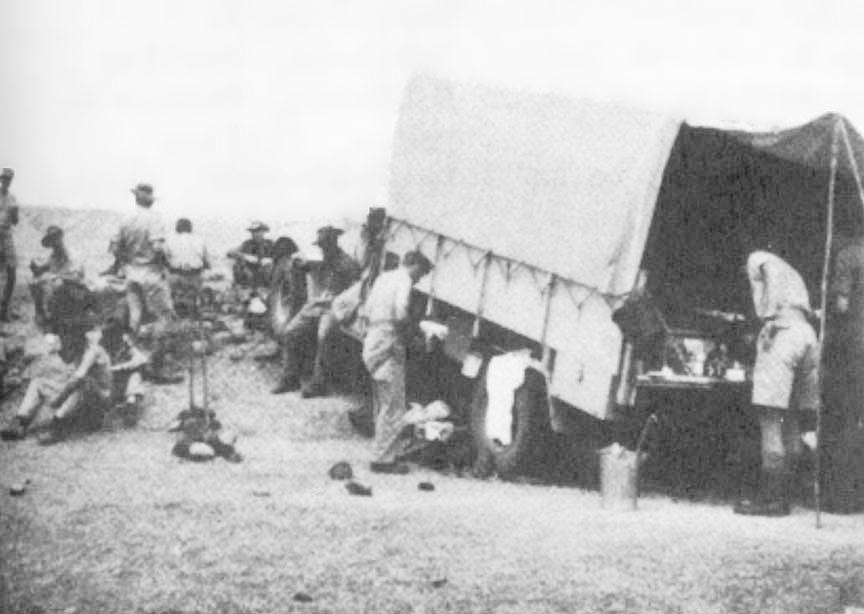
Mess call on the Indian plains. Some of the AFS
"American Indians" pause for a meal while out on maneuvers.
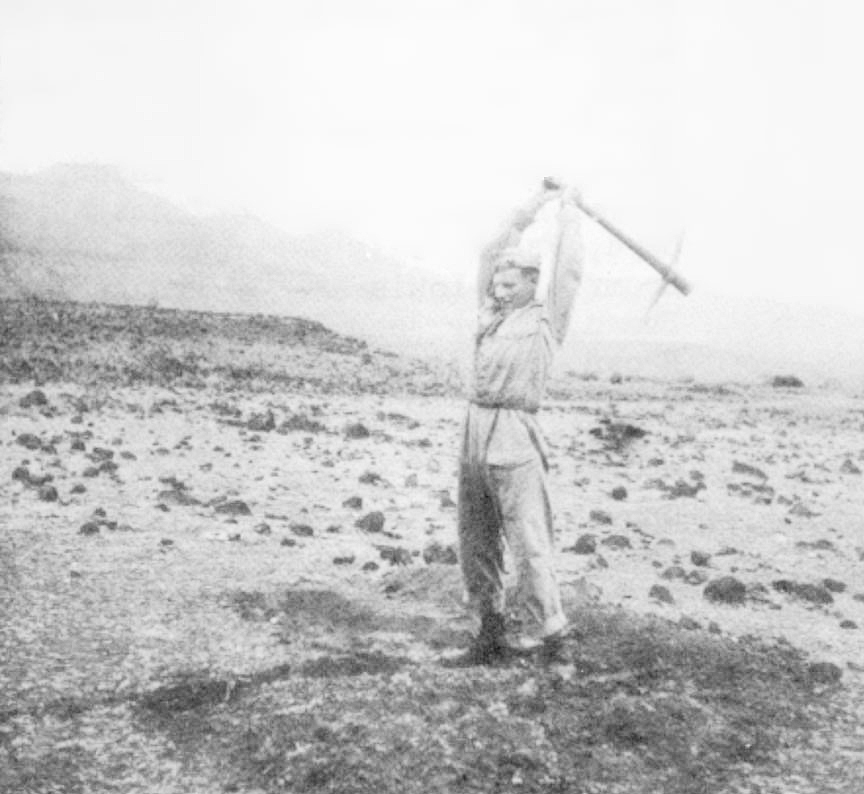
Photo by J.R. Latham Norman Peters, one of the first "American
Indians", digs himself a slit trench. Digging shelter in the harder
Indian soil appears to be real work compared to the sands of the Western
Desert. Photo by J.R. Latham Bill Wallace has turned over this page to me this month and it
permits me to do something I have wanted to do for a long time, and that
is to call attention to old AFS men who have acted as representatives
for these past years. Without them there would have been no service,
Busy at many tasks, they have patiently interviewed hundreds and
hundreds of applicants, choosing wisely, giving a helping hand whenever
needed. They have raised money, have helped in embarkations and given
valuable advice.
CHRISTMAS GIFTS, which may be purchased thru the AFS.
BOOKS: LAST CALL FOR CHRISTMAS CABLES. DECEMBER 15th is the dead line.
We are grateful for all letters sent in to us. Keep them
coming---preferably copies (not the original letter) and where possible
give the date of writing. We need lots of them to be able to make a
varied selection.
Adriance, Edward Friedlich, Robert E. Olmsted, Frederick
N.
Allen, Wharton Gilbert, Wells Patton, Perry Atkinson, Belford P. Griesa,
Charles H. Peffers, Harold W. Ball, Randolph Hannah, J. Clifford
Potter, Lars S. Bangs,
Geoffrey Hill, Ralph B. Prickett, William Barretto,
Lawrence Hutchinson, J. Danna, Pumpelly, Prof. Lawrence Black, Barron Johnson, F. Kirk.
Purves, Edmund Blake,
Herbert C. Johnston, Earl T. Ray, John V. Boyd, Frank
H. Karaghan, Harry R. Robinson, Barclay Bromfield;
Louis Krusi, LeRoy Robinson,
Thomas A. Brown, Major John F. La Flamme, Frank Rodes, Clifton
Brown, Paulding Le
Veillie, G. Norbert Rogers, Prof. Samuel Buckler, Prof. Leslie Lindeman, Charles B. Rotharmel,
Kenneth Burrell, Roger Long, Dr. Perrin H. Schoen, Ernest
R. Buswell, Capt. Leslie MacDougall, A. E. Scott, Edgar
Church, William P. McAllister, Judge Thomas F. Seccombe,
Edward N. Clark, Robert McClellan, R. A, Shirley, A.A.
Cope, Thomas McFadden
John, Jr. Sponagle, James M. Dawes, Beman G. Means, Prof.
Thomas Weld, Garneau Donovan, C. V. Michael, Berkeley
White, Victor Eldridge,
Adams Mitchell, Alexander White, William T. Fay, S.
Prescott Newell, Joel Whitton,
Prof. John B. France, Robert O'Brien, Thomas, T. Wright,
Whitney
"Mercy in Hell" (Whittlesey House) by Andrew Geer
at $2.75
"Ambulance in Africa" (Appleton Century) by Evan Thomas
at $2.00
AFS Insignia pins
at $2.25 plus
25¢ tax ---$2.48
AFS LETTERS
at (for 1 year) $3.00