|
WASHINGTON Dear Mr. Galatti: Almost four years ago, well before the United States entered the present war, the American Field Service reviewed its impressive record of 1914-1918, reorganized its forces, and began again the work of sending a corps of young Americans overseas to operate ambulances in war areas. Since the reorganization of the Service on September 29, 1939, its men have seen bitter action and worked under heavy fire, always with valor, beside the forces of the French and the British. Serving voluntarily and largely at their own expense, they have saved thousands upon thousands of lives that the Allied forces might grow larger and stronger, and that the day of victory might be hastened. As these men approach the fourth anniversary of their service in this war, I wish to congratulate them, to thank them, and to give expression to the admiration in which they are held by our people. In serving our Allies, they serve America. Very sincerely yours,
Mr. Stephen Galatti, |
Edited and published at AFS Headquarters, 60 Beaver Street, New York 4. N. Y. under the sponsorship of the families and relatives of the ambulanciers. The relatives and friends contribute the excerpts from the letters.
Over confidence and optimism on the progress of the war are two of its greatest hazards at the moment. It is impossible to avoid a feeling of elation on hearing of successful Allied advances. Inevitably we conclude that the war is nearer to being over and in relief are inclined to minimize in our minds the distances yet to be covered. It is great news that AFS has rejoined Montgomery's Eighth Army in Italy and is once again serving on the European continent. Great news, because the volunteers are going ahead in their chosen work; and great news because it means the renewal of the fraternity between the American volunteers and the Tommy soldiers. The road home is a long one and rough. The Field Service men are on it, but they have stepped onto the far edge.
The first time that a group of American volunteers drove into battle organized as the American Field Service was in France 1914. The latest action participated in by an AFS unit took place in Southern Italy in October, 1943.
After waiting at a North African port for four months, AFS men and their ambulances embarked for Europe in American invasion barges. At 8 a.m. on October 2nd, 1943, Bill Oates drove the first ambulance ashore. Within two hours after disembarking the ambulance service was lined up and ready to go.
The volunteers, happy to be back once again with their pals of Montgomery's Army, set about 'brewing-up'. While the Americans and British were renewing old acquaintances and discussing campaigns to come, a curious crowd of Italians gathered and struck up conversations. One of the AFS men found himself talking to a conductor of the local railroad who several years ago had lived in Cleveland.
The AFS men heard their first gun-fire in many weeks when an anti-aircraft battery opened up over the port. For some of the newer volunteers this was their first gun-fire. It was a short burst, however, and is presumed to have been aimed at reconnaissance planes.
The Medical Units to which the AFS men found themselves attached moved out of the town at which they had landed on the afternoon of the 2nd, and, after driving north for a few miles, encamped in an orchard ready to move up to the front.
The first patient to be carried in an AFS ambulance was a man taken sick aboard the invasion barge and driven to the dressing station ashore by John Wright. A few of the ambulance drivers developed jaundice on the trip across the Mediterranean and had to report for hospitalization in Italy. Two of the volunteers on learning that they might be evacuated back to North Africa or even to Cairo dropped out of inspection line and vanished. As they left they were heard to mutter something to the effect that: "we've waited four months to get over....damned if a little thing like jaundice is going to keep us back NOW." (Ed. Note: our dispatch does not elaborate on the outcome of this bold decision.)
Within three days after the initial landing, Lt. Arthur Jeffress had established an advanced AFS headquarters. After some difficulty; he obtained an apartment large enough to store extra baggage, accommodate the men and have room for his office. The greatest problem encountered was that of obtaining water, as the Germans had blown up the system of aqueducts before retreating.
The AFS officers found that moving into an Italian city was more complicated than moving into North African ones such as Tripoli and Tunis. In Italy, because of the status of the Italians as co-belligerents, all arrangements for occupying even a small apartment has to be accomplished by requests to and approvals from the local Italian authorities. A requisition has to be filed with a member of the Italian government before the Americans can got any supplies, furniture, food or in fact anything they need.
AFS men were most favorably impressed with the efficiency of the combined British and American command, particularly so when they distinguished themselves by working along the shell-torn road for forty hours at a stretch.
Action in Italy today.... France tomorrow?... Germany?.... and then home....That may well be the course of AFS European units and the last destination cannot be reached too soon. Good luck to them all! and Godspeed!
September 6, 1943.
"Since being over here, I've seen some of the battle fields of the African theatre of war. And even after all these months there is plenty of evidence of a fracas, particularly at El Alamein where quite a stand was made. The plains are dotted with burned-out, rusting tanks and trucks, Heinkels, Messerschmidts and Junkers all lying about in various stages of incompleteness. Some look as if they had just landed while others stick tail up in the air. There is a lot of salvage work going on which has eliminated anything of value. Most of the British stuff has been removed as they can use it for repairs and spare parts. The wastefulness of a war is appalling. It's no wonder things cost so much.
"Another interesting part of the country gives evidence of Il Duces' colonization farming plan. There are farmhouses of very modern, stucco design all the way from Meturba to Benghasi. Some are pure white and others sport a reddish hue which matches the earth: each has the words 'Eute Colonizzionzia Libia' written across the front and on each side the word DUCE in two foot letters.
"Each little community has a civic center which includes a couple of halls for Fascist meetings and a Catholic Church. Here the farmers came to learn more about agriculture and unfortunately more about Il Duce. All these centers are very ultra-modern in design and are covered with Italian, and Latin phrases as per the Facisti.
"The Arabs have now occupied these residence and most of them are a mess, mainly because they bring their live stock into the house. Most of the fields are neglected and farm machinery lies around rusty from disuse. The plan behind all this was really capitalistic though on the surface it appeared to be a government project.
"This 'Eute Colonizzionzia Libia' is the name of the corporation which operated this farming plan. And it was financed by rich Italians which was not commonly known. One thing can be said and that is Il Duce did a lot for the country and it is too bad he got off on the wrong foot.
"It looks as if the long awaited invasion has begun."
June 19, 1943.
"Aside from minor explosions and occasional beautiful fireworks there is no excitement for the moment. It is hell though to see what the ravages of war can do to beauty. Although no windows are left the Cathedral is very beautiful. On the left of the main altar is one of the most poignantly lovely statue of the Christ I have ever seen..
"When I get home I'll probably feel more comfortable sleeping under the bed and I'm sure I'll find the diet much too rich. Have felt better eating the old Army food mixed with grease and sand for roughage than during the wonderful 'outing' I wrote about. You become attuned to it and more doesn't sit well, at first.
"The bugs are really friendly and aside from the flies there are now only tired, lumbering beetles, with sleepy hooded eyes, that flounder about dejectedly. I enjoy having my ambulance alone and at the moment I am writing in the back of the car which I have covered with netting and am scowling sarcastically and hatefully at the flies outside. Each fly seems to assume a personally odious form of adhesive affection .
"It is wise to avoid being swept along and feeling in the middle of this great war. One wants to feel it's just part of a daily dozen and in that way it is much easier when it's rough it should never be personalized.
"I have been lucky to have seen so much, and so much beauty with it all. Am picking up a bit of new dialogue from an old Italian who drops by each morning for a cigarette in exchange for his banter. Have convinced him I know La Guardia ! which excites him greatly.
"I have a wonderful kit from a British officer who has just gone home. I'd give my all for a 'clothes shute' ! What a wonderful abandoned feeling it must have been (only I didn't realize it) taking off dirty clothes and not brooding over them. You certainly don't bother with pajamas. I shared a tent once with a fellow when it was cold who used to crawl in with even his boots on. Didn't unlace them. Last I heard he was still recuperating from flu. Used to watch enthralled but for five nights, for no reason, he never took them off. Inherited a small primus stove. This has occasioned no end of good cheer by either emitting heavy soot, exploding off and on and failing to heat anything but the handle of a saucepan I found under a tree. We have enjoyed cold stew and burnt tomatoes so far. Last night a gentleman mechanically inclined, the sort always running around squirting grease guns and holding broken automobile parts in his teeth, said it was plugged up. It was. He unplugged the top opening and 5 days' accumulated pressure carried gasoline in geyser fashion directly toward the mark, for he was glaring into the opening."
July 8, 1943.
"Great excitement today by way of the wonderful Beatrice Lille and Leslie Hensen. Succeeded in getting into a performance given here for the British forces and they are here this week. She was grand and it made me very nostalgic for the old days of seeing her off and on in New York. Got an excellent seat in a good box reserved for officers (we so rank en theatre !) All these are given gratis of course as are all the films and thus passed a pleasant hot afternoon.
"Bug life is beginning to fascinate me. When very hot the flies gave up. Alas other odd forms have appeared. Only attractive wild life are chameleons which are not unpleasant reptiles and seem tame. One hovered about on my teacup or mug today and wouldn't depart. Upon placing him in my duffle he became dark brown and looked annoyed."
No date.
"Today something was done I have never seen before, nor shall I probably ever see done again. I'm sorry I can't tell you more of this, because it only excites your curiosity, but at least I've tried to show you I'm doing what I came over here to do, loving it, and thinking that I have not made a mistake in my previous convictions about the AFS."
August 2, 1943.
"First of all let me make A CAUTIONARY STATEMENT: Be sure to put 'American Field Service' (written in full) on the envelope as well as 'APO 616'. Otherwise, the letter arrives with things all over the front of it like this: 'not Douglas Aircraft'... 'try Am. Field Ser.'. Over the whole thing is a rubber stamp saying, 'Inform correspondents of correct military address.'
"I was in charge of a section up in a small seacoast town. We were busy, making long daily runs, and striving to keep the cars in shape on the side. We were attached to a very small medical unit which cleared patients from a biggish area back to another medical unit 100 miles away. The Medical Officer in charge of the unit was extremely ineffective. He floundered for long periods in a sea of indecision before making the simplest of plans. It was really an abnormal state of mind and I don't expect he can go on indefinitely without developing an acknowledged mental illness. The sergeant was no help either, for he was so afraid of exceeding his authority. Under these circumstances, we did as we pleased, and in time gradually ran the camp. We got them to make coffee and cocoa instead of tea, decided who was to make a run and who was to stay on duty, prescribed our own maximum weight to be carried in the ambulances, decided what time the ambulances must leave on their 200 miles round trip, which meant we indirectly prescribed the hours of sick parade. Then, when the town was placed out of bounds, we went in anyway, when a speed limit was set on the road we exceeded it, and when rules were made regarding cars remaining in workshops, we disregarded them because they were silly. Our tent was a continuous sea of Timeses, letters, and magazines, and cigarette butts. But we were always on the job when needed, and consistently carried the mail, though sometimes it meant working late at night and getting up early in the morning to make a car roadworthy.
"We had a marvelous time, and the stories and rumors of our activities spread so that other people in the Field Service came to visit us on leave.
August 15, 1943.
"I went to Cairo on leave a few days ago. I walked into the Field Service headquarters and bumped up against L. C. , whom I hadn't seen for about a year. We got talking about this and that, and it developed that he was nourishing a desire to climb the Second Pyramid --- that is, the one with the 'slippery' alabaster peak. He asked if that appealed to me and I said it certainly did, and would like to join him. He said he would like to have me, but he felt duty bound to tell me that a Mt. Everest climber was killed on it recently, and two South Africans lost their lives as recently as three weeks ago. I said we might as well have a look at it --- just because a man can climb Mt. Everest doesn't say he knows how to climb a pyramid. L. agreed that there was a lot of difference between climbing a pyramid and climbing Mt. Everest, and as for the South Africans, they were probably drunk. At any rate we agreed to meet the following morning for breakfast at the Mena House and climb the pyramid.
"When we told Abdullah, the Mena House doorman, what we were planning and asked him to provide guides, he replied it would be impossible. In the first place, no one had climbed it for several years, so far as he knew. Second, there was a Cairo city ordinance against climbing that particular pyramid because of the danger. We made a show of saying too bad, we're out of luck, some other time maybe, each of us perfectly positive that we would climb that thing there and then, or be dashed to a mash. We ambled out the front driveway and over to the pyramid --- just strolling along --- and when we got there, sure enough, we found three guides waiting for us which Abdullah had sent over. The five of us started to climb.
"Now, the first two thirds of that pyramid is easy as easy can be. It's just a matter of climbing up a set of immense stairs, each one about four feet high and three feet wide. Of course, as you go up, you get more and more careful, but we didn't look around until we got to the base (& the alabaster part, where the guides found a big cavity in the pyramid where we could all five sit down at a reasonable distance from the edge. Then we started looking around, and frankly it was pretty scarey at first. The angle of this particular pyramid was 51 degrees some odd seconds from the horizontal. We were beginning to get winded so we urged on the guides in order that we should have no time to think. The first thing they had us do was take off our shoes and socks. A quick anxious glance upwards showed me the reason. Our ascent to the top was to be largely a matter of lying flat against the marble and pegging our way to the top with the use of hooks and crannies. Two fingers here, a big toe there.
"The first fifteen moves were the hardest. During our rest, we'd seen an old lady walking along the road below us, and she looked so damn small. I couldn't forget her image, or the vast distance between herself and me. Soon, though, I got to be more interested in my handholds and footholds than in her, and proceeded with little trouble except I was shaking like a Jack-rabbit. A guide was first, I second, another guide third, L. fourth, and a guide last. We zigzagged up across the north face of the pyramid, the leading guide finding the trail. Once we came to a ledge four to six inches wide on which we could walk several steps. That was just like Park Avenue on a Sunday morning. Once the guide worked up a blind alley, which dwindled out into what looked like an acre of polished marble. Not a crack in it or a piece knocked out. We had to turn around and go down several feet, to find a new way. I mean turn around, too. We placed our heels where our toes had been, our palms where our fingers had been, and our backs where our stomachs had been. There we were, hanging like pictures on a wall, and facing out. Ghastly. Perfectly ghastly. We eased out way down in that position, and started up on a new tack. This time we went right on up to the top, which was not a sharp point of marble we had feared, but an uneven place about ten feet square, big enough for all. There we sat for about half an hour, puffing and panting, sweating and smoking, talking over the trip. The old lady was still in sight. A plane flew around us and we waved. Eventually we decided we'd go down before we got thinking about it and how terrible it would be descending that whole distance with our backs to the wall. But there again, it wasn't so bad once you got started. There was one place I just about froze on, however, where I had to lower both feet at once to a little spot which could take care of heels only, and which sloped down at that. I found if I stayed there and searched for other ways to descend, I began to mistrust every possible move I might make. The only thing to do then was to just go ahead anyway, and trust to whatever laws of cohesion there may be governing human flesh in contact with polished marble. We reached the bottom of the alabaster, and of course, from there on everything was just like rolling off a pyramid. We dropped down walking on the level, after the first part.
"We returned to the Mena House, after having bribed a policeman who turned up at the bottom of the pyramid in order to be bribed. There we sat in the garden drinking long, cool drinks and feeling very pleased with ourselves."
July 9, 1943.
"Life here is very pleasant and simple. Tolstoy says, 'The chief attraction of military service has consisted and will consist in this compulsory and irreproachable idleness.' This is what I have been trying to say all along. It is great to find something true to your own experience in reading. I found something else in Hemingway just now. In fact, it evoked a chain of thinking that since led to my writing you a letter. 'Knocking your bindings loose, kicking the skis free and leaning them up against the wooden wall of the inn, the lamplight coming from the window, where inside, in the smoky new-wine smelling warmth, they were playing the accordion'. It reminds me of swimming in the Mediterranean this afternoon--- the associations completely different, but the intense, childish enjoyment quite the same. My friend and I were out among the rocks off shore. No surf and you can see clearly thirty and forty feet to the bottom of the great green and blue chasms. We swam underwater most of the time pulling ourselves along the rocky bottom four or five feet under, coming suddenly to sea-cliffs so precipitous that we had the inane feeling that we were about to fall. Then pushing and swimming down and down to where the water is ice cold and everything dark blue but still eerie and clearly visible, then shooting up so fast that you come spurting out of the water up to your thighs when you hit the surface. I have never seen water so translucent or so multi-colored. The best place was a canyon twenty feet long, nearly covered at the top. I watched F. shoot through it so far down he looked like a big fish. After some nervous hesitation, I dove down and tried it myself... found it the most wonderful sensation, particularly beautiful and exciting where the narrow rock-bound passage widens into the sea. These rocks are off the officers' beach which we went to for the first time yesterday. Previously we had been spending every afternoon at the O.R.'s (other ranks) where you go naked and where the crowd is pretty thick and jovial. It is swell to be in the unique position of enjoying both facilities. I think we have been a little harsh in scorning the officers' beach up until now. There is a shaded pavilion where you get gelato at sixpence a cup and fresh lemonade (all food is short in these parts) a pier... a dining tower, but especially a whole company of offshore rocks. There are also English nurses --- Sisters (the reason for the bathing suit requirement) in pitiful small numbers, looking about as you would expect. The shade is especially rare and sought after because of the African sun. We drink quantities of water, perhaps three or four quarts a day. The water truck gives vile, chlorinated stuff but it across the road yields delicious, cold water. We would be pretty well lost without it. The Italian family that owns the farm is very interesting; the father talkative, friendly and excitable, the three children most affectionate, and the signora hardworking and quiet, always ending every conversation with 'Speriamo che fenira fra poco'. I have listened to a lot of hard luck stories from Italian civilians but they all admit that they have never been molested. One cannot expect the British to kiss the Eyeties on both cheeks after three years of bitter warfare. Even so they are always kidding with the Italian children who swarm around the workshops and play with the tools. I guess the Italians don't know when they' re well off.
"To return to the well: you should see the terra cotta jugs we have to keep our water in. They are so archaic and picturesque, they make the back of the ambulance look like an opera set. They keep the water cool through the hottest weather.
"You must be wondering whether we are doing any work at all. The answer is no. I have been here for a month and have not driven the ambulance out of the grove once except to go on one sight-seeing trip. I am prepared to spend the summer and even part of the fall, reading and swimming, nodding along through these letters, sleeping under the stars and being awakened at 6 a.m. by the buzz of the flies, leading a frugal, healthy bucolic life. . . In any case, we are in for a long stay. The occasional wandering around town is fun. Very few shops, no restaurants, lots of........ They look even better than they're cracked up to be. We are proud to work with them. It isn't a badly-built city although the architecture is as pretentious as ever. Effects of bombing are visible. The only remnants of German occupation are the 'Gruss aus Afrika' cheap leather wallets that infest the little shops (together with 'Welcome Allies' silk embroidered banners) and the superbly efficient watercans marked 'Wehrmacht-Drinkwasser' that we use at the camp. Occasionally you see a captured lorry. I think I have been to the beach and to town in every imaginable kind of vehicle. This common courtesy, the open friendliness and goodwill, are a good thing to see."
July 15, 1943.
"The American Army is getting plenty of good food. I had a chance to eat some of it a while ago when I spent a week in an American hospital with an earache. We are also fortunate here in being allowed (with certain reservations) to use the American Canteen in town which serves good sandwiches and ice cream at a low cost. And starting this week, our own canteen which previously had subsisted on Navy stores, is being allowed certain goods from the U.S Army PX stores. This means we get five packs of American cigarettes a week, Canadian ale, vanilla wafers, cheese crackers, and copies of Yank magazine which is a pretty fine Army publication.
August 1, 1943.
"This morning an AFS man returning from a short leave in the States, said he was glad to be back where peace, order and a pleasant monastic asceticism reigned. The picture of the States that I got from him, from old copies of TIME and from letter-excerpts, made it all sound grim --- very grim. A tense, nervous atmosphere."
'"A short while ago we painted our chickens on all our ambulances and other vehicles. As usual there was a row as to whether it was a good design; it wasn't dignified enough, it was too dignified; it was corny; it lacked the proper spirit, the AFS should have an insignia; it shouldn't. Anyway they painted some hundred odd of them --- five somewhat individualistic artists did. After the first thirty or forty they got browned off at merely being copyists and so they began to get original. In no time we had scowling chickens, leering chickens, smiling chickens, panting chickens. Finally they came up with a drunk chicken. At about this time the CO got wind of the thing and now all the chickens are sober again and wear none but the conventional AFS expression. But for a while there the outfit looked like a portrait gallery at Bloomingdale's.
"I might tell you a little about the chameleons that are common around here. I don't know much about them except that they are very attractive little creatures. They are about 6 to 8 inches long, have a skin like a turtle, a head like a prehistoric monster, thin match-stick legs and a multitude of colors to chose from; and despite what a late issue of the Readers Digest says, they do change color with their background although not as easily or so often as they do when irritated, or excited. They are capable of quick movement but seldom move quickly. They are unafraid and never run away from you. They live on flies and insects and stalk a fly with the same deliberation and ultra slow motion with which a cat stalks a mouse, but instead of a pounce a long tongue flashes out. Their feet are like slit hands, one side acting as thumb, the other as fingers; and each side is split up into claws. These hands are for climbing branches and trees . Pick one up and scratch him on the back and he will rapidly go thru the whole rainbow."
August 12, 1943.
"One day I took a coat from a branch of the tree under which I sleep and came upon a real centipede which had sought refuge. I shook the coat and the insect was tossed out upon the sand in the sun. It wiggled furiously and was making rapid progress across the ground for a few minutes and then began to move more and more slowly. I had but a hint of what was the trouble. In Arizona, much against common belief, snakes never are found sunning upon rocks for soon the sun's rays would kill them. Such was the case with the centipede, it died gradually as I watched, its movements ceasing from its tail to its head. I put it in the shadow but it did not alter its 'health'. In five minutes it was prey to a large ant. The structure of the centipede's body was primarily for undulating movement and protection against attack by bite for its body was beautifully sheathed in a light.. translucent sheath segmented to be flexible. The sun its normal enemy evidently because of its instinct to seek cover.
No date.
"The compound on which we live is quite a place. It is a regular menagerie. There are men stalking game all night to quiet them so we can sleep. There are 5 small sheep, 4 rams, 2 goats, 3 donkeys, 2 mules and 6 dogs all running around loose. Boy '... what a racket '. One donkey screams his head off seven consecutive times about ten times a day. It sounds like nothing I have ever heard before. The compound itself is composed of a hospital and attached buildings.."
July 30, 1943.
"I want to tell you about our patient. I first visited her with the MO, Dr. Homayonni, a Persian and quite a brilliant linguist. (There are quite a few medical posts in the British army filled by doctors not of British birth).
"She is an attractive, fine featured Arab girl of sixteen. Her left arm is very badly infected from shoulder to hand, certain bones being dead.
"Fortunately the infection has been localized to the tissues of her arm and kept from spreading through the blood stream. The MO left yesterday and instructed us in continuing to care for her. She lives in a remote section of town. After travelling a myriad of vile, dirty, winding alleys we were amazed to find her home immaculate. Her father is a serf; he raises so many kilos of grain on his landowner's fields and is allowed to keep a very small portion. He couldn't possibly afford a doctor's treatment for his daughter.
"Not being able to give the girl anything but local ethyl chloride antiseptic, the MO kept her mind from the pain of a drainage incision by reciting several verses from the Koran --telling her to think of them and she would feel no pain. Today we took out the rubber drain and redressed the arm. We hope to get an English town doctor to help us, for her elbow also needs a drain".
July 29, 1943.
"I was lucky enough to get a ride from the Hotel Oriental-Palace straight through to Haifa, Palestine, near the Jewish Communal Settlement where I had hoped to stay. There, I was welcomed with open arms by the Jewish comrades, many of them having come from America. Their settlement is run on a plan of almost pure communism... their government being managed by committees with a chairman at the head. There are popular elections every year. Every one takes a share at the unpleasant work, each having his own specialized job besides. No one receives pay, except a small allowance for personal needs. Each receives his share of farm produce. It is a large farm of vegetables, vineyards and orchards. They spend their spare time reading, singing, dancing, playing volley ball.
"About dancing, I must say something. The second night I was there the children who had completed the first year of school put on a little play, similar to Miss Lewis's school plays, after which an informal dance was organized, the sound effects being made by piano, singing and clapping of hands. Children and parents took part and it was most lovely. They have borrowed folk dances from all the countries of Europe out of which many of them have fled. (Germany, Russia, Poland, Rumania, etc.)
"I like very much their system of education which is quite progressive. The children of different age-groups live, sleep, work and play together, each age-group in a separate cottage equipped with teacher and nurse. As much interesting work is given the child as is possible, and he is taken unawares with the uninteresting by means of projects where arithmetic, for example, is applied to real life studies. At the age of 12, the children go to a larger school outside their own settlement.
"I met two very friendly American comrades, Ja and Ruben (everybody goes by his first name) who answered questions, showed me around invited me to come for a longer time and really live with them. From them I gathered that the members of the settlement consider themselves pioneers in the Zionist movement. Their aim is to fructify the desert land and settle the strife with the Arabs: so that the Jews may some day have again a home and national pride, free from scorn, discrimination and persecution. Their hope is that not only the Jews but the whole world may some day take up their way of life and adopt their principles."
No date.
"The morale of the A.F.S. would be kept high if we would be constantly kept busy and on the move. I believe everyone was much happier when the fighting was going on. In my case, I liked it better when we were getting nightly bombing raids in Tripoli or taking part in the Tunisian campaign. You felt like you were doing something then and were a real part of the war effort. Then when periods of comparative inactivity come and the waiting around starts, you get wondering what good you are doing and what a waste of time it all is. We've got to realize that when we are not doing much either. It also has one consolation that if we aren't active, there are then many men that aren't getting wounded and killed! I'm under the impression that no matter what part of the service one is in these days, there will be a certain amount of boredom waiting around and military 'baloney' to put up with. I also think that most people soon get fed up with any organization that they are in after the novelty and change wears off. War and fighting just aren't natural, or suited to most people involved in this world struggle; peace and home are the main thoughts in the minds of the soldiers who have been overseas for any length of time, especially the poor tommies with the 8th Army --- they've gone through plenty and it looks like there is still another big job ahead for them to help finish.
"At this offensive stage of the war, there is now a calm before the storm. As in our case we just have to sit and wait for a big front to open up before we can operate ourselves. Our job these days, like so many other troops, is to keep ourselves posted at various places just in case; maybe nothing will ever come of it, but then on the other hand, their presence might have been needed. War is a very uncertain thing, especially when you don't quite know what the other guy, the so-called enemy, has up his sleeve. Yes, you've got to do a lot of traveling and waiting around to put in your small 'two cents' in the war effort. War is hell, but it isn't the bombing and shelling that makes it so; there are many men in the service, especially Americans, who will probably never even see an enemy plane or bomb burst. Modern war has so many specialties and base service troops which carry on many of the same types of jobs that they did as a civilian; the only difference is they are in the army and on foreign soil. I've got few kicks about the A.F.S. and like being with the 8th Army. We are fortunate to get around and into action as much as we do. I believe we have a worthwhile job ahead.
"The American Red Cross has taken over a nearby villa for a rest and leave camp for American personnel. Leave it to the Americans to take over the beat and make the most use of it ! There are a small swimming pool and tennis courts on the estate, as well as easy walk from our camp and we take advantage of it, mainly for the outdoor movies and some good food, several nights a week. It's wonderful to have it to go to, because it gives you a real set-up feeling. Recently Jack Benny came there in person with a small troop of Hollywood stars and gave us all an evening's entertainment. It was a darn good show and lifted up everyone's morale. Sometimes they serve refreshments, occasionally doughnuts and real ice cream; the A.F.S. goes in for more than their share!
"I saw 'Desert Victory' at the Red Cross Club. It was about the first chance that the 8th Army had to see it. While there were some amazing action photo shots. I thought much of it quite poor in relation to the real thing. It was too much charging infantry and roaring tanks; there's a lot more to war than that!!!- and most of the drama in this struggle is unseen, but can be portrayed and should be mixed in with the drama of noisy action.
August 14, 1943.
"First of all I had the opportunity I'd been waiting for so long. I visited Palestine. From what I saw of Tel-Aviv and Haifa, and the countryside as I travelled through it, Palestine as a place to live has not been over-rated by those people who spoke for it. Of course I don't know, and didn't have time to find out, what the situation is politically or whether all the people live as comfortably or happily as they may seem to do on the surface. I found the countryside fertile and busy. Collective farms stretch far away to either side of the road and colonies of refugees who work the land there are almost self-sufficient. Sort of a unit cooperative which includes not only farmers but carpenters, masons etc. But Palestine hasn't confined itself to agriculture because they also have small industry which provides necessities for the people. This doesn't say that Palestine is industrial.
"Its cities are modern, clean, well-taken care of. Tel-Aviv particularly is a beautiful city with lovely beaches close to the heart of town, with three shaded streets, three story apartment houses and parks. Even the shopping districts, that is for clothing etc., are built in the latest fashion. We think that some of the new apartment houses we have around our way are the latest thing, but Tel-Aviv and Haifa are way ahead of them. They've had to start from scratch, you see, and a gradual change was not necessary; they could jump the gap from old to new in a leap. The people are friendly with progressive ideas. Orthodox religion, I believe, is not all prevalent in the younger group, although everything closes on Saturday. Palestine is strongly behind the war effort. Many of its men are in the Palestine army and its women are in the A.T.S., which mean Auxiliary Transport Service, and they drive trucks and cars, relieving men to more important jobs.
"I don't know what Palestine was like before, but I'm sure its changed a great deal and will change even more. It's a very nice place right now."
Men about to embark oversees have for the past year usually found the Navy League "Truck" at the door of 60 Beaver Street .....as their zero hour came up. They have loaded their sleeping bags and duffle ..... and wondered if it would "make" the pier. It always has !
|
They discovered me in Brooklyn Jane Churchill Brown |
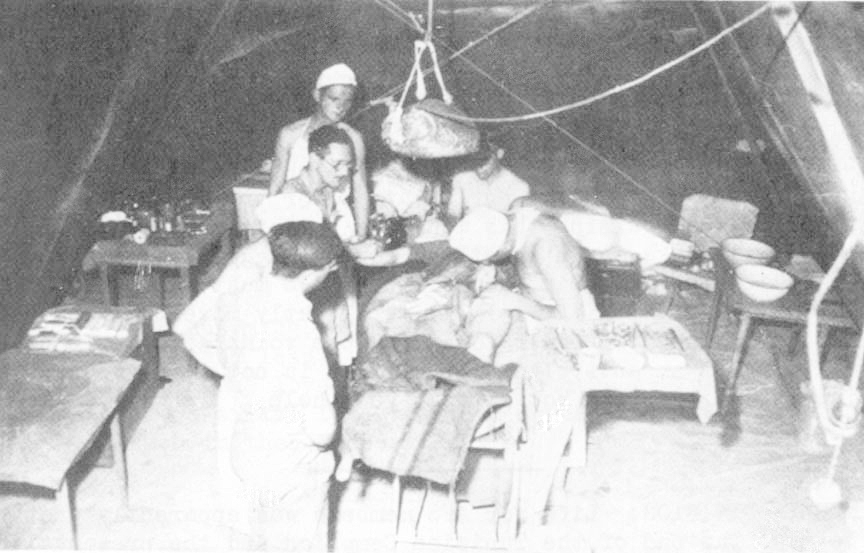
Care of the desert wounded. A scene in a mobile operating theatre; this theatre is a tent pitched directly behind the hospital truck in which are carried the medical supplies and lighting facilities. This type of operating room often receives the wounded brought off the battle field by AFS ambulances. PHOTO BY JOCK COBB
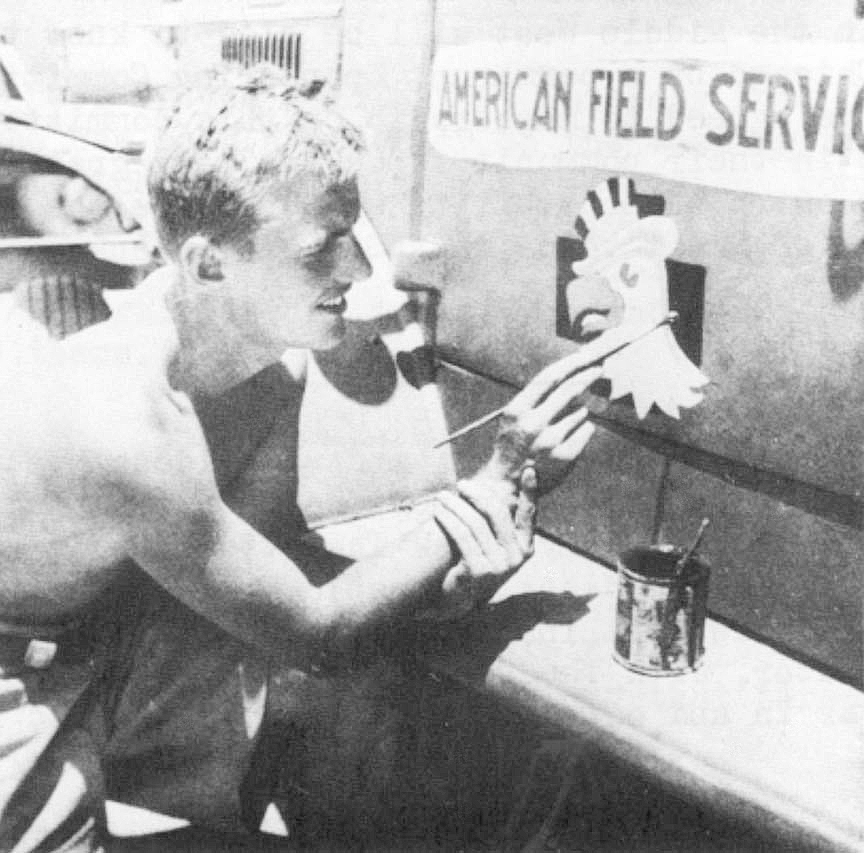
Invasion gray. Charles Edwards puts the finishing touches to the 'Chicken Brigade' insignia of his ambulance after it was repainted from the light 'desert sand' color used in Africa. The ambulances were all painted a dark battleship gray preparatory to being sent to Italy.
Beginning December 7th the American Field Service will start a nation-wide drive for funds. This money is badly needed to finance the ambulance operations in three war theatres for the coming year. In order to keep the cost of raising this money at a minimum, it is hoped that the readers will take an interest, offering suggestions and perhaps doing some soliciting in their communities. AFS must have $400,000.00 (four hundred thousand dollars) or slightly more than the cost of one Liberator Bomber, in order to supply the volunteer ambulance service to our Allies for an entire year. This sum is not tremendous.... and we can raise it easily...but not without your help.
MORALE DIVISION: Life for AFS members was apparently pretty dull going between the end of the Tunisian Campaign and the present Italian Invasion. After all the moving and activity, it was difficult for the men to find enough to do while waiting. A solution to the problem was offered for one day by the staging of a foot race between the two fattest men of a company. The race was fourteen miles in length, a distance which the winner covered in 3 hours and 19 minutes. A pool was formed on the time of the winner and truckloads of non-participating AFSers were sent to various spots along the road to cheer on the contestants .....From where we sit, sounds like a great lark ... except for the long suffering 'fattest two'......
Readers in the Middle West will be glad to know that AFS is to be represented in Chicago by a permanent Sponsoring Committee. These ladies and gentlemen have agreed to membership on this committee to handle the interests of AFS in their community. We are very grateful to them for undertaking this extra responsibility and are sure the existence of their committee will be of great value to AFS. Many thanks and the best of luck to them all.
SMALL WORLD DEPT.: Bob Stein, an AFS mideast veteran who is in Washington as a member of the consular service, writes that: "A couple of days ago I was visiting the big Army 'Back The Attack' show and bumped right into Hod Gilmore (another AFS Mideast veteran) who was putting some personality into a display of divisional insignia under a huge banner announcing the Fighting Quartermaster, with the result that we have spent two weeks fighting the desert war in and out of the Capitol pubs .....
Two men of the AFS India units are eligible to attend each session of the Indian Army's Mechanics School. So far four AFSers have successfully attended. Very successfully, in fact. George Birkett got a final grade of 98 1/2....Alexander Parker of 95....Norman Fenn 94 1/2....Thomas Burton: 94 1/2.....We are much impressed and heartily congratulate them.
TRUE LOVE DEPT: Almost every man...in nearly every section of AFS men overseas....has pets. Dogs, cats, monkeys, cobras share the war front life of the volunteers and cheer their lonely hours. These faithful companions, however, must have nomad hearts as well as nomad lives, for when their masters return to the home shores, they are passed on to a remaining ambulance man until his enlistment in turn is over....and so on through their lives. We were recently gratified to observe two reversals of this policy. 'Andy' Anderson landed accompanied by his 'desert girl' ( a charming, slim black and white lady, all dressed up in a shiny red collar and lead). No sooner had we gotten over our pleasure in this display of true love, than Bill Wetmore arrived leading his desert companion, a silky, lemon colored damsel with the liveliest personality ever seen in these parts.
ROMANCE DEPT: AFS Mideast veterans who have married during the months are: Fred Taylor married to Miss Frances Hanby Talley. Fred is now a Pfc with the U.S. Army Medical Corps stationed at Springfield, Mo. ...and Bill Brown married to Miss Christine Elisabeth Upper.....Mortimer Wright who qualifies as a Mideast veteran and a future AFS man as he has reenlisted in AFS for another year's service, married Miss Eva Anderson....Michael Cheney, who reenlisted and has sailed; was married before leaving home but we have no details .... Vincent Bowditch will be married by the time this reaches you to Miss Mary A. King. We wish them all the best of luck.
Further news of the Middle East veterans that came to us recently is Frank Wood who has been a reporter on the Seattle Times since coming home...has left the newspaper to take a pre-medical course at the University of Washington....Norman Moyle is a Private in the Armored Force U.S. Army and stationed at Camp Beale California. ....Bert Grove is with the Field Museum of Natural History in Chicago and devotes his spare time to publicising AFS there.
FAMILY TRADITION DEPARTMENT or THE ALLENS OF AFS....Lewis Allen joined the AFS in November 1942, a month or so later his brother Howard joined the AFS and sailed for the Middle East. Their brother Douglas has recently joined and sailed for the Middle East also. This is a notable event, being the first time in AFS' history that three brothers have been in the ambulance service simultaneously.
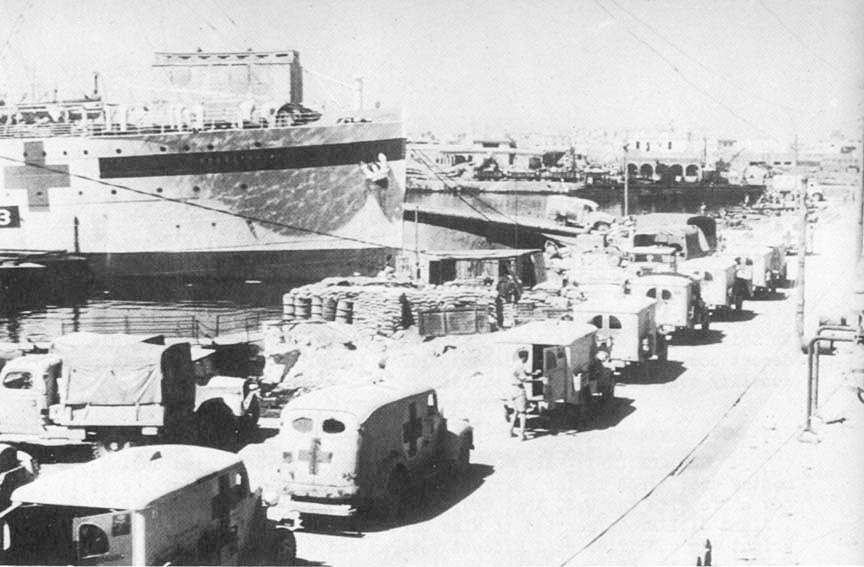
AFS ambulances line up to unload the wounded from a hospital ship just back from Sicily. The main work of the volunteers during the lull between the Tunisian victory and their transfer to Italy was to evacuate the wounded brought to North Africa from Sicily. PHOTO BY GEORGE HOLTON
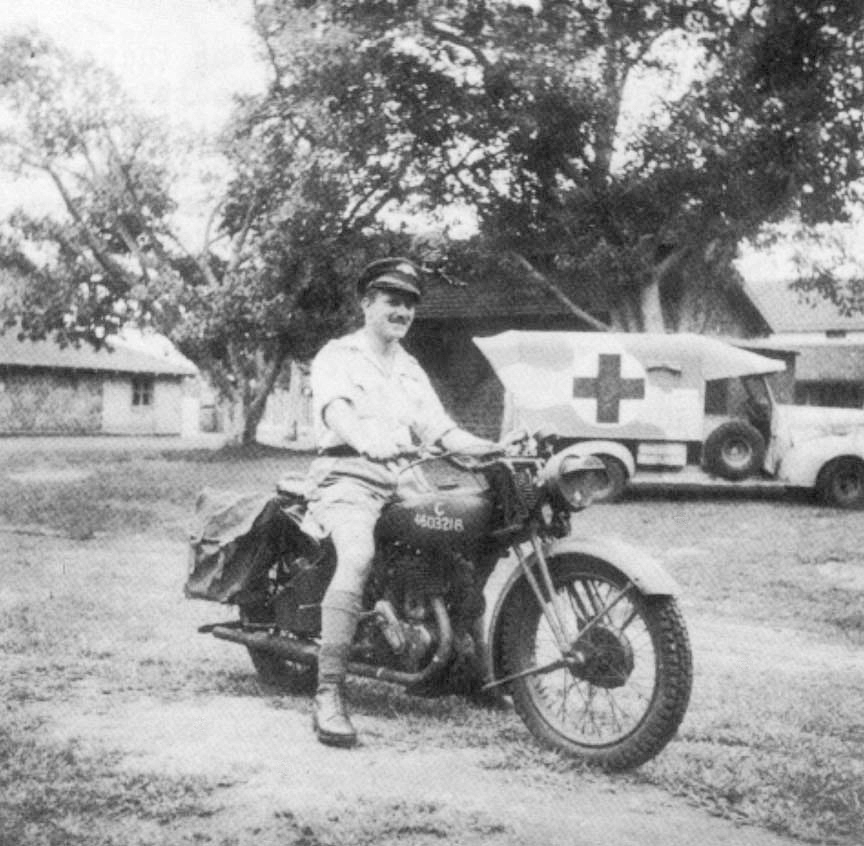
At AFS HQ India, Lt. C. Norman Jefferys poses on his motorcycle. In the background is the large ambulance now used by the AFS men on duty in India. PHOTO BY J. RICHARD LATHAM
No date.
"Today, being Sunday, we have been seeing the town and I must say it is more like a dream. than reality; the whole atmosphere of the place, the natives, the houses and shops, the fauna and flora, the money, customs, food and smells are all so fantastically strange and foreign that it is hard to take it in at once; if you remember seeing movies like 'The Thief of Bagdad' (in technicolor) you get some idea of the color of the place; otherwise it has to be heard and smelt, as well as seen, to be believed and appreciated. I shall not attempt to describe it all to you yet since we have been here only one day.
"Your remark to the effect that ...... may seem dull to me when I return is true to a certain extent but I can already see that I am going to long for the comforts and amenities of home long before the year is up. It is apparent that as soon as we go on active service we are going to encounter rather uncomfortable conditions, to state it mildly."
August 20, 1945.
"R. certainly could have gotten his fill of motor cycle riding if he had joined the AFS. Yesterday I went out with an instructor and we drove over some extremely rough roads. Every boy in this unit is supposed to learn how to ride a motorcycle as a few will have to be D and Rs (dispatch riders).
"Every few lines I write, I am interrupted by our Indian cook asking questions... He is a bright little fellow named Abdul and he speaks a fair amount of English so we are getting along quite well.
"The other night we had another record concert in our library. It included Grieg's Piano Concerto, Debussy's L'Après Midi d'un Faune, Tchaikowsky's Piano Concerto, (1st. movement only) and Beethoven's Lenore Overture. A British lieutenant scrounged an electric pickup for the phonograph and a brigadier's son got hold of an amplifier so that we had very good sound facilities. Present in the audience was an English lord and he made a hearty contribution to our record fund."
July 17, 1943.
"This country is fascinating. The climate here seems to be ever pleasant. The best time of day is from six p.m. to nine p.m. The roads are crowded with Indians out for a cool evening walk; the man of the family walks in front with his spouse dutifully following him. Occasionally he shouts a few words of encouragement to her over his shoulder. The native music really fits this atmosphere. The queer minor tones and odd rhythms that move softly through the night air add to the intense feeling of mystery that is so much a part of this country. Every station of life is in evidence here from beggar to Maharajah, complete with lavender colored, satin upholstered Rolls Royce.
"I am fast learning to be a driver mechanic. When I was home I didn't know much about the British, nor was I able to appreciate fully all that they have suffered. The captain who teaches us mechanics is a typical example. Because of this war he has lost his only child, his younger brother, his uncle, and his wife had left him. He doesn't blame his wife at all, but rather places the blame on the war where it rightfully belongs.
July 30, 1943.
"Two Sundays ago an English major took four of us to tea at the home of a wealthy Parsi family. The Parsi people compose a very small group in India. They are mostly wealthy business people. The Parsi take their dead out to towers which they build in the hills. These towers have gratings built into the sides. The dead bodies are placed on these gratings where huge birds called kites come down and strip the flesh from the bodies. The bones drop through the gratings, and due to the weather they gradually pulverize and mix with the other pulverized bones of the many other Parsis whose bodies have been placed in that tower. It is a kind of everyone-is-equal-in-the-end theory. The Parsi family that we visited had adopted an almost completely European mode of living, at the same time clinging to their own background. The house was surrounded by boxwood hedges into which were cut figures of horses, swans, turkeys, etc. The food was excellent and the hospitality superb.
"Instead of taking a taxi, you must take either a tonga (two wheeled affair) or a ghari (four wheeled job). These are horse-drawn vehicles. The drivers decorate the horses with bells and beads, and altho there had been an attempt made at setting a standard price for rides of certain distances, you must invariably argue with the driver at the end of the ride.
'One rupee. sahib.'
'No, eight annas.'
'Horse hungry, sahib, one rupee.'
And so the argument goes, until finally he sees your way and grumbles a number of oriental cuss words in your direction while his hand closes over the eight annas.
"One of the most colorful sights to be seen is the continual parade of Indian women along the sides of the road. They wear beautiful saris of the brightest cloth imaginable. Their posture is exceptionally good, and they acquire a very graceful stride from carrying huge loads on their heads.
"Abroad, the American soldier is a wealthy man. I spoke to an American staff sergeant the other day. He gets 800 rupees a month, more than a British captain. I am glad I am in this outfit. It is small enough to allow a certain amount of flexibility and consequently you are more apt to be doing a job that suits your talent."
June 13, 1943.
"Let me tell you something of the ridiculous life I'm leading. I think I have told you about 'bearers' before. But then I was a private and my bearer was about eight other guys' bearer, too. This time I am a 'pukka sahib' and I must have a bearer all to myself. I was practically broke when I landed here but in spite of that I was informed in no uncertain terms that I had to have a bearer. I used to associate body servants with the very rich but I certainly don't any more.
"My bearer, Ishwar, is a remarkable fellow and I like him even though he governs everything I do as though I were his slave. He speaks English fluently and reads and writes it. He knows what I should do, and when and how I should do it. He does not hesitate to tell me so nor to tick me off if I slip up. In the morning he awakens me with a cup of tea, a banana or orange, and cake. This is served on a tea set, complete with tray, which --- after insisting that I must purchase it --- he selected, bargained for, and bought (with my money)! My clothes are laid out for me and shaving water --- too hot to touch --- sits in a little cup on the dresser in front of the mirror. I must shave with hot water in my room instead of with cold water over a basin outside in the bathroom as is my wont. My clothes are always freshly laundered both morning and night. They are done by another man, the dhobie, of a different caste. He and Ishwar cannot do each other's work. I pay the dhobie about $2.50 a month for his services. Ishwar cannot cook for me, sweep my room, or clean my bathroom, nor could he carry drinking water to me if I were in the field. These are jobs for men of still different castes. Ishwar also sees that I get afternoon tea at the right time, that my bath is ready before dinner, and that the proper clothes for dinner are laid out and ready. He shines my shoes and makes my bed, and supervises the doing of the other jobs necessary for my maintenance in the manner to which I am not accustomed
"You see why this is sometimes referred to as a first rate country for third rate men. At the moment I feel definitely third rate and hope I leave here soon lest I get that way permanently."
June 20, 1942.
"I have simply been reading and studying the language. The latter has been going fairly slowly but it is apparently not too hard to learn. It is fairly regular, and the rules of grammar are pretty simple. My instructor is my 'bearer', Ishwar, who speaks seven languages, including English. This intellectual gentleman is supported, together with his family of five and his aged mother, by W. and myself at the rate of $17 per month. He regards that as pretty good pay since he is fairly advanced and works only for officers. Were he working for lower ranks he might, if he were lucky, get 75¢ a week."
No date.
"There is a very strong Communistic feeling in the British army, if not Communistic, leftist. They all have the greatest respect for the Russians and believe that epics like Leningrad and Stalingrad could not have been possible if the Russians had not really believed they were fighting for something. The average Tommy's attitude toward the special privilege which has kept England in a terrible social condition is 'to hell with the lords and ladies'. There seems to be no doubt that great changes will be made after the war. Churchill, according to this British sergeant, was the only man big enough for prime minister after Dunkirk --- he is a great war leader. But he is getting old and will probably retire after the war. Just how much he will figure in the peace is the question. He will see that Germany and the Axis are completely finished, but any great progressive moves, if they come, will be made by someone else. Everyone says that Anthony Eden is the coming man in England --- and Stafford Cripps is a dark horse.
"The average attitude of the English people toward the Indian situation seems to be that it is a long way off, there are more important things now to be taken care of and that the government out there will take care of it for the time being --- in short, let it ride."
July 26, 1943.
"This has been quite a day. We got mail and we also heard about Mussolini quitting. We celebrated the occasion by helping the British Quartermaster move about 5 million pillows and some screens from a building to a storeroom. Boy, I didn't know there were that many pillows in the whole world."
No date.
"This life to date has been invaluable in teaching us to find ways of keeping busy during the 'long periods of waiting' which were so rightly promised us. Was recently assigned a vehicle more or less permanently to love and to cherish; and will probably be working in the personnel office doing a little pen pushing and learning a little something about the organization from the office point of view.
"In spare time attempt to study by reading and interviews with British of all ranks the political, social and economic situation in this inexplicable country. Have arrived at one conclusion only; that issues seem far less clear cut when one is on the spot than when one is some thousands of miles away. The political side is especially exasperating though I doubt if Democratic and Republican squabbles would be any less difficult for a visiting Indian. The more I observe of this country, the more I am inclined to put faith in the worship of rugged individualism, individual initiative and a certain amount of ambition for 'the things of this world'--- at least the tendency in those directions seems more desirable than one in the direction of philosophy and other-worldliness. It's interesting to note how at least a belief in and lip-service to the theory that a man gets as far as his ability and initiative will take him, apparently produces a more independent outlook and greater material well-being. (You can spot one British officer hidden among a thousand Tommies with ease; and a Tommy among most Indians --- and an American among 'em all!) An illustration between two WAYS OF LIFE is found in the field of philosophy; India has philosophers a dime a dozen, while America, to my mind, has produced only one philosopher and there is precious little comparison between the Upanishads and Wm. James' pragmatism. Here endeth..."
August 3, 1943.
"Had an interesting experience Sunday. Went to tea with a wealthy Parsee family. They have a beautiful place with lovely grounds, particularly interesting gardens with hedges trained in the form of birds and animals. We had many various pastries and ended up with ice cream. They keep their own water buffaloes for milk etc. They played a good trick on me --- gave me a 'cherry' which actually was a chile and did it burn! There were three young daughters, one of whom was married --- they waited on table. None of the family ate with us altho Ma and Pa sat with us. She is a Christian Scientist, he a worshipper of the Sun. Zorastrianism, I believe."

Miss Nancy Wright was a lovely, unsuspecting young thing, very happy in her career, nursing Fighting French wounded, when the worst happened...the AFS. moved in.
Born in New South Wales, Miss Nancy had studied nursing and was in London at the outbreak of war in 1939. With others, she joined the Hadfield-Spears Mobile Surgical Unit. Early 1940 found her in France, just back of the Maginot Line. Hitler hit. The Maginot Line was turned, the Unit barely escaped the encircling movement of the Huns. For weeks, for a distance of 1500 miles, it reeled back through France with the Army it served, strafed day and night until it reached Bordeaux, and embarked with other refugees for England Miss Nancy made the grade thus far without a scratch.
In London, Lady Spears met General DeGaulle and offered her Service to him. Accepted, the Unit was reformed, shipped around the Cape of Good Hope and attached to the FFC. In March 1941, they went to Syria taking part in that tragic, fratricidal campaign, and at its conclusion, Miss Nancy was stationed in Palestine, home of Miracles. Then the Heavens fell...She met "Smitty". The AFS moved in.
Now, "Smitty" rates a paragraph for himself....but has had so many that all he gets here is a sentence. "Smitty" of France '40, of Syria '41, wearing, along with his Croix de Guerre and campaign ribbons, the Purple Heart gained as a Marine Sergeant in the World War...had already become a legendary figure in AFS annals ... also at the Bar of "Au Cheval Pie" in 45th St. Miss Nancy had reached the Holy Land... so had "Smitty". Mars met Venus...with the inevitable result .... They fell....they were married, prepared to live in happiness and peace, forever after.....when Mr. Rommel had a thought.
Beyond Mr. Rommel lay the Western Desert, yet beyond, the Pyramids, Suez and the British life line. He may even have heard of that love nest in the Promised Land of milk and honey. Anyway, he headed east. Nothing between him and his objectives but an Army of British Contemptibles, a few miserable Frenchmen and the AFS. For a time, the going was simple. First serious contact with ME Forces came on the line from Tobruk to the north, held by the British, south to the Desert Box of Bir Hacheim held by the French, reinforced by the coming of Mrs. Nancy and "Smitty" and Alan Stuyvesant's AFS "Desert Rats", The Greeks had a Thermopolae... the Fighting French, a Bir Hacheim....which checked advancing Hunnish hordes...long enough for a main Army to dig in and reform. Casualties were heavy...British, French, AFS. For a time "Smitty" was among the missing. Nancy's feelings remained unvoiced....Work in the Operating Theatre precluded personal considerations. But the Line at El Alamein held...and "Smitty", like the proverbial penny, turned up.
The rest is a matter of history, General Montgomery took over. Operations went into reverse. A war-worn family turned its weary face homeward for a well earned rest.
Two gallant people walked into 60 Beaver St, Nancy's smart blue uniform sports "France" and four Service bars, with the Croix Lorraine and appropriate ribbons on the tunic. "War-working Smitty's" funny old face wears a smile of pride and happiness. "Au Cheval Pie" is desolate... "Smitty" has turned over a new leaf.
NOTICE:
WE HAVE RECEIVED WORD FROM OVERSEAS THAT OUR MEN ARE VERY ANXIOUS TO HAVE GOOD BOOKS( NOT DIME NOVELS) AS THERE IS ENDLESS USE FOR THEM. ALSO ATHLETIC EQUIPMENT SUCH AS FOOTBALLS, BASEBALLS, SOFTBALLS, etc.
THERE ARE ONLY TWO WAYS OF SENDING PACKAGES:
1. One 8oz. package weekly, first class mail.
2. Up to 5 lbs. IF you have a written request from the volunteer, take his envelope and letter, with the package, to your local postmaster.
DON'T FORGET CHRISTMAS CABLES MUST BE IN THE NEW YORK HEADQUARTERS, 60 BEAVER STREET, NEW YORK 4, N.Y. BEFORE DECEMBER 15TH.