Edited and published at AFS Headquarters, 60 Beaver Street, New York 4, N.Y. under the sponsorship of the families and relatives of the ambulanciers. The relatives and friends contribute the excerpts from the letters.
September 29th is the day on which the American Field Service commemorates its rebirth. On that date, 1939, the ambulance service was registered with the State Department as an active war relief organization. Thus as the Western World Marches into its fifth year of war, AFS rolls by the side of Allied troops. Not only were we the first to be organized for this battle field work, but we were, and still remain, the ONLY volunteer American outfit giving this kind of assistance.
Like the Allies, AFS has travelled far, both figuratively and geographically, in these four years. At the time of the reorganization AFS --- in common with most of us --- believed in the strength of the Maginot Line and the invincibility of the French Armies. The ambulance sections of 1939 were formed along the lines of those of 1914-1918. The sole intent was again to go to the aid of our former Allies, and to again help evacuate their wounded, whether or not we should be followed into France by another American Expeditionary Force. The swift by-passing of the Maginot Line and entrance into France by conquering German troops brought to an abrupt end AFS work in France. The volunteers, with their neutral status, managed to leave and return home. The ambulances remained in France in the hands of civilians who were authorized by the Nazis to use them to haul provisions for French refugees.
One-hundred and forty-nine vehicles, which had been bought by AFS before the fall of France but had not been delivered, were re-routed to England where they were turned over to American Ambulance Great Britain. This organization was set up by Americans living in Great Britain to handle casualties during the 'Blitz' and still operates.
The American Field Service found itself halted, stumped. There must be somewhere that the ambulance service was needed; always in war time there was a shortage of medical transportation during battles. American men knew this, many were trying to volunteer although their country was not involved. Other Americans knew it and wanted to help alleviate suffering where they could; their dollars came to AFS. The Field Service was willing, it was able to serve. But where? There seemed to be no battle field where the Allied Nations fought off the Invaders. Even France with her Maginot Line had been blitzkrieged and overrun before she could collect herself.
In those brief weeks under fire the job done by the AFS volunteers had been good, it had upheld the tradition started in the 1st World War. It had not gone unnoticed. Before long AFS New York Headquarters received an urgent request for volunteers. The Free French, those who had managed to get out of France when the Germans entered, were beginning to take up arms. They were gathered in Syria, trying to get outfitted and their medical equipment was in particular need of reinforcement. The British Middle East Forces were supplying much of the material needed by the Free French Army. Among this material was a field hospital unit being put at the disposal of the French, complete but for personnel. AFS was called upon to man this, the Hadfield-Spears. Volunteers sailed immediately for the Middle East to fill this Field Hospital. vacancy. These men served in the Syrian campaign fought in the summer of 1941 against the Germans and the Vichy French.
In the meantime the Greeks were in dire need of ambulances, as they had little motorized equipment of any kind. The American Field Service shipped vehicles to these people, the latest victims of the Nazi invaders, The Germans were too quick in their desperate work, and the ship carrying the ambulances had to turn back to Suez.
At the close of the Syrian campaign British personnel arrived from England to man the Hadfield-Spears Unit and again the work of AFS, was halted. The grateful French, however, were loath to lose their American friends, a small group of the American volunteers were equally loath to leave; they saw a real job to be done and they wanted to help do it. The ambulances that had been unable to be of service in Greece had found their place, AFS was again serving French allies. The few Syrian campaign veterans and the refugee-from-Greece ambulances were formed into a unit which was attached to the Free French Forces in the Middle East. For two years this unit has served through the desert fighting at the side of brave Frenchmen at their temporary home across the sea.
The work of AFS with the Hadfield-Spears was the first service rendered by the American volunteer outfit outside continental Europe. It led to another first: service with British troops. General Wavell who was then commander-in-chief of the British Mideast Forces, realized that he had inadequate ambulance strength for the territory and he asked that AFS send men and ambulances to supplement those at his command. The success of this initial service with our English speaking Allies is self-evident in the further request from Wavell, now commander-in-chief of India and Viceroy-elect, that the Field Service go out to this increasingly important theatre.
In September 1943, the Field Service is at another halt. The victorious North African campaign which the volunteers shared with the men in Montgomery's Eighth Army is over. AFS is on the alert, men and ambulances are ready to go across the Mediterranean with an invasion force. AFS men and ambulances are ready in India to carry wounded in the coming struggle against the Japanese. Over 1000 Americans have left their country voluntarily to do their part in the war as AFS ambulance drivers. The generosity of Americans backing them on the home front, has provided 677 ambulances in which to carry wounded soldiers to recovery. The number of wounded carried is an unavailable figure at this writing. That they have been carried, and more than well, is a known fact. American men, with a unity of purpose and from all parts of the United States, enlisted to do a job they believed had to be done. Doing that job well has been their sole satisfaction. Twenty-nine have been decorated by the countries with which they served for the excellence and bravery with which they carried their share.
It is ardently hoped that there will be need for a very few more to go, but as long as there are wounded who need attention on the battle field, there will be American Field Service men and ambulances there for them.
No date.
"We were told we were going still farther up to the Poste de Secours which is the First Aid post; wounds are just covered and tourniquets applied --- only emergency treatment. No additional treating is done. The road (?) up was unbelievably rough and the shelling was getting heavier and closer. We just arrived when one of the boys came in from a machine gun nest with his ambulance. He had his tin hat on and was white as a sheet. He said he'd had enough and if it was OK with the Lieutenant he would go on back and get some rest. What had given him the jitters was the poor guy he brought back. A big negro with his jaw completely shot away and a big hole in his back. He was conscious and crawling all over the ambulance, and at that point we got them before they'd seen any M. O.'s, so none of their wounds were covered. As we were the only other ambulance left we had to shove off for the trenches. The nest was in Wadi between two hills and there was no road there at all, just simply cross-country going over a mountain. We got there about one and immediately hit a rather heavy barrage. We were fairly safe in our slit trench but if anybody ever tells you he isn't scared when he hears shells whistling around call him a liar with my compliments.
"It was a very quiet night and I heard only one shell but sleeping in a slit trench is not comfortable anyway you slice it. The next morning about 6 I went back and by that time everybody was sure that the surrender had been made. Finally about 11 we got word that things were definitely over. Boy, I was sure glad. I was tired, hot, hungry, and dirty but when we got that news I really wanted to jump up and down for joy. A funny thing is the fact that when things wore going on nobody said much about near misses or things like that but when we knew it was over everybody started laughing and describing 'just how close that shell had come', and 'if I'd been sitting there, laugh; I'd be a mess now', more laughs.
"The day hostilities broke off we went about 20 miles back in the hills to evacuate an Italian hospital. The tents were all pitched in a clearing on the mountainside and it was practically inaccessible. We were the first people there and there were about 200 sick soldiers but no means of transport as the Italian ambulances were completely out of gas. We got to this place about 6 and they fed us well and we even had a bottle of red wine. No gas but quite a little wine --- typical. We got the twelve most serious cases and about 9 started back to a New Zealand hospital. It was about 1 a .m., when we got there and we just parked in a field and went to sleep. So except for the last 3 days there really was very little excitement, but over here a little goes a long way.
"I finished up this campaign sitting with my ambulance in a machine gun nest at the Enfidaville front. They did their best to drop shells on us but fortunately their aim was pretty poor although a couple of times they came much too close for comfort. We were dug in rather well but a slit trench built for one is crowded when four people try to got in it at once."
May 21, 1943.
"Last night I was sitting in an ambulance playing bridge. when what should I hear but a guitar, a kerosene tin, and a wooden drum. It meant one thing --- Tahitians. I went over and said 'Iorana' whereupon there was great shouting. I asked if there were any Bambridges present (a sure-fire bet). One of Louise's yard boys was there and remembered us. Tomahou was killed at Bir Hacheim. Someone brought out an accordion, and voila! Wine was cut out of tin cans. There was much singing and dancing --- it was wonderful! They had a hen with about four chicks. These they would hold up by one leg and scream with delight at the frantic 'peeps'. Every now and then one of them just could not hold himself back any longer and would jump up, yell and start to dance. There were several French around. One was 21 years old and had been in the service for 6 years. It is now about 7:30 the following evening and they have started all over again. I suppose it will keep up like this until the wine ration gives out.
"I got three letters today. Two from you and a communication from 'Brooks Brothers' on the occasion of their 125th anniversary. Of all the things to get. It was wonderful --- I devoured every word of it sitting on the radiator of my amb. I am afraid that Messrs. Brooks would have had gas pains if they could have seen me dressed as I was in filthy shorts --- now in their second week --and high shoes with gaiters. I have three shirts with me which I have dry cleaned every day or so. Dry cleaning consists of letting them air in the sun. I left most of my uniforms back a bit because I did not want to have so much to bother with. All I have now is a bedding roll and musette.
"Everything that has anything to do with the French Armies is delightfully screwy. Sometimes I think I am sane. Now that everything is all over in Africa we will probably be in for another long wait. Ouch!! ... There are two wonderful little Frenchmen here who have just come to play bridge. Often I wake up and think that I am back in my own bed --- the rude awakening. I would love some Lobster Mayonnaise.
"Yesterday afternoon one of the French came around with a nice little Arab mare. About 15 hands and nice and plump --- which was good as he had no saddle. It was the first time I had ridden since Der-ez-Zar and I did enjoy it. I am really surprised at the quality of the food we are getting. Have meant to tell you that I have always been able to get onions! And I can eat anything so long as I have an onion to go with it.
"There is a goat that sort of wanders about camp. He is very nice but he does not like me very much. He climbs all over the cars. The other day G. started off with the goat on the roof. Ge belongs to a charming old native who has him trained beautifully. He does all sorts of tricks. Wish he did not want to butt me all the time.
"When the A.F.S. functions well it is all that I could wish it to be, but there is quite a bit of sitting around. I don't mind this when I am out with a unit and have an ambulance, but it is sheer hell when you have to hang around 'headquarters' (I don't mean Cairo). I have done my share of sitting and waiting. There is a big difference between being here where I am with not much to do and being some other place where there is a lot of --- shall I be kind and call it 'red-tape'. This is nobody's fault. Our ambulances are front line vehicles and perfect for the job. But when there is no front or real work to be done we have practically nothing to do. This is unquestionably the hardest thing to do; I know that it must be done so try to do it, as well as I am able. I am well satisfied with my present situation; i.e. I am out with a small unit and evacuated to a dressing station or Aid Post. Sometimes we only have one run a day but even that makes us feel that we are needed to a certain extent. The weeks before Germany capitulated in North Africa were perfect so far as work was concerned. It is odd. Here we are a humanitarian organization and yet we crave the action of the front lines and are happiest --- I use that for want of a better word --when there are plenty of wounded because that means work for us. I have been extremely fortunate in the boys I have been stationed with.
"It worries me a little because I am having so much fun in the general course of my work. I enjoy it immensely. The most exciting days I have ever spent were those near the front when you were never far from a slit-trench unless on duty. They were thrilling because you knew the real thing was going on. This along with the fact that you had work to do made for a wonderful setting. I must be a warmonger. Thus endeth the first lesson... Can't help but think that this whole thing will be over shortly. Probably a shorter time than any of us would dare to guess. I know exactly what I want to do after the war, and how to go about doing it. I want to know more about International Law (a big field I think and, of course, languages.)"
June 28, 1943.
"One-tracked American newspapers made no mention of FFC activities, stressed only U.S. and British action. It makes us angry to feel that we have been left out; I don't believe anybody in the States even knows that the FFC took part in the Tunisian campaign. It was the FFC, stationed in the mountains in the neighborhood of Enfidaville that took 3 weeks of continuous bombardment, especially during the last week after all other fighting in Africa had ceased. Jerry knew the game was ultimately up, so threw everything he had at us. A month's supply of ammo was spent in a few days. Reason he did not surrender 'till his men were starving from hunger was because he was the same Jerry who caused the catastrophe at Bir Hacheim, who caused nearly 50% casualties among the glorious French troops garrisoned there, and he now was scared to death to surrender to the revenge-seeking survivors. Although I'm not allowed to discuss politics in letters, you know very well how I feel about the way the U.S. has treated DeGaulle and the FFC. He has just today come back home to his adoring men after his rather unfortunate stay in Algiers. As a unit we will all stay together, apart from any other French army, be it headed by a Giraud or a Laval. (the difference is slight). I am more attached now to the Fighting French than ever before. In spite of the fact that they possess the one and only true spirit of Free France, they have been forced into obscure martyrdom for more reasons than one. They are offered the tail---and every time, but they make it their business to work up to the head, ---only to be landed the tail-end the next tine.
"As for me, I feel that I am in one way or other a part of them, and I don't think I can return home until I see it through with them, be it for better or for worse."
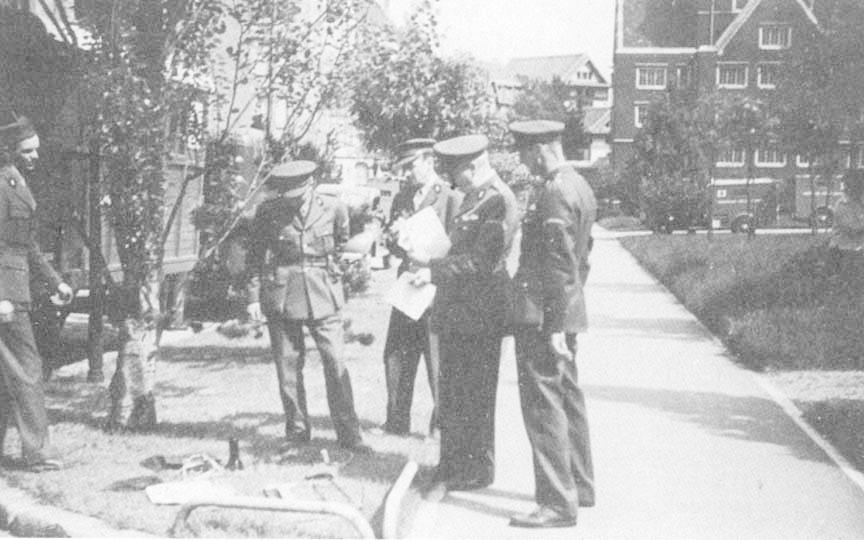
Paris, May. 1940. Equipment for AFS ambulances is checked before going to the front.
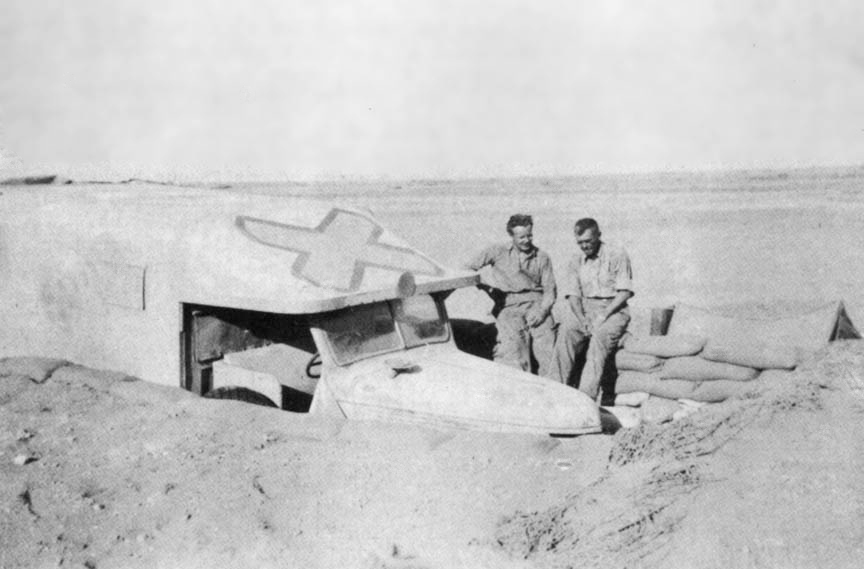
Bir Hacheim, May. 1942. The AFS ambulance is nosed into a sand bag trench for protection against air raids. Photo by Mrs. LeClair Smith
July and August, 1943.
"I carried a wounded man the other day that had been shot by his friends who didn't recognize him. Another one also came in who had been shot up by bandits. He had a slash in his foot, dirty, too. It took him 14 hours to get to us, and he had to go 40 more miles to get to a surgeon. He couldn't get transportation sooner. Sort of tough on him.
"I have just returned from visiting a native family where I have my laundry done. I go to see them every little while for although you don't appreciate it at home, it is very nice to sit in a house where everything is quiet. The family consists of Mama, Papa, Charlian 21, George 18, Josephean 14, and a boy of 12. They do laundry, and also farm a small piece of land. I usually go to see them before dark, just about the tine Josephean is driving their four cows into the yard. Their house has only one room and two windows. Birds have built a nest inside the house up in the rafters. The old lady usually gives us coffee when we come."
June 18, 1943.
"Women here take a definite back seat, of which I heartily approve, and don't seem any the worse for it. In the towns many have adopted European dress but 95% of them wear the traditional black veil covering the whole head. Peasant women dress in smock-like things with long trousers underneath. They work in the fields and occasionally I pass groups of them mending holes in the road or clearing drainage ditches. How Moslems ever get married is a question that puzzles me, especially because it seems almost impossible ever to meet a girl. When encountered on the street, it is a terrible faux pas to pay more attention to them than you would to a strange man.
"Formally and ritualistically speaking, the Moslems are so much in advance of us --- the Catholics, the Episcopalians. Slightly less (the others a little less still) believe in 4 separate, primitive, anthropomorphic deities, around which there are a great deal of mystical superstitions. The Moslems believe in one God only. He is a spirit, and very holy, therefore cannot and may not be represented by any picture or even symbol. That would be idolatry. They believe that the will of God has been expressed by several entirely human men. The greatest is Mohammed, the next is Jesus of Nazareth; and others are John the Baptist, Abraham, Isaac, Aaron, Moses, Jonah, Noah and a few others. These figures they revere but do not worship. There is no priesthood. Friday is their Sunday when they are supposed to go to the mosques for the usual prayers and also public reading from the Koran."
August 21, 1943.
"Tomorrow being July fourth, we have been invited by an American woman to a celebration at her home in town. She is a sort of missionary school teacher, born in Europe but a naturalized American and runs an American School for Girls here in town. She's very nice and is a sort of Godmother to all AFS men who are stationed here. She has had us and other AFS men at the school for teas, suppers, entertainments, etc., and on one occasion took three of us to a native wedding some distance in the country, myself included."
July 1, 1943.
"Once I had the opportunity to take the French Doctor out to one of the Bedouin tribes. We took along a guide and two guards (the latter proved unnecessary). The camp was way back in the mountains and not the slightest sign of a road. My poor ambulance went over places that day which I mould have believed impossible. It was the daughter of the sheik who was sick. She had a bad case of T.B. of the bone and was really a mess. The Doc gave her a couple of sulpha pills and an inoculation of distilled water to pacify her. He could not spare anything else. After the work we went under the tent for the coffee ritual, which takes about an hour. Rugs are spread out and cushions banked against a camel saddle. The Doc sat on one side and I sat on the other. When we left they gave the Doc a baby lamb in gratitude."
April 29, 1943.
"M. and I have just finished our mechanics course and took our final exam last night. Today we are to begin a ten day gas course. We really are waiting for fourteen English Sisters to show up with whom we are supposed to be taking a special training schedule with the medical end emphasized. The hours for this school are much better. They are from eight to one and four-thirty to seven."
June 7, 1943.
"Just recently we returned from maneuvers on which I was in charge of all mechanics, I really wasn't adequately prepared for the work but I did benefit immensely from it. I drove my 15 cwt ------- at the end of the convoy to care for all breakdowns. Although I was busy from dawn to dusk I had a wonderful time.
"Do you remember Dahl's section in the Boston Herald where he drew a cartoon about people in the U.S.A. receiving food they lacked from men serving in Africa? Well E. started this and many other newspaper articles when he sent home coffee from Cairo. The coffee reached the states but the rationing board would not give it up until his parents presented a coupon. They were not sure that the coffee hadn't become stale and the matter ended by the board issuing a special coupon".
June 15, 1943.
"The other day the staff sergeant called me the happiest bloke in the A.F.S. and it would take a hell of a lot to-make me argue the issue. We are almost through reconditioning our second ambulance so I am more sure of what the Dodge is like."
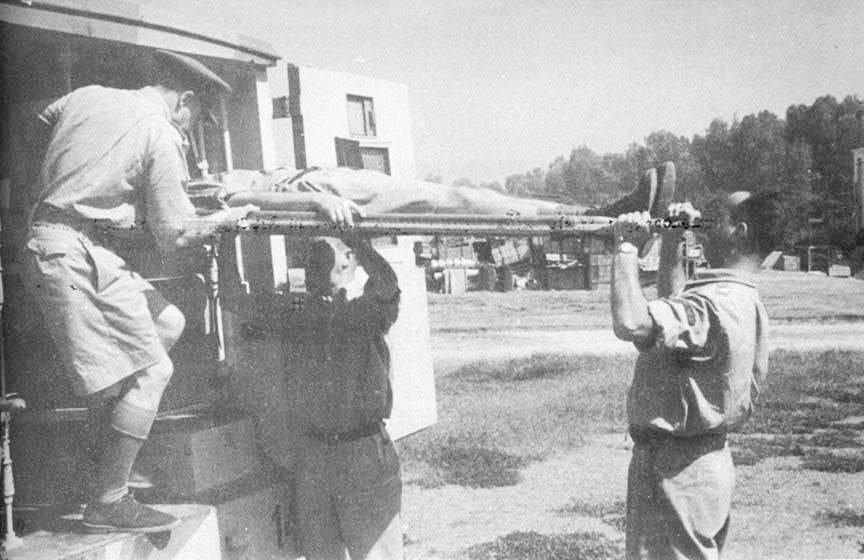
AFS men with Hadfield-Spears unit, 1941, practice loading patients. Photo by Lewis Stuyvesant
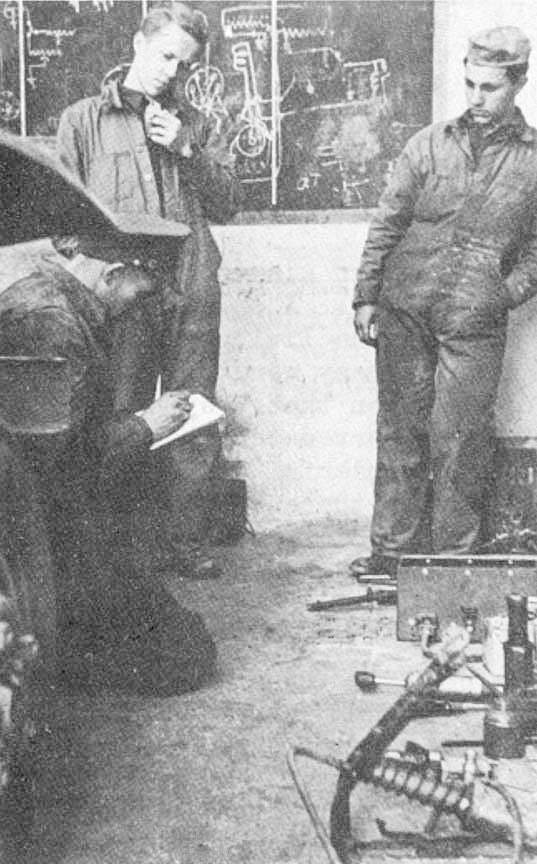 After a session in maintenance, tools used by AFS men are checked by a British mechanic. Photo by Jock Cobb |
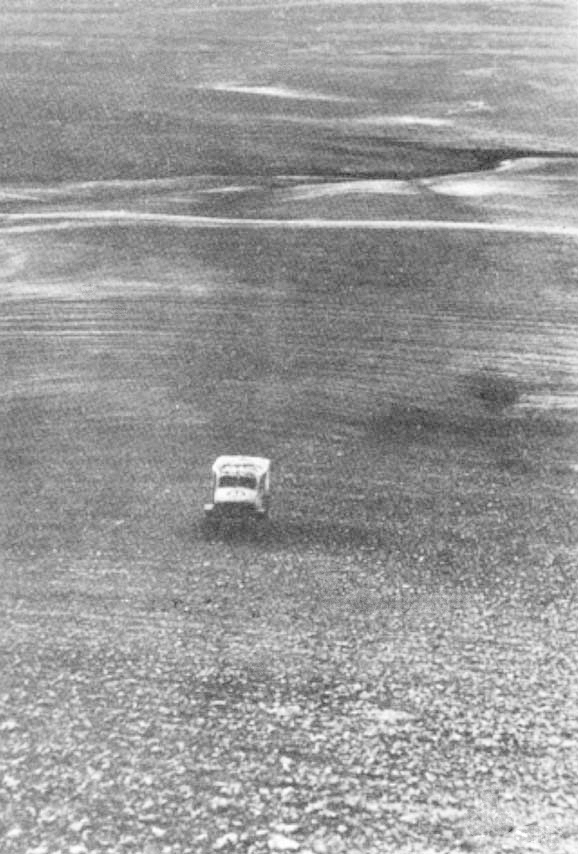 AFS ambulance crossing Syrian desert. Photo by Jock Cobb |
No date.
"My mate bought a flute when he was in town the other day and to-night we were having great sport trying to play the darn thing (it's not really worth a damn). After a half hour of arduous effort --all this takes place in a lonely tent amidst decaying fern, the floor is of plain soil, and as the wind wafts gently through the open sides of the tents small whirlpools of dust rise, curtsy nearly and are gone; there are five men in the tent, --- a Welshman, two Englishmen, and two Americans. The Americans are seated upon what might be called a bed -- it is in reality two wooden horses with six sturdy strips from the local tree for springs, and a blanket spread over them to give the aspect of a comfortable sitting room sofa. As I started to say, the two Yanks had toiled for half an hour and had finally emerged with a passable scale --one of them went so for as to play the opening strains of 'Old Black Joe'.. He had just finished this effort with a light trill and a final note of a somewhat squeaky nature and his friend was now starting on the scale, when a stranger walked in, announced that he could play the flute and proceeded to do so. Bach, Beethoven and all the famous masters were soon lending their talent to the already vibrant air-gasps of admiration which were heard as the stranger's fingers --- hardened slightly by the work he had been doing --flitted lightly over the holes.....' I used to play quite a bit back in Czechoslovakia. Loch Lomond, Hungarian dances, classic tunes came from the little instrument in his hand. Yes, he had escaped from Czechoslovakia with his mother several years ago and he was now in the army and happy enough. 'Have you ever heard of ----- ? My father came from there.' 'Yes'. --- Idle chatter passed the time but the stranger got up and left soon. 'If you want any help in learning to play, I am in that tent on the corner. So long'. 'So long'. "Gee, it's amazing how that fellow made music come out of this thing.' 'Yes, at least we know now that it can be played.'
June 18, 1943.
"One of the highlights of the trip was my leave in Alexandria. We stayed at the Red Cross Club and it is really something. I shall never make disparaging remarks about the Red Cross again. The living part didn't cost us a thing and we could get three meals with as many servings as we wanted for a dollar a day. We stayed in an old mansion that they have taken over and they had a snack bar in the basement which served real honest to God hamburgers and catsup. What with that place and a wonderful tea shop that we found, we damn near killed ourselves eating. Movies there were very new so we saw one every night. Oh, what a wonderful time we had. Now all that is over. We are living in our ambulance which, by the way, is my second one."
No date.
"I was very proud to join the American Army as a private and if possible work my way up to a commission. In fact that is one thing I learned on the desert, if you are a poor officer you cause deaths and if you are a good officer you save lives! I want to be a good officer or none at all."
June 1, 1943.
"I finished my training about the middle of April and was assigned to an R.A.F. Fighter Squadrons. Our work there was mostly as the drome ambulance drivers, and evacuating sick and wounded to the nearest C.C.S (Casualty Clearing Station).
"We saw some damn good dog fights in which the Limeys always came out on top. One we saw at night was actually spectacular. The bombs on one of the Italian bombers were exploded by the slugs from our Hurricane guns. The thing exploded in mid-air and lit up the whole sky like a torch. It was beautiful until you realized that the poor guys in the plane were being blown into a million pieces. The flight sergeant who shot it down ate in our mess, and came back just as though he had just returned from a joy ride.
"After about a month I was recalled and assigned to an Indian Field Ambulance Unit, with which I am still serving. I am very proud to be associated with the Indians. They are faithful and deadly fighters, especially the Ghurkas. They are the fighters of India, and are armed with a knife about a foot long. It is slightly curved and a deadly weapon. The English Sergeant tells an interesting story about the campaign on the Northwest Frontier. The colonel in charge of the brigade called about two hundred Ghurkas around him and said these very words: 'The King-Emperor wants that hill. Get it!' One hour later there were two thousand dead Fuzzy Wuzzies on that hill. The Ghurkas do not take prisoners. They have a funny superstition about their knives. If you ask them to show you their knives they will, but will not put it back in it's sheath until they first draw blood with it. If there is a dog or cat around they will kill it. If not they will cut their own arm. That is absolutely true--Believe it or Not !"
June 19, 1943.
"There were quite a few American Naval men in--------------and, of course, that meant good old American cigarettes. We also met a foreign correspondent from the New York Times, who is a swell guy. He was on a vacation from Chungking, China. He had covered the Flying Tigers, and some of the stories he told us were very interesting. He received his degree from Northwestern and, of course, we talked about school for hours."
June 27. 1943.
"One other item of great interest was our opportunity of seeing the King, while on his recent visit to North Africa. As a matter of fact, we were one of the outfits in the review for him here in town. He and 'Monty' headed a large group of notables that rode by, as we echoed the three cheers that resounded down the endless line of troops. He appeared much as in all his pictures, looking extremely fit and tan, in the uniform of a Field Marshal, and had the sleeves of his bush shirt rolled up to the elbows in true Eighth Army style. Aside from the fact that we spent over four hours in the blazing sun during the reviews it was very interesting.
"Later in the day I wangled my way into a very choice box seat, without any ticket, to see B. Lille, Vivian Leigh, Leslie Hanson and others in a very amusing revue for the troops. As this was the first really decent stage entertainment the Eighth Army has had in the three years it's been out here, the show was royally received and deservedly so."
No date.
"The club here is composed of three different buildings; the officer's which is near the waterfront (I haven't seen it yet) and two buildings for the men. I'm in the main one of the two, which seem to have been tremendous and luxurious private homes before the war. A large hall, with a desk in the center, greets you as you enter, with rooms leading off on all sides. These rooms on the first floor are reading, writing, ping-pong, and what have you. A lovely winding staircase leads you up to a large second floor hall, with an immense number of bedrooms branching off everywhere, with the biggest connecting bathrooms I've ever seen. Five of us in each of these rooms, which have very, very high ceilings and large windows. I haven't been up as far as the third floor yet. The other house, more or less classified as the annex, seems not quite as new, but just as spacious and comfortable, with a snack bar in the basement. We have the main dining room downstairs here, which has a clean marble floor, innumerable tables and black boys.
"All this sounds very expensive, which it well must be, but not to me. There is absolutely no charge for anything except the food, which you are not obligated to buy. Breakfast is $.25, lunch and dinner, $.40 each --- one buck a day for the best food I've had since Durban. Everything cooked American style, marvelous coffee, and as much of everything as you can eat! Just the word 'hamburger' was enough to insure the popularity of the Snack Bar with all of us,--- none of those since the States."
June 4, 1943.
"We got a day's leave to drive to Tunis and it was an interesting trip. We got into the town at nightfall and as they have a fearsome blackouts we couldn't see a thing--- no accommodations to be had, so we spent the night in the city park by the curbing. A friendly French sergeant appeared and offered us wine. Next morning we arose to see passers-by staring at us in a surprised fashion. Tunis is a big, quite Frenchy city and was simply packed with troops of every description. Meals were almost unobtainable and it was very hot. So we left --- to go and look at Carthage a few miles on. The sea is beautiful out here and the surrounding country and the Bay reminded me of Naples. Lots of nice little Villas and gardens. The oleanders are magnificent all through this country now and make the towns lovely. This town we are in now has one of the Main Streets lined with many trees and all in bloom. Against the white houses and blue sky, they are beautiful. We are parked out of town about five miles and run a truck in several times a day. I enjoy going in, though there is little to do."
July 16, 1943.
"Until about a week ago we were having such hot weather that all one wanted to do was stay at the beach. The thermometer registered 142 one day and I never knew such dry searing heat. It even killed off the flies which are with us in great numbers. If you left water in the sun, it got hot enough to shave with, almost; too hot to put your hand in."
June 24, 1943.
"First of all, the last definite place where you knew I was, was Syria. At that time we were under British censorship which allow us to place ourselves in a country. We very shortly afterward came under American ... just at the time I moved to the desert... which does not allow you to identify your location at all. I took on the job of evacuating old cars back to Cairo and bringing back new ones (reconditioned). The company was then at Marble Arch which is the border between Tripolitania and Cyranicae...and the most desolate place in the desert. To make a long story short, I came back from one of those trips and found the company had moved up to the line in Tunisia, to the South of the Mareth Line. I got back to the company just in time to see the end of Rommel's march, 5th abortive push, but, as far as I was concerned, no great action. March 19, I was given an R.A.P. (front line medical post) with a famous English regiment. I went into the post that night which was in a Wadi just under the guns of the Mareth Line and proceeded to bed down. The following night the offensive started to crack the line. We were under heavy artillery fire, mortar fire, strafing and bombing for the next fifty-two hours during which period I stayed underground, scared to death, in a trench only coming out when I had to evacuate a patient. The strafing, took place at night and I had the lovely misfortune to be in a Wadi the German planes came down to, going and coming back from their bombing raids. Anyhow, I didn't get hit. It was there I was carrying on a conversation with the British doctor about Wally Simpson in my ambulance when it was interrupted six different times by planes swooping down and machine gunning us. The doctor didn't say a thing until the last time and I was trying to keep him from seeing how scared I was. The sixth time, after diving in the dust, he got up, brushed himself off, said, I really take an extremely dim view of this strafing of ambulances, and don't you really think Wally Simpson was a bit of a tramp?' After fifty-two hours of that hole I got a signal to report back to our company headquarters at once, which I did and got there just in time to start out in convoy on the famous flanking attack that went around and behind the Mareth Line forcing the withdrawal. That was a miserable drive but decidedly an anticlimax after what I had just been through and I did no more front line work except for a few hours at a time. Again I did routine work until the forcing of Gabes gap when I received word the application I had made to go with our French unit had been accepted at last.....so two hours after Wadi Akarit had been forced I left the English unit and went back to the French unit which was still in the desert... getting with them in time to come up with them in convoy to the last stages of the campaign. I am staying with them."
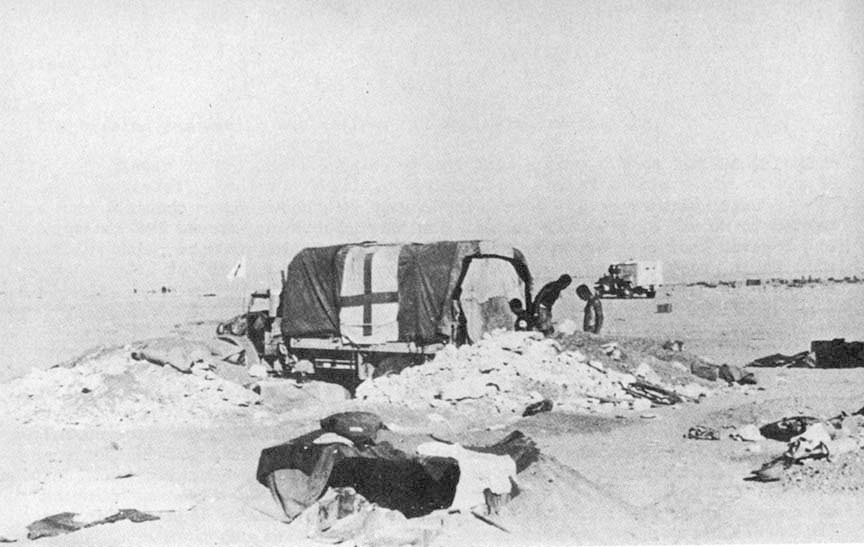
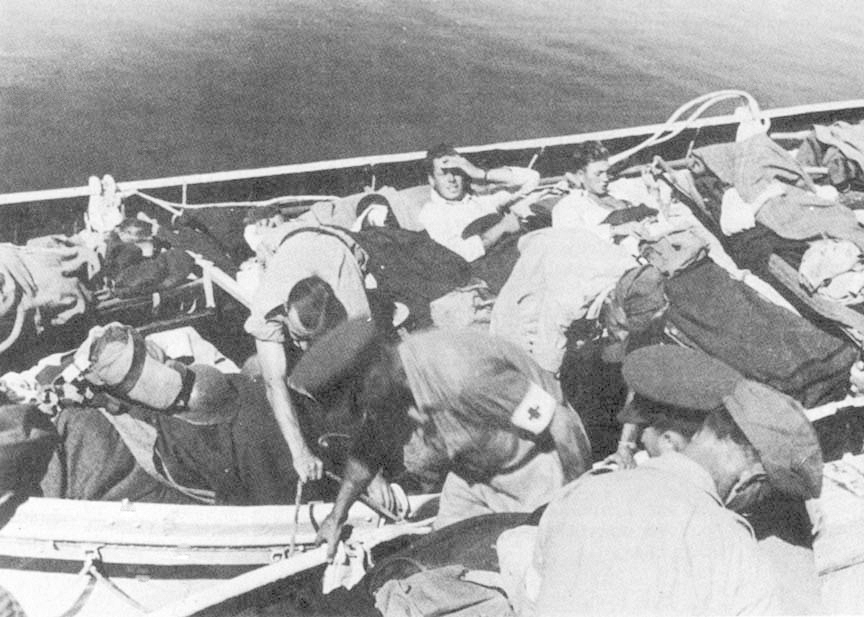
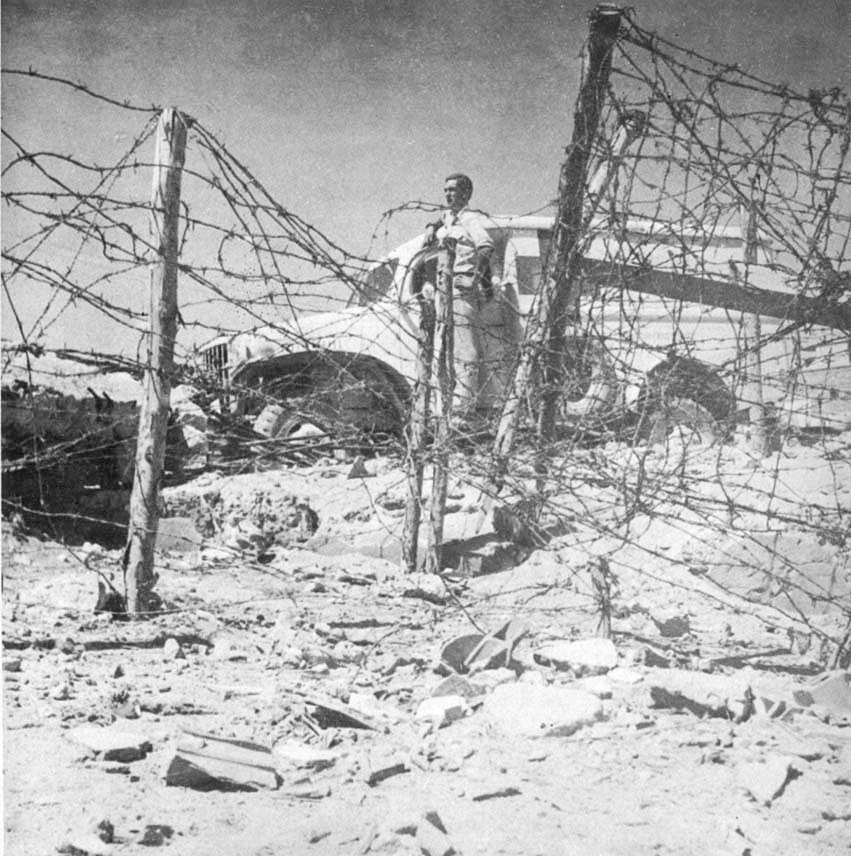
R.A.P. at the front, with an AFS ambulance in the distance. Western Desert. Wounded men, evacuated from Sicily, awaiting removal in AFS ambulances to a base hospital. Photo by William Emslie
July 10, 1943.
"Safe and sound in India with rain the general theme...just at the present I am having a great time in tho cook-house with 2 cooks, 3 washers and one sweeper --- J. is the quartermaster and he is on the run all day ---this morning I had to wake him up as there were no cooks and I was trying to get the fires going, the oat-meal stirred, the bacon can opened and the bacon fried, the tea made and the broad toasted. I laid the law down to the cooks etc., when they slouched in at 07:00 hours.
"The quarters are very nice --- huge ceilings, fans, cots, lounge and writing table --- Last night I had to put on a blanket in our wind tunnel.
"A white woman is a rare sight...although a few English girls canter by Sundays and we all sit with our eyes popping out of our heads... the few smooth operators, to my knowledge, haven't been doing any too well, or else they aren't playing fair with their chums."
"I suppose the best way to give you a picture of what has been happening to me is to describe some of the people who are in my unit. My section leader photographed Powers models for eight years. During the last two years he has raised goats for a living. He is a thin, angular man and his sensitive profile is topped by a great shock of prematurely gray hair.
"Another interesting person is a Jewish man about forty years old. He was interned in a Japanese concentration camp for six months. He has traveled all over the world and he often gives us useful information about such varied subjects as what Jap soldiers are like or where to go when in Berlin, Paris, Shanghai, Singapore or Tokyo. He came back from Hong Kong, where he was interned, on the Drottingholm with a lot of diplomatic prisoners.
"Among our members are former actors, stock brokers, soldiers of fortune, men with marital problems, college boys, social butterflies, heirs to large fortunes, and 4F's. But almost all of them have one thing in common, and that is their idealistic point of view.
"I am now stationed at a British Transit Camp. The trip was just a succession of warm, lazy days with almost nothing to do except eat and sleep. Two days ago we were invited by a British major to move into officers quarters (a little more spacious then W.O.'s barracks) eat in the officers' mess, a building resembling a decent country club, except for the tin roof, with a beautiful bar, easy chairs, dozens of servants, five course breakfasts, etc. Naturally enough we were pleased with the change. We can now take hot showers or baths and shave in hot water. All privileges which are extended to us are purely honorary and we are trying to make our conduct deserving of such fine treatment.
Every day we are allowed to go into town at two pm. and so far I have seen quite a bit of the surrounding country and met several nice people. I bet ton shillings at the races one day, and as might be expected I lost it. Food rationing hasn't hit here yet, and their biggest problem seems to be glassware, crockery and petrol. There is an awful lot more I would like to tell you but because of censorship I can't.
"I met a very nice New Zealand pilot. He was in the Battle of Britain for nine months and he has seen an awful lot of action in North Africa. An AFS boy in North Africa gave him a German Iron Cross-First Class, that he had found. The odds against this New Zealander's being alive are terrific. He is a very handsome boy and has been away from home for three and a half years. Out of the original group he trained with --- numbering 63 --- there is only one other boy alive beside himself. You would think that he would be bitter and calloused by this time, but he isn't at all."
July 4, 1943.
"We arrived at Headquarters yesterday. We are at a hill station and living in a hospital. Our quarters are nice and there is a village very near with movies and some stores. I can not says directly or indirectly, where I am. It is 'just somewhere in India'. Have just finished lunch. We had a reasonable facsimile of a Welsh Rarebit, (I think) but it tasted awfully good.
"There are a few A.F.S. men down from the Middle East, who are our Officers. They are all swell fellows from what I have seen of them."
July 8, 1943.
"We get lots of fresh fruit --bananas --- oranges that don't have much taste. As you see I have underscored bananas --- we get them for about a penny apiece. I am to look like one if I keep on eating them the way I have, but they taste awfully good."
July 10, 1943.
"I have made friends with a little dog. Am going to give him a bath tomorrow and then I will see just what color he is. He is awfully cute, but very skinny."
En route.
"Well here we are, back on the ship again and getting very close to our destination. We had a very enjoyable stay at the city of ------We stayed at an Imperial Forces Transhipment Camp about 8 miles out of the city. Our first week we ate in the Warrant Officers and Sergeants' mess. There we had five or six courses at every meal---wonderful food and good service. We certainly lived an easy life, loafing around in the morning, listening to a few lectures on India, getting leave at 2 every afternoon to go into the city.
"One of the things to see down there is a great valley, which is filled with beautiful scenery; long, high, sloping hills and rugged canyons --- the land was supposed to have once been under water. The natives live there in a very primitive state, in grass, mud huts. The next Sunday morning we started out by train. At the town where we were supposed to change trains we found out that we had just missed the only connection. We were standing on the platform wondering what to do, when along came a couple of girls about our age with their mother and younger sister, all in bathing suits and carrying a big lunch basket. We asked them about getting to the valley and then they invited us to the beach with them. (the people here are very friendly). We dashed into the station to get tickets and just managed to get on the last car as the train pulled out. It was packed with people going to the beaches, and somewhere on it our new found friends. There are beaches all the way along the south coast --- beautiful beaches with big surf, a few small European hotels and lots of homes. Since we didn't know to which beach they were going, we had to hop off at each stop and look for them. At one of these stops we finally bumped into them, but, much to our surprise, they had decided that we were not coming after all and had picked up a couple of RAF boys on the train!
"On the day before embarking we finally got to the valley with all the hills. It was a warm sunny day and the ride out was very pleasant. We passed through pretty little towns, lush countryside of very green tropical trees and shrubs, bright vari-colored flowers, flaming poinsettias and rolling hills. The scenery was very interesting and constantly changing. The hills became steeper at the edge of the valley; the view was breath-taking and we could see on endless expanse of hills, some long and sweeping, others more abrupt. The vegetation was not profuse, but there were some tropical trees and shrubs, varieties of cactus, some as big as good-sized trees. Scattered about on the hillside, were native huts in groups of two and three. Often there was a wide ring of trees about them, to hold the soil and give protection.
"We followed a rough dirt road which dropped down at most amazing angles. The chief of that section was not at home so we were invited into the hut of one of his wives, --- he had a number of them and each had a hut in which she lived with all her children. It was round and low, made of mud, 7 or 8 yards in diameter and had a tightly-thatched grass roof. Inside there were a number of baskets, earthenware dishes, a small crude stove of stones, and some meaningless figures painted on the wall. Two of the chief's wives were there, one of them visiting the other, both wearing only a bright-colored loin cloth and a few strings of beads about their necks. A number of children were running around and three of the chief's ministers of state sat on the floor against the wall drinking a mild native beer. They live a very simple life, sitting around, talking, laughing, and sipping their mild liquor from big earthenware jugs. They are childlike and friendly; and healthy, too, because if anyone gets sick, the witch doctor does away with him.
"Beside the huts was a very primitive corral, about 20 yards in diameter, made of shrubs, branches, and stumps. Inside a dozen scrawny cows stood around in the mud and manure. Some hens and baby chicks picked around the yard and inside the huts.
"I bought some beads from a native girl, but they still smell so terribly I don't know what to do with them. On the way back we came upon a most picturesque scene. We were crawling along a narrow little road, winding along the side of a very steep hill with a steep drop to the valley below, when, at the crest of the road, there suddenly appeared two native girls, colorful skirts thrown about them and many kinds of colored beads about their necks, big earrings, long black hair done up, and large bracelets on their heads. Outlined against the bright blue sky they made quite a sight.
"One Sunday a couple of fellows went to a Quaker meeting, and there they met a German refugee who was the head of a native college back in the hills. Since the next day was a holiday, Empire Day, we started out in tho morning to visit the school. We took a train about eight miles down the coast, then walked eight rolling hills covered with grazing pasture, sugar cane field, pineapple fields, and woods of many kinds of tropical trees.
"The school was set up on a hill, hidden by the trees. There are a few small buildings, 20 boys in the school and about 80 girls, the grades ranging from high school to two years after high school. Because of their background they are not capable of understanding some of the more advanced subjects --- especially psychology . They are very different from the Indian in that respect, according to this German doctor.
"The most interesting part of the visit was when we got to talking about Germany. This fellow was a psychologist in a boys' reformatory in Germany until 1933, when he was practically forced to leave because he is a Quaker. Hitler had a sort of hypnotic hold on the women and youth, he said. Most of the youth, according to him were ready to do whatever Hitler asked of them. He also believed, I heard from a British Sergeant --- quite an intelligent fellow --- that the majority of the Germans, especially the Prussians have a militaristic background that had to be cleared away. He thought that a complete military defeat for them would help. When the lost war ended, the German military didn't believe that it had been beaten by the enemy but from within. Hitler kept playing this up, and the Germans would have to learn a lesson this time which they missed in the last war. He was a doctor in the German medical corps in the World War I --- said they were sick of the war the first year, but the German people never really tasted it --- only through starvation in some parts of the population, but that is only one phase of war. Because of these bombings, the Germans are getting a taste of what they loose on about every country in Europe. As to after the war, he thought that Germany should be broken up into a loose federation of separate States, but he didn't make himself too clear about that.
"The thing that made the greatest impression in my mind was his talking about the burning of books in the streets. I don't know how well the impression which I received compared with the truth about the matter, but at the time it seemed to me that a large part of the people in Germany had gone to the farthest extreme of confusion and cynicism in that are between the wars when those attitudes dominated the thought of the world. The burning of the books in the streets may have been done by fanatical Nazis or it may have been done by people who should have known better. But, from the way he spoke it was an indication of the mental attitude of enough people to pave the way for Hitler, and the war. Many men couldn't have taken the advantage, but Hitler was a clever opportunist. Of course, there were other factors bringing about his rise, but this was an extremely vital one. The common man on both sides has got to learn plenty from this war, because for every weakness he has, there is a Hitler, Mussolini, a greedy capitalist, or an old hidebound Tory imperialist to take advantage of it."
July 6, 1943.
"At last we're getting down to business. There are a number of officers here from the Middle East. They got things ready for us and took over the unit when we arrived. We're now all having personal interviews with them. This morning we went on an 8 mile route march. The unit received instruction in British army drill on the way over on the boat -- it is quite exaggerated but very snappy. We also had classes in 1st Aid and a couple in Hindustani. Tomorrow, we really begin our training. Two fellows in the unit were picked to go to an auto-mechanics school in another part of India. Six others of us, including me, are going to become apprentices in British workshops for our training. The first two will get very advanced training and will probably be instructors for new units coming out. The rest of us, trained in workshops, will pass on what we've learned to the others.
"Our Commanding Officer talked to us yesterday. Some of the officers visited the front before we arrived and from what he told us about it, I don't know how they can ever fight a war up there."
No date.
"We are now stationed at one of the many hill stations which seem to be scattered all over the country. The trip up by rail was lovely. Huge green hills rose on either side of us and since it is the monsoon season there were many waterfalls. The buildings we live in are large and airy. We sleep under mosquito nets but as the nights are cool they don't hinder our comfort. There is a modern road within a stone's throw of our quarters and every kind of vehicle in existence passes over it at one time or another. Early in the morning I sometimes see an elaborate carriage pulled by two magnificent horses. Up on the front seat sit two beautifully dressed native footmen. They look very natty in their brightly colored silks and directly in back of them sits some wealthy potentate and his wife. Sacred cattle make life pretty difficult for anyone who wishes to drive. Water buffalo pass by from time to time in small herds. The bicycle traffic is terrific; I rent one for 5 rupees a week, about a dollar and a half. The little go-carts drawn by undersized horses clutter up the road. The sacred cow gives off on odor which is anything but sacred. Small goats run in and out of the yards and lean, flea-bitten dogs follow lean, flea-bitten masters.
"Although there is a tawdry side to life out here, there is also a very romantic one. I walked through the botanical garden the other night. It is full of immense trees, whose branches bend earthward and form a canopy. I was walking down one path when I heard the sounds of native music from a tiny tea house. Suddenly I heard someone singing 'Robins and Roses' ---it was coming from a gramophone!
"We have all sorts of people running around our barracks. First of all there are the wet sweepers, who are just what their name implies. Next come the dry sweepers, who won't do anything the wet sweepers do; then we have washers, who are another step up and lastly come the cooks, Some of the boys have hired bearers, who shine your shoes, make your bed, tend to your mosquito netting, give your laundry to the dobhi (laundry) man, do your shopping, bring your tea in the morning, shave you in bed, etc.
"One thing that my association with the British has convinced me of, is that their uniforms all look better and are one hundred percent more practical then the American uniforms. The British have a knack for making their troops look colorful. About five minutes ago an Indian corporal marched up the road with twelve uniformed men following him. He brought then to a halt just outside of the Major's office and I just learned that these men will be permanently attached to us. They are all kinds of servants from dry sweepers on up.
"Around twilight I occasionally see an English girl go cantering by on a beautiful horse. There are more beautiful horses around here then you can shake a stick at...The sun just came out for the first time in three days. Hooray! I thought Bromfield's book 'When the Rains Came', was just a lot of nonsense until I got here. It is just as Alexander Korda pictures it, only it is more colorful, more sordid, and you can smell it.
"We have a radio here and the reception is pretty good. We get Chinese programs, B.B.C., America, 'Mail Call' with Spencer Tracy the other night was a thrill, so full of baloney that it isn't even funny,"
We have just received a report from headquarters in the Far East giving a list of the clothing issued the men. We print it below with the thought that it may assist you in the choice of items for you Christmas package.
2 pair shorts
1 pair long trousers
1 pullover-jersey
3 pair socks
1 pair hose tops (without bottoms and used with socks)
1 pair ankle boots
1 pair tennis shoes
1 duffle beg
1 blanket
1 pair puttees
1 kit with razor, blades, combo toothbrush, needles etc.
1 jacknife with can opener
knife, forks and spoon.
mosquito nets.
Here is a list of things they DO want:
Vitamin tablets
Calcium tablets
Long socks with wool to darn them.
chocolates
nail files
steel mirror
shaving cream
tooth powder & tooth paste
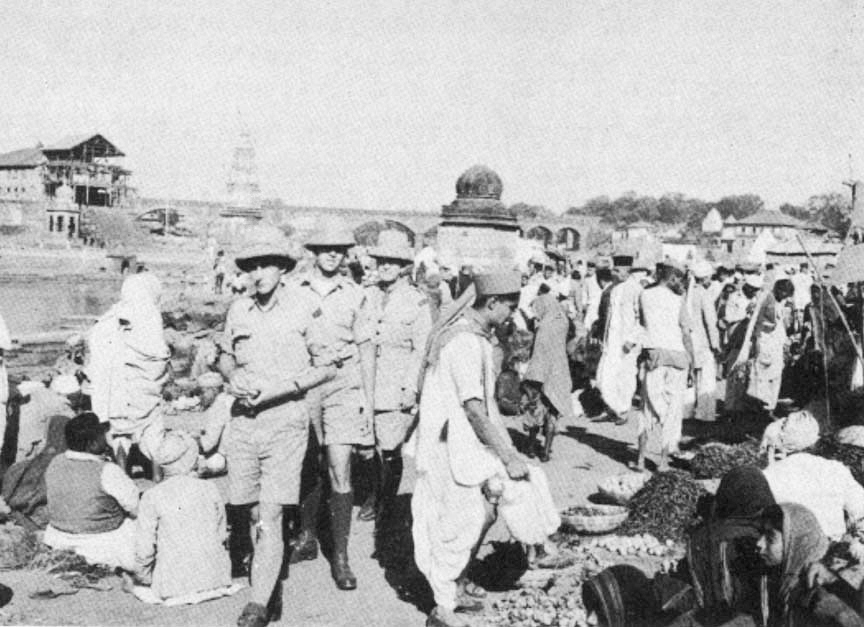
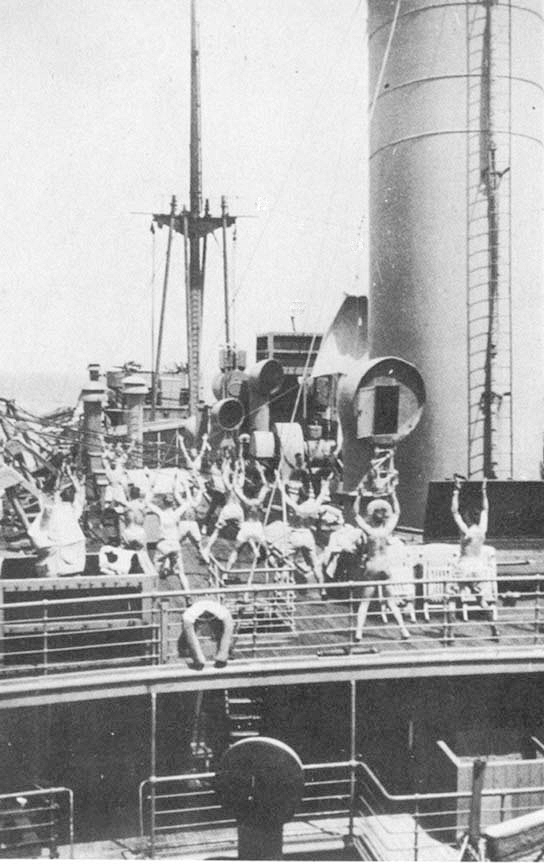
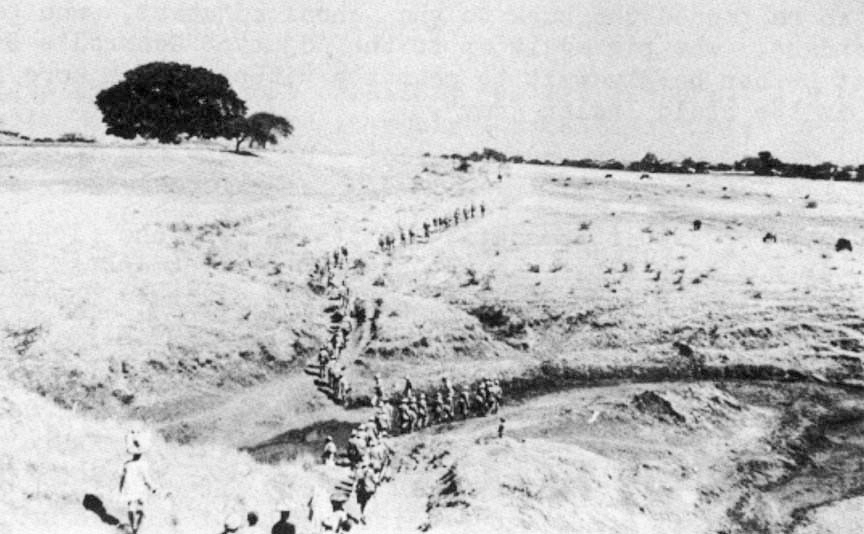
Three of the ambulance drivers use a day off to visit a bazaar in India. A group of AFS men set off on a conditioning march across the Indian plains.
AFS has just been given $15,000.00 donation by the U.S. Steel Corporation. The board of directors voted us this amount after seeing LETTER FROM LIBYA. We are extremely grateful, not only to U.S. Steel but again to Stuart Benson who did most of the photography and all the editing, and to Burgess Whiteside whose smooth voice does the narrating in the film.
AFS men have come home after their term of enlistment by almost every means imaginable. Three of the latest men to return had almost as much excitement on their return journeys as during their whole time overseas. Jim Stanton, Ed Jones, and Norman Sargent signed on Merchant Marine ships to work their way home. Norman's ship was laden with cargo destined to be landed in Sicily. When they went across to deliver it the ship was hit by a bomb and Norman landed in the Mediterranean. He was picked up and taken to a hospital in Tripoli, where after three days he was released and shipped on another vessel, which brought him directly home. Jim and Ed were on a ship on which they had signed in Alexandria, knowing nothing of its route except that the eventual destination was the U.S. They, too, found themselves part of the invasions, but were more fortunate as their ship made its landing without mishap and then continued calmly on its way home.
Alvin Wright, who left AFS to join the Indian Army, wrote from Officer Cadet School in India that he had received his AFS service ribbon and war and was delighted with it. Receiving the ribbon and wearing it are, it seems, widely different things. He says that on receipt of his AFS one he went, according to custom, to his Company Commander to ask his permission to wear it. This Alvin said is a formality and is gone through even when one has received the VC. The Commander, seeing that it was an American decoration, decided that all sorts of matters of precedence were involved, so he passed the buck to the School adjutant, who passed it on to the School Commandant, who passed it up to the Adjutant General's Branch GHQ, Delhi. Alvin writes that he can hardly wait to wear the ribbon, even more so after the "fuss it caused in the staid Indian Army".
John Dun, who received the Médaille Militaire from the Fighting French for his work at Alamein while in AFS, has received an appointment to a Captaincy in A.U.S. He is entered In the next class at School of Military Government and is hoping to serve in AMG "right in the heart of Germany". We wish him the best of luck and hope that he reaches his goal.
Even though you may have read MERCY IN HELL by Andy Geer and think you know all about the AFS first hand, don't miss AMBULANCE IN AFRICA by Evan Thomas. Published by D. Appleton Century, it will be out the end of September. It covers about the same ground geographically and in time, but the similarity ends there. His treatment is entirely different, as are his personal reactions. We heartily recommend it, not only as a documentary account of AFS growing pains in the Middle East, but as one of the most sincere and thoughtful war books to be written by a young American. Evan himself has done a good deal since returning from the Middle East; he wrote AMBULANCE IN AFRICA, had malaria, recovered, got a commission in the Navy and got married.
A check for $1914.00 was given Mr. Galatti recently by Vice President Alexander Phillips of the Great American Insurance companies. The money was raised at the suggestion of an employee that they contribute to the purchase of a war front ambulance. When the money was raised a vote was taken as to who should get the vehicle and AFS nosed out the Red Cross and the Army. We are very grateful indeed, and assure them their ambulance will be in the field at the earliest opportunity.
Miss Charlotte MacDonald, who for the last year has had charge of equipping outgoing AFS volunteers, has left. She has gone to California to be with her brother who is in Service. She will be very much missed at AFS HQ N.Y.; we wish her the best of luck. Miss Ada Brentano is now handling the equipment and uniform department.
AFS Romance Department has been blooming lately. A large contingent of volunteers returned home during the month and as soon as possible three of the erstwhile ambulanciers got married. Ed Koenig, Bert Payne, and George Goddard have now joined the ranks of married men. We wish them all great happiness and best of luck.
We now have available some excellent new AFS posters. Any of the readers who would like to distribute some in their communities please write to us and we will send as many as you want. The poster is an original design by Miss Virginia Gilmore of Urbana, Illinois. Miss Gilmore is a member of the art class at the University of Illinois which did the AFS LETTERS cover designs that we ran a few months ago. Several very good posters were submitted to us by the class. Miss Gilmore's was chosen as the first to be reproduced because of its pictorial value in telling of AFS, and also because it was done in fewer colors and was thus less expensive to have processed. We owe Miss Gilmore a sincere vote of thanks. Thanks also to the other members of the class who unselfishly did poster designs for us, particularly Miss Barbara Lentin, whose poster was voted an equal winner with Miss Gilmore's and which we hope to have produced in the near future. Our thanks especially to Professor C.V. Donahue who teaches the class; he is the AFS Urbana representative and a former ambulance driver during World War I.
We joined the General LeClerc French one evening in late April about 20 miles south of Enfidaville in Tunisia. We had come, 13 of us in 6 ambulances, from near Tobruk and were as green as the fluff on a new billiard table.
The next morning J.F. and I were sent out to get the U bolts "and any other valuables" from an ambulance that had been blown up on a mine about midnight. "It's near a destroyed bridge a few miles north of here" ---those were our instructions. J. and I had had our only previous taste of war when we saw "Sergeant York" back in Radio City. We set out about 9 a.m. and after driving thru field after field deployed with the tanks of the famed 7th Armored Division, "the desert rats", came to a ridge that was blown out. A bunch of Royal Engineers were completing a diversion around the damage and we stopped to find the ambulance. This turned out to be the wrong bridge and finally an officer told us that the only other bridge in the vicinity was some 5 miles further along. Before we left we asked about the dozens of round iron boxes lying around and a long lecture ensued on the nastiest feature of modern warfare, the mine. There was a very complete display here we were told. "Jerry ran short of mines for a while, but here he's left everything he has ---"must have had a new ship come in", a Tommy sergeant told us.
This was all very interesting but when we heard how the detector couldn't locate the new box mine, which is made out of wood, how the area around all blown up bridges is always heavily mined, and how anti-personnel mines are never laid in groups of less than nine, on hearing this, we developed a certain respect for mines--that is to say we never wanted to be within 8 1/2 miles of one again.
On driving along the road another 3 or 4 miles we came upon a British major with field glasses who was stationed in a great ditch beside the road. We asked about our bridge and he allowed that it was up the road a couple of miles alright and hadn't been shelled for some hours. I looked at J. and we both gulped. The major went on to say that the enemy relinquished the position a couple of days ago and that the whole area was under observation from those mountains. He seemed a little bored by the whole thing.
At this point I had the ill taste to ask him if it was sage to proceed on our U bolt mission. He allowed that he didn't know anything sage about war and then a voice said, "O.K., let's go". It was my voice. J. was a good bluffer, too, and finding his voice, thanked the good man for the interview and we stumbled into the car.
After driving gingerly for a couple of miles we saw the bridge a couple of hundred yards ahead and were relieved to find a Bren gun carrier neatly hidden behind a cactus hedge right beside the road. We had already decided unanimously that the U bolts could wait a few days --but before turning back saw fit to engage the gun crew in conversation. They turned out to be the foremost outpost of the allied troops in the area and were not overjoyed at our having given away their location to the enemy. They told us how they had come out here last night and had heard the ambulance come along the river bed. "We thought it was Jerry and were about to open fire when the mines did their job".
Then we told them about how we'd been sent out to got U bolts. One of them did more than offer to lead us thru the mine fields to the ambulance; he just said "O.K. follow me, chaps", and started toward the bridge. I couldn't move my feet but I did manage to mutter something about "there's no sense in your risking your neck, corporal."
That started him off on the "if your number's up" routine. All these guys that have been thru a lot of action have this phobia. Well, the corporal headed right down the bank to the river bed and J. and I followed in his footsteps, and I don't mean followed an inch from his footsteps, we followed in them. On reaching the car, whose front end was completely ruined, we climbed in to see about the tools and to try and calm down a little.
I found a funnel, a can opener and some stale chocolate and was about to suggest that we depart. I was stepping out of the blown off door when I saw the corporal suddenly fall on his stomach. Then there was a bang and cloud of smoke about 50 yards away. That was the first time in my life I'd seen anything but a firecracker go off. The corporal was cool but I guess he figured this number-up business only went so far because he said, "Just take it easy, lads---when you hear 'em whistle, fall flat, then run --- that's Jerry with his 88 millimeter."
Another whistle and J. and I fell out of the ambulances on our faces forgetting for the moment that we might hit an anti-personnel mine. We followed the corporal who was now pale but still giving instructions. Then the shells came in pairs --- and of course the whistle of the second one which landed a moment later couldn't be heard. Perhaps a dozen shells landed near us before we were out of the mine field. I was just plain petrified and was just wondering where I'd get hit.. Here at last was a use for the tin hats we'd carried for over 3,000 miles --- --but they were still tied to our front bumper as always.
When we got back to the carrier the sergeant was furious for now he could expect to be shelled all night. "Get your cups", he said, "and then you can bloody well get on the move." It was tea time and it takes a lot more then a war to keep the Tommy from having his tea---or being anything but polite. So we sat there and had tea and left 2 packs of cigarettes --- a great treat at the front --- and then lit out for home.
Just as we left an armored car filled with engineer officers arrived to survey the bridge which had to be fixed before the Eighth Army could reach Enfidaville. We learned the next day that one of the officers stepped on a mine and blew his leg off.
This was our first taste of war. It had taken us some 30 minutes to learn to hate it. Everyone does. It's always easy to look back on these little episodes and laugh---but it's not funny at the time---it's awful. What is a U bolt anyway?
Letter from a Prisoner of War.
July 3, 1943.
"Our day's routine was simple --- too simple. Up about 7:30; count parade at about 8:00; taking maybe 20 minutes; grub at 11; grub at 4:30; inside huts (140 men to a hut) at dark. A couple of times a week we spent a morning moving everything out of our hut (in 10 minutes) and waiting while a floor inspection (for tunnels) was made. The rest of the time was our own in which we could read or else, sports --- once a week --- same teams playing rugby. Two hours walk once a month. More guards than POW's. About those tunnels; I think 6 have started in camp 590. One was finished and about 20 men got out, all except one being rounded up in a day or so. The one, a Canadian and a Commando, was out about 3 weeks, saw some of the country, couldn't get out of it. Finally got picked up way up north and sent back. He got about 30 days in the klink, no really bad treatment. Many got out of camp, almost none out of Italy. Too many guards up north, too for to swim otherwise.
"At 59, our relations with the Wops here were at least consistent, if not good. They use the word 'domani' where Mexicans say 'mañana', and how they do use it. You can have anything you want 'domani', but try to get anything today. In 11 months I have never even gotten an answer to my continued requests to establish my status, in order to got a few benefits. The Italians here, as always, are meanest when they think you are laughing at them, which is frequent and a logical occurrence. They are a comic opera lot although it wasn't always so comical from our position.
"Things began to happen around here the turn of the year. It was to be made an American camp, British moved out, Yanks in, in spurts, until when I left in April, there were about 500 Americans here. These boys were middle westerners, southerners and dead-end kids, and it was amusing to me, so long under the subtle English influence to really see the character of America in such sharp outline as it then appeared. In the end, I found that, although they were sometimes a bit screwy, I was glad to be one of them. One of the 4 Free Frenchmen, living with 137 noisy Americans, said he liked it better because they had a zest for life, even under bad conditions, and always had a pretty good time. It was here that I heard the current No. 1 English-American joke, which goes as follows: An Englishmen and an American are walking around camp and the latter stops and looks up into a tree, saying, 'Look at the boid'. No. 2 says, 'That's not a boid, that's a bird'. No. 1 answers, 'Sure it's a boid, can't you hear it choipin?'
"Other odds and ends about camp 59 --- it was a prison camp (German) in the last war, stables in the interim. The commandant was a prisoner in the last war, and we consequently received better then average treatment. There are 14 occupied huts for 2000 men, and a church and concert hut, a barber shop, and stores hut, and smaller buildings for cook house and other shops and things. There is a brick wall averaging 10 ft. in height and glass encrusted on top and a barbed wire fence outside of this. The camp is set about 25 miles up in the foothills, above Porto St. Giorgio almost due east of Rome. We had a weekly newspaper which came around about every 2 or 3 weeks, well printed and edited by the Ities and full of baloney. We had the Itie newspaper every day, from which we got our news, and it was fairly well up to date but highly colored. One of our Camp Itie officers had recently spent several year's in San Francisco --- Nob Hill.
"It was April 3rd --- my birthday when 29 names were called out over the loud speaker, the 1st 27 being English medicals, the last 2 being mine and M's. We were called down to the office and told we were leaving in a few days --- for repatriation. We had no inking of where we were going and you can imagine how we felt. That was the day, let me tell you. I was carrying on my usual non-observance of holidays, but that was too much, I went back and ate all the Red Cross food on hand, smoked several extra cigarettes, tried not to be too overjoyed, outwardly, because of the boys to be left behind. I had always said I would never trust those treacherous wops, would never believe in repatriation until I touched British soil. But I'm afraid my head was soon in the clouds. We left here April 7th and went to Laterina, near Florence (PG82) from where the collected party was to go overland to Lisbon, thence to England. This was all right with me. Adding France, Spain, Portugal and England to my already long list sounded suitable. And I might see something of the British Isles. And most important, I would be a cinch to get home for a while before going back into something military. But there was a nigger in the wood pile and the overland business fell through. We sat around in this camp, week after weeks wondering if the whole thing hadn't fallen through, and finally, on May 17th, left for the south. We were 2 1/2 days on a hospital train, the only good ride I ever had in Italy and although we had drawn blinds and strict orders, I caught glimpses of Rome, Naples, Pompeii and Mt Vesuvius. We went to PG 75, Bari, a very good camp, and were only there a week, marching finally and with a tremendous but subdued elation down to the docks, to leave. You know how I don't get excited outwardly. Well, I almost burst in the effort this time. We boarded the hospital ship Gracida that night and sailed at dawn and we spent a week aboard her. We went past Albania, Greece and I think Rhode Island and we finally pulled into Smyrna harbor in Turkey right behind the English hospital ships carrying the Italians.
"On June 22nd we made the change over (4 1/2 to 1). and we sailed the next morning, eating, drinking and smoking our fool heads off, down to where I am now. We had Indian cooks in our Warrant Officers mess, and it was the berries. Curried rice and all. Wonderful. I found that 3 cans of American beer was about my limit, and although I consistently took 2 and ate very well and smoked what I wanted, I evidently did not overdo it, because I had no ill affects.
"Well, the next thing was the depression when we knew we were caught and when we were rounded up, from here to Italy, there was always this to keep the spirits up --- escape. Even so, there is no use denying that I felt very low that morning. A patient in my ambulance died during the night and left about 4 inches of Johnny Walker black label lying in a bottle beside him in the ambulance. S. and I had this for breakfast and felt considerably better. In the Jerry hospital, hard work and more definite escape talk, along with pleasant relations, made it easy and I frequently felt pretty good about whole thing. In the Merse Matruh POW pen, except for the air raids and shelling from the sea, life did begin to get dull. But we knew we would move soon and we always thought the tide would turn quickly and we'd be re-taken. I was about the same until after a couple of weeks in Benghazi and then boredom did set in for fair. We had no way of passing time except talking among ourselves, escape was very difficult and attempts were proving fatal in some instances. Hope of being re-taken dimmed. We were beginning to feel the effects of poor food and hard ground. On the whole, it was worse than either before or after. And here, at its worst you would have been surprised to see how well everybody took it. There was almost no moping around, there was determination to see it through. Jerry was pounding hell out of the El Alamein line but nobody really thought he'd break it, or that we might ever lose the war. Nerves were frayed, sometimes, and there were some disputes. But I never saw a fight or a serious argument, except among the Italians. We began to look forward to going to Italy, just to get away from Benghazi. And I was thinking about repatriation, which I still thought would be a quick and simple matter once I got to Italy. Once in Italy with more order about things and with much better food and Red Cross supplies things seemed better and everybody had some good moments. Also we began to resign ourselves, conditionally, and that made it easier. And then in 50 there were plenty of books and between them and talking and brewing tea, and cooking one thing and another, time passed well enough. A couple of boys went slightly daffy, but only for a few days. I was never bothered myself. I read plenty and enjoyed it. If you know me, you know I am gifted with an unusual ability to enjoy leisure. And that is what I did in Servigliano. Of course there were often moments of feeling very discouraged about the whole thing---no mail, no status--- but they were only moments and they were pinched off. And then, of course, repatriation came and from then on out it was all rosy except when impatience set in from time to time. I didn't get too excited about repatriation, since I thought it might fall through. But there was a definite difference. For a while I did not know what to do with myself. I could walk out a door and go either way and damned if I could make up my mind which way to go or why. That could be a bad thing and I took steps to remedy it. When I found myself undecided, I didn't try to figure the best course. I just took one or the other and to hell with which was better. And it seemed to have worked. I don't stand around in a stupor now any more than I ever did. I'm tired of the war, but who isn't? It's all very futile, but I work on the rehabilitation end of it which sets that off as far as I am concerned.
I was down near Sousse, In Tunisia, before the French moved, and was given a ten-day leave. A guy by the name of J----- in my unit also had leave. There was talk of going to Algiers, some 600 miles away, and there was an AFS truck going up there to take men on leave, it was pretty crowded, as far as we could make out the night before it left, and at 7 a.m. J--- woke me up and said "Do you wanna hitch to Algiers?" And then went back to sleep.
I woke him up and said "Yeah". Then I went back to sleep. (My, but that was a powerful wine they had in our camp!) We gradually got up, shaking off the hangover, and decided to bum our way alone. 60 to 70 miles to Tunis, no 100 miles to Tunis, then 600- odd to Algiers. So we stood in the road after lunch and started off to Tunis, tra-la. We rode with crazy Americans, crazy French, and crazy trucks, but we made Tunis by 5 p.m. I thought we'd better look up my girl-friend in Tunis --- a French artilleryman told me to give her a letter from him, so it was a swell excuse to meet her.
She turned out to be pretty as a picture, and had a charming mother who fed J. and me all the wine we could hold, gave us supper, and a couch for the night. I played the piano for a few hours, then helped Katherine with her college English assignment. She spoke rather good English, which saved the day, because I got pretty tired of struggling with French.
We pushed on the next morning, to try to make Constantine that night. We were fairly lucky in getting long rides, for the most part, but had to be ready to bum meals and a place to sleep. Each of us carried a small musette bag and one extra bag with a mess kit and some food in it. The food was only an emergency measure, and we acted as though we'd never seen food for a week and had none with us.
Well, by 2 p.m. we were let out of a car near a small town. I say "near". It was about 1 mile away --- the sun was hot, and all-and-all, it meant waiting till something came along. We were well into the foothills of the Atlas Mountains by then, and rather desperately hoped that something would happen.
Then came a jeep. Two officers, one trailer, and a big empty back seat. Yes, he was going down the lines. We rode over the Atlas Mountains, punching through convoys all the way, until 7 that night. The lieutenant would sway around a curve, find a truck coming, practically go off the edge to avoid it, and then I'd pick my heart out from between my teeth and let it go back to its normal place.
They were Air-Force men. They were going to their airfield. Well-well!! Coincidence? Do they have planes to Algiers? Yes? Mind if we come along?
Well, we got along to this place. It was way out in West Mudhole somewhere, only up in the mountains, no traffic to retrace our steps with. Boy! I said to myself that this better be good, or else...
I was frozen when we got there. Jerry and I broke the ice in our knees and fell out, got our stuff, and walked slowly to a Red Cross hut nearby. In this Air Force Camp, it was a front-line USO, so to speak. We asked the ARC man in charge whether there were planes to Algiers, he said yes. We asked about a meal and a bed. He said yes. He asked us did we want some doughnuts. We fainted.
But, by God, he had doughnuts. Nice, hot, munchy---good doughnuts, racks and racks of them, fresh out of the machine. I ate 5 before I realized I hadn't swallowed the first one. He watched us benignly, and then took us to see the captain about a bed. We got a bed --- in a tent reserved for officers above the rank of colonel! We had it to ourselves --- electric lights, wood floor, beds, everything.
We got up in the morning and had a real breakfast. We walked out to the Courrier Tent and said, "Uh, now --- er --- the plane to Algiers that leaves at 8 o'clock?"
"Sorry, sir, we don't have one today, but the captain left orders saying you could go to Constantine on the mail courrier car." So we rode about 100 miles on the courrier car to the airfield near Constantine. There was a plane leaving at 1 p.m. for Algiers. The time was 12:40 p.m. I walked brazenly into the tent and said, "You have a plane for Algiers leaving at 1 p.m. Can you give me two seats?"
The sergeant said, "Yes, sir. What is your name, weight, and baggage weight?"
We left at 1 P.M., flew the remaining 250 miles in 1:34 hrs., and were in Algiers in our hotel by 4 P.M. Smart work, on the whole.
The American Red Cross invited us into the staff mess for a whale of a good supper, and we then pushed on to a dance at the Officer's Red Cross Club. We got in free, and met many beautiful nurses, WAAC's, Air Corps girls, etc. A nurse from Boston and her 1st Lieut. boy friend invited me to have a short snort with them. It was a bottle of the rare Scotch in Algiers. Well, we were knocking off a drink here and there, and never noticed that the air raid was on until the ack-ack opened up. We took a look outside, but just then a bomb landed up the street a way, so we went back into the dance which had never been interrupted. The lights were off, but the dance was still going full-swing.
Jerry and I got lost in the blackout --- a really black one, too--- and it wasn't till about 1 A.M. we found the hotel.
The next morning was beautiful, and our window and balcony looked out over the whole harbor. It gives you a sense of well-being to look out over harbors on fine mornings, I find.
We messed around all day, got a new pair of shoes out of a British officer's shop on the strength of a requisition that read, "2/Lt. A. Y. D., U. S. Army" on it --- that was pure bureaucracy, and the major who made out the requisition put our ranks down as that --- and generally wasted the day. Well, about 5 P.M. Jerry and I dropped into a bar, but couldn't make up our minds what to drink. just then a British captain sitting next to me said to the bar-maid, "They'll each have a champagne with me."
We had a champagne. It got late, and we were wondering about supper. We hadn't reserved a table anywhere, as you must do if you want to eat supper in Algiers these days, and we told the captain that we'd better move along to find some food. He said not to be silly, that he would be delighted to have us for supper at his mess.
Well, we drove out to his mess; it turned out to-be the Officer's Mess of GHQ in Africa --- Allied Force Headquarters. We had a whiskey sour, then a great meal. We told him how we managed to get up to Algiers, and he said, with a twinkle in his eye, "Then here's another laurel to hang on your tree: Do you realize that this is where your General Eisenhower eats?" Bang! Just like that!
We finished supper and had a few more whiskey sours, and then caught the staff car going back to town. And in, too, just before we left, climbed a Royal Naval lieutenant, the Captain of a minesweeper in the harbor. He was an awfully friendly Scot, and invited us to have a drink with him. Couldn't pass that up, so we went aboard his minesweeper and he piled us with Scotch and beer ---the old boilermaker. His mate was there, and later on the Captain pulled out his harmonica and we all started singing Scotch songs. There was much good talk and much good drink, and by the time they poured us off the boat, J. and I were quite exhilarated, to say the least. The Captain was lucky; he could stay on the boat
J. and I got lost again in the blackout.
Nothing much happened till Monday, two days later. We went out to a General Hospital near Algiers to have tea with this U.S. Army Nurse I'd met at the dance. We had tea, and were all set to bum back into Algiers when I decided to go down to the Medical Inspection Room to see if they had anything to quiet down a case of gas cramps. They jammed a thermometer into my mouth, and about 3 minutes later they wanted to know my name, rank, outfits religion, age --- oh, oh! This is bad. They want to put me away here. I argue and argue, but they say "no" and throw me into the dysentery ward.
Then I got a surprise. It was a British hospital, but there was an American who took my data , (rank, age, etc.) because I was American. He asked my rank, and I said Warrant Officer. He yelled over to the orderly "Ward M-Y" and I went away. It wasn't as easy as that, because I had to explain what the Field Service was, and you know what that's like. But to him Warrant Officer was an Officer, not a top sergeant, as it would be to an Englishman. So I went into the officers' dysentery ward. Lieutenants, captains, majors, lieut. colonels --- Ye Gods ! There I was. I had to bluff my way for five days, but it was worth it. It was a hospital dysentery diet, but I was not kicked around the way I might have been in another ward.
I went in Monday, told I had dysentery. By Wednesday, I felt better. By Thursday I felt swell, and on Friday I convinced the MO, a lieut. colonel, that I was absolutely all right, and I wangled a discharge.
My leave was up on Sat. noon, only I was 700 miles away. I got out Friday noon, was offered a ride to Sousse in a staff car, but refused it because It wasn't going to leave till Monday. I knew the British wouldn't give me a plane ride back to Tunis, because I'd tried them before I went in to the hospital. The Americans wouldn't do anything for me because I had no reason to get a high priority. So I said to hell with the bunch of them, bummed out to the airport, got talking with a sergeant in the Courrier office, and found they had a plane to Tunis in the morning.
He was American, of course, --- it was a U.S. Air Field. So I asked around to see if a couple of Air Force friends of mine were around. I'd met them in Algiers and they said to come out and see theme They were there, and I asked them about the planes. Yes, they had one going to Tunis. Could they get me on? Sure thing. Well, they fixed me up with a meal, a bed, a movie before that, and breakfast in the morning.
Then I told them I wanted to get an American helmet, if possible. We were talking about it for a while, then the talk went to food. They get a lot of canned meat, a lot like spam, but they go crazy over bully-beef. I was lugging a tin of bully in my musette, and said, "Do you want a can of bully?" It was the International Buddy System again: Take care of your buddies and they will take care of you.
I gave them a can of bully, and came away with an American helmet, 6 boxes of K ration, five bars of soap, and a carton of Camels. And they put me on the plane, along with an Allison airplane engine, 13 tires, a lieutenant, a colonel, a Navy Commander, and a Navy Vice-Admiral!!!
We got to Tunis, but the plane ride wasn't over at all. We landed, and rolled all the way across the field to within 15 yards of the administration building. I kidded the pilot when he came dawn the aisle. "Trying to put us right onto the porch or only the doorstep?" "Damn near," he said, "We didn't have any brakes... and I couldn't stop the plane. I almost had to ground-loop." Ground-looping is the process of dipping one wing Into the ground, and then spinning around. You need a new wing each time, but it's very effective. Then I remembered our cargo: That Allison engine would have cast loose and bashed us all to a squash. I was glad he didn't ground-loop, really, I was.
I walked through Tunis and gradually bummed down to Sousse. I arrived only 3 hrs. late --- overleave, they call it --- in spite of leaving Algiers only that morning. The only thing was --- the unit wasn't there any more. It was gone! There was only a vacant lot. I was a waif, homeless as an old newspaper. Then I realized that here was going to be some fun. I knew they had gone vaguely south. How far, I didn't know; how long they'd been gone, I didn't know. But it was up to me. A fair challenge to my own initiative and ability.
Well, I said, I'll go to Tripoli. Maybe the AFS will know there. How to get to Tripoli? Fly, naturally. So I stood in the road and got a car into Sousse. The car is a jeep with some Americans in it. Jeep breaks down. We walk to the American's place and get food. Then I get a ride to the airport quite a way down the coast. Spend the night there. Get more food. I wait. Planes zoom all around me, but not to Tripoli, oh, my! no --- but one came in and the people on it said it was for Tripoli. I managed to argue my way on to it, got to Tripoli. I meet some AFS guys in Tripoli, but they didn't know where the (FFC) was. So I asked around, found out a possible lead, and after bumming a couple of meals and a bed between them, I hit the road again --- in the morning.
I bummed many, many miles, found the outfit, and was home.
It happens that K. was driving my car down from Sousse, and hit a mule. Made a mess of the fender and radiator, but I didn't care. I was home.
That's the story of the 2000 mile leave, folks. In no army in the world can you got 2000 miles on a ten-day leave when you're overseas. But the AFS does it, almost habitually!
|
|
September 1, 1943, marks the Fourth Anniversary of Global War ... and equally of AFS effort therein ... one full year longer than from the birth of the Service in 1914 until absorbed by the AEF, late in 1917 in France.
It is a fact that during the past four years, fewer man have passed through the organization than during the World War. From July 1940 until January 1941 no AFS ambulances rolled at the front, no Volunteers were enlisted. Yet in some respects, the early record has been exceeded. Today the contrast reads for "One year from ARRIVAL over seas". Thus a given number of men in the field put in more actual man hours than double that number in 1914-17, when the contract read for "Six months from EMBARKATION", with additional time lost in transit. Today, transportation is a major problem. No longer can one ship on the ESPAGNE, SAVOIE or LAFAYETTE, running at regular intervals, and in ten days' time, report to Doc or Steve in Paris. Transportation is allocated by the British Ministry of Shipping ... who indicate a days, a port, and so many places ... to be filled by us ... and time consumed in transit averages two months at sea. Yesterday, few enlistment problems existed. Today, Draft limitations debar many desirable young men who mould like to volunteer. Never-the-less AFS has filled all quotas and maintains a goodly reserve "on call". On one occasion, 68 men were brought together, some from far-flung points by air, from the job, from the class-room, in one instance from the nuptial chambers and embarked on twenty-four hours notice.
The Volunteer remains unchanged in essence. His average age approximates yours in 1914-17. His background is similar. He comes from Harvard and Virginia, Wisconsin and California, and Dartmouth... even as you. Like you, he does a job.
With an expanding Service, more men, more money, more space will be required. Space is HQ's affair. But HQ looks to the Vieux Oiseaux for a leg-up on other counts ... especially in recruiting. AFS Representatives, Oiseaux, cover the country "like the dew". They have brought in fine material. Some have sent their own sons to carry on. Others, young and strong enough, have themselves re-enlisted again serving in the field. Very many of you have found time to assist in the works for which your Service is grateful. The AFS wants more good men, Oiseaux, find them.

A LEAF FROM THE AFS HQ GUEST BOOK
Donald Q. Coster --- France '40 --- Unit Is Don will be recalled as the bird who changes his uniform like the chameleon, AFS, US Navy, now a Major in the US Air Corps, temporarily home from the Wars.
| Dick Glenn |
|
|
|
| George Perry |
|
|
|
| Bill Madsen |
|
|
|
| Fred Myers |
|
|
|
| Lindsley Baldwin |
|
|
|
| Percy Gilbert |
|
|
|
| Gayle Smith |
|
|
|
| Kermit Anderson |
|
|
|
Dave Emery, Unit 16 ME, acquired a belly-full of metal in Tunisia. Army surgeons extracted some of it. "Doctor John" Erdmann, looked Dave over and thought it would be "good as new after a little rest.
Edward Kneass --- SSU 10 --- Lieut. Commander US Navy
"Pat" Nadeau, Unit 32 ME, arrived on a stretcher and spent a week at the Beekman Hospital. After a convalescent leave, Pat will return to the Fighting French UNIT ... and his vintage Voitures. Pat likes the old ones... They keep him busy.
Capt. Lloyd F. Bradley of SSU 12 & TMU 133 is Provost Marshall and Liaison Officer with French Military and Civil authorities in North Africa. Lunched one day with Clarence Mitchell, Exec. Com., and Durant Rice, SSU 30 "Good food, fine wine, and the swimming superb."
Julian L. B. Allen --- SSU 4 & 29 --- France '40 --- again promoted, Lieut. Colonel US Air Corps --- overseas. Recorded in Will Irwin's book as the "Kid" and the youngest ambulancier (15 yrs.) in France.
A Plaque on one of the cars with the FFC UNIT reads:
SSU 1 had it's Townsend... III, its Hill X, its Gallant Suckley....but to the Oiseaux of SSU LV, there is but one CHEF.
Old Joe Desloge, TMU 526, sent young Joe to the ME, in Unit 4. He is now grooming his younger boy, Bernard, to follow.
Madame J.P. Oliveau has donated a check...."Cigarettes for AFS boys". Those who attended the French School for Motor Transport Officers at Meaux, 1917, will recall their old friend, Lieutenant Oliveau, with vast appreciation of his kindliness, consideration and gentle humor, which made the courses, given under his able direction, so delightful.
A distinguished auto-motive engineer, the "Lieut" came to the US after the World War and turned out several popular models of the time. Seemingly his talent has been passed on to the next generation...for his son Michael designed the "Boston Bomber" .......original "DB-7".
David Wayne....our own Wayne McMeekan, Unit 2 ME, having served as driver and officer through the campaigns of the Eighth Army, has returned to this country and the stage. He will be found in the cast of the rejuvenated "Merry Widow". A far cry from Desert to Broadway
INSTRUCTIONS AS GIVEN BY THE U.S. POST OFFICE AND WHICH APPLY TO ALL A.P.O. PACKAGES:
| WEIGHT : | Not more than 5 pounds. |
| SIZE: | The package may measure 15 inches in length but not more than 36 inches in combined length and girth. To find girth run tape measure round the package width wise. |
| WRAPPINGS: | These must consist of a sturdy box of tin, wood or fiberboard, securely wrapped with strong paper and tied, but not sealed. The package should be clearly labeled* "Christmas Parcel". |
| CONTENTS: | Don't send perishables, breakables, intoxicants or inflammables. Don't send a lot of tiny packages; wrap the small items separately it you like, but assemble them in one larger package of the dimensions given above, which can be handled as a unit. |
| THE LIMITS: | From September 15th to October 15th. |