
Edited and published at AFS Headquarters, 60 Beaver Streets New York 4. N.Y. under the sponsorship of the families and relatives of the ambulanciers. The relatives and friends contribute the excerpts from the letters. We regret that, due to paper shortage in the Middle East, the overseas Bulletin has not yet been received, so we cannot give you the signed articles usually included.
All the readers know of Stephen Galatti, a great many have corresponded with him yet only a small number actually know him. August is the month of his birth, and we think high time for an introduction.
"Dear readers! Mr. Galatti":
Stephen Galatti is an American of foreign extraction. This in itself is not extraordinary, nor would it be worthy of mention except that his name is constantly being taken for Italian. For a man both fond and very proud of his Greek forbears, this mistaken identity is a cross to him. Stephen Galatti is a man of intense, stubborn loyalties. When he makes up his mind as to the virtues of man, motives, or matter,--- he has decided! Paradoxically he has an open mind and a willing ear to all and sundry; no one's problems, no matter how small or insignificant, are spurned by him. If you go to him with a grievance or impractical suggestion you will come away feeling soothed, happy and a little flattered that he has given you such undivided attention. It is only after being away and reflecting on the interview that you realize, with a rueful smile, that you did not alter anything. You spent several minutes of a valuable man's time having your ruffled feathers smoothed. You have been charmed and cannot quite bring yourself to add---defeated. But the victory is all his. He now has a keen insight into your inner workings, the lines along which you think, and he has you clearly pigeon-holed where you can be of most use (for AFS).
AFS is Mr. Galatti's alma mater, his love, his ideal---and perhaps, if he thinks of it, his career. 'Director General' is the perfect title for him. He doesn't head by ordering, he directs by talking things out. His generalship is complete. In a single day he has been seen conferring with a mysterious big-wig from the inner sanctum of the State Department, interviewing a shy prospective volunteer, taking messages over the telephone, carrying cold drinks up from the nearby lunch counter, and, being the last to leave the office for the day, turning out the lights and locking the windows.
He refuses to have a separate office, Instead he sits at one corner of the vast room that is AFS HQ N.Y. In front of him and all around him typewriters clack. In his ear, phones ring in every direction. A static stream of ambulance drivers, old and new, stagger in under loads of duffle, greeting each other with shouts worthy of any desert army. Directly behind his ear the elevated train thunders and squeals its ancient path toward the Battery, where it turns around and, mournfully emitting the same song, inflicts its presence on its northward run to the Bronx. Mr. Galatti does not live in spite of these disturbances, but with them. He says he likes to know what's going on.
He enjoys people and loves company. If there is anything against which he has an obsession it is being left alone. This aversion is a hangover from his early youth when he set out to make his way in the world in the importing business. This venture took him to the southern part of India where for a year he lived on a plantation devoid of white people. To a naturally gregarious boy, who had just left college and a host of genial comrades, this existence was unbearable and Stephen Galatti made up his mind that if this was the way one got rich he'd rather stay poor ---and he has.
Except for a brief period in the 1920's when to be in Wall Street meant to be affluent, he has never been rich. Today when he devotes at least seven hours a day to running the Field Service on a strictly voluntary basis, he makes his livelihood by working half a day as a member of a stock brokerage firm.
His is a chain smoker and very untidy about it. It is a major wonder how anybody can possibly cover himself so completely with ashes. He runs out of cigarettes so fast it even amazes him and he calmly replenishes his supply by walking to any handy desk and helping himself to a smoke. These 'scrounged' cigarettes are always returned ten-fold to the original owner at odd moments when he will come in laden with a carton which he distributes with the same nonchalance with which he took the individual cigarette.
Clothes are a source of little or no concern to Stephen Galatti. When shoes became rationed he bought a pair because everyone was talking about it. His ties he gets for Christmas and birthdays and wears whichever one his hand falls on in the morning. He always wears button-down-collar white shirts; it is likely that his mother purchased that type when he was old enough to relinquish busterbrowns and he has automatically repeated the order ever since. In the summer he does not wear a hat. The rest of the year he wears a bowler, which although in disreputable condition he will not replace, claiming that it is still in the same shape as when he bought it. As far as can be ascertained the present one is his second since he got out of uniform in 1918. Hat No 1 would still cover the Galatti head in winter had not a friend's dog eaten it. His overcoat is a lifetime tweed that has surpassed even the boast of the salesman who sold it to him. It has become a bit greenish and in damp weather has a very pungent tweedy odor. For a raincoat he uses the trench coat that was part of his AFS uniform in the 1st World War.
Passing him on the street, you would never take him for an executive, the head of an organization. He lopes slowly rather than walks, and he is invariably carrying some loose papers in one hand while the other hand is not at his side, but rather out from it as if in arrested motion.
He lives in a house in Manhattan which he uses mainly for sleeping and breakfasting. For relaxation (on occasional Sundays when AFS affairs allow) he enjoys playing tennis at which he excels, and swimming which he enjoys because of the attending coolness and wetness rather than for the sport. In his school and college days he was a football star. His love of the game was such that for several summers he spent his vacations coaching football at St. Mark's. His son Stephen Jr., now at the end of his first year at his Dad's old school, shows signs of following in the parental footsteps, a fact of which the elder Stephen is bashfully proud.
Stephen Galatti heads the Field Service, he runs the Field Service, he is the Field Service. It was his sincere belief in the ambulance service that revived it into an active state in 1939 and has kept it on the up-grade since. Records made overseas, victories in the redtape battle of Washington, and the smooth functioning of the AFS offices at home are all due in some measure to Stephen Galatti's personality. He is a true altruist, giving his all and getting in return only the knowledge that an ideal can be put to practical use.
June 9, 1943.
"I had the privilege of attending a meeting of 'Monty's' a while ago, and he is certainly a dynamic little fellow. His right hand man, who inspected us some weeks ago, was there as well. Never have I known such supreme self-confidence and yet at the same time controlled, as the fellow enjoys. As I once remarked to you much to your disgust, I believe, 'the biggest fool in the world is the man who is good and doesn't know it.' If that be a truism, Monty must be O.K. Just an example of the kind of thing he says is his statement that 'there are no more deserts to be fought for, if there were, we would already have them'. His pride in the Army, and the British soldier in particular is without bounds. Wrongly interpreted, he might be accused of treading on a good many people's toes. Fortunately, he does the whole thing with a sincerity and calmness which achieves just the purpose I expect he wants it to achieve; namely, it instills confidence in those who are about him. His personality is certainly a deep and complex one which will one day be fruitful material for biographers.
"Our little grove of mulberry trees makes a pleasantly shaded home for Comp. H.Q. Through the orchard around us the ambulances are scattered for several hundred yards and, for the first time in a long time we have the feeling of being, and actually are, a united Company. All the fellows with long service are managing to get a bit of leave and everyone except the work-shops is getting a good rest."
May 28, 1943.
"After this amount of time out here, each person seems to take personal delight in seeing Rommel's defeat. The rest of the time wasn't exactly the same kind of picnic as those last months.
"The Eighth Army is the cockiest bunch of soldiers that ever existed; nothing can lick them now. They are utterly convinced that they are the greatest fighting force in existence. (This is the general expression---not necessarily individual). On their shoulder is a nice square chip --- really a 'flash', which is Montgomery's gift and recognition of a job well done. As for their compatriots (and in all probability, brothers) in the First Army, why they're just bums! Of course, all this is mostly ludicrous. They fail to take into account the many difficulties the First Army had to encounter. One I particularly know of was the terrain, a problem which the Eighth Army hit later, as you read, and had to face. Also, the funniest part was that so few of the men really constituting the original Eighth Amy are left. Good, though, is the spirit, and that is what counts.
"As for the superiority, it naturally showed itself in the fighting, too. What a difference that was. Instead of four 'Stuka Parades' a day, there wasn't a single enemy plane to be seen for days on end, while ours were overhead constantly. I was distrustful before I saw it myself. The newspaper reports for once were accurate. Prisoners that arrived later could speak of nothing but the 'invincible eighteens', referring to the close formation. Just before the true end, in which the last pocket of resistance folded - ------ bombers came over, and one could see the devastating effect, by which they literally blasted the enemy out of the mountains. By the same token our artillery was unbelievable. If a German battery was rash enough to shell desultorily, within a short time we could reply with literally a hundred times the number of rounds. And so on in ad infinitum.
"After all was over, I found a terrible let-down; hardly anyone could realize that THIS was the finish of three years' fighting. But, spirits picked up when the prisoners started to roll in --- you've seen the figures. I can only express it as tremendous masses of men. For several days the roads were clogged with men marching in to P.O.W. camps. In most cases they gave themselves up, or perhaps one man would bring in several hundred alone. A particularly amusing sight was, in riding along the roads to see a complete Jerry convoy coming along --- O.C. first in a staff car, followed by the rest of his men in Lorries, with dispatch riders and M.P.'s riding up and down on motorcycles. After a look at this you'd wonder if you weren't behind Jerry lines somewhere.
"The whole supply of war goods is so far superior these days to what it used to be that there is no comparison. In tanks, guns, transport (though that was originally pretty OK) we are so far ahead---that I only wonder how we held on to Africa as long as we did. Now it is no longer secret the way our men had to fight, completely out-classed in every way. I think that was when the heroes were made. Tanks would go into battle and be fired on for thousands of yards before being able to shoot at an enemy tank. Ours couldn't begin to do counter-battery work since they were so hopelessly out-classed. And so on it went. NOW we have the edge, and it will be interesting to see how the Jerries stand up when the odds are against them. Thinking of this, plus the bombings of Germany, Italy, and the Mediterranean Islands, I'm finally becoming really encouraged about the imminent end of the war. Maybe it won't be more than a year, though I kick myself for being too optimistic. I might add here that I have had some chance to see the results of some of our bombing and it is really terrifying. What they must be taking in Germany must be colossal."
May 15, 1943.
"Well, it's all over in Tunisia, and we are really glad over here. You don't know what a terrific relief it is when you are right in the middle of it. Incidentally, I was right up at the front when it ended, and you can bet they were happy up there. I was with the ----- for those last few days and I really saw some horrible sights, but I still wouldn't have missed it for anything. I went up to the front about a week before it ended, and stayed there for the finish. The first time I went up, we were all wakened up about midnight and told we were going up. It was freezing cold and dark, and the prospect of the rest of that night at the front didn't make me feel much better. There was an attack scheduled for the next morning, so they needed extra ambulances. We drove up in convoy, with no lights, of course. We got lost once, and I remembered two of our follows who just a few days before around there had gotten lost, driven toward the German lines and gotten blown up by a mine. We found our way again, however, and soon got up to the Poste de Secours, which is a first aid station a few hundred yards behind the lines.
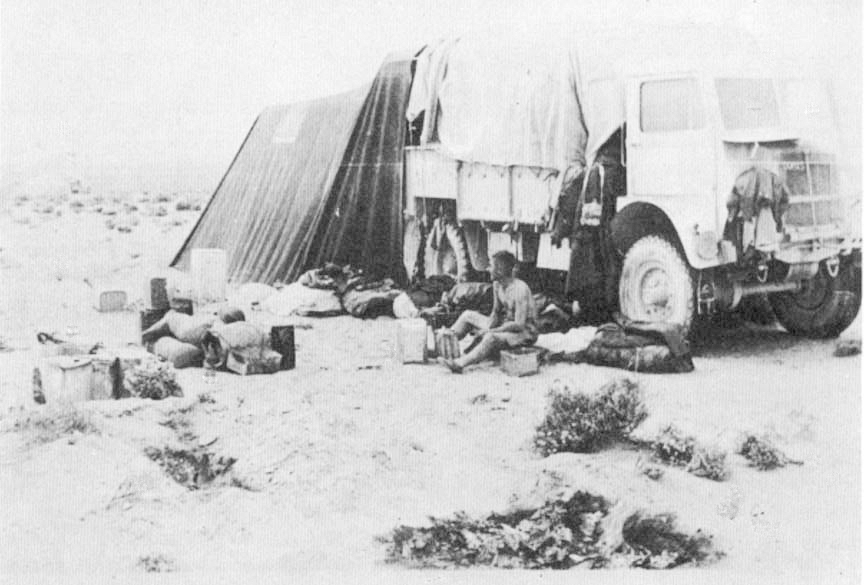
An operating theatre (tent) is pitched behind the truck in which it travels. The medical orderly seated beside the track is making washbasins out of abandoned petrol tins. Photo by John O. Cobb, AFS.
We stayed here for the night, and got up at 5 the next morning. The poste was a little two room mud hut, but it was luckily thick enough to stop bullets. When the attack started it sounded like all Hell was breaking loose. Jerry shelled all around us for several hours, and machine gun bullets whistled by overhead. We sat behind the hut and played cards, smoked, talked, and smoked! I don't think I stopped smoking all morning! Whenever the shells got too close we jumped in trenches. Some of them were so close that they nearly shook you off your feet. The stretcher bearers brought in a few wounded... and one of the other ambulances took them back to the advanced dressing station, after they were hurriedly treated there at the poste. The lines had advanced some by then... and I was ordered to drive up on the field to pick up some wounded, as it was too far for the stretcher bearers to carry them. Boys I didn't feel too comfortable driving along the battlefield as if I was going on a pleasure ride, particularly as all the troops were lying flat in their trenches with shells flying around. When I got to the spots I discovered that the wounded, due to a mixup, had been sent back by stretcher bearers anyway. So I drove back empty. I soon got some patients in, however, and drove them back to the advanced dressing station. One of them had his whole head bashed in, and died by the time we arrived. There were quite a few horrible sights, but I don't guess you would particularly care to hear about them. Incidentally that day I worked from early that morning until one o'clock that night and continued that for about four days straight. But I really enjoyed working hard like that since we had been doing so little for so long. Don't think, however, from this description that we do this all the time. Most of the time we do routine evacuations, and it is very seldom we see any excitement."
May 19, 1943.
"They continued shelling us, one after another, for about ten minutes. G. had a small trench, and in spite of all our squeezing, my rear still protruded above the top uncomfortably far. Every shell sounded exactly as if it was landing right on us, but luckily they all missed. There is really very little danger in shelling, however, when you are in a trench, because no shrapnel can hit you. Only a direct hit can get you, and the odds are against that. I can't remembers though, when I've been so scared, and after it was all over, we smoked up several packs of cigarettes in quick succession. I had almost broken myself of smoking before that, too."
The following letters dated May 14, 1943 (2 days after the push) was lost, but finally arrived, badly stained, and with a second postmark of June 21st:
"We have an old bird with us (last war men were nicknamed 'Vieux Oiseaux') by the name of ----- . He must be in his late 50's but I've never seen anyone who worked so hard to deny his age in so far as work is concerned. Until we got into the real blue, the boys were apt to treat him with indulgent tolerance and address him as 'Mr.' When the real test came he made them all look silly. If ever a man earned the respect of his mates he has, and the hard way, because if it was tough for us it must have been twice as bad for him.
"Then there is the work closer to the front. This involves transferring patients between aid posts and hospitals in a maze of interconnected posts. The only trouble here is that there is more maze than connection. There's the British Army, the American Army, the French Army. There's De Gaulle Hospitals and Giraud Hospitals. The wogs keep getting in the way, and no hospital wants them. There are white hospitals and negro Hospitals. And they all claim to be too busy to take anyone else. Being an independent Unit merely confuses the issue if possible. In areas like that we keep pretty busy.
"Then there's the actual front. There the ambulances go as far forward as possible. Sometimes they can pick up wounded and get them to the nearest R.A.P. (British Regimental Aid Post) or Poste de Secours, the French equivalent. These, however, are usually as advanced as is humanly possible and our work is to run between them and the A.D.S. (British Advance Dressing Station) or the G.S.B. (French Groupe Sanitaire Divisionnaire) where light operating and such is carried out. The first treatment is merely the stoppage of blood and the removal of small fragments. Again, this kind of work keeps us busy, dammed busy.
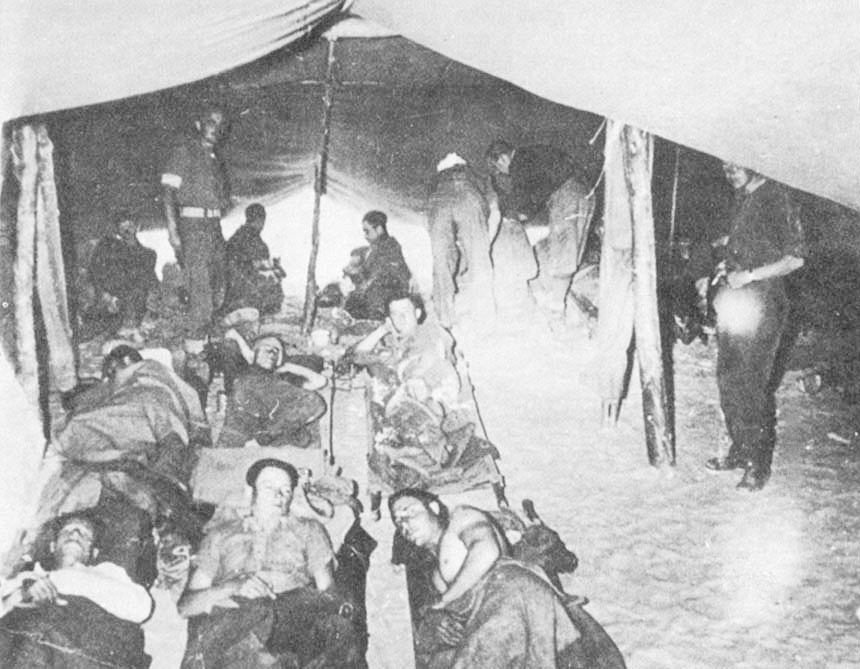
A group of wounded rest inside a dressing station tent after treatment. They will be evacuated back to a base hospital by A.F.S. ambulances. Photo by John O. Cobb, AFS.
"Then there's the actual field work--- that of stretcher bearer, or as the French call it 'Brancardier'. There you go into the field with the troops armed with a stretcher.. bandages and a prayer. This is not part of our job and only once has there been a call for it, and then it was only for volunteers. Suffice it to say here, that keeps you busy, too,---god-dammed busy.
"It's too soon after the end of this phase to even venture a guess as to what comes next. For the time being at least it looks like flies by day and mosquitoes by night will be our lot. I'm not sure which is worse, except the flies definitely have an edge on them both. This war is a long way from over, but at least we've made this one big step.
"The whole thing started when our C. O. came in one night and said the French needed 'brancardiers' and asked for volunteers. W. and I decided that we had come over to help as best we could and that here was a chance so we went ahead and stuck our necks out.
"The country we worked in was mountainous which meant the Poste de Secours had to be fairly far back. This resulted in from a one to two mile gap between the fighting and the poste, all difficult country at best, to say nothing of trying to carry wounded at the same time. We were split into two groups. As I say, I can't give details, but these things did happen, we spent nights on a mountain top at an observation post, huddled into a little two foot shelter, under direct shell and mortar fire--- the dam things exploding all about us, incessantly. We moved into attack, took our objective and were thrown out of it. A man was wounded so close to the shell hole we had ducked into that he practically fell in our arms. We were machine gunned in open fields we had to cross to reach the poste. Shrapnel bits passed between the two of us and we were never over six feet apart. In a few words, all hell broke loose and we were in the middle of it. One of the things that I minded most was not being able to fight back --- you can't shoot a stretcher.
"It's all over now and hardly seems as though it had happened. I'm glad we were there, for they did need us. I wish we could have helped more than we did. That's the reaction of each of us who were there.
"Of our team of 12 one was killed and one wounded. Sometimes I wonder how we didn't all get it. The one great satisfaction is that 2 days later Jerry was whipped for good, at least in this part of the world.
June 9, 1943.
"Well, I came over to drive ambulances but haven't done much of that. Right now I'm the N.C.O. in charge of a detachment at an isolated post. It is really quite a place. There are only a few white Europeans here. Actually though it is what is called a 'staying post' --- in plain English, it is a place where troop convoys stop for gasoline (petrol, out here), water, and to camp.
"There are many men out here who have families and children and who have been away from England 2, 3, 4, and even 5 years. Some men have never seen their children! Everyone's ambition is to get on the Continent and take a swat at Germany. There is a Sergeant here at camp with a child at home who saw his brother killed in France. He has sworn to kill 6 Jerries with his bayonet and then has more to go. He has been severely wounded twice, but is ready for action now!
"It is obvious to all of us out here that winning this war is going to be a tremendous effort --- one which requires not only skilled men on the battlefields but an uncompromising struggle on the part of those safe at home to produce as much as possible as quickly as possible. Were not the implication tragic, the news we receive here of people complaining about overworking, lack of food, lack of gasoline, lack of this and that --- all the news could be humorous. The soldier in the field and in transports has far less material comforts than Americans at home, though conceivably more than have the people in England --- worse perhaps than the lack of material things is his longing for his family, friends and familiar environment. Yet you do not hear any complaints; there are no men who worry about their morale being weakened through any shortages. Everyone is prepared to accept worse than his present lot, if that would hasten the downfall of the Axis. In short, we are happy and contented to be here and hope that each one of us will be able to cross the water when the inevitable invasion starts."'
No date
"The last three days of the campaign the French decided they needed some help so my section shifted over to them. Their MDS was farther up and had been under shell fire the night before we got there. We arrived about six (it got dark then about 7:30). We sat around until about seven then we had a run of about 20 miles to a French Hospital Unit. I was carrying three badly wounded Germans, who had been blown out of a tank. One had a gangrenous head wound and the stink was awful, it stayed in the ambulance for days. As it was dark and we didn't know the way it took us until about 11 to get there and back. About midnight we were told there would probably be some more trips during the night so we just lay down on stretchers in the truck and tried to get some sleep. About 4:30 A.M. we had another run to the same place and got back about nine. Lunch (beans and rice was all we ever had for 3 days) and then we were told we were going still farther up to the Poste de Secours which is the First Aid post; wounds are just covered and tourniquets applied and things like that there. No additional treating is done. The road (?) up was unbelievably rough and the shelling was getting heavier and closer. We just arrived when one of the boys came from a machine gun nest with his ambulance.. He had his tin hat on and was white as a sheet. He said he'd had enough and if it was OK with the Lieutenant he would go on back and get some rest. What had given him the jitters was the poor guy he brought back. A big negro had his jaw completely shot away and a big hole in his back. He was conscious and crawling all over the ambulance, and at that point we got them before they'd seen any M.O.S.'s so none of their wounds had been covered. Well, as we were the only other ambulance left we had to shove off for the trenches. The next was in a Wadi between two hills and there was no road there at all, just simply cross country going over a mountain. We got there about one and immediately hit a real heavy barrage. We were fairly safe in our slit trench but if anybody ever tells you he isn't scared when he hears shells whistling around call him a liar with my compliments.
"The shelling eased up in about half and hour and we just sat around until about 3, when the stretcher bearers brought in a couple of casualties so we went back to the first aid post. As there were only two of us that knew how to get to our post, one had to go right back and the other had to go up for the night. We draw and I got the night shift. I sat around until about seven and then went up to relieve. It was quiet all night and I heard only one shell, but sleeping in a slit trench is not comfortable anyway you slice it. The next morning about six I went back and by that time everybody was sure that the surrender had been made. Finally about 11 we got word that things were definitely over. Boy, I sure was glad. I was tired, hot, hungry and dirty but when we got that news I really wanted to jump up and down for joy. A funny thing it is, that when things were going on, nobody said much about near misses or things like that, but when we knew it was over everybody started laughing and describing just how close that shell came; 'and if I'd been sitting there', laugh, 'I'd have been a mess now', more laughs.
"The day hostilities broke off, we went about 20 miles back in the hills to evacuate an Italian hospital. The tanks were all pitched in a clearing on the mountain side and it was practically inaccessible. We were the first people there, and there were about 200 sick soldiers but no means of transport, as the Italian ambulances were completely out of gas. We got to this place about six, and they fed us well, and we had a bottle of red wine. No gas but quite a little wine. Typical. We got the twelve most serious cases, and about nine started back to a New Zealand hospital. It was just about one a.m. when we got there, and we just parked in a field and went to sleep. So except for the last three days, there really was very little excitement; but over here a little goes a long way.
"I finished up this campaign sitting with my ambulance in a machine gun nest at the Enfidaville front. They did their best to drop shells on us but fortunately their aim was pretty poor although a couple of them came much too close for comfort. We were dug in rather well in a slit trench, but a trench built for one is crowded when four people try to get in it at once."
Feb. 1, 1943.
"The other day two men were killed and another wounded. They were on manoeuvres and chanced upon a land mine. Of the two who were killed one was French and another a native trooper. The bodies were to be taken to a new cemetery which was built in commemoration of a great French battle. Two AFS boys were to take them there. I was one of the two. We were to leave at two o'clock that morning. The other boy and myself went out a bit to cut the flowers. On our way we passed the M.I. tents, in front of which were the remains of the two persons who had been killed, one was, pretty badly dismembered but the other was more or less altogether. We gathered as good a bunch of flowers as possible, but the stems were short and then too we were naturally thinking of land-mines and did not want to wander too far, though we had been over the ground many times before. As the cemetery was some little distance, we were to spend the night. After we had picked up the bodies we went out to the main road to wait for the Guard of honor. It arrived in due time; there was a French Lieutenant and quite a few enlisted men. Just before we were to start I went around back to see if the doors were closed securely. I found a black with a parcel trying to open the door. He said he wanted to put something in and I asked him what it was. As he was speaking French I did not understand exactly what it was that he had. In response to my quizzical look he opened the parcel. The French words that I did not understand were those for skull and entrails.
"In the center of a large battle-field had been built a memorial cemetery which was impressive because of its simplicity. It was hardly more then a stone wall but the center was a sort of grave court; the graves were around the edge. In the center of this court and a little to one end was a monument --- a large concrete edifice with the Cross of Lorraine in low relief. No words. They would have been superfluous.
"The graves were dug very quickly, not six feet deep before I realized that tho burial had begun. The sun was well down. We were on a land that had once known the height of activity, now it was vacant of living beings except for ourselves. All that remained were the shadows of war-deserted dugouts, tanks and trucks that had been blown apart. It was a complete battle-field except there were no people. It was hard to distinguish these objects now, but their presence was never doubted. Everything seemed too dramatic to be real.
"When the graves were ready we stood just outside the entrance. The guard of honor marched in and stood solemnly before them. Not a sound was heard except a few mumbled orders. As the body passed by I snapped to attention and saluted; no guns were fired, as they were shoveling the dirt into the grave the batman whose m'sieu was being buried stood at attention at the head of the grave, tears running down his cheeks.
"It was getting dark as the friends of the black who had been killed gathered at the back of our ambulance to carry their brother to his grave. Again I snapped to attention and saluted. Then came a weird chant that could not be mistaken for anything but a dirge. It was a kind of wail but there was a distinct rhythm. After the walling ceased the blacks shoveled the dirt in with their hands. When we were through it was dark."
May 14, 1943.
"All fighting has stopped so I am well out of danger. I saw quite a bit of gunfire and while I was never in great danger I think I know how it would feel to be. Spent five nights in slit trenches which are comfortable as well as safe. About the closest call I had was one night when a shell landed close enough to shake the ground pretty violently and throw a lot of dirt in my trench. Quite a few fragments whizzed by overhead but there is no danger from them if you keep your head down. Which I did ------ I did. Saw a wonderful artillery duel on the plain before us; looked just like a movie. Carried quite a few blessés --- French, German and Boogie.
"The nights were most exciting. Things I'll never forget. Most of the guys got much worse than I did for a longer time; however, I did get an idea. There is nothing more exciting then hearing shells whiz by. We were quite safe from it but it did give a weird sensation. Saw hundreds of Jerry prisoners. They did not seem too unhappy. I felt sorry for the bums. After the fighting had stopped we were sent behind the Jerry lines to pick up some wounded. Jerry prisoners were used as stretcher bearers. They seemed to think that we were going to beat them all the time. One had a pretty bad case of shell shock. About half the people we carried were in serious condition. One died in the car.
"The Jerry prisoners were mostly young and rather healthy looking. They all seemed to be glad that the whole thing is over. I did feel sorry for them. When I walked back to the ambulance and saw all the shell-holes I did not feel quite so sorry for them."
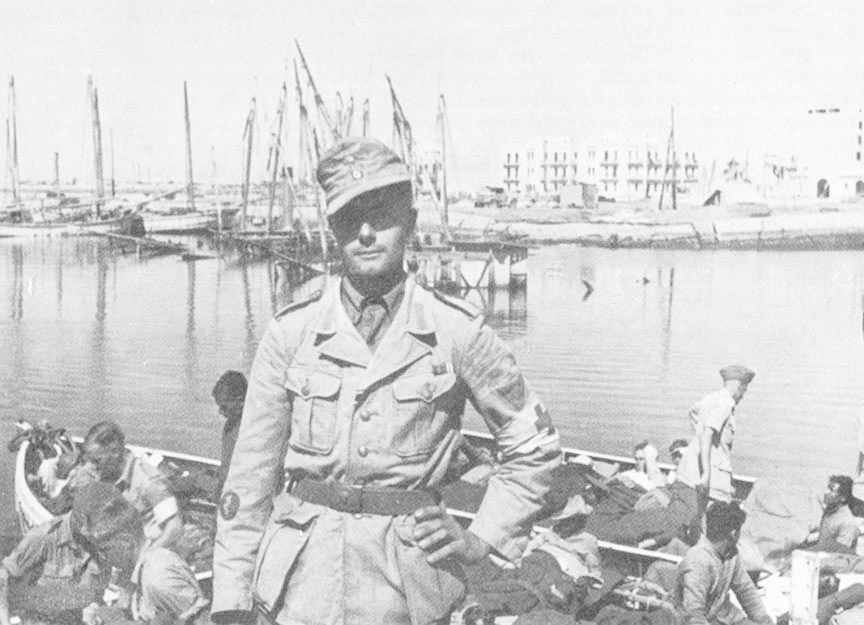
At a Tunisian port a German medical orderly (POW) helps load the wounded onto whale boats which take them out to hospital ships waiting in the harbor. photo by William Elmslie, AFS.
"We have been on a training 'scheme'--getting a little belated practical experience in how to handle ourselves and our ambulances as a unit under battle conditions---simulated in this case, of course. We took our 25 ambulances, a cook truck, a water truck, a headquarters truck, a spare parts truck and a jeep out into a desertish sort of place 'some distance' from here, and stayed out there with them and nothing else. We learned, in the process of pretending we were in an active sector, a good deal; we learned how, for instance, to drive in convoy --- how to disperse the cars when you stop for lunch or for the night --how to dig slit-trenches and to make a car go when it won't (or know the reason why). Also less obvious things -- like how to live in an ambulance, making it a quite comfortable little blacked-out home at night, and how to get along on a canteen of water a day, and how to load an ambulance so that you can carry all your kit with you and yet be able to load four stretchers safely over rough terrain. We also acquired quite a bit of health through a program of daily swimming in a pool at a nearby village, to which we walked 6 miles under a really scorching sun and acquired as well some gorgeous sun-burns and a colossal esprit de corps.
"By the time you get this I hope the coal strike will be straightened out. You would have a hard time imagining how perfectly disgusting a thing like that is to have to try to explain, for instance, to a British soldier who's been out here for four years or so, how such a thing could happen. The group at the sergeants' mess at the place where I was posted before this recent shake-up was absolutely incredulous when the news came over the radio that those guys had actually walked out. Their comments ranged all the way from 'What kind of a war is that you're fighting over there?' to 'Why don't they shoot the bastards? (When an Englishman calls somebody a bastard, he isn't fooling.) We didn't answer them because we didn't know how to --- we just sat there while the back of our necks grew red. It certainly is a terrible show for America to put on for the benefit of the world at this time.
"Of all the worries you have in the world I should be the least and the last now, such good care is taken of me I feel almost like a pampered school girl. Except that I miss you all like hell, I'm also completely happy and contented."'
May 27, 1943.
"It is far more galling than you can realize to have chased our Fascist 'friends' all the way from Egypt only to miss the kill by a hundred miles. I did however, experience some of the thrill and satisfaction of conquest when we pushed the Ities out of Tripoli, the last remnant of their 'Empire'. Still when I think of the rest of the gang strutting about Tunis displaying Eighth Army flashes on their shoulders and me wasting away in a base hospital, I want to break something.
"Our company which gained itself a fine reputation in this campaign will probably stick with the Eighth Army in their part in the next phase of the war."
From a POW in Italy, since released.
"Camp 75".
"I am well and unwounded and life here is not too bad. You must not worry at all.
"Life in a prison camp is not what I expected, but more like a boarding school."
June 1, 1943, Camp "59"
"It is surprising how full one's days seem. There are counts or check parades every day, and each day has some little incident to draw it out. Time has so far passed rapidly. There are quite a number of Americans here, mostly from Algiers and Tunis, and some pilots from my side. Weather is nice at present, but the cold months are upon us. I have warm clothes and am okay.
"There are two AFS boys here --- B. and M. --- both from California. There are many decent chaps about. It is interesting to see the way different nations take it. The Yanks are the most cheerful, as were the New Zealanders at the other Camp. No New Zealanders here. All English, French, Poles, U.S. and Canadians. The country here would be nice to visit in peace --- quite picturesque and interesting. News is one thing we all want and liberty".
May 29, 1943.
"I have covered a lot of ground and been through a lot of air. First of all I visited the city beginning with the same two letters as the name of my Davenport College Master, and spent a most interesting day there, and visiting the famous places nearby. The historical ruins are not very exciting but the country is magnificent. Judging by any standards it has truly breathtaking scenery and I can imagine no more lovely place in the world to travel about. There are hundreds of miles of broad valleys of tall lush wheat, each one a little world of its own so high and precipitous are the intervening ranges of mountains. The farms are attractive, prosperous little concerns, and their red tile roofs stand out against the verdant fields surrounding them. The steep mountain sides are covered with pine or evergreen trees which give the air a pleasant smelling freshness.
"In one of these valleys I found an American medical unit with which I spent an evening, enjoying their food and tobacco as well as their company. The brother of Dr. T. was among the doctors there and he took me all through the place. Such an outlay of equipment and personnel I have never seen before.
"About 4 days ago we moved the entire Company back to the place we were sometime ago. Orders awaited me there to fly to H.Q., which I did at once and for a couple of days I have been enjoying the comforts of the best hotel in the big city, attending long conferences on future operations and generally tiring myself out with late evenings. The trip down was cold, dreary, and uneventful, riding as ---the tail of a bomber on a lot of mail sacks. The view one gets of the ----from the air is quite unusual. The narrow strip of green is a myriad of rectangular fields forming a sort of tile pattern which reaches to the desert's edge. The line of demarcation is concisely drawn with the absolutely barren desert reaching right to the fringe of fertile fields. The broad estuaries of the ----wind and twist through the mosaic fields and small clumps of buildings clustered together around a central mosque to form a native village at regular intervals.
"Last night I attended a very fashionable soiree at an elaborate new open air night club not far from town. Major K. got me all dolled up in a stylish uniform and took me along. It was a private party given by some wealthy -----and its elegance equal to that of anything New York ever produced. Buffet supper was served from long tables laden with rich foods and heavy silver and every delicacy you can think of was there for the asking. I unfortunately ate so much cold duck and squab right at the beginning that I couldn't do justice to the hundred and one other things. Today I am suffering gastronomic troubles from such a sudden and drastic alteration in my dietary habits and as well I an pretty well exhausted from having danced till 3 a.m. The guests (about 400 in number) were a conglomeration of the wealthy Greeks, Syrians, Egyptians, French, American and British people round about.
"Tonight I am having dinner with Dr. Watson, President of the American University here, who somehow knows of me.
June 3, 1943.
"There are so many whimsical things I'd like to describe, the tiresome and yet remarkable inclination of all Arabs to gesticulate madly and argue all at once as to whether a train should stop longer or go on. They run up and down the platforms and women with baskets and babies got up and out and in again, arguing too, while the British sit stolidly looking into space. They all wear what I should say resembles nothing as much as it does dirty bed linen. Whatever you ask, in whatever language they say 'yes' they promptly do whatever they think you asked, never guessing remotely the import of what you gesticulate and demonstrate madly to obtain. I certainly miss the pugilistic Bronx taxi driver.
"In my typical way this morning was involved in a minor fracas. A dark skinned maiden left her baby in my lap --- not at my suggestion, while I was on the beach sitting in the sun. Promptly after her departure into a small café, why I don't know, along came two male Arabs and one on each side began to argue and, try to grab him. Am still hoarse from yelling 'yellah' and retrieving him. That means 'go away you-----!'. They were still screaming and pointing and fighting on the return and the annoying incident ended by my discovering it was the father and uncle. She kept saying 'père --- mère --- enfant' and laughing --- evidently three of the ten French words she knew, while I smiled grimly and tried to look pleasant instead of shaken and wracked!"
May 7, 1943.
"I am now attached to a French Unit of Pacific Islanders from Tahiti and New Caledonia. They are the best bunch I have had to work with since I've been out here, and the greatest part of the lot is that we are a single car attached to them, so on our own. There are two doctors. I am attached to the advanced Poste de Secours, which is usually as far as cars are able to get up behind the lines. This business is about over now, and Tunis and Bizerte are in our hands. It's wonderful to be out of the desert and in hills once more where water flows abundantly and it is not too hot, although it can be pretty warm. Where we are there are quite a few flowers that seem to be oleanders, but in low bush form. The fields are littered with bright dark poppies and yellow daisies and thistles, which makes a blazing patch of color here and there."
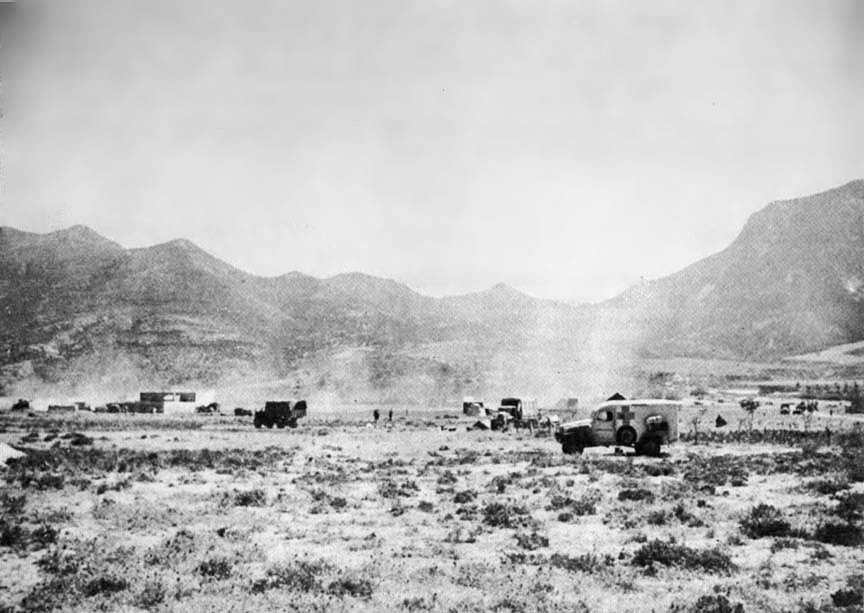
AFS with Indian Division on Cap Bon peninsula. Dust raised by Axis prisoners streaming down from Cap Bon to POW cage.
May 15, 1943.
"Now it is all over for the time being, and Europe looms very big and not too far away. You can imagine what a change it was to see hordes of Italians and Germans streaming by, but conditions were reversed this time.
First long lines of them walking out of what had been their positions, then truck loads pouring by; I don't know what happens now, what we do or where we go. Turkey, Sicily, Crete, who knows? In the meantime, there is lots of water and high hopes. From the Germans, we got boxes of French lump sugars which of course is why France has no sugar or anything else. This sugar came from Nantes. Also large cans of delicious butter from Norway and then the inevitable Italian macaroni, etc., and Parmesan. They were very well provided with cigarettes, of which we do not by any means have too many. They were young fine troops, probably elite groups, picked out to keep up a rear-guard action. About ---- were taken prisoners in our small sector alone. All their money was Bank of France notes, not accepted or used by us, as we use notes on the Bank of Algiers and Tunis. So wonderful to be using French money again. The rate is about 50 francs to the dollar.
"We only started working two months ago, properly speaking. There is still a great need for new cars, as most of ours are on their last legs, and I cannot see how or when we will ever get them. It is definitely warm here now. We are located in a grove of olive trees. I sleep out every night under one of the trees, and we spend our time sun bathing, swimming as the sea is not far away, and we play innumerable games of Bridge. The Arabs bring around eggs which enable us to have excellent breakfasts. Where we shall go and when it will be remains a mystery to everyone. Saw a big anti-aircraft barrage go up last night. A beautiful sight, with red tracer bullets criss-crossing; the sky over a wide areas making wonderful designs.
July 1, 1943.
"At Mareth we went on the flanking movements through the desert up to Al Hamma and then to Gabes. From then on until Tunis fell we were in the show. I think it was about 2 months time. Anyway it was long enough to satisfy my curiosity and to realize it isn't as much fun as one might think. When Tunis fell I don't know whether the credit was given to the first Army or the 8th in the papers at home. However, it was definitely taken by the 8th Army. I know, because I went over to the first Army with the branch of the 8th Army that took Tunis. I got into the city of Tunis the morning after it was taken. I never saw such a madhouse in all my life. The civilians were so glad to see the Jerrys gone that they went mad. They certainly gave the troops a wonderful reception. For days there were German and Italian prisoners being marched back to P.O.W. cages. Thousands of them. Most of the Italians seemed pretty happy that the war was over for them. The Germans didn't seem to be so happy. I talked with quite a few Germans --- very intelligent and quite human too They all still think that eventually they will win.
"This year certainly has been an experience that I wouldn't have missed for anything."
Somewhere in Syria. No date.
Last night had a most interesting experience. We were camped near a very small native village and all day heard sounds of a celebration. One of our boys, whose family came from Palestine and are Arabs, said it was a wedding festivals so we decided to go and see it.
"Two others and myself went into the village in time to see the grand finale. The groom who was 35 years old was a dwarf, and his wife to be was a girl of 15. Of course we did not see her or any other women as they keep veiled and indoors while the men are having their show.
"J., the Arab, spoke fairly good Arabic, and the natives seemed tickled that we had come. They ushered us into one of their houses and made coffee. We passed out cigarettes to all those present, gave the bridegroom several packs as a presents and then the celebration started in the street. First, came a drummer, then a flutist, followed by all of the men in the village. They played the most weird music I have ever heard in my life and the drummer constantly beat strange, syncopated rhythms.
"As the procession walked slowly down the street, various men came to the center of the circle and dances, and, as they did so, collected money from various donors, waved it over their heads, danced around the circle touching the heads of those in the first row with the money, and finally placed it somewhere on the groom.
"As darkness approached, we neared the house which the bride and groom were to occupy. The bride was already inside and when the crowd finally reached the door, it was opened and the groom stepped inside. At the same time, the women, who were in the building across the courtyard, set up a terrific wailing which J. said signified that the marriage had been completed.
"Following this, we returned to the a house from which we had come and were presented with fresh onions, lettuce, a bottle of olive oil and a bunch of carnations !"
May 28, 1943.
"I never told you about my leave in Tunis. Well, sir, our day there, five of us, was almost worth the bother of fighting from Alamein for such enjoyment. Since candour is often lacking in explanations, I'll admit that our main view and object was focused on women and wine; and what a view. Once there, we split for a while and I went with a cobber of mine, veteran of the last war, forty-six, avec le Croix de Guerre plus deux palms. After a few buxom French women had called me 'un bébé' and said I was too young for war, I about resigned myself to the fact that les jolies femmes would pass me up completely. But, never fear, mon vieux, Lady Luck was still giving me an occasional nudge of reassurance between the ribs. After a nice snack in a little restaurant we toured the city sitting on the top of the ambulance. Old Mr. Lowell, one of Back Bay's early codfish, thought William Thackery 'not quite a gentleman' when he swung a log over the side of a Boston cab, but oh, he should have seen us in Tunis, yelling and screaming from the top of the 'bus'. Some kids spied the car and yelled to us with worried looks on their young faces. We pulled up at a pension. 'Blessé, blessé' they yelled. In we went, only to find a drunken soldier unconscious in the garden. I'm afraid I wasn't duty bound that day, for while the boys administered aid of sorts, I sat down and talked with a Professor's wife who spoke beautiful English. And I might use the same adjective concerning her. This was one of Lady Luck's nudges. On we went. In the morning we had been given a bottle or so of wine, and by this time we were gently on the mellow side. One of the fellows, a Phi Beta Kappa, always gives birth to a scotch accent whenever a bit 'high'. This is really a treat, to hear a genius speaking French with a scotch accent. And into the park we drove, only to bump into three lovely girls. One of them needed medical attention ---thanks, Lady Luck! and we snorted to a stop. Only a blistered heel, but when there is a good-looking girl concerned, all possible care must be ministered, using the maximum amount of time. The prettiest was a girl of fifteen. We took to each other like corn syrup to buckwheat cakes. She couldn't utter a word of English, and me with my college patois --- a mere semblance of true French --- we got on famously, drawn together by our ages. Rheumy-eyed harridans had called me a baby all day, then this thing of loveliness says I'm just the right age for her; well, her wish was a command. We had our picture taken together. I lavished all the candy and chocolate I had on her, and we had a wonderful time. I learned more French in those few hours in the park than any college could drum into me. And I assimilated far more than a few new French words, but that tale is saved for after the war. When I said goodbye in true cinema fashion, she waved until we were out of sight from the top of a hill overlooking the entire city."
June 9, 1943.
"And here is the explanation for my staying. Without boasting; I am a trained man with many months of field experience on the battle front. To go home, join the Army and be trained anew for a different type of job would take at least a year. That simply means that I should be comparatively useless to the war effort for another twelve months. Now, with new operations about to begin, every man with experience is needed. I really feel that I could do more good by remaining here than going home. There's nothing in the world I'd rather do than set foot in the Connecticut hills again, but I must wait until such time when all the boys come home. I know you shall worry even more than you did before, because of what lies ahead. Every mother and father wishes their son to be home when the prospect of Second Front looks large. But someone must, many of us must, start this new phase if the war in ever to end. In many ways I feel happy that I am not coming home. Coming into so many captured towns, one sees the children crying for food and the gaunt tired looks on all faces. There must be millions of people, wearing these same expressions, somewhere in Europe. And I do hope that I may be one of those men to see their faces break into an occasional smile."
May 24, 1943.
"One of the things which has amazed me the most is that everywhere I have been there was swing music. I made a great friend in Bombay who told me all about Gene Krupa and Tommy Dorsey etc.. When I told him that I had seen both of them just a couple of months ago he almost kissed my feet.....There seemed a lot of 'Col Blimps' who still thought that the Japs couldn't think for themselves. And again I have met a lot of officers who have fought against both the Japs and Jerries and who think that the Japs are better fighters and more original. One had a story which almost sounded like 'the lost patrol'. He went out with twelve men into Burma and out of the nine who got back, two are insane, two have died from the after effects and the rest are still in the hospital, except the officer, and he has a disease called 'sleepy sickness' (not sleeping sickness) which comes from malnutrition and extreme exhaustion. If the folks at home could know what the Red Cross does for sailors and soldiers overseas, they would certainly dig down deep. I was talking to the chap who runs this place (he works for nothing) and he said that they went in the red about $40 a day in the dining-room. I can believe it because I had a fine dinner for five plasters which is about twenty-five cents. Bombay would make Bakersfield in the middle of summer seem like Iceland. I actually wrung water out of my shirt when all I had been doing was just sitting."
June 20, 1943. Working out of a Base.
"These troops think a lot of Jerry as a fighter and they think, on the whole, that the Germans that they have met as prisoners were a fine bunch of men. Of course that doesn't mean that they won't kill them to win the war. These troops have been in the thick of the fighting, they are not fanatical or anything but just consider the war a job to be gotten over as soon as possible. They are the most generous people on earth. A Tommy I brought down from the hospital had a pair of Jerry binoculars; I offered to buy them. On the way down we got friendly and when I went to let him off he offered to give me the glasses. I wouldn't take them and he wouldn't sell them. The same thing happened with another Tommy---that time it was a Jerry flag."
En Route with Ind. I unit.
"I literally had what I thought would be my last look at 'Lady Liberty' through the porthole ---with dishwater running off my hands. That was my first and last day on K.P., and I'd be a liar if I said I didn't enjoy every minute of it, because I did. I enjoyed the whole trip over. I was pretty tired when I left, and the peace of that crossing was pre-war. The ship was dry and we had to be in bed by 10:15 so it was literally a health farm. Up at six and calisthenics. breakfast, first aid, hindustani and drill took up the morning and than the afternoon was our own. After a few days we were the healthiest looking lot of 4Fs as I ever saw. This went on for days and finally we touched at a port---the usual natives-diving-for-pennies, native-diving-for-shillings type, but we couldn't go ashore, nor at the next port (which really looked inviting. But here we are ashore with vengeance not to mention a reasonable amount of drunkenness the first night off. I feel so sorry for the residents of this town. It has a normal population of about 83,000 and at the moment there are some 200,000 people in it. Talk about boom towns! What ever else this town may be rich in, and it doesn't look poor, it is most certainly rich in forbidden area."
In the remarkably short time of seven days we received word from Cairo HQ, that the first casualties to arrive in Africa from Sicily were evacuated to hospitals by the AFS. The same dispatch says that the drivers were disappointed that they were left out of the Sicily show for the initial stages. But they are biding their time until they rejoin Montgomery's enviable Eighth, and are making good use of every minute. Most notable of these seems to have been a party given for the AFS unit and British Medical personnel in the area; the piece (or pieces) de resistance at this celebration were sixty imported nurses, from New Zealand, South Africa, England and even U.S. The presence of these ladies is reported as "an indescribable treat."
One of the AFS man with the Fighting French reports that the weather "has been really hot lately 127° in the shade, 151° in the sun," this taste of African summer leaves him almost speechless, his only comment being "whew", What was that about a heat-wave in which this country suffered (?) as a result of 17 days at 90°?
What's in a name dept: Frank Wood who came home a few months ago after a year with AFS in the Middle East is now a reporter on the Seattle Washington Times. On a recent assignment Frank interviewed Lieut. The Honorable Richard Wood, Lord Halifax's sons who lost both legs in the desert campaign. Both Woods had known each other while serving over there.
AFS LETTERS has gone to school again. Our newest scholastic subscriber is Westridge School for Girls in Pasadena, California. The main use to which it will be put is to give French students an actual vital account of the Frenchmen fighting in Africa. We are delighted and hope that we may got many more fine letters from AFS FFF members.
The first AFS man to be seen in the U.S. wearing the tabs with the Eighth Army shield were Lt. Jim Ullman, Bill Van Cleef and Lee Ault. These three have just returned and looked particularly snappy and soldierly wearing these insignias. Jim Ullman as an officer wears his on his arms just below the shoulder. Bill and Lee wear theirs over the shoulder straps of their tunics.
After the excitement of the final days of the Tunisian campaign the AFS section with the Fighting French found themselves at a loss for something to do until they acquired, complete with cage, a pet canary. When last heard from, on Bastille Day the canary was in fine spirits and singing lustily with the aid of a thimbleful of Chianti wine in its water.
You never can tell what will happen next dept; a military dispatch from the U.S. Army in North Africa was shown to us the other day containing, the following information: "Another case of brother and sister reunion in North Africa occurred when David Briggs, an American Field Service ambulance driver, asked a WAAC auxiliary whether she had ever heard of his sister, Capt. Ruth X. Briggs of the WAAC. Five minutes later he was guided to his sister's office in the Headquarters building nearby. Capt. Briggs whose home town is Fort Edwards, Wis., is on duty at Allied H Q in North Africa and was one of the five WAAC secretaries at the Casablanca conference. Her brother, Field Worker Briggs was an ambulance driver with the British Eighth Army and saw service at the Battle of El Alamein and in the Tunisian campaign."
Readers in and around Philadelphia may be glad to know that they can see the AFS movie LETTER FROM LIBYA anytime until Labor Day at the U.S. Army Ordinance Dept's exhibit at Wanamaker's.
Truth is stranger than fiction: Knighthood, chivalry and its accompanying customs are NOT dead......at least not as far as AFS is concerned. The knights of old....so we are told....were wont to wear their lady's color somewhere on their person when going forth into battle....One of the Field Service men overseas provided an element of mystery for many weeks by always wearing a blue ribbon on his wrist. After much wheedling, his comrades wangled the secret from him. "I wear it", he said, "for her; blue is her color."
Andy Geer ex-Capt. AFS, author of MERCY IN HELL, has recently been commissioned a Capt. in the U.S.M.C.R. Raymond T. Hanks, Jr. who was in the Middle East for a year returned and was inducted into the Army as a private; after two weeks at camp obtained the commission he had tried for in the Navy. He left the Army and is now in training as an Ensign at Cornell University; quite a varied career. The best of luck to both of them.
The Field Service originated as an organization to aid the forces of oppressed nations. That is still its function. In the first world war AFS was with the French and British Forces. Some of the ambulances and drivers have served with the U.S. Air Force in the Middle East. Now word comes that a small group of ambulances and drivers are attached to the Royal Greek Army in the Baalbeck and Aleppo regions of Syria. This group has been with the Greeks since late in February, and hag done all imaginable types of ambulance work. They have evacuated the wounded, driven the Army doctors on their rounds, carried Greek refugees from Europe to their camp, and have even been assigned to act as hearses for the funeral of seven Greek soldiers killed in a mortar explosion. The admiration of the few Americans attached to the Greek Army is great and their affection for the soldiers no less than that expressed by other AFS man for the French, New Zealand, Tommie, Aussie, Indian and South American soldiers.
The following excerpts are the preface to an India section in AFS LETTERS. These are taken from a shipboard bulletin, compiled by members of the first unit to sail for AFS' new theatre of operations with the British Forces in India and Burma.
|
|
|
|
The Unit 0241B was conceived early in November and has miscarried ever since. It was started when a group of medical officers descended on an unsuspecting colonel at Fort Jackson. The colonel greeted them with: "Gentlemen, we are going overseas and we are now on the alert," We have been on the alert ever since, though many of us sleep 21 hours a day (with three hours devoted to eating).
Although Fort Jackson is in the Sunny South according to the nearby Chamber of Commerce, our barracks were like Eskimo igloos and we all shivered and shook in cadence. Each morning we had a bed check to see who was frozen to death. Finally, the conscience-stricken War Department transferred us from this Valley Forge of the South to California. Here we were joined by a bevy of beauties from the Army Nursing Corps.
After exhausting the possibilities of San Francisco and its environs, we were ready for any eventuality---and found it at Camp Kilmer. (Alcatraz would have been better. There was at least one successful jail break there recently.)
After a long and devious six-hour, seat-numbing journey in GI trucks thru the wilds of New Jersey and N.Y. we finally found the H.S. Atlantis and were most graciously received by our British cousins. We are now learning to swing and sway the Atlantis way.
Another first--and we hope not a last as far as this trip is concerned---has come to pass for Unit 0241B. This is the first time medical units are being transported by hospital ship by courtesy of the British Merchant Navy and in accordance with the Geneva Conference. Because we have been favored in this manner, and also because of the hospitality extended us by our host, we hope the experiment proves to be highly successful, not a minor consideration being that our own necks are involved as well.
So far the trip has proved to be a cruise in wartime , while drawing overseas pay. We hope we never learn about underseas pay.
We feel that since we have been given pamphlets on Egypt--about its languages and customs--we can rest assured that we are definitely going elsewhere. Of only one thing can we be certain----wherever we are sent that's where we will be.
In closing we wish everybody on the ship a dull and uneventful voyage.
(signed) the Gremlins
By One of Them
Abbott--The other half of Costello; Birney--Miniature Uncle Louie; Boslett--A dental lieutenant who is sad because he is always looking down in the mouth; Bozio--Bullshooter; Benson--3.2 slap happy; Canady--Six dollar a day man worth two; Elsam--Sky pilot; Edmunds--Baltimore feesycian; Finnegan--Seven-card Finnegan but does just as well with five; Ferber---Only one of his kind in captivity. Will "fit" with the natives.
Feldman-Assistant to the assistant Co; Forney---Only rigor mortis will straighten him out; Grillo---Indiana's contribution to 0341B. Indiana's loss our gain? Gillespie---A damn Yankee rebel with a Southern accent; Hymes---Slap Happy in three quarter time; Horowitz---happy as a lark---a dead one; Jordan---The Jersey Bounce; Pwapisoz---Oh Henry's Coming, Mother.
Kazar---The conformist; Ketchu---A Southern Gentleman who re-fights the Civil War every day. This time the South wins; Lavalle---Best dressed moustache in the unit; Livistein---Tammany Hall Politician; Moorefield---Will Rogers reincarnated with a Southern accent; Milner---That ain't the way the Army does it; Oliver---Going to the dogs Gillespie way; Parkman---Woman hater; Ring---Noisy type; Staub---Hell raising Staub; Shivers---Let Doug do it; Strongin---Bklyn sheriff; Schiman---Wonder Boy, voluntary "Information Please"; Silverberg---Happy on only one day a month-pay day; Thorastenberg---When I was in private practice, Thomas---When I was at VMI Uchal---He has what it takes!! Weiss---The man who came to dinner and ate it all up.
Condensing the life of Lt. C. Norman Jefferys into one column is about as easy as dumping Kate Smith into a size 30 girdle
Lt. Jefferys, who is the commanding officer of the American Field Service India Unit I, quit his job as contact man for a lawyers' mortgage corporation three years ago when Russia attacked Finland. His plans to drive an ambulance in Finland ended with the armistice, and he instead joined the American Volunteer Ambulance Corps for service in France.
He arrived in Paris two weeks before it fell, feverishly evacuated wounded from the Amiens area, and topped off the episode by escaping with four other drivers to Spain.
Lt. Jefferys returned to New York, sought to join the Royal Canadian Air Force, but saw another opportunity for action with the AFS experimental unit to Syria, serving with the Free French. After the campaign there Jefferys stayed on to organize the AFS units arriving to aid the French. After the swift Bir Hacheim and Tobruk engagements he took charge of the evacuation and reorganization of the entire French ambulance service in Libya.
For his work the French awarded him the Croix de Guerre, the Médaille Colonial, and the Médaille Commémorative. They don his tunic today.
Lt. Jefferys, during the action-choked days of May and June, 1942, while on a special mission for the French at Bir Hacheim, drove through the German lines without knowing it. Once he went three days without water.
He relates an incident. One day while passing through a hospital ward he happened to take notice of a shabby Hindu whose face was hardly visible through a heavy mat of beard. The lieutenant paused for no apparent reason, exchanged a few words with the man, and gave him a swallow of water. From that day on every time he passed thru the ward he was noticed by the grateful Hindu. "That man became the symbol of every man in the entire hospital and every man I had ever helped," Jefferys said.
-----Block
There are many indolent persons who like to get five or six hours of sleep each night. There are others who get up before the moon sets and rush around singing and whistling and clapping people on the back and being very hale fellows indeed. These latter invented calisthenics in order that the sloths may share with them the cleaner and more wholesome life.
|
By John Shorger Oh, it took peculiar planning, Oh, a plank was the foundation, Oh, the sheets are made from burlaps Oh, Galatti, you deceived me, Oh, you painted nothing brightly, Oh, I'll grin at boiled potatoes, |
Thoughts when the thermometer hit 90°: Al Potter is hotter, Arch Horner is warmer, Bob Riotte is very hot, Walter Doyle is aboil, Mr. Boit looks very hoit, Ed Kelly feels like helly !!!!
Unit 41 held its first class in Mechanics on Tuesday morning. Dean Fuller conducted the session, which was attended by about 40 men. Other men with knowledge of the subject will take turns in teaching future classes, which will be held in Unit 41 mess hall at 11 a. m.
In his lecture Fuller commented on the importance of learning how to handle the difficulties arising from driving a car in a hot climate. He classified the types of failure in a car a follows: electrical, mechanical, and carbonation. Starting with the electrical system. Fuller explained the construction and function of the battery. Points emphasized were keeping up the water supply and prevention of excessive corrosion on the terminals.
CAPTAIN McGILLIVRAY SPEAKS TO FIELD SERVICE UNITS.
Captain McGillivray of the RAMC delivered an interesting talk on malaria to members of the AFS on Friday and Saturday mornings. He spoke to Unit 41 on Friday to Unit 1 on Saturday.
Capt. Mac, a husky Scot with clear blue eyes and deeply tanned skin, embellished the talk with accounts of his own experiences in both contracting and combatting the disease.
He traced the discovery and research on malaria, which means bad air, from 1847 to 1900, when effective means of combatting this serious menace to health were discovered. Treatments by means of quinine, atabrine and plasmochin were outlined. The serious nature of malaria was emphasized by a resume of the detailed organization necessary in army units to combat it.
The Field Day finals will be held tomorrow, Sunday, May 16, instead of Monday, as previously announced.
The contests will get under way at two o'clock on C deck aft. When these events have been completed, the action will shift to D deck where the remaining contests will be run off.
All contestants from the RAMC and the USAMC and the AFS and crew are urged to be on hand at the starting time.
The boxing and wrestling exhibitions be held on Monday if conditions permit.
Calisthenics is very scientific. The object is to put a cramp or charley horse in every muscle in your body. A good calisthenic leader can do this in 10 minutes. The apprentice often misses a few muscles. He is looked upon as a fakir by the experienced leader. A calisthenics leader loses face if he doesn't produce at least 1 rupture per 10 persons per week.
The first exercise is always running without making any headway. The object of this manoeuver is to blister the balls and heels of both feet.
A favorite of calisthenics leaders is touching both toes with your hands. Some historians claim this was discovered during the Spanish Inquisition. Others say it was invented by the Chinese pirates during the reign of Ghengis Khan. However, I have not done a great deal of research on this problem and do not propose to take sides until all the evidence is in.
An uncomplicated exercise in outward appearance consists of standing like a scarecrow and turning both arms in opposite directions. This seems very simple, but few people can do it. They try so desperately that both arms are disjointed at the shoulder. This causes the calisthenics leader to say comforting things like, "come, come now, Smith, we mustn't throw our shoulders out of place, must we"?
The only unscientific exercise is the one where you hurl your body into the air and kick out both feet while clapping your hands overhead. This is not scientific because by the time the leader has come to it all the muscles are strained. It depends on chance. The chance is that you will break your leg. The Journal of Calisthenics Culture has advocated editorially that this exercise be eliminated. However, calisthenics leaders are born optimists and they refuse to give up a good thing.
Calisthenics are always held in the morning while fortunate ones about to be started off to a glorious day are still asleep. This has led to the name "setting-up exercises". This name was criticized in rather vulgar language once. The critic was encased in a plaster cast and practically no one heard him.
The real purpose of morning calisthenics is quite disarming. If they were held in the evening, the class could spend the day running an obstacle course and after a few weeks be prepared for even the hands-on-toes movement. The calisthenics toughening-up course ends with the subject running upside down across a 30-foot glass ceiling.
At the end of the exercises, the average person says to himself, "Oh well, that wasn't bad. Feel much better already." he then starts down the stairway at a brisk pace only to have his left knee buckle at the third step. Clutching for the railing, he discovers his hand is contorted like a talon. Consequent bruises, abrasions and concussions are added to the effects.
By the time he reaches his berth he is inching along on his stomach not unlike an angle worm. After he has been lifted into his bunk, several people ask him for his autograph, having mistaken him for "The Hunchback of Notre Dame."
| "Listen," quoth the volunteer, "When I was cruising south, My pelt did melt I caught a smelt And stuck it in my mouth. I sucked a scale, I squeezed the tail And merrily did drink. I was the first To quench my thirst--- But, God, how I did stink!" |
The men of unit 41 extend their thanks to Sister Seabrook for her help in obtaining them the loan of an iron. Luckily she hasn't seen the work being turned out or she would probably take it back.
Outcome of Field Day aboard ship participated in by A.F.S., Royal Army Medical Service, and U. S. Medical Services;
|
Running High Jump
Indian Wrestling Lightweight:
Middleweights
Heavyweight
Standing Broad Jump
Chinese Wrestling Middleweight.
Heavyweights
Wheelbarrow Race
Three Legged Race
|
Sack Race
Potato Race
Tug of War Lightweight
Middleweight
Lightweight
Wrestling Lightweight
Boxing Boxing Exhibitions Lightweight: :
Middleweight :
Light Heavyweights
Heavy Heavyweight:
|
|
We're fresh from the States We want to see sights High-minded and pure Take Cleo and Mark Did Joseph's chaste life |
Jim Ullman, an officer in the AFS ME, returning home on leave, was commissioned to complete arrangements for a short route back for the return trip. In the performance of his mission, he ran into Lieut. Col. Perrin Long and Lieut. Ted Latham, overseas.
Ferry Jasper Patton, TMU 133, former AFS Representative in San Francisco, has become a Captain in the US Air Corps.
Announcement is made of the marriage of Francis Peabody Hamlin, France '40 to Miss Minette Egger of New York City.
Arthur Watson, TMU 184, has completed his inoculations, gathered his equipment, and is prepared to go "Overseas" a second time. In War I, after leaving the AFS, "Doc" saw service with the Chasseurs d'Afrique in Morocco and with the French Army of Occupation in Baden.
Stan Birch and Won Logan, TMU 184 and Conrad Hedin, SSU 66 gave him a going-away party in Boston.
Paul Rockwell, whose career has been so close to the AFS that we have always thought of him as a part of it, is a Lieut. Col. at the HQ of General Spatz, along with Harold Willis and Johnny Ames. Paul's value lies largely in his unusual knowledge of France and the French, gained in two Wars. Among the first to join the Foreign Legion in 1914, were the Rockwell boys...Kiffin went on to the Lafayette Escadrille and was killed in action...After being seriously wounded, Paul was declared "Réformé" and honorably discharged from combat service. He finished the War as a correspondent. The Riffian campaign called him back, commissioned in the French Aviation. 1939 again found Paul under the Tri-Colour, a Captain in the Legion. He served throughout the tragic Battle of France, returning after the Armistice to his Asheville NC home. Author of "American Fighters in the Foreign Legion", in which will be found names of many 'Vieux Oiseaux".