Edited and published at AFS Headquarters, 60 Beaver Street, New York 4, N.Y. under the sponsorship of the families and relatives of the ambulanciers. The relatives and friends contribute the excerpts from the letters, and the volunteers write the signed articles which are taken from the A.F.S. News Bulletin published in the Middle East.
Alan Stuyvesant, the first AFS man to be taken prisoner of war in the Middle East, is back home. After being released from the camp in Italy, he was shipped back to Cairo with, a group of wounded French and English prisoners. After a brief period in Cairo during which he was cross-questioned by many military intelligence officers, he came home. Arriving in his native New York for the first time in two and a half years, he looked remarkably fit and chipper for a man who had spent ten months living in an Axis prison camp.
Before leaving the Middle East he went out to the desert and visited our Fighting French Unit. It was Alan Stuyvesant who was the father, so to speak, of this unit. He volunteered to go from Syria to the Free French Forces in the Middle East after the 1941 Syrian campaign. The present Fighting French section is the outgrowth of the small band of men who volunteered with him. At the time of his capture, during the siege of the garrison at Bir Hacheim last June, he was in charge of the AFS FFF unit.
The General impression that he got from visiting his old outfit was one of impatience, he said. The men were all anxiously awaiting more activity; things had been pretty quiet for them since the end of the Tunisian campaign. As they were present at the last desperate stand made by the Germans at Enfidaville the men saw a great deal of action during the closing days of this battle.
The majority of the AFS men with the Fighting French were strangers to Alan, having joined the unit after his unfortunate capture. He says that by and large they looked well and seemed to enjoy serving with the French.
In reply to our many questions about his stay in Italy, Alan was definitely evasive. He told us rather apologetically that he had been severely warned by both the British and American military authorities in the Middle East against divulging any details that might be misconstrued by his erstwhile hosts as a slur. We did learn that most of his fellow-prisoners were British, a few were French. He said that their chief occupation was attending school. They organized lectures and classes in every possible field, whether or not the self appointed instructors knew much about their subject. The classes were most popular, and the only means by which to keep occupied. The lack of books or reading material of any sort was acute. More or less regular hours had to be kept by the prisoners; getting up in the morning, lights out at night, and meals were definitely scheduled. The guards were constantly accosting the prisoners and following them around to be sure they did not try to escape. Alan said that the feeling of real, actual freedom was so strange to him after his release that he could not believe it, and for days looked around for the ever-present guards to appear and ask what he was doing.
He said that life was lived in its simplest form. After the prisoners got used to knowing nothing of what went on "out-side", they ceased to fret and grouse. Ordinary things became extraordinary in their scarcity and prized out of all proportion to their face value. Mail delivery was poor and infrequent and its arrival a momentous event. He told of seeing strong soldiers actually weep with delight over the arrival of Red Cross food parcels, which were sent both by the British Red Cross from England and by ours from here. In his camp, mail from England was much faster than mail from the U.S.
Alan's homecoming was his first glimpse of America at war, so that he noticed with much interest the things to which we have become so accustomed ------ many uniforms, less traffic, War Bond posters. He is now enjoying a well deserved rest before entering the Army. He is to receive a commission and be assigned to a secret mission. It was grand to see him and be able to interview him, even briefly. AFS is sad that his return had to be hello and goodby, and, as we turn him over to Uncle Sam with all of our sincerest wishes for Good Luck, we mutter softly "Remember, we saw him first".
No date.
"Well Victory is ours. As you know Tunis and Bizerta have fallen. All that remained to be done is the final clearing up. So I think it an appropriate time to say something about the 8th Army. These men, many of whom have been in France, Greece and Crete, to say nothing of the campaigns out here, are really a pleasure to work with. Many of the patients I have carried have been very seriously wounded and the desert tracks we had to use were a constant line of ruts and yet no matter how much pain they were in. I have never heard one whimper or even groan --- with the exception of course of those delirious. These men are the 8th Army --- Soldiers all.
"Now as for this ----- in spirit of the Allies, let me cite an example. In my ward in the hospital there was a South African, a Frenchman, two Scotchman, a New Zealander, seven Tommies and myself. Which just about covers the United Nations. Everyone without exception did everything he could to make the others comfortable. When one was able to get up, he did everything he possibly could for those confined to bed, including the menial tasks such as fetching bedpans, etc. There was no question of favoritism or the like.
"Now as for the AFS, well they're a part of the 8th Army. They're out here to do a job and they do it without asking questions. No matter if the job calls for running through mine fields, shell fire, bombing or what, the job is done and done well. We have had our casualties as well as any other outfit and they are regrettable, but that is the risk we must take. Never yet has there been a war without at least one casualty. We miss them, but so does the 8th Army grieve its losses".
May 16, 1943.
"As a matter of fact I was in that area for about nine weeks and only got 'west' in time to be in on the last six days of the fighting out here. There was a time during those six days when I was sure that I was going 'west' permanently. Indeed, the fact that I am writing this now is due to the fact that I am probably the world's fastest slit trench digger and greatest broad jumper, I left one record up in the mountains which will stand for one helluva long times a standing broad jump of at least twenty-five feet. I was cooking supper at the time when I heard a slight whssss, closely followed by a loud wham. My slit trench was a good twenty-five feet from the fireplace and yet I made it in one bound without the slightest trouble. I wrote my last letter just a few minutes before, T. came up to see me and told me that the French had asked for twenty volunteers to act as stretcher bearers from the lines back to the forward medical posts. Twenty had already volunteered and T. just told me that I was hooked for running the show. We were driven as far as the ambulance cars could go and then we had a helluva hike over the damnedest mountains I ever saw. M. J. our Sgt., took ten men with him to the -----Battalion and I took the others to the ------ Battalion lnfanterie Marine Pacifique. The men with the Legion had quite a bit of work but we only had one stretcher to carry the whole time. And I never hope to do that again. Altho we were under observation the whole time we were carrying this man we were so busy trying to keep from spilling him off the stretcher we never even thought about the Jerry. We had to lug this joker two miles over the most amazing rocky mountains I have ever seen. It took us about two hours and my back and feet have yet to be the same. The rest of the time we sat in our holes and hoped like hell none of the mortars would land with us. I keep reading in the papers about the amazing artillery fire which our army always sends up, but most of the time we heard nothing but Jerries' 88 mm and the Iyeties' mortars. The morning before Jerry gave up he sent over one helluva barrage and I don't believe I have ever cursed anyone out the way I cursed our artillery for not answering it. However, that afternoon we sent over something even worse and it was kept up all night long. The next morning the 90th Infantry surrendered and it was all over. T. pulled us out about midnight of the lost night as he knew that the French weren't going to attack again which meant that we would have nothing to do, and he didn't want any more of us killed by stray shells. He was absolutely right of course, but still we were all madder than hell to have had to miss the actual end. And then for two days we just sat around and watched all the POW's come thru. It's funny that one night we are cursing out the Jerry as hard as we could and the next day we are chatting with him as if he were an old friend, giving him cigarettes and asking him what he thought of the war and who did he think would win. Most of them seem to be un-Nazified and have an intense dislike of Hitler, but they are all scared stiff of him and his Gestapo. I was quite surprised with one young Jerry who when asked what he thought of the Eyetie, said that he was a lousy soldier but a very good friend und commerad'."
"The other day, while looking for some of our cars, D. and I came upon what we later learned was the third largest amphitheatre of Roman times. It is a very spectacular edifice, with its massive stone walls standing about 100 ft. above the low white buildings and the native mud huts of the village of El Djen. Many different levels have been built, and those near the top have been enclosed in rock, with doors and windows, thus making sort of private 'boxes' for the more noble of the audience. Below there is a large rectangular opening in the center of the oval that would be the stage. Thru this, you can see the dungeons below ground level some 15 ft. These are reached by any of four stairways, leading down from opposite sides of the stadium, far in under the walls. The narrow staircase is again made of rough hewn rock, and goes down quite steeply. Once you are below, an age old musty scent assails you, and you feel for the first time the tremendous antiquity of the place....except for the Sphinx and Tombs of the Pyramids, I think this lost relic of ancient greatness, hidden away in the heart of the fertile coastal belt of Tunisia, has made the greatest impression on me of anything thus far seen out here."
"As to your point about leave and rest --- we are sure to get a good period of leave after this campaign is cleared up. One thing, tho, that people at home never seem to be too clear about, and I feel that it is important that you realize and understand, (so you won't be feeling that I am worn out, or a nervous wreck, or, etc. from so called front-line-action) is that, as a well known correspondent recently was quoted as saying; 'Modern war is, essentially, a boring business'. This may sound strange, but when explained, it is clear that it is true. Admittedly, we have, and probably shall continue to have, some work in 'forward areas' which are anything but boring, but in between such assignments are long periods of work back ten, fifteen, or even fifty miles behind the lines. Also, there are periods of complete inactivity, when we just sit around and twiddle our respective thumbs. Thus, you can see that, while leave is a thing we want and look forward to, it is also something we can do without indefinitely, due to the intervals between forward work. As it is well known that men can't do their best work if under the constant nervous strain that is present in shelling range, they are constantly shifting such men around, so that none have to have it too long at a time. It is also true that the area some ten or fifteen miles behind the lines, where I have spent a good deal of time, is about the quietest in the whole area, as it is not bothered by shelling, and since there aren't usually any objectives of importance nearby, it is a space not bothered a great deal by night bombing or air attacks, that often come to the areas farther back. Therefore, as you can see, you have no reason to worry about my not getting leave for so long --- as long as we are able to got a few books from our HQ library to tide us over the lax periods, and can black out and have our brew-ups and discussions in the evenings, there is no excuse for complaint from me, and none will be forthcoming."
May 11, 1943.
"....Well, she's all washed up at last! It was a long and bitter fight but the best men won in the end, and ol' Jerry is 'mafeesh' in Africa. All that he has left are a few scattered pockets of resistance, and these will be swiftly cleared out. The bulk of his forces are all through, and the two thousand odd mile march of Eighth Army across the north coast of Africa is at an end in total victory. Since we are now, from time to time, in contact with other forces, an Eighth Army 'flash' has been created, and all members of the Desert Force wear it. Ours haven't arrived yet, but should very shortly, and no one will be prouder than I to have the right to wear it......everything going fine, am happy and well as usual."
May 26, 1943.
"Book again, after a prolonged delay due to much moving about. I had one day leave in Tunis a few days ago, and will give you a description of same. We were located in the ----- area, and so had quite a drive to get there. Left at noon, and arrived in Tunis just before dark. Drove on out 10 miles to Carthage, and found a beautiful spot on a bluff overlooking a fine beach and with a wonderful view of the bay. The whole setting, just at sunset, and again at moon-rise, was like nothing I've ever seen before. Actually, I think the Tunis harbor and bay is far more beautiful, if quite similar to the bay at Rio. The coloring of the sea was something indescribable --well, we parked here, cooked up some dinner and went to bad early, so as to get an early start in the A.M. Dawn found us already stirring about, restless to be off for a 'shaftee' of the town. D.W., self appointed cook, brewed up some coffee (scrounged from an American food dump sometime earlier over at Tebassa), and we had sausages, eggs and coffee, bread and jam. Then we went down and took a quick dip in the Med. By 7 A.M. we were back, in the ambo, and on our way toward Tunis. On the way into town we passed a huge ex-Jerry air field, littered with hundreds of plane wrecks, mute evidence of the effectiveness of the R.A.F. and U.S.A.A.F. in the battle of Tunisia. There were three and four motor transports by the dozens, burned out where they had been parked, wicked little 'Stukas' with gaping holes in their wings and fuselages; Focke-Wolffs, Junkers, Messerschmitts; all were represented and all lost. It gave us a thrill to realize for the first time the tremendous import of such a victory as we have just had -- a victory that ended in total loss for the enemy -- loss of manpower ---who could do nothing, as the end came, but surrender. And even more important --loss of huge stores of material, supplies, etc.
"We drove on into Tunis. itself, parked in the A.D. lot, and wandered around town. I think Tunis is one of the best looking towns I've seen anywhere. Far superior, as a 'European' center then even Alexandria. The civil population still lives in the town, as very few bombs have hit any but military objectives. There seemed to be plenty of food, several restaurants were open, as well as all business, which, however, only sold beer and wine from noon to 3 P.M. and just lemon, orange or mint-ade at other hours. I bought a few souvenirs, but spent most of the day just looking around. Of course, the city was overrun with soldiers from 8th, 1st, and 5th Armies, so it was very difficult to get in anywhere. I was glad to have my 8th Army tabs, which were issued just a day before, to let them know who I was with! These tabs, incidentally, fit over the shoulder straps to our shirts or jackets, are made as in the diagram following:

Since we had a long trip back, we met at the ambo at 3 P.M. and started back. Arrived in our -----location late in the evening. The following day the whole platoon moved."
April 28, 1943.
"Spent the whole day working on the ambulance. It is more de luxe than I expected --- a British Austin --- with room for four stretchers and ten sitting patients. The back is heated and is well lighted and there I shall have my abode soon. It was very dirty but is not as bad now. Tomorrow the last jobs will be done, oiling, greasing, cleaning the engine, oil filter, etc. We will be out here in the desert for a short while learning various things. You needn't worry for there is little imminent chance of any belligerent sort, I think, right now. The driver's seat is comfortable and it is like the pictures the AFS have."
May 8, 1943.
"Have been on the move again. Am enjoying the most wonderful and awe-inspiring scenery --- minus flies and sand --- but lush growth, and I saw my first snow capped peaks. Am flooded with mingled feelings by any and all beauty or interesting and new things. My ambulance is fine and I am sitting in it listening to crickets, in a drop seat with my blankets on the bed stretcher beside me. The water canteen which is a felt covered British issue one, at my feet and myriad bugs popping against mosquito netting draped over the open rear door. Very luxurious after sleeping in mud, dust and sand, and it is a beautiful night. haven't stopped moving from 5:30 A.M. until 6:00 P.M. and then had to do a job on the car. I had to add a grease gun which blew out directly over me while greasing. No water for many miles here. I will never have to spend money on our car any more. I know what there is to do from A to Z, and can take a car apart now. I smell of gasoline but am clean. It is fine for washing.
"I was amused today when I approached a fellow and gave him a lift. He was in a beautiful Free French uniform and tanned I supposed. I said 'Bon Jour--- Ça va bien, hein?' and the reply was 'Yeah, O. K.' He was Syrian born and bred in Detroit, etc! Was much amused. Am not missing the desert, frankly --- for the heat was getting fierce, and dead camels and dirty Arabs became fairly unpleasant. It's about over there I guess."
May 13, 1943.
"There in so much I want to write, especially now, but it is impossible. Every once in a while I feel so darned far away. Incidentally, after seeing and living with an important person who is completely informed about it all, we will not lose this war if anyone can win one, and also I wish to go on record that the British have done it, are doing it, and have assured the outcome.
"Have had every opportunity to speak French. Because it looks as though there would be a better opening in the future, I have volunteered for the Free French. Odd, but they always seem to be such wonderful fellows. The French think the Americans are a wonderful people for some reason."
May 15, 1943.
"Our news is probably not as hectic as yours. When I see a paper here there are no extras, no big headlines, it is more normal and collected here than I found it at home before I left. Less alarming, less over painted.
"We've been moving about a great deal lately, and as I have told you the censorship has stepped up so incredibly that you would not believe it. Two nights ago I splurged and went into the town (guess --- wish I could tell you) and had a tin of American beer, dinner, and then a good movie in a little one horse place. Movies, or flicks, mean five intermissions between each reel when hordes of little boys shout --- oranges, peanuts, etc., all very busy and quite cute at that age.
"Life is most interesting here and there is much to see and I am taking it all in and absorbing the atmosphere if, as, and when I can."
May 19, 1943.
"Tonight there was for a moment the most beautiful sunset I've ever in my life seen, a soft quilted rose effect ---with rays shooting out in all directions. Am writing in a small canteen in our barracks surrounded by tommies asking each other how to spell words. The radio blares forth.
"There is some vegetable matter about the food now, which adds some form of better-for-the-stomach content. You get pretty hungry here after changing wheels and tires on a large truck.
"The most difficult part of war is the one at the moment, the keeping busy and yet sitting around. You are too busy to do a good job at the latter, and vice versa. Until recently there certainly was never a dull moment. Am now cornering books and have read two French ones I picked up at a little shop I passed the other day --- not good --- Bordeau. My effort at French so delighted the proprietor that he pulled out a bottle of white wine which we divided. How many things I'd like to write, but one has to be en garde every sentence.
*Much to my amazement a tommy has just started to play Debussy's Arabesque on the little upright here, very well--- mon Dieu --- will have to hear this."
No date.
"Easter Sunday I went to Church and made my Communion. I say Church, but the Altar was the tail gate of a truck, the Credos a canvas flap, the pews ---there weren't any, the carpet a Field of Poppies, the windows and the roof the clear blue sky. It was one of the nicest Easter Services I have ever been to, as it was so sincere and only those who wanted to go, were there."
May 13, 1943.
"As you know, it is now all over out here, and it seems almost impossible to believe since we have been at it for so long. The last day of war was about the most interesting one I have had. I went forward and spent the entire afternoon with an artillery observation post, which faced Jerry's most furious last fight. The officer there was extremely cooperative and kept up a running commentary all afternoon as we watched the Germans through field glasses. It was like being in a front row orchestra seat to watch the effects of our own shelling while most of the Jerry's shells passed harmlessly overhead. His last salvo, however, landed about 250 yards in front of us, and I got, what I hope will be an excellent picture of the Africa Corps; last gesture of resistance. We saw the white flag go up, but at the time thought it was only a local surrender, but when we got back from supper, however, we found that the whole business was over. It is impossible to describe everybody's joy. That evening we were present as a path was finally cleared through the fields, and the Coast Road from Alexandria to Tunis was completely opened. As a matter of fact, the first tank to get through from the other side had to yell us out of the way. The Germans walked in and gave themselves up by the thousands. They were an extremely happy group, and I don't think there was more than one out of a hundred who wasn't glad to have the African war over with. The best singing I heard since I came out here came from the German prisoners marching back. The next day, we were kept busy clearing the German wounded out and sending them on their way back to hospitals. You can imagine how interesting it was to talk to them."
May 11, 1943.
"Tunis has fallen as you've heard on the radio and been reading in the papers, and it looks like a series of mopping up operations from now on. After that ----- I can't say but I have a pretty good idea. My desire to get out and see the new sights and visit the new cities has pretty much left me. I know well enough what they will look like, and the country we are now settled in is all I could ask for. You mentioned the possibility of skiing in the mountains of North Africa, but I fear you are thinking of other parts than those in which we are working. Here there are broad meadows between ranges of abrupt jagged mountains which look as though they were waves about to topple on the plain below -- to use some famous man's comparison, I can't remember whom. The ruggedness and sharpness of every angle on the mountains and the bare rook of which they are formed stand out in contrast to the lush meadows of billowing wheat and flowers. It is an awe inspiring sight to drive through such country after months in the desert near desert lands. The sides of the ranges are so abrupt that at almost anytime except midday there are deep shadows which add further beauty to the views one gets as he drives over the winding turning roads crossing each range and the straight flat road across each intervening plain. For the first time since I left Syria, I saw a true mountain stream a few days ago, and with the fresh spring air blowing in my face I certainly longed for a trout rod.
"It is not pleasant to go on a few miles in such country and suddenly find yourself brought back to the reality of the situation by the sight of a knocked out tank, a blown bridge, or a tiny silver speck in the blue sky-diving and twisting amidst the popping black specks of bursting ack-ack fire. And proceeding on, one finds himself entering the area of enemy artillery fire and all the usual signs of the approach to a fortified position are apparent. In the fields and on the hillsides there are little piles of mines which our sappers have painstakingly removed one by one; there are great black smudges on the road where a bomb or shell has exploded and often a derelict mass of twisted steel lies nearby which was once the object of the missile; every bridge is blown up and along the edges of the gully or waadi it crossed are generally rows of barbed wire; any building in the vicinity has its plaster walls pocked with shrapnel holes; and a dead mule by the roadside is quite a regular part of the picture. An occasional air burst overhead or the explosion of a shell somewhere roundabout tends to keep one on the move in these areas until he arrives at his destination, which is certain to have a few trenches round about in case of any concentration of fire by the boys across the way. Quite often the most frightening thing that can happen is to have a battery of our own concealed guns open up when you are innocently driving by."
May 17. 1943.
"The North African war is over, and we find ourselves enjoying the unique experience of being able to all sit down for a while with the knowledge that our time is our own. We can work on the vehicles, we can send people off on short leaves, and we can generally pursue our own happiness. Everyday I let a few sections go for the day to the city. They come back late at night after fairly riotous parties, but it does them all a tremendous amount of good, I am convinced. It is in some small way an outlet for the tremendous accumulation of emotional experiences which have been increasingly weighing on our nerves for months.
Our H.Q. Is alive with cars and there is a mass of activity in every department. The Canteen particularly is doing a rushing business, disposing of a 600 litre barrel of fine red wine we got ahold of. Also a fair stock of other goods (such as tinned fruits) soup, soap, toilet articles, chocolate, tobacco, and canned milk, have come in. The radio is blasting away in the canteen tent, and I can hear singing from 5 different directions --- we are surely celebrating a great victory!
"At the same time there is not one of us who does not have other thoughts in his mind as well---thoughts of the two men who were killed in the last days of the campaign and the two who were wounded as well. However we know that such things are at an and for a while at least, and even with such tragedies fresh in our memories, we are experiencing a sensation of gaiety and rejoicing. People who have not seen each other for weeks and even months are now back together having been relieved from their assignments.
"As well there is not a one of us who has not seen the thousands of prisoners in the cages and who has not been forced to think twice of them by their youthful, healthy, clean-cut appearance. We have all seen the tremendous accumulation of captured vehicles and equipment and we have all had the same thoughts on the waste which this war demands.
"A few days ago I was driving along a road and glanced out to one side and noticed several dark hill-tops and without thinking further assumed they were patches of cultivation. Then a second look made me realize that these dark patches in the distance were not trees or plants but that they were groups of prisoners. I went over to look at them. There were thousands of them in hastily constructed barb wire enclosures. A few guards stood around about rather casually. The men were washing and shaving, and building shelters and lying about in groups smoking and chatting. In one place an intelligence officer was attempting to sort them out according to regiment and nationality, taking groups of several hundred at a time and quickly sorting them into the enclosures he wanted them in. A solid line six deep and almost a mile long was waiting its turn for allocation. Everywhere men were walking about inside and out of the enclosure, going about their business as if things were quite normal. The guards were giving the guarded their own cigarettes and water and lending a hand wherever it was needed. Beneath an olive tree near-by 3 very high captured officers sat on their camp stools in the shade while their batmen bustled about them. One of the officers had a lovely plaid rug over his knees and was holding a shooting stick in his hand a veritable page from 'Esquire' magazine. Beneath another tree three other officers were having a heated but still friendly and joking discussion over something or other -- probably the tactics they had been using on each other in deathly earnest a few days before."
"Back from the desert for good, so far as I know. Glad, too. Life is slow and dragging and dull there, but having returned I have the benefit of memories which color my recollections of it. Lying on our backs gazing at the moon and singing 'Stars of a Summer Night'. Seven men crowded in the back of a smoke-filled ambulance drinking gin from a bottle. Inching down a road through the sandstorm. Shrapnel shells exploding overhead. Swimming in the Med. in January. The distant ru-ru-ru-ru- of a Ju 88. Sand in my teeth. The shape of a Messerschmitt 110 skimming along the road on a moonlight night. These things were rare, hence doubly important when they came.
"When I got back, I took two weeks leave in Palestine, and it's impossible to describe the effect of green, gently rolling hills and little villages after all that time in waste spaces. Money ran like water for those two weeks. No luxury was too luxurious. A little more than ten dollars a day was my average, which isn't bad for war-time, but I travelled from place to place by taxi, always stayed in the most expensive hotels, ate the most expensive food, and went around with veritable spendthrifts that I met here and there. Most of my time I spent in Tel Aviv, where I got to know a lot of people and was invited to a lot of 'functions'. Then to Jerusalem, where a sense of duty made me see the orthodox sights, and where I had a lot of fun with a very young Major named the Honourable Brian Somebody-or-other. A first-class Englishman (there ought to be more of them). After that I spent a couple of days on a Jewish collective settlement farm spraying apple trees and driving horses. That soon began to seem too much like desert life, so I pushed on to Haifa and then to Beirut --- my Beirut, where I spent the last two days in company with another Field Service joker I ran into there. So I'm now in the same part of the world I was in last Summer, and intend to go to ----- shortly where I shall spend another year. I'll tell you about those collective farms some time. Those Jews have a lot of credit due them for their pioneering achievements, which have been hardly less difficult than the achievements of our own western pioneers, even to being raided and slaughtered by guerilla bands.
"Today being Easter I went to church. High Mass at the invitation of the commandant of a French post near here. Very effective service --- first time I'd ever been to a Catholic service. Church was so small it could only hold about sixty, odd people.
"I thought the Field Service had every sort of colorful person there was, and that I had met them all, but I found a new one the other day. This prize package went to school with John Dillinger, was a bootlegger under Al Capone, and a small-time politician in the Kelly-Nash machine in Chicago. He got talking about his experiences the other night while we innocents sat in rapt attention --- we who hardly know a torp from a sting. Up till the time I met him, my most Unforgettable Character was a man who lived In Tahiti and wrote detective stories for the pulp magazines. Either him, or the one who was a lawyer in New York by day and operated three dance bands by night. Ah, the Field Service."
May 15, 1943.
"The passing of another week, a week which has brought much, the fall of all Africa, and at last the chance for me actively to fulfill my part in the A.F.S. --a week crammed with action, excitement and a certain amount of danger. Tunis has fallen and with it all Axis interests in Africa.
"I've been doing a little hiking lately, only of a grimmer sort, --- with a stretcher under my arm and bullets and shells bursting around about me. The French put in an emergency call a short time ago for 'Brancadier' (stretcher bearers): and our Field Service Captain, T.G., said he would ask the boys to help. Strictly a volunteer affair, as it is not in our line of duty, and somewhat more dangerous. Needless to say, he got his volunteers. We were needed to carry the freshly wounded from the forward areas back to where they could be treated and evacuated by ambulances. It was rough terrain, I can tell you.
"Yet in a few short days I think I saw much of the hell and terror that war can be. There were twelve of us with one particular unit, divided into stretcher teams of four. Eleven of us are back to tell the story of what we tried to do. One of the eleven is badly spattered with shrapnel. You will have heard of the death of Caleb Milne, directly hit by a mortar shell. He nearly lost one foot. Before he could be aided, he had been hit again. I helped bear his stretcher for a while back to the dressing post; my heart goes out to his friend, who with two Frenchmen carried his stretcher for two hours from within a few feet of the front over the difficult and dangerous map to the Post. That afternoon, after everything humanly possible was done, he died. You will have heard, too, of the death of Lieut. Stockton, who with T.R. drove into a mine field. T. was badly wounded and a prisoner. They were all friends; and that is what war means.
"But I think each one of us did a job, a job we asked to do, a job we wanted to do, a job badly needed, and none of us would refuse to volunteer again.
"Now that I've seen war first hand, I feel mixed in my thoughts and emotions concerning it. Events are yet too near to view objectively; and still it was so intense and unnatural an experience that it is already remote. Only lucid moments stand out amid the jumble, moments crouched in a dugout during a shelling, moments when shrapnel fell between B. and myself in the same dugout, a night spent a few yards away from enemy guns, a mad dash across a field with machine gun bullets landing the grass before and around me --aimed at me. My part was certainly minor and unheroic. But despite the fact that I was scared, and I admit it, I proved myself, proved I need never have fear of fear."
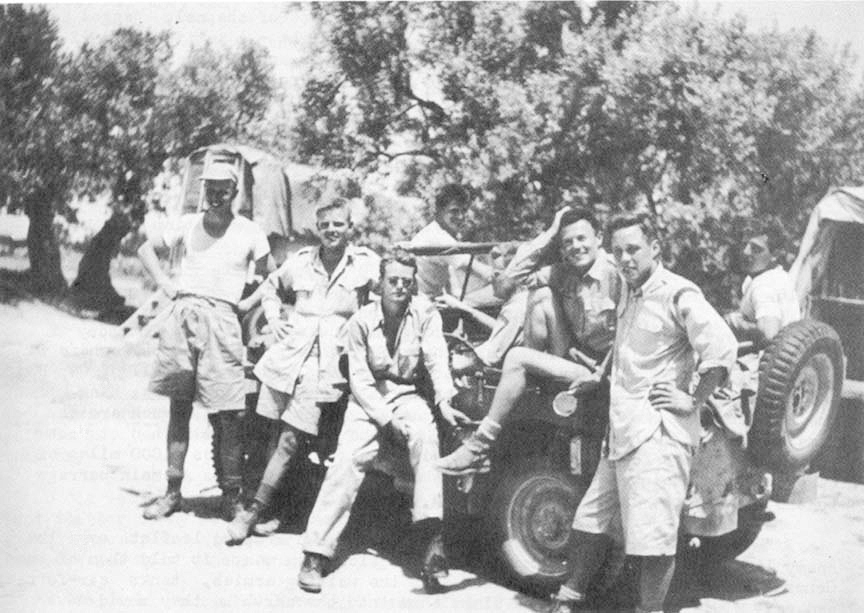
Some of the AFS men who volunteered to serve as stretcher bearers with the Fighting French at Enfidaville: left to right; Philip Zeigler, Richard Edwards, Waring Hopkins, Lewis Allen, Newell Jenkins, Caleb Milne, James Doubleday, James Gerhardt. (photo by Henry Larner)
April 3, 1943.
"At Shepheard's they have a rum and gin drink called 'Sufferin Bastard' and very appropriate; it's a stiffy.
"There are very few tools in Cairo, and I was under vow to myself to get some. So I wandered ------ asking for tools. I stopped at one shop, run by an English-speaking Greek; we sat over syrupy Turkish coffee for two hours talking about everything. He asked how much pay I got, $20 dollars. 'You're buying tools for your ambulance out of your own pocket?' 'Yup'. 'Well, if you're willing to make that sacrifice, I'm happy to almost give you these tools I have.'
"That guy gave me for $2 what normally costs in Cairo about $20 or $25. Also he gave me many interesting stories of the Egyptian dope traffic, which is big.
2 days later.
"We got that tire off and pulled out a 4" piece of shrapnel, jagged as they come. Also a little later we passed a grim sight --a native child 12 years old had been run over by a tank or heavy truck and was really a mess. Dead, of course, but no one had kicked it off the road.
"By the way, a while ago I saw my first air raid. They had a Jerry in the lights but missed him. They also were throwing up ack-ack like fury. A few nights later I saw a Junker get shot down in flames --- a very beautiful sight.
"My French now gets better. I held a five hour conversation with a young French madame, over a bottle of pinard."
May 16, 1943.
"As you know, all resistance collapsed Wednesday nite and Thursday of this week, thus ending an important phase of the war. BBC reports, where we got them, told of the situations on other fronts, notably the fall of Cap Bon, and the numbers of POW's (Prisoner's of War) taken. Montgomery was King, and the 8th Army his standard-bearers. 1st Army, American, and French armies came in for their shares of the Glory, but the 8th Army knew it had at last gotten the honors for a fight that raged for six months across 2,000 miles of desert and mountains --- from the first shell in the stupendous Alamein barrage to the thud of the last hand grenade in the Jebel mountains.
"My latest flash was the news that the RAF had dropped leaflets over the enemy lines telling them how hopeless their situation was. It told them of the Generals captured, of the men taken, of the waiting armies, tanks air-forces, and navy --- all of them ready to blast them into the earth so they would never come out. The sportsman's hand was in evidence in the sentence 'You have fought well, you have done your duty as soldiers --- but now you must think of your families and homes.' And underneath were great capitals 'ES GIBT KEINE AUSWEG!!!' and the Italian equivalent on the other half of the page.
"On some fronts there were Eyties who used the sheets as passports, as directed. Others gave up en masse. Some were so numerous that they marched, not walked, but marched in squads, brigades, corps to the POW camps, with NCO's at the head and foot of each squad --- perfect order to the last.
"Most Eyties were fairly happy, and responded to waves from us with waves back. Germans were a tough mobs glum on the whole, who looked much like a gang of young hoodlums on the way to prison in a paddy wagon. I saw one German doctor, a captain, who was working in a POW camp on the sick and slightly wounded, a damn fine looking guy, healthy, tall, and blonde, very good natured, and happy, as he said, to be free from the fear of the Gestapo. I asked him if being an officer, he wasn't more or less obliged to be a Nazi. He drew himself up, and said very sincerely and very seriously, 'I am not a Nazi, I am a German'. I have heard that same remark many times now.
"He added that even now, if his comrades were around, he wouldn't dare say anything. Other comments: German workers are forced to work 16 hours a day in factories, and are forced to live in the factories. I was incredulous. 'But yes! If they went home, they would never come back!'
"I asked him about the Eyties, and he agreed with another German 'as a comrade, all right, as a fighter, no good.' So far, most Eyties dislike the Germans quite passionately.
"But all this, though pertinent, is out of line with my own doings of the last day, because on that day, the ticket with my name on it hung on one shell, slipped off, and I was still the lucky guy.
"I'd been on duty for some 5 or 6 days, and I was getting pretty jumpy. No work to speak of, and I had only a book to distract me. I'd be reading and all of a sudden hear the wind whining through the scrub and think it was a shell. I was sitting by my slit trench, (that's another sign of jumpiness) when I heard one coming over. At that point there were guns on 3 sides of me, and the Jerry, thinking they must be in the middle (because he'd failed to put any out of action) gave it to me --- in the middle.
"I was in my trench in no time. A few more came over, one landing quite near the ambulance. I heard shrapnel clang into the sides of the ambulance, and I said 'Goodbye, meatwagon!' I was thinking of this when I noticed a whistle that had been going on for sometime. I said, 'Boy, that's headed this way'. ----
"It was, just before it went off, it gave a piercing shriek, and I went flatter on my face. It went off 5 feet from my trench, and either the ground came up and hit me or the blast-concussion got me, but in any case I went out and didn't hear them calling for an ambulance for a long time.
"Several centuries later, I heard a call for ambulance, I was still stunned and I didn't want to get up out of the trench, though the shelling had stopped. A second call. and I clicked ---they wanted an ambulance. So I went up, and they looked at me awful funny until I told them what happened. The patient had been wounded while violating one of two cardinal rules. I don't know which. No 1 is, Don't change your slit-trench! and No 2 is, Don't try to see where the last shell landed! My guess is that he stuck his head out of his trench to see where it landed and caught himself a chunk of shrapnel on the jaw and neck. Well laid open, not much blood. Boy, he was lucky, too. Almost hit the carotid artery, and I saw a very damaged set of neck muscles, also the joint of the jaw all bare, though it was smashed and pushed pretty wall into his mouth. Anyway, it wasn't obscured by much blood, and I took advantage of my position as medical officer to give a good look. Très intéressant, and well worth the extra 1 minute I took getting him bandaged.
"Well --- there I was, being an M. O. again. Damn --- I hadn't seen my officer for four days, and had almost done all his sick parade and all his wounded cases, whether walking, sitting, or lying. I lugged the guy in, also took responsibility for taking in a wireless operator to get his thumb looked at --- he'd burned it 3 days before and I'd had to take care of it myself ---bad burn at that. Also had a tummy-aching negro I diagnosed that I took in.
"I was under the impression that I'd be relieved of duty about then, but I got to the dressing station and I was told to go back. No one else around to take my place. I didn't want to go back. I was scared of the road after that morning --- Jerry had been raising hell with it, and also I was tired and jumpy. But I got back under will-power, stayed until relieved later about sundown. I got home to the dressing station just before dark, got me a slug of bum wine and was already to go to bed when everyone came home.
"All the stretcher bearers came in --- my co-driver and a bunch of friends. They'd been out four days and were tired, dirty, bearded, and hungry. One thing gave them hell up there --- and that also gave me plenty of hell --- the multiple mortars. They come six at once, and you just pray. One of our boys was killed, one wounded. I didn't know the one, but the wounded one was H. B. one class ahead of me at Fessenden, and in my class at Harvard. He's doing well, despite a severe bashing-up. Both of them have been awarded the Croix de Guerre.
"All in all, they were severe casualties for our unit, but why there were no more I don't know. I came damn near getting it twice, and am considering myself as the best candidate for possible hits. I was called away once to look at this dead English sargent, and when I got back I found the whole spot riddled with shrapnel --- I was spared that. But as a previous letter describes, I had a darn close squeak coming back through the shell.
"One guy also answered a call, drove away just as a shell blew up a loaded ammo truck 25 feet from where he was parked.
"And By God! if I ever hear anyone make a crack about me being in the AFS as a draft dodger I'm going to belt him so hard he'll think his lower teeth are a now sort of crown.
"One interesting thing is the ribbons I'm entitled to wear. As I see it, I'm entitled to the AFS ribbon, the Middle East ribbon, the 8th Army ribbon, the Tunisian ribbon, with one star, and a special ribbon the same as the Flying Tigers of China wear. It's designated as a ribbon for volunteer groups serving in battle areas outside the United States.
"The stretcher-bearers AFS man got home, and we all compared notes. I was even, or doing better with my record of---hadn't had my clothes off for 6 days, had slept in only stretcher blankets and a slit trench for 5 nights, not a hot meal in 5 days, no meal at all the last day. I matched them even on having sleep interrupted by mortar and shell fire, surpassed them with my knock-out shell.
"Interesting subject for war research is the dietic's of the desert sore--- a boil that becomes an ulcer on the skin. I guess this business of living on bully beef is not too hot, on the whole. More on this sometime.
No date.
"I have acquired a lovely little ambulance with all sorts of cute little grease points and the two loveliest water cocks you ever saw. Have to drain the water out every night so I know the latter well. I am serving as a relief driver and thus hope to see more of the countryside than I would otherwise. I have been fairly successful so far and after a while I think I would like to settle down at a post. However, the machinations of acquiring the desired post is most complicated. I think I shall just sit back and let the wind toss me where it will. What we are doing now --mostly driving M. O.'s about to inspect ------ sometimes doesn't seem exactly compatible with our high hopes of helping the war effort but they keep telling us that the army is always waiting for action and that we are doing as much as anyone can. Just the same it seems an awfully strange way to fight a war. The beer in the British canteen at HQ makes life quite pleasant in spite of the fact that it is cold as a bat. They say spring is beginning and we certainly hope so. I have seen many amazing sights in this strange land.
"I was sitting outside of a house --- private --- the other day waiting for the M O (Medical Officer) when who should come tripping lightly across the street but a young girl in modern dress bearing gifts. The gifts consisted of a cup of black coffee and a shot of some liquor. Knowing how I love coffee you can imagine me gulping it down. The liquor made it bearable though and I carried through gallantly. Another strange sight was a railway bicycle I saw one of the Wogs propelling along the track. And probably the strangest sight is what the well-dressed Wog will wear for pants. They wear cloth breeches built on the lines of jodpors (I can't spell it but I mean riding pants). However, in between the legs is a great quantity of' extra material forming a large sack. The idea seems to be that the next time old M. descends to earth he will be born of men and that they have therefore prepared themselves to catch him. They are without a doubt the dirtiest people on the face of the earth --- their bodies, clothes, dwellings, food and literally everything. There is one place through which some water runs. The Wogs use this for everything --- distinctly 'browned off' at the bloody orientals. They walk all over the street, their animals walk all over the street, everything stays right in the middle of the street. You blow your horn steadily for about five minutes and they finally give you enough room to pass. Of course at night its impossible to see a thing, so you either hope to swerve at the last moment or hope there aren't any Wogs about. When I was with the French I had quite a time. Of course I couldn't understand them but there were a few who spoke English especially the M. O. The good thing about it was the food. There were three Polish officers there, and those boys really know what war is. One of them still has his wife and children in Poland. He thinks that at the end of the war we and Great Britain will try to protect Jerry and he doesn't think he deserves it. I somehow agree with him and think that the Poles and several others should be allowed into Germany to do whatever damage they desire.
"There's a truck in front of me now and they are unloading heavy bags of cement and now bricks. The men just sit around and direct traffic while the women old and young sling a bag of cement on their hip and march away."
"North Africa is quieting down to what I hope will be permanent peace. The whole of the Mediterranean coast was never meant for tanks and guns and violent death. The climate, the background, the primitive native life, the incredible sea are blended together as one gigantic panorama which can really only live life to its fullest under idyllic conditions. In an incredibly short time North Africa will settle back softly into its ancient ways and the modern thunderbirds, the belching fire dragons will move away to new theatres of war. Relentless and eternal time already is flowing its balm over this scarified land and it won't be long before nearly all traces of the desperate struggle disappear. All that remains now are tanks and equipment which already are being infiltrated by the quiet legions of sand. These, too in time will pass. As the clouds lift from this continent, the first faint glimmers of dawn break thru over Europe. As we have always known, it won't be too long before the terror of fascist tyranny will, in time, pass."
May 14, 1943.
"As you know from listening to your radio, yesterday all hostilities here in North Africa ceased --- and that's good news for all. It seems so very quiet and peaceful here now, without the roar of the guns, and with our having to keep your ears open for the whistling of shells --- yes everything seems so peaceful and nice --- and there is a cool pleasant breeze here where I am writing. We are on a dirt road near an old stone farm house, and there are shade trees on each side of the narrow road. On my right is a wheat field, and the wheat sways and swishes in the breeze, and in the middle of the field an old wind mill is going round and round, just as I suppose it did when the Germans were here. On my left I can see mountains --- huge rugged mountains and they look so clear and powerful. Yes, it is very pretty here, and it is so very, very quiet. I still can not tell you any news. I will remain attached to the Fighting French for that is my choice anyway. Still well and healthy, although I may have grown a little older during the last month or so --- but my hair isn't white yet, so all is well! In such places as we have been in for the past five or six weeks money is of no value whatsoever. One cannot buy anything, and whatever we get, we get by trading with the Wogs (native Arabs). For half a cup of tea, we can got a dozen eggs and for an old shirt we can get a fresh-killed chicken for the two of us. You see we do not eat in any mess, we just draw our rations each week by the man, then we do all our own cooking and planning. We cook by a roadside, in a field or wherever we are and whenever we can. It's so much more fun that way. We carry everything with us and we have our car so packed that we can carry three (four if necessary) lying patients, and still have all our rations, water for three or four days, extra gasoline, clothes and bedding rolls, pots, stove pans, etc., all packed outside on the fenders and around the front of the engine --- yes, we are a moving house!"
May 15, 1943.
"After waiting literally for months we finally got up to the front in time for the victory. I wasn't here long enough to see a whole lot of action but I did see enough to get the general idea and finally got a chance to do the kind of work I came over for. Actually this past week has been one of the most interesting of my life and I wouldn't have missed it for anything.
"After travelling for seeming ages across the desert road we finally arrived out here at the front. We passed lots of interesting sights on the way out and had over a week in Tripoli while our ambulance was being repaired. I can also tell you now where the camp was where we sat for over a month before coming out. It is a little place called Gambut, about fifteen miles east of Tobruk, and just about the flattest and dustiest section of the whole desert. Even though it was hard sitting there while all the fighting was going on out here, still I enjoyed it an awful lot because there was such a swell bunch of guys there and the harder things went the harder we laughed.
"After many a trial and tribulation we finally got out to the front in time to be there during the German's last stand in Africa. I had several days of evacuating wounded from the front and several nights of being shelled, quite a new and different experience. I spent one whole night in a slit trench and there were a couple of times when I would have sworn those things were coming right on in with me. It's an experience that I wouldn't have missed for anything but one that you're not in too big a hurry to repeat! It's all over now, though, for a little while. I don't know what happens next.
"It hasn't all been pleasant and exciting though. Two of the man in our little group from Gambut (there were only twelve of us there so we knew them all very well) were killed out here.
"The most interesting thing that has happened out here was when the Germans surrendered. They brought about 600 of them into the place where we were stationed at the time and we spent the whole morning talking to them. There were right many who spoke a little English or French and we managed to make each other understand very well. They all looked very happy and not a one that we spoke to was the least bit sorry that it was all over for him. One of them told me, 'It is good that the war should end for us here'. Another, a former radio announcer from Berlin, was very vehement and wanted to got on the radio and tell Germany to stop fighting. When we asked him if he was a Nazi he looked quite indignant and said, 'I am a German, not a Nazi.' Everyone of them that we talked to was really quite likeable I must admit, and they didn't want any more to do with war then we do (with good reason). A great many of them had been sent down from the Russian front and they said the fighting down here in these mountains was just as tough as in Russia. They just couldn't understand, though, why America had come into the war against them. They said we should be friends and join together to defeat Russia (again with good reason---on their part!) We traded them cigarettes for belt buckles and a few little medals as souvenirs. The only thing they didn't like about the whole set-up was that they had been captured by the French. They hate the French mainly because they're afraid of them after the way Germany has treated France. Little bunches of prisoners kept coming over to us and asking us confidentially if they were going to be prisoners of the English or French. You should have seen their look of relief when we told them we thought it would be the English. It also hurt their feeling of race superiority to be guarded by the black troops, which the French use a lot. I just missed getting a wonderful souvenir --- one of the prisoners pulled out a marvelous Leica miniature camera with six rolls of color film, close-up lens, et al and gave it to a British Tommy who was talking to us! The German said held rather give it to him than have the French take it. It was a mighty interesting morning.
"I ran into some kind of a record last nite -- I was talking to a British Tommy who swore he had 19 brothers in the service. That's the height of something, I don't know what."
"The war is over, or very nearly over, out here. And in the past week I've been experiencing a feeling which I completely failed to foresee, and is a foretaste of what is to come when the war is over. The whole center of our existence for the past year and a half is about to be taken away. The feeling is quite frankly one of regret and loss. The show is over like the end of a football game, book or girl. It is a tragedy in more ways than one, too. It's bitter to see a man and fighter as fine as Jerry is, beaten. Worst of all, these men who have been great for a moment have lived up to themselves again and again as the need arose, are most of then, going to go back to what they were before, without the demanding discipline of a war to draw the best from them. Of course it can be argued that in ordinary living they don't need so much of themselves to get along, that war destroys more men than it makes. But what to me is more important is that to all men, even to those it kills war brings a moment of departure from self, a keying up of personality; it builds vital tension, strong and flexible like a tempered spring, that increases the capacity to live. I cannot tell you why but to me the first aim in the individual after development of courage in to increase the tempo of living, and war does this for men as nothing else I know.
"What is going to happen to us now that we've lost our job, neither I nor anyone else in this army know. That we'll be used sometime, someplace before the war is finished, we all feel sure. But we know, too, that meanwhile we are in for a long and difficult wait. I only wish it could take place in the country we are in now. Coming out of the desert into this was like coming home. The flowers are in even greater profusion than they were down the line. Miles upon miles of fields of flowers of every imaginable colour stretch out on all sides.
"It was pretty good up here at the end of this do. There was just about anything you could want for the taking. One of our fellows scrounged a Jerry Volkswagen. The most practical little car I've seen in a hell of a while. Except for the fact that it has no four-wheel drive it is better then a jeep. It has a four-cylinder air-cooled engine in the back. It's very low and open like a touring car. It has a better springing than any car I ever rode in. It'll do about seventy but since you sit so low in it you have the sensation of a hundred or more. It'll seat five --- two in front, three in back. it has a roll-top and quickly removable curtains, and the lightest steering I've ever known. We all use this car a great deal. When the war out here was over we made a rather long move --- several hundred miles. It was a sight to see all the thousands of captured vehicles being driven down the road. When we came near to the town to which we were going, we noticed a Volkswagen parked in a field hidden behind bushes. It had the insignia of a famous 8th army division painted all over it. On investigation we found that its motor arm had been removed, so we towed it in. We made a motor arm, painted out the signs and painted our own on, being a captured vehicle it is investigated and therefore easily hijacked. I only tell you this to show you to what lengths hi-jacking and scrounging can go in this army. Another amusing incident took place when the last Jerries quit. We took a detachment of ambulances into the hills, where the Jerries had been holding out, to pick up mine casualties and odd left overs. We parked on a road and when a call came in we'd despatch an ambulance. Down this road were pouring thousands of Jerry prisoners, all driving their own transport. Just at the time when five American airforce men in a jeep went by doing a little extra-curricula sight-seeing, an MO with us stepped out into the road and flagged down an Eyetye on a motorcycle and took it from him. The Americans watching were amazed and wanted to know if you could just take anything like that and in answer the MO wanted to know why not. Just then I was called down the road. On my way back I passed the five Americans in the Volkswagens, an Alfa Romeo diesel, a Guzzi motorcycle and their jeep. The general attitude is that prisoners have plenty of time and that they might as well walk."
En route.
January 29, 1943.
"We're leaving Freetown. The anchor winch has finished its growling and hissing, the chain finished its rattling up through the prow into the chain looker. Slowly our line of vision swings around, the boat slowly turning into the outgoing tide.
"The water in the harbor is a dull heavy green, foul with the sewage of the town and the several boats at anchor in the harbor. Directly off our starboard bow lie two huge grey and rusty freighters, boats that are daily running the seas and all their wartime dangers. The mountains behind Freetown run down almost to the waters edge and the town consequently is a narrow strip of semi-civilization between the malaria jungle devil and the deep green sea. Two of our crew, Lascars, have come to sit near me. There's a fascination in entering and leaving strange ports that doesn't seem to lose its attraction with repetition.
"A small -----has just crossed our bow, probably going out for a daily patrol, and one of the Lascars volunteered the information that one of our -----went out about dawn this morning. The motors are beginning to throb again. They stop and the boys up on the forward deck can be heard shouting to some American fellows on a Tanker anchored off our port. We're under way again. None of us knows where, or especially cares. We ease past a grey Freighter lying at anchor, fairly low in the water with a noticeable list to port, and a Royal Medical Corps man says 'Reckon the cargo must be shifted a bit --- doesn't seem to've been hit, does he?' The wake increases a little. We're quite close to the hills on the other side of the harbor now. Almost without exception they're solidly covered with a lush heavy green vegetation. The trees are rather old, the trunks run bare up to a few feet of the top and finish off in a dense solid mass of branches and leaves, like a child's drawing of one. The mist hangs low along the shoreline town. A trim motor launch comes clearly across the calm water.
"As you sail out of Freetown harbor the land on your left tapers from high astern to nothing ahead through a series of gradually lowering hills. Just past the last few feet of taper there is a small lagoon and a long low island on the far side of the lagoon, flat for its entire length except for an abrupt crest on the seas side like a paddle with an inverted ice-cream cone on one and. There's a little row of houses on the hilltop, and down below a little doll's version of a lighthouse. A long line of floats angles out from shore almost to where our course lies. Sub nets. I suppose. The net boom has been opened for our passage through. A grey green Corvette lies off our port bow in a line with the lighthouse, and a tiny sailing craft glides in from the ocean. It's a native boat, fat and low in the water, dirty sails and hull, and dirty natives in it. The Corvette has slid out from anchorage and is riding parallel to us off our port bow, signal light blinking. Lying at anchor the Corvette looked awkward and ungainly, but sliding out to see it imparts a slightly startling impression of sudden and deadly efficiency. The mountains have fallen a little behind now, and as the sharp sloped and rugged crests lose in distance they lose, too, in color starkness. We're past the lighthouse inlet now. The Corvette is leading us out riding well in front and slightly starboard to us. In a short time we'll be on the high seas again."
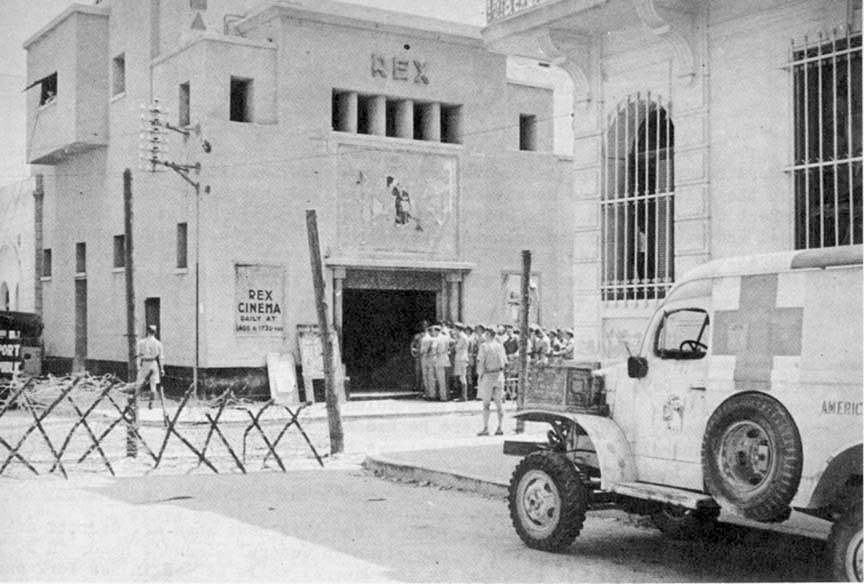 Relaxation at Sfax. A group of AFS man wait to go to the movies. The films are shown the men by a British Mobile 'cinema' unit; this unit travels in a 3-ton track and in the only method of providing movies to the men in Tunisia. |
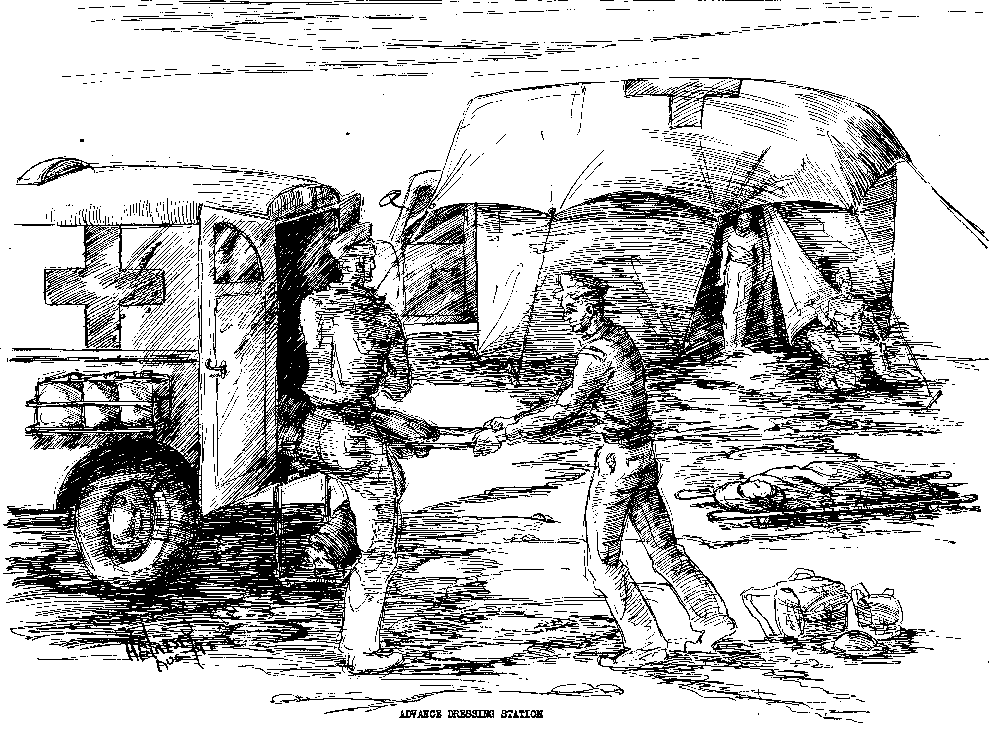
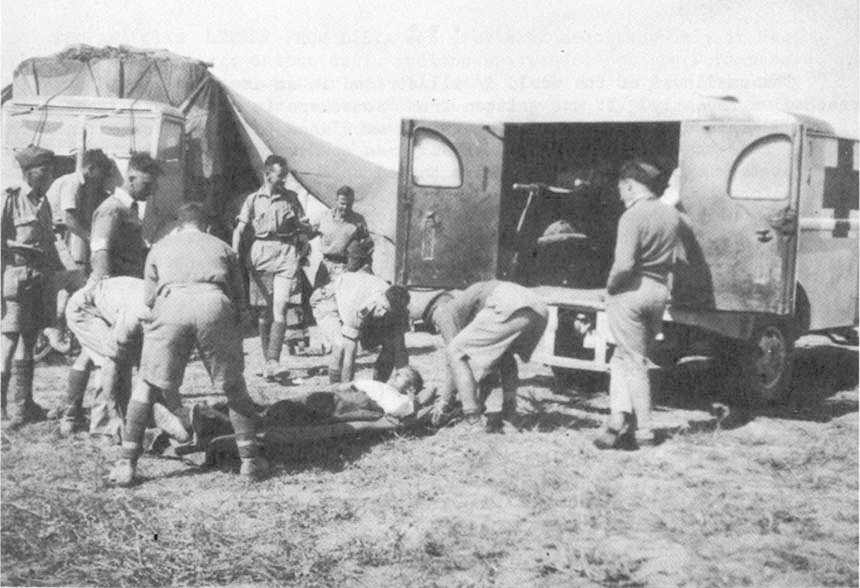 AFS at work. Some of the volunteers pictured loading a wounded man onto an ambulance. |
Word has come by special cable from Cairo that two AFSers have been awarded the British Empire Medal. The recipients of this honor are George Lester and Robert J.B. Sullivan. The British Empire Medal (Civil Division) is a gallantry medal and was awarded the ambulance drivers for "Their courageous conduct during operations in the Middle East". These are the first AFS men to be cited in any way by the British; we congratulate them both with great pride.
The most notable event of July, the month not only of our Independence Day but of Bastille Day, the French equivalent, was the arrival of General Henri Giraud in the U.S. Mr. Lydig Hoyt of AFS volunteer enlistment department met the General informally in Washington where he had tea with him and President Roosevelt and General Marshall. The French General was reported as a very charming person. Mr. Hoyt, who is leaving N. Y. Headquarters to go overseas with the French Unit of AFS, caused a mild panic when he reported having calmly sat on the Whitehouse lawn with three international figures.
We had barely recovered our composure from this news when Mr. Galatti announced that he was attending the dinner given in General Giraud's honor in N. Y. As this was the only dinner attended by the General while he was in New York and there were only sixty people invited, we were once more awed and impressed. Therefore it is appropriate that the representative of France and those of AFS should meet, particularly in July, since it is the month in which both countries celebrate their freedom. The Field Service has been associated closely with France throughout the 29 years of its existence.
The smallness of the world is illustrated in an excerpt from a letter that reached us recently. It was written from "somewhere in the Pacific" by a Naval officer. This officer's cousin donated an ambulance to AFS in France in 1940, and he wrote that he had met another Navy man commanding a ship in the same area. They got talking and the conversation turned to France where the second man had lived before the war; he mentioned an interest in ambulances. It developed that the AFS ambulance donated by the first officer's cousin had been driven in the Battle of France by the second officer's son.
The list of AFS Middle East veterans who are reenlisting for more ambulance work is growing to impressive proportions. Norman Jefferys, a vet not only of the Middle East but of the very first (Hadfield Spears) unit to go over, is already on his way, as are Joe Latham, Leo (Harpo) Marx, Charles Winship, Harrison Searles, Bill White, and Bill Drew. On the waiting-for-shipment list are Tim Krusi, Donald Bragg, Ham Douglas, Burgess Whiteside, Stokes Royal, Dick Paulson, Russell Kneupfer, John Brooks, Michael Cheney, James Moore, Edward Spavin, David Becker, Charles de Rimsingeur, Thomas Dibble, Robert Gaukroger, Jack Kneupfer and Arthur Lavenhar.
Keeping up with the world: As Allied operations spread further afield, so does the AFS overseas. In addition to the headquarters in Cairo, we now have a liaison office in Tripoli with Lt. Lester Collins in charge, and one in Algiers with Lt. Robert Thomsen in charge. Betting is high as to when and where we open a Sicily office. Be alert! be prepared! it may be YOUR AFS man whose next address is Gela.
The romance department is flourishing in spite of the heat, or maybe because of it. Charlie Shoneman, late of AFS presently A.U.S., was married June fourteenth to the former Miss Anne Marie Negbaur. Burgess Whiteside met and married Miss Dorothy McNab in a whirlwind courtship and at present writing they are honeymooning awaiting 'Burge's' return to AFS service.
The status of AFS an a member of the National War Fund Inc. has been slightly altered since we announced in the May issue that we had been accepted for membership. The 1943 drive for funds will not include any appeal in behalf of the Field Service nor will we be mentioned as participants. This is because 16 major war relief agencies will be the only beneficiaries this year. We ARE, however, still participants, although at present inactive. Being inactive we remain responsible for raising funds, our life-line. With this memo, we officially state that any and all contributions will be gratefully received--- checks made payable as in the past to American Field Service, and addressed to 60 Beaver Street, New York 4, N.Y.
The AFS film LETTER FROM LIBYA was previewed simultaneously in New York and Boston. Large enthusiastic audiences attended both performances. LETTER FROM LIBYA is now on tour and will very likely be in your community before long. If any of our readers know of an opportunity for a showing of the AFS film, please write to AFS headquarters N.Y. and a copy will be shipped to you. We are very anxious to show this film to as many people as possible, as it is an excellent account of the work of the ambulance men overseas.
What it means to be a Yank: Arthur Lavenhar and David Backer have just arrived home after a three months boat trip. Their ship stopped at Melbourne and they were permitted one day ashore. Shortly after they got to town an American Colonel, stationed in Australia, upon learning who they were gave them his car for the day. They had a wonderful day and saw all the sights.
We have word of a few of the Ex-AFS Middle East veterans. Hugh Scott and Jack Carter are in the Marine Corps and Edwin Zittell is in the Army. We wish them the best of luck and hope that their year in AFS will stand them in good stead in their now careers.
 After the battle is over, AFS men go in for a little desert exercise while their ambulances rest in the background |
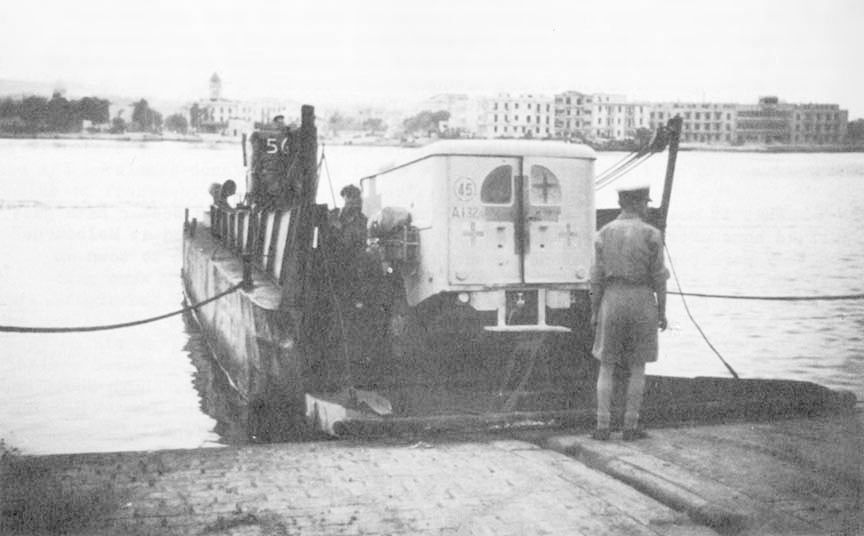 The AFS moves into Bizerta. One of the ambulances is loaded auto the ferry, the only way to cross into Bizerta. |
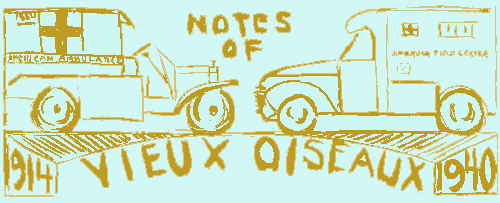
Returning planes and ships, bring back to us youngsters from the Middle East, youngsters in years, but "Vieux Oiseaux" in experience; and so the roster of those rating space on this page grows rapidly.
Youth yearns for change. Our fledgings fly home with ideas ... sometimes grandiose ... of new fields, bigger worms. God bless them, it was ever thus. Having been proven excellent ambulanciers, did not you and I once feel that General Pershing would, with open arms, welcome our willingness to assume more important duties under his command? In certain cases, not many, he actually did. The present war finds Oiseaux holding down jobs, running the gamut from Private to Brigadier General, largely at home in the US. But the fledgling having tasted action, becomes intolerant of training camps and schools. With memories of nights in the Western Desert with the New Zealanders in mind, he finds life at Upton, Gordon and in Topeka, dull indeed. At a southern camp, drinking "Liker", and reading the lines of old Doctor Eugene Murphey;
"But when he lusts for action or would lead a hope forlorn
He'll find the force that's needed in the SPIRIT of the Corn"
his craving is fanned to flame. Flesh-pots and tins and flies and short water rations assume new and unexpected charm ... in retrospect... even as you and I recall fresh-killed beef and "Pinard".
All of which may, in part, account for the fact that many fledglings are returning to their first love, signing up for the Middle East or India or hoping to roll into Paris along with French troops.
Norman Jefferys, who succeeded Alan Stuyvesant and preceded Tom Greenough as CO of AFS with the FFC, re-embarked, this time for India. So have Harrison Searles and Bill White and Bill Drew. Harpo Marx went back to ME. Tim Krusi, son of old Leroy TMU 133, having evacuated the metal he absorbed in the Desert, chomps at the bit. As they sail, their names will be recorded.
Happy landings, Birds.
Leslie Price Jacobs, SSU 89 saw action on the Champagne and Verdun fronts, with the AFS, in 1916 -17. Returning to the U.S., he entered Naval Aviation, eventually being commissioned Lieutenant Junior Grade. With the Armistice, he retired to private life but in 1941, re-entered the Navy as Lieutenant Commander, serving under the Bureau of Aeronautics and as Aide to Admirals Stanley and Yarnell. On the night of April 27th, 1943, he was killed in the crash of a Navy Bomber, near Oakland, California.
A short time before his death, Leslie called at AFS HQ, re-iterated pledges of loyalty and affection to his old Service and in leaving, presented a donation to the AFS General Fund.
We salute one more Vieux Oiseaux.
Edward Pack Curtis, SSU 15. Vice President and-General Sales Manager of the Eastman Kodak Co. is again in the US Air Corps, overseas, Chief of Staff for General Spatz and is a Brigadier General.
Lieut. Colonel Hugo Alden Kenyon, SSU 1, gives his address "Foreign Liaison, Pentagon Building, Washington, DC."
Lieut. Colonel John H. Hynes. GSC, formerly SSU 68, is in the Office of Chief of Staff. Civilian Affairs Division, Washington, DC.
Paul F. Ullman, France '40, has closed his studio, put away his paint brushes and departed his customary haunts. The grape-vine says he has acquired an APO number, c/o Postmaster, New York, NY.
John Edward Boit is in charge of AFS Liaison at HQ FFC Middle East. Johnny's ambulance work with the French began in 1916. He served as a driver and as Sous Chef of SSU 11.
Note: Les Vieux Oiseaux are always welcome at 60 Beaver Street.