Edited and published at AFS Headquarters, 60 Beaver Street, New York under the sponsorship of the families and relatives of the ambulanciers. The relatives and friends contribute the excerpts from the letters, and the volunteers write the signed articles which are taken from the A.F.S. News Bulletin published in the Middle East.
Excitement and tension over the invasion of Europe, while running very high in the U.S., must be at even greater peak in North Africa. Who is going to be the first to invade? Where will they land? When? Sooner or later we will all have the answers to these questions. At the moment the only fact we do know is that the British War Office has notified Mr. Galatti that AFS ambulance units will be attached to an invasion army. This is not only great news to the ambulance drivers themselves, who by all accounts are happiest when they have a lot of work to do, but is the highest tribute to AFS that could possibly be paid by our Allies. There can be no greater proof of the worth of the job done in the desert fighting, than to have the British value the services of our American volunteers enough to undertake to transport them across the sea.
At present the AFS ambulance men serving in the Middle East are enjoying a well deserved rest after the Allied Victory in Tunisia. Perhaps 'enjoying' is not the right word. From all reports the inactive periods in war are not popular with the fighting men. The waiting on the job --- yet no job to do, is the hardest, most tedious part of war. A large percent of time has to be spent idle. This does not mean, however, that AFS men are sitting around doing absolutely nothing. Their ambulances which have been driven at an almost constant pace from Alamein to Tunis, need care and attention. There are always patients to be driven within the army which they are serving.
The period of waiting may not be very long and one Field Service driver may realize his hopes in the near future. After obtaining a long wanted release from the comparative inactivity of a Syrian post, he wrote: "As the sun sets and the landscape of this oriental paradise sinks into the horizon, we set sail for Tunisia, Sicily, Berlin and Greenwich Village."
|
".......Unfortunately this work has not been accomplished without losses. May I extend my deepest sympathy of the A.F.S. to the families of those men who have given their lives in relieving the suffering of others, and to the families of those men who are wounded or missing." Stephen Galatti |
August A. Rubel was killed in action North of Enfidaville in Tunisia when his ambulance struck a mine. A veteran of AFS World War I, he felt he could no longer stay out of the present war, where he could be helpful to others. He reenlisted in the AFS in November 1942, and went to the Middle East as an ambulance driver shortly afterwards.
Richard Stockton died of wounds received while riding the same ambulance with August Rubel. When their vehicle struck a mine they were in enemy territory and Stockton was taken prisoner. He was taken to a German medical post but failed to respond to the operation.
These men were serving with the Fighting French Unit of the British Eighth Army. They lost their lives on the site of the last Axis stronghold in Africa --- the Enfidaville sector attacked by the Fighting French and counter-attacked by the Germans until it finally fell to the Allies on May 11, 1943. To the last ditch these two Americans did their best to assist others. The great Allied victory in North Africa, although it does not lessen their loss, avenges their deaths.
David Emery was seriously wounded when a Butterfly Bomb exploded near him in Tunisia. We do not have a full report as to his injuries, but have received a cable that he is out of danger, and getting along well in a hospital. We want to wish him a speedy and complete recovery.
Word has been received in HQ N.Y. that the four A.F.S. man who remained prisoners of war in the hands of the Italians, have been released. For a detailed report of this wonderful news: see OUT OF THE EVERYWHERE.
April 8, 1943.
"Have just returned from an evacuation. of patients and am now moving up the line in convoy at the rate of something under a mile an hour. For the most part we are just sitting and when we do move the speedometer doesn't get past the zero mark. Much of the driving out here is almost pre-machine age in its slowness --- when you are in convoy and when you have patients you practically have to drive in reverse with the brake on. But when you aren't in convoy and haven't got patients --- that is the great leveler!
"Food has ceased being a pastime and has become a means of satisfying hunger. It is another daily habit --- like brushing the teeth and combing the hair.
"The news continues to be good out here and right now we have very little to do. I had most of my excitement at the beginning of the push, before the cracking of the Mareth Line; at that time I was at an advanced dressing station which was between our big guns and the enemy. When I arrived there, shortly before midnight, our guns were sending over a tremendous barrage and a continual roar of hundreds of shells. It was more than reassuring --- it was appalling.
If they were at all effective they must have raised hell. After about half an hour they let up. Then it was Jerry's turn. He set up his own little barrage, which was a fairly creditable replica of ours --- and it so happened that our ADS received a greater part of it ! Just before it started we were all sitting in the tent (there were 4 AFS cars and about 6 British ambulances at the ADS, as well as several stretcher bearers, two doctors and a chaplain) drinking tea. Before I was even aware that anything out of the ordinary was going on, everyone was squirming on the ground, donning steel helmets and trying to hide behind boards, each other and even little wicker baskets! Naturally I squirmed too. Then I was aware of a great roar of motors --- then the earth shook and there was a deafening noise. By the time I had taken my next breath the motors were far away and people were making headlong dashes for the tent doors. Several got out before the medical officer in charge could recommend in a calm voice that we all stay put and not give Jerry another clew to our hereabouts by showing light from the tent. But it was too late --- Jerry had apparently found out all too well our exact location. He came back twice more in rapid succession and each time I thought we were more surely blown to bits than the last. But then there were several minutes of unpredictable silence and I discovered that we were all quite as whole and healthy as ever. Mechanically we all trooped out into the open. The moon was struggling with a dark cloud and all the noises of war were very distant and impersonal. We exchanged small talk and relaxed. Then the shelling began! The first shell was whistling through the air before any of us realized it was coming at us. We were still standing --- the chief M.O. was telling a couple of us an amusing story about an Italian doctor he nicknamed Benito Spaghetti, when the shell landed five feet behind us and right next to the tent. It should have corrected our positions in a hurry, but it didn't --- it was a dud! I still have difficulty believing it, myself! The M.O. continued his story and it was a good one. But immediately he had to stop again, because two more whistles were heard simultaneously and we were all diving for slit trenches. The first two I tried were already occupied. The third was deep and narrow and empty --Paradise at the moment ! Another AFS fellow dove in after me and for several minutes we squirmed about trying to erase ourselves in the dirt at the bottom and become comfortable at the same time. We didn't get an opportunity to even raise our heads above ground for what seemed like hours. Shells were falling all around us, throwing dirt in on us and shrapnel near us. When at last we did get a breather we could see pits around us and I found pieces of shrapnel inches from the trench. The breather was a brief one --- as was all breathing that night. Sometime early in the morning a British ambulance driver was killed a few feet away from me by a piece of shrapnel. We all heard the hit and the yells of the orderly who was with him --- he also was hit. It was almost the only time I have heard a wounded man yell; he kept repeating "I can't stand it --- I can't stand it." Most of the wounded man have been treated for shock and given morphine before we evacuate them, so one gets a rather distorted view of the self-control of a man who is hurt. When the screaming stopped I heard from a slit trench near me 'War is hell, isn't it?' and then the answer, 'Yes, but I guess it is only human!'
"From about 3 am. until 8 a.m. I was on duty, which meant that in case of an evacuation it was my turn. It was no hardship, however. I wouldn't have slept a wink anyway.
"Daybreak was a welcome sight --- for two reasons. It was one of the most beautiful dawns I have ever seen and it brought with it a total halt of the shelling. We were for the most part silent, smiling wearily and emptying out pockets of dirt accumulated from slit trenches. After an hour of searching, a bottle of rum was produced. This liquid is especially manufactured for frontline troops and why they call it rum I don't know. It tastes a bit like cough medicine and more like varnish, but above all it is alcoholic. It has a terrible punch and is almost impossible to drink straight but with tea it is a reasonably good facsimile of a hot rum toddy and very comforting. We sat about in the growing sunlight and became thoughtfully tight. We had breakfast and right afterwards I took a short run to an R.A.D. to pick up some patients. After that I washed up and then cleaned up my car. The morning was quite peaceful, spent largely in staring at a group of Italian prisoners captured the night before. But the curtain had not fallen --- one or two guns (we'd been told they had all been quieted during the night) --- started to lob shells over again. They came over spasmodically from then on. There was general eagerness to get trips back to safer territory so by noon I was the last AFS ambulance there, and shortly after I evacuated four patients amid a slight flurry of shells. When I was once in the car and moving, the shells seemed less important.
"Since then I haven't had a great deal of excitement --- occasional bombings and strafings nearby, a Jerry plane shot down over my head (a beautiful sight, really with ribbons of ack-ack fire and then the plane falling to the ground a red ball of flames and strewing the country side with weird pink shadows) and a wild excursion in the wrong direction with another ambulance which ended at the Mareth Line (a week before we broke through). But for the most part I must be content to watch our own bombers fly overhead with large bombs attached by invisible threads --- and then ten or fifteen minutes later return without bombs and usually in the original quantity.
"There seems a good chance of my getting more activity if the Germans make a strong stand before they say goodbye. If not, I'll have to be content with my brief sample, which my friend the M.C. at the ADS said when I ran into him the other day was the biggest thing he'd been in during his 3 years service in the Middle East (most of it spent in the front lines). In short, it was a brief but convincing sample.
"The sight of a badly wounded man, a dead body, a human hand lying in the road, doesn't depress me as much as you might expect --not as much as the insane asylum I worked in last summer did for example. Perhaps because it is so completely physical.
"The bunch I am with now is on the whole a good one. There are two platoons in Africa ---I was fortunate enough to get transferred to the one that usually sees most action ---the older one. I and the fellow who was my second driver for a while before the push started are the only two from Unit 26 in it. He was assigned a car of his own when someone went back to Cairo.
"The influx of books never quite ceases, consequently I've been able to do a good deal of reading, some good, some bad. This stage of the battle is particularly conducive to reading. It seems nothing more than a chase: Jerry running and us fast on his heels. That he is running faster all the time is indicated by the amount of stuff he leaves behind. There is more and more loot as the miles crawl by. This paper, for instance, I hope you will pardon. I scrounged it from an abandoned branch yesterday.
"The liquor situation out here is a bit grim, since Cairo. A bit of metallic, impotent Tunisian wine, some potent but almost unpalatable native brandy, 2/3 of one quart of gin! Oh for a dry Martini at the Algonquin --- or practically any place for that matter! If they ever make up a dehydrated Planter's Punch --- or beer or T.C., or . . . . send me bushels! But I'd give up all of those for a drink of cool milk !"
"At about seven started off in desert formation (that is, 3 parallel lines of vehicles). Went for several miles over crude paths and trackless fields. Then I was called over to evacuate a patient back of the medical dressing station. When I arrived at the medical truck in our convoy the patient was already dead. But they asked me to take him along anyway until there was time to bury him. He was a German --- died of appendicitis, of all things. For some time I followed the convoy with him. At one of the frequent stops that promised to be of some length the chaplain came up to my truck and asked me if I would like to get rid of my corpse. I said I had no objections so the chaplain's driver and I lifted the stretcher with the body from the ambulance and carried it to a nearby slit trench. Then a chaplain started to widen and lengthen the slit trench with a shovel --- for some time, refusing assistance. He examined the man's clothes, found his identification papers and a few odds and ends. Then we lowered the body into the hole. The padre read a few lines from the Bible in an almost inaudible voice, and we proceeded to quickly cover the body, taking turns with the one shovel and leaving a long mound above the grave. At that point we searched about for some wood for a cross, but there was none to be had. Someone suggested a bottle so we dashed back to my ambulance. The only one I could find was a brandy bottle with an inch of the vile stuff still in it. We agreed immediately that the padre would consider it sacrilegious. 'Guess we'll just have to leave it bare', somebody said. At that point the padre produced a board from his truck and set to work splitting it in two and nailing the pieces together. He then asked for a pencil, which I dug out of a pocket --- my last stub. The padre wrote the man's name, race and number --- the latter twice, as that is apparently the most important of all --- and nailed his identification papers on the upright stick. Then we placed the cross on the grave, took a last look and decided it was an adequate job under the circumstances.
"After that it was a mad dash to overtake the convoy, two miles ahead.
"Today note that I have gone 1,000 miles in my Tunisian ambulance."
April 10, 1943.
"We are getting into the travelogue Tunisia these days --- great fields of green grass ( often up to the car windows) red flowers that look very much like poppies, yellow daisies, and exotic lavender flowers. And above all, trees --- thousands of trees in precise and unwavering rows. I don't believe I've seen a tree growing of its own accord this side of Cairo. The palm trees are diminishing, but cacti are becoming more frequent,
"It occurs to me that you might be interested in knowing just what goes through your head when you hear a shell coming at you. At the moment it seems the most important thing in the world. Your thoughts --- or perhaps they aren't thoughts, but impressions and reactions --- are something like this: (I can hear it coming. I wonder where it will land. Will it land near me? Yes, it is going to land near, in fact right here! Here it is ! And here I am! Ah, I wonder if that tea is ready yet?'"
April 12, 1943.
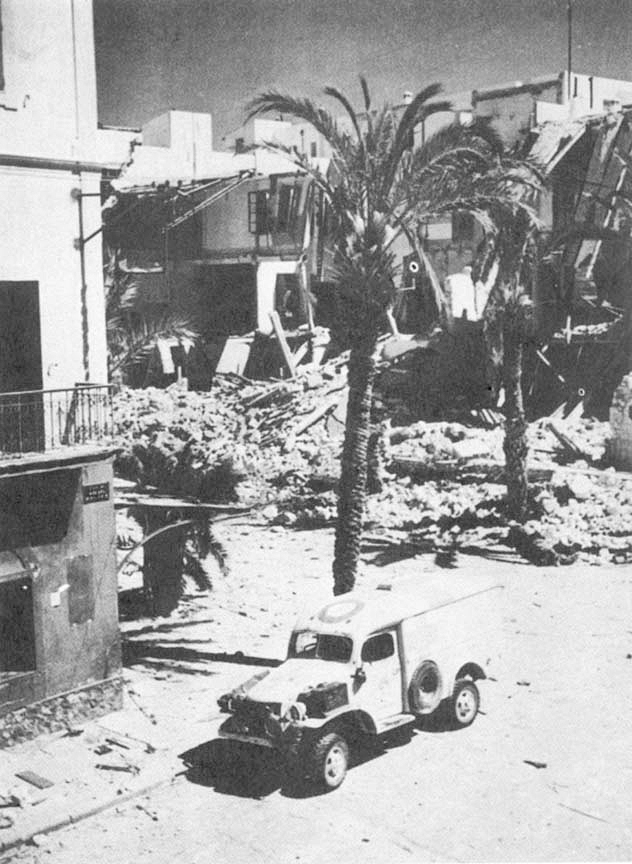
"Had a big day yesterday --- hit a good sized town --- larger than Gabes---for the first time. While on my own it seemed pretty much a dead place --- main streets and largest buildings completely shattered --- railroad station and yard demolished, freight cars and passenger cars thrown all over the lot, some even blown onto low buildings ! All this by the RAF and American Air Force. Talked with some civilians, all of whom had lost friends and relatives in the bombing and found them saddened but not bitter.
"The arrival of the Eighth Army after long waiting seemed to cheer them up considerably. One lady told me that her son and granddaughter had been killed a week before by American planes. She was not accusing, but merely stating a fact: There was little I could say.
"The people have moved out of the main part of town, the most heavily bombed, and into the suburbs. In the center of two are a few soldiers but no civilians. Those that remain are apparently hoping to hang on until the fighting is over in Tunisia and they can reconstruct their former lives. They all seemed to have plenty of money, but there was little they could buy with it. Army issue cigarettes and biscuits were more gratefully received than money.
"Fell in with two fighting Frenchmen and a South African --since the population here is almost exclusively French-speaking we succeeded very well in finding the places where there was still wine to be sold. Spent an amazing afternoon in a room above a fly-infested horse-stable. As the South African commented (they are English speaking ) it was a 'very cosmopolitan gathering.' During the afternoon people of all nationalities wandered in and out of the town: French, native Tunisians, Indians, English officers, the South Africans and myself.
"Our host was a Frenchman who had fought with France before it fell and come to Tunisia afterwards. He made you feel at once that you were his 'camarade' as he expressed it, and at the same time a guest of honor at his table. He treated us royally. I don't know how many liqueur glasses of cognac we had, without so much as a word about money, but it was certainly ample for all of us.
"At our party we had one unshaven native who, though quite self-effacing at first, became more and more inclined to express himself with every glass of cognac he consumed. He seemed to have one thing particularly on his mind. 'Les Allemands', he would shout, grabbing at a bracelet on your arm and pretending to wrench it off. 'Bracelet', he would say and whistle through his teeth. Then a ring" 'Ring' and 'psst' it was gone. All of which was intended to convey his condemnation of the German's unscrupulousness and his approval of Englishmen, Frenchmen and Americans, his comrades. By the end of the afternoon his little act had become quite polished.
"At six o'clock the party began to break up. Our host was still reluctant to take any money at all from us. All he would accept from me was 30 francs (60¢) for a bottle of wine I brought away with me. He showed us his wallet, counting thousands of francs and shrugging his shoulders expressively.
April 13, 1943.
"Returned this afternoon to the before-mentioned town. Overnight they had apparently forbidden the sale of wine to troops so it was somewhat frustrating. But I called on my host of yesterday to leave him a pack of cigarettes. After leaving them I picked up a civilian and we went on a tour of the town. He pointed out the best hotels, cafes, cinemas, theaters, and stores, telling me when and under what circumstances each had been wrecked. His own home was completely demolished. All he could say as we wandered about the broker town was 'Tout cassé. Tout! Tout!' over and over again. It was an extremely depressing sight, particularly while in the company of one of the inhabitants. I left him with many protestations of my sorrow and a present of three packs of cigarettes. Among other things he told me that over 3,000 inhabitants had been killed by bombs, that the city had had 6 cinemas and one legitimate theater, that the city had been bombed twenty times, and that he was sure the Americans would send food. He also paid me one of the finest but moat unearned compliments I have ever received --- he said that my French was 'très bon'.
April 23, 1943.
"To return to the present and life in Tunisia. We are L.O.B. (left out of battle) at present and are camped in a huge olive grove --- 15 Coy (this one) has been supplanted by F.H.'s boys and G.G. and P.C. are now up where the stuff is, as far as I know there's quite a show going on now. Jerry is penned up in an area around Bizerte, Tunis and Cape Bon, from which he 'ain't going to get out'. . . . He has a heavy concentration of troops in a small area which makes it duck soup for our air force, but hell for the ground troops . . .He hasn't a Chinaman's chance but it's going to be costly before he knuckles under. You probably know more about this than we do now, however.
"Several days ago we were inspected by the Leftenant General in command of the Army Corps to which we have been attached. He stopped and spoke with each one of us and afterwards gave a little thank you speech for all the fine work and this and that. It was interesting to see the same cars we had at Tahag, seven months later. Several still had their battle scars and others patch-marks showing where they had been. All of them looked well worn.
"I heard today that D.R., of our original group has been recommended for a high decoration for work done in a recent show. He and an M.O. worked for seven or eight hours at an R.A.P. tending wounded (under intense shell fire). D. made three runs in and out of the place, as well with three tires shot flat and a hole in the radiator. There were fifty some shrapnel holes in his car when he finished. Whether he gets the thing depends on the military-civilian distinction which governs these cases. He certainly deserves it as all who saw it attest. Fine show.
"A. and C. of section 12 (mine own) had some interesting times with the ----- to whom they were recently attached. They procured a little man named Ali who acted as a batman for them when in rest areas, It turned out that Ali had been in Rommel's entourage shortly before. He told them that the Field Marshall had been wounded shortly after the Mareth do. Checking through Intelligence proved it to be true. He was recently in a hospital in Tunis. The ----are a famous old regiment. It was a squadron of that regiment that made up the Light Brigade at Balaclava under Lord Cardigan. The boys had a fine time with them.
"The weather is fine spring weather now and highly welcome. The flies are back, but they haven't had the practice of the Egyptian flies and aren't quite as eager as their brothers to the East who have been slapped at and knocked about for three years".
"Well here it is another day in an endless string of days that go on forever. We are in the midst of one of those long, weary periods of sitting and waiting, waiting for supplies, waiting for attack, waiting for enemy planes, waiting for our own planes, waiting for something to happen, and just plain waiting. The only thing that seems to have arrived are our planes. They have been a little thin lately, but not so to-day. The sky has been dotted with them and the air thick with their welcome sound. When they go over sometimes I take out the field glasses we carry and look them over. I often wonder if any of the boys I knew in Syria are flying them. I have met some of them in places here and there, so it may well be. I told you about flying them up there. I learned how to handle a plane in the air from a South African officer. I never did try landing or taking off. Both myself and my instructor placed too high a value on our respective lives to risk the practice necessary to such maneuvers; and it is more fun when you are at four or five thousand in one of those fast low wing trainers. You just give a slight pressure with the finger tips and an equally slight pressure with your feet --- and lo --- you turn and dive and twist for no good reason that I can see. It's so darn out of this world. When you first try it that it makes you slightly intoxicated with your own accomplishments --- sort of like 'Dumbo' --- and then you get a little uncertain of your ability --- there is always that broad shouldered guy in the front cockpit to whisper encouragement in the speaking tube --- like Timothy Mouse in Dumbo's ear.
"A tragic thing happened after my last flight --- I think I mentioned it vaguely once before. After we landed we taxied the Harvard to its position on the drome. Lt. A. and I had been to Homs, about 60 or 70 miles north to do a routine reconnaissance flight. I flew for a bit and then A. stunted for my amusement, then we returned to 'C' ft., or telegraph pole heights, while he counted motor transport and gun positions and I counted box cars on the railroad line to the west. We went into the mess and I went into the Sgts. bar and had a drink before supper and B.W., and Aussie pilot, and some of the other Sgts, in the unit. One of the instructors come in and asked B. to take a Kumy over Homs. B was to jump M. with the Hurricane to give M. practice in evasive tactics. M. wasn't told anything about it, of course. He needed the practice all right. He had cracked up a Hurricane four days before --- a total loss, and he had muffed several landings. I came out at the drome at six the next morning to be ready for the take off. It was my job to be there when any plane from the unit took off or landed. Flight Lt. B. came over to the ambulance and said 'Want a flip in Harvard 3 Ken --- the back cockpit is empty?' I told him I was suffering from a bit of a hangover---anyway, so thanks just the same, sir, etc. Anyhow, M. finally got off with one of the mechanics, fellow named B. in the back. B. and the rest of the Hurrys went off a few minutes later. I went into the flight tent and kidded with Flight Sgt. B. about the bender the night before. About an hour later Hurricane F came in like a bat out of hades without even doing one circuit. I ran. out and started the engine --- just in case --- and woke up my orderly. It was B. He taxied in and out the engine. He was white as this paper and not making much sense, but we finally got the story. He had gone up to Homs and stunted around at about 29000 looking for M. --- finally spotted him and then came in for an 'attack' from the starboard quarter, and above. After that he did not quite know what happened. M. must have gotten panicky, and thrown the plane into a spin when he heard B. shoot past. At any rate he started spinning at 1,000 ft, it takes at least 1,000 ft. to get a Harvard out of a spin --- and that is just what it took him. Just as he leveled out --- whom, and that was that. We phoned Homs to see if we could get to them and I grabbed the M.O. and started off for Homs myself. Two of the instructors took another Harvard and went off to see if they could land nearby, though there wasn't much hope. The first to get there were the Arabs. but it didn't matter --- the boys were both dead. The Doc and I got the Arabs to give us a hand and we brought them back to the drome. According to military regulations a post mortem was necessary before burial, so the M.O. routed me out of the bar at 9.30 o'clock that night and off to the hospital 14 miles away --- an hour there --- then back again. I was tired and feeling about as lousy as is possible when I went into the mess. To my astonishment everyone was drunk as a lord and merry as hell. I stood where I was for a minute and I must have looked my astonishment because someone yelled 'Hey --- what's the matter with you, haven't you ever seen a party before? Have a drink'. Then I began to realize that this was the way the R.A.F. does things --- the way they have to, because in the R.A.F. you just kiss yourself good-bye when you sign on the dotted line --- so anyway I had a drink and If you ever mention a guy named X. or a little block called 'R' around 74 squadron --- you just get a blank stare and someone says--- 'Who are they?' Anyway for once you can forget any moral issues involved and thank God I had a hangover or they would be saying up at 74 --- 'S., who is he'?"
February 24, 1943.
"Being in on the Tripoli campaign was quite exciting. On the night of the 14th of January we were all gathered together and told the battle was to start the next morning. We were given our instructions concerning our work in the battle and given our map positions etc. There was quite a lot of aerial activity, and in the early hours of the morning we could hear the guns. We moved up ourselves shortly afterward. We carried our first casualties a few minutes later. A Stuka attacked two petrol lorries and milled three man and wounded three others ahead of us on the track. We scarcely paused for the rest of the battle, stopping only at night and on the roadside during the day to lead patients and send them back. Five of our boys were with the armed cars that were the first of our troops to enter Tripoli. They went into the town at four or five in the morning, and had breakfast in the Piazza Roma, the main square of the city, before daylight. My own unit came in from the south later on. We had been out in the desert since Agheila and the first thing we did when we hit the 'Shores of Tripoli', was to take a swim. It was a beautiful cloudless day and we found one of the many pretty lagoons that dot the Mediterranean and swam from the white beach that was dusted with little fishing boats drawn up on the sand.
"It was with a great feeling of pride and accomplishment that we came into Tripoli. It had been our goal since Alamein, and we thought it was more or less the end of the road, but I am in Tunisia now off on another campaign and Tunis is our new goal."
March 6, 1943.
"My truck broke down, I met some guys from the Yank Air Force and they fed me and housed me while I was getting fixed up. Had wonderful meals too. Flapjacks for breakfast and sausage and coffee. I ate so darn much I didn't think I would be able to keep it down. I introduced the Yanks to some New Zealanders I knew and we got 5 gallons of Italian wine and had a party. There was a terrific rugby game going on when I finally got to bed --- of course there were a few casualties during these operations. I returned to my outfit the next day and got myself an ambulance. The first day I was back on the ambulance I had a run of 40 miles over lousy roads and had to make it twice. The first casualties I had were all full of shrapnel around the hand and chest from bombing up the line. Took me 2 hours and 40 minutes to do the 40 miles and 1 hour and a half coming back. I missed lunch and then went out at five in the afternoon and missed supper. I got lost trying to find the place in the dark and when I finally did they sent me to another unit because one of my patients was an eye case and they didn't handle them. I got lost again but finally got there."
March 10, 1943.
"You get very stale from no exercise out here so we got hold of a rugby ball the other day and played touch football. Minsk vs. Moscow U. complete with accents. I was playing half back for Moscow U. and as the radio announcer on the sidelines commented --'It looks like a sad day for Moscow U.' All that running around was so alien to my aged bones (I am referring of course to the fact that I will be 21 in two months) that I could hardly drag myself from 'The playing fields of Minsk'.
"We have been working pretty hard lately --- even making runs at night which is a highly dangerous business with all the Westbound traffic on the road. Last night I stopped 2 inches short of a head-on collision with a three ton lorry. I could just see my little Dodge folding up around my ears like an accordion. To day I carried 8 stretcher cases and 14 sitters, though the run wasn't very long."
March 14, 1943.
"The enclosed picture is one taken in Syria with Flt. Sgt. T. of the R.A.F. About five minutes after it was taken I almost got my head blown off by -------machine guns firing simultaneously. They had a Hurricane parked up about 100 yards off to the right of the ambulance, pointed my way, and a mechanic messing around in the cockpit pushed the firing button. The bullets all tore between the back of my car and a hangar and went harmlessly into the woods. Old Chiefy T. gave the guy seven days C.B. (confined to barracks) and pay stopped."
March 18, 1943.
"I feel pretty good to-day --- the wind has stopped and the sun is out, no clouds, the sand is still a little cool and damp from the rain --- and I am in a little wadi with grass and trees and flowers. The flowers are very pretty. I wish I could send you some. There are some little purple ones about a half inch in diameter that are known as desert orchids --- and that is what they seem to be ---orchids in miniature. Then there are some white flowers on a long stem that look very much like lilles-of-the-valley. They have the best scent. Smell like my shaving talcum. There are a lot of others too. The wadi really looks pretty nice this morning --- birds chirping and all."
March 31, 1943.
"We have been shifting about from one unit to another doing very little actual work. Some of the crews in the company have had it a little tough however. One of them was killed last week and one of the British mechanics we have attached to us, also. My own section has been sitting under some palm trees in an olive grove brewing tee and throwing the bull all day. I tried to climb one of the palm trees like the Hawaiians, but after almost breaking my head decided it must take practice."
March 31, 1943.
"A great massive movement of men and materials across miles of desert tracks six or seven deep across the horizon, a single track with one vehicle ahead against the sky; the coast road one day, the desert again; a small town, a deserted barracks; a swim in the ocean, a large city whom population gradually puts down its fears aroused by imagination and propaganda and walks the empty streets again to accompany the ever-moving soldiers and sailors.
"A run; three patients --- two badly hurt, one comfortable in comparison; a slow run --- ease the bumps, watch the road, easy passing the heavy trucks. 'How long?' 'How far?' 'Are there nurses?', 'My chum and I '---' 'At ----- we ran through.'
"Scotch, Welsh, Irish --- Tommy, Jock and Paddy. 'Back in 'Civvy Street'. 'Blighty'. This word, I believe derived from a poem or song, takes them all back to home. Particularly it means England, but it in used for other countries in the Empire.
"An air raid over the city at dusk, from a distance as some gigantic display of red and sparkling white lights. The sky suddenly winking with these sparkling flashes and links of red. In the city fear and anxiety and dullness of sense from habit; yet it does not last forever and shortly the planes are gone and the city carries on. Such air raids are terrible, but people somehow are not beaten, for they have learned how to protect themselves. Stores open, conversation, first halting, will perhaps grow lucid as each tries to understand. A few bars open, then more; liquor and wine but as yet no food but rations.
"Out of the city, back to the section --- clean out the ambulance, grease it, add oil to a seemingly continually thirsty engine called Dodge, a cleaning here and there, then a few letters, dinner. Then a collection about the radio for news two days old and the old blarney of propaganda.
"Then as weeks pass by, a quickening of the pace is felt all around. Rumors fly --- usually misleading, contradicting and wrong, yet interesting, and the 'grapevine' becomes loaded with this and that speculative position. Soon we are detached from the section to join 'New Zealanders, Tommies and Scotch. Infantry, Armored Brigades all have medical and ambulance units spread out chain-like to the rear. There is a strange feeling in the stomach, a wild heedless, irresponsible spirit catches you to be fought down by your reason and responsibility, little or great as it may be.
"The time is set, the horizon stretches far and wide, the time has come---movement, always movement; 'Wait for the moon'. Again, foot on the starter, a near but almost imperceptible form of vehicle ahead, parses out of view only ten feet ahead. The dust rises and climbs, billows and curtains you from everything else. Two feet from you is another form, sometimes completely gone in the clouds. Dust in your eyes mouth and nose --- smell its taste it and see it. Gradually you lose direction, sense of time, sense of anything but those behind you as they stir restlessly on their stretchers. Tremendous noises, a spot of flame, a crash, a hum and a swish, a reverberation of sounds, two-fold from surrounding hills. On into the night, first this way, then that. Tired, oh very tired, eyes heavy, mouth dry, mind dulled and purpose even dimmed for one brief moment. Why? you ask and wait for no answer. Moving, dispersed, the line swings out and tracks cross and recross.
"The camp is made, a position is to be held. The advance is made. Pockets must be cleared. Flanking movements, chasing movements. The road is reopened, supplies pour in, morning advances, patients drink tea through parched lips Drivers clean up and pack away kit. A plan roars overhead, ack-ack goes off, it passes out of sight.
"The road is clear again, back to the next M.D.S......Soon we know there will be little to do for a period, indefinite and monotonous. Monotony and restlessness pay all of half a portion of war. Months of preparation shot up in a day or two, a rest, and then again and again, perhaps. Then quiet and preparation again. You must understand the waste, the fatigue, periods of nothing to do, no place to go and a search for little things to move the mind and body. 'Browned-off' is a term for all this.
"There is no glamour, no compensation or even satisfaction. The heroes are all over, but you hear them not. If you do, it is a cause for doubt. There is always a great hope, a hope that never dies, and with that there is the strength and endurance of these men around us.....There is a great world ahead. A chance this time to meet the council of all peoples and the force of all nations to prevent this again. Never must we return to 'normal' as we knew it before. Never such complacency, such well-stuffed conceit and design for our living conditions as well as other peoples. It is a great order, but it means freedom. Think of it, and let's go to work."
March 29, 1943.
"A few days before we got to Tripoli, we were stopping for the night in a perfectly barren area, flat as far as we could see, and empty except for us. During the afternoon, lorries began to stop in little groups not far away. Soon after, fighter planes began landing, and in not more than two hours, we were in the middle of a group of separate air fields, supporting fighters, light bombers, and transport planes. It is quite a thrill, to say the least.
"Recently as at El Alamein, we've seen a group of eighteen American bombers escorted by fighters heading for the German lines. It gives one a feeling both of pride and confidence, and eighteen came back practically every time. To-day, I saw truckloads of prisoners being brought back from the front.
"Did you hear Churchill's speech about post war problems? I thought that he said very little that was definite, but liked his suggestion that the small states of Europe band together into federations; especially when being represented at international conferences.
"As close as we are to the fighting, we cannot be much better at arm chair strategy than by the radio at home. And the closer one gets to the front, the more inaccurate one becomes, as rumours are as unreliable as they are numerous. It is amazing how much one can predict about the course of the particular battle, however, once it has started. And it is peculiar how little some of the men seem to have learned about the sequence of events. They will swear that such and such has fallen, days before it has. While the strategy of the battle changes of course, during the course of the fighting, it is surprising how much they tell us about the general plan of attack.
"I'm writing on Italian typewriter paper, by the light of an Austrian lamp, bought in a Tunisian town. The type-writer is resting on an empty New Zealand biscuit tin. The lamp burns kerosene from Shell, and in lighted by matches made in India. Give my best to everyone and thanks again for the Christmas bundle. Plant an extra row of corn in the Victory garden for me."
April 13, 1943.
"Finally, we've come to a town that's really French. Gosh, but it seemed like getting home, almost, to see signs saying 'Epicerie, Poste-Télégraphe' etc. And, well the town was nowhere near the size of Tripoli, but it seemed more European. For one thing, the white population is all over the place, on bicycles, in the windows, standing about the streets, talking jovially with everyone. There seemed to be loads of well dressed pretty girls too. Now we've come to a really good chance to talk to a lot of people. What a thrill it is to talk French again with real French people. There are even poppies scattered about in the fields and along the roadside as in France, in Normandy. One fellow insisted that what wine the Germans hadn't taken, the British had already bought. I said 'but I hope you have some hidden for yourself at least'. 'Ah, but yes, but naturally', he exclaimed. 'For the Victory, bottles of champagne, and cognac, old cognac, and some good red wine too.' Everyone wants to shake hands. Yes, it's not at all exaggerated, what the radio says the British troops received in these first really French towns. And we're finally on good roads, out of the bloody desert. There are endless fields of grain, and almost as many olive groves. Though it isn't like any springtime I've ever seen before, there are birds singing in the morning, and in the evening those peepers chirp merrily.
"The war produces peculiar thoughts and sentiments. When we first reached the edge of the hills and a few palms, and greasy plains, there were some views that might have been Arizona, or New Mexico. And there were a few scenes, pastoral, almost bucolic, which made me think of similar scenes in New England. I could look at a patch of grass, and remember the relaxed feeling, the peaceful, lazy, detached feeling one finds out in the country, but I couldn't have the feeling, could only remember it. I can't say that the war hung like a somber shadow over my being, or anything like that, because it didn't and doesn't. But the fact that something is going on, somewhere, that's got to be finished, precluded the possibility of complete peace of mind in complete inaction."
April 24, 1943.
"I had an interesting time the other day while trying to buy wine for the canteen. Found a wine merchant at home with his family, (brothers, sister, grandchildren, etc.) celebrating something or other. He insisted I come in to have some wine. Turned out to be champagne, very old, (Moet et Chandon), the same name as last bottle we had at Cape. Talking with brother and pretty young wife it came out that they were married in Toulouse, France, the same day I was there, 1939. He was called into the Army twenty minutes after the ceremony. I was in Toulouse the first day mobilization decrees were posted. They all know well the tiny night club 'Le Lapin Agile' in Montmartre, said it is many years old, ---several hundred perhaps."
"Refer back to your newspapers to see why we have just had our first good sleep. The old 8th Army has been on the move again. The confidence and skill with which it does things is certainly amazing. The men who have organized the supply system through the air, by land, and by sea have performed feats which dwarf anything I have yet known. Between us and our base there is about 20000 miles of desolation and destruction and yet we lack nothing in the line of essentials. The variety of equipment which has to be maintained is a further reason for the magnitude of the organizational feat. Not only do we need such things as food, water, petrol, ammunition, vehicle parts, clothing, medical supplies etc, but a thousand and one elaborate kinds of equipment for the engineers, the road and bridge builders, the linesmen, the airmen, the dock and naval men, the political organizers, the sappers, the tank man, the well drillers, the hygiene squads, the signal men, etc. I understand that the new picture Desert Victory gives a good glimpse of what has been done. Whether or not our people appear in it, I don't know. F.H.'s Company came up a couple of weeks ago but prior to that my gang has been with the AFS with the 8th Army.
"We take a very good view of that editorial you sent me from the Times referring to us. Poor F's gang have been very fed up because they have had to sit back for so long but I guess they are happy now. It is going to do us all a lot of good to get a rest at the end of this mess --- my fellows have worked pretty hard for a long time under conditions which tend to fray ones nerves eventually, and I know there are a lot who can't take so much more for a while. Of course after they have all sat around for a week they will be crying for work again and will be sore if there is nothing to do, but that's the way it goes. I censor letter after letter from fellows who write home saying they never want to hear a bomb or shell or motor again in their life, describing blood curdling experiences, etc., and then a week later they are in here groaning because they never get any forward work. It is truly amazing. Most of them will never stop thinking that this war is being run to suit the AFS. If we are doing an indispensible job and doing it well, I don't see as there needs to be any more argument on the AFS and whether people should stay with it or not after their year. So many people don't feel they are using their ability or half of their energy 9/10 of the time and accordingly want to join something else, not realizing that the army just isn't organized to give the individual that satisfaction. It is organized so that it may be fully manned when it goes into battle. That means that the man on the anti-tank gun sits around on his tail for 360 days of the year and works on five. I was talking with some anti-tank people yesterday. They have sixty guns and only two of them have been fired at the enemy in the last 8 months, and this during one of the biggest campaigns of the war.
"The planes are flying up and down our beach day and night, the RAF in the daytime, the jerries at night. There is a period at sunrise and sunset when the schedules overlap a little and then there are all sorts of goings on. I am awfully sick of seeing flares hanging over my head at night as I attempt to go off to sleep to the whining drone of a jerry plane. The beggars are nothing but a nuisance. Night before last we were playing bridge in here when we heard a plane start to dive somewhere over our heads. We in turn dove out the door just as a bomb started to whistle. There was a mad scramble for the single slit trench we have outside, and then the 3 unlucky ones of us rushed back under the trailer behind the wheels and some water tins and some odd luggage. There was considerable confusion followed by a tremendous thud just as the whistling sound reached a peak. We still don't know where the darned thing landed but it was not near any of our vehicles and was probably just a dud if it hasn't exploded by now. The things can certainly disturb you even if landing 200 or 300 yards away.
"We will be moving on in a day or so. With the tremendous numbers of prisoners we have taken this time I figure this show must be nearly over.
"I had the good fortune to find J.K. a few days ago, a captain now, and the Intelligence officer of a certain armored unit. He was well and cheery and we sat around in the sun with the shells whistling around overhead from our guns behind us and had a very pleasant chat.
"My first copy of Life arrived and it was a pleasure indeed, appreciated by us all. The mail has been sticky in coming through to us of late but we are expecting a big load soon. I must be off for a swim before lunch and the usual rounds to go this afternoon, checking up on some cars here and there, delivering mail to the people I will see, and arranging to move the H.Q. and workshops up the line in accordance with the plans of the brass hats.
April 16, 1943.
"There is a strange atmosphere hanging about us tonight as the old 8th Army pushes on for Tunis. For the first time in months we are hanging back from the very forward areas keeping a large portion of the Company here with us, letting some of those who have been out of it for so long do the last pull of day and night work which will bring an end to this fabulous campaign. It is a bit anticlimatic to suddenly be held back (as the goal looks into sight) but we rest in good company. With us are most of the men who have made the desert victory possible and now some of those who supported us from the rear for many months ere being given an opportunity to win their spurs, so to speak. We are tired both physically and mentally, but we rest with a satisfied feeling. Yesterday the Brigadier who is my boss asked me for names of men whom I would like to be given military honors or awards, and our allotment of them was 5, only twelve in all being available for the medical units who have done the forward work since Alamein. To say the least I was flabbergasted. Our small company, comprising perhaps 5% of those under consideration has been allocated 5 out of 12 of the available awards. I can scarcely believe it. They may not go through because of some hitch in our civilian status, but that will certainly make little difference. By the men who count in our eyes, the men with whom we have worked, but the men of the 8th Army, we have been accorded this singular honour. I don't mind saying that I'm pretty well pleased, and it will be fine if the 5 recommendations I have put in will go through the War Office in London or wherever such things are handled.
"We are parked in one of the many olive groves which stretch almost continuously for miles and miles along the coast in this part of the world. In the places where there are no groves, fields of lush green grass wave and sway in the breezes with a gorgeous interspersal of red poppies, yellow daisies, and some small purple flower. The colors are so hard, the green and red and yellow and purple, that it is almost breath taking for us who have spent so many months among the dull sands of the desert.
"I had an interesting experience two days ago when off on a routine sort of a job reconnoitering some roads as possible evacuation routes for the Brig. The roads he wanted me to cover had to my surprise not yet been checked by the sappers whom I found just starting out on their job of cleaning up the mines. They were roads off the main way and ones which none of our forces had yet advanced up as they were in areas of little strategic importance. The sappers told me it would be safe enough if I merely kept a sharp eye for suspicious looking holes in the road; so off M. and I went (M. being my driver). After we got about twenty miles along we come to the outskirts of a town and people started running into the streets up in front of us. Before we knew it we were engulfed in a swarming mass of young and old, male and female, all frantically screaming, 'Victoire' and 'Vive La France' etc.; showering us with flowers and generally creating far and away the biggest hubbub I have ever found myself the center of. We were greeted as the conquering heroes, had to shake hands with the Mayor, the veterans of the last war dressed in all their finery, all the beautiful ladies, and a hundred others, while the acclaim grew and grew. Never have I known such frantic joy as those people seemed to be experiencing. We were the first of the 8th Army or any other they had found to whom they could show their delight and joy over the liberation of their land, the end of the axis ravaging their homes and crops, and their new hope for a rebirth of France. After much drinking of wine and further acclamation we managed to get away. Outside the town we stopped, cleaned all the flowers out of the car, recovered our composure and proceeded on our way. But soon we came to another town and here again the same thing was repeated only this time on a slightly larger scale. I was fairly a wreck by the time we got all the girls off the running boards and got through the town. Careful scrutiny of the map showed me we still had two to go and rather then go back through the last two we took them on as well. Quel jour!
"The people were mostly French, many refugees from France itself, and we had taken the brunt of two years of pent up emotions and desire. Toward the end I realized that there was nothing to do but play the part, and well fortified by wine I gave the people in the last town a little speech standing up through the observation hole in the roof of my car. My French made quite a hit I guess because never before has or again will such acclamation follow any words of mine."
May 5, 1943.
"I was driving --- matter of miles --- but it was damn long. We got to the road just as one went off on our left a hundred yards away. I ducked as low as I could and started to make tracks. I got 50 feet, along when two went off we close I was wondering why no shrapnel came through the car. A great shower of rocks and dirt came down like thunder on the roof and hood, and the smoke and dust for a moment blotted out the scorching sunlight. I yelled to the other driver to hop out and take cover, but he stayed in. Just then three went off on all sides of us and one airburst shell (illegal, they tell me) blossomed into a great big flower of death some 50 feet in the air 100 feet in front of us. A rain of shrapnel hit the road, none hitting the car, by some freak chance.
"We hopped out. Fast. I switched off the motor before the car stopped at the side of the road, slammed on the handbrake. and was out and on the ground before the next one hit, some 40 feet away. I was all covered with dirt, and for the first time I heard something clank against my tin hat ---a rock shrapnel, I guess, but I didn't stick around to find out.
"The other guys --- C. and some Tommies --- were on their way back to shelter, and I guessed I'd better get the car nearer the hill to protect it. It took nearly all I had to get in that damn car and drive it up to the post, especially when I saw what had hit the place since we had left. Nothing more came over, but C. sat right down and ate up the scrambled eggs he'd been making just as we were called out. I was so full of adrenalin all I could do was smoke. Man I'm telling you that I had my belly-full of excitement for that day.
"Post-mortems and note comparing included a good look at some holes the airburst shell made, a shell hole two feet from a Tommy truck that didn't hurt the truck at all, and a good special look at C.'s great coat. It had been blown 20 feet away and was all torn to hell. The buttons were lying around all over the place. We picked up some knitted woolen scraps of stuff, but C. can't remember what it was in the first place.
"No one else needed treatment except a motorcyclist who had a stone blown up against his shin and had a skinned spot. I doused it with iodine, he whistled, gave me a cigarettes shook hands (as is the French custom), and left.
"By this his time I ate my lunch, full of shell-blown dirt thought it was. A little-of our hoarded vin rouge was passed by C., who later finished it up.
"They say Jerry will paste this spot again today, but if he comes any closer, I'm hauling tail the hell out to my old wadi some 600 yards from here. I still can't figure out why we stay in this place, but orders is orders.
"Slight compliment from our Tommy friends who saw us drive back through the shells --- they called us 'daft maniacs', and sincerely meant it.
2 hours later:
"I was interrupted by a great cannonading over the other side of the hill. At first I thought it was a tank-battle for some weird reason, but I got out of the ambulance to see if anyone was around who could tell me or at least make a guess. Then I saw a lot of ack-ack bursts and two planes went shooting past, quite far away. A sharp series of shots behind me, and I saw two planes coming down in a steep power dive about mile up the valley. I might add that mile is not very far either.
"Well, I stood there and I suddenly clicked --- these were enemy planes out strafing. I grabbed my tin hat and lit out for my little slit trench and made it a few seconds before the varied hunks of metal and dirt started flying around.
I must have gone in pretty fast, because when I got out I found that I'd skinned my elbow for good-and-proper. C. was over talking with the boys on the Bofors ack-ack gun and gave me the full report: they were Italian planes, medium bombers, and one was shot down.
"Anyway --- so ends another day with no business as yet. It's pretty fast boring sitting around. Almost always we just cook and read and write letters, more usually we shoot the bull with whatever guys happen to be around. Every now and then 'we get a little excitement as I've outlined just now.
"I hereby repeal and cancel any and all statements about the fact that I am getting used to (a) blood, (b) shell-fire. I don't think anyone ever gets used to either. I know I shan't.
"Another ambulance just rolled in --- bringing the January 1943 Readers Digest, the first one that's gotten to me. Only trouble is that everyone else seems to be getting them, and I've read it already. The copy I had was without cover, had many pages loose but in place and until you were ten pages from the front and twenty pages from the back, you had to read through great clots of blood. Some guy had it in his ambulance and a blessé just bled madly all over the floor, stretcher, and the precious RD. Right now I'm using it as a fly swatter, as the flies are worse than anything I've ever seen.
"It's been a pretty long day, withal. Last night at dusk an ambulance from another one of our outfits came by and wanted a guide to our Main Dressing station. It was about a 25 mile trip, because we had to dump a doctor at another place, and I was pretty bushed when I got to bed about 10:30 p.m. At 3 a.m. another ambulance came by with two sitting patients who were wounded by a hand grenade. We transferred them to our car, because the other one was open and the blessés were too damn cold to be healthy. So we went again to our MDS. Came back about dawn, went back to bed for a couple of hours then woke up and found that C. had lost a bridge with two false teeth in it. We searched the ambulance, found them not, went back to the MDS thinking that they might have been kicked out by a patient. We didn't find them. We came back to our post, found them on the ground. C. clamped them firmly home just as the first shell of the morning barrage landed.
"Here's luck --- I've got plenty."
February 8, 1943.
"Am realizing so completely that we have never known what war is at all in America,---- the psychological and practical and physical effects, the complete censorship and the knowledge that all anyone can say or write is 'all well' or 'am carrying on' etc. Everything and everyone lives, thinks and breathes on a temporary basis and there are good sports and poor ones."
No date.
"You can't imagine how much you can fall in love with the USA and American way of life, until after you have said 'good bye' to the Statue of Liberty. There is no country like her, and it sure will be good to see that lady again.
"Just to show you how much the Americans and New Zealanders are alike I was standing, reading an inscription on a monument, when two of them walked up to me and said, 'Hello, Yank. How are the 'Detroit Red Wings doing this year?' That broke the spell I was in, and, that famous hockey team being one of my favorites, I told them all I knew, and ended-up by driving them back to Camp. They had never been to America.
March 5, 1943.
"Things have gotten busier again, and we have left the desert behind us. C. and I have a nice set-up overlooking the sea. Of course, it's no 'St. Regis', but nice to be living in a room again, even if it has a couple of holes in the roof, having been bomb-shelled. It is a wonder I have any throat left; I have smoked American, Canadian, English, Egyptian, Syrian, South American, French, and Arabian cigarettes.
"C. gave me a badly-needed hair cut which took two hours, with a pair of manicure scissors. He turned out to be an excellent barber."
March 27, 1943.
"There is no such thing as gaining weight out here. It's strictly war rations --- British, as you know, and it is far below, in both quantity and quality, compared to what the U.S. Army gets. The quantity is what hurts. I'm continually hungry. Their idea is that the less you eat, the easier it will be to go without, if you have to. Just wait. When I get home, Oh, boy."
April 4, 1943.
"Have seen plenty of German and Italian prisoners. I am trying to pick up interesting things for my scrap book. Have a few elaborate German postcards, brightly colored, and plastered with the Swastika, birth certificates, money, a couple of guns and other junk. I wouldn't give up my experiences for anything, and consider myself very fortunate."
April 22, 1943.
"There is an A.F.S. Club in Cairo, completed a few months ago, that they say is wonderful, with good American food. A lot of effort and money has been put into it. A.F.S. men, convalescing from illness, may stay, free of charge, with an allowance of 50 piastres, or two dollars a day. Pretty swell of them.
"Speaking of food. The first thing I am going to say when I get home is, 'When do we eat?' It will be wonderful to get my stomach Americanized again."
February 10
"I'm learning and have learned a lot ---you see I can't write of what --- and perhaps the best I can do is cheer you by saying I am very healthy and in excellent spirits. And, knowing what sort or thing you run into and war brings you up against am even more firmly convinced that this is my niche, that life is more than just a good game, but rather has to be done in the Quaker way.
April 6.
"I have never seen anything to surpass the beauties of Palestine. There are vast hills and little rocky colored towns in among them, and surprisingly, on the tops. The sides are often steep but carpeted with yellow daisies or fields of purple flowers, or black, red and crimson poppies Glorious lilies, Easter lilies. It is a wonderful land --- sheep, goats, camels, oxen, little sad-eyed and big eared donkeys --- all busy plowing rich land. I have never dreamed of such beauty, and to not have you with me makes me very, very sad. Once in awhile you find little new Jewish towns into which refugees have seeped, built of stucco. Europe here; berets and Balkans and Poles and the small concert hall which they seem to build first. Large beautiful oranges and grapefruit are given away. Hostile Arabs and natives are likely to throw them at you instead of stones, in Trans Jordan! They go by in towering orange cartloads. There has been much sullenness and bits of tribal war, in the past, but as always, the wild, furtive, hunted look gives way to a smile and a cheerful bit of surprise that you haven't yelled "Yellah" or "Go away, you so and so", etc. It is that way everywhere thank God, and I am going at it that way always. You can't put something down, however, and turn away, or even glance sideways, for that evidently means you have thrown it away! If you aren't holding on to something it means you don't want it!
"Vicissitudes of life:
1. Walking literally each night anywhere from 200 yds. to one mile round trip for a bucket of water, or further usually for guess what --- which consists of three sunken tin cans in a row behind a pile of petrol tins.
2. Never being clean.
3. Trying to keep grease down in a mess tin.
4. Flies.
5. Breakfast at 5 A. M. or shortly after.
6. Never any light after sunset, and no time to do more then shave before that, which one does from a mess tin, or over a motor radiator.
"This position is too uncomfortable and so forgive me if I tell you I adore you and am certainly never going to find anything even remotely difficult after this.
April 22, 1943.
"Trains anywhere are something. It is always cause for alarm to have to board one. I wouldn't went to put a small dog on most of them.
"Had some dinner squatting on my haunches with a lot of Indians the other day. All very curried and very good. All the bunch have been wishing they could get some. Little Willy got it by sign language and a bit of saluting one of their officers.
"Life is fun, but you fiddle so much with things --- wash, mess tins, pack, unpack, make up the bedding roll, whisk out sand. You get so tired of 'things'.
"The pleasantest experience I've had was the two day bout I had with ptomaine. It has completely and beautifully passed and I am healthier than ever, and am and have been healthier than most. It was pleasant because it meant I washed my underwear and had a hot shower after ten days with no water except the canvas bucket full at night-fall, in which, because it was very cold, one didn't do much washing. It also meant a bed and sheets for one day and two nights --- the first since arriving on shore a considerable time ago. On my right was an Italian prisoner, on my left a Kiwi, or New Zealander, and in close proximity, two Senegalese, a Scotchman, two English and three Poles. Don't tell me that isn't miscellaneous. From the window that day I could gaze upon the Mediterranean. Altogether it was an ideal rest and sleep, whatever caused it. I take my hat off to salute, and am now duly thankful for, it would be handy to carry with me.
"Sometime ago I had an opportunity to see Bagdad, of all places --- and any idea one might have of the 'Arabian Nights' I should like to dispel. It is incredibly dirty and singular. The muddy river winds down beside the main street, in which children sleep all night. Flies are legion --- disease and sores something to behold. For one dollar, or 250 phills, I was enabled to get a warm bath in the best ?! hotel. The food is very bad --- only eggs seem to be edible, and prices are so high that none of us spent anything i.e. a cup of tea is 50¢ and a package of cigarettes 85¢. Naturally we only use Army stores and canteens where all is very cheap everywhere. The mysterious East is indeed something. It was a relief to got away from our camp nearby. I assure you I absorbed in five free hours the mosques and museums, and salted it away mentally. The above is merely every man's obvious impression.
"It is hard to understand how these Arabs live in little mud huts far from nowhere. You go 40 miles and see nothing but sand and mirages, then in the middle of it, up pops a mud hut, a camel and two dirty Arabs in rags crying 'Backsheesh, sahib', 'Cigaro, George' etc. Then you continue 40 more miles and two block huts appear and two dirty Arabs, etc. --- no grass, no hills, no clouds --- cold as hell, and windy. Soft sand is always bad news, the roads are there though.
"No time for more now --- love from amid the camels."
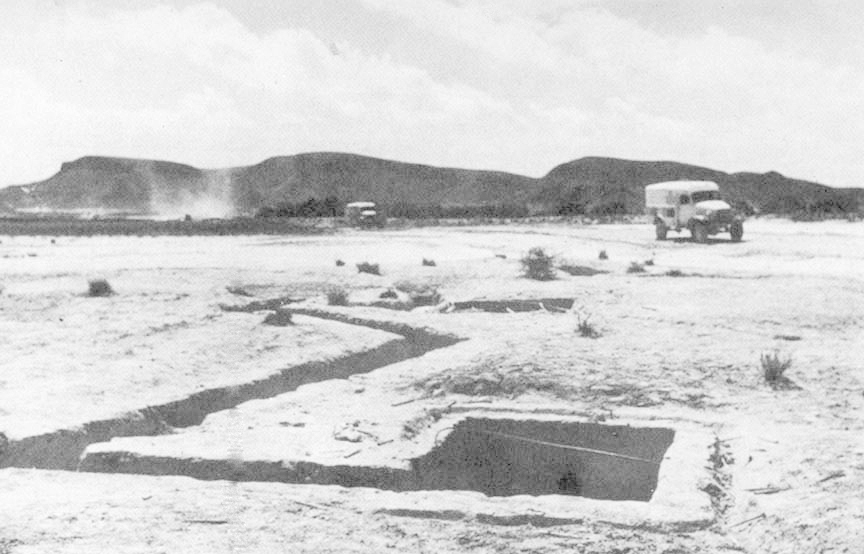 Two AFS ambulances in a convoy drive past abandoned Axis fortifications on the Tunisian plain. |
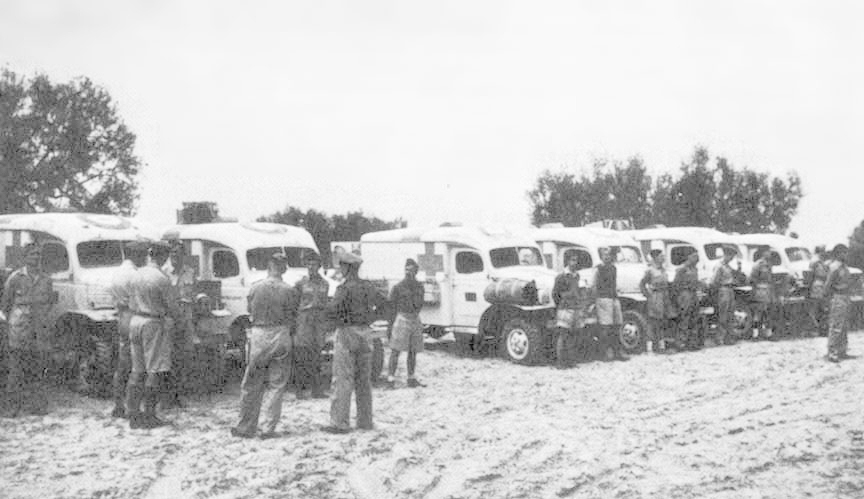 AFS drivers and ambulances of the Tunis Company line up for inspection by Lieutenant General Lees, Commanding Officer of the Corps to which they are attached. |
June 6, 1943: a momentous day at Field Service N.Y. Headquarters. This was the day that a cable came from Cairo announcing that AFS men, Lawrence Sanders, Charles Perkins, Mortimer Belshaw, and William Mitchell are in Cairo having been released from prison camps in Italy. They are reported in good health and great spirits.
Lawrence Sanders was captured SE of Mersa Matruh, June 28, 1942. He was then by-passed into Bangazi. He was later shipped to Italy where he arrived in September. He did clerical work in Italian hospitals. He was later transferred to another P.O.W. camp, this second camp was one for American and British prisoners, and is the one to which the first Americans taken in Tunisia were sent. Lawrence Sanders said that at this last camp the prisoners organized lectures, classes, and athletics to keep occupied. In spite of this they had a hard time finding enough to do. Sanders said that they spent many hours picking bugs out of their clothing, waiting for their next meal, and hoping for the day of release. He said that they had plenty of food although it lacked vitamins. Arrival of Red Cross P.O.W. parcels were highlights---eagerly looked forward to by all the men from week to week.
Charles Perkins was captured on December 15, 1942 and was taken to Tripoli where he arrived Xmas Eve. He was taken to Italy on a submarine. About this trip Charlie says "Shucks, I'd rather have gone by submarine than any other route, the way the RAF was knocking everything out." In January he arrived in Italy and in March was transferred to the camp with the other three AFS men. The high spot of Charlie's career as a P.O.W. came one night when nature called him from his bunk and he innocently walked out of his tent, only to be accosted by a sentry. The latter, convinced Charlie was trying to escape, prodded him in the log with his bayonet; the sentry got the worst of this action as he had picked Charlie's wooden leg and his rifle got stuck in it. This caused a great deal of commotion ---which attracted the attention of an English-speaking guard. When the excitement died down the Italian guard found himself the object of a lot of kidding for having made the mistake. Charlie told the Italians that he was a farmer back home. This apparently amazed the Ityes who had never thought farmers could read and write.
Mortimer Belshaw and William Mitchell were both captured near Mersa Matruh on June 28, 1942. They have evidently been together all along. Before being shipped across the Mediterranean, they worked for several weeks as medical orderlies in a German Field Hospital. While doing this work they were granted rights equal to those of the Germans. They arrived in Italy in September and eventually landed at the same camp with Sanders and Perkins.
This news reduces the number of AFS men held prisoner by the enemy to ZERO. This is certainly the best news that we have had in a long time. We sincerely hope that AFS may never have another driver taken P.O.W.
MR. GALATTI RECENTLY made a trip to Washington to meet Field Marshall Wavell. They discussed plans for organizing AFS India HQ and the probable work in store for the units there. Wavell, said Mr. Galatti, was very cordial and enthusiastic over the prospect of having the volunteer ambulance corps with his forces. The commander-in-chief of Allied Forces in India assured Mr. Galatti that he would personally see Chan Ives when he returned to his headquarters.
NOTABLE FIRST: One of the AFS men writes that: "I now have the honor to tell you, Art and I in '01 J.' were the first Americans in the 8th Amy to greet the American 5th Army, and I reckon we were one of the first who came from El Alamein to shake hands with them. We were very tickled and they were loud in their praise of the 8th Army. I was very glad to see that they liked the Tommies..... ... it is good to be with some of our own people...."
THE YOUNG LADIES of Hunter College presented AFS with a $2,000.00 check and will soon have an ambulance in the field with a plaque dedicated to their Alma Mater.
DAVE HYATT who recently returned from a year and a half in the Middle East has been commissioned an Ensign in the U.S.N.R. He expects to report for training soon and be assigned to Naval Air Intelligence. Congratulations and best of luck Dave.
AFS ROMANCE DEPT. This section seems to have become a permanent feature, every month brings new candidates. This time we have the pleasure to report the engagement of two AFS Middle East veterans. Evan Thomas Lt. AFS is engaged to Miss Anne Robins. and Hammond Douglas is engaged to Miss Elizabeth Read. Evan has been commissioned an Ensign in the U.S.N.R. and "Ham" has reenlisted in the AFS and will probably return overseas to ambulance duty sometime this summer.
ELEVEN OF THE AFS ambulances being driven with the Fighting French Section were bought with funds donated by universities all over the U.S. These funds were obtained through the efforts of Dr. Horatio Krans the former secretary of the University Union in Paris. The University Union was an organization of American University students and professors doing extra work abroad. Dr. Krans became interested in AFS when the ambulance sections were serving in France 1939-40. He raised the funds for the eleven University ambulances by writing letters to his many University colleagues at most of the large Universities in the U.S. At $2000.00 per vehicle this is really a stalwart job, we would like to belatedly express AFS's appreciation to Dr. Krans for his grand contribution.
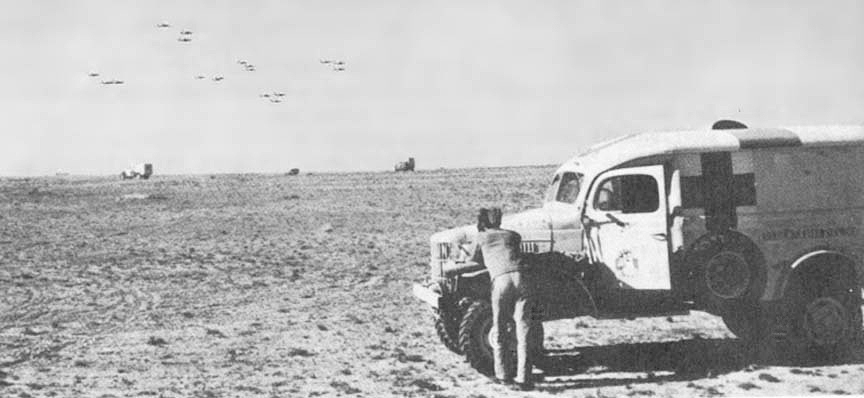 AFS man watches Allied air formation over the Tunisian plain. |
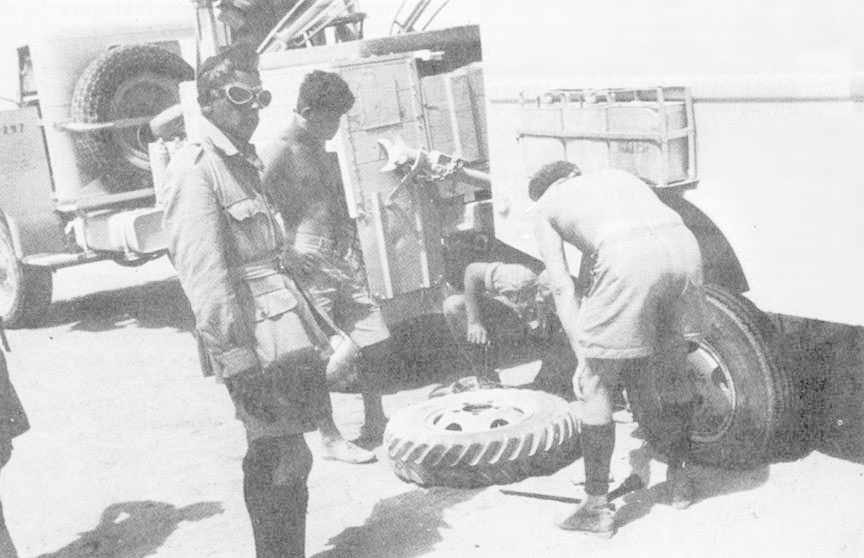 Protected-by goggles and handkerchiefs against the swirling sand, three AFS men and a British Tommy change a tire on the way across the Western Desert. These men are lucky to have a repair truck help them; such jobs often have to be done without assistance. |
"WE'LL BE THE FIRST in Tunis:"
Competitive spirit and satisfaction at being the first to reach a captured town --- probably a throwback to the playing fields of Eton, or Central High --- persevere to a surprising degree in the Eighth army. And the "opening night" complex animates members of the Field Service as much as anyone else. The driver who was able to roll the asphalt of Benghasi or Tripoli before his fellows inevitably exhibited the vulgar superiority of, say Hope Hampton at a Noel Coward premiere --- and for much the same reasons.
My car mate at the time, Joe Jarrell, and I received the privilege of being the first Americans to enter felled Sfax. Like many of our AFS predecessors in this game, we had the honor bestowed on us ex officio, simply by being the ambulance attached to the 11th Hussars, a regiment which amends Job Stuart's maxim by "getting there fastest with a very few men".
In response to a hurried call for a second ambulance --- Van Cleef and Ault were already there --- we left our Main Dressing station for the Hussars on the afternoon of April 6 and got under way early the next morning. The first day was spent in a series of short moves and longer waits, inching up to the wide U-shaped pass between the coastal hills and inland mountains. The so-called Gabes Gaps lying a number of miles to the north and west of the city for which it was named. Here the infantry had broken the taut enemy line. The engineers cleared narrow lanes through the mine fields and marked the fatal limits with fluttering strips of white tape. The weary, dirtied soldiers who had done the initial job were trudging to the rear as we moved past them to the front. Among them were German and Italian prisoners, unkempt, dejected, docile, needing neither guards nor orders to direct them towards the POW cages further back.
The mass of the 7th Armored division crawled on through the gap, a caravan of every type of military vehicle --- tanks, armored cars, bren carriers, Bofors and Long Toms, stubby 25-pounders, low-slung anti-tank guns, canvas-topped lorries, engineer units with utility trucks, troop carriers, signal corps with "main" and "rear" divs, radio trucks from the echelons. On each piece of transport rode the unit men. On each vehicle was stenciled the red silhouette of the desert rat.
Forward the incredible tide rolled, but not for long. The pass at one point funneled to a dangerously cramped corridor. Here, on a flat oil mud, the hastily cleared track gave way; several heavy vehicles mired in up to their axles. For miles back the traffic gurgled and stopped, like fluid mass trying to go down a clogged drain.
While men got to work with shovels and officers sought other routes along which to direct traffic, an almost inevitable catastrophe occurred. A German Messerschmitt, probing through the skies for prey, found its target. With the deadly familiar roar, it raked the trapped transport with bullets, dropping bombs in specially inviting areas --- of which there were too many.
Although such an attack is over before I can do much about it, I go through the inevitable motions. I jumped into the nearest hole and threw my face against the sand until the storm blew over. There were only three or four other occupants with the same idea.
The enemy picked a bad time for his sweep. The general of the corps was on the spot, engaged with many other in helping untangle the traffic knot. Looking up at the attackers, he quickly said, "This calls for a fighter screen, all right." he walked over to his radio truck. Fifteen minutes later the Warhawks were over in force winging above the congestion and giving evidence once again of the superb cooperation between land and air units of the Eighth Army.
Following days were spent moving through the areas just recently evacuated by the Germans and their worn-out Italian allies. There was the ever-recurring belief that here, or here, or here, they would make their big stand. They never did. We followed so soon after their withdrawal that it gave one the feeling of occupying the yet-warm seat someone has just relinquished. We passed the bodies of victims of both sides still lying grotesquely in the sand. No one had had the time for burials. When we came upon the abandoned enemy equipment, it was usually still smoking from the torch set to it by its former owners. In early afternoon we came upon an Italian cookhouse with the noon meal still on the stove. Some unwarlike Roman Alfred had left the cakes to burn.
Of the few remaining days until our entry into Sfax, one was pretty much like another. We did the major part of our moving in the dawn hours, or just after sunset. After the break-through at Gabes, the Hussars regiment was usually the foremost forward unit, and we often bedded down at night in the knowledge that nothing was between us and the Germans but lots of fresh air. Our part was the simple one of forward patrol, occasionally moving aside in deference to a tank battle in the neighborhood or when the bursting of enemy shells close by suggested that we were too near our artillery, the target.
Sfax was the goal of the regiment. On the evening of the 9th of April we made our leaguer a few miles from the edge of the city. While some of the patrol cars nosed about the country-side for a sign of the ever-retreating Germans and Italians, streaks of light burst out over the buildings. Filling the skies with flame and strafing the ground with explosion were the burning ammunition dumps of Sfax. The enemy was busy destroying them, the military equivalent of packing a suit case. The next morning Joe and I got our first invitation to the grand opening. The first of our armored cars entered and took the city at 7:30 A.M. A few miles beyond one car hit a mine, injuring the driver. An urgent call for an ambulance came through on the radio. Van Cleef and Ault being out on a run at the moment, it was our turn.
A smooth straight and empty road led into the city. Down it we raced at a speed I had not attempted since my civilian days. Sfax was lying on its back dazed by two conquests in one season, deflated by the sudden withdrawal of its bosses, a city in a faint. When we first saw it, there was no one on the streets but an occasional soldier standing guard at a vital intersection or local inhabitant auspiciously sniffing the new atmosphere. The physical aspect of the town told the story of the air war. The attacks of British and American planes had made a junk-heap of such objectives as the docks and railway station, and left scarcely a single building unmarred. We had time only for a passing glance at Sfax as we rolled through on our errand, but an hour later we returned to see a new Sfax.
The people had tasted the British occupation and found it agreeable. They were beginning to throng the streets as for a carnival. The Tricolor, surely in moth balls these past two years, was flying everywhere, accompanied by a few Union Jacks that could be procured locally. As the British military transport, now a thick stream, flowed through the streets, the people pressed forward, examined, reacted, and heard. But the loudest reception of the days was saved for us --- or rather for America --- as inadequately represented by our lonely AFS ambulance.
As we stopped for a moment, tied up in the mass of traffic, someone edged close and read aloud the identification on our door. The big word, America, swept through the crowd like a wind, and the "vives" for everything Yankee they could think of gave us our official welcome to Sfax. On our next trip through, later in the day, the Stars and Stripes accompanied the Tricolor and Union Jack in the main street decorative scheme. No other American unit had yet reached the vicinity.
It's an old story of most AFS desert rats who know, if anyone does, what it means to have a well-maintained ambulance. But the trials and tribulations told by Kenneth Stephens when the old bus finally sputters its last sput show how much trouble can be caused.
"CHERUB" WAS A NEW car before Alamein. She was a lovely sandy white with bright red crosses and with the governor off she would do 70 without a knock. It was hard to believe she was the same car seven months later at Kairouan. Eight thousand miles of desert driving, night convoys, broken springs, and watered petrol hadn't done her any good.
Moving from Sfax to Kairouan I was to take one of our officers up forward to pick out a spot. Thirty miles up the powder dust track, "Cherub" quit. Not by degrees, but just --- plop --- and she was through. We rolled off the track and I got out to look her over. I had picked the leeward side of the track unfortunately, and every truck that went past throw dust all over us. We waited for hours for our LFA workshop to catch up to us.
During the wait I took apart the carburetor, petrol filter, distributor, and fuel lines, and still nothing happened. The workshops went through the same motions and off she went. As a mechanic I am a fine plumber! Actually the boys from the workshops never did find out what was wrong, but they got her going. When we got to Kairouan it was obvious I that I wasn't going to be much help with evacuations so the Sgt agreed that we go back the coast road into Sfax in order to got proper overhaul. Ed Sieber was having the same sort of trouble with his car so he came along. So did Frank Cochrane who had a broken spring.
After five miles Ed's car quit. Ten miles and Frank's broken spring collapsed and "Cherub" started to cough. We left at Kairouan and promised to send up a new spring with a mechanic. Ed got rolling again and we went our separate sputtering ways for a while.
Ed got well ahead of me because "Cherub" refused to do more than 20 m.p.h. About 20 miles of this and who do I find parked by the side of the road but Ed. "Give me a push"? he says. I do. He goes. I stay. After playing for about an hour "Cherub" goes again and off I go in Ed's wake.
A mile and there again is Ed. This time I said no soap to his "push me" proposition and told him I would send aid. I came to a right turn-off from the main road. There were barrels placed across the road and an MP waved me on to the diversion. Five miles and "Cherub" stopped. I set up a stretcher---looked at my rations --- bully and tea --- then went to sleep. When I woke up I stepped on the starter and off I went. I went back to the main road and both MP and barrels were gone. Cursing the copper I went on down the road. Of course I only went about two miles when the force began again, I found a tank workshops mechanic and he went to work on it.
I think he was under the impression that "Cherub" was a Sherman tank. He took a wrench as big as his head and calmly snapped the fuel line connecting the carburetor and the fuel pump. He said, "Sorry, chum" and went his way. Then up drove our AFS field cashier in a jeep. He towed me for 10 miles but it was turning dark so he left me in a field and promised to send aid.
With my car blacked out I had tea sans milk and sugar and cold bully --- then went to bed. In the morning I traded some issue cigarettes for eggs with some of the local Arab population. They were very interested in the war and wanted to know what had happened to Kairouan their holy city, and how far we had advanced. In bad Arabic, lousy French, and the sign language I told them who had what towns, and then added "Badin Allemagne maneesh" which means "Pretty soon Jerry all through" --- I think.
Anyhow I had eggs for breakfast, and as the last yolk dribbled down my chin, up came friend Sieber. He seemed to be running all right, so we put "Cherub" on two, and actually got as far as El Djem --- half way to HQ --- before Ed stopped again. After tinkering with his engine for a while it ran so we went on for another 25 miles. Ed's car started to buck and in so doing snapped my two cables.
That was the payoff. He went on and I sat by the side of the road and read T.E. Lawrence's "Revolt in the Desert". I figured I was having a hell of a lot tougher time than he had as I kept giving cynical little sneers on every page. Late in the afternoon a wrecking truck from HQ arrived and I feel sure it just averted causing a nervous breakdown.
"Cherub" is back in shape again, but it is only the wish to save my own neck that keeps me out of every mine field I pass. Damn that car.
IN TRIPOLI, A QUARTER of a block from the Benito gate, on the Castel Benito airport road, is the new AFS Liaison office, opened April 9th.
Eight minutes from the center of town, toward the airport, brings you to the official sign executed by Bowditch. Turn in your conveyance along the geranium hedge and there is plenty of room for dispersal before you enter the sanctum. There, if you are lucky enough to hit their office hours, you will find the two AFS officers transacting business at a two-seater, sixth grade, Italian school desk. The room is cubical, with a telephone and one comfortable chair; it is cluttered in the corners with baggage in transit and odd presents, from grateful or ungrateful patients as the case may be, such as Jim Atkins' shoes.
Why did the AFS Liaison office come into being? The best answer to that can be given by quoting the orders handed to Collins before he left headquarters. Under functions are listed:
1) To visit the hospitalized men, to advise on the problem of convalescent leave, to deal with any special problems regarding the health of the men.
2) To keep in close contact with methods of transporting personnel from HQ to the units, to know the people of Movement Control, the airport, and the docks.
3) To discover the NAAFI supplies, to find out what the canteen managers want.
4) To speed mail and signals.
5) To obtain space for a future ambulance car pool, to discover the possibilities of getting spare parts and workshop supplies.
6) To be liaison between the far-distant headquarters and the forward AFS units.
In the first fourteen days of business 56 AFS men have visited the office. Some men have sought hospital beds, others have been supplied with the necessary air, boat, or ambulance transportation. Still others have been there on leave, solaced by sorties --- the officers' bar --- or by the bathing beach, movies, cactus farm, or by the one hotel which always has hot water.
The length of life of the AFS Liaison office is a speculative subject --- for those who care to speculate. Bowditch and Collins do not care when they are asked to move forward from Tripoli to points north. With a jeep loaned them from the finance department --- who knows---maybe they'll take Tunis.
When you read this article have plenty of time on your hands and don't let yourself be interrupted. It is long, perhaps, but we make no apologies. For in our minds this is one of the best descriptive stories The AFS NEWS BULLETIN has printed. It is the story of an AFS convoy carrying civilian foodstuffs to Baghdad. The men making this run were newly arrived in the M.S. They were at base camp awaiting equipment for training. The British had to move 50 loaded trucks. The AFS did it and did it "seven days in advance of my (a Brigadier) estimate for their return." ---Carl Adams Editor AFS NEWS BULLETIN.
THEY ALWAYS TELL of the "Road to Baghdad" around the smoldering fires in a convoy camp; of the warlike natives who steal down quietly over silent sand dunes to strike and steal and kill the white impostor; of the treacherous roads along the route that "shift and break away"; of the many convoys that, for lack of water, have burned to death under the simmering summer sun; of gigantic boulders mysteriously pushed on top creeping trucks winding slowly up the mighty hills of Palestine, of the "last convoy that completely disappeared 'somewhere along the road to Baghdad;'" of the hidden evil eyes that lurk behind each rock, each dune, each veil, and watch and count and send the word along.
Yea, they tell these and many other tales to make a hardened campaigner peer uneasily into the black night; to start at every crunch of gravel, every dry rattle of windblown sand against the stiff canvas.
And now to these tales can be added the wondrous story of Jim Ullman, who with 65 men pushed a civilian food convoy of 50 new, 3 1/2 ton Dodge civilian trucks through the treacherous 1,000 mile route from Cairo to Baghdad with only the loss of one screwdriver and three tire lugs.
As the black smoke of future convoy fires belches into the still evening sky someone will tell, how, on that trip, the armed guard never had to stand watch; how the natives were friendly rather than bloodthirsty and treacherous; and that perhaps the most terrifying and dangerous menace encountered enroute was the "never- give-an-inch" Tommy driver coming the other way.
It wasn't a dull trip, for Charlie Huber's truck slid over a weak shoulder on to its side, and Lou Murphy tightened his wheels on Sunday and lost them on Monday; and Joe Zarella maliciously sideswiped two convoy jeeps to demonstrate to the Tommy that a jeep can't dodge a Dodge that's trying to dodge a jeep (or that's the way Joe tells it; and there was the momentous football game upon the rockpile called Trans-Jordan for the pleasure of four astounded Arabs who had come to camp to sell "o-ran-ges". but had to be content with what was probably the first football game ever to be played in that land.
Few of us will forget the first day when every other truck stalled within the first 15 miles for some reason or other, and Carleton Richmond and Johnny Carotenuto banged their spanners in disgust for they thought they'd never see the convoy at that rate. Wally Lovelace dropped out to get petrol and returned too late to catch the speeding trucks, and after an hour-and-a-half of driving at break-neck speed without sight of his comrades decided that he was lost. A friendly MP, American Military Police, and a call to Cairo; lost again, then redirected,--- and finally breathlessly, tired, and frightened he arrived at the bridge a few minutes before the convoy crossed the Suez and rolled into camp on the other side.
That night everyone was in high spirits and joked and kidded an each one shaved and washed off the top layer of Egyptian dust. The fact that the camp was a desolate, sandy hole was forgotten in the first day's excitement. Even the meal of canned M & V and tepid tea passed without comment.
After dark the fellows gossiped on their tailgates while they watched powerful searchlights playing hide-and-seek with the barrage bullets and flares streaked their way through the night. Everyone agreed that at least the pyrotechnical side of war has its beauty.
The second day across the Sinai desert was probably the most difficult day of all because of a heterogeneous combination of factors; the large trucks with four speeds forward were still somewhat of a mystery to a bunch of follows who had never driven anything but the family Buick on week-and dates. Then, too, we started in the wee, small hours when the fog was still dense and impenetrable for more than a few feet. Moreover, the Sinai road proved to be mostly steep hills that required quick shifting and trick combination of dodging and bluffing was required to survive a long, coming convoy that seemed to hog more than its share of the narrow, winding road.
This was the day Charlie turned over ---with narry a scratch on himself, the truck, or his cargo, only a few miles before we pulled into camp, --- an even dustier spot then the preceding night.
The thing that surprised us most was the presence of countless Arabs who seemed to spring up from nowhere. They swarmed around our camp, filthy creatures; dust and dirt caked upon their exposed parts much as if they had just finished a shift on an American cement gang. We had seen many of them in mud villages along the road that day despite the fact that there didn't seem to be anything to keep body and soul percolating in that and country.
Here it was that Fred Rogers, who always has an eye open for tragedy, announced that Bobby Boyles had been stricken with the "gyppy tummy". We all felt sorry for Bob, but his sickness did have its humorous side, Fred explained. Bobby is a sly, old fox who attempts to foresee all events, who spares no expense to insure his comfort and takes all precautions to avoid either disease or discomfort. He was one of the few who had a nice, soft sleeping bag for protection against the rocky ground. He was the only member able to procure a complete set of 12 priceless blanket pins; and somewhere hidden from jealous eye he probably had concealed a complete hospital kit, and electrically heated blankets and an angora belly-band. Now, however, he lay stricken. The first to go despite all his precautions.
It was with a strange mixture of joy and pity that we tucked ourselves in that second night.
The next day we entered Palestine, and it was like stepping from a "before" latrine into one of house "after" bathrooms illustrated in color in "Better Homes and Gardens." Palestine was alive and busy. Palestine was green.
The land was rolly and luxuriant much like middle Iowa; however, the soil was a reddish-brown rather than Iowa's rich black color.
Here the natives seemed much cleaner. Arabs, Palestinian native, and European Jews alike worked industriously in the irrigated fields.
The Arabs wore their long, loose, flowing robes; the Palestinian women wore colorful dresses that looked for all the world like patch-work quilts, and the young Jewish boys and girls wore European slacks and shorts for their work clothes.
The Arabs lived in tent cities, some long, rambling, and shapeless with room for several families; and some lived in small tents that looked much like Hershey's chocolate kisses.
The natives, however, lived in red and brown mud-brick villages with flat-roofed houses that were often covered with faggots, or overgrown flowers and grass.
The Jewish people lived in modern bungalows and houses ---many had as beautiful lawns and gardens as our own at home.
Time passes quickly, for there was so much to see; cactus hedges 6 to 8 feet high used as fences between fields, an Arab plowing a field in shorts behind a strange camel with a flat-top and a self-satisfied, sophisticated expression.
It was here that we saw our first wildflowers along the road; wild daisies a yellow flower much like our dandelion, flat, only white, a deep crimson double poppy, purple thistles, and J. Stockton "Redwing" Hopkins swears he found wild orchids, but they looked more like common, ordinary sweet peas with ideas.
The native women walked about with great loads balanced upon their heads. The result, of course, is perfect posture. The tremendous weights, however, carried in that manner, have accordioned the women into short, squatty, knick-knack figures for the shelf in the corner. Before many centuries have gone by the descendants of these hard-working women will look more like conveyor belts with socks than human beings.
That afternoon we saw a fairly high range of mountains to the west of us, and the patches of sunlight upon the peaks made it appear as if some of them were snowcapped. About the middle of the afternoon we landed in our next camp --in reverse order. One of the MP's along the way had turned our lead trucks down the wrong road and then rectified his mistake in the middle of the convoy. It all came out the same, but the rear was in front and the front was in the rear when we landed.
After supper many of us attended the movies for soldiers and civilians in another nearby camp. The first picture was, "Daughters Courageous" with Priscilla Lone, Mae Robson, and Claude Rains. The sound was so poor, however, that unless one could read the French subtitles that flashed on and off the screen at an alarming rate, one couldn't follow the picture even though it was in English. The second picture, an old but good Russian production, "Professor Mamalick," earned four stars for confusion. This picture in Russian came complete with French and English subtitles on the main screen and Arabic subtitles flashed on a small auxiliary screen to one side. One could hardly see the picture for subtitles.
The next day was Sunday. We stayed in camp and worked on the trucks, greased the points, cleaned the filters, tightened the lugs, and pumped up the tires to within 20 pounds of the absolutely required pressure with pseudo-foot pumps that could not make the grade on last year's football balloons.
Some of the fellows dropped their wrenches to see the wenches that afternoon on the Mediterranean beach. Only a few had bathing suits, and at first American stigmas, taboos, customs, and traditions made it rather hard for the boys to run out in front of the men and women sans clothes. But the tempting, cool-looking, blue-white surf tantalized most of them beyond the tensile strength of American culture. Soon they were all in the icy water splashing, whooping, and oblivious to the smiling, curious eyes on the beach.
Many brought back shells and stones from the beach which they planned to take home with them, but which were lost somewhere along the road to Baghdad. Little piles of sea-worn rocks and shells may well confuse some unsuspecting student of geology scrounging around the Syria desert in 1950.
Stan Bayne, straight from "Cowhampshire", rented a donkey and rode around looking much like a scarecrow on a mobile flour sack.
By supper time everyone was pretty well worn-out. A few strayed down the road for supper. Nomer, Masbach, Bowen, Whitlatch, Huber, and Bryan met their match, if not in volume of sound during a song exchange with a group of Kiwis. The camp fairly rocked and the stars quivered and shivered to the vibration of "Amherst, Brave Amherst" and "Kiss Me Goodnight, Sergeant Major" hurled to the skies in a giant conglomerate geyser of discord.
The songs, the Kiwis, and the Mediterranean were temporarily forgotten as we bustled off the next morning, Monday, and bounced our trucks across the beautiful Jordan valley.
STOPPING IN FOR MAIL, Lee Ault and Bill Van Cleef brought the following story to headquarters of the "Chicken Brigade".---
During a tedious trip of evacuation with a wounded sergeant of the famous Highland Division, Ault and Van Cleef engaged their patient in conversation. His wounds were in his legs --- where he had been wounded before at Alamein. Advancing with his company under cover of a barrage, the sergeant related, he was crawling to the crest of a hill when he saw a Jerry gun crews still there and fiercely firing an 88 mm.
"They looked scared when they saw me and after I used my Tommy gun on them, they were squealing like pigs," the Scotty was saying.
"Did you kill them all?" asked Ault incredulous.
"Mon, I hope so!" was the answer. "It was me or them."
"I suppose you'll get a decoration for this," interposed Van Cleef.
"No", was the prompt response, "but the bloke who came out and carried me back will."
Don Moffatt, SSU 4 , and now a Lieutenant in the United States Navy, sat in the Wardroom of his ship at sea. The radio was tuned in on a world-wide program and from Cairo and Tunis and points east came News broadcasts. Presently was heard an account of the British Eighth Army advance across the wastes of the Western Desert, into the rocky fastnesses of Tunis, and glowing reference was made to the work of the American Field Service therein. Said one Officer "Who are these American Volunteers?" ...and another "What is this AFS?" ..."My service" said Don, "This is the AFS ribbon".
And other former AFS men from remote parts of the world, report seeing the ribbon wherever they go. There have even been rumors of a Reunion in North Africa.
The following has been received:
HQ Combat Command "B"
6th. Armored Division"I have recently been talking with Colonel J. C. Fry, who commands one of our regiments. He was in the Middle East some time ago, where he came across the American Field Service. He spoke very highly of them and said that at Tobruk the AFS was the only Unit that did any evacuation ... and that they did a swell job". He also mentioned having a meal with one of the AFS Unit Commanders, Daniel Debardeleben, a west Point classmate of his. All in all, he seemed to think a good deal of the Unit.
"At present I am stationed at ... where I am the S-2 of a combat command in the 6th Armored Division. Things are going very quietly at present.
"I am enclosing a check for the AFS and only wish I could do more for it."'
Sincerely,
(Signed) Cameron Burrage"
Captain CC "B"
Men of France '40 will recall "Cam" as the tireless little giant, whose cheery smile and abundant vitality and mechanical skill were valuable assets during those tragic days of the retreat through France.
Rex Dunlap, SSU 4, is with the Lehman Rehabilitation Committee in North Africa.
Colonel Perrin H. Long, of General Eisenhauer's Staff wrote "Slats" Slater, perennial secretary of SSU 69, that he had just handed out 37 Purple Hearts. It is beyond the power of man to eliminate casualties in war, but Perry's sulfa drugs work miracles for the wounded.
SOS ---Will some of the "Old Birds" kindly take pen in hand and send in contributions for this, their Alumni News.
Page 2 of this issue records the death of "Tim" Rubel in Tunisia. And so one more name is added to the roster of Vieux Oiseaux "killed in action".....in the "Service in which he enlisted for life