Edited and published at AFS Headquarters, 60 Beaver Street, New York, under the sponsorship of the families and relatives of the ambulanciers.
With this issue of AFS Letters we are inaugurating a new policy. Those of our readers who have relatives among the AFS ambulance drivers have received, in the past, several issues of the AFS News Bulletin. This Bulletin was written and edited by some of the volunteers overseas and was made up of articles on their experiences in the desert.
Because of a shortage of material and time, we are now issuing ONE bulletin under the name AFS LETTERS, in which are incorporated articles from the volunteers' News Bulletin and excerpts of letters sent us by their friends and relatives. Before many months we expect to receive the first bulletin assembled by the AFS in India. When we do, we will give you parts of it also.
We feel that in this way more readers will get a fuller account of AFS overseas and at home. We hope our readers approve the new arrangement, and as always we welcome suggestions.
Chauncey B. "Chan" Ives, who went to the Middle East as a member of the first unit in November, 1941, has been appointed OC (Officer Commanding) of the AFS units in India.
When we heard about this we decided to introduce Chan to our readers through an article in AFS Letters. Many of you readers are probably acquainted with him in letters from men overseas. If this account is lacking in definite facts, it is because we do not personally know Major Ives and had to rely on men returning from overseas to give us the dope. All our informants were so enthusiastic in their praise of our subject that detailed information was hard to unearth. In general the procedure went something like this: Us, "Hello, do you know Chan Ives?" AFS man, "Sure I do, he's a wonderful guy". Us, "Thanks, what else can you tell us about him; you see, we want to write him up for AFS Letters." AFS man, "Gee, that's a good ideal well, he's a wonderful guy." Silence, accompanied by a look of pleasant memories. Us, patiently, "You just said that Mister, could you give us a little dope on his activities or a story or two?" Well, the ultimate result of these pryings convinced us that, without a doubt, Chan is a wonderful guy. It seems that he is the people's choice (or would be if they had voted) of the man to head AFS in India.
Chan Ives was a section leader and later a Lieutenant with the first group of AFS men to go to the Western Desert. On the Alamein line, he was never satisfied to stay at Field HQ or at the Main Dressing Station but insisted on personally going up to the Regimental Aid Post as far up front as he could get. Whenever any of the ambulance drivers needed replacements or provisions, Chan was on the spot to obtain them.
In the early days of Alamein, Chan was hatless, having somehow mislaid his headgear on the trip down from Syria. He has an aversion to 'Tin Hats'. One day he was to visit an MO and decided he might be better fitted for the occasion if he had a hat for saluting purposes, so he borrowed one from the nearest AFS man. Every time the original owner of the hat approached Chan to retrieve it, there seemed to be some occasion looking up when he felt that a salute might be necessary and the hat indispensable. The net result of this procedure is that as for as is known Chan still has the hat. It may even now be in India staunchly serving as the springboard for new salutes to new British officers.
If there is any one factor about Chan Ives' character that is of greater value to his men then others, it appears to be that of his quiet strength. He moves quietly, his keen sense of humor is quiet. He is a very hard worker. Like Montgomery of the Eighth Army, Chan does not ask a man to do a job that he himself would not do. He endears himself to the man under him, by never issuing a command. All orders are presented in the nature of a request.
Chan started as a member of the greenest of units, the First. He has done, at one time or another, all the jobs of an ambulance driver and he knows the ropes from the ground up. He is not only popular because of his personality, but also respected for his unquestioned ability. His sense of justice, often evident in his handling of the many problems that cone to him, is partly due to his training. In peacetime he was a lawyer; and he left a post with the Securities and Exchange Commission in Washington to enlist in the Field Service.
His greatest personal pride is his mustache, a product of the Middle East, in which climate it has flourished much to its wearer's joy. When he left N.Y. Chan was clean-shaven. He is now the parent of a flowing, somewhat raggedy sandy mustache which boasts walrus qualities and is in keen competition with every bewhiskered lip in the Middle East.
A native of Brewster, N.Y. Chan was graduated from Groton School, Yale University and Harvard Law School. Possessed of a strong idealism and a belief in the brotherhood of man, he has long had an interest in war ambulance service. In the early days of the war in Europe, he signed with an ambulance outfit being formed to go to the aid of Finland. This plan was never realized as Finland capitulated before the contingent was able to cross the ocean.
For the past eight months Chan Ives has been in charge of the AFS ACC stationed in Syria with the British Ninth Army. There, he has been responsible, in addition to his duties in keeping the Syria units operating properly, for the training of the new contingents. This is a tremendous job. The men have to learn map reading and compass course bearings. They have to be familiarized with their ambulances and the British personnel with which they work. In other words, they undergo a general conditioning preparing them for desert warfare, and Chan is the man who sees them through this conditioning. He has done a great job and has been instrumental in the making of many a "desert rat". These months in Syria have represented a personal sacrifice for Chan, who unselfishly accepted the task and successfully carried it through. Although he personally yearned for the Western Desert, Alamein, Tripoli, Tunisia, and all the excitement of front-line action for which he fitted others.
We congratulate him on his new appointment and his new status as Major AFS, and wish him the very beat of luck at his new post.
|
"......Unfortunately this work has not been accomplished without losses. May I extend my deepest sympathy of the AFS to the families of those men who have given their lives in relieving the suffering of others, and to the families of those men who are wounded, missing, or captured," Stephen Galatti |
Caleb Milne, IV was killed In action north of Enfidaville on May 11, 1943. He and his comrades had been attached to the forward troops of the 8th Army and since El Alamein had evacuated the wounded as they advanced through the Western Desert. Finally, during the bitter fighting at the end, came a call for volunteer stretcher bearers to help with the wounded forward, in an area ambulances could not travel. Caleb and three comrades responded, and while carrying out this task a shell from a mortar mortally wounded him. Carried back by his AFS comrades to the dressing station he was unable to survive the operation. Caleb had risked his life many times to save others, but when even more was asked he never hesitated. There can not be greater faith than this.
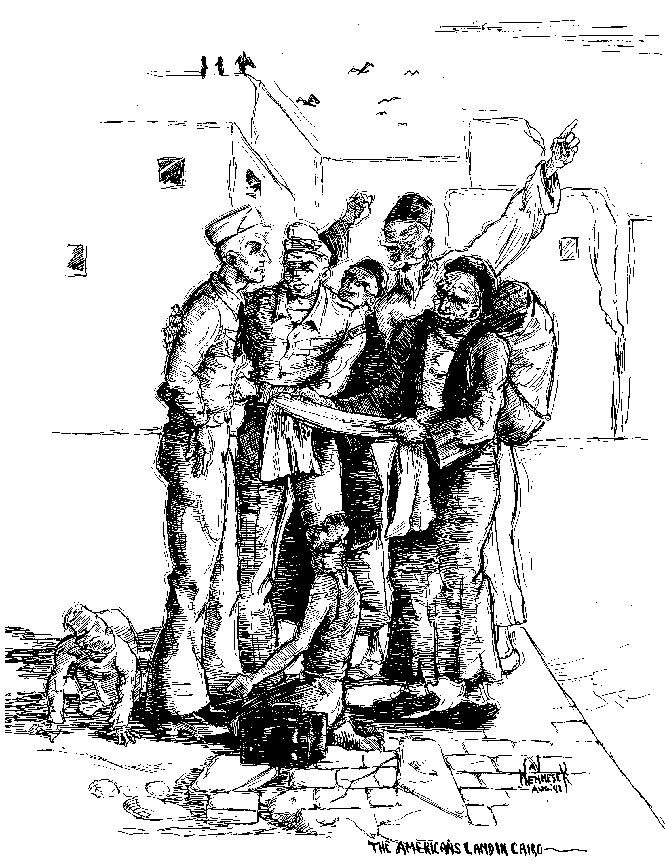
Curtis Rodgers died in Cairo on May 1, 1943. He had served in the Western Desert for a year, and had then left to join the faculty of Cairo University. All who have read the AFS Letters will have become familiar with his drawings and have understood his hate of war as well as his determination to serve and resolution not to stand aside. Because of this resolution he had decided to rejoin the AFS where he felt he could serve more fully. He, too, gave his life to a cause in which he believed.
Henry Bonner was wounded by shell fragments in the same action at Enfidaville in which Caleb Milne was killed. He was struck by flying fragments in one arm and in the back. He was one of the four AFS men who tied volunteered to act as stretcher bearers. The latest word from Cairo reports Henry's condition as satisfactory after medical treatment. We congratulate him for offering his services for such a job, and wish him complete and speedy recovery.
Word has just come from Cairo HQ that Alexander McElwain, who has been interned in Italy since his capture at Bir Hacheim, June 1942, has been released. 'Mac' is in Cairo unfortunately, in the hospital with jaundice. It is probably a very slight evil after his experiences of the last few months. We are delighted to know that he is free and hope the jaundice disappears quickly.
The following article was written by a man in the field, who probably like most of us over here has received letters from home evidently prompted by thoughts that AFS men are leading the attack on all fronts. This article is not trying to tone down the work the AFS does, nor present a consoling picture for the benefit of parents. It merely portrays the actual and dominating aspect of the work in the field with the AFS. ---Editor AFS News Bulletin, Carl Adam.
John Jones drives on American Field Service ambulance with the 8th Army. Technically, that's correct. Most of the time, however, he sits in his ambulance waiting. When the army advances he drives. When he is reassigned to a new location he drives. When there are sick or wounded men he drives. But for weeks and weeks he waits and sits and occasionally makes a routine trip with an ambulance load of patients.
Then one day while he is driving in convoy along a road filled with advancing trucks and guns and tank-carriers, a German plane suddenly swoops in, fires several cannon shells into some trucks, and swoops away. There's excitement for a moment while a burning truck is moved off the road. Then John J. continues on, driving to the next medical unit site, where he sits and waits.
While he is sitting and waiting, John J., decides to write home. Naturally he describes the strafing incident. John J.'s parents receive the letter, sit back after reading it, and, with their too vivid imagination, picture their son John driving incessantly along roads continually being strafed.
Such an attitude on the part of parents is manifest with each batch of mail from home. One parent recently wrote: "Don't take any unnecessary risks on the battle field picking up the wounded." Another said: "The fleas and lice must be simply terrible." And on the other extreme a parent expressed the hope that the barracks were heated!
The work of some few Field Service members shouldn't be belittled. Some have had assignments with advanced tank units, one or two have gone into shelled areas to pick up the wounded, and nearly all, at one time or another, have been near the front where danger has made the work exciting. But nine-tenths of the time their work is waiting and driving well behind the lines.
As for living conditions, most AFS drivers are attached to Medical units where everything from expert surgeons to delousing equipment is readily available. They usually sleep on comparatively comfortable stretchers in their ambulances. Except in Cairo or Syria barracks are unheard of. The food they get at medical units is usually better than that issued to the ordinary soldier, and unless they are deep in the desert, they can usually get plenty of water for drinking and bathing.
One AFS representative in the States told the men he signed up: "There'll be long, long hours of boredom and hard manual labor, there'll be times when friends and leave in strange cities will make life exceptionally interesting, and there'll be short moments of intense excitement, possibly fear, to make your work worthwhile." A Field Service driver in the Great War, that representative knew whereof he spoke.
So if your son writes home to you that he has driven through an Italian artillery barrage or has been dive-bombed by Stukas in the course of his work, you can justly feel proud that he has had one of the rare chances to drive where more then a mere knowledge of gears and accelerators is required, but temper your vivid imagination of his experience with the long hours of sitting, waiting, and driving routine runs that he has gone through and will go through again.
FIRST OF ALL, I should like to remind readers that the following is not based upon exact statistics. The gentlemen in the Cairo office would probably not let me into the files because they probably contain awful reports on me from my past O.C's and NCO's.
Traditionally Harvard contributes more men to the AFS than any other college; but this does not mean that the average AFS man is a Harvard man. By the same token, the geographical center of the Northwest and Middlewest areas from which most AFS men are drawn, would probably be around Columbus, Ohio. Actually hardly anybody in the AFS comes from Columbus.
The average AFS man had about 2 7/8 years of college. Chances are he joined the Field Service when it became apparent that his next period of exams would be the last.
When the question of occupations comes up, the picture of the average AFS man becomes a hopeless kaleidoscope. They range from Reds to ex-monks. If there is any particularly noticeable common denominator---and here again it applies to only a minority---it is an interest in the theater, either amateur or professional, ranging from playwrites to vaudeville hams.
Although he clings tenaciously to his Americanisms, his speech here has become a dialect of Arabesque-Anglo-American idioms. This argot has been immeasurably enriched by Capt. Chan Ives, who believes in the brotherhood of mankind.
In appearance he usually seems to fall into one of two classifications: The "one man slum", who, although under feminine influence at home may have sported tweed coats and bow ties, in the desert does not think of changing or removing his shirt from one month to the next; and the "Christmas tree" who loads his specially cut uniform down with all winged eagles, colored ribbons, and Sam Browne belts he can assemble. Of course, there are those who find a mean between these extremes, but here again is a minority.
Contrary to widely held belief, the average AFS man does not drink much. The impression that he does is caused by the excessive intemperance of a few, which always attracts more attention than general sobriety. For one thing, most of us consider ourselves connoisseurs enough to shudder at the small of the local brews. Fred Pillsbury, who is looking over my shoulder says this is a damn lie.
Our subject was probably very idealistic when he enlisted in the Field Service, but a few months over here fixes him. By this time, any mother who has read this thing should be prepared for the change in her boy caused by associations made in the AFS in the Middle East. Fortunately, my own mother is prepared for the worst, because she saw the effect upon my father of his associations in the Field Service in '16-'17. It was with difficulty that she was persuaded that it would be anything but a disaster to my soul for me to get in with these people......"
|
I squat in the Cyrenaican hills I lived like a rat on the Alamein line, I'd run with the hare---well I'd hunt with the hounds; They hit in the dark, my armored lads, I forgot the sand, the rotten food, So I squat in the Cyranaican hills |
Doing routing work carrying patients who become ill while at base camps, or providing transport for MO's who visit native villages to give medical treatment, give the AFS men their preliminary training before going into action on battle lines. This work is carried on in Syria. From Syria the men are posted some 3,000 miles west. The following account is a description of this trip.
TRANSFERRING FROM SYRIA to the Western Desert is usually an agonizing week's jouncing. Eight AFS men were more fortunate than a larger group in a recent transfer, however. I was one of the eight. The larger contingent had travelled the 3,000 odd miles in 3-ton lorries and wasted no time getting to their company. Our group of eight travelled in the Dodges from our HQ to the railroad head on the coast of the Mediterranean. There we had to wait a day for the train to Cairo. When the train pulled in, we had to fight for seats in the third-class carriages for what was to be the most uncomfortable part of the trip.
Availing ourselves of one of the many ranks afforded the AFS man, we went into the officers' NAAFI's for very good food during the many train halts. Travelling by lorry you usually rely on tea and bully-beef prepared by yourself ---when and if you stop.
After arriving in Cairo we had a 24 hour stop-over which gave us the necessary time to repack our kit and make the arrangements for the next leg of our journey. HQ teamed us up with Captain Greenough of the FF unit. That meant that we would get to Gambut all right, but from there on it was up to us. We proceeded to Alex and spent the night there. I believe that it is the most beautiful city I have seen in the Middle East. Early the next morning we got underway. We kept a steady speed all day, stopping at the NAAFI's in Dabs and Buq Buq for lunch and dinner.
It was bright night, and as we climbed "Hellfire Pass" from Egypt into Libya we saw the shoreline of the Med very clearly. It was a beautiful sight compared with the bomb-torn and machine-gunned pass. We stopped at Fort Capuzzo to count heads and then after a few hours or more driving, we arrived at Gambut. We were all fairly tired so we got out our bedding rolls for the first time since we had left Syria, all of us had been enjoying luxurious hotel beds for the past few days. We felt that it was the best thing---to have a "fling" before entering the desert life in earnest.
Awakening early the next morning we found to our dismay that the French don't eat a real breakfast. We managed to get some bread and jam and coffee, however. The remaining five of us (three of our contingent were being stationed with the FF) drove over to one of the airports. As luck would have it, there was a plane leaving shortly for points west, and the men in charge gladly agreed to take us and all our luggage. The air force fellows were swell to us, and to show our gratitude, we opened up the majority of our rations and all of us pitched in and ate heartily.
An hour later we climbed into the twin-engined plane, checked our luggage, made ourselves comfortable, and the next thing I knew, the pilot was warming up her powerful motors. After a few seconds he opened the throttle wide and the plane shuddered from the power given out. We taxied over the field. The ground was rushing past and my ears were deafened by the motor's roar as we took off. She rose easily, straightened out, and proceeded up the coast, flying low. In a few minutes our ears were accustomed to the steady roar of her engines, but I never got used to the sudden jounces caused by air pockets.
The scenery on our left was merely flat land dotted with green bushes, and to our right was the Med. The novelty of all this soon wore off and we became very sleepy. All of us did stretch out and sleep, only waking up when the plane landed to let off some ground-crew men and mail. About 6 o'clock we awoke to see the Marble Arch, and the plane settled down for a perfect lending. We notified 11 Coy of our arrival and they quickly sent us some transportation.
We met all the old crowd from Syria, and found out that we were all "greenhorns" for they had been there for a day and a half. The trip that had taken us a mere four and a half hours by air, had taken them nearly three days. Bully-beef for supper inaugurated us into desert life. There was a get-together that night, but I went to bed fairly early. Tomorrow was another day, and there would be work to do.
People living in the temperate climate of northern New England may be right in thinking that it's hot on the Western Desert. But when they write to us Eskimos up in Syria and ask if we remember "golds id da doze" it's going too far. Antarctica may be colder than Syria, but let's have no more of these remember-what-snow-looks-like-letters from America. And if anybody mentions anti-freeze for car radiators he will please do so with the distinct understanding that he is distributing seditious literature to us frozen AFS penguins in bleak Syria who drain our ambulances every night, who have probably the greatest collection of colds of all time, who wear long woolen underwear, sleep under four blankets, and break the ice in our shaving mugs every morning. The following account tells what happened to two of said penguins on a routine run. You can see for yourself.-- Field Associate Editor, William Powning.
WE WERE BOGGED DOWN in the glue-like mud under the snow. The car lay at a 46 degree angle in the middle of nowhere perhaps 15 or 20 miles from either Merjayoun or Zahle. It was almost certain that no vehicles could or would be along, for the road was becoming more and more impassable each minute. Steve Sivcho and I sat there thinking.
With our ambulances loaded with patients bound for Saida and Beirut, Francis Bloodgood and I had left Damascus early the morning before. All had been well until we climbed the mountains. We ran into very heavy snow and sleet, and on several occasions we were forced to stop and scrape our ice-covered windshields. This was only the forerunner of what was to come. We arrived in Saida and discharged our patients at the CCS in pouring rain. I took the remaining patients to Beirut while Bloodgood and a British orderly returned to Damascus.
At Beirut the sun had been shining and the weather perfect. I had delivered my patients and then enjoyed a good dinner. That evening, after running into several AFS men at the Hotel Normandy, Steve Sivcho (one of the AFS men) and I went out to look over the town. We had met some Tommies who informed us of the presence of American sailors in town. We started in hot pursuit with visions of American cigarettes. After locating them in a NAAFI we spent a pleasant evening --- it was like seeing a long lost member of ones own family. And there were plenty of Luckies and Old Golds, too.
We had been invited to spend the night aboard the Yank ship and after losing no time in accepting, we were aboard. With good hot coffee in the American style we had enjoyed a typical midnight snack and then tumbled into soft bunks. After leaving the arms of Morpheus we had a Yank breakfast of hotcakes, eggs, cereal, bacon, toast and coffee. It was a terrific contrast to our usual slice of cheese and cup of tea. There were many of the little things aboard that ship that we miss so much. But we had had to push on, and saying goodbye, we started out for Damascus.
I thought of these things as Steve and I sat there in the cold wondering what to do. The road over the mountains from Beirut had been closed because of heavy snow. So we had been forced to come back via Saida and Merjayoun. I was to drop Steve at Zahle, for he was bound for Baalbeck.
It had been shortly after cutting inland from Saida that we had run into snow. All had gone well until we had arrived at the mountainous section beyond Merjayoun. We had been able to follow a faint track in the snow; it was over a foot deep. The going was tough, but I used low gear and four-wheel drive to good advantage. Shortly after passing a series of treacherous curves we came out on an open plateau. Here was a wide field of deep snow with no indications whatsoever of a road. I halted and requested Steve to climb out on the fender to help guide the way. The air was filled with whirling snow making our visibility about nil. We proceeded along in this fashion for about a half mile when suddenly the car had sunk sharply to the left and well into the ditch. An attempt to shovel our way out had been futile. Unfortunately we both were wearing oxford shoes which offered little protection for our feet. Our situation was rather desperate, so we had decided to call a meeting and study the problem in an orderly fashion.
We agreed that one of us should stay to guard the car and the other should take what clothing he needed to face the blizzard and strike out for help. Chance destined me to remain behind while Steve braved the elements to search for help. Inventory of our food produced two packages of P.K. gum, an orange, and a few cigarettes. We split the last and prepared for action.
With a towel about his head, a gas cape over his trench coat, and compass in hand, Steve left me with the stipulation that if no help had arrived by noon the next day, I should say to hell with Kitten II (our ambulance) and start out too. Steve plodded off through the ever deepening snow.
My petrol was very low and with the car lying at such a sharp angle I knew the motor would not run long---and then no heater.
After several hours Steve returned completely exhausted. The snow was more than knee-deep and 20 steps would tire anyone. The blizzard was increasing in fury and we decided then the best thing to do was to eat a hearty dinner of P.K. gum, and get under our four inadequate blankets.
My gas registered nearly zero so we ran the motor only at two-hour intervals for a few minutes to keep it from freezing as well as ourselves. After the light of day had passed it became bitterly cold. We put on all our clothing and attempted to sleep on one stretcher to conserve body heat. The narrow stretchers are uncomfortable for one---let alone two.
It was the worst night I have ever spent. Cramped, damp, and cold. At intervals of two hours one of us would climb to the front seat and start the motor to heat the ambulance. As soon as the heater was turned off, it was cold again. Somehow the night passed and in the cold light of dawn we decided to strike out towards Merjayoun. I left a note in the car telling to whom and where it belonged, drained the block and collected our belongings. We each took two blankets and what we could salvage from the contents of the car.
Just as we were about to strike out, the snow halted and to our delight we sighted a few native huts in the distance across the fields of deep snow. We started off for the village. Then the snow came again---practically blinding us and hiding the village from our sight.
The going was tough as the snow came well up over our thighs. We could take about 10 steps and then would have to rest. Steve complained of a stomach pain, but I assured him it was only hunger, for we had not eaten since that morning before in sunny Beirut.
As we plodded on I spotted a man coming towards us. He had seen us from the village and met us about half way. I greeted him and thankful I was for my meager ability to speak Arabic. I explained our situation and then we continued on.
Our rescuer's name was Zaide Zalami. He carried Steve on his back for a bit, but it was impossible to continue like that because the snow was so deep. Near the stage of collapse we gained the village half crawling and walking. Here our rescuer's neighbor insisted on taking me into his hut. Steve went next door with Zaide. The name of my host was Tewfic Torme. The hut was a small mud dwelling of two rooms. One was for the cow, donkey, and chickens; the other for the inhabitants, of which there were six.
Tewfic helped me to get my wet clothing off (there was an interested audience, but no time for modesty) and then provided a place for me by the small fire. Soon there was food---raw olives, warm milk from the cow in the next room, flat bread, and tea. After fasting for a day it tasted delicious. The food and heat was all I needed to make me drowsy---so I slept.
I awoke about 2 p.m. and went over to see Steve. he was still sleeping with a guard of three small babies and one old grandmother crowded around him, all deeply interested in their newcomer. I think the grandmother had taken a fancy to Steve for she was constantly patting him. When Steve awoke we were treated to small cups of Turkish coffee and roasted beans. The man and I talked about the road. They believed it would be three or four days before the plows could got through. However we had an invitation to stay as long as we wished. Tewfic said I could stay for a month!
At least we were rescued. There were no beds or chairs, but a mat on the floor sufficed, there was a roof over our heads, and a fire for warmth.
Zaide picked out one of his prize chickens to make a feast for us. Dinner was special: potatoes, chicken, Arabic bread, labon (a cheese-like paste), sour milk, and fig jam. During dinner Tewfic came bursting in with news of a truck on the road. It had stopped snowing. I went up to the housetop and waved at the truck crew. They halted at the ambulance and then moved in ---we returned to our meal and stuffed ourselves. It was really wonderful. Steve could not eat the labon, so rather than have Zaida feel insulted I explained that Steve was still rather ill, but would surely eat labon tomorrow. After dinner we sang some Arabic songs ---"Balady" being my favorites. Balady means "My Home Land" and it is said the English term "Blighty" has been derived from the mispronunciation of this word.
Returning to my hut the family and I tried to converse. It was rather an unsuccessful attempt, but we had many good laughs and quite an enjoyable evening. Tewfic made tea and the two of us drank while the rest looked on. Here the man is boss, God, and never wrong.
Time for bed ---the best mat for my use, and a warm quilt. We all slept on the floor in the same room. They sleep in the same clothes they wear all day. I wondered if they ever wash.
Just as we were settled for the night, there came a "hello" from outside. It came from two Englishmen, a staff sergeant and an officer. They were the fellows in the truck we had spotted at dinner time. Their truck had gone down a short ways beyond the ambulance and they had followed our tracks to the hut. They spoke no Arabic, so I requested Tewfic to take them to a friend's house, for we were overcrowded as it was. In a short time Tewfic returned and assured me the English soldiers were well cared for. Again to bed --before falling asleep I felt what I am sure was a flea make for my ear---well, Maleesh. When in Rome....
Slept like a log. I was up at 6 a.m. and shortly afterwards Steve came over. We breakfasted together. A small table was set for the two of us. There was tea, milk, a sugary mixture, and olives. Steve could not drink the milk, so when the watchful eye of our host was turned I slipped him my empty bowl and finished his as well. No one was the wiser. The Arabs are deeply insulted if you do not eat, eat, and eat. Being a natural glutton I had no trouble in pleasing them. A few minutes after breakfast we drank from small cups of delicious Turkish coffee. The more noise made while drinking, the more pleased your host will be. I wonder if I will ever be acceptable in American society again. The hospitality is terrific. If you sit, they immediately prop you up with pillows. Whatever they have is yours. We could learn a few things from these simple farmers.
At 10 o'clock we went over to see the two Englishmen. They were staying at the village director's home. When we arrived we found several sick persons. They believed us to be doctors. They insisted on treatment --so we took their pulses and gave them some aspirin we had. One little follow mistook my nickel-plated tire gauge for some kind of health indicator. He would blow on the end and I would shake the indicator down and show then the degree of his health. It was very amusing.
The four of us decided to return to the road after lunch and attempt to get one vehicle mobile. Much to our surprise we found in our own hut, on our return, three more British soldiers who also had gotten as far as we and then become stuck. My host spread a lunch for all of us---which we again enjoyed very much. As we prepared to leave, I gave Tewfic as much of my personal property as I could dispose of, and then bid them all farewell. We trudged back to the road and with a great deal of digging, pushing, and grunting, we managed to get the cars back on the road. My ambulance gave us the most trouble for it had cemented itself in the mud under the snow. I was able to borrow enough petrol to get back to Merjayoun. There we had tea and then refueled and returned to the warm shore of the Mediterranean through Saida and up to Beirut.
If this title suggests to your mind a serious situation for some poor unfortunate to on whom. you want to shower tears of sympathy, read the brief experience below....
IT WAS ABOUT A WEEK before last Christmas and the main topic was the coming Dinner--spelled as I have it with a capital "D" We were in the sand a bit behind Agheila and the days were warm and sunny nights vice versa. As for me personally, I never felt better and my appetite didn't diminish even after such day's big meal. The disturbing symptoms, however, of what turned out later to be bacillary dysentery had me wearing out shoe leather. After three days, the problem was reluctantly referred to a nearby CCS.
I presented myself at about 10 in the morning to the "Reception Tent", reported my complaint and was directed to the "MI Room"-- "Room" is good; not a house for miles around it. Before setting off, I had quite a chat with the staff of Kiwis in the tent, arranged a tentative bridge game, and agreed to give a corporal a much-needed haircut in exchange for a gray wool shirt
Major B----- a nice, congenial old doctor, was the MO in charge at the MI Room---let's call a tent a tent. The usual pertinent questions were asked and answered, laboratory tests made and bang! Diagnosis: dysentery. Visions of weeks in a base hospital, missing the "show", the dinner---- But the kindly Major must have read my thoughts. "This is a mild case which I believe might be cleared up in a few days," he said with a smile. I must admit that I couldn't return that smile, but I started right in telling him how well I felt, how I didn't want to miss moving up or to be "away" for Christmas Dinner. Vividly did I recollect to myself that Christmas Day in 1918 in a French hospital with impetigo.
Once they got you into a CCS it's no cinch to get "out" when you want to, or even remain there and not be evacuated. Before the Major sent me back to the Reception Tent to be formally admitted, he assured me that two or three days there would probably see me back with my outfit. This allayed my fears somewhat, but things looked none too certain. The outfit might move on and leave me behind. After trading some stamps with the Major and his orderlies, I got "booked", and was given a tag with my name on it. At this point I interrupted their routine by asking to be placed in a ward in charge of a good-looking sister. This request was given no consideration whatever. To be frank, it was utterly ignored. At that moment in walked a Sister who was a heavenly vision of earthly beauty. I beamed and burst out facetiously: "Good morning, Sister. May I go into your ward?"
With a twinkle in her sparkling eye, she replied lightly, "Come along, Ward 2, surgery. We can cut you up if you wish."
Well, I ended up in Ward 7 with Sister --------- a genial old battleaxe---with a heart full of gold and a pair of gray cotton stockings full of legs. My tag was inspected, notes made thereon, drugs administered, and a stretcher assigned. I sat down on the stretcher to chat with my follow patients.
"Taffy" was from Wales, naturally enough, and his close-cropped head was literally covered with a yellow paste. He could have easily been a clown, but he wasn't inclined to laugh. It seems he had a skin disease which was bothering him quite a bit. Then there was Jock. He, too, was gloomy. Only just evacuated, he was bemoaning his luck in probably never getting back to his fellow Scotties. Across from me sat a robust Greek who grinned over at me with an equally robust smile. The only other occupant of the 40-patient ward at the moment was a New Zealander, an orderly of the CCS, who was under observation for "NYD Fever". Curiosity on my part elicited the explanation ---Not Yet Determined.
Cocoa was served to us as I began to open international negotiations. In no time, we had all met the close relatives of our collective selves via photos. We learned from where we all came, what we had done, what we hoped to do --go home was unanimous -- and why we were in Ward 7 of the CCS. I traded stamps with Eric, the Kiwi; traded a lighter to Jock for an Iron Cross (he'd seen a "wagon load" he told me) and carried on a conversation in French with the Greek-- even showed off by talking ancient Greek which I learned in school.
After a liquid lunch, I walked over to Reception and got into a game of bridge. The cards were running my way when, at about 4 p.m., in marched a captain who, asked if I was me. To make a long afternoon shorter, he broke up the game and I wound up "flat on my back" in Ward 7.
My offenses, it seemed, had been many and I imagine they were laying it on a bit when they said I'd be there a week. But this "threat" scared me into the strictest cooperation. For the balance of the day --which wasn't such a long time --I lay quietly except for when the Sister went off duty. I got up to help one of the orderlies wash and dry dishes.
The night seemed like round after round of sulpha-something with now and then another liquid or so.
I was awake in time to shave before breakfast -- no, not breakfast, just coffee. But it was a treat to get that. I had to lay low I 'til the MO and the Sister came in. They looked perfunctorily at me and my tag and passed on to the Greek. When I saw a chance I eagerly asked if I could go watch the Rugby game in the afternoon. My Commanding Officer, I said, was to play on the team opposing the CCS boys. While I waited anxiously, the MO and the Sister went into a huddle. After duly weighing the merits of my request on the scales of medical justice, the MO in a low tone replied simply: You may. This compelled my conscience to make me a good boy until game time. More chats with the "International Set", the orderlies, and a newcomer, and a stamp trade with the Sister, passed the time not required to consume more liquid and drugs.
The game was alright. A warm sun covered the "field" which was well-lined with enthusiastic rooters. The players in their red and white striped tops added the necessary local color. Hard fought and well-played, the game came to an end with Capt. Art Howe; AFS, and his associates out in front.
When I got back to good old Ward 7, I met a fellow I knew who said that his outfit-- closely associated with mine-- was to move up in the morning. Hurriedly, I thanked him for letting me know and I hastened to look up the MO about releasing me right away. I spent a lot of time trying to find him and all to no avail. It seems that he and my Major-friend had been ordered up ahead to do some special work. No one was able to tell me who was taking his place or who would sign my discharge. Appealing to the Sister for help or suggestions produced no definite results. I was a prisoner! Or was I, on second thought? I could walk out. I argued with myself for a long time and "we" finally decided to stay the night, but to get up cracking bright and early in the morning.
I checked with Phil, the head orderly, on my present condition. He thought if I took it easy-- food, etc-- I'd be OK.
Between figuring ways and means to get out and thinking about what would happen to me if the outfit left me behind, I didn't sleep much that night.
I was shaved, packed, and set to go by 7 in the mornings but it was almost 9 when the Colonel in command of the whole CCS came in pinch-hitting for the absent MO. I presented my case as briefly and an militarily as I could. He asked to see my tag which I lost no time in thrusting under the gaze of his cold, blue-gray eyes. All he did was to give it a glance, scribble on it, hand it to the Sister and walk off. I chased after him in terror, saluted my best and inquired if I was discharged. What he mumbled I couldn't get, but I did notice a smile on his wrinkled face as he turned and strode off. I forgot to salute. And in my haste I also forgot to turn in that tag (I still have it) which has a scrawl "Discharged 23/12/42."
In reporting the first meeting between American and British troops in Tunisia, Chester Morrison correspondent for the Chicago Sun wrote: "An American Field Service man came along in a jeep. He was Thomas White of Richmond. The Field Service seems to turn up everywhere."....We might say the same thing for Mr. Morrison, and hope that before too long he may write of encounters with AFS in Berlin.
A forthcoming book titled MERCY IN HELL will be in the booksellers' hands early in July. After an advance look at it, we heartily recommend it to everyone interested in AFS. Written by Andrew Geer, it is a vital and absorbing account of his year in the Middle East as an AFS ambulance driver and officer. It is full of references to places that at least in name many will find familiar. The pictures of the work and growth of AFS in the Middle East from the day of the embarkation of the first unit through the first year of service, is given in strong, simple language. Many AFS men and the specific incidents in which they participated are mentioned, MERCY IN HELL is published by Whittlesey House, N.Y.
After more then three years in AFS, first in France and later in the Middle East and the U.S., Stuart Benson, Major AFS is retiring from the Field Service and resuming his career as a sculptor. We salute him for his service in AFS. In France he drove an ambulance. He went to the Middle East with the First Unit, as officer in command and officer in charge of publicity. He came home from the Middle East after 6 months to tour a large portion or the U.S. On this trip, during which he spoke to innumerable groups of the need for the ambulance service overseas, and the work of the volunteers, he was responsible for raising many thousand dollars for the continuation of the service. After he completed this trip, he returned to the Middle East where he again conducted the publicity. When a request, came for motion picture footage of the AFS in the Desert, 'Stu' Benson armed himself with a camera and visited the various units photographing them at work. When the film was taken, he came home with it, and has spent many months putting it in shape for presentation. He certainly deserves a rest, and a vote of thanks from AFS. The latter we heartily extend to him. The former we hope he will take before starting work. AFS will certainly miss him, and we wish him very good luck.
Many inquiries have come to N.Y. Headquarters anent AFS going out to India. A statement appearing in many newspapers gave a somewhat false impression. The dispatch from Cairo said in effect that AFS was now finished in the Middle East and the ambulance service was being transferred to India. This is a misunderstanding. AFS has had a new field of operation opened to it in India. Men and ambulances will serve under Field Marshall Wavell there. The AFS in the Middle East, however, is still operating there. The commitment to the British Middle East Forces and Fighting French Forces are still very much in effect. Col. Richmond and Major Ives went to India from the Middle East. The latter, as we have told you, to take command of the new AFS unit, the former to help make the headquarters arrangements. Col. Richmond is to return shortly to Cairo to resume leadership of the AFS in the Middle East.
Speaking of AFS in the Middle East, a complete and (at this writing) up-to-date list of AFS officers in the field has just been received in N.Y. This listing only covers those units serving with the British Forces. The designations of the two separate groups have been changed. The larger complete AFS Company is now known as 567 AFS Company, the smaller as yet incomplete group (men now en route will fill the complement of this unit) Is known as 485 AFS Company. The officers are:
The Field Service has been certified as eligible for membership in the National War Fund. This is a newly established committee, appointed by President Roosevelt. Its purpose is to replace all community War Fund Chests. Its job the collection and allotment of funds. These funds will be divided between relief organizations voted eligible for participation by the committee. Funds will be distributed to the relief organizations by the National War Fund according to their needs.
A member of one of the latest contingents to sail overseas created a mild sensation when his fellow AFS men found him to be named Lowell Messerschmidt; he was immediately rechristened 'One-o-nine', and will probably have to wait for the end of his term of enlistment before hearing his own given name again.
Here is a sample of the way the readers may expect their AFS men to speak on return. This is a dispatch sent by AFS volunteer Nelson to HQ: "Starter, accumulator, brake, clutch maleesh Alexandria P.M. 16 probably leave 18 notify Hoeing"....This (we are told) when translated into English means: Nelson had a little trouble in Alexandria the afternoon of the 16th and expected to leave the 18th; HQ was to notify Maj. Hoeing of said misfortune.
Word has just come to us that Clifford Saber, who was wounded in the Mareth Lines is recovering in a Cairo hospital, is to have an exhibition of his paintings in Cairo. This dispatch is not detailed as to dates and specific location, but we understand that the showing is to be quite an affair with King Farouk acting as one of the sponsors. Congratulations, 'Cliff', we hope it will be a great success.
February 24, 1943.
"It was with a great feeling of pride and accomplishment that we came into Tripoli. It had been our goal since Alamein, and we thought it was more or less the end of the road, but I am in Tunisia now off on another campaign and Tunis is our new goal. I wonder how many we will have to chase before this thing is over."
March 24, 1943.
"I haven't written in over a week so I am whipping this off quick-like, so you'll hear from me. The last time I wrote everything was nice and quiet but the A.F.S. had been working like the devil since, I am proud of our gang. They have been doing a wonderful job under the most difficult conditions, and liking it. At least I have liked it, although we all groan a lot. I have worked harder in the past three days then I ever worked in my life. Despite the amount of stuff flying around, we have only had one casualty, and it seemed to be going to pull through. It was a rather serious head wound."
November 29, 1942. (Received April 9th, 1943.)
"Things couldn't be going better. I only wish that I'd gotten into this show three years earlier. Can't tell you much about anything as yet except that we're still on our way. Meeting and talking with many, many interesting people from all parts of the globe, and that you know is my way of living and the only food I need. Great tales and also thoughts that are to me as astounding as they are encouraging and stimulating... The great thing is that in spite of wide diversity of background and local culture people are human and there is that true understanding, which deeper than mere words, is the stuff of friendship."
March 19, 1943.
"Convoy driving is more difficult than it sounds. You must keep your eyes on the car ahead all the time in order to try and keep the proper interval. Jerry has made quite a mess of much of the road with dynamite and strafing every so often. If the convoy is a long one the leader has a devil of a job. When he hits a rough stretch he must slow down and those behind, even tho they be miles back on good road, must follow suit. Then those ahead will at times speed up leaving us to hit a bad spot with an open throttle. At night there is only the dim red convoy light of the car ahead to follow twisting thru the dark. We were traveling with a good group tho, so on the whole this crawling or jouncing business was rather good fun --- altho F. and I had two blow-outs inside of an hour one afternoon.....
" . . . . . .On the way up we passed through much country that had been cultivated by Italians. . . . . Say what one will about these peoples' fighting abilities, you must admit that they're mighty handy at gardening. I reckon they've done as well as anyone could have taming this desert. Rows of cyprus and alder -- young trees -- line the road and border the short dirt driveways that lead to the small box-like white plaster farm houses. The latter are all alike in architecture, construction --- even to the layout of the small yards. Each house bears its number, the words, "Ente Collinazazion Libia", and a Fascist inscription in Italiano . . Only one small barn, few livestock are to be seen. Every once in a while we would pass a large group of buildings following the same architecture, etc. --- the community center including school church, etc. --- evidently the town and administrative center for the surrounding farm units.
"It was good to see the cultivated fields and large, well cared for orchards....The Eytie has practiced strip-cropping, in windy stretches often running tree rows thru his fields.
"When sex, home, books, and how we would have run the war are exhausted there is always one subject that can start a good argument---slit trenches. To dig or not to dig is only part of the question.
"There are several schools of thought on the subject the most prominent of which is that group of hardy souls that says "to hell with it" and quietly goes to sleep in the middle of their ambulance with no qualms about bomb shells or machine gun bullets. This group is usually made up of fatalists or darn fools who are new to action and are impressing all concerned with their bravery or laziness. The less said about this bunch the better as they either become more conservative as time goes on or they become corpses.
"But even among the died-in-the-wool slit trench diggers there in no unity of agreement. Some like long, some like them square, some like them shallow, some like them deep; some like them straight, some like them V-shaped --and all parties feel very strongly on their preference and have sound reasons to back up their particular theory.
"The proponents of the deep trench, for instance, maintain the deeper they go the greater their protection from bomb or shell blast. The shallow trench boys agree but point out the fact a close hit would bury them alive in a deep trench thus saving their friends a lot of trouble. The long trench advocates again maintain more protection but the square trench boys say, yes, but only from two directions. The idea behind the V shaped trench, of course, being if a plane strafes from a vulnerable direction you scuttle around the corner and become quite safe.
"Once having decided on your own type of trench and method of sleeping, comes the actual digging. Convoy commanders will invariably drive right by hundreds of perfectly dug trenches of all sizes and shapes to pull up in the middle of a rock pile, so as well as a shovel you have to get out a pick and toil away -- and boy, is it toil! Once having completed the thing to your own satisfaction, thrown out your bedding with a sigh of relief, when down comes the officer (it never fails) with word --- "we're moving on tonight, be ready to pull out in ten minutes."
No date.
"The ambulances: These are very sturdy, but require a certain amount of maintenance in the desert. We have to keep all the oil levels up, clean the filters, tighten the body bolts, and grease the shackles regularly so that they will not freeze. We have "four-wheel" drive, which is very helpful in mud and soft sand, and we are continually pulling out other vehicles.
"The work: Any medical unit has to be prepared for the greatest conceivable emergency which means that 99% of the time we are considerably overstaffed, and as a result there are long periods of nothing to do. I have sat as long as two weeks without moving, when we do work our job is to transport patients from one desert hospital to another. These patients are more apt to be sick than wounded. A relatively small percentage of the 8th Army has received bullet wounds, but almost everybody gets dysentery or jaundice at one time or another. Sometimes the trip is a very short one --- 10 miles or so, and other times it may be as long as 100 miles, but almost invariably the road is very bad, according to American Standards. I am always glad to get back "home" and relax with a book or a conversation.
Concerning our whereabouts we are able only to say that we are in the Middle East. If you did not already have a general idea of where I am you would know only that I am somewhere in an area including parts of two continents, several countries, and several million square miles."
February 8, 1943.
"We left the boat the morning of the 6th and have spent the time in between on a train in an old wooden coach ---nothing more than a cattle car. It makes me laugh to think of the transportation our army gets home compared to that which the army out here gets. The English soldiers have been swell to us, showing us the famous old city here yesterday, etc. It's lousy with beggars all over this part of the country -- the arabs are terribly dirty and diseased. We don't know what poverty means back home... Ever since we landed we've been surrounded by beggars. They are the most annoying and yet pitiful things I've ever seen --half of them have some terrible skin, eye, etc. disease or are crippled. As soon as a child can walk he begs. If he can't walk or is crippled, he is carried to the sidewalk where he can squirm around on whatever part of him works and beg...."
Written sometime early in April. 1943.
"There is a terribly exciting confusion, however, something very much like traffic around Times Square on a Saturday afternoon. There are people, posts, offices, red caps (M.P.'s) workshops everywhere --- and there is the 8th Army, one of the most tremendously huge and complex organizations I have ever experienced. All over, thru and around this vibrating core of streaming life pours, literally pours the vehicles, large and small, lorries and tanks, jeeps and twenty-four wheel trucks. As a display, this spectacle is certainly overwhelming. You gasp for breath amidst the incessant roar of so many motors, the fitful passing of so many faces, the dust, the business, the indifference. Cars half plunged over road shoulders, enemy tanks long since caught and hold by a bursting shell halfway up a slope. Everyone is bewildered and uninformed. There is a continual swirl of inner motions that leaves us laughingly dizzy.
"Sugar is gold. People yell for it. I have seen native hawkers deliver over their entire establishments for one cup of dirty, brown unrefined sugar.
"Strangely enough, I am enjoying myself immensely. I like washing my clothes in water in which I have already washed myself. I like waiting a week and a half for a piece of Palestinian chocolate --- like being 'lost'. As yet I have not suffered 'war'. I have done much. I have carried patients who were, at the last moment, pulled from the interior of burning tanks. I have seen what is left of a man when a 75mm. shell explodes in his face. But you don't stop to think of the drama, not because you can't, but you won't."
No date.
"I have no idea what day of the week it is, but for me, it's Sunday. It's a day of rest --- and I can use it. You've read and heard about the encounters by now. A good friend of mine and I were up at a car post with our two ambulances.
"Much of the time we had nothing to do but sit in our trench --- and that was bad. The place was heavily shelled and when you're idle this is no fun. You sit and watch him change his range. He's landing them just over the brow of the hill on the track. Now they're on this side of the hill. I wonder what the hell he thinks there is over here? Now one blew the telephone pole at our driveway out of existence --- as a telephone pole. Get Down ! --- Smoke-buzzing shrapnel. That one was just in front of the car. And so on --- one, two, three days. It's a bit tiresome. You secretly thank God when a casualty comes in and you can fix him up and drive him in --- you're busy then. You even enjoy the 6 mile race over the section of the road which is in plain view of the enemy. Your speed and luck against his accuracy and luck. Wham! That was close! But you know you'll get through because you've got to get through because this poor devil in back needs a Doctor --- bad!
"Returning to the car post it's different. You just drive like a damn fool and laugh and sing or rationalize about this is life and how much some people back home would give to get this thrill. And it is a thrill --- a thrill with such a punch that we all had headaches from the first afternoon one
"Yup, it's Sunday --- the morning after. Some party. Jerry's new big tanks were there, so were those fascinating high-muzzle-velocity Italian cannons, and I'll never forget how those Stukas livened things up! About eight or nine of those fresh things got me off in a corner on the 6 miles stretch and strafed me! Imagine the nerve! Don't worry, though. I didn't let them harm me.
"Sunday morning --- we sent Jerry 'packing'. I've bathed and shaved and put on clean clothes. I hadn't been out of my others for 5 days and 6 nights --- a hell of a situation.
"Well, I'll be damned! He just landed three clear back here! Maybe I'm wrong. Maybe it's only Wednesday or Thursday or something.
"See you Sunday."
February 24, 1943.
"Just the other day I caught my first close range glimpse of a Nazi Messerschmidt. There I was calmly scraping the mud out of my Bully Beef when my attention was diverted by the sound of diving airplanes and rapid machine-gun fire. Looking up, and not far at that, I saw three Allied and three Axis planes engaged in a 'dog-fight'. Watching from under the comparative safety of my tin helmet, I saw two of the Axis planes hightail it for home while the remaining one started dashing around about 50 feet above our heads. The ack-ack and our three Spitz kept him pretty well occupied and the last I saw of him he was headed deep into our territory, probably hoping to be able to wing out over the sea and get back.
"The WOGS" (Worthy Oriental Gentlemen) seem to differ out here very little from those in Syria, Palestine, Egypt, and Libya. They live in the same mud or straw huts scattered over the face of the desert, and never cease their attempts at being barterers of high renown with their sale of eggs, primarily, and relics of the 'forward retreating' Germans. They feel quite fortunate if they can secure a few packages of issue biscuits for a dress sword or pistol."
November 27, 1942. (Received January 20, 1943.)
"We were attached to an Advanced Dressing Station which was about ------from the front the first day or so. We seldom went up to the R.A.P.'s (the first place a soldier is treated --- just behind the battle lines). Very first night. twenty-third of October, we were about ---miles behind the lines at a Main Dressing station, waiting to be called up to the A.D.S. The barrage began at nine-thirty. It was a bit breath-taking, but not frightening as nothing was being fired at us; no bombing by the enemy where we were. The tanks, pounding the asphalt road just above us on the ridge, went by almost steadily for three hours. There was nothing for us to do that night, the infantry went in to clear the first enemy positions, so that the engineers could clear the mine fields, so the tanks could go through, The next two days of course, there were wounded, our own and plenty of Jerries and Italiano. We worked pretty steadily, driving all day and night. Carrying patients over bumpy dirt tracks was a slow and nerve-wracking job. That evening when the barrage opened again with six pounders in front of us and twenty-five pounders behind and beside us, I confess I was scared, ---scared by the immense quantity of ear-splitting noise and the blinding flashes of the battery just behind us. The sound of the shells whistling over us was weird. I wasn't frightened in the ordinary sense, as Jerry wasn't shelling us nor bombing us and after I stopped jumping at every detonation, I felt as calm as ever. Actually, though we carried some badly wounded men, we saw little of the blood and so forth, as the men had all had some bandaging or treatment before they got to the A.D.S. And they'd all had morphine before we carried them back to the M.D.S.; they were mostly quite calm. Some were quiet, others talkative; some 'glad to get out of it', others sorry not to be 'going in' with their friends. Very few moaned or groaned. The most awful part of our job was driving over the bumpy 'tracks' (wide, ill defined roads in the desert) which were full of ruts, hidden by many inches of dust. Trying to go slowly, to miss all holes possible and at the same time to get the patients to the M.D.S. as quickly as possible --- to be treated further--- was extremely nerve-wracking. The men were all so calm, so good natured and above all patient. None bemoaned his fate when out of real pain. The most cheerful man I saw was one coming out of the operating tent, a neat bandage at the shoulder where his right arm should have been. It is amazing what the doctors can do right up near the front, in a tent, with a stretcher across saw-horses for an operating table. They give blood transfusions only a mile or so behind the front. One of the New Zealand doctors performed something of a miracle by removing a two pound armour-piercing anti-tank shell from a man's back.
"There was a lull for a day or so, in which we moved a ways back of the lines and then up again for the second big assault, which carried through, and we became a moving Red Cross Unit, picking up casualties as we went. Traveled almost seventy miles the first day, quite exciting. Were bombed at a cross road, lost our brigade that night, slept near a tank battalion, were shelled the next day passing through a mine field gap. More exciting than anything, since Jerry had so few planes as compared with ours. It was a tremendous thrill seeing squadrons of our U.S. Army bombers --- eighteen to a group --- flying over in perfect formation all day long, protected by from six to eight fighters. We heard that in the first three weeks the 'Bostons' were in service here, not a single one was shot down. And I can only remember once seeing only seventeen planes return out of eighteen. Quantities of new U.S. tanks we've seen, and they seem to be proving themselves, too.
"This front here gives the lie to the old complaint that Britain is fighting merely to maintain an empire. Here are representative units from many countries independent of Britain --- Greeks, Poles, Free French, South Africans, Aussies, New Zealanders, all fighting along with the Tommies, on a front far from the homes of all, but all fighting a common enemy.
"The cross country run about a hundred and fifty miles thru desert was interesting and uncomfortable. It rained for twenty-four hours, almost bogged us down. We ate cold bully and service biscuits for almost a week, with an occasional hot stew thrown in when we were lucky. Had a New Zealander riding part way with me; told fabulous stories of trout fishing there ---twenty pound rainbow trout, five and six pound brook trout. Redwood trees very common there, too, lots of wild country, beautiful farm land.
"Out here I find it is difficult to get a clear picture of how men feel about war. At base camp they kick and curse about it, especially about the discomforts of the desert. Now here in the desert, no more kicking at all. Some men say 'always be wars'; other just be 'damn glad when it's over' Thinking on post-war problems either muddled or utterly lacking. Very little bitterness against the Germans. Good, clean fighters, treat prisoners well. Italians disliked for treatment of prisoners.
"I think idea of disarming completely all countries but U.S., Britain, Russia and China, very realistic and all around a sure way of guaranteeing peace. Also agree with Hoover---for a real foundation for lasting peace all countries must be converted to democracy."
March 6, 1943.
". . . They are very good fellows, the Tommies. Harder to get to know than the Kiwis or the Aussies, but just as fast friends. None of them ever show any pettiness what-so-ever. One was in the Rhineland occupation after the last war; was in France, Greece, Crete and in Libya for eighteen months, in this war. The few days before Tripoli fell were uneventful except that we finally left the desert for stoney hills and actually came to some small towns. The natives seemed more dignified and better clothed then those in Egypt, and we encountered numerous Jews who were naturally in a high state of excitement at being rid of the Fascists and Nazis."
No date.
"Pretty soon we'll give one more squirm and the African Wars will be over.
"You must have been able to piece together my doings of the last 8 weeks --- arrived in Tripoli, flight back to Cairo, trip up by sea, and departure from Tripoli. Two of our cars were the ones you heard referred to over the radio in the fall of Tripoli. My Company has had the only A.F.S. cars in the advance. While I was gone from Tripoli Churchill came to town and our follows paraded for him, a thing I was very sorry to miss as the Brigadier (our boss) said I might have had an opportunity to meet him. I did see him in Cairo while I was there, however, tho of course I didn't meet him. C.S. and F.F. had the gang all spit and polish and I am told they marched as well as any in the 8th Army. ('The finest group of fighting men I have ever seen,' to quote Churchill.) It was evidently a most moving spectacle and I was deeply impressed by the pictures of it I saw in the Tripoli theater. It gives one quite a feeling to be part of such a tremendous thing, to have sweated and pushed with them all, and to know that you are one of them to whom the world looks with admiration for a job well done.
"Yesterday afternoon I jumped in my car and drove 50 miles down in the desert to a birthday party being given for C.S. There were about 20 of us jammed into a tiny tent (captured the day before); the cooks of the mess had somehow produced a wonderful big cake with frosting and writing on the frosting and someone also had laid his hands on a cellar of wine in a town we had recently come through, and still another had been out bargaining for food with the Bedouins, and it was all most sumptuous. There was a delightful padre (Church of England) present who played all evening on an Italian accordion he had found, and we sang and chatted until far into the night. My cigars suffered a heavy round, and the air was so thick one could hardly breathe. It was one of those situations which occurs so often out here; a group of men gathered in that forlorn nothingness creating and enjoying the pleasure of fellowship in spite of all. The second one experiences the pleasantness of such a situation, however, he instantly is carried back to similar conditions he knew at home, and he realizes that beneath the surface of the apparently carefree, happy atmosphere, there is a deeper tragic note of longing for families far away and for friends lost in battle. There was not a man present who had not suffered in one way or another at home or here in the Middle East, and there was not a one who did not expect to suffer in the future, and yet there last night they were making the best of it, keeping their sense of balance amidst the whirlpool of war attempting to engulf them. and finding great pleasure in a collection of odd luxuries they had been able to lay their hands on.
"As one passes from Tripolitania into Tunis, there is a marked change in the countryside, the roads, the houses and the people, a change from Italian to French. Perhaps the most marked change is found in the towns just captured. A little village (or a large city) suddenly overrun by a vast army in its headlong pursuit of Europeans is closed and barricaded, the white-washed hovels of the natives are apparently deserted, and the streets of the town have nothing of more interest then a few shrapnel pocked walls and bomb-gutted buildings. Then after about two days a few wogs will start wandering around offering 'eg-guz' for sale in return for 'chy' or 'sucre', in other words eggs for tea or sugar. Then shortly afterwards an occasional Italian bicyclist will be seen pedaling swiftly down the street, apparently hurrying about his own business. Then a shop or two will open, and suddenly at the and of a week one realizes that the place is back to normal. The British Political Officer commanding the town has plastered proclamations on every street corner assuring the townspeople of their safety and security and the people have seen that it is all in good faith. Generally the Europeans have had their homes and stores looted by the natives in the time between desertion by enemy and captive by allies, and it is due to this to a large extent that they are slow about coming forth again and getting back into normal life.
"In Tunisia all this is different though. The natives of Tunisia have not been treated by the French as the natives of Tripolitania were treated by the Italians. The French rule was apparently a kindly and enlightened one compared to the way the Italians handled their subjects. Accordingly the towns in Tunisia have not had riotous periods of lawlessness and the Europeans do not dread the approach of the Allied Army. The French language sounds good to one who has been unsuccessfully trying to understand Italian, and the paper franc notes are scented with a lovely odor. The roads are poorer but the people more intelligent, the countryside similar in physical makeup but warmer in atmosphere.
"This has been one of those days out here which leaves me thoroughly 'browned off' or 'fed up' or whatever you like to call it. We moved H.Q. workshops, and a fair number of ambulances at the crack of dawn and arrived at our sites just in time for a cup of tea and some bully for lunch. Everything was unpacked and settled when some brass-hat rolled up and informed us that we would have to move as he needed that spot for something or other.
Accordingly we filled in our slit trenches, packed up the lorries, and moved to a second site to which we were directed by an authority. There again the process was repeated, and finally we arrived in the place in which we are now and intend to stay for a bit, brass-hat or no brass-hat. It is all so infuriating when you are ordered to do twenty different things at once, and besides it is no fun packing, unpacking, digging, etc. on a hot afternoon such as it was today. I get so mad out here at times that I can hardly see straight. Generally I take it out on my car and everyone else on the road by driving like the devil through the middle of convoys and over bumps etc; and fortunately it all wears off once things are straightened out.
"It is getting now so that everywhere I go in this massive army I find people I know or have met before. Every unit has its number or sign and one is forever stopping off to see old so and so in 2368 or some such things We have all been pretty close together through a good deal in the past month and a spirit of 'comraderie' seems to have imperceptibly developed among these of us who have been in it all along. Occasionally some new unit appears among the hundreds which go to make up the army, and it is generally treated as pretty much of a new comer or younger brother by the veterans, who from their lefty heights sit around and talk of strange names and places and blood curdling incidents in the most snooty manner imaginable, attempting in every way possible to impress on the greenhorns, their superiority and prestige. One might say 'C'est la guerre' or 'C'est la vie' equally about such doings.
"Must quit now and got the lamp turned off. I hear an old Jerry plane buzzing around up there and one might go so far as to say we are having an air raid."
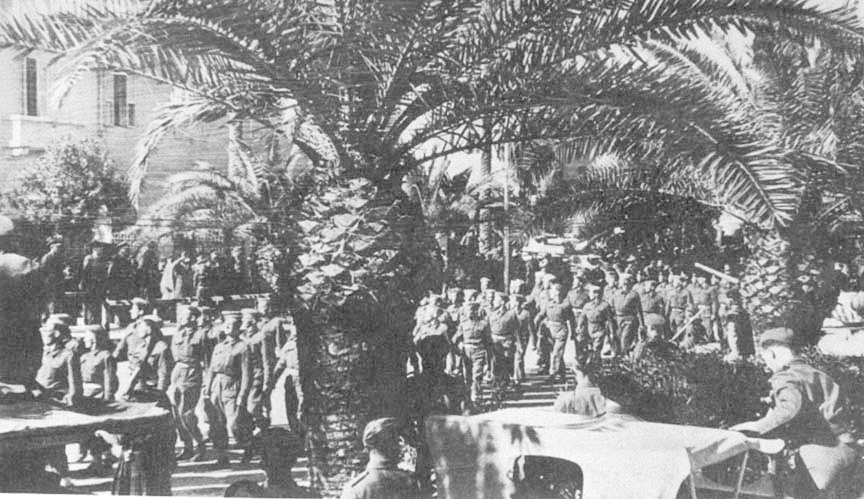 A section of the Thanksgiving parade of the Eighth Army after entering Tripoli. on January 23rd. Between the two palm trees are the AFS men who entered the town attached to the advanced units of the famous 'Eighth'. |
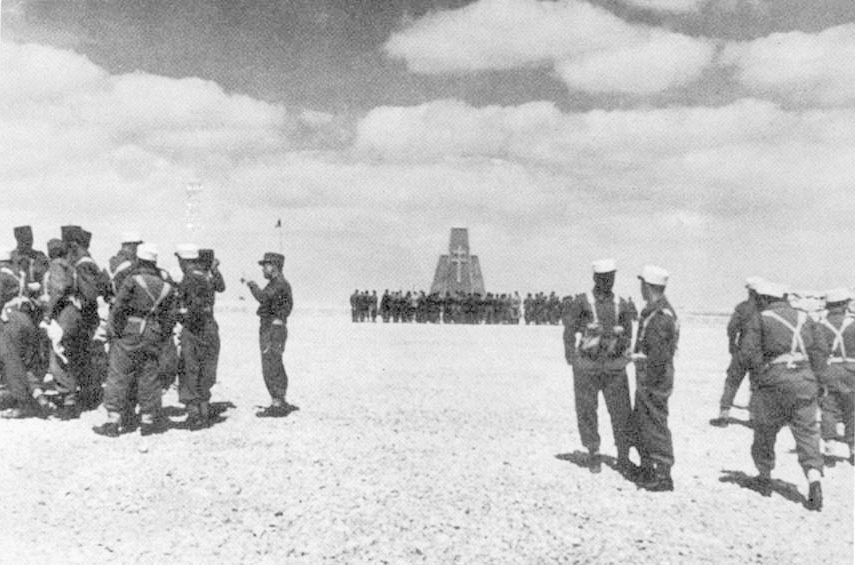 The Lorraine Cross stands guard. over the desert at Bir Hacheim, where the Fighting French soldiers held out against a powerful German siege for 13 days in June 1942. George Tichenor and Stanley Kulak AFS who lost their lives during the evacuation from the garrison of Bir Hacheim, are buried in the cemetery beside this monument. The above photo was taken just after the dedication ceremonies, which were attended by a contingent of AFS FF ambulanciers. |
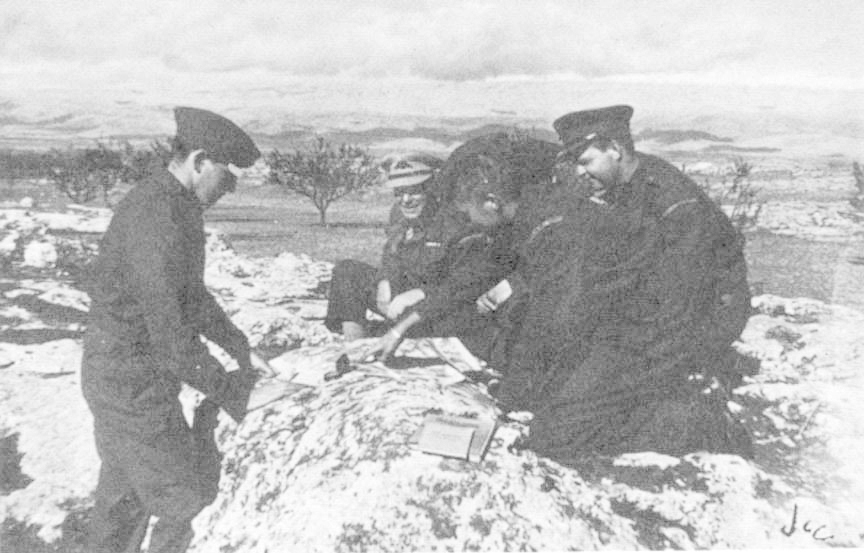 A group of AFS men attend an outdoor map reading class in the mountains of Syria. Left to right are: Francis Bloodgood, Raymond Fowler, Howard Brooke, and Walter de la Plante. |
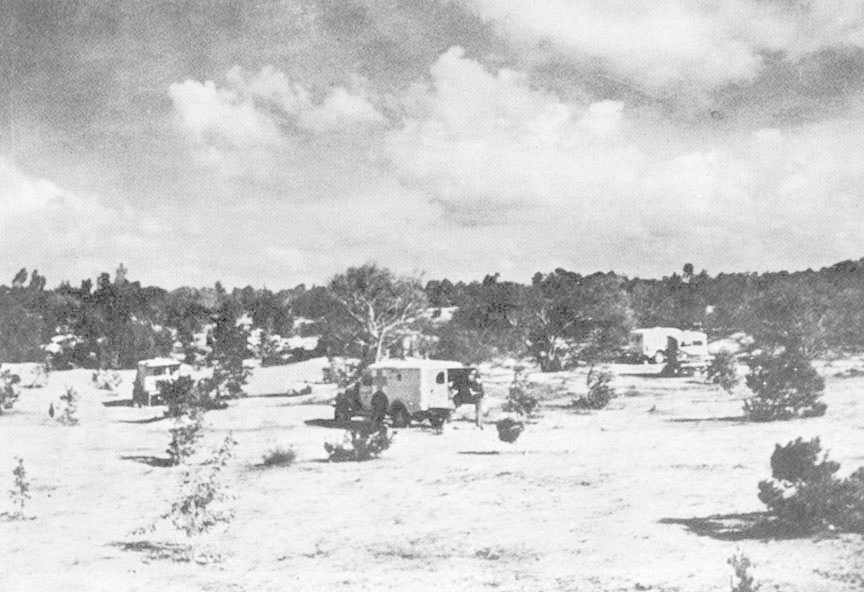 AFS ambulances dispersed in Tunisia. This country with its shady trees affords a welcome haven to the ambulance drivers who drove across the desert all the way from El Alamein. |
March 2, 1943.
"I was sent to the French Unit two days later and here I am. You may wonder why I was so anxious to get here. Well, the reasons are many. To begin with, they (H.Q.) make it sound horrible ---that's a challenge right away. You evidently should have three qualifications: 1. Speak French; 2. Experience; 3. You must volunteer. Well, I speak French, but evidently that isn't of prime importance. Obviously, I have no experience, having just arrived, so to speak, but I think I learn pretty quickly. Volunteering was a dead pipe cinch. So what do I get in return to make me want it so much? To begin with, the officers take it for granted that the men want to do a job and treat them accordingly. The man are a swell bunch, in my opinion. They appreciate the way they are handled and the net result is that the job is done and no beefing. The food from the French is marvelous. Literally, they served Crepe Suzettes the other night and the only complaint was that they weren't quite hot enough. While we are not in action at the moment, I understand that when we are, the job is a real one and not just fiddling around behind the lines. After all, that's what we signed up for and I think everybody in the Field Service would rather do it that way than otherwise. Also, and of importance, we have a pride of Unit. We don't want to be known just as being with the A.F.S., but as being A.F.S. Unit F.F.C. (Force Française Combattante). And, on top of it all, the French think enough of us to pay us on top of that munificent stipend which the A.F.S. contributes. All in all, I'm tickled pink to be here and, from the above, I imagine you'll agree."
March 19, 1943.
"Censorship rules dictate that I shall say nothing about where I am, where I was, where I expect to be, who I'm with, what I'm doing, how I like it, or anything else of interest, except that I may mention where I have been on leave.
("Two items I am permitted to tell you: First, I am with the French Unit, and second. that I am in the Western Desert. Since the F.F.C. are split up all over the lot, and since the Western Desert is over 2,000 miles long, I guess they feel fairly safe in allowing that much latitude.
"Sometimes the obvious is so plain that it is overlooked. For instance, a desert is a most uninteresting stretch of real estate, and consequently no one ever lives there except when there is a war going on. Hence, no buildings no towns, no anything but desert. Thus, if you live on the desert you must camp. This is very easy since you don't have to look for a spot, you just stop. Some outfits try to find a 'Bir', which means a well, but it's a waste of time since they are practically all dry. Camping itself is simple. Just stay in the ambulance. A group of two or more vehicles standing still thus becomes a camp. Undoubtedly in some future argument over these waste lands people will discuss the battle of El Afeffe and argue about the pronunciation, when actually all it will mean is that we stopped here. Camp life is much the same as anywhere else, only simplified. You don't build a lean-to for sleeping, you just string a stretcher in the back of the car and you're all set. Cooking likewise is a cinch, no need to look for dry wood, there isn't any dry wood, so you just put a little sand in the bottom of an empty tin, pour in some gasoline, light same and you have the finest damn fire that ever was. So just think of us the next time you walk to the theatre.
"I certainly take off my hat to the fitters and mechanics who have done the impossible by keeping all these vehicles rolling. And when I say 'all' I mean more things on four wheels then I ever imagined existed, from jeeps to block-long trucks.
"Unit 35, as such, got a swell break. Our identity as a Unit is lost immediately upon arrival at H.Q. and usually the men are scattered to the four winds, but luck has been with us and after being separated for a bit, we are now all with the F.F.C. We are divided between two brigades, but even that may straighten itself out and all of us will be together again. I certainly hope so for we all get along well and at best, the most this life offers is good fellowship".
No date
"About a week ago I transferred to the F.F.C. Our Captain is a swell fellow and a man that a person would be proud to serve under. I was very discouraged when I first came over, but now I feel that this is the real thing and what little good I can do will be appreciated. The French need us, and I think most of the fellows connected with them feel the same way. The A.F.S. made their reputation with them in the other war and maybe they will be able to live up to it in this one. I like the French even though I don't speak the language. I haven't seen any action yet but I expect to be in the show before long."
March 25, 1943.
"I believe that the volunteers of the A.F.S. have changed a lot during the past year. At first many of the fellows thought that they were officers and dressed and noted like them, and were pretty hard to order around. After being in the desert a while, most of the fellows found out that there wasn't anything wrong with greasing cars, dressing like privates, looking like privates, and being treated like privates."
January 21, 1943.
"The corporal who works in the medical tent is quite a character. The first day I was here he showed a picture of himself with at least five pounds of medals on. Needless to say I was much impressed and remarked upon it to M. le Lieutenant who said 'Oh, he has no medals at all, he just bought those. He used to be a safe-cracker in France and has been in all the jails. On his days off (permission) he dresses up with all his medals and tells the Arabs he's General de Gaulle! Quite a colorful personality!"
April 8, 1943.
"The best birthday present I can imagine is about to come true ---not only to me, but to the whole of Eighth Army. That is, of course, the destruction and/or capture of the Afrika Korps, and the clearing of North Africa of Jerry. The upswing in the number of prisoners we pass, walking back to rear areas, is even now very marked, and the end is drawing ever nearer. It won't be long till the fabulous march of 'Moonlight Monty' and the Eighth Army is ended and ready to be recorded by historians as the greatest desert trek in the long history of warfare. We all sort of laugh or joke about the praises laid on the Desert Army, but way down deep we're awfully proud to have been along, and to be able to feel that we've been a part, however small, of the whole great effort."
No date.
"Well, we're still at the same old post, although we may be transferred in the near future. In such an event, it will be a little like leaving home again, because we have become attached to the old place. The group before us apparently included a number of the Field Service playboys and we were in very bad odor when we arrived. They were so startled, however, when we started arriving at calls on time and getting out on cold days to grease our cars that their attitude began to change. Soon all was concord in the post that was supposed to be one of the most unattractive ones in Syria. The old commanding officer, who had a fearful reputation for grumpiness, has been very good to us indeed. The sergeants with whom we mess have welcomed us into their rather cliquish society, and we have spent many evenings with them buying drinks all around and singing songs (practically all of which bear no scrutiny from the Hays office). The Englishman is naturally reserved, but once the barriers are broken he can be quite genial.
"I still want to see this mess through to the end (which we all pray will come soon), and after it is over I'd like if possible to stay in this hemisphere a little while longer, for sure as God made little apples there'll be a show over here then that --- horrible or wonderful --- will none the less be fascinating.
February 15, 1943.
"We eat at the sergeants' mess, which is a very good one. They are queer fellows, and perfectly swell. They are a bunch of really battle-scarred soldiers who have lived and worked together for nearly ----- years now, and their mess, therefore, is rather like a club and a difficult one to be admitted to, at that. For the first few weeks, they more or less resent any forwardness on the part of outsiders like us ---and we are careful to keep our mouths shut and our eyes glued on our plates. Still they are already beginning to thaw, and it is plain that when they finally have looked us over long enough and do thaw, we will got along swell with them. Some cracks were made there, a few days ago, about the obvious fact that I badly needed a haircut, so I went downtown and got a real Tommy cut --bowl style. Over night my stock went sky-rocketing. The other day there was a slight beer party and we all got singing, and that helped too.
"Well, I have learned quite a few things since joining the war effort in the Middle East. I have learned that all natives are affectionately termed Wogs. I have learned, which is news to you, that a camel is the funniest looking creature which God saw fit to create not accepting the penguin, and that he habitually has the most incredibly disgusted expression on his face.
"I have learned also, in a more serious vein, that the British Tommy is one of the finest fellows in the world, and probably its greatest soldier ---and that, at the same time there are still plenty of reasons out here for being glad (and proud) that one is an American."
|
Who knows where the road is going? Who knows what is behind the dawn? The sand is pale by moonlight Who waits when the job is thru? |
February 5, 1943.
"H. and I got to know the son of the manager of the hotel pretty well... he's a great lad, 18 years, now is studying at the French College in Beyrouth and goes to the American University next year -- then to M.I.T. He hopes for Aeronautical Engineering. Talking with him we found out quite a bit about this amazing valley. In the first place Jubran Halil Jubran (or Kahlil Gibran), author and illustrator of the "Prophet" was born in Besharra! We went down to the public school house where three rooms on an upper floor have been turned into a museum containing many of his original paintings, books of his original sketches, his library in his bookcases, his bed a sort of bunk complete with a Simmons 'Beauty-rest mattress', easels, paints, personal effects, etc. etc.; also all his books in their various translations. I had known that he was a Syrian but hardly expected to come upon those fragments of history in that remote valley. He is a very respected man in those parts. Selim Rahme, our informer, told us a bit of his Lebanese history-- sketchy at best: he was born the only child of a poor peasant family..... father was a drinking man (the native Arak is pretty potent stuff) and his early childhood was pretty grim for both Jubran and his mother ....at 12 he set out for America with his mother...the story is vague but it seems that he was quite a hand at sketching......one day, as the story goes, he drew a woman's portrait ... she took a liking to him, etc., the details grow dim, but I smell a good story. Anyway, in the end (the early 1930's) he died and his body was brought back to the Lebanon to Besharra! ---where he is buried in a cave at the head of the canyon.....and he is considered a sort of saint by the peoples thereabout. He also left $30,000.00 for the poor of the town when he died. Strange---to walk into that stone schoolhouse on the side of the valley---a tiny woman, dressed in black and trailing three or four ragged children, let us into the rooms and collected our 15 piastres with a smile--- They all stood about gaping, she nursing her youngest, while we rummaged around thru the dust covered books and looked at his painting with a dozen chickens being chased about our feet....The contrasts in this country are beautiful, strange--till you begin to understand it isn't America.
"Jubran's paintings are weird, many of them make no sense at all to me. Quite a few show the influence of early Christian painters and other portraits that of the Dutch and Flemish schools in the high-lighting etc. Many of the larger paintings are fantastic in their religious expression. Really, though, I appreciated a number of his pencil portraits most---there is a depth of feeling and a radiant beauty here in black and white line and shadow that he cannot catch, indeed doesn't try to portray in the more violent and rough painting. With the brush he depends on color to communicate his feeling, with the pencil it is line. He has some fine character sketches that really live.
"There's still more of interest in this mountain valley. The people in these hills are all Christians, mostly Maronites, a branch of the Roman Catholic Church. Besharra is regarded as the central town of the neighboring villages, mainly on account of its ancient church (in the canyon directly below the town 500 feet) which dates back to Crusader days.---as do many ruins of old forts and castles."
"It's good to walk about these small towns and soak up a bit in this foreign atmosphere. Walking along a wooded lane on a bright moonlight night one sometimes thinks of the different peoples who have passed this way, sometime leaving their mark, but always moving on. Being at the center of the fertile crescent, this land was the cross-roads of all the earliest caravan routes; its trees furnished the lumber for the Phoenicians' ships and the timbers for King Solomon's palaces. All the great conquering armies of history have passed down this valley: Egyptians, Romans, Greeks, Byzantine emperors, both the German and the English in this war and the last. At Baalbek we climbed among the ruins of the great Roman temples of Jupiter, Bacchus and Venus, and watched a donkey draw a wooden plow between the weathered Corinthian columns (hewn from red granite that was brought from Assuan on the Nile) of a temple nearly buried under red earth. The land has been under the rule of a dozen national it has been the scene of many bloody battles and yet the fellah still reaps his grain and watches his flocks of goats and sheep --and the sheik still sucks at his water pipe-- an interesting land-- as impossible to describe as the pattern of an Oriental rug."
Early April or late March, 1943. Trinidad.
"Rather late one night a few of us visited the 'Baltimore Club' -- a dive if ever there was one, where the native Calypso singers held forth nightly. The singers hold forth in long extemporaneous chants -- weird native melodies -- composed often as they go along. There is a cadence and real poetic effect to the words, and a strong rising rhythm. Dancers come forth from the dark, shadowed corners of the dim-lit room---a sort of native jam session---wild at times, slow and serious at others."
At sea. No date.
Yet I guess the awareness of some danger lurks somewhere in the back of all our minds. This is given away, cornily enough, only in dreams. Most of us aboard have had at least one hair-raiser, featuring torpedoes and much water. I've had two. One of mine has become something of a minor classic here: 'As we fought our way up the companion-way through water and smoke, the lights went out. Someone said, in a typically exasperated tone of voice, "there goes the fuse' and I woke up.
"Oh well, It's a queer world. When we came aboard, we beefed loud and long about our cabin accommodations, which were Third Class. So loud and long did we beef that the unit leaders decided it was only fair to have those of us in 3rd class swap with those in 1st, when the voyage was half done. Oh. the bliss of it. We were going to 1st class, where you can have cold water in a thermos bottle and your bed made every day, and according to rumors get clean sheets once a week. Yet, when the day came for us to leave our squalid quarters ---eighteen men strong---we grew homesick, wept, and finally refused to go. It's God's truth."
A Departure. No date.
"Then bidding a fond farewell we loaded our duffle aboard a motor launch and chugged out into the harbor. We passed a merchantman in whose side a mine had torn a jagged hole. She stood without movement, deserted and solefully silent --- grim evidence that this war is reality. We were amazed by the extent of our shipping program in this one port. Everywhere docks and piers were full and crowded with activity; arenas swung high, heavy with goods going or coming, tugs puffed here and there, some towing strings of barges, others just busy like bees --- overhead planes droned by and in the distance we see the blue flashes of welders' torches at work in a shipyard where more than several Liberty ships stood in the ways in various stages of completion. Finally we rounded a bend to see a group of cargo vessels anchored in midstream and flying the flags of many nations. The customs man pointed out our ship and a trim vessel she was. She flew the blue and white crossed red flag of Norway and her gray coat was less weathered than some of the others. We learned that she had been built in Sweden in 1938, but she sails well for her Norwegian master and crew.
"Our rubber suits are a relatively recent innovation and have already saved many lives, tho I sometimes wonder how. They are one piece of black rubber that begins as parka hood drawn tightly under the chin and ends in a pair of heavy rubber boots. We are to wear it over our life jackets and attach a red flashlight and whistle to the hood. Clumsy they are, but really a godsend in the water, I imagine, especially when it's cold.
"These Norwegians are a good group. They are good fun; always joking; and they have a quick and sincere smile. And yet there seems to be something aloof ---and unfathomable depth in the steady way they hold your eyes. They are quietly calm as they actively and even dangerously, always, it seems with a steadiness of purpose."
The following statement was filed by a native Syrian mechanic of the AFS in unaccustomed English to describe an accident he had:-
IT WAS ON THE; 20th 4/43 at 11 o' clock when I entered into the Park after having tried the sanitary car mark Dodge No. 1312082 which belongs to American Field Service. At the descend which precedes the barricade East on the Aleppo-Lattakia road I took off my foot upon the accelerator. At the same time the back of the car began to move to the right and to the left sides. Before me and on my right side and coming across the road a man with his donkey. So to avoid him I was obliged to turn to the left side. After that the car did not obey to the manoeuvre which I wanted her to do and comes (the car) across the road and the back wheels touched the pavement and scaled it so the car begun to skid backwards and the wheels are went upon the wall and the car was reversed on its right side.