A collection of excerpts of letters from the men serving in the American Field Service overseas; edited and published at AFS headquarters, 60 Beaver Street, New York, under the sponsorship of the families and relatives of the ambulanciers.
Many of you, who have read these letters, know of the high regard that AFS men have for the New Zealanders. Since many have served with them under General Freyberg during the retreat before Rommel and the offensive against him, it is fitting that we print his story.
Sir Bernard Cyril Freyberg, V.C. is a very colorful and exciting character, and his career is an outstanding example of courage and hope, often with the cards stacked against him. Up to the time of his part in the African offensive he seemed to have been largely involved in defeats. His most remarkable characteristic is the vigorous ability he shows for rebounding under disaster. He and Mr. Churchill have both a dogged tenacity in common; Churchill has been effective in political war and Freyberg in military.
He was born in Surrey, England in 1890, but when he was two years old his family moved to New Zealand where he lived till he was twenty-two. He was always an outstanding athlete and a man of tremendous vitality and vigor. In 1912 he was practicing dentistry at which time he gave up his practice and left New Zealand to be next heard from as volunteer in Mexico in Pancho Villa's army. There he attained the rank of general. As soon as he heard of the outbreak of World War I he started at once --- on foot --- for the coast, where he shipped to England. He enlisted in the Royal Naval Division -- a British Commando unit hastily formed by Churchill to carry out a policy holding Antwerp against the Germans. Freyberg went with this expedition, but because of ill equipment and delay it was a failure.
His courage and vitality are qualities more then any other that make him the successful soldier he is, and these always seem to operate with special force after a defeat. So, completely undaunted, he became a part of the Gallipoli landing. The story is told of his bravery there in an address by Sir James Barrie on COURAGE given to the students at St. Andrews University in 1922:
"He was dropped overboard to light decoys on the shore to deceive the Turks as to where the landing was to be. He pushed a raft containing these in front of him. It was a frosty night and he was naked and painted black. Firing from the ships was going on all around. It was a two-hour swim in pitch darkness. He did it, crawled through the scrub to listen to the talk of the enemy, was so close that he could have shaken hands with them, lit his decoys and swam back."
For his bravery he was given the Distinguished Service Order which is the highest awards except the Victoria Cross, that a junior officer can receive. The Gallipoli campaign also failed; he was transferred to France and the end of World War I found him Lieutenant Colonel to the Grenadier Guards. But this service was too dull in peace times, he needed more vigorous outlet for his amazing energies. To find this he attempted to swim the English Channel, first in 1925, when he missed it by 200 yards, at which point a sea current swept him outwards. His second attempt was made a year later and again miscarried. In 1939, when World War II broke, Freyberg became commander of a Training Area and it seemed he might be on inactive service for the duration. But the land of his adoption knows a good man. The News Zealand Government offered him the top command of their overseas force and so he found himself at the head of men who were his kind --men of valiance and sturdy courage and of his own upbringing. He swept them with the offensive spirit and they have made a fine name for themselves in the entire African Campaign.
It is this type of man under whom many of the AFS men are serving and in November 1942 at Sidi Resegh, where he prevented a general collapse of the British offensive, as well as in this recent Battle of Mareth, they have proved themselves worthy of his leadership.
"IT IS RATHER FOR US TO BE HERE DEDICATED TO THE GREAT TASK REMAINING FOR US THAT FROM THESE HONORED DEAD WE TAKE INCREASED DEVOTION TO THAT CAUSE FOR WHICH THEY GAVE THE LAST FULL MEASURE OF DEVOTION, THAT WE HERE HIGHLY RESOLVE THAT THESE DEAD SHALL NOT HAVE DIED IN VAIN."
We quote Lincoln's words in honor of two A.F.S. men who have recently lost their lives overseas.
RANDOLPH G. EATON was killed in action on the Mareth Line in Tunisia. Capt. Howe, his Commanding Officer, reports as follows: "At 10 AM on the 25th March, 1943, Randolph Eaton, attached to the 6th N.Z. ADS South West of G. . . was severely injured by shrapnel from a bomb landing on the ground of the ADS. Major Duncan of the ADS gave him immediate attention, but he died five minutes later. Major Lamieson (Padre) buried him at the ADS." His home was in Brookline, Massachusetts and he had been a student at Bowdoin College, which he left at the end of his freshman year in order to join the American Field Service. He was 21 years old.
JOHN H. DENISON. Jr. 36 years old, died of pneumonia on March 27th. He was taken ill March 21st just after having arrived at a new post with the Fighting French Corps. He was buried with military honors in a British Military Cemetery, where a number of his A.F.S. comrades were present to form a guard of honor and also a squad of French troops acting as guards. His home recently had been in Bighorn, Wyoming where he owned and operated a ranch, but much of his life had been spent in both archaeological and anthropological studies which took him all over the world.
We extend to the families of these men our heartfelt sympathy and we resolve again to devote ourselves with renewed energy to the work to be done. Strong hearts, brave souls. and steady minds are needed to bring through to victory and reason a world so harassed and overrun by the nihilistic philosophy of the axis. Because these man, and their families through them, have given everything they had, we will do no less.
* * * * * * *
"For what is Fear? A limping fool
And what is Death? A windy sage
Not all whose vacant breath can cool
The sunrise of our pilgrimage."----Stephen Vincent Benét
Clifford Saber, driving ambulance #1325536, was returning to the 149 L.F.A. of the . . . Div., when at 0200 hours approximately on the 23rd of March, 1943, his ambulance was strafed from the air by a low-flying enemy aircraft on the Star Track, about . . . . .miles north of M. . . . . One bullet came through the roof of the oar and hit Saber in the back of the head. His spare driver William Schorger took over the car which had not been damaged, and drove Saber to the . . . L.F.A. about two miles up the track. Saber is in the 15th Scottish Hospital in Alexandria where his progress is as favorable as can be expected.
With this issue We return again to the cover drawn by Clifford before going overseas, and in so doing we wish him a full and speedy recovery to health and service.
The first two AFS men to be captured in action in the Middle East (both were taken in June, 1942) have been exchanged and are now free. Both men were evidently released as medical personnel in charge of wounded Allies prisoners being exchanged for wounded Axis prisoners.
On April 21st Mr. Galatti received a cable from Lisbon signed by an officer of a Quaker organization, stating that Peter Glenn AFS was in Lisbon on his way to London. He had arrived in Lisbon with some 400 British prisoners who had been held by the Italians. A subsequent brief cable was received at AFS N.Y. Headquarters stating that Peter had arrived in London and was awaiting repatriation home.
This wonderful news had hardly been digested when news came through the press that Alan Stuyvesant had also been released by the Italians and was in Turkey, having been exchanged there for a Group of German and Italian prisoners. On Easter Sunday AFS received a detailed cable from Carl Adam, our public relations man in Cairo, saying that Alan was in Cairo where he had arrived in charge of a small group of Fighting French "wounded and protected" personnel.
Alan had made the trip from Italy partly by Italian hospital ship, and later by British hospital ship. He described his three days on the British ship as days of "super treatment". He said that the greatest difficulty to life in the prison camp was the problem of finding enough to do to keep busy. The prisoners organized lectures, plays and music fests. Alan who spent much of his childhood in France taught French. (We printed earlier that Peter Glenn was librarian) The only highlights enjoyed by the internees according to Alan, were the periodical arrival of "welfare parcels" from the International Red Cross. These were great cause for rejoicing and afforded much pleasure, the contents being exchanged among the recipients, according to their national tastes. At one time he was placed in solitary confinement, and afterwards confined closely with "stooges" who attempted to get information from him. When he refused to give any information he was threatened with starvation, upon further refusal to impart information, he was however, released and the threat was never carried out. On the whole according to Alan Stuyvesant, life in Italy, was "not unbearable but no picnic".
No date.
"We are now off on the final jump in the chase from Alamein to Tripoli. Of course, we all hope with all our hearts that we make it. After that comes Syria. I hope. We are connected with an unusually good unit this time, the fifth we've been attached to so far, and we are told that if Tripoli does fall we stand a good chance of being the first Americans in. Usually it's the job of the first medical unit into a city to set up or take over the hospital. If such duty falls to us it should be a very interesting experience.
"Speaking of the Kiwis made it imperative to say what a truly fine people they are once again. The longer we're in contact with them the more they make us feel rather small compared to their sheer philosophy of giving. Wonderful guys --- and I'm afraid they've got the Yanks beat all hollow when it comes to traits like generosity and kindness and hospitality. They are damn good soldiers too and always got a real job. The only trouble is that at times they go so far forward they lose their support.
"The Time magazines are a source of real pleasure even though slightly aged. Everyone in the section hawk-like waits his turn. But after reading them it is a potent commentary on the way things are going at home that people must still be prodded to buy war bonds, still strike because of wages, still quibble about losing luxuries, still play the political game, and haven't yet realized that men every day are being killed and crippled so that they may quibble or strike or play politics some more. If they could only see whit the reports such as that from a country such as America, involved in a war like this, make them and the country out to be. I'm not very proud of my country if things like that are allowed to go on. Strikes. Selfish people. Let them trade places with the troops out here protecting them and see how much striking they'd do.
"All we can do is hope that this time another 1918 will not be allowed. If it is, America may have to face a revolt which she can't even imagine now. Let us hope not. Rather a badly written bit, but at least you've the state of mind at present."
December 9, 1942.
"Can you imagine somebody sitting --- well, let's see --- just behind Cemetery Ridge at Gettysburg? Well, that's me, warming up a little bully-beef over a gasoline fire. That close you can see the enemy ack-ack go up at the Allied planes. This sort of duty is our meat because our cars are particularly adaptable to it.
"I don't know if I can say anything about this life, but I'll send up a couple of trial balloons. Everything looks the same and it's extremely easy to get lost. I got lost the other day and almost spent the rest of the war in Germany, except an artillery shell fell across my bows and I hove to. I don't know who fired the shell --- no sign of anything. I eventually stumbled across some people who gave me the course and distance home."
"The desert is pleasant, aside from its being rather cold these mornings and aside from the hordes of flies that swarm around us in the afternoons when it gets warmer. There is a rather extraordinary variety of flowers and shrubs to be seen --- many of them quite fragrant and resembling our snapdragons, daisies, dandelions, buttercups, petunias and violets. And the desert, itself, is geologically quite varied into patches of soft sand, mud, red earth, gravel, flints, limestones, and escarpments. And there are dragonflies, butterflies, ants, many different birds (now flown south for the winter), lizards, snakes, and land snails. I have quite a representative collection of the last three.
"As for myself, I am very healthy, contented, and disgustingly dirty, and I would be hungry, if I hadn't lost my appetite long ago. Several weeks ago I had a sponge bath and I changed my shirt yesterday for the first time this month, anyway. But I found it quite necessary to change it so soon because, you see, I also sleep in my clothes. In fact I haven't had all my clothes completely off since the afore-mentioned sponge bath. I am altogether Elizabethan as far as the affectation of washing is concerned.
"The first three weeks of the attack, we were rather busy carrying the wounded, but since then work has been slight, which is good from the standpoint of the war, because it means that soldiers aren't being wounded so much. So far, we have experienced very little more than an occasional strafing or bombing, which, after all, is merely a nuisance raid. Our unit was once, however, for some reason or other, several miles ahead of (censored) between us and a 'pocket' and were shelled by 88-millimetres, but even after half an hour there were, miraculously, no casualties. I was not with them on that occasion, so missed the 'fun'."
No date.
"You don't know how surprised I was to receive mail today. I am surprised because I received these at a place where a month ago no man would have dared to tread. From this you can gather that I am in the desert and that I am actually a very long way from base. I never thought that I would ever receive mail here, to say nothing of receiving it so soon.
"The closest to danger I have been was the first week out of New York. I saw one ship go down and saw plenty of depth charges and bombs dropped. Out here I've seen plenty of German planes --- all on the ground. Once a plane came over and dropped some flares which were rather pretty but he was shot down. Since then nothing in the nature of action has 0occurred. Mind you, I'm not being facetious about war and action. The endless streams of wreckage for hundreds of miles of silent testimony to the fact that war is hell. The little graveyards full of German, Italian and English dead (many of the unknown) is even further proof of that fact. The point, however, is that if a few moments of action are glorious then 99.8% of a man's time is spent in drab, monotonous existence. I suppose I'll always quarrel with the propagandists and they're probably right. How else except by propaganda are people thousands of miles from the scene of action going to be made to realise that their efforts can win or lose the war. That their efforts can win or lose the war is absolutely true. The war is rather like checkers --- when one team has (or thinks he has) more guns, tanks and planes then the other boy, he moves in and takes over. If the other guy knows that he is short on these things he bluffs and waits for the other guy to attack and then retreats. And that's exactly what has happened out here. The British had the stuff. Rommel knew it. The British attacked. Rommel retreated and the British are still trying to engage the main German army. The Germans will have to fight when they get cornered. He'll be licked if there are enough American goods at the front. Whether there are enough American goods available or not depends largely on how much the people at home are producing. I know (as I have always thought) that without American production England would be out of the war by now. But I'm sure I have never really appreciated what that word 'production' meant. But I've always been a reasonable man, and seeing that I, as a reasonable man, did not fully appreciate the importance of our industrial energy, I doubt if many other reasonable men who have not had my experience can appreciate it.
"These immortal natives will outlast them all. How they have lived so far, is a mystery no one will ever fathom. You see them in towns which are in absolute ruins. You see them walking across mind fields and you see them coming through the camp. I've only seen one dead one and his camel --- he hit a mine. Since we don't drink as much tea as the British I think is necessary for life, we had some saved up to exchange for eggs. It 's interesting that these natives will accept German, Italian, British and Egyptian money. These natives, by the way, are simply exploiting the farms and orchards which Mussolini organized to give Libya a 'raison d'être' and to entice a few happy Italians to leave home. The native must be having a wonderful time. He's his own boss and quite friendly to all of us.
"You know the American Field Service has a wonderful time out here because no one understands us. The Tommy is our equal, the Sergeant is our equal and the Officer is our equal. The Officers can't understand how we can eat a meal with the Tommy but the Tommy has a wonderful time when he and an Officer are included in our party. It seems as though every place we go we throw the British military social system out of kilter. The Officers can't treat us as men because we're not men and the Tommy doesn't treat us as Officers as we're not Officers. What no Britisher can understand is how we can sit around and have a gay old time with our own AFS Officers, and we love to keep them guessing. We revel in our democracy.
"I do think that the AFS in doing a great service out here. British officers have told us that. My own personal view, if I am in any position to judge, is that we not only have the cars for actual front line, no-man's-land work, but also an ardent, in some ways a pioneer spirit. Our boys like to get into things, they like to scrounge (meaning investigate anything from which they might obtain a useful article) and at the risk of being sentimental I think they feel a challenge to do not only as good a job as the British but a better one. All of us are genuinely proud to be Americans, proud that we can take it and glad to have a wonderful place to go home too I'm really awfully happy out here and though I haven't done much yet I know that we have a better chance of getting to the front than anyone else and that we'll get more than our share of the breaks."
No date.
"Our units are so far forward and the supply lines the farthest in the world, it's a problem to rejoin one's outfit. It was an enjoyable trip except for our brief sojourn in Bengasi; when Capt. C. proceeded to drive toward the docks in search of a YMCA center in order to procure a tooth brush. In our frantic search all hell broke loose --- bombs and ack-ack fire. It seems everyone took to cover except us. There we were a lone ambulance amid bullet riddled buildings and in the centre of the street casually searching for the army canteen. Everyone had steel helmets except yours truly. His was with his unit. It was quite a scare. If anyone mentions tooth brush to me again, I'll give him the tube to go with it. A paste in the mouth."
December 29, 1942.
"At the moment I'm parked in a roped-in area which has just been cleared of mines. Just in back of me is a bridge which is suspected to be mined. In front is a field where the New Zealand mine-sappers have discovered several of the S mines, which the Jerries left all around the place as they retreated. All that is visible above the ground of this type, is three small prongs. If a person steps on one or all of them, the mine, buried in the sand, explodes. A jacket inside it jumps out and up about waist high, goes off, and shoots shrapnel for yards around.
"Yesterday a New Zealand sapper stepped squarely on an S mine. He felt the prongs on his foot and fell flat on his face right away. But the thing didn't explode. The Germans hadn't gotten the safety catch pulled out right when they left the mine. That sapper was really lucky. But they tell me he was shivering the rest of the day, and I can see how he'd be a nervous wreck. I know I would if I'd had a narrow escape like that.
"The boys are working in a field of weeds and flowers just ahead of me now, with their electric detectors sweeping ahead of them. When they find a mine, they render it harmless by fixing the safety catch. Senussis wandering around the desert are often the innocent victims of Jerry's mine-planting.
"The New Zealanders are the most generous people in the world. I'm convinced. They came over to our ambulance (and are still dropping over) with stuff they had gotten in parcels from their friends at home and wanted to share with 'the Yanks'. We're also to receive, each of us, a New Zealand 'patriotic parcel', along with the New Zealanders . . . They're wonderful fellows, and the first place I went to visit after this war is New Zealand.
"This life is really fun (I suppose it wouldn't be if we were taking the bombs and shells instead of giving them out). It's much more interesting than the work we did in Syria."
January 30, 1943.
"As of two days ago, I turned in my ambulance, and started driving for our Platoon Lieutenant. Briefly it consists of driving a 15 CWT truck, which is about the same size as our ambulances, but has a 'box" on the back covered with canvas, around to visit the different units that the various sections of our first platoon may be connected to at any certain time. Thus you can see that the job will mean getting around the whole area and thus getting a much more complete picture of the situation, while at the same time, doing a very necessary job.
"Everything is fine with me, and with the whole set-up. I only hope you've been as healthy as I have the past five or six months. They say this climate is supposed to tear you down, but I've certainly been feeling good all the way thru. Of course, you really can't help it, when you get from nine to eleven hours sleep nearly every night. What with a complete blackout, there's really nothing to do but go to bed, so except when we're working at night, we certainly get a lot of rest. During the time I had my ambulance, carried 70 lying cases and 117 sitting cases, and I drove a total of 8183 miles."
"We've come more than 1000 miles through the desert going only about 40 miles on the coast road---that at the worst point where the road was under repairs. That was at Halfaya Pass, which is very disappointing after even a good hill in the White Mountains, but is quite something in elevations for this desert. Everyone who'd been here before kept saying 'wait till we hit so-and-so, then the desert will be entirely different'. Actually, with slight variations in hilliness and bumpiness, the desert---for over 1000 miles (mostly in second gear) is sameness itself.
"One gets to appreciate the great changes in the sky. The sunsets and sunrises are marvelous, especially with no obstructions in the view; one can see the horizon all around, and the reflections of the sunsets are almost as colorful as the desert itself. And the sunsets are so varied; there are the usual brilliant red and orange ones, and then there are completely unique pastel pink and lilac sunsets --real baby pink and lavender, and sometimes the sky is turquoise green in patches. Strangely enough, there are quite a few small flowers in places, and we have seen no Hollywood of pure white sand. Even tanks get stuck in that type of desert. Ours is all sandy gravel or hard packed dirt, sometimes covered with shale, almost always sprinkled with small scrubby bushes. In some regions these bushes collect blowing sand and mounds are slowly formed which make driving, even on well-worn tracks, one continual bounce, jounce and rattle. While with one unit we used to have breakfast at 6.45---still almost dark, start off about 8:00, stopping and going, between two and twenty miles an hour for most of the day till 5:30. We have averaged 70 miles a day, which isn't bad, considering that a whole division was moving, every vehicle about 200 yards from the next (usually in three rows).
"That's one trouble with the modern war. It's lost much of its sociability. No longer are tents lined up in orderly rows, twenty feet apart. No longer do troops march along beside vehicles moving bumper to bumper. Nor does one sit around the campfire in the evening. Because of airplanes, the modern camp is not a camp at all. Everyone tries to park as near the cook truck as possible, but that may be somewhere from 50 yards to half a mile, and usually a hundred yards from the next vehicle. This does not make for sociability. Then, after the sun is well down, it is dark everywhere, except for a couple of lights in the hospital tents, and there are naturally no fires. We have finally learned the trick of putting blankets over our window, and using the very excellent ceiling lights in our ambulances. As we never drive with headlights, the batteries are not overburdened. So, I'm writing now, with two blankets over the front side windows and windshield, and one over the back windows on the inside. Getting in and out requires extinguishing the light and redraping rear blanket. Just now there's a Tommy riding with me who has no home (vehicle) at this point.
"Dishwashing out here is an art in itself. What with the scarcity of wells, and the number of these the enemy has spoiled, dishwater is about as common as ice-cream out here. There's usually at least a pail half full of warm sometimes soapy water, but this must do for the rinsing of mess tins of anywhere from 40 to 140 men. The water takes the food out of the inside, and leaves it on the outside as you take your dixie out of the water. Grease, of course, does not come out. Tea stains enamel mugs, and now that we're using the last inch of tea in lieu of nonexistent dishwater, the tea corrodes the metal mass tins; however, it is amazing how clean we can keep things. Now we're getting one canteen of water every other lay. Luckily each one of us has extra spare containers holding water collected at the last place where it was plentiful. This afternoon I made a fire of scrub bush and heated about a quart and a half of water, with which I washed three pieces of underwear, two pairs of socks, myself, and shaved besides.
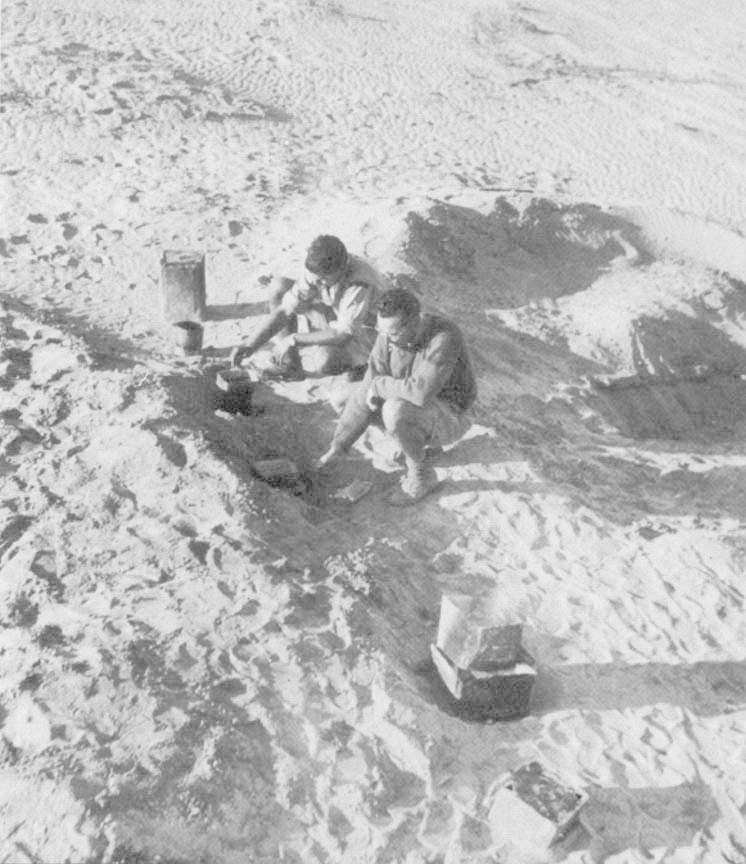 Late afternoon sun on the stern Desert catches Foray Gilbert and Porter Jarell 'cooking up' their supper |
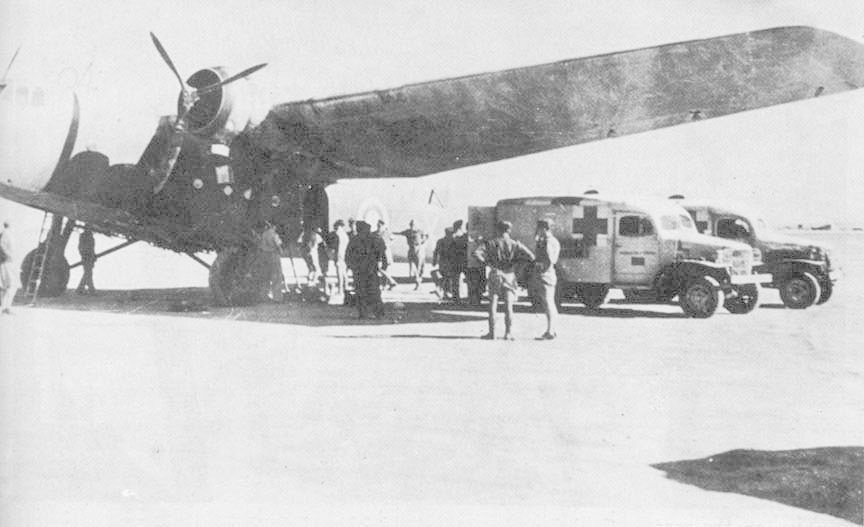 A short distance behind the front lines, AFS ambulances carrying the most severely wounded patients, meet an RAF hospital plane which will speed the casualties to a base hospital. |
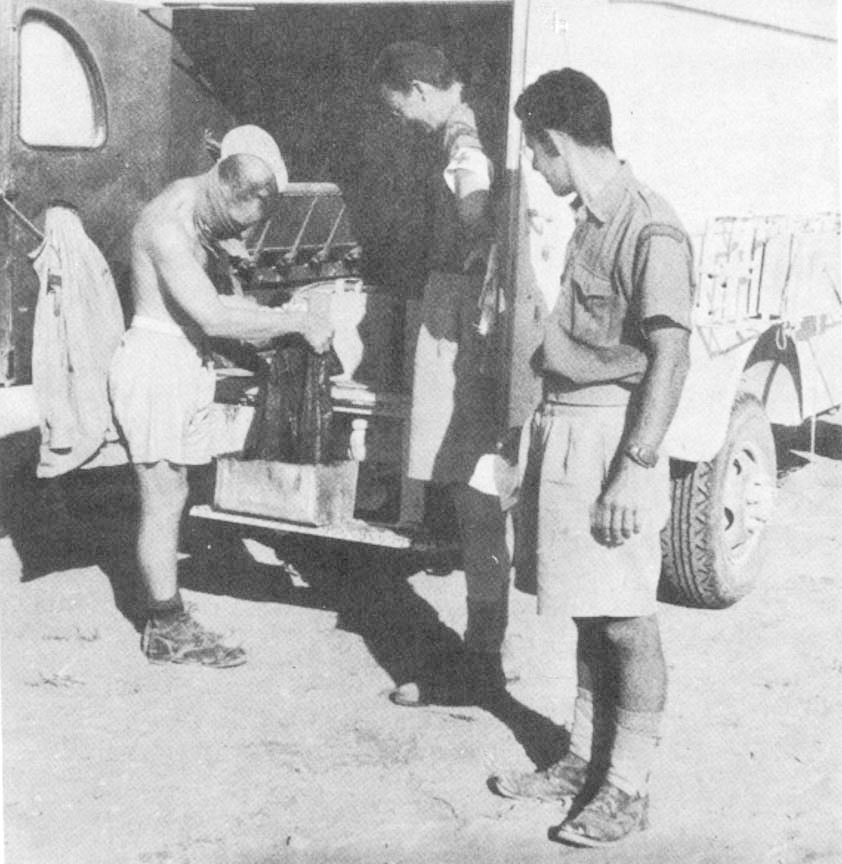 Western Desert. Mitch Follansbee (center) and Walt Olden find amusement in watching Harry Pierce in blue shorts doing a week's wash in petrol tin. |
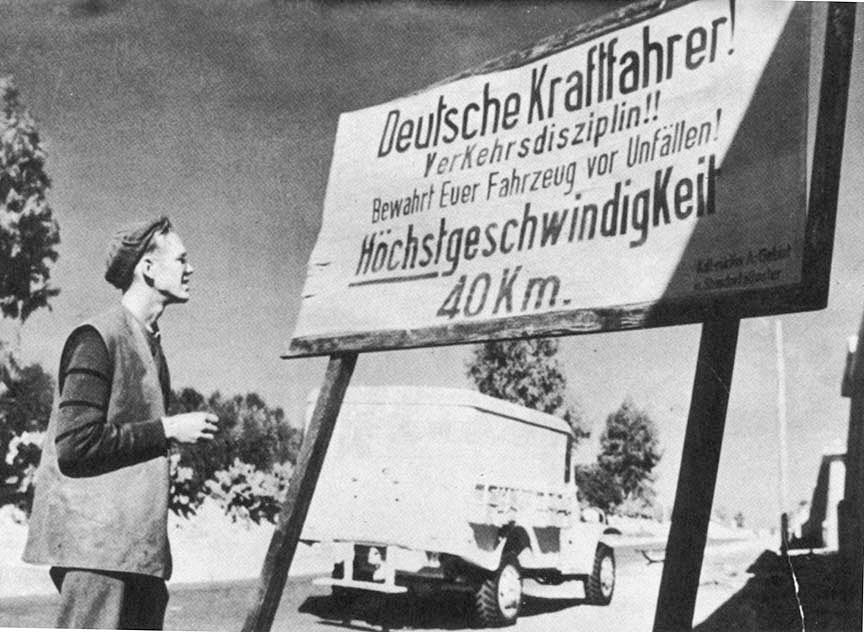 Jim Doughty, on the road to Tunisia, pauses to read 'Jerry's' advice: "GERMAN DRIVERS OF MOTOR VEHICLES ! Traffic Discipline !! Protect your vehicles from accidents MAXIMUM Speed 40km. Commander -----Area A and Senior Post Officer. |
February 5, 1943.
"We're still in the same place, still with the same unit, still involved In the general lull that has fallen over our battle-front since the taking of Tripoli. By now I've seen a good deal of the city --- in fact much more then I have of Cairo or Alexandria. In the simple tourists sense it's an interesting enough place; a magnificent harbor and waterfront; churches, mosques and temples; spacious palm-lined avenues and squares in the modern city and tortuous, aromatic alleys in the old; a proud old Roman arch, a great grim Turkish citadel, a fantastically scrambled population of Italians, Jews, Greeks, Senussi, Berbers, Negroes in all possible combinations. But what has been far more interesting than all this, has been the opportunity to see what life is like in a newly conquered city. Two of the ambulances in my platoon were with the very first troops to enter Tripoli on the morning of Jan. 23. They came in before dawn and nosed along cautiously through absolute dark and silent streets to the main square. Occasionally they heard the sound of shutters opening or closing, and they were extremely conscious that they were being watched from the dark, blank buildings along the way; but nothing happened; the streets remained silent and deserted. At dawn they brewed up their morning tea in the Piazza Italia and the Scotties greeting the rising sun with the wild yawp of bagpipes.
"....The town's ordinary commercial and social life is still very much upside down. In the big hotel the Grand, of course, you can get coffee and occasionally chianti, but no food unless you bring it yourself, in which case they'll prepare and serve it for you. The other night, however, a few of us did unearth a functioning restaurant --- the Roma --- and enjoyed the red-letter experience of eating our first indoor meal since sometime back in October. Menu: Macaroni soup, chop meet (camel?) cauliflower, oranges, bread (bread is big news in these parts), coffee, chianti and much too much anisette.
"Say what you will against the desert, it is about the ideal place to fight a war, or at least to live a soldier's life, none of the rain and mud of France; or the cold of Russia; or the sweat and fever of the true tropics. A man can put up with a great deal if he knows that he can count on the bright, beaming sun every day and the magic of the moon and stars every night.
"The great event of the past week has, of course, been Churchill's visit to Tripoli. A small detachment of AFS men were among the picked units of the 8th Army that lined up in review to receive him, and for a few days before the event there was a good deal of excitement."
"We are stopped out here apparently in the middle of nothing, thousands of miles from anywhere. We have been travelling for days thru swirling dust and desolation,----occasionally a deep 'waadi' breaks the monotony, but otherwise nothing; nothing but flat, hard, pebbly ground of soft drifting sand reaching to the horizon; so that; one feels as though he is sitting on a little round dish with an abysmal eternity of space and sky surrounding him. At first we travelled in the middle of a mass of transport, moving along in six great endless lines from horizon to horizon, but have been on our own the last couple of days. This desert certainly has a nothingness the vastness of which is overpowering and all-embracing.
January 23, 1943.
"Since writing the above we moved for three days more. The country has been more varied, great ranges of sand rising in the distance, and occasionally crossing our course. That means hard work, pushing and pulling on three ton load carriers up over the rising soft ground or getting them down almost precipitous rocky slopes of jagged slag rock. When we started to move again on the 19th we only got a couple of more miles that day and were held up by having to stop and repair several ambulances which we had accumulated in a broken down condition. We got the blacksmith to work and he repaired two broken chassises and four broken springs there in the middle of nothing. It meant that he had to make new chassises and new springs on his anvil, but in 24 hours the ambulances were heading bank to their units. That shows you how completely equipped we are and how important it is to have a good workshop with your company. Capt. W. who is in charge of ours is a marvel and produces something to patch up even the most derelict vehicle. While we were held up and camped for the night we heard heavy convoys moving by us, and the next day we saw one of the most amazing transformations of a barren desert I have ever witnessed. We found ourselves in the course of about 12 hours surrounded by 3 complete airfields. Hundreds of vehicles had brought in the technical equipment, the ground crews and the supplies and within a few hours there were several hundred planes on the fields. The air was filled with aircraft of every type. I saw a plane of the type that D.R. flies go overhead, stopped at the plane when it landed, and sure enough there was D. himself, looking thin and weary after hours of flying up freight. He told me that B. was on the next field and sure enough I went across and found his mechanic, who told me that B. had just been decorated by the R.A.F. and was at the moment recovering from jaundice. It was all rather a dream to see what went on and to meet those friends there in that mass of desolation. 8th Army has now achieved its goal and we are back in civilization, lovely Italian towns surrounded by green grass and fig trees and vineyards with white, modernistic stucco buildings standing out against the green background. All about us are wells of fresh water and we are busy washing away the dust which has been saturating our clothes, our hair, and our skin, and from which we could not free ourselves on an issue of 3 cups of water per day.
"Grand reports are coming from every hand on the work the fellows done and it has been a fine effort. The Corps Commander asked about information for a citation for two of our fellows who did particularly fine jobs under fire. We have had no casualties more serious than scratches and our luck has been wonderful on that score, considering the close calls a good many have had."
February 19, 1943.
"We are still settled in the buildings we first got into some weeks ago. It was then a great trial to get under cover for a spell, find ample water, and take it easy generally; but already everyone is anxious to be off again and back to the more nomadic desert life which we are accustomed to.
"Life in these buildings is so different from that which we are used to that I still wake up with a strange feeling from the presence of a roof overhead. We have a long shiny Italian horn which is used for calling meal time, and when it rings thru the corridors and halls, one feels as though he would walk into a medieval courtyard filled with lords and ladies and partake of the roast and wines of the oaken tables. Instead a greasy bunch of man in overalls line up with mass tins and mugs and are served bully and tea, and it is all a bit anticlimactic.
"We have a friend just a few yards away from our door, a fellow we call 'old George' or 'good old George'... We never see much of him in the daylight hours, but along about 8:15 every night and 6:15 every morning 'old George' lets out a cough that makes you drop your pipe or jump up in your bed with shock according to what the situation may be. Just after he coughs he lets out a whistle which is comparable to the sound of six express trains going by all at once. Repeating this performance at approx. 2 sec. intervals, 'old George' is not the nicest fellow in the world to have in your back yard. Needless to say he is a large, heavy ack-ack gun. As well, 'old George' has quite a brood of small fry around about, who with a much sharper faster cough attempt to emulate him. In fact 'old George' will often let them put on their little performance for about five minutes before stirring himself' into action. However he gets tired of their feeble efforts and sort of says 'stand back kids, and let the old boy show you how, and proceeds to let out a noise that shakes the very foundations of the buildings and lights up the area for 100 yards round about. All the little fellows stop for a moment of awe and admiration and then start thumping along again, proud to be associated with 'old George'.
February 25, 1943.
"A signal from HQ arrived ordering me to report to Cairo as quickly as possible. From reading your papers you probably know where I was when the thing came. We were just settling down for the first time in many days, taking over beautiful Italian homes for offices and HQ and generally revelling in having an opportunity to stay in one place for a bit --- a place particularly which had all the water we wanted for washing clothes and bathing, and a place with green grass and trees and stores. I went down to the nearest airport hopped a bomber going back and that same evening slept between the white sheets of a soft bed in Mena House. The plane ride was most interesting, giving sort of a panoramic view of all the country we had sweated, and pushed and fought our way across for many months. A wog village here, a cross-road there, a deep waadi, a strip of beach, a trench spattered area, a town by the sea; all as we crept by them called up memories of past days. Flying part of the way at a tremendous height, we soon realized why aviators wear wool and fur. We sat dejectedly among the bomb racks of the plane, shaking and shivering from the cold, while the engines droned on outside, an occasional cloud bank swallowed us up, and sometimes the rough air bumped us about, but otherwise there was no sense of space or time or movement. Our little world was for the time at least that jammed space in the body of the plane where the ten of us sat. Most of the other passengers were press reporters, rushing back with their stories, tired and dirty after a full two weeks in the desert. The way they looked you'd think they had been through weeks of fire and hell, instead of having ridden along in staff cars, as is the case. The way they talked you'd think they had been personally responsible for the victories. In one corner there was a British officer who had been thru it all, had helped to produce the success. He sat there quietly and watched and listened, his arms wrapped in bandages, his appearance neat and orderly. I wonder what he thought. Finally the cold began to get the reporters and one of them as a last resort pulled out a large bottle of whiskey which they consumed in short order. A second one followed shortly after and when the pilot finally came down to land they were singing and yelling away at the top of their lungs. We were all requested to move well forward for the landing and it looked like a football team as the reporters went charging up into the nose of the plane, stumbling over apparatus and luggage and ending in a great heap, which it subsequently took us some minutes to disentangle.
"The first night I was back there I happened to find some Itie parachute flares lying around and we had some grand fun shooting them up and then trying to catch the silk parachutes when they floated back to earth. It takes a lot of judging when a high wind is blowing, and most of them were floating over the wall of the compound in which we are living. Finally we got one started down right into our area when a sudden gust of wind caught it and swept it along farther than we thought it would and by golly the thing floated right into the open garage in which a certain Brigadier had his staff car parked and disappeared inside, still burning away at a terrific rate. We were terrified last the vehicle should be burned, and went racing down there just in time to meet the Brigadier puffing around the corner with the same thing in mind. We put the flare out and caught absolute hell from the Brig. I'm still trying to explain but he is not a very reasonable man."
January 20, 1943.
"I have been doing some work on X-ray equipment. Recently a ground on a high tension lead shorted and I had to take the whole insulated upright apart and rewire it and test it. The machine is something like yours, (same peak voltage), but newer and made by G.E. Also the spring on the release of the Bucky was poor and the bell on the Bucky didn't work. All in good condition now, I may add. It seems that out here I happen to be the only one who is at all familiar with X-ray equipment. So ---shades of the past, I'm at it and love it."
January 31, 1943.
"This morning is the last I shall spend at the American Field Service Club, where, since the twenty second (January) I've holed up and rested. Major H. was very kind, telling me to recoup a week and do nothing but read a book and consume the magnificent breakfasts and dinners that G.P. produces here at the Hostel. Right here I went to go on record as stating this place is a refuge and a Godsend. G. did all the decorating--- mixed up the paint, supervised papering, added to the furnishings already provided by the landlord, collected a small library, engaged two servants. He does daily shopping and runs the whole place as nearly like a private home of good class as is physically possible. He is an artist and to my mind this is his best work. We have a game room, a large living room with couches, covered chairs, lamps, a medium sized dinner table, where as many as fourteen have crowded about a series of brilliantly varied and nutritious triumphs. A typical meal consists of bean and ham soup, carrots, peas, fried chicken, rolls, coffee made in a percolator, and bananas and tangerines. Of course, they aren't always so sumptuous for convalescents and transient desert rats, it is all a blessing from God.
"Hot water for a bath, laundry, can be arranged for --- really no other place at the base, out of innumerable Forces Hostels you might try to stay at --- places are hard to find and expensive --- can compare with G's 20 Pt bed and breakfast, and 15 Pt. dinner. Flowers fill bowls --- the cheap and beautiful kinds you always buy, grown in the gardens along the river.
"Evenings are chilly --- a couple of oil stoves out the cold. The U.S. Maritime Union (CIO) I think, voted to let American Field Service men go back to the United States on Liberty ships. It all came about through a Captain who explained to his crew about our work --- driving ambulances for a year --and how some of us wished to return (we had trouble getting passage) how we were volunteers, had served six months without pay etc.
"At headquarters there is a small kitten, grey and white, living in our baggage room. Lt. K. who has charge there keeps her in one of those folding canvas pails lined with odds and ends of clothing the boys have discarded. Her milk is warmed over the oil stove used to heat the place. Though she had a cold in her tummy she is recovering.
"The Field Service is becoming more departmentalized and the financial section is running very well, distributing our money and paying us under the direction of Lt. F. and Capt. G. They are bringing the cash out to us regularly, no matter how far away the boys are."
January 21, 1943.
"The offensive began when I was in town but I got out there in time for the 'break-thru'. Then a unit of five ambulances, including myself, was transferred and attached to the spearhead of the drive. Probably sounds exciting, but actually, after the first two nights, and three instances later --- running into two 'Jerry' pockets and a strafing episode --- nothing of a too disturbing nature happened my way (admitting of course my fright on these occasions). The wreckage of the various types of army equipment, the great number of volunteer prisoners, the enemy positions and techniques as well as the burning tanks were impressive and interesting in a certain way.
"We did not have the advantage of the coast road as the part designated for our contingent necessitated moving westward thru the desert (series of limestone, rocky plateaus and shallow --- lofty valleys --- therefore broken springs and chewed-up tires. And then shooting northward, thereby cutting part of the enemy off. So, when we, instead of stopping at various planned and scheduled spots because of the unexpected facility of our drive, were ordered to go westward and keep going --- the CO reporting to general staff by wireless truck every hour; right thru the desert with little worry who had compasses, maps and other paraphernalia. But the evacuation of patients back to the first casualty clearing unit was our worry --- one time over a hundred miles over the same rough trackless country.
"The sensation of being lost came my way several times, and once with a load of patients during one of those desert rains. The rough journey did not do them any good, and when I got stuck in some saturated slit, they had to pile out and help, those who could. Evacuated, then 3 days to catch up with the fast moving drive."
February 22, 1943.
"Tripoli itself isn't anything marvelous because there is nothing to buy at all. The Jerries cleaned the town thoroughly leaving the problem of feeding the inhabitants to the 8th Army. Since Jerry swiped all the crops and flour and foodstuffs and took or dismantled all machinery the natives have little left to keep them going until we can tide them over to the next crop. They do have date cakes and such junk as that which they hawk along the streets. When we first got into town the bargaining position was lovely since I could and did get a dozen eggs for a handful of tea. But then the whole 8th Army poured in. Since the push they have had practically no chance to spend a cent so they are all rolling in dough and hungry as hell for food and souvenirs. No matter what price the natives would ask, some damn fool would buy it so as a result unless you know the ins and outs of the city or unless you make some connections, it is practically hopeless to got anything at all. When I was last down on the main drag, eggs were retailing at a shilling per, which is an idea of what prices are like.
"Actually there is little to do in town. (We are just on the edge of the city). There are no restaurants at all and no canteens as yet so if you want to eat you must take something with you unless you don't mind the native junk, which is mostly some byproduct of dirt and dates. That's what I live on. Practically everything is closed. The army has one cinema going but usually the queue is 1/4 of a mile long. There is a soldier's lounge where you can go and read lots of eyetie magazines or listen to the radio or you can walk along the sea wall which is always lovely. For a short while the native quarter which is the old part of the city and surrounded by a high wall was in bounds, but now it is out of bounds again.
"This was the most interesting, part. Here thousands are pocked in and there are streets and streets of tiny shops with nothing to sell. What the people do for a living is a mystery. My good friend J. and I would wander hither and yon. Occasionally we would come across some hole in the wall cooking up some evil looking junk which we, of course, got a plate of. Why I haven't made the dysentery grade I don't know especially as some of these joints would be a bit severe for stabling a porker. Naturally the dishes are rarely washed and the forks and spoons not at all. We also would pass some travelling street hawker who was frying up some flour cakes in what appeared to be machine oil. These turned out to be quite tasty, and tho the Arabs buy one at a time and go away, J. and I managed to stow away 36 since we were hungry. We also came upon the arch of Marcus Aurelius which he had erected to honor nobody else then himself. It is in a fine state of preservation and quite handsome. The simplicity and strength of the architectural form is very impressive. There are other bits of stuff lying around tho a good many of them are piled in a corner and practically knee deep in the usual Italian excrement. (They seem to make a game of misbehaving in the most extraordinary places.) Scattered around the city are Roman ruins of one or another minor sort. Often in the native quarter you will see a well worn carved marble doorstep. A minority of the natives speak French so with that and with my sparse knowledge of Arabic, Italian and German I get along quite well. We also deal In English pounds and shillings, Egyptian ackers (piasters) Italian lira and all of which we must translate into dollars and cents so as to get some idea of what we are getting cheated by.
"P. has travelled with the most advanced regiment all the way and has been the only ambulance driver in the knowledge of the 8th Army who has refused to leave his patients during a stuka raid and for 5 days they were attacked about every 30 minutes. When once he had no patients he left his ambulance and went off a few yards whereupon a bomb landed about 6 inches in front of the vehicle and totally demolished it. P. wasn't scratched. Usually another ambulance and driver would replace such a loss, but the MO wouldn't hear of it and went out and got another ambulance for P. to drive. He has learned how to give morphine, dress wounds, put on splints, administer blood, etc., all of which we never do since we are usually with a bunch that has medical orderlies. Moreover the hours he worked, the food they had, the conditions they lived under were fantastic. When P. was recalled into headquarters for a checkup, his buddy the MO thanked him most profusely for his work. And then the major of the regiment sent for him and thanked him for the splendid job he had done, an occurrence which has never happened in the history of our outfit. To cap it all, the Colonel or head man of the regiment sent for him and commended him for his fine record and what with the usual British reserve this was indeed a magnificent tribute. Typical of P., the first thing he did when he got back to Tripoli was to buy up such little food and supplies that were available, wrapped them up, and sent them to his friends in the regiment who had nothing at all. As usual P. gets very embarrassed when you even mention the fact that you heard that he did a swell job.
"The amount of nonsense that has been going on in town recently would warm the cockles of the Metro-Goldwyn-Mayer. Everyone has been parading around, putting on a great show, and generally patting themselves on the back. It's getting so that one hardly looks up when a general or a prime minister goes by. The Highland Div. puts on an elegant performance every night with the changing of the guards all done up brown with bagpipes and kilts. Like all armies everyone knew about 3 days in advance that Churchill was going to pay us a surprise visit. How the griff gets around I don't know, but we are always well posted on movement orders or unusual events. They put on a display of armored power for Churchill that even impressed me and I think that tho the show lacked subtlety, the natives whose loyalty might be questioned got the point. We were supposed to line the road in military fashion which some of the boys attempted to do, tho I think the Salvation Army could put us to shame. I didn't get in the line because I was playing nurse to Baksheesh the hound. Churchill drifted by in convoy and gave us the old high sign which he uses as a victory token and which we use as an Impudent Gesture. He looked tired and worn and determined. I give him credit for showing up in a zone of danger and for giving the boys the kick which they all got. Of course, it isn't really dangerous tho Jerry does manage to drop in once or twice a day to see how we are getting on. We are always so glad to see him that we open up in a 21 or is it 2100 gun salute. Our boys are managing to put on a damn fine show but we are getting so blasé now that we rarely get out of the ambulances for a looksee.
"It's hard to describe the great feeling of elation out here of the victories of our Russian comrades-in-arms. The General feeling is that we have been playing around while the real business goes on across the sea. Morale is now at its highest pitch I have yet seen and certainly if it weren't for the Red Army we don't kid ourselves into knowing where we would be. The war is a long way from over, but I really think that the Allies will be taking in the chips from now on."
"We were awakened by an orderly before dawn to drive over to the medical truck to take on patients. I loaded on 3 lying patients, and one with a broken jaw who could sit in front with me. While we were waiting for the sun to come up so that we could see to drive, I got a cup of tea to be split amongst all 5 of us. Water happened to be short. Both ambulances then started off over extraordinarily rough ground. It was like driving across the floor of a granite quarry. After two hours and a half, we had covered 4 miles. By this time we had reached medical unit 'A' here the patients --banged up in a Stuka raid --- were redressed and given something to drink. I got about 3 forkfuls of corned beef and a cup of hot Bovril. The patients were given shots of morphine to hold them for the rest of the trip, I was given my orders: Take them to 'C', which should be about 10 miles back; if it has moved, take then on back to 'D' which should be about 30 miles away'.
"We started off in low gear, just lifting the speedometer needle off zero while the ambulance banged and rocked over the extraordinary terrain. By the time we'd gone about half an hour, the trucks of 'C' came past us moving in the opposite direction, O.K., 'C' is out, leaving us 29 miles to 'D'. It was then about 11.30 A.M.
"You develop a technique driving an ambulance. There's no use being tense and wincing at every bump --- you only tire yourself out. The thing to do is size up your patients, see how badly they are injured, and then be completely objective in driving accordingly. The general rule is to drive just slow enough so that they don't groan. There are, of course, very sick men who will never let out a peep no matter what happens, and apprehensive ones who groan when there's no call to. These you can size up by noting the drift of their conversation, whether or not it's forced, etc. If you go up into the groaning speeds, you may get there with a couple of cases of shook which is bad. If you go too slowly you merely prolong an uncomfortable trip.
"By three o'clock we had gone 10 miles from 'A', or 14 miles since dawn, with only one stop to give the patients some extremely rusty water out of an old gasoline can, which had by no means lost its savor. But water's water. By this time the patients were getting restless and anxious to know how much farther it was. I didn't know for sure, but told them upwards of 20 miles. At this, one of them, who was a lieutenant, got very grumpy and said: 'Do you realize, driver, we've been in ambulances now for TWO DAYS?' 'Well'. I replied blandly. He said nothing, but muttered and mumbles in rage. This is a good sign --- a sick man doesn't often get impatient.
"The going improved markedly about this time, so that I could push her up to 10 miles an hour or better. Only once or twice was I caught off guard and the wheels dropped into holes about 7 inches deep, setting off groans and sighs from the back. The man in front sat reading a detective story through most of the day. About five o'clock we saw the first signpost to 'D', and a little later came to an AFS company headquarters. By 5:20 we found ourselves in a huge area of camps, where I couldn't distinguish 'D' from any of the other units, and none of the other units knew about 'D' because they had just arrived. Finally I found a major in a jeep who said, 'Follow me.' He roared across the desert at a greater than groaning speed, but the groans just had to be, else I'd lose him. He gave up, though, five miles forward at a point we'd already been. He had guessed wrong and had to confess he knew no more about 'D'. Five miles to be done all over again --- half an hour's work. In about ten minutes, however, I stopped an English ambulance who gave full and authoritative directions. By 6:15 I was unloaded and taking deep breaths. I whipped back to AFS headquarters at 40 per, got dinner and went to bed.
"The next day I would have about twice the trip I had had, for 'A' and 'B' were moving forward all the time. I had been driving back. But that was O.K. I'd be alone and could bang along at any speed the ambulance could stand."
January 31, 1943.
"It is a comfort to be allowed to write about this visit to Tripoli. I'm sure you had already gathered that we were there from my hint in your last letter. Although the town is still pretty closed up (I think the population is afraid to come out from behind their closed shutters), it's still darn good after so many weeks in the desert.
"We had quite an amusing time a while back before we got here when we came upon our first inhabited village. We parked our ambulances and wandered into the local restaurant. 'Jerry' had recently departed and I guess the inhabitants were a little nervous as to how they would be treated by us. As a result, upon entering this little cafe, we had huge glasses of red wine thrust upon us.. .a state of affairs which lasted steadily for about eight hours. You have no idea how good it was because we hadn't had much water (much less wine) for a long time. At any rate, a good club dinner, has nothing on a bunch of desert-weary soldiers and their attachments (us) when they strike such a place as this.
"Things are not half so bad as they might be with us. It does seem funny, however, to see a whole city of closed shops and shuttered doors and windows when you know that people are still living behind them."
February 26, 1943.
"Saw 'Winnie' Churchill the other day, when he drove along in an open staff car inspecting all the troops in the area. As the clipping shows, he seems quite pleased and satisfied with things in general over here, and he has every right to be, as the co-called 'desert army' certainly has lived up to, and far surpassed even, all that had been hoped of it.
"By the way, if any one asks, you can tell them for me, or for any AFS man for that matter, that the New Zealanders (Kiwis) are the grandest bunch of fellows in the desert. Everyone always hopes to be attached to them, and those who do the job are the envy of the rest of the company. It's really hard to say why they are so liked, except that they are so friendly and hospitable, and we all get along so well together."
December 2, 1942.
"I am convinced after only a few months in the Middle East that arms and supplies are destined to play a crucial part in this war. America is and must furnish these necessities, I cannot possibly tell you what it means to have the skies clouded with fighter protection. I cannot describe the meaning of tanks support. Nor can I express the eagerness and buoyant pride of a victorious army hot on the heels of the enemy. We, on this side of the ocean, are confident of victory because we have faith in the home front.
"I have observed that you keep reminding me that I can come home when my year is finished. To that I can only reply it's the job I want finished not the year. When the war is over, I'll be back ---not until."
December 13, 1942.
"War is terrible, it is austere, and it is nauseatingly bloody but for the individual part participant felicitous moments are not entirely lacking. So the next time you begin to worry about how I am getting along, remember that I may be at that very moment a thousand miles from even a POP gun probably stretched out on a feather bed in some fashionable hotel with a glass of beer in one hand and a cigarette in the other and, of course, always thinking how wonderful it will be to see you again and to sink my teeth into some of that swell home cooking."
"I promised you that when I felt in some small way capable, I would attempt to describe what is actually happening over here and what constitutes my humble part.
"Picture, if you can, a great expanse of land; a magnitude stretching out from Alexandria and reaching across 1800 miles of Northern Africa to the coastal city of Tripoli. For spaceless miles it is a low slung desert land, flat and desolate. Its landscape is garnished with scrawny clumps of desert grass and its surface is inadvertently strewn with small coarse rocks. Occasionally it is slashed by depressions and ravines, bedded with soft sand. It is a listless, phlegmatic land; challenging to those who dare to brave its austerity.
"During the entire year the sun relentlessly beats down with sadistic fury; and in the summer, so viciously that the temperature is frequently well above one hundred degrees. The winter months, on the other hand, are quite mild and usually cool enough to permit the wearing of a heavy sweater or jacket with perfect comfort. The nights are intensely cold during all seasons; so much so, in fact, that even in the summer I have been chilled to the bone sleeping between eight blankets.
"Yet I do not dislike the desert. Once accustomed to it, one becomes fascinated by its profound silence, its crystal clear nights, and the intangible mystery that hovers above it. It has history as ancient as the world itself. Hidden away in many of its forgotten corners are numerous Roman ruins whose crumbling walls are all but concealed by the shifting sand. Along its surface are large quantities of petrified wood; perhaps the remains of a great forest long since disappeared. I think I shall recall these things in later years more than the dust storms that cut my face and filled my eyes, ears and throat with an irritating powder; more. than the heat, and more than the scarcity of water.
"But you are mistaken if you believe this expanse to be consummately naked of the more refreshing and pleasing attributes of nature. For along the coast around such towns as Derna, Berge, Bengasi and Tripoli, there are miles of green cultivated fields, luxurious shade trees, and rolling, voluble hills. In some places the altitude rises as much as three thousand feet. The towns in their emerald domains and facing the melting blue of the Mediterranean have a refreshing and untarnished beauty. They are the result for the most part of the Italian colonization scheme. Many of the houses and buildings are painted a bright rust color, or an electric green or a pale blue, giving a cheerful warmth that is so utterly incongruous to the parts of the desert I have already described. In some places farms are laid out in neat, concise squares, each with a small square stucco house that is the exact duplicate of its neighbors. On the sides of most of these homes the word 'Duce' is emblazoned in large white letters. Everything is very neat and very tidy but there is no contrast and no individuality. It is an excellent criterion on dictatorship with the whole thing out and dried and totally lacking in personality. What the Italiano lost we are fighting to preserve: namely the rights of the individual. The Italiano are of course gone but their homes remain as ghostly remembrances of an unfortunate and misguided nation.
"It has been across this great expanse of Northern Africa that we have been waging war against our enemies for two long, arduous years. In many respects it has been a perfect setting, for there will be few homes to rebuild and little damage done to private property. In years to come the sand will seep into the trenches and shell holes and cover the once great battlefields with a thick veil.
"But what kind of a war is this? Most military men over here agree that it is a war of supplies. It is comparatively easy to move an army rapidly across hundreds of miles of unobstructed desert waste, but to keep that army well supplied as it moves farther and farther from base is incredibly difficult. For this reason the importance of the home front cannot be too strongly emphasized. Every truck turned off the assembly line in the U.S.A. and sent here helps ameliorate the supply problem. Every article of war necessity that reaches the desert base helps to establish new, well stocked depots closer to the front. For in this war there is no static line; armies must retreat to their nearest large supply point and advance only as rapidly as their supplies can move with them. The geological aspect of the desert also plays an important part. In many places there are marshes, arduous depressions, and jagged ravines that are in themselves excellent fortification. When one of these strongholds is finally seized by the enemy the vanquished retreat to the next one which may be as much as four or five hundred miles away. Thus, unlike the last war the mere taking of ground is unimportant unless it embodies the seizure of one of these significant points. This, then, is a highly mobile war with a changing fluid front, dependent upon supplies and geological positions.
"But there are few here that believe that this campaign will decide the outcome of our struggle against the Axis. It is of importance, true, but it would be fatuous to lull ourselves into the belief that it is anything more than a side issue. In a recent speech, Churchill declared that there had been fourteen thousand allied casualties during the six week campaign at El Alamein. Yet from the Russian front we have heard news of that number killed in a single day's fighting!
"Here in the desert is a true coalition of the Allies working together towards a common goal. Shoulder to shoulder with the British are men from France, South Africa, Australia, India, New Zealand, Greece, Poland, America and numerous other countries throughout the world. They are doing every conceivable task necessitated by army functions; everything from repairing; roads to flying fast fighter planes. They are working together with avidity and with a grim determination to wipe out the enemy as quickly as possible...At times there are long periods of routine, of comparative idleness. Then men begin to worry about their families and wonder whether their homes are still standing. And you should see their faces when letters from home arrive! It is almost too difficult to describe how much they mean in the desert. But the more I see of the men out here, the more supremely confident I become in our ultimate victory, for they have courage that is unbeatable. It is not an ostentatious but an inveterate, plodding courage that has enabled them to brave a desolate land, countless hardships, and the anguish for their families at home. It is the kind of courage shown by badly wounded men riding in jogging ambulances over rocky trails without so much as a whimper. It is the kind of courage shown by a Frenchmen who dictated a letter to his mother on his death bed saying that he was in no pain when his whole stomach had been torn to pieces by shrapnel. How can we lose?
"My job of ambulance driver explains itself. I carry wounded and people in need of medical attention. Why should I say more when thousands of mothers now have sons overseas?
"But I can assure you that war is not without humor. One day, for instance, I met a Besoota (black South African trooper) who asked me If I knew Joe Louis. I told him not intimately. The fellow then told me that he could lick Joe with no trouble at all. 'I've got his style all figured out,' he said, as he began bobbing are weaving around, throwing rights and lefts at the air. 'But Joe is too big for you.' I said, looking at his diminutive form. 'How much he weigh?' said the Bosootac 'Over two hundred pounds.' He looked crestfallen. 'Maybe he make my lights go out then, me only one-hundred fifty.' 'Joe's pretty tough', I ventured. 'We got two hundred boys in Bosoota Land that can take him over.' 'Yes, but can they do it singly?' 'Of course we got plenty fighters, yes sir.' I started to move away but was heartily clapped on the back. 'Boy, you sho is lucky.' 'Why?' 'Brother, you've been talking to the world's next lightweight champ.'
"You were ever so right about travel changing and enlarging one's personality, framing new perspectives, awakening new insights, creating a broader sense of tolerance and sympathy. The need for the making of a new world is so terribly apparent; a world free from oppressive traditions, prejudices and intolerance, ---a world where masses of blameless people are not forced to sell themselves for the simplest material needs to avoid starving. The task ahead is so tremendous and seemingly impossible. The dim idols of the past are ever with us.
"The British Tommies are (all said and done) a pretty fine lot. They have all of the British reserve, and do not appreciate childish enthusiastic explosions from others. But if you are not too 'wild' in your approaches and sort of gently break down the wall of reticence, it is surprising what good fellows they can be. As our boss Captain puts it, 'They are not given to bragging but they know their onions.' The Aussies and New Zealanders are a different breed (so they tell me). They are said to be very fine, but in a different way."
January 20,1943.
"That very evening we were ordered to leave troops we were stationed with on an hour's notice, complicated by the fact that two of the squad were away and we had to pack up for them, and next day were sent to a point some --- miles further on. Half way thru the trip however, we were ordered back some --- miles and are now attached to a hospital where we have rooms in a nice little stone house outside, (bit cold and damp) but a relief from sleeping so long in the ambulance. We evacuate to a certain place one day, spend the night there, then return here the following day. Two squads here; one taking the run one day, other the next, then return here the following days we pass them on the road.
"Lads have been most ingenious about fixing up our new quarters. No electric lights so we've made reflectors for the candles out of petrol tins, some of them made by one boy, real masterpieces, quite as good looking as some of the Mexican ones. Today we scrounged a stove which will help dispel the damp in the living room as well as using it for cooking. All and all should be most comfortable.
"Nice country around here, purple crocus like in our winter garden, trees, when any, scrubby but interesting, sort of cedars, and nice big palms around hamlets. Right in the heart of Mussolini's colonization plan, houses little modernistic jobs, quite comfortable but ruined by big black letters on outside of 'Duce Vinceremo', etc. We're near a small town where they're accepting Wop money. Incidentally we're far away from action despite our moving."
No date.
"Every one had a great deal of fun at the U.S.O. We played ping-pong and pool, pitched horse-shoes, roller-skated, took fresh water showers!, drank cokes, saw good American movies. I can sincerely say that the U.S.O., with its wholesome, inexpensive recreations is indeed a moral oasis in an immoral wilderness. It is a splendid American Institution."
February 20, 1943.
"As to the spirit of the men out here, which you may have noticed, I have mentioned several times, I think the great success of the whole Middle Eastern war tells better than I ever could what the man are like, what their attitude has been, and what they are going to do with the rest of North Africa. I think Winston Churchill expressed the whole thing in a few simple words when he said, in a speech given at the Piazza Italia in Tripoli, "When, after the war is over, a man is asked what he did, it will be enough for him to say, 'I marched with the Eighth Army'."
"There is the cultivated area that was developed by Italian colonists, and which is very pleasant country, extending from just east of Barce to a bit beyond Bengasi. Then more desert, interspersed with small spots of cultivations stretching on westward toward Tripoli. As you near this famed spot, the land is again rich and well cultivated. Here, again, the Italian colonists' homes (many still inhabited) are to be found. Tripoli itself is similar to Cairo, a mixture of the primitive with the modern, but as the buildings that used to house the Italian Colonial Government, and the houses in the residential districts, are extreme in their modernism, the primitive has been crowded out, and except for a district of a few blocks known as the Native Quarter, you must go out to the outskirts of town to find the true natives."
December 20, 1942. En Route.
"The Chinese, immaculate little men slink about taking good care of us. When the Norwegians finish a meal they obviously begin all over again with cheese, sardines, salad, cold meats. etc. Have seen whales, swordfish, sharks, barracuda, etc."
December 28, 1942.
"Although I have written that it was rough before, it was pure self-deception. Am hanging on the table, and walking consists of freezing like a pointer, then shuffling forward arms extended, while the shuffle becomes rather an unwieldy board -like gavotte, at which point you're thrown in reverse, or continue up the wall. Sleeping under these circumstances is not what it might be. Unfortunately much worse is predicted, and if you have gleaned the route vaguely, you will know it is rough. Awe-inspiring, it is to see the waves overhead from the dock. A dull thud and swearing mark another mishap.
"Now that it can be written, Panama City is a hot, fly-infested spot. All the traffic moves on the wrong side of the road. The busses, or small Model A Fords with a aeries of crates on the back, neither stop to let you on or off. You got in or out while they slow down. By the time the passengers who desire to alight have done so, they reassemble from the various strategic spots along the block where the chances for jumping look most advantageous. There was one good hotel, the Tivoli, where we ate dinner. The rest of the time was passed walking about and gawking at everything. Prices everywhere were sky high, and soldiers by the thousands."
January 6, 1943.
"The strong faces and courage of some of these men is impressive. Many have not seen their homes for two or three years, and the Captain (of the ship) has an only child of four, that he has never seen, born just after he left the last time. He can't return now, of course."
January 23, 1943.
"People here are thinking of what must be done after the war too. The very thing that I am doing is an excellent example of the long-range view point of the British and French governments here in Syria. Everyone realizes that it will not be enough simply to win the war in the Middle East. We must also win a peace for the Middle East. I often think that these countries are having their heyday of peace and plenty now with the armies of occupation, something which may easily go when they go. And this is a great problem foremost in many minds. Well, we here in the Field Service are doing a lot for the few Syrians and Lebanese who can understand that we are volunteers and that the ambulances were given by ordinary people back home to help their country. You may not know that there is no conscription for Lebanese and Syrians. I have some good friends here in Beirut who are of my age and are enjoying the prosperity while it lasts. They are in business, in the University, in the faculty of Medicine and such things as that, quite oblivious to the war. They say that they are a peace loving people which is certainly true; and they are wise business men, those of them who are in business. Possibly they feel a little obligation to us and so they give us everything we could want. Treat us like long lost brothers.
"They are looking into the future. Indeed they are stock from which has sprung the world's greatest prophets; they are the Bedouins who have been chased into the desert to sit and think and sip coffee while great conquering armies have come and gone through their country, from the Orient bound for the West, and from Europe bound for the East; time after time, millennium after millennium. And once only have they been united by Mohammed and once only have they gone out to conquer the world from Gibraltar to Bombay, to form an Empire which crumbled almost as it was formed because these people are not rulers, and fighting is not their way of life. They are the philosophers of the world, the reeds that bend with the wind while the mighty oaks, the Empires of the East and of the West, crash around them. Then they rise to give to their conquerors a new religion; to give back to the crusaders of the dark ages in Europe, the culture that the Romans gave to them; or to give to the Romans what their conquerors from the East had taught them; and to the whole world their own number system, the product of their thought, the wisdom of their prophets.
"Last week we made a vaccinating tour some 100 miles into the Syrian desert where the Bedouins have their tents. It was slow tough going lots of the way through mud that taxed my four wheel drive in low gear, and the rest of the way dodging large square rooks scattered at random over the countryside. There are no roads, just places where people walk and places where people can't walk. You try to drive on the places where people have been walking. We left about eight in the morning and didn't get to our destination until the middle of the afternoon, when we spotted a bunch of long low black tents off on the horizon and laid a course for them. By a miracle it was the place we meant to get to and we were most cordially welcomed by a polished French-speaking Prince of the deserts who ordered a sheep killed for us at once. And then began the drinking of coffee. Being an Emir, you see, the fellow had not just a couple of coffee pots, but five coffee pots of various sizes, from a pint up to two or three gallons and he had a slave continually employed brewing the stuff on the coals, sampling, pouring, and mixing the whole day long. Every time anyone either got up, sat down, changed position on the divan, or finished a sentence, this fellow would offer him a sip of coffee."
January 1, 1943.
"When you come down out of the mountains into Beirut. on the coast and at sea levels the weather suddenly becomes mild and balmy. It is quite a large town, full of French and Lebanese people, most of whom speak French and Arabian but very little English. The roofs are all orange-red tiles and the houses themselves mostly white or pale tan. Being on the coast it in one of the few places in the Middle East where trees and grass are green and abundant. Both Christians and Moslems live there so the dress of the people varies greatly. Some of the woman dress very modernly, with clothes like the women wear at home, paint and lipstick --- a few are even good looking! But Moslem women all wear veils --- at least the married ones do --- and the outline of their faces can be only faintly seen through them. It's a ludicrous sight to see a young and trim figure docked out in a pretty and modern dress (with the skirt perhaps just a trifle too short) modestly wearing a veil on her face."
December 2, 1942.
"While I was posted in an obscure little village on the banks of the Euphrates, I patronized quite frequently the local movie palace. On my first visit to the 'Roxy Theatre' I argued with the ticket seller for fifteen minutes before I finally won my point and was allowed to sit downstairs for 20 piastres less. Not that I minded the money so much but the balcony was defiantly poised in the air and what held it there was a mystery to me. My inability to tread air was also a point to be considered. Therefore followed by the disapproving glares of the ticket seller and the manager, I trotted down to the aisle to a seat well beyond the threatening structure above.
"The audience was sprawled out on wooden chairs jabbering and digging their bare feet into the earthen floor. When I casually tossed away a cigarette butt, four tobacco addicts leaped out from various vantage points and began to frantically inspect the area surrounding my feet. This was a bit disconcerting. By this time the gentleman who had been sitting on my right emerged from the cess pool of arms and logs with the butt jammed between his lips. I found myself precariously perched on the top of my chair lugubriously viewing the results of that well known slogan 'Something new has been added'... As the lights faded, some vindictive soul hurled a watermelon rind which struck the back of my neck with a loud resounding whack. This displeased me considerably and I felt a slight inclination to tear the fellow's head off with my bare hands. The picture was 'Lost Horizon' with Ronald Colman whose voice sounded vaguely like a rusty meat grinder.
"Soon the wealthy patrons in the balcony began to discard their apple cores, watermelon rinds and nut shells onto the vociferating audience below. After every reel the lights wabbled back on and throaty peddlers ran around with more ammunition which was readily purchased."
|
It is not merely flesh that makes a man, Those inner longings that possess his soul For that swift spark that flow from Heaven to Earth |
As we announced In the last issues AFS has undertaken a new commitment, that of supplying volunteers and ambulances to India. Negotiations are under way to obtain mailing privileges of an APO number, similar to the one we now use in writing to the AFS men in the-Middle East. In the meantime the AFS men in India (still enroute) have two addresses, one for Air Mail the other for Boat Mail. Without an APO number it is NOT possible to send V-Mail.
| Air Mail Address | Boat Mail Address |
| Name | Name |
| American Field Service | American Field Service |
| Air Base Postal Depot | Base Postal Depot |
| Karachi, India | Bombay, India |
We recently received word of the work of AFS overseas from the 'heart' of the front. A friend of ours has a nephew who is a pilot in the RAF, this airman, Hector MacDonald was in the U.S. fully recovered after having been shot down at Tobruk in June 1942. When he was downed he managed to got out of his plane and was there on the desert wondering what would become of him, when up drove an AFS ambulance sent from a dressing station some distance back. He was picked up, put in the ambulance and driven to safety. He was enthusiastic in his praise of the whole outfit and particularly so of the driver who picked him up. The name unfortunately had become confused with time, but is more similar to John Countaway than any other AFS name.
All the comforts of home dept. We seem to be constantly making reports on the subject of foods but then we are constantly receiving items on food, so perhaps it is a very important thing in the lives of the AFS men. The latest comes from Gerald Paine from the AFS Club in Cairo which he is managing; he says: "An average of 25 to 30 breakfasts served every morning of fruits coffee or tea, dry cereal, eggs, sometimes sausages or ham. Sometimes 12 and sometimes 30 for tea with which is served cakes and cookies. Dinners for 129 preference given to club residents, of a hot soup, both meat and fish, 2 vegetables, salad, desert of sometimes fruit and coffee, sometimes a fancy dish procured uptown or a home made one.
AFS is now in the midst of an extensive tour of the U.S. in search of more volunteers. The men on these tours are Burgess Whiteside and Hammond Douglas both of whom have been in the Middle East and are seeing America first in our behalf before returning overseas. One of the new ambulance drivers did a bit of recruiting around N.Y. while waiting to sail. One day he spent an hour and a half riding on the Third Avenue El to reach his destination. We feel sure that a man with such fearless determination will go far toward success in anything that he undertakes.
Among the war time shortages that have affected us the most, is the near-impossibility of obtaining messenger boys. AFS LETTERS have become so numerous that the postman is unable to take them away and we could not get the postal truck to fetch them when each issue was ready to be mailed to you. Things were looking bleak. It took two or three men (if we could prevail on them to do so) all day to carry the issues to the nearest post-office. However the situation is saved and we now assure you that your copy will be mailed faithfully. The Boy Scouts of America (Troop 218, New York City) are making us the recipient of their good deed for one day a month and are handling the mailing of AFS LETTERS from now on.
AFS, and its volunteers at the war fronts in the Middle East will soon be immortalized in print. Watch for the appearance shortly of a book titled MERCY AND HELL by Andrew Geer, to be published by Whittlesey house. Andy Geer was a member of the first unit to go to the Middle East in November 1941 and has recently returned home, where he completed his tome begin in the desert.
A benefit performance of Helen Hayes' current play HARRIET was given April 6th for AFS. We profited by $4,010.25 from the net proceeds of this benefit. The credit for the success of the affair goes to the N.Y. Women's Committee set up especially for it. The Women's Committee is made up of relatives of AFS men from N.Y. It was organized in February 1942 and in just over a year has raised by various methods $26,698.00. A wonderful piece of work for which the ladies have our hearty congratulations.
Bill Thomas who was in the Middle East with AFS for several months has joined the American Red Cross as an assistant Field Director. He will be stationed somewhere in the U.S. doing welfare work.
Two colleges, Alma Maters of AFS men, who had war fund drives on the campus, have allotted part of the money collected to use The University of Wisconsin sent $25.00 for which we are most appreciative. The University of Pennsylvania sent $200.00 from their coffers. At the latter campus Jim Doubleday's (AFS) brother Newell, who graduated in the early spring, was responsible for arousing the University's interest in the ambulance service. Our thanks to him and the U. of Penn contributors.
The Romance Dept. We cannot discover whether its the war, spring, or just natural inclination..... but more and more AFS members are joining this dept. Leo 'Harpo' Marx has just become engaged to Miss Anne Cox of Bedford, Mass. Harold 'Rod' Gilmore is engaged to Miss Dorothy McNab of New York.. Congratulations and very best wishes to all of them. (aside to them) And don't forget to ask us to the weddings.
Writer an old SSU....later In the US Air Service....and again, today, in the US Air Corps...."Twelve Zeros attacking....Go get 'em....four pea-shooters (Pursuit planes) with you.... Business of breaking out the guns and getting set....I had one of the waist guns and a wonderful view. There was a lift, almost of exaltation, in that flight. It was definitely a test for my reactions....One never knows how one will behave.... My job is to interrogate, guard against mistakes of inexperience, rashness, over-enthusiasm and qualities, which properly guided, make them the best damned fighting men in the World.... and misdirected, bring speedy destruction to our men and our War strength.... Flashing moments of combat.... No sentiment here .... responsibility under primitive conditions."
Dr. Perrin Hamilton Long, SSU 69, while at Johns Hopkins, did much in evolving the principles and in the development of Sulpha-derivative drugs. In December 1941, the War Department speeded him by air to Pearl Harbor, where his work was described as of "inestimable value". Today "Perry" is in North Africa, a full Colonel on the Staff of General Eisenhauer.
How many AFS "Vieux Oiseaux" in North Africa? We cannot say, precisely.... but we have heard from and of a number....Major Enos Curtin and Captain Clarence Mitchell, whose introspective and legal minds are sadly missed at meetings of the AFS Executive Committee.... Lieut. Colonel John Huffer and Colonel Harold Willis are watching the air-lanes.... There was a goodly representation of the "Old" service awaiting the lads of the "New" upon their arrival in Tunis with General Montgomery's "Fox hunters" of the British Eighth Army.
Telegram received: "As a parent in the New service, I wish to express both pride and satisfaction in the spirit launched by you twenty-nine years ago. It is a privilege and an inspiration to have a son serving with you and to know that through him, is being contributed a small but priceless part towards a better understanding between Nations. A Parent".
Waldo Peirce, SSU3 is painting the Memorial scroll (World War II) upon which will be inscribed the names
| Killed in Action | Died In Service |
| Tichenor | Eaton |
| McLarty | Watson |
| Kulak | Denison |
| Eston |
Les Oiseaux will recall the scroll he produced during World War I, portraying Nikke, Goddess of Victory.
| Acheson, Alexander G., | TMU 133 | Lieut. US Navy |
| Bradley, Edward U., | TMU 133 | Lieut. US Navy |
| Burrage, Albert Cameron III, | France '40 | Capt. U.S. Tank Corps |
| Besse, Harry W., | TMU 184 | Major US Air Corps |
| Mackenzie, Donald, | Syria, 141 | Major AUS |
| Carson, Robert B., | SSU 69 | War Production Board |
| Harter, Harry B., | SSU 70 | Capt. US Air Corps |
| Love, Ethelbert W., | SSU 69 | Capt. US Air Corps |
| Pents, William R., | TMU 526 | Major AUS |
| Field, Donald F., | TMU 184 | 1st. Lieut. US CMP |
Horatio Tobey Mooers, SSU 27 and Paris Headquarters, has long been in the US Consular Service. Late in 1941, he was sent to the Philippine Islands on a special mission for the State Department, and on the fall of Manila, was interned by the Japanese. His release is hoped for but according to latest advices, Mooers was still in a Concentration camp.
If you have received a post card, or other form of "Notification of Classification" addressed to your son or husband at his home address, would you please send it to us, as we need it for our records. Also, we keep National Headquarters, Selective Service System, Washington advised of these extensions, and we send the notifications themselves to our Middle East Headquarters; they should be in the possession of the registrant concerned.
Many of these notifications come to us directly , but we believe that others must be going to the registrants, at their home addresses. STEPHEN GALATTI
The transmittal of personal funds overseas for the great number of men in the field has added such a burden on our limited financial organization that a changed policy is made necessary. Instead of cabling credits and messages at all times, we will only cable on the 1st and 15th of each month at the same rates, and we earnestly ask your cooperation.
The cabling of funds of men whose enlistments are known to have expired or who are on the way back are transmitted at the discretion of the Financial Department. Communications of all kinds are very slow, and we frequently cable money to men intending to return, only to find they have already left for home. This entails a deal of extra work both in these Headquarters and overseas. Men returning are given $40.00 by the Service and this has been found ample for the return voyage. However, should an emergency arise, the man can always contact these Headquarters and we will help him in whatever may be necessary.
We must also ask that you do not cable funds to various ports to men enroute. This causes a great deal of confusion and, in many instances, the funds are not received as the Unit has left port by the time the cable arrives*
Packages weighing up to 8oz. may now be sent A.P.O. but only by 1st. class mail.
16¢ from New York City
24¢ all other points