A collection of excerpts of letters from the men serving in the American Field Service overseas; edited and published at AFS Headquarters, 60 Beaver Street, New York, under the sponsorship of the families and relatives of the ambulanciers.
On March 12th in New York the AFS members, past and present, had a reunion --- the first ever held in wartime. On this occasion Mr. Galatti spoke to the men overseas by shortwave through the courtesy of the U.S. War Office of Information. The text of the talk follows:
I can't tell you how happy I am to have this chance to talk to you. I have often wished I could personally tell you of the reputation you are making, for yourselves individually and for the American Field Service as a unit. I speak to you not for myself alone but for all your families and friends who are wishing you luck and the continuation of the marvelous record you have established. I want to send you their best wishes and those of your representatives, their helpers, and the American Field Service men of 1914-1918 as well as those of 1939-1940.
You have made this your service. Its intrinsic qualities are yours. Built on the foundation of past service by Americans to their friends and Allies of another war, it is your structure. You have carried the same basic materials with you to a new field, determined to furnish valuable service to our new Allies. New only in the sense that it is the first time that AFS has worked attached to the British Forces, and its initial experience on battlefields outside Europe. You have taken the desert in your stride and have made the men of the Empire troops your friends. Those of you who have served with the Fighting French Army have also done a good job, not only in ambulance work, but you have revived a great tradition with those men, the tradition of American friendship.
It has been grand to see Ralph Richmond and to get first hand from him a report of your problems and progress in the Middle East. He in turn got a clear picture of the work on this end. We were brought still closer by the fact that we both had to be here while most of you were over there fox-chasing.
The number of wounded carried by you in your 15 months' service is a military secret, but I know it to be very large. Lives have been saved whenever and wherever it was possible; you have driven your ambulances through all sorts of difficult terrain and have spent long hours negotiating the distances.
The service that you have rendered the Allies has not gone unnoticed. We have just received a request from Field Marshall Sir Archibald Wavell, Commander in Chief in India, to send the ambulance service to his forces there. We are now working to fulfill this new commitment. The credit for the requisition goes to you, all of you, for the grand job that you have done in the Middle East. The work you have accomplished is the main factor behind this new demand for the aid of the American Field Service.
This assignment to a new war area in no way takes the place of the present one. Rather it supplements it, making the Field Service a larger double-barrelled unit, extending our phase of American assistance and enlarging our scope with the United Nations. I am sure that this token of confidence is as gratifying to you all as it is to me and I am sure that you will again distinguish the AFS by giving your best. Good luck and God-speed to you.
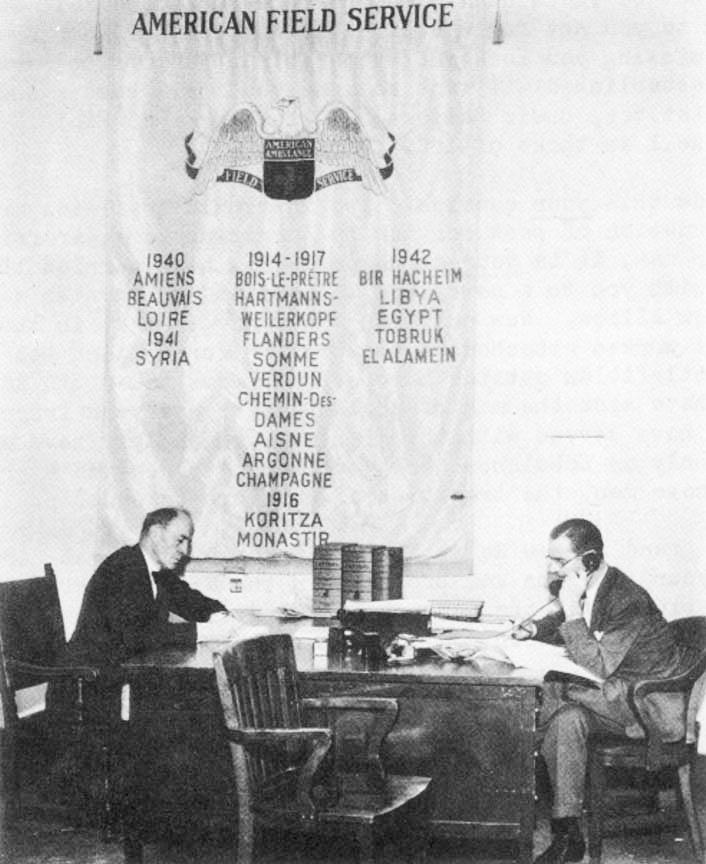
The first step to India. Volunteer enlistment department at AFS New York headquarters. Mr. Lydig Hoyt and Mr. Mathews Dick wait for customers.
November 11, 1942.
"To describe what this push is like is hard for me, because the immensity of it takes my breath away. There are thousands and thousands and thousands of trucks, lorries, staff cars, armored cars, tanks, guns on wheels; kitchens and workshops-on-wheels; petrol, wireless, ammunition, provisions and more provisions on wheels. Every conceivable man-made machine and commodity that man needs to live by rolls west day after day. Convoys run 3 abreast for miles on end, pouring west. Coming back are truck-loads of Italian and German prisoners. You see Germans in little groups standing beside the road, waiting to be driven back to prison pens --- some are not even guarded --- they know that getting back to their own lines is impossible.
"Some of the trucks are still burning. Cans of foods, broken, are scattered for and wide. Lord, I could never tell you of the destruction. And through it all, our motor transport roars on and on and on.
"Confidence in the success of this drive was in everyone's mind before the attack began and now it is stronger than ever. By God, I would not trade my job for a job in any one of all the other departments in the whole war set-up!"
November 20, 1942.
"My ambulance has been given a plaque for the door and guess what it is. 'From the Patrons of the Metropolitan and Paramount Theatres in Boston, Mass'. It makes me feel quite at home, you know.
"I have talked to some prisoners, as we carry them in our ambulances, quite often. Mine have been Italian and very nice. They didn't like the war at all and didn't want to fight it in the first place. They hope it will be over soon so that we can be friends and can come to Italy to visit them. Mine seemed very surprised to see us being friendly and were very thankful for cigarettes and water. We carry more Italians than Germans because 'Jerry' has a favorite trick of leaving the Italians behind to defend something when he knows he can't hold it. However, I have been told that the German treats his prisoner for better than the Italian and I do know that he respects the Red Cross much more then they do.
"I think I told you in one of my previous letters that the Sanousie, the native in this country, is much different than the natives of Alex and Cairo. They are a proud race and quite pro-British. I've been down to the market quite a few times in the last week and it's real fun. It's only one street, as the town is so small, and you walk up and down looking at the things spread out on the side walks and on the grass. The commodities are quite humble but their bread is good and the mint tea, chocolate, and coffee that you get in the cafe are superb. Most of the bargaining is done with tea and sugar which are quite dear around this country at this time. A kilo of tea brings about 2 1/2 pounds which is terribly high, so the measuring of tea is done with a 'jigger' glass and it really gives a very poor appearance when you see it being dished out. Their costumes are much more colorful than in Egypt and they wear little jackets that have elaborate embroidery work on them. The women ruin what beauty they have by drawing lines down their faces in blue pencil of some kind. It's very picturesque when you take the market in, in one sweep of the eye, and the town looks like something out of an Opera. It hasn't been damaged half as much as some of the places like Matruh and Tobruk so that you can get a pretty good idea of what it was like before the war."
December 21, 1942.
"Your letter of Nov. 23rd reached me a day or so ago in the depths of the desert. And when I say depths, I mean depths! I really don't know how it contrived to reach me at that point as we had all imagined ourselves out off from communication with the outside world and were resigned to receiving no mail for quite a long time. And then suddenly out of the blue appeared an ambulance laden down with most welcome mail.
"You will surely have read in the papers lately of the drive into the desert that was made with a view to cutting of Rommel's forces at El Agheila, and I don't suppose it will be giving away too much to tell you that we were part of that adventure. Hitherto I had usually been attached to units that kept pretty close to the one and only road, the coast road, in these parts, but this time, we branched off and struck straight onto the desert. We must have made an imposing sight from the air (the Luftwaffe was conspicuous for its absence, thank the Lord) as our convoy, which included practically every engine of land warfare that you could name, stretched for miles in every direction. Desert convoys spread two-dimensionally where an ordinary road convoy can only get longer and longer. I really got quite a kick out of bowling along the desert with vehicles stretching as far as the eye could reach on all sides, none of them nearer than some 150 yards. However, it became pretty tiresome after a day or so, especially as progress was usually pretty slow...We never seemed to achieve more than eight or nine miles an hour and often were stationary for hours at, a time for reasons best known to those way ahead in the front of the convoy. At times we drove at night, by the light of the moon, at much reduced distances from each other, of course, and there was one never to be forgotten day when we left early in the morning --- about 7.30, I think, and did not finally settle for the night until 1 a.m.
"Of course at the end of this manoeuvre, we were prepared for the most terrific fight, which would have meant a lot of hard work for us drivers, carrying the wounded back over the bumpy desert tracks to the M.D.S. (Main Dressing Station) which is a medium sized affair, something between a C.C.S. and an A.D.S. However, the wily Hun seems to have managed to escape the trap, and though he has given up the Agheila positions and we have advanced some hundred miles or so, his army, or what's left of it, remains unsmashed. For a while the positions were confused and we did manage to run smack into a battle with guns going off a few yards ahead of us and behind us with earsplitting effect, but the danger was never very great. Fatigue was more in evidence than fear, in our case, I think, I got so tired of digging fox-holes (that's what Life calls them, though here they are termed slit-trenches) only to be told we were to move off to a new position a few minutes later.
"We have now moved up near the road again. . . I can't tell you how blissful it was to drive on macadam again after being tossed up hill and down dale on the desert ... and it looks as if we will have a quiet and uneventful Christmas. We are told that a jeep from our H.Q. is on its way out to us laden down with mail and Xmas packages.
"The struggle to keep warm and clean goes a on with unmitigated a fury. After weeks of shivering, we have finally been given our battle dress and so no longer do we have to stand around and freeze in cotton shorts. The nights and early mornings are really quite arctic now, though the days remain warm and sunny, even quite hot. I sleep wrapped up in a down sleeping bag, with two blankets under me and three on top. I sometimes wear woolen pyjamas, a woolen belly band, woolen socks and even a leather jerkin...and still the cold seems to penetrate everything. Please God, we don't get sent to Russia at the and of this campaign...not that there is the slightest chance of that.
"Just now we are issued one canteen of water every other day...the water is strongly brackish and tastes pretty bad, the well having been salted by the retreating enemy. Other wells which he blew up are being worked on by the engineers so we hope for something better pretty soon. Of all the jobs connected with an army the most dangerous seems to me to be that of the engineer. They are always being sent out into exposed spots to repair roads, bridges, wells, etc., in constant danger of bombardment and ambush, and even more so, of mines. Yesterday I heard a dull explosion some miles off which I took to be a mine going off, and sure enough it was. The poor man was brought here and buried this morning. We have now been issued four sandbags for each ambulance. They go on the floor under the feet of the driver and front passenger and help to prevent your legs being blown off if you run over a mine. Only your feet are lost!
"We are rather disappointed at the prolongation of the campaign, I think, and the failure to catch Rommel. We have been out in the blue, for three or four months and have had no real leave since we reached the Middle East. I, for one, am more then ready for a change, though I see very little chance of it as things stand at present. Perhaps Xmas will come as a welcome break. We have had no liquor or beer for the longest kind of time. At one point, back near Benghazi, our canteen produced a bottle of scotch for each section at a fabulous price that I now forget. We bought ours, of course, and then, if you please, dropped and broke it before it had even been opened.
"I am thinking of starting to write another musical for the A.F.S. as my collaborator from the show we did on the ship coming over, is stationed at the same post as myself, and it would while away the time until the next push gets under way. I've no idea when or where we would ever put it on, though there is talk of opening an A.F.S. club house in Cairo, and this would do well by way of opening it, giving it a send-off with a flourish as it were. The other fellow is a positive mine of ideas, a volcano of creativeness."
No date.
"My year is almost up, and, believe me, I don't believe I'll ever live another like it in my life time. The grand clean life, the comradeship, the war, the oriental cosmopolitanism of the cities, the soft impenetrable mysteries, the customs, the languages ---they have been a great education."
December 20, 1942.
"The morale that I have spoken of before is at an even higher ebb, and the men have but one idea in mind, and little doubt but that it will be achieved... the complete annihilation and eradication from the African continent of Jerry and the Itai. We get little news of the action in the Pacific, but hear some about the fine work the Russians are doing up on the Stalingrad front. It is also quite amusing to listen to the Itai and German propaganda stations trying to get around some of the successes in our area. I'm afraid old Jerry is just about thru this time, even tho it is hard to get him to come right out and admit it. Oh well, I guess Germans have always been bull-headed. The Itai patients I have carried are all happy to concede that things are all washed up for them."
"We moved up to a point about half way between Cairo and Alex (does your map show 'Wadi el Natrun' --- we were about 20 miles north of there on the main road) where we carried our first patients. Our run was a rather long one, and we were usually gone from camp from 8 till 4 or 5 in the afternoon. Saw a great deal of the Pyramids during this period. After working here for some time, we moved up a bit, and our next run was back about 20 miles west of El Hamman. Then we were just east of El Daha for a few days. Following this, we were at Matruh. (All these locations were, of course, approximate, as we were never right in these villages, other than passing thru, but made camp within a mile or so outside.) Then we moved up to just east of Tobruk. Then, after a few days of runs, we rejoined our headquarters, which was then at the top of Solum Hill, near Halfaya Pass on the Libyan-Egyptian border. From here we moved up to a point about half way between Tobruk and Derna. Then, we returned to Tobruk to aid in loading the first Hospital Ship of this push. When we moved again, we left the desert-like country, and came into the rich and fertile agricultural belt of Cyreneica. We arrived at Barce, from where I wrote you about the Italian house we lived in and really had a swell time. Had chicken for dinner several times, and bought edibles from the market downtown. When we left Barce, we passed thru the main streets of Benghazi (and quite a city it is, too) and stopped to cook up lunch on the outskirts, then continued on to Agedabia.
"Much has happened since we left there, but we are now situated in a semi-fertile spot within a mile of the sea, and a good distance west of El Agheila where we are spending Christmas. Where we'll move next or how far or when, are things I naturally couldn't say even if I knew, but we all are hoping things will work out so that we are able to arrive in Tripoli before the First Army operating in Tunis according to radio reports. In any case we feel that this is really a very Merry Christmas for us and a particularly sad one for Jerry."
December 28, 1942.
"Things have happened!!!
"My leave was cut short following my stay in the hospital, but I was all patched up and 'rarin' to go! I am now with the Free French.
"Christmas was really wonderful. We were lucky enough to have a 'quiet' time. Festivities started with Midnight Mass, followed by a marvelous supper. Practical gifts from the French, too, made it quite gay. To drink, 'issue' plus 'mess' gave a choice of red or white wine, beer, rum, rye or scotch whiskey. Not bad and a wonderful time was had by all.
"In the afternoon, our mess gave the French officers an egg-nog party. It was made with sweetened tinned milk, eggs, rum and rye; and believe it or not, it was damned good! After the officers left, we provided drinks for the Sous officers, and a few U.S.A.A.F. We are all in hock for another year, but it was wonderful while it lasted. The French officers entertained me on my birthday for dinner. I think it was swell of them! In my new job with the French, I feel though I'm doing a small bit for people who really deserve everything that can be done for them."
December 15, 1942.
"I did have the break of carting two lovely N.Z. girls to Palestine a few weeks ago. They were going in to leave and asked our HQ Cairo if we had anything going up that way. As I had just come (censored) with two three tonners the gals were referred to me. and B. and I were only too happy to oblige. I must say they were awfully good sports, as well as being very good looking and extremely lovely, for the second night on the we found ourselves miles from anywhere with B. and I too damn tired to drive any farther. The gals immediately said that they had no objections to sleeping in the back of one of the lorries if we could supply the blankets. And then the next morning they up and cooked our breakfast out of a couple of petrol tins. It was the best bully I ever tasted ---but then again bully ain't no good no matter who does what to it. We stopped in the middle of a field that night and the next morning while B. and I were washing up a great gang of Arab kids surrounded us asking for 'baksheesh' . I wish you could have seen their faces when the girls hopped out of the back of one of the lorries. It really shook them. I'm now waiting for Christmas to pass so that I can apply for leave and see a bit of Cairo as well as the gals.
"I wish I could get all this nonsense that the U.S. papers have been feeding you out of your heads re the God-awful life one leads on the desert. I'm not trying to say this just to relieve your minds etc., but honestly the desert is one helluva lot better place to be in than Syria, Palestine or Egypt.
"I hope the papers at home haven't been wondering why the drive stopped at El Agheila.. Because, if they have, take a look at your map, then realize what the terrain must be and what a job it must be to get supplies up. Also remember that it took the Army just 17 days to get to Benghazi! This team of Alexander and Montgomery is the hottest thing yet that the United Forces have put on the field, I'd have given my eyeteeth to have been in on the capture of von Thomas, I'll bet he's still shaking, for all his being OC Africa Corps. I suppose I may seem a little too exuberant to you at home, but when you have to flap back 300 odd miles and wonder whether or not you're in good enough condition to swim the canal and then see the some army go thru Jerry like a dose of salts, you forget all about the rest of the war and the Middle East becomes the center of everything to you . And then too, one doesn't get a newspaper regularly and the radio doesn't work so you sort of lose track of things in general."
"When we finally got back to Matruh, M was called in by the DDMS of the 8th Army (Chief Medicine Man for the whole of the Army) and was told that Matruh couldn't possibly hold, that the last line of defense would be held at Alamein. This meant that there would only be a forty front. As such a front was too small for all the Medical units of the Army to work in the DDMS wanted all of them to rendezvous at a point about thirty miles behind. The point was called Garbanyat. M was to go on ahead set up the area (later known as Medical Area) and hold all medical units there until they were needed elsewhere. At the end of two days we had a setup that would put Bellevue in the little boys class for size. Then a few of the Field ambulances ware sent out to the brigades to do the actual field work while all the others staid on at Med Area. We ended up with CCS, two and sometimes three Field Ambulances, Field Hygiene units, surgical teams and their trucks etc., Field Transfusion units, dental units and all the necessary stuff to keep an army healthy. All casualties were evacuated back to Med Area for major surgical work and shipment to general hospitals. Thus M, a mere Capt, had to keep track of all casualties sent thru the area, had to handle all the medical stores which came up to us and which had to be sent on to the units in the actual field, had to handle all the postings of medical personnel of 8th Army, and had to see that everything in a medical way went along smoothly. The job under ordinary circumstances would have been handled by a Lt. Col., and I might add the OCs of the units in Med Area were all Lt. Cols. Thus M. was in a rather ticklish spot. However, the DDMS backed him up to the nth degree and M. was responsible only to him, I might add that he was a Brigadier and they just don't come any finer than him. He has since been made a Knight of the Realm. As there were no available medical officers to send along to help M., and no clerks, he asked if I could go along to do the clerical work and supply him with transport. Needless to say the Army was desperate at that point for transport and Jerry had most of it. Well things went along quite smoothly for a good while and then the Brig. decided to run an ambulance train to hasten the evacuation from Med Area. My God, what a headache that was. We had to make out in quadruplicate a complete roll of all men sent down by train. That meant his name, no., unit, nationality, wound, etc. And then the rows that M. would have with Major--- who was Of. of an ambulance unit ever getting the casualties to the train. I think I spent a good bit of the last two months with M. as a peacemaker. Altho the work was long and hard it was a wonderful experience for me in that I was in on the ground floor of the working of an army's medical problem. And then too there was the thrill of being in on all sorts of hush-hush things many of which still haven't been released. The best way to give you all an idea of how large a job it was: just before this present attack which has gotten the Army practically in Tripoli, M. was recalled to Rear Army and a Col., two Majors, and a corps of clerks were went up to take his place! Not bad for a Captain."
 |
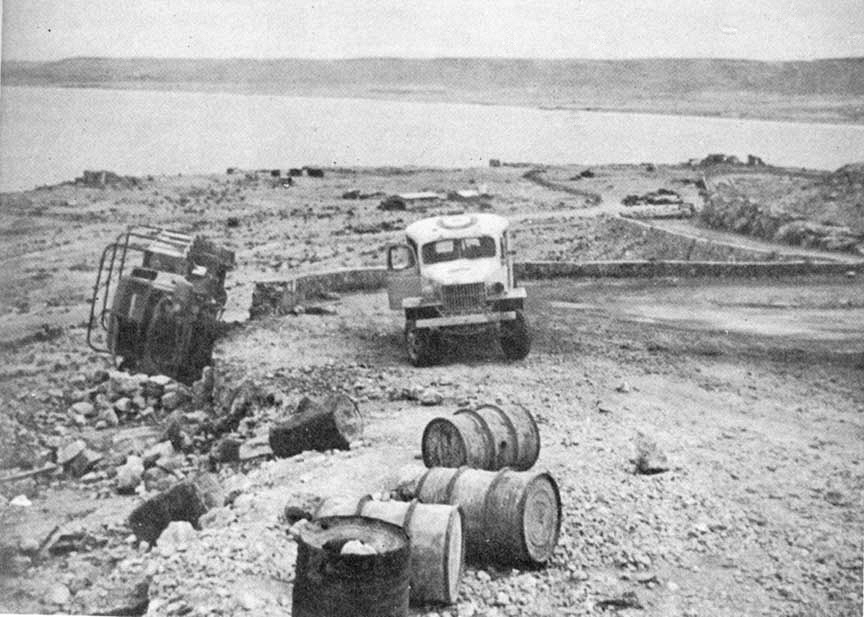 |
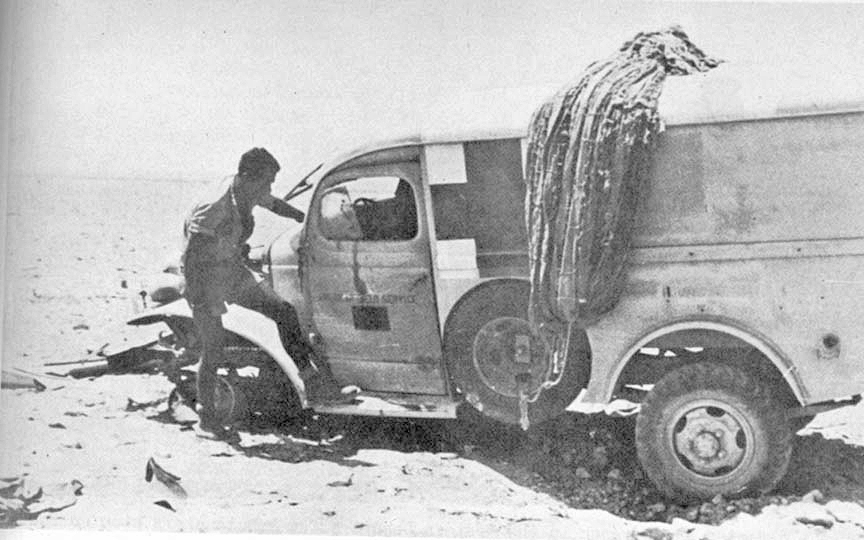
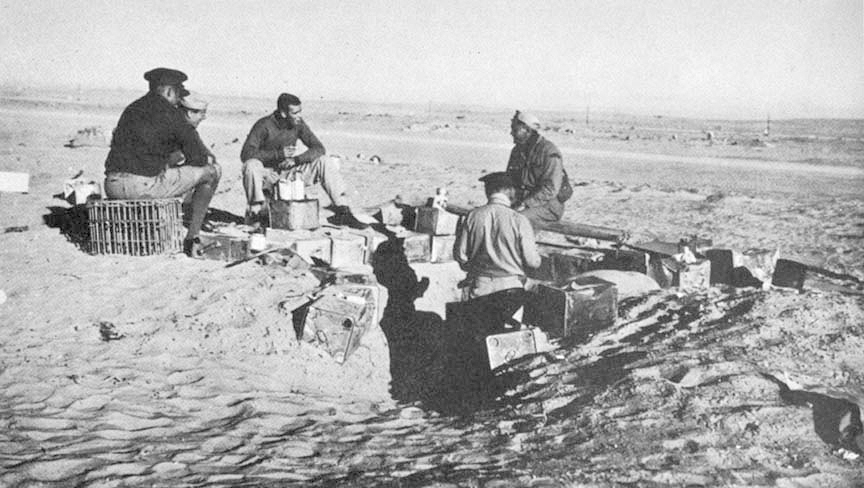 Around a deserted slit trench in the Western Desert a few ambulanciers stop en route for 'a bite'. Left to right: Lee Ault, Charlie O'Neil, Fred Taylor, Charlie Snead, and in the trench Bill Van Cleef. |
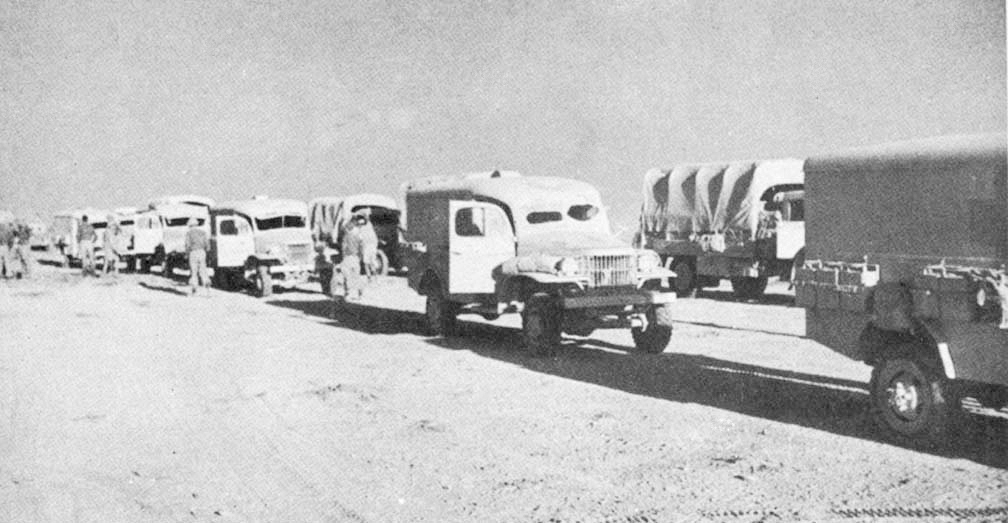 |
December 26, 1942.
"I went jouncing off about 20 miles on the usual vile desert tracks. What's more, I got lost a couple of times which made life even less savory. For various reasons I had to get back that night and since it was cloudy, it was one of the darkest nights I've ever seen --you couldn't even see your feet. It took me about six hours --- I was lucky bumping into the right track at the beginning --- then I'd take out the compass, use the flashlight under my jacket for a second and head off in the direction I was supposed to go --- I'd go about three hundred yards, get out and walk out at right angles to the car, scuffing my feet --- trying to find where. the consistency of the send changed --showing that other trucks had been there before --- let me tell you it was exhausting. Then back on the truck and off for another three hundred yards --- another bit of luck was that I had worked the mileage out exactly on the nose and when I stopped where the camp should be --lo and behold there it was. Although of course I couldn't see it until the next morning.
"The biggest event of Xmas day --- through considerable scrounging --some of it a little illegal. I had managed to gather a gallon of water together and I took my first bath in over a month --- OH! BLISS! --- and all clean clothes too, I felt like a completely new man but found that I had to wear extra clothes since my protective coating was gone.
"Some time ago we had a new type of excitement ----we were shelled --- somehow we got lost and ran into a few enemy batteries of guns --- they were just over the other side of the hill when we parked to have supper. We heard first a few shells going high overhead at some other objective --- they make a sort of a pulsating noise between a whistle and a gasp --- nobody paid much attention --- and we went on with supper --- then the jerry observation post apparently spotted us and they started to let fly --- we could hear the shot being fired, then the whistle and then the crack when they hit --- you should have seen me, all of us for that matter --- on our hands and knees with a shovel trying to dig a slit trench between the time the gun went off and the sound of the whistle --it's a funny thing --- without any experience you can tell by the sound when one is going to land near by. I finally got a trench dug but the Germans were getting the range. By the time the salvoes were landing some thirty feet away, I was getting a good deal of dirt thrown over me and sick and tired of the whirring, hissing whistle of shrapnel over my head --I was also convinced that their definite targets were my truck and a few close by, and they didn't seem to have anything better to do than to experiment around until they would finally hit my truck, and accordingly one who was right beside it. So perhaps you will be able to understand why I decided to leave that particular area --- but every time I'd start to get up and into the truck --- I'd hear the uncomfortable whistle and have to dive for the slit trench.
"After several thwarted attempts I got in and you never saw such pick-up and speed in a truck in your life. By this time everybody else had the same idea and we went whooping across the desert like Indians in a Wild West charge. I got about four hundred yards away in a Wadi where I could be seen by the enemy observation post and stopped in order to close a few doors and pull the helmet up off my ears --- a result of violent contact with the roof on some of the bumps I hit. Then one of the doctors came up, jumped in the ambulance and said he thought someone had been hurt back where the shelling was still going on. So, around I turned and back we went. You don't feel in the least bit scared, however, when you have. something like that to do. There were three vehicles back there --- still being shelled --- which had been incapacitated. Another touch of the "Western thriller was when we were humming back at about 25 miles an hour and saw everybody around the trucks ahead drop into their slit trenches. Without thinking, both the doctor and I opened our doors and jumped out --- rolling along the ground. On after-thought I don't see why we weren't hurt doing that but we weren't. After the shell went off we run up to the ambulance again --- which had stopped in the soft sand and went on back. Luckily nobody was hurt --- and they had managed to get one of the three vehicles started so with shells still falling around but not too close --- we hooked up a car to the back of my ambulance and the other to the functioning truck and went galloping off across the desert again."
December 13, 1942.
"Three days ago B. and I were sent out on detached service with an armored car regiment. We severed connections with the American Field Service till they (the regiment) needs us no longer. Tonight by luck we ran into our section and picked up some mail. It is very interesting and thrilling but very lonely on this job. Two of us in an ambulance among 500 British soldiers and officers in their armored cars! We have a rather ticklish assignment and expect to cover some territory before stopping again! Mostly petrol work. We are attached to a Medical Officer in the regiment who takes care of the wounded --- we evacuate them to nearest medical unit. Move very fast and very far with this regiment and as a result this may be the last letter I'll be able to get off to you for some time to come.
"Since I last wrote you things have been very quiet here, but not for long. We are moving all day, every day on this now job. May get a taste of real action now. At present the weather out here is most uncomfortable. Rains at least once a day and is quite cold and rainy. Just never seemed to get ourselves and equipment thoroughly dried out. Damned uncomfortable to say the least. Also we are on vehicle cooking rations. This means we are issued six days rations at a time --- then cook for the two of us. We arise at 6.15 by the firing of a Bren Gun --- leave at 7, not light enough to light fires for fear of giving our position away to enemy airplanes. Move until 9, when we cook breakfast --- lunch around one, supper about 1/2 hour before sunset. Go to bed about 5 --nothing, else to do as it gets dark. Where we are now the desert is just like Hollywood makes it out to be --- long rolling sand dunes for miles. Nothing else, about the most barren land I've ever seen. Actually most of the desert is rocky and little scrub growth about 6 or 8 inches high."
January 1, 1943.
"The Germans had a big time today. Counted 36 Messerschmidts over us at one time about 4 this afternoon. Was over talking to this sergeant and twelve of our planes flow over. About five minutes later over they came. At first we thought they were ours till they started to dive. They come from all sides flying only about fifteen feet above the ground. Luckily they didn't hit a thing and wounded no one! There were about six of us talking together around this truck and you should have seen them disappear. I had a cup full of flour in my hand at the time and didn't spill a drop. Good manoeuvering, what?
"We had a rather eventful Christmas day here. Made all preparations to cook a terrific meal about five in the afternoon --- call came for us to proceed to a town immediately. The town being about 30 miles distant, and freshly evacuated by the Germans earlier during the day they gave us a 'jeep' to lead us through the mine fields. When only a mile from the town we mere bombed by a single aircraft --- missed us by a good margin. Poor marksmanship! We never did get to bed that night. Rather a fruitful day to say the least.
"Since then we have been the target for five raids. Three coming in one day by those famous German 'Stukas'. About the deadliest plane I can imagine. On the other hand our planes usually get a good number of them before they can reach home. Day before yesterday I saw seven of his planes come down. He can't afford losses like that for a very long time. By the sound of the news things are looking up. Can really see the end of this business before too much longer.
"However all the life out here isn't too grim. Why, today I indulged in a little baking. Made some jam tarts. What with a little more practice I expect to become an accomplished cook! At present we are able to have plenty of coffee. Thanks to some hurrying Germans we are enjoying a huge bag of coffee (ersatz). Rather good, a change from the ever present 'English tea'. Also a huge sack of flour with which we have pan cakes for breakfast when we have time. And more still have a huge can of candy. Looted all this from one of their burnt out tanks near by. Could have invited the German major for dinner, but I guess his place is back under guard.
"Will really have some stories to tell you when I get home. Our last three weeks. on detached service has produced some exciting experiences. We are up at first light to disperse our cars (6.00). Each night at sunset we move into closer leaguer in case we move during the night. Open out to 300 yards during the day. Let me tell you its uncomfortable getting up these days. You can imagine how much ground we cover, when we are at full dispersal. Really much more like a convoy at sea when we move across the desert."
December 22, 1942.
"The El Alamein show started with a terrific barrage of artillery fire on the 23rd of October and in the first few days of November the break through was made. This battle was won at the very beginning of the barrage, which from various prisoners I have talked with I hear was one of the most deadly sheets of flying steel that has ever been laid down. For days the enemy got no food, water, or sleep and all the time our sappers were out, one by one, picking up the deadly land mines which are scattered so profusely over the desert as a defensive weapon, until finally there were gaps in the various mine fields of sufficient proportions to allow our gigantic mass of armor to surge through.
It was one of these armored divisions that I was attached to and we had the role of getting around behind Jerry and cutting him off, a thing which we proceed to do with considerable zest. The troops were then, and continue to be now, in the highest spirits, which considering all that they have been through out here and in Greece, speaks well for the unshatterable, unconquerable, and unfathomable spirit of the British 'Tommy'. The New Zealand 'Kiwis', the 'Aussies', the 'Elushians' and the South Africans all played important and often limelight parts, but there is only one backbone to the Middle East Forces and that is as always the 'Tommy'. They groan, they swear, and split and polish --- and have far less color and originality than any other group, but they are certainly winning the Battle of Egypt and the Middle East. Thousands and thousands of them are pounding the rough roads driving tremendous tank trailers, water, petrol and ration lorries, signal trucks, office lorries and a thousand other odd sorts of transport day in and day out; others are filling the multitudinous base jobs of routine work; and then, as well, they form the major part of the fighting strength. There just seems to be something everlasting and unending about the dirty little Tommy in his greased stained overalls, jabbering away in some 'Cockney', 'Scottish', or 'Welsh' , accent which none but his kin can understand except for a few swear words and Arabic expressions which are commonplace In the M.S. I sit here in my office lorry by the hour listening to Jock, the little Scotsmen who drives the truck, chatting away with one of his pals as they brew up a cup of tea in an old petrol tin outside or sit in the cab in front and talk about home. He is the cagiest, spriest little fellow in the camp and about 9/10 of the time has some one down on him for some tricky deal or other he has just pulled. I hear him at this very moment walking back from the cooking truck with C., bargaining for C.'s daily water ration in return for some trash he has picked up somewhere. Needless to say Jock will get the water.
"We joined a large group from workshops who are going out to sing Christmas Carols to the patients in a C.C.S. not too far away. It was a lovely moonlight night with the stars faintly twinkling around the horizon, sort of trying to add their bit to the glory of the moon lording it over the heavens from the zenith of the sky. There was no wind and there was a sharpness in the chill of the evening which made one think for a minute that the moon-bathed desert was snow, and it was a Christmas Eve at home.
"Finally after tooting around for some time in the staff car with carollers hanging all over it, and after running into numerous slit trenches from each one of which we had to extract the car by sheer lifting, we returned to bed weary and happy. A couple of airplanes went overhead, but whether they were Jerry or Santa Claus winging to some distant land I don't know. In any case it remained quiet and peaceful the night thru, in contrast to what had been happening previous evenings.
"After taking an extra luxurious hour in the nice warm blanket roll and leisurely shaving in the warmth of the morning sun instead of the usual icy chill, we had a big breakfast and prepared for a football (soccer) match with a neighboring unit. Almost all, in fact, all but two, ambulances were off on assignments in the forward areas and accordingly the workshops and the Quartermaster Dept. had to produce most of the talent for this. P. and I and J. went along with the team to lend cheering support, and P. with a tangle of red ribbon and a megaphone gave the Britishers quite a show. They retaliated by picking up old petrol tins and beating on them with iron tools, and it was quite a gay occasion but for our defeat to the tune of 8-2. We all, players and officialdom, subsequently retired to a very gayly decorated tent for a sip of beer, something more precious than money to the troops way out here. This was followed by a light lunch and rum ration. Everybody around the camp pitched in during the afternoon to erect a couple of large and adjacent tents in which we planned to eat our big meal and afterwards have a Concert Party, or in our terms 'Amateur Program', gotten up by the English blokes. About 4.30 in the afternoon, 16.30 hours by army time, we gathered in the tents for a little Church Service conducted by a visiting Padre, and then started right to work on the meal. It was really quite something to be seen to be believed. Four sheep which we obtained at the cost of two lbs. of tea, and, the procurers shamelessly tell me, about 50 rounds of ammunition, and from some wandering Bedouin, a pile of Christmas boxes from Cairo H.Q. and a large jug of wine from the cellars of some wealthy ex-Italian colonist of Cyrenaica who had left in a good deal of haste; 60 pounds of pork obtained thru the normal army channels as Christmas ration; and odd and sundry things we had saved and collected; all these were dished up in one glorious meal. In accordance with an immemorial British Army custom, the officers of the unit, in this case W., C. and myself, served the meal, and all went well. After dinner there was a brief respite in which we could lie down and rest our stomachs, and during this time the Brigadier who bosses all the medical facilities of the western desert battlefront came to see us. We had him in for a cup of coffee and a cigar and then took him over to the Concert Party. The Brig., unlike the one I used to get orders from in the early days of this battle, is a very kindly, human fellow with a great weakness for American tobacco. The first time I went to see him he mentioned the fact, while we were discussing tobacco, that his favorite was 'that American Edgeworth'. It just happened that I had one of the tins of it you sent me in my pocket and when I said 'presto' and produced it for him he nearly cried with joy. For weeks since I have seen him taking little bits of it out, packing it on top of a lot of bum tobacco which he uses as filler for his pipe and then proceeding to just smoke the Edgeworth on top. That tobacco has gotten more favors and little extras than will ever be known. It is by just such methods that one accomplishes anything out here. I have tried to get petrol; or warm clothes or some other supplies for days thru the regular channels, and then I suddenly go to tea with some big wig, casually mention my wants, he signs a little chit for it (which I always have ready) and I have my goods at once.
"I mentioned that the Brig. came over to the Concert Party and it turned out to be quite a show; Cockneys, Welchmen, Cornwall men, Yorkshire men, Scots, and Irish all contributing some element of their national humor. With most of them by this time well into the wine kegs it was a rowdy but most amusing show. I had to make a speech during the intermission and later the Brig. hopped up and said a lot of nice things about us as well.
"It was agreed by all that it was the best Christmas yet spent in the army, of those present having been in it for several years."
January 2, 1943.
"Now we have been on the move again and have celebrated the New Year. We happened to spend New Year's Eve right in the middle of a certain very exuberant Division which had its transport scattered for miles around us. It was a lovely bit of rolling country with green grass and little white and yellow flowers blowing in the breeze on every side of us. We sat in our wicker chairs outside the H.Q. office lorry, with a big meal inside us, blowing smoke up into the warm (most unusually so) evening air, rather intoxicated by the freshness of the countryside and the glow of the setting sun in the clear sky. As if by signal, rockets, flares, and every sort of evening fireworks started up all around, and the colors were really very lovely. Tracers were shooting off at a thousand different angles, crisscrossing ell over the sky. One follow would shoot a big yellow flare high up in the air, and then Bren guns with tracer bullets would start shooting a at it from all around. This went on for hours and then at midnight there was a terrific load of stuff thrown up altogether and under the glowing light of flares and rockets we could see everything round about perfectly clearly."
December 26, 1942.
"I returned to the desert, where I'm now attached to the French. A splendid French mid-night Mass was held in a tent by a marvellously bearded priest, the French officers sang carols throughout the service, the church bells were two polished 6mm shell casings, and the congregation was one of the most amazing mixtures you have possibly seen anywhere -- French, English, Sengalese blackmen, a couple of Tonkinese French troops, half a dozen American flyers, an English and American nurse who were attached to the French and ourselves. Outside there was a full moon which gave an ashen color to the desert, and with scarcely any imagination at all you could imagine that the whole countryside was covered with snow. When we returned to camp we had a grand mid-night meal. The punch, really a masterpiece as those things go, and they go a long way, was something the French officers had apparently never tasted and they were not alone swept off their feet, but practically knocked off as well. It was a really wonderful party, and in fact the whole day was pretty good --one of the best Christmases I've had in a long while, or any of us for that matter, I think. So you see, life in the desert isn't too bad, and some of us are really unworthy of the sympathy that probably is given us at home
January 1, 1943.
"Four Messerschmidts came over and circled above our camp, probably to get their bearings, and then swooped in to their target. It was the first time I had had a good look at a bombing, because when we were at Alamein the ack-ack kept us ducking. The Germans, despite stories to the contrary, really do respect the Red Cross, and as we were miles away from any legitimate target I felt perfectly safe watching them overhead. The only times the planes are dangerous is when they are strafing, for of course, if you are caught in a lot of motor transport you are liable to be shot at. Also they will pick out a truck even in a Red Cross unit which hasn't got a cross on it, such as a radio car, and strafe that. But I haven't run into anything like that yet."
January 3, 1943.
"Our particular crowd of A.F.S.'s have been well up with the advance units of the Eighth Army during most of the push and have covered so much ground at the moment of writing Cairo seems almost as remote as New York. We've had our bad moments and made our mistakes. We've been hungry and dirty and homesick and disgruntled and frightened. But I flatter ourselves that we have done a necessary job remarkably well, and it has been a fine and satisfying thing to be a part, however, small, of this great and victorious campaign, I have never for a moment regretted joining the A.F.S. and I am proud to be a member of it."
December 26, 1942.
"We were addressed by our General and our old Colonel who's very popular with the men and was interrupted continually by a comic drunk, a buddy of his from France, who kept throwing his arms about him. He was only a private tho and was surprised that they ever let down their hair this much. Later that evening another party in the Medical Tent which the patients seemed to enjoy. Much singing and much confusion tho proud to say that C. behaved himself and sang 'East Side, West Side', upon request. Officers joined in on this too. Also serving us at the dinner were two actresses from a touring NAAFI company. Seems years since I saw any women. They were a bit weary looking but durable and gave the lads a thrill. Tonight the men are putting on a show which should be very good."
January 4, 1943.
"Still in same spot with little or no work to do but everything very pleasant and lots in the way of entertainment and amusement ... There was an exceedingly violent soccer game the other morning between the Padres (ministers and priests) and the officers of all people. It ended when one of the officers had his collar bone smashed and with the score tied! The English never cease surprising me. Also had an Information Please quiz between two teams, presided over by an English Major who kept losing the questions or going on to the next one before the answer was given. Questions and answers were written on sheets of paper and some of the answers were funny which he'd read off very solemnly and then long after the laughter subsided, would get the point. Believe there's to be another one tonight. Wouldn't miss it for the world....Food better, much better of late, quite a bit of fresh meat. Vague as to what's going on out here except action is so far away from us that it might as well be in another part of the world... Flowers in profusion now. Desert here really wasteland covered with little patches of scrub and all kinds of lovely little blooms, most of them small are appearing. Am pressing some, but fear they won't give much of an idea. Plenty of water here incidentally but awfully cold to bathe."
January 11, 1943.
"According to a prisoner, a German officer carried by one of the lads in his ambulance, they, the Germans, had been told all along that New Zealand and Australia were completely out off from the rest of the Allies and he was surprised to see New Zealand and Australian products (we got a lot of their fruit, etc.) Another German conceded the fact that Germany had lost the War. A third A.F.S. man had his hands full keeping two Greek sick away from a German patient, the German having been in the Greek occupation....Came across a truly delicious product the other days, Nestles Reduced Cream. It comes in little cans and looks like Creme Fraiche. Noticed however it was marked Australia...Wonder if you can get it at home? ... The most important contribution to humanity our group has done this week was making glasses from bottles. You fill the bottle to the required height with oil then you take a red hot bar of metal (has to be iron or steel) shove it in the neck and the oil starts to sizzle and the bottle pops right off at the line where the oil is. Problem now is to round off the edges of the glass which we don't know how to do. Filing dulls it all right but giver, a rather poor effect. Some of the Ale bottles we get make really beautiful glasses, good, thick and strong."
November 22, 1942.
"We wear woolen clothes and great-coats and the old days of semi-nudity seem like a dream. I feel as though I'd been transplanted to the last War by a time machine. During one of the worst storms we had, I was on duty for 36 hours, without relief at the C.C.S. and it was one of the dreariest scenes of the war --- standing in the drenching cold with turned up collar and tin hat, seeing by lightning flashes, bumping thru great bomb craters and shall holes, wading ankle deep in oily mud with heavy stretchers as the stout-hearted wounded shoved their pain and discomfort only thru their tightened eyelids.
"Inside, 24 hours a day, the surgeons, oblivious to the leaking roof, the inexpert orderlies, the thousand and one drawbacks, stood tall, white and quiet against the gloom and thunder of the storm, and performed swift miracles. Many a man, I thought was doomed, but the next day I'd evacuate him to the hospital plane in good shape and happy. More pitiful were some recaptured S.A. negroes who'd been mistreated badly for five months and looked miserable as only a black man can."
January 9, 1943. In Hospital.
"The last few days I've been allowed to go out of the ground dressed, of course, in hideous suits of blue flannel that don't fit and a six-inch red necktie with our Army caps. It's really a sight. I suppose it is intended to make you conspicuous, and it does help in crowds, for you can push into a jammed theatre without having to fight your way. Everyone stares and smiles but is very polite. The main attraction is the Movies and before or after we generally go to the N.Z. Club and stuff ourselves with ice-cream. They have their own plant at their base camp outside (censored) and the ice-cream is made from real N.Z. milk brought by refrigeration. It's delicious and I think it embarasses the girls serving every time we come in because we eat so much. Then I usually collect cakes and oranges for the boys in bed, and return.
"British Military Hospitals are very much like working your way through college. As soon as you are all cured and out of bed, you get a job --- such as dusting, sweeping, making beds, etc. Naturally enough, I found myself a nice niche in the kitchen of our ward, where I can muddle around and spoil my appetite to my heart's content, with toast and tea between meals. The 'sisters' as they call the nurses, are mostly Scottish and on the whole a pretty good lot. The few Yanks that are here all kid them unmercifully, mimicking their burr, and continually playing pranks and flirting with the younger ones. Helping them are Volunteer aids, V.A.D.'s and Palestinian girls, mostly Polish. One, named A., is about 5 ft. and the same girth from head to too with a button nose, but she's my little Angel. When I was worst, she used to fix me orange juice, poached eggs and toast, any time of the day or night. In return I'd help her with her English since we could get along fairly well in German. She's always bustling about, working with a little smile on her face, 12 hours every day and she's so short and stocky that she reminds me of those mechanical toys that are sold on N.Y. sidewalks, as she skips up the hall. The V.A.D.'s are just the opposite, generally being wives of British Officers from some of the best families in England and yet have managed to accept things as they are and do their best, which is very good. One, Mrs. S., is very pretty and charming, yet always smiling even when changing dirty sheets, time after time. They work very hard and the pay is just nominal. She has a delightful sense of humor and we have a swell time bantering back and forth. She has a knack for helping the patients along, as with one patient who lost most of his nose and had only a rubber tube sticking out, she told the story from Kipling's 'Just So Stories' of 'How the Elephant Got His Trunk' and always called him the 'poor Elephant's child'."
January 20, 1943.
"As you've known long since from the papers, the battle for Tripoli began last week, and, as of the moment is still, in progress... As you can imagine the going has been rough and tough and unrelenting and there has been nothing else in our daily lives but eating, sleeping, moving and doing our job. Today, for the first time since the battle began, we are spending the entire morning in one place, and I've been devoting it to much long-neglected activities as brushing my teeth, combing my hair, changing my socks."
January 22, 1943.
"The Eighth Army's preparations have been so complete, its manpower and armament and particularly its air power so superior to the enemy's that the final lap of our 1500-mile jaunt has been more a race or pursuit than an actual battle. We move forward, stop, receive patients, treat them, evacuate them, move forward again hour after hour; day after day.
"Today, however, should be written down in at least moderately red letters, for we have come out of the desert at last. There is grass around us, and trees and fields and orchards and white farm buildings and villages --- the first time we have been in cultivated or inhabited country since way back in Cyrenaica in late November. Only a few short miles, a negligible day's journey, remain to Tripoli itself."
January 24, 1943.
"The Eighth Army took Tripoli. You can imagine the joy and deep satisfaction we all felt. I haven't been into the city yet, but we have the satisfaction of being in inhabited, cultivated country, and that, after the long weeks and months in the desert, is sufficient reward for the time being. Last night we camped in and around an abandoned Italian farmstead ... For dinner we had roast peacock, no less (surprisingly good and very much like turkey) spaghetti and chianti... I also took advantage of the occasion to wash my hands all the way up to the wrists and to change my socks, so you can see that life has suddenly become most refined and luxurious, if not positively decadent. Greetings from Tripoli!"
No date.
"We would all have liked a good siesta but the officers sent word they would be early. We were ready for them by three o'clock. The punch was brimming in G's enamel wash basin. Our three glasses and assortment of cups gleamed on the table cloth made of the reverse of big military maps for which we hope we will have no more use. Plates of food and a vase of wild flowers under festoons of green and the Free French pennant completed the back drop.
"About five of the officers come --- later some Americans looking for a work shop and all evening people kept dropping in. At one time I caught H. talking Flemish to a fellow on one side, French to another, and English to another. Unfortunately not all of us are so capable. If anyone, either guest or host, yesterday, didn't have one of the best times of his life, I didn't see him."
No date.
"The closest to danger I have been was the first week out of New York. I saw one ship go down and saw plenty of depth charges and bombs dropped. Out here I've seen plenty of German planes --- all on the ground. Once a plane came over and dropped some flares which were rather pretty but he was shot down. Since then nothing in the nature of action has occurred. Mind you, I'm not being facetious about war and action. The endless stream of wreckage for hundreds of miles is silent testimony to the fact that war is hell The little graveyards full of German, Italian and English dead (many of them unknown) is even further proof of that fact. The point, however, is that if a few moments of action are glorious then 99.8% of a man's time is spent in drab, monotonous existence. I suppose I'll always quarrel with propagandists and they're probably right. How else except by propaganda are people thousands of miles from the scene of action going to be made to realize that their efforts can win or lose the war. That their efforts can win or lose the war is absolutely true. The war is rather like checkers --- -when one team has (or thinks he has) more guns, tanks, and planes than the other boy, he moves in and takes over if the other guy knows that he is short on these things he bluffs and waits for the other guy to attack and then retreats. And that's exactly what has happened out here. The British had the stuff. Rommel knew it. The British attacked, Rommel retreated and the British are still trying to engage the main German army. The Germans will have to fight when they get cornered, he'll be licked, if there are enough American goods available or not depends largely on how much the people at home are producing. This place is full of American equipment. You just wouldn't believe it, I know (as I have always thought) that without American production England would be out of the war by now, I'm sure I never really appreciated what that word 'production' meant. But I've always been a reasonable man and seeing that I, as a reasonable man, did not fully appreciate the importance of our industrial energy, I doubt if many other reasonable men who have not had my experience can appreciate it.
"These immortal natives will outlast them all. How they have lived so far is a mystery no one will ever fathom. You see them in. towns which are in absolute ruins. You seem them walking across mine fields and you see them coming through camp. I've only seen one dead one, and his camel --- he hit a mine. Tea is worth its weight in gold and since we don't drink as much tea as the British think is necessary for life, we had some saved for exchange. It's interesting that these natives will accept German, Italian, British and Egyptian money. They, by the way, are simply exploiting the farms and orchards which Mussolini organized to give Libya a 'raison d'être' and to entice a few happy Italians to leave home. The native must be having a wonderful time, he's his own boss and quite friendly to all of us.
"You know the American Field Service has a wonderful time out here because no one understands us. The Tommy is our equal, the Sergeant is our equal and the Officer is our equal. The Officers can't understand how we can eat a meal with the Tommy but the Tommy has a wonderful time when he and an Officer are included in our party. It seems as though every place we go we throw the British military system out of kilter. The Officers can't treat us as enlisted men because we're not enlisted men and the Tommy doesn't treat us as Officers as we're not Officers. What no Britisher can understand is how we can sit around and have a gay old time with our own A.F.S. Officers, and we love to keep them guessing. We revel in our democracy.
"I do think that the A.F.S. is doing a great service out here. British officers have told us that. My own personal view, if I am in any position to judge, is that we not only have the cars for actual front line, no-man's-land work but also an ardent, in some ways a pioneer spirit which the British, granting their many virtues, do not have. Our boys like to get into things, they like to scrounge (meaning investigate anything from which they might obtain useful articles) and at the risk of being sentimental I think they feel a challenge to do not only as good a job as the British but a better one. All of us are genuinely proud to be Americans, proud that we can take it and glad to have a wonderful place to go home to. I'm really awfully happy out here and though I haven't done much yet I know that we have a better chance of getting to the front than anyone else and that we'll get more than our share of the breaks."
December 17, 1942.
"An hour ago I boarded a hospital ship back to base, I am feeling much better... This is an experience I am very glad to add to the others. It is the greatest mixture of care and no care you ever saw. For example, my temperature is forever being taken, like 6 A.M., but for supper I may have 2 crackers and a slice of Bully beef. We have just had a good lunch on shipboard, but we had to climb up a ladder to get on, which was slightly difficult for the poor boys with bullets in their arms.
"We lunched at the Geura Sporting Club, which, is on an island in. the river that flows past our windows at the A.F.S. Club. They have everything there, including polo fields, horse racing, golf, tennis, squash, swimming pools, and it was lovely sitting on the terrace overlooking the different fields of sports, with flowers and palms, to say nothing of' attractive looking women, and enough uniforms to outdo any musical comedy.
"The Opera House is small, but all white and gold, with red and gold curtains, plus two royal boxes. It looks more like a layer cake in Schrafft's window then anything else."
"But first something of our existence. You've heard the old one about war 'ninety-per cent boredom and lethargy, ten-per cent grim guts-spattered fighting'. Our Captain reminded us the other night just how much of a lie that is ---'ninety-nine per cent of war is a yawn, one-per cent a nervous twitch'. Most of those I am with experienced that small fraction of excitement and duty under fire back at Alamein. Just now we are waging a war albeit an unconscious half-amused one with ourselves and the conditions in which we live. Our home is our ambulance. For days we push them, beat them, within a bolt of their mechanical lives --- we drive them over foul paths --- across fields of boulders --- into slit-trenches up and down shell and shock roads. And then we stop then at supposedly proper distances from each other and live the hell out of them. We sleep in them. Swing our stretchers and throw a bed roll or five blankets. Throw off your battle-dress, but keep those stiff, smelly socks on; tuck your shirt into your long underwear and-shove your way in --- then curse and eel out again rummaging around looking for a stocking cap. And sleep. Sleep 'til the wet cold of 4 am. slithers in and banks itself against your legs. Then toss and get your blankets twisted. But sleep, because just sitting around is fatiguing. Sleep until dawn is here and all its gray, damp, gloomy, sticky atmosphere. Scratch your head, mutter a curse against life; vow to always read all Sunday Supplement Stories (illustrated about Men's Battle Against Insects) scratch, scratch. And hobble out --- tramp across a hundred yards of stone and brown clay, scattered petrol tins, odd collections of a desert which has supinely permitted its pristine belly to take the refuse two armies discard --- walk past a couple of other dripping, bleak ambulances and get something to eat. Why not? What else is there to do at 7 a.m.? Over-sleeping isn't much fun if there is no eight o'clock class to cut. . Sure, the oatmeal is about the texture of library-paste ---all right, all right --- do you live to eat or --- ? There is always bread and bugs are better than carroway seeds cause they don't taste at all. I hope that Ingersol drowns in margarine. Or marmalade? It's over there sitting on that petrol tin in a two quart metal tin. Tea, too. It's hot and if lucky, tasteless; and it makes the back of your front teeth brown. Not bad though at 7.30 a m. I'll take your bacon. That mass of grease there --- there, bacon. Now g'wan and swish your two metal dixie trays in that gray water 'til by some process of physics the remains are swept into the gray hot liquid. Back to the ambulance. Pull out the stretchers, fold the blankets, sweep the butts and papers out; put a half used can of condensed milk away. Stop to take stock of your private larder. Mostly collected from our canteen --- bit from travelling canteens --- a proud bit or two --- say, for instance a few pounds of cocoa --- snitched from a hastily deserted Jerry hospital, Brush your teeth --- you forgot yesterday and that 8 a.m. candy just took the taste away --- it didn't clean them. 'See your dentist twice a year, clean your teeth twice a day.' Chortle, chortle. Shave today? Two days. Oh, the thought! But you shave. And heat water. A bit of dirt in a tin, put on some petrol --- a match with your head back --- for room! Put on a billy of water --- that black pot hanging in front of car. And tear them off. Let's see, three weeks without a bath. Praise the Lord and bless the wide open spaces! Climb in the front seat, think of some lousy rationalization for not writing --- maybe a letter from the States tomorrow --- yeah --- write much better after I've got a letter --- sure. Where is that October Time? Heck --- over at the HQ truck. Might as well read War and Peace --- everyone else has. Tolstoy had the real griff! Lunch at twelve --- cheese pitchards --- a good piece of pastry. I mean it's good. Our cook was a baker in Civvy Street, boys. Tea. Bread. Sour butter. Your happy, aincha? Throw a word at the Tommys who cook for us and by some miracle keep our cars running. Poor ----, what a trial we are to them. Then to ambulance. Read, sleep. Just jaw about home, about the 8th Army, about ---the A.F.S., about women, about William Faulkner, about yourself, about the jeez-are-they-dumb Tommies, yourself, food, food.. home. Dinner (tea) at 4.30, it's dark at 6 p.m., and no lights after dark. Holy Mackerel! a piece of fresh meat! Almost worth standing in line to-night. Then sit on the ground or stand up against the fender of the water truck. Rain's maalesh. Tea gets cold anyway. Talk a bit. Laugh. Be coarse. Why not? But grin and guffaw. That's important. Laughs and good bowel movements are vital. A new rumor? Not way I heard it. We're due to move when ------- Goin' to write ce soir? Poker in Bing's car. Okay. Je m'en ------ So throw the blankets around the windows, turn on the lights (they're powerful --- my kiwi doc cut a guy's leg off in mine one night---good lights) turn on the water, turn on the fan. Borrow some washers from workshops and dammit, win back that pound-forty you lost last night. Six guys in a warm bright ambulance playing across a suspended stretcher. Smoking. A beer if you're lucky. Good Canadian Blackhorse. Stud - Draw --- Th' hell wid die wild stuff! Smart guys --- colleges? you-betcha! Dough. Some plenty. Some not much. Lose a five bucks, win ten. Maleesh. Laugh and live to-night for tomorrow you diet. Ugh. Damn smart guys. They know good music, they like good books. They are used to good liquor, they're pretty decent, too, Mr. Hemingway --- Esquire. The cream of America's highly nurtured, much fortified crop? Sitting on their tails. Driving a truck. Sort of sheepishly hoping to pick up a Luger or even a Jerry haversack. And loving it. More in retrospect than now. And indignant if you tell them they aren't learning anything. And angry if you tell them you're fools --- no, they'll grin and say, 'You're telling me'. We work for Jesus.!' And they'll go home --- all except an unlucky few--- and every last one of them will exaggerate. Tolstoy again. 'A battle's never planned as fought nor fought as described.' But they'll curse the few who drool in the newspapers about bombs or that night or guts. Lose a pound, lose a pound-fifty. Quit. Open a can of fruit. Turn off the lights, crawl out the back and stroke through the blackness to your car. Yawn at the late, chipped moon. Sleep. Night as well. Gotta take car into workshop tomorrow. 'Night, Bill---Yeah, great gal---'."
| "Oh, the beetles they shovel, The lizards they flirt, While a man on his belly Makes eyes at the dirt, The coils of the snakes And the snouts of the bugs, And the tail of the scorpion These on the ground thugs Are living right handsomely Out of his pockets; Into his vest - Through his arm sockets And onto his chest For the wages of war are many And Good Workers find many a penney." |
No date. Lebanon
"This afternoon low clouds began coming down into the valley from the mts. At first the sunset was shining its rays downward through rifts in the clouds, then near the last the fanning rays extended their fingers upward and the effects both in color and formation were so fantastic and wonderful. Light wispy clouds formed an advance guard for a fog that settled down on our camp, through which the bright moon barely penetrated.
"We went up the valley today, the M.O. and I, to give inoculations to the members of a camp and also this afternoon we had quite a few come to the M.I. room for their shots. I see so very much that is beautiful that I don't know whether I can release the fullness inside me.
"This morning as I lay half awake, the fellow in the next bed got up and after going out, called me; I trotted out bare feet and all and saw the most beautiful sight. The sun was just rising, and touching the tops of the Lebanons --- orange light reflected from solid snow quite a way down the eastern slope, against a pink and purple sky. I have thought about it all day as I drove up the valley tonight I kept looking at the mountains in the twilight, they are capable of every color, I do believe. It was just dusk and a feather-bed of clouds was beginning to cloak the snowy sides and hide the peaks.
"If you are ever tempted to tell the Edison Co., to go fly a kite, don't do it. A lantern is hell."
No date. Eastern Syria.
"This is a desolate country, conceived, in one of God's more nightmarish moments. Hills without trees and eroded to look like a piece of paper crumpled up.
"It was a beautiful day, sunny and warm, and I didn't get cold in the least, even when I found myself with an hour and a half still to go when darkness came. I passed thru several good sized towns and saw scores of villages. This country is very fertile and there is mile after mile of arable land, though there is much irrigation. The small villages in this section are queer looking, built of mud, each house is conical, similar to the American Indian teepees and not unlike, in the distance, a stand of bee-hives.
"The natives never shave or cut their hair and their whiskers are so long they bring them around under their chins and up on top of their heads, where they tie a knot. Of course they wear turbans most of the time. They are a fine bunch of boys and I've picked up a little information on religion, life in India, etc. It's a really quaint, clean city for this part of the world. Uniforms of all sorts, everything and everybody so completely different, many tongues and different monies."
No date. Northern Syria
"Today has been a holiday in this country, Moslem Christmas. Out in the country all of the families were trekking towards the nearest town, trudging along beside the ever-present donkeys, dressed mostly colorfully in robes made up of God-knows-what patches of different bright colors are all that you can distinguish. The Armenians celebrate Christmas on Jan. 6th, one of them tells me. These robes that the Arabs wear are unbelievably akin to Joseph's coat of many colors, and probably aren't much different. In fact, there are many things in this country that are exactly the same now as they were hundreds of years ago. The coats are made of sheepskin, fur inside, they tend their flocks out in the middle of nowhere, sleeping wrapped in their coats in all kinds of weather, with maybe several lambs or dogs cuddled around to break the wind. You'll see a whole family driving two sheep or one sow to market, when the trip probably takes three or four days, all they get out of it is the money they'll live on for the next month or two. They must walk unbelievably long ways. I don't know whether I ever mentioned the fact that if you stop for any length of time, out in the middle of nothing, apparently miles from the nearest human, in fifteen minutes there will be from five to fifty Arabs clustered around. As you drive through the desert the shepherds can be seen walking along with the herds of goats or sheep, camels graze at will."
January 5, 1943.
"We decorated the house with eucalyptus branches and what few paper decorations we could buy in town. We even made a wreath for the front door and got a small and ragged evergreen. Christmas Eve, a Tommy brought us over a good load of old telephone poles for much needed firewood. Several of us spent a good part of the evening sewing and stacking up the logs in the moonlight. Later we were all invited over to the hospital for a party that the British and Indian medical personnel were giving. An American missionary led us in carols while his wife played the accompanying organ. The missionary and staff of Syrian nurses, doctors and teachers left early and then a Tommy began 'swinging it' on the organ. Our dinner chiefly consisted of the two turkeys which we had fattened up for nearly a month; in addition we had a good supply of olives, figs, dates and the pumpkin pies ---which the missionary's wife made for us. Later in the afternoon we had 'open house' for the British troops and several large jugs of wine were consumed. Several officers attended, among them was a Col. C., the nephew of the ---- and a darn fine chap. On New Year' s eve we were all invited to the French Officers' Club for a gay 'soiree'. C. bumped into another one of his Tahitian friends here, a Fighting French medical officer, and he got us all invited over. The Club was the quaintest looking place you ever saw; we had some Camel Corps soldiers to visit on us. After a delicious dinner, there was dancing for late into the early hours of the new year. I spent most of the evening dancing with the French Officers' wives and the daughters of the leading officials of the town. It is more or less the custom of French officers to bring along their wives most everywhere they go; they don't have much choice in their present position. The officers treated us especially well, and it was the best time we had in a long while. One Colonel was telling me an interesting account of his flight down from London with De Gaulle. On New Year's day we had several of the French M.O.s in for another big feast. One of them was a high class Negro from Martinique; he later invited us back to the club for another meal and a dance the following Saturday."
December 4, 1942.
"This is a very lovely town on the Mediterranean, with the beautiful American University its main attraction. Mr. D., who is the head of this, seems to have done a wonderful job in making the Arabs friends of America. We Americans get a most cordial welcome, everywhere we go. The chap who does the cooking in the place I am now staying, was helped by the Near East Relief, and sure does worship America. About the only phrase in English which the children know around here is 'America good'. They use this whenever they see us.
"Another interesting part of our visit to Baalbek was being invited to an Arab wedding. This ceremony takes three days, so of course we saw only part of it, but I think it was the most interesting. We joined the parade of about fifty noisy, dancing celebrants who were accompanying the groom on his trip from his village to the bride's village to get the bride. He rode on a horse and had with him two large camels gaily bedecked with oriental rugs etc. In the parade, these were being ridden by some colorfully dressed, but of course, veiled girls. Later, at the girl's house, these were loaded with a four piece living-room suite, many rugs, blankets, and pillows and even pots and pans. This was the girl's dowry, according to custom, but we were a told that the groom slipped the girl's parents a sum of money which approximately paid for it. In the street in front of the girl's house, there was much dancing by the celebrants, led by nomads, who had an orchestra of three squeaky native instruments and a tattooed and painted dancing girl with them. She sang several songs, accompanied by cheers, about how good America and Americans were. Everybody was in very high spirits and made more fuss over us than they did over the groom. Finally the groom, the male members of his family, the mayor of the town, the Arab priest, the wealthiest man of the town who made his money in South America and returned home to retire, and four of us joined the male members of the girl's family in the small, poorly furnished main room of the house for coffee and candy. There were two interpreters but the conversation over our coffee was extremely stilted. Finally, one of the groom's brothers offered to sing for us. Then he started screaming and wailing, while the others would cheer every so often, or shout out an unmelodious phrase themselves. After all this was over, we were told that they were singing about the great American victories and wishing us luck. After this we went outside and watched them lead the camels and watched the girl and some other women get into a carriage, and finally saw the whole crowd follow the groom who was on horseback, through the village to the road to his town. The shouting and dancing continued all the time we watched, but finally a large truck drove up and those who were not on donkey back, climbed in and off they all went to the groom's house. The wedding was truly one of the most fascinating experiences we have had."
December 6, 1942.
"About being war-minded. I think you are right. Folks at home should not go off the deep end. Realize there is a war, and do something about it, sure. But keep home so that it will be home when the boys get back. It would do any wife, mother, school-teacher, shopkeeper, cashier or five and ten sales girl good, in addition to every girl that has a fellow away, to hear how they are talked about, how they are remembered, and how they are missed when the fellows start talking about them. American boys like excitement, like travel, hate red-tape and social strata, but they love America, and it's the little things that make America. You know what they are. There are any number of poets who could express it better than I could, and any number of writers. It is the sort of thing Dorothy Parker or even Ogden Nash can write about. The first part of the New Yorker, or hot dogs at a ball-game. You know what it is. That's what the fellows want when they get back. Most of them are homesick a lot of the time whether they admit it or not. And all of them have some girl back home who they think of often. She means as much to them individually as the American flag waving, or the tingle down your spine when you hear the Star Spangled Banner. She is in their dreams and in their day dreams they try to piece together all the little exciting memories of her, all those thrilling moments, all those lovely ones. They forget the quarrels, or the way her hair at the back of her neck won't stay up when she combs her hair up. They forget her chipped finger nails or how she is grouchy first thing in the morning. They forget the way she scolds when their suit is not pressed or the way she is always late for dates. They forget a hundred and one nuisances, and remember a hundred and two thrills. Don't think he is going to be disillusioned when he returns to find that she is normal after all, as he is. No, on the contrary, he is going to be thrilled all over again re-discovering all those little things that he forgot about her. Having been away, a blur has come over like a mist of the unknown, but rediscovering her shiny nose will be all the more fun, because it takes all sorts of things to make a woman, or a man. It takes the wonderful and the trivial. That's what makes personalities. To the returning soldier it will be a revelation that his wife or girl likes four lumps of sugar in her coffee. It will show him, war or no war, thunder and chaos may come and go, but the little things in life remain along with the big and nothing will change them. P.S. Still looking for a good looking girl out here. Don't worry, they aren't to be found. Besides I'm too busy.. War seems to be a 7 day a week job, even here in Syria."
No date.
"You would have loved the bazaars, their color, their variety, their subtle blending of the primitive and the cosmopolitan; these are the marketplaces which make economics a romance; and make of barter and exchange, in performance and history, as well as in setting, a fine art. One can trace it daily --- in the caravans of camels and donkeys that are perpetually being driven over the mountains and the plains to some mart or other about which the whole world will eventually hear; in the flocks of sheep or goats whose fleece or skin will soon serve a thousand and one conveniences --- blown bladders, sheepskin coats and blankets, gruesomely professional meat-markets, head-dresses, veils, robes, or the more prosaic western attire. It grows on you after a while, even the dirt; but it can become narcotic and the time to stir your stumps and remember the precepts of good American living is when you begin to enjoy the buzzing flies in a good hot sun or shrink from a cold shower."
November 27, 1942.
"We stumbled off of the train at some little place known as Rehoveth. Just a crossing which may have attracted the fancy of the engineer. Here we caught a bus and rode into Tel Aviv.
"Tel Aviv is very simple to describe. It consists entirely of very new white-to-grey cement buildings all built on the modern straight lines and horizontal curve architectural design. For the most part these buildings look fresh and aggressive and confident. And then you see a few a bit older and the effect is depressing. They're beginning to peel and crack and turn brown and grey as though they were suffering from structural exzema. I thought with a great flourish of unoriginality 'Gosh, looks like a still standing housing exhibit at last years World's Fair --- after an unusually hard winter'. There is no feeling of permanence. There is a very main street in this all Jewish town of 200,000 souls. They, very sagely, call it Allenby Road. It runs for three or four miles bordered with lovely trees and pock-marked with dozens of fruit stores, camera shops, candy shops and restaurants. Everything is in Hebrew except where the ubiquitous English is found. And the streets (especially just about 4:30 just as darkness and blackout descend) are jammed with an energetic determined citizenry going somewhere, all appearing just a little late for some engagement (a fine indictment for an American to make). The blackout is a thousand times blacker than ours and people all carry little flashlights which pop at you when you are about to zig when you should have zagged. The bane of this town is the helter skelter of street cafes where are always to be found groups or individuals reading Hebrew, English, German, Polish, even French and always a piano or accordion -- some music. Is this the result of the European love of music? or --- no, doesn't the Arab world slowly revolve around the cafe? Maybe this is the one Semitic bond.
"Along the pounding surf they have built a cement wall which is pleasant and probably gay in the summertime. There are no beggars but dozens of pedlars --- nice embarrassed pedlars --- trying to sell razor blades, etc.
"Except for the usual grim farce of the Service Clubs, trying to eat is a very expensive affair. Things are strictly rationed in Palestine and when a soldier buys a meal he must sign all sorts of papers which will permit the owner a few credit points. For soup, a small steak, a handful of peas and small potatoes, a cup of tea, a small tart, I paid almost two dollars --- once. For forty cents I bought a cup of coffee and two pieces of fruit cake in a sidewalk cafe --- more than once. Eggs are almost unattainable. No sugar, four meatless days --- brother, have another orange...
"But it was swell to be in Tel Aviv. This was Europe. None of the squalor of Arabdom. Clean, ambitious, (most part) modern, happy. And as we made trips to a couple of children's colonies and later walked out to new developments I was struck with the great emphasis placed upon children here. Everything is done for them. They probably lead as happy a life here as any children in the world. There is almost a pathetic earnestness in the attention they receive --- an attempt to make up to them a lost home --- a grim determination that no-blight will touch their lives anyway.
"And no one can deny the marvel of Tel Aviv --- that it was built up from complete waste --- sand dunes as though a modern American suburb were planted on the Indiana dunes."
The following letter just came in:
January 25, 1943. Tripoli.
"Now I'll describe the taking of Tripoli as much as possible. My ambulance was about the sixth vehicle to enter and therefore we were the first Americans to enter (since we are attached to a British armoured car unit). The moon was full and it was a cold clear morning when we drove in in absolute silence. The civilian population was asleep or too scared to put their heads out of the windows. We didn't know how we would be received or by whom because there might well have been some troops left behind to bother us by ambush. Silently we crept up the streets between attractive white buildings. A few of the blocks had been demolished by bombs but not many. We went directly to the palm lined water front and parked to wait a couple of hours till daybreak. I walked about and looked at the harbour which was full of bombed Italian boats, read the propaganda signs which seemed to be a bit of a paradox in their boasting of 'Il Duce Vincere' and the same for Hitler. We had entered from the central section of the push and were the first to reach our objective. About an hour afterwards the Scotch, who had fought their way through along the coast, arrived. A tank regiment squeaked and roared it's way in with the Scotties sitting on top of their tanks. They were led in spirit by a Scotty on the lead tank who stood up with bagpipes in hand and tooted out his cheerful tune while driving up to our square. I don't know what the hiding civilians could have thought to have this concert above the racket of the tanks but it certainly was picturesque. As soon as the tank corps took their positions they formed a bagpipe band and marched up and down playing with all they had despite the long trip and lack of sleep. As it was getting light and troops were pouring in by truck, armoured car, jeep, station wagon and every other conceivable known type of car, I went to a large hotel to get some coffee which I hadn't had for months. It was one of the few things that hadn't been 100% looted by the retreating axis.. . . . . When I was once again on the streets it had become daylight and then I could see that not all the buildings were white but that many were pastel shades of pink and blue. All of them had chunks out of the walls where shrapnel had hit. The civilians began to appear nervously, Arabs and Wops looking us over. The former were definitely glad to see us. Someone had hoisted a huge Union Jack on the highest flag pole and the place was rapidly filling up with war equipment and soldiers. All the men were happy to get here, and when you realize how long they have waited for this objective you can understand their feelings. We remained until the middle of the day and than drove out through streets lined with civilians waving us on our way and seemingly quite bewildered by such a display of war equipment."
AFS has undertaken a new commitment. The ambulance service is going to be sent to serve In India, at the request of Field Marshall Sir Archibald Wavell commander in chief of India. AFS units in India will function in the same manner as those in the Middle East. Now volunteers will be recruited to drive in India, some of the men in the Middle East who sign on for an extended period will go to India to show the newer men the ropes, this change will of course be voluntary on their part. This new field of service is an expansion of AFS and the old one in the Middle East will go on as before. It is a great compliment from the Armed Forces served by AFS men that they ask for further aid from us. Best of luck to all the ambulanciers in both areas and congratulations.
For those of our readers who did not see the notice in the papers, we reprint the news that the first Americans to enter Tripoli in the Eighth Army advance were 5 AFS men. The five men who were the first to enter the town, while attached to the Eleventh Hussars were Bill van Cleef, Grafton Fay, Ed Munce, Bill Schorger and Jim Doubleday. Since January 23rd, when they took part in the initial entry, many more AFS men have gone into Tripoli, and beyond.
We sincerely thank the family of JOHN FLETCHER WATSON for their generosity in giving his equipment to the Field Service for the use of a future volunteer. By making this gift they have enabled another man to go abroad and do the job that John set out to do and was unable to carry out. What a grand spirit the recipient of this equipment will take with him to the fighting front.
More for the AFS pet dept.: Our old collector Colket Wilson, the driver who has Van Gogh and other art works in his ambulance, has acquired a new companion. He has bought a monkey, realizing a childhood dream, and writes that he is delighted with it... How do your patients feel, C.W.?
AFS N.Y. headquarters staff has lately been aided and abetted by several of the returned ambulanciers. Having served their term of enlistment overseas, they have done all sorts of jobs here while awaiting the next step. Of these are notable: Norman "Jeff" Jefferys who is rejoining AFS to go to India; Bill Taussig who was here until the Army Air Corps literally yanked him out; Leo "Harpo" Marx who is also on the way to India and new ambulance assignments; J. Richard "Joe" Latham is another of AFS' reenlistments for India. Outside of the N.Y. headquarters Hammond Douglas from Boston deserves mention for his hard work in many localities in recruiting.
Speaking of Hammond Douglas who is back after months in the Middle East, he is wearing a unique decoration. It is a tiny gold circle surrounding the emblem of the Syrian orthodox church. "Ham" always wears it because it was given him by a Syrian archbishop whom he met on a train journey from the Western Desert. The archbishop presides over a large district in Syria in which AFS men had worked, doing medical work with the natives. He was so appreciative of the aid given to his natives by the Field Service that he presented the cross to "Ham" telling him to wear it always and it would keep him from harm.
The AFS N.Y. headquarters is losing one of its most faithful and long term workers to the Army. Louise Williams who has worked at any and every kind of job since 1940 is leaving the Field Service to marry Lieutenant C. R. Devine on March 27th. We wish them all happiness, in spite of our regrets at losing "Weasie".
In a letter from his mother we hear that Peter C. T. Glenn, who was taken prisoner of war at Tobruk and is now in Italy, is "well, very busy and quite happy". He wrote that he had been put on the staff and had organized a library. Peter said that the food was good, he was very well but starved for books of all kinds. Mrs. Glenn did not elaborate as to what staff Peter was on nor what the job entailed.
The readers' choice of the first group of covers for AFS Letters is the one appearing on this month's issue. When the readers have chosen their favorite from this month's collection we will put the two winners up for the final selection and the winner will be used as a permanent cover for AFS letters.
AFS has been given a two-thousand dollar donation by the Manhattan School for Women's Garment Trade. The students at this school are of high school age. They became so interested in the work of the Field Service that they decided to raise enough money to dedicate an ambulance overseas. In order to raise the funds the girls made and sold all sorts of articles to their families and friends. No article sold for more than a dollar, in this way they raised every cent of the ambulance money.
We all read so many sets of initials and unfamiliar terms in correspondence from abroad that this dept. decided to hunt out a few of these and their explanations and list them for you. here are the ones we were able to unearth.
| ADS | Advanced Dressing Station |
| CCS | Casualty Clearance Station |
| MDS | Medical Dressing Station |
| RAP | Regimental Aid Post |
| DDMS | Deputy Director Medical Section |
| "Blue" | desert |
| KIWI | New Zealander |
| AUSSIE | Australian |
| SCROUNGE | Harmless looting, a right in the desert |
| ITY | Italian |
| JERRY | German (much too decent and regular sounding) |
| WADI | dried water beds gullies washed out in the sudden severe desert rains. |
| BAKSHEESH | the Arabic term for alms, (also used for anything gratis) |
| MALISH | Arabic for "oh what's the difference, n'importe, etc". |
| NAAFI | Navy-Amy-Air-Forces-Institut. the organization which supplies all the mobile canteens with their goods |
The first "War-time" AFS Reunion was held March 12, at the Harvard Club, New York City. Because of travel difficulty, notices were sent only to those residing in or close to the city; however, more than 100 men attended.
The Director General presided. On Steve's right was seated Col. Rex Benson, Military Attaché of the British Embassy and on his left the Tajkumar Rajendrasinhji of Nawanagar, Lt. Col. Second Royal Lancers, Agent for India (nephew of the immortal "Ranji" ---tops of all-time cricketers). Others at the speakers table were Col. Francis L. Robbins, Jr., AFS General Committee, Maurice Barber (France '43) "Lehman Re-habilitation Committee"; and one representative of each major AFS effort; H. Dudley Hale for the SSU, John B. Whitton for the TMU, Leclair Smith for France '40, Norman Jeffreys for Syria '41, Harold Gilmore for AFS in the Middle East, and Ashley W. Olmstead for the "Pre-Service" men awaiting embarkation. (His parents gave an ambulance In 1917 named for their three sons. Willia, Ashley, Brewster.) Col. Rajendrasinhji welcomed the coming of AFS to India. The Representatives recalled their work in the past renewing their pledge of co-operation and the younger generation offered assurance for the future. The Toast to the Glorious Dead fell to Louis Hall, brother of Dick first of all AFS men to make the supreme sacrifice. At the close of Louis' splendid response the Reunion stood at attention while Sgt. Poff, general Drum's own bugler, sounded taps.
Steve's "Report to the Nation" was the high light of the evening; he was introduced with these words
".....with maturity his wisdom has become more profound, his patience and understanding seemingly limitless, his energy unique, his ideals and loyalty burn with undiminished lustre. To say more would be but an attempt to gild the lily. The present status of the AFS is a tribute to his imagination, his courage and his inspiring leadership." A resumé of the report follows:
"At the outbreak of the war in Europe 1939, the wheels of the AFS were immediately set in motion and two sections served in France in 1940 for a short but glorious period. After the Armistice, our funds and ambulances operated "The American Ambulance Great Britain" with the cars driven by English women. We then put to work organizing, financing, and operating the American Eagle Club of London, founded to take care of Americans serving with the British forces. It was most successful and formed the nucleus of the Red Cross establishment now in England.
"In 1941 when service in France was no longer possible, 15 of our men served in the short Syrian campaign with the Spears hospital Unit. A message from General Wavell asking for the AFS's participation in the Middle East Armies brought a new opportunity for service which we immediately set about to fulfill. The 100 representatives, who secured volunteers, were invaluable in enabling us to send over our 1st unit in November 1941. Since then 40 units of varying sizes have gone over.
"The volunteer is passed on to us from the representative, with required papers, then N.Y. Hq. makes arrangements with Selective Service, Passport Bureau, Naval Intelligence and for inoculations, equipment, physical examinations, etc. Our men are shipped on every type of boat from small freighters to the fastest transport and en route they study military procedure, navigation, first aid etc. Upon arrival they proceed to Tahag Mobilization Center, are here further outfitted by the British, and then receive training in Dodge 4 wheel drive ambulances, compass work, care of cars, and what an Army is all about. Usually the new men are sent to 9th Army in Syria where they are scattered at posts along the front, driving the sick and learning more of military life and routine. From Syria they are moved up to the Western Desert and those men who have seen a period of desert service are sent to Syria for a quiet period when the action permits. An Ambulance Car Company comprises 250 men and 120 ambulances, and a self-sustaining unit with workshop, trucks, canteen etc. It is wholly administered by the Field Service and has Field Service officers representing the same rank as those in the English army. Headquarters in Cairo, under Ralph Richmond, acts as liaison between N.Y. and Cairo, and between Cairo and the field. All money and mail is administered by us, so that there are many, many details of administration all the time.
"The men have worked from Bir Hacheim, Knightsbridge and Tobruk, back to the El Alamein Line and from El Alamein back to Tripoli; a section with the Free French, and the rest of them with the Empire (New Zealand, Australian, South African and Indian troops). In sharing the hardships and battles of the 8th Army they have suffered thru a period of retreat in which the AFS losses were heavy in killed, wounded and prisoners of war. They had the satisfaction of entering with General Montgomery's advanced army into Tripoli at 4.30 a.m. January 23, 1943. General DeGaulle, Lord Halifax, Commanding Officers and companions-in-arms have all sent us tributes to the work of the men. The specific proof of the successful achievement in the Middle East is a request recently come from Field Marshall Wavell that we send an AFS unit of 250 men to India. This request we are now working to fulfill. The help of the AFS men 1914-1916, our representatives, is vital to the service, your service, and I am counting on you all."
From Tom Greenough and Hammond, of the AFS unit with the French Fighting came this cable: "Greetings and best wishes to the old Campaigners on their 1943 Reunion. We, serving the French, realize the importance of living up to your excellent reputation in World War I. All our efforts strive toward the goal. La France continue vers la Victoire". ...Telegrams from AFS men unable to be present pouring in during the evening; messages from Lars Potter, Roy Wilcox, Bob France, TMU 526, Gov. Colgate Darden, Jr. SSU1 and Charley Kinsolving, SSU4, Ed Hughes SSU14, Don Moffat SSU4, Roger Whitman TMU 397. Steve Pell regretted for the men of Norton-Harjes ---- Space does not permit mentioning them all ... Robert J. Murray, our landlord, Pres. of the N.Y. Cotton Exchange, was unable to come; an as a penalty for his absence our annual rental of ONE DOLLAR will probably be with-held....The great bowl of spring flowers in red, white and blue on the a speakers table were sent by "Lady Sour Doe" Orcutt, SSU 31.
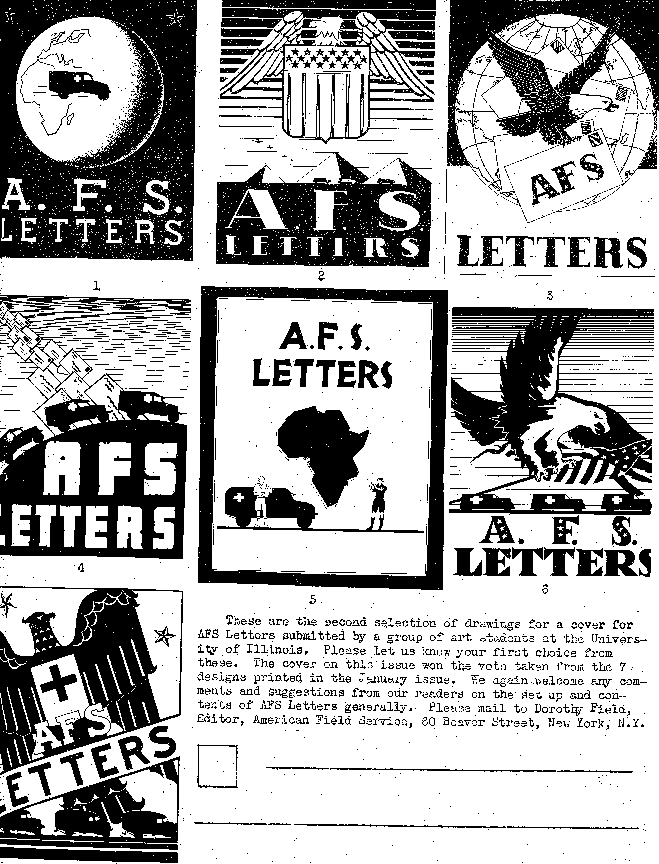
These are the second selection of drawings for a cover for AFS Letters submitted by a group of art students at the University of Illinois. Please let us know your first choice from these. The cover on this issue won the vote taken from the 7 designs printed in the January issue. We again welcome any comments and suggestions from our readers on the set up and contents of AFS Letters generally. Please mail to Dorothy Field, Editor, American Field Service, 60 Beaver Street, New York, N.Y.