A collection of excerpts of letters from the men serving in the American Field Service, overseas; edited and published at AFS Headquarters, 60 Beaver Street, New York, under the sponsorship of the families and relatives of the ambulanciers. We regret the delay in issuing this number. Because of priority ruling, we have had to wait a long period for a new part to the printing machine. The next issue will be printed in March.
To the Honor Roll of the American Field Service is added the name of STANLEY KULAK, who was reported missing in action last spring.
On the night of June 10th, 1942, Kulak took his place in the line of evacuation with Alexander McElwain, during the retreat from Bir Hacheim by the Free French. Together, they skillfully maneuvered their ambulance through the mine fields and cross fire of the German machine guns and reached the outside perimeter of this dangerous area when a shell struck their car, killing Kulak and wounding McElwain.
Kulak's record of service is one of courage and unselfish devotion. During the fifteen day encirclement of Bir Hacheim, he worked incessantly under the stress and strain of the murderous barrage. His calm and steady manner during these days soothed the shattered nerves of the wounded.
In the early days of his service, he narrowly escaped death when he was attacked from behind by two Messerschmidts which machine-gunned his ambulance, wounding Tom Krusi, his relief driver.
He sacrificed his life for a common cause in helping to alleviate suffering. His loss is keenly felt by all those who had the privilege of knowing him and the honor of serving with him.
JOHN WATSON died at sea on December 4th, 1942, and was buried with full military honors.
He left with his comrades with his heart set on the work he was to have done, and though it was not his lot to accomplish it, he nevertheless gave his life for the ideal which had made him voluntarily leave his wife and family.
In the short time we knew him, he had already made an impression on all of us. The Field Service is built on examples of devotion such as Watson had, and in cherishing his memory we will realise that such a spirit as his can not die.
FORCES FRANCAISES COMBATTANTES
1er. Brigade
GROUPE SANITAIRE DIVISIONNAIRE
No IORDRE GENERAL No 53
Par télégramme No 13604 en date du 9 Décembre 1942, le Général DE GAULLE, Chef des Français Combattants décerne, la Médaille Militaire, aux militaires dont les noms suivent:
--- Pour Faits de Guerre DUN, John, Ambulancier - A.F.S.
"Au cours de la journée du 24 Octobre 1942 a fait preuve du plus grand courage. Malgré le feu adverse, ambulance criblée de balles et d'éclats, n'a pas un seul instant abandonné ses blessés, dont l'un a été coupé en deux par un obus de char traversant le véhicule. Grâce à son sang froid a réussi à ramener au Ier. B.L.E. cinq blessés.
Cette citation comporte l'attribution de la Croix de Guerre avec palme.
Signé: Catroux
P.A. Le Chef d'Etat-Major
Signé: Illisible* * * * * * * FORCES FRANCAISES COMBATTANTES
ler. Brigade
GROUPE SANITAIRE DIVISIONNAIREORDRE GENERAL No. 48
Le Général d'Armee CATROUX
Commandant en Chef les Forces Françaises Libres en Moyen-Orient,
cite les Militaires dont les noms suivent:
- A l'Ordre du Corps d'Armée -
- (Croix de Guerre 39-40 avec étoile de Vermeil)
- Service de Santé -
GREENOUGH, Thomas, Olney - Lieutenant.
"Lieutenant de la Field Américain Service détaché au Service de Santé de la ler. Brigade depuis Mai 1942.
Commande la section d'ambulance depuis le 1er Octobre 1942 avec tact, compétence, et dévouement. Le 24 Octobre 1942 alors qu'il avait reçu l'ordre d'envoyer quatre ambulances chercher des blessés tombés entre les lignes; est parti lui même, a franchi une zone battue par l'artillerie adverse et réussi à ramener 16 blessés au G.S.D."
Signé: Catroux
P.A. Le Chef d'Etat Major
Signé: Illisible
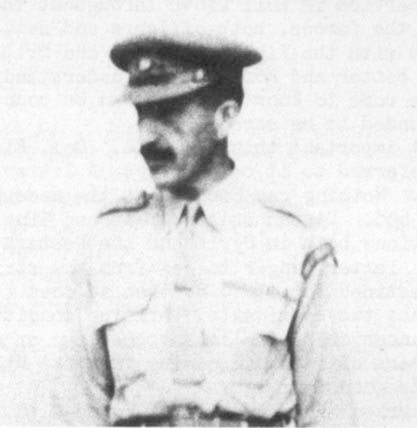
After fourteen months overseas as acting head of the American Field Service.. Col. Ralph Richmond is back in the United States to report to the Director General Mr. Galatti on the work of the Service in the Middle East.
When Col. Richmond came to N.Y. headquarters, we asked him for an interview for AFS Letters. His reply was that he himself had no particular experiences to relate, but that he would be glad to be able to make a report to our readers. What he had to report is good news, which we pass on to you.
When the first contingent of AFS volunteers arrived in the Middle East fourteen months ago, the ambulance service was an unknown quantity to the British authorities. The officials were cooperative, polite, and helpful in every way, albeit rather sceptical. They did not know what to make of a group of men who would leave their own country, a neutral one, and volunteer to do a dirty job in a war zone for other nations. If they felt strongly about taking part in the war that their own country was yet to enter, that was perhaps understandable; but to do this and pay to do it, getting no official rank or status, was more than the soldiers could grasp.
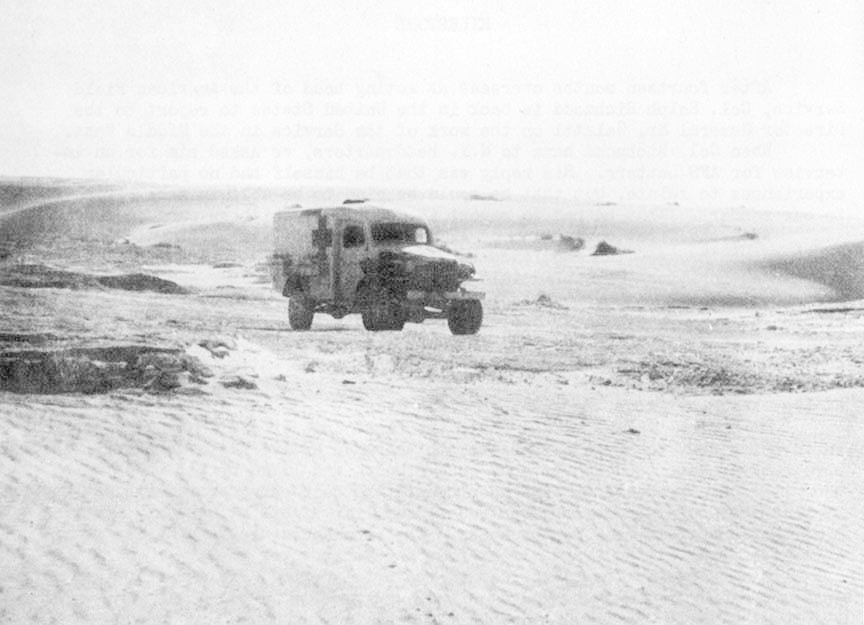
On arrival in the Middle East, the first unit of AFS men were disappointed in being sent to Syria rather than to the more active Western Desert. They were however such good sports they became known and liked by all those with whom they came in contact. The Americans with their easy camaraderie and their distinctive Dodge ambulances soon became familiar sights at Casualty Clearing Stations, Hospitals, and on the roads. The ambulances are very easily recognizable at some distance and differ from any others over there.
Having proved themselves during the trial period, Field Service man were stationed in the Western Desert, where they further cemented their relations they had begun to establish among the many troops whom they served.
Today the American Field Service is well known throughout the Middle East and is highly regarded by the forces, both officers and men, to which it is attached. Associations with the Fighting French and British troops over there is bringing about a better and more cordial understanding between those Allies. The army men have come to know that AFS can be counted on to do a job wherever there are wounded to be cared for.
To the men the most important thing is MAIL. Col. Richmond could not stress this enough; he referred to it constantly. A letter from home means more than any other thing. Nothing can occur that the receipt of mail does not overshadow, be it good or bad. Distances are great and lines of communication very difficult. Many stations both in Syria and the Western Desert are so remote that it often takes a letter longer to get from the station at which it is written to the mail bag destined for the U.S. than it does for the letter to make the journey between the two continents. Writing conditions for men living in and out of their ambulances, sleeping in snatches day or night, are obviously very difficult. When letters are slow in coming from the Middle East recipients should feel that no news is good news.
The AFS men have carried many hundreds of wounded to recovery during their fourteen months of service. They have been unofficial ambassadors of good will wherever they have gone.
November 5, 1942.
"I am beginning to feel, out here, like I am again a student at Stanford in 1940, and we are watching a big football game series, similar to that season out on the coast. From the look of things, the Rose Bowl is about here and, as it was then, it looks like another undefeated season. What I mean, morale is tremendously high, and everyone is very satisfied with things, both in general and in particular."
November, 1942.
"We're terribly optimistic and the general feeling among everyone is that what the Germans are getting now is only a section of what they gave everyone in Greece and Crete and consequently there's not much idle sympathy being tossed their way. We have number of prisoners go through nearly every day; a good lot of whom have fought previously in Russia and have been flown down from Greece with reinforcements. Many of them have only been in Egypt months or days or weeks and it's surprising the number of boys you get, some wearing the Iron Cross 2nd Class, who are only eighteen.
"It is all very exciting and interesting, though I wish I could be doing more in it than driving an ambulance. When all the fireworks and excitement are going on just over the horizon the feeling of having to turn your back to them, and bring the wounded into a hospital is a little too much like having to stand in a theatre lobby collecting tickets when there's a damned good show going on inside. But its work that has to be done.
"Right now I am attached, physically and spiritually too, to a New Zealand operating 'team', which consists of three doctors and a mobile operating theatre, which works as far forward as it is possible and safe to get, working on serious casualties that need immediate attention. The three doctors are marvelous, a statement which goes for just about all New Zealanders, and as the chief' surgeon is an excellent abdominal specialist, we get some really interesting cases. Often I stand in and watch the goings on, looking misleadingly professional in a white mask, sometimes assisting in a vague sort of fashion, though mostly just trying to keep out of the way. Major Wilson is really a beautiful surgeon and some of the things he does are absolutely incredible. Frequently in a busy day he will do as many as twelve or thirteen operations, taking anywhere from half an hour to two hours apiece, and then with 3 hours sleep, get up and start again. Not only doesn't it seem to affect his work any, but also, and what I sometimes think is even more amazing, it doesn't even alter his sense of humor and occasionally after being even at it all day, he will look up a minute and wink across the table at me, while other times when planes come down pretty close to the tent, he'll just swear good humoredly and keep right on operating."
No date.
"We left our camp the day after the balloon went up, and moved up the line nearer the scene of action. Some of our sections are actually in the thick of things and we occasionally see them and hear their exciting tales. We, less fortunate ones who lost the toss, are quite a few miles away from the scene of action although not quite without our own thrills. We work hard most of the time carrying patients back to a hospital further away from the front. I imagine that the plan is for us to work up at the front in relays, so do not expect to be in our present position for very long. We do however have our little excitements as I mentioned before. The very first night we got here some of us were called out, myself included, on a job. As we were waiting to load up, a very large bomb dropped comparatively close, and practically scared the day-lights out. of me. The Tommies leapt straight into a nearby slit trench, but we at that time were too green and too bewildered to know just what to do. Then a very little later, three of our machines had just loaded and were setting off on what proved to be a most exhausting night drive over the desert in which we got completely lost, when no less than four flares were dropped ahead of us up the road. You have no idea what light those flares can give. There we were sitting in the middle of the road lit up like Christmas trees, simply waiting for bombs to fall. They fell some little distance away, and that was all the excitement we had for that night...I cannot imagine where I shall be at Christmas time ---Tripoli or Bengazi, I hope."
November 15, 1942.
"I am no longer in Egypt, but in what was one of Italy's biggest colonies, and still we are moving on...But time is scarce these days, as everything is going on at such a rate, it is all I can do to get this written. We move off again at 6.00 tomorrow morning. There is very little undressing that goes on, for the last two nights I have slept without taking a thing off. Washing and shaving take place at any time of the day or night, when one can catch a moment, water is pretty scarce and very irregularly rationed. Meals are also a matter of catching what you can when you can. There are no more cigarettes available and have not been for days. Many of our people have received cigarettes from home, and there has been no trouble, so keep on sending a carton at a time.
"Of course the Armed Forces are fully fed, as they say, but it is idiotic to stop parcels, for it makes all the difference to get a little something extra, when none of the canteens are available. One gets bully beef morning, noon and night. One thinks of food a great deal under these circumstances, and every bar of chocolate is a great occasion ... Air Mail from U.S.A. is equally as fast, if not faster then the V mail, so keep on writing as heretofore.
"With everything that has been happening I hardly know what to write, so I will give you a few excerpts from notes: 'On a Friday, there were bombs this morning at 6.30, I had a wonderful sleep until 9.30. The morning was spent working on the car, preparing it for workshop inspection. Expect more fireworks tonight. (later) At 3.00 order came for our section and P's section to be ready to move out in 30 minutes. (This was our first move up in the offensive, we had been settled working in the same place for quite a while, so we were well dug in, and naturally nothing was anywhere ready for a move). Regular panic ensues. T.L. brings his stuff over to the car. No time to pack anything. I was dressed in work clothes. Rapidly changed. Tore everything apart, tent and all, and simply throw everything into the car 'pell mell' and what a mess, 4 spare tins of gas. The car was piled high with junk, looked like an old rag store. Moved off up on the road and drove through a maze of convoys, with sometimes 2 outer lanes (of traffic) going up, and one coming down the middle. The sight on the road was fantastic. A 'rout' forwards, truck load after truck load of Italian and German prisoners coming down. Passed through former German defenses with mine fields on both sides a part of the time. Wrecked guns, lorries and tanks, as well as smashed staff cars and motor cycles and air fields strewn with planes, that we had gotten on the ground before they had time to take off. German graves and graveyards, each with its German cross. Finally got to our destination. Ate a very good cold dinner from cans that we fixed up ourselves. Bully beef, baked beans and spaghetti washed down with tomato juice, followed by pineapple cubes. Was getting fixed up to go to bed when a German plane flew over and dropped magnesium flares. A terrific light with people rushing to throw sand on them. Then the plane came back and machine-gunned with tracer bullets. That was just a little too close, so, R.B., T.L. and I fixed up ourselves in a ditch just wide enough to hold the three of us in a tight squeeze side by side, where we slept fully clothed with helmets conveniently at hand.
"Another day: found a lot of Italian stuff, a wonderful jacket, candles, string, pamphlets, etc. Went on duty at the C.C.S. carrying innumerable Italian wounded around from ward to ward. H.'s car was towed in completely shattered by a bomb. We were told that we were to drive on to X tomorrow. Then I got a run to take wounded back to the ----C.C.C. as they were evacuating here, in order to move on. We are to rejoin the section tomorrow, wherever they may be. Arrived at sunset at the C.C.S. to find them moving off and a heavier unit moving in. France in the reverse, I never thought I'd see it. Now I hear we are to move still further up to morrow. It all sounds perfectly incredible. It really looks like Tripoli for Christmas.
"Another day: around 12 o'clock we overtook a whole bunch of light tanks, then were stopped and told that there was a pocket of Germans 5 miles ahead, and we had to wait until the tanks went ahead to clear them up. The German planes came and machine-gunned the road, so we shot off to the side, dispersing all over the place, hoping to God that it was not mines. At many places along the road lorries had been blown up by mines, by just getting off a bit to the side of the road. We had lunch there and were told that we would spend the night. On the radio they spoke of the fighting around X.....,when we had already passed the place. . etc. sans fin."
November 6, 1942.
"Desert life is not the drab and ugly thing it has been made out to be. The New Zealanders keep us clean and healthy and this big push is gaining in momentum and confidence. Our major Dr. seems to be a highly valued man, his surgery is the most critical and major and he is needed as near the front as possible. But operations such as his and immediate post-op care cannot be done under shell fire, so don't be distressed about me. The action I have seen has been little enough to be objective about and the one roaming enemy plane that goes over us every night manages to keep his bombs at safe but exciting distance. I keep myself as busy as possible and beside the car the op-theatre offers me most of my work, doing such odd jobs as sulfanilamide spraying, preparing the patient or controlling same, but I manage to keep pretty close to the Dr. --he often explains to me, and I do much drawing and if they get proficient enough, could be a contribution to war surgery illustration.
"I have done lots of drawing in the Emergency Ward Tent, for which we have more gruesome names; the spirit there, as you can imagine, is obvious and eloquent and some drawings I think I have done of real intensity and strength. Knowing the U.S.A.'s fondness for anything done on the spot, I'll try to get the best of them published or exhibited. So, somehow, I feel that that too is indirectly for the war. There is a great deal of free time, ambulance driving, and I am using all of it, if not drawing --- in the operating theatre. That I have become used to the hideous and foul results of war, and seen its suffering, does not mean, as I feared, that one is the less sensitive to it. To be used to it makes you more efficient to help, and I was certainly none the less sensitive when I held one young man's legs this morning for both feet to be amputated. But as I always say ---nothing is inseparable --- we take all in its stride and life here is actually simple and uncompromised. The desert is broad and free and is conducive to such thinking.
"The Major is famous enough to do things his own way (if they do conflict with British authorities) and one day up at this large and official dressing station has involved sufficient red-tape and general compromise to send us on our way again. The big guns no longer sound in the night and the army is advancing --- the dust is driving high and fast and the desert trucks flow with ceaseless movement and exciting activity, day and night, toward the front, and coming back, lorries filled with prisoners.
"When you think of the havoc and suffering of bombs, there is nothing wonderful about them, but I know I have never heard any sound as tremendous and fascinating ---as the great percussion sound of a bomb and its colossal earth-shiver; nor felt any moment so freighted with suspense as that when the plane in the night above slows down and you know its load is on the way.
"Being always on the move unrolling bed-roll on hard and lonely desert floor is not so much a hardship as it is simplified living. Civilization will seem complicated, however comfortable. Time only seems heavy to some, because that spent on the business of living at home is subtracted. So much more for my drawing --- and it is inspiring to watch the Major work --- he is calm and imperturbable in his work; a real and mature artist, and I like being in his outfit.
"One thing works with me --- the fouler the mess in the job ---particularly in the operating theatre --- the less the revulsion and the stronger the sympathy and determination to help. It is a fine rewarding feeling and certainly one of the biggest war jobs is being orderly in a 'front' hospital where suffering is the more intense. The courage and patience of the wounded is tremendous".
No date.
"The screams of the bomb grew louder and louder, comparable to violins at a high pitch, then as if the whole orchestra, accent on the drums and cymbals broke in with a chord --- bang it hit --- like the roll of kettle drums; the ground shook, a break, sudden stillness, then the plucking of violas and harp, bits of earth, sand, metal, landed about and above me ( I am still under my wagon) with the drums in the back ground as he drops the rest of his load in the near vicinity, all that was left was drifting flares that made one think of a flute playing, then silence. A shout from the medical officer brought me to more worldly things and we were off doing our duty, regardless of any more 'visiting cards' ".
No date.
"At the moment am encased in brand new Jerry riding breeches and also brand new Etie hob-nail boots and writing on a folding table salvaged from an Italian officer's mess......My exterior has to get along as best it can in an Elizabethan sort of way as water is scarce.....The last two weeks have been exciting, hectic and busy."
No date.
"Actually about the only things I want are a few gallons of fresh orange juice, some odd thousand gallons of water for showers, a mechanical flyswatter, a few quarts of ice-cream and sauce, a few days at the cape with you. Finally at last we're busy, almost too busy. We've done 200 miles almost every day for the last week, finding only minutes for greasing cars etc., almost no time to shave."
No date. Written on New Zealand Y.M.C.A. paper.
"At present we are working with the New Zealanders and what a swell bunch they are. The closest thing to American soldiers I have met yet. Very hard working, and friendly, like their beer and good food and very brave soldiers. They can't do enough for you and food, I never ate so much and good."
November 12, 1942.
"Ten ambulances left after lunch in convoy, moving up the coast to join the unit we were attached to, which is a medical dressing station that can move in twenty minutes with all its tents, cook houses and equipment. We began to see the country had been occupied by the enemy and wrecked vehicles. That night, there was a lot of plane action, and the shooting at flares to put them out when the enemy dropped them reminded me of fireworks at home.
"The next day, we carried our first prisoners. They were badly wounded and the Italians seemed half starved. There was a large wire compound in our camp and the prisoners were coming in steadily. Their worn out clothes and what they had been through without a chance to shave and wash, made them look pretty pathetic in comparison to our men.
"I had my first driving in total darkness along a heavily used road the following night. One of our boys had to crawl on his hands and knees to find out where some of his turns were, but fortunately, I am able to see pretty well except for holes in the road, and it is this that puts one's nerves on edge. You have no idea of the torture of driving men with broken bones and hearing them groan when you hit a bump that you can't see. It's like deliberately hurting someone that is down and out.
"The following day, we advanced 100 miles and it rained very hard part of the time. Convoy driving with every equipment for war known to man on the road is something that is impossible to tell about unless you have done it; but Sunday traffic around Long island, etc, will seem a treat. I suffered greatest depression that day since arrival. I am used to it now, but the sight of unburied bodies, burned vehicles, clothing, food and all that is abandoned in flight, is a great shock at first. The fact that it is all enemy property does not make up for it, even if it is a thrilling thought; but now I am used to it and don't notice.
"On the following A.M. we moved into a German field hospital just like ours, with the German patients and doctors still in it. We evacuated the whole 75 miles, with the result that we were driving 150 miles a day, of which one way was after dark. I am proud to say that our boys treat the enemy with every care and consideration as if they were our own, remembering them as human beings, after all. The scavengering for articles left behind the enemy is enough to turn your stomach especially as the soldier hasn't really any room to carry it all.
"I wish you could have heard the conversation on the following day when we carried four Germans and four English sitter patients. They fought the whole war during the trip, and one young Nazi was having quite a time trying to explain his beliefs to a Tommie, in broken English. We broke a spring coming back that night after dark, so drove on 50 miles to our H.Q. and workshops to have it fixed.
"This is the pay-off! D. wanted to show me a lovely spot, where he had been camped before, and where there were some palm trees, grass and a lovely beach. We parked the ambulance under the first grove of palms. There were seven Germans, with one waving a white towel. We went over and they surrendered to us. If you could have heard D. saying 'Pile your guns here at our feet.' (when we had no arms at all) and they piled them in front of us. We asked them if they had eaten, and the answer was no; so we took out our special macaroni tins that we were saving for a treat and cooked them lunch. They were living off berries that grow on the palms, boiled in water. Lunch was a very pleasant affair, with them hauling water to wash and cook with; then we ordered them to pack up and get in the ambulances. At this point --- you know me --- I had lost the keys to the car and here I was with seven prisoners, so there was nothing to do but make them help look for them. I soon found the keys. What I had done was to hide them so that if there was any trouble, they couldn't make us drive them off, but in the excitement I forgot what I had done with them. Just as we were putting the Germans in the car, a New Zealand Lieutenant came along and we hailed him and his men. They advanced with drawn rifles, and we stood in more danger from them than from the Germans but we soon explained and turned over our prisoners to them. They wanted to know if we had 'frisked' the Germans for arms and we said 'no, we cooked them lunch and had been with them an hour and a half . You should have seen their (the New Zealanders') expressions. Well, we finally had our swim, and laughed and laughed at the thought of the two unarmed A.F.S. boys taking seven armed Germans.
"It seems so funny to go flying along through the little town that we have heard the names of ever since the beginning of the war in the Middle East--- Pray God this is the last time it will be fought over, and that this campaign will wind it up."
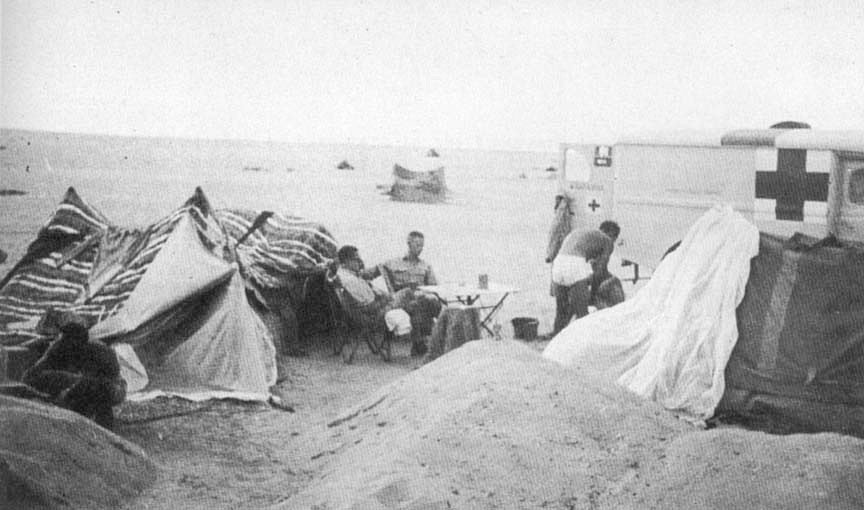 |
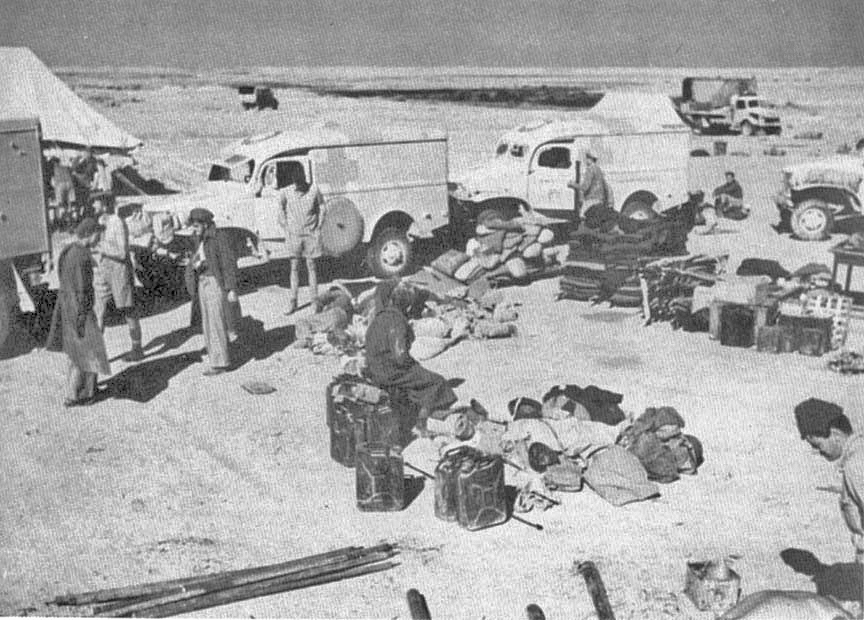 |
| At home: Western Desert. Drivers Art Jeffress, Dick Barrett and Tony Stewart relax between a parked ambulance and their tent. | AFS men and ambulances line up outside a reception tent waiting for the wounded to be ready for transportation, Western Desert. |
No date.
"Some of us plan to take part in the important tasks of reconstruction when the war is finished. This may well be the great role of my generation. Already I have met differing attitudes of mind with regard to our present world situation. The fellows are from colleges for the most part and are on their toes. Many of them have travelled extensively; needless to say talk is interesting.
"I am somewhere in Egypt at a British army camp. There is of course wide interest in the good news of the present 8th Army push, but Jerry is sort of an impersonal thing. Hatred does not run high. This is as it should be, this casual acceptance of the war. Morale among men of Britain is very high, and the good fellowship at this camp is one evidence of it. During this time we have been transformed. superficially at least, to British tommies."
November 7, 1942.
"Things have been exceedingly interesting recently. As you know we've been in the offensive, news of which you get before we do. It may easily be over and won when you read this, and I'll be writing you from Tripoli, I hope. It seems that the Germans treat their prisoners very well, so don't worry at all if I should be captured. It's exceptionally unlikely anyway, since we seem to be doing the capturing now. Have carried quite a number of wounded Italians and Germans. They do seem glad to be out of it, not too well dressed or fed, evidently, either. Some of us were not too far from the front, when the offensive started, the 23rd. There were guns all about us, and they did make a terrifying racket.
"The other day, a truck donated by Woolworth employees in New Zealand. stopped right in front of us in the middle of the battle and opened up to sell tinned fruit, chocolate, biscuits, etc. They had Australian peaches Canadian chocolate, Egyptian biscuits, American tinned milk. Palestinian honey, New Zealand beef sausages, English cigarettes.
"It's amazing how quickly these mobile medical units put up and take down their tents. It's a matter of ten or fifteen minutes and they can receive patients, perform minor operations, etc., serve hot tea and cocoa. The cook truck carries big insulated containers which can keep food hot for 24 hours. When we're moving constantly we have tins of bully, cheese, marmalade in each car. I can heat up soup by putting a can in the engine a while before opening it, too."
November 1, 1942.
"Couple of days ago a German Messerschmidt was brought down about 50 yards from us. At present there is nothing, left --- souvenir hunters demolished it. I managed to get an instrument from the dash board. People even took guns and the 'swastikas'.
"We have been sleeping in an abandoned German dugout for the past two nights. You really have to sleep in a trench now. They bomb us every night. Tuesday night they even strafed the ground here, with their machine guns after they finished bombing.
"We are kept awake all the time by the constant artillery barrage. They are only a short distance to the west of us. As you are probably reading in the papers, things are popping here now.
"We carried two German prisoners the other day, quite an amazing pair of individuals. My knowledge of German helped some --- found out their number, regiment and rank.
"Have seen several dogfights since this last little maneuver started. The first one I saw, a Jerry plane was brought down. Have seen three all told brought down to one American and no British rather satisfactory ratio."
November 19, 1942.
"Had a very harrowing experience one night last week. The Red Cross Unit we were attached to was all packed up awaiting orders to move the next day. That night about 15 patients came in who needed immediate attention. As a result they sent five ambulances out. As luck would have it, they put me in the front of the column. It was about the darkest night I've ever seen and very unfriendly territory. We started out at a snail's pace --- there was an amazing amount of heavy traffic. When you say heavy traffic out here it usually is. These British tanks are tremendous. We were proceeding along, under strict blackout regulations which means you can see absolutely nothing. All of a sudden out of nowhere appeared this huge lorry dead ahead of us. The inevitable --- they hit us head on. Luckily none of our patients were hurt. We got our patients to the hospital only to find that our front axle and spring broke.
"About the closest shave we had was when B. and myself were lost in the desert and decided to just stop and then go on the next day. Just after driving off the track we thought we saw a huge pit and we parked about fifty yards from it thinking in case of an air raid we could dive into this. You see it was raining and we didn't want to dig slit trenches, and sleep in those, so we slept in the car. Just after we had gotten to bed, I heard this plane, definitely German, overhead. Saying to B. "Do you think we should get under the car." He replied, 'No. They don't know we are here!' The darn plane began to circle around overhead, being night you couldn't see him, but their engines sound a bit different than the British. Couldn't imagine what he was up to because we hadn't noticed anything else around when we stopped.. All of a sudden we heard him start to dive. He seemed to be coming straight at us. It all happens so quickly you don't have time to do much when they start a dive. He dropped two flares and lit the place up like Times Square then he dove again, by this time we were running 'naked' toward this hole, when he started to strafe about a hundred yards beyond us. He hit this ammunition truck parked next to us which we never saw when we came in. We were just on the verge of diving into this pit when we noticed about four feet of water in the bottom. By this time we had parked plump in the middle of an ammunition dump unknowingly. That was about the closest one yet.
"One of our ambulances was blown up by a bomb landing four yards from it. Usually they respect the red cross, but in this case the car was parked among some anti-aircraft guns! Luckily the driver was in his slit trench But he was unharmed."
November 29, 1942.
"Certainly have been rushed around the past few days. In less than a week we moved up over 500 miles. It certainly has given us a fine chance to see some country. Halfaya Pass which we passed thru, Tobruk, Barce, Bengasi and others. Tobruk harbor is jammed with sunken ships of both sides including overturned air-craft, a half submerged submarine, and others. Tobruk is really shot up. We walked down by the docks and thru the streets which are littered with broken stones and junk. In the sides of the hills are carved bomb shelters in the solid rock. We had a little while to spend looking at all the scenery. At --- I met P. and had dinner at his camp. Then I drove on up to H.Q. after dark. So far I've driven my ambulance 2800 miles of which 600 have been at night with no lights at speeds of 30 mph up to 55. Luckily everything has gone along well. Bengasi was raised rather well but not nearly so completely as Merse Matruh, Tobruk and Sidi Barrani. Along the roadside are planted mines so that vehicles straying off the macadam are blown up. The roads are very narrow and for two trucks almost impossible. My ambulance has actually had paint scraped off three times by side swipes of 3 ton lorries. So far I've strayed into 3 mine fields and been lucky enough to get out of each one safely. Now I am again in bombing strafing area.
"The other day while making a 300 mile run at 45 mph across terrible roads my steering wheel almost fell into my lap, my starter pedal broke, and my muffler broke. All's fixed now.
"My hair is so long that I've seriously been considering joining a concert orchestra. Since the middle of September I've not had a haircut so that I can almost make little thatched roofs over my ears. My fingernails are so long that when I file them sharp they make very good letter openers.
"We have passed a great deal of abandoned and ruined equipment, Jerry and Italian. When we passed into the green belt just east of Matuba where it begins we found that for tea, sugar and service biscuits we could trade eggs, chickens or tomatoes. They were the first eggs, I've had since my leave in Cairo. Along the roads are numerous old forts and strongholds similar to those in 'Beau Geste'.
"Yesterday C.S. and I traded cup of tea leaves for 4 eggs to some Arab. All the Arabs sell eggs (Eggis to them, copying us) but we almost never see any chickens. We made a good omelet with a little bully beef and green beans. The green belt is much nicer than the sandy desert. Yesterday while we were starting our omelet at noon I went thru my first mass bombing raid; 8 or 10 dive bombers dropped out of the clouds in pairs and let their eggs go about 160 feet above the ground. The bombs landed some 100 or 200 yards away by some radio cars and lorries. Within 5 minutes we had RAF protection from an airport 40 miles away. At the time we were standing by the ambulance which was on a huge cement park with no place to go. Any APs (anti personnels) nearer would have had a fine chance at us. That has been the only excitement in several weeks.
"While on a long cross country trip the other day we passed thru numerous native villages with their palm trees above the dilapidated light brown walls lining the narrow streets. If a spy wanted to travel thru this country undiscovered, a good disguise would be a very dirty white robe, no shoes, a brown face, two eggs in one hand, a filthy cloth to put tea in, and a partial English accent of eggis as he held the eggs up in one hand along the road.
"Hellfire (Solum), Barce, Bengazi, passes are all very beautiful and quite different from each other. Hellfire is very straight and high; Barce is small, twisty, and has slight gullies (200 feet), Bengazi is high, narrow twisty and deep gullies but very beautiful looking across the plain to the sea."
November 29, 1942.
"I think I can tell you now that I've seen Mersa Matruh, Sidi Barrani, Bug-Bug, Solum, Capuzzo, or the pile of rubble that is left, Bardia, Bengazi and all stops in between. All of these towns are of course bomb-scarred, but they are still very interesting to see. All the houses are white and were once obviously very neat and they sit up oh plains or escarpments just like a white sailboat stands out in the middle of the blue Long Island Sound. And in Cyrenaica, of course, you're out of the desert. There's grass, mud and rain and small 'scrubby trees', very similar to the parts in the Norwegian mountains, just before you hit the tree line. The Italians did a great deal of colonizing through this district, and the little white farm houses, all exactly the same, dot the hills everywhere. It's pretty ludicrous to see that neat bit of civilization, and then just in front find a 'Wog' (dirty native Libyan) ploughing the field with the spring of some old car and a camel."
November 16, 1942.
"For once the British combined brilliant theory with rigid efficiency, plus an abundance of equipment. The combination was unbeatable and brought great grief and sorrow upon the Jerries and Italians. All the prisoners that I have spoken to have been quite bewildered and unhappy. With the American landings in Morocco and Algeria I imagine that the entire North African front will be cleared up rather speedily. And re Americans, I haven't seen one for almost a month. My world has been almost exclusively a New Zealand one.
"You know by this time that my place of residence is my ambulance, which serves as bedroom, library, dining room and guest room, also kitchen. The exhaust pipe makes an excellent stove. And at the moment my larder consists of about a dozen cans of soup, a few cans of spaghetti and macaroni, and two cans of 'Creamed Spinach' which is most luxurious. My clothes and other belongings, I keep in a steel box, much like a steamer trunk, which I have screwed on to one of the front fenders. The 'steamer trunk' was originally intended by the British Army to carry shell charges. If by chance a bridge game develops, a stretcher slung in the middle of the ambulance makes an admirable table. The folding benches on either side of the ambulance are the chairs. And blankets placed over the window permit me to use my interior lights and still observe the black-out regulations. That about takes care of my domestic arrangements."
December 5, 1942.
"The greatly lengthened distance from the front to Cairo changes things a good bit.
"In my last letter, as I remember, I was a bit too optimistic about the African set up. I'm pretty sure that the Axis will be driven across the Mediterranean but it will probably take some time.
"The fellows in the outfit that I am attached to are a typical bunch of New Zealanders. Good natured, generous, self-consciously democratic and always ready to chant about the superiority of New Zealand beer, women (if the Yanks have left them unspoilt), and social legislation. My best friends are not among the more typical specimens.
"There is a Russian who managed to escape the attention of the Ogpu by setting up housekeeping in New Zealand. He has a long, black curling moustache which, is a trifle soggy as a result of frequent dunkings in borscht, and he is a most formidable fighter. We disagree about everything and get along enormously well.
"Another one of my 'cobbers' is a guy named Scobie, who is quite a force in New Zealand educational circles. At one time he worked for the Carnegie Institute. His last job (to which he expects to return) is liaison man between the museums and educational system. He knows quite a lot about Middle Eastern archeology, and when we get some leave we're planning to do a bit of prying around tombs and relics that are not generally visited. The sightseeing that I have done thus far is quite conventional: the religious hot spots of Jerusalem, Nazareth, Crusader castles, Phonecian ruins, the pyramids, etc.
"My other good friend is N.N. He is chess champion of Auckland (New Zealand's largest city) and possesses an enormous fund of knowledge on such unrelated affairs as history, wild life (flora And fauna) nautical affairs, and real estate. His income is mainly derived from an orange ranch and writing detective stories for American Magazines."
November 23, 1942.
"At present we are camped in a not especially attractive spot in the desert enjoying a lull or bored by inactivity---depending on which way you look at it--- while our future destiny is being decided upon. Up to now we have been alternately working hard with our machine loaded with patients or dashing along the wreck-strewn Via Balba , once so vaunted by the Fascists, in a wild attempt to catch up, and keep up with the advancing Eighth Army. For myself I am quite pleased to stop for a few days and take stock of myself. . . especially glad to be allowed some water so that one can make at least some attempt to get clean again. I have even been heating this precious liquid. . . . You pour gasoline on to a sand-filled container---it burns for hours. But this feat involves a slight danger of conflagration and I only resort to it when absolutely necessary. I could have wished however for a more attractive spot and a warmer one. The winter has really descended on us now and the mornings, evenings and nights are truly arctic, and more so as by some tiresome error, we have not been issued our winter uniform and are mostly freezing in cotton shorts and such. Some lucky ones have managed to scrounge warm-looking Italian coats, but I must always have been looking in the other direction when they were lying around. Last night I could hear an enemy plane overhead for a long time, not to mention the Grmmmp of his bombs falling not so very far away, but though I knew quite well I should leap from my stretcher-bed inside my ambulance and hurl myself onto the ground or better still into a slit-trench, it was so doggone cold that I decided to stay just where I was and to hell with it. The cold has driven away most of the flies that used to be the bane of our existence. However to offset that, there is a plague of mosquitoes where we are now,"
No date.
"Nothing has happened recently except that a few days ago somebody fell overboard, and contrary to rule, we went back and picked him up. The bridge spotted him and consequently found him only because of the huge albatross (9 ft. wing spread) which was flying around him trying to pick his eyes out. A few shots scared the bird away and the man was saved. . . I am keeping up my Dutch, am taking French conversation with mon Capitaine, brushing up on German and sing songs, and also taking first aid and map-reading. All of them good time killers. Terribly happy and healthy.
"We were attacked by a rainstorm. and all our tents were under 4" of water. prisoners did a good job at moving our tents and equipment to a higher spot...... The AFS eats everything wherever it goes. Had lectures on explosives and weapons. AFS took guns apart. Result: 2 machine guns wrecked."
October 22, 1942.
"For the post two months I've been more busy than usual for when you're an officer you have to worry about other people's business as well as your own. For a while I was assigned to help organize part of a company of new fellows who'd just come over. . . The new fellows were keen and eager and quickly caught on to the work that had to be done and to the things we were trying to teach them. We took them out on the desert once to teach them how to travel a map course, by compass. They traveled a twenty-five-mile course across trackless, featureless desert, to a point that was marked by a stake in the ground, and they hit it right away. . We didn't do anything but check to see if they went wrong, except once during the middle of the night, we got up and blowing the jeep's horn loudly we woke everyone up and in the dark, with no moon and no lights, made then move to a new camp site two miles away, just to make it more like actual war conditions on the desert.
"I have been an officer now just long enough to learn that one can't live as cheaply as a private. The voluntary nature of this organization makes it inadvisable that officers should receive any different pay from the rest, and that is as it should be. Prices in these countries are rising rapidly, especially outside Egypt. The British are doing their best to control them, Leon Henderson style, but it is not so easily done here as in self-governing countries like our own."
November 30, 1942.
"On Friday night at 20 minutes to 10, the artillery opened up, to spot the enemy batteries. Two minutes to 10, they ceased and dead silence. At exactly ten, everything all up and down the El Alamein line let go. It was terrific. For hours... without a single let up it continued. The sky was one steady bright flame, and terrific roar. At 2 A.M. the bombardment settled down to a steady incessant barrage, the infantry went in, and we started to move. We move faster than has ever been accomplished before. Now, as you know, we are past Tobruk (cannot say where for obvious reasons) and the prisoners and equipment that Jerry and the Iti have lost is unbelievable. So far the A.F.S. and my company are up with them. We've lost no one, thank God, and the boys are doing heroic work. I'll be up there soon, very soon, as I am anxious to see the show and to be in on it. I'm no fire eater, but history is out there, and I aim to be in on it. Three of the boys who came back told me that one of the fellows ( I know him, but names are of no use) was sitting on the back stop of his ambulance, putting on his socks when he heard a whistle, he dived for his slit trench, hitting it, just as his ambulance blew up, a shell landing ten feet from it blowing it to smitherines. He, the boy, was saved."
Written after September 15, 1942.
"The group has come along in grand style. We have had some busy times, but all has gone smoothly and they are far and away the best crowd yet to come out. We move off with them for the same old stamping grounds we have just come from shortly. The role of instructor has been about the most difficult one, as I have to give lecture twice a day sometime all along and it is not easy getting across all the specific factors of navigation, and many less specific factors of navigation, and many less specific factors concerning our operations. However, I took my platoon out for an overnight trip in the Sinai to test their knowledge of all that we have been throwing at them and it was very pleasing indeed to get the results.
"There have been a million and one things to do in getting this group out-fitted with all the regular issue for ambulances, arranging of mechanical inspection at regular intervals, organizing people into sections where they are happy, censoring mail, and generally solving the personal and organizational difficulties of a group of highly developed individuals. However. it is pretty well done now and I am awfully glad to see the end of it all. It has been one of our most hectic periods without much to keep one inspired in the work, but more functional operations lie ahead.
"I have enjoyed the officers' messes very much indeed, and it has been most pleasant to have a place to relax in and forget about other things for a few hours each 24. I have been put in here with a particularly good group of desert veterans (likewise veterans of France and Greece) and they are a fine lot of men. The senior officer is a very quiet major, of a pleasant nature and well worth listening to when he speaks. A group of young captains---two from Cambridge --- and two have been in business in London --- a middle-aged London playboy who is perfectly delightful and the most likable chap in the world, beloved by his men and fellow officers alike --- two younger sub-alterns who have just come up from the ranks, one a Welshman of considerable musical ability, the other an extremely quick-witted and alert and humorous Scot. I have become very attached to them in the past two and a half weeks and will be sorry to leave them. The final character (forgot to include) is an Englishman by birth who has spent his days travelling all over the world and is an amazingly well informed person on Egyptology, past and present, having lived in Alex for several years before the war. He has spent considerable time in Hollywood among other places and loves everything American. He is so fat that he looks like a man in the sideshows (one night we sneaked into his tent and measured his belt --- 54") and is a constant source of amusement with his capable and devastating replies to remarks about his size, being caterer for the mess (he is a regular officer and not just caterer,) he produces the most wonderful Egyptian foods at half the cost any other mess succeeds in getting them at, because of his fluent Arabic and knowledge of the country.
"We have a great many keen baseball fans, and the world series has caused about as much consternation off in this barren patch of sand as it has in the bars of New York. We heard two of the games ---at least parts of them--- by the radio of our canteen truck and there has been much passing about of coin since the Yankees' defeat.
"A few days ago I took a bunch of cars off on a run in the desert per certain instructions of a Brigadier. It turned out that our course ran through some of the most impassible country in the whole desert, great dunes of soft sand rising so steeply that no car in the world could get thru under its own power. We sweated and pushed for several hours getting all the cars over the first rise only to find another one a short ways on. And so it went, another and another until we were all so fed up and exhausted that we just quit and rolled into bed for the night, miles away from the rendez-vous at which our cook truck awaited us, and hemmed in on every side by miles of soft sand. I alone had a car without 4 wheel drive and that made it doubly difficult for my driver find me. To make matters worse at the end of the first day he (the driver) came down with dysentery and was quite ill all night. To make matters still worse the heavens suddenly opened up at about 4 a.m. and it rained cats and dogs and then hailed for a while --- first heavy precipitation I have ever seen out here. Needless to say we weren't passing very complimentary remarks around about the Brigadier next morning. I had the fellows open their emergency rations and decided it was ridiculous to try to go any farther; accordingly we headed off towards some harder country back to camp as quickly as possible. Later, I found that the Brig. was a wise owl and he may have done it as a bit of a joke. In any case it did take all our crowd into more difficult country than they will ever have to fight through again and the experience was valuable. The only way you can get thru really soft sand is to hit it at a high speed and keep going no matter what bumps may be occurred. In one place we measured a jump made by my lorry when it hit a hard sharp ridge amidst some softer stuff ---15 feet.
"A few days before the 'sand incident' I had another incident occur which shook me considerably. It was one of those broiling hot afternoons out in the desert, when the air rises in a wavy line off the sand and everywhere in the distance appear lovely blue pools of water which you know aren't there and the light is so glaring that your eyes hardly stay open. I was standing upon the seat of the lorry with my head thru the observation hole when suddenly I saw a DUCK directly in front of our on coming wheels. I yelled at my driver to look out for the duck! He merely gave me a sort of quizzical, sympathizing look and went on. Before I could stop him we seemed to have gone right over the apparition, but when I finally got him to stop and looked back there the old duck still was about 30 yards behind me. I really couldn't believe my eyes, but decided to go back and investigate in spite of the bitter remarks E. was making, he not even having thought it worth while to have a look. But when he did look out and an amazed expression came over his face I felt much better. I took a few steps more toward the thing and stopped. There it sat, absolutely motionless about 4' from our tracks in the sand. I heard E. mutter something about 'decoy' and took a few more steps forward and still it sat there absolutely motionless. By now I could see its markings and it was, I believe, a green winged teal. For the minute I had the feeling that someone must be lying over behind a sandhill enjoying all this immensely, when suddenly I saw an eyelid flutter and I felt much relieved and I knew it must be a real bird. I took a few more steps closer, bringing me directly up to the bird and still I could see nothing but that eyelid flutter. Slowly I leaned over and touched the thing, deciding that I would have to put an end to the suspense, and sure enough up it got and flew away -- a real live DUCK. What that bird was doing out in the midst of that desert and why it had never flown when our wheels went by within a few inches of its head is something I will never know. Also why I didn't have the presence of mind to grab the thing for a good duck dinner is another problem that worries me. We just sat there open mouthed, and watched it wing away over the sand. That gave me the usual bag for the first hunt of the season, but you can be sure that the next one I run into won't get away quite so easily. As a matter of fact I have often heard geese going over at night and they say the upper Nile has some of the finest shooting in the world, so you never can tell. One of those geese might even try to fool me out in the desert. His goose would be cooked (literally) if he uses the same old tactics as the ducks."
October 2, 1942.
"Well something happened last night but I don't know what --- all I've heard is odd bits from the casualties that have come in---, apparently things went well.
"There has been intense air activity today and a Jerry floated down quite near me in his parachute this morning. There is always a tremendous amount of ack-ack and air fighting before anyone on either side gets shot down and I spend half the day looking up at the planes with my binoculars --- incidentally a very fine pair, given to me as army issue, and extremely useful for spotting aircraft, finding people scattered over the desert, etc.
"One of the things that gives us a scare out here quite regularly are the flights of geese that go whistling over at night --- sound almost exactly like a shell which is going to land very close. They fly low and I have often been able to spot them against the moon. Occasionally they come over in day time, and then the ack-ack gunners all cut loose more than ever in hopes of a change of diet. One day I was in the middle of a sponge bath and covered with soap suds when suddenly I heard a whistle and dove for the old slit trench only to find that 'it was a flock of birds. Upon extracting myself from the hole I find most of the dirt in the desert clinging to me and had to use about a gallon of water to get clean. For us out here, water is dearer than petrol, and it is quite unreal to imagine ever having to buy petrol again. It has become the natural thing to stop off at a petrol point, fill up with 30 gallons and go along without ever considering the cost behind it all. When one realizes that all this array is on wheels, many such things as tanks measuring their consumption in gallons per mile instead of miles per gallon. and that there are thousands and thousands of vehicles moving continually on land, sea and air it is hard to understand how the supplies are kept up so well. How Jerry and the Ities do it is still more amazing."
No date. Rec'd, November 9, 1942.
"The major is an O.C. (officer in command) of an M.A.C. (Motor Ambulance Convoy) Company. He is incidentally one of the grandest characters I have run into out here --- sort of an old Irish horse doctor --- been all over the world as a ship's doctor in his early days and in the insurance business later. Spent most of his time talking of 'Custer's Last Stand', building lovely bonfires of equipment which would be valuable to Jerry and could not be carried by us, and telling jokes in an Irish brogue with a breath smelling of Irish whiskey.
"At the moment my new crowd is sitting out here amidst the endless wastes of send, and we await an assignment which is expected to arrive shortly. The only sign of life is the presence overhead of a very large number of low flying aircraft (entirely our own I am glad to say) they fly so low that everyone involuntarily ducks his head as they come and we can distinctly see the pilots and wave to them. I don't expect Jerry is having too pleasant a time of it from what we see here.
"In regard to Jerry prisoners, yes, we have often carried them in our ambulances. Their ability to take what must be appalling suffering is well known. I never saw one flinch or complain even in the worst cases. They get treated as well as anyone else by all the medical units; you can't help but admire their guts, and I am sure that has a lot to do with it. The Ities on the contrary are most demonstrative of their feelings, and wail and groan on the slightest provocation. They too get as good treatment as the rest. Normally conversation with prisoners is very limited. Like our own troops they are taught not to talk when captured and are quite distrustful of advances.
"The breadth and depth of the interests and knowledge of this crowd is amazing and it is a pleasure to be associated with them.
"I must turn off the light now in the back of my little lorry here and get to bed i.e. roll out the bedroll on the sand. This wagon is most convenient for carrying all the comforts of home and I am very well set indeed."
"It is from all appearances quite a regular evening. I am sitting here in the back of my lorry near an M.D.S.; the tents of the M.D.S. and my ambulances are scattered over the desert round about with their usual dispersal area of 150 yards between each other; the wind is rustling the canvas top above me; the air is chilly; and I am sucking on my pipe, comfortably filled with a meal of tea, biscuits, jam, bully and onions. As I said before, all appears normal, and yet I know it is not so. There is the same tenseness in the air which the player feels before the big contest, the duck hunter in his early morning ride to the blind. We all feel that tonight may be one of the turning points of the war, and anything which points toward the end of this mess is of great moment. From the papers you know for better than we what is happening out here, but the feeling of being part of it all is something you cannot sense. One must watch the tanks roll over the desert with young sensitive faces of officers showing above the turret, riding out to battle as erect and stately as their fathers did on horseback; one must watch endless streams of men riding in the backs of lorries or on their cannons towed behind, their faces expressionless ---white masks from the dust; finally one must above all hear the sounds of war to truly get its feeling. The rumbling of the tanks, the rattling and bouncing of the lorries, the constant woomphs of artillery fire with the minute vibration of everything round about from the percussion of each gun, the staccato sound of machine guns, and the deafening crash of bombs --- these are the things that give me the feeling of being in the midst of war. All this is what is exciting and new at first but what is in time hated with all one's heart. At the moment most of my crowd are new to it, and they seem to be thriving on it, happy with their work, and upset only when they have some particularly horribly mauled bodies to carry--- I find myself at times almost overwhelmed with a feeling of disgust and yet I can't help but be caught up to some extent by the amazing optimism and cheerfulness of these Britishers and tonight the grapevine has it that we are going to break through. This last week of fighting in the minefields has paved the way for the thrust and tonight we start. By dawn tomorrow I must be creeping along in a convoy many miles in front of where I am now, the entire M.D.S. packed up and is en route in front of us. Who knows? That's what makes it intriguing despite one's true feelings. Perhaps we will be right here for a month and the grapevine has it all wrong. You'll know by the time this arrives in any case."
November 9, 1942.
"We have made tremendous advances as you know from the radio and papers and this does look almost like the turning point of the war. Particularly with the news from West Africa. This sudden break thru has made a lot of work for us and with the constant advances has meant that it takes about 24 hours a day to got the cars in the places needing them. I have spent more hours bumping around in my lorry than ever before, and with the night driving in a complete blackout and no moon it has been pretty hectic. It has been a matter of catching a few hours sleep and a bite to eat where I can and moving on. Attached as my cars are to an armed division, we seem to cover the countryside very well. A good two thirds of our patients (and at times all of them) have been P.O.W.s. The battle is apparently turning into a rout and the Axis losses are incredible. Never have I seen such wholesale destruction and loss as has been the fate of the enemy here. The entire equipment of the Italian army seems to be strewn over the desert, much of it quite intact and merely waiting to be taken over by us, and yet a fair amount blasted to bits by the onrush of our forces. Literally hundreds and hundreds of vehicles have just been left behind, filled with equipment and stores, so sudden was the advance. Hardly a soldier in the British Army is not stocked with all the spare clothes, boots, food, and odds and ends he can carry or get on his vehicle. The scrounging has been terrific. Every unit in the front of the advance is living the life of luxury. Tonight I drank a bottle of Chiante wine, had German sausage to eat, and ended up with a Jerry cigar. I picked up a good lorry for the Company-- a Jerry Ford which had only been 800 miles, and about the best of the available models. All I did was pick out the one I wanted, put one of our spare drivers on it and tell him to take it away. Could have had any number, but one was all we wanted. Except for the acquisition of valuable equipment such as cars, binoculars, cameras, etc., this scrounging has a terrible nuisance value. People see shiny new things lying around of absolutely no use but because they are free they are grabbed up. Elaborate and very valuable bits of technical equipment are of no use to nine tenths of us but one's possessive instinct seems to get the better of him at such times. To see people pawing thru the great heaps of luggage left behind, scattering clothing, blankets, and little personal things all over the desert is in many ways quite revolting. I just felt I want nothing to do with most of it, and accordingly my only take has been a very fine Jerry rooksack which a P.O.W. presented to me.
"At the very beginning of the onslaught I swung off to the South with one of the circling columns, and for a couple of days we did nothing but carry prisoners. During this time there, was a large enemy pocket between us and our own lines and it was a rather uncomfortable feeling. One of our ambulances heard we were in a certain place and came sailing directly out to meet us and only got back by the skin of his teeth into the friendly territory from which he started after drawing all sorts of machine gun, mortar, and rifle fire. When direct access to us was opened up, I took one of the very first convoys of vehicles down the road and it was a most unpleasant experience. Shot up vehicles littered the sides of the road, great tangles of blackened burned metal and scraps..... dead bodies strewn amidst the wreckage. We crawled along thru some 25 miles of such sights and I felt about as sick at the end off it an I ever have. It was the first time I had been involved in such a large scale slaughter and mess when it was all so recent. We have seen the destruction of former battles often but this is the first time we have been right in on a large one. During the retreat from Tobruk, we left the holocaust behind us at each move and never really saw much but relics of battles fought many months before. Time seems to remove the cruel edge of most catastrophes and with those of war it makes no exceptions. The only loss we have suffered throughout has been one vehicle which got riddled by shrapnel in a bombing one morning. It was the only bombing or action of any sort we (my platoon, at least) have actually been caught in, and it was only bad luck that the single bomber caught it. It was one of my cars and I saw the thing happen quite clearly. The plane came in about 400 yards from where I was, flying very low and apparently deliberately went for the Red Cross vehicles. That is only the second time I have seen such a deliberate attack on the Red Cross, and in both cases it has been done by single planes, probably by pilots with particular grudges. I am still convinced that when possible to avoid it the Jerrys do not attack the Red Cross, as rumor sometimes has it.
"The prisoners have come in endlessly, most of them seemingly happy to be out of it all. At an advance dressing station just yesterday three ambulances came driving in and stopped in front of the tent. An Italian Colonel and his batman climbed out of the front of the first, Jerries out of the next two and not a Britisher on board any of them. They were merely surrendering, and when no one paid him any attention but went right to work on the patients in the backs of the cars the old Colonel started to get a little sore. He stood about for about an hour very angry at being so neglected before he was finally marched off to the P.O.W. pen not far away. Then this morning two of my boys went down to the beach for a swim and up from behind a rock pop nine Ities who run out and throw their guns on the ground, startling the poor swimmers quite considerably. One of them tells the Ities to fall into line, and marches them triumphantly back to our camp. It is all so ridiculous that it makes the killing much more horrible. Those Ities could have shot our two defenceless boys down like rats but knowing they were surrounded had been hiding down by the beech for a couple of days just waiting for someone to surrender to.
"Then also this morning a Captain of the unit with which we are now working was driving across the desert when his car hit a small land mine which made quite a boom, but did nothing more than blow the wheel off the car. Up from slit trenches all over the place come the heads of twenty Ities whom he promptly rounds up and brings in."
October 26, 1942.
"Last two nights have been noisy ones, surrounded by armed forces, and bombs etc., have been dropping though the Germans respect our Red Crosses and none have been dropped in our own little area. Mass yesterday said beside the priest's car with an aeroplane fight going on high overhead. Saw a remarkable sights a German plane flying along a ridge quite low and every quarter or half miles or so you'd see the bullets fly up at him from various guns ---they're easy to see as every fourth bullet or so is a trace. He was losing altitude and believe he came down eventually but it was amazing to see it continue on through hail for a course of 2 or 3 miles at least. They brought in a couple of prisoners, wounded Germans, yesterday, but I did not see them.
"I wish I could read the letters I find about---am saving them, anyway, hoping to find an interesting one. Heard about U.S. troops arriving in Algiers etc. ---Interviewed an Officer today serving on some kind of relations job. He took down my name and said he'd write something about A.F.S. life for U.S. papers. Afraid he found me poor material as have seen little compared with the others, but all I wanted anyway. Our rations have caught up with us again ---we had several days of nothing but Bully Beef..... Breakfasted the other a.m. with a cigar (German) and some Chianti. 'Just the job' as the Tommies say when anything is poifect or clicks. Road strewn with vehicles of all sorts in all stages of decomposition. These enemy letters I talk about were all written recently."
October 15, 1942.
"Ran a British officer off the road into the sand on his motorcycle. He turned and chased me find caught me some 15 miles away and gave me the most superb lecture that lasted a good half hour. Must have been an actor. I was very polite to him, and didn't laugh once. For first time in the desert the flies were bad today. Think they scented the storm and were seeking refuge. Want very much to get one of these ambulances after the war. Should be able to pick one up cheap second hand. They'd be useful as a station wagon and truck and best of all we could take trips in them and sleep in them. Want very much to see the U.S. desert country and California."
"As for our life, the months of waiting have given way to hard work, for which I am grateful, I now know in a minor way what London went thru. We at least haven't been strafed as yet, but knock on wood. We no longer sleep in our ambulances, but in slit-trenches or dugouts, For several days and nights I worked at the CCS. Things were going so fast that the wounded would come in with only preliminary first aid. Anyone who says that the AFS does only driving and no stretcher bearing lies in his teeth. I have carried dead and wounded till my back nearly broke. Some of us have worked 48 hours without rest or food right in the thick of things. My hat is off to those surgeons who work tirelessly- --on wrecks of humanity -- impartially -- 4 Jews working over a Jerry shot through the tummy and hopelessly shattered --the flow of blood and the stench mingled with the delirious songs and cries of the dying -- operating theatres in tents on the sand and the steady flow of patients in and out -- from one ambulance to another -- blood transfusions and intravenous feeding -- and the smell of ether and formaldehyde --the little trips up the hill at night with a tightly rolled blanket inside which was once a man, and a murmuring padre over a hastily dug grave ---the rows of crosses with 'Unkn Br Sldr' on them along the roadside -- burnt out wrecks of planes, tanks, trucks, equipment and metal covering the desert, as far as the eye can see -- prisoners walking across the sands to give themselves up -- men unable to make their wants known -- starving enemy -- when will it all end????? Can no one get up and cry enough?
"The long nights watching in a dugout, or in the operating theatre ---helping as best we can and suddenly the sound of a plane overhead The man on the table is an 'Eytie' -- a bomb whistles, screens and explodes -- and still the surgeon goes on to save the very thing that causes it. It is a funny and Christian war fought with unchristian principles for a cause no one can fully formulate--- And letters go out home, and some one back there dies a little.
"You may remember me telling you about a section known as the Dead End Kids? Well, they were off at the beach for a swim one day and found some rifles and ammunition, so they threw a tin can into the sea and began shooting at it. Suddenly a white flag on a stick started waving over the top of a sand dune only a few hundred feet off, and nine Italians came out with their hands up. Needless to say, both were astonished
November 16, 1942.
"Again moving, following behind the advance. Passed a demolished A.F.S. ambulance that had been captured by the Germans with the German 'Black Red Cross' painted on it--- At a place now where we'll stop for the day and then rumor has it we'll go to a place where we'll stop for 2 weeks or so which I would welcome. I doubt if the Germans were surprised by the push but they were surprised by its power. Much praise for the Sherman tanks. Judging by his failure to bomb advancing supply trucks in areas where I was shows that his air arm must be hit, too. Am well and filthy".
December 4, 1942.
"We are at present having a grand time. For the past week or ten days have been located on the outskirts of a place previously occupied by the Axis and since the place is full of empty houses, we have really set up housekeeping in a big way! (Madsen finally rejoined us a week ago, after a rest cure ---which included a drift up the Nile on a river boat). Bill and I have taken a room together and the rest of our house has several other chaps in it. (fine grammar) We have scrounged (found or "dug up") chairs, tables, lanterns, beds, etc. and have a very comfortable little home rigged up. Let me describe in detail what we did yesterday --- (the reason I had the time is because of my car not being here for a few days). We got up at seven or so, as usual --- had breakfast at our cook house, and then went downtown (rather into town, as you would hardly go downtown here any more than you would in Ashland). We went to the "black market" (native market) and haggled with the Libians for chickens, red and green peppers, onions, dates, garlic, other spices, Itai tomato sauce, macaroni, and nuts. Than we returned to our little home and Ned Fenton, former book shop owner from the east and "chef-par excellence" began work! The wogs had picked the chickens at the market, so there wasn't much dirty work to do. We had two of the fellows decorate the dining room with branches, charcoal drawings, etc. and set the tables for ten. Then, we (Madsen, Fenton and I) worked all afternoon in the kitchen getting things ready. Dinner, which consisted of a base layer of macaroni with a sauce of olive oil and garlic, covered by and smothered in the most delicious and tender "Chicken Chat Rousse" was served at 6 P. M. and I don't hesitate to say that it was the best meal I've had since I left home. It was truly amazing, considering the fact that all the cooking was done in halves of 5 gal. petrol tins, and served in various pans we had scrounged. Fenton really knows his stuff when it comes to cooking. Tonight, if all goes well, we plan to have fried chicken!! and the amazing thing about it is that the whole thing last night, including everything, came to but 2 pounds for ten people, or twenty piastres each, which is eighty cents--. Considering the high prices around here, that is really cheap! You can see, therefore, that while we may not have the luxuries of home, we can find very good substitutes if we really try. Of course, since we are now in very fertile country, it is much easier than it would have been back on the desert.
"Another facet of our life out here has now become the 'Scrounge'. Everything from a Mercedes staff-car in all its luxury to a bayonet or even a broken box can be picked up by walking just a few feet.
"News has just come that Tobruk has fallen! Do you realize what that means tous? Let's hope that it's true and not just another rumor. And now on we go again."
December 4, 1942.
"I also managed to see just what the Eighth Army has been up to in the past few weeks and the papers hardly covered the subject. It is really unbelievable!
I only hope that Rommel gets put in the bag, because only could he be saved if he went home to see Adolf. Giving Jerry is putting it in the mildest terms. And most of the reports re the Field Service are most favorable. Damn, but I wish I had been in it. On the way back here we had 2 NZ girls dumped on us who wanted a ride up while on leave. They couldn't have been nicer or better sports and they lightened the trip no end. It was great to know that the NZ women are as sound as the men. I saw the Field Ambulance crowd on the road; they have been the busiest unit on the desert and have done a magnificent job the whole time. And they are still up to their ears in work.
"From the way they are rationing things at home methinks that I'm eating better than you all. We get coffee three times a day and have more sugar than we know what to do with. As for petrol --- I just drive up to a pump or a stack of tins, fill up, sign a piece of paper and then drive off. Practically the same goes for tires at present. That should make you feel great."
November 1, 1942.
"One night, a petrol fire from a small double set of bombs ignited an ammo truck not 150 yards from where I was. Nice mess! The driver lit out immediately but several others not too well in awe of the cargo, tried half-heartedly to extinguish the blaze. One was killed, two wounded. Especially heroism by two of our drivers, Ed Jones and Hamilton Goff, in rescuing the wounded, by recklessly maneuvering their ambulances and loading them, well within range of floating jagged metal, reminds me of the clipping you sent of why the Army wants young men: 18-19 year olds (not cautious as mature men!) You can imagine the most of us scuttling for 'safety'. . . There is a great deal of optimism among the troops here because the air is ours and the American tanks are proving themselves. . I just go on living out here --- like an old desert rat --- because I guess I have the habit and feel useful and have good friends --- these can be found anywhere. Yesterday we re-welded our stretcher racks, so they were moved a bit, the rear ones back about an inch and a half--- to give clearance for the larger British stretchers, which do not fit so well into our ambulances."
November 3, 1942.
"Well, I'm on the push, too, and once started no one knows how far 'twill go. . . Aha! Interruption; getting a trifle noisy --- a plane or two with the pilot clearing his guns if it's one of ours --- or strafing in the afternoon's Children's Hour, --- if it is one of theirs. Gone, anyhow. I am working from an MDS, and am thankful I am no further ahead --- because it is hot enough right here. This dewy, rose-fingered dawn, I arose like Lazarus from my slit trench and was greeted by a tank man ---whose buddy had just stopped a piece of Jerry's long range stuff --- quite at random --- quite by accident. I trundled my ambulance over the way and picked the poor fellow up. He had already been given morphia, but we must have hurt him anyway, trying to ease his fractured leg onto the stretcher. Then I had breakfast. Their planes are a nuisance and ours an 'umbrella' of protection, thank God.
"The other night I took a copy of Omar's Rubaiyat and read a few choice passages to some comrades, over a bottle of Canadian Club, which the British officers made available to us, my first and probably my last for a good while. Here we were in the middle of the 'blue' inside a blacked out car, passing it ceremoniously around, while the barrage thundered like a thousand stage-hands beating zinc off stage --- the perfect advertisement! I have just begun placing sandbags over the floor boards to guard against inadvertently blowing myself up on a mine, for someday soon we will fare forth through 'terra incognita' where booby traps and trip wires of tungsten wire thin as a hair, await the unwary. For instance a fellow found a bottle of Stella (Wog) beer in the middle of the track. It rested over a mousetrap arrangement that set off a mine when the bottle was removed. One less Tommy. But we do have the advantage of coming along after the Royal Engineers have cleared most of this away --- and believe you me --- I stick to the established and charted courses! But this recital above is just the stock in trade of everyday life out here and I didn't write it to alarm you. There are funny episodes, too-- A certain member of the Long Range Desert group kept bothering HQ for a camel and a wireless. After being thrown out of the office several times, he affirmed, 'I know I can capture Rommel' . His command gave him the camel and wireless to get rid of this pest. He set out. A few days later a message vies received by HQ.. 'Stand by, Rommel captured. Awaiting further orders.' 'Very nice, this,' thought the HQ, and prepared to entertain their prize visitor. A couple more days passed. No captor or captives appeared. Instead another wireless was received. 'Stand by. Correction. First message should have read, 'Camel ruptured. Awaiting further orders.'"
November 23, 1942.
"Everyone has been advancing so rapidly that the Captain had to go on reconnaissance to pick up various lorries stuck in the mud (what a rain!) or broken down and left behind in the rush. Well, we went back alone and got stuck ourselves four or five times --- found the spot the lorries were supposed to be (by navigation). One RAMC ambulance left. The others had been pulled out. The sole one left there was minus a battery. A gaping hole had been made in the rear. Shrapnel holes in the engine bonnet, etc. Jerry medical, supplies littering the ground. . . We are cheered by the American troop landings Churchill spoke of. How can I describe what I've seen during the last five days? Imagine several thousand Chicago auto junk yards dropping their salvage from Milwaukee to Chicago --- then add all the old planes and new, the tanks and wheeled trailers, etc. The RAF shot them up...I watched a Jerry plane bombing an aerodrome and the RAF night fighters shoot tracers through the air at it. Like balls from a Roman candle, out of the dark. I watched the Aussies make a 'V' for victory out of two Brenn guns shooting up into the night sky --- answering Jerry calls for reinforcements. And always our tanks rumbling ahead. Too many to count. Sometimes an officer would pop out of the top lid, like a Jack-in-the-box, and want to know where the hell we were going --- 'like a dam panzer division' and make us halt until the enemy were cleared out ahead --- or detour around them. We are rationed to about a water-bottle of water per day, plus cookhouse tea. The going has been tough and will be tougher. But my health is O.K. and I need a bath badly...The dawns are magnificent --- like sick pearls and tarnished silver or shredded copper and azure. I wake up with dew on my nose, and my face covered with a grease the body secretes to protect it."
December 4, 1942.
"I feel quite confident of looking any man straight in the face when 'What did you do during the war?' is brought up. For though our part has not been that of undergoing any beating like the poor infantry takes, or living in the fume-filled noisy hell of a tank, or our ears deafened by firing 25 pounders all day, or the blackout or bailout of airmen in combat, we have seen the results of this, day in and day out, when the only 'front' was a series of boxes and thrusts and counter thrusts between. Yes, I've listened to their stories and placed a cigarette or a sweet in their mouths, or held the wounded up while he hobbled out of the ambulance to answer Nature's needs. I've watched a horribly burned chappie revive under a little cognac, like a frost-dulled butterfly in the sun. I've kept magazines you sent me for them to read, and when the Italian who'd been shot by a Jerry groaned as the car lurched over the endless track, I racked my brain to remember piano notations to talk to him with. Yes, and they have died in my car, too --- silently and the next morning the quarter master furnished a three foot cross --- blank --- on which were painted the names of friend and foe alike --- while the padre in khaki threw a purple banded scarf about his neck and addressed these dead for six minutes, his audience leaning on shovels, we back at the open rear doors of the car. There have been the unknown neighbors with wine who laagered near us in the night and shared their bully and margarine or a can of Eyetie jam who got drunk and sang themselves hoarse over traditional racy English ballads. I take my hat off to thousands of Other Ranks who told me the way, pulled me out of the mud or sand as soft as down, towed me in, got under the car to help replace a spline or a spring, scrounged parts from wrecks, lent me tools and gauges, asked me to join their 'break' for tea. Complete strangers? No. Just everyone pities everyone else for being out here and you are friends for that. But I'd like a center once more, a room with four walls, a window that didn't move. A bed. It is cold at night --- and rains short showers often. Flowers like dwarf crocuses flattened out to five pointed stars spring up beneath your feet, yellow snails creep along and a muddy turtle crawls thru the bushes, hunting. The land is arable, partially plowed, hill. Artesian wells spout here and there, which the enemy was unable to foul, though some wells further back were dosed with creosote. The people are shyly coming back from the hills to sell fowl, eggs, a few oranges and greens. They trade for 'chay' tea and sugar, accept piastres dubiously. Our work is steady, mostly delivering patients to air evacuation points, which saves hundreds of miles of travel over poor, bumpy roads. A Dornier came over a week ago and bombed the road and the airport but I think the RAF shot him down near the sea. Our campsite is splendid, but damp. The cyclorama of clouds and unimaginable sunsets make our decoration. The days are unbearably short, though. The sand bags in the miserable dugouts of the waddy fortresses sprout with green. The rain has rotted the discarded clothing of its defenders, the harbors are jammed with sunken ships. The flies seem impervious to cold and are as bothersome as ever. Mosquitoes come and go and the 'Stayaway' and 'Lollacapop' remedies combat generation upon generation of fleas. I have bought souvenirs, a Jerry swastika ring, an Axis cigarette case, and visiting an abandoned airport yesterday, an Aussie obligingly helped me cut out a big linen cross from a defunct fighter. The damned jobs have straffed us so long that it was a real pleasure to get a pelt from them. Everywhere you see evidences of Il Duce's empire, bridges marked in the XIV year of the Fascist Era, hospitals loaded with block fascist axe motifs in plaster, gutted schools, Princess Maria streets etc."
December 28, 1942.
"They had a wounded German tank corporal with whom I spoke thru an interpreter. I'm not allowed to say much about such things but he was thirty years old, wore sneakers and had been decorated by the Italians. He was very careful about showing his decorations because he thought we would take them away from him. He told us he had been out here for ten months; it looks as though in desperation, Hitler has to use his older men now, and this is no place for them as the Allies are proving."
"Today we are in Libya, we can not go half fast enough to catch the section because of the speed with which the Germans are being pushed back. An offensive is the most amazing thing to see. We go up the road with what we estimate as about thirty thousand other cars and trucks all going in the same direction. Half the time we can't use the regular paved road because there is too much competition, so we just make another parallel with it, consequently we live in a cloud of dust trying to get ahead of the next convoy. All the time the scenery is the same; cars, trucks and airplanes burnt out and upset dotting the horizon. Never have I seen such wracks, on their sides, upside down, still bleeding oil from fractured crankcase or still smoking. Plus tanks which appear to be black boilers with guns protruding are usually the worst for fire and bombing. Always you see them with a hatch open where the inquisitive have peered in but failed to close the door when leaving. Then for a change you run across a German graveyard with their white Maltese cross and a helmet lying in an enclosure of rocks. They are very well done under the circumstances and are a marked change from the Italians who more frequently just leave their dead for the enemy to bury.
"The battlefield certainly is grim, sand and destruction everywhere. I always walk with my head down because you never know what you'll see on the ground. Ammunition is everywhere, shells, bombs, cartridges kind hand grenades. Deserted uniforms and tents, tins of food and packages of crackers are quickly left in old haversacks with mail still unopened. Empty shells and rifle clips are found in trenches and dug-outs which are lined with sandbags and gasoline tins.
"Yesterday we were camped between the Mediterranean and an escarpment which was really a pretty site. We had to stay there for a while so we had time for a walk up the hills, where many a car was deserted when the Axis tried to retreat not using the regular pass; they were all stalled on the steep incline and left in perfectly good condition. Lancia trucks, Mercedes staff cars, Fords of all descriptions even to convertible sedans, and the German 'people's car' which we thought were never built. We found an Italian rifle which we had target practice with, firing at empty wine bottles and hand grenades. But it was a very poor rifle it always shot way to the right.
"Apparently the German air-force just doesn't exist down here because we never hear the bombing anymore. It must have been a week ago when we last were anywhere near their target and then it was really close. One day I was standing with L. beside his car when we heard the bomb starting to scream on its way down. We ran for a trench some twenty feet easy and I actually dived for it landing on my shoulder as it hit. L. was a few feet behind me, not horizontal, the concussion had knocked him flat on his face and stunned him for a minute or so. Naturally he was slightly nervous but it did no harm. Now the only planes that go over head are friendly and frequent."
November 6, 1942.
"Lately I've been getting up at six-thirty in the morning and working right through the day driving patients to different field hospitals from other medical stations. I certainly have to see my share of suffering but I'm beginning to look an it as bravery, which it certainly is, and someday I my get used to it. Frequently the worst cases are those of British soldiers who refuse to leave the fight after getting a shrapnel or bullet wound and pretending that nothing happened. Their spirit is something that few people will ever appreciate but it is obvious now that it is winning the war out here.
"The constant drone of airplanes in now getting monotonous even when they fly at a very low altitude which is half the time. During the daytime we never look up but at night you never can be too sure of the pilots nationality. As the newspapers any, the allied superiority is overwhelming so we ere confident but not to the point of undue laxity.
"Last night for the first time, I slept most of the night in a trench instead of my ambulance because directly after dark a stick of three bombs landed a couple of hundred yards away. I was standing with a friend of mine talking and looking into a cloudy sky trying to see the plane when a bomb started to whistle like a fourth of July rocket. I ran twenty feet and dived into a slit trench landing coincidentally with the explosion but the guy with me didn't quite make it so he was knocked flat with the percussion. Aside from being slightly stunned and amazed he was perfectly O.K. but we decided to sleep in trenches. Of course it started to rain in the middle of the night and we got soaked and had to come back to the ambulance. Nothing more happened but we were ready to jump whenever planes went overhead.
"We have seen a dog fight with the German coming in second place and have watched anti-aircraft fire in the distance. Better than this are the stories of the patients who each have a different one and all damned good. Talking to the wounded Germans is even more interesting but it has to be done thru an interpreter who sometimes is embarrassed to ask the questions I want to hear the answers to. But they ere very grateful for kind treatment because it is more than they expect. Yesterday one told me he had been thru the Moscow campaign and was wounded and brought home where he revolunteered for Africa. He said he would prefer to be in Russia to this especially after the terrific shellacking they have been having here. He hadn't eaten a meal in ten days and was exhausted, he said held lost forty-five pounds and looked it."
November 20, 1942.
"All the letters of Germans and Italians turned out very uninteresting though one boy picked up one in which a Fraulein said she had complained to the Reich about sending her husband's hair tonic, toilet water and other expensive luxuries by sea as the boats were always sunk; have some more but no translator yet. We got some Chianti. the Wops left behind, it warms the tummy anyway and is excellent for the innards which have to get along without vegetables. Plenty of Wogs about selling eggs but haven't seen any myself worse luck.
"The Field Service at present is on the whole far back of things and there is much grumbling about this. Am far from fed up with it, in fact the region we're in now is pretty and borders on areas of plants and trees, in fact, not really desert at all but it seems we might be idling here for quite a spell; of course all this is ever uncertain, and think it's a good time to make a break and get up and get as much mechanics as I can before getting home. All the younger ones are now grumbling that they haven't seen anything in the way of action, tho a few weeks back, the ones in our group were getting about as much in the way of thrills as they could comfortably digest. Am amazed really how few bodies I saw. Don't think more than 7 or 8 in all, but so happened we passed around most of grimmer areas.
"News has just been seeping in of the Germans retreat from El Agheila. We're far away from everything and as far as anyone knows we'll be here till after Xmas...Believe truck has left Cairo office with our gifts so we should get them in a day or so
"Have seen my first issue of the Field Service Bulletin, (i.e. Cairo News Bulletin) don't know whether it's the one you get at home or not. It contained some of the most lurid prose I ever read. I slept with my head beneath the blanket all night. I wish they'd print it on less harsh paper."
No date.
"Well, it was one of those Christmases you will talk about when is the war over and you have filled yourself to bursting at home. How Friday afternoon brought from H.Q. the white boxes everyone was issued --- containing in a multitude of shredded paper --- nuts, a slice of fruit cake Benson Hodges cigs in tin, candies, and a petite pie tart. This was unexpected and welcome. Then at the same time, a gift from the whole force in the New York Office, together with a card about its origin, signed by all of them, --- a fine new leather wallet, stamped AMERICAN FIELD SERVICE" in gold. Everyone has one of those. I guess these are compensations for having your first Christmas away from home. On Thursday morning it got around that F.H., our Lieutenant, former history Prof. at Williams and Mary's, was going to talk an hour in the canteen pent house to the British Officers and Men on 'America' . So a few of us crept in the rear to listen. We like to hear about America, too. F. said he'd have to be careful about politics because he noticed some 'spies' from the AFS there --- and they might disagree with him. All the Tommies laughed at that. A corporal had drawn a map of the U.S. in colored chalk on a small blackboard and the Colonel of the outfit sat cross-legged amusedly looking at it as F. began to distinguish himself ---and I believe our whole educational system --- in his lecture. First he said 'our people study English history at school, but I understand few courses are given in American history in England.' So he said you people have to learn from Hollywood's dramatic and exaggerated examples. 'We don't take the films too seriously as a picture of our life at home.' Then he pointed to the map and spoke of first the size of the country, 3000 miles long, and 130 million or more in it. Then the resources, agricultural and industrial, our mass production and Yankee ingenuity. Our mistakes and our ideals --- Wilson's of the League and the ACTU's of Prohibition. The Government --- how it came from Montesquieu's System of 'checks and balances' --- the increasing power of the executive during crises. How twice the president had been checked, once by the Supreme Court, and again by the Senate, on war. He told the British how hard it was for the President, whoever he might be to run the country two years after a Congress had been elected hostile to him. He went into the reasons for Isolationalism, by mentioning that the Americans did not go into the war earlier for a number of reasons: they had been brought up and taught as he had taught himself that war wasn't the way to settle troubles. They resented the nonpayment of war debts when in the 20's and 30's they had economic slumps. They did not like being called 'Uncle Sam Shylocks' by the French. He tried to tell them how unprepared we were and then said 'My students wanted to know why it was, here I was hollering we ought to help Britain, when I'd been preaching against war for five years' Ah well! He said 'Of course then came Pearl Harbor.' F. remarked drily that the answer to why we hadn't fought earlier was the same answer the British state would have to give regarding Czecho-Slovakia and Munich. In other words --- why hadn't they started earlier? But now, he said, we have got to figure out together and fight the war and try to understand the members of the two nations --- because he said that the understanding of the two peoples was the most important part of the war, after winning it. Or we'd lose the peace. So, he said, he didn't want a few individuals on either side (the disagreeable minority) whom everyone remembers, it seems, instead of the greater numbers of Americans and British who are quiet, generous, and cooperative, to spoil a very necessary friendship. So he said the Field Service, if it has been a good example of Americans, has served a purpose outside of carrying the wounded. He talked informally and used good old slang, and the hour of his talk, which he measured with a watch set out where he could see it, (like all my Profs I could remember) was stretched by numerous demands that he answer questions. About gangsters, Boulder Dam, the labor unions. F. said it was hard for the labor unions to get a membership, not so much because of company coercion, but because until the frontier was closed everyone still thought himself 'middle class' or better, and had a hope of striking it rich. So the 'proletariat' couldn't be made to believe they were such. He discussed immigration, its restrictions, the English backbone population of 42% how we studied traditions and copied her --- how we were a huge melting pot and another type of person was evolving in the U.S. Well, he touched on the Negro problem and others, the Dust Bowl, etc. He described our food and our women. It was good. That night, Christmas Eve, it was clear and chill. Headquarters issued every man a bottle of Black Horse Canadian Ale and these F. carted over to us along with the 'goodie boxes'. We could procure another bottle at the Tommy canteen. We did. The boys drank their beer, the candles were lit on the tree. All the boys liked that tree you sent, you bet! We had gathered the yellow flowers and the purple ones, too, and the boys made up old green bottles into stands for the larger candles we had, with Christmas wrapping paper, colored strings and the greenery. Our repertoire of carols consisted of "Come All Ye Faithful", "Noel", "Silent Night", and "Little Town of Bethlehem", beside "Hark the Herald Angels Sing". The not too large tent, with blackout blanket over the door held a crowd of us. A.'s popcorn was the sensation. The English had never seen it before. A Rhodesian wandered in and toasted the merriest evening he'd ever had. Candies from gift bottles from home. American cigarettes and chocolate passed from hand to hand. The Amherst men song 'Lord Geoffery' and three of us from Yale answered with 'March on Down the Field'. About then we were interrupted by a bunch of Tommy Sergeants who came carolling in the door. The Tommies sang ancient songs. And the Scotch cook, who had just come in from baking such a set of cakes, pies, tarts, and breads, as you never saw in your life before for next day's big Christmas dinner, gave us a broad Scotch tune about his heart there. Next day the long saving of margarine, chocolate, sugar. etc. (for a few days we had lived pretty thin) flowered into luxury. About one o'clock I started in with T. to make a salad. At one o'clock I had only scallions, radishes, and carrots. No oil, no vinegar, no herbs; I used up the last of my paraffin 'lubricating' oil, thinned down with wine and water (this oil was thicker than Nujol, but tasteless like it), a bit of lemon juice, salt, pepper, herbs from the officers' mess. We added a can of tomatoes, marinated the whole, poured it into half a petrol tin, decorated with Christmas papers my contribution. By two o'clock two ambulances had pulled up about 20' feet apart, stretchers over biscuit tins and old chairs rigged from bumper to bumper. The cars were covered with green and flowers from the desert. It started out with blankets over the stretchers as tables, then D. made place cards for everyone---including the Tommy cooks --- and a tin hat was pressed into service for a bowl to hold Player's cigarettes donated by the Red Cross of Great Britain and Order of St. John. We had a marble slab to one side of our table and benches made of stretchers. On this slab was one chocolate cake with almonds outlining a cross --- another cake with those nut meats in the monogram A.F.S. Little curlicue cakes made the greeting 'Merry Christmas to you all'. In the punch was gin, Italian wine, rum issue, lemon concentrate flavor, pineapple and apricot; it made everyone's head swell like a balloon and ascended into the stratosphere. We drank our punch. The Colonel and four of his aides arrived in a jeep --- well and cheerily celebrating --- wishing us all a Merry Christmas and insisting on helping F. dish out the food (the cooks were in the line for a change) fresh pork, fresh chicken, tomato soup, oven browned potatoes, cabbage and 'tea' for those who wanted it --- though the tea had been depleted a little doing 'trades' for materials necessary to the cookery. We sang the officers a carol, we ate ourselves silly --- and toddled off to bed around five. It was a very merry and delightful Christmas 'with no strange relatives popping in to make it awkward' as' one boy remarked, and the whole desert for a dining hall."
December 9, 1942.
"We were attached to a fairly inactive outfit; but we did see the barrage, a tremendous thing that went on night after night for days. It was probably the biggest thing of its kind outside of the Russian front in this war. You know war is horrible and all that, but it's beautiful too. The sound of it is a symphony of force and power. It's fire-works without being tawdry. It is like the anger of Jehovah. But it is in no way inhuman. It is all the strength and greatness that is in the bottom of every man let loose in a painful furious orgasm which is nevertheless exhilarating beyond anything in experience. That I think is the reason that battles involving the same men never last more then a few days. It isn't that men can't take any more; rather it is because they've expended themselves in a torrent, like an electric spark, and when that is over for the time being there is nothing left."
No date.
"Several times, I have weakened to a state of self-pity, as we all have occasionally, only to shake myself and to remember some of the lugubrious stories related to me in seemingly apathetic fashion by Polish and English acquaintances. I at least have a home and family to return to. . .I am happy because I feel that I'm actually helping to get things accomplished, even though I play an exceedingly small part in this gigantic task. My work has, in many ways, been a source of great consolation and it is, perhaps, easy to understand that I have pursued it with a certain amount of alacrity. But it has been with the utmost pride that we, on this side of the ocean, have observed the fruits of America's home efforts. Supplies are pouring in with a steady stream. It is gratifying to know that those at home are standing firm behind us.
"The tommies are bursting with stories of their exploits, at the front and of 'Jerry, our wily enemy'. 'War is a kind of sinister game, out in the 'Blue' ", one soldier remarked. The Tommies discuss and laugh about Jerry's antics as though he were a crazy quarterback opposing them in a football game. For the desert has become a common bond between enemies, against which each must primarily struggle."
"From the mountains, I moved to the sun-baked Syrian desert where most of the roads are mere desert tracks, and water is more precious than gold. I was stationed with Indian troops, few of whom knew much English, but all of them were quite considerate and kind. Here I learned something of desert navigation, and a great deal of Indian culture. The officers spoke excellent English, and were exceedingly interesting to converse with.
"The home we called at was on the bank of a river. It was a thatched hut shaped surprisingly like a thimble. As we approached, most of the occupants rushed out to meet us. The father was tall and thin, but, for an elderly man, quite erect. He had a white beard and bushy white eyebrows that matched his turban. He offered us a boney hand and smiled with four teeth which were all he could muster. The rest of the group consisted of three bedraggled children, only a shade taller than the brilliant green melons that grow around the house, and up the sides of the river bank. We were eagerly drawn inside the hut, and found it to be no more than 10' by 10' at the most. The floor was covered with wicker mats of different shapes and sizes. We were ushered to a long, soft cushion, striped with all colors of the rainbow, upon which we sat cross-legged. On the floor opposite us were the mother and daughter who were in the process of preparing 'kouskas', a native delicacy made to celebrate the end of the fasting period which was quickly approaching. Both were bare-footed, and wore one-piece black dresses with brown sashes. Their heads were covered with round black hats, and their tattoo marks stretched from their neck lines to the tips of their noses. They worked with sleeves rolled up, moulding dough into long strings. Then with deft and nimble fingers, they pinched off the strings into pieces which would be dried in the sun. Before the feast, these would be coated with sugar and fried in clarified butter, making 'kouskas'. The women acknowledged our presence with radiant smiles, while the husband squatted opposite us and jabbered to the doctor in Arabic. Occasionally the daughter would giggle something, and join in the conversation, but the mother seldom said more than three or four words in stating or answering a question. After a time the doctor (who had brought me there) brought out his gifts of cigarettes, matches, margarine, some photos of himself, and a small mirror. The children all crowded around with eager, inquisitive, little faces, while the rest of the family beamed with pleasure. A moment later, the husband disappeared outside, and returned with some freshly picked melons and cucumbers which were cut and served on a red cloth. It was a refreshing and delicious repast."
"I was pretty lucky---got sent up to a small Arab village in central Syria, and am working with the Speare's Mission. The mission was founded by the Quakers in England and their purpose is to try to stamp out disease in these native villages. There are only two other white men up there --Doctor S., an American-educated Syrian, who is in full charge, and a swell chap, about thirty, from Philadelphia who has been in the AFS for about six months. Our work is very interesting --- each day one of us drives the Doc out to the native villages to treat the malaria patient. If a guy is real sick, then we load him in the ambulance and drive him down to a base hospital. But believe me, I've never worked so hard in my life. There are no roads, and you must drive your ambulance over the rocky desert terrain, and boy that is some job. The native villages are most interesting -- filthy hardly describes them -- they just plain stink. The men and women dress in the long flowing robes that have been used for generations -- the country is really ageless. All around are the most primitive things imaginable --- mud huts, dung heaps (they keep all animal manure in heaps, and use it for fuel due to the scarcity of wood) and countless millions of flies, mosquitoes and other charming pests. They plough their fields with old hand-carved wooden ploughs using a team of oxen or water buffalo (if they're lucky).
"Now that winter is setting in, the Bedouin tribes are leaving the hills and the summer grazing lands, and are coming down into the valleys with all their flocks. The entire tribe moves together, with all their worldly possessions loaded on the backs of the camels, donkeys and women (the women here are little more than beasts of burden and perennial brood mares). The men usually ride, and the kids have the job of driving the huge flocks of sheep and goats along. The Bedouins are amazing --- you can go across the country and see a huge camp of hundreds of black tents, and you can return the next day and see an empty field. Had to drive over to Beyrouth and Tripoli the other day and saw countless tribes of that description on the move. I've been doing one helluva lot of driving --eight, ten and twelve hours a day over cart tracks and across open fields and desert areas. All in all though, it's a wonderful life ---you work like hell and cuss away at the mud and flies , but when you see the good that's being done in the native villages, you feel that it's all worth while. The feeling that comes with having a hand in curing these sick people is unlike anything I've ever experienced before.
October 9, 1942.
"The natives of these lands are most interesting from the standpoint of habits and dress and religion. Many of them live as their ancestors did 2000 years ago. Camels and donkeys are made to do all the work. It is not uncommon to see two men astride a four foot high donkey, their legs nearly touching the ground, being carried up a steep rock slope. Both donkeys and men seem never to use their heads for purposes other than to separate their ears. They will stand for five minutes watching your ambulance approach and at the critical moment decide to cross the road. Camels, on the other hand, keep on one side of the road, but turn their heads to the right to watch you approach. This turn of the head causes their rear end to shift across the road and block the traffic. Of course on the desert conditions are different, the obstacles to drivers are more potent and greatly increased in number.
November 28, 1942.
"On the Mount of Olives there is a Russian convent. On the grounds of this convent (the inhabitants of which came mainly from Russia in 1917) there is a small chapel. While the others went to climb one tower I stood in the cold evening air just outside the entrance to this chapel. A service was in full swing. And the heavy black-robed sisters came, crossed themselves and sat or stood inside or just outside the chapel while the incantations went on. Just in front of me there were two people. I could see neither of their faces. One was sitting on a little camp stool and might have been 25 or 75; she was dressed thinly and roughly with's small shawl around her head and shoulders. The other, she just turned to look at her companion and her face turned to me, was perhaps 60, perhaps 80. She was small. Her face was lined and yellow and taut. Did she once have a youth? I wonder if she ever had laughed. She said nothing but took a slow step towards her silent, bent companion and took from her a large bundle. This she shook open --- it was a huge woolen shawl. Just a barely perceptible nod of the head and the sitting figures stood up. Her old friend proceeded to wrap this cloth around her head and shoulders all the time the chanting and singing was becoming more intense and passionate. This practical Christian job done the little lady, still the same taut expression on her hard face, sat again on her stool, just pulling her shabby brown overcoat (a coat like the one most people give to the Salvation Army) around her thin frame. About this moment H. came back and was standing just to my right. Evidently his approach attracted her attention for she turned around and looked at him. The next moment she was up, pulled up her little stool and moved over to H. indicating that she wished him to take her seat! I gasped. H. smiled and shook his head. She silently insisted and wisely he accepted the seat. This was what she wanted and thus it was best. And the only word uttered was when H. nodded thanks. She whispered 'maalish'--- that word of apathy and fatalism which signifies so drearily the curse of Oriental religion and yet is the commonplace of all Occidental troops. 'Maalish' by this little Catholic lady. She knew that it was not Russian or English but 'maalish' that could settle the issue between them. I felt pretty good inside even though the Jerusalem cold was becoming intense."
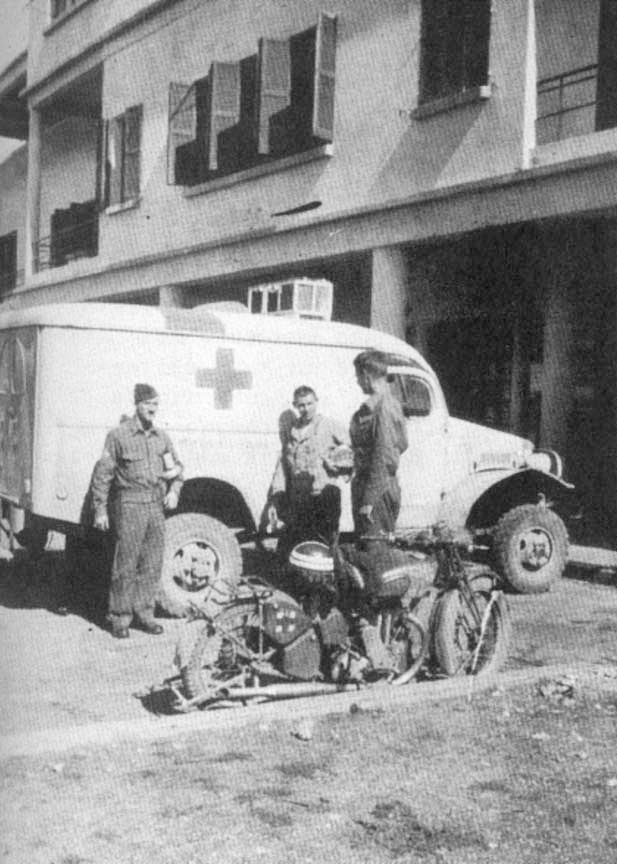
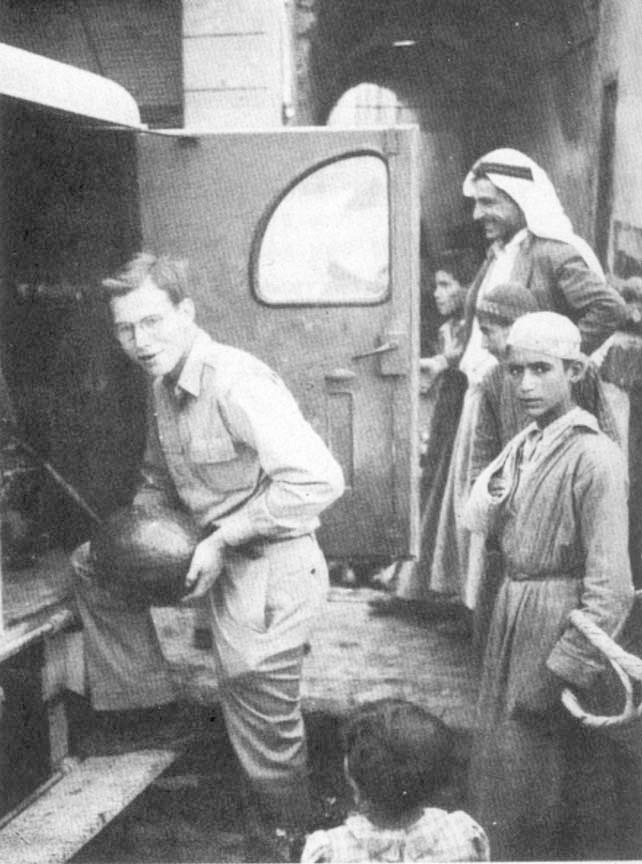
War and rumors are unfortunately partners. AFS has come in for its fair share of the latter and all have eventually drifted into oblivion. The latest rumor that has come to our attention, however, persists in growing and gathering momentum from both sides of the ocean. In short they say that Col. Richmond is in the United States by government order to turn AFS over to the Army. This is not true in any way. Col Richmond returned to make a report to Mr. Galatti on the work of the Field Service in the Middle East through its past year and two months service, and a brief leave to see his family. There has been no hint from official circles in any area that the Army wishes to absorb the AFS. On the contrary AFS is becoming increasingly more of an independent organization, going about its business with the approval and gratitude of the Armies which it serves.
A lot of praise to the Field Service has been written to Mr. Galatti this month; maybe it was the holiday spirit. In any event we pass it on to you:
From the consulate of the Union of South Africas
"It has been a pleasure to cooperate with the American Field Service which is doing such a valuable work in the field.."
From the British Military Attaché, Col. Rex Benson
"Much water has rolled under the bridge in a year and AFS has earned fame. I am so glad that they got in on the hunt and will be there for the kill. When the war is over they will have something to talk about and the older ones can stand up to their own sons who may be fighting elsewhere."
'From the assistant British Military Attaché, Maj. R.A.F. Williams.
"The testimony that we have received is indeed proof that the herculean task that you have performed has reaped a just and true reward, and I feel that it has been a great pleasure and privilege to be associated with you in some small way assisting you to bring this to pass.
"With very best wishes to you and those members of the American Field Service who are helping you in this terrific work and for an even more successful 1943 to the Service."
From the British Ambassador, Lord Halifax:
"I have just been looking at some figures giving the service record of the men of the First Unit of the American Field Service which went, a year ago, to our Eighth Army in the Middle East, at the original request of General Sir Archibald Wavell.
"I must send you a line of warm congratulation on the splendid record of this unit, particularly at Bir Hacheim, Tobruk, and El Alamein; their work has been appreciated but I cannot refrain from adding a personal line of congratulations*"
From General Charles de Gaulle, commander in chief of the Fighting French Forces:
"Je tiens à vous exprimer combien j'apprécie les services rendus par l'"American Field Service" à la France.
"Dès le début de la campagne de 1940, vos ambulances transportaient nos blessés sous le feu de l'ennemi, comme pendant l'autre guerre. Vous étiez à nos côtés en Syrie, puis en Lybie. A Bir Hacheim, vous étiez présents aussi; deux morts, trois blessés, deux prisonniers et un disparu, pris sur l'effectif de vingt et une ambulances, témoignant de l'actif dévouement avec lequel l'"American Field Service" s'est dépensé pour la France Combattante.
"Je vous prie de partager avec les familles de ceux que vous avez perdus, mes condoléances émues. La France n'oubliera pas ses amis d'Amérique qui ont fait volontairement pour elle le sacrifice de leur vie.
"Veuillez agréer, Monsieur Directeur, l'expression de mes sentiments distingués."
War is hell ... but versatile dept. from a driver's letter home: "I have bought a Boa Constrictor from a native animal dealer. It is about four feet long and very docile (so far has remained coiled up in an uncovered box on my bed). It only costs two dollars." This unexpected addition to AFS ranks answers(?) to the name of Eleanor.
Lewis Stuyvesant, a member of the first AFS group to go to the Middle East (he was in the Hadfield Spears Unit in the Syrian campaign of July 1941) has received the commission of Lieutenant in the U.S. Marine Corps Reserve. "Stuyvie" has completely recovered from the arm injury he suffered in Syria. We congratulate him on his commission and wish him the best of luck. His brother Alan is an AFS prisoner of war in Italy.
The War Fund of Madison Wisconsin has included AFS for $500.00 of their budget. We have often mentioned Community War Funds but so far not explained them. In communities where there are war chests, charitable organizations other then those included are generally barred from private solicitation Only a few of the many existing war relief organizations are included in the individual Fund drives; thus AFS becomes one of the favored few, which are usually assured member ship yearly, for the duration.
So many of the Field Service men have been stationed at various parts of Syria that we thought our readers would welcome official statement of some of the work they are doing. This comes through the Quaker Emergency Service from Beirut. It is a general report and announces a more detailed report to be sent in the near future. "This work is carried on in five areas where there are no physicians able to take care of the people and where no adequate government health service exists". Areas where AFS personnel is serving are listed:
Sidnaya area, north of Damascus; 1 Arab doctor, 1 English Quaker doctor, 1 AFS driver
Assyrian Colonies on the Khabur River near Massetche (this takes in Bedouin tribes and Circassian villages; 1 Arab doctor, 1 English quaker, doctor, 2 AFS drivers.
Turcoma area, north of Letakiya; 1 Arab doctor, 1 English quaker doctor, 2 AFS drivers.
"The English Quakers use ambulance cars for their clinics. The American boys use their American Field ambulances for getting about and help very much."
Four AFS men have joined the Armed Forces in the Middle East after serving their enlisted time in the ambulance service; Ralph Muller, Edward Pattulo, Alvin Wright and Wendell Nichols have joined the Indian Army as cadets. After a training period they will be eligible to receive commissions.
AFS Letters have gone to school again. This time the Army School for Special Service at Lexington, Va. is using it as part of the instructional program there. According to the assistant Commandant Lt. Col. McComb FA, who wrote Mr. Galatti requesting future Issues, our bulletin is included with material on overseas field operations of several agencies.
Some time ago a Unit sailing for the Middle East carried a package of medical supplies destined for the Czechoslovak forces in Russia which was delivered to the proper authorities. Mr. Galatti has received this cable from the Czechoslovak Red Cross In London reading; "in reviewing work 1942 we recall again with gratitude your unfailing sympathy and support all good wishes for Christmas and the coming year." The cable was signed by Mme. Edouard Benes and General J. Xnamenacek, honorary chairman and chairman.
Bill Riegelman, whose letters often appeared here, has left AFS at the end of his year's service, and has a job with the Lend-Lease administration in Cairo.
The AFS coffers have been swelled by $250.00. This amount represents the proceeds from the sale of wooden wild birds, carved and pointed by Mr. and Mrs. John Betts of Short Hills, N.J. These birds were made in their spare time, which cannot be very much, since Mr. Betts has a war plant job and Mrs. Betts looks after a large family. The birds sold for the benefit of the Field Service at the Crossroads of Sport in N. Y. City. Mr. and Mrs. Betts assure us that this is only a beginning, and they are working on more birds which will be in the shop soon.
Appreciation from the front dept:. . . . . ."Those sweaters and socks that were donated to the AFS by various organizations and friends of the Service are certainly good to have. The sweaters especially are fine."
Apparently the Christmas packages received in the Desert and elsewhere in the Middle East met with great success, as one letter puts it: "The AFS did something very nice for Christmas. Each of our men got a card, a wallet, and a box containing fruit, nuts, chocolate and cigarettes. All was nicely wrapped and when received out in the un-Christmasy desert brought a very nice warm feeling.
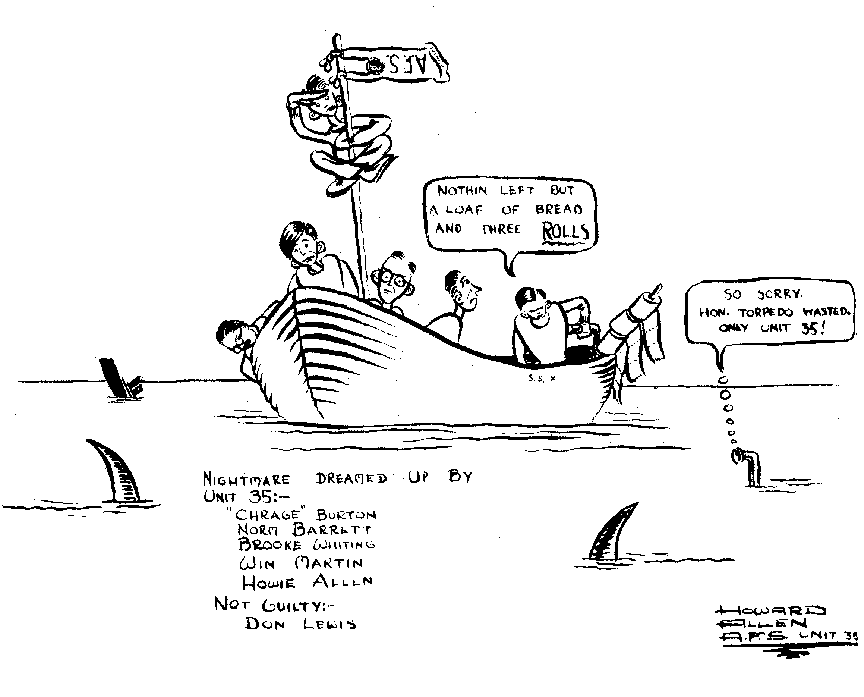
If you want to send a gift to your mother, father, child, wife, or sweetheart, all you have to do is to write to the SHOPPING SERVICE of the Navy League at the above address, tell them what you want to buy, where you want it sent, enclose money order, or instructions to send C.O.D. and message if you desire. They will do the rest. If there is anything you need for yourself, they will be very happy to buy it for you; anything from a paper of pins to a baby grand piano.
No parcels will be accepted by the Post Office for dispatch to A.P.O.s outside the continent unless they contain such articles as are being sent at the specific written request of the addressee, approved by the battalion or similar unit commander of the addressee.
| Agar, William M. | SSU 16 | Headmaster Newman School |
| Annan, David Hugh | SSU 619 | Lt. US Navy |
| Bingham, William J. | SSU 30 | Major US Army |
| Blum, Francis H. | France '40 | Pvt. US Air Corps |
| Bosworth, Thomas S. | SSU 1. | US Govt. Service |
| Cock, Malcolm O. | TMU 184 | US Medical Corps |
| Duke, Dusossoit | TMU 526 | Major US Air Corps |
|
|
||
| Eastburn, Hugh B. | SSU 9 | AFS ME |
|
|
||
| Fisher, John R. | SSU 2 - 20 & Paris HQ | Chairman Vermont State Board of Education |
| Fowler, Raymond P. | TMU 184 | AFS ME |
| Reyes, David M. | Syria '41 | Ensign US Navy |
| Hinrichs, Dunbar M. | TMU 526 | AFS ME (Acting OC the absence of Ralph Richmond, who is back in the US on Mission) |
| Jackson, Peter H. W. | France '40 | Lt. US Navy |
| Johnson, A. Grima | France '40 | AFS ME |
| Knauss, Edward D. Jr. | SSU 10 | Lt. Commdr. US Navy |
| Lilienthal, Theodore M. | TMU 397 | Civ. Def. |
| Long, Hilton W. | SSU 18 | Capt. US Air Corps |
| Maddocks, Thomas H. | SSU 626 | Major US Sig. Corps |
| McMenemy, Logan T. | SSU 2 | Major US Air Corps |
| Moore, Peter V. C. | France '40 | AFS MR |
| Mitchell, Clarence V. S. | Norton-Harjes | AFS Exec. Com. Capt. US Army |
| Morris, John K. | SSU 13 | Capt. US Army |
| Nichols, John R. | SSU 10 | Exec. Dean Univ. of Idaho |
| Rice, Durant | SSU 3 | Capt. US Army |
| Richardson, Gardner | SSU 1 | US Foreign Service |
| Riggs, Carroll G. | SSU 2 | Major US Army |
| Rubinkam, Henry W. | SSU 13 - 3 | Aeronautics |
| Skelton, Leland R. | SSU 10 | (Grade?) US Coast Artillery |
| Tison, Paul | SSU 1 - 3 & TMU 526 | Capt. US Air Corps |
| Roberts. John C. | TMU 397 | Lt. Comndr. U.S. Navy |
| Lewis, Philip P. | SSU 1 | Capt. US M.P. |
| Rogers, Horatio R., | SSU 27 | Major US -M.P. |
| Smith, Douglas M. | TMU 397 | FFF Overseas |
| Stockwell, Roy | SSU 1 | US Army |
| Stuyvesant, Lewis R. | France '40, Syria '41, AFS ME | 1st. Lt. US Marine Corps |
| Talbot, Melvin F. | SSU 3 | Lt. Comndr. US Navy |
| Taylor, Edward H. | TMU 184 | Lt. Commdr. US Navy Med.Cps. |
| Thompson, Henry B. | TMU 133 | Major US Ord. Cps. |
| Tilton, Elmer H. | TMU 184 | 1st Lt. US M.T.Corps |
|
|
||
| Van Santvoord, George | SSU 8' | Headmaster Hotchkiss School |
| Walker, J. Marquand | SSU 2 - 3 | Major US Army |
| Weekes, Charles Alexander | France '40 | Pvt. US QM Corps |
| Wheeler, Walter H. | SSU 3 | War Production Board |
| White, Joris M. | SSU 4 | Capt. Royal Engineers (British Army) |
| Buck, Norman S. | TMU 133 | Dean Freshman Year at Yale |
| Gemmill, William B. | SSU 65 | Office of Provost Marshall in Washington |
| Brown, John F. | SSU 1 | AFS Representative, Lakeport, Major C. A. P., N. H. |
Joris White fights all his wars in the uniform of the AFS and the British Army.
Raymond. Hanks, TMU 133, has a fine lad in the AFS ME. Ray writes to the "Vieux Oiseaux" as follows:
"Bud mentioned the nice wallet .... Christmas present, 1942, from AFS HQ NY ... I still have the wallet that was passed out at the Christmas party at "21" in Paris 1918."
Now that "PRESENT ACTIVITIES" are brought up to date, alumni notes will be welcomed for the next issue.
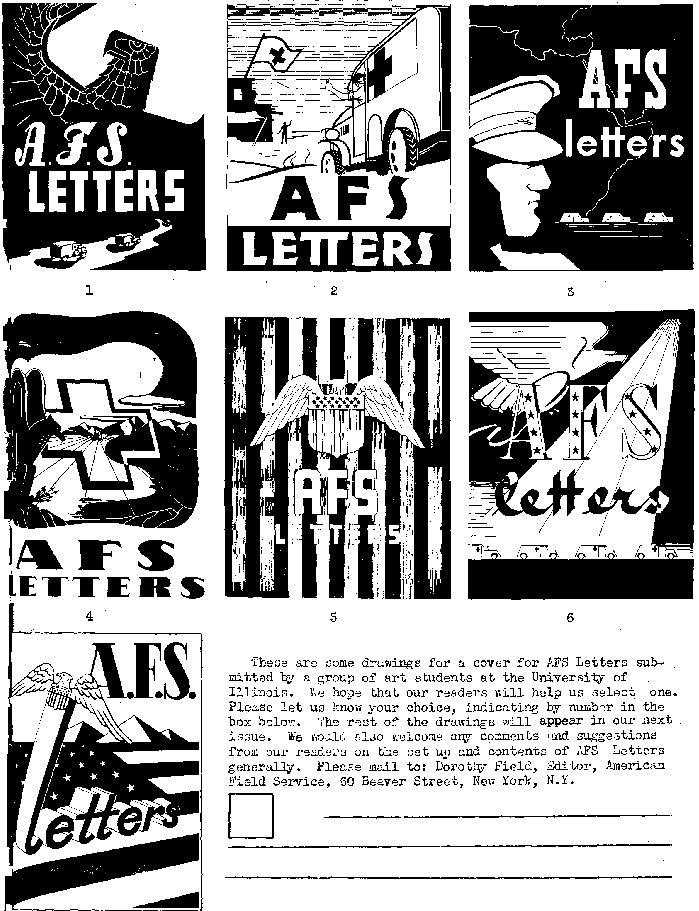
These are some drawings for a cover for AFS Letters submitted by a group of art students at the University of Illinois. We hope that our readers will help us select one. Please let us know your choice, indicating by number in the box below. The rest of the drawings will appear in our next issue. We would also welcome any comments and suggestions from our readers on the set up and contents of AFS Letters generally. Please mail to: Dorothy Field, Editor, American Field Service, 60 Beaver Street, New York, N.Y.