A collection of excerpts of letters from the men serving in the American Field Service overseas; edited and published at AIS Headquarters, 60 Beaver Street, New York, under the sponsorship of the families and relatives of the ambulanciers.
The entire civilized world is engaged at a job in which only global military peace can bring a real holiday. This year Christmas December 25th commemorates, as always, the birth of Christ, though in its merrier festive aspect, Christmas cannot exist for many people. For most of us, the joyous holiday with our loved ones gathered around the home hearth, will not exist; and with so many of our men far off working at tasks from which they get no relief, our own holiday cannot be complete.
Christmas 1942 brings close the realization of the permanence of "good will towards men," which has existed for hundreds of years. Wars, strife and hatred come and go, but the spirit of Christmas remains. Humanity's faith in itself is repeated. We pray for peace and understanding between men, knowing that we will achieve it. Christmas spirit is our mental victory, our assurance of gay Christmas holidays to come.
|
I cross my heart as the Easterners do Whatever you do, wherever you go Through days of labor and nights of rest So I cross my heart as the Easterners do |
| THOMAS ESTEN | GEORGE TICHENOR |
| To the families of the men reported missing in action we extend the fervent hope that the New Year will bring knowledge of their safety. |
|
Under the arc lamp's shining light The surgeon's brain 'gainst time and waste This thing --- a man? --- Once, I guess Here man of woman can give birth |
August 28, 1942.
"We are stationed out among the shadows of one of napoleon's old watch towers right now and its really quite a landmark, with nothing but sand as far as one can see in all directions. We first moved here three days ago, but hope to push on soon Yesterday one of our Bir Hacheim wounded came back to join us after having been in the hospital with something like 78 pieces of shrapnel in him. We are now all on active service again except of course those that were lost. The Free French are now ready to go into action again after all this sitting around. They are waiting orders after being moved to the edge of the desert . . Yesterday I was out on a call from a patrol and some guy in a truck about 100 yards away lot fly with his rifle. The bullet whistled past me and landed in a sandbank. More darn fun! I really don't think I'm destined to be removed by a 'Jerry' after that one."
July 1, 1942.
"I will now give you the horror story.
"Life around Tobruk was not at all bad except for salty brackish drinking water, but since we left, I had had an exciting few weeks with an American Field Ambulance outfit which does the more dangerous stuff at the front. I was at one time with four other ambulances, two of which were destroyed in a tank ambush along with three of our men. There followed a period of free lancing, compass navigating and cooking my own food. I've experienced bombing, shelling, strafing and mortars, but am only really scared stiff by dive bombing. In a Stuka Parade, as they call it, the formation peels off and dives to within 500 feet of you, then drop beautiful silver casks which you watch falling, it seems right at you. You then bury your head and hear the whistle growing louder and louder. The closest; to me were bombs 25 yards on either side and I got a lot of dirt and a piece of hot shrapnel in the trench with me. From a quarter or half mile away, these raids don't bother one except that the ack-ack noise is terrific.
"We lost some ambulances and men at Bir Hacheim with the French Foreign Legion and Free French, which is where Jerry first broke through as you no doubt read. Incidentally we hear that Peter Glenn is P.O.W. ( Prisoner of War) which is not as bad as it sounds, as Jerry treats prisoners well and eventually they will be exchanged.
"Don't for a minute believe the stories you read about the unbearable heat of the desert. It is quite comfortable, and I never felt better and digging a trench every time we move --- which is sometimes three times in a night, keeps me in shape.
"I have stopped writing to the few girls who wrote me, as all they tell me is who sings at what night club, etc. Who cares ! Nearer my realm of reality is where can I scrounge my next can of peaches.
July 22, 1942.
"Would like you to pray for every member of the American Field Service, even the staff back home as they are all doing a most wonderful job; the lads under fire are a real credit to the good old U.S.A. --- a few of them, real pals of mine that I have worked with daily . . ."
June 20, 1942.
"The curse of the Middle East, sand flies, have taken their toll of me. I now have 185 bites, 20 of them festering beautifully. The sand, by the way is not really sand. It is a dust of a finer texture than talcum powder, and so can permeate everything with the greatest ease. My associates are wonderful. I like them all and am lucky to be with them. In fact, I am lucky to be well and alive. Our ambulances are marvelous and it is a treat occasionally to be able to sleep in one. You can lock yourself in, turn on the ventilating system and be as snug as a bug in a rug".
Syria, June 5, 1942.
"First bunch are just being baptised now after some three months here. No sewing yet oddly enough. Haven't tried darning myself as laundresses are cheap. Much paper work of late. Got call about 12 o'clock last night to go to hotel here, some accident or other. Course by time I got there nothing to be found, but ran into A.F.S. bloke looking for his ambulance. W.P.S. will pick them up if you leave them unaccompanied so never got in till after 3, when we found it. We had a soused major in tow which helped a lot. Funniest character around here, the bartender, huge oxlike creature who comes fittingly enough from Dubbo, Australia. Take him down marketing sometimes when he gets caught short for stuff for mess. Best horn blower I ever had, and entirely on your side whether you are right or not. Always threatening every one in way and invariably starts biz deal with wogs by calling them silly ------s. He never gets out of market without slapping at least one of them but they don't seem to mind much. He resigns his job every morning but is always on again at night. Dinner one night in town with B.S. Girl at table next to us fainted but came back five minutes later and finished dinner of shellfish and wine which I thought extraordinary. In Damascus they still have public hanging but haven't seen any yet. Nice to go to and bring your lunch of a Sunday. C. got letter from a priest, prisoner in Germany now who was with him on the Zamzam. Well, am learning bits here and there about cars, will learn still more if actually get mechanic stationed with me as I may, and help him work. The news of raids on Essen looks as though Germans were at last getting theirs. Gosh I hope the darn thing gets over soon".
Syria. June 8,1942
"Really one of the finest countries to paint you ever saw and must say have done rather badly by it to date. . . .With the departure of Aussies from our barracks, have much smaller mess, and Tommies are setting to work to decorate it in grand style. Have bought plants and everything else. Price of plants extraordinarily cheap; also have acquired a much better cook and in a week or so when things have settled down should be eating very well indeed. Visited town last week called Djebail but known to ancients as Bibelosand, supposed to be one of the oldest towns in the world. All very ruined but perfectly beautiful site on little promontory sticking out in the sea. Very tiny or whit's left of it is, but really gorgeous. . .. Just read that Churchill is back in England safe, thank heaven; those little tripe of his make me nervous. We have Basutos guarding our gates at night now which is one hell of a nuisance --- all your life's worth to get in ---have passes now. They make good soldiers but I would rather see them in the front line."
Syria. June 18, 1942.
"Final organization of our men in this vicinity is still hanging fire, so can't take a couple of days off to see more of the country. Met a nice Armenian lady painter here through one of A.F.S. boys. Has a nice house and good French books, studied in Paris and U.S. . . I suppose she is probably younger than I am but she looks about 50. Very nice change to talk to from men though. She works in censor office here and has never been able to afford to paint for more than a year or so at a time. -- result is that work isn't much, but no matter how punk they are, a painter is always a painter. Most of Aussie troops arm stationed with that were good friends are shifting too and much celebrating of evenings. Will be sorry to see them go. . . . Was given two nice pairs of socks by an Aussie Sergeant. Have finally screwed up courage to break shoes issued to me while in desert camp in Egypt and despite their weight have found them surprisingly easy. Haven't even a blister. They were discouraging to look at though because they have iron reinforcements on the toes and a big horseshoe (really) on heel, besides being very heavy anyway. But looks like they will last me forever.
June 19.
"Lovely looking tree here. Same foliage as Jacarandas but has rich red blooms on it in great clusters which when they are examined closer as in our bowl this morning, have same general shape as orchids. Really gorgeous. Must find out name and try to get some of seeds. . . . . Festivities for departing Aussies continue. They brought their beer into our room last night as said they wanted peace and quiet and to get away from an obstreperous friend of theirs who was ejected from the mess by the Sergeant Major for loading a great hunk of bread with ketsup and hurling it two tables away into the face of a buddy ---causing tea spilling as well. In midst of party, was called away on a stretcher case --- man got delirious in ambulance, thank God his buddys came along, --- and when returned, found my peace loving friends had pulled down the iron fence around the little garden outside and sawed a tree partially in half. The room was left O.K., though, except for beer on the floor which is drawing flies like the devil today. Have been scavenging around the departing men and getting all manner of fine things. Another pair of boots, a soapbox mounted on legs which we call our Louis Quinze piece, and an honest to goodness chair taken from a brothel and now C. enters with a water pipe he has just bought!
"Went to an Indian camp the other day to collect a patient. Magnificent mules there and men slapping the dust off the back of the mules, keeping time as they did so. Had come to the conclusion that I was quite a diagnostician, but got slight setback here. If they have pains about the lower abdomen, they have appendicitis; it they are sick and achey all over, it's sandfly; and if they have black eyes and abrasions they have been beaten up. This guy could not speak English nor could anyone hither, so I told another ambulance driver who came along to take him to his M.D., and tell him he had acute, nay chronic appendicitis. It turned out that a mule had kicked him in the stomach! Goodness knows what next month will bring. Hope I will see some of the show before it is over, though. With the paper work, the patient calls, lubricating the car, shining shoes and doing my laundry (do all except my shirts), and studying mechanical book, days go by quickly enough."
Cairo, August 17, 1942.
"Damascus in summer is even more startlingly lovely to visit than in spring, though then the fruit trees were in flower. Now you drive through the desert Mountains of the Anti-Lebanon, worn and smooth ancient Mountains, bright red, orange, yellow and tawny, with outcroppings of silver rocks and the breath of the furnace on them. Then the road runs for a narrow pass and the Ghouta begins suddenly. Suddenly the trees grow, and you drive among orchards with water pouring out of the rocks, and fountains jetting up in summer gardens. It is a dazzling place, a wide oasis of fruit-trees and poplars, with never-failing water. The air changes, so that your whole body and spirit senses the coolness. That first glimpse of violent, rich green just a patch showing around the bend of the narrow gorge, with those bare orange Mountains just above the water-line --- Damascus could not help but be fecund and ancient. It is inevitable and durable. I think if the Church were there, instead of Rome, we should have had a better Christendom. However that is purely conjecture. I have been reading about the great civilization of the Arabs, which was destroyed by the Church in Spain, and the Turk, out here. Must have been a very beautiful time. Must have been a bright day in History. I go down to hear an Arabian singer sing songs which I thought to be classic, but which turn out to be recent hits from Egyptian Movies. One lovely haunting song is called, 'Boukera-minsefar'---'Tomorrow we're going away, ---tomorrow we are going away; we'll have a fine time, we'll dance and laugh, --- we'll play and we'll make love ---tomorrow. Tomorrow we're leaving'. Arab music even at its most joyous seems sad to me. In effect, I mean. Demain on s'en va; on va rigoler, on va s'amuser, nous allons danser demain, She is a lovely levantine, the singer. Islam has not prospered too well, either, but it seems to me all moslems have a good ides of how to live. Their houses are graceful and adorned and their orchards --- every house (I do not talk of the always-with-us poor) has a garden and a fountain, with flowers and trees --- are designed for beauty. They are a dishonest lot, according to our standards, --- but so are we, as a matter of fact; how intolerant and unjust we are, with other people's dishonesties; and, as a matter of fact, courtesy and la politesse, those accents of culture, are both based on lying and concealing aspects of the absolute truth, and what the hell is diplomacy? In fact, the greatest gentleman must be, ipso facto, the greatest liar. A good gentleman must have some basis of social intercourse which has nothing to do with the brain, the vocal cords or the sexual organs. The French chose La Nature and La Logique (identical), and the British chose the Playing Fields. It is a shame the Germans chose guns. And the Americans escaped in pursuit of the dollar, otherwise called 'Happiness'."
Probably Syria. September, 1942.
"You live very fast out here, and sometimes everything and everybody suddenly changes tempo and nothing moves and nothing happens. You get the feeling that life wants to move but time, Father Time, won't let it. You measure time here by things which occur or do not occur --- things promised to occur at a given hour. I am one of several persons here with a timepiece that works well. You measure time here by the heat of the sun and the numbers of hours you do work in the heat. On the coast in the breeze it is possible to walk on the roads in sneakers. Twenty miles inland on the plain, long wide fault valley the roads melt and the rubber on your sneakers feels melting hot and you jump back into your ambulance to cool your feet and let the tires on the old baby carriage explode.
"They do, too! It takes a special skill to handle a front blowout. Our old friend Major T. had one of the worst when he was spiriting me away to a tryst of his own at so much per so much and he was skillful. We did go in the ditch, but right side up. Do you understand how that it is hot here, and that tires explode!
"This morning I saw a woman carrying three bright big green water melons. Big Ones! One under each arm --- and, one on the top of her head ! There are more colors out here than I ever saw in a paint box and more shapes than Art Young ever wrote about.
"Friendship out here can be based on the smallest things. There are so many people to talk to that often not a word is spoken. But if there is something to work over and talk about then things open up. Someone, at some time or other, had felt that he needed the rear view mirror belonging to my ambulance more than my ambulance needed it. I determined to buy a new one in the village. What got it for me? Not the two Syrian pounds I paid ! Oh, no. It was my command of French and gesticulations! Mine may be funny but I'm having to use it. It was terrible and very satisfying, for I got the mirror at a price, that would be fair in any tongue.
'Well the fittings on the mirror were good but not correct for the ambulance, so I stopped at the camp of the South African engineers to have them engineer my rear view mirror into place. Kind they were, those S.A. lads. 'Now that would make a proper mirror to shave by', said they. We discussed that point and after a cigarette or two I agreed that it would make a good shaving mirror. It was flat, and had a good backing of silver. But why should I pay two good pounds to help them shave? They had an answer! They had been trying to shave in a convex, rear view mirror which makes perfect vision on the road but gives a face a distant dreamy look. Not too good for shaving on a morning when you're not too happy anyway. So, we made a fair exchange all around. They can see themselves, so help them, and I can see my road behind me. A bit rough, jolty at times, but a good road.
"Only a few day later my ignition system failed very quietly and completely. I believe I could have found the defect if I had spent about two days at it But a friend gave the old baby carriage a push, the engine responded and I was off to the S.A. camp for repairs. It was a Sunday morning when many workshops are officially closed. I was lucky though. The shop was closed. But H. remembered me. Why we had swapped mirrors! He was all clean and neat, and a fine looking lad. He didn't know much about ignition officially, he said, but he'd try. Well, in that blistering, broiling heat he worked for two hard hours, overhauled the generators checked all points, and generally made a new girl of the old thing. "Thanks", said I. "No thanks said he, "I had no drink last night and drank a few beers this morning, and if I hadn't needed to work them off I shouldn't have helped you out." If that is the South African idea of a Sunday morning I want to be there for a year of Sundays."
"Carry 99% soldiers in ambulances, though occasionally a civilian workman connected with the barracks. The past few days some men have been coming back from action and how beefers can continue to believe that the A.F.S. misrepresents facts and that you don't do what you said you would, is a mystery to me. Some of the tales brought back by lads, harrowing. Can't mention casualties or missing. Dare say you may hear of these thru U.S. newspapers or Mr. Galatti before I can get it to you . . . . For the first time there are ambulances for all drivers now. I hang around watching our mechanics check ambulances. Am actually learning as much about a car as possibly can. Tire changing is a tough job on buses we've got. Getting it off the rim, but had another lesson to-day and am going to try it all by myself tomorrow, yanking one off own ambulance and putting it back again. . . Believe I told you leave in Haifa was garnished by bombing. A British officer had some lovelies all lined up, when bang went the bombs and party was ruined. He saw most of display from rooftop, officer led him there, thinking officer was leading him to safety. The lovelies vanished to their homes. . . Have been swimming when had the chance; there's a lot of nice places around. They've started playing tennis again at the barracks, when the Aussies were here we had it a lot, but there was only one court, and with the crowd, it was almost impossible to get a game. Now there's more chance of it.
"Had a gay week all in all, this past one. A dinner, a glorious one for five or six of us, in a town up in the mountains. It certainly cost plenty. Friday, C and I went on an all-day, exhausting trip to see Cedars of Lebanon. These trees once dotted the entire countryside, and were used by Solomon to build his temple, etc. . . but, to all intents and purposes, except for an odd one about here and there, they're now confined roughly to an area of about three acres. The trunks on the older ones are very thick, and they were impressive all right. The best part of the journey was the trip itself, you climb up to 1000 feet to see them over roads and cliffs that made you gasp, and you would see old deserted monasteries and hermitages built in caves in the faces of cliffs. How in God's name anyone ever got to them, I don't know . . . . On the way down from the cedars, we stopped at a little town in the mountains where, buried in an altar, the top of which could be lifted up, was a great Lebanese patriot who at one time commanded a force of nearly a hundred and twenty men! They venerate him as a saint practically, and his old sister comes in once a week to dust him off. He was the worst preserved mummy I ever saw and I think was careless with his kissing because his upper lip was absent . . . .
"Some ack-ack guns went off the hitherwards the other night and thought for a moment there was going to be some excitement, but there was no general alarm and so guess they were popping at a reconnaissance plane. . .
August 5, 1942.
"If you want to be the life of the party and win friends, try this amazing one. Stand up along the side of the wall and reach out as far as you can just touching the wall with your finger tips, then keeping your feet in the same spot bend back your elbow and either rub it vigorously several times or smack it a few times (tho this is somewhat painful on the hand) having done this, try and touch the wall again and you'll find that your arm has been shortened by several inches! . . .
Aug. 6th.
"Saw a U.S. Lieut. in town the other night, one of those in group that were forced down in Turkey. He was very young . . . . . . Run across some pathetic cases here. Awfully nice chap, very good worker, good spirit, nice build etc., but with a back and neck that would make your dear husband look like Garbo in regard to boils, etc. After getting all the way over here, he now learns that he can't be sent to the desert in such a condition. There's waste for you; any honest doctor back home should have told him this. My health continues excellent.
Sept. 3rd, 1942.
"Living about as primitively as I ever have in my life. Desert surprisingly cool and salutary after mugginess of Beirut. Very cool at night, need no blanket. Live in and out of the ambulances, like gypsies, Have been sleeping on ground except nights when take patients into town which actually has been most every night. Have one tent here for headquarters and a little stone hut used for cook house. About 8 ambulances. Planes fly overhead all night long, some of them enemy but you can't tell them apart. Greatest danger is shrapnel from own ack ack guns. Heard some dropping round us the other night and S. and I met face to face under the ambulance! Each looked so funny, couldn't help laughing! Noise only about as loud as Roton Pt. fireworks Friday night. It's nice safe introduction to more intimate action. . . .Have been to Alexandria on days off and like it immensely. Still have vague idea of town tho, as most of it seen at night. Parts much like Nice. Cheaper than Beirut, delicious French restaurants. Parts fascinating curious old houses with second stories overhanging first, like some English Inns etc. Desert in parts beautiful, finest Metro Goldwyn sand with razor sharp edges in drifts. Some walled town look as if crusaders had built them, not far away. Other night while in town had air-raid alarm. Funny to see all gypos scrambling and yelling for shelters.
" Found a small scorpion in my bed the other morning, he seemed very apologetic, no one has been, as far as I know, bitten by them. The Germans just bombed the airport again. They fly so high that they look like little silver fishes in the air. Really lovely sight if it was only bigger and you were sure of who's planes were who's. Airport good four miles away. . . . Have some jolly beer nights of late with an extraordinary English cook and slavey attached to us called Darbey who's attached himself to S. as a sort of bat boy. Looks as if he had colored blood in him, or Polynesian. Eighteen years in army and still private. Has a pal called Joe who has done some rare things. "
Capetown. August 19th.
I've met a rancher down near Kimberley, a 2nd. Lieutenant in U.S. Army. From what he says, and from what I have seen, South Africa is really a marvelous spot, much like our own west. All their officers have known have been fine fellows. The pioneering spirit is still very strong, and there's an awful lot to be done there . . ."
June 3rd.
"As for the war, it's at last in our laps, and I find it 'aint like in the movies'. It's just another kind of foreign exchange, a colossal business, with destruction purpose and waste its product, and in these terms quite efficiently run. Doesn't matter viewed from back areas (where we've been up to now) or battle areas, it's just the same stupid grind, for both the individuals and the nations involved. The blood and thunder element of total war merely reads more glamorously than the rest, is essentially the same trying daily chore. It is revolting that supposedly intelligent man can talk himself so easily into playing such a harmful game. Naturally, when I'm driving casualties over that bumpy road --- and I have had a few particular beauties--- and hear them gasping at every lurch, sometimes go delirious over the worst stretches, perhaps mumble 'thanks' when I unload them at the other end, then I am especially affected emotionally at the shame of the whole damn thing. But my head tells me that this is actually minor, that major waste is the lost years of peace and normalcy, the misdirection of such tremendous economic effort, the physical destruction and the unconstructive use of resources, the dislocation and privation suffered by nearly every one in the world, regardless of his part in the war, the unhealthy attitudes and morals that will lag over into peace times. Old stuff this is, of course, but when it's seen first hand it becomes very real all over again, has a little more substance than when read off a textbook page.
June 10th.
"The first few sheets you will find a little muddy. Frame them. They were rained on! Had a short cloud-burst several days ago, which just isn't done in these parts this time of year, so everyone was caught short. Everyone leaves their kit lying around on the ground, because the weather is constant and dry. I scooted back to our canvas covered dugout, found big bulges of water dripping down on my stretcher, my blankets and papers wet. . . . We all moved into an old camp a few hundred yards away, now have regular dugouts. They are cramped somewhat, full of fleas, needed working on. Many of the fellows prefer living in their ambulances, just use the dugouts for their equipment and for an emergency shelter. They are fairly comfortable to live in, but they give one claustrophobia and a worm complex. Also ours has a lingering stench of stale petrol, because T. dunked his bed roll. to try to get the fleas out. They issue flea powder and it merely seems to send them into a drunken frenzy, like cats and catnip, and they come from all directions and delightedly roll in it The fleas and I have reached a grim practical agreement, under the terms of which have granted them considerable crawling liberties, in return for which, they take only one smell practice bite per flea per night. It is quite satisfactory and I am bothered little. Rats and scorpions are alleged to have joined the fifth column, but I've seen no rats and only one scorpion. Did take serious action on a mouse in my luggage. While we're on domestic matters, I might boast that I can sew a mean button, but have found replacements much easier than darning. Wash my clothes when we go swimming, occasionally wash shirts and short pants in petrol when they accumulate enough grime and stain Incidentally, I'm going to hate to get back to long trousers again, shorts are so comfortable."
No Date.
"We were packed into open lorries at the pier, our baggage in others, and the officers in a vacant ambulance. All afternoon we drove and drove and drove. The sun was blazing, the country turning to shimmering sand wastes, undulating towards distant blurred horizons. Along the tarred highway solitary donkeys trotted along with triple rows of gilt bangles jingling over their muzzles, their hooded riders lolling back on red saddles. Women swathed in black filed past, their eyes enormous with kohl circles. As we travelled the air grew hotter and hotter and even the tearing breeze of our transit burned as it cooled. Occasionally the road stretching ahead into a hollow, filled with palms, dates hanging in great castanets of reddish black beneath the fronds. Then on up the oily ribbon of road stretching ahead into a curved infinity. Now and then lorries and equipment lumbered by then the increased traffic indicated a camp ahead. We passed several field punishment camps, for British offenders, and a barbed wire enclosure for Italian and German prisoners. At each corner a dizzy wooden 'fire tower' housed an armed guard We stopped once for a quick you-know-what and then started off again. Many fellows were lobster-colored by this time and lying on the floor of the truck. By six o'clock we had been travelling along a little canal for an hour or so. The vivid green strips of garden on either side of the brown water were cultivated to the last inch. Each tiny patch was burdened with waving spears of emerald colored corn, or long trailing melon vines. By the road eucalyptus trees looking like silver willows swayed in the heat. The native farmers use a rough tree-crotch for a plough, using a camel, a donkey, horses, or their relatives for pulling power. The slowness and uneven methods result in waving lines in the rich watered earth... Every inch of the precious earth along the few waterways is made to produce. . . The boats are called dhows. They are flat and prowed abruptly like a cobra-hood, painted in fantastic designs, with rough masts high and tilted cross-bar to which is lashed the whitened sails. They lie low in the water, very much like an inverted flat scoop, the bow being an abrupt upturn. This gives the dhow a pouter pigeon appearance, the painted breast puffing out to defy the harmless little wavelets that the placid canal throws up. Parallel to our highway, and fringed with grey green trees, these minute waterways wend their smooth way. Occasionally the natives stand nude along the grassy hillocks soaping themselves with dark rags, and sometimes calmly evacuating along the roadside waving gayly to passersby.
"We are now camped on a vast sand-and-pebble plain. As far as the eye can see, the tent roofs lie, roped to the sand. They are set up in any formation which causes the tracks and faint roadways to curve and slink about the plain. The tents are loosely grouped and not very near each other. Ours is about 25' X 15' with two thick bamboo poles, capped with globes of beautifully tied rope, to support the ridge-line of the roof. The aides swoop down in a long octagon to meet the walls which are 5' high. Outside the bamboo poles are roped to pegs in the sand, giving each tent a tentacled appearance. So far we have ample drinking-water, and of course tea at all meals. These take place at one and six. Today we had a raw cucumbers an onion, a slab of cold corned beef, a slice of whole wheat bread, butter, jam and tea. All vegetables and fruits are first washed in potassium permanganate solution, yum, yum! It has never rained here. The ground is like mushroom-colored talcum, six inches deep in places and soft as velvet. The breezes sift whole clouds of this golden dust across the land, giving the vistas a soft, luminous aspect that has its own beauty. The very austerity and bareness are lovely at times, especially at dawn and dusk. Our training officers are desert veterans and very congenial men. We will move by the time you are reading this to relieve others ahead. Then every 16 days we get two days off, followed by a week at the maintenance camp for repairs. This schedule is designed to rotate us at active spots, then give us a much needed forty-eight hours in the capitol, then a week to get ready for the fray again. We are about 85 miles from our official address and will be sent 60 miles beyond it soon.. It is strange to see life being lived so near to the holocaust. When air raids come rockets are sent into the sky, the color indicating the type of raid. Overhead in the daytime great hawks whirl in the sky and float low over our heads. We each have our own vehicle, a mechanic, and a leader for every six of us."
No Date
"I am fascinated by this burning country. The vistas are so long that they attain an unearthly, hazy quality which is accentuated by the luminous filter of powdered dust, as if a gauze was pulled across a skeleton. The stars are splendid and dusk is cool and highly colored. We saunter home to our tents after dinner at six, mess plate dangling, and a welcome cigarette soothing the rough food. The trucks and motorcycles are resting and only an occasional plane glints across the radiant sky. The sun, an impossibly huge orange ball rests on mauve, pink and lavender clouds just above the distance, and the whole high sky is delicately, deepeningly bathed in blues that blend with the sunset. How often I've looked overhead to think that the same stars and moon were lightening your sky, only seven hours later! Like Bedouins, our tents are standing about, the door-flap swaying in the breeze. We usually keep one section of the wall open, but stretched with netting, to allow plenty of air to come through. Most people sleep on a canvas stretcher loaded with blankets and bed-rolls and canopied quite royally with crowns of mosquito nets, some black, some yellow and some white so there is different color as well as draping. Where available, we have covered the pebbly sand with cheap matting while overhead undulates a kerosene lamp. The tent is also lit with candles at night, stuck in empty peach tins or Australian beer bottles. As bedside tables we have appropriated little split bamboo crates that they send cucumbers in. They are delicate and "spindley, about 10" high. We get so little that is sweet that we get ravenous for desserts and candy. I wish I could enclose a letter I just received from Marjorie Kinnen Rawlings. I had written her to say how much I'd enjoyed her 'Cross Creek' and she answered me with six charming pages, an offer to send me a rather rare book, and asking me to write her more.
"We have lectures on all necessary subjects. Every other day we file off to the blessed relief of a rationed shower. Of course, by the time we get back, we are hot again, but the satisfaction is there. I forgot to mention that always in the distance is the smokey spiral of small 'twisters'. These spouts are like inverted whirlpools and are amazing in their sharp outline, often being an absolutely straight tan line extending up into the clouds a mile or two above. As they travel over the plains, the air suction lifts this column of dust in a vast cataclysm of air. Yesterday our tent was engulfed in one. For a couple of minutes the ropes flapped madly, the air thickened violently, we couldn't see 10 feet away and, choking with dust, we clung to the bamboo poles to prevent our tent rising any more off the ground. At the end, the spout skidded off impishly leaving every single thing heavy with dust. Our faces looked heavily powdered, our beds like crumbling tombs.
"There is so very much I'd like to write you; the organisation and the effort is vast, so inexplicably impressive out in this nothingness. If you hear anyone complaining, tell them the tires are out here, working, the sugar is being used every day, and the things they are doing without mean life and refreshment out here.
"I have seen many curious sights already and talked to dozens of varied strangers. I cannot help feeling now that there is more sense to this conflict, not because of the old clichés and speeches, but simply because of listening to the thoughts of men out here. But there will certainly be more of a change in everything afterwards than most people realize. The conflict is more than we can see on the surface, believe me. I agree with Secretary Wallace that 'the coming century will belong to the common man'. Our organization is very well thought of by the British; the conciseness of the officers is a joy. "
September 23, 1942.
"Yes, it is three days' leave, and you can imagine how we are enjoying it. A room with a bath (in which I spend most of my time when in the hotel and would like to leave the water running in the shower, just to hear it the rest of the time) --- every meal in e different restaurant, and cocktails before every one but breakfast, which is served in bed. . . I had cocktails yesterday with Chester Morrison --- do you listen to his broadcast from here? . .
"You would be surprised how pleasant life in the desert really can be. The nights, sleeping under the stars, are really lovely; also the sunrise and sunset, which are practically our bed hours. The lack of household facilities one gets used to quite quickly. For example, I shave every morning with piping hot water made on s stove consisting of two small fruit cans. The bottom on which one pours just a little petrol and with the hole turned into the wind one can boil water in five minutes. This also means we can have cocoa or soup, which helps."
September 10, 1942. Cairo, Egypt.
"Things have been a bit hotter up here this time. You have probably read in the papers about Rommel's attack, our counter-attack, and his withdrawal, all of which occurred a little over a week ago,! It was a pretty hectic time for most of us. I was out at an R. A. P. and, as a result, spent a couple of very sleepless nights, what with two-way shell traffic over my head, and with flares and bombs being dropped all over the place. Fortunately the battalion I was attached to didn't have many casualties, so I wasn't very busy. This particular one didn't go in the first night of the attack. The next day, however, we received orders that we were moving up to replace another battalion. That afternoon, in the middle of a dust storm, we proceeded up through the mine fields and settled down just outside them. Being but there is rather a weird feeling, because to the East and South was a vast stretch of desert, somewhere in the midst of which were the German lines. And they weren't too far away. I had one terrible moment out there when shells were falling all around me. I had a patient in the ambulance, so I just stepped on the gas and got out of the barrage. It's a wonder, however, that I didn't get a piece of shrapnel in the ambulance, I don't think I have ever been quite so scared in my life. I was sure I would have a gray hair or two, but as yet none have appeared. That same evening we received orders to withdraw. What a relief! Rommel was retreating with huge losses, so there was no need for our battalion. One of the chaps in our section was missing --believed killed --- after recent action. His name was Arthur Foster --- an older man --- who had come over here in the Field Service. I was always afraid something like this might happen, since he was fairly deaf and probably couldn't hear something coming in time to duck. Nevertheless, he insisted on being up at an R.A.P., so our officers couldn't very well keep him back.
Durban, South Africa Unit 18.
"At camp here are a lot of American Air Corps boys which makes it more congenial, especially as they have gobs of money. The other day we had a good walk through the valley of the 1000 hills --- the heart of Zulu land but unfortunately the natives in the country only dress in rags and didn't do any shinnanigans for us; but in Durban some enterprising business man has them all fitted out in outlandish bright colored get-ups, pulling rickshaws all over the town. They will also knock you on the bean at night and strip you for your valuables if you happen to wander down lonesome alleys at night."
No date.
"Our training camp is in the desert, mile upon mile of which is covered with endless rows of tents, and trucks and rough movie houses and water and tents, and more tents, and sand, of course. All Egypt seems a great camp. Camp facilities available to us are a movie house, Catholic Women's canteen, Naafi (Navy, Army, Air Force Institutes) tent where beer and sandwiches are sold, showers twice a week, Arab laundry, Arab style latrines, and a water tap. These things we were told will be highly valued by us after we taste life at the front, where an ambulance is our only home. Even so, it has taken the entire training period for us to gradually accept the standard of living here imposed. We live out of duffle bags, dress in 'dirty khaki'. A nearby Arab laundry takes in washing, but returns clothes dirtier than they were originally. Flies during daytime and mosquitoes at night make living outside a netting most uncomfortable. And a great howl was raised the first day when the latrines were discovered to be Arab style or seatless.
"Our new half-ton Dodge ambulances were issued the third day after we had arrived, when each driver was charged with his ambulance, which became his almost as much as if he had owned it.... Across the desert we found them plenty tough and perfectly able to cross dangerous sand traps and rough country. Besides the four speed, the cars are fitted with four-wheel drive.
"After two weeks of training, our company was formally inspected by British and AFS officials. All vehicles in perfect condition and all volunteers in perfect dress stood in formation to receive the commendations of the officers and we were told what part we were soon to play in this World War II."
Posted from Trinidad, B.W.I. July 19, 1942.
"This is an interesting town --- its population has increased considerably because of the greet influx of the British and American military... Monday we went to the botanical gardens, which are one of the best in the world. There is a wonderful orchid house there, where they grow the rarest kinds of orchids."
Durban. September 23, 1942.
"We came here by train --- lot Class --- about 1000 miles through several kinds of country. From the Cape you climb between four and five thousand feet and spend about a day in the Karoo, a dry, hot desert (rain about 2 weeks in a year). with sage brush --- rather like Arizona or New Mexico. From the Karoo the train entered a high plateau, with steep hills, and long sloping valleys more fertile ---with many ranches--- of horses, sheep and cattle and some wheat and oats. The farming here is done by natives who live in square mud huts or in caves on the sides of the hills. Sometimes in the center of a great plain one might see a large collection of these huts --- much like those of the south-west American Indians.
"As we descended again to sea-level, the earth became more and more fertile, fruit trees, increased irrigation and a green landscape, until we reached Durban's lovely city, with wide streets and many flats and hotels. Durban is a summer colony and is more cosmopolitan than any place we have been in so far. There are interesting native curio shops and side by side with rick-shaws are 1942 American motor-cars with right-hand drive."
September 18, 1942.
"Some five weeks ago our section was sent out to a different sector than we had been to previously. We got to the MDS --- considerably behind our advance positions and there we sat for a few days. Then suddenly one morning B. and I were detailed to a certain unit which was, it developed, the farthest west of any unit in the area. We were together in one ambulance, incidentally. From then on we were on our own, more or less, for a little over three weeks, and in that time the action which you undoubtedly read about took place --- and we were, as you will see more or less, in the middle of it. The MO to whom we were attached was a wonderful man in many respects, and we got along with him as if we were old friends way back (more of him anon). Our RAP was just way behind our most advance troops, and during the first few days there was little, if anything much, by way of excitement. We did get a chance to become very familiar with the surrounding terrain, and later this proved invaluable. Then, at about 12:30 one night we were awakened and told to get ready --- that Jerry was advancing directly at us, and at our flank. A few minutes later Hell broke loose all around us. Our guns at our rear began firing steadily, and the whine of the shell soaring through the air became incessant, west and north tracer bullets followed one another around in every direction. The skies were lit from time to time by flares and a sort of suppressed movement could be heard on all sides. Our orders were to remain where we were for the time, and B. decided to lie down under some blankets alongside the car. He was soon asleep. I sat in the car. All of a sudden there was a whine of a bullet very close and a plop a bit in front. I assumed it to be a "over" or a "ricochet". A second or so later there was another and yet another. Then came God knows how many.
"This", thought I, "is very strange and requires thought." Deeming it easier to think on the ground with the ambulance between the propelling machine gun and my beautiful white (not so very) body, I acted accordingly, but it kept up for nearly three hours and I soon realized that we were being the unbusinesslike end of a businesslike Nazi sniper. This particular fellow was a bum shot, however, and by some miracle never touched us. Then from out of nowhere came a Messerschmidt. He, too, had designs upon us. He missed us utterly the first time, but swung and had another go at us from no more than thirty or forty feet off the ground. He was in a bank however, and his bomb went over us nicely, making a fairly sickening noise as it hit the ground beyond us. Then a few more planes came overhead and dropped flares all around us. It was a weird sight and a frightening one at first . The eerie pale yellowish shadows cast on the sand by the light from the flare is something one must see to believe. Bombs dropped---none very close, thank God--- and then a steady stream of our vehicles began to wend their creepy way eastward. 'Yes', we were withdrawing ---'but according to plans'. We were the last car out, partly because we were supposed to wait a certain amount of time, and partly because the MO's jeep wouldn't start. I pushed it ---it was facing west --- 'Where was Jerry', you ask. He was west --- and coming east. But the jeep started before we began to run over any Jerries, and we took our way east. After some miles (not many) it was light and we were hungry. So we stopped and ate breakfast. Believe it or not the guns were firing over our heads.
"Ultimately we got back to our new position and it was quiet for a spell. There were a few Stuka raids, however, and about four o'clock in the afternoon we had to take some quite seriously wounded back to the ADS. I wish I could tell you about that afternoon, but I can't. Well, the ADS had moved --- God knows where --- or may be I am giving God too much credit so we decided to keep on going, and finally after a long nerve wracking dash across some of the worst country you can imagine, we got the MDS on the run. It was on the move but we stopped it long enough to transfer our patients and then started back. Soon it began to get dark, and it was difficult to tell just where we were. You see out there we did not travel on marked tracks we just out across the country on a compass bearing and trusted more or lees that eventually we'd see something recognizable, but in the gathering dusk it was quite impossible. Moreover most of the few trucks which could be seen were heading east --- and nothing west. Finally we passed a troop of gunners, and after going on another mile, I persuaded B. to turn around and go back, at least so as to get a map reference as to our position. . . It was a weird performance. With the map reference by radio we proceeded across the desert on a bearing and, wonder of wonders, after about an hour's drive we hit it right on the nose. Incidentally at our point of inquiry, I was standing next to a wireless truck while our location was being sought, when suddenly four Messerschmidts dove at us. They over shot the car I was in (their target) and nearly got an ambulance. As a matter of fact one was so close that it nearly hit the ambulance in a head-on collision. B. claims that he got out of the car and under it without either opening the door or touching the ground --- and, for my part I believe him. We had no sooner reached our unit (where the MO welcomed us as if we had returned from the dead --- he was really worried about us) when we were advised that we were going out on a column. About all I dare tell you at this time is that we were gone about two weeks --- that at times we were in the thick of some action quite different from anything we had yet seen, and that, all in all, it was an interesting time despite substantial periods of waiting for something to happen which would break a complete lull in the activity. It always did. Never again will I make fun of the British communiqué with a smug swish when it reads, 'Our patrols active, nothing further to report'.
"The two weeks that I barely touched upon were by far the most interesting and at times the most exciting. I can say that we participated in our first advance, and at one point as we moved forward B. and I leaned out of the window yelling, 'We want a touchdown' and generally trying to turn the desert silence into a Dartmouth-Harvard football game. I might add that we scored a safety by a manoeuvre strangely like a quick kick. . They are as confident of final victory as you and I, and I am no less sure than when I left. It's astonishing to realise that these men have been exposed to every demoralizing force imaginable and are as untouched by it as if it did not exist. And believe me their optimism is one day to bear real fruit. This sounds perhaps exactly like my comments on the New Zealanders ---let no one tell you that the British Tommy has a superior anywhere in the war when it comes to sheer guts, patience and skill in the use of their weapons. Whatever the future may hold in store, whatever gallantry and skill and ability the American Army may show when finally they do start fighting (though God knows when that will be or where), whatever immediate effects may be seen as the immediate tangible results, let no one say, to me at least, that America won this war. What Russia is doing you know as well as I, but these men out here are doing their share and more.
"I have learned an entirely new kind of driving--- one rides over plain rocks, climbing over mounds and moving through the country that at other times I would have thought beyond the capacity of any car; the next moment in deep sand, helpless without our four wheel drive, but we are able to get through without it.
"As for actual duties as ambulance drivers --- they were somewhat different than when with the New Zealand sector. Just as close to actual front troops, yes, but that means very little with a unit as mobile as this one was. One moment we might be close to the so-called German lines the next one several miles away. Wounded men were less frequent, because we suffered fewer casualties but when the Stukas came or the Messerschmidts appeared (they move so fast that they cannot be said to come ---they just arrive) we could go out to pick up the wounded, if there were any. The difference was that the distances were too great or the intervening country was too nearly impassable to roam around the way we did with the other unit. At other times we would be on the move it was against orders to leave the column until it took up its new position. A greater proportion of the wounded men were brought into the RAP in lorries etc. About one o' clock one night we were told to go where a Bren gun had been blown up. To reach them we had to pass through a mine field, and I can promise you that it was anything but fun. Fortunately the men were not too badly hurt and we were able to get them all back without too much delay. On another occasion we had a turbulent ride across some of the most incredible country imaginable seeking the victims of a Stuka raid. We got close to the spot, but found almost a sheer precipice of almost forty feet in the way. No one had told us about it--- we had come on a bearing. It was too long an excursion to go around and there was a considerable amount of shelling going on in the vicinity. So we decided to chance it, and with our hearts in our mouths and my foot on the floor, over we went. We made it. Once again I paused and gave silent but heartfelt thanks to God and the Chrysler Corporation. The sight that greeted us was rather gruesome indeed. Three men had been hit. I won't describe their injuries, but they were as serious and unpleasant as anything I have seen to date. . . .
" . . . . . To make matters worse, the padres accoutrements for performing the last rites blew away; and while B. and I lowered the body into the grave, which was not wide enough, the padre went tearing across the desert in something between a lope and a gallop in pursuit of his Bible. Behind him floated his purple scarf. His hat nearly followed his Bible, but he succeeded in salvaging that with a last desperate grab. I leave the rest to your imagination."
No date: en route.
"Before embarkation, I had been somewhat fearful that all opportunities for relaxation would be imperilled by strain and nervous tension. But a group of American boys on shipboard don't sit around and worry; the psychology works in the other direction. Gradually they begin to humorize dangers that had at first seemed gravely serious and then to forget them altogether.
"One afternoon at about 2:30 land was sighted; merely a thin gray line. Gradually rolling green hills became discernable, shrouded in heavy gray clouds. Africa looked foreboding and sullen. Soon native fisherman were seen gliding about in their small and primitive sailing vessels. They were cordially greeted by the men on board and the blacks waved and grinned. As we approached our destination, palm trees and native grass huts became visible. Children were paddling around in front of their huts. They were as bleak as night. Nestled on one side of a sloping green hill was the town itself. Unfortunately we were not permitted to disembark however, we were entertained by numerous natives who took the occasion to paddle around us in their narrow cottonwood canoes.
"I spent two days and nights in Durban, Natal, a city with a population of more than 250,000 and as modern as any town of its size in the U.S.A. city where semi-clothed Zulus and barefooted Indians board double decker busses and street cars alongside of immaculately dressed Europeans. A city where rickshaws weave in and out between fast moving automobiles. And a city whose waterfront is lined with modern first-rate hotels. The Palm Beach of Africa.
"Labor and food are cheap in Durban. Every European has at least one Zulu servant who will work from 6 o'clock in the morning to 8 o'clock at night for four dollars a month, with his food and board."
September 7, 1942.
"At the canteen each night we listen to the BBC news over a battery fed radio. Our 'canteen' is a pile of crates in the middle of our parking lot, where you can buy beer, 35¢ a quart cigarettes 20¢ for 20, Egyptian candy, mints and toffee, pretty fair, packets of slightly stale crumbly Peek & Frean biscuits (but welcome withall), soap, razor blades and Palmolive (not brushless) shaving cream."
October 7, 1942.
"It is beginning to rain. Once in a while, fogs come up too. I saw two little birds asleep on the axle this morning, and a quail. Hoards of butterflies, lady bugs."
October 13, 1942.
"We haggled with warehousemen who have cornered Nestle's chocolate, beg a case of Heinz peanut butter, spaghetti or beans, hunt high and low for American products. The canteen is a godsend to the boys parked out here as we are far from either big city, which supplies us, and it is the one luxury we can all have. It is a three ton Chev. lorry, which like everything also must be completely mobile.
"J. H. has, as I mentioned before, gone native with Spear's Mobile Clinics, has an Arab nickname, meaning 'great mustachios', bowls about with Dr. Ayash, a Lebanese cracker-jack doctor distributing quinine, and fighting dysentery with the Beduin tribes, dressed in Mehariste sandals and bournouse and lent by the AFS for the balance of his term, ambulance and all. Art Foster, the other member of my 'Rodgers Rangers' is just missing, I hope, captured by Jerry. But no one has ever been able to traverse the ground in which he was last seen by a Kiwi (New Zealander) so no one knows yet. I have a little donkey shoe which he tossed into my ambulance. "Here's a bit of good luck, Curt", he said, and the horse shoe landed over my right rear stretcher bracket. Then I helped him grease 325 (the ambulance in the Life photos, as I told you) and he went up, I haven't seen him yet. His son's still looking........... As I drive about I'm often amused by some of the signs I've seen. For instance, one in big white letters on a black ground: "Don't leave your vehicle unattended in A------ or it may be stolen". Another: "You'll slow our Blitz if you drive your car to bits." Or a more sobering legend: "Are you prepared to be ambushed on this road?" We hear Rommel has renamed Tobruk after himself. I think his glory will be shorter lived than Alexander the Great's namesake."
September 26, 1942.
"Our company is made up of two platoons with a number of sections to the platoon. Each section has eight men and five ambulances. One of the eight is the NCO and another is the driver mechanic (me).. The desert convoys are done by platoons.
"It is hard to describe the desert to one who hasn't been there. It isn't all sand dunes and oases, etc., but is a mixture of soft sand spots, hard windswept stretches of gravelly surface little dips and ridges and gullies and patches of gorse and desert grass, little hills and big hills. The whole thing is fairly level and damned hot. The most difficult part about the desert is its absolute monotony. The damn thing is constantly repeating itself and there is nothing that could possibly be considered a recognizable landmark; subsequently all navigation must be done by compasses (by sun-compass and lensatic or prismatic in the day time and by the lensatic or prismatic at night.) The sun compass, after being adjusted for longitude, time of year and time of day is the most accurate way of getting places since the lensatic compass is affected badly by metal. Even when you compensate the lensatic compass for your motor, the damn thing will vary if it moves as much as an inch or two while being held.
"One of the things I have developed out here is the ability to eat anything and everything under all conceivable conditions. Food is not too plentiful but we still eat enough for any 3 people back home.
"The life is hard out here and there always seems so much to do that it is almost imperative that you be in bed by 10.30 at base camp and by dark in the field. (I am always up by 6). The desert nights are cool and when the moon is full it is unreal.. You could read the finest print here thru smoked glasses.
"At night you only have an actual sight range of about 30 yards even though you are able to distinguish the horizon which is miles away. This makes driving damn deceptive, except for the lead car, every one else goes by the car ahead. You also go in a straight line which means that you have to go through soft sand over sharp bumps ditches sand hills and the like without being able to prepare for them slowing down speeding up or shifting gears. You must always keep the car ahead in sight which is no easy trick since he gets caught in loose sand and slows down. After he pulls through he speeds like hell to catch up to the convoy while you are in the sand. This means you have to go that much faster to catch him, and when you are near the end of the line, as we were you really travel. Riding is something like breaking in wild horses. Because of the limited sight range, the car ahead has a nasty habit of completely dropping out of sight, even though it is on a fairly level stretch. To counteract this, the driver usually has a low star sighted which he drives by when he is outdistanced by the car ahead. We made the three miles all rights though 2 ambulances never did show up until the next morning. After driving some more, at a specific point on the odometer (mileage recorder) we turned on a new bearing and proceeded again. After driving most of the morning, I was astounded to find that we had hit our objective right on the nose (a barrel with a cross attached right smack in the middle of nothing at all). Highly pleased with ourselves the convoy proceeded on 15 miles to a road which we came home by. The work at the base camp consisted mostly in preparing our ambulance for the work ahead and in the leisure time we had plenty to do; washing clothes, sewing, working a bit in the work shops, eating and sleeping.
"The movies are mostly out of doors, quite modern and comfortable, and the dialogue appears in 3 or 4 languages. In one movie, an American film, the French subtitles were on the actual film while to the side of the screen was another smaller screen on which was projected a running translation of the Americanese in Arabic and Greek. One of these movies was a modern slangy gangster film. The French translation of the American double talk was comical enough, but I can imagine what it. must have been in Arabic or Greek. Several times they just gave up and made no attempt at translation. My impressions of the men out here are somewhat as follows:
The Greek are rather close mouthed, volatile when. they get going, and damned bitter with the fascists.
The Aussies are wild, untamable, brilliant bayoneteers at the front and are usually only used as such.
The New Zealanders are much like the Americans; friendly, cocksure, adaptable and damn good men.
"But for sheer all around men I'll take the English Tommy or the Scotch Highlander and Cameron any time These are the finest type of people I have ever met. They are quiet, efficient, hard working, badly underpaid, as every one knows, and have gone through six times the hell of any other soldier since the war started. To a man they are truly progressive, damn aware of what's going on, modest as a wallflower, generous to a ridiculous point, and have all the strength and dignity that one loves to see in a human being The whole story of what these men have been through will have to wait until the end of the war, since it is too long to tell and might not be wise at this time anyway.
"The South Africans are another fine bunch, much like the Tommy but not as experienced. Another great bunch of fighters you find out here are the native troops like the Maoris from N.Z., the Kafir from South Africa, the Hindus, Moslems, Musselmen, and Sikhs from India, and the Basutos from Egypt. They are not by policy assigned the fighting roles, but the stories of what these men have done on the battle fields are epic.
"A short while after returning from this leave, our basic training un fait accompli, we have departed for our actual work. At this point our convoy is stationed in one of those delightful spots where as far as the eye can see there is absolutely nothing. We are awaiting our assignments of duty, but this is not the spot to build my dream castle on. We live in our ambulances and carry our equipment with us and damn little of it. One of the last things we did before breaking camp was to send three quarters of our stuff into storage. Everything we have for the next few months' life has to be packed in two smell knapsacks and that is all. Gone are my uniform, trenchcoat, sleeping bag, extra shoes, socks, shirts, sweaters, pants, underwear, soap and all the odds and ends I had with me. The two knapsacks are not rubber and will only carry what is positively essential since there must be room for 4 stretcher cases unhindered by stuff. Remember there are usually two to an ambulance. Life is more primitive than ever, but the thought of getting to work makes everything else quite bearable and enjoyable.
"It is amazing how the circumstances of life out here are conquered, especially, by the hospital units. Naturally they have to be very mobile, but still complete enough to do the work. The place where I am stationed is almost as well adapted for medical services as a base hospital though as a rule they don't attempt to hold patients here more than a few days. Nevertheless they have 7 or 8 wards, an operating theater, a reception center, and X-Ray lab., 3 kitchens, 3 mess rooms, a laboratory, a sick bay; they can do everything that a base hospital does and it is done just as well. and as hygienically. But note: all this is done in tents, there is no electricity or running water, and the whole thing can be knocked down or set up in an hour or so. When I say there is no electricity I mean that there is none piped in, but they do have their own mobile power unit which feeds power to the different tents (the lines are just flopped in the sand) and all the tents are cleverly blacked out at night. This is necessary so that the Jerries won't strafe or bomb us during the night as they have no way of telling that it is a hospital unit. Stories to the effect that the Jerries blast hospitals are untrue to the largest extent as I have inquired very closely about the matter. Mistakes will be made and occasionally a wild kid new to war will let blast at an ambulance or a hospital just to keep in practice, but for the large part the Red Cross is well respected out here by both sides.
"Scrounging is the international pastime out here and means simply trying to get something for nothing. It includes clothing, food, leave, tools, or gadgets for the buggy, salvaging something unusable and making it usable. It means hours of time working over something not in the least of any value and trying to instill some measure of worth in it. A good deal of the scrounging involves petrol tins. I have a very nice half of one with the edges rolled to prevent cutting and two handles fixed to either side. It comes in useful for washing me, for washing clothes, for taking baths, for shaving, or for lugging stuff. I have another for washing the parts of my buggy in front on the ambulance. To wash some especially greasy clothes I scrounge a half petrol tin, put water and clothes in, cut a hunk of soap in, and set the damn thing on the portable forge that the travelling workshop has. Then I get on the bellows and pump like hell and in no time at all my clothes are bubbling merrily. With some wire scrounged off of some bully beef crates I have made a rack for one musette bag in the ambulance, made a wire holder for my canteen and mess tin which are so constructed as to hang very nicely from another wire strung along one section of the buggy wall."
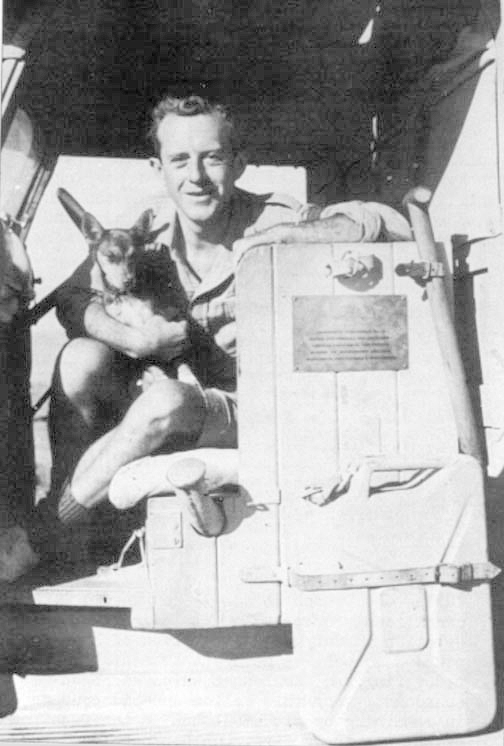
On the driver's seat of his General Motors Ambulance is Robert Brewer with "Bir", the puppy that the AFS French section found on the battlefield at Bir Hacheim and adopted as their mascot.
Lt. Col. Mallet was the officer in charge of the motor transport reserve which bore his name and which was manned by AFS personnel in France during the first World War. He writes from North Africa:
October 6th, 1942.
"Dear Mr. Galatti;
I am happy of the occasion that is given to me to send to you and to all of our mutual friends in the A.F.S. the best greetings and wishes of the former Reserve Commander. Although I have so far only been in this region for a few months, I have been glad to find with your men the same spirit of devotion they had in the other war and I so hope the Free French Forces will have the privilege of keeping some of them to work with us until the end of this war. I do hope too that it will be found possible to squeeze from time to time a few cars and drivers on the boats and ship them to us as you must know that we are very short of both.
With kindest regards
Sincerely yours,
signed: Richard Mallet, Lt. Col. F.F.F."
Copy of a report by Lieut. Tom Greenough, American Field Service, attached to the Fighting French.
"On the night and morning of the 23/24, during the French attack, John Dun did magnificent work, and by his courage and devotion to duty saved the lives of his wounded as well as being instrumental in recovering two ambulances which had been abandoned. For this action and his courage in remaining by his ambulance in the face of intense enemy fire, Dun has been commended by the M.O. of the French Tank Corps as well as by Col. Viallard-Gouder, head of the 1st. Brigade Medical Corps, who has requested that if possible, Dun be transferred to the F.F.C. group of the American Field Service."
October 21, 1942. Syria
"Three of us A.F.S boys went out at noon and Mrs. B. drove us over to her cabana at the Beach, taking along a lovely hamper full of salad, fruit, lemonade and beer, and we brought French pastries from town. We were joined by the American consul, two English Army Captains and e flight commander in the R.A.F. There was a very nice French girl, educated in England, and several English titles in the group. After a lovely day swimming and lying around under umbrellas in sight of the King's palace we returned for tea, from a lovely Georgian tea set, at her home. She is kindness itself, and so generous about allowing one to bring out several friends at a time. There are lovely palms of all sorts here, together with all the flowers of Bermuda and Florida, like Bouganvilla and Hibiscus, and yet one mile from the city is desert, desert, desert. Not that I mind the desert. I have come to like it lot, and would rather sleep on a stretcher outside my vehicle there tonight than inside the vehicle as I must at the hospital . . We had our first terribly bad dust and rain storm the other day, which lasted 42 hours. You just can't imagine whet it's like sitting in the vehicle completely shut in and still sand and dust sifts rapidly thru closed doors and windows and covers everything and gets into every bit of clothing and blankets that are put away in duffle bags. No cooked food for two days and sand, sand, sand going into one's stomach along with the crackers, chocolate, or whatever one is existing on."
September 15, 1942. Egypt
"Now to tell you a bit about our life here at camp. It really is very comfortable compared to what we'll have soon but even so it took time to get acclimated. We're in desert land with no trees for miles around. We have plenty or water for washing and drinking, however, and we pay a visit to the showers about a mile away every other day. We would take them more often but it isn't allowed. There are plenty of NAAFI'S around where we go for beer in the evening and a couple of 'flickers' which show very bad movies of unknown dates and unknown casts. They're lots of fun, however, and if the pictures is exceptionally bad the soldiers make up for it by throwing beer bottles against the screen which luckily is hard. I had a funny experience last week --- I was taking some patients from the C.C.S. here to a rest camp when a very bad dust storm came down on the road. It was the first really bad one I have been in, the air becomes a dark brown and at times you can't see even over your hood --- well anyway I crept along at about 5 M.P.H. and after about 10 minutes of this a strong wind came up which brought hail stones as large as marbles --- they sounded like a machine gun fire on the roof. I doubt if I'll ever see hail over here again but it certainly was something."
May 10, 1942.
"Christianity sits in a strangely colored seat in the places of its origin. Here is no rest for the followers of Christ. Mohammed also was a great man in this part of the world and his followers are numerous and powerful. They 'persecute' the Christians so the Christians 'persecute' them, as they both 'persecute' the Jews --- who are the most intelligent, sincere, progressive, admirable group of people in the Middle East. I'm for the Jews all the way."
September 26, 1942.
"While the rest of my unit is camped presumably at or near the front, I am lying on my back with a trifling nameless fever in a British base hospital. It was to have been Malaria, but is perhaps only sand fly fever. Scattered through the ward are shivering or sweating patients, drinking quinine cocktails or eating yellow pills. There are sheets, spring folding beds that crackle when you roll over (like a steam roller crushing acorns). Some patients are kept in corrugated mail box shaped houses (R.F.D.) but I'm in a long rectangular tent with a sunken concrete floor. The level of the outside ground is about a foot higher than someone prone on a bed. A dozen beds on each side, with an alley between. Occasional nurses whom you call 'Sister', their scalps draped with large starched doileys. The place is about half full, no one with one exception who departed wrapped in a Union Jack, unpleasantly sick. It is a khaki tent, lit in the evening, except during occasional blackouts, by electric lights strung along the ridge pole. Over every bed there hangs from a hoop a mosquito net which at night envelops the patient and his bed. In the day time you twist the tail of the net and tuck it between the double tent roofs.
"The food is ungood, but no doubt adequate. There is tea, constantly, served out of a bucket by a dark, dirty Arab, who looks like a wall-eyed moustached George Bigelow. The rest is bread with little dead insects here and there among the wholesome wheat grains, porridge and marmelade for breakfast. Maybe a couple of pigeon eggs. At lunch there is a cooled off portion of summer squash and camel meat or if not camel, then those slate-colored humped water buffalo with ears like deer, instead of cattle. Dessert is cold gruel and some sugar soaking in a rice pack (yesterday or a spaghetti cluster today.) At least once a day an Arab or an Italian prisoner comes through the ward with a bucket, sing-songing 'shave --- nice shave?' . . Before my sickness we spent about three weeks at a camp up the road, learning a little about ambulances, compasses, maps, soft ball, Australian beer, and the desert. We lived in small tents holding about 8 men each. We slept on our narrow canvas stretchers, underneath mosquito nets.
October 5th, Sunday.
"Tomorrow morning I parade before the Col. of this hospital, which means that on the next day I'll get out of here, and then --- go where? I don't know. . . . Whoever one talks to at the NAAFI is tremendously optimistic about the war. The tide has turned, they say".
October 11, 1942.
"Am now back in Cairo in a New Zealand General Hospital convalescing from jaundice. The Kiwis certainly are well taken care of by their various patriotic organizations. And their hospital care is excellent. And well treated they ought to bet Lord knows the N.Z. division has gone thru hell out here and in Greece and Crete. The division has been hard hit but the men are tough physically and emotionally.
"Because the hospital is full just now we are out in tents --- large square tents --- set up in threes providing for about 24 cots in each tent layout. We are rolling in the luxury of clean sheets and pillow cases and being served out meals rather then buggy blankets and greasy 'dixie' tins. You are awakened about 5:30 in the morning when it is still very dark by an orderly who pops a thermometer in your mouth and takes your pulse. Then breakfast which is always oatmeal and perhaps toast and fruit and tea. The morning is supposed to be quiet no smoking, no cards, etc. --- regulations not carefully observed by men beginning to improve. Usually all sorts and specimens of big-wigs parade thru between 9-12. We are continually being urged to consume a great deal of water--- five or six quarts a day--- at least enough I promise you to cause a slight protest. But the sisters are persistent --- and kind. You know all trained nurses are known as sisters while untrained nurses are called nurses. The former sport two or three 'pipe' on their shoulders to lend a certain dignity, which dignity I have upset all too often by referring to them all as nurses. And they have a great deal of trouble trying to decide what to call me. The hospital records ask for 'volunteers' and the abbreviation 'vol' causes too much confusion to make that suitable. Some of the sisters referred to me as driver until in a particularly stormy and stuffy mood one day I requested an unusually unpleasant sister to call me 'Mister'. The caused a regular rash of 'Misters' which I have been fighting off ever since. . . I am thankful I had a month with Kiwis in the desert before being sent back here to lie on my back trying got keep up with convalescent conversation. At least I do not appear like a complete ignoramus when they swap yarns about the fighting. And their continuous use of the fighting as a subject of conversation is a surprise. Somehow I had expected them to be a bit cautious about mentioning cobbers lost or their own close calls. But this is their shop talk and not one in twenty will discuss it when home."
September 9, 1942.
"After we move out of this camp, we live entirely in ambulances or in slit trenches. I am writing this in our tent, on the bedding roll which we've finally gotten, and under an issued mosquito net which is ten times as voluminous as my own, and I'm quite comfortable. The heat isn't at all bothersome. We learn, however, to appreciate the small pleasures of life, such as taking off socks and boots and airing toes, or the beauty of a cold shower, which we get every other day, and how much fun it is to see a fly on the outside of the mosquito net, or how good a can of peaches tastes. Incidentally, you mentioned that, and we get plenty here. There's also a movie of sorts nearby, but the sound is so bad that you have to go by the French subtitles, and my French is rusty. We've seen quite a few prisoners around."
September 22, 1942.
" I can now tell you we wont to Cairo and had a grand time. I suppose Mom remembers all the natives or 'Wogs' which descend on you by thousands selling every known thing, and during the war, it's a military offense to hit one, so they're not afraid of anything. You literally can't entangle them from between your legs. Well, we fought our way to a 'Gerry' (droshka) and whipped into town, spending most of the afternoon trying to find a place to sleep. It had to be a cheap place for financial reasons, and we finally located a room with 8 beds and breakfast for about 60¢ a head. W. then proceeded to a place known as 'Grappy's' and had about $1.50 worth of ice-cream and sodas each. It was wonderful, bliss pure and simple, then a large steak dinner and a little night-clubbing during the evening. The next morning we proceeded to the pyramids, rode a camel, etc. and then for the best lunch I've had since leaving home at the Meena House. Then home again to our camp, and a long and arduous ride. Then I immediately got sick again. This time with a combination of sand-fly fever and diarrhea. It was awful---that fever makes you terrifically tired and hot, and every bone, particularly the back aches like hell. That, combined with the necessity of trotting off to a latrine over 1/4 mile away at 15 -30 minutes intervals, made life miserable for about 3 days. Incidentally, I'd pay about $100.00 cash to have Roessle's old out-house on this spot, in place of what we have to use. The only cure for sand-fly fever is cold drinks.. Ha-ha, they don't know what ice or ice-boxes are out here. So I drank luke-warm tea and finally came out of it. But how I prayed for bed at home with tall cold glasses of orange juice and grapefruit juice."
"In the "Blue". June 7, 1942.
"Lessons taught by war seldom penetrate beneath the skin when a new war breaks out. Last time the American attitude was an all out 'do or die' and the result was an appalling loss of men, men whose fervour far exceeded their reason. They charged recklessly, and they died by the thousand. Yes, they were brave, and they were shining example of American spirit and courage, and they said 'There is the enemy across the line! Let's wipe them out, and quickly!'. But they could have accomplished the same ends, and might have done it better had they been more careful and systematic. It's no good to throw yourself with wild abandon against the opposing guns. Far better to silence them with strategy and grim determination. War itself is a grim thing, and ideas of personal heroism are changing. The army which moves forward, slowly and without breaking, and is grimly determined to win, should be unbeatable. The army of brave fanatics, though it may score a dramatic victory, stands a good chance of being cut to ribbons. I suppose that our present army has not changed its attitude much, and before long I suppose that we shall be very proud of its exploits, but I hate to think of the cost. On the other hand, there are signs that we have grown up a bit and are willing to win a good fight.
"I have an idea that South Africa turns out as good a fighting man as you could find on this frothy globe. The British admit their slowness and are proud of their bulldog tenacity. The Australians are proud and boastful, and are probably the same breed of man that inhabited our West eighty years ago. They have the spirit of the AJ.F. of the last war. The South Africans are quiet --- so you don't hear much of them --- determined, quietly convinced of the necessity to win, and are magnificent fighters. No boasting or mock heroics for them. They have a job to do --- and do it, efficiently. If they were the Germans, God help the world. And if our army can be like them, God help the Germans, and the little men. Believe me, I shall never comb the battlefield for danger spots, nor shall I ever be reckless. When the time comes, I shall do the dangerous work, and, by God, nothing will stop me. But as for doing it recklessly, no. A man can climb an Alp recklessly, and another man can climb it carefully, and climb it more often. In war, it's the winning army that does the job the longest. Many times during the course of battle, a soldier has to gamble with fate, but he doesn't have to spin the wheel to set that gamble in motion.
"A couple of days ago I managed to get hold of a copy of Life magazine, published just after Pearl Harbor. There was a two page editorial in it written by the editor, Henry Luce. It contained one phrase that seems remarkably good, and which I hope some Americans may take to heart. He was talking of the part played by those at home. He said that many U.S. soldiers, who are doing the hardest job, will die at the front, and then he said in italics, 'will they die through any fault of ours,' meaning through negligence and laxity of the American which is working within its own borders. He meant, of course, that the home front should drive in to the hilt. To the soldiers, he meant something else; if an army knows that its country stands solid behind it, that army will stand solid in battle. It won't be a Belle France. Personally, your assurance that America is unitedly determined has made me prouder to be an American than anything else our country has yet done or is likely to do. Over here, news is a rarity and much of it has been a bit discouraging. There has been talk among us about America's failure to do her job, but since your letter and other letters that have reached camp recently, we have assumed a confident air when discussing America with the British tommies and their officers. We can hold our heads high rather than vaguely apologizing. And that means a lot. It's the job our country is doing that counts. . .
"Our first bombing was rather amusing --- in retrospect. It was a preliminary to the present push. Dinner was over, the sun was low, and we had assembled in the open to hear some words from our Lieutenant. Nine planes, flying very high appeared above us. 'British', someone said. 'Friendly', said our Lieutenant, determined to get on with his talk. 'Then why', someone asked, 'is the ack-ack firing at them?' Puffs of smoke and little silver stars from the exploding shell appeared in the sky. 'Friendly', said the Lieutenant. 'The hell they. are', from someone. 'They' re peeling off'. If there were such a thing, I should have set the record for a fifty yard dash across open country. At the edge of the dugout I must have looked up for a second. I distinctly recall seeing a Stuka,. low to the ground, just pulling out of its dive. At the same moment I sew a small hillside go up in smoke, flame, and dust. Then I was making a sensational flying tackle into the mouth of the dugout. Crouching in the dim light thereof, I could hear the bombs hitting, the planes roaring, the dynamite sound of the ack-ack guns, and then the planes soaring away to the west and the sanctity of the blinding sun.
"When the smoke and dust pall had blown sway with the evening wind, we found that almost no damage had been wrought. What they were after, I don't know, since Jerry is pretty conscientious about bombing anything with a Red Cross showing.
'"I'm rather hazy on the subject of being frightened, and can only give you a post-mortem impression of my feelings. I think, while running across the open ground and while diving into the dugout, that I was rather enjoying the whole thing. That tremendous feeling of reality --- sudden and very close reality like a great brass gong going off close to the ear --- and unreality combined. I think I was having a good time. But once in the dugout. surrounded on all sides and assailed with all the sounds, I was really scared for a moment. Probably a touch of claustrophobia, for I had a distinct impression that I should rather be outside. Then the planes were gone and my world regained its sanity. It's odd, but I heard nothing, not even the first bombs until I was in the dugout. Then I seemed to hear altogether too much. (one sentence censored) Jerry returned and we were given a wonderful show, although it was a bit disturbing. And thereafter until dawn broke, he kept it up. I was sleeping in my ambulance, parked conveniently close to a dug-out. Every time he came over at intervals of ten to fifteen minutes the ack-ack would open up with a terrific barrage, and the show was tremendous, like a mammoth fourth of July; the air was full of silver stars, tracer bullets, chasing each other heavenward in a graceful arc, great red balls of fire --- flaming onions --- lazily arching into the sky, and occasional fuzzy balls of green stuff. And an earth-shaking crescendo of noise from the ack-ack guns. And at each barrage, which lasted three or four minutes, I flung myself out of my sleeping bag and plunked into the dugout, there to stick my head cautiously from the entrance to watch the show. This commuting process kept up until (several words censored) at which time I said to hell with the whole thing and remained permanently in the ambulance and actually managed e few hours sleep. At five o'clock we had a few bad moments. He dropped several parachute flares over our camp and lit us up with a blinding light. We expected hell to break loose, but nothing happened. Probably he saw all the red crosses and cursed wildly.
"Actually it's not the bombs that worry us. If a bomb hits you, it hits you, and that's that, and the chances of a direct hit are pretty small. The ack-ack plays the nasty role; ack-ack schrapnel is bad stuff and a big enough piece would easily slice through the top of an ambulance, and it falls all around the place. The inevitable result? I an now living in a delightful little flea-bitten two-man dugout, quite safe, although the nightly ack-ack show makes so much noise that sleep is difficult."
October 17th, 1942.
"Having some Tommies attached to us, we get their letters as well as those of the AFS and, of course, there is a greet difference ---one of the greatest being that there is never anything to censor in a Tommy letter, and frequently all too much cut out of an American. By comparison, we are shockingly untrained in many ways and our 'liberal education' does not seem to make much difference in matters of common sense or in appreciation of the values of a few simple rules. We do our best in the more spectacular parts of the show. I think that on one point at least all of our crowd is in agreement. That is admiration and liking for the New Zealanders. It is really startling how universal this feeling is in a crowd as varied as ours. With true Anglo-Saxon and democratic form we have faults to find with Tommies, Aussies, and, also, with Americans but we have practically come to believe that there is no fault whatever in the 'Kiwis'.
At Sea, Mailed from Balboa. October 2, 1942.
"Food is very good. The six other fellows and three of us A.F.S. ones are newspaper men from the Dept of War Information They are swell and believe it or not we are all having the time of our lives. I'll be able to entertain you for years with accounts of this trip. All the fellows have a swell sense of humor and we have laughed ever since we have been on the boat. The weather has been so wonderful and the ocean so beautiful that it seems impossible that we are in any danger and we don't think about that except to pull cracks about it. The trip is anything but monotonous and we really are lucky to have such a swell bunch in our stateroom."
September 23, 1942.
"I was working with the News Zealand Divisional Cavalry. It was my luck (for which I will always be grateful) to have almost immediately upon arrival in Egypt been detached from my group and sent alone with this light armoured regiment. Naturally the word cavalry is rather loosely used suite. Any poor horse who got mixed up with this crowd would be faced with a well balanced diet of 600 oil and high octane gas. The outfit had large numbers of light tanks and Bren Gun Carriers and even larger of New Zealand farm boys. These were men whom it was a great pleasure to be able to work with. They are really a great deal like us --- you might almost expect to pull up to a Northern Illinois farm house after the war and run into one of them at work in the field. They talk almost with our Middle West sharpness, perhaps a bit Southern Illinois. They are a confident, happy bunch and probably are the best soldiers in the Desert. Certainly their record is amazing both here and in Greece and Crete.
"Have you ever hoard of the Mauris? Neither had I. They are the original native inhabitants of N.Z. and are Polynesian (sp?) in background. Very dark when pure in blood and just as white as you and I when mixed with the immigrants. But the great thing is that the New Zealanders think that the Mauri is just about the greatest guy in God's Green Earth. There is absolutely no trace of class or race distinction. As a matter of fact any N.Z. soldier will tell you that the Mauri is absolutely the beat soldier out here.
"For three weeks I was away from the regular, A.F.S. line of work with the Div. Cav. as the fighting squadrons took new positions. Aside from not having a bath for almost 20 days it was a great exciting life. Or because of not having a bath it was exciting. Being in the field in the desert is, strangely enough, in certain respects, a very healthy life. The sun zooms with great speed below the horizon about 7:30 P.M. and after a few songs and, if you are lucky, a bottle of Canadian beer, you go to bed. Bed is just a few blankets thrown onto a shallow depression or (praise be to the ambulance service) laid across a stretcher. The nights become very cold and you wake up early in. the morning (about 5:30) sure that it has rained. At least your blankets are soaked it you are not wise enough to put a ground sheet over them. With the Div. Cav. each small group ate with each truck or tank carrier. And, spared the necessities of a large cookhouse, we always were able to eat well of food prepared to the taste of a few men. My work was lose the carrying of cases to back areas (which was done by another ambulance of the N.Z. ambulance corps attached) and more the carrying of the doc around to fighting squadrons. My ignorance of the techniques of the desert driving were magnificent in spite of four or five months in the Syrian desert. This was really a desert with few tracks and a great deal of just following a compass of land and mark in hopes of hitting a given mark. By day it wasn't so difficult. By night it was hell. Either there was no moon and you couldn't see five yards in front (how you bless the institution of the North Stars). Many times Doc walked in front of my car as we groped our way home keeping his eyes watchful for slit trenches, etc., or there was a large moon blazing away and it was too light for comfort.
"I will always be happy that we were able to spend those months in Syria before coming into the W.D. And yet now I hope the rest of my year will permit me to stay here."
"Never forget that the greatest moment in all the Middle East is an envelope with American stamps on it."
July 25, 1942.
"Dawn breaks and I sleep soundly. Into my peaceful slumber breaks a discordant note. 'Hey, Yank! We're movin'!' Throwing myself from my bedroll I scoop the blankets together and heave myself and the blankets into the ambulance, and fall into line. The predetermined position for the A.D.S. which we had been unable to locate in the dark, is found, and the trucks move over to it. The tents are set up, trenches dug with superhuman effort through solid rock, and breakfast is served. (The food is always good at the front). At eight o'clock I am sitting in my truck. The main thing is to forget the fact that we are surrounded by artillery and Bofors, which drew the Stukas like a magnet. With a disarming smile the captain asks me to go out on a milk run --- three times a day an ambulance makes the rounds of the R.A.P.s, and is then on the milk run. 'Delighted' I murmur, and ask him where the R.A.P.s are. 'Out there' he says with a sweep of his arm, taking in most of the territory 'to the west'. The R.A.P.s may be out there, but so are the enemy. The captain wishes me well and departs.
"Pointing my prow to the west, I speed off down a wide, sandy arroyo---or deir --- which is dotted with well dispersed vehicles and guns. Soldiers sit peacefully by their slit trenches, absorbing the pleasant sunlight and battling flies. From time to time I stop and ask directions. I almost lose control when a twenty-five pounder I'm passing goes off with a tremendous roar practically under my nose. Guns go off on all sides and shells swish disconcertingly over my head. Pulling up beside a major engaged in having his hair cut, I ask directions to the X battalion, and he points to an escarpment half a mile away. 'There in a deir on the other side of that', and berates his batman for cutting his scalp.
"I whip over to the escarpment and start up its slope. Luckily the truck moves slowly up the sandy bank, for I have time to absorb the leisurely words of a captain standing nearby. 'I say, old boy, do you intend to carry on? I really wouldn't if I were you.' And he smiles pleasantly. He is a dashing young officer of the sort one might expect on Shepheard's terrace in Cairo; tall and sunburnt, crisp blonde mustache, immaculate uniform, and a silk khaki scarf around his neck. 'I was going over' I assert sulkily. 'But I shall have to back up and start over now; my ambulance will never get traction in this sand.' 'I really shouldn't if I were you', he repeats. 'Oh', I reply haughtily. 'You see, old boy', he says and smiles patronizingly, 'Jerry is just over this hill'. 'Oh', I reply meekly. He then shows me the location of my objective, and I retreat; rapidly.
"The remainder of the milk run is reasonably uneventful, aside from the unfortunate moment when I hear a shout, stop, and am informed that I have just driven into a mine field and 'for Christ's sake get out before you waste some of our mines'. What patients there are, are duly picked up and returned to the A.D.S. The run has used up about two hours of the morning and several weeks of my life."
September 26, 1942.
"Our drive up was quite an experience. Our convoy was miles long. As this was our first experience of driving in a convoy, we found it none too easy to keep our distance of eighty yards. There were of course innumerable short stops for no apparent reason and much changing and grinding of gears. As soon as the vehicle ahead of you stops you stop too: when he starts ahead, you follow. You must never close up to him except under special orders, for fear of bombing. In the capitol, we had to close up to within ten yards of each other. It took a long time to get through it as the traffic was pretty thick. Natives ran alongside selling papers, which turned out after you had bought them to be months old. Knowing we were strictly forbidden to stop, they realized they were on a safe bet. After being caught once we were shy, and asked several others to show us the dates on the front page first. They were one and all furious at being asked, and, naturally, refused! I say we, as I was not driving alone. We have five cars to a sub-section of eight men, so that besides the sub-section leader (who is a veteran A.F.S. man of a year's standing and knows all the ropes) who does not have a car of his own, there are two spare drivers. At the beginning we drew lots as to who should be the spare drivers, an uncoveted position, though it has great advantage in that you are not responsible for the maintenance of the car... It is, of course, absolutely necessary to have spare drivers owing to the prevalence of illness in all units working in the Middle East. Already we have had numbers of men down with one complaint or other, more or less serious and unpleasant. . .
"After we had driven for close to twelve hours we drove off the road into the desert and pitched camp and here we are still. It seems so odd when we stop. The place is of course all decided upon at headquarters, but when you arrive at it, you can't help wondering, 'Why just here?' Why not a mile further back, a mile east or a mile west? For there is nothing, nothing to distinguish the place you are at from anywhere else, not a single landmark, or hill, or depression---just sand, in all directions.
"We slept, of course, in our ambulances on stretchers. It is remarkably comfortable. I believe this is not allowed at posts farther up the line, where you have to lie on the ground or in a slit trench. Slit trenches are a great feature of the desert landscape. They are usually three or four feet deep, and anything from six to eighteen feet long. . . a terrifying hazard if you are driving, or even walking, in the dark. So far we have not had to dig any for ourselves, thank god, but that comes pretty soon, I gather.
"Our machines are considered (by our people) the finest ambulances in the Western desert. They have four wheel drives which prevents them from sticking in the soft sand, so they say. All I have to add to that is that within ten minutes of our turning off the road into the sand, at least a third of us were planted firmly in the soft sand, wheels buzzing merrily around, and engines roaring. It took quite a long time and the efforts of three or four of us pushing to get me out and on my way again, both then and again this morning, when to my absolute fury, I was made to move my position. This entailed removing the camouflage netting. and until you've tried doing that you haven't lived. It catches in everything, from door handles to fenders, windshield wipers to petrol cans, and requires the assistance of many before it can really be coped with.
"Our machines are Dodges. The British have AUSTINS, very much larger jobs and more comfortable-looking, but then, of course, they stick in the sand all the time. Ours are really quite small, room for four stretcher patients or about nine sitting ones They are, I suppose very efficient little affairs: I wouldn't know yet
"This morning's move was not all bad news, however, as it has brought us many yards nearer the cook tent and the water wagon . . . much farther however, alas from the latrine! We have to park of course, very widely dispersed, again for fear of bombing, so that if you are unlucky, you may have to walk a quarter of a mile or so for your meals. No joke over this sand, I can tell you! The meals themselves are not too bad . . .
"With your letter yesterday came my first copy of 'Life' since I left. A great pleasure, as you can picture. I still have received no New Yorker. These things assume an inordinate importance around here"
September 29, 1942.
"The four pages, clipped from 'Life' of August 31st were of much interest to the boys, since I know those who posed for them and that Landry shot them not under a hail of bullets, but safely back at a CC. The 'New Zealander' wasn't a New Zealander, but such is publicity The truth would have been more exciting --- such as Gilmore's voluntarily working his way with another A.F.S. man and 2 Britishers, through a new uncharted minefield to pick up two wounded, --- then because the path was so narrow having to reverse the party, the M.O. had led them in with an engineer, and the A.F.S. going out first. Only one of the wounded was alive to take out. But maleesh I suppose the spirit of the article was right, though with the exception of the 130° sun, the rest was like a Montgomery Ward assignment, taking pictures to advertise tin hats. . . . . .
"On leave, I stayed at a modest hostel where you have breakfast included, it was run by a church mission. The churches do more here for troops than anyone else. I had long talks with a musician, who took me to the zoo where I made a water color and a photographer (both working in those capacities for the government and dressed as soldiers). The matron of the house, a Miss Abel, who had come from Blighty before the war, told me of her life in Cairo, and the subtleties of employing Egyptians. All table servants in the hotels, where I had several good meals, wear a long white night-gown-like robe, wide red cloth belt and red fez. I noticed, with a twinkle, that Parrish, the Tribune cartoonist had drawn a Gypo soldier with a turban. The Farouk soldier wears a khaki kepi, like a French Legionnaire, with a piece of cloth on both sides of the head, shielding the ears and another piece down the back of the neck. The neckpiece is starched somewhat and instead of falling over the shoulders, curls up behind, very comically. Cairo is an expensive place, a cut-throat town, fascinating, dirty, one you should live in and study, or stay only a few days. I had an evening with some African friends; jolly and generous (I had trouble keeping the favors on an even basis --- but did) I visited the poor sections, the Palace, the Bank to change a five dollar bill, and did another water color in a ruined mosque whose walls surrounded a flourishing garden. The guard was very kind and let me in, though it was 'Ladies Day' and I sat and enjoyed the grass, trees and cacti.
"I occupy my ambulance all to myself these days. Living like a hermit, I have made friends with a lizard, who is droll indeed, lazy and energetic by fits and starts, like myself. A curious swarm of yellow and black flies, quite gentle and beautiful, thicken their abdomens on a little piece of sticky candy I have left. They sing their gratitude and depart, very friendly.
"Our canteen is a marvel of finding the impossible at prices we boys can afford. You know I just mended the lovely warm stockings you knitted, by stretching the heel over the ball on top of the gear shift. Nifty, eh? Tomorrow I must change the oil crank case.
"Parts of Cairo are a maze of buildings which if ever were bombed, won't look any different than they do now --- in ruins. And there I would like to hire the men and women to pose for an oil. I've just itched to do that. And take more time than a leave pass (I've had two leaves in three months I've been down here, more generous than soldiers get) and a few trips into town for our canteen. The banyan trees and the cacti made me cry because I did not have time to draw them. There are numberless establishments for 'Ondulations Permanents' for mesdames et messieurs. Also photographers, egg, chips, steak joints, cheap cabarets where the soldiers dance with themselves and kick beer cans under the tables. Little boys skillfully hammering brass bars or cutting leather wallets in open front stores which remind me of a Whistler or Rembrandt etching. The Nile with the slim sails ridiculously tugging scows. The farce of soldiers trying to look gay with no girls to spend time with. Who wants a soldier? here today, gone tomorrow. Little French school boys in grey pinafores, bookshops with no books. Green flags with stars and crescent. Another feast after the Ramadan fast, when Mohammed decided it would be a very good thing for the poor to be remembered once a year, and even the rich only eat at night, not during the day. The shops closing inconveniently but comfortably from 12:30 to 3:30 or 4:00. French sailors with red pompons on their hats. Hatchet-faced vendors of fly whisks, old razor blades, cigarettes, indecent photos. Numberless soldiers having their pictures taken resting on the knees of a solid bronze Egyptian goddess, nude to the waist. Endless omelets. Garis(?) or open carriages, Arabia and English numerals on cars. Rickety street cars with long rides for 21 cents. Etoiles with streets fanning out. Pretty, but ignorant shop girls. Smartly intelligent, well dressed French daughters. Beggars of all persuasion. Oh, the Desert is a peaceful retreat. I always get a headache in the cities!"
October 27, 1942.
"By this time the papers and radio must be blasting out the news of the British attack in which my unit of the A.F.S. is taking part. . (Note: about a page cut here by the censor) They need us badly here. Time and again I've thanked God, I was able to join the A.F.S. and did not wait to be drafted. (Censored) Let me tell you, the Ambulance corps boys are no sissies---- we just have to take it --- while you forget what's happening (and not be scared) if you're manning a gun. Really though, I am quite well. About now a job in Beirut looks very, very good. But now I'm trained and useful I'll stick until I'm through. You mayn't receive letters from me as we advance further, because we'll be separated from Hdq. --- I'm afraid --- too far for much communication. Things are really popping --- never a dull moment. The runs (any time of day or night) are so far fortunately short. So far I can contact canteen for a beer. The Catholic padre passed out packages of Camel cigarettes yesterday. Casualties have not been heavy. Well, this business is all old stuff. My camera is proving useful (my vocabulary is very meagre). Life revolves in a reduced orbit. Chief concerns are: keeping your akin in one piece feeding yourself, which is a problem, sometimes --- trying to got some sleep --- wash your teeth and face --- and shoot just enough grease in the bus so it won't collapse. Anyway I'd better start wishing you (in spite of everything) a Merry Xmas . . . . . Mother mailed a number of color pictures from the Trib. of the oaks and maples in the fall. I've pasted them up in the car. On the other wall I have an American flag and a luscious nude, to take the minds of the patients off their trouble. Carried an eye-tie with a shot in the leg, he said a Jerry gave him. He was in pain --- stank to high heaven we talked a mixture of French, English, and piano notation Italian."
|
Did you ever stop to wonder The A.F.S. has done its work |
"The circumstance are ideal again today; a sandstorm is blowing to deaden our usually quiet sector. Jerry can't see any better than we can, so everybody just crawls into a vehicle or slit trench figuratively and literally --- pulling the covers over his head until the thing clears off.
"Last night was a killer though, I'd been down the line on a job and coming back it was so thick you couldn't see 20 ft. ahead. The medical officer seemed a little dubious but we fetched our landmarks and came through in plenty of time. As it grew darker (the sun had been invisible since morning) the wiseacres said, 'See, it never blows at night. It's letting up already'. In an hour, you couldn't see your radiator, and another beautiful theory had exploded. Worse still, there were terrific rain squalls mixed in --- of course it never rains in the desert. Thunder and lightening added to the show, and flying gasoline cans created a novel hazard as they came slamming and clattering out of the murk. Everybody throws gasoline cans around, and when the wind gets strong enough to start them rolling you have to dodge or accept a set of barked shins.
"Not all gas tins are left lying around tho. The ingenuity of the true desert dweller can work wonders with these simple metal containers. Sliced in half and filled with alternate layers of gasoline and sand, they produce two very fine open fires, one for the teapot and one for the stew, beans, or whatever. With one end sliced off they make a serviceable oven, tho a 25- pound shell box is better, tho rare. Filled with sand and stacked strategically, they are better than sandbags for stopping vindictiveness in the form of shell or bomb fragments. Piled on a hilltop and suitably inscribed with cabalistic number sequences, they will locate your position in this featureless waste of nothing. Placed at 100 yard intervals, they will indicate a motor tract to some place or other, and turned back smoothly they furnish a suitable substitute for a wash basin, --- provided you can find any water to wash in.
"Not that water is a necessity for washing. Gasoline, or petrol in this strange language, can wash a good many things. Only wool socks, towels, and sweaters require water. Anything else can be rubbed out in gas and will dry in a few minutes. A great advantage in this mobile war where you may move on in a minute's notice.
"The sand keeps away the flying vermin and I don't mean just the ones with crosses on their wings. Let me tell you, the flies are just as big a nuisance as the Stukas, and damn near as deadly. I can see the boys on the other side, cussing flies and wondering when they're going to beat the Tommies and go home to Dusseldorf or München, They may go home, but they'll never lick Tommy.
"Tommy is a tough baby. He's little and he's scrawny, he's dirty of shirt and face, but he's tough. Nothing jars him, and nothing worries him. He gets 'browned off' (bored) at sitting still, so he thinks up ways to annoy Jerry. Every cross marked visitor gets a hot reception, even if he's a Messerschmidt 109 going hell-for-leather so high he can barely be seen. The other day, tho, one fell to pieces in the air and it almost started a subsidiary war. Seems the entire brigade had been shooting at him, with everything from the Brigadier's Web lay to the Trooper's Bren. Nobody knows yet who hit him, but he was forevermore hit.
"The water man --- Gunga Din --- is an important pert of the Desert warfare and his load as precious and as necessary as ammunition. Yet, strangely enough you can leave your water ration sitting around in a slit trench all day. A hundred men will pass it, a hundred thirsty men maybe, but it will wait untouched. Nobody will steal a cup of water in the desert, but any other army issue goods are freely borrowed and it behooves you to keep your eye on your stuff. Of course, that works both ways, naturally.
"They're glad to see Americans. They ride American cars and run American tanks and planes. I find without exception that the little Jeep is saluted as the king of the desert vehicles. Even Jerry gives his approval by using every one he can catch."
October 21, 1942.
"Inside one of those tents is a canteen, where dust-covered, weary men gather to seek some hastily snatched relaxation. The place is crowded and the air is stale and heavy with smoke. A hooded light casts a dim glow over a scene typical of all canteens, a scramble of pushing men, dusty from head to foot, and eager to purchase the small assortment at the counter, a dart game with excited participants and spectators, a few up-ended boxes and petrol tins on which lucky groups chat noisily, More clustered closely about a radio listening to a broadcast of music from home. Static distorts it frightfully. You squeeze in and edge toward the contact with the ones you love. Easing your way slowly down carefully with your back to the tent wall, you sit on the sand, elbows on knees and head in hands. Face down and with eyes closed. You are carried away by a dance tune. You glide rhythmically over a smoothly polished floor with your girl held close in your arms. Rapture: Then the sudden jolt. Your eyes open and, instead of a waxed floor, you are looking at the sand and rubbing a trampled foot. Outside you breathe in fresh air and I look up at the moon, the same beautiful moon which throws that same warm glow over so many places. Unconscious of war, it will always be a symbol of love and peace.
"I spent a noisy night trying to sleep under the tail-end of our truck with my face behind one rear wheel and my feet behind the other. Talk about the fourth of July! Pretty, incidentally."
No date.
"We are up at dawn or a bit before, and drive over a route of more than 100 miles each way --- arrive back at our camp just at dusk. It's really wonderful to at last be working. And the men we are working with are really grand fellows, and you should see them beam when I tell them how you and I were in their land, several years ago. They really like us a lot too, from all appearances. So far as our 'camp' goes, well, it's not much. There is a big hunk of sand surrounded for miles and miles by more sand---that's what they call a desert. Well our camp consists of a small hunk of sand on the big hunk! We are living in our ambulances now, tho, and they are really much more comfortable and cleaner than the tents were back where we were before. As we are just one to a car, with a few exceptions, there is quite a bit of room, and the stretchers make very good beds. I am now sitting in the car writing this on the little map table that slips out from under the dashboard."
November 2, 1942.
"I am feeling full of pep after a swim in the Mediterranean. Yes, think of swimming on the second of Nov., but I do so enjoy it. This afternoon it happened to be my work, as I was assigned to take the English personnel attached to us. It means so much, both for the peace of mind that a beach always brings and the bathing also, which out here under ordinary circumstances is rather difficult, as you can imagine.
"I have just finished supper and now they are 'blacking out' the ambulance for a bridge game, so I will have to stop this poor epistle. What a crazy life this is, with all this fun while those airplanes fly over in great squadrons ready to drop their deadly message on the enemy! It doesn't make any sense, does it?.
No date.
"Last night, I had four layers of blankets under me, and six layers over me, and all my clothes on except my shoes, and I was very comfortable, and not a bit too warm. Yet, by ten in the morning, and on till sunset, it is very warm, and sweaters, and even at times, shirts, are discarded. A very strange climate! We see many scorpions and a few snakes at our present locale, but since we are still sleeping in the ambulance, they don't worry us a bit."
Below is the most recent letter sent in, just arrived, and which gives the reader an example of what to expect in the following issues.
November 18, 1942. In the Libyan Desert.
"Just received instructions from the Light Field Ambulance C.O. --- a major --- on where we are to go next --- so if we happen to leave behind a broken down vehicle the driver can make his way forward, after repairs and join us. We have had a day or two to catch our breath near a famous airport, bitterly defended when Jerry came down last June. In fact our advance has proved so rapid, as you can see from the news, that the historic battle sites, forts, dromes, passes over the escarpments, have flickered by the windshield like a speeded up newsreel, long hard months having passed in fighting all along there, months ago. There is very little remaining intact of those coast towns. I remember one place, with a harbor, whose 'Main Street' shops, 'Cinema Rialto' and hotels were only shells, with signs alone still indicating what the blasted out businesses were. 'Gentlemen's Tailoring', 'All kinds of Coiffeurs', etc. The enemy lived like moles, under sand bags and sheet iron, while the RAF pounded the hills themselves to powder. Sometimes the sole way you know you are motoring by a place of 'habitation' is from a German or Italian sign. Nothing else left. Italian light tanks strew all the roads; vehicles captured from us last June by Jerry and identified by a big black cross painted on their wrenched open doors, are propped, thousands of them, on water cans or rocks, the four wheels removed and if they had time, everything else of value, the 'carcass' abandoned. The criss-cross metal work of the stricken Italian bi-plane fighters, too slow and too lightly armed, whistles in the night wind, the tattered fabric rotting from the wings. Jerry water cans, which the U.S. has imitated none too well, the hob-nailed Italian boots, green ersatz jodphurs of Jerry, bullet punctured helmets, wreaked siege guns, blankets, huge scorched areas where the RAF has caught a petrol or ammo wagon and the explosion following, made a black arc on the road, cans of Italian jam, Jerry Turkish cigs from Dresden, fatigue caps, jackets, unexploded small arms ammo, mine fields, and everywhere pushing, cursing, winding through --- our transport, lined closely for miles to the rear --'coming up' --- tanks on carriers, ambulances; trucks, guns, food, gas, ton after ton. We move so fast we lose our ration and supply behind and have to wait until they catch up, before pressing ahead....In the last two weeks I have seen more of what war is like (the results) than during all the previous months together. The Tommies are gay for a change. The good American tanks, the bacon from Chicago, the six pounder anti-tank guns, the overwhelming raucous snarl of our planes overhead, is making the soldiery who had their brains practically unhinged by Greece, Crete, and this lest summer out here, come back to normal optimism. We feel that though Jerry is 'Kaput' out here there will be many nasty pockets of resistance to overcome yet. The part played by the Americans and the British on the other and helps no end."
"We reprint a letter from Colonel Ardagh of the New Zealand Division to Colonel Richmond in Cairo:
HQ 2NZ DIV
5 Oct. 42"My dear Colonel Richmond:
It has been my intention to write to you ever since the 2 N.Z. Division came out of the line, but unfortunately this has been delayed by a short spell in Hospital.
The purpose of this letter is not a more polite acknowledgement of services but a desire to express a genuinely sincere and warm appreciation of everything done by the Officers and men of your Service whom we consider it an honor to have had with us.
The two and a half months of this happy association were difficult and strenuous for all, but they served to establish a firm bond between your men and our own.
Casualties amongst AFS men inevitably occurred but considering the eager way in which the AFS drivers persistently volunteered to 'get in amongst it', I think we may consider it fortunate that losses were not heavier.
The truest judges of worth are the soldiers themselves and in this respect I can assure you that our own drivers with whom your men worked, all officers and men of the N.Z. Medical Services and most important of all, the wounded, expressed nothing but admiration and praise for the AFS.
These sentiments I most heartily endorse, and on behalf of the GOC and members of the 2 N.Z. Division I would once again express our deepest gratitude to the Officers and men of the AIS as a result of whose tireless service, so many New Zealand lives have undoubtedly been saved.
Yours sincerely,"
P.A. Ardagh, Colonel, NZMS
Christmas thoughts of a driver who writes during the action in Libya:
"Christmas, as it is to so many people, was always a very special time to me. We spent it with an aunt and uncle who had an apple farm and so Christmas meant the excitement of snow in the country. It meant the superbly exhilarating smell of woods in the winter, so much more fresh, so much sharper than summer air. It meant wearing great, heavy boots that would make the snow squeak as you walked over it. It meant drinking not quite hard cider out of a barrel in the barn --- all you wanted, the luxurious tingle of cold cheeks warming before a fire, the studied and premeditated anticipation of an enormous dinner. Or it would be sitting and listening to a deep-voiced uncle read aloud the 'Christmas Carol'. It meant waking up to find snow on the floor and frost designs on the windows. It meant putting a lot of ugly balls and old tarnished tinsel on a tree, but the balls never seemed ugly. It means the ceremonious biting into the biggest apple of the year's crop which was always polished and kept on s mantelpiece until Christmas. It meant the equally important ceremony of going to a small nearby wood and selecting and cutting an appropriate tree. It was all this and a hundred more details of sensual perception and of custom."
Just after AFS Letters no. VII was completed, we received the good news from his sister, Mrs. Mary Blakeman, that Laurence Sanders who had been reported missing in action on the Western Desert, July 7th was safe and well, a prisoner in the hands of the Italians. This news was imparted to Mrs. Blakeman by the Bishop of Natchez who received it through his Holiness Pope Pius XII. The International Red Cross is negotiating for his exchange.
Mr. Mitchell of the AFS executive committee has resigned to enter the Army with the commission of Captain. His place on the executive committee has been taken by Mr. Matthews Dick, an AFS ambulance driver in the 1st World War, who has been in charge of the volunteer enlistments in the N.Y. office since April 1942. Congratulations to both of them and the best of luck.
Many of our readers may have wondered at the censored parts of the letters that they receive from the Middle East; some of you may have wondered at the lack of 'facts' in your letters. We have at hand a letter quoting the rules of censorship as they are given to AFS men abroad, it follows; "We are not to write. . . news, views, or rumors which might cause despondency or dissatisfaction at home; criticism of the administration of war, practical comments, disparagement of troops, officers or equipment, expressions of doubt as to the outcome of the war or a particular phase of it, descriptions of bad conditions in the field, or anti-war philosophising. We are also not to mention troop movements, shipping, names of units, descriptions of fortifications, supply systems, military tactics or strategy, or descriptions of battles or air raids in detail." From which you may gather that you are lucky to glean ANYTHING from the letters of your personal Middle East correspondent.
AFS Letters has risen to new heights. The latest issues have been used in a Detroit Junior High School in both geography and social science courses. The innovation is very popular with the students.
Our coffers are richer by $l,192.00 as a result of the benefit American Primitive Painting exhibit at the Whitney Museum of American Art in N.Y. The great success of this benefit is in part due to the fact that, unlike the usual benefits in which the expenses are deducted from the amount raised, the Whitney Museum footed all the bills as a donation and turned over to us the gross proceeds. AFS is warmly grateful to the Museum and members for their generosity.
AFS own ace globe trotter Major Stuart Benson is back in N.Y. As usual he is on a mission for the Field Service. This time he has brought back hundreds of feet of movie film that he took of AFS at work abroad. It is hoped that the film will soon be ready and may be run as a news short throughout the country. . . Watch for further announcement of this exciting event.
The smallness of the world . . . AFS N.Y. headquarters' closest neighbor is a Western Union office; one of the girls who works next door came in the other day with a letter she had received from a friend in the Middle East; he is Lt. H.- G. Vivian, 4th N.Z. Reg, 2nd Expeditionary Force MEF. He wrote, "two of the American Field Service boys are working with our unit. The lads have picked up New Zealanders after bombing and shellings and kindly placed them in their ambulances. These boys are doing fine work and are a very happy group. They are greatly appreciated by the New Zealanders."
Romance Dept. Tom DePew, Lt. AFS who recently returned from serving a year in the Middle East, was married on December 10th to Miss Noel Johnson in St. Louis. They are living in Brooklyn where Tom is with the Sperry Gyroscope Corp . Jackie Hunter, AFS N.Y. headquarters phone operator is engaged to Harold Snyder of the U.S. Coast Guard. The HQ staff, however, is wholly unwilling to part with Jackie and are all trying to postpone the wedding.
Mr. S. Prescott Fay who was vice chairman of the New England AFS office under Mr. Bigelow until the letter's recent death, is the present chairman. He is being assisted by Mr. Wade White.
One of the drivers abroad is an art enthusiast and he recently received from home some Van Gogh reproductions which he put up in his ambulance. He writes that they are a great success and the "comments of my patients are very encouraging".
We heartily congratulate the Otis Chatfield-Taylors whose first son Charles Benjamin was born to Mrs. Chatfield-Taylor in N.Y. on October 31st. The baby's father who sailed for the Mideast in June was somewhere 'in the Blue' at the time.
Anyone dropping into the N.Y. office at the beginning of the month might have been surprised to find it blooming --- literally. American Beauty roses were everywhere . . . the gracious gift to the AFS women members from, Ted Borger, Bill Ostes, Frank Cochran, Robert Lindsay and Gus Rubel: the leaders of Unit XXXII. Too bad they could not have been here to see the pleasure we all got from their lovely flowers.
The Garden Club of America presented .AFS with a $2,000.00 check for the purchase of an ambulance. This gift was made through the efforts of Mrs. Andrew Williams, the sister of Messrs Alfred and John Ogden, who were both in Cairo with the AFS until recently.
We received a memo from the Cairo HQ dated Armistice day saying, "This office will stop work at 11 A.M. today for one minute, in memory of the 127 American Field Service men who fell in the last war."
Late flash just received from Cairo HQ. . . . Christmas packages containing: Plum pudding, cranberry sauce, chocolate, nuts and cigarettes, will be delivered to each AFS man on Christmas. Several .AFS men have been detailed to make the deliveries, some in the Desert, some in Syria and others to those men in the hospital.
NOTICE: Imposed by the United States and Foreign Government on International Telegrams: Regulation I. Discretion of Censor --- All messages will be accepted for transmission AT THE SENDER'S RISK AND MAY BE STOPPED, DELAYED, OR OTHERWISE DEALT WITH AT THE DISCRETION OF THE CENSOR, WITHOUT NOTICE TO THE SENDER.
William DeFord Bigelow died on November 23rd . ....with the satisfaction of knowing that the American Field Service of 1942 had won the esteem and confidence of the British Army.
From the day in 1916 when he went to the Verdun front, until his death, the AFS was uppermost in his heart. As an ambulance driver, with a strong physique and indomitable spirit, he set an example to younger men. As a Section Leader he won the loyalty of all. When, with the expansion of the Service, he was needed at Headquarters, he brought wisdom and strong character to help in its problems. When commissioned in the US Army, he went back to the front, where he wanted to be.
During the years of Peace, he devoted himself to AFS Association activities and to the AFS Fellowships for French Universities. It was he who represented the Service at the dedication of the Museum at Blerancourt
In September, 1939, he foresaw the part that the AFS could play once more, and threw himself into the task of recreating it. For the Section serving in the Battle of France, 1940, he recruited a full quote of New England Volunteers.
He worked unremittingly, night and day, enlisting Volunteers, collecting funds, spreading the word of the Service throughout his New England district. His health failing, his spirit sustained him, and at last, when he could go no further, from a sickbed, his counsel and advice were of inestimable value.
The American Field Service exists because it represents an idea worth striving for, but it is men inspired by this idea who have made the Service live. There are many, many men who are happiest driving ambulances for the sake of what that work stands for. Some have had to take responsibility that there was to take, but "Big" never thought of himself as anything but an AFS Volunteer. He won his decorations in the Field in 1916 and 1918. Through 1939-42 he had but one thought --- to help another generation to take his place.
For those of us who were privileged to know him and to walk along the path with him, there will always be the knowledge that his courageous spirit is urging us to renewed effort and to fulfillment of our trust.
John R. Nichol, SSU X, Executive Dean University of Idaho, Southern Branch, writes to Bob Dean Editor of the AFS News Bulletin, Middle East as follows"
"I am just one of many old AFS men writing to tell you how much I enjoyed (enjoyed is definitely not the word --- much deeper than that) Vol. I No. I. I have also been reading the AFS LETTERS assiduously and passing them around to some of my friends (and AFS contributors) on the Faculty here. The LETTERS are a bit fresher and naturally, more intimate. But the crushing climax of your No. I Bulletin, ending with the evacuation of Bir Hacheim, leaves me breathless, and, in a ways heartened, to see the Fighting French Forces (with which I was once aligned) really fighting again. . . despite desperate odds as usual.
"The Distinction between a civilian back home and a man at the front will never be erased, nor can it be. But these Letters and Bulletins come as near erasing time, distance and age, as though they were 'magic bullets' annihilating the differences between this war and the last.
" . . . Dibble's drawings are superb and up to the standard of 1917.
"Such names as Tobruk, Bir Hacheim. . places in Syria, have already taken on meanings to you in the AFS which none but other Veterans who were there, shall ever understand . . . . . . .
"I know there are hundreds of others who will enjoy your stories, but will not find it sufficiently convenient to write and express themselves. Hence I send their appreciation with mine ...not only for your accounts, but for your actions, actions which make such accounts, invaluable,"
On Christmas Eve 1915 Richard Nelville Hall was taking his turn driving up the steep road to Hartmanns-Weilerkopf, when a shell struck his-ambulance and he was instantly killed. he was the first AFS Volunteer to give his life in the Service to which We are dedicated.
The AFS will claim Duff Bigelow --- and properly --- and men of SSU will defer. But in their hearts, they count "Big", along with Oliver Ferry and Eric Fowler, as peculiarly their own.
|
"With such a comrade, such a friend, |
The "Vieux Oiseaux" desire to felicitate, at this season, those of their members now serving with the Armed Forces of the United Nations. . . and those whose sons follow in the footsteps of their fathers. Our 1942 Christmas wish to all is an early and happy reunion at the family fireside.
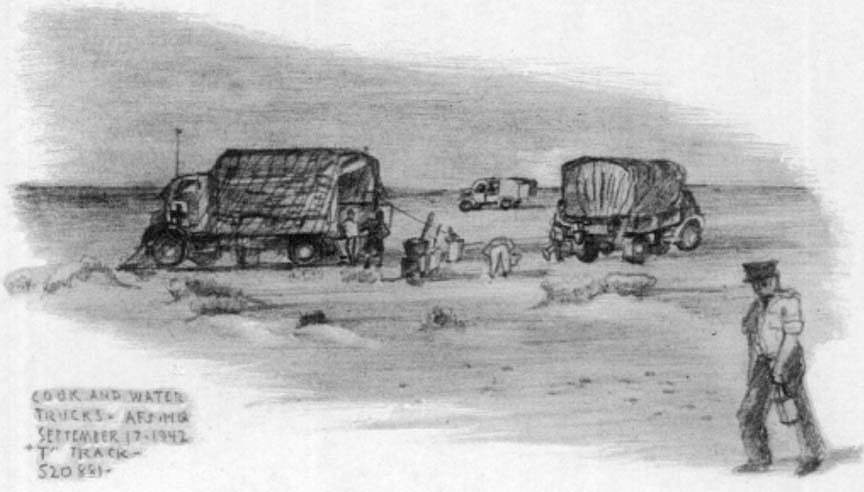 |
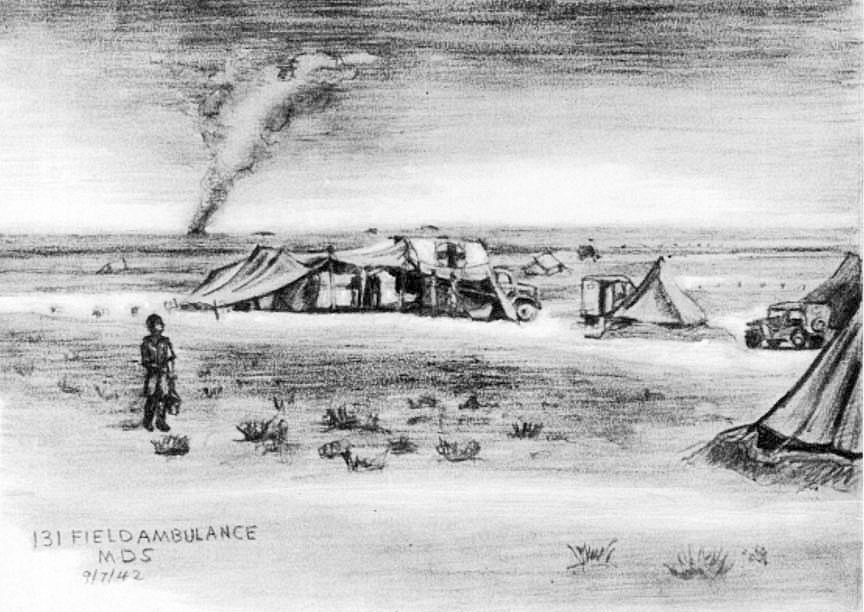 |
