That the American Field Service as a war ambulance service worked in France from 1914 to 1918 and again for 10 months in 1940 is past history. The year that has now elapsed since the AFS first served with the British forces in the Middle East constitutes present history. On November 6, 1941 the first contingent of one hundred volunteers left for ambulance service in the Mid-East. As we go to press with our first anniversary issue of AFS Letters, 500 volunteers are on active service with the Armies of the United Nations.
So much happens that some things get cast aside in the shuffle, and our readers are not abreast of events. In commemorating a year's service, we highlight these from both sides of the world.
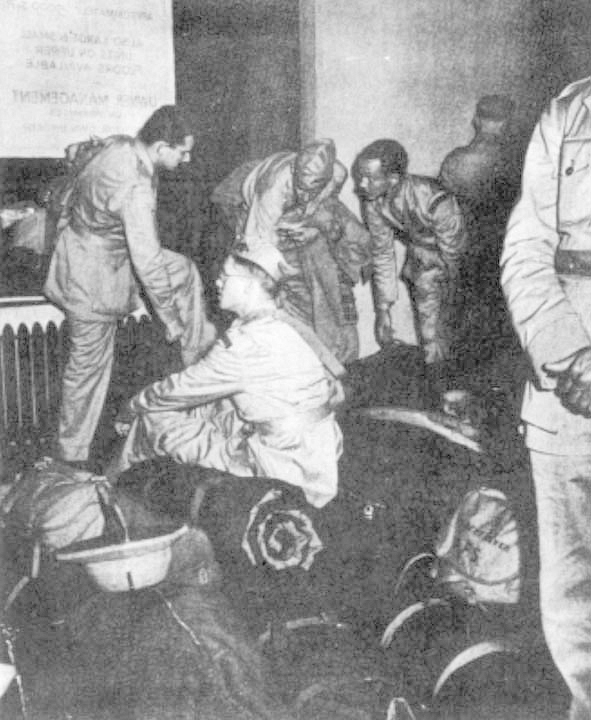
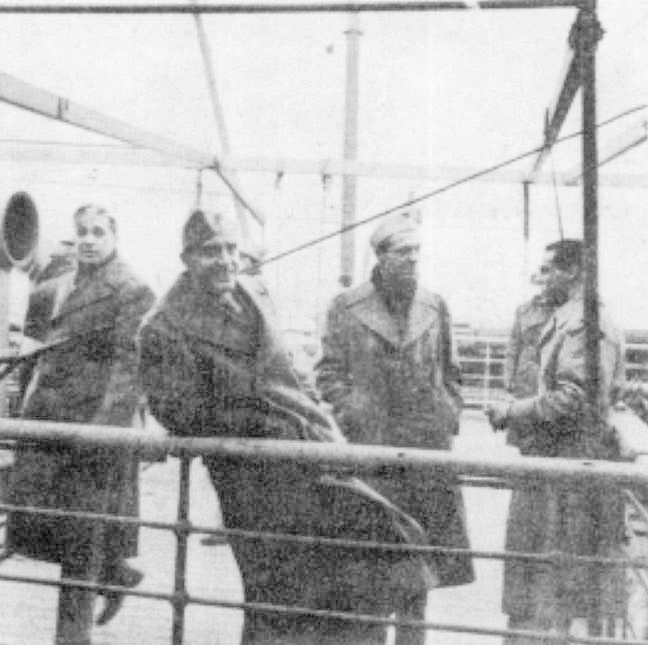
| November 1941 | Unit 1 of 100 men makes its exodus on November 6 from Grand Central Station, N. Y. to parts unknown. The ship was re-routed to Bombay, Colonel Richmond and Major Benson disembarked at Capetown, fly to Cairo and wait for the arrival of the Unit on February 15. |
| December 1941 | N. Y. Headquarters moved across the street to our present location. |
| January 1942 | The first casualties arrive in New York. L. R. Stuyvesant and Martin Knowlton injured in the Free French campaign in Syria 1941, and both wearing the Croix de Guerre given them for their services by General de Larminat. Departure of Units 2 and 3 numbering 63 men. Also in January AFS women workers burst into uniform which, with variations, have been retained since. |
| February 1942 | Departure of Unit 4, 111 men |
| March 1942 | Major Benson flew back from Cairo on the plane with Lord Beaverbrook, to go on tour for AFS. The tour was Good Will in every sense. Major Benson raised a great deal of money for the Service and as a result of his appearance it is still coming in; in addition he broadcast news of the AFS in the Middle East, short wave through OWI. The AFS Letters came timidly into being, and Units 5, 6 and 7 departed, 23 men. |
| April 1942 | Unit 8 left, 7 men. They were torpedoed in the Western Atlantic. |
| May 1942 | Medecin General Cise (High Commissioner of French Equatorial Africa) was in New York on a military mission and personally thanked Mr. Galatti for the aid to his forces rendered by the AFS section of men and ambulances attached to them. Units 9, 10 and 11 departed, 21 men. |
| June 1942 | Unit 11 was torpedoed in the Atlantic, rescued in three different groups, and brought on different dates to different ports. All were unhurt except for sunburn and exposure. AFS Letters inaugurated the Vieux Oiseaux page and through it has brought the Service into contact with many former members. Units 12, 13, 14, 15, 16 and 17 sailed --- 131 men. |
| July 1942 | Three citations were announced for three AFS ambulanciers. The Croix d Guerres were given to LeClair Smith, Norman Jefferys and LeRoy Krusi, jr. for their services to the Fighting French Forces. Units 18, 19, 20 and 21 departed, 33 men. Unit 14 was torpedoed in the Western Atlantic, safely rescued without injury and taken to British Guiana. |
| September 1942 | Units 22, 23, 24, 25 and 26 comprising 68 men departed. |
| October 1942 | Units 27 and 28, 25 men have departed as we go to press. Lorenzo Semple 3rd was given the Médaille Militaire and the Croix de Guerre with palm for bravery in action in the retreat from Bir Hacheim. |
Through the year we have expanded in several ways and some things, now that we look back on them, seem not to have happened, but like Topsy they "just grew." The list of the AFS representatives throughout. the country has grown and changed; new men have taken over new posts, and other new men have replaced those who have joined the Armed Forces,
We Salute for Extra Service -
Clifford Saber ---for the two wonderful oil paintings that he did for AFS, and all the drawings and cartoons he gave to the AFS Letters.
Ed Koenig--- for all the work he did speaking at colleges, placing posters and endlessly writing form letters in the office, before departing for "out in the blue". . .
George McCandliss --- who so generously helped the editor make the deadline for one issue of AFS Letters, as well as being on invaluable aid to all in matters of English and spelling.
Herman Vander Molen --- who showed up about the same time as the new printing machine and struggled daily with it.
Bill Van Cleef --- who worked for weeks in the enlisting department, and when he left gave us his brain child, "Rendesvous", a very pretty tune.
Arnold Motz --- who came with a smile that lasted through all the times that he helped with the finances, and still had it when he left.
We also salute those volunteers who did office work, errands and the various boring jobs which make up the daily life of the Service --- Donald Neville-Willing, Ralph Muller, Hugh White, Bob Humphrey, Jack Martin and Robert Gudder. This list cannot include the multitude who worked untiringly on the details of their own departures, some of them for many weeks.
Dave Hyatt --- for his feature stories on AFS distributed through North American Newspaper Alliance.
Arthur M F Stratton --- for his very vital Bir Hacheim article in the Atlantic Monthly for November, 1942.
Chandler A Chapman --- for his piece in Life Magazine on his experience of being torpedoed in the South Atlantic.
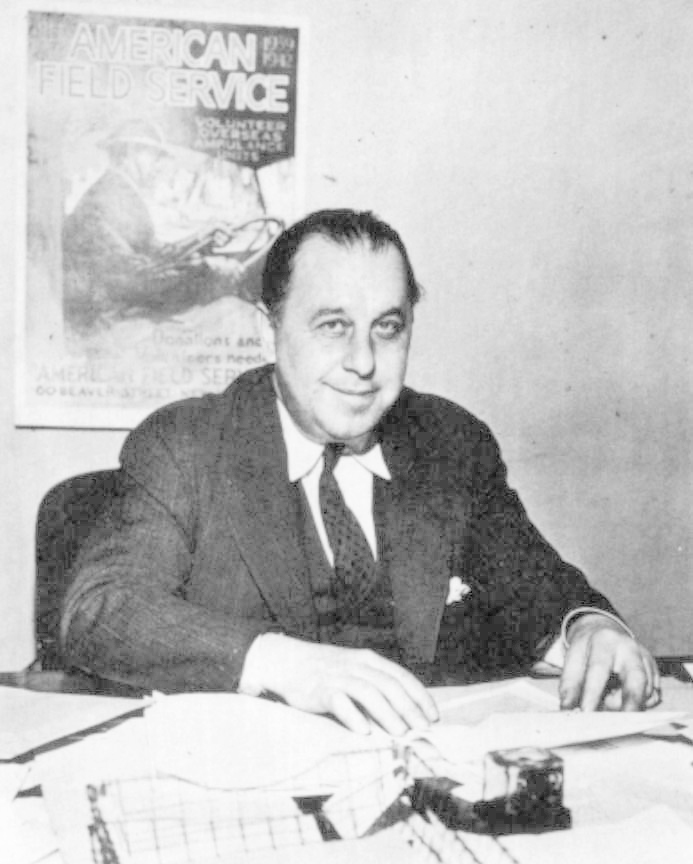
And most of all, our chief, Steve Galatti, Director General, beloved by us all for his vital spirit, his consideration, and his indefatigable energies which serve and make the Field Service. The dynamo that makes it run.
 |
 |
 |
 |
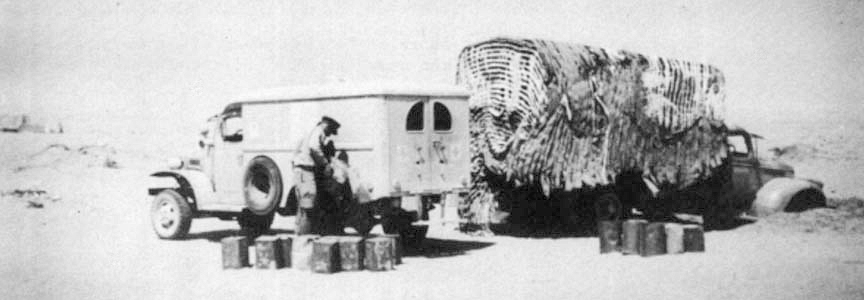 Refueling Col. Richmond's HQ ambulance at an emergency desert Petrol Point. |
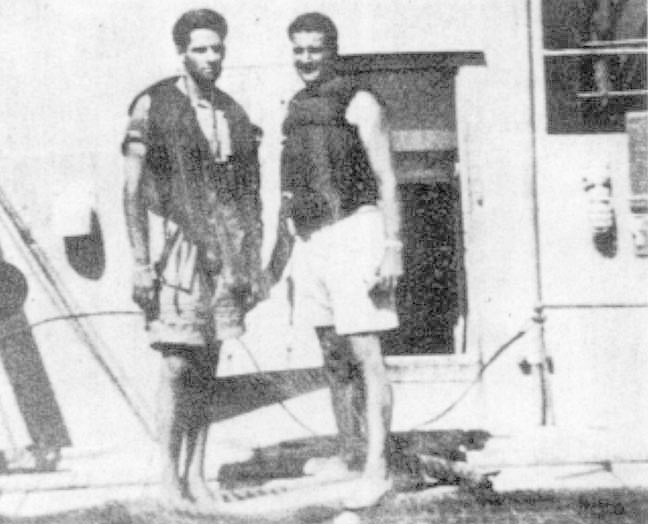
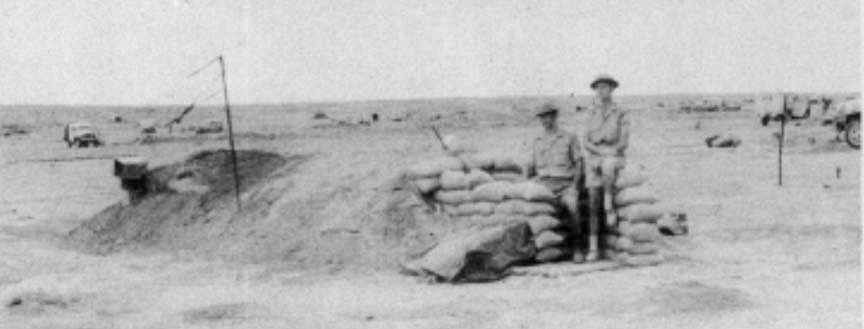 Dugout at Tobruk A.F.S. camp. Mortimer Belshaw and Joseph Reynolds. |
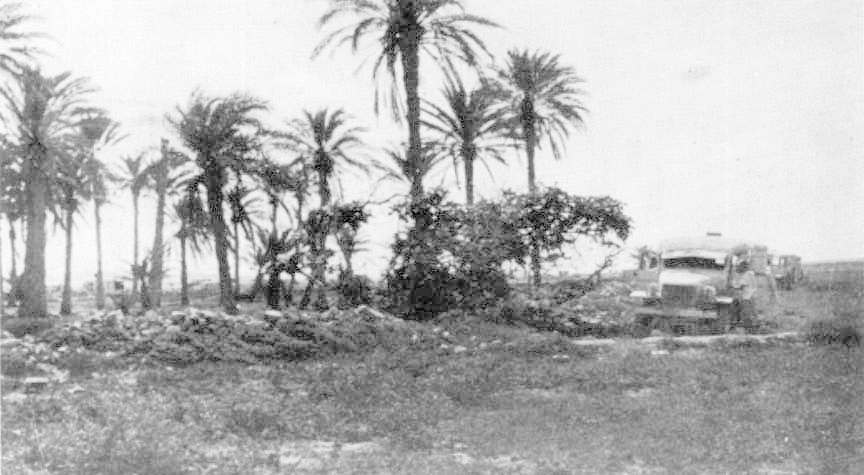 A.F.S. camp near Sidi Barani. on shore of Mediterranean after withdrawal from Tobruk. A.F.S. men named it "Wadi Richmond". |
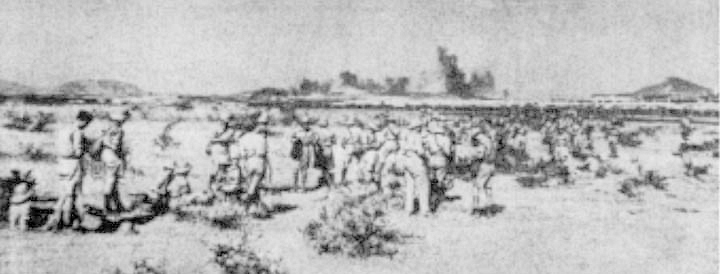
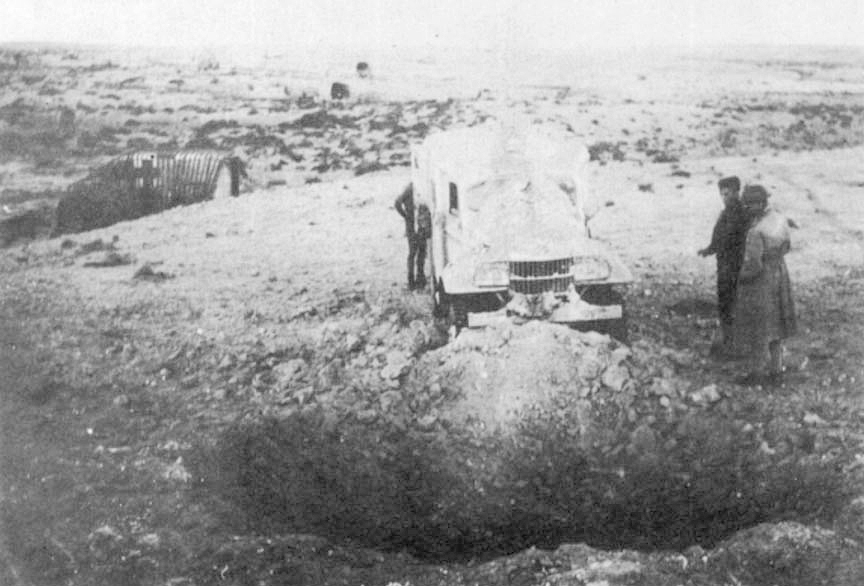 An empty ambulance suffered a shattered windshield from a bomb which left this crater directly in front of it. |
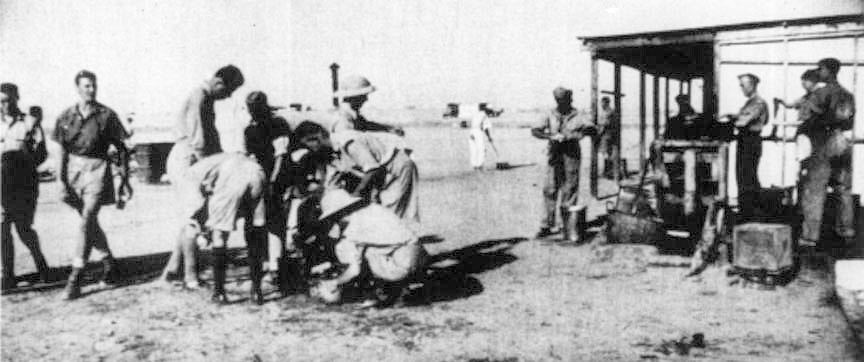 Tahag, September, 1942. Washing mess kits at MOB centre. Kitchen on right. |
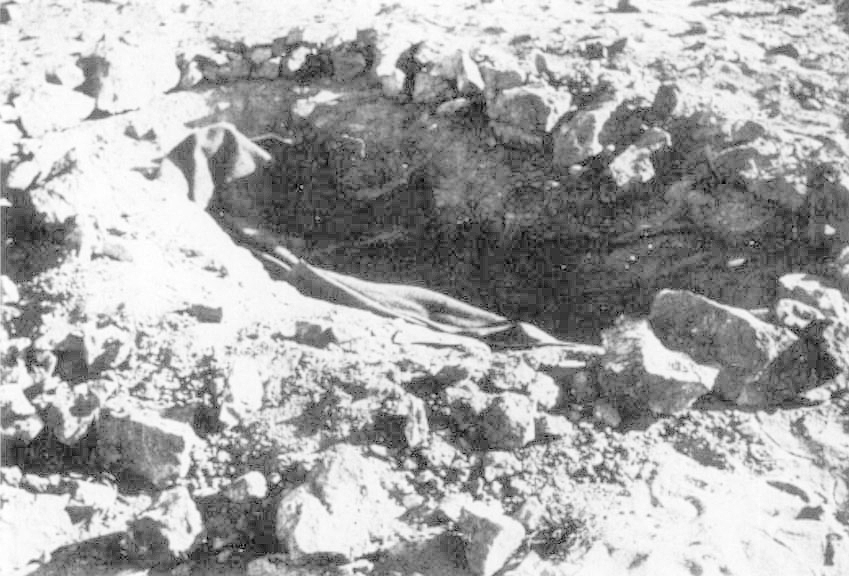 A.F.S. slit-trench used for sleeping at the front. Western Desert. |
"We have gotten the loan of a nice big tent from the French for the period of our stay here. We've got it all fixed up with tables, chairs, couches, benches, book racks and a cupboard --- all of this was either picked up around the camp or manufactured out of old packing boxes and beer cases (and in the case of the couches --- stretchers on gasoline cans). All in all, it is quite home-like and very comfortable. We had a great experience today when one of the boys went out and bought a dozen fly-papers. As the stuff is made in Egypt the flies light on it, lick it, walk around on it, and then calmly fly away. Result --- we are still swatting at them and cussing like hell."
"We got up on the desert just about three weeks or so before Jerry started his disastrous push, and we were working as an M. A. C. from a general hospital back to another hospital about 90 miles back. We were living in old Italian dugouts and things were exceedingly quiet except for night bombing raids on Tobruk. However, these didn't amount to much as Jerry never sent more than two or three planes over at a time. The night before the push started our platoon officer had us lined up for some special orders when suddenly 9 Stukas dropped down in the middle of our camp. I broke the world's record for the standing broad jump by clearing the 30 feet to the nearest slit trench in one jump. Another egg --- since gone bomb happy ---made for the same trench and we collided in mid air. We were all OK however, as Jerry only dropped 3 bombs in the middle of our workshop section. The blacksmith who stood up to see the show got a fragment in the arm and another in the leg, but any fool who hasn't got sense enough to take cover at a time like that deserves to be hit. That night Jerry did a bit of machine gunning about our camp but nothing much happened until around 3.00 a.m., when he dropped a flare which landed about 10 feet from my ambulance where I was sleeping. About 10 more records were smashed when I made for the nearest dugout, and there I stayed until I was lured out by the breakfast bugle. Two days later I went back with Gyppy Tummy and then three days after that, when I rejoined the unit, I was assigned as driver to an M. I. (Medical Inspection) tent about 20 miles from the rest of the unit. The medical officer was an eccentric old goat---Indian service, etc. --- who had me in stitches most of the time. Most of our work was at night and he used to get out of the ambulance and lead me across country. He got a great kick out of it and I never got any sleep. But it was right interesting work and I ate in the Officers' Mess cookhouse where there were 3 Guardsmen doing the cooking, etc. They were a wonderful bunch and I had a devil of a lot of laughs with them. Jerry was getting nearer and nearer and we used to have great arguments as to whether the "Guards" would leave before or after me. Suddenly the M. O. was sent back, the M. I. tent was closed and I was posted to another M. I. tent about 2 miles away where there was another one of our drivers. Everyone but the "Guards" and their two officers had left the other spot and there was not much to do. We still had to go out nights, however, the new M. O. said he'd be damned if he'd walk in front of the ambulance the way Major O. had. One night two Indian runners came over for the ambulance and off we went. That afternoon they had laid a new mine field which we knew nothing about until we'd piled through the barbed wire fence and gone 20 feet into the mine field. I still haven't figured out why we weren't blown to Hell and back again, but luckily I had found some wire clippers a couple of days before and we got out with only minor cuts on my knees from the wire. Capt. M., the M. O., took great delight in pouring iodine on them, but I got my revenge several weeks later when he cut his hand on a bully tin just after we had arrived here, and I was the only one about to dress it. I still don't think the iodine I used was strong enough however. But to get on. We were on a minute's notice to move as Jerry's armor was only supposed to be 4 miles away --- a damn short distance in this kind of warfare and we must have packed and unpacked the M. I. equipment a hundred times. One night I went up to see the Guardsmen and they gave me a half bottle of whiskey. We carried on our argument as to who was withdrawing first, but the next morning when I went up to see them they had pulled out. I'd sure like to see them again and put the old hawk on them. Capt. M. scrounged up 7 cans of beer and that plus the whiskey made it quite a bit of a party. We lived like Kings up there as there was a Field Supply Depot just 100 yards away and a Base Supply Depot only a few miles away. Finally, one of the medical orderlies and I were sent down to the local sub-area HQ and there we sat in a wadi for 4 days wondering how soon it would be before we were in "the bag". We could hear all the gunning over the ridge and we got a couple of shells and a bit of strafing, but there was no damage done. The bombing doesn't bother me too much as I always figure that the bombs will land well away from me. Strafing, however, is another matter as it seems to be a very personal matter and I'm always amongst the first to hit out for the nearest hole or cover. After 4 days of waiting and wondering we split up into two convoys and made for the rear. The convoy I was in made tracks straight across the desert and it took us four days to reach the sub-area HQ. It was well worth the trip, however, as the new HQ was located on a lovely beach along the Med. Sea. Capt. M. was quite surprised to see me as another driver from our unit had been sent out to relieve me. He never found me, however, and so I had another 3 or 4 days of sitting and waiting. This time we had a beach and good swimming, so it was right nice. Finally, Capt. M. was ordered farther back to set up and run a medical concentration area and I was attached as driver, but driving has only been one phase of the game since we've been here. The work is damned interesting though the locality is hell on earth. Hotter than blazes, frequent dust storms and more flies than you can shake a stick at. In fact, the flies are going to drive us batty before long. We'd been here about 2 weeks when I got a bit of fever which I insisted was sand fly fever. The Capt. insisted it was a bad hangover from 2 bottles of beer which an ophthalmic Major had given me 2 days before. The argument raged hot and heavy for days, but finally the Capt. came down with the same thing yesterday, so he had to admit that there was sand fly fever here after all. Now all I have to do is to convince him that I had it and not a hangover. Two beers and a hangover --- indeed!
"The only trouble with this job is that it's a 24-hour job and one gets no time off. An Indian officer gave me a pile of books a while back, however, so I'm able to read whenever there is nothing on. The Capt. insists now that I'm the laziest white man on the desert now, but there is nothing like a few books, etc. to get in a bit of relaxing with."
No date.
"We have a mascot here. One night a tiny, unfed, starving and very friendly little kitten came to our domicile. We fed her and she has been with us a month now and is doing well. She is very playful.
"I swam in a beautiful pool which is decidedly sulphurous where Cleopatra is said to have bathed for the waters healthful powers. You can smell the sulphur long before you get to the pool but one doesn't notice it while swimming.
"One drives along the desert between two ridges of low lying mountains about 10 miles apart. You really can't get lost. We see gazelles occasionally, also herds of camels, and most peculiar, you will occasionally see a native, way out in the middle of nowhere and we know there isn't a village in sight or water for many miles but there they are and they seem to know where they are going."
"Well, I have been out here for a week now. There are 5 of us at this particular Advanced Dressing Station. We evacuate patients from here back to an M. D. S. --- Medical Dressing Station. The first couple of days were very busy ones. There had been some tremendous artillery barrages, especially by the English, the night we arrived. For one day we were only 4 miles from the front. But things were a bit hot there for an A. D. S., so we moved right back the next day. It was up there, on my first day out, that I went through my first air raid. And I can assure you it was no fun to hear those Stukas screaming down not far from you. They were attacking some batteries about half a mile away. We weren't sure what the planes were at first, until our "ack-ack" guns opened up. Then there was a mad scramble for slit trenches. Only I didn't find one, so I just lay flat beside one already occupied. Well, none of the bombs landed closer than a quarter of a mile from us. But that is plenty close enough to send some shrapnel your way. I heard one piece whistle over my head, sending my heart right into my mouth, beating like a tom-tom. Then, of course, there is always your own ack-ack to look out for. The shells explode in the air and pieces drop all over the place some of them quite large, too. A little while after the bombers and Stukas went away the Germans started shelling, and that also was a bit too close for comfort. Moving back a couple of miles put us out of range of the Jerry artillery, but not out of range of planes. Anyway, we stick close to our slit trenches, and sleep in them at night.
"It's a good thing I do sleep in one, too, since I slept through one air raid the other night. The nights are really wonderful out here, very cool and dewy. It isn't nearly as hot as I expected. In fact, the days are quite pleasant. But the flies are terrible. They almost drive you crazy. Since we haven't had much work in the last three days, we have just had to sit around and let the bloody things annoy us. During meals we stand around the cook tent eating with one hand and waving the flies sway with the other. It is almost a race to see who gets the food first --- yourself or the flies, I should like to get my hands on the person who told me that there were no flies in the Western Desert.
"Two nights ago I was up the whole night at the M. D. S. carrying patients to and from the operating theaters, which are just small tents, containing operating equipment and electric lights. There had been a tremendous number of patients for the previous two days and the surgeons were working day and night. In between trips I watched the operations, sometimes helping the anaesthetist by cutting a piece of tape or something. I saw some mighty gruesome things that night, an amputation and some amazing abdominal operations. Those surgeons really work hard. No sooner is one patient taken away than I would bring another requiring every imaginable type of operations. Bullets and shrapnel can certainly do an appalling amount of damage to a man."
"The ambulance that I now have the stewardship of is the gift of Thomas A Yawkey of Boston Red Sox fame. At least there is a plaque on the door which bears Mr. Yawkey's name. When I have some time I'll have my picture taken with the ambulance as a background, or vice versa, and send it and a letter to Thomas A. as I somehow feel that the gentleman would like news of his Middle East interests.
"Outside Alexandria the sand dunes are honeycombed with ruins. But that is one of the few traces of a former civilization. However, it is a beautiful, modern city. Most of the sea front is a sort of glorified version of Riverside Drive. The Mediterranean, an unbelievable blue, is far more scenic than the grimy Hudson. And the apartment houses and hotels in gleaming white contrast with the rows of colored cabanas that they stand guard over. The food (which is not rationed) is good. And you can buy a very adequate meal for about 25 piastres which is in the near neighborhood of a dollar. To continue on about the local currency --- 100 piastres make one pound Egyptian.
"Reverting to Mr. Yawkey's Middle Eastern properties. The local terrain is rather hard on our ambulances and we have to grease them almost daily as well as clean the carburetors, etc. Not too much fun but it certainly helps.
"I just caught sight of myself in my rear vision mirror and I don't think you would be overly pleased at the view. You see, we haven't been able to get a complete bath in over ten days.
"And my washing has been most sketchy as I prefer to devote the greater part of my water ration for inner consumption. Also the landscape (which is rather mobile) is coated all over most of me. As for my apparel, I have on a gray New Zealand shirt and greenish South African shorts and brown suede desert boots. And as much of my head as is possible is crammed under a steel helmet as Jerry happens to be buzzing around in the neighborhood.
"Climatically speaking, the desert does not meet Metro-Goldwyn-Mayer standards. Ninety degrees is unusually warm and the nights are positively freezing. Also the contours are most un-Metroish. Rolling dunes are the exception. Brownish-gray rock is predominant. Remember when we saw "Suez" being made by the courtesy of the Beverly Hills police force? The most unpleasant features of the desert are the flies who travel in thickish convoys and the Jerries who are not nearly as numerous as their fellow genus."
"Have just returned from about a week's leave in Damascus and Beyrouth, the only large cities of any interest in Syria. Actually Beyrouth is in Lebanon, there being both a historical and political division, the seacoast back to the large Lebanon Range and hinterland and desert which is properly termed Syria. Tell a Lebanese he is Syrian and you may be in trouble. The majority of the population of Lebanon is Christian and obviously marked by European and particularly French influence. Beyrouth as center of the coastal region is, as I can recollect, almost a dead ringer for southern French towns. The houses climbing up and up the hills rising from the beautiful Mediterranean. Red tile roofs. Large hotels along the shore---winding clean paved streets with small sidewalk cafés, kids in shorts and berets, rarely a veiled woman. Beautiful flowers and large cedars. And in the hotels, still a few typical tourist faces, old habitués of a small Riviera. Meals with innumerable courses, always café au lait and the inevitable fruit with which to end the meal. And to hear perfect French after the half-breed français spoken by the usual Syrian native.
"Damascus is nothing of the sort. Damascus, with always the exception of Mecca, is the heart, the capital of Islam. Here is one of the greatest Moslem Mosques, here for centuries Christians have been slaughtered. John Baptist's tomb is here and from an ancient window Paul escaped from prison. Although there are the European shops the civilian French and the military British influence, this is actually a wog city ("wog" is a tern for Arab and is just as bad and vicious as "nigger") There are the dark souks which run, unplanned for miles. Thousands of aimless gabbering natives wander by, the women perhaps in short skirts but always with veil. Always interspersed among other stores are the small coffee shops where very sweet clear tea and acrid Arab coffee is consumed all day. And they smoke their Argillas and just stare. It is said that a favorite touch of well-to-do Arabs is to buy out a small hotel or a coffee shop and just use it all day. They could show our drugstore cowboys many tricks. Occasionally there is an Armenian shop among the Moslems.. But the true Damascus Christians stick to their own quarters, both living and working. You cannot turn in Damascus without running into clear, fast flowing water; Damascus, in every way is far more attractive than Cairo. Begging, the fete of Egypt and probably partly due to that great institution, the American tourist, is at a minimum. If you permit your imagination a little freedom it is easy to picture the triumphal entry of Laurence and his Arabs in Damascus in 1918. Out of the desert into this valley of fruit and olives and green. And it is not hard to understand why the Bedouin conception of Heaven is a sensuous one, almost Bacchinal. To spend a lifetime in a sterile land with only a few spots such as Damascus, even, inevitably build an after-life wish in every detail. While we of the temperate climate turn to the afterlife for spiritual comforts, if we turn at all.
"But in spite of the romance of the old cities we still like best our desert, our lousy English tea and our Bedouin friends who continue to dine us in the famous extravagant Bedouin style. Only a couple of weeks ago there was an enormous fete at one of our acquaintances --- a big sheik. We sat in the courtyard on heavy rugs leaning on long pillows and reaching our greasy hands into a huge roast of mutton. One of our men was the unwilling recipient of a nice blue sheep's eye, regarded as quite a delicacy. They offered one to me but I was not caught unprepared and had stuffed my face to overflowing with Bedouin bread and could only roll my eyes protestingly, gesture frantically at my mouth and protrude my tummy as signs of sufficiency. And after, we adjourn to the private gardens of a night to sit on heavy carpets smoking the bubbly-bubbly pipes (argillas) and drinking black coffee and dipping our palms into bowls of fruit. We talk, sing and in a crude manner, are able to carry on small talk in English, French and Arabic."
"When I last wrote you I think I said that we were in the process of going back for a couple of weeks rest after a fairly arduous period of continually being on the go. Well, we moved back to a delta city and settled down of all possible places in an old cattle pen on the outskirts of town. There jammed together in about the filthiest place I have ever been we spent 4 days swatting flies, chasing away the wogs, hunting for "Back-Sheese", and generally sweltering, in our own stew of annoyance. After having spent so many weeks in the wide open spaces in the fresher, healthier climate of the desert, we fairly hated the place. The town itself had sections which were very nice indeed, broad open avenues lined with trees, a couple of good movies, and a pleasant country club, but as always there were the other unescapable 9/10 of wog filth, noise, and smell. A few of our sections were still back in the desert, and having had a very rough time of it for a couple of weeks they needed relief badly. Accordingly, we packed up and started out to find them. We got pretty near them by road and then had to head across the desert for about half a day. Having nothing but a map and compass we had to stay right on our course all the time, and it was certainly tough going. This particular section was either rough going over jagged rocks or terribly bumpy travel through soft sand with a heavy growth of low bushes. The desert is monotonous and dull in one way, and yet once you learn to appreciate it and know it, it has a great deal of beauty and grandeur.
"There are "wadis" --- sort of gullies --- cutting it in many places, and larger "wadis" called "deirs" occasionally make very scenic spots. Riding along our apparently flat country you will suddenly find yourself on a cliff with a sheer or very steep drop of about 40 feet. Such a cliff normally surrounds "deir" which may be a mile across and several miles long. Right out in the middle of it there may be a cone or a cylindrical shaped mound rising up again to the desert level some 40 feet above and those rises scattered through the "deirs" are fascinating. They evidently are some small section of harder material which has resisted the wind or rain evasion process creating the rest of the "deir".
"The A. D. S. (Advance Dressing Station) which we were hunting for happened at the time to be one of these places and it was a grand location; the only drawback was that there being such nice protection in the place from gunfire, etc. the artillery had also decided to make use of it as a good spot in which to hide itself, and to the South, East and West of us the artillery was roaring away and the shells were whistling over continually. Of course, too, Jerry was sending back an occasional salvo and we were kept on our toes most of the time. At first we couldn't distinguish between our own and his shells and accordingly did a good deal of needless flopping on the ground, though out there a needless flop is not something to be laughed at. One sees too many cases of people who failed to take the precaution for it to be a joking matter. Wherever and whenever we stopped for any time at all out there the first thing we always did was to dig a slit trench. It's the orders for the soldiers and no one had to ask us to follow suit After one Stuka raid a man does not question the desirability of having a little hole to jump into. A job which I will be well suited for when I go back will be that of ditch digger. Our work at the A. D. S. consisted in both bringing in the patients from the front and carrying them back, after treatment was given, to the M. D. S. (Main Dressing Station). The first few days we had it pretty easy. The ambulances stationed in the front lines at the R. A. P. (Regimental Aid Posts) were running back fairly regularly with the few people who got caught by Jerry artillery and the others were operating back to the M. D. S.
"About twice a day or night the A. D. S. would pack up and move a mile or two, on about ten minutes notice, for reasons I could never understand and thereby leave the ambulances up forward or back in the rear with no knowledge of where to go; but somehow we functioned smoothly and well. The food and water were both sufficient and good and we began to wonder about the horror tales we had been getting from various others in the same locality when suddenly it hit us. The Major of the A. D. S. called me in, told me that a big attack would be launched that night. He showed me first what the disposition of our forces was, along what bearings they would attack, what the signals would be for success or failure in taking each objective, and what opposition was expected. Also the password for the night and the particular jobs for our cars. Under cover of darkness we got to the front, just in time to see some of the infantry before they started out with their bayonets fixed. At the prescribed hour out they went and such hell as broke loose out there I hope never to witness again. There was literally the "din of battle" with the shouting and yelling which arose when the enemy were contacted. Machine gun fire and flares immediately broke loose from both sides, whirling onions of fire, mortars bursting everywhere, and the signal rockets made it bright as daylight for much of the time. Almost immediately we got the cars loaded and started back and after that we ran continuously for almost 3 full days and nights. I have never before seen such hellish sights as we witnessed in those three days. The casualties, though perhaps of relative minuteness in number when the war as a whole is considered, were enough for all of us for the rest of our days. Without sleep, with several Stuka raids a day, with lots of shelling, and with blood and death beside us constantly we just about reached our limit of endurance when we all got ordered back to the M. D. S. to get a sleep and some rest. The whole A. D. S. pulled out, the doctors and orderlies being in the same condition as ourselves, and never was a rest more welcome. On the last of those three days D's and my ambulance was badly hit during a dive bombing though we both were O.K. D. had a particularly close call as he was in a slit trench right next to the thing, while I was off some distance talking to some people about the location of a bunch of Jerry and Itie wounded, whom we were going out to pick up. No people very near by got hit during the raid and D. was certainly lucky. The entire front of the car about the steering wheel was ripped open by shrapnel and the back looked like a sieve where it had gone out. Most of the cars managed to pick up a few holes, but on the whole we came through pretty well. When people tell me about Pearl Harbor and I read of the gallantry of two-day stands here and three-day stands there. I begin to wonder how much is known of the men in any sector you choose out here, who have gotten the same sort of punishment for weeks and weeks and are never mentioned; about the men in any single battle in Russia who have seen there endless horrors compared to the gallantry tales with which all U. S. war dispatches are filled.
"We have in the last couple of months won a very fine reputation out here in the desert, and our organization is tops with every medical unit we have served with. So, come what may in the line of tales on our awful behavior on past or future occasions, when given a tough job we have done it well.. It's the little jobs which seem to stump us.
Later.
"My new job is not too exciting, though there seems to be a thousand and one little things to be done each day. We are right in the main line of evacuation for patients coming in from the front, and as the battle ebbs and flows up forward our work varies accordingly. We are not so far from civilization but the flies are bad and they certainly are a nuisance. They wake me up in the morning buzzing around my face, and until about 6 in the evening they seem to keep it up. With a. large mosquito net I manage, however, to close off the back of the H. Q. truck pretty well for reading and writing and playing chess. I have gotten in a lot of food reading of late, as even when we are busiest we spend a good deal of time waiting around to load and unload and if you keep a book nearby it helps to fill a lot of otherwise wasted time. There is ample reading material scattered through the outfit and Alex has good bookstores if the supply runs low. I have just finished the Essays of Heinrichs Heine which are full of exquisite bits and Clifton Fadiman's book of Reading I've Liked.
"My opinion of Alex picks up as I see more of it on occasional trips. I have found a wonderful little French Restaurant which has as good food as one could hope for in New York's best, and besides there is a marvelous seafront to the city along which are many nice cafes and swimming spots.
"That reminds me that the moon is coming up and Jerry will be around starting very soon, and as yet I have not dug a slit trench in this camp. Last night I heard him whining around overhead and he dropped a few flares and did a little bombing a mile or two away. Accordingly I had better do a little digging before turning in.".
Alexandria Hostel, August 15, 1942.
"No one is allowed to stay at the front very long, because so many chaps are chomping at the bit to get up there and dodge shells and actually transport patients in the field, that everyone is regularly pulled out. It is interesting to note that the intensity and strain of battle (and as newspapers point out the front is quiet) bring most people the gambler's exaltation. Few of the soldiers I've carried in my ambulance wish to remain in a hospital very long. When they leave the front they want all their comrades to go with them, the tie of common dangers is very strong. Many of the Field Service drivers will do anything to get back up. They feel they are doing the work for which they volunteered. I could describe, I suppose, what most of us saw up there; the wrecked Italian and. German guns, vehicles, aircraft. Dog fights overhead were exciting to watch, planes shot down in smoke, tanks blown up, etc. But the skill of the Medical Officers performing their operations in simple tents, under sandstorms. Myriads of flies (they say they are bred from the dead) and an occasional Jerry visitation, is marvelous to watch. The Medical Corps is, to my mind, very efficiently run. The fol-de-rol of the parade vanishes. Our M. O. used to mix us up Horlik's malted milk every noon. We received our breakfast delivered on an armoured vehicle, the food kept warm in metal cylinders. Officers and men ate the same. Though evidences of rank were not obvious, I don't believe there was a man among us who would have hesitated an instant to do whatever the M. O. asked. I had a hole next to the ambulance which was dug in, and surrounded by sand bags. One morning the shells got a bit close to our position, so the M. O. yelled "It's getting hot. Let's move," We did, I can tell you. When I returned, there were no marks on the ambulance (some boys had shrapnel spattered all over the sides) but in my trench were several pieces of spent shell, which probably wouldn't have hurt me, but which I was glad not to have felt, just the same. These I collected as an exhibit.
"You know the Jerry shells differ from ours because the bursts are black (like the devil himself) and ours are white. We used to shut up our cars, leaving the doors unlatched, spread netting over the window openings and spray out the inside, rendering us relatively fly proof. We were genuinely sorry to leave our Regimental Aid Post and the Captain.
"I had a wade in the Mediterranean. It was peacock blue, warm and frothy. One thing I've learned --- how to live with a change of, only clothes, toilet articles, blankets --- a pack you can carry --- and when I reach home and the war is over --- I'm going to try a walking trip with just this much. I don't particularly enjoy losing my nucleus, my center, the instability of living on call. I am not an adventurer, but I must help with this job until it's through and then maybe we can forge a better world. There are hints of it coming.
August 15, 1942.
"The stint of sharing Jerry's presents with the New Zealanders (God bless them) wasn't long enough for any one to write a sheaf of War Memoirs and keep a straight face. I was a bit tired, the rumbling continues, though everyone, including the newspapers, said the front was quiet. We received a quota of shells near us, and fire from machine guns and mortars, ducked when the planes overhead were taking ack-ack, watched dog fight after dog fight through binoculars, saw tanks blow up, all the regular stuff, I guess. We were thoroughly scared, but we went through not so much as other AFS boys have been. And. now relief and the quiet routine of shuttling back men for evacuation to base hospitals and rehabilitation. There are so many of our lads who are anxious to, and pestiferous about serving at the Regimental Aid Post, or an advanced dressing station, that no individual is allowed to stay up there very long. So we did our stint and perhaps. will go back to our first stamping ground for a while, a few at a time, when we wish. I've been going to my favorite Greek restaurant, a humdinger, took a Major there with us last night, a lonely man away from his family. We thoroughly enjoyed his dissertations on whiskies, he being a connoisseur of them. I am writing this in a lovely old house run by the N. Z. Y. M. C. A. for their volunteer troops. The beds are so clean and white, the breakfasts marvelous and all in all its just the place to rest up after a little nerve-wrack. Capt. King came up to our little post near the front and snapped the ambulance, where, we were dug in, sand bags around us. Every evening dinner was delivered in hot boxes, after the flies went to sleep, by a rumbling war cart. We haven't been through the dime-novel type of war, like the others of our outfits I'm not after thrills, but to do my work. I suppose one could make a kind of Cook's tour of the front out of our service, were you inclined. But I don't believe any of the boys like loafing about, they just want to work. If they send us out on any job whatever, we'll try and do our best. I will never forget our ambulance one typical night blacked out with blankets, the doctor, orderlies and myself squeezed inside, examining a casualty on a stretcher First the morphine, I held the empty syringe after it was used, then the unwinding of the first field dressings, put on by the fellow's mates. Wounds in arm and legs... No bones broken, fortunately --- clean. Then the careful tapping of muscles, and testing of nerve reactions by the Capt., number, name, condition, and lastly filling-out the envelope for each wounded man. The box, "slight or severe", checked. Running through the night, back from the lines to the tent advance hospital in the rear. By compass, the Dipper is cloud covered, easing along mostly in second or first gear smelling our way --- stopping by lorries, whose sleepy drivers, roused out each time, gave us directions, closer and closer. Challenges by sentinels. Identifications. Two hours of this, the fellow in a jeep led us to the place, a vague blur in the dark cool expanse, to be distinguished from other vague blurs. There! How did we miss those shell holes and slit trenches? Perhaps my vitamin caps helped my night vision."
August 24, 1942.
"I enjoy conversing with the different troops, who, like a man on guard duty at the AFS HQ in the field, told me the legends of Hereford--- "here-we-"ford" --- the story of Johnny Hant, who was warned by the devil that when he dies Johnny's soul would fly to hell if the coffin was carried to the grave either on the verge (shoulder) or on the road --- buried either in the churchyard or out. So the pall bearers bore him half on the verge and half on the road and interred him half in the churchyard and half out of it, the head stone rests outside the hedge. Then there is Mother Shipley's "Wishing Well" where water drips in a limestone cave. People hang up dead dogs and cats, pipes and walking sticks; the pets are covered in a time with a case of "tin" of stone and can be set up in a garden in natural posture. "Permanently". Isn't that strange? Another man told me a woman next door to him was frightened by a wild cat in her barn, while carrying her unborn child. This soldier swore that he met the tot, a beautiful fair haired boy, and while dangling him on his knee, asked about a glove covering the child's right hand. The mother took it off and revealed the wrist downed with grey fur, the pads (pink) and claws of a cat!"
Unit No. IX bounced a bit on the high seas.
"The roll of the ship gives me the uncomfortable feeling of sliding up and down in my skin. Books and trash collected on the table were thrown onto the floor. During the night the table started skooting up and down the cabin and the chair tipped over and rolled around and crashed into everything. The drawers under the bunk slid open sometime in the night and almost everything on the table was dumped into then, including books, clothing and two nice full ashtrays. What a mess The jug of water was found in the morning on the settee, but fortunately upright and only a pint or so soaked of our equipment."
August 3, 1942.
"This army life is queer business. You have to be ready all the time for anything at all to happen, but often days will go by on end with nothing happening at all. Then when you are busy you have plenty, of course. Yesterday morning I spent the early hours (except for actually eating breakfast) in my slit trench to be out of harm's way. They were shelling sporadically here and there, as they are likely to do every morning and evening. Visibility is better then and the Observation Officer can see more targets and see results more clearly then. But finally I got disgusted fighting flies, and got up to fold my blankets, shaking out the dirt that always blows and drops in on a bed made in a slit trench. I was standing maybe 15 feet from the trench when I heard a shell and turned around to see dirt beginning to fly, perhaps 50 yards back of me. I took a flying leap, landing flattened out on the floor of the trench, and boy did I flatten myself. Shrapnel and rocks flew over me, but, of course, none could get at me, below ground level as I was. And more and more kept coming, and I stayed very low, scared plenty. Hours after I took little interest in lunch, though it was half a tin of fruit, which is something of a treat. Funny how differently a guy will react. When I was bombed at Tobruk I was just excited. Action was indicated ---the search for cover --- I didn't have time to get scared.
"It seemed to go on and on, another shell screaming in to a landing before the rocks had more than barely started to thud down from the last. I could picture each one as a direct hit on my slit trench. But each one wasn't and endless as they seemed I don't suppose there were actually as many as a dozen shells in all. Then it was quiet again, and after leaving a decent interval for rocks to settle from the last one (a precaution that one learns well the first time) I poked my head up. I was horrified to see that the dust that marked the position of the shells was all coming from the direction of the First Aid Section, where all the fellows were, and here came my ambulance mate to jump into my trench with me. He smelled of burning stuff, partly but not wholly, I thought, the cordite from the shells. The quiet continuing for a bit, we all took the two ambulances and drove away.
"It turned out that everybody was all right, only a scratch or two on J's knee, where he jumped into a slit trench, except that the sergeant's nerve was broken, He's a strong man, and a fine one. Been through several campaigns (including Greece and Crete) but this finally got him. Or perhaps the conjunction is "and" for the effect may have been cumulative. I don't know. Anyhow, it wrung your heart to see him. After we moved a few hundred yards away and parked, the shelling began again, and though it was now far away you could see him writhe in agony with every bang. Our own guns, which he would normally recognize, were quite as terrible to him, it seemed, as shells bursting. Now I have seen it myself and know what they mean by "bomb crazy", and I can also appreciate how it happens. As I say, I wasn't feeling very good after it myself.
"They hit the rear end of the truck that was our first aid post a direct hit, and why the thing didn't catch fire, I can't guess. Or why, failing that, the shell didn't anyway get B. who was lying in the pit under the body of the truck. All the rest of the outfit except myself were lying in slit trenches within a few feet of it. The most amazing thing how no one was hurt.
"But all the medical supplies and equipment were an almost total loss. I salvaged this paper. I don't know whether the hole was made by shrapnel or something not a part of the shell but blown around by it. The MO went back and got some stuff for us to carry on with, and we are set up in a new place. Incidentally, they shelled that old spot at least twice more. We are sans truck, and so less mobile than we should be, but that defect is being corrected, and at least the area is not devoid of medical service as it might have been if we had moved back as I supposed at first we should have to do.
"Let me remark that I don't believe Jerry was deliberately shelling the Red Cross, even though all those shells landed in or closely around it. There was another, more legitimate target not very far away, and it was partly our own fault for being there. But let me hasten to add that our being there was not the MO's fault, either. The whole thing was a combination of things I better not go into here. There is definite evidence that the thing Jerry was hoping to hit was the other target.
"They bring our food, around to us twice a day, thermos jugs of tea and of cooked meat and vegetables. They bring it around in a little thing they use instead of jeeps here --- a bren gun carrier, which is not armored, like a tank, but has caterpillar tread. In the morning the meat is bacon and/or sausage; at night it is likely to be bully beef with potatoes and a little something of vegetables. At noon we drink some tea left over from breakfast if we want it, and eat cold stuff, crackers ("biscuits") and cheese or maybe, marmalade.. At this post we are about the last ones, and we are lucky if we get our dinner while it is light enough to see what we are eating. They don't like the vehicles running around in the daytime lest it draw Jerry fire. But we are perhaps fortunate to eat late, at that. The flies go to bed at dark, and we can eat the food we can't see secure in the knowledge that it isn't accumulating accretions of that sort on the way to the mouth. In the daytime you have to pop the food in fast."
August 23, 1942.
"I finally got in that trip out to seethe Sphinx I've been promising myself so long. It is carved out of bed rock --- crossbedded sandstone dipping south, so that the true bedding plus the crossbedding gives a queer effect of improbability in tousled hair. Just now they have a scaffolding up his chest for people to scale, so one can see that he isn't really so big. At least, not so big as I had expected and sort of grotesquely out of scale with the truly massive pyramids that are so much more impressive than I had been prepared for. His broken nose makes him look rather like an ill-used china doll that has been thrown out of the house and is now lying around in the sandbox. I climbed the Great Pyramid again, and that is really something to write home about. As I found before, it is a wonderful place for fossil hunting. Beautiful exposures, weathered enough so that the fossils lie free on the surface, or just. ready to be pried loose with a thumbnail. In addition to the ones I found before there were several others, and one echinoid which is an amazing specimen --- almost a museum piece --- with shape and 3/5 of the surface preserved, including the many rings that are spine bases. , You may recognize it better if I call it a sea urchin.
"The "Time" arrives sort of erratically, copies two months apart coming in the same mail But my friends and I are glad to see it as BBC (which we hear only .8oinetimos) naturally fails to cover U. S. news in the detail possible in the magazine."
No Date
"I find myself still here on the same job as when I last wrote you about ten days ago. The days roll by with a hundred and one little jobs keeping me busy as we keep this show going. I don't seem to be able to get away very often, but it is not too bad a spot on the whole. Being in charge here, the cooks seem to feed me particularly well and I have put on a lot of weight and am feeling very fit. After about seven in the evening the day's work is over, and from then till sunset is a glorious time. My little Headquarters tent empties itself of all the pious folk who have been seeking refuge from the heat and flies between runs, and we move outside to enjoy the cool and beauty of the evening. A new arrival in our midst is a boy who was formerly a violin soloist for some Concert Agency in New York and we have spent many a pleasant hour listening to him play. The contrast between the atmosphere in which we live and the beauty of his music is very striking and it is truly an escape into another realm to hear him.
"The nights here are intermittently noisy and it begins to get me down watching tons of explosives landing on some poor devils miles away. Our interest in the display of lights and flashes and tracers has been completely satiated, and it is all now an unpleasant disturbance, both because it keeps us awake and because we know what those wretches in slit trenches are going through.
Later.
"I have just returned from an overnight run into Alex., where I had another lovely meal "Au Petit Coin France" and had several baths in the course of 12 hours. It is good to get back to a place where first of all you have something comfortable to sit on, sleep in, and eat off, and where secondly, the atmosphere is not that of army life. As week after week we sit around in ambulances or on old petrol tins, sleeping at night in bedrolls on the ground on stretchers, and eating our meals out of mess tins and chipped enamel cups with no utensils but a spoon, the nice sides of life become remote and forgotten with disuse. Suddenly to find yourself sleeping in a comfortable bed without your clothes still on but rather between white sheets, eating off clean white plates and drinking out of a glass, and sitting in an easy chair, is a very pleasant sensation.
"Last night after a good many weeks of sitting about on my tail sucking on a pipe, I went out and played in a soccer game which we arranged with the Field Hospital for whom we are now doing the evacuation work. Seeing as how the Tommies play most every night, and as how none of us had played the game for at least ten years, I deemed it advisable to bring in a couple of ringers from our R.A.S.C. attachment and they aided by a certain amount of brute force support from the rest of us managed to put up a pretty good show, though at the end, needless to say, we were not the victors. The only thing we were was "pooped out". At the end of the match it was all we could do to crawl over to our canteen trucks and hustle down few tins of beer which our dessicated bodies seemed to absorb before we know it was beer. The very smell of beer since, except at the most dire moments of thirst, has fairly turned me up, and beer and tea being the principal liquids a soldier out here seems to drink, I have found myself drinking literally quarts of tea a day. We get good tea always at meals and quite often manage to scrounge a few cups between times, the only trouble being that during the heat of the day it makes one perspire terribly."
Later.
"I have just been listening to the news and Churchill's presence in these parts has finally been disclosed. We, of course, knew about it some time ago as some of our people saw him. The B. B. C. broadcasts from London which the radio on our canteen trucks picks up keep us pretty well in touch with the news. Add to this a pretty good supply of "Time" and "Life" magazines which various people get sent and the daily edition of the "Egyptian Mail" and we have all we want. Of course, the last mentioned publication seems to be optimistic to almost a criminal extent, but there are many and deep reasons why that should be so here in Egypt. Just recently Mrs. B. was telling me how a few weeks ago in Alex. all the patisserie and wine shops had been cleaned out completely by certain elements who were arranging parties for the triumphant Ities when they arrived in town. Yesterday I was driving down through the delta on some business and while waiting at a drawbridge for canal boats to pass by was surrounded by the usual howling mob of kids. They were all saying "Mussolini mush guayeese, gimme backsheese" (meaning "Mussolini no good, gimme some money") but were there an invasion by the Axis powers, you can be certain their parents would teach them to insert Churchill for Mussolini quite readily.
"Another rather amusing thing happened recently when I was driving down the road with Capt. ----- who is our commanding officer. He was at the wheel and was buzzing along at a pretty rate, passing all the rest of the transport on the road when an M. P. raced up beside us and flagged us down. The M.P. then strolled up, came stiffly to attention, and with a click of his heels saluted the Capt.; he then proceeded in a very polite and yet firm note to give us a bawling out. At the end he repeated the procedure with which he started, and went away. It made me think how if only our cops at home had to employ the same methods we would avoid a great deal of hurt feelings and trouble. The M. P. can be just as hard on an officer or any one else as they see fit and can get them in severe trouble, but they have to do it respectfully.
"Already out here there seem to be signs of the approach of fall. The evenings are getting shorter, the nights cooler, and the heat of the day much less intense. Somehow I feel as fit physically as I have at any time since I left home. The cooks and I have become so friendly that they are all now sleeping in my tent at night, and we manage to have apple pie and tea on hand at most any of the 24 hours of the day. They were all pastry cooks before joining the army and the little delicacies we enjoy at regular intervals make our cookhouse the mecca for hungry people from other units in the vicinity. At the moment we are formulating plans for turning their efforts into remunerative channels, and I have an idea we may organize quite a profitable little organization.
"Tonight we played the Field Hospital again in soccer, and our showing was not bad at all, as we managed to tie them. They seem to be a little puckered at having a bunch of "Yanks" who are so inexperienced as we are do so well, and they will be out for blood when we play again in a few nights.
"With things as quiet as they now are on the El Alamein line our work is not heavy at all, though there seems to be a certain uneasiness and tenseness in the air as the old moon gets a little fuller each night. I have been doing a lot of reading again and in particular have enjoyed several books on travels through the Middle East by various roaming authors. One thing is made very clear in them, that this part of the world is quite different in peace time from what it now is. This is particularly seen in the attitude of the natives, though also in many other ways.
"We hear the rumbling of artillery quite regularly in the distance, but otherwise this area would seem very normal and peaceful. I expect the warfare here now is much more often the nature of what it was in France in the last war than it has been at any other time. Officers drive back from the front for an evening in Alex., and there in town all is gay and bright as ever now that the scare of a few weeks ago has passed and one will meet a R. A. F. boy who had been bombing Tobruk that same morning, or an infantry man who the night before was stabbing Jerries and Ities with his bayonet, but who now is quietly reading a book in the comfortable surroundings of a Service Club."
Cairo, Egypt, July 28, 1942.
"The interval since my last letter covers us at the very mobile front and the experience has been so intense, so jammed-packed with the hell of actual war that all my other letters and minor risks read now like a Cook's Tour. However, this is a difficult period about which to write. There is so much that one wants to forget. Then, too, we are still in it all.
"Almost immediately after I mailed my last letter we started to prepare for the desert campaign. We turned our old ambulances over to a succeeding American Field Service Unit, entrained for a desert base where we were issued new ambulances, trucks, etc. which we had to get ready. We covered all the glass including the windshields with a mixture of oil and sand so that the sun would not be reflected in the glass and thereby attract planes and artillery fire. We also made camouflage nets to throw over our sand-colored vehicles to make it even more difficult to be spotted; and made such personal preparation as storing our kit and taking only the absolutely necessary clothing. The Mobilization Officer warned us to take nothing that we were not prepared to lose either through sudden movement orders or enemy action. Furthermore, the frequent sand storms (like talcum powder) ruin everything with their penetrating thoroughness. At this stage I decided to get out of the H. Q. Mechanical set-up and go out as an ordinary driver. Other fellows had this same feeling that we had volunteered to drive and did not want to miss getting into it; consequently, a British mobile workshop under Lt. M. and personnel of 14 were attached to us to remain behind us for repairs. A few of our gang hung on with them, but most of us went out in sub-sections of 5 ambulances and 8 men and were spread out over the desert.
"When fully equipped, we started to roll; it was an impressive convoy of ambulances, huge trucks, staff car, staff pick-up trucks, and motorcycles for the dispatch riders --- all spread out at about 120 yard intervals which distance was maintained day after day, out into the Libyan desert. On the first day out we had luncheon by the pyramids but after that we refueled, ate and slept at points that were merely map references in the sand. It was, indeed, awe-inspiring to pass through the hot-spots of the First Libyan Campaign ---Sidi Barrani, Fort Capuzzo, Sollum, and Bardia which have been variously occupied by Italians, British and Germans, all void of civilians, all shattered ruins.
"We finally reached Tobruk, the former Italian base, a newly-built village of one and two story cement and marble buildings --- now a truly ghost town, completely levelled by shells and bombs. And it was in this area that the Aussies were besieged for months, but with the Royal Navy supplying them, held until other stout British troops could break through and connect them again with overland supply lines. Our camp site was on the battlefield to the west of the village and it was littered with the silent remainders of that terrific struggle, --- spent shrapnel, burned trucks, deserted machine-gun nests, Italian artillery guns silenced forever, piles and piles of new mortar bombs, etc., a German mauser and an Italian rifle, here and there --- all left hurriedly during the retreat. We all went souvenir wild!
"Even before the actual German offensive started at the end of May, there was considerable activity, mostly aerial. We dread the moon because everything stands out so against the light sand; but, even when there is no moon, Jerry drops flares to light up his objective. During our entire stay in Tobruk, there was a nightly barrage of ack-ack with the multi-colored tracer bullets bursting over our heads and mixing with the spot lights. We were constantly on the alert for parachute troops. There was a steady increase in activity, especially heavy artillery as the offensive started. Finally we evacuated Tobruk. As always when we went away from the front we were loaded with patients and must have looked not unlike the Tobacco Road crowd with our kit bags tied onto the fenders and spare gasoline, and water in racks on the side of the vehicles. I certainly want to pay tribute to the patients I've carried. I have never heard a wounded man complain no matter how trying the situation. In fact, the patients are usually cheerful, and, I must admit, that this spirit often turns a hard day for me into a bearable day. An Italian patient once survived the crisis of pneumonia en route with a South African black and two wounded Tommies, all of whom I carried for two days and one night during an unusually long trip.
"As our lines and distances to cover became shorter, there was less need for ambulances, so I was pressed into service in the operating room dugout of a South African (white) hospital tent unit. My previous meagre surgical experience stood me in good stead for I was often first assistant and "scrubbed" in to help the surgeon with the suturing, passing instruments, etc. Sometimes I gave the Anaesthesia --- ethyl chloride and ether or pentothal. It was certainly a privilege to work with those surgeons, the hardest working officers of any army because they have to do all the hard work themselves. During one rush we worked from 8 a.m. until 10.30 p.m. and the surgeons were just as considerate and patient with prisoners as with their own soldiers. Practically all of our cases were emergencies but one that I shall long remember was that of a Tommy with the nose of a shell behind his right ear. It severed his carotid artery but, as often happens, pressed the artery and prevented excess hemorrhage until we removed it at which time the blood just spurted out. The foreign body was the length of my little finger and the diameter equal to the length of the first two joints of my little finger. The fellow survived, thanks to the surgeon's calmness and quick ligations.
"One simple technique that surgeons might find useful, is to incorporate a piece of vasoline-covered rubber tubing lengthwise in all plaster casts. As soon as the cast hardens, the tube is pulled out easily leaving a cutting channel through which to run the scissors at time of removal. I sincerely regret that I did not bring a Miller-Abbott tube with me, because we could have put it to some new uses.
"My work at this hospital was cut short when the Germans captured Mersa Matruh and forced us to leave. Whether or not the Germans or anyone else respect the Red Cross is relatively unimportant in this war because bomb fragments, road strafings, shrapnel and shells dropped along the roads are no choosers of victims. Furthermore, at night it is difficult to distinguish the Red Cross. Proof of this is the fact that many of our ambulances have been hit and several destroyed. About 10% of my original unit as missing (some killed, others, we hope, only captured). A few others have been wounded.
"In spite of all the vicissitudes, I do not regret having volunteered. It is proving to be a valuable experience in so many ways . We not only have a deeper appreciation of life itself, but also of the most elemental things of life such as water, food, and minor comforts previously taken for granted. I think anyone who lives through this will have a richer, fuller life. Paramount among the things that prove an oasis. out here are letters!
August 25, 1942.
"Well, now that I have had my first touch of the real thing I find very little to say. Some of our boys have wonderful, hair-raising tales, but we struck things at a quiet time and dove for slit trenches very seldom. My feelings are still more curiosity than anything, and I want to stand or sit up and see what's going on rather than bury my face in the dirt, although I know one narrow experience will probably put the fear of God in me and make a more sensible person out of me. I also can never picture myself as one of those people to whom the narrow escapes and story telling incidents happen. So far the patients have been seen by a doctor before I see them, which means that it is easier for me mentally, as that is the thing that worries me more than shelling or bombing. This was a matter of luck as our position was close enough so that things could have been different. Also, it is the first time we have been thanked and appreciated for our work, and, of course, it is very pleasing. I was lucky enough to be one of five visited by a General in charge of the forces of his country in the field and thanked for our work not long ago. Dog fights between the planes are the most sad to see as they are so quickly over and so fatal.
"You will understand if my letters on leaves are short, as so is the leave. Your mail will probably reach me sooner than before."
"Well, there's so much to tell you --- and so many new experiences to relate that it's difficult to know where to begin --- accordingly I think I shall make an attempt at a chronological account. You will recall, that my last letter was written from an area which was one of the few which we missed in this part of the world (Delta). We all hated it there --- there was little if anything to do and the prospects were bad indeed. The day after, however, we were ordered back to the desert, and we were glad to go. We went to our new field headquarters which is about 15 miles west and several miles south of the town of Alexandria. We stayed there for about three days getting our cars in shape for what was ahead and then early one morning we set out for the front. You will have heard the name of the unit to which we were attached over the radio (New Zealanders). (Golly, that was a thrill and it was wonderful to get your wire saying that you had heard it). For some reasons we can't say in letters as much as we were allowed to say over the air --- it's just one of those things about which certain people get balled up --- but gradually we are getting used to the idea. The drive up was uneventful --- and saved from sheer routine only by the fact that we got lost. Chan Ives met us at the MDS (Main Dressing Station Roosevelt and his boys could take lessons from the British in the use of the alphabet --- thank God there are only 26 letters) and told us the news about Keith McLarty. That wasn't too auspicious a start. From there we were led to the ADS (Advance Dressing Station) some nine miles nearer the fighting front. As I said over the radio, we just pulled up in time to see everyone breaking for slit trenches. Fortunately there were several available for us and we literally dove into them just as the ack-ack (anti-aircraft fire) broke out in its deep throated rattle. I looked up to see a whole flight of Stukas just overhead and getting ready to dive. Then one peeled off and started down. God, how he came! And what a racket he made. I lay there for a minute waiting for the "garrumph" of the bomb --- it seemed like an eternity --- and. then it hit --- and then another and yet another. The ground around me vibrated --- and sand was shaken down from the walls of the slit trench and all hell seemed to have descended on us at once. And yet I wasn't really scared or frightened for an instant. Except under unusual circumstances, one is as safe in a slit trench against that kind of bombing as one can be. One bomb landed only about 30 feet away --- the explosion was deafening, and I was sure my car must have been hit, but other than that, it didn't particularly bother me. Then, as suddenly as it had started it was over and. the Stukas were away trying to avoid our ack-ack and we got up to see where we were. I shall never forget Tommy Stix's face. He had been in a very sandy trench and as his cranium appeared speculatively over the top, it looked as if he had been painted with some kind of rough, sandy shellac. The raid's objective had been nearby, you will realize, but fortunately it had been wholly ineffective. We gathered around the cook truck for supper --- we call it tea ---and the raid wasn't oven mentioned. (Incidentally, my car was still intact). Later George Lester was sent off to an RAP (Regimental Aid Post). where Bob Orton and I were destined later to join him. The RAPS are, as I described over the radio, simply three-ton lorries under the command of an MO (Medical Officer) and he is usually supported by a Padre, an assistant and a medical orderly --- all in addition to a couple of stretcher bearers and a driver. Usually they are stationed within a few hundred yards of the particular unit they serve --- they form a part of the battalion and stay with it at all times. (More of them anon.) Buzzy and I were detailed to make a trip back to the MDS --- we got off shortly after dark --- and it was pitch dark. We were being lead by two of the ambulances of the unit --- big Austins --- whose drivers were supposed to know the way. We started off and I was the last car. I could barely make out the outlines of the Austin in front of me although I kept only a few yards behind him. Suddenly he disappeared completely, and before I knew it I was plunging down a precipitous drop of about 15 or 20 feet into a wadi. (Wadis are sharp depressions in the desert varying in area from a few hundred square yards to several square miles--- sometimes they are five or six miles across and ten or eleven miles long. Usually they are very sandy --- soft clinging sand in which our cars are about the only ambulances around which are able to operate effectively --- that's due to our four-wheel drive.) In some way or another the leader had missed the entrance to the Wadi and had simply taken a chance that nothing untoward would happen. It's impossible at night to stay on any given path and if you succeed in getting anywhere near where you're headed you've accomplished a minor miracle --- unless, that is, you know the country perfectly. The ADS had been moved that afternoon and these boys were navigating by dead-reckoning. I hit the bottom of the cliff with a sickening crash. I had two stretcher cases and five sitters and the upper stretcher had broken. My heart nearly stopped as I realized that the man below had taken the full weight of the man on top.
Amazingly no one was hurt and after giving the two stretcher patients a bit of water, mounting another stretcher in place of the one that had broken and generally ascertaining that no one else was hurt, we proceeded on our way. We hadn't gone far, when the Austin in front of me got stuck in the sand. He forgot to blow his horn and the others didn't stop. I pulled him out but by this time the others had disappeared. There was nothing for us to do but to try and find our own way. The Austin leading, we crept along, feeling our way around slit trenches and other miscellaneous impediments until finally we got out on the other side of the wadi. Then came the problem of finding our way to the MDS. We had no real idea where we were, but knew that generally we should be going slightly north and east. We drove for another forty or fifty minutes when suddenly the Austin stopped. He had just avoided plunging into another wadi, at the foot of which five men were asleep in slit trenches. They tried to guide us, and then came a disagreement. By lying flat on the ground we could silhouette the rim of the wadi on both sides, I was sure we should go to the left --- the other driver was set on the right. So we went to the right --- and suddenly he just wasn't there. He had slipped off into the very wadi we had been trying to avoid. By luck and some clever maneuvering he hadn't turned over, but was hopelessly stuck. I got out and we reconnoitered the country side and finally picked a spot where we thought it safe for me to try it. I put the car in four wheel drive and after a bad moment succeeded in ending up on four wheels on the floor of the wadi. I hooked onto him and pulled him out of the sand and we again found our way to hard ground. Then we took stock and all agreed that we should go due east. "That's east", said the other driver, pointing due south. I dragged out the North Star and showed him where the east was --- confirmed it for him with my compass (which has been invaluable) and then decided to take a crack at leading myself. We started along narrowly missing a half dozen slit trenches --- any one of which might have wrecked us had we fallen in --- and suddenly after about three-quarters of an hour I saw a faint light flicker for just a second. I stopped to investigate and discovered that it was the other crowd --- Buzzy and the other two ambulances from whom we had earlier been separated. They too had gotten lost. We decided that the only thing we could do was to bed down for the night. The MDS is only a small group of tents and a fifty yard error would be enough to miss it completely. Having no real idea where we were after four and a half hours of groping around, the decision seemed wise.. Accordingly I dragged out my blanket roll and put one of my sitters on it --- fixed up some extra blankets for another, and in some way the remaining three were able to make themselves passably comfortable in the car. I finally gave up and simply sat on the fender until dawn showed us the MDS less than a mile, off to our right. We started back to the ADS after a bit of breakfast and by sheer luck bumped into Bob and Jupe who were tearing across the desert at right angles to use It seemed that later that night they had sallied forth for a different destination and on returning to the ADS had found it moved. They were then in the process of looking for it and weren't more than a hundred per cent out in their calculation either as to where it was or in what direction they were then going. It's amazing how hard it is to keep on a bearing. You start out in a certain direction and until you've learned the trick, you will suddenly find yourself going in exactly the opposite direction. This --even in broad daylight --- happens all the time until, as I've said, you get used to following certain land marks and learn the trick of desert driving. There are no roads, of course, and few tracks. One simply heads off into the blue and hopes to hit the right spot. Together we found the ADS at its new location only to learn that we were to be guided to our new point of operation, somewhat nearer the actual front. Orton, in the meantime, had gone off to join George Lester at the RAP and later that same afternoon a Captain (one of the finest men I've ever met) came around and took me away with him. That night we spent in a sort of foraging search. At one point we were very close to the most advanced of our troops. A couple of shells landed uncomfortably close and the Captain decided to move back a little. Shells and mortar bombs were landing all around the area we were in --- but hit nobody, incidentally --- and the Captain just stayed there directing me here and there as if he were looking for a nice place in Central Park to stop for a picnic supper. Gradually it got darker and so he decided that he couldn't find the spot he was looking for that night and that therefore we had better get back to the ADS, or at least near it so that in the morning we could start out again from a known location. I don't mind saying that I didn't mind a bit. (In the meantime Buz and Tom Stix had been detailed for ferry work at the MDS where they worked like dogs). Well, we had just gotten back to the ADS when Jerry came over with his bombers. I could see two vehicles get hit about a half mile away and started for the further one. On my way I had to pass fairly close to the nearer of the two and just as I went by it began to behave as if it were the central feature of a July 4 celebration. It seems it was an ammunition truck and it sprayed its sundry contents all over the landscape. One bit went right across the hood of my car but once again I was lucky. I picked up my first patient at the other truck --- saw my first bomb fragment wound --- and put on my first shell dressing --- and it was not pleasant. I brought the men in to the ADS --- it was nearer than the RAP---and saw his wounds properly dressed. He, together with several others, were soon loaded on another ambulance and were away to the MDS where presumably they were operated on, given blood transfusions, and generally taken care of by the most expert men one would hope to find anywhere. The Captain told me to bed down for the night, which I did --- on a stretcher right alongside of a slit trench, (When we are at the ADS we don't sleep in slit trenches because Jerry doesn't deliberately bomb a red cross area. When circumstances find us outside red cross areas we sleep in the slit trenches, and it's amazing how well I sleep. When I think of the disgust with which I faced my first night on the desert on the way to our April station when I had to sleep on a nice smooth piece of desert, inside a tent, in a sleeping roll with two or three cushions under me --- when I recall how I had thought that the last word in discomfort and compare that night with the innumerable nights spent in a slit trench, with nothing under me but a blanket --- another on top --- my head half in sand, and a more or less steady stream of sand running into the crevices between the rocks which poke into you at all sorts of odd places, I realize how far I've come in the reshaping of my sense of values and ideas of bodily repose.) Early the next morning the Captain and I started off again and after a bit more exploratory work, ended up at the RAP at which Bob and George were stationed. He then took all three of us up to another RAP serving a more advanced battalion --- our most advanced as a matter of fact --- and explained that we were to operate a shuttle service between the two RAPs and the ADS. One of us was to be at the front RAP --- two at the one slightly back. Whenever the front RAP ambulance had to make a run back, one of the two at the rear would go up at once and take over --- the others remaining at the rear RAP. As soon as we had delivered our patients to the ADS we returned to the RAP in the rear and waited our turn to go up again. Actually the two RAPs were about equally busy --- and to call one the rear and the other the front is slightly misleading. I can't make it any clearer however for obvious reasons. This system was later abandoned when the position changed, and then I was permanently at the RAP above referred to as the one in front. And so it went --- at times we were terribly busy --- at others we were quite quiet with little or nothing to do. During these quiet periods we got to know the men with whom we were working and others who were not in the medical corps but whose duties kept them in our immediate vicinity. A finer, more courageous, more gentlemanly group of men can scarcely be imagined. I'm completely sold on them as people --- as fighters --- as officers --- as doctors --as friends and allies. One day I'm going to visit their country --- maybe for a very long visit indeed. Specific adventures, if you can call them that, I'll describe in a bit --- first let's get the outline finished. I stayed there for about eight days. Occasionally I would go back to the MDS --- occasionally Buzzy and/or Tommy would come up to relieve us. The work at the MDS was just as important --- perhaps more taxing from the physical point of view. By mutual agreement, however, we didn't follow the general 36 hour shift plan --- we would have balled up the job back at the MDS where the routine would have been unfamiliar --- and they in turn would have had to learn the area and the various land marks and the general method of operation in our part of the world. Later when we were all split up and each permanently attached to a specific RAP, Buzzy came up to help Bob --- Al Ogle, our relief driver, was nominally with me, while Jupe was with George. I preferred being alone, however, and so Ogle went back to the MDS to help Tom who stayed there, although he did take over my car while I went in to do the Broadcast. And so it went. Patients would be brought into the RAP on lorries, staff cars and tanks --- sometimes they would walk in when they weren't too badly hurt or if they were just sick. Sometimes the stretcher-bearers would carry them in. This last was very rare, however, because usually they would get word back to us from wherever they happened to pick up a wounded man and we would go out and get them. You'll understand, of course, that with every company of troops, there are a certain number of stretcher-bearers who stay with them all the time. (That's not much of a sentence but neither are a number of others.) Whenever our company was shelled or treated to a bit of mortar or airplane bombing, we would go out and look around for men who had been wounded. It was the MO's decision as to whether I would go out and just wander about looking for wounded or wait until called --- and his decision was usually dictated by such things as the probabilities of my actually finding anyone in need of my services, whether or not there was a telephone near where the bombs or shells had dropped, etc. He was rarely, if ever, wrong. Frequently I would go out, however, and then it was my job to pick up anyone who had been hit, put a tourniquet on if the wound looked as if it were necessary (and I soon got to know by instinct more than anything else when it was in fact necessary) and then apply a shell dressing. Then I would bring the wounded man back to the RAP where the MO gave him rudimentary first aid, dressed his wounds with antiseptics and did what was necessary before the man was taken back for the more complete attention at the ADS. At the ADS, to digress for a moment, blood transfusions are given and every effort made to cope with the inevitable shock reaction. There too, minor surgical work is done before the man is again transported back to the MDS where they have the equipment and the staff for a complete and thorough operation. The emphasis is always on morphia unless there is some reason not to. Perhaps a few specific incidents would interest you. One day there was a terrific air raid --- by Dorniers this time --- and I actually saw the bombs leaving the planes as they flew overhead. I didn't like that, I can tell you, although I knew those bombs could never hit me. Jerry was bombing a nearby wadi where he thought there was an artillery battery. As a matter of fact he was right, but he missed them all. As soon as the planes had passed overhead I was sent out to the spot. There I, together with four other AFS ambulances, cruised about until we were sure we had found everyone who had been hit. There were very few as a matter of fact, but I did find two. These I put on stretchers, and with the help of one of their mates who hadn't been hurt (my orderly was not around when I left and I was therefore alone at the time) I got them on the ambulance. One had been very badly hit by a bit of shrapnel on his left side between the shoulder and the chest --- the fragment had passed right between his arms and chest and gotten him in both places. He had also been hit on his right side in two places. The other chap had only gotten it in the foot. Accordingly I slung the first mentioned chap so that the MO could work on him more easily inside the ambulance and put the other one on the floor from which his wounds could be treated from outside. So far I thought it out fairly well. But like a fool I put the upper chap on the wrong side, so that when the MO got inside to attend to him --- and he had to remove all the dressings I had put on because the wounds had gotten all full of sand before I had been able to pick him up --- he found the worst wounds on the side away from him, making it terribly awkward for him to get at. He was awfully nice about it --- simply pointed out to me that next time I got a man with an obviously severe wound on one side, I should sling him with that side out. But I did feel like such an utter dope not to have thought of that myself. On another occasion I was taking two sitting patients back to the ADS. As I was driving along, I saw two Stukas apparently getting ready to have some fun about a half mile ahead. Everyone around was running for slit trenches, and so I thought I had better do something about it. I noticed some slit trenches a little to my right and drove to them like I had been shot out of a gun (poor English but that's the way it was). I told the two patients to get out quickly and get into the trenches --- and being seasoned soldiers, they didn't beat my admonitions by more than five or six seconds. I drove the car a little bit away --- the one danger is the car getting hit and catching fire. If it's near you when that happens, it doesn't make life any more comfortable. Then to my untold consternation I found there wasn't a slit trench available for yours truly. So I just dropped in my tracks --like Popper Martin coming into third base on a two base single --- and waited for the bombs. Actually the first three or four were nowhere near us, and I was just beginning to wonder whether there were more to come when I saw something which made me lose all interest in the Luftwaffe for the moment. A shell burst about 400 yards behind us, and as the smoke cleared away another landed 300 yards away and a line drawn through the two looked, at least, as if it would cross somewhere between my then very prominent Adam's apple and my navel. It seemed to be no time to sit there contemplating the latter mentioned. I got the two wounded blokes back into the car and started to make tracks --- hoping like hell that Jerry wasn't ranging on something on my line. I might add that I swerved very sharply, away from the line of those two shells and was making real time across the very rocky desert when I was flagged down by a staff car. It seemed that the second of the two shells had gotten a man. So I turned around and went back and there found that not one but two men had been hit. One was an officer who wasn't too badly off, but the other, a Sergeant, had had his foot completely blown away. I put a tourniquet on --- applied a shell dressing, and with the help of one of his mates got him into the ambulance. Then I attended to the officer and we were off again. All through it, however, the Sergeant was trying to help me dress not only his own horrible wound but that of the officer. He showed me where the tourniquet should go (and was right), he saw to it (by leaning forward) that I put the shell dressing on correctly (and was right again). Then after I had gotten him in the ambulance he kept telling me what to do for the officer, (and was right) After being satisfied that everything was being done for the officer, he started dictating to his mates as to what he wanted done with his sundry properties. This was to be forwarded by him to a certain "sister" that was to be given to Jim --- something else was to go to Jack, and so on. It was incredible. Then I discovered that I wasn't exactly sure of my route---I had been twisting about a lot and was afraid I might miss the RAP. The Sergeant interrupted his tirade about getting it from a stray shell (that it was such now appeared obvious) to tell me to look around for a particular burned out tank --- I told him I saw it, and he directed me to take a line from there to a lorry which I would see at the top of the hill and that if I bore slightly left of that I'd hit the RAP. he was right. Back at the RAP he kept up his directions to his men (who had followed us) as to the disposition of his gear, and never for a moment showed the slightest sign of anything but anger that he couldn't look forward to another crack at Jerry. God, I'll never forget that man --- nor will anyone else who knew him, I'm sure. When I returned from taking him to the ADS, the MO said to me that he was very much afraid that the Sergeant would die. It seemed unbelievable to me, but he said that when the shock hit a man like that, there was little if anything that could be done. He was on the operating table within an hour of the time he was hit, but the MO's prophecy proved sound. Despite everything that medical attention could do for him, he died a few hours later --- not from loss of blood, particularly (he was given three transfusions) --- not from internal disorders --- but simply from the shock with its devastating effect on men with highly tensed nerves, had he been the kind who was inclined to let himself go --- had been able to let his nerves escape him for a bit --- he would have lived, but he wasn't that kind of man --- and I can tell you I felt very badly for several days. When a fellow like that gets it, you can't help but let it become personal --- he wasn't the only man I picked up in whom I took a really personal interest, but I think his death affected me as much as anything else out here. On still another day, I came as close as I ever want to to getting my own one way ticket. Someways in front of us, as I've said, were our most advanced troops. Beyond them was a fair bit of desolate desert and then Jerry. One night Jerry had been shelling these troops for some time when we got a signal to come up and get a man. The MO himself went with me, and in our efforts to get as close to the wounded man (as it turned out) as quickly as possible he allowed me to go up to a spot somewhat nearer the top of a little escarpment. Why none of the shrapnel didn't get the car I'll never know. The MO jumped out and simultaneously shouted to me to get the car back out of sight. I swung it around and drove it back about fifty yards and then dove into a slit trench. Shells were dropping all over the place, and yet the MO walked slowly out to where we could see a man waving. I yelled to him but he signalled me to stay where I was. After what seemed an interminable time I saw him starting back --- four of them --- two stretcher bearers carrying one man, the MO and the man we had seen waving carrying a second. I waited until they were nearly half way back and then went back to the car and we slung them on the hooks --- the MO was going back for two more. I started to walk back with him but he wouldn't allow me to --- "You stay with the car, that's your job, and stay in a slit trench until I signal for you". I protested to no avail and he again made his way back across that stretch of open ground. Then from a slightly different direction I saw a man come running towards me --- he was screaming bloody murder --- like a badly spanked child. I had heard of shell shock but I hadn't seen it in the raw before. I ran. out to grab him and forced him into a slit trench. He was sobbing and crying --- cringing with each burst of a shell --- even though most of them were landing quite a good distance away. It was a tragic and helpless feeling --sitting on the poor chap to keep him from bolting out of the comparative safety of the slit trench. Then I saw the MO starting back towards the ambulance and I grabbed Johnny --- I recognized him as one of the chaps who had been at the RAP a few days before with some minor complaint --- and holding him by his shirt I forced him to run to the car with me. I got him inside and then got the car turned around just as the MO arrived with the last patient for the time being. And so we started back --- nothing more came near us, but I was extremely happy to get out of that particular bit of Egypt. Never, so long as I remember anything, will I forget the sight of that MO ---wholly defenseless and completely exposed walking slowly out to those men and carrying them back. Such is the daily task of the stretcher-bearers ---but somehow this seemed different --- even though it wasn't in fact. Nor shall I ever forget Johnny. Just what happened to him we shall probably never know --- he was apparently alone in a slit trench when a mortar bomb landed very close by --- his nerves, strained and made raw by weeks of shelling and machine gun fire, simply broke --- it was an amazing sight --- I can't say tragic because somehow that wasn't my reaction at the time. There was nothing by way of cowardice --- far from it --- he was known as one of the best soldiers in the unit, and yet once his nerves had gone, he cringed and yelled --- all the way back to the ADS he huddled down in the seat even when our own guns were the only things that could be heard --- when nothing was falling within thousands of yards. It was tragic --- of course it's tragic to see a man completely shattered without having a mark on him --- but it wasn't quite the same. I wish I could make you understand what I'm trying to say, but the effort is doomed for the obvious reason that I don't quite know myself. That was the only case like that I saw (I saw other shell shock victims but they were different --- they were in later stages when they were simply incoherent --- I hadn't brought them in and I somehow reacted to them in the same way as I did to the wounds of a more obvious and more easily understood variety). Perhaps that's enough to illustrate how we worked and what we did --- how we are working and what we are doing. I've chosen the more dramatic incidents, I guess, because they are most vividly imprinted in my mind. My own experiences were no different than those of any of the others --- many of the boys had much more fireworks --- Evan Thomas'. story as told over the radio gave only an inkling of what they went through --- George Lester got caught in a mine field one day --- so did I, incidentally --- and had quite a time getting out of it. Ralph Muller spent several hours in a slit trench while machine gun bullets were whizzing about all over the place. I hope this letter doesn't sound too egotistical --- it isn't so intended. I'm trying to picture for you what this show has been like --- and somehow one's own experiences are the easiest described --- and perhaps the most clear. Please, however, remember they are examples only. Much of our time was spent doing nothing. For long hours on end we would sit in our cars reading or playing gin rummy casino (when we were together). Much of our work was sheer routine --- but we were constantly waiting --- for it's been our distinction to have been able to get the men back to the doctors more quickly than has ever before been possible, at least in so far as the particular unit we were with is concerned. We have been told that so often, it seems beyond doubt. Being only one of a great many, I haven't any hesitation in saying that we've done well --- as a group --- and we've gotten a great many compliments from very high sources. There is nothing personal about that --- the boys have all done astonishingly well, and will continue to do so if given the chance. It's partly because of our equipment --- our cars will go places and do things that are quite beyond any other ambulances out here. It's partly due to our own freshness --- we don't stay out there long enough to get so tired that our efficiency drops. Our normal time at the front is two weeks and then we are replaced and don't get back for three to three and a half weeks. The interval is spent doing what I'm doing now --- evacuating into base in the town of Alexandria. It's not too strenuous but is vital in the chain from the field to the final cure --- and when things are busy, it's less dramatic but every bit as difficult. I'm way off my track and to got back to it let me once again disclaim any excessively personal touches in this letter, very proud of the job the entire unit has and is doing.
"To get back to my story one night I was told that the broadcast was actually coming off. I was ordered to Cairo for the purpose. I didn't want to leave at that time --- it seemed absurd under all the circumstances, but there was no choice. Chan Ives told me that I was to go down with him a day or so later, and that was that. (There are quite a few "thats" in that sentence, but I guess that an occasional "that" is all that can be expected.) Accordingly the night before I was due to leave I went down to the MDS. I stayed up at the RAP until about 11 o 'clock, and then I had a full load of patients and was sent straight on through. That night we put on an attack. I wish I could describe the things I saw before I left, but although it's been in the papers and has been fully related by Reuter's, I'm told I can say nothing about it. In fact, I'm worried that much of this letter may never got through to you. I've said nothing that isn't common knowledge ---I've not told anything of a military nature that wasn't said in the broadcast --- but there is some queer censorship rule that may outlaw much if not all of the foregoing. Well, that night at the MDS I did the ferry work that Tommy and Buzzy had been doing. It was unbelievable and thrilling in a wholly different way. I was asked to help at one operation. The patient had gotten an anti-tank shell right through his throat --- and another through his shoulder and part of his chest, There, at 1 a.m., in a little tent, not more than seven to ten miles behind the actual fighting front, a surgeon began to operate. He finished some two hours and forty minutes later. During that time he completely reconstructed the entire larynx --- never hurried, never hesitating, never losing his patience or presence of mind despite the obvious fact that the man might easily die at any moment, he worked steadily and with infinite care. Three times he gave blood transfusions (I incidentally holding the needle in the vein because he didn't dare fasten it for fear it might have to be moved at any moment in the event of a clot.) Then he performed a tracheotomy in which he inserted an artificial windpipe (perhaps one of your doctor friends will describe it to you so that you can understand what I'm trying to picture in my blundering fashion) and then he had to do an intricate operation on the man's shoulder and chest. It was an experience I shall never forget. I complimented him warmly when he had done, and believe it or not, his only comment was to the effect that that man, as well as three others upon whom he had operated that night, owed their lives to --- guess whom --- the AFS. He wasn't throwing lillies about at that hour of the night --- under the pressure that was on --- he didn't leave that tent for another nine hours --- and then only for a minute to grab a cup of tea and then at it again for another six hours. And yet his comment was that he had performed three operations already and had two more to do which he had never before had a chance to attempt in the field for the very simple reason that the men had always died before they got to him. It was a very nice compliment --- and Grant Parr's introduction was sheer fact. But there I go again about "us". The real point I'm trying to make is the stupendous job these men are doing --- from the lowliest stretcher-bearer to the surgeon --- from the private to the Brigadier ---and I'm only talking about the unit to which we were attached. I've told you in other letters about the Tommies and the other men we've been with in the past. They are every one of them doing the job of three --- and yet these men whom I've just left outstrip them --- in my humble opinion, that is. And it's an inspiring thing to be a part of --- dangling participle or no. And then my trip to Cairo for the broadcast. It got all balled up at one point, so that Torland wasn't there to help on the script --- in fact, he didn't arrive until a few hours before we went on the air and it didn't help. Actually what happened was the Evan wrote the entire first half and I wrote the entire second half --- and then Tor simply read the first half of Evan's and the last half of mine. I was a little sorry to let him tell the last incident --- the one about George --- because that had a personal meaning to me, but it couldn't be helped. I was frightfully angry to arrive in Cairo and find that New York hadn't been notified although they had had a week in which to send a cable --- and I was thrilled to get your cable evidencing the receipt in time of mine. I wonder whether you were able to get hold of Norman Thomas, and whether you had time and the inclination to notify any of my friends. I wonder too, how it was received. By the time we had written it, rewritten it about eight time and then cleared it through the censors and rehearsed it, it sounded like such garbage that I'm no longer able to judge it. But it was a grand thrill to speak to you and even though you couldn't reply, and even though I had to be so impersonal in my words, you know to whom I was really addressing myself. I left Cairo the day after the broadcast and by good luck and a bit of rushing was able to make my way back up to the front by noontime a day later. There I stayed until our entire subsection --- still intact --- was relieved four days later. When we got back we got 48 hours leave in the town I've mentioned twice before. And it was wonderful to go to a good hotel --- to get a bath --- to get a really good meal. We had quite a party the first night and then the next day George, Buzzy and I went out and played golf --- believe it or not --- at the local sporting club. The course is laid out in the infield of the race track just as at Durban --- it's not hard but very good fun. Then we met Tom and Jupe for lunch (Bob went to Cairo for his leave) and spent the afternoon at the race track. That was fun for a while, but I got bored and annoyed by the sight --- you can imagine why --- and so back to the hotel where we spent a quiet evening before going back to HQ the next day. Yesterday we came out here, and at the moment I'm sitting in Buzzy's ambulance, waiting to be called to make a run into the same town mentioned above --- some hour and a half's drive to the east of us. The flies in this part of the desert are bad ---but they are nothing like what we had up at the front. There they seem and are in such profusion that any description would simply not be believed. Accordingly I won't describe them. And now for a few reactions and things which I suppose you know about.
"The heat, intense though it has been, somehow hasn't bothered me at all. We have become acclimated to it to such a degree that the other day George and I both thought it was about 80 and when we looked at a thermometer at the RAP we were amazed to find it was well over 110. Nor have I been bothered by the food, my weight has stayed up and generally speaking I've been in better health than I can recall ever having been before. My eyes have given me no trouble whatsoever since that one occasion which seemed to disturb you. I've acquired the knack of sleeping in any position and although anyone moving around in a room or a horn of a car, etc. will still awaken me, I can be sleeping right next to a great big gun and never, hear it fired --- a bomb is alleged to have fallen within 300 yards of where I was asleep in a slit trench one night, but I never heard it. To my infinite satisfaction the blood and gore doesn't affect me in the slightest and I've seen it in every form and under every conceivable condition. The other parts of this war haven't bothered me too much either. I'll never pretend to like it --- the sound of a Stuka diving right at you with siren screaming away is one of the most horrible sounds to hear and one of the most terrifying things to experience that I've ever imagined. I remember the first time that happened to me --- I was lying in a slit trench and I was sure the thing was coming right in with me. My mind, by some queer Freudian process, in that instant went back to 2178 B'way and those awful nights when the fire department was roaming about loose. I think the worst part of the whole show was the tenseness, the constant awareness that peaceful as things seemed to be, at any given moment a shell could land next to you without warning. It took me a little time to get used to that but like everything else in this bloody mess, it becomes a part of one's daily life. It wasn't until we got back away from it that I realized how tense I had been. The first night back I was miserable for a few hours and I knew it was a reaction which would soon pass --- and so it did. I thing the strongest impression I have at the moment --- the thing that is uppermost in my mind is this: if the truly gallant fight these men out here are making --- if the horrible suffering I've seen --- the shattered bodies and decimated personalities --- if the courage and devotion and bravery and determination -if these things are again to be for naught --- if our leaders let us down again ---if this isn't the war to end wars, then truly mankind has no right to survive. I've said again and again that I'm not here to help regain the America of Hoover, the England of Chamberlain, the France that was --- and that feeling has become intensified to a degree that I can't put in words. Perhaps it's because of the kind of work we do and the sort of things we see and the position from which we see them --- surely if there is any right as opposed to wrong, if there is any good as opposed to evil --- this can and must be forever outlawed. If money and its concomitants, if the short-term gains are to take precedence in the peace that must come one day over the establishment of a civilization in which Roosevelt's four great freedoms can endure --- then our leaders and all those who have supported them should be mercilessly wiped out. ------ may complain about the apparent academic nature of her work and I agree that until the premises are known, coherent planning is perhaps impossible, but these men are betting their lives that a world can be fashioned in which decency and self-respect are paramount --- in which something other than a large bank account is the measure of progress --- and believe me they are going to get it, or the we going to be very difficult to deal with. I'm not suggesting that there has been anything to indicate that those things won't happen --- that this peace won't at long last be given a real chance to operate --- but I'm more conscious of my own determination to do what little I can to insure that the avariciousness that led us into this war and that left us so very badly prepared when it arrived shall never again have a chance to work its dirty way into the dictates of the world's people. That all sounds pompous and trite and presumptuous --- I know that --- but pompous and presumptuous as it may be, I feel and believe it with every fibre of my being --- and in this I'm by no means alone out here.
William I. Riegelman
HQ 21Z DIV.
5 Oct. 42.Officer Commanding
American Field Service,
General Headquarters,
Middle East.My dear Colonel Richmond:
It has been my intention to write to you ever since the 2 N. Z. Division came out of the line, but unfortunately this has been delayed by a short spell in Hospital.
The purpose of this letter is not a mere polite acknowledgement of services but a desire to express a genuinely sincere and warm appreciation of everything done by the Officers and men of your Service whom we consider it an honor to have had with us.
The two and a half months of this happy association were difficult and strenuous for all, but they served to establish a firm bond between your men and our own.
Casualties amongst AFS men inevitably occurred but considering the eager way in which AFS drivers persistently volunteered to "get in amongst it", I think we may consider it fortunate that losses were not heavier.
The truest judges of worth are the soldiers themselves and in this respect I can assure you that our on drivers with whom your men worked, all officers and men of the N. Z. Medical Services and most important of all, the wounded, expressed nothing but admiration and praise for the AFS.
These sentiments I most heartily endorse, and on behalf of the GOC and members of the 2 N. Z. Division I would once again express our deepest gratitude to the Officers and men of the AFS as a result of whose tireless service so many New Zealand lives have undoubtedly been saved.
Yours sincerely,
P. A. Ardagh, Colonel, NZMS
We heartily congratulate Lorenzo Semple 3rd who has been cited by General Georges Catroux, commander of the Fighting French Forces in North Africa. On October 9 he was given the Médaille Militaire and the Croix de Guerre with palm, for bravery in action during the retreat from the French garrison of Bir Hacheim on June 11. During the evacuation Semple drove an ambulance loaded with wounded until his car was put out of commission by enemy gunfire; in spite of a shrapnel wound in his leg, he managed to remove the wounded from the ambulance and onto a lorry which carried them to safety.
Then and now . . . At this time last year, the most enthusiastic man in New York was Alex McElwain; his tale about driving the wounded in France had been printed and AFS had re-enlisted him to go to the Middle East; he was on the eve of his departure for this new venture and in his element --- today he is convalescing from wounds sustained during the evacuation of Bir Hacheim, ----a prisoner of war in a home hospital. Last year "Rebel" Knowlton was recuperating somewhere in Africa from injuries sustained in the Syrian campaign --- he is now in the U. S Army with the brand new promotion of Corporal.
Before the departure of Unit 1 the men in the contingent were handling the New York volunteer enlistments --- since they left, volunteers have been speeded on their way by AFS veterans of 1914-18.
What they say about AFS. Col. Richmond forwards a letter he received from Brigadier General A. S. Walker of the Medical Directorate GHQ MEF who says: "I well remember the first day you came to see me and I recall feeling that the Medical Services of the Middle East were going to be richer with the arrival of the AFS. That "hunch" was not wrong. I remember also the slight atmosphere of disappointment that went through the men when the first unit was posted to Syria. There was a method in that move; it got the men "salted" to climactic conditions in this part of the world before facing the rigours of the Western Desert, where one and all were itching to goo I know how gallantly they carried out their difficult and dangerous tasks. I know of the very warm regard the combatant people have for them. I know that some did not come back and I would appreciate it if you will convey the sincere sympathy of the Medical Directorate to their relatives".
We regret to announce the death of John Sise who has been a member of New York headquarters staff for over a year. In spite of illness he worked unceasingly in helping to raise funds and his unconquerable spirit will always remain as an example to those of us who have been privileged to work with him. He would have wanted active service, but this being denied to him he set his heart on helping those who could go.
From October 27 to November 19 AFS will benefit from an exhibit of American Primitive Paintings held at the Whitney Museum in New York. The collection is jointly owned by Mr. J. Stuart Halladay, an AFS driver of the last war, and Mr. Herrel George Thomas. In charging admission to any of their galleries in order to aid the Field Service, the Whitney Museum is breaking one of its strongest precedents.
A nut-shell account of life in the ambulance service - by cable home
WIND SAND STIRS TENTS MESSKITS AMBULANCE SWELL SQUAD MAIL HAPPY FIT HEALTHY WRITE.
Arthur M. P. Stratton, who was wounded in 11 places when the ambulance that he was driving in the Hacheim retreat was shelled by the enemy, has recuperated sufficiently to leave the hospital although not for active service. He has left the Field Service and has taken a post teaching in the American University of Constantinople.
As the time approaches for the composition of the enlistment period of the men of the First Unit, a group of drivers have already (in September) reenlisted and have elected to stay in the Middle East in the ambulance service. Their names as cabled to us are --- Ralph Richmond, Stuart Benson, Douglas Atwood, Chan Ives, Albert Lovejoy, John Wyllie, Andrew Geer, Manning Field, Evan Thomas, George F. J. King, Leo Marx, Fred Hoeing, John Meeker, Houghton Metcalf, W. J. Moore, John Nettleton, John Pemberton, James MacGill, Scott Gilmore, Wendell Gosline and Roscoe Lewis.
An English Brigadier (whose name was deleted by the censor) addressed AFS men at a company inspection of Company "W" and said: "It is splendid for you American Volunteers to come out here to do this work. I want to thank you and Colonel Richmond for doing so. You are a fine husky looking body of men, and I know you will do well You have now completed your preliminary training and will soon be sent to the 8th Army to join your comrades on the desert. I warn you, there are two difficult things for you to do. I do not refer to the enemy. You can ignore him. No, the hardest things for you to do are first, to meet the physical conditions of living in the desert---they are hard. The second is to live up to the standard set you by the men who have preceded you. Those men have done a magnificent job. They have done more than just the work required of them. They have won the affection and esteem of the rank and file of the troops they served. If you can also do this, we shall he more than satisfied with you. I know you will. Thank you and good luck to all of you."
One of the recent units of AFS drivers to sail for the Middle East embarked on one of Uncle Sam's brand new Victory ships. These are the ships that we have been hearing about that the Government is building especially for Lend-Lease. Of course censorship forbids any description but we think it safe to say that reports call her "A swell looking vessel".
From our files --- volunteer enlistment department --- dated July 18: "I feel that I can be of some service to the U. S. even though not in the Army, I am an experienced cook, also professional entertainer, but am very willing to volunteer myself fir any service you can use me in, anywhere, full time. . Am obliged . . R. H. ....P. S. Have had 5 years experience with the Salvation Army in field work". July 19. "The thing I least expected has happened. The same day I received your reply I received induction papers from the Draft Board . . Much obliged for your reply . . I remain, Yours truly . R. H."
We have just received word from the International Red Cross that efforts towards negotiations for the exchange of AFS prisoners of war are being made.
To the Veterans On this anniversary of a year's service with the British Armies, we have a new group of Veterans to join you. Veterans who, building on the early foundations, have added their full share of service, well done.
The names of their battles, Bir Hacheim, Tobruk, El Alamein, Mersa Matruh, sound, perhaps, unfamiliar to you who served on the Somme, in the Argonne in Champagne, and at Verdun, and to those who, under other conditions, evacuated Amiens and Beauvais in 1940. But they, like you, have carried the wounded and have met changing conditions with a spirit and resourcefulness which has earned for them, respect and admiration.
They, like you, volunteered to help a Nation before we were at war and they, too, have found among British New Zealanders, Australians, Canadians, Fighting French and other soldiers of the United Nations, the same qualities of courage, devotion and friendliness as you did in 1941-17.
And so the AFS goes on, ADS instead of Poste de Secours, MO instead of Médecin Chef, four-wheel Dodge and Chevrolet instead of the Ford --- always there ahead of time.
Stephen Galatti
John William Huffer, SSU 2... joined the AFS in 1941...Foreign Legion in 1915...French Aviation in 1915... and shot down four enemy planes ...Médaille Militaire and Croix de Guerre with five citations ...Commissioned Sous Lieutenant (French)...Transferred to the U. S. Air Service in 1917 as a Major...Commanding in order, the 94th, 93rd and 3rd Pursuit Squadrons... Quit work for a time to catch his breath but...returned to French Aviation as an active fighter in 1939...British Intelligence 1940-4l... Recommissioned Major U. S. Air Corps 1942...Still keepin' 'em flyin'...Happy landings, John.
"Ted" Jodgman, SSU 67, still works for the AFS. His firm has already shipped a goodly number of volunteers to the Middle East
Do you realize that the "Arthur P. Foster, missing in the Western Desert" served with you in SSU 17? Having sent two boys to the AFS in this war, he could not stand the strain and followed them himself.
Gardner Richardson, SSU 1, writes from Bern Switzerland, renewing pledges of loyalty to his old Service, Gardner was one of the first group to leave America to serve France, sailing with A. Piatt Andrew in 1914. He later became Chef de Section --- -worked under Herbert Hoover for Belgian Relief --- in the U. S. Army --- and in recent years in the U. S. Diplomatic Foreign Service. Before assignment to Bern he was stationed in Istanbul, Turkey.
William Alexander Rich, son of Dominick, SSU 15, recently sailed in the 28th contingent to the Middle East, there to join other sons of other AFS fathers.
Gill Robb Wilson, SSU 33 --- Vosges Det., running for nomination for U. S. Senator in the New Jersey primaries, was defeated by a small margin. Had there been more AFS and Air Service voters in N. J. the result might have been otherwise.
An old bird sits in some dejection...news bad ...too old for active service ....nothing to do about it...Over the radio sings a young voice "This is worth fighting for".. .mind reverts to Ippécourt.. Esnes... Mourmelon... AFS 1914-17...swell job...well done too...AFS carried on in France '40...Syria... now in the Desert ...still a swell job...Well done? Perhaps better than ever before ...but by other people...Was it Browning who wrote -
"Grow old along with me,
The best of life is yet to be,
The last of life, for which
The first was made."
| HUFFER, John William | SSU 2 | Major US Air Corps |
| COSTER, Donald . | France '40 | Major US Air Corps |
| (This human chameleon changes his uniform with amazing facility --- AFS in France --- Lieut. U. S. Navy --- now Major US Mr Corps.) | ||
| CHIPMAN, John Hale | TMU 184 | Lt. Commdr. US Navy |
| CAMPBELL, Dewey Muscott | SSU 65 | Officer Candidate School |
| BOSWORTH, Thomas Shaw | SSU 1 | Strategic Service |
| VERRILL, Robinson | SSU 3 | Major US Air Corps |
| SHONINGER, Clarence B. | SSU 8 (Lafayette Esc.) | Capt. US Air Corps |
| RICHARDSON, Gardner | SSU 1 | US Foreign Service |
| JONES, Russell Kennedy | SSU 28 | Major US Special Services |
| CHAMBERLAIN, Samuel V. | SSU 14 | Capt. US Air Corps |
| KENDALL, Francis P. | SSU 10 -- 2 | Ferry Bomber |
| SAUNDERS, George | SSU 8 -- Vosges Det. | Colonel US Inf. |
| HUTCHISON, J. Dana | SSU 30 | APS Rept. Auburn, N.Y. |
| HYDE, Albert Musgrave | SSU 17-26 | Major, US Air Corps |
| ISBELL, Charles W. | SSU 26 | Civilian Defense |
| JAMES, John S. R. | France '40 | Sgt. Canadian Black Watch |
| JEFFERYS, Charles N. | Syria '41 | Lt. AFS Middle East |
| JOHNSON, F. Kirk | SSU 13 | AFS Rep. Fort Worth |
| JOHNSON, Earl T. | SSU 14, 10 | AFS Rep. Oklahoma City |
| KARGNAGHAN, Harry R, | SSU 14 | AFS Rep. Kingston, N.Y. |
| KEITH, Donald McKee | SSU 9-629 | Major, Judge Advocate General's Dept. |
| KING, George F. J. | France '40 | AFS Middle East |
| KNOWLTON, Martin P. | Syria '41 | Private, USA |
| LANCASTER, Earle N. | SSU 26-69 | Lt. Col. GSC AC of S, g-3 |
| LEEDS, William. B, | Kenya Colony | Capt. USMC |
| LEVEILLIE, G. Norbert | SSU 622 | AFS Rep. Syracuse, N.Y. |
| LEWIS, Virgil A. | SSU 4 | Capt. Air Corps AUS |
| LILIENTHAL, Theodore M. | TMU 397 | Civilian Defense |
| LINDEMAN, Charles B, | TMU 133 | AFS Rep. Seattle, Wash. |
| LITTLE, Arthur W., Jr. | AFS Syria | Capt. USMC |
| LOGIE, John Burce | TMU 526 | Major, US Air Corps |
| LONG, Dr. Ferrin H. | SSU 69 | AFS Rep. Baltimore, lid. |
| LOVETT, Paul D, | SSU 16 | Major Ord. Div. AUS |
| MEANS, Thomas 11, | TMU 526 | War Council-Brunswick, Me, AFS Staff Boston, Mass. Instr. Aircraft Obs. in N.E. Civ. Defense, Prof. Greek & Latin, Bowdoin Col, |
| MERRILL, Perry H, | SSU 630 | AFS Rep, Montpelier, Vt. |
| MICHAEL, Berkley | SSU 3 | AFS Rep. Sioux City Iowa |
| MILLER Roswell | TMU 526 | Lt. Com. USNR, Exec. Com. AFS |
| MITCHELL, Alexander | SSU 631 | AFS Rep. Jackson'e, Fla, |
| MITCHELL, Clarence V. S. | Norton Harjes | AFS Exec, Com. |
| MITCHELL, Wildey Hubbell | TMU 133 | Major, US Air Corps. |
| MOFFAT, Donald | SSU 4 | Lt, USNR, Author & Writer Co-author with Sam Chamberlain "This Realm, This England", "France will Live Again," "Fair is our Land" |
| MONTEAGLE, Kenneth | TMU 397 | |
| MONTGOMERY, Robert | France '40 | Lt. USN |
| MORGAN, Lawrence W. | France '40 | Seaman 1st class, USCG |
| MORRIS, John Knox | SSU 14 | Capt. Med. Corps |
| MUSS, Robert P. W. | Paris HQ, 1914-17, Chief of Const. & Repair (Kelner's) | AFS HQ, N.Y. |
| MUNGER, Ralph S. | France '40 | AFS Rep. Watertown, Conn. |
| McALLISTER, Thomas F. | SSU 69 | AFS Rep. Grand Rapids, Mich. Cir. Judge, Fed, Court Appeals |
| McCLELLAN, R. A. | SSU 621 | APS Rep, Houston, Texas |
| McELWAIN, Alex. | France '40 | AFS Middle East, Reported missing Bir Hacheim, June '42, Later reported wounded and captured in Italy |
| McFADDEN, John H. Jr, | H.Q. 1914-17 | Asst, Director General, Executive Comm. |
| McQUISTON, Charles F, | TMU 133 | Capt. AUS (F.A.) |
| NICHOLS, John Ralph | SSU 10 | Chairman, Selec. Ser. Board of Appeals, Southern Idaho, Exec. Con. Univ. Idaho, Southern Br, |
| NICKERSON, William G, | France '40 | Canadian Army Ambulance Svc. |
| O'BRIEN, Thomas J0 | SSU 633 | AFS Rep. Salt Lake City |
| OLLER, Richard H | SSU 1 | Lt. USN |
| OLMSTEAD, Frederick N. | TMU 397 | AFS Rep. New Bedford, Mass. |
| ORCUTT, Phillip Dana | SSU 31 | Capt. US Army Corps |
| PARMENTER, Richard | TMU 526 | Lt. Com. USN |
| PATTERSON, Henry Whitely | TMU 133 | Capt. US Air Corps |
| PATTERSON, Joseph | SSU 1 | Master at Arms, US Army Tr. Svc, |
| PATTON, Perry | TMU 133 | AFS Rep. San Francisco, Capt. AUS |
| PAUL, Samuel H, | SSU 1 | Defense Plant, Aero Motor |
| PEFFERS, Harold M4 | TMU 526 | AFS Rep. Danbury, Conn. |
| PETERS, Churchill C. | SSU 67 | Essential War Production |
| POTTER, Lars S. | SSU 27 | AFS Rep. Buffalo, N.Y. |
| POTTER, Russel H. | SSU 28 | Director Price Adm. |
| POTTER, Thomas | SSU 3 | Lt. USN |
| PRESTON, Jerome | SSU 15 | Major, AUS |
| PRICKETT, William S, | SSU 4 | AFS Rep. Wilmington, Del, |
| PRINCE, Frederick II. 3rd | France '40 | US Army |
| PURDY, Harold E, | SSU 1 | Capt. AUS |
| PURVES, Edmund R. | SSU 4 | Capt. US Air Corps. Intell. |
| QUIGLEY, Karl E. | France '40 | Fighting French |
| RANSOM, Andrew | France '40, Syria | US Ski Troops |
| RAY, John V0 | SSU 3 | AFS Rep. Charleston |
| REED, Kenneth | SSU 67 | American Red Cross |
| REISER, Robert R, | SSU 33 | Secy. Local Rationing Board, Mossir County, N.J. |
| RICH, Francis N. | France '40 | Lt. US Air Corps |
| RICHMOND, Ralph S | SSU 15-30, AFS HQ, France '40 | AFS L Colonel in Command |
| RINGWALT, Charles C, | SSU 1 | Major, AUS Coast Artillery |
| ROBINSTON, Barclay | SSU 67 | AFS Rep. Hartford, Conn, |
| ROBINSON, Frank Owen | TMU 184 | Lt. Col. Motor Transp. AUS |
| ROBINSON, Thomas A, | SSU 64 | ARS Rep. Pittsburg, Pa. |
| RODES, Clifton | SSU 9-3 | AFS Rep. Louisville, Ky. |
| ROGERS, Prof. Samuel | SSU 27 | AFS Rep. Madison, Wisc. |
| ROTHARMEL, Kenneth | SSU 4 | AFS Rep. New Orleans, La, |
| SANGE, William O, | SSU 9 | ARC Cranford, N. J. |
| SCHOEN, Ernest R. | SSU 18 | AFS Rep. Dallas, Texas |
| SCHWAB, Lawrence V, | France '40 | Cadet, US Air Corps |
| SCOTT, Edgar, Jr. | HQ, 1916 | Civ. Defense, Radnor, Pa, |
| SECCOMBE, Edward N, | SSU 3 | AFS Rep. Derby, Conn. |
| SEWALL, Loyal | SSU 4 | Capt. US Air Corps |
| SENELL, Sumner | SSU 8 | Governor of Maine |
| SHEPLEY, Philip | SSU 502-641 | Major US Air Corps |
| SHREVE, Charles U. | SSU 4 | Capt. Coast Art. AUS |
| SMITH, LeClair | France '40 | Lt. AFS with Fighting French Syria '41 |
| SPAULDING, Way | SSU 71 | US Marines |
| SPAULDING, John S. | TMU 526 | Capt. US Air Corps |
| SPONAGLE, James M. | SSU l-65 | AFS Rep. Tucson, Ariz. |
| STEBBINS, Roland W, | SSU 1 | Airplane Spotter |
| STEHLIN, Charles | France '40 | Fighting French Aviation |
| STUYVESANT, Alan R, | France '40, Syria '41 | AFS Middle East, Prisoner |
| STUYVESANT, Lewis R, | France '40, Syria '41 | AFS Middle East |
| TALLIAFERO, Albert P, Jr. S | SU 19, AFS HQ | Deceased |
| TAYLOR, Henry | AFS Rep. Harrisburg | |
| VANDERPOEL, Augustus | France '40 | Lt, Con. USNR |
| VERRILL, Robinson | SSU 111 | Major, Air Corps |
| WAIT, H. Gregory | France '40 | AFS Middle East |
| WALLACE, Wm. H, Jr. | SSU 4-28, HQ AFS France '40 | Asst. Dir. Gen. AFS |
| WATTS, Erwin | France '40 | U. S. Govt. Service |
| WEEKS, Francis D. | SSU 15 | War Production |
| WELD, J. Garneau | SSU 1 | AFS Rep. St. Louis, Mo, |
| WELLBORN, John D. | Syria '41 | Capt. AUS |
| WHITE, Victor G. | SSU 1 | MS H, N.Y. |
| WHITE, William W. | TMU 526, SSU 65 | AFS Rep. Chicago, Ill. |
| WILLIAMS, Harvey L. | SSU 26 | War Production |
| WILLIS, Harold B, | SSU 2, France '40 | Major US Air Corps |
| WINSLOW, John | France '40 | Lt. Col. US Intelligence |
| WORDEN, James A. 2nd | France '40 | Sous Lt. Fighting French |
| WRIGHT, Whitney | TMU 133 | AFS Rep. Pasadena, Calif. |
| GOOCH, Robert K, | SSU 4 | AFS Rep. University of Va. Ofc. Co-Ordinator Information |
| JACKSON, Peter H. W, | France '40 | Lt. JG, USN. |