Excerpts from correspondence from the men serving the British and Fighting French in the Middle East Armies; compiled and edited at New York Headquarters, 60 Beaver Street. Printed and mailed through the courtesy of Mr. John R. McFadden, Jr., in Memphis, Tennessee.
N. B. Through an error, change or correction of address was announced in the last issue as to be made at American Field Service, Memphis, Tennessee. Only the American Field Service, 60 Beaver Street, New York, N. Y. should be notified of all changes of address.
Three of our missing men are now reported prisoners: Alexander McElwain is a prisoner in Italy and Mortimer Belshaw and William Mitchell are prisoners in the hands of the Germans. This leaves Stanley Kulak and Lawrence Sanders the only men still missing.
We are, indeed, happy not to have to report any casualties in this issue. Our pride is great in the service rendered by these men and our responsibility to all of them increases daily. They are performing an ever more important duty, as the world situation grows daily more critical. We feel that all friends and relatives will be, perhaps, more firmly resolute if they read the following quotation from Major George Fielding Eliot's column in the New York Herald Tribune of September 9, 1942.
"The people of the United States are facing the gravest crisis, the greatest trial and the heaviest responsibilities of their history. From this point onward, America must bear the major burden of this war. It is up to us to carry it through to a victorious conclusion.
"The task before the United Nations is the defeat of two powerfully armed, desperate, predatory empires which are bent on nothing less than the conquest of the world and so far have been almost uniformly victorious in their progress toward that goal. The stake is enormous --- it is nothing less than the survival of individual human rights and liberties on this planet; and whether those rights and liberties shall survive or perish will be determined very largely by our own efforts and our own sacrifices.
"Our allies have done their part and will continue to fight on as well as their resources permit, but they have suffered heavy losses, they are tired and they look to us --- and rightly --- not only for words, not only for supplies, but for deeds.
"It is a tremendous responsibility which we thus assume, and it is one which will not be discharged easily or quickly or cheaply. We are the last reserve of freedom. If we fail, freedom dies. We have watched others fight the good fight while we made ready. Now the burden of that fight is ours. Upon our battle-worthiness and our manly virtue rests the future of the world.
"It is not enough that we should not recoil from this terrible but splendid responsibility; what is required of us is that we meet it with hearts of steel and with a shining pride that it has been given to us to lay so costly a sacrifice on the altar of freedom."
|
Hard candies
Dice If you wander in the small leather goods department of your biggest store you may get some ideas. Also, very small tins of some tasty foods. |
| REMEMBER --- | 6 lbs. weight --- about size of
shoe box Mail in October Pack securely Address legibly Don't forget return address |
Letter written to Colonel Richmond in Cairo from Colonel Ardagh of the New Zealand Division with which our men served.
Subject --- Missing A F S. Personnel and Vehicles
H. Q., N. Z. Div.
M (Div) 1/511 Jul 42.
Dear Colonel Richmond:
I greatly regret to have to inform you that of the twenty men and ambulance cars attached to N. Z. DIV three men and two cars are missing. There is strong presumptive evidence that this loss occurred during an engagement with enemy forces on the night of June 27, 1942.
In an action of MINGAR QUAIM the N. Z. DIV. was surrounded by enemy tank forces and had to fight its way out at night. Several NZ and AFS cars carrying wounded came out with the force. Three NZ cars were destroyed, one AFS car hit by a high explosive shell and destroyed, and a second AFS car probably hit.
On summing up after the melee it was found that Messrs. BELSHAW, SANDERS and MITCHELL together with two cars were unaccounted for.
It is a possibility that one of the drivers may have received injuries when his car was hit but unfortunately I cannot give you more definite information than that the men are missing, probably prisoners of war. I hope you will convey my sincere sympathy to the relatives of these men.
I would like to take this opportunity of expressing to you and through you to all your officers and men, my very deep and sincere appreciation of the excellent work they have done and are continuing to do for the New Zealand Division.
All have been keen to be where the battle is thickest, and their invaluable help has not only simplified the evacuation of casualties, but has enabled wounded to be operated on much earlier and has thus greatly enhanced their chances of recovery.
Once again on behalf of the NZ forces I thank you.
Yours faithfully,
(Sgd.) G. A. Ardagh
Colonel NZMSColonel Richmond,
AFS Headquarters, GHQ, MEF.
April 26, 1942.
"Situated in a mud hut, writing you this. Tile floor, natural peeled wood pillars support my ceiling. Up above a couple of Moslems, Moghrabis, Persians, Afghans, Kurdis, Turks or Jews are repairing the roof with more mud, which drops like pigeon droppings over bedding, duffle bags, clothes, ourselves, etc. etc. Everything biblical, bearded gents in flowing robes loading flocks of goats and sheep (not separated) cross the road. Mind that donkey loaded to look like a moving bush, with fodder. (Our car sometimes bumps and swerves along the asphalt, butting through a crowd of black veiled women.) The towns are lovely domed ones, which when I get a little more spare time, I will explore with my friends.
"The mornings are brilliant, cold ones, with the sun coming up behind an ancient row of eroded hills, cultivated somewhat, to make the sides look as if they were combed. I have had conversations with many people from all over the empire. We have had lots of fun with the English officers and sergeants, wherever we're bedded down in transit."
April 29, 1942.
"Two of us are learning the ropes here (rather shuffled about, but settled a while) running odd errands, tacking up a map or two, washing ambulance windows, painting a sign on the door, and occasionally doing a trip from city to city, with orders, mail for the lucky ones, to be picked up, or 'inspection' and 'reconnaisance' Today I helped a British Captain feed warm condensed milk to a hutch full of baby rabbits, whose mother had been killed. We had to force the milk right between their teeth with a pipette and they drooled something awful. We hope they'll learn to nibble clover soon. Some of the boys are busy elsewhere bringing casualties to the hospitals, but I am happy to learn the general set-up and then maybe have a place out in the blue.
"I've been sailing, motor lorrying, riding third class railways, so long without stopping more than a week in one spot and eating at transit camps, that to stay ingloriously put for a little (though it probably won't be for long) is a blessing. If things pop, everyone will be useful, and I'll have a small part. I am struggling to learn a few measly words of Arabic, current throughout the Middle East. And do maybe a watercolor and a photo or two. When I had a day's leave in (cut by censor) I tried 'Kallie merra', Greek for 'Good Morning' on a merchant and received a bottle of brandy for travelling, and a bottle of 'lemon squash' to add to our canteens, some few piastres less. Talking about money, the various exchanges and systems are enough to drive a man nuts. Everywhere we stop we lose a couple of points, before we know what the rate is, unless we are handy to a bank, or get the low down from men stationed there. I can look out early mornings toward the rugged and bare mountains, hunching themselves against the astonishing hard surrealistic lights. The mud huts cut sharply out were shot with rose. Donkeys bawl piteously. Camels pass later with patient ugly looks, right, left. A palm, as mother says, like a ragged feather duster, waves ahead. Two important dark skinned gents pass, with gold cord around flowing head dresses, driving a 1941 Packard convertible sedan. There are lovely little flower stars, about the size and shape of violets, colored the same; tiny white flowers, too, and loads of poppies. The jolly British officers are most kind to us. The ranks are always wanting to do a favor, or arrange conveniences. They hope more of us will come,. and ask us when. In town there are lots of silver, copper, brass and leather shops."
Thursday, April 30, 1942.
"Surely spring must be beginning at home. Is it wet or cold? This country is like T. S. Eliot's 'Waste Land', English sparrows twitter about rounded eaves and poise by the ditches, while. I am remembering home. Men who have been out here twice as long as we, spend twice as much time ruminating.
"I have been making stencils to paint American flags on our cars, a handy thing to have in the desert.. Also we have met people living here who run a Jewish school and others who run an American one. The American director, a lady who took her Ph.D. In California, has spent 17 years here teaching and struggling to improve the younger Syrian generation. She, a zoologist, was very excited to hear about the new electron microscope. Magazines and books are scarce. One evening she made us real muffins on a tiny primus stove, whose oven fitted on top. Everybody cooks that way here, and how they manage, I don't know. Whenever we can steal the time we shoot into town, wander about the bazaars (75% junk) and catch a bit of fruit, vegetable, or candy. We attempt to say a few greetings in Arabic or French, beat down the prices of leather belt, or a 17th C. dagger. Up until recently we had little knowledge of how the people lived here. Moslem women, old and young, are swathed in black dresses and veils, which decrease in opaqueness the younger the wearer. Finally we became acquainted with a silversmith who was kind enough to introduce us to his people and take us inside his home. We listened to the radio, sat on a terrace within a secluded court, where birds and trees pleased us as much as a fountain and refreshing winds. His uncle in tarboosh and mustachios, sash-about striped gown, in slippers, puffed at a hubble bubbly, while the sisters and cousins, large and small, shy at first, made friends, and one, a college student, corrected our Arabic, telling us our mistakes in French. We sipped the traditional little cups of coffee, smiled, and later we all drove out to a garden by a river where at tiny tables we drank sweet wine, ate nuts, tomatoes, and cucumbers, large flat unleavened bread and more of the ceremonial coffee. I bought a toy train, Mum, for a little boy, (Tony's, the silversmith's, cousin, who had a burned and bandaged hand) a European train like those you used to bring me from Chicago, when I was small. All the children have the largest, most appealing eyes, and long lashes. D. B. made a paper boat for them to sail in a tiny canal and about eight o'clock we returned, Tony singing a chorus from an old Arabic song. He belongs to a choir. I think the two things we all miss are family life and music. Feminine companionship is also rare, other than the purchased, official variety. But at the Jewish school, the director there and his wife introduced us to their teachers, Greek, Turkish, Syrian, French, and we had a delectable evening dancing on a concrete roof in the moonlight to an ancient valuable record of Vienna Waltz. Phonograph records are few, too.
"During the full moon the old city of Jewish, Moslem, and Christian quarters lay like a white skeleton, with blue blackout lights making eerie effects for our imaginations. The Bible really lives here, and the stories of Christ and his disciples are not hard to believe. There was, however, a dead camel in a field which made a ribbon of stench for me for a solid week at a certain spot on the road whenever I took patients to the hospital. The camel was finally removed, but he might have been there since the Master walked, for all I might know.
"There has been a great and intense argument over what the correct air pressure is for our tires. The English workshops insisted on 23 lbs., but we held out for 40 lbs. because the American manufacturer said so in black and white in his Army instruction book. Finally a compromise of about 25 lbs. was agreed upon, the heat of mid-day and the desert travel expanding them probably about 40 lbs. as you go. You ought to see me in my rubber gas mask, tin hat, and anti-gas cloak and gloves. Sometimes we have practice alerts, like you. The Major gets us out by having orderlies bang on old shell casings or defunct steel truck wheels, with a spanner. We race out and report and bring back whatever 'casualties' may have been imaginarily (a ten dollar word) hit. I hope they continue to be imaginarily hit. Our officers try to persuade us to shave every day, but we crawfish. Showers are brr! cold, from five to six, when the 'dhobie', the English name for laundry, doesn't steal all the water out of the pipe first, (5-6 p.m., I mean). I sleep under a net hung from a ring at the ceiling, a virginal bridal veil arrangement, which a Southern four-poster bed sports. Oh, I forgot to say, I don't shave every day because its a wee hard on the hide, with the mountain shaving water. Some of the boys have sulphur springs to bathe in, by the sites of Roman ruins. Their identity bracelets turned impolitely black. Yesterday I managed to get in a picnic at the source of a river in the hills. A shepherd, with a crowd of goats, surrounded us, and the goats and he gawked as the boys changed clothes. Regular amphitheatre of rocks and Idyllic audience! You see we are 'in transit' and right now we try to improve the boredom of Army life with these, and I truthfully say, innocent amusements. Other times we have duty like the stationed chaps, and transport people with varicose veins or mumps. Not too much is done for us in a fun like way, except leaves, I suppose because we are so small in number. One boy of a new contingent of 17 sent here, fought two years in the Spanish Civil war. He reels off the most frightful and amusing experiences I ever heard. Not like Hemingway. Hemingway has his hero in 'For Whom The Bell Tolls' sharing each night his blanket with a woman. W. who saw action on every front, maintains you might stroll or hold hands, but that the Church was too powerful for any gal to do much else. Waiting, however, for our jobs is hard, but in this war it seems to be waits and spurts. I was glad to receive news the other boys who were torpedoed are safe in. the U.S.A."
June 25, 1942.
"I am really out in the desert now, (though it is not like the Western desert) away from the large city where I'd spent a month waiting for a post. Most of us are constantly shifted about, staying only in one place as long as there is work for us there. Day before yesterday we evacuated a fellow with a stone in his kidney. It happened this way. At 6 o'clock the camp orderly heard this fellow groaning on a cot in the billet. He discovered where he was and then roused us. We are situated across the court or compound (our fort was originally 'French)' and A. L., who received training from the Ass't Director of Medical Services and has set up a Medical Inspection Room here (the first run exclusively by AFS, alone) fetched a French doctor, a Captain, who lives in the town. The doc examined the patient, relieved his pain with a hypodermic full or morphine (we boiled the needle over the cook house fire) and after gathering up two cans of willy, bread, and some tinned cheese, as well, J. and I left at 7 AM over the world's most monotonously rough road, to the Casualty Clearing Station. Fortunately I could talk with the Tommy while J. drove. The local anaesthetic prevented the bumping from torturing him too greatly and lasted until we got to Macadam. Six hours, the ride took! I kept the fellow's mind off his troubles by asking him about his wife and children in 'Blighty (Eng.). A. L. who comes from New Jersey, treats some 20 patients a week for everything imaginable. Bashes, bites, cuts, tight bowels, loose bowels. So far we have not had to splint any broken bones.
"A. L. and I alternate caring for the kitchen and a prize cook. We try to keep the kitchen as clean as the M. I. room and though we boil our water for sterilizing, both in the pantry, so far we haven't mixed up the bismuth bottles, or the Lysol with the vinegar! We catch fresh fruit, coffee, an edible anonymous charming green, and cucumbers from the town; to supplement the rations issued us. You know, this letter is not very logical, as I keep remembering things to inject while I am discussing some other aspect of our life here. The bedding roll is the darndest useful thing to keep dust from my blankets. F., you rang the bell all right on preparations! Time and again I have thanked you for your foresight. I miss you both like the very devil, but I am quite healthy and swim regularly in a spring-fed pool here. You can't spend a lifetime with your family and not know about its power through habit, common memories, and love, when you get away. The native music, minor keys, is played on a bamboo flute, with a rushing reedy noise as Pan's Syrinx must have sounded. Native troops and workers play this instrument, and our own cook sings the most complicated songs. Mum, I did a water color, the hard yellow light of the day, the lilac, ribbed mountains, the ochre walls of our fort, and a figure in it, too, with the Arab or Bedouin headdress. I wish my hand were more accurate. I've been painting a number of signs and red crosses on the cars. They must be replaced regularly, because they fade."
July 10, 1942.
"After a hurried transfer covering hundreds of miles and many camps, good, bad, and otherwise, I have finally set up my stretcher over four empty petrol tins as a bed and am at a forward base ready soon to serve for the first time in the field of action. You people probably know more from your newspapers about the fighting than I do, but I am going to learn, after the sudden termination of my training in a 'safe area', what I came over here for. We, I mean a number of us, are relieving another bunch. I am traveling as light as I can, with musette, small duffle, with gas mask and tin hat, and bedding roll. Over my bed stretcher are raised two more stretchers tied together at the top to form a peak, or triangle, as a shade against the sun. So far we have had plenty of water, but from now on, it will be scarce. Well, it's here. I sin going to be soon serving with an outfit that takes the wounded back from the front. We are camped out here among thistles, horse flies, and oleander bushes, right in the open, waiting for duty. I guess I am going to serve at last in the real thing. I have no reactions right now whatsoever, except a desire to wash my shirts, because soon water will be too valuable for that.
July 20, 1942.
"I haven't gotten myself straightened out here, except there are two of us swept into the middle of the desert and resting like tired dogs until we are shooed somewhere else. I spout bad French at our new cook, Mohammed M----, whose combination of French and Arabic is just as bad as my mixture of a petite vocabulaire, breaded out to fill the spaces with English filling. We have recruited some travelling Spear's people, Quakers, to make up a mess with us. Tonight we had a grand stew, the five of us--- a doctor, and an English photographer, who knows all the artists and photographers and had a studio in Paris, before the war. We also had tea and rice with syrup. Yesterday I managed to negotiate a G. Washington cup of coffee from some brought with me, and breaded fresh lamb chops, etc. If only we can keep our cook, perform a bit of work, and have time to let me paint this incredible landscape, of uninhabited mountains, vast plains, and unfertile valleys, oases about a spring, a little pool of water enclosed in cement to luxuriously bathe in. We ought to be quite content here, exploring the mud village, haggling for apples, talking French with the local mayor's assistant. Later it may be possible to do a trifle of reconnaissance. Before I left the city near which I was stationed, we had a little fun, after a month of dreariness at a transit camp. We met some local families who were very kind. We did a little dancing with some teachers at a school (our first since at Capetown so many months ago). You know life here would not be half bad provided one could settle down. I mean its a great place for an artist. I am sure from what the director of an American school tells me, that you could live very cheaply in peace time. But most everyone seems to tire of it and want to move dissatisfiedly on and on. I am afraid, though I know the value of seeing countries, I don't like the process of travel necessary to visit them. We had a chance to talk to an Indian captain and his men for a while. My, they impressed me! They were spotlessly efficient, the officers kind at all times to their men, quite deep of voice, the doctors working long hours without faltering. Everyone who meets and knows these people is forcibly struck by their calm, their knowledge, and their charm. We only wish we could know them better. Little human considerations out here are magnified a hundredfold by the isolation from so-called modern civilization. The English soldiers, the French, the civilians, everyone, with slight exception, is good to us. I believe we have our unofficial mission as important as our official one --- that is, to improve our relations with them, try and understand their problems, and enrich ourselves from their wealth of living --- that does not sound as it should. 'Wealth' and 'enrich' are two words all people who have exploited this land since Rameses have used. But maybe idiotic diplomacy has done its worst. And we are too few to repair the tears and ruptures of ancient feuds. Have there been any good shows, photographic or painting ones? We travel the same old names out here, Dali, Matisse, Blumenfeld, Louise Dahl, Wolfe.
"Just a moment, I must put my socks into J. H.'s canvas bucket to soak. I am getting more proficient at mending them. We are expecting a visit from our C. O. for inspection. Our new barracks are nice, enclosing on three sides a fairish size compound. The water, a little flat, is plentiful, and good. I am sitting in a bent wood chair, writing at a desk, which is a great luxury here, though all the furniture in the room wouldn't bring $2.00 at a hock shop, and even the destitute would scorn it at home. Here certain vegetables are scarce and the rest, outside those drawn as rations, expensive. Once in a while we improve the quality of the water by adding wine to it. Half pound of sugar is the same ration for the civilian here per week."
Egypt, July 18, 1942.
"We are close 'nough now to hear distant explosions, and as the moon comes up again will probably see Jerry, though so far we have operated safely enough. Fortunately, the RAF's appear to control the air, which makes driving a lot easier. I work from a desert post where the wounded stop over for dressings and a break, before we boys transport them to a large city (which I'd never seen before and is very interesting). We may, of course, move up very soon, especially as the situation is improving. We are completely mobilized, workshops, canteen, cookhouses, and of course live in our ambulance on 24 hour duty. Our home is where we dig a slit trench, and hang our tin hats. I manage to scrounge showers and meals from this large hospital. (where I am writing you now), having just eaten after a run; mostly sitting patients for a change, though my stretchers have been full enough many times. We run occasionally at night, which is a gamble and slow, but necessary. I didn't mind the hair-pin turns in Syria because I could use my lights. But here we drive with our cat's eye blue markers lit only and just flash and headlights to see difficult places. Most of the road is good. I have seen my first Jerry prisoner and many Italian ones. The Jerry is quiet, a lad of 21. Some of them are stubborn and truculent, refusing to work for the British, who pay prisoners, caring for themselves independently and haughtily tossing back cigarettes, offered them.
"You would be amused at me bouncing along, windshield raised (part of it is painted to keep down reflections the enemy might notice), goggles plunked across my nose, topee down around my ears to void off the sand, which literally fills the floor, twisting higher and yon avoiding waddies, pulling up long escarpments, slithering through traffic, like Michigan Blvd's. Water at camp is rationed, so I bring some from town. Recently I stopped in at a lonely oil and water pipe line yard to ask for a helve to my pick. A Major and a Captain and their dog 'Whiskey' welcomed me with a beer and treated me to a good dinner. They like to talk with Americans, and told some rare stories of their respective 23 and 11 years here. Both were to study American oil methods, when the war came. I provided some conversation which they evidently wanted in the worst way. They were not snobbish, in the least, and worked from dawn to dark. I hope Stalin is right about the Germans being through in '42. I'd rather believe him than Whitaker. Some of the boys are raring for action, and some, who've been through Tobruk, would like to return, but I am not particularly anxious to go up, but will of course, if the Service requires me. That's what we're here for, and now I feel that even though I'm tired when I finish, it is worth it, helping. I still believe I must act constructively and maybe, by the end of my year there will be a place for me to do this work, or photography, or camouflage. I hope so. 'Time' and 'Life' wrote us up and photographed our post, but I was absent on a run, and so did not participate in this choice nonsense."
Egypt, July 8, 1942.
"This business you read about the bombing of Jerry on the shuttle system is the real goods. Where I happened to be when he was stopped at El Alamein, I saw flights of bombers going over and over and yet again. It was most heartening after the retreating and withdrawing and some of the impossible (and incidentally untrue) rumors we had heard. Jerry can't have sent over the number of planes I myself saw, and that in daytime. Nearly all the Jerries I have seen come over at night. If we can keep a margin like that, I can't see us getting squeezed out of here, however bad it may have looked as we pulled back and back."
Written at Alexandria, July 25, in the Hostel of the New Zealand Y.M.C.A.
"This is a beautiful place and a wonderful thing to have. They have been very cordial to all of our boys who have been fortunate enough to get to Alexandria on leave or otherwise. The word has passed around, so that almost all of our lads are apt to think of this first when they think of the city. We get a bed (with sheets, mind you!). (Yes, believe it or not, there are still white cotton sheets being used in the world), hot shower, a breakfast, all for about 62¢. There is a nice green (yes, with green lawn) garden where you can sit and where the boy will bring you ice cream if you. order it. I gloat; hear me gloat."
Letter written to the Director General by an old Field Service man.
August 21, 1942.
"It was indeed a pleasure to recently receive your letter addressed to all American Field Service Veterans. It has also been a source of great pride to read about and hear via radio from Cairo, concerning the activities of the New AFS. As you say, they are certainly living up to the very best traditions of the Old AFS. I for one do not mind stating that real lumps have often arisen in my own throat, and many tender memories recalled, as I have read of their actions in the Battle of France (poor, poor France), and later in Syria, Libya, and Egypt. There is some indefinable something about service in Italy and France with the American Army which subsequent service cannot replace or equal. You may have a definition for this 'something' but I do not, unless it be Esprit de Corps."
Taken from a letter to Mr. Galatti from headquarters in Cairo:
"Two officers (strangers) stopped me and one of them said he welcomed the chance to say a good word for our men who were doing a cracking good job. One of the officers had been evacuated as a casualty in an AFS ambulance. The driver didn't merely drive but looked out for his men. When they were thirsty, they got water, cigarettes, a cheerful word, or whatever the situation required. Before the dust had blown away from a shell hit, one or more of our ambulances would be there looking for casualties in spite of flying shrapnel. The rapidity of evacuation has contributed to the situation materially."
"Brigadier ---------------------------Army, dropped into the office this morning. He had a personal letter from the man in charge of the medical services for the New Zealand division. I took the following quotation from it, which I thought you would be interested in seeing. 'Our evacuations have been going smoothly, I am glad to say, largely due to our having 20 AFS cars attached to us. I can't say enough for those lads. They insist on getting right in the thick of it all the time and have done a magnificent job throughout."
May 4, 1942.
"Living was somewhat difficult in tents but it really is surprising how you do get accustomed to sleeping on crushed rock. The nights were bitter cold and we all slept in every bit of clothing we had. I arranged a flag raising which developed into quite a ceremony."
Trinidad, July.
"Each Sunday we have an hour's service at eleven, in the lounge, for any who want to attend. The meeting is run and read by a Quaker, a Jew, a Baptist, an Episcopalian, a Moslem, and a Scientist. It is very touching, somehow, and to me an impressive hour. This coming Sunday I am reading some of your Marcus Aurelius, which is a source of much pleasure to me for many reasons, later leading into a practical application of some of Marcus' philosophy. I am really the only .AFS man to be rooming with a civilian and consequently escape the weekly room inspection since they cannot bother him! He is a Canadian speech expert, very kindly, plays poker all day and comes to bed around 3:30 a.m. The group is a very interesting mixture of people, thank God. Wonderful books on board. I'd say twenty-eight is the average age though we have one seventeen and one who must be sixty. I almost forgot to tell you that the Captain's wife is on board, her canary, the purser's dachshund, and a Boston bull, who wears a life-preserver collar! It is amazing to hear the canary accompanying the victrola records on a hot afternoon, with the dogs barking in the distance. The lady never appears, but through every known kind of binoculars her back is studied by everyone!"
Alexandria, July 16, 1942.
"Getting along in the desert I had always thought of as being somewhat similar to my wilderness travel, i.e. both dependent on yourself, but I really find it altogether different. In Canada you have wood and water always present, in the desert you have nothing. If you are cooking you can't go to the nearest bush and out yourself a pot-lifter. In the desert it you are without a truck you have nothing and can do nothing, but in Canada without canoe you could probably manage for some time. Once I got some extra water, about 2" in the bottom of a 5 gallon can. With that I shaved, took a good sponge bath, washed my feet carefully, gave my hair a rinse, washed my socks and handkerchief. At home I probably would have used four times that water to wash a handkerchief in. This moving around the desert at night is the hardest thing I know of. And of course they only supply officers with maps. What happens time and time again is that you leave your unit with wounded, take them to the proper place and return only to find your unit has moved. The question is what to do. It all depends on circumstances and may take up to 3 days to find the right people.
Unit XVI.
"Instructing first aid takes up a good deal of my time, but its a lot of fun. Another job I got which ought to amuse me, is that I have been taking part in the religious services every Sunday at the request of the commanding officer, since they wanted the Jews represented."
No Date.
"I had given up the idea of any correspondence whatsoever for a month at least, until one of the ship's gunners whom I had befriended volunteered to relay a letter for me to some Atlantic port. He said he would turn it over to an officer of a naval patrol vessel scheduled to meet us at sea. I am doubly fortunate, being the only passenger so privileged. In this letter, for instance, I should like to tell of how close or how distant the war has brought to us such of its offspring as convoys, patrol vessels, enemy subs, depth charges, torpedoes, sinkings, harbors, guns, aircraft and cargoes, but we all endorse wartime restrictions as the foregoing list may prove offensive. However, there seem to me at least two statements I am safe to make about the war's relation to us: (1) we are in deadly danger, and (2) we are supremely defended. I am absolutely powerless to express in words the thrill that was ours when we walked up the gangplank of this beautiful ship. Just a few years old, it not only has excellent design but is speedy as well. We have two large modern salons, beautifully furnished, as well as a classy bar lounge, a beaut of a dining salon, wide decks, and even a tile swimming pool. I and three roommates share a roomy stateroom with plenty of closet space and our own private bathroom. And the food is indescribable. We have all we could possibly want of everything. This whole trip is perfect. I wouldn't have missed it for the world. Perhaps you are wondering who my companions are. One of my roommates is from the University of Chicago, one from Yale and the other from the University of Washington. Practically all of the fellows on board are college men. Most of them attended Eastern prep schools. They are all well bred, intellectual, and make wonderful pals. The American Field Service is clearly the best thing that's happened to me!"
July 8, 1942.
"We work like dogs to keep our ambulance going. Because our facilities are not enormous here we are thrown back on our much-taxed ingenuity in repairing, mending brake lines --- a date, by Arabs experience, is by far the best thing to plug a hole in a gas tank punctured by a fast flying desert stone. All of the houses are of baked mud walls; a patio, off which are many rooms. We were taken into one lavishly decorated room, heavy rugs on the floor and walls and pictures of Churchill, Stalin, Roosevelt, Catroux, Allenby, on walls. An enormous wolf skin was across a large table. Altho the Mohammedans do not drink liquor (at least the Koran forbids it) we were served Arak --- a native liquor ---:crystal clear, which turns milk-white when mixed with water. It tastes of licorice and seems mild although it really is potent stuff. We talked for a long while, mostly in French (as we knew little Arabic and they little English) and then we went out into the patio where a table was set. In the middle was the roast gazelle, stuffed with rice, Bedouin fashion. We all reached our hands in and helped ourselves. Absolutely it was the tenderest, tastiest roast meat I have ever eaten. Far more savory than venison and with quite a game taste. A large salad, string beans and other delicacies (?) were on the table. Each person had at his right a couple of large pieces of Bedouin bread-hubis-unleavened, brown, chewy, tasteless stuff in which one, would wrap a piece of meat. We tried to remember to eat with our right hand as is the Islam law. After dinner we retired for some coffee. Small (smaller than. a demitasse) cups were partly filled with strong unsweetened Arab coffee, and were continually filled until on returning your cup you twirled it in your hand signifying that you were satisfied. The chief's brother brought out a large metal thick bowl in which coffee was ground, and beat a tune meant to tell other people that this house was entertaining guests. It boosts the prestige of the Arab a great deal to entertain us. But more than that one always has to watch them, all this kindness may head up to some strange request on their part which one can't possibly fulfill. Likewise you have to guard against admiring too vocally any possessions of theirs. Do so and they will try and give it to you whether they really want to or not. And you have to be on continual guard when talking to them. Although they appear very friendly they might be just as happy to entertain Jerry, and often you find them trying to steer conversation around to some delicate subject. Much to the consternation of some of the starchier British officers, we mingle with the Arabs if we become acquainted with them, have tea with them (sanitary laws go slightly haywire) and exchange the elaborate Bedouin salutations. Then we may visit the officer's clubs for a drink and converse with officers. I am sure many of the British think us quite mad. But we have met many charming friendly British officers. Men who are amusing --- who are willing to discuss what they consider to be shortcomings of their nation and do not hesitate to frankly criticize America. They are the officers who will eat bully beef gladly, who will stay with you if your ambulance breaks down instead of hopping into town in the first passing lorry, who accept with thanks a glass of beer, who profess to enjoy iced tea and do enjoy it. They think the New Yorker is very funny always,---- and their sentences on an up-pitch and find an interest in the work we are trying to do. Some are not so democratic. But one of the greatest pleasures in this branch of the service is the opportunity to have close contact with the British officers and enlisted men --- not to mention the rubbing shoulders with soldiers of a different nation of semi-nations. This is being a very full experience."
A mother writes to us:
"One of the nicest things he has written me is a thought that I feel is well worth passing on to other mothers whose hearts are heavy with dread and who may feel inclined to 'let go' and simply give up when they are so depressed. He says: 'I beg you, Mom, as earnestly as I can, to keep a stiff upper lip and hold down the fort till I get back. I'm setting all my hopes on when I return home, and it would break my heart to get back and find it any different than when I left it. You've got to be as young and cheerful. and as full of fight as ever and you can't let me down on that. This war's a doggone unpleasant interlude, but I'm doing my part to help win it, I hope, and you must do yours, as I know you will, to keep the sane swell home fires burning for us to return to. I dream continually of home and food and of the chance of getting a letter from you."
Unit XVI (en route).
"Here is a typical day: I rise about 6.15 --- not because I have to, but because I have been sleeping on deck and they are washed down at that hour. Then a swim (in the pool) and a perusal of my first-aid lesson. Breakfast at 7.30. After breakfast I straighten out my blankets and cabin, which I share with three others, and write up my log. At 9.30 the whole company assembles on deck and we go through an hour of first aid, then half hour drill and half hour calisthenics. I have lunch at 12 and then go up on deck and read, talk and sleep. Supper at 6.30 or 7 and then bridge and more talk. I have met some darn nice guys. I am feeling very healthy and am really enjoying every minute of it."
With the American. Field Service, Unit XVI, en route to Cairo, July 17, 1942.
"Not so long ago, on one of our blackest nights, I determined to sleep on deck. About 1 a.m. I was awakened by a scream and the sound of running feet. My reaction. needn't be described, but you may be sure Lifeboat No. 2 and I weren't long separated. After several minutes the bedlam subsided to the cry of 'False Alarm.' At breakfast the tale was told. A slamming door had awakened one of our officers who had been torpedoed in the last AFS unit. He lost no time in seeing that all the volunteers were up and ready for any emergency.
"Of Unit XVI, 17 have been torpedoed in the two attempts just previous to ours to cross the Atlantic. One fellow told me he slept through the torpedoing and had to be awakened. His ship sank in twelve minutes, although others have gone down in as few as three. He spent 40 hours in a lifeboat before being picked up. I strongly doubt that we will find ourselves tossing about in an open lifeboat on this trip, because we are so superbly defended against attack. I wish I could describe our defense in detail, if only to show that Col. Knox is doing a hell of a better job of patrolling the Atlantic coast than the Morning Colonel gives him credit for. As the captain of our ship told me when I accidentally met him our first night out of New York harbor, there are thousands of uninterrupted voyages for every one that is halted by the Nazi and then publicized in the papers.
"And even should we meet with an emergency, all of us have been drilled and drilled to meet it calmly and efficiently. We carry cork or kapok belts with us at all times. In certain dangerous waters, we are advised to remain on deck. We have divided ourselves into squads and rotate in patrolling the decks at night. In case of emergency, those on guard wake life boat captains who are responsible for getting those assigned to their respective boats on deck. Each of us has a musette bag handy which is full of our valuables and necessities. We are to take these along in emergencies.
"Without dates or locations or names of ships, perhaps I will be allowed to tell some of the events I have witnessed. On various occasions I have seen depth charges laid by U. S. destroyers, a captured enemy sub, half-sunk hulls of torpedoed vessels. On various occasions we have been followed by one or two subs and at one time were in the same waters with 12 enemy subs. At one point, a ship was torpedoed just three hours after we had passed.
And yet, with all our precautions and all our dangers, our normal routine is scarcely interrupted. One would certainly think this a pleasure cruise. As far as I'm concerned, it is a pleasure cruise. For I've certainly never had so many pleasurable experiences. This is truly a life to be envied. The weather is so enjoyable, the air so fresh, the food so delicious, the days so short, the activities so fascinating, the sleep so deep --- that I can't begin to explain how utterly happy I really am."
Address given by Major Stuart Benson on Shipboard to Unit XVI, July 28, 1942.
I like to think that every one of us here has come with one outstanding purpose in mind --- to do an all-important job of work.
We in America are a race of individualists --- that is the basis of our national freedom, of thought, or speech, or action. In our private lives, in normal times, we are not regimented.
The basis of the Nazi structure, of Fascism, is regimentation.
The Nazi world plan is the subjugation of individualism. If we are to overcome this menace, if we and our children are to continue to be individuals,. to be free in thought and deed, Naziism must be licked.
Our fighting units are working to this end by using arms, by the destruction of lives. We, the American Field Service, are doing our part by saving them. Our functions are radically different, but our goal is the same. To reach that goal we must work together as a team. We are up against the most powerful offensive team in the history of the world.
We are definitely non combatants. Our Geneva cards prove our status. According to the Articles of the Geneva Convention, we cannot transport arms or munitions in our ambulances --- we are permitted to carry reinforcements. That the German Ambulance Service in France violated this agreement (which possibly was the reason they. deliberately machine-gunned our ambulances) does. not affect our attitude. We live up to the convention and remain purely humanitarian,.
But we are supposed to be, and must be an integral part of the greater machine, the greater idea --- the idea which will eventually take us out of the machine.
To accomplish this, it is necessary to be drilled and trained. Drilling may seem a bore, but it is essential to full efficiency. We have got to learn to move in unison --- we have to learn to obey orders. Not because the man who gives the orders is a better man as an individual than we are, but because he has his place and his responsibility in the machine.
Romantic as the thought may be, an ambulance driver does not take his car out as an individual, and roam the desert, looking for wounded and picking and choosing which wounded he will carry.
He obeys orders.
He goes where he is told and when he is told, and does as he is told. And it's no picnic. He may come back from long hours of work and throw himself exhausted onto a stretcher. Then, even before he can fall into a well-earned sleep, he may be called upon again for more gruelling hours --- driving without lights, dodging by a hairsbreadth the huge vague forms of other vehicles, blacker than the night, which loom suddenly out of the darkness.
And he will go through the night, endlessly it will seem to him, his eyes dead with fatigue, striking his tin hat with his fist and slapping his face to keep from falling asleep over the steering wheel. Then when that piece of work is over, he will be too numb to feel anything except perhaps a little pride in that he has done his job well.
That bit of pride is nothing to be ashamed of because to my way of thinking, an ambulance driver's job comes near to being the greatest of all. And because of that we should welcome all the training we can get now, or at any stage of the work, which will make us better able to save more lives, when the final test comes.
We're going to run into some tough spots. But we'll have our moments of let-up. Conditions won't be so strict in between engagements and will be even less so when we are on furlough.
But we're neither resting or on furlough now. We're in one of the tough spots. The most serious handicap the United Nations face at this moment is the problem of getting supplies and reinforcements to the battlefronts where they are needed. Every ship, every man, every ton of cargo is precious to the common cause --- and therefore among the enemy's chief objectives. We are in action now --- potentially under fire --- and the penalties of misconduct which are doubly severe in actual battle, hold good. Disobedience, drunkenness, carelessness, are a danger to the safety to all. The slightest disregard of blackout regulations and other measures of precaution may result in a major catastrophe. Drastic action must and will be taken if necessary.
To go back to the individual and the military organization. When I had finished my job in the AEF in April, 1919, I was offered a Lt. Colonelcy in the Reserve. I refused it. The war was over. Peace, or what then seemed to be peace, had been achieved. I was through with the army. I even got my discharge in France so as to go home a free man. I don't like war --- or any part of it.
Yet, I am here, glad of the privilege of being an unimportant cog in the machine that is building to crush another and greater threat to freedom. I know I am going to run up against a lot of things I won't like. I know I'm going to be unhappy at times and uncomfortable. I know I've got to take it. It's part of the game.
I think we all feel the same way. We are here because something within us made us come, to help preserve the American way of life.
Let's live up to that ideal. Let's start by leaving the boat as a perfect unit, 98 individuals, each one of whom has strengthened his individuality by conforming to the common end. Let's march off with a precision, an esprit de corps, which will promise to our American and British and Free French comrades that we are ready to tackle this great job before us and do it well.
As I said before, I like to believe that we have all joined the American Field Service to add, each one of us, his honest effort to the struggle. If I am wrong --- if there are exceptions, that is their error. They will have to conform. The American Field Service will not be made over to fit their personal idiosyncracies. The American Field Service has a long record of faithful service in many campaigns. That' standard of performance was established 28 years ago, at the first battle of the Marne,
We are not going to lower it now --- not for all Hell!
A play "Tuckerman Forbid" --- was produced by the 16th Unit on board ship. We give you below a reprint of the cast as sent to use
| Telephone Girl | Caleb Mime |
| Ambulance Drivers | |
| First Boy | William Wallace |
| Second Boy | Richard Barrett |
| Third Boy | LeMoyne Billings |
| Fourth Boy | Loftus Cuddy |
| Fifth Boy | Harry Blackwell |
| Sixth Boy | Dennis Weaver |
| Mr. Wallace | William Emslie |
| Grafton Cabot Lowell Lodge, III | Vincent Bowditch |
| Benny Benson | Percival Gilbert |
| Guitarist | Peter Brooks |
| Marine Major | John Hutchinson |
| Barman | Eccleston Johnston |
| Pepe Le Jerko | Howard Weisberg |
| Mother Spanish Fly | Arthur Jeffress |
| Les Girls | |
| Kous | Edward Welles |
| Zam-Zam | Frederick Myers |
| Feenamint . | James Atkins |
| Pi-Pi | Antonio Stewart |
| Little Fatima | Nicholas Madeira |
| Veronica Shake | Richard Edwards |
| The Six Singing Musette Bags: | |
| Peter Brooks | Richard Fallow |
| Newell Jenkins | Grima Johnson |
| Edward Seiber | Peter Van derVliet |
|
ACT ONE Scene 1. 60 Beaver Street (any day of the year) ACT TWO Scene 1. A Street in Cairo
Book and Lyrics by Arthur Jeffress and Edward Fenton
Synopsis of Musical Numbers Act 1. Scene 1. 1. The Saga of Benny.....Benny & Ensemble Act 1. Scene 2. 3. Friendship.....Grafton & Benny Act 2. Scene 2. 7. Everything I've Got.....Mother Span. Fly The Management wishes to express its gratitude to Mrs. Vaering for the kind loan of valuable properties. |
June 18, 1942.
"We went to bed quite early and I slept like a log, until I was awakened by a terrific explosion. My first bomb. I swore a bit at being disturbed, turned over and started back to sleep, when the ......began evacuating our tent in favor of a dugout or slit trench. I grabbed my tin hat, shot out of the tent, and literally dived into a slit trench. We heard the plane coming closer and were awaiting strafing, which never came. I learned two things from that --- to take cover and that a tin hat is, psychologically, a marvelous invention. I felt quite well protected."
June 19, 1942.
"I have been placed in a surgical ward, but am not very busy at present. The Staff Sgt. in charge is a swell egg, and so are all the men, doctors, and sisters here.
"Spent all afternoon yesterday in the operating theater. They were short handed so I was called onto help.
"My heart and my hand go out to these nurses here. You can have no idea and I can't begin to describe the hardships of their life here. They give and give and ask so little in return, one believes that they are really 'angels' in white. . .
"The doctors are doing a wonderful job and not complaining. Our Chief Surgeon is Jewish and as swell a man as I ever hope to run across ---unselfish and indefatigable, even-tempered and a sure and thorough worker.
"It's people like these that make us see how insignificant our petty discomforts are. We know nothing, absolutely nothing, of war, and death and horror, sitting like kings and queens and fighting the war from nice, comfortable arm chairs. I could really argue with the Ax now; and I dare say I could tell the isolationists and their like things that would make them sit up and take notice, and I have been only within 8 miles of Tobruk at the closest,"
June 23, 1942.
"Yesterday I got my first taste of desert driving. The desert roads are merely beaten tracks throughout the vast, sandy, rocky wastes, and are they rough! Except for the continual bouncing it's rather nice driving, for when there is something to see one can look. It really doesn't matter if you run off the road and there is absolutely no traffic coming the other way.
"On the other hand, the main roads are continually filled with both east and west-bound traffic. The salvage that's done in the western desert is quite remarkable --- tanks, guns, planes, trucks, bren carriers, armored cars and all the implements of war that can be used as spare parts are rebuilt and saved.
"It is wonderfully cool and I'm sitting in a little nook in some limestone walls about 8 feet high. The Mediterranean is only 15 yards from me, and the surf is roaring as the tide comes in. Three of us are going to sleep here tonight in the lee of the cliffs."
Egypt, July 3, 1942.
"I was at the front at Matruh on the 25th with the New Zealanders, who fought their way out later, but did not get very far. It was my birthday, and the only present I got was sandfly fever. I was in the hospital until the first and although I am damned glad to be at work again, I must say it was nice to have hot water, hot food, sheets and a bed, to say nothing of cigarettes, coffee and movies.
"I hope I never see Egypt again as long as I live. It is dirty filthy place, actually unfit for man or beast. Camels are ugly, stupid looking creatures and are not worth a tinker's damn. I would not ride one, let alone jump one. The flies and fleas here are awful, and I'm a mass of lumps. The Nile Valley is not too bad, and I imagine it is quite nice in the moonlight."
July 4, 1942.
"I want some firecrackers. The guns are so far away they don't make any decent noise. I got my Fourth of July fireworks after all, and I no longer complain. I was not scared during the raid, but started shaking like hell afterwards."
May 5, 1942, MEF.
"The next day we had lunch with some of the officers of an old regiment, very pleasant men, very moustached, almost expatriates and yet so thoroughly British, or rather, English. Behind them were many decades of 'their red line of Empire' tradition. They had been required to do an appalling job of re-organization and re-education. Their work was physically punishing. They were stuck at the end of nowhere. But the only thing that dismayed them was the difficulty of getting beer for their mess, and even this was treated lightly. They might well have dropped straight out of Kipling. You never saw more easy cordiality, more unobtrusive self-assurance, more cheerful willingness to live the life of Englishmen under almost totally uncooperative circumstances."
A letter written by one of the hospitable Capetowners to an AFS mother. No date: Postmark, 21 April, 1942.
"'They' arrived on the Saturday and on the Sunday morning my sister and I were in the garden, I was sweeping the drive while my hair dried, when we saw four Americans pass by. They were walking past looking at the gardens and the trees. We overcame our prejudices and called them in, and, thank heaven, found them as charming and likeable as anybody we have ever met. From now on all Americans are first class people to know. I admit that we weren't prepared to like Americans and I also admit that the five we have met so far are well up on the list of people we like most.
"Curt, Bud, John and. Ned (insertion by CLR: Curtis Rodgers, Raymond Hanks, John Hodel, F. Edward Woodward) were the four we asked in. We gave them fruit to eat and sat and talked, all four of them sitting in a row on the edge of the lawn. They couldn't possibly stay to lunch but were back promptly at two. We took them to Hout Bay, the place in the picture, the drive crossing the peninsula mountains and running through the prettiest. scenery in South Africa. The boys thought Hout Bay simply magnificent; they whistled with surprise at its beauty, which made me wonder if we had not under-rated it all along.
"After tea we took them to the Rhodes Memorial --- you know, Rhodes of the Rhodes Scholarships where the view is magnificent, having a flat plain bounded at the other end by the Hottentot's Holland Mountains and on the left hand one can see Table Bay in the Atlantic, and to the right False Bay in the Indian Ocean.
"But the questions we had to answer! They were endless and all on top of each other and jumping from one thing to another. Thank heavens, we could answer most of them. With only two of us to answer a battery of four questioners, you can understand our difficulties.
"We enjoyed the boys' stay so very much that we are regretting they couldn't stay longer, and also that a convoy called us to the duties of entertaining, more people. Personally, I felt we neglected them shamelessly, and I am feeling rather small about it. It's rather a difficult position. However, on their last night Ned, Curt and John spent the evening talking to my mother, who I consider even better company than ourselves.
"In the meantime you can pat yourself on the back at having a son, who with others, is a far better ambassador for his country than films or magazines, and was able unintentionally, to change a bigoted person to one who is prepared to like everybody, excepting of course Nazis, Japs, Vichy French and Italians."
Syria, April, 1942.
"After a long but varied journey of ferrying, railways, truck bumpings, and finally our own cars, we were dumped, bag and baggage, in this camp, outside a lovely ancient town with bazaars, Jewish quarters, crooked, vaulted and roofed streets, and a modern quarter, as well. Old hands here teach us a few measly words of Arabic, which is current over the Middle. East. I watch the worn mountain ranges change their hundreds of colored robes from morn until night. Little streams of water hurry (like us) through shepherds' flocks and around the feet of abandoned stone forts. I watched the people watering their stock by the palm lined canals, drawing the water with well sweeps, bathing at noon, jabbering or praying, but mostly quietly doing their tasks. It's like a story book or a Burton Holmes, unless you blink twice. The women's costumes of veils, hoods, robes, silver anklets, coins in chains slung over their heads, are graceful to see."
Egypt, July, 1942.
"There are a bunch of fellows, whom we call 'Fire Eaters,' longing to see action, and this plus usual routine relief may'(?) bring us up there. 'Maleesh' as the Egyptians say ---it's all the same. I have, as I told the family in my last letter, painted your name on my bumper, to serve as a good luck symbol, against blowouts, etc., but shan't hold you responsible for troubles. Speaking of the girls we met in South Africa, we just are having a little fun, and then off we go like pirates or sailors or scissors grinders. We eat Aussie cheese, Chicago Bacon, English oatmeal. Use Italian triangular bandages, and Jerry welded water cans. Internationalists! The big brass affairs I see in the street shops, tubular with handle, used for pressing blocking fezzes, look like cooking pots. Sometimes, get a little time off from our desert post, a dot in nowhere, after a desert run, to steal into the New Zealand or 'Keive' Y.M.C.A. here, where I can catch real good ice cream. Never like ours, though. Camels, with their evil faces, knock knees and ridiculous contours, are our chief enemies, for they, and the high wheeled, horse drawn stone carts, often obstruct the road. The water I sometimes catch a glimpse of, is like peacock feathers: brilliant; astonishing. We work along, carrying our capacity of wounded, sitters and stretcher cases; during a lull we have to grease, rather oil, the springs, for grease is too thick and forms a hard shining plug, and freezes the shackles. To quote, I believe from Emily Dickinson, 'To the close in heart absence is but compressed presence', or something like that.
"It's growing dark. I write at eventide. The blackout prevents night writing to you. I can hear the negroes joking across the way in front of the reception tent. Palms, and for goodness sake, a bit of grass are about. For a while a kitten was mowing in a hedge, but has left. As your Song of Innocence from Blake said, I will await the Angel's breath to put me asleep, though I do wonder, if it isn't just another sand storm, instead. The wounded say nothing, but their eyes say plenty. Most can't wait to return to their friends, and help, bless 'em."
Egypt, May 28, 1942.
"Beneath a foot of dusty dirt the soft limestone (or perhaps sandstone) begins, and this is excellent for the construction of dugouts, for it can be broken up quite easily with a pick but is hard enough to stand up as walls only with supports."
June 7, 1942.
"Because of being a platoon leader I got a sumptuous palace about 18' by 15' with a window and plenty of corrugated iron and dirt on the roof. I later took some glass off a wrecked truck and made another window. I share this with my sergeant, a Kentuckian of 22. He sleeps on a stretcher, I on an almost real bed made of canvas stretched between pipes. (It's substantially the same as a stretcher but is wider and looks more bed-like.) We have a kerosene lantern that I bought for $2 in Egypt and that constantly smokes up its globe. Our table is of three boards laid on two boxes. Our chair is a stool made by a precious lesee. There is a ventilator made of petrol (gasoline, of course) tins at each end of the room. Soon I hope to install a slightly damaged wash bowl on the theory that it will be more aesthetic for lavatory purposes than a mess tin. (A mess tin is quite large enough, for we get no more than a quart of water a day for shaving, tooth brushing, washing and drinking between meals, another two quarts goes to the cookhouse for tea and miscellaneous cooking needs.) There are two maps in front of the table, pinned against the side of a packing case that I brought from Egypt to fasten against the dirt wall. They are excellent maps. In addition to Arabic names and markings are such identification points as 'pole in drums', 'bush', 'small bush' (bushes are a bit rare), 'cairn', 'mud-flat and scrub', 'very flat and stony', 'gravel', etc.
"For many days now we have heard the rumblings of the battle, sometimes it has seemed to move away, sometimes comes closer. But it has been constant and the stream of wounded has broadened. You can't help thinking that out there the noise must be unbearable. When we see some of the men at the hospital --- men without a scratch --- we know that for them it was unbearable.
"The ambulances start going out in groups at 7.30 and continue at 15 minute intervals until 9.15. I check them out. The sergeant goes to the hospital to see about loading, and I go there later to 'supervise.' The loading not infrequently takes most of the morning. All ambulances are back usually not later than 9 pm."
July 28, 1942.
"I have been away, having spent six days in the desert. In climate, and in every other way, it is really a good place to be. One feels well and is in good spirits; life is simple and interesting. I saw various air raids, artillery bombardments, etc., but practically always a little way off, so that one felt like Louis XIV on a tapestry --- sitting gracefully watching a battle in the plain below."
June 9, 1942, Cyrenaica.
"Actually, the only thing that we have had to face so far, has been air raids that are directed at the town and neighboring camps. We've had many, some fairly severe, and we've had bombs dropped in camp, flares dropped overhead, and a h----l of a lot of shrapnel, mostly from anti-aircraft shells bursting all around. We live in dugouts --- two in mine. Our dugout is about 6 by 15 by 6 feet, dug down about three feet and then built up around the edges with sand-filled 5-gallon gas tins. The roof is arched --- made of curved corrugated sheet metal. We have a glass window, door, good ventilation, and wooden floor, and writing table, that J. and I made out of Italian ammunition boxes (captured) which we had to unload ourselves.
"We have a canteen selling canned fruit (30¢ - 50¢ for No. 2 tins), chocolate bars, (15¢ for a nickel bar), and Chesterfields (30¢ a pack) and New Jersey canned beer, (3 cans a week ration, at 25¢ per can). These things and a few other incidentals equally costly, leaves, and letters (about 50¢ per sheet of this paper, airmail) constitute nearly all of my expenses."
August 9, 1942, Alexandria.
"I have certainly had some time out in the desert and have seen plenty of action and been very lucky many times. I think the worst of all, is the strafing from the air, by the fighters, especially Messerschmidts. Of course, dive bombing and shelling is bad too, but not nearly as terrifying as machine gunning."
Georgetown, British Guiana, August 14, 1942.
"The ship I was on was torpedoed and sunk several days ago, and I am well and safe in Georgetown, British Guiana, South America. Although unpleasant to see men die, a ship blown up, and not to eat or sleep for a week at the risk of your bally life, it was an experience that I wouldn't trade for a million bucks."
Georgetown, B. G., August 18, 1942.
"Today marks the end of our first week in Georgetown, British Guiana, and it has been one of the most pleasant and interesting weeks I have ever spent. As you know, we arrived here on August 11th in the most beragged condition you have ever seen. Our biggest problem when we landed was in securing decent clothes. We met all the local big shots and among them was a Major J. who runs all the large department stores in town. He insisted we drop into his store, so yesterday we did. He absolutely demanded that we get a complete outfit, so I got several shirts, stockings and a tailor made tropical suit for nothing. There aren't many people who give away tailor made clothes. Really a marvelous guy. You really begin to realize how nice people are to you when you are stranded on a foreign shore with not even the clothes on your back,
"During our short stay hero we have met several officers from the U. S. Army Base up the Essequibo River (4 Captains in the Medical Corps, several pilots, etc.) and they are really very marvelous fellows. We have been on three parties with them. Their ages vary from 28 to 36 and although they are men and I am only a kid they treat me as one of them and I've had some swell talks with them. The fellow I was most glad to meet was a Lieut. J.W. of the U. S. Air Corps. He was the pilot of the plane that spotted us and outside of the fact that he saved our lives he is a marvelous guy. We spent about 6 hours together one evening and had the time of our lives. Tomorrow we are going up the river by a side wheel boat to the army base to visit these fellows. It promises to be very interesting. The base is really in the jungle on the border of British Guiana and Brazil. Takes 5 hours to reach --- you leave 5 a.m. and get there at 10 a.m. Another example of the way we are being treated is that we have been given passes for every theatre in town that are good as long as we are in Georgetown. I have never been treated so well in my life by absolute strangers. Georgetown itself is quite a place. It is something like Port of Spain, Trinidad, but much more charming and tropical. There are practically no white people, but the Portuguese and colored are of a very high type and very decent and pleasant.
"One of the most disagreeable features about B. G. is the insect life. The place abounds with mosquitos, flies, bedbugs, cockroaches, spiders and what's worse, scorpions and centipedes. We have a huge mosquito netting all over our bed but it does little good. The cockroaches are actually 1 1/2" long and they scare the daylights out of you. If we go inland up the Essequibo River it will be even worse, but of course, that's the drawback to any tropical country,
"The U. S. Naval observer is a Lieut M., a. marvelous guy. Extremely intelligent and a hard worker. He questioned and grilled me for about an hour on the German sub. I had to draw sketches and God knows what else. My one and only souvenir is a package of German cigarettes that were thrown to us by the submarine crew.
"The luck we had was tremendous. For example, when we sighted the airplane we dropped a smoke float. The plane spotted us and thought we were a sub on fire. W. the plane's pilot said that he ordered the bombardier to open the bomb bay and prepare to bomb. He winged over and dove straight at us passing not more than 15 feet above us. At the last minute he spotted the red sail and yelled to the bombardier that we were survivors.
"Perhaps the luckiest thing of all was when we were picked up. We were about 2 1/2 miles from the Venezuela coast when the bauxite boat discovered us. If he had gone by we would have landed on the beach just before dark, and in the world's densest jungle, a place infested with poisonous insects, alligators and impregnable swamps. We were 20 miles from the nearest human.
"You will never know how much I have learned these past two months. For the first time in my life I have realized what modern warfare is. I have seen men die almost in my arms. I have seen $7,000,000 worth of goods blown seaward in 7 minutes. I have suffered from lack of necessary food, water and sleep for nearly 8 days. I have been tossed nearly naked and about 30 percent alive on a foreign shore and much else besides. I have lived for 6 weeks on an English tramp steamer and listened to their ideas and opinions. I have drunk and talked with U. S. Army officers stuck here in a tropical outpost. I have eaten and talked and slept with men who are from 10 to 20 years older than I for six weeks, etc. It has all added up to the most singular glowing experience I have ever had in my life, and it's only the beginning compared to some fellows, I have seen or done nothing but I have a better picture of it all than I had before. My appetite is whetted, I'm only a kid, I know that now, but I have tasted the cold steel of modern war and I won't be down. I'm no hero but I know now that I'm no coward, thank God, and I want to help win this war more than life itself."
Here is a letter that tells us what it feels like to be on leaves He seems to have covered about everything except breakfast brought to him in his bath. Notice the count!
Alexandria, July 27, 1942.
"I had forty-eight hours in Alexandria and I will describe how I spent them. Three of us went to the Windsor Hotel and rented a room, I taking a separate room as they had none for three. It was a double room (for the price of a single) with bath. And I went straight into the tub '(Number 1)'. It was a big tub and by filling it to the brim I could submerge myself so that only my nose remained above water. After the bath I went up to the N. Z. YMCA and had lunch with several of the fellows including T. T. Boy, what a meal! Lamb and mint sauce, tomatoes, french fries, squash, tea, custard, melon, rolls and real butter. Then in the afternoon I went out to Sidi Bishr where there is a swimming pool, '(Number 2)' beach and restaurant for soldiers. I met a couple of tank corps men, one of whom knew the fellow I met and got to be good friends with in Tobruk. I tried to find him in Alex. but couldn't. In the late afternoon I returned to the hotel, took a bath, '(Number 3)' changed into my long pants, and went to a restaurant called the 'Canton' with a couple of fellows. What a place that was --- just like a night club in New York. Stacks and stacks of beautiful women and a good orchestra. We returned to the hotel for dinner, and had a very good steak. After dinner we went to see the Marx Brothers in the 'Big Story' and I just about laughed myself sick. Got to bed around 12.00 and slept between clean white sheets. The next morning I had breakfast in bed, went back to sleep and then took a bath '(Number 4)' and went up to the N. Z. YMCA where we had the most delicious chicken dinner with all the extras, including ice cream and melon. Then to the hotel where I took another bath '(Number 5)'. Around 3.30 I met F. Q. and D. H. and we went to a phonograph concert at some Service Club where they played Brahm's Third and The Nutcracker Suite. Then to N. Z. YMCA where we each had a couple dishes of ice cream in the garden and then to my hotel room, where we each had a bath '(Number 6)' and sat around drinking a little beer, talking and taking things easy. Towards 6.00 we dropped down to the Carlton and had a drink before going to a very nice Greek restaurant where we ate a very good meal. After dinner I left F, and D. and made a round of the Service Clubs looking for -----, I finally gave up and went to see 'The Cat and the Canary' with Bob Hope and Paulette Goddard. It was very funny although it scared me half to death. In the morning I had breakfast in bed again, followed by a leisurely bath '(Number 7)'. I spent an hour on the promenade along the sea front, getting my picture taken by one of the many sheik photographers.
"Alexandria is a very pretty city. It is very clean and has several beautiful boulevards lined with a green bushy tree loaded with red-orange blossoms. My hotel was on the sea front. There is a very beautiful --- colorful, perhaps --- boulevard running along the shore. On one side is the water and on the other side a solid flank of very nice looking buildings. Everywhere you find horse drawn buggies which furnish a pleasant and at the same time inexpensive means of transportation. For ten to twenty cents you can go anywhere.
"I am not sure just where I will be working now, but in any event, it will be an easy and safe run, so that there is no reason for worry. We all take turns taking a spell out in the blue and I have had mine. I certainly met some wonderful follows and learned quite a bit."
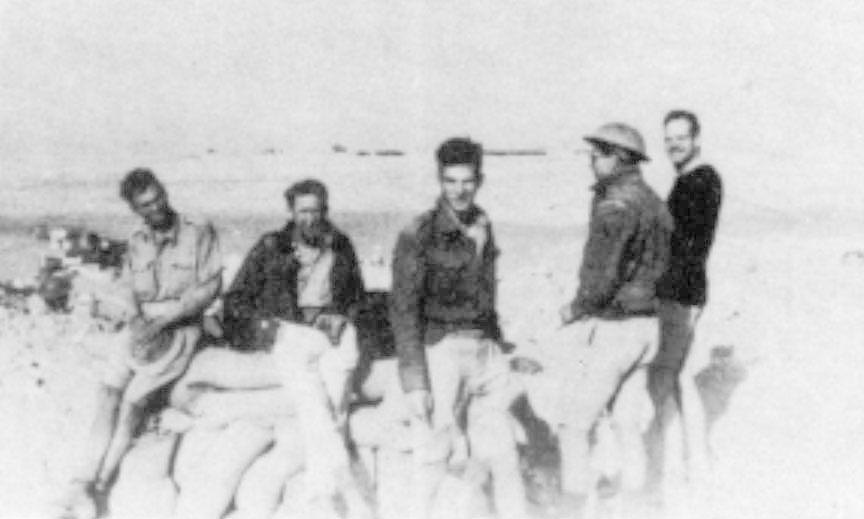
| Pictured in front of their dug-out inside the Bir Hacheim garrison are the members of the AFS section attached to the Fighting French Forces. This photo was taken just a few days before the tragic evacuation of Hacheim, and includes left to right: Arthur Stratton, Stanley Kulak, Lorenzo Semple, George Tichenor and Alexander McElwain. |
AFS 's most momentous happening since the first of the men reached the Middle East is the advent ...just a few days ago...of the APO enabling mail to go by the most direct channels, and for SIX cents air mail, THREE cents V mail. This changes the AFS address to...rank...name...American Field Service, APO 616 c/o Postmaster New York, N. Y.....Thank you, Uncle Sam......
A big event (to the N. Y. Headquarters) was the arrival home, after a year and a half in various parts of the ME, of Lt. LeClair Smith, 'Smitty' went out with the original forerunner AFS unit that served in the Free French Syrian campaign of 1941; after having driven an AFS ambulance in the battle of France 1940. 'Smitty' enjoys the unique distinction of being the only man we know of, who spent his honeymoon on the desert near Bir Hacheim. Our greatest disappointment (not to mention 'Smitty's' feeling) was that Mrs. Smitty did not come home with him. He left her at Capetown to go home to her native Australia for the first time in 3 years and see her family. For a man who has seen just about the longest term of active service in this war, of any American that we know of, he seemed in very good shape. His uniform is faded and worn and his decoration ribbons (he has several) show their active service wear, in being not only faded but moldy from the desert climate .......................................................................................................................
AFS has lost two of its star representatives to the armed forces, Mr. J. Clifford Hanna of Detroit has gone on duty as a captain in the U. S. Troop Carrier Command. His place as our Detroit representative has been taken by Mr. A.A Shirley. The other representative who is leaving AFS after having signed up a large group of California men, is Mr. Perry Patton of San Francisco, who has been commissioned a captain in the U. S. Air Corps; he has been replaced by Mr. LeRoy Krusi. All of these men are former AFS ambulance drivers of the first World War, Mr. Krusi is 'Tim' Krusi's father, Tim, who was wounded when his ambulance was strafed on the Western Desert, is in California convalescing and getting along fine ................................................................
AFS Letters being ever inquisitive about anything and everything....we want to know whatever became of the monkey?... what monkey?... the monkey that Jack Martin and Reilly Dibble acquired on their way to the wars ........................................................................................
Croswell Bowen, member of the first unit and the official photographer for AFS in the Middle East, arrived home, invalided back from Tobruk, a few days ago ...He came back using a cane and looking considerably thinner, but altogether in good spirits, and armed with MANY fascinating pictures of the ambulance service at work ...He-was interviewed on the radio by George E. Combs on his news program, and had a variety of interesting things to say... As soon as he feels better and has had a chance to sort out his vast material, we hope to get him to give us an interview and some photos for the next issue.................................................................................................................................................
After a year and a half of six days a week steady slaving, we were finally able to get Mr. Galatti to take what we fondly thought would be a vacation ...He went to New Hampshire for THREE days .....................................................................................................
Unfortunately, through circumstances beyond our control, the big national campaign to raise funds for 250 ambulances by the Amusement Industries has had to be cancelled ...................................................................................................................................
Additional news on the financial front is the inclusion of the Field Service in three more Community War Fund. campaigns ...Indianapolis, Uniontown, Pa., and five corporate townships in Long Island (Lawrence, Hewlett, Woodmere, Cedarhurst and Inwood) ............................................
News from loved ones overseas at the front ...a cable received jointly by the families of two AFS volunteers... 'Safe, Happy, Broke, Don't Worry'...
In our last issue we tried to clarify AFS drivers' status in The Question of Rank ...simultaneously we received a letter from an AFS man in the ME on the subject ...he says: 'Dilemma for regular British Sergeants: the AFS technically has Warrant Officers' rating, are invited out by British Officers to bars, have AFS Sergeants over them, are treated by the Military Police as common soldiers, told by their AFS Captains to get rid of the Officer complex, and yet are able to go to French Officer's Clubs, and ride (when they can) the Major's horse!' .........................................................
Having raised upwards of $100,000.00 during his bare three months stay, Major Stuart Benson is back in Cairo ...by now hard at work as AFS' liaison officer .........................................................
The XV Unit sends a shipboard news item! ...'Lt. Robert Montgomery, ex-AFS, and now on board one of the accompanying ships, went out of his way to come aboard and pay us a visit ...He was very pleasant, and most anxious that we send back his regards to all of you at headquarters' ... Thanks, Lt. Montgomery, and ours to you! .........................................................
FLASH!!! ... Unit IX, with James Ullman in charge and Unit XVI, headed by Bayard Tuckerman, have arrived at their destination, according to word received from our Cairo Headquarters .........................................................
A new book entitled 'On Ice' has recently been published ...It's author is none other than our own Robert George Dean, who did such a fine job in editing the Cairo Bulletin.........................................................
Overheard in a New York bar ...A British sailor, who had just returned from Libya said 'I met a bunch of American Field Service 'guys' out there. They are fine lads and doing a swell job'... Orchids to you, sir, for this fine and totally unsolicited tribute .........................................................
Here's news for Pierre Laval! ...A friend of the service recently met, in an American home, a young Frenchman names Richard Picard...Mr. Picard carries his first name in memory of Richard Neuville Hall --- the first American Field Service man to be killed in the last war, and is now making his home with members of that same family .........................................................
Dear Oiseaux:
Your response to Steve's letter has been most gratifying --- to Steve ---to the Editor of the Bulletin --- to the HQ. Staff --- who read therein a renewed pledge of loyalty from you, the ALUMNI, to the Service, yours and theirs.
At the HQ, we appreciate the uplift that comes through your letter, your requests for AFS ribbons, your phone calls, but best of all, through your personal appearances at the Office. They are heartening to us. But perhaps more important, is the effect on the Volunteers waiting here for embarkation. You look them over and they, you.
You see healthy youth, rarin' to go, and your memory turns back the pages. They see mature men, not devoid of enthusiasm, often in uniform, of varying grades, from Brig. General to Private, from Bos'n's Mate to Commander. They look for and find the AFS bar in the sometimes imposing array on the chests of the 'Oiseaux'. They see distinguished executives and Directors of Industries, essential in the War effort. All with a common interest. There really is no OLD Service, nor a NEW, but an AFS begat by you, picked up and adapted to changed conditions in France '40 and Syria '41, carried on in the Western Desert, by new personnel, but with unaltered devotion and ardor, ---a continuous flow, without check, since the days of the Marne.
At Steve's suggestion and under the cooperative Mrs. Field, I am taking over this page of the Vieux Oiseaux. What do you wish made of it? An Alumni News? If so, I must have your support in the form of personal notes, recollections of yesterday, anything concerning YOU of interest to the old Section-Mate.
As a starter, we publish herewith a partial list, for your information, of SSU and TMU men who have thus far let us know of their 'Present War Activities'. Let us hear from YOU.
Happy rollin'
Bill Wallace
For lack of space we cannot print the full list, but watch the next issue or even those following.
| ABBOTT, John Badford | SSU 2 | Major AUS |
| ADRIANCE, Edward H. | TMU 133 | APS Rep. Williamstown, Mass. |
| ALLEN, Julian L. B. | SSU 4-29, Paris HQ '40 |
Capt. U. S. Air Corps |
| ALLEN, Wharton | SSU 12 | AFS Rep. Colorado Springs |
| AMES, Charles Burton | SSU 8 | Capt. USMC Aviation |
| AMES, John Worthington, Jr. | SSU 2 | Major, USA Air Corps |
| AMES, Lawrence Coffin | SSU 68 | Lt. Col. US Air Corps |
| ASHTON, Charles M. Jr. | SSU 28 | Lt. US Navy |
| ATKINSON, Belford P. | SSU 16 | AFS Rep. Columbus, Ohio |
| AUSTON, Kenneth | SSU 4-8 | AFS HQ NY Exec. Comm. |
| BARBER, Maurice | France '40, ARC France '40, ARC Wash. '40 |
In charge American Red Cross, Middle East |
| BARLOW, Frederic B. | TMU 64 | Capt. US Air Corps |
| BARRON, Arthur M. | France '40 | Private US Army |
| BARTLRTT, Sidney L. | France '40 | Lieut. US Navy |
| BATES, Chester Alley | TMU 526 | Lt. Commander, US Navy |
| BEATTY, Francis J. | SSU 4 | Major AUS |
| BENSON, Stuart | France '40 | Major AFS Middle East |
| BEST, Tharratt Gilbert | TMU 526 | Lt. Col Transp. Corps |
| BIGELOW, W. DeFord | SSU 4 | AFS Rep. Boston |
| BISBEE, Frank D. | SSU 11 | Coast Guard Auxilliary |
| BLAKE, Herbert C. | SSU 630 | AFS Rep. Troy |
| BOYD, Jackson Herr | SSU 8 | Capt. USMR |
| BRANT, John Westervelt | France '40 | Capt. Specialist Res. Corp. |
| BROWN, J. Paulding | SSU 1 | AFS Rep. Washington D.C. |
| BROWN, John F. Jr. | SSU 16 | AFS Rep. Lakeport, N. H. |
| BUCKLER, Leslie H. | TMU 526 | AFS Rep. Charlottesville |
| BUNDY, Mahlon C. | SSU 15 | Capt. USA Air Corps |
| BURRAGE, Albert C. | France '40 | Lieut. AUS |
| BURRELL, Roger | SSU 14 | AFS Rep. Akron |
| BURTON, David C. | France '40 | Lieut. AUS |
| BUSWELL, Leslie | SSU 2 | AFS Rep. Miami Now---Capt. US Air Corps |
| CAMBELL, Donald L. | SSU 69 | Capt. US Army Air Corps |
| CARTER, John S. | SSU 2 | AFS Middle East |
| CASSADY, Thomas Gantz | SSU 13 | Lt. Commander USN |
| CLARK, Charles E. F. | SSU 15 | Lt. Col. Insp. Gen. Dept. |
| CLARK, Robert D. | TMU 133 | AFS Rep. St. Paul |
| CLEMENT, John | France '40 | Lt. US Ski Corps |
| CODMAN, Charles R. II | SSU 3 | Civilian with army and navy intelligence |
| COLlE, Frederic R. | SSU 28 | Justice Supreme Ct. of N.J. |
| COOK, Harvey W. | SSU 16 | Lt. Col. USA Air Corps |
| COPE Thomas | Norton-Harjes | AFS Rep. Philadelphia |
| COSTER, Donald Q. | France '40 | Lt. US Navy |
| CRATHERN, Charles F. H. Jr. | SSU 526 | Capt. US Air Force |
| CURTIN, Enos | SSU 2 | Major US Intelligence |
| CURTIS, Charles C. | France '40 | AFS Middle East |
| CUTLER, John W. | France '40 | RAF |
| DALY, Frederick J. | TMU 526 | Capt. US Transp. Corps |
| DARDEN, Colgate Whitehead Jr. | SSU 1 | Governor of Virginia |
| DARLING, Mayo Atwood | TMU 526 | Lt. Col. QMC AUS |
| DAVIS, Charles C. | SSU 4 | Air Warden |
| DAVISON, Henry P. | HQ 1916 | Lt. Com. USN, AFS Gen Com. |
| DANES, Beman Gates Jr. | TMU 184 | Major, AUS |
| DEWEY,, Donald Mack | SSU 9-629 | Aircraft Production |
| DICK, C. Mathews | SSU 633 | Staff Officer, HQ ARS |
| DICKIE, Robert B. | Syria | Canadian Army |
| DOCK, William | SSU 2 | Major, US Medical Corps |
| DOLE, Robert Alden | TMU 526 | Capt. US Air Corps |
| DONOVAN, Welton | SSU 622 | ARS Rep. Springfield, Mass. |
| DUNAWAY, Jack W. | France '40 | US State Department |
| DUNHAN, Dows | SSU 12, TMU 184-609 |
Civ. Defense--- AFS Boston |
| EGAN, William Henry | SSU 70 | Commander, US Navy |
| EVANS, Henry C. | TMU 526 | Brig. Gen. AUS |
| FAGAN, Charles C. | Unit 11 | Cf. Petty Officer, USCG |
| FARMER, John Clifford | TMU 133 | Major, AUS |
| FAY, Samuel P. | SSU 1 | AFS Staff, Boston |
| FEARING, George R. II | SSU 71 | Capt. US Air Corps |
| FINNEY, Benjamin F. Jr. | Kenya Colony | Capt. US Marines |
| FOLDS, George R. | France '40 | AFS Rep. La Porte, Ind. |
| FOSTER, Arthur P. | SSU 17 | AFS Middle East |
| FRANCE, Robert | TMU 526 | AFS Rep. Baltimore |
| FRAVELL, James E.G. | SSU 64 | Lieut USNR |
| FREIDLICH, Robert E. | SSU 68 | AFS Rep. Rochester, N.Y. |
| FULLER, Horace W. | France '40 | Capt. US Marines |
| FULLER, Richard E. | SSU 64 | Capt. USA Specialist Corps |
| FURBISH, Henry Ordway | TMU 397 | Mayor, Westbrook, Maine |
| GALATTI, Stephen | SSU 3 | Director General, AFS |
| GAMBLE, Robert H. | SSU 1 | Commander, US Naval Aviation |
| GAYNOR Joseph Jr. | France '40 | AFS Middle East |
| GRIESA, Charles H. | SSU 2 | AFS Rep. Kansas City |
| GRIGGS, Benjamin G. | SSU 64 | Vice-Chairman ARC St. Paul |
| GRISWOLD, Roger | SSU 2 | Capt. USA Air Corps |
| HALLADAY, John Stuart | SSU 66 | Civilian Defense |
| HAMLIN, Francis P. | France '40 | British Min. of War Transp. |
| HANKS, Raymond T. | TMU 133 | AFS Rep. Cleveland, Ohio |
| HANNA, J. C. | SSU 1 | AFS Rep. Detroit, Capt. USA Air Corps |
| HARJES, John F. | France '40 | US Army |
| HARRISON, Benjamin V. Jr. | SSU 64 | Comm. USS YP 339 New London Base |
| HARVEY, Kenneth Austin | SSU 70 | War Production Board |
| HILL, Lovering | SSU III | Intelligence Section USA |
| HILL, Ralph B. | SSU 65 | AFS Rep. Little Rock |
| HUGHES, Edwin H. Jr. | SSU 14 | Lt. Chaplain Corps |
| HUTCHISON, Bertrand | France '40 | Flying Officer, RCAF |