Excerpts from correspondence from the men serving the British and Free French in the Middle East Armies; compiled and edited at New York Headquarters, 60 Beaver Street. Printed and mailed thru the courtesy of Mr. John H. McFadden, Jr., in Memphis, Tennessee. For any change or correction in address please notify American Field Service, 66 West Court, Memphis, Tenn.
On July 25 came news of the fatal wounding of William Keith McLarty and we must now add his name to those of George Tichenor and Tom Esten, volunteers who have given their lives to save others.
Since the siege of Bir Hacheim, American Field Service volunteers have been everywhere in the Battle of the Desert. Twenty-one left Bir Hacheim at the last moment with the Fighting French rear guard. Their leader, Alan Stuyvesant, was taken prisoner. Stanley Kulak and Alexander McElwain are still missing. Arthur Stratton, injured by a shell was able to get away. At Tobruk others of our men evacuated the wounded just before the fall, and now in these last weeks in the desert with New Zealanders, Imperials and Indian troops, our ambulances have worked back and forth through mine fields, dive bombings and shells, picking up men just wounded and evacuating dressing stations. Again in this section we have men missing, Mortimer Belshaw, Lawrence Sanders and William Mitchell. Peter Glenn was taken prisoner.
They are Americans; the first on the front line in this Battle of Egypt---they are worthy of the best traditions of any front line forces and their courage and endurance is attested by all. We are proud that the American Field Service is there to render aid.
Stephen Galatti
|
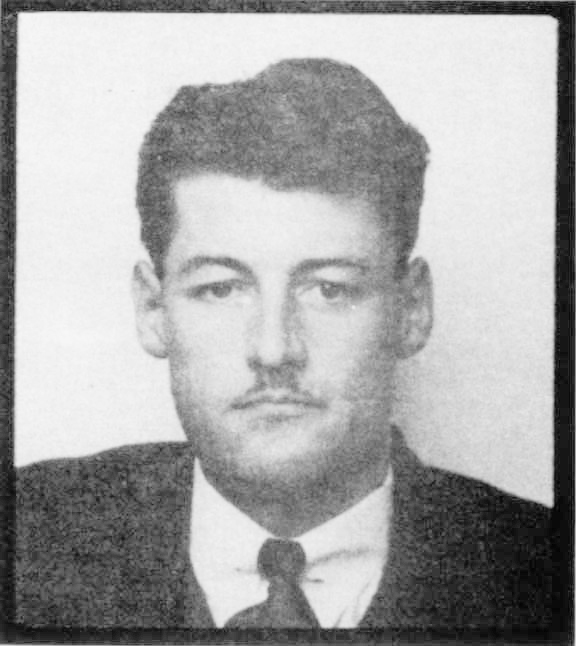
THE NAME OF WILLIAM KEITH McLARTY, TWENTY-TWO YEAR OLD CALIFORNIA BOY, HAS BEEN ADDED TO THE HONOR ROLL OF THE AMERICAN FIELD SERVICE. IT WAS WITH A FELLING OF PROFOUND REGRET WE LEARNED OF HIS DEATH, AS A RESULT OF WOUNDS SUFFERED WHEN A BOMB FRAGMENT STRUCK HIM. HE FACED DEATH ---AS HE LIVED ---FEARLESSLY AND BRAVELY, DOING THE JOB HE HAD CHOSEN. NIGHT AND DAY HE HAD DRIVEN HIS AMBULANCE OVER THE DESERT WASTES WITH NO THOUGHT TO THE DANGERS OR THE HARDSHIPS WHICH HE MIGHT MEET ON THE WAY. HIS LOSS IS FELT KEENLY BY HIS COMPANIONS, WITH WHOM HE SERVED, AND BY ALL THOSE WHO HAD THE GOOD FORTUNE TO KNOW HIM. |
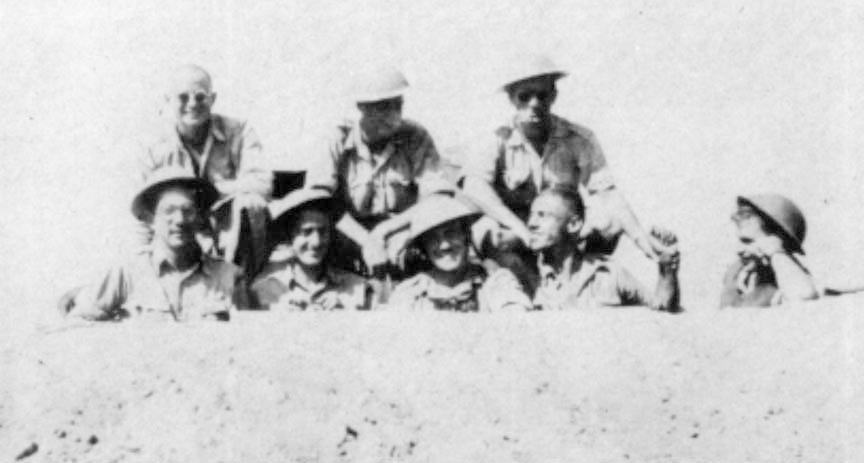
| Left to right: upper row: George Lester, Jupe Lewis, Bill Riegelman bottom row: Bob Orton, Tom Stix, Tom Breivogel, Joseph Frank, Houghton Metcalf |
The following was enclosed in a letter from an AFS officer:
"Charles Shoneman did himself proud at the front about. a month ago. A British ambulance had somehow become immobilized out in the blue. An appeal for help reached our units at headquarters. Volunteers were called for and Charles was the first to volunteer. They went up front and risked danger and capture and towed the vehicle in. The Shonemans should blush for pride".
Here's the kind of stuff Field Service men are made of, shown in letter from Lorenzo Semple:
"It was decided to send out a large column of artillery and infantry to a point 40 miles behind the enemy lines and by very good luck at cutting the deck, I won the chance at being the one AFS ambulance to get out with them."
Written about Tor Torland and Arthur Howe, Jr. by Dave Hyatt in the Detroit News:
"Credit for splendid work under fire in recent weeks goes in particular to two members of our ambulance company. Tor Torland, former NBC newscaster from Denver, conducted a convoy of 40 ambulances from Daba to Ghabinyiat under a barrage from Jerry night fighters. At the same time, with a German patrol only 12 miles away Arthur Howe, Jr. ex-Yale man, supervised the work of the American Field Service in evacuating the wounded out of Daba. **** Three Indian drivers (of ambulances under fire) went hysterical. An R.A.F. officer, with a wound in his leg, held a pistol behind one to keep him from driving pell-mell out into the desert. Tor cajoled, then threatened the two others with a knife and managed to keep them on the road."
Dear Steve:
The remains of our Unit have finally had a chance to rest, as the FFL are now resting; so I am taking this opportunity to give you a few of the details that brought about so many changes.
As you have undoubtedly read newspaper reports of the gallant stand of the French at Bir Hacheim, I will not endeavor to give you details other than those which concern the AFS.
Throughout the duration of our period in the desert, our work consisted chiefly of evacuating wounded and sick of the area in and around Bir Hacheim to Bir bu Maafes. As Bir Hacheim was the centre of operations, we used Bir Maafes as a reserve and repair point for such cars as were not needed at Hacheim. Of our twenty cars, we kept seven at Hacheim, ten at Maafes, and about three out with the French patrols which went out from time to time to contact the enemy.
When things looked as if we would get more action I went to Aciro and asked for the balance of ten men to complete our complement, and sent back three new cars from our reserve along with McElwain. Two days later I started hack to camp. In the meantime, the Germans had moved around Bir Hacheim and came right through Bir Maafes pushing towards Tobruk. I was unaware of this until I arrived at Maafes and found signs of hasty departure. A last Englishman came along and told me that we were in German territory, and that he didn't know his way out. Being familiar with the surrounding area, we set a course; finally after some 36 hours of exciting incidents, I finally located our group, which then consisted of Greenough, Hammond, and three Legion Drivers. At the last moment Alan had called up three more of our cars, and sent four to a Second Brigade; so that left us with twelve cars in Bir Hacheim, whose drivers were Alan, Stratton, Tichenor, Kulak, Semple, McElwain and Smitty.
Two days later I joined an armored convoy and broke thru into Bir Hacheim Everyone there was quite happy, as there had been a tank battle in which the French had knocked out thirty-seven tanks with only two wounded! Alan and I agreed that the Legion drivers should be replaced by our men, and decided that Smitty and I should go to King and demand ten more men immediately. Upon receiving them we planned to return to Bir Hacheim and evacuate any wounded, thus leaving enough cars for further contingencies. Smitty and I left that night and the next morning saw King who assigned us ten men; the next day they came with Smitty to our temporary station, while I was making arrangements to get them thru to Bir Hacheim.
In the meantime, an offensive column had gone out from Bir Hacheim, well behind German lines, with which two of our ambulances (driven by Semple and Kulak) went along. They were heavily attacked from the air the first day, and there were too many wounded for the two cars possibly to evacuate to camp. Accordingly in response to a radio call, Alan went out with a relief group of all the AFS cars that night, and the next morning picked up the column's wounded and headed back to Hacheim. On the way back Alan got a flat tire, but he insisted that the others go on ahead with the wounded --- all except a Legionnaire who stayed on to help him with the difficult job of changing a tire in soft sand. While they were doing this, heavy German forces moved up to attack Bir Hacheim, unknown to them, and he was picked up as he was in sight of the camp's east gate. Nothing more was heard of him until I discovered an English boy named Bryce, who had also been captured but sent back later to Bir Hacheim with a note from Rommel demanding that General Koenig surrender. I met him three weeks after the fall of the camp, and he said that he had spoken to Alan at the German prison camp --- Alan had left no message, and only said that he was quite safe, though damned annoyed at being caught.
Ten or twelve days passed during which we made repeated attempts to get into Hacheim, but the route was always cut. A convey of trucks with desperately needed supplies left unknown to us; but only fifteen out of fifty entered the camp, as the rest were forced to turn back. Except for the booming of the guns and other sounds, we were unaware of the tremendous assault which was in progress against Bir Hacheim.
At Hacheim, our cars were being picked off one by one "Philadelphia and Vicinity", driven by Kulak, was one of the first to go, after being struck directly by a German shell. Others followed suit, falling either to the terrific shelling or bombing; and at the end of fifteen days attack, there were but four cars left running; the remaining eight having been completely destroyed. Miraculously, however, none of our fellows were hurt; in fact because of the carefully dug shelters, the total wounded of 4,000 Frenchmen was 180.
The French decided to evacuate Bir Hacheim, and on the evening of June 10th, the four remaining AFS cars took their position in the line, to go through the opening in the deep Hacheim mine fields.. This gap consists of a zigzag passage flanked with loose coils of barbed wire, about five hundred yards in length, and fifteen (at the widest points) in width. Jim Worden's ambulance was in the lead, followed by Tichenor, Semple, Kulak and McElwain in one car, with Stratton in the rear.
Because of the darkness and the uncertainty of the passage, progress was very slow; and the line was only just starting to leave camp when it was spotted by the Germans, who were entrenched on both sides of the exit from the mine fields. Instantly the whole scene was lit up by star shells, as they started to pour a murderous barrage of machine gun, rifle and light cannon fire into the long line of vehicles and foot soldiers. Semple's car became entangled in the barbed wire and despite his efforts it was impossible to disentangle it. While he managed to get the wounded out of the back, the others moved on following Worden. Fortunately, Semple found an abandoned Bren Carrier behind which he placed the wounded during the time it took him to find other trucks for their transport; despite this precaution, however, one of his patients was struck again in the head while waiting.
Stratton, meanwhile, had his car disabled by machine-gun fire, rendering .the steering and motor useless, so he was taken under tow by another truck. While he was under tow a light shell struck the hood of his ambulance, wounding him in a number of places in the arms and legs, as well as setting fire to the car. Despite his frantic efforts to open the back and get the wounded out, he was badly wounded himself; and while he lay on the ground helpless, he was unable to free the patients from the blazing wreckage. Shortly afterwards, Stratton was picked up by a truck in the back of which he lay exhausted for several hours, before he was turned over to a relief column of ambulances, from which we picked him up and brought him to a hospital ourselves.
As to Tichenor, I've been unable to definitely find out all the details of what happened after he was last seen. At any rate, his identification bracelet was turned over (and subsequently lost) to Worden by an English ambulance orderly, who said that they had buried Tichenor at a point about eight miles southwest of Bir Hacheim. Other than that, we have no other information up to now, though we're still investigating.
I'm afraid that there's even less definite news of just what happened to Kulak and McElwain, after they were last seen by one of our fellows. They pulled on ahead and have never been seen since. Naturally, we hope that they are prisoners.
After the evacuation, Sample was missing for two or three days, until he caught up with us finally near Sidi Barrani. After getting rid of his wounded, he had walked some distance, was wounded in the leg by a shell fragment, and finally caught a ride on a Legion truck. I think that this should account for all Alan's cars and drivers as well as we can at this moment. I'll let you know as soon as any other information is turned up.
Meanwhile, our little group of six ambulances remained anxiously awaiting news. Orders to accompany General Larminat came at 4:30 AM, and by 5 we were heading south to a point 30 miles east of Bir Hacheim to await the arrival of the armed convoy that was to bring the survivors of the camp. It was the sight of their arrival that confirmed our fears. We set to work taking the wounded off the trucks, gun carriers, Bren carriers, and loading them onto our own ambulances. Nobody dared ask questions about Alan's group, as it was significant that there were none among the convoy.
The following thirty six hours held very little sleep, as we had to transport these men from one station to another, until we found a unit with room to accommodate them --- which finally turned out to be Hadfield Spears. It was during the confusion of this move that we found Stratton and had him transferred to our car. He was dressed and treated at Spears before being shipped on down to Alex; from where he eventually made his way to Syria, where he is now resting.
We rejoined the remains of the 1st GSD and set about trying to collect ourselves. The French were understandably enough too upset to be bothered, so we had to sit by and watch developments. Semple showed up in the meantime.
A week passed, and matters were still in a rather disorganized state with the GSD 1, when negotiations were made effecting our transfer --- temporarily --- to the 2nd GSD, then in the forward area. You will remember that just before the Hacheim affair they had been loaned four cars with Legion drivers, which we immediately transferred to AFS drivers; thus bringing our effective strength to ten cars and thirteen drivers. All the cars were in bad shape except for Hammond's which was new; however, that was destroyed by a German plane during a hurried evacuation. The car was riddled and set on fire, although Hammond and his wounded miraculously escaped unhurt; whereupon Curry, who was at the same post, carried out the evacuation.
After short stays at Daba and Fuka, from both of which we were driven out, the French Second Brigade then retreated to El Alamein and turned south into the desert where we remained for two days with wholly inadequate supplies and only mud water to drink. By this time the German drive was gaining momentum, and we were forced to retreat across the desert. It was at this point that Hennessey and Momsen became detached from the main body, and accompanied a small French convoy heading towards Cairo. Momsen was driving a borrowed English ambulance which became stuck, and was burned with all our personal equipment.
The main body of French forces finally arrived in Amirya, some 20 miles south of Alexandria, whereupon all available ambulances were called upon to rush to Alex. for immediate evacuation of the French hospital there. The evacuation took place at midnight, and after a very hard all night drive, the convoy of ambulances and busses arrived in Ismalia the following morning about 11.
The French in the meantime retired to Helwan, 27 kilos south of Cairo, for refitting, where we rejoined them; and have since moved to El Tahag where we are now hoping to put our cars into the long-overdue workshops for badly needed repairs.
Throughout our period of action Thomas Greenough played a very active part when he was called upon to take charge of the group during my absence and in two particular instances avoided possible capture of the remaining group by his prompt and level headed decisions.
I am sorry to have been so long in compiling this information; but as you see, we have been very busy, to say nothing of the discouragement caused by the loss of men and cars.
Our unit is determined to carry on the splendid work and unity that existed under the competent hands of Alan. Your letters to Alan are encouraging, and we feel confident of your whole-hearted support.
We would appreciate your expressing the unit's condolences to Tichenor's family. We are all wishing for the safety of Kulak and McElwain, and that Alan's release may be effected through the Red Cross.
Our unit personnel is as follows: Lt. N. Jefferys, 2.Lt. T. Greenough, J. Hammond, L. Semple, C. Murray, R. Momsen, R. Curry, R. Brewer, W. Hirschberg., N. Gilliam, J. Foster, and L. Carlson,
Sincerely,
(Sgd.)
Lt. Norman Jefferys,
AFS, FFL.
July 18, 1942
P. S. Please see that Stuyve reads this letter, for I am anxious to relieve his mind. I would also appreciate a copy of this letter sent to my folks.
Syria, March 24, 1942.
"And speaking of Arabs --- this is supposed to be the land of the golden desert where sheiks dressed in flowing robes of silk, carry off shrieking maidens to some desert oasis. "It ain't so", as they say in America. The Arab is a dirty person, and his camels are more so, which is difficult to imagine. He dresses not in silks but in rags. And the desert is only golden when a torrid sun beats down and nearly puts your eyes out with the heat. Furthermore, I have never seen an oasis that was the cool, lush haven of rest that books tell us they are. There are usually a few palms around a small hole filled with dirty water.
"I visited the town of Acre the other day. It is one of the oldest towns the world can boast of, and it is still much as it was in the days when the crusaders tried to smash it to bits. As one comes up the road from Haifa there is a view across the small bay to the promontory where Acre still carries on. From that view it looks like the old cities one reads about in the tales of the Arabian Knights. It is surrounded by the original wall that first served to protect it. Rising above its stone buildings, numerous minarets and mosques add a picturesqueness that only the East can claim. Once inside one finds oneself in a maze of narrow streets lined with little shops where the business is carried on. The amazing part of this town is the fact that the fort, (it is all one great fort) has been turned into apartments, some of which are really quite modern. One I ran into had modernistic French furniture, deep oriental carpets, and equally fine accessories. Others were poor."
"Your letter arrived in Cairo only 12 days from the moment it left your fingers. I received it two days later, making it an even two weeks for the entire journey. A record.
"I have recently had one really unique and interesting experience. I had to drive a Major, who is testing water for purity, out into the desert about 150 miles from where I am stationed. At this particular post there is an AFS squad, which made the trip like a friendly call; and on the way out across the desert (no roads at all) I raced and maneuvered for an advantageous position, this advantageous position was out in front where you would not have to eat the other fellow's dust which rose in unbelievable clouds behind the speeding automobiles. Unbeknownst to us, these cars were going to the same location as we, quite by coincidence, to review some camel-legions of the French Foreign Legion. We arrived just in time for the festivities. This began about 4 PM with a gala celebration of parades, camel races, etc., that was one of the most colorful spectacles I've ever seen. We sat in the seine tent with all the celebrities which was (the tent) oblong and open on one side. The floor was covered with multicolored rugs, and coffee was brewing in the urns on an open fire right in front of the tent. It was served in a demitasse cup --- the entire throng drank out of the same cup. Every one was beautifully dressed, and the legions, which were native Arabs, put on an exciting show. The wife of a Free French General here was the guest of honor. This part of the entertainment was climaxed by all the Arabs running around shouting and shooting off their guns in a most pagan manner.
"Later on came a huge feast, which was also held in a tent, with everyone lolling around on rugs and loaning on shaggy camel-saddles. The dinner itself was preceded by a lengthy speech (in French, of course) which was interrupted about every paragraph with rifle shots, which takes the place of hand-clapping among these people. The dinner which consisted of entire roasted lambs layed out on a blanket of rice was brought in on silver trays about a yard in diameter. This was eaten entirely with your bare fingers, or rather your whole hand. The dinner was followed by a series of native dances and music.
"The next was work to do, and then we started home in the midst of a raging sandstorm."
The Western Desert, May 24, 1942.
"Here is your bolt from "the blue" as the region near the front is affectionately called and I think we're both about equally surprised that I'm here. I'd like to be dramatic and launch into a description of war 1942 style, but the AFS seems to have a deadening effect on activity. Wherever we go it stops, and outside of an occasional distant rattle or boom "all the air, a solemn stillness holds."
"However, we are living under almost real war conditions and if discomfort were the criterion, I'm rapidly earning a croix de guerre --- but more of that anon.
"The trip was interesting in its novelty, but touring in convoy is pretty dull, and the amount of varied traffic and bombing the country's been subjected to in the last few years doesn't improve matters. Our convoy was really impressive, and spaced at hundred yard intervals it was an eye-filling sight. When the first car slows down to pass a cart, etc., everyone has to follow suit and, by the time the last of us get around it, several minutes have elapsed which makes it a maddeningly slow process. But considering that it was our first attempt, everything went off ultra smoothly, and we got a few well deserved compliments. Every hour or so we'd stop to stretch or "fill her up" or grab some "bully" and bread and then push on to our prearranged spot of nothing.
"The desert is pretty depressing if you let it be, but I found myself daydreaming happily or even singing and the time somehow passed. It's really fantastic to look at --- flat brown space stretching towards any horizon you choose. Sometimes you wonder how anybody could pick such a place to fight on, but after all it's almost an ideal battlefield 'cause there's so little to destroy except the implements of war themselves, and the people involved. It's a nice world when you begin to talk of ideal battlefields.
"The one real break is that it was and still is unbelievably cool. All the glass of our cars is sanded so it won't reflect the glare and we have to drive with the windshields open. I've never had a jacket off and when the sun goes down, overcoats are very much in order. When you read in the papers "dust storms in Cyrenaica, nothing to report today" it isn't propaganda or excuses, --- it's literally true. I've just had a few tastes of it and you can't see an inch in front of you. Actually it's always present and in your eyes despite the goggles which are swell, --- in your hair too. The battlefields have all been cleaned up except for a few wrecked and stripped lorries, etc. --- just enough to remind you. Some of the headline towns have taken a terrific beating --- a few walls or piles of stone delineating a street, others are surprisingly whole at least from a casual glance. Air raids, being indiscriminate, don't level places and "the hit and miss" is obvious.
"Now, as to life here, as it's seen at first glimpse. We're widely dispersed over our allotted corner of desert which makes sociability difficult, and also bombing. For the time being, we're living in our ambulances, with a slit trench nearby, just in case, but when we settle permanently we expect to go underground. Some of the English dugouts I've seen are more than adequate, some even swank and whether we get theirs or have to dig our own, with sand bags, petrol tins, and odd pieces of wood we can make a pretty comfortable home. Everything is underground, and "desert rats" aren't just a phrase in fiction.
"We're eating out of mess tins in the open, picking up our food from the truck and then squatting in a happy circle and wolfing it down. The food is adequate but monotonous with "bully" hot and cold as the hub around which most of the meals revolve. This morning for an innovation we had cold tinned salmon for breakfast, an idea even Dow's hasn't thought of, but nothing surprises me any more. Once in a while we get a few vegetables and canned fruit, and I've stocked up on chocolate and chow-chow and while they last I won't be hungry. Water is rationed, one quart a day for your car and your food, another for you for drinking, washing, and all other purposes. It's fun to see how little you can get by on. I shaved in a quarter of an inch of water at the bottom of my cup today, but I'm growing a mustache to save the tender upper lip.
"Yesterday I spent trying to repair the ravages of the trip on the car and then, on me. In war your vehicle comes first. Every time I get into my coveralls, I get that unhappy martyr feeling, 'cause I can't kid myself that I'll ever be really friendly with the inside of an automobile. But I now wallow in oil and grease, at least with familiarity if not enthusiasm.
"For five days I didn't have my clothes off and as a result I got the soldiers' curse --- fleas, God, how they itched and kept me awake. However, I attacked 'em on i full scale campaign and they're in full retreat. Flea powder, clean clothes, and best of all --- a swim. It's the only saving grace! A beautiful bay and a gorgeous beach. You should have seen me yesterday, washing my clothes à la "women of Arles" and hanging 'em on a barbed wire to dry. The result was pretty good and after a few more weeks, I'll be able to give A. a few helpful hints.
"Social life is naturally pretty sparse and centers around the radio. Everybody congregates in my ambulance after supper for news and music and talk. No lights at all. This morning we had a real thrill --- WLWO came thru for the first time and even though it was an Italian propaganda program we hung on. for the American jazz. It's funny how such little things like that mean out here.
"Today's J.'s birthday and I gave him a couple of my carefully hoarded packs of camels, which he loved. He's giving a party tonight and I'm anxious to see whether we can be gay or not. This is being written on the map board of B.'s ambulance. He's under it with a grease gun, and X. is sitting next to me reading "Journey's End" with an unpleasant expression on his face --which brings us all up to date.
"It did turn out to be a gay evening and to be accurate, the gayety started in the afternoon. I got into town for a few minutes and in one of the few buildings left, the "Y" has a canteen. Like so my nutty things in this war, they were out of most staples, but well stocked with canned lobster. That a tragedy! I got a couple cans some mayonnaise and asparagus tips, mixed 'em in a mess tin on the fender (Oscar never put more devotion into it) and quaffed with synthetic orange juice we had a Lucullan feast. I'm afraid "bully" doesn't taste quite the same today.
"After dark, eight of us huddled into a little dugout --- our light a candle, on an empty ammunition box, and with our beer ration plus a bottle of scotch and a couple of bottles of wine, were much gayer than we would have been at Shepherd's. Stories, college songs, kidding, etc. It all ended in a literal blaze of glory --- there was bombing in the distance, and the "ack ack" started a tremendous barrage with different colored tracers criss-crossing the sky. It was much better than anything at Crosley Field and lying flat on the ground, it was quite a thrill to watch it, sort of from a front row seat. It probably won't be so much fun to be on stage, but I'll take that as it comes. (Dramatic personae.)
"You're anxious for first impressions I know, and this'll give you a rough idea of how we're living and probably will live for some time to comet No mail has come thru yet, but it's supposed to be fairly regular, so I've high hopes that two way conversations'll start again soon.
"Here's sand in your eye, and the usual, from..."
On Board Ship, April 20, 1942. Mailed from Capetown, April 27.
"The food is excellent and plentiful. Cheese of various sorts is usually served even with breakfast. Milk stayed fresh for over two weeks, proving the refrigeration must be good. Our schedule leaves little time except for washing of self and clothes three or four times a day. In many ways it is a combination of a seaman's off hours and a prep. school schedule of classes and study.
"I should like to tell you something of the crew and the cargo which are stories in themselves. It is not unlike "The Long Voyage Home". I can't say much because of censorship. I have a great admiration for the officers and men. Many of them have wives and children in an occupied country whom they haven't seen for years and don't expect to see for years to come. And yet they go about their jobs with no bitterness and with a very realistic attitude toward war. Perhaps it is fatalism, perhaps it is a national characteristic, but whatever it is it makes them a pleasure to know and talk to.
"By way of breaking the monotony of the routine there have been a few uncensorable incidents. The ship drifted for many hours one time due to a minor breakdown in the engines. We were surrounded by very large sharks, perhaps a dozen, who were after the garbage, etc. Also several large blue fish with yellow tails, which were very pretty. The crew and officers tried to catch the sharks but without success, as they were able to bite right through every line and straighten every hook. The first mate did shoot two which sank immediately."
Somewhere at the Front, June 14, 1942.
"There is a big battle going on and has been for some time, and there are fleas. You know more of the battle from the newspapers than I do who hear the bombs, planes, guns, etc. and who carry the wounded. Oddly enough the fleas bother me more than the battle; they certainly have done me more damage than the other.
"Last Tuesday I had dinner at the mess of some South African officers stationed nearby. We had some grand talk and a lot of fun. The South Africans, both officers and men, are the friendliest and most interesting men I have met. They "speak my language" even where they disagree with my opinions. I went to their church this morning and after church visited in one of their dugouts with an old sergeant (he had been Colonel in the last war), a Jewish private (he had been a German officer in the last war), and the pet rat --trained by the sergeant, who shares the rations of his owner. Incidentally this sergeant had lectured for the Red Cross in America in 1920. He is quite a character, they call him "Rags", and his weakness is South African Brandy, a violent form of "Stuka juice." All the men I meet are interesting and I have met many --- men of all nations, colors, races, creeds, and political beliefs. I talk to them as best I can and have learned much which I hope to remember until the time comes to tell my tale of this junket. It all bears out what I shall always cling to --- the basic decency of the individual, the thing worth saving and preserving."
June 22, 1942.
"The summer heat is now upon us --- leaving us completely lethargic and almost wishing we would be told to work long hours to keep us from relaxing into complete laziness. I suppose the desert sun is no worse than Kansas in August but it is fun to pretend that there never was anything just like this at home and certainly there are no Coke stations. Occasionally --- English beer is brought in by convoy.
"Of all the varied hues and tongues military which frequent this miserable section of our world perhaps the most interesting are the Indians one sees. Gurkas, Sikhs, Punjabis, and dozens of other types. The Gurka is probably the most renowned and certainly the greatest fighter. He is short, round-faced (almost Chinese features) and cuts almost all his hair except for a small topnotch. He wears an Aussie-type hat, is always smiling and is known as Johnny. He is permitted in any English canteen unlike any other Indians --- a privilege dating back to the Indian Mutiny when the Gurkas remained loyal to the Crown. He is famous for his use of the curved knife and considers it an honor to serve in the army. The Sikh (pronounced "seak") is tall, heavy set and has a dark beard --- never cuts his hair but winds it up beneath his turban. He will never wear a hat nor a helmet but always a turban. He carried a miniature dagger in his hair and a fanlike piece of cloth which waves above his head and theoretically is supposed to lift him to heaven if killed.
"I saw an article in April Digest of Major Alubus' legion. His men are colorful, dark and almost circus-like in dress. British soldiers refer to them as the Pansy Division."
Aden, June 8, 1942 (Unit VI).
"The third mate (of the ship lying alongside us) had information about the American sailing ship which came in here a couple of days ago. She has a crew of 14 and it took her 163 days to come here from Los Angeles. That means they left a few days after America declared war. They had no radio so knew nothing of what had happened from that day to this. Of that small crew on a four-masted schooner, only eight were sailors, the others officers and stewards. That meant they had to stand watches four hours on and four off---a strenuous business for that length of time. They got into a gale off Los Angeles and shipped so much water it left high water marks on the bulkheads of the officers' staterooms and submerged the generator. The pumps were jammed, all but the electric one which had no juice. They flew distress signals for several days, but the patrol planes would just come by with a "Hya, Bub" and carry on. The crew has all deserted, and the cracker-barrel sages say she's here for the duration because no one in his right mind will go in her.
"At tea our steward was staggering around on rubber legs, trying to carry on as best he could. Everyone was saying, "The poor old gentleman, the heat has certainly got him". He thus had everyone's sympathy until he asked the captain if he wanted cold meat, and when the captain said no, he brought him some anyway. Then he spilled some macaroni on the floor, picked it up hurriedly and put it back on the plate intending to serve it. It suddenly dawned on those in the saloon that this man was fried as an owl. What he'd been drinking nobody could guess, possibly vanilla extract, but a couple drops more and he would have been out like a kipper,"
Probably Syria, June 5, 1942.
"I can say that I am very happy and very healthy.
"A very exciting and colorful event has been taking place here for the past few days --- the annual migration of the Bedouins. By just walking down the end of our street we have been able to witness a sight that has been seen by a very lucky handful of people.
"From dawn until afternoon for seven days there has been a steady and consistent procession of camels, horses, donkeys, and, of course, humans, too. Looking down the road, as far as the eye can see, there is a choked mass of camels. An officer has told me that there will probably be a half million animals going through town. If you can picture 500,000 camels, which I am sure you can't, you will be able to get something of the scene. Each Bedouin family has its own camels, possibly fifteen or twenty. The first camel is usually led by the father who utters a strange clacking call which induces the other camels to follow. The rest of the family whack away on the animals' behinds, even the littlest children carry sticks and help in the work. The babies are carried by Mama. In fact, Mama carries about everything that won't comfortably fit on the camels. Some of the women, besides carrying a child will have a baby sheep tied on their backs, and strapped precariously on the tops of their heads a great bundle of wood. No women's world, this. It is interesting to notice who is among the 400 in the Arabic firmament. Some of the camels have very elaborate little carriages on their backs, all covered with silks and satins, and the animals' harness will be very Barnum and Bailey. If I stay in this part of the world much longer I certainly will become a sophisticate when it comes to camels. When I get back to the United States and go to the zoo, I know that when I get to the camels I shall turn around and say "Now, when I was in ---------."
"Had an opportunity the other day to see the insides of a home belonging to a wealthy Arab. I have seen lots of native tents and huts, but I was curious and eager to see how the real rug tycoons, etc., lived. There had been one house, especially, that had whetted my curiosity. From the outside it was a beautiful place. Very elaborate iron filigree work on the doors and windows and a huge walled-in garden. Just like something out of the Arabian Nights.
"Well I managed to get in, and it was somewhat of a shack. The rugs were magnificent. They must have had a half million dollars in rugs, and when I was there most of them had been put away for the summer. Tremendous Persian things, 30 x 25, of the finest weave and texture you can imagine; ours look like bath mats in comparison. The rest was pretty awful, as I suppose I should have expected. The furniture was in the cheapest and most ornamental Ludwig-Baumann manner. Artificial flowers sprinkled all over the place. And the chief's bedroom was really the piece de resistance. Even Mae West in her most imaginative moments couldn't have thought of anything more luscious. The whole room was a brilliant pink with great canopied things hanging over the bed and angels with horns in their mouths scampering over the ceiling. Civilization is like a sphere, when you think you have travelled as far as you can to get away from it you find that you are just where you started from.
"The missionaries next door have a shortwave radio and hardly a night goes by that we don't listen to the Esso News reported from New York or the BBC news from London. New York is pretty faint, of course, but with the world sort of falling to pieces around you it is reassuring to know that the Dodgers are in first place and that John Barrymore has breathed his last."
Syria, probably.
"The more I see of all the types of men here, the more I am convinced that the run of soldiers in the various medical corps are a much better lot than those in any other. In our sergeant's mess at the CCS we had a Latin teacher, the owner of a sheep farm, a director of a shoe chain store, a pharmacist, three medical students who had not completed their training when the war started, a worker in the Rockefeller Institute in the Fiji Islands, an embalmer, and several others of equal variety. The lot I feel most sorry for are the Tommies. For us they are an uninteresting lot compared with the Aussies, South Africans, or New Zealanders. They have in so many cases apparently lost their identity in their little cockney type, with its almost incomprehensible speech, its small physical stature, its continually foul language and rather unintelligent conversation, its insularness, and its lack of initiative. They appear to be a different breed of men from their officers in appearance, social standing, and intelligence. Except as fighting men they do not stack up well with the others out here. I fear they are the natural product of the existing social and industrial system in Great Britain, and until that changes the cockney will always be with us. All this is of course only one side of the matter, and yet I think it is all fair criticism. Perhaps because I have seen a little more of them and understand them a little better, I still like the cockney immensely, and also admire him; but the impression he has made on most of the fellows in our crowd is only what I have depicted, with none of his good points showing."
Egypt, June 13, 1942.
"The dugout is becoming very homey. It is large enough for three people and quite comfortable. It has been dug out of solid clay and is about six feet deep. The roof has been built up with sand bags leaving plenty of room to stand up. The roof is galvanized iron covered with dirt and supported by heavy beams which come from the Lord Knows Where. The floor is tile --- some style, what!
"We have dustproof windows made from an automobile windshield, and a door. To get air into the place we have three air-shutes. The walls are covered with felt, so we don't keep knocking dirt onto the floor. Then, too, we have a system of mirrors which throw light from the windows into the dark corners. Also we have several families of mice and innumerable fleas --controlled by flea powder. They bite most of the fellows unmercifully but I'm too tough for them."
A letter from the man in charge of the California unit written to Mr. Perry Patton, US Representative in San Francisco. This group has born the weight of misfortune, so far, and has the honor of giving the majority of the men missing and one casualty, William Keith McLarty.
June 15, 1942.
Dear Mr. Patton:
The California men in the first Unit have done very, very well. Dave Hume and Richard Tevis and Mort Belshaw are sub-section leaders, (as was Charles Wood until his inception into the U. S. Navy) and with the arrival of new units will receive, I'm certain, further promotion. At present Belshaw is in charge of Platoon A in this area while Lt. Ives is away on sick leave. Dave Hume running one of our ace sub-sections, Hands, at present, stationed at a very difficult post, and is doing a magnificent job. James Watson, Robert Murphy and Emmons Coogan are other California men in his group; these three men are exceptional workers, industrious and courageous. Bob Murphy helps in the operating theatre of a nearby hospital almost every night besides doing his regular duties; Jim Watson made two trips to a certain point to pick up wounded while this spot was under severe bombing; while Coogan, with his unfailing cheerfulness and care in handling the wounded, has brought himself to the attention of British Officers several times.
William Hoffman is the Dispatch Rider for my HQ; while this may not sound important, none-the-less it is the job only an expert motorcyclist, a man with initiative, a good map reader, can handle. Bill is doing a fine job. Of the balance: Bill Mitchell, Newell Barrett, Keith McLarty, William Heidewald, Ramsey Campbell, all have been doing their work well, but cannot receive special mention simply because they were not on the ground or in the vicinity when big things happened. Keith Robbins has been plagued with sickness and is not with us, but is now doing well in Syria. As this is being written, Ellis Locke just returned from a rather dangerous (perhaps that is an under-statement) patrol and he did very, very well, indeed.
The men are very well pleased with the additional funds the California Committee were able to send out for the sponsored members. Rations are adequate here but the necessary added luxuries are expensive; i.e. a can of fruit costs about forty cents. We are rationed to one quart of water per day --- one can of beer per week, and issued fifty cigs a week, but we can buy as many as we wish or have money for.
That just about winds up this report, brief as it is. The battle rages all about us and we have no way of knowing just what way the tide will run. Our men are doing their jobs and doing then well, and it is not always easy nor safe, and we have been extremely fortunate as to illness and casualties. I pray that our Goddess of good fortune continues to smile.
Sincerely,
June 6, 1942.
"We arrived in the Western Desert just in time for Rommel's big push which started on May 25th and has been raging ever since. As you have read, the artillery duel is the biggest in history and the air activity is intense. The Grant tanks made, I think by Chrysler, are sensational. Yesterday there was no bombing or strafing but in its place a severe sandstorm accompanied by Kanopeen winds. Except when these hot blasting winds blow from the west it is quite comfortable here. When the sand blows it is sometimes so thick that you must drive in first gear or stop.
"There are no civilians left in any of the towns, for that matter not much left of the towns. I've only seen three Arabs since we've been out here. Two were wild looking women who came out of the desert with slight bullet wounds they'd gotten somehow. The other was a crubby looking bedouin whose sole possessions were a donkey, two eggs and a tomato. The eggs he would not part with for my proffered money but instead he indicated his desire to trade them for "Suka" sugar or tea; having neither we came to an impasse.
"In. several hundred miles covered only by scrubby bushes I have seen only two trees, apparently planted by an Italian colonist. They are near the sea in what was a pretty. little town but is now a shambles.
"I am in excellent health and quite enjoy living in a hole in the ground and I really do not need anything, We can buy chocolate and canned peaches and occasionally canned beer.
P.S. "Tune in", the only thing I get from AE, is enjoyed by all.
June 15, 1942.
"My birthday was also a big day for which I had hoarded a can of pineapple, one can of beer and was issued a vitamin C pill.
"Despite the huge battle which is going on, and I hope you are following in the newspaper, there are times when life in the desert is extremely boring.
"The Jerrys command a good deal of respect here for courage and fair play which the Italians do not. I have talked to a number of released prisoners, all of whom were well treated and fed the same rations as the Jerry troops.
"We see things that bring home the realities of the war. For instance, I talked to a South African whose armored car was hit by an anti-tank gun. He lay in the track made by the wheels (with a wounded leg) for protection waiting for nightfall and watched his two gunners burn in the car. He said they smelled like steak. He pretended to be dead until late in the afternoon --- he had to move his leg and was machine-gunned and hit in the chin. A patrol picked him up after dark and he was quite cheerful when I talked with him.
"A bright spot this week for me was a trade for an egg with a desert wanderer which I boiled on a primus in the dugout. It wasn't steak and oysters but it did taste good.
"Time we spend not driving we dig bigger dugouts, try new ways to exterminate fleas, and grease our ambulances which has to be done every day because of the sand."
August 4, 1942.
"The food, with occasional exceptions, isn't bad, but the combination of British-Chinese cuisine, isn't exactly the answer to a gourmet's prayer. Did you ever have curried shrimp with chutney for breakfast? Don't.
"At the moment Capetown seems like New York, Hollywood and the Seventh Circle of Heaven rolled into one. Capetown is right out of a movie --- a roaring, teeming boom mining-town during a gold rush."
Syria, May 10, 1942.
"The word "American" exercises considerable influence here, especially when there are some present, few though they may be. As you remember after World War I the Palestinians designated American as their first choice for control over the mandate. Furthermore, it is much easier for us to respect the peoples of Palestine and Syria. Unlike the Egyptians, they are not constantly attempting to get your last cent. In Egypt, hordes of little children --- dirty and covered with flies --- are always following you with outstretched hands, repeating the word "baaksheesh" until it almost drives you crazy. The people here seem to be a rather prouder group, though perhaps it is because few American tourists have ever been here. The condition of the vast majority of people in this part of the world is quite appalling. Disease and filth are everywhere and in great abundance. You can't swim anywhere. You can eat nothing that is uncooked or unpeeled, unless you treat it with certain chemicals. Flies are thick and a terrible nuisance.
"I should never have believed it if someone had told me a month ago that I should be living in a lovely little stone cottage on an island in the Euphrates River, with apple trees and rose bushes around it. It is the best location as far as living conditions go that the Field Service has in Syria. We are in the compound of what was formerly an American Mission Hospital, but which is now used by the military. There are seven rooms, two good American bathrooms, a screened-in porch on each side. We have our own mess, also a cook and a houseboy --- both Armenians. Krikor, the houseboy will do anything for us --- fills our ambulances with petrol, shines our shoes, cleans the house, brings us cold drinks. We have the use of a frigidaire in one of the hospital buildings.
"The big yearly Arab Fair and Spring Festival was held here about two weeks ago. There was horse and camel racing with Arabs dashing around the track in their colorful clothes, swinging their whips around their heads. We were standing near our ambulance, when in pulled a big Buick sedan, flying an American flag. It turned out to be the American Vice-Consul in Beirut, and we had quite a pleasant chat with him. We met his party the next day in town at the end of our convoy run, and were invited to the hotel for a few drinks. Present were the Commandant of a nearby camp, the Brazilian Consul in Beirut and his wife (a lovely French blonde), a Rumanian princess (related to the Duke of Connaught and also King Carol), a French gentleman, and Mr. Whitman, the American Vice-Consul."
Unit XVII. En route.
"---- and I are well and happy. We eat well and very often. Best of all we really enjoy the officers and men on this boat. For exorcise we have been shovelling coal, which may sound dismal. The fact is --- and I like this form of exercise --- we do it by preference and only hope the shovels do not wear out. Stoking with bare hands would be tedious to say the least."
Egypt.
"The water for irrigation is pumped up by old fashioned water wheel, propelled by the old cattle, who plod around day in and day out on a worn path with a stick from the axle of the wheel attached to their backs. Their existence must be monotonous, but not much more than that of many of the wogs who work on the canal. When the boats have to move upwind and the sails are useless, they are pulled by a man walking along a tow path, and to see one poor little fellow towing a whole barge load of stones is a pitiful sight. They sling the rope over their shoulders, lean against it, and slowly raise and lower their feet as the load moves forward. Sometimes they take several seconds for each step, so great is the load, and yet they seem unconcerned that they have perhaps 100 miles to go. Wages of 20¢ a day for hard manual labor are common and the standard of living is so low that it is revolting to one unaccustomed to it
"One can sit on the front terrace at Shepheard's in Cairo and watch the most amazing procession of officers covered with ribbons and braid, and pipes and crowns, and every conceivable sort of decoration. Every nationality of Europe can be seen there in a short time. Sometimes a dust covered officer just from the "Blue" will come in carrying his helmet in hand, or the next moment a general from GHQ may roll up with an entourage of lesser satellites trailing in the rear. Young British officers, hardly old enough to be out of school, trip up the stairs to the terrace with an air of confidence which speaks of considerable experience in the outside world since leaving the confines of home. It is fascinating to sit there and watch the stream of men flowing in and out.
"The soldiers in town spend their days in the service clubs scattered all over where they can make up for the weekly ration of one bottle of beer in the desert. Tremendous dimly lit rooms filled with wooden tables with cheap cloth coverings, and hordes of soldiers drinking beer and singing "Tipperary" to the tune of an extremely squeaky orchestra reminds one of the pictures of soldiers in the last war.
"I finally started out for the Blue and "thumbed my way". It was an arduous trip and I was pretty tired when I finally got there. I drew hard rations for four days before leaving, and started out with my pack and bedroll. The first part I did by train and the last 3 legs of the journey by lorry. The train was bombed the first day, but nothing was hurt, and that was my first real experience with bombing. It is a most uncomfortable feeling to see a little spot in the sky and know that it is aiming awful big explosives at you. Just the fact that you can not possibly judge where its bombs will land is the thing I don't like. If people must throw things at me, I like to see them do it. I personally prefer the low flying Jerry bombers, for even though they are far more dangerous, one at least can tell pretty accurately where the bombs are going to land. The roar of a dive bomber is, of course, a terrible thing, and the explosion of a bomb anywhere near you, even though you are safe in a trench, is a deafening and terrifying experience. The explosives have been developed to quite a fine point and the explosives they know how to make these days are pretty terrific. Our camp here was dive bombed about a week ago, and it is no fun, as every member of our unit will tell you. People are still recovering from bruises, sprains, cuts, etc., received in headlong dives under cars, into trenches, etc. The bombers happened to attack when everyone was gathered listening to some instructions, and everyone was rather caught unawares. The disappearing act which was performed by the group was sensational. The whole trouble was that when the planes came in sight and the ack-ack guns didn't start to fire on them everyone assumed they were British and thought no more about it until they started pealing off in power dives. No one knows whether the planes in the sky or the column of vehicles in the distance be friend or foe. In our ambulances we are pretty safe from trouble as Jerry very definitely respects the Red Crosses and Ities fly so high they can't hit them when they occasionally try.
"I got a ride for two days on lorries, until I arrived at my destination. Riding on a load amidst the sun and sand all day long will toughen one up pretty quickly. The jolting and bouncing involved in travel out here is unbelievable and all the pre-formed conceptions of whizzing across smooth desert sands were certainly a lot of tripe. At night, after the first day, we pulled off the road a few miles (because Jerry patrols at night) and cooked up a meal before climbing into our bedrolls. Picnicing in the sand has been developed to a high degree during the course of this war and I will have some tips for you when I return. By luck the truck I was on was a rations one and so we picked out the daintiest tin goods we could find, and making a fire out of the butts of old Iti rifles lying around, we cooked up a meal fit for a king. Then we sat around talking about things at home, enjoying the beautiful sunset, and the coolness of the evening. I have not been uncomfortably hot out here yet; in fact, I have generally worn my woolen underwear until noon time each day there being a definite chill in the morning. The afternoons are pretty warm from 2 - 4 and yet our proximity to the ocean or else the dryness of the air or something or other makes the heat seem quite bearable. Only the sandstorms are bad, and they can be terrible. The air is filled with a fine, brown almost dust like stuff which swirls around and gets inside your ambulance, your clothes, your dugout, your everything, and deposits a layer of fine sand. Sometimes vision for driving is almost non-existent, and when you read next time that sand storms "prevented activity today" in the war communiqué, believe me, they aren't kidding. Though the sand always blows a little around 3 in the afternoons, those real Kamseen storms are far more irregular, and hence are not a daily occurrence at all.
"We had unknowingly pulled off next to one of the biggest aerodromes in the M. E. and it being Jerry's regular practice to raid them every night, we came in for a very unpleasant evening. At first in the dark, and later under full moon, he was over the place dropping stuff everywhere. We were in no danger of getting bombed, but the falling bits of ack-ack are very dangerous, and we had to keep under cover because of them. The bursts of ack-ack and bombs was enough of a 4th of July celebration to keep me for a long time. I don't think I want to see rockets or fountains or hear fire-crackers ever again.
"After a sleepless night we came on here the next day. We are living on a plain about a mile wide lying between two rises in the sand, which though of no height give us some protection, I expect. All the country here abouts is really more hard baked earth than sand, though in a few places there is nothing but sand. We live in dugouts which have apparently been occupied by Ities, Jerry, and the British at different times. They are excellent dwellings for giving protection from air-raids, but the bugs in them are terrible.
"We find ourselves doing ambulance work for a large portion of the casualties. We are in the middle of a tremendous job and I think we are doing well. Daily runs of every ambulance are the rule, and fellows are going from 6 in the morning till 9 or 10 at night, often on long exhausting hauls or else on painfully repetitious short ones. There hasn't been much time for anything except work, sleep, and food, though occasionally a fellow can get a day off when he is relieved by the spare driver of his section or else by luck his whole section gets a rest. Over the hill from our camp we hear the continual rumble of the guns, though to find out how the whole battle is going we ironically enough have to turn on the London news broadcast.
"Sometimes we get a rumor that Jerry has broken through here and there, and sometimes the guns are close and sometimes far, but we have hardly had time to worry too much how things are going. Men who are burned or filled with shrapnel are the majority of our cases. Before we evacuate them into safer areas in the rear, they are all dressed, some of the most serious are operated on, and some stay behind to be buried.
"The greatest luxury we have out here is the sea and most people manage to squeeze in a swim every few days. That being the only water we can get for washing, we also do our clothes in it as well as ourselves, and it is a most lovely beach that we have for swimming.
"The most striking thing to me about the desert is its similarity in many places to a junk heap. Never have I seen so much destroyed material. The sands are littered for miles and miles in many places with old cars shot up or destroyed, planes, tanks, guns, artillery, barb-wire, shells, bombs, shrapnel, etc. Most numerous of all are the petrol tins which are everywhere and which serve a thousand purposes. When picnicing one boils the water in them, uses them as a stove, sits on them. Every wog home in Syria, Lebanon, Palestine, and Egypt uses them for water containers, trash baskets, and other things. Also there is a great deal of captured stuff lying around, which no one takes the risk of using as often booby traps are left behind by the retreating enemy. Fountain pens loaded with explosives are one of the. common types and we are repeatedly warned not to pick up souvenirs."
Syria, June 10, 1942.
"Beirut is about the nicest (from an American point of view) town in Syria. It contains modern stores, several trolley lines, and an American University, the only place in the Middle East where one can get Coca Cola. I have also been in Damascus, the oldest city in the world, where there are quite a few sacred mosques. I was in the most famous of these; a structure built about three sides of a courtyard. It contains, of all things, the body of St. John the Baptist. Most of these mosques have large and airy prayer halls that are unencumbered by such formal things as pews and pulpits. The floors are covered with beautiful oriental rugs and the Moslems just lounge about informally on these. Besides praying the people sleep, gossip, transact business, and do hundreds of other things. Incidentally, you have to remove your shoes before entering. As a concession to Westerners who are terrorized by athlete's foot, the Moslems provide us with a pair of shapeless slippers.
"My ambulance is a Dodge truck and is painted a bewitching spinach green. I put more mileage on my ambulance than I did on the late and lamented Jerk. That will give you an idea of how busy I am. They never heard of the Wagner Act out here."
Egypt, June 26, 1942.
"We are camped some eight miles southeast of Tobruk. One night we were awakened around 2 AM and told to get ready to evacuate the hospital as soon as it was light. That day will long live in my memory. As soon as it was light enough to see we had a spot of breakfast and then the entire company proceeded in good order to the hospital. The gunfire in the distance which had been very noticeable for several days was not very much closer but it had increased in intensity to a considerable degree. Having a fairly clear picture of what was going on derived from many sources of variable accuracy, the order to get out came as a terrific surprise.
"The road resembled the Saw Mill in the days of my Sunday night return journeys --- from Richmond to New York --- only worse. It was my first retreat and neither my patients nor I liked it. By driving across the desert --- avoiding the road where possible --- and generally bouncing around like a cork in a bathtub, I got ahead of most of the traffic and then it was a bit easier. One of my patients was shot full of shrapnel that he couldn't stand any position for very long. By using pillows in appropriate places I was able to fix him so that the inevitable and recurrent bumps didn't finish what Jerry shell had started, but even then I had to stop about every twelve or fifteen miles and help him change his position. It was heartbreaking and at the sane time awe-inspiring to see his courage and capacity to take pain. Don't let anyone tell you the British Tommy isn't a marvelous soldier. They'll fight like hell --- I've seen that --- and they'll never utter a sound when they're hurt ---I've seen that too, time and again. I've carried them across country where it is simply not possible to avoid pit holes, soft spots, great anthills and all manner of things which serve to make a car resemble a "jumping jack". You can't help it --- even in low gear. And yet no matter how they may be suffering --- no matter what tortures they are going through, an "apology" for a bump will always be greeted with a cheery assurance that "I know you can't help it, Yank, carry on". Their one thought is to get back on the line and "have another go at it". And, believe me --- though the morale is high --- as high as it ever has been --- the Tommy is taking the present situation very calmly indeed. They assume that there must be a reason for the sudden reversal from having it all our own way --- but thus far it hasn't become apparent. But to get on with this saga of woe, I made X about 5:30 that afternoon after stopping twice to feed my patients (besides the shifting operation mentioned above). I found NAAFI not yet abandoned and there I bought some tomatoes, biscuits and tea which were very gratefully received. I really enjoyed that part of it because they seemed so genuinely pleased and appreciative. We arrived to find a wonderful South African hospital where the patients were attended to quickly, competently and sympathetically. We were fed there and then. After some further and uninteresting incidents, J.L. and I managed to make our way to our new camp site --- arriving just at dark ---two exhausted young fellows, indeed. Most of the men missed the camp and didn't get in until the next morning. We woke to find ourselves on the most beautiful beach I've ever seen. I won't describe it --- somehow things like that aren't very important at the moment.
"Cairo is a hotbed of rumors --- but on the whole the officers, who are found in great profusion around Shepheard's, are confident that we'll hold, etc. etc. etc. By the time you read this, the issue may and probably will have been settled --- at least for the time. Surely the spirit of confidence and determination evinced by the Tommies can't be entirely unjustified.
"You will be amused to hear that oven out here I an able to wangle plane rides. When I left camp, B. drove to -----, from which point I was on my own. Things looked blue indeed until I suddenly hit on the idea of asking at the hospital (a wonderful C. C. S.). There the Sgt. Major turned out to be a perfectly grand guy to whom doing a favor was his only real joy --- or so it would seem. He promptly said that he couldn't see why the R. A. F. shouldn't take me in if they had a plane going and "why not find out". Suiting the word to the deed --- a trait highly developed in them, he called the Aerodrome with the result that I flew in with G. M. --- who was travelling with me --- on one ride and two --- two mind you --- Brigadiers on the other.
"I could describe Cairo for you but I'm not in the mood. There are so many other things to think about. Besides it's a hell of a place. Hot as hell. --- dirty and noisy. At home, when you want to kill a fly., you must needs at least aim at a particular one and even then, as you know, a miss is not unknown. Here, all one does if one is moved by an anti-fly impulse, is to put one's hand down hard anywhere --- the carnage caused by such an operation in the fly family is simply terrific.
July 8, 1942.
"I was required to wait around Cairo doing absolutely nothing for several days while waiting for a reply in connection with the proposed broadcast. Col. Richmond wouldn't let me go back because he thought the broadcast of such enormous importance to our Service. I didn't give a hoot about that end of it but thought it would be so nice for you people at home. It nay yet come off, although just when seems to be in the lap of the gods and maybe General Rommel. (Editor's note: IT DID on July 25, 5:15 P.M. over the Red Network, Short Wave, and a copy of same has been sent to all parents) I took a train to K and arrived there in the midst of an air attack. After checking in I drew some blankets and was guided to a cabin where I got settled on a board stretched between two boxes with one blanket under me and one on top, and tried to get some sleep. Then it was that I discovered that the blankets were so dirty that in about two minutes clothes had become encrusted with filth. So I threw blankets aside but not in time. I had just lain down again, this time with only my trench coat over me and nothing underneath --- when I began to feel that familiar crawling peculiar to the Middle East flea. They got me, and good. I couldn't stand the itching after a while and so got up to walk around. Then I discovered that my whole face had swollen up and was half itching and half aching. On turning my attention to other parts of my anatomy I found a similar state of affairs. I was more annoyed than anything else, but it wasn't pleasant. I walked around for a while and was pleased to realize that the swelling had all gone down --- almost as quickly as it had developed. So once again I tried to sleep --- and no sooner had I gotten myself as comfortable as possible when I began to swell all over again. By this time I was completely mystified, The walking treatment worked the same miracle again, however, and so I tried a third time. This time, however, I moved to the floor proper, thinking that maybe the wooden bench had something to do with it. By now I was so exhausted that not even the air raid. alarm, which chose that moment to make a lot of noise, could bother me. What the alarm couldn't do, however, was easily accomplished by four British Tommies running for a slit trench. Each in turn stumbled over me in the dark, and when a fifth almost kicked my head in, I decided I might as well join them in the slit trench even though by now air raids mean so little in my young life that I should probably have turned over and slept, at least until the first bomb dropped nearby, had I been left entirely to myself. I stood in the trench for a half hour or so, but then decided to go back and have another go at sleeping. It might have worked if the all clear signal had forgotten to sound, but sound it did just after I had dozed --- and my British friends once again found me out in the darkness and stumbled over me. This was about all I could stand --- I gave up any idea of sleep and proceeded to smoke the night away. Came dawn and I got dressed and soon found out that the information I had received was all wet --- and that about the last place to find a ride was at the transit camp. Besides, all ranks had been confined to barracks until further notice. I never did find out whether that applied to me with movement orders, but the consensus at the Sergeants' mess was that it did. I simply walked out of the place and nobody said me "nay". Thence I proceeded to a hospital where I was elated to find that a convoy of our boys could be expected late in the afternoon. It appeared that some of us, at least, were evacuating into K. So I spent the balance of the day talking to some female volunteer ambulance drivers, and sleeping in the Sergeant's Mess which was very nice indeed. Late that afternoon I was once again greeted by the cheery countenance of one T. S. --- this time with an ambulance, and I was again with my unit. The boys of good old Subsection III --- Chan Ives' Madcaps, as we have come to be called --- were once more united and ready for the fray --- the fray being to cause as much confusion in the minds of our superiors as possible and yet do our job. It's quite unintentional, but everything seems to happen to us as this saga will soon reveal.
"Tom drove me out to our new camp and told me what had transpired since I had left for Cairo. It seems that the boys had. spent most of their time moving from spot to spot and that at that time most of then were in camp quite a piece behind where we were. Our section together with several others, however, were very hard at work and so I was made quite welcome. We were attached to a Field Hospital and were apparently doing quite a good job. The news came filtering in from the actual battle and we were able to keep well abreast of what was going on --- and for a while it was none too pleasant. I am convinced that the British have put up a terrific fight and that as usual the fighting men have distinguished themselves. Whether as much can be said of the powers-that-be is another matter. The morale remains good --- greatly cheered I believe by the news of the tremendous vote of confidence received by Winston Churchill. What will happen, however, no one can know or even guess. Three days after I returned to the unit we got an order to do a night evacuation to K. That was truly a difficult performance. Driving on the desert at night is hard enough --- driving into a place like K and through it, finding your way through unfamiliar streets in the pitch black of a moonless night --- all without lights --- is the closest thing to doing the impossible that I have ever attempted. Somehow most of us made it. At one point I missed a parked lorry by the width of a coat of paint --- on another I found myself about to drive into the side of a building, but ultimately I picked my way into the hospital without any untoward incidents. Poor B. Q. was not so lucky --- a truck came at him and he had to swing to the right to miss it, and crashed head on into a truck parked on the side of the street. Fortunately, he was only going about ten miles a hour and so did no serious damage to himself or his patients. His car was pretty well knocked apart. We got back to camp the next day to find that we had been ordered to pick up and move out. Why is too long a story --- suffice it to say that everyone from the Major in charge of the hospital (Field) down were furious. We had been doing an important job and doing it well and we hated to leave. That night we took all the patients we could and pulled out for K. We were given the night off and so I gave my delayed birthday party. It was a hilarious affair in which a British Lt. Col., a Captain of the Indian army (British), a So. African Sgt. Major, a British Lt. and an RAF Pilot Officer from Winnipeg finally joined. B. pulled the bon mot of the evening when, while talking about Merza Matruh to three Britishers, he was heard to say --- "That was the place where Wally and what's-his-name went on their honeymoon." We roared, but the British, perhaps in deference to the fact that we were nominally celebrating the Fourth, smiled it away. Incidentally, that was lots of fun, drinking to Independence Day with a lot of British officers under the circumstances in which we found ourselves. The next day we once again set off on the road, this time into the area east of K --- it has a name which you can get if you think of various college clubs in the U. S. --- there is one word in the name they use which is common to a great many of them. It's not a city ---just an area which you may identify simply by knowing where it is. There in a little town most of the boys are camped in an abandoned bull pen. We were detailed for special duty some sixty-five miles away --- but the whole thing at the moment is a farce and until we were told that we will in all likelihood be going back to where we have come from in a very few days, we were wild. The bugs are awful, the climate is hot and muggy and the wogs are revolting. "Wog" is vernacular for the Arabian natives who are found in such profusion that one wonders if they ever die.
"Yesterday it was decided that we ought to reconnoiter this area so that if ever called upon to do anything we'll know where to go. Well, that trip will long live in our minds as one of the greatest bungles that has ever been staged. We all had our noses glued on the maps trying to spot the various references --- but either the British are rotten map makers or we aren't very expert in their use --- we missed the road so many times we lost count. Round and round we wandered --- up one canal --- down another --- each locality looking like the last --- until we ended up at a dead end just in front of a filthy wog village. The problem was how to get out without backing for about three-quarters of a mile. George solved it --- he backed his car into one of the drainage ditches. His rear wheel on the left side was clear out of sight --- his right front was actually 8" off the ground. Why the car didn't turn over will ever be a mystery. There was no way of getting at it to pull it out frontwards and moving back was clearly out of the question. So we all climbed onto the right front fender thus forcing the wheel back onto terra firma, and J putting it in four wheel drive, heroically drove it out. It's a wonderful contraption. Jupe then had the brilliant notion that if he let George lead (we were to retrace our steps for a bit in the hopes of finding our way out of the maze we found ourselves in) good old G. might be kept with us for a spell. But it didn't work. G. took the first opportunity of taking the wrong road. Having once more gotten him back in line we stopped for lunch --- and then on with our merry charge through the Egyptian countryside. It wasn't long before G. was missing again --- and this time J. again went to the rescue. Driving back some four miles he found G, sitting peacefully on the side of the road with a very flat tire. It being his second of the day, he was fresh out of spares. J. gave him his, and once again we were off but not for any great distance. "Where's George now?" was the cry. O, not willing to let J. win all the laurels for heroic rescues, dashed madly after George who had missed a turn. It seems that he had been guided mostly by following dust clouds, and he was unfortunate enough to have picked the wrong one. He discovered his error when the particular dust cloud he was enthusiastically following turned out to be coming towards him. And so it went --- G, the old reliable, really had a day, and if any of us could have stopped giggling long enough we might have been able to take note of the roads we were traversing. The point is that we saw practically every road in Egypt not to take in order to arrive at any of our possible destinations in the future --- that at least would have been a comfort ---any time a road looked familiar we would know we were wrong. And so we come to the end of this chapter."
"Capetown is not an old town, by any means, nor is it really a good looking one, but parts are very charming. The architecture is curious Dutch and African mixture. Average house low stucco with red tile roof. Clubs for soldiers where you can dance with gentry and soldiers families. Impossible really to describe Capetown. Curious color mixtures --- big almost rococco looking stucco house next to a building that might be a house on Fifth Avenue. Lots of Mohammedans --- Cape negroes who are partially white, --- and have even seen Hottentots. and Bushmen. You can stand on a Hottentot's fanny; they can live off them like a camel lives off his hump.
"Most common birds around camp are doves, Jacaranda and flowering gum trees as in Guatemala, in fact mountains around much like those in Guatemala.
"Went to a hotel out in Big Bay where we fished, --- African lobster tails and steak, and proprietor wouldn't let us pay for it. This is typical of hospitality here everywhere.
"Today we were given lessons in driving trucks. Rather complicated, five speeds, --- double gear shift, --- that is, you go from third into neutral, release clutch, then step on it again and above it into high. On the way down you do the same thing, only give it some gas at neutral. There's also another thing that looks like a gear, that controls whether it is to be a four or two wheel drive.
"Wind comes up in the morning, and blows like hell until three. You can't imagine the dust. Today though it kept up until six and blew down a big mess tent. Thank God ours stood up. Can hardly breathe for the dust. They have issued us a completely new line of equipment. Our battle dress is very good looking --- the color of winter uniforms. Got another barracks bag, another musette, shirts, gas mask, canteen (Thank God) and shoes, also eating equipment.
"AFS pretty well spread out in small bunches all over. One of us to an ambulance with a medico.
"Trip up Red Sea surprisingly cool. Hot as hell before, but nothing like as insufferable as N. Y in summer --- though you sweated more. Need all blankets here at night. Scenery, what I have seen of it, much like outside Mexico City during a dry spell, mud huts and palms where there is water, like Guatemala. Palms are big, but rest of vegetation very low.
"Continue to get along famously with the Australians and believe myself to be popular with them. They are a nice crowd and have been most kind to me, helping me out, etc.
"Little churches here all very ornate with painting in Byzantinish manner and very hard to tell Orthodox from E. C. Most of them don't seem to have actual altar but a sort of table effect with canopy hung over it where altar in other church would be. The Duke of Gloucester passed through here the other day but didn't see him.
"Women here (Moslems, which look as if they outnumbered Christians) have an annoying habit of veiling themselves when you get near them --- haven't found a way to cope with this as yet, and rather wish I was a turtle to pay them back in kind. Place on the whole is trying to change from French to English. Some of the translations on the shops are killing, "Nouveautés pour femmes" on one has had "Newness for Womens" added to it. Run into some extraordinary experiences in restaurants. Asked for an egg sandwich and a banana, and got a banana sandwich and an egg. Sandwich was really very good.
"Wish you could have seen the "Breugel" scene the night I got stuck on the road with the ambulance and woke up in the A.M. to see Arabs harvesting ---women with handkerchiefs on their heads and sea in the distance, --- only difference being the camels for dragging away the big loads.
"Hear no news except the Russians are doing well and so are the Japs, ---have really almost forgotten about the war which seems an odd statement in present surroundings, but mind occupied with chauffering all day and trying not to hit the wogs, and night read, write or paint.
"Had great luck hitch-hiking thither, and got there in very good time, though was delayed one half hour along route waiting for the Duke of Gloucester to pass. He's been reviewing hither. He passed not more than fifteen feet from me, but my reactions being what they are, I never saw him in confusion of vehicles, am happy however, to think he probably saw me. Gave up trying to find way around myself --- everything is arcades and hidden, so got a guide who hailed from exotic hinterland of Fitchburg, Mass. Bought you a silk brocaded evening jacket, I guess, it has short sleeves, decor on it being from old Persian textile, real silver burnished with gold; it's pure silk and washable. The Duke had been in same store that A.M. and gotten one for his wife much like yours.
"Druze women wear coin necklaces much like Guatemala, glass, a copper green. Most of copper coffee sets, etc., a bit too ornate for us but stuff hither all on cheap touristy side, as opposed to Damascus. Don't imagine we will get to Damascus again. All in all, think rug about the nicest souvenir I could have gotten. Lovely views and streets. Must try to replace those men on jobs who have had no time off. Went to dance at Sous Officers Club last night, and afterwards went back to the home of the Syrian French Family who have been so nice to us. They gave me a leaf from the garden of Gethsemene and a. foul little plant that smells like a cat which they find delicious. Sent your father a bottle of Arak, the sort of Pernod like drink they have here, very strong and taboo for militaires. Damascus was the first place I have heard them calling Moslems for prayer."
Somewhere in the Desert, June 4, 1942.
"We get the impression that there is an exceedingly strange contrast between the attitude of people back home and the boys at the front. I've been with fellows who've been in the army since the beginning of the war, who have left wives and children and homes to be bombed in England. They are the ones you might expect to feel violent over the war effort --- an easily justifiable spirit of revenge which might prompt them to all sorts of vile tricks. But no, they are the ones with perspective --- they are the ones who will treat a German prisoner decently, praise a German pilot's bravery, discuss at length the problems of post war reconstruction, without illusions as to their own chances for a job, a home and real peace when they get back.
"I'd like to bring some of the super-patriots over here to see what the war's all about. I'd like to put them through just one good air raid. I'd like to introduce them to just one man who hasn't seen his wife for two years and will never see two of his children again. I'd like to have them drive an ambulance carrying a patient nearly burned to death in an ammunition truck, over a bumpy stretch of road, as one of our fellows did and have the patient who was out of his head with pain, reenact his whole experience and end up by screaming, "My God, I'm on fire, I'm burning!! Then I'd watch to see whether he would become "giddy with joy" (to quote radio reports of American reaction) upon learning of a raid of 1,000 bombers upon a German city.
"I don't say the British soldiers are all of one mind with myself, they are not. They are doing their job, and though I wouldn't include all British officers I've met in this, they are doing it well --- but with it they are patient and tolerant. They know what the war is made of and are the seed of the next war's crop of pacifists --- they have very few illusions except one, and that is that the war will be over soon.
"And though I've seen very little yet myself, I have seen enough to convince me that no more worthwhile object could motivate the rest of my life than to bend all my efforts toward proving the proposition that men can live and ought to live without using military force upon one another."
On Active Duty, June 4, 1942.
"I an writing tonight on a new table, made today out of Italian (captured) ammunition boxes which I had to gingerly unload myself. Makes a nice sturdy table, screwed and mortised as the boxes are. The light is kerosene, but close enough to give a good light. The immediate --- is my dugout, which I didn't dig myself. I moved into it the other day and just finished remodeling today. Put in a wood floor (more ammunition boxes) fixed a bed and deflead the place. It is actually a pleasure to have this "home" (with another fellow from N. J.), since we have spent the last several days living in ambulances and slit trenches (the latter during air raids only, of course). Now we don't have to move or get up for air raids since the dugouts give us protection. Now we just sleep through them, unless they get too close, in which case we lie awake through them. If they last too long we smoke, drink beer, or have a nip.
"I've not been particularly nervous myself, although a couple of times I've been thoroughly frightened for a moment. The nearness of the Germans is due to their 2 or 3 days offensive, which is not meeting, even so with much success. The new "General Grant" American tank is knocking them for a loop, and it is the current opinion that this affair will finish off the Axis in this theatre. Before I get further let me explain that we are in the Western Desert on the outskirts of that well known town, the name of which begins with ---(T). The fact that we are here will explain the proximity of the enemy and the occasion of the air raids in the immediate vicinity. The air raids seem to be directed at the town, harbor port particularly and the neighborhood camps and airfields and this means a scattering of bombs, none of which have to date come too close, and an abundance of shrapnel from the ack-ack guns defending this area. It is not, in fairness, the safest place in the world, but with the proper use of the protection facilities, there is little danger. Danger at work consists of driving around during raids, which doesn't happen to be part of my particular job, and highway driving where machine guns strafing might occur, if a Red Cross vehicle were crowded into a convoy of good targets. Otherwise, on the road and elsewhere, the Red Cross, to my knowledge, (there are confusing reports) is respected. Air raids are dangerous to our camp, which covers twice as many acres as I am years old, (Ed. Note: 56 acres), approximately, because of darkness and neighboring camps, ack-ack emplacements, petrol dumps, etc. Also since planes must keep high above the level of ack-ack effectiveness, they cannot be too accurate. But even so, bombs have only dropped in camp once with only slight shrapnel injury to one attached British mechanic. As I write now --- in the middle of that sentence --- tonight's fireworks start. German planes are above, we can hear them plainly. They come in small numbers, usually, although I have seen a dozen in broad daylight. We usually hear them several minutes before anything happens and take the proper precautions and then, within a few moments, we hear the ack-ack gun going after them. Once the ack-ack starts it is hard to tell just what happens, because of the similarity of explosion sounds. The day bombs did drop in camp, I saw the first one go off. I saw the planes above at about 3,000 feet --- 10 or 12 of them --- and we could tell by the peculiar drone of the engines they were Jerry's. I watched until a couple peeled off, then while running, I saw the bomb explode about 300 yards away, before I got to my dugout. Two more dropped --- the second and third in a line towards where I was. But there was no damage after the first and the planes left at once. The worse bombing we've had, the ack-ack was going most of the night. The planes were audible most of the night and I lay awake from 10 until after 12 Then I slept on and off, depending on how "hot" it got. When I woke from my stretcher in the ambulance, I noticed it was brightly lighted outside. I got up not knowing whether to hop into a slit trench or "watch". I saw three flares burning brightly on the edge of the camp. They lit up the entire area, one drifted and fell burning out within 50 yards of me. I went after it for a souvenir, but our Capt. beat me to it.---Would have been good, even though it was ersatz silk-rayon. I wasn't scared that night --- not very much, anyway, but when I saw the bomb go off the first time, I was really scared and so was everybody else. As a matter of fact one fellow near the bomb is now hospitalized with "bomb neurosis". For the present the planes have left and firing has ceased. The only noise now is the whistling of the wind, and that brings dust. The whole country is one big dust bowl at times. The seasonal wind here is the Kamseen, which usually blows about like a California March wind for about 2 months, at this time of year. Although we are within a few miles of the sea, the dust comes with any strong breeze or wind. It's coming tonight, through everything and into everything. I swept our floor today before going swimming for 2 hours, but during my absence a storm put a full thick layer over the floor and everything also. We drive thru it when we can't see 20 yards ahead. And are we dirty after that! We eat dust, breathe dust, get dust in the eyes, until we are ready to scream. But the storms usually subside in a few hours and then we can sponge off in a cup full of water (quite efficiently, too) and feel very refreshed. It blows about 10 - 15 of our waking hours and is bad but not impossible. About our work, we evacuate down the line and also to hospital ships right here. The patients have been numerous lately, and the horror of war is fully evident in the cases we get. It is really appalling that men can treat each other so. The boys we get from the front are a hell of a bloody mess and everybody out here knows that they may be next. With this happening here and in so many other places, and with it's psychological effect on all of us, I fully expect the post-war period to be as wild and uncivilized as it was the last time. It will be worse because of the involvement of so many civilian populations. Morale and other cautions will be swept away in another tide of recklessness and those who would live quietly and soberly will be hard-pressed for any prominence in society of men. It is a bitter heartless show (the planes are here again) that robs many a man of steadfastness of character. He is a lucky man who has God or a good woman to cling to --- lucky to have something. But it isn't that bad --- or I mean it doesn't really affect you that way. You know it's bad and then put it out of mind and "carry on". I suppose it would be like any other job except for the personal danger involved. The rest you get used to, as an embalmer or a garbage man does. It's only the danger that might affect you and, lest you feel concern, the danger doesn't bother me except, when, in frequent intervals, it comes very close and can be seen quite plainly. Bombs falling around are really nothing. You are safe really from almost all but direct hits. And you'll never know it if a direct hit does find you. So what cause is there for worry? I say, and worry I do not.
"I'll give you a bit of daily routine. Up at about 6 for early breakfast, then away to the day's run at 7.30. Being in charge of a sub-section of 8 men I don't always make the run, since my responsibility often ends, for the moment, in getting my drivers off. Some days I go with them, sometimes in charge of a convoy of several sub-sections. Today I got them off, then went to work on my dugout furnishing. Finished that about noon, lunched, sat around talking till 1.30 then went swimming in a cove near town ---the Mediterranean here, as elsewhere, is clear, of beautiful color and most clean. Swam till 4.30 (swimming party goes by truck) back to camp. Check drivers in and have mechanic check the cars till dinner at 6.30. Usually an evening meeting of sub-section officers.
"Workshops are mobile --- on trucks. Dugouts accommodate one to four people, mine takes two. They are dug down mostly and then built up with either sacks or 5 gallon gas tins filled with sand. Roofs include beams, planks, brackets, corrugated iron, always covered with sand. Ours is corrugated iron, curved up in the middle, covering the dugout, which is about 6x15 feet, very neatly. All dugouts are ventilated very well with pipes and cut tins, and most, as ours, have glass windows. Strict and complete black-out at night means curtains for windows and door. In the daytime we have plenty of light from door and windows, and at night we use a kerosene lamp. Other lighting systems include candles or salvaged headlamps run from battery of car parked nearby. Our dugout has four built-in cupboards about the size of apple crates. In addition to these we use ammunition boxes to stow our belongings in, the same to make tables and chairs, stretchers and hobby horses to sleep on. I have the frame-work of a cot found in camp and may cover it. However, find stretcher fairly comfortable after getting used to narrow width. Have plenty of very good wool blankets including one from Pennsylvania Hotel in New York. Dugout is dry, as most of the desert, so the only real disadvantage, aside from abundance of dust and dirt is fleas which we are beginning to conquer. Water is a problem, though somewhat relieved lately. We had been getting 2 quarts a day for personal use, and that only filtered chlorinated sea water. We have better water lately, though now tasting of gasoline and we have one quart a day a man and one gallon per trip per vehicle. Most of the latter we are able to use personally. Because of dust, hair is cut short, shaves are managed about every other day and most of us, such as I, take a sponge bath daily. Food, bad at first, now includes plenty of meat, vegetables, potatoes, desserts, bread, jam margarine and, the last few days, real coffee.
"The hospital here is on the edge of the town and has caught a few bombs and been machine gunned a bit. The town itself is mostly a shambles ---bombed out. It is small as most towns here are; 200 is a lot and I doubt if this town has nearly that many. The port is a mess --- full of all kinds of sunken ships, left where they are hit resting on the bottom or on top of each other.
There is the town "character", too, who has stayed through the siege. He is a barber, one Sweeney Todd, the "barber of ----------------". His motto is "Closer cuts for Jerry". The ack-ack is bursting all over the place right now --- hope they get 'em. We seldom know if they do, since the damaged planes usually go down in the sea.
"There is in camp a dugout with a rough tile floor, smooth tile walls, all cemented, sealed in all corners with cement, cemented passageway, good lighting and ventilation and a water storage tank, top side, which runs water through a faucet and basin (real porcelain) into a drainage tank. It is remarkable. Was built for some officer of last unit camped here and it was occupied by one of our officers. This is by far the best of our 50 odd dugouts.
"The animal life includes fleas, flies, beetles, snakes, lizards, desert rats, one cat and a couple of dogs. Since there is no civilian population for a great distance, the cat and dogs must have been imported by troops. We get plenty of fresh air, sunlight, and good salt water swimming. And the food is what is usually called a "lean and vigorous" diet. It is commonly known that the desert improves the health of most troops. For my part, I am feeling very fit and am taking on quite a sun tan."
June 8, 1942.
"Am now on the much fought-on western desert. It seems we picked the proper time to come; things are a bit warm just now. I've several times helped in an operating theatre --- very interesting and I hope to do more of it. The dust storms are terrible, mainly because the stuff is like talcum powder and penetrates everything. It's a shame that all wars can't be fought in the desert, where no one cares about gaining ground. It is just a game of maneuvering. The Germans and English have the greatest respect for one another --- it is good to see. The better an opponent fights the better the feelings towards him are. The Italians are the fly in the ointment; it is a question whether they are disliked more by the Germans or by the British. It's the same as a football game --- a little rough and dangerous at times; if a team plays clean ball no matter how hard they play, they are respected even in loss. In other words, the Germans here seen to be a very good lot. Some are very young, yet show little sign of being imbued with Nazism --- as might be expected."
Probably Egypt, June 7, 1942.
"I was talking with a boy who had been in Namsos and Greece during the ----------------withdrawals, and he said that he had never once been bothered -------------. He told of one instance in Greece where an ambulance convoy was trying to break away from a convoy of lorries which were being bombed and straffed continually. Six ---------------------------airplanes circled around them above warding off any attacking plane until the ambulances -------------convoy. Then, there is the case where an Italian plane was attacking an ambulance convoy and a Messerschmidt passing by, shot it down. All those I have met out here seem to have the same opinion about -------------------------------respect for the Red Cross, so there might be something in it.
"The shorts we get are classical; they are made to fold down in the evening when it is cold; and our under shorts are still better --- they are designed for one who weighs 300 and there is no means provided for drawing them in. They are made in India, and we refer to them as Bombay Bloomers.
"In the canteen there is a radio and we hear news from London at nine o'clock each evening. Yesterday we picked up a special program featuring Baby Snooks!"
Letter from Normal Jefferys to Lewis Stuyvesant giving the account of Alan Stuyvesant's capture at Bir Hacheim. Mr. Jefferys is now in command of the Free French Unit in place of Lt. Stuyvesant.
July 10, 1942.
"Once again I attempt to write you --- but with more prospects of mailing it as I have just arrived in the big city. Perhaps it is well to have waited as I have since spoken to an English boy who returned from the prison camp where Alan was. He was furnished the missing links to the story. You have undoubtedly realized that we were with the French at Bir Hacheim and are aware of the accounts from newspapers. I can truly say Stuyve, I am glad that Alan was captive 4 days before the siege as I shudder to think what might have happened had he been there. None of the 12 ambulances got out, most of them were destroyed by shell fire; the four remaining ones at the end of the siege were destroyed when they attempted to leave Bir Hacheim. Stratton was wounded in the legs and hands, Tichenor killed, Kulak and McElwain are missing, Semple came through unharmed by hiding until it was safe to crawl out as his ambulance was previously destroyed.
"Part of our work was to send one or two cars with small patrols and in the event of a blessé we would bring them to the Spears advanced post. Alan had never been able to go on these patrols as he was needed at the base (Bir Hacheim). On May 27 I arrived back at our reserve camp (we were split in 2 groups, Alan had one and I had the other) after being away one week on a mission. On arriving I found myself in German territory as they had pushed around Bir Hacheim and moved right through our camp. After a series of exciting incidents I reached safety without loss to car or material on board. Two days later I joined an armored convoy through to Bir Hacheim and saw Alan.
"We agreed that I should return and see Richmond to demand the balance of men for our cars. I was supposed to bring them back with the rest of the cars. Everyone was quite happy then. Smitty came out of Bir Hacheim with me. Two days later we had the men and cars but our contact with Bir Hacheim had been cut. It was during that time that Alan had left with a patrol and was returning to Bir Hacheim when he got a flat tire. He told everyone to go on and he'd join them shortly, he had a legionnaire driver with him. Changing tires in sand is a slow job and a good l-1/2 hours passed during which time a German patrol turned south and cut his entrance to camp, he was unaware of it and was caught as he approached the entrance to Bir Hacheim mine fields. He was taken to a prison camp where he spoke to the afore-mentioned English boy (Bryce by name). Alan told Bryce that he was quite all right but damned annoyed at being caught. Later Bryce was sent back to Bir Hacheim. I met Bryce some time later when I was seeking to sort the truth and facts from rumors."
Lewis Stuyvesant has since received a postal card from his brother in a prison camp somewhere in Italy, probably the northern part, as he requests warm clothing.
Syria, April 16, 1942.
"I've done quite a lot of sleeping in my ambulance of late and it would certainly be an ideal thing to have for trailing about in peace-time. They're really swell cars, Dodge trucks that handle quite easily.
"I'm living with a grand bunch of British Sergeants in comparative luxury. I have yet to hear my first gun fired in action and my worse wounded case is still the poor devil who was kicked in the face by a mule."
June 27, 1942.
"I have been in the western Desert the last five days. It couldn't have been more interesting, especially at this time. The hardships for the combatants must be extreme, but seeing it as I did, it was infinitely preferable to Cairo. Cairo is like a woman, well-born, old, dissipated, mercenary, fat, much and badly made up, who has let herself go completely to pieces. One cannot deny that she is somebody, and one cannot help loathing her. The desert is the opposite in every way. The scenery has a certain attraction in its bleakness; the hard simple living is a real pleasure, and one is among men, not these Egyptians. I am not exaggerating and not boasting when I say that I thoroughly enjoyed it --- it is a simple fact, and the experience of everyone who goes there.
"I did get well up into the forward area, where the Germans were only some fifteen or twenty miles away, but that is a very different thing indeed from being in a battle. One hears the firing, but that is all. That, and the uncanny stillness of evacuated towns --- like Pompeii. You know how there one expects to see people around the next corner, or coming out of houses that have been uninhabited for centuries. Here it is a little different, more the silence that preceded the storm. One is not quite certain that some tanks may not have broken through or sneaked around, and be about to appear over the hill at any moment.
July 27, 1942, Unit XVI, Letter postmarked Trinidad.
"We have been in large, slow convoys all the way. Always well escorted. A total of about 20 subs have been sighted. All have run. One was blown out of the water. We have had many alerts. We mount anti-aircraft guns, anti-sub guns, heavy and light machine guns. It will be a long trip."
June 22, 1942.
"Now way behind the lines getting re-equipped. Several of our fellows were either killed or taken prisoners in an evacuation. However, I missed it with about --- others we were going in to join them when the survivors were just coming out and we had to cart back the first wave of wounded.
"At present I am surrounded by fleas. It's quite an interesting game to try to bring your fork up with food on it without getting at least one fly on it on the way up. Everyone around me would almost rather have them exterminated than the Germans and Italians. We just drank some of our emergency supply water that is in every ambulance and was it ever awful! They apparently put something in it to keep it germ proof and I won't be able to look at any more water for days. The only reason we drank it was because we hadn't had any water issued to us for three days. Boy, this climate sure does take the energy out of a person. If you thought I used to be lazy in Rio you ought to see me now.
"We went up to the front lines again. This time we also didn't stay long, lost three ambulances this last week. One got a shell thru it also removing everyone in it as well as the car, another got 4 hand grenades thrown in it --- it was empty except for the driver who got out and is now with us again. Last but not least my car burned up under me as we were making a forced drive right across country and no oil or water was to be had so it finally just went up in smoke. I managed to save a few things from the cab but the rest of my stuff was all lost. Luckily I still have some equipment in Cairo so it O. K. I won't have to be naked. I had an interesting experience the other night when they were bombing one of the Foreign Legion outposts where I happened to be on duty. The Jerrys blew up an ammo and gas truck five hundred yards away and it was a terrific blaze. There was stuff flying around all over with quite a few casualties as the planes of course always blast hell out of the vicinity of a burning truck, hoping they'll get some more. But I got not even a bit of shrapnel in the truck."
July 5, 1942.
"Boy, do I feel wonderful. Just polished off a real breakfast.
Unit XIII
The Dawn Watch.
"As you take up your early vigil, the damp and salty wind strike you hard in the face, and the rush of passing air whistles in your ear. You breathe deeply and peer out into the murky blackness, straining to locate the tiny escorts which ride like corks beyond the huge dark hulks which accompany you. As the dawn slowly breaks, the little craft for which you search, gradually emerge from the gloom before you. Then it is that you begin to wonder if this or that deep dark trough can be the dreaded shape for which you look so intently. Suppose it should be! What to shout in the warning. Yes, this is the port side. How to man the gun in the turret. All these and many other thoughts race through your mind. But now the dawn. Beautiful and peaceful it --- the gold red light of the rising sun upon the low-hanging clouds. Daylight! You breathe more freely. So far, so good."
We repeat below the sixth poem of Titus Petronius Arbiter published in the last issue for the benefit of our new readers and this time we add the translation; now you can tell how good a classicist you are:
"Linque tuas sedes alienaque litora quaere, O iuvenis; maior rerum tibi nascitur ordo. Ne succumbe malis: te noverit ultimus Hister. Te Boreas gelidus securaque regna Canopi, quique renascentem Phoebum cernuntque cadentem; maior in externas fit qui transcendit harenas."
Titus Petronius Arbiter, Carm. VI
"Leave thine home, O youth, and seek out alien shores: a larger range of life is ordained for thee. Yield not to misfortune; the far-off Danube shall know thee, the cold North-wind, and the untroubled kingdoms of Canopus, and the men who gaze on the birth of Phoebus and upon his setting: he that disembarks on distant sands, becomes thereby the greater man."
Under the sponsorship of Mr. Neil Agnew, vice-president of Paramount Pictures Corporation, a nationwide campaign stemming from the 31 key cities of the U. S. will get under way August 15th, to raise money for AFS. It is the aim of these committees, which will be made up of people representative of the amusement and sports fields, to get 250 additional ambulances for us. Through Mr. Agnew and his associates we have a new department, the Amusement Industry Division of AFS; our heartiest thanks and good luck to them all.
The American Eagle Club which was started in London in March 1941 by Mr. Robert Hutchinson. under AFS sponsorship, has just been turned over to the American Red Cross. The Eagle Club, a recreation center for Americans serving with various British Forces, on leave in London is to be used by the Red Cross as a model for other such clubs that they will set up throughout England. Mr. Hutchinson is soon to leave for London with the Red Cross to work with them in setting up the new clubs.
To date our star correspondent is Dave Hyatt who has filed two long articles on the AFS and its work in the Middle East. Both were distributed nationally by North American Newspaper Alliance, and published by several papers.- Good work, Mr. H., keep it coming!
Senator Henry Cabot Lodge of Mass. recently returned from a special mission to the Middle East said: "Those boys of the Field Service have been doing wonderful work. When I went out with the tanks I saw their ambulances on the road and everybody knew how active they were around Bir Hacheim, where the Free French held out so long against terrible odds. I talked with a lot of them when they had a chance to rest, and I found them to be absolutely self-sacrificing, just the sort of men who would do the jobs they have done with complete disregard of personal safety. Certainly it is a powerful influence for good will, as well as for humanitarian action, to have those drivers out there, serving where they elected to serve, without compulsion and without reward."
Col. Rex Benson, Military Attaché of the British Embassy in Washington, in a letter to Mr. Galatti said, "To say that the Middle East Armies are satisfied with the work of the AFS is putting it mildly. They have been magnificent."
It seems that AFS letters has started something. Unit XIII in transit wrote and sent back the "North Star Edition" which made us look to our laurels, and now Unit XVI is putting out a daily opus "The Torpedo Times". We haven't seen this latest but fear the worst. Unit XVI has our cover artist, Clifford Saber, as well as several writers.
The distance of some 5,000 miles seemed almost nonexistent on the afternoon of July 25th, when three Field Service men spoke on the air from Cairo. It was a special broadcast which lasted for 15 minutes. The men sounded wonderful, and they spoke of the work and their lives at the battle fronts. Grant Parr of NBC interviewed Tor Torland, Evan Thomas and Bill Riegelman. This was a HIGH spot of a lifetime to all of us who heard it.
One of the parents has brought to our notice an article in the August National Geographic entitled "BUSY CORNER --- THE CAPE OF GOOD HOPE" by W. Robert Moore. As all AFS men have rounded the Cape in transit and many, if not all, have stopped in Capetown, this has a close interest.
Carrying on. On the same day two boys applied to join the Field Service, both sons of the old AFS in the first World War.
It is said by some that "position is everything"; many disagree. At the front, as in the field, the men of the American Field Service all enjoy the same position; they are uniformed civilians, voluntarily serving armies to which they are attached.
These volunteers came to the AFS from devious walks of life because they wanted to serve in an active capacity in the war. The Field Service offered them this chance to do a really important job. All had to get themselves equipped, all had to pass through the same channels of enlistment, all are equal.
Some of the ambulanciers in the Middle East have been designated as officers by the man in charge at GHQ. There are lieutenants, adjutants, sergeants and captains. These are not commissions, but honorary ranks given to the men who have the most ability to handle themselves and others under battle conditions. The various sections and sub-sections are attached to separate fighting units of the United Nations. It is essential for smooth unity in operations, that each ambulance unit have an individual at its head. One person must be responsible to the fighting unit for the receipt of movement orders, repair details, and for the jobs which the ambulance section is to execute. The fact that the British Army has bestowed this privilege on our men is a singular honor given to the AFS men for the first time.
The fact that the Armies the AFS serves thus honor our men, has two meanings: first, it is done to incorporate the AFS into the giant machine of the United Nations, and keep this machine in the smooth running order it must maintain to do the job of beating the Axis and winning the war; second, it is a gesture of appreciation of the type of man the AFS has sent. Men who are big enough to do the job our American volunteers are doing, do not need commissions as an inducement, and they do not get them.
Herein, a page devoted to the VIEUX OISEAUX. More space will be accorded as more information on activities, past and present, is made available. This can only come from YOU, of yourself, and, through YOU of others.
Steve's circular letter elicited a number of replies, from which considerable data has been culled, for the succeeding letters.
This "Bulletin" belongs jointly to the New AFS and to YOU. Please make it interesting to all.
Toujours a toi
"Uncle Bill" Wallace.
Comparison drawn between the Service 1914-17 and the Service 1940-42: But for the tragic fall of France we would have had 8 sections in the field within 6 months after the start of hostilities in 1940. In the present effort, within 9 months after signing our agreement with the British Army, we have volunteers and ambulances equivalent to 20 old sections.
Compare with SSU 12, eighth section in 1914-17, which did not go out till February 1917 and one realizes the increased tempo of this war over the last.
Mr. Julien Allen, general committee, France '15 and France '40, is a Captain in the U. S. Air Force, presently stationed in London.
With many of the volunteer drivers being at the fronts in Egypt, word is received that Mr. Dows Dunham, AFS World War I, is in charge of the Egyptian Dept. of the Boston Museum of Fine Arts; and has been lecturing to troops stationed at neighboring camps.
Mr. Edgar Scott, president of the Philadelphia Stock Exchange, governor of the New York Stock Exchange, partner of Montgomery Scott & Co., vice-president Board of Commissioners, Radnor, Pa. Township and Chairman Civilian Defense Counsel of Radnor, finds time to wish he were back in the AFS. We sincerely hope that he may get some encouraging news from his only brother, who is a prisoner of the Japs after serving for a year at Manila and Corregidor.
Mr. H. P. Davison of the AFS General Committee is away on active service with the U. S. Naval Reserve.
Mr. Samuel Paul writes that he likes the AFS letters, which is certainly nice to hear. Mr. Paul has the responsibility of running a defense plant in Philadelphia which is on a 24 hour working basis. (Old AFS?)
It is very sad to learn of the sudden death of Mr. Gordon Howland of SSU 16 of the AFS in the last war. He suffered a heart attack while working at a Civilian Defense Report Center.
We regret, also, having to announce the death on April 29th, of Gil Ross, another TMU member.
Col. F. O. Robinson, formerly commander of one of the TM sections is now commanding officer at Fort Warren, Wyoming.
James Fravell, SSU 17, has received a commission in the U. S. Navy.
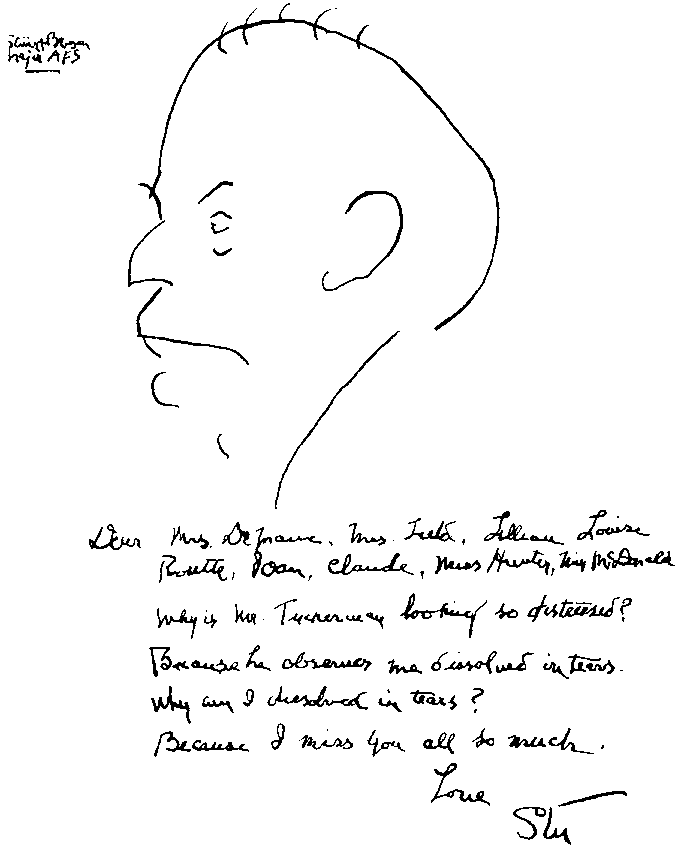
During the nearly three years that the American Field Service has been carrying on its work begun in the last war, the old Field Service has been well represented on the various fronts.
As shown by the roster, a number of volunteers of 1915-1917 have joined the A.F.S. of 1939-1942, and sons and nephews of former drivers are now enrolled with us.
Also, ambulances have been donated, bearing inscriptions which are constant reminders of the service we built in World War I. These inscriptions, with place of service, follow:
FRANCE, 1940:
In Memory of A. Piatt Andrew, Director, American Field Service, 1915-1917 (Colonel Andrew, going to France in 1914, became the creator and head of the A . F. S.) In Memory of Henry Davis Sleeper, American Representative, American Field Service, 1915-1917 (Gift of a Boston friend of Harry Sleeper. Nat' l Hdqts. of the A.F.S. were in Boston during the last war.) In Memory of Homer Gage, Jr. Worcester, Massachusetts (Given by his mother. Gage served in S.S.U. 31; later in the United States Army Ambulance Service with the French Army, an outgrowth of the A. F. S.) Henry Grew Crosby (Staff car, given in his memory by his mother. Crosby served in S.S.U. 71) Member of Former S.S.U. 30 (Donated anonymously by the head of S.S.U. 30) Mr. and Mrs. Roswell Miller (Miller served with T.M.U.526, 1917, and on our Executive Committee, 1939-1940) Deux Reconnaissants Americains (All ambulances of S.S.U. 9 on the French front in the last war bore this inscription. One of the actual name plates was sent back in 1940, and used on an ambulance given by the same donor.)
KENYA, B.E.F.1941-- :
In Memory of Ambulance #10 (Funds raised by Leslie Buswell, our Miami Representative, who drove Ambulance #10 in 1915)
| GREECE, 1941 | Of 25 ambulances shipped to Greece, 13 arrived safely; 12 were unloaded at Suez and subsequently driven by AFS, volunteers serving the Free French.) |
It memory of Henry E. M. Suckley, Chef de Section, American Field Service. Killed at Koritza, 1917. (Given anonymously.) In memory of Gordon Ware, American Field Service Ambulance Driver, Balkans, 1916. Gift of Mr. & Mrs. George P. Gardner, Jr., Boston, Mass., U. S. A.
AMERICAN AMBULANCE GREAT BRITAIN, 1940
In memory of Crompton T. Johnson (Funds raised by G. Ripley Cutler, a section mate of Johnson in SSU 18.) In memory of Carlton Burr,
American Soldier.(SSU 2, Chef of SSU 9, 1916-17. Killed as an officer in the Marines.)
MIDDLE EAST (Free French 1941
In memory of Joseph R. Greenwood (SSU 8, Sous Chef, Vosges Detachment, Captain, U.S.A.A.S. with French Army) Gift of T. M. members of the American Field Service, 1917. (Funds contributed by members of Reserve Mallet, in honor of Col. Mallet, thru Wm. Beach Olmsted, Jr., TMU. 397)
MIDDLE EAST (British) 1942
In memory of Clay H. Hollister and George Hollister, Grand Rapids, Mich. (George Hollister was member of SSU 3, 1916-17; killed as officer with U. S. Infantry.) SSU 1. of the American Field Service April, 1915 - September, 1917. (Funds raised by Victor White, member and Sous-Chef, SSU 1, 1915-16.) SSU 2 of the American Field Service April, 1915 - September, 1917 (Both of these ambulances donated by the American Field. Hospital Corps., Inc., --- Raymond Harper, of SSU 2, President.) In memory of the American Field Service Volunteer Ambulance Drivers who gave their lives, 1915-17. In memory of Oliver Hazard Perry, Chef de Section, American Field Service, 1916-17. (Given by his section mates of SSU 4, and by his friends.)