
MEDALS that adorn the uniform tell of courage and endurance and heroism that braved the worst for the cause. Their wearers live to hear the acclaim of their comrades. But there is another decoration, the commonest even though the most distinguished of all, the Wooden Cross that is awarded only to the men who have done the greatest thing that man --- yes, even God --- can do.
Yonder they lie, along that front where with face to the foe they counted not their lives dear unto themselves but bore the standard of liberty onward. Above their graves rise the sheltering arms of the rough-hewn cross, than which no fitter monument ever reared its form over mortal remains.
Our comrades they were. Our comrades they are. Death was powerless in the face of their bold daring to rob us of them or them of us. They are separated now from us, not by the gaping gulf of time but by a veil so thin that at times we almost see their figures through its waving folds. They live --- live gloriously in the land of far distances. Death stripped them of nothing essential. In the permanent society of the world beyond this they think and speak and see and love. They are what they were, except so far as the river of death has washed away the dust of earth and left them cleaner and better by reason of this their last great adventure.
The same dauntless spirit moved them, one and all. There was something dearer than life. To it they gave themselves and their all, and won the decoration of the Wooden Cross.
These men and a myriad more are calling to us, calling to us and bidding us to carry on. If we would still hold to their comradeship we must display in life the spirit they displayed in death. We must live for the things for which they died. That which we have achieved by victory we must weave into the fabric of the new world and the new age. The Wooden Cross of our dead comrades is for them a glorious decoration. For us it is the banner of our life that is to be. It challenges us to hold more precious than mortal life ideals of honor, justice, and righteousness. After all, the Cross that redeemed the world was a wooden cross, too, was it not? It was no toy or pretty bauble, but a thing of nails and pain and death --- and yet a thing of glory.
THE Second Pursuit Group, originally the 13th and 139th Squadrons, began to operate late in June, 1918. Then came the 103d (formerly the Lafayette), which was replaced by the 22d and 49th Squadrons late in Aug., or early in Sept. This was a live Group which came to its own in the St.-Mihiel and Argonne offensives. It has some one hundred and thirty-five official victories, against thirty-eight losses.
Early in the spring there were reports from the lone Lafayette, at Dunkirk. Things were causing concern on the front from Reims to Soissons, and in June the First Pursuit Group pulled out to stave off the advancing Hun at Château-Thierry; and the neophyte 139th and 13th Squadrons moved into the vacant hangars at the "cross-roads." Raoul Lufbery had gone on to a reward, as had Dick Blodgett and others, and the new tenants were confronted with a sterner task, to meet and avenge their deaths. Then the business began and the skeleton Squadron was right busy until the eleventh day of the eleventh month.
Major Angstrom, who had been with the English, was in command of one Squadron, while Capt. Charles Biddle, of the Lafayette, had the other Squadron, as Flight Commander. In the 139th were Capt. Bridgman, who later commanded the 22d, and Dave Putnam, both of whom had been with the French. From the 103d Squadron came Hobey Baker, and Maury Jones as Flight Commander for the 13th, while George Fisher, from the First Pursuit Group, was the third on that list.
Soon the 103d came, and proved to us that there was n't any use wasting time. The summer went on in a quiet sort of way as later experiences taught, and when the 103d left our Group, the 22d and the 49th Squadrons came in.
Then in Sept. came the St.-Mihiel affair, which paved the way for large things in the Argonne. In the week beginning Sept. 1 the Group had downed twenty-five planes, against nine lost, and four of these came back. A little later, it grew noisy over west of the Meuse, and the Second Pursuit Group was very much in the activity, and over a hundred official victories resulted.
FIRST LIEUTENANT, A.S.A., U.S.A., ONE HUNDRED AND THIRTY-NINTH AERO SQUADRON, SECOND PURSUIT GROUP
SON of Frederick Huntington and Janet (Hallowell) Putnam; was born at Jamaica Plain, Mass., Dec. 10, 1898. He was a descendant of Gen. Israel Putnam, of Revolutionary fame. He attended the Newton High School, and entered Harvard College, class of 1920. At school he was president of his class and excelled in athletics; he was an expert swimmer, played on the football team, the baseball team, and the hockey team; he was class orator.
During his freshman year at college he successfully passed his examination for the Aviation Service, but being under age was barred from entering the U.S. Service. He left Harvard after passing his mid-year examinations and sailed for France on a cattleship, being determined to enter the Air Service abroad. In April, 1917, he began his training at Avord, France, where he was brevetted on Oct. 17, 1917, and sent to Pau for training in acrobatics. There he remained until Dec. 21, when he was sent to the front assigned to the Lafayette Escadrille, N 156, stationed a couple of miles outside of Châlons, near the Marne River. On Dec. 2, 1917, he flew for the first time over the enemy lines, and on Jan. 19, 1918, brought down his first enemy machine; he was given a Morane plane, and was proud of the fact that he was the only man known to have brought down a Boche while flying one of these machines.
One of Putnam's longest and hardest fights was on April 11, 1918, when he engaged four two-seaters for thirty-five minutes, and brought down one of them. The following day he fought alone a German "circus" of eight machines and got two of them.
On April 23, Putnam was credited with three official victories. His most famous combat took place on June 5, 1918, when he was alone in battle with ten German Albatross planes; bringing down five, the greatest score of victories ever credited to a flyer in one flight.
On June 16, 1918, he wrote:
Combat after combat comes my way, and without boasting I'll say that I generally meet them head on. Friday, with another fellow, I dove into a bunch of six Germans and three fell. These are not official yet.
Yesterday I was with three other fellows when I saw two Boche biplanes. They saw us at about the same time and started to drive for home. Putting on all the speed I could, I gave chase. As my machine happened to be slightly faster than the others of my patrol, I arrived first. With both guns shooting murder, I slowly closed with one of the Boches. Nearer and nearer I drew. One gun stuck, but the other rattled on. When I was about ten yards from the German, up came his nose. A perfect target, and just at that moment my remaining gun stopped. The German gunner (I could see him clearly) took one look at me and commenced to fire. A quick turn and I was out of range. I looked back and there was the unlucky Boche falling. Suddenly his left wing broke off and he dashed into the ground. I looked for the rest of my patrol, and there they were, some five hundred yards above me watching the fight. We got together again and started to patrol some more. I kept on, for I was able to fix my guns. which were n't very badly jammed. Suddenly I saw five more Germans and gave chase immediately. As the biplanes had done before them, they, too, turned toward home, and in following them I passed through a cloud and lost the rest of my patrol. The Germans, however, went so far that I turned back. I had flown perhaps three minutes towards our lines when a German balloon loomed up directly ahead of me. "Well," I said, "I've got no incendiary bullets, but there's no harm in shooting at it." No sooner said than done. I pulled both triggers. Pfoof!! ! The balloon burst into flames, and it did look queer. I supposed that there would be just one burst of flame and that would be the end. No; the thing remained in the air, a flaming mass, for perhaps twenty seconds, and then dropped slowly to the ground where it continued to burn. But how the anti-aircraft guns did shoot at me. Bang! Bang! Bang! Just a continuous roar. "Flaming onions" also were coming up from the ground. Into a cloud I went. The shooting was even more terrible there, so out I dove. Twisting, turning, circling, I finally reached our lines and made tracks for home. The others arrived about the same time, having witnessed the entire performance. That makes nine official planes and thirteen unofficial for a total of twenty-two in six months.
On June 10, 1918, Putnam was commissioned 1st Lieut., A.S.. U.S.A., and four weeks later he was sent to an American escadrille. and finally assigned as Flight Commander of the 139th Squadron. During the terrific air fighting along the French front early in June, he distinguished himself by his repeated attacks on the German infantry, flying at low altitudes above the massed formations, and spraying them with machine-gun bullets with perfect indifference to the shots from the ground that riddled his wings with holes.
Lieut. Putnam's last flight was made over the lines on Sept. 12, 1918, in company with Lieut. Robertson. Fifteen German planes came down upon them from the clouds in a surprise attack. Robertson escaped; Putnam brought down one German plane in flames, and on his way back he saw an Allied biplace being attacked by eight Boches; he saved the biplane, but was himself brought down with two shots through his heart. It was for this last deed that his country awarded him the Distinguished Service Cross. He fell at Limey, and was buried with full military honors near Toul, in the forest of Sebastopol, Sept. 14, 1918, and lies by the side of Lufbery, whom he had succeeded as the "American Ace of Aces." He was credited with thirty-four planes, fourteen of which are official.
In a discourse on "Immortality," delivered after his return from France, by the Reverend William B. Geoghegan, at New Bedford, Mass., the speaker said:
From contact with our aviators, I have felt the impulse of the soaring spirit that would carry them higher than their planes ever went, and have felt that the clouds would open to take them into a larger universe. It was my great pleasure to meet, just before he was killed, our Ace of Aces, Putnam. His was one of the most beautiful souls I have known. He was in appearance almost like a Greek statue, showing, however, the effect of his experiences. When I heard that he had gone down, I knew that that beautiful form had been broken to emancipate a noble soul, and that he had gone to flights beyond the bounds of our human imagination.
In a beautiful letter to his mother, found among Putnam's effects, to be delivered in the event of his death, he wrote:
Mother, there is no question about the hereafter of men who give themselves in such a cause. If I am called upon to make it, I shall go with a grin of satisfaction and a smile.
Lieut. Putnam was awarded the Croix de Guerre; the Médaille Militaire, May 30, 1918;. the Cross of the Legion of Honor, Nov. 11, 1918; and the Distinguished Service Cross, April 8, 1919. In addition to citations, received Feb. 21, 1918, and March 21, 1918, he was awarded the medal of the Aero Club of America July 4, 1918.
The following report of the Chief of the U.S. Air Service, Liaison Section, was sent on Nov. 15, 1918, by Major Edmund Gros, in answer to a request by the French Government for names of famous American aviators to be used in naming vessels for the French fleet.
FIRST LIEUTENANT DAVID PUTNAM. One of the American best pilots and, for some time preceding his death, the American Ace of Aces.
During the time Lieut. Putnam served as a Sergeant-Pilot in the French Army, he succeeded in bringing down on the Champagne front nine enemy planes, three of which were biplace machines, and in addition he is credited with thirteen unofficially, which were too far over the enemy lines to be confirmed officially. On the date of June 5, he brought down one official enemy plane, and four others unofficially. Lieut. Putnam joined the 139th Aero Squadron, June 4, 1918, and from that time up to the time of his death, he brought down five official enemy planes as well as seven others which were so far within the enemy lines that no confirmations could be obtained. These latter aircraft were all brought down in the Toul sector during the time when that front was quiet, and it was only by means of persistent and long flights into enemy territory that he was able to gain the above number of victories.
Always seeking combat, he flew a brightly painted red machine which was known as "Putnam's Red Devil," and was never known to turn tail when attacked by superior numbers.
On July 1, Lieut. Putnam was recommended for the award of the Distinguished Service Cross for having brought down in conspicuous gallant and skillful manner an enemy biplace machine; notwithstanding the superior manoeuvring ability of his opponent he dived straight into the machine gun of the observer and brought the enemy plane down by the firing of only six shots.
On August 1, Lieut. Putnam was recommended for the award of the Medal of Honor on account of his extremely brave, courageous, efficient service to the Allied cause.
As a Flight Commander Lieut. Putnam showed remarkable cool-headedness and skill as a leader and always allowed the less experienced pilots to derive benefit of his knowledge. As Acting Squadron Commander of the 139th Aero Squadron from May 16 to the time of his death, he again showed his ability by managing his squadron in most exemplary manner, yet never diminishing the number of his flights or combats.
On September 12, Lieut. Putnam and another pilot were attacked by seven or eight enemy aircraft. He succeeded in downing one enemy plane, but was overpowered by superior numbers and was brought to earth, having received several bullet wounds.
At the time of his death. Lieut. Putnam had been credited with fourteen official victories, while his unofficial victories numbered twenty.
Always a clean fighter and one who always fought out of a sense of duty and never for renown or publicity, Lieut. Putnam was loved and respected by all with whom he came into contact, and will be remembered by his friends and foes alike as a true sportsman, as well as one of the best fighters.
EDMUND GROS, Major, Air Service.

SON of Clift Rogers and Gertrude (Blanchard) Clapp; was born at Dorchester, Mass., July 4, 1893. He prepared for college at the Newton High School and the Noble and Greenough School; graduated from Harvard College, in 1916; entered the Law School, and during his first year there joined the Harvard Regiment.
He attended the Officers' Training Camp at Plattsburg, from May until Aug., 1917, then entered the School of Military Aeronautics, M.I.T., graduating (with honor) Sept. 22, 1917; he continued his training at Mineola, N.Y., about Oct. 1, 1917; was commissioned 1st Lieut. Dec. 17, 1917, and sailed overseas Jan. 29, 1918. After training at Issoudun, France, Furbara, Italy, and Orly, he joined the 22d Aero Squadron, in Aug., 1918, at Toul.
This Squadron in two months lost eleven of its original eighteen pilots, and had forty-two German planes to its credit; it was actively engaged throughout the fighting along the left bank of the Meuse toward Sedan, during the last month of the war.
On the afternoon of Nov. 3, 1918, a patrol of six pilots, among whom was Lieut. Clapp, went over the lines in single-seated Spads to bomb a road leading out of Beaumont to the north. They flew about twenty kilometres inside the German lines and on their return were attacked by eighteen German Fokkers. Three German planes are known to have been brought down and only three of the American planes returned to their own lines; two of them were so riddled with bullets as to be useless. Of the three Americans who failed to return, Lieut. Tiffany was taken prisoner, uninjured; Lieut. Gibson's plane, and grave, were later identified near Létanne, but no trace of Lieut. Clapp has been found. He was last seen engaged at close quarters with several of the German planes, and the officers of the Squadron reported that his plane was probably exploded by an incendiary bullet within the German lines, near Beaumont, ten miles south of Sedan; his place of burial is unknown. Lieut. Herman C. Rorison was decorated for his conduct in this fight. The other survivors are Lieuts. Frank B. Tyndall and John Crissey.
Extract from letter written by Lieut. Clapp, June 6, 1918, describing combat practice:
For the last few days I have been at the last field of this Group, doing combat practice, with camera-guns. It is the most thrilling and exciting work we have done so far, and wonderful practice. It accustoms you to handle the machine without paying any attention to it, or the horizon, or the ground, all old and tried friends of earlier days of instruction. But in combat your only thought is for the other machine, and how to get on his tail, or keep him from getting on yours. I have n't done very much of it yet; twice with John Agar and once with Harry Harkins. We go out together or meet over some prearranged town, and then the fun begins. We start to circle, each one climbing for all he is worth, and at the same time drawing nearer each other. Round and round, and up and up! Finally the circle gets so tight that we are both doing practically vertical banks and stretching our necks to the limit to keep an eye on the other man. Suddenly one or the other breaks --- he has not handled his control properly in his anxiety to keep his place --- and goes down in a side-slip or vrille (tail-spin). This is the chance that the other man has been waiting for, and he kicks the lower rudder of his machine, causing it to fall over on that side and down on the other man's tail. The latter by this time has come out of the vrille by going into a nose-dive, and with the tremendous speed thus acquired points his machine straight upwards in a terrific zoom. Then the real fun begins. It is like a juggler playing with a couple of balls.
This morning I smashed my first bird all to bits --- worse luck. I was coming down to land and it was very windy and our field is terribly rough. I had her on the ground on all three points when the wheels struck a bump and over she went on the left wing. Then things happened with much speed and raising of dust. She whirled round like a top, smashing the other wing to kindling wood and wiping off the landing-gear completely. The last thing that happened was one of the wheels flying up past my left ear and embedding itself in the wing! I had a tiny scratch on my left elbow and some badly hurt feelings, for it was the first time I had done any real damage to any of Uncle Sam's expensive planes. Very much disgusted!

SON of Frank E. and Josephine (Levasseur) Brooks, was born at Framingham, Mass., Nov. 1, 1895. He attended the public schools of Framingham and graduated from the M.I.T. in 1917, where he was editor-in-chief of the "Tech" Magazine.
He enlisted in the U.S. Service Sept. 1, 1917, at M.I.T.; and was ordered to Fort Wood, N.Y. He trained with the R.F.C. at Toronto, Can., from Sept. 10 to Nov. 10, 1917. From Nov. 10 to Feb. 25, 1918, he trained at Hicks Field, Fort Worth, Texas, with the 28th and 139th Squadrons. He was commissioned 2d Lieut. on Feb. 5, 1918, and sailed overseas March 19, to France, where he completed his training at the 3d A.I.C., Issoudun. On Aug. 16, 1918, he was transferred to the 22d Squadron as Flight Commander and was prominent in the brilliant exploits of that Squadron. On Sept. 14, 1918, he won the Distinguished Service Cross, and recommendation for the Medal of Honor, in combat with eight Fokkers, bringing down two and making an official credit of six.
Lieut. Howard Clapp, afterwards killed in action, wrote of this combat:
Twelve Fokkers attacked our formation of six from above and in the sun ....
Brooks had about five after him, and they stuck very tenaciously. But he is a fine flier and a good shot, and, though he only fired 75 rounds during the whole affair, succeeded in bringing down two of them --- one in flames. They have both been confirmed, so he is now officially an ace.
His machine was very badly shot up. The rudder wires were cut through on one side, so that the rudder was useless; one of the main spars in his top wing was smashed and a tire punctured. Yet, in spite of all this he brought the machine safely down in a rough field north of camp.
A quotation from Capt. Brooks's own description of the affair follows:
We were still at 5000 metres or about three miles up. The "we" in this case referring to myself and eight red-nosed Richthofen Circus planes bent on an eight-to-one shot.
We were ten miles behind the lines of the infantry and my chances of escape were so slight that I figured I had come to the end. I was frankly scared, but in spite of much high tension and futile yelling at the top of my voice, I calculated, by nature of my training, I suppose, to get as many of the Fokkers as possible before the inevitable.
The only thing that saved me was that being entirely surrounded, the Germans could not shoot at me without being in their own way. A stream of white ribbons from the incendiary bullets and the tracers would cut through the gap in my wings so that if I reached out my hand they were close enough to cut it off.
Twice I tried to ram the Fokkers that had me in a direct line with their guns. One red-nosed "Night Mare" came in from my right and endeavored to draw me under by playing as a foil in a swoop to my level and then perceptibly below.
I had just time to dip enough to see his features before I let him have a few incendiary bullets. I was n't even sorry for him after that.
Another I turned upon and after a short, close burst was satisfied that a second had quit, although he did not, like the first, apparently catch fire ....
Two more of the Boches, in their tactical work, happened to get in the way of my line of fire and I finally had the better feeling of finding myself with a good 2000 metres, directly over the huge, boomerang lake (Lachausée) with only four of the enemy still paying me too much attention to suit me.
This was rather more dangerous than with a swarm, because the individuals could far better get a good shot at me where they had less chance of being in their own way.
A 220 horse-power Spad can out-dive a Fokker D-7 and for 1500 metres, with almost full motor, I spun, nose-dived, and slithered, flattening out just over the rolling country, with a fair chance over those four.
Two of these, and finally one, kept up the chase for a feeble distance, but retreated to my glad astonishment, before crossing the lines.
Brooks was commissioned 1st Lieut. Oct. 7, 1918. After the signing of the Armistice he was stationed at Grand, as Commanding Officer of the 22d Squadron. He was commissioned Capt. on March 12, 1919. Stationed at Selfridge Field, and later at Kelly Field.
For the extraordinary heroism in action over Mars-la-Tour, France, Sept. 14, 1918. Lieut. BROOKS, when his patrol was attacked by twelve enemy Fokkers over Mars-la-Tour, eight miles within the enemy lines, alone fought bravely and relentlessly with eight of them, pursuing the fight from 5000 metres to within a few metres of the ground, and though his right rudder control was out and his plane riddled with bullets, he destroyed two Fokkers, one falling out of control and the other bursting into flames.
(Signed) PERSHING

SON of Edmund Murry and Kate (Miles) Beane; was born in New York City, Jan. 20, 1896. He took up residence in Concord, Mass.. in 1909, and attended the Concord High School where he made a record on the track team. On graduation he entered the employ of the Department of Education at the State House, in Boston.
He sailed for France in June, 1916, and from July 8, 1916, to July 20, 1917, served as ambulance driver in the American Ambulance Field Service on the Verdun front. He joined the French Army in Aug., 1917, and was assigned to the Lafayette Escadrille for training. After acting as Avion de Chasse to the French, from Aug., 1917, to Feb., 1918, he was transferred to the U.S. Air Service in Feb., 1918, and shortly after commissioned 1st Lieut.
He had several German planes to his credit, when on June 27. 1918, he was shot down, badly wounded after a hard battle against overwhelming odds. He left the Hospital six weeks later with two fingers gone, but insisted on rejoining his Squadron. In Aug., 1918, he was transferred to the 22d Aero Squadron, with which he was flying at the time of his death. On Oct. 31, 1918, he was officially reported "Missing in action" near Banthéville, after one of the most important air battles of the year. For his heroic action in this engagement he was posthumously awarded the D.S.C. Not until April 29, 1919, was the fact of his death fully established. A letter from the American Military Mission in Berlin bearing that date states definitely that Lieut. Beane was killed in action on Oct. 30, 1918, and that he was buried near the place where he fell. Capt. F. W. Zinn, of the Air Service, reported that he was buried "two kilometres east of Brieulles-sur-Bar."
For extraordinary heroism in action near Banthéville, France, Oct. 29. 1918. When Lieut. BEANE'S patrol was attacked by eight enemy planes (Fokker type) he dived into their midst in order to divert their attention from the other machines of his group and shot down one of the Fokkers in flames. Four other Fokkers then joined in the battle, one of which was also destroyed by this officer.
(Signed) PERSHING
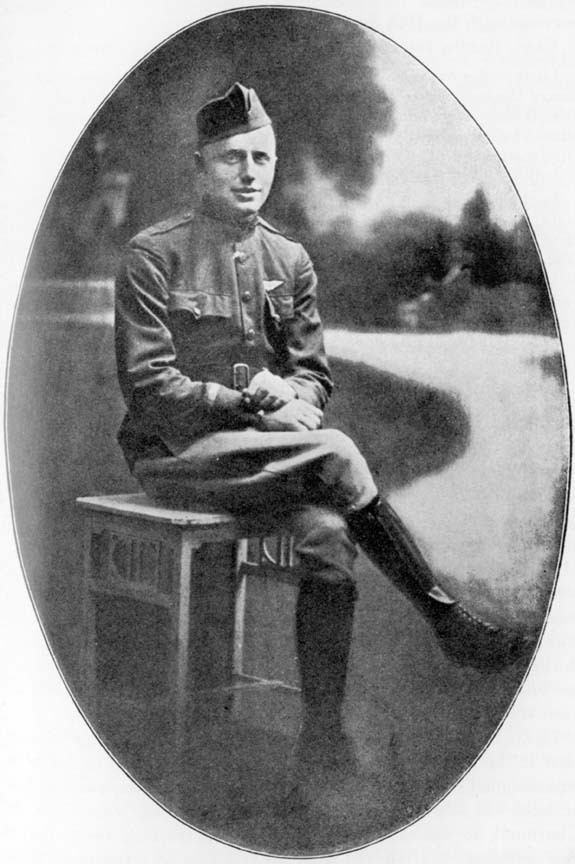
SON of Walter F. and Annette L. (Hewins) Stiles; was born at Fitchburg, Mass., Nov. 15, 1894. He attended the public schools of Fitchburg and graduated in 1916 from Harvard College, where he was prominent in many associations. He was on the editorial board of the Crimson; its managing editor in 1915, and president of the board of editors in 1916. He was a member of the freshman baseball squad, and manager of the 'Varsity baseball team in 1916; also president of the freshman Mandolin and Banjo Club. After graduation he became commission sales agent for a well-known textile firm, and was doing a very successful business at the time of his enlistment.
In the summer of 1916 be attended the Harvard Aviation School at Buffalo, N.Y., where he obtained an aviator's license. In June, 1917, he enlisted at Boston, Mass., for the Aviation Service; trained at the M.I.T. from Aug. 20, 1917, until Oct., when he was sent overseas, continuing his training at Issoudun, France. He was commissioned 1st Lieut. May 13, 1918. On Aug. 7, 1918, he was sent to the front attached to the 13th Squadron, 2d Pursuit Group. On Aug. 15 he was given credit for bringing down a German plane during his first engagement. Lieut. Stiles took part in the St. Mihiel drive, and on Sept. 16, 1918, was reported "Missing in action." It was later ascertained that he had been killed in action on that date, having been brought down by four or five German planes. He was shot through the chest and death was instantaneous on landing. He was buried near where he fell in a little cemetery beside some Germans, who had been killed in 1871. Later, he was reburied in the officers' section of the cemetery at Thiaucourt. On the day of his death Lieut. Stiles was the leader of a patrol of three, and when seven miles southwest of Metz these men were attacked by a number of German planes. Two of the men were able to reach their own lines, but Lieut. Stiles was last seen flying straight into Germany. Although only officially credited with one plane, it has been reported by other aviators that Stiles brought down several planes after his first one. He was cited by Gen. Pershing, "For exceptionally meritorious and conspicuous services with the 13th Squadron."
Capt. Biddle, Commander of the 13th Squadron, wrote of him:
Lieut. Stiles was one of my Flight Commanders, and I considered him one of the most valuable men in the Squadron, and the loss to all of his friends here who admired him so much for his courage and fine character cannot be measured.
Capt. Biddle elsewhere wrote of this engagement:
In three days, Sept. 13 to 15, the 13th Squadron shot down officially eight German machines, all single-seater fighting planes. In the meantime, however, we ourselves lost six men, two of them being among my best pilots.
Brother in Service ---
Walter F. Stiles, Jr., 1st Lieut., Q.M.C., A.E.F.
SON of Harvey L. and Nellie C. Boutwell; was born in Malden, Mass., Feb. 15, 1892. He was educated at the Stone School, Boston; Bowdoin College; and Boston University, Law School, LL.B. 1917. He was admitted to the Suffolk County Bar, in Sept., 1917.
On Oct. 30, 1917, he enlisted at Boston, Mass., and had eight weeks' ground training at the M.I.T. He then attended the flying school at Gerstner Field, Lake Charles, La., until Sept. 1, 1918. He was commissioned 2d Lieut. on May 13, 1918. At Gerstner Field during the summer of 1918, in addition to flying, he was detailed as Trial Judge Advocate before special courts-martial, and as such tried forty or more cases.
Lieut. Boutwell sailed overseas on Sept. 6, 1918. He spent some time in the hospital at Issoudun with influenza. Upon recovery he was assigned to 22d Aero Squadron, 2d Pursuit Group; and at last account was still overseas with the Third Army of Occupation. At Charmont he was ordered to do important work as Judge Advocate, although not relieved from his full duty as a member of the 22d Squadron.
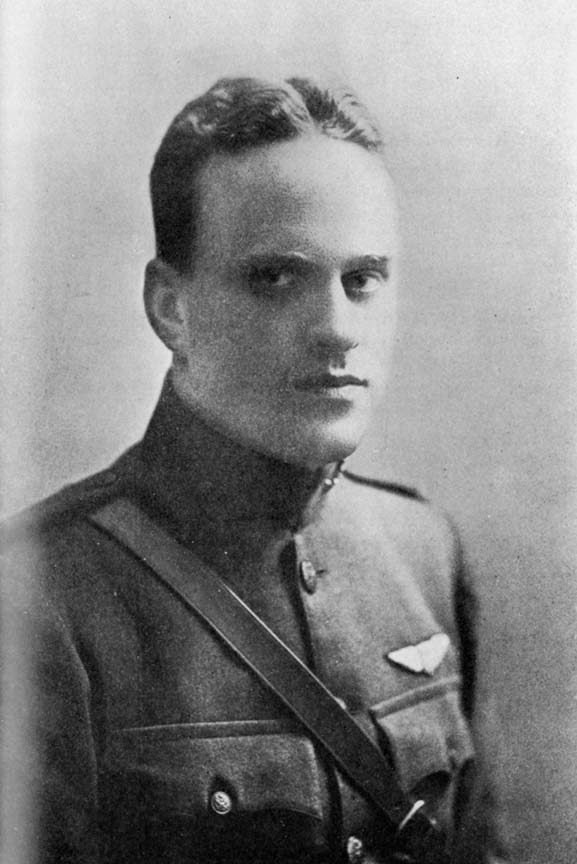
FIRST LIEUTENANT, A.S., U.S.A., NINETIETH AERO SQUADRON, THIRTEENTH AERO SQUADRON, SECOND PURSUIT GROUP
SON of Franklin W. and Helen (Boit) Freeman, of Wakefield, Mass.; was born in Newton Lower Falls, Oct. 17, 1896. He was educated at Wakefield High School; Cheshire Academy, Cheshire, Conn.; and the University of Washington (one year); also, he had two years at Yale College, class of 1919. He played on the baseball and football teams at Cheshire, and on the football team at Yale.
He enlisted on June 12, 1917, at Boston, and began preliminary training at M.I.T. Ground School, where he finished on Aug. 4, 1917. He was one of ten men chosen to go at once to France for training, and he sailed overseas on Aug. 22. He went directly to Liverpool, and from there to Southampton and Le Havre. He was one of a detachment of fifty men chosen from all the ground schools in the United States. After a few weeks at Étampes, he was transferred to Issoudun, where for two weeks he was engaged in general construction work. Following this he spent four months at the Aviation School at Tours, and was brevetted Jan. 29, 1918. He finished tests at Tours on Dec. 19, 1917, but was delayed by quarantine and change of management.
On Feb. 2, 1918, he was commissioned 1st Lieut. and went to Issoudun for Nieuport training, and then to the French Aerial Gunnery School at Cazaux, with a class of twenty men, for the month of April. He returned to Issoudun for combat training, but owing to shortage of pilots was sent out to the 90th Observation Squadron.
During May and June Lieut. Freeman was stationed with the 90th Squadron at Amanty and Ourches, flying biplace Sopwiths. On July 1 he was transferred to the 13th Squadron, 2d Pursuit Group, stationed at Toul. He served as Deputy Flight Commander to "Hobey" Baker, during July and the first half of Aug. He was then made Flight Commander. He engaged in several combats during July, Aug., and Sept., and led a formation of four against six Boches, at an altitude of 21,500 feet, the highest combat on the U.S. record. He is credited with three enemy planes.
On Sept. 14 he was one of a patrol of fourteen planes which engaged a number of Boches.
On Sept. 11, 1918, he was sent over ten miles within the lines in a heavy rainstorm to learn if the Huns were evacuating the St.Mihiel salient. On Sept. 14 he was one of a patrol of fourteen planes which engaged a number of Boches near Pont-à-Mousson, where four men were lost. Due to a failure of his motor during combat, he was forced to land directly back of the German front lines, and was made prisoner. He was confined in the prisons of Metz, St.-Avold, Strasbourg, Karlsruhe, Landshut, Villingen, and Constance. Being released after the Armistice, he returned through Switzerland to France on Dec. 1, 1918; and sailed for America on Feb. 1, 1919. He was honorably discharged on Feb. 7, 1919, at Garden City, N.Y.
Since his discharge Lieut. Freeman has been cited by Gen. Pershing "for conspicuous bravery in Service."
Brother in Service ---
Willard J. Freeman, 1st Lieut., 23d Infantry, U.S.A.; died in Service
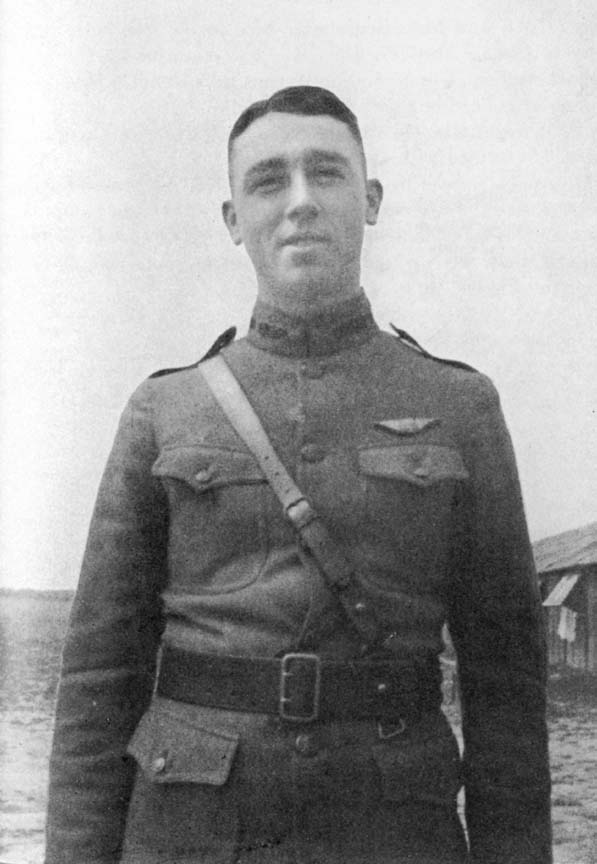
SON of William F. N. and Ella Teresa (Ahern) Beauton; was born at New Haven, Conn., March 13, 1895. He was educated at the Lovell Grammar School, New Haven High School, and Sheffield Scientific School, Yale. At high school he played on the football team in 1911, '12, and '13. At Yale he played on the freshman football team in 1914.
He enlisted in July, 1917, and trained first at the Ground School of Urbana University, Ill., until about Sept. 15. From then until Dec. 1, 1917, he trained at the Flying School in Belleville, Ill.; and was commissioned 1st Lieut. Dec. 23, 1917. He sailed overseas in Feb., 1918, and received training first on Caudrons. Later he went through the courses for advanced training at Issoudun. He joined the first flight of the 13th Squadron, which was sent to the front south of Châlons-sur-Marne; the Group consisting of the 99th Observation Squadron and one French Escadrille. This Group was stationed at Haussimont-sur-Marne, and worked with an artillery camp from March until June, 1918. On June 1 the 99th Squadron was ordered to Amanty, leaving the flight of the 13th to work from this field with the French until the Squadron should be completed. On the morning of June 3, Lieut. Beauton took his mechanic, Hugh A. Tate, up for a trial flight. They left at about seven-thirty, and returned about fifteen minutes later, because of motor trouble. At that time Sopwiths were being used, and were not of the most dependable type. As the machine neared the edge of the field it was seen to side-slip and then nose over and dive. Lieut. Beauton fell and was killed. He was buried in the town of Mailly, seven miles from Haussimont, France.

SON of Mr. and Mrs. Benjamin F. Richards; was born at West Haven, Conn., April 17, 1896. He was educated at the Suffield School, Suffield, Conn., and at Wesleyan University, Middletown, Conn. At college he was a member of the freshman and 'Varsity, football teams, the class basketball team, and the 'Varsity track team. He trained with the Wesleyan R.O.T.C.
He went overseas in the spring of 1917, and served for four months with the American Ambulance Field Service, behind Soissons, and in the Champagne, taking part in the evacuation under fire at Gueux, which won the unit a citation, and Croix de Guerre from the French, July 14, 1917.
In Oct., 1917, he enlisted at Paris in the U.S. Aviation Service, and was sent to Tours for training, where he received the French Brevet, in Feb., 1918. He trained at the 3d A.I.C. at Issoudun from Feb. to April, 1918, and he was commissioned 1st Lieut., March 8, 1918. He attended the Aerial Gunnery School at Cazaux until May, 1918, when he was assigned as Ferry Pilot to the 1st A.A.P., Orly (Seine), remaining until June 14, 1918. He was transferred to the 1st Air Dépôt, at Colombey-les-Belles, June 14 to July 14, and on July 5 was attached to the 13th Aero Squadron, 2d Pursuit Group. with which he went to the front in the Toul sector.
On Sept. 9, 1918, during the Argonne offensive, Lieut. Richards was brought down, wounded in action, and was sent to the hospital. He reported for duty on Nov. 6, and served as Flight Commander, 13th Squadron, from Dec. 18, 1918, to Jan. 4, 1919. He was honorably discharged on April 7, 1919, at St.-Aignan, France, and returned to the U.S. Inactive Status: Capt. in Reserve; per letter War Dept., June, 1919, Lieut. Richards designed the insignia of his Squadron.
Married, May 16, 1919, at Paris, France, Edith L. Armstrong.
From the Commander in Chief, A.E.F., for conspicuous and especially meritorious service.
First Lieutenant EARLE F. RICHARDS, A.S., U.S.A., Pilot, 13th Aero Squadron, 2d Pursuit Group, is hereby credited with the destruction, in combat, of two enemy Pfalz, in the region of Cormsy, at 4000 metres altitude, on Sept. 14, 1919, at 8.05 o'clock.
SON of Willard B. and Annie B. Howe; was born in Burlington, Vt., June 22, 1892. He was educated at the Burlington High School, graduating in 1910; and at the University of Vermont, A.B. 1914, where he was a member of Sigma Phi and Phi Beta Kappa Fraternities. He trained for two years in the student battalion of the University of Vermont.
He enlisted at New York on May 12, 1917, and attended the First Plattsburg Officers' Camp, from May 12 to June 25, 1917. He then trained at the M.I.T. Ground School, June to Aug., 1917; and at Hazelhurst Field, Mineola, N.Y., Aug. to Oct., 1917. On Nov. 2, with a 1st Lieut.'s commission, dating from Nov. 3, 1917. he sailed overseas, and was in training at the 3d A.I.C., Issoudun, France, from Dec. to March, 1918. In March and April he was stationed at the École de Tir Aérienne, Cazaux; and acted as ferry pilot at Orly on the Seine, in May and June, 1918.
In July, 1918, Lieut. Howe joined the 13th Aero Squadron, 2d Pursuit Group, organizing on the Toul sector, and remained with this Squadron at Toul, Bebain and Souilly aerodromes until Dec. 5, 1918. He returned to America and was honorably discharged on Feb. 25, 1919.
Copy of a General Order: "Headquarters Air Service First Army, A.E.F. France, Sept. 292, 1918. General Orders, Number 8. Par. 6, 1st Lieutenants J. D. Este, J. J. Seerly, R. R. S. Converse, D. W. Howe, and 2d Lieut. F. E. Hays, 13th Aero Squadron, Second Pursuit Group, are hereby credited with the destruction, in combat, of three enemy biplane Fokkers, in the region of Chambley, at 2400 metres altitude on Sept. 13, 1918, and 18:35 to 19:55 o'clock. By Order of Colonel MITCHELL. (Signed) T. DEW. MILLING, Colonel, A.S., U.S.A.. Chief of Staff. Official: W. P. KELLEHER, Major, A.S., U.S.A., Adjutant."
SON of Charles E. and Stella (Bosworth) Riley; was born Sept. 4, 1894, at North Attleboro, Mass. He was educated in the public schools of North Attleboro, and studied Electrical Engineering for three years at the Rhode Island State College. He played on the baseball team at the high school, and belonged to the Cadet Corps of Rhode Island State College.
He enlisted in the Service of the U.S. at the Officers' Training Camp at Plattsburg, on May 14, 1917. He was trained at Plattsburg, N.Y., and at the Ground School, M.I.T. He was later transferred to Mineola, Long Island, N.Y., for a course in Primary Flying.
He sailed overseas, and he attended the aviation schools in France, at Issoudun, Cazaux, Orly, Seine; at Colombey-les-Belles; at Toul; and at Belrain. Subsequently he was attached to the 13th Squadron, 2d Pursuit Group. He was commissioned 1st Lieut. on Dec. 13, 1917, and received active orders as 1st Lieut. on Feb. 11, 1918. Returning to the U.S., he was stationed at Carlstrom Field, Arcadia, Florida.
Married, Nov. 7, 1918, Catharina Slaign.

SON of Henry A. and Agnes (Bartlett) Francis; was horn at Pittsfield, Mass., Jan. 13, 1897. He was educated at the Pittsfield High School, at Phillips Andover Academy, and at Harvard College, class of 1919. In 1916 he belonged to the Harvard Regiment and attended the Officers' Training Camp at Plattsburg, N.Y. He was a member of the Harvard R.O.T.C., 1916-17.
He enlisted in the Aviation Service at Pittsfield, Mass., on July 6, 1917. After completing the course at the M.I.T. Ground School he was sent overseas, and received the remainder of his training in French schools. He attended the 3d A.I.C. at Issoudun, from Oct., 1917, to May, 1918, as a Cadet. On May 13, 1918, he was commissioned 1st Lieut., A.S.A. He was ordered to the Cazaux Instruction Centre in June, 1918. From July to Oct., 1918, he served as Instructor at the 3d A.I.C., Issoudun. During Nov. and Dec., 1918, he was assigned to the 41st Aero Squadron, 5th Pursuit Group.
Lieut. Francis was honorably discharged at Garden City, N.Y., on Feb. 8, 1919.
Members of family in Service ---
Grandfather: William Francis Bartlett, Major-General in Civil War.
Ancestors in Revolutionary War:
William Francis, Captain.
Daniel Hubbard, Captain.
Jabez Hall, Captain; died in service, 1776.
Seth Pomeroy, General; died in service, 1777.

SON of John Stuart and Helena Forsyth (Ellis) Elliott, of Washington, D.C.; was born at Osterville, Mass., Aug. 24, 1892. He was educated at the Fay School, St. Paul's School, Concord, N.H., Harvard, A.B. 1914, and M.I.T. (graduate work). While at school and college he engaged in general athletic sports.
Previous to the war he served four years in Troop B, M.V.M. He enlisted on May 21, 1917, at Boston, and trained first at the Ground School, M.I.T. He continued his training at Mineola; and sailed for France on Oct. 27, 1917, where he had further training at Issoudun and Cazaux, France. He was commissioned 1st Lieut. on Sept. 17, 1917. During April and May, 1918, he was ferry pilot at Orly. He saw active service from July 1 to Oct. 11, 1918, being attached to the 18th Aero Squadron, 2d Pursuit Group, of which Major (then Capt.) Charles Biddle was Commander. He was stationed near Toul from July 1 to Sept. 14, and took part in the St.-Mihiel offensive. On Sept. 20 he moved to Belrain, where he remained until Nov. 4, taking part in the Argonne-Meuse drive. On Nov. 5 he was moved to Souilly. He has a record for 100 hours over the lines in a 220 Spad. He flew patrols, protections, and took part in "strafing" sorties. He returned from France on March 4, 1919, and was honorably discharged at Camp Mills, on April 11, 1919.
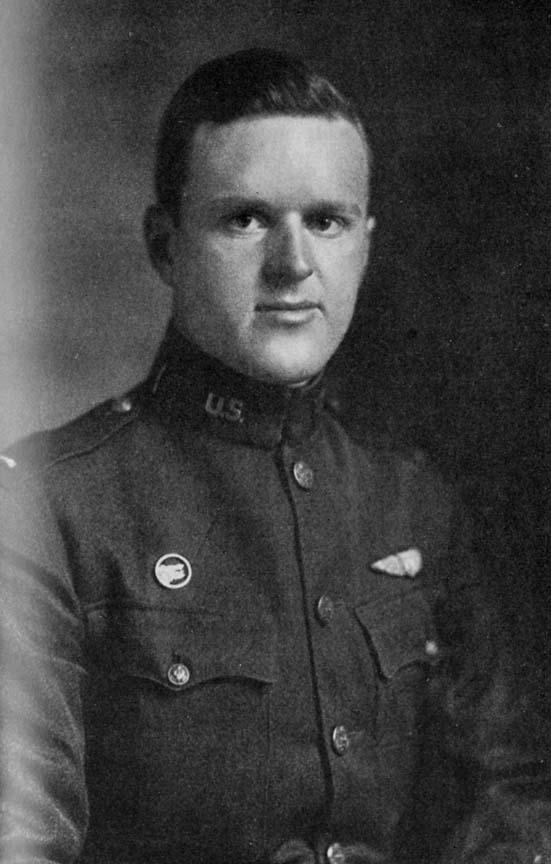
SON of Lewis J. and Annie Page (Campbell) Bridgman; was born at Salem, Mass., Oct. 26, 1897. He was educated in the Salem public schools, and at Harvard College, class of 1919. He was on the staff of the Crimson, and was a member of the winning crew in an interdormitory boat-race in 1916.
He sailed for France on Feb. 19, 1917. with the Harvard Unit of the American Ambulance Field Service. On Sept. 15, 1917, he enlisted in the Air Service, U.S.A., and was trained at Tours, and at Issoudun. He was commissioned 1st Lieut. Jan. 1, 1918, and in June was one of the first group of ten American aviators chosen to pilot French fighting-planes at the front. He was later transferred to the 49th Squadron 2d Pursuit Group, and took part in the first "All-American" offensive in Sept., 1918. He did excellent work and was credited with one Boche.
He wrote of this exploit:
I don't think I wrote what a nice birthday I had. I got a beautiful present. The telephone rang and they told me I had official confirmation on a Fokker I got in flames, with another boy, two days before I attained my majority.
It was queer the way we got him. We have the old Richthofen Circus opposite us now, and they are marvellous pilots and full of all kinds of tricks. Seven of them laid a trap for our patrol --- four staying high, and three coming down to invite us to attack them. We did just what they wanted us to do, --- but left the rear man up top to protect us.
We dove 2000 metres after the Fokkers, who dove also, into Germany. They had a head start, so all we could get was a long shot with incendiaries. One of them caught fire, and as we were low, and in Germany, with the other Fokkers trying to get a chance to pick on us, we pulled up.
As I did so, my motor stopped, and I went down some more. I fiddled with it and it picked up, and I staggered back home on a level with the observation balloons.
Our Squadron now has a record of 22 Boches, with only five losses .... More than four to one.
In a letter dated Sept. 17, 1918, he wrote of the offensive:
Our quiet sector has been turned into an important one. I am so glad to have been in the operation as it was the first all-American offensive since we entered the war.
It was, of course, very successfully carried out .... We were handicapped in our particular line of trade by nasty weather, clouds so low we had to hop the hedges (almost) to fly at all, and squalls of rain every ten minutes. There was a strong wind, too.
Dawn of the offensive, I went out alone, more to satisfy my curiosity than to fight, as there were no enemy planes up at all. The front looked queer because my perspective was changed. We always fly high lip, 15,000 to 0,000 feet, and here I was only a few hundred. It was just beginning to grow light, and in the semi-darkness the flashes of the guns we had massed on the lines looked like thousands of fireflies. I could see them twinkling constantly, fifteen or twenty miles up and down the front.
The guns near me rather worried me for a while. The shells were coming so fast that they tossed me around quite a bit, disturbing the air as they did. The detonations were very clear.
I looked around for enemy planes, but all I saw that morning were our liaison planes following infantry, and then chasing back to tell headquarters and batteries all about it by wireless. They were working at my own height, and once in a while an unusually low cloud would come by, and get two of us hidden together, whereupon I would dive out for all I was worth to avoid a collision.
During my flight I superintended the affair up and down the entire front of operations. In one place I went down and watched a local attack by the infantry supported by small tanks. Viewed from above, an attack is ridiculously slow. The tanks seem to crawl, and the men crawl with them. In reality I've seen the tanks, and they are fast for anything so clumsy.
It was tiresome to circle around and watch that particular attack, so after a time I crossed into Germany and looked over the Boches in their reserve trenches. Quantities of shells were bursting on this side and a few on our own territory. I was only machine-gunned once from the ground.
Altogether that first morning was the most impressive I shall probably ever see, and to witness it in such a complete way was worth anything I've got.
Lieut. Bridgman was honorably discharged at Camp Devens, March 18, 1919.
First Lieutenant HUGH BRIDGMAN, A.S., 49th Aero Squadron: For distinguished and exceptional gallantry at Aincreville, France on, 23d Oct., 1918, in the operation of the American Expeditionary Forces. In testimony thereof, and as an expression of appreciation of his valor, I award this citation.
(Signed) JOHN
J. PERSHING,
Commander-in-Chief
THE Third Pursuit Group was formed at Vaucouleurs under the command of Major William Thaw, in the first days of Aug., 1918. It included the 103d, the 93d, the 213th and the 28th Squadrons. Of these the 103d, or the former Lafayette Escadrille, was the only one which had operated before. It was several weeks before the other three were equipped and ready for work. There were many difficulties, such as the lack of planes, parts, and efficient mechanics, to be met with and overcome. Yet in this short period each organization became complete and began its patrols according to schedule.
At this time there was but little enemy activity on the Toul sector, so that it was possible for the new men to gain much experience over the lines before the real contest began. On Sept. 12, 1918, the drive of the First American Army on the Boche positions between St.-Mihiel and Pont-à-Mousson commenced. With this, the group took up its duties in earnest. Patrols were constantly sent over the lines to bomb, "strafe," destroy balloons, protect observation and bombing planes, and drive back the enemy formations. With but small losses, very satisfactory results were achieved. The German formations encountered were not as strong or as skilful as they later proved to be on the Argonne and Verdun sector. Beside, their "chasse" planes, most commonly the Fokker type, were not quite as good for fighting purposes as the French 220 H.P. Spads used by the Americans. The Spads had the advantage of speed, strength, and diving ability. However, the Fokkers made up for this to a certain extent by their adeptness in climbing and manoeuvring. Taken as a whole, the forces were fairly well matched.
On the 24th of Sept. the First Army having reached its objectives, transferred its forces to the Argonne. The Third Pursuit Squadron accordingly moved with them, and became settled at L'Isle-en-Barrois, about 20 kilometres southeast of Verdun. In carrying out their missions here our patrols met with much fiercer opposition than before. The Germans sent out patrols in greater numbers and played a most cautious game. It was not unusual for our fairly scattered formations of three to eight planes to encounter twice as many. Yet the work went on with the same degree of success as before. A German captain who was taken prisoner after his machine had been shot down in flames, and he had been forced to escape in a parachute, made a fair statement of facts when he said: "Your organization is poor. You patrol in small numbers far into German territory, yet you get amazing results. It is due to a certain amount of daring and luck, mostly the latter."
With the retreat of the Huns, it was again necessary for the group to change position. On Nov. 6 it moved toward the lines ten kilometres to Foucacourt. Adverse weather from this day to the Armistice permitted only a few patrols and bombing expeditions. On Nov. 11 the Group Commander, now Lieut.-Col. Thaw, gave out the order "All hostilities will cease at 11 A.M." In the short three months of activity up to this time the following official confirmations on the destruction of enemy planes had been received: the 93d, thirty-two; the 103d, twenty-eight; the 28th, fourteen; and the 213th, twelve. Sharing in these victories were the following New England men: William Loomis, Richard Loomis, Bryant Woods, Clarence H. Faith, William C. Appleton, Hugo A. Kenyon, and Chester E. Wright.
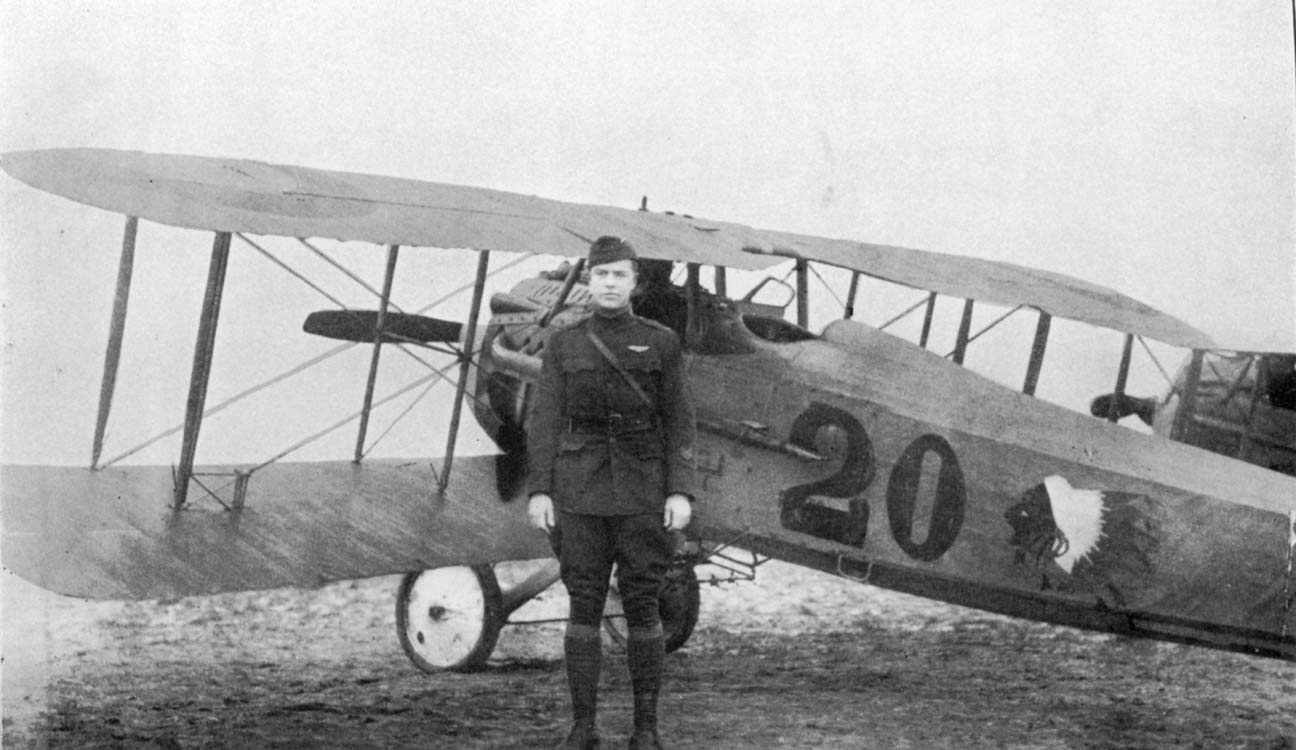
SON of William Channing and Edna (Turner) Appleton; was born in Jamaica Plain, Mass., on March 15, 1897. He attended the Noble and Greenough School, Boston, and was graduated from Harvard in 1917. At school and college he took part in athletics; at school he played on the baseball team; and at Harvard was captain of the second 'Varsity hockey team, 1915-16, and a member of the 'Varsity hockey team, 1916-17.
He trained with the Harvard Regiment in 1915-16, attended the Plattsburg Camp in 1916, and took a Military Science course at Harvard, 1916-17. In May, 1917, he enlisted in the American Ambulance Field Service, sailed that month for France, and was attached to the Camion Service (T.M.U. 133), which operated along the Aisne and Chemin des Dames front from June to Nov., 1917.
He enlisted in the Air Service, U.S.A., in Paris on Dec. 3, 1917. He was stationed at Paris, at Tours, and at St.-Maixent from Dec., 1917, to April, 1918; and trained at Gondrecourt, Tours, Issoudun, and Cazaux, from May to Oct., 1918. On May 18, 1918, he was commissioned 2d Lieut., A.S., U.S.A. On Oct. 13, 1918, he was attached as pilot to the 103d Aero Squadron, 3d Pursuit Group (1st Pursuit Wing of the 1st Army), then stationed at L' Isle-en-Barrois, and later moved to Foucacourt Field, near the Argonne Forest. In the weeks before the Armistice the 103d Squadron patrolled the Argonne-Meuse front between Grandpré and Verdun, and later from Verdun northward beyond Stenay, during the battles which resulted in the taking of Grandpré, Dun, Stenay, etc. The following extracts are from letters written by Lieut. Appleton:
October 20, 1918
Yesterday we went out to get a plane which had a forced landing near the lines. It was on a hill where eight days before the Americans had rushed up over. Old tanks, etc., lying around and lots of dead Germans, all hit in the chest by bayonet or machine gun ....
This country seems much more like one's idea of war than the last summer's country [the Aisne and Chemin des Dames front]. Especially Yesterday with low dark clouds and misty rain and artillery rumbles. It was as dark at three as usually at five or five-thirty this time of year, and the flashes of guns twinkling all over the valleys and machine guns winnowing away in the distance, made everything very lonely. No towns left at all.
November 11, 1918
We seem to have ceased hostilities .... You ought to see the poor old French poilus. They are weeping, they are so happy.
A couple of our fellows walked out beyond our lines just after 11 A.M., when peace came, and talked with some Germans who walked over from the other side. Germans seemed satisfied and said the Kaiser was finished, and grinned broadly.
All the church bells in the little torn-up villages began ringing and the whistles of the little narrow gauge railway locomotives began tooting at eleven, when the firing ceased.
Our squadron made the last patrol, as far as we can find out, of any American force along this part of the front, and possibly of any Allied, last evening. We went out an hour before sunset and got back after dark and landed by flares. The front was wonderfully beautiful. A thick haze up to 1000 metres, and above clear as a bell, with the moon rising in the east. You could see the earth vaguely beneath. A bunch of our chasse planes were playing around over an old town [Verdun], just on the upper edge of the haze. A few fires from burning villages behind the German lines and the artillery flashes on our side.
The sun set crimson as we headed north on our patrol, and when we reached the end of the northern stretch, there was only a pink glow. We headed home, and put our noses down and pulled on our throttles, and in a few minutes saw the flares and bonfires at our field, away to the southwest.
And to-day all fighting is stopped. It is hard to believe.
After the Armistice, Lieut. Appleton was detached from the Squadron on Dec. 1, 1918; spent Dec. at Issoudun, and part of Jan. at Bordeaux. He sailed from Marseilles Jan. 20, for America, and was honorably discharged at Garden City, N.Y., on Feb. 7, 1919.
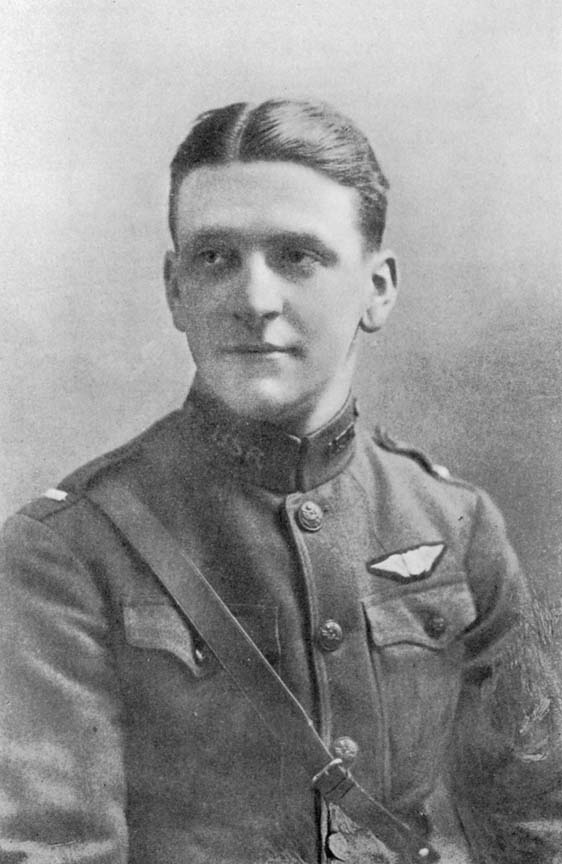
SON of Arthur E. and Jessie (Emery) Giroux (now Mrs. Arthur E. Haley); was born in Roxbury, Mass., Dec. 4, 1895. He was educated at the Somerville High School, class of 1915, and at Dartmouth College, class of 1919. He was a member of the Phi Gamma Delta fraternity.
He left college in March, 1917, to enlist in the American Ambulance Field Service, sailing overseas on April 22, 1917; he was one of the first forty-five to sign for camion service; went to the front with the Ammunition Transport, serving as Sergeant in T.M.U. 526 B. He secured his discharge and enlisted in the Franco-American Flying Corps, and trained at Avord, Tours, Issoudun, and Cazaux; later he was transferred to the U.S. Air Service and was commissioned 1st Lieut. Nov. 20, 1917. After completing his training he acted as ferry pilot between Paris and the front. He was attached to the 103d Squadron under Major Thaw, and in April, 1918, began active service at the front. He was killed May 22, 1918, in an engagement between five American machines of the 103d Squadron, and eight German monoplace machines. He fell behind the enemy lines in the vicinity of Laventie, between Lille and Armentières, and was buried at Estaires, France. He was awarded the Distinguished Service Cross by Gen. Pershing and the Croix de Guerre with Palm.
D.S.C. First Lieutenant ERNEST A. GIROUX, Pilot, A.S., U.S.A. For extraordinary heroism in action near Armeyeren, France, May 22, 1918. Lieut. Giroux, while on patrol with four other scout planes attacked an enemy formation of eight monoplace machines. Two of Lieut. Giroux's companions were forced to retire when their guns became jammed. Despite numerical superiority, Lieut. Giroux continued the attack, endeavoring to protect his leader until finally forced down and killed.
Croix de Guerre with Palm Awarded to American Pilot, 1st Lieut. ERNEST A. GIROUX. Young pilot filled with energy did not hesitate on May, 22, 1918, to attack in their lines an enemy patrol of superior numbers, and gave them a stubborn fight, in the course of which he disappeared.
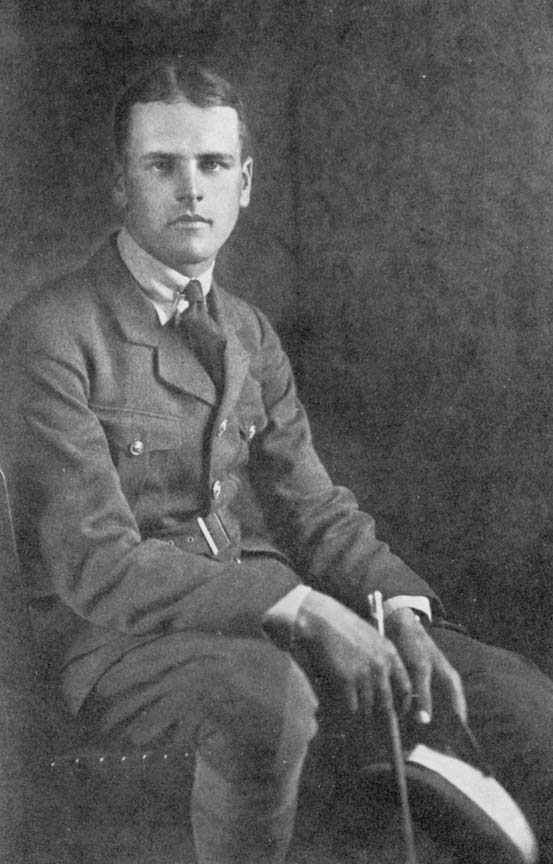
SON of Arthur E. and Jessie (Emery) Giroux (now Mrs. Arthur E. Haley); was born in Somerville, Mass., on Oct. 19, 1897. He was educated at the Somerville High School, and at Dartmouth College, class of 1923.
He enlisted in the American Ambulance Field, Service on April 28, 1917, and served at Danmiers on the French front, as sergeant, T.M.U. 526 B, from April 28 to Oct. 28, 1917. His brother Ernest was in the same service. On April 22, 1918, he enlisted in the Royal Air Force; his brother having enlisted in the Franco-American Flying Corps. He trained at Toronto, Can., Ground School, flying 204 T.D.S.; at East Church, England, No. 7 Fighting School; and at Turnberry, Scotland, "Camel" scout Pilot. He was commissioned 2d Lieut. on Nov. 21, 1918.
On Feb. 25, 1919, he was temporarily released from Shornecliffe, Eng., and returned to the United States.
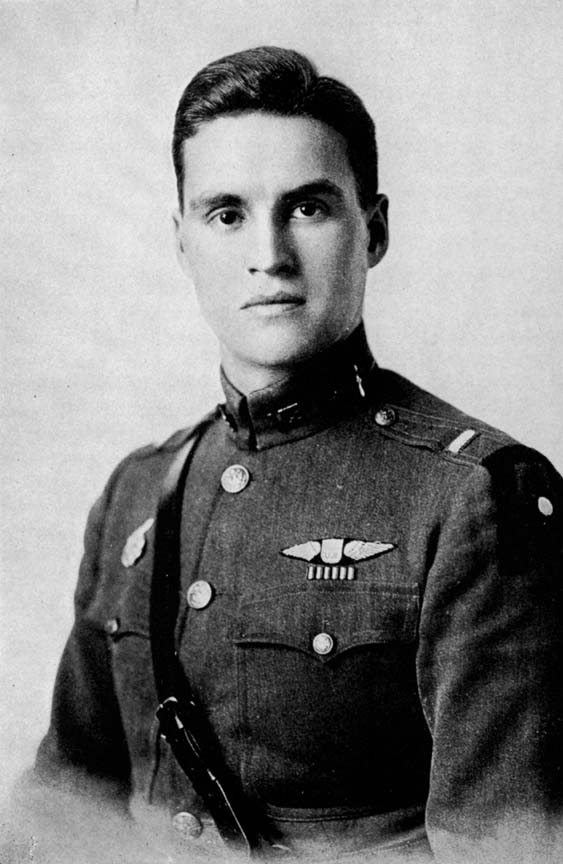
SON of George Adams and Martha Neal (Howe) Woods; was born at Winchester, Mass., May 6, 1896. He was educated at the Noble and Greenough School, and at Harvard College, class of 1919. taking his degree A.B. Honoris Causa. He played on the freshman football and track teams in 1915-16; on Harvard 'Varsity football squad, 1916; member 'Varsity crew squad, 1919.
He enlisted at Cambridge, Mass., on May 30, 1917, and trained at the M.I.T. Ground School from May 30 to July 17, 1917. He sailed overseas on Aug. 13, 1917, and continued his training at Foggia, Italy; and at Issoudun and Cazaux, France. He received an Italian brevet in Dec., 1917, and was commissioned 1st Lieut. U.S.A.S., at Foggia on Jan. 10, 1918. He was one of thirty men sent to France on order of Gen. Pershing in March, 1918.
On May 1, 1918, Lieut. Woods fell in a tail-spin from 400 feet (due to defective machine), with his plane completely demolished. Suffering from a broken jaw, broken ankle, and other injuries, he was three months in the hospital. He joined his Squadron, the 8th, on Aug. 30, and was sent to the front on the Toul sector.
On Sept. 12, 1918, he was leading a flight on the St.-Mihiel sector on a mission to "strafe" the infantry back of the German lines, when his motor was hit by machine-gun fire over the third-line trenches. The Germans continued shooting after the engine had stopped, riddling the plane with rifle and machine-gun bullets. They concentrated fire after the machine had been abandoned, while Lieut. Woods was making way to cover on foot, until he was captured by German infantrymen. About Sept. 9 a note dropped over the aerodrome by German flyers stated that Lieut. Woods had been killed. He was given up by his Squadron, but later was reported a prisoner of war. He was confined successively in six German prison-camps, suffering hard treatment until he reached Villingen, where there was Red Cross Service. He was released on Nov. 29, 1918, and sent by train through Switzerland with other captured officers.
Lieut. Woods was honorably discharged on Feb. 5, 1919, at Garden City, N.Y.

SON of Richard William and Gertrude (Wesley) Wright; was born at Readville, Mass., Sept. 1, 1897. He attended the schools of Hyde Park, Mass., and spent three years at Harvard College, class of 1918. At the end of his sophomore year, he succeeded in breaking the strength test record for undergraduates, and registering second highest in the University. During the fall of his junior year he was a member of the cross-country team. In Feb., 1917, he left college to train for the Air Service.
He enlisted on March 25, 1917, at Fort Monroe, was appointed sergeant and assigned to the Curtiss School, Newport News. In the latter part of May, the school was broken up, and he was transferred to the Ground School, M.I.T. He graduated July 23, and was sent to Essington, Pa., for instruction in flying hydroplanes. On Aug. 25 he was transferred to Chanute Flying Field, Rantoul. Ill., and completed his R.M.A tests on Sept. 15. He was commissioned 1st Lieut., Oct. 9, 1917. On Oct. 23 he was assigned to active duty at Garden City, N.Y., as adjutant of the 19th Aero Squadron. He sailed overseas on Nov. 23, 1917, as Supply Officer for the 15th Foreign Detachment, and was stationed at St.-Maixent until March 14, 1918. From then until April 15 he trained at the A.I.C. at Issoudun, when he was sent to Cazaux for a month's work in aerial gunnery. He was later ordered back to Issoudun, and thence to Orly, Paris, as a ferry pilot and tester. On July 29 he reported to the 93d Aero Pursuit Squadron as pilot, and from Aug. 6 to the time of the Armistice he acted as Flight Commander of that Squadron. During that period he had numerous encounters with enemy planes and received official confirmation on eight planes and one balloon. On Dec. 5, 1918, at Souilly, he was decorated by General Liggett with the Distinguished Service Cross and one oak leaf.
Lieut. Wright returned to the U.S. on March 13, 1919, and was honorably discharged April 1, 1919, at Garden City, N.Y.
D.S.C. For extraordinary heroism in action near Beffu, France, 10 Oct., 1918. Lieut. WRIGHT attacked an enemy observation balloon protected by four enemy planes; despite numerical superiority he forced the planes to withdraw and destroyed the enemy balloon.
A Bronze Oak Leaf For extraordinary heroism in action near Banthéville, France, 23 Oct.. 1918. Lieut. WRIGHT, accompanied by one other machine, attacked and sent down in flames an enemy plane (Fokker type), that was attacking an Allied plane. He was in turn attacked by three enemy planes. His companion was forced to withdraw on account of motor trouble. Lieut. Wright continued the combat and succeeded in bringing down one of the enemy planes and forced the remaining two into their own territory.
(Signed) PERSHING
SON of Thomas and Henrietta (Baciagalupo) Gioiosa; was born at Boston, Mass., Sept. 20, 1893. He was educated at the English High. School; at Boston College; and at Dartmouth College, graduating at Dartmouth with the degree B.S. He played baseball and football at Boston College, 1910-11, and football at Dartmouth College, 1911-12. He enlisted in the Air Service at Boston, Mass., Nov. 14, 1917, and was assigned to the Ground Schools at the M.I.T., and Princeton, N.J., for elementary work, completing the course at Princeton, March 9, 1918. He was subsequently transferred to Camp Dick, Dallas, Tex., where he remained from March 16 to May 6, and to Kelly Field, San Antonio, Tex., where he was stationed from May 7 to Nov. 29, 1918. He was honorably discharged at Kelly Field, San Antonio, Tex., Nov. 29, 1918.
Brothers in Service ---
Alfred A. Gioiosa, Sergeant, Co. 4, Overseas Convalescent Hospital.
Albert A. Gioiosa, Coxswain, U.S.S. Pennsylvania.

SON of Rev. Leonard and Fannie I. (Wright) Aldrich; was born in West Kill, N.Y., Nov. 27, 1891. He prepared for college at Vermont Academy, Saxtons River, where he graduated with honors, and entered the University of Vermont; there he was also an honor student, graduating in 1915. He was a member of the Alpha Zeta fraternity, and of Phi Beta Kappa.
For two years he taught agriculture in the Waterbury High School, and was given the principalship of the junior high school of that place, resigning this position to enter the Air Service, Sept. 20, 1917. He was one of five graduates, appointed from this college to attend the aviation schools, and was trained at Fort Sill, Okla., and Garden City, N.Y., and commissioned 2d Lieut., Jan. 3, 1918.
He went overseas in Jan., 1918, received intensive training in the aerial schools in France, was commissioned 1st Lieut. Feb. 2, 1918, assigned to the 135th Aero Squadron, and was sent to the front as an observer in Aug., 1918.
On Oct. 10 he brought down an enemy plane officially. At the time of his death he was about to be made operating officer of a new squadron, which would have meant promotion to Capt., but on Oct. 29 he and his pilot, Lieut. Edward C. Landon, volunteered for an important mission for the corps commander, without the usual protection. This they declined, on the grounds that one ship, if lucky, could get away better than three, and if the enemy did overwhelm them, only one would be lost. They were forced to fly at an altitude of 1000 metres, because of poor visibility, and in the combat which ensued Lieut. Aldrich was mortally wounded.
When the plane landed he was sent with all speed to the hospital, but he passed away without regaining consciousness.
He was buried the following day, at Sebastopol, Toul, Meurthe-et-Moselle, where an impressive service was held.
The following appreciation was forwarded to Lieut. Aldrich's family with the certificate issued by the War Department stating that "Perry H. Aldrich died with honor in the Service of his country."
At the time when so many officers of the Air Service are returning, I feel an earnest desire to express to you some acknowledgment on the part of the Government of the devoted sacrifice offered by your son, who died of wounds received in action in France, Oct. 29, 1918.
Lieut. Aldrich sought the front lines of danger and was one of those whose privilege it was to be selected for it. His sacrifice was made for his country, and his bravery and unflinching devotion to duty have made him one of the nation's heroes.
The Air Service of the United States Army has permanently inscribed his name upon its Roll of Honor and he will ever be remembered as one of those who contributed his best to maintain the prestige of our cause.
I join with his brother officers in expressing our deep appreciation of his loyalty and the effectiveness of the service rendered.
Very sincerely CARR T. MENOHER
Major-General, U.S.A.
Lieut. L. W. Schlesinger, Adjutant 135th Aero Squadron, wrote:
I was with the Squadron when Perry joined it, and in my work as Adjutant the various officers of the Squadron were constantly before me. I can truthfully say that I don't believe there was a braver, truer, more Christian soldier than Perry in the A.E.F. He was a good comrade, always had a kind word and a ready smile, and was absolutely indifferent to personal danger. He showed the highest devotion to duty, and met his death while carrying out a dangerous mission.
For extraordinary heroism in action near St-Mihiel, France, 29 Oct. 1918.
Lieut. ALDRICH (Observer) with 1st Lieut. E. C. LANDON, volunteered and went on an important mission for the Corps Commander, without the usual protection. Forced to fly at an altitude of 1000 metres because of poor visibility. Soon after crossing the lines they encountered an enemy Rumpler plane, and forced it to the ground. On returning they attacked another Rumpler and drove it off. After completing their mission and seeing an enemy observation tower on Lake Lachaussée, they reëntered the enemy territory and fired upon it. Immediately attacked by seven enemy planes (Fokker type) a combat followed in which Lieut. Aldrich was mortally wounded.
By command of General PERSHING
Brother in Service --
Herbert J. Aldrich, sergeant Medical Dep't Fort Meyer, Va.

FIRST LIEUTENANT, A.S., U.S.A., ONE HUNDRED THIRTY-FIFTH AERO SQUADRON, FIRST OBSERVATION GROUP
SON of Mr. and Mrs. Thomas J. Fuller, of Boston, Mass.; was born at Washington, D.C., Aug. 6, 1893. He was educated at the Washington public schools, and at Harvard College, class of 1915. He rowed on his freshman crew, and on the 'Varsity four-oared crew, in 1913.
He enlisted on April 23, 1917, at Mineola, N.Y., and was trained at Mineola, from April to July, 1917. He was commissioned 1st Lieut., R.M.A., July 26, 1917, U.S. Air Service, and was on duty at Chanute Field, Rantoul, Ill., from July 26, to Sept. 4, 1917; at Fort Sill, Okla., from Sept. 4 to May 9, 1918; and at Taliaferro Field, Fort Worth, Tex., from May 9 to July 1, 1918.
He sailed overseas on July 15, 1918, and trained at Issoudun, France, from Aug. 15 to Sept. 1, when he was attached to the 135th Squadron. On Sept. 192 he was forced to land on Swiss soil, his machine having been damaged by anti-aircraft fire. He refused to give his parole not to try to make his escape, and was imprisoned at Addermatt, Switzerland, until the end of the war. On Oct. 16, 1918, he made a desperate attempt to escape on a rope made from his bedclothes; but the rope broke and Lieut. Fuller fell a considerable distance and was badly injured. He was reimprisoned, and remained in captivity until Dec. 7, 1918, when he was released by the Swiss government. He returned to the U.S. on Jan. 3, and was honorably discharged on Jan. 10, 1919.
Brother in Service ---
Ashmead Fuller, 1st Lieut., A.S., U.S.A.

FIRST LIEUTENANT, A.S.A., U.S.A., TWENTY-FOURTH AERO SQUADRON, FIRST OBSERVATION GROUP
SON of Eugene W. and Jane (Putnam) Clark; was born at Jamaica Plain, Mass., on Dec. 18, 1892. He was educated at the Roxbury Latin School, at the West Roxbury High School, at the Mass. Agricultural College, and at the Rhode Island State College. He was a sophomore in the Agricultural Department of the Rhode Island State College when he enlisted at Plattsburg, N.Y., May 12, 1917. On Aug. 14, 1917, he was honorably discharged from the Officers' Training Camp at Plattsburg, and on the same day reenlisted in the S.E.R.C. at Mineola, N.Y., as private, 1st class.
He was assigned to the Ground School at M.I.T., and from there transferred to the Aviation School at Mineola, N.Y. He was further trained at the School for Observers at Fort Sill, Okla. On Jan. 4, 1918, he was commissioned 2d Lieut. at Garden City, N.Y., and on Jan. 5 assigned to active duty with detachment of Aerial Observers, No. 1. He sailed overseas on Jan. 9, 1918.
He was commissioned 1st Lieut. on Feb. 2, 1918, and assigned to various schools in France. On Sept. 12, he was ordered to active official observer's flying duty near the Toul sector. On Sept. 17, 1918, while flying with his pilot, Lieut. William A. Bradfield of Dallas, Tex., the motor went dead and he was forced to descend, and was captured by the Germans. For a month he was reported "missing in action," but on Oct. 15 was reported unwounded and a prisoner at Landshut, Germany.
Upon landing from their plane on Sept. 17, Lieut. Clark and his pilot were taken to Joeuf, in Lorraine, questioned closely and transferred to Karlsruhe, Baden, by train, and finally to Landshut and Villingen, about thirty kilometres north of the Swiss border, On Nov. 5, after many faithless promises, they were released, and proceeded to Konstanz, thence to the Swiss border.
Lieut. Clark was one of the first American aviators and ex-prisoners of war to be returned to the U.S., arriving on Jan. 18, 1919. He was honorably discharged in Jan., 1919, and is now attached to the Experiment Station at the Rhode Island State College.

FIRST LIEUTENANT, A.S., U.S.A., TWENTY-FOURTH AERO SQUADRON, FIRST ARMY OBSERVATION GROUP
SON of Phelias, and Zelia Cote Cauchon, of Providence, R.I.; was born Sept. 29, 1895. He attended the Rhode Island School of Design. Prior to the war he was for sixteen months a member of troop N, R.I. Cavalry.
On May 11, 1917, he enlisted at Providence R.I., and was sent to the Plattsburg Training Camp, May 11 to July 16, 1917. From then until Sept. 15, 1917, he attended the Ground School at Princeton, N.J. He sailed overseas for France, arriving Oct. 28, 1917. From Dec. 25, 1917, to April, 1918, he trained at the Ecole d'Aviation, at Châteauroux, France, and from April until July, 1918, at Issoudun, where he was commissioned 1st Lieut. in June, 1918. He concluded his training at Tours, where he was stationed from July to Aug. 23, 1918, when he was attached to the 24th Aero Squadron, and with them saw service until Dec. 8, 1918.
Between Sept. 8 and Nov. 11, Lieut. Cauchon's flying time over the lines was thirty-six hours, seventeen minutes, and he was officially credited with one enemy plane. He returned to the U.S. and was honorably discharged at Camp Pike, Ark., April 26, 1919.
Citations First Lieutenant L. B. CAUCHON, A.S., U.S.A., and Second Lieutenant B. F. COLLINS, C.A.C., 24th Aero Squadron, 1st Army Observation Group, are hereby credited with the destruction, in combat, of an enemy Fokker, in the region of Damvillers, at 2500 metres altitude, on Oct. 22, 1918, at 9.50 o'clock.
By order of Colonel MILLING
Chief of StaffThe Air Service Commander, First Army, cites the following officers and men for exceptional devotion to duty:
First Lieutenant LEO B. CAUCHON, A.S., U.S.A., Pilot, 24th Aero Squadron, has repeatedly fulfilled missions under unfavorable conditions with an utter disregard of personal risk. On Oct. 22, with Second Lieutenant BAYARD F. COLLINS, C.A.C., U.S.A., Observer, he was flying alone over Stenay-Montmédy region and encountered five enemy formations, resulting in two combats, in which one German plane was shot down. Lieutenant Cauchon returned safely, although his plane was badly damaged. The destruction of one enemy plane has been officially confirmed on this mission.
By order of Colonel MILLING
First Lieutenant LEO B. CAUCHON, A.S., U.S.A., Pilot, joined the 24th Aero Squadron on Aug. 30, 1918; has had thirty-six hours and seventeen minutes total flying time, of which twenty-one hours and twenty-two minutes was included in successful reconnaissance. He has displayed unusual bravery in action on several occasions, for which he was cited in General Order Number 30, Headquarters, Air Service, First Army, Nov. 26, 1918. As mess officer during his entire stay with the Squadron, he has performed his duties with good ability and untiring effort.
MAURY HILL
Captain, A.S., U.S.A.
Brothers in Service ---
Hervé P. Cauchon, Sergeant, Headquarters, Co. 103, F.A. 26th Div.
Henri F. Cauchon, Corporal, Headquarters, Co. 327, Infantry, 82d Div.