
FIRST LIEUTENANT, U.S.A.S.; LAFAYETTE FLYING CORPS, FOREIGN LEGION; ESCADRILLE N 87
SON of Arthur G. and Celia Wellman; was born in Brookline, Mass., Feb. 29, 1896. He graduated from the Newton High School, where he proved himself an all-round athlete. At the time of enlistment he was in the wool business in Boston. He desired to enter the U.S. Aviation Service, but he was rejected, as the Service was full at that time. He therefore enlisted in the Norton-Harjes Ambulance Corps, of New York, in April, 1917, and sailed for France on May 22.
Soon after his arrival in France, he transferred from the Ambulance Corps, and enlisted in the Foreign Legion, June 27, 1917, becoming a member of the Lafayette Flying Corps. He trained at Avord, and received his pilot's license on Sept. 29, 1917, becoming a Corporal in the French Army, and refusing to accept a 2d Lieutenant's commission in the U.S.A. He was trained as a chasse pilot and as a bombing pilot; then went to Pau and Plessis-Belleville for training in acrobatics. Finishing his courses on Dec. 1, he was assigned to Escadrille N 87. in the Lorraine sector, near Nancy, at Lunéville, where he reported on Dec. 3, and made his first flight over the German lines on the following day.
On Jan. 19, 1918, Lieut. Wellman brought down his first Boche, in company with Thomas Hitchcock in another plane. The German Rumpeler, which had destroyed a French plane, was brought to the ground and the occupants killed. For this achievement both Hitchcock and Wellman received the Croix dc Guerre. The latter's citation reads, translated, as follows:
Corporal WELLMAN, WILLIAM AUGUSTUS,. . . of the Foreign Legion, pilot attached to Escadrille N 87. An American enlisted in the Foreign Legion. is distinguished as a remarkable chasse pilote by his enthusiasm and courage. On Jan. 19 he brought down an enemy aviator, who crashed to the ground near Bois Maut de la Croix.
In the next two months Lieut. Wellman had three more official and three unofficial victories to his credit. He was made Maréchal de Logis (Quartermaster, corresponding to Sergeant in rank). With Lieut. Hitchcock he went on special duty over the German lines to distribute President Wilson's Message to Congress.
On the second day of their flight they had a narrow escape, when flying only 100 yards above the Boches, who constantly shelled them. Lieut. Wellman's machine was destroyed, after he had succeeded in escaping just over the first-line French trenches.
On March 9, the day the Rainbow Division made its first and successful attack on the enemy, Lieut. Wellman was detailed to fly over them with the French patrol the only American airman at that time and place. He flew as leader of the lowest patrol, at a height of 1000 metres, with eight machines following him. He first destroyed a biplane Rumpeler, sending it to the ground in flames at 4.20 P.M. and a few minutes later, at 4.45 P.M., brought down a one-man Albatross. For this achievement he received a second gold palm-leaf on his Croix de Guerre, and the following citation, which included recognition of two previous victories:
The American pilot, Maréchal de Logis WELLMAN, WILLIAM AUGUSTUS, pursuit pilot, showing the finest qualities of bravery and enthusiasm for attack. On Jan. 20, having gone in pursuit of an enemy biplane, above Nancy, he chased him to his terrain for more than 25 kilometres within the lines, shooting the hangars at short range and killing the pilot.
On Feb. 10 he shelled at low altitude an enemy aviation ground.
On March 9 he brought down an enemy biplane de réglage in the region of P------, and almost immediately after brought down an escorting enemy monoplane.
On March 1 he was shot down by anti-aircraft guns, at the height of nearly three miles. His shelled machine went into a spinning nose dive that changed as by a miracle into a sweeping spiral, over the forest of Parroy. The machine struck the trees and splintered into fragments; he clung to the top of a big fir tree, and clambered down, badly injured but alive. On March 29 he was honorably discharged from the French Army, as unfit for further Aviation Service, and returned to America.
After treatment and recuperation he enlisted in the U.S. Aviation Service, receiving a 1st Lieutenant's commission, on Sept. 16, 1918. He became Advisory Instructor of Combat Flying at Rockwell Field, San Diego, Cal. He has written a most readable and interesting book, "Go Get 'Em!"
Brother in Service
Arthur Ogden Wellman, 2d Lieut., A.S., U.S.A.

SON of Arthur G. and Celia Wellman; was born in Brookline, Mass., Oct. 31, 1894. He was educated at the Newton High School, where he was a member of the football, baseball, and hockey teams throughout his course.
Lieut. Wellman enlisted at Princeton, N.J., in Jan., 1918, and trained at the Ground School at Princeton, West Point, Miss., and at Dayton, O. He was commissioned 2d Lieut., A.S.A., in Aug., 1918; but did not, like his brother, see service on the other side, as the Armistice intervened.
He was honorably discharged at West Point, Miss., on Jan. 1. 1919.
Brother in Service
William A. Wellman, 1st Lieut., Lafayette Flying Corps.

LIEUTENANT (j.g.), U.S.N.R.F.; LAFAYETTE FLYING CORPS, ESCADRILLE SPAD 3 (Les Cigognes); BRITISH NAVAL DAY BOMBING SQUADRON; NORTHERN BOMBING GROUP
SON of Dr. David H. and Lillian M. (Hanna) Judd; was born in Boston, Mass., Aug. 31, 1894. He graduated from the Roxbury Latin School, 1912, and from Harvard College, A.B. 1916. On Jan. 6, 1917, he enlisted in the American Ambulance Field Service, and was attached to S.S.U. 4 of that Service until June 28, 1917, working in the Argonne and Champagne sectors.
On July 6 Lieut. Judd joined the Foreign Legion of the French Army for Aviation Service, and became a member of the Lafayette Flying Corps. He was brevetted "Pilote Aviateur" on Oct. 1, 1917, at Avord, France. He went through the acrobatic school at Pau, and the finishing school at Plessis-Belleville, then joined Escadrille Spad 3, at Dunkirk, France, on Dec. 1, 1917. This escadrille moved to Soissons and later to Beauzée, just behind Verdun.
While at Beauzée Lieut. Judd was released from the French Service to join U.S. Naval Aviation. He was commissioned Ensign on Jan. 19, 1918, and sent to the Naval Air Station at Dunkirk, to fly scout seaplanes on anti-submarine patrols in the North Sea, off the Belgian coast, at that time held by Germany. On May 28, 1918, he was transferred back to land flying on day bombing machines. After a month at the Army Day Bombing School at Clermont-Ferrand, he was sent to join English Squadron 218, at Calais, for training in actual day bombing, later to become a Flight Commander in a Naval Day Bombing Squadron. While with this English Squadron Lieut. Judd made raids over Zeebrugge, Bruges, and Ostend.
The day bombing work of the Navy having been taken over by the Marines, he was transferred to the staff of Capt. D. C. Hanrahan at Paris, Commander of the Northern Bombing Group. After a month there, on Sept. 6, 1918, Lieut. Judd was returned to the United States to instruct in day bombing. He arrived in America on Sept. 1, 1918, and was sent to Miami, Fla., to instruct in the Marine Flying Field there. He remained in Miami until Feb. 28, 1919, when he was put on inactive status of the U.S.N.R.F., as a Lieut. (j.g.), dating from Oct. 1, 1918.
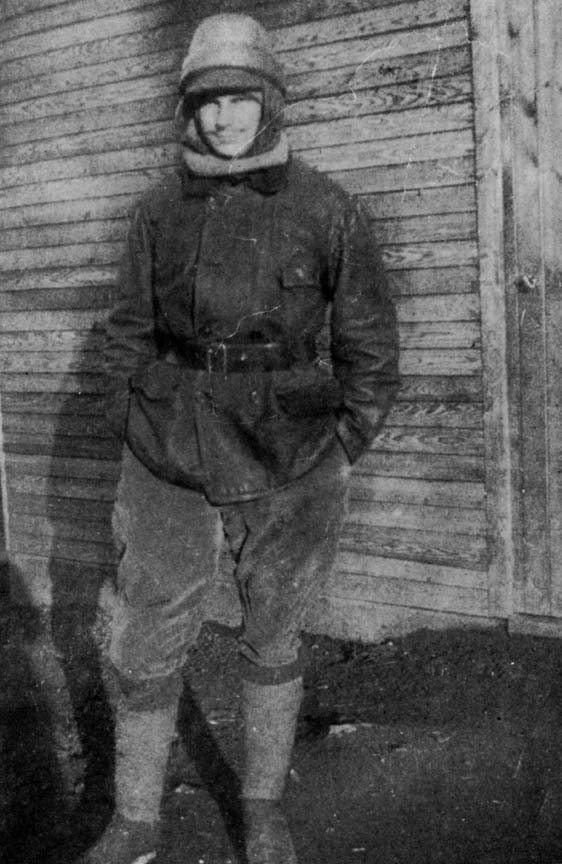
SON of Charles Dabney and Charlotte L. (Ogston) Horton; was born in St. Louis, Mo., June 3, 1891. He was educated at St. John's School, Ossining, N.Y.; at Blair Academy, Blairstown, N.J.; and at Dartmouth College, A.B. 1915. He was noted for his swimming at Blair Academy, and at Dartmouth belonged to the Dartmouth Outing Club in 1914, took 1st Prize for the 100-Yard Ski Dash, and 2d prize for the Cross-Country Ski Race.
He enlisted in the French Army Aviation Service in Paris on Aug. 20, 1916. He was trained at the French flying schools at Buc, Juvisy, and Avord, and was made "Sergent-Pilote" on Sept. 14, 1917. He was attached to Escadrille C 17, Sop. 55, Spa 69, and Spa 75. He took part in engagements in Flanders in 1917; at Fismes, Chemin des Dames, and St.-Quentin in 1918. As a recognition of his excellent work at St.-Quentin he was awarded the Croix de Guerre. He was discharged from the service of the French Army on Jan. 20, 1919, in Paris, France.
Married, Jan. 10, 1917, Miss Helen Wheelock Hubbard.

FIRST LIEUTENANT, A.S.A., U.S.A.. QUARTA SQUADRILLA UNDICESSIMO GRUPPO, ZONA DI GUERRA, ITALIA, ONE HUNDRED FORTIETH U.S. AERO SQUADRON
SON of Daniel Allen and Lucy T. S. Freeman; was born in Longwood, Mass., Nov. 9, 1890. He graduated from the Noble and Greenough School, and from Harvard College, S.B. 1914; member of the Institute of 1770, D.K.E., Hasty Pudding, and "Fox" Clubs (Digamma). He made the Harvard-Yale freshman record, 120 yards, high hurdles, and belonged to the 'Varsity track team from 1911 to 1914. For a year he trained with Battery A, M.V.M.
He enlisted in the Air Service in Boston on June 0, 1917; and was assigned to the M.I.T. Ground School from June 20 to Aug. 25. On Sept. 11, 1917, he joined the 4th Squadron of the "First Foreign Detachment" at Fort Wood, Bedloes Island, N.Y. He sailed overseas on Sept. 25, 1917, arriving in Paris on Oct. 16. He was then ordered to the 8th Aviation Instruction Centre at Foggia, Italy, where he was trained from Oct. 8. He passed his first "brevet" on Jan. 13, 1918 his second "brevet" and R.M.A. tests on Feb. 14; and was commissioned 1st Lieut., A.S.A., U.S.A., on March 2, 1918. On May 28 he qualified as night and day Caproni bombing pilot. Lieut. Freeman finished his final training at Campo Scuola Cascina Malpensa, Galleratte, Milano, on July 1, 1918. He was subsequently ordered to Verona, where he joined the 4th Squadron, 11th Group, on July 16. He remained on active duty on the Italian front until late in Aug., taking part in the raids over Pola, the Austrian naval base. During this time he was piloting the Caproni planes, and was recommended for the Italian Croce di Guerra on Aug. 20. On Aug. 25 he was detached from the Italian Squadron, and assigned to the Chief of the Air Service at Tours, France, from Aug. 28 to Oct. 1. On Oct. 7 he was ordered to Handley-Page Night-Bombing Aerodrome in England, where he qualified as B.E. -- 2 E. Pilot on Oct. 10 and as Liberty D.H. 4 Pilot on Nov. .5. On Dec. 1, 1918, he sailed for New York. He was honorably discharged at Camp Mills, Garden City, N.Y., on Dec. 30, 1918.
Brother in Service
Daniel Allen Freeman, Jr., -2 years Lieut. (j.g.), in U.S. Navy.

SON of Major Washington Irving Lincoln and Grace (Wilson) Adams; was born in Montclair, N.J., May 6, 1893. He was educated in the Montclair public schools, and at Harvard College, class of 1917. He was leader of the 'Varsity Musical Clubs at Harvard, and a member of D.K.E.
He drove a motor ambulance in France during the summer of 1916, and before returning to America to complete his college course he enrolled for service the following year in the Lafayette Escadrille.
In May, 1917, he volunteered for active war service in the Royal Flying Corps, and had his preliminary training at Camp Borden, Can., and Fort Worth, Tex. In Nov., 1917, he received his commission as 2d Lieut., R.F.C., and sailed for England in Dec. He graduated first, in a class of twenty, with an average of 94, the highest grade which had been achieved up to that time. After completing his training at various camps in England and Scotland, he volunteered for active service in France before he was required to "go out," and crossed the Channel with a single companion in Feb., 1918.
He was assigned to the Bombing Group of the 18th Squadron, R.F.C., at Aire, France, and at once began his flying on the battle front. He chose the bombing group, because, as he wrote, in destroying the enemy's munitions, fortifications, and equipment, he was "making war on war." To quote from a letter to his mother:
I feel no bitterness against the Huns as individuals. It is war that I hate, and war that I am willing to give all to end as permanently as possible; for it is n't the men that war kills, it is the mother's heart which it destroys, that makes it hateful to me.
In another letter he wrote:
Even if I don't come back, it is all right, Mother, for you know we can't hope to gain such wonderful ends without paying big prices, and it is not right to shirk payment.
On March 4, 1918, while in active service on the western front, he fell and was buried with military honors in the military cemetery near St.-Omer, France. "Death is the greatest event in life," he wrote in one of his eloquent letters to his mother, "and it is seldom that anything is made of it. What a privilege, then, to be able to meet it in a manner suitable to its greatness."
A few of his letters were first printed in the "Harvard Alumni Bulletin"; subsequently a larger collection appeared in the "Atlantic Monthly" for Oct., 1918. They caused a widespread expression of deep interest, and thoughtful readers assigned to them a high place in the spiritual literature of the war. Of them Professor Francis G. Peabody of Harvard says:
The are not only gallant and beautiful in their feeling, but singularly elevated in their style, as though his new experience had lifted him into new levels of expression and given to his language something of the clearness and freshness of the upper air.
And Arthur Stanwood Pier, who collected the letters in a volume called "The American Spirit," wrote to Major Adams:
He never wrote anything for me which could compare with these letters, and nothing else that has been written about the war that I have read, can compare with them. They are the most beautiful bits of writing that have come out of the war---beautiful in style, color, and motion .... one else has taken me up in the air, and shown me what it must be to fly; no one else has presented so vivid a figure of War as it should be portrayed.
In a letter to his mother, he wrote:
I go about, as it were, hands with palms out, all about my heart, holding things outside of it. I am conscious of things I don't like, discomforts, sometimes ... but I won't let them get into the inside where they hurt. If I can change them, I can do it just as well keeping them outside, and if I can't change them well, what does it matter? --- they are outside.
Lieut. Adams, through his father, Major Adams, was a lineal descendant of Henry Adams, of Braintree, Mass., the common ancestor of Samuel Adams, the Patriot, and John Adams, the second President. On his mother's side, Lieut. Adams was descended from the Wilson family of Virginia, of which one member was killed in action at Monmouth in the Revolutionary War, and another fell in the War of 1812. His father, Major Adams, was in active service with the Q.M.C. for over a year. Lieut. Adams also had a brother in the Service, Wilson I. Adams, 2d Lieut., F.A., in active service about five months.

FIRST LIEUTENANT, A.S., U.S.A., ONE HUNDRED FORTY-EIGHTH U.S. AERO SQUADRON ATTACHED TO THE THIRTEENTH WING, ROYAL AIR FORCE
SON of Nicholas F. and Mary Henderson (Taylor) Avery; was born at Charlestown, Mass., Feb. 6, 1894. He attended the public schools in Boston and Pepperell, Mass., and graduated from Tufts College in 1914.
He entered the employ of Sloane, Huddle, Feustel & Freeman, consulting engineers, and was carrying on his work in Chicago at the time of his enlistment, May 13, 1917.
He attended the first Officers' Training Camp at Fort Sheridan, Ill. (Co. I, Ill. Engineers). He was one of eight men to be chosen for the Air Service, and was transferred to the Aviation Section June 18, 1917; he graduated from the School of Military Aeronautics, Champaign, Ill., Aug. 1, 1917, and went overseas Aug. 18, 1917, with the first detachment of aviators to go across. He trained in England at Oxford University Ground School, receiving flying training at Stamford, Joyce Green. London Colney, Hounslow, and Marke; during this time he was injured in a "crash," in which his companion was killed, and spent three months in English hospitals.
He was commissioned 1st Lieut. May 29, 1917, and was assigned to the 148th U.S. Aero Squadron (Pursuit), attached to the 13th Wing, R.A.F., Sept. 6, 1918. In the following weeks he took active part in patrols, bombing, and observation expeditions, and participated in a fight in which between 80 and 90 machines were engaged; although outnumbered about two to one, his group suffered no casualties and brought down enough enemy machines to win a congratulatory letter from the General in command.
He was cited for extraordinary heroism in action on July 25, 1918, and was awarded the Distinguished Service Cross.
On Oct. 1, while flying at a low altitude, some distance over the lines, his engine was put out of action by an enemy machine gun and he was forced to land a few kilometres southeast of Cambrai, behind the German lines, where he was captured. He was confined in the prison camps at Caudry, Solesmes, and Le Quesnoi, until Oct. 10, when he entrained for Germany; some hours later he escaped from his guards and jumped from the train, moving at the rate of 25 miles an hour, near Valenciennes; for the next two days he travelled by compass without food or water, hiding in ditches during the daylight and crawling through the middle of a German transport camp. Forced to take shelter in a shell-hole by the Allied bombardment, he was recaptured by the enemy. and while being marched through the streets narrowly escaped death from bombs dropped by his own Squadron.
He was imprisoned from Oct. 18 to 31 at Siognies, under the poorest conditions, suffering from insults, hunger, and filthy surroundings; on Nov. 2 he was transferred to Maransart, where, on Nov. 6, he escaped with a British officer, by a rope suspended from a barn, between guards stationed outside.
Aided by friendly Belgians he remained in hiding during the following week, travelling back by degrees to Siognies, where he was located on Nov. 11, and witnessed the evacuation of the town the next day by the enemy. On Nov. 14 Lieut. Avery was returned by airplane to his Squadron at Toul, which had given him up for lost. He was for some time confined in the hospital as a result of his ill-treatment by the Germans.
He was honorably discharged at Garden City, N.Y., Feb. 5, 1919.

SON of James I. and Eliza (Phelps) Wetherald, of Boston, Mass.; was born in Newton, Mass., Dec. 9, 1893. He was educated at the Noble and Greenough School, Boston; St. Andrew's School, Concord, Mass.; and Mass. Institute of Technology. He played on the football and track teams. Previous to enlistment he completed the prescribed Infantry and Cavalry Course of the U.S. Military Training Camp, Fort Oglethorpe, Ga., on May 30, 1916.
He entered the Curtiss School of Flying at Newport News, Va., on March 5, 1917. He received a certificate as pilot after 600 minutes' instruction in Curtiss F Boat type and land tractor J.N. 4. He enlisted in Naval Air Service on April 19, 1917. On Nov. 5 he passed the Naval Aviator's tests and examinations at Naval Base, Hampton Roads, Va.; and on Dec. 19, 1917, was commissioned Ensign, U.S.N.R.F.
After receiving his commission Ensign Wetherald was detailed to instruct students in flying, until ordered to Fort Worth, Tex., to take a course of instruction at the Aerial Gunnery School of the Royal Flying Corps. After graduating from this school he returned to Washington and received foreign orders; but before sailing was ordered back to Hampton Roads as Ordnance Officer and Instructor in Charge of the Officers' School of Gunnery. He organized the Ordnance Department at that station and fitted with ordnance the first seaplanes that were ever used in active patrol work off the Virginia Capes. During this time he instructed many of the officers in flying and aerial gunnery who were afterwards sent abroad.
During the German submarine activities off the U.S. coast, while still acting as Ordnance Officer. Lieut. Wetherald patrolled the coast of Virginia. On Nov. 1. 1918, he was honorably discharged, at Hampton Roads, Va.
Married, May 11, 1918, Rosemonde Wyman.

SON of Arthur W. and Josephine B. Hill; was born in Malden, Mass., June 6, 1897. He was educated at the Malden Grammar and High Schools, 1915. From earliest boyhood Lieut. Hill showed the keenest interest in flying and in flying machines. While in high school he won a silver cup for special flying at a meet of the Waltham Model Aeroplane Club. He made a double somersault and spiralled to the ground, a feat unusual for an amateur in those days.
On Jan. 1, 1918, Lieut. Hill volunteered in the Royal Air Force at Toronto Can. He trained at Camp Mohawk, Can., and had technical training at the University of Toronto. He learned to fly at Fort Worth, Tex., and was recommended for Instructor in the School of Special Flying at Toronto. He was commissioned Lieut. in June, 1918.
On July 13, 1918, Lieut. Hill was killed in an accident while flying at Armour Heights, Toronto, Can. He was buried at Mt. Auburn, Mass.
A letter from the Chaplain to Lieut. Hill's family said in part:
In speaking with Captain Leach, the Commanding Officer of the School of Special Flying, he said it was a pure accident which caused the death of Lieutenant A. W. Hill; he was a promising flyer, a good officer, and personally a very fine fellow. His death cast a deep gloom over the airdrome. Speaking personally, I know he was very popular among his fellow officers and all who knew him in the airdrome. There is no doubt that he took his duties very seriously and showed wonderful ability. There is every evidence that he was a fine, clean-living, manly fellow, who commanded the respect and confidence of all who knew him. He will not be forgotten. Be assured that his passing was due to no mistake or neglect on his own part or the part of any one, but just one of those unaccountable accidents that have taken from us so many of our fine, heroic boys.

SON of Charles Eustis and Caroline Dennie (Tracy) Hubbard; was born in Boston, April 19, 1878. He fitted for college at the Browne and Nichols and the Noble and Greenough Schools, and graduated from Harvard College in 1900. He was prominent in athletics (running, jumping, hurdling, pole-vaulting, and golf), playing on the 'Varsity, team in his senior year. After graduation he made a trip round the world, and then spent over three years in Paris, at the Beaux-Arts, studying architecture. On his return he went into an office in New York. Some years later he visited Prof. Bell at Cape Breton, who was at that time experimenting on flying machines, and Hubbard became interested in the subject. This resulted in his spending the winter there and designing and building an aeroplane in the Baddeck shop. He then went to Pau and took lessons in aviation and received his certificate. Later he built another machine at Ipswich, Mass., and did some flying in New York State. He was a member of Squadron A, N.Y. State Cavalry, when the war broke out.
In Nov., 1914, he went to Belgium, with Francis Colby and ten other young men to form an ambulance corps, attached to the Belgian Cavalry. He remained there until the summer of 1915, when the ambulance corps disbanded. Hubbard was urged to join the Lafayette Escadrille, but decided to go to England and enter the Royal Flying Corps. He received his commission in the fall, and went to the front on active duty and remained there until spring.
He was then sent back to England to serve as an instructor. Later he was detailed at Coventry, to fly new aeroplanes to Farnborough, Aviation Headquarters. From there he went to Norwich to test out new machines. He then went to the Military School at Christ Church, Oxford, as Instructor in the Mechanism of Aeroplanes. He remained there for about a year, receiving his Captaincy there. He then went to assist in establishing an aerodrome at Denham, near London, where he was brevetted Major. In the summer of 1918 he was sent to Prawle's Point, South Devon, to establish a Coast Patrol.
Father in Service:---
Charles Eustis Hubbard, Company A, 45th Mass. Volunteers Civil War.
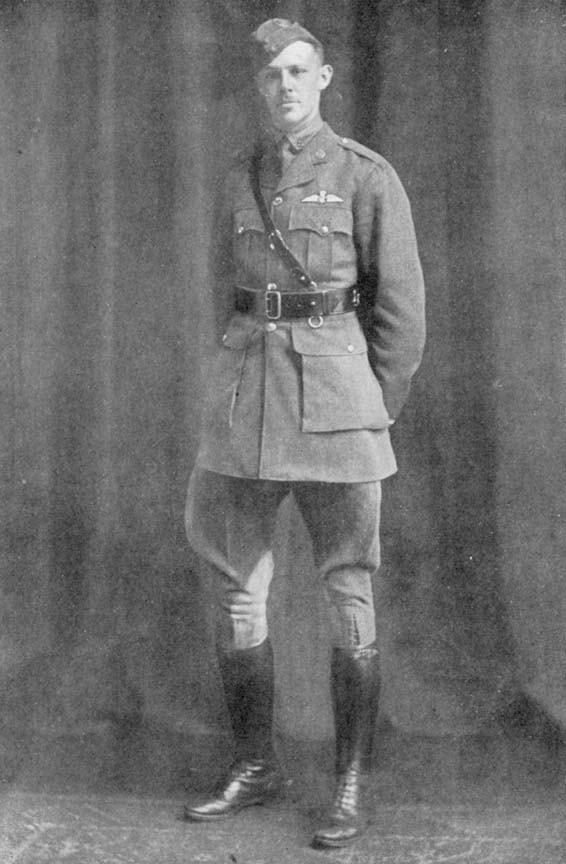
SON of David Taggart and Carrie X. (Story) Dickinson: was born at Cambridge, Mass., Nov. 11, 1895. He was educated at the Cambridge Latin School, and at Harvard College, class of 1918. At college he won his numerals in his freshman year in the high jump.
He went to Toronto, Can., in Sept., 1917, to join the Royal Air Force; attended training camps at Long Branch, Camp Borden, and the School of Aeronautics at Burwash. In .Jan.. 1918, his training in flying began at Fort Worth, Tex., Camp Taliaferro, and Benbrook. In March, 1918, he sailed overseas with time Royal Air Force, and finished his training at Scampton Aerodrome, Lincoln, and Shrewsbury. He was commissioned 2d Lieut. in July, 1918. At Scampton he was recommended for a Bristol fighter. On account of his excess height (he is 6 feet, 7 inches tall), he was sent to Shrewsbury for Bristol bombing-machine training. He was then assigned as pilot in a battleplane, and was preparing to go overseas when his knee was badly injured in an airplane crash, while he was a passenger. He became instructor at Shrewsbury and Thelford. In Dec., 1918, he began a course in wireless telephony at the R.A.F. Winter Aerodrome, Bournemouth. Later he was to have been officer in charge of this school: but he was incapacitated on account of his injured knee, and was honorably discharged by the Medical Board, as permanently unfit for further air service with the R. A. F.

SON of Capt. Horace Walpole Craigie (of the British Army), of London; was born in New Brunswick, Can., May 22, 1892. At an early age he was adopted by Mr. and Mrs. James Brown and subsequently made his home in Boston. He received his education at the Mt. Hermon Preparatory School, the Boston Y.M.C.A., and the Harvard Graduate School of Business Administration.
At the time of the outbreak of the war in Europe, Craigie, then in business with the Berkshire Life Insurance Co., desired to enlist, and made several applications in Canada, but failed to obtain his mother's consent. He was a member of Troop A, 1st Squadron of Cavalry, M.V.M., and trained one year at the M.V.M. Training School.
When the U.S. entered the war he made application to attend the 1st Plattsburg Camp, but was not eligible because of failure to receive his final papers for Americanization. He then enlisted in the Royal Flying Corps, in Canada, where he began his training in June, 1917, at Toronto University, Camp Mohawk, and at Camp Borden; he continued training at Taliaferro Field, Tex., where he proved himself the best shot with machine gun in the division. He was commissioned 2d Lieut. in Toronto, in Nov., 1917, and sailed overseas Dec. 14, 1917, continuing his training in Stockbridge and Langmere near Chichester, Eng. There he had about completed his course and was eagerly awaiting orders to be sent to France, when he was killed in a collision on April 7, 1918.
Before going overseas, Lieut. Craigie wrote to his mother:
I thank God that I have been accepted to take part in this damnable slaughter for the freedom of future generations and the race. Had I held back I should feel myself a traitor to the whole civilized world.
Later he wrote:
Certainly I forgive you for not allowing me to get into the fray sooner, although it has grieved me much not to have been one of the first to put the harness on in the great cause for freedom and right.. However, may God permit me to reach the German lines.
He was buried with full military honors at St. Andrew's Church, Oving, Sussex, Eng.
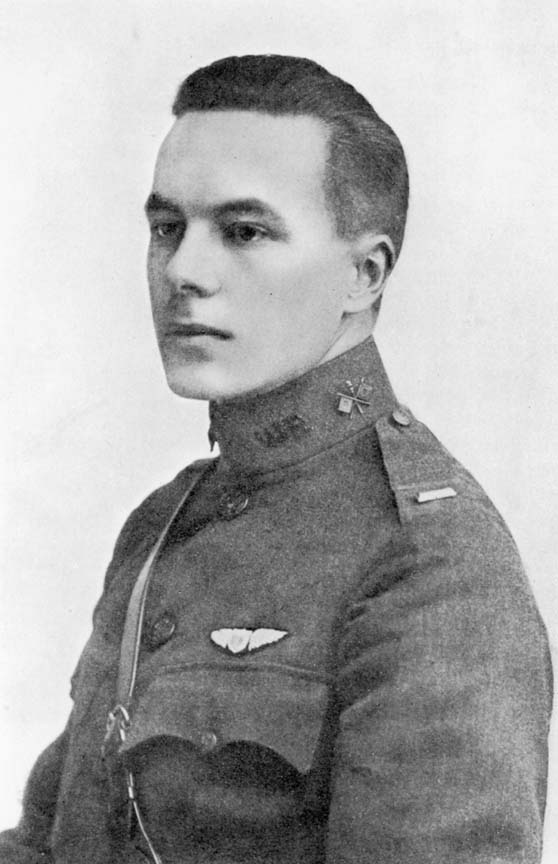
SON of Frank Clifton and Mattie (Bradley) Frost; was born at Arlington, Mass., Aug. 8, 1892. He prepared for college at the Arlington High School, graduated from Dartmouth in 1914, and from the Thayer School of Civil Engineering in 1913. While in college he played on the Dartmouth hockey team.
In July, 1916, he joined the National Guard, in Iowa, and the following year enlisted in the Aviation Service. He attended the Ground School, M.I.T., during the summer of 1917, and was sent overseas to continue his training in England, at Oxford, Grantham, Lincoln, Tadcaster, and Turnberry; also at Ayr, Scotland.
This course extended from Sept.. 1917, to March, 1918. and on April 2, 1918, he was ordered to France where he was attached to the 17th Aero Squadron, and sent to the front. He was on active duty until Aug. 3, when he had two weeks' furlough which he spent in England. On returning to France he was made Flight Commander and was leading his patrol in a battle with enemy planes on Aug. 26, when he was seen to fall behind the German lines, near Bapaume. He was at first reported missing, and later his family were informed that he was alive and a prisoner in Germany. It was not until more than six months after he was reported missing that the War Department announced that Lieut. Frost had died on the day he was shot down, at the main dressing-station at Boursiers. France. He was buried in the military cemetery on the Cambrai-Bapaume road at Boursiers.
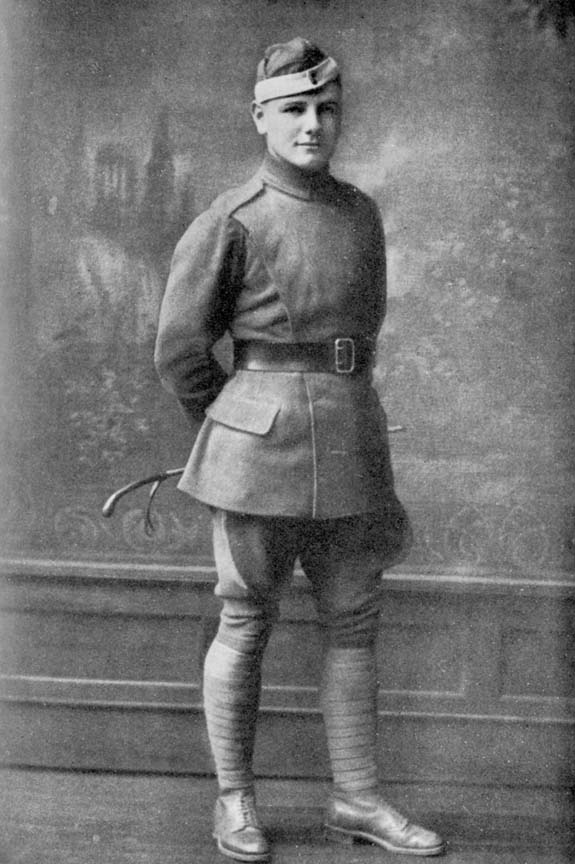
SON of Charles Edwin and Edith J. Hall, of Maiden, Mass.; was born in West Dennis, Mass., Jan. 8, 1896. He was educated in the Medford and Maiden High Schools, and at Burdett Business College. He left college to enlist. He won several medals and ribbons for running-races. In Jan., 1913, he was awarded a silver medal by the Humane Society for bravery in trying to save the life of a chum in a skating accident.
He enlisted in the Royal Flying Corps, at Boston, in July, 1917, after having been several times refused by the U.S. because he lacked half an inch of the required height. He went to Toronto and trained at different camps in Canada and later in Texas. He was commissioned 2d Lieut. Nov., 1917, in Toronto, and sailed overseas on Dec. 22, 1917. He landed in England and was sent to the front, in France. He was in active service, flying a scout plane, and had three Hun planes to his official credit. He was commissioned 1st Lieut., in May, 1918. He was doing admirable work, when he was shot down in combat on the Picardy front and reported killed, on Aug. 8, 1918; though the report has not been officially confirmed by the Air Ministry.
Lieut. Hall's Major wrote his parents that he was a most promising officer and had done wonderful work in his Squadron. From his letters it is assumed that he was on the Picardy front, and it was on the day before the British began their smash there that he engaged the Germans, and failed to return. The battle was at several thousand feet, and as long as Lieut. Hall was in sight he appeared to be under control and heading for the British advanced lines. Unless shot down by anti-aircraft gun-fire it seemed that he might land safely.
He is said to be buried one and a half kilometres south of Maricourt, France.

FIRST LIEUTENANT, A.S., U.S.A., SIXTY-FOURTH SQUADRON, R.A.F., TWENTY-FIFTH AERO SQUADRON, FIFTH PURSUIT GROUP
SON of Dr. Henry Flanders and Caroline E. (Taft) Batchelder, of Dedham, Mass.; was born in Danvers, Mass., Nov. 10, 1895. He attended the Dedham High School, and graduated from the Mass. Institute of Technology in 1917.
He enlisted at Plattsburg, N.Y., on May 12, 1917, and was one of the first ten to be sent from the Plattsburg Training Camp to the Ground School at M.I.T. on June 18. There he was one of three chosen for a ground course at Oxford University, England, and sailed overseas on Aug. 18, 1917. He remained at Oxford from Sept. 4 to Oct. , 1917, and was attached to the Royal Flying Corps in Sept. He was then transferred to Stamford, Eng., to Harling Road and Marske-by-the-Sea for training as a scout pilot.
He was commissioned list Lieut. in the Signal Reserve Corps, on May 13, 1918, and was attached to the 64th Squadron, Royal Air Force, serving in France from July to Sept., 1918. He was withdrawn to the American Air Service in Sept., and assigned to the 25th Aero Squadron for patrol duty on the Rhine through Nov. and Dec., 1918.
Lieut. Batchelder was honorably discharged from the service at Garden City, N.Y., on Feb. 4, 1919.
Brother in Service ---
Hollis G. Batchelder, Lieut., Medical Corps., on duty with AEF., 76th Division, 301st Field Hospital; Surgeon-in-Chief, Camp Hospital 26.

SON of Frank N. and Elizabeth (Kimball) Nathan, of Newton Centre, Mass.; was born at Dorchester, Mass., Jan. 21, 1897. He graduated from Newton High School, class of 1915; attended Dartmouth College one year; then transferred to M.I.T., class of 1920, leaving there to enlist at the end of his freshman year. He played four years on the Newton High School football team; was captain of the freshman football team at M.I.T. For three years he was on the school track team, winning many cups and medals.
On March 17, 1917, he enlisted, at the age of 20, in the U.S. Aviation Service. He trained at Miami, Fla., and at the Ground School, Berkeley, Cal. In Aug. he was made Commander of his Squadron, and a few weeks later was put in charge of the eight highest honor men, picked to finish their training in England. These were among the first 50 aviators ready for service abroad. He went to Oxford, Eng., on Aug. 12, 1917; and having trained there was sent to Stamford, Eng., for scout-patrol work on the coast. Later he was sent to the Flying School at Ayr, Scotland, to test planes. On March 3, 1918, he was commissioned 1st Lieut., and was ordered across the Channel. Lieut. Nathan was to have sailed for France on March 22, but two days before that date he was killed at Ayr, Scotland, while testing a Spad plane, a wing of which collapsed, so that it fell. He was given a funeral with full military honors, both British and American.
A letter to his father from the English Lieutenant in command of the School at Ayr says:
Your son's death was a very severe loss to all those who knew him in England. He was not only extremely popular and well liked, but an excellent soldier, and I have heard from many sources that he was considered the best American pilot that had ever been to the Flying School at Ayr.

C.Q.M. (A.), U.S.N., TWO HUNDRED SEVENTEENTH SQUADRON, ROYAL AIR FORCE, SEVENTH SQUADRON, NORTHERN BOMBING GROUP, U.S.N.
SON of Mr. and Mrs. Walter Sprague, of Saugus, Mass.; was born in Boston, Mass., on Nov. 16, 1896. He was educated at the Saugus High School, where he played football and basket-ball for four years, and at Boston University.
He enlisted in Naval Aviation early in April, 1917, in Boston,, and after a few weeks' training at the Ground School in Pensacola, Fla., sailed for France on May 25, 1917, as a member of the First Aeronautical Detachment, U.S.N., which was the first official unit of U.S. forces to land in France, disembarking at St.-Nazaire, June 7, 1917.
Sprague was designated as an observer and assigned to the Centre d'Aviation Maritime, at St.-Raphael, on the Mediterranean coast. Here he took the French seaplane observers' course. He was then ordered to the Aerial Gunnery School at Cazaux, where he received his brevet as a military observer. For a number of months he acted as a Gunnery Instructor in the U.S. Naval School of Aerial Gunnery at Montchic-Lacanau, Gironde. After an additional course at the U.S. Army School of Bombing at Clermont-Ferrand, Puy-de-Dome, he went to the front with the first squadron of daylight bombers which the Navy had on land work. He had several months of active service over the lines with Squadron 217 of the Royal Air Force, with Squadron 7 of the First Marine Corps Aviation Force, and with the Northern Bombing Group, U.S.N. Soon after the Armistice was signed, he was sent to England for training as a pilot. He was ordered home in Dec., 1918, after having completed eighteen months of foreign service. He was honorably discharged from the service at the U.S. Naval Station, Pelham, N.Y., on March 15, 1919.

SON of John and Alice C. (Johnson) Lavalle, of Boston, Mass.; was born in Nahant, Mass., on June 24, 1896. He was educated at the Noble and Greenough School, at St. Paul's School, and at Harvard College. He belonged to the Harvard R.O.T.C. from April to June, 1916; attended the Officers' Training Camp in Plattsburg in July, 1916; and had intensive training with the Harvard R.O.T.C. from April to July, 1917. He passed the examination for the Aviation Service in April, 1917, but because his record was lost in Washington for three months, did not formally enlist until July 2, 1917, in Cambridge. He was assigned to the Ground School at M.I.T., where he remained from July 2 to Sept. 1, 1917.
He left the U.S. on Sept. 18, 1917, with the "Italian Detachment," which never reached Italy, but was sent to Oxford and Grantham, Eng., and then split into several groups for flying instruction. He trained at the Ground School, Oxford, from Oct. 5 to Nov. 2, and at the School of Machine Gunnery, Harrowby Camp, Grantham, from Nov. 3 to Dec. 3. He was then transferred to Rockford, where he stayed till Jan. 27, 1918, when he was ordered to Southend, and later to Amesbury, Jan. 8 to April 1. He was in the hospital in London from April 1 to Aug. 8, leaving to return to Amesbury. Lieut. Lavalle was attached to the 33d Wing, R.A.F., and was sent to 58 T.S., Cramwell, Eng., where he expected to join a night-bombing Handley-Page Squadron, which, however, was disorganized. On his return to Amesbury, he was made Instructor. He was posted to No. 1 School of Fighting and Aerial Gunnery, Turnberry, Scotland, on the day of the Armistice; returned to Liverpool, and sailed for the U.S., arriving in New York on Dec. 4, 1918.
He was commissioned 1st Lieut. on March 20, 1918, and honorably discharged from the Service at Camp Mills, Mineola, N.Y., on Dec. 26, 1918.
Married: Oct. 3, 1919, Ellen Tufts.
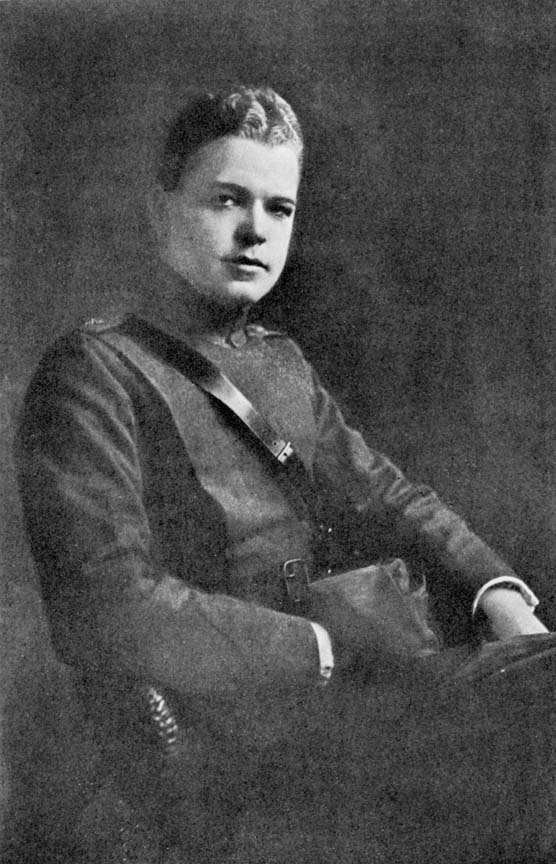
SON of Cyrus S. and Alice (Bigelow) Chapin, of Newton Centre, Mass.; was born May 10, 1895, at Somerville, Mass. He was educated at the Newton High School, class of 1913; and at Phillips Andover Academy, graduating with the class of 1914. He entered Harvard College in the class of 1918. In his freshman year he played on the Gore Hall football team, and in 1915 captained the Gore Hall baseball team.
At the close of his junior year, in April, 1917, he enlisted in the USNRF Coast Patrol, after having been refused by the U.S. Aviation Service, because of a minor defect in one eye. Being eager to serve in Aviation, however, he applied for and obtained an honorable discharge from the U.S.N.R.F., effective upon his enlisting in the British Royal Flying Corps, which he did on Aug. 26, 1917. He reported at Toronto, Can., on Sept. 6, and received ground and flying training at Deseronto and Long Branch; he continued his training at Camp Hicks, Fort Worth, Tex., where, in Dec., 1917, he was commissioned 2d Lieut. On Dec. 31, 1917, he sailed from Halifax on the Tunisan, as part of the convoy with the ill-fated Tuscania when she was torpedoed off the Irish coast. Lieut. Chapin volunteered, when the Captain called for "extra submarine watch," and afterward wrote his family that "it was the most exciting three hours he had ever spent."
After further intensive training at Old Sarum, Salisbury, Eng., he was commissioned 1st Lieut. in April, 1918, only seven months after beginning training. Early in May, 1918, he was ordered to France, and with his observer flew his plane, a large de Haviland bomber, over the Channel and across France to the aerodrome of the 99th Squadron, R.A.F., 6 miles south of Nancy. His Squadron was a bombing squadron, whose duties were to harass the enemy lines of communication, railways, ammunition dumps, and aerodromes.
On June 27, 1918, Lieut. Chapin was sent with others to bomb the railway at Thionville, north of Metz. After successfully dropping their bombs, the formation was attacked by a large number of Fokker scouts. In a desperate fight a shot passed through the petrol tank of Lieut. Chapin's plane, causing an explosion which sent the machine down in flames from 1300 feet. Lieut. Chapin fell at Thionville, 5 miles within the enemy lines, and was killed. As the machine went down he was seen to turn to his observer and shake hands with him. His grave is as yet unidentified.
In a letter informing Lieut. Chapin's family of his death, Major Pattison, Commanding Squadron 99, R.A.F., writes:
Your son is a great loss to this Squadron, as he was one of our best pilots, and also most popular amongst the other officers. He had been in a number of successful duties over the lines, and was a fine, stout-hearted officer.
One of his brother officers also writes:
His loss is very keenly felt amongst us all, as he was one of the best. He always had a smile, and a kind word for every one.
And later, this officer wrote:
There have been many tales of bravery, but I think it must be nice for you to know that your son died a hero's death, and faced it without fear. He was a son for any parent to be proud of, and we all loved him. In fact he was the finest type of Christian manhood that could possibly be found.
Lieut. Chapin's maternal grandfather, George E. Bigelow, was. killed in the Civil War at the battle of Fredericksburg. His great-grandfather, Capt. John Bigelow, fought in the Revolutionary War, and was delegate to the Convention to ratify the Constitution.

SON of Frederick A. and Emma Ida (McDaniels) Swan; was born at Saugus, Mass., July 6, 1898. He was educated in the public schools of Saugus, at the Hawley School of Electrical Engineering, and Boston Y.M.C.A. (Automobile Course). He worked for a year as apprentice with the Burgess Aeroplane Company, of Marblehead, Mass., while it was under Government control; and was advanced to the position of foreman of the Flying Squad in July, 1917. He left this company to enter the U.S. Aviation Branch of the Army on Oct. 29, 1917. He trained at the Kelly Field, Everman Field, and Hicks Field, Tex., receiving high marks; and was recommended by his Captain, on Jan. 3, 1918, for a commission.
In a letter of Jan. 9, 1918 he said:
I had a wonderful flight yesterday with a boy from Boston. We were up for an hour and ten minutes. Believe me, at 6000 feet I got a good look at Texas.
Jan. 28:
Our Captain's plane collapsed 3000 feet up to-day. It happened before my very eyes and I shall never forget it. It was the worst thing that could have happened to the Squadron, because Captain Payne was a worker and was pushing this Squadron ahead very fast.
The death of his beloved Captain greatly affected him. On Feb. 4 he wrote:
Was in the air to-day two hours and ten minutes, and during that time we did about everything that was ever done in a flying machine. I had the controls 45 minutes.
Feb. 7:
I had two beautiful flights to-day with Lieut. Marquand. This morning we did not go very far, but this afternoon went to Dallas, about 44 miles from here. To-morrow I expect to make a trip to Denton, about the same distance, only in the opposite direction.
He never made that trip; for on Feb. 8 he was instantly killed in an airplane crash, at Hicks Field. His Lieut., Joseph Lersch, with whom he was making the flight, was nearly killed by the same fall.
Lieut. Lersch wrote of the accident a year later:
I wish I could tell you in detail the happenings of that February morning. What I remember is that we started up about 9.45. In my recollections of Willard, I think of him as always making the most careful examination of the plane before a flight. His cautiousness was an outstanding characteristic as a "mechanic," and while, as I say, happenings just preceding are not clear, I can picture him, as was his habit, making the usual tests before going up. I know that while aloft we discovered some engine trouble and landed; after attempting to remedy it we went up again. I should say we had been flying about ten minutes when the crash came. I can remember falling; I think, too, I realized striking the ground, but there was no pain .... It seems certain that Willard must also have escaped conscious suffering. The cause of the crash was, in my opinion, a "frozen control." Willard was my 52d student. It seems a hopeless thing to try and convey sympathy for his family in writing. I know that resignation to the sacrifice of such a boy --- one so full of promise and who had the admiration and affection of every last man in the Squadron --- is a heroic thing. .
Sergeant Swan is buried at Camden, Me.
Willard Swan's last words to his parents on leaving home were to the effect that he was not going to fight for selfish gain, for any honor or praise which he might win in the Service; not for the good of his country only; but Service in the highest sense.
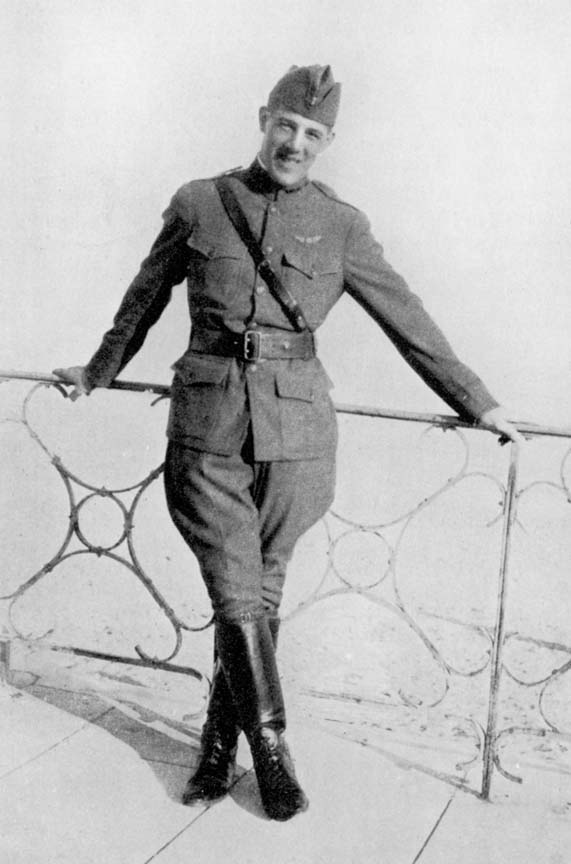
SON of Charles Herbert and Nellie R. (Oatman) Woodward; was born at Watertown, Conn., Dec. 28, 1898. He attended the public schools of Watertown, was president of his class in the High School (1912), and graduated from the Pratt Institute, Brooklyn, in 1916. He was captain of class baseball team (Pratt Applied Electricity), and played on 'Varsity basket-ball, tennis, and football teams.
He enlisted June 21, 1917, and attended the Ground School, M.I.T., receiving further training at Scott Field, Belleville, Ill. He was commissioned 1st Lieut. at Washington, D.C., Dec. 24, 1917, and sailed overseas Feb. 25, 1918, continuing his training as chasse pilote at 3d Aviation Instruction Centre, Issoudun. He took the gunnery course at Cazaux, and returned to Issoudun for three days' combat work before going to the front.
On Aug. 16, the second day of this combat flying, he was killed in an airplane accident, two days before he was to have gone to the front. He was buried in the Military Cemetery 32, at Issoudun.
Lieut. Woodward was very ill during the first of his stay in France.
After his recovery he wrote to his mother:
I'm back on the OK list again, and am feeling like a two-year-old. I started to fly again about a week ago and went through the rouleurs, the 23 doubles and singles, and 18 metres all in about a week, and am now over on the 15-metre machine, which is the smallest machine we have. I probably will be here a couple of weeks or so, perhaps not as long as that; then I have to have a gunnery course --- that will take about another week, and then yours truly will be ready for that longed-for crack at the Hun.
As we progress from one field to the next, planes get smaller and better, and I'm really in love with the "li'l' babies." I know I will make good because I love the work and have so much confidence in myself. I feel at home quite as much when I'm upside down in the air, at an altitude of a couple of miles, as I do when I am flying level at a few feet off the ground. But never have a fear, 'cause above all things I'm careful, 'cause I'm always thinking of you.
Brother in Service:---
Russell Johnson Woodward, 2d Lieut., 25th Engineers, A.E.F.
Grandfather in Service: ---
John Andrew Woodward, 22d Connecticut Volunteers, Civil 'War.
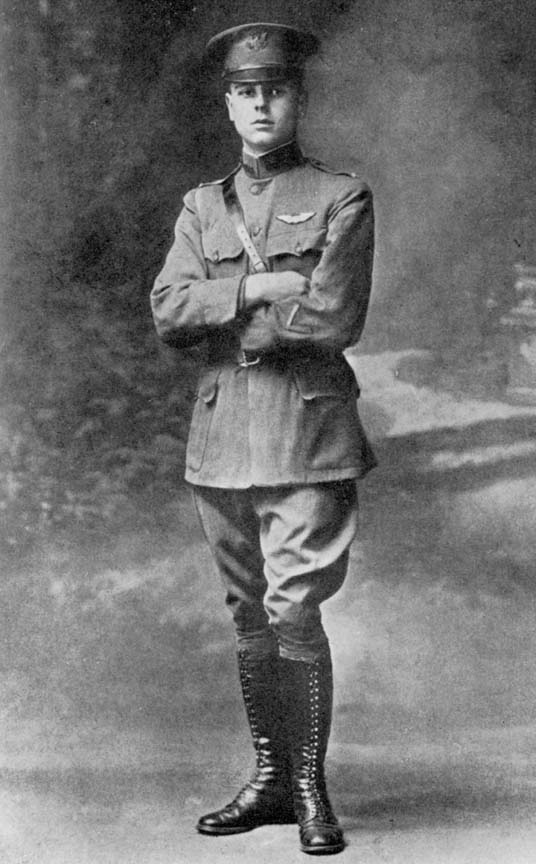
SON of Henry F. and Julia (Calligan) Hubbard, of Providence. was born in New Rochelle, N.Y., Nov. 9, 1895. He was educated at the Moses Brown School, Providence, R.I., and at Harvard College, class of 1918. At the Moses Brown School he was one of the editors of the school paper, president of his class in junior and senior years, and at graduation won the Harvard Prize. At school he was captain and catcher for two years of the baseball team, and captain of the football team in his junior and senior years. At Harvard he won his "H" for playing on the 'Varsity lacrosse team.
He joined the R.O.T.C. at Harvard, and was sent to the 1st Training Camp at Plattsburg. He was one of the first to answer the call from Washington for volunteers for the Aviation Corps, enlisting in April, 1917. He was sent to the M.I.T. Ground School for training, and graduated as an honor man. He sailed overseas from Halifax on Oct. 29, 1917, for final training, which he received at Avord, Tours, Cazaux, and Issoudun. He was commissioned 1st Lieut, on May 13, 1918, and was attached to the 10th Aero Squadron, Aviation Corps, U.S.A.
He was killed on Aug. 18, 1918, as a result of the fall of his airplane, during the final phase of his training, at Issoudun, France, and was buried with full military honors in the Government Cemetery connected with the 3d Aviation Instruction Centre, A.P.O. 724, Issoudun.
A quotation follows from a letter sent to the parents of Lieut. Hubbard by the Aero Club of America:
Although the sacrifice is great, it is a consolation to feel that your son's patriotic and faithful service to our Country, for which he gave his life, and the indomitable spirit which he has shown, will serve as a noble example and be an added incentive to young men, especially to his nearest and dearest friends and companions, to fight for the cause of Liberty and Freedom. We believe the Air Service, in which your son was engaged, is the most important of all forms of combat .... His name will be inscribed upon the records of this Club among those who gallantly answered their Country's call, and who nobly gave their lives in her defence.
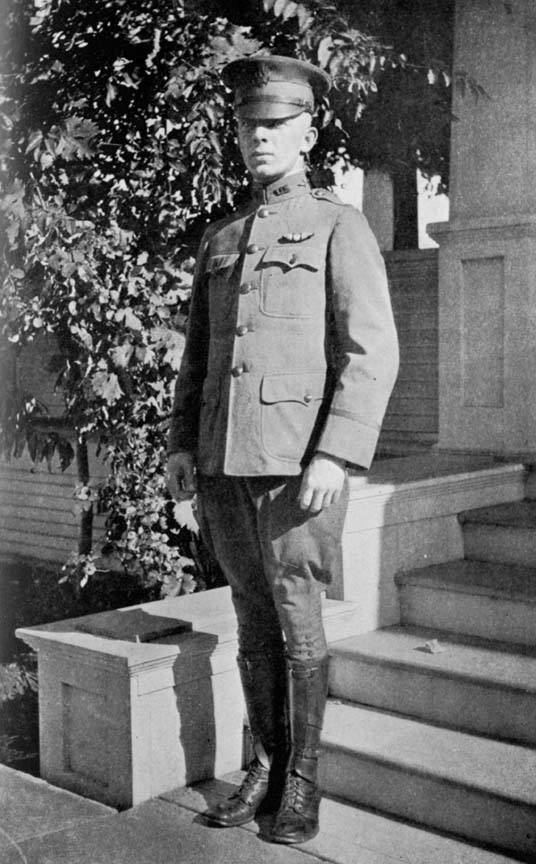
SON of Rev, and Mrs. Walter P. Buck, of New London, Conn.; was born in Provincetown, Mass., July 18, 1896. He graduated from the High School, Brockton, Mass., and attended Wesleyan University, 1913-14; Mass. Institute of Technology, 1915-16. He was proficient in tennis, rowing, riding, and motoring. He enlisted at Fort Slocum in April, 1917, and was sent from there to Kelly Field No. 2, San Antonio, Tex. He went to Princeton, N.J., for theoretical training; then back to Kelly Field, where he was commissioned 2d Lieut. in the spring of 1918. Lieut. Buck soon became Pioneer Instructor at Kelly Field, and trained 44 cadets in solo flying without an accident. He was then appointed Instructor of Instructors, teaching them "stunts" and military tactics. He longed for active service, but was kept at the less interesting work of training other flyers.
He had passed his final examinations and was awaiting further promotion at the time of his death.
On Sept. 7 Lieut. Buck had been flying in battle formation all the morning at Kelly Field. On coming down, a mechanic asked him to go up with him to test a certain airship. When 4000 feet high, both wings fell from the plane, and were found later a city block apart. The Government stopped at once the use of all ships of that make. It is supposed that the steel pins were removed and wooden ones substituted by some one sympathizing with the enemy.
Lieut. Buck was buried at Cedar Grove Cemetery, New London, Conn. The Government showed every possible honor on the occasion. Five airships, driven by officers whom Lieut. Buck had instructed, flew above the train for 30 miles out of San Antonio, dropping flowers on the coach. A full military funeral was held at New London, by order of the Kelly Field Commander. An airship hovered over the cortège, and dropped flowers into the grave of the aviator.
Married, April 26, 1918, Mab Casey, of San Antonio, Texas.
Brother in Service --
Willis L. Buck, entered Hydroplane Service as soon as possible after his brother's death. Assigned to M.I.T. for training.
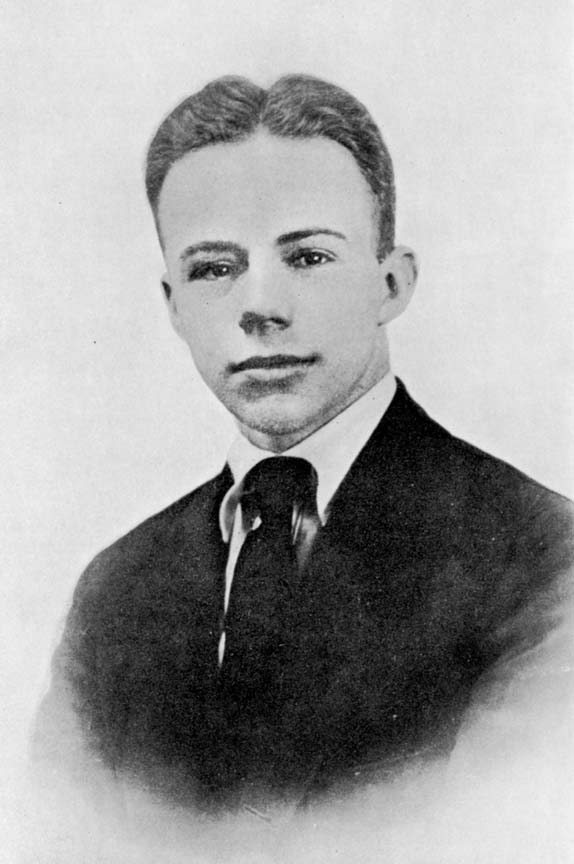
SON of Edward J. and Helena (Felt) Stewart, of Brookline, Mass.; born in Millis, Mass., March 15, 1896. He was educated at the Brookline High School, Chauncy Hall School, Boston, and at the Mass. Institute of Technology. He was an all-round athlete; coxswain of the high school crew for two years, and captain in 1915, when the crew won the interscholastic cup; a member of the swimming team for three years; member of the gymnasium team, winning two medals from the Harvard Interscholastic Gymnasium Association. He was prominent in various branches of sport at Chauncy Hall, and held the Greater Boston interscholastic diving championship for two years. He was a member of Sigma Alpha Epsilon Fraternity at Tech.
Immediately after the declaration of war, Stewart left the M.I.T. to enlist, with his brother Theodore, in the American Ambulance Field Service, reaching France aboard the first ship to dock after the declaration. He served from April to Oct., 1917, except for two and a half months spent in the hospital with a bad fracture of the arm. In Aug., 1917, his ambulance section was cited for exceptional bravery at Verdun. On Oct. 15, 1917, he enlisted in the Aviation Corps at Paris. He trained at Tours, and was about to graduate from the Aviation School there, when he fell ill with spinal meningitis and died within ten days, on Jan. 9, 1918, at Tours, France. He is buried in the American Cemetery, Indre-et-Loire, at Tours, France. His French instructor, when he heard of his death, wept, not wholly for Gordon, but, as he said, "for the loss to the Allies." He was accounted the most promising pupil that had passed through the school at Tours.
Brother in Service ---
Theodore F. Stewart, ambulance driver; wagoner, Co. D, 2d Corps Artillery Park, France.

ONLY son of Edward Archie and Isabel (Abbe) Jones; was born at Pittsfield, Mass., on Jan. 7. 1894. He attended the public schools of Pittsfield, and prepared for college at the Hill Preparatory School at Pottstown, Pa.; he graduated from the Yale-Sheffield Scientific School (Mechanical Engineering), with high honors, in 1915; the year following he took a special course in chemistry at the M.I.T. in order to fit himself for his father's business, the manufacture of paper-mill machinery.
Ill the summer of 1916, and again in 1917, he attended the Officers' Training Camp at Plattsburg, enlisting from there in the aviation section of the Army, June, 1917. In Aug. he was transferred to the Ground School, M.I.T., at which time he entered the 13th Squadron, graduating from there in Oct. He was assigned to Mineola, N.Y., for training, and from there was sent abroad Oct. '27, 1917, and trained at Tours, France, until Dec. 26, 1917, when he was transferred to a French flying school at Avord. There he was killed in an airplane accident on Feb. 15, 1918, two weeks before the time when he was to have been commissioned 1st Lieutenant. He was buried in the Protestant Cemetery, at Avord, on Feb. 18, and on March 25 memorial services were held for him in Pittsfield, at the First Congregational Church.
In paying tribute to his memory the Rev. Mr. Gregg said:
"This young soldier, whom we are commemorating, did not pretend to greatness. His last thought would have been to esteem himself above his fellows. Yet it is remarkable that wherever he went, other people and specially his contemporaries and comrades, admired him, respected him, and loved him. One of these, a cadet, who was with him both at the aviation school in Cambridge and in France, wrote: "I have never known anybody who was a better example of the highest type of an American. Of all the men in our detachment there was no one who was a better citizen, actually and potentially, none whom the nation could so ill afford to spare. By his straightforward living under conditions not the most favorable he was a constant inspiration to all of us."
Cadet Jones was descended from two Captains of Revolutionary fame, on his mother's side from Capt. Thomas Abbe, of Enfield, Conn., and on his father's, from Capt. Samuel Pelton, of Pittsfield.

SON of Charles P. Cheney and Mary C. Cheney (Schofield), of Peterboro, N.H.; was born at Colorado Springs, Colo., Jan. 15, 1897. He was educated at St. Mark's School, and at Harvard College, class of 1920. He was captain of St. Mark's School football team in 1915-16; and member of the Harvard freshman football team in 1916. During his vacations in 1915 and 1916 he took preliminary training in Aviation at Newport News, Va.
He left college in his freshman year to enlist in U.S. Aviation Service. March 31, 1917, he entered the School of Military Aeronautics at Urbana, Ill., and graduated as Honor Student on July 25, 1917. He sailed overseas and took advanced training in flying in Italy, and was the first American to win the Italian Military Flying Brevet, on Oct. 18, 1917. He was commissioned 1st Lieut. A.S., S.O.R.C. on Nov. 23, 1917.
On Jan. 20, 1918, Lieut. Cheney was accidentally killed at Foggia, Italy, in an airplane collision which resulted in the death of two other aviators.
The accident is described in the following letter from Headquarters of Major Ryan, commanding the U.S.S.C., Foggia, under date of Jan. 20, 1918.
With the profoundest feeling of sympathy for you and sorrow for your loss, I wish to inform you of the death of your son, 1st Lieutenant William H. Cheney, Aviation Section, Signal Officers Reserve Corps, a member of this command, on January 20, 1918.
Your son served under my command since leaving the United States, and by his delightful personality, keenness for work, and devotion to duty proved himself a man, a soldier, and a gentleman in every respect and one worthy of the greatest respect and admiration by all with whom he came in contact.
His death, which was instantaneous, was one of those almost impossible and wholly unavoidable accidents. He was piloting a machine with Lieut. Oliver B. Sherwood as observer and flying over the training field. At the same time another machine, piloted by Aviation Cadet George A. Beach, was also in the air. A very low cloud of fog blew over the training field and closed around your son's machine. He immediately turned to get out of the fog, and as the machine emerged, it struck the machine of Cadet Beach who was also endeavoring to avoid the fog. Both machines fell to the ground, a distance of about one hundred and fifty feet.
The funeral was held from the Italian Military Hospital in Foggia, at two o'clock in the afternoon of the twenty-first, and was attended by troops and officers of the American, Italian, French, and English Armies. All three men were buried with full military honors.
This noble sacrifice, although very hard to bear, is one every soldier is ready to make at any time for his country, and it was a comfort to know that he died as he desired, a soldier, a flier, honorably, in the defense of his country, of liberty and democracy for the world.
(Signed) WM. ORD RYAN
Major, J.M.A., Signal Corps
From Special Order, issued by Headquarters, Foggia, Italy, Jan. 22, 1918:
1st Lieut. W. H. Cheney, AS., S.O.R.C., 1st Lieut. O. S. Sherwood, A.S., S.O.R.C., and Aviation Cadet George A. Beach, S.E.R.C., were men who on every occasion and in every way showed their bravery, desire, and eagerness in serving their country in all things and in all ways.
1st Lieut. W. H. Cheney answered the call of his country by enlisting in the S.E.R.C. on March 31, 1917; entered School of Military Aeronautics at Urbana, Ill., graduating therefrom as an honor student on the 25th day of July, 1917. After completion of the course at the S.M.A., he was sent abroad as a member of the A.E.F. He was the first member of this command to complete his Italian Military Flying Brevet, this on October 18, 1917, was commissioned as 1st Lieutenant, AS., S.O.R.C., on November 3, 1917, and thereafter, as well as before, showed his abilities as a soldier and endeared himself to all men of his command.
The great sacrifice of these brave young soldiers is not only an inspiration to this entire command and to the American Air Service at large, but also America's first offering of life in Italy to the great cause of the Allied Nations.
The command mourns at their loss and desires to express its deepest sympathy to their bereaved families.
(Signed) WM. ORD RYAN
Major, J.M.A., Signal Corps, Commanding
SON of Constantine P. and Amalia J. Perentesis Konstantarogiannis, of Greece; was born in Sparta, Greece, Jan. 30, 1888. He is now a citizen of Boston. He was educated at Olivet College, A.B., and at Harvard University (post-graduate). Immediately after the declaration of war, he made application for the Officers' Training Camp at Plattsburg, but was rejected as being a fraction of an inch below the minimum height. Constan applied for the 2d Plattsburg Camp, and was this time rejected for being three pounds underweight. Just then the age for Aviators was raised, and he enlisted in U.S. Air Service at Cambridge, on Sept. 14, 1917.
He attended successively the M.I.T. Ground School, Nov. 3, 1917, to Jan. 6, 1918, and the School of Military Aeronautics, Princeton, N.J., Jan. 6 to graduation, Jan. 19, 1918. From Jan. 25 until April 20 he was trained as a pilot at Kelly Field, San Antonio, Tex. He then transferred to aerial bombing, and was ordered to the Concentration Camp at Camp Dick, Dallas, Tex. On June 28, 1918, he was ordered to Ellington Field, Tex., to train as a bombier. he finished his training and was recommended for a commission on Sept. 13. A week later he was ordered to the Aerial Gunnery School for Bombers at San Leon, Tex., a branch of Ellington Field. He was commissioned 2d Lieut. on Oct. 25, 1918. He graduated from this school on Nov. 2, and returned to Ellington Field to await orders for overseas.
Lieut. Constan has taken up a course for piloting and will remain at Ellington Field until it is finished.
In an interesting letter, Lieut. Constan shows his appreciation of American citizenship and of the New England tradition:
I am a native of Greece. But I am an American none the less. Without a hyphen. I am very proud of the fact that I was an American citizen when I first set foot upon this continent, almost fourteen years ago, my father having been naturalized some years before my arrival. I am also a New Englander, more specifically a Bostonian. At least, I consider myself one, inasmuch as I have made Boston, or one of its suburbs, my home for the last seven years. It will be a matter of infinite pride to me to be included among the New England Aviators.
New England's past records are among the highest. Let us hope that this one will not fall short of the mark; that the Past will welcome it as a worthy companion; that the Future will look up to it with pride.
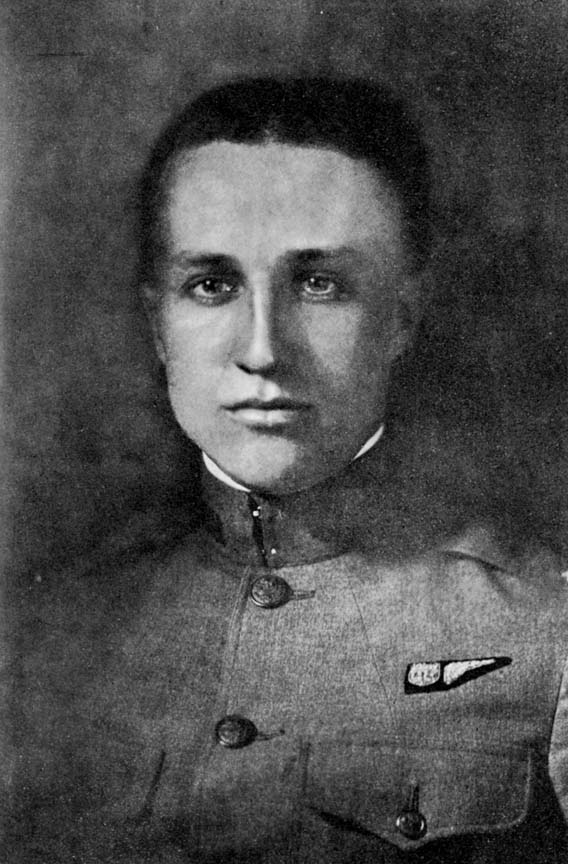
FIRST LIEUTENANT, A.S., U.S.A., CHIEF OBSERVER, ONE HUNDRED NINETIETH AERO SQUADRON, SECOND PROVISIONAL WING
SON of Arthur Lincoln and Mary Bradford (Swift) Gillett; was born at Hartford, Conn., March 5, 1895. He was educated at Westminster School, Simsbury, Conn., graduating in 1912; and at Amherst College, class of 1916. He attended the Harvard Law School, but left in the spring of 1917 to go to Plattsburg.
He attended Plattsburg Camp in 1916, and Plattsburg Officers' Training Camp in the summer of 1917. He enlisted May, 1917. He was commissioned 2d Lieut., F.A., and was ordered to Camp Devens, where he was attached first to Battery 1, 302d F.A.; then to Headquarters Co., 3092d F.A. He was commissioned 1st Lieut., F.A., early in the winter of 1918. He was ordered to take examination as Aerial Observer, and was sent for training successively to Post Field, Fort Sill, Okla.; Camp Dick, Dallas, Tex.; Selfridge Field, Mt. Clemens, Mich.; and Park Place, Houston, Tex. He was with the 191st Squadron, 2d Wing, Air Service. At Park Place he was made Chief Observer of the 2d Wing, consisting of the 190th and 191st Squadrons.
He was killed in an airplane accident near Kingsville, Tex., on Sept. 17, 1918. He was interred in Hartford, Conn., Sept. 21, 1918.
Married, Oct. 13. 1917, Marjorie Stafford Root; one child, Mary; born July 22, 1918.

SON of William Thompson and Ellen (Horswell) Sanger, of New York City; was born at Cambridge, Mass., May 31, 1882. He was educated at St. Mark's School, Southboro, Mass., and at Harvard College, A.B. 1904. He rowed on the Harvard freshman crew and on the Harvard four-oared crew.
He attended the Officers' Training Camp at Plattsburg in Aug., 1917, graduating with a commission as Capt. of Infantry, about Nov. 27, 1917. He transferred to the Aviation Service and went first to Fort Sill, Okla., then to Austin, Tex., for eight weeks' training in machine-gunnery and wireless telegraphy. He continued his instruction in flying at Hazlehurst Field, Mineola, N.Y., beginning in April, 1918. He passed all tests and received his wings in July, when he received overseas orders, and sailed for France. He was given command of 250 officers, known as ferry pilots, at Orly Field, France, on Aug. 20. He was killed in an aerial accident on Aug. 29, 1918, and was buried at Suresnes, France.
The officer in charge of the Transfer Section, who had been in very close touch with Capt. Sanger from the time he came to take charge of the Transfer Pilots, wrote of him:
I enjoyed my work with him, and for him, so much. To work under him was excellent training. He insisted that everything should be exactly right, and his attitude towards us was always such that no one wanted to fall short of the standard .... I thought perhaps I might tell you how much I miss him and how much the other pilots feel his loss.
Married, Nov. 16, 1904, Virginia Osborn.

SON of Charles M. and Alice M. (Call) Parsons; was born at Gloucester, Mass., Dec. 11, 1895. He was educated in the public schools of Gloucester and at the Mass. Institute of Technology. He was a member of Theta Chi Fraternity at M.I.T. He played baseball and football at Gloucester High, and won his letters. At M.I.T. he won his numerals in wrestling, and was on the football team. He was Captain of the High School Cadets in his senior year, and 1st Lieut. in the M.I.T. Regiment. After graduation, and before the war, he practised civil engineering, and had experience in planning and building roads with the Mass. Highway Commission. In 1917 he worked five months for the West Virginia Railroad, laying tracks in the coal mountains.
He enlisted at Boston, on Nov. 10, 1917, and trained six weeks at M.I.T. and two weeks at Cornell University. From there he went to Dallas, Tex., and was among 50 men chosen to train with the Royal Flying Corps. In April, 1918, he was commissioned 2d Lieut., and was transferred to Hicks, Tex., where he served as Instructor in the Gunnery School. On July 2, 1918, he met with an accident while going for help for a fellow aviator, which resulted in his death on the following day. He was buried in Gloucester.
Lieut. Parsons had a narrow escape from accident on his altitude test, when his motor stopped and he came down 8000 feet, but he escaped without injury. He never had an accident with the cadets he was called to instruct. He had 150 hours of solo flying to his credit.
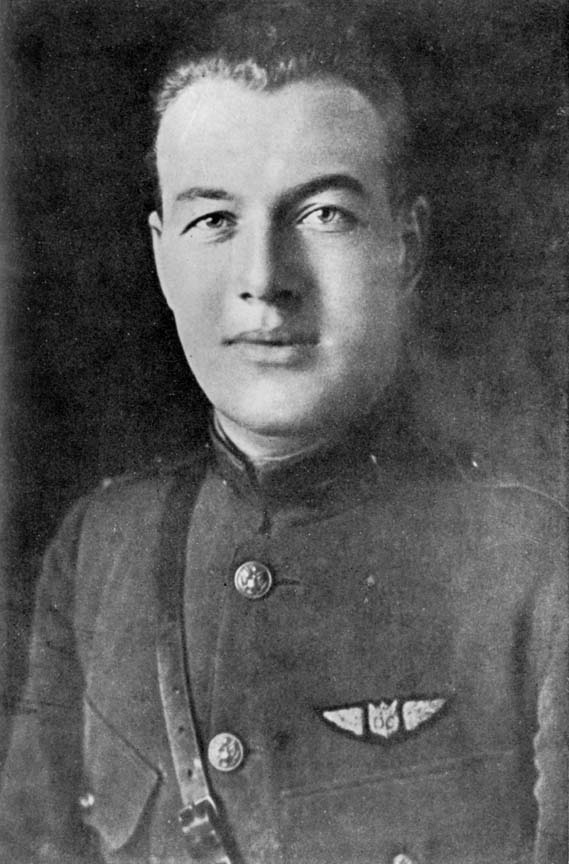
SON of Bradley A. and Hattie (Boden) Messer, of Lowell, Mass.; was born in Lowell, Sept. 12, 1894. He graduated from the Lowell High School, where he made a record as long-distance runner, and was manager of the baseball team in 1913. He attended the Lowell Textile School for three years.
He enlisted as mounted orderly in the 6th Mass. Regiment, on March 30, 1917, at Lowell, and was chosen to attend the Officers' Training Camp at Plattsburg. There he volunteered for Aviation Service, and was sent to the Ground School, M.I.T. When he had completed a six weeks' course, he was transferred to Mineola, N.Y. He was commissioned 1st Lieut. in Sept. 1917.
He went overseas, Nov. 13, 1917, and trained at Issoudun, France, graduating there in Feb., 1918. He was subsequently ordered to several other training-fields as an instructor. On July 13, 1918, he was sent into the zone of advance. He hoped to get to the front, but was stationed at Châtillon-sur-Seine as instructor and tester of planes. He was killed in an airplane collision there on Feb. 20, 1919, and was buried at Châtillon-sur-Seine on Feb. 22, 1919.
Lieut. Messer's superior officer wrote concerning his death:
Raymond joined us as a pilot shortly after the Second Corps Aeronautical School was organized at Chatillon-sur-Seine. I was in charge of the flying at that school from its organization. It did not take many days to find what a really valuable man your son was, and he was at once put to work as an instructor in Sopwith and Bréguet planes, in addition to his duties as a staff pilot. He was a skilful pilot; his judgment was good; and his attitude toward his equals and superiors was one of unvaried courtesy. He was extremely popular, and to quote one of the old officers, "No accident ever hit the fellows quite so hard as Messer's death." Like the rest us, he found it a source of great regret, not being able to get to the front. But the training of observers was so important that he could not be spared. It ever a man served his country well, it was Messer.