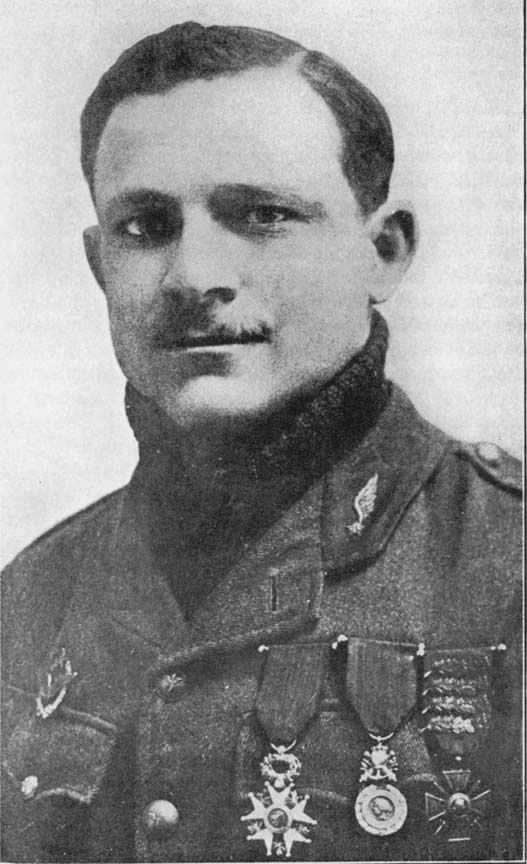
SON of Mr. and Mrs. Edward Lufbery, of Wallingford, Conn.; was born in France in 1886; his father being an American and his mother a Frenchwoman. At the age of seventeen he ran away from his home, and began his career of travel and adventure. During the next four years he journeyed over France, Algiers, Tunis, Egypt, Turkey, and the Balkans, working at anything that came his way. In 1906 he returned to the U.S., and in 1907 entered the Regular Army; he spent the next two years in the Philippines, where he distinguished himself as a marksman (holding first place as rifleman in his regiment).
Leaving the army at the end of his two years' service, he continued his travels; he roamed over China and Japan, finally reaching India, where at Saignon, Cochin China, he saw his first aeroplane in 1910, and made the acquaintance of Marc Pourpe. This famous French trick-flyer, who was exhibiting in the Far East, engaged Lufbery as his mechanic, and soon found him an invaluable aid. For three years they travelled and worked together, and 1914 found them in France at the outbreak of the war. Pourpe at once enlisted in the Air Service, with N 23, and Lufbery wished to do the same, but being an American was forced to join the Foreign Legion; following which he was allowed to accompany Pourpe to the front as his mechanic.
On Dec. 2, 1914, Pourpe was killed, and Lufbery, longing to avenge his death, at once applied for permission to fly. After a few days he was given his brevet, and was enrolled in the celebrated Escadrille of Bombardment, the V 102. Six months later he was transferred to the newly organized Lafayette Escadrille, where he began those heroic exploits in the air that eventually won for him the title of "American Ace of Aces."
From this time on his success was rapid. On July 30, 1916, he brought down his first plane, over Étain, and a week later vanquished another; these successes won him his first citation from the French Government, which read:
Model of address, of coolness, and of courage. He has distinguished himself by numerous long-distance bombardments, and by daily combats he has had with enemy aeroplanes. On July 30 he unhesitatingly attacked at close range a group of four enemy machines. He shot one of them down near our lines. Succeeded in bringing down a second on the 4th of Aug., 1916.
A third plane was brought down in flames a few days later, and shortly after, a fourth. Lufbery was promoted to Adjutant, and on Oct. 12, 1916, won his fifth victory over a huge three-seater Aviatik, shot down in flames during a bombing expedition against the munition factories at Karlsruhe. It was during this expedition that Norman Prince was mortally wounded.
Lufbery was now an "Ace," and according to the French custom was given a citation for each subsequent victory. He continued his successes, and on Dec. 27 shot down two planes in one day, only one of which, however, was officially credited to him; in one of these combats he narrowly escaped death. For these and other exploits he was awarded the Croix dc Guerre with ten Palms, the Médaille Militaire, and named a Chevalier in the Legion of Honor. He was the first American to receive from England the British Military Cross, which was bestowed upon him on June 12, 1917; he also received three other English medals.
He was commissioned 1st Lieut. in June, 1917. During this month he brought down his tenth enemy plane; on this occasion, when flying alone at 18,000 feet altitude, he saw seven Boches at a distance, but observing that one of them was cut off from the others, he dived upon him, firing as he approached; after twenty-five or thirty shots, his gun jammed, but he had already accomplished his purpose, as his foe wavered and crashed into the German trenches.
When the U.S. entered the war, and began to prepare her own Air Service, the experienced fighting pilots, who had been doing their part for France, were given charge of the new American escadrilles. Both Lufbery and William Thaw, who had been original members of N 124, were commissioned Majors in the A.S., U.S.A. Lufbery's commission was received Nov. 7, 1917, and he was made Commanding Officer of the Lafayette Escadrille.
During the time of his service in France, Lufbery suffered much from severe attacks of rheumatism, which at times kept him in hospital, but although often enduring acute suffering, which was increased by the inclement weather, he continued to work with his Squadron, carrying on with unabated enthusiasm his active patrolling, and exposing himself to every risk.
On Sunday, May 19, 1918, Lufbery went aloft over Toul with his fighting Squadron. Enemy machines were at this time hovering over the American line. Seeing a German Fokker (a great armored plane, a single-seater triplane, the first of its kind that had been used) deep enough within the Allied territory to be cut off before it could escape, Lufbery darted swiftly to the attack. The exact details of the combat will probably never be known, but the American "Ace" was seen to fall in flames, and when 2000 feet from the ground, he was seen to jump from the blazing mass to instant death. When Lufbery's body was picked up, it was found to have been practically uninjured by enemy bullets, and it has been stated that had he been provided with a parachute attachment, his life might have been spared for further victories. Moreover, had his plane been equipped with a non-inflammable fuel tank, he would no doubt have scored his nineteenth victory. As it was, he stood officially credited with eighteen enemy planes, and was known to have brought down many more.
At Lufbery's death the title of "American Ace" passed to Lieut. Frank L. Baylies, upon whose death it was accorded to Lieut. David Putnam, of Brookline.
Lufbery's body was found where he fell, in a flower garden in the village of Maron. His machine crashed to earth in flames half a kilometre away and was burned to ashes. The American aviators who rushed to the spot where Lufbery lay, found him already covered with flowers by the peasants who had seen him fall. He was unwounded save by a bullet which had passed through the hand that held the control lever, and set his petrol tank on fire.
Lufbery's funeral was held on May 20, 1918, and he was buried with full military honors on the hillside back of the American lines. Six of his fellow flyers dropped roses on the bier and an eloquent tribute was paid by the French General, who said that Lufbery's work was typical of the union of America and France in the common cause. He closed his address with the simple words, "Au revoir."

SON of Charles S. and Lydia Terry (Paige) Baylies; was born in New Bedford, Mass., Sept. 23, 1895. He was educated in the New Bedford Public Schools, and at the Moses Brown School, Providence, RI. He was always interested in sports, and was an expert swimmer; he was also an expert automobile driver, one of his qualifications for the Ambulance Service.
He volunteered in the Automobile Sanitary Section, U.S.A., in May, 1916, and was on duty at the French front, on the Somme, at Verdun, and in the Argonne; then for three months in the Monastir sector, Serbia; where, in an order of March 25, 1917, he was cited for "perfect devotion and fearlessness" in evacuating wounded under bombardment, and was given the French Croix de Guerre, with palm. He served with the American Ambulance Corps from May, 1916, to May 11, 1917, when he enlisted in the French Aviation Corps, and was trained as a flyer at Avord, Pau, and Lake Cazaux. In Nov., 1917, he was sent to the front as a member of the "Stork" Pursuit Squadron, and he became one of the most famous aces of that famous Escadrille. He served first at Dunkirk, later at Verdun, then in the Champagne sector. After his sixth official victory he was cited by the French as a "chasing pilot of the highest class, who always seeks combat and leads marvellously the patrol of which he is chief. On April 12 he destroyed alone his fifth enemy aeroplane, and the following day he gained his sixth victory." He was then Sergeant of the Foreign Legion, pilot in Spad Squadron; and he refused a Captaincy in the American Aviation Service to keep the lower rank in his Escadrille.
Following Feb., 1918, eleven German planes were officially credited to Lieut. Baylies, and he was in reality a victor more than twenty times.
On May 13, 1918, he was transferred to the U.S. Aviation Signal Service Reserve Corps, and commissioned 2d Lieut. in an order dated May 20, 1918. On June 17, 1918, he fell in combat behind the German lines, near Montdidier, and was instantly killed. He was at first reported missing; a note, however, was thrown over the lines by a German aviator stating that Frank L. Baylies, an American aviator, fell at Rellet and was buried in a private tomb.
Besides the Croix de Guerre with palms, the Military Medal, and the ribbons of the French Legion and of the Lafayette Flying Corps, Lieut. Baylies was given a medal by the Aero Club of America, and the French Legion of Honor.
On May 30, 1919, a handsome bronze tablet, given by the Daughters of the American Revolution, Fort Phenix Chapter, New Bedford, was placed in the Josiah Swift School which Lieut. Baylies had attended. The inscription is as follows:
In Memory of Frank Leaman Baylies, American Ace, Member of the Lafayette Flying Corps, killed in action June 17, 1918. "Greater love hath no man than this, that a man lay down his life for his friends."
A letter to Lieut. Baylies's mother from Major Gros, commanding officer, A.S. Signal Reserve Corps, said in part:
Your son met a glorious death. He was one of the shining lights of our Aviation. He was a soldier without fear and without reproach. You must apply to him the eloquent words spoken in the British Parliament with respect to aviators; you must not turn your mind on your sorrow, you must turn it towards all the glory which your son has won and the name which he will leave behind him when the story of this great war is written. He has taken his place by the side of all those heroes who gladly gave up that which is most precious of all, their lives, for the greatest ideal, the happiness of the human race.
In a dispatch to the Chicago Daily News dated July 8, 1918, Paul Ayres Rockwell paid tribute to the recently fallen Ace, as follows:
One of the finest and highest-spirited figures that was ever revealed has disappeared from among us. To know Baylies was to like and admire him. His outstanding qualities were those which real heroes possess. Quiet, modest, and reticent on the ground, dashing, fearless, and indomitable in the air, Baylies goes down into history as one of the exceptional characters in war aviation.
Baylies's record after reaching the front as a chasing pilot was unique. No other flyer in any army gained at the beginning of his career so many official successes over opposing pilots in so short a space of time. Baylies destroyed his first German airplane Feb. 19, 1918. On March 7 and 16 he gained his second and third victories; and on April 11 and 12 he had two more official triumphs. May was a wonderful month for the superb air fighter, confirmed victories being won May 2, 9, 10, 28, 29, and 31, making eleven enemy airplanes officially destroyed.
Mention after mention was awarded to Baylies in the Army orders, and many palms were added to his war-cross, ribbon, and military medal. Lately he was proposed for the Cross of the Legion of Honor, and also for the rank of Under-Lieutenant.
Order 57, March 27, 1917: "Frank Baylies, an American volunteer in the Automobile Sanitary Section No. 3, twice volunteered duty at the front and then for the Army of the Orient. He placed at the service of wounded men perfect devotion and fearlessness, being daily tested under bombardment. From Dec. 19, 1916, to March 27, 1917, during the evacuation of wounded from the Monastir sector, he exhibited contempt for the bombardment of cities, roads, and cantonments."
From an order dated March 9, 1918: "Frank Baylies, an American citizen, enlisted in the French Army before the United States declared war. He passed at his own request into chasing aviation, in which he displayed the very finest enthusiasm. On Feb. 18 he shot down single-handed an enemy aeroplane which crashed within our lines."
Order dated May 6, 1918: "An excellent chasing pilot; refused to enter American Aviation as an officer, not wishing to leave his French squadron; delivers daily combats; has destroyed alone his second enemy aeroplane."
Order dated May 29, 1918: "Frank Baylies is a brilliant, high-class chasing pilot. On May 9 and 10 he destroyed his seventh and eighth German aeroplanes."
Lieut. Baylies won four additional citations equally remarkable.

SON of Austin Kilham and Julia M. (Moulton) Chadwick; was born at Lowell, Mass., Sept. 923, 1888. He prepared for college at Phillips Exeter Academy, 1907, where he was awarded the Yale cup for scholarship and athletics. He graduated from Harvard College in 1911, and from the Harvard Law School in 1914. He was one of the most popular men in his class, proving a leader in many undergraduate departments; he was coach of the Harvard freshman track team in 1915; assistant of the 'Varsity track team, of which he was asked to become coach; he attained a wide reputation for his skill as goal tend on the hockey team.
After graduation he entered the house of Stone & Webster as a member of the legal department, but at the outbreak of the war in Europe was filled with a desire to aid the Allied cause, and went to Canada to offer his services; finding that he could not enlist there as an American citizen, he decided to return and enter training. He attended the first and second Plattsburg camps, and in 1916 spent four months at the Mexican Border with Battery A, 1st Reg. Mass. F.A., N.G. On his return North he at once arranged for lessons in flying under Curtiss, at Newport News, and as soon as he had acquired proficiency in handling a plane he sailed for France, where he entered the French Foreign Legion, enlisting Jan. 22, 1917. He speedily obtained his license as pilot at the school of Pau, and having completed a course in aerial marksmanship at Cazaux, joined Squadron No. 192, under command of Major Brochard, July 29, 1917. After some practice flights on Spad aeroplanes, he took part in patrol flights and was particularly marked by his skill as a pilot.
On Aug. 3 Corporal Chadwick wrote:
I am now somewhere, and I can describe it no more definitely than by saying that I should rather be there than anywhere else. One of the first things I saw when arriving here was Capt. Guynemer. I saw him go up, and an hour later come back. In the meantime he got his 50th official .... and he must have dropped about as many more out of sight behind the German lines.
One of the other things of interest which I saw here was a machine which had been hit by several explosive bullets. They do a thorough job. The men here are a splendid lot. It is the most famous group of escadrilles in the world and the finest commander. If I don't learn how to be a good Boche hunter, it will be my own fault. I am not at liberty to say where I am, or much about what is going on, but here is a generality drawn from the past, which will probably hold good for the future: Wherever the pot boils, there is to be found Groupe de Combat 12.
On Aug. 14 he was not scheduled to fly until afternoon, but anxious to get all the practice possible, he went to the field in the morning hoping that an extra man might be needed. A patrol was just going out, and being one man short, he was asked to fill the place. They set out at nine o'clock, and at 9.45, the patrol engaged in combat with an enemy squadron near the forest of Houthulst. An English patrol also took part in the fight, and seeing it attacked by an Albatross, Chadwick hastened to its assistance. At the same moment he was attacked from the rear by two enemy Albatross pilots and his machine was seen to fall towards the earth. It landed 1200 metres north of the village of Bischoff, exactly between the two lines. At the time of its fall, both French and Germans came out of the trenches and a skirmish took place about the machine without any definite result, the two parties shortly returning to their shelters. Two or three days later, a new French attack carried the lines forward to the exact place where the machine had fallen. The Spad was found with the body of a German beside it, but no trace of Pilot Chadwick. It was not until many weeks later that the certainty of his death was assured, and his burial place found marked with his name.
Baron d'Estournelles de Constant, Senator of France, wrote to Nicholas Murray Butler, of Columbia University, concerning the devotion and loyalty of Chadwick. He said:
He has literally flown to the defence of liberty, and might be likened to a young god. The letters which he wrote me filled me at the same time with admiration and anxiety, for he had but one thought. He was intensely eager to devote himself to the service at the earliest possible hour. I have often thought that he was one of those whom we describe as too good for this earth. When I consider such a loss, the only consolation which I find is that self-sacrifice such as that of Chadwick bears more beautiful fruit perhaps after death than during life. Such beautiful generosity awakens in souls still undeveloped unexpected inspirations and a desire to emulate. The heroic devotion of a single person is sufficient to animate suddenly the indifference of a crowd, of an army, of a nation, of a world. And then all humanity profits by the death of these magnificent young people, apparently wasted, but in reality most fruitful.
In July, 1919, the Croix de Guerre, awarded Chadwick by the French Minister of War, was personally presented to the aviator's father by Baron d'Estournelles de Constant.
Corporal Chadwick was awarded a blue ribbon decked with stars and the insignia of the Lafayette Escadrille, in recognition of service rendered, accompanied by the announcement:
The President of the Council, Minister of War, has decided to award a souvenir to the four directing officers and to the 214 pilots of the Lafayette Flying Corps, who in helping the cause of our people, fraternally joined the French ranks, sharing a great part of the perils and glories of war.
A war medal was awarded Chadwick by the Aero Club of America, "In recognition of Valor and Distinguished Service," in Jan., 1918, with an accompanying certificate on which was inscribed:
In recognition of the services rendered to France and her Allies for the cause of humanity this certificate has been issued to Serg't Oliver M. Chadwick who served during the European war in the capacity of pilot in the Lafayette Escadrille, killed on Aug. 14, 1917; thereby in a measure repaying the great debt which America owes France and contributing to the victory of Liberty and Civilization over military autocracy.
Le Colonel, Commandant la Division Aérienne
Cite à l'Ordre de la DivisionCHADWICK, OLIVER MOULTON
Caporal, pilote, aviateurJeune pilote, venu au front après quelques mois d'École, a fait preuve d'une haute bravoure, d'un noble caractère et, malgré l'inexpérience des combats aériens, a affirmé, dès son arrivée dans une unité française (Spa 78), l'ardente volonté de prendre part à la lutte.
Au cours d'une mission à basse altitude, sur les lignes ennemis, a soutenu un dur combat au cours duquel il est mort en Héros.
Copie certifiée conforme au G.Q.G. le 7 juin.
Le Général Commandant l'aviation française
M. DUVAL** The silver star is added to show that Corporal Chadwick was cited for bravery in the Army orders of his Squadron.
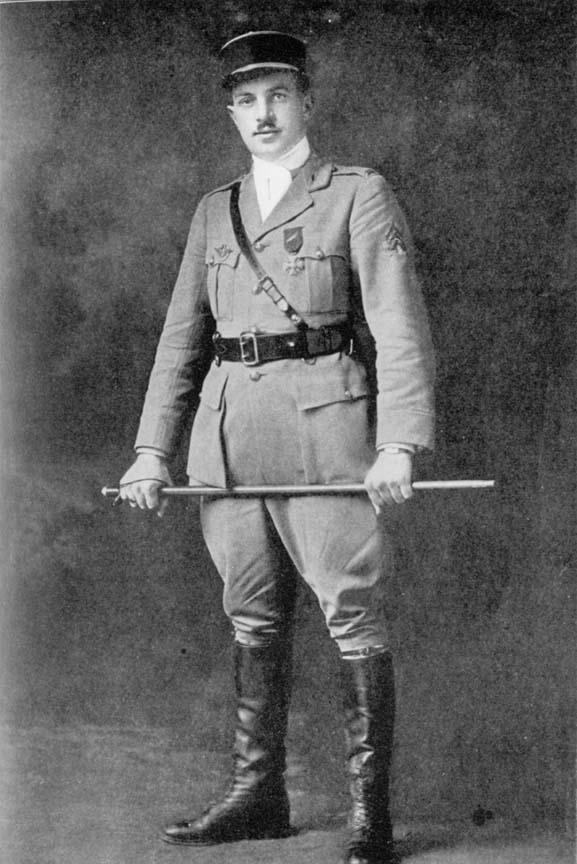
SON of Frederick D. and Grace M. (Steele) Parsons, of Springfield, Mass.; was born Sept. 24, 1892, at Holyoke, Mass. He was educated in the public schools of Springfield, and at Phillips Exeter Academy.
In Dec., 1915, he sailed overseas to enter the Ambulance Service. While at his first ambulance work at Neuilly-sur-Seine, Jan., 1916, was made Sergeant, and was later given charge of a section of the Ambulance at Mrs. Whitney Warren's Hospital at Juilly, near the Soissons front.
While there he made his application to enter the Aviation Service, and in April, 1916, his papers arrived. He served three days in the Foreign Legion (during which time he took the oath of allegiance to France for the duration of the war). His first training was at Buc where he was made Corporal after three months' work. From there he was transferred to the school at Avord for training in "pursuit flying"; then to Cazaux for machine-gun work; and to Pau for "group flying." About Dec. 8, 1916, he went to Plessis-Belleville for final training, and was there when "demanded" by the Escadrille Lafayette which he joined Jan. 24, 1917.
He was made Sergeant in Feb. and won his first honors --- being cited with two others in the order of the day for having had three aerial combats the day previous.
He brought down his first Hun in Sept., 1917, and was awarded the Croix de Guerre.
From Nov., till Jan., 1918, he was at home on leave, and upon his return, the Lafayette (N 124) being taken over by America, he joined the French 124, but in April was assigned to the Cigognes or "Stork" Escadrille (Spad 3). He was commissioned Sous-Lieutenant in the fall of 1918.
He got most of his enemy machines while with this organization, receiving the silver stork after his third. He has eight officially confirmed enemy planes to his credit.
He has the right to wear the Croix de Guerre with eight palms, the Médaille Militaire, and fourragère, the latter awarded the Escadrille as a group, after winning its 150th plane, and the silver stork.
He also received the Cross of Leopold, the Belgium War Cross, and Medal of the Aero Club of America. He was awarded the William Pynchon Medal by the Publicity Club of Springfield in 1918.
Sept. 4, 1917
Bon pilote de chasse qui exécute avec entrain les missions qui lui sont confiées. Le 4 septembre a attaqué et abattu un avion ennemi en pièces sur Neuilly (1er avion).
Citoyen américain fait preuve depuis deux ans, déjà comme pilote de chasse d'un dévouement absolu, d'une joyeuse bravoure. Le 6 mai 1918 a abattu seul son 2e avion ennemi.
Excellent pilote de chasse a abattu seul le 17 mai 1918 son 3e avion ennemi.
Excellent pilote de chasse, exécute avec intelligence toute mission; a abattu le 19 mai 1918 son 4e avion ennemi.
Pilote très énergique, plein de courage et d'entrain, le 20 mai 1918 a abattu son 5e avion ennemi.
Citoyen américain, pilote d'élite, exécutant avec gaieté les missions les plus ingrates, vient encore le 9 août d'abattre seul son sixième avion ennemi dans des conditions difficiles (dated 5 septembre 1918).
Excellent pilote de chasse remarquable pour son audace bravoure et dévouement, a abattu le 26 septembre 1918 son septième ennemi.
Pilote de chasse exceptionel pour son courage, un vrai modèle pour ses camarades, le 1er octobre 1918 a descendu très bas dans les lignes ennemis et abattu son huitième avion ennemi dans les très durs conditions.
On June 17, 1918, Lieut. Parsons accompanied Lieut. Baylies on his last flight. The latter's swift machine carried him far ahead of his companion, who saw him in combat with four enemy planes before his machine went down over the enemy's lines. It was days before his comrades received the news of Baylies's fate.
Lieut. Parsons avenged his late companion's death by bringing down a Hun machine which approached him camouflaged as a French plane. After a hot fight, Parsons gained a position above his adversary and after firing a burst of not over ten shots, the enemy dropped like a stone from a high altitude.
During the month of Oct., 1918, being ill, he was given a permission and was at Biarritz when the Armistice was signed. He has since returned to America.

NORMAN PRINCE was the younger of the two sons of Frederick Henry and Abigail (Norman) Prince and the grandson of Frederick Q. Prince, a former Mayor of Boston, and of George H. Norman, of Newport, R.I. Born Aug. 31, 1887, at Prides Crossing, Mass., he received his early education under private tutors in this country and in Europe and completed his preparation for college at Groton. He was graduated at Harvard College in the class of 1908, receiving a cum laude with his degree of Bachelor of Arts. He received a degree of Bachelor of Laws from the Harvard Law School three years later and was admitted to the bar, beginning the practice of his profession in Chicago. He devoted much of his time to the study and practice of aviation at a time when flying was popularly regarded as a mere sport rather than a practical utility in this country.
At the outbreak of the World War, in 1914, he offered his services to France as a volunteer aviator, taking passage abroad in Dec. of that year, and receiving his preliminary training at the Military Aviation School at Pau. Having won a certificate of proficiency in four months, he distinguished himself by his skill and bravery in many air raids against the enemy, winning at once the confidence and admiration of his commander and comrades.
At the beginning of his active service he conceived the idea of bringing the American aviators, together with some of those of the Foreign Legion, into a single squadron, not only that the Americans might be associated in closer comradeship, but also that their achievements might become more distinctive and thus redound to the glory of their own country as well as to that of the Allies. With this end in view he was primarily and chiefly instrumental in organizing the Lafayette Escadrille. Originally carrying the Tricolor, this famous squadron subsequently had the distinction of carrying the first American flag that appeared on any of the battle-fields of the World War, after the United States became a co-belligerent.
The Lafayette Escadrille became famous for skill and daring 'n the battle-fronts and Prince soon achieved the ranks of Sergent, Adjudant, and Lieutenant successively, and was actively engaged in 122 aerial engagements in northern France. He was credited officially with five Boches brought down in battle, not to mention four others not officially recorded.
On Oct. 12, 1916, while descending from an aerial raid on Oberndorff, his plane struck an aerial cable near Luxeuil, Alsace. In the collision his machine was overturned and wrecked, Prince receiving injuries from which he died at the neighboring Gérardmer Hospital three days subsequently.
He was given all the honors of military funeral, which was held on the Luxeuil aviation field and was attended by a large representation of the Allied military divisions. The body was borne to a neighboring chapel, there to rest until the end of the war in accordance with the military regulations regarding the temporary disposition of those dying at the battle-fronts.
Citations Croix de Guerre, with two stars, and four palms First Star, won for being cited in L'Ordre du Jour of his Division for having been the only one of twenty-five aviators to reach Douai in 1915.
First Palm, won for being cited in L'Ordre du Jour of the French Army for having brought down an enemy avion.
Second Palm, for having brought down two enemy avions on the same day at the same time receiving the
Third Palm, cited in L'Ordre du Jour for having brought down a fourth enemy avion, and for meritorious service in a raid on the Mauser Ammunition Works at Oberndorff --- at the same time receiving the Médaille Militaire.
He was also awarded the Croix de la Légion d'Honneur.
In writing of the founding of the Lafayette Escadrille, Elliot C. Cowdin, one of its original members, has said:
Norman Prince had spent many years and made many friends in France, and felt it his privilege and duty to serve her in the hour of need. He conceived the idea of forming an aero squadron composed exclusively of Americans, to join the French Army. Prince arrived in Paris early in January, 1915. He consulted with his French friends, of whom Lieut. Jacques de Lesseps was the most enthusiastic, and was instrumental in getting the French War Department to listen to Prince's ideas and plans. He solicited the aid of several prominent Americans then residing in Paris, but they all declined to be identified in any way with the scheme, so that Prince had to fight his own battle single-handed. The French Government told him they could not use his services, as Aviation was so popular among the soldiers that they had more aviators than they could use.
Prince was not to be denied, and kept plodding along on his own account, calling on such of his French friends as might be influential, trying to convince them that it was essential and would be most beneficial to France if she would accept an American squadron.
The only men upon whom he depended for pilots were Frazier Curtis, then flying in England, and Norman Read, then in Paris, and doing what he could to help Prince. The situation looked hopeless, but Prince was ever determined .... He finally obtained permission to form a squadron of six pilots, all to he Americans, with previous flying experience.
Cowdin has described the various discouragements through which the founders of the Squadron passed before perfecting their organization. Accidents reduced their number after the quota was complete. Curtis had two bad smash-ups and was forced to withdraw; Andrew Ruel (another of the group) was injured; and after some months Prince and Cowdin found themselves alone, with their hopes sadly dimmed. At last, however, assisted by Dr. Gros, at Paris, with M. de Sillac and Mr. Frederick Allen cooperating, the project was carried through. Cowdin writes:
Early in May (1916) we were all mobilized at the Alsatian front as the Lafayette Squadron, with French officers, Capt. Thénault and Lieut. de Laage, in command. The original members, besides those officers, were Norman Prince, William Thaw, Victor Chapman, and Kiffin Rockwell, of the Foreign Legion; James McConnell, who had already done good work in the American Ambulance before joining the French Aviation; Bert Hall, and myself. We remained but a short time in Alsace and were then transferred to the Verdun sector, where we were joined by such men as Lufbery, Masson, Clyde Balsley (who was severely wounded the first week), Dudley Hill, Lawrence Rumsey, and Chouteau Johnson.
The Squadron increased steadily, so that at the end of the following year a total of 325 men had joined it, counting those training in various schools. Of this number more than twenty-five gave their lives, and there were a number wounded and taken prisoner.
Norman Prince fortunately lived long enough to see his long-cherished ideas successfully carried out, and the Lafayette Squadron at the height of its success.
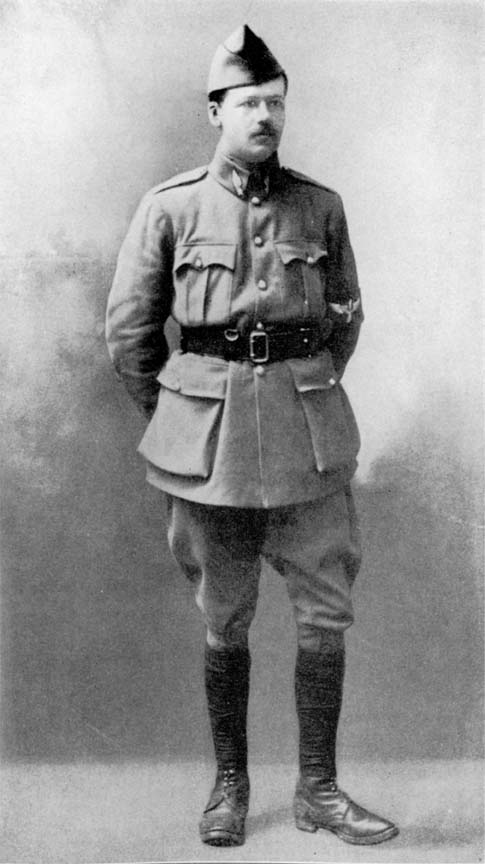
SON of Frederick Henry and Abigail (Norman) Prince; was born in Boston, on April 10, 1885. He was educated at Groton School and at Harvard College.
With his younger brother Norman, he volunteered for service before the U.S. entered the war, and on the latter's return from his Christmas furlough at home in 1915, sailed with him for France early in 1916. He enlisted in the French Army, Jan. 29, 1916; brevetted a pilot, May 21, 1916, at Bue; returned to Pau for training on Morane and Nieuport, was made a Brigadier; continued training at the Aerial Gunnery School at Cazaux, returning to Pau for the D.A.C. (Division d'Application de Combat); then to the G.D.E., where he waited for a place in Escadrille N 124 (Lafayette), joining on his brother's death Oct. 15, 1916. At the end of Feb. he was ordered to Pau as monitor, where he was made Maréchal des Logis; after six weeks he was returned to the Escadrille, then at Ham, where after a few days he was ordered back to Washington, D.C. In Sept., 1917, he was sent back to France to G.D.E. and from there ordered to report to the Chief of Liaison attached to the 26th Division, at Neuchâteau. There he remained until the middle of Jan., 1918, having been promoted to Adjudant. He was then sent to Le Bourget as convoyer, remaining until honorably discharged in April, 1918, to enter the U.S. Army.
During his service he took part in 22 aerial engagements.
Married, July 14, 1917, to Mary Elizabeth Harding, daughter of Hon. William P. G. Harding, of the Federal Reserve Board, Washington.
Brother in Service---
Norman Prince, Sous-Lieutenant, Lafayette Escadrille; killed in action, Oct. 15, 1916.

CAPTAIN, A.S.A., U.S.A.; ESCADRILLE LAFAYETTE (SPAD 14); FRENCH SQUADRON, SPAD 112; ONE HUNDRED THIRD PURSUIT SQUADRON, U.S.A., FLIGHT COMMANDER, NINETY-FOURTH PURSUIT SQUADRON
SON of Arthur Wright and Ella (Young) Hall, of Colfax, Ia.; was born in Colfax, April 92, 1887. He attended the Colfax High School; Grinnell College, from which he graduated in 1908; and the University of Chicago. For five years he made his home in Boston.
In the spring of 1914 he went to England, intending to spend a year in traveling and cycling, but on the outbreak of the war he enlisted with the 9th Battalion, Royal Fusiliers (British), London, on Aug. 18, 1914.
He spent the following winter in Aldershot and Folkestone drilling, and went on active duty in France with the 9th Royal Fusiliers on May 30, 1915. Throughout the summer he was in the trenches of Flanders, at Messines, Ploegsteert Wood, Loos, and Armentières. in Sept., 1915, he narrowly escaped death by stepping into a dugout just a moment previous to the explosion of a large German shell which killed seven men in his squad. He was shortly promoted to be Lance Corporal in charge of a machine-gun section, and was starting for an officers' training camp on Dec. 1, 1915, when he was presented with his discharge from the British Army, which, unknown to him, his friends in Boston had been active in securing for him because of the illness of his father in Colfax, Ta. He returned to the United States immediately, visited Iowa, found his father much improved, and settled in Boston where he spent the winter lecturing and working on his book "Kitchener's Mob." In June, 1916, he attended the Officers' Training Camp at Plattsburg, N.Y.
He returned to England in July, intending to continue literary work, but instead enlisted in the French Aviation Service on Oct. 13, 1916. He trained in the French aviation schools at Bue (Seine-et-Oise), Avord (Cher), and Le Plessis-Belleville (Oise), and was assigned to the Lafayette Escadrille. On June 26, 1917, he had an encounter with seven German airplanes, was shot through the shoulder and lungs, and fell 12,000 feet to what seemed certain death. But fortunately he was picked up alive and taken to a hospital near Paris, where he soon recovered. Reports of his death reached America, but he wrote from the hospital at Neuilly to a friend that he was alive.
When he left the hospital on Sept. 22, 1917, he returned to the front as a pilot in the French Squadron, Spad 112. A fortnight later he was transferred to his old unit, the Lafayette Escadrille, with which he served, with the rank of Sergeant, until his transfer to the United States Air Service. He was commissioned Captain, A.S.A., U.S.A., on Jan. 26, 1918, and was kept on active duty with the Escadrille Lafayette which had just become the 103d Pursuit Squadron, U.S.A.S. On March 29, 1918, he was assigned to the 94th Pursuit Squadron as Flight Commander. He was shot down in combat on May 7, 1918, near Pagny-sur-Moselle, back of the German lines. He tells the story of this encounter in his book, "High Adventure."
Again it was reported that he was dead. But on May 8, a German airman flew over the Allied lines, and dropped a note saying that Hall was safe.
Capt. Hall returned to America shortly after, and on March 10, 1919, was discharged from the service at Garden City, N.Y.
Citations Médaille Militaire HALL, JAMES NORMAN (active de l'Escadrille N 124) Réformé, après avoir été mitrailleur dans une armée Alliée, s'est engagé comme pilote à l'Escadrille La Fayette. Dès son arrivée a montré un courage splendide et le plus pur esprit de sacrifice. Le 26 juin 1917 a foncé seul sur sept avions ennemis, faisant l'admiration des témoins du combat, blessé grièvement dans la lutte a réussit à ramener son appareil dans nos lignes.
(Pour prendre rang du 29 juin 1917)
La présente nomination comporte l'attributon de la
Croix de Guerre avec palme Signé: MAISTRE
Médaille Militaire Monsieur HALL, JAMES, Caporal pilote (active) à l'Escadrille N 124, est informé que par arrêté ministériel du 13 septembre, à 1917, rendu en application du décret du 13 août 1914, la MÉDAILLE MILITAIRE lui a été concédée.
Il aura droit an port l'insigné de la décoration et aux arrérages attachés à celle-ci à compter du vingt-neuf juin 1917.
La présente concession sera régularisée ultérieurement par une loi spéciale.
Paris, le 29 octobre 1917
Pour le Président du Conseil
Ministre de la Guerre, et par son Ordre
Le Lieut. Colonel, S/Chef du CabinetSigné: F. JODINOT
Au G.Q. le 21 janvier 1918
Le Général Commandant la IVe Armée cite à l'Ordre de l'Armée:
Excellent Pilote de chasse, déjà blessé en combat aérien, revenu au front, y fait preuve des plus belles qualités de hardiesse et d'allant. Le 1 janvier 1918, a descendu un monoplace ennemi dont une aile s'est détachée et est tombée dans nos lignes.
Le Général Commandant le IV' Armée
Signé: GOURAIJD
le 4 avril 1918
Le Général Commandant la IVe Armée cite à l'Ordre de l'Armée,
Capitaine HALL, JAMES NORMAN, de l'Escadrille Lafayette Pilote d'une grande bravoure, qui livre journellement de nombreux combats. A abbatu deux avions ennemis.
Le Général Commandant le IV' Armée
Signé: GOURAIJD
D.S.C. April 10, 1918
G.H.Q. American Expeditionary Forces
The Commander-in-Chief has awarded the Distinguished Service Cross to James Norman Hall, Captain, Air Service, Flight Commander 103d Aero Squadron. On March 26, 1918, while leading a patrol of three, he attacked a group of five enemy fighters and three enemy two-seaters, himself destroying one and forcing down two others which were very probably destroyed, the fight lasting more than twenty minutes.
By Command of General Pershing:
Signed: FRANK C. BURNETT
Adjutant General
Capt. Hall has also been awarded the Croix de la Légion d'Honneur.
le 9 mai 1918
Le Général Commandant la VIIIe Armée, cite à l'Ordre de l'Armée
Capitaine HALL, JAMES NORMAN, à pilote à l'escadrille américaine, 94.
Brilliant pilote de chasse, modèle de courage et d'entrain qui a abattu récemment un avion ennemi, a trouvé une mort glorieuse dans un combat contre quatre monoplaces dont un a été descendu en flammes.
Le Général Commandant la VIIIe Armée
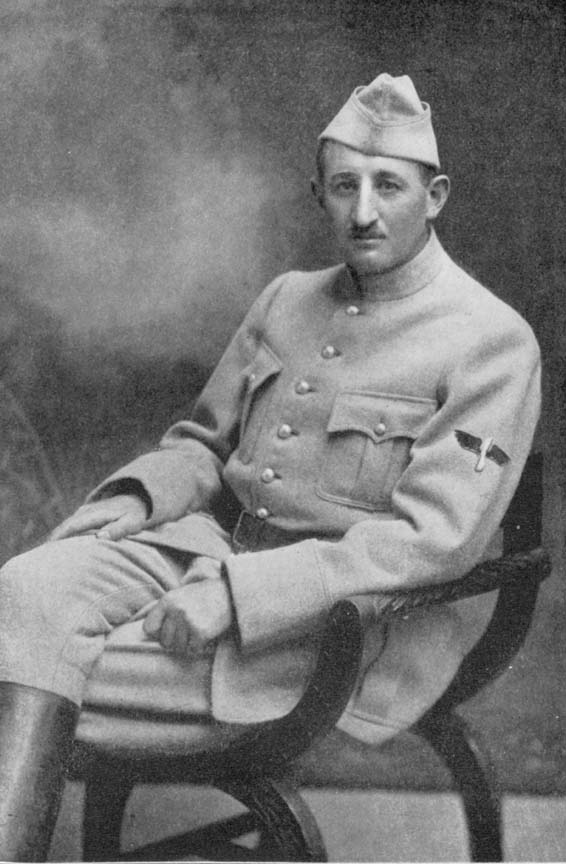
SON of Greely Stevenson and Harriet (Appleton) Curtis; was born in Boston, July 18, 1876. He attended Mrs. Shaw's, and J. P. Hopkinson's private schools, and graduated (cum laude) from Harvard College in the class of 1898 (A.M. '99). He played on his class football team and on the Harvard second eleven. He was married June 16, 1909, to Gladys Margaret Roper.
In Sept., 1914, Curtis sailed for England, where he tried to enlist in the Air Service. Being rejected on account of his age and nationality, he returned to the U.S. hoping to take back to Europe a Burgess-Dunne seaplane, which might be of assistance in his next application. At Marblehead he met Norman Prince and discussed with him the idea of creating an American Escadrille in the French Army. Returning to England he tried again unsuccessfully to enter the British service. In Feb. he went to Paris, and with Prince organized the American Escadrille, later called the Lafayette.
Curtis trained with the Escadrille at Pau, and later at the Camp d'Avord, until disabled by two accidents; his machine catching fire at about 9,000 feet, followed five days later by an axle breaking in two places on landing. After a week in the hospital he was given 45 days' sick-leave. At the end of his furlough he applied to be transferred from a bombing-machine, on which he had been hurt, to a fighting-machine. In answer to this request the French War Office gave him an honorable discharge as unfit for further flying, on Aug. 8, 1915.
After four months' rest in England, he returned to the U.S. and in March, 1916, organized the Harvard Flying Corps, but his health again broke down and he had to give up his work and go to California to recuperate.
It is believed that Curtis was the first American pilot to go over to Europe to offer his services to the Allied Air Force, having sailed from Boston on the Arabic, Sept. 2, 1914.
Frazier Curtis's father, Greely S. Curtis, organized and commanded the 1st Mass. Cavalry in the Civil War. His grandfather served aboard the U.S.S. Chesapeake and U.S.S. Constitution in the War of 1812, and his great-grandfather was one of the "Boston Tea Party."
The following letter of appreciation was sent to Curtis by his French Commander:
MON CHER CURTIS:
Vos deux lettres, ainsi que votre résiliation d'engagement me sont arrivées, et j'ai fait part de cette dernière au ministère. Nous avons bien regrettés que votre état de santé ne vous permette pas de continuer votre entraînement et vous empêche ainsi de devenir le hardi pilote que vous promettiez d'être, d'après vos excellents et rapides progrès à l'école d'aviation d'Avord.
Sans ce malencontreux accident, au cours de vos épreuves du Brevet Militaire, vous auriez en 48 heures, terminé ce B.M. Vous auriez ainsi complété une brilliante escadrille avec vos camarades venus en même que vous et qui se sont également fait remarquer pour leurs qualités de sangfroid et d'énergie.
Soyez certain, mon cher Curtis, que nous garderons le meilleur souvenir de vous et de vos charmants camarades, et croyez bien, je vous prie, à l'assurance de mes meilleurs sentiments.
Signé: HUSSIGNY
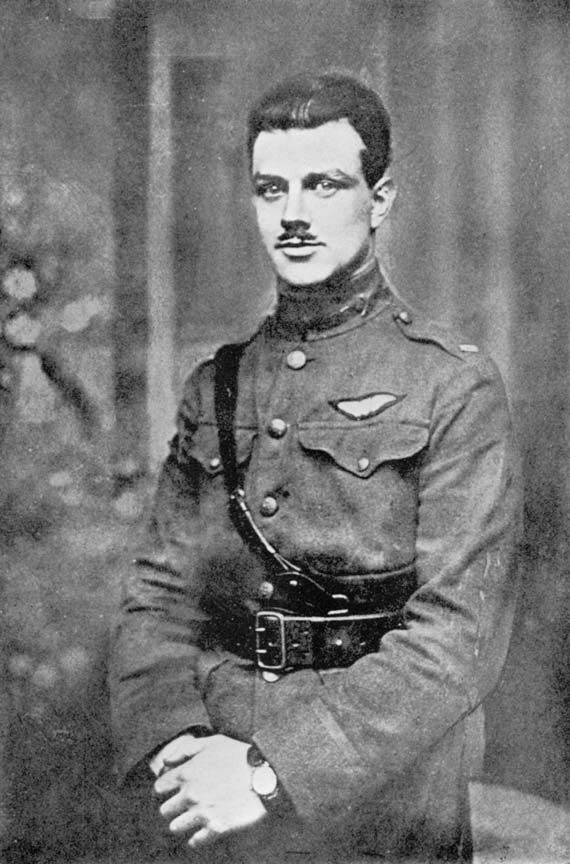
LAFAYETTE ESCADRILLE, FIRST LIEUTENANT, A.S., U.S.A., ONE HUNDRED THIRD AERO SQUADRON, THIRD PURSUIT GROUP
SON of Charles H. and Anne (Mainwaring) Dolan; was born at Boston, Mass., Jan. 29, 1895. He graduated from Mechanic Arts High School, where he was secretary and treasurer of his class; studied electrical engineering for one and a half years at Mass. Institute of Technology. Chief inspector of a munition works in England for one year. Installing engineer in France for Sperry Gyroscope Company, 1915-16. Joined French Air Service, Aug., 1916, and assigned to Lafayette Escadrille.
Lieut. Dolan has given the following summary of service, which contains an admirable outline of the activities of the Escadrille:
I joined the French Foreign Legion as a 2d-class soldier in Aug., 1916. I immediately transferred to the Air Service, was sent to the old Blériot School at Buc on the hills surrounding Versailles. I took preliminary instruction, and on the moving of the school went with it to Avord. I got my license and went through the School of Perfection work on Nieuports there. From Avord I went to Pau, Basses Pyrénées, to the School of Acrobatics and Combat, where I took my final training before going into reserve at the front. I was in reserve about ten days at G.D.E. at Plessis-Belleville, near Paris, when I was ordered to join the Lafayette Escadrille N 124 at Ham. On the Somme, James MacConnell, Roland Hoskier, and Genêt were killed. Our sector on this front was from Moy to Anizy-le-Chàteau, during the great German retreat in 1916.
From there we went to the Aisne, and from the Aisne to Dunkirk (St.-Pol). But because of very bad weather, we did very little flying in this sector which ran from the sea to Armentières. We were then ordered to Verdun, where we lost Willis as a prisoner, and MacMonagle killed. The Squadron was here cited for the first time. After this attack the group of which the Squadron was a part was ordered to Chaudun to patrol the Chemin des Dames from Coranne to La Fère. The battle of Chemin des Dames was fought in a drizzle and fog and none of us flew over 200 feet. Campbell was killed in this battle.
From here we were ordered, in the middle of winter on six hours' notice, to go to Champagne, and in anticipation of a German winter attack, which never occurred. We spent the winter practically on the same spot that Attila, "King of the Huns," occupied in the year 451 when he overran the Franks, between the towns of Le Cheppe and La Noblette. Our sector which we patrolled here was from Reims to the Forest of Argonne.
While here Edward Laughlin and Stuart Walcott, American boys in a French Squadron in our group, were killed. It was here in Champagne that we transferred to the American Expeditionary Forces and were taken over as an American unit known as the 103d Aero Pursuit Squadron, under command of Major William Thaw, Nov., 1918, and I was made Engineer Officer in addition to my flying duties. As such, we continued with American personnel to operate under the direction of the French, and moved shortly after to Fismes, where we were signally honored by the French by being given the sector from Reims to Noyon --- the longest sector given to a pursuit squadron --- to patrol, being the only pursuit squadron on a front of 65 miles; and at that we carried the fight into the enemy's country, because of the German concentration on the Somme where all the Allied Aviation was also concentrated.
In the early part of June we were ordered north to Dunkirk, and had our aerodrome on the border of Belgium at Leffrinckoucke. While here we acted in unison with a French photo squadron, which did some of the most wonderful aerial photography of the war. We also acted with the French Army of the North and the Northeast, at the battle of Mont Kemmel.
We were again cited in the Order of the Army and were granted the privilege of wearing the fourragère and the colors of the Croix de Guerre.
Because of extensive bombing we had to move our field to another site southwest of Dunkirk near the town of Steene. The sector we patrolled was from the sea to the Forest of Nieppe, including the Ypres salient, and as far south, sometimes, as Béthune.
The first of July we were ordered to join the American Army, 2d Pursuit Group, at Toul, in the St.-Mihiel sector, which we patrolled from St.-Mihiel to Bey.
Just before the battle of St.-Mihiel, while in this sector, Major Thaw was given command of the 3d Pursuit Group, Capt. Robert Rockwell took command of the old Lafayette Squadron --- now the 103d --- and as the 3d Pursuit Group we participated in the battle of the First American Army. We were felicitated for our work and lost very few men.
We moved with the First Army when they moved up in the Argonne, and between the Argonne and the Meuse patrolled the Verdun salient from St.-Mihiel to Argonne.
Our aerodrome at this time was at Lisle-en-Barrois. It was on Oct. 16, 1918, that I was ordered home to report to the Office of the Director of Military Aeronautics, Washington. D.C., to be used in an advisory capacity on pursuit work; and with my chum, Major David McK. Peterson, went to Carlstrom and Dorr Fields. Arcadia, Fla., where the most advanced pursuit and aerial gunnery schools in the country were. There I was put on the Control Board and also made Engineer Officer at Carlstrom Field. After Major Peterson's death. I was transferred to the O.D.A.S. Information Group, Washington, D.C., where I now am.

SERGEANT, FOREIGN LEGION, AND ESCADRILLE LAFAYETTE, N 124, GROUP 13
SON of Joseph S. and Mary C. Bigelow; was born at Boston, March 18, 1894. He graduated from Groton in 1911, and from Harvard College in 1915. He attended the Plattsburg Training Camp in 1915, and April 13, 1916, enlisted in the Foreign Legion at Paris, France. In June he entered the Air Service and was trained at Dijon, Buc, Avord, Pau, Cazaux, and Plessis-Belleville; he received his Brevet as Military Aviator on Sept. 7, 1916, and on Oct. 18, he was brevetted as Pilote Aviateur No. 4651. He was attached to the Escadrille Lafayette N 102, and later to N 124. On April 28, 1917, he was detailed with four others to act as garde d'honneur chosen to represent the Escadrille Lafayette, at the ceremonies performed at the monument of Lafayette. On June 21 he had a miraculous escape from five enemy planes which attacked while he was protecting French machines engaged in photographing the enemy's position. He landed safely, as did the photographers, a large hole in the wing of his machine being the only casualty. On June 24 and June 30 he had two successful engagements with enemy planes; on June 25 he was mentioned in the official report on American flyers. On Aug. 22 he was attacked by several German planes, but escaped unhurt, and on Aug. 23, being attacked by eight German flyers, his machine was crippled and he was wounded about the head and face. On Sept. 14, 1917, he was officially cited in Army orders and shortly afterwards decorated with the Croix de Guerre.
Citation Sergeant Bigelow, an American volunteer pilot, engaged six Germans on Aug. 22, while protecting a bombing squadron. He was slightly wounded, but repelled the enemy.
In Jan., 1918, he was honorably discharged from Hospital No. 6, being pronounced physically unfit for further active service.
Brothers in Service ---
Joseph S. Bigelow, Jr., American Ambulance Field Service; 1st Lieut., U.S.A., Aviation Signal Corps, A.E.F.
Arthur G. Bigelow, American Ambulance Field Service; Private, U.S.A., A.E.F.
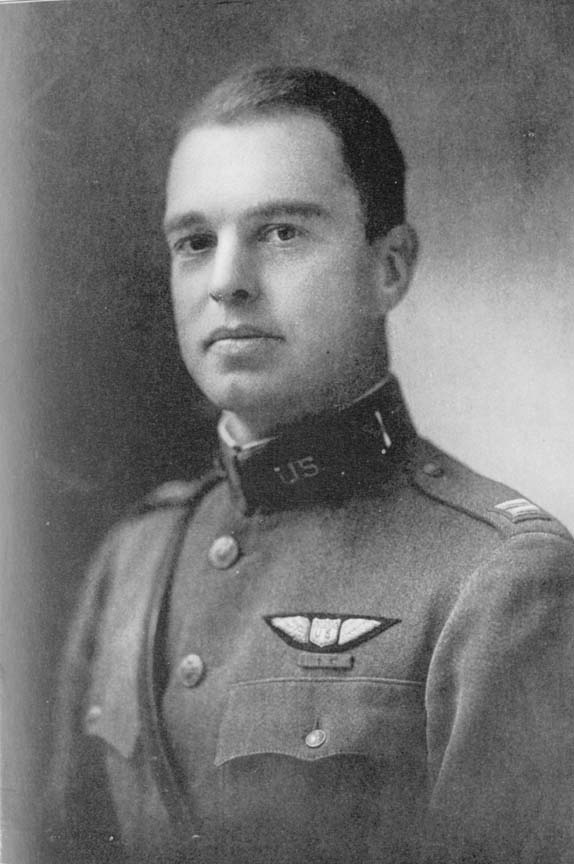
SON of Wallace D. and Josephine (Hastings) Lovell; was born at Newton, Mass., Sept. 9, 1884. He was educated at Milton Academy, Newton High School, the Stone School, Boston, and Harvard College, A.B. 1907. He was a member of the 1st Corps Cadets, M.V.M.
In Feb., 1915, he enlisted with the American Ambulance Field Service in France, and was made second in command of Sec. 3, which did remarkable service in Alsace. He received the Croix de Guerre for his work there. In 1916 he transferred to Aviation, and joined the Lafayette Escadrille, with which he did such notable service as to win the Croix de Guerre of Aviation, and the Médaille d'Argent of the Aero Club of France. He was credited with two German planes officially and with four unofficially. While in the American Service he was in charge of assigning personnel for the Air Service Squadrons at Colombey-les-Belles. In Aug., 1918, he came to the United States for purposes of instruction. In Jan., 1919, he resigned at Washington, D.C.
Capt. Lovell was married to Hélène du Bouchet on April 15, 1918, and has taken up his residence in Paris.
From Lieut. Lovell's Ambulance Service citation one reads:
Has always given proof of a noteworthy spirit and constantly set the example of courage to the other drivers.
Brothers in Service --
Endicott Remington Lovell, Capt., U.S.A., 301st Reg't, F.A., 76th Division.
Philip Gray Lovell, 1st Lieut., U.S.A., 101st Reg't, F.A., 26th Division.
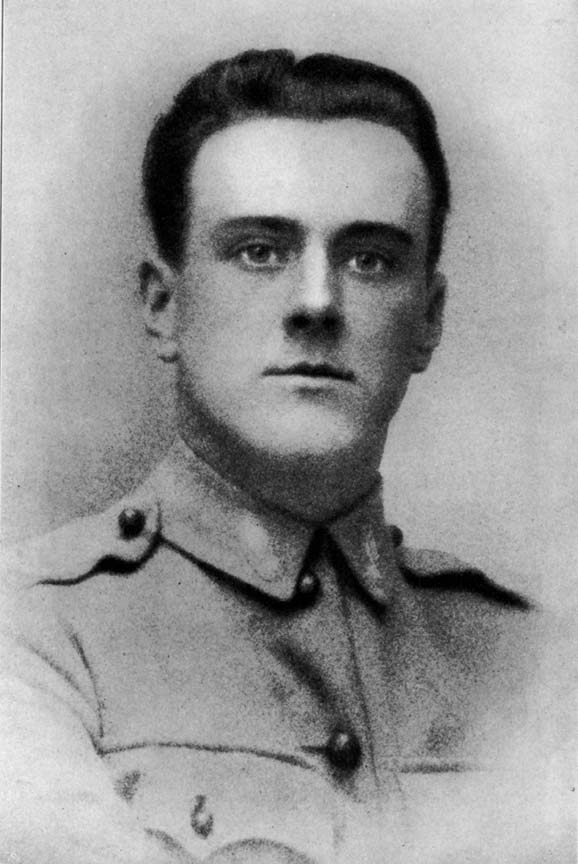
SON of Walter Henry and Abbie Harris (Razee) Stearns; was born at Pawtucket, R.I., Jan. 4, 1896. He was educated at Lake Placid School and at the University of Virginia, class of 1918.
On Jan. 8, 1917, he enlisted in the American Ambulance Corps for two months. He then transferred through the Foreign Legion to the Aviation Service of the French Army. He was sent to Camp Avord, and presently became a member of the Lafayette Flying Corps. He was brevetted at Jévisy and had intensive flying at Pau, and Plessis-Belleville.
During his training at Jévisy, Lieut. Stearns wrote to his family on June 23, 1917, as follows:
We are a few miles out of Belfort which I like immensely and which gets bombed often. The German machines fly over our airdrome quite frequently, and then the anti-aircraft guns get busy and we have quite a time. My work consists of escorting bombing-planes, patrolling, and hunting. I am given my regular machine to-morrow, which I regret to say is a type out of vogue and which enables the crafty Hun to make circles around me. However, our entire escadrille changes to Spads in ten days, and there is no better machine out than that ..... aviation is a great game which requires perfection in all a man's faculties, and I am trying to keep myself in the best physical shape possible, one false step might mean the end .... I have become a fatalist as every aviator does, and am prepared to accept whatever awaits me.
For two months and a half, late in 1917, he flew at the front, his first flight over the German lines being as a member of Escadrille 150, Groupe de Combat 16. On one occasion while travelling over the lines alone, three German planes attacked him, but he eluded them and returned in safety. He was located in the Alsace-Lorraine section. In May, 1918, he received furlough from France, and then entered the U.S. Service, of the Marine Flying Corps. He was sent to Florida as 2d Lieut. He was honorably discharged on account of nervous breakdown.
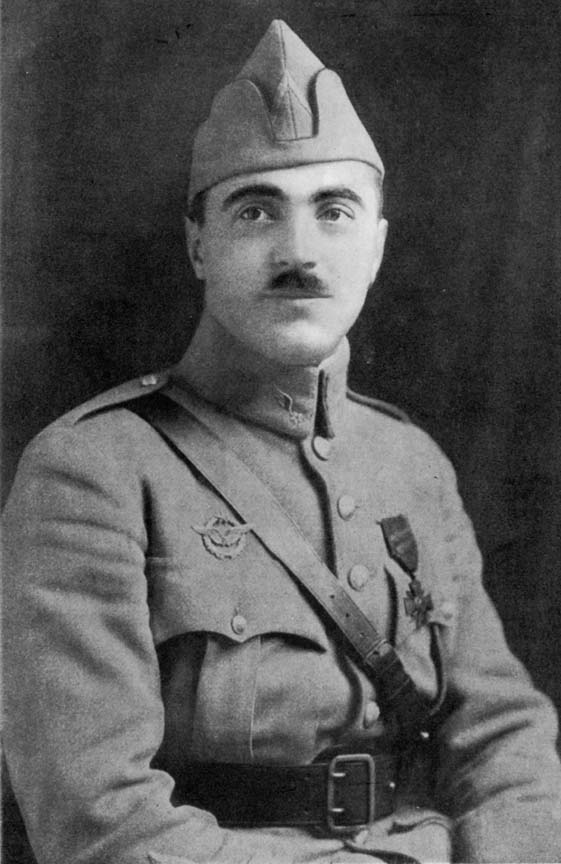
SON of Simeon L. and Clara (Pratt) Rheno; was born in Vineyard Haven, Mass., on Feb. 26, 1895. He was educated in the public schools of Vineyard Haven. In the latter part of 1916, he abandoned the automobile business in which he was engaged in New York City, sailed for France, and enlisted in the Foreign Legion, in Paris, on Dec. 19, 1916. In Jan., 1917, he applied for transfer to the Aviation Service, and in Feb. started his training at the École d'Aviation Militaire at Bue, near Versailles, continuing at Pau and at Avord. On May 10, 1917, he received the French Military License. After perfection air work in the one-man combat machine known as the Fighting Chasse, the fastest of fighting machines in use at the front, he was ordered to the war zone on July 1, 1917. He was sent to Verdun on July 16 to join fighting Squadron N 80 of the Groupe de Combat. On his arrival at Verdun, he found awaiting him notice of 21 days' leave of absence in the United States, but did not accept it, because he did not wish to return home without having seen active service. It was at this time that he made the wager that he would down a German machine within a month. This he accomplished on Aug. 18, when in a fighting chasse with one gun, he downed a two-man German Albatross carrying four guns, after an 11-minute combat. For this engagement he was cited and decorated. On this occasion Rheno received the following letter from Dr. Edmond Gros, dated Aug. 23, 1917:
Bravo! I think you hold the record for shortness of time you were at the front before bringing down your Boche. When you get your citation send me a certified copy and I'll see if we can give you a money prize.
The Associated Press has heard of your exploit and I have no doubt that you will be a hero in every aviation camp of America very shortly--- all prospective aviators in the United States will envy you.
On Sept. 6, he won his second combat, defeating a one-man German Albatross scout machine in a one-minute fight. For this exploit, when still a pilot, without higher title, he won the Croix de Guerre as a member of the Lafayette Squadron, French Aviation Corps. On Sept. 12, 1917, he defeated his third machine, a one-man German Albatross, for which he received official confirmation. He also brought down seven other machines which fell too far within German territory for confirmation by the French observation posts, but which were confirmed by comrades flying with him, a confirmation not considered official.
On Sept. 18, 1917, he left for Paris to secure his passport for the leave granted him in America in the first days of his stay at the front. He received his passport Sept. 19, 1917, and revisited the United States the following Nov. wearing the second palm on his Croix de Guerre with a third on its way. On his return to the front, he was transferred to the American Forces with the commission of a 1st Lieut.
He died at the American Hospital at Neuilly-sur-Seine, on Oct. 10, 1918, of pneumonia, and was buried in the New Cemetery in Neuilly, France.
14th Fighting Group
Escadrille N 80 Postal District, no. 8, August 31, 1917
No. 4141.Captain GLAIZE, Commander of Escadrille N 80, certifies that Corporal WALTER DAVIS RHENO, a Pilot in the Escadrille, brought down a German biplane "Albatross" after twice attacking it, on the 18th of August, 1917, at 7.40 P.M. Corporal RHENO was piloting the "Spad" No. 1298, Type S VII, 140 H.P. Motor.
The Captain Commanding the Escadrille
14th Fighting Group
Escadrille N 80 Postal District, no. 8, Sept. 16, 1917
No. 487.Captain GLAIZE, Commander of Escadrille N 80, certifies that Corporal WALTER DAVIS RHENO, a Pilot in the Escadrille, brought down a German monoplane "Albatross" after once attacking it, on the 6th day of September at 10.10 A.M. Corporal RHENO was piloting the "Spad" No. 1776, Type S VII.
The Captain Commanding the Escadrille
Citation Croix de Guerre 14 Groupe d'Escadrille
de CombatS.P. 8 septembre 1917
Extrait de l'Ordre Général No. 889 Le Général Commandant la IIe Armée à l'ordre de l'Armée:
Le Caporal RHENO, WALTER DAVIS, pilote à l'Escadrille N 80
Très bon pilote américain montre de grandes qualités d'audace et d'entrain; le 18 août a abattu un biplane ennemi qui s'est écrasé dans ses lignes.Signée: Le Commandant de G.C. 14
Brother in Service ---
Winthrop C. Rheno, honorably discharged from the Army at Camp Devens, Oct. 28, 1918.
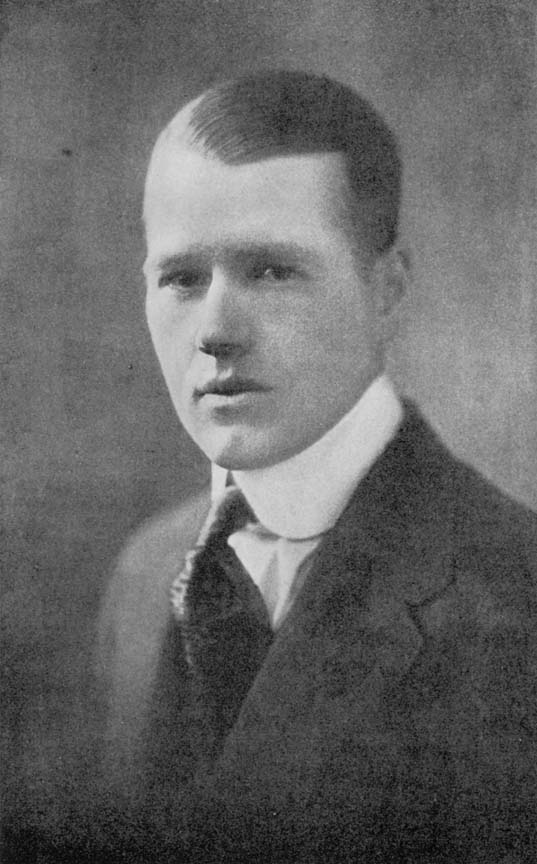
SON of Frank Elmer and Lena Dora (Hoehm) Starrett; was horn in Athol, Mass., on July 16, 1893. He graduated from the Athol High School, from Worcester Academy, Worcester, Mass., and from Brown University. He played football and baseball at Worcester Academy; at Brown, he was manager of the track team, member of the Beta Theta Pi Fraternity, the Camarian and Sphinx Clubs.
He entered the American Ambulance Field Service, Nov. 1, 1916, and served six months in France, in Red Cross Section .5-646, which won the Croix de Guerre, and green and yellow fourragères. He afterward enlisted in the French Aviation Service, and was assigned to the Lafayette Escadrille. He was among the first 200 men to train at Tours, France, in Aug., 1917, a group called the "Stranger Legion," made up of American boys who had volunteered with the French before the United States entered the war. He was detained in the hospital for some time by illness so that he fell behind his class, but on his return from the hospital, he continued his training (on the Caudron G-3 type). In Dec., 1917, as Starrett was making the first lap of the triangle from Tours to Pontleroy, which was part of the trial test, he was first seen by the mechanics at the field, about 500 metres from the ground, heading for the airdrome. Suddenly the plane peeked over and dived for the earth about two kilometres from the hangars, never redressing. Starrett died instantly. He was buried at Tours with full military honors by the French and American officials. Just at the time of his accident he had been planning to return home on a furlough. In a memorial discourse delivered before the students of Brown University some time after his death, the Dean said that Frank Starrett was a man whom all Brown men might well emulate, and whose memory should be ever cherished by the university.
Brother in Service
Arthur H. Starrett, Cadet, A.S.A., U.S.A.; Sergeant, 1st class, in 139th and 32d Aero Squadrons. In service in France for 14 months.

SON of John B. and Myrta (Gale) Willis; was born at Boston, Mass., Feb. 9, 1890. He attended the Newton High School, and graduated from Harvard College, class of 1912. He served in Battery A, M.V.M., 1913-14.
He enlisted in the American Ambulance Field Service in Feb., 1915, and arrived at the western front, with Section , at Pont-à-Mousson, in April, 1915. From Feb. to May he served with the Ambulance at Verdun. He was cited, July 4, 1915, "for rescue of wounded under fire," offensive Bois-le-Prêtre, "Croix de Guerre with Star."
In June, 1915, he enlisted in the Foreign Legion of the French Army, and transferred to 2d Groupe d'Aviation. He was brevetted pilot on Blériot, at Bue. He trained successively at Nieuport Perfectionnement School, at Avord; Machine-Gun School, Cazaux; Combat and Acrobatics, at Pau; Spad, at Plessis-Belleville.
He arrived on the Somme front with the Lafayette Escadrille (N 14), in March, 1917, under Capt. Théraul and Lieut. Thaw. Served during the Somme retreat to the Hindenburg line, March to April, 1917; the offensive of Aisne, April and May, 1917; the Ypres offensive, July and Aug., 1917; Verdun, 1917.
He was awarded the silver medal of Ligue Aéronautique de France, in May, 1917, and recommended for Order of Leopold, by C.O. 13th Groupe de Combat, July, 1917. Proposed for Sous-Lieut. in French Army, July, 1917, and cited for Croix de Guerre with palm, Aug., 1917; he was also recommended for Majority to U.S. Aviation, by Com. Féquant, C.O. 13th Groupe de Combat, Aug., 1917.
On Aug. 18, 1917, Lieut. Willis was shot down behind the enemy lines at Verdun, and was interned in the prison camps of Montmédy, Carlsruhe, Landshut, Gütersloh, reprisal camp Eutin, Bad Stuer, Mecklenburg-Schwerin, Magdenburg, Wurzburg, and Villingen, during 14 months of captivity.
After several attempts, Lieut. Willis, disguised as a German guard, made his escape from the American camp at Villingen on Oct. 4, 1918, in company with Lieut. Isaacs, U.S.N., and Lieut. Puryear, U.S.A. This plan was accomplished by means of an intricate and coordinated plot of many American and Polish officers, electric lights being short-circuited, barbed-wire palisades and cordons of guards being pierced at several points simultaneously. Isaacs and Willis crossed the Black Forest mountains together, travelling at night by means of luminous compasses, and aided by the stars, hiding by day. After a week they arrived at the Rhine frontier of Switzerland, which was crossed by swimming.
On arriving at Paris, Lieut. Willis was awarded the Médaille Militaire, and permitted to return to the Argonne front. Returning to the U.S. in 1919, he was honorably discharged.
Citations Croix de Guerre Citation à l'Ordre du Service de Santé de la 73me Division, N° 19.
Par application du décret du 23 avril 1915, sur la Croix de Guerre, le Médecin Divisionnaire cite à l'ordre du jour du service de santé de la 73me Division ---
Monsieur WILLIS, HAROLD, conducteur à la S.S.A.A. A toujours fait preuve d'un courage et d'une hardiesse dignes des plus grands éloges, notamment pendant l'attaque du 4 juillet; s'offrit pour aller chercher des blessés dans un endroit très périlleux et eut sa voiture criblée d'éclats d'obus.
En campagne le 5 octobre 1915
Signé: D. W. VIELE
Le Médecin Chef
A l'Ordre de l'Armée Ordre du Général Commandant la 2e Armée, No 889 du 10 sept. 1917.
Le Général Commandant la me Armée cite à l'Ordre de l'Armée:
WILLIS, HAROLD BUCKLEY, sergent pilote à l'escadrille N 124 (G.C. 13) (mort en combat): Citoyen américain engagé au service de la France. Véritable modèle pour ses camarades d'escadrille par son courage et sa haute conception du devoir.
A fourni par des reconnaissances de nombreux et utiles renseignements.
Est tombé 18 août au cours d'un combat contre deux avions ennemis qui venaient attaquer des avions de bombardement qu'il escortait.