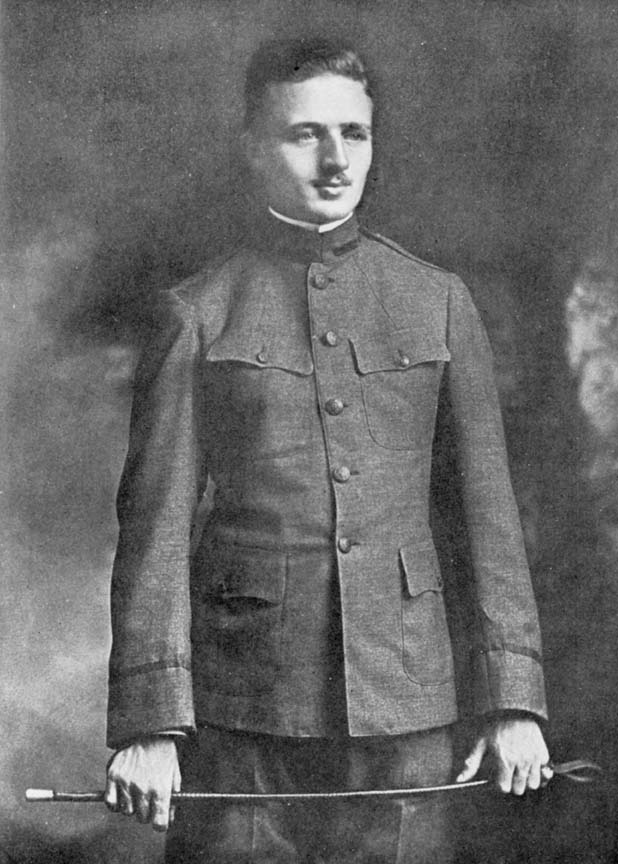
SON of Edward G. and Jane G. (Hooper) Gardiner; was born in Boston, May 14, 1896. He graduated from the Berkshire School, Sheffield, Mass., and entered Harvard College, class of 1919 (A.B. posthumously awarded him). At school he played for three years on the football team, and at college was on the freshman crew squad.
He trained with the Harvard R.O.T.C. and attended the Plattsburg Training Camps in 1916 (one month), and 1917 (three months). On Aug. 15, 1917, he was commissioned 2d Lieut., U.S. Cavalry, and on Aug. 29 reported at Camp Devens, attached to the Field Artillery. He was transferred to the 103d Machine-Gun Bat., 52d Brigade, at Camp Bartlett, on Aug. 31. On Sept. 17 he volunteered to fill a vacancy in Headquarters Det., 51st Artillery Brigade, 26th Division, at Boxford, Mass. He sailed overseas under "confidential orders," on the Finland, as General's Aide, attached to Battery C, and landed at St.-Nazaire on Oct. 5, 1917. During Oct. and Nov. he was attached to the 102d F.A. He was transferred on Dec. 9, 1917, to the Aviation School for Instruction in Observation, at Le Valdahon, remaining there until Jan. 15, 1918, when he was returned to the 102d F.A., and went with them to the front in the Chemin des Dames sector. He was appointed Assistant Instructor in Aerial Observation on March 3, 1918. He was ill with grippe at Base Hospital No. 6 from May 21 to Aug. 3.
On Aug. 16 he was attached to the 50th Aero Squadron, and on Sept. 12 he disappeared in action near Pont-à-Mousson, during the St.-Mihiel offensive. For several months after his death there was great uncertainty as to Lieut. Gardiner's fate, and it was not until May, 1919, that an official report from the American Military Mission in Berlin secured the German record which stated that he had been shot down at Thisnonville, a small town twenty-five kilometres northeast of Pont-à-Mousson. He was buried in the American Cemetery at Thiaucourt, France.
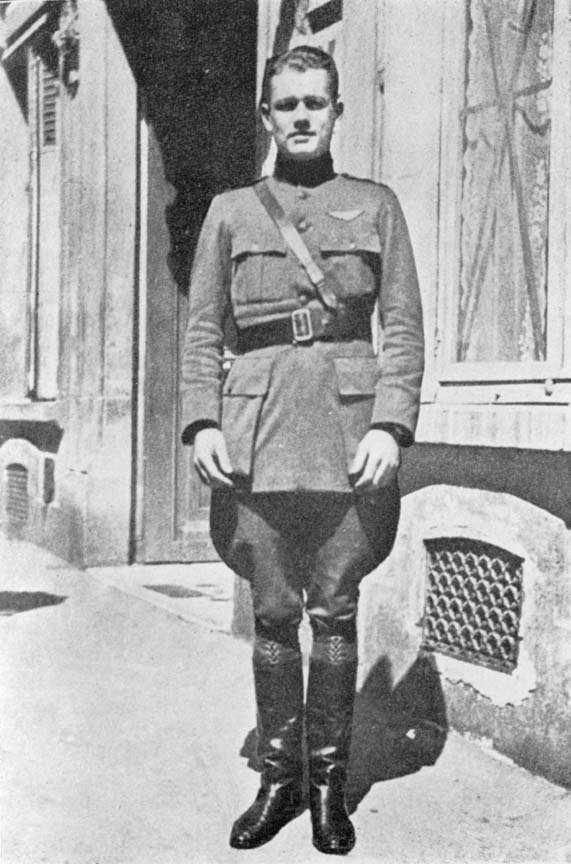
SON of George W. and Eugénie (Stafford) Brown; was born at Newton, Mass., Oct. 25, 1895. He was a graduate of the Newton High School, and entered Dartmouth College in the class of 1920. At college he was captain of the tennis team, and played on the football and hockey teams.
He attended the Plattsburg Training Camp in 1915; and in March, 1917, went overseas to France as driver in the American Ambulance Field Service. He served for five months, chiefly in the vicinity of Verdun, and then joined the Air Service. He trained at Tours and Issoudun, and was commissioned 1st Lieut. in June, 1918.
In at least three instances, before the accident in which his life was sacrificed, Lieut. Brown escaped fatal consequences solely by his remarkable skill as pilot. On one of these occasions his companion was killed. He had almost finished formation flying in the Seventh Class, when he was killed by a fall due to a defect in his machine, on Sept. 8, 1918, while flying a Spad monoplace to the front, in the Arrondissement de Mantes. He was buried at Hargeville, Suresnes, France.

SON of Mr. and Mrs. Josiah Sturgis Pishon; was born at Las Vegas, New Mexico, May 30, 1888. When a boy he removed to West Roxbury, Mass., where he attended the public schools. He graduated from the English High School, Boston, in 1906, as a Franklin Medal scholar, and entered Dartmouth College in the class of 1910, graduating there magna cum laude. He was prominent in athletics, playing on the 'Varsity football team, where he was famous as quarter-back; he also played baseball and hockey, and belonged to the Theta Delta Chi Fraternity and the Casque and Gauntlet Society; was member of Phi Beta Kappa; was permanent secretary of his class. On leaving college he entered the wool business and later associated himself with an advertising firm, with which he was connected at the time of his entry into the U.S Service.
He enlisted Aug. 8, 1917, at the Army Aviation Ground School at Cornell University, Ithaca, N.Y., graduating there Sept. 29, 1917, with special recommendation to the War Department. He sailed overseas Oct. 13, 1917, and trained at Issoudun, France. After four months he was transferred to Foggia, Italy, where he was one of the first detachment of American Aviators to train with Italian officers. He was commissioned 1st Lieut. May 18, 1918, and returned to Issoudun for further training. Later he was sent to St.-Jean-des-Monts for aerial gunnery instruction, and it was there that he was killed in an airplane accident, on Oct. 26, 1918. He was buried in the French Military Cemetery at St.-Jean-des-Monts, Vendée, France.
The following extract is from a letter written by Lieut. Pishon, and found with his papers after his death:
What little I have to give to my country I give without reservation. If there ever was a righteous cause it is ours, and I am proud to have worked and died for it. Pray God this war will be over soon and that it will be the last war. I leave you with a smile on my lips and a heart full of love for you all. God bless you and keep you.
Brother in Service ---
Emmet Pishon, 1st Lieut., U.S. Infantry.
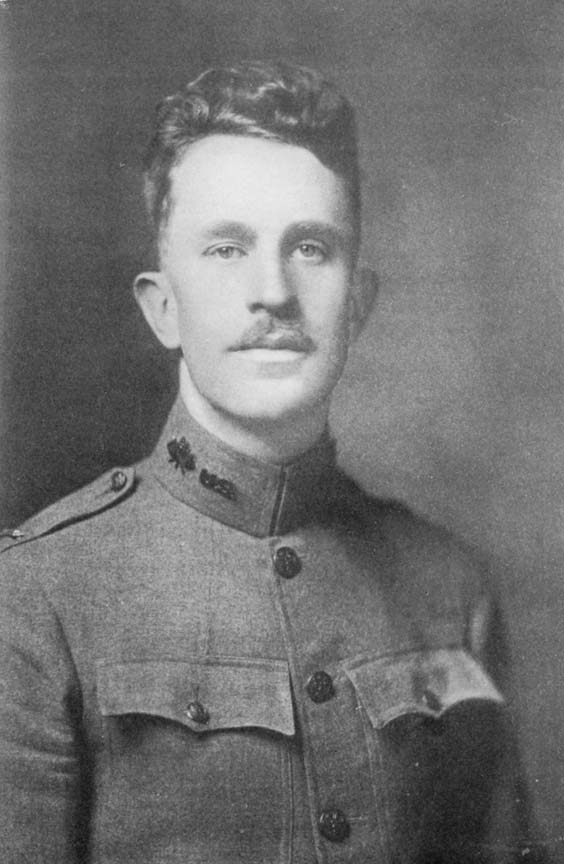
SON of Edward S. and Esther (Martin) Kenneson, of Arlington Heights, Mass.; was born at Somerville, Mass., Nov. 4, 1895. He attended the Somerville High School, graduating in 1913.
In Oct., 1916, he entered the School of Aeronautics, at Newport News, Va., and was given a Pilot's license, Dec. 2, 1916. On Dec. 18 he enlisted in the U.S. (Regular) Army, at Fort Monroe, Va., where he continued his studies until graduation. On April 4, 1917, lie was commissioned 1st Lieut., A.S., Signal Officers' Reserve Corps, and was transferred to Princeton, N.J., as Instructor of Aeronautics. In July, 1917, he was sent to Kelly Field, San Antonio, Tex., where he received overseas orders, sailing Aug. 22, 1917, in command of the 36th Aero Squadron. He was retained as Instructor at the 3d A.I.C., Issoudun, France, for over a year.
In the spring of 1918 he applied to go to the front, and after some advanced training in bombing he was assigned to the 91st Squadron as an observer. On Sept. 2, 1918, he was transferred to the 9th Squadron, and on Sept. 30 was appointed Commander. He saw active service at the front from Oct. 1 to the signing of the Armistice, when he was assigned to the Army of Occupation. On Jan. 9, 1919, he died of broncho-pneumonia and was buried at Suresnes, France.
Lieut. C. E. Kennedy of the 9th Squadron wrote of him:
Lieut. Kenneson joined our Squadron about the middle of Sept., when we were at Amanty, France. It was about the time of the St.-Mihiel drive, and your son accomplished several successful missions over the lines at night, bringing back very important and valuable information.
He was an excellent pilot, capable and courageous. He had more hours in the air than any other man in the Escadrille; I believe his flying time totalled more than one thousand hours. All our observers had absolute confidence in his ability and never had hesitancy in starting out on a mission with him. A splendid pilot, he was equally as capable as a soldier. He was devoted to his duty, performing all his military offices with qualities of unusual judgment and fairness.
Lieut. Kenneson was recommended for promotion to a Captaincy.
Married, June 14, 1917, Mary Aileen Cubberly, of Trenton, N.J.
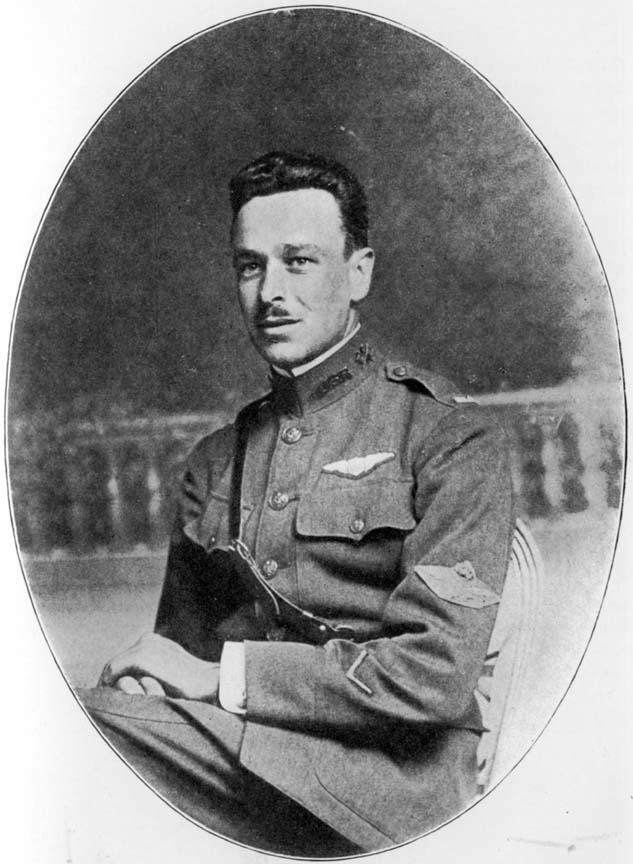
SON of William B. and Lucy A. (Fisk) Herrick; was born at Natick, Mass., July 31, 1890. He graduated from the Newton High School in 1906, and spent one year at M.I.T. He went abroad for one year as private tutor, and after his return was engaged in business up to the time of his enlistment, in June, 1917.
He attended the Ground School, M.I.T., and upon the completion of his course was sent. overseas to France. He was transferred to Foggia, Italy, where he was commissioned 2d Lieut. in May, 1918. He was then given the option of service in the bombing-planes at the Italian front, or of returning to France to qualify as a fighting pilot. He chose the latter course, and was nearly ready to go to the front when the fatal accident occurred at Issoudun.
The following extract is from a letter received by the father of Lieut. Herrick from a Red Cross representative:
Lieut. Herrick was engaged with a number of other aviators in mass formation practice on Field 7. At a certain signal he and Lieut. Sylvester B. Moore were to pass each other, one flying up and the other down. Through some misunderstanding both aviators ascended. The result was a collision; the airplanes were smashed and the men fell, being instantly killed .... I was talking with some of the men about Lieut. Herrick, and it would be a satisfaction to you to know with how much affection and admiration they spoke of him. They said he was always full of fun and helped to keep them all in good spirits. He was considered an unusually good flyer. You may rest assured it was no fault of his own that caused his death, but an accident coming in the regular performance of duty.
Lieut. Herrick was buried with military honors at cemetery No. 32, about seven miles from Issoudun, France.

SON of George F. and Eliza M. (Capen) Chapman, of Canton, Mass.; was born at Evanston, Wyoming, July 3, 1891. At an early age he moved with his family to Jamaica Plain, Mass., where he attended school. In 1906 he entered Bordentown Military Academy, at Bordentown, N.J., graduating in 1910. He was regarded as one of the finest athletes that this school had ever produced, and while there he was captain of the baseball team, and in his senior year captain of the football team; also a member of the basket-ball team. In the fall of 1910 he entered the University of California, graduating in 1914; there he was one of the leading athletes; he was pitcher on the 'Varsity baseball team, and member of the Theta Delta Chi fraternity, the Wolf's Head Club, and the Gun Club.
He enlisted at Brookline, Mass., in Nov., 1917, and in Feb., 1918, entered the School of Military Aeronautics, at Princeton, N.J., where, in a class of ninety, he was one of nineteen to successfully complete the course. He was then ordered to Camp Dick, Dallas, Tex., in April, 1918. During the drive for the Third Liberty Loan he was chosen as the speaker to represent his Squadron in that part of Texas. About the middle of May, 1918, he was sent to Rockwell Field, San Diego, Cal., where he was killed in an aeroplane collision on June 3, 1918. He was buried at Canton Junction, Mass.
Brother in Service ---
George H. Chapman, 1st Lieut., U.S.A., 15th Aero Construction Co.
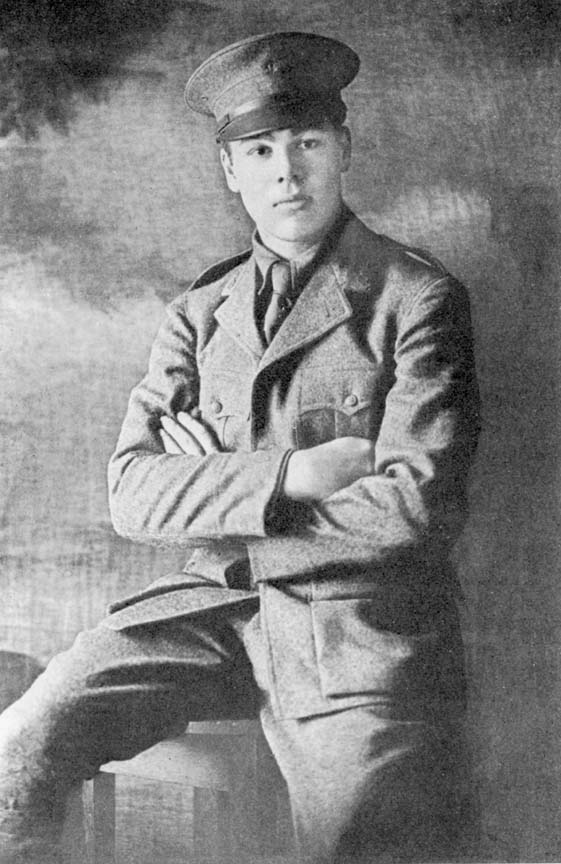
SON of Roger S. and Louise (Parrish) Dix; was born at Boston, Mass., Dec. 9, 1896. He was educated at the Country Day School, and at Harvard College, entering with the class of 1918. He left Harvard at the end of his junior year, and attended the Plattsburg Training Camp, in 1915, and again in 1916. He served with the American Ambulance Field Service, Section 1, at Verdun, in 1917, at which time his section received a Citation Militaire. In Nov., 1917, he enlisted in France, in the U.S. Air Service, but was forced to remain inactive during the winter, owing to lack of planes. In the spring of 1918 he was one of twenty-five to volunteer for instruction as bombing observers in the French Bombing School at Le Crotoy, Somme, France, with the understanding that they should be sent at once to the front for the spring offensive. He was commissioned 2d Lieut., May 12, 1918.
Lieut. Dix had completed his course, and was to leave that week for the front, when he was killed in an airplane accident at Le Crotoy on May 15, 1918. He fell from a height of 200 metres, and his French pilot was also killed. He was buried with military honors at Le Crotoy.
A letter signed by the twenty-four comrades of his flying detachment which was sent his parents, states:
Cadet Dix was easily the most popular member of this detachment. He was a loyal, gallant soldier, an assiduous student, an excellent airman and a splendid companion. Every man counted him his friend and he had never failed us. His fearlessness, his coolness and his intrepidity had made it a foregone conclusion that his career in his chosen Service would have been brilliantly distinguished, and his tragic death is a double loss to us and the Army because he was the possessor of such splendid qualities.
The letter from which the above is quoted was also signed by Lieut. Dix's Commanding Officer, who adds:
I found him to be a most excellent soldier both on the ground and in the air. He was on his last training flight and was to have received the highest honors of any of my command for his work here. He died while doing work in the air and while holding the position of the first in his class. More glory than this no man can claim for his son.
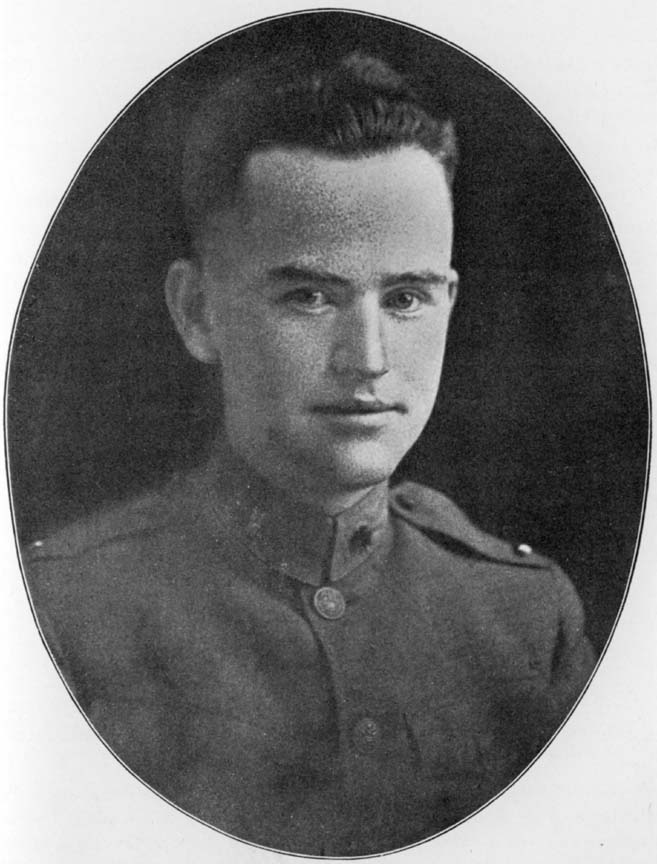
SON of Allan and Minnie (Arnold) Brown; was born Feb. 19, 1893, at Salem, Mass. He was educated in the Salem and Boston public schools; and at the Mechanic Arts High School in Boston, where he was a member of the baseball, football, and basket-ball teams.
He enlisted in the Aviation Service on Dec. 15, 1917, and was sent for training to Kelly Field, San Antonio, Tex.; then to Georgia Technology, at Atlanta; Ellington Field, Houston Tex.; and to San Leon, Houston, Tex.; He was commissioned 1st Lieut. on April 19, 1918; received his sailing orders for overseas, but died in Boston on Nov. 1, 1918, twenty-four hours before the date set for sailing. He was buried in Salem, Mass. Lieut. Brown invented and perfected a more efficient system of sighting machine guns; and wrote a book upon aerial gunnery which is accepted by the War Department as an authority upon the subject.
SON of Dr. Edward Thayer and Elizabeth F. (Schuster) Twitchell; was born in Dorchester, Mass., Feb. 10, 1895. He was educated at Milton Academy, and at Harvard University, A.B. 1916. He was a member of the track and cross-country teams at college. He served nine months in France as an ambulance driver, in Section 4, American Ambulance Field Service, on the western front, from Sept., 1916, to June, 1917. In Dec., 1917, he enlisted in the Air Service, at Boston, Mass., and trained at the U.S. Army School of Military Aeronautics, at Cornell University; at Camp Dick, Dallas, Tex., and subsequently at Kelly Field, San Antonio, Tex., at which station he was commissioned 2d Lieut., A.S.A., Aug. 23, 1918. He was then stationed at Wilbur Wright Field, Dayton, Ohio, and later at Payne Field, West Point, Miss. In Jan., 1919, he resigned his commission and was released from service at Payne Field, West Point.
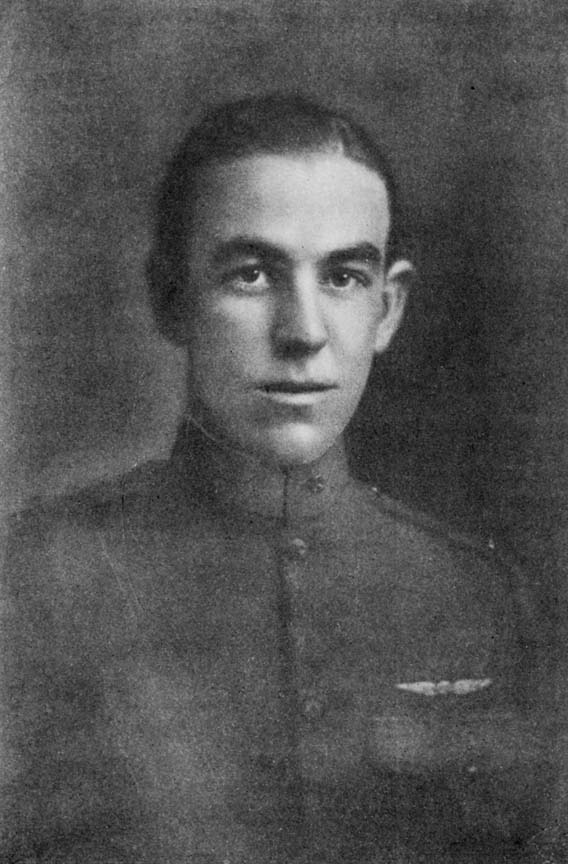
SON of George Eaton and Mabel Abigail (Shaw) Pfaffmann; was born at Quincy, Mass., April 27, 1894. He was educated at the Quincy High School, at Phillips Andover Academy, and at Harvard College He was a remarkably fine tennis player, and belonged to the Harvard tennis team in 1916 and 1917, and was elected captain in 1917.
He sailed for France in April, 1917, with the Norton-Harjes Ambulance Unit, and served on the Aisne, and about Reims during July, Aug., Sept., 1917. In Oct., 1917, he enlisted in the U.S. Air Service in Paris, and was assigned to Tours, where he remained through Nov. and Dec. He continued his training at St.-Maixent from Jan. to May, 1918, and was transferred to Voves on June 1. He was commissioned 2d Lieut. in June, 1918. On July 2 he was killed at Voves in an airplane accident, when returning from an altitude flight of one hour at 6000 feet, which would have given him his military brevet as Pilot. Watched by his chief and an instructor, he descended to a height of about 200 feet, and banked his plane to come into the wind, and land. The lower wing of the plane was caught in an air-pocket at the same instant that a counter-current hit the upper wing; he crashed, and was instantly killed.
An impressive military funeral was held at Voves, attended by the officers and cadets of the Voves Flying School, veterans of the War of 1870, the Mayor of Voves, and many villagers and children. At the end of the services Lieut. Mayeur, of Headquarters Staff, stepped forward and said:
Among the first Americans to come to combat the invader upon the soil of France, John Pfaffmann entered the Ambulance Service and distinguished himself at the front by his unflagging energy and his high comprehension of military duty. His desire to do more and yet more for his country and for France soon led him, however, to seek a transfer to the Aviation Service .... May the remembrance of his glorious death upon the field of honor be, in some small degree at least, an alleviation of the sorrow of his family, and of all those who have known and loved him.

SON of Charles French and Georgianna West (Graves) Perry; was born at Boston, Mass., Nov. 8, 1883. He was educated at the Noble and Greenough School; and at Harvard College, A.B. 1905; M.I.T., S.B. 1917, and École des Beaux Arts, Paris, 1913.
He attended the Officers' Training Camp at Plattsburg, in Aug. 1916; served as Capt., Co. M, 13th Reg't., Mass. State Guard. He enlisted Nov. 1, 1917, and was commissioned 1st Lieut., A.S.S.C., reported for duty at Kelly Field, San Antonio, Tex., Nov. 11, 1917, and was put in command of the 65th (later 477th) Aero Squadron.
He sailed overseas March 4, 1918, and was commissioned Capt., A.S.C., Aug. 1, 1918. He was appointed Equipment Officer Air Service, 1st Army, Oct. 14, 1918, and was stationed at Souilly from Oct. 14 until Dec. 24, 1918. From Nov. 21 to 24 he was attached for temporary duty to the 3d Army, to receive airplane and other Air Service material from the enemy. Capt. Perry participated in frequent flights and trips to the lines during the Argonne battle, for the purpose of choosing and preparing airdromes and advanced landing places for the Air Service of the 1st Army.
He was honorably discharged May 31, 1919.
Cited in General Orders as follows:
Captain WILLIAM G. PERRY, A.S., U.S.A., organized and commanded the 477th Aero Construction Squadron which made such an enviable record for itself. Under his direction it built airdromes at Autreville, Amanty, Bicqueley, and St.-Mihiel. At Bicqueley, by superb organization and morale, he was able to build the field in ten days. At these Headquarters, as Equipment Officer during the latter part of the operations west of the Meuse, he successfully and with great tact handled the very difficult proposition of obtaining, and allocating to the units of this command, Air Service material, transportation, and equipment of all kinds.
His extreme conscientiousness was an example which all may well emulate.
By order of Col. MILLING
Married, Aug. 6, 1908, Eleanor Gray.
Brother in Service ---
Edward Hale Perry, 1st Lieut., Co. D, 6th Engineers. Killed in action at Warfusée, France, March 30, 1918. Cited for bravery in action.
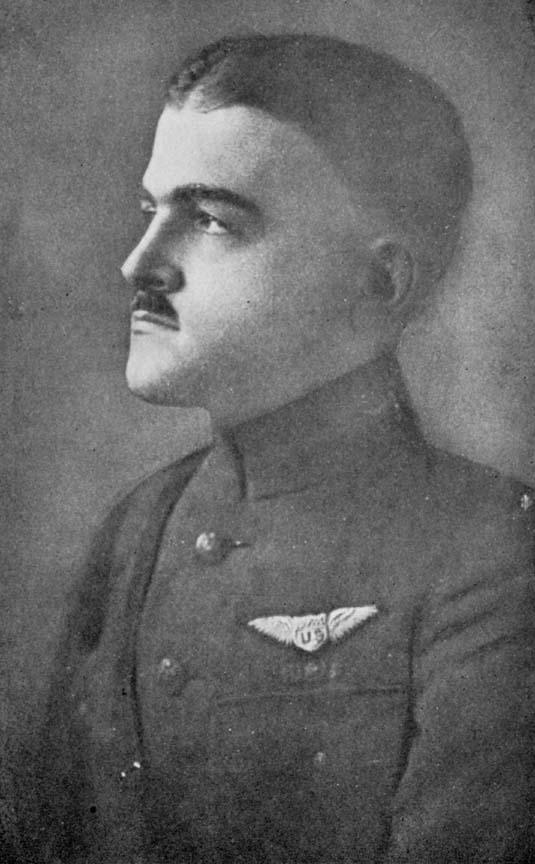
SON of Henry F. and Fannie E. (Thompson) Hurlburt, of Boston, Mass.; was born at Lynn, Mass., Nov. 8, 1893. He was educated at St. Paul's School, Concord, N.H., and at Harvard College, A.B. 1916. At St. Paul's he was captain of the track team, and member of the Lower School hockey and football teams.
He sailed for France, April 28, 1917, with the American Ambulance Field Service, with which he served until Sept. 18, 1917, when he enlisted as private in the U.S.A., and trained for the Aviation Service at Tours, France. On Jan. 17, 1918, he was commissioned 1st Lieut., and arrived at the front in June, 1918, as Adjutant of 5th Air Dépôt. He was transferred to the 163d Aero Squadron, 2d Day Bombardment Group, with which he served until April, 1919, when he was appointed Aide to Gen. Patrick. On May 30, 1919, he was commissioned Capt., and left France to return to the U.S. on Aug. 18, 1919. He was honorably discharged on Sept. 12, 1919.
Brother in Service ---
Paul Hurlburt, Capt., U.S.A., 3d Cavalry.
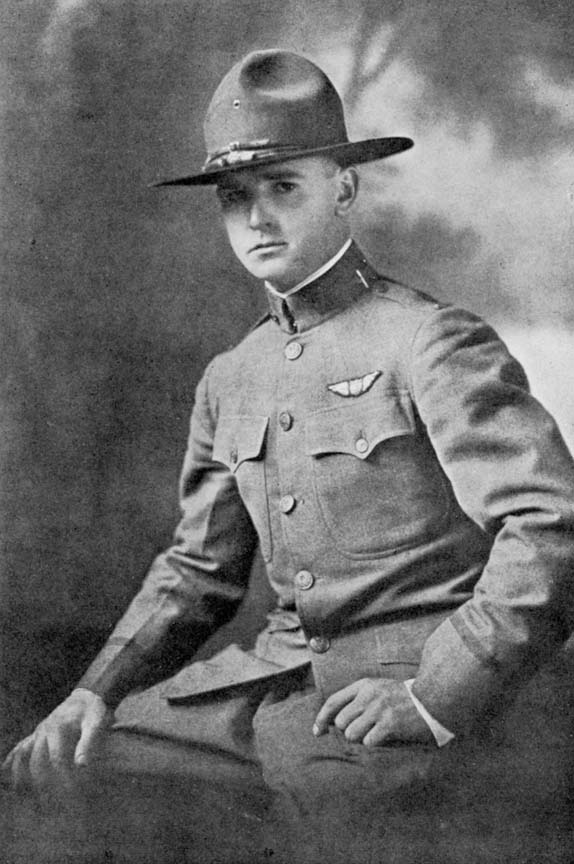
SON of Harrie Clifford and Florence (Gordon) Farnsworth; was born at Hyde Park, Mass., on March 15, 1895. He was educated in the Hyde Park public schools and at Worcester Academy, Worcester, Mass. He graduated from the M.I.T. in 1917. In his freshman and sophomore years he played quarter-back on the M.I.T football team, and was captain of the football team in his freshman year.
He enlisted in the Air Service on Aug. 11, 1917, in Boston, Mass., and was assigned to the Ground School, M.I.T. On Dec. 3 he was sent to Waco, Tex. He was commissioned 2d Lieut., March 6, 1918, and was ordered to Gerstner Field, Lake Charles, La., for training as a Pursuit Pilot. Subsequently he was sent to the Gunnery School at Taliaferro Field, Hicks, Tex., from which he graduated on June 29, he was then made Gunnery Instructor. Late in Aug., Lieut. Farnsworth received overseas orders; he reported at Hoboken, and on Sept. 4 sailed for Scotland. He went to Paris by way of Glasgow and London, reporting for duty on Oct. 5. He was immediately assigned to the 3d A.I.C. at Issoudun, where he qualified as Pursuit Pilot on Nov. 9, and was made Instructor in Combat on Nov. 11, 1918.
Brother in Service
Charles Luke Farnsworth, Quartermaster, 1st Class, U.S.N.
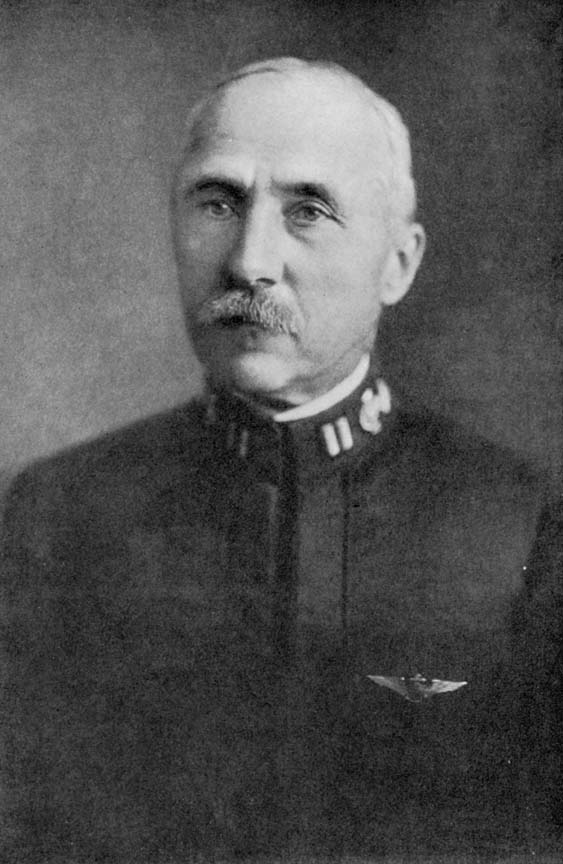
SON of Samuel and Hannah Lowell (Jackson) Cabot; was born at Boston, Mass., Feb. 26, 1861. He was educated at the Brimmer, Latin, and Hopkinson schools, Boston; M.I.T., one year; Harvard College, four years; Polytechnic, Zurich, and University of Zurich. He took final honors (magna cum laude) in chemistry at Harvard. At college he took one prize in a wrestling match, and won many prizes at tennis.
He was commissioned Ensign, A.D.C., M.V.M., on June 6, 1916. On March 20, 1917, he was commissioned Lieut., U.S.N.R.F., at Cambridge, Mass. He practised flying at Marblehead, May to Dec., 1915; trained at Pensacola, Fla., in April, 1916; Marblehead. May to Dec., 1916; Pensacola, Jan., 1917; Salem Harbor, April, 1917. He first flew as a pilot on April 1, 1917. For over two years he was on active duty, serving from March 20, 1917, to the spring of 1919. He originated and practised the art of picking up burdens in flight, reaching 155 kilometres on Oct. 3, 1919.
Married, June 3, 1890, Maria Moors, of Boston.
Sons in Service ---
James Jackson Cabot, 1st Lieut., A.S., U.S.A.
Thomas Dudley Cabot, 2d Lieut., A.S., U.S.A., Instructor at Kelly Field, Tex.
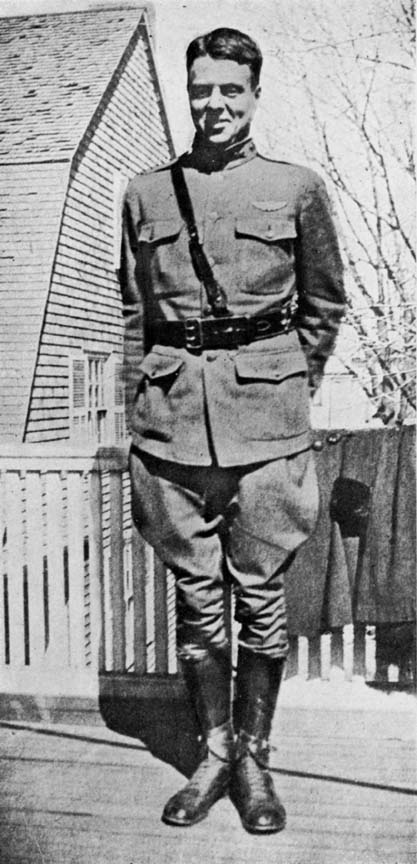
SON of Lieut. Godfrey Lowell and Maria (Moors) Cabot; was born at Cambridge, Mass., Sept. 24, 1891. He was educated at the Browne and Nichols School, Cambridge, and at Harvard College, class of 1913. He also took extra courses at M.I.T.
Previous to enlistment he attended the Plattsburg Training Camp for two summers, qualifying as a sharpshooter. He enlisted on Sept. 29, 1917, and trained at the Curtiss School in Buffalo, N.Y., at M.I.T. Ground School, and at Fort Worth, Tex. He was commissioned 1st Lieut. in Jan., 1918. He sailed overseas in May, 1918, and was first attached to Squadron 182; afterwards to Squadron 88. He piloted a number of aeroplanes from England to France, making his headquarters at different aerodromes in England. Six weeks before the Armistice was signed he flew about Verdun and Sedan. He sailed for America the last of Dec., 1918, and was honorably discharged at Garden City, N.Y., in April, 1919.
Married, May 10, 1919, Catharine Rush, daughter of Commandant Rush, of the Navy Yard, Boston.
Father in Service ---
Godfrey Lowell Cabot, Lieut., Aviation Aide, First Naval District.
Brother in Service ---
Thomas Dudley Cabot, 2d Lieut., A.S., U.S.A.
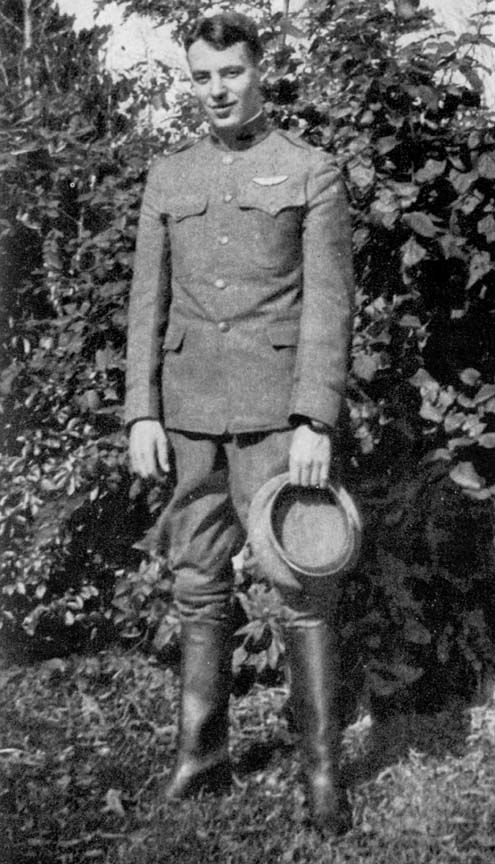
SON of Lieu t. Godfrey Lowell and Maria (Moors) Cabot; was born at Cambridge, Mass., on May 1, 1898. He was educated at the Browne and Nichols School, Evans School, Arizona, and at Harvard College, class of 1919.
He attended the Plattsburg Training Camp in the summer of 1916 (sharpshooter), and trained with the Harvard Regiment. He took a course in aeronautics at the M.I.T. Ground School, and trained as a flyer at the Curtiss School, Buffalo, N.Y. On Aug. 27, 1917, he enlisted as a private, 1st class, A.S., S.E.R.C., at Ithaca, N.Y. He trained at the M.I.T. Ground School during Oct. and Nov., 1917; was sent to Kelly Field, Tex., on Dec. 1, 1917, where he was attached to the cadet wing for further training as a flyer. He passed the R.M.A. tests on Jan. 17, and was commissioned 2d Lieut., A.S.S.R.C., Jan. 31, 1918. He was in charge of officers' barracks during Feb., March, and April; and at the Instructors' School in May, where he acted as Flying Instructor from June to Oct.; he was sent to Miami, Fla., in Nov., where he trained as a pilot, for flying-boats, and as coast patrol pilot. He was sent to Arcadia, Fla., and honorably discharged, at Carlstrom Field, on Dec. 14, 1918.
Father in Service
Godfrey Lowell Cabot, Lieut., Aviation Aide, First Naval District.
Brother in Service ---
James Jackson Cabot, Lieut., A.S., U.S.A.
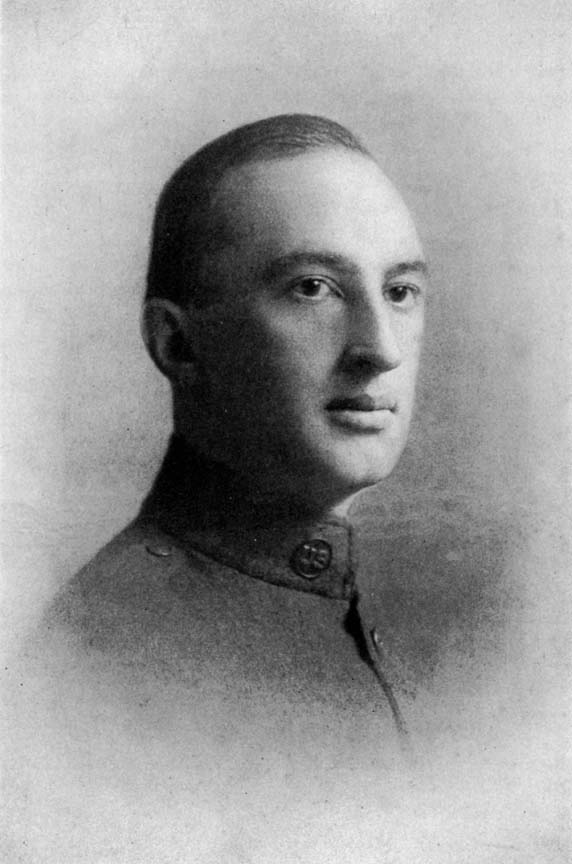
SON of John L. and Susan A. Lord, of Rutherford, N.J.; was born at South Boston, Mass., Nov. 9, 1890. He was educated in the public schools of South Boston, and at Cutter's Business School. He was prominent in athletics and played quarter-back on his high school football team. On leaving school he engaged in business, and relinquished a good position to enter the Aviation Service.
He enlisted on Oct. 1, 1917, at Cambridge, Mass., and attended the Ground School, M.I.T. (Squadron A). On Jan. 7, 1918, he was sent to Ellington Field, Houston, Tex., where he remained until May , when he was sent to Camp Dick, Dallas, Tex. He was transferred, on May 29, 1918, to Payne Field, West Point, Miss., where he became Instructor in Aviation Acrobatics. He was commissioned 2d Lieut., April 20, 1918.
On June 5, 1918, Lieut. Lord was instructing a pupil, who was directing the plane, when the machine went into an accidental tail-spin, and before the Instructor could obtain control of the plane from the pupil, it had dashed to the ground, killing Lieut. Lord, and severely injuring his companion.
Lieut. Lord was buried at Pine Grove Cemetery, Lynn, Mass. As his body was carried aboard the train at West Point, eight aviators flew overhead, in the form of a cross, and dropped flowers on the casket. Lieut. Lord was exceedingly popular with his associates, and after his death they presented his family with a loving-cup, inscribed: "From his comrades who esteemed him as a soldier, and loved him as a friend."
Lieut. Lord was one of four aviators chosen to make long trips on behalf of the Liberty Loan drives, bombing different cities with Liberty Loan literature. Of this group he was the only one to return without accident to either his plane or himself, and was officially complimented on his flying. It was his one ambition to get across seas and engage in active scout work at the front.
Grandfather in Service ---
In Civil War. Lost an arm at battle of Bull Run.
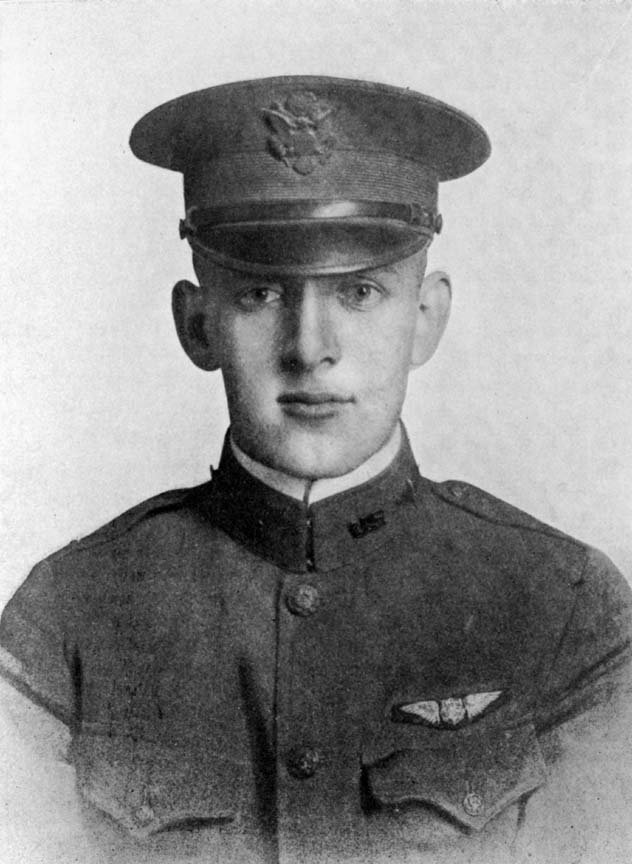
SON of Silas H. and Juliette Butterfield (Davis) Ayer; Was born at Boston, Mass., on April 13, 1893. He was educated at the Boston Latin and De Merritt schools, and at M.I.T., where he was a member of Sigma Chi Fraternity. He rowed on the Boston Latin School crew in 1911; and on July 4 of that year received a gold medal, presented by the City of Boston, as stroke of the winning crew in the intermediate eight-oar shell race, Charles River Basin.
He enlisted at Youngstown, Ohio, in the Regular Army, on Sept. 19, 1917, and served one month at Camp Sherman, Chillicothe, Ohio. He received honorable discharge, to enter the Aviation Service. On Jan. 12, 1918, he graduated from the U.S. School of Military Aeronautics, Ohio State University, Columbus. He then trained at Call Field, Wichita Falls, Tex., and was commissioned 2d Lieut., Aviation Section, Signal Reserve Corps, on May 10, 1918.
On May 22, 1918, Lieut. Ayer was assigned to active duty at Camp Dick, Dallas, Tex.; he was transferred on June 29, 1918, to Ellington Field, Houston, Tex., where he completed his work and was ready for overseas duty. He was honorably discharged from the Service in Jan., 1919.
Brothers in Service ---
Nathaniel D. Ayer, Lieut., A.D.C., 4th Division, Canadian B.E.F.
Silas H. Ayer, Jr., Bandmaster, U.S.N.R.F.
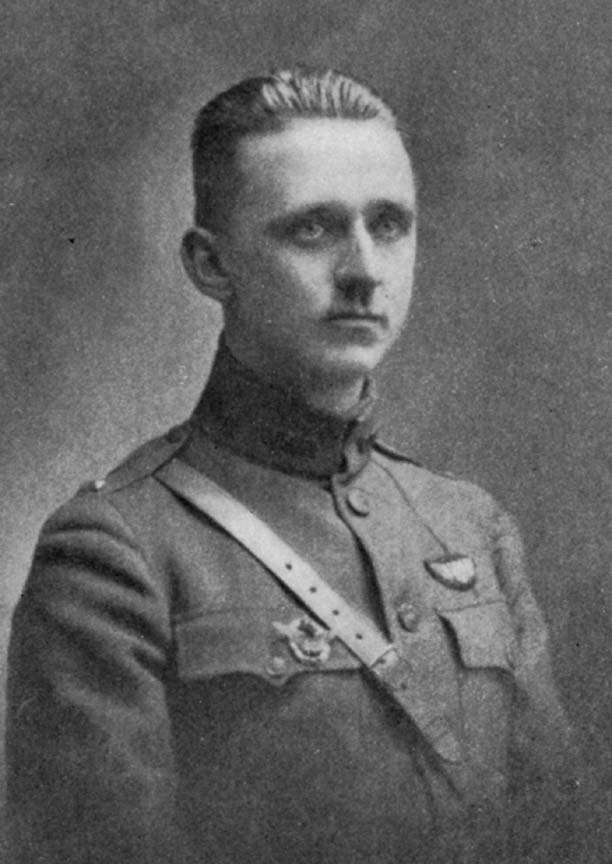
SON of James M. and Maria (Dame) Adams, of East Lake, Fla.; was born at Nashua, N.H., March 24, 1892. He was educated at the Hackensack, N.J., High School, class of 1909.
In Jan., 1917, he volunteered for the American Ambulance Field Service in France, with Section 8, and served for six months under Major A. Piatt Andrew. In Aug., 1917, he enlisted in the U.S. Air Service, in France. He trained at Tours and Issoudun, receiving a Pilot's license at Tours, and training in acrobacy at Issoudun. He was commissioned 1st Lieut. in Nov., 1917, and has a record of some 800 flights since then.
When the Armistice was signed, Lieut. Adams was flying near the Toul front, piloting observation planes of many types. In June, 1919, he was still in service with the Army of Occupation.
In a letter dated April 21, 1919, Lieut. Adams writes:
Just a word saying we are here on the Rhine. We've all got here now and are comfortably settled at our field near a big German fort, half a mile from Coblenz. I flew up here in my Spad alone with my map and compass. Crossed No Man's Land, with its miles of old trenches, near St.-Mihiel, and followed them to Pont-à-Mousson on the Moselle River. Then went right up the river at about 1000 feet altitude to Metz and its circle of unconquerable forts. Then, after about ninety minutes of flying, got to Trèves (Trier), where I landed for gas and oil at a U.S. field, formerly a Zeppelin base, with a huge hangar, big enough for one hundred aeroplanes .... Started off again at 3 P.M. up the Moselle. A wonderful valley, but its huge hills, canyons, and mountains made it dangerous flying. But the day was perfect and my motor, too, and I had no trouble at all. Passed over many world-famous Rhine castles and hundreds of towns along the river. A really great experience! Landed at Coblenz O.K., an hour later, where the Rhine and Moselle join, as you can see on a map. Right in the heart of Prussia, and Germans all about us, civilians, children, and militaries. Seems a different world, and impossible for a city like this to be absolutely dominated by an army of khaki!
Brothers in Service --
Leon M. Adams, 2d Class Seaman, U.S.N.
Lincoln D. Adams, 2d Class Seaman, U.S.N.
Grandfather in Service --
James P. Adams, Private, 7th Reg't, N.H. Volunteers, Civil War. Died in Service.
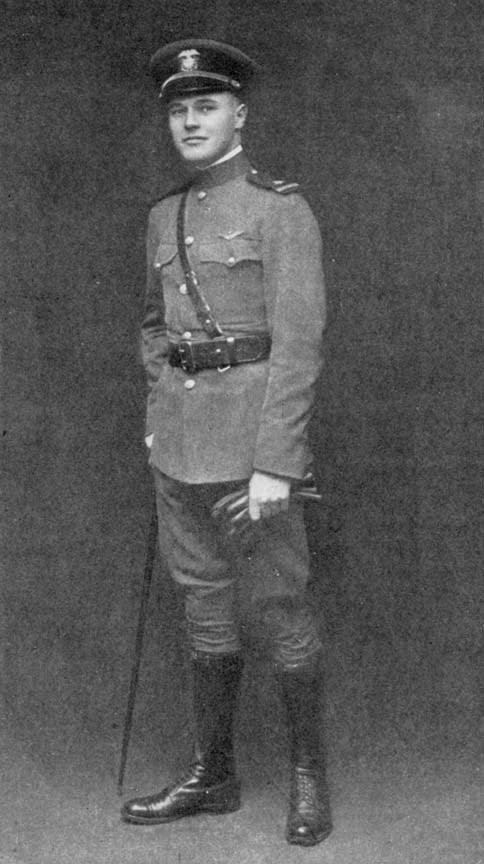
SON of Eugene T. and Mary Agnes (McCarthy) McNamara, of Arlington, Mass.; was born at Somerville, Mass., April 3, 1898.
He was educated at the Cambridge High and Latin Schools, and at Boston College. He entered Service at end of freshman year.
He enlisted on April 28, 1917, at Boston, and was sent to Pensacola, Fla., for training. He was commissioned Ensign Dec. 1, 1917, sailed overseas in Jan., 1918, and was stationed for three months at the Royal Naval Air Station at Portland, Eng. While operating there, on scout duty, he bombed and sunk a submarine, being the first American naval aviator to accomplish this feat. He was commissioned Lieut. (j.g.), April 1, 1918. He was transferred to the Royal Air Station at Felixstowe, Eng., where he remained until Aug., when he was attached to the U.S. Air Station, at Killingholme; subsequently he was ordered to the U.S. Air Station at Wexford, Ireland, in command of a squadron of eight seaplanes. On Oct. 1, 1918, he was commissioned Lieut.
He was placed on inactive duty at Bay Shore, N.Y., Jan. 15, 1919.
Married, Oct. 8, 1919, Florence E. Riordan.
To Ensign JOHN F. MCNAMARA:
The Department quotes below for your information the report of Vice-Admiral Sims relative to your apparently successful operations while out on scout duty against enemy submarines, on March 5, 1918, under orders from the Commanding Officer of the Royal Naval Air Station, Portland, England, whose report was forwarded by Vice-Admiral Sims:
The attached correspondence relative to the performance of duty of Ensigns ----- and John F. McNamara, U.S.N.R.F., reflects credit upon both those officers. It is recommended that adequate recognition of their services be granted."
The Department wishes to avail itself of this opportunity to express to you the very high appreciation felt upon receipt of reports similar to the above. It is strong evidence of the fact that earnest cooperation exists between the Armed Forces of our Allies and the United States Armed Forces. It is work of this character that will impress our enemies with the realization that the United States is a power very much to be considered.
Accordingly, you are hereby highly commended for your valiant and earnest efforts on this particular occasion when your attack on the enemy submarine apparently caused some damage. It is to be hoped that a continuance of such work will be maintained in the future.
JOSEPHUS DANIELS
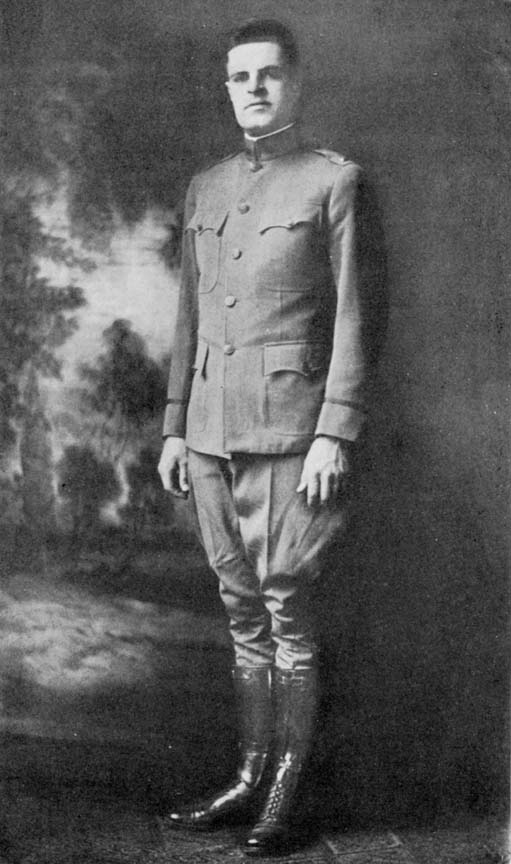
SON of Theodore F. and Clara D. Koch; was born at St. Paul, Minn., Aug. 20, 1891. He graduated from the St. Paul High School, and went to the University of Minnesota for one year. He transferred to Harvard College in 1910, and received his degree in 1914. In the meantime his parents moved to Houston, Tex., where after his graduation Lieut. Koch entered business with his father. He enlisted in the Ground Officers' Training School, at Kelly Field, Tex., in July, 1917. He received his commission as 1st Lieut., and was sent to instruct in the Wilbur Wright School of Administration at Dayton, Ohio.
On March 7, 1918, he sailed for England with the 47th Aero Squadron, and was stationed at Cramlington. Later he was assigned as Commanding Officer to the 372d Aero Squadron stationed at Hendon. On Oct. 2, 1918, the Squadron was mobilized at St. -Maixent, France, and fully equipped for service at the front. Then it was sent to the 3d A.I.C. at Issoudun for temporary duty. Late at night on Nov. 10, 1918, orders for the front arrived, but because of the Armistice these were cancelled the following day. Lieut. Koch was Adjutant at Field 10, Issoudun, from Nov. , 1918, to Jan. 8, 1919. On April 20 he returned with his Squadron to Mitchel Field, Garden City, N.Y., for demobilization.

SON of Dr. William M. and Mary B. Conant; was born at Boston, Mass., March 3, 1891. He was educated at the Noble and Greenough School, and at Harvard College, A.B. 1912. In school he was a member of the football, track, and baseball teams; and played on the freshman baseball team at Harvard College.
He served in the 1st Aero Squadron, N.G., of New York, in 1916, and flew at Mineola, N.Y. He enlisted at Mineola in July, 1917, and received his flying training there in Aug. On Oct. 8, 1917, he was commissioned 1st Lieut., and sailed overseas in the same month. He completed his training as "chasse pilote" in Dec., Jan., and Feb., at the 3d A.I.C., Issoudun, France. In Feb., 1918, he was made Tester of Planes, and in April was promoted to he Chief Tester of the School. He was commissioned Capt. on Oct. 3, 1918, and promoted to Major, on Feb. 1, 1919. He is still in the Service at Boiling Field, Washington, D.C.
Married, June 4, 1919, Dinsmore Patrick, of Lexington, Ky.
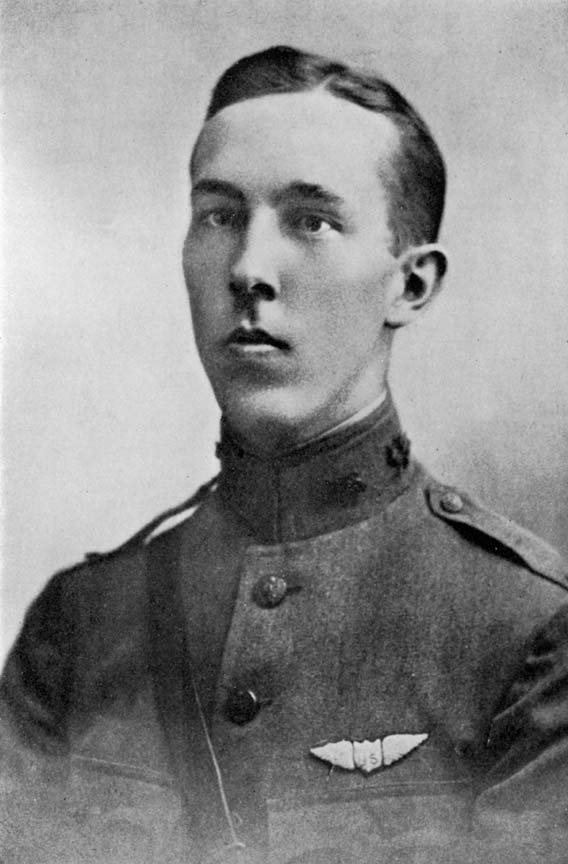
SON of George W. and Anna Louise Benedict, of Cambridge, Mass., was born at Boston, Aug. 14, 1895. He was educated at the Volkmann and at St. George's schools, and at Harvard College, A.B. 1917.
He attended the Plattsburg Training Camp in July, 1916, and the Harvard R.O.T.C., from March to July, 1917. He enlisted at Cambridge on July 7, 1917, in the Signal Enlisted Reserve Corps, and began active service at the Ground School, M.I.T., on Aug. 20, 1917. Graduating on Oct. 13, he was sent to Mineola Embarkation Camp, N.Y.; and on Nov. 14, 1917, sailed overseas. He waited at Tours and St.-Maixent until the end of March, 1918, when he was sent for flying instruction to the French school at Châteauroux. After preliminary training and the French brevet tests, he was stationed at Issoudun for further training, from July 12 to Aug. 17. While at Châteauroux he was commissioned 1st Lieut., May 18, 1918. From Issoudun he was sent to the 2d A.I.C. at Tours, Aug. 17, 1918, to take the course for 'Corps d'Armée" Pilots. Shortly afterwards this centre began to train observers exclusively, so that the "Corps d'Armée" Pilots' course was discontinued, and Lieut. Benedict was transferred to the status of Staff Pilot, to fly in cooperation with the observers. He remained on this duty until his discharge in France, April 1, 1919.

SON of Louis Wendell and Eliza Morgan (Gage) Reycroft, of Arlington, Mass.; was born at Boston on May 11, 1894. He was educated at the Arlington public schools, and at Dartmouth College, A.B. 1917. In high school he was captain of the football team in 1913, and of the hockey team in the same year. At Dartmouth he played on the 'Varsity hockey team for three years.
He enlisted at Arlington, and was trained at the M.I.T. Ground School, Cambridge. On graduation he was ordered to Key West, Fla., where he was commissioned Ensign, and then ordered to Miami, Fla., as Instructor in Flying. He applied for overseas service, and sailed for France in detail Aug. 1, 1918. He saw service with the Northern Bombing Group of Headquarters in Flanders and Belgium. At last reports he was still in Service at Norfolk, Va.
Brothers in Service ---
Harlan Long Reycroft, Ensign, U.S.N.A.S.
Harrie Fay Reycroft, Private, 26th Balloon Co., France.
Louis Manning Reycroft, Private, Signal Corps.
George Moulton Reycroft, Qualified Cadet, Officers' School, Camp Frémont.
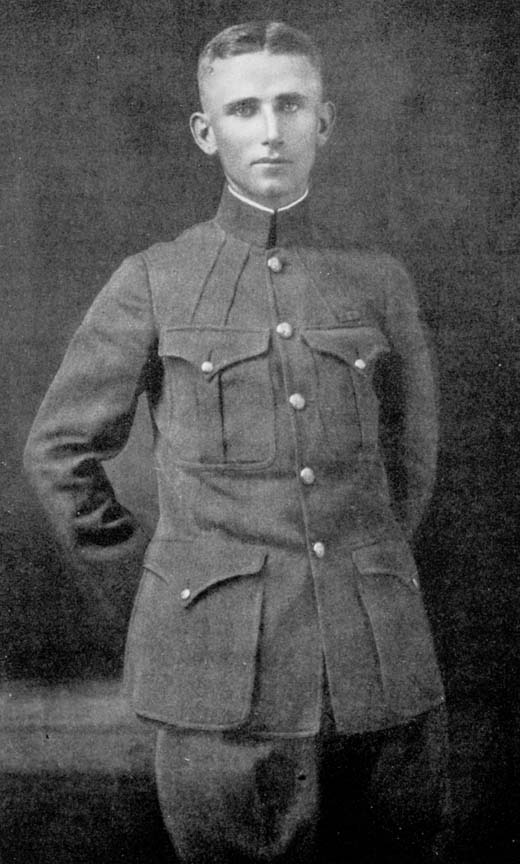
SON of Louis Wendell and Eliza Morgan (Gage) Reycroft, of Arlington, Mass.; was born at Boston, on Dec. 1, 1892. He was educated at the Arlington public schools, and at Harvard College, A.B. 1915. In high school he ran on the track team, was captain of the football team, 1911, and was on the baseball team, 1911. At Harvard he earned his "H" on the track and hockey teams.
Previous to the war, he served in Mexico with Battery A, 1st Mass. Reg't, F.A., N.G. He enlisted at Arlington, Mass., in 1918; trained at M.I.T. Ground School, from which he graduated, and was ordered to Miami, Fla., on Aug. 3, 1918. Here he was commissioned Ensign, and was appointed Naval Ensign and Instructor in Flying. At last reports he was still in Service.
Married, July 6, 1918, Gladys M. Chamberlain.
Brothers in Service ---
Wendell Gage Reycroft, Ensign, U.S.N.A.S., Northern Bombing Group.
Harrie Fay Reycroft, Private, 26th Balloon Co., France.
Louis Manning Reycroft, Private, Signal Corps.
George Moulton Reycroft, Qualified Cadet, Officers' School, Camp Frémont.
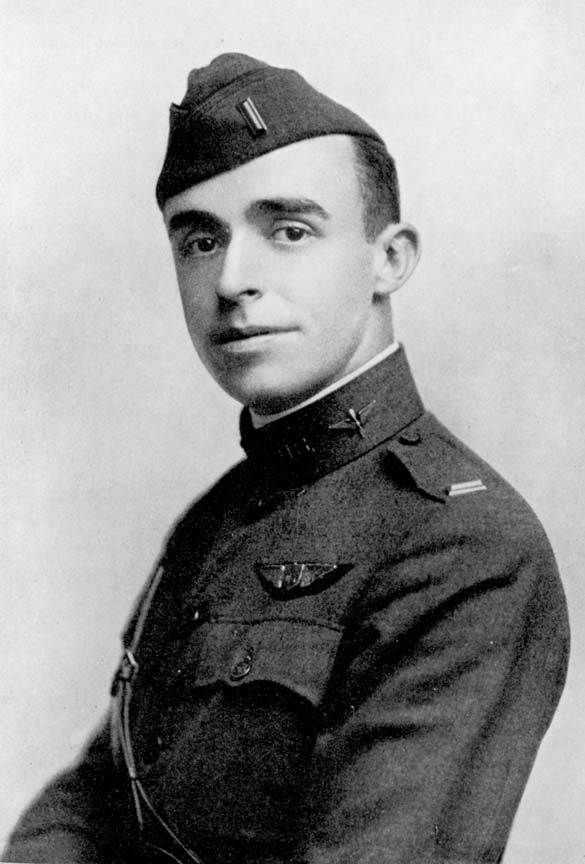
SON of Frank E. and Hattie M. Mackenzie; was born at Taunton Mass., July 17, 1892. He was educated at the Taunton High School and at M.LT. Prior to his entrance into the U.S. Service he trained with various school and college cadet corps.
On July 2, 1917, he enlisted at the M.I.T., where he attended the Ground School from July 2 to Aug. 23; he continued his training at Wilbur Wright Field, Dayton, Ohio, Aug. 3 to Dec. 30. He was transferred to Ellington Field, Houston, Tex., and stationed there from Dec. 30, 1917, to July 5, 1918 (student and Instructor in day and night bombing). He was commissioned 2d Lieut., Feb. 21, 1918. He was ordered to Taliaferro Field, Fort Worth, Tex., July 5 to Aug. 17, serving as Instructor in Aerial Gunnery.
He sailed overseas and was stationed at the 7th A.I.C., Clermont-Ferrand, France, from Sept. 30 to Oct. , 1918, as student and Instructor in Bombing. On Oct. 22, 1918, he was injured in wreck of a D.H. 4. He returned to the U.S. and at last accounts was in the Base Hospital, at Camp Devens, Mass.
Lieut. Mackenzie was the first night-bombing and day-bombing pilot to be trained in the U.S. and sent abroad. He sailed with two others, Lieuts. Jenkins and Nichols; the three being at that time the only completely trained bombing pilots in the U.S.
Married, Aug. 23, 1918, Margaret Traynor.
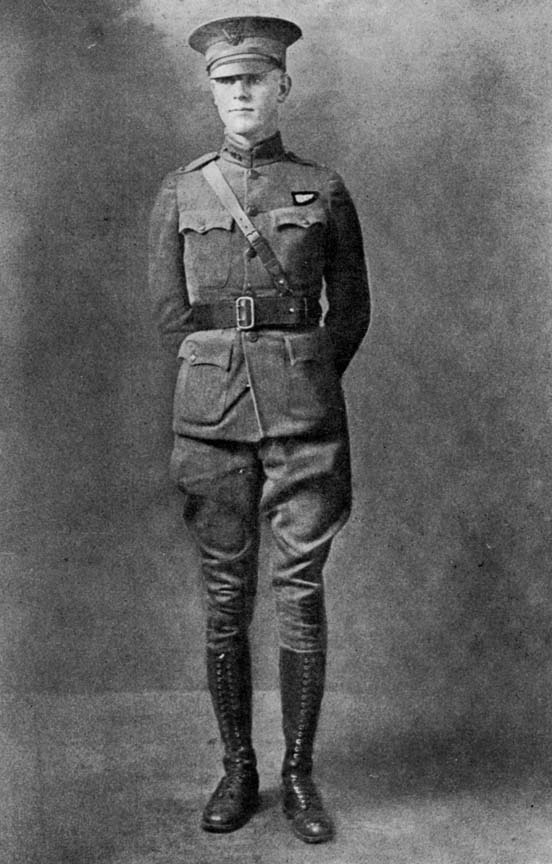
SON of Rev. John Elliot and Charly (Root) Bowman; was born at Somerville, Mass., Dec. 30, 1895. He was educated at Vermont Academy, Saxtons River, Vt., and at Harvard College, where he remained for two years with the class of 1916. Prior to his entry into the U.S. Service he was a member of the staff of the Boston Evening Record.
He enlisted in Boston, Aug., 1917, as private in the 301st Field Artillery. In Feb., 1918, he was transferred to the Air Service, and trained at the Ground School, Cornell, at Dallas, Tex., and at Selfridge Field, Mich. He sailed overseas in Aug., 1918, and was stationed at Brest, St.-Maixent, and at Clermont-Ferrand. He was commissioned 2d Lieut., A.S.A., July 30, 1918, and was made a member of the instruction staff of the 7th A.I.C., Clermont-Ferrand, France.
In the following communication he has graphically described the spirit of the French toward the American aviators, who have given their lives in France:
Perhaps you know that a ship always flies overhead to escort the procession to the grave and then drops flowers from the air. There is something very impressive about this, the big ships circling overhead and leading the way to the grave. Seems like the Spirit of the Game welcoming one of its followers. Then a little service by the padre, a flutter of petals from the air as the ships swoop down to ten feet from the ground --- three volleys and then "Taps." That bugle call sure gets a man. The point of the story is this: In that pouring rain there were nearly fifty French kids and women hard at work shaping the graves, patting them down, edging them with sod and covering the whole cemetery with flowers from God knows where. There was n't a grave in the place that was n't hidden from sight by blossoms. And they do this every day and have been doing it for months. And believe me, they will keep on doing it for a hundred years. The French never forget. At the cemetery gate they have erected a monument with laurel wreaths and the inscription:
"Aux soldats américains; morts pour la France, pour la Justice, le Droit et l'Honneur du monde; Honneur aux Braves."
Lieut. Bowman was honorably discharged at Garden City, N.Y., Feb. 4, 1919.
Married, Dec. 19, 1916, Helen A. Dodge, of Cambridge, Mass.
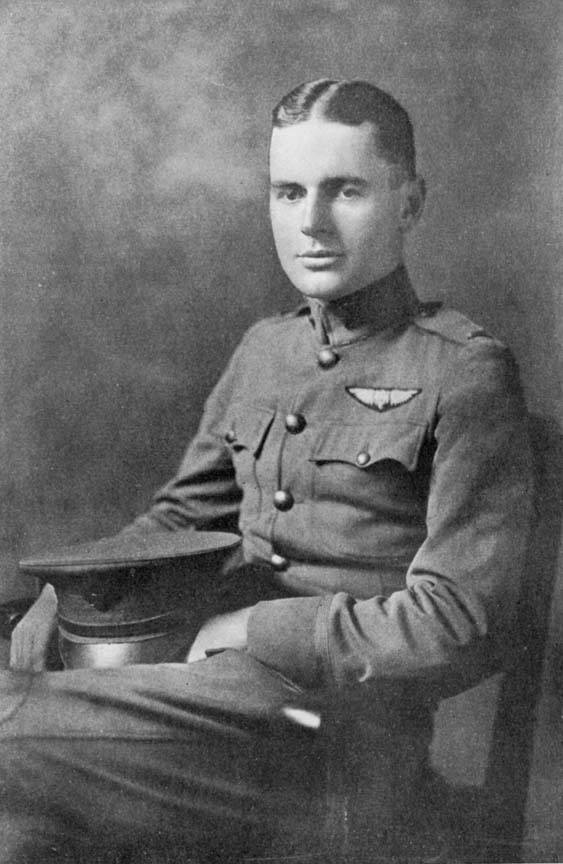
SON of George Beale and Marie (Dupont) Emmons, of Brookline, Mass.; was born at St. Louis, Mo., April 5, 1894. He was educated at the Volkmann School, 1913, and at Harvard University, class of 1917. At Harvard he played on the freshman baseball team in 1914 and on the 'Varsity soccer team, 1916-17. He was a member of Battery A, 1st Mass. Reg't, F.A., N.G., and in 1916 saw four months' service on the Mexican Border. In April, 1917, he enlisted with the 1st Harvard Regiment. He trained at the 1st Officers' Training Camp at Plattsburg, and after finishing the course was transferred to the Air Service. He attended the Ground School, M.I.T., and graduated the high honor man of the Squadron. He then had training in flying at Gerstner Field, La., and at Ellington Field, Houston, Tex. He was appointed Instructor at Baker Field, N.Y., and then at Langley Field, Va.
He was commissioned 2d Lieut., May 3, 1918. At the time of the Armistice he was under overseas orders, at Newport News, being attached to the General Staff, Tours, France.
Upon application, Lieut. Emmons was honorably discharged at Washington, D.C., on Dec. 13, 1918.
Brother in Service ---
Arthur B. Emmons, 2d, Capt., Medical Corps, U.S.A.; Evacuation Hospital No. 2; appointed Head of Medical Dep't.

SON of Herbert and Sally Carroll (Brown) Payson; was born at Portland, Me., Oct. 1, 1897. He attended the public schools of Portland, and the Salisbury School, Salisbury, Conn. He entered Yale College in 1916, leaving to enter the Service in 1917.
He attended the Plattsburg Training Camp in 1916, and was a member of the Yale R.O.T.C. Battery. He enlisted in the Air Service at Boston, Mass., Dec. 11, 1917.
He began his training at the Ground School, Cornell University, Ithaca, N.Y., in Feb., 1918; in March he was transferred to Camp Dick, Dallas, Tex., and from there was sent to Payne Field, West Point, Miss., where he was commissioned 2d Lieut., Aug. 20, 1918. He was assigned to the Armorers' School, Wilbur Wright Field, Dayton, Ohio, in Sept., 1918, and from there he was transferred to Field No. 2, Garden City, N.Y. On Dec. 18, 1918, he was honorably discharged at Garden City, N.Y.
SON of M. L. and Helen R. (Tappan) Brackett, of Brookline, Mass., was born at Boston, Mass., Jan. 19, 1892. He graduated from Brown University in 1914; he was a member of the 'Varsity swimming and wrestling teams, and of his class baseball and gymnasium teams. In 1915 he served for a few months in the Machine Gun Co., 8th Mass. Volunteer Militia. He enlisted at Plattsburg, N.Y., May 12, 1917, and was attached to the 2d Provisional Training Squadron from May to Aug., 1917. He attended the M.I.T. Ground School during Oct. and Nov., 1917. He received further training at Ellington Field, Houston, Tex., from Dec., 1917, to May, 1918; at Langley Field, Old Point Comfort, Va., through May and June; and at the Aerial Gunnery School, Taliaferro Field. Fort Worth, Tex., during July, 1918. He was commissioned 2d Lieut., April 20, 1918, and from Aug., 1918, to Jan. 30, 1919, was Flying Instructor at Selfridge Field, Mt. Clemens, Mich. He was honorably discharged at Selfridge Field, Jan. 30, 1919.
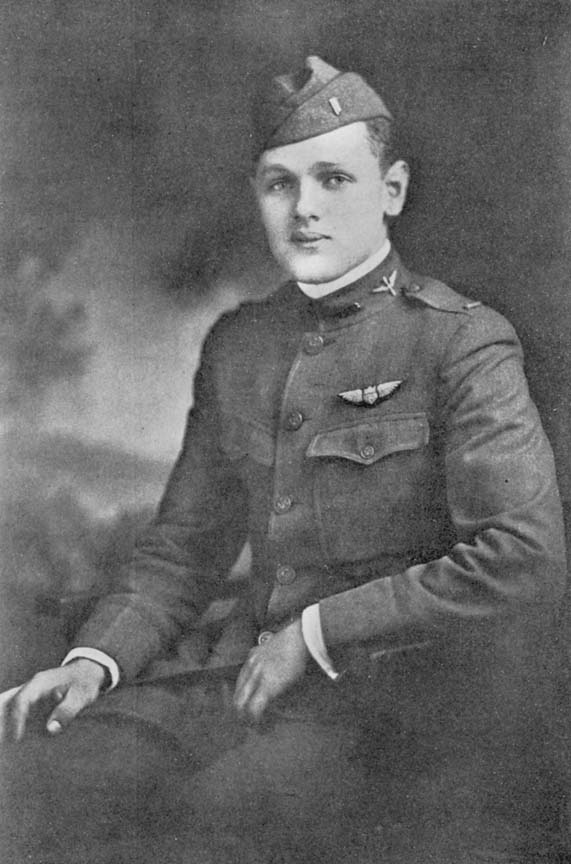
SON of John H. and Florence C. Craigie, of Stoneham, Mass.; was born Aug. 22, 1898. He was educated at the Stoneham High School, and at Harvard College, member of the class of 1920. At school he won the MacDonald scholarship medal and stood first in his class. He trained for six months with the R.O.T.C., and on Sept. 20. 1917, enlisted at Cambridge, Mass.
He trained at the Ground School, M.I.T.; at Ellington Field, Houston, Tex.; Camp Dick, Dallas, Tex.; Call Field, Wichita Falls, Tex.; and at Wilbur Wright Field, Dayton, Ohio. He was commissioned 2d Lieut., April 3, 1918, and sailed overseas to France, continuing his training at St.-Maixent, then at Issoudun, where he completed Pursuit Pilot training, Nov. 10, 1918. He was transferred to the Concentration Camp at Angers; sailed from Brest, Jan. 15, 1919, and was honorably discharged at Garden City, N.Y., Jan. 8, 1919.
Brothers in Service --
Hugh H. Craigie, Corp.. Co. L, 33d U.S.(Reg.) Infantry.
Laurence C. Craigie, Cadet, U.S.M.A., West Point.
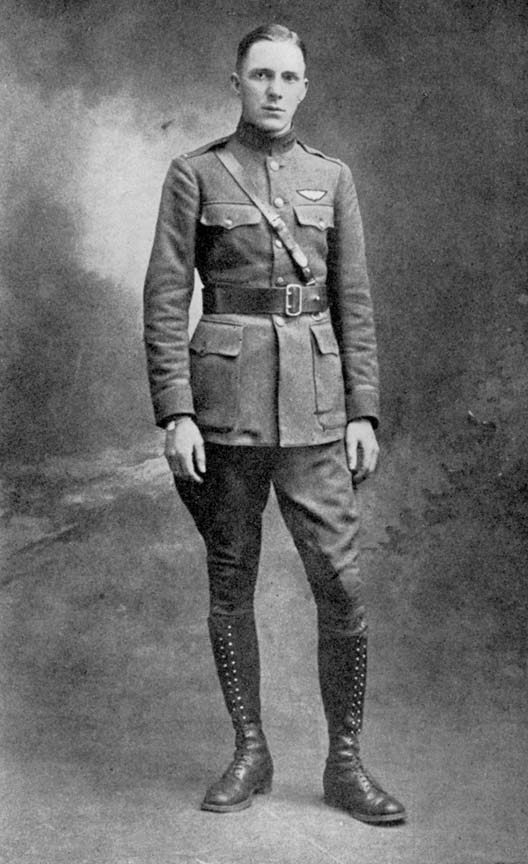
SON of Mr. and Mrs. David Van Schaack, of Hartford, Conn.; was born at Brooklyn, N.Y., July 21, 1894. He was educated at the Pawling School, Pawling, N.Y., and at Williams College.
He left college on April 10, 1917, to train for the Service, and on June 24 joined the Franco-American Flying Corps in New York City, sailing overseas, July 9, 1917. On reaching Paris and finding that his entry into a French flying school would be delayed, he obtained his release from the French Government and enlisted in the U.S. Air Service on Aug. 16, 1917. He trained at Tours from Aug. 19 to Oct. 19, 1917, when he was brevetted as a Pilot by the French Government. He was then assigned to the 3d A.I.C. at Issoudun, where he remained from Oct. 20, 1917, to Feb. 10, 1918, and where he was commissioned 1st Lieut., A.S., U.S.A., on Nov. 20, 1917. In Feb. he trained at Clermont-Ferrand, and on April 16 was sent to England for further training at the First Aerial School of Navigation and Bomb-Dropping at Stonehenge. He was subsequently transferred to Guillons, France, where he joined a French Voissain Group, from June 2 to June 29. He was then detailed to the First Air Dépôt at Colombey-les-Belles. From there he went to join the 100th Squadron, Independent Air Force, B.E.F., with which he remained from July 2 to Aug. 16, 1918.
On the night of Aug. 16, while he was on a night-bombing trip against a German Squadron at Boulay, his motor was struck by machine-gun fire from the ground and he was forced to land. Lieut. Van Schaack and his observer, Capt. John A. King, of Chicago, were captured by the Germans, and held at various prison camps: Saint-Avold, Strasbourg, Karlsruhe, Landshut, Villingen, and Constance. They were released on Nov. 29, 1918, and returned to France by way of Switzerland. Lieut. Van Schaack spent a week in the hospital at Allerey, and on Dec. 20 went to England, where he spent six weeks. On Feb. 5, 1919, he sailed for the U.S., where he was honorably discharged at Garden City, N.Y., on Feb. 28, 1919.
Brother in Service ---
Bulkeley Van Schaack, Private, U.S.A., 101st Machine Gun Battalion, 26th Division, A.E.F.

SON of Frederick L. and Grace L. (Harrington) Emery; was born at Lexington, Mass., March 8, 1896. He was educated at the Volkmann School, Boston, and at Harvard College, class of 1919. He rowed two years on his school crew.
He attended the Harvard R.O.T.C. previous to enlisting. He sailed for France in April, 1917; and entered the American Ambulance Field Service, with the French Army, T.M., Section 526 B, Réserve Mallet, and remained in that service for six months. He then enlisted with the U.S. Army, Aviation Section, Signal Reserve Corps, on Dec. 1, 1917. He trained at Tours, Issoudun, and at St. Jean-des-Monts, Gunnery School. From Dec. 1, 1917, to June, 1918, he was detained as cadet at St.-Maixent. He was commissioned 2d. Lieut., A.S.A., on June 7, 1918, and from then to the signing of the Armistice was retained as Instructor at Tours and elsewhere, continuing in this capacity until his return to the U.S. He arrived in New York, April 7, 1919, and was honorably discharged May 7, 1919, at Camp Devens.
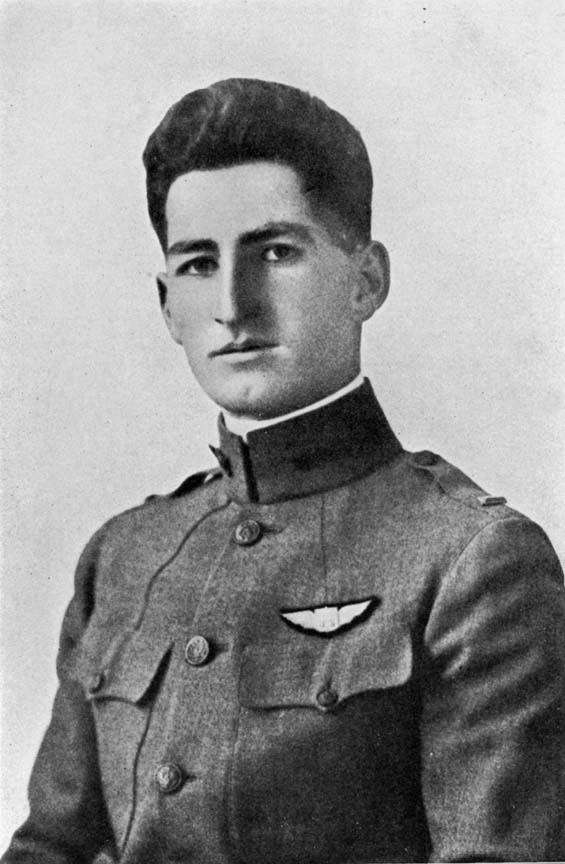
SON of Walter Lawrence and Ella E. (Lalley) Moran; was born at Cambridge, Mass., June 30, 1896. He attended the Russell Grammar School and the Rindge Manual Training School, Cambridge. When he was fifteen years old he enlisted in Co. C, 8th Reg't, M.V.M., was made Corporal, and served three years, withdrawing finally because it was necessary for him to work during the evenings.
He enlisted July, 1917, in the Aviation Corps, and entered the Ground School, M.I.T., Dec. 1, 1917. He was transferred to Princeton University, Dec. 29, 1917, and graduated with the class of Feb. 9, 1918. In the same month he was ordered to Love Field, Dallas, Tex., and thence to Kelly Field, and later to San Antonio, Tex. He was commissioned 2d Lieut., May 9,0, 1918, and appointed Instructor in Gosport System of Advanced Flying, at Love Field, Dallas, a few months later. He was at last account Officer in Charge of Transportation at Love Field.
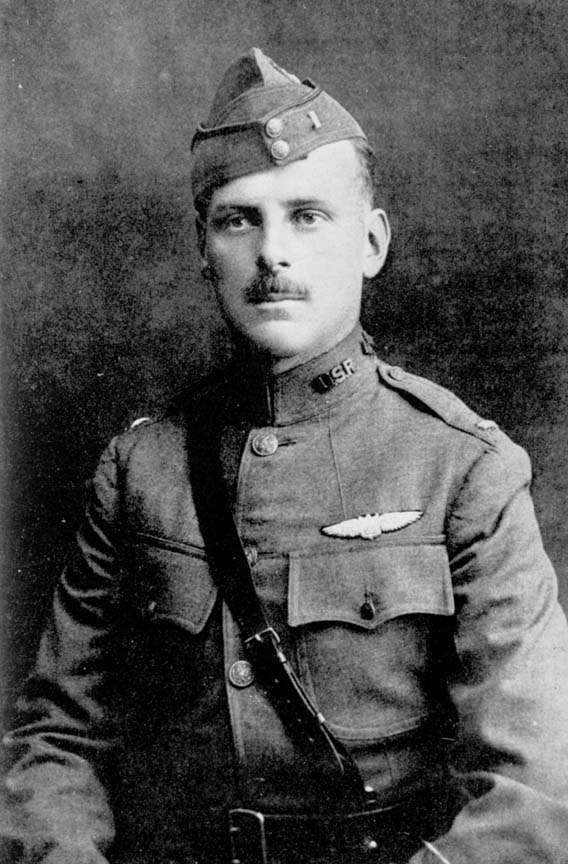
SON Of John F. and Alice R. Brown; was born at Milton, Mass., May 7, 1893. He was educated at Phillips Andover Academy, and at Harvard University.
He enlisted March 31, 1917, was appointed Sergeant, and trained for Aviation at Newport News, M.I.T, and Essington, Pa. He was commissioned 1st Lieut., R.M.A., in Nov., 1917. In the same month he sailed overseas for advanced training, which he received at Issoudun and Clermont-Ferrand.
In March, 1918, he was sent to training school at Stonehenge, Eng., for a six weeks' course in night bombing. Returning to Clermont-Ferrand he was put in charge of one of the flying fields and later became Instructor there in Aerial Navigation. After the Armistice he was ordered to the 2d Army of Occupation as Navigation Officer, Dec., 1918.
SON of Alexander Theodore and Beda Elizabeth (Boigeson) Ramsay; was born at Cambridge, Mass., Oct. 4, 1897. He was educated at the Huntington Preparatory School, Boston, Mass., and at the Mass. Institute of Technology. At school he played football, baseball, and hockey. He enlisted in the Air Service at Washington, D.C., on Feb. 2, 1918, and was sent to Camp Dick, Dallas, Tex. He was then ordered to Cornell University, Ithaca, N.Y., for ground-school training, and thence to Camp Dick. Subsequently he was assigned to Gerstner Field, Lake Charles, La., for work in flying. He was honorably discharged from the Service on .Dec. 21, 1918, at Gerstner Field.
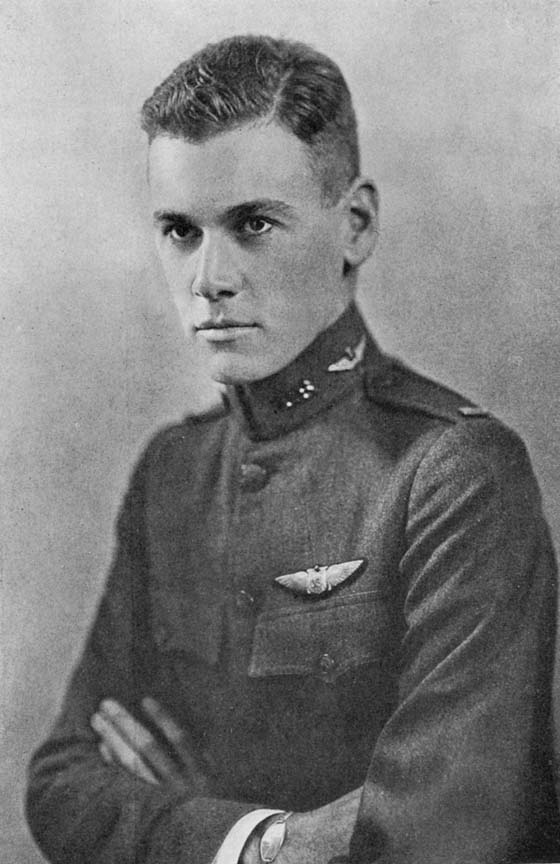
SON of Samuel H. and Margaret (Sargent) Fisher; was born at New Haven, Conn., June 22, 1898. He was educated at the Taft School, Watertown, Conn.; the Thacher School, Ojai, Cal.; and at Yale College.
He enlisted in the Air Service at New Haven, Conn., on Jan. 19, 1918, and was assigned to the U.S. School of Military Aeronautics at Princeton, N.J.; after completing the course there he was sent to Payne Field, West Point, Miss., for flying instruction. Subsequently he was ordered to Wilbur Wright Field, Dayton, Ohio, for a course in Pursuit Pilot's gunnery. He was commissioned 2d Lieut, on Aug. 20, 1918. He was discharged from the Service at Garden City, N.Y., Dec. 12, 1918.
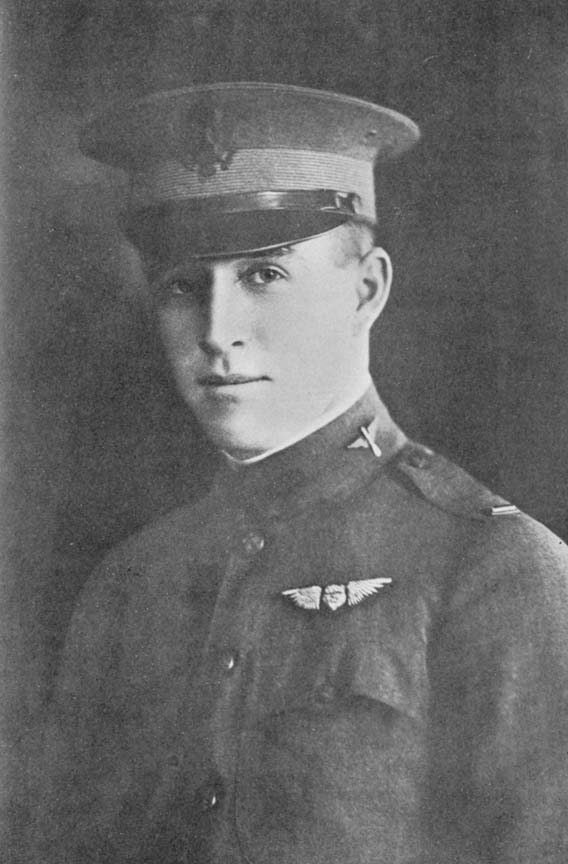
SON of Arthur E. and Adelaide May (Starbird) Craig; was born at Portland, Me., July 9, 1895. He was educated at the Portland Grammar and High Schools, M.I.T., and at Cornell University. He enlisted from Cornell in June, 1917, and was sent to the Officers' Training Camp at Plattsburg, N.Y. Later he transferred to Aviation, and was assigned to M.I.T., Cambridge, Mass., for groundschool work. He was trained in primary flying at Park Field, Memphis, Tenn., where he remained from Jan. 1 to June 1, 1918; and in advanced flying at Ellington Field, Houston, Tex., where he remained from June, 1918, to March, 1919. On completing the course at Ellington Field he was commissioned 2d Lieut. in April, 1918, and held as Instructor in Night Bomb Raiding.
Lieut. Craig had several narrow escapes from death. On July 9,
1918, while flying a new ship at Ellington Field, the engine refused to function at an altitude of 9000 feet. Fortunately he was able to plane to earth in safety, although his machine was badly smashed in colliding with a barbed-wire fence. On Dec. 9, 1918, he and another instructor had barely left Ellington Field when their engine stopped. In the forced landing which followed the plane was smashed and his companion was killed. Lieut. Craig escaped unhurt. He was honorably discharged at Ellington Field in March, 1919, and returned to Cornell to finish his college course.
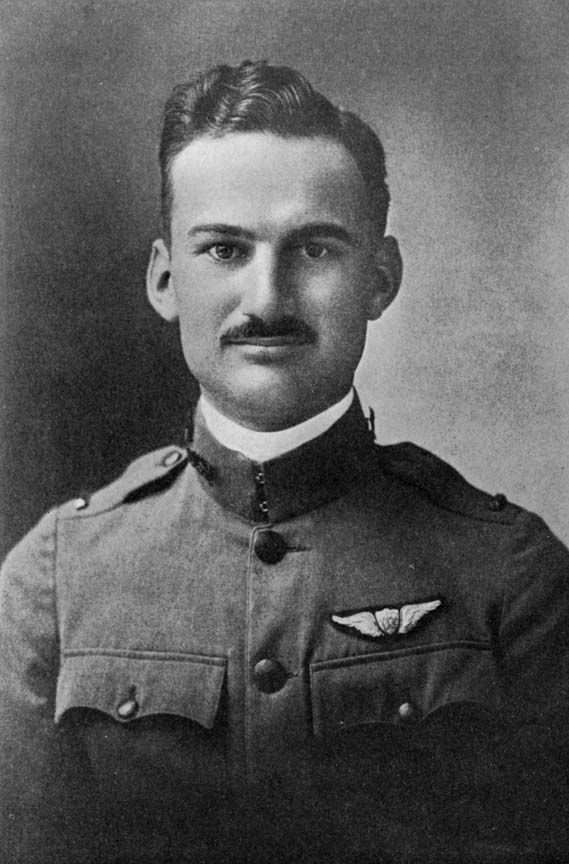
SON of Charles E. and Albertine (Flanders) Smith; was born at Nashua, N.H., April 6, 1895. He was educated at Florida Military Academy, Green Cove Springs, Fla., and at Andover Academy, Andover, Mass.
He enlisted in the U.S. Service on May 2, 1917, at Plattsburg, N.Y.; trained at Plattsburg, and at the M.I.T., where he finished his course on Dec. 18, 1917. He continued his training at Ellington Field, Houston, Tex., where he was commissioned 2d Lieut., A.S., U.S.A., on April 15, 1918, remaining there until he was sent overseas, May 15, 1918. He trained at Tours, France, and at Clermont-Ferrand during which period trouble with his eyes necessitated his transference to a bombing squadron. After some weeks of this training it was evident that his previous experience in night flying, acquired at Ellington Field, had made him available for that branch of the Service, and he was sent as a replacement to the 9th Aero Squadron, which was doing night reconnoitring for the American Aviation Headquarters.
From Aug. 1 to Nov. 11, 1918, Lieut. Smith was at the front engaged in night-patrol work, flying as Pilot with the 3d Army Corps. After the signing of the Armistice he was sent into Germany with the Army of Occupation, and has since been doing photographic work with the 9th Squadron.
Married, May 8, 1917, Marrion P. Gould.
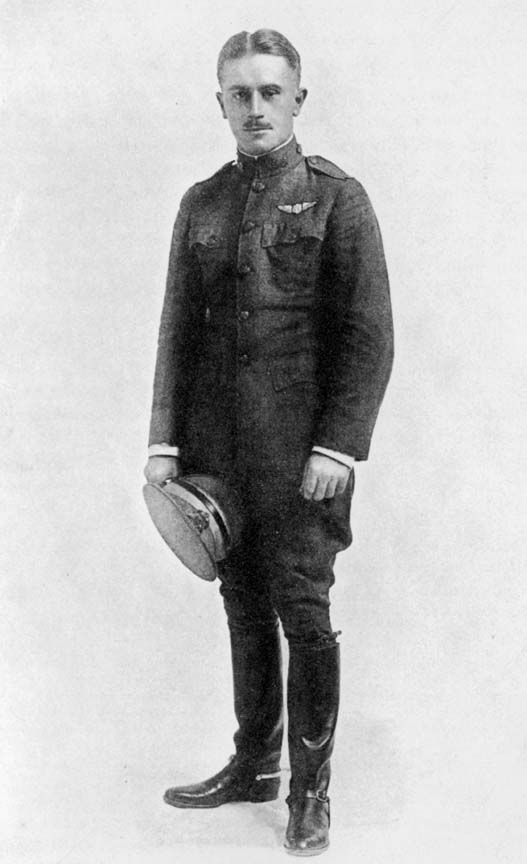
SECOND LIEUTENANT, A.S.A., U.S.A., ASSISTANT O.I.C., GUNNERY DEPARTMENT, GERSTNER FIELD, LOUISIANA
SON of Leonard Jarvis, M.D., and Mabel (Howard) Jarvis; was born at Claremont, N.H., Jan. 6, 1896. He was educated at St. Paul's School, Concord, N.H., and at Trinity College, Hartford, Conn., class of 1919. He was a member of Psi Upsilon Fraternity and of the Senior Honorary Society. He played on the 'Varsity football team two years; 'Varsity track, two years; 'Varsity hockey team, one year. He left college in the middle of his senior year and enlisted on April 3, 1917.
He served in Troop B, Hartford, Conn.; then in U.S. Ambulance Corps. He was sent to M.I.T. Ground School on Nov. 3, 1917, then to Cornell, where he remained until Jan. 12, 1918. He was then transferred to Gerstner Field, La., where he qualified as Pilot, and was commissioned 2d Lieut., May 6, 1918. On May 7 he was made Instructor in Aerial Gunnery, Flying Combat, and Martin Gun. He was ordered to Dayton, Ohio, Aug. 1918, and returned to Gerstner Field in Oct. as assistant O.I.C., Aerial Gunnery. In Nov. he was attached to the French and English Commission at Camp Beauregard. He was honorably discharged at Gerstner Field, Lake Charles, La., Jan. 7, 1919.
Great-uncle in Service ---
Charles Jarvis, Major, U.S.A., 9th Vermont Regiment; killed in action in Civil War.

SON of Herbert and Phila E. Coolidge; was born at Watertown, Mass., Feb. 3, 1897. He was educated at St. George's School, Newport, R.I., and at Harvard College, class of 1919.
He enlisted at Cambridge, Mass., in July, 1917, and had three months' training at the M.I.T. Ground School. He was commissioned 1st Lieut. in Oct., 1917, and sailed overseas in that month. About Jan. 1, 1918, he was appointed Instructor in Bombing at Headquarters Detachment, 3d A.I.C, at Issoudun, France.
Certain extracts from Lieut. Coolidge's letters are of interest:
January 8, 1918
I have been appointed an instructor in bombing for this camp, and have had to do some intensive studying before beginning my lectures. I find your honorable professor a very busy one, for besides giving four lectures a day, I have begun flying myself, in consequence of being a member of the Training Department, and this naturally is the best part of it all. However, having taken this position, I shall remain in camp after the other fellows go, perhaps for several months.
March 3, 1918
Am back at my old job, but I certainly wish I could get into active flying work, especially now that the big German offensive is on, and while the work here is interesting, I don't intend to be a school teacher for the rest of the war. If I don't get to service flying soon, I shall try to get to the front as a bomber.
November 16, 1918
Everybody here is thinking up alibis for, "Why I did not get to the front." It is n't our fault the war stopped. The only difference to us caused by the Armistice is that we are not to fly on Sundays, which perhaps is. just as well, as Sunday has been the day for getting killed... four last Sunday.
Quentin Roosevelt and Hamilton Coolidge were here a long time, and I knew them very well. They were in my class at college, as you may remember. They were fine fellows. Ham had gotten several Boches, I understand, and had been made a Captain.
We continue flying, when weather permits, and I am glad that I changed over from Nieuports to the de Haviland machines. The latter are easy to learn, but give one more work to manoeuvre at high speed. Have just led a formation in a cross-country trip, and that keeps one busy every minute.
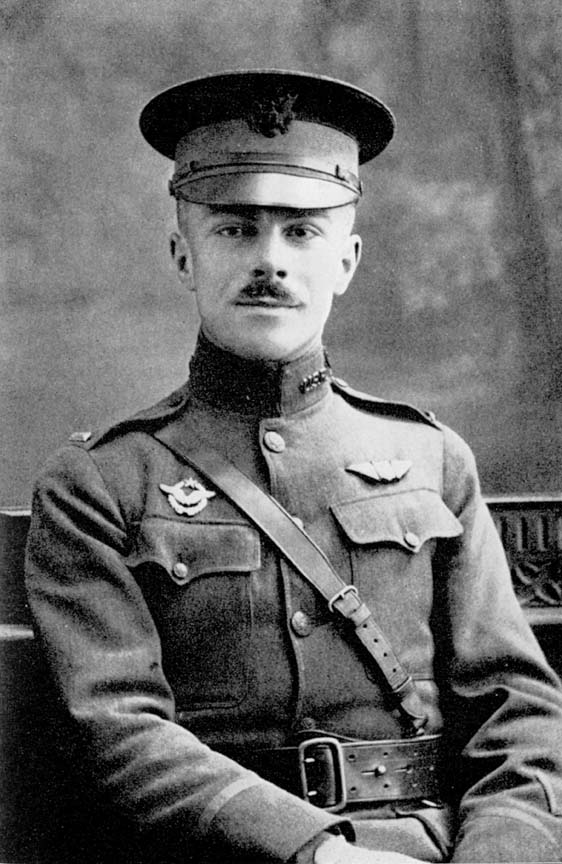
SON of John Moore and Persis (Dearborn) Comstock; was born at Chelsea, Vt., Feb. 12, 1893. He was educated at the Chelsea, Vt., High School; Manual Training High School, New Haven, Conn.; Kimball Union Academy, Meriden, N.H.; and at Dartmouth College, one year, class of 1915. He took part in track athletics, and played baseball and basket-ball.
He enlisted in the U.S. Air Service in Aug., 1917, at Sandusky, Ohio. He trained at the M.I.T. Ground School. and sailed overseas in Nov., 1917. He spent the following winter in camp at St.-Maixent; training being hindered by lack of planes. In the spring and summer of 1918 he completed his training at Châteauroux, and Issoudun. He was commissioned 2d Lieut. on May 18, 1918. For a month he was assigned to motor transport service; and he served for some time as Instructor at the Issoudun training field. While so engaged he met with a serious accident which incapacitated him from active service for some weeks. He returned to America in March, and was honorably discharged on March 17, 1919.

SON of Frederick W. and Carrie E. (Vining) Clark; was born at North Abington, Mass., June 3, 1893. He was educated in the Abington public schools, and at the M.I.T. He played on his school football team; and at Technology was a member of the tug-of-war team.
He enlisted on June 18, 1917, at M.I.T. Ground School, where he spent two months. He was then transferred to Belleville, Ill., on Aug. 18, 1917, where he made his first flight from Scott Field on Sept. 11, 1917. He was commissioned 1st Lieut. in Jan., 1918, and sailed for overseas service on the ill-fated Tuscania, which was torpedoed off the Irish coast on Feb. 7, 1918.
Lieut. Clark was in active service in France until the end of the war.
Grandfather in Service ---
A. Elliot Vining, served in the Civil War.
SON of Mr. and Mrs. Thomas R. Tarrant, of Brookline, Mass. He entered Dartmouth College in the class of 1918. In June, 1917, he enlisted in the American Ambulance Field Service, and sailed for France with the Dartmouth College unit. He was in the Camion Service for five months; was appointed Corporal by the French, and placed in charge of cars taking ammunition to the front. In Dec., 1917, he transferred to the Aviation Service, and trained with the French, receiving a French brevet. On May 18, 1918, he was commissioned 2d Lieut. in the U.S. Aviation Service, and served as an Instructor until the end of the war.

SON of Samuel Gelston and Alice (Tyler) King; was born at Boston, Mass., July 20, 1894. He was educated at the Noble and Greenough School, Boston, class of 1912, and Harvard College, A.B. 1916.
He attended the Officers' Training Camp at Plattsburg, in the summer of 1917, and the M.I.T. Ground School in the fall of 1917, leaving there in Dec. to continue his training at Ellington Field, Houston, Tex. He was commissioned 2d Lieut. and sent to Taliaferro Field, Fort Worth, Tex., where he completed a course in advanced flying, as Bombing Pilot. He was sent overseas in the fall of 1918, and remained at Clermont-Ferrand until after the Armistice was signed, when he was sent to pilot some of the ships, that our American aviators had left at the front, back to their bases. He returned to the U.S. in Feb., 1919.
HE was one of the original members of the First Aeronautical Division, called out on April 6, 1917. He received an honorable discharge from this organization to join the Lafayette Escadrille in France. He trained at Tours from Sept., 1917, to March, 1918. and at Issoudun from March to Aug., 1918. From Aug., 1918, to Nov. 11 he was employed as Ferry Pilot, flying machines to the squadrons at the front, from Orly, France. In Dec., 1918, he was assigned to the 28th Aero Squadron in the 3d Army of Occupation.
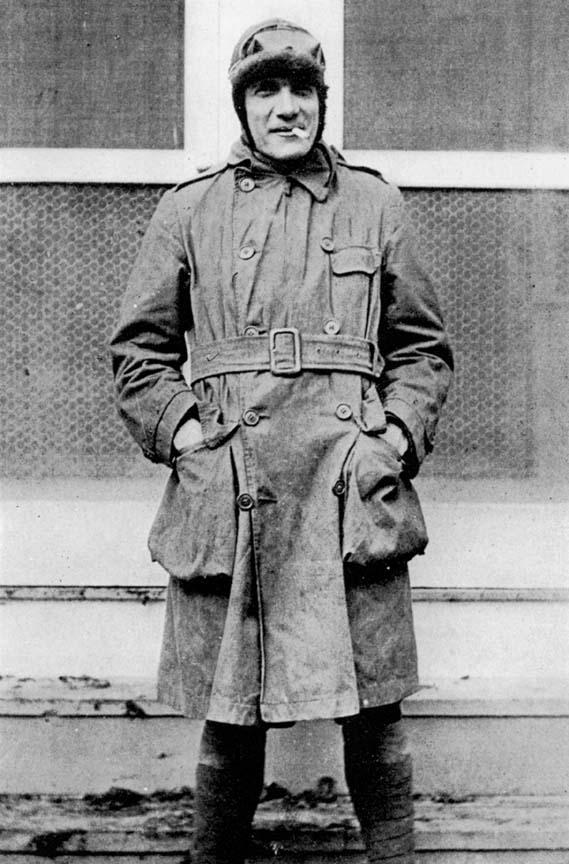
SON of Rev. Laurens and Ella T. MacLure, of Newton, Mass.; was born at Oakhurst, Pa., Nov. 7, 1892. He attended the Newton High School, and graduated from Harvard College in 1915. At school he was captain of the track team, and at college a member of the track team and captain of the cross-country team.
In May, 1917, he attended the Officers' Training Camp at Plattsburg, and while there volunteered for the Air Service, and was one of twenty-five accepted by the Government and sent to the Royal Flying Corps School at Toronto, Can., in Aug., 1917. On Dec. 1 he was transferred to Fort Worth, Tex., to continue his training, and in Feb., 1918, he was commissioned 1st Lieut., and sent overseas, where he was attached to the 139th Aero Squadron.
On July 17, 1918, he volunteered to protect a photographic plane going from the Marne back to the Aisne, some twenty miles behind the German lines; his engine failed as they started to return and he was overtaken by an enemy plane and forced to descend. Lieut. MacLure, who was badly injured, was captured and taken to a German prison hospital at Stuttgart. Wurtemberg, where he remained until Oct. 20, when he was able to be transferred to the prison camp at Landshut, Bavaria. He was sent from there to Villingen, from which camp he was liberated with other American officers on Nov. 29, 1918. Lieut. MacLure was repeatedly asked by the Germans during his imprisonment, "How many Americans are there in France?" And he always replied, "At least five millions." He was returned through Switzerland, and sailed from Brest in Feb. 1919. He was honorably discharged at Mineola, N.Y., early in March, 1919.
SON of Rev. Hiram Bingham, D.D., and Clarissa (Brewster) Bingham; was born at Honolulu, Hawaii, Nov. 19, 1875. He was educated at Punahou and Andover Academy, graduated from Yale College with the degree B.A. in 1898, took an M.A. at the University of California in 1900, an M.A. at Harvard University in 1901, and a Ph.D. at Harvard in 1905. He received the degree of Litt.D. from the University of Cusco, Peru. He was Capt. of Headquarters Co. of the 10th Militia, F.A. (Yale Batteries), from June to Oct., 1916; at Tobyhanna from July to Sept., 1916.
He enlisted in the Air Service at Washington, D. C., on May 3, 1917, from New Haven, Conn. He was trained at the Curtiss Flying School, Miami, Fla., in March and April, and passed his brevet test on April 30, 1917, when he was stationed at Washington, D.C., in charge of all ground schools, from May to Nov., 1917. He took his R.M.A. at Mineola in Aug., 1917. From Nov., 1917, until March, 1918, he was in charge of the Air Personnel. He was then ordered overseas.
He was in charge of Air Personnel at Tours, France, from April to Aug., 1918. During this time he made one trip to the front on a tour of inspection to the 1st Pursuit Group, the 1st Observation Group, and the 1st Balloon Co., during the battle of Epieds, north of Château-Thierry, July 23 and 24, 1918. He was subsequently transferred to the 3d A.I.C., at Issoudun, France, where he was Commanding Officer from Aug. 27 to Dec. 26, 1918. During this time he flew Nieuport 23's and Auros. At the termination of his command at Issoudun, Lieut.-Col. Bingham received the following letter from the Chief of the Air Service of the A.E.F.:
December 17, 1918
LIEUTENANT-COLONEL HIRAM BINGHAM
Commanding OfficerIssoudun
MY DEAR COLONEL BINGHAM:
As the school at Issoudun is about to close you will soon be relieved from your present duty as its Commanding Officer and returned to the United States. Before your departure I desire to place on record my hearty appreciation of the excellent work you did while in command of this, our largest training-centre in France. The results achieved speak for themselves and evidence the interest you took in your work and your power to inspire those who were working with you.
May I add that I was just about to recommend your promotion when the Armistice came and all advancement was stopped. While it was thus impossible to bestow upon you this well earned evidence of work well done, I want you to be assured that in my opinion it was your due.
Very truly yours (Signed) MASON M. PATRICK
Major-General, U.S.A.
Chief of the Air Service
Col. Bingham returned to the U.S., and from Jan. to March, 1919, was stationed in Washington, D.C., where he was honorably discharged, March 8, 1919.
He was commissioned Capt., F.A., July 3, 1916. He was made Major, A.S., S.O.R.C., on June 6, 1917, and was promoted to the rank of Lieut.-Col., A.S.A., on Oct. 23, 1917.
Married, Nov. 20, 1900, Alfreda Mitchell. He has seven sons.
SON of James M. and Emily L. York; was born at South Portland, Me., May 24, 189.1. He was educated at the Mt. Herman School, and at Harvard College, class of 1918. He trained with the Harvard R.O.T.C., and was a member of Troop A, Cavalry, M.V.M. He attended the First Officers' Training Camp at Plattsburg, and enlisted there, May 14, 1917. In July, 1917, he transferred to the Aviation Section, and from Oct. to Dec., 1917, trained at the M.I.T.; from there he went to Cornell University, completing the course Jan. 19, 1918, when he was sent to Ellington Field, Houston, Tex., Jan. to May. He trained at Camp Dick, Dallas, Call Field, Wichita Falls, Tex., Wilbur Wright Field, Fort Sill, Okla., and finally at Taliaferro Field, Fort Worth, Tex., where he was stationed from Aug., 1918, to Jan., 1919. He was commissioned 2d Lieut., R.M.A., May 14, 1918. On Jan. 19, 1919, he was honorably discharged at Taliaferro Field.

SON of Adolph and Rachel Cohen; was born at Pawtucket, R.I., Sept. 1, 1891. He was educated at Phillips Andover Academy; Sheffield Scientific School, Yale; and at the Mass. Institute of Technology.
He enlisted at Boston, Mass., on June 15, 1917; and attended the Ground School, M.I.T., from June to Aug., 1917, when he was sent to the Flying School at Belleville, Ill., in the first Squadron there trained. He was commissioned 1st Lieut., Dec. 1, 1917, and sailed overseas, to France. He trained at Issoudun from Feb. to July; was attached to the 85th Aero Squadron at St.-Jean-des-Monts, Hill 402, in Sept. and Oct., 1918; at Toul Aerodrome from Oct., 1918, to Jan., 1919. On Sept. 15, 1918, he made his first flight alone. He was honorably discharged at Garden City, N.Y., on Feb. 21, 1919.
Lieut. Cohen was the originator of the "Soldiers and Sailors Day" idea, which was carried out on July 4, 1918. On the stated day every one in Rhode Island was, at the request of the Governor, expected to write to friends in service overseas.
Brother in Service ---
Dr. Bernhard Cohen, Lieut. (j.g.), U.S. Navy.
SON of Charles H. and Catherine H. (Wilson) Little; was born at Melrose, Mass., Jan. 6, 1896. He attended the public schools of Melrose, and entered the M.I.T., class of 1919, leaving at the end of his junior year. He enlisted on Dec. 8, 1917, and trained at the M.I.T. Ground School, at Princeton, N.J., and at Chanute Field, Rantoul, Ill., where he was appointed Sergeant. He sailed overseas in July, 1918, and was stationed near Dover, Eng., until after the signing of the Armistice. He returned to the U.S. on Dec. 3, 1918, and was honorably discharged.
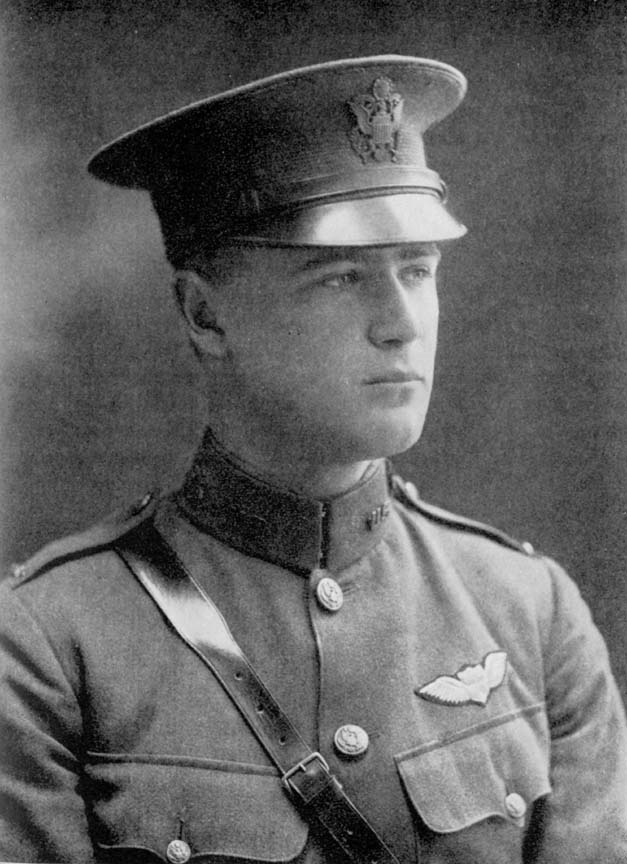
FIRST LIEUTENANT, A.S., U.S.A., TWO HUNDRED TWENTY-SECOND AERO SQUADRON; ONE HUNDRED FOURTH AERO SQUADRON, FIRST OBSERVATION GROUP
SON of Charles W. and Ethel M. (Wheeler) Spencer; was born at Cambridge, Mass., Jan. 29, 1897. He was educated at the Cambridge Latin School, the Noble and Greenough School, and at Harvard College, class of 1918.
Previous to entering the Air Service, he served for two years in the 8th Mass. Reg't, N.G., and attended the First Officer's Training Camp at Plattsburg.
He enlisted on May 12, 1917, at Boston, and had preliminary training at Selfridge Field, Mt. Clemens, Mich. During Oct., 1917, he was stationed at Mineola, N.Y. He was commissioned 1st Lieut., Oct. 5, 1917, and was ordered overseas on Nov. 2, 1917, attached to the 104th Aero Squadron. On reaching England he was transferred to the Royal Flying Corps, and from Dec., 1917, to Aug., 1918, trained at Yatesbury and Salisbury, England. From May to Aug., 1918, he was attached to the Staff, S.W. Area, R.A.F. He acted as a test pilot at No. 5 A.A.P., Bristol. He left England for France attached to the 222d Aero Pursuit Squadron, and in Sept., Oct., and Nov. was in active service in the Toul sector.
Lieut. Spencer was recommended for promotion to Capt. by the Commanding Officer of the 1st Air Dépôt, France, on Jan. 2, 1919. He returned to the U.S. in the spring of 1919; was honorably discharged from the Service, and is now engaged in business in South America.
Married, Nov. 12, 1917, Henrietta Brooks Faxon.
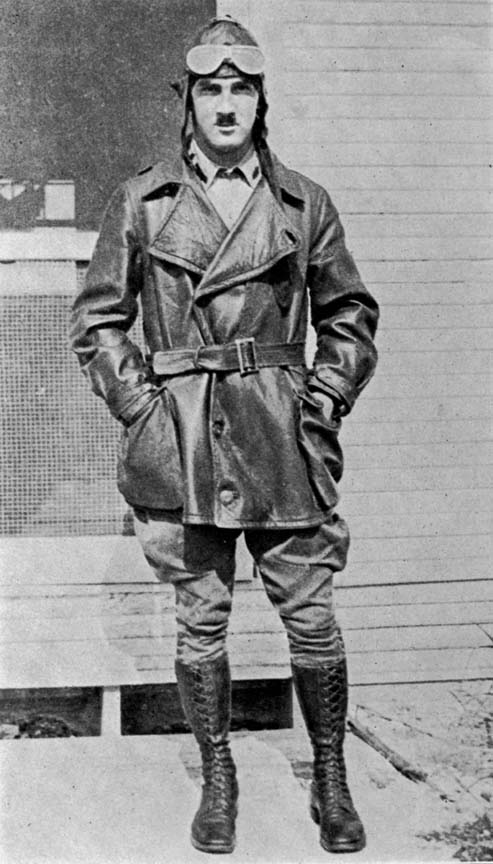
SON of Francis Walker and Lina (Coe) Bliss; was born at Attleboro, Mass., June 9, 1895. He was educated at the Attleboro High School, and at Colby and Brown Universities. At school he played on the baseball team, track, and football teams; he was two years captain of basket-ball, the last year winning sixteen out of seventeen games played by the school. At Colby he played one year on the football team.
On May 12, 1917, he attended the Officers' Training Camp at Plattsburg. From there he was assigned to the Ground School, at the M.I.T., graduating Dec. 22, 1917. On Jan. 2, 1918, he was sent to the Flying School at Kelly Field, Tex.; and on March 9, 1918, he was commissioned 2d Lieut. in the Aviation Service. He completed his course at Ellington Field, Houston, Tex., where in Aug. he received his overseas orders, sailing Sept. 2, 1918.
On Nov. 14, 1918, Lieut. Bliss was killed while instructing a pupil, at Ford Junction Airdrome, Sussex, Eng. He was buried at Morn Hill Cemetery, Winchester, Eng.
Brother in Service ---
Earle F. Bliss, Capt., 331st Reg't, F.A.; served with the 86th Division.
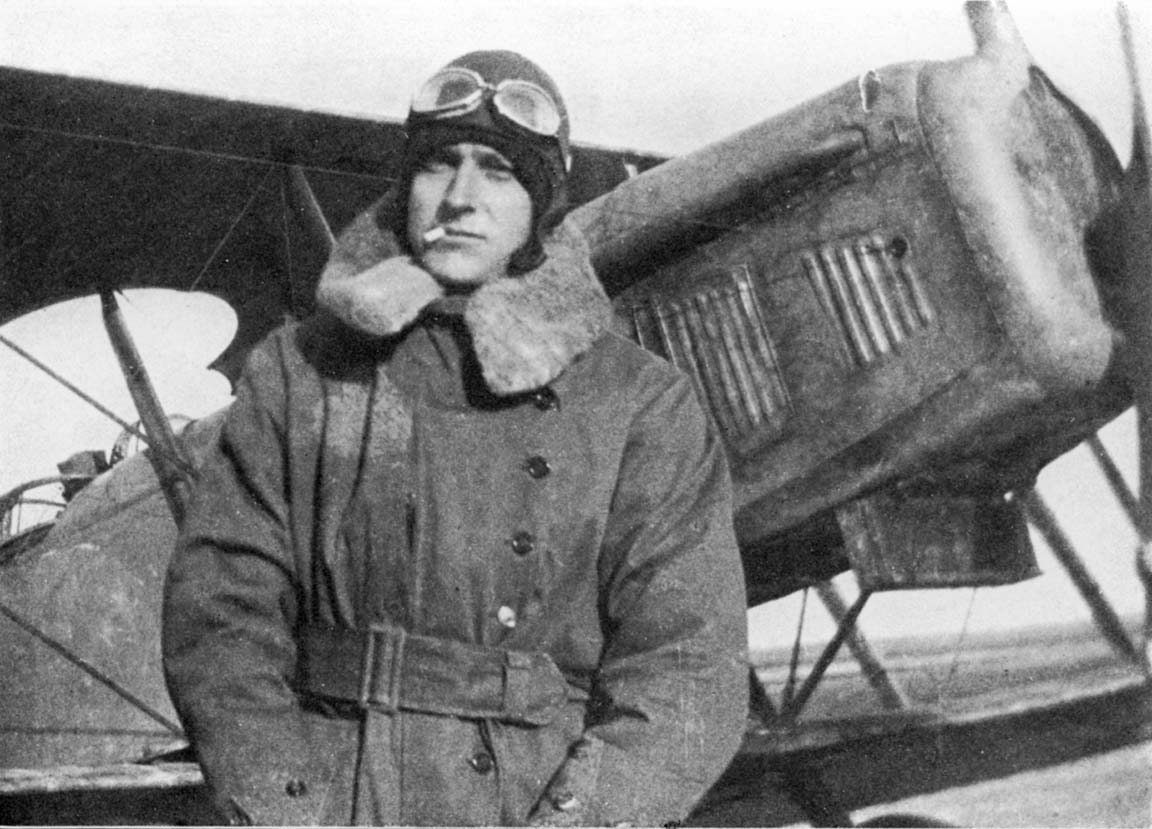
SON of William G. and Harriet (Towle) Hambleton, of West Newton, Mass.; was born at Plympton, Mass., June 11, 1894. He was educated in the public schools of Newton, and at Boston University. He left college after three years, to enter the theatrical profession, in which he continued until his entry into the U.S. Service.
He enlisted at Cambridge, Mass., in May, 1917, and began his training at the M.I.T. Ground School. In Nov., 1917, he sailed overseas and completed his training at Tours, Gondrecourt, and at Cazaux, France. On May 16, 1918, he was commissioned 2d Lieut. and saw active service on the western front until July, 1918. From July until the signing of the Armistice, Lieut. Hambleton was Instructor in Aerial Gunnery at the French Aviation School at Cazaux. He was brevetted by the French Government, and made an honorary member of the Aero Club of France. He returned to the U.S., and was honorably discharged at Garden City, N.Y., on Feb. 12, 1919.
Married, March 26, 1919, Marion S. Bowen.
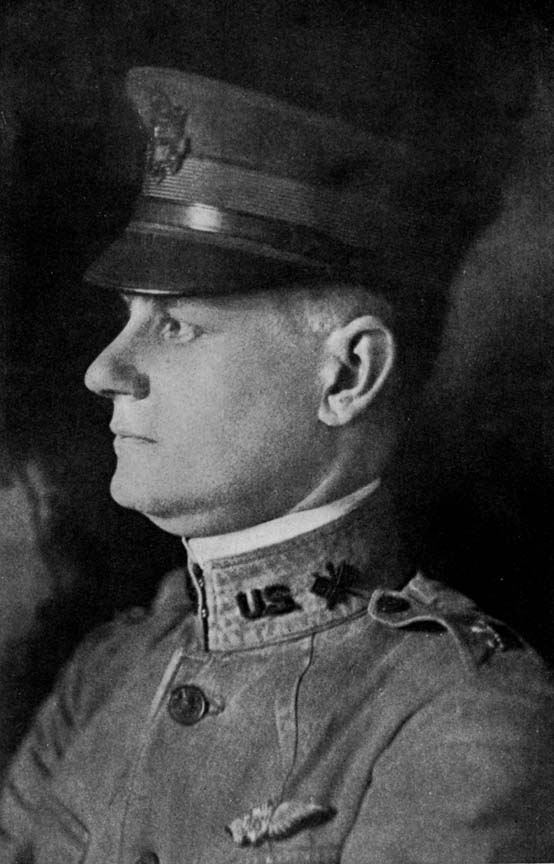
SON of Charles. Stedman and Clarina Bartow (Shumway) Hanks; was born at Manchester, Mass., July 17, 1889. He was educated at Groton School, Groton, Mass., and at Harvard College, A.B. 1912. He played on his class baseball team, and was a member of the 'Varsity track team.
Prior to the declaration of war he trained as civilian aviator, and received Pilot's certificate from the Aero Club of America, Aug. 16, 1916; he had preliminary training at Governors Island, and at Mineola, N.Y. He enlisted May 26, 1917, at New York City, and was commissioned Captain, Signal Officers' Reserve Corps, May 26, 1917. He served as Aide to Maj.-General Geo. O. Squier, Chief Signal Officer, War Department, and subsequently, as Liaison Officer for Air Service with French, British, and Italian Aviation Missions. On Aug. 15, 1917, he was promoted to grade of Major, U.S.A., and later transferred to A.S.M.A. On Jan. 11, 1918, he passed his R.M.A. tests, at San Diego, Cal., where he was Commanding Officer of the 18th Aero Squadron. Major flanks inspected many aviation fields, both by aeroplane and with Gen. Squier; was Commanding Officer of 2d Wing, Concentration Brigade, Aug. 19, 1918; commanded Concentration Brigade, Aug. 30, 1918, and was officer in charge of review of 6000 troops, Air Service. He was also President of Special Court-Martial; and officer in charge of demobilization of Air Service, at Kelly Field, Tex., where he was discharged under special orders from the War Department, Jan. 7, 1919.
Married, Feb. 11, 1919, Margery Hancock.
Relatives in Service ---
Seven cousins in Army: 2 Major-Generals; 2 Colonels; 1 Lieut.-Colonel (flying status); 1 Captain; 1 Lieutenant, killed in action.
SON of Mr. and Mrs. F. A. Barnes, of Whiting, Vt.; was born at New York City, Aug. 10, 1888. He was educated in the public schools, and at Bryant and Stratton Business College, Boston.
He enlisted at Boston on July 19, 1917, and received his ground and flying training at Mineola, N.Y., Lake Charles, La., and Ellington Field, Houston, Tex. He was commissioned 1st Lieut., Dec. 20, 1917, and has been recommended for promotion several times. While in flying service he acted in several capacities; was Officer in Charge of Officers' Club, at Gerstner Field, for nearly eight months; was Mess Officer, Cadet Mess Officer, and Tactical Officer for Cadets, at Gerstner Field. At this station he was on the overseas list at the time of the big storm that nearly wrecked the field. The Commanding Officer removed Lieut. Barnes from the overseas list to help reconstruct the field. He had charge also of all transportation to town, during the influenza epidemic in the fall of 1918, and of food supplies at Gerstner Field.
Lieut. Barnes was at last accounts still in service at Ellington Field, Houston, Tex.