Paris
October 30, 1914
Off to-morrow at 7.45 A. M. for the front! Mr. H------'s troubles are over and he is moving the Hospital as near the trenches as prudence allows. It's great news, and I am as glad as can be to get off. Mr. M------ has been as nice as possible to me, and I have enjoyed staying with him no end. Spent all the afternoon in Notre Dame and the English hospitals playing checkers with wounded Tommies. Most of the sights and sounds were ghastly, and they take a weird interest in showing you their wounds.
Chateau d'Ayencourt
November 1, 1914
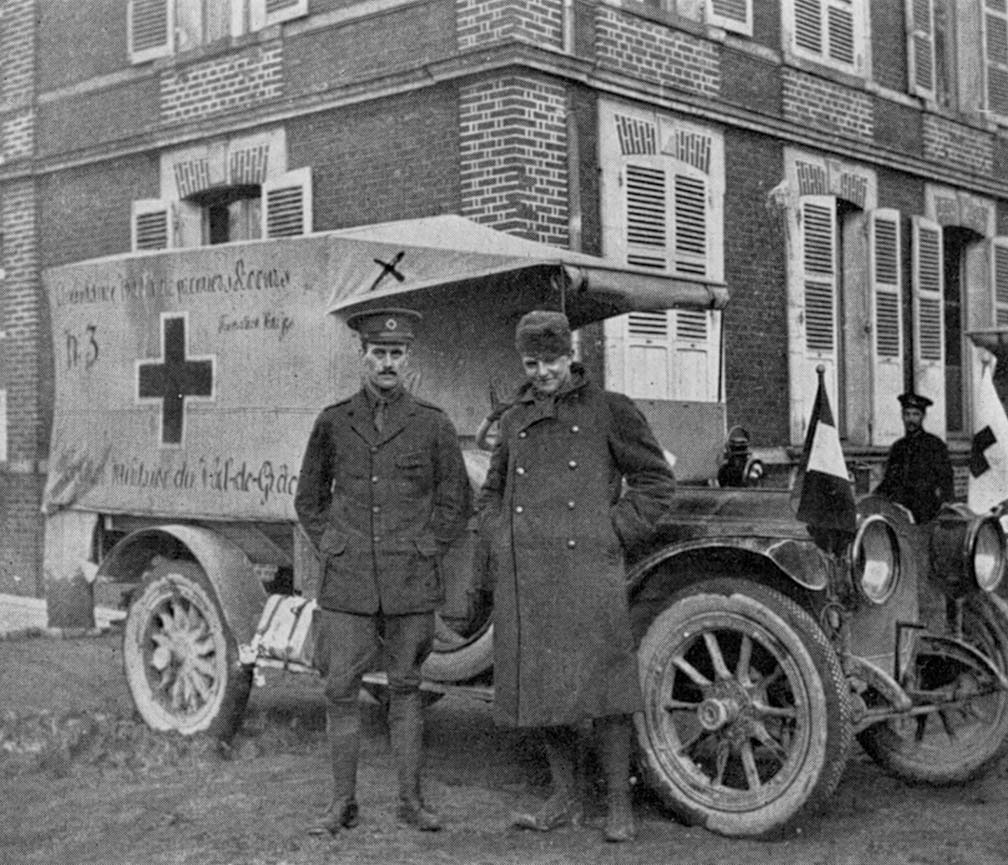
Yesterday morning I started off with Mr. H------ and Dr. W------, one of Dr. B------'s friends to begin my job. We motored to Compiègne through Senlis, which is now a mass of ruins and at Compiègne met the ambulances. I've got a big six cylinder Packard that goes very well. From Compiègne I drove it out here near Montdidier where we have requisitioned a fairly decent Chateau. It was in shocking shape, but nineteen of us soon moved everything out of sight, and it was much like a huge picnic. Only I got rather sick of carrying chairs up three flights after my twenty-sixth trip. All afternoon I raked the yard and drew carts of leaves off to a dump pile about a quarter of a mile away,---and slept like a log afterwards. I've got a bully room with Paul Rainey. It looks across a little pond into some very pretty woods and just now I can see two aeroplanes going to reconnoitre, while the booming of cannons has been continuous since daylight. There are three of us St. Paul boys here,---T------, S------ and I, and four of us, including two of the doctors are Princeton men. B------ was in L------ B-----'s section in Ivy, so I've landed among friends! I was surprised to find everyone,---Eli's and all, singing the "Orange and the Black." The men are very nice. I'll write more about them later. We have one Mexican who answers to the name of Jesus, and a chef from Paris who produces wonderful meals. I've been working all morning on my car, as the General is coming to inspect us at two o'clock and am just dashing this off before lunch so as to give it to Mr. H------'s chauffeur to mail in Paris.
Chateau d'Ayencourt
November 4, 1914
Monday and Tuesday we worked like sin setting up beds, sweeping, moving furniture and getting things in shape generally. We've a very decent house and are slowly getting settled. On Monday the Surgeon General of the 4th Army Crops came around with an aide to inspect us and the performance was worthy of Gilbert & Sullivan. Rainey had us all trained and we stood by our ambulances and saluted the old boy in rare style. One of our machines has to be at the gare from 7 A. M. to 10 P. M. and we've divided the time into three shifts. The gare is about two miles away and the wounded are brought in there by other ambulances from the front. We hope to do that part of the work ourselves later on. Just now the firing has stopped and it's a damp peaceful day.
The Germans went through Montdidier and though they killed no one, they stole everything they could lift.
Yesterday I drove Doctors B------ and W------ and T------ into town, and we bought some small necessaries and looked about. They all went to the hospital to see how it was run and I was left outside with the car. Before long I was surrounded by a crowd of townspeople who admired my uniform immensely and when they found I was an American, asked at once if many of the American troops had landed in France! They were a very congenial crowd and all shook hands with me with great formality before they left, and wished good luck to the new entente cordiale. I talked to quite a few soldiers and heard lots of gossip, after which I helped carry corpses to the morgue. It was rotten work, but I thought I might as well get used to it. Some of them you couldn't tell had ever been human beings. We came home just before lunch and all afternoon I worked on my car and cleaned brass for the operating room. This ought to be a very healthy life,------no end of work and no rum or late hours.
Rainey is general boss over us ambulance men,------and his talks in the evening about hunting are marvelous. We all get around the fire in a big room we have fitted up as a club room for the men, while he talks by the hour and is very interesting.
We won't begin to take wounded until Friday and then our work begins in earnest. We're part of the Army in everything but enlistment and are virtually prisoners here as we can't move without a pass, and sentries stop you everywhere.
I can't think of any more now, but as this can't be mailed for a while I may add to it.
Chateau d'Ayencourt
November 5, 1914
Things began with a rush to-day. The "medicine man" sent for us to come and get wounded at the station and we have ten now. There was a general advance yesterday by the Allies and we see the result here. In one room at the station there are over a hundred wounded,---all covered completely with mud, smelling to heaven and groaning. It is an awful sight,---and they're still coming in. We weren't really prepared and when I came out with three on stretchers and two sitting in N------'s car it took five minutes to get the nurses and doctors together. Yesterday I went to Montdidier and did some shopping. G------ forgot to stop for me on his way home and the sentry at the railroad refused to let me pass. However, after a little jollying he not only gave me the password but stopped a cart and told them they had to take me with them! Got to clean my car now.
Later
I'm writing this on a board laid on my steering-wheel while I'm waiting outside the station for orders. I'm stuck here till midnight. It's a damp foggy night, but the sight of the few lights gives a rather Whistler-like touch and the cannon are booming at short intervals. They worked us for fair this afternoon. I made any number of trips to a farm behind the firing line and to Warsy and Dancourt, two villages, and brought in forty-eight wounded. Our cars brought in over two hundred. Off on another trip now, so so-long.
Back again from a trip to the Civil Hospital with a couple of wounded. This afternoon on my last trip to Warsy, when it was almost dark, I passed some batteries of artillery. They were coming over a ridge with the full moon rising behind them and it was a most gorgeous silhouette. I also saw the Germans shelling aeroplanes. You'd hear a boom and then see a puff of brown smoke burst way up high, but they hit nothing. I didn't get nearer than two miles from our line,---but every little helps.
Our machines are the admiration and envy of every French doctor that sees them. They carry six "couches" and the stretchers run in on pulleys, which is a new idea here. There are fourteen hundred wounded in this station---the result of having tried to take the village of Andechy, and having it retaken by the Germans this morning. The French intend making another attack to-night,---so to-morrow ought to be a busy day.
An old fellow whom I picked up wounded, rode in beside me today. He had been in Algiers four years and we had a great talk. He was shot lying down, the bullet going in above his shoulder and emerging just above his knee. He was also hit by a spent bullet on his Morocco medal which pleased him no end,---and he was very gay. The station beggars description-stretchers everywhere and smells and groans rising in chorus. I've just been through giving them chocolate and cigarettes and doing any little thing I could, like taking letters, etc. They seem very grateful and I enjoy doing it no end. The French attack has evidently begun as the cannons are continuous. Off on another trip.
11.30 P. M. Home at last and very tired. The town is full up,---not a bed to be had anywhere and I don't know what will happen to-morrow after this row to-night. It's really remarkable. The big guns are going like mitrailleuse ---not a second's pause: Went around with a Frenchman after my last trip to some friends of his and had some fine hot coffee served by two good looking girls. My French is awfully useful and I do a lot of interpreting work. I'm going to get some photos which I'll send on when I can. Going to bed now, so good night.
P. S.---One of our wounded died from an internal hemorrhage. I just saw one lad with five wounds who didn't seem to mind a bit. They all want to exterminate les Boches!
Chateau d'Ayencourt
November 7, 1914
B------ brought back from Paris your letter written on the train to Princeton. I think I wrote Father that I brought in fifty in my car the day before yesterday and yesterday I carried ten. When I deliver the wounded at different hospitals I always go in to kid the others along and feed them or mail letters for them, and they seem very grateful. Dr. B------ I didn't see in Paris as he was busy twice when I tried to see him and then I got this job and couldn't I'll write him and explain why I didn't present my letter.
We have thirty-three wounded here and are very busy. One of them is a German, the only one we have and I'm sorry for him, as he's badly hurt and it must be hard to die with nothing but enemies around you.
It's remarkable how accustomed you get to things. I see these fellows all mussed up, watch them die and then carry them out, and it seems quite natural, whereas at home I'd run a mile from a "stiff." Quite a lot of our men groan all the while and it's a bit depressing at first, but after a while you don't notice it. This morning I was on the station job at six o'clock and by good luck I was sent to Boulogne la Grasse, and the Germans were less than a mile away the other side of a little hill. I took out a Curé with warm clothes and then talked awhile to men and officers. They admired my machine no end and were cordial as could be. Then I came back, giving two sentries a lift for five miles and got coal for the chateau. It's no joke lifting the hundred pound bags, but fine exercise! This afternoon I did nothing but shop for the doctors. There aren't more than five or six wounded here in the station now so there's nothing to do until another fight takes place. They've been pouring troops through here since last night. I heard their bugles at intervals, and saw them to-day, so it looks as if something were about to happen, and we'll probably get off to the front again to-morrow or the day after. There is so much of interest going on every minute that it's quite impossible to write a consecutive letter.
These nurses are the finest women I've ever run into. They hit the happy medium of being sympathetic with the men without slushiness, and they fairly eat work. It's beyond me how they do it. I get on very well with the "medicine man" largely on account of a fair knowledge of French and partly because I "kid him along" rather outrageously, but I let him know that I understand he's king in this part of the country. He knows exactly what he wants and if you do it, he's an easy and pleasant man to work under.
I had breakfast this morning in a hut with the sentries who had just come off night duty and enjoyed it hugely. They're very keen about my uniform and the entente cordiale works to perfection. I'm awfully glad to be here, and it's great to get at these fellows when they first need help, and not after they're all "dolled up" in the hospitals in Paris. I've quite a few souvenirs in the way of buttons, bayonets, buckles and shells that I've picked up and I'll get a casque à pointe before long.
Chateau d'Ayencourt
November 9, 1914
Sunday passed uneventfully, only ferry work for typhoid patients. Rather good church bells in this town, but you'd never know it was Sunday otherwise. This morning I took a dead man to the morgue and then came home after doing a few errands and went to work burning the old dressings and bandages which had accumulated during the week,---a most disgusting job. I then watched the surgeons trepan our German's skull. They cut right through the top of his head and removed a bit of bone four inches long and two wide. Skulls are evidently very tough for they hacked away at it with a species of pick-axe and you could hear pieces crack and break off like stone in a quarry. It's fascinating to see them do it, though its very bloody. The bullet cut a groove in the skull and it was the under side which had been depressed that they took out. He is wounded through the middle also and the bets are that he doesn't live. Lately he had been tearing off his bandages and scratching himself, so they decided to operate and now expect things to go better. I bought some sirup in town for one of our Lieutenants and he was most grateful.
As you see, our writing paper has given out and we're down to this. One car went off to Paris to-day and I'm next on the list to go. I'll be glad, as I want to buy some kahki shirts, having worn this one ten days. All the French soldiers call me "Major," salute at every opportunity and are quite impressed with my uniform. As I wrote you I've secured a bayonet, a gilt belt buckle and numerous buttons and I'll get all I want later.
One of our nurses, Mrs. S------, served in the Russo-Jap war, in the Philippines, Balkans and now this one, and she is as interesting as can be to talk to. We're officially attached to the army now and military inspectors come around quite often. We're in the 4th Corps of the 2nd Army and working for the 18th Evacuation Hospital. Rainey is most interesting and essentially a man, and what he doesn't know about hunting isn't known. He talks by the hour every night after supper and it's a tribute to his conversational cleverness the way we all gradually drop our own talk and listen to him. He's especially interesting when he tells how he made up his hunt pictures and there's more bluff than you would think in them. A fellow in the top right hand stretcher of my ambulance pretty nearly bled to death the other day and if the two under him hadn't been so sick, they'd have yelled like sin, for they were soaked, and the machine looked like a "futurist" sunset and was the deuce of a job to clean.
We're fed awfully well, and we're all drinking the ordinary water after all, as the trouble of getting the other was too great and as yet no one is ill. I'm glad I was vaccinated however, as I don't like our supply at all!
Going out to clean up my car a bit, then to put rubber heels on the nurses shoes and "kid" the patients along, before taking a walk. I'm off duty unless something unforseen happens, till to-morrow morning.
Chateau d'Ayencourt
Wednesday, Nov. 11, 1914
This job beats working in the American Hospital four ways at once. The field work is exciting and very good exercise, and I have more chances here to do decent things for the wounded than I'd ever have in Paris, as we get any amount of men who are so badly banged up they'd never live to reach Paris. They're shot in every conceivable spot and it's marvelous how much it takes to kill a man,---though three of ours died to-day---and I've been seeing French officials and signing death notices for the "medicine man."
Our life has settled down quite systematically. We get up about 6.30 A. M., eat an awfully good breakfast---chocolate, bread and butter, baked apples, fried eggs and bacon and then, if I'm not on duty en ville, I work over the car for an hour or so and it's no easy job keeping a "six cylinder" in good order. We lunch about twelve and it depends on the events of the day if we have much to do, or not. Sometimes we're rushed and don't get in till seven, but between H------ and the chef we're fed fully as well as I am at home,---though not so stylishly. We all eat in the kitchen on oilcloth and broken chairs, one plate, knife, fork and glass for all courses and hunks of bread for butter dishes, but it's a merry assembly, though to hear them talk about who is due to die during the night, etc., and making jokes over it might lead an outsider to think they were a callous lot. I like W------ our chief surgeon a lot, and to hear him and the other two talking after dinner is a treat. We've a little room which we have made into a sort of den, and we sit around there after dinner and yarn till bedtime,---usually about 9 P. M. This afternoon I was kept busy till tea time carrying typhoid, malaria and rheumatic men to different hospitals and they were the most woebegone looking lot I've seen. The wounded suffer, but are usually alert, while these were dumb as cows and walked as if in a dream. They were fully as dirty as any I've seen and had a smell of their own. You'd never live in this place ten minutes. It's dirty and cigarette trays are unknown. I took two dead men down in my car and on the chains which held their stretchers I had nine of these round French loaves strung when I came back, and all our meat wrapped up in paper on the floor where the other fellow I wrote about almost bled to death. I think the water here is bad, as several of the men have been sick. I drink as little of it as possible. It's getting very cold, but our overcoats are immense and very comfortable. Rainey has left us for Biarritz, so I've got his bed and a room to myself which is very comfortable. * * * There has been no end of activity to-day. I saw four aeros up at once and trains of new guns and supplies have been chasing each other along all day at fifteen minute intervals. Some of them were marked for the Indian Army. N------ who came from Paris says the road from Compiègne here was full of troops and it looks as if something was about to be sprung. The soldiers about the station are quite friendly and I talk to them all the time and usually have tea or a drink of Dubonnet with one of them any afternoon I happen to be down there.
I can't think of anything more to say just now except that I'm very well and happy and really feel as if I was doing something in the biggest thing the world has seen, even if it isn't much, and I enjoy it no end.
Chateau d'Ayencourt
November 14, 1914
I worked on my car most of the morning and then took off a Frenchman's beard for him with clippers. The first man I tried to shave, told me when I was half through with him, that he would rather have the rest of his beard left on, and when I asked my second victim if I hurt him, he said "Oh, I am a soldier and don't mind pain"!
After lunch the "medicine chief" ordered me to take two ladies around in the auto. They are hoping to start a hospital something like this one. I drove them to Hargicourt, Davnescourt and Rollot, about sixty kilometers. We saw German prisoners at Rollot and the French are still constructing the most intricate trenches facing towards Roye. They are roofed over and loop-holed and cannot be seen fifty feet away.
Next I got a hurry call from the station to take fever men to Breteuil. Coming home empty, we ran very fast. It was a clear starry night, quite cold, and we could see the flashes and hear the big guns by Guerbigny. I nearly ditched the car while watching for the flashes. * * *
Troops are still pouring through to the north, and the men around here say things must be pretty serious, as the class of 1914 has also gone to the front. * * *
We have discovered quite an amusing café near here, and the patron is now one of our most intimate acquaintances. A soldier gave B------ a dog who has been named Soixante quinze after the 75 mm. French guns, and he is popular beyond words in the wards.
Chateau d'Ayencourt
November 17, 1914
Yesterday the big guns boomed intermittently until evening and then began to go like sin and kept up all night.
We were sent to Amiens in the afternoon with wounded, and it was a fine run of 35 kilometers.
This morning a Taube flew over the town and dropped a bomb. We saw it flying home and all the French taking shots at it. The shrapnel was fine. It looked like a lot of greasy puff-balls strung on a kite string. The puffs changed to dark brown after a while and hung in the air for five minutes. It's fascinating to watch them appear. A machine gun hidden in the woods let go, and it sounded just like a boy running a stick along a picket fence. The cannonading this morning was terrific but the results cannot be definitely known. Some accounts have it that the French took Roye, but many soldiers tell me that the Germans have advanced five kilometres towards us, and there is no doubt that the guns are nearer than before, as our windows rattled all day, and G------ who went to Compiègne said the sentries were awfully strict and there was great activity everywhere.
This morning I took some men to Amiens and without any laissez-passer. I thought it would be a good scheme to get one at Amiens, but the military Governor of the city refused to give me one, and said no motor ambulance could circulate without a "non-com." officer on board. I saluted and then started home minus any papers except my passport. The first sentry would have stopped me if I had not been going so fast. At Boves a gendarme dashed out, and I thought all was up, but not for nothing had B------ and I given about fifty men drinks the day before in Moreuil. It seems the gendarme had heard of our party, and simply wanted a ride to his home. He got me by the next sentry, and the last two I jollied into letting me get home, so here I am!
I gave all my men wine and chocolate and they survived the trip very well and thanked me a lot.
Chateau d'Ayencourt
A little snow and very cold. My car froze yesterday, and I had an awful time to get it going.
November 20, 1914
Chateau d'Ayencourt
November 21, 1914
Coal is not to be had, and we are in a bad way if some does not arrive soon, as we have no wood.
Took five sick to Breteuil this afternoon and had a nice talk with Mdme. De N------, daughter of the Count de N------, who met us in a café where we were having hot toddy before starting home. Her husband was killed a short while ago, but she is as plucky as can be. The patron said that a French cuirassier, when surprised in the village by six Uhlans, galloped to a side street, dismounted, killed one German, and by beckoning to non-existent reinforcements, scared off the other five. He also told us the Germans with forage caps were mistaken for English and were given cakes and apples. Queen Louise's Guard took Albert near Amiens yesterday, and the soldiers here are as mad as sin.
Chateau d'Ayencourt
Sunday, Nov. 22, 1914
Have just come in and finished lunch after a long and very cold stretch of duty at the station from eight until one o'clock with only one trip to break the monotony. It's really exceedingly cold and your feet feel it from resting on the metal pedals so long. But it's a bully clear day so one can't really complain. This morning about 10.30 I was walking up and down trying to keep warm, and listening to the church chimes which are really very fine, thinking how peaceful the place seemed, when suddenly there was a rattle of 75's and white puffs appeared all over the town. It was our old friend the Taube and he escaped unhurt. The French biplanes got up about ten minutes later and started off after him towards Amiens, but it's a safe bet they never got him. They're fine machines (the French), but slow. They have boat-like bodies, some with a machine gun in front, but as I said, are too slow. They each carry two men and under each wing they have three circles so that they can be recognized by the French.
An English supply train going South empty, passed by and I got a bottle of rum for some of the men who were half frozen. They were so grateful that they wanted to give me shoes, puttees, etc., but I compromised on a tin of chocolate which had been sent to an English officer, since killed, which they had annexed, and ate myself to the brim.
The 155 mm. and 220 mm. guns were going all night, and our windows rattle continually. It's no end of fun watching the shrapnel burst near aeros and we bet on which side the next puff will appear. The Lieutenant on the supply train told me they had just left six French suspected of being in German pay, at Amiens. They had dynamite fuses and powder in their possession and couldn't explain it, so it's liable to go hard with them unless they can think up a plausible tale. * * * I brought two men out to the chateau to-day, one of whom had just received the Medaille Militaire. He had held a German column of Uhlans in check with a mitrailleuse all alone and has now a fractured thigh and a hole in his shoulder. The other man had a broken leg. On the supply train were also some English soldiers, prisoners for misbehavior. One punched his captain's nose while full and got three years, but he didn't seem to mind, at all. The English sell things right and left off the supply trains, and half the citizens are now sporting English puttees, shoes and tobacco. I don't see why it's allowed to go on. * * I'm going out now to work on my car and then come home and get cleaned up for Sunday supper. It's really a treat to feel clean once a week, even if a six inch rubber bath tub is the only plumbing you have.
S------ P------ ought to do very well singing "Tipperary." It's got a glorious swing. Since I saw a train-load pass through here to the front singing it, it seems to me almost a hymn, and I can't help thinking of the line "and the long, lean ranks go roaring down to die." It's gorgeous, all the same.
Chateau d'Ayencourt
November 24, 1914
Monday was more or less routine work. Yesterday I took six men to Breteuil and did errands, etc. The troops have been going South all day and there's a report that the Germans have taken Arras and will try to come this way, as the North seems too hard. I hope they do. Quite a few of my shop-keeper friends have asked me what to do if they come. I tell them all to hide their best stuff and sit by smiling with the others.
The grimy side of war was brought home to us to-day at lunch. We were all sitting around laughing and talking when a nice looking man and woman came to the kitchen door and asked for Lieutenant M------. B------ was just rising to talk to them when Mrs. S------ (the nurse in whose ward the Lieutenant was), came along and led them away. As they were crossing the court she told them the Lieutenant had died yesterday and the woman broke down completely. The man was a bit staggered, but took it well. It seems they were his aunt and uncle who were practically father and mother to him, and they would have arrived in time to see him if the station hadn't refused to send a telegram until too late. * * * The interruption above was a hurry call to go and get the corpse out of the green house and take it to the morgue. There had been an autopsy and the body looked rather messy, so the doctors thought it would be better to have the relatives see it when it was dressed for burial.. It was an unpleasant thing all around, and I felt like a crook stealing that man away.
Just come in from a walk to M'didier with Mrs. S------ and Miss L------. Your letter of November 4 came last night. I will wear a woolen helmet with joy, as I've been freezing as to ears and feet for three days. * * *
No wounded to speak of---only three to-day. * * *
* * * I hope the Germans come this way if they come at all, as we're not busy enough now.
I've got to get supper now as I'm on night duty, so good-bye. This will be taken to Paris by one of the English ambulance men to-night. * * * Merry Thanksgiving---it's to-morrow, I believe.
Chateau d'Ayencourt
November 29, 1914
The firing has stopped for the last few days, and there is talk of moving us up nearer the line. I hope they do. Our life here has settled down quite a bit. We are waked up at 6.30 A. M., breakfast at 7 A. M., and then I work on my car until orders come in for the day. We are liable to be sent anywhere on two minute's notice and have to keep our cars like fire engines ready to start at once. I drive a very good machine and have not had trouble with it so far.
I saw a fellow at the gare yesterday who had just come in from the trenches, with his arm blown off at the elbow. He was a most awful sight, blood from head to foot and groaning continually. The most unpleasant cases that we get are called paraplegias, men who's spinal cord has been injured. It is practically sure death, but the fellows do not know it, and it's awful to see them grow thinner and thinner every day, and taking a little less interest in life until finally they seem just to forget to live. After these cases, our worst jobs are the fractured femurs. There is one fellow that yells his head off every time he is dressed and has to be held down. He is a very nice looking chap, a footman of the Duke de R------'s, and he has a hole in his thigh into which you can get your fist. These nurses are marvelous. They even find time to do no end of little things for us ambulance drivers, by giving us hot water bags when we come in at night, and I have never in my life seen anyone eat work the way they do.
This chateau is reasonably comfortable, but one would not live in it long at home. No bathroom, and these French windows do not stop the winter breezes at all.
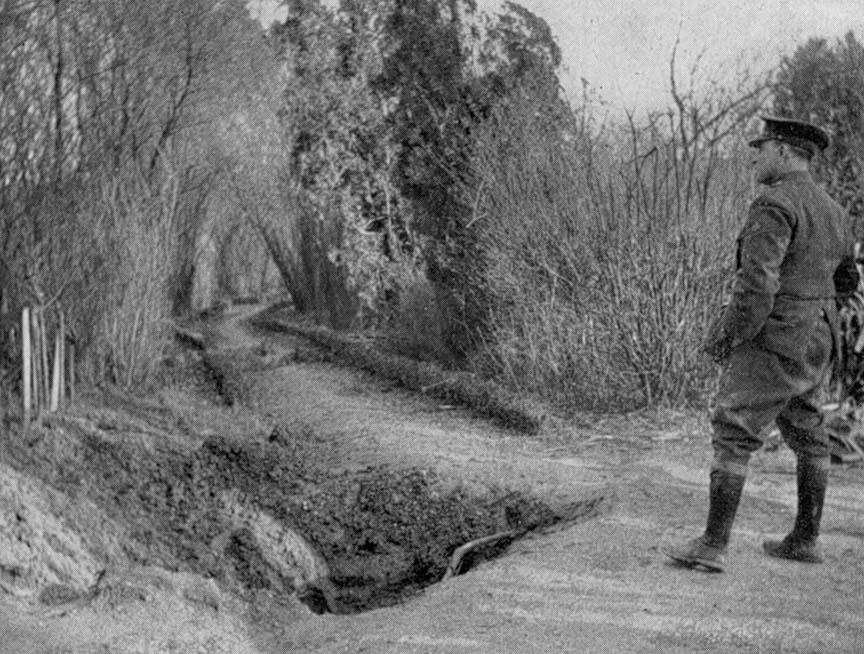
Troops are still passing South,------what for no one knows, and they shut up like clams if you ask. A regiment just quartered itself around Le Montchel, and marched off during the night towards Roye. The Germans, they say, have evacuated the latter town and mined their line of retreat, and a French officer told me yesterday that they were shelling out positions on the hills on the other side of the town to-day. * * * You ought to see the holes some of the big shells make. I saw one near Boulogne la Grasse in which a dead horse looked lost. It's funny to hear the difference between shells going and coming. When they go you hear a "bang, whiz, boom," but when they come towards you, you get nothing but the "boom," followed by a loud bang as the shell explodes. This is because it comes toward you faster than its own whirring noise.
No more news from P------. I was talking the other day with some army service corps men who were taking guns and motors South, and they said they had been two days coming from Ypres, and that more attention was paid to feeding the autos than the men. Also they told me there was no doubt the Germans had sprung a surprise with the number of big guns they had on hand and the rapidity with which they were transported. * * *
The sporting view of the English soldiers is well shown by the following: The Germans had erected some wires with bells hung on them in front of their trenches to let them know if any attempt to advance was made during the night. The English soldiers in the opposite trenches used to crawl out and risk their lives tying strings to these wires, after which they would work their way back to their own trenches and pull the string, enjoying in safety the fusillade which followed. * * *
The cold snap is breaking, and it is just windily cold now. The P------ W------ ambulance, which advertises itself as going to the front, is safely installed in Juilly, in a monastery about thirty miles from Paris.
We are civilians only in name, as we are officially attached to Evacuation Hospital No. 18, Fourth Corps of the 2nd army, and move only on orders from the Médecin-chef."
Chateau d'Ayencourt
December 1, 1914
Just in from a most awful trip to Breteuil. I had orders to hustle back as fast as possible from the Médecin-chef himself and I was not sorry to have an excuse to see what that Packard could do. After the first ten kilometers it began raining, and came down harder every minute until we reached home, and when we struck hail going at thirty-five miles an hour it almost killed the soldier riding with me. He did not enjoy his trip at all, and was scared green. By good luck I had my poncho and kept dry, but it's no fun driving fast in a cold rain. The Médecin-chef, when I appeared, was so sorry for me, that he said there would be nothing to do until to-morrow. * * *
This morning when I was at the station, the 14th Hussars arrived and with them a Russian Colonel. He was about six feet four inches tall and had a sword four feet long, if it was an inch. He was a marvelous looking man and amused us by cutting cigarette papers with his sword. He had the blade sharp enough to shave with. The Hussars are in fine form and look quite smart. All troops arrive and leave at night.
There were two Germans at the Croix Rouge the last time I was there. I think I wrote you how one was rather a pet among the doctors. That "pet" will get his all right. By some freak of fate the Lieutenant-Colonel of the 102nd Infantry near here found a note book on the field near Roye, and as he knew the two men at the Croix Rouge, he recognized the name on the note book as belonging to one of them and sent it on. One of the officers here read it and it contained a description of pillage and atrocities in which its owner had shared, it appears with joy, so now he is due for a court martial and will probably be shot. It's strange, as he seemed a most kindly and simple fellow.
While I was at the station this morning, B------ a Princeton man in the British Red Cross came up and we met S------'s brother D------, so you see I meet friends all over. You might tell L------ when you see him.
All the aviators are talking of Garros' latest exploit. It seems his engine failed while he was sailing over German lines, and he had to descend. Very craftily, he came down clumsily as if he were falling. When the two men from the Taube which had been pursuing him came up, he jumped up in his seat and shot them both, after which he got into the Taube and flew off unmolested; but he was almost killed by the French when he tried to fly home. He certainly deserved the prize for pure nerve.
A General of our corps, Buell, first fought near here as a private in '70, and was made a Sergeant here. Later at Amiens he was promoted to Colonel and a few years ago, at the same place was created a General, and just lately did some clever work at Chaumes, a few miles away. He had better stick around here a while longer. It seems a healthy district for him!
We are almost full here now, only three beds empty.
The Germans pulled off a very crafty trick a little while ago. They dug trenches in a wheat field and the French, when they charged in with bayonets to clear the place, ran into a mine and mitrailleuse and left practically a whole regiment behind to fertilize the next crop.
Only about two per cent of the soldiers I talk with, admit that the war will last more than a few months, and all are full of the Russian advance, which they seem to think marvelous. How they work it out I don't see.
To-day there was a funeral from the Church adjoining our chateau, for a two months' old refugee baby. I saw the priest starting out, preceded by two little kids, and later, on my way in town, I met the funeral coming back. Only four people besides the priest,---evidently the father and mother and a little chap about ten years old who carried the coffin in his arms, and who was sobbing out loud. The road was narrow and they all dove for the woods when they saw my car coming. I felt rather like a crook, but I crawled by as slowly as possible and then they went on. They were the most forlorn looking crowd I had ever seen. They seemed as if they felt it a privilege to be permitted to live.
I am in fine form and enjoy my work a lot.
Chateau d'Ayencourt
December 5, 1914
This week has been very busy as a couple of our drivers were in Paris. * * *
D------S------ came out this afternoon. He says lie has a job on an armored motor in the English Army and expects to begin about January. I would like nothing better in the world.
Troops are passing to and fro continuously, and flocks of staff officers go tearing through the town every day. I had a note from the American Hospital offering me a driving job, and one from F------ C------ asking me to join his ambulance corps. * * *
We have five men here who were wounded by their own side. One fell on a bayonet entering a trench. Another was shot by a sentry who did not give him time to answer before he fired,-----while a third was winged by an officer who was cleaning his revolver. All our men but the two paraplegias laugh and talk a good deal and are in good form. It's interesting to hear them talk. For the last two days, while one of the aides has been in Paris, I have been working a bit in Miss M------'s ward. It's pretty messy work, and you cannot imagine what the men look like when they come in.
Chateau d'Ayencourt
December 7, 1914
Nothing much since I last wrote you. I have been working in the wards a good deal and this morning I put in chopping wood. We have one man here with a bullet through his thigh. I asked how it happened, and he said that while his captain was showing him the proper way to handle his rifle, it went off, "but then," he said "a captain is more used to a sword than a rifle."---which let the captain off easier than I should. We have another man here stabbed in the stomach and arms by his own men, because he would not let them pass to get a drink while he was on sentry guard. Officers came around yesterday to take his deposition for the court martial.
A funny thing happened a few days ago, not far from here in the trenches. The Germans and the French were fairly near together, but neither cared to start anything they might not be able to finish, and they lay watching each other for several days. Finally one Sunday morning, the Germans trotted out their band and began to play. That was a little more than the French could stand, and they ran their guns into the road and banged away. The second shell burst amid the band, and as one soldier naïvely said, "the discord was frightful." They have had no concerts since. * * *
Another humorous thing was pulled off near Guerbigny, where the trenches are within shouting distance of each other. A Frenchman, by way of varying his insults, yelled to the Germans that they were so little afraid of them that the next afternoon Poincaré was coming to visit the front trenches. Accordingly, the next afternoon a silk hat was mounted on a stick and handed along the line. It had not gone ten feet, before hat, stick and all were blown to atoms and enough lead was poured out by the Germans to sink a battleship.
A young man told me how he crawled out at night to within ten yards of the German trenches and left sardine tins with strings tied to them. When he got home the strings were pulled and the Germans hearing the noise let go a few thousand useless bullets.
A soldier told me the following tale which if it is true---and I rather doubt it---was about the best trick of all and was worked at Amiens. The Germans took the town without fighting and then evacuated it,-----of which the French were ignorant for two days. Accordingly one of these nights a few Germans came back, stole the town seal and forged the Mayor's name to a proclamation, bidding all men between eighteen and thirty-five present themselves the next day at the Palais de Justice, with three days' rations. The Palais was a huge court surrounded by a stone wall and only one gate. When the Frenchmen came the next day, they were let in by an apparently French sentry and told to stand in line. When about four thousand were gathered in, a crowd of Germans came out of the Palais, the sentry changed into a German, and the French were bundled on to a train which started North. It's distinctly not worth while to joke about it around here.
If, as I hear, the English headquarters moved to Chantilly, I am going to try and see Colonel H------ when I pass through with my car. * * *
To-day for the first time I saw English troops going South.
Two German aeros flew over us yesterday. It's a strange and unpleasant feeling to watch them come on. There is no way you can dodge a twenty pound bomb, and all you can do is to hope it won't come near. * * *
We get awfully good food here, but very naturally there is not much style,---one glass doing for milk, water, wine and coffee; I am an awful looking sight, as it's seven weeks since I had a hair cut!
The main excitement to-day is that the Médecin-chef shaved off his goatee and that one of the paraplegia cases began to feel with his toes.
At Le Montchel there is a most quaint old café. It's simply one large room, spotlessly clean, with a big fire place at one end and heavy old chairs scattered around. It is kept by an old pair, whose parents and grandparents kept it before them. There is an old pear wood table in the middle, made of one plank, and it is worn as smooth as velvet and shines like mahogany. It must be as old as the hills, as the old man says his grandfather bought it when a boy from a café then going out of business.
The hospital at Breteuil is now full and an annex started.
Our Médecin-chef certainly has the most efficient and smartest ambulance corps---and that is not throwing bouquets at ourselves. He storms at us on general principles, but I overhead him tell one of the Government Militaire de Paris, that he had a corps of ambulances tout a fait magnifique, adding that they had done fine work.
The French had sin knocked out of three regiments at Conchy les Pots, though the papers had their usual rien a signaler, and no officer will say a word.
Chateau d'Ayencourt
December 18, 1914
Things have been rather lively. Last Thursday we saw a great fight between a German "Albatross" and two French machines. The German came over us flying very high, and at once two Frenchmen got up behind him. He flew toward Breteuil and the Frenchmen were left way behind. In about fifteen minutes, the "Albatross" came back at about ninety miles an hour right for the other two and they dropped like stones for about five hundred feet and then tried to converge on the Dutchman, but he was too fast.
I met the French aviators Pelletier D'Oizy and Clément, and they told me they had each fired twenty-five shots, but with no effect. They are nice men and very daring. * * *
On our way back from Paris yesterday we were stopped on leaving Chantilly and told our laissez-passer was "n.g.," so B------ and I went to headquarters to arrange matters. We were kept waiting a long time and finally were ushered into General Joffre's office. There were maps all over the room marked with lines and flags. While B------ was talking, I walked over and began inspecting a map. I had just begun to see "what was what," when I heard an exclamation and turned around to see a captain of artillery speechless with emotion---and angry emotion at that. Then, for about five minutes he explained to me what a terrible thing I had done. After a long and windy argument, we got our laissez-passer and arrived here by way of Clermont, Creil and St. Just about dinner time in a pouring rain.
Mr. H------ is coming out to-morrow with Dr. B------ to visit us.
I gave a party last night in the café to celebrate my birthday and every man here got down for a while. We had cakes, sweet wine and then some poor champagne, and the "Ayencourt Quartette" sang for us. Madame, the wife of the patron, is a fine old soul and made me a rake to save me from being rouléd. She told me the next day that it was a belle petite soiree. I should like to see a grand soiree!
I have been a good deal in Ward 3, bringing the men papers, etc., and the evening I came back from Paris I went in to see them and was quite pleased to have them let out yells of delight. In fact they yelled so loud that the doctors and three nurses came running in to see if a lamp had upset, and I felt rather foolish, though it was nice to be welcomed back.
There is not much going on now, only skirmishes every evening with fifteen or twenty wounded. We have our orders what to do if the Germans come: Leave enough to roughly care for the wounded, and then "beat it," making sure that no autos are left for the Germans.
Chateau d'Ayencourt
December 19, 1914
The village of Roye has been taken and retaken so often that there is nothing to bombard and the latest trick is for each side to slip out at night and mine a street and then lure the other side on to it during the day time. They caught an entire French company two days ago and only six or eight escaped. It was never reported in the papers, like the attack on Andechy for the benefit of a high official, which was a complete fiasco and cost about twenty-two hundred men, killed and wounded.
Chateau d'Ayencourt
Christmas Day, 1914
Merry X-mas to you all-and many of them. Yesterday was quite the strangest Christmas Eve I've ever spent, and the first in twenty-four years that I have passed away from home. I was on morning duty at the station and carried eight newly wounded men. One of the aviators asked me out to the field in the afternoon, so after lunch B------ and I went in on the ambulance and put in an hour there before I started for Breteuil with some sick men. It was a wonderful sight,---five machines getting up and flying about like sparrows. Three went off on reconaissances and one of the officers showed me a map he made while aloft. While I was watching the flying, a cry arose "un Boche! un Boche! La Mitrailleuse," and before I knew it I was handing belts of cartridges to the gunner for a Hotchkiss rapid-fire gun while he vainly endeavored to wing an "Alabatross," a mile or so away. Everyone on the field let go with rifles and carbines and the row was quite exciting for a while though the German got away all right. Pelletier d'Oizy, as he came down, did three "loop-the-loops" for our benefit and incidentally got rats from a General who was present for taking unnecessary risks. I gave him a drink from a flask I carry on the car and he said he had to admit that for drinks which "rechauffer le coeur" England had it all over France. I left after that and took my men to Breteuil. It was an awfully cold trip and when I got back the Médecin-chef told me to go home, put on my pantouffles and "fêter le Christmas." His subordinate found me on my way out and handed me a list of twenty-eight wounded and sick to be distributed around the town, so I called off the pantouffle business and Dr. B------ and I made the Infirmiers Militaires move faster than they have since the war begun. If they'd only let me alone I could move twice as many men twice as quickly, but these everlasting "billets" etc. make any rapid action almost impossible. But be that as it may, we delivered them all and got out here late for dinner and very cold, only to find all the hot Christmas punch had been drunk in our absence. We had a very good dinner however and after it we opened the little tree Mr. and Mrs. H------ had sent with presents on it for all of us. The nurses got gold bracelets. Dr. W------ a gold cigarette case and we volunteer chauffeurs got gold pencils and match boxes. I drew a pencil with an inscription on it reading "With great appreciation for good work done at the front, Ambulance Harjes, Dec. 1914." It was bully of the H------'s wasn't it? It will be one of my nicest souvenirs of my work here. After that we opened some champagne and drank to "absent friends." Our two wounded officers had a dinner with their wives and one mother-in-law in their room, and it pleased me a lot to have them ask for Monsieur Mitchell to "venir trinquer" with them. Their wives afterwards thanked me several ways at once for little things I'd done for their husbands. Incidentally I never "trinqued" with better claret in my life. The Lieutenant told me it was about twenty-two years old, and it tasted like no red wine I ever drank before.
We sat around in the smoking room till 11.30 P. M. when I took Dr. B------, Miss L------, Miss L------, T------ and myself into midnight mass at St. Pierre. I think it was the most impressive service I've ever attended, and only those who have seen the chapel at St. Paul's on "Last Night" can begin to picture it. The church is an old fourteenth century one, with fair vaulting and very massive columns and a good organ with an echo high up at the end of the centre aisle. The place was jammed, and I stood with my aviator friends near the back. It must have been a picturesque sight from the altar. The chairs crowded with women and then the aviators, some in the new light-blue uniforms, others in bearskin coats; then two of us in grey-green alongside and the dark splash of the two nurses' cloaks standing out against the red of the soldiers' trousers as they stood behind us in a crowd ten deep the whole width of the church. The lights on the columns and vaulting were beautiful and when the organ came in to accompany the priest's chanting it seemed almost as if someone were picking the notes out of the mossgreen cracks in the arched roof. War seemed a long way off, but when the bells rang midnight and everything was as silent as possible you could hear sobbing all around, and as the last few strokes tolled, three "Err roums"! from the 120's at La Boissière came as clear as could be and you woke with a start.
It certainly is a treat to see people who aren't afraid to show their religion. It struck me particularly as I stood with those aviators last night. They are the most jolly, reckless, devil-may-care lot on ordinary occasions, but there wasn't a more dignified and nicer looking crowd in that church last night, nor any who were more reverent or attentive. One in front of us was weeping like a kid of ten, and Clément leaned over to me an whispered "Il pleure deux frères." All around us it was the same thing, about half the town is in mourning. * * * The whole thing was awfully impressive, and I enjoyed it. There was a sort of Major-domo who led a procession of priests, crucifers and boys swinging censors who was a treat to look upon. He had a tricornered hat, a red plastron with gold buttons and a red and white sash and a drum major's staff. He was the nearest thing to a "Punch" I've ever seen.
We got home about 2 A. M. and I've just had breakfast. It's a bitterly cold and frosty Christmas Day, and so misty the guns can't be used. Yesterday they were going harder. than ever, after their two weeks' rest, and they were so near that from here you could hear the roar of the shell from the time it left the gun until it exploded. I'm speaking of the 120's or 155's not the Soixante-quinzes.
A general attack had been scheduled for the 22nd, but something turned up and the actual putting into practice of "Peace on Earth good will towards men" was postponed till yesterday. I thought as I heard those three shells in church last night of "It Came Upon a Midnight Clear" and wondered where they landed. Don't worry about our not having a good Christmas. I've rarely enjoyed one more, and the yelp the men sent up this morning when I came into the ward, was the nicest Christmas present I've ever had. I had a card from one we evacuated a short time ago. He's now in Bordeaux, or near there.
It seems as if the Germans had some new guns. La Boissiere where I run out once in a while was half wiped out the day before yesterday. It's just on the cross road opposite Fescamps where we went for our first wounded, and some German shells passed entirely over the village. I am going out again when I get a chance to see just what did happen and get a photo or two. I had my camera with me at the aviation grounds yesterday and B------ asked if I could take a photo of Pelletier in his car. I didn't want him to ask and I'm sure the Chef d'Escadrille who was near by didn't want me to photograph as he said that there was "Aucune objection, mais il fait tellement noir n'est ce pas?" which remark, in view of the fact that it was a clear frosty day, seemed to me a pretty good negative! This letter is running on much like the well known brook, but I've nothing to do just now and may have later. Did I say that last night in church we had two violin solos and they played Handel's "Largo" and Schubert's "Serenade." I don't believe half the congregation knew the composers were German or they would have yelled "a bas les Boches" and mobbed the organist.
Mrs. W------'s wristlets came last night and they're most useful as wind arresters over my sleeves. Also a card from P------, sent on by his sister from London. He's received none of my letters from France, so now I send them to his sister who forwards them from England.
Did I write you that I had a Tommy brought to me as a "camarade" by the station sentinel Wednesday? He had missed his train when he got off to wash. He couldn't speak a word of French, had no money and had lost some of his clothes. I got him a meal, put him in charge of the Chef de Gare and gave him some coin, so I guess he got away all right. I rather put my foot in it by asking if he was in the Army. Service Corps when he had been in the "Queens" for six years, but I think he forgave me on account of the dinner.
Our quartet sang for the wards yesterday and the men told me they enjoyed it a lot. Little things look big from a bed.
My box hasn't come yet, but as the letters which left on the same boat only arrived yesterday, I couldn't very well expect it, could I? I've mailed your letters to your mother and have written her a short Christmas note myself. Miss M------ gave me a photo album which was awfully nice of her. I'm taking no chance on sending any of my kodak photos home---they'll come with me! Incidentally, I've no wish at all to leave before the war is over. I don't see what the French would do without us in this place. Their whole Red Cross seems to be run on the Biblical injunction of "Let not thy right hand know what thy left hand doeth," which while it may be good advice on certain occasions doesn't help much when you've got so much work to do and only human agencies to do it with. I've just about exhausted all the news I know, so good bye. Lots of love to you all. It's certainly a great life helping to wing aeros on Christmas Eve, and listening for guns on Christmas morning.
Hotel De Crillon,
Paris, Dec. 28, 8 P. M.
Just a line before dinner. Mrs. H------ and a Frenchman appeared this morning in an auto (militaire) in which they had come to see us. As they couldn't go back in it, they asked me to run them to Paris after lunch, which I did with intense pleasure. I've just had a most regal bath and (oh! dissipation!) a cocktail while I was in it, the first in three weeks. I'm to dine in a few minutes with Mrs. H------ and Mr. Bacon our Ex-Ambassador, and at 9.30 P. M. I'm going to see Mr. M------.
Christmas I was busy as could be and also the next day, driving officers at quatre vingt-dix a l'heure on dispatch work, as their car had broken down. Then I did evacuation work for a hospital a few hundred yards behind the trenches. Unluckily it was a quiet day and only a few shells were fired. I was on the run from 8.10 A. M. till 9.30 P. M. with twenty minutes out for lunch.
While at Hangest (northeast of Montdidier) I saw a military funeral. It was rather fascinating. Two hundred men lined up and while the widow wept, some artillery dashed by at the gallop. It was fairly exciting. Our trip up to-day was wet and cold and a hot bath was a treat beyond words. I've secured a cavalry carbine as a souvenir and it's a bully gun up to one thousand yards. No more time now as I start back at 9 A. M. I'll try and send you a decent line from the Chateau.
Chateau d'Ayencourt
January 7, 1915
Sorry not to have written more lately, but I have been rushed to a cinder.
New Year's day I was on station duty, and saw the Turcos arrive and detrain. They are small but powerful men, much like the Gurkhas, and wear bright colors wherever possible.
On Saturday, the 2nd, I was sent up to Paris. I saw A------ and C------ at the American Ambulance, and dined with them in the evening.
Sunday we were inspected by General d'Amade who fought in Morocco. He was very nice indeed and the most appreciative man we have had yet.
Took the H------'s and W------ back to Paris about 4 P. M., and we all dined at the H------'s where I stayed. It was most luxurious,------but I don't believe a night or so of luxury will hurt me after living out here.
Monday I worked in Paris all day shopping for surgical supplies with W------. I had to go along on account of my French. I dined with W------, R------ and E------ at Maxim's. When I returned home fairly late, I was almost chewed alive by Mrs. H------'s chow dog. We came to Paris to secure two infirmiers, as two of our aides have to return to America.
Took a walk with Mrs. H------ after tea, at which Count R------ from the Italian Embassy was present. I dined with the H------s that evening, and Mr. C------, father of B------ C-----was there. Mr. B------ came in later, and I have seldom heard such an interesting conversation as between these men. They knew most of the men in their Governments and the whys and wherefores of many things.
Came out here Wednesday morning with an expired pass and two infirmiers in the car. I told them to lie low, but when we were stopped at Louves, one of them nearly gave the show away by sticking his head out of the car. Luckily the sentry did not see him.
Just been told to go back to Paris on Saturday to get the H------'s and take them to headquarters at Dury, so I will have a run of 375 kilometers that day.
Things are still quiet about here. Little scraps, but nothing big, and the 4th corps has been replaced by the 13th, and just now the 32nd is here also.
Had a note from P------'s sister in which she said he had had a five days' Christmas leave and had grown fat.
Chateau d'Ayencourt
January 13, 1915
Saturday I was working all day shopping for the ambulance in Paris, and that night dined with the H---s. Mr. H------ gave the aides a box at the Folies Bergères, but as I wanted to start back at 6.30 next morning, I left the others at the theatre and went to bed. Next morning I started off just as the sun was rising and after reaching here filled up with gasolene and started for Amiens. It was bitter cold and my feet nearly froze, but we arrived in time for the H---s to see General Jevonsky. We will probably stay in this place until the English troops arrive, after which we may be moved to a place called La Folie near Soissons, where there is more activity.
Mr. B------, W-----, S------, D------, and Major L------ arrived for lunch, having motored around the Marne battlefield.
At Paris, I stopped at the Hotel Le L'Empire in the room once occupied by the Empress Eugénie. I dined with T------ and J------ at La Rue's and by some twist of fortune, sat in the very same cubby hole that Father and I occupied some years ago. We dined regally and enjoyed good dishes well served, with napkins, two knives, glasses, etc., immensely. On our way back to the hotel about ten o'clock, as we were going down the Rue Danou, I heard a voice behind say "Beg pardon." I nudged T------ and said to walk on, thinking it was a beggar. Pretty soon two English soldiers, a corporal and a private came up on each side of us and said "Can we see your papers?" I said "Certainly not," and T------ said "I absolutely refuse," and when they became a bit more urgent, I conveyed the same idea although in language more forcible than polite, and they said they would get a gendarme. I told them to go ahead, but that I would not wait and walked on, and the last I saw of them they were arguing violently with an agent while we were entering the hotel. I was full of nerve all the time being sure of my papers, and it was quite a shock when I got to my room to find my pocketbook there with every imaginable piece of identification inside!
I shopped all Monday until we left for here at four o'clock in the afternoon. I took the wrong gate and before long found myself on the road to Chantilly, which town we are forbidden to pass through. I wanted to turn east towards Senlis, but J------. urged me to keep to the west by Neuilly and Beaumont, which I did. I never had such a miserable trip. Hail and high wind and awfully cold. My lights went out at Neuilly where we stopped and had some omelette and cheese. When I struck Claremont I knew the road again. I had no valid pass and the men inside refused to keep quiet while I was arguing with sentries. We got home about nine o'clock and I fell into bed at once.
Yesterday I was on afternoon station duty, and as the night car failed to come down, I stayed on. All told I moved forty-two men. Afterwards I went up to the hill beyond the aviation grounds with one of my soldier friends and watched the cannons flash on the upper side of Guerbigny. There was an especially lively cannonade going on all the way from Hangest down through Roye and away towards Remaugies and Conchy, and it was most interesting to see the searchlights and illuminating shells. The latter are really wonderful and stay bright for thirty seconds. I was rather keen to get out to Guerbigny, but although the sentinels would have let me pass they were down on the idea, so I did not press matters and came home for a good sleep.
They have a new Commandant d'Armes (military governor) of the town here and it's immensely difficult to travel around. He has placed sentries in every imaginable corner, and they are a most heavily conscientious lot. They held me up in town one night, even though I had the Médecin-chef's laissez passer and also the pass word. It required a big row to get myself and two of our cars which had come up back to Ayencourt. Incidentally, all the soldiers are laughing because the Médecin-chef himself was arrested and marched between two men with fixed bayonets up to the Commandant. He being the only man to whom the pass word is given, and a Lieutenant-Colonel at that, it was rather amusing that he should have forgotten it, and be arrested like any farmer. His pomposity must have received an awful jolt.
I have sometimes thought it would be easy to run past a sentry on the main road at night, but a few afternoons ago I found that it would not be such a snap after all. I came up to the sentry box and found the sentry engaged in an argument with another car. I tried to pass to the right around him, when car number three came from the opposite direction with bright head lights that lit up the hedge on the left, and my brakes went on with a rush when I saw three rifles sticking through the hedge pointed at me with as many evil looking faces behind them. Since then I slow down for every light I see on the road, whether it swings or not. The sentry told me to-day that they are looking for a man with a red pass, and that in one day they had hauled in six people who could not explain themselves.
Chateau d'Ayencourt
January 16, 1915
Thursday I put in working on my car, as the oiling system needed attention. As I was lying on my back, the oil tap gave way, and fifteen liters of thick black oil spilled on my neck and chest. J------ who was standing by told me to stop talking or the gas would ignite!
Yesterday B------ and I moved up to the big room vacated by three aides, and are very comfortable with a carpet and two real beds.
The Germans have made it too hot for the French just east of Soissons, and the line was pierced. In attempting to retreat across a little pontoon bridge over the Aisne, the French troops jammed and could not get across quickly enough, so the Germans captured quite a few guns and men and a whole ambulance corps.
The English are expected here almost any time now. The idea seems to be that they are to hold the line from Calais to Creil, and let the French move to the East. When they come we go.
P------ and C------ my two aviator friends have gone to Paris. Another, whom I knew slightly, B------ was flying from the Germans yesterday when his observer was winged twice in the arm. He says the next time he flies over the Germans he is going so high that the sun will be between him and them and dazzle their aim!
As I was going through town this morning an old man with whom I have sometimes talked told me he had just heard of his son's death. He was killed on November 21, and leaves a wife and two children. The old chap was pretty well upset, but of a philosophical turn, and as I was starting off he said "pas de chance eh"!! which I thought a very decent way to look at things.
D------ and S------ sent us out five thousand cigarettes to go to the men in the trenches, and I am just waiting until I am sure I will not be needed here to have a joy ride in forbidden regions.
The newspapers you sent never arrived. In the Paris Herald for Saturday the 10th, you will see that "Dr. Mitchell of New York, now with the H------ Ambulance, arrived at the Hotel Continental from the front"!
The Germans when they start bombarding trenches, first send one of their big "Marmites" which explodes on landing and blows a colossal hole in the ground. When one of these come too near the trenches, the French nearby "se sauvent" and the Germans, knowing this, change their second shell to shrapnel and catch the French as they run for new shelter. It's brainy work, all right.