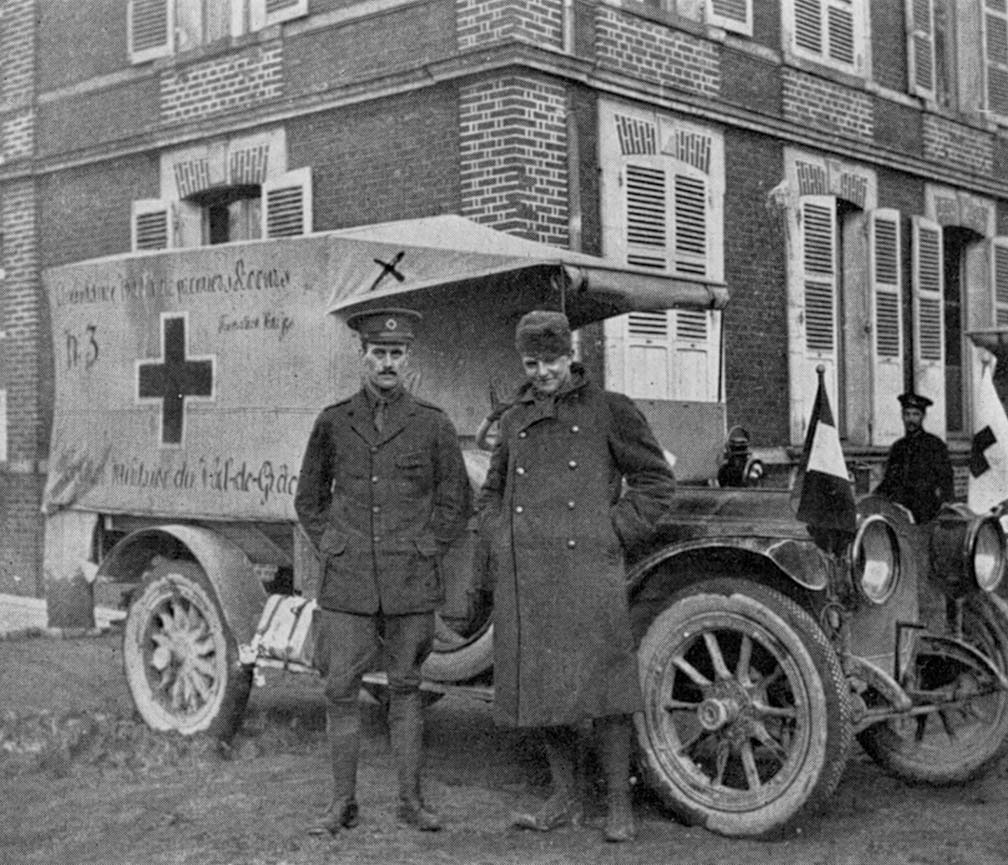
Chateau d'Ayencourt
January 21, 1915
I had a most amusing meal with the --- battery of the 32nd Artillery at Brunvilliers, where B------'s brother is stationed, and we stayed until midnight seeing guns embarked at Tricot.
We have had the most abominable weather here lately, snow, sleet and cold, and motoring has been more work than pleasure. Day before yesterday I did over two hundred kilometers and there was not a moment when it was not raining. In the morning I was sent to Ressons, then in the afternoon I took six men to Claremont, and just after I had cleaned up and shaved they sent me off to Breteuil. S------ and I stayed over and dined with the gendarmes, who in that town are all très bon garçons.
I have heard it said that Joffre said he needed six thousand more shells a day than he was allowed.
An officer told me a few days ago that the French aeros discovered the Germans this side of Roye engaged in making concrete platforms for their big guns, with the obvious intention of shelling Montdidier. For the next two days the French guns all took a crack at the platforms and destroyed them, but an artillery officer told me that he was pretty sure the Germans would build platforms in the woods next time and at the last moment cut a few trees in front of them and trust to do what they could before being put out of business by our guns. So, we may have something doing before long.
Shells are falling from time to time at La Boissière and Remaugies. If I were not afraid of messing up a car that is not mine, I could see a good bit more of trench life, but it's hardly fair to risk the machines too near the trenches.
I was offered a chance a few days ago to drive a motor mitrailleuse, and I wish I could take it.
My Christmas box is still in Paris, but ought to get out here before long.
Yesterday I drove W------ to headquarters at Dury and we did a little shopping in Amiens.
I am writing this in Ward 2, and as the men are all gay and talkative, you will understand it if this letter is a bit absent minded. There is an Algerian from Biskra behind me, and if he knew a little more French, it would be good fun to talk to him. Morton, the negro, who talks Arabic, told him I had been in Algiers, and the fellow now regards me as a bit better than the other men.
S------, the Duc De R------'s footman, wants to come back to America with me as a valet.
There is a very nice fellow here named D------, whose left arm I saw W------ take off at the shoulder. He is as friendly and polite an old man as we have had. The two paraplegias still linger on, getting no better, and it's pitiful to see them.
We have orders to wait around the gare in expectation of carting eighty men from town hospitals.
I have just been reading an official French report of German atrocities, and while they certainly did some very dirty work, yet in about half the instances cited, the victims brought on their own fate by not obeying orders. Another thing which was particularly objected to was that the Germans made fifty or sixty citizens of a little town follow them, with their trousers down,---the idea being that they could not run away without tripping.
Our courtyard is almost impassable on account of the mud, and we have been promised a detachment of engineers to dig it out.
Chateau d'Ayencourt
January 24, 1915
Please excuse the pencil. I have been trying to get warm all day. I think it's pretty certain we are going to move very soon. One of the British Red Cross yesterday told me that fifteen of their Fords had been ordered here. Where we will go not one knows, but a town called Folies on the road from Amiens to Roye has been mentioned. S------ is asleep on my bed. It's the best way to keep warm. We have had a spell of the most miserable weather,-----rain, rain, rain, and it's now turning damply wet with a cutting wind.
As I sit here I can hear the guns going again. The French batteries consist of four guns, and all four fire in rapid succession, while the German batteries have six guns and fire in sections of three, so it's interesting to hear who is doing most of the work. I do not see why the Germans have not a bit the best of it so far. They are here and it seems impossible to oust them. The German line, as far as it interests us, runs about as follows: From north to south beginning at Chaulnes, east of Amiens, Fouquescourt --- Fresnoy --- Andechy --- Dancourt --- Beuvraines --Canny --- Lassigny --- Gury --- Samson --- just north of Ribecourt---and then down to Attichy from where it follows the railroad and the Aisne to Soissons---which they seem to bombard at will. The line varies a village or so or a few metres a day.
An officer told me yesterday that two Germans have been riding around in an auto, dressed as French officers and that was why the sentries had stiffened up so. They now place carts across all roads at night. They used to place them only half way across, making you turn in near the sentries, but now it's worth four days of prison for a sentry, if he does not block the entire road, so you have to come to a dead stop while they push the cart out of the way for you. Some of the sentries are very boneheaded, but I have noticed that the best are the Hussars. They know their job, and though always very polite, are quite firm, while the territorials around here are apt to be surly, but will let you by. The Algerians are the best sentries on the road. In the day time they have all the sangfroid and hauteur of a New York traffic "cop." They pull the bolts of their guns into position and simply wave at you to stop, not bothering to stand out in the road, and walking leisurely up when you have stopped. We have one from Biskra here now with a frozen foot. I have lots of fun with our men, and they tell me all sorts of little things about the gossip and doings in their regiments.
Two German aeros flew over us yesterday, and there was great shooting at them, and it seemed to me that the shrapnel came a bit closer than usual.
I have a note to Plantier, a new aviator, who has just come here, from a friend of his, asking him to take me up, but I have not been able to find him as yet.
American Hospital, Neuilly
February 9, 1915
A couple of days after I last wrote, I drove my car to Paris on its last trip, as it was to be turned in and a new one given me. Dr. W------ came up with me and that day we made the hundred kilometers in an hour and thirty-five minutes, averaging over forty miles an hour.
Wednesday I shopped for the hospital, and Thursday drove W------ out to Juilly where Mrs. W------ has her hospital. It's marvelous beyond words, but almost too grand. They are installed in a sixteenth century monastery, since used as a college. Mrs. W------ has done the whole place over with electric lights, steam heat, scientific sewerage, bath tubs, etc., until it's a perfect hospital with two hundred and fifty beds---but no patients. The Government refused to requisition the building for her, so she had to pay rent besides installing all she did.
I felt rottenly all the time I was in Paris, and did not enjoy my trip. I ran into E------ B------ at Neuilly, and we lunched together at La Rue's. When I got back to Ayencourt, I felt so low I stayed in my room for four days until W------ discovered I had jaundice. As B------ was coming into the American Hospital at Neuilly, W------ suggested I go in and get really mended up, as food was quite a question at Montdidier and the water had gone absolutely bad. It was so bad that you could taste the chloride of lime from the cess pool in the juice of prunes and vegetables which had been boiled.
I got in here on Friday. Miss L------ who was also coming into Paris, and who was the head nurse here for a while, brought us out and had us given the best beds possible. I was put on skimmed milk for three days, which, although it nearly killed me of starvation, certainly did kill the jaundice, and I am now nearly all right,---but as I cannot get to Ayencourt until the end of the week, I am just lying around in a sun parlor and walking about a bit for exercise.
This is a fine place, and Dr. G------, Mrs. C------'s friend, seems a good jaundice doctor. We can smoke in our room and have all the books and magazines possible. Mrs. H------ came out with an armful of illustrated papers and roses, so we are well looked after. She said she could not stand the contrast between the pink roses and my yellow green color, so promised me jonquils instead!
My Christmas box arrived at last. No end of thanks for it. The dressing gown was my greatest need, and it's no end of a comfort. Mrs. E------'s cigarettes saved my life. I will write her before I go back to Montdidier. The Ambulance all expressed great appreciation of your remembrances, and asked me to thank you for the gifts. I never enjoyed Christmas presents more.
There is a beautiful garden behind this window, with nice walks in it and we go out and bask in the sun in the morning.
This is a "punk" letter, and I am sorry to have let so long a time go by without writing, but I felt like nothing, and could not get up energy enough to write.
American Hospital, Neuilly
February 10, 1915
Leaving the hospital to-morrow, but I am out on bail, as it were, now.
There is absolutely no news here except that people are rather excited about the Germans' threat to sink any ships under the English command, but they are all saying "Wait until they sink an American ship."
One of the English soldiers, when asked how it felt to go to war and be wounded said, "First they put you in a muddy trench and tell you to shoot in a certain direction. Then there is an awful bang behind you and the nurse says 'Here, my good man, drink this'."
We have evacuated nearly all our patients in expectation of moving, as the chateau has become really quite uninhabitable, and I am sure that if it were not that we had all been inoculated, we would be down with typhoid.
Chateau d'Ayencourt
February 16, 1915
Here I am again on the job. I left Paris Sunday morning. Saturday afternoon, after I had had tea with my nurse from the American Hospital and a friend of hers, Mrs. B------ at Rumplemayers, and was driving along the Rue de Rivoli, in Mrs. B------'s car, I saw N------ L------ strolling along and did a hasty "get-away" from the two ladies. N------ nearly fell over on seeing me and we adjourned to the Chatham where we talked until dinner. He has just come down from La Bassée, where he had a most interesting time and was to join Mrs. W------'s crowd at Juilly. I persuaded him to come out here for a day or two.
On Sunday we ran to Dury with a litter, so we had quite a trip. Yesterday morning N------ and I started out on the road to Roye to go as far as we could and succeeded almost too well. We got to Dancourt, a little town in front of the batteries and between them and the trenches. The French have built a stone wall across the road. A French military automobile had driven up about five hundred yards this side of it and the Red Cross were taking out empty stretchers and starting to cross the fields with them. One of them, when he saw us coming, ran back and told us not to go nearer the wall, as the Germans were potting it consistently with rifle and shell fire. We stopped beside the French ambulance and talked a while, and I was just moving to the cross roads to turn, when there rrrr! rip! bang! and a shell lit right in the middle of the crossing almost scattering the dirt on us. That shell "got my goat" a bit, and just as I turned the four guns behind me went off and I was sure I was killed! It was very interesting, as you could hear the rifle fire and see the shells drop about in the fields---but I admit I was scared.
In the afternoon N------ rode with me in the car and I cleaned out sixteen patients from the town hospital, after which I ran him over to Breteuil and back.
There was some fighting here last night, more than we have had in a long time, but I do not know what it proved.
It's a beautiful warm day now and things ought to start up.
On Christmas Day N------ says, there was a local truce at La Bassée. The men exchanged cigarettes, etc. They were Bavarians on the German side, the Prussians having been relieved. The English challenged them to a football game, and when they refused, the English played among themselves between the trenches. All went well until a German took a pot shot at an English officer who was watching and got him. Everyone walked back into the trenches and the English put shells into the Dutch trenches. A German officer then came over under a white flag and protested that such a performance was not playing the game. Can you beat it!
The Bavarians do not like the war and several times have let the English know that a night attack was ordered, but that if the English would not wing them, they in turn, would fire high.
New saw the Scotch Grays in La Bassée and he says they still have gray horses. The French will not requisition any light colored horses around here. They had about two hundred or so in town yesterday.
The Etat-Major of the Sixteenth Corps, which arrived from Belgium, is in town, and we are quite bubbling over with activity.
While at Merville, N------ saw the officers running beagles while the Germans were shelling the town about four kilometers behind them. They also had a small steeplechase course laid out, and once a week they have a boxing night. Captain G------, a brother of the polo player, challenged anyone in the house. A big Tommy took him up and in the first round gave G------ such a nasty black eye that his orderlies begged him to stop, but he would not, and in the next few rounds absolutely killed the private. The whole house arose and cheered the roof off when he finally knocked the Tommy out.
N------ says that one of the things that struck him most was the almost affectionate respect the men have for their officers,---a thing which I think is quite lacking with all the French I have seen.
A rather rough thing happened near here the other day. The Germans laid out some bait to get two brigades of "Dragons," i.e., put infantry out in front of the woods, the idea being to blow the cavalry to pieces when they came up. The French were all lined up ready to charge when they found out the intended trick and stood still in lines. An aero came down and was taken by the Germans. The officers who were in it seeing the cavalry set up a yell "a moi les dragons, a moi" and one of the cavalry men told me it was the hardest thing they ever had to do, to sit still in plain sight and see their officers taken off. You can imagine the aviators' feelings.
One of our aeros came home yesterday with two rifle holes.
The guns are going hard now and our windows rattling constantly.
I feel like a new man since they fixed me up in the Paris hospital.
Chateau d'Ayencourt
February 19, 1915
Just a line while I have a few minutes before going on duty.
There has been little news except for an interesting trip to Erches yesterday with Drs. W------ and S------. We ran out in the car armed with nothing better than the word "Vannes" and arrived o.k. We were welcomed with open arms by the soldiers to whom I brought cigarettes and newspapers. The village had been bombarded so often that hardly a thing remains. It's only three kilometers from Andechy, which the Germans now hold, and while we were there the French batteries began firing, and the row was fine, as we were right along side of the batteries. Soon the Germans began answering and things were quite exciting for a while. The shells fell too near for real fun. You can hear them coming and gauge within twenty yards or so where they will fall. That part is easy, but I don't see what happens if you decide you are in line. I was standing by a wall watching the batteries work, when three German shells "éclatéd" at once over the next batteries a hundred yards off.
A man was pushing a cart of Camembert cheeses on the road when one of the 105 shells dropped about twenty yards ahead of him and splashed him with mud. He dropped the cart and ran, saying he would come back and get it after dark. He was the colonel's cook, so if the old man misses his cheese, I know why.
Some soldiers took us down the road to the trenches from where we could see the German trenches about two hundred and fifty yards off. An officer advised us not to go further, so we turned back and talked to different soldiers and picked up some souvenirs.
The holes the big guns make are beyond belief. I picked up some shell fragments in the bottom of a hole so deep that I could not see out of it, and about eight feet wide. Barrioz, an artilleryman, gave me a fine lot of souvenirs, including the head of a shrapnel shell which had killed three men,---also a piece of P------'s aeroplane in which he was killed, and a German campaign knife and fork he found in the trenches. As we were leaving, a very polite sub-lieutenant came up and said we would leave by such and such a road. He was so polite I saw something coming, and when he came with us and asked us if we would give his colonel the pleasure of seeing us, I got the idea. The colonel was a gentleman, however. He asked for my permit to circulate which I did not have. I showed him my blue card and the Médecin-chef's laissez-passer. He took my word without question, that the others had the same documents, and then told me that I should get a permit from the General at Davnescourt if I came out again. After several salutes we parted very amicably. All together it was a great day. The shells fell in front, behind and beside us, but I am afraid the General will balk at giving me that permit.
Our hospital is closed, but our ambulance service is to be kept going. We are to keep the chef, with his wife as housekeeper, and Morton the negro as servant. The chef feeds us better than I have ever been fed before.
Chateau d'Ayencourt
February 21, 1915
There is a road across the plains from Guerbigny to Erches on each side of which are French batteries. Things were quiet when I arrived and the French began by dropping shrapnel on the Germans. We stayed at the cross roads and watched the shells explode over the German trenches, but the results were, of course, invisible. The Germans soon began to answer, and we heard the shells whistle by and "éclaté" over the nearest battery. If I had only been a few seconds quicker I would have had a fine photo of three shrapnel puffs at once, over the nearest battery. You can hardly tell the difference between the bursting shrapnel and the shots of the 75's. They are both sharp staccato stabs of sounds. A few of the 105's were fired and they really sounded like war. The 75's are more like fire crackers.
It's beyond me how the soldiers keep so gay. They took us into their hovels and gave us cakes (lady fingers) and wine, and their main idea seemed to be how nice it was of us to give them an opportunity to garder un bon souvenir des Anglais. It was almost embarrassing.
I was talking to two English soldiers who passed on a train the other day, and they both told me they could break through the German trenches near La Bassée at any time, but that it was impossible to move the guns until things dried up a bit, and that if the infantry moved on without the guns, they would not last an hour. One of the men was in the North Lancashires and the other, who was a pointer of a six inch piece, was in the Royal Field Artillery. The first had served in the Boer War, then stoked on the St. Paul, New York, St. Louis and Philadelphia, finally ending up in some phosphorus works near Newport News, which he left to enlist. They were both clean, square-jawed fellows, and it was a relief to see them after the sloppy French. Their description of the retreat from Mons was very interesting. I said something about "retreat," and with one accord they said "Retreat 'ell! a bloody rout more like," and went on to tell me that there was not a regiment that kept order or did not get mixed with every other in the army. They threw away everything but their arms. It took two days to sort the men when the retreat finally stopped, but they said it was to the everlasting credit of the Commissariat the way they were refitted.
Yesterday on the road to Breteuil I passed the 143rd of the line, incidentally to leeward, and a regiment has a smell all its own. It was on its way to entrain and was strung out in the road for three kilometers or more.
While I was on night duty at the station, the scene was quite attractive. The big freight yards were lit by fires, making bright spots in which you could see men sitting in bunches with stacked arms and singing. Their red trousers showed up against the darkness and some, who had not painted their buttons black, as they are supposed to, looked like pages at the Belmont. I noticed as I walked among them, no less than eighteen different equipments in the same regiment. The new light gray uniform, decided upon just before the war, is responsible for many weird looking outfits. No one seems to know what is the correct shade, or if they do, there is not enough material to go around, as the colors vary from light sky-blue to dark navy, and some are all gray. I saw some soldiers in the latter guarding German prisoners at Ressons, and at twenty feet you could not tell the difference between the French and Germans. Half the men wear blue overalls over their red trousers, blue covers on the kepies, and if they cannot find the cover, they daub mud over the hats. English puttees are in great demand and corduroy trousers everywhere. Brown overcoats and green trousers are to be seen, and the men come in from the trenches in sandals. They strap the bottom of clogs to their feet and wear four or five pairs of socks.
My friend Clément, the aviator, has just been "cité a l'ordre du jour." He was flying at two thousand yards above the Germans when they got his range with shrapnel, so he dropped to eight hundred yards, looping the loop on the way down and chancing the rifle fire, but he accomplished what he was sent out for,---hence the citation.
They have a new monoplane here now and they are just waiting for the Germans to fly over again. B------ says I can go up without a doubt, so I am living in hopes.
I like these French people better all the time, though I think a mean Frenchman is a bit meaner than anyone else. The people in town are always glad to see you, and the soldiers have always something to say or some story to tell you. I find it pays to talk to every soldier you can. The other day they had a new sentry at Breteuil who did not know the word and refused to let me pass without a laissez-passer which I never get from Breteuil, and I would have been up a tree if an artilleryman with whom I had talked and given cigarettes to a few days earlier, had not come up and passed me by. We fairly own the town of Guerbigny since we distributed Mr. D------'s cigarettes, and if we took every drink we were offered in that village, we would never get home.
I rather think it's dawning on the soldiers that this war will last longer than they expected. Their exuberance is pretty well gone, but they have a calm certainty which I think will get them far. The difference between the French and English view of their work is marked. These French are perfectly stolid. If they are to be killed, killed they will be and they hardly look forward to coming out unharmed, while I have never yet met the Tommy who did not talk as if he were doing something about as dangerous as hunting big game, and who did not have the healthy belief that he would come out all right. I think the purpose back of him than the Englishman. He is doing something for France and all the time there is the idea of La Patrie somewhere in the back of his head, while Tommy goes into a scrap because he knows he is there to fight and wishes to exterminate everything opposing him, as rapidly as possible. Also the English despise the Germans while the French hate them. All the Tommies I have talked to voice the opinion that anybody as sloppy as the French soldier may get away with something, but cannot be a real fighting man. They all admit the French cavalry is good,---largely, I think, because they are smart in appearance, but they always say, and with truth I think, that the French do not understand horses. An English cavalryman told me in shocked tones, that the French cuirassiers in the North never clean their horses, and this because they had orders to throw away their brushes and curry combs, and I have since found out that such an order was given. Lots of English wounded horses pass through here to be patched up at Rouen, and they seem great pets with the men.
Chateau d'Ayencourt
February 23, 1915
Yesterday was a very quiet but interesting Washington's Birthday. I ran into the man who took me around Erches, and we lunched together at the Hotel du Cygne, where they have a mixed mess for men from the front who have eight days on the job and four days off,---and they live a month in those four days. G------ seems very well informed and up to date, and is about the only Frenchman I have met who can say that it would be madness for America to join in the row.
During the morning I ran out to Warsy to leave some cigarettes and playing cards for Barrioz. In the afternoon I did town service and a run to Breteuil, and then got G----- who came out to spend the night.
L------, an aviator who had come out to bring me some pen-holders made of cartridges, stayed to dinner also, and afterwards we had some music with P------ at the piano. G-----had just been with the English near Callais. At one place they had four rows of artillery, each one shooting over the other; first a line of French 75's, second English four and six inch pieces, then the French 220's, all of which were backed by the ten and twelve inch English naval guns. He said the job of picking up the wounded in front of the lot was as noisy and nervous work as he ever cares to do. The English Red Cross men are nervy beyond belief, and the casualties among them are very high, even among the ambulance drivers who run up in daylight to the second line of trenches. This morning I gave L----- a good pipe, twenty or thirty corn cobs, cakes, tobacco and chocolate for his section, and then G------ and I ran him out to Arvillers, where the first line men are sent to rest. The opposing lines at Erches are only from two to four hundred yards apart. At Arvillers we were given a fine reception, and the Médecin-major asked us in to see him do typhoid vaccination, after which we were photographed together and had the inevitable wine and cakes.
The little scrap we saw at Erches killed one and wounded four artillerymen.
There is a Russian aviator here now who is getting quite a reputation for nerve.
A soldier near here has produced a contrivance for wire cutting. They put a shield in front of a mitrailleuse and push it up to the entanglements, while two men on each side cut away with pruning hooks. The fence they have for some miles along the line here is thirty feet across, and how anyone but the Almighty or a bird can get by it, is been done and will be done again, I suppose.
Chateau d'Ayencourt
February 26, 1915
It's been very cold lately and a peculiarly damp and penetrating cold at that, so that the kitchen is the only habitable place.
I had rather a grewsome afternoon. After moving nine convalescents, I had to take a man they found dead on the railroad tracks, to the Hôpital Civil. His bare feet stuck out at the bottom of the stretcher, and while we were loading him on board, a woman came along and remarked that it was honteux the way the poor wounded were carried around without socks or shoes! I didn't answer her, so she will probably tell everyone in Paris of the awful conditions in Montdidier.
An hour later a telephone call came that two aviators had fallen and for me to run out to the Aviation Grounds as quickly as possible. An infirmier threw a splint, a dozen or so rolls of bandages and two stretchers into the car and then I had to wait for two doctors,---Lieutenant G------ and Lieutenant D------, the latter known among the infirmiers as "la fleur d'amour." He came galloping out at the last moment carrying four hypodermics and jumped aboard telling me to hustle. I had a clear conscience about fast running, so I went through the town with my klaxon wide open and had people climbing trees to get out of the way. As we arrived at the grounds the mechanics were carrying the two aviators across, and I just had time to get the car ready as they came up. Fifty persons or more tried to get the stretchers in and bungled until I ordered them away. The men were in nasty shape,---blood oozing out of eyes, mouth, nose and ears, and their limbs in that unpleasant limp condition that denotes broken bones. I was dreadfully sorry to find that one of them was Lieutenant G------, whom I knew. He showed more signs of life than his observer, Lieutenant B------. I hustled them to the Hôpital Civil, where B------ died as we were undressing him. "La fleur d'amour" rose considerably in my estimation by his quick work. The other doctors said something about etiquette as Le N------ was the surgeon in charge of the hospital, but our little flower "m'en fiched" and appeared in his shirt sleeves and collarless in less time than it takes to tell it. Captain J------ "chef d'escadrille" came up and it was all he could do to keep himself in hand when they told him of B------'s death, and I saw him again openly using his handkerchief when they told him about G------. The two aviator's mechanics came and stood outside the door like dogs until the doctors gave them the news. J------, who is really a gentleman, found time to thank me for quick work, which I thought nice of him under the circumstances. He felt like the deuce, because G------ was his best all-around man. The latter had volplaned to within about ninety feet of the ground and then tried to bank to the right. They banked all right, but for some reason kept on turning and finally pointed their nose down and plunged into the ground. One of the mechanics said that if G------ had kept his engine going instead of volplaning, he could have saved himself.
The "medicin major" said to another aviator "of course we admire you men and you like to do tricks to make us marvel at you, but all the same it's dangerous," to which he replied that it was no more so than in the trenches and seemed rather nettled.
I imagine that J------ will put the lid on fancy flying for a while. I could have gotten good photographs of the accident, but somehow it did not seem right. I was the only person not a French soldier on the field, as it is always carefully guarded.
The Médecin-chef had his orderlies out looking for cellars yesterday. When a Taube is signaled they blow a horn and everyone is supposed to go in doors until the horn blows again.
All the soldiers are pleased because the cafés are now open to them from eleven to one o'clock instead of twelve to two o'clock. It seems that noon is quite too late to dejeuner although 11.45 A. M. is not. They are a humorous lot, the majority of these men, and I should think the discipline would erk them. The French idea is exactly the opposite of the English. Here the officers concern themselves more with the personal behavior of the soldier in his individual capacity,---how and when he drinks, what places he frequents, etc., but are not half as strict with the soldier en masse, while as far as I can gather, when Tommy is off duty, he does about as he pleases, but is held to strict account when in his regiment.
Chateau d'Ayencourt
February 28, 1915
The funeral of the two aviator officers took place this afternoon. They were carried on gun carriages wrapped in the tricolor, with their artillery full dress jackets and swords on top. A squadron of soldiers preceded the gun carriages, behind which were any number of Generals and about half the soldiers of the garrison. It was rather impressive, but sloppy as to arrangement, and the soldiers were as slovenly looking as usual.
Chateau d'Ayencourt
March 1, 1915
A few of the French shells from the post near Guerbigny, which were being fired at a Taube, burst right over us to-day.
I had a run to Breteuil in the afternoon and came home by rather a roundabout way,---Chepoix---La Hérelle---Sains ---Morainvilliers, and then to the St. Just road near Crèvecoeur and home. It was blowing up for a storm and the light over the country was quite beautiful.
Chateau d'Ayencourt
March 3, 1915
On afternoon duty at the station.
A German shell burst in the middle of one of our patrols at Dancourt, killing two and wounding two.
I had quite a chat with Captain C------ of the First Cuirassiers, and he is one of the best set up and smartest officers I have seen yet.
There is a story going around about Max, the Mayor of Brussels. The German commander levied 4,000,000 francs on the town to be paid within four days. All the other city authorities said it would be impossible to collect so much, but Max overruled them and said he would surely have the amount within the time specified. When the Germans came to collect, Max had nothing in sight but several barrels of little papers. The Germans asked where his coin was and Max pointed out the papers and said "There you are, every sou of it. Your own promises to pay for goods requisitioned which you assure us all are the equivalent of gold." The next day Max started on his trip to the Fatherland! I don't vouch for the truth of the story, but there are many like it going around.
Four men from the Fifteenth Company of the 121st Infantry came in with mumps yesterday. I saw my friend B------ of the 16th Artillery in town, who told me more guns were coming up every day, and that he was pretty sure they would attack Andechy soon. The last attack resulted in 1500 wounded, and this time there ought to be more, as there has been time to entrench and mine.
So far as I can see, all the soldiers look forward to activity, as this pot hunting and trench work is rather boring them.
You have probably heard by this time the story of the French Jew taken prisoner by the Germans, who wrote a most enthusiastic letter home about his good food, treatment, etc., but added a postscript saying that his chum had been shot for complaining! ! The best part of the story for me is that E------ B------ to whom I wrote it, took it seriously as another atrocity.
Had a note from P------ in which he says he is at Bailleul, which is about one hundred and fifty kilometres northeast of Amiens.
Chateau d'Ayencourt
March 4, 1915
G------ just arrived from Paris bringing me your letter from the Union Club of February 15th.
As you say, it's time I was making plans for coming back. If I had my own fortune I do not know of anything that could get me away, as long as our service lasts. I have enjoyed myself no end in this work.
Things are bound to start with a rush before long, and I shall be sorry to miss them. I am taking a lot of our hospital stuff into Paris to-morrow. The weather has cheered up a bit and we have had three spring days which brought out the buds---and also the Taubes.
The French marksmanship is improving, I think, and today as I watched them shell a Taube, some of the puffs seemed very close. Since our accident, the aviators have become very cautious and we are treated to no more spectacular descents.
At Arvillers, a little town near here, they had an unexpected souvenir from the Germans yesterday. Not being in the first line, the village is used for the men who are on their four days' rest. Six of the men were sitting at lunch when a wandering shell came in through the wall and burst under the table. Two were killed, one died on the way to the hospital and two more in the hospital last night. The last one is expected to die any moment. It was rather rough having it happen in a spot meant for rest and quiet!
Chateau d'Ayencourt
March 7, 1915
Just back from Paris where I arrived Friday about lunch time. I lunched with S------, Mrs. S------, Drs. W------, S----- and B------ at Ciro's and in the afternoon shopped and got my hair cut. The B------'s, S------, B-----, a French friend of the latter's and I all dined at a little restaurant called Le Clou, in Montmartre. I was the only one in uniform and got quite a welcome, as it's an informal sort of place. The whole restaurant was singing "Tipperary" before we left.
Saturday I took Miss L------, one of our nurses to lunch at La Rue's. Did a little shopping for the hospital. Dined alone with B------ and went early to bed.
It makes me sick to think of leaving here just as things will begin with a rush.
There are notices posted around that the post-office will be closed for a month and other signs warning everyone. to keep away from the railroad stations. In Paris all the schools are being turned into hospitals.
Chateau d'Ayencourt
March 13, 1915
There hasn't been much to write about this week. Work has run along about as usual. Breteuil evacuations, town service and the only excitement was a night attack near
Conchy-les-Pots which netted us a few blessés to carry. On Tuesday I took two nuns and a sick woman to their convent near here at Domfront. They promised to be ready to go back in fifteen minutes but after three quarters of an hour I got rather tired of waiting and it wasn't very hard work for a nice old girl to persuade me to visit the refectory. She had baked-apples with confiture, biscuits, wine, cheese, bread and butter set out for me---and I made quite a successful attack on them. She talked to me while I ate and was a most cheerful and amusing old soul, with a keen wit. She came from Martinique and when she found I had been in the Carribean she fairly blossomed out and raved over le soleil qui brille toujours et les belles vagues bleues que je ne reverrai plus. She seemed to drop thirty years in as many seconds. The Germans came through Domfront but never entered the convent and she explained with an almost child-like conviction that it was "La Sainte Vierge qui nous a protégé, sans ça"---and the inimitable shrug of the shoulders. I think it was probably a German officer with more decent ideas than most of them who did the "protégé-ing" but it's nice to meet someone who has faith in anything.
There's a very nice Captain of Cuirassiers in the hospital at Breteuil and I mail letters for him every day or so. He's very well trained, for he writes his mother in London every other day. There's more military activity than there has been for a long time---new troops coming in from all directions and Barrioz of the 16th Artillery tells me they have increased their supply of shells threefold. Just lately the artillery has been pretty lively---attacks every night---and nearly every afternoon. As I'm writing this the windows rattle from the big guns, which are going strong.
I saw my friend G------ who came to town for business and he said his sister had sent you some lace. B------ and I are lunching with him at Arvillers on Wednesday. The Germans have knocked the church to pieces since I was last there, and I expect to get some photos. I hope no stray shell bursts under our table, for one would feel an awful fool to be smashed up out of mere curiosity. Mr. and Mrs. H------ and six others are coming out to-morrow to deliver paquets from the Lafayette Fund---and I expect some mail. That Russian aviator, Kiriloff, is a most amusing man and I meet him almost every evening at the café. He's much like J------ W------ at home, and very entertaining.
Chateau d'Ayencourt
March 15, 1915
Things are very quiet in spite of the almost continuous artillery work. The men are either killed outright or escape with scratches, so we have had little to do. Thanks to the fine weather our trips have again become a pleasure and the run home at sunset is delightful. In some places the country is much like ours, only the villages are dirtier and add more to the general attractiveness of the scene. I come home by various routes and there are a few towns within a radius of fifteen kilometres that I have not been in.
Yesterday I took one of my aviator friends some photographs I had taken at the aviation grounds, and he was so pleased that he offered to take me up in his machine some time this week. I will go if I get the chance.
Yesterday a lot of German prisoners, guarded by English, passed through and the whole town lined the tracks to voir passer les Boches. The bitterness and outspoken hatred of the people surprised me. Their ferocious brutality equalled that on account of which they hate the Germans, and the majority of them had no idea of giving the vanquished a decent deal. These Germans could have been left unguarded,---they would no more have dared to leave wagons than to have pushed off the couple of Tommies who sat on the floor negligently swinging their legs over the edges and "kidding" the citizens. They would have had about as much chance as a rabbit in a beagle kennel.
Some of the so-called atrocities are nothing more than justifiable, although somewhat severe, punishments brought on by the Frenchies' own pig-headedness and contempt.
Talking of atrocities, there is an infirmier who rides with me to Breteuil and who calls our disregard of geese that infest the road, les atrocités Americaines. We've not got one yet, but I will bet that some geese eggs are addled before they're laid.
To-night after dinner we went out and watched the star shells for a while and about ten minutes later the guns began. The Germans have been potting at Dancourt with 77's, but to-day they ran up some 220's, and the whole place looks as if every one in it had started digging a well and left off, after getting down a metre. They do make outrageously big holes.
Chateau d'Ayencourt
March 17, 1915
Yesterday B------ and I ran out to Arvillers for lunch and had a great time. There were a lot of soldiers I had known before and they gave us a great welcome. We lunched with fifteen of them in a little room big enough for six or eight persons. They had cut laurel and pine boughs and made a sort of trellis over the table in our honor, which gave quite a festive touch, and we had a very gay meal. Afterwards, the Major came in for coffee, and then we went to see G------, Captain G------ and Lieutenant ------, and I took some photographs. The Captain is really an exceptionally nice man and he gave us the best he had. We all adjourned to see the church which has been scientifically destroyed. Nothing remains but the tower and that is fairly well banged and dented. The Germans still take a pot at it every little while for amusement and there are five big holes this side of it where the 220's have fallen. I took a few pictures.
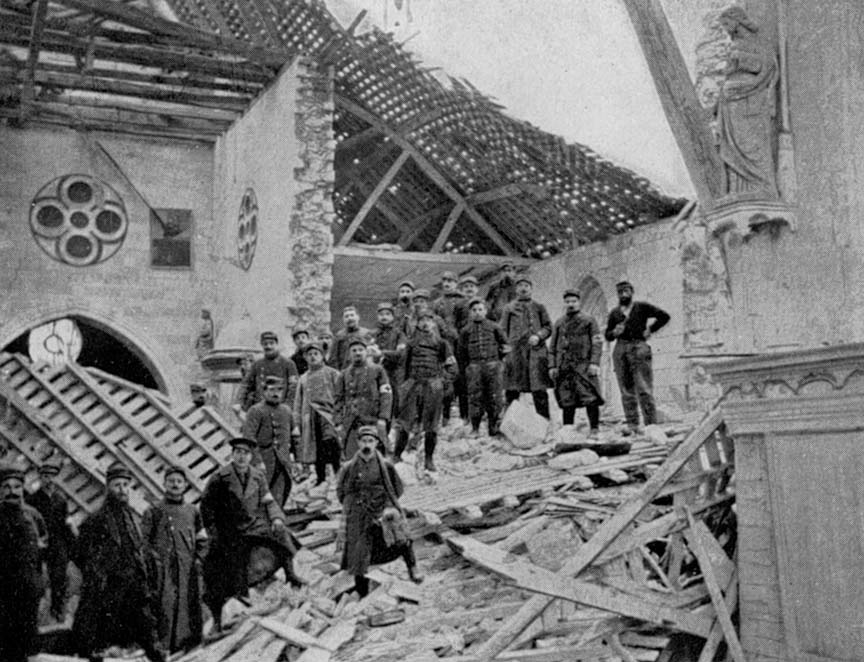
While climbing over the debris near the altar, I tripped over a statue of the Virgin Mary and fell on my face, which gave me such a start that I slid all the way down a pile of rocks and rubbish for about fifteen feet. The soldiers enjoyed it a lot, but I didn't. Just after we left, another shell fell where I had been photographing, so you see my luck holds good. The Captain took us to his house and gave us some rum and we chatted for quite a while. On leaving he gave me a brass percussion cap from a German 105 and besought us to revenir. I will take him some cigars when I can. It's nice to have the officers welcome you, as then you are sure you are not intruding. They are really a nice crowd on the whole these poilus and several of them are quite good friends of mine.
I have not said anything about leaving here, but around town it seems to be pretty well known. Two or three men have come up and told me how sorry they were to hear I was going and said they would always garder un très bon souvenir of our work ensemble, which pleased me, although, of course, it doesn't mean much. A couple have given me little presents of shells, etc., and I really believe some of them are sorry to see me go. The gendarmes at Breteuil made me promise to come to their mess once again before leaving. G------, to whom I explained how I felt about leaving, said it would be idiot de risquer ma carrière for a few more months' work here.
The other day I brought in a man to the hospital, who had been caught in a trench when the Germans exploded a mine. He and four others were caught, but only one of them was killed. The one I carried had had his eyes blown out and was a mass of clotted blood.
I passed a funeral the other day of a soldier who died here in the Ancien College and I think it impressed me more than any funeral I have seen yet. The hearse was a battered old delivery wagon which creaked and threatened to fall apart at every yard. A little boy drove the one lame horse that pulled it, and was smoking and spitting like a regular "cocher." Over the horse was a bit of tricolor bunting and behind the wagon walked two infirmiers and four ragged looking hospital orderlies. The whole thing would have been amusing, if it had not been for the effect of loneliness and the obvious impression it gave that no one cared. I could not help thinking, as I watched the little procession drag along, of the "glorious death" of a soldier one hears about, and I doubt if one could find a better poster for a Peace Society, than a photograph of that yellow van carting an eight franc pine box to a muddy field outside the town.
The day before yesterday I took an old farmer to the hospital at Breteuil. He was plowing in a field outside Arvillers when his plow hit an unexploded German shell and set it off. One horse was killed and the old man had both arms shot. There will be a lot of similar accidents, and raising potatoes will be about as dangerous as big game hunting.
Chateau d'Ayencourt
March 18, 1915
Had a fine time at Arvillers yesterday. Captain G-----was as nice as could be and showed me how he had to make out reports about his company each day. He and Lieutenant L------ were much pleased with some real cigars I had the luck to find here and both came out to see me off. They both said I was to see them plus tard and I certainly shall when I come back to see the armies march under the Arc de Triomphe. Captain G------'s orderly must have worked hard, for he had about one hundred shell fragments arranged in his room for me and had I taken them all, nothing short of a freight car would have gotten me home.
A Captain C------, a Servian, had heard of my photographing and had left word that he would like me to take him, so I did, with several other officers. I was talking to these officers about my trip to Erches and I can now see I was pretty lucky. I told them that Colonel C------ had said my ambulance was trop visible on the Guerbigny-Erches road in the daytime, and they would not believe for a time that I had really passed over it safely. I would not go over it again for a good deal. The whole stretch is within rifle shot of the Germans and as I was leaving I heard one of the officers say "mais vous savez il a du toupet extraordinaire---et de la veine aussi." They were all awfully nice to me and nearly the whole battalion was out to see me off. I took a lot of photographs which I hope will come out. G------ nearly wept when we parted and I was really sorry to say good-bye.
Regulations have been stiffened up since yesterday morning, and it needed a lot of talk, my blue hospital card and a stupid sentry to get me into Arvillers. As luck would have it the military passes are now blue and the sentry, seeing the color of my card, let me by. One of the men told me that the reason for the increased strictness is that the French are mining the surrounding country extensively and I have heard that they may let the Germans advance at Erches and then pound them from the sides from about Fouquescourt and Dancourt. Big gun emplacements are being constructed and everything points to some action about the time I shall be leaving.
March 21, 1915
Fine warm day with lots of aero shooting. B------ said he saw two of the Zeppelins which flew over Paris bomb-dropping last night.
Paris
March 29, 1915
Out of uniform and in clothes that feel very funny and quite a bit cold. I miss my puttees and after four months of collarless bliss, I feel as if I had a dog collar about my throat. I am sorry to leave,---sorrier than I ever thought I would be, but it's the only sensible thing to do, so there's no use grieving.
Needless to say, I have enjoyed the work a lot. The motoring, machinery and the ever waiting for something new to happen, with the excitement of an occasional trip to the actual front, would appeal to anyone, and I do not think I am any vainer than the rest of us in feeling that we have been helping---though in a very insignificant way---in the biggest thing the world has seen, and incidentally having a chance to do a few decent things for those who needed them. I got genuinely fond of the French soldiers with whom I worked, and was surprised to find how nice they could be. Of course, my uniform was a great help and with it you needed no introduction to anyone. Our wounded were inclined to get spoiled if you did not keep them in their place, but on the other hand I have never seen such an appreciative lot. The littlest things would please them and they never hesitated to show their thanks. Their ability to derive pleasure from small things was a continual astonishment to me. The decorating of a miserably small room at Arvillers with a few laurel branches in our honor when we were there to lunch, was a thing no Englishman would have thought of, but there was not a soldier who came into the room who did not notice it and make some cheerful remark. The ordinary soldiers are a childish lot in some ways, and on that very account they have a child's lack of bashfulness in telling you of their own exploits, but they do men's work---and well at that. I do not believe, however, that a Frenchman is up to the average Tommy in fighting value.
At present Paris is excited over the first Zeppelin raid and, although it's been denied in the papers, I heard from the men connected with two Embassies that, the evening the raid took place, practically all the aviators had been given a holiday, and that the chef d'escadrille who happened to be on the field, could not get into his hangar, as his orderly who had the key, was in Paris. People are asking how the Germans got word of the aviators' vacation.
L'Aneret, Mer
March 31, 1915
Back here again and it's as delightful as ever.
Monsieur G------ L------, S------ and a friend of the latter's met me at Orleans and I gave them lunch at the Café Jeanne D'Arc, coming on here in the afternoon. Madame P------ is as delightful as ever. Monsieur G------ L------ says to tell you that my French has improved immensely. F------ has sent them some remarkable photographs. One of infirmiers collecting arms, legs, heads, etc., and tossing them into an obus hole for burial,---another of a man cut squarely in two by a shell. They are a bit grewsome.
I am going back to Paris to-morrow, taking S------ to her aunt and may dine with C------ and W------.
Tuesday I am lunching with Mrs. H------ and going with her afterwards to see her portrait just finished by Boldini. Tuesday night I am dining with S------ in the Latin Quarter.
Wednesday night I expect to dine with E------ and look over the Grand Guignol, leaving for London next morning.
Traveling to and from England is now very complicated. You have to have a sworn statement taken at the U.S. Embassy that you are an American citizen and your photograph stamped with the Embassy seal and signed by the Ambassador. Then the British Consulate almost takes your finger prints and visés your passports, and finally the police at the Gare du Nord give you another visé, entitling you to leave Paris. I have written the A------s and hope they will ask me down for Easter.
Burlington Hotel, London, W.
April 2, 1915
My trip to London was very pleasant as the trains were fast and the Channel calm. A torpedo boat from the French side conveyed us half way across, when an English destroyer took her place and brought us in. Mr. H------ had arranged for me to bring over the dispatches from our Embassy so, with a courier's passport, I sailed by some fifteen important looking officials and my luggage was not even opened.
It was nice to arrive here and find letters from home, and the hall porter seemed glad to see me, although my mustache rather puzzled him at first. They had a fire going in my room and I tumbled into bed at once. I slept until late and after lunch called on Mrs. P------. She says W------ is in very good form and getting fat. His greatest excitement came when he was preceding King Albert to announce the latter's coming to General Smith-Dorrien. His front wheel broke and he had a bad accident, whereby King Albert "beat him to it" and caught Smith-Dorrien shaving!
Mrs. A------ wrote me a very nice letter asking me to visit them when and as long as I cared to, and as Mrs. H------ is to be there, I am much pleased.
They now have aeroplane guns in Green Park, and more troops about, but otherwise it's about as it was in October.
This hotel is a bit depressing. In the dining room tonight there were only eight of us. One party included a typical "Englishman's Home"-----father, mother, sister and the son in uniform. Father laughed loudly whenever he thought he ought, Sister tried to be a worldly-wise, up-to-date sort of person, and Mother, who was a nice simple old soul, regaled the room with the news that "father is getting so fat that he has torn two buttons off his waistcoat." Next to me was a mother and son home from school, whom she had evidently taken to church, as she kept asking him about the text. He was more interested in the pie. Opposite me was a Second Lieutenant in kahki with his remarkably handsome wife. He, I gathered, had been home on sick leave and was going back to-morrow. That girl never took her eyes off him during the entire meal.
Before I left Paris I went with Mrs. H------ to see her portrait which is being painted by Boldini. It's clever and artistic, but not so much of a likeness, as a clever painting and one bound to challenge attention. Boldini himself is a queer old man, amusingly outrageous in his talk, and I enjoyed watching him paint. He seems undecided and vacillating as he works. Incidentally, he is leaving Paris because he says the Zeppelins are coming back.
The C------s asked me to lunch the day before I left, and I am bringing home a bronze plaque for some artist friend of Mr. C------'s, which shows our Ambassador's wife in Red Cross costume. Had tea with Mrs. H------ that afternoon. Dr. S------, Mrs B------, Princess L------ and a rather nice Russian, Baron De M------ were also there, the latter, by the way, may come over with me on the Adriatic.
Dined with E------ and took a stroll with her before turning in. This afternoon, as I was crossing Green Park, I heard two men openly conversing in German. Such a thing would not pass for a moment in Paris.
Burlington Hotel, London, W.
April 6, 1915
Saturday I went down to Colonel A------'s at Alresford for Easter. Mrs. H------ and her two children were there and it was fine to see them all again. It's a delightful old place with the most attractive clear river flowing through the lawn, a few yards from the house. It runs swiftly but with scarcely a ripple and from time to time you can see a black flash as a trout dashes under the bank when frightened by your approach. It's very difficult fishing on account of the clearness of the water, which is a chalk stream.
The country is beautiful and had a finished garden-like freshness that came as a pleasant surprise after the trench-scarred and rather monotonous land around Montdidier.
Mrs. A------ said that Lady M------ was well and asked about you all and sent her love.
Mrs. H------'s brother, Colonel E------ L------ was killed while leading his regiment at Neuve Chapelle.
General H------ is supposed to be near La Bassée.
Father's godson is a fine little chap.
I returned here this afternoon, had a pleasant dinner with E------ B------ and am writing this before turning in.
To-morrow I take the boat train for the Adriatic at noon and by the time you get this, I will probably be at home.