
THE City of the Golden Horn had never looked so good tome. There she stood in all her beauty---Pera and Galata, as well as Stamboul. The great hotels, embassies, schools and hospitals were uninjured, and the peoples of all the world, including American tourists, were walking the streets in perfect safety. The massacre, which was daily expected at Constantinople at the time I left the city during the first week of October, 1922, had not materialized for the very reason which would have prevented the calamity at Smyrna. The time was ripe, the loot in sight, the spirit willing, but the strong arm of the Turk was not strong enough. The Great Powers protected Constantinople and she was saved from an immediate and violent finish, but doomed to gradual decline by a slow garroting process.
The Inter-Allied Commission, English, French and Italian, was still running the city in March, 1923, and Americans in large numbers were voluntarily umpiring the game. Warships galore, flying the Stars and Stripes, the Union Jack, Tri-color, and all sorts of colors, were in the stream. The Petit-Champs, where the officers of all nations met, was gay and festive by night, with Russian nobility furnishing the entertainment and waiting on the tables, and down the hill nearer the Barbary Coast, "Dinty Moore's Place for American Sailors" was also doing a thriving business.
Soldiers, sailors and civilians from far countries elbowed each other on the Grand Rue, and on some of the petty rues. American and British officers, manifestly first cousins and terribly alike, tall and fair against the darker background of the peoples of the Near East, contrasted strikingly in dark blue and khaki, with the French officers in gray-blue, and the Italians in their sleek, olive uniforms.
During the continuous celebration following the victory of the Turkish Nationalists in Asia Minor, red was the dominant color in Constantinople. The country had not gone Communist, but the Turkish flag is red, marked with a star and crescent, and the city looked as though an epidemic of scarlet fever was raging. The general inflammation was subsiding somewhat, but large numbers of red flags were still to be seen waving proudly from the tops of buildings, hanging from doors, windows, balconies and peeping surreptitiously from the lattices of Stamboul.
Red flags and lights are danger signals in my native land, indicating open manholes, ditches and other dangers: "Stop, look, listen!" is suggested by this color. There is something alarming and disturbing to the emotional equilibrium of men and animals in the flaunting of red bunting. This psychological weakness is exploited in bull fights and other demonstrations. The sun never sets on the red flags Wild men and women the world around, naturally run to red, while tame ones prefer subdued colors, and wherever there is a flaming shirt, there is also a flaming shirtwaist although it may be worn beneath a tcharchaff.
On previous visits to Constantinople, I had met some of the leaders of the feminist movement, Turkish women of outstanding ability. Several of these were zealous nationalists, as eager to get into the currents of the world as prisoners are to get out of jail. At Angora, the woman movement is in the nature of a graceful, up-to-date, political gesture in the right direction. And here's hoping that the women of Anatolia will take this seriously, and rise up some fine morning, voluntarily burn their gags and veils, smile expansively, open their windows and let the blessed sunshine in.
The Nationalists did not start the feminist movement in Turkey. On the contrary, this ferment helped to start the Nationalists. "It is like a leaven which a woman took and hid in three measures of meal, till the whole was leavened." And the "woman" was Flora Bowen, Frances Gage, Grace Kimball, Emily MacCallum, Minnie Mills, Mary Patrick and a score of others. Thousands of girls, Christian and Moslem, have been educated in the schools conducted by such women, American and British, who have lived and worked in Turkey during the past fifty years.
Dr. Safieh Ah, a Turkish woman physician who recently started to practice in Constantinople, is the educational product of the Constantinople College for Girls, plus a medical degree and post graduate work in different European countries. She was the delegate from Turkey to the Third General Conference of the Medical Women's International Association at London in 1924, and received an ovation on account of her charming personality.
There was a striking change in the conduct of young Turks and Turkesses in the public places of Constantinople, especially in Pera on the Christian side of the bridge. Mild-mannered suffragists, who had been holding meetings in semi-secrecy for years, were appearing with bare faces and declaring their principles openly, much to the distress of the ladies and gentlemen of the old school. But worse was yet to come. Within one year, or ere the "funeral baked meats" of the Sultanate were cold, these courageous leaders were back numbers. New Turkey favored the feminist movement, especially the fox-trot and the Charleston to jazz music. The Great Ghazi smiled indulgently, and in the light of his countenance these movements increased with leaps and bounds.
The lid was off in Constantinople. The veil was rent, the fez was in the dust. The incubator stood wide open, and fluffy little Turkish chicks, flapperettes in short skirts, were dancing all night till the broad daylight, while their elders talked in whispers of the good old days before the war, when Turks were Turks.
The end of another age had come. Constantinople was having her last fling. She was gay at night and ghastly in the morning. Sailors on the rampage were common sights. Jolly tars of all the strong nations were looking for entertainment and willing to pay for it. Work was scarce. Refugee men could find little or nothing to do, but young and beautiful women were in demand---and their families were in need of food.
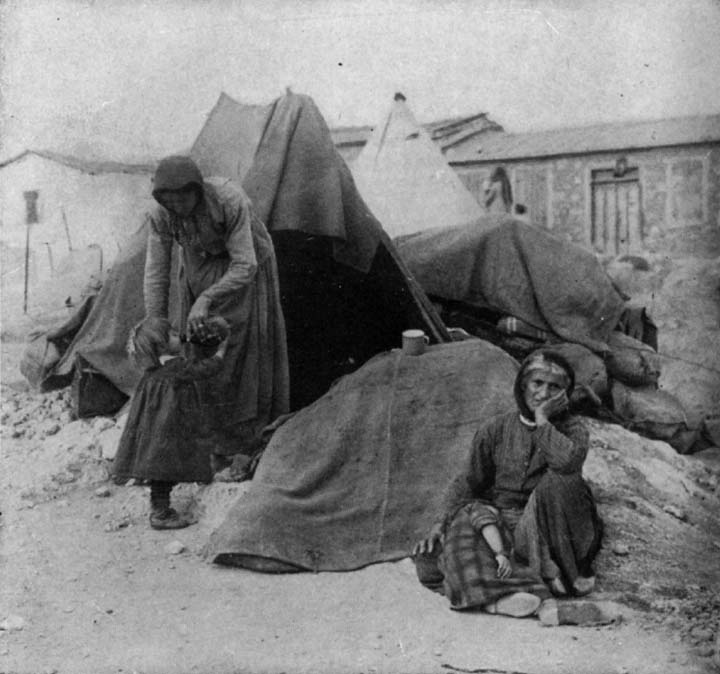
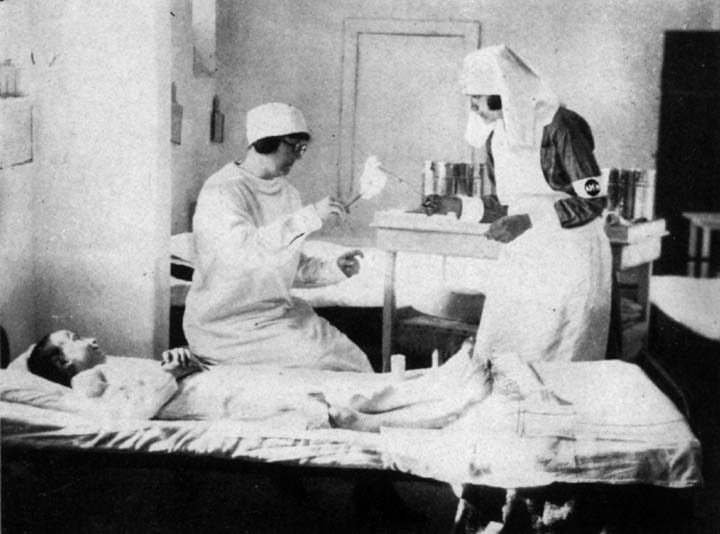
The American Women's Hospitals had been asked to undertake medical work for the refugees in Constantinople, and I was looking for the place where the greatest good to the largest number of sick refugees could be done at lowest cost. Efforts were being made to keep the Anatolian refugees out of European Constantinople, but thousands of them had seeped in and were living in the Greek and Armenian sections of the city. On account of inadequate quarantine facilities in Greece, the stream of refugees from the Pontus had been temporarily halted, and this produced a congestion on the shores of the Bosphorus. Camps had been established to keep these unfortunate people in transit segregated, and in all my pilgrimages to pest-holes, the worst I ever saw, and undoubtedly the worst in the world at that time, was the Selimieh Barracks and stables at Scutari, on the Asiatic side of the Bosphorus.
On March 12, 1923, the following cable was sent by Mr. H. C. Jaquith, head of the Near East Relief in the field, to the New York headquarters:
Constantinople, March 12, 1923.
Vickrey, New York
To-day's shipload of exiles from Asiatic Turkey increased to 32,000, the total number of refugees now in Constantinople. Sick, destitute and without food, clothing or homes to go to, they present a tremendous relief problem calling for prompt, energetic action if they are not all to perish.
* * * * * * * In the harbor crowded with twenty-one warships of seven different nations, are four refugee ships crammed with deportees from Asia Minor, who have waited for days to be landed. Ashore, at eleven different places along the Bosphorus, earlier arrivals are huddled together in windowless, doorless, leaky buildings under conditions beyond description. Afloat and ashore, smallpox, typhus, dysentery and pneumonia are unchecked . . . . Weakened by days of travel, by wagon and foot from interior Anatolian or Black Sea ports, Trebizond and Samsoun, these wretched people fall easy victims to disease. Many of those who survived their march of terror to the sea died on shipboard and 60 per cent of those who lived through the voyage on filthy, crowded ships, were diseased on arrival here.
At Scutari where the worst conditions prevail, 10,000 deportees are existing in the Selimieh Barracks and stables . . . . Dr. Post on one of his rounds counted a hundred dead bodies. Wrapped in rags, death had come days before the living knew it. One room contained 53 dead. Three thousand people who a few weeks ago were prosperous farmers in Anatolia, live on the mud floors of stables where many of them become staring skeletons from undernourishment. Children are brought into the world near where village priests pray over the dead.
Jaquith.
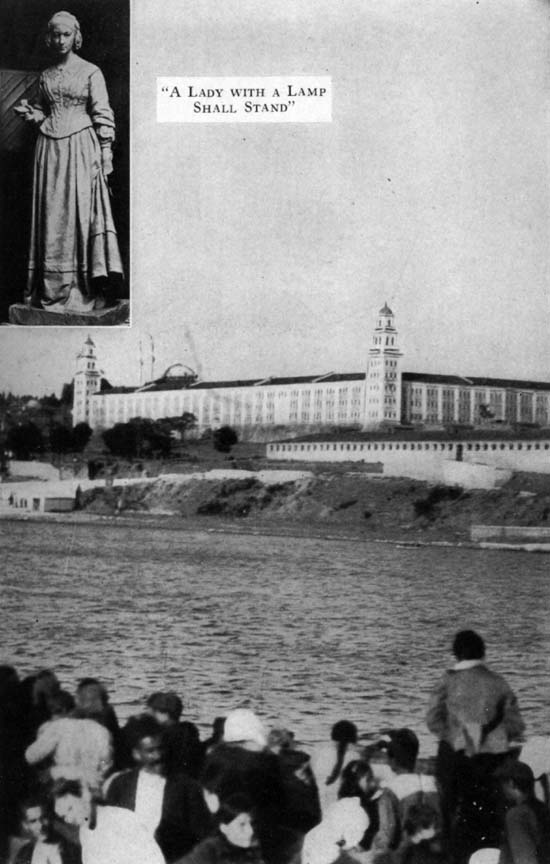
Destiny marks ships and houses as well as men, and this barracks must have been the predestined pesthouse of all history. It was the very building in which Florence Nightingale started the nursing service of the world in 1854, during the Crimean War. Time after time it has been described, and the following three paragraphs are quoted from three different writers, Tooley, Strachey and Nolan---
The first and chief scene of Miss Nightingale's personal ministrations, however, was the great Barrack Hospital at Scutari, lent to the British Government by the Turkish authorities. It was beautifully situated on a hill overlooking the glittering waters of the Bosphorus, and commanded a view of the fair city of Constantinople, with its castellated walls, marble palaces, and domes, rising picturesquely on the horizon . . . . The Barrack Hospital was a fine handsome building, forming an immense quadrangle with a tower at each corner. An idea of its size may be gathered from the fact that each side of the quadrangle was nearly a quarter of a mile long. It was estimated that twelve thousand men could be exercised in the central court. Galleries and corridors, rising story above story, surrounded three sides of the building, and, taken continuously, were four miles in extent. (Tooley.)
Lasciate Ogni speranza, voi ch'entrate: the delusive doors bore no such inscription; and yet behind them Hell yawned. Want, neglect, confusion, misery---in every shape and in every degree of intensity---filled the endless corridors and the vast apartments of the gigantic barrack-house, which without forethought or preparation, had been hurriedly set aside as the chief shelter for the victims of the war. The very building itself was radically defective. Huge sewers underlay it, and cess-pools loaded with filth wafted their poison into the upper rooms. The floors were in so rotten a condition that many of them could not be scrubbed; the walls were thick with dirt; incredible multitudes of vermin swarmed everywhere. And, enormous as the building was, it was yet too small. It contained four miles of beds, crushed together so close that there was but just room to pass between them. (Strachey.)
There were no vessels for water or utensils of any kind; no soap, towels, or cloths, no hospital clothes; the men lying in their uniforms, stiff with gore and covered with filth to a degree and of a kind no one could write about; their persons covered with vermin, which crawled about the floors and walls of the dreadful den of dirt, pestilence, and death to which they were consigned. (Nolan.)
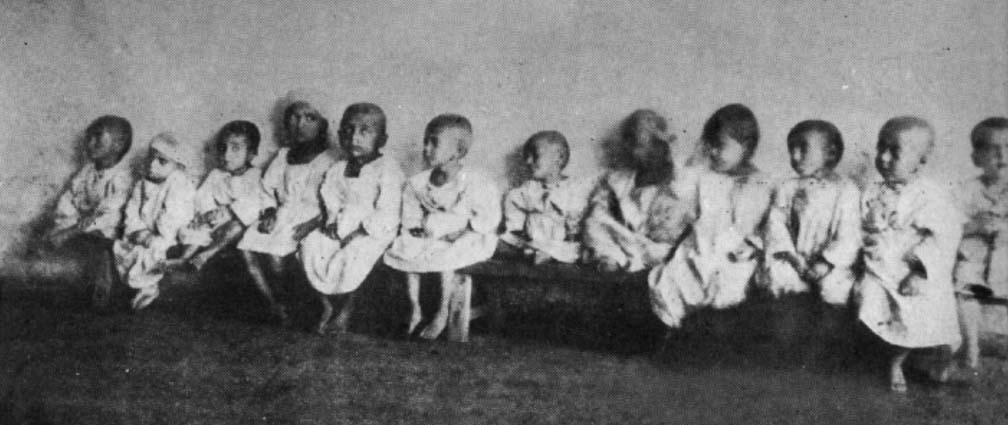
Could anything be worse? Yes! The same building in which 10,000 refugees were quarantined for typhus fever and smallpox sixty-nine years later was infinitely worse. The sick and wounded in that barracks building during the Crimean War had beds---"Four miles of beds" and such food and care as the most civilized nations had provided for soldiers up to that time. But for weeks the refugees had no beds or care, and only such food as they, themselves, could buy through the Turkish guards, or was brought in pity's name and distributed irregularly.
The building was very like our Turkish barracks building on the Island of Crete, but much larger. The stone walls were well preserved, but the interior had fallen into decay. The place was a colossal incubator of pestilence. The sick and well were sleeping on the reeking floors with disease breeding among them and Death gathering the harvest.
 |
 |
 |
 |
 |
 |
On the day of my visit in March, 1923, about a month after this barracks and its stables had been quarantined, the process of separating the sick from the well had just begun. A plan to delouse the barracks and everybody in it had been formulated, and a gleam of hope from the European side of the Bosphorus was filtering through the darkness to the festering mass of humanity within.
Picking our way carefully among the sufferers squatting or lying in that dank and fetid barracks and stables, it was hard to imagine that the nursing service of the world, in its large and practical application, had originated within those walls, and that "The Lady with the Lamp" herself, answering the calls of the sick, had glided noiselessly through those reeking corridors. The flame of her lamp had burned brighter as the years had passed in other countries, but it had flickered and gone out at Scutari, leaving the old barracks in total darkness.
The sweet sister stories written around Florence Nightingale do not explain her achievements. Thank goodness, for the other side of her character revealed in a recent book. She was a ministering angel, yes---driven by a demon, a straight-thinking demon of energy and intelligence in the service of the sick.
This "Angel of Deliverance" was welcomed with thanks to God by the sick and wounded, but the representatives of the established order, whose berths were comfortable, entertained grave misgivings regarding the innovation. They did not enjoy adverse criticism. Who does? War was war, they said in substance. This was the business of men; they were used to it. Conditions in the field were normal under the circumstances. There was nothing to complain about and these were honorable men, sincere in their opinions. Their official successors of this day, whose opinions are as unconsciously fathered by their own desires, might as sincerely affirm that conditions were normal in the Near East, and the suffering incident to the forced exodus of the Christian population from Anatolia, was merely part of the game in that country.
My father served in the British Navy during the Crimean War. He was a young boy then, and strong for the "angel band," but many of his superiors said that the Lady-in-Chief at Scutari was distressing herself and the world at large unduly. Being of the feminine gender, she naturally had "nerves," poor thing. But they soon found out that what she really had was nerve.
. . . Honest Colonels relieved their spleen by the cracking of heavy jokes about "the bird"; while poor Dr. Hall, a rough terrier of a man, who had worried his way to the top of his profession, was struck speechless with astonishment, and at last observed that Miss. Nightingale's appointment was extremely droll . . . . At first some of the surgeons would have nothing to say to her, and, though she was welcomed by others, the majority were hostile and suspicious. But gradually she gained ground. Her good will could not be denied, and her capacity could not be disregarded.
* * * * * * * To the wounded soldier on his couch of agony she might well appear in the guise of a gracious angel of mercy; but the military surgeons, and the orderlies, and her own nurses, and the "Purveyor," and Dr. Hall, and even Lord Stratford himself could tell a different story. It was not by gentle sweetness and womanly self-abnegation that she had brought order out of chaos in the Scutari Hospitals, that, from her own resources, she had clothed the British Army, that she had spread her dominion over the serried and reluctant powers of the official world; it was by strict method, by stern discipline, by rigid attention to detail, by ceaseless labour, by the fixed determination of an indomitable will. Beneath her cool and calm demeanour lurked fierce and passionate fires . . . . There was humour in the face; but the curious watcher might wonder whether it was humour of a very pleasant kind; might ask himself, even as he heard the laughter and marked the jokes with which she cheered the spirits of her patients, what sort of sardonic merriment this same lady might not give vent to, in the privacy of her chamber.
Late at night, when the long miles of beds lay wrapped in darkness, Miss Nightingale would sit at work in her little room, over her correspondence . . . . There were hundreds of letters to be written to the friends and relations of soldiers; there was the enormous mass of official documents to be dealt with; . . . and, most important of all, there was the composition of her long and confidential reports to Sidney Herbert. These were by no means official communications. Her soul, pent up all day in the restraint and reserve of a vast responsibility, now poured itself out in these letters with all its natural vehemence, like a swollen torrent through an open sluice. Here, at least, she did not mince matters. Here she painted in her darkest colours the hideous scenes which surrounded her; here she tore away remorselessly the last veils still shrouding the abominable truth. . . Her sarcasm searched the ranks of the officials with the deadly and unsparing precision of a machine gun. Her nicknames were terrible. . . . The intolerable futility of mankind obsessed her like a nightmare, and she gnashed her teeth against it. (Strachey.)
These letters and reports referred to by Strachey were written by Florence Nightingale at Scutari Barracks during the mild Victorian age, when women were supposed to be seen and not heard. What would she have written if she had lived in these days of free speech, witnessed the horrors of Smyrna, and worked among the Christian refugees uprooted and driven from their homes in Anatolia? Perhaps she would have individualized this crime against children, and said: "'Whoso shall offend one of these little ones which believe in me, it were better for him that a millstone were hanged about his neck, and that he were drowned in the depth of the sea.'" What would she have written if she had actually seen the outcasts from the Pontus quarantined for typhus fever and smallpox in her old barracks at Scutari? What would she have called the men who tried to save their faces by whitewashing the greatest crime in the history of mankind? Lytton Strachey should have published those nicknames. They were never needed more than during the present generation.
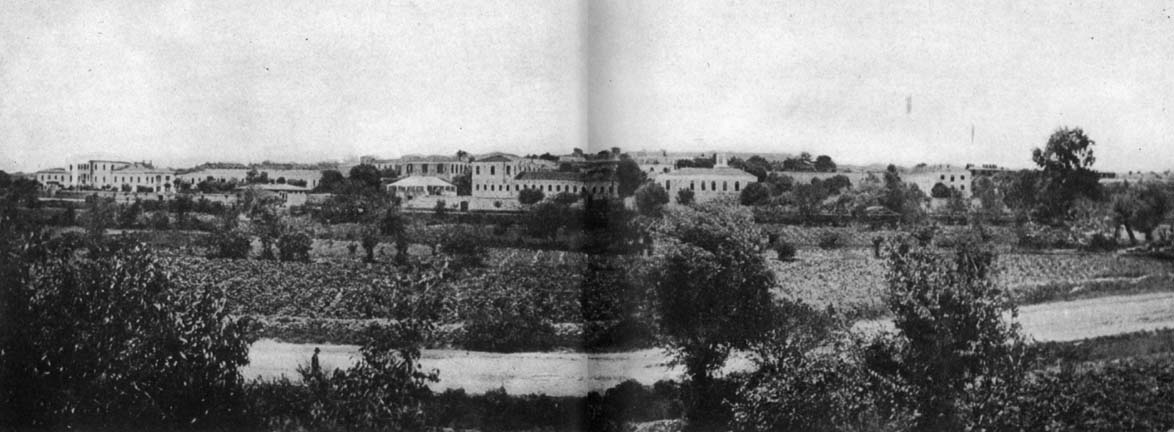
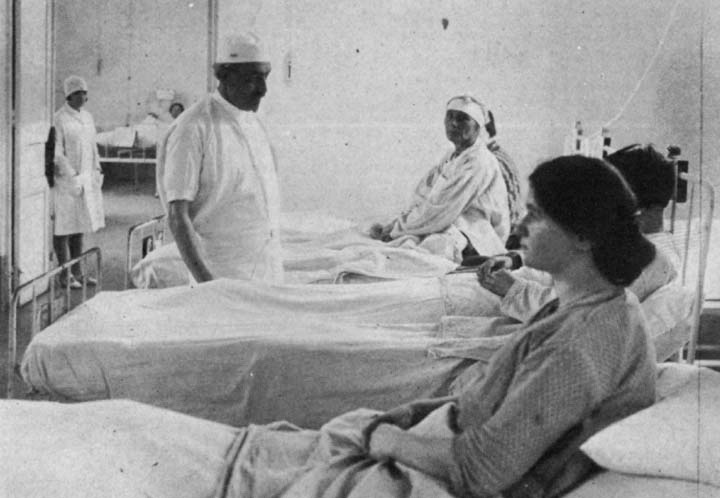
Among the places which had appealed to us for help, was the Greek Hospital at Yedi Koule (Seven Towers) outside the Byzantine walls where the most tragic part of the history of the old city is writ in stone. This is the largest hospital in the Near East. Founded in 1753, it had grown slowly with the support of wealthy Greeks and the Orthodox Church. Departments for the different branches of medical service had been developed, including separate sections with pavilions, cottages, and gardens for the care of tuberculosis and other transmissible diseases. Special provision had been made for the insane, and there was a home for the aged and an orphanage for children.
At the time of our visit, the place was swamped with typhus fever. Unfortunately, the disastrous state of affairs which filled the wards, deprived the institution of a large part of its financial support. There was a shortage of all supplies, including ordinary equipment for preventing the spread of infection. Several physicians and nurses had been stricken with typhus, and some of them had died. But even the typhus wards were not so depressing as the psychopathic section. There was hope for the fever cases.---They would either get well or die, but the people whose minds had failed, particularly the insane Russian refugees, were a hopeless group.
This hospital was undoubtedly the place where the greatest good to the largest number of sick refugees could be done at lowest cost in Constantinople. A coöperative plan for the care of those in quarantine at Selimieh Barracks had already been undertaken by other relief agencies. Besides, these people were to be sent to Greece as soon as arrangements could be made. The Christian people in Constantinople were not to be sent to Greece, and for less than it would cost to establish and conduct a refugee hospital of a hundred beds in that city, we could keep this well-established hospital of a thousand beds from closing its doors. By supplementing other resources, we could care for the refugee sick, both Anatolian and Russian, and help this historic institution carry on until, perhaps, adjustment could be made to changed conditions.
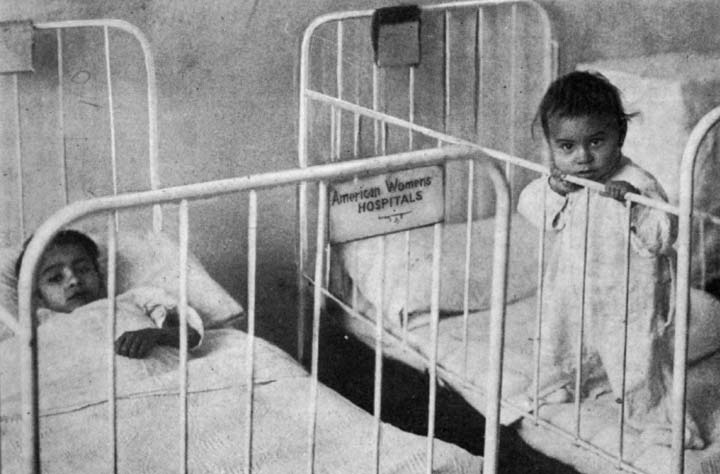
Finally, we decided to support a refugee service in coöperation with this hospital, and while we do not maintain American personnel there, our work is done under the Director of the American Women's Hospitals in Southeastern Europe, and funds are transmitted through our representative at Constantinople, who keeps a watchful eye on this work.
Official Constantinople was gay and festive during that week in March, 1923. Lent was not being strictly observed. But Ramadan and Lent, and different calendars of time, are confusing in near eastern countries. In the spring of the year, young men crave the sight of their own kind of girls, and there was a flutter among the American and British officers on account of the tourist ships coming and going with the loveliest creations from the United States that ever gladdened the eye of man. There were balls, parties and dinner dances, ashore and aboard, and caiques hanging around those big ships regardless of the treacherous current.
Late in the evening of the day I visited Selimieh Barracks, I joined a party going out to the Rotterdam, where a dance was in full swing. The girls from home were lovely in their dainty evening dresses, silk stockings and American shoes, and their hearts seemed as light as their feet. Some of the older folks were dancing, too, tripping the light fantastic fairly well considering their years. But most of them were loafing on deck and talking about the wonders they had seen during the day. They had seen the mosques, palaces, museums, the Whirling Dervishes, and the place where the Sultan went to prayer; they had visited the bazaars, glanced into the Sublime Porte, touched jeweled scimitars with their own hands, and sipped Turkish coffee out of small cups served by a tall, black eunuch, in a Prince Albert coat.
But among the things they had not seen or heard about were the Yedi Koule Hospital, and the Selimieh Barracks in plain view by daylight from the deck of the Rotterdam and other vessels lying in the stream between Stamboul and Scutari. They did not know that behind the stone walls of that enormous old building on the Asiatic side of the City of Two Continents, 10,000 human beings, mostly women and children, were suffering the tortures of the damned. But those wretched people knew about the visitors from America. They saw the big ships during the day tended by hundreds of caiques, and after dark they heard the mocking music from the brilliantly lighted decks, where thousands of God's favored people danced the hours away. The outcasts were included in these dancing parties. In the dead of the night, when Death came reaping along the corridors of their prison house, he came on the orchestral waves of these liners from New York, and frequently to the rollicking tune of "Yes! We have no bananas, we have no bananas to-day."

AFTER the departure of the Allies with their fleets of ships, men and money, the decline of Constantinople was rapid. The harbor was comparatively deserted. Barnacles gathered on the bottoms of vessels anchored here and there, and the metropolis of the Golden Horn seemed like a city of beggars with nobody to beg from. Russian refugees---all belonging to the nobility, because tourists were more likely to buy from the demoted members of the nobility than from commoners---peddled trinkets in the streets. Officers of the Czar, broken and pathetic, solicited assistance. Gifted artists, hollow-eyed and hungry, offered their wares and found few purchasers. Food was hard to secure, but in Turkish fields the poppies grow, and many of the outcasts found consolation in the seed-pods of that flower.
Young Turkey is afraid of old Constantinople. Beautiful and fascinating, she has been the favorite of many masters---Turkish Sultans, Byzantine and Roman Emperors. Constantine the Great took her to his bosom and gave her his name. Europe and Asia have fought over her for centuries. Sharing her favors with both continents, she has been a prime motive in the question of dominance, which is not yet settled. Center of intercontinental intrigue, this imperial city has always been part and parcel of strife, suffering, romance and tragic mystery. The ghosts of the Golden Horn are a thrilling host, and the flocks of strange, swift birds that skim the waves and never come to rest, are aptly called, the lost souls of the Bosphorus.
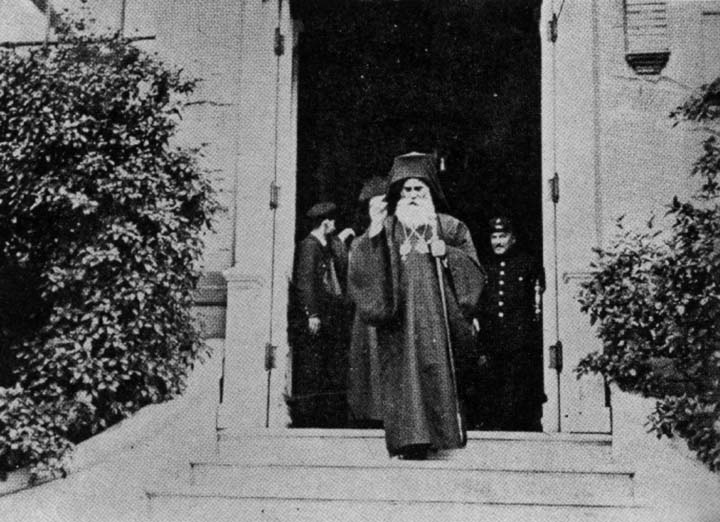
Sanctified by the Eastern Orthodox Church, the City of Two Continents is the seat of the Ecumenical Patriarch, but this does not increase the confidence of her new Turkish master. She is altogether too accessible. During the Allied occupation there was a rumor of setting her free.---Better the bowstring! Ankara (Angora) has been chosen by Kemal as the capital of Turkey, and the seat of government transferred to that inaccessible place on the interior of Asia Minor. But the charm and glory of Constantinople is not transferable. Her humiliation was finally completed by taking away her Christian name. By Turkish command, she is now called Istanbul, but to the world at large, she is forever Constantinople.
My will be done, should be the title of the colossus of Kemal, the Great Ghazi, bestriding a pedestal in a threatening attitude, even as he bestrides the state. The location of this statue on Seraglio Point under the windows of the old harems, flouts the traditions of the Ottoman Empire and symbolizes the present situation.
What is left of the Seraglio is a museum now, and the most interesting exhibits are the surviving eunuchs collected from the deposed sultan's palaces. On the day of my last visit several of these wrinkled "antikas" were basking in the sun like old, old tabby-cats. Neither male nor female, their experiences have been peculiar. But perhaps a living eunuch is better than a dead sultan. No one knows ---not even a eunuch.
What do they talk about in their queer, squeaky voices? The glory of the old sultans and the beauty of their concubines? Such memories! Just out yonder near the mouth of the Golden Horn, where the birds are flying so close to the waves, some of the favorites, who had lost favor, were drowned in the dark of the moon. But that was a long time ago, and perhaps the eunuchs have forgotten.
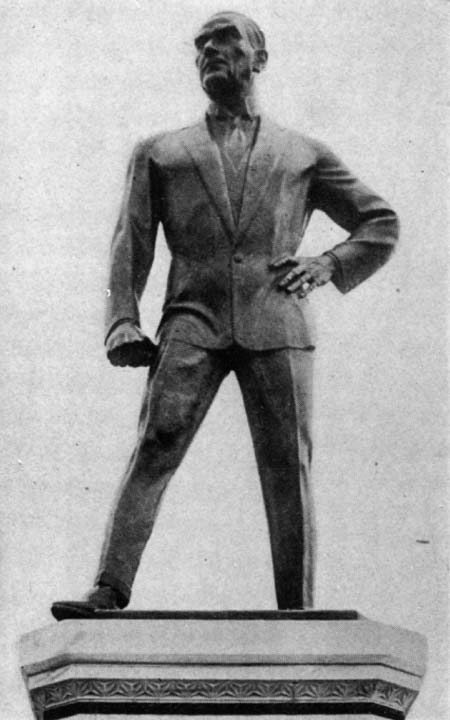 (The Great Ghazi") This colossal graven image stands on Seraglio Point, Constantinople. |
 |
 |
Turkey has changed. Under the new régime, the eunuchs are out of their element, and they may be confidentially animadverting upon what the world is coming to. Women are permitted to run loose without care or restraint. Bold, bare-faced creatures! Immodesty, in the good old days, led to the bottom of the Bosphorus.
But after all, life is comic, and the eunuchs may be sniggering at foreign tourists snooping through the private apartments of the old harems. These sexless relics are at home in those quarters, and they may question the propriety of this innovation. Secretiveness is a habit with them, and just between themselves they may go so far as to criticize the program of the Great Ghazi, and his graven image standing so brazenly in front of the old seraglio. Surely he knows that such abominations are forbidden by the Koran! But Allah is merciful. Allah is Great, and so is the Ghazi---but why did he stick his statue on Seraglio Point? His huge bronze fist is clenched as though he would dare the world to approach his domain. Poor old eunuchs! They may feel intimidated in his metallic presence.---Allahu Akbar! Allahu Akbar! The eternal call from the minarets sustains their neuter souls. Yes, Allah is Greatest---Mohammed is the prophet of Allah, but the Ghazi may have secret reasons and second sight. Magic is magic. And an enemy would hesitate before passing that fierce image.
Safe in the Sultan's garden on the European side of the Bosphorus, the eunuchs look over the water to the Towers of Asia and to the Princes Islands in the Marmora, where excess princes used to be imprisoned. Poor things! Some of them took sick and died quite suddenly. And there is the Island of Prinkipo, just a short distance out in the sea. Such a convenient island! It suggests Russia---reminiscences of the past, anecdotes old and seasoned. Russia was always close to Turkey---too close. Just before the Crimean War, Czar Nicholas I dubbed Turkey, "the Sick Man." Well, the disease has spread. Other countries are sick too, especially Russia. Czars and Sultans have been swept from the earth. They are all dead and gone, save a few "antikas" at the old seraglio with a breath of the Marmora in their withered bodies, and, perhaps, a senile chuckle in their throats, as they gaze at the Island of Prinkipo, where Leon Trotsky is a guarded exile.
How fast the wheel of fortune spins in this swift day and age! A few short years ago, thousands of Russians of the privileged class under the Czar, fleeing for their lives before the Red Army, escaped in ships from Black Sea ports. Typhus fever and smallpox developed on those ships and they were quarantined---anchored off the mouth of the Bosphorus in the Marmora. The outcasts were not allowed to land, and they died by the hundreds of thirst, hunger and disease. Their bodies were cast into the sea. Finally, the survivors were permitted to land on the Island of Prinkipo. And now Leon Trotsky, who organized the Red Army of Russia and whose daughter, subject to the loneliness and horrors of exile, recently committed suicide, is, from the standpoint of Stalin, safe in sanctuary on that same island within view of the old seraglio and the eunuchs who sit in the sun.
THE exodus of the Christian population from Turkey constitutes the greatest migration in the history of mankind. On this the world agrees. It was also the most unnatural migration that has ever occurred. These people were not nomads. They were home people. Their ancestral homes had been in Asia Minor for centuries before they were converted to Christianity. Emerging from obscurity ages later, the conquering Turks accepted Islam and a religious conflict began which finally took on a national tinge and resulted, after hundreds of years, in the expulsion of the Christian people from Turkey.
The Christian exodus was an exodus of the weak. There was no Moses to divide the waters and save them from their enemies---no pillar of cloud to lead them by day, or pillar of fire to guide them by night. They were not protected by their strong men. Their strong men had been "detained" in Turkey. After ages of occupation, this people was suddenly uprooted from the fertile soil of Anatolia and cast upon the barren islands and shores of Greece.
The outstanding phase of the colossal task of replanting a nation within a nation, was the part taken by women. It was a case of dig in or die. The majority of the able-bodied adults among the refugees were women, the mothers of little children, and the mothers of children cannot give up the ghost and die. With the selfless spirit of race-preservation they cling to life, and many a woman who left Smyrna with soft hands and tender feet was growing stronger in the struggle for survival.
Women who had been cared for and protected all their lives were suddenly called upon to take up the burden of both father and mother to their families. With nothing but the bare earth upon which Fate had thrown them and the free breath of life in their nostrils, they gathered their children around them and started to build from the ground up.
Such a lesson! Over a million people thrown overboard economically, were sinking or coming to the surface in accordance with their social qualities. The help of foreign relief associations and the element of luck (largely, health or disease) were strong influences in the new state of affairs, but the actual quality of individuals was, and is, the prime factor in the reëstablishment of these people. Survival was sometimes a thing of the spirit, and the will to live a determining cause. Under this terrible test, the strong physically, weakened and died, in many instances, and the weak grew strong and lived.
The majority of the refugees were of good social quality. There were a great many expert workers among them, and this equipment for life was the salvation of their family groups. The unadaptable woman, accustomed to indulgence and self-appointed periods of indisposition, was a nuisance until she learned to carry her own weight on the lowest possible economic plane in a new world.
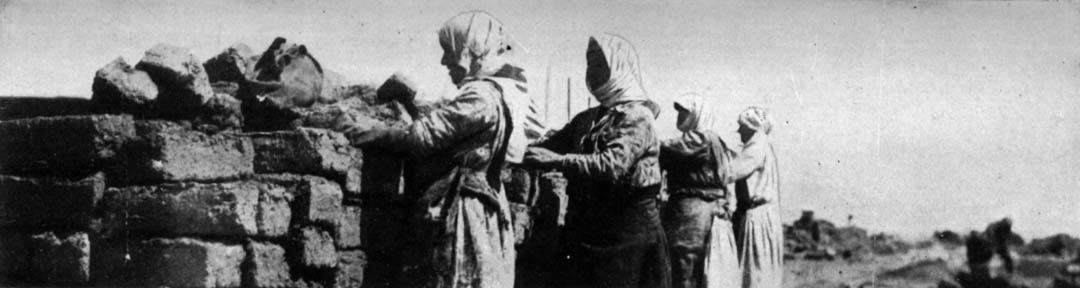
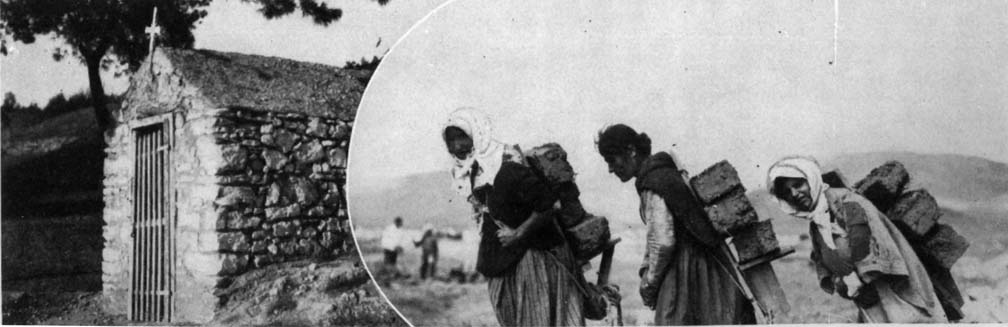
While the inrush of refugees was at its height, a ship arrived at Piræus and dumped three thousand ashore. Nobody knew what to do with them. It was merely a case of three thousand more of the same kind. There happened to be a piece of unoccupied ground between Phaleron and Athens, upon which they were told to camp. The soil was unproductive. That is why it was not in use. It was sterile but sticky, and mixed with chaff and droppings, gleaned from the highway and country round about, it made poor bricks.
 |
 |
 |
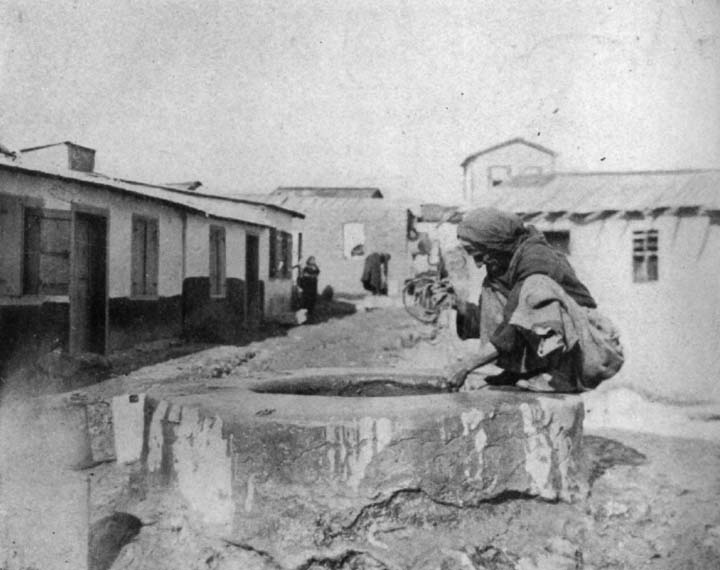 |
Winter was coming on. There was no time to lose.. Primitive implements were secured, the ground dug up, bricks made and dried in the sun. Everybody worked, and within a few months there was a town, Dirgouti, built mostly by women and children. In addition to family huts there were shops, school barracks, and a building made of mud bricks, erected by the refugees for the American Women's Hospitals. This townsite was chosen by chance, and the wonderful ruin on the hill in the distance to which these busy builders raised their eyes from time to time, was the Acropolis---the greatest inspiration of the builders of the world. The Parthenon, in its purity and beauty built of marble from the mountains, 2300 years ago, literally looks down upon this poor little town made of mud in the winter of 1922-23.
Dirgouti was run on the lowest possible commercial scale, but after the manner of town dwellers, the residents pointed with pride to their civic achievements. When I was there in September, 1923, they showed me their streets, houses, school and our own hospital, which they had built of mud bricks. This hospital had two tent annexes to accommodate the overflow.
A town government had already been established, and in spite of difficulties, it was functioning. Business was being conducted. There were miniature grocery stores with beans, wheat and rice for pilaff, strings of onions and other supplies. Shoemakers were at work at benches in front of their huts, and their materials were scraps of leather from old shoes sent into Greece by the relief organizations of America and England. The people of this little town were all living below the hunger line, and the "Ways and Means Committee" was not overlooking any possibility of outside assistance.
On account of the digging and loose dirt which became dust during windstorms and mud after torrential rains, it was hard to reach our centers in some settlements. Highways were frequently blocked, and I shall always remember a new street where small trees had been set out, for in the distance there was one in full bloom. I could hardly believe my eyes. How could a tree bloom so gaily at such a place and season? My curiosity was aroused. Picking my way through the débris I reached the end of that street and found that the bright scarlet blossoms were made of paper and renewed from time to time to keep them fresh, but the poor little tree looked as though it was going to die for want of water.
Water! Water! That was the cry of the refugees everywhere. They came from a land with plenty of water, but Greece is always in a state of drought. At Dirgouti, Lipasma and other settlements there was no water supply save uncertain wells always infected with sewage. Water for cooking and drinking was brought in water wagons, and had to be paid for by the liter.
While most of the outcasts were billeted in one way or another upon established communities, these special refugee centers, poverty-stricken boom towns, sprang up like toadstools in different parts of Greece and ran on an inconceivably low financial plane. Communities were organizing for social life, with shops, workrooms developing into small factories, and other industries conducted by refugees who were doing an active business on what might be called a penny basis, with every penny, or rather lepta, circulating at the highest possible speed.
The looms appearing in the huts and rookeries of refugees were a hopeful indication in the midst of misery, the forerunner of looms on a larger scale in the factories of the future. At one place, where we peered into a mud hut, the woman and her three children, who had built the hut, were working on a beautiful "Smyrna rug." Her family had been expert rug makers in Smyrna, but they had lost everything, she said. This was not exactly true. They had lost their homes, fortunes and supply of rugs, but they had saved the cunning patterns in their brains and trained fingers, without which the looms and plants left behind were worthless. The industries of Turkey, which had been conducted by the Christian population, were incidentally transferred to Greece. The outcasts left their buildings, flocks and herds in Asia Minor, but the goose that laid the golden egg, sadly in need of fat and feathers, swam across the Ægean Sea with them.
Nations are usually willing to allow strangers to come in and redeem waste lands in malarial districts at the expense of their spleens and red blood corpuscles, but the new people in Greece quickly infiltrated every industry and soon became a competitive force to be reckoned with. Before they were through the quarantine station, some of them began buying and selling on a low scale, and within two years they were operating on the Bourse as well as cleaning the streets.
With the help of their children, women went into business in a primitive way, saving rent and increasing trade by displaying their goods on pushcarts and soliciting patronage along the streets. Greece is a grape-producing country and wine-making a family industry. During the late summer months refugees were to be seen at times along the highways, between the miles of vineyards, buying grapes, which were thrown into grooved carts drawn by donkeys and trodden as they moved along. The children, with or without scabies, seemed to enjoy this work. Their feet and legs were wet with wine as they ran along the roads jumping in and out of these portable presses with buckets hanging along the rear to catch the precious vintage. Some of the finer brands of delicate bouquet, so prized by connoisseurs, are made in this good old-fashioned way.
Two hospitals were conducted on the Island of Corfu until August, 1923. At that time, Dr. Sara E. Foulks, head of this service, was appointed general director of the American Women's Hospitals in Greece, and served in this capacity until February, 1926. She was assisted by Mrs. Cruikshank, Miss Frances MacQuaide, and a committee including Mrs. Carl Blegen, Dr. Minnie Mills and Dr. Mary Kalopothakis (whose mother was an American), who has practiced medicine in Athens for many years.
When I visited Salonica in April, 1923, a stream of refugees was pouring through that port and seeking places of permanent residence all over Macedonia. Approximately four hundred thousand had already been received. The work of the American Women's Hospitals in that district was under the direction of Dr. Ruth Parmelee. Our grounds and buildings were loaned to us by a religious association connected with the Greek Orthodox Church. There was a hospital of a hundred beds with provision for overflow, clinics, dispensaries, out-patient service and a nurses' training school. In September, 1923, the Governor-General of Macedonia sent the following cable to the American Women's Hospitals:
Thousands additional refugees landing-Health Department unable meet desperate medical sanitary situation---beg American Women's Hospitals enlarge clinical hospital facilities to decrease high death rate.
Lambros.
Dr. Parmelee was one of the deportees. Her parents had been missionaries in Turkey, where she was born and had spent most of her life. She was sent to America to college, returned as a medical missionary, and had served several years before the Greco-Turkish War. Deported from Turkey on account of her sympathies, she was placed at the head of the American Women's Hospitals at Salonica, and did an enormous work caring for the sick, many of whom were from the districts where her family had lived and worked for over forty years.
Dr. Parmelee knows the Near. East, its people and languages. She realized in the beginning that it would take years, a generation at least, for refugees, moving from a large fertile country to a smaller, less productive one handicapped with malignant malaria, to become established. A training school for nurses was started at the Salonica Hospital in January, 1923, which, as the months and years passed, supplied nurses for our refugee hospitals in other parts of the country.
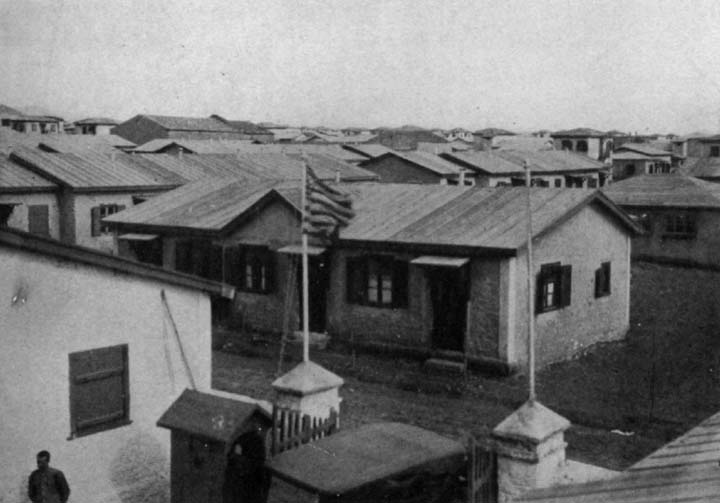 View of Kokinia Refugee Settlement from the entrance to the A. W. H. compound. Seventy thousand refugees live in this town. |
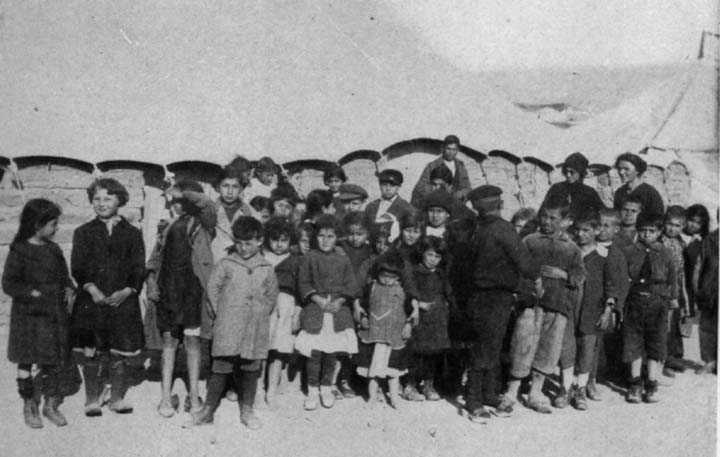 Mud schoolhouse with a canvas roof for refugee children, Dirgouti, Greece. |
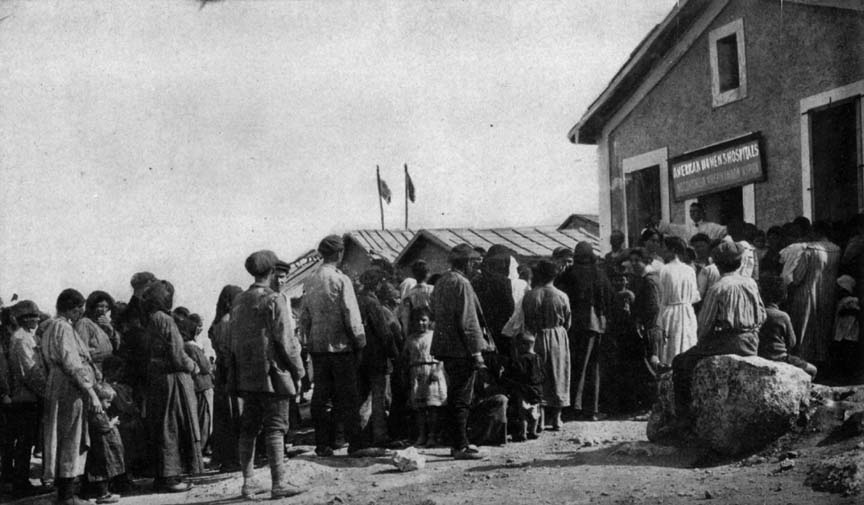 Patients waiting for treatment at the Lipasma Hospital Clinic. |
Plastiras was dictator in Greece during the migration, and his straight-shooting, military methods brought order out of chaos in an incredibly short time. He was a benevolent despot, a gallant soldier and a gentleman---gentle to the innocent, injured and helpless, especially to little children. But political tricksters and disturbers of the peace got short shrift. As part of his personal obligation, being a bachelor, he collected a family of orphans and gave them a home in his own household. He was a poor man, and paradoxically law-abiding. Cash allotments were legal for kings and princes, but no salary had been provided under the monarchy for a revolutionary dictator, so Plastiras served in this capacity without pay.
Special representatives were appointed by the government to deal with foreign relief agencies, and our relations from the beginning were cordial and coöperative. At the end of our first six months of service, the following letter was received from the Greek Minister of Hygiene and Public Assistance:
Ministry of Hygiene and Public Assistance
Ministers Bureau,March 9th, 1923.
Executive Board,
American Women's Hospitals,
New York.Honorable Ladies:
I have the honor to express to you by this letter the gratitude of the Greek Government and the Greek Nation as well as the thanks of more than a million refugees for your admirable effort in medical and hospital work in favor of those suffering crowds driven away from their homes.
Your organization, represented in Greece by Dr. Esther Lovejoy and Dr. Mabel Elliott, has really been at the height of a very difficult situation. The great help which you offer to the Greek Nation in this critical period, when we had to accept into our country hundreds of thousands of unhappy refugees driven away from their homes by the Turks, will remain for ever engraved in the heart of us all. Your country has shown by such actions as that of your organization a wonderful spirit of International solidarity which will remain as an example to the civilized world. The action of the American Women's Hospitals has also proved what splendid results can achieve a woman's organization when it is inspired by high philanthropic feelings.
Greece owes a debt of gratitude to the American Women's Hospitals who crossed the ocean to put the spirit of method and organization as well as the generous heart of the great American women at the service of more than a million distressed refugees.
With the assurance of my profound respect, I am,
Very sincerely yours
(Signed) D.
DOXIADES,
MINISTER OF HYGIENE AND PUBLIC ASSISTANCE.