
OUR appeal for funds had been fairly successful, and four months after leaving Smyrna I returned to the field in Greece with additional American personnel.
After inspecting our hospitals and clinics at Piræus, Dirgouti, Kokinia, the Aerodrome, and the orphanage infirmaries at Athens, Oropos, Loutraki and elsewhere, which we were conducting at that time for the care of the sick among the Armenian orphans brought to Greece by the Near East Relief, we started one morning for Macronissi Island.
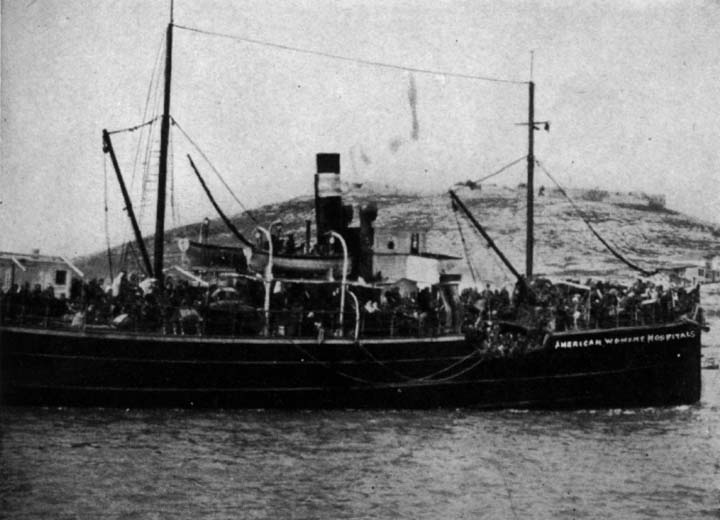
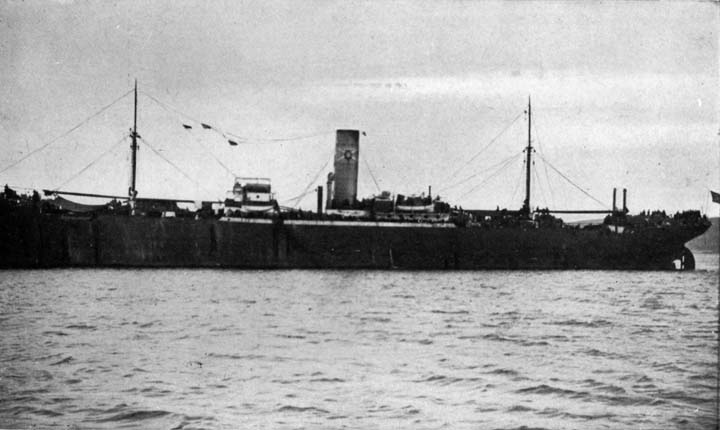
The weather at Athens was not bad, but thirty miles down the Attic Peninsula near the land's end off Laurium, the water was rough and the men running our tenders refused to take us to the island. The boat would surely be wrecked in the breakers, they said, if we attempted to land on that rock in such weather. The Ionia was lying between the coast and the island waiting for the storm to subside. She had arrived, a few days before, flying the usual signals of distress, reading in the language of the sea: "Four thousand refugees. No water. No food. Smallpox and typhus fever aboard."
This story of twelve words, or the first seven words with immaterial variation, was true of practically all the refugee ships. They came into the ports of Greece, including Piræus, Salonica, Nauplia, Kalamata, Herakleion and many other places, loaded to capacity with human freight, contagious diseases spreading in their holds, and thousands upon thousands of outcasts famished and frantic for water. Part of the human cargo of the Ionia had been unloaded before the storm, and the rest had to stay on the ship and wait for fair weather. Meanwhile, the delousing, disinfecting and encamping of those ashore, moved forward with dispatch in spite of the difficulties to be overcome at every step.
The sea was smooth on the following day and debarkation was resumed. The refugees came ashore in great, flat-bottomed scows, and Dr. Stastny, with the assistance of Dr. Sara E. Foulks and Dr. Owen H. Yereman, inspected them, one after another, as they landed. The sick were given first attention. Some of them were insane. Those with contagious disorders were sent to the isolation hospitals, and the entire Ionia colony was located at a distance from the colonies arriving previously, from different ports of the Pontus, with perhaps, different kinds of diseases.
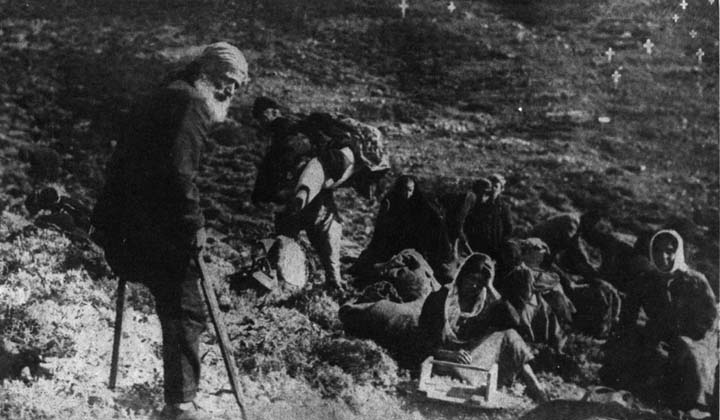
Mr. H. C. Moffett, Dr. Elliott and I stood on an elevation above the cove where the tenders were landing, and watched that tragic procession made up of women, children, the aged, and a small proportion of able-bodied men, struggling through the sand with their bundles on their backs. Many of the old people were exhausted, and had to be helped to the camp of the "unclean," where all the newcomers were obliged to remain until they were deloused and their meager belongings disinfected. Bending beneath enormous loads, the refugees struggled up the hill, and here, as on the railroad pier at Smyrna, unusual personalities occasionally emerged.
In this procession of wretchedness I noticed an old gentleman, one of whose legs had been amputated. He was a man of sorrows with a saintly face. His crutches sank so deep into the sand that it was very hard for him to get along. With the help of a young girl who resembled him strikingly, he finally reached the top of the first incline, and as he looked around, I noticed that he was going straight toward the cemetery with its white crosses---the last refuge on wind-swept Macronissi.
 |
 |
 |
A woman with a family of children pushed forward and upward. Her husband had probably been "detained" by the Turks. There were no weaklings in this brood. Her strength, stride and cast of countenance compelled attention. She had increased and multiplied herself for the coming generations. Who was she? No one knew. What was she? Every one knew. A strong mother, an honor and an asset to her people. She was not resigned to her fate. Generations of hatred begotten of oppression lurked behind her eyes. Wait! Time and such families may reverse the fortunes of to-day. Her spirit was not crushed. Hagar, mother of Ishmael, might have had just such a proud, resentful face.
Hundreds followed hundreds through the shifting sand; then came a lovely child, carrying a baby sister, almost more than her strength could support, and tenderly leading her mother, who seemed to have lost her mind. The nondescript numbers streamed from the scows for perhaps another half an hour, when a boy appeared, unwashed for a month, like all the rest, with a fine dog straining at a leash. There was quality in that animal, the dog I mean, and probably in the boy, but he was at a disadvantage. Dogs are good refugees. Their needs are small. Who ever heard of a ragged, unwashed, barefoot dog? No such pathetic animal exists. Clothes may make the man, but pedigree still makes the dog.
There were three hospital pavilions, one for non-contagious cases, another for typhus fever and a third for smallpox at the smallpox camp. A great many people died soon after landing, most of them from exhaustion due to lack of food and water, and other hardships incident to this terrible migration.
Ten minutes' walk over another hill to the north brought us to the American Women's Hospitals' outdoor cafeteria. A photograph of this place, taken on this day appeared in the National Geographic Magazine, in November, 1925, over the following caption:
THE AMERICAN QUARANTINE STATION ON MACRONISSI ISLAND, GREECE, FEEDING SIX THOUSAND GREEK REFUGEES FROM TREBIZOND, BLACK SEA PORT, WHO HAVE JUST ARRIVED BY STEAMER.
This photograph was used to illustrate an article with the title, "History's Greatest Trek," in which the following statement appears:
To avert the horrors of a plague-swept Greece, a quarantine station for incoming refugee ships was established off the coast at Macronissi Island by an American organization.
The "American organization," the name of which was not mentioned, was the American Women's Hospitals. At that time we were carrying the entire cost of feeding the refugees, and all other costs in connection with this work, with the exception of the cost of water, fuel and transportation, which was borne by the Greek Government. A month later the American Red Cross came to our help and allowed us a thousand calories of food daily for every refugee on Macronissi.
There were probably not more than eight thousand outcasts on the entire island, including those landing from the Ionia at the time of my visit in February, 1923, but the line waiting for food looked like twenty thousand to me. Carrying all sorts of pots and pans in which to receive their portions, they moved slowly by our caldrons, where they were given their allotments of dark bread, and mush or beans, in accordance with the size of their families.
In those early days, before the work was organized, every woman was obliged to bring all of her children able to walk, to the bread line in order to prove their number and prevent hoarding. This hardship was necessary because the universal habit of hoarding could not be checked in this emergency, among people where the need for hoarding was actually gnawing at the pit of their stomachs.
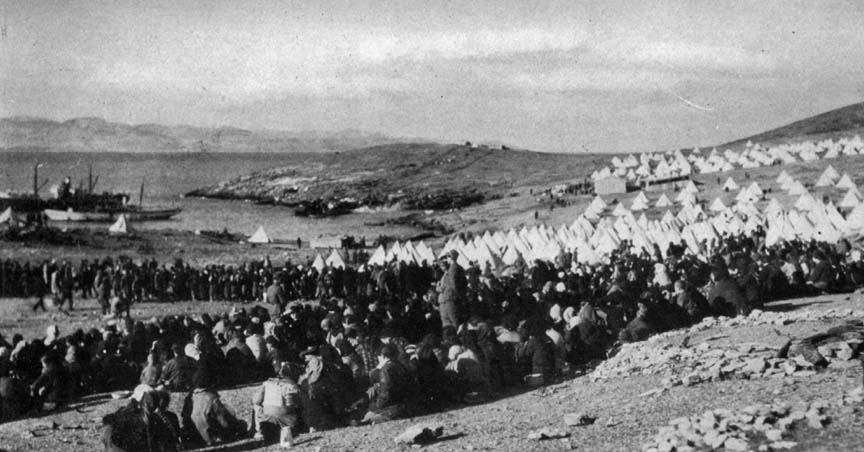 Six thousand refugees waiting for food, A. W. H. Quarantine Island. At the time this photograph was taken the entire cost of feeding these people was borne by our organization. Later the American Red Cross came to our assistance and allowed a thousand calories of food daily for each person in quarantine. |
 |
The poor are always with us, and so are the hoarders. They appeared among the Children of Israel during the Exodus from Egypt, three thousand years ago; they appeared in the United States during the war, and they appeared upon Macronissi Island during the Exodus of the Children of Christianity from Anatolia, day before yesterday. Therefore, every woman was obliged to bring all of her family to our flesh pots filled with beans or mush and stew once a week, in order that their mouths might be counted. There were six thousand waiting for food, and approximately two thousand more in the camp of the "unclean." I felt like a hostess with a very large number of guests and a mighty slim larder.
How long can we last? That was the unspoken question with which I was inwardly tormented as I walked along that line and noticed how hungry they all looked. For four years, I had been begging for the American Women's Hospitals, and I knew how hard it was to secure funds. Beans, meal, sugar, fats, and the cheapest kind of meat by the ton cost a lot of money.
Eight thousand guests, every one of whom had been exposed to typhus fever and smallpox---what a prospect! Even though they were cleaned up yesterday, and their camps thoroughly disinfected, they would be coming down to-day, to-morrow, all next week and the week after, with these diseases. In the cases of new arrivals taking the places of those who could safely be removed to the mainland at a later date, this process would be repeated.
How long can we last? Many a ship had split on Macronissi Island, and the good ship Awotal was close to the breakers. But financial disaster was not the only danger. Mr. Moffett, who came from the Black Sea with the refugees on the Ionia, called me aside and warned me of the grave danger of leaving American women on that island. As I remember the words of his warning they were in substance as follows:
"This is a dangerous place, and these are dangerous people. They have suffered terribly. They have nothing to lose and they feel that the whole world is against them. Suppose this island is storm-bound for a week and the water runs out? They will blame everybody in control for keeping them here, and they may rise up and kill your women. Remember, that when this island is storm-bound, no help can come from the shore.
"While we stood offshore waiting for permission to come in, the officers had to use guns to control these people. When the bodies of their children were thrown overboard, and they floated around the ship, these mild looking women were like raving maniacs, threatening the lives of everybody in authority. Dr. Stastny is very confident and sympathetic. The refugees look like lambs to-day, but I've seen them in the other mood. When the time comes, they may turn tiger and tear her to pieces."
This appalling possibility added to our financial danger, dimmed the glory of a glorious work somewhat. It was fine for those who slept in the Hôtel Grande Bretagne at Athens, but for those sleeping on the island during the impending equinoctial storms, braving the dangers of pestilential diseases and the frenzy of thousands of half-crazed people---well, this was the reverse of the Macronissi Medallion, the beautiful obverse of which had already been held up before my admiring eyes.
In search of a quiet spot, where I could be alone for a few minutes to try to think, I passed through one of the camps and the cemetery, on my way to the crest of the island. Whew! Living refugees have an odor as distinctive as the odor of violets, and different kinds of decomposing organic matter, also gives off characteristic effluvia. At the edge of the cemetery, which already had a large number of graves, a few of them marked with crosses, I caught a familiar whiff and asked an English-speaking deportee who was digging a grave, for an explanation.
"It is not my fault, Madam, I assure you," he said. "We are not allowed to put our dead in the channel and the soil on this island is not deep enough' for graves." He was standing halfway out of the grave, and to convince me of the truth' of his statement, he scraped his shovel discordantly along the granite bedrock, measured the depth with the handle and announced that it was less than a metre deep.
From the crest of Macronissi, which is also called Helena, because the lovely Helen is said to have paused here with Paris on her epoch-making elopement, I looked out over the main channel between the Port of Athens (Piræus) and the ports of the Ægean, Eastern Mediterranean, and Black Seas, then, turning on my twentieth-century rubber heel, glanced back to the Attic Peninsula. Within a small radius of this island our most precious possessions were developed, for Western culture is peculiarly the child of Greek culture. From those immediate shores to the north, south, east and west, we have a priceless heritage in art, literature, science and philosophy, and here on the hillside under my eyes was a remnant of the people who had made the greatest of all gifts to the world---the gift of a civilization.
They cast their bread upon the waters, and after many centuries the crumbs returned. Across the Gulf of Ægina, at Epidaurus, was the famous shrine of Æsculapius, the God of Healing, and his daughter, Hygeia, Goddess of Health. To the east beyond the Cyclades was the Island of Cos, where Hippocrates, "Father of Medicine" was born, and on the mainland within view from the crest of Macronissi he actually practiced the science, art and morals of medicine. His life, as expressed in his work, teachings and writings, forms the corner stone on which the profession of medicine rests to-day. This Moses left his Commandments, the Hippocratic Oath, which for centuries was part of the graduating ceremony of physicians in the Western world.
"The road to Learning leads through Faith," said Aristotle, twenty-two centuries ago, and he placed a gift on the altar of learning that has never been equaled. But why itemize our debts to Greece in the presence of the exiles from the land that was Greece at the time of her greatest glory. There they were, six thousand of them, on the hillside---families that had known the comforts of life, eating mush or beans out of one pan with the help of a bit of bread, for lack of a spoon wherewith to feed themselves.
Of course, I had to warn Dr. Stastny of the dangers of her position, which she recognized fully. She had counted the possible costs in advance, and she was on the island to stay.
"My children are grown and married," she said. "I have no duties which should take precedence of my duties here."
Her presence inspired confidence. She was six feet tall, very handsome, unconsciously commanding, and I somehow felt that she would make good on that job. A guard of two hundred and fifty soldiers was placed at her command, and later when the dire predictions of that day were fulfilled, the presence of Olga Stastny of Omaha had more influence in quelling trouble than the Greek military guard.
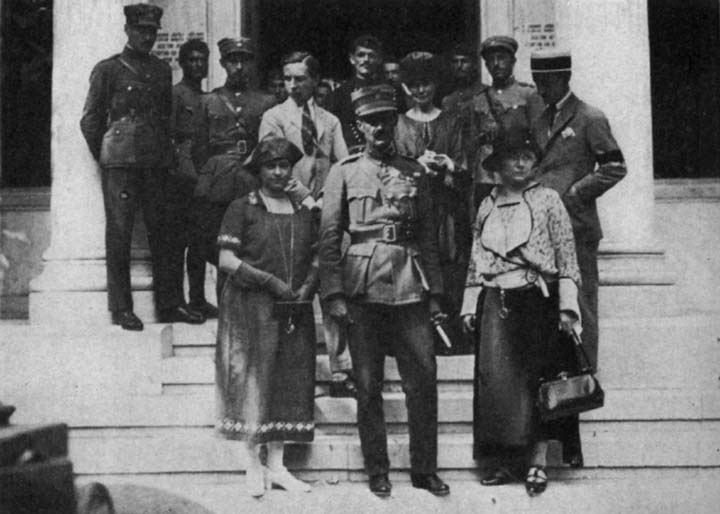
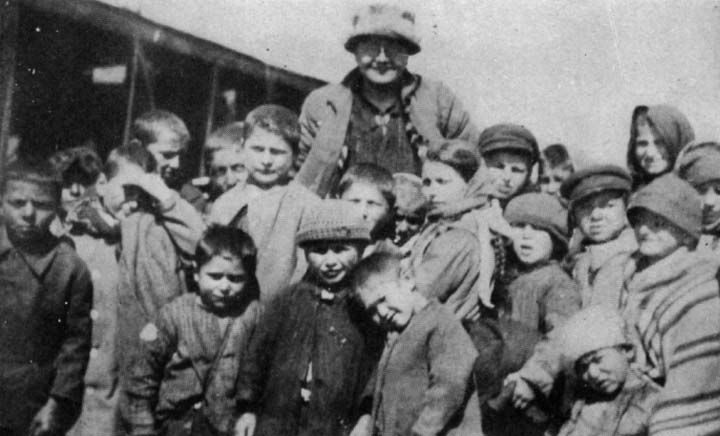 Dr. Olga Stastny with a group of "clean" children. These children have been deloused, washed and provided with vermin-free clothing. |
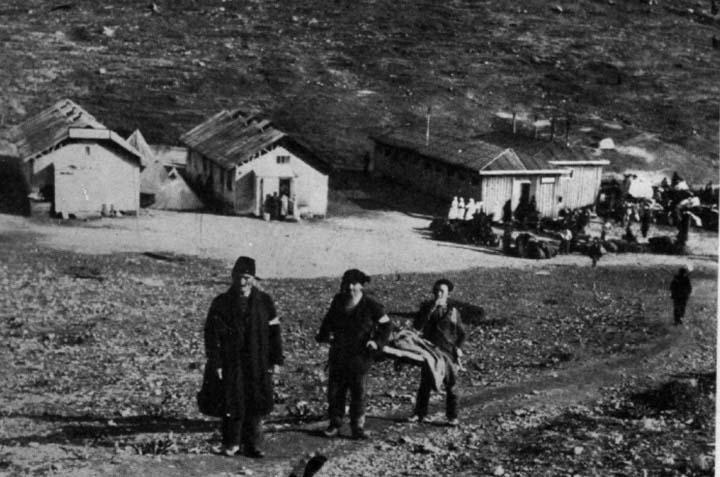 |
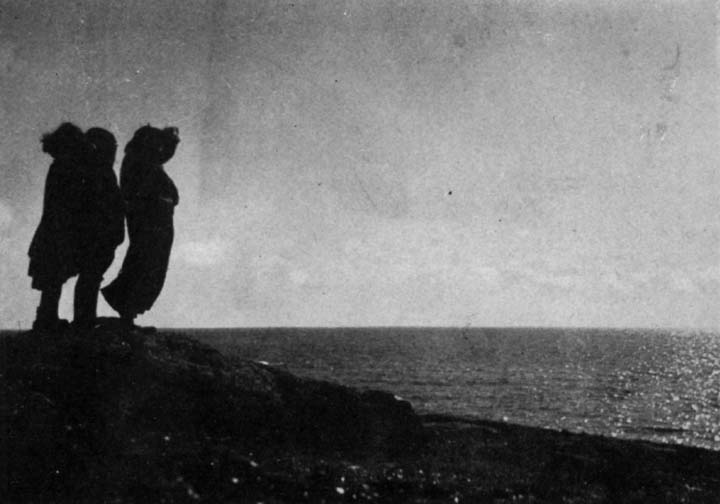 |
 |
The population of the island increased until there were seven camps. Some of the nurses and physicians took the typhus fever. Dr. Stastny's chief assistant, Dr. Poumpouras, died. But in spite of all the dangers and difficulties, she stayed on the island for five months, leaving her post but twice for a few hours during this time. In the report of the Athens-American Committee, investigating American relief organizations in Greece, the following statement is made regarding the work of the American Women's Hospitals on Macronissi Island:
On the bleak, rocky slopes of this Quarantine Island, there are rows upon rows of shallow graves in which are buried the victims of typhus and other diseases, and throughout the length and breadth of Greece there are thousands of Pontus refugees who are alive and well to-day as a result of this self-sacrificing, heroic effort on the part of this organization.
The sun was sinking when we left Macronissi. At a distance of a mile, perhaps, I turned and scanned the island with a glass. There stood Olga Stastny on the shore, shading her eyes with her hand, while the last scow from the Ionia was pulling into the landing cove, and along the hillside in the background the refugees were moving, one after another, toward our caldrons---how long could we keep them full?
This disturbing thought was in my mind all the way to Athens, and when we reached the Hôtel Grande Bretagne, dinner was being served. Corps of waiters were passing down the aisles with loads of food gathered from the land and the sea. Course after course was spread before the guests: hors d'oeuvres and cocktails to stimulate flagging appetites, followed by soup, fish, fowl, meat, desserts and all sorts of trimmings along the way, finished with coffee, cigarettes and liquor served in the lounge.
We are such wasters! I felt like getting a basket and gathering up the fragments which remained after each course. Why should we pick, choose, and waste while the people off the coast on our island were suffering for food?
Fresh from Macronissi, the spell of that horrible place was on my spirit. The room seemed full of hungry children. Their living faces looked out of the clouds on the ceiling, as real as the frescoes of great artists, and in my mind's eye, that long line of wretched human beings was moving down the rear wall of the dining room toward the mush pots of the American Women's Hospitals.
How long could we last? The question might easily have been answered in that dining room, if some of those present had been rich and charitable. As Health Officer of a large city, it had formerly been my practice to observe people closely for signs of disease, but for several years past, I had been observing them for signs of wealth and human sympathy.
There is a subtle quality of gentleness, loveliness and carelessness of self, in the appearance of those who sympathize deeply with the suffering of mankind:
| The quality of mercy is not strain'd, It droppeth as the gentle rain from heaven Upon the place beneath. It is twice blessed: It blesses him that gives and him that takes. 'Tis mightiest in the mightiest: it becomes The throned monarch better than his crown. |
The guests of the Grande Bretagne that evening at dinner were not a hope-inspiring company. Most of them were dressed too well and carefully. Put not your faith in the man who looks like a million dollars! There was enough jewelry displayed in that dining room (some of it secured from refugees) to have fed the outcasts on Macronissi Island for a month. But experience had taught me not to bother with women who hang large fortunes on their persons, flouting the Lord's Prayer, leading the weak into "temptation" and demanding police protection from the results of their own folly.
"Come out of it and eat your dinner," said a familiar voice at my elbow and out I came. A dinner party was passing our table on the way to the lounge. Among them was Rose Wilder Lane, a distinguished author, who was writing a book, a thrilling tale in which one of our women physicians appeared as the central heroic figure.
Heroism was a necessary quality among the A. W. H. physicians and nurses in the field, and the achievements of the organization, in the aggregate, were due to the devoted service of a large number who were stationed at remote and dangerous posts at different times. The stories of Dr. Graff, Dr. Parmelee, Emily Nesbitt, Margaret Purvis, Freda Frost, Mabel Power, Adah Butts, Jessie Kennedy, and many others of their type, are epical in character, but the heroine of that hour was Dr. Olga Stastny on Macronissi Island.
Sleep was out of the question, so I joined a party going to the Acropolis. The charm of this immortal hill by night should, "tease us out of thought as doth Eternity"---but the wind was blowing and our tent cities on Macronissi Island were insecure. The exquisite Temple of Athena Nike proclaimed the eternal joy and truth of beauty---but ugliness and pain are also truths eternal. The Caryatides are never more beautiful than in the pale light of the moon. For two thousand years they have been standing serenely in the portico of the Erechtheion and there they will remain through coming generations "in midst of other woe than ours."
Led by familiar strains of music, we followed a winding path among fallen columns and fragments of the ages, along the side of the Parthenon, and in the deep shadow at the base of a marble pillar, as large as an Oregon fir, we found a group of our countrymen playing the ukelele and singing, "Sweet Rosie O'Grady."
Late that night, as a finish to the day, I sent the following cable to our Board:
Refugee conditions indescribable. People, mostly women and children, without a country, rejected of all the world; unable to speak Greek language; herded and driven like animals from place to place; crowded into damp holes and hovels; shortage of food, fuel, water, bedding and clothing; cold, hungry, sick. Mercy of immediate death withheld. Awotal conducting fourteen hospitals and large number of dispensaries in Greece and Ægean Islands, combating pestilence under great difficulties. At present moment Awotal feeding and housing in tents and caring for eight thousand people in quarantine on Macronissi Island.

A WEEK later I left Athens for Crete and the Grand Bretagne forever. It was the only hotel in the city where the rates were not regulated by the government. At the time of arrival, I had been congratulated on my good fortune and told that the Grande Bretagne was so crowded that it was only the coincident departure of another relief worker that made it possible to secure accommodation for me. My stay had been short and far from sweet, and my daily account amounted to more than enough to feed thirty people on Macronissi Island. As an insurance against further extravagance I kept the bill in my pocketbook for almost two years, an ever present reminder of the importance of a bargaining attitude in strange countries.
Whenever I opened my purse I stopped and pondered the price, with the gratifying result that I learned to travel like the Greeks in Greece, the Romans in Rome, the French in France, the Germans in Germany and the Russians in Russia. It was a profitable change in more than one way, and I looked back regretfully upon my old tourist days, the lost opportunities and money wasted, when I passed along the same routes carefully protected from the normal contacts of those countries, in special cars and steamships, like a lady tortoise moving very exclusively in a cabin de luxe, but not getting much out of the trip.
Traveling in Greek ships on the local run between Piræus and Crete is not a pleasure during the February storms. But I was overweight, and a brief period of seasickness will do more toward the restoration of a lithe and willowy figure than a diet of lettuce leaves and lemon juice for a month. A few days without the oily meals served on these vessels cannot be counted a hardship. One whiff of the dining room was enough, but the stateroom might have been worse. Pestilential diseases were prevalent at all the ports harboring refugees, and the berths in the ships were likely to be infested with carriers. The bedding had seen long, uninterrupted service, but protests on ships of this kind are worse than profitless, so I slipped into my verminproof bag, closed the inlet, leaving a small airhole, and retired for the voyage.
This health resort was pink in color, a detail which had escaped my notice, and slick on the outside affording no foothold for pulex or pediculi. These carriers of disease were shut off from their natural field, the only approach being through a well guarded pass, and in this way the danger from typhus fever and bubonic plague was reduced to a minimum.
The inside of that bag had a home-sweet-homey atmosphere. There was peace and security in its ample folds, and whenever I crept into it and closed the top, I felt like reaching out and turning on the bedtime stories. But I couldn't reach out for the reason that the bag was sewed up tight all around, the only opening being occupied by my nose.
Several hours passed before the room steward came to earn a few hundred drachmas if possible, but he was so startled when I put my head out of that pink bag, that he rushed away without pretending to perform any service. Within a few minutes, the head steward came to see what he could do to make the voyage comfortable, and from that time forward there was no lack of attention. Most of the stewards and officers of the ship, including the captain, called on one pretext or another.
When Mrs. Marian Cruikshank came out in a rowboat to the ship at Canea, Crete, she seemed like an angel from "God's Country." The personnel of the American Women's Hospitals came from different states, and each one referred to her native state as "God's Country." We were both born on the Pacific Coast and had worked together in Portland, Oregon, for years, and her "God's Country" was my "God's Country"---the land of the big trees. She was full of talk and enthusiasm, and if there is anybody in the world an Oregonian can think out loud to, it is another Oregonian a long way from home,
For a week we thought out loud whenever we were alone together, and the gist of our talks is contained in the preceding and following pages, for which we are jointly responsible. It is impossible to unscramble and identify ideas which we hold in common, and it doesn't matter anyway---we are both from the same town away out west.
Crete had more than her quota of refugees, and those in Canea were faring better than those on other parts of the island. A hundred thousand drachmas had been raised by popular subscription, and to this amount, M. Venizelos, a Caneote by birth, contributed an additional 70,000 drachmas to help the first influx of refugees. The foreign consulates and the headquarters of the American Red Cross were located at Canea, and this meant a closer supervision of food allotments and health conditions.
Retimo was in greater need of help. The refugees in this town exceeded the normal population in number. In addition to the "Greek" refugees from Asia Minor, all of whom spoke Turkish and whose forefathers had never set foot on Greek soil since Asia Minor was Greek, before the Turkish invasion, about a thousand years ago, there were the "Turkish" refugees from the interior of the island, who fled to the cities because of the danger of Greek reprisals.
The whole population of Crete, and other parts of Greece, was in a hectic state of military emotionalism. In view of the attitude in our own safe and placid country during the war, it is amazing that these people, who had suffered from Turkish oppression for centuries, did not seize upon this opportunity to wipe out everything Turkish within reach of fire and sword.
According to the report of the British vice-consul at Herakleion, twenty "Turks" had been killed by enraged Christian Cretans. Most of these "Turkish" refugees were of Greek and Cretan blood. They spoke Greek and had no knowledge of the Turkish language. It was religion, not race or nationality, which determined their allegiance. Christian or Moslem? That was the vital question. Most of the Turks on the Island of Crete were "Turks" merely because their forefathers had accepted the Mohammedan religion during the Turkish occupation, which lasted two and a half centuries, and came to an end, practically, in 1912, with the help of Venizelos, and the Cretan Declaration of Independence of Turkey and union with Greece.
The religion of the fathers had been instilled into the children from generation to generation, and the Turkish nationality, went with it, although these "Turks" were Greek citizens, some of them holding high political offices. A great many Greek family names end with the suffix "akis," such as Papadakis and Spiradakis. The Turks have no family names, and an effort at adjustment was manifested on the part of many Cretan Turks by the voluntary addition of the above suffix to their given Turkish names, after which they read: Mohammedakis, Abdulakis, etc., and were used as family names.
Retimo had a large "Turkish" population. Several members of the City Council were "Turks," and this, perhaps, is the reason why so many Cretan "Turks" flocked into that town. There was a motley crowd of Turkish-speaking "Greeks," and Greek-speaking "Turks," and the general confusion worse confounded by the presence of Armenian, Bulgarian and Russian refugees.
Housing was out of the question. It was a case of shelter from the wind and rain. All the old mosques, churches, school buildings and rookeries of every description were utilized. The "Turkish" population helped the Greek-speaking "Turks" from the interior of Crete; the Christian population helped the Turkish-speaking "Greeks" from Anatolia, and the American Red Cross and the American Women's Hospitals helped the sick and hungry, regardless of religion or nationality.
An effort was made to force these unfortunate people into the country districts, but they would not go if they could help it, for the reason that starvation is less likely in a town where people who eat regularly are obliged to suffer the sight of other human beings without food. Only those with strong stomachs can really enjoy a chicken dinner with a crowd of hungry children looking through the window.
The café keepers were distracted. The out-of-door spring business would surely be ruined by these hungry, barefooted little ragamuffins. They were driven away every few minutes, but the smell of the food brought them back, and thoughtless people encouraged them to hang around by occasionally throwing crusts and tag ends of mutton chops, for which they fought, tooth and nail, like the homeless dogs of Constantinople. They were far more disquieting to the dining public than the dogs of old Constantinople, because they had hands, dirty little outstretched hands, pleading brown eyes, sweet piping voices, and they had learned the English word: "Meat! Meat! Meat!"
"Zeus!" said Mrs. Cruikshank. "How I wish these kiddies could hang around the Parliament Terrace tea garden on the Thames, the Capitol Restaurant at Washington, the cafés near the Chamber of Deputies at Paris and Rome, and particularly around the lake hotels near the Ouchy Quay, Lausanne!
"Oh, for an amplified wand of Circe and a long reach! I would not turn men inside out and show their souls in bodily form. But talk about exchange of populations---presto! An instantaneous exchange of populations would be effected, and these refugees should take the places of all the people in the world whose personal and political schemes tend to create refugees. They should sit in the seats of the mighty, where there are different knives and forks for all the different kinds of food, and, like the swine of Circe, they should remember their days before the transformation.
"In this exchange of population, the first should be last and the last should be first. There should be representatives of all the countries making up the League of Nations, from all nations represented officially or unofficially at Lausanne, from the governing bodies of all the great states of the world, members of commissions, a few relief workers and other missionaries. One 'exalted cyclops' of my personal acquaintance should be changed into a little refugee boy starved and shivering, with his pinched face pressed against the pane of the restaurant window at Retimo, and the hunger of all refugee children pleading for food through his famished eyes."
"Mercy! Mercy, what a Bolo!" I interrupted, stemming this flow of feeling, which was as a spark to the powder of my own Circeness. "Let us spare the exalted, man-devouring Cyclops. Perhaps he will reform."
"Perhaps," agreed the head of our island service, cheerfully. "But in the interest of safety and childhood, let us put out his eye. On second thought I wouldn't make a refugee, even if I had the wand of Circe and the necessary reach. Refugee makers ought to be refugees in Hell for all eternity---the good old camp-meeting Hell. Justice on earth is a joke. Two month's on these islands has convinced me that the world needs a Heaven and Hell hereafter, and I am strong for the restoration of these institutions."
The epidemic at Herakleion had not developed in accordance with Mrs. Cruikshank's prediction, and her reputation as a prophetess was on the decline. Still, she stuck to her prophecy, and for fear the blow would fall during her absence, took the first boat to the ill-starred station, and left me to follow at a later date.
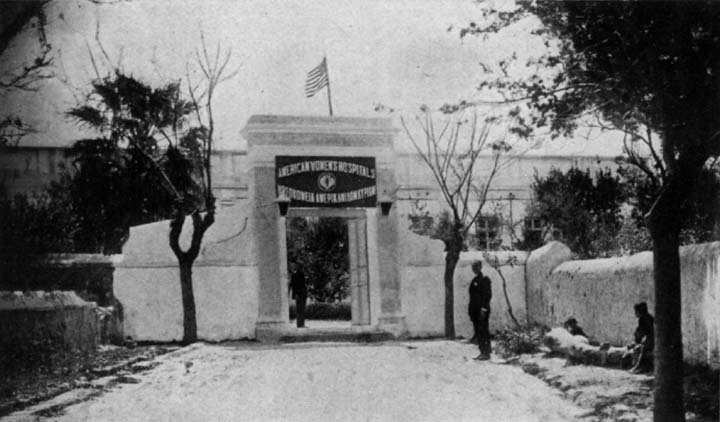 Entrance to the American Women's Hospital, Esther Lovejoy Street, Retimo, Crete, 1923. (The name of this street was changed as an expression of appreciation of the A. W. H. service to the sick.) |
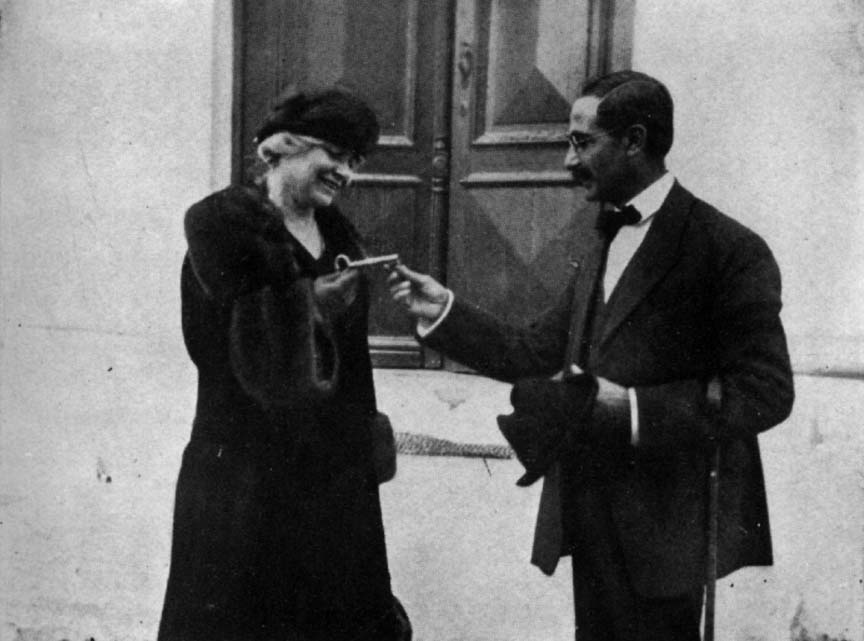 "THE KEY OF THE CITY." Menalous Papadakis, Mayor of Retimo, and Dr. Lovejoy. |
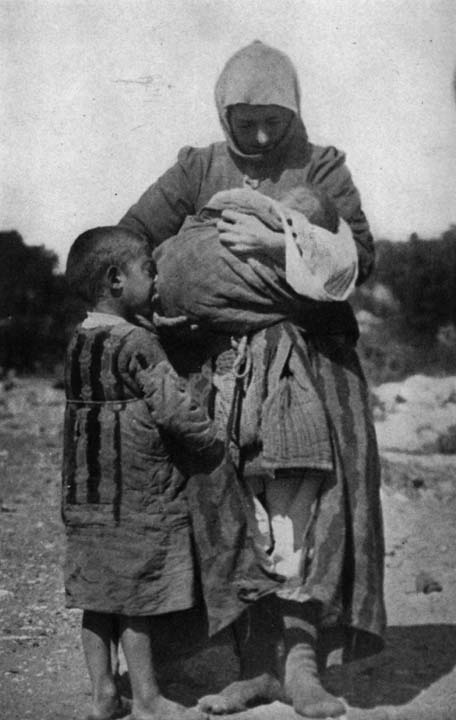 "THEIR WIVES SHALL BE WIDOWS AND THEIR CHILDREN ORPHANS." |
A storm was raging when Mr. B. D. MacDonald of the Red Cross and I reached Herakleion on an Italian Lloyd liner, which touched at that port en route to Egypt. After standing off shore twelve hours waiting for the wind to subside, in order to land passengers, the captain calmly announced that he would take us to Suda Bay, about seventy miles from where we wanted to go, and ten miles from Canea, where we embarked, because at that point there was a fine harbor where the metropolis of Crete should have been located.
This decision affected a large number of passengers, including a Cretan préfet, and the Turkish sub-préfet of the Canea district, and naturally, created considerable protest. But captains are arbitrary men, and this one said we could either get off at the nearest bad weather harbor on the Island of Crete, or we could take a round trip to Egypt on a stormy sea at a cost of $120, and he could promise us our money's worth of mal de mer. He strongly advised us to get off at Suda Bay, walk over the hill about ten miles back to Canea, and catch the next local boat to Herakleion. Could anything be easier? No, they would not return the fares we had already paid, for the reason that we had been to Herakleion, and it was not the fault of the company that we could not get ashore.
We tried to listen to the Italian captain with an open mind and Cretan point of view, through an interpreter who was manifestly modifying the spirit and letter of the captain's remarks for the sake of our feelings. After all, this misfortune, according to the classification of American insurance companies, was an act of God, for which no mortal man or corporation should be held responsible. Even Saint Paul experienced difficulties with the weather on the coast of Crete, which he accepted philosophically.
The captain was right. Suda Bay is a perfect harbor and a wonderful site for a city at this day and age. But the cities of Crete were not built during this day and age, and at the time they were built Suda Bay was altogether too easy a harbor for any city.
We telephoned to Canea for a conveyance, and while waiting tramped the hills overlooking the sea, which were flecked with anemones, red, white and blue, announcing an early spring. The road to Canea was hedged here and there with century plants, an occasional central stalk shooting upward to flower later in the season.
I had already inspected our work at this town, but we went over it again, after which we walked along the quay of the artificial harbor. The old stone galley-slips are still in good order, and it was not hard to imagine Ben Hur, a galley slave, and thousands of others resting on their oars as the galleys slid into their berths twenty centuries ago at this great naval and commercial center midway between Rome and Alexandria.
On a funny little Greek ship, which had also taken refuge in Suda Bay, we slipped into Herakleion unannounced a few days later, and learned that while we had waited outside the harbor on the liner for twelve hours, a large part of the population, including the city and church officers in regalia, had waited for us on the quay inside the old Venetian harbor, built for such ships as the Santa Maria.
A real Cretan reception had been arranged, and the disappointment was very great when the liner weighed anchor and sailed away toward Egypt. These people had Knossus at their door, but Knossus had been there for five thousand years, and the novelty had worn off. Besides, Mr. MacDonald and I were alive. We were the living, breathing representatives of the great country recently discovered by Columbus, a Mediterranean navigator who used to stop at Crete on his trips from Genoa to Chios and other Ægean ports.
"For to admire and for to see" we did not amount to much, personally, but we represented the American Red Cross and the American Women's Hospitals, and, in a larger sense, the organized compassion of the United States. Therefore, we had our little rôles in the legitimate drama of the generation. We were show people, and Demos is always show hungry, especially in out of the way places. Any sort of a spectacle is better than none at all, and the population of Herakleion, refugee and resident, expected us to arrive with the trappings, pomp, ceremony, and parade worthy of the great nation we represented on that small island.
Demos was disappointed, but a reception was afterward arranged at which we met the representatives of the ancient city. Glancing across the room on this occasion, I noticed the head of our insular service in solemn conclave with a group of Cretan officials. They were talking English, French and Greek with the aid of an interpreter and the original sign languages. Such a pantomime! I was manifestly the subject of this conference, for they were looking me over carefully from time to time. Finally, this lady from my own home town, masked in an absolutely inscrutable expression of countenance, came to me and said: "The gentlemen with whom I have been talking are all officials of this island. They take their duties seriously. They are deeply concerned regarding a report which has been circulated by the officers and crew of the steamship on which you came to this island from the Port of Piraeus, and they have requested me to ascertain the facts, in order that they may officially deny or affirm this report. The truth, the whole truth and nothing but the truth, must be told. Do you, or do you not, sleep in a pink bag?"
The fame of our Herakleion clinic, which was located at the end of the enormous refugee barracks, had reached the headquarters at Athens, but I was none the less astonished at the large number of patients cared for daily at that station. They were only about 20,000 refugees in the city, but most of them were sick as a result of exposure and deprivation, and thousands came to our clinic for treatment. At this time, February and March, 1923, the records show that 1840 visits daily were made by the sick to our clinics at Mitylene, Chios, Canea, Retimo and Herakleion.
The American Red Cross was doing an enormous work feeding and clothing the refugees on these islands. The following is taken from the Red Cross report regarding conditions at Crete in the early part of 1923:
The strictly medical side of the work on the Island of Crete has been cared for very effectively by the American Women's Hospitals, to which organization the Red Cross has given several thousand dollars' worth of supplies, in addition to a good-spirited coöperation. . . . There are two phases of the work of this organization---hospitalization and clinics for baby feeding and general medical treatment. . . . The municipal hospital at Canea, with a bed capacity of fifty, is a well-run institution. It is being enlarged to accommodate thirty more beds, and is so well-managed that the A. W. H. has thought it unnecessary to do more than to supplement the supply lists occasionally. At Retimo and Herakleion, however, the municipal hospitals were so poorly operated that the American Women's Hospitals took complete charge. The buildings were renovated by the Town Councils and turned over with existing equipment. The Herakleion Hospital accommodates one hundred, and the Retimo Hospital sixty patients. The A. W. H. employs sixty people to operate their institutions, and the Red Cross allows a thousand calories of food daily to each patient.
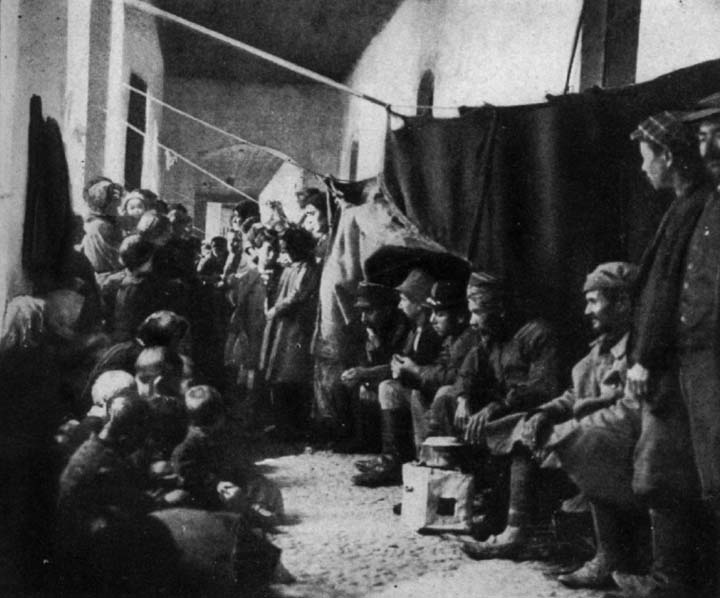
My reaction toward the refugee barracks at Herakleion was an echo of Mrs. Cruikshank's. It seemed impossible that three thousand human beings could have occupied the place all winter without developing pestilential diseases. Many of the families attempted to preserve a semblance of privacy by hanging shawls or sacking around their few feet of space. The home instinct and art of housekeeping revealed itself in the arrangement of their pitiful belongings.
As we passed through this barracks and court, crowds of people flocked after us, some speaking English and others trying to make their wants known through interpreters. All the women voiced the same petition. Couldn't the Americans do something to help them get their husbands and sons, who were detained in Turkey? One group of women with a chosen spokesman barred our path. This was the "Soap and Water Committee." They realized the danger of diseases and the importance of cleanliness. The water supply was limited and the wretched, inadequate wooden troughs used as wash-tubs were the greatest cause of trouble among the women of the barracks.
"Give us soap, water and tubs," they pleaded, "and we will keep the place clean." Mrs. Cruikshank promised soap, but water and tubs were not so easy to secure.
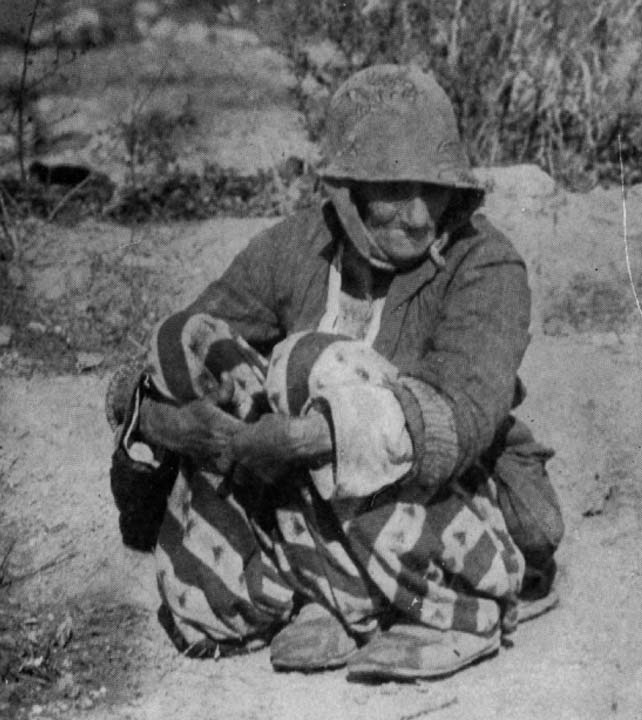
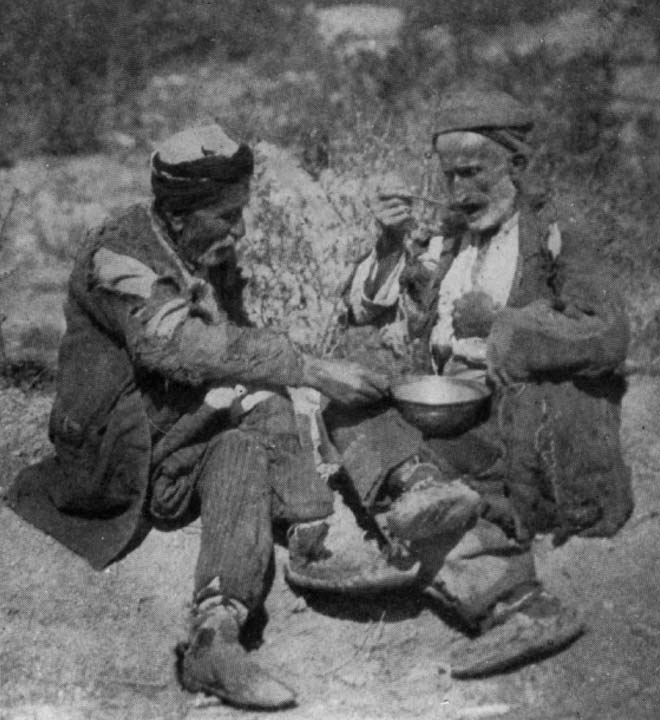
The most pathetic group of women in the barracks were the lost grandmothers. In the rush and confusion of embarkation at Smyrna, these poor old women, in many instances carrying grandchildren in their arms, became separated from their families, and were put on the wrong ships. Five months had passed and still they were hoping sometime, somewhere, to find their families. A sweet-faced old woman stayed close to my side as I passed through the barracks court. Time after time she laid her hand upon my arm and said something to me which I did not understand. At last I stopped and asked the interpreter what she wanted.
"She doesn't want anything," he said. "She is just telling you that she will ask God to take away her years, and add them to yours, because you can do so much for her people, and she is only a burden to them."
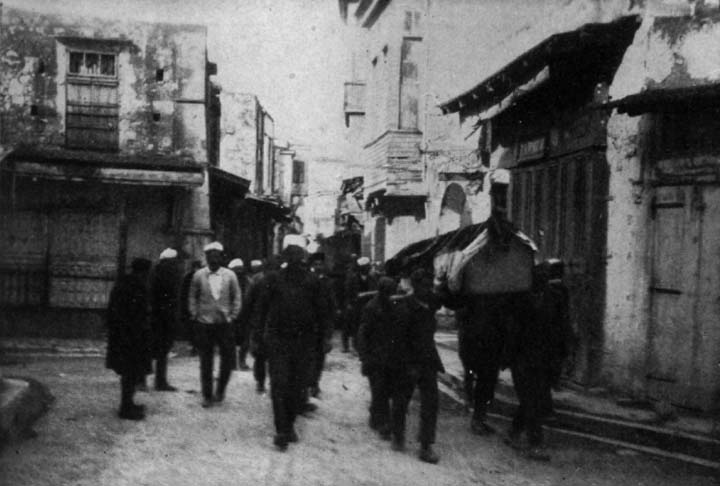 |
 |
 |
 |
The next day a case of typhus fever was reported from the barracks. The second day six cases, the third day fifteen cases, and Mrs. Cruikshank's reputation as a prophetess was established on the Island of Crete forever. All the noncontagious and surgical cases were removed from the hospital, the typhus cases sent there, and the whole place quarantined. With plenty of soap, water and adequate delousing facilities, typhus is an easy disease to control, but a shortage of these necessities constitutes a heavy handicap in the management of an epidemic.
Maintaining quarantine at the hospital was easy, but at the barracks it was a difficult job. Fortunately, there was a stockade around part of the building, and the Government supplied us with soldiers who guarded the gates. Our physicians examined every person in the barracks daily, removing the infected to the hospital. A corps of orderlies were selected from among the refugees to fetch and carry for the three thousand inmates of the barracks, which was without sanitary conveniences of any kind.
"The day after you left we had a revolt at the barracks," wrote Mrs. Cruikshank. "The physicians came to me in a body and reported that they dared not go inside the stockade for the very good reason that the refugees, holding them responsible for the quarantine, had threatened to kill them. A guard of gendarmes was provided, but the doctors were wary and wouldn't go inside, saying that they knew those people and they would kill the gendarmes too.
"Something had to be done. With a guard of soldiers and four physicians who finally volunteered, I went down into the enclosure. Sullen-faced and ready for trouble, the rebels were standing around the inside walls of the stockade, with plenty of loose cobblestones at hand, waiting to receive the visiting physicians, who were also refugees, and whose authority was resented and resisted.
"Why should these doctors, whom they had known from childhood, be raised up and put in authority over them? They, too, were refugees. Why should they come and go at will, saying, 'Do this and do that' to their neighbors, who were prisoners in this horrible place because of the false and wicked words of these physicians.
"The situation was ticklish, and I could hardly keep a straight face while I told them that I was responsible for the quarantine, and if they coöperated they would soon be free, but if they resisted, they would be confined a long time and many of them might die. An instantaneous and unanimous change of front occurred: It was as though the Goddess of Liberty from the land where they all wanted to go had spoken.
"'Zito! Zito!' they cried, and the revolution was over without the incidence of cobblestones. The idea of voluntary coöperation appealed to their democratic aspirations. We were handicapped by lack of machinery, but mountains can be moved by hands if there are willing hands enough. The entire population of the barracks joined the health campaign that morning, and with means available, set to work delousing with a will.
"'Double, double, toil and trouble!' The Mayor and a Committee of Councilors were waiting in my office when I returned from the barracks stockade, and I knew from the way they were counting their amber beads that something unusual had occurred. These bead shock-absorbers never show which way the wind blows, but they indicate the velocity of the storm.
"Smallpox had been reported from a camp of refugees on the outskirts of Herakleion and also from Canea and Retimo. The island had been simultaneously invaded by the alien enemies, Smallpox and Typhus. Could anything be more terrible?
"Epidemics had swept over Crete time after time during the centuries, and their records read like the Black Plague of London. Earthquakes, fires, or pirates were preferable in the way of disasters. Plague is an invisible, death-dealing enemy, spreading like a blight and creeping upon its victims unaware. There is no means of defense, nobody and nothing to shoot at. The situation was appalling, and the island officials were in a state of panic.
"My standing as a prophetess had gone up, and for rational reasons, it was time for me to predict fair weather. The spring was coming, a stock of vaccine, a delouser overdue for months, and a large consignment of soap, had just been received. My attitude, therefore, became encouraging. Applied science provided an invulnerable defense against disease, I argued.
"The Cretan officials manifestly entertained doubts, but they said that they were glad to hear this good news, and they were perfectly willing to give the American Women's Hospitals a commission to fight typhus and smallpox to the death. Within half an hour we were headed for the camp from which smallpox had been reported with an ample supply of vaccine. After the manner of human beings, the refugees had kept quiet about the existence of this disease until Death had reported it for them. Meanwhile it had gotten a good start. There was an ill-equipped hospital with accessory cottages in the district, which had been turned into a pesthouse worthy of the name. Here the sick had been received without a diagnosis, and no one knew what was the matter with them until the eruption appeared, and at about the same time the disease broke out in the camps.
"Varioloid, my Oregon acquaintance, was a benign disorder with a few pustules here and there, but the confluent kind of smallpox I met in Crete is frightful. As I passed through those awful wards I could feel the loathsome, deadly hand of Old Smallpox at my throat, and I did not blame the local nurses and other employees for running away and leaving the unfortunate patients lying three and four in a bed, dressed just as they were when they staggered into the place. Some of them were wearing sheepskin coats with the dirty wool gummed up and sticking to their suppurating bodies. The floors, walls, beds, bedding, clothing, and the poor sufferers themselves, in this hideous setting, constituted a sight such as we read about in old books on smallpox epidemics of two hundred years ago.
"This center was cleaned up immediately, and a smallpox pavilion opened near our typhus hospital in coöperation with local agencies. The American Women's Hospitals provided all employees and part of the equipment and supplies for both of these places. The American Red Cross furnished part of the equipment, and allowed a thousand calories of food daily for every patient received. Camps were inspected systematically. Over 20,000 people were vaccinated against smallpox, while approximately 15,000 were deloused in an effort to stamp out typhus, with the gratifying result that these epidemics were under control by the end of the period of incubation.
"Great was the rejoicing, official and unofficial. Medical science and Christianity, mobilized by means of the Almighty Dollar, had triumphed gloriously over the forces of evil. The Cretans were grateful. As an expression of appreciation the municipal fathers of the old city of Retimo, in extraordinary session assembled, changed the name of the street leading from the quay to the hospital, to Esther Lovejoy Street, and hung a flattering portrait of me in the hospital which is to remain there forever unless somebody takes it down. This gesture was but a feeble indication of their sentiments. They would gladly have moved their historic island across the ocean and joined the Union."
At Herakleion a unique banquet was given in honor of the American relief workers in the summer of 1923. With the consent of Sir Arthur Evans, the ruins of the excavated Palace of King Minos were bedecked with bright colors, and festal tables spread in the royal banquet hall for the first time since the destruction of the Minoan civilization, which antedated the ancient Greek civilization.
The midsummer night had been carefully chosen. The moon was at its maximum, lighting the ruins and casting a sheen over the undulating sea. The food was plain and the service simple, but the man in the moon had never looked down on a more dramatic setting.
The Préfet of Herakleion was a good speaker, but no one could measure up to such a background. Here was the beginning and the end, so far as we have been able to read---the first and the last chapter of the continued story of humanity. The obvious parallel between the destruction of the Minoan civilization and current events in Asia Minor was drawn by the Préfet. He spoke with deep feeling regarding the work of Americans for the relief of Christian outcasts on the Ægean Islands, indicating with an intimate gesture over the sea to the right, the site of Smyrna, and in the next breath dropping back two thousand years to Carthage, the metropolis, which once stood on the north coast of Africa to his left. Another thousand years, at least, were as quickly skimmed over, and he described the destruction of Knossus, the prehistoric capital of Crete, the ruins of which echoed and attested his words. This story of Smyrna, Carthage and Knossus seemed like a thrice told tale, with a change in names, time, place and one important detail. "Poor Minoans!" he said. "There were no Americans to help them in their last extremity."
Soft strains of music floated through the royal ruins and over the silvery sea, facilitating flights of the imagination:
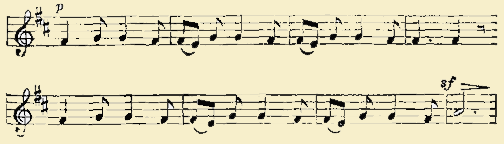
The eternal love song suggested the whispering wraiths of Theseus and Ariadne in the weird shadows of the labyrinth. But man cannot live on love alone. He must have other diversions. The orchestral theme suddenly changed and the din of the drums, horns and sounding brass might equally have heralded the beginning of the bull fight in Mexico City on Sunday afternoon, or the charge of the Minotaur at Knossus four thousand years ago.
STEAMING in to Piræus, I had looked anxiously toward Macronissi Island, and my first questions on landing were for Dr. Stastny and her assistants, personally braving the dangers of that terrible place. The work was going well, but among those who had been stricken with typhus was a young American nurse whose life at that moment was in the balance. Smallpox at Crete was not reported until after my departure, but I might have known it was there. Typhus and smallpox were traveling together on most of the refugee ships, and by a strange coincidence they ran their course together at different places. One pest island was enough to worry about---now we had two. Over and over, I read the cables reporting the progress of the epidemics at Crete, which emphasized the insistent and sleep. disturbing question: how long can we last?
The answer to that question was my principal business in life. It was a question of money, and I was chief beggar for the organization. Calls were coming from all directions. Several appeals for hospital installations had been received during my absence in Crete, which could not be refused. God give us the Almighty Dollar---Thousands! Hundreds of thousands!! Millions!! !---This was my prayer.
There was a black-bordered letter with a crown in the upper left corner, addressed to me, in the accumulated mail, which read as follows:
March 3rd. 1923.
The lady in waiting to Her Majesty the Queen has the honor to inform you that her Majesty will receive you on Tuesday, March 6th, at 12-1/4.
(signed) Effie T. Kalergie.
Her Majesty the Queen would receive me on March sixth. That was the following day, and I went to bed planning, scheming, thinking, not about what I should wear or say to the Queen, but how to get the money to care for the sick among her refugee subjects.
Just as I was leaving the hotel for the Royal Palace next morning, a publicity man from another organization came in and reported the arrival of the Mauretania on the cruise de luxe of the season. "There are five hundred millionaires aboard that ship," he said, and while mentally discounting this report, I realized the importance of sailing on the Mauretania with all those unprotected millionaires.
Perhaps this "Golden Special" was the answer to our prayers for money. There was wealth, millions of dollars, and a flood of human sympathy. There was life for thousands of Christian outcasts, and all that was lacking was the word, the genius, to release this life-saving power. The Godliness of the enterprise transcended the possibilities of my spirit, and while I silently prayed for inspiration I laughed aloud at the little things along the way, including myself, in an effort to maintain an even mental keel in a sea of aberration.
Not a minute was to be lost. There was no telling when the "Golden Special" might speed away. Time seemed so precious. With "five hundred millionaires" slipping through my fingers, I was obliged to spend an hour calling on the Queen.
This unprecedented experience induced a new and harrowing sensation. On the horns of this dilemma, I was sitting in the royal anteroom when an American representative came in with Mrs. Gary, to whom he introduced me with the casual but supremely comforting remark that she was from the Mauretania. Her presence seemed providential. I knew the ship wouldn't go without her, besides her pin money was more than enough to support our work on Macronissi Island.
How long can we last? By day and by night, waking or sleeping, talking or dreaming, these five words ran through all of my mental processes, and in the presence of a prospect, this ulterior motif seemed to speed up and become more insistent.
Mrs. Gary was there to visit the Queen, and she was manifestly interested in the fact that my call came first. "There is a tide in the affairs of men, which taken at the flood leads on to fortune." This was the time, place and woman. That Shakesperian line was written for this occasion. But woe is me! Just as I was leading cautiously "on to fortune" the Lady in Waiting appeared and led me into the Royal Presence.
Elizabeth, Queen of Greece, was every inch a queen, and a very nice girl. She was deeply interested in the work of the American Women's Hospitals. That is why she sent for me. We were both engaged in the big business of saving human lives, and I should have suggested that Mrs. Gary be invited to our conference, with the hope of finding further support for the American Women's Hospitals.
Among the lost opportunities of my life, I count that audience with the Queen of Greece while Mrs. Gary waited in the anteroom. When I went out she went in, and the door closed fatefully. Passing along the corridor and down the blue-carpeted stairs, I exchanged perfunctory pleasantries with the American representative and others, but the only face I really saw was the sweet, reproachful face of an old woman who was not there---a lost grandmother quarantined in our barracks on the Island of Crete.
Within an hour I boarded the Mauretania and made the terrible mistake of announcing my presence to the purser. I should have kept quiet until the ship was well on her way. Success hinges on such details.
A partial quarantine had existed against Greece for weeks. This should have been a complete quarantine so far as tourists were concerned, and it should have extended to Constantinople and adjacent ports on the Bosphorus, where pestilential diseases were prevalent. The danger at Constantinople was greater than at Piraeus and Athens, for the reason that a false sense of security existed regarding that port. Through our own agents, we knew that the worst pest-hole in the world at that moment, was the old Selimieh Barracks at Scutari, the Asiatic section of Constantinople, where 10,000 refugees were in quarantine.
The passengers of the Mauretania were just returning from their sightseeing excursion in Athens when I went aboard. For several hours they had been riding in public conveyances with native drivers and guides. These conveyances were in use every day in the city of Athens and at the Port of Piraeus, for the transportation of anybody and everybody, sick or well. Some of these automobiles were nicely upholstered, and might easily harbor typhus lice and bubonic fleas. The danger was very great, but the tourists didn't know it, and what we don't know, doesn't hurt us unless it happens.
I had been immunized against every quarantinable disease existing in the Mediterranean countries, except typhus fever. No immunizing serum for typhus was available, but I had taken every precaution possible against infection. From the standpoint of an intelligent health officer, I was one of the best risks on that ship---one of the persons least likely to carry a pestilential disease, and conscious of this fact, I was hoping that my profession might get me by any special quarantine rules.
This idea shocked the purser. "Orders are orders," he remarked, and an expression of apprehension spread over his face as he inwardly visualized the dire possibilities my presence entailed. Still, I argued that I belonged to a profession to which special privileges are extended in matters of quarantine. For years I had walked unhindered in and out of houses, hospitals and isolation camps, regardless of the yellow, green or red flags. Why shouldn't I travel on the Mauretania? I was convinced that I should, and the purser was clearly in doubt.
"We have been allowed to land tourists with the understanding that they go directly from the landing at Phaleron to the Acropolis and back to the ship in conveyances provided by the company," he said, "and with the further understanding that no other passengers be allowed to come aboard at this port. Your being a doctor may make a difference. Let us go and see the captain."
"Quashed!" said I to myself, for in judicial matters I had little confidence in captains. Besides, I was over forty, ,my hair was straight, I wore glasses, and although I had traveled extensively on all kinds of ships, I hadn't been invited for at least ten years to stand on the bridge at midnight.
"No !" barked the court of last resort belligerently, without reviewing the case, and an imp of insubordination which had slept for a generation, suddenly awakened in the depths of my being. Where had I heard that word before in just that tone of voice?
The captain looked and spoke like my English relations. The chances are he came from Kent and belonged to the "Klan Knute," the "heathen horde" from which my tribe originated. He was undoubtedly one of my far-away cousins. The family feeling was unmistakable. The minute I looked at his face I wanted to choke him.
"No!" From the time I could remember, that arbitrary word had blocked my way, and by virtue of inherited Kentishness, I had resisted with tenacity unbecoming a "little lady" and with many a good spanking in the bargain.
"Special orders just received from Liverpool to take no passengers at this port," continued the tyrant of the high seas, addressing his remarks to the purser and ignoring my unimportant presence. "If any one comes aboard here, the ship may be quarantined at the next port. Put this lady ashore."
Worse and more of it! The word "lady" had a menacing sound. I was glad he didn't say "little lady." This expression of politeness had usually been followed by a tanning, and that timely treatment had resulted in a special, psychological resistance, which saved my quaking spirit in this emergency, otherwise, I might have been crushed by being put ashore ignominiously by a present-day English sea captain at the very place where Xerxes reviewed his fleet and held his Council of Kings on September 27, 480 B.C.
The associations of this spot were peculiarly comforting from a feminist standpoint. Great Xerxes, King of Kings, ("this is Ahasuerus which reigned, from India even unto Ethiopia, over an hundred and seven and twenty provinces") who was afterward victimized by the wily Mordecai and fair Esther, presided at that memorable conference. The King of Sidon occupied first place in the Council, the King of Tyre second, but the one woman member, Artemisia, Queen of Halicarnassus, occupies first place in the history of that epochal day forever, simply because she realized the immortal power of the written word. She stood in with the scribes. Herodotus was a friend of hers. Besides, she cast the only vote against attacking the Greeks at Salamis, and laid before the Council a less spectacular project more likely to win.
At the battle of Salamis, Artemisia again exhibited that quality of judgment which would have saved the day before it began if Xerxes and his Council of Kings had taken her advice. She was one of the first to quit. Her galley had speed and tonnage, and in her haste to get away, she ran down smaller vessels, friend or foe, which had the ill luck to cross her course.
Artemisia's tactics made a hit with Xerxes. He was partial to ladies, and from his special throne on the cliff overlooking the Bay of Salamis, where he witnessed the defeat of his navy of a thousand ships, he recognized the towering galley of the Queen, but not the smaller vessels sinking under her keel. Naturally, he assumed that they were enemies, and marked Artemisia for future favor.
| A king sat on the rocky brow Which looks o'er sea-born Salamis; And ships, by thousands, lay below, And men in nations---all were his! He counted them at break of day--- And when the sun set where were they? |
Queen Artemisia and the other survivors were at the Persian naval base located at Phaleron, where the captain of the Mauretania put me ashore twenty-five centuries later.
Fancy the feelings of a poor American beggar, standing on that historic strand watching the Mauretania with "five hundred millionaires" disappearing in the distance. But the beggar didn't do that. She hadn't the time. From the unsuspecting purser, she had learned that there were no quarantine regulations against Constantinople, and it was up to her to reach that port in time to catch the Mauretania and sail with the millionaires for Egypt. With a hat pulled over her face, that purser would never recognize her. There would be plenty of time during the trip via Palestine to Egypt to get acquainted with the passengers and size up the situation. If the prospects warranted a complete change of plans, she might stay on the ship for the home voyage. All preliminary work could be done quietly, and when the ship was away out in the ocean where there were no islands on which she might be marooned, she could take off her hat and campaign openly for funds.
The possibilities were dazzling. Perhaps she could get a million dollars for the American Women's Hospitals. Besides, she hoped to meet that captain again about a hundred miles east of the quarantine station at the port of New York. She longed to tell him in a soft Oxford tone, which she sometimes used on Sundays, about her recent experiences smallpoxing on the Ægean Islands.
No quarantine regulations were being enforced against Greece in connection with ordinary travel. Ships were leaving the port of Piraeus every day for different parts of the world. I had other business in Constantinople, and the possibility of killing two birds with one stone made a hasty departure imperative. My car broke the traffic regulations to the different steamship offices and before the Mauretania weighed anchor at Phaleron, I was off on a little Italian ship for the City of the Golden Horn.
That vessel was unworthy of Mussolini and the Fascists. She was too slow for this day and generation of Italians. She lost hours en route, and was further delayed by the leisurely methods of the port officials at Constantinople. Slowly, slowly, little by little, she edged toward the dock, and just as we were ready for debarkation, the Mauretania steamed swiftly out of the harbor, and was lost with all aboard to the American Women's Hospitals.