
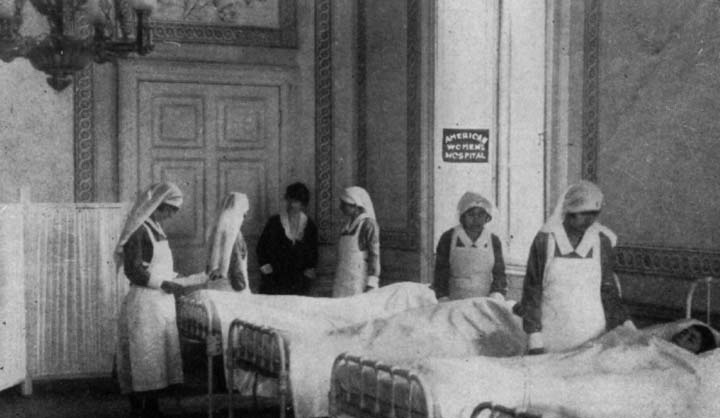
GREECE was paying a high price commercially and otherwise, for her humanity in receiving the outcast Christian subjects of Turkey, which other nations refused to harbor. Most of these people were called unredeemed Greeks, but they had never lived in Greece, and many of them could not speak the language. They came by the thousands, tens of thousands, hundreds of thousands, and pestilential diseases came with them. Our physicians and nurses met them on the Greek islands and at the coastal towns and opened hospitals for the care of their sick.
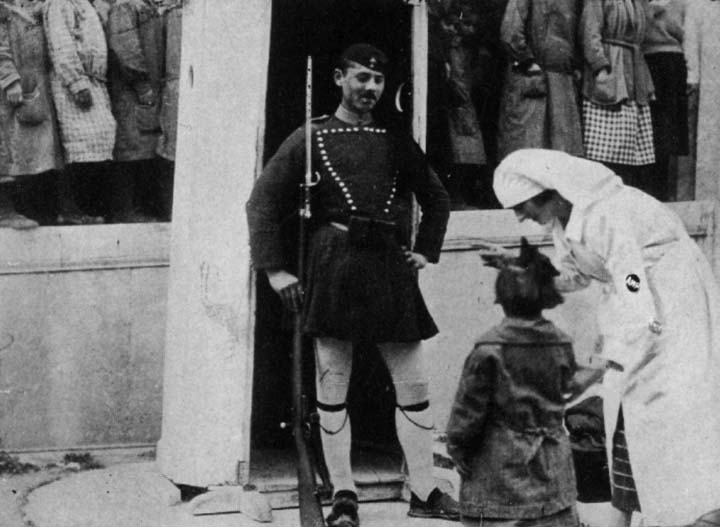
In November, 1922, the Near East Relief Committee began bringing Armenian children from Anatolian orphanages into Greece, and the American Women's Hospitals agreed to carry the medical end of this service in accordance with the proposals contained in the following letter, written by Mr. H. C. Jaquith, Managing Director of the Near East Relief in the field:
November 29, 1922.
Dr. Mabel Elliott,
The American Women's Hospitals,
Constantinople, Turkey.Dear Dr. Elliott:
During the last few years the American Women's Hospitals has been closely affiliated with the Near East Relief. Its coöperation has been most helpful and much appreciated. Our contacts have been largely through Dr. Lovejoy and yourself, although we recognize that there is a large and interested constituency in America who are carefully following your splendid work and assure you of continued support.
* * * * * * * We are faced with a new problem. The orphans which have been in Anatolia are finding a new home in Greece. The children still remain with the Committee, and we believe that the opportunity of self-expression and future development under conditions which have been offered in Greece, will arouse sufficient interest in America to furnish the Committee with funds and good will to complete its program.
We trust that you will share in this new opportunity in Greece and continue the full and unqualified support of the American Women's Hospitals in this area. I am led to make the following suggestions:
1st: The Near East Relief requests, through you, that the American Women's Hospitals assume the full medical responsibility for all the orphans and Near East Relief work that may be established in Greece.
(a) Salaries and maintenance of American doctors and nurses necessary for the health and welfare of the children under our care.
2nd: The salaries and maintenance of the native doctors and nurses necessary to supplement the American doctors and nurses for the maintenance of health and welfare of the children under the care of the Near East.
3rd: The medicines and medical supplies necessary for the above mentioned purpose.
It being understood that the Near East Relief will continue the feeding and the housing of the children, and that the American Women's Hospitals will assume the full medical responsibility, we at the same time request that you personally become the medical director of our orphans and orphanages.
We trust that this request of the Near East Relief will be met with a warm and ready response on the part of the American Women's Hospitals, with whom our relations always have been most cordial.
Very truly yours,
(Signed) H. C. Jaquith,
Managing Director.
This plan was adopted and the infirmaries connected with the Near East Relief orphanages in Greece were organized and conducted by the American Women's Hospitals. Buildings were provided by the Greek Government in most instances, rations by the Near East Relief, special sick diet and all expenses connected with the care of the sick were carried by our organization from November, 1922, until August, 1923. Dr. Mabel E. Elliott, who was the head of the American Women's Hospitals in Greece, was, of course, the head of this work, as well as of our independent hospital service and our coöperative work with other organizations. From August, 1920, until August, 1923, Dr. Elliott was in our employ and the budget for the work in which she was engaged, including her salary and all expenses, was provided by the American Women's Hospitals.
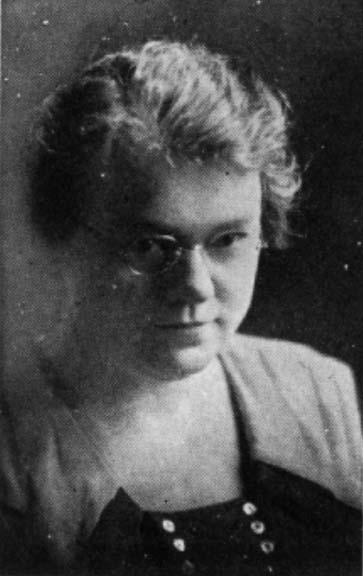 (Chicago, Ill.), Serbia. |
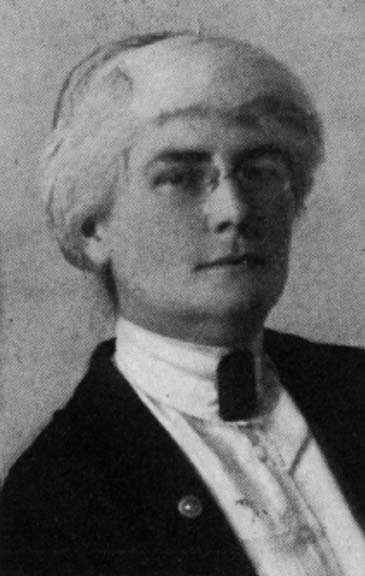 (Brenton Harbor, Mich.), Turkey, Armenia, Greece. |
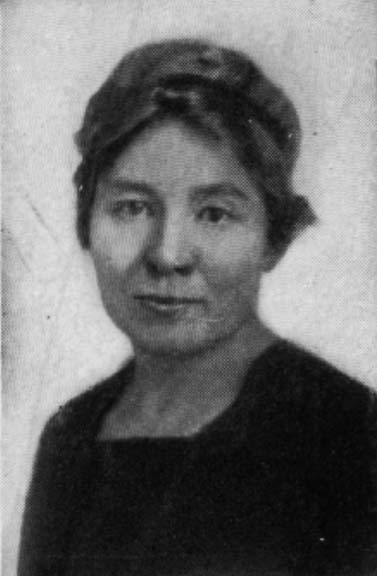 (Flint, Mich.) Russia. |
We were conducting twelve small orphanage hospitals for the care of the sick among approximately 10,000 children at the time of our final report to the Near East Relief Committee in August, 1923. The general health of the children was good, but a large number of them were infected with scabies, favus, and trachoma requiring daily treatments. These treatments were administered by refugee nurses in a systematic way, which made it possible to care for enormous numbers in a very short time. Malaria had developed among the orphans at Corinth and measures were adopted to stamp it out. The following is quoted from the last American Women's Hospitals' report made by Dr. Mabel E. Elliott:
Malaria at Corinth: One of the most difficult problems lately has been the malaria at Corinth. Hundreds of cases came down suddenly, including Miss Cushman. Investigation revealed tertian parasite in all cases. Examinations of blood of cases in villages found the same form, and swamp was located two kilometers from the orphanage and laundry water lying on the surface also contained larvae. At first it was hoped that cleaning up the laundry water would do away with the breeding, but later when more and more cases developed and finally the æstivo-autumnal form was found as well as the tertian, it was decided to drain the swamp and this is now under the process of accomplishment.
 |
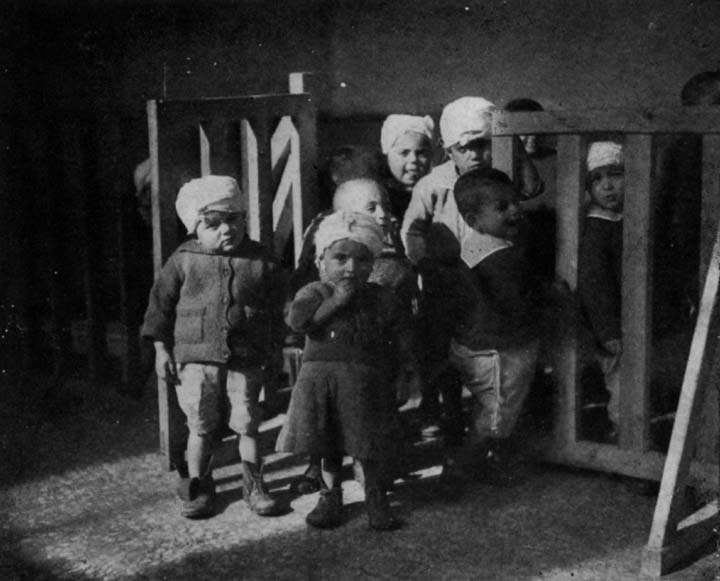 Isolation pen used for refugee children recovering from contagious diseases, Athens, 1923. |
On page 34 of the Near East Relief report to Congress for the year 1922 the following paragraph appears:
In Greece the medical work of the Near East Relief is under the direction of the American Women's Hospitals, which provides personnel and supports the medical work under the supervision of Dr. Mabel Elliott. During the year under review, the American Women's Hospitals has also financed and directed the medical work in the Caucasus.
Dr. Ruth Parmelee, who had been deported from Turkey, went to Salonica, Greece, in October, 1922, to help the outcasts from the country where she was born---people among whom her parents had worked as missionaries for over forty years. With the assistance of American nurses, and refugee physicians and nurses some of whom had served with her in Turkey, Dr. Parmelee organized our work in the Salonica district, including camp service, clinics, a hospital of a hundred beds and a training school for nurses.
This was the first training school for nurses ever established in Greece. It was afterward transferred to Kokinia, and is still conducted by the American Women's Hospitals.
Dr. Olga Stastny, of Omaha, a member of our French unit in 1918, was called from Prague to assist Dr. Elliott in organizing the work of the American Women's Hospitals in Athens, Piraeus and other districts. With these experienced women directing our service, order emerged from chaos and about the end of the year 1922, Dr. Elliott wrote:
Five thousand people receive medical aid daily, and a thousand sick people sleep between clean sheets in Greece because of our work here.
Week after week, health conditions were getting worse. Quarantine facilities were overtaxed at all ports, and malignant diseases were developing in different localities. Many of the tourist companies had cut Athens off their schedules. A general quarantine against the country seemed imminent, and in self-protection, about the beginning of January, 1923, Greece temporarily closed her doors to refugees from the Pontus, whence came most of the pestilential diseases.
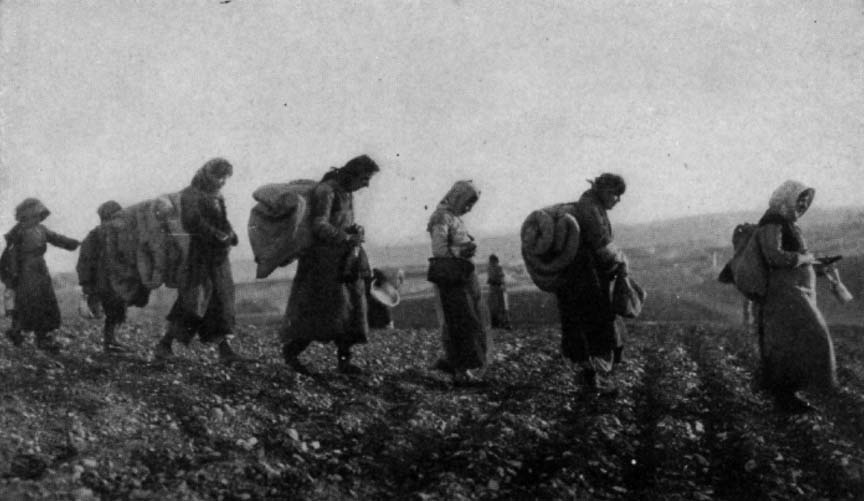
This was the crowning calamity. Thousands of people, packed deck and hold in cargo ships, short of food and water, and with typhus fever and smallpox among them, were already on the Ægean Sea when the last door of the world was closed in their faces. Greece had joined hands with the other nations and the only haven of refuge was shut. Action along this line had been anticipated by relief workers and representatives of countries anxious to save face and fortune by minimizing the disaster which had overtaken the Christian population of Turkey. What was to be done? If the refugees could only be gotten ashore and sent into the remote districts of Macedonia, where press agents, tourists and investigators never penetrated on account of the malarial mosquitoes and other dangers, they might quietly pass away without shocking the sensibilities of the world at large.
But there they were at the height of the tourist season on the surface of the beautiful, blue sea, flying signals of distress conveying, with slight variation, the following information: "Three thousand refugees aboard. No food. No water. Smallpox and typhus fever."
As a climax to all their misfortunes, the old cry, "Unclean! Unclean!" was raised against the outcasts. There was no place for them, dead or alive. The land refused to receive the living, and the sea refused to receive the dead. Bodies thrown overboard with lungs full of air and no lead on their heels would not sink. This was embarrassing. The form of a little child with hair floating like seaweed on the surface of the water is a witness hard to refute, and a smallpox corpse on the crest of the waves is a horrible "sight" for a tourist.
 |
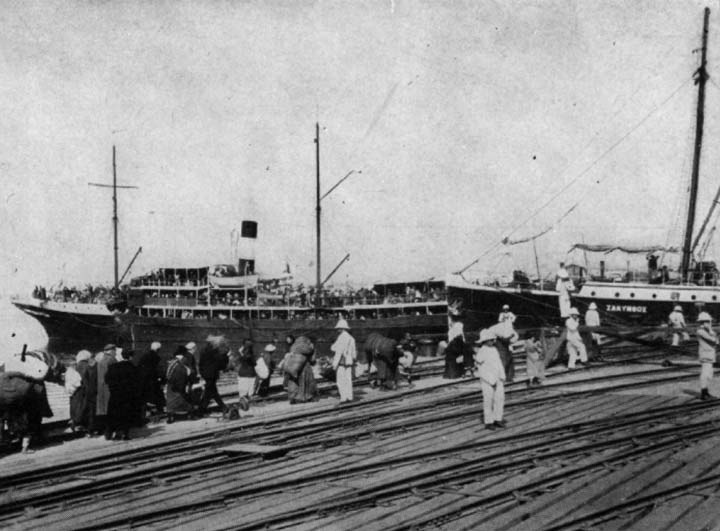 |
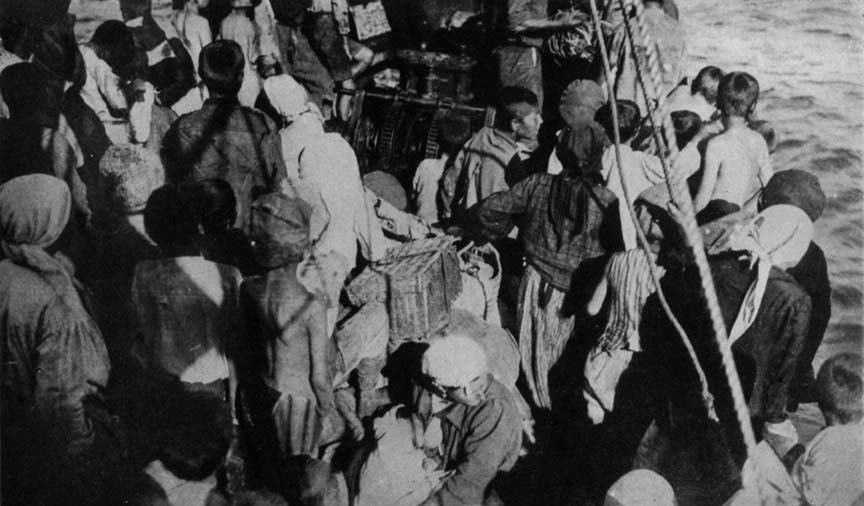 "No food-no water-smallpox and typhus fever." |
From the beginning of the exodus of the Christian minorities from Turkish territory after the burning of Smyrna, the Greek Government had carried the greater part of the burden, financially and otherwise. The refugees were not only received in Greece, but the government furnished ships for transportation, such housing as was possible, and a dole to thousands of utterly destitute people to help stave off starvation until assimilation could be effected. The achievements of Americans engaged in facilitating this unprecedented migration were made possible by the coöperation of the Greek Government, and the fleet of cargo ships, plus cost of operation, provided for this purpose.
The Christian people of Northern Anatolia, including thousands of Armenians, fled from their homes to the Black Sea ports, and there they were, many of them sick and without food. Actuated by fear for their lives, they crowded aboard freight ships expecting to land somewhere in Greece. But the quarantine stations were glutted on account of these hordes arriving with pestilential diseases, and a halt had been called while ships were on the sea. Dante, himself, could not have imagined the horrors of these floating Hells, packed with children, short of food and water, with typhus fever and smallpox raging in their holds, and no place on the face of the earth to land.
Colonel Plastiras, the Dictator, and his associates were embarrassed. Refuge had been granted the outcasts, and the ships upon which they embarked from Turkey had been provided by the Greek Government. "Admiral" Jennings (some of the American relief workers were dubbed "Admiral" on account of their activities in connection with the transportation of refugees) was at his wits' ends. Finally, the government agreed to allow pest ships from the Pontus to land refugees on Macronissi Island, and to furnish water, fuel and transportation, providing some relief organization would establish a quarantine station with isolation hospitals, assuming all further expense and responsibility in connection therewith.
Macronissi Island is a bleak, barren, uninhabited rock, seven miles long and less than two miles wide at any point, lying in the channel eight miles off the coast of Greece from the Port of Laurium. There is no water on this island, which is sometimes storm-bound for days. As a quarantine station it had one point only in its favor. Lacking outside coöperation, it was impossible for anybody to get away, who was unable to swim eight miles.
Naturally, it was difficult to get any American or English organization to undertake the running of a quarantine station at such a place. Besides, every organization was already overburdened. The American Red Cross and the Near East Relief had entered into an agreement by the terms of which the Red Cross was to provide food for refugees after they reached Greece, and the Near East Relief was to provide food for refugees in Turkey and en route to Greece. The deadlock was due to disease, and in this emergency we were called upon to establish a quarantine station at Macronissi Island, which would reopen the door to refugees from the Pontus, and make it possible for them to get into Greece. After making all arrangements, Dr. Elliott wrote as follows:
A few nights ago, Mr. Jennings rushed in and said, "Doctor, you've got to do something about this, you know you always help us out. What can the American Women's Hospitals do about this?" ----And the next morning, we went over to the Island of Macronissi. . . . That afternoon, I decided to open a quarantine station, and that night I ordered the tents and blankets and got to work. The government through Dr. Doxiades, the Minister of Public Assistance, had written me a letter, after a talk the night before, copy of which find enclosed.
Sunday morning, at the invitation of our representative at the American Legation, I called and he said it was a great relief to him, that the American Women's Hospitals had taken this up; that the State Department at Washington was much concerned, and he immediately sent a cable to Washington. telling them of our move.. . . The Government (Greek) will supply all transportation, water and fuel. There are excellent disinfectant plants, baths and a hospital building on the place. We must buy tents, put up warehouses and roof over the kitchen.
* * * * * * * To-morrow morning, one of our staff, Dr. Poumpouras, will go to work out the details. This man is one of the leading experts in quarantine work of this country. . . . He is now a refugee from Smyrna and will prove, I am sure, a great help in time of need on the staff at our quarantine station.
The only trouble now is that I feel like a guilty housewife, who has been extravagant and finds herself nearing the end of the month, worrying about the bills that will soon be coming in . . . . In any case it simply had to be done. Could we bear the thought of that last few thousand waiting on the Black Sea coast, waiting in their desperate need for the famous ships of Mr. Jennings---the ships that would never come if we had not promised to free them from the menace of disease.
Practically all the American medical work for the relief of refugees in Greece was being carried by our organization. But this quarantine island was too costly a job for us to undertake in addition to existing obligations. Had the Executive Board in New York been consulted, the answer, on deliberation, would probably have been "impossible." Heroic decisions, however, are usually made without deliberation. Shiploads of human beings were calling from the sea for help. There was no time to count the cost.
Dr. Olga Stastny was appointed director of this new work. With the coöperation of the Greek Government and the help of Drs. Poumpouras, Yereman and others, preparations for receiving eight thousand refugees were speedily made. Barracks buildings were erected, two thousand tents purchased, a delousing plant and water reservoir used during the World War put in order, and within ten days, pest ships from the Pontus were discharging their human cargoes at the American Women's Hospitals' Quarantine Island.

MEANWHILE, Mrs. Cruikshank was called from the Caucasus to take charge of our island service, and with the help of Mrs. Anderson, Miss Emily Petty, Miss Agnes Evon and other American nurses, this work was developed enormously. Under trying conditions, many of our nurses had served in different European and Asiatic countries during and after the World War, and they were especially qualified by unusual experience for this unusual service.
"Pack up your troubles in your old kit bag, and smile, smile, smile," is a 100 per cent American sentiment. Some Europeans say that we have no sense of tragedy and prove it to themselves by the attitude of our soldiers during the war, expressed in the leading line of this paragraph. "Strange people, these Americans," the soldiers of other countries sometimes observed. "They laugh when they should weep." Mrs. Cruikshank was an eighth generation American and she ran true to form in this respect. The following pages inadequately echo the spirit of her verbal and written communications.
"Mitylene, November, 1922.
"I am wintering on the Ægean---literally. Much of my time is spent on ships. In foul and fair weather, my job is Odysseying up and down and round about the Islands of the Ægean Sea, where we are carrying all the American medical relief work for the Anatolian refugees that is being done on these islands to date.
"The Seven Wonders of the World were located on this part of the globe---now there are eight: The American Women's Hospitals, and the wonder is that this organization is run by women. The Lesbians, Chiotes, Cretans and other remnants of the glory that was Greece, are manifestly entertaining inspiring suspicions. Their curiosity is aroused. They are coöperative to the nth degree. There isn't anything on these islands we can't have. They watch our every move, and so long as we take orders from no man (especially from no Englishman, the highest authority) we can give orders to almost everybody.
"These Islanders are fine people with inquiring minds and habits of observation. They intend to get to the bottom of this mystery. They cannot believe the evidence of their own eyes when they see our women signing checks to pay for the A.W.H. service. They are not convinced. They smile and pretend to believe that the American Women's Hospitals are actually conducted by an organization of American women, just as I smile and pretend to believe their heroic stories of the Amazons.
"On second thought I do believe the stories of the Amazons. Why not? We are such doubting Doras. The Amazons certainly have a proud record in this country. Of all the tales told regarding the founding of Smyrna, Ephesus and other cities older than history, I prefer the one that gives all the credit to the Amazons. 'Great is Diana of the Ephesians' and the type she represents. Only gods and demi-gods were worthy of their steel. Theseus won his spurs in a battle against the Amazons. Steel? Spurs? Did they have steel and spurs in those heroic days? Anyway, I'm for the Amazons, strong, and I'm glad we're reverting to type.
"One of the Twelve Labors of Hercules was getting the girdle of Hippolyta, Queen of the Amazons. Small business for a man of his stature. His previous labor had been cleaning the Augean stables and I can't help thinking he should have stayed on that job. But 'girdle' in this connection may have a subtle, symbolic meaning, which in the vulgar parlance of our native land is sometimes expressed by the word 'goat.'
"On third thought I'm an Amazon myself in spirit, and I'm sorry that Hippolyta and all her forces were not guarding Smyrna with poison gas and black magic when the Turks came down from Angora. There are Amazons among the Kurds right now. Women who fight for the love of fighting. One of them, who was shot, came to our Ismid Hospital for treatment. She had a military swank, a modern rifle and other deadly weapons. Her man, "Hercules," acted as perambulating arsenal and general transportation system for the team. She was the sniper. This Kurdish woman warrior is worthy of the Amazonic traditions of her country---thrice worthy in a land where most women compete with donkeys as pack animals.
* * * * * * * "During my recent visit to Constantinople, Caris Mills and I had luncheon at the Patriarchate. Long years ago when a phrenologist who came to Olympia, Wash., with a side show examined my head, he didn't find any bump of veneration.----Worse luck But even to my blind understanding, the Patriarch Meletios is a venerable man---one of the few venerable beings it has been my good fortune to meet.
"Accompanied by a member of the Greek Refugee Commission and a guard in the dark blue uniform with the arms of the Patriarch, we visited some of the refugee quarters around Constantinople. One of the camps contained people from the village of Shili on the Black Sea, near the entrance of the Bosphorus. This village of about two thousand population was in the neutral zone and therefore considered safe. When the Turkish soldiers came, the people 'made a feast' and went out to receive them. But this pathetic gesture of friendliness was unavailing. Poor little Shili! Her case can be heard only behind closed doors.
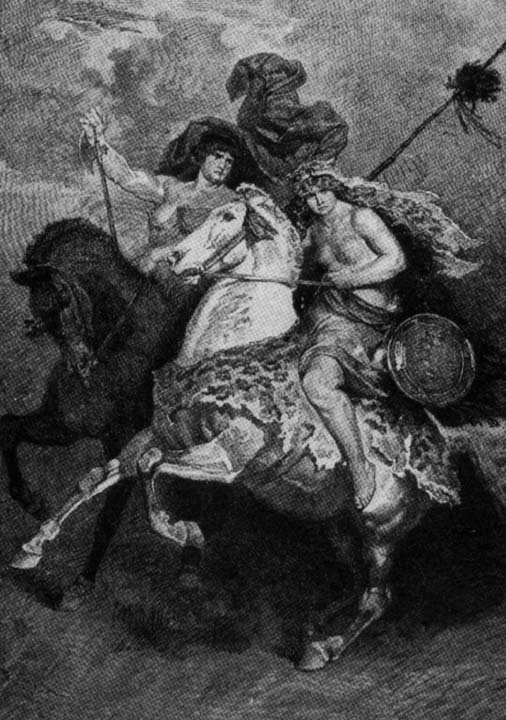 |
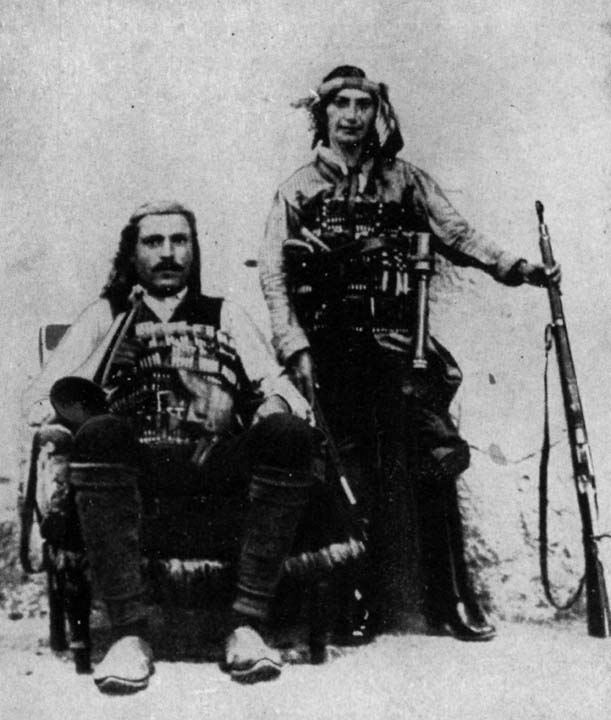 This sniper was shot, but her life was saved by "Hercules" who brought her to our hospital at Ismid. |
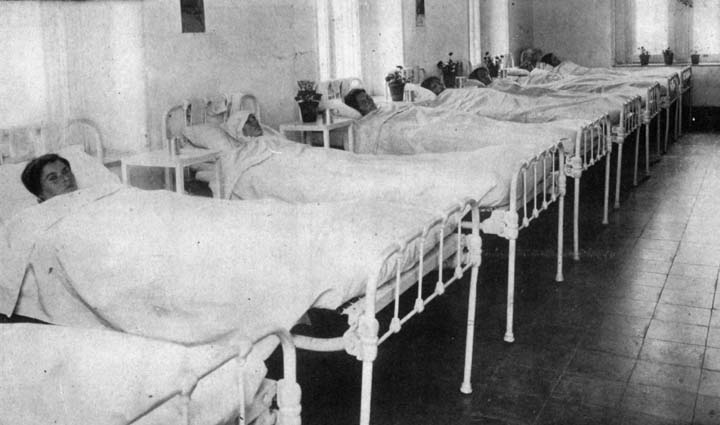 |
"Miss Mills and I were on the Charwood, a British ship while she was being loaded with refugees at Constantinople. They were a pitiful looking lot. Fifteen hundred of them had been crowded into the old church of St. Nicholas at Galata. There had been some sort of difficulty. A Turkish policeman had shot three refugees and the rest had turned loose and killed him. Pandemonium followed; a general alarm was sounded and the British military police finally stopped the fight.
"Getting that crowd of refugees, mostly women and children, from the Church to the quay, afterward, was an almost impossible task. They had to be driven like a herd of cattle. Naturally, they were on the lookout for the shambles, and balked at the entrance of a huge building, four stories high with a central court and inside balconies, where they were to be parked for safe-keeping until the time of embarkation. Finally, they were. gotten into this court. The poor things were dazed with fright and when they looked up and saw British soldiers on all the galleries surrounding the court, they became hysterical, laughing, crying, and chattering irrelevantly, like so many gibbering idiots.
"Tears, idle tears, unbecoming to an Amazon in good standing, who should be proof against such weakness. 'My word!' as the English say, you've got to be hard-boiled or die in this country. Fortunately, my folks were amphibious animals. They were hard-shelled Baptists, and six years as a surgical assistant, added to my hereditary gifts, has qualified me, in a measure, for this 'post.'
"According to the Anglophobes, all this trouble is due indirectly to British Imperialism, and according to the Anglophiles, the British are sane and saving angels hovering over the country. The Spirit of Imperialism broods in the embassies of the great nations hatching all kinds of dodos. For the past two years, I have been breathing this atmosphere and my system is saturated. The symptoms are like the gold-rush fever set to martial music. Commercial imperialism appeals to me personally and patriotically. We, the American people, are not sustaining our record on these immediate shores of Europe, Asia and Africa. The English, French and Italians are grabbing everything. It is very embarrassing. Something ought to be done. I should like to reach out a prehensory paw and secure an option on King Solomon's Mines, in the belt beyond Smyrna where Midas and Croesus used to operate, and sell it for a million pounds sterling.
"The defenders of the Turk dwell with insistence upon his truthfulness as compared with other natives, but in the interest of neutrality I must say that no nation or religion in the Eastern Hemisphere has a monopoly on truth. The Turks, Greeks and Armenians are intelligent people. They tell the truth when it serves their purpose best, and sometimes when it doesn't. The ex-governor of Chanak was moved to tell the truth regarding our refugee surgeon. This 'Sick Man of the East' was under an anæsthetìc in the hands of an injured enemy wielding a scalpel, and when he came out and found himself, 'actually enumerated with the alive' he was so surprised and grateful that he wrote the following letter in Turkish, which was translated by an English-speaking Turk:
"Mitylene, November 21, 1922.
"Trichopoulo, Esq., Surgeon,
American Women's Hospitals,
Mitylene."(1) Suffering since years I entered the Hospital, and seeing that my surgical attendance which was made in accordance to my disease was a very success, and my health therefore rendered within a week's time, I cannot retain myself from expressing you my soul's gratitude.
"(2) I express not only my own thanks, but also those of other unfortunate patients who were salved by you without exception religious or national.
"(3) It is impossible to forget also the superhuman troubles which are daily rendered by the nurses.
* * * * * * * "(6) Although I should make known through the press either of your politeness or your line art, either the perfection and the huge work of the American Women's Hospital producing the very best efforts for this unfortunate humanity I have not been able to do so.
"(7) Several patients in the hospital they told me that even at the very last moment quite hopeless of their salvation entered the hospital and owing to the successful intervention they are actually enumerated with the alive.
"(8) I beg to forward full of holy emotion, greetings of gratitude to the various noble and charitable American ladies, who arriving from so far struggle superhumanily for the suffering humanity.
"(signed) A. Pertev,
"Ex-Sous-Gouverneur de Tzanak."
Chios, November, 1922.
"Seven cities warred for Homer being dead;
Who living had no roof to shroud his head."* * * * * * *
"Seven wealthy towns contend for Homer dead,
Through which the living Homer begged his bread.""VERY little is known regarding the origin and local habitation of Homer, but Chios is one of the seven towns and Smyrna is another. The evidence is in favor of these two places as against the other five. The data quoted above indicates that Homer was a refugee, and in view of the present state of affairs, it is reasonable to assume that he was a refugee from Smyrna, the Phoenix City, which is incinerated about once in five hundred years, and arises fresh and flourishing from her own ashes.
"This island has a habit of producing blind prodigies. There is one here now, a blind linen keeper at the relief center. She knows every nook and corner of the home and hospital, the linen of every description, belonging to the place, and the highways and byways of Chios, as well as Nydia knew Pompeii.
* * * * * * * "In organizing medical and sanitary service for the refugees on these islands, we do whatever is most expedient. We establish hospitals and clinics in barracks and tents, or in buildings provided by the local governments. Sometimes, as at Chios, there are hospital buildings, but no money or supplies to run them. In such cases we take over the buildings, put in more equipment and auxiliary tents or barracks, and carry on with the understanding that in case the refugees are moved, we shall take our movable hospital equipment and go with them.
* * * * * * * "In the tame old days when I lived in the wild west, I had my fortune told occasionally to relieve the monotony. But no matter how much I paid those unimaginative fakers, not one of them ever predicted anything half so wonderful to relate as my daily life in the service of the American Women's Hospitals on the Ægean Islands.
"It is rumored that a soothsayer told Josephine and the little French Sultana when they were children together on the Island of Martinique, one of the stepping-stones between North and South America, lying due west of the Sargasso Sea, that they were destined for greatness in the old world. But nobody ever foretold that I was destined to be medical dictator on strange islands, peopled in the consciousness of the world with mythological characters, and in reality with thousands of the most pitiful human beings that ever walked the earth without shoes.
"But here I am, going down to the sea in ships. The same islands and the same sea connected with the misadventures of Ulysses, but different ships. It was here that Æolus, God of the Winds, gave that hero the storms confined in a bladder. The Pagan Gods certainly played favorites. I wish they would do as much for me, especially when I go down to the sea on one of these little Greek stingarees (destroyers), the favorite toys of Poseidon in this day, age and water.
"The officers of the ships touching at the islands are more than good to us. They look after our freight and we are privileged passengers on refugee ships and cargo boats. Madam la Directress, that's me in French (in Greek I may be something more exalted), goes from island to island like the aforementioned Ulysses on anything that floats. Sometimes she gets a lift on an American destroyer, after which her swelling pride is deflated by a trip on a Greek fishing smack.
"'The Liner she's a lady, an' she never looks nor 'eeds.' She usually passes us proudly by on her way to Egypt or Constantinople. The proudest of all these proud ships is the British liner in the American tourist trade. With a thousand straight-ticket tourists, she sweeps across my Ægean Sea, her brilliant lights, tier upon tier, challenging the constellations of the heavens. But my little islands are not entirely forgotten. Poetic passengers are always murmuring:
The isles of Greece, the isles of Greece!
Where burning Sappho loved and sung.Burning Sappho is the favorite theme. They don't get close enough to see the refugees, cold, hungry and dying of typhus and smallpox. Like shining apparitions from another world, these great ships pass in the night. Their wakes wash the shores of Mitylene and break on the crags of Chios and Crete, while our nurses wait for the Messenger calling the souls of the sick.
* * * * * * * "The Ægean Sea, November, 1922.
"I am running back to Piræus on a Greek boat by a roundabout route among my treasure islands, 'Where Delos rose and Phoebus sprung,' whence France transported the 'Venus de Milo' and the 'Victory of Samathrace' to the Louvre, and from which the strong, young nations of the earth, with accomplices in the fields, are still picking up gems of art for their spacious galleries and museums. This is what comes, or goes, through the 'open door.'
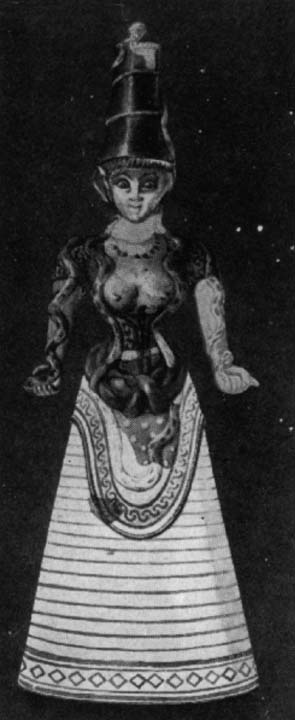 CRETE. (Boston) |
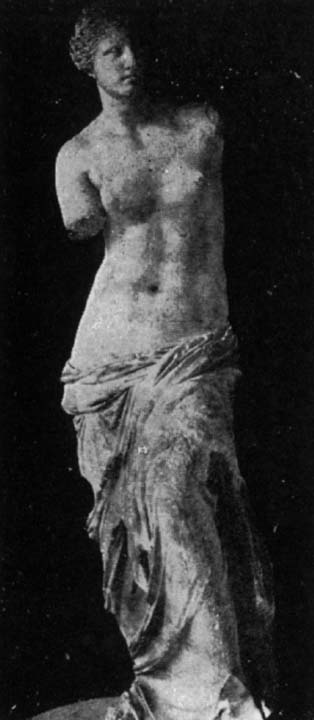 (Louvre, Paris) |
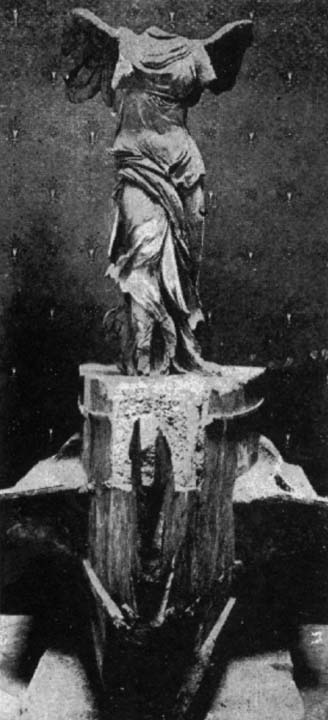 (Louvre, Paris) |
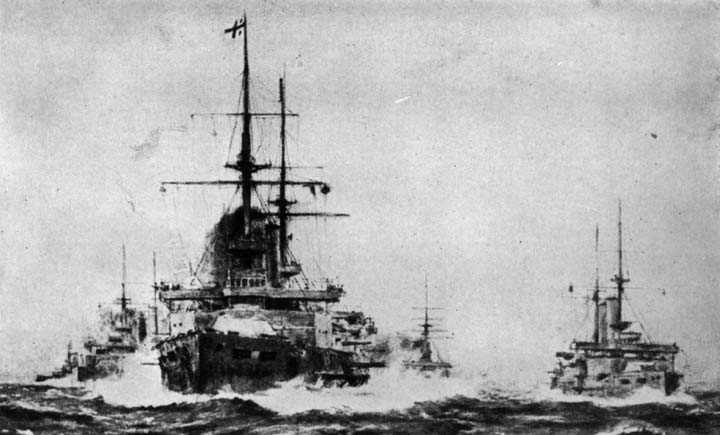
"The maneuvers of the dreadful dreadnaughts of the European nations keep me in a state of nervous apprehension. Britannia rules the waves, but Italia and the others are very much in evidence, and when I see a line of battleships ploughing through the waters of my archipelago, my protective instincts are aroused and I feel like going out and double-staking all the islands in the name of the American Women's Hospitals and the United States.
"The sea is lovely and I have been scanning the horizon with a glass in search of islands which may harbor refugees. There are plenty of them. They stand out of the deep in clusters between Crete and the mainland of Europe and Asia. Toward the east lies Skarpanto, Rhodes and the Sporades, but there are no refugees on these islands. They have recently been acquired by Italy (the islands, not the refugees) and according to current gossip, are merely stepping-stones in a great pan-Romanic revival, the first part of which involves the conversion of the Mediterranean into an Italian lake.
"The prefix 'pan' is a hard working syllable in this part of the world. The pan-Teutonic probabilities were nipped in the bud by the big parade, but nature, animal or vegetable, moves according to law, 'And 'ere one flowery season fades and dies, designs the blooming wonders of the next.'
"You should hear them talk about European and Asiatic combinations, pan-Turanian-Slavonic-Latinic-Hellenic-Fascistic---and Communistic movements. These ravings are all news to me, although they have been going on without abatement for hundreds of years. In my little old geography there was a picture of Balboa standing in the Pacific with his clothes on, seriously taking possession of the ocean and all its inlets, shores and rivers, condemning the future inhabitants thereof to peonage and a Spanish dialect, with one sweeping pan-Castilian gesture.
"My sentiments are pan-Awotal plus. Next to my passport, there is nothing so precious to me as my Awotal (cable name) job, and I shall never be satisfied until the A.W.H. puts a ring around the world and makes me sanitary dictator of all the islands. For sentimental reasons our influence should be extended to the Islands of Malta, and Rhodes where the Colussus used to be. The early Hospitalers operating in my territory, about a thousand years ago, established strongholds at Rhodes and Malta. These fighting monks were perfectly good Samaritans in the beginning, but they were misogynists of the old school. I can't imagine anything more tantalizing to their immortal souls than the standards of an organization of female hospitalers waving triumphantly over their historic stamping-grounds.
* * * * * * * "Chios, December, 1922.
"Caught in Chios !---'They also serve who only stand and wait'---perhaps. But I don't like the service, and I wish the Greek Government would give me a hydroplane and a pilot so I could hop off from island to island without waiting for the irregular boats. This may seem unreasonable, but it really is a modest wish compared with things my countrymen put over. Some of them have special ships and trains to carry them around and all I want is a little hydroplane with a Greek pilot at about thirty dollars a month.
"Too much power and grandeur sometimes has a bad effect upon us. We go to bed in a normal state of mind and arise with divine right complexes. This disorder, which has been named the 'Balkan Bat' by a natural born American alienist in the warehouse service of the Red Cross, is a by-product of the European upheaval. Kings and Emperors are down and out, and American relief workers and national dictators have come into power. The dictators look like death and castor oil, and the American relief workers look like nourishment to the hungry. The general adulation is a sweet, but acid test. Those with a weakness for benevolent despotism develop delusions of grandeur and ---my boat is coming---sorry I cannot finish this treatise on the 'Balkan Bat.'"
"Island of Crete,
December, 1922."WHAT do you know about Crete? Nothing! How fortunate ! You can begin at the beginning with nothing to unlearn.
"Well, 'Death Valley,' at the base of Mount Ararat, where the Bolos sing the 'Internationale' before and after eating instead of saying grace, may be the site of the Garden of Eden, but Crete is the Elysian Island where men, themselves, first made life worth living.
"This island, 160 miles long by 35 wide at its widest point, is the largest and choicest tract of hills and dales in my archipelago. One isolated peak in these Cretan mountains is the memorial stone of Zeus, himself. This is the only statement made by the island boosters regarding prehistoric matters, which they lack the evidence to prove in part. Equi-distant from Europe, Asia and Africa, Crete was literally the center of the commercial world four thousand years ago, and this is a comparatively recent date, as dates go on the island. The excavations tell the story of prehistoric men, who lived in the great valley of the Mediterranean before the Atlantic Ocean beat through the neck of land joining Europe and Africa, and converted a fertile country into a great sea with islands sticking up here and there, one of which is Crete.
"Life on this island has been a series of ups and down---usually downs for the Cretans. The sacking of Knossus and other cities and the clean sweep of the Minoan civilization, was the greatest crime of all. The barbarians, whoever they were, did a thorough job. 'Dead men tell no tales' must have been their principle of action, and for lack of evidence, no special group has been historically indicted for the final holocaust, which must have been similar in some respects to the recent disaster at Smyrna.
"I am not prepared to state definitely whether the early Cretan (Minoan) civilization, which was already on the down grade when Homer sang of Troy, antedated the ancient civilizations of Egypt and Assyria, but the Cretans say it did, and I am willing to take their word for it. The Apostle Paul was misinformed. The Cretans are not always liars. (Titus I-12.) They sometimes tell the truth, and they rarely short change us on supplies.
"A dark age followed the decline and fall of the Minoan civilization. During this eclipse of a thousand years, the traditions of Crete took on a mythical character. Then came the dawn of Greek civilization, fertilized by the Minoan and Mycenæan, and the stories of Crete, 'such stuff as dreams are made of,' were recorded in books on the subject of mythology.
"But the 'authorities' on history and mythology had written without a thought of such an imaginative man as my neighbor, Sir Arthur Evans, who came along about twenty-five years ago with a pick and shovel and changed the history of the world. Tomes upon tomes representing the work of savants for ages were scrapped by this seeker after truth, who actually dug up from under an ordinary olive grove on the outskirts of Herakleion, the well-preserved remains of Knossus and the Palace of King Minos with its Labyrinth where the Minotaur used to be. These findings on the Island of Crete spread before the astonished eyes of the present generation, hundreds of thousands of whom have followed the tourist trail around the ancient monuments of the world, made the Colosseum and other age-proud ruins look as modern as a New Year's edition of the Main Street Chronicle compared with the Old Testament.
"Fortunately, there was one rich possession which the invading hordes of antiquity could not transport from Crete, and that was the climate. With the help of the 'foodful glebe' (no longer so foodful) the salubrious climate preserved the human species, and man, soil, sunshine, and rain, working together century after century, made the island so attractive that every dominant Mediterranean power annexed it in turn.
"The yoke of the Greeks, Romans and Venetians was hard to bear, but when the Turks came along and, after the siege of Herakleion lasting 21 years (the longest siege on record), subjugated the island, the unconquerable minority among the Cretans took to the hills like the highduks of the Balkans under similar circumstances, and lived by exacting tribute from the invaders, and all of those who submitted to their authority.
"For 250 years these Cretan mountaineers were known as lawless brigands or heroic rebels, by Turkophiles and Turkophobes, respectively. They were proud, picturesque folks to read about. With swagger and personality expressed in details of dress, they were not unlike the comitadjis of the Macedonian mountains to-day, and they certainly did make life interesting for the law-abiding population of the lowlands.
"The Isles of Greece are inspirational in the highest degree. With the help of the gods and muses, nothing was impossible in the old days. Men and women were merely instruments for immortal manifestations. This influence still lingers here and there. The poorest germ of genius will hatch in this climate if given half a chance, and I am expecting a fine frenzy at any moment. In the Palace of King Minos when the moon is full, even my poor, inhibited, medicated, and sterilized imagination runs amuck, and conjures up all sorts of fancies, but nothing half so wonderful and actually far-fetched as the fact that I am here.
"Sir Arthur Evans and his associates are still prospecting the subsoil of the olive groves in this vicinity, digging, panning and sifting for the ninety cities described by Homer in the Odyssey. Prospecting in all its phases, including archæology is a passion. The revelations of its devotees in Crete give me a feeling of 'Onward Christian Soldier,' there is infinitely more behind all this to be revealed and adjusted.
"The archæologists are not alone in this field. There is a paleoethnologist searching for the wisdom tooth of the missing link which may be found at any time. Even Mr. Dawkins, the British consul, is delving here and there and everywhere when he is not busy diplomating for his government, and day after day I am praying that they won't accidently strike oil. If they do, all is lost.
|
"Crete awes the circling waves, a fruitful soil! * * * * * * * The hero speeded to the Cnossian court: |
"The doings of the prehistoric pioneers mentioned in the XIX book of the Odyssey as quoted above, have intrigued my budding imagination. The Palace of King Minos at Knossus has already been uncovered. What next? This is a treasure island. Deep buried beneath the matted roots of gnarled olive trees which stand in groves, are ancient cities lying tier on tier. The ground is rich in works of art coveted by the nations of the earth. Stories of the fabulous value of antiques are current, and the islanders are on the lookout for buried treasures which may be smuggled out of the country. The gold and ivory Snake Goddess of Crete (1500 B.C.), wearing an 18 corset and foreshadowing the fashionable models of the Victorian period, is in the Boston Museum. This Goddess was not on the quota, and her presence in a foreign land has never been explained to the satisfaction of the people in her own home town.
"As a special privilege, I would rather have a miner's license on this island than in the Klondike. Century after century people have buried their valuables to save them from invaders and have not lived to dig them up. Besides, this has been the favorite haven of pirates for ages, and there are coves, inlets, caves and undiscovered hiding places all around the island.
"The American Navy was born out here to the southwest toward the Barbary coast. Mohammedan corsairs were preying upon Christian trade at that time, and in the regular order of business had been seizing American merchant ships and holding our seamen for ransom. We were in urgent need of a navy, so Stephen Decatur started one. He was from Sinnepuxent, Maryland, a far less likely place than Portland, Oregon, and I am pleased to imagine that he stopped at Crete after bearding the pirates in their stronghold at Tripoli and making his world renowned getaway, which has not yet been reproduced by Douglas Fairbanks. The activities of the Barbary pirates in these surrounding waters should be credited with the immortal outburst: 'Millions for defence but not one cent for tribute.' (6)
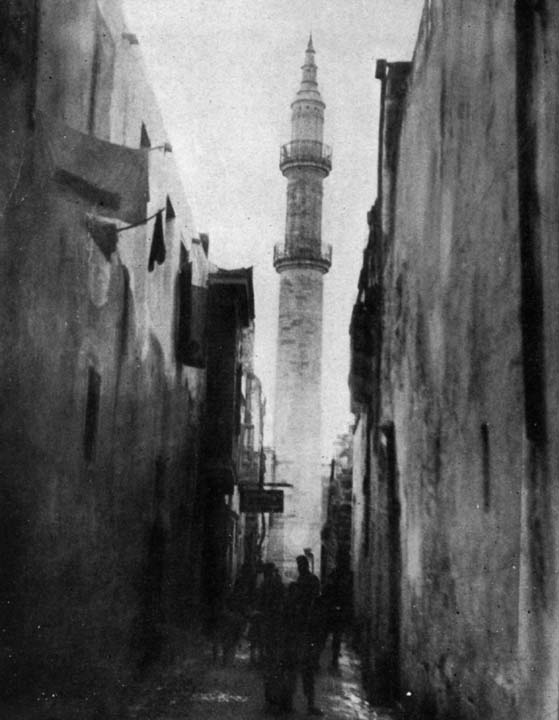 |
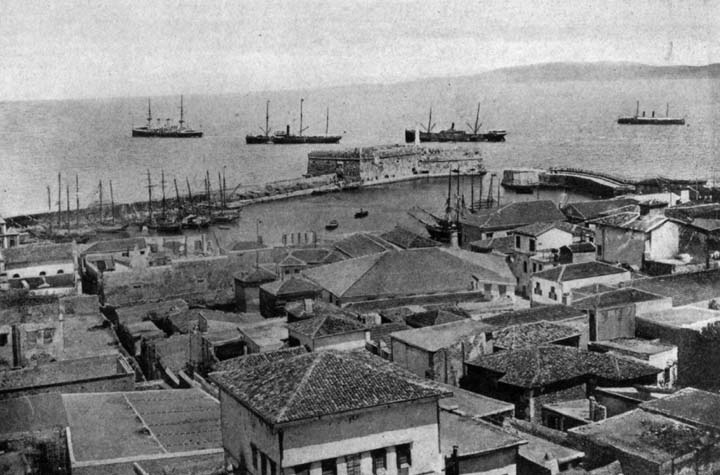 |
"All these things and many others, even the story of Zeus, are easy to believe after living on the islands for awhile. But the great romance, the immediate wonder of wonders to the Cretans and other islanders, is the fact that a group of American women has come to help them in the last of a series of disasters covering several thousand years. The Cretans are interested in the personnel of the American Women's Hospitals. We furnish material for much of the conversation on the island. Our clothes, hats, shoes, stockings and lingerie hanging on the clothesline, are far more interesting to the public than the daily proceedings of the League of Nations.
* * * * * * * "Yes, I've met the Greek Governor, the Turkish Préfets, the Cretan Mayors, Deputies and Councilors and the island is ours---that is, the part of the population with typhus, smallpox and scarlet fever. I have been immunized against bubonic plague, cholera, diphtheria, meningitis, smallpox and typhoid in alphabetical order, and if all the refugees and other inhabitants develop these diseases, I shall be reigning autocrat with authority over the entire island. The original Minoan Throne is at the recently excavated Palace of Knossus, about three miles from our new clinic at Herakleion, and nobody is using it at present.
"My system is armed to the teeth with antibodies. Phagocytes guard every portal. My person is liberally sprinkled with sabadilla powder, fatal to typhus-bearing vermin. I don't miss the vermin; the powder produces exactly the same sensation. I sleep in a bug-proof bag, under a mosquito-proof canopy at night, and use oil of citronella, deadly to common mosquitoes, instead of cold cream, for my complexion.
"Malaria! this is the flaw in my armor. The refugees have brought a malignant form of this disease down from Samsoun and other parts of the Pontus, and Greece furnishes the anopheles. The country is a regular mosquito hatchery, and whenever I see a mosquito that I do not hear, I have a chill. Please find a serum for malaria and send it quick or a I shall take to the sea in a submarine.
"Sunday week in the old English vernacular, we reached Canea, visited the clinic and outfitted the hospital with supplementary supplies. On Wednesday, we left by motor for Retimo, and although we traveled like the wind the news by 'phone went faster with the gratifying result that we were met about a mile out of town by the local authorities including the Military Governor, Préfet, Mayor, Chief of Police and Bishop, who had formerly been Aide de Camp to Venizelos.
"In the early part of November, 1922, Mrs. Anderson started our clinics and baby stations at Canea, Retimo and Herakleion, and a large service has been carried at these three places. The local hospital at Canea is better than those conducted in other districts on the island, for the reason that Mrs. J. M. Dawkins, the American wife of the British consul, is a devoted friend of the sick in that town.
"Retimo was sadly in need of greater facilities for hospitalization, and after selecting buildings and arranging to have them repaired, I left for Herakleion by boat, for the reason that there was no land route but a bridle path. Herakleion has been hard hit. The population is normally about 25,000 and at least that number of refugees have been landed here. Unfortunately, there was a huge, unoccupied building in the town, an old Turkish barracks about eight hundred feet long by one hundred feet wide, with one floor and a sort of a loft. Three thousand people were crowded into this building, which was constructed by the Turks for quartering soldiers about a century ago, and belongs to the Neolithic Age.
"No, I haven't got my dates mixed. The facts are written in blocks of stone at the Knossus excavation nearby, and in exquisite marble figures at the museum across the street. My job forces me to think in terms of sanitation. The civilization, four thousand years ago, which produced the Palace of King Minos with its perfect drainage, baths and other appointments, three miles from our present-day clinic, was about four thousand years in advance of that which produced this barracks building, a hundred years ago.
"Such a stew! King Minos would surely turn up his royal nose if he could return to his beloved island, the beautiful, highly civilized spot he helped to create, and get one sniff of this pestiferous barracks. Many of the people living in this place formerly had good homes. Now they sty together in constant dread of being sent to the foodless hinterland and forgotten by God and man. The minute I put my eye on this barracks, I saw trouble ahead. The place is a perfect incubator for contagious diseases and I promptly foretold an epidemic, thereby assuring myself of a footstool among the minor prophets at a later date when this nightmare will surely come true.
"Meanwhile, repairs on our hospital buildings are going forward rapidly. We are getting ready for the inevitable epidemic and our clinic at Herakleion is running full force. Now hold your breath and make a mighty mental effort to grasp the full significance of a statement, which, to the best of my knowledge and belief is a statement of fact. The A.W.H. clinic at Herakleion is the biggest clinic in the world! I am terribly proud of this work and thankful that we are able to carry it, albeit conscious of the wickedness of being proud, instead of just thankful and meek as a lowly Samaritan ought to be.
"Anyway, we have from six to eight hundred patients daily at the Herakleion clinic. This is due to the fact that a large percentage of the refugees are sick, especially the children. We employ a great many refugee physicians and nurses. The nurses are the best fitted girls we can find. They are without training, but they learn faster than any group I ever worked with. So long as they give satisfaction, they are able to secure food for themselves and are in a position to help their families a bit. Believe me, they pray for light in regard to their jobs.
"Crete, February, 1923.
"The last time I was at Chios I felt as though my child had grown up and got married. I was no longer needed. Miss Petty is running the hospital and clinics much better than I could run them if I stayed there and did my best. She is also keeping an eye on our work at Mitylene, and this leaves me free to spend most of my time at Crete.
"The American Red Cross is furnishing a thousand calories of food daily for every patient in our hospitals, in addition to milk, and some other supplies for our clinics. Somebody connected with the Red Cross seems to know that it is good business to help us with supplies. By giving us ten, twenty or thirty per cent of the food for our hospitals, they are more certain that these hospitals will stay open, and they save themselves the difference in cost to spend elsewhere.
"As part of our sanitary work, we are running delousers and baths. Among the ruins here, as well as at Rome and Pompeii, there are the remains of public baths, which testify to the habits of other days. Crete is off the 'tourist' trail and the old baths have no value as 'sights.' Therefore, we put pipes into them and restored them to their original purpose for the use of refugees. We furnish the soap as a medical measure, observing the letter of the unwritten law and keeping strictly within our province, and the government supplies the water. 'No bath, no bread,' is the Red Cross ruling and these baths haven't had as many patrons since the reign of Suleiman the Magnificent.
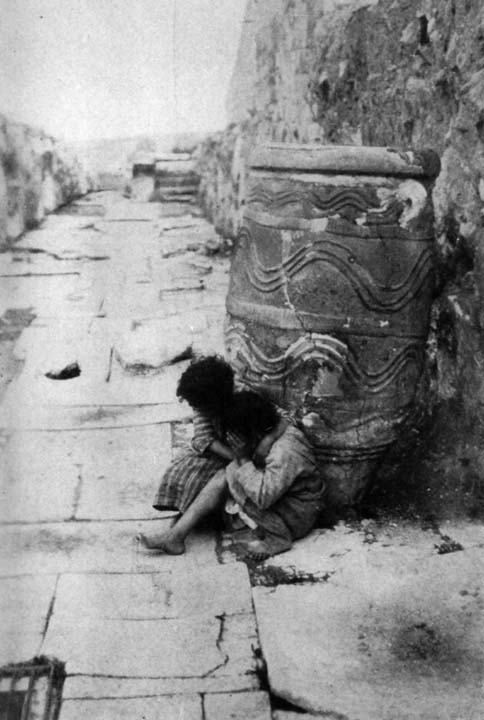 |
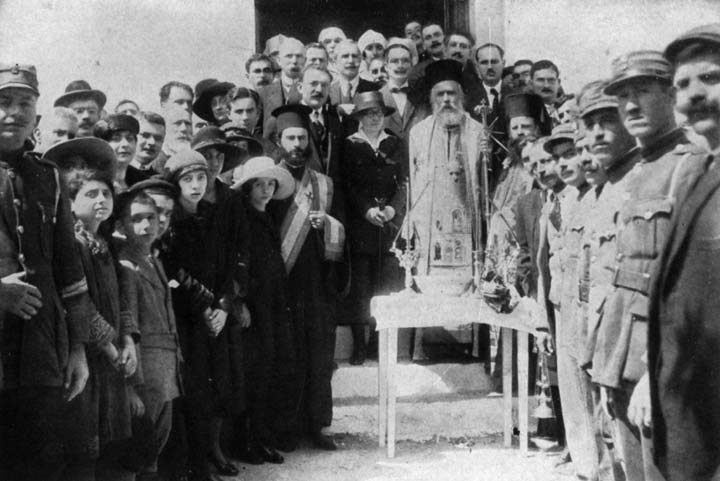 |
"The first case admitted to the A.W.H. hospital at Herakleion was a little child of five years, who had been stabbed in the back at Smyrna and who had refused to die. The wound, which had pierced the chest wall, was followed by empyema and the mother of that child had carried him from place to place for almost three months. The endurance of this woman is beyond belief. With that child in her arms with a discharging wound, no dressings, no possibility of care and another little one at her side, she had gone into the holds of refugee ships, slept in the streets of Mitylene and finally reached the barracks at Herakleion on the Island of Crete. With proper care our first patient was well within ten days and at just that time a miracle occurred.
"These people believe in prayer and in miracles. The more they suffer, the more they pray for help, and no one was in greater need of help than that poor woman. Associated with terrible affliction, there is a corresponding possibility of great joy. The father of that child had been deported to the interior of Anatolia by the Turks. He escaped, made his way to the coast and swam to a ship on the sea. That ship might have been going to France, Italy, Morocco, Portugal or Spain, but strange to say, it was going to Herakleion, Crete. Being a refugee, this young man was sent to the barracks, where he found his wife and children.
"The transcendent joy and thankfulness of this family contrasted strangely with their surroundings. God was good! They were the most fortunate people on earth. Three thousand refugees rejoiced and gave thanks with them, and I remembered my grandmother with her saws, sayings and psalms: 'Weeping may endure for a night, but joy cometh in the morning.'
"The presence of this man raised the morale of the barracks population enormously. The women, whose husbands and sons had been sent to the interior of Turkey, became more hopeful. Perhaps they would escape. Perhaps they had already escaped. After all, God is good. They had a sign. Here in their midst was a man who had been delivered from their enemies, and they looked out over the sea with hope renewed."