
EARLY one morning I walked along the pier with an officer of the American Navy. The separation of families was going on at every gate. At the last barrier two girls were begging for the life of their young brother, who had just been seized. He had passed four gates and his life had probably been bought and paid for several times. Almost within reach of the ships he had finally been arrested. Without avail, they had pleaded and tried to buy him off, and they were in despair when capricious Fate suddenly intervened. The right man passed at the right moment The American officer walking with me was that man. He had seen thousands of families separated and had heard thousands of women weeping. According to his own statement he was hard-boiled, but I had my doubts. These girls spoke his language. They knew he had great power and they begged for their brother's freedom, as only women can beg for the lives of those they love. After the manner of people of that country, they knelt and kissed his hands He tried to shake them off, but they clung to him, one on each side, their dark, pleading eyes fixed upon his face Orders were orders, and he had his orders indirectly from Washington, but he had higher orders directly from God Almighty, which are written in the soul of every manly man. These girls were very beautiful, and they had gotten under his armor. They had found favor in his eyes. He was manifestly torn between a personal desire to help them and an official desire to maintain discipline!
"Look at him," they pleaded. "He is our only brother. You can save his life! For God's sake say the word! He is sick! He will die!"
"Yes, he's sick." Like a drowning man our American officer seized this straw of an excuse. "Anybody can see that that boy is sick."
Through an interpreter, the American officer explained to the Turkish officer in command that the boy was sick. Certainly he was sick. They agreed on the diagnosis. What was the ailment? Immaterial. What does the name of a necessary disease matter between officers and gentlemen? The Turk bowed to his fellow-officer, smiled at the lovely girls, issued an order in an undertone and the closing gates of the world opened to that boy.
Instantly a woman with a family of little children, whose husband had just been taken, seized my hand. I did not know her language, but I sensed her suffering. It was against the rules to interfere in any way, but I looked toward the Turkish officer and indicated that prisoner. This officer was in a gracious mood. Without the slightest hesitation, he set the man free. He did not need an excuse. This was merely a personal favor to an American woman---a small favor. Christian life was cheap that day on the Smyrna pier.
Two men were saved, but what about the other prisoners? They were all taken sick at once, and were displaying the evidence of their ailments. As a matter of fact, they were sick. Human beings cannot suffer s they had suffered for two weeks and remain in health. But the gifts of life were over for that group of prisoners, and a few minutes later they were marched away.
Finding favor was an important business in Smyrna during the evacuation. In many cases it meant the difference between life and death---"deportation to the interior" or freedom. One of the marines, who had witnessed the intervention of the American officer in favor of the boy above mentioned, told me later that he was glad the girls put it over. He was smarting under a reprimand for helping young girls instead of devoting his time to feeble old people.
"What do you think about it, lady?" he asked. "I think we ought to get the girls aboard the ships first. The Turks don't want the old people."
Another husky youngster, who had taken a pretty girl under his protection, was deeply distressed when his ship was ordered away. I had noticed this girl sitting in a niche of masonry near one of the windows of the relief house with this big American in front of her, and at such times she looked quite safe. Before leaving, he came in to see one of the committee about getting her aboard a refugee ship.
"She is my girl," he said. "I got her that place near the window and the blanket and pillow. I've kept her there and brought her, food for nearly two weeks, and I don't want no Turk to get her now. Give me the God's truth. Promise you'll watch her and get her aboard a ship."
The girl who shared her room with me also found favor. Her prayer for her brother's life was heard and answered on earth. I heard it and "Shorty" answered it. This girl and her sister were cooking and keeping house for the Disaster Relief Committee and others at the headquarters, and I advised them confidentially to cultivate "Shorty," to wait on him and see that he had plenty to eat no matter who went hungry. Naturally, they found favor in his eyes, and when I told him about their special trouble he stepped right out as though he expected to get a particularly fine picture, but he didn't take his camera. Within an hour he passed down the quay and along the pier assisting a sick person on a stretcher carried by a sailor, who led the way, and a new relief worker with a cork hat well over his face.
They boarded a refugee ship and left the sick person, and also the strange relief worker, in the hold.
As soon as these girls knew that their brother was safely away they started at once for the pier, and as they passed me in the crowd, one of them pulled off her bracelet and pressed it into my hand. I still have that bracelet, an exquisite trinket---my share of the Smyrna loot.
Several other members of the household staff left that day. These poor women did not want to leave the house in the lurch, but they were afraid of "deportation to the interior." Dinner that evening was not a success. The cook was missed. People usually eat without much thought of the cook, but when there is nothing to eat worth eating the cook is remembered with regret. "Shorty" beamed over that disorderly board. It was a case of everyone for himself, and those with cafeteria training fared better than those accustomed to service. Confronted with this hardship, everybody registered cheerful endurance, but it was clear that some of the older men would have made very poor refugees.
On the night of September 29 I left Smyrna on the United States destroyer Litchfield. There were, perhaps, fifty thousand refugees still in Smyrna, and approximately a quarter of a million had gotten away. Pestilential diseases were inevitable among these people wherever they went, and our organization would be called upon to conduct hospitals for their care. Fortunately, we had a small fund, but it was necessary for me to reach the United States as quickly as possible in order to get more money for this service.
Several Americans were leaving, including the United States Commercial Attaché and the representative of the Baldwin Locomotive Company. I was detained on account of an accident to Mr. Jacobs of the Y. M. C. A., who had been working day and night since the beginning of the holocaust for the relief of the victims. It was dusk when I reached the small pier used by the launches of the warships, but I saw one of the sailors pass my suitcase to a young boy and I heard him whisper: "Take this suitcase aboard for the lady and don't come back. Listen! Don't come back."
Strange as it may seem, the conversation during dinner on the destroyer turned to the menace of Russia and the evils of the Soviet system, on which we were practically all agreed. One charitable, historically minded person, however, remarked that the Russians had been on the job only five years, and, within view and hearing of the Smyrna demonstration after the advantages of almost two thousand years of Christian and Mohammedan culture, we should give the Russians at least a thousand years before passing judgment upon their system. By that time, with the help of the Turks and other Asiatics, there might be none of us left to pass judgment.
Dinner was over and the men had lighted their cigarettes when the captain turned to me and asked about the boy who came aboard with my suitcase. I told him that he was a stranger to me, but the captain seemed unsatisfied, so he sent for the boy and questioned him in the presence of everybody, including the vice-consul, who was a guest at dinner. This boy was small in stature, looked very young, not more than twenty, and spoke English well. He was pale and trembling, for it was a case of life or deportation and death, perhaps, to him, although but a light, unimportant matter to those used to this sort of thing from the other end of the game. Mr. Jacobs identified the boy as one of those who had been helping relief workers on the quay. Therefore, we knew that in saving others he had probably lost any chance to save himself.
He was a brave boy. Not a word did the captain get out of him about his friend the sailor who sent him aboard. I had not noticed him particularly, but standing before his judge in the bright light of the cabin, his thin, blanched face contrasted strikingly with the older, harder faces of that company, and strangely suggested the "Judgment" upon which his religion was founded.
There was no fault in this boy except that he was an Orthodox Christian. My plea for him was of necessity denied. In the beginning the captain might have closed his eyes, but having called attention to the case he was bound by the rules and as helpless as Pilate.
The captain of the Litchfield was an efficient officer. Wherever he appeared during the evacuation order was maintained. Day after day I met him on the quay and pier. He seemed like a man with a kind heart and a strong defense reaction against this weakness within himself. In the performance of their duties such men are apt to lean backward from their humane impulses.
The boy was sent ashore---two of them, for another had meanwhile reached the ship. This seemed very cruel, but orders are orders, and neutrality is neutrality.
Less than half an hour later, while I was leaning over the rail peering through the darkness at the last refugee ship of the day pulling out from the end of the wharf, a sailor told me that those boys had been put on the pier. The vessel was already well in the stream, and with the pier guarded by Turkish soldiers, it seemed unlikely that they could have gotten aboard---but perhaps they did. Seven months later I was told by a diplomat (formerly the American vice-consul at Smyrna) that those two boys had actually been put aboard that outgoing refugee ship. Strange, how that boy's pale face still lingers in my memory. If I ever meet Saint Peter I shall ask about him.
I was still leaning over the rail when the representative of the Baldwin Locomotive Company, who had been in Smyrna on business for several days, came along and stood with me for a few minutes. He said that he had been on the pier, but did not stay long, because he could not bear to witness the suffering of the children. "Besides," he added, as he turned away, "my business is to sell locomotives."
That was the answer. That was the core of the whole wicked game. It was a case of every man for himself, and every company and country for that matter. The ships in the harbor were under instructions to protect the property of their own nationals and otherwise maintain neutrality. Their shadowy forms on the dark water suggested a herd of sea monsters with big bodies and no heads.
They had not saved the property of their nationals, unless "futures" may be regarded as property. They had failed. The property had gone up in smoke. But, if in all the ages that men have lived upon the earth, they had found some simple plan of standing together for humanity's sake in times of great disaster, Smyrna would have been saved, and incidentally the precious property. Fire on the rampage is an impartial power. Regardless of the national status of insurance companies, it swept through Smyrna without pausing to salute the flags at the Consulates of the favored nations north of the Turkish quarter. With tongues of flame it lapped them up and wiped the city from the earth.
From the deck of the Litchfield after dark, the ruins of Smyrna seemed as spectral and fantastic as a nightmare. I could not see the people huddled at the north end of the quay in the angle they dreaded so terribly, but I knew they were there, and that later in the night they would shriek for searchlights.
An epochal fortnight had passed, and the memories of my visit with the delegates to the World's Fourth Sunday School Convention belonged to the era of past illusions. The destroyer was preparing to slip away quietly. No one was singing "How Firm a Foundation," but over the water, from a tall minaret, came the voice of the muezzin: "Allahu Akbar! Allahu Akbar!"---Allah is greatest!

THE Greek Islands near the coast of Anatolia were convenient dumping grounds for retreating Greek soldiers and the Smyrna refugees. At least 200,000 outcasts were marooned for a time on the Islands of Mitylene and Chios. The normal population was more than doubled and the suffering indescribable. There was little to eat, limited sleeping quarters, and the women and children were so reduced by weeks of hunger and horror at Smyrna, that thousands of them were sick.
Under the leadership of Colonel Plastiras, the Greek military naval and air forces at Chios and Mitylene revolted. Like a great carrier pigeon, an airplane from Chios flew over Athens and other parts of Greece, scattering a manifesto and calling upon the Greek people to arise and save the country. This call was answered promptly. Constantine abdicated, George was proclaimed King and Plastiras returned to Athens as Dictator.
All this had happened before the Litchfield reached Constantinople on October 2, 1922. Dr. Elliott, who was Director of the American Women's Hospitals in that field, was waiting for me. After a conference I left for home to secure funds and she went to Mitylene to establish a medical relief service, including hospitals, clinics and milk depots.
For a month or so the different American relief agencies continued to work under the Disaster Relief Committee. In addition to funds, each organization contributed such service as it was best equipped to render.
As a measure of order gradually emerged from necessarily chaotic beginnings, it was found that the American Women's Hospitals was carrying practically all of the American medical work conducted for the relief of the sick in this unprecedented emergency.
By a combination of unforeseen circumstances, we were in the field when the call came. On the islands of the Ægean Sea and along the shores of Greece, Christian women and children, driven from their homes in Asia Minor, were dying by thousands of hunger and disease. Shortage of water increased the suffering. There was no prophet with a divining rod to strike sweet water from the rocks, or bring down manna from the heavens.
The lives of the outcasts depended upon money---the almighty dollar, shilling or drachma. We dared not wait to count the cost of service in advance. Our small reserve was spent at once, and our prayers were for money, and more money! Our sole resource was the generosity of friends at home, and our faith was more than justified. Week after week, month after month, a stream of life-saving messages went out from our little headquarters at New York to our director in the field, reading in substance as follows: Ten thousand dollars more available---twenty-five---fifty---a hundred---two hundred and fifty thousand---half a million!---And we came to believe that Jesus loved the rich young man because he was worthy of the stewardship of great wealth.
Our first hospitals, with dispensaries and milk stations, were started during the early days of October, 1922, on the small Islands of Mitylene and Chios. Small?---Mitylene, old Lesbos, the island which produced Sappho, and where Aristotle passed his honeymoon:
| Him rival to the Gods I place, Him loftier yet if loftier be, Who Lesbia, sits before thy face, Who listens and who looks on thee. |
Small?---Chios, the local habitation of Homer, the incorporate spirit of poetry? The "blind man who dwells on rocky Chios; his songs deserve the prize for all time to come." The size of these islands depends upon our individual measures of magnitude. In area they are very small, but in cultural influence they are as wide as the civilized world.
It may be impossible to hurry the East, but it is possible to speed up a bit in near eastern countries, as the following material taken from letters of Dr. Elliott, written during the first weeks of October, 1922, seems to indicate:
Mitylene, October 3, 1922.
At 3 A. M. we arrived with our thirteen cases of food and medical supplies. It was a balmy night. The moon was shining so I tucked myself between the cases, while Mac(4) went out to reconnoitre. I was discovered by a refugee, who had been sleeping on the quay. He had three children with him and his seventy-year-old mother. All his children were born in Rochester, New York. His wife was dead. He had received one pound of bread that day for his entire family. Some days, he said, they didn't get anything to eat. He had owned his own farm near Smyrna, but had been robbed of everything. His two sisters had been killed at Smyrna, and his brothers had disappeared.
* * * * * * * We reached the American House(5) before daylight. There was not a sound. Only the odor, that unforgettable refugee odor, to tell the story. A hasty survey through the camps was made a few hours later. Many of the refugees were sick, and one poor woman in labor was out in the park, which was a mud puddle on account of the morning's rain.
* * * * * * * Among the exiles I found Cornelius. He was my right hand man at the Ismid Hospital, whom I had not seen since that mad night when he fled with all the rest. He has married Araxia, one of our Ismid nurses. I told him to come down and get a job and bring Araxia. Such luck!---for them, and for us. We shall have at least two trained workers. We trained them ourselves last year.
October 4.
* * * * * * * The Governor-General has asked us to take charge of the refugee medical work. Buildings have been selected for refugee hospitals and clinics. Whitewashers are already on the job. Fifteen physicians, all refugees from Smyrna, have enrolled for service.
I spent the morning buying materials for mattresses, sheets, towels and nightgowns . . . . A committee of Greek ladies with sewing machines volunteered for work, and before night mattresses and sheets were ready for fifty beds.
Chios, October 5.
Thousands of people are sleeping in the streets and suffering for want of water as well as food. Still, health conditions are better than at Mitylene, because of a better local sanitary and medical service. A fine group of buildings, including a hospital, has been assigned by the government for refugee relief work.
A large number of little children, who were lost by their parents during the rush from Smyrna, have been taken into one of these buildings . . . . There is one group of six, the oldest of whom is a girl of twelve years. They belonged to a wealthy Smyrna family, and before they left their home their father, fearing that they might be separated in the struggle to escape from the burning city, concealed seven hundred Turkish pounds on each child. The parents were both killed, and all the children were robbed before they left Smyrna, save little Patricledes, four years of age, who reached Chios with his money, about five hundred dollars, safely tucked away in his underclothing.
October 9.
When we reached Mitylene practically nothing was being done for the care of the refugee sick. The wretched municipal hospital was crowded to the doors, and people on all sides begging and praying for help. The sick were lying in the streets, and women giving birth to babies in the open places without help or protection. Thank Goodness! To-day we have a hundred-bed hospital, where maternity cases are given first place.
* * * * * * * I have never seen so many babies in my life, and all of them sick. Poor little things! They don't cry. They just whimper. For weeks these people have been hungry. Nursing mothers by the hundreds have gone three and four days straight without food, and now what do they get? Half a pound of bread daily.
* * * * * * * We are carrying all the medical work of the Disaster Relief Committee, and we must limit ourselves to the medical end of this service. In connection with our baby clinic, as a medical measure, we have opened a milk depot where the babies get one feeding daily of warm, fresh milk. We also maintain a place where the nursing mothers of sick babies have a roof over their heads and get a little extra nourishment . . . . Let me impress upon you all that there are thousands of young mothers with families, whose husbands and brothers have been taken by the Turks. These women are utterly destitute and utterly helpless,
* * * * * * * I saw some dreadful cases in the hospital to-day. Several young girls, the victims of Turkish outrage. One of them will probably die. They tell hideous, unprintable stories . . . . There is one little girl, ten years old, with an infected bayonet wound in her back, and a macerated arm from the blow of a gun butt. The Turk who attacked her killed her father and mother. She knew this man. He was from her own village . . . . I shall never get used to the look of these children when they are asked about their mothers. I have never seen children under ten cry while telling their tragic stories. Their eyes grow wide, their mouths twitch, and with a look more of wonder than of terror, they almost whisper, "I saw her killed and I ran away."
* * * * * * * One of our doctors spends his full time going from camp to camp looking after the general sanitation and seeing the sick, who are bedridden. "Bedridden" is not the word, for these poor things have had no beds for weeks, and many of them no blankets. Our housekeeper was a woman of wealth a few weeks ago. She had a home with ten bedrooms. Her family slept fifteen nights in the streets of Mitylene without so much as a blanket. Now they have a room where ten people sleep together. She is sleeping with us, of course, and we have finally managed to give her a bed. Yesterday she begged the privilege of giving her blanket to her sister, who is sick. We gave her a straw mattress and blanket for her sister, and to-day she told me that her sister was so happy and had slept so well last night. Poor things! A few weeks ago they had more wealth than I had ever thought of having, and there are hundreds, yes thousands, like them.
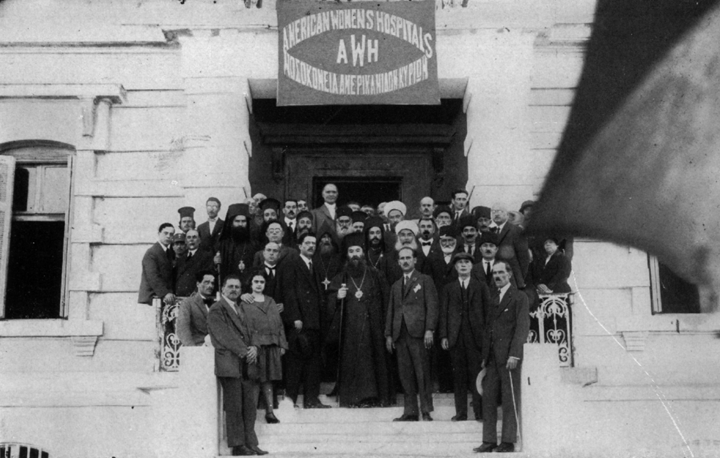 THE A. W. H. APPEARS AT MITYLENE. |
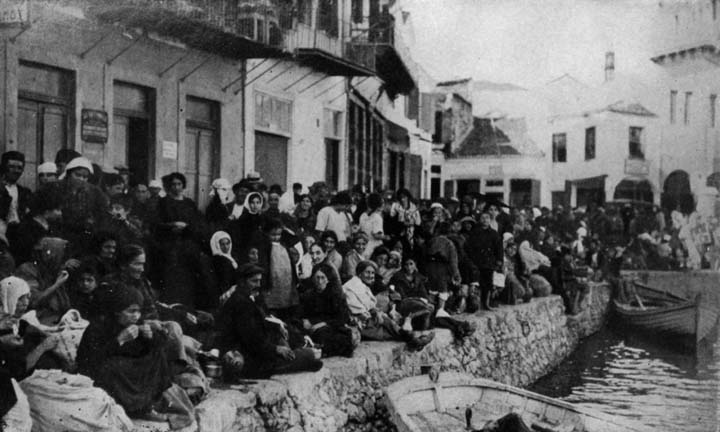 |
There were three American destroyers in the harbor this morning. They didn't stay long. They are busy cruising up and down the Asiatic coast picking up refugees. . . A horrible mess comes to us. There is an increasing number of sick . . . . With a 100-bed hospital, two clinics running full force all day, and our milk depots for babies, we feel that we can relieve a lot of suffering
October 18.
No one in America can imagine the horror of things here. There are 300,000 refugees or more on the islands, and 600,000 trekking across Thrace in search of safety. It is tragic to put these poor things, who have been hungry so long, on a barren island, which hardly produces enough food for a goat. It will take all the relief organizations in the world to prevent wholesale death this winter.
.. . Every bit of American medical work so far has been done by the American Women's Hospitals. . . . My boat stopped at Rodosta, Eastern Thrace. The refugees are leaving. They will all be out in a few days, so I told Dr. Babeekian to close our work and report to me at Athens.
Mrs. Byrtene Anderson, an American nurse, was our first local director and worker at Mitylene, Chios and Crete, one place after another. Her personal devotion to the details of her job was an important factor in the prompt functioning of our hospitals, clinics and baby stations on these islands. In less than a week from the time our first worker set foot on Mitylene, we had a hospital of 100 beds running to capacity, two baby-feeding stations, and two clinics in the center of the town, where approximately four hundred patients were cared for daily.
The fame of this service spread to Chios, and resulted in a dramatic incident in connection with the opening of our first clinic and milk station on that island. There were thousands of sick and hungry little ones, and the mothers, crazed with grief, fearing that the milk and medicine would give out, rushed the clinic with their babies in their arms. .This struggle was basic and terrible. The female of the species moved by the instinct of race preservation, fighting for her young. The Governor was notified and sent soldiers to restore order, establish lanes and maintain the line.
Another clinic and milk station was opened to divide the crowd and make it possible to get the day's work done. Within the week our hospital at Chios was functioning, and just then a frantic call for help was received from Crete by wire. About 35,000 people had been thrown on that island without any provision whatever being made for them. Shortly after the receipt of this message, a refugee ship loaded to the gunwales appeared at Chios, and a cry of protest went up from the island. Chios was already swamped. "Move on! Move on!"---The old, old order, and Crete was decided upon as the easiest dumping ground.
"Who is ready to go to Crete?" That was the question.
"I am!" answered Mrs. Anderson, and she dashed to the Red Cross to beg additional supplies. With 400 cases of milk, eight cases of medicines, 100 sacks of rice, 100 beds, 400 blankets and 91 bales of old clothes, she sailed away to Crete a few hours later.
Tucked in among two thousand human beings which blackened the deck of that ship, it might have been hard for her co-workers on shore waving good-by, and wishing Godspeed, to identify her in the distance. But there was an outstanding and distinguishing difference between this American woman and the refugees---she had a white handkerchief.
THE holocaust at Smyrna marked the beginning of a general exodus of the Christian people from Asiatic Turkey. With one accord, they fled to the nearest ports in a frenzy of fear. Men of military age, 17 to 45, were "detained," but the women, children, aged and sick were "permitted" to depart. The word "permitted" in this connection has a ghastly meaning. They did not wait to sell their homes or auction their household goods. In many instances it was a case of the "quick or the dead," and the quick lived to tell the tale.
Immediately after the evacuation of Smyrna, the Council of Mudania was held, and the Turks demanded Eastern Thrace and other territory evacuated of its Christian population. This was straight to the point, and cleared up any doubts regarding the purpose of the new Turkish Government. Twenty-eight Christian deputies, representing Thrace in the Greek National Assembly, cabled the President of the United States and Congress on October 7, 1922, seeking protection for the Greek, Armenian and other Christian populations should that area be turned over to the Turks. Eastern Thrace was returned to the Turks. The first article of the Convention of Mudania, October 8, 1922, provided for Greek evacuation within fifteen days, and the flood began. The Christian population of Eastern Thrace, about half a million, moved into other parts of Greece.
All the world, including the elements, seemed leagued against these people. The rain poured in torrents while hundreds of thousands struggled through the mud with their few cattle, sheep, ox-carts and movable property. Roads and bridges were washed out and the country was swamped by this unprecedented downpour. Still, the refugees dragged slowly and laboriously toward the border, their one thought being to cross the rising Maritza River before the Turkish troops reached Eastern Thrace.
The New Turkish Government was determined to rid the country of troublesome Christian minorities, and from a Turkish point of view, there was ample justification for this policy. During the World War, while Turkey was fighting on the side of the Central Powers, the Christian population within her borders, encouraged to believe that the success of the Allies would mean religious and national freedom for them, probably aided and abetted these forces whenever they got the chance---and little good it did them in the end.
If home, sweet home, is "God's country," and life on earth the greatest of all gifts, these poor creatures might better have turned Moslem and fought the Allies to a finish. The Emperor of Germany, at the time of his visit to Turkey several years before the World War, gave some significant advice in a public speech at the Tomb of Saladin, the great Mohammedan warrior who crushed the Crusaders. "Christians," he said, "should either embrace Islam or leave the country to the Moslems." Those who took this advice and served loyally on the side of Turkey and the Central Powers when "Der Tag" came, were saved, but those who did not were sacrificed.
These people may have contributed to the defeat of Turkey during the World War. And, judged by our standards as applied to persons within our borders suspected of disloyalty while this country was at war, there is something to be said for the Turks, but under the circumstances we are not the ones to say it.
The Turks might truthfully say for themselves: Hundreds of years ago we conquered Asia Minor (Anatolia) and we have tried to persuade all the inhabitants to adopt our religion and become one with us. The Christian subjects of Turkey have always been untrustworthy. They are the very seed of sedition at the core of the country, and, but for their faithlessness, our standards might be waving over the world. Century after century, they have rejected our good offices. They have conspired against us. Their ruling passion is hatred of everything Turkish, and their actuating motive from generation to generation has been secession. They want a country of their own with a government and religion after their own image, which would be in a position to do us damage at all times.
Christians! They are the terrible meek! Under their mask of submission they are a stiff-necked, rebellious people. Gratitude is not in them. They have always been a menace to the Empire, and after five hundred years, we have decided to have done with them once for all, to exterminate them or drive them out and let the people of other nations have a taste of their quality.
This is what was done, and Turkey is not without sympathizers in her radical treatment of subjects with an inextinguishable devotion to their own national and religious ideals. But if any civilized country, Great Britain or the United States, for instance, should adopt this policy in regard to troublesome or unassimilable minorities, the world would see clearly and speak righteously.
Turkish patients in different countries have been popular with the personnel of the American Women's Hospitals. They wash their hands before they eat without being told twice, and there is something agreeable about them which goes with generations of power. At Ismid the Turks had the power to close our doors, just as they have the power at present to close any American door in Turkey, but there was nothing they were not willing to do to make things pleasant. Our investment was comparatively small, but there is something psychologically binding and blinding in any investment. It was the province of our personnel to care for the sick regardless of nationality, and the good of such service in any country does not permit of a scrutinizing, critical attitude toward the government, no matter what that government may sanction or put into action.
The Turks are a courteous people to outsiders. What though their courtesy be tempered with pillage and massacre, so long as these evils are in another direction? It is hard to hate people for what they do to others while we enjoy their good will and good offices. Some of the Macedonians and Albanians along the new borders of Serbia were quick with their knives and guns. They helped to keep our surgical wards full, and they, no doubt, deserved hanging, but chetas, comitadjis and highbinders of different varieties have always enjoyed a certain popularity.
The Turks are good fighters and generous enemies, according to the reports of the American, English and French soldiers. These are men a Turk may look straight in the eye, or glance upward toward, without losing caste in his own soul. They have never been his subjects or his slaves. But woe to the Armenian or Anatolian of Greek blood, who wars against the Turk and falls into his hands!
The arrogance of Turkey following her conquests of highly civilized countries seems, at this distance, like the manifestation of a national inferiority complex. It is easy to call a subject people "cattle," but if the "cattle" are proud of their pedigrees and unwilling to mix blood with their drivers, there is a reflected insult in the name. The Anatolians would probably have been one people centuries ago but for religious incompatibility. The difference in the religious status of the Christian and Mohammedan woman has played a big part in this drama of a thousand years. The religious status of the Christian woman has separated her from the Mohammedan Turk by the width of heaven, but the comparative lack of religious status of any woman from the standpoint of the Turk has made the Christian woman, who happened to be a Turkish subject, fair game. The Turk has probably felt morally justified in taking her perforce out of a life which he regarded as altogether wrong, and allowing her to share the blessings of a righteous institution under his own loving care and guidance.
From a racial standpoint, polygamy and fecund concubinage, voluntary or involuntary, has helped eliminate the old, original Turk. His face has changed. The chances are it has improved. His features testify against him. The blood of his fathers has been diluted almost to the vanishing point, but these victorious invaders have survived in spirit. A jocular fate has overtaken the Turk. Blood and bone, he is the man he most despises. Ethnologically, he has almost disappeared, and for this he should be thankful, if the Mongol types I saw among the Turkish soldiers at Smyrna are true survivals of the old originals from Central Asia. In any case, the appearance of the present-day Turk in Constantinople, Crete, and along the coast of Anatolia, would indicate that the predominating strains in his circulation are Greek and Armenian.
Assuming that a corresponding number of male and female Turkish children have been born since the Turks invaded Asia Minor, and that the majority of Turks have had at least one Turkish wife, most of the plural wives must have been secured from subject peoples. The mother of Abdul Hamid is said to have been an Armenian, and this suggests that an Armenian mixture sometimes produces a terrible Turk or Kurd, as the case may be. According to Talcott Williams, in 1922 there were at least 100,000 Armenian women held by the Kurds and bearing children to their Moslem masters. A formidable army of "irregulars" may easily be the outcome of this phase of the deportations.
In addition to this continuous maternal dilution, there has been a large number of converts to the Moslem religion from the Christian populations of conquered countries. "Accept the Faith, Pay Tribute or Die." This was the slogan during the Moslem flood. Nobody wanted to die, and the men who believed in a business administration promptly accepted the Faith and collected tribute from the less adaptable. Anyone who has followed our newspaper reports on the subject of the reduction of taxes and surtaxes during the last few years can readily understand why so many men moved to the side that did not have to pay tribute.
Then, there were the Janizaries. What a stream of good Christian blood, if religion gets into the blood, was poured into the veins of Turkey from this source. For three hundred years or more the standing army of the Sultan was recruited largely by a forced levy on the male children of Christian people in subjugated countries. These boys were selected for physical perfection, taken from their parents when they were very young, brought up in the Moslem faith, trained from the beginning in the arts of war, and the sword of Islam placed in their hands.
An invincible army was developed in this way, and men of Christian lineage carried the Crescent to the north, south, east and west. Under Suleiman the Magnificent, it looked as though they were destined to conquer the world, but in this supreme crisis the Christian nations stood together, the tide turned in the opposite direction, and ebbed steadily until the present decade. The Janizaries, undoubtedly recruited their harems with the most attractive Christian women from the lands they conquered, regardless of the rules concerning marriage, which were infringed with all other rules as they grew in power.
The Turks have no family names, and their family trees, with promiscuous roots and branches, are genealogical jungles. Tracing a Turkish family tree from twig to root, one not infrequently finds oneself in Spain, Albania and sometimes in France, but far more often in Greece and Armenia.
"Kemal" is not the family name of the Great Ghazi, but a nickname given him by his teacher, at the military school which he attended, as a tribute to his ability. It is difficult to obtain authentic information regarding this Man of Destiny, who seems to have sprung full-armed like Minerva from a Greek storm cloud split by lightning. His father is said to have been a Turkish customs official at the port of Salonica, and beyond that is the dark age of the family. Where did he get his blue eyes, fair complexion, executive ability and general style? Nobody seems to know. Some of his forebears may have been Circassian, or more likely Balkan Christians. In any case, Turkey is to be congratulated upon having a leader of Kemal's calibre at the time of her desperate need---which may not have seemed so desperate to those familiar with the course of international politics.
But this Great Ghazi is not the first and only Turkish reformer. There was Selim the Grim, and Mahmud the Reformer, who was also known as the Shadow of God on Earth. He was part French. His mother, Aimée de Rivery, was a French Creole born on the Island of Martinique, captured by pirates, sold as a slave, and finally presented to the Sultan of Turkey. This Sultana and the Empress Josephine were children together on this side of the Atlantic, and their friendship became a link between Turkey and France in later years. Mahmud the Reformer was on the job during the Greek War of Independence, 1821-29, and the final clean-up in 1922 may be regarded as a centennial celebration and finish of his work, which was interrupted by outside interference.
The Turks had ruled over all of Greece for about four hundred years at that time, and they honestly thought it was their country. The Turkish Commandant lived on the Acropolis in the Propylæa, the Erechtheion served as his harem, and with the addition of a redeeming minaret, the Parthenon made an acceptable mosque. The Maid of Athens was a sort of maid of all work in the Turkish domestic service, but she could never be trusted.
After the manner of patriots the world around, in all ages, the Greeks rose up one fine morning in 1821, and said, "Give us liberty or give us death," and they smote the oppressor hip and thigh and cut his collective throat, killing the Sheik-ul-Islam and many others in and out of authority. Their reward was a breath of liberty before the tide turned and the massacres in reprisal set in.
"Giaour!" groaned the Turk in despair, for there was not enough Greek blood in the whole world to wipe out this debt at the prevailing rate of exchange. A reform pogrom was decided upon. A thorough pruning and spraying of the imperial tree seemed necessary for the health of the empire. There was a massacre of the Christians at Constantinople; the Patriarch Gregorius was hanged in the doorway of the Patriarchate on Easter Sunday; several Bishops were hanged on the same day; the entire Christian population of the Island of Chios, rocky Chios where Homer sung, was killed or sold into slavery, and during this general reform the insubordinate Janizaries were opportunely wiped out.
Mahmud had the spirit, vision, and nerve, and with the help of Mehemet Ah of Egypt, the "exterminator of infidels," he might have antedated the work of this generation by a century with a saving of large territory. But champions of Christianity and Liberty, including Daniel Webster, arose in other countries. Byron died fighting for Greece with pen and sword, and his pen was the mightier weapon. Finally, the Great Powers took a hand, and after four hundred years of national subjugation, Greece, reduced in size, was reëstablished upon the earth.
There were no oil scandals in connection with the Greek War of Independence a hundred years ago. Wind was the principal motive power of the world at that time, and there was no getting a corner on it. And the mistaken policies of the American missionaries were not responsible in any way for the massacres. On the contrary, these massacres attracted the first American missionaries to Turkey.
During the past hundred years, the English-speaking people of the world have spent a lot of money and fine talk on the Christian minorities of Turkey, but when it came to real protection it was the Bear that walked like a man who was there first with the ammunition. Peter the Great and his successors regarded themselves as the divinely appointed protectors of the Greek Orthodox Christians in Turkey. A vaguely defined protectorate was secured by Russia in 1774, but whenever the Bear put out his protective and prehensory paw in the direction of Turkey, the Lion rushed to the rescue, and between them the Christian minorities were preserved. With Russia engaged in the World War, followed by a revolution which overthrew the Government and the Church, the Christian minorities of Turkey were doomed.
France and England have mandates to fight for in Asia Minor now, and the Christian minorities have been dispersed. Some of these people lost faith, turned to Bolshevism, and are developing the Armenian Soviet State, while many of those who took refuge in Greece are still struggling for existence in the "wilderness" of Macedonia.
Much is made of the fact that the Greeks invaded Anatolia in 1919. There are two sides and many angles to this question. The Greeks contend that they were there first, and that the Turks from Asia invaded their country at a comparatively recent date, about a thousand years ago. The majority of the population of Smyrna was Greek Orthodox when the Greek Army landed there in 1919 with Allied authority.
The Greeks certainly were in Asia Minor during the Golden Age of Greece and long before, but the French and British have no ancestral roots in the soil to justify their present occupation. The Anatolian Christians of Greek ancestry have never been able to forget that that was their fatherland, the birthplace of some of their greatest men, the kindergarten of the Christian religion, and there they stayed until the people of Smyrna were driven into the sea by the Turks, under Mustapha Kemal Pasha, while great nations with brand-new mandates in Asia Minor maintained neutrality.
Imagination is said to be the highest intellectual faculty. Let us be intellectual for a moment. Let us imagine an alien race conquering our country a hundred years from now, tabooing our religion and making us over in its own image. A thousand years hence we shall still be fighting for the "Land of the Pilgrim's Pride," or our stock has no lasting quality.
The Caliph Haroun Alraschid of the Arabian Nights whose capital was at Bagdad, was a far less picturesque figure than the Great Ghazi of the present day, whose capital is at Angora. Alraschid was a real historical caliph who survives in a book of miracles, but he never attempted anything so miraculous as the modernization of Turkey overnight, after the model of Japan. This takes magic. The Church and State have been---well, not exactly divided. Kemal is the Church and State, a decided improvement on the old Church and State, according to the Kemalists, and a difference of opinion in this respect is keeping the hangmen busy in Turkey.
A dictator is a dictator, and it doesn't matter whether he is called a Czar, King, Sultan, President, Prime Minister or Comrade, except that it is harder to dislodge a hereditary ruler with family roots in the job. Kemal is one of the most despotic and efficient dictators in this day of dictators. He knows more about his business and is less subject to influence than his predecessors, the Caliph-Sultans. A reformer extraordinary, he changes national customs, clothes, calendar, script---anything he doesn't like: and he doesn't like the history of the Turkish race, therefore it has been changed.
Why not? The great nations have always doctored their histories and made them better. Kemal has performed a radical operation, and now, "the Turkish race is centuries older than any other race, and it is from its civilization that all other civilizations have sprung."
Ditto, spoken in Turkish and written in Latin script, is the WORD in the Republic of Turkey. Kemal's Ministry of Education has pronounced the word, and henceforth his history of Turkey is to be taught by Turkish teachers in all the schools of the land, including foreign schools which are required to pay Turkish teachers for this service. Unadaptable scholars may choke on this bolus, but it must be swallowed. Kemal's history must be taught in their institutions, and if they don't like it they can take their passports and go, but they cannot take their things: Ay, there's the rub. Improved property representing large investments must be left in Turkey.
More power to Mustapha! The world is in need of such men. He has saved his country, why shouldn't he remold it if he wants to? The "Sick Man" is getting well under his treatment. But there are other soft and sick men. A course of history under Kemal and a course of Communism under Stalin, followed by a course of castor oil under Mussolini might be beneficial.
Progress is Kemal's ruling passion, and he moves so fast that his countrymen cannot keep up with him. They seem flurried and disheveled---changing their clothes on the run, as it were, adjusting unfamiliar suspenders and in imminent danger of losing their garments. Dignity and distinction have been scrapped with their national costumes, and, on Galata Bridge, where all nations meet, many of the people look as though they had been fitted out at a rummage sale, or in the second-hand shops of American slums.
The fez, so dear to the souls of old Turks that it used to be carved on the tops of their tombstones, is no longer a legal headpiece. Kemal doesn't like fezes, so they have been changed by law for hats and caps. Some of the hats are of the Charlie Chaplin model and give their wearers a pathetic, comic aspect. Propaganda was used to get rid of the fez. Subtle rumors were circulated to the effect that this headgear was of Greek origin. That settled it. Nothing Greek or Armenian could be tolerated. The fez was proscribed. But in order to get rid of every strain of Greek and Armenian, the Turks will have to change the marrow of their bones.
The difference in bearing and behavior of the Moslem and Christian peoples of Turkey, so generally remarked, may be the difference between hundreds of years of power and hundreds of years of a peculiar form of oppression, plus the influence of a dominant religion. Would the fact that the honest, outspoken, self-respecting youth rarely lived to transmit his characteristics, while the cunning, subservient strains were transmitted generation after generation, effect the traits of a people? If so, the criticisms of the Turkophile against the former Christian inhabitants of Anatolia, involve a more monstrous accusation against the Turks than is ordinarily made by their enemies.
The Russian exiles in Southeastern Europe and in China are demonstrating, year after year, the effect of power and lack thereof on the human spirit. During the past decade there have been millions of refugees of different classes from different countries, and Russia has provided the nobility. How brave they were in the beginning, those Russian exiles of noble birth! How debonair! How different they seemed from the common horde of refugees! With what grace they accepted their fate! "To the manner born," we murmured inanely, and lucky the ones who escaped to America, or died while the manner lasted.
"Death hath two hands to slay with," one for the body and the other for the spirit. During long years of beggary in hungry countries, the manifest difference and nobility of Russian exiles, as compared with other exiles, has gradually passed away. They are no longer exiles. Most of them are refugees in every sense of the word. "The manner born" was the unconscious indication of the power and privilege they had enjoyed for generations. A complete reversal of fortune has already broken the spirit of most of the survivors, and brought about a pitiful change in this overrated manner. Cold, hunger, and disease are dreadful levelers. They level down to the depths of the soul. It may take three generations to make a gentleman, but the vicissitudes of war, revolution and exile, have demonstrated that either a lady or a gentleman can be unmade in far less time.