
THE fire, which was started on September 13, 1922, was still smoldering when the Dotch crept into the harbor and it looked as though two-thirds of the city had been destroyed. The line of demarcation was significant. The Turkish quarter was uninjured, but the Christian section of the city was practically gone. The ruin somehow reminded me of trees I had seen in Belleau Wood with all the branches shot away save one stark limb, the Turkish. Along the quay for a mile or more, the destruction was complete, but near the railroad pier, a line of white buildings had been spared and these stood out like tombstones to the memory of the city I visited in 1904. It seemed almost as though I had met a beautiful woman, Smyrna the Amazon, strong and graceful of figure, and the charm of her living presence lingered in my consciousness during the inquest over her mutilated remains.
Time after time I had been told of the dire results of moving about in warring countries, especially in Turkey, without official papers, but in the general excitement nobody was taking any notice of the Dotch and I landed without a military permit. It was suggested that I stay on board until an official vessica could be secured from the Turks, but a vessica sounded uncertain and I preferred to get ashore and consider the permit afterward.
Several of the fine residences toward the pier end of the quay facing the harbor had been the homes of wealthy Christians whose families had lived in Smyrna for generations. These people in their wisdom had fled before the Turks took the city, leaving unguarded treasures in furniture, rugs, silver and paintings. The cellars of some of these homes were well-stocked with luxuries, such as are stored by the rich in different parts of the world for the entertainment of friends, and many a toast was drunk to the health of an absent host who had made such convivial provision for unexpected guests.
The American Consulate had been installed in one of the finest residences left standing on the Smyrna quay. The house next door served as headquarters for the Disaster Relief Committee. Here we were received and lived during the last week of September, 1922, which might well be called "Evacuation Week," for it was at this time that the majority of the evacuees, who had waited so long on that terrible quay, were taken away on ships sent by the Greek Government.
This headquarters was the center for such work as was possible under the appalling conditions. Several members of the committee, men who had been connected with educational and other work in Smyrna, lived at that house and were assisted in their colossal task by English-speaking Christians, both men and women, many of whom had been educated in the mission schools.
American and British sailors, however, rendered the greatest assistance to the refugees during the evacuation, with the exception, of course, of the Greek Government which coöperated with the Disaster Relief Committee, and furnished practically all the refugee ships. The presence of American naval men had a tendency to maintain order, and there was nothing our boys were not willing to do to help those unfortunate people.
All the American women, who had been living in Smyrna prior to the Turkish occupation, embarked for Greece with the American Consul-General on the night of September 13, while the fire was raging. At a later date, I understand, one or more American nurses came into the harbor on relief ships, but they did not land. Perhaps they waited for vessicas. In any case, I was the only American woman who witnessed the cruel spectacle of the evacuation of Smyrna, during the last week of September, 1922. An English newspaper woman, who was generally supposed to be an American, because she lived on a United States destroyer, came to the railroad pier several times during that week.
The retreating Greek Army left Smyrna on September 8, 1922; the Turkish Army occupied the city on September 9, and the fire was started on September 13. From that date, the Christian population, Turkish subjects of the Greek Orthodox religion, and Armenians, had been without shelter. During the fire with its attendant murders, robberies and other outrages, men, women and children swam from the quay, and every boat, raft and floating bit of timber was utilized in a desperate effort to reach the ships in the harbor.
The mothers with families were not able to swim and take their little ones on their backs, but the strong, who had the luck to board the ships in the beginning while the fire was raging, were not put ashore. They were taken away and saved from the additional anguish and suffering experienced by those who remained on the quay, after the representatives of the different nations had been officially instructed to maintain neutrality.
There were approximately 300,000 people huddled together on the cobblestones of the Smyrna waterfront and hiding in the ruins, when we reached that port. For ten days and nights, they had held their places. The quay, within view of the warships of the Allied nations in the harbor, and within range of their searchlights at night, was the zone of greatest safety, the least likely place for a wholesale massacre.
City-dwelling human beings, suddenly deprived of the conveniences of civilized life, are utterly unable to care for themselves. They are far more offensive than animals can possibly be. The people squatting on that quay were filthy. They had no means of keeping clean. They dared not go back into the ruins of the city for any purpose, lest they lose their lives. In less than two weeks the quay had become a reeking sewer in which the refugees sat and waited for deliverance. When that crowd stirred, the stench was beyond belief.
Between Darages Point and the railroad pier there was a triangular water space in which an eddy had seemingly been created by the building of the pier. This space was filled with floatage made up largely of the carcasses of animals. As the mass washed to and fro with the waves against the stonework, a bloated human body occasionally appeared, and this sickening spectacle was augmented by the liberation of offensive gases peculiar to putrefying flesh.
Among the outcasts, there were a large number of English-speaking people. It is safe to say that during the World War there were not so many refugees in all Europe who spoke our language, as were assembled on that quay at Smyrna. Some of them had studied in British schools, but a large proportion had learned English somewhere, somehow from Americans. Many of them had lived in America and some of their children had been born there. Others had been educated in the American mission schools. They had known nothing but kindness from Americans, and in their great need they crowded as close as they could to the Consulate and the relief headquarters where two large American flags were displayed.
The faith of those unfortunate people in our flag was pathetic. Many of the mothers had secured shreds of red, white and blue cloth which they tied on their arms, and on the arms of their children for talismans, as some near eastern people wear blue beads to avert the "evil-eye" and other dangers.
One young man who had served thirteen months in the American Army during the war and had his papers to prove it, stood in front of the Consulate for that terrible week acting as interpreter for American sailors and relief workers. On September 29, he asked me if I would go with him to the vice-consul. He was hoping that his former connection with the American Army, from which he had been honorably discharged, might save him. In this he was disappointed. The vice-consul said that no provision was made for such persons and nothing could be done for him.
The people on that quay knew the old Turks. They had lived with them for generations. They anticipated trouble, but not such a ravage of fire and sword or they would have gotten out a month before it came. The cautious ones with fluid assets, did go away for a vacation, with the expectation of returning after things quieted down, but the majority were probably as hopeful as the people of Carthage had been before the destruction of that city, two thousand years ago. In addition to other difficulties, there was a law in Turkey by the provisions of which abandoned property accrued to the government, and this tended to keep the residents of Smyrna in their homes. Besides, while they had not openly participated in the war, it was generally known that they had aided and abetted the Allies in every possible way, and these victorious nations, whose ships were in the harbor, would surely protect them from the vengeance of the Turk.
After neutrality had been declared, announced and exemplified by sending men ashore who swam to the warships at night, and in many other ways, the people of Smyrna still hoped that they would be protected and taken away to places of safety. The presence of Allied ships in the harbor undoubtedly afforded a measure of protection by exercising a restraining influence upon the Turkish forces in control of the city. Judging from what actually happened under the eyes of other nationals, it is easy to imagine what would have happened if their ships had not been there.
Neutrality was a strange and terrible word to the people on that quay. It meant that the warships would not take any more of them away; that they were at the mercy of their traditional enemies, and it meant outrage, slavery and death.
The Turkish command had issued a proclamation to the effect that all refugees, with the exception of males between the ages of 17 and 45, would be "permitted" to depart, and on the solicitation of the Disaster Relief Committee, had agreed to allow Greek ships without Greek flags to dock at the end of the pier. A considerable fund had been collected from the refugees on the quay to pay for transportation, but afterward the Greek Government on written guarantees that Greek vessels would not be seized, placed a fleet of freighters at the disposal of the committee.
These arrangements took time, and the Turks finally notified all concerned that males of military age (17-45) were to be detained and deported to the interior, and that all refugees regardless of age or sex, remaining in Smyrna after September 30, 1922, were to share this terrible fate. This notice was posted in conspicuous places, and scattered from an airplane among the wretched people huddled on the quay.
"Deportation to the interior" was regarded as a short life sentence to slavery under brutal masters, ended by mysterious death. Since conquerors began conquering the different parts of Asia Minor (Anatolia), "deportation to the interior" has been a favorite outdoor sport. The Lost Tribes of Israel were "deported to the interior" by Sargon, the Conqueror, and not so much as their bones have ever been found. There was probably not a great difference between the humanities as practiced at the time of Sargon, the Conqueror, and the time of Kemal, the Conqueror. Thousands upon thousands of Armenians were "deported to the interior" during the World War, and many of them disappeared as completely as the "Lost Tribes." No one knows what became of them, but the flight of the buzzards and the cry of the jackals have a gruesome meaning for their widows and surviving children.
The people on the quay were panic-stricken. The Allies had forsaken them. The Turks were going to deport them to the interior on the thirtieth of September. What country would help them? Greece had signified her willingness to receive them, but how could they get there without ships? For twelve terrible days and nights they had watched, waited and prayed. The stones of the quay were hard, but not so hard as the hearts of nations! The sun was blistering during the daylight hours, and the nights were full of horror, but the time was passing so fast, so fast. Only five days more to the thirtieth of September and deportation.(3). Even if ships should come, how could they all embark in so short a time? Besides, Greece was poor and overcrowded, and since the strong countries, indirectly responsible for their suffering, had definitely refused to admit them, perhaps Greece would change her mind. Why should one nation accept all the Anatolian Christians fleeing for their lives, including the Armenians?
Most of them called themselves Greek, but were they Greek? They had never lived in Greece and many of them could not speak the Greek language. On the other hand, they were not Turks, it seemed, although they had lived under the Turkish Government, generation after generation, for five hundred years. They were people without a country, and the Armenians among them were sorry they had not turned toward Russia and joined the Soviet.
Nationality and religion to the people on that quay was a hopeless muddle. Two hundred years before the colonization of America the Turks had taken Smyrna, but Turk meant religion to most of the Christian people in Asia Minor. They had seen too many Christians turn Turk by accepting the Mohammedan faith. Before accepting the Faith they were Armenians or Greeks perhaps, and the next day they were Turks, with all the privileges of Turks.
This confusion of nationality and religion was very well shown in the strange case of a certain man who had been in the service of an American tobacco company for so many years that he looked, acted, talked and no doubt felt like an American. He told me quite simply that he was a man without a country, and that that was the status of most of the Christian people in Turkey. His father was German, his mother English, and he was born in Smyrna. Naturally, they were cosmopolitan in thought and language, but he had always considered himself of German nationality. He had married a German girl and he thought his children were Germans. They were all members of the Lutheran Church.
His attitude toward the Turkish people was friendly. He knew their problems and sympathized with them, but he also understood the problems of the Christian minorities and was vitally interested in them. Had he been born in Germany, England or America or had his citizenship been carefully guarded, he doubtless would have stood with those groups of sympathetic outsiders, who saw both sides of an impossible situation, and who leaned, perhaps unconsciously, toward the side in which they were personally interested. But he was born in Smyrna. Anatolia was his native land, the loveliest country in the world, he said, especially along the fertile valley of the Meandre River. Having lived there all his life and considered himself a German, he had given little thought to proofs of citizenship. He held a high position with an American company, and while he did not say so, no doubt he had quietly kept out of the World War. But when the Turkish Army was marching on Smyrna and all the outsiders were getting their passports, he applied at the German Consulate and was told that he was not a German.
This was staggering information. If he was not a German, what was he? What was the nationality of his wife and children? Surely, they were not Turks! If so, he and his sons might be called to serve in the Turkish Army. Finally, through the influence of friends and otherwise, he secured a Portuguese passport, on which he was able to get his family out of the country. In this emergency, he had become a Portuguese, almost the last kind of a national he wanted to be.
Meanwhile, the Turks had taken the city, and quite by chance he met a lifelong friend, a Turkish officer, who told him that he had better come over to the Turkish headquarters and get papers to prove his German citizenship. This was an agreeable solution of the dilemma. The Turks issued papers certifying to the German citizenship of this man, which were perfectly good in Turkey.
"In my left pocket," he said, "I have a Portuguese passport, and in my right pocket I have Turkish papers to prove that I am a German, and I should certainly like to know what my nationality really is. There is no doubt about my race, religion and business. My father was German, my mother English, my business connections American, my religion Lutheran, and I would never serve in the Turkish Army."
In issuing these papers the Turks, of course, knew just what they were doing. This was a man of wide influence with powerful American, English and German connections. By involving him they would gain nothing, and might lose a great deal. Why further complicate an already complicated situation by embarrassing such persons? As a friend he was worth while. Besides, they liked and respected him, personally. He belonged to the ruling class of human beings, to whom courtesies and privileges are extended as a sort of birthright.
The Dotch sailed to Greece with a cargo of refugees. She was a ship without a country, and that helped some in this emergency. There was no Russian representative to step forth with the power of life and death in his hand and say, "I forbid this ship to sail. We must maintain neutrality no matter what happens to these women and children. Pooh! What an odor! It makes me sick at the stomach. Come in to the Consulate, let's get a drink." And all this suggests the desirability of keeping a stock of the flags of dead nations on hand for such emergencies.
The first ships that took refugees from Smyrna after neutrality was being strictly observed, were paid for by the refugees themselves. Members of the Disaster Relief Committee collected money from the refugees on the quay to help defray the cost of such ships, and issued tickets to the people contributing to this enterprise. Some of the refugees gave large sums, but when the rush along the pier finally came, these tickets were worse than useless. The gates were guarded by Turkish soldiers, and the sight of one of those pink tickets merely meant that the holder had parted with real money, which they might have secured as part payment for taking Smyrna.
The night of September 25th had come. Eight ships sailed on the 24th, one on the 25th, and only four days remained until the 30th of September. That evening at dusk, I stood on the balcony of the Relief Headquarters with a native Christian woman, and looked out over the shoal of tragic faces on the quay. There was a strange murmur of many voices rising and falling along the waterfront. The sound was mournful, like the moaning of the sea, increasing in volume as the darkness deepened. The language was unfamiliar, the tone minor and the effect weird and indescribably uncanny.
"What are they doing?" I asked this girl.
"Praying," she answered simply. "Praying for ships."
This girl and her sister, capable, well-educated young women, had been working among the refugees and keeping house for the Disaster Relief Committee, since the opening of the headquarters. I had urged them to take the first ship which they could reach lest they lose the opportunity. But their young brother was in hiding, and they refused to leave, because in saving themselves they would sentence him to certain deportation and probable death. By staying they could give him food, day after day, and they might be able to find someone, some American perhaps, who would help him get away.
That night when I went to my room, which I shared with this young woman, I found her kneeling by her bedside praying to God for mercy--praying for her people, for ships, and for her brother's life. She had been educated in a mission school, and she spoke my language. She asked me to pray with her, but my soul was dumb. As I listened to that strange woman pleading her case with God, so simply, so intimately, even as she might speak to her father, I sensed, in a vague, indefinite way, the meaning of "Our Father which art in heaven" and I realized that I was standing in the presence of the Faith which had sustained her people, age after age, unto this day.
The remnant of the race to which that woman belonged, after eight years of massacre and deportation under the Turks, had joined Soviet Russia in order to survive. She and her family had lost all their worldly possessions. They were facing deportation and perhaps death, but as soon as her prayer was finished she slept peacefully, while I, in perfect personal security, lay awake listening to the terrible sounds from the quay.
Night after night blood-curdling shrieks, such as Dante never imagined in Hell, swept along that ghastly waterfront. From my room-mate I knew what these cries meant. When the Turkish regulars or irregulars, under cover of darkness, came through the ruins to the quay for the purpose of robbing the refugees or abducting their girls, the women and children, a hundred thousand or more in concert, shrieked for light, until the warships in the harbor would throw their searchlights to and fro along the quay, and the robbers would slink back into the ruins.
Darkness and silence followed these outbursts, broken at times by the phonographs on the warships in the harbor, which, of course, suggested Nero playing the violin while Rome was burning. Poor old pagan! He was probably in the habit of playing the violin, and there was no reason why he should suddenly interrupt this comparatively harmless pastime. He didn't belong to the fire department. In any case, since Smyrna, we should let Nero and his violin rest. He has been outclassed. We have a better story. Time after time, the sweet strains of familiar records, including "Humoresque," and the swelling tones of Caruso in "Pagliacci," floating over the waters, were suddenly drowned in that frightful chorus of shrieks from the Smyrna quay.
Well after midnight I heard a sound on the stairs. It was Mr. Jacobs of the Y. M. C. A., bringing good news. Nineteen ships were coming into the harbor. Greece was not only receiving the refugees, but she was sending ships to save them. The Golden Age of Greece in art and literature was over two thousand years ago, but the Golden Age of Greece measured by the Golden Rule, began with the Smyrna holocaust which precipitated the Christian debacle in Turkey.

EARLY Tuesday morning, September 26, a terrible struggle to reach the ships docking at the end of the railroad pier began. The quay was separated from the pier by two iron picket fences about seventy yards apart. These fences had narrow gates. The pier extended a long distance out to deep water, and three more fences with narrow gates had been improvised by placing heavy timbers across the pier about two or three hundred yards apart. The purpose of these fences was to force the refugees to pass through the narrow gates, where they could be carefully scrutinized, and all men who appeared to be of military age detained for "deportation to the interior." The gates were guarded, and between the first and second gates at the north end of the quay leading to the pier there was a double line of Turkish soldiers, in addition to officers and other soldiers moving to and fro among the refugees.
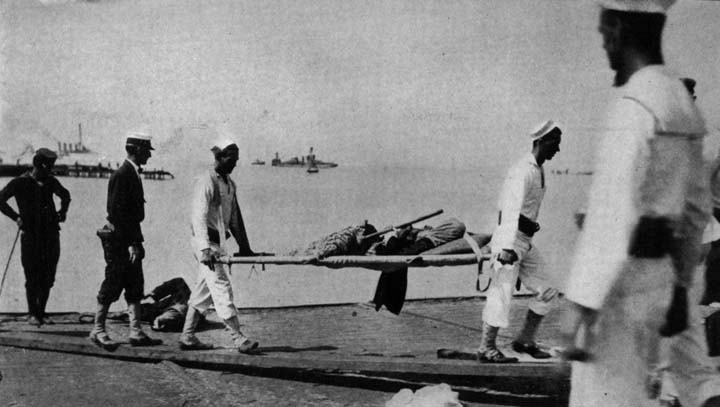
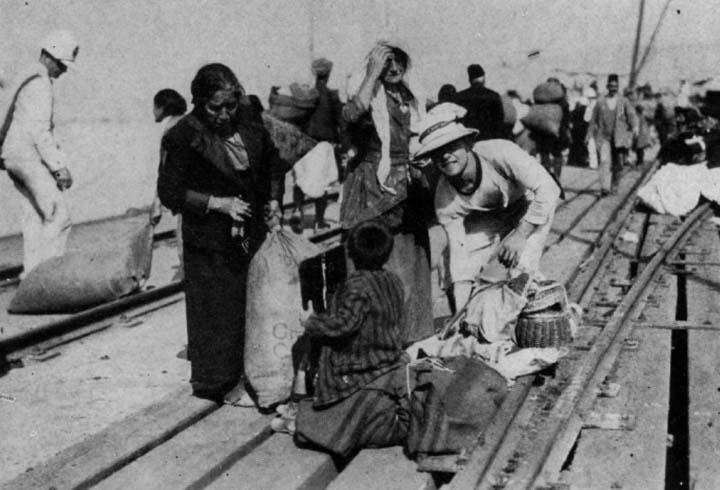
The officers and crews of the American destroyers in the harbor were of the greatest assistance to the Disaster Relief Committee. The privilege of helping the refugees was a favor granted by the Turks to American and British naval men, and it goes without saying that the sailors of both countries were guilty of many unauthorized acts of humanity. Most of the American boys assigned to help the outcasts were stationed near the center of the pier, and at the far end the British assisted the sick and weak to board the ships.
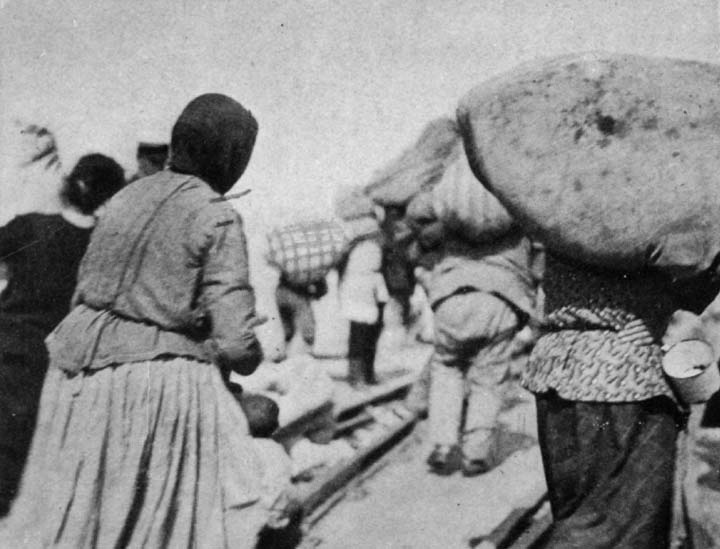
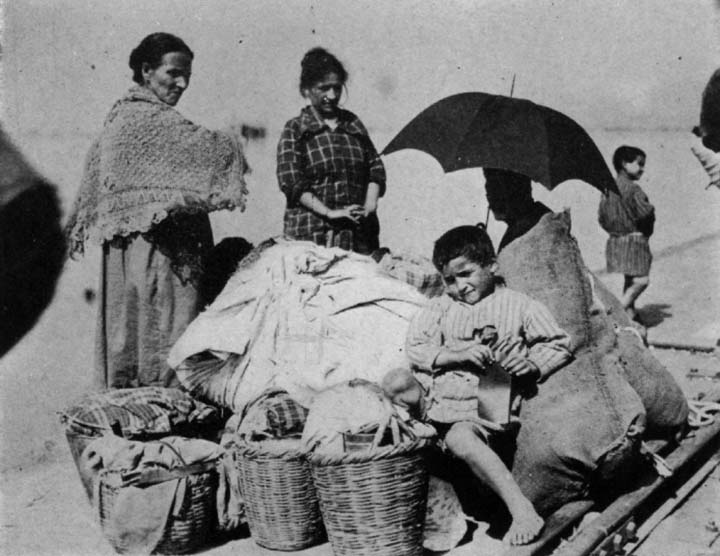
This was a boon to the unfortunate women, children and old people, who, without their able-bodied men and with all their worldly goods salvaged from the fire upon their backs, were going into a strange country to live or die. These precious bundles, containing bedding, clothing, cooking utensils, and perhaps a loaf of bread and bottle of water, impeded the progress of the refugees along the pier, but on the islands afterward these articles were in many instances the determining factors between death and survival.
The description of that frantic rush to reach the ships is beyond the possibility of language. Pain, anguish, fear, fright, despair and that dumb endurance beyond despair, cannot be expressed in words. Fortunately, there seems to be a point at which human beings become incapable of further suffering---a point where reason and sensation fail, and faith, coöperating with the instincts of self-preservation and race preservation, takes control, releasing subhuman and superhuman reservoirs of strength and endurance which are not drawn upon under civilized conditions of life.
For six hours on Tuesday, September 26, I stood near the land end of the pier, between the first and second gates, watching this inhuman spectacle. Thousands upon thousands of refugees, with heavy bundles upon their backs, pressed forward along the quay, struggling to reach and pass through the first gate. The Turkish soldiers beat them back with the butts of their guns to make them come more slowly, but they seemed insensible to pain, and their greatest fear in the daylight was the fear of not reaching the ships.
In a desperate effort to keep their families together, many of, the women lost their bundles, and some of them were pushed off the quay into the shallow water near that floating mass of carrion which washed against the stonework. No effort was made to help them out of the water. Such an effort would have necessitated the putting down of bundles, or children, and every person in that crowd strong enough to carry anything was carrying a pack or a child, or helping the sick and old of his own family. So these women stood in the water waist deep, holding up their little ones, until they were able to scramble out and join the crowd, with nothing in the world left to them but the wet rags on their backs.
 |
 |
 |
The crush at the first gate was terrible. Many of the women lost one or both shoes, their clothing was torn and their hair hanging by the time they got through. One poor old grandmother, who had become separated from her group, was naked from her waist to her feet and apparently unconscious of this fact, as she ran about in the open space near where I was standing, calling pitifully for her family. Another woman, whose child passed the gate just as a halt was called, was beaten back by the soldiers, but the mother instinct is hard to control. With a wild expression of countenance she turned, dropped her bundle and went over that iron picket fence, which was at least seven feet high, like an orang-outang. A soldier was ordered to stop her, and he cornered her between the fence and a small building on the inside, beat her with the butt of his gun, and finally pinned her against the building with the muzzle of it, in an effort to make her listen to reason and obey orders. But that poor mother had reverted to the lower animals and was acting on instinct. She couldn't be controlled by a gun unless it was fired. With her eyes on her child, who was being pushed along with the crowd in the distance, she broke away, and the soldier shrugged his shoulders impotently, as much as to say, "What is the use of trying to manage such a crazy creature."
All along this fence there were women attempting to climb over and get their children over. Here and there they were caught on the sharp pickets. A Turkish soldier, who had noticed that the gate receipts were worth while for those who had the luck to be stationed along the line of traffic, improvised a ladder by hooking a bed spring on the pickets, and did a profitable business helping women and children over the fence at this point.
Meanwhile, several thousand people had passed the first and second gates and were making their way painfully along the pier, carrying their heavy burdens and taking the test at each gate. Some of the roadway of this pier was built of heavy planks, about two inches apart, and the children's bare feet slipped through these spaces if they were not carefully watched. The difficulty of walking these planks was further enhanced by the broken glass of water bottles dropped by the overburdened refugees.
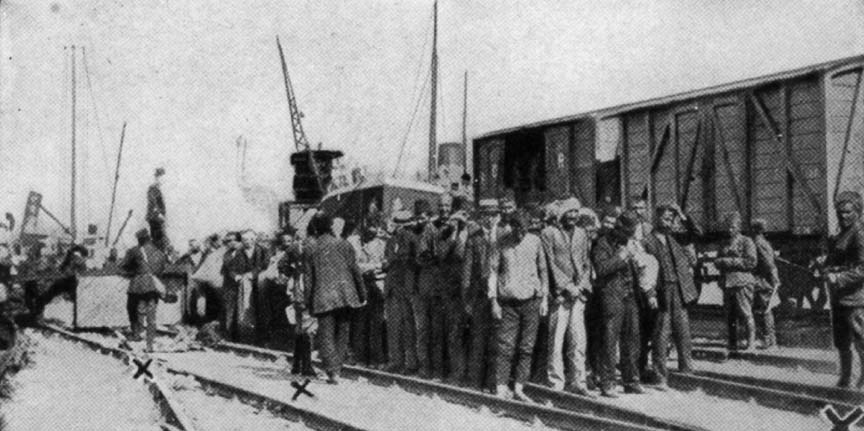
In the space between the first two fences many of the deportees were robbed. Individual soldiers would seize the more prosperous-appearing women, drag them out of the line and rob them in broad daylight. As the men of military age passed through with their families, they were sometimes arrested at once and placed with the group of prisoners for deportation, but frequently a man or his wife would whisper to the soldier making the arrest, after which they would pay tribute and the man would be released. Before he had gone far, he would be held up by another soldier and then another, the experience being repeated over and over again. At first I wondered why they temporized in this manner, but as the hours passed the motive became clear. It was evidently a plan of the common soldiers to secure their share of the loot, and to trick the women, who had money or other valuables secreted upon their persons, into buying their husband's or their son's freedom. These men would afterward be arrested at one of the gates farther down the pier, many of them reaching the last gate before they were finally placed with the prisoners for "deportation to the interior."
During that morning different people stood with me at different times, in the space between the first two fences, and I noticed that while American naval officers in their unmistakable uniforms were present, the outrages were less flagrant. But the Turkish soldiers did not seem to mind civilians, although things might have been worse if we hadn't been there. An American resident of Smyrna was with me for an hour or more, and the robberies went on under our eyes. For some reason I could not understand in the beginning, this man kept making excuses for this inexcusable conduct.
"If the Turkish officers were here, this would be stopped," he said, and just then an officer came along, spick and span in a new uniform, but for the color of which he might easily have passed for a Frenchman, or even an Italian---the Beau Brummell of military officialdom.
My companion spoke Turkish, and he complained to this officer, who acted promptly and demonstratively. With spectacular gestures he moved along the line threatening the offenders with his cane, which he sometimes brought down upon their backs with more show than force. The act was unconvincing, and I noticed that the profitable bedspring hooked to the pickets was not removed. We could not hear what this officer said, and I do not understand Turkish anyway, but judging from results he probably said, "Don't rob anybody in the light of my presence; wait until I face the other way," for the minute his back was turned operations were promptly resumed. While deprecating these outrages, the man who had spoken to the officer continued to find excuses, and finally said plainly: "Dr. Love-oy, please be careful what you say about all this in the United States. Remember, we have to live here."
I was interested in the aforementioned Turkish officer. He seemed too emphatic. While watching the evacuation I kept a special eye on him as he passed along the line with his menacing cane. Finally, my watchfulness was rewarded. An old man, a promising prize, came through the gate just as this officer was passing, and reaching out casually he took the old man by the arm and led him away and robbed him, incidentally giving an impressive demonstration of a thorough job to his subordinates.
The people who pooh-pooh the idea of atrocities now that the war is over, seem as mistaken to me as those who formerly took the opposite position and increased, multiplied and exaggerated every story which impugned the honor and humanity of an enemy country, as reflected in its soldiers. War, itself, is the greatest of all atrocities, and it always has and always will be attended by lesser atrocities all down the line and along the way. There are a large number of men in prison in different countries, including the United States, for atrocities committed against women and children in times of peace. During periods of war, when brutal instincts, or rather hellish instincts (for brutes do not attack the females of their own species) are unleashed, it is not likely that anti-social types of men voluntarily reform.
The greatest crime against humanity with which I am personally familiar was committed on the Smyrna Railroad Pier during the last week of September, 1922, and consisted in the separation, by military force, of the members of all the Christian families. At every gate during the daylight hours, this atrocity was conducted systematically. As family after family passed those gates, the father of perhaps 42 years of age, carrying a sick child or other burden, or a young son, and sometimes both father and son, would be seized. This was the climax of the whole terrible experience for every family. In a frenzy of grief, the mother and children would cling to this father and son, weeping, begging and praying for mercy, but there was no mercy. With the butts of their guns, the Turkish soldiers beat these men backward into the prison groups and drove the women toward the ships, pushing them with their guns, striking them with straps or canes, and urging them forward like a herd of animals, with the expression, "Haide! Haide !" which means "begone! begone !"
I shall never forget those women with their little children clinging to their skirts as they moved backward, step by step, gazing for the last time, perhaps, upon the faces of their husbands and sons. "Their wives shall be widows and their children orphans" is a prophecy which was fulfilled on the Smyrna Railroad Pier, the Via Dolorosa of those unfortunate people.
Deportation is a common practice during war, but this was not a common deportation. The men were going to the "interior," and the women, children and old people, were going to a strange country to begin life anew without the support of their natural protectors. Day after day the pitiful procession of mothers and their little children, the aged, sick and helpless, moved toward the ships. This was the most cruel, cowardly and unsportsmanlike spectacle that ever passed under the eyes of heaven.
"Haide! Haide !" Everybody was echoing this expression, and "Haide git" for special emphasis. The Americans and English took it up. They didn't know exactly what it meant. They only knew that it kept the crowd moving, and it was imperative to get these people away as quickly as possible. There are times when human beings must seem cruel to be kind, and many a man with a tender heart puts on an armor of hard-boiledness.
There was nothing the refugees seemed to dread more than to be overtaken by darkness on the pier, or in the curve at the north end of the quay beyond the reach of the searchlights. They were not allowed to remain on the pier during the night, and after struggling all day to reach that point; it was sometimes impossible to embark, or to get back to a place of comparative safety, within range of the searchlights, before darkness settled. A gate had been opened toward the rear end of the first fence, which routed the procession farther into this dreaded angle, and here a growing pyramid of rejected clothing and other articles from the precious bundles belonging to the refugees mutely testified to the daily struggle and the nightly pillage.
Near this point of the quay one day a strange-looking caique pushed through the floating carrion, stirring the mass and accentuating the nauseating odor. It was a large Levantine boat with oars and a dull red sail, manned by a picturesque gang of cutthroats. This was Thanksgiving Day with them, and they had brought twelve rams as a sacrificial offering. The ceremony was creepy. A moving ring was formed with the poor sheep in the center, and after a weird performance all their throats were cut, the officiants wiping their knives and hands on the victims' wool. When this rite was finished, the carcasses of the animals were thrown into the caique and the worshipful crew rowed away, leaving the sacrificial blood of the rams on the stones of the quay.
There was a surgeon from the British Navy doing emergency work near the far end of the pier, and I was asked to walk up and down and watch for the sick, especially for women having labor pains. Such women and other refugees who were completely exhausted were taken out of line and helped aboard the ships by the American and British sailors. Many lives were saved in this way, or at least many of the sick were prevented from dying on the pier.
In a city with so large a population there were, of course, a great many expectant mothers, and these terrible experiences precipitated their labors in many instances. Children were born upon the quay and upon the pier, and one woman, who had been in the crush at the first gate for hours, finally staggered through holding her just-born child in her hands.
The sailors soon came to know me and call me in maternity cases. On one occasion a British boy took me aboard a ship almost ready to pull out, where there were three women in need of help. Down into the hold I followed this young sailor, and there, literally packed in with such a mass of people that the place was humid with their breathing, was a poor woman in labor. With great difficulty we got her out and placed her on the deck behind a chicken coop. Her clothes were in rags, her hairpins gone and her long hair hanging loose. She had lost her shoes and her feet were bare and blistered. She was dirty like the rest of the refugees, but I noticed that her chemise was made of fine linen, hand embroidered. She spoke English, and when I asked her sister, who was with her, what they had to wrap the baby in, she opened a small bundle of baby clothes, which the young mother had clung to during the burning of Smyrna, and the subsequent two weeks on the quay. Daintily made by hand, edged with fine lace and tied with ribbons, these little things aboard that refugee ship testified to a home life which seemed as remote and impossible as the Elysian age---"the age of love, and innocence and joy."
 |
 |
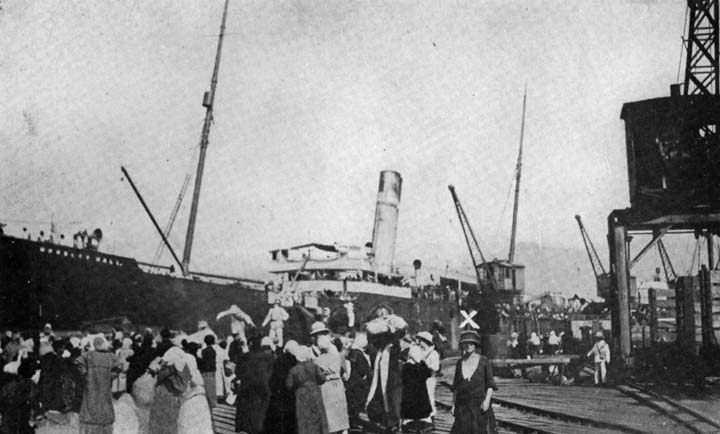 (x) Dr. Esther Pohl Lovejoy. |
At another time I was called to a woman in labor on the quay. There was a midwife in the crowd who promised to stay with the sick woman, if we would see that they were both put aboard a ship later. An American marine was with me, and we knocked insistently on the door of one of the few houses standing. Finally it was opened, the woman taken in and made as comfortable as possible. The place was full of frightened people. Just as I was leaving, a woman who spoke English detained me. She was in deep trouble like all the rest. Her sons and several other young men whose parents were in that house were hidden in the attic. Up a narrow stair she led the way to a low space at the top of the house, where these young men were lying flat on their chests looking out through peepholes under the eaves.
After the manner of mothers, this woman begged me to help these boys escape. The older members of the family would gladly die, she said, if only their young could live and be free. These boys were watching the ships in the harbor, measuring the distance and planning to make a swim for life and liberty. But their mothers were afraid. Night after night, young men from the quay, who knew that they could not pass the gates on the pier, were silently slipping into the dark waters, and no one ever knew whether they succeeded or failed in their desperate attempts to escape. It was a long way to swim and hard to beat against the steel plates of a ship in the darkness, when the waves were high. The waters were smooth in the morning, and told no tales of the night, but sometimes on the flooding tide a body was seen floating in the distance, and hundreds of women on the quay whose men had made that swim, said prayers for the souls of the drowned.
The anguish of the mothers whose sons were planning to swim from the quay was easy to understand, for the night before, the only time during the week that refugees were embarked after dark, two men were observed swimming toward the British destroyers in the path of a searchlight thrown across the water from another warship. Turkish soldiers, ordered to shoot the swimmers, stood on the edge of the pier and shot time after time. The men were a long distance from shore, and the bullets would go beyond or fall short of the mark, and skip like flat stones on the water, which was very smooth that night. Everybody on the pier, refugees, sailors, officers and relief workers, stood still and watched the spectacle. There was no noise, no screaming as might have been expected. The silence was broken by the repeated reports of the rifles. The tension was ominous. The American boys .were quiet, very quiet. Finally, one of the men ceased swimming. Perhaps he was hit. I do not know. At this point an American officer protested and offered to send out a boat and pick up the swimmers. This was done.
Then came the vital question of neutrality. According to the rules, I was told, these men could not be put aboard the British ship, although they might have been taken aboard, for humanity's sake, regardless of rules, if they had reached the ship unobserved. Beyond the path of the searchlight it was impossible to see, and I do not know from personal observation what happened after the light was turned in another direction and the launch passed into the darkness.
About a year later I was talking at the Young Women's Christian Association at Pittsburgh, and spoke of the boys of Smyrna swimming out to the ships in the harbor at night. At the back of the auditorium a young woman arose and said: "My name is Johnson. My husband is an American. I was born in Smyrna. My brother, fifteen years old, made that swim, and he is here at school in Pittsburgh."
Day after day there was a succession of harrowing incidents. Children fell off the pier and were drowned, young men committed suicide, old people died of exhaustion, and at the end of the pier, when two or three ships were loading at the same time, children were lost and their mothers ran to and fro frantically calling for their little ones, and great was the joy if the lost were found. But in many instances such children were already stowed away in the holds of outgoing ships, crying for their mothers, who were put aboard vessels bound for other ports.
Women whose husbands had been seized and whose sons had swum away into the unknown at night, moved down that pier silently, and sometimes audibly praying for strength and mercy. With seemingly impossible loads on their backs and their little children by their sides, they passed those infernal gates. In view of their astounding strength and endurance, which was repeatedly remarked by strong men easing their burdens from time to time, who, with eyes and ears and understanding, can say that their prayers were not answered?
The flaming spirit of nationalism was the immediate cause of all this suffering, but behind it in Turkey was religion. The Anatolian Greeks and Armenians had been Christians for about a thousand years before they were conquered by Turkish invaders, and the Faith by which they had lived sustained them in their suffering. No matter how imperfect they may have been as Christians and human beings (and on this point we should withhold judgment lest we be judged), they believed in the saving power of God through Jesus Christ, and this was their last refuge.