
An amazing state of affairs existed at Leninakan at the time of our arrival. The native workers of the Near East Relief, who depended somewhat upon that organization for their lives and the lives of their children, were on a strike against the organization for the reason that five of their number had been discharged by one of the American directors, Mr. B.D. MacDonald. This was in direct contravention to the Soviet principle. Therefore, a strike had been called and was in full swing when we arrived. Under the Soviet scheme of things, the Union of Workers in different industries are supposed to run the industries. The Union of Workers (native) in the Near East Relief, backed by the government, was demanding that the five men who had been discharged be reinstated and the American director dismissed.
Conference after conference was held. The American personnel was intensely interested. It was not merely a ratter of reinstating five Armenians and discharging an American director. There was a principle involved, upon which the world stands divided. It was a test case, which for a week or more was argued pro and con, not only by those with authority to settle it, but by the native and American personnel in private conversation. In the opinion of some of the workers, an American relief organization should have the right to "run its own show," while others argued that individuals and organizations, operating in foreign countries, should "play the game" in accordance with the laws of the land. Naturally, the Union of Workers and the Soviet authorities took much the same position as the Turks at Angora were taking regarding capitulations and foreign institutions in Turkey.
Finally terms were arrived at. The five men were reinstated, the American director resigned and the trouble was over. The Union of Workers was, of course, pleased with the outcome, but the American personnel were far from satisfied. Some of them held that the first American Soviet had been, at least, partially established, while others said, "Pshaw! There are Soviets all over the United States. In many of the big industries and public service corporations the workers, including the managers, are organized for mutual benefit."
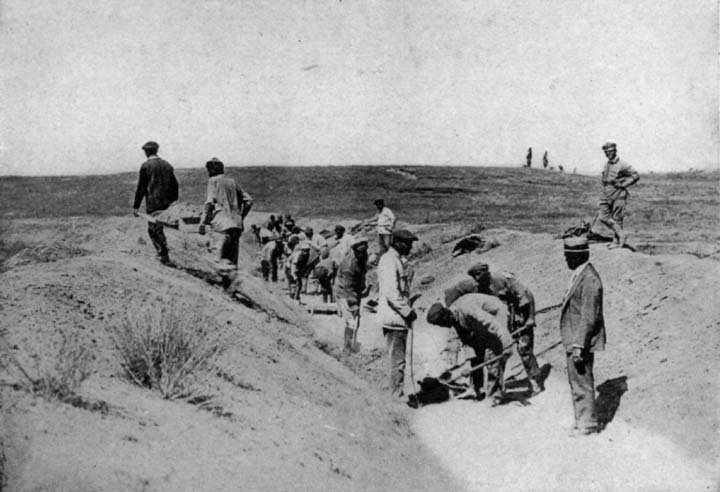
The Union of Workers, backed by the Government, had won, but not without concessions, in witness whereof a mandate had been signed-another covenant of Ararat for time to test. The Americans were doing a great work in child salvage, education, medical service, physical and industrial training, and scientific farming, including engineering. Public improvements, such as roads, bridges, streets and systems of irrigation, were being constructed in accordance with their plans, and laborers, people who would otherwise be hungry and naked, were being paid in American food and old clothing.
The Soviet Government had placed at the command of the Near East Relief four large systems of military barracks, containing approximately 250 substantial stone buildings, 36,000 acres of land, rent free, on which to develop agricultural colonies, and 16,000 acres of grazing land for the development of dairying and animal industry. Naturally, the leaders in the government were anxious to have the Americans stay on the job, but not at the price of divided authority.
As a geographical expression, and to a large extent as a religious entity, Armenia has survived for centuries under one outside power after another. Persia, Turkey and Russia have misruled the country in turn. Following the great war came the tri-state federal republic, the Armenian National Republic, and finally, the Armenian Soviet State, a constituent part of the Union of Socialist Soviet Republics.
Shut away from the rest of the world, Armenia is enormously interesting as a social experiment station. To be sure, Moscow is the ultimate source of authority, but Moscow is so far away that she cannot meddle overmuch with local affairs. In 1919-20, Miss Witte and others reported wholesale starvation and death in Leninakan and Erivan; in 1921, Dr. Elliott and others reported similar conditions. A year later when I was in Armenia, crops were being harvested, and, although there was danger of hunger during the following winter, the Union of Workers and the local government felt strong enough to enforce their principles at the risk of losing what amounted to an enormous American subsidy.
The general state of affairs in Soviet Armenia was a revelation to me, although I had been receiving letters, reports and photographs from the country for three years. All of this material, received from physicians and nurses, dealt with famine, pestilence, disease and death. Taken together it constituted one of the most appalling stories of human suffering ever written. These letters and reports were irregular. Other reports were perhaps lost in the mail, or destroyed by the censors. In any case, no specific reference was ever made to the extraordinary experiment in communist government, including agriculture and child-rearing, in which the Americans were participating on a large scale.
This was an ideal place for such an experiment; a sort of social laboratory, far removed from outside influence and conducted under conditions especially conducive to success. The country was manifestly rich in natural resources; the young men at the head of the government were fanatical in their zeal. Communism was their religion, and they had but one God. A great American organization was carrying part of their natural burdens, supporting many of their children, providing food and clothing for adults, which was exchanged for labor on public utilities, and for the development of model farms and other nationalized industries.
Communism has always seemed to me an impossible dream, sure to defeat its own end by discouraging individual enterprise. Time after time it has failed in the United States and elsewhere when attempted on a small scale without subsidy, but its advocates have always argued that, subject to extraneous influences, it has never been given a fair chance. This form of government is certainly being given a fair chance in Armenia, and fostered as no other new government has ever been fostered, if it does not make a conspicuous success, there must be something wrong with the system as applied to human life in its present stage of development.
The men at the head of the Armenian Soviet Government in 1922 were not the dreamy idealists we read about, but young Armenian university and business men, and Armenians are said to have a genius for business. There is an adage in near eastern countries to the effect that a Jew can out-trade a Turk, a Greek a Jew, an Armenian a Greek, and this may apply in the business of running one state in a Soviet Union, as well as in individual affairs.
There were two kinds of Bolsheviks in the Caucasus, "Reds and Radishes." The Reds were red all through and the radishes were red outside and white inside. The "radishes," currying favor among unconverted Americans with one hand and serving the Soviet with the other, did not hold the big jobs. The high officials served but one master, and some of the Americans working with them frankly stated that, judged by results achieved in two years, Communism was the best form of government that country had ever had.
 |
 |
 Soviet Armenia. |
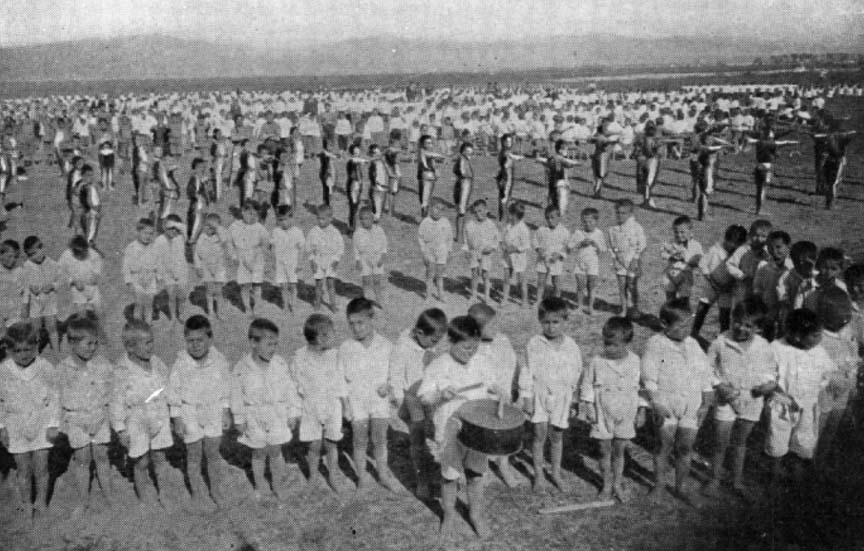
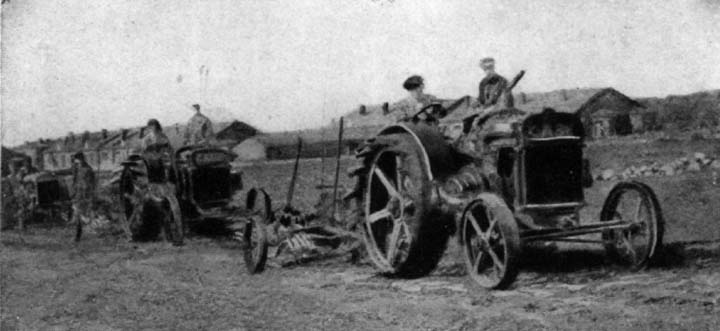
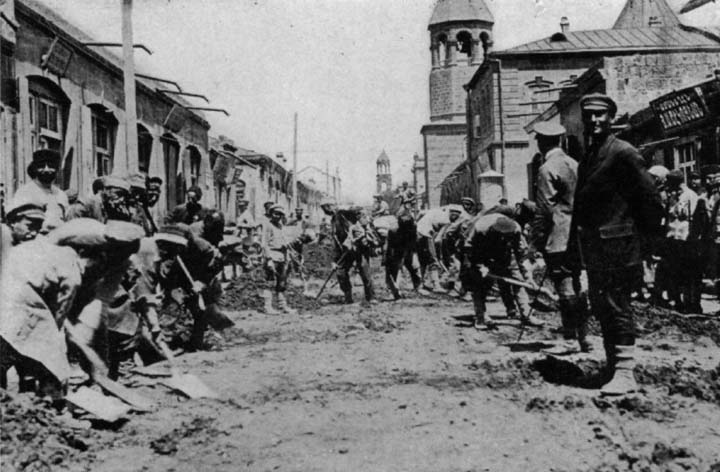 The laborers shown in these pictures were paid in American food and old clothing, |
In the New Near East for November, 1922, an article appeared under the caption, "Repopulating the Garden of Eden," by Mr. William A. Biby, containing the following paragraphs:
Modern America using waters which fed the Garden of Eden sounds like another of those Arabian Nights yarns which originated around this fortieth meridian east, centuries ago, but I have seen the first dirt turned which will mean American reclamation of 120,000 acres of cotton, rice and grain land, with the aid of the Garden of Eden river.
* * * * * * * The irrigation project will take water from the old Araxes River, the upper end of which, historians contend, was one of the borders and supply sources of the Garden of Eden prosperity. By rebuilding old irrigation canals and cutting some new life-giving streams, America will restore scores of abandoned fields. In addition she will reclaim virgin soil that, for want of water, is fast tending toward the same kind of desert which now separates Armenia and the Holy Land, once a populous, productive region. Refugees will do the work for ten cents' worth of grits, American dehydrated corn, a day, and a few American old clothes from time to time.
Dr. Elliott and I inspected the orphanages and hospitals together, and as the days passed I became more and more impressed with Armenia as a social experiment station, an isolated laboratory in which the Armenians and Americans were conducting an important experiment in the communistic scheme of life.
American money and efficiency combined with Armenian tenacity of life and purpose constitute a strong alliance. Give that union one generation in which to work unhampered and we shall see what we shall see. But, one thing is certain, there will be a lesson in Communism to lay before the world.
In Moscow and other parts of Russia, I visited Communistic homes for children, but they were not like those in Leninakan and Erivan in the Armenian Soviet State. At the Central Health Department of the Union of Socialist Soviet Republics in Moscow, I saw an artistic health exhibit with plans, specifications and a fine program---all on paper. In the Armenian Soviet State such a program was being put into actual operation.

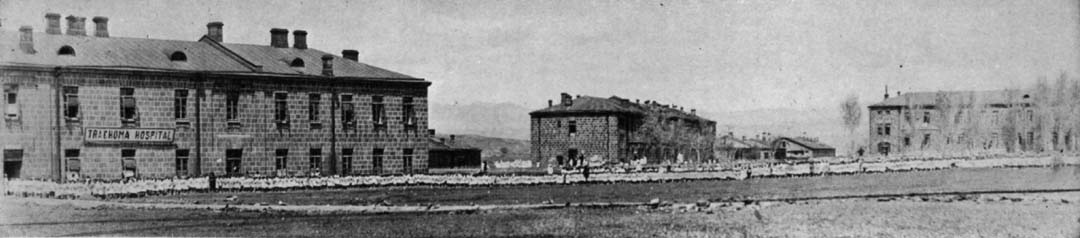
THE medical work in connection with the Near East Relief program was coöperative, and a wonderful work it was. At the time of my visit in 1922, the Government was supplying the buildings, the Near East Relief repair service, equipment and supplies, and the American Women's Hospitals provided personnel, paying the salaries of all persons, native and American, working in the hospitals, or in any way connected with the medical end of this service. There were orphanage hospitals, isolation pavilions for contagious diseases, camps for tuberculosis and special hospitals for eye diseases, including the trachoma hospital at the "orphan city" of Leninakan under Dr. R. T. Uhls, a surgical service under Dr. R. O. Blythe and a training class for nurses in which over a hundred students were enrolled.
Reports regarding the number of children in the orphanages and hospitals, for all of whom we were medically responsible at that time, are somewhat conflicting. The Near East Relief report to Congress for the year 1922 gives the number as approximately 25,000. In an article published in 1925, Dr. Uhls states that there were 40,000 children in the orphanages and hospitals of Armenia, and in the preface of Beginning Again at Ararat, signed by Dr. Mabel E. Elliott, the following statement appears:
I went to Ismid for the American Women's Hospitals, with a staff chosen, equipped and paid by them, to open and manage a hospital for which the Near East Relief furnished all supplies. Later the American Women's Hospitals sent me to the Caucasus to take over, for them, a larger share of the medical work of the Near East Relief. This association of the small, specialized organization, with the large general one, proved so satisfactory that before I left the Caucasus my organization, made entirely by American women and employing only women in all executive positions, was handling the whole medical work of the Near East Relief in the Caucasus, a work involving the care of 40,000 orphan children, all of whom were at one time patients.
My own observation leads me to believe that the lower figure was nearer right, but in any case, order had come out of chaos. Hospitals were conducted at Kazachy, Polygon and Seversky Posts and unbelievable numbers of treatments were given daily at the "medical factory," which was running at capacity, regulated by the clock, calendar and bugle call.
Leninakan might better have been named the "trachoma city" than the "orphan city." All the people in that country whose children had eye diseases tried to get them into the orphanages at Leninakan, where they would get food, education and proper treatment. It was not possible to tell whether a child was an orphan or not, but it was possible to diagnose trachoma, and practically all the children in the orphanages and hospitals of Leninakan had trachoma.
 |
 |
 |
|
|
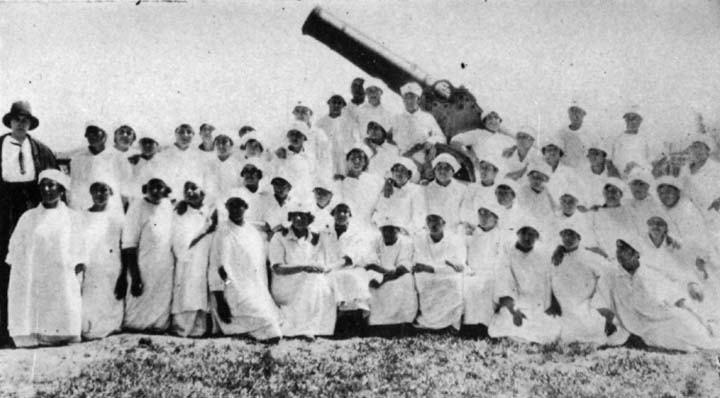
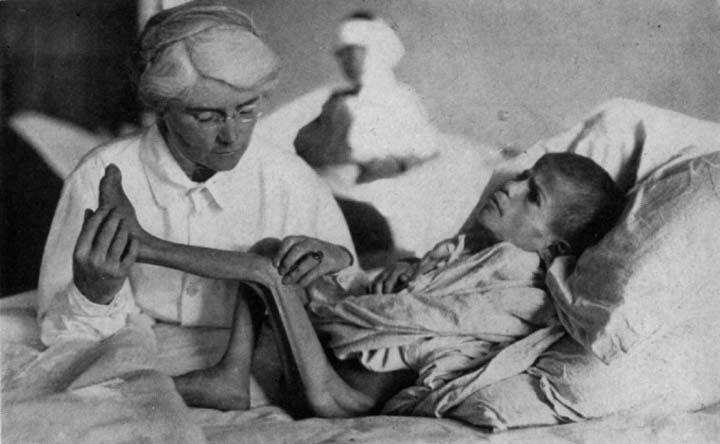
Dr. Mabel E. Elliott, head of the American Women's Hospitals in the Near East, 1920-23. Departments of the "Medical Factory," nurses training class and trachoma service, so vividly described in her reports, are visualized in these pictures. Note the line of children moving through the Trachoma Clinic for treatment. |
|
The eye work was under the direction of Dr. Uhls, and his system of wholesale treatment was nothing less than marvelous from the standpoint of efficiency. Reports showing hundreds of thousands of treatments were not typographical errors. Thousands of children with trachoma passed through the clinics daily, almost as fast as a line of people can pass through a subway registering gate. The work was partly automatic, each child picking up his applicator as he moved down the line toward the physician or nurse, by whom his eyelids were deftly turned back and treated. This process required only a few seconds for each case, but the treatments had to be kept up, day after day, for months and years.
The findings of this clinic should be of enormous value in the scientific treatment and prevention of trachoma. It is usually the mild, unrecognized cases of contagious diseases which broadcast them through communities, carrying them along the lines of travel from city to city, and country to country. Most of the cases of trachoma were mild and sometimes hard to diagnose, but the mild as well as the severe cases were under control. It will be interesting to note, at the end of a decade of treatment and instruction in the prevention of diseases, how Armenia, with a population of 1,200,000 specially educated in matters of health, compares with neighboring nations which have not shared in this unprecedented advantage.
Accompanied by Mrs. Cruikshank, I visited Djalal-Oghli, a mountain village near Big Demon Cañon, about 120 miles from Leninakan, where there was a large orphanage hospital, with Dr. Elfie R. Graff in charge of the medical service.
 |
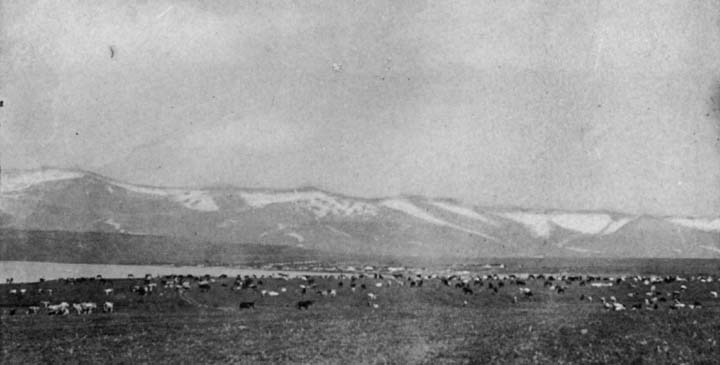 |
This entire district is one of the wonders of the world made accessible by the automobile to travelers with scant time at their disposal. Hour after hour, we ran upgrade over a winding road along precipitous hillsides. We had never seen such grazing land. Range above range covered with grass, a sort of wild timothy, luxuriant beyond belief and at least five feet high in protected places, where it was not kept down by the cattle and sheep. The contour of the country was like a great bowl of heaping hills, and away beyond these green ranges, the snow-capped mountains reached the clouds, completing the enclosure and shutting out the rest of the world.
Among the wonders of the day was the road cut in the face of sheer mountains in many places. It must have been built at enormous cost, which we could not understand until we were told that the estate of 16,000 acres surrounding Djalal-Oghli, had formerly belonged to a member of the Russian royal family. The Ptolemys, Bourbons and Romanoffs did not count the cost of the things they wanted. This royal estate had been assigned by the Soviet Government to the Near East Relief for the development of a model dairying and animal industry center, and I doubt if there is a better place for this purpose in existence.
Labor was not a problem in connection with this undertaking. It was available at the Ptolemy and Romanoff rate, the rate that made the building of the pyramids possible, but there was a fundamental difference. The laborers were now supposed to be building up their common inheritance, and that of their children, instead of the inheritance of their kings and masters. Tractors and other farm machinery had been sent from the United States, fine cattle imported from Switzerland, modern dairy machinery was to be installed, and a power plant was being built in the depths of Big Demon Cañon---another wonder of that world.
Big Demon River named itself. It is a turbulent stream at the bottom of a narrow chasm, four hundred feet deep, cut in the level plateau. The brink of this cleft is apparent only at close range. Many lives have been sacrificed to the fury of Big Demon, snorting, tossing his white mane and pawing the boulders in the bed of the cañon. But his wild days were almost done. He was about to be harnessed and his great strength used to furnish light and power for his masters.
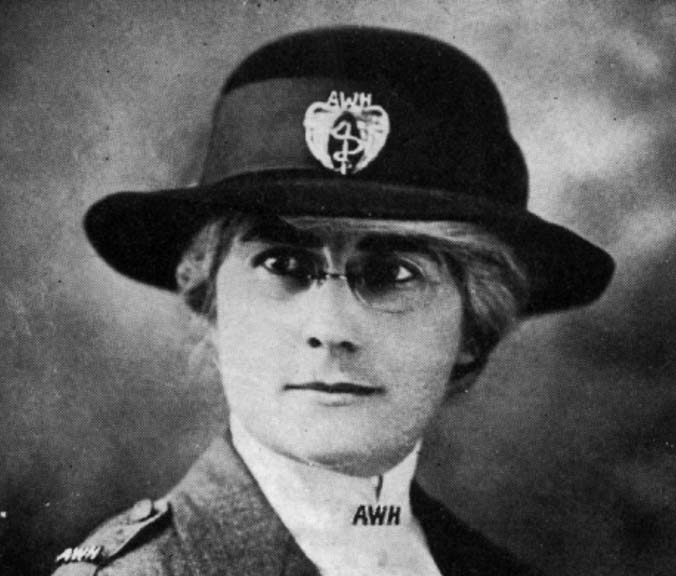
Our ride through the mountains and along the rim of Big Demon Cañon was a thrilling experience, but our special and particular thrill was meeting Dr. Graft with the A. W. H. insignia on the front of her hat, and seeing the little ones she was caring for in that out of the way corner of the earth. The American Women's Hospitals had gone far and done well in the few years of its existence.
"UNCLE America Sees It Through, or, Seeing Is Believing," a remarkable photoplay, was being filmed in Soviet Armenia at the time of our visit. All the children from the orphanages were mobilized for this picture. In Leninakan there were perhaps fifteen or twenty thousand children housed at the three different posts, several miles apart, which had formerly been used as military barracks by Russian soldiers. The making of this picture was an exhausting task, even for those who rode in automobiles, and the children had to walk.
"Uncle America" was a Near East worker on the home service end. Had he been born two decades later, there might have been another star in the movie firmament. He never had been an actor, and he didn't want to be one, but there wasn't another man among the Americans available who could successfully register philanthropy. He looked the part, and I believe he was the part. There are good, bad and indifferent uncles, and "Uncle America" was a good uncle. For the sake of the children, he was willing to be an actor, or Santa Claus, and he didn't care whether they were Armenian, Greek, Russian or Turkish children. Poor little kiddies! They didn't select the part of the world into which they were to be born. That was their bad luck, and as soon as they were old enough to realize the mistake, they were all keen on correcting it, and getting to the United States without loss of time.
The moving-picture corps motored from place to place in order to get the special features of the story, every detail of which was carefully pre-arranged. But the big job was done on the parade ground at Leninakan, formerly used for military drills. Day after day, the children were assembled for practice on this great square. There was a pulpit in front of the Russian Church facing the grounds, in which a priest, in picturesque vestments, was to be "shot" blessing the children. When the stage was finally set, and the children at attention, after days of intensive training, the priest ascended the pulpit and "registered" in accordance with instructions. "Shoot!" came the startling command, and it is a good thing the poor old man did not understand our language, for even those of us who knew what it was all about, were relieved to see him descending from the pulpit quite uninjured, with a childlike smile on his venerable face.
The endurance of the children was beyond understanding. About five thousand little boys, none of whom were more than eight years old, lived at Polygon Post, where I was staying. They were perfect little Spartans. Their rations were simple, containing the proper proportions of the different kinds of food necessary for normal development. Their lives were absolutely regular. They arose, ate, went to school, to work, and to bed by the sound of the bugle.
Polygon Post was five miles from the parade ground, and these little tikes walked in their bare feet, drilled most of the day in the hot sun, without food and with very little water, and marched back in the evening, as chipper as though nothing had happened. I thought surely some of them would be sick, but they seemed to enjoy the experience, which had no bad effect whatever.
Groups of visitors were always watching the children, assembled from the different posts, drilling in preparation for the picture. Companies under their own leaders were so well trained that they marched and counter-marched, forming the most intricate figures with little apparent effort. On one occasion, the question of what was to become of these children was discussed by a group of American spectators. They would, of course, be engaged in different industries, particularly the basic industry, farming, and they would undoubtedly exercise a safe and sane influence in an unsafe and insane environment. This was the stock argument, but some of the American personnel, who had lived in the country long enough to develop a pink tint, maintained that it was none of our business what the children did when they grew up. We had not asked what was to become of the French children we had cared for after the war, or the German or Austrian children. We were not asking why Turkish students in American schools in Asia Minor were so partial to engineering. Why should we ask what was to become of the children in Soviet Armenia?
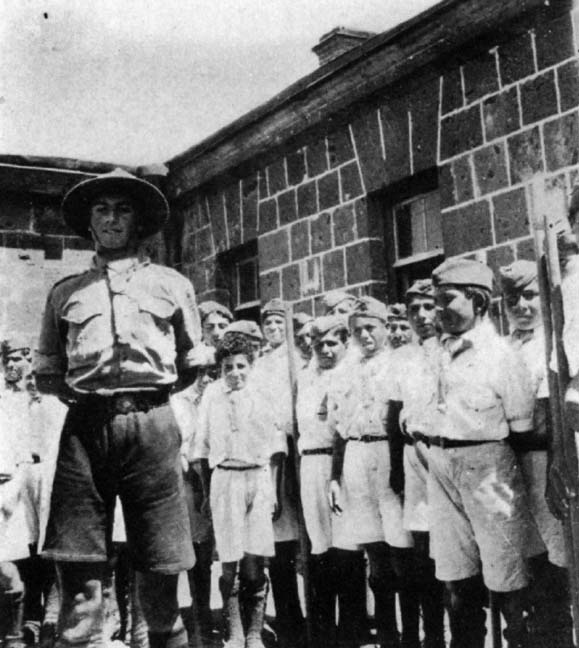
A few days later the orphanage boy scouts were reviewed at Erivan. They wore shoes and a good many of them shaved regularly. In perfect formation they marched down the street, and we understood instantly why the Turks did not favor Armenian boy scouts, and why they did favor Turkish boy scouts.
 |
 |
 |
As the first few hundreds passed, we felt that they were a picked company. They were. Life had picked the most enduring. The others had died. On they came, and came, and still they came. They were manifestly proud of their performance, and well they might be. The question of their placement was raised again. The answer was obvious. Their future was bound up in the future of Russia. They were almost ready for service. All some of them needed was a red star on the front of their caps.
No group of children in the world is better prepared for communistic life than those children raised like Spartans in the American orphanages of Armenia. They have been communists ever since they began to eat three times a day. Many of them remember no other life. In a land of illiteracy, they are well educated. They know the languages of the East and the West. Especially trained in industries conducted for the benefit of the group, these children are not only physically and mentally, but psychologically equipped for service in the Union of Socialist Soviet Republics.
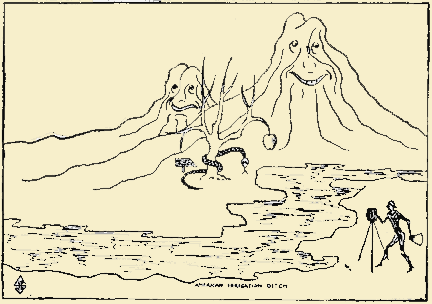
Mount Ararat is a grim, unsmiling mountain in a tragic setting, but through its connection with the story of the flood, it has helped to furnish more smiles for mankind than all the other mountains on the face of the earth. What would the smile makers do without Noah? A cartoonist without the ark and the animals would be sadly handicapped. The power of the funny page has somewhat overcome the majesty of this mountain so far as Americans are concerned, and its frowning aspect does not always check facetious comments, which are usually colored by the experiences of the commentators.
But Ararat did not frown upon us. He was not in a frowning mood. Strangers from the north, south, east, and west and out of the Land of Nod, had usually come for damage. No wonder Ararat frowned. But this seed of Japheth returning to the original field from over the sea, and turning the Garden of Eden into a temporary Hollywood, had surely come for good. Looking out over the traditional holdings of Adam and Eve, where a plan to make the waters flow regardless of the weather, an American irrigation system was being installed for the Soviet State, this patriarchal old mountain seemed to smile at "Uncle America," and the rest of us registering our better selves in connection with a great work for the relief of suffering. Even little Ararat perked up out of the clouds, and seemed to be taking an interest in these strange things happening under the sun.
All the American visitors and personnel were entertained by the Government on the day before our departure. There was a reception at the "White House" followed by a theatrical performance and concert, and finally a dinner in the evening.
The President of the Federation of Georgia, Armenia and Azerbaijan, the members of the Economic Council, and other officers of the Soviet Government, received us in the official reception room, which had formerly been used by the representatives of the Russian Empire. The pictures of the Czar, Czarina, and members of the royal family, had been replaced by those of Lenin, Marx, Trotsky and other men, but I looked in vain for the picture of the martyr, Rosa---what was her name? I have forgotten already. I wonder if it pays to be a martyr.
The theatrical performance and concert was manifestly an exhibition of native culture for the benefit of the Americans, and it certainly was edifying. First they sang the "Internationale" and they put so much temperament into it, that we could feel the meaning although we did not understand their language:
Arise you pris'ners of starvation! Arise ye wretched of the earth,
For justice thunders condemnation, a better world's in birth.
The children at the orphanages had sung the "Star Spangled Banner" for the American visitors and we were thrilled. They sang it in our language as a performance for our entertainment. But when those people sang the "Internationale" they sang it as the Germans sing "Deutschland Über Alles," and the French sing "The Marseillaise."
The dinner was the crowning event of the day. There was plenty of good food, stirring speeches and an excellent interpreter. As an introduction, the band played the "Internationale" and we all stood at respectful attention, just as we would have done in any country while listening to the national hymn.
The President of the Economic Council, a youth consecrated to Communism, delivered an address of welcome supplemented by an impassioned exposition of the living principles of the U. S. S. R. (Union of Socialist Soviet Republics), after which the band played the "Internationale" and we all stood at respectful attention again. Mr. Charles E. Vickrey, the guest of honor, talked of universal brotherhood and the work of the Near East Relief, and the band repeated the "Internationale" while we all stood at attention as before. Taking their texts from Lenin, the Soviet representatives spoke with faith and fervor. Their attitude seemed paradoxical. Disavowing religion, their creed was the Golden Rule---the soul of Communism. With the help of God, it was intimated, this principle had been preached long enough. Without the help of God, the Communists proposed to put it into practice the world around.
After each speech, American or Soviet, the band played the "Internationale" and we all responded respectfully whether we wanted to or not. The Bolsheviks were beaming. Their hymn had been practiced on local audiences and it had never failed to exalt the spirit of Communism. This was the first opportunity of trying it on so large a company of outsiders. At least fifty Americans were present. In addition to field personnel, there were Near East home workers from many of the states between New York and California, and to see them moving up and down to the tune of the "Internationale" was an inspiring spectacle to the Communists, symbolic of the Movement in the United States, Canada, Mexico, and all the mother countries, including England, France, Germany, Italy, Spain and the Irish Free State.
Music hath charms. But I could not listen to "America" (tune, "God Save the King") or to the hymn of the Sein Fein Republic, six times in succession without developing ptomains of fatigue. There were at least twelve speakers and I was the last. The Soviet representatives seemed particularly interested in what I had to say, although I was merely telling the story of the work of the American Women's Hospitals in their own territory. This was the only field in which we did not negotiate directly with government officials, and, for this and divers reasons, the work did not seem like our work in other countries.
"Bravo! Bravo! Bravo!" cried the Bolsheviks, time after time, and especially when I sat down.---"Hope springs eternal in the human breast!" Surely those musicians would play the "Star Spangled Banner" for a change and as a farewell courtesy to their American visitors.-But "Communism knows no border." The band struck up the "Internationale" and we all stood at respectful attention until the last note had died away, after which we departed in peace.
THE second meeting of the Medical Women's International Association was held at Geneva during the first week of September, 1922. I was President at that time, and representatives from seventeen countries answered the roll call. Among the delegates from the United States were Dr. Eliza M. Mosher, Honorary President of the Medical Women's National Association, Dr. Grace N. Kimball, President of the Medical Women's National Association, Dr. Elizabeth B. Thelberg of Vassar College, and Dr. Sue Radcliff, all of whom were members of the Executive Board of the American Women's Hospitals.
A quorum of our board was present at Geneva, and a special meeting was called at which Dr. Etta Gray and Dr. Mabel E. Elliott made reports regarding our work in their different fields. Conditions were improving in Serbia, and for this reason retrenchments were decided upon and a corresponding increase of activities elsewhere. Dr. Elliott was authorized to undertake special work in Constantinople and I was instructed to meet Dr. Graff at Moscow for the purpose of arranging the Russian program of the American Women's Hospitals, which we were conducting in coöperation with the American Friends Service Committee (Quakers).
In spite of our experience in Erivan in 1920, and at Ismid in 1921, we reckoned without the Turk. We should have known better. The deportations and massacres of the Christian population of Turkey had been going on for years. The Turks had manifestly adopted a radical plan for setting the vexed question of the Christian minorities, by getting rid of these minorities during the confusion of the World War, with its aftermath of lesser wars, and oiling the troubled waters later if necessary.
The League of Nations was in session at this time, and on September 5th, four days before the Turkish occupation of Smyrna, the Kemalist Government sent a note to the League alluding to the atrocities said to have been committed by the Greeks in Asia Minor, and disclaiming "all responsibility for consequences that may arise from these terrible provocations."
This official notification of the impending holocaust at Smyrna, made the nations of the earth, particularly the Great Powers with fleets in the Mediterranean, accessories before the crime. But we should not be hard on the Great Powers. They are not always great. As represented by mortal men or women, like the members of our board, for instance, their aftersight is apt to be better than their foresight.
A week later, the burning of Smyrna was reported and all our plans were changed. With the approval of Dr. Thelberg and Dr. Kimball, who had formerly been a missionary in Turkey, I left Paris for Constantinople. Dr. Elliott had gone from Geneva and I did not know where to reach her. She was waiting for me at the station when I arrived at Stamboul. We had both heard and answered the same call.
In this unprecedented emergency, the American relief organizations pooled their resources and operated under the Disaster Relief Committee, Admiral Bristol, Chairman. The American Women's Hospitals contributed medical service and funds for medical supplies. Within a few hours of our meeting at Constantinople, arrangements were made. Dr. Elliott and her nurse left for Rodosta, Eastern Thrace, where thousands of refugees had been landed from the Turkish side of the Sea of Marmora, and I caught a "tramp," the bad ship Dotch, just leaving for Smyrna with food supplies.
The Dotch was a queer old craft. There was something about her that suggested a checkered career. I don't know where she got her name. The chances are it was an alias. She savored of irregularity, tar and bilge water. If she had been a man instead of a ship, she would probably have been hanging around a sailor's boarding house doing the chores for food, drink and smoke, hoping to be shanghaied just once more. She had a Greek crew, and sailed under the flag of Old Russia, an autocracy which no longer existed. Why she flew the old Russian flag was never explained, but two days' and nights' acquaintance with that vessel gave rise to suspicions that she could not be registered under any living government.
Constantinople was governed by the Inter-Allied Commission, British, French and Italian, and the Disaster Relief Committee must have gotten permission from the port authorities for the Dotch to sail. The Straits were controlled by the squadrons of the Allied nations. These were proud nations, and it is not likely that any of them would want to see their flag flying over a ship like the Dotch. Still, sailing through waters infested with piratical small fry, along a coast guarded by "irregulars," to a seaport city just taken by the Turks and practically wiped out, that vessel was sadly in need of colors, and Old Russia, deceased, was not likely to make any trouble regarding the use of her flag in this emergency.
With a box of canned food, coffee, bread for two days, and several sterno burners, another American and I went out in a caique to the ship, which was anchored in the Bosphorus. She was not licensed to carry passengers, and no provision was made for such persons. "How do you do?" said the Greek captain in broken English as we climbed aboard, and turning, he fired a vocal volley at the crew, after which the capstan began to turn, the chains clanked, the anchor came up reluctantly and we steamed away toward Smyrna.
I did not know my companion's real name. It began with an Sch---- and the finish was difficult for a person without the gift of tongues. To facilitate the hurried business of life during the war years, somebody had nicked him "Shorty." He was very tall and while I used his nickname, in my mental registry, it began with an Sch. He was a famous moving-picture man. Photography was not only his profession, but his ruling passion. His tracks, wide apart, on account of his long legs and haste toward the scene of action, covered the battlefields of Europe. He was a real sport. Shooting men and harmless animals with bullets was not in his line. Such atrocities had no attraction for him, except as pictures, and there was no danger to himself he would not brave in order to shoot a great picture. Nothing in the way of a moving photograph that "Shorty" started out to get, had ever been known to escape. After making the film called Grass in Asia Minor, this dauntless Nimrod "shot" lions, tigers, elephants and gorillas in their native haunts, and finally captured Tarzan, the ape-man, in the jungle of the imagination.
The trip to Smyrna was very distressing to "Shorty." He was torn, as it were, between two massacres. The one which had already taken place at Smyrna, and the one which might take place at Constantinople. We were the only Americans on the ship, and we told our troubles to each other. Time after time, as we walked the deck, "Shorty" paused, reflected and observed with manifest anxiety: "Dr. Lovejoy, I am afraid I have made a mistake. If the Turks break loose at Constantinople, there will be the greatest massacre that has ever happened in the history of the world, and I shall not be there to get it."
Great Britain was on the verge of war with Turkey. But Great Britain is used to being on the verge of war, especially with Turkey. Filibustering in a harmless way holds the field and keeps the world guessing until time effects desired results. The verge of war is a perfectly safe place for a well-balanced nation able to stay on the verge. Turkey was either bluffing or really did want to cross the Dardanelles into Thrace, and this move, successful or unsuccessful, would create a new set of complications to be adjusted. Perhaps it was time to let well enough alone. In any case, a formidable array of British warships stood offshore in the Dardanelles, and the British land forces occupied Chanak. It had been reported that a battle was imminent, and "Shorty" went ashore with his entire armament prepared to "shoot" the Turkish and British forces in action, but he came back within an hour quite disappointed, and reported that there had been a little skirmishing, which could be worked up nicely for newspaper stories, but nothing of any value for pictures.
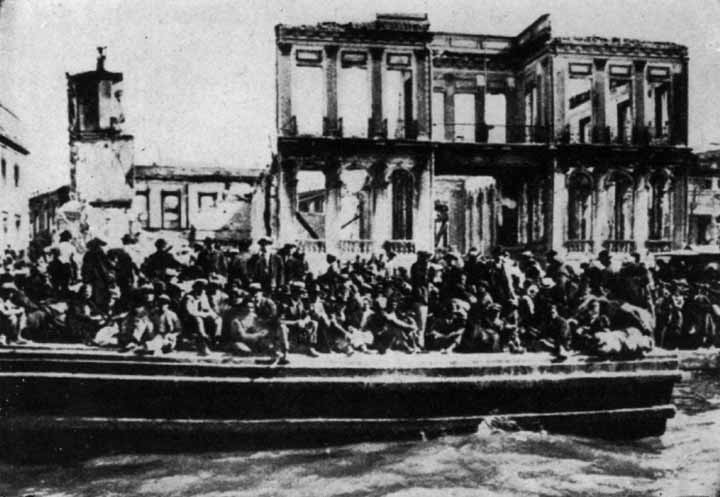
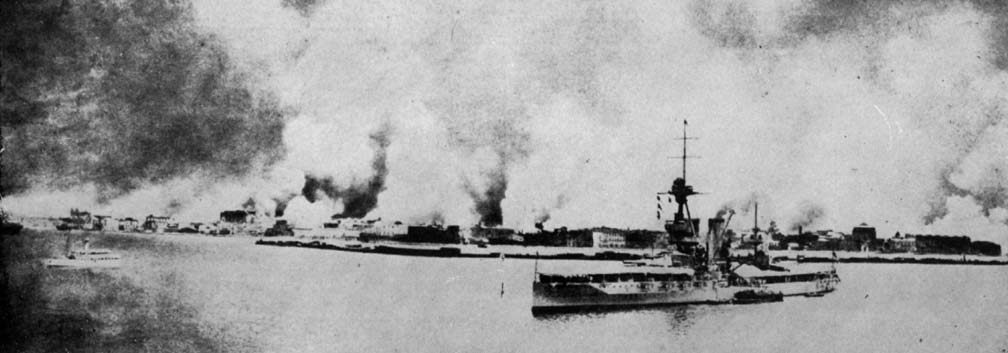
Smyrna, from the harbor, was a shocking sight. Scanning the smoldering ruins from the deck of the Dotch, memories of a former visit came back vividly. With the delegates to the World's Fourth Sunday School Convention, which met at Jerusalem in 1904, I cruised along the Mediterranean stopping at Smyrna and other ports, en route to the Holy Land. This pilgrimage was educational as well as religious. Sermons and lectures on the subjects of history, literature, art, and especially on the religious history of the lands we visited, were delivered by scholarly men among our delegates.
When the first historian made his first surviving record, Smyrna was standing at the head of a deep inlet on the Ægean Coast of Asia Minor, partially protected from the dangers of the sea by a landlocked harbor. The wealth of the surrounding country has been her blessing and her bane since the beginning. Midas and Croesus, whose names suggest fabulous riches, lived and ruled within a short distance of Smyrna. From Jason to Chester, from the time men began to paddle, to the time they crossed the ocean in oil-burning dreadnaughts, the quest of the Golden Fleece has brought them to the shores of Asia Minor.
Pirates and privateers came by water, and hordes of barbarians and others from Europe and Asia by land. Smyrna has been looted, burned and partially destroyed by conquering armies time after time in her long career. In self-protection, she has fought and bled throughout the centuries, but unlike her sister cities of old, she has never died of her wounds. Her bones have never been picked by vultures, gradually buried by the dust of time, and finally dug up by archæologists. Smyrna is one of the living wonders of the world. The wonder is that she has stayed on the surface of the earth, holding her place, name and commerce, reduced almost to the vanishing point at times, since the beginning of recorded history.
Smyrna is a lovely name, from a mythical Amazon, beautiful of body and unconquerable of spirit, but on account of her predominantly Christian population, she has been known among the Turks for hundreds of years as Giaour Ismir, infidel Smyrna. There are twelve towns in the United States called Smyrna, probably sponsored by godfathers, who knew the "tribulations" of the ancient city over which she has triumphed gloriously century after century.
The "Metropolis of the Levant" had intrigued my imagination, not only on account of her fine harbor, broad quay, and miles of attractive buildings along the curving shore line, but on account of her romantic life, changeless youth and early Christian associations.
There was inspiration in the religious history of Smyrna. John, the beloved disciple, Saint Paul, and the personal converts of the Apostles, worked as missionaries in that field, containing the sites of the Seven Churches of the Apocalypse. Polycarp, the first bishop and patron saint of Smyrna, was burned for his faith in the year 155 A.D. He did not lose his life---he found it. The heroic death of this venerable man, crowning a long life of service, won converts to the new religion for which he lived and died.
 |
 |
 |
 |
Our "pilgrims" visited the spot where Polycarp laid down his life, and the story of his martyrdom was told over and over again in sermons and lectures. Polycarp was beloved in Smyrna and the officers of the law were loath to take his life. They urged him to recant, but he would not recant or equivocate. Perhaps he had nothing but his soul and the souls of his converts to save.
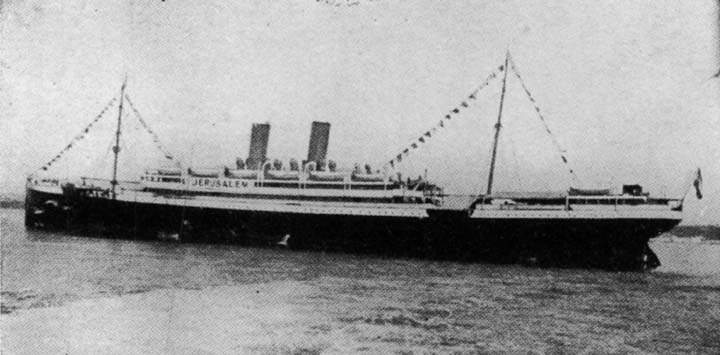
The Grosser Kurfürst was probably the largest ship on the Mediterranean in April, 1904, and along the side of the upper deck, the sign, "Jerusalem" in enormous letters indicated our destination and the nature of our mission. Although we were sailing in Turkish waters, we were not hiding our light under a bushel. The ship itself was a Sunday school, a bible school, and the passengers were eagerly studying bible lands and characters. Such a delegation! Committees from the missions came out in boats to meet us, and on every possible occasion we lifted up our voices and rejoiced together in that stronghold of the Christian Faith.
|
How firm a foundation ye saints of the Lord,
When through fiery trials thy pathway shall lie, |
This was the hymn actually sung by the delegates to the World's Fourth Sunday School Convention, over eight hundred Christian pilgrims, sailing away from Smyrna toward Jerusalem, on Easter Sunday, April 3, 1904. There were representatives of different denominations from every State in the Union, every province of Canada, from far and near countries of Europe, Asia and Africa, and from the islands of the sea.
An Episcopal clergyman from Manitoba led the responsive reading from the Easter Service; a Presbyterian missionary from Syria led in prayer; a Congregational minister from Ohio preached the sermon, and the Bishop of Macedonia, who was born in Smyrna, pronounced the benediction. Christ had risen and the people of the earth were uniting in His name. The spirit of unity and strength was expressed in another hymn sung on that occasion:
| Elect from every nation, Yet one o'er all the earth, Her charter of salvation One Lord, one faith, one birth; One holy name she blesses Partakes one holy food, And to one hope she presses, With every grace endued. |
But eighteen years had passed, ten of which had been devoted to warfare in that country. The navies of the nations, which had the largest representation at that Easter Service in 1904, were strongly in evidence in the Smyrna harbor in September, 1922. Their great ships were lying at anchor maintaining neutrality. The Turkish Army was in control of the country, its warplanes circling over the harbor. The Christian part of the city had been practically wiped out, and the Archbishop Chrysostom, a gentle old man, who had succeeded Polycarp after seventy generations, had been brutally murdered by a Mohammedan mob during the holocaust which followed the Turkish occupation.
On the deck of the Grosser Kurfürst in April, 1904, with Smyrna standing as witness, there was no question regarding the value of the early Christian sacrifices. But on the deck of the refugee ship Dotch in September, 1922, the stench of dead Smyrna in our nostrils, the sight of the Allied squadrons, American, English, French and Italian, under our eyes, and the sound of the Turkish airplanes over our heads, inevitably suggested the question, was the martyrdom of Polycarp and his followers in vain?
| Glory and Queen of the Island Sea (2) Was Smyrna, the beautiful city, And fairest pearl of the Orient she- O Smyrna, the beautiful city! Heiress of countless storied ages, Mother of poets, saints and sages Was Smyrna the beautiful city! They crowned with a halo her bishop there, In Smyrna, the martyred city, Though dabbled with blood was his long white hair--- O Smyrna, the martyred city! So she kept the faith in Christendom From Polycarp to St. Chrysostom, Did Smyrna, the glorified city! |