
WHEN the Turkish Nationalists took Marash in February, 1920, Dr. Elliott and Mrs. Mabel Power, who were serving in a hospital in that city, retired with the French forces. Dr. Elliott returned to the United States and resumed the practice of medicine in Benton Harbor, Michigan. Meanwhile, the proposal of the Near East Relief Committee that the American Women's Hospitals assume the medical responsibility for a large district in Asia Minor had been favorably considered. Funds had been raised for this purpose and in the autumn of 1920, our Executive Board appointed Dr. Elliott head of the American Women's Hospitals' Service in near eastern countries and sent her to Constantinople, with other personnel, as director of our work..
Owing to the military activities of the Turkish Nationalists and the Russian Bolsheviks, the Trebizond plan was out of the question and arrangements were made by Dr. Elliott to take over the medical work of the Near East Relief at Ismid, Derindje and Bardazag, in accordance with a coöperative plan which was afterward followed in the Caucasus and Greece.
The Greco-Turkish War had been going on for several months and this new area was occupied by Greek military forces. Warships of Great Britain and Greece were in the harbor, and a large number of Christian refugees had crowded into the towns around the Gulf of Ismid. It was a good place to wait. If the Greeks won, these noncombatants could move back to their homes, and if the Turks were victorious, they could escape massacre or deportation, by crossing the Sea of Marmora to Thrace.
Health conditions were in a sad state when Dr. Elliott took charge of the medical service in that district. Large numbers of children were dying from deprivation and exposure in the refugee camps. Typhus, tuberculosis, smallpox and trachoma were prevalent. The beginning of our Turkish story may, perhaps, best be told in diary form, excerpting passages from letters and reports received from. Dr. Elliott and Mrs. Mabel A. Nickerson, who were stationed at Ismid and Bardazag between January and August, 1921.
Ismid, Turkey.
January 5, 1921.I hardly know where to turn first in this hospital. When I tell you that I found four typhus and one smallpox case in the same "isolation" room, you can have some kind of an idea what it is like. We have ten typhus cases now.
* * * * * * * Miss Stroger went out to distribute clothes the other day, in a camp on the outskirts where she had been just before the rain set in, and where she saw that when it did rain it was going to be awful, as the children were absolutely naked. She sent in her order for old clothes and there was some sort of a mix-up about it, and they did not come. In the meantime, the rain started and when she got out there, she got so cross because they didn't take the baby clothes. Finally, she said to her interpreter, "go out there and speak to the crowd and tell the mothers to come and get the clothes for the children." He talked to them and they told him there were no children left since the rain. They had all died.
March 14, 1921
I wonder if the people in America realize what the magic words "American Women's Hospitals" mean to these people out here?
Many of the children are brought to us with their knees drawn up to their chins. They have lain such a long time in this position trying to keep or get warm, that it takes days of oil rubbing to loosen up the tendons sufficiently to draw their legs down straight. Many of them die within a few hours after their arrival, but usually if we can get them over the strain of the first two or three meals, they gradually begin to take a little interest in life and it is a wonderful satisfaction to see them slowly get a grip on life and learn to smile.
We have in our hospital what we call our "smile class." At first these children lie for days and just whimper like some little wild animal caught in a trap. We keep coaxing them to smile, until one day it comes. The great trouble is that the children need months and months of proper care and we can't keep them so long in the hospital, for there are always others to take their places. So I am planning a convalescent place across the gulf where the air is fine and they will have a lot of space.
March 31, 1921.
As you know, of course, the Greeks are advancing on this front, and for awhile the place was quite low as far as Greek soldiers were concerned, but reinforcements have come in so the place is pretty well filled up again . . . . We have refugees all the time from across the gulf where the Turks are up to their usual pastime of massacring the Christians. Twenty-six came in from a village the other day, and they were all who had escaped the knife. We watched the flames reach to the heavens as the poor little homes were laid in ashes.
* * * * * * * We have under treatment something like six hundred children for scabies. You can imagine what a job it is. For instance, to-morrow we start in with 220 here and 320 new ones were started in one of the outlying camps. They must all be treated three times. That means that for the next three days enough sulpher ointment has to be prepared to smear over 1620 bodies. All of these children get a bath first and their clothes are run through our delouser. Most of them need the delouser for its own sake, so it kills two birds with one stone, as it were.
To-morrow Mrs. Nickerson goes over to put the finishing touches on the Children's Convalescent Camp. By the end of next week, we will have fifty kiddies in there. We are going to have a lovely place. Mrs. Nickerson is going to run it.
Meanwhile, the Allied nations were playing the international game according to established rules, catch as catch can, each group scoring every possible point by hook or crook. The stakes must have looked attractive in the distance. The beneficiaries under the Treaty of Sèvres were not all satisfied, and therefore, the treaty had not been ratified by all the interested countries. The Nationalist movement in Turkey was growing stronger, and a policy of watchful waiting with an eye single to the main chance, was manifested by the different powers and commercial groups.
Greece was supported by the Allies when she went into the war, but this support got weaker and weaker. Lloyd George and Venizelos were out of office, and the great powers had had enough war for one generation. Finally a truce was arranged, a conference called at London, and recommendations made which were rejected by Greece. This was foolish. The weak should take their medicine lest they get something worse. But London, Paris and Athens are a long distance from Anatolia, and the men who accept or reject terms of peace usually sit in pleasant places. They do not feel the heat of the fires they light, or hear the groans of the wounded and the screams of women and children personally affected by their decisions.
After the London conference, hostilities in Anatolia were resumed on an increased scale. Victory perched on the banner of the Greeks for a time, but when different nations of: the Allied group withheld approval of the Greek military program, Victory flew away and lighted on the banner of Kemal.
Refugees scurrying before the Turkish Nationalist forces, reached the coast cities in large numbers. The British ships left the harbor of Ismid and everybody understood that the protection of Great Britain was withdrawn. Letters written by Dr. Elliott and Mrs. Nickerson give a vivid picture of what actually followed. On April 9, 1921, Dr. Elliott wrote:
I have had a couple of anxious days. The Kemalists surrounded!. Bardazag yesterday and so far we have been unable to get in communication with Mrs. Nickerson.
* * * * * * * We heard the big guns booming all day yesterday, last night and to-day . . . . Mr. Kyser from Derindje came over this morning and he and I attempted to land at the Bardazag dock . . . . As we approached the landing, however, we could hear the "crack, crack" of the rifles on all sides and the occasional "bang" of the big guns, and we could not persuade the boatman to go any farther. The captain of the boat said, "I have three children, why should I be shot?" So we laid off and listened to the battle for awhile, came back and sent word to Constantinople asking for a destroyer to come down and land one or two of us over there . . . . They must have all the orphans down in the cellars, and it must be a great job to keep the poor little things under cover.
It was a sight to see the fires burning last night. We counted seven villages burning all about Bardazag, and for three days the refugees from these villages have been pouring in. At least two thousand new refugees are here. The people from one village came in, and the place was not burned, so the Greek troops went out there with their machine guns, made trenches, and the refugees, thinking this a good protection, trailed back. The Turks, however, not dismayed, attacked and the people had to clear out again.
To-day I learn that the Greeks discovered a plan for the starting of fires in six places, one very near the hospital. I am sure all the Turks here are our friends, and our only worry is getting mixed in the mêlée.
Noon, Sunday, April 10th.
A heavy fog to-day and we can see nothing of Bardazag, but we can hear the guns. A Greek soldier was just here to tell me that they were unable to get a direct message from Mrs. Nickerson last night, but they would try to-day. Things are not just at their best now. My two American nurses are sick in bed, and Mrs. Nickerson cut off from us by the Nationalists.
3:30 P. M. (same day).
Enclosed find copy of Mrs. Nickerson's letter just received.MRS. NICKERSON'S LETTER Bardazag,
April 8, 1921.Well, we are having lively times, bullets whistling! One hit the roof of the house when we were on the balcony. They seem to be shooting from every side. The native teachers seem to be very much frightened. The people in the town moved down to the dock at daybreak to go to Ismid. The Greeks won't allow them to do that, so this evening they moved back. The Greek gunboat fired about six shots over the hills about 8:30 A. M., then steamed off toward Constantinople. Here we are high and dry! The report is that the Greeks were getting ready to burn out the Turks, and the Turks "beat 'em to it."
I expect you can see the towns burning. The Bardazag people know that is what will happen here, so they're scared! We hear big guns over your way so deduce there must be something doing over there too.
While the bullets were so thick we had the kiddies in, but now it has subsided for the time being. The citizens are armed. We saw many go up and join the Greek outposts this morning. They were fired on while going up the hill.
We can distinctly see the Turks directly in back of our buildings nearly to the top of the hill. They pass along a certain route, some leading horses, some mounted, but climb down quickly under fire.
I just went out to listen to operations that seemed to have a fresh start and "bang" went a gun seemingly right at hand and the bullet came whistling right by me.
7:30 P. M.---The report is that the Greeks are going to place big guns here to our right and give it to the Turks to-morrow.
8:00 A. M. April 9---Many Turks killed at the dock. Heavy guns began at 4 A. M. We are all right. The Greeks seem to have things well in hand .... Everybody on the alert. The children seem happy.
6:30 P. M.---It has been a wild day, bullets flying through the yard, the Greeks firing from behind the wall directly in front of the boys' building. The Turks answering just a short way up the hill. . . .The big gun down across the water has been shelling the place where we saw the Turks yesterday. For an hour it has been quiet. That has gotten to mean increased action later. There is one place on the road to the dock where everything that passes is fired on.
* * * * * * * This morning it was lovely at dawn. You should hear the birds.
For a time all was still and it was hard to realize that death and destruction lurked in the peaceful quiet of these heavenly hills.
* * * * * * * Nobody knows what will happen to-night---the worst fear is fire.
I am just writing along as things happen. They can tell us nothing of when we can get messages through.
A man is taking our mail just now. We are all right.
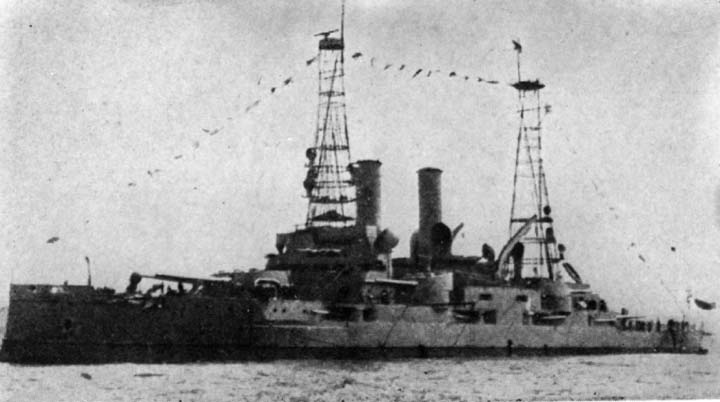 formerly the Mississippi |
 during the Battle of Bardazag. |
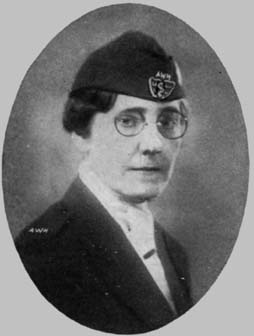
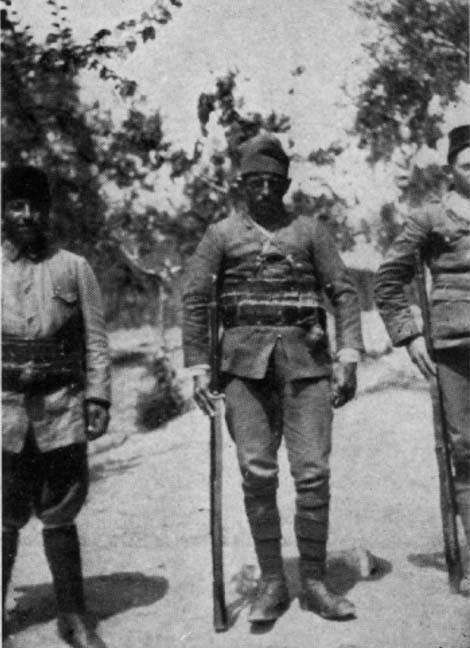 |
 |
During the months of May, June, and July, 1921, reports received from Dr. Elliott contained the following passages:
May 9, 1921.
As the time for the annual meeting of the Medical Women's National Association draws near, I am tempted to write you a rather concise letter in regard to our work and the importance of it, so that they may get a message from Turkey and perhaps a better idea of the importance of our work.
Mr. Jaquith, General Director of the Near East Relief in Turkey, told one of the workers in Constantinople that he considered the Ismid work one of the biggest and most important pieces of relief work now being done in Turkey, and, as you know, the American Women's Hospitals is paying the salaries and assuming the responsibility of all the medical work done in this area, which includes Derindje, Bardazag and Ismid regions. We have between 20,000 and 25,000 refugees in Ismid alone, a large boys' orphanage at Bardazag and a girls' orphanage at Ismid. There are five thousand refugees at Derindje.
Our work includes a 95 bed hospital, a 25 bed smallpox camp, a 50 bed childrens' preventorium (which was started at Bardazag and had to be discontinued because the Turks and Greeks came into our yard to fight, and which is now being reorganized here), a weekly clinic at Derindje, a weekly clinic at Bardazag and a daily general clinic, children's clinic and tri-weekly women's clinic at Ismid.
We are in close coöperation with the Greek Army and the Turkish civil authorities. To-day I have a conference with the chief medical officer of the Greek division occupying Ismid, so that we may do more thorough sanitary work in the refugee camps, 80 in number. To-morrow I have a conference with the Turkish city doctor about the cleaning up the city, which is one of the filthiest it has been my lot to see in the Near East. The American Women's Hospitals has undertaken the responsibility of cleaning it---it remains to be seen how successful we will be.
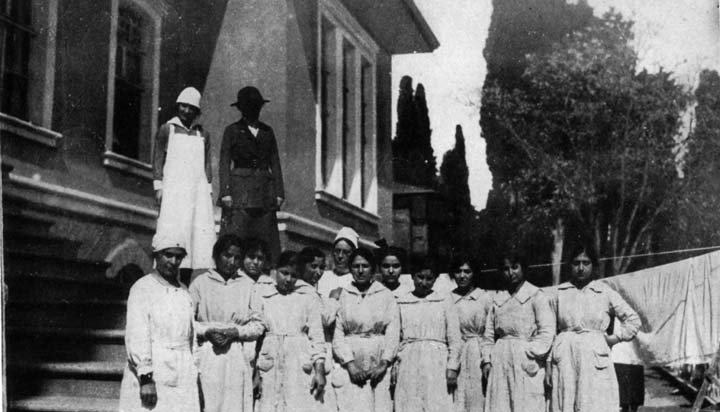
In connection with the hospital we have a class of 17 Armenian girls all of whom were refugees during the war, and we are beginning to be proud of them already. Unfortunately, while they are girls of good family and natural refinement, they have had very poor educational advantages because of the war. In addition to their regular nurses' classes we are giving them classes in reading, writing and arithmetic. We also have what I consider the most important work for a woman physician in this country, a class in midwifery. Women will not have men doctors and as a consequence they are forced, even the wealthiest, to employ the native midwife of Turkey, who is the product of the darkest of dark ages. Filthy in person and in habits, they are repulsive beyond measure.
If any one has a doubt of our usefulness here, one would only need to come to our general clinic and see the wretched creatures come crawling in more dead than alive. Now that there is active fighting on all sides of us between the Turks and Greeks, we get not only the wounded civilians, but many sick who have to wait their opportunity to come when the way is clear of fighting soldiers, or worse, the bandits who follow in their trail.
* * * * * * * May 16, 1921.
The hospital which we are now taking over was a Turkish hospital, then a British barracks, then a Greek barracks. It was as near a wreck as anything could be and still be revived. I have had between fifty-five and sixty men working there for two weeks and we are just beginning to see daylight.
* * * * * * * June 1, 1921.
Ten Americans came down for Decoration Day, so they were all here and I had our little ceremony for the capping of our class of nurses . . . . The next day we had our regular opening. The day was glorious and there were about a hundred of Ismid's prominent people here. We had representatives from the Army and Navy (Greek), the Turkish mustessarif, the Turkish municipal doctor and members of the Turkish Committee. The Greek Church was represented by the Archbishop and the Armenian Church by the Bishop.
The height of my ambition was reached when I repeatedly heard from all sides the exclamation: "What cleanliness!" and many of them said "The Americans' first thought is cleanliness!"
June 23, 1921.
The Eleventh Greek Division left this morning early and evidently have met their enemy at our door, for there is continuous heavy artillery firing all morning. A telephone from Mr. Kingsbury in Bardazag at four this morning asked for help to get his orphans out. Mr. Moffet went over and has not returned. I can't see how he can ever get through all this fighting, and I am very anxious, I can tell you.
* * * * * * * The town is jammed with refugees. The cemetery at the foot of our hill is simply full and they are sleeping by the side of the road. Just now I have sent out my native doctor to pick up sickly looking children and bring them to the preventorium. The bath water is hot, and we are having hot soup made. He asked me how many to bring and I told him not to count the beds, we'd put them on the floor. There have been about 5000 new refugees in the last two days.
* * * * * * * We are bringing our smallpox camp up the hill to-day, which is quite a job on account of the necessary disinfection involved, but I don't think it safe to leave them down there with the soldiers gone.
July 4, 1921.
The plan was for the Eleventh Division to form the left wing of the Brousa Front, this division crossing straight over on the Bardazag, Brousa Road, but the Turks met them right there at Bardazag, met the whole division, artillery and everything from Adebazar, Sabange and the whole Ismid front. And what's more, they held them so they didn't get by. There were eight gunboats in the harbor besides the Kilkis.(1) All day Saturday and Saturday night there were great fires between Bardazag and Dermanderine, and the big guns, and all the rest of it, were going at a great rate.
Sunday morning, our little game began, as was to be expected, with only three thousand soldiers in the place. It broke out on all sides of us. They were fighting between here and our water source and on the hill across from our picnic place. Soon the Kilkis began to shell and it shook things up, I can tell you. They shelled on all sides and back of the town. The Turks had trenches at Ratched Bey's place where we were working our tractor, and the shells did more plowing in one hour than the tractor did in a week. Wounded were being brought every few minutes and we had our hands full. . . Mrs. Power thought she was back at Marash.
About noon the Greeks landed three thousand marines to help out, and in the early evening the Commandant signalled the General across the Gulf that Ismid was falling and to send help. He came over with three regiments. Monday, we heard that Turks had been massacred and the General had given the refugees forty-eight hours to get out. By this time, we had refugees from Adebazar and Sabange. It looked like the whole world was refugees. You could hardly get through the streets. The cemetery and the road at the foot of the hill were jammed. The Turkish population was pouring down from the Turkish quarters, just as terrified as every one else.
July 6, 1921.
We have lived through the evacuation. All the Christians fled like rats . . . . Our nice girls have fled . . . . We hear they are at Rodosta . . . . We are running the hospital with little orphan girls from the American orphanage. At first they were to leave, too, but it was decided for them to stay on. We have these girls in the laundry, scrubbing the floors, nursing and doing everything else.
They are a dandy bunch, and pleased as Punch to be in the hospital.
* * * * * * * I am the only doctor left in the place. The Kemalists haven't even got a military doctor here, so I have the soldiers to look after, too . . . . We kept the clinic running until two men were stabbed to death in front of the building, and another shot. We brought the shot one up here and fixed him up, but he fled with the rest the next day . . . . We had an awful time with the smallpox camp to keep the convalescents from running away. A double guard was kept on day and night.
We have the most courteous treatment from the military authorities (Turkish). They are trying to protect us as much as possible from the "irregulars." All our buildings on the outside, including the clinic buildings, have been looted, and the Commandant assured us that he will punish the offenders if he finds them. We have nationalist guards on the place day and night, one of our destroyers lying in the harbor and a landing party up on the hill and at the orphanage, since the day of the evacuation.
* * * * * * * I am looking forward to your visit, but the picture will be different than what I expected to show you. You will not see our nice class of girls, and I shall not be able to show you what a lot they have learned in such a little while. Poor dears! They were so happy here and tried so hard to be a credit to us. It was wonderful to see what hospital discipline had done for them in carrying them through the crisis. These girls had fled before the Turks, times before this, but I know they never did it in such a dignified way before. I told them to stay on duty until I told them it was time to leave. And if you had stepped into this hospital at any time on that last day you wouldn't have known anything was wrong. I doubt if many American girls of seventeen, in fear of their lives and worse, would have done as well,
All was quiet at Ismid when I arrived in July, 1921. There were no fires, sounds of strife, or bombarding. Only one gunboat lay at anchor, and she was the U. S. Destroyer Brooks. The tumult and the screaming were over. The people were gone. If there was any loot left, it was buried so deep that no one would be likely to find it for awhile.
The Ismid massacre is said to have been an inadequate affair, in view of the opportunity and provocation. Some of the noncombatant Christians had secured arms for self-protection and with the connivance or help of the Greek soldiers might have taken reprisals for the deportations and massacres which had been systematically carried out against their people for years. But there was little time or inclination for vicarious revenge. The Christian residents of Ismid fled for their lives carrying only their most precious possessions. One American woman, at considerable risk, saved her porcelain bath tub.
In the good old days when a prize like Ismid was taken the soldiers were allowed three days' looting, and old customs are not suddenly changed, although new articles may be written to prove to the outside world that the rules of modern warfare are being observed.
The "irregulars" (chetas, bandits), were not on the government payroll it was said, but military service offered great opportunities for privateering, and was far more lucrative than highway robbery in times of war. These chetas are interesting gentry. They accompany the army like jackals and vultures, gleaning along the way. From time immemorial refugees from falling cities have been suspected of swallowing the family jewels, and a thoroughgoing cheta goes through the entire length of the intestinal canal of his victim.
The Turkish regulars and "irregulars" had fought and bled for Ismid, but when they entered the city there wasn't an enemy left to loot, unless the Turkish residents, some of whom had promptly moved into the homes and shops of their former neighbors, might be regarded as enemies. From the standpoint of victorious "irregulars" it must have been an empty victory. There was nothing to eat, nothing to drink, and not a Christian woman in the town except Americans, guarded by a United States destroyer. Even the loot had been skimmed, and there was nothing to do but make the best of a profitless job, and hope for better pickings in the future.
Falling was no new experience for Ismid, old Nicomedia. Age after age, that history-making city had been falling and rising and the chances are it will continue to fall and rise. The site has been good through the centuries, and therefore, it has revived repeatedly under different governments, while many of its contemporaneous cities have disappeared from the earth. Diocletian had decided to remove the Eastern Capital of the Roman Empire to Nicomedia, but his successor, Constantine, held to the site of Byzantium on which he founded the Christian city of Constantinople, dedicated to the Blessed Virgin. Constantine lived part of the time at Nicomedia and died in the suburbs of that city where the chetas were operating in the summer of 1921.
With all these ups and downs, the latest fall of Nicomedia will not make much of an impression on her history chart. Compared with former experiences, it was not much of a debacle, but from the standpoint of the American Women's Hospitals, it was a disastrous fall. There stood the fine hospital, which we were running in coöperation with the Near East Relief, on the inside of the Turkish lines, and the people it had been established to serve were on the opposite shore of the Sea of Marmora, greatly in need of medical care.
For the first five months of 1921, we had conducted the medical end of the American relief work in the Ismid, Derindje and Bardazag regions, and, in spite of inadequate buildings and equipment, a large service had been carried for the relief of the sick. With the help of Miss Leila Priest, Miss Griselle McClaren, Mrs. Power and Mrs. Nickerson, Dr. Elliott had directed this work. A training class for nurses had been conducted, and although the people we were serving had fled from the country, our work was not entirely lost. In a way, it was spread broadcast by the disaster. The young women belonging to the nurses' training class did not suffer the usual fate of refugees. They were not obliged to live on charity in refugee camps for long, or submit to even greater humiliation. Resources within themselves had been developed, and they were soon called to serve the sick in the districts where Fate had placed them.
Medical service should be developed on a plane with the lives of the people it serves. If they are very poor people in a very poor country, their medical work should be run on a low financial scale. Hospitals serving unstable populations, subject to the fortunes of war, and likely to be deported or forced to flee from the wrath of victorious armies, should be conducted in temporary quarters and always ready to move. This lesson at Ismid proved of great value in our plans for the relief of the sick among the Christian refugees from Anatolia, after the disaster at Smyrna the following year.
The Ismid Hospital on the hill was well located and equipped, but somehow the picture suggested Andromeda chained to a rock. It was officially opened on May 31, 1921, and three weeks later the evacuation of the district began. On June 26, the Turkish military forces occupied the city. This hospital overlooked the harbor within sight and hearing of the confusion and carnage during the battle and evacuation, but in spirit it stood five thousand miles apart, an American refuge for the sick and injured regardless of race, religion or nationality.
There they were, Turks, Greeks, Armenians and chetas, perhaps, hobnobbing together as though they all belonged to the same fraternity---and they did: the fraternity of the wounded. Men who had been fighting each other to the death, were friendly and solicitous regarding the welfare of their wounded enemies. Glancing down the ward, the whole tragic business took on a comic aspect, and one of the nurses referred to a Mohammedan prophecy of dire calamity in store for certain unworthy brothers, who were to be punished by passing through generations of degradation, and sinking deeper into the abyss, until they reached the uttermost depths, where they were to be ruled over by women. The culmination of this prophecy was seemingly fulfilled in that hospital. This brotherhood of the wounded was not only ruled over by women, but its members were so lost to the spirit of the prophecy that they actually liked the experience.
The flight of the Christian population had left the town without a carpenter, blacksmith, plumber, shoemaker, butcher, baker or any sort of an artisan. Community life was difficult. Dr. Elliott was the only physician left in the district. Assisted by three American nurses, and a score of children from 10 to 14 years of age, she kept the hospital running and cared for all kinds and conditions of sick and wounded. Most of these children had prominent abdomens due to improper food and malaria. This peculiarity, with their bare feet and smiling faces, made them look like a band of brownies.
The hospital grounds were guarded by Turkish soldiers ostensibly to protect the property, but probably to prevent Greek or Armenian patients from getting away. These convalescents registered weakness in the arms and the knees. It was manifestly hard for them to walk. They needed crutches, and some of the hand hooks used by mutilés in France, such as Long John Silver used to wear, might prove useful in this emergency.
Dressed in American pajamas, these men hobbled about with canes or crutches, and sometimes sat at the windows looking wistfully over the gulf toward Thrace. What were they thinking about? The width of the waters perhaps, or the dark of the moon. Leander swam the Hellespont at its narrowest point, but the Sea of Marmora was wide in front of Ismid. Constantinople by land might be possible, but soldiers surrounded the town; chetas lurked in the hills and for want of a better weapon a crutch might be worth carrying.
The strange Turkish soldiers guarding the place did not inspire confidence, so a Turk, who had worked for the American Women's Hospitals for several months, was appointed special watchman to patrol the grounds during the night and watch the other Turks.
An oppressive silence brooded over the land. The night sounds were weird and intensified by the stillness. Our special watchman had a secret signal which could not possibly remain a secret for long. Walking slowly around the building he tapped twice on the stones with a metal-tipped cane every few steps, and after several hours this tapping was about as comforting to me as the tom-toms in the jungle were to the "Emperor Jones."
"Tap, tap!---tap, tap!" favorably interpreted, this meant, all is well, all is well. "Tap, tap!---tap, tap!---Tap tap!"---the watchman doth protest too much! In answer to this thought the carrion-fed jackals yelped in the hills.
The darkness and silence deepened. "Tap, tap !---tap, tap !" Our Turkish watchman had just passed under the window when eight bells struck on the destroyer in the harbor giving assurance that all was well for us. The dawn was breaking, and from a distant minaret above the deserted city of Ismid came the call of the muezzin: "Allahu Akbar! Allahu Akbar!"---Allah is greatest!

FORTUNATELY, our plan of work anticipated complications. This was the second complication within a year. Under Dr. Alfred Dewey, with reduced personnel, the hospital at Ismid was carried on for the care of the sick among the Turkish people. The service was small and the reduction in cost of operation made it possible for us to consider a larger field in the Caucasus. The following month, August, 1921, Dr. Elliott was. sent to Erivan, Soviet Armenia, to take over the medical work of the Near East Relief in that district, and before the end of the year every person, American or native, connected with the medical or hospital end of this service was on the payroll of the American Women's Hospitals.
This was the district in which Dr. Elsie Mitchell and Dr. Clara Williams had started our medical work in coöperation with the Near. East Relief in 1919. Meanwhile, the Armenian Republic of Erivan had been crushed by the Turkish Nationalists and Russian Communists operating together in 1920. The Turkish Army had occupied the country, and, as a last resort, a Soviet Republic had been proclaimed. The Russian goal in the Caucasus was reached, and with the help of Russia and other countries Turkey reached her goal two years later at Smyrna.
Health conditions in Armenia had improved somewhat during the year 1919-20, but following that brief respite, two foraging armies had overrun the country, massacres had occurred, and devastating tides of refugees had ebbed and flowed. A plague of refugees is worse than any plague, except the plague-creating plague of war responsible for the refugees. Absolutely destitute, these poor creatures must live on the country or starve. As they pass from place to place, they eat everything edible, burn everything combustible they can lay their hands on for fuel, and spread disease wherever they go. They are less welcome anywhere because they are human and cannot be exterminated.
The crops which had been planted in the spring of 1920 by the Armenians were harvested in the fall by the Nationalist Turks---Kismet! The Armenians were used to this sort of thing. It is part of their history. The snow was creeping down the slopes of Ararat. Winter was coming. "God have mercy on my children," was the wail of the mothers throughout the land.
The Allies and Central Powers had proclaimed peace, but there was no peace. The people, of Armenia knew nothing about the policies of the great nations, but they knew when their homes were wrecked, their families killed, their crops stolen, and their children were dying of starvation. These were strong arguments. Any change would be a change for the better. The sufferers did not care whether the flag was red, white or blue. What they prayed for was peace---peace at any price! "Give us this day our daily bread," has a meaning for people who are starving.
The proclamation of the Soviet Republic brought about a sudden change. The tattered mantle of Moscow was thrown around the Armenian people within the borders of the new state. New Turkey and New Russia had nothing further in common in that territory. The Turks evacuated. "God be praised!" There could be no greater blessing. And this religious people under an affirmatively irreligious government gave thanks in the name of their Saviour and Redeemer. The Communist Army assisted in the establishment of the Soviet Government, and effectually quelled any political protests. From that time forward Moscow was the real capital of the country and ultimate source of authority, although the Union of Socialist Soviet Republics was not officially declared to the world until January, 1923.
After generations of cruel oppression under an absolute autocracy, the pendulum of government, loosed by war and revolution, naturally swung to the opposite extreme. An equally absolute oligarchy was organized, committed to the establishment of Socialist Soviet Republics, with a world-wide program expressed in the slogan, "Communism Knows No Border!"
When the American Women's Hospitals took over the medical work at Erivan in coöperation with the Near East Relief, in the fall of 1921, the country was under two flags, the American flag and the Communist flag. The first flag meant food, and the second meant peace. Word had gone out regarding the enormous food and clothing supplies of the Near East Relief, and people came from every direction like starving cattle on the plains to feeding places. With the establishment of the great orphanages at Leninakan (formerly Alexandrople) and Erivan, there followed a shortage of fathers and mothers and a corresponding increase of aunts, uncles and cousins. These destitute human beings brought large numbers of little children to the orphanages, and if there was no room for them on the inside, they were left crying at the doors. This was their best chance of survival.
The state of affairs at Erivan and Leninakan did not fairly represent the entire country. The sick and hungry flocked toward these centers of relief, while the strong and well remained in their own villages. In November, 1921, Dr. Mabel E. Elliott wrote from Erivan, Armenia, as follows:
I hardly know where to begin telling you about the work here. As I wrote you before, it is a mess, but it isn't going to be a mess six months from now if I live to tell the tale. I find that there are at least two hundred cases of trachoma mixed with the well children, and this means new cases developing daily. My two big problems just now are more buildings for hospitals, and sanitation. I am horror-stricken at the state of some of our places.
* * * * * * * To-day is Sunday, and this afternoon we go to Kanukeuy, a village near here which is high, and where there are some lovely barracks buildings which I want for favus and trachoma hospitals. My great desire is to get these two scourges of the Armenian orphanages as far removed as possible from the rest. The chief of staff of the local Bolshevik Government is going with us and I hope to interest him in my propositions.
* * * * * * * My whole office force, including myself, have been in a mad rush ever since my arrival. Getting about looking up buildings takes a great deal of time. I am so anxious to get something that I can feel is permanent . . . . Miss Priest and Mrs. Power are up to their ears in work also, as you may imagine, and it is a great comfort to me to know that they are carrying on while I am in the mazes of the administrative part of it. If you had only come up here and seen things as they were, and then come next year and see the improvements.
* * * * * * * I cannot begin to tell you, doctor, of the misery here in spite of the enormous work that is being done. Since I have been here 852 is the lowest number of cases we have had in our hospitals, and yet they are dying on all corners of the city. Sunday afternoon we passed a dead horse by the side of the road, and three wretched looking human beings were sitting on the ground tearing the flesh off with their hands. It was a most repulsive sight.
All day long we can hear the groans and wails of little children outside our office building in hopes we can and will pick them up. If the sun shines a little while they quiet down, and when it rains they begin again. One day the rain turned to snow, and it was awful to listen to them. The note of terror that came into the general wail was distinctly perceptible, although my office is upstairs and I had the windows closed. They well knew what a night out in the snow would mean to them. We are picking them up as fast as possible. You can see by my report how many more patients we have than beds, and the same holds good in the orphanages. There is no use crowding them in so that they will all die. We have a bread line for those we cannot take in on account of lack of buildings.
Erivan, December 20, 1921.
We have our training class well under way. There are 28 girls to start with. They all go to one of Mrs. Power's hospitals for an English class, and Miss Priest and Mrs. Power each have classes in nurses' courses. Then from six to eight o'clock they go to the Near East Relief night school for their lessons in ordinary studies. All these girls are from the orphanages. They are so happy in their work. It is a pleasure to see them. Miss Priest and Mrs. Power are busy getting their uniforms in order. After three months, those who pass their examinations will be capped.
* * * * * * * In my last letter I told you that I was about ready to move into two new buildings, that is, new to us. I just had them cleaned and looking lovely when 4,000 new troops came in and they were obliged to billet their soldiers in them. You can't imagine what they look like now. They have promised to turn them over to me soon, in fact one to-night and one in two days. Meanwhile I am about to put 315 cases of trachoma that we found in the orphanages into another building, and we have opened a hospital at Etchmiadzin for children who have been picked up off the streets in a frightful condition. It is rather a hit and miss affair, but it is better than having them die on the streets and in every corner.
The hospital referred to above was the same one which had been conducted by Dr. Clara Williams with the help of Miss Frances Witte in 1919-20, during the brief existence of the Republic of Erivan, the Armenian National Republic. This work was given up by the Americans just before the Turks took that district in the autumn of 1920. In December, 1921, after the establishment of the Armenian Soviet State, this hospital was opened again by Dr. Elliott. The reports made to the New York office, over a year apart, by different persons, are strikingly similar. Under Dr. Williams the Etchmiadzin Hospital had become a place to live and get well in, but during the Turkish military occupation it had promptly reverted to its pre-American status, and had become a "place better to die in than the streets."
The rapid growth and development the American Women's Hospitals' service in the Caucasus continued to be shown in letters received from Dr. Elliott, our director in that country.
January 5, 1922.
For a time you will see a great increase in the number of patients. This is because we are getting all the trachomas, scabies and favus out of the orphanages . . . . I am talking prevention a lot and hoping to get the orphanages in shape so that we won't have so much sickness.
We have had ten cases of cerebro-spinal meningitis and not one drop of anti-meningococcus serum . . . . I have had to quarantine two of the orphanages on account of meningitis.
Taking over the medical work for the whole of Armenia is certainly a thrilling thought . . . . If you cannot take on the whole work, the Alexandrople unit is much larger, and we might change another year and take that over.
Alexandrople, March 7, 1922.
I have had my talk with Captain Yarrow, and after two days to consider and do some figuring, have decided to accept his proposition, which is to give up the Erivan district and take on the Alexandrople area. He asked me to get off at Alexandrople on my way back from Tiflis, and look over things, and serve on a committee to consider the problem of trachoma for the whole Caucasus area. We have decided to make Alexandrople a trachoma center. All the trachoma-free children will be sent to other stations, and the trachoma cases brought here.
When I tell you, doctor, that we have at least 15,000 cases of trachoma under our care, you will see that the American Women's Hospitals has undertaken a big job. We have here at the present time a trachoma specialist, Dr. Uhls, and a very good surgeon, Dr. Blythe, and I will do the medical work. There are three nurses (American) at this post (Seversky), one at Polygon Post and two at Kazachy Post. I will bring down both my nurses from Erivan and may transfer one from here if we find we don't need these.
However, I will start immediately to establish our training school for nurses on a proper basis, and it will take all one nurse's time for the present . . . . Our Erivan class of nurses has just been capped.
Erivan, March 17, 1922.
The Alexandrople work will be tremendous when we get it organized; it is almost unbelievable the "medical factory" that will be in operation . . . . I am personally examining all the children's eyes for trachoma here, as we find the native doctor's tendency is to give the child the benefit of the doubt and call the case negative when the trachoma is slight. To-morrow I am going to Daratchitchak to examine the eyes of children and arrange the medical program, for we shall be sending children there soon, and I want to be sure that they are all trachoma-free.
It is an awful job getting these children changed about. We have sent 400 trachoma cases to Alexandrople; cleaned and fumigated two buildings, and made them safe for trachoma-free children . . . . In this way we shall gradually get all the trachoma-free children out of Alexandrople and have only clean cases here. Then the terrific job will begin of getting enough personnel to treat thousands and thousands of eyes daily at Alexandrople.
Alexandrople, June 17, 1922.
I will make an attempt to get this out to you at Constantinople. I am sure your decision to come at this time is Heaven-sent. I have never needed you so badly. I do hope you will be along very soon. Perhaps word can be gotten to me, and I can meet you at Batoum.
Yes, I was Heaven-sent at that time. The American Women's Hospitals was in need of a special service which I was equipped to render. At Constantinople I joined a group of relief workers who were waiting to get into the Caucasus and rejoicing in the good fortune which had kept them waiting at such an interesting place. The delay was due to a recent ruling of the Soviet Federation of Georgia, Armenia and Azerbaijan, in accordance with which all the American personnel of relief organizations should be subject to search on entering and leaving Soviet territory. The Near East Relief was resisting this ruling, which canceled the privilege of coming and going without search which American workers enjoyed. Pending the decision regarding this question, Mrs. Marian P. Cruikshank, an A. W. H. nurse, and I, were requested to wait at Constantinople, although we belonged to another organization and had no objection whatever to being searched.
Twenty-five or thirty Americans from different states, the majority of whom were interested in the home end of the Near East Relief work, were also waiting. Some of these were inclined to defend the new ruling of the Soviet Government. Why should American personnel enjoy special privileges? All travelers entering the United States or passing any of the European borders are subject to search. My baggage had been searched by the custom officials of France, Switzerland, Italy, Yugoslavia, Bulgaria and Turkey. One search, more or less, did not matter in the least.
Mrs. Cruikshank had had a larger experience. For over a year she had been taking our hospital supplies across the Serbian border from Greece, and she knew something about the border business. There was nothing for us to fear. We were not carrying any political messages into the country, or expecting to bring out any of the crown jewels or other valuables interdicted by the laws of "Bololand."
Just as we had decided not to wait any longer, but to take the first ship crossing the Black Sea, a telegram announcing a favorable decision regarding the controversy was received, and everybody embarked for Batoum. The "Bolos" had backed down. Hurrah for our side! The privilege of coming and going without search was not to be taken from American relief workers, and we began to reconsider the matter of the crown jewels.
The great days were over. The days when the first families of Russia were trading their heirlooms for bread, and Constantinople made Treasure Island look like a poor farm. Since those days, Sinbad and other sailors have been able to find real princesses in distress, selling wines in restaurants and other resorts, and in many instances actually dignifying Mrs. Warren's Profession.
The ethics, angles and phases of the complex business which had resulted in the decision of the Soviet Government to search American relief workers, were the chief topics of conversation during our trip across the Black Sea, and some of the visitors wondered why great philanthropic pawnshops had not been established by Americans in Constantinople to protect refugees from profiteers of all kinds.
Soviet money was cheap, but treasures of gold, platinum, precious stones, rugs, sables and Persian lamb, sold at par in the markets of the world. This was real wealth. Under the law, all persons leaving Soviet territory were required to declare their collections, lay them before a customs committee for valuation, and pay an export duty.
The right of search in this connection was manifestly a debatable question, and the debate was waxing warm one fine morning on the Black Sea, which was blue, when a little Greek gunboat that looked like a plaything came whizzing through the water, held up our big ship, and gave us a demonstration regarding the right of search in another connection. The Greco-Turkish war was going on and the Greeks wanted to know if there was any war material for the Turks in the cargo.
We had brought the Arabian Nights and the Three Musketeers to read en route, but these were dull, old-fashioned stories compared with those circulating on that ship, especially the thrilling tale of the "Czar's Cigarette Case." The final chapter regarding the adventures of D'Artagnan, intrusted with the recovery of the missing jewel from the necklace of the Queen of France, had long since been written and read by the world, but the story of the "Czar's Cigarette Case" was current, and any person on our ship might be personally concerned with the next chapter.
The Grand Duke Nicholas, so the story ran, had given a platinum cigarette case studded with jewels, and bearing the Imperial monogram, to His Majesty the Czar during the days of his absolute power. This priceless treasure, which had been passed to a faithful attendant at the time of the exile of the Royal Family, was afterward brought to the Caucasus by a Russian refugee and bartered for food. Finally it fell into the fair hands of an American relief worker, and the Soviet police had been instructed to prevent its passage over the border.
The latest chapter of this unwritten romance had just reached Constantinople. An innocent-looking package had been passed to an American girl leaving Tiflis to be delivered to an innocent-seeming person at Constantinople. In repacking her handbag before reaching Batoum, this girl opened the package and was shocked to find herself in possession of the "Czar's Cigarette Case." She was utterly unequal to the situation. Visions of the cheka overwhelmed her, and instead of seizing the greatest opportunity of her life by the forelock, she wrapped up the treasure and sent it back to the person who had given it to her.
Such an anti-climax! The spirit of adventure groaned aloud on the deck of our Black Sea freighter, and several quiet souls began formulating plans in case a similar opportunity presented itself to them. Even Mrs. Cruikshank felt that her sister in service had exhibited a lamentable lack of enterprise in a great emergency.
In addition to her duties as surgical nurse at our Veles Hospital in Southern Serbia, Mrs. Cruikshank had been acting as special transportation agent for the American Women's Hospitals, when large shipments of supplies were being brought from the port of Salonica, Greece, over the border to our district in Serbia. She had a genius for sociability which transcended the limitations of language.
She couldn't speak Greek or Serbian, but her eyes, hands and entire muscular and nervous system were eloquent, and her suitcase was redolent of cigarettes. In the Balkans and near eastern countries the cigarette is the conventional symbol of good-fellowship, and this open sesame had facilitated the passage of freight cars full of hospital supplies across a border with a world record for unpleasant incidents.
"Look who's here !" the Miloshes, Alexanders, Xenophons and Aristotles would exclaim in their different languages on their respective sides of the border. "Clear the track!" and her cars would move through without the slightest difficulty, whereas, if we sent a Serb across the border into Greece to bring in our supplies, there was always the possibility of starting a war.
That woman's confidence in the socializing influence of the noxious weed was extremely disconcerting to a certain total abstainer of her intimate acquaintance. Mrs. Cruikshank had had no experience with the Bolsheviks, but she felt sure they would respond to rational treatment, and she declared that if she got her hands on the "Czar's Cigarette Case" she would fill it with good cigarettes and go out of the country passing them to the inspectors as she went up the gangplank.
He who laughs first is sure of his laugh and, fortunately, we had had our laugh before we reached Batoum. Yes, they had agreed to continue the exemption of American personnel from search, and had signed articles to that effect, but they had changed their minds. According to our standards this was outrageous, but our standards do not apply to Eastern peoples, any more than their standards apply to Western peoples. Their customs are not our customs; their calendars are not our calendars; their religion is not our religion; their alphabet is not our alphabet and their language is not our language. We unconsciously violate their rules of behavior most honored by observance, and they unconsciously violate the customs by which we live and maintain order.
At Batoum we learned that everybody was to be thoroughly searched. In order to avoid complications, it was suggested that all written communications which might be interpreted as having a political bearing, and anything that could be considered contraband should be left on the ship and sent back to Constantinople.
For three years I had been receiving reports from the Caucasus regarding the effects of war, famine and pestilence upon the population; descriptions of disease ravaging the country, together with plans for wholesale treatment, and projects for salvaging a generation of orphans. In my mind's eye, the country was a barren waste, and I was under the impression that the surviving population was living in complete helplessness, wretchedness and dependence upon American charity.
This picture was modified in some respects by my trip through the Caucasus. We did not travel on a freight train, or on the "Maxim Gorki" with the proletariat. People were not packed in the aisles like herrings, sitting on the top of the train, or on the steps. In the early days of the Russian revolution when Maxim Gorki was at the head of the National Transportation System, there had been a general proletariat picnic. In the first flush of ownership, the people naturally wanted to ride on their trains, and all they had to do was to get aboard. The system ran down rapidly and stopped. It was reorganized, but the name "Maxim Gorki" is forever identified with the world's best literature and worst transportation system. The most dilapidated train in any part of Russia is waggishly dubbed the "Maxim Gorki," especially by the good folks who went a-traveling on their trains and had to get off in the snowy mountains and gather limbs of trees and other combustibles in order to create enough steam to get home.
The "special" American train was well appointed for that country. The private car of the Near East Relief general director, which had formerly been the private car of the Grand Duke Nicholas, bearing his coat of arms and his royal chef, was attached to the train and occupied by some of the leaders in the Near East Relief and their guests from the United States. The country through which we passed appeared barren in some parts, but wonderfully fertile and productive in others. We were greatly impressed by the ranges of hills, providing rich pasture, and by the beauty of the woods with wild hydrangeas blooming in thickets as the rhododendron blooms in our western mountains.
Most of the relief work which had been carried on at Tiflis in 1919-20 had been discontinued, but it was a convenient administrative center and halfway house for Americans en route to Leninakan and Erivan. Food and clothing were still being distributed, orphanage work done, and one physician, assisted by native nurses, was conducting clinics.
In the evening we visited an amusement park and had difficulty getting in on account of the crowd at the gate. This resort had been nationalized. The entrance fee was low, and the games of chance and other amusements in which human beings take delight were being conducted by the government with the object of gratifying the national taste for gambling, while preventing the evils which are inevitable when such places are conducted for private profit.
The entertainments were along the lines which had prevailed before the war. And in regard to music and dancing, either the proletariat government was not catering to popular taste, or popular taste was very high. A Georgian ballet, wild, defiant and colorful as the country, was presented. The audience seemed enchanted and temperamentally in accord with the music and motion. We were amazed. How could people who had suffered so much exhibit such vitality and spirit? This was no new thing. Music and dancing were, perhaps, the greatest outlet for the sublimated spirit of freedom in all the Russias under the Czars.
The aims of New Russia are affirmatively different from the aims of Old Russia, but her methods of procedure and enforcement are much the same. New Russia and New Turkey are chips off the old blocks. They may be committed to the principles of progress, freedom and justice for all the world, but anybody with a plan differing in detail from the official formula had better express it in music.
Strange games of fortune were running under the trees. Stacks of money (rubles, about a billion to the dollar) were piled up in front of the players, who were demonstrating thrills theoretically typical of Monte Carlo, although they couldn't possibly lose more than thirty cents in real money if they played until morning.
We had heard of the physical perfection of the Georgians, and the people in that park were good-looking. The women dressed like women in any western European or American city, but with shoes so short that they looked horse-footed, were not so attractive as some of the men in Russian or Georgian costume. There was one particularly striking figure. Conscious of his grace and physical perfection, he moved from table to table, risking a few million rubles here and there, in a proper princely fashion.
"Is he a Georgian Prince or Cossack General?" I inquired in an undertone.
"Georgian, I believe," was the answer. "I think he came from Atlanta." "Say Jimmie, what State are you from, Georgia or Texas?"
"Neither, old man. I'm from St. Louis," he responded.
So, after all, it was the clothes. Our conventional suit for men has the best pocket system ever invented, but as vesture for the human form divine, it cannot compare with the Cossack or Georgian costume.