
AT the Pristina Hospital a few bandits, more or less, had ceased to create special remark by the time I visited the place in 1921. Pristina is near northern Albania in the Kosova country. This territory was formerly Albanian, and while it was ceded to the Serbs after the Balkan Wars, a large proportion of the population had not declared their allegiance to the Kingdom of the Serbs, Croats and Slovenes without mental reservations.
The country was supposed to be at peace with the world, but every Thursday afternoon the surgery of the Pristina Hospital was prepared for casualties, like a dressing station behind the lines when troops go over the top. Thursday was market day, and those who had nothing to sell were wont to divide profits with those who brought their pigs to market by waylaying them on the highways when they were returning to their village homes with the proceeds of the day's sales.
Bands of Albanian bandits called Katchaks were held responsible for these malefactions, but the chances are that many a good soldier out of a job took advantage of this smoke screen to secure a little pin money. After these skirmishes the wounded were sometimes brought to the Pristina Hospital, and it was strongly suspected that some of those who claimed to have been held up were in the hold-up game themselves. It was impossible for an American to differentiate between an Albanian Katchak and a descendant of a Serbian Highduk. In their picturesque native costumes there was no resemblance, but in hospital pajamas there was no distinguishing difference.
Honor and shame from no condition rise, they depend upon a point of view, and nothing is more honorable for a self-respecting Katchak than to hold up a Serb, rob him of his last stitch of clothes and leave him in naked humiliation upon the public highway.
Gentlemen driving automobiles have been held up by bandits in this territory, stripped of everything save the automobile and their skins, in which they have driven into town. An automobile would be absolutely useless in the mountain fastnesses where bandits are supposed to live, and an embarrassing possession to an honest peasant. Besides, some men have a strange sense of humor which they love to gratify. A band of, Katchaks would roar with laughter at the sight of a traditional enemy, sans garments, at the wheel of an automobile ignominiously breaking the speed limit, with the encouragement of a few stray shots in the air. Albania and Arizona are not so far apart in spirit.
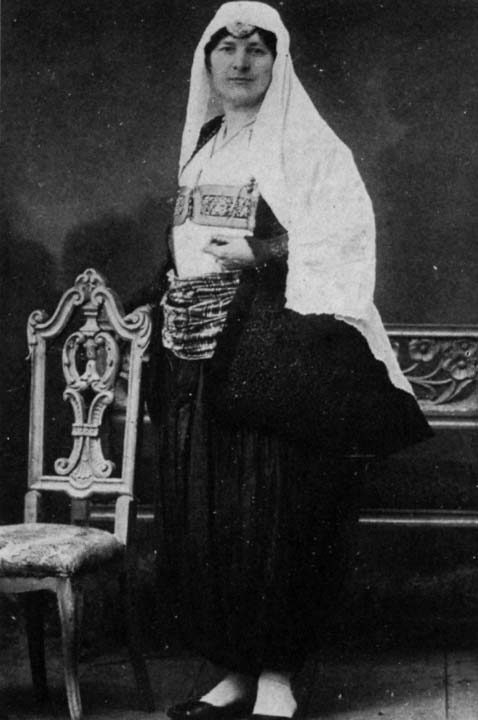
The evils attributed to border bandits did not seem to lessen the popularity of the Albanian tribal costume. No cowboy was ever prouder of his chaps and sombrero than these men are of their petticoats, pantaloons, caps and other articles of wearing apparel designating the tribes to which they belong. There is a difference in color, detail and ornamentation of the native Balkan costumes, but we were particularly interested in the pattern of the trousers with capacious seats, in which large quantities of loot could be conveniently stowed away.
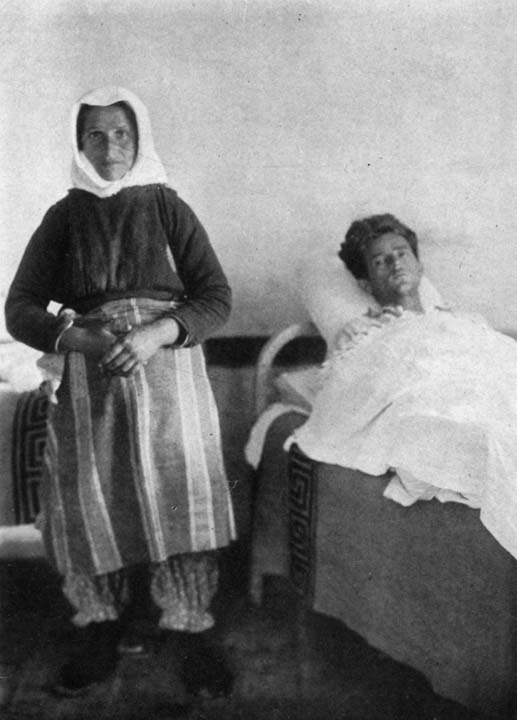
The fiancé of a girl with typhoid fever in one of our hospitals called frequently. The nurse in charge of the woman's ward noticed that after these visits there was a shortage of towels, and sometimes only one sheet was left on the patient's bed. It was also noticed that the baggy, sack-like seat of the visitor's trousers hung flat and pendant almost to his popliteal spaces when he came in, and presented a rounded, feminine outline when he left. The Serbian nurse was instructed to record her observations. A blanket disappeared, a small pillow laid out as a bait was quickly tucked away, and everybody waited to see what he would do about the mattress, but so far as we know he never so much as attempted to smuggle a mattress out of that ward.
When the patient was strong enough to bear the shock, she was accused of complicity in this crime, to which she confessed with copious tears. She acknowledged her guilt and took all the responsibility, admitting that she had no dowry, and therefore had suggested this means of acquiring household goods in order that they might get married as soon as she was able to leave the hospital. But grief and woe! Now that everything was ready, her sweetheart would be sent to prison and she wished she had died. Over and over again she declared, as though she feared we doubted the statement, that they had not been responsible for the war, but had suffered terribly, and that luck was always against them. For a week or more things had been going so well. They had acquired several towels, sheets and everything but a mattress, and the young man had a donkey which he got elsewhere. She was getting stronger every day, and life seemed so sweet and promising, but some talebearer, an accursed Bulgar, if the truth were known, had betrayed them, and all was lost. This incident in the history of the American Women's Hospitals was a tragedy, in which love, hope, fortune and all the joys of the world were involved. Needless to say, our patient was forgiven, and it has been whispered that a certain American woman in the service added a mattress to the dowry of that home-making girl.
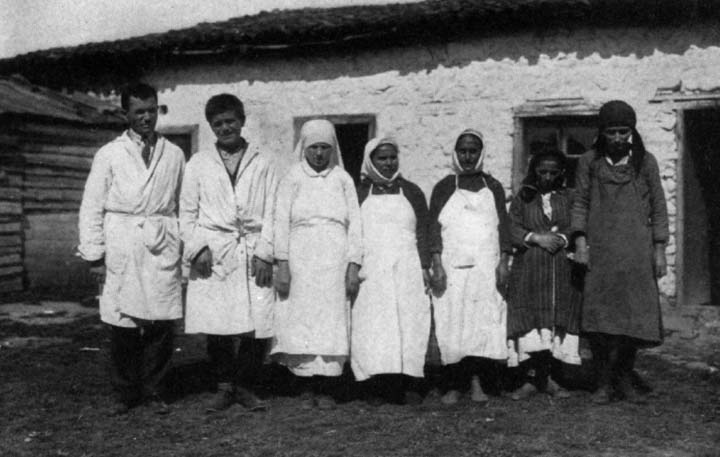
In connection with our hospitals, outlying clinics were conducted at Giljiane, Podujevo, Gratchnitza, Frisovitch and Urasavitch by Dr. Ellen Cover and Miss Nora Hollway. They not only cared for the sick, but carefully refrained from assuming the duties of the secret police, and probing into the causes of wounds. When an injured person volunteered the information that he had been hooked by a bull, cut accidentally with a scythe, or kicked on the top of the head by a water-buffalo, these statements were accepted without comment and the proper treatment administered.
In the districts where robberies were the order of the day, our people were never molested. The popularity of our nurses was at first attributed to their charming personalities, but later we learned that it was a case of "safety first." On a journey through the mountains, an A. W. H. nurse was as good as a guard of gendarmes, and men of high and middle degree were always asking for the privilege of riding with our personnel. On one occasion our automobile was stopped in the dusk of the evening by armed men, who apologized, and disappeared without further explanation.
Brigands in the Balkans and near eastern countries have always had an honorable standing with those against the prevailing government. It is sometimes hard to tell whether these "irregulars" are outlaws or patriots. In any case, they are a convenient group to charge with particularly atrocious crimes, which are, in spite of all the post-war whitewashing, committed by soldiers of invading armies.
David, the anointed, had a queer crowd with him in the Cave of Adullum: "And every one that was in distress and every one that was in debt, and every one that was discontented, gathered themselves unto him, and he became a captain over them." That was strange conduct for a law-abiding, psalm-singing citizen.
The suppression of brigandage in a country with 90 per cent peasant population, where the man with the hoe and the woman with the rake lighten their labors, while cultivating their ten acres, by singing the glories of unconquerable highduks who died in their opankes, is very difficult. These songs have no tunes. They are chanted in blank verse, absolutely blank, and after the first week they sound like the dirge of the dismal swamp to an outsider, but to those who know what it is all about, they are said to be soul-inspiring to the highest degree. The burden of some of these chants glorifying the questionable exploits of outlaws, in spirit and substance is as follows:
What though the field be lost?
All is not lost; the unconquerable will
The study of revenge, immortal hate
And courage never to submit or yield.
During the Turkish occupation for five hundred years, the Ancient and Honorable Order of Highduks kept the flicker of liberty burning in the Balkan mountains. After each defeat the survivors took to the hills, from which they sallied forth to plunder the invading Turk, dig pits for his feet, harry his flank, van, rear, shoot up his villages, kill his janizaries, kidnap his pashas, lead insurrections against him, and to make things so generally hot for him that he finally got out. Naturally, the people sing, Glory be to the highduk, may he live long and prosper! And this encourages adventurous young men to stay at home, instead of leaving the country and joining the Foreign Legion.
Five hundred years are twenty generations, and the spirit of the last paragraph encouraged and cultivated for that length of time cannot suddenly be turned into paths of submission to the will of the majority, or the minority, as the case may be. Wise men say that history is inclined to repeat itself, and there certainly have been Davids in the Balkan mountains during every generation. Our David, alias Willie, who had the hernia, is there now, and anybody who goes out to capture him should be armed with an anæsthetic.
My spelling of the word highduk is original Some writers spell this word haiduk and heyduk, but highduk carries the American meaning and associates the term with other designations having the prefix high, two of which, highbinder and highjacker, are perhaps worthy to be classed with highduk.
In official circles, the highduk has lost his popularity, and is called a comitadji. He is a nuisance to the police, but what are they to do? The peaceful peasant following his furrow, comforts his soul by chanting the story of the Highduk, Kara George, under whose military leadership Serbia regained her freedom, over a hundred years ago. The Turks nicknamed this terror Kara George (Black George), and the name took. He founded the Karageorgevich dynasty, was King Peter's grandfather, and great-grandfather of Alexander, the present King of the Serbs, Croats and Slovenes, whose wife is the great-granddaughter of Queen Victoria.
But the Serbian King is no relation to Scanderbeg, the traditional hero of the Albanians, and for this and other reasons Katchaks pillaging on the Plain of Kosova would be actuated by moral and patriotic, as well as gainful motives. Scanderbeg was an Eagle Man, who lived and fought the Turks before America was discovered. At an early age he was taken to Constantinople as a hostage, and like other children from Turkish provinces was trained for military service. His genius won recognition and he became a commander of the Janizaries, the standing army of the Sultan. Like Kemal of the present day, this warrior was given a Turkish name suggested by his prowess: Iskander Bey, in complimentary reference to Alexander the Great, and this name was afterward Albanianized.
Honor, riches and power were showered upon Iskander Bey (Scanderbeg), but he did not forget his homeland. When the time came he deserted the Turkish Army, returned to Albania and led his people against their oppressors. His good deeds were not interred with his bones. According to tradition his bones were dug up and used as charms to ward off the evil-eye and terrify the enemy. Under his spiritual influence his countrymen continued to fight the Turks, and after centuries of conflict they finally won the rich Plain of Kosova with its towns and villages, only to have it snatched away by the accursed Serbs and their allies.
Glory to the high mountains! Surrounded by Greeks, Serbs and Italians, what would the Albanians do without these retreats? Turks were better masters. Their base of military supplies was farther removed. An American king would be ideal. With a ruler so far from home the Albanian tribes could do as they liked and that would suit them exactly.
Albania is a wild, isolated section of hills and dales, mountains, valleys and gorges, rocky stream beds in summer, and torrents in winter. Foreign colonizers have not been kept out by the dauntless courage of the original inhabitants. This is a fine theory, but as a matter of fact there is nothing for self-seeking man to go there for, and traffic, following the line of least resistance, flows in a full stream around the end of the peninsula to Athens and eastern points. It is easy to understand why settlers from other countries kept out of Albania. But why did the Albanians stay there?
They are called the Eagle People. Mountains may be their natural habitat. The smiling, fruitful plains to the east, and across the Adriatic, within view from their aeries, may have had no attraction for them during the ages, save the attraction it had for their swooping namesake. The lofty eagle does not mate with other birds. There are no other birds in his altitude.
 |
 |
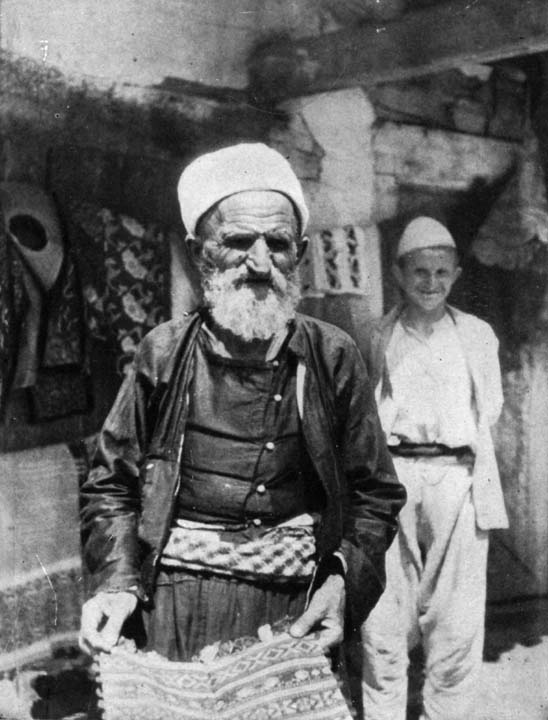
Geography, topography, natural selection and stark, repelling poverty, supplemented by a death-dealing code of social morals, has preserved a distinct human type in the Albanian Mountains for thousands of years. Within a few hours flight of Geneva, the political center of the world, these people still wear their tribal costumes, and the chiseled beauty of their features, strikingly similar in a large percentage of the population, testifies to the maintenance of pure racial stock.
Albanian highlanders have personality plus. They are fine, upstanding folk, picturesque in appearance, original in opinion, and delightfully lawless from our point of view. Old Greek, Roman and English laws are nothing to them. What do they care for Blackstone? The unwritten Canon of Lec is more to their liking. It upholds their moral system. Intensely nationalistic in their attitude toward neighboring countries, they treasure the right of patriarchal authority in their mountain communities. Traditional sanctions are powerful influences, and they prefer to settle their own affairs without process of law or cost to the country.
Blood feuds, bessas (tribal truces) and other activities in the field of honor are hard to relinquish. The presence of a woman protects an enemy. Hospitality and the guarding of guests are solemn obligations. Family loyalty is almost a fetich, and revenge for injury a high duty. Isolation in the mountains must mark the human body and soul, for in many respects the Men of the Eagle are remindful of the Scottish clans of old and our southern mountaineers of the present generation.
Where did these people come from? Nobody knows, but everybody speculates. They are the last surviving vestige of the ancient Illyrians. Are they? Scutari was the capital of the old Illyrian kings---perhaps. At any rate the Albanian Highlanders antedate history, and one thing is certain: there is good stock in their background even if they have no recorded pedigrees.
Lacking written accounts of their tribal experiences, rights, wrongs, heroic exploits and superstitions, they put them into ballads and chant them from generation to generation. Hidden valleys, reached only by steep trails, are tucked away in the mountains, and the Pipes of Pan are heard in the hills. Pan was a goat-man---god of shepherds and flocks. He must have been lonely, for he invented the shepherd's pipe. And the goat-men and shepherds in the Albanian hills still wile away the hours by playing on these primitive instruments.
Some of the domestic animals in Albania have evidently not changed for thousands of years except to get worse. Stunted, pathetic cattle, which may have descended in a direct line from the ash-colored herds of Laban, struggle around among the boulders in search of a living, and there isn't a pig in the country that looks like a pig, except recently imported products and their issue.
But goats thrive and caper nimbly through the generations, and droves of wild swine rove the hills and devastate the fields by night. Led by fierce boars with thick hides and huge, tusked snouts, no barrier is proof against these rangers. Plunder is their dominating instinct, and they are physically equipped for robbing potato patches. With their powerful, double-action snouts, rooting and devouring simultaneously, they plow through the rows leaving ruin in their wake. The razorbacks of our southern highlands, reverting to type during the past two hundred years, are gradually revealing a vague resemblance to the old ferel stock. There is a strain of nobility in an Albanian wild boar, and nobody would insult him by intimating that his breed is in any way responsible for the hams, bacon, lard and economic by-products of the present age.
A boar hunt reminiscent of ye old merrie England can be arranged in the Albanian mountains. Shooting a helpless deer is murder, but fighting a wild boar with an old-fashioned spear is about as near to sport as killing ever gets. Sporting qualities are exhibited by a wild boar at bay. He is a formidable quarry. His malignant eye, huge bristling head, gnashing tusk-armed snout, high broad shoulders, lean flanks and slender hams, indicate power, speed and ferocity. He is a desperate fighter and it is hard to believe that he is any relation to a pig. Even after he is killed he is not pork. His meat is lean, dark and gamy---too gamy in the old tuskers.
On one occasion we came upon some hillmen in the Albanian mountains who had just killed one of these animals. Mohammedans do not eat swine, and they were glad to get rid of it. Taboos and prejudices regarding articles of diet and their preparation are hard to understand. Food was scarce at the station to which we transported that meat. Such a delicacy !---so we thought. But the Moslem influence was strong, and people who ate soup made of sheep intestines, yards and yards of slippery mucous membrane, harder to manage than any kind of spaghetti---a shocking sight to unaccustomed eyes---would not touch our delicious roast which tasted like wild goose to me.

ILLITERATE but intelligent, the Albanians are eager for education. Without modern conveniences, methods of production and protection, they are at a disadvantage, but they are not so sure that they are all wrong and the rest of the world is all right. Outsiders have brought them diseases, which they cannot control. Partial immunity has not been developed by ages of infection, and these afflictions run through their ranks like fire through a virgin forest.
Immediately after the war, eleven women physicians were certified by the American Women's Hospitals to the American Red Cross for work in the Balkans. Some of these were sent to Albania, where they assisted in the organization of hospitals which were afterward closed or carried on limpingly by local agencies. At a later date, health service was undertaken by the American Women's Hospitals in coöperation with the Albanian-American School. While this work was going on, a comprehensive and valuable survey was made in Albania by C. Luther Fry, and the following is quoted from his report published by the Columbia University Press:
The health question is one of the most serious that confronts Albania. Because of their poverty and ignorance, the people are undernourished and very susceptible to disease. The three great scourges are syphilis, tuberculosis and malaria.
* * * * * * * Women suffer more than men from lack of medical attention, because, as a rule, Mohammedan women will not let male doctors attend them. Girls marry at an early age and are very young when they begin to bear children. It would seem that a few women doctors could perform a great service in Albania.
* * * * * * * The American Women's Hospitals has become so impressed with the health needs of Albania that it has recently sent two workers there to start public-health and anti-malarial work in coöperation with the Albanian-American School of Agriculture at Kavaje.
Our nurses in Albania worked under great difficulties. Women flocked to them for help, but English-speaking interpreters were scarce, and life, outside of a few towns, was primitive in every aspect. Each family supplied most of its own needs in the way of food and clothing. Furniture was in the future. Bedsteads had not been introduced. Large families bedded together on the floors of miserable huts. They knew nothing about the transmission of disease, and had no means of protecting themselves from infection.
Syphilis was a curse brought upon them by foreign soldiers. Tuberculosis, malaria and trachoma were also curses. Kismet!
Albania is a hard country on nurses. Only the indomitable make the grade. Special development is necessary for successful service in that land of mud and mountains. Nurses should be born on the highlands and inured to climbing up and down. They should never be allowed to leave their natal place lest they fall into the luxurious habits of other lands and become disabled---hamstrung as it were---for work in their native environment.
Reporting a visit to a mountain district in the northern part of Albania in 1927, Miss Edith Wood, an A. W. H. nurse, wrote as follows: "As we were leaving, the headman shouldered his gun and said his corn would not be watered that day because he wanted the honor of escorting us down the mountain. I had taken his name in order to send him some medicine which was badly needed in his village. While I was walking, where the trail was too steep to ride, my horse fell and got two deep gashes in his belly, either of which, had it been a little deeper, would have left me stranded among the 'Peaks of Shala.' At the next stop I got out my first aid kit and fixed up the horse. The entire population gathered around and witnessed the operation with gasps of astonishment. One of the women had a child with a burned and blistered foot, crusty with dirt, which I washed and dressed, in spite of the fact that the villagers said it would be useless to wash it because it would get dirty again."
There are no passenger railways in Albania and our nurses and physicians have used every means of transportation from donkeys to airplanes. The old Roman Road, out of repair for ages, has been improved upon in some sections, and, barring slides and washouts, the distance from the northern to the southern boundary of the country can be covered in less than two days with a Ford. But this takes the local flavor out of the trip, and for economical souls in search of thrills I, personally, recommend a seat with the driver of the mail lorry. A dollar goes a long distance in Albania, and the mailman enjoys the novelty of an American woman passenger.
People, sights and thrills, are different in Albania, and by riding with the mailman you meet the people, see the sights and feel the thrills. It is a coveted privilege to sit with the driver. His seat has springs. The common passengers in the back of the lorry sit on solid wood. Crossing a rocky stream-bed where the bridge had been washed out, we sighted another lorry moving along the side of the cliff ahead. The road was comparatively level, but that lorry slid gracefully over the edge and down the embankment. Perhaps the driver was a hillman. Anyway, it was a thrilling sight.
 |
 |
 |
 |
|
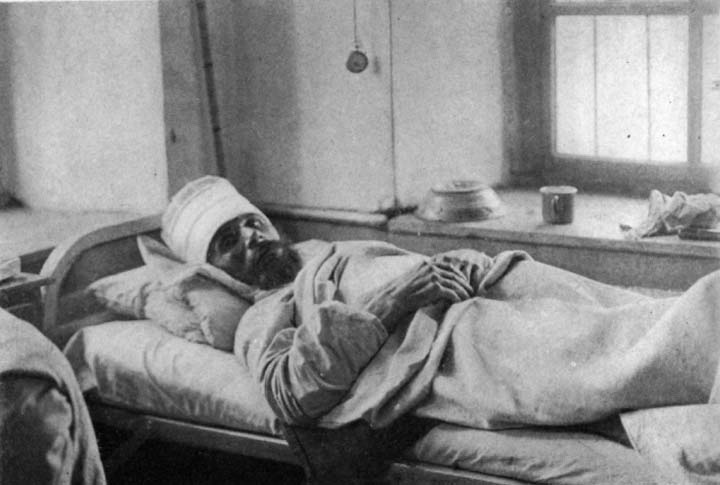
Great souls are sometimes found in remote places. This patient is a devotee of a new religion founded upon the "best" in Christianity, Mohammedanism, Buddhism, and other old religions. His headdress, worn day and night, is a vestment of his faith which is developing in this Albanian retreat, far from the madding influence of the world. |
|
Albanian hillmen are not used to level roads. Climbing and sliding has been their daily experience since they were begotten. Their mothers carried them up and down the mountains until they were able to climb and slide, and this has been their principle expression of life ever since. They are regular mountain goats. And as lorry drivers, they skid along the edges of precipices, and hug the boulders of mountain roads, at forty miles an hour. The Canadian Rockies has no advantage of Albania in the way of mountain scenery, gorges and glorious views, and the lorry drivers can be depended upon to furnish the thrills.
Skirting a river beyond a small village, I was amazed to see a dishevelled, demented woman emerge from under a scow which had been overturned and thrown upon the river bank during a flood. This was her home. The driver said that no provision was made for the insane, but people fed harmless lunatics because it brought them luck. Maniacs, of course, had to be tied up, but they didn't live long.
Dr. Sara E. Foulks, who subsequently served with the American Women's Hospitals in Greece, was stationed at Kortcha, Albania in 1919, and her work was so satisfactory that calls for sick relief continued to be received from that town for years after her departure. Kortcha is an inaccessible place situated on a high plateau near the border of Serbia to the east, and Greece to the south. It is distinguished by-the presence of a mission school, a center of Christian culture, developed by the Reverend and Mrs. Kennedy by years of self-sacrificing service in His. name. The gracious influence of this school is felt immediately by strangers coming into Kortcha.
Our experience in Albania has been highly educational. Only the love of God, one nurse said, would make work in that country successful. And the results achieved by the Kennedy's at Kortcha bears this out. For many reasons that place appealed to our board, but the advisability of placing an American unit there was doubtful. The old hospital established by the American Red Cross in 1919 was in sad need of assistance, and finally, satisfactory arrangements were made in this connection, which are still maintained.
Mrs. Melville Chater, a nurse who had served with the American Women's Hospitals in Greece, accompanied her husband, a noted writer, on a trip through Albania, which is described in the National Geographic Magazine, February, 1931. Mrs. Chater made a survey of health conditions for the American Women's Hospitals, and strongly recommended that a special mountain medical service be established for the benefit of the Dukagini tribes in the mountains north of Scutari. While this matter was under consideration, strikingly similar recommendations were received from remote mountain districts in our southern states. Funds were limited, and after careful consideration, a decision was reached in favor of establishing a rural and mountain medical service in our own country.
The Serbian service of the American Women's Hospitals was discontinued in one place after another. The hospital at Strumitza was destroyed by fire due to a stork's nest, which had been built in the chimney during the summer---wonderful place for a stork's nest, so convenient! The Prelip hospital was turned over to local authorities, and the work at Veles finished in 1924. As a permanent memorial to our post-war reconstruction service under Dr. Etta Gray, the Children's section of a hospital at Skoplje was built in 1927 with a special fund given for the purpose. A ward for destitute children is still financed (1933) at this hospital through the A.W. H. by the good offices of friends especially interested.
THE work of the American Women's Hospitals in Turkey and Armenia began in a small way. The World War was over, at least we thought it was, and we were anxious to do our bit in salvaging the survivors. Medical service was sadly needed in countries where progress had been retarded for centuries by oppressive forms of government. But that was all in the past. A new day was dawning. The peace conference was in session, and we felt quite sure that we should find the world, including Russia and Turkey, ready and anxious to be made over in accordance with the plans and specifications of the experts at Versailles.
Eight women physicians, Gladys L. Carr of Brookline, Mass., Mabel E. Elliott of Benton Harbor, Mich., Elfie Richards Graft of Somerville, N. J., Emily Clark MacLeod of Boston, Mass., Blanche Norton of Weehawken, N. J., Caroline Rosenberg of San Francisco, Elsie R. Mitchell and Clara Williams of Berkley, California, were selected and equipped by our organization for service with the American Committee for Armenian and Syrian Relief, which later became the Near East Relief Committee. Five of these physicians sailed with a large group of relief workers on the Leviathan in February, 1919, and arrived at Constantinople in the early part of March.
This was the first appearance of the American Women's Hospitals in Turkey. The meaning of the letters A. W. H. was little known in that part of the world, but this meaning has gradually been revealed in service to the sick, until it has become widely known, especially in Greece and on the Islands of the Ægean Sea, since the exodus of the Christian people from Turkey.
More than a year before the Armistice, in anticipation of the collapse of Russia, a Federation of Georgia, Armenia and Azerbaijan under a provisional government was proclaimed. This union was short-lived. All the forces which divided the Balkan States before, during and after the war, plus factors peculiar to the Caucasus, worked for dissolution, and after the signing of the Brest-Litovsk treaty between Germany and Russia, this tripartite federation divided into three separate republics, none of which was strong enough to stand alone.
During the period of uncertainty which immediately followed, Georgia accepted German assistance, and the Armenian Republic of Erivan was accorded de facto recognition by the Allied Powers, a gracious, noncommittal gesture. The Russian Bolsheviks, Armenian Dashnakists, returning Caucasian soldiers released from the Russian Army, and other radicals, had established a government of their own at Baku, which controlled enormous oil supplies. And, with divers treaties, governments, religions, and groups inspired with a passion for self-determination, all pulling in different directions, confusion worse confounded reigned in the Caucasus.
After the signing of the Armistice of Mudros on October 30, 1918, and the one we celebrate on November 11, peace was established on paper, but the fighting continued in that far-away part of the world. Turkey was crushed, so the newspapers said, and the victorious nations were to free the Christian subjects of the Ottoman Empire at last. The, sacrifices of two thousand years had not been in vain. Thanksgiving prayers went up from churches and homes throughout the Caucasus and Asia Minor, while the Turkish Nationalists and the Caucasian and Russian Bolsheviks gathered strength for the final test.
There were doubting Thomases---there always are. They doubted the evidence of their own eyes. The Dardanelles and Bosphorus were open. The Allies occupied Constantinople, Trans-Caucasia, and other important territory in near eastern countries. The Allied ships moved to and fro upon the Black Sea. Surely the day of deliverance was at hand!
For at least a hundred years, the Christian people of the United States and other countries had encouraged their coreligionists in Turkey to keep the faith. As a final expression of sympathy, funds were gathered and representatives sent to care for the sick and helpless, while the new order decreed by the peacemakers was being established in these old lands.
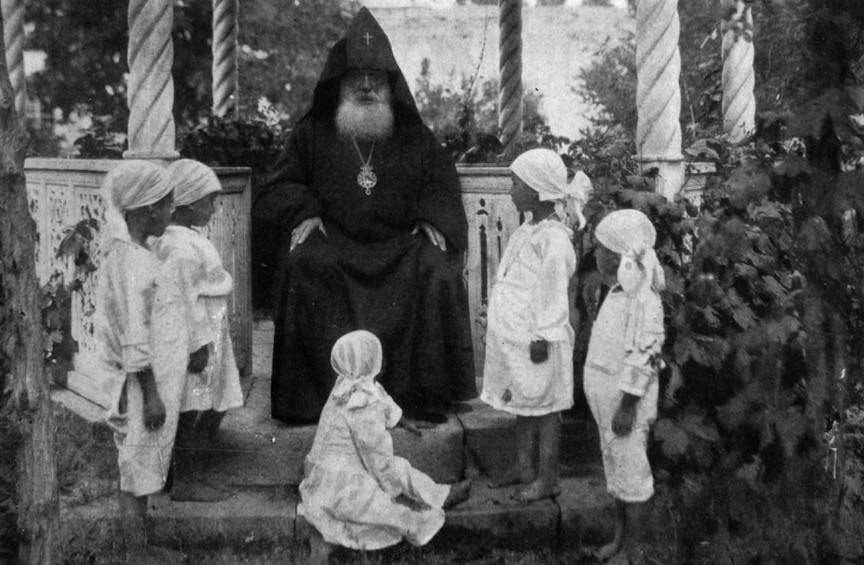
The women physicians among the representatives of American compassions were assigned for service in different places. Dr. Carr, X-ray specialist, supervised the installation of apparatus in many hospitals in different parts of Turkey; Dr. Elliott was sent to Marash, Dr. MacLeod to Malatia, Dr. Norton to Trebizond, Dr. Graff was stationed at Constantinople, and Drs. Mitchell and Williams volunteered for service at Erivan, the capital of the new Armenian Republic where typhus fever was raging. Dr. Williams was afterward sent to Etchmiadzin, the seat of the Armenian Katholicos, head of the Gregorian Church, under the shadow of Mount Ararat.
Old Ararat, near the center of a line drawn from the Cape of Good Hope to the Behring Straits, was not placed in the middle of the Eastern Hemisphere for nothing. This mountain has been associated with the beginning of things since the beginning, traditionally and otherwise. It is easy to understand why a section of the earth's surface near the headwaters of the Euphrates at the base of Ararat has been definitely designated as the birthplace of mankind. To the east was the Great Unknown, the Land of Nod, where Cain got his wife, and from whence terrible people appeared with increasing frequency and in increasing numbers as the ages passed. Century after century, the waves of war, trade and nomadism, washed this neck of land, leaving a heterogeneous mixture of antagonistic tribes, races, national and religious groups.
Talk about melting pots! Here is an ethnological crucible into which the metal of mankind had been thrown, age after age, since Noah came down from the mountain with his sons, Shem, Ham and Japheth. Blood mixture has occurred throughout the generations, but the flame of love has not been great enough to effect complete amalgamation.
Shem, Ham, Japheth and the folks from the Land of Nod, don't want to become one people. Most of them have resisted fusion from the beginning, each group struggling for separate survival with the instinctive hope and expectation of inheriting the earth.
According to Armenian tradition, the Araxes Valley, at the base of Mount Ararat, is the site of the Garden of Eden. It was here that Adam and Eve ate of the tree of knowledge and brought the curse of God upon the earth: "Cursed is the ground for thy sake, in sorrow shalt thou eat of it all the days of thy life . . . . So He drove out the man; and He placed on the east of the Garden of Eden Cherubims, and a flaming sword which turned every way, to keep the way of the tree of life." It is not hard to believe this story after seeing the place. Looking toward the east in the light of recorded history, it is easy to imagine the "flaming sword" which through all the ages, and never more than in this generation, has "turned every way."
The Erivan assignment presented many difficulties, but was especially interesting on account of the religious and historic associations of the country. From a clinical standpoint, it was one of the richest and most terrible fields in the world. The "flaming sword" had devastated the land and it was bringing forth "thorns and thistles" abundantly. All kinds of diseases were flowering in the valleys around Ararat, and the unburied dead lay in the streets of Erivan.
Undaunted by the magnitude of the task, Drs. Mitchell and Williams of the American Women's Hospitals, with the help of Miss Frances Witte and others serving with the Near East Relief Committee, which furnished supplies, started to clean up the town. They began in the gutters, and inspired with the idea that obstacles were made to be overcome, succeeded in their work.
Hospitals and clinics were opened at Erivan and Etchmiadzin, and a sanitary service inaugurated. Contagious diseases were cared for, including typhus fever, which Dr. Mitchell, herself, had the ill luck to contract, and the good luck to recover from, after which the typhus louse had no personal terrors for her. Typhus fever is a dangerous disease, but the victims die or get well promptly. Those who recover are rewarded by a lifelong immunity which enhances their value as physicians and nurses during typhus epidemics.
Americans shrink from loathsome skin and eye diseases more than they do from those affections more dangerous to life. Over and over again, the story of job has been told in the clinics of the American Women's Hospitals by old men without so much as a potsherd wherewith to scratch themselves. "My flesh is clothed with worms and clots of dust; my skin is broken and become loathsome."
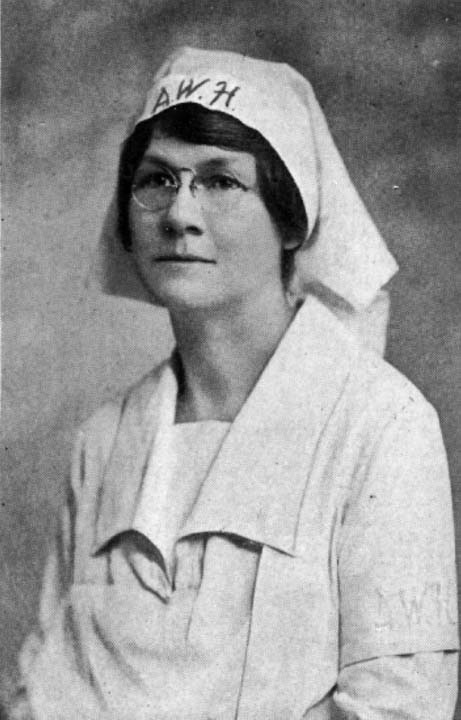
The following excerpts were taken from a report of Miss Frances Witte, superintendent of nurses at the State Manhattan Hospital, New York, who was assigned for service by the Near East Relief, with Drs. Mitchell and Williams of the American Women's Hospitals at Erivan, Armenia, where they served from 1919 to 1920:
The station assigned us was the Caucasus. Typhus was raging there and this assignment could be made from volunteers only. An old Roumanian coal boat was in the harbor, (Derindje) so it was seized and loaded . . . . After four days we reached Batoum and started to unload the ship. We were the gang masters and we soon learned why the ship had not ridden well. Nurses are good for many things, but they cannot load a ship although they do fairly well unloading one. Such a time! Dr. Mitchell's post was at the hoisting outfit. Her "Haidai git" worked well, likewise her "my goodness" and "be careful!" She never need worry about a job. She can handle anything from a scalpel to a gang of hamals. We nurses in the hold laughed at her often and with her more often;---she was so earnest and brave.
The following day our party, consisting of Drs. Mitchell and Williams, we two American nurses, and a group of Armenian girls, boarded our "side door pullman" (freight car) and began the trip to Erivan. The train was made up of eleven freight cars and one courier car in which some of the relief workers traveled. To travel on freight ships and freight cars living on canned food is no joke after the first week, but everybody made the best of things. We were short of water, but our trusty old sternos were working. With soup on one, and cocoa on the other we had nothing to complain about in that land of famine.
One morning we were riding along smoothly when the brakes were applied and the train stopped with a jerk. There was a man lying across the track. Dr. Mitchell and I went out to help him, but it was too late. He had died of starvation. The engineer was used to such sights. He simply pulled the body off the track and the train moved on toward Alexandrople which we reached the next day.
There we saw the dead and dying, starvation and disease in all forms. Arms were stretched out to us, mouths opened showing no tongues, eyelids parted showing no eyes, and the cries and appeals were dreadful. We nurses were sick, not physically, but mentally because we could do nothing. Erivan was our station, so we closed our eyes and went on. The engine puffed and pulled up the grade from Alexandrople to Erivan, the capital of Armenia. The sights were the same as at Alexandrople, but we felt a little better because we knew that we could soon roll up our sleeves and get busy.
 |
 |
 |
 |
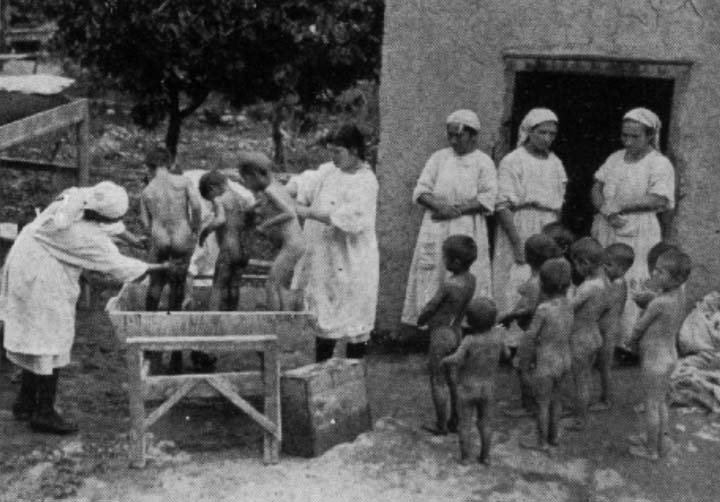
We made our way to what was called the Medical House. The only thing medical connected with it was one Red Cross nurse. There had been two nurses, but God had just called one of them. This young woman had contracted typhus while sorting out refugees and picking up little children and carrying them to the ambulance. These people were alive with vermin, and to attend them and not become infested was impossible. We all had 'em, but only five contracted typhus.
Erivan was in a state of chaos, and one hardly knew what to do first, so a refugee house was decided upon. This might be compared to an overcrowded stock yard with fifty per cent of the animals sick. The refugees came to this place during the day and night. They were fed, and each morning the nurse would sort them out, as one would sort out old rags, pick a living person off a dead one, or vice versa. In these cases, the living were too ill to know the conditions. I have picked up babies with protruded bowels covered with dirt and straw, and yet with care these poor little souls would brighten up.
Dr. Mitchell was in charge and the real work began. I stayed in Erivan about two weeks, and then Dr. Williams and I were sent to Etchmiadzin. The Armenians had a small hospital there. It really ought not to be called a hospital. It was simply a place better to die in than the streets. There were fourteen dead children in the morgue piled as you would pile cordwood. The cases in the ward ran like this: pneumonia, scarlet fever, measles, malaria, mumps, whooping cough, dysentery, etc. Favus and scabies were in full swing.
Can't you see Dr. Williams making her first rounds? I can see her now, and I can smile, but it wasn't a smiling matter then. Her staff consisted of one American nurse, four Armenian doctors (men), one felcher (medical student), one Russian nurse, five Armenian nurses, four sanatares (orderlies) and eight marabeds (ward maids). With this small force, plus workmen for outside jobs, we began to clean up the place. The first thing to do was to clear the streets of the dead for sanitary reasons. We buried eighty-five the first day in a trench. There were no tears and no prayers, just an urgent desire to get rid of the bodies. The hospital and orphanages had to be put in order.
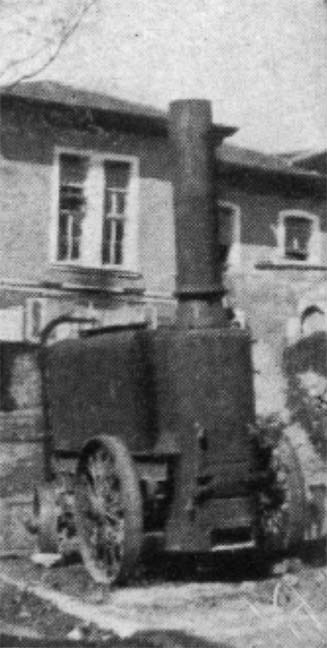
The hospital building was made of wood with a straw roof. The place was alive with vermin. We whitewashed it three times and I used the Pyro fire extinguisher from the old Ford van as a pump to spray a solution of bichloride of mercury and soap into all the cracks. This solution became hard when it got cold, so if we failed to kill the bugs we sealed them up in their nests. The hospital was lighted by lamps, and our water came from a well in the back yard.
In less than two months that place was running like a real hospital, and we had to open overflow buildings. All the infected cases were isolated; smallpox and typhus were in separate tents, favus and scabies were under control, and the children with whooping cough and other lung diseases slept on the porches,
Things were running nicely when Igdar was attacked by the Kurds and 800 children were sent to us from that place. There had been a few cases of gonorrheal ophthalmia at the hospital at Igdar, and in the excitement this disease was spread among the children and 150 cases developed. With our scant supplies, we worked with those children and only eight of them lost their sight. We hired girls to do nothing but irrigate eyes. Each girl had seven cases and by the time she reached the seventh, it was time to begin again on the first.
Cholera came in the summer. We inoculated all the children and workers and no more cases appeared. Out of about 5,000 inoculations, we had only two infected arms. With winter the green foods gave out, scurvy developed, and the mouths of the children began to "break down." Two fatal cases of noma occurred. We had no lemons or apples, nothing in fact to check this scourge. Dr. Williams thought of cauterizing some of the worst cases, but we had no cauterizer. With the aid of the stove and two screw drivers, we improvised a cauterizing apparatus, two nurses gave anæsthetics and Dr. Williams treated thirty cases with wonderful results.
In the clinics we treated every kind of skin and blood disease from scabies to leprosy. Never having seen a case of leprosy, I didn't recognize it, so I gave it the good old-fashioned treatment for syphilis, and I must say that mercurial ointment and potassium iodine are pretty good for leprosy.
During all this time Dr. Mitchell was at Erivan, where she carried a similar work on a much larger scale until she was taken down with typhus fever. The dear woman was very ill and her convalescence was slow.
A nurse, who has worked with many physicians, recognizes efficiency and worth, and Dr. Mitchell and Dr. Williams were true physicians in every sense of the word. I worked with them for over a year, and in such an emergency, I should like to serve with them again.
The women physicians who went to Turkey and the Caucasus in the spring of 1919, all had contracts for one year. Some of them renewed their contracts and remained in the field, while others returned home. The coöperative plan of work between the Near East Relief and the American Women's Hospitals had proved so satisfactory that negotiations were opened for the expansion of this service and the following paragraphs appeared in letters received from Mr. H. C. Jaquith in this connection:
The Near East Relief Committee is deeply appreciative of the service which the American Women's Hospitals contributed to the Near East Relief during the last year, both in the financial support which has been given to Dr. Williams and Dr. Mitchell, and also in the selection of other women personnel for our relief work.
* * * * * * * The Near East Relief would like to lay before your organization a definite suggestion for further coöperation.
"We desire your organization to assume, if feasible, the medical responsibility in one of our large districts, namely Trebizond. The attached report from our managing director at Constantinople, covering the work of the station for December, will give you a more concrete idea of the extent of the need and the possibilities of service in this area."
During the summer of 1920, arrangements were made to take over the medical service of the Near East Relief at Trebizond, with the understanding that if complications arose another field would be assigned to us. Complications already existed and new ones were arising month after month in different quarters.
The White Russian Army under Deniken, including General Wrangel's Caucasian troops, had been defeated and the Russian people who had depended upon these forces for protection had fled to the Black Sea ports. Thousands had died, and thousands had been transported by the remnant of the Russian Black Sea Fleet and foreign refugee ships to Constantinople, Prinkipo, Lemnos and other islands. Typhus fever broke out among the exiles and some of the ships, quarantined at anchor in the Sea of Marmora, became death traps from which the dead were cast into the deep.
Under the terms of the Treaty of Sèvres, President Wilson had drawn the line including Trebizond in Armenian territory. France and England were occupying parts of the former Turkish Empire, and Greece, under Allied instructions, had taken possession of Eastern Thrace and the Smyrna District. The Turkish Nationalists did not like this any better than the Russian Bolsheviks liked the establishment of independent republics in the Caucasus which had formerly been Russian territory.
Whatever the attitude of old Turkey and old Russia might have been, new Turkey and new Russia were in a position to exchange favors. As a choice of treaties duly accepted by the Turkish Government, the Nationalists preferred the one made in Germany. The Treaty of Brest-Litovsk between Germany and Soviet Russia was generous to Turkey, and the Treaty of Sèvres, dictated by the Allies, was generous to Greece and Armenia. After paying their military respects to the French at Marash, and showing them the way out, in February, 1920, the Turkish Nationalists joined hands with the Russian and Caucasian Bolsheviks across the independent republics of Armenia, Georgia and Azerbaijan, and the crushing process began.
The victorious Turks advanced from the Southwest occupying city after city, while the equally victorious Bolsheviks advanced from the Northeast, and, caught in this vise, the new republics chose the evil they knew naught of, and hastily hoisted the red flag.
Russia gained three small states for the Union of Socialist Soviet Republics. Fate is jocular---and this is the grimmest joke of the age. With little Georgia, big Russia got her master---Stalin.