
THE village at which the convoy had halted was Tannois. We shall not soon forget Tannois. Not that there is anything remarkable about it, for it is just the ordinary, uninteresting French provincial village with an unpretentious inn, a few épiceries, and some stolid-looking stone houses, but we shall remember it for the peace and calm it brought us. We did not linger long in the village proper but passed through and entered a little valley just beyond. It was a beautiful spot. On either side and at the far end were green-clad hills, and down through the valley flowed a clear, sparkling spring. Sweet-smelling hay carpeted the ground and poppies and wild flowers were scattered everywhere. Beneath a row of trees whose protecting branches offered pleasing shade we parked. The whole environment was one of peace and restfulness and after the inferno we had just left we were in a mood to appreciate the change. We were content to lie on our backs and gaze at the hills and listen to the trickling of the brook.
But we were not destined to remain long at Tannois, for on the night of the sixteenth orders came in and the following day we moved. As usual we went through Bar-le-Duc without stopping and proceeding by way of Méricourt and a number of half-demolished villages, in mid-afternoon reached our destination, Givry-en-Argonne. Givry is one of those sad little towns which make one wonder why the French, being a kind-hearted people, permit it to linger and suffer. Its dirty main street opens into a sad little square where dejected buildings face each other in an attitude of hopeless boredom. Even the ubiquitous cafés seem burdened with ennui. It required but one look at our cantonment, a buggy-looking stable, to convince us that we should prefer our cars as sleeping quarters. These we parked on two vacant lots by the side of the main road where the dust from passing traffic swept over them. We messed in a commandeered private residence and I remember we had especially good food while at Givry. Though nominally en repos, the Squad did a certain amount of work, the evacuation of malades or an occasional blessé, the victim of hand grenade practise, and in this way saw considerable of the surrounding country.
In the French Army, each automobile section has some distinguishing emblem painted on its cars, a stork, a Pierrot, a ballet dancer, some symbol as a sort of trade mark as it were. Among the Squad's French contingent was a man who in civil life was a distinguished painter. He now designed a splendid Indian head, resplendent with feathers, and this was adopted as the Squad's mark and was emblazoned on the sides and back of each car. This head at once caught the fancy of the poilu. It soon made the Section well known and thereafter wherever we were, we were hailed as Les Peaux Rouges---the red skins. Incidentally this decoration started an epidemic of car painting and with the war-gray paint nearly every car was freshened. Poor old "Ting" suffered the hardest luck when, after laboring all day, covering his car and himself with paint, perspiration and profanity, we received orders to move, the roads at the time being ankle deep in dust.
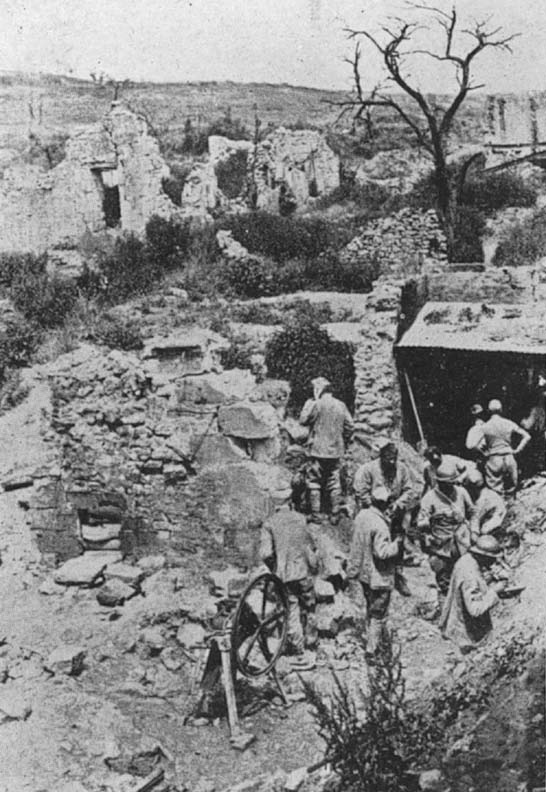
We left Givry without regret and after an uneventful roll of twenty kilometers, we hove to at the village of Triaucourt. Just outside Triaucourt is a pretentious villa, the property of M. Poincaré, the brother of the President of France. It was at the villa that the Crown Prince stayed before the Germans were swept back. It is situated in its own beautiful grounds, or rather park. To the left of the house, as it faces the road, is a large open sward, along one side of which flows a small stream, the headwaters of the Aisne. All around are groups of trees. In this beautiful spot, through the courtesy of the authorities, we were permitted to park our cars. They were aligned in two rows facing each other and about sixty feet apart. The mess tent was pitched in a magnificent grove of pines at one end of the cars, and the C.O.'s and a sleeping tent in another grove on a small rise of ground. Never had we had such an ideal cantonment.
Triaucourt itself we found to be not entirely without interest. It possessed a church of some architectural pretensions which bore the marks of war, for the Germans in their first advance had shelled the place rather thoroughly. The church contains one picture said to be a genuine Van Dyck. Certainly it was dingy enough to be. From the back of the church extends a row of ruins the length of two city blocks, another token of the passing of the Huns. There were the usual cafés and épiceries and several field hospitals.
Those were pleasant days we spent at Triaucourt. We were forty kilometers back of the line; our Division was en repos, reforming, so there were no wounded. Occasionally we would receive a call to transport a malade from one hospital to another. On such duty I went several times to Revigny or rather what was left of the town. Whole blocks lay in ruins presenting a picture of desolation such as only war---the war of the Hun---is capable of producing. At Le Roi, not far from Revigny, lay the gigantic frame of the Zeppelin brought down some months before.
But for the most part our days were of idle dalliance. Beautiful weather prevailed. We sat in our cars chatting or reading or lolled about on the grass. In the later afternoon we used to pair off and go for long walks about the country. A series of soccer matches was arranged and played between a team made up from the Squad and a team from the Division. Considering that our opponents had six thousand men from whom to draw and we were but twenty-one and not familiar with the game, we did remarkably well for, while we were never victorious neither were we ever blanked and once we tied. They were good sportsmen---the French---and always applauded when we made a good play and cheered at the end of every match.
Of course we had a baseball and bat---were there a score of Americans in any part of the earth that the makings for the national game were not forthcoming? Our scrub games attracted an enormous amount of attention and created great speculation and interest. At times the gallery exceeded a thousand poilus and a score or more of officers. Once or twice an officer joined in, holding his hands wide apart, and when a hot grounder burned his palms a great shout of joy would rise from the spectators.
There seemed something in the air 'round about Triaucourt that was particularly salubrious to the raising of dogs; not dogs of any one kind or breed, or in fact of any recognized kind or breed, but, nevertheless, in the general acceptation of the term, dogs. This condition prevailing, it occurred to some inspired soul, to take advantage of the material thus provided by the gods, and hold a bench show, each ambulancier being entitled to one entry. The idea was received with enthusiasm, and thereafter in the by-ways of Triaucourt might be seen khaki-clad figures holding forth a morsel of meat in one hand, the other concealing behind their backs a piece of rope, the while cajoling the prospective canine victims with supposedly soothing terms of mixed French and English. The result was as astonishing a collection of animals as was ever gathered outside the precincts of a museum. And when they all got to howling and yowling and yapping, the ensemble was truly magnificent. The prize was eventually awarded to a weird-looking animal with quaint legs, an abortive tail and of an indescribable greenish hue. The decision of the judges was contested by the disappointed proprietor of another entry on the ground that the animal awarded the prize was not a dog at all, a protest, however, which was disallowed.
In the reaction from the strain of front line work there was an effervescence of spirits which found expression in pranks as well as sports. One favorite diversion was the morning "evacuation." The Squad was supposed to turn out at seven and to report for coffee at seven-thirty. There were usually several recalcitrant risers and it was the self-constituted duty, or I should say pleasure, of the early risers to "evacuate" such cases. Silently "the committee" would proceed to the car of the évacué; two "members" would carefully grasp the projecting handles of the stretcher upon which the unconscious victim was sleeping; then, at a given signal the stretcher would be shot out of the car, the other end grasped by the remaining committeemen, hoisted shoulder high and in a second the évacué would find himself torn from the arms of Morpheus and traveling at a high rate of speed towards the center of the town. Here he was deposited in a prominent place, preferably the middle of the square, and immediately he would become what the society people would term the "cynosure of all eyes." Ancient dames, children, dogs, wandering poilus and "le population civile" would crowd wonderingly about. There would be many ejaculations of "Qu'est-ce que c'est" and "Qu'est-ce qu'il y a," whereupon "the committee" in furtherance of its duties would spread the rumor that the occupant of the stretcher was a contagieux. After a reasonable period---though it could hardly be thus defined by the victim, he would be again hoisted aloft and borne solemnly back to camp to the whistled strains of the dirge.
While at Triaucourt three new recruits joined us, replacing men whose enlistments had expired. A "new man" was always treated with distant courtesy and called formally by his last name until such time as he might be proved, which might be a matter of days or weeks or, perhaps, never. Certain privileges, however, he always had. For one thing, he was invariably "permitted to subscribe" to the Bulletin des Armées, paying therefore ten francs. Inasmuch as this journal, the official army paper, was furnished free to every enlisted man, "the subscriber" could not be heard to say that he did not receive his paper. Then, too, a recruit was liable to be "sold" a gas mask and helmet, both of which are furnished free by the army in any desired numbers. The money obtained from these activities, was devoted to the purchase of gateaux for the table which, when served, were announced as "the gift" of the new man. Whereupon he realized, perhaps for the first time, that in the words of the song, he was "in the army now." New men were apt to be confused by the talk, for the Squad possessed a vocabulary and language all its own. Everything was either "good news" or "bad news" depending on how it struck the Squad. Anything incredible of belief was "a Iota." If a man died he "huffed" or "passed." A helmet was a "trench derby," a gas mask, "a muffler." A friend was "Mon Vieux," furlough was "perm." The mess was referred to as chow," beans were known as "dum-dums." Salt was "doosel" A car was a "buss," a "peanut roaster" was a "Rolls-Royce." Wine was "ink" and the cook "the Zouave." A dug-out was "a rathskeller," shell fire was "heaving eggs;" "be careful" was "mind your eye, judge." Of nick names there was no end. "Breakbands," "Sparkplugs," "Wilkins," "Doc," "Sample," "Slack," "Betty," "Skinnay," "Silent," "Claxson" were all real characters. The Squad, too, had its favorite songs, among which were "Ephriam Brown, the Sailor," "Here's to the Land," "Mary Ann McCarty,' "How Well I Remember the Days of '49," "There Was An Old Man Named Bill," "Here Lies the Body of a Cigarette Fiend," "When I Die," "The Kaiser Has No Hair At All," "She Wore It For a Lover Who Was Far, Far away." Through many a weary wait and in many a queer place have these choruses rolled forth their cheer.
On the twenty-fifth of July we received word that the Section, as a section, had been cited to the Order of the Division for its work at Verdun. The day following we were paraded. The Médecin Divisionaire appeared with his aide. The Citation was read and the Cross of War pinned to one of our battered ambulances, symbolizing the Decoration of the Section.
The citation follows:
|
2e Armée En exécution des prescriptions réglementaires, le Directeur du Service de Santé du 6e Corps d'Armée cite a l'ordre du service de Santé le Corps d'Armée. Sous la Direction du Lieutenant de Kersauson de Pennendreff et des Officiers Américains Herbert Townsend et Victor White, a assuré remarquablement le service quotidien des évacuations en allant chercher les blessés le plus loin possible malgré un bombardement parfois violent. S'est particulièrement distingué le 11 juillet 1916 en traversant à plusieurs reprises une nappe de gaz toxique sous un feu intense sans aucun repel pendant 32 heures pour emmener au plus vite aux Ambulances les intoxiqués. Q. G. le 26 Juillet 1916 Délivré copie du présent ordre à H. P. Townsend Seal |
The days were passing pleasantly. July ended and still we remained at Triaucourt. We were beginning to tire of inaction and to wish for the front---yes, even though it meant the Vortex. Therefore we were delighted when at the beginning of the second week in August orders came in for us to move. But we were not yet to go to the front. It was merely to the village of Vaubecourt, seven kilometers distant from Triaucourt that we shifted. The change meant our Division, which for the past month had been en repos, was now en réserve and as Vaubecourt was in the Verdun section, in all probability we should again go up to the Vortex.
Vaubecourt is now little more than a name. A few blackened walls still stand, a few houses remain unscathed. That is all. Here it was the Germans made a stand from which the French finally drove them. The village is on the edge of a considerable forest, part of the Argonne. On the outskirts of this forest we established our camp. A really beautiful spot it was and save that in places the forest was traversed by splendid roads, the region was as wild as the Adirondacks. Everywhere the spoor of the wild boar was visible. The C.O. was an ardent sportsman and together we spent the greater part of the ensuing nights roaming the woods or sitting motionless in a thicket, waiting for a shot, returning as the rising sun began to light the forest. On the way we used to exchange hunting reminiscences, as we had both shot great game in Africa---he in the Transvaal, I in the Congo.
Five months had now elapsed since I had been en permission. The Squad now being part of the line, permissions were "open;" two men at a time were permitted to leave. So on the morning of August twelfth, Josh and I left in the staff car for Bar-le-Duc where we caught the train and that same evening reached Paris.
PERMISSION was over. It was five o'clock in the afternoon and I had just reached Bar-le-Duc. My orders were to report to the officer in charge of the parc here, where I would be told the whereabouts of my Section. So I at once sought out the commandant who informed me: "Votre Section est à Verdun," a cheering little piece of news. None of our cars were in Bar-le-Duc, so there was no way of getting to the front that night. With me were three recruits for Section 4, at the time quartered at the village of Ippecourt some thirty kilometers from Verdun. As there would be a machine in for them next day I decided to remain in Bar-le-Duc for the night and go out with them. Accordingly on the following morning, through the courtesy of Section 4's commander, I was taken out to Ippecourt and after lunching with the Squad was driven over to my own Section.
I found the Squad quartered in the Château Billemont, some three kilometers from Dugny and about equal distance from Verdun. It was a fine, large place splendidly situated with numerous trees which offered concealment for the cars from scouting aeroplanes. I was somewhat puzzled to know why we had been assigned such elaborate quarters until I saw the answer in a number of shell holes about the house. The place was under intermittent bombardment. Prior to our occupancy it had been the headquarters of a high officer and had been evacuated by him because of its frequent shelling. We were perfectly willing to take our chances with shells to have such comfortable quarters. Here we had half a dozen rooms for sleeping---the irony of the situation being we got very little chance to sleep---a fine large dining-room, a lounging-hall, kitchen and salon. There was even château stationery and a telephone, though this of course did not function.
On this, our second time at Verdun, we served but one poste---the Caserne Marceau. This caserne,---now demolished by shell fire---had topped the crest of a considerable hill which rose to the northwest of the city, and about two kilometers beyond. It was an exposed spot and it and the approach were swept by almost continual shell fire. The poste itself was a half-dugout in the side of the hill just below the crest, shored with timbers and both roofed and banked with sand bags.
To reach this poste after leaving Château Billemont we proceeded north along the road which passed the Château grounds. A kilometer or so beyond, the road turned to the left and for a way paralleled a spur railroad track. On this track was operated a mobile 100 marine battery mounted on specially constructed cars. The "hundred" takes a shell about four feet in length, the detonation from which is terrific. Frequently the guns would be in action as we passed and the concussion fairly rocked our heads. The road about here bore testimony of the accuracy of the enemy's fire. But the battery being mobile, changed its position frequently and never suffered a hit. Again bending to the north this road entered a little patch of shell-torn timber. Here was a transparency with the information Zone Dangereux and an equally superfluous injunction to Allez Vite. Beyond the timber the road turning to the east entered the city gate. Traversing the city and emerging as before on the Etain road, our new run left this about a kilometer beyond and commenced a long ascent on the left at the end of which, near the hill crest, was located the poste. The entire run was under the enemy's fire. This poste served that portion of the line of which Fleury was the central objective. Evacuations, as before, were made to the church at Dugny.
Though we served but one poste this time our work was much more severe than at our first time up at Verdun. Consulting the communiqués you will find that at this time there was a series of attacks and counter attacks upon Fleury; that the Germans took, lost and retook the village, that the French regained it, advancing toward Thiaumont, and that the enemy's line near the Vaux-le-Chapitre Wood was captured on a length of sixteen hundred meters. These gains were paid for in bloody toll. Thousands of wounded poured through the poste at Caserne Marceau.
At first there was pretense of a schedule, the cars leaving quarters at stated intervals, but this was soon abandoned, having been found impracticable, and when on duty a car rolled almost continuously. As before, the Section was divided into two Squads of ten cars each, but as the wounded frequently came in such numbers that one Squad could not handle them all, twenty of the cars were put into service. This meant that sleep "went by the board" and many of the men served forty-eight hours without a wink, some of them falling asleep at the wheel as they drove. To facilitate the service, at night ten cars were stationed in Verdun itself. The stand here was at what had been the Military Club (Circle Militaire), an imposing brick building now half-wrecked by shells. Within those elaborately decorated rooms, the scene of so much festivity and high living, we wandered about or sat upon the plush chairs awaiting our call, the while the bombardment raged about.
The nights during this period were especially dark. In the pitchy streets of Verdun with the débris piled high on either side it was impossible to see a bayonet thrust ahead. Eyes were of no avail; one steered by feel. Several times cars met head on. Twice when this occurred both the colliding cars were put temporarily out of commission. Again, on several occasions, it occurred that a driver, overcome with weariness, fell asleep at the wheel to be awakened by his car's crashing into a wall or ditch. The mechanical force was kept busy with repairs and rendered yeoman service. At times there were several cars en panne at once and we should have been swamped had it not been for the fact that our rolling stock had been supplemented by a large truck ambulance capable of transporting twenty sitting cases simultaneously. With this and the entire Squad in action, we were able at all times to handle our poste.
There were the usual miraculous escapes. Giles was blown off his feet by the concussion of a shell. Bob's car was pierced by éclat which wounded the already wounded men therein. Some were knocked down by concussion. Some of the cars were hit but the Squad did not suffer a scratch.
We came off duty at Caserne Marceau at three o'clock on the afternoon of Saturday, September ninth, it falling to my lot to evacuate the last load of blessés. As I descended the hill from the poste, a number of cars of the replacing French Section were coming up. Within two days after taking over our section, two of the drivers were killed and two seriously wounded. On the same night three brancardiers were killed at the poste.
Though relieved from duty, we were not to leave Billemont for another day and accordingly on Sunday several of us obtained permission to go into Verdun. Though I had been through the city scores of times, I had been always in my car or on duty. Hence I had had little opportunity to really view the place. At the city gate the gendarme stopped us and in spite of my laisser-passer was disinclined to allow me to pass since I had neglected to wear a helmet and it was strictly forbidden to enter unless thus crowned. But after some argument he consented to turn his head and we went in. It was a strange experience, thus wandering in this deserted, stricken city. It gave one something of the sensation Pompeii does. Though the sun shone brightly enough, the chill of ruin and desolation prevailed. In all the city there was scarcely a house that did not bear the scar of shell, while in scores, hundreds of places there remained but a pile of stones and a yawning hole where once had stood a house. In many places a shell coming from above had entirely wrecked the interior of a building leaving the four walls standing.
We ascended the hill to the citadel. Its walls were scarred and shattered but its two towers still bravely reared themselves four-square to the world, guarding the ruins below. As we left the citadel, and turned into a side street a quaint corner café attracted our attention. Entering through a shell-made orifice we seated ourselves at one of the dust-covered tables. It must have been a cosy place once. Low smoke-browned ceilings above, paneled walls, seats with high backs and at one end the barrette. Here many an absinthe has been sipped. And there on the shelves back of the bar still stood the glasses which in the happier days, avant la guerre, had clinked to merry toasts. We passed down the street and entered a private house, one side of which was blown in. The room in which we stood had evidently been the salon. On the mantel stood some ornaments and a joyous china chanticleer with raised head seemed to pour forth the defiance of France. Below, on the same street was a hardware store---or, as the English would say, an ironmonger's shop. Its front was smashed in and scattered about the floor were bolts, screws, tinware and all the goods of the trade. We entered an hotel and continuing down the corridor came to the "bureau." Here the keys to the guest rooms still hung in orderly array, waiting for the patrons who would never come. There was the open register in which after knocking off the dust we inscribed our names. Rain and snow, coming through the shattered roof, had stained the hangings, and the upholstery was beginning to rot. Broken marble-topped tables and wrecked chairs littered the bar. The upper floors or what was left of them, were cluttered with furniture. Bed linen lay scattered about and over everything was a coating of plaster, while underfoot glass crackled.
In the rear of the building, the front of which had been some sort of a shop, we found a room three sides of which were lined with rows of books. Some were solid-looking tomes bound in calf, now rotting from the exposure. There were scientific treatises and works of reference as well as a few paper-backed ones and on one shelf were a number of works printed in German. The roof of this place was gone and pools of water stood on the floor and mildew was everywhere. In a closet leading from this room, clothing still hung, one pompous evening coat of ancient cut jet buttons still preserving its dignity-being supported by a coat hanger.
For three hours we wandered about but during all our ramble we did not encounter one single soul. Not so much as a dog or a cat moved among the ruins and when the guns quieted not a sound was heard save the crunching of the glass beneath our feet.
While within the city we had heard no shells, but as we passed through the gate a crash sounded and looking back we could see, a cloud of dust rising in the still air. The Hun was hurling his hate.
It had been arranged for that afternoon that the regimental pasteur should hold service for the Squad at quarters. Though not a bearer of arms, no braver man wears the blue, and he was a great favorite. After noon mess we all gathered in front of the château, lounging about on the grass awaiting the chaplain's arrival. Suddenly, out of nothing, sounded the screech of a shell. It did not need much experience to tell that it was coming close. Conversation ceased; pipes remained poised in the air; not a soul moved. There was an explosion. The shell had hit about one hundred yards down the road. Then came a faint "boom" and eleven seconds later another shell came in, this time somewhat nearer. The château was being bombarded with 130's. We were all pretty well scared ---at least I can speak for myself---but no one had the nerve to be the first to run for the cellar. So we lounged there waiting. At this moment the staff car with the pasteur came through the gate, a shell hitting not fifty meters behind and the éclat whirring viciously overhead. For perhaps ten minutes the bombardment continued---trying minutes they were too---and then the firing ceased as suddenly as it had commenced. Beneath a fine old tree we grouped ourselves about the chaplain and lowered our heads while he prayed to "le bon Dieu, our protector in times of peril, our strength in moments of trial."
At nine the next day we formed convoy in front of the château. The sun, smiling on our departure, came out from behind a bank of clouds. The guns were in action and their thunder followed us, gradually growing fainter as we passed through Dugny and on toward Ippecourt. Shortly before noon, we "spoke" Triaucourt and dropped anchor in our old harbor.
ON the same afternoon upon which we reached Triaucourt the Squad drove over to the small nearby village of Eire. Here we found the brancardiers of the Division had preceded us and shortly afterwards the commanding general and his aides appeared. The names of the soldiers of the Division who had especially distinguished themselves under fire were called out and among the others, two from the Squad, "Hutsie" and Gyles. After congratulating the men as a whole, the individual citations were read and the Croix de Guerre pinned to their tunics. In the meanwhile the entire region was suffused with an erubescent glow from Gyles' embarrassed blushes.
We remained at Triaucourt but three days and on the morning of the fourth pulled out towards the northward, passing through the city of Ste. Menehould to the village of La Grange aux Bois, the bois in the case being the forest of the Argonne.
La Grange is a sleepy little village which lies sprawled along the side of the road about midway between Reims and Verdun. At the time we reached here it was some fifteen kilometers back of the line. There were two picket stations, La Chalade, a wretched village about two and a half kilometers from the line and another small village at about the same distance. Evacuations were made to a dressing station located in La Grange and to Ste. Menehould, a place too small and too sleepy to warrant the name "city," and too large and populous to be called a town. (The sector was at this time one of the dullest and most dormant in the whole line and were it not for the newspapers which reached us occasionally, we would never have known the war was going on.)
Our runs took us through neighboring towns, Clermont---now almost totally destroyed, La Claon, Les Islettes, where the church steeple was tilted awry, the work of a passing shell, Les Controllere, and to a village which bore the somewhat cryptic name of Corrupt.
Just off the main road at La Grange stood a portable wooden barracks which was assigned to us for quarters. It was too airy to heat and leaked like a five dollar raincoat. Almost overnight fall seemed to have set in. Cold rain fell day after day; the mud deepened and a mournful wind swept through the dismal little village. Josh, Gyles and I, stimulated by a desire to avoid pneumonia and an aversion to sleeping in wet blankets, moved up the road to a deserted one-room house. The place was a perfect replica of Fagin's Den as usually staged in the third act of the dramatized version of "Oliver Twist." We succeeded in borrowing a wooden bench and table and we obtained a small stove. We exerted much effort in setting up the pipe and the more in digging a hole through the wall to accommodate it, after which it occurred to us that we had no fuel nor was any obtainable. Our quarters we shared with a sociable family of rats, or perhaps I should say they permitted us to share their quarters. The prospect held little of cheer. Winter was coming-in fact was almost upon us. The deadness of the sector meant little work and that of the dull back-of-the line sort. There was absolutely no excitement, nor prospect of any. For all we could see the Section might be doomed to put in the entire winter at La Grange. Permission was nearly three months away. For the first time some of us were beginning to realize that even war may have its monotonous side. And then something occurred which promised to change matters.
"Hutsie" brought the news. He came into Fagin's Den one dismal afternoon and with a caution born of former collapses gingerly lowered himself on the bench. He sat silently looking at me a moment or two and then grinned "How'd you like to go to the Orient?" "Fine," I answered, "When do we start?" "I'm speaking seriously," he affirmed. "The Army of the Orient has asked for a section of our cars, and headquarters has just wired asking for three volunteers from the men in the Service. Yours is one of the names mentioned. The enlistment is for seven months and your answer must be given by tomorrow morning."
Outside the rain came down, the wind blew the smoke down the leaky pipe and there was a little of the picturesque to be seen from the rug-stuffed window. But in the Orient, the sun-smitten Orient, surely there would be no more cold feet and always there would be the picturesque. Perhaps even "Moscow" was there. Of course it would not be so pleasant in a new Section. Old S. S. U. 1 after nine months had become home. There was not a man in the Squad for whom I did not possess a genuine liking. And it was not only the Squad---the Americans---to whom the regret of separation would extend. There were the French members of the Section. There was the genial La Blanch of the bureau, the smiling De Ville, the ever obliging Zouave, Bonner, the provident quartermaster, "Old Sleeps"---so called because in furtherance of his duties he was always demanding our "sleep"---expired ordre de mouvement, "Celt," the cook's mate and surely not least, there was Gen. "George Washington" Rop with his half-dozen English words, of which "shocking" was one, his ready willingness and grave demeanor.
I sought out Gyles whom I found administering nourishment to an invalid tire. He had heard the news. "Are you going?" I asked. "If you will," he answered. "C'est bien," and we shook hands. We found Bob strong for the proposition and our names we wired into headquarters as having volunteered for the Army of the Orient. Jacta est alia.
It was on the next day but one that I made my last "roll" as a member of Section I, taking some malades into Ste. Menehould. On my return I relinquished "New Number Nine" to her future driver, bespeaking for her careful treatment.
On the morning of the twenty-eighth of September our ordre de mouvement which we had impatiently awaited arrived. The four of us---for "Vic." the little terrier, had also volunteered for the Orient--- climbed into the staff car----the fellows crowded round shaking hands, "Hutsie" threw in the clutch, there was a cheer and we were on our way.
| "We are those fools who found no peace
In the dull world we left behind, But burned with passion for the East And drank strange frenzy from its wind. The world where wise men live at ease Fades from our unregretful eyes, And blind across uncharted seas We stagger on our enterprise." |
IT was close to midnight. The hush of Paris in war time had long since fallen on the city and save for the occasional hoot of a distant automobile horn there was nothing to break the silence. We, the Squad for the Orient, were clustered around our dunnage down in a freight yard. There were twenty-six of us, men recruited from every Section in the Service---and the Corps now numbered ten Sections---chosen because of experience and ability to meet the conditions which the work presented. The frenzied period of preparation was over; the outfits had been gathered, the cars had been assembled, reviewed and crated, good-byes had been said and now we were waiting the word which would send us on our way. Along the track stretching away into the blackness of the yard, was our train, a line of "open-face" trucks upon which were the forty-two cars which represented the rolling stock of the Section.
There was a movement down the line and we looked up to see several officers, one wearing the uniform and insignia of the Commander of the Automobile Service of the Army. It was for him we had been waiting. He responded to our salute, as we gathered around him, and presently he spoke: "Messieurs, you have proven your worth with the armies of France. Now you are about to join the Army of the Orient in the Balkans. You are going to a hard country where you will be confronted with harsh conditions---conditions far more severe than you have here endured. That you will meet these unflinchingly and conquer, your record here proves. I shall observe you with interest and wish you the success which your courage in volunteering for this service merits. Messieurs, adieu and Vive la France."
We turned and climbed into the two passenger coaches which were attached to the train. There was the usual blowing of tin whistles, without which no continental train ever starts; the wheels began to grind and creak and we wound slowly out on the first stage of our journey to the East. Somewhere a clock struck the hour of midnight.
There is no great cheer in endeavoring to sleep in a place quite evidently designed with particular care for promoting sleeplessness and though some of us managed to stretch out in the space between the seats and in the corridor, it was not an especially restful night. However, "Buster" with his "shining morning face," proceeding down the aisle unheedful of what lay beneath, opened the day auspiciously, as he stepped upon Giles's face, a performance appreciated by all, save perhaps Buster and Giles. The day passed slowly, as the stops, though frequent, were not of sufficient duration to permit of our wandering and there was no opportunity to obtain any hot food. About two, we reached the city of Macon and, as the train was announced to remain here for an hour and a half, we took advantage of the opportunity thus afforded for a brisk walk. Another crampful night we endured and then, about eleven in the morning of the second day after leaving Paris, we detrained at Marseilles.
Until the transport was ready to take on board our cars, we had nothing to do. Quarters were established in a hotel, quite the most luxurious cantonment the Squad had ever known, and our sole duties were to report each morning at eight o'clock for possible orders.
It had been nine years since I had been in Marseilles. Then it had impressed me as being a rather sleepy city, partaking of the repose of the South. Now we found it bustling with life, the gayest city, I think, I have ever seen. The point of departure for the French expeditionary force, or to use the official designation, l'Armée Française d'Orient, the port had taken on all the activity incident to an undertaking in which hundreds of thousands of men were involved. Then, too, many of the units of the British Army of the Mediterranean either passed through or touched here. This city of the south had been too far from war's theatre to experience any of its horrors and the soberness which Paris had assumed was lacking. At night, when thousands of electric bulbs made the city's streets streams of light, when the cafés blazed and the sidewalks teemed with the sailors from the seven seas rubbing elbows with the soldiers of two armies, it was worth going far to see. In Marseilles the lid was not merely off; it had been thrown away and within the civic cauldron there, was the seething and bubbling of unrestrained revelry. There were heterogeneous days and hectic nights.
Meanwhile we had assisted in the loading of our cars. On reporting at morning mess we received orders to report on board our transport at four o'clock that afternoon. We found the S. S. Madeira warped alongside the quay. She was a converted tramp and even after her conversion we found her sinfully filthy. Formerly a German, the flag of Portugal now flew at her mast. Around, about and on board her was the hurry and confusion incident to departure. As we ascended one gang plank, a convoy of mules was being driven up another. A number of cattle, penned on the main deck, forward, bellowed their protest. Dogs dodged about underfoot, chains clinked, winches creaked, steam hissed and orders were being shouted in three languages. The decks were piled high with hay, life rafts and miscellaneous cargo. As the novels say "confusion reigned."
We did not seek our steamer chairs, principally because there were no steamer chairs, and no place to put them had there been any. Neither were we bothered with looking up our staterooms or our places at table; in fact most of the usual worries of a steamer passenger were saved us. So, lacking other occupation we lined the rail and like voyagers the world over watched and commented upon our fellow passengers coming aboard. And they were enough to excite comment. For plodding up the gangplank came eight hundred yellow men from Indo-China, French colonial troops. A sinuous line, they stretched along the quay, the end disappearing within the hold. Their high nasal twang reminded one irresistibly of the notes of a banjo, punctuated now and then by a laugh as though a few flute notes had been introduced into the program. How their officers ever told them apart was a mystery, for to occidental eyes they were exactly alike, the same slanting eyes, the same black, wiry hair, the same lack of expression. Each was simply a bifurcated yellow ditto of the others.
I fancy none of the Squad will soon forget that first night on board the Madeira. Into the vessel's hold had been built tier on tier of iron shelves. One section of these shelves had been assigned to us for our very own. Above, below and all around us were our yellow friends. Close proximity revealed another of their characteristics---like Kipling's camels, "they smelled most awful vile." There was no air in that hold, but there was plenty of atmosphere, a sort of gaseous Gorganzola. I doubt if any of us slept; we were merely bludgeoned into insensibility by lack of oxygen. A stiff breeze, which had blown up during the afternoon, with the coming of night had freshened into half a gale, so that departure had been postponed till morning. The ship strained at her hawsers and tossed about, the groaning of the timbers vying with that of the seasick "chinks." Dante, peering into that hold, would have found ample material for another cycle.
With the coming of daylight we were on deck. The wind had abated somewhat. The gangways had been run in the night before and the lines were now loosed off. By seven o'clock we were winding our way out of the harbor past the curious rock formations which guard its entrance and by mid-forenoon had dropped its headlands. In the open sea there was a distinct swell on, and this with the smells and sights gave us cause for internal reflection. During the morning we made a sortie into the fetid hold and dragged out our belongings. We were all fully determined that come what might we should not spend another night below hatches. We proceeded to pitch camp on the boat-deck where, during the remainder of the voyage, we remained, sleeping in the lea of the small boats at night and lounging about the decks during the day.
The voyage from Marseilles takes normally about four days. But there was nothing normal about the Madeira. With an entire disregard of submarines, she proceeded with the phlegmatic complacency of a stout old lady going to a funeral. The fact that it was likely to be our funeral did not lend cheer. Nothing seemed to disturb her. She would steer perhaps half a knot on one course, then change her course, proceeding an equal distance on a right-angle tack before again coming about. The theory was that, should a torpedo be launched, we should be where it was not, a theory which might have worked, had the Madeira possessed such a thing as speed.
On coming on board, each man had been supplied with a life-belt, which he was supposed to keep on or by him at all times. Once each day a life drill was held and the small boats manned. Frequently, too, the bugle sounded "to arms," at which time the rails were lined with all hands prepared to let go at a possible submersible. Mounted on the main deck aft was a swivel "75," served by a naval crew. In addition to these precautions, as we approached the narrows between Sicily and the coast of Africa, lookouts were stationed, two in the bows, two on the bridge, and two with the gun crew aft. This duty was assigned to our Squad and we stood four hour watches, day and night, throughout the remainder of the voyage.
There was more or less monotony, but this is true of most voyages and we had some unusual distractions. There was the ever-present menace of the submarine; there was the slaughtering of cattle on the deck, forward; there were the yellow men to watch and listen to, for the matter of that, for they frequently "picked out" a high falsetto chant which rang of the East. Their favorite ditty had a chorus which they would sing for hours on end, "ling, hio ah ee ah, ling hio ah ee ah" and with which we became so familiar that we could sing it ourselves, much to their delight.
One day---it was the twenty-fifth of October---the monotony was broken by an impressive incident---a burial at sea. At two in the afternoon watch, a blare of bugles sounded forward. Massed on the main deck, aft, three hundred of the yellow men were under arms. On the port quarter, supported on two casks, rested a plain, wooden box, draped with the tricolor of France. As the bugles ceased the ship's commander and the commandant, the highest ranking officer on board, both clad in full dress and bearing sidearms, descended the companionway stairs and advanced to a position behind the casket. A squad of eight soldiers, flanking the casket, came to attention, their bayonets flashing in the sun. The commander raised his arm; a bell struck; the engines slowed down, stopped. Somewhere forward a dog barked and then an unnatural silence settled down and enveloped the ship. Amidst this, itself almost a benediction, the commandant read the burial service, his voice sounding very solemn there in the unbroken waste of the tropic sea. He ceased speaking; the bugles sounded forth the plaintive, mournful notes of le repos. As the last sound died away, the hand of every officer rose to his képi in salute, and with a swish and click three hundred guns presented arms. The casket was slowly upended and the remains of Mohammet San Chu, a soldier of the army of France, sank to its last cantonment.
Mohammet San Chu had died of spinal meningitis. That night three more yellow men were crumpled up with the disease, and from then on it tore through their ranks like a salvo from a shrapnel battery. We never knew how many succumbed, for the bodies thereafter were merely shotted and heaved overboard at night; but certainly the number must have run into the scores. A distinct feeling of uneasiness pervaded the ship. Crowded as we were, a thousand and a half of men, on that one small ship, to avoid contact with the "chinks" was impossible. Sanitation was non-existent. Filth collected on the decks and, to make matters worse, water, both for bathing and drinking, gave out. During the day the sun beat fiercely down on decks littered with cargo and unprotected by awnings. The restless "chinks" cluttered the spaces and filled the air with their everlasting twanging; dogs scuttled about the slippery decks; the cattle bellowed. Below the engines throbbed and occasionally a clot of cinder-laden smoke belched from the stack and hung over the ship. But at night, as the ship wallowed along in the darkness, not a light was permitted, not even the glow from a cigarette, then it was better. The glare was gone; a cool breeze swept away the smoke; the stars came out and blinked at us as we lay beneath the small boats. Someone would start a chorus and "just a song at twilight" would sound out over the waters. Then we would fall silent, wondering what the East held in store, till presently, wrapping ourselves in the blankets, we drifted off into sleep.
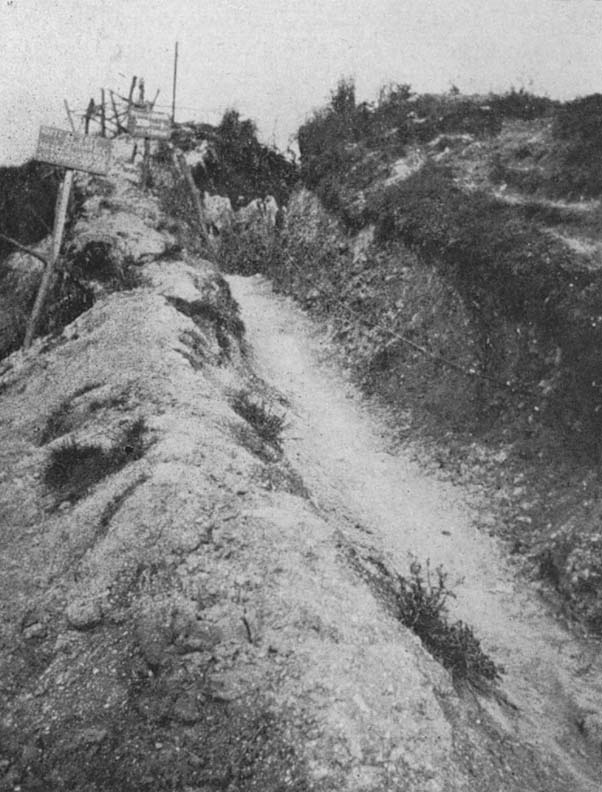
It was on the morning of the ninth day after embarking that we awakened to gaze out upon the most famous mountain and saw the sun reflected from the snow-clad Olympian slopes. A few hours later we passed the torpedo net which guards the outer harbor, and presently caught our first glimpse of the white minarets of Salonika. About us were dozens of battleships and merchantmen, some flying the tricolor, others with the Union Jack, others with the green, white and red of Italy. The gigantic four funneler La France, now a hospital ship, rode at anchor, while close in shore were ranged many wooden boats with the peculiar Peloponnesian rig. We passed the length of the harbor before dropping anchor. The yellow quarantine flag flew from our masthead and presently the health officers came off. We were all anxious to learn their ruling. Rumor spread that the entire ship was to be held forty days in quarantine. The thought of remaining two score days on that filthy craft, while she rode at anchor off shore, nearly made us wild. A line of signal flags was broken out and presently, in answer, three launches came along side. Into these were loaded half a hundred of the yellow men, victims of the spinal meningitis. The ship then swung about and we proceeded to the other end of the harbor, where we again dropped anchor. The yellow flag was still flying. We lay here for the rest of the day and speculation ran rife on our chances of being held thus indefinitely. On the following morning, much to our relief, the yellow flag was lowered; we warped alongside the quay and about noon disembarked. It was the tenth day after leaving Marseilles.
TO the northeast of the city, where the barren plains merge into the barren foot-hills, which in turn rise into barren, scraggy mountains, was established our camp. It was night when we reached the spot and as our tents had not arrived we spread our blankets on the bare ground and turned in under the sky.
Until our cars should be unloaded, there was no work for the Squad. We were, therefore, given every alternate day for "shore liberty," when we were free to go down into the city and wander at will.
We found it a city well worth seeing. Dating back three hundred years before the birth of Christ, it has been and is the stamping ground of history. The Avar, the Goth, the Hun, the Saracen, the Norseman captured and sacked it. The Serb, the Bulgar, the Venetian and the Turk have fought over it. For five hundred years the latter held and ruled over it, until, after the second Balkan war, it passed to Greece in 1913. "There will always be fighting in the Balkans," says one of Kipling's men and when we found the armed men of six nations guarding the prisoners of four others through the streets of Salonika, we felt that it was so. Before the allied occupation, Salonika had a population of perhaps 150,000, about fifty per cent of whom were Spanish Jews. The remainder of the population was divided among Turks, Serbs, Roumanians, Greeks, Cretans, Czechs, Albanians and the bastard tribes of the near east. With the coming of the allies and the influx of refugees, the population trebled. Rarely, if ever, in the world's history had there been such a mixture of men and races as now thronged the rough, slippery streets of the city and filled the air with a conglomeration of languages unequalled since the I. W. W. knocked off work on the tower of Babel. All the characters of the Orient were there; the veiled woman, the muezzin, the bearded, befezzed Turk, the vendor of wine with his goat-skin, the money-changer, the charcoal-seller, the Macedonian mountaineer with his ballet skirt and pompommed shoes, the rag-clad leper, the porter, the black-hatted Greek priest, women in bloomers, women with queer parrot-like headdresses, dignified rabbinical looking old men in white turbans and loose, flowing robes; and mingling with this throng in the narrow, twisting streets were the soldiers of France, Annamites, Senegalese, Moroccans, the English Tommy, the Italian in his uniform of elephant-hide gray, the sturdy Russ, the weary Serb, the Cretan Guards, soldiers of the newly formed Venezelos army and now and again guarded German, Austrian, Bulgar and Turkish prisoners. From the battleships in the bay came the sailors of four nations and from the merchantmen a half score of other nationalities found representation and mingled with the crowd. Lest some fragment of the way remain unoccupied, that ubiquitous Ford of the east, the burro, jostled the passerby and droves of sheep and goats scuttled about his legs. Over all this shifting mass sounded the curious hum of many languages, punctuated by the cries of the street vendors and the honk and rattle from army motors.
You are led to believe that everybody is in the street until you enter a café and find it difficult to obtain a seat. Here you can drink delicious black Turkish coffee, served in tiny brass cups, or, if you like, a sticky white liquid tasting exactly like sweetened paregoric and reminiscent of collicky nights. Here, too, you may try the giant hookah, or water pipe, though, after reflecting on the generations of Turks who must have curled a lip over its mouthpiece, you probably will refrain.
Then there are the bazaars. They are booth-like shops which open directly on the streets. And the streets on which they open are roofed over so that business is conducted in a subdued light, conducive to meditation and also, perhaps, (but whisper it) to the concealment of defects in the wares. Here are displayed flint-lock pistols, embroideries, laces, sheep-skin coats---and ye gods, how they do smell !---leather sandals, beaten copper ware, knitted socks, beautiful lace silver work, amber beads and cigarette holders. And if you inquire. "From whence come these things?" he of the shop will make answer, "From Albania, O Sire," whereas, be the truth known, none save perhaps the silver work ever saw Albania.
We had been told that the flies would be all over by October. They were-all over everywhere. In Salonika the fly is ever present; they festoon every rope, crawl over every exposed article of food, flop into every liquid, swarm about your head, skate over your person and generally act "just as happy as though invited." Heretofore, I had always considered a little restaurant in Gettysburg, Md., only slightly mis-named "The Busy Bee," as being the world's headquarters for flies, but a Salonika fly, if transported to that restaurant, would hunger for companionship and pine away and die of lonesomeness. It is beyond dispute that should the rest of the world run out of flies, Salonika would be able to re-stock it and. still have enough left to bat in the .300 class. They do not seem to bother the Turk. He accepts them as decreed by Allah; it is enough. As for the Greek, he is too busy frying fish to notice. The Greek considers that day lost whose low descending sun sees not a mess of fish fried. Everywhere, in little open-faced booths, you will see him with a tiny charcoal brazier---frying fish. At early morn, at dewy eve, all through the sunny day, this piscatorial pastime proceeds. What is done with these schools and oceans of fish I wot not. Never have I beheld mortal man eat thereof. Indeed, I question whether he could eat one without giving quick proof of his mortality. Possibly the frying has to do with the mysteries of the Greek religion; possibly it is a form of sport, like tatting or solitaire. I know not. Whatever the cause, whatever the result, certain it is, its popularity is beyond question.
Of course there be other foodstuffs. Exposed to sale---and flies---you will see them. Many weird and curious shapes they have, deterring to all save an ostrich, or a Macedonian. One sort there is, a brown ball, slightly larger than a shrapnel ball-also slightly heavier. These are served with honey. Having consumed a salvo of these, one is prone to meditate on the vicissitudes of life. There is another dish resembling lamp chimney packing.
This, too, is chaperoned with honey. The substance most in demand, however, is a ghastly sort of plaster exactly resembling putty. Personally, I have never eaten putty but after trying this other stuff, I am convinced I should prefer putty as being more digestible and equally palatable. Then there are numerous white, fly-sprinkled sour milk products, rather pleasing from a scenic standpoint, but fearful to the unaccustomed taste. All of these concoctions are regarded by the populace as being cibarious, nay more, as being delightful to eat. Truly the ways of the East be strange.
The setting for the street life and characters is appropriate. The quaintly colored houses with their overhanging second stories and latticed windows, the narrow twisting ways, the stately minarets add to the mystery and lend atmosphere. But incongruities there are, the West clashing with the East, the modern opposing the ancient. It was disheartening to the lover of the picturesque to behold motor lorries speeding down the Street of the Vardar, that street dating from Roman times, a part of the way over which passed the caravans from the Bosphorus to the Adriatic. Then, too, it jarred one's sensibilities to see a trolley car passing beneath the triumphal arch of Galerius, dating from the year 296, or the walls of the White Tower of Süle Iman the Magnificent reflecting the lights of a cinema palace, or to hear the plaintive cry of the muezzin, calling the faithful to prayer, broken by an auto hooter. And the regrettable part of it all is that when there is a co-mingling of the Occident with the Orient, it is the latter which gives way with a loss of the picturesque and the tranquil.
As the sun sinks across the harbor and the after glow pricks out the jagged mountains and paints every spar and rope of the battle fleet with an orange glow, the bazaars become deserted, the easterner betakes himself within his doors and the life of the city moves down toward the water front. The nightlife of Salonika was not nearly so extensive or unrestrained as that of Marseilles. While not under martial law, the streets were at all times patrolled by military police, French, English, Italian and Cretan, and no disorder was permitted. Along the great street which faces and follows the waterfront for several miles, are scattered cafés, cinema palaces, restaurants, theaters and dance halls. The cinema shows are like such affairs the world over, the restaurants are Greek---which is to say the worst in the world; the theaters produce mediocre burlesque but the cafés and dance halls offer more of interest. There are a few dancing girls --- mostly thick-ankled, swarthy Greeks,--- a singer or two and a persevering pianist, to whom nobody pays any attention. But most of the entertainment is furnished by the patrons themselves. You may see a couple of tipsy Zouaves, from the Tell, gravely performing the "dance of the seven veils"; a score of Serbs, grouped around a table, occasionally break into one of their wild, weird chants, thumping their mugs in rhythm but never laughing---I, never saw a Serb laugh. If you call out "Cobra"---"good"---to them when they finish, however, they will smile. When things quiet down a bit someone starts "Keep the home fires burning" and instantly there is a thump of hobbed feet and every Tommy present swings into the chorus. Presently a poilu is pushed to his feet and in a rich voice sings the prologue from Pagliacci. The Italians present applaud vociferously and everyone bangs on the floor while there come cries of "encore," "bravo," "dobra" and "good" which bring the singer back.
We fall into conversation with a Tommy at our table. He has "been up country," as he calls it, in fact, is just back. "How is it up there?" we inquire.
"It's 'ell, that's wot it is, 'ell," he responds.
"Oui monsieur," chimes in a poilu, "it is all that there is of terrible."
Nice cheery talk, this for us who are going up there. The Tommy is named "'Arvey." In his opinion the "'ole blinking country ain't fit to kill a balmy dog in." We have his mug replenished, in acknowledgment of which he hoists it, nods toward us and remarks "top 'ole," to which etiquette requires we respond "every time." His "pal" joins the group and 'Arvey informs the newcomer we are "priceless fellows," which, considering we have paid for the rounds, is an ambiguous compliment. The chum is full of dignity and beer. He regards 'Arvey solemnly, for some time listening to him describe his own prowess with the bayonet. At the conclusion of this not overly modest recital, he leans forward, gravely wags his finger and demands, "Tell me 'Arvey, 'ave you ever 'it a 'Un"?
On the days when we did not have permission to go into the city, we remained in the vicinity of camp or took walks back into the barren hills. The ground on which our tents were pitched was, I am convinced, the hardest in the world and it was a week or more before our bones and muscles accustomed themselves to its surface. Not far from the camp was a tiny café, kept by a Greek who spoke French, and here we would repair and in the course of a day drink quarts of thick Turkish coffee. Here, too, could be obtained sausages, or at least what passes for sausages in Macedonia. Nearly everyone in the Squad tried them---and found them guilty. They must have been heirlooms in that Greek's family. Certainly they antedated the first Balkan war.
At this time there was in progress one of those incomprehensible revolutions, without which no Macedonian or Central American is happy. No man knew what it was all about, but there were great marchings and countermarchings and, as one of the revolutionary camps was near ours, we saw considerable of the "goings on." They made a fearful row about it all and at night, when the moon shone, they would cluster together and with heads tilted upwards bay out some agonizing choruses. We fervently hoped that the revolution would suffer a speedy suppression and its participants meet a just retribution.
Our illusions, formed in France, respecting the warmth and sun of the Orient underwent speedy change. We found the climate much like that we had left. Heavy torrential rains set in. Outside our tents the yellow mud was inches deep. After a fortnight, with no work to occupy our attention, we became restless. The vessel, in which were our cars, remained at anchor in the harbor and apparently did naught save issue bulletins that "demain" it would discharge cargo. Our spirits were further depressed by a sad incident which happened about this time. Sortwell, whose "cot was right hand cot to mine," a splendid, big chap, one of the most popular men in the Squad, was struck one night by a staff car and knocked unconscious. He never came to and died the following morning. He was buried with full military honors. On the morning of his burial we received word that our cars were ready for discharge at the dock.
We set to work the following day. That it rained, goes without saying. The crated cars were lowered over the ship's side and with crow-bar, pick and sledge we crashed into them. As soon as the crates were knocked away, gas was put into the tanks and the cars driven out to camp. We worked throughout the day and by ten that night had the satisfaction of releasing the last car.
The camp now became a scene of industry. The cars were parked in a hollow square formation. They had suffered some damage in transportation but this was soon remedied. The tire-racks, which had been demounted for the packing, were now re-installed. The lockers were replenished with spare gas and oil; tires were re-inflated and everything tuned up for departure. It had been determined to leave ten ambulances in Salonika as a reserve and we also established a dépot of spare parts from which the field atelier could replenish its store from time to time. The remainder of our rolling stock, including the staff cars and the kitchen truck were now ready for departure. Reports had come in of lively fighting and a steady advance in the direction of Monastir, for which front rumor had it we were destined. We were anxious to be away. Finally on an afternoon in the middle of November we were reviewed by the commanding officer of the automobile corps of the A. F. O. Our cars were packed and it but remained to strike the tents and roll the blankets. Enfin, we awaited the word.