
THE first flicker of dawn was showing as we wound our way down through the outlying parts of Salonika, a sinuous line of ambulances and auxiliary cars. On the water front the convoy halted for final adjustment. The fore-glow, coming across the harbor, filtered through the spars of the shipping and gave promise of a clear day. A few early porters and rugged stevedores paused to gaze wonderingly upon us. The C.O. passed down the line to see if all were ready; the whistle sounded and we were off.
Passing through the already livening streets we paralleled the quay, turned towards the northwest and then, as the muezzins in the minarets were calling upon the faithful to greet the rising sun, entered upon the great caravan trail which runs back into the mountains, and Allah knows where. Past trains of little mountain ponies, laden with hides; past lumbering, solid-wheeled wagons, drawn by water buffaloes and piled high with roughly baled tobacco, tobacco from which are made some of the choicest Turkish cigarettes in the world; past other wagons with towering piles of coarse native matting; past the herdsman and his flock, his ballet skirt blowing in the morning breeze; past the solemn Turk, mounted athwart his drooping burro, his veiled woman trudging behind. The city lay behind us now; the passersby became fewer, until only an occasional wayfarer and his burro were sighted. The road, pitted and gutted, stretched away through a barren, dreary country. The sun's early promise had not been fulfilled and a gray, slaty day emphasized the dreariness of the landscape. To our right bleak mountains rose to meet a slaty sky---nowhere appeared tree or shrub, not even a fence broke the monotony of the landscape, never a house, not even a road, though occasionally a muddy track wandered aimlessly through the waste. We rounded the mountains and crossed a sluggish stream, the Galiko. Once we saw a village far away, its white minarets rising above the dull gray of the ensemble. Then the desolation closed down. Farther on, over a shaky wooden bridge, we crossed the Vardar, the Axius of Virgil. Hereabouts the country was flat and swampy, but suddenly it changed, scattered trees began to appear, here and there rocks jutted out. The trail began to mount and presently as we twisted our way through the first settlement, the village of Yenizé, mountains came into view to the northeast and then moved towards the south and west. About eleven we sighted some whitewashed houses clinging to the side of a cliff, the overflow of the town of Vodena through which we presently passed over a winding road of mountainous steepness; up we went, three hundred, four hundred meters, finally stopping where a fountain gushed from the roadside, a kilometer or so beyond the town.
We were in the heart of the hills now. On three sides of us the mountains rose to a height of six thousand feet or more. Their tops were covered with snow and from this time on we were never to lose sight of it.
Some biscuits, ham and chocolate found a good home and there was time for a couple of pipes before the whistle blew and we again cast off. And now our troubles began. Up to this time our way could at least lay claim to the name "road," but now even an attorney, working on a percentage basis, could establish no such identity for the straggling gully through which we struggled,---sometimes a heap of boulders, sometimes a mire, but always it climbed. The cars coughed and grunted and often we were forced to halt while the motors cooled. In mid-afternoon the rain, which had been threatening for some hours, set in and the ground quickly assumed the consistency of sticky paste, through which we sloughed our way. About four we spoke the Lake of Ostrovo and shortly afterwards passed through the straggling village of the same name. Deep sand here made the going hard but we soon left the shores of the lake and again headed straight into the mountains. So far as possible the trail held to the passes but even so, the ascent was very great. As night fell we came to an especially steep stretch slanting up between snow covered mountains. From a little distance it looked as though someone, tiring of road building, had leaned the unfinished product up against a mountain side. Time and again we charged but without avail; no engine built could take that grade. Physics books tell us, "that which causes or tends to cause a body to pass from a state of rest to one of motion is known as Force." With twenty men to a car, pulling, pushing and dragging, we assumed the function of "force" and "caused a body" ---the cars---to "pass from a state of rest to one of motion," hoisting them by main strength over the crest.
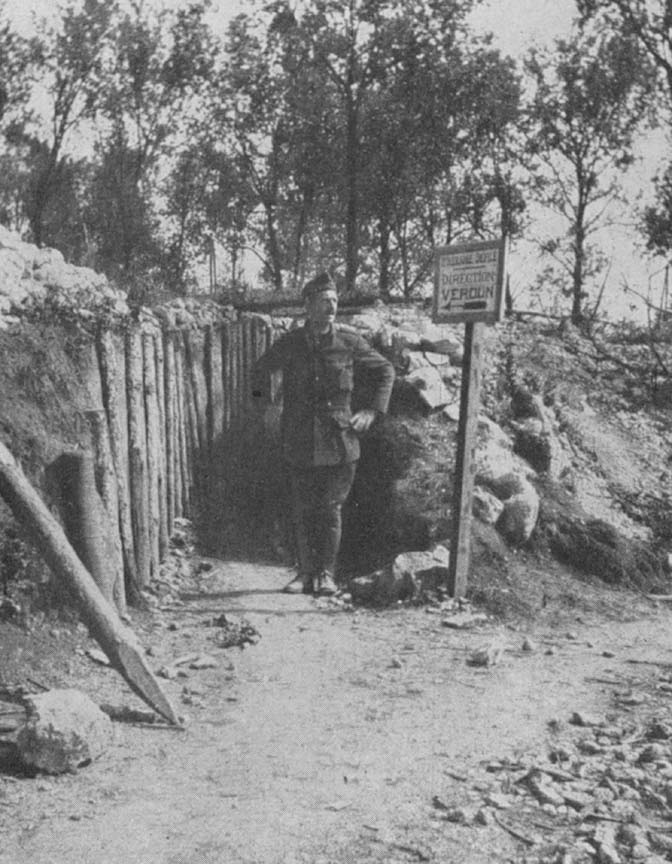
Night had shut down for some hours when the last car had topped the rise. A bone-chilling wind had swept down from the snow, the rain still fell. The lights were switched on and over a trail, flanked on one side by a towering cliff and on the other by a black chasm of nothingness, we kept on. Once we rounded a sharp curve, there was a sudden dip in the trail and in the darkness we almost shot off into the space below.
It still lacked some two hours of midnight when ahead we discerned a few flickering lights. The Lieutenant gave the signal and we came to a stop at the fringe of a miserable village. We had been sixteen hours at the wheel but had covered no more than one hundred and fifty kilometers. We were all cold and hungry, but the soup battery was mired somewhere miles in the rear. Our lanterns showed us but a few stone hovels. Had we known more of the Balkans, we would not even have thought of finding a shop. We gave up thoughts of dinner, crawled within our cars and wrapping our great coats about us, sought to dream of "a cleaner, greener land."
The tramping of many feet and the sobbing of a man woke me next morning. I looked out to see a column of Russian infantry passing. One big fellow was crying as though his heart would break. Ba-né-a or Ba-netz---a, the village at which we had halted---proved to be a miserable collection of huts, constructed of rounded stones, with which the surrounding hills were covered. Like most Turkish villages, it clung to the side of a hill, sprawling there with no attempt at system or a view to streets. The buildings were of one story; a few had glass but in by far the most part straw was employed to block the windows. The twisting paths which wandered about between the houses were knee deep in black mud. There were no shops, not even a café.
Other and higher hills rose above the one on which the village was situated. These hills were barren and covered with loose stones, their tops were crested with rough breastworks behind which were empty cartridge cases, torn clothing, ponchos, and scattered bodies in faded uniforms, for here the Bulgar and Serb had opposed each other. To the north of the village stood a few trees and here within a barbed-wire corral a few armed Serbs guarded several hundred Bulgar prisoners. The villagers were as unattractive as their surroundings, the men dull, dirty-looking specimens, the women cleaner but far from comely. The latter were dressed in skirts and blouses of many colors. Their heads were covered with shawls, the ends of which were wound about their necks. From beneath these straggled their hair, invariably woven into two plaits into which was interwoven hair from cow's tails dyed a bright orange. Upon their feet they wore wooden, heelless sandals which, when they walked, flapped about like shutters in a gale of wind. The little girls were miniature replicas of their mothers, save their faces were brighter---some almost pretty. They wore their many petticoats like their mothers, at mid-leg length, tiny head shawls and striped wool stockings. The endless occupation, both of the women and children, was the carrying of water in clay jars. They must have been building a river somewhere and judging from the amount of water they were transporting, it was to be no small size stream either.
Not all of the cars had come through to Ba-netz-a and so we awaited their arrival. Several had broken axles and the big atelier car and the soup battery had mired in crossing the Ostrovo flats. Meanwhile, perched on the side of a hill with the snow above us and a falling temperature, we, of the advance squad, were reminded that winter was almost upon us. The days were gray and as there was nothing to do while awaiting the stragglers, save gaze across the valley which stretched southward below us, the time dragged. The boom of heavy guns came to us from the northwest and occasionally, when the wind was right, we could hear the crackle of infantry fire. Some couriers riding back from the front brought word that Monastir had fallen after fierce fighting and the French were advancing northward.
By evening of the third day all the cars had come up and, with the kitchen wagons once more in our midst, we were again able to have a hot meal. Our spirits rose and that night, clustered round a small fire, we sang some mighty choruses. At nine on the morning of the twenty-fourth of November---a cold, drizzly morning---we wormed our way down through the village and out upon the transport road northeast toward the Serbian frontier. Though hundreds of German, Bulgar and Turkish prisoners were at work upon the road it was scarcely passable. Everywhere we passed mired couriers and camions; dead horses and abandoned wagons were scattered about. The way led across a level valley floor. On the flat, muddy plains bordering the road were camps of French, English, Italians and Russians. Several aviator groups were squatted in the miry desolation.
As we advanced the road accomplished something we had deemed impossible---it grew worse. The transport of five armies struggled along, or rather through it and contributed everything from huge tractors to little spool-wheeled cow-drawn Serbian carts. We passed through one squalid, war-festered village where the road reached the sublimity of awfulness and then t about mid-day spoke the village of Sakulévo. Several demolished buildings, pocked walls and shelled houses showed the place had been recently under fire. Passing through, we crossed a sluggish stream, from which the village takes its name, and on a shell-scarred flat on the north bank halted and pitched our tents.
The road at this point bends to the east before again turning northward, and enters the long valley at the farther end of which lies the city of Monastir. About a mile northward from our camp was a stone which marked the border between Macedonia and Serbia. High ranges of mountains stretched along the side of the lonesome valley. No words of mine can describe the landscape as do the words of Service:
|
"The lonely sunsets flare forlorn "The lonely sunsets flame and die, |
WE had reached Sakulévo on the afternoon of the twenty-fourth of November. On the morning of the twenty-fifth we started to work. On the other side of the river was a cluster of tents. It was a field dressing-station and, appropriate to its name, was located in a muddy field. Since Sakulévo was at this time some thirty kilometers from the fighting, our work consisted of evacuations, that is back of the line work, the most uninteresting an ambulancier is called upon to do, since it wholly lacks excitement. Here it was made more trying because of the fearful roads over which our route lay. At this time the village of Eclusier, some forty kilometers southeast of Sakulévo was rail head and to this point we evacuated our wounded. It was a matter of three and a half hours of the most trying sort of driving. Perhaps a better idea of our work at Sakulévo may be had if we go together on a "run." It's seven-thirty in the morning, a cold raw morning with ice on the pools and a skim of ice on the inside of the tent. The sun has not long appeared over the snow-clad mountains and there is little warmth in its rays. We have just had breakfast---heaven save the name---some black coffee and army bread---so it's time to be off. The crank up---a none too easy performance, since the motors are as stiff with cold as we are, and then toss and bump our way across the little bridge disregarding a sign which, in five languages, bids us "go slowly." A couple of hundred meters farther on in a field at the left of the road is a group of tents, before which whips a sheet of canvas displaying a red cross. It is the field dressing-station. We turn the car, put on all power and plough through a mire and then out upon more solid ground, stopping in front of the tents. A short, stocky soldier with a heavy beard and the general aspect of Santa Claus comes out.
We exchange salutes: "Ça va? " he queries.
"Toujours, et vous?ª
"Bien, Merci.ª
The formalities, which no matter what the stress are never omitted, being over, business commences.
"Many blessés?" you inquire.
"Yes, many"; he answers. "Last night there was an attack; you heard the guns? Il'y'a tout couchés." So, since all your passengers will be stretcher cases, you pull down your third rack, assemble your stretchers and arrange your blankets. A number of wounded have now come out of the tent and are standing about. Later they will be removed as assis or sitting cases, but first the more urgent cases must be evacuated.
One chap, in the peculiar yellow-green uniform of the Zouave attracts your attention. He is very large for a Frenchman, close to six feet. His head is swathed in bandages and his right arm is in a sling. Across his tunic is a row of decoration and service ribbons which show him. to be a professional soldier. Above his sergeant's chevron is already one wound stripe.
"Bonjour, camrade," he greets.
"Bonjour, sergeant," you respond, "hit badly?"
"Ah, ça ne fait rien, but now I shall not be able to face them for two months."
At this moment two German prisoners, carrying a stone boat, pass by within six feet of us. The colonial's lips draw back like the unsheathing of a bayonet, his eyes fairly stab and his unbandaged hand opens and closes, as though gripping a throat. "Sales cochons," he mutters. "Nom de Dieu, how I hate them." The prisoners pass placidly by and you feel it is well that your friend cannot have his way with them.
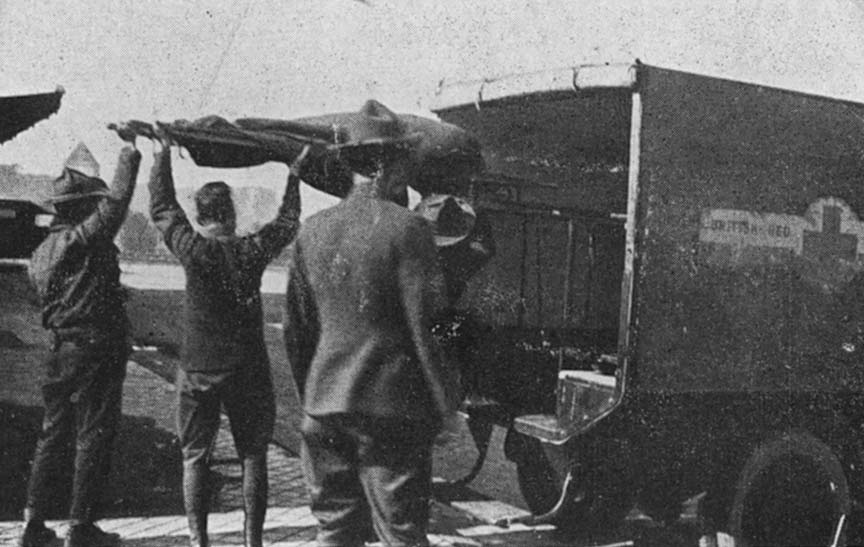
Now the tent flap opens and two brancardiers appear, bearing between them a stretcher upon which lies a limp figure covered with a dirty blanket. A gray-green sleeve dangles from the stretcher and shows your first passenger is a German. He is slid into place and by this time your second passenger is ready. He is a giant Senegalese with a punctured lung. Your third man is a sous-officier whose right leg has just been amputated. He has been given a shot of morphine and his eyes are glazed in stupor. The third stretcher is shot home, the tail board put up and the rear curtain clamped down. Over these roads we can take no more, so we are ready for the start.
Through the slough and then out upon the road, which is little more, we go. Through war's traffic we pick our way, beside shell-laden camions, pack trains, carts, past stolid lines of Russians, dodging huge English lorries whose crews of Tommies sing out a friendly "are we downhearted?" Between rows of Bulgar and Boche prisoners your way is made, the hooter sounding out its demand for the rights of a loaded ambulance. Along the road-side, out there in the fields, sprinkled everywhere, we see the little wooden crosses, war's aftermath. Everywhere war's material wastage is apparent. Wrecked wagons and motors, dead mules, hopelessly mired carts, military equipment, smashed helmets, dented douilles. Your way is lined with these. The road from there on becomes freer but is still too rough to permit much quickening of speed. As we turn a bend a frenzied Italian comes charging across the fields. He seems greatly excited about something and unwinds reels of vowels not one word of which we understand. We try him in English and French, not one word of which he understands, so finally we give it up and go on, leaving him to his "que dises."
Through two passes, in which the white low-hanging clouds close down, through several deserted villages over a road which, save in the Balkans, would be considered impassable we carry our load. It is impossible to prevent lurching and the black within groans and cries aloud in his pain. The Boche, too, when there is an exceptionally bad bit, moans a little, but the sous-officier makes not a sound throughout the voyage. At one point the road passes near the railroad and, dangling over a ravine, we can see the remains of a fine iron bridge dynamited during the great retreat. At last, rounding the jutting point of a hill, we see far below us the blue waters and barren shores of Lake Petersko. Squatted beside the lake is a little village, Sorovicevo. Railhead and our destination, the station of Eclusier, lies a mile or so to the west. Down the hilt we brake our way, then over a kilometer of wave-like road into a slough, where for a time it seems we are destined to stick, and at last the tossed and moaning load is brought to a stop at the hôpital d'évacuation, a large cluster of tents. We assist in removing the wounded---the Senegalese is gray now, with the shadow of death upon him and his breath gushes with great sobs through his torn lung. The Frenchman and Boche seem to have come through all right.
It is now eleven-thirty o'clock and we are probably becoming conscious that we could use a little food, but it will be at least two hours before we can reach camp, so we get out a spark-plug wrench and break up several army biscuits to munch on the way home. En route we are hailed by three Tommies who have been left behind and are seeking to join their detachment. They desire a lift so we take them aboard and are repaid by hearing their whimsical comments on the "filthy country." It is nearly two o'clock---a blowout has delayed us---when we reach camp and the motor has barely stopped churning before we are in the mess tent clamoring for our "dum-dums"---beans---and "singe", tinned beef. You will find your appetite has not suffered because of the "run."
The days were rapidly growing colder. Our tents were sheathed with ice and the snow foot crept far down the mountains each night. We got our sheepskin coats and inserted an extra blanket in our sleeping bags. Each night we drained our radiators to prevent damage from freezing. The few sweets we had brought with us had now given out. In the French army save for a little sugar---very little---and occasionally---very occasionally---a small amount of apple preserve, no sweets are issued. It was impossible to purchase any, so presently there set in that craving for sugar which was to stay with us through the long winter. The arrival of Thanksgiving, with its memories of the laden tables at home, did not help matters much. Dinner consisted of lentils---my own particular aversion---boiled beef, bread, red wine and black coffee. However, the day was made happy by the arrival of our first mail and we feasted on letters.
It's wonderful what a cheering effect the arrival of the post had on us. Throughout the winter it was about our only comfort. In France it had been welcome but down in the Orient we seemed so cut off from the world that letters were a luxury, the link with the outside. When they came it didn't so much matter than a man was cold or hungry and caked with mud, that the quarters leaked and the snow drifted in on his blankets. The probability of its arrival was an unfailing source of pleasurable conjecture, its arrival the signal for whoops and yowls, its failure, the occasion for gloom and pessimism.
Some fifteen kilometers to the north and west of Sakulévo was the large town of Florina, the northernmost town of Macedonia. Here was located a large field hospital. At the hospital, for a time, we maintained a post of two cars on five day shifts.
We found Florina one of the most interesting towns in the Balkans. Long under the rule of the Turk, it possessed a distinctly Oriental aspect which gave it charm. It nestled at the foot of some high hills which had been the scene of heavy fighting in the dispute for its possession. The town itself had suffered little, if any, in the fighting. Its long main street followed a valley, turning and twisting. Booths and bazaars lined the thoroughfare and in places vines had been trained to cover it. There were innumerable tiny Turkish cafés, yogart shops, little shops where beaten copper ware was hammered out, other booths where old men worked on wooden pack saddles for burros. There were artisans in silver and vendors of goat's wool rugs. The streets were always alive with "the passing show," for the normal population of fifteen thousand souls had been greatly augmented by the influx of refugees from Monastir. There was an air of unreality about the place, an indefinable theatricalism which gave one the sense of being part of a play, a character, and of expecting on rounding a corner, to see an audience and then to hear the playing of the orchestra.
It was while on duty at the hospital at Florina that I made the first run into Monastir. My journal for December 2nd reads: "At one o'clock this afternoon received orders to proceed to Monastir en raison de service. My passengers were two corporals. It has been a cold, overcast day, the clouds hanging low over the snow-capped mountains. A cold, penetrating wind hit us in the face as we drew away from the hospital.
"When the Florina road joins the main caravan road to Monastir, we passed from Macedonia into Serbia. Here we turned sharply toward the north. The flat fields on either side were cut up with trenches, well made, deep ones, from which the enemy was driven less than a fortnight ago, and shallow rifle pits which the French and Serbs had used in the advance. Even now, so soon after their evacuation, they were half filled with water. Everywhere there was evidence of big gun fire and in one place where we crossed a bridge the ground for yards about was an uninterrupted series of craters. For the first time in the war I saw piles of enemy shells and shell cases showing that his retreat had been unpremeditated and hasty. In one place stood a dismantled field piece.
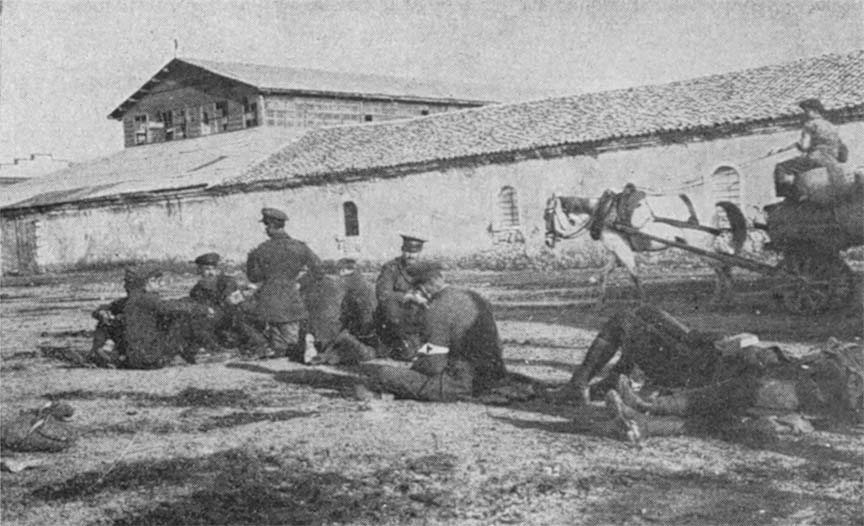
"About a quarter of an hour after leaving Florina, we reached the village of Negocani. There had been heavy fighting here and many of the houses had been reduced to piles of 'dobe bricks. Two miles away to the road, we could discern the remains of another village, Kenali, where the enemy made his last stand before falling back upon Monastir the other day. The sound of the guns had all the while been growing louder and not far beyond Negocani I caught my first glimpse of the minarets of Monastir. It had been two months since I was under fire and I had some curiosity as to how it would affect me. Before reaching the environs of the city it became apparent that this curiosity would not long remain unsatisfied, for ahead we could see the smoke and dust from bursting shells. Approaching the city, the way becomes a regular road, quite the best I have yet seen in the Balkans. I was speculating on this marvel when, perhaps, five hundred yards ahead, a columnar mass of earth spouted into the air. The whirring of speeding éclat had scarcely ceased when another came in slightly nearer. The road was under fire and that same old prickly feeling shot up my spine, the same "gone" sensation moved in and took possession of my insides. Suddenly the familiar sound pervaded the air. There was the crash as though of colliding trains and not forty meters away the earth by the roadside vomited into the air. In another second the débris and éclat rained all about us, showering the car. The shell was a good-sized one---at least a 150, and we owed our lives to the fact that, striking in soft ground, the éclat did not radiate. Meanwhile, I had not waited for the freedom of the city to be presented. The machine was doing all that was in her and in a few seconds more we shot by the outlying buildings. The fire zone seemed to be restricted to the entering road and the extreme fringe of the city and when we reached the main street, though we could hear the shells passing over, none struck near. Within the city our batteries, planted all about, were in action and the whirring of our own shells was continuously sounding overhead.
 |
 |
"We parked in a filth-strewn little square lined with queer exotic buildings. While I waited for the corporals to perform their mission, I talked with an Algerian Zouave who lounged in the doorway. He pointed out where a shell had struck this morning, killing three men, two civilians and a soldier. He further informed me that the streets of the city were in full view of the enemy who occupied the hills just beyond its outskirts. This revelation was most disconcerting to me, for I had no desire to work up a "firing acquaintance." A number of officers of high rank passed---among them a three-star general. A colonel of infantry stopped, shook hands with me and spoke appreciatively of the work of the Corps in France, saying he was glad to welcome a car in the Orient.
"By three o'clock we were ready. My passenger list was augmented by a lieutenant, medecin, who wished to reach Florina. He cautioned me with much earnestness to "allez vite" when we should reach this shelled zone, a caution wholly unnecessary as I had every intention of going as far as Providence and gasoline would let me. The firing now---praise to Allah---had slackened and only an occasional shell was coming in. So, making sure the engine was functioning properly, I tuned up and a second later we were going down the road as though "all hell and a policeman" were after us.
"We reached Florina without mishaps. Tonight there is a full moon. Don and I strolled down into the town. It was singularly beautiful, the white minarets standing out against the sombre mountains, the silvery light flooding the deserted streets. We strayed into one of the tiny little cafés. It was a cozy place. Divans covered with rugs and sheepskins lined the walls. A few befezzed old men sat cross-legged on these, sat there silently smoking giant hookahs and sipping their syrupy coffee. We, too, ordered coffee and then sat in the silence helping in the thinking. After a while the door opened and a shorts hairy man entered. He was clad in long white wool drawers, around which below the knee were wound black thongs. On his feet were queer-shaped shoes which turned sharply up at the end and were adorned with black pom-poms. He wore a short jacket embroidered with tape, and thrown back from his shoulders was a rough wool cape. Around his waist was wound a broad sash into which was thrust a revolver and a long-bladed dirk. About his neck and across his breast were hung many silver chains, which jingled when he moved. His head was surmounted by a white brimless hat. He talked in an unknown tongue to the patron and then, bowing low to us, was gone amid a clinking of metal. This strange looking individual was---so we learned from the café's proprietor---an Albanian, a man learned in the ways of the mountains, a scout in the employ of the French.
"We sipped another coffee, smoked a cigarette and then, bowing to the old men, went out into the moonlit street, leaving them to their meditations. As I write this from the tent, the sky is darkening, a chill wind sweeps down from the snow and gutters the candle. I am glad that our blankets are many."
As the days went by, our camp site, where we were the first comers, began to assume the aspect of a boom mining town. Several camion sections appeared. Numerous avitailement groups moved in. Tents and nondescript structures of earth and ammunition boxes sprang up. Across the river ten thousand Russians were encamped and all night their singing came to us beautifully across the water. All day and all night war's traffic ground and creaked by us. The lines had shaken down; the two forces were now entrenched, facing each other just beyond Monastir and the transport was accumulating munitions for an offensive. In the first camp opposite long lines of Serbian carts, carts such as Adam used to bring the hay in, struggled. The sad-faced burros plodded by, loaded with everything from bread to bodies. Soldiers, French, Italian, Serb and Russian slogged by. But this activity was confined to the narrow zone of the roads. Beyond, the grim, desolate country preserved its lonesomeness and impressed upon the soul of man the bleakness and harshness of a land forlorn. For the most part the days were gray and sombre, with low-hanging clouds which frequently gave out rain and sleet and caused the river to rise so that more than once we were in danger of being flooded out. But occasionally there would be a clear morning, when the clouds were driven back and the rising sun would light the mountains, turning the snow to rose and orange. We were growing very tired of the evacuation work, of the long, weary runs. There was no excitement to tinge the monotony. We were becoming "fed up." The Squad, therefore, hailed with joy the news that the Section was to move up to Monastir and there take up the front line work.
Though the exact date of our departure was not announced we knew it would be soon and we commenced at once to make ready. Helmets once more became items of interest and motors were tested with an interest born of empirical knowledge that the fire zone was no place to make repairs. Everybody brightened up; interest and optimism pervaded the camp. And then the word came that we should leave on the seventeenth of December.
MEN stumbled about in the darkness falling over tent pegs or pulling at icy ropes. Now and then a motor in response to frantic cranking, coughed, sputtered and then "died." Down near the cook tent someone was swearing earnestly and fervently at the mud. It was three o'clock in the morning and the only light was that given off by the stars. The Squad was breaking camp and we were to be in Monastir, twenty-five kilometers distant, before daybreak. Somehow in spite of the darkness, the tents were struck and packed and the cars rolled out on the bumpy roads.
Our orders issued the night before were: (1) every man to wear his helmet, gas masks to be slung; (2) on reaching a designated spot five kilometers outside of Monastir, to extinguish all lights; (3) thereafter cars to maintain intervals of a hundred metres, so that if shelled, one shell would not get more than one car; (4.) in the event of losing the convoy after entering the city, to stop, unless under fire, at the point where the car preceding was last seen.
With the assistance of our lights we were able to hold a good pace until we reached the dip in the road which had been designated as the point where the convoy should halt. Here we extinguished all our lights and made sure that everything was right. Ahead we could see flashes, but whether from our own guns or bursting shells we could not determine. The sound of firing came plainly to our ears. The cars now got away at fifteen seconds' intervals. A faint, gray light was showing in the east, just permitting a dim vision of the car ahead. At the entrance to the city in a particularly exposed spot, there was some confusion while the leading machine circled about in an endeavor to pick the right street, then we were off again, heading for the northeast quarter of the city. Crossing a small wall-confined stream by a fragile wooden bridge, we wound and twisted through a maze of crooked streets, and finally just as the first glow lightened the minarets, came to a halt in a narrow street. Where my car stopped was a shattered house and the street was carpeted with débris, the freshness of which testified to the fact that the shells causing the damage must have come in not long before. Even as I clambered out of the machine two shells crashed in somewhere over in another street.
Our cantonment consisted of two five-roomed, two-storied Turkish houses which stood within a small walled compound. The top floors, or attics, of these houses were free from partitions and gave just sufficient space for our beds, ranged around the walls. The place was clean and dry and though, of course, there was no heat and no glass in the windows, it was infinitely better than the tents. The rooms below were used for the mess, the galley, and for the French staff, and one room which had windows and a stove was set aside for a lounge. The "C. O." occupied a small stone building which formed part of the compound wall, a sort of porter's lodge. Beneath the houses were semi-cellars, and in one of these we stored the spare gas and oil. The cars were at first parked along a narrow, blind street which extended a short distance directly in front of quarters. As it was ascertained, however, that here they were in plain view of the enemy, they were moved back on another street and sheltered from sight by intervening buildings. The atelier was established in a half-demolished shed about 200 yards up the street from the compound.
Our quarters were situated about midway between two mosques. In front of one of these mosques which faced on a tiny square hung a tattered Red Cross flag, betokening a field dressing-station. Here we got our wounded. The lines at this time were just beyond the outskirts of the city, and the wounded were brought directly from the trenches to this mosque, from whence it was our work to carry them back to the field hospitals out of range of the guns. I doubt if there ever was a more bizarre poste than this of the mosque. The trappings and gear of Mohammedanism remained intact. The muezzin's pulpit draped with its chain of wooden beads looked down on the wounded men lying on the straw-carpeted floor. On the walls, strange Turkish characters proclaimed the truths of the Koran. The little railed enclosure, wherein the faithful were wont to remove their sandals before treading the sacred ground, now served as a bureau. All was the same, save that now the walls echoed, not the muezzin's nasal chant, but the groans of wounded men who called not on Allah, but on God.
At first we found the twisted streets very confusing. They rarely held their direction for more than a hundred yards and their narrowness prevented any "observation for position." There seemed no names or identifications either for streets or quarters, and did one inquire the way of some befezzed old Turk, the reply would be "Kim bilir? Allah"---Who knows? God. But gradually we grew to know these ways until on the darkest of nights we could make our way through the mazy blackness.
The city sprawled about on a more or less level plain at one end of the long valley which extended southward to the Macedonian frontier. Some of its houses straggled up the hills which rose immediately back of the city proper. Beyond these hills rose the mountains from which at a distance of two kilometers the enemy hurled down his hate. The normal population of Monastir was perhaps fifty thousand souls, a population of that bastard complexity found only in the Balkans. When we reached the city, a month after its capture and occupation by the French, something like forty thousand of this civilian population yet remained, the others having fled to Florina or gone even farther south. Conditions were still unsettled. Daily, spies were led out to be shot, and we were warned not to wander unarmed in the remote sections. Snipers, from the protection of covered houses, shot at passing soldiers and at night it was unsalubrious to go about. Lines were drawn about the town and none but military transport permitted to pass. Famine prices prevailed. In the bazaars, captured dogs were butchered and offered for sale. A few stores remained open. Above their doors were signs in the queer, jumpy characters of the Serbian alphabet, signs which it would take a piccolo artist to decipher. Within, matches were sold for half a drachmi (10c) a box, eggs, 7 drachmi a dozen, and sugar at 6 drachmi a kilo. All moneys, save Bulgar, were accepted; the drachmi, the piaster, the franc, the lepta, the para, but the exchange was as complicated as a machine gun, and no man not of the Tribe of Shylock could hope to solve its mysteries.
Though most of the houses were closed and shuttered as protection against shell splinters, life seemed to go on much as usual. There was no traffic in the streets, save at night when the army transports came through, or when our machines went by with their loads, but the populace passed and repassed, bartered and ordered its life with the phlegmatic fatalism of the Easterner. The enemy from his point of vantage saw every move in the city. His guns commanded its every corner. His surveys gave him the range to an inch. Daily he raked it with shrapnel and pounded it with high explosive. No man in Monastir seeing the morning's sun, but knew that, ere it set, his own might sink. At any time of the day or night the screeching death might come, did come. Old men, old women, little children were blown to bits, houses were demolished, and yet, because it was decreed by Allah, it was inexorable. The civil population went its way. Of course when shells came in there was terror, panic, a wailing and gnashing of teeth, for not even the fatalism of Mohammed could be proof against such sights. And horrible sights these were. It was nothing to go through the streets after a bombardment and see mangled and torn bodies; a man with his head blown off; a little girl dead, her face staring upward, her body pierced by a dozen wounds; a group in grotesque attitudes, with, perhaps an arm or a leg torn off and thrown fifty feet away. These in Monastir were daily sights.
One afternoon I remember as typical. It was within a few days of Christmas, though there was little of Yuletide in the atmosphere. At home, the cars were bearing the signs, "Do Your Christmas Shopping Early," but here in Monastir, where, as "Doc" says "a chap was liable to start out full of peace and good will and come back full of shrapnel and shell splinters," there was little inducement to do Christmas shopping. Nevertheless we started on one of those prowling strolls in which we both delighted. We rambled through the tangled streets, poked into various odd little shops in quest of the curious, dropped into a hot milk booth where we talked with some English speaking Montenegrins, and then finally crossed one of the rickety wooden bridges which span the city's bisecting stream. By easy stages, stopping often to probe for curios, we reached the main street of the city. Here at a queer little bakery, where the proprietor shoved his products into a yawning stove oven with a twelve-foot wooden shovel, we got, for an outrageous price, some sad little cakes. As we munched these, we stood on a corner and watched the scene about us. It was a fine day, the first sunny one we had experienced in a long time. Many people were in the streets, a crowd such as only war and the Orient could produce: a sprinkling of soldiers, mostly French although occasionally a Russian or an Italian was noticed; a meditative old Turk, stolid Serbian women, little children---a lively, varied picture. Our cakes consumed, "Doc" and I crossed the street and a short way along a transverse street, stopped to watch the bread line. There were possibly three hundred people, mostly women, gathered here waiting for the distribution of the farina issued by the military to the civil population. For a while we watched them, and then, as the street ahead looked as if it might yield something interesting in booths, we continued along it. In another fifty yards, however, its character changed; it became residential and so we turned to retrace our steps. Fortunate for us it was that we made the decision. We had gone back perhaps a dekameter, when we heard the screech. We sprang to the left hand wall and flattened ourselves against it as the crash came. It was a 155 H. E. Just beyond, at the point toward which we had been making our way, the whole street rose into the air. We sped around the corner to the main street. It was a mass of screaming, terror-stricken people. In quick succession three more shells came in, one knocking "Doc" off his feet with its concussion. The wall by which we had stood and an iron shutter close by were rent and torn with éclat. One of these shells had struck near the bread line. How many were killed I never knew. "Doc" for the moment had disappeared, and I was greatly worried until I saw him emerge from an archway. There was now a lull in the shelling. All our desire for wandering about the city had ceased. We started back towards quarters. Before we were half way there, more shells came in, scattered about the city, though the region about the main street seemed to be suffering most. Crossing the stream, we saw the body of a man hanging half over the wall and nearby, the shattered paving where the shell had struck.
In such an atmosphere we lived. Each day brought its messages of death, On December 19th, I saw a spy taken out to be shot. On the 20th, a house next to quarters was hit. Two days later, when evacuating under shrapnel fire, I saw two men killed. Constantly we had to change our route through the city because of buildings blown into the street.
Our work was done before the coming of light in order that the moving machines might not draw the enemy's fire. One morning, the 21st of December, a dark wet morning, thick as the plot of a problem play, I had gotten my load, and had left Monastir behind. As I entered the little village of Negocani, where the road bends sharply to the left, I beheld in the dim half-light the figure of a man. As I drew near he flashed a torch and extended his arms. I threw on the brake, brought the car to a standstill, and peering out over the shrapnel hood looked into the eyes of George. George whom I last saw as we left Verdun last July. We had crossed together in 1915, had served together on the Aisne, on the Somme and throughout those trying days at the Vortex. Then he had left to return to the States. Rejoining the Corps in November, he had been sent out to fill the place left vacant by Sortwell's death, had come up from Salonika to Florina by rail, had reached Negocani the night before on an Italian camion, and here he was, adrift in the wretched Serbian village trying to locate the Section. I dare say two people never were more delighted to meet. We pounded each other on the back and made strange noises till my blessés exclaimed in wonder. I drove on to the village of Kenelic, just over the Macedonian line, where was located the field hospital to which we were then evacuating, and after discharging my wounded, returned to Negocani for George. He brought news from home, from Paris, Christmas packages, and the football scores. There were five Yale men in the Squad and when they learned that Yale had triumphed over both Harvard and Princeton, the noise that went up caused passing citizens to scuttle for cover.
On "the night before Christmas" we hung up our coarse woolen stockings for each other to fill, and there was some speculation as to whether the morrow would bring the usual shelling. Dawn of the day had not come before we heard our batteries sending their message of Christmas hate. In the cheerless dimness of early morning we gathered around the coffee urn and wished each other "Bon Noël." Far away, we knew the sun was shining on peaceful homes, cheery towns, beautiful women, happy children. Here it struggled up over the mountains, lighted the minarets and looked down on a city stricken with war. It saw bedraggled, helmeted soldiers leading weary pack mules over pitted, sloughy streets, veiled women gliding along in the shelter of mud walls, masked batteries, starved, pitiful children, pariah dogs feasting on dead horses, long lines of trenches, filled with half frozen men, débris-cluttered spaces where shells had fallen. The sun looked down and wondered if this could be the anniversary of Christ's birth.
Towards nine o'clock our batteries ceased firing. The enemy's guns, too, were silent, and we hoped this presaged a quiet day. Four of us decided on a bath and made our way over toward the ancient, arched stone structure where generations of Turks had performed their ablutions. It was a Turkish bath, but picture not to yourself a sunny "hot room," needle showers and limpid pools, for the real Turkish bath is a vault-like chamber reached by double doors which serve to shut in the air which has been in captivity since the walls were reared. Around the walls are a number of shallow stone basins, into which trickles tepid water. After disrobing, the bather throws this water over himself, using for the purpose a small copper bowl. We brought our own towels, otherwise we might have had to resort to limp cloths by no means resembling our conception of Turkish towels. Such is a real Turkish bath.
Emerging on to the street we visited a hot milk booth. Some of us were already acquiring the yogart habit. Yogart is fermented goat's milk, and when it comes to flourishing, it is the green bay tree of the Balkans. It waxeth loud in the land. The taste for yogart is strictly an acquired one, but once one becomes a "yogartist" he wades into the product with all the enthusiasm of a newly converted golf fiend. Yogart possesses the unique property of mixing well with anything. Thus it is made better by adding sugar, or chocolate, or jam, or honey, and I even caught "Buster" one day stirring in macaroni.
We had left the yogart palace and were on our way back to quarters. As was natural, our talk was of the night's dinner, at which two plum puddings, brought from France, were to appear prominently. Report had it too, that other delicacies would be forthcoming; it was to be a regular "burst." There was a distant whistle, increasing to a crescendo screech, and we "froze in our tracks." Two seconds, and over in the direction of quarters there was the crash of the explosion.
Monastir is a city without cellars, a city for the most part of flimsy mud walls, through which an obus crashes like a hammer through an eggshell. About all one can hope for in a bombardment is that by sticking close to a house the smaller éclat may be stopped. We had plenty of time to realize this as we flattened out against a building, on the other side of which was a gaping hole, the result of a former bombardment. As we lay there we speculated as to the welfare of the fellows at quarters, for the shells all seemed to be falling in that locality. We speculated on the size of the missiles, deciding that they were H. E., and finally we speculated on whether they were coming nearer. Up to that time they had been dropping at a distance which we estimated as possibly three hundred yards. Now they seemed to be coming nearer. We accordingly moved, going down towards the center of the city, where we once more became "wall-flowers." We were particularly disgusted. To be strafed on Christmas Day, "mustered for foreign service," before the only real meal in months, was surely the refinement of cruelty, worthy of the Huns. There was no help for this, however, and so, while the people at home were on their way to church, we lay beside a mud wall in a Balkan town, liable any minute "to go out" without benefit of clergy, and wondered, perhaps, if after all the "life of safety first" was not preferable.
Suddenly, as suddenly as it had begun, the firing ceased. We consulted our watches; it lacked five minutes to mid-day. The bombardment had lasted one hour and twenty-five minutes, during which time about one hundred and fifty shells had come in. The shelled area was about a quarter of a mile square. The enemy was after a particularly troublesome seventy-five battery which had its station about two hundred yards from our compound. His efforts had been successful, the battery having been silenced, two of the guns being put entirely out of commission. We started for quarters with considerable apprehension as to what we should find. The streets which at the first shell had been depopulated were now swarming again, and it was "business as usual." We were immensely relieved on reaching the compound to find quarters intact. The yard and house had been showered with éclat but no one had been hit.
The noon meal was not half over before the shelling was resumed. This time a battery on the southeastern edge of the city was catching it. From our attic windows we watched the shells strike and the columns of smoke and mud mount into the air. For perhaps an hour this continued and then quiet fell, broken only by the occasional fire of our guns. The day had become gray and dull. The sun, as though saddened by such a spirit on Christmas, withdrew behind thick clouds. As the afternoon advanced, the firing on both sides grew less and less, until when night fell only the intermittent rap of a machine gun broke the silence.
Somehow the dinner was not a great success. I think we were all just a bit homesick. Not even the plum puddings aroused our spirits. There was only one toast---"To the folks back there." The choruses lacked vim. "She wore it for her lover who was far, far away" served only to emphasize the feeling that, though we might not be "lovers," still we were far, far away, and "When I Die" possessed such potential possibilities that it quickly "died." So I think we were all rather glad when the day was over and we could crawl into our flea-bags and forget it was Christmas.
The Huns seemed determined to make the last days of the old year memorable for Monastir. Day by day the shelling increased. The city crumbled about us. Some of the streets were blocked with fallen houses. Few of the stores or booths were now open. The population remained within their frail walls and were killed in their homes. The Franco-Serbian Bank was blown into the street. As someone remarked, a check drawn on it would be returned marked not "no funds," but "no bank." The bakery where we had bought little cakes was reduced to a pile of rubbish, its proprietor buried beneath. I went around to get some silver work I had ordered from an artisan, to find his place no longer existed. It was wiped out by a single shell. On the 28th of December the enemy shelled throughout the night. The following day we had five cars partially demolished, my own among the number. Its sides were blown in and the entire machine was plastered with blood and strips of human flesh, the shell which did the damage having torn to shreds a little girl who was standing by it at the time. In all the war I have seen no more horrible sight than that of the child's family gathering the still warm particles of flesh, finding here a hand, there a finger or a foot, the while moaning in anguish, and then rolling on the ground. The scene was appalling.
On the 30th of December, we began to excavate a dugout beneath our quarters. The shelling was now almost continuous, and this lent impetus to the work. We dug the shelter in the form of a cross, seven feet deep and with a roof of banked timber. It would not have survived a direct hit, even of a 77, but it was splinter-proof and at least it took our minds off the shelling.
I was hard at work on this abri when I was told that the Commander wanted to see me in his quarters. He greeted me with his usual winning courtesy, and without wasting time on preliminaries, informed me that that there was a call for two cars to serve the division now occupying Southern Albania; that I had been selected to take one of these cars through---the one going to the most advanced post---and would have a reserve driver "in case anything happened." My orders were to leave the same afternoon, taking sufficient oil and gas for three hundred kilometers, and to report to the Commanding Officer at Florina for further instructions.
I at once set about preparing for the trip. It was uncomfortable working on the car as the afternoon shelling was at its height, but by four o'clock all was ready and, after taking on some wounded at the mosque, I scuttled out of town, headed for Florina.
It was nearly nine o'clock the next morning, the last day of the old year, before we finally got away and drove down the long, winding main street of Florina headed towards the mountains. Just beyond the town, the road turns towards the west and begins to rise.
The main road from Southern Serbia into Albania runs from Monastir almost due west, skirting Lake Prespa. Across this road, however, stretched the enemy's line. To hold Southern Albania and flank the Austro-Bulgarian army, the French had thrown a division of troops across the mountains, advancing from Florina by the little-used trail over which we were now making our way. A number of attempts had been made to get motors across the divide---our own cars had twice essayed the task but without avail.
The grade was terrific. The trail clung to the mountain sides and wound its way almost perpendicularly upward. Rains, snows and the supply trains of an army had kneaded the soil into a quagmire. Motors bucked this, stalled, bucked again, mired and finally had to be dug out, to abandon the attempt.
But those other cars had neglected to bring with them the one thing that could get them across: they had neglected to provide themselves with a real live general. With commendable foresight we had stocked up with "one general"---the Commander of the Albanian Division seeking to join his command. With such a tool in our locker there could be no doubt of the success of our attempt. The first time we mired, he displayed his usefulness. Hastily commandeering the services of all the soldiers in sight, he ordered them to leave their various tasks of road-building, mule-driving, etc., and to get their shoulders against the cars. Then with a tremendous "alle, hup," a grinding and heaving, we pulled out and struggled on and upward for several metres. It was slow work. Time and again we were mired and had to be dug out.
Sometimes we even dropped back to get a start and then charged the mud with every bit of gas the throttle gave. But always at the end of an hour we were a little farther on. By two o'clock, when we stopped to eat some sardines and bread, we had ascended to a height of fifty-four thousand feet above sea level, and were on top of the Divide. The surface here was more solid, for the snow froze as it fell, and with chains, the wheels gripped.
During the afternoon we worked our way down on a trail from which a sheer wall rose on one side, and the other dropped away into nothingness. Often, passing traffic forced us to hang literally with two wheels clinging to the edge, where, had the brakes slipped, we would have been classed among "the missing." The sun had long made its westing, and a half-gloom filled the valleys when we came to a pocket in the mountains. On the opposite side of a gorge through which rushed a stream, were clustered a number of stone houses, clinging to the mountain side. It was the forlorn village of Zelova. We parked the cars in a small open space by the roadside, and crossing the stream, clambered up among the houses. There were one or two pitiful little stores, but they were without stocks. There was even a one-roomed café, but although this was New Year's Eve, there seemed no demand for tables, perhaps because there were no drinks of any sort to put on those tables. The few villagers we saw were a depressed-looking lot, as indeed they well might be. The murky huts offered very little cheer, so I spread my blankets in the ambulance. Outside the snow was coming down and drifting against the side of the car. 1916 was dying but I was too weary to await the obsequies, and was soon asleep.
Shortly after daybreak we roused out. The snow was still swishing through the paths, blotting out all but the nearest objects. By eight o'clock we were en route, and following the course of the stream, we reached a narrow valley. The brook had now assumed the proportions of a small river, and, because of the configuration of the ground, we were forced to cross it time and time again. There were no bridges, and each time as we charged through the water we expected to be checked by the flooding of the carburetor.
About ten o'clock the snow ceased to fall, and occasionally the sun looked out on a scene grandly beautiful. For the first time we entered a region partly forested. Stunted oaks grew on the mountain side and along the river were poplars. We were entering a more populous country. We saw numbers of queerly-costumed people. Mostly, they were clad in white homespun wool, embroidered with vivid reds and greens. Farther on, we passed into a region more barren and desolate than any we had yet encountered, a region of towering cliffs and stone strewn ground, devoid of all verdure. Shortly afterward we passed another stone village, Smesdis. Five or six kilometers beyond the road, which all this time had been terrible, suddenly became better. Though no boulevard, it seemed so by contrast, and, since we no longer had to push the car, we regarded our troubles as over.
We had now emerged from the mountains and were in a considerable valley. At noon we entered a good-sized village, Beclista. We were now in Albania having crossed the frontier somewhere between Beclista and Smesdis. To our surprise, there was a sort of restaurant near where we had stopped our cars, and here we were able to obtain a stew of mysterious and obscure composition, together with some very good corn bread.
At Beclista the other car remained. My orders were to continue on to Coritza and accordingly, at one o'clock, I again set out, Vive accompanying me as a reserve driver. The snow had once more begun to fall but the way had so much improved that we were able to proceed at a fair speed. The road led through a broad valley, which in summer must be very beautiful. On either side, mountains stretched away in serried ranks. Here the Comitaje had their lairs, from which they issued to raid and terrorize the country round about. The whole of Albania is infested with these mountain bandits. They were constantly making sallies against isolated detachments of the transport, swooping on the men before they could defend themselves, plundering the supplies and then making off into the mountains where no man could follow. In Albania, every man went armed and a soldier found without his gun was subject to arrest. On leaving the General at Beclista, he had directed that I be armed with a carbine, besides the army revolver which I already carried, and the gun thereafter always hung beside the driving-seat.
As we drove along, we left consternation in our wake. Mountain ponies, forsaking habits of years, climbed imaginary trees and kicked their loads loose with a carefree abandon born of a great desire to be elsewhere. Terror-stricken peasants gave us one look and took to the fields. Bullock wagons went into "high" and attained a speed hitherto deemed impossible. We created a Sensation with a capital S. And well we might, for we were the first motor to pass this way.
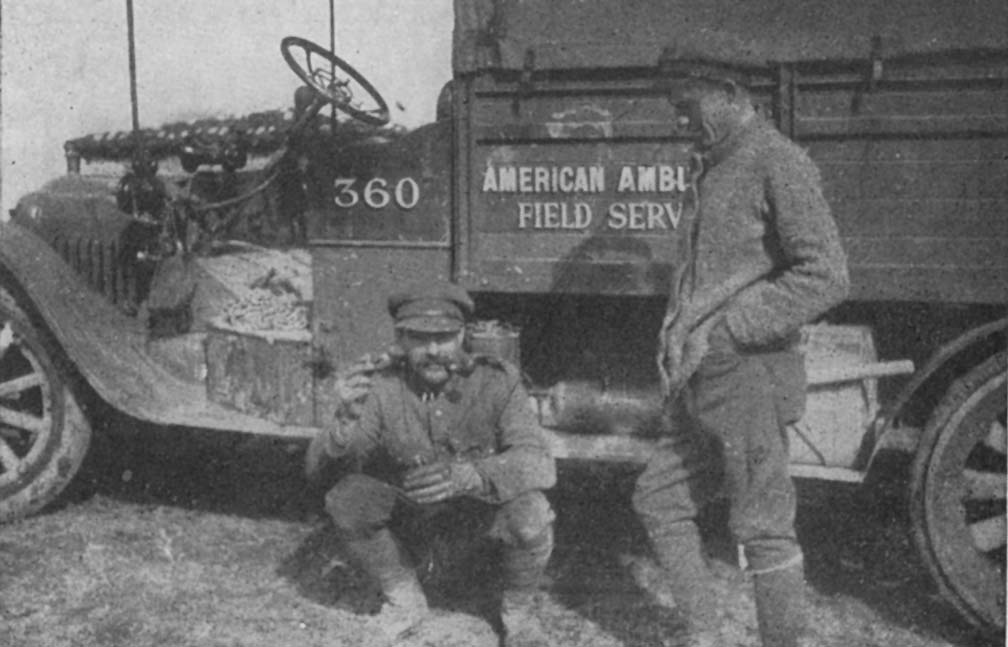
Towards four in the afternoon we were challenged by the outpost and, presenting our papers, were permitted to pass. A half mile beyond we again answered the "Qui vive" and then entered Coritza. An elephant pulling a baby-carriage up Fifth Avenue, would excite no greater wonder in New York than did our car rolling through the streets of Coritza. When we drew up in front of the état major, it became necessary to throw a cordon of. troops about the machine to hold back the wondering, clamoring populace. Reporting to the officer in command, we were assigned quarters and the car was placed within the courtyard.
 |
 |
Coritza in many ways is a unique city. It is situated about midway between the Adriatic and the Macedonian border, about one hundred and eighty kilometers from deep water and one hundred and fifty from a railroad. Normally it is reached by three caravan routes, the one from Florina over which we had just come, the trail from Monastir, and the road up from the Adriatic. These two latter were now closed, the Monastir trail by the Bulgar line, the other by the Comitaje. The houses, for the most part, are solid structures of gray stone, and some sections remind one strongly of a Scotch town. The streets are well surfaced and there are sidewalks made of stone slabs. The most prominent edifice in the city is a two-buttressed Greek church. The Turk, though long nominally exercising suzerainty over Albania, never succeeded in really conquering the country or in impressing his religion upon the people. There are but two mosques in the place and the atmosphere and aspect are much more occidental than oriental. From a place, formed by the junction of two broad avenues, radiate smaller streets, and on these are found the bazaars. Here are workers in silver and leather and copper; also iron-workers who seem constantly engaged in producing hand-wrought nails, and several artisans whose sole product is the long-bladed Albanian dirk. Besides the bazaars, there are a number of modern stores---hardware, grocery and two pharmacies, all well, stocked. Everywhere is exposed for sale maize bread in cakes, slabs, squares and hunks.
Through the streets wandered an extraordinary, diverse crowd, displaying a strange admixture of costumes. There were a few veiled women, a few robed Turks, a few men clad in the European fashion of a decade ago, but the great majority of the people were in the native Albanian dress, the women in long, blue homespun coats, with red braid trimming, and multicolored aprons, their heads bound in blue cloths which were tied under the chin. Upon their legs they wore homespun stockings, dyed red or blue. The men, frequently bearded, wore red or white fezes without tassels and white short-waisted skirt coats, from the shoulders of which hung two embroidered wing-like appendages. Their baggy pantaloons were thrust into high white stockings. Upon their feet they wore, as did the women, curious red shoes which turned sharply up at the toes and were adorned with large black pompoms. About their middle was a broad leather girdle into which were thrust poiniards. Some of these knives are really finely made with elaborate silver handles. Their owners set great store by them, and it is with difficulty that they can be induced to part with them. For an outer garment the Albanian wears a rough woolen cape with hood attachment which hangs from his shoulders to mid-leg. For ornaments, the more wealthy wear silver chains draped across the chest. The girls wear long loose bloomers, drawn in at the ankle. Both sexes of all ages smoke cigarettes. Big, lean, wolf-like dogs follow their masters around and fight each other with great fervency. Also there are burros, millions of them.
We were much surprised that many of the people ---more especially the storekeepers---had been to America and spoke English. When they learned we were Americans, they were delighted. The news quickly spread, and as we walked through the streets, the people crowded around us, shaking hands and inviting us to take tea. One storekeeper had been the proprietor of a dairy lunch in Washington at which I remembered I had eaten. Another had a brother who was a waiter in Washington's largest hotel. The barber had for five years worked in New Haven and had, perhaps, cut my hair when I was at Yale. It seemed queer enough to find these people in this remote mountain town.
After a few days Vive and I decided to move our quarters from the hospital to the inn which stood at a point formed by the junction of the two principal streets. Here we secured a commodious room, furnished with a charcoal brazier, a couple of chairs and two almost-beds. Upon the latter we spread our fleabags, a case of otium cum dignitate. The inn was kept ---or perhaps in the interest of accuracy I should say has existence---under the proprietorship of "Spiro." Spiro was his first name, his family name partaking of a complexity too intricate to dwell in the memory of one not imbued from birth with Albanian tribal genealogy. He was a man of sorrows, a victim of what economists call "The ratio of exchange." In the café which occupied the ground floor of the inn, Spiro dispensed weird drinks to those whom war had rendered fearless of death. And the price of these drinks was such that five sous bought one. Now the exchange on French paper in Albania at this time was twelve sous on a five franc bill. But those that did patronize the tavern paid for their refreshment in notes of the denomination of five francs, demanding in return therefrom sous to the amount of ninety-five in change. Howbeit, it came to pass that Spiro did lose seven sous on every drink he did sell, besides the value of the drink. This situation, he confided to me, "makes me craz."
Though we had changed our quarters, we still messed with the sous officiers at the ambulance. With characteristic French courtesy, they insisted on giving us the best of everything and welcomed us as one of themselves. We shortly grew to know their individual characteristics and to feel entirely at home with them. We ate in a stone room, which had evidently been the kitchen of a considerable establishment. The table was waited on by the cook who, in the democratic way of the French army, took part in whatever discussion happened to be going forward. He was as comical a chap as ever I have seen, short in stature, with sparkling black eyes and a voice like the rumble of an artillery wheel. His nose was so large the burden of carrying it around seemed to have bowed his legs, which were quaintly curved. His béret he wore at an astonishing angle curved down from a hump in the middle so that the headgear more nearly resembled a poultice. From somewhere he had secured a bright red waistcoat, the better which to display, he always appeared sans tunic.
Petit déjeuner we ate down in the town. Our breakfast consisted of boiled eggs, corn bread and Turkish coffee, and the amount of labor necessary to assemble this repast was about the same as required in getting up a thousand-plate banquet n New York. The mere buying of the eggs was in itself no small task, since the vendors refused to accept paper money, having, I suppose, seen too many paper governments rise and fall; and silver was very scarce, since it was horded and retired from circulation. The eggs once obtained, there remained the matter of their cooking. The science of boiling eggs seems never to have been understood or else is one of the lost arts in Albania, and we were forced to expound anew each morning this mystery to the pirate who presided over what the Coritzians ingenuously regard as a restaurant. Each morning we appeared with our hard-won eggs, Exhibit A, and made known that it would be pleasing to us could we have said eggs boiled and chaperoned by two cups of Turkish coffee, into which we proposed to stir some condensed milk, Exhibit B. The board of governors having considered this proposition, after some minutes usually reached the conclusion that this thing might be done. A la carte orders, banquets and such extraordinary culinary rites as egg boiling were conducted in the cellar of the place, and thither our eggs would be conducted, it being necessary, owing to the absence of inside communication, for the proprietor to go outdoors, trudge around the corner and descend by an outside stairway. Through a crack in the floor, we could presently see our eggs in the process of cooking. At three minutes, having called time, they would be taken off, carried out into the street, around the corner, through a wondering throng at the door, and presently, if our luck held, we were actually confronted with a half dozen boiled eggs, a rare sight in Albania, judging from the interest their eating invoked. Such is breakfast in the Balkans.
Powers has described Albania as "a burlesque product of embarrassed diplomacy." The country was in the process of one of its burlesques. But a fortnight before, under the benevolent toleration of the French, it had proclaimed itself a republic and we found it in the travail of birth. Already a flag had been adopted, a paper currency established, self-appointed officials had assumed office, and an army which would have gladdened the eye of General Coxey was in formation. The whole affair was extraordinarily reminiscent of an opera bouffé; and, looking at these people---in many respects the most splendid in the Balkans---one could not but hope that the comedy might continue a comedy and not degenerate into bloody tragedy.
In the center of the town rose an ancient, square-walled tower, erected by the Turks. Now, the French maintained an outlook from this vantage point. The sector of Albania presented a unique situation, unparalleled at this time on any front. There were no trenches, in fact no sharply defined line between the opposing forces. The fighting consisted largely of cavalry skirmishes between the Chasseurs d'Afrique upon our side, mounted Comitaje on the other. These bandits were not regular troops but outlaws accoutered and supported by the Austrian. The difficult nature of the country and the absence of roads had prevented both sides from bringing up artillery, though rapid firers were from time to time brought into action, so that the fighting was of the open kind unknown on other fronts since the first days of the war. This held true of the front to the north and west of Coritza. Further eastward in the border mountains, the Monastir line found its beginning, and here the Zouaves were entrenched.
It was from this region our calls came. The main road from Serbia, now cut off by the line, rose some eight kilometers to the southeast of Coritza and, by a series of loops, zigzagged up from the valley below to a height of five thousand feet, at which altitude it entered into a pass. Midway along this pass a view, exceeded in beauty by nothing in Switzerland, opened out below, where the vividly blue waters of Lake Prespa stretched away from a barren shore to a dazzling snow-clad mountain range. It was as wild and lonesome a scene as nature presents. Undoubtedly ours was the first motor ever to enter this pass, and there, amidst the immensity of a scene which showed no traces of man's dominion, it looked strangely out of place.
There were not many calls, but when one did come in it meant biting work. One afternoon, I remember, we left Coritza in response to a call from a little village nestling up in the foothills to the eastward. Dusk was coming on and a nasty, chill wind, forerunner of the night's cold, was blowing steadily through the pass when we reached the narrow gut which formed the only approach to our objective. Here we shut off the motor and prospected our way. It led along the base of a hill and the mud was such as I have never seen on road or trail. At times, as we plodded, it gripped us so that our lumbermen's boots became imbedded and in an effort to extract them we would topple and then, in kangaroo posture, kick ourselves loose. It was apparent no car could be forced through this morass, and that the wounded would have to be brought out by hand. We found them on some rotting straw in a roofless stone court halfway up the mountain side and fully two kilometers from the nearest point to which the car could approach. There were three of them, all Anamites (Indo-Chinese) and all badly hit. They were the first wounded Anamites I had ever seen, for the yellow men are deemed unreliable and are rarely sent into the line. These men, we were told, had been shot by their own officers when attempting a break after being sent into a charge.
 |
 |
Night had now shut down. It was deemed unsafe to show a light lest it draw the fire of the enemy's patrols. Thus a pitchy darkness added to our task. There were several brancardiers in attendance and we all now set to work to get our men to the car. None of that little group, neither the wounded nor those who bore them, will, I fancy, ever forget that night. For six hours we wallowed through that slough of despond, steaming and struggling till the cold sweat bathed our bodies, and every muscle and tendon cried out in weariness. Not a star helped out a blackness so deep that at one end of a stretcher I could not see my fellow bearer before me. How we made it we shall never know but somehow we came through and stowed the last blessé within the car. A wet, clinging snow had commenced to fall and to beat down into our faces as we drove. Once the car mired and we groaned with apprehension lest we be held till morning but we "rocked" it through. Once the lights---for we had now switched them on---showed us figures ahead in the road. We loosened our arms and stripped off our gloves the better to handle them, but passed I the group without incident.
Sometime after two in the morning we glimpsed the red light which showed the field hospital. We knocked the place up and commenced the unloading of our wounded. They were still alive, as the groans showed. The médecins urged us to stay the night, but the snow was coming down harder than ever, and afraid that morning might find us snowbound, we determined to push on at once. Coritza was something like thirty kilometers away down the valley, but we had no load now, and in spite of the roughness of the way it was less than ninety minutes later when we passed the sentry, drove the car into the compound, and climbed stiffly down.
But all nights were not like this. On the second floor of a building midway down a crooked street in the town was a cosy café, and here, when there were no calls, we spent the evening sipping Turkish coffee and smoking interminable cigarettes. The walls were draped with exotic hangings. On the floor were crudely woven rugs. A small, raised platform occupied one end of the room. Cross-legged upon this sat grave old Turks nodding meditatively over their hookahs. Scattered about were tables where foregathered many men of many tongues. All were armed and sat with their guns across their knees or handily leaning against the walls by their sides.
It was at the café we encountered the Zouave. A fascinatingly interesting chap he was. He had been everywhere, seen queer sights and made strange journeyings. He was a child of adventure. All over the world you meet them, in the dingy cabins of tramp steamers, around balsam camp fires, in obscure cafés of the polyglot ports, beneath tropical palms, in the tea houses of the Far East, in compounds and bomas from Bankok to Bahama. And always their setting seems appropriate, as they tone into it. They are usually just coming from, or are just going to some place beyond. Of some things their knowledge is profound; of others, theirs is the innocence of children. They may be tall or short, old or young but usually they are lean, and about their eyes are tiny wrinkles which have come from much gazing over water or from the searing glare of the tropics. They are apt to be of little speech, but when they talk odd words from queer dialects slip out. They know the food terms in a half dozen languages and the fighting words in as many more. They have met cannibals and counts. They eat anything without complaint or praise. Nothing shocks them; nothing surprises them, but everything interests them. They are without definite plan in the larger scope of life but never without immediate purpose. For a good woman they have respect amounting to reverence. Without doctrinal religion, they live a creed which might shame many a churchman. Living and wandering beyond the land of their nativity, they love her with the true love of the expatriate and should she need them they would come half around the world to serve her. So the Zouave talked to us of Persia and Peru, of violent deaths he had seen, of ballistics and sharks and opium dens and oases, and the while a sentry challenged without in the street "somewhere in Albania."
My orders, when leaving the Squad, had been to proceed to Coritza and remain there until relieved, the C. O. adding that this would probably be in five days. This time passed and twice five days, yet no word or relief came. The weather had been almost continuously bad with rain and snow, so that there seemed a probability that the pass was blocked and the stream swollen beyond the possibility of a crossing. Even the most unusual surroundings may become commonplace through forced association and Vive and I were beginning to tire of Coritza. We took turns in walking about the town; we worked on the machine till nothing remained to be done; we chatted with the soldiers; we read. Our library contained one book, Dombey and Son. As I was about half way through this, we cut the book in two, Vive reading the first part at the same time I was pushing through the latter half.
On the seventh of January the Albanians celebrated their Christmas and on the fourteenth, following the Greek calendar, New Year's. All the stores and bazaars were closed on these days, giving the streets a particularly desolate appearance. Some astounding costumes appeared, those of European descent being the most extraordinary, the fashion of a decade gone by suffering revival. Bands of urchins roved about and upon small provocation broke into what I suppose were Yuletide carols, though it would indeed be a "merry gentleman" who could "rest" when under fire of such vocal shrapnel.
At last one gloomy evening, when January was half over, as we crouched over our charcoal brazier, we heard the hoot of a motor horn and knew that our relief had come. We tumbled out to find the Lieutenant with two of the fellows. It had been found impossible to get another ambulance across the mountains, but the C. O. had managed to pass his light touring car through with the relief drivers. My car was to remain in Albania until conditions in the pass improved in the spring, and Vive and I were to return with the C. O.
With the passing of the days, these plans materialized and soon Vive and I found ourselves referring in the past tense to the time spent in Albania. The return trip from Coritza was in reality the beginning of the end which was attained four months later. Ultimately Monastir, Salonika, the Island of Melos (where we put in to escape a submarine), Taranto, Rome, Paris and New York were cities along the trail which, in May, led to the magic place that men call "home."