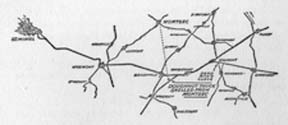
Map
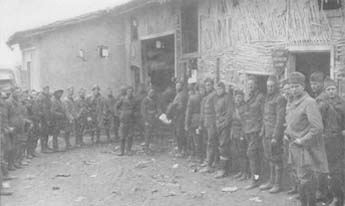
The hut in Raulecourt was an old French barracks. Outside in the yard was an old French anti-aircraft gun and a mesh of barbed wire entanglement. The woods all around was filled with our guns. To the left was the enemy's third line trench. Three-quarters of the time the Boche were trying to clean us up. Less than two miles ahead were our own front line trenches.
The field range was outside in the back yard.
One hot day in July a Salvation Army woman stood at the range frying doughnuts from eleven in the morning until six at night without resting, and scarcely stopping for a bite to eat. She fried seventeen hundred doughnuts, and was away from the stove only twice for a few minutes. She claims, however, that she is not the champion doughnut fryer. The champion fried twenty-three hundred in a day.
One day a soldier watching her tired face as she stood at the range lifting out doughnuts and plopping more uncooked ones into the fat, protested.
"Say, you're awfully tired turning over doughnuts. Let me help you. You go inside and rest a while. I'm sure I can do that."
She was tired and the boy looked eager, so she decided to accept his offer. He was very insistent that she go away and rest, so she slipped in behind a screen to lie down, but peeped out to watch how he was getting on. She saw him turn over the first doughnuts all right and drain them, but he almost burned his fingers trying to eat one before it was fairly out of the fat; and then she understood why he had been so anxious for her to "go away" and rest.
Often the boys would come to the lassies and say: "Say, Cap, I can help you. Loan me an apron." And soon they would be all flour from their chin to their toes.
They would come about four o'clock to find out what time the doughnuts would be ready for serving, and the girls usually said six o'clock so that they would be able to fry enough to supply all the regiment. But the men would start to line up at half-past four, knowing that they could not be served until six, so eager were they for these delicacies. When six o'clock came each man would get three doughnuts and a cup of delicious coffee or chocolate. A great many doughnut cutters were worn out as the days went by and the boys frequently had to get a new cutter made. Sometimes they would take the top of quite a large-sized can or anything tin that they could lay hands on from which to make it. One boy found the top of an extra large sized baking powder tin and took it to have a smaller cutter soldered in the centre. Sometimes they used the top of the shaving soap box for this. When he got back to the hut the cook exclaimed in dismay: "Why, but it's too big!"
"Oh, that's all right," said the doughboy nonchalantly.
"That'll be all the better for us. We'll get more doughnut. You always give us three anyway, you know. The size don't count."
They were always scheming to get more pie and more doughnuts and would stand in line for hours for a second helping. One day the Salvation Army woman grew indignant over a noticeably red-headed boy who had had three helpings and was lining up for a fourth. She stood majestically at the head of the line and pointed straight at him: "You! With the red head down there! Get out of the line!"
"She's got my number all right!" said the red-headed one, grinning sheepishly as he dropped back.
The town of Raulecourt was often shelled, but one morning just before daybreak the enemy started in to shell it in earnest. Word came that the girls had better leave as it was very dangerous to remain, but the girls thought otherwise and refused to leave. One might have thought they considered that they were real soldiers, and the fate of the day depended upon them. And perhaps more depended upon them than they knew. However that was they stayed, having been through such experiences before. For the older woman, however, it was a first experience. She took it calmly enough, going about her business as if she, too, were an old soldier.
On the evening of June 14th they made fudge for the boys who were going to leave that night for the front lines.
For several hours the tables in the hut were filled with men writing letters to loved ones at home, and the women and girls had sheets of paper filled with addresses to which they had promised to write if the boys did not come back.
At last one of the men got up with his finished letter and quietly removed the phonograph and a few of its devotees who were not going up to the front yet, placing them outside at a safe distance from the hut. A soldier followed, carrying an armful of records, and the hut was cleared for the men who were "going in" that night.
For a little while they ate fudge and then they sang hymns for another half hour, and had a prayer. It was a very quiet little meeting. Not much said. Everyone knew how solemn the occasion was. Everyone felt it might be his last among them. It was as if the brooding Christ had made Himself felt in every heart. Each boy felt like crying out for some strong arm to lean upon in this his sore need. Each gave himself with all his heart to the quiet reaching up to God. It was as if the eating of that fudge had been a solemn sacrament in which their souls were brought near to God and to the dear ones they might never see on this earth again. If any one had come to them then and suggested the Philosophy of Nietzsche it would have found little favor. They knew, here, in the face of death, that the Death of Jesus on the Cross was a soul satisfying creed. Those who had accepted Him were suddenly taken within the veil where they saw no longer through a glass darkly, but with a face-to-face sense of His presence. They had dropped away their self assurance with which they had either conquered or ignored everything so far in life, and had become as little children, ready to trust in the Everlasting Father, without whom they had suddenly discovered they could not tread the ways of Death.
Then came the call to march, and with a last prayer the boys filed silently out into the night and fell into line. A few minutes later the steady tramp of their feet could be heard as they went down the street that led to the front.
Later in the night, quite near to morning, there came a terrific shock of artillery fire that heralded a German raid. The fragile army cots rocked like cradles in the hut, dishes rolled and danced on the shelves and tables, and were dashed to fragments on the floor. Shells wailed and screamed overhead; and our guns began, until it seemed that all the sounds of the universe had broken forth. In the midst of it all the gas alarm sounded, the great electric horns screeching wildly above the babel of sound. The women hurried into their gas masks, a bit flustered perhaps, but bearing their excitement quietly and helping each other until all were safely breathing behind their masks.
The next day several times officers came to the hut and begged the women to leave and go to a place of greater safety, but they decided not to go unless they were ordered away. On June 19th one of them wrote in her diary: "Shells are still flying all about us, but our work is here and we must stay. God will protect us." Once when things grew quiet for a little while she went to the edge of the village and watched the shells falling on Boucq, where one of her friends was stationed, and declared: "It looks awfully bad, almost as bad as it sounds."
The next morning as the firing gradually died away, Salvation Army people hurried up to Raulecourt from near-by huts to find out how these brave women were, and rejoiced unspeakably that every one was safe and well.
That night there was another wonderful meeting with the boys who were going to the front, and after it the weary workers slept soundly the whole night through, quietly and undisturbed, the first time for a week.
It was a bright, beautiful Sunday morning, June 23, 1918, when a little party of Salvationists from Raulecourt started down into the trenches. The muddy, dirty, unpleasant trenches! Sometimes with their two feet firmly planted on the duck-board, sometimes in the mud! Such mud! If you got both feet on it at once you were sure you were planted and would soon begin to grow!
As soon as they reached the trenches they were told: "Keep your heads down, ladies, the snipers are all around!" It was an intense moment as they crept into the narrow housings where the men had to spend so much time. But it was wonderful to watch the glad light that came into the men's eyes as they saw the women.
"Here's a real, honest-to-goodness American woman in the trenches!" exclaimed a homesick lad as they came around a turn.
"Yes, your mother couldn't come to-day," said the motherly Salvationist, smiling a greeting, "so I've come in her place."
"All right!" said he, entering into the game. "This is Broadway and that's Forty-second Street. Sit down."
Of course there was nothing to sit down on in the trenches. But he hunted about till he found a chow can and turned it up for a seat, and they had a pleasant talk.
"Just wait," he said. "I'll show you a picture of the dearest little girl a fellow ever married and the darlingest little kid ever a man was father to!" He fumbled in his breast pocket right over his heart and brought out two photographs.
"I'd give my right arm to see them this minute, but for all that," he went on, "I wouldn't leave till we've fought this thing through to Berlin and given them a dose of what they gave little Belgium!"
They went up and down the trenches, pausing at the entrances to dugouts to smile and talk with the men. Once, where a grassy ridge hid the trench from the enemy snipers, they were permitted to peep over, but there was no look of war in the grassy, placid meadow full of flowers that men called "No Man's Land." It seemed hard to believe, that sunny, flower-starred morning, that Sin and Hate had the upper hand and Death was abroad stalking near in the sunlight.
It was a twelve-mile walk through the trenches and back to the hut, and when they returned they found the men were already gathering for the evening meeting.
That night, at the close of a heart-searching talk, eighty-five men arose to their feet in token that they would turn from the ways of sin and accept Christ as their Saviour, and many more raised their hands for prayers. One of the women of this party in her three months in France saw more than five hundred men give themselves to Christ and promise to serve Him the rest of their lives.
A little Adjutant lassie who was stationed at Boucq went away from the town for a few hours on Saturday, and when she returned the next day she found the whole place deserted. A big barrage had been put over in the little, quiet village while she was away and the entire inhabitants had taken refuge in the General's dugout. Her husband, who had brought her back, insisted that she should return to the Zone Headquarters at Ligny-en-Barrios, where he was in charge, and persuaded her to start with him, but when they reached Menil-la-Tour and found that the division Chaplain was returning to Boucq she persuaded her husband that she must return with the Chaplain to her post of duty.
That night she and the other girls slept outside the dugout in little tents to leave more room in the dugout for the French women with their little babies. At half-past three in the morning the Germans started their shelling once more. After two hours, things quieted down somewhat and the girls went to the hut and prepared a large urn of coffee and two big batches of hot biscuits. While they were in the midst of breakfast there was another barrage. All day they were thus moving backward and forward between the hut and the dugout, not knowing when another barrage would arrive. The Germans were continually trying to get the chateau where the General had his headquarters. One shell struck a house where seven boys were quartered, wounding them all and killing one of them. Things got so bad that the Divisional Headquarters had to leave; the General sent his car and transferred the girls with all their things to Trondes. This was back of a hill near Boucq. They arrived at three in the afternoon, put up their stove and began to bake. By five they were serving cake they had baked. The boys said: "What! Cake already?" The soldiers put up the hut and had it finished in six hours.
While all this was going on the Salvation Army friends over at Raulecourt had been watching the shells falling on Boucq, and been much troubled about them.
These were stirring times. No one had leisure to wonder what had become of his brother, for all were working with all their might to the one great end.
Up north of Beaumont two aviators were caught by the enemy's fire and forced to land close to the enemy nests. Instead of surrendering the Americans used the guns on their planes and held off the Germans until darkness fell, when they managed to escape and reach the American lines. This was only one of many individual feats of heroism that helped to turn the tide of battle. The courage and determination, one might say the enthusiasm, of the Americans knew no bounds. It awed and overpowered the enemy by its very eagerness. The Americans were having all they could do to keep up with the enemy. The artillerymen captured great numbers of enemy cannon, ammunition, food and other supplies, which the trucks gathered up and carried far to the front, where they were ready for the doughboys when they arrived. One of the greatest feats of engineering ever accomplished by the American Army was the bridging of the Meuse, in the region of Stenay, under terrible shell fire, using in the work of building the pontoons the Boche boats and materials captured during the fighting at Chateau-Thierry and which had been brought from Germany for the Kaiser's Paris offensive in July. The Meuse had been flooded until it was a mile wide, yet there was more than enough material to bridge it.
As the Americans advanced, village after village was set free which had been robbed and pillaged by the Germans while under their domination. The Yankee trucks as they returned brought the women and children back from out of the range of shell fire, and they were filled with wonder as they heard the strange language on the tongues of their rescuers. They knew it was not the German, but they had many of them never seen an American before. The Germans had told them that Americans were wild and barbarous people. Yet these men gathered the little hungry children into their arms and shared their rations with them. There were three dirty, hungry little children, all under ten years of age, Yvonne, Louisette and Jeane, whose father was a sailor stationed at Marseilles. Yvonne was only four years of age, and she told the soldiers she had never seen her father. They climbed into the big truck and sat looking with wonder at the kindly men who filled their hands with food and asked them many questions. By and by, they comprehended that these big, smiling, cheerful men were going to take the whole family to their father. What wonder, what joy shone in their eager young eyes!
Strange and sad and wonderful sights there were to see as the soldiers went forward.
A pioneer unit was rushed ahead with orders to conduct its own campaign and choose its own front, only so that contact was established with the enemy, and to this unit was attached a certain little group of Salvation Army people. Three lassies, doing their best to keep pace with their own people, reached a battered little town about four o'clock in the morning, after a hard, exciting ride.
The supply train had already put up the tent for them, and they were ordered to unfold their cots and get to sleep as soon as possible. But instead of obeying orders these indomitable girls set to work making doughnuts and before nine o'clock in the morning they had made and were serving two thousand doughnuts, with the accompanying hot chocolate.
The shells were whistling overhead, and the doughboys dropped into nearby shell holes when they heard them coming, but the lassies paid no heed and made doughnuts all the morning, under constant bombardment.
Bouconville was a little village between Raulecourt and the trenches. In it there was left no civilian nor any whole house. Nothing but shot-down houses, dugouts and camouflages, Y.M.C.A., Salvation Army and enlisted men.
Dead Man's Curve was between Mandres and Beaumont. The enemy's eye was always upon it and had its range.
Before the St. Mihiel drive one could go to Bouconville or Raulecourt only at night. As soon as it was dark the supply outfits on the trucks would be lined up awaiting the word from the Military Police to go.
Everyone had to travel a hundred yards apart. Only three men would be allowed to go at once, so dangerous was the trip.
Out of the night would come a voice:
"Halt! Who goes there? Advance and give the countersign."
Every man was regarded as an enemy and spy until he was proven otherwise. And the countersign had to be given mighty quick, too. So the men were warned when they were sent out to be ready with the countersign and not to hesitate, for some had been slow to respond and had been promptly shot. The ride through the night in the dark without lights, without sound, over rough, shell-plowed roads had plenty of excitement.
Bouconville for seven months could never be entered by day. The dugout wall of the hut was filled with sandbags to keep it up. It was at Bouconville, in the Salvation Army hut, that the raids on the enemy were organized, the men were gathered together and instructed, and trench knives given out; and here was where they weeded out any who were afraid they might sneeze or cough and so give warning to the enemy.
Not until after the St. Mihiel drive when Montsec was behind the line instead of in front did they dare enter Bouconville by day.
Passing through Mandres, it was necessary to go to Beaumont, around Dead Man's Curve and then to Rambucourt, and proceed to Bouconville. Here the Salvation Army had an outpost in a partially destroyed residence. The hut consisted of the three ground floor rooms, the canteen being placed in the middle. The sleeping quarters were in a dugout just at the rear of these buildings. It was in the building adjoining this hut that three men were killed one day by an exploding shell, and gas alarms were so frequent in the night that it was very difficult for the Salvation Army people to secure sufficient rest as on the sounding of every gas alarm it was necessary to rise and put on the gas mask and keep it on until the "alerte" was removed. This always occurred several times during the night.
It was just outside of Bouconville that the famous doughnut truck experience occurred. The supply truck, driven by two young Salvation Army men, one a mere boy, was making its rounds of the huts with supplies and in order to reach Raulecourt, the boy who was driving decided to take the shortest road, which, by the way, was under complete observation of the Germans located at Montsec. The truck had already been shelled on its way to Bouconville, several shells landing at the edge of the road within a few feet of it. They had not noticed the first shell, for shells were a somewhat common thing, and the old truck made so much noise that they had not heard it coming, but when the second one fell so close one of the boys said: "Say, they must be shooting at us!" as though that were something unexpected.
They stepped on the accelerator and the truck shot forward madly and tore into the town with shells breaking about it. Having escaped thus far they were ready to take another chance on the short cut to Raulecourt.
They proceeded without mishaps for some distance. Just outside of Bouconville was a large shell hole in the road and in trying to avoid this the wheels of the truck slipped into the ditch, and the driver found he was stuck. It was impossible to get out under his own power. While working with the truck, the Germans began to shell him again. At first the two boys paid little heed to it, but when more began to come they knew it was time to leave. They threw themselves into a communicating trench, which was really no more than a ditch, and wiggled their way up the bank until they were able to drop into the main trenches, where they found safety in a dugout.
The Germans meantime were shelling the truck furiously, the shells dropping all around on either side, but not actually hitting it. This was about two o'clock in the afternoon.
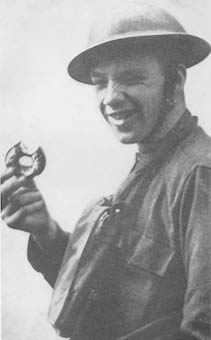 "It was just outside of Bouconville that the famous doughnut truck experience occurred"---and this is the Salvation Army boy who drove it |
 |
At Headquarters they were becoming anxious about the non-appearance of the truck and started out in the touring car to locate it. Commencing at Jouey-les-Côtés they went from there to Boucq and Raulecourt, which were the last places the truck was to visit. Not hearing of it at Raulecourt, the search was continued out to Bouconville, again, by a short road. Montsec was in full view. There were fresh shell holes all along the road since the night before. Things began to look serious.
A short distance ahead was an army truck, and even as they got abreast of it a shell went over it exploding about twenty-five feet away, and one hit the side of the road just behind them. It seemed wise to put on all speed.
But when they reached Bouconville and found that the truck they had passed was the Salvation Army truck, they were unwilling to leave it to the tender mercies of the enemy as everybody advised. That truck cost fifty-five hundred dollars, and they did not want to lose it.
As soon as it was dark a detail of soldiers volunteered to go with the Salvation Army officers to attempt to get it out, but the Germans heard them and started their shelling furiously once more, so that they had to retreat for a time; but later, they returned and worked all night trying to jack it up and get a foundation that would permit of hauling it out. Every little while all night the Germans shelled them. About half-past four in the morning it grew light enough for the enemy to see, and the top was taken off the truck so that it would not be so good a mark.
That day they went back to Headquarters and secured permission for an ammunition truck to come down and give them a tow, as no driver was permitted out on that road without a special permit from Headquarters. The journey back was filled with perils from gas shells, especially around Dead Man's Curve, but they escaped unhurt. That night they attached a tow line to the front of the truck, started the engine quietly, and waited until the assisting truck came along out of the darkness. They then attached their line without stopping the other truck and with the aid of its own power the old doughnut truck was jerked out of the ditch at last and sent on its way. In spite of the many shells for which it had been a target it was uninjured save that it needed a new top. The knowledge that the truck was stuck in the ditch and was being shelled aroused great excitement among all the troops in the Toul Sector and it was thereafter an object of considerable interest. Newspaper correspondents telegraphed reports of it around the world.
In most of the huts and dugouts Salvation Army workers subsist entirely upon Army chow. At Bouconville the chow was frequently supplemented by fresh fish. The dugout here was very close to the trenches, less than five minutes' walk. Just behind the trenches to the left was a small lake. When there was sufficient artillery fire to mask their attack, soldiers would toss a hand grenade into this lake, thus stunning hundreds of fish which would float to the surface, where they were gathered in by the sackful. The Salvation Army dugout was never without its share of the spoils.
Before the soldiers began to think, as they do now, that being detailed to the Salvation Army hut was a privilege, an Army officer sent one of his soldiers, who seemed to be in danger of developing a yellow streak, to sweep the hut and light the fires for the lassies. "You are only fit to wash dishes, and hang on to a woman's skirts," he told the soldier in informing him that he was detailed. That night the village was bombed. The boy, who was really frightened, watched the two girls, being too proud to run for shelter while they were so calm. He trembled and shook while they sat quietly listening to the swish of falling bombs and the crash of anti-aircraft guns. In spite of his fright, he was so ashamed of his fears that he forced himself to stand in the street and watch the progress of the raid. The next day he reported to his Captain that he had vanquished his yellow streak and wanted a chance to demonstrate what he said. The demonstration was ample. The example of these brave lassies had somehow strengthened his spirit.
Back of Raulecourt the woods were full of heavy artillery. Raulecourt was the first town back of the front lines. The men were relieved every eight days and passed through here to other places to rest.
The military authorities sent word to the Salvation Army hut one day that fifty Frenchmen would be going through from the trenches at five o'clock in the morning who would have had no opportunity to get anything to eat.
The Salvation Army people went to work and baked up a lot of biscuits and doughnuts and cakes, and got hot coffee ready. The Red Cross canteen was better situated to serve the men and had more conveniences, so they took the things over there, and the Red Cross supplied hot chocolate, and when the men came they were well served. This is a sample of the spirit of cooperation which prevailed. One Sunday night they were just starting the evening service when word came from the military authorities that there were a hundred men coming through the town who were hungry and ought to be fed. They must be out of the town by nine-thirty as they were going over the top that night. Could the Salvation Army do anything?
The woman officer who was in charge was perplexed. She had nothing cooked ready to eat, the fire was out, her detailed helpers all gone, and she was just beginning a meeting and hated to disappoint the men already gathered, but she told the messenger that if she might have a couple of soldiers to help her she would do what she could. The soldiers were supplied and the fire was started. At ten minutes to nine the meeting was closed and the earnest young preacher went to work making biscuits and chocolate with the help of her two soldier boys. By ten o'clock all the men were fed and gone. That is the way the Salvation Army does things. They never say "I can't." They always can.
In Raulecourt there were several pro-Germans. The authorities allowed them to stay there to save the town. The Salvation Army people were warned that there were spies in the town and that they must on no account give out information. Just before the St. Mihiel drive a special warning was given, all civilians were ordered to leave town, and a Military Police knocked at the door and informed the woman in the hut that she must be careful what she said to anybody with the rank of a second lieutenant, as word had gone out there was a spy dressed in the uniform of an American second lieutenant.
That night at eleven o'clock the young woman was just about to retire when there came a knock at the canteen door. She happened to be alone in the building at the time and when she opened the door and found several strange officers standing outside she was a little frightened. Nor did it dispel her fears to have them begin to ask questions:
"Madam, how many troops are in this town? Where are they? Where can we get any billets?"
To all these questions she replied that she could not tell or did not know and advised them to get in touch with the town Major. The visitors grew impatient. Then three more men knocked at the door, also in uniform, and began to ask questions. When they could get no information one of them exclaimed indignantly:
"Well, I should like to know what kind of a town this is, anyway? I tried to find out something from a Military Police outside and he took me for a spy! Madam, we are from Field Hospital Number 12, and we want to find a place to rest."
Then the frightened young woman became convinced that her visitors were not spies; all the same, they were not going to leave her any the wiser for any information she would give.
Several times men would come to the town and find no place to sleep. On such occasions the Salvation Army hut was turned over to them and they would sleep on the floor.
The St. Mihiel drive came on and the hut was turned over to the hospital. The supplies were taken to a dugout and the canteen kept up there. Then the military authorities insisted that the girls should leave town, but the girls refused to go, begging, "Don't drive us away. We know we shall be needed!" The Staff-Captain came down and took some of the girls away, but left two in the canteen, and others in the hospital.
It rained for two weeks in Roulecourt. The soldiers slept in little dog tents in the woods.
The meetings held the boys at the throne of God each night, they were the power behind the doughnut, and the boys recognized it.
"One hesitated to ask them if they wanted prayers because we knew they did," said one sweet woman back from the front, speaking about the time of the St. Mihiel drive. "We couldn't say how many knelt at the altar because they all knelt. Some of them would walk five miles to attend a meeting."
It poured torrents the night of the drive and nearly drowned out the soldiers in their little tents.
They came into the hut to shake hands and say goodbye to the girls; to leave their little trinklets and ask for prayers; and they had their meeting as always before a drive.
But this was an even more solemn time than usual, for the boys were going up to a point where the French had suffered the fearful loss of thirty thousand men trying to hold Mt. Sec for fifteen minutes. They did not expect to come back. They left sealed packages to be forwarded if they did not return.
One boy came to one of the Salvation Army men Officers and said: "Pray for me. I have given my heart to Jesus."
Another, a Sergeant, who had lived a hard life, came to the Salvation Army Adjutant and said: "When I go back, if I ever go, I'm going to serve the Lord."
After the meeting the girls closed the canteen and on the way to their room they passed a little sort of shed or barn. The door was standing open and a light streaming out, and there on a little straw pallet lay a soldier boy rolled up in his blanket reading his Testament. The girls breathed a prayer for the lad as they passed by and their hearts were lifted up with gladness to think how many of the American boys, fully two-thirds of them, carried their Testaments in the pockets over their hearts; yes, and read them, too, quite openly.
Two young Captains came one night to say good-bye to the girls before going up the line. The girls told them they would be praying for them and the elder of the two, a doctor, said how much he appreciated that, and then told them how he had promised his wife he would read a chapter in his Testament every day, and how he had never failed to keep his promise since he left home.
Then up spoke the other man:
"Well, I got converted one night on the road. The shells were falling pretty thick and I thought I would never reach my destination and I just promised the Lord if He would let me get safely there I would never fail to read a chapter, and I never have failed yet!" This young man seemed to think that--the whole plan of redemption was comprised in reading his Bible, but if he kept his promise the Spirit would guide him.
On the way back to the hut one morning the girls picked marguerites and forget-me-nots and put them in a vase on the table in the hut, making it look like a little oasis in a desert, and no doubt, many a soldier looked long at those blossoms who never thought he cared about flowers before.
Within thirty-six hours after the first gun was fired in the St. Mihiel drive seven Salvation Army huts were established on the territory.
Three days before the drive opened twenty Salvation Army girls reached Raulecourt, which was a little village half a mile from Montsec. They had been travelling for hours and hours and were very weary.
The Salvation Army hut had been turned over to the hospital, so they found another old building.
That night there was a gas alarm sounded and everybody came running out with their gas masks on. The officer who had them in charge was much worried about his lassies because some of them had a great deal of hair, and he was afraid that the heavy coils at the back of their heads would prevent the masks from fitting tightly and let in the deadly gas, but the lassies were level-headed girls, and they came calmly out with their masks on tight and their hair in long braids down their backs, much to the relief of their officer.
It had been raining for days and the men were wet to the skin, and many of them had no way to get dry except to roll up in their blankets and let the heat of their body dry their clothes while they slept. It was a great comfort to have the Salvation Army hut where they could go and get warm and dry once in awhile.
The night of the St. Mihiel drive was the blackest night ever seen. It was so dark that one could positively see nothing a foot ahead of him. The Salvation Army lassies stood in the door of the canteen and listened. All day long the heavy artillery had been going by, and now that night had come there was a sound of feet, tramping, tramping, thousands of feet, through the mud and slush as the soldiers went to the front. In groups they were singing softly as they went by. The first bunch were singing "Mother Machree."
There's a spot in me heart that no colleen may own,
There's a depth in me soul never sounded or known;
There's a place in me memory, me life, that you fill,
No other can take it, no one ever will;
Sure, I love the dear silver that shines in your hair,
And the brow that's all furrowed and wrinkled with care.
I kiss the dear fingers, so toil-worn for me;
O, God bless you and keep you!
Mother Machree!
The simple pathos of the voices, many of them tramping forward to their death, and thinking of mother, brought the tears to the eyes of the girls who had been mothers and sisters, as well as they could, to these boys during the days of their waiting.
Then the song would die slowly away and another group would come by singing: "Tell mother I'll be there!" Always the thought of mother. A little interval and the jolly swing of "Pack up your troubles in your old kit bag and smile, smile, smile!" came floating by, and then sweetly, solemnly, through the chill of the darkness, with a thrill in the words, came another group of voices:
Abide with me; fast falls the eventide,
The darkness deepens; Lord, with me abide!'
There had been rumors that Montsec was mined and that as soon as a foot was set upon it it would blow up.
The girls went and lay down on their cots and tried to sleep, praying in their hearts for the boys who had gone forth to fight. But they could not sleep. It was as though they had all the burden of all the mothers and wives and sisters of those boys upon them, as they lay there, the only women within miles, the only women so close to the lines.
About half-past one a big naval gun went off. It was as though all the noises of the earth were let loose about them. They could lie still no longer. They got up, put on their rain-coats, rubber boots, steel helmets, took their gas masks and went out in the fields where they could see. Soon the barrage was started. Darkness took on a rosy hue from shells bursting. First a shell fell on Montsec. Then one landed in the ammunition dump just back of it and blew it up, making it look like a huge crater of a volcano. It seemed as if the universe were on fire. The noise was terrific. The whole heavens were lit up from end to end. The beauty and the horror of it were indescribable.
At five o'clock they went sadly back to the hut.
The hospital tents had been put up in the dark and now stood ready for the wounded who were expected momentarily. The girls took off their rain-coats and reported for duty. It was expected there would be many wounded. The minutes passed and still no wounded arrived. Day broke and only a few wounded men had been brought in. It was reported that the roads were so bad that the ambulances were slow in getting there. With sad hearts the workers waited, but the hours passed and still only a straggling few arrived, and most of those were merely sick from explosives. There were almost no wounded! Only ninety in all.
Then at last there came one bearing a message. There were no wounded! The Germans had been taken so by surprise, the victory had been so complete at that point, that the boys had simply leaped over all barriers and gone on to pursue the enemy. Quickly packing up seven outfits a little company of workers started after their divisions on trucks over ground that twenty-four hours before had been occupied by the Germans, on roads that were checkered with many shell holes which American road makers were busily filling up and bridging as they passed.
One of the Salvation Army truck drivers asked a negro road mender what he thought of his job. He looked up with a pearly smile and a gleam of his eyes and replied: "Boss, I'se doin' mah best to make de world safe foh Democrats!"
They had to stop frequently to remove the bodies of dead horses from the way so recently had that place been shelled. They passed through grim skeletons of villages shattered and torn by shell fire; between tangles of rusty barbed wire that marked the front line trenches. Then on into territory that had long been held by the Huns. More than half of the villages they passed were partially burned by the retreating enemy. All along the way the pitiful villagers, free at last, came out to greet them with shouts of welcome, calling "Bonnes Americaines! Bonnes Americaines!" Some flung their arms about the Salvation Army lassies in their joy. Some of the villagers had not even known that the Americans were in the war until they saw them.
In the village of Nonsard a little way beyond Mt. Sec they found a building that twenty-four hours before had been a German canteen. Above the entrance was the sign "Kamerad, tritt' ein."
The Salvation Army people stepped in and took possession, finding everything ready for their use. They even found a lard can full of lard and after a chemist had analyzed it to make sure it was not poisoned they fried doughnuts with it. In one wall was a great shell hole, and the village was still under shell fire as they unloaded their truck and got to work. One lassie set the water to heat for hot chocolate, while another requisitioned a soldier to knock the head off a barrel of flour and was soon up to her elbows mixing the dough for doughnuts. Before the first doughnut was out of the hot fat several hundred soldiers were waiting in long, patient, ever-growing lines for free doughnuts and chocolate. These things were always served free after the men had been over the top.
The lassies had had no sleep for thirty-six hours, but they never thought of stopping until everybody was served. In that one day their three tons of supplies entirely gave out.
The Red Cross was there with their rolling kitchen. They had plenty of bread but nothing to put on it. The Salvation Army had no stove on which to cook anything, but they had quantities of jam and potted meats. They turned over ten cases of jam, some of the cases containing as many as four hundred small jars, to the Red Cross, who served it on hot biscuits. Some one put up a sign: "This jam furnished by the Salvation Army!" and the soldiers passed the word along the line: "The finest sandwich in the world, Red Cross and Salvation Army!" The first day two Salvation Army girls served more than ten thousand soldiers in their canteen. They did not even stop to eat. The Red Cross brought them over hot chocolate as they worked.
Evening brought enemy airplanes, but the lassies did not stop for that and soon their own aerial forces drove the enemy back.
That night the girls slept in a dirty German dugout, and they did not dare to clean up the place, or even so much as to move any of the débris of papers and old tin and pasteboard cracker boxes, or cans that were strewn around the place until the engineer experts came to examine things, lest it might be mined and everything be blown up. The girls set up their cots in the clearest place they could find, and went to sleep. One of the women, however, who had just arrived, had lost her cot, and being very weary crawled into a sort of berth dug by the Germans in the wall, where some German had slept. She found out from bitter experience what cooties are like.
The next morning they were hard at work again as early as seven o'clock. Two long lines of soldiers were already patiently waiting to be served. The girls wondered whether they might not have been there all night. This continued all day long.
"We had to keep on a perpetual grin," said one of the lassies, "so that each soldier would think he had a smile all his own. We always gave everything with a smile." Yet they were not smiles of coquetry. One had but to see the beautiful earnest faces of those girls to know that nothing unholy or selfish entered into their service. It was more like the smile that an angel might give.
Here is one of the many popular songs that have been written on the subject which shows how the soldiers felt:
"They say it's in Heaven that all angels dwell,
But I've come to learn they're on earth just as well;
And how would I know that the like could be so,
If I hadn't found one down here below?
A sweet little Angel that went o'er the sea,
With the emblem of God in her hand;
A wonderful Angel who brought there to me
The sweet of a war-furrowed land.
The crown on her head was a ribbon of red,
A symbol of all that's divine;
Though she called each a brother she's more like a mother,
Salvation Lassie of Mine.Perhaps in the future I'll meet her again,
In that world where no one knows sorrow or pain;
And when that time comes and the last word is said,
Then place on my bosom her band of red."
By "Jack" Caddigan and "Chick" Stoy.
That day a shell fell on the dugout where they had slept the night before, and a little later one dropped next door to the canteen; another took seven men from the signal corps right in the street near by, and the girls were ordered out of the village because it was no longer safe for them.
One of the boys had been up on a pole putting up wires for the signal corps. These boys often had to work as now under shell fire in daytime because it was necessary to have telephone connections complete at once. A shell struck him as he worked and he fell in front of the canteen. They had just carried him away to the ambulance when his chum and comrade came running up. A pool of blood lay on the floor in front of the canteen, and he stood and gazed with anguish in his face. Suddenly he stooped and patted the blood tenderly murmuring, "My Buddy! My Buddy!" Then like a flash he was off, up the pole where his comrade had been killed to finish his work. That is the kind of brave boys these girls were serving.
That night they slept in the woods on litters, and the next day they went on farther into the woods, twelve kilometres beyond what had been German front.
Here they found a whole little village of German dugouts in the form of log cabin bungalows in the woods. It was a beautifully laid out little village, each bungalow complete, with running water and electric lights and all conveniences. There were a dance hall, a billiard room, and several pianos in the woods. There were also fine vegetable gardens and rabbit hutches full of rabbits, for the Germans had been obliged to leave too hastily to take anything with them.
The boys were hungry, some of them half starved for something different from the hard fare they could take with them over the top, and they made rabbit stews and cooked the vegetables and had a fine time.
The girls up at the front had no time for making doughnuts, so the girls back of the lines made 8000 doughnuts and sent them up by trucks for distribution. They also distributed oranges to the soldiers.
News came to the girls after they had been for a week in Nonsard that they were to make a long move.
Back to Verdun they went and stopped just long enough to look at the city. They were much impressed with St. Margaret's school for young ladies, and a wonderful old cathedral standing on the hill with a wall surrounding it. Just the face of the building was left, all the rest shot away, and through the concrete walls were holes, with guns bristling from every one.
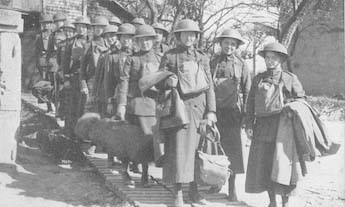 Here they found a whole little village of German dugouts |
They did not linger long for duty called them forward on their journey. At dusk they stopped in a little village, bought some stuff, and asked a French woman to cook it for them. They inquired for a place in which to wash and were given a bar of soap and directed to the village pump up the street. After supper they went on their way to Benoitvaux. Here they found difficulty in getting quarters, but at last an old French woman agreed to let them sleep in her kitchen and for a couple of days they were quartered with her. The word went forth that there were two American girls there and people were most curious to see them. One afternoon two French soldiers came to the kitchen to visit them. It was raining, as usual, and the girls had stayed in because there was really nothing to call them out. The soldiers sat for some time talking. They had heard that America was a wild place with beaucoup Indians who wore scalps in their belts, and they wanted to know if the girls were not afraid. It was a bit difficult conversing, but the girls got out their French dictionary and managed to convey a little idea of the true America to the strangers. At last one of the soldiers in quite a matter of fact tone informed one of the girls that he was pleased with her and loved her very much. This put a hasty close to the conversation, the lassie informing him with much dignity that men did not talk in that way to girls they had just met in America and that she did not like it. Whereupon the girls withdrew to the other end of the kitchen and turned their backs on their callers, busying themselves with some reading, and the crest-fallen gallants presently left.
They only had a canteen here one day when they were called to go on to Neuvilly.
When the offensive was extended to the Argonne the Salvation Army followed along, keeping in touch with the troops so that they felt that the Salvation Army was ever with them, sharing their hardships and dangers, and always ready to serve them.
Just before a drive, close to the front, there are always blockades of trucks going either way.
The Salvation Army truck filled with the workers on their way to Neuvilly one dark night was caught in such a blockade. They crawled along making only about a mile an hour and stopping every few minutes until there was a chance to go on again. At last the wait grew longer and longer, the mud grew deeper, and the truck was having such a hard time that the little company of travellers decided to abandon it to the side of the road till morning and get out and walk to Neuvilly. There was a field hospital there and they felt sure they could be of use; and anyway, it was better than sitting in the truck all night. They were then about eight kilometers from the front. So they all got off and walked. But when they reached the place, found the hospital, and essayed to go in, the mud was so deep that they were stuck and unable to move forward. Some soldiers had to rescue them and carry them to the hospital on litters.
Their help was accepted gladly, and they went to work at once. There were many shell-shocked boys coming in who needed soothing and comforting, and a woman's hand so near the front was gratefully appreciated.
When at last there was a lull in the stream of wounded men the girls went to find a place to sleep for a little while. It was early morning, and sad sights met their eyes as they hurried down what had once been a pleasant village street. Destruction and desolation everywhere. The house that had been selected for a Salvation Army canteen was nearly all gone. One end was comparatively intact, with the floor still remaining, and this was to be for the canteen. The rest of the building was a series of shell holes surrounding a cellar from which the floor had been shot away.
The women reconnoitred and finally decided to unfold their cots and try to get a wink of sleep down in that cellar. It did not take them long to get settled. The cots were brought down and placed quickly among the fallen rafters, stone and tiling. Part of the walls that were standing leaned in at a perilous slant, threatening to fall at the slightest wind, but the lassies took off their shoes, rolled up in their blankets, and were at once oblivious to all about them, for they had been travelling all the day before and had worked hard all night.
One hour later, still early in the morning, they were awakened by the arrival of the truck and the thumping of boxes, tables and supplies as the Salvation Army truck drivers unloaded and set up the paraphernalia of the canteen. The girls opened their eyes and looked about them, and there all around the building were American soldiers, a head in every shell hole, watching them sleep. There was something thrilling in the silent audience looking down with holy eyes--yes, I said holy eyes!--for whatever the American soldier may be in his daily life he had nothing in his eyes but holy reverence for these women of God who were working night and day for him. There was something touching, too, in their attitude, for perhaps each one was thinking of his mother or sister at home as he looked down on these weary girls, rolled up in the brown blankets, with their neat little brown shoes in couples under their cots, nothing visible above the blankets but their pretty rumpled brown hair.
The women did not waste much more time in sleeping. They arose at once and got busy. There were five tables in the canteen above and already from each one there stretched a long line of men waiting silently, patiently for the time to arrive when there would be something good to eat. The girls had no more sleep that day, and there simply was no seclusion to be had anywhere. Everything was shell-riddled.
When night came on the question of beds arose again. The cellar seemed hardly possible, and the military officers considered the question.
Across the road from the most ruined end of the canteen building stood an old church. All of its north wall was gone save a supporting column in the middle, all the north roof gone. There were holes in all the other walls, and all the windows were gone. The floor was covered with débris and wreckage. It had been used all day for an evacuation hospital.
Just over the altar was a wonderful picture of the Christ ascending to heaven. It was still uninjured save for a shot through the heart.
The military officer stood on the steps of this ruined church, and, looking around in perplexity, remarked:
"Well, I guess this is the wholest place in town." Then stepping inside he glanced about and pointed:
"And this is the most secluded spot here!"
The seclusion was a pillar! But the girls were glad to get even that for there was no other place, and they were very weary. So they set up their little cots, and prepared to roll themselves in their blankets for a well-earned rest.
The boys had built a small bonfire on the stone floor against a piece of one wall that was still standing, and now they sent a deputation to know if the girls would bring their guitars over and have a little music. The boys, of course, had no idea that the girls had not slept for more than twenty-four hours, and the girls never told them. They never even cast one wistful glance toward their waiting cots, but smilingly assented, and went and got their instruments.
 |
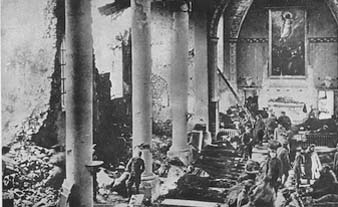 |
Beneath the picture of the Christ, in front of the altar a few men were at work in an improvised office with four candles burning around them. In the rear of the church Lt.-Col. Frederick R. Fitzpatrick of the One Hundred and Tenth Ammunition Train had his office, and there another candle was burning. Some wounded men lay on stretchers in the shadowed northwest corner, and around the little fire the five Salvation Army lassies sat among two hundred soldiers. They sang at first the popular songs that everybody knew: "The Long, Long Trail," "Keep the Home Fires Burning," "Pack Up Your Troubles in Your Old Kit Bag and Smile! Smile! Smile!" and "Keep Your Head Down, Fritzie Boy!"
By and by some one called for a hymn, and then other hymns followed: "Jesus Lover of My Soul," "When the Roll Is Called Up Yonder," and, as always, the old favorite, "Tell Mother I'll Be There!"
They sang for at least an hour and a half, and then they did not want to stop. Oh, but it was a great sound that rolled through the old broken walls of the church and floated out into the night! One of the lassies said she would not change crowds with the biggest choir in New York.
Then they asked the girls to sing and the room was very still as two sweet voices thrilled out in a tender melody, speaking every word distinctly:
Beautiful Jesus, Bright Star of earth!
Loving and tender from moment of birth,
Beautiful Jesus, though lowly Thy lot,
Born in a manger, so rude was Thy cot!Beautiful Jesus, gentle and mild,
Light for the sinner in ways dark and wild,
Beautiful Jesus, O save such just now,
As at Thy feet they in penitence bow!Beautiful Christ! Beautiful Christ!
Fairest of thousands and Pearl of great price!
Beautiful Christ! Beautiful Christ!
Gladly we welcome Thee, Beautiful Christ!
Before they had finished many eyes had turned instinctively toward the picture in the weirdly flickering light.
Then the young Captain-lassie asked her sister to read the Ninety-first Psalm, "He that dwelleth in the secret place of the Most High shall abide under the shadow of the Almighty," and she told them that was a promise for those who trusted in God, and she wished they would think about it while they were going to sleep.
"This evening has made me think so much of home," she said thoughtfully, drooping her lashes and then raising them with a sweeping glance that included the whole group, while the firelight flickered up and lit her lovely serious face, and touched her hair with lights of gold, "I suppose it has made every one else feel that way," she went on; "I mean especially the evenings at home when the family gathered in the parlor, with one at the piano and brothers with their horns, and the rest with some kind of instrument, and we had a good 'sing;' and afterward father took the Bible and read the evening chapter, and then we had family prayers and kissed Mamma and Papa good night and went to bed. I shouldn't wonder if many of you used to have homes like that?"
The lassie raised her eyes again and looked on them. Many of the men nodded. It was beautiful to see the look that came into their faces at these recollections.
"And you used to have family prayers, too, didn't you?" she asked eagerly.
They nodded once more but some of them turned their faces away from the light quickly and brushed the back of their hands across their eyes.
"To-night has been a family gathering," she went on, "We girls are little sisters to all you big brothers, and we have had a delightful time with just the family, and the evening chapter has been read, and now I think it would not be complete if we did not have the family prayers before we separate and go to sleep."
Down went the heads in response, with reverent mien, and the place was very still while the lassie prayed. Afterward the boys joined their gruff voices, husky now with emotion, into the universal prayer with which she closed: "Our Father which are in heaven----"
They were all sorts and conditions of men gathered around the little fire in that old shell-torn church in Neuvilly that night. To quote from a letter written by a military officer, Lt-Col. Frederick R. Fitzpatrick, to his wife:
"There was the lad who was willing but not strong enough for field work, who was in the rear with the office; the walking wounded who had stopped for something to eat; the big, strong mule skinner who could throw a mule down or lift a case of ammunition, who was rough in appearance and speech and who would deny that the moisture in his eye was anything but the effects of the cold. There were the men who had been facing death a thousand times an hour for the last three days, who had not had a wash or a chance to take off their shoes and had been lying in mud in shell holes --men who looked as though they were chilled through and through; men on their way to the front, well knowing all the hardships and dangers which were ahead of them, but who were worried only about the delay in the traffic; doctors who had been working for three days without rest; men off ammunition and ration trucks, who had been at the wheel so long that they had forgotten whether it was three or four days and nights; wounded on their stretchers enjoying a smoke. And as I stepped in the door there were the feminine voices singing the good old tunes we all know so well, and not a sound in the church but as an accompaniment the distant booming of big guns, the rattle of small arms, the whirl of air craft, the passing of the ever-present column of trucks with rations and ammunition going up, and the wounded coming back; the shouted directions of the traffic police, the sound of the ammunition dump just outside the door and the rattle of the kitchens which surround the church, and which are working twenty-four hours a day.
There was the crowd of men, each uncovered, giving absolute undivided attention to the good, brave girls who were not making a meeting of it; it was just a meeting which grew--men who in their minds were back with mother and sister. The girls sang the good old songs, and then one of them offered a short prayer, in which all the men joined in spirit, and as I tip-toed out of the church it seemed to me that the four candles at the altar did not give all the light that was shown on the picture of Christ our Saviour. Every man in the building that night was in the very presence of God. It was not a religious meeting; it was a meeting full of religion. And it was a picture that will ever stand fresh in my memory and which will be an inspiration in time of doubt. There was nothing there but the real things, absolutely no sham of any kind. Oh, it was wonderful! I hope you can get just a little idea of what it was. I wish you would keep this letter. I want to be able to read it in future years."
In what remained of another village not far distant from Neuvilly, the lassies had a tent erected. The rain was endless--a driving drizzle which quickly soaked through everything but the staunchest raincoats in a very few moments. The ground was so thickly covered by shell craters that they could find no clear space wide enough for the tent. It so happened that almost in the centre of the tent there was a big shell crater. In this the girls lighted a fire. All through the night, and through nights to follow, wounded men limping back through the rain and mud to the dressing stations came in to warm themselves around the fire in the shell hole, and to drink of the coffee prepared by the girls. As they sat around the blazing wood, the fire cast strange shadows on the bleached brown canvas of the tent. In spite of their wounds, they were very cheerful, singing as lightly as though they were safe at home.
Everybody had worked hard at Neuvilly, but they felt they must get to their own outfit as soon as possible at the Field Hospital up in Cheppy where the wounded were coming in droves and the boys were pouring in from the front half-starved, having been fighting all night with nothing to eat except reserve rations. Some had been longer with only such rations as they took from their dead comrades. The need was most urgent, but the puzzle was how to get there. The roads had been shelled and ploughed by explosives until there was no possible semblance of a way, and there were no conveyances to be had. The Zone Major had gone back for supplies, telling the girls to get the first conveyance possible going up the road. That was enough for the girls. "We've got to get there" they said, and when they said that one knew they would. They searched diligently and at last found a way. One girl rode on a reel cart, one on a mule team and one went with an old wagon. They went over roads that had to be made ahead of them by the engineers, and late in the night, bruised and sore from head to foot, they arrived at their destination.
The next morning they reported at the hospital for work and the Major in charge said: "I never was so glad to see anybody in my life!"
They went straight to work and served coffee and sandwiches to the poor half-starved men. The Red Cross men were there, also, with sandwiches, hot chocolate and candy.
The wounded men continued to pour in, later to be evacuated to the base hospital; they kept coming and coming, a thousand men where two hundred had been expected. There was plenty to be done. The girls were put in charge of different wards. They were under shell fire continually, but they were too busy to think of that as they hurried about ministering to the brave soldiers, who gave never a groan from their white lips no matter what they suffered.
The girls worked about eighteen hours a day, and slept from about one or two at night to five or six in the morning. The hospital was in front of the artillery and every shell that went over to Germany passed over their heads. When they had been there five days under continual shell fire from the enemy the General gave orders that they must leave, that it was no fit place for women so near to the front.
When the Salvation Army Zone Major brought this order to the girls rebellion shone in their eyes and they declared they would not leave! They knew they were needed there, and there they would stay! The Zone Major surveyed them with intense satisfaction. He turned on his heel and went back to the General:
"General," he said, with a twinkle, "my girls say they won't go."
The General's face softened, and the twinkle flashed across to his eyes, with something like a tear behind its fire. Somehow he didn't look like a Commanding Officer who had just been defied. A wonderful light broke over his face and he said:
"Well, if the Salvation Army wants to stay let them stay!" And so they stayed.
It was in a German-dug cave that they had their headquarters, cut out of the side of a hill and opening into the hospital yard. It was a work of art, that cave. There was a passage-way a hundred feet long with avenues each side and places for cots, room enough to accommodate a hundred men.
The German airplanes came in droves. When the bugle sounded every one must get under cover. There must be nobody in sight for the Germans were out to get individuals, and even one person was not too insignificant for them to waste their ammunition upon. They had a mistaken idea, perhaps, that this sort of thing destroyed our morale. The tents, of course, were no protection against shells and bombs, and presently the Boche began to shell the town in good earnest, especially at night. Gas alarms, also, would sound out in the middle of the night and everybody would have to rush out and put on their gas masks. They would not last long at a time, of course, but it broke up any rest that might have been had, and it was only too evident that the enemy was trying to get the range on the hospital.
One morning, standing by the window making cocoa for the boys, one of the lassies saw an eight-inch shell land between the hospital tents, ten feet in front of the window, and only five feet from the door of the place where the severely wounded were lying. These shells always kill at two hundred feet. All that saved them was that the shell buried itself deep in the soft earth and was a dud.
The shells were coming every twenty minutes and there was no time to lose for now the enemy had their range. At once all hands got busy and began to evacuate the wounded men into the Salvation Army cave. The cave would accommodate seventy men, but they managed to get a hundred men inside, most of them on litters. They were all safe and the girls heard the whistle of the next shell and made haste toward safety themselves. But someone had carelessly dropped a whole outfit of blankets and things across the passageway of the dugout and the first woman to enter fell across it, shutting out the other two. Before anything could be done the next shell struck the doorway, partly burying the fallen young woman. Inside the dugout rocks came down on some of the men on litters, and anxious hands extricated the lassie from the débris that had fallen upon her, and lifted her tenderly. She was pretty badly bruised and lamed, besides being wounded on her leg, but the brave young woman would not claim her wound, nor let it become known to the military authorities lest they would forbid the girls to stay at the front any longer. So for three weeks she patiently limped about and worked with the rest, quietly bearing her pain, and would not go to the hospital. One lassie outside was struck on the helmet by a piece of falling rock. If she had not had on her helmet she would have been killed.
The shelling continued for six hours.
The hospital was all the time filled with wounded men and there was plenty to be done twenty-four hours out of every day. The women moved about among the men as if they were their own brothers.
A poor shell-shocked boy lay on his cot talking wildly in delirium, living over the battle again, charging his men, ordering them to advance.
"Company H. Advance! See that hill over there? It's full of Germans, but we've got to take it!"
Then he turned over and began to sob and cry, "Oh God! Oh God!"
A lassie went to him and soothed him, talking to him gently about home, asking him questions about his mother, until he grew calm and began to answer her, and rested back quite rationally. The stretcher-bearers came to take him to another hospital, and he started up, put out his hand and cried: "Oh, nurse! I've got to get back to my men! I'm the only one left!"
Thus the heart-breaking scenes were multiplied.
One boy came back to the hospital in the Argonne badly wounded. He called the lassie to him one day as she passed through the ward, and motioned her to lean down so he could talk to her. He said he knew he was hard hit and he wanted to tell her something.
"I was wounded, lying on the ground over there in No Man's Land," he went on. "It was all dark and I was waiting for someone to come along and help me. I thought it was all up with me and while I was lying there I felt something. I can't explain it, but I knew it was there and I saw my mother and I prayed. Then my Buddy came along and I asked him if he could baptize me. He said he wasn't very good himself but he guessed the heavenly Father would understand. So he stooped down and got some muddy water out of a shell hole close by and put it on my forehead, and prayed; and now I know it's all right. I wanted you to know."
Often the boys, just before they went over the top, would come to these girls and say:
"We're going up there, now. You pray for us, won't you?"
One day some boys came to the hut when there were not many about and asked the girls if they might talk with them. These boys were going over the top that night.
"We fellows want to ask you something," they said. "Some of the chaplains have been telling us that if we go over there and die for liberty that it'll be all right with us afterward. But we don't believe that dope and we want to know the truth. Do you mean to tell me that if a man has lived like the devil he's going to be saved just because he got killed fighting? Why, some of us fellows didn't even go of our own accord. We were drafted. And do you mean to tell me that counts just the same? We want to know the truth!"
And then the girls had their opportunity to point the way to Jesus and speak of repentance, salvation from sin, and faith in the Saviour of the world.
A lassie was stooping over one young boy lying on a cot, washing his face and trying to make him more comfortable, and she noticed a hole in his breast pocket. Stooping closer she examined it and found it was a piece of high explosive shell that had gone through the cloth of his pocket and was embedded in his Testament, which he, like many of the boys, always kept in his breast pocket.
Another boy lay on a cot biting his lips to bear the agony of pain, and she asked him what was the matter, was the wound in his leg so bad? He nodded without opening his eyes. She went to ask the doctor if the boy couldn't have some morphine to dull the pain. The Sergeant in charge came over and looked at him, examined the bandage on the boy's leg and then exclaimed: "Who bandaged this leg?"
"I did" said the boy weakly, "I did the best I could."
The poor fellow had bandaged his own leg and then walked to the hospital. The bandage had looked all right and no one had examined it until then, but the Sergeant found that it was so tight that it had stopped the circulation. He took off the bandage and made him comfortable, and the agony left him. In a little while the Salvation Army lassie passed that way again and found the boy with a little book open, reading.
"What is it?" she asked, looking at the book.
"My Testament," he answered with a smile.
"Are you a Christian?"
"Oh, yes," he said with another smile that meant volumes.
It grew dark in the tent for they dared not have lights on account of the enemy always watching, but stooping near a little later she could see that his lips were murmuring in prayer. There was an angelic smile on his white, dead face in the morning when they came to take him away.
There was a funeral every day in that place. A hundred boys were buried that week. Always the girls sang at the graves, and prayed. There would be just the grave digger, a few people, and some of the boys. Off to one side the Germans were buried. When the simple services over our own dead were complete one of the girls would say: "Now, friends, let us go and say a prayer beside our enemy's graves. They are some mother's boys, and some woman is waiting for them to come home!"
And then the prayers would be said once more, and another song sung.
Those were solemn, sorrowful times, death and destruction on every side. The fighting was everywhere. United States anti-aircraft guns firing at German planes; Germans firing at us; air fights in the sky above.
And in the midst of it all the boys had meetings every night on log piles out in the open. These meetings would begin with popular songs, but the boys would soon ask for the hymns and the meetings would work themselves out without any apparent leading up to it. The boys wanted it. They wanted to hear about religious things. They hungered for it. So they were held at the throne of God each night by the wonderful men and girls who had learned to know human hearts, and had attained such skill in leading them to the Christ for whom they lived.
It was not alone the doughnut that bound the hearts of the boys to the Salvation Army in France, it was what was behind the doughnut; and here, in these wonderful God-led meetings they found the secret of it all. Many of them came and told the girls they did not believe in the so-called "trench religion" and wanted to know the truth from them. And those girls told them the way of eternal life in a simple, beautiful way, not mincing matters, nor ignoring their sins and unworthiness, but pointing the way to the Christ who died to save them from sin, and who even now was waiting in silent Presence to offer them Himself. Great numbers of the men accepted Christ, and pledged themselves to live or die for Him whatever came to them.
How close the Salvation Army people had grown to the hearts and lives of the men was shown by the fact that when they came back from the fight they would always come to them as if they had come to report at home:
"We've escaped!" they would say. "We don't know how it is, but we think it's because you girls were praying for us, and the folks at home were praying, too!"
There were three cardinal principles which were deemed necessary to success in this work. The first and most important depended upon winning the confidence of the boys. This was a prime requisite in any work with the boys, especially by a religious organization.
The first quality looked for in a person professing religion is always consistency. It was felt that if the boys saw that the Salvation Army was consistent, that it stood only for those things in France which it was known to stand for in the United States, that the first step would be established in winning the confidence of the boy. It was therefore determined that the Salvation Army would not, under any circumstances, compromise, and that it should stand out in its religious work and adhere to its teachings as firmly and as vigorously as it was known to do at home.
A stand upon the tobacco question was, therefore, highly important. Other organizations were encouraging the use of tobacco but those who had come in contact with the Salvation Army at home knew that it had always discouraged its use, and although the officers had to go against the judgment of many high military authorities who thought they should handle it, they decided that the Salvation Army would not handle tobacco and that no one wearing its uniform should use it. The consistency of the Salvation Army and the careful conduct of its workers won the esteem of the boys.
The second requisite was that the Salvation Army should be willing to share their hardships. To accomplish this, it was made a rule that Salvation Army workers should not mess with the officers but should draw their rations at the soldiers' mess, also that they should not associate with the officers more than was absolutely necessary and that in the huts. It was neither possible nor desirable that officers should be kept out of the huts, but as far as possible soldiers were made to feel that the Salvation Army was in France to serve them and not for its own pleasure or convenience.
The third requisite was that the Salvation Army should be willing to share their dangers and this was proved to them when they went to the trenches--the Salvation Army moved to the trenches with them and established huts and outposts as close to the front line as was permitted.
After the Armistice was signed, on November 11th, it was a great question what disposition would be made of the troops. It was concluded that they would be sent home as rapidly as possible and that the three ports--Brest, St. Nazaire and Bordeaux--would be used for that purpose. Immediately arrangements were made for the opening of Salvation Army work at the base ports with a view to letting the boys have a last sight of the Salvation Army as they left the shores of France. The Salvation Army had served them in the training area and at the front and were still serving them as they left the shores of the old world and it would meet them again when they arrived on the shores of the home-land. In this way the contact of the Salvation Army would be continuous, so that when they returned, it would be able to reach their hearts and affect their lives with the Gospel of Christ.
The problem of buildings was, of course, the first one and a very difficult one. To secure buildings of adequate size, which could be constructed in a short space of time, was almost out of the question, but it occurred to the officers that the aviation section would be demobilizing and that they had brought over portable steel buildings, for use as hangars. The matter was taken up at once with the military authorities and twenty of these steel buildings were secured--each of them sixty-six feet wide by one hundred feet long. It was planned to place eight of them at Bordeaux, six at St. Nazaire and six at Brest. By placing two of them end to end it was possible to secure one auditorium sixty-six feet wide by two hundred feet long--capable of seating three thousand men. Adjoining that could be another building sixty-six feet by one hundred feet, to be used for canteen and rest room.
It was planned to proceed with a religious campaign at these Base Ports, holding Salvation meetings in these extensive departments.
When the Army of Occupation was started for Germany, two Salvation Army trucks were assigned to go along with the Army. Whenever the Army of Occupation stopped for a space of two or three days, places were secured where doughnuts could be fried, pies made, and at all times hot coffee and chocolate were available for the men.
When the American soldiers marched through the villages of Alsace-Lorraine the Salvationists marched with them. At Esch and Luxemburg they were in all the rejoicing and triumph of the parade, bringing succor and comfort wherever they could find an opportunity.
When the men arrived at Coblenz the Salvation Army was there before them, and on their crossing the Rhine, arrangements had been made for the location of the Salvation Army work at the principal points in the Rhine-head. They are now conducting Salvation Army operations with the Army of Occupation.
One of the occasions when President Wilson clapped for the Salvation Army was at the inauguration of the Soldiers' Association in Paris. The Y had invited all the other organizations to be present. The meeting was held in the Palais de Glace, which seats about ten thousand people.
President and Mrs. Wilson were present, accompanied by many prominent American officials. Representatives of the various War Work Organizations spoke.
The Salvationist who had been selected to represent the Army at this meeting had been in the United States Navy for twelve years and was a chaplain.
When he was called upon to speak the boys with one accord as if by preconcerted action arose to their feet and gave him an ovation. Of course, it was not given to the man but to the uniform.
A soldier of the Rainbow Division sitting next to one of the Salvation Army workers over there, kept telling him what the boys thought of the Salvation Army, and when the cheering began he poked the Salvationist in the ribs and whispered joyously:
"I told you! I told you! We've just been waiting for eight months to pull this off! Now, you see!"
The speaker when given opportunity did not attempt to make a great speech. He told in simple, vivid sentences of the services of the Salvation Army just back of the trenches under fire; and President Wilson sat listening and applauding with the rest.
The chaplain paid a tribute to President Wilson, finishing with these words:
"President Wilson was not man-elected, but God-selected!"
For some little time after the War started it was a question as to whether the Salvation Army was entitled to any representation in the realm of Chaplaincies of the United States forces. During the progress of the consideration Adjutant Harry Kline secured an appointment with the Nebraska National Guard, and his regiment being made a part of the National Army, he was received as an officer of the same and thus became our first Army Chaplain.
The War Office decided favorably with regard to the question of our general representation, and shortly thereafter Adjutant John Allan, of Bowery fame, was given a first lieutenancy and then followed, in the order given, Captain Ernest Holz, Adjutant Ryan and Captain Norman Marshall.
The exceptional service that these men have rendered is of sufficient importance to have a much wider notice than where only the barest of reference is possible. Shortly after arrival in France Chaplain Allan was being very favorably noticed because of the character of the work which he was doing, and it was gratifying to learn that this confidence was reflected in his appointment as Senior Chaplain of his regiment and his assignment to special service where probity and wisdom were essential. Shortly thereafter he was taken to the Army Headquarters, where up to the present time he is most highly esteemed as a co-laborer with Bishop Brent, the Chaplain-General of the overseas forces.
Typical of the enthusiasm of each of the five men appointed as Chaplains, the following story is told of First Lieutenant Ernest Holz, who was inducted into his office as Senior Chaplain of his regiment right at the commencement of his career.
At the beginning of the year, when Chaplain Holz knew his Salvation Army comrades would, as usual, be engaged in special revival work, he thought it would be a worthy thing to time a similar effort among the men of his regiment. Approaching the Colonel, he found him in hearty agreement concerning the effort, and so securing the assistance of his fellow chaplains they arranged for a series of meetings nightly for one week, with the result that two hundred of the men of the regiment confessed Christ and practically all of them were deeply interested.
The effort was wholly directed to the uplift of the men and God commanded His blessing in a most gratifying manner.